Trading Places
PG.12 Questions around voluntary apprenticeships
Hydrogen Hopes PG. 42
Canadian Mail Sales Product Agreement #40063170. Return postage guaranteed. Newcom Media Inc., 5353 Dundas Street West, Suite 400, Toronto, Ontario M9B 6H8.
The Business Business Magazine Magazine
Nikola rolls ahead with future fuel
Canada’s Canada’ss Trucking Industry
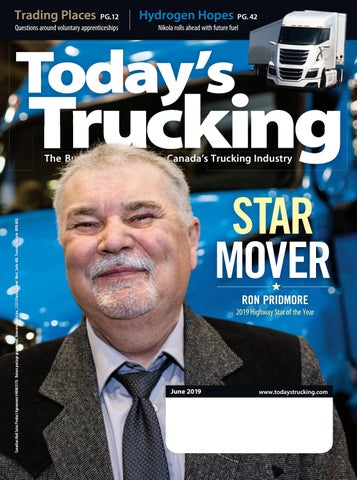
STAR MOVER
RON PRIDMORE
2019 Highway Star of the Year
June 2019
www.todaystrucking.com
CHECKS EVERY BOX
Competitive financing available through Daimler Truck Financial. For the Freightliner Trucks dealer nearest you, call 1-800-FTL-HELP. FTL/MC-A-1541. Specifications are subject to change without notice. Copyright © 2018 Daimler Trucks North America LLC. All rights reserved. Freightliner Trucks is a division of Daimler Trucks North America LLC, a Daimler company.
AND THEN SOME. Fuel Efficiency Integrated Detroit™ Powertrain • Detroit engines • DT12™ Automated Manual Transmission (AMT) • Detroit drive axles Aero packages
Uptime SM
Elite Support service network Designed for ease of maintenance Exhaustive durability testing eVault interior electrical fuse and relay box
Safety Detroit Assurance® suite of safety systems LED headlights Standard air disc brakes
Driver Experience Driver’s lounge Freightliner’s quietest cab Outstanding ride quality
Connectivity Detroit™ Connect suite of connected vehicles services including Virtual Technician
When choosing a truck there are many factors to consider. Like advanced aerodynamics designed for maximum fuel efficiency. The backing of the largest service network in North America to keep your truck moving. Safety technology that helps mitigate collisions and increases vehicle uptime. And driver-focused amenities to make sure the truck feels like a home away from home. The new Cascadia® delivers on all of this, and it checks the profitability box, too.
Freightliner.com/new-cascadia
SM
leads the way Great isn’t simply a promise, it’s our purpose. It’s why we’re looking to the future, developing new technologies and focusing on our customers’ growing needs. It’s what makes us ready for the road ahead and why Great Doesn’t Stop. GreatDane.com
Great Dane and The Oval are registered trademarks of Great Dane LLC. 741 DMD 0319.
Contents June 2019 | VOLUME 33, NO.6
9 11 27 29
John G. Smith Rolf Lockwood Jaclyne Reive Mike McCarron
NEWS & NOTES
Dispatches
31
34
42
48
12 Trading Places Questions surround Ontario’s driver apprenticeships
19 21 22 23 24 25 54
Truck Sales Logbook Stat Pack Pulse Survey Heard on the Street Trending Faces
In Gear
Features 31 Star Mover Ron Pridmore has moved prime ministers and athletes. Now this mover of stars is our Highway Star of the Year.
By John G. Smith
34 When a Tree Falls Truckers in Canada’s forestry sector face growing challenges, and not just in the form of rough roads
By Eric Berard
42 Hydrogen Hopes There’s water, water everywhere, but will fleets embrace Nikola’s plans to transform it into fuel?
46 Fuel and Gains The right measurements and tools to boost fuel economy
By John G. Smith
48 Control the Cruise Advanced cruise control can deliver big fuel economy gains – if drivers are trained to use the features
By Jim Park
50 Product Watch For more visit www.todaystrucking.com JUNE 2019
5
sit up and take notice The industry’s only reclining mattress
The best thing to happen to sleep since pillows. Only Volvo offers a reclining, innerspring mattress with a memory foam pillow top. Our designers went on the road to talk to thousands of drivers to see what they want most in a sleeper cab. Then they created our new interiors. Now what drivers want most . . . is a Volvo. Learn more at volvotrucks.ca
Volvo VNL Interiors
Letters The Business Magazine of Canada’s Trucking Industry
PUBLISHER Lou Smyrlis lou@newcom.ca • 416/510-6881 VICE PRESIDENT, EDITORIAL Rolf Lockwood, MCILT rolf@newcom.ca • 416/614-5825 EDITORIAL DIRECTOR, TRUCKING AND SUPPLY CHAIN John G. Smith johng@newcom.ca • 416/614-5812 CONTRIBUTORS: Eric Berard, Steve Bouchard, Derek Clouthier, Mike McCarron, Jim Park Jaclyne Reive, Sonia Straface, John Tenpenny DESIGN / LAYOUT Tim Norton, Frank Scatozza production@todaystrucking.com • 416/614-5818 SALES AND MARKETING CONSULTANT Anthony Buttino anthonyb@newcom.ca • 514/292-2297 SALES AND MARKETING CONSULTANT Nickisha Rashid nickisha@newcom.ca • 416/614-5824 QUÉBEC ACCOUNTS MANAGER Denis Arsenault denis@newcom.ca • 514/947-7228 CIRCULATION MANAGER Pat Glionna 416/614-2200 • 416/614-8861 (fax) PRODUCTION MANAGER Alicia Lerma alicia@newcom.ca • 416/510-6845
Kenneth R. Wilson Award Winner
MEDIA INC.
5353 Dundas Street West, Suite 400, Toronto, Ontario M9B 6H8 416/614-2200 • 416/614-8861 (fax) CHAIRMAN AND FOUNDER Jim Glionna PRESIDENT Joe Glionna VICE PRESIDENT, PUBLISHING Melissa Summerfield CHIEF FINANCIAL OFFICER Peter Fryters DIRECTOR OF CIRCULATION Pat Glionna
Today’s Trucking is published monthly by NEWCOM MEDIA INC., 5353 Dundas Street West, Suite 400, Toronto, Ontario M9B 6H8. It is produced expressly for owners and/or operators of one or more straight trucks or tractor-trailers with gross weights of at least 19,500 pounds, and for truck/trailer dealers and heavy-duty parts distributors. Subscriptions are free to those who meet the criteria. For others: single-copy price: $5 plus applicable taxes; one-year subscription: $50 plus applicable taxes; one-year subscription in U.S: $90 US; one-year subscription foreign: $180 US. Copyright 2019. All rights reserved. Contents may not be reproduced by any means, in whole or in part, without prior written consent of the publisher. The advertiser agrees to protect the publisher against legal action based upon libelous or inaccurate statements, unauthorized use of photographs, or other material in connection with advertisements placed in Today’s Trucking. The publisher reserves the right to refuse advertising that in his opinion is misleading or in poor taste. Postmaster: Address changes to Today’s Trucking, 5353 Dundas Street West, Suite 400, Toronto, Ont., M9B 6H8. Postage paid Canadian Publications Mail Sales Agreement No.40063170. ISSN No. 0837-1512. Printed in Canada.
Member
Batteries and hydrogen should be compared Re: Shock Waves (May 2019) The rarely considered supply of electrical energy and all the other issues related to battery operation is interesting. The delay in the mass production of fuel cell vehicles appears to be related to the hydrogen supply that is produced with electrical energy, as well as the supply of hydrogen itself. The advantage of the hydrogen electrical energy source is the huge excess of electricity generated through nuclear, hydro, solar and wind during off-peak periods. This lost energy could be used to produce hydrogen at present fueling outlets. However, there appears to be no analysis showing comparisons between batteries and fuel cells, showing all the issues relating to the two power sources before a massive investment in battery infrastructure commences. — Dave Eccles By email
Email:
What about those who trained the Humboldt driver? Re: National driver training standard a positive step (April 2019)
johng@newcom.ca
SEND YOUR LETTERS TO: Newcom Media Inc., 5353 Dundas Street West, Suite 400, Toronto, Ontario M9B 6H8
I have read many, many articles about the Humboldt Broncos crash at this point and found that no one has addressed the basic fundamentals with regard to the driver’s instruction. For example, how many hours of training did he have? How long was his instructor teaching for, and what were/are their qualifications? Additionally, what about the individual who passed this driver? How long have they been testing Class 1 drivers, and what are their qualifications to do so? Drivers are only as good as their teachers, and thus, regulations must also address the number of “fly-by-night” companies that are training, and in some cases testing, new Class 1 drivers. I conduct driver evaluations for all kinds of fleets and often shake my head in amazement as to how some people qualified for their licence. — Peter Faminoff Port Coquitlam, B.C.
Advance standing shouldn’t reduce training hours The hours required for today’s mandatory entry-level training regimes are too low, and are more suited for those who have had a higher class of licence like a DZ or experience operating equipment for a living. Any “advance standing” that allows even less training because of a driver’s experience could lead this industry back to the days when there was less-thanadequate training. The one good thing about mandatory entry-level training is that the Ontario Ministry of Transportation made it harder to get a licence. The road test is more challenging. Instructors at an Ontario truck training school require five years of experience as an AZ driver. Any school that hires a graduate to be an instructor is not a reputable school following the rules. — Richard Wynia Tri-County Training, Ayr, Ont. JUNE 2019
7
#DeloDrives PERFORMANCE
The Next Generation of Heavy Duty Diesel Engine Oil ®
®
Delo 400 with ISOSYN Advanced Technology
Up to 35% Better Oxidation Control*
Up to 69% Better Wear Protection*
Up to 46% Better Piston Deposit Control*
Up to 60% Better
Component Durability*
canada.deloperformance.com
*As compared to previous generation HDMO product test limits.
Chevron Products are available from the following locations CHEVRON CANADA LIMITED 500-5th Ave. S.W. Calgary AB T2P 0L7 Toll Free: 1 (800) 822-5823 canada.deloperformance.com
CATALYS LUBRICANTS 7483 Progress Way Delta BC V4G 1E7 Toll Free: 1 (855) 946-4226 catalyslubricants.ca
NORTHERN METALIC SALES (GP) 9708-108 St. Grande Prairie AB T8V 4E2 Tel: (780) 539-9555 northernmetalic.com
UFA 4838 Richard Rd. S.W. Suite 700 Calgary AB T3E 6L1 Tel: (403) 570-4306 ufa.com
CHRIS PAGE & ASSOCIATES LTD 14435-124 Ave. Edmonton AB T5L 3B2 Tel: (780) 451-4373 chrispage.ca
RED-L DISTRIBUTORS LTD 9727-47 Ave. Edmonton AB T6E 5M7 Tel: (780) 437-2630 redl.com
49 NORTH LUBRICANTS 1429 Mountain Ave., Unit 2 Winnipeg MB R2X 2Y9 Tel: (204) 694-9100 Fax: (204) 775-0475 49northlubricants.com
CASE ’N DRUM OIL INC 3462 White Oak Road London ON N6E 2Z9 Toll Free: 1 (800) 265-7642 cndoil.ca
TRANSIT LUBRICANTS LTD 5 Hill St. Kitchener ON N2G 3X4 Tel: (519) 579-5330 transitpetroleum.com
LUBESOURCE 351 Caldari Rd. Vaughan ON L4K 4S9 Tel: (905) 695-0781 lubesource.ca
R. P. OIL LTD 1111 Burns St. East Unit 3 Whitby ON L1N 6A6 Tel: (905) 666-2313 rpoil.com
MACEWEN PETROLEUM INC 18 Adelaide St. Maxville ON K0C 1T0 Toll Free: 1 (800) 267-7175 macewen.ca
CREVIER LUBRIFIANTS 2320, Rue de la Métropole Longueuil (QC) J4G 1E6 Tél : (450) 679-8866 crevier.ca
NORTH ATLANTIC REFINING LTD 29 Pippy Place St. John’s NL A1B 3X2 Tel: (709) 570-5624 northatlantic.ca
© 2019 Chevron Canada limited. All rights reserved. All trademarks are property owned by Chevron Intellectual Property LLC or their respective owners.
Editorial By John G. Smith
Let’s Slow Down Higher posted speeds are a move in the wrong direction
S
omething sounded oddly familiar about Ontario Transportation Minister Jeff Yurek’s case for reviewing the speed limits on 400-Series highways. The routes are designed for 120 km/h, he told media during a recent presentation at the Toronto Region Board of Trade. Then I realized that it sounded familiar because I once heard the same comments during a discussion with Al Palladini, who held Yurek’s cabinet post in the mid-1990s. But the idea of posting higher speed limits was a bad idea then, and it’s a bad idea now. I’m not naïve enough to suggest that everyone is merrily cruising along at the posted limit of 100 km/h. In the spirit of full disclosure, I’ve earned speeding tickets in the past, even if the points have long faded from the record books. I, too, tend to drive with the flow of traffic. Is that always 100 km/h on a 400-Series highway? I’d be lying if I said it was. No matter what a speed limit might be, it always seems to be treated as a baseline. Today we see posted 100 km/h speed limits stretch to 120 km/h. I’m convinced that the 110 km/h limit to be posted on selected routes during a twoyear pilot project will be stretched further still – no matter what enforcement resources are available. And as those top speeds creep higher, the speed differentials between slow- and fast-moving vehicles will also grow wider. Ontario is a province where truck speed limiters are the law, and trucks remain capped at 105 km/h. It’s a worry because there’s no escaping the laws of physics. Higher speeds lead to longer stopping distances and leave less time to react when something goes wrong. The only thing that seems to increase is the threat of a collision and the amount of mangled metal that ensues. British Columbia learned this the hard way. It recently dialed back the maximum speeds on several highways after boosting the
limits to the magic number of 120 km/h in July 2014. The decision to reduce many of the posted speeds was made after researchers at the University of British Columbia (UBC) found that fatal crashes doubled on some of the routes with higher limits. It is hardly the only research to conclude that speed kills. Only days before Yurek made his comments, the Commercial Vehicle Safety Alliance (CVSA) cited plenty of data when announcing driver behaviors like speeding would be a special focus during this year’s Operation Safe Driver Week. The umbrella group for highway enforcement teams pointed to U.S. National Highway Traffic Safety Administration data that identified speeding as a contributing factor in 26% of traffic fatalities recorded in 2017. The Insurance Institute for Highway Safety’s Highway Loss Data Institute discovered speeding was a factor in more than ¼ of crash-related deaths since 2008. And the U.S. Federal Motor Carrier Safety Administration’s 2016 Large Truck and Bus Facts identified speeding as the most frequent driver-related crash factor for commercial drivers and other motorists alike. In trying to justify higher speeds, Yurek also noted that today’s speed limits were established during the energy crisis of the 1970s in a bid to conserve fuel. He may be missing the point that conserving fuel remains a good idea today. Just like highway safety. TT
“No matter what the speed limit might be, it always seems to be treated as a starting point.”
John G. Smith is the editorial director of Today’s Trucking. You can reach him at 416-614-5812 or johng@newcom.ca. JUNE 2019
9
EX+™ AIR DISC BRAKES
Meritor’s EX+™ air disc brakes are the lightest truck air disc brakes on the market today. Optimized for a wide range of applications including linehaul, EX+ lives up to its name with unparalleled stopping distance, optimal pad and rotor wear, faster pad changes, and reduced inspection time. And because the internal adjuster mechanism is sealed for life, EX+ air disc brakes don’t require periodic lubrication. Run with the company that offers superior performance and exceptional support. Learn more at meritor.com/brakes
©2019 Meritor, Inc.
Lockwood By Rolf Lockwood
Careful out there Please, use your head when approaching emergency workers on the roadside
E
very time I see a policeman or a tow-truck driver working at the side of a busy road, I get the willies. The risk is so obvious, so profound. A driver’s momentary inattention or wilful carelessness can snuff out a life in a millisecond. It happens far too often. In the last few years, more and more drivers have taken to moving over a lane to give safety space when they approach some sort of emergency roadside activity, and I’d say it’s become almost common. It’s the law in some places, thankfully. But not every driver understands that or is so considerate. Sometimes in busy traffic it’s just not possible. I found myself in that position just a few days ago with a sick rig on the shoulder, and a big wrecker in front with its driver walking back – on the road side – to the poor dude in the semi. I saw this from ahead but I was in the right lane in dense traffic moving at speed and had few options. I could simply slow down, move over a bit while staying in my lane, or brake to await space on my left. The latter was impractical – rife with its own potential dangers on a fast-moving multi-lane highway – and there was no room to move safely over by much more than a foot. I did that, and slowed down as much as I could, though in that situation what’s the diff between 100 and 90 km/h? In any case, I cleared the tow-truck guy by two or three feet, I suppose. I did the best I could in the circumstances, and it was good enough, but that fellow was way too vulnerable for way too long. I watched in my mirror to see how other drivers were dealing with things and, like me, most had no choice but to continue as they were. A couple of things occurred to me in that moment, not for the first time. One, why didn’t that tow trucker exit from his right door and walk back to the disabled truck on the offside? He could just as easily have spoken to his customer by way of the truck’s passenger
door. And two, similarly, why don’t cops approach the driver they’ve just pulled over from the passenger side, too? I’ve been stopped more than a few times over the years and can’t remember one time when that happened, on busy roads or quiet ones. Is there some sort of bravado going on here? I know a little about that, having spent several summers years ago as a marshal at sports car races. You know, standing trackside with a flag or a fire extinguisher as fast Mustangs and Austin Healeys raced by just a few feet away, mostly under control. Once a thundering Camaro lost it under braking just before my corner and forced me to leap out of its way, a split second clear of my demise. I sit trackside photographing the Rodeo du Camion races, two or three feet away from mighty Petes roaring by off the start line with all 3,000 lb-ft of torque fully engaged. Am I stupid? Not for me to say, I guess, but the thrill seems to be worth the risk. Actually, that’s not it. It’s just the job. And I guess it’s the same for the cops and tow truckers who ply their trades on the sides of Canadian highways. It’s just what they do, what they’re paid to do. I just wish they’d use a little more caution, though of course the much bigger responsibility rests with those of us driving by. Please, people, let’s give these folks a break. Just use your heads. TT
“I cleared the tow-truck guy by two or three feet… but that fellow was way too vulnerable for way too long.”
Rolf Lockwood is vice-president, editorial, at Newcom Media Inc. You can reach him at 416-614-5825 or rolf@todaystrucking.com. JUNE 2019
11
Trading Places Ontario’s move to shutter the College of Trades raises questions about voluntary apprenticeships By John G. Smith Ontario’s decision to dissolve the province’s College of Trades has placed a voluntary apprenticeship program for tractor-trailer drivers in question, with some fleets now wondering about the future of tax benefits for apprentices they helped to train. The Tractor-Trailer Commercial Driver Trade Board, which played an advisory role in the program, was abruptly disbanded through an email distributed on Oct. 24, confirms APPS Transport recruiting and driver training supervisor Guy Broderick, who was the board’s chairman at the time. “Apprenticeship in Ontario needs to be modernized and transformed to better meet the needs of apprentices, employers and industry,” the government said when announcing plans to dissolve the College of Trades. Through the Making Ontario Open for Business Act, it promised to set 1:1 journeyperson-to-apprentice ratios, place a moratorium
12
TODAY’S TRUCKING
on trade classifications, and look for ways to better promote skilled trades. The new governing model was to be unveiled this spring, but details have yet to be released. The voluntary tractortrailer apprenticeships go well beyond the requirements of Ontario’s mandatory entrylevel training (MELT) regime for new truck drivers. Anyone in the province who wants to earn a Class A licence must take 103.5 hours of training before taking their road test, but the voluntary apprentices must complete 12 weeks of in-cab mentoring and up to 40 weeks of workplace training. “It’s not just the regular day-to-day training that every company should be doing,” says Caroline Blais, recruiting manager at Kriska Holdings, which actively participated in the program. Kriska is now among the fleets wondering about the future of $5,000 in annual tax credits offered to employers
that supported the apprentices, and the $2,000 to be awarded to drivers who completed the program, Blais says. The Ontario Apprenticeship Training Tax Credit for each eligible apprentice was capped at $15,000 over a 36-month period for those who began a program after April 23, 2015 and before Nov. 15, 2017. But when announcing plans to wind down that credit in the fall of 2017, the previous Liberal government unveiled plans to introduce a new Graduated Apprenticeship Grant for Employers (GAGE). Those grant plans, like the college itself, have been put on hold. “The GAGE program was not included in the 2019 Ontario budget and will not be rolling out,” says Tanya Blazina, spokeswoman for the Ministry of Training, Colleges and Universities. It was a surprise to Blais. “Nobody that I know of received any notification that GAGE is on hold,” she says. “I
reached out to our employment training consultant who confirmed that there is currently no money forthcoming.”
Ongoing struggles It isn’t the only struggle that the voluntary apprenticeships for truck drivers has faced since first being established. Disagreements about the requirements to enter the program were among them. Blais refers to the way the Ontario Ministry of Training, Colleges and Universities began to require a Grade 10 high school diploma or equivalent. That sounds easy enough to meet on the surface, she says, but new many of the industry’s newest recruits are from other countries and lack the documentation to prove a high school education. Aging workers looking for second careers have sometimes found the added challenges of Canadian high schools that have closed, she adds. “They’re like, ‘I’m not working. I need a job. This other company will hire me yesterday.’” The apprenticeship’s voluntary nature also limited participation. The Ontario College of Trades reports that a mere 205 journeypersons have completed their tractor-trailer appren-
Titanium Record PG. 14
Bison, Celadon Deal PG. 15
Insurance Protest PG. 17
Guy Broderick says the former Tractor-Trailer Commercial Driver Trade Board continues to meet.
ticeships or passed a trade equivalency assessment, and 253 apprentices have signed up along with their employers. There were also times the Tractor-Trailer Commercial Driver Trade Board lacked the members needed to form a
quorum and make decisions, Broderick says. But the board had recently re-established itself, with representatives coming from fleets including Challenger Motor Freight, Erb Transport, Kriska Transport,
and APPS Transport. “We basically rewrote the book on the apprenticeship program,” Broderick says of their work, referring to the way learning outcomes were realigned with the National Occupational Standard – a list of knowledge, skills and abilities expected to play a role as Canada looks to develop a national mandatory entry-level training standard. “We were really turning the wheels, and then this happens.”
Members of the trade board have continued to meet despite the province’s announcement, looking for ways to keep the apprenticeships alive. “Every one of us sees the benefit,” Broderick says. For now, Blais worries that the struggles could set back national discussions about recognizing trucking as a skilled trade. Says Blais: “We want to be able to promote this as a skilled trade.” TT JUNE 2019
13
Dispatches > NEWS BRIEFS
TFI International grows final mile TForce Final Mile, the TFI International division that focuses on last-mile deliveries in the U.S., has taken over select assets of BeavEx and its Guardian Medical Logistics (GML), JNJW Enterprises, and USXP affiliates.
TFI paid US $7.2 million in cash for the companies, in a deal approved by the U.S. Bankruptcy Court. While it takes on working capital liabilities, the acquired businesses represent about US $100 million in annual revenues. The fleet will take on only seven of the 69 BeavEx/GML locations, however.
Kriska acquires Milton’s Champion Milton, Ont.-based Champion Express has been acquired by Kriska Transportation Group (KTG), but will continue to be led by its existing management team. “Champion has a longstanding reputation of white-glove-like care and attention to their customer base,” said KTG CEO Mark Seymour. ”We expect these customers to benefit from the additional support KTG has to offer, and we believe this will bring growth opportunities for all parties involved.”
New Ontario plates will be all business
NO MORE
DEFLATED PROFITS. with
No more excess fuel usage. No more accelerated tire wear. No more unnecessary downtime. Tire Pilot Plus™ constantly monitors tire pressure, automatically keeps tires inflated, relieves pressure from overinflated tires and equalizes pressure across all wheel positions.
TECHNOLOGY ENHANCED TIRE PRESSURE MANAGEMENT SYSTEM
Maximize tire life and reduce rolling resistance for fuel savings with Tire Pilot Plus™ – an easy spec that will immediately increase your profits.
Follow us on
www.safholland.ca 519.537.3494
14
TODAY’S TRUCKING
© 2019 SAF-HOLLAND, Inc. All rights reserved.
Ontario licence plates will carry new messages as of Feb. 1, with slogans proclaiming the province is “Open for Business” and also “A Place to Grow”. The business-related tagline applies to commercial plates. The passenger vehicle tagline was drawn from lyrics in a provincial anthem that debuted at Expo ’67. Ontario issues 580,000 commercial plates and 2.4 million passenger plates per year. The province’s licence plates were last redesigned in 1982.
Titanium posts record revenue Titanium Transportation Group’s trucking segment recorded a record $28 million in revenue in the first quarter of 2019, up 7.9%. It added 14 trucks during the threemonth period, and plans to add five more before mid-year. Another 40 trucks have been reserved for the third and fourth quarters. Still, logistics revenue dropped 40.9% to $12.1 million, which the company attributes to a softening market and comparisons to a booming market in 2018. The company’s net income was $540,000, down from $1.08 million in the first quarter of 2018. But it expects a recently launched U.S. logistics division to be profitable by the end of the year.
NEWS BRIEFS
Bison picks up Celadon intermodal Bison Transport has acquired Celadon’s container-on-flat-car intermodal operations in an all-cash transaction. Terms of the deal weren’t disclosed, but Celadon reports that the division contributed US $20.2 million in revenue during 2018. Personnel, drivers, customer and supplier relationships, and the containers and chassis themselves were all included in the transaction. Under the deal, Celadon has agreed to refer intermodal work to Bison in exchange for an undisclosed referral fee. It was within days of Celadon reaching a settlement with the U.S. Department of Justice and Securities and Exchange Commission (SEC) in a case that involved a conspiracy to commit securities fraud and falsify books, records and accounts. The company is to pay more than US $42 million in restitution and related administration expenses. The first $5 million is to be paid within 90 days, and the remainder on June 30, 2024.
agriculture and construction industries. Prospective truck drivers will still have to go through Ontario’s mandatory entry-level training program, and will require employer-led training. “While the trucking industry does not expect immigration, on its own, could or should solve the industry’s labor shortage, it’s clear immigration and the
< Dispatches
recruitment of professional foreign truck drivers through programs like this one will need to play a larger role moving forward,” said Stephen Laskowski, president of the Ontario Trucking Association. The trucking industry will also be allowed to participate in a pilot program that will bring highly skilled immigrants to smaller communities.
POWERFUL, EASY-TO-USE ELD SOLUTION A robust solution your team can rely on. Thanks to automatic synchronization between their logbook and trip sheet, drivers can focus on what they love: driving!
Transtex acquires TopKit, LeadEdge Transtex has announced it has acquired the TopKit and LeadEdge Top Fairing aerodynamic trailer products from SmartTruck. The TopKit is EPA SmartWay-verified, and redirects air toward the rear of a trailer to reduce drag. It can be used by dry vans, reefers and straight trucks. The LeadEdge improves airflow between the truck and trailer or two tandem trailers, according to the company. “By leveraging our engineering expertise, we’ll develop new products and refine our solutions so these innovations can build on our long-term growth strategy,” said Mathieu Boivin, president and CEO of Transtex.
Ontario opens doors for immigration Ontario’s trucking industry has been added to the province’s immigration nominee program, offering fleets access to the foreign labor sources now available to
LET’S START A PROJECT TOGETHER!
www.isaac.ca/eld-solution 1 888 658-7520
JUNE 2019
15
Long haul or short, nothing comes easy working behind the wheel. And the rest of the world, it’s not going to do you any favors. The only one looking out for you is you. So get the truck that’s built to work as hard as you do, and built to help you win. Settle for nothing less. YOU CAN FIND YOURS AT WESTERNSTAR.COM
The world is tough. Be tougher.
Western Star - A Daimler Group Brand WS/MC-A-579 Specifications are subject to change without notice. Western Star Truck Sales, Inc. is registered to ISO 9001:2008 and ISO 14001:2004. Copyright © 2019 Daimler Trucks North America LLC. All rights reserved. Western Star Truck Sales, Inc. is a subsidiary of Daimler Trucks North America LLC, a Daimler company.
NEWS BRIEFS
Aggregate haulers protest insurance costs
< Dispatches
The deals are expected to close later this year. Gibson was founded in 1953 as Gibson Petroleum Marketing Company, and was one of the first midstream companies in Canada to move and market crude oil. Its first semi-trailer purchase came in 1969, when it began hauling heavy crude oil using its private fleet. It now hauls products including crude, condensate, LPG, sulphur, asphalt, and petroleum coke.
B.C. approves support for container haulers A group identifying itself as the Ontario Aggregate Trucking Association (OATA) took to Toronto-area highways on May 1 in a rolling protest against rising insurance costs – and they pledged to return. Dozens of their dump trucks formed convoys and choked traffic on routes including the Gardiner Expressway, Don Valley Parkway, and Highway 427 as commuters headed to work. Insurance rates have increased by double digits in recent years, while several insurers have suddenly dropped coverage for aggregate haulers, organizer Jagroop Singh told Today’s Trucking. Compounding matters, truck drivers who want to begin hauling sand and gravel are facing requirements for three years of experience – essentially blocking new drivers from the sector, he said. The same group made headlines during protests in September 2016 when they occupied Ontario Ministry of Transportation inspection stations to protest a crackdown on rules governing axle weights.
Trimac to purchase Gibson Energy trucking Trimac is purchasing Gibson Energy’s trucking business, taking on commercial trucking contracts, equipment, and 160 employees. Trimac Transportation will pay about $70 million for the trucking assets, while an affiliate will pay $30 million for an Edmonton property that includes a field office and shop.
Trip and hourly rates paid to the B.C. container trucking sector will increase by 2% effective June 1, under a series of changes approved by the province’s government. “We are creating an enhanced rate structure and implementing several measures, which will benefit more than 1,700 hard-working British Columbians and their families,” said B.C. Transportation and Infrastructure Minister Claire Trevena. Paul Johal, Unifor-Vancouver Container Trucker Association president, said the announcement sets truckers “on firm footing for collective bargaining this summer,” with an existing agreement expiring July 30.
ELD mandate expected soon
Be efficient. Master any job when you spec your Western Star with the power of a Detroit™ engine. Whether you choose the Detroit™ DD13®, the Detroit™ DD15® or the 16-liter Detroit™ DD16®, you’ll have an engine you can count on to deliver performance and profitability for years to come. Find out more at westernstar.com/engines
The Canadian Trucking Alliance (CTA) believes it’s in the home stretch in a bid to see electronic logging devices (ELDs) mandated in Canada – and expects a final rule to be published this summer. The trucking alliance has been working alongside technology providers within its membership to help expedite the creation of a technical standard, which is needed before a final rule is published in Canada Gazette Part 2. The published rule would be accompanied by timelines for any rollout. The most recent federal work has focused on the third-party certification of ELD devices, which in Canada would require an independent organization to confirm whether a product complies. JUNE 2019
17
Dispatches
Painting a Positive Picture Kenworth investments continue from the plant to the products Kenworth is actively building trucks and capabilities alike. Coming off a record year in which it produced 39,800 Class 8 trucks at a manufacturing facility in Chillicothe, Ohio, the OEM is now breaking ground on a new US $140-million paint facility that promises to deliver better finishes and higher productivity. And there’s clearly demand to be filled. “Most of our 2019 availability is late in the year, and we’re doing quite a bit of work with orders in 2020,” Kenworth general manager Mike Dozier said during a media briefing, referring to existing backlogs for new trucks. The strong production volumes are anticipated for months to come. “Even if orders continue at a really low level, I would still expect us to start 2020 with a pretty good backlog,” said Paccar president Harrie Schippers. Like other OEMs, Paccar officials stress they’ve been carefully reviewing customer orders to spot the difference between those used to reserve spaces on assembly lines and the orders that will translate into actual sales. Related discussions with dealers and customers “stepped up” last May and June when truck sales were accelerating, Dozier said. “The last 12 months we’ve been very focused on assessing the backlog.” But economic fundamentals remain strong, and there are no signs of slumping truck demand even if orders themselves have slowed. One economic factor that has had a nominal difference in prices has come in the form of steel and aluminum tariffs, which remain in place despite advances in the yet-ratified U.S.-Canada-Mexico Agreement. Kenworth’s Class 8 trucks for Canada and the U.S. are produced in Chillicothe, Ohio, while medium-duty models are
18
TODAY’S TRUCKING
assembled in Ste. Therese, Que. While some components are sourced outside the U.S., tariff-related price increases have been limited to a couple of hundred dollars per truck, Schippers said. “We prefer not to see the tariffs,” he said. “We like free trade. Free trade is good to the economy.” Production-related investments at the Kenworth plant in Chillicothe clearly demonstrate a focus on increasing
on 1.9-meter cabs has come to an end. About two years since introducing a full Paccar powertrain from engines to axles, about half of Kenworths also roll off the line with Paccar engines, and more than 25% have a full Paccar powertrain. Looking further to the future, Kenworth is also working alongside Toyota to produce 10 hydrogen-electric vehicles to be tested in Southern California over the next 18 months to two years. “Hydrogen-electric and batteryelectric all have a place,” Dozier said, referring to industry efforts to work with fuel cells and batteries alike. “The whole point of this program is to take that technology, the hydrogen fuel cell electric, and put it in an environment where you’re testing it from shore to store.”
From left at a groundbreaking ceremony for a new paint facility are Karen Logan, Kenworth Truck Company controller; Lex Tisdale, Kenworth Chillicothe director of engineering manufacturing; Jack Schmitt, Kenworth Chillicothe assistant plant manager; Judy McTigue, Kenworth assistant general manager for operations; Jay Timmons, president and CEO, National Association of Manufacturers (NAM); Harrie Schippers, Paccar president and chief financial officer; Mike Dozier, Kenworth general manager and Paccar vice-president; and Rod Spencer, Kenworth Chillicothe plant manager. (Photo: John G. Smith)
capacity for the future. The new 120,000sq.ft. paint facility to open in 2021 will be 25% larger than the painting area that exists today, and will increase capacity by 50%. While the manufacturing operation currently runs on two shifts per day, the existing paint facility needs to run on three shifts to keep up with demand. A new US $33-million automated cab assembly system is scheduled to be operational this July. The plant has also completed its transition to produce 2.1-meter cabs associated with T680, T880 and W990 models. Work
But don’t expect Paccar to follow the lead of Nikola Motor, which plans to produce fueling infrastructure alongside its hydrogen-electric trucks. Paccar has opted to partner with Shell. “They have the expertise,” Dozier said. It isn’t the only alternative fuel being researched, but some will make bigger gains than others. Dozier expects natural gas to retain the limited market share it has today, largely to fuel applications like refuse vehicles. “Long term it’s questionable what place natural gas will have,” he said. TT
Dispatches
Slowing orders ‘normal’, says Mack exec Class 8 truck orders are slowing, but Mack director of product strategy Roy Horton does not sound concerned. “It’s something we see as a normal part of the industry,” he said during the recent ExpoCam trade show in Montreal. Mack’s order board now stretches through 2019, and new orders are being scheduled for early 2020. In terms of confirmed retail sales, Freightliner led the way in Canada this March, accounting for 29% of the 3,206 overall Class 8 units, Wards Auto reports. Mack accounted for 5.5% of the market share. International secured the top spot in Class 7 with 38.3% of the 887 sales. While Hino held the month’s top spot with 40% of Canada’s 152 Class 6 sales, it is in a statistical tie with Freightliner on the year. Each company has secured about 35% of year-to-date sales. Ford continues to dominate Class 5 retail sales in Canada, with 46% of the 719-truck market for the month.
Canada – March 2019 SALES CLASS 8
U.S. – March 2019
MARKET SHARES
SALES
Mar.
YTD
Mar. %
YTD %
CLASS 8
Freightliner Kenworth Volvo Truck International Peterbilt Western Star Mack Other Total CLASS 7
930 477 581 483 332 227 176 0 3,206 Mar.
2,478 1,106 1,055 1,029 743 600 394 0 7,405 YTD
29.0 14.9 18.1 15.1 10.4 7.1 5.5 0.0 100.0 Mar. %
33.5 14.9 14.2 13.9 10.0 8.1 5.3 0.0 100.0 YTD %
International Peterbilt Freightliner Hino Kenworth Ford Total CLASS 6
340 255 106 143 34 9 887 Mar.
636 429 376 257 104 21 1,823 YTD
38.3 28.7 12.0 16.1 3.8 1.0 100.0 Mar. %
Freightliner Hino International Ford Isuzu Kenworth GM Peterbilt Total CLASS 5
26 61 54 6 4 1 0 0 152 Mar.
150 148 100 16 8 6 0 0 428 YTD
Ford Hino Isuzu Dodge/Ram Freightliner Mitsubishi Fuso GM International Kenworth Peterbilt Total
330 153 68 167 1 0 0 0 0 0 719
707 339 220 191 1 0 0 0 0 0 1,458
Source: WardsAuto
www.total-canada.ca
MARKET SHARES
Mar.
YTD
Mar. %
YTD %
Freightliner International Peterbilt Kenworth Volvo Truck Mack Western Star Other Total CLASS 7
8,363 3,476 3,403 3,147 2,404 1,623 418 0 22,834 Mar.
25,586 9,365 8,901 8,200 5,744 3,805 1,283 0 62,884 YTD
36.6 15.2 14.9 13.8 10.5 7.1 1.8 0.0 100.0 Mar. %
40.7 14.9 14.2 13.0 9.1 6.1 2.0 0.0 100.0 YTD %
34.9 23.5 20.6 14.1 5.7 1.2 100.0 YTD %
Freightliner International Peterbilt Kenworth Ford Hino Total CLASS 6
2,041 1,286 605 385 215 199 4,731 Mar.
6,922 3,709 1,653 1,103 862 499 14,748 YTD
43.1 27.2 12.8 8.1 4.5 4.2 100.0 Mar. %
46.9 25.1 11.2 7.5 5.8 3.4 100.0 YTD %
17.1 40.1 35.5 3.9 2.6 0.7 0.0 0.0 100.0 Mar. %
35.0 34.6 23.4 3.7 1.9 1.4 0.0 0.0 100.0 YTD %
International Freightliner Ford Hino Kenworth Isuzu Peterbilt GM Total CLASS 5
2,087 2,073 1,820 658 206 128 4 223 7,199 Mar.
6,566 6,266 4,052 1,705 675 260 9 304 19,837 YTD
29.0 28.8 25.3 9.1 2.9 1.8 0.1 0.0 100.0 Mar. %
33.1 31.6 20.4 8.6 3.4 1.3 0.0 0.0 100.0 YTD %
45.9 21.3 9.5 23.2 0.1 0.0 0.0 0.0 0.0 0.0 100.0
48.5 23.3 15.1 13.1 0.1 0.0 0.0 0.0 0.0 0.0 100.0
Ford Dodge/Ram Isuzu Freightliner Hino GM International Kenworth Peterbilt Mitsubishi Fuso Total
5,073 1,316 505 346 298 22 13 1 2 0 7,576
12,171 2,713 1,226 1,049 555 54 15 8 4 0 17,795
67.0 17.4 6.7 4.6 3.9 0.3 0.2 0.0 0.0 0.0 100.0
68.4 15.2 6.9 5.9 3.1 0.3 0.1 0.0 0.0 0.0 100.0
JUNE 2019
19
Pric Supe ing r Ea End rlyb s M ird ay 3 1st
SURFACE TRANSPORTATION SUMMIT
Don’t miss the summit that DELIVERS OCTOBER 16, 2019 International Centre 6900 Airport Road, Mississauga, ON
REGISTRATION NOW OPEN!
GET Expert insights into your industry. Networking Opportunities with fellow supply chain leaders. Practical Knowledge you can put to work today. Card Exchange & Networking Driver Recruitment Best Practices Freight Management Best Practices Shipper-Carrier Roundtable | Workplace Safety Economic Outlook | CEO Track | Shipper of Choice
Association Partners
Produced by
Media Sponsors
MEDIA INC.
www.surfacetransportationsummit.com
Dispatches
L gbook2019 SAVE THE DATE SATURDAY, SEPTEMBER 14, 2019
AUGUST 1-4 Rodeo du Camion Notre-Dame-du-Nord, Que. www.elrodeo.com
13-17 Commercial Vehicle Safety Alliance North American Inspectors Championship Pittsburgh, Pa. www.cvsa.org
22-24 The Great American Trucking Show Dallas, Texas www.truckshow.com
FREE ENTRY | FREE PARKING International Centre | Conference Centre 6900 Airport Road, Mississauga, ON
WWW.RTTNEXPO.COM
JUNE 3-6
JULY 12-14
Canadian Council of Motor Transport Administrators Annual Meeting Ottawa, Ont. www.ccmta.ca
519 Loud N’ Proud Truck Show and Shine Orangeville Fairgrounds Orangeville, Ont. www.519loudnproud.com
7-8 Atlantic Truck Show Moncton Coliseum Complex Moncton, N.B. www.atlantictruckshow.com
THE FLEET TECHNOLOGY SHOWCASE October 28-31, 2019 • Georgia World Congress Center, Atlanta, Georgia
Road Today/Truck News Jobs Expo Mississauga, Ont. www.rttnexpo.com
14-19 Technology and Maintenance Council Fall Meeting Raleigh Convention Center Raleigh, N.C. www.trucking.org KEEP YOUR FLEET IN
THE FAST LANE CAN’T-MISS NEW SHOW FEATURES
³ Connectivity Zone ³ ‘Ask the Expert’ Workshops 3 On-Floor Education Theaters ³ ³ Off-Floor Conference Programs
12-14 Private Motor Truck Council of Canada Annual Conference Crowne Plaza Fallsview Niagara Falls, Ont. www.pmtc.ca
REGISTER NOW with code
TODAY19
for your free expo hall pass!
Q The biggest class 4-8 vehicle manufacturers in one place
15 Vankleek Hill Agricultural Society Truck Pull and Show n’ Shine Vankleek Hill Fairgrounds Vankleek Hill, Ont. www.vankleekhillfair.ca/truck-pull/
SEPTEMBER 14
Q 500+ exhibitors Q 530,000 sq. ft. of exhibitors expanded to two halls Q Enhanced educational programming
nacvshow.com JUNE 2019
21
Dispatches
StatPack UP TO 1,500 TRUCK COLORS Kenworth paints its new Class 8 trucks
8 CLASS 8 ELECTRIC TRUCKS Lion Electric will supply CN with eight of its Class 8 electric trucks to be developed and manufactured in Quebec. The Lion 8 vehicles will be deployed next summer around Vancouver, Toronto, Montreal, and Hamilton, Ont., for tests that will include urban deliveries, container shuttle service, port operations, and cross-town service.
in as many as 1,500 unique colors in a given year. A new US $140-million paint facility in Chillicothe, Ohio, will be equipped to paint even more of them. At 120,000 sq.ft., the building scheduled to open in 2021 will be 25% larger than an existing paint area. While the manufacturing operation currently runs on two shifts per day, its existing paint facility needs to run on three shifts to keep up with demand.
22% FEWER THEFTS Cargo thefts in Canada and the U.S. were down 22% year over year as of the first quarter of 2019, CargoNet reports. It counted 140 such thefts during the quarter, valued at an average of US $145,000 each. Thefts of loaded trailers and a resurgence in fictitious pickups were both cited as growing threats. The most common targets included food and beverages.
14 HIGH-SPEED
A $65.1 million PROFIT
CHARGERS
TFI International posted a record profit of $65.1 million in the first quarter
Penske Truck Leasing is emerging as one of the early adopters of electric trucks in Southern California, and it has opened 14 high-speed chargers to support them. The company says they’re believed to be America’s first DC fastcharging stations designed specifically for heavy-duty commercial vehicles. The 50-150 kW chargers will fully charge a Class 8 truck in less than half a shift.
22
TODAY’S TRUCKING
of 2019, up sharply from a $48.2 million profit recorded during the same quarter last year. Operating income hit a record $106.3 million. All business segments performed strongly, said chairman, president and CEO Alain Bedard. But logistics and final-mile revenue dropped 5% when compared to last year.
40 YEARS COVERED Load Covering Solutions celebrates its 40th anniversary this year, and has announced plans to further expand its lineup of aerodynamic products in the decade to come. Offerings include the Windmaster Bullet round top slide kit, GR8Look and Smartlook.
Dispatches
Pu se Reader Survey Tell us your thoughts on ... Job Searches People begin job searches for many reasons. Maybe they need to move to a new location, want to enhance skills, need more money, or feel unhappy with their current environment. Or maybe it just feels like it’s time to move on. In this month’s Pulse Survey, we asked for your thoughts about job searches.
How long have you been in your current job? 4% 3% 7% 13% 11% 62%
Less than 6 months 6 months-1 year 1-2 years 2-5 years 5-10 years 10 years +
Have you actively searched for a different job in the last 12 months?
YES
26 % NO
74 %
How happy are you in your current job? 41% Satisfied 39% Very satisfied 13% Neither satisfied nor dissatisfied 4% Dissatisfied 3% Very dissatisfied
Other than higher pay, what is the top thing that would attract you to another employer? 15% 13% 11% 10% 9% 7% 6% 3% 3% 2% 2% 2% 17%
Positive workplace image Better benefits Opportunities for advancement Different work Predictable pay Flexible hours/dispatching options Different co-workers/managers Paid downtime (i.e. for border delays) New technology Better truck amenities (i.e. sleeper features) Newer/better equipment Training opportunities Other
Other than higher pay, what attracted you to your existing employer? Where are you most likely to turn to find a job opportunity if you were looking to change jobs? 35% 18% 9% 9% 7% 5% 4% 3% 2%
Industry peers Recruiting ads Friends Recruiters Job fairs/trade shows Social media Family Mentors Contact information on truck or trailer 8% Other
20% 16% 13% 11% 6% 5% 3% 3% 3% 3% 2% 1% 14%
Today’s Trucking Pulse surveys are conducted once per month, covering a variety of industry issues. To share your voice in future surveys, email johng@newcom.ca.
Positive workplace image Different work Opportunities for advancement Predictable pay Flexible hours/dispatching options Better benefits Different co-workers/managers Newer/better equipment Paid downtime “Close to (i.e. for border delays) home.” Training opportunities New technology Better truck amenities (i.e. sleeper features) Other
Next month: Insurance JUNE 2019
23
Dispatches
Heard Street on the
Jennifer Edwards
Rhee assumes lead role at Hankook Tire Canada Hankook Tire Canada has named In Hyuk Rhee its new president and CEO. A member of the Hankook Tire team since 1993, Rhee has managed Hankook Global’s motorsports team as well as the marketing strategy at Hankook’s European headquarters.
Volvo appoints Edwards to PR role Volvo Trucks North America
Feight named Paccar CEO Preston Feight becomes Paccar’s new chief exec-
Preston Feight
utive officer on July 1, when he moves up from his role as executive vice-president. He succeeds Ron Armstrong, who has served as CEO since April 2014. Feight has played a role in developing many of the company’s vehicle and powertrain products. In his 21 years at Paccar, he has served as president of DAF Trucks, and held roles at Kenworth including vice-president and general manager, assistant general manager – sales and marketing, and chief engineer.
has named Jennifer Edwards its new public relations manager. The 16-year trucking industry veteran began the job on April 15. Edwards is now a member of the Volvo Trucks North America marketing and brand management team and reports to Fredrik Klevenfeldt, director of marketing-communications. Brandon Borgna, the previous public relations manager, is now director – internal communications at Volvo Group North America.
Continental taps Cox to enhance processes Retread industry veteran John Cox is joining Continental to help enhance the process technologies followed by ContiLifeCycle retreaders around the world. Cox has more than 20 years of experience in North America’s retreading industry, and also supported the development of IT systems used in retread manufacturing. There are about 60 ContiTread retread shops around the world, with 30 located in the U.S. and Canada.
Hubbard promoted to HDA Truck Pride COO Tina Hubbard has been named chief operating officer of HDA Truck Pride. She joined the business in 2011 as director of marketing during the merger of HD America and Truck Pride, and most recently served as vice-president of marketing and program management.
Ellis named president by Phillips Connect Bill Ellis has been named president of Phillips Connect Technologies, just two years after being named managing director of the newly formed company. Since joining the business, he has been focused on leading the effort to create an open platform for intelligent trailers, chassis, and containers. He’s the first person outside the Phillips family to hold the president’s title in the company’s 91-year history.
24
TODAY’S TRUCKING
Jeff Jeter
Ritchie Bros. realigns team Jeff Jeter will become president of upstream and emerging businesses for Ritchie Bros. auctioneers, effective July 1. He will oversee strategic accounts in Canada and the U.S., among other responsibilities. Kari Taylor has been named the chief sales officer for U.S. regions, while senior vice-president of Canada sales Brian Glenn will continue to run the regional field sales organization in Canada.
Dispatches
Trendingg on Regional hauling poised for growth The latest report from the North American Council for Freight Efficiency (NACFE) is highlighting converging trends from e-commerce to electrification that could boost regional hauling activities. “If you ask most people to define trucking, words like ‘over the road’ and ‘longhaul’ are likely to be part of the description. But the reality is that 45% of the Class 8 tractors produced today are day cabs, and a high percentage of those trucks are involved in regional haul operations,” says Rick Mihelic, NACFE’s director of future technologies and study team manager. Growth in e-commerce and a push toward immediate deliveries are being observed along with innovations in load matching systems, GPS-based asset tracking systems, and data mining capabilities, notes More Regional Haul: An Opportunity for Trucking. Regional operations can also leverage new spec’ing options including electric and hybrid vehicles. Even the ever-present demand for new truck drivers has a role to play in the growing interest in regional hauls. “Regional operations means drivers are more likely to get home on a regular basis and that could help the industry with
@todaystrucking Your go-to social media source
.com
its the driver recruitment and retention problem,” says executive director Mike Roeth. “Regional operations are also fertile ground for alternatefueled vehicles because, by their very nature, they make it easier for fueling infrastructure for vehicles that use an energy source other than gasoline or diesel fuel to be installed.” “If we can improve the coordination of regional haul and make it more of a choreographed stage performance rather than a pickup basketball game, we can capture even more benefits,” the report adds.
25.4K FOLLOWERS
If you’re not following us on Twitter, you’re missing out on some interesting discussions in the world of trucking. From regulations to product news, we have you covered.
HERE ARE A FEW EXAMPLES OF TWEETS POSTED BY TODAY’S TRUCKING THIS MONTH
KEEP IN TOUCH April 16 Trevor Milton of @nikolamotor arrives in style on @budweiserusa Clydesdales. #NikolaWorld2019
April 11 This @PeterbiltMotors 389 is the grand raffle prize during this year’s #RodeoDuCamion. Customized by Camions Excellence Peterbilt, Enterprise PJF, Trux Accessories, Ferblanterie Daniel Bilodeau. #ExpoCam
April 24 Celebrating @KenworthTruckCo history in Chillicothe, Ohio. #Trucking
facebook.com/ TodaysTrucking
@todaystrucking
TodaysTrucking1
JUNE 2019
25
Lighter. Stronger. Smarter.
PROLAM introduces the lightest composite Ђ ˢˢ˥ ˔˩˔˜˟˔˕˟˘ ˜ˡ ˧˛˘ ˜ˡ˗˨˦˧˥ˬʔ ˃˥ˢ˟˔ˠ ˛˔˦ ˗˘˩˘˟ˢˣ˘˗ WINGOLITEʟ ˔ ˖ˢˠˣˢ˦˜˧˘ Ђ ˢˢ˥ ˧˛˔˧ ˢˣ˧˜ˠ˜˭˘˦ ˪˘˜˚˛˧ ˦˔˩˜ˡ˚˦ ˪˜˧˛ˢ˨˧ ˖ˢˠˣ˥ˢˠ˜˦˜ˡ˚ ˢˡ Ђ ˢˢ˥ ˦˧˥˘ˡ˚˧˛ʟ ˦˧˜˙˙ˡ˘˦˦ ˔ˡ˗ ˗˨˥˔˕˜˟˜˧ˬʡ
Classic
OPTION 1
To maximize the weight savings ˔ˡ˗ʢˢ˥ ˦˧˥˘ˡ˚˧˛ ˢ˙ ˬˢ˨˥ ˗˥ˬ ˩˔ˡ Ђ ˢˢ˥˦ for heavy cargo like paper rolls, automotive parts, beverages, etc.
Hybrid
OPTION 2
Sometimes, it may be better and smarter ˧ˢ ˥˘˜ˡ˙ˢ˥˖˘ ˢˡ˟ˬ ˦ˣ˘˖˜Ё ˖ ˔˥˘˔˦ ˢ˙ ˧˛˘ Ђ ˢˢ˥ʟ ˧˛˘˥˘˕ˬ ˥˘˗˨˖˜ˡ˚ ˧˛˘ ˧ˢ˧˔˟ ˖ˢ˦˧ ˔ˡ˗ without compromising its durability.
˃˥ˢ˧˘˖˧ ˬˢ˨˥ ˜ˡ˩˘˦˧ˠ˘ˡ˧ ˪˜˧˛ ˃˅˂ʿʴˀʔ ʼ˙ ˬˢ˨Ϟ˥˘ ˣ˟˔ˡˡ˜ˡ˚ ˢˡ ˔˗˗˜ˡ˚ ˖ˢˠˣˢ˦˜˧˘ Ђ ˢˢ˥˦ ˧ˢ ˬˢ˨˥ Ђ ˘˘˧ ˢ˙ ˗˥ˬ ˩˔ˡ ˧˥˔˜˟˘˥˦ ˔ˡ˗ ˪˔ˡ˧ ˧ˢ ˠ˔˞˘ ˦˨˥˘ ˬˢ˨ ˚˘˧ ˧˛˘ ˠˢ˦˧ ˕˔ˡ˚ ˙ˢ˥ ˬˢ˨˥ ˕˨˖˞ʟ ˖ˢˡ˧˔˖˧ ˃˅˂ʿʴˀ ˧ˢ˗˔ˬʔ
100% SFI Certified Floors Available Only From Prolam
ˣ˥ˢ˟˔ˠЂ ˢˢ˥˦ʡ˖ˢˠ
Legal
New rules could change the markings on dangerous goods By Jaclyne Reive
T
ransport Canada has proposed a series of amendments to existing Transportation of Dangerous Goods Regulations (TDGR), as it looks to align with the 20th edition of the United Nations Model Regulations on the Transport of Dangerous Goods. The end results will likely affect classification information, shipping names, and other special provisions, and better align with U.S. regulations when it comes to the safety marks on dangerous goods. Written comments are required on or before May 27. Those who move such freight would be well served to review the proposed changes in detail, before they are finalized.
Descriptive shipping names To align more closely with U.N. recommendations and the U.S. Code of Federal Regulations (CFR Title 49), for example, Transport Canada wants to add “molten”, “stabilized”, and “temperature-controlled” to the list of words that can be used after the name of shipped goods. This is meant to readily communicate important characteristics. Any information that’s not specifically listed in the TDGR to describe the goods would actually be banned from shipping documents. Transport Canada also wants to add orientation
arrows on containers of liquid dangerous goods, both in the name of safety and harmonizing with international standards.
Shipments between Canada and the U.S. It’s not the only way harmonized rules could make a difference. Consider the rules that can apply to cross-border shipments, depending on where they originate. The U.S. allows shipments to move to and from Canada under Transportation of Dangerous Goods Regulations as they apply to classifications, markings, placarding, labels and documents. But shipments that originate in Canada can’t be transported – or reshipped – to the U.S. if they happen to meet the 49 CFR rules rather than the Transportation of Dangerous Goods Regulations. In contrast, 49 CFR can apply to shipments coming into Canada from the U.S. If a shipment originates in the U.S. and is transported to Canada using 49 CFR markings and placards that are rejected on this side of the border, any carrier or consignee that wants to ship such goods back across the border would have to change the markings and placards to comply with Transportation of Dangerous Goods Regulations. They wouldn’t be able to return to the border with the 49 CFR mark-
ings and placards that were originally displayed. Transport Canada wants to simplify this situation by allowing loads that originate in Canada, or those being re-shipped to the U.S., to move under the 49 CFR requirements. There is also a proposal to allow U.S. placards to be displayed when dangerous goods are shipped by road or rail from the U.S. and past the first destination in Canada. Under today’s rules, two sets of placards are needed if a load will continue to another destination in Canada.
Non-odorized LPG Another proposal looking to align with 49 CFR would require non-odorized liquefied petroleum gas (LPG) to be carried in cylinders, portable tanks, highway tanks, or tank cards that are marked with the words “non-odourized”, “not odourized”, “non-odorized”, “not odorized” or “sans odorisant”. Today, only the shipping documents have to identify the non-odorized LPG. The words could also be added to the containers
themselves, reducing the need to add or remove the mark.
Empty containers The proposed changes could even change the markings on empty containers. Transportation of Dangerous Goods Regulations currently won’t allow the safety marks for dangerous goods to be displayed on an empty means of containment. But 49 CFR will allow such markings as long as they are covered, or if the means of containment are transported inside a closed vehicle. This has led Transport Canada to consider whether it should allow the markings to be displayed as long as they meet the same 49 CFR conditions, or whether it should stick to the status quo. One way or another, we can expect some changes to be made. TT
Jaclyne Reive is a lawyer in Miller Thomson’s Trade, Transport and Logistics Group. She can be reached at jreive@millerthomson.com. This article is provided for information purposes only and does not constitute legal advice or a solicitor-client relationship.
JUNE 2019
27
EVERYTHING YOU NEED TO CONQUER YOUR DAILY GRIND Engineered to set new standards for quality and driver appeal. Now designed with a spacious new interior crafted from driver input for optimal comfort and control. The MV™ Series offers the choice between the Cummins® B6.7 or Cummins® L9 engine and is equipped with the industry-leading intelligence of the Diamond Logic® electrical system to help protect your equipment and operate more efficiently. The MV™ Series is built to work harder for you – all day, every day. LEARN MORE AT INTERNATIONALTRUCKS.COM/MVSERIES
™
© 2019 , Inc. All rights reserved. All marks are trademarks of their respective owners.
Open Mike
The day of insurance reckoning is upon us By Mike McCarron
C
arriers with poor safety records are learning that insurance is a privilege and not a right. They’re dealing with huge spikes in premiums, or worse, the bitter reality that no one will insure them. Several carriers have recently shut their doors because they couldn’t get coverage, and I know of a large Ontario carrier where the only option was facility insurance. It’s hard to support annual premiums pushing $40,000 per truck. The problem with insurance is that everyone pays for the sins of the industry, including those that make safety a top priority. Several carriers I spoke with aren’t happy about rising premiums, but in an odd way think it’s payback for fleets that have cut costs so they can gobble up market share. As one fleet owner said to me, “Karma is a bitch.”
A hard market In insurance circles, we’re experiencing what’s known as a “hard market”. This is when the cash that funds insurance transactions dries up due to a lack of capital and profit by retail insurance companies. As a result, many insurers are abandoning the market. The underwriters that remain are making up for years of losses by increasing premiums on policies that have been too low for too long. One large insurance company I spoke with expects it
rate increases will continue to shrink the number of fleets. They’ll also make it nearly impossible for start-ups and smaller fleets to grow. Insurance companies that will write policies for these carrier are few and far between because the data indicates that, when fleets grow too quickly, loss ratios soar. Better check with your insurance broker before you take on a big contract that will double your size.
Hiring scrutiny
will take two to three years to get ahead of their pricing issues before they return to profitability. Unfortunately for trucking companies, this prolonged hard market may quickly turn into the lack of a market for carriers that don’t get their act together before renewal dates.
Increased claims Trucks are expensive today, and one reason is technology that’s designed to make them safer and more environmentally friendly. These bells and whistles make trucks more expensive to fix. Combined with skyrocketing settlements, goofy
weather, and sketchy hiring practices, it’s no wonder the insurance sector has soured on trucks. Fleets that have invested in training and technology to reduce accident claims are the real winners in this hard market. Safety is part of their culture. Their premiums may be going up, but corner-cutting competitors are facing steeper increases.
Shrinking market A carrier that can’t get insurance has two options: close the doors or be forced into facility insurance, which is frankly unsustainable. The prolonged hard market and double-digit
In particular, underwriters are scrutinizing hiring practices and the training of new drivers. Unfortunately, carriers that rush drivers into action are perceived as the worst-possible risk. Hiring drivers is by itself a difficult task. Hiring drivers that insurers have to approve will thin out the already-limited pool of applicants. Insurance is a complicated business. Committing to safety is not very complicated. It’s a conscious decision that every carrier must make: invest in safety or pay lip service to safety. Many are finding out the hard way that paying lip service to safety is a lot more expensive. TT Mike McCarron is the president of Left Lane Associates, a firm that creates total enterprise value for transportation companies and their owners. He can be reached at mike@ leftlaneassociates.ca, 416-551-6651, or @AceMcC on Twitter.
JUNE 2019
29
FROM
PUMP TO PUMP WE’VE GOT YOU COVERED
Building a successful business, whatever its size, is an extraordinary journey – and we get it. That’s why Husky and ESSO have come together to form Canada’s strongest cross-national cardlock network. Experience the freedom of filling up 24/7, 365 days a year at strategically located sites across
North America that are designed for large trucks and hard-to-maneuver vehicles. Every part of our business is fueling our partners journeys throughout Canada, ensuring you have the resources you need to keep moving forward. Focus on your extraordinary journey and leave the fuel to us.
Learn more at huskyroadsolutions.ca
Star Mover
Ron Pridmore named 2019 Highway Star of the Year By John G. Smith ou could call Ron Pridmore a payload specialist. Over 40 years at the wheel of various moving trucks he has hauled household goods for the likes of prime ministers and hockey players. But Governor General Julie Payette – a Canadian astronaut at the time – was the one who gave him a chance to tour the most famous payload bay of all. That’s when he found himself at the actual controls of the Space Shuttle’s Canadarm robotic arm. Any questions about the special nature of that tour were put to rest when he looked up to a catwalk to see the other tour groups being held at a distance. The tourists waved. “They thought we were astronauts,” he says with a grin. “We waved back.” A conversation with the 2019 Highway Star of the Year is filled with anecdotes like that. He can tell stories of work for prime ministers Pierre Trudeau and Jean Chretien, as they moved in and out of 24 Sussex Drive. Trudeau had a lot of stuff, Pridmore recalls. “He was even out there carrying stuff with us.” But the stories of interactions with hockey players are the ones that put the widest smile on his face. There was Patrick Marleau, traded from the San Jose Sharks, and Kirk Muller, freshly traded to the Florida Panthers. Jason Spezza, then a center for his beloved Ottawa Senators, was the one who left the veteran driver starstruck. When an anxious Pridmore arrived for the move, a helper pointed at his feet. He had rushed to work in his slippers and forgot his shoes. “All these hockey people, they’re such down-to-earth people,” Pridmore says. The coaches tend to be the best tippers, but the players themselves are particularly special. Look no further to the way he has decorated
Y
STAR MOVER
Ron Pridmore, 2019 Highway Star of the Year.
JUNE 2019
31
Star Mover Pridmore hasn’t recorded a collision in 40 years on the job.
his trucks for proof. Decked out for a parade, one unit was plastered with Senators logos and a seven-foot picture of longtime captain Daniel Alfredsson. “It’s all for the kids,” Pridmore says. Well, maybe a bit for him as well.
40 safe years Pridmore clearly takes his career seriously, though. In his four decades as a driver he’s never recorded a collision or insurance claim. Mark Hudson, the Campbell Moving Systems manager who nominated Pridmore for the national Highway Star of the Year honor, describes him as someone who takes pride in every shipment. Equipment right down to the trailer floor is spotless. And he treats client belongings as if they’re his own, Hudson said. It’s a focus that had already secured Pridmore the highest-possible rating for a United Van Lines driver, based on customer survey scores and claim ratios alike. “Try to take pride in your work and respect everyone,” Pridmore says of his secret to success. “People are just too much in a hurry anymore.” It’s a careful, measured approach that earned him handles like Smooth Operator; a calm demeanor that earns him the familial label of Uncle Ron. “We just take things as they come and we just deal with it,” Pridmore says of the many challenges that come with the role of a household mover.
32
TODAY’S TRUCKING
His loads are hardly pin-to-pin shipments. The trucks are expected to wind through residential neighborhoods. Many of the VIPs that he has moved also live in gated communities, requiring transfers onto smaller trucks when completing the all-important final mile. “Even in Toronto, old downtown Toronto, with all those little streets, we can’t park on them.” Crossing the border with household goods presents a planning challenge of its own. In addition to the manifests identifying everything in the trailer, there have to be copies of passports and visas for those who are actually making the move. Most of the time all the paperwork is well in hand before passing Customs,
but Pridmore remembers one time when he was pulled aside. The social security number and other documents he had been handed were fake. “The Customs guy said, ‘Driver, you have two choices. We can either seize your truck or you can go back.” He took the load back to Windsor. Pridmore can’t imagine any other role in trucking. He was simply lucky enough to stumble into it at a young age when a friend in the moving industry called to ask for help with a load. “Once I got in there, I was done,” he said. “Every day is actually a different day because you move different people, and you get the pleasure of seeing people from so many different walks of life.” Sometimes he’s been lucky enough to have his wife of 40 years, Claudette, come along for the ride. During those trips they were joined by the “real boss” – a Pomeranian named Frodo. Both of them earned the right to have their names painted on the passenger door.
Compassionate and caring “Ron is not only a competent, professional driver, he is also a compassionate and caring human being,” Hudson added on the Highway Star nomination form. It’s reflected in the way Pridmore commits to helping the fellow movers he’s never actually met, sharing insights and tips through a Movers Information Bureau page he established on Facebook in 2014. It now counts almost 4,500
Ron Pridmore accepts a big cheque, one of the rewards that comes with the title of Highway Star of the Year as chosen by Newcom Media.
Star Mover members including drivers, helpers, company owners, and office staff. Posts include those looking to contract labor, or requests for information on Customs requirements. Sometimes the questions are asking about a place to stay or tips on truck repairs. A related mentorship program that he established in 2018 now connects new movers with veterans, helping to answer questions of every sort. Pridmore makes the connections based on bios provided by the mentors. “I wish I would have this years ago,” he says of social media. “I’m pretty amazed at it because I’m not the most computerfluent person.” Working in the industry for 40 years means he can remember the days of Telex machines and faxes, let alone email. “Now you do so much on your phone you could run an entire business.” The social media platform even gave him the opportunity to raise $8,000 in the fight against breast cancer, selling pink T-shirts that he had produced at a personal cost to ensure all the funds went to charity. Marleau gave him an autographed hockey stick that he was able to auction for $1,000 in the name of the cause. “My wife had it twice, so it was pretty special to me,” Pridmore says of breast cancer. “Everybody was so supportive. I got overwhelmed.” In one recent trip through Oklahoma the veteran driver also played the role of lifesaver. Traffic had come to a halt when he heard a report about someone threatening to jump from a nearby overpass. Recalling the story about a similar situation in Canada, he keyed the CB and called for fellow drivers to line up underneath to prevent a fatal plunge. “They were able to talk him down.” His hobbies support others as well. The model trucks that he builds with a focus on the perfect company colors and markings tend to be presented as gifts, personalized to a level that includes pictures of drivers looking through the cab windows. “I put their names on them, make them as exact as I can.” His personal collectables are connected to trucking, too. His United Van Lines memorabilia includes hats dating back to the 1950s. “I’m not allowed to move
because nobody would help me. I’ve accumulated too much stuff,” he jokes. The connection to history even led him to paint his 2010 Lone Star in United Van Lines’ 1950s colors. Pridmore is now scaling back his workload somewhat. He just sold his 2014 Volvo VNL 780 – what he refers to as his latest “last truck” – and picked up a medi-
um-duty van to focus on overseas moves as a contractor for AMJ Campbell Movers. Tractors will be rented as needed. But the driving continues, even if the lanes are shorter than the ones that have taken him across Canada and the U.S. “It’s in your blood,” he says of the trucking industry. “That’s the thing about it.” TT
Together, we thrive YOU’VE GOT CARGO... WE’VE GOT TRAILERS!
1 855 327 9757 trailerwizards.com
JUNE 2019
33
Trucking operations, usually owner-operators and small fleets, have to compete with sawmills for a new generation of workers.
When a Tree Falls Truckers in Canada’s forestry sector face growing challenges By Eric Berard Canada’s forestry sector is worth an estimated $20 billion a year, but those who haul logs from the forest to sawmill are experiencing the weight of factors from wildfires to lumber tariffs. Wildfires make lumber buyers nervous about supply disruptions, CIBC World Markets analyst Hamir Patel said last August. And Global Affairs Canada reports that anti-dumping and countervailing duties imposed by the U.S. represent an average 18.9% increase in the price at which Canadian lumber is sold south of the border. Lower revenues from our neighbors to the south have proven to be significant enough for Ottawa to inject $251.3 million into the forestry sector over the next three years. About $64 million has been allotted to the Expanding Market Opportunities
34
TODAY’S TRUCKING
Program, to increase and diversify opportunities in offshore markets and expand wood use in nonresidential and mid-rise construction. Market hiccups mean more than a simple shift in freight volumes alone, however. As logging revenues drop, investments into bush roads tend to drop with them. And it’s a situation that log haulers experience first hand. The rougher roads inevitably take their toll on equipment, says Mario Beaulieu of the Association Nationale des Camionneurs Artisans Inc. (ANCAI), which represents 800 independent log haulers in Quebec. The same logic applies across the country. “You can definitely tell when the market is down,” says Jeremy Kuharchuk, director-partner at Blue Valley Trucking, based in Vanderhoof, B.C. That’s when the roads can even be used. Depending on weather conditions, logging trucks already tend to be limited to just 38 to 45 weeks of work a year at the best of times. It’s seasonal work, requiring many of those with the specialized equipment and related permits to find other loads when the spring thaws begin. “When the logging is slow in the first part of the summer, we’re looking at other jobs and small contracts to fill the void,” says Trevor Lidtkie, owner of Trevor Lidtkie Logging and Custom Bulldozing in Palmer Rapids, Ont. When not hauling logs or maintaining the logging roads themselves, for example, he runs heavy machinery for private construction and excavation jobs. The same tractors used to haul logs are often repurposed for road construction or hauling aggregates when work slows, says Glen Légère, senior manager – roads and infrastructure at FPInnovations, a forestry think tank with locations in Montreal, Edmonton and Vancouver.
When a Tree Falls The forestry-based equipment is certainly ready for heavier loads, typically built and powered to handle gross vehicle weights above 120,000 lb. when on the private logging roads. “Payload is everything in log hauling,” says Jan Michaelsen, lead researcher – transport at FPInnovations. It doesn’t mean “heavier is better” when it comes to spec’ing, however. There is still a place for lightweight components that can increase payload without compromising strength. “You always have room to put in more wood, and that’s what a lighter truck allows you to do,” Michaelsen says. The typical log-hauling trucks that he comes across have seen tare weights shrink by 4,000 to 6,000 lb. in the last 10 to 15 years alone. As for the third drive axles that might have been spec’d for slick conditions in forestry applications, they can allow for higher payloads on select public highways as well.
Specialized skills shortage The equipment itself isn’t the only thing that’s specialized. Loghauling operations also struggle to find drivers who have the skills needed for difficult terrains. Beaulieu has seen 25-year highway veterans unable to handle forestry roads. “It really takes experienced, qualified drivers to haul logs,” he says, referring to the way drivers have to “feel” whether they can climb a hill or risk slipping to the bottom. Even once on the other side, the steep grades require careful skip shifting. Curves can be so tight that one wheel might be left hanging in mid air. The work schedules can scare away other potential candidates. “To get a 20- or 25-year-old kid to get up at three in the morning to go get a load of logs is a struggle,” Kuharchuk says. To compound matters, the same youth are recruited by sawmills where they can make $30 an hour on predictable eight-hour shifts. “There’s a competition that’s not favorable to the industry we’re in. It’s something we have to work on,” he says. “We find young guys that want to come,” Kuharchuk adds. But it comes at a price that small log-hauling businesses – mostly owner-operators or relatively small fleets – can’t always afford. “We don’t have money in our rates to train people.” This presents a challenge for the future. The average log hauler in Quebec is now more than 60 years old, Beaulieu says. New blood is needed, and the forestry industry as whole relies on it, noted Trucking HR Canada in its analysis of the latest federal budget: “Aside from the CTA [Canadian Trucking Alliance], the forest products sector has been one of the most vocal advocates at the federal level on the driver shortage, and the economic challenges it is experiencing as a result.”
Technical solutions, autonomous controls Perhaps the trucks themselves offer a solution. Sweden’s Einride recently unveiled a completely autonomous concept truck known as the T-Log. Closer to home, FPInnovations’ PIT Group recently tested platooning in a forestry setting. The platooning doesn’t offer aerodynamic advantages on bush roads, but some industry watchers are wondering about the possibilities that could be realized with an experienced human driver leading an automated platoon. “When we look at upcoming years with the number of drivers who are going to retire, the shortage will only get worse. That’s why the forest industry is so open-minded about research on platooning and backing us on it,” Légère says. Michaelsen sees other opportunities in short hauls, using automated equipment to complete repetitive, short distances. Imagine a loader being able to call on an autonomous truck whenever it’s needed, and simply sending it back to a company yard for unloading. One of the biggest challenges to such technology is a lack of communication-related infrastructure in remote areas, he says. Human log haulers can use VHF or FM airwaves to communicate their positions on narrow bush roads to avoid collisions, but higher tech is needed to transmit data. “The ultimate goal is to get the same level of communication service in the forest as in urban areas. This means cell phone and internet access,” Michaelsen says. “I think we’ll get there sooner than later.” TT
Future logging trucks could rely on autonomous controls, such as those displayed in the T-Log concept vehicle from Sweden’s Einride.
JUNE 2019
35
Precise Plowing Refined GPS systems guide precise plowing, and can deliver even more By Jim Park
I
f the snow plow drivers who work the road through Alaska’s Thompson Pass worried about driving in zero-visibility white-out conditions, the path would never be cleared. During the average winter over the past 50 years, the Thompson Pass on the Richardson Highway near Valdez receives about 500 inches (1,270 cm) of snow. The area claims several snowfall records. In 1955 a single-day accumulation record was set at 62 inches (160 cm), and during the winter of 1952-53 a record 971.1 inches (2,474 cm) landed in the area. It snows a lot through Thompson Pass, yet the snow plow crews there can keep running thanks to an ultra-precise GPS system that’s accurate to within two centimeters, or less than one inch. “In the U.S., the paint stripe on a highway lane is four inches wide, so this GPS is accurate enough to know when the wheel is going over the inside of the line,” says Craig Shankwitz, part of the system’s original development team at the University of Minnesota. For snow plow drivers like Mark Hanson of the Department of Transportation station at Thompson Pass, it means the difference between driving blind through a blizzard and still knowing exactly where the truck is on the road – even when everything out front is just a white blur. “These trucks are all set up with differential GPS systems, a guidance system for getting you a virtual image of where you
36
TODAY’S TRUCKING
are on the road,” Hanson says. “It’s a really good way of keeping you on the road... You can cut a really nice, true, straight line down through a whiteout. And that way you have less passes to get the road the full width.” In the cab, drivers have a display that shows the truck’s position relative to the lane markings on a moving map. The center line appears as a yellow dashed line, while the outer lane markings appear as solid white lines. If the truck travels over the lane marking, a solid red line appears, warning the driver he or she is crossing out of the prescribed lane. In addition to the in-cab display, there are motorized vibrators in the driver’s seat that activate if a truck crosses out of
the lane. If it crosses over the center line – drifting left – a vibrator in the left side of the seat goes off. Drift to the right, toward the shoulder, and the right-side vibrator goes off. It’s a natural human reaction to move away from something you don’t expect, so almost subconsciously the driver steers away from the source of the vibration, centering the truck in its lane. The displays are of such resolution that drivers, with a little practice, can steer the plows along a winding roadway using just the image on the display. As well as the GPS, the plows are equipped with forward-looking radar to warn of objects in the road, such as abandoned cars. Systems were first installed in snow plows by the Alaska DOT in 2003. The technology is ancient by today’s standards, but it remains state-of-the-art since nothing better has come along. The main technology is called Dual Frequency Carrier Phase GPS, says Shankwitz. It uses signals from two separate satellite networks – the civilian signals from the American GPS satellite constellation and, in the case of the Alaskan snow plows, signals from the Russian GPS constellation of satellites called GLONASS (Global Navigation Satellite System). The trucks have two GPS receivers mounted atop the cab. These receivers cost about $10,000 each, Shankwitz says. “That’s probably why this hasn’t been deployed in many other areas. It’s just too expensive and most applications do not require that level of accuracy.” The two-centimeter accuracy actually
The trucks have two GPS receivers mounted atop the cab.
Precise Plowing
Plows on the road in Alaska are currently guided by GPS signals, with positions displayed through in-cab monitors.
comes from a third receiver – a highprecision stationary ground-based receiver perched atop a microwave communications tower in nearby Valdez. It’s accurate to within millimeters and it acts as a reference receiver for the plow-mounted systems. The receiver is essentially looking at the code and then counting the number of wavelengths traveling between the satellites and antenna, Shankwitz says. “The difference between the wavelengths is about two centimeters, so when we talk about that two-centimeter accuracy, it’s actually the possible variance you have in the number of wavelengths that get to that satellite. It counts the number of wavelengths from a couple of satellites in geosynchronous orbit 26,000 km above the earth.” The base station computes the discrepancy between where it knows the stationary GPS receiver is and where the truck-mounted GPS thinks it is. The system calculates the error and sends that information to the trucks via VHF radio. Computers on the trucks use this cor-
rected derivation to calculate a truck’s actual position to within two centimeters. And all this happens thousands of times every second. The city of Minneapolis currently uses a newer version of this system on some transit buses that operate around the Twin Cities. When a road’s shoulder is obscured by snow, the operators can still track their position using a display similar to the one on Thompson Pass snowplows. But the Minneapolis systems communicate over a cellular network rather than a VHF radio.
GPS and future autonomous vehicles A highly accurate GPS seems like the perfect navigation solution for autonomous vehicles. But the system described above, developed by MTS and the University of Minnesota, is patent-protected for a couple more years. Not that it matters much. The U.S. government is about to roll out a new constellation of GPS satellites called GPS III.
“Instead of two frequencies on GPS that we use now, civilian and military, GPS III will give a third frequency when the constellation is fully populated,” says Shankwitz. “When that happens we’ll have 10-centimeter accuracy rather than two [centimeters], but without the high cost of the patent and the infrastructure from the base station that supports the operation in Alaska and other places. All of a sudden the cost comes way down, and GPS technology becomes much more viable.” Many of the autonomous vehicles that are being developed combine radar (for collision avoidance) and Lidar to see their way in the world. GPS is used as well, but for navigation rather than managing lanes. GPS III could bring to autonomous vehicles the kind of precise “vision” enjoyed by snowplows clearing Thompson Pass. But there’s still one more thing needed to make it work: the map database. “Google has mapped much of the planet to very accurate dimensions. In fact, they’ve got map database technology that really no one else has,” explains Shankwitz. “So, when that GPS III constellation becomes populated, the GPS receivers – instead of being expensive instruments – basically become a commodity. That’s when Google goes nuts and owns the entire planet.” To prevent Google from having a global grip on high-definition mapping, a consortium of German automakers including Audi, Volkswagen, Daimler and BMW bought former mapping provider NAVTEQ’s database for US $3 Billion in 2017, the New York Times reported. “The Germans realized that GPS III is coming [with] a 10-centimeter accuracy that is sufficient to guide an autonomous vehicle,” said Shankwitz. “GPS solves the weather sensitivity problem that we now have with imagebased systems. And you combine that with the map database, you’ve got the guidance thing covered,” he adds. “As radar and Lidar technology evolve [to support collision avoidance], you’ve got all the elements you need for a functional, all-weather, autonomous vehicle.” And it all started with a couple of snowplows in Alaska. TT JUNE 2019
37
THE FLEET TECHNOLOGY SHOWCASE October 28-31, 2019 • Georgia World Congress Center, Atlanta, Georgia
nacvshow.com
KEEP YOUR FLEET IN
THE FAST LANE CAN’T-MISS NEW SHOW FEATURES
³ Connectivity Zone ‘Ask the Expert’ Workshops ³ 3 On-Floor Education Theaters ³ Off-Floor Conference Programs ³
REGISTER NOW with code
TODAY19
for your free expo hall pass!
Q The biggest class 4-8 vehicle manufacturers in one place Q 500+ exhibitors Q 530,000 sq. ft. of exhibitors expanded to two halls Q Enhanced educational programming
In Gear
42 Hydrogen Hopes 48 Control the Cruise 50 Product Watch
EQUIPMENT NEWS, REVIEWS, AND MAINTENANCE TIPS “We can still make a business case,” says Mike Taylor, director of autogas business development at the Propane Education and Research Council (PERC).
options that could be realized with engines that have more-robust blocks, says Mike Taylor, director of autogas business development at the Propane Education and Research Council (PERC). Even fuel dispensers have improved in the form of systems that come equipped with K-15 quick connectors, and dispensing times that were traditionally the domain of gasoline or diesel tanks. The biggest challenge to adoption rates has more to do with fuel prices.
Fuel price differences
The Propane Proposal In the race to reduce emissions, propane is still part of the equation By John G. Smith Diesel and gasoline are clearly the most common fuels used by Canadian trucks, but many people might be surprised to discover that the most widely used alternative is something other than natural gas. “Propane used as an automotive fuel was less than 1% of all fuels used for road transportation across Canada in 2015,” the Conference Board of Canada observed in its Fuelled Up report, released in December. “Yet propane is the third most used fuel in road transportation after gasoline and diesel.” Ontario alone was home to more than 18,000 propane-fueled light- and medium-duty freight carrying trucks, while B.C. accounted for more than 9,000. When all vehicle classes are accounted
40
TODAY’S TRUCKING
for, there are more than 60,000 propane-powered vehicles in Canada, and 25 million such units around the world. “We project that road transportation demand for propane will rise about 2% annually,” the Conference Board added. “In the future, we anticipate that road transportation will be the second-fastest growing demand sector for propane.” Fleets including Canada Post and FedEx are already counted among today’s users, while UPS has more than 600 propane-powered vehicles on this side of the border – part of a rolling laboratory testing an array of alternative fuels. Propane-powered equipment has undeniably evolved, with engines shifting from port injection to direct injection models. Engineers are also exploring
There is no question that interest in propane as a vehicle fuel has been somewhat dampened by relatively affordable gasoline and diesel. But price gaps have been known to narrow in the past. The average retail price for gasoline increased 21.5 cents per liter between August 2017 and 2018, the Conference Board reports. The price of diesel increased 23.3 cents during that time period. In contrast, auto propane prices were up just 7.7 cents. Any shift in fuel prices makes a difference. “Any time you see that fluctuation in pricing today, it increases sales, it draws back attention to all alternative fuels,” Taylor says. “You see that price [of gasoline or diesel] dip, alternative fuels disappear.” “We’re far more competitive than we were four or five years ago, but when we get to price parity that’ll be a good day for us,” he adds. “Regardless, we can still make a business case for propane, give you a quick ROI, and save you money for years and years and years.” The Conference Board argues that, while propane has a lower energy content than an equivalent volume of gasoline or diesel, it is still less expensive than gasoline on an energy-content-adjusted basis. A vehicle will travel the same distance on a liter of gasoline as it would on 1.4 liters of propane, but federal alternative fuel excise tax exemptions and
In Gear provincial subsidies can help to narrow the price difference. The potential cost savings don’t end there. The Canadian Propane Association says 200 auto propane filling stations can be installed at the cost of a single Compressed Natural Gas (CNG) unit. And those CNG vehicles will run about half as far per equivalent liter of propane. Cost savings in the shop have been known to come in the form of longer oil drain intervals, too, while the clean-burning gaseous fuels should extend the time between engine overhauls. There’s no diesel exhaust fluid to contend with, either.
Environmentally friendly Costs aside, propane supporters argue their fuel is the most environmentally friendly option when compared to alternatives. “Per dollar invested, auto propane vehicles offset significantly more GHG emissions than CNG vehicles,” says the
Canadian Propane Association. And even if it’s accidently released, propane doesn’t contribute to greenhouse gases. In contrast, up to 5% of the available natural gas is released prior to use, generating 25 times the impact of carbon dioxide, the association says. Propane vehicles also emit lower levels of carbon monoxide, hydrocarbons, and particulate matter when compared to gasoline-fueled vehicles. When greenhouse gases are tracked from wells to wheels, Environment Canada says propane-fueled internal combustion engines perform 22% better than gasoline and 4% better than diesel. Still, propane doesn’t solve every emissions-related issue. “Any time you say ‘zero-emission vehicle’, you wipe out most of us,” Taylor admits, including propane among other carbon-based fuels. But he bristles at such labels in the first place. “There’s truly no such things as zero-emissions vehicles. There are emis-
sions somewhere. And what about recycling, disposal of components, spillage and leakage?” Taylor says. “There’s a craze about electrification now that will pass. It’s an unproven technology. They haven’t solved the range issues. They haven’t solved the payload issues. They haven’t solved your recharging. They haven’t solved the purchasing part of it without the funding.” He is clearly frustrated by the electric vehicle funding that emerged following settlements over Volkswagen’s diesel emissions scandal. “Electric gets a lot of VW funding or infrastructure. We’d love to get a portion of that. And ‘clean diesel’? Figure that one out. How is that an alternative fuel? How does that qualify?” For now, the propane market continues to move forward on other merits. “Our sales continue to be stable in spite of low gasoline and diesel prices. Our sales remain stable in spite of the glorification of electrification,” Taylor says. “Propane’s a proven technology.” TT
GET TO KNOW THE NEW INDUSTRY STANDARD
11 or 12
1,850 LB.-FT.
750,000 MILES
SPEEDS
TORQUE CAPACITY
LUBE CHANGE INTERVAL
The Groundbreaking Endurant™ Automated Transmission A clean sheet design allowed us to produce the lightest heavy-duty transmission on the market, yet give you the ability to haul up to 110,000 pounds Gross Vehicle Weight. Available in 11-speed direct drive or 12-speed overdrive models and with single or dual PTO mounts, Endurant protects your investment with breakthrough innovations like a transmission fluid pressure sensor and clutch life prognostics. And uptime is maximized thanks to the industry’s longest lube change interval and IntelliConnect™ Remote Diagnostics.
Learn more at eatoncumminsjv.com/endurant
©2019 Eaton Cummins Automated Transmission Technologies. All rights reserved.
JUNE 2019
41
In Gear A fully fueled Nikola Two will store 3 megawatt-hours of energy in 160 lb. of hydrogen.
Hydrogen Hopes There’s water, water everywhere, but will fleets embrace Nikola’s plans to transform it into fuel? By John G. Smith Anheuser-Busch is clearly a believer in the promise of the Nikola Two. The brewer has placed an order for 800 of the Class 8 trucks that, as of today, only exist as prototypes. Nikola Motor CEO Trevor Milton even rolled into a recent technology showcase aboard a wagon pulled by the famed Budweiser Clydesdales. When a member of Anheuser-Busch’s management team joined him on stage to toast the deal with a beer, Milton raised his water bottle in response. It was an appropriate choice. Water will ultimately fuel this deal in every respect. The Nikola Two daycab, sleeper-equipped Nikola One, and Europe’s Nikola Tre are scheduled to be counted among the first hydrogen-electric trucks on the road. (Toyota
42
TODAY’S TRUCKING
and Kenworth have joined forces in a competing venture.) Nikola even plans to establish the fueling stations that will transform water into oxygen and the all-important hydrogen for fuel cells. “We are on track to meet our production timeline in 2022,” Milton told a crowd of more than 2,000 guests in Arizona. And Nikola says more than 13,000 of the trucks have been ordered. Interested companies include the likes of Canada’s Bison Transport. The future OEM that began in the basement of Milton’s home has already grown to more than 100 employees who joined him at the event dubbed Nikola World. There will be 300 people on staff by the end of the year, with projections leading to 2,000 personnel once a manufacturing
facility and research and development center are up and running. “People have no idea what you sacrifice when you put everything you have in it,” said an emotional Milton, who credited his parents for encouraging him to follow his dreams. “There are times we pledged our home.” The results were around him during Nikola World, though. “This is a real truck. A real fuel cell.”
Hydrogen as fuel Nikola has already established a hydrogen fueling station at its Phoenix headquarters, with the capacity to fuel a Nikola Two in less than 15 minutes. Toyota has struggled to roll out hydrogen-electric vehicles because it’s waiting for other companies to build the stations, he said. Milton’s emerging manufacturer pledges to establish up to 100 fueling stations per year until it reaches a target of 700 locations, largely to be based where early buyers operate. “Hydrogen is an incredible fuel,” he said. Not all of the trucks are destined to run
In Gear on the fuel cells. While Nikola is a strong proponent of hydrogen-electric vehicles, it’s also planning to offer battery-electric options for those running in urban applications or short hauls. “The powertrain of hydrogen-electric and battery-electric vehicles are actually identical,” Milton stressed. “The only difference is how the motors are actually propelled.” The Nikola Two itself will deliver up to 1,000 hp and 2,000 lb-ft of torque – accelerating at two to three times the rate of a diesel – and draw energy from hydrogen fuel cells or the alternative 500, 750, or 1,000 kwh battery packs. The trucks are to weigh 15,000 to 18,000 lb. depending on the spec’s. That is similar to a dieselfueled truck, he added during a press conference. “They’re both incredible technologies that kind of fit in different areas,” he said. “We think about 80% of the sales will come from hydrogen, 20% will come from battery-electric. It doesn’t necessarily mean one will be better than the other. It’s just weight is so important in the trucking world that every pound is worth 50 cents [in potential revenue per load].”
The outsider Milton is working in uncharted territory, but he clearly revels in presenting himself as an outsider. “None of my engineers could have worked for an existing truck manufacturer before,” he told the crowd in Arizona,
“Hydrogen is an incredible fuel.” – Trevor Milton, Nikola Motor
suggesting that candidates who work for OEMs tend to focus on incremental gains rather than large technological leaps. He referred to detractors who suggested that oil companies would kill his idea, or that it would be better to retrofit an existing diesel-powered vehicle. Others said it would cost too much money and doubted it would be produced. But his company is reportedly investing US $1 billion into the drivetrain. “If we have to go out and pioneer it to force these other people to do their damn job, I’m going to go and do it,” he said, referring to the value of creating energy from water and reusing it time and again.
One monthly payment Nikola also plans a leasing model that rolls truck payments, full-service maintenance support, and even the fuel into a single price. Initial estimates from the company suggest that price will run between US 90 and 95 cents per mile over the course of a truck’s seven-year lease – what Nikola personnel refer to as “parity” with the cost
“This is really one of the most exciting projects that we’ve ever been involved with,” said Nel CEO Jon Andre Lokke. “It solves the chicken and the egg.”
of running diesel-powered equipment. “We are talking about real disruption,” said Nikola CFO Kim Brady, referring to the pricing that would be available for those that run minimal distances, likely in the neighborhood of around 150,000 km per year. “No one is willing to take risk from fuel.” But doing this will mean delivering hydrogen “at scale” with the support of Norwegian-based Nel, establishing fueling infrastructure to support fleets that adopt the technology. “We’re building our hydrogen infrastructure where the trucks are,” said Jesse Schneider, Nikola’s executive vice-president – hydrogen and fuel cell technology. “If you want to build a new type of disruptive vehicle, you have to build the infrastructure.” “This is really one of the most exciting projects that we’ve ever been involved with,” said Nel CEO Jon Andre Lokke. “It solves the chicken and the egg. Everything comes at the same time.”
The fueling stations A standard Nikola fueling station is to produce eight tons of hydrogen per day – enough to support about 150 heavy-duty vehicles – although truckfocused depots could produce four times that much. “That’s where you see a lot of cost benefits to the hydrogen,” said Jesse Schneider, Nikola’s executive vice-president – hydrogen and fuel cell technology. Public users would pay less than $6 per kilogram. Each station is to cover more than seven acres, a footprint similar to a truck stop, and also be able to fill mobile trailers for fueling at other locations. The goal is to be able to refuel a Class 8 Nikola truck within 10 to 20 minutes. There will undeniably be fewer hydrogen stations than diesel islands, but Nel’s JUNE 2019
43
In Gear Lokke stressed that planning will make a difference. The U.S. could get by with fewer fuel islands than exist today, he said. “You have the opportunity to plan.” “We are trying to take the vehicle out of the carbon equation by removing carbon from the feedstock,” Schneider added. This means relying on renewable energy sources like solar panels and
wind turbines to develop the hydrogen on site, perhaps supplemented by adjacent solar farms. An entire station will run on about 17.6 megawatts, and at least 30-40% of that is to come from renewable resources on site or through established electricity grids. “It really drives down costs,” Lokke said of the business model, noting how it
REACH CANADIAN SHIPPERS
ADVERTISE IN
MAGAZINE
Get your message in front of those who have freight to move. Advertise in Canadian Shipper magazine — the most-trusted and widest-reaching Canadian publication for shippers.
NATIONAL ADVERTISING Delon Rashid Director of Business Development 416-459-0063
QUEBEC ADVERTISING Anthony Buttino Director of Business Development 514-292-2297
canadianshipper.com
44
TODAY’S TRUCKING
will make the hydrogen competitive with diesel in part because there is no need to transport the fuel. “You will find smaller stations around the world, that will produce hydrogen on site, but never at this scale.”
Full-service leases It will be up to Ryder to maintain the trucks themselves. “We perform literally thousands of total cost of ownership studies each year,” said Dennis Cooke, Ryder president of fleet management solutions. The fuel simply “brings another dimension” to the equation. Nikola’s proposed business model will follow the one already in place for Ryder customers in other respects, with leases involving full-service maintenance, pre-defined in-house maintenance service, or service on demand, said Karen Jones, Ryder’s executive vice-president and chief marketing officer. “What we’ve been perfecting in a diesel world, I think will be very transferrable.” “This is the potential to simplify your business model down to hiring and training drivers and keeping them on the road. We can fix all the other costs for you. That’s why we’re proposing lease as the base model,” said Nikola president Mark Russell. “We know that we can generate hydrogen for a cost that is competitive with diesel, and if you buy our truck with a bundled lease we’ll commit to selling it to you for the life of the truck.” Fleet shops that want to service such equipment on their own will require some upgrades, but the changes would be similar to those associated with natural gas vehicles. Hydrogen is 14 times more buoyant than air, which will require some ventilation in the case of any spills. “We’re making a giant step forward here in saving the planet, and we can save you money probably,” Russell said. This isn’t the only differentiator when it comes to alternatives like batteryelectric vehicles. “Every pro-forma we have does not depend on any government incentive,” he said. “Our bogey for everything is diesel parity and then try to beat it. We want to match it or beat it.” TT
In Gear
Recruiting, retention are a top shop challenge Recruiting and retention challenges took center stage at the Canadian Fleet Maintenance Summit in Montreal this year. According to Bernard Boulé, general manager of Camo-Route – an organization that focuses on trucking’s labor needs – there are currently 1,485 vacant heavy vehicle mechanic positions in Quebec. Just 400 students graduate each year, however, and even some of them will eventually change careers. “It’s not enough,” said Boulé, adding that the situation is even more worrying when it comes to truck drivers. “This is a major challenge for the industry.” Women are also largely underrepresented in trucking, despite efforts to attract more. “There is clearly a problem of reception, integration, and perception of women in this environment,” says Patrice Lagarde, president of Virus 1334, the agency behind a Quebec Trucking Association (ACQ) recruiting campaign. Camo-Route has given itself a mandate to increase the share of women in Quebec’s transportation industry to 10%, up from today’s 3%. In the midst of it all, the employer-employee balance of power has shifted in recent years, as many potential candidates now wonder what companies can do for them. Marco Girardin, director of safety, compliance and fleet for TYT Group, admits that the shortage of manpower has led fleet personnel to alter hiring criteria. “Promote your ‘employment brand’ to appeal to young people,” Lagarde suggested. “Do you not know what the employment brand is? Call in human resources and speak with a specialist.” According to Lagarde, millennials like to travel, live new experiences, and change their jobs to try to improve their lot in life. “It’s going to happen more and more often, and companies will have to learn to adapt – in particular, by training employees to perform a variety of tasks.”
“There are enough people in Quebec to fill all the positions to be filled. But it’s a bit like Tinder. You have to be the
most beautiful to attract them into the industry,” he said, referring to the popular dating app. “It was our fault. We saw the shortage come and we did not do anything as an industry,” said Luc Fortier, head of vehicle maintenance – central Canada at Agropur. “Now we have to work to become more attractive.” TT
Looking for a Career Change in Trucking or Logistics? REGISTRATION IS NOW OPEN Saturday, September 14, 2019 • 11 AM – 5 PM International Centre | Conference Centre | 6900 Airport Rd, Mississauga, ON
GET YOUR RESUME READY! Professional drivers, mechanics, warehouse staff, office staff and more
Event Sponsors
FREE ENTRY • FREE PARKING
www.rttnexpo.com To exhibit, contact Kathy Koras kathy@newcom.ca or Manan Gupta manan@newcom.ca
JUNE 2019
45
In Gear
Fuel and Gains The right measurements and tools can lead to fuel-economy gains By Jim Park How do you coax drivers to operate more fuel efficiently? Is it enough to encourage them to reduce idling or use progressive shifting techniques? If not encouragement, then how about coercion using idle-shutdown timers, speed governors, or engine-rpm limiters? Such devices effectively take away control from the driver – and drivers hate them. Paying fuel bonuses can be a one-way ticket to a toxic workplace depending on how they’re managed. Drivers respond well to incentives when they are seen as fair, but it’s almost impossible to manage a fuel incentive program based solely on fuel consumed. Drivers will argue, rightly, that there are too many variables at play to compare even two identical trucks on identical routes. Factors such as traffic density, weather, schedules and even tire tread depth come into play. Fleets that have tried such programs can give up in frustration, and drivers come away feeling the fleet is pitting driver against driver on a very unlevel playing field. But what if drivers were rewarded for driving the truck properly, coaxing every last meter out of a liter of fuel rather using an mpg-based bonus system? “What’s 7 mpg anyway?” asks Jeff Baer, founder and CEO of LinkeDrive, developer of the PedalCoach in-cab coaching application. “Without some context, the mpg gauge doesn’t know if 7 mpg is good or bad. Would you bonus a driver that gets 7 mpg with a load of ping pong balls? How about a load of bricks?” PedalCoach is an in-cab application that provides drivers with visual cues to help them drive more efficiently by constantly calculating the optimal fuel rate at a given moment. It gives drivers a moving consumption target that doesn’t penalize them for heavy loads, old trucks, headwinds, or traffic density. It simply encourages proper operation of the truck. Isaac Instruments takes a similar
46
TODAY’S TRUCKING
approach with its Isaac Coach application, bundled into its fleet management devices. It uses visual indicators to coach drivers on proper throttle management and gear selection, while providing a performance-based score card for realistic comparison of the drivers’ eco-driving skills. “When fleets monitor fuel economy, they tend to group drivers in similar operations for easier comparison: U.S., heavyhaul, city, etc.,” says Isaac Instrument’s vice-president of marketing JeanSebastien Bouchard. “Isaac Coach takes the actual fuel mileage out of the equation, and instead monitors how efficiently the driver operates the truck. You could score any two drivers in the world accurately and fairly.” The True Fuel application from Vnomics takes a similar approach, but uses an audible alert to warn drivers when they are straying outside the
▲ Vnomics uses only an audible signal in the cab to indicate when certain thresholds have been exceeded. Reports can be produced showing driver fuel economy and shifting scores as well as fuel burned and wasted.
▲ Isaac Coach uses colored dots to represent throttle pedal position and fuel input, along with words like “coast” or “accel” to encourage certain driver behaviors.
envelope. Using algorithms developed in-house, True Fuel calculates the maximum potential fuel economy at a moment in time and compares it precisely to the actual fuel consumed. If the driver is operating correctly, nothing happens. If drivers accelerate too hard, take engine revs too high, or exceed a set speed limit, they hear a beep. “We feel that feedback in the cab should be exception-based and audible rather than visual for safety reasons,” says Vnomics chief technology officer Lloyd Palum. “True Fuel is a low-drag, easy-to-understand tool that gives drivers the ability [to] master fuel-efficient driving for themselves.” While these tools might deliver their messages in slightly different ways, they share several things in common. They all tap into the truck’s data port and draw fuel consumption numbers and vehicle parameters directly from the ECM; provide drivers with indications of how well they are driving, to encourage better performance rather than taking something away; and provide feedback and score drivers based on technique, independent of actual fuel consumption. “PedalCoach is as much a driver engagement tool as it is a fuel-saving device,” says Baer. “We don’t make assumptions on the amount of fuel used, just that the driver is using the minimum amount of fuel possible to maintain speed. For every mile drivers keeps the gauge in the green, they get a point. When the trip is over, the number of points over miles is the PedalCoach score. It really just indicates how hard the driver is trying to conserve fuel regardless of what they have to work with.”
What the truck driver sees Who hasn’t heard of the old piano teacher who would rap students’ knuckles with a ruler for improper technique? That’s no way to teach a new skill. Fortunately, apps like Isaac Coach, True Fuel, and Pedal Coach are kinder, gentler, and way more effective than a figurative rap on the knuckles. True Fuel, on the surface, has the least intrusive interface. The black box connected to the data port can be hidden anywhere. The driver sees nothing,
In Gear but hears a tone only when he or she is exceeding some parameter. At the end of each leg of the trip, whenever the key is turned off, the system announces the driver’s score. A score of 100 would be perfect. Such near-immediate feedback for the driver is a better coaching tool than sitting down with a supervisor a week or two after the fact to review reports, says Palum. By that time, the driver will have forgotten the incident, and it will be of no value as a teaching tool. “There are two prongs to what we do for a teaching experience,” Palum says. “The first is the audible feedback at the moment in time you’re doing something inefficient. The other is a ‘game-film’ approach where the driver can review a previous run and get detailed information about the truck he or she was driving, where the waste was sneaking in, and under what conditions.” A visual report shows actual fuel economy for a trip as well as potential fuel economy – an estimated number based on sticking with best operating practices – as well as a “gallons lost” field. This shows how much fuel was wasted. In addition to an overall 0-100 driver score, a gear shift display shows truck and engine speed as well as gear choices, and the time at certain engine speeds in certain gears. This is a clear reminder of whether drivers are using progressive shifting. The Isaac Coach interface is visual. On a tablet screen, the driver sees three green or yellow circles. Data on the truck’s weight, speed and terrain come from the ECM, while the algorithm calculates potential fuel savings compared to actual fuel used based on inputs like which gear the truck is in, and the percentage of the throttle pedal input. Three green circles indicate more throttle can be safely applied. Three yellow circles means the driver is close to the throttle input limit. If the word “accel” appears, the driver has exceeded the throttle input and should back off a little. If the driver removes his or her foot from the pedal and coasts, the word “coast” appears in the display, and this earns extra points toward the Isaac Score. The word “shift” appears when the driver exceeds a certain rpm in a certain gear, or when traveling faster than 90 km/h when not in top gear.
▲ PedalCoach’s gauge display represents fuel consumed at a given moment. The more time the driver spends in the green zone, the better his fuel economy will be.
▲ The MyDrive report from PedalCoach is emailed to drivers at the end of the driving shift so they can review the day’s performance while it’s still fresh in their minds.
“Even if all the fleet’s trucks are doing different operations – city, highway, heavy or lightly loaded – they are all scored the same way with Isaac Coach,” says Bouchard. “It’s not the actual fuel consumption that matters, it’s how well the driver operated the trucks by following the prompts on the tablet. The fuel economy follows when the driver is driving properly.” With PedalCoach, the driver interface is more visually oriented, displaying what looks like a speedometer with numbers from 0 to 100. The gauge is shaded green (0-45), yellow (25-75) and red (65-100). Essentially, it displays the relationship between the fuel going into the engine, the vehicle speed coming out, and the rate of change between those two signals. “We’re
also looking at pedal position and what they are doing with the brakes and everything else,” says Baer. “It’s very simple for the driver. All they have to do is keep it in the green and they are operating in the most economical range of the engine under a certain set of conditions, uphill, into a headwind, or on flat ground.” If the driver encounters a hill or a sudden change in wind direction, trying to maintain the same speed will require more throttle. So as he or she steps on the pedal, the gauge creeps upward toward 100. Staying in the green might require giving up a bit of road speed to maintain efficiency. At the end of each day the driver is emailed a daily summary report called MyDrive, showing details from the trip including miles driven (at highway speed and in the city), weather conditions along with wind direction and speed at various points along the route, and a few other useful summaries. “Drivers get instant feedback from the gauge display and [a] report from which they can learn from the day’s driving,” Baer says. All of these tools work equally well with automated transmissions, by the way. More emphasis is placed on throttle use, such as sudden acceleration; choice of performance, economy or manual mode; as well as throttle position and speed control. But the basic concept of managing throttle and road speed still apply. “Use of these tools lines up with how the fleet is already doing in terms of a culture of performance and cooperation with its drivers,” says Palum. “If the fleet feels that it doesn’t have a constructive relationship with its driver pool, then introducing something like this, where there’s already a lack of trust, can be counterproductive. The fleets that do the best are those that have a culture of trust.” Palum went on to describe a such a fleet, where the drivers are saying, “Hey, please give us another decimal point in the score so we can break a tie.” “They have moved beyond the bickering and mistrust and they are really trying to master driving for efficiency,” says Palum. “We work with the customers to help build that sort of culture. It’s the carrot versus stick approach. Coaxing and coaching versus coercion.” TT JUNE 2019
47
In Gear Standard cruise control works best on level terrain, but predictive cruise control really shines in hilly, rolling terrain.
Control the Cruise Advanced cruise control can deliver fuel economy – if drivers are trained to use all the features By Jim Park Going back to its earliest incarnation, cruise control meant tugging on a dashor floor-mounted mechanical throttle extension cable and giving it a twist to lock it in position. As rudimentary as it was – and definitely not a recommended practice – it set the engine to a given rpm and allowed the truck to cruise along at a given speed on level ground. Modern day cruise control works essentially the same way, but with the added benefit of eyes and brains. In some ways, though, modern cruise control still has some of the same limitations as the throttle lock. It’s convenient for drivers and an easy way to maintain a certain speed on flat ground. Early versions of electronic cruise control did just that. Set it to 100 km/h and that’s what the truck did – or tried to do. If you started climbing a grade or ran into a headwind, the computer opened up the fuel pump and in went more fuel, whatever was needed to maintain the set speed. It wasn’t subtle about it, either. Its mission was to maintain the set speed. Period. This meant the engine often went from, say, a 70% engine load at the set speed to 100% engine load as it started up a grade. It wouldn’t really have mattered much if the engine maintained 70% power output
48
TODAY’S TRUCKING
and the speed dropped to 90 km/h, but the programming in the early days wasn’t capable of discrimination. It got worse at the top of the grade. The cruise control, hanging on for dear life, kept the engine output at 100% until the truck once again reached the set speed, meaning it went over the top of the hill and part way down the other side with the throttle wide open. And as the truck hit the set speed on the downside, the engine brake would often come on. You went from full throttle to idle in a matter of meters, and now the engine brake had to reign in the speed you just burned a bunch of fuel to achieve. Cruise control in that capacity didn’t do much to conserve fuel. Some of today’s cruise controls still work like that, but they are tempered to some extent with engine parameter settings called “droop”. Droop allows a slight variation in road speed without an instant response from the fuel pump. For example, if the lower droop is set 5 km/h below the set speed (100 km/h), the computer will not begin rolling on the throttle until the vehicle speed has drifted down to 95 km/h. The same applies to an upper droop setting: the engine brake will not come on until
the road speed reaches 105 km/h. Droop settings vary by engine brand and are usually customer-programmable parameters from 2-8 km/h. Some truck makers still offer this basic cruise as an option, and it’s still popular with some heavy haul fleets that are concerned more with maintaining road speed than saving fuel. Droop adds a margin above and below the set speed to save fuel while climbing a hill and to preserve momentum when starting down the other side. Droop is still part of the cruise control, but it’s now a part of a sophisticated system that responds to dozens of external influences.
Predictive cruise control Recent-vintage cruise control systems can largely control engine torque to deliver extra hill-climbing power at lower engine speeds, which might forestall a downshift. The next big thing in cruise control is called predictive cruise control. As the name implies, the system can “see” the road ahead and predict what the engine should be doing to get up or down a hill as efficiently as possible. “Standard cruise worked best on straight, flat roads where keeping a steady speed was the primary function,” says Volvo’s Peter Blonde, senior product marketing manager for fuel and transportation efficiency. “Predictive cruise control, on the other hand, delivers the best value in rolling hills where the driver can’t necessarily see what’s over the next hill or around the next corner.” Predictive cruise control combines a GPS receiver with onboard maps, and adjusts the vehicle speed to deliver fuel economy according to its read of the road ahead. For example, on level ground when approaching a hill, predictive cruise might accelerate the truck slightly to gain a little momentum for the climb if it’s a longish hill, or let the truck slow slightly while climbing a short hill because it knows it will make up some speed on the downside. In other words, slow 10 km/h going up, gain 10 km/h coming down. It all works out in the wash.
In Gear “As a truck enters certain types of terrain, such as rolling hills, the system modulates cruising speed to correspond to the surrounding geography,� says Kurt Swihart, Kenworth marketing director. “For example, Kenworth’s predictive cruise control will hold the gear on the flat in anticipation of an upcoming grade. As the truck ascends and crests a hill, the system allows the Kenworth T680’s speed to drop slightly below the set cruise speed, which is an effective way to boost fuel economy.� Another basic difference between standard and predictive cruise is the aggressiveness of the throttling and braking. “By operating how the driver expects, the driver is more likely to use cruise control more often, further improving fuel economy,� says Jim Nachtman, Navistar’s heavy-duty marketing director. “International Truck’s predictive cruise control system has fleet-adjustable programmable parameters that control how much the vehicle speed will go above and below the driver’s set speed. By allowing the speed range to deviate more, additional fuel efficiency can be achieved,� says Nachtman. In Volvo and Mack trucks, the engine brake features an automatic position on top of settings one through three. This enables the engine brake to apply in stages as the truck begins its descent, to allow the best use of vehicle momentum. “Naturally we don’t want the truck to run free down the hill for safety reasons,� Blonde said. “By setting a droop into the engine brake, we manage the speed of the truck by modulating the engine brake.� These features are known by various names specific to different OEMs, but they function essentially the same way with a few variations. Daimler calls its optional advanced cruise control Intelligent Powertrain Management. This offers, among other features, a predictive gear shifting strategy for upcoming terrain and predictive acceleration, increasing vehicle speed before a steep hill to prevent unnecessary downshifts and “dip� coasting. This allows a vehicle to increase speed at the end of a dip’s downhill position before the uphill climb. In various test drives I have done in recent years, I have noticed that cruise
control doesn’t always work the way I expected it to. On one particular drive, I concluded that the cruise control was malfunctioning. But when I spoke with an engineer afterward, I learned that buried within the cruise control’s electronic architecture were four distinct operating modes, basically invisible to the driver. They reacted as they were supposed to
act in different scenarios, but not the way I expected. Before fleets assign a truck to a driver, it’s worth doing some fairly extensive orientation with the new technology so that drivers won’t become confused or be reluctant to use cruise control. These new systems offer huge efficiency gains. It would be a shame to waste them. TT
DELIVERING YOUR BUSINESS A FULL LINE OF LOW CAB FORWARD TRUCKS
• COMMERCIAL TRUCK CLASSES 3 – 6 • CLASS LEADING FUEL ECONOMY • GVWR RATINGS 12,000 – 25,950 LBS.
• MULTIPLE WHEELBASES ACCOMMODATE BODY CHOICES 10 – 30 FEET IN LENGTH • A DIESEL ENGINE AND A GAS ENGINE THAT IS ALSO CNG/LPG CAPABLE
www.Isuzutruck.ca 9HKLFOH VKRZQ ZLWK RSWLRQDO HTXLSPHQW VRPH HTXLSPHQW LV GHDOHU LQVWDOOHG 1 6HULHV DQG ) 6HULHV YHKLFOHV DUH DVVHPEOHG IURP FRPSRQHQW SDUWV PDQXIDFWXUHG E\ ,VX]X 0RWRUV /LPLWHG DQG E\ LQGHSHQGHQW VXSSOLHUV ZKR PDQXIDFWXUH VXFK FRPSRQHQWV WR ,VX]X¡V H[DFWLQJ VWDQGDUGV IRU TXDOLW\ SHUIRUPDQFH DQG VDIHW\ 3OHDVH VHH \RXU DXWKRUL]HG ,VX]X GHDOHU IRU DGGLWLRQDO GHWDLOV Š 2019 ISUZU COMMERCIAL TRUCK OF CANADA, INC.
JUNE 2019
49
PRODUCTWATCH WHAT’S NEW AND NEWS FROM SUPPLIERS
For more new product items, visit PRODUCT WATCH on the web at todaystrucking.com
ELECTRICAL
Mack makes battery refresher standard Mack Trucks is adding a battery refresher as a standard feature on all truck models beginning in the second quarter of 2019. The refresher, mounted in the battery box, helps to reduce and reverse the effects of sulfation, giving lead-acid batteries a longer life and supporting performance. Sulfate crystals will build up on a battery’s lead plates during normal operation, limiting the battery’s ability to accept energy and reach a full charge, Mack explains. High-frequency energy pulses from the refresher help to remove the crystals. The refresher can increase battery life by up to two times and help prevent no-start conditions, Mack says. And fully charged batteries help to reduce the wear and tear on other electrical system components like alternators and starters. www.macktrucks.com INSURANCE
Boxx packages cyber training Boxx Insurance reports that 67% of cyber security incidents are caused by employee negligence, but says it has a solution in the form of online cyber security training available through Boxx Academy.
50
TODAY’S TRUCKING
Built in a partnership with Hiscox, a Lloyd’s of London underwriter, the academy is designed for small and mid-sized businesses and promises to establish a better understanding of the cyber threats. The training covers topics such as phishing, social engineering, password safety, device protection, and social media use. www.boxxinsurance.com TRUCKS
Magnum moose bumper protects Kenworth W990L
Kenworth’s W990L can now be reinforced with the new Texas Titan four-post moose bumper, unveiled by Magnum Trailer and Equipment. The design incorporates highstrength materials including 6061-T6 aluminum tubing with an 18.5-inch extruded beam that’s reinforced with 3/16-inch stiffeners. It all bolts onto the truck with a steel mount assembly, supporting a front-facing aluminum guard. Boxed vertical uprights and threeinch OD cross tubes deliver the extra strength to reduce any twisting that might happen during an impact. An integrated quick latch system allows the bumper to fold down to allow engine access in a single click. And an optional Titan 2000 Easy Lift System makes the grille guard 90% lighter when opening and closing the bumper, the company says. www.magnumtrailer.com
TRAILERS
Decking system for leased equipment Ancra has unveiled a “non-permanent� decking system that can be used in leased equipment or containers without voiding their warranties. The FasTrack Lift-a-Deck II Conversion system is a single track that includes brackets attached to the back for mounting into vertical logistics post slots. That track, when coupled with a Lift-a-Deck II beam, converts a standard dry van trailer into a captive beam Lifta-Deck II decking trailer. The 78-inch beveled single-track assembly installs into vertical logistics post slots. Two tracks are needed for each beam location. The brackets are spaced 12 inches apart to mount to standard vertical E/A slots on four- or six-inch centers. www.ancra.com LUBRICANTS
Duron GEO LD lineup is updated Petro-Canada’s updated Duron GEO LD product line includes 15W-40 and 10W-30 CK-4 oils that meet the CES 20092 specification for Cummins natural gas engines. They’re also backwards compatible to meet CES 20085 standards. Offering further support for mixed fleets, Duron GEO LD is also approved to be used in Cummins, Detroit Diesel, Mack and Volvo engines. The oils are formulated to extend oil drain intervals and offer superior all-weather performance and advanced engine protection, the company adds. They’ve been proven to extend oil drain intervals up to 1,000 hours with the support of an oil analysis program. www.lubricants.petro-canada.com
Product Watch TRUCKS
Pinnacle grille echoes Anthem design cues Mack’s Pinnacle trucks will echo the grille styling of the Mack Anthem beginning in the third quarter of 2019. The axle-forward Pinnacle is available in daycab and sleeper configurations. The grille is framed by LED headlights, which are 66% brighter than previous models. www.macktrucks.com ENGINES
Volvo Parameter Plus picks up more parameters Volvo Trucks has added more parameter updates to its Parameter Plus subscription package, and now offers more than 250 paramaters that can be changed over the air. The Parameter Plus package allows for up to 50 parameter updates per year. Volvo says nearly 17,000 of its trucks are benefiting from over-the-air update
capabilities. Parameter categories include: road speed; cruise control; transmission settings; idle shutdown; and fuel economy. A new offer is “comfort shift”, a software package that provides smoother launches when load shifting must be minimized, offering drivers a smoother, smart and gentler drive, Volvo says. Parameter updates can generally be done remotely in less than 10 minutes, while over-the-air software updates take less than 20 minutes. www.volvotrucks.ca LIFT TRUCKS
Counterbalance stacker from Crown Equipment Crown Equipment’s SHC 5500 Series counterbalance stacker is ready to move loads weighing up to 4,000 lb. Combing power steering and a reduced head length, each unit is designed to maneuver heavy loads in congested spaces from the dock to the
Crown Equipment
warehouse floor, the company says. Its lift height runs from 114 to 172 inches, and the truck can pick up most loads or even double-stacked loads within 10-foot aisles. The design eliminates the need for outriggers and can handle block stacking and loads that are wider than the truck. Electronic power steering minimizes steering efforts, and a brake override feature can be used when the handle is nearly vertical. www.crown.com
ALUMINIUM FLATBEDS BUILT IN CANADA
Ontario: 519.878.4051
www.alutrec.com JUNE 2019
51
Product Watch SHOP TOOLS
Vehicle diagnostics focuses on all ECUs Platform Science is partnering with Noregon to add remote fault code information to a connected vehicle open platform. Platform Science’s Vehicle Fault Diagnostics presents diagnostic informa-
tion about all electronic components on any make and model of vehicle. Detailed fault descriptions and action plans to manage active issues offer the information to reduce unexpected breakdowns and increase uptime, the company says. Rather than providing real-time insights into a single powertrain component, Vehicle Fault Diagnostics monitors
NEED MARKETING? A D VERT I S I NG S T R AT E G Y ❘ P R O M OT I O NS ❘ D E S I G N ❘ V I D E O
USE THE INDUSTRY’S CREATIVE EXPERTS! Whether you need impactful branding, well thought-out advertising, lead generating promotions, videos with “wow” or SEO, we’ve got the talent, know-how, and expertise to meet your marketing objectives. Not only do we publish Today’s Trucking magazine, our experts can apply their knowledge to connect you with your target audience.
SEE WHAT WE CAN DO FOR YOU N E W C O M . C A / C R E AT I V E C R E AT I V E @ N E W C O M . CA
52
TODAY’S TRUCKING
all electronic control units and provides actionable information over internet connections. TIRES
R284 Ecopia tire to save fuel Bridgestone Americas’ new R284 Ecopia steer tire has been unveiled with a SmartWay verification. Designed for longhaul and regional service, the tire is made of a tread compound that promotes long wear, and NanoPro-Tech polymer technology that promises to improve rolling resistance by 5% when compared to an Ecopia R283A steer tire, the company says. The tire’s IntelliShape sidewall features a slim bead to reduce tire weight and reduce rolling resistance as well. And a Fuel Saver Sidewall compound adds to the energy-saving benefits of the NanoProTech polymer, Bridgestone adds. www.bridgestoneamericas.com SUSPENSIONS
Drive axle suspension supports electric vehicles Reyco Granning Electric Vehicle Solutions is producing a new drive axle air suspension designed for electric commercial vehicles. Part of the WorkMaster product family, the new 240AR-EV is based on an existing Model 240AR, but makes room for e-axle packages. Low-profile frame brackets leave room for body mounts or fifth wheel angles, the company says. And the curved spring beam eliminates a traditional lower air spring mount to increase ground clearance, reduce weight, and accommodate different frame widths. The 240AR-EV has a gross axle weight rating of 17,000 to 23,000 lb., and can be used for single- or tandem-drive axle arrangements. Ride heights range from 8.5 to 10 inches. www.reycogranning.com
National Advertisers Alutrec www.alutrec.com Canadian Shipper www.canadianshipper.com Chevron canada.deloperformance.com Eaton eatoncumminsjv.com/endurant Freightliner Freightliner.com/new-cascadia Great Dane GreatDane.com Husky huskyroadsolutions.ca International Truck & Engine www.InternationalTrucks.com ISAAC Instruments www.isaac.ca
51 44 8 41 2-3 4 30 28 15
Isuzu 49 www.Isuzutruck.ca Mann+Hummel Filtration (Wix Filters) 55 www.wixfilters.com Meritor 10 meritor.com/brakes Newcom Marketing & Creative Services 52 www.newcom.ca/creative North American Commercial Vehicle Show 38-39 www.nacvshow.com Peterbilt back cover www.peterbilt.com PROLAM 26 www.prolamfloors.com
Road Today & Truck News Jobs Expo 45 www.rttnexpo.com SAF-HOLLAND 14 www.safholland.ca Surface Transportation Summit 20 surfacetransportationsummit.com Total Canada 19 www.total-canada.ca Trailer Wizards 33 www.trailerwizards.com Volvo Trucks North America 6 www.volvotrucks.ca Western Star/ Detroit Diesel Engines 16, 17 www.westernstar.com
COMPANIES IN THE NEWS A AMJ Campbell Movers . . . . . . . . . . . . . . . . . . . . Ancra . . . . . . . . . . . . . . . . . . . . . . . . . . . . . . . . . . . . . Anheuser-Busch . . . . . . . . . . . . . . . . . . . . . . . . . . APPS Transport . . . . . . . . . . . . . . . . . . . . . . . . . . . Audi . . . . . . . . . . . . . . . . . . . . . . . . . . . . . . . . . . . . . . B BeavEx . . . . . . . . . . . . . . . . . . . . . . . . . . . . . . . . . . . Bison Transport . . . . . . . . . . . . . . . . . . . . . . . . . . . Blue Valley Trucking . . . . . . . . . . . . . . . . . . . . . . BMW . . . . . . . . . . . . . . . . . . . . . . . . . . . . . . . . . . . . . Boxx Insurance . . . . . . . . . . . . . . . . . . . . . . . . . . . Bridgestone Americas . . . . . . . . . . . . . . . . . . . . . Budweiser USA . . . . . . . . . . . . . . . . . . . . . . . . . . . C Camions Excellence Peterbilt . . . . . . . . . . . . . . Campbell Moving Systems . . . . . . . . . . . . . . . . Canada Post . . . . . . . . . . . . . . . . . . . . . . . . . . . . . . Celadon . . . . . . . . . . . . . . . . . . . . . . . . . . . . . . . . . . Challenger Motor Freight . . . . . . . . . . . . . . . . . Champion Express . . . . . . . . . . . . . . . . . . . . . . . . CIBC World Markets . . . . . . . . . . . . . . . . . . . . . . . Continental . . . . . . . . . . . . . . . . . . . . . . . . . . . . . . . Crown Equipment . . . . . . . . . . . . . . . . . . . . . . . . D Daimler . . . . . . . . . . . . . . . . . . . . . . . . . . . . . . . . . . . E Einride. . . . . . . . . . . . . . . . . . . . . . . . . . . . . . . . . . . . Enterprise PJF . . . . . . . . . . . . . . . . . . . . . . . . . . . . Erb Transport . . . . . . . . . . . . . . . . . . . . . . . . . . . . .
33 50 42 13 37 14 15 35 37 50 52 25 25 32 40 15 13 14 34 24 51 37 35 25 13
F FedEx. . . . . . . . . . . . . . . . . . . . . . . . . . . . . . . . . . . . . 40 Ferblanterie Daniel Bilodeau . . . . . . . . . . . . . . 25 Ford . . . . . . . . . . . . . . . . . . . . . . . . . . . . . . . . . . . . . . 19 FPInnovations . . . . . . . . . . . . . . . . . . . . . . . . . . . . 34 Freightliner . . . . . . . . . . . . . . . . . . . . . . . . . . . . . . . 19 G Gibson Energy . . . . . . . . . . . . . . . . . . . . . . . . . . . . 17 Guardian Medical Logistics . . . . . . . . . . . . . . . . 14 H Hankook Tire Canada . . . . . . . . . . . . . . . . . . . . . 24 HDA Truck Pride . . . . . . . . . . . . . . . . . . . . . . . . . . 24 Hino . . . . . . . . . . . . . . . . . . . . . . . . . . . . . . . . . . . . . . 19 I International. . . . . . . . . . . . . . . . . . . . . . . . . . . 19, 49 Isaac Instruments . . . . . . . . . . . . . . . . . . . . . . . . . 46 J JNJW Enterprises . . . . . . . . . . . . . . . . . . . . . . . . . 14 K Kenworth . . . . . . . . . . . . . . . . . . . . . . . . . . 18, 25, 49 Kriska Holdings . . . . . . . . . . . . . . . . . . . . . . . . . . . 13 Kriska Transportation Group . . . . . . . . . . . . . . 14 M Mack . . . . . . . . . . . . . . . . . . . . . . . . . . . . . . . . . . . . . 19 Mack Trucks . . . . . . . . . . . . . . . . . . . . . . . 49, 50, 51 Magnum Trailer and Equipment . . . . . . . . . . . 50 N NAVTEQ . . . . . . . . . . . . . . . . . . . . . . . . . . . . . . . . . . 37 Nikola Motor. . . . . . . . . . . . . . . . . . . . . . . . . . . 25, 42 Noregon . . . . . . . . . . . . . . . . . . . . . . . . . . . . . . . . . . 52
P Paccar . . . . . . . . . . . . . . . . . . . . . . . . . . . . . . . . . . . . 24 PedalCoach . . . . . . . . . . . . . . . . . . . . . . . . . . . . . . . 46 Peterbilt . . . . . . . . . . . . . . . . . . . . . . . . . . . . . . . . . . 25 Petro-Canada . . . . . . . . . . . . . . . . . . . . . . . . . . . . . 50 Phillips Connect Technologies. . . . . . . . . . . . . 24 Platform Science . . . . . . . . . . . . . . . . . . . . . . . . . . 52 R Reyco Granning Electric Vehicle . . . . . . . . . . . 52 Ritchie Bros. . . . . . . . . . . . . . . . . . . . . . . . . . . . . . . 24 S SmartTruck . . . . . . . . . . . . . . . . . . . . . . . . . . . . . . . 15 T TFI International . . . . . . . . . . . . . . . . . . . . . . . . . . 14 TForce Final Mile . . . . . . . . . . . . . . . . . . . . . . . . . . 14 Titanium Transportation Group . . . . . . . . . . . 14 Transtex . . . . . . . . . . . . . . . . . . . . . . . . . . . . . . . . . . 15 Trevor Lidtkie Logging and Custom Bulldozing . . . . . . . . . . . . . . . . . . . 34 Trimac . . . . . . . . . . . . . . . . . . . . . . . . . . . . . . . . . . . . 17 Trux Accessories . . . . . . . . . . . . . . . . . . . . . . . . . . 25 TYT Group . . . . . . . . . . . . . . . . . . . . . . . . . . . . . . . . 45 U UPS. . . . . . . . . . . . . . . . . . . . . . . . . . . . . . . . . . . . . . . 40 USXP . . . . . . . . . . . . . . . . . . . . . . . . . . . . . . . . . . . . . 14 V Vnomics . . . . . . . . . . . . . . . . . . . . . . . . . . . . . . . . . . 46 Volkswagen . . . . . . . . . . . . . . . . . . . . . . . . . . . . . . 37 Volvo Group North America . . . . . . . . 24, 48, 51
JUNE 2019
53
Faces Terry Shaw
Manitoba Man Terry Shaw recognizes he had big shoes to fill, but now he’s the industry’s voice in Manitoba By Sonia Straface Terry Shaw, the executive director of the Manitoba Trucking Association (MTA), isn’t a truck driver by trade. But he’s playing a key role in shaping the future of those who climb behind the wheel in Canada’s centermost province. Comments by the group’s top staff member have been making news recently as Manitoba explores plans to mandate entry-level training for new truck drivers, and he’s making the case for more than that. “Going into Home Depot and buying a hammer doesn’t make me a carpenter any more than going to Manitoba Public Insurance and getting a Class 1 licence makes me a truck driver,” Shaw explains. “The pre-licensing standard in Manitoba is an excellent first step when it comes to road safety, but when it comes to meeting the needs of our industry and the supply
54
TODAY’S TRUCKING
chain, we need employable drivers, not just licensed drivers.” “Last year we trained almost 300 drivers to industry employability levels,” he says of his association’s work. “That’s huge for us and we want to continue that here in Manitoba.” Shaw himself stumbled into the broader trucking industry by chance, joining TransX in 1996 after finishing his business administration certificate at a community college. Back then, he was a log audit clerk, and loved every minute of it. From there, he bounced around in a variety of roles and eventually moved up and onward at Big Freight Systems. After a decade with Big Freight it was time for the next step, and he ended up looking to the MTA. His role at the association started small, but five years ago it led to filling the shoes
of Bob Dolyniuk, a man who led the association for 17 years and was a presence in the industry itself for 43 years. “I always had a desire to better understand the work the MTA did,” Shaw says, referring to an introductory coffee he had with Dolyniuk about eight years ago. “As I progressed in my roles, I got a better sense of what occurred here. And that’s why I reached out to Bob. I took a job here, as Bob transitioned into retirement, which was fantastically beneficial as far as information sharing and history sharing. Bob was a really well-respected advocate not only in Manitoba, but nationally.” Shaw says the best part of the trucking industry is that it’s a puzzle that always need solving – something he loves doing on a daily basis. “I have friends always asking me why I like working here,” he says. “I would say, ‘I solve problems all day.’” It’s the same thing that attracted him to other jobs in trucking. “Working as a planner, or dispatcher, or fleet manager, and I’ve held all of those roles… it’s just basically we have a bunch of stuff here, it needs to get there. So what’s the most cost-effective way of getting that done? What’s the most compelling fashion we can communicate that to the customer? What’s the most rewarding lifestyle and economical needs of getting our drivers to engage in providing that service? How do we keep drivers healthy and keep them safe while also meeting all of these other priorities around profit and fuel economy and border concerns? So no day is ever the same. And that’s what draws me to trucking.” Shaw said his initial goal when taking over the MTA five years ago was to not destroy the “fantastic foundation” Dolyniuk had laid down over his time with the association. Those goals have evolved since then, though. Shaw and his team at MTA have expanded and renovated its building, adding classrooms and a variety of service offerings. The MTA has also established a number of safety, fuel efficiency, and pre-employment programs – something Shaw says wouldn’t have happened without Dolyniuk’s legacy and the voices of his members. It’s his job to help ensure those voices are heard. TT
’LL
ETS ADG G , S O GIZM VING O M U’RE R YO E H T WHE
E E, W M LIN O T T O HE B OR T
ERE.
U TH
YO GET
g nnin nd ru uty a p u d leet avy- rs our f e of he t filte ep y n n e i l k a l coo g to oad site tryin as a br lics and , on the u’re u h d a o a r y s o d r r e hen ® Filt el, hy on the ant w IX s n, fu ou w time. W smissio r vehicle cess. y g suc t thin y down l, air, tran eep you o s t a l d a The ecessar es oi tment. K n the ro om n clud s o ers.c is un ts that in our inve ur fleet ixfilt w c o y y u t d c pro keep rote will p ld — and that e i f the or in