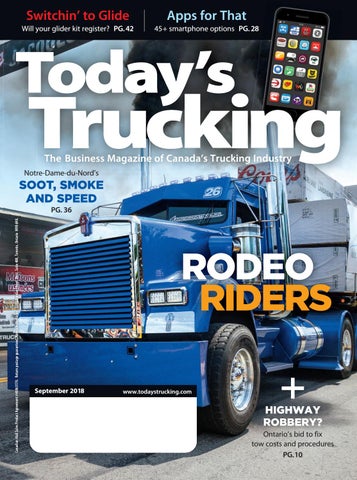
Switchin’ to Glide
Apps for That
Will your glider kit register? PG. 42
45+ smartphone options PG. 28
The Business Magazine of Canada’s Trucking Industry Notre-Dame-du-Nord’s
SOOT, SMOKE AND SPEED Canadian Mail Sales Product Agreement #40063170. Return postage guaranteed. Newcom Media Inc., 5353 Dundas Street West, Suite 400, Toronto, Ontario M9B 6H8.
PG. 36
RODEO RIDERS September 2018
www.todaystrucking.com
HIGHWAY ROBBERY? Ontario’s bid to fix tow costs and procedures PG.10
THEY MAY NOT SEE YOUR HARD WORK BUT WE DO Your job demands something most people can’t see — hard work and dedication. We see the relentless efforts you put in day in and day out. It doesn’t go unnoticed. That’s why we work just as hard to make sure our most advanced technology is in every bottle of Shell Rotella ® engine oil. Because we know just as well as you, that sometimes hard work is its own reward. Learn more at www.shell.ca/rotella.
Available at:
© Shell Canada Products 2018. All rights reserved.
Contents
September 2018 | VOLUME 32, NO.9 5 7 9 23 25 27
Letters John G. Smith
10
28
36
54
Rolf Lockwood Jaclyne Reive Heather Ness Mike McCarron
NEWS & NOTES
Dispatches 13 Setting the Standard Daimler looks to strengthen aftermarket service
16 17 18 19 20 21 22 54
Heard on the Street Logbook Truck Sales Pulse Survey Stat Pack Trending Truck of the Month Faces
Features 10 Highway Robbery?
In Gear 38 Fluid Paths The promise and challenge of recycling oil By Eric Berard
The push is on to address Ontario towing costs and procedures
By John G. Smith
28 Apps for That Looking to transform your smartphone into a smarter tool? There are apps for that.
By Elizabeth Bate
42 Switchin’ to Glide Used glider kits might be hard to register
47 Pre-Wired and Ready Mack, Lytx expand pre-wired lineup By Elizabeth Bate
49 Product Watch 52 Guess the Location, Win a Hat
36 Rodeo Roundup Rodeo du Camion’s annual story of smoke, soot and speed
By Rolf Lockwood
54 Guiding Star Western Star president David Carson on Canada’s ‘awesome market’
By Rolf Lockwood
For more visit www.todaystrucking.com SEPTEMBER 2018
3
Jacek Misiak Truck Driver 8 years, VersaCold
VersaCold is a food-first company. With over 70 years of supply chain experience, we’re a diverse team dedicated to ensuring the safety, quality and freshness of the food families eat—every step of the chain.
versacold.com
Letters When will the fines come for deletes? The Business Magazine of Canada’s Trucking Industry
PUBLISHER Joe Glionna joe@newcom.ca • 416/614-5805 VICE PRESIDENT, EDITORIAL Rolf Lockwood, MCILT rolf@newcom.ca • 416/614-5825 EDITOR John G. Smith johng@newcom.ca • 416/614-5812 ASSOCIATE EDITOR Elizabeth Bate elizabeth@newcom.ca • 416/614-5828 CONTRIBUTORS: Eric Berard, Steve Bouchard, Mike McCarron, Heather Ness, Jim Park, Jaclyne Reive DESIGN / LAYOUT Tim Norton, Frank Scatozza production@todaystrucking.com • 416/614-5818 SALES AND MARKETING CONSULTANT Anthony Buttino anthonyb@newcom.ca • 514/292-2297 SALES AND MARKETING CONSULTANT Nickisha Rashid nickisha@newcom.ca • 416/614-5824 QUÉBEC ACCOUNTS MANAGER Denis Arsenault denis@newcom.ca • 514/947-7228 CIRCULATION MANAGER Pat Glionna 416/614-2200 • 416/614-8861 (fax) PRODUCTION MANAGER Kimberly Collins kim@newcom.ca • 416/510-6779
Kenneth R. Wilson Award Winner
NEWCOM MEDIA INC. 5353 Dundas Street West, Suite 400, Toronto, Ontario M9B 6H8 416/614-2200 • 416/614-8861 (fax) CHAIRMAN AND FOUNDER Jim Glionna PRESIDENT Joe Glionna VICE PRESIDENT, OPERATIONS Melissa Summerfield CHIEF FINANCIAL OFFICER Peter Fryters DIRECTOR OF CIRCULATION Pat Glionna
Today’s Trucking is published monthly by NEWCOM MEDIA INC., 5353 Dundas Street West, Suite 400, Toronto, Ontario M9B 6H8. It is produced expressly for owners and/or operators of one or more straight trucks or tractor-trailers with gross weights of at least 19,500 pounds, and for truck/trailer dealers and heavy-duty parts distributors. Subscriptions are free to those who meet the criteria. For others: single-copy price: $5 plus applicable taxes; one-year subscription: $50 plus applicable taxes; one-year subscription in U.S: $90 US; one-year subscription foreign: $120 US. Copyright 2018. All rights reserved. Contents may not be reproduced by any means, in whole or in part, without prior written consent of the publisher. The advertiser agrees to protect the publisher against legal action based upon libelous or inaccurate statements, unauthorized use of photographs, or other material in connection with advertisements placed in Today’s Trucking. The publisher reserves the right to refuse advertising that in his opinion is misleading or in poor taste. Postmaster: Address changes to Today’s Trucking, 5353 Dundas Street West, Suite 400, Toronto, Ont., M9B 6H8. Postage paid Canadian Publications Mail Sales Agreement No.40063170. ISSN No. 0837-1512. Printed in Canada.
Member
Re: Dirty Secrets (July 2018) I work for a Western Star Trucks and Hyundai Heavy Equipment dealer. We struggle with engines that have had emissions controls deleted. Our tooling is designed to diagnose a factorycompliant engine, not one that has been tweaked. At what point can we expect to see some consequences for the shops that are performing the deletes? When do we get to see some sort of enforcement organization that will hand out the fines? Here in Saskatchewan it is even written in the safety manual that, if the vehicle is “visibly” tampered with, we can only circle it for “monitoring”. Not fail it. We can’t connect any computer to see if the vehicle is tampered with at all. And right below that, the manual says if there is an engine light on, it has to be rejected and failed. This punishes the customer who is trying to be compliant, and rewarding the customer who had it deleted. We spend thousands of dollars every year, training our staff in all departments on the new technology and emission systems that roll out, and then get side-barred by a shop that just cuts it out. If you have any answers as to when Saskatchewan will see some consequences and accountability for all these deleted engines, I would be very interested in knowing. — Tyler Robertson Saskatoon, Sask.
Large fleets can bury problem trucks Re: Dirty Secrets (July 2018) I’m so tired of hearing about these poor “compliant carriers”. These guys are pretty much the reason why those of us who handle the majority of the freight out here keep getting hit with page after page of heavy-handed government regulations. Why do people alter emissions systems? Usually because they don’t work correctly. Usually because the downtime for repeated shop visits for the same unsolved problem isn’t reasonable or sustainable. When you have a large fleet, you can bury a problem truck in the numbers. You park it. You sell it. You lean on your dealer to do something about it because you spend lots of money with them. Those are advantages that single-unit guys and small fleets don’t have. I’m going glider kit. So far, we can still do that. — Colin Wallace By email
Email: johng@newcom.ca
SEND YOUR LETTERS TO: Newcom Media Inc., 5353 Dundas Street West, Suite 400, Toronto, Ontario M9B 6H8
Speed limiters are an issue, too Re: Dirty Secrets (July 2018) Deleted truck emissions systems aren’t the only offence being committed by truckers. Not all the trucks plated in Quebec and Ontario have speeds limited to 105 km/h. Some are set 107 all the way up to 115 km/h. I go 105 km/h on a level stretch of highway, and I get passed like I’m doing 90. Many companies also have switches installed in their trucks, so that once they leave the country or province, the driver flips the switch. No more limiter. I don’t really care what companies do, but the law is the law. — Paul Beauregard Cambridge, Ont.
SEPTEMBER 2018
5
Our DriverFirst philosophy led us to seek input from hundreds of drivers that helped develop ergonomic interiors and reshape a classic aerodynamic design. All this led to the exceptional comfort and performance you require to be successful in today’s industry. Introducing the DriverFirst purchasing program designed for you, the Owner Operator. This is an exciting opportunity to experience the benefits of a new International ® Truck. In addition, finance a new International LT™, LoneStar ®, RH™ or DuraStar ® with Navistar Capital using this program and receive a $1,000 Mastercard ® Gift Card*. Contact your local International Truck dealer for further details and enjoy the ride.
© 2018 , Inc. All rights reserved. All marks are trademarks of their respective owners. * Mastercard only applicable to customers approved through Navistar Capital. Offer ends October 31, 2018.
Editorial By John G. Smith
Sticker Shock It’s time to strike a balanced price for towing and recovery
S
ome of my earliest work experience came at the benches of a shop that repaired small appliances and vacuum cleaners. And a fond experience it was. Even when off the clock, I loved hanging around the area behind the counter. It’s where the owner’s aging friends would gather to chew the fat over some chewable coffee, and I was welcomed as one of them. It’s also where a barely teenaged version of yours truly began to learn about the value of a job properly done. Handed a dead assembly of plastic, metal and wires, we assessed problems, replaced parts, and brought things back to life. The customers who walked through the door couldn’t do it. They didn’t have the tools, parts or expertise these tasks required. That shop recently came to mind after I sat down with Guy Broderick at APPS Transport to discuss what clearly appears to be an unfair towing bill. (See Highway Robbery?, page 10.) Specifically, I recalled a fading fax that had been pinned over the appliance shop’s counter. Work would come good, fast, and cheap, it promised – but you could only pick two of those at a time. It’s the type of joke pinned to shop bulletin boards everywhere, and these days shared as internet memes. There’s also an underlying truth to it. When service is delivered well and quickly, it should be priced higher than a haphazard job or one that drags on well past a reasonable deadline. This is certainly true in the world of towing. Not all service providers are created equal, after all. Some companies have made significant investments in the latest equipment, training and rotators, preparing for every conceivable job. Without such commitments, massive wrecks would litter highway lanes for much longer than they should; Toronto’s Hwy. 401 would begin to look like Fallujah. Proper equipment and training also help to limit the risk of making a bad situation worse. These operations need to be compensated for their investments. So, too, do there need to be limits on how long police
and traffic-jammed motorists should be expected to wait before stranded equipment is pulled out of the way. But there also needs to be a limit on fees – especially when it comes to minor incidents in which fleets and owner-operators are forced to use the first tow truck on a scene. Broderick shared the story of a bill that was more than four times higher than his preferred towing supplier would have charged. Given the nature of the work, the cleanup of a minor coolant spill and tow to a nearby exit, the $4,800 price tag was unusually steep. Prices should be based on work that is required, and not just the equipment that happens to be available. So what’s the solution? I usually loathe the idea of establishing common rates. In a free market, the right price is the one that people are willing to pay. Those who find efficiencies can tweak prices and establish a competitive advantage. But since we can’t expect police to shop for prices at the side of the road, and their responsibilities should remain focused on clearing lanes quickly and safely, it’s time for Ontario to cap the prices on minor tows meant to do little more than move stranded equipment off a highway. Specifically, it’s up to the province’s revived quick clearance committee to recommend guidelines that make sense – taking steps to ensure towing and recovery operations are compensated, but also avoiding cases of sticker shock along the way. Let’s get moving on this in Ontario and beyond. TT
“There needs to be a limit on fees – especially when it comes to minor incidents.”
John G. Smith is editor of Today’s Trucking. You can reach him at 416-614-5812 or johng@newcom.ca. SEPTEMBER 2018
7
The Mobil Delvac 1™ range of synthetic engine oils helps protect your fleet and your business by extending oil drain intervals.
©2018 Imperial Oil. Mobil is a trademark or registered trademark of Exxon Mobil Corporation or one of its subsidiaries. Imperial Oil, licensee.
There’s no such thing as a slow summer in the trucking business.
See all of our oils at mobildelvac.ca
Lockwood By Rolf Lockwood
My Money’s on Hydrogen The fuel has been discussed for decades, but now it’s close
P
lug-in electric trucks are all the rage these days, mostly medium-duty machines. There’s even a functional prototype logging truck that’s not only electric but fully autonomous as well. Swedish tech start-up Einride recently unveiled its T-log truck that incorporates “some off-road capabilities and is designed to navigate forest roads,” as the company describes it. It’s a mighty interesting idea, but carrying capacity is just 32,000 lb. Then, of course, there’s the Tesla Semi. Or is there? It may or may not see the light of day. A better bet to my mind, for highway hauling and pretty much any other transportation application in the longer term, is the hydrogen fuel cell. I know, I know, people have been saying that for ages, and I first wrote about the technology almost 40 years ago. It hasn’t arrived yet, but I think it’s pretty close. Hydrogen may start to become a serious factor in our driving lives sooner than we think, in both cars and trucks. Nikola Motor Company’s fuel-cell trucks aside, passenger cars are leading the way here. Toyota, Hyundai and Honda all have commercially available fuel-cell models; Daimler is hard at it in cars and vans; and fuel-cell growth in the transportation sector nearly tripled last year. There were nearly 3,500 fuel-cell electric cars on the road in the U.S., primarily in California, through the end of 2017. At that point there were 40 retail hydrogen stations and nine non-retail stations in the U.S., but 45 (plus 11 private fleet facilities) in Germany alone. As many as 400 service stations are planned in the latter country by 2023 as part of the H2 Mobility Joint Venture run by Daimler, Linde, Shell, Total, and others. Europe has a clear lead over North America, not least because the German government very actively supports infrastructure development. But Japan is more advanced still, with 91 public outlets. Now, enter Nikola. And it’s really on the move, according to a press release last month. Targeting US$200 million in investment funds, Nikola CEO Trevor Milton announced that more than $100 million had already been raised and funded in August. He added, “So far this year we have kicked-off plans to build
the largest hydrogen network in the world with Nel, secured a massive 800-truck order commitment from Anheuser-Busch, developed the most energy-dense battery system on the market with almost 400 watt hours per liter, engineered a 240-kW fuel cell, kicked off electric vehicle stability controls and electric ABS with Wabco, designed a thermo-management and HVAC system with Mahle, finalized the most advanced Class 8 independent suspension on the market with Meritor, relocated our company to Arizona to build our new 150,000-sq.-ft. headquarters, and now closed on $100 million.” Nel ASA may be the most important element. Founded in 1927, the Norwegian company is already developing hydrogen plants, so Nikola has partnered with a seriously experienced outfit. Its capabilities cover the entire value chain, from hydrogen production technologies to manufacturing hydrogen fueling stations, providing all fuel-cell-electric vehicles with what it claims to be “the same fast fueling and long range as conventional vehicles today.” By 2028, Nikola plans to have more than 700 Nel-built hydrogen stations across the U.S. and Canada. The first 14 stations will be up and running by 2021, we’re promised. Give these guys credit. They’re really pioneering hydrogen-electric renewable technology. With a range between 800 and 1,900 km, and a refill time within 20 minutes, Nikola trucks will be in fleets beginning in 2020 and in full production by 2021, the company says. It adds that it has nearly $11 billion in preorder reservations. Nikola is going to be a force, I predict. TT
“Nikola trucks will be in fleets beginning in 2020 and in full production by 2021, the company says.”
Rolf Lockwood is vice-president, editorial, at Newcom Media Inc. You can reach him at 416-614-5825 or rolf@todaystrucking.com. SEPTEMBER 2018
9
Highway Robbery? Push is on to tackle tow fees, practices in Ontario By John G. Smith Guy Broderick couldn’t believe the towing invoice that appeared in front of him. The task seemed so simple. An APPS Transport truck only had to be towed a single exit down Highway 401. The cleanup involved nothing more than a bit of coolant that had spilled through a failing lower rad hose. The tow alone cost $2,531 – and that’s after Broderick negotiated a $1,000 discount. The coolant cleanup was billed at another $2,260, which included a $2,000 flatrate “environmental” fee. His fleet’s towing company of choice would have charged $500 for the tow. And instead of putting a street sweeper and sander on the clean-up, the team expected to handle the issue with a broom, shovel, garbage can, and no more than a few bags of absorbent. But they were never given the chance to do
10
TODAY’S TRUCKING
the work. By the time they arrived, Ontario Provincial Police (OPP) had already called on the services of the first tow truck on the scene. Time had simply conspired against the fleet. The APPS truck had broken down in a live lane near Highway 400. There was no chance to pull over to the shoulder because it was being used by emergency vehicles heading to the scene of a nearby collision – the same one that was slowing the arrival of the preferred towing company. Police waited 20 minutes and then had the truck hooked up for its journey to the Keele Street exit. “You’re not in a position to do anything,” says Broderick, the supervisor who was left to monitor his driver’s experience through text messages. To compound matters, he had to contact one of the fleet’s owners for a credit card to
cover a bill of that size. It was embarrassing. “It’s a huge problem,” Broderick says of the entire process. “If it’s a simple tow to get the person to the next exit, why is that $2,000? And we’re not talking major contamination.” “I understand why police have to clear the highway,” adds Apps vice-president
Brent Byers. “There needs to be more of an effort made to keep traffic flowing.” But couldn’t there be some sort of cap on the cost per incident or distance?
Quick clearance committee They’re the exact items on the agenda for a provincial quick clearance committee,
Daimler’s Standard PG. 13
Brake Blitz PG. 14
Fatalities Spike PG. 15
and the committee is currently developing them to a sufficient level of detail to confirm their viability,” a Transportation Ministry spokesman says. And there’s no question that gaps exist.
“We don’t have provincial towing guidelines,” says Sgt. Kerry Schmidt of the Ontario Provincial Police’s Highway Safety Division. “The heavy tow sector sets their own rates … we don’t have the ability to
▲ This simple tow and cleanup cost almost $5,000. ▲
recently revived by the Ontario Ministry of Transportation to gather ideas from the OPP and representatives of the Ontario Trucking Association, Ontario Recovery Group, Provincial Towing Association of Ontario, Insurance Bureau of Canada, and CAA. “Several concepts to help reduce clearance times for major commercial vehicle incidents have been developed,
“You’re not in a position to do anything,” says Guy Broderick.
refuse someone from doing a job unless we have sufficient justification. “We don’t have the ability to shop for price. There’s no mandate for us,” he adds, confirming that police receive complaints about bills and other issues associated with towing teams that are put to work on breakdowns. But the focus for police is on getting highways moving again. Individual officers are left with the discretion to decide just how long to wait before handing out recovery-related jobs. Exactly how widespread any
excessive bills have become is anyone’s guess. The Ontario Trucking Association (OTA) is still in the midst of surveying members for copies of towing invoices, in a project that began last year. “What we will be looking for is figuring out where there are anomalies and where costs are legitimate,” says Geoff Wood, the association’s vice-president – operations and safety. Definitions of legitimate costs also need to look beyond hourly rates alone. “Obviously the total price is one of the issues – and how you arrive at the total price,” says Doug Nelson, executive director of the Ontario Recovery Group, an association representing heavy-duty towing and recovery operators. Someone who charges $2,000 per hour might finish a job in one hour, while a business that works for $500 per hour might take five hours because they don’t have the proper equipment or training, he says as an example. “But you don’t go out with a 50-ton rotator to pull out a five-ton truck,” he says. “You should be charging for the appropriate size of equipment.” Nelson also stresses that some complaints can be unfounded because those who
SEPTEMBER 2018
11
Dispatches receive bills aren’t involved in towing operations every day. Then again, other complaints clearly seem to be grounded in fact. Reports of excessive costs are a problem for everyone involved, he adds. “It’s a concern for everyone in the towing industry because it paints everyone in the towing industry with the same brush.” An Ontario Transportation Ministry
WIN
spokesman agreed that rates can “vary significantly” based on services, such as a breakdown on a shoulder compared to a tractor-trailer that overturns in a live lane and spills its load. “MTO is aware of cases where the fee charged for the work done is much higher than would be expected. The concepts being developed by the quick clearance committee are expected
WITH TRUCKMATE
Decision-making in the trucking industry is difficult. So why waste your time on software solutions that aren’t crystal clear? TMW TruckMate gives you full control over all areas of your operation while being highly configurable and easily scalable. TruckMate helps your operation become more efficient, effective and profitable, so that your business can WIN EVERY TIME.
www.tmwsystems.com | phone: 440.721.2020 S O F T W A R E S O L U T I O N S F O R : T R U C K L O A D | B R O K E R A G E / 3 P L | LT L D E D I C AT E D & P R I V AT E F L E E T | I N T E R M O D A L | F U E L D E L I V E R Y FINAL MILE | ASSET MAINTENANCE | BUSINESS INTELLIGENCE
12
TODAY’S TRUCKING
to help keep the fees charged within a reasonable range,” he said.
First on scene There’s also a concern around the longstanding process of giving work to the first tow trucks that arrive on a scene. “We need to be able to do this safely,” the OTA’s Wood says, recognizing the pressure to open highways as quickly as possible – especially in the Greater Toronto Area. “But we can’t have tow trucks racing to the scenes of collisions … everybody has got to be safe in what they’re doing.” A fleet’s preferred towing companies, meanwhile, can face other barriers to doing such work. Out-of-town operations are regularly blocked from towing jobs because they lack the licences imposed by individual municipalities. Nelson refers to one operator who was fined $1,600 for hooking up to a vehicle behind a service center that was just a few hundred yards inside Toronto city limits. “We need to go to a provincial licence, and we have to have a body where complaints can go to – with people who are educated and understand the towing issues,” he says. “God bless the municipalities. They’ve tried their best to fix a lot of the pricing problems, but they’ll never be able to protect the industry.” Admittedly, the province has struggled in such efforts in the past. This isn’t the first time a quick clearance committee has come together to look at towing-related challenges. Nelson also scoffs at relatively recent efforts to protect consumers through the Fighting Fraud and Reducing Automobile Insurance Rates Act. “It didn’t do anything to help at all because there’s no management,” he says. Car owners who are frustrated with bills of their own are usually limited to court actions and the workings of the Ontario Repair and Storage Liens Act. Still, he’s hopeful that a recently elected Conservative government will be open to listening to concerns. “We have a balancing act to do here,” Wood says. “It’s got to be safe. It’s got to be fast as possible. It also has to be fair, which is the big one. “It’s about designing a system that works.” TT
Dispatches
Setting the Standard Daimler looks to strengthen aftermarket service By Rolf Lockwood The aftermarket arm of Daimler Trucks North America (DTNA) is aiming to set a new standard in customer service by strengthening its 24-hour-or-less service turnaround promise, adding new digital tools, enlarging its supply chain, and launching a major expansion of its Alliance Truck Parts enterprise. The company says its new retail strategy will benefit customers at every touch point. “Our customers have diverse products and businesses, and we want to help them be successful by providing solutions that create efficiencies and value,” said Stefan Kurschner, DTNA’s senior vice-president of aftermarket activities. “Our goals are ambitious. At the heart of everything we do is communication, speed and transparency, and our evolution positions us to achieve our goals.” Kurschner noted that DTNA and its network have collaborated to develop new systems and processes to create the “ideal customer experience.” Recently, DTNA’s Elite Support network – which includes more than 280 certified dealers – spearheaded an effort to narrow the repair-time window to 24 hours. He said
56% of its dealers achieve that goal today. The Elite Support initiative has been in place for nearly 10 years Maximizing uptime and creating a superior customer experience starts with clear and timely communications, he said. “Keeping customers informed every step of the way during a service event is one of the most important things we can do,” Kurschner added. The new DTNA Service Tracker is a web-based, mobile-compatible application that enables customers to track their service in real time, on demand. Customers can opt to receive notifications about the repair status of their vehicle, review and approve estimates, and communicate with the service location. “The flow of accurate and timely information throughout the repair process is essential, and our team wants to use digital tools and available data to cultivate communications. Service Tracker provides customers real-time information so they can make the best decisions for their truck, driver and load,” Kurschner said. Service Tracker is a component of DTNA’s suite of uptime management
tools that streamline communications between customers and the dealer network. Express Write-Up, UptimePro, and Uptime Performance are among the data-driven applications that work together to help dealers initiate, execute and manage their service processes. On the supply chain front, in early 2019 DTNA will open its 10th parts distribution center near Phoenix, Ariz. A second Canadian parts distribution center is coming soon, too, likely next year in the Toronto area. But NAFTA negotiations may complicate that effort, Kurschner said. There is presently a center in Calgary. The facility in Phoenix will be the fourth parts distribution center opened by DTNA in just over two years. DTNA has also recently opened new parts distribution center in Des Moines, Iowa; Indianapolis, Ind.; and Dallas. “Having and delivering the right parts for our customers when and where they need them, as quickly as possible, is essential to uptime and achieving the 24-hour-or-less repair turnaround time,” said Kurschner. “Our expansive service network and strategically located parts distribution centers are critical to that goal.” At Alliance Truck Parts, more than 15 new product lines are scheduled to launch over the next several months, as well as new retail locations in dealerships and at standalone locations. The all-makes, “value-priced” segment is a particular focus for DTNA’s product strategy. A “value-priced” product is one that offers the same quality and functionality as a genuine original equipment part but will last for, say, 800,000 km instead of 1.6 million. “We already have a strong product portfolio that extends over 50 lines. Now, between the new product lines and our strategically architected retail approach, Alliance will not only be the all-makes brand of choice but will provide an exceptional retail experience that meets customers where they are and when they need us the most,” said Kurschner. Brad Williamson, manager of Alliance Truck Parts, says that by 2020 Alliance will launch more than 80 product lines, many new standalone retail stores will open, and several dealer storefronts will be established. TT SEPTEMBER 2018
13
Dispatches
Premiers commit to standardized regs All 10 provincial premiers say they are looking to find common ground in trucking-related regulations, following a meeting of the first ministers in Saint Andrews, N.B. Identified opportunities include the
use of wide-base single tires, weights and dimensions, and electronic logging devices (ELDs) – the latter of which are expected to be mandated by the federal government as early as 2019. “As provinces and territories consider mandating for intra-provincial travel, a consistent approach will enable more accurate monitoring of a drivers’ HOS,
enhance road safety, and provide a level and competitive playing field for all carriers,” a related communique said. The commitment was included in a pledge to break down trade barriers using the Regulatory Reconciliation and Cooperation Table under the Canadian Free Trade Agreement.
Vertex Resources acquires Three Star Vertex Resources Group has acquired Three Star Trucking, an environmental services company that provides fluid hauling, pressure truck, hot oilers, and combo vac services in Western Canada. The deal is worth a reported $8.9 million. The purchase adds more than 270 pieces of equipment to Vertex’s fleet, including high-pressure fluid hauling trailers, enabling the company to haul propane, butane, and NGL fluid. Three Star was established in 1962 and is licensed to haul condensate, NGL, butane and propane between Canada and the U.S., with a federal transportation licence in five states. Vertex, based in Sherwood Park, Alta., employs about 750 people.
Brake blitz grounds 12.4% A surprise Brake Safety Day inspection blitz in Canada and the U.S. put 1,595 trucks out of service for brake violations on April 25, the Commercial Vehicle Safety Alliance (CVSA) reports. There were 11,531 inspections conducted overall, 1,457 of which were in Canada. While 12.4% of inspected trucks were grounded in Canada, 14% were placed out of service in the U.S. The blitz included 41 states along with 11 Canadian provinces and territories. Several jurisdictions also focused on antilock braking systems (ABS). Of the 8,128 air-braked trucks and tractors that needed ABS, 10.2% recorded violations. Trailers didn’t fare quite as well. Of the 5,331 that were inspected, 14.3% had ABS-related violations. Brake Safety Week blitzes are also scheduled Sept. 16-22.
14
TODAY’S TRUCKING
Dispatches
OPP reports spike in fatal collisions Ontario Provincial Police (OPP) report fatal transport truck collisions were up 38% as of mid-July, including 33 collisions and 41 fatalities overall. “Despite our efforts, it takes a firm commitment to safe driving on the part of all transport truck drivers and other motorists in order to see a significant reduction in these types of collisions,” said Commissioner Vince Hawkes. During the same time period the force had investigated more than 3,600 truck-related collisions, representing 11% of collisions overall. It also laid more than 1,615 speeding charges, 354 distracted driving charges, and 963 defective equipment-related charges. “It is important to remember that in 70% of collisions involving commercial trucks, the truck driver is found to not be at fault, and even more rarely are collisions the result of the truck’s mechanical fitness,” said Ontario Trucking Association president Stephen Laskowski. “Regardless, OTA believes we need to modernize enforcement and regulatory approaches to better identify the minority of carriers and drivers who do not operate in safe and compliant manner.” The association responded to the OPP report with a 10-point action plan, urging enforcement agencies to target those who don’t comply with regulations.
PIC picked for transponder award Partners in Compliance (PIC) has been honored for its use of smart transponders to expand weigh station bypass services in Alberta. The Alberta Motor Transport Association initiative received the award from the Intelligence Transportation Systems Society of Canada. Nearly 56,000 trucks now participate in the bypass programs available at 56 weigh stations, says Brian Heath, president and CEO of Drivewyze, which supplies the transponders. The company also hopes in the near future to use the technology to offer PIC members access to driver safety notifications and electronic inspections.
Daimler announces new truck entity Daimler AG is reorganizing to create three legally independent entities, including one dedicated to trucks. The new structure will include Mercedes-Benz AG; Daimler Truck AG; and Daimler Mobility AG. “The new structure positions Daimler to tackle the rapid pace of change in the mobility sector and the corresponding strategic challenges. Legally independent divisions will sharpen our focus on the future success of the business,” said Manfred Bischoff, chairman of the supervisory board at Daimler AG. The reorganization is being dubbed Project Future, which will be implemented this year and next, pending shareholder approval. SEPTEMBER 2018
15
ADD 140+ CHANNELS TO THEIR HAUL Give your drivers a better experience behind the wheel. Sign them up for a SiriusXM subscription today and ensure every road they’re on sounds like the road home. To get started, visit siriusxm.ca/fleet or call 1-888-539-7474..
SiriusXM Fleet Programs starting from
9 99
$
/mo*
per radio *Additional fees apply
© 2018 SiriusXM Canada Inc. “SiriusXM,” the SiriusXM logo, channel names and logos are trademarks of Sirius XM Radio Inc. and are used under license.
Dispatches
Heard Street on the
Weatherbie named marcom manager for Challenger
Mark Bara
Laurie Beegle
Paul Weatherbie is the new marketing communications manager for Challenger Motor Freight, joining the fleet
Paul Weatherbie
with more two decades of marketing experience in the transportation industry. Robert Dike was also named as a new recruiter for the company. Dike has been with the company since 2005, most recently as a driver-trainer, and is based out of the Challenger facility in Abbottsford, B.C.
Doug Wolma
Truck convoy honors driver Harold Reimer More than 20 trucks made the 45-km journey between Deacons Corner and Steinbach, Man., this July to honor Harold Reimer, a driver who lost his battle with cancer. He was diagnosed with stage four pancreatic cancer on his 58th birthday. Remembered fondly in the Winnipeg trucking community, Reimer was cremated prior to the July 28 funeral. He is survived by his wife Cheryl, six children, his parents, five siblings and their families.
Paul Sniegocki
Truck-Lite shakes up executive team Harold Reimer
Phillips Connect names new business development manager Intermodal industry veteran Cliff Creech is the new business development manager at Phillips Connect Technologies, where he will primarily guide product and business development efforts for ChassisNet. He is a member of Intermodal Association of North America’s (IANA’s) intermodal interchange executive committee, and from February 2015 to January 2018 was chairman of IANA’s maintenance and repair committee. Cliff Creech
Truck-Lite Co. is making changes to its executive team with four new appointments. Mark Bara is the new executive vice-president of sales and marketing; Laurie Beegle is now president of Davco Technology; Paul Sniegocki is executive vice-president of engineering and chief technology officer; and Doug Wolma is in the newly designated role of president.
Three promotions at Trimble Trimble Transportation is moving Mark Botticelli into the role of chief technology officer, transportation;
Eric Vaillancourt named Stemco president Eric Vaillancourt is succeeding Todd Anderson as president at Stemco. Vaillancourt joins the company with more than 30 years of experience in various industries. He most recently served as the president of Garlock Sealing Products, a fellow EnPro Industries company. Vaillancourt has continued his education over the years, completing the Harvard University Advanced Management Program in 2014.
16
TODAY’S TRUCKING
Keith Mader to vice-president of analytics, transportation; and Trent Lezer into the role of senior vice-president of technology at PeopleNet. The company says the new appointments will help create operational efficiencies to allow for faster product development.
Dispatches
L gbook2018 SEPTEMBER 7-9
BRITISH COLUMBIA TRUCKING ASSOCIATION GOLF TOURNAMENT
9-12
IA N LEA
iler
in
um
ra
Alum
s
•
•
R
CA
AD
DE
N
PEOPLENET/TMW SYSTEMS’ IN.SIGHT USER CONFERENCE George R. Brown Convention Center Houston, Texas www.insightuserconference.com
Flatbed
SAE NORTH AMERICAN INTERNATIONAL POWERTRAIN CONFERENCE Chicago, Ill. www.sae.org
13
11
NORTH AMERICAN TRAILER DEALERS ASSOCIATION’S TRADE SHOW AND CONVENTION Indiana Convention Center Indianapolis, Ind. www.natda.org
12-14
TORONTO TRANSPORTATION CLUB’S POWER OF EDUCATION GOLF CLASSIC Blue Mountains, Ont. www.torontotransportationclub.com
15 Meadow Gardens Golf Club Pitt Meadows, B.C. www.bctrucking.com
NEWCOM SOUTH ASIAN MEDIA’S RECRUITMENT AND RESOURCES EXPO International Centre Mississauga, Ont.
11-13
20-27
FTR TRANSPORTATION CONFERENCE Historic Union Station Indianapolis, Ind. www.ftrconference.com
IAA COMMERCIAL VEHICLES SHOW Fairgrounds of Deutsche Messe Hanover, Germany www.iaa.de/en
HAVE IT YOUR WAY! Aluminum Flatbeds Built For You... HERE IN CANADA
T
Tom Armes
Richard Cassault
Ontario/ Western Canada (519) 878-4051
Quebec /Maritimes (418) 952-1341
Tel: (418) 728-2415 Toll Free: (877) 631-2600
www.alutrec.com SEPTEMBER 2018
17
Dispatches
July Class 8 orders hit record Monthly North American Class 8 truck orders hit an all-time high of 52,250 units this July, surpassing the previous record of 52,194 set in March 2006, FTR says. And fleets are clearly desperate to get new trucks. “Supply chain issues began around March. OEMs started falling behind in deliveries to fleets in April. Deliveries did improve a bit in June, but most OEMs are still operating in catch-up mode,” said Don Ake, vice-president of commercial vehicles. “It is uncertain when suppliers will be able to improve delivery times and for OEMs to ship all orders on time ... it may take up to a year for everyone to catch up.” In terms of actual Class 8 sales, Freightliner led the way in Canada this June, representing 1,021 units, WardsAuto reports. International topped the Class 7 totals with 190 units, while Freightliner led Class 6 with 56 sales. Ford was the sales leader in Class 5 with 362 sales.
Canada – June 2018 SALES CLASS 8
18
U.S. – June 2018
MARKET SHARES
SALES
June
YTD
June %
YTD %
CLASS 8
Freightliner Kenworth Volvo Truck Peterbilt International Western Star Mack Other Total CLASS 7
1,021 477 557 382 348 315 215 0 3,315 June
5,278 2,548 2,389 1,993 1,902 1,455 907 0 16,472 YTD
30.8 14.4 16.8 11.5 10.5 9.5 6.5 0.0 100.0 June %
32.0 15.5 14.5 12.1 11.5 8.8 5.5 0.0 100.0 YTD %
International Freightliner Hino Peterbilt Kenworth Ford Total CLASS 6
190 101 112 103 56 7 569 June
852 704 577 576 302 32 3,043 YTD
33.4 17.8 19.7 18.1 9.8 1.2 100.0 June %
Freightliner Hino International Peterbilt Ford Isuzu Kenworth GM Total CLASS 5
56 43 35 4 7 1 0 0 146 June
277 262 172 68 29 12 10 0 830 YTD
362 145 124 103 12 1 2 0 2 0 751
2,194 818 647 628 18 15 5 2 2 0 4,329
Ford Hino Dodge/Ram Isuzu Freightliner Mitsubishi Fuso International Kenworth Peterbilt GM Total
TODAY’S TRUCKING
www.total-canada.ca
MARKET SHARES
June
YTD
June %
YTD %
Freightliner Peterbilt Kenworth International Volvo Truck Mack Western Star Other Total CLASS 7
7,672 3,328 2,749 2,492 2,542 2,026 542 0 21,351 June
39,168 16,889 15,788 14,295 12,445 8,605 2,826 9 110,025 YTD
35.9 15.6 12.9 11.7 11.9 9.5 2.5 0.0 100.0 June %
35.6 15.4 14.3 13.0 11.3 7.8 2.6 0.0 100.0 YTD %
28.0 23.1 19.0 18.9 9.9 1.1 100.0 YTD %
Freightliner International Peterbilt Kenworth Hino Ford Total CLASS 6
2,620 1,434 752 320 249 163 5,538 June
15,088 6,461 3,842 2,074 971 846 29,282 YTD
47.3 25.9 13.6 5.8 4.5 2.9 100.0 June %
51.5 22.1 13.1 7.1 3.3 2.9 100.0 YTD %
38.4 29.5 24.0 2.7 4.8 0.7 0.0 0.0 100.0 June %
33.4 31.6 20.7 8.2 3.5 1.4 1.2 0.0 100.0 YTD %
Freightliner Ford International Hino Kenworth Isuzu Peterbilt GM Total CLASS 5
1,747 1,947 1,191 790 197 96 5 4 5,977 June
11,903 10,010 8,951 4,018 1,267 555 67 27 36,798 YTD
29.2 32.6 19.9 13.2 3.3 1.6 0.1 0.0 100.0 June %
32.3 27.2 24.3 10.9 3.4 1.5 0.2 0.0 100.0 YTD %
48.2 19.3 16.5 13.7 1.6 0.1 0.3 0.0 0.0 0.0 100.0
50.7 18.9 14.9 14.5 0.4 0.3 0.1 0.0 0.0 0.0 100.0
Ford Dodge/Ram Isuzu Freightliner Hino GM Mitsubishi Fuso Kenworth International Peterbilt Total
4,725 1,987 644 384 204 23 21 1 1 1 7,991
25,882 7,612 2,763 2,065 1,273 152 86 16 12 5 39,866
59.1 24.9 8.1 4.8 2.6 0.3 0.3 0.0 0.0 0.0 100.0
64.9 19.1 6.9 5.2 3.2 0.4 0.2 0.0 0.0 0.0 100.0
Source: WardsAuto
Dispatches
Pu se Reader Survey Tell us your thoughts on ... Apps Whether you’re on the road or at home, a phone is likely at your side. Statistics Canada reports that more than three-quarters of all Canadian adults owned a smartphone in 2016. Combine those phones with in-cab telematics devices and the potential for app use is almost endless. This month we asked – what apps drive you?
Do you use a smartphone or other app-enabled device while at work?
YES
NO
87 % 13 %
Did you ever drive while using a phone app that was not hands-free-enabled?
NO
69 YES
23 What kind of apps do you regularly use on your work devices? (select all that apply) 84% 74% 71% 38% 29% 27% 19% 19% 15% 14% 13% 12% 11% 9% 8% 8% 7% 7%
Email Weather GPS Social media News Restaurant/ truck stop locators Messenger apps like Whatsapp or BBM Music/ movies/ entertainment Fuel price trackers Games Logistics/ dispatch/ load matching Food/ exercise trackers Parking locators Fleet management Other Weigh-scale pay/ bypass Expense/ receipt trackers Maintenance
Today’s Trucking Pulse surveys are conducted once per month, covering a variety of industry issues. To share your voice in future surveys, email elizabeth@newcom.ca.
I would never use my phone % while operating a vehicle I have used non-hands-free
% apps when driving
YES %
8
But only in my personal vehicle
What kinds of apps could benefit from improvements to make your job easier? (select all that apply) 58% 55% 31% 30% 24% 19% 18% 18% 16% 17% 8%
GPS Weather Parking locators Restaurant/ truck stop locators Maintenance Dispatch or load matching Expense/ receipt trackers Fleet management Trucker forums Weigh-scale pay/ bypass Other
$
Next month: Towing and recovery SEPTEMBER 2018
19
Dispatches
StatPack 7 million REMAN SHOES Bendix recently celebrated the production of its 7 millionth remanufactured brake shoe since beginning production in 2012. The shoes are produced at the company’s 74,000 sq-ft plant in Huntington, Ind.
19.8% REVENUE BUMP Mullen Group reported record revenue for its trucking and logistics segment in the second quarter, up 19.8% year-over-year to $219.4 million. Murray Mullen, chairman and chief executive officer, said the company’s 15 trucking business units were able to capitalize on a tightening supply chain – and that he believes a turnaround is occurring in the oil and gas industry.
0.5% COST INCREASE The total cost of ground transportation paid by Canadian shippers rose 0.5% between April and May, according to the Canadian General Freight Index (CGFI) reported by Nulogx. The Base Rate Index, which excludes the impact of any accessorial charges, was up 1.2%. Fuel accounted for 18.05% of May’s base rates, compared to 17.98% in April.
1.45 TRUCKS PER LOAD Canada’s spot market load volumes through the first half of 2018 were up 43% over the same six months in 2017, according to TransCore Link Logistics’ Freight Index. The volumes were also 33% stronger than the second half of 2017, reflecting historically high load volumes. There were 1.45 trucks per available load in June, compared to last year’s 1.75 trucks per load.
7.9%
300 GLIDER CAP
MORE TONNAGE
The United States Environmental Protection Agency (EPA) will limit manufacturers to a maximum of 300 glider kits this year, reversing a decision by departing agency administrator Scott Pruitt. He tried to delay the new cap by a year, but a court challenge stepped in the way. A previous cap limited manufacturers to the volumes produced in their busiest year between 2010 and 2014. Glider kits are new trucks that come without an engine or transmission, and are typically fitted with older engine technology.
U.S. for-hire truck tonnage may have dipped 0.4% in June, but it was up 7.8% year over year, the American Trucking Associations (ATA) reports. Year to date, tonnage is up 7.9%, outpacing the annual gain of 3.8% seen in 2017. “In the second quarter, we saw the tonnage index jump 1.8% from the previous quarter and 8.4% from a year earlier,” says ATA chief economist Bob Costello. “This robust growth fits with what is likely to be a very strong GDP reading for the second quarter. I expect the growth in tonnage to moderate, but remain at very high levels in the months ahead.”
20
TODAY’S TRUCKING
$80.4 million IN REVENUE TFI International boosted its margins and profits in the second quarter, reporting net income of $80.4 million on revenue of $1.32 billion. “We generated an operating margin of 10.5% compared to 6.5% a year earlier,” said Alain Bédard, chairman, president and chief executive officer. For the first half of the year, the company posted $2.51 billion in revenue, compared to $2.37 billion over the same period in 2017.
Dispatches
Trendingg on
.com 3M spokesman Doug Boccabella
3M Makes Case for Brighter Signs — By Elizabeth Bate It’s raining, it’s dark, and you’re squinting to see the lines on the road and the signs ahead of you. We’ve all been there. But if you’ve ever cursed your inability to see road markings in such conditions, you don’t necessarily need to blame advancing age or declining sight, according to engineers at 3M. Instead, they say it’s time for governments to rethink the materials used to make the signs themselves. The company has been making its case across North America with a traveling roadshow and demonstration-laden tractortrailer, next scheduled to make an appearance at a Transportation Association of Canada conference running from Sept. 30 to Oct. 3 in Saskatoon. Most of the signs on today’s roads are actually using reflective technology with a T1 designation, first adopted in 1940. The brightest option, T11, is rarely used, says 3M spokesman Doug Boccabella. It can be seen in selected areas of British Columbia, Alberta and Quebec, but not in Ontario.
@todaystrucking
Blame government RFP processes that emphasize cost controls. The T3/4 signage, falling between the brightness of T1 and T11 markings, costs 10% more than T1 signs – and the T11 signs cost another 30% on top of that. Bright and consistent markings will also play a vital role as autonomous vehicles emerge, Boccabella adds. After all, they could be conveying information that should be picked up by more than the naked eye. “Road closed” signs on display by 3M look familiar, for example, but they also contain QR Codes that are picked up by infrared sensors. These make it possible to convey other data including weather conditions, GPS coordinates for a detour, or other instructions about how a vehicle should operate. The signs, they are changing.
23.9K
Your go-to social media source
FOLLOWERS
If you’re not following us on Twitter, you’re missing out on some interesting discussions in the world of trucking. From regulations to product news, we have you covered.
HERE ARE A FEW EXAMPLES OF TWEETS POSTED BY TODAY’S TRUCKING THIS MONTH
APPS Transport Group @APPSTransGroup July 26 Thank you to @Todaystrucking for helping share our story. We have had a lot of response to the article and we are not the only company this has happened to in the GTA.
Greg
@todaystrucking The push is on to tackle excessive #towing fees and other recovery challenges in Ontario. https://www. todaystrucking.com/highway-robberythe-push-is-on-to-tackle-excessivetow-fees/ …
@greg4248 July 22
4 hour minimums for half hour of work is a rip-off. Most ppl be happy to pay 500 for a tow off 401. But paying 2000 or 3000 or more is ridiculous. Send OPP out to help block traffic for the safety aspect of drivers.
Doug Anderson
@72bigsmooth July 22
KEEP IN TOUCH facebook.com/ TodaysTrucking
@todaystrucking
TodaysTrucking1
If these people are not happy with the prices and service then maybe they should go and spend upwards of a million dollars of their own money and buy their own tow trucks. Problem solved. SEPTEMBER 2018
21
Dispatches
Trucks of the Month
Chrome and Steel Mark Gunter’s 1998 Peterbilt 379 isn’t exactly new. There’s actually 2.2 million kilometers on the odometer. This is a working truck, used to haul steel coils and other steel products for Skillex based in Woodstock, Ont. But the unit is new to him and has clearly been rebuilt from front to back. “I had another one like it and I sold it to buy this one,” Gunter said during a moment at the recent Clifford Truck Show. The truck with a 305-inch wheelbase was largely restored when he picked it up last year, although the fan of the famed red ovals has had a hand in some of the updates. “I’ve wrapped the tanks. I just did the breathers. I wrapped them with new stainless,” he says, listing some of the work that he’s had his hand in. “I put all the chrome nut covers on it. All the wheel covers.” “I’ve done some stuff just everywhere.” And whether a feature is in gleaming white or chrome, there’s plenty here that shines. TT
THE SPEC’S TRUCK: 1998 Peterbilt 379 ENGINE: Caterpillar 3406 E TRANSMISSION: 15-speed Eaton GEAR RATIO: 3.70:1
Do you have an unusual, antique, or long-service truck to be profiled? Send your Truck of the Month ideas or photos to johng@newcom.ca, or mail Today’s Trucking Magazine, 5353 Dundas Street West, Suite 400, Toronto, Ont., M9B 6H8
22
TODAY’S TRUCKING
Legal
Food for Thought Changing food safety rules could affect your fleet. By Jaclyne Reive
C
anada’s Safe Food For Canadians Act and its regulations will officially become law on Jan. 15, 2019. And while it won’t apply outright to most carriers who transport food, some operations might still face new requirements. Essentially, the act is meant to streamline existing food safety regimes, regulate previously unregulated food products, and bring the regime more in line with other countries. It takes a preventative approach to ensure that food is not contaminated during preparation, and during the other steps that food goes through before making its way to our tables. Once in force, it will all apply to food that is imported, exported and moved between provinces and territories, and to organizations that are involved in preparing, importing, exporting, labeling, packaging, grading, warehousing and storing food. The obligations associated with transportation will apply to organizations that transport food and are involved in one or more of the other activities. While the act might not otherwise apply to a company that focuses on trucking alone, the risk associated with compliance can be shifted through contracts including verbal or formal agreements. Carriers, for example, may be asked by customers to comply with all laws that generally deal with the safe transportation of food, or specifically to
comply with the act itself. Carriers are already required by law to deliver such cargo in good order and good condition. This means ensuring that food is not contaminated or adulterated during transportation. In future, a court might be willing to extend some aspects of the act to carriers, given that trucking companies usually have the most control over the related equipment. It all means that carriers should carefully review existing contracts, clients’ standard terms and conditions, and all future contracts to see if the act is being applied to their operations. Those who hand the food over to carriers are responsible for ensuring that equipment meets the act’s requirements. However, since carriers tend to be the ones who control the equipment, shippers are using contracts to transfer the related responsibilities. The act includes detailed requirements about equipment design, cleanliness and
maintenance that will prevent contamination. Carriers will need to consider the risks associated with the specific commodity being transported and make sure they meet the detailed statutory requirements if they have assumed such risks under a contract or are involved in activities beyond transportation alone.
Preventative plans Most of those who prepare and import food – and in some cases those involved in packaging, labelling, exporting and storage – have to establish preventative control plans (PCP). These are usually specific to different foods and activities, and involve identifying inherent and environmental risks that would affect the food, and determine how best to control and prevent those risks. The plans consider every process the food goes through, from the moment it’s prepared to labeling, transportation and everything in between. A customer might even ask a carrier to prepare and
implement its own PCP to deal with transportationrelated aspects of the commodity’s journey, or require the carrier to comply with the customer’s existing PCP. In other words, carriers will need to review their operations and determine what changes, if any, need to be made to ensure compliance. Carriers should keep copies of all records relating to food shipments – including those that involve sanitation, equipment cleanliness and temperatures – for at least two years after a delivery date. Written policies should also be established to cover the standard methods for maintaining equipment and keeping food from spoiling. TT Jaclyne Reive of Fernandes Hearn LLP can be reached at 416-203-9819, and followed on Twitter through @jacklyne_reive, or her blog at https://jaclynereive.wordpress. com. This column is intended for information purposes only and does not constitute legal advice.
SEPTEMBER 2018
23
Dispatches Members of the Arnold Bros. team wrapped themselves up in the campaign.
Going Plaid for Dad
didn’t say a couple of my drivers or good friends in the industry are suffering right now.” “The companies that are doing it have jumped in with two feet,” he adds. The industry’s involvement was hardly limited to fundraising alone. Carriers including Steed Standard Transport, Arnold Bros., and Rosenau activities such as draws, donations and Transport have added vehicle wraps barbecues in Winnipeg and Milton, Ont., to support awareness. Plaid for Dad raised $4,500 alone. That was matched by encourages workplaces to wear plaid in the fleet and then supplemented through a show of support on the Friday before supplier donations. “Arnold Bros. always Father’s Day. matches what we do for fundraising,” “Awareness is everything for us. Men she adds. typically don’t like to talk about their Plaid also became a visible sign health,” says Arden Bagni, a spokeswoman of support through workplace attire for Prostate Cancer during the month, includCanada. Yet almost ing everything from ties all of the men who to socks. have prostate cancer This is the first time detected soon enough that Trucks for Change will survive. – known for marshalling “Trucking groups industry resources such across the country have as discounted freight been really integral to moves for charities – was what we’ve been doing,” involved in a purely fundshe adds. raising initiative, helping “We’re just getting to coordinate and chamArden Bagni warmed up. It’s a great pion industry efforts. Prostate Cancer Canada cause,” Dalmazzi says. There’s a natural fit Trucks for Change has to date between the fight against prostate raised $160,000 for charitable efforts cancer and the trucking industry’s through volunteering or fundraising, predominantly male workforce, says and offered about $500,000 through Pete Dalmazzi, president of Trucks for in-kind freight services. Change. “I think carriers understand September is Prostate Cancer the demographics of their workforce … Awareness Month. TT there was almost no one I talked to that
Arnold Bros. Transport leads annual fundraising in prostate cancer fight By John G. Smith The trucking industry continues to wrap itself in Plaid for Dad to support Prostate Cancer Canada – and this year Arnold Bros. Transport even earned the coveted plaid vest that’s awarded to the fundraising campaign’s top workplace champion. The fleet accounted for more than $19,000 of about $50,000 raised by 20 carriers and industry suppliers this year, according to Trucks for Change, which helped to coordinate the broader efforts. While it’s the first time an individual fleet has won the award, trucking has dominated Plaid for Dad fundraising in recent years. An Ontario Trucking Association team earned the vest in 2016, while a Canadian Trucking Alliance team earned the top spot in 2017. Arnold Bros. became involved in the campaign when vice-president Gary Arnold heard a pitch during a Canadian Trucking Alliance meeting in 2017. And this year the fleet smashed through its $12,500 target. “It kind of took on a life of its own,” says Arnold Bros. finance director Carla Kaneski, who served as campaign captain and credits a fundraising team representing several departments. Employee
24
TODAY’S TRUCKING
“Trucking groups across the country have been really integral to what we’ve been doing.”
Compliance
Person questions about personal conveyance By Heather Ness he U.S. Federal Motor Carrier Safety Administration (FMCSA) recently issued revised guidance on using a commercial vehicle for personal conveyance. While it’s always great to have rules further clarified, especially around hours of service, such clarifications can sometimes generate more questions than answers. Such as is the case with FMCSA’s guidance. Here’s what you may need to consider:
T
ending odometer readings, and subtracting that distance from the total distance traveled for the day. If you’re a cross-border carrier, ensure your drivers are aware of the differences between personal conveyance in Canada and the U.S. before claiming the personal conveyance allowance. Also, be sure to communicate to your drivers any policies or procedures surrounding personal use of a company’s commercial vehicles – on both sides of the border.
Cross-border personal conveyance
IFTA and IRP
In the U.S., a driver can record the time operating a commercial vehicle for personal conveyance as “off-duty” only when relieved from all responsibility for performing work by the motor carrier, regardless of whether the vehicle is laden. Before this guidance was issued, drivers could only log themselves off duty for personal conveyance if the vehicle was unladen. In Canada, commercial drivers subject to hours of service regulations are limited to 75 km of personal conveyance per day (logged as off-duty) if the vehicle has been unloaded and trailers have been unhitched. And that 75 km is the actual distance traveled, not radius distance. Drivers are also required to track the personal conveyance’s starting and
While there may be some differences between Canada’s and FMCSA’s interpretations on personal conveyance allowances, one thing is certain: When a driver is operating a commercial vehicle for personal use, the driver is off duty. But there’s another issue that has been largely overlooked when it comes to personal conveyance on both sides of the border – the distance tracked for the International Fuel Tax Agreement (IFTA) and the International Registration Plan (IRP). When considering kilometers or miles traveled for IFTA and IRP purposes, the distance traveled during personal conveyance must be tracked. Under IFTA, all distances are considered taxable, unless specifically exempted by the province or state. The driver’s time may be logged as off-duty under both Canadian
and U.S. hours of service regulations, but under IFTA and IRP this distance must still be reported. Remember, IFTA and IRP are tax and registration credentials, not safety regulations. They are concerned with vehicle moves rather than driver moves.
Separate rules, separate applicability The hours of service rules and the IFTA and IRP rules are administered under completely separate agencies in Canada and the U.S. These agencies are concerned with personal conveyance for different reasons. The hours of service rules are in place to manage a driver’s work hours and fatigue, while IFTA and IRP rules are in place to manage vehicle tax and registration compliance. A driver may be off duty
under certain circumstances, but under those same circumstances the distance they travel in the commercial vehicle must be tracked for IFTA and IRP. Drivers could run into trouble if they don’t fully understand the personal conveyance hours of service rules on both sides of the border. If you’re subject to an IFTA or IRP audit, and the auditor discovers that you’re missing personal conveyance distances in your records, the assessments and penalties can be steep. As with many rules affecting the transportation industry, each rule needs to be considered separately to ensure compliance. TT Heather Ness is the editor of Transport Operations at JJ Keller and Associates. She can be contacted through transporteditors@jjkeller.com.
SEPTEMBER 2018
25
Open Mike
How well do you know truckers from South Asia? By Mike McCarron
I
was disappointed when I read headlines about the “Indian” driver who was criminally charged for the horrific Saskatchewan accident that involved the Humboldt Broncos’ team bus. If guilty he should face justice, but I’m not sure where he was born has anything to do with it. I’m guessing if the driver were Italian it would not have been mentioned. In my travels I can’t tell you how often I hear truckers tell me they “can’t compete with the Indians,” and I’m never sure how to react. Some of the most successful and fastest-growing trucking companies in the county are owned and operated by people who can trace their origins to India. To better understand this thriving community within the trucking industry, I met with Manan Gupta, the general manager of Newcom South Asian Media. Here’s what I learned from my old buddy over a sandwich.
race among the top languages of immigrants overall. Northern India is rural and considered the country’s food bowl. Farming and trucking go hand in hand, which is why it’s a profession of choice when Punjabis immigrate to Canada for better opportunities. Sounds similar to Canada in the 1930s, when farmers fueled the growth of an emerging trucking industry.
South Asian
Good, bad, ugly
The first thing Manan confirmed is the way to refer to “Indians” is actually South Asian. Most South Asian truckers come from five countries: Bangladesh, India, Nepal, Pakistan, and Sri Lanka. The majority are from Northern India and speak Punjabi, which according to Statistics Canada is the fifth-most-spoken language in Canada. It’s in a three-way
I’ve seen South Asian fleet owners make deep personal sacrifices to make money and make it fast. They’re not putting nine men in a truck and cutting holes in the floorboards so they don’t have to take bathroom breaks, but the hyper-focused business philosophy can lead to their reputation as tough competitors. Manan says it’s safe to assume you can apply the
Choice of professionals Many South Asians are trained as doctors, lawyers, and other professions, but their credentials are not recognized in Canada. New immigrants use their closeknit religious community to find jobs driving taxis or in factories, but trucking is by far the preferred occupation for many South Asians coming to Canada. It’s natural that some will use their expertise in business management, finance or law to become trucking company owners and managers.
Clint Eastwood “good, bad, and ugly” formula to the South Asian trucking community – the ratio of guys running crappy equipment, smuggling contraband, and pushing hours of service limits is the same as the industry overall. It’s a safe bet, though, that the color of their skin and turban on their heads make South Asians more visible and open to scrutiny at scales, border crossings, and on the road.
Access to drivers I recently sat in a South Asian trucker’s lobby prior to an appointment and watched driver applicants file in one after another. Many of you will snicker, saying access to drivers is more about how South Asian operations pay versus where candidates were born. Driver Inc. – where fleets encourage drivers to incorporate themselves to avoid source deductions – is all the rage
these days, and the Canadian Trucking Alliance is lobbying against this perceived advantage that many South Asian carriers are thought to be using. Not sure what I would have done if I still owned trucks, but my sense is I probably would have joined the Driver Inc. parade while it lasts. No one (including the Canada Revenue Agency) can definitively confirm that Driver Inc. is illegal. Sources also tell me that the government is not interested in shutting down the Canadian economy because of a loophole that carriers have been utilizing for decades.
Back to hockey One of the many things I learned about many South Asians is their love of trucking and hockey. I’ve been moonlighting in the hockey business for years and know they represent the fastest-growing segment of the sport. If you don’t believe me, go to any community arena in Surrey, B.C., or Brampton, Ont., on a Saturday morning. Seems Canadian to me! TT Mike McCarron is the president of Left Lane Associates, a firm that specializes in growth strategies, both organic and through mergers and acquisitions. A 33-year industry veteran, Mike founded MSM Transportation, which he sold in 2012. He can be reached at mike@leftlaneassociates.ca, 1-844-311-7335, or @AceMcC on Twitter.
SEPTEMBER 2018
27
Apps That FOR
Transform your smartphone into a smarter trucking tool By Elizabeth Bate
W
hatever you need to do, they say there’s an app to help get it done. From smartphones to telematics devices and electronic logging devices, apps are at your side in the cab and on the road. But if you’ve ever looked at the pile of offerings and wondered what they all do, we have you covered with this list. Unless otherwise noted all apps are available for Apple iOS and Android platforms, through the Apple App Store and Google Play Store.
Electronic logging devices (ELDs) Now that electronic logging devices (ELDs) are mandated south of the border, hundreds of the time-tracking apps have emerged. The most important thing to know is if the app you choose is legal. The U.S. Federal Motor Carrier Safety administration has answered that question by cataloguing all self-certified devices at https://csa.fmcsa.dot.gov/ELD/List.
28
TODAY’S TRUCKING
Catch-all apps Trucker Path On any website or survey we reviewed, Trucker Path was by far the most recommended app for truckers. It helps users locate truck stops, find available parking at multiple branded and independent stops, identify weigh stations and scales, find fuel stations, compare fuel prices, plan trips, and more. Information is uploaded and updated by users, although some content is restricted to suppliers.
DAT Trucker DAT Trucker finds travel plazas and trucks stops and lists their amenities, shows fuel prices, identifies trucker-friendly hotels, finds repair shops and tow services, and has GPS. It also has a companion DAT Load Board for Truckers, connecting users to loads and spot market rates.
Apps for That Trucker Tools
Loadlink
Trucker Tools sources fuel prices, parking spots, repair shops and more for drivers, but its main draw is its access to load boards. Users can add route preference and availability while searching for loads.
Loadlink from Transcore Link Logistics promises to connect users to more loads than any other Canadian load board.
Truck stops, parking, and fuel
DAT Load Board for Truckers The DAT Load Board for Truckers connects subscribers to more than 225,000 truckloads on the DAT Network per day.
Love’s Connect
Truckstop Mobile
This app is a one-stop-shop for everything associated with Love’s Travel Stops. Users can call for roadside assistance from the Truck Tire Center, locate a Love’s stop, view real-time fuel prices, and activate commercial fuel pumps. It can also be used to map a route, view transaction histories, and access a loyalty program.
Post or search for loads on TruckStop.com, accept loads from one screen, and see a trip overview with all the details. Spot market rates are offered by equipment type and lanes.
GPS First a warning ...
Trucksmart By Travel Centers of America, this app’s major selling point is access to the Reserve It parking feature. Customers can reserve and pay for parking spots up to 30 days in advance. It also allows users to submit a service request once they’re at a center, or purchase a shower or wifi.
myPilot This app looks for fuel prices, Flying J locations, and available parking, while also handling rewards and shower bookings. The mobile wallet feature allows you to go card-free at the fuel island or in the store.
A GPS navigation system can lead you to your destination, but it can also lead you into trouble if not designed for trucking-related applications. The U.S. Federal Motor Carrier Safety Administration suggests using such apps designed for trucks. Before beginning the trip, type in relevant information about vehicle length, width, height, and axle weights, as well as hazardous materials being transported. Keep in mind that signs may also identify advisories not included in the latest map. Keep the apps updated for the most current route planning information.
CoPilot Truck This app is billed as GPS for truckers. With route information including traffic and turn-by-turn guidance, this app allows yyou to plan routes appropriate for your truck weight and height, and with the type of load in mind, so you can avoid low bridges and other obstructions traditional GPS apps may miss. One note – be careful w which version of the app you download. CoPilot Truck apps are available for the U.S., the U.S. and Canada, and for Europe.
Fuelbook Diesel prices are updated six times daily for fuel stations across the U.S. and Canada. It also features a list of truck stop services and open parking status.
Petro-Pass Mobile App Petro-Pass uses its app to search over 270 cardlock locations across Canada, even when cell service is unavailable. Results can be filtered by fuel preference and amenities.
Waze W While it doesn’t define truck-practical routes, this community-sourcing traffic app relies on users to report approaching road hazards and other sources of delays. Just take care before following the detours recommended for four-wheelers.
Load boards XYpper XYpper automatically sends notifications of available loads, while also automatically generating documents such as order confirmations, bills of lading, proof of delivery, and invoices.
Weather
Uber Freight
The Weather Network
The ride-sharing business known as Uber entered the freight space with this app that promises upfront pricing and payment within seven days.
A basic, reliable weather app with seven-day forecasts, severe weather alerts, location-based weather reports, and radar features. SEPTEMBER 2018
29
Apps for That Weather Underground
Carrot Weather
Weather Underground is advanced weather for those who like their head in the clouds. With 10-day forecasts, real-time radar, localized weather alerts, wind speeds and visibility, it gives you all the basics, complete with crowd-sourced reports for quicker weather updates.
Carrot weather offers a funny and engaging weather experience with all the advanced features you’d want in a weather app, but with a twist. This one is run by an avatar with a sense of humor. There is both a free and paid version of this app, with the paid version featuring extended forecasts, weather alerts, and games.
Manufacturers and maintenance Cummins Cummins has many apps for its engines, Quick Service Mobile gives customers a list of replacement parts, as well as build and dataplate information to help with repairs. Cummins Guidanz helps technicians retrieve information quickly to ensure faster repairs. Connected Diagnostics requires a subscription to the program of the same name and a telematics device. It allows users to retrieve the activity status of all equipment, fault alerts, and the meanings behind fault codes.
Detroit Connect
“THE RESULTS WE HAVE SEEN ARE REMARKABLE – IT DOESN’T GET BETTER THAN THIS!” LARRY SLAVENS, OPERATIONS MANAGER, DLM TRUCKING, SUNNYSIDE, WASHINGTON, USA
This app from Daimler Trucks North America (DTNA) allows all Freightliner and Western Star owners with the Detroit Connect service to have fault codes and events delivered right to their phones. The virtual technician feature allows users to see what’s wrong with their truck and how best to fix it.
Mack and Volvo Asist Two separate apps with the same name, Mack Asist and Volvo Asist are designed to access and track assets. With a map that will pinpoint trucks, search for assets, and view route information, users can also see the last time a truck was serviced and create new service requests.
Volvo My Truck Volvo’s My Truck is connected by a dealer to stay on top of things like fluid levels and maintenance needs, and even serves as a control for in-cab temperatures. Want to double your drain intervals like DLM? Take the DURON™ Challenge. There’s no cost, and no risk. We’ll provide the DURON heavy duty engine oil, the technical expertise and oil analysis. And we’ll support you all the way. Visit DURONCHALLENGE.com now for more information.
SmartLINQ For Peterbilt owners, this app connects to the SmartLINQ remote diagnostics portal to track vehicle locations, fault codes and service appointments.
OnCommand Link For Navistar customers with the OnCommand dongle, this app provides vehicle health reports, allows users to store preferred wifi connections, provides software updates for International,
30
TODAY’S TRUCKING
Apps for That Cummins, and IC Bus engine control modules, and creates a seamless user interface for everything OnCommand Link-related.
Hino Trucks The app for Hino owners and drivers gives users access to Hino roadside assistance, a dealer locator, and more information on trucks and the HinoCare program. There’s also a social feature, giving users access to #Hinonation, allowing them to meet and speak to other Hino drivers.
one to you is. That’s why most major OEMs have a dealer locator app. If you’re in the Daimler Trucks North America family, you can find your dealer home through Freightliner Smart Source or Freightliner Chassis 24/7 for custom chassis, and the Western Star Sales Tool also finds Western Star dealers in a hurry. If you
own an International, the International Truck Sales App has you covered. Those in the Paccar family can find their dealer through the Kenworth Essentials app or Peterbilt Dealer Locator, or parts through the TRP Retailer Locator. For fans of the Bulldog there’s the Mack Trucks Dealer Locator, while those with an iron mark
Truck Fault Codes Diesel Laptops offers information on more than 40,000 fault codes.
Bendix Brake Pad Identifier Don’t know what model of brake pad you have? Bendix’s Brake Pad Identifier will tell you. Just place the brake pad on a clean, white surface and take a picture with your phone.
Driver vehicle inspection reporting Inspect by Fleet Complete Inspect by Fleet Complete offers a tool to record detailed vehicle inspections and includes an in-app sign-off function that doesn’t require intermediaries.
Fleetio Fleetio can be used to inspect vehicles, trailers, or any other equipment. Forms can be customized to meet specific inspection criteria and be adjusted as needs change.
Blue Tree Systems Blue Tree Systems’ DVIR app supports pre-trip and post-trip inspections on trucks and trailers using any Androiddevice. The data can also be uploaded in real time to Blue Tree’s maintenance manager solution.
Dealer locators and sales If you’re on the road looking for your dealer for a repair, parts replacement, or just an oil change, it can be hard to know what where the closest SEPTEMBER 2018
31
NEWCOM SOUTH ASIAN MEDIA COMPANY PRESENTS:
Recruitment and Resources Expo Get to Work. Recruit Today.
FREE ENTRY • FREE PARKING SATURDAY
SATURDAY
SATURDAY
Sept. 15, 2018
April 6, 2019
Sept. 14, 2019
11 am to 5 pm
11 am to 5 pm
11 am to 5 pm
International Centre, Mississauga, Ont. Fulfill all your recruiting needs with one call. Reserve your booth or sponsorship package today!
Kathy Koras kathy@newcom.ca 416-510-6892
Manan Gupta manan@newcom.ca 416-451-0040
www.rttnexpo.com
Apps for That
BIG ‘APPY FAMILIES
on the grille can use the Volvo Trucks Dealer Locator. Allison Transmission Mobile offers customers the opportunity to page through the latest and greatest from the manufacturer, researching and comparing models before you buy.
In the world of telematics, several suppliers have developed a wide suite of apps to maximize available data. ▲
Weigh station pay and bypass
Trimble, TMW, and PeopleNet are all one big happy family, and if you add them up they have 56 apps in the Google Play Store between them. App uses range from farm and construction management tools, to apps that help calibrate your GPS, and multiple dispatching tools. Here we give a rundown of just a few of the offerings.
Drivewyze Preclear
TAC
Drivewyze – the app at the heart of Alberta’s Partners in Compliance program – boasts more than 700 sites in 44 states and provinces that allow drivers to bypass scales up to 98% of the time depending on safety scores. No transponder is needed.
TAC from Trimble is an asset tracker to help you keep tabs on your trailers. Users attach Trailer4U devices to each of their trailers and then use the app to validate and configure them.
PeopleNet Connected Driver A companion app to the PeopleNet System, this app provides information to drivers including dispatches and messages, giving them the ability to communicate with their office even when they’re away from the truck.
TMW Go Driver This app allows drivers to view their loads, communicate with driver managers, and view payroll data all from their phone. They can also respond to messages from dispatchers and accept or reject load offers.
Weigh My Truck
TMW Go Dispatch A companion app to TMW’s dispatching tools, users can assign resources, start trips, send load confirmations, and issue advances without the inconvenience of logging into laptops.
▲
Developed by CAT Scale Company, this app allows drivers to weigh their truck and pay any fees directly from their phone through electronic funds transfer, PayPal or other methods. With no need to leave the cab, drivers can see weights and even get PDFs of scale tickets and receipts.
Roadnet Mobile
With real time updates on wait times, this app can help to plan for delays along the world’s longest undefended border.
This app allows deliveries to be made seamlessly, giving customers the ability to sign for the drop-off right on screen, followed by notifications to dispatchers and managers if required. It also optimizes routes, takes metrics for delivery standards, and verifies quantities among other things.
Mobile Data Capture
A couple more ...
Omnitracs says Mobile Data Capture provides a missing link between in-cab activity and what happens outside the vehicle. Featuring offline data capture and the ability to securely sync with back-office applications without using extra data, this app is good for drivers whose fleet uses the Omnitracs telematics system. (Android only.)
Load Docs
With diet and exercise tips, a daily food log, and social media connections, the Healthy Trucker app aims to help drivers stay in shape on the road. Users can share pictures of their healthy meals at truck stops, or search pictures to get meal ideas, and the app makes registered dieticians and fitness coaches available for advice. TT
Command Center This app is for fleet managers. Allowing managers to visualize their whole fleet in real time and sending and receiving alerts and messages, it allows fleets with Omnitracs software to operate things from their phone.
▲
Healthy Trucker
Omnitracs Omnitracs and Roadnet are names you’re likely familiar with. Omnitracs has apps for any phone or tablet, but there are also apps that function on phones and tablets sourced directly from them. Like Roadnet Anywhere. The app can host different features to provide route guidance, proof of delivery, real-time reporting, and other features to make life easier for fleets. Here are a few other free offerings available to customers.
CBSA CanBorder
LoadDocs gives drivers a tool to send proof of delivery and other documents like weight certificates and toll receipts directly from a cab to the home office. Just take a picture with the phone’s camera, and the app does the rest. Photos, dates, times and locations can also be attached.
Trimble
Geotab This Google-backed telematics company has been growing in size and offerings, including the following.
Geotab Drive This app is billed as an all-in-one ELD solution with driver Driver Vehicle Inspection Reporting (DVIR), driver identification and more. Open and flexible, this app has the ability to integrate with other platforms and updates over-the-air for an easy user experience.
MyGeotab Fleet Management For fleet managers using the Geotab telematics solutions, this app allows users to see the entire fleet or just one vehicle in real time on a map. It has engine data reporting and alerts so managers can keep on top of problems, tracks driver behavior and on-road incidents, and shows customers their interactive dashboard.
Geotab Fuel Tracker Just what it says, this app tracks all your fuel purchases and stores the amount of fuel purchased and related cost in your Geotab dashboard to keep track of fuel use and patterns. (Android only.) SEPTEMBER 2018
33
it’s Easy to see Volvo sets the standard in safety.
The new VNR improves on Volvo’s legendary visibility. Its aggressive nose slope and seamless windshield provide the best driver sight lines in the industry. Combined with standard safety features like Volvo Active Driver Assist, Volvo Enhanced Stability Technology, and optimized LED headlights, we’re proud to say this is our safest Volvo ever. Learn more at volvotrucks.ca/safety
THE NEW VOLVO VNR
Crash Causes Women drivers were safer in every statistically significant safety behavior.
Trouble Brewing Reckless driving, failing to yield violations – and even gender – predict crashes to come By John G. Smith The next time someone jokes about women drivers, they might want to think about the latest research results from the American Transportation Research Institute (ATRI). The institute’s updated crash predictor model continues to identify violations for reckless driving or failing to yield the right of way as the top two driving behaviors that predict future crashes. But gender appears to play a role as well. Male truck drivers were 20% more likely than their female counterparts to be involved in a crash, while female truck drivers were safer in every statistically significant safety behavior, ATRI says. Men were 88% more likely to have a reckless, careless, inattentive or negligent driving conviction. They were also 73% more likely to be convicted for failing
to obey a traffic signal, and 40% more likely than women to be convicted of any driving-related offence. It’s the first time researchers have reported differences by gender. Age didn’t play a significant role in events that had the largest impact on future crash risk. “Women are always concerned more about safety,” says Ellen Voie, president and CEO of the Women in Trucking Association. “Women will leave a carrier if they don’t feel they’re safe in their job. Safety is a top priority. “This is what women bring to the industry, and this is why you want to hire women as professional drivers,” she says. “Women do make safer drivers,” agreed Shelley Uvanile-Hesch, CEO of the Women’s Trucking Federation of Canada, while driving a load of her own
through Nebraska. “We have a lot more patience. A lot of the male drivers seem to suffer a lot more from road rage.” Women have a tendency to take things in stride, she adds, suggesting a “mothering” instinct plays a role in that. ATRI’s widely cited crash predictor draws on data from more than 435,000 U.S. truck drivers over a two-year period, comparing behaviors like prior crashes, violations and convictions to the likelihood of a future crash. Behaviors that raised the risk of a future crash by more than 50% include: Reckless driving violation – 114% n more likely to be in a crash Failing to yield right of way o violation – 101% Failing to keep in proper lane p conviction – 83% Failing or improperly using a q signal conviction – 82% A past crash – 74% r Improper lane or location s conviction – 72% Improper pass conviction – 70% t Reckless/careless/inattentive/ u negligent driving conviction – 69% Improper or erratic lane changes v conviction – 66% w Improper lane change violation – 63% Drivers with an hours of service violation were also 50% more likely than their peers to be involved in a future crash. Such violations peaked among drivers from 25 to 29 years old, and steadily decreased with age. Drivers younger than 45 were more likely than their older counterparts to have out of service violations, although the numbers peak in the age group from 85 to 89 years. Drivers with an out of service violation were 29% more likely to be involved in a future crash, too. Seatbelt-related violations were linked to a 33% increase in future crash risks. Those who have been involved in one crash are 74% more likely than their peers to be involved in a future crash, researchers found. The data has emerged as a tool to focus recruiting and training practices alike, and there’s a good reason. The Virginia Tech Transportation Institute has found that 10-15% of drivers account for 30-50% of a total fleet’s crash risk. TT SEPTEMBER 2018
35
Rodeo Roundup Rodeo du Camion’s annual story of smoke, soot and speed By Rolf Lockwood The Rodeo du Camion is a bucket-list item for a lot of folks, and not just in Canada. This year’s 38th running of the wild and woolly event on Aug. 4 and 5 attracted spectators from as far away as Japan and Australia, the Rodeo being their target destination. In years past the always lively crowd was made livelier still by groups of enthusiastic Germans and Finns, and a few years back the latter even brought a show truck with them. The annual event utterly transforms the little Quebec town of NotreDame-du-Nord on the shores of Lake
36
TODAY’S TRUCKING
Temiskaming – and brings in some $4.5 million of revenue to local coffers. Among this year’s first-timers was Anne Finley of Innisfil, Ont., a truck driver, country musician, and well-known woman about the industry. A little surprised that she’d never made it before, she says she’ll be back next year, “and every year after that.” Kevin Trelford of Tara, Ont., is no stranger to cool trucks himself, his daily-driver cattle hauler being a classic 2002 Peterbilt Model 379. But there’s also a pair of nicely restored Model 359s in his stable: a spiffy ’72 with 12 Detroit
Paolo Gagnon’s Kenworth battles Martin Couture’s Freightliner in the B loaded category.
cylinders and an ‘84 as well. He’s been to the Rodeo before, but this year he introduced his truck-driving father to the unique racing in the middle of town. “He just had to see it,” said Trelford. Both bobtail and loaded trucks race side by side up a town street – which becomes a 12% grade – during two days of elimination runs. They compete in three horsepower groups plus what’s called the ‘Zezette’ class, which goes a little further spec’ wise and is reserved largely for hot rods. It’s sometimes called the “outlaw” competition. “Loaded” means a B-train grossing 63,500 kg, or about 140,000 lb. The bobtail course is 750 feet long (229 m), the loaded finish line being at 550 feet (168 m). The fastest of the bobtail runners in the high-horse ‘A’ category this year was perennial top finisher Nicolas Gagnon, whose Peterbilt has been clocked at nearly 130 km/h at the finish line. He also won the ‘A’ loaded battle, having managed the same results last year. To call his Model 379 a “high horse” machine is to understate the case rather a lot. It’s a pure race truck, as
Rodeo Roundup Nicolas Gagnon’s 2500-hp Peterbilt won both bobtail and loaded A categories for the second year running.
are many others at the Rodeo, and its Caterpillar C18 industrial engine pumps out a ton of horsepower. He told my colleague James Menzies, editor of Truck News, that his Cat produces 2,000 hp, but in the past he’s told me 2,500 hp. I’ll go with the higher number because there’s no way he was any slower this year than in the past. Racers are always a little cagey. As Anne Finley put it, “He ripped it up.” Second in A bobtail racing was Jean-Luc Bossé, whose unique orange Kenworth has never finished so well. He was fifth last year. Second in the loaded competition for the second year running was Steve Goulet. Always near the top of the leader board, he was second in bobtail in 2017, fourth this year. It’s not only spectators who come from far away. Take Mike Sturgill, who brought his fast Kenworth all the way from Onaway, Mich. His first run on Saturday, in the A bobtail competition, ended before it began when he lost all the coolant just after the light went green. Towed off the track, much to the crowd’s dismay, he wasn’t seen again
Drivelines were being blown apart more often than ever before. Too much horsepower?
until Sunday, but he redeemed himself, finishing fourth in the loaded category. Martin Couture’s striking green Freightliner won both bobtail and loaded categories in the ‘B’ section last year but this year he only took the bobtail win, finishing second to Paulo Gagnon’s Kenworth W900 with trailers out back. Gagnon was third in bobtail racing. In the Zezette category, in which anything goes, Guillaume Bergeron raced
his Detroit-powered Western Star that once belonged to track legend Donald “Baby Mad Dog” Vachon. This year he was beaten by the fast Mack of veteran racer Franco Touzin, reversing the one-two order of last year. This battle is always entertaining, two very fine drivers in beautifully prepared trucks. A key feature of the Rodeo weekend is the lottery, the top prize being a three-year lease on a 2019 Peterbilt 389 from Montreal’s Excellence Peterbilt, or $100,000 in cash. Albert Viger and Marielle Bergeron were the winners this time, opting for the cash. Daniel Laroche won as well, a choice between a new Ford F150 or a Jeep Wrangler. All told, more than $200,000 in prizes were given away. So, the 38th version of the Rodeo du Camion has come and gone, but like many thousands of others we’ll be back. As reporters and photographers, yes, but really just as fans lucky enough to get a ringside seat. TT SEPTEMBER 2018
37
In Gear
42 Glider Kits 47 Macks Pre-Wired 49 Product Watch
EQUIPMENT NEWS, REVIEWS, AND MAINTENANCE TIPS Veolia’s processing plant in St. Hyacinthe, Que., treats more than 72 million liters of used oil per year.
Fluid Paths The promise and challenge of recycling oil and coolant By Eric Berard Everything old can be new again, even when it comes to oil and engine coolant. An entire industry is dedicated to re-refining such fluids, presenting an opportunity for fleets to realize financial savings along with the benefit of a clear environmental conscience. Depending on the province where
38
TODAY’S TRUCKING
you’re based, you either pay for such collection services or get them for free. A good way to familiarize yourself with the different used oil management services providers would be to visit the Used Oil Management Association of Canada (UOMA), www. usedoilrecycling.com, or reach out to
a province’s environment ministry. For example, Ontario is not a member of the above-mentioned group but has its own recycling structure under the Ontario Waste Management Association. Fleets can even take advantage of fluctuating crude oil prices to get a better deal on their waste oil collection. When the crude oil prices go up, used oil becomes more valuable to refiners. “It’s a free market. I would encourage fleets to call and discuss with at least five or six collectors to try and get the best pricing,” says Jean Duchesneau, general
In Gear
▲ A bin of used oil filters awaits a second life as a new generation of products.
manager of Quebec’s Société de gestion des huiles usagées (SOGHU) and UOMA Atlantic. The underlying value comes from the fact that used oils – including those found in transmissions, differentials and hydraulic systems – can be re-refined to separate impurities from worthy core product. And that core product in the form of used oil and filters is collected at numerous lube shops, repair facilities and fleet maintenance shops. Water is the main contaminant to be removed from used oil, along with unwanted fuel and engine coolant; metal particles such as iron, lead or silica; and degraded additives such as the calcium, chlorine, magnesium or zinc that was used to inhibit corrosion or reduce wear. “We have a regeneration process similar to conventional refining, with distillation towers,” explains Louis Côté, general manager, oil – industrial business for
Oil in a used filter is extracted so the steel can be melted and re-used.
Veolia North America. Along with Safety-Kleen, Veolia is a key player in the Canadian oil re-refining industry with its processing plant in St. Hyacinthe, Qué., which treats more than 72 million liters of used oil per year. While the worn oil is re-refined to produce base oil destined to be blended with new additives and used once again as a lubricant, filters are taken care of, too. Hefty presses compact the filters, collecting the oil that’s left in them – roughly 33% of their weight – and turns 100 to 125 of them into 57 kg bricks of steel that can be melted and re-used.
A niche market Recycled oil represents only a fraction of the lubricants used in trucking, though, largely because of the limited volume of used oil recycled in North America. “Oil regeneration represents a small volume on the market. Virgin base oils coming from crude extraction still have the lion’s share,” says Côté. Canadian Fuels Association (CFA) vice-president Carol Montreuil doesn’t think major oil companies will lead the recycled fluid path anytime soon. “[They] haven’t per se been involved in the business of building facilities to SEPTEMBER 2018
39
© 2018 Penske. All Rights Reserved.
In Gear recover and refine used oil to produce new oil. Historically, it hasn’t been a core business for them.”
The possibility is there, but oil recycling is still a niche market.
Customers want certifications Is a market being overlooked? Canadian carriers seem to be open to using re-refined oil, as long as it comes with some form of guarantee that the products will safely maintain long drain intervals and protect against downtime. “If it [recycled oil] meets the standards of the new oil, sure, I guess we’d consider that,” says Darryl Watkins, maintenance manager at Commercial Transport Limited in Lively, Ont. Michael Forest, maintenance manager at Keystone Western in Winnipeg, keeps an open mind but demands formal commitments. “I haven’t seen any indication anywhere from recyclers that they would put in writing that they would warranty an engine in case of failure,” he says. “I need to meet the obligations of what the engine warranty requires and have the assurance from the oil companies that it meets and exceeds all the necessary requirements to meet those obligations.”
Oil isn’t the only thing that can be recovered from a recycled filter.
A marketing issue Montreuil understands Forest’s point of view. “The commercial customers are very specific in terms of performance they expect. They are operating extremely expensive fleets of trucks that they need to protect in terms of [using] a lubricating oil that meets all the standards,” he says. “It’s a marketing issue where you need to change perception to educate the people about how good the product is, even though it’s been re-refined. You need to educate people that this is not ‘used’ oil. This has been remanufactured to the quality and the standards required by modern vehicles,” Montreuil adds. Speaking of marketing, Côté stresses that a carriers’ carbon footprint is increasingly important to shippers. For that reason alone, the choice of re-refined oils could be a wise business move, he says.
Coolants, too Similar to recycling motor oil, engine coolant can be collected and re-refined through a distillation process to produce new fluids that fully meet ASTM (American Society for Testing and Materials) standards, says Tom Thompson, a spokesman for Recochem. From Stettler, Alta., Clear Glycol’s president Calvin Connell explains: “Over time, the [engine coolant’s]
inhibitor breaks down due to thermal degradation.” The degraded inhibitor is among the chemicals that are taken out of used glycol and replaced before putting it back in circulation, sometimes under the company’s ClearKool brand name. According to Connell, the use of recycled glycol meeting an original equipment manufacturer’s spec’s can generate savings ranging from 20 to 40%. TT SEPTEMBER 2018
41
In Gear Glider kits became a popular alternative as new emissions rules emerged.
Switchin’ to Glide Buyers of used glider kits should beware. You might get it registered, you might not. By Jim Park There are hundreds if not thousands of trucks rumbling across this land that aren’t really trucks at all. They are legally defined as “an assemblage of parts” that someone has bolted together and turned into a truck. Otherwise known as glider kits, these vehicles create headaches for regulators – and some may soon cause their owners a little grief as well. Until the U.S. Environmental Protection Agency introduced emissions regulations that required diesel particulate filters, higher rates of exhaust gas recirculation, and eventually a selective catalytic reduction system to treat oxides of nitrogen, glider kit trucks were not that common. Mostly the kits were used to repair trucks that hade been severely damaged in a crash like a roll-
42
TODAY’S TRUCKING
over, or to update older trucks that were looking long in the tooth but still had good powertrains. They also became popular during the recession of the 1980s as a way to update fleets at a significantly lower cost than purchasing new trucks. The kit – bought directly from the OEM through a dealer – consisted of a set of frame rails, a fully equipped cab, front axle with suspension and steering gear, and a radiator. Often, the frame wasn’t even drilled to accommodate a specific engine, transmission or rear axles unless it was specified that way. The owner stripped all the useful hardware from the “donor” truck, bolted it all onto the shiny new cab and frame rails, and away they went. There were so few of
them constructed that nobody really worried about the peculiarities at registration time, such as describing the make, model and model year. If the donor truck was a Freightliner, for example, and the glider kit was a Freightliner, most vehicle registrars wouldn’t even notice. Then, when owners realized what a trainwreck the new emissions rules turned out to be, glider kits became a popular alternative to the cost, frustration and lack of reliability associated with truck generations of the day. Some owners began building their own glidered trucks. Businesses sprang up offering to do the conversions for a fee, while other entrepreneurs began buying junked trucks and glider kits and selling the resulting pieces of equipment as used trucks. That’s when the regulators became involved. Transport Canada was among the first to put its foot down regarding the importing of complete glidered trucks from the U.S. The regulators on this side of the border concluded that vehicles classed as trucks and manufactured from glider kits that are less than 15 years old couldn’t be imported into Canada because they lack the certification that demonstrates these vehicles comply with all applicable Canadian Motor Vehicle Safety Standards (CMVSS) or American Federal Motor Vehicle Safety Standards (FMVSS). Those standards include such things as seatbelt anchors, glazing, door hinges and locks, flammability of the interior materials, brake timing, and stopping distance. “It takes a few million dollars’ worth of testing at the OE level to prove out all the compliance requirements for new trucks,” says Don Moore, director of government and industry relations at the Canadian Transportation Equipment Association (CTEA). “A glider kit comes from the OEM without any certification because it’s not sold as a ‘new vehicle.’” Transport Canada’s ruling effectively prevented Canadians from buying completed glider-kit trucks from American companies like Fitzgerald Glider Kits of Crossville, Tenn., but it did little to stem the tide of domestically produced gliders.
In Gear The kits, frame rails, and cabs can be imported into Canada because they are not deemed to be vehicles – and therefore not under the jurisdiction of Transport Canada. It deems them to be an “assemblage of parts that would constitute a truck minus the powertrain, i.e., engine, transmission and drive axles.” The kits, for all intents and purposes, are treated no different under the regulations than a replacement fuel tank. Nor are glider kits considered “incomplete vehicles” under the regulations.
New, used, incomplete The Canadian Motor Vehicle Safety Act defines an incomplete vehicle as a vehicle that is capable of being driven and consisting at a minimum of a chassis structure, powertrain, steering system, suspension system, and braking system in the state in which those systems are to be part of the completed vehicle, but require further manufacturing operations to become a completed vehicle. In the case of a cement mixer, for example, the chassis would arrive in Canada without the mixer body and be documented as an incomplete vehicle awaiting the installation of the mixer body by a domestic upfitter. That company would be responsible for ensuring things like the lighting fixtures and vehicle stability meet all CMVSS and Motor Vehicle Safety Regulations requirements. To comply, a truck that has been rebuilt using a glider kit must meet two criteria. All three major drivetrain components must be used. In other words remanufactured, reconditioned or rebuilt. And at least two of the three components must come from the same donor vehicle. Transport Canada considers any other use of a glider kit as the manufacturing of a new truck. As such, the “manufacturer” must certify that the completed truck meets all CMVSS that apply to the vehicle class – a task that’s not technically or financially possible. A glider would also be deemed to be a new vehicle if a single new drivetrain component is installed, or the used drivetrain components have been sourced from two or more donor vehicles. Transport Canada allows glider kits to be properly imported with no more than one single remanufactured major
THE FUTURE OF GLIDER KITS
G
lider kit trucks have been around for decades, and by the look of the regulatory landscape, they will continue to be available to consumers in years to come – but with a few more restrictions than we have seen. Following a court challenge in July, the U.S. Environmental Protection Agency (EPA) was forced to suspend an earlier decision not to enforce a 300-unit production cap on glider kits and vehicles that do not comply with Phase 2 GHG emissions rules. The EPA said it had decided to withdraw the production cap because it is working to finalize a proposed rule that would repeal “certain emission requirements” on glider kits imposed under the Phase 2 rules established in 2016. The challenge was brought by the Environmental Defense Fund, the Center for Biological Diversity, and the Sierra Club on July 17. The U.S. Court of Appeals for the District of Columbia ruled in favor of the motion the following day, granting a temporary stay pending a further court order. It’s not clear whether the EPA will try again to remove the production cap or leave it up to the discretion of the court. Nor is it clear what final rule relating to glider trucks might emerge from the EPA under the Trump administration. The way forward is a little clearer in Canada. Environment and Climate Change Canada published its Heavy-Duty Vehicle and Engine Greenhouse Gas Emission Regulations in Canada Gazette Part 2 on May 30, 2018. In addressing glider kits, amendments to the rule say users can equip a chassis (the glider kit) with an engine that has a different model-year of manufacture than the chassis as long as the engine has previously been sold to a first retail purchaser (i.e., it’s not a new engine) and one of the following conditions is satisfied: The engine has not reached the end of its useful life since its original date of manufacture; The engine has accumulated fewer than 160,935 km (100,000 miles) of operation since its original date of manufacture; Less than three years have passed since the original date of manufacture of the engine; The engine is of the 2010 model year or a subsequent model year. Canada’s heavy-duty greenhouse gas emission regulations come into effect in 2020.
drivetrain component already installed. A kit with only a remanufactured engine is a “powered” glider. A kit with only remanufactured drive axles installed is a “rolling” glider. If a glider kit is imported with a single major drivetrain component installed, then the remaining two components must be installed in Canada and come from the same donor vehicle.
The owner’s position It’s now 2018, a decade after the current boom in glider sales began in response to the EPA’s emissions rules of the day. And there is still no consensus among provinces and territories for registering these vehicles. That leaves sellers and prospective buyers of glidered trucks in regulatory limbo. In June 2015, the Canadian Council of
Motor Transport Administrators published a document called Best Practices for Registration of Glider Kits, intended to become a set of uniform registration policies that provincial motor vehicle registrars could adopt when registering glidered trucks. In Canada, vehicle registration is a provincial matter, so the guidelines are just that – unless the provinces agree to bring their policies in line with the CCMTA’s suggestions. When it comes to determining the “year” of the truck, for example, the CCMTA document indicates that Alberta, New Brunswick, Ontario, Prince Edward Island, and Saskatchewan use the model year of the kit on the registration, while British Columbia uses the model year of the donor engine. In some cases, these trucks are being registered in some SEPTEMBER 2018
43
100% SFI Certified Floors Available Only From Prolam
Scenic Icefields Parkway, Alberta
Higher durability, weight savings, low cost maintenance… We hear you. ˇ˛˔˧Ϟ˦ ˪˛ˬ ˪˘Ϟ˟˟ ˡ˘˩˘˥ ˦˧ˢˣ ˜ˡˡˢ˩˔˧˜ˡ˚ʡ ʴˡ˗ ˧˛˔˧Ϟ˦ ˛ˢ˪ ˪˘Ϟ˟˟ ˦˛˔˥˘ ˧˛˘ ˥ˢ˔˗˦ ˧ˢ˚˘˧˛˘˥ ˔˖˥ˢ˦˦ ˧˛˜˦ ˖ˢˡ˧˜ˡ˘ˡ˧ ˙ˢ˥ ˬ˘˔˥˦ ˧ˢ ˖ˢˠ˘ʡ
ˣ˥ˢ˟˔ˠЂ ˢˢ˥˦ʡ˖ˢˠ
In Gear Canadian jurisdictions as current-modelyear vehicles. When it comes to the VIN number, there is also little commonality across the country. Some provinces, such as Manitoba, will assign a unique VIN to the truck at the time of registration, while Ontario will use the VIN from the kit, and New Brunswick will use the VIN that is most easily viewed by law enforcement, with other recorded VINs noted in the vehicle’s history file. So almost nothing about glider kits is consistent across Canada, and since there are so many of them on the road now, it’s not a problem the regulators can ignore. The CCMTA says the registration incongruities are “misleading to consumers, finance companies and insurers who base their decisions upon a truthful description of the vehicle being presented for consideration.” As a buyer of a “used” glider, you can’t be certain of what you’re getting, or how well it was put together. Realistically, that’s the case with any used truck. You’re at the mercy of its previous owner and their maintenance practices. There are no standards applying to the condition of a used truck, except for its ability to pass a safety and mechanical fitness inspection. We called about a dozen truck dealerships across Canada to get a sense of where the they stood on glidered trucks. They were split on whether they would accept one on a trade. Mike Shay, used truck sales manager at Bayview Trucks and Equipment in Saint John, N.B., said he hadn’t seen one in four or five years, but wouldn’t have a problem taking one in on a trade. “The problem is, most of then have more owing on them than they are worth,” he said. “I think the cost of a glider surprises many owners after all is said and done.” Meanwhile, Adam Davy of Davy Truck Sales in Mississauga, Ont., said he’d probably pass if someone arrived peddling a glider. “It’s a little difficult when it comes to the emissions requirements,” he told Today’s Trucking. “If the year on the registration indicates it should have a DPF but it doesn’t, it can get complicated for me.” And just because the current registration says one thing, it doesn’t always hold up. According to Jeremy Harrower, tech-
nical programs manager at the Canadian Transportation Equipment Association, imported gliders do slip through the cracks because they are imported as a used American vehicle. “Sometimes the Canada Border Services Agency often doesn’t pay enough attention to the details and they miss the fact that it was built from a glider kit by a
company in the U.S. and sold as a used vehicle,” he said. “And some provincial vehicle registrars simply do not check the vehicle properly, such as making sure the serial numbers of the major components match original VIN and it has all the appropriate safety marks and certifications. It’s really a case of buyer beware when buying a used glider truck.” TT
Going My Weigh?
SAVE TIME. MAKE MONEY. Time is money, and your drivers need to make every minute count. The Weigh My Truck app is the fastest way to weigh. It’s a game changer that streamlines the weighing process and payment all from a mobile device.
Find out how to add more driving time back into your drivers’ day. 1-877-CAT-SCALE (228-7225) catscale.com | weighmytruck.com Now accepting:
SEPTEMBER 2018
45
th ANNIVERSARY
SURFACE TRANSPORTATION SUMMIT
Drive Results for Your Business OCTOBER 10, 2018 International Centre 6900 Airport Road, Mississauga, ON
GET Expert insights on the state of the industry and future trends Actionable strategies to increase efficiencies and productivity Networking with supply chain leaders Inspired with enlightening keynote speakers
Economic outlook | Freight transportation technologies | Shipper - Carrier roundtable | Last mile delivery | ELD mandate | Managing budgets | Small Carrier strategies | Freight brokerage & management | And more‌ Association Partners
Produced by
MEDIA INC.
www.surfacetransportationsummit.com
Media Sponsors
In Gear
Mack Granite straight trucks will join the LR and TerraPro among pre-wired vehicles.
Pre-Wired and Ready Mack, Lytx expand pre-wired vehicle lineup By Elizabeth Bate Mack and Lytx are partnering to bring pre-wired telematics and video systems to a third vocational truck model. The companies announced the service will now be available on Mack Granite straight truck models ordered in the third quarter of 2018. This follows the service being announced for the LR and TerraPro cabover models, for deliveries beginning this fall. Curtis Dorwart, refuse product manager for Mack, says the partnership makes adding the Lytx telematics and video systems really easy without having to get into the dashboard and “mess around” with the electronics, which could cause problems down the road. The pre-wired system makes the Lytx technology “plug and play” when the truck arrives from the factory, saving fleets the time and expense of installing the systems in new vehicles. Downtime for a typical aftermarket installation can range from one to two hours for a single truck, and four months or more for a whole fleet. The pre-wired system is covered under the standard two-year Mack warranty
on the electrical systems, with the aim of saving fleets not only the hassle of installation, but making sure the system is protected – something not available with an aftermarket solution. Dorwart says the partnership was born of a desire to improve safety for fleets and other road users. The Lytx DriveCam program helps to reduce unsafe driving behaviours by giving managers the tools for effective coaching. Telematics, predictive analytics, and front-facing and driver-facing video cameras monitor driver behavior and other incidents on the road, and give managers and drivers a dashboard to facilitate conversations about how to improve driving. Video trimmed to 12- or 20-second clips, based on fleet preference, is triggered by an on-road incident or other event, such as hard braking or swerving. The video is then viewed by global members of the Lytx team to determine if the event is a learning opportunity. Kristin Costas, Lytx director of product management, says the prospect of reviewing the on-road driver behavior
can seem overwhelming, but it doesn’t have to be time-consuming. “It’s really designed to be manageable,” she says, referring to less than five minutes of video recorded around a typical driver per month. The video also offers an added layer of security in the form of proof for cases where a driver is involved in an incident that wasn’t their fault. Jonathan Randall, Mack’s senior vice-president of sales and marketing, says if the system exonerates a fleet in just one lawsuit, the monthly subscription service pays for itself. While the driver-facing camera is only triggered by an event, the road-facing camera has the option to record continuously, giving fleets the opportunity to use it in other ways. A popular choice with waste management companies, Costas says the video has made it possible to dispute claims that refuse wasn’t picked up at a scheduled time – by verifying that trash wasn’t at the curb as it should be. Randall says the response from customers to the pre-wired option has been good, but blames the hot market for slow adoption. “Right now it’s a limited take rate, but we were so far out on the order board,” he says. “There’s a lot of interest in new orders coming in.” TT SEPTEMBER 2018
47
Double Coin Scores a Hat-Trick
Coast to Coast, National Fleet Program Exceptional Technical and Customer Service
© 2018 Huayi Tire Canada, Inc.
7-Year, 3-Retread TBR & OTR Warranty
Available through our Canadian Distribution Center Call us at (888) 726-3390 or visit huayitirecanada.com
Canada’s Premier Tire Marketer and Distributor
PRODUCTWATCH WHAT’S NEW AND NEWS FROM SUPPLIERS
For more new product items, visit PRODUCT WATCH on the web at todaystrucking.com SOFTWARE
Noregon updates JPRO Professional Noregon has once again updated its JPRO Professional in-shop diagnostic and repair software, offering some added guidance for users. The new Repair Mentor feature now displays all current issues on a vehicle, alerts high-priority issues, and helps users begin a diagnostic process. It guides technicians to the starting point for particular issues, such as a DPF regen screen, or offers troubleshooting steps through the NextStep service and information portal. Such updates are included at no extra cost with a Noregon subscription. www.noregon.com/jpro
APU
Maintenance eased with ComfortPro update Carrier Transicold has updated its ComfortPro diesel-powered auxiliary power units (APUs), reducing maintenance demands and doubling service intervals. A tensioner automatically adjusts a new automotive-style multi-V drive belt to help maintain the generator’s full voltage output when the APU is running, the company says. Manual belt tensioning isn’t required anymore. And maintenance intervals have been doubled to 2,000 hours, thanks to the use of CK4 engine oils. Fully featured ComfortPro diesel-powered APUs offer air conditioning, heating, cab power, engine warming, truck battery monitoring and charging, and optional shorepower connectivity. They provide 12,000 BTUs of cooling and up to 10,000 BTUs of heating, along with power from the 6 kW generator for hotel loads and maintaining the battery’s charge. The shorepower option can be plugged into a 110/120-volt source. The system is available as an integrated unit or standalone system, or with a ClearSky diesel particulate filter for those running in California. A power-only model is also available. Integrated models warm engines via an APU coolant exchange, while the standalone system uses the generator to power the tractor’s block heater. www.carrier.com
TELEMATICS
OnCommand now connected
All new International trucks with International or Cummins engines will now be equipped with an OnCommand Connection telematics device and two years of free service. The system integrates a cellularenabled hardware platform with telematics and the OnCommand Connection Advanced Remote Diagnostics platform. Its open architecture has allowed for the integration of more than 25 telematics service providers. www.oncommandconnection.com SEPTEMBER 2018
49
TM
Our Engineered for Efficiency ™ philosophy yields some of the most innovative, durable, lightweight, less maintenance and lowest life-cycle cost suspension systems and components for the global transportation industry. The more components we can engineer, manufacture or influence, the better we can optimize the entire system and engineer efficient ride solutions.
www.hendrickson-intl.com
Product Watch SCALE
Alliance system weighs in motion
Features of the brake include light weights, reduced stopping distance, and extended brake system life, Bendix says. They also better Federal Motor Vehicle Safety Standard 121 stopping distance requirements by 20%, and exceed the Reduced Stopping Distance requirements mandated by the National Highway Traffic Safety Administration. Another benefit of disc brakes is that they virtually eliminate the brake fade associated with drum designs, and improve brake stability from side to side. www.bendix.com BEARINGS
Alliance Scale’s new axleWeigh-inMotion truck scale will dynamically weigh each axle and print a receipt with individual axle weights and totals – without requiring a driver to stop. Vehicles pass over the scale at about 5 km/h while the unit calculates weights regardless of lengths or configurations. Drivers then enter their known tare weight or a truck ID to recall a stored tare weight, or use a two-pass weighing method. The controller then calculates gross, tare, and net values, and can also provide a .csv file with job numbers for every transaction. Features include factory-calibrated load cells and a preprogrammed indicator, and the company says the results are repeatable within an average of 0.5%. The scales can also be installed on a gravel driveway rather than requiring a ramp. www.alliancescale.com BRAKES
Bendix discs standard on HV and HX Series Bendix ADB22X air disc brakes are now standard equipment on International’s HV and HX Series trucks, used for severe-service applications. The lineups include the HV507, HV607, HV513, and HV613, as well as the HX515, HX520, HX615, and HX620 models. The ADB22X is produced in a joint venture between Bendix Commercial Vehicle Systems and Dana Commercial Vehicle Products. More than 2 million of the units have been produced since being introduced in 2005.
Bearings, seals for drive axle carriers Meritor has launched 20 bearing and seal kits and 70 individual bearings to cover popular Meritor and Dana axles – covering a significant share of drive axle carrier assemblies. The bearings are manufactured in Europe using high-quality steel for strength, and optimized for balanced load distribution and higher load capacities, the company says. Tighter tolerances on bearing widths have been introduced to reduce the time needed to rebuild carrier assemblies, too. www.meritor.com MATERIAL HANDLING
Loaded container handler unveiled Galbreath’s SLCH-X loaded container handler with a hydraulically adjustable fork assembly offers a tool to haul containers with wide variations in pocket and trunnion bar heights. The 93X and 113X models move containers on top of the chassis rather than hanging off the back of a truck. Each handler features a 24-inch cylinder stroke and will pick up and move 8,000-lb. containers with front-end load (FEL) fork pocket heights ranging from
17 to 44.5 inches, and rear-end load (REL) containers with trunnion bars measuring 45 to 49 inches from the ground. Originally designed for waste-handling companies that serve small businesses or restaurants, the handlers are also compatible with equipment including salt spreaders. Operators can even level out a container on the chassis without re-attaching the chain or tilting the forks. Other features include provided ratchet straps, joystick controls in the cab, a poly half-round fender, rear-load attachment, 20 US-gallon hydraulic reservoir, and 3-micron return filtration. www.galbreathproducts.com COMPUTERS
Rugged tablet will work cold and wet
Samsung’s rugged Galaxy Tab Active2 tablet is designed to offer computing power in hot or cold temperatures and wet environments. The unit is certified to MIL-STD-810, the military standard for durability in the face of excessive pressure, temperatures, vibrations and drops. It’s also IP68 rated for resistance to water and dust. Physical buttons can be controlled with work gloves, and the display itself can be used when wet, the company says. Other features include an IP68certified S pen, an LTE version to stay connected, and replaceable batteries that allow for quick swaps when a charge runs low. There’s a 5MP front camera and 8MP autofocus rear camera. And enhanced touch sensitivity makes it possible to use the touchscreen while wearing gloves. Available applications include Omnitracs XRS fleet management software to monitor hours of service. www.samsung.com SEPTEMBER 2018
51
Product Watch TIRES
Yokohoma wide-base with a new size
lowers rolling resistance and reduces the build-up of heat, the company says, while the combination of small blocks and sipes reduce heel-toe wear to improve fuel economy and increase traction in snow. www.yokohomatruck.com TIRES
Giti Tire coming to North America Giti Tire commercial offerings are rolling into North America with a lineup of longhaul, regional, urban/light-duty and mixed-service products. Pronounced “G-T”, the Singaporebased company already offers original equipment commercial tires to more Yokohama Tire’s max-mileage 902L ultra-wide-base longhaul/regional drive tire is now available in a 455/55R22.5 size. It also comes in 445/50R22.5. Features of the tire include a 27/32 tread depth to support traction and tread life, and an eight-rib block and sipe design to enhance lateral stability. The tire’s rubber compound also
than 300 truck and bus models around the world. It has a research and development center in South Carolina as well. There are 17 tread patterns and 59 SKUs available here. Among the products are a regional steer tire (GSR225), longhaul ultra-wide-base drive tire (GDL633FS), longhaul ultra-wide-base trailer tire (GTL933FS), and all-position mixed service tire (GAM851). www.gititrucktires.com BRAKES
Kenworth T680 gets rear discs Bendix ADB22X rear air disc brakes are now standard on Kenworth T680 on-highway tractors, adding to their existing standard position on front axles. Brake features include a two-pin floating caliper design that distributes consistent braking forces. And disc brakes also significantly reduce the brake fade associated with drum brakes. The brakes exceed U.S. reduced stopping distance requirements, too. www.bendix.com
YOU CAN’T GET THERE FROM HERE Kitchener landing pad
DO YOU KNOW WHERE THIS IS?
Those who paid close attention to last month’s clue landed a winning guess by knowing the replica World War 2 spitfire hovers over the Spitfire Emporium on Victoria Street (Highway 7) in Kitchener, Ont. The plane has never flown but was commissioned more than two decades ago for the historical store. Look to your right and take a guess at the location of this month’s weird highway wonder. The first 10 correct responses will get a Today’s Trucking cap. Remember to include your address with your answer and send it to elizabeth@newcom.ca. August Answer: Replica World War II spitfire hovers over the Spitfire Emporium on Victoria Street (Highway 7) in Kitchener, Ont.
52
TODAY’S TRUCKING
YOU CAN’T GET THERE FROM HERE c/o Today’s Trucking Magazine 5353 Dundas Street West, Suite 400, Toronto, Ontario M9B 6H8
Phone: 416-614-5812 • Fax: 416-614-8861 Or email: elizabeth@newcom.ca P.S. If you call your answer in, don’t forget to leave your contact details!
National Advertisers Alutrec Inc. www.alutrec.com Cat Scale www.catscale.com Eberspaecher www.eberspaecher-na.com Hendrickson www.hendrickson-intl.com Hino www.hinocanada.com Huayi Tire Canada www.huayitirecanada.com Imperial Oil www.mobildelvac.ca International Truck & Engine www.InternationalTrucks.com
17 45 31 50 26 48 8 6
ISAAC Instruments 14 www.isaac.ca Mack Trucks 55 MackTrucks.com/Anthem Penske 40 www.gopenske.ca Peterbilt back cover www.peterbilt.com Petro-Canada 30 www.duronchallenge.com Prolam 44 www.prolamfloors.com Recruitment and Resources Expo 32 www.rttnexpo.com
Shell 2 www.shell.ca/rotella Sirius 15 siriusxm.ca/fleet Surface Transportation Summit 46 www.surfacetransportationsummit.com TMW 12 www.tmwsystems.com Total Canada 18 www.total-canada.ca VersaCold 4 www.versacold.com Volvo Trucks North America 34 www.volvotrucks.ca
COMPANIES IN THE NEWS A APPS Transport . . . . . . . . . . . . . . . . . . . . .7, 10 3M . . . . . . . . . . . . . . . . . . . . . . . . . . . . . . . . . . . 21 Alliance Scale . . . . . . . . . . . . . . . . . . . . . . . . . 51 Alliance Truck Parts . . . . . . . . . . . . . . . . . . . 13 Allison Transmission . . . . . . . . . . . . . . . . . . 33 Arnold Bros. . . . . . . . . . . . . . . . . . . . . . . . . . . 24 B Bendix . . . . . . . . . . . . . . . . . . . . . 20, 31, 51, 52 Blue Tree Systems . . . . . . . . . . . . . . . . . . . . 31 C Carrier Transicold . . . . . . . . . . . . . . . . . . . . . 49 CAT Scale . . . . . . . . . . . . . . . . . . . . . . . . . . . . . 33 Challenger Motor Freight . . . . . . . . . . . . . 16 Commercial Transport . . . . . . . . . . . . . . . . 41 Cummins . . . . . . . . . . . . . . . . . . . . . . . . . . . . . 30 D Daimler . . . . . . . . . . . . . . . . . . . . . . . . . . . . . . . . 9 Daimler Truck AG . . . . . . . . . . . . . . . . . . . . . 15 Daimler Trucks North America . . . . . . . . . . . . . . . . . 13, 30, 54 DAT Trucker . . . . . . . . . . . . . . . . . . . . . . . . . . 28 Detroit . . . . . . . . . . . . . . . . . . . . . . . . . . . . . . . 30 Drivewyze . . . . . . . . . . . . . . . . . . . . . . . . 15, 33 F Fitzgerald Glider Kits . . . . . . . . . . . . . . . . . . 42 Fleetio . . . . . . . . . . . . . . . . . . . . . . . . . . . . . . . . 31 Flying J . . . . . . . . . . . . . . . . . . . . . . . . . . . . . . . 29 Ford . . . . . . . . . . . . . . . . . . . . . . . . . . . . . . . . . . 18 Freightliner . . . . . . . . . . . . . . . . . . . . . . . 18, 31 FTR . . . . . . . . . . . . . . . . . . . . . . . . . . . . . . . . . . . 18
G Galbreath. . . . . . . . . . . . . . . . . . . . . . . . . . . . . 51 Geotab . . . . . . . . . . . . . . . . . . . . . . . . . . . . . . . 33 Giti Tire . . . . . . . . . . . . . . . . . . . . . . . . . . . . . . . 52 H Hino . . . . . . . . . . . . . . . . . . . . . . . . . . . . . . . . . . 30 Honda . . . . . . . . . . . . . . . . . . . . . . . . . . . . . . . . . 9 Hyundai . . . . . . . . . . . . . . . . . . . . . . . . . . . . . . . 9 I International. . . . . . . . . . . . . . . . . . . 18, 31, 49 K Kenworth . . . . . . . . . . . . . . . . . . . . . . . . . 31, 52 Keystone Western . . . . . . . . . . . . . . . . . . . . 41 L Linde . . . . . . . . . . . . . . . . . . . . . . . . . . . . . . . . . . 9 Love’s Travel Stops . . . . . . . . . . . . . . . . . . . 29 Lytx . . . . . . . . . . . . . . . . . . . . . . . . . . . . . . . . . . 47 M Mack Trucks . . . . . . . . . . . . . . . . . . . . . . 30, 47 Meritor . . . . . . . . . . . . . . . . . . . . . . . . . . . . . . . 51 Mullen Group . . . . . . . . . . . . . . . . . . . . . . . . . 20 N Navistar . . . . . . . . . . . . . . . . . . . . . . . . . . . . . . 30 Nikola Motor Company . . . . . . . . . . . . . . . . 9 Noregon . . . . . . . . . . . . . . . . . . . . . . . . . . . . . . 49 Nulogx . . . . . . . . . . . . . . . . . . . . . . . . . . . . . . . 20 O Omnitracs . . . . . . . . . . . . . . . . . . . . . . . . . . . . 33 P PeopleNet . . . . . . . . . . . . . . . . . . . . . . . . . . . . 33 Peterbilt . . . . . . . . . . . . . . . . . . . . . . . . . . . . . . 31 Petro-Pass . . . . . . . . . . . . . . . . . . . . . . . . . . . . 29 Phillips Connect Technologies. . . . . . . . . 16
R Rosenau Transport . . . . . . . . . . . . . . . . . . . . 24 S Safety-Kleen . . . . . . . . . . . . . . . . . . . . . . . . . . 39 Samsung . . . . . . . . . . . . . . . . . . . . . . . . . . . . . 51 Shell . . . . . . . . . . . . . . . . . . . . . . . . . . . . . . . . . . . 9 Skillex . . . . . . . . . . . . . . . . . . . . . . . . . . . . . . . . 22 Steed Standard Transport . . . . . . . . . . . . . 24 Stemco . . . . . . . . . . . . . . . . . . . . . . . . . . . . . . . 16 T Tesla . . . . . . . . . . . . . . . . . . . . . . . . . . . . . . . . . . 9 TFI International . . . . . . . . . . . . . . . . . . . . . . 20 Three Star Trucking . . . . . . . . . . . . . . . . . . . 14 TMW . . . . . . . . . . . . . . . . . . . . . . . . . . . . . . . . . 33 Total . . . . . . . . . . . . . . . . . . . . . . . . . . . . . . . . . . 9 Toyota. . . . . . . . . . . . . . . . . . . . . . . . . . . . . . . . . 9 TransCore Link Logistics . . . . . . . . . . 20, 29 Travel Centers of America . . . . . . . . . . . . . 29 Trimble . . . . . . . . . . . . . . . . . . . . . . . . . . . . . . . 33 Trimble Transportation . . . . . . . . . . . . . . . 16 Trucker Path . . . . . . . . . . . . . . . . . . . . . . . . . . 28 Truck-Lite. . . . . . . . . . . . . . . . . . . . . . . . . . . . . 16 U Uber Freight . . . . . . . . . . . . . . . . . . . . . . . . . . 29 V Veolia North America . . . . . . . . . . . . . . . . . 39 Vertex Resources Group. . . . . . . . . . . . . . . 14 Volvo Trucks . . . . . . . . . . . . . . . . . . . . . . . . . . 30 W Western Star . . . . . . . . . . . . . . . . . . . . . . 31, 54 X XYpper . . . . . . . . . . . . . . . . . . . . . . . . . . . . . . . 29 Y Yokohama . . . . . . . . . . . . . . . . . . . . . . . . . . . . 52
SEPTEMBER 2018
53
Faces David Carson also serves as Daimler’s chief diversity officer.
of its production headed to vocational customers, the affable Carson said Western Star is positioned for further growth in that segment, investing in a strengthening market. He sees growth potential in dump trucks, cement mixers, and heavy haulers. Canada is an especially strong market for the latter, he said, and a resurgence in residential and non-residential construction spending in the U.S. has finally recovered to prerecession levels, offering new opportunities. With its roots in the western logging business going back to 1967, the brand still dominates there. As for the Canadian oil patch, Carson says he’s committed to expansion there, and it’s finally showing signs of life. He says he has the advantage of an especially strong dealer in Edmonton, Western Star North, a family business run by Scott Robinson. In fact, he says his Canadian dealers in general have unique and strong bonds with their customers, offering a depth of expertise not required in on-highway sales. Vocational trucks are complicated The occasion was a DTNA press event in beasts, after all, and spec’ing a tri-drive California where, earlier in the day, he vacuum truck for use in Fort McMurray made his first presentation to trucking is a far cry from plugging customer needs scribes since taking the president’s job. into a computer and The brief answer to the emerging with a tracfirst question is that the tor that will pull vans company is doing mighty between Winnipeg and well. “Canada is an aweRegina. some market for us,” he Not surprisingly, said, “especially in the Carson notes that the west. We’re here to stay.” vocational and highCanadian marketshare way markets present figures through June of a different business this year show Western model for dealers. “You Star with 8.8%, ahead of David Carson, President might be doing one- or Mack at 5.5% and not too Western Star Trucks two-truck deals in a far behind International vocational transaction at 11.5%. In the month of rather than hundreds or thousands of June alone it reached 9.5%. It’s a different trucks in on-highway.” story in the U.S., where its share is but All told there are some 370 dealers in 2.6% through June. Canada and the U.S., 85 of them selling And where’s the company going? No Western Stars exclusively. TT change there, not surprisingly. With 80%
Guiding Star
Western Star president David Carson sees Canada as an ‘awesome market’ By Rolf Lockwood David Carson is not your ordinary truckmaker chief. Not an engineer, not a sales veteran, his background is in human resources. In fact, while he was named president of Western Star Trucks in January, he was also appointed chief diversity officer of parent company Daimler Trucks North America (DTNA) at large. But make no mistake, he’s as much a truck guy as anyone else in that role, and he’s passionate about the iconic brand he now heads. Previously president of Freightliner Custom Chassis Corporation, he led that DTNA subsidiary to record performance in 2016. Prior to that he served as the company’s general manager of human resources, which included negotiations with labor unions. He joined DTNA in 2001. In a recent sit-down interview with Carson, I wanted an update on how the company is faring and where it’s going.
54
TODAY’S TRUCKING
“Canada is an awesome market for us, especially in the west. We’re here to stay.”
See more of the action at RoadLife.tv/Watch
ALL-NEW MACK ANTHEM®
Break the mold. Making the unexpected legendary. “Killer” has been driving trucks for more than 5 years, but now she has one that lives up to her big personality. The Mack Anthem shatters expectations of aerodynamics with a bold new look that not only turns heads, but improves fuel efficiency by up to 9.5%. Discover what it can do for your business, and how it keeps your drivers happy with the performance and comfort they want. Learn more at MackTrucks.com/Anthem