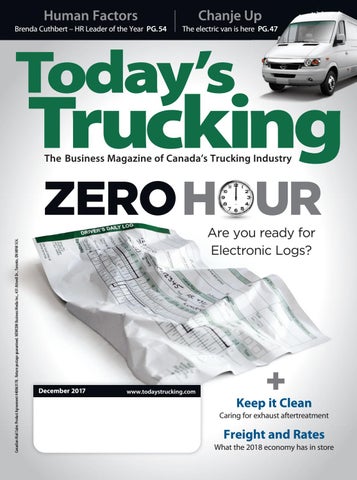
Human Factors
Chanje Up
Brenda Cuthbert – HR Leader of the Year PG. 54
The electric van is here PG. 47
The Business Magazine of Canada’s Trucking Industry
Canadian Mail Sales Product Agreement #40063170. Return postage guaranteed. NEWCOM Business Media Inc., 451 Attwell Dr., Toronto, ON M9W 5C4.
ZEROH UR Are you ready for Electronic Logs?
December 2017
www.todaystrucking.com
+
Keep it Clean Caring for exhaust aftertreatment
Freight and Rates What the 2018 economy has in store
Amenities to help drivers sleep at night. ProďŹ tability to help you do the same.
Competitive financing available through Daimler Truck Financial. For the Freightliner Trucks dealer nearest you, call 1-800-FTL-HELP. FTL/MC-A-1460. Specifications are subject to change without notice. Copyright Š 2017 Daimler Trucks North America LLC. All rights reserved. Freightliner Trucks is a division of Daimler Trucks North America LLC, a Daimler company.
The new Freightliner Cascadia® takes the driver experience to a whole new level. Designed for both comfort and functionality. A spacious driver lounge? Check. Increased storage capacity? Check. Space for larger appliances? Check. And that’s only a fraction of how we’re making life on the road easier for drivers. We understand increased driver comforts helps with driver retention. Which directly impacts your profitability. Experience it for yourself by taking a virtual tour at freightliner.com/amenities.
Contents December 2017 7 9 11 32 33
|
VOLUME 31, NO.12
Letters John G. Smith
12
36
40
44
Rolf Lockwood Heather Ness Mike McCarron
NEWS & NOTES
Dispatches 15 Deadly Distractions Police are cracking down
23 24 25 26 27 30 31
Heard on the Street Truck Sales Pulse Survey Stat Pack Trending Logbook Truck of the Month
In Gear
Features 12 Zero Hour U.S. paper logs are at an end, and Canada is next
By John G. Smith
36 Style and Substance 42 Bigger Data,
By Jim Park
Mack ups its game with the Anthem
Better Returns Control maintenance costs with video feeds and more
47 Chanje Up 48 Keep it Clean 50 Product Watch 52 Guess the location, win a hat
40 Freight and Rates 2018 will bring changes to the market
By John G. Smith
44 Power Plays By Jim Park
Is a lead acid battery your best choice?
For more visit www.todaystrucking.com DECEMBER 2017
5
We are Mack. This is our Anthem. Introducing Anthem, the next-generation highway truck from Mack. Born of the American spirit, Anthem comes standard with a bold design that delivers serious aerodynamics, and a new interior that keeps drivers comfortable and productive. See how Anthem is built to move your business forward. MackTrucks.com/NewAnthem
Letters Night drivers face special demands The Business Magazine of Canada’s Trucking Industry
PUBLISHER Joe Glionna joe@newcom.ca • 416/614-5805 VICE PRESIDENT, EDITORIAL Rolf Lockwood, MCILT rolf@newcom.ca • 416/614-5825 EDITOR John G. Smith johng@newcom.ca • 416/614-5812 ASSOCIATE EDITOR Elizabeth Bate elizabeth@newcom.ca • 416/614-5828 CONTRIBUTORS: Steve Bouchard, Mike McCarron, Jim Park, Nicolas Trépanier DESIGN / LAYOUT Tim Norton, Frank Scatozza production@todaystrucking.com • 416/614-5818 SALES AND MARKETING CONSULTANT Anthony Buttino anthonyb@newcom.ca • 416/458-0103 SALES AND MARKETING CONSULTANT Nickisha Rashid nickisha@newcom.ca • 416/614-5824 QUÉBEC ACCOUNTS MANAGER Denis Arsenault denis@newcom.ca • 514/947-7228 CIRCULATION MANAGER Pat Glionna 416/614-2200 • 416/614-8861 (fax) PRODUCTION MANAGER Lilianna Kantor lily@newcom.ca • 416/614-5815
Kenneth R. Wilson Award Winner
NEWCOM BUSINESS MEDIA INC. 451 Attwell Dr., Toronto, ON M9W 5C4 416/614-2200 • 416/614-8861 (fax) CHAIRMAN AND FOUNDER Jim Glionna PRESIDENT Joe Glionna VICE PRESIDENT, OPERATIONS Melissa Summerfield
Re: Traffic Unjammed (October 2017) While I believe your editorial can and will have a full and beneficial impact on our industry, you have missed a crucial aspect of this “strategy of schedules” – the driver. Although most drivers will say night driving is enjoyable, relaxing, and causes less stress, it requires a “different breed”. Night driving cannot be mistaken for the ordinary evening trips to get to a receiver before closing. Working a straight night lane challenges a driver in many ways. Physical, mental, and emotional changes to the human condition place demands on drivers who awaken to the sweltering heat of a summer day and sleep when families are beginning school and workdays. Do you enjoy time socializing with friends and family? Do you like to camp or fish on days off? Clubs, organizations, volunteering part of your time? Say goodbye to most all your “fun” activities if you’re a serious worker. A scheduled night driver must change and adjust their lives in a manner that baffles the average day worker. Your body begins to fight you at every turn. Even after years of practice, the body still never stops asking to be readjusted back to its human daylight position. — Russ Wallace Peterborough, Ontario
ELD’s will be the tipping point for many Any driver shortage issue caused by Electronic Logging Devices (ELD’s) will not be caused by drivers leaving because they can no longer survive financially, but the simple fact that they have finally reached the tipping point – where we have been legislated and dictated to a level we are no longer willing to tolerate. [Rolf Lockwood] was preaching to the choir with the point about drivers not wishing to drive several hours beyond legal; just 15-20 minutes as needed. I used to travel to a location that completely filled the logbook. If anything unexpected happened, I would drive that extra quarter hour. I find it impossible to sleep in a truck stop, and a rest area isn’t much better. I had the option of using common sense (something previously expected and appreciated, but now criminalized), and proceeding to my destination; a quiet yard on a street nearly devoid of traffic; or I could follow the book religiously, and spend the next day exhausted, and frankly, a hazard to road safety. — Bill Cameron Owen Sound, Ontario
CHIEF FINANCIAL OFFICER Peter Fryters DIRECTOR OF CIRCULATION Pat Glionna
Today’s Trucking is published monthly by NEWCOM BUSINESS MEDIA INC., 451 Attwell Dr., Toronto, ON M9W 5C4. It is produced expressly for owners and/or operators of one or more straight trucks or tractor-trailers with gross weights of at least 19,500 pounds, and for truck/trailer dealers and heavy-duty parts distributors. Subscriptions are free to those who meet the criteria. For others: single-copy price: $5 plus applicable taxes; one-year subscription: $40 plus applicable taxes; one-year subscription in U.S.: $60 US; one-year subscription foreign: $90 US. Copyright 2017. All rights reserved. Contents may not be reproduced by any means, in whole or in part, without prior written consent of the publisher. The advertiser agrees to protect the publisher against legal action based upon libelous or inaccurate statements, unauthorized use of photographs, or other material in connection with advertisements placed in Today’s Trucking. The publisher reserves the right to refuse advertising which in his opinion is misleading, scatological, or in poor taste. Postmaster: Address changes to Today’s Trucking, 451 Attwell Dr., Toronto, ON M9W 5C4. Postage paid Canadian Publications Mail Sales Agreement No.40063170. ISSN No. 0837-1512. Printed in Canada.
Member
Plenty of hurdles in path to autonomy Re: What’s Next (October 2017) Full (or even semi) autonomy in trucking is a little akin to the Jetsons’ world. The list of unintended consequences, surprises (lane closures, accidents, a virtual rolling highway exit ramp blockade for four-wheelers, etc.) and plain hard challenges is almost without limit, despite what rent-seeking, climate-change-doomsaying, pie-in-the-sky outfits like the North American Council of Freight Efficiency may claim. The platooning crowd claims a 4% saving with a Return on Investment of between 12 and 24 months, a zombie driver in [truck] Number 2, [but they will have] a pantload of legal, social, and regulatory hurdles to overcome for their efforts.
Email: johng@newcom.ca
SEND YOUR LETTERS TO: Newcom Business Media, 451 Attwell Dr., Toronto, ON M9W 5C4 If we publish your letter, we’ll even send you a Today’s Trucking hat as our thanks.
— Kent Smerdon Aeroserve Technologies DECEMBER 2017
7
Smaller. Lighter. Simpler.
The Single Module™ Cummins next-generation aftertreatment system offers a smaller package that is easier to install and simpler to maintain. With a drastically reduced size and weight, the Single Module is easy to install and takes up less space on the vehicle. Its compact design enables better thermal management across the system, translating directly into fuel savings and more efďŹ cient emissions reduction. And with increased ash capacity in the DPF, you can spend less time worrying about maintaining the system and more time focusing on the job at hand. For more information, visit www.cummins.com/components/aftertreatment @CumminsEmission
YouTube/Cummins
Editorial By John G. Smith
Keep it Safe OPP commissioner’s rhetoric does not reflect industry reality
L
et’s pause a moment to remember Benjamin Dunn. The 37-year-old truck driver from North Bay, Ontario, was a father of nine, killed in a flaming crash on Highway 400 that consumed 14 vehicles. It was a horrific scene. Every fatal collision is. And while just 12% of Ontario collisions involve commercial vehicles, about one in five fatal collisions involve trucks. The laws of physics determine just how bad things can be when large trucks and small cars collide, regardless of the mitigating factors. In this particular case, a line of traffic was stalled by the cleanup of a single-car collision involving a drunk driver. A tractor-trailer slammed into the back of that queue, even though early indications suggest the stopped traffic should have been seen in time. The sheer size of a collision involving trucks can leave the general public with the misconception that trucks are generally unsafe. But the facts demonstrate otherwise. Not only is our industry safe, it’s getting safer. Between 1995 and 2014, the number of large truck registrations in Ontario rose 75%, while fatality rates dropped 66%. Only 1.8% of large trucks involved in collisions between 2010 and 2014 had a mechanical defect that contributed to the crash. Police found truck drivers at fault 28% of the time during the same time period. These figures prove that unsafe trucks are outliers. The Ontario Trucking Association likes to refer to them as “bad apples”. Even when we acknowledge that generally safe carriers and skilled drivers are also involved in collisions and make mistakes, the story is the same. These situations are rarities in an industry that shares its workplace with the general public. Recent comments by Ontario Provincial Police Commissioner Vince Hawkes would have the general public believing something different. In the wake of the Highway 400 collision, Hawkes referred to trucks as “missiles”. In an earlier press conference that highlighted four other fatal collisions involving trucks entering construction zones, he blamed inattentive truck drivers pushed by factors such as fatigue, handheld devices, time pressures, and costs.
More unsafe equipment needed to be taken out of service, perhaps impounded, he said. Hawkes must have forgotten that there are rules in place to do this sort of thing now. Police and other enforcement teams have tools to ground unsafe vehicles and drivers today. The commissioner’s rhetoric serves no other purpose than generating headlines. It antagonizes the relationship between safe truck operators and police, frightens the general public, and will be outright ignored by the few “bad apples” who run afoul of the rules no matter what police may say. Yes, there are those who ignore the rules in the name of making a quick buck. Let’s not pretend otherwise. I’m not talking about those who are fined because of a mistake on a form, drive an extra 15 minutes beyond allowable Hours of Service to get home, or fail to spot a malfunctioning marker light. These are more matters of compliance with the strict letter of the law. I’m talking about those who turn a blind eye to the dangers they present, pushing driver to the limits of exhaustion in the name of completing loads, run tires as bald as racing slicks, and use these methods to undercut competitors who run as they should. If the police want to focus on companies like that, let’s help to point them in the right direction. But let’s also help to teach the general public to respect trucks rather than fear them. Let’s commit to ongoing efforts to make this industry and its equipment as safe as it can be. Let’s do it for every truck driver in our midst. They all deserve the chance to come home after a safe, productive day. TT
“In the wake of the Highway 400 collision, Hawkes referred to trucks as missiles.”
John G. Smith is editor of Today’s Trucking. You can reach him at 416-614-5812 or johng@newcom.ca. DECEMBER 2017
9
Transportation Growth Summit
Get Advice You Can Grow With! February 21, 2018
Register Today!
Introducing a summit designed to drive growth. If you are a President interested in making acquisitions, a Sales Manager interested in organic growth or a sales rep interested in increasing earnings, the Transportation Growth Summit will provide best practices, advice, and demonstrated techniques for growing your top and bottom lines.
Who Should attend: Companies: Trucking, Freight brokers, Freight forwarders, Customs brokers and industry suppliers. Position: C Level, Sales, Marketing, Customer service
www.transportationgrowthsummit.com For more information call Mike McCarron – 416-931-7212 The International Centre, 6900 Airport Road, Mississauga, 8:00 AM - 4:30 PM
Produced in partnership with:
Lockwood By Rolf Lockwood
Under-appreciated no more There is a new award to honor dispatchers, and I say it’s about time
T
here are lots of tough jobs in trucking, but people will usually say the most difficult of all is driving. They might just be right, and the poor sod piloting a truck through a city’s rush-hour traffic amidst untrained idiots on four wheels certainly won’t disagree. Then again, the company owner trying desperately to balance the books while juggling a thousand other competing priorities could well argue that his job takes the cake. Who’s to say either one is wrong? For my money, aligned with those first two on the tough-job scale is the dispatcher’s pressure-filled role. Much as I respect drivers, they’d be going nowhere fast if somebody hadn’t figured out who takes which load where. There’s no doubt in my mind that the dispatcher is this industry’s unsung hero. Sure, automated systems have made parts of the job easier for almost all of them, but the fact remains that they have to satisfy an awful lot of diverse demands. The sales manager says the load’s hot, the shop says the trailer needs service right now, the driver demands a backhaul to get him home for his wife’s birthday… well, you all know the picture. The poor sod at the dispatch desk is caught smack in the middle, doing a balancing act that would look good in most circuses. I’ll always remember my first visit long ago to a dispatch office because it seemed to be the perfect demonstration of that complexity. It was a pretty big Montreal LTL fleet, and there was a long wall of cards and colors staring down on a few sweating guys with phones stuck firmly in their ears. No computers to be seen. The office was electric with activity and I remember thinking I’d found the hub, the core of it all. But who’s working in that hub? Chances are good that it’s an ex-driver who wanted in from the cold (and sometimes a fleet owner who just loves to be in the thick of it every once in a while.) Chances are even better that he or she has no training whatsoever, except maybe in the software being used. There’s unlikely to be any coaching, for example, in how to deal with the conflicts that will inevitably arise.
It’s clear to me that drivers are under-loved in general, but none of us would have any trouble naming a fleet that works hard to appreciate drivers every day of the week. And there are several national awards as well, including our own HighwayStar of the Year. I’d venture a guess, on the other hand, that we couldn’t conjure up many carriers – if any at all – showing the same readiness to applaud dispatchers. So here’s some good news for you: the Private Motor Truck Council of Canada (PMTC) and CPC Logistics Canada have teamed up to create a new award that aims to celebrate dispatchers. The Rick Austin Memorial Dispatcher of the Year Award aims to honor the memory of one of CPC’s fleet dispatchers, Rick Austin, who died this past March. It will be presented for the first time at PMTC’s 2018 conference next June. Austin, like so many other dispatchers, was first a driver and then an owner-operator, joining the John Deere private fleet in 1991. After earning his million-mile safe-driving award he moved into a full-time dispatch role in 2000, subsequently receiving the CPC President’s Award in recognition of his exceptional loyalty, service, and dedication. The new award, says the PMTC, is “designed to help recognize the exceptional and often under-appreciated efforts of dispatchers who have made an outstanding contribution to their company in the past year or over their career.” I applaud both CPC and PMTC for this excellent move. It’s about time. TT
There’s no doubt in my mind that the dispatcher is this industry’s unsung hero.
Rolf Lockwood is vice-president, editorial, at Newcom Business Media. You can reach him at 416-614-5825 or rolf@todaystrucking.com. DECEMBER 2017
11
Zero Hour Paper logs about to meet their end in the U.S., and Canada is next in line By John G. Smith The countdown toward mandated Electronic Logging Devices (ELD’s) in the U.S. is now measured in terms of days. As of December 18, anyone who has been using paper logbooks south of the border will have to embrace a new reality – and a tool that monitors Hours of Service from the perspective of an unblinking digital eye. “Hours of Service hasn’t changed,” stressed Joe DeLorenzo, director – office of enforcement and compliance at the Federal Motor Carrier Safety Administration (FMCSA), during a presentation at the American Trucking Associations’ annual meeting. But requirements around the way workdays are tracked clearly will change. Once deadline day arrives, U.S. enforcement teams will begin to issue violations, warnings, and citations to those who run afoul of the new requirement for ELD’s. Out-of-Service penalties will
12
TODAY’S TRUCKING
be added to the list of potential sanctions on April 1, 2018. Some states have yet to complete the underlying legislation needed to introduce the mandate, but they will be ready come December 18, says Collin Mooney, executive director of the Commercial Vehicle Safety Alliance (CVSA) that guides enforcement teams across North America. DeLorenzo says the FMCSA won’t be concerned by one violation in a day, perhaps someone driving 15 extra minutes here or there, but multiple violations will trigger compliance reviews. Despite what some people believe, there is no official allowance for any “wiggle room” with paper-based logs, either. Legal and legislative challenges by groups such as the Owner-Operator Independent Drivers Association to stall or outright kill the mandate, barring any changes that
happen when the ink is still wet on the page of this magazine, have failed. “This issue has been legislated, promulgated, and litigated,” American Trucking Associations Chief Executive Officer Chris Spear said in his annual address to members. “It is now time to move forward.”
Canada’s rollout For its part, Canada continues to move forward at a slower pace. Regulators here are expected to mandate the devices as well, but no sooner than the spring of 2019. That’s if a first draft of the rules appears in Canada Gazette: Part 1 before the end of this month, quickly passes through a mandatory 60-day comment period, and is published right away in Canada Gazette: Part 2. When a proposed mandate is unveiled, it could also expect some opposition as industry trade groups continue to push for more time to prepare. News of Canadian regulators’ interest in a one-year rollout began to emerge this June, said Mike Millian, president of the Private Motor Truck Council of Canada, briefing his members on the plans. “One year is pretty short for all the devices that are going to be installed.”
There is no small irony in the fact that Canada is lagging the U.S. in setting a standard. Regulators here were preparing technical standards for such devices before their U.S. counterparts began pushing forward with rules of their own. But as similar as the rules are expected to be, there will likely be differences, Millian said. Transport Canada has indicated it will exempt trucks that are rented for 30 days, lining up with a proposal from the Truck Renting and Leasing Association, he explained. South of the border, an exemption only applies to trucks that are rented for eight days or less, aligning with the time limits in place to fix a malfunctioning device. Like any rule, there are also exceptions in the U.S. mandate. Paper logs, for example, will continue to be accepted in trucks that have pre-2000 Model Year engines. Millian was also critical of a U.S. approach that has manufacturers self-certifying products, some of which were registered before rules were even finalized. “It’s the most asinine thing I’ve ever heard of,” he said, adding that Transport Canada officials have suggested they plan to follow a similar path.
Deadly Distractions PG. 15
Tip of the Spear PG. 16
Shining Navistar PG. 21
Jacques DeLarochelliere, president of Isaac Instruments, points to an approach by some manufacturers that might not work in cases without cell coverage. Some cloud-based devices actually link to the engine’s Electronic Control Module through a cellular connection. If a device like that is used in an area without adequate cell coverage,
the device wouldn’t comply in those instances. “The operator has to choose a system that will be compliant everywhere it operates,” he says. “The mountains and the regions along the border have the worst cellular coverage.” Since the equipment is “self-certified” – meaning that vendors are the ones who say whether a device complies with the rules – it’s
important to ask questions when spec’ing an ELD, DeLorenzo said. A recently introduced online file validator, for example, can identify any problems with the data being transmitted. “It’s a pretty straight upload process and will kick back a report,” he added, challenging reports that have suggested there have been problems with the system.
Then again, many devices were self-certified before that tool was even available. Mooney is sure there will be a “couple” of ELD’s that don’t comply. But regulators believe most issues will be addressed with software patches rather than requiring the equipment to be rejected outright, he said. It’s up to fleets to ensure that their devices comply. PIT Group of FPI Innovations, a Canadian organization, now offers third-party certification to help with that very thing. Of course, some carriers operating in the U.S. have yet to decide what they’re going to use at all. “It sure feels like there are a ton that aren’t doing anything yet,” said Eric Witty, PeopleNet’s vice president – product management, referring to smaller carriers and owner-operators who have yet to order or install devices. “Regardless of the 100 different products that are out there to be ELD-compliant, is there enough supply for people [who] decide on the 10th of December, ‘I guess I better get something?’” Those who have existing Automatic On-Board Recording Devices (AOBRD’s) can have that technology
DECEMBER 2017
13
Dispatches grandfathered in the U.S. until December 16, 2019, but there are limits in that respect as well. The grandfathered technology can be moved into different trucks, but only as long as the vehicles aren’t adding to a fleet’s overall capacity. Any additional trucks will require a device that meets the ELD standards. If drivers end up moving from a truck
"I added Diesel Treat to my fuel tank and have not had any issues on these frigid Maryland mornings." Richard H.
product that really d. After two tanks of uct my diesel stopped ng when first started." C.
"Last week the temperature in Bakken dropped to 31 below. My truck survived and I Know it won’t leave me stranded because of fuel problems." Robert P.
"I’ve been in the transportation industry for over three decades and since the beginning I have used Howes products – never failed me." Richard S.
"Thanks for a great product that solved my problem. I tried other products but nothing works like Howes Diesel Treat." Alice T.
Nothing outperforms Diesel Treat.
"The last two days have been extremely cold with temps aroundd -10°. We’ve not had one fuel issuee throughout this winter season." Jim C.
ust wanted you to know this product is spectacular. oes everything you say on the bottle." Chris R.
We use it in our diesel trucks. We find the formance outstanding!" James P.
that has an ELD into another truck that has an AOBRD, meanwhile, there are other steps to follow. “One way or the other, whether it’s a printed copy or edited into the ELD, make sure your driver has the previous seven days [of logs],” DeLorenzo advised. There is no option to hand write logs and reconstruct the Hours of Service.
#1
Selling Anti-Gel in the U.S. and Canada
"I used a competitor’s pro product for years. But when it g gelled up twice I switched to H Howes. It was -38° and no pr problems. Never going back." Kathleen K.
"I’ve used Howes Diesel Treat for over 14 years. My C-15 has over 1,368,000 miles on the original injectors. I start with ease at sub-zero temps. What else can you ask for?" Lyle K.
"I’ve done a comparison omparison in fuel fuel fu uueeell mileage and on the performance perforrm rm man ance an aanc nce cee of my truck and nd found thee using uus usissin usin siiinnngg Howes makess all the differenc difference. reen ennce" nce nc cce" ce e"." ee. Mike ike P.
My milea mileage went from 17.6 to 19.7. My truck hasn’t ru run this good years in years. Dave RR.
"I’ve been caught in my fair share of ridiculous winterr storms and never once did myy fuel lines gel thanks to Howes.s. The stuff just works." Marc H.
"I’ve been using your product ffor the last 5 years and use anything else in my I won’t us truck. I stand st by Howes because you keep k me running." Paul H.
"Last year, a truly brutal winter, en I gave rides to two drivers with frozen fuel lines. They didn’t use Howes but I did. It was satisfying to know that I chosee a winner in Howes Diesel Treat." William B.
Just ask around. An for even more cleaning And power po and lubrication, try Howes Meaner Power Kleaner. Ho
"I believ Being from winters are a not only to So keep I
"I finally found a product I can trust. It’s nice to find something that really works!" Wayne H.
"This product is amazing! The money saved on fuel mileage pays for itself." Eddy J.
"Whatever is in that stuff, I would highly recommend it to any diesel user! It works like magic." Doug H.
"When my fellow truckers ask why my truck runs so well, I recommend they go get some Howes. Thanks for making a great product." Kevin B.
Howes Bluetooth l h SSpeaker k 1-800 GET HOWES (438-4693) • www.howeslube.com
14
TODAY’S TRUCKING
when you purchase any six bottles of Diesel Treat ½ gallons or Meaner Power Kleaner quarts. Visit www.howeslube.com or call 1-800 GET HOWES. Offer ends: 3/31/18, available while supplies last.
The mixture of devices could present challenges during future rollouts, Witty adds, referring to the slip-seating and sharing of equipment form one terminal to the next. When it comes time, he recommends such fleets should change entire facilities to ELD’s in the name of training efforts and support.
Sharing the data At the roadside, ELD data will be transferred by the web or email, or uploaded through a Bluetooth link or USB key. If all else fails, the ELD is expected to have a display screen or printout. Officers will give drivers a code to transfer the data, and the file will be accessed. “It’s also very important for drivers to know what they have,” DeLorenzo said, referring to the way data can be transferred. “The more your driver knows, the easier that inspection will go.” The rules don’t require drivers to let enforcement officers walk away with the devices. He suggested training drivers to step out of the truck and hold the screen to show required data. The technology itself isn’t new. Millian introduced ELD’s when working at Hensall District Cooperative’s Ontario fleet in 2013. But preparations involve more than throwing a switch. The best approach is to review two or three suppliers, install the devices, and then train everyone involved, he says. Cheat sheets or visor cards to answer basic questions such as how to read the screen and access information are helpful, too. There are inevitably calls from drivers who forgot to log into devices, or don’t know what to do if they see a truck was moved by a member of the maintenance team who forgot to log in as well. “If you’re running into the states and don’t have ELD’s installed, you’re already late,” he said. “Stuff’s going to happen. Nothing’s perfect.” But the devices did help reduce paperwork. Logs were verified automatically, and form-and-manner violations like incorrect dates disappeared, as did issues caused by drivers incorrectly adding up their available hours. Only one driver quit because the devices were installed, Millian said. “He was a good one to lose.” TT
Dispatches
Deadly Distractions Ontario police look to crack down on dangerous driving behaviors By Elizabeth Bate
The province’s largest trucking association has been asking for a committee to be struck between themselves, the OPP, and MTO, Beghetto said, referring to actions expected in coming weeks. The committee will address issues of safety and enforcement and work toward developing a plan to combat incidents like these.
As for the seizure of vehicles, the OTA says a law already exists in Ontario that allows the impounding of commercial vehicles, and police must follow specific criteria when doing so. Beghetto says if the OPP would like to review the criteria for impounding a vehicle, that is something they can talk about during the upcoming committee meetings. TT
Charges have been laid and changes may be coming to the way police officers investigate and enforce dangerous driving behaviors in Ontario. Citing 56 crashes and 57 related deaths involving commercial vehicles in 2017 – up from the previous year – Ontario Provincial Police (OPP) Commissioner Vince Hawkes took to a podium in October to announce charges in three separate crashes on 400 Series highways in the previous month. Each case is being blamed on distracted truck drivers failing to slow down as they entered constructions zones. Hawkes called the incidents “inattention at its worst,” and said the sudden increase in collisions involving commercial drivers highlighted the need for increased patrols on Ontario highways and the possibility of increased measures against commercial truck drivers – including vehicle seizures. The OPP will be consulting with the Ontario Ministry of Transportation (MTO), as well as those in the industry, to better understand why these collisions happened and to develop a new strategy for dealing with commercial vehicle drivers who drive while distracted or fatigued, he added. Marco Beghetto of the Ontario Trucking Association (OTA) said he agreed with the OPP sentiment that the trucking industry does not want to see unsafe drivers on the road. Both the OPP and the OTA reiterated that commercial vehicle drivers are some of the safest on the road, but said the actions of what Beghetto called “a few bad apples” need to be addressed. DECEMBER 2017
15
Dispatches
Tip of the Spear American Trucking Associations president applauds Trump By John G. Smith The U.S. Trump Administration clearly has a friend in America’s trucking industry. Chris Spear, president and Chief Executive Officer of the American Trucking Associations (ATA), delivered a wide-ranging state of the industry address at the group’s annual meeting, promoting everything from proposed tax reforms to a pending mandate for Electronic Logging Devices, and Trump’s commitment to raise funding for infrastructure. In the past year, the group has met with U.S. Transportation Secretary Elaine Chao and all 10 House and Senate Committee leaders and ranking members. But a clear highlight, demonstrated through pictures around the convention hall, was an appearance at the White House with 12 America’s Road Team captains. “ATA is now fully engaged in reforming our country’s decaying tax laws,” he added, referring to the associations’ hosting a recent meeting with Trump in Pennsylvania. Citing trucks as “the barometer for the nation’s economy,” Trump at that meeting introduced a proposal for a 20% cut in corporate tax rates and eliminating estate taxes. “With the president now championing our best interests, the entire nation is paying attention to what we have to say,” Spear said. Meanwhile, ATA is supporting a coalition led by the U.S. Chamber of Commerce to advance trade policy – including that which governs truck freight between Canada and the U.S. “Trucks move 76% of the NAFTA surface freight, 82% of the cross-border traffic with Mexico, and 71% with Canada: our nation’s largest trade partner. I’ve visited our borders and can tell you first hand that our industry will be the first to feel any changes in NAFTA, good or bad,” he said. Throughout the strongly worded address, Spear committed the ATA to
16
TODAY’S TRUCKING
fighting “anti-truck and amateur-hour advocacy groups,” and credited the group with helping to strike down “illconceived, special interest-driven Hours of Service rules from the U.S. Code.” “ATA and its coalition partners are looking to continue this winning streak by sending a strong message to policy makers in Sacramento … this is not the United States of California,” he said, challenging what’s known as FA4, the state’s meal and rest breaks that collide with federal standards. “This confusion has generated a litigious frenzy. Over $250 million in settlements to date and immeasurable exposure in pending and potential litigation.
litigated. And it is now time to move forward,” he said. On a morning when the American Transportation Research Institute identified the driver shortage as the industry’s top priority, drawing on an annual survey, Spear noted that today’s shortage of 50,000 drivers is expected to double in just five years. Almost 1 million drivers and technicians will be needed in the next decade just to meet economic demands. “Our industry faces several barriers that must be addressed if we’re going to grow, including: establishing preapprenticeship and apprenticeship training programs, and hiring and training 18-21 year olds. We need interstate recognition of credentials, entry-level training standards for veterans and non-veteran employees, solutions for the impact of detention time, and congestion on drivers’ Hours of Service and more,” he said. Spear pulled no punches in an attack against groups that oppose ATA work. “This wave of special interests has built
Spear lefts little doubt that the American Trucking Associations has a role in building trucking’s future.
Apparently California’s lawmakers care more about the plaintiffs’ bar than public safety, or even jobs,” Spear said. “This is an issue we have to win, and we will. It’ll happen by working with Congress and this administration, continuing to invest over $9.5 billion each year in safety technologies, and giving a voice to the 7.4 million employees in trucking jobs throughout the nation.” Spear gave the ATA credit for convincing the U.S. House of Representatives to defeat efforts to delay the rollout of Electronic Logging Devices. “This issue has been legislated, promulgated, and
a cottage industry fueled by ideology, emotion, and misguided narratives – all intended to divide our industry and this association,” he said. “Obstruction is their weapon of choice. From bad bills to frivolous lawsuits, trolling social media and issuing personal attacks. Theirs is an agenda purely based on the notion that if it feels good, do it – and if it fails, blame someone else.” “Agendas rooted in ideological divisions are nothing more than self-fulfilling prophecies,” he said. And he called on industry representatives to joint forces in the fight. TT
Dispatches
Leathers, Brewster and Costello discuss the growing shortage during a presentation at the American Trucking Associations annual meeting.
Empty Seats U.S. approaches record driver shortage, and the worst may be yet to come By John G. Smith The U.S. is approaching a record truck driver shortage, requiring 50,000 for-hire drivers this year alone – and the problem is expected to intensify in the next decade. Turnover rates in the truckload sector are expected to reach 90% this year, said Bob Costello, chief economist at the American Trucking Associations, during the group’s annual meeting in Orlando. That’s still less than the all-time high turnover of 130% recorded in 2005, but up from the 81% seen in 2016, when the industry faced a freight recession. The first half of this year, the rate was closer to 82%. “It feels much worse to you,” he told a crowd of fleet executives, noting how the shortage ranks high on the list of top issues tracked by that American Transportation Research Institute (ATRI). The for-hire industry in the U.S. was short 45,000 drivers in 2015, while the need dipped to 36,500 drivers during last year’s freight recession. By 2026, the shortage is projected to climb as high as 174,000 for-hire drivers. At those levels there will be an impact on supply chains, Costello said. It may be the day when people go to the grocery store and discover seven varieties of apples waiting for them instead of 10, he added.
The numbers are based on today’s 864,000 for-hire drivers of heavy trucks and tractor-trailers, about half of the 1.7 million drivers of such drivers overall. There are 10 million holders of Commercial Driver Licences in the U.S., but many of those are retirees who have held on to their qualifications, Costello said. The overall 3.5 million Americans who count themselves as truck drivers work behind the wheel of everything from dump trucks to refuse vehicles. The turnover rates in the Less Than Truckload sector are closer to 9%, largely because its drivers tend to make more money and get home more often, he said. “First and foremost it is a demographics story,” Costello added, referring to the aging workforce. “The trend line doesn’t look good.” The industry also faces stiff competition from job opportunities in other sectors such as construction, which created 1.3 million new jobs in the last five years. Derek Leathers, president and Chief Executive Officer of Werner Enterprises, stresses that the shortage is really about quality drivers. His fleet is hiring just 2.7% of applicants. Rebecca Brewster, president and Chief Operating Officer of ATRI, referred to the
4.4% of drivers who are 20-24 years old. “We are not bringing young people into this industry in numbers and volumes that we need to fill those requirements,” she said. Leathers sees an opportunity in reaching out to younger men and women who are saddled with college debt and want to explore a trade-based career path. “I think we’ve lost our way a little bit as a country,” he said, referring to youth who are not exploring trucking careers. For its part, ATRI is already studying whether it is possible to identify younger drivers who share common characteristics with safe, older drivers, perhaps creating an expedited path for those under the age of 21 currently banned from interstate trucking. Costello questioned whether higher driver pay would be a solution to the problem. A lot of drivers would love it, he said, but many would just decide to work less and make the same wages seen before the increases. But there has been an undeniable increase in bonus payments. Safety bonuses in the U.S. now average $1,499 per driver, with bonuses for on-time deliveries reaching $1,946, starting bonuses $949, and retention bonuses $1,143. “There is no one solution to the driver shortage,” he said. TT
TOP 10 U.S. trucking industry issues The driver shortage is clearly at the top of mind among 1,500 people who responded to the American Transportation Research Institute’s annual survey. The following were the Top 10 issues:
n Driver shortage o Electronic Logging Device mandate p Hours of Service q Lack of available truck parking r Driver retention s Compliance, Safety and Accountability (CSA) ratings
t E conomic impacts of trucking regulations u Driver distraction v Infrastructure and congestion w Driver health and wellness DECEMBER 2017
17
Dispatches
Trucking groups back trade deal Negotiators are reportedly struggling to find common ground in the search for a better North American Free Trade Agreement, but three of North America’s largest trucking associations are encouraging them to do that very thing.
The Canadian Trucking Alliance, American Trucking Associations, and Mexico’s CANACAR, issued a rare joint statement in October, calling for negotiating teams to “update the trade agreement in a manner that continues to benefit trade.” Trade certainly benefits trucking. Motor carriers haul the vast majority
of trade by value across international borders, supporting the supply chain for everything from cars to agriculture and pharmaceuticals, the statement notes. “NAFTA truck-transported trade supports tens of thousands of trucking industry jobs across the continent and generates billions in revenue annually,” it reads. “Our industry demonstrates how trade creates good, solid long-term jobs across the continent. The ripple effects are significant, too. In order to haul all the trade across our borders, our industries have to buy a significant amount of goods and services, from equipment to fuel to tires to insurance. This, in turn, supports many jobs. Not only do we haul this cross-border freight efficiently, we do it safely – regardless of the carrier’s country of origin.” The groups ask government negotiators to update NAFTA to keep North America competitive in an international context, improving the efficiency of international crossings.
BC wants drivers to ‘be truck aware’
PREMIUM BRANDS. LOCAL EXPERTS. THE RIGHT PEOPLE. THE RIGHT PARTS. THE RIGHT PLACES. There’s no beating the ease of doing business with your trusted local truck parts distributor. As part of North America’s Leading Truck Parts Network®, your local VIPAR Heavy Duty Parts Professional offers the brands you want and the expertise you need, with the strength and resources of a network of over 620 locations throughout the U.S., Canada, Mexico, and Puerto Rico.
FIND A VIPAR HEAVY DUTY PARTS AND SERVICE PROFESSIONAL AT VIPAR.COM
18
TODAY’S TRUCKING
With one-in-five traffic fatalities in B.C. involving large commercial vehicles, road safety insiders are calling for drivers to be more careful around trucks. The Be Truck Aware campaign was launched in time for Operation Safe Driver Week, and is aimed at reducing car-truck crashes, which put the passengers of a car at a much higher likelihood of injury. While only 1% of collisions on B.C. roads involve commercial vehicles, they are involved in 20% of fatal collisions. Car drivers are being asked to leave space for large trucks that need extra room to stop and turn, ensure they can see both headlights in the rearview mirror before merging in front of a truck, and be visible to trucks by staying out of their blind spots. “We’re asking drivers to consider their own driving behavior around large trucks. If we want our roads to be safer, we first need to start with ourselves,” said Lindsay Matthews, director of road safety for the Insurance Corporation of British Columbia (ICBC).
Dispatches
Phillips and Tempro acquires Wolverine Phillips and Temro Industries has acquired Washington-based Wolverine Engine Heaters, which provides heaters for industrial hydraulic systems, commercial and personal vehicles, and other applications. The companies have been working under a distribution agreement for the past four years. Phillips and Temro is a manufacturer and aftermarket provider of heating, cooling, and electrification systems for markets including trucking, automotive, oil and gas, and off-road vehicles. Its brands include Zerostart, Temro, Arctic Fox, Idle Free Systems, and Truflo.
hydraulic disc brake pads. The business will become part of Stemco’s brake product group, while CVC products will be marketed with the Lunar brand name. “This purchase presents the perfect opportunity for us to expand into the medium-duty marketplace, which will be a new venture for us,” said
Stemco president Todd Anderson. Lunar air disc brake pads feature a mechanical retention system that delivers shear strength and efficiently dissipates heat, the company says. A molded V-groove further dissipates heat, helps evacuate gas, and reduces surface tension, fade, and premature wear, the company says.
Cummins acquires battery pack maker Cummins’ commitment to electrified vehicles has taken yet another step, with the company acquiring the assets of Brammo, which designs and develops battery packs for mobile and stationary applications. “To be a leading provider of electrified power systems just as we are with diesel and natural gas driven powertrains, we must own key elements and subsystems of the electrification network,” said Tom Linebarger, chairman and Chief Executive Officer of Cummins. “By adding the expertise of Brammo and its employees to Cummins, we are taking a step forward in our electrification business and differentiating ourselves from our competition.” Cummins recently unveiled an electrified Class 7 tractor known as the Aeos, built by Roush on the base of an International ProStar. It can travel 160 kilometers on a single charge of its 140-kilowatt-hour li-ion battery.
Stemco buys air disc pad maker Stemco has purchased Commercial Vehicle Components, a manufacturer of air disc brake and medium-duty DECEMBER 2017
19
Dispatches
Daimler eyes future Electrification, platooning part of manufacturer’s strategy By John G. Smith Against a backdrop of strong sales and the promise of a growing economy, Daimler Trucks North America continues to explore emerging technologies from electrification to platooning. “We’re going to finish strong this year,” said president Roger Nielsen, during a wide-ranging roundtable discussion with industry media during the American Trucking Associations’ annual meeting. While the Canadian market for Class 6-8 trucks expanded by 6% year-overyear as of September, Daimler’s related market share dropped 3.9%. Much of the Canadian market’s growth can be attributed to the Oil Patch, Nielsen said. “Honestly, the market growth there is not in a segment where we’re most competitive,” he admitted. “We’re going to solve that (drop), so don’t think I’m going to let that sit.” Some of the most dramatic sales gains in the broader organization are at Western Star, with a 30% jump compared to the previous year. Those gains can be credited in part to the 4700 model, he said. But at a time when several industry players are announcing electric truck plans, Nielsen was also quick to note that Daimler already has a presence in the market. Its urban e-Truck in Europe has a 190-kilometer range, a Gross Vehicle Weight of 57,000 pounds, and can charge in two to three hours. The medium-duty Fuso e-Canter being released in North America has a 100-kilometer range and 10,560-pound Gross Vehicle Weight. The latter truck is scheduled to launch with four models in 2019. Only days after his briefing, Mitsubishi Fuso Truck and Bus Corporation (the majority of which is owned by Daimler AG) unveiled an electric Class 8 truck with a 350-kilometer range at the Tokyo Auto Show. Nielsen also confirmed that work is underway to develop an electric version of the Cascadia tractor.
20
TODAY’S TRUCKING
Roger Nielsen, President and CEO Daimler Trucks North America. (Photo: Daimler AG)
“We believe it’s a technology worth exploring,” he said of electric trucks. But there is still the need to increase battery power density and reduce weight penalties, delivering a sound business case for truck operators. A vehicle battery will last about six to seven years, but does that mean an electric truck has no value at the end of that timeframe, he asked. A truck’s depreciating value is tracked through three different customers, but what does this mean for the third buyer? Product development has hardly stopped here. Among ongoing work is the move to ever-taller rear axle ratios. “We’re doing quite an investment in machining to make that happen,” he said. Daimler also wants commitments for the U.S. Environmental Protection Agency’s Phase 2 Greenhouse Gas emissions standards to continue. “We are encouraging EPA to keep the standard as it is right now,” Nielsen said, noting that the rules offer fuel economy gains and certainty
in the truck development process. Questions have been raised about whether the rules pertaining to glider kits and trailers might be at risk under a U.S. presidential mandate to reduce regulatory burdens. Nielsen openly hoped for a unified standard across the country.
Platooning Then there are ongoing plans for the future, with evermore refinements in active driver safety systems like lanekeeping technologies that support the potential for fuel-saving truck platoons. It is a scary experience to sit just 45 feet behind a stainless steel trailer and see your headlights reflected in the surface, admits Nielsen, who has completed a test drive himself. “You simply can’t see around the truck in front of you.” Platooning has a niche, and the underlying technology is ready, he said. Daimler is combining radar, cameras, and vehicle-to-vehicle communications, with antennas on both mirrors so there’s always a line of sight between lead vehicles and those that follow during tests. “We would be the last to advocate a driver sit with his arms crossed, but it will be possible,” he said, referring to lane-keeping systems. But there are still questions to answer, and they involve more than technological advances alone. Technically there is no limit to the length of a platoon, but there would have to be a business model to support different lengths. “I haven’t had anybody yet say we need five (vehicles),” he said. The motoring public also has to learn that the tight gaps between two platooning trucks aren’t meant for their cars, either. Other productivity gains can still be realized by going old-school. “Why would you invest in platooning if you could put dollies underneath?” Nielsen asked, referring to Long Combination Vehicles as another option. Daimler itself is steering away from language about autonomous trucks and instead focusing on the active safety systems that support drivers. A description of autonomous trucks leaves the impression that vehicles won’t require drivers, Nielsen said. “We don’t believe that.” TT
Dispatches
A Shining Navistar Manufacturer feels positive about the future By John G. Smith Backed by a new family of products and a robust economy, Navistar executives are clearly feeling positive about the future. “We have [introduced] a lot of new products in the last two years, and we got a lot of new products coming in the next two,” said Denny Mooney, senior vice president – product development, during a briefing to industry media. Those new products include the LT linehaul tractor, its RH regional hauling counterpart introduced at the Expocam trade show in Montreal, the heavy vocational HX tractor launched last year to replace the PayStar, and the new HV that replaces the WorkStar. The HV was unveiled at the recent North American Commercial Vehicle Show in Atlanta, Georgia. The HX itself represents a market segment that Navistar saw drop in half after it stopped producing 15-liter engines. “Our [13-liter model], because it was an EGR engine, we couldn’t cool it at some of the power and torque ratings we needed,” he said. A little over five years later, though, Navistar says it’s back in the business. “We’re picking up share,” Mooney said, noting that three HX models were entirely new entries in the marketplace. “In the vocational segment, if you don’t have the features, if you don’t have the power and torque, they’re not buying the truck.” Heavy vocational trucks represent a relatively small market compared to the sales volumes of linehaul tractors, but the segment is growing on news of booming construction and even improving sales in the oil and gas sector. “It’s not a share play. It’s more of a profit play. These are high-margin trucks. The volumes are way higher in on-highway, but the margins are much thinner,” he said. As the company’s fiscal year was coming to a close, Navistar was bullish on the economy in general, according to Jeff Sass, Navistar’s senior vice president – North
American truck sales and marketing. The company’s North American Class 8 market share had inched up about 0.5%, with the share of medium-duty trucks up 3% in 2017. “I see the economy being very strong. I see the freight rates going up. I see the number of loads going up,” he said. Still, there are challenges to come – specifically in the form of Electronic Logging Devices, which as of December will be mandated for carriers operating in
features will play a significant role overall. “We know there’s a driver shortage in the industry, but we have really, really tried to make these products [the type of] products drivers want to drive,” Mooney added. “If the drivers like our trucks, the fleets are going to buy our trucks.” Driver-centric features include disc brakes that are less “grabby” than drum designs, he said as an example. “We made disc brakes standard on the LT in June of this year, but we also saw the take rates come up.” Other technologies have been making gains of their own. Take rates for collision mitigation systems are up 50%, while the sales of replacement bumpers and fenders has reportedly dropped.
Armed with a new product line-up, Navistar sees strong days ahead.
the U.S. Overall productivity is expected to drop 8-12% at first, and then level out at a drop of 3-5% once the rollout is complete, Sass said. “Those are the fleets that were running clean in the first place.” It could influence the market for used trucks, too. Half of U.S. freight is hauled by a truck operated by its second or third owner, Sass said, predicting further consolidation in the truck market to come. “Most of those second or third owners have not implemented ELD’s yet.” In the battle for market share, Navistar executives say driver-centric
Predictive cruise controls that adjust speeds and gears based on readings of topography have also seen take rates rise to 15%. The latter system, launched just over a year ago, is delivering “real world” fuel economy gains, Mooney said. The biggest technological shift, though, has come in the form of Automated Manual Transmissions, which have seen adoption rates rise above 70% compared to about 40% of trucks sold just two years ago. “It was one of those technologies we knew made it easier for drivers to drive trucks,” Mooney said. TT DECEMBER 2017
21
Dispatches
Untapped Resources Recruiting, retention, and changing demographics The trucking industry’s average employee is seven years older than a typical Canadian worker, and overwhelmingly male. But a potential generation of new recruits is within reach in the form of largely untapped resources – millennials and women. There have always been women in the trucking industry, stressed Jane Jazrawy, Chief Executive Officer of Carriers Edge, during a presentation to Ontario’s Fleet Safety Council. Even Queen Elizabeth assumed a role in trucking during World War II. But the current recruiting environment requires more women than the past. Fewer than 3% of Canada’s drivers are women, even though they represent half of the nation’s workforce. In the overall transportation sector, including other modes, just 27% of employees are women.
22
TODAY’S TRUCKING
One of the ways to recruit and retain more members of the demographic group is to create a more welcoming workplace, Jazrawy says. This can involve tackling factors that create a toxic work environment. “It happens everywhere,” she stressed, referring to environments inside and outside a fleet office. “Tell them how they can report things. Ask them what’s going on. Ask, ‘How can we make it better?’” “We need to start showing women in other [roles] despite being pretty,” she added, noting how Challenger Motor Freight successfully uses recruiting ads that highlight women. Millennials present some unique requirements of their own. The demographic cohort typically begins looking for promotions after 15 months
on the job, says Isabelle Hetu, director programs and services at Trucking HR Canada. “Don’t be surprised if a first-year driver, a millennial, comes to you and says they want to be a driver-trainer.” “That’s not a lot of time,” she admitted. It may not even be practical. But rather than dismissing the interest outright, it is possible to identify the steps needed to meet the next goal in their career path. Millennials are looking for training, professional development, and a sense of purpose, she explained. “They want to be connected, and part of that is related to coaching and mentorship.” Not surprisingly, all of the employers recognized through Trucking HR Canada’s Top Fleet Employers program are committed to training, offering such things as in-house programs and reimbursed tuition. Training is a two-way street. Twothirds of women already in Canada’s trucking industry are both looking for mentoring opportunities and want to be mentors, Hetu said. TT
Dispatches
Heard Street on the
John A. Schneider, President Accuride Wheel End Solutions
Gregory A. Risch, President Accuride Wheels North America
Scott D. Hazlett, President Accuride Wheels Europe & Asia
STA awards celebrated with glitz and glamour The Saskatchewan Trucking Association (STA) celebrated its 80th anniversary October 21. Kristin Finch, 29, was named Driver of the Year. Finch is a nine-year veteran of the industry, who drives with her dad as part of a team for Kindersley Transport. The Service to Industry Award winner was Brenda Cuthbert of Siemens Transportation Group, making her the first women to ever earn the honor. The Dispatcher of the Year award was presented to Ian Brown of Transall Group of Companies.
Accuride consolidates business units Accuride is consolidating its wheel end components businesses that include the stand-alone Gunite unit, and KIC business acquired in May 2017. Collectively they will now be known as Accuride Wheel End Solutions, although the KIC and Gunite brands will remain. John A. Schneider, who joined Accuride as president of KIC, will serve as president of Accuride Wheel End Solutions. Gregory A. Risch, previously president of Accuride’s Gunite business unit, has been appointed president of Accuride Wheels North America. Scott D. Hazlett, previously president - wheels, now serves as president – Accuride Wheels Europe and Asia.
Saying goodbye to a friend Kenneth John Tanner, 65, branch manager of the SAF-Holland’s Surrey, British Columbia facility – and sales representative for Western Canada and Alaska – passed away suddenly October 15. A well-known face, he is survived by his wife Laurie.
Brian Orrbine
Brian Orrbine dead at 67 Brian Orrbine, Transport Canada’s former chief –
Element names Gittens Canadian president Element Fleet Management has named Chris Gittens as president of Canadian operations in a role that will have him reporting to Kristi Webb, president and Chief Executive Officer of Element Fleet Management North America. Gittens joined the fleet management consultants in 2013 as Chief Commercial Officer for Canada and has worked closely with most of the company’s largest accounts across North America. Gittens succeeds Sebastien Blondin, who switches to a strategic business development role with the Element Fleet Management corporate team.
Chris Gittens
motor carriers, has died after a fight with cancer. He was 67. He served the Canadian Council of Motor Transport Administrators’ (CCMTA’s) compliance and regulatory affairs program committee for about two decades. “Admired and respected by colleagues and staff across the organization, Brian was honored with the CCMTA Award of Distinction at the 2017 annual meeting. We shall miss him,” the group said in announcing his passing. DECEMBER 2017
23
Dispatches
Commodity costs pushing up prices Navistar has taken the unusual step of announcing it will increase truck prices by up to 2% in the coming year, citing rising commodity costs. “We continually improve our own productivity, but there is a point when suppliers raise costs to us that we can’t just absorb,” said Michael Cancelliere, president – trucks and parts. Still, the marginal price increase will be offset by the overall value that new trucks bring to customers, he said. “If you can get better fuel economy on a daily basis over a three-, four-, five-year period, I’m sure that’s worth well in excess of the increase.” Every day of downtime is also valued at about $1,000 on the low side, he added. Reliable trucks and effective service networks make a difference there. In terms of 2017 sales, Freightliner continued to hold the top Canadian sales spot for Class 8 trucks as of September, with International Trucks leading Class 7, Hino at the top spot for Class 6, and Ford in Class 5.
Canada – September 2017 SALES
MARKET SHARES
Sept.
YTD
Sept. %
YTD %
Freightliner Kenworth International Peterbilt Volvo Truck Western Star Mack Other Total
690 420 322 250 312 233 199 0 2,426
5,384 2,991 2,751 2,189 2,038 1,753 1,321 0 18,427
28.4 17.3 13.3 10.3 12.9 9.6 8.2 0.0 100.0
29.2 16.2 14.9 11.9 11.1 9.5 7.2 0.0 100.0
CLASS 7
Sept.
YTD
Sept. %
YTD %
417 88 77 49 37 6 674
1,359 800 581 368 323 87 3,518
61.9 13.1 11.4 7.3 5.5 0.9 100.0
38.6 22.7 16.5 10.5 9.2 2.5 100.0
Sept.
YTD
Sept. %
YTD %
56 22 24 2 12 3 1 120
460 229 194 45 43 10 2 983
46.7 18.3 20.0 1.7 10.0 2.5 0.8 100.0
46.8 23.3 19.7 4.6 4.4 1.0 0.2 100.0
Sept.
YTD
Sept. %
YTD %
272 122 93 91 3 0 0 0 0 0 581
2,860 1,165 970 685 20 10 6 0 2 0 5,718
46.8 21.0 16.0 15.7 0.5 0.0 0.0 0.0 0.0 0.0 100.0
50.0 20.4 17.0 12.0 0.3 0.2 0.1 0.0 0.0 0.0 100.0
CLASS 6 Hino International Freightliner Peterbilt Ford Kenworth Isuzu Total CLASS 5 Ford Hino Dodge/Ram Isuzu International Mitsubishi Fuso Freightliner GM Kenworth Peterbilt Total
24
U.S. – September 2017
CLASS 8
International Hino Freightliner Kenworth Peterbilt Ford Total
TODAY’S TRUCKING
www.total-canada.ca
SALES CLASS 8 Freightliner Peterbilt Kenworth International Volvo Truck Mack Western Star Other Total
MARKET SHARES
Sept.
YTD
Sept. %
YTD %
7,252 2,604 2,689 1,995 1,384 1,312 413 18 17,667
50,774 21,342 19,446 15,172 12,252 11,659 3,725 111 134,481
41.0 14.7 15.2 11.3 7.8 7.4 2.3 0.0 100.0
37.8 15.9 14.5 11.3 9.1 8.7 2.8 0.0 100.0
CLASS 7
Sept.
YTD
Sept. %
YTD %
Freightliner International Peterbilt Kenworth Ford Hino Total
2,424 1,666 513 349 121 153 5,226
21,544 13,791 4,093 3,279 1,457 1,309 45,473
46.4 31.9 9.8 6.7 2.3 2.9 100.0
47.4 30.3 9.0 7.2 3.2 2.9 100.0
CLASS 6
Sept.
YTD
Sept. %
YTD %
Freightliner Ford International Hino Kenworth Peterbilt Isuzu Total
1,496 1,263 846 558 265 8 38 4,474
15,089 14,857 10,764 5,059 1,802 223 67 47,861
33.4 28.2 18.9 12.5 5.9 0.2 0.8 100.0
31.5 31.0 22.5 10.6 3.8 0.5 0.1 100.0
CLASS 5
Sept.
YTD
Sept. %
YTD %
Ford Dodge/Ram Isuzu Freightliner Hino GM International Mitsubishi Fuso Kenworth Peterbilt Total
4,742 1,195 445 421 234 24 8 32 4 0 7,105
36,787 12,743 3,921 2,522 1,832 257 141 127 28 14 58,372
66.7 16.8 6.3 5.9 3.3 0.3 0.1 0.5 0.1 0.0 100.0
63.0 21.8 6.7 4.3 3.1 0.4 0.2 0.2 0.0 0.0 100.0
Source: WardsAuto
Dispatches
Pu se Reader Survey Tell us your thoughts on ... Electric Trucks Diesel is currently the trucking industry’s fuel of choice, but a growing number of manufacturers are also preparing for an era of electric powertrains. How do you feel about the potential of electric trucks?
Do you believe electric trucks will have commercial applications? (Pick one)
Do you believe electric trucks would offer an effective tool for controlling emissions?
66% Only in applications with limited ranges and weights (urban deliveries, port drayage) 17% In most applications 11% No 6% In all applications 0% Only if and where using diesel is banned
YES
68 % NO
32 %
When do you think electric powertrains would be practical for your business?
What do you think is the biggest barrier to adopting electric trucks?
41% 28% 14% 11% 6%
43% 17% 17% 10% 8% 5% 0% 0%
Never 6-10 years 11-20 years 1-5 years 21+ years
Results are rounded to the nearest 1/10th percent.
“Carbon footprint on building these batteries is terrible”
Limited operating ranges Lack of charging infrastructure New/unproven technology Other Battery weights Limited service locations Lack of tax incentives Limited product lines
If the Total Cost of Ownership for a diesel or electric truck were the same over the lifetime of a vehicle, would be more likely to buy: Diesel
42 % Either
34 % Electric
24 % “Cold weather issues up in Northern Ontario and Quebec”
Today’s Trucking Pulse surveys are conducted once per month, covering a variety of industry issues. To share your voice in future surveys, email johng@newcom.ca.
Next month: Health and Wellness DECEMBER 2017
25
Dispatches
StatPack
41.8% HIGHWAY TRACTORS Mack secured a spot in the market for linehaul trucks through the recent release of its Anthem tractor, and the company believes the overall market for such trucks is also on the rise. Year to date, highway tractors accounted for 41.8% of U.S. and Canadian Class 8 vehicle registrations as of August. In 2016 the share was closer to 46%. Jonathan Randall, senior vice president – sales, predicted the share will continue to climb into the high 40s.
TRAFFIC ACCIDENTS Volvo invented the three-point safety belt in 1959, and with an era of active safety systems upon us, the company has unveiled another vision – zero traffic accidents. “Each year more than 1.2 million people per year [are] killed on roads around the world, and we must change the world,” said Carl Johan Almqvist, traffic and product safety director. “We know that about 90% of all accidents are a result of human factors, so real progress requires a change in mindset so we don’t tolerate accidents and their contributing behaviors.”
1,000,000 th PETERBILT Peterbilt will produce its 1,000,000th truck in mid-January – and a “super fan” of the trucks with their signature red ovals will have a chance to drive it away. The Peterbilt SuperFan promotion will recognize five candidates leading up to the 2018 Mid America Trucking Show, where one of them will be presented with the customized Peterbilt Model 567 Heritage tractor. Submissions from fans are being accepted until December 22.
26
TODAY’S TRUCKING
48 TOP FLEET EMPLOYERS Trucking HR Canada’s has once again recognized businesses that follow the best practices in human resources. Based on the organization’s reviews, 48 fleets earned the right to identify themselves as 2017 Top Fleet Employers. Bison Transport was recognized as the top large fleet, while Kriska Holdings was named top medium fleet, One for Freight the top small fleet, and STG Fleet Services the top private fleet. Individual achievements of excellence were awarded to Westcan Bulk Transport (for workplace culture), XTL Transport (diversity), Bison Transport (training and development), Challenger Motor Freight (HR Innovator), and Sutco Transportation Specialists (employee engagement).
Dispatches
Trendingg on
.com
Larry Burns peers into trucking’s future Safer trucking – “90% of crashes are caused by driver error. Advanced driver assistance systems are offering near-term benefits,” he said. Lower-cost trucking – Burns showcased the American Transportation Research Institute’s latest cost of trucking report and said, “almost every aspect could be positively affected by autonomous trucking.” Although there might end up being higher costs for permits or taxes, he said, “overall there’s more than a 50% cost-reduction opportunity.” Faster trucking – Human drivers are restricted to 11 hours of driving time but autonomous trucks could operate twice that long in a day. “Beyond that, think about taking a container off a ship at a port and lowering it onto one of these autonomous, zero-emission platforms, and that container doesn’t get touched again until it gets to a Target store where it’s emptied.” Smaller and more frequent shipments – “Autonomous driving lowers shipment scale economies, and e-commerce demands more frequent deliveries,” Burns said. “And what about that last mile? Starship Technologies, who created Skype, developed a little robot to deliver a couple of bags of groceries, and Domino’s (pizza) is experimenting with several ideas.”
Automated vehicle technologies, vehicle electrification, and the rise of transportation as a service (think ride-share services like Uber and Lyft) are creating a “transformational change” in the transportation industry. But what does that mean for trucking? Self-proclaimed technologist Larry Burns looked at some of the possibilities in a presentation at the American Trucking Associations’ Management Conference and Exhibition. During his 1998-2009 tenure heading up research and development at General Motors, Burns was a proponent for the safety benefits of self-driving vehicles. Today he advises companies such as Google and Peloton, governments, and research institutions, on transportation, energy, and advanced technology. Today’s cars and trucks have the same DNA as their predecessors, he said. They’re mechanically driven with an internal combustion engine using oil-based fuel, and operate with a human at the controls. “As you combine autonomous vehicles, electric vehicles, and transportation as a service, you get safer, more convenient, more productive, more personalized, and more affordable transportation services,” he said. As for other possible futures?
@todaystrucking Your go-to social media source
22.7K FOLLOWERS
If you’re not following us on Twitter, you’re missing out on some interesting discussions in the world of trucking. From regulations to product news, we have you covered.
HERE ARE A FEW EXAMPLES OF TWEETS FROM AROUND THE INDUSTRY THIS MONTH
KEEP IN TOUCH facebook.com/ TodaysTrucking
Mike “Ace” McCarron @AceMcc “Fact: Commercial Truck Drivers are safer than non-commercial drivers. The stats don’t lie. @OnTruck http://ow.ly/ NXlV30glQfH #trucking”
Pro-MECH @promechlearning
American Trucking @TRUCKINGdotORG
Have a fun Halloween weekend! Stay safe and don’t leave the check engine light on. #trucking #Halloween
@OTAOregon & ATA Past Chair Mike Card are calling on Washington today, making stops across #CapitolHill
@todaystrucking
TodaysTrucking1 DECEMBER 2017
27
$15,000 IN
CASH+PRIZES
+
We’re looking for one driver who embodies the term “professional”.
A driver with that certain outlook on life and the industry that sets them
apart from the rest. A driver who gives to the community, operates with
YEAR • 2018
OF THE
the highest regard for other road users, and who generally sits tall in
the saddle. In short, we’re looking for a driver with STAR quality to be the 2018 Highway Star of the Year. The Highway Star of the Year award is open to ALL drivers – company drivers and owner-operators alike. If you know someone worthy of such an honor, please submit your nomination as soon as you can. We’ll be presenting the award during Truck World 2018 in Toronto, ON., on Saturday April 21, 2018.
WINNER WILL RECEIVE... $10,000 IN CASH
+ Road-ready, trucker-friendly laptop from OBAC + Special-edition leather jacket with winner’s name and Highway Star of the Year logo
www.truckworld.ca
+ Travel and accommodations for two to Toronto for Truck World 2018
FORMS ARE AVAILABLE ON-LINE + 2018 HlGHWAY STAR OF THE YEAR + BEFORE YOU
+ START! Save Nomination Form To Your Desktop. Open PDF in Adobe Acrobat Reader.
PLATINUM SPONSOR:
PROUDLY SPONSORED BY:
$15,000 in Cash and Prizes! Plus a trip for two to Truck World in Toronto.
NOMlNATlON FORM Nominate yourself or a driver you know. It’s easy and free. Candidates can be owner-operators or company drivers. Simply fill out this form and submit it to our judges.
STEP 1: Who are you nominating? Name: Company Driver?
T
Current employer/contracted to: Candidate’s day-to-day supervisor: Or Owner-Operator?
T
todaystrucking.com/hsoy
Having a winning driver on your team pays huge dividends. There’s
free publicity. It’s a morale boost, a proud flag to fly, and just entering somebody’s name shows you care. The winning driver and his or her
carrier are often used as expert sources in subsequent magazine stories. Nominate as many drivers as you want.
AND A CHANCE FOR YOUR FLEET TO SHINE
+
HIGHWAY STAR OF THE YEAR
2011
2012
2013
Brian Bertsch
Stephen McGibbon
Reg Delahunt
Rosenau Transport, Calgary, AB
Hi-Way 9 Express Ltd., Drumheller, AB
Milltown Trucking, Oak Bay, NB
lndependence Transportation Lanark, ON
2006
2008
2004
Michael T. Rosenau
APPS Transport, Brampton, ON
2009
Highland Transport, Markham, ON
Guy Broderick
2007
Joanne MillenMackenzie
2010
2014
2015
2016
HALL of FAME
Cliff Lammeren
Bud Rush
Dale Hadland
Jean-François Foy
Terry Smith
René Robert
Praxair Edmonton, AB
Armstrong Moving/ United Van Lines Oakbank, MB
lnternational Freight Systems (IFS) Beachville, ON
Transport J.C. Germain Neuville, QC
Highland Transport Miramichi, NB
Classy Transport lnc. Libau, MB
PROUDLY SPONSORED BY: PLATINUM SPONSOR:
+
Dispatches
L gbook2017 DECEMBER 7 ATLANTIC PROVINCES TRUCKING ASSOCIATION INDUSTRY AWARDS DINNER Delta Beausejour Moncton, New Brunswick www.apta.ca
7 TORONTO TRANSPORTATION CLUB ANNUAL DINNER Toronto, Ontario www.torontotransportationclub.com
22-24 MID AMERICA TRUCKING SHOW Kentucky Exposition Center Louisville, Kentucky www.truckingshow.com
25 CANADIAN TRUCKING ALLIANCE SPRING BOARD MEETING The Scottsdale Plaza Resort Scottsdale, Arizona www.cantruck.ca
MARCH 5-8 TECHNOLOGY AND MAINTENANCE COUNCIL (TMC) ANNUAL MEETING AND EXHIBITION Georgia World Congress Center Atlanta, Georgia www.trucking.org
APRIL 19 -21 Truck World
International Centre Toronto, Ontario www.truckworld.ca
MAY 26 ROAD TODAY TRUCK SHOW Brampton Soccer Centre Brampton, Ontario www.roadtodaytruckshow.com
26-27 WOODSTOCK TRUCK SHOW Woodstock, Ontario www.woodstocktruckshow.ca
JUNE 9-10 TRUCKING FOR KIDS Ilderton, Ontario www.truckingforkids.ca 30
TODAY’S TRUCKING
Dispatches
THE SPEC’S Truck: Peterbilt Model 389 Engine: Paccar MX-13 – 500 hp Transmission: 18-speed Fuller Front axle: 13,200-pound Dana Spicer Rear axle: 40,000-pound Meritor Ratio: 3.42 :1 Sleeper: 72-inch Ultracab with Prestige interior Fuel tanks: 100- and 150-US gallon, 26-inch aluminum Fifth wheel: Holland, aluminum top plate Air compressor: Wabco – 28 cfm
Truck of the Month
Neo Classic — BY STEVE BOUCHARD This 2017 Peterbilt 389 is the result of a Camions Excellence Peterbilt dealership project designed to demonstrate classic features alongside advanced aerodynamics, power, and safety. Sales representative Richard Prévost had the idea to customize the model. “The truck arrived from the factory deliberately stripped,” he said, referring to how it was dressed with the help of mechanics David Perrault and Camilo Crestto, who designed the paint scheme completed by PJF of Saint-Hyacinthe. Fabricator Daniel Bilodeau of Thetford Mines, Quebec, packed the 389 with stainless steel and aluminum accessories.
The pair of eight-inch Dynaflex exhaust pipes are, by the way, purely decorative. Indiana-based RoadWorks Manufacturing handled the grille, sun visor, and bumper. “You cannot tell the year just by seeing it,” Prevost said with a smile. The Diesel Particulate Filter and urea tank were factoryinstalled under the sleeper so the battery boxes and running boards could be placed under the doors, mimicking a classic look. “It looks like there’s no particle filter. This redevelopment allowed us to put six-inch cab skirts on each side,” he said. The upgrades were valued at $45,000. TT
Do you have an unusual, antique, or long-service truck to be profiled? Send your Truck of the Month ideas or photos to johng@newcom.ca, or mail Today’s Trucking Magazine, 451 Attwell Drive, Toronto, ON, M9W 5C4 DECEMBER 2017
31
Compliance
Taxing States Are you aware of these state tax obligations? By Heather Ness
W
eight-mile or weight-distance taxes are assessed on motor carriers operating in four states – New York, Oregon, Kentucky, and New Mexico. These taxes often trip up carriers because trucking is arguably one of the most heavily taxed industries out there. Many folks think that, because they’re already paying fuel taxes through the International Fuel Tax Agreement (IFTA) and registration fees through the International Registration Plan (IRP), these “special” state taxes don’t apply. Unfortunately, the taxes do apply. The special taxes are above and beyond any other taxes and fees that carriers pay to operate in the U.S. There’s one other littleknown tax in New Jersey that might apply to you as well.
New York Highway Use Tax New York’s Highway Use Tax (HUT) applies to trucks, tractors, and other self-propelled vehicles with a gross weight above 18,000 pounds (8,165 kilograms), and certain types of automotive fuel carriers. If operating these types of vehicles into New York, you’ll need to register for the HUT certificate of registration and obtain a HUT decal for each vehicle. Tax filing is typically done quarterly, one of two ways: the gross weight method or the unloaded
32
TODAY’S TRUCKING
weight method. You determine how you’d like to file. One way or the other may be more advantageous. (Be sure to take note of any special recordkeeping to comply with this tax.) Alternatively, you can obtain HUT trip permits, but you’re limited to just 10 per year. See www.tax.ny.gov for more details.
Oregon Weight-Mile Tax Oregon does not charge fuel taxes under IFTA. Instead, motor carriers operating in the state are subject to the state’s weight-mile tax. This tax applies to vehicles with a gross weight above 26,000 pounds (11,794 kilograms). If you operate regularly in Oregon, you’ll need a “weight receipt” credential and will need to carry it in applicable vehicles. This tax is filed monthly, with some carriers filing quarterly after a certain time period. As with the HUT, you can use trip permits. See www. oregontruckingonline.com for information and online filing.
New Mexico Weight-Distance Tax New Mexico’s weight-distance tax applies to vehicles with a gross weight exceeding 26,000 pounds (11,794 kilograms). If regularly operating in New Mexico with applicable vehicles, you’ll want to obtain a weight-distance e-permit. Carriers with two or more
trucks must electronically file (e-file) the weight distance tax on a quarterly basis, but all carriers are encouraged to e-file. Trip permits are available at ports of entry. See https://tap.state.nm.us.
Kentucky KYU Finally, Kentucky’s “KYU” weight-mile tax credential applies to vehicles with a gross weight of 60,000 pounds (27,216 kilograms) or more. Carriers subject to the tax must obtain a KYU licence. Upon applying for the KYU licence, the carrier must provide a list of vehicles subject to the weight-distance tax. The KYU is also filed quarterly, unless you elect to trip permit for infrequent trips into or through Kentucky. See https://drive.ky.gov/ motor-carriers.
New Jersey Corporations Business Tax New Jersey’s Corporations Business Tax (CBT) is an odd one. The state has been known
to put trucks from Canada out of service – and prevent them from operating – until the tax is paid. The annual CBT applies to any domestic or foreign corporation doing business, employing people, owning property or capital, or maintaining an office in the state of New Jersey. That’s right, even if you just make money by delivering into New Jersey, you could be subject to the tax. The tax is assessed based on net income or income attributable to the state. Electronic tax filing is mandatory. See www.state.nj.us/treasury for more details on the CBT. When it comes to state taxes, or really any type of tax in Canada or the U.S., understanding your obligations is key. If unsure, you may want to meet with a tax service provider or an accountant for assistance. TT Heather Ness is the editor of Transport Operations at J.J.Keller and Associates. Contact her at transporteditors@jjkeller.com
Open Mike
A banner for the rafters By Mike McCarron
W
ithout a doubt, the most pivotal event during my 35-year stint in the trucking industry was a hockey game I attended in 1994 at Maple Leaf Gardens between the Buds and the hated Canadiens, their arch rivals. My guests that night were Habs super-nut David Bradley, then president of the Ontario Trucking Association (OTA), and his charming wife, Heather. I wasn’t a member of the association at the time but that night I learned why it had become one of the country’s most effective lobby groups. During our steak dinner David not only persuaded me to join the association (despite the fact that we had only three trucks) but also invited me to participate on the convention committee, a job I readily accepted after the third bottle of merlot. As they say, the rest is history. It’s no secret that I believe in the value of belonging to a provincial trucking association. The generous return on my measly annual dues makes it arguably the best investment I ever made. The lobbying prowess is just a start. I never would have been able to build, grow, and eventually sell MSM Transportation without my involvement in the Ontario Trucking Association or Canadian Trucking Alliance (CTA). Nor would I have had
whose ear he was trying to bend or arm he was trying to twist. He was trusted, respected, and well liked—even by those who got the “look.” More importantly, under David, our industry got its strut back.
Team OTA and CTA
the lifelong friendships, truckloads of laughs, and countless stories that can’t be repeated in this column. You may have heard that David is hanging up the blades (not retiring—just ask him) at the end of the year. There’s no better time to reflect on the legacy my buddy leaves behind.
Today, the alliance is a unified federation of these provincial associations representing some 4,500 carriers, owner-operators, and industry suppliers. It’s the strong, singular presence we need to wage and win the large-scale wars that impact our bottom line as an industry. David brought us together.
Unifying voice
Industry strut
Every trucker could learn from the way David built a team around him. Just look at the tenure of his staff—a loyal, experienced group poised to lead the OTA and CTA without missing a beat. David’s greatest legacy might be his successor and right-hand man, Stephen Laskowski. Stephen doesn’t have to worry about filling David’s shoes. He’s already walked a mile in his own. David has a way of bringing people together. That dinner at Maple Leaf Gardens was the first of many over our 23-year friendship. In all those years, I’m proud to say that we only forgot to return one rental car, and it happened to be in St. John’s, Newfoundland. Enough said on the night. Thanks for everything, my friend. TT
The Canadian Trucking Alliance was founded in 2000 solely on David’s vision and leadership. Back then our industry had no national voice. The provincial trucking associations were run like fiefdoms, constantly fighting battles on their own turf and amongst themselves.
Not sure if you’ve ever been on the receiving end of one of Sir David’s “looks,” but I sure have. So have politicians, regulators, and other lobbyists. In the halls of Ottawa and Washington, David meant business. He knew more about any issue than the person
Mike McCarron is the president of Left Lane Associates, a firm that specializes in growth strategies, both organic and through mergers and acquisitions. A 33-year industry veteran, Mike founded MSM Transportation, which he sold in 2012. He can be reached at mike@leftlaneassociates.ca, 1-888-204-8434, or @AceMcC on Twitter.
David Bradley
DECEMBER 2017
33
Dispatches
Don’t Let the Bed Bugs Bite Five ways to stay clear of the pesky pests By Elizabeth Bate Orkin Canada recently released a list of the top 25 bed-bug-infested cities in Canada, and Toronto is in the top spot. The creepy critters are also crawling through Winnipeg and Vancouver, which took the second-and third-place spots, respectively. With heightened reports of bed bugs in movie theatres, on public transit, and even truck cabs, no one is safe. If you have the heebie jeebies just thinking about it, read on as we tell you the top five ways to prevent beg bugs from bugging you.
n Check yourself, before you wreck yourself So tonight you’re spending the night in a motel. That means cable, a hot shower, and some room to stretch out. It could also mean bed bugs. Beg bugs are notorious for transporting themselves from one location to another on soft clothing and bags. Before you lie down remember to check the sheets and seams of a mattress. The bugs may be no bigger than the period at the end of this sentence, but if you look closely, you should be able to spot them. They like to hide in crevices,
34
TODAY’S TRUCKING
so do a quick survey of the floor, headboard, and baseboards before heading to sleep. If you find anything suspicious, report it to management and ask for a new room. Leave all non-essentials in your truck. If you’re just staying for the night, there’s no need to bring a week’s worth of clothes with you. Bring only what you need, reducing the risk of the bugs latching onto something you own.
o Check everyone else, too If you have a guest or team driver, ask if they’ve checked for beg bugs. Be polite but firm, ask them to do a quick scan of their luggage, and consider placing luggage in a heavy-duty garbage bag while it’s in the cab.
p Remember that heat kills Bed bugs are resilient little buggers, but can be killed in the dryer. While you can’t microwave your whole sleeper, separate and heat the stuff that might have come into contact with the pests. Once you realize you have a beg bug concern, stop moving items in the cab around. Don’t take your clothes, pillows, blankets, luggage, or other soft items
back into the house, motel, or other areas without sealing them tightly in a plastic bag. The same can be said for moving things from an infected area into your truck. Don’t do it! Plastic garbage bags will be good enough to get to a dryer, but the bags won’t kill them, and beg bugs can live up to 10 years, so don’t assume you’re safe just because something has been in a bag awhile. Separate things that are a concern into two piles – those that can go in the dryer, and those that can’t. Put the sealed bag in the dryer, open it once inside, empty the contents, then remove the bag and close the door. Use high heat, as the bugs die at 117 Fahrenheit. Don’t reuse the bag, either.
q Replace your mattress It’s expensive and a giant hassle, but an infested mattress has to go. Bed bugs have been known to live inside mattresses for up to 10 years. If you can’t get rid of the mattress, seal it up in a specialized plastic cover. You can find them online, made in every size. Once the protector is on, it never comes off. Make sure to treat your protector as part of the mattress and not assume it can be removed to be washed. Taking it off before the 10-year mark may unleash a wave of bugs.
r Clean every surface So they’re in your cab, and it’s going to be a nightmare. Not only can the tiny creatures live up to 10 years, but they can also survive the inside of the vacuum. After you’ve tossed things in the dryer, and sealed up your mattress, vacuum everything else. But do it with a vacuum that has disposable bags. You want to be able to throw the bags out in a dumpster far away from anything you own. Vacuum every crevice and corner. Then be prepared to do it again. You’ll have to vacuum your cab two or three times a week for several months until you’re sure they’re all gone. After you’ve cleaned, spread Diatomaceous earth – available at most hardware or gardening stores – around your bunk or anywhere the pests can hide. The white powder is a pain, but it dries out and kills the bugs. TT
Dispatches
Drug testing plans come before legalized weed had its random testing program upheld because 20% of employees regularly showed positive for drug or alcohol use
www.vdoroadlog.com
You need compliance…not monthly fees, complexity, or ELD headaches. VDO RoadLog™ offers simple, affordable solutions for FMCSA ELD mandate compliance. • VDO certified and FMCSA registered. • Available with no monthly fees. VDO and RoadLog – Trademarks of the Continental Corporation
Cannabis is coming, but the time to establish the groundwork for random drug tests already appears to be here. The pending legalization of marijuana doesn’t mean the drug should be allowed in the workplace, MLT Aikins lawyer Meghan McCreary told an audience at the Saskatchewan Trucking Association’s annual general meeting. She said fleet owners are within their rights to put policies in place that would forbid using or possessing of cannabis on company property or time – even once the drug is legalized on July 1, 2018. Carriers transporting goods across the border are allowed to administer drug tests to comply with U.S Department of Transportation regulations; other Canadian carriers live in a legal grey area. While there is no current law in Canada preventing employers from using random drug testing, there is no law specifically allowing it, either. Recommended approaches have emerged through the rulings on court cases where employers have been taken to task over human rights. Employers who want to avoid such challenges need to demonstrate their workplace is dangerous. McCreary says the safety-sensitive work of a commercial driver would qualify. Testing programs currently allowed for employees in safety-sensitive positions include pre-employment testing, testing if there is reasonable cause to suspect impairment, and testing after an incident or near miss. But McCreary said random testing has only been upheld for companies that have other testing programs in place for a reasonable length of time before making the switch, and for those with tests that proved an existing drug or alcohol problem among a significant number of employees in safety-sensitive positions. Legal issues may arise because Canadian courts have not been able to determine exactly what percentage of employees constitutes a significant number, but an Irving pulp and paper mill
at work, she said. What is clear is that a “significant” number is more than a few positive tests. Courts have upheld decisions for employees that require an accommodation for addiction, but only if the employee discloses the addiction to the employer and seeks treatment prior to being caught in tests, she added. TT
• Built-in printer to get through inspections faster. • Backed by Continental, a leader in compliance systems, with over five million ELDs in use worldwide. You’ve got the driving covered. Leave the mandate to us.
FMCSA RTIFIED VDO CE NIC ELECTRO G LOGGIN DEVICE
www.vdoroadlog.com (855)-ROADLOG roadlog-sales@vdo.com
DECEMBER 2017
35
There will be no mistaking an Anthem when you see one coming down the road. Mack has dumped the conservative Pinnacle set-back axle model in favor of this show-stopper.
Style and
Substance Mack ups its longhaul game with the new Anthem | By Jim Park Mack has traditionally been pretty conservative with its truck styling, but the new Anthem model puts boots to that notion. Not since Navistar tapped into the retro vein with its Lonestar back in 2008 has a truck maker put forward such a striking and highly styled truck. Comparatively speaking, the Anthem is New York Italian-style cheesecake to the vanilla-pudding Pinnacle it replaces. Mack’s share of the longhaul segment has been in single digits for some time, in part because of its aging and uninspiring Pinnacle model. With the recent releases of some pretty flashy iron from other manufacturers, Mack really had to up its game. The company has done so in spectacular fashion. I doubt there will be many tears shed the day the last axle-back Pinnacle drives off the Lehigh Valley assembly line in Macungie, Pennsylvania.
36
TODAY’S TRUCKING
The Anthem comes three years into Mack’s extensive rebranding crusade and may represent the “pinnacle” of those efforts. Roy Horton, Mack’s director of product strategy, says the focus over the past three years has been to deliver products that bring value to customers’ top concerns. “Fuel economy continues to top the list of challenge fleets,” Horton said during post-launch media presentations. “Driver recruitment and retention remains a critical concern, and then there’s uptime and the overall total cost of ownership. We put all those concerns front and center with the Anthem.” Anthem addresses those design imperatives with flashy styling that will certainly appeal to a good chunk of the driver population, along with an efficient powertrain, significant gains in aerodynamic efficiency, and new connectivity packages intended to
THE SPEC’S
Mack Anthem Daycab 6x2 POWERTRAIN: Q Q
Mack MP7-425e 425hp/1,560/1360 lb-ft GHG17 Mack mDrive AMT TMD12AFO 12-spd OD
FRONT END: Q Q Q
Mack 12,500-lb axle w/ taper-leaf springs Michelin 275/80R22.5 X-line Energy Z, load range H Mack air-disc brakes
REAR END: Q Q Q Q Q Q
Meritor RS23161 23,000 lb drive axle 3.07:1 ratio Link 20,000-lb lift axle/air suspension Maxlite 20EZ 20,000-lb air suspension Meritor drum brakes Michelin X One Energy D 445/50R22.5 Load range L (drive) Michelin X One Energy T 445/50R22.5 Load range L (lift)
OPTIONS: Q Q Q Q Q Q Q
improve fleet uptime and lower operating costs. Mack stayed with a proven chassis and driveline for the Anthem, and the basic cab structure and doors haven’t changed. What has changed is blindingly obvious. With many of today’s highway tractors taking on a similar and familiar shape, albeit with unique styling cues, Mack’s Anthem really stands out from the crowd. With its bright metal accents around the headlights and grille, the large squared-off fenders and the iconic bulldog hood ornament (even these are under aerodynamic pressure these days), are in contrast to jelly-bean truck shapes. Despite its decidedly non-aerodynamic appearance, Mack says the Anthem is 3% more aerodynamically efficient than the Pinnacle model it replaces. New downsped powertrain packages and the latest engine technology promise to provide up to 11.8% better fuel efficiency compared to baseline Mack models with previous-generation GHG14 engines, Mack says. Drivers will take to this truck because of its looks, but once they are in the door they’ll discover the beauty runs more than skin deep. The interior has been totally revamped with a new dash layout, new trim options, and a few new control interfaces. The sleeper interiors are new as well, and Mack now offers a stand-up area within the dimensions of the cab. Drivers no longer need to duck when sliding out of the driver’s seat and heading for the bunk.
SEATS: Mack premium trim, cloth, steel gray/black PAINT: graphite gray pearl – Axalta #874763 Interior trim: Premium, with info & entertainment system Bendix roll stability advantage GuardDog Connect Bendix Wingman Fusion 2-piece windshield
V The dash is decked out with big, firm, and very tactile rocker switches, an optional seven-inch toughscreen display, and new home for the mDrive shifter pad. It’s available in three trim levels: Standard, with gunmetal trim, Premium with aluminum trim (shown), and Ultra with woodgrain trim.
Inside and out The five-year design project that became the Anthem began with the premise that the truck had to look like a Mack and be aerodynamic. If you look closely, you can see where some of those gains might be realized. The big square fenders are swept back at the front and the headlights nestle into a 45-degree cut. The hood contour is more steeply sloped than the Pinnacle’s, and the DECEMBER 2017
37
Style and Substance
The view below the dash A-panel from the driver’s perspective. Mack offers the industry’s only flat-bottomed steering wheel, which provides a little more belly or thigh room between the driver and this primary control.
V To the left and right of the steering column are two controllers for the turn signals and wipers (left), and engine brake controls and the Co-Pilot navigation (right).
top rear edge has a flair to help sweep the air up the windshield and onto the doors. The bumper includes covered tow-hook ports, a lower air dam, and a close-out flange between it and the hood for better air flow. An optional sunvisor is aerodynamically neutral, and the tall roof on the 70-inch sleeper model is smooth and includes a tab at the back to help guide air over the front edge of the trailer. It’s all pretty subtle, aerodynamically speaking, but Mack says it works. There’s little else you can call subtle about the Anthem. The hood and bumper are each threepiece designs for ease of repair, and the hood and side mirrors are both breakaway-style. The placement of the optional hood mirrors seems a bit odd when you’re standing on the curb looking at them, but they are in just the right place when viewed from the driver’s seat. Mack says they are designed like that to help with the airflow around the main mirrors.
38
TODAY’S TRUCKING
The Anthem comes with two styling choices, lots of chrome, and bright trim around the grille, fenders, and headlights. Or none at all. Maybe there’s some middle ground available, but I prefer the sleek look of the black trim. There’s even a Black Dog trim that features a black paint scheme, black wheels, half-fenders for the drive wheels, and black “MACK” across
the front of the grille. That particular truck seemed to be the most popular with the folks who stopped to look during our twoday test drive. The interior has been vastly modernized. Among the changes from old Pinnacle dash is a repositioned mDrive selector. It’s now much closer to the driver and down lower on the dash. There are DIN-ports in the dash for various bits of equipment like the seven-inch infotainment touchscreen display, an Electronic Logging Device, or storage slots. Atop the dash is a clever smartphone holder that keeps the phone in place on a horizontal axis, and has a neat little cable trough and a nearby USB power port so you won’t have wires dangling all over the dash. There are about half a dozen USB ports around the truck, so finding a power outlet should be much less of a problem than with earlier models. The A-panel is all new, too. While quite striking, it’s functional and easy to look at. It features large tachometer and speedometer displays with crisp lettering and LED back light for a sharp white appearance. The six standard gauges, oil and water temp, fuel and DEF levels, and primary and secondary air pressure gauges, have a distinctly automotive look. Between the tach and the speedo is nestled the fiveinch Mack Co-Pilot display. It’s home to dozens of driver-programmable screens with everything the drivers needs to know about the truck and trip. There are two sleeper options for the Anthem: a 42-inch flat-top and a 70-inch stand-up model that offers an optional upper bunk for team operations. The stand-up model is one of the nicest
The Mack Anthem day cab. I drove this truck about 800 kilometers on the first day of the trip. It’s a 6x2 with a liftable pusher axle. We were loaded to a Gross Vehicle Weight of 79,000 pounds and kept up with the pack with our 11-liter, 425-horsepower, MP7 engine.
Style and Substance sleepers Mack has ever offered, with up to 27 cubic feet of storage in the premium model. The interior height directly behind the driver’s seat is just shy of seven feet. There are cupboards, cubby holes, cabinets, and shelves everywhere you look, from right above the driver’s head and all the way across the back wall of the sleeper. And there’s still room for a fridge, desk, flat-screen TV mount, a 52-quart capacity fridge with a slide-out drawer, and microwave cabinet.
The drive In what’s becoming a bit of a rarity these days, we had two full days in the truck, covering about 1,300 kilometers from Allentown, Pennsylvania, to the Mack dealership in Duluth, Georgia. There were 10 trucks in the convoy and only seven reporters along, so we did a fair bit of slip-seating to get a taste of everything Mack had to offer. I spent the majority of the time in a pair of day cabs – first the premium-spec’ 6x2 model with an MP7-425e 425 horsepower, 1,560/1360 lb-ft engine pulling a tank loaded to very close or even a little over 79,000 pounds. The other was the “economy” model, with the lower-end interior, likely destined for work in a city Pickup and Delivery, or local operation. It had the same engine, but taller gears and a much lighter load. When you can spend 800 kilometers in a day cab a still feel like you want more, the truck maker did something right. It’s spectacularly quiet inside, for one thing, and the new premium Sears seating Mack uses is butt-hugglingly comfortable. I found the new dash layout functional and easy to navigate, with all the stuff I needed within easy reach. It was nearly dark by the time we pulled into Greensboro at the end of the first leg of the trip, so I saw the dash in night-lighting trim, and got to see how good the new LED headlights are. Winners, both. There’s a new hood latch to mention: it’s under the grille at the center of the hood. It’s a bit tricky to find at first, but one yank and the hood all but pops up by itself. It’s on a counter spring to help with the lifting. Because there are cables and latches involved, one hopes they will last the life of the truck.
Since many of the changes to the Anthem are cosmetic, it’s hard to say how they impacted the ride and handling, which was up to Mack’s previous high standards. I think Mack has produced a truck that will have broad driver and fleet appeal. The styling is certainly a departure for Mack, and a welcome one. Judging by the
crowds that gathered each time the convoy pulled into a truck stop or rest area, I’d say Mack has tapped nicely into drivers’ sense of style. I don’t recall hearing a single negative comment about the truck. Given how typically polarized we’ve become, I think it’s fair to say that Mack will soon see its share of the longhaul market start to grow. TT
HEAT DOESN’T HAVE TO BE A LUXURY. You should be able to afford a good night’s sleep on the road without breaking the bank. Our air and coolant heaters cost up to 40% less than the competitors while offering the same level of quality and support. Call us today!
BF2000A
BF5000C Exclusive distributors of Belief and TuiTé parking heaters
GENERALCOMPONENTS.CA
1-800-517-7740 DECEMBER 2017
39
Freight and Rates Coming year promises tighter capacity, higher rates, and changes in M&A activity
By John G. Smith
T
he coming year appears to hold the promise of a growing economy, tighter capacity, and ultimately higher rates for those who haul freight. “When you have the economy doing reasonably well, transportation tends to be generally picking up,” said Carlos Gomes, senior economist – Scotiabank, in a presentation during the Surface Transportation Summit in Mississauga, Ontario. He projects economic growth of about 2% in 2018, compared to the 3% seen in 2017. “The Canadian economy recently has been very strong,” agreed Walter Spracklin, equity research analyst – transportation sector at RBC Capital Markets. But where railways have enjoyed higher volumes against the backdrop of recent growth, trucks didn’t fare quite as well. Railway volumes surged in part because of the demand for fracking sand, feeding into the 6.5% boost in overall freight that moved over these iron highways, he said. Intermodal freight volumes are growing as well, although grain volumes are likely to drop when compared to the strong crops of 2016. Of the Canadian railways, CN is seeing capacity tighten, leading to congestion challenges and a projected boost in capital spending. With trucks, freight volumes appear to have reached a bottom and are showing signs of improving, Spracklin said, cautioning that factors like a high exchange rate means it’s still not a “slam dunk”.
40
TODAY’S TRUCKING
“It’s been a tough 11 years from a volume point of view,” observed John Larkin, managing director and head – transportation capital markets research at Stifel Financial. But truck tonnage has rebounded to levels seen during the peak of 2006 and should grow further, he said.
Tightening capacity Then there’s the question of who will be left to move the freight – especially once Electronic Logging Devices are mandated in the U.S. The route from Chicago to New York is 800 miles long, and shouldn’t be covered in a day, but smaller carriers are doing it to help offset higher costs for everything from equipment to fuel, Larkin said. “Many brokers will tell you sometimes over a beer that they give carriers those loads all day long, and miraculously those loads are delivered.” Once the U.S. mandates Electronic Logging Devices in December, some of these carriers will no longer be economically viable, he said. Still, recent increases in spot rates could convince some of these carriers to keep open their doors, he added. Not only that, there’s the question of whether individual states will enforce the Electronic Logging Devices the same way. “Some (drivers) may continue to cheat and run around weigh stations,” he added.
Rate Rise Higher rates For 2018, Larkin expects intermodal rates to rise 4-8%, railroad rates to increase 3-4%, truckload rates to rise 5-10%, and LessThan-Truckload rates to rise 4-6%. He referred to a letter from JB Hunt that told good customers to budget for 10% rate increases, while those who had been squeezing the carrier’s rates should expect the increases sooner – or face the threat of fewer trucks to haul their goods. “This is a really terrific opportunity for carriers to bring prices up,” he said of the current rate environment. Spracklin projects continued strength in the parcel and courier sector, but softer growth in the longhaul Less-than-Truckload and specialty truckload segments. “We have seen some pressure, especially in truckload, but my hope is that will improve,” he said. “Demand is the cure-all. If we get better demand, that fixes a lot of problems.” Revenue is only part of the equation, of course. When it comes to profitability, carriers that run a Profit and Loss statement for every truck continue to be the most profitable, Spracklin said. “The key to profitability is price your business appropriately.” Other gains have been realized through acquisitions, although it can be difficult to get acquired businesses to integrate profitable strategies.
M&A Spracklin expects a slowdown in fleet acquisitions. Gone are the days of income trusts that traded at eight times EBITDA but were buying companies at a multiple of four times EBITDA, he said. In the current business environment, the fleets that are shopping will be more selective. “There’s not a lot more huge deals to happen in Canada,” he said, suggesting that the focus is turning to “tuck-in” acquisitions. Mullen will likely focus on Canadian companies, perhaps in eastern reaches of the country, while TFI International will continue to look at new and emerging U.S. markets like same-day parcel deliveries, he said. Larkin said the super merger of Knight and Swift fleets in the U.S. has changed many minds about merger and acquisition activity. “There seems to be a lot of interest given how difficult it is to grow organically,” he said, referring to issues such as a shortage of skilled drivers. “Look for more industry consolidation in the truckload space.” As for Less-than-Truckload carriers, that took place 15-20 years ago. There is room for further consolidation to happen, too. While deregulation has been a reality for 37 years, the biggest carriers still control just 1-2% of the business, Larkin observed. Doug Munro, president and owner of Maritime-Ontario Freight Lines, sees another advantage if carriers like TFI International continue to grow. “Shippers are looking for other alternatives, and M-O becomes an alternative they may not have looked at in the past,” he said.
Truck sales While Class 8 truck production is rebounding after a recent downturn, it’s not because fleets are adding equipment,
Larkin suggested. He thinks it’s because the new generation of trucks is easier to maintain, reliable, and offers the benefit of automated transmissions that improve fuel economy and driveability. “If you don’t have drivers for the trucks that are parked up against your fence, it doesn’t make sense to replace your fleet much.”
NAFTA Then there is one of the biggest unknowns – the structure of a renegotiated North American Free Trade Agreement. Panellists were cautiously optimistic about the outcomes, but questioned the direction of negotiations that involve U.S. President Donald Trump. Larkin noted that Trump was elected on a pro-business platform. U.S. Secretary of Commerce Wilbur Ross “definitely has a better IQ than Donald Trump,” he said, adding that he thinks Larkin is “sensible enough” not to disrupt critical CanadaU.S. trade. “Logic should prevail in most cases,” Spracklin agreed of the negotiations. “It’s too important to mess up. It is too integrated.” But political decisions could throw this into disarray. “Logic doesn’t always prevail in politics. Especially in the politics we see going on right now,” he said, referring to tariffs on Bombardier as an example. “Things can get ugly.” Spracklin’s advice is to prepare for the worst, but hope for the best.
Economic growth In the meantime, the economy continues to accelerate. Gomes projects globally it will swell 3.6% next year, compared to 3.5% this year. “We’ve seen the low point in the cycle and its broad base,” he said. Consumer activity has been the primary driver, while business investment has lagged, with the latter dropping from 3.5% in 2014 to 1% in early 2016. Much of the drop in Canada has been linked to the downturn of the oil and gas sector, which accounts for 24% of business investment overall. “Thankfully, that’s beginning to recover,” he said. It isn’t all good news, however. Close to home, the housing market is concerning, especially in Ontario where home sales over the past decade have been above traditional totals of 190,000 units per year. “We have been significantly above what is normal,” he said. Construction as a share of Gross Domestic Product has swelled to 18.5%. Munro is equally unsure about 2018 because of challenges ranging from Trump’s policies to central bank activities. “It’s a bubble that’s been growing,” he said, adding that it will pop when interest rates rise. An “overblown” real estate market will be first. “There are clouds on the horizon,” he said. “We could see a really strong downturn if we see an interest rate push up.” His advice to fellow carriers: Be cautious. There are plenty of decisions to be made, but the wrong one could leave a business in trouble. TT DECEMBER 2017
41
In Gear
44 47 48 50
Batteries and Ultracapacitors Chanje Up Aftertreatment Product Watch
EQUIPMENT NEWS, REVIEWS, AND MAINTENANCE TIPS W
“You need to know how many miles your fleet is running between a breakdown event,” says Jim Buell of FleetNet America.
Bigger Data, Better Returns Root causes found by digging into crash reports, video feeds By John G. Smith Data ranging from maintenance costs to video images is increasingly helping fleets to drive down the cost of everything from on-road repairs to collisions. And those who dig a little deeper can realize some of the biggest savings of all. “All fleets at a minimum should be collecting a basic set of data,” said
42
TODAY’S TRUCKING
Rich Hanowski, director – center for truck and bus safety at the Virginia Transportation Institute, during a presentation at the American Trucking Associations’ annual meeting. But the “basic” set involves more than costs alone. Comprehensive crash data, for example, includes such things as
the date, location, contributing factors, whether or not the crash preventable, road type, crash type (such as a rollover), and a driver’s narrative about the situation. That can all be coupled with vehicle information such as make, model, year, mileage, the presence of ABS, safety technologies and the date they’re installed, and speed limiter settings. When information like that is combined, fleets have a tool to identify which safety technologies are offering a true Return on Investment. “You want to know is that technology working for you,” Hanowski said. Digging beyond crash and vehicle data, fleets can use sophisticated data acquisition systems like video-based telematics event recorders to assess safety and risk, he added. Driver-facing and forward-facing cameras, triggered by a hard-braking event, might show someone who was checking a cell phone behind the wheel. Information like that can be used for coaching. Big M Transport, based in Mississippi, has seen the advantages first hand. The fleet introduced forward- and driver-facing cameras in 2015 along with revamped hiring criteria and hair follicle tests for drugs. Concerns about the cameras invading privacy were put to rest with the approach to collecting the images, said Wes Davis, Chief Financial Officer. “It was event-based driven,” he explained, referring to issues such as hard braking. “They control just how much we can see.” Drivers also heard that if insurance costs and collision-based losses were reduced, the fleet would be in a better position to increase pay. Out of 200 drivers, just five left. In many cases, the videos exonerate the drivers of any wrongdoing, Davis
In Gear added. The system paid for itself one year when it was able to show a woman trying to pass a company truck in the grass. Combined with targeted training based on incidents tracked by video, the fleet has seen a dramatic turnaround in its safety record. Following distance violations and incidents have dropped 74%, late responses are down 85%, and traffic violations are down 72%. Insurance costs dropped by more than 55%. CSA scores for unsafe driving plunged from 63% to zero. And last year the Truckload Carriers Association recognized Big M as the Safest Fleet in its division. CPO Logistics has been able to introduce a proactive approach to training by digging deeper into its own data about driver behaviors, said Kelly Osburn, its safety analyst. A more complete picture emerges when tying video to the data from roll stability and lane departure systems, Osborn said. That helps determine root causes. “It’s not always the driver,” she explained. “Eighty percent of our drivers are doing very well. It’s 20% of the drivers that are causing issues.” A general look at monthly “severity scores” compares the fleet’s drivers to their peers, ensuring training is focused on areas that present the highest risks. And peers play a key role in the related training when it’s required. “We never get the, ‘You don’t know. You’ve never driven,’” she says of the peer-based approach. The highest-risk drivers even receive an intense sixmonth coaching program looking at the unwanted events and beyond. The laser-like focus on behaviors is appreciated. It helps to retain drivers because they want to work for a fleet that cares for their safety, she said. As for the ones who do leave? They’re seen as people who don’t want to change. Of course, gains realized through a focus on data are not limited to safety and training alone. Maintenance costs tend to account for 10% of a fleet’s budget, and are accepted as a certainty just like death and taxes, said Jim Buell, executive vice president – sales and marketing for FleetNet America. But savings can be found by
taking a closer look at roadside repairs, he said. Aside from the fact that such repairs are costly, they are a good indicator of what’s happening inside the shop. Pouring over the data from 400,000 annual maintenance events, Buell found that most fleets were spending more on maintenance than they needed to. Yet similar Preventive Maintenance forms and shop layouts could be found in each location. Those that reduced on-road repairs were simply taking more time to explore the root cause of different issues. “You need to know how many miles your fleet is running between a breakdown event,” he said. A drop to 50,000 miles from 75,000 miles might lead to 30% more customer service issues because more loads are stranded on the side of the road. Vehicle Maintenance Reporting Standards make it possible to drill down into every key component, from tires, to trailer frames, lighting systems, and
towing events. Using an example of a $13,000 in mirror repairs, he matched the numbers to specific truck VINs and locations. Almost all the repairs were at a fleet yard in Charlotte. A visit to the yard discovered one tree that was clipping off mirrors. For the cost of a pole saw, $17,000 flowed directly to the bottom line. It was just a matter of looking in the right location. It’s also important not to lose sight of the forest for the trees. “You’ve got to get a full year’s data because there’s an amazing seasonality,” he said of different maintenance needs. Benchmarking the numbers against similar fleets with similar assets would offer an even deeper story. Later this year the Technology and Maintenance Council will launch a program to do just that, he said. “They’ll know where they’re best in class,” Buell said, “and they can even estimate how much they can drop to their bottom line.” TT
DECEMBER 2017
43
In Gear Long considered commodities, batteries can now be spec’d to suit specific applications, with money and fuel-saving results.
Power Plays Using the right battery opens up many fuel- and money-saving opportunities By Jim Park No longer are fleets stuck using the same old batteries for starting and lighting as well as hotel loads and auxiliary loads like lift gates. With several different types of energy-storing devices on the market, savvy fleets can spec’ the right component for the job and see potentially huge paybacks. But there’s a catch. You have to look at the electrical system as several sub-systems, each with a different purpose. In bygone years, flooded lead acid batteries performed well enough in starting, lighting, and ignition applications. Because of their construction and chemistry, they are prone to degrading from deep voltage draws, over-charging, and physical damage. While this type of battery is reliable and inexpensive, it isn’t well suited to modern sleeper applications because of their hotel loads, and it can fall short in regional and Pickup and Delivery operations because of the high number of starting cycles without enough driving time to recharge the battery. Absorbed Glass Mat (AGM) batteries are far more tolerant of deep discharge cycling in applications where power is
44
TODAY’S TRUCKING
drawn down slowly over long periods of time. They are great for powering invertors used for TVs and microwave ovens. They’re good for electrically powered climate control systems, too, but capacity can be an issue. On a full charge, a set of four AGM batteries will generally keep the system running for six to eight hours if the cooling demand is modest. However, if they aren’t fully charged at the beginning of a duty cycle, operating times can be considerably less. The AGM batteries will also start a truck, making them a good dual-purpose battery, but a bank of four may not have enough reserve capacity for starting if the demand from hotel loads is high. Low-voltage disconnects will protect the truck for starting, but electric HVAC performance can suffer. About five years ago, ultra-capacitors appeared on the market. These are not actually batteries at all, although it’s easy to call them that, much to the chagrin of their producers. Ultra-caps, as they are called, do not produce energy as batteries, but instead store energy drawn from traditional batteries. Ultracaps are used primarily for starting. They
are very good at providing large surges of current for short periods of time. They are impervious to cold and can recycle their charge very quickly. “With batteries it’s like pouring water out of a bottle,” says Jeff Brakley, OEM/ distribution sales manager at Maxwell Technologies, a provider of ultracapacitors. “With ultra-caps it’s like dumping water out of a bucket. You’re dumping a lot of power really quickly, and then it also recharges very quickly.” Unlike batteries that rely on an electro-chemical reaction between lead plates and sulphuric acid to produce electricity, ultra-caps use an electro-static reaction to release stored energy. Ultracaps use thin strips of metal separated by a non-conducting electrolyte material rolled tightly into spools and wired in series inside a Group 31 container. When connected to a battery, random positive and negative ions in the metal align themselves into positive and negative, and build up on the charged metallic surfaces. The resulting imbalance of positively and negatively charged metal strips creates a strong electric field between them, separated by the electrolyte material. Once each of the metallic strips has reached its full positive or negative charge, the transfer of charged ions ceases and the electrical field keeps the strips in their positive and negative states of charge. This state can be maintained almost indefinitely. The charge is released when a load is introduced and the circuit is closed, allowing the ions to flow between the strips, returning them to an electrically neutral state. This return to neutrality happens very quickly at a relative low voltage but very high amperage. This is what makes the ultra-cap an ideal power source for engine starters. Brakley says ultra-caps – or Engine Starting Modules (ESM) as Maxwell calls them in this application – are no good for deep-cycle applications like hotel loads. “It’s for starting, and starting only,” he says. “The ESM handles all starting requirements, so you don’t need high CCA (Cold Cranking Amp) batteries to start your truck.” The Maxwell ESM will provide enough current flow to turn the engine over for
In Gear
Credit: Dejan Nedelkovski, www.howtomechatronics.com
(US) $1.3 million a year on jumpabout 15 seconds. Once depleted, starts alone for its 8,600-truck it can fully recharge in about fleet before the switch,” Essig 15 minutes. Interestingly, the says. “That doesn’t include the ultra-cap doesn’t require great cost of possible tows, the cost of amounts of current (only 12 the replacement batteries, labor, amps) or voltage to recharge, so downtime, driver and customer it can be recharged by a battery dissatisfaction, etc.” that would be deemed dead for As for reserve capacity, some traditional starting purposes. fleets now double down on the “We regulate the discharge, so AGMs, running two banks of that we deliver about 1,800 amps four – one dedicated to starting, to get the engine turning over, lighting, and ignition, with the and then scale back to about other bank for hotel loads. You 1,600 amps to keep it turning,” could dispense with the four Brakley says. “As long as you have AGM starting batteries and enough charge in the battery to replace them with an ESM, but run the electronics that control that would leave room in the the engine, which could be as low battery box for only three hotel as 11 volts, the ESM will turn the deep-cycle AGMs, and that may engine over.” not be enough. Ultra-caps can be charged “At an 80% depth of disand discharged millions of times V This illustration shows metallic sheets inside an ultracapacitor in two states of charge. The top is uncharged, with charge, even our Odyssey without ever wearing out; they random positive and negative ions on both plates. The lower Extreme AGM only has 400 are very light and contain no shows the ions arranged positive on one side and negative cycles,” says Essig. “In a year, dangerous or toxic chemicals. on the other. This is the charged state of an ultra-cap. you could potentially cycle a Nor are they affected by low temthree-battery system right out, perature. Cold will slow the elecwhere you’ll usually get four to five years tro-chemical reaction in a lead-acid batlead-acid batteries, there are still a few out of a four-battery system.” tery, reducing its charge considerably, but difficulties to be overcome – the capacity Brakley says the ideal place for the ESM the electro-static process in a Maxwell for hotel loads, and cost. is the battery box, but it doesn’t have to ESM is unaffected by temperature. Essig says his Odyssey Extreme AGM live there. AGMs and ESMs can be stored costs roughly three to four times as much Ultra-cap & AGM inside the truck because there’s no danger as a typical flooded lead-acid Starting of an acid leak or dangerous fumes, so Lighting Ignition (SLI) battery. An ESM Combining an ultra-cap engine starting there’s little to stop you from placing an ultra-cap can cost upwards of $1,000. device with a bank of AGM batteries ESM somewhere else on the frame, or Those are scary numbers when you’re might be the solution to most electrical even inside the cab or under the sleeper. used to paying around a hundred bucks power needs. Some AGM batteries are “The only concern is the length of the for a lead-acid battery. There is, hownow billed as dual-purpose, such as the cable from the terminal on the ESM to ever, a pretty convincing business case Odyssey Extreme Series from Enersys. the starter,” he says. “You would have to for making the additional investment in Bruce Essig, national sales manager for consider the gauge of the cable and make migrating toward AGM batteries and an Odyssey Battery, says the construction sure it has the proper capacity for the ESM starting system. of the battery and used materials give it length of the run.” In an example related by Essig, the flexibility to deliver deep-cycle disEssig suggests fleets consider a bank of Walmart Transportation recently charges for hotel loads, and high-current, four AGMs with a super-cap starting sysswitched from SLI to AGM batteries, short-duration discharges for starting. tem for maximum flexibility and perforand found that batteries were lasting “Aside from the hotel loads we see on mance. While pricing always varies with the 1.5-to-2.4-million-kilometer life of highway trucks, even city delivery trucks the vendor and manufacturer, such a systhe truck. The fleet was averaging three can deeply cycle their batteries through tem could easily cost north of $2,000. But sets of lead-acid batteries in each truck multiple starting cycles on routes that when you think of all the problems you’re over its life. That just about covers the don’t allow enough time to recharge eliminating, including inconvenient jump upcharge of switching from lead-acid the battery while driving,” Essig says. starts, battery replacement costs, unhappy to AGM. On top of that, battery-related “Traditional [lead-acid] batteries don’t drivers, service calls, and additional shop problems all but vanished. Essig says respond well to deep discharges, and will labour, rolling the extra upfront cost into Walmart reported a huge decline in the typically have pretty short lifecycles.” the price of your next new truck might be number of jumpstart incidents. While AGMs, especially the dual-purTT the way to go. “Walmart was spending something like pose AGMs, are capable replacements for DECEMBER 2017
45
THE MEETING PLACE FOR CANADA’S TRUCKING INDUSTRY
APRIL 19, 20, 21 2018 INTERNATIONAL CENTRE, TORONTO, ON
NEW FOR 2018 Additional exhibit hall added More international exhibits
Participate in the largest trucking industry event in Canada: • 5 Exhibit Halls • 390,000 sq. ft of Event Space • 500+ Exhibitors • 15,000+ Visitors
Endorsed by:
www.truckworld.ca
For the first time produced in partnership by:
Producers of the NACV (North American Commercial Vehicle) show in Atlanta, GA
Official Media:
In Gear
Chanje Up Electric vehicle maker comes to North America By John G. Smith Chanje has come. The Chinese-based manufacturer (pronounced “change”) officially unveiled an electric medium-duty panel van last month, with Ryder immediately accepting 125 units for its U.S. rental and leasing fleet. The initial rollout – including Ryder’s parts distribution, service and support – will be in key California markets including Los Angeles, San Francisco, and San Diego, as well as New York and Chicago. “All the trends in diesel are going in the wrong direction,” said Chanje Chief Executive Officer Bryan Hansel, noting that diesel equipment is increasingly expensive to build, purchase, and maintain. China’s demand for electric vehicles will admittedly outpace North America’s needs in coming years, but the U.S. market sets the highest bar for vehicle reliability and safety, Hansel said. And this van is being developed as a “world” truck for an array of markets. Canada just has to wait. “It’s demand-driven,” he said, explaining when a rollout would come on this side of the border. “We’re certainly going to be inquiring to see the uptake opportunity.”
The vehicle The V8070 van will hold a 6,000-pound payload in its 580-cubic-foot cargo bay, and boasts a 25-foot turning radius. “When you’re driving this, it feels like you’re driving a minivan,” Hansel said. Then there’s the inevitable question about an electric vehicle’s range. The V8070 can travel 160 kilometers before needing more energy, depending on the application, and is charged at the equivalent cost of 4.7 liters per 100 kilometers, the company says. That’s based on an average payload of 50% through the day. Where a fuel cap would traditionally be found, there’s a SAE J1772 connector for the 7.2-kilowatt onboard charger. Regenerative braking helps to extend the range. Hansel has worked in this market
before, founding Smith Electric in 2009 and launching a commercial electric truck in 2010. But that was a retrofit. Chanje offers a purpose-built platform, engineered as an electric vehicle. It’s an important distinction. The torque delivered through the pair of rear electric motors offers 30% gradeability, giving it enough power to accelerate from a stopped position on a steep hill. Electric vehicles don’t traditionally offer the gear ratios for a climb like that. “They usually quote [a gradeability of] 20%, and even though torque seems to be your friend, the gear ratios that people
phone, backup camera screen, and charging information. “We’ve built it from the ground up to be a connected vehicle,” Hansel said. “If you’ve got an app on your phone, you can mirror it into the vehicle.” As for cost, the choice of the electric van compared to its diesel-based counterpart is no longer financial, he said, adding that Chanje offers price parity when comparing lease costs, maintenance, and fuel.
Ryder as a cornerstone Ryder’s involvement has been a “cornerstone” of the company’s rollout strategy, Hansel stressed, referring to the distribution model. It gives users the confidence that, should something need to be repaired, the work can be completed nearby. Ryder trainers have already been studying the equipment, and are now preparing technicians in the key markets.
Canadian buyers have to wait for Chanje, for now.
tend to put into them don’t give them the ability to climb really steep grades. And if they do, they tend to lose highway speed. We have an 80-mile-per-hour top end and we have the gradeability,” Hansel said. “If you’re running through a driveshaft and a rear differential by just upfitting an existing vehicle, then you’re going to lose on one of those ends.” At the center of the dash is a 10.4inch touchscreen display based on an Android operating system that can be programmed for such things as navigation and telematics feedback. The model on display in Brooklyn devoted screens to such things as HVAC controls, radio,
The first graduated just weeks ago. And about 200 unique replacement parts are also being stocked in distribution centers. “We realize that we need to be able to support customers when they bring a vehicle in from a diagnostic perspective, so we’re installing chargers inside our shops,” says Chris Nordh, Ryder’s senior director – advanced vehicle technologies and global fuel products. Charging equipment will also be installed in Ryder lots to support rentals as well as leasing. “Chanje is bringing a product to market that has the scale, the quality that we need to feel comfortable,” he said, “but they’re way ahead of the rest of the market.” TT DECEMBER 2017
47
In Gear Soot clogging of the Diesel Particulate Filter substrate can only continue so long. Eventually the engine will de-rate and could require a tow. Don’t ignore the warning light.
Keep it Clean The art of aftertreatment maintenance By Jim Park This is a good news/bad news kind of story. The bad news is that aftertreatment system maintenance is still required, and will be for years to come. The good news is that it’s getting easier. Original Equipment Manufacturers have improved the efficiency of these devices, and in some cases the packaging. Those changes mean some trucks will see fewer regen events on their Diesel Particulate Filters (DPF’s), and their cleaning intervals have in many cases been extended. Maintenance of the Selective Catalytic Reduction systems (SCR & DEF) remains minimal. It’s good news, not great news. Several factors have combined in recent years that help alleviate some of the maintenance burden. Low-ash oils such the American Petroleum Institute’s CK-4 and FA-4 have been available for about a year now, and they are having a positive impact on ash accumulating in DPF’s. “These newer oils contain less ash than older oils, so there’s less chance of DPF fouling,” says Jim Nachtman, Navistar’s heavy duty product marketing director. “The new cleaning intervals we publish for our A26 engine are based on these new oils. You can continue to use older oils, like a CJ-4 or CI-4, but you’ll have to dial back the DPF cleaning interval.” Engine lubricants are typically the single largest source of ash in the filter. Specifically, it is certain additives in the
48
TODAY’S TRUCKING
oil such as metal-based detergents, antiwear additives, and anti-oxidants that were developed before DPF’s came along. The new oil classifications contain less of this material, which means that if you’re using a CK-4 or an FA-4, there will be less of that type of ash winding up in the DPF. When choosing oil, be sure you’re using the right product for your engine. The CK-4 oils are for current and older engines, and are backward compatible with CJ-4, CI-4 with CI-4 PLUS, and CH-4 oils. The FA-4 oils are designed for newer engines (2016 and beyond) and are not backward compatible because of lower high-temperature/high-shear properties. Oil has other ways of making it into your DPF as well, such as leaks and internal oil consumption. Any liquid, such as fuel, oil or coolant that makes it into a cylinder and eventually into the exhaust stream, will foul the DPF and lead to premature plugging, and perhaps permanent damage to the Diesel Oxidation Catalyst (DOC), the DPF, or worse, the SCR. “Contamination of the SCR can interfere with NOx conversion,” says John Moore, Volvo Trucks’ product marketing manager - powertrains. “Once they have been damaged by coolant or oil contamination, they have to be replaced. They cannot be cleaned or repaired.” Since the SCR is downstream of the
DPF, the likelihood of contamination is slim, but if a severe problem goes unchecked for a long time, the risk is higher. “Oil and/or coolant consumption all play a factor with DPF contamination and will result in the engine controller commanding more frequent regenerations due to the excessive backpressure created by the oil/coolant contamination,” says Kenworth marketing director Kurt Swihart. “Drivers should monitor oil and coolant usage and notify their maintenance department immediately if usage increases.”
Longer cleaning intervals A combination of better technology and better monitoring has allowed engine makers to extend DPF cleaning intervals. Either a predetermined number of kilometers or hours, combined with fuel consumption, are reliable predictors of how heavy the engine is working, and how likely the DPF is to need cleaning. “Since 2007 we have learned a lot, and with the addition of SCR in 2010 we have been able to tune the engine system differently, which is allowing us to reduce ash accumulation,” says Russ Poling, Cummins’ on-highway marketing communications manager. “We are now producing more torque at lower engine RPM, which reduces the amount of fuel we burn, and that is producing higher exhaust temperatures and steadier flow. All of which lead to more effective regenerations.” More effective regens mean longer intervals between cleanouts. Speaking of new technology, Volvo and Mack are now using what they call the Wave piston design, which they claim improves the completeness of the combustion and produces less soot. Moore told Today’s Trucking that Volvo is looking at extending its cleaning intervals to 600,000 kilometers or 10,000 hours for on-highway trucks. Challenges will persist, though, for vocational trucks, fleets that run lighter loads, and those with lots of stop and go operation, like residential refuse collection trucks. “That’s a 50-yard dash, 1,000 times a day,” says Scott Barraclough, Mack technology product manager. “They
In Gear will require a regen at least once a week.” Doug Baker, fleet maintenance supervisor at St Mary’s Cement and CBM ReadyMix in Toronto, says his fleet consists of brand new trucks and many that are 10 and even 20 years old. “Much of what we do is city work,” he says. “We don’t often get enough drive time between the plant and the customer to complete a regen while driving. Wet concrete has a limited shelf life, so we can’t just stop anytime we choose for 45 minutes to an hour and do a regen.” He says they rely heavily on dealers to service aftertreatment systems because there’s just too much going on to keep his technicians trained on all the latest and greatest updates. One trend we’re seeing that might please guys like Baker is smaller aftertreatment modules. It seem counterintuitive that a smaller DPF would go longer between cleanings than a larger one, but that’s what manufacturers claim. “The name of the game is heat,” says Polling. “Enabling closer placement to [the] engine, retaining more heat inside the module, and better distribution and storage of the soot and ash are all in-concert contributors to higher efficiency and effectiveness.” Polling says overall, servicing a Cummins aftertreatment system has become simpler. There’s easier access to the DPF, which saves time and money in the repair shop. “In addition, our dosing system no longer requires the use of coolant lines and our Single Module aftertreatment [system] has a single electrical connection, reducing hardware and software complexities.” While owners of older equipment can’t yet take advantage of the newer DPF technology, they can sleep a little easier knowing things will only get better. Still, there are a few proactive things they can do to ensure the truck itself isn’t working against them: Q Verify there are no exhaust leaks where heat can escape and dust or grit can get in. Q Minimize idle time, especially in winter. Q Train drivers to not ignore the dash lamp warnings, to report fluid top-ups, and not to overfill the crankcase when adding oil.
Use approved oils and never mix oil into fuel tanks. Q Spec’ trucks with adequate engine size and gearing to operate with mediumto-high load levels to leverage passive regeneration. Q Consider performing a manual regen during the Preventive Maintenance inspection to reduce the need to perform unanticipated and inconvenient parked regens. Q
The SCR side Here’s the rest of the good news – there’s practically no maintenance required on the SCR system, including the Diesel Exhaust Fluid tank or the dosing system. Navistar’s Nachtman says the only scheduled maintenance for that company’s SCR system (the Cummins’ SingleModule AT) is changing the DEF tank neck filter, which is in place to keep grit and debris out of the tank. “It’s a scheduled item at 500,000 kilometers,” he says. “That’s all. If there’s a problem with the DEF line return pump, you replace
it. There’s really no other maintenance except to clean the tank if it becomes contaminated with something like diesel fuel.” Volvo and Mack have added a DEF quality sensor to the tank to alert the driver to a potential contamination problem. “That came with the on-board diagnostics updates in 2016,” Moore says. “Previously the system would not detect bad DEF. Instead, it would guess at the source of the problem, sometimes targeting a sensor. You’d get some incorrect fault codes and possibly an engine derate because it wasn’t seeing the proper conversion rate. Now, you’ll see a code for bad DEF.” Mack and Volvo have a scheduled DEF filter and pump filter replacement at 240,000 kilometers. Many of the gains, of course, involve new equipment. Those with older trucks have to stay on top of the aftertreatment system. They are expensive critters to repair or replace. And for those buying used equipment, a thorough inspection of the aftertreatment system is highly recommended. TT
Are you ready for the
ELD mandate? Our FMCSA compliant solution is affordable, easy to operate, and open to integration with dispatch and back office programs. Deploying the right solution should be a win-win for your business, actually helping you save time, money, and lives. Q Affordable Hardware Q Includes DVIR and IFTA Reporting Q Secure Data Q Scalable and Future Proof Q No Contracts
1-888-963-1364 www.connectedvehicles.com/eld/
DECEMBER 2017
49
PRODUCTWATCH WHAT’S NEW AND NEWS FROM SUPPLIERS
For more new product items, visit PRODUCT WATCH on the web at todaystrucking.com
Mack LR seat
ically pairs with any PeopleNet Video Intelligence receiver in the cab. The camera is powered by the trailer’s Antilock Braking System, so there is no battery to charge, and it uses a transmitter to deliver the video feed. Combined with forward- and side-facing cameras, Video Intelligence now gives fleets access to 360 degrees of video data. The company’s Video Intelligence Solution triggers video recordings based on Onboard Event Recording. It’s about more than support when backing. It can also capture images when a collision occurs. And according to the Federal Motor Carrier Safety Administration, nearly 17% of fatal truck-car collisions in 2015 were caused by passenger vehicles rear-ending large trucks. Another 25 fatal truck-related collisions were caused by improperly starting or backing. www.peoplenetonline.com/VI
Mack LR Seating
SHOPPRO HYDRAULIC, PNEUMATIC TOOLS
Multi-position seat for Mack LR refuse vehicles
MAHLE PARTNERS WITH GRAY MANUFACTURING
Drivers who hop in and out of Mack LR refuse vehicles will enjoy a more comfortable ride thanks to the combination of a new multi-position seat and re-aligned accelerator pedal. The seat for the right-hand standup/sit-down drive configurations was unveiled during the Canadian Waste and Recycling Expo. The Sears Seating model’s back and seat pan can slide up and down, while the back can change depths and the seat pan can change angles. That provides support whether operators want to sit or stand as
50
TODAY’S TRUCKING
they drive from one pickup to the next. But the seat should also be seen as part of a system that includes an accelerator pedal that has been realigned to sit at a more comfortable angle. www.macktrucks.com
WIRELESS BACKUP CAMERA PEOPLENET VIDEO INTELLIGENCE IMPROVES DRIVER VIEWS
PeopleNet is using some advanced technology to offer a better view of the space behind you – with a wireless trailer backup camera that automat-
Mahle Service Solutions is partnering with Gray Manufacturing to offer ShopPro hydraulic and pneumatic equipment.
Product Watch The product line includes 12 product categories – air lifts, axle jacks, component lifts, engine stands, fluid handling, forklift jacks, service jacks, shop cranes, shop presses, support stands, vehicle lifts and wheel service equipment. Each piece of equipment is made at Gray’s manufacturing facility in St. Joseph, Missouri. www.servicesolutions.mahle.com
LOADING RAMPS WM SYSTEM KEEPS CLEAN AND DRY INSIDE
National Fleet Products’ WM System Loading Ramps have been unveiled as an affordable alternative to hydraulic liftgates for everything from vans to trailers. The ramps stow inside rear- and side-access doors – keeping them clean and dry – and collapse to just 8.5 inches deep when locked in place. Built-in spring-assist features and side handles mean they can be unfolded in about five seconds, using about 20 pounds of force.
DRIVECAM RECORDERS LYTX, DRIVECAM PROGRAM ELIMINATE ‘BLIND SPOTS’
WM loading ramp
Each ramp has a swivel-action mechanism that allows them to swing 90 degrees like a door, ensuring vehicle access when the ramp isn’t used, the company says. Vehicle-specific mounting plates are available for all major platform makes and models, and units can be installed in as little as two hours. Two-panel configurations are 98 and 128 inches long, and three-panel configurations are up to 16 feet long. The ramp ends have rollers and adjustable flaps to accommodate different surface angles and textures. www.nationalfleetproducts.com
Lytx Video Services are combining a cloud-connected event recorder and video cameras to offer fleet managers a view around trucks up to a week after an incident. The services – enhancing the DriveCam safety program – offer video evidence when evaluating driving and non-driving processes and procedures, confirm activities like load deliveries, and reveal ways to improve customer service, the company says. Users can livestream video in the workspace, and streamline what video is watched or downloaded. Video is tagged, including cloud-based triggers from third-party systems for fleet tracking, critical events, and custom configurations. Users can even choose the length of video clip they want, pulling views from any cameras on the vehicle – including those from third parties. www.lytx.com
DECEMBER 2017
51
Product Watch UPGRADED INTERIORS VOLVO IMPROVES COMFORT IN VHD 300 AND 400
Who says linehaul drivers deserve all the creature comforts? Volvo has upgraded its VHD 300 daycab and VHD 400 regional sleeper interiors that include LED lighting, new seating options, and “connectivity points” to support daily work. In the midst of the gauge cluster is a five-inch color driver information display for trip and diagnostic data, while a dash-top tray offers 12-volt power and USB connection. Another option comes in the form of Volvo’s new smart steering wheel attached to the Perfect Position air-assisted adjustable steering column. Those adjustments even allow the steering wheel to tilt relative to the column itself. An optional infotainment system features a seven-inch color touchscreen, navigation information, and back-up camera. All this can be seen from the different seating options which feature more seat
travel and offer optional heating and ventilation. A refrigerated passenger seat even offers a cool spot for food and beverages when on the job site. www.volvotrucks.ca
NATURAL GAS ENGINES MACK LR AND TERRAPRO GET L9N
NOx emissions 90% lower than the U.S. Environmental Protection Agency’s limit of 0.2 g/bhp-hr, and meets 2017 limits for Greenhouse Gases. The LR model still comes standard with Mack’s proprietary 11-liter MP7 diesel, which delivers 355 horsepower and 1,260 lb-ft of torque. The TerraPro is also available with Mack MP7 and MP8 engines. www.macktrucks.com
FIVE-YEAR WHEEL END WARRANTY
Mack LR and TerraPro refuse vehicles are now available with the Cummins Westport L9N natural gas engine, offering an option for those looking to generate near-zero levels of NOx. The spark-ignited L9N can run on Compressed Natural Gas (CNG), Liquefied Natural Gas (LNG), or Renewable Natural Gas (RNG), and generates 320 horsepower and 1,000 lb-ft of torque. It also produces
Stemco is extending the wheel end warranty available to those who rebuild an OEM wheel end or retrofit wheel ends. Platinum Performance System, previously available as a three-yearpackage, is now offered for five years as well. There is no mileage limit. The integrated wheel end system combines Stemco’s Guardian HP or Discover Seal, Zip-Torq Axle Fastener, Defender “Sentinel” hub cap, and Stemco heavy duty bearings. www.stemco.com
YOU CAN’T GET THERE FROM HERE On the way to Sudbury
DO YOU KNOW WHERE THIS IS?
Ontario Highway 69 is a well-traveled road, according to the many sharp readers who identified last month’s picture. The overpass featuring indigenous animal art is located on the highway headed to Sudbury about 15 kilometers west of French River, Ontario. This month’s site was provided by Isabelle Duchaine. If you can be one of the first 10 readers to correctly identify the location of the picture and we’ll send you a Today’s Trucking cap. Send your guesses to elizabeth@newcom.ca. November Answer:
Indigenous animal art is located on the highway headed to Sudbury about 15 kilometers west of French River, Ontario
52
TODAY’S TRUCKING
YOU CAN’T GET THERE FROM HERE c/o Today’s Trucking Magazine 451 Attwell Drive, Toronto, ON M9W 5C4 Phone: 416-614-5812 • Fax: 416-614-8861 Or email: elizabeth@newcom.ca P.S. If you call your answer in, don’t forget to leave your contact details!
National Advertisers Alberta Motor Transport 43 www.amta.ca Connected Vehicles 49 www.connectedvehicles.com Continental Tire 35 www.vdoroadlog.com Cummins 8 www.cummins.com/components/ aftertreatment Eberspaecher 15 www.eberspaecher-na.com Freightliner 2-3 www.freightlinertrucks.com General Components 39 www.generalcomponents.ca
HighwayStar of the Year 28-29 www.todaystrucking.com/hsoy Hino 55 www.hinocanada.com Howes Lubricator 14 www.howeslube.com Isaac Instruments 19 www.isaac.ca Kenworth insert www.kenworth.com Mack Trucks 6 www.macktrucks.com/NewAnthem Manufacturer Direct 22 www.mdltd.ca Peterbilt back cover www.peterbilt.com
Serti 4 dms.serti.com/dtna Total Canada 24 www.total-canada.ca Transportation Growth Summit 10 www.transportationgrowthsummit.com Truck World Show 46 www.truckworld.ca Trux Accessories 51 www.truxaccessories.com Vipar 18 www.vipar.com Yeti 30 www.goyeti.ca
COMPANIES IN THE NEWS A
Accuride . . . . . . . . . . . . . . . . . . . . . . . . . 23 American Petroleum Institute . . . . 48 B
Big M Transport. . . . . . . . . . . . . . . . . . 42 Bison Transport . . . . . . . . . . . . . . . . . . 26 C
Carriers Edge . . . . . . . . . . . . . . . . . . . . 22 Challenger Motor Freight . . . . .22, 26 Chanje. . . . . . . . . . . . . . . . . . . . . . . . . . . 47 Commercial Vehicle Componants . . . . . . . . . . . . . . . . . . . . . 19 CPO Logistics . . . . . . . . . . . . . . . . . . . . 43 Cummins . . . . . . . . . . . . . . . . . . . . .19, 48 D
Daimler Trucks North America. . . . 20 E
Element Fleet Management . . . . . . 23 Enersys . . . . . . . . . . . . . . . . . . . . . . . . . . 45 F
FleetNet America . . . . . . . . . . . . . . . . 43 FPI Innovations . . . . . . . . . . . . . . . . . . 13 Freightliner . . . . . . . . . . . . . . . . . . . . . . 24 G
General Motors . . . . . . . . . . . . . . . . . . 27 Gunite . . . . . . . . . . . . . . . . . . . . . . . . . . . 23 H
Hensall District Cooperative . . . . . . 14
I
Irving Pulp & Paper . . . . . . . . . . . . . . 35 J
JB Hunt . . . . . . . . . . . . . . . . . . . . . . . . . . 41 K
Kenworth . . . . . . . . . . . . . . . . . . . . . . . . 48 KIC . . . . . . . . . . . . . . . . . . . . . . . . . . . . . . 23 Kindersley Transport . . . . . . . . . . . . . 23 Knight -Swift Transportation . . . . . 41 Kriska Holdings . . . . . . . . . . . . . . . . . . 26 L
Lytx . . . . . . . . . . . . . . . . . . . . . . . . . . . . . 51 M
Mack . . . . . . . . . . . . . . 26, 36, 48, 50, 52 Mahle Service Solutions . . . . . . . . . . 50 Maritime-Ontario Freight Lines . . . 41 Maxwell Technologies . . . . . . . . . . . 44 Mitsubishi Fuso Truck and Bus Corporation . . . . . . . . . . . . . . . . . 20 MLT Aikins . . . . . . . . . . . . . . . . . . . . . . . 35 Mullen Group . . . . . . . . . . . . . . . . . . . . 41 N
National Fleet Prodcts. . . . . . . . . . . . 51 Navistar . . . . . . . . . . . . . . .21, 24, 36, 48 O
One For Freight . . . . . . . . . . . . . . . . . . 26 P
PeopleNet . . . . . . . . . . . . . . . . . . . . . . . 50 Peterbilt . . . . . . . . . . . . . . . . . . . . . .26, 31 Phillips and Temro . . . . . . . . . . . . . . . 19 R
RBC Capital Markets . . . . . . . . . . . . . 40 Ryder System . . . . . . . . . . . . . . . . . . . . 47 S
SAF-Holland . . . . . . . . . . . . . . . . . . . . . 23 Scotiabank . . . . . . . . . . . . . . . . . . . . . . 40 Siemens Transportation Group . . . . . . . . . . . . . . . . . . . . . . . .23, 54 St Mary’s Cement and CBM Ready-Mix . . . . . . . . . . . . . . . . . . 49 Stemco . . . . . . . . . . . . . . . . . . . . . . .19, 52 STG Fleet Services . . . . . . . . . . . . . . . 26 Stifel Financial . . . . . . . . . . . . . . . . . . . 40 Sutco Transportation Specalists . . 26 T
TFI International . . . . . . . . . . . . . . . . . 41 V
Volvo Trucks North America . . . . . . . . . . . . 25, 48, 52 W
Walmart Transportation. . . . . . . . . . 45 Werner Enterprises . . . . . . . . . . . . . . 17 Westcan Bulk Transport . . . . . . . . . . 26 Wolverine Engine Heaters . . . . . . . . 19
Peloton Technology . . . . . . . . . . . . . 27 DECEMBER 2017
53
Faces
Human Factors Brenda Cuthbert collecting hardware for the softer side of the trucking industry By Elizabeth Bate Brenda Cuthbert never planned to work in the trucking industry. But the vice president of human resources at Siemens Transportation Group and this year’s winner of the Trucking HR Canada Top Fleet Employers HR Leader Award – and the first woman in 80 years to win the Saskatchewan Trucking Association’s Service to Industry Award – knew right away that she and her longstanding employer were a fit. “It was the funniest interview,” she recalls of the first day with Siemens Transportation Group owner Erwen Siemens, about 28 years ago. “It was all about family, and he showed me the whole company within the first half hour.” Cuthbert had applied for a human resources job with a mixed bag of experience, having been a reservist with the Canadian milBrenda Cuthbert itary, working her way through a physical education degree at the University of Saskatchewan, and then spending seven years working for the YMCA. But she knew very little about transportation itself. She had merely applied on a friend’s recommendation. During her tenure at the YMCA, only one of Cuthbert’s co-workers was a man. Suddenly she was in a male-dominated workplace. “It was difficult at first, and it took me a good five years to gain respect from the men I was working with,” she says. On top of being Siemens’ first female manager, she was the youngest manager, and the first-ever person to hold an official human resources role at the fleet. Some of her early decisions were ignored outright. It all came to a head during a tough round of bargaining with the union, and that’s when the company stood beside her. “At a large managers’ meeting following the signing of the agreement, the owner made it clear to the ‘boys’, the ‘moss backs,’ that all people policies, concerns, and decisions were to be directed through myself and they were to follow my
54
TODAY’S TRUCKING
direction,” she says. “This was probably my most memorable moment. Twelve men with over 240 years of trucking experience were told to follow the direction of the female HR person.” Now volunteering with Trucking HR Canada’s Women with Drive program, she’s passing on the knowledge she’s gained to help encourage women to join the industry and move up through the ranks. “I want to make a path for women,” she says. “I think women have a whole lot to offer in all different positions. I think women have so much insight, and have so much knowledge and experience.” Cuthbert says her goal from the beginning was to draw more women into non-traditional roles, so it should come as little surprise than that her daughter followed her footsteps and also works at Siemens as director of business developing and marketing. In fact, both Cuthbert’s children began working at the business when they were young, hosing down trucks, helping with lawn care, and picking up garbage in the parking lot to earn pocket money. The weekend and summer errands turned into a full-time pursuit for Cuthbert’s daughter at the age of 14, who was welcomed into the family business with open arms. Now 32, she’s been in the industry for 22 years – almost as long as Cuthbert herself. Being able to mentor the next generation is what drives the elder Cuthbert, who encourages trucking’s young women to succeed by doing what they love. “I like assisting mentoring and developing the people I work with. And I love working with young children. I want to create a brighter future for young minds.” Cuthbert says she was given opportunities she hopes to usher others through – but those opportunities weren’t the types that were normally given to young human resources managers. With a boss that put her in the boardroom from the first day, Cuthbert says she is grateful she was given a seat at the table for mergers and acquisitions, as well as other projects, which helped her to gain ground in her career. Now she oversees all the human resource requirements for Siemens’ 10 companies – a challenge that is exciting and keeps her on her toes. “Every day is absolutely different,” she says. TT