WINTER 2019
If Trailers Could Talk
Telematics provide an opportunity to improve trailer maintenance
Slick Business Keeping lubricants straight in the shop
Reimagine Maintenance
Canada Post Publications Mail Agreement No. 40063170
FĵŞųŅƴå åþÏĜåĹÏƼ ƵĜƋĘŅƚƋ Ÿ±ÏųĜĀÏĜĹč the outcome you want
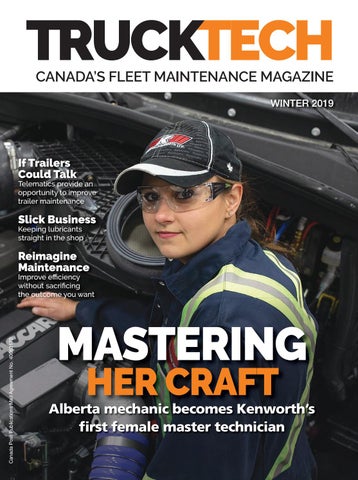
MASTERING HER CRAFT
Alberta mechanic becomes Kenworth’s first female master technician
Your bottom line doesn’t care if it’s cold. The new Mobil Delvac 1™ range of synthetic engine oils helps protect your fleet and your business.
See our new products at mobildelvac.ca
is written and published for owners, managers and maintenance supervisors of those companies that operate, sell and service trucks, truck trailers, and transit buses.
WINTER 2019 VOL. 4 NO. 4 Vice President, Editorial Rolf Lockwood rolf@newcom.ca • [416] 614-5825 Contributing Editors Eric Berard, Derek Clouthier, Abdul Latheef, James Menzies, John G. Smith Managing Director Trucking and Supply Chain Group Lou Smyrlis lou@newcom.ca • [416] 510-6881 Creative Director Tim Norton tim@newcom.ca • [416] 510-5223 Art Director Michael Chimienti mike@newcom.ca • [416] 510-6813 Production Manager Alicia Lerma alicia@newcom.ca • [416] 510-6845
LUBRICANTS
SLICK DECISIONS How to properly and safely store oil and other lubricants
Features NEWCOM MEDIA INC. 5353 Dundas Street West, Suite 400 Toronto, ON M9B 6H8 416/614-2200 • 416/614-8861 [fax] CHAIRMAN AND FOUNDER Jim Glionna PRESIDENT Joe Glionna VICE PRESIDENT, PUBLISHING Melissa Summerfield CHIEF FINANCIAL OFFICER Peter Fryters DIRECTOR OF CIRCULATION Pat Glionna
Departments
Trailer Telematics Improve trailer maintenance by tracking your assets
12
A New Reality How augmented and virtual reality can reinvent technician training
15
Transmission Talk Transmissions are evolving, and so are their maintenance requirements
17
Maintenance Reimagined Improve efficiency without sacrificing the outcome you want
21
Editorial ................................................... 5 Quick Fix .............................................. 6-9 Equipment Watch ............................ 27-29 Techs Talk............................................... 30
28
Truck Tech is published by Newcom Media Inc. The contents of this publication may not be reproduced or transmitted in any form, either in part or full, including photocopying and recording, without the written consent of the copyright owner. Nor may any part of this publication be stored in a retrieval system of any nature without prior written consent.
Jennifer Lesnik of Edmonton, Alta., becomes Kenworth's first female master technician.
12
21
21
ADVERTISMENT
15 trucknews.com
17
Who does what, where and how in your garage are important but complicated questions. Can they be simplified to increase collaboration and productivity? 23 WINTER 2019 TRUCKTECH 3
BOOST UPTIME.
EVERY TIME. www.PrestoneCommand.com
Since 1927, eet owners have trusted Prestone to boost uptime by protecting engines regardless of their heavy-duty demands. For protection against heat, cold, and corrosion, Prestone works!
Editorial
Sweat the Details There's no room any more for cavalier attitudes in the shop or anywhere else By Rolf Lockwood
One defining characteristic of many trucking people has long been their 'cavalier' attitude. Much less so in 2019, but it's still a factor. Don't sweat the details, just get it done. Old-time trucking folks have always known what was good enough and gone with it. Baling wire, duct tape, those were key tools for drivers – literally and metaphorically – when they were forced to play mechanic on the side of a highway in the middle of nowhere. Skills learned on farms, more often than not, and the repairs were usually sort of OK. For a while. More than a few mechanics adopted such low-tech saviors too in a pinch, no doubt. But all that was back in the day. Way back when they could afford to be cavalier, or so they thought. Training? What training? They learned on the job. Rules and regs? What rules? What regs? They knew what they were doing, so guys said leave us alone. There weren't many controls anyway. And since the inspection and enforcement element was pretty much non-existent, they got away with stuff that would land a guy in jail these days. Or at the very wrong end of a liability lawsuit. Or both. Safety in the shop or on the road was strictly a matter of common sense. Luckily that was not in short supply, but today we need so much more than that alone. Nowadays the trucks and even the trailers are wildly complex and working in any shop presents challenges trucknews.com
“They got away with stuff that would land a guy in jail these days” that must sometimes seem insurmountable. Time is always an enemy. Not every job gets the kind of time it really deserves, many techs will tell you, and they'll blame dispatch, who in turn will blame the sales folk, who will then bitch and moan about customers who have no idea what it takes to make the wheels roll. One thing's for sure, we can't afford 'cavalier' any more. It's expensive, if nothing else. It's not just trucking that suffers from the curse of such attitudes. It's all over the place, in every industrial space. Hell, in every space of whatever sort. And we're all rendered vulnerable. Like never before, sweating the details is now necessary. Whenever I think of industrial safety in general, I think of my dear old dad. He was in charge of the engineering
side of safety at a big steel plant in Hamilton, Ont. Being of good British stock, he rarely showed emotion, didn't talk all that much either. But I remember him complaining about how often the safety rules he wrote and the warning signs he created were ignored. Long after the fact, I now wonder if one horrifying incident left him with PTSD. A millwright was on a ladder working beside an operating oxygen furnace where molten slag at a million degrees is poured off and runs along a sluice before the boiling liquid iron underneath is extracted and formed into steel ingots. Tragically, someone took the red out-of-service tag off the overhead crane, moved it, and knocked the helpless millwright off his ladder and into the three-foot-deep slag run. Witnesses said he landed feet first in the red hot river and in slow motion disappeared as his body was consumed from the bottom up. That was a Saturday morning and dad had to rush to the plant to investigate. When he came home he was clearly devastated and stayed that way for weeks. A cavalier attitude – a willingness to be careless like that crane operator – has no place in the shop. But I still hear, for example, that we're not always serious about wheel security. In spite of endless service bulletins and instructional videos and even mandatory training programs, not to mention a draconian Ontario law, the worst still happens. That's cavalier, and we have to fight it. TT WINTER 2019 TRUCKTECH 5
QUICK FIX
TIP gets green light to acquire Trailer Wizards TIP Trailer Services has announced its acquisition of Trailer Wizards has received a no-action letter from Competition Bureau Canada, allowing the deal to proceed. The deal, struck Sept. 4, is expected to close in January 2020, according to the company. It will make TIP one of the leading trailer service providers in Canada, according to the company. TIP came to Canada from Europe in 2016 with the purchase of Train Trailer. Its latest acquisition will add 21 locations, more than 400 employees, and a fleet of more than 23,000 units. When the deal closes, TIP says it will have more than 33,000 trailers, reefers, chassis and flatbed/dropdeck configurations, with a staff of more than 500 people.
Daimler opens new PDC Daimler Trucks North America (DTNA) has opened its 10th parts distribution center, just outside Phoenix, Ariz. The 268,000 sq.-ft. facility stocks more than 10,000 parts and serves more than 130 DTNA dealers. “As part of our strategy to get closer to our customers and dealer partners, DTNA identified the southwest United States as the best location for its next stage of expansion,” said Jay Johnson, general manager, aftermarket supply chain for DTNA. “After an exhaustive search throughout the Southwest, we determined that the Phoenix metropolitan area offers a great combination of benefits: proximity to our customers and dealers, a strong workforce and ease of doing business.” Daimler says the new facility allows it to fulfill 90% of all dealer parts orders in less than 12 hours. It has invested more than US$100 million into its parts distribution center network over the past five years.
Manac opens research center Manac has opened a 62,000 sq.-ft. research and innovation center. 6 TRUCKTECH
WINTER 2019
Nikola makes battery technology leap
Nikola says it has developed the first battery to remove binder material and current collectors, reducing costs by 50% and doubling range when compared to lithium-ion. It has a record energy density of 1,100 watt-hours per kilogram on the material level, Nikola announced, and 500 watthours per kg on the production cell level. It also is less prone to nail penetration, Nikola claims. Nikola has signed a letter of intent to acquire a battery engineering team to bring the battery to pre-production. It will announce more details and show the technology at Nikola World 2020. “This is the biggest advancement we have seen in the battery world,” said Trevor Milton, CEO, Nikola Motor Company. “We are not talking about small improve-
The company says its new center will help support and accelerate Manac’s research and product design
ments; we are talking about doubling your cell phone battery capacity. We are talking about doubling the range of battery-electric vehicles and hydrogen-electric vehicles around the world.” The company says it will share the technology with competitive OEMs. “Nikola is in discussions with customers for truck orders that could fill production slots for more than 10 years and propel Nikola to become the top truck manufacturer in the world in terms of revenue. Now the question is why not share it with the world?” said Milton. The company says its trucks could now travel 800 miles fully loaded between charges, while weighing 5,000 lbs less than when using lithium-ion batteries. They can be fueled in 15 minutes.
efforts, optimize manufacturing processes, and allow it to implement new business information systems. “This space consolidates the jobs of engineers, technicians, designers, analysts and consultants and creates a technologically elite community of which we are very proud,” said Rodrick Levesque, director of product engineering at Manac. trucknews.com
New lighting standard coming Transport Canada is introducing a new lighting standard to help vehicles and drivers see, and be seen, the department said in a post on its website. As of September 2021, the Canadian Vehicle Lighting Regulation will require that all new vehicles, including trucks, sold in Canada have one of the following: • Tail lights that come on automatically with daytime running lights; • Headlights, tail lights and side marker lights that turn on automatically in the dark; • A dashboard that stays dark to alert the driver to turn on the lights. The Transport Canada post also reminded drivers that automatic headlights only work if they are set on automatic mode. “A bright dashboard doesn’t always mean that your headlights and tail lights are on,” it warned.
Ontario to crack down on emissions cheaters The Ontario Trucking Association has said changes to the commercial vehicle program within the Made-inOntario Environment Plan (MOEP) will make the province the leader in North America for enforcing heavy truck emissions rules. Association president Stephen Laskowski said the proposed changes contained in the Red Tape Reduction bill are aimed at effectively cutting emissions while reducing red tape for carriers. The measure highlights a phased-in approach that will align environmental testing of trucks’ emissions control systems with the Ministry of Transportation’s (MTO) Periodic Mandatory Commercial Vehicle Inspection requirement, the association said. Under the plan, combined safety and emissions inspections would be required annually, starting when a vehicle is first registered in Ontario. Part of the inspection will require a trucknews.com
Quebec, New Brunswick land Alliance Parts locations Daimler’s Alliance Parts has announced its expansion to 15 new locations, including three in Eastern Canada. Two of the three standalone stores are Carrefour du Camion in St. Quentin, N.B., and Centre du Camion in Mont-Laurier, Que. Garage Gilles Roy in St. Georges, Que., also added an in-store location at its existing dealership. The other 12 locations are in the U.S. “Our priority is keeping customers on the road, so we are increasing our retail footprint in order to meet customers where they are and provide quality parts at the right price,” said Brad Williamson, director of marketing, Alliance Parts and Detroit Reman. “Alliance Parts is committed to creating a superior experience for our customers that helps them maximize their uptime.”
Stephen Laskowski physical and electronic emissions system-tampering test. The government has said it will work with all stakeholders to develop these testing protocols prior to implementation in 2021. The association said it is also working with the authorities to ensure that annual inspections, which include
Alliance Parts has been expanding its parts offerings. Recently added parts include height control vales, fuel pumps, water pumps, Detroit-branded carriers, composite bumpers, and 14-gauge stainless steel bumper guards. The company’s network now includes more than 800 locations, with more set to open soon, Daimler Trucks North America announced.
anti-tampering checks, are electronically linked. By doing so, officers from the MTO and the Ministry of the Environment, Conservation and Parks (MECP) will be able to determine at roadside the technician and facility which last inspected/ passed the vehicle for which tampering was discovered. For the first time in Ontario, those who enable environmentally non-compliant trucking operators will face significant consequences, the association said. “This program will bring real, effectual enforcement and tangible reductions to heavy-duty diesel emissions,” Laskowski added. “When these regulations are passed, Ontario will be the first jurisdiction in North America to inspect vehicles at roadside for emissions tampering as well as during their annual safety inspection.” WINTER 2019 TRUCKTECH 7
QUICK FIX Navistar’s fleet service platform connects with all makes
Design students envision future of vocational trucks
Navistar is preparing to offer greater insights into vehicle health through International 360, a communications platform to manage fleet service. The equipment that’s monitored doesn’t even have to carry the company’s well-recognized diamond. “International 360 enables all-makes integration,” said Friedrich Baumann, president – aftersales. “Fleets can also add trailers to International 360, and this is especially useful since so many of our dealers service trailers at the same time.” There are no per-VIN surcharges to draw other equipment nameplates into the system, either. With International 360, Navistar has integrated service-related communications and remote diagnostics into a single platform. It draws on more than 24 telematics service providers through the OnCommand Connection remote diagnostics service offering visibility into vehicle health, locations and more. The OEM has also ensured that it can fully integrate with a fleet’s existing fleet management software providers and fleet management companies, making it possible to deliver International 360 data through an existing service. Features include service status updates delivered through a related portal, email, or integrated third-party system, and a complete VIN-based service history and history for each repair order. VIN-level data from existing fleet management systems and other sources can be accessed with one username and password, and it can be accessed on smartphones, tablets and computers using any major browser. The integration with OnCommand Connection also offers fault details and recommended repair plans to help prioritize service. There are details about estimated
Daimler Trucks North America (DTNA) has challenged art students to design the vocational truck of the future, through a collaboration with the ArtCenter College of Design in Los Angeles, Calif. Some of their ideas included: a plow that inhales snow and turns it into vapor, a crane with an electro-translucent roof that goes from solid to clear at the push of a button for better visibility, and a diesel engine that slides from the engine compartment for easier access. The challenge was to consider the needs of vocational customers in 2030 and beyond, and to design trucks to meet those needs. Winners were announced at the North American Commercial Vehicle Show in Atlanta, Ga. in October.
8 TRUCKTECH
WINTER 2019
completion times, too. In terms of communications with dealerships, International 360 will accommodate online service requests, communications, and estimate approvals, while the integrated parts inventory data helps identify which dealer has the parts on hand.
Traction expanding in B.C. Traction will open its first corporate store and a new distribution center in B.C. Currently serving Canada’s west coast with 12 associated Traction stores and other business partners, the company said the opening of a corporate store and the fourth warehouse in Canada will complement its services by offering its customers access to over 500,000 parts from over 1,000 suppliers.
“Through this challenge, we tapped into some of the brightest minds in transportation design to gain new and different perspectives on what vocational trucks might look like in the future,” said Samantha Parlier, vice-president of marketing and strategy for Western Star. “Two of these students have al-
ready started internships with DTNA, and we’re excited for the opportunity to incorporate some of this bold thinking into our long-term vocational strategy.”
“A market analysis started almost two years ago has revealed that to consolidate our position as leader of the heavy vehicle parts aftermarket, our presence in this region had to be increased,” said Pierre Rachiele, executive vice-president of the heavy-duty parts division. “Our current customer base, serviced by our Edmonton warehouse in Alberta, will be the first to benefit from this as we will be able to respond more quickly to their demands from the new warehouse in Langley.” The move brings the heavy-duty parts division together under one roof, with the company’s Cadel warehouse, which has been in the province since 1996, moving to the new Langley location. trucknews.com
Parts for Trucks celebrates 100 years Parts for Trucks has celebrated its 100th birthday by opening a 56,000 sq.-ft. distribution center in the Burnside Industrial Park in Dartmouth, N.S. “It is actually the biggest parts distribution center east of Montreal,” said marketing manager Lori Rogers. The company held an open house in October to mark the occasion, and invited delegates attending the Atlantic Provinces Trucking Association’s annual conference in Halifax, N.S., to the party. In April, Parts for Trucks acquired Malmberg Truck Trailer Equipment, an Ontario company with operations in Ottawa and Gatineau, Que. The acquisition made the company one of the largest truck and trailer service providers and parts distributors in North America with 19 warehouses, six service facilities and three mounted equipment shops. Parts for Trucks also published a book, 100 Years of Trucking in Atlantic Canada, to commemorate its centenary.
LUBRICANTS
Discover Total Heavy-Duty Rubia Optima Range
Volvo Group boasts a million connected assets Volvo Group has declared it now has more than a million connected customer assets on the road. They include trucks, buses and construction equipment. The data collected by Volvo is used to increase uptime, reduce emissions and improve safety, according to the company. “The connected solutions bring increased vehicle and construction equipment uptime for our customers, better safety for drivers, operators and other road users – and of course, less emissions of carbon dioxide. The first million connected assets is only the start. We are committed to remain a leader in this field,” says Martin Lundstedt, president and CEO of the Volvo Group. As more and more people move into cities, the needs for better infrastructure as well as transportation of both people and goods are growing. “The Volvo Group is a pioneer in connected vehicles and we use the knowledge and insights we get from connectivity in strategic alliances with customers and other partners to speed up the innovation cycle,” says Lars Stenqvist, chief technology officer at the Volvo Group. TT trucknews.com
total-canada.ca
WINTER 2019 TRUCKTECH 9
LUBRICANTS
SLICK
DECISIONS Managing an effective oil program BY JAMES MENZIES
S
tocking oil in the shop, preventing cross-contamination and spills (not to mention misfills), can be a challenge. Spills can create hazards and inefficiencies, and misfills can damage equipment if not quickly identified. Maintenance operations can reduce the risk of all of the above by first consolidating product, whenever possible. “Consolidating the number of lubricants in stock helps to improve the efficiency of the maintenance process, as it makes lubricant handling simpler, while also contributing to considerable cost savings,” says Ron LeBlanc Sr.,
senior technical services advisor with Petro-Canada Lubricants. However, he acknowledged consolidating oil can be difficult in mixed fleets operating diesel and natural gas trucks, or older and newer vehicles. For fleets or shops storing oil in bulk, LeBlanc says “properly vented tanks with a desiccant breather capable of filtering two micron particles should always be utilized. In some cases, operators should also consider using a filter when filling their bulk tanks, especially for hydraulic or transmission fluids.” Shops that store different types of oil should paint bulk storage tanks differ-
ent colors to differentiate, for example, between FA-4 and CK-4 engine oils. “The easier you can make it for operators, who are under considerable cost and time pressures, the better,” LeBlanc says. Oil manufacturers themselves, use different colors on packaging to help maintenance providers keep their oils straight. If storing lubricants outdoors, “drums should be tipped up with the bungs placed horizontally to protect against water entry, with a plastic or metal lid to cover the drum,” advises LeBlanc. “It is also very important to ensure proper labeling of tanks and product containers to avoid the risk of misapplication.” For outdoor lubricant storage, a containment area is needed to limit the possibility of spills. When a spill does occur during service, an absorbent floor dry should be used, and then swept up and safely disposed of. There are also oil eating cleanup materials available for use outdoors, when soil remediation isn’t required. “The ability to clean up spills has drastically improved over time and there are many effective options now available,” says LeBlanc.
Quick Truck Lube in Napanee, Ont., claims to have the most types of oil on reels, 11, of any facility in Canada. 10 TRUCKTECH
WINTER 2019
trucknews.com
LUBRICANTS
Gurjinder Johal, Quick Truck Lube (left) Gurjinder Johal, owner of Quick Truck Lube, says bulk storage is always preferable, as deploying oil by reel eliminates practically all spills. It also reduces costs and is more environmentally-friendly, he adds. He claims his company’s recently opened Napanee, Ont., location has more oil on reels than any other facility in Canada. “With gallons or buckets, there’s always extra costs for the packaging,”
Johal says. “The packaging is always expensive, compared to bulk.” Bulk storage also speeds up service time, something that’s crucial in a quick lube operation. Johal says there continues to be some operators who request gallon or bucket product, thinking its better than bulk oil. That’s just not true, Johal says. “The reel bulk oil and the gallon and bucket oil is the same,” he says. Jim Pinder, corporate fleet director with Erb Group, also prefers stocking oil
CLEAN ENERGY INITIATIVES WILL REQUIRE FUTURE FLUIDS BY JOHN G. SMITH Jason Brown, Shell’s global technology manager for heavy-duty diesel engine oil, knows electric vehicles are coming. But that doesn’t seem to faze one of the world’s largest producers of fuels and lubricants. “We’re definitely going to have electric vehicles. It’s going to be there,” he said during a media briefing at the Texas A&M Transportation Institute. These same vehicles, though, will have lubrication needs of their own. Thermal fluids will be needed to cool electric motors, inverters, and motor windings, and to support battery thermal management. Specialized process oils will be needed to protect battery membranes, too. There will be greases to lubricate electric motor, wheel and steering bearings, and the transmission lubes for reduction gears and differentials. Plug-in hybrid vehicles will also require specific solutions when it comes to transmissions and engine oil. Higher stresses on internal combustion engines within such systems will include frequent stop-starts,
trucknews.com
while sustained electric vehicle operation will affect fuel dilution, water content, and emulsion formation, Brown says. Electric vehicles require lower oil volumes, but also introduce higher power outputs, more compact designs, higher complexity, different operating conditions, higher thermal stresses, and need to protect against wear at lower temperatures. There are also conductivity issues to consider when copper wires and fluids mix. “Not everything is going to be coated,” Brown said. And transmissions in electric vehicles will turn at higher rates, requiring improved controls against foam. A diverse energy mix As important as electrification will be, Shell believes the battle against CO2 emissions will also require more than one energy source. “You’re going to need a much more diverse mix of energy going forward,” Brown said. Oil and coal are still abundant and practical fuel sources, he observed, referring to the
in bulk. Erb has suspended reels in its service shop, and wall-mounted reels in its reefer shop. “The bulk tanks are in out-of-the-way locations, and product is pumped to reels in the work area,” Pinder explains. The main benefits, he adds, are “It’s a closed system, not being manually transported in containers that could be spilled or contaminated. We can monitor quantity right at the nozzle.” If a spill does occur, Erb stocks an absorbent material specific to the product being dispensed. It is available throughout the shop, with larger quantities in high-risk areas, Pinder notes. New oil is stored in tanks within a concrete barrier and the remote fill system is equipped with alarms. “I have seen shop managers buy the absorbent material of the day or week, but not necessarily the best for the product they are using or that may spill,” Pinder adds. TT infrastructure that’s already in place to transform them into energy. Even electric vehicles need infrastructure support because today’s grid couldn’t handle everyone plugging into an electric car. A grid capable of doing that is still expected to be decades away. “That building is going to take time,” he said, “and it’s going to take money.” Shell itself is taking a broad-based approach to energy. It’s building retail sites for hydrogen, and investing in conventional and advanced biofuels alike. In terms of electrification it is investing in slow and fast-charging stations for electric vehicles, while also supplying compressed natural gas (CNG) and liquefied natural gas (LNG). It’s one of the pioneers in gas-toliquid (GTL) fuel as well as nature-based solutions. None of them will be a “silver bullet,” Brown stressed, referring to the drive to reduce CO2 emissions. “The best way to do that is to invest in all of them.” The approaches might even vary by region. “Natural gas is pretty available globally,” he said as an example. Existing resources could offer more than 230 years of the fuel at current production rates, Shell projects. And gas-fired power plants emit about half the carbon dioxide of their coal-fired counterparts. TT
WINTER 2019 TRUCKTECH 11
TRAILERS
TRAILER
TRACKING Telematics data driving toward prescriptive, predictive maintenance: Gerry Mead BY JOHN G. SMITH
European regulations require brake inspections every 90 days, which can be completed with the support of telematics systems that communicate between tractors and trailers over 15-pin connectors.
G
erry Mead, Phillips Industries’ executive director – innovation, recognizes the value of telematics data in the maintenance process. More of it is emerging every day. He just wonders whether fleets are taking advantage of the insights that are already at their fingertips. “There’s information that’s sitting there in portals that people don’t utilize that could improve maintenance 12 TRUCKTECH
WINTER 2019
today,” he said during a presentation at the North American Commercial Vehicle Show. Driver Vehicle Inspection Reports (DVIRs) and pre- and post-trip inspections are certainly helpful, and they guide plenty of maintenance activities, but there are limits to what those can show. “We can’t look at every truck every day,” he says, referring to the value of live sensor readings and telematics.
“You don’t know what you can’t see. You don’t know what you don’t know.” Look at wheels alone. Readings about hub temperatures, lubricant levels, hub vibrations, spindle nut torque, hub load, bolt tension, and speed could all be valuable to maintenance teams. But the greatest value emerges when sensor readings are combined. Mead uses the example of an ABS warning. If that occurs on its own, a driver could be instructed to continue a trip. But if it was coupled with a warning about rising heat at the wheel end, a system drawing on artificial intelligence could point to a potential wheel loss. Several companies are now using high-level math to explore sensors and failure rates, he adds. “It’s unbelievable the amount of lines of code that are coming in.” Each fleet can also prioritize such information in different ways, depending on their operations. That’s where individual user interfaces can help transform simple data into actionable information rather than simply generating ignored reports. The support has come along way since the 1970s when the U.S. military introduced a 100-lb. device with a 26-pin connector that came in the form of simplified test equipment for internal combustion engines (STE/ICE), or even the Pro-Link tools that used OEM-specific cartridges to help identify the causes of failures. trucknews.com
TRAILERS
Great Dane launched FleetPulse into a crowded trailer tracking market at this year’s North American Commercial Vehicle Show.
Evolving telematics The evolution continues. While diagnostics explains why something happened, predictive maintenance shifts the attention to what will happen, Mead says. The ultimate goal is prescriptive information that will recommend action. And that will deliver a true benefit in terms of the total cost of ownership. Higher levels of diagnostics would be needed to support autonomous technologies, too. A simple ABS event will affect how roll stability systems perform, he says as an example. There is certainly room to grow. While there are six million trailers on U.S. roads, fewer than one million are equipped with telematics systems. But that is changing rapidly, Mead says, noting how regulators will play a role in that. He uses the example of smart reefers to prove his point. Maintaining temperatures has always been important, but trucknews.com
the real push came with the FDA’s Food Safety Modernization Act. European regulations require brake inspections every 90 days, but those can be completed with the support of telematics systems that communicate between tractors and trailers over 15-pin connectors. Imagine the chaos that would emerge if every one of the units had to be pulled in for a physical inspection, Mead says. “Regulation drives a lot of adoption of technology – but so does pull-through from the fleets,” he adds. “Think about how valuable data is to your business today.” Mead suggests that the technologies also play a role in employee retention because technicians want opportunities to learn. He foresees a day when technicians will be wearing headphones as experts walk them through repairs identified by a system’s underlying artificial intelligence. “You’ll still have shorts and
everything else you have to diagnose, but those will be limited,” he says. And the Amazon package you’re waiting for? Even that will have a role to play. Given the ever-tighter delivery times, there is less tolerance for equipment downtime, Mead says. “E-commerce drives a need for a lot of efficiencies because of our quest for instant satisfaction.” There are plenty of telematics options on the market today. Great Dane’s FleetPulse, Truck-Lite’s RoadReady, Samsara, Orbcomm, Phillips Connect Technologies, and SkyBitz are just a few of them. And once telematics data can be delivered to the cloud for processing, it will have a story to tell. “Put pen to paper. What’s your return on investment? What is your main pain point?” Mead says, referring to where fleets should focus their attention in the search for telematics systems. “Does it solve problems that you have?” TT WINTER 2019 TRUCKTECH 13
NOR 23 HOURS OF DARKNESS NOR THE FAILED MISSIONS OF TRUCKERS’ PAST NOR ACTS OF GOD. . . SHALL STAY ME AND THESE CHAINED-UP WHEELS FROM REACHING THE FINAL OUTPOSTS OF THIS VAST FRONTIER. Lisa Kelly on History® Network’s Ice Road Truckers®
Delo® user since 2005
UNCOMMON JOBS REQUIRE UNCOMMON TOUGHNESS
Chevron Products are available from the following locations :
CHEVRON CANADA LIMITED 500-5th Ave. S.W. Calgary AB T2P 0L7 Toll Free: 1 (800) 822-5823 chevronlubricants.ca
CATALYS LUBRICANTS 7483 Progress Way Delta BC V4G 1E7 Toll Free: 1 (855) 946-4226 catalyslubricants.ca
NORTHERN METALIC SALES (GP) 9708-108 St. Grande Prairie AB T8V 4E2 Tel: (780) 539-9555 northernmetalic.com
UFA 4838 Richard Rd. S.W. Suite 700 Calgary AB T3E 6L1 Tel: (403) 570-4306 ufa.com
CHRIS PAGE & ASSOCIATES LTD 14435-124 Ave. Edmonton AB T5L 3B2 Tel: (780) 451-4373 chrispage.ca
RED-L DISTRIBUTORS LTD 9727-47 Ave. Edmonton AB T6E 5M7 Tel: (780) 437-2630 redl.com
49 NORTH LUBRICANTS 1429 Mountain Ave., Unit 2 Winnipeg MB R2X 2Y9 Tel: (204) 694-9100 Fax: (204) 775-0475 49northlubricants.com
CASE ’N DRUM OIL INC 3462 White Oak Road London ON N6E 2Z9 Toll Free: 1 (800) 265-7642 cndoil.ca
TRANSIT LUBRICANTS LTD 5 Hill St. Kitchener ON N2G 3X4 Tel: (519) 579-5330 transitpetroleum.com
R. P. OIL LTD 1111 Burns St. East Unit 3 Whitby ON L1N 6A6 Tel: (905) 666-2313 rpoil.com
MACEWEN PETROLEUM INC 18 Adelaide St. Maxville ON K0C 1T0 Toll Free: 1 (800) 267-7175 macewen.ca
CREVIER LUBRIFIANTS 2320, Rue de la Métropole Longueuil (QC) J4G 1E6 Tél : (450) 679-8866 crevier.ca
NORTH ATLANTIC REFINING LTD 29 Pippy Place St. John’s NL A1B 3X2 Tel: (709) 570-5624 northatlantic.ca
A Chevron company product © 2019 Chevron Canada Limited. All rights reserved. All trademarks are the property of Chevron Intellectual Property LLC or their respective owners.
NEITHER RAIN, NOR SNOW
VIRTUAL REALITY
AUGMENTED AND VIRTUAL REALITY A NEW TRAINING TOOL BY JAMES MENZIES
A
ugmented and virtual reality give maintenance departments new options for training and may also attract a new generation of technicians. “Augmented and virtual reality are prime tools to engage and teach techsavvy younger generations, that ultimately have to find their way into our workplace,” said Kenneth Calhoun, fleet optimization manager for Altec Industries. He was speaking at an education session at the American Trucking Associations’ Management Conference & Exhibition. But Matt Johnston, of Design Interactive, first explained that augmented and virtual reality are not one and the same. Augmented reality is the overlay of information (think of the yellow first down line on football broadcasts) while virtual reality places you into a different world. “One is immersive,” he explained. “The other keeps you where you are and gives you that virtual information as an overlay.” Both can be used to more effectively train technicians, and some fleets are beginning to take advantage of it. New technologies and thousands of new fault codes are making it more challenging than ever to train technicians. High turnover and an aging demographic add to the challenge. One fleet had a collection of tires that demonstrated 13 different types of wear. Rather than flying in technicians from other terminals for tire wear training, the fleet used augmented reality and did the training remotely using “virtual tires,” Johnston explained. The “tires” were distributed electronically. “I just have to click a button trucknews.com
and make it available to every single technician across the workforce instantaneously,” said the University of Waterloo graduate. Suppliers are also tapping into the potential of augmented and virtual reality to train customers’ technicians on how to service and repair parts. And those early adopters are finding this new form of training is more effective. Johnston’s Design Interactive built a five-minute lesson on how to calibrate a collision avoidance system radar and then put a team of mechanics through it. “None had done it before,” he said. “After they were instructed using this software, they were told to calibrate a radar sensor on a second vehicle. What we got was 100% compliance. They did exactly what they were supposed to do the first time on the second vehicle – they didn’t make any errors and they didn’t have any experience doing that.” Following the test, 90% of the technicians who took part said they would recommend augmented reality for training. Johnston said young people today, including his son, are already using augmented and virtual reality gaming systems. “He’s going to expect this technology he plays with every day is going to be something he potentially uses in the workplace,” he said of his young son. Currently, Design Interactive is working with the ATA’s Technology & Maintenance Council to develop an augmented reality game around the group’s SuperTech competition. “Kids will be able to get it through the app stores and hopefully it will inspire them to consider this industry,” Johnston said.
Volvo’s technicians use virtual reality tools at VISTA international competitions. The Arkansas Trucking Association is bringing the message directly to the younger generation, and has funded a mobile 53-ft. workshop that showcases the opportunities in the industry using virtual reality workstations. “It’s an incredibly impressive exhibit,” said Calhoun. “It’s booked well into 2020.” He noted South Carolina has also secured funding to build a similar workshop. One of the stations in the workshop allows visitors to lay a weld, virtually, using a simulator. They are scored on the quality of the weld. “Those who were outscored were right back in line to redo it,” Calhoun said. This “gamification” of training makes it more fun for students. An app built by BeProBeProud.org demonstrates how to assemble an air disc brake. Points are deducted if it takes too long, or help is requested. Johnston said augmented and virtual reality systems are already available today, though not widely used in trucking. “Most of it is already in the market,” he said. TT WINTER 2019 TRUCKTECH 15
FLEET SUMMIT
Practical strategies for fleet maintenance managers FRIDAY, APRIL 17 8 a.m. – 12 p.m. International Centre Toronto, Ontario
Learn how your fleet can: Q Tackle corrosion Q Avoid aftertreatment challenges Q Harness trailer telematics Q Prepare shops for electric vehicles
www.trucksummit.ca New event at
www.truckworld.ca
TRANSMISSIONS
TRANSMISSION TALK
Vigilance still required despite longer service intervals BY HARRY RUDOLFS
I
n the world of truck transmissions there are basically three types: manual, automated manual and fully automatic. The manual transmission remains the most fundamental and widespread in the industry, requiring a clutch and gearshift leaver. Eaton Fuller transmissions might be considered the most ubiquitous brand, usually available in 10-, 13-, 15- or 18-speed packages. An automated transmission is essentially similar to the manual model except there is no clutch and no gear shift to manipulate. This transmission works on a similar principle as its stick-shifting predecessor, but uses automated sensors and an electronic shifter to determine the optimum gear selection. According to Bob Cook of Mohawk College in Stoney Creek, Ont., “There’s a few differences inside the case. The gears inside are spaced a little wider apart, but it’s the same X and Y axis shifter as a manual, just operated electronically.” The fully automatic transmission is quite different and complex. “There’s a lot going on inside an automatic,” added Cook. “Take the Allison six-speed automatics, the 1000, 1500 and 2500 series designed for medium-duty work. It has five clutches, two rotating clutches up front and three stationary clutches in the case to hold the ring gear.”
Synthetic oils allow for extended drain intervals A major paradigm shift in recent years has been the introduction of synthettrucknews.com
Truck and coach apprentices John Nicholson and Adam Carter inspect a transmission at Mohawk College in Stoney Creek, Ont. ic oils, resulting in much longer service intervals, often years between fluid changes. OEMs fill the components with lubricants at the assembly plant, and stress the importance of using the approved lubricants when refilling. According to Dave Embury, territory manager for Eaton Roadranger, “The performance characteristics of these lubricants enable component manufacturers to offer extended drain intervals and extended warranties. Extended drain synthetic lubricants are advantageous in all applications and Eaton highly recommends them for severe-duty applications and in cold climates.” According to the maintenance schedule, a Volvo tractor with the automated I-Shift transmission doing high-
way or regional work can go 800,000 kms or 60 months between changes. Even the heavy-duty I-Shift package working in severe conditions is good for half that distance – 400,000 kms or 2,500 hours of operation. Similarly, the fully automatic Allison TC10 has no scheduled maintenance for the first 800,000 kms and comes with a fiveyear/1.2-million km warranty. Ken Cooke, president of Coastline Transmission and Differential in Abbotsford, B.C., thinks that’s too long between changes. “I believe the oil companies are telling you that they will last up until 500,000 kms between changes, but we recommend they change it every two years, probably 200,000 kms for highway trucks,” he said. Cooke suggests WINTER 2019 TRUCKTECH 17
TRANSMISSIONS
even more frequent changes for vocational applications like dumps and cement trucks. “Trucks operating locally like dump trucks will never get that high mileage but they are probably doing 100 times the shifting that a highway truck does.
Transmissions on dump and cement trucks wear out faster,” added Cooke. “The oil is not necessarily breaking down, but the particles in the oil from the wear of the transmission are working like sandpaper in there and wearing things out prematurely. That and
To repair or swap out the transmission is a key consideration for fleets.
Condensation can create issues inside the gearbox. condensation which is working its way in and out of the system, summer and winter.”
Diagnosing the problem Although OEMs are offering longer service intervals between changes, it’s still important to check for leaks and fluid levels at regular preventive maintenance services. New truck owners probably won’t have to worry about transmission failures for years, but Tony Forlini, of CT Cam in Laval, Que., gets to see trucks when the warranty expires and there’s no shortage of work. “There are transmissions everywhere and they are always breaking down,” he said. Forlini thinks all truck and coach mechanics should have a Class 1 licence. “Before you rebuild transmissions, you should be able to drive the truck and diagnose the problem. The first 18 TRUCKTECH
WINTER 2019
trucknews.com
TRANSMISSIONS
clutch and mating gear may be worn,� he said. “But if the shift lever did not move and it feels like the transmission went into neutral, the problem could be the range splitter or it could be in the rear auxiliary section of the transmission.�
To repair or to swap out
Bob Cook, Mohawk College
thing I do when a client comes in is send him for a road test with my technician. That way you can figure out if it’s the transmission or the driver. Usually, there are three reasons someone comes into a transmission shop – either the unit won’t advance, it’s making noise or it jumps out of gear. “Let’s say a customer is complaining about noise coming from a certain gear. The technician drives it and tries to replicate the problem, to see, for instance, if it’s coming from outside or inside the transmission. If it’s inside then it will probably have to come apart. If it’s an automated transmission we’ll throw it on the scanner,� he said. “But if it’s not a sensor or the ECU, then the problem is in the transmission.� A plethora of things can go wrong with transmissions. Premature wear and degradation can often be attributed to bad driving habits like poor shifting or pre-shifting gears, too much shock load, as well as riding and popping the clutch. “Every one is a little different,� according to Cooke of Coastline Transmission. “The bearings eventually wear out, broken countershaft wells, worn out shift forks, worn out shift collars, broken teeth, all kinds of different failures on them.� Eaton’s Embury suggests that a detailed report from the driver may help the technician isolate the problem. “For instance, if the shift lever is slipping out of gear, the front box sliding trucknews.com
Cook’s shop-classroom at Mohawk College in Stoney Creek, Ont., has a dozen training transmissions set up on stands. About 300 truck and coach apprentices pass through Mohawk’s program every year, and sooner or later all of them will learn how to break down a transmission and put it back together again. The irony is that they will probably never have to do that in the working world. “We teach them how to tear down and rebuild trannies but hardly any shops do that. Some fleets and some
dealerships will do the repairs themselves, but most will replace it with a new one or a rebuilt,� he said. Mike Winter of Truck Trans in Cambridge, Ont., says installing a rebuilt transmission can save 40-70% over the price of new one. “If it’s beyond just replacing a part, we can swap out the old transmission and save downtime. It’s going to take a couple of days to rebuild your transmission, but if you have a popular 13-, 15- or 18-speed we have them in stock already rebuilt,� he said. “How much work you want to do on a transmission depends on the owner and how many miles are on the truck,� adds Winter. “If it’s an owner-operator with two million miles then he probably wants it done correctly. If he’s selling the truck next week, he might just want to do what it takes to get it going again.� TT
For Total Lube Solutions,
*2 :,7+ 7+( )/2 √ Autogreasers for Your Mobile Equipment √ Fluid Handling Equipment for Your Garage √ Our Mobile Workshops Come to You
.JTTJTTBVHB 1.800.668.5458 t 8JOOJQFH TBMFT!GMPDPNQPOFOUT DPN t XXX GMPDPNQPOFOUT DPN $PNQPOFOUT CZ
#PPUI
WINTER 2019 TRUCKTECH 19
$ 15,000 IN
CASH+PRIZES
AND A CHANCE FOR YOUR FLEET TO SHINE
Nominate Your Highway Star
OF THE YEAR • 2020
We’re looking for one driver who embodies the term “professional”. A driver with that certain outlook on life and the industry that sets them apart from the rest. A driver who gives to the community, operates with the highest regard for other road users, and who generally sits tall in the saddle. In short, we’re looking for a driver with STAR quality to be the 2020 Highway Star of the Year. The Highway Star of the Year award is open to ALL drivers – company drivers and owner-operators alike. If you know someone worthy of such an honor, please submit your nomination as soon as you can. We’ll be presenting the award during Truck World 2020 in Toronto, ON., on Saturday, April 18, 2020.
FORMS ARE AVAILABLE ONLINE + 2020 HlGHWAY STAR OF THE YEAR + BEFORE YOU
+ START!
www.todaystrucking.com/highwaystar
Save Nomination Form To Your Desktop. Open PDF in Adobe Acrobat Reader.
$15,000 in Cash and Prizes! Plus a trip for two to Truck World in Toronto
NOMlNATlON FORM Nominate yourself or a driver you know. It’s easy and free. Candidates can be owner-operators or company drivers. Simply fill out this form and submit it to our judges.
STEP 1: Who are you nominating? Name: Company Driver?
T
Having a winning driver on your team pays huge dividends. There’s free publicity. It’s a morale boost, a proud flag to fly, and just entering somebody’s name shows you care.
Current employer/contracted to: Candidate’s day-to-day supervisor: Or Owner-Operator?
T
The winning driver and his or her carrier are often used as expert sources in subsequent magazine stories. Nominate as many drivers as you want.
WINNER WILL RECEIVE...
$10,000 IN CASH + Special-edition leather jacket with winner’s name and Highway Star of the Year logo
+ Travel and accommodations for two to Toronto for Truck World 2020
www.truckworld.ca
MAINTENANCE
REIMAGINING MAINTENANCE
How can fleets make fundamental improvements to the efficiency of maintenance operations without compromising the quality of the outcome? BY JIM PARK
Truck telematics are helping fleets adjust service intervals to actual needs conveyed in real-time.
D
o you want to save time and money on fleet maintenance operations? Then dig deep to find the root cause of your problems and take full advantage of all the technology at your disposal to solve them. And don’t forget to use a little imagination along the way; seeking change in this scale will require some out-of-thebox thinking. That may sound easy, even self-evident, but fleets struggling to stay ahead of the day-to-day challenges often do not step back to see what’s really going on or try to get beyond what appears obvious. Speaking on a panel discussing ways of improving the efficiency and effectiveness of fleet maintenance practices at the 2019 annual meeting of trucknews.com
the American Trucking Associations’ Technology and Maintenance Council, Randy Obermeyer, terminal manager for Batesville Logistics in Batesville, Ind., recounted the story of how he managed to trim 30 minutes from the time it takes to complete a preventive maintenance (PM) service. Obermeyer felt 2.5 hours per PM was a little long, so he set out to see what could be done to shorten the process. The first step was to make what he calls a spaghetti diagram, mapping all the movements a technician makes during the inspection. That yielded some surprising results. “We found that technicians were leaving the inspection area several times during the process,” he said. “We tracked one tech making a couple of
trips to the supervisor’s office, a trip to the water fountain to fill a water bottle, a separate trip to the oil filter crusher, a few trips to the parts room, etc., and he made multiple trips around the vehicle he was working on.” The solution was to bring all the needed parts to the PM service bay prior to starting the work and reordering the inspection process into a specific sequence to cut down on the number of trips around the truck. They even went so far as to move a trash can into the service bay to so the tech wouldn’t have to walk as far to dispose of the parts packaging. In addition, Obermeyer went over the list of 135 inspection items and pared it down by 25, deciding not to inspect things like the controls on the driver’s seat, interior lighting and other things that drivers would be sure to point out if they failed. “We went back over previous inspections and looked for things that we had never had to repair, and we identified inspection points drivers would let us know about,” he said. “The bottom line was, we knocked 30 minutes off a PM with absolutely no negative consequences do date.” That exercise was all about rethinking a process that had gone more or less unchanged for years because nobody had felt the need to re-examine it closely. Similar thinking helped Obermeyer discover that some of his technicians were not following procedures for tightening battery cables onto battery terminal posts, and that was killing batteries. Obermeyer had noticed a technician replacing the batteries on a truck that was less than a year old and he stopped to ask why. The technician told him the batteries would not hold a charge. Testing revealed the batteries had been discharged too deeply too many times and would no longer hold a charge. In some respects, testing the batteries and replacing the bad ones is what you’d expect a diligent technician to do, but Obermeyer wanted to know what had killed that set of WINTER 2019 TRUCKTECH 21
MAINTENANCE batteries in the first place. Was the problem a failing alternator or a short circuit somewhere that was drawing them down? He kept drilling down to get to the root cause, which turned out to be a technician who had previously serviced the truck had not followed recommended practices for tightening battery cables to the terminal posts resulting in bad con-
nections and batteries that were not charging properly. “That’s a good example of how fleets can approach a problem with the objective of not just fixing the problem at hand, but getting to the root cause of the problem,” he said. “It was a simple problem to fix, but the cause took a bit of work to identify and prevent from happening again.”
EXTEND DRAIN INTERVALS BY 70%. CHALLENGE ACCEPTED. MBR Trucking needed maximum uptime for trucks, even in extreme temperature conditions. So they took the DURON™ Challenge. Result: DURON heavy-duty engine oils increased their drain intervals* from 350 to 600 hours. Need proof of what DURON can do for you? Take the DURON Challenge.
Visit DURONCHALLENGE.COM NO RISK. NO COST. BIG REWARDS.
DURON HEAVY-DUTY ENGINE OILS THE TOUGHER. THE BETTER.™
™ Owned or used under license. * Extending drain intervals should always be undertaken in conjunction with an oil analysis program.
22 TRUCKTECH
WINTER 2019
Take advantage of technology Telematics has opened the door to a whole new level of diagnostic clarity and streamlined maintenance. Trucks today practically tell you what’s wrong with them, which begs the question, should we continue with traditional PMs or just wait for the alerts? It’s much easier today to query a database to discover what might be the top 25 fault codes and focus on resolving those. “That will save the tech-savvy fleet a lot of time and money previously spent chasing down problems,” said panelist Cindy Hunter, technology sales director for Rush Enterprises. “For fleets just getting familiar with telematics and diagnostics, there’s so much data there it can be overwhelming. If that happens, the data just becomes something else that takes time out of their day. Those fleets need a crawl, walk, run approach so they can stay focused on their pain points and not get distracted by the volume of data coming off the truck.” Greg Johnsen, a regional service manager with Maverick Transportation told the panel that telematics has helped his fleet take major service intervals out to 70,000 miles with a dry service in between. He noted that not long ago, trucks were hauled in for service every 20,000 miles. “Telematics gives us a very close and current look at the truck,” he said. “It doesn’t need any more service, but telematics can alert us to a pending issue that we previously would not have seen coming. We don’t want to over-service the truck any more than we want excessive downtime. We have historically used pretty conservative service intervals, not knowing really what condition the truck was in. Now that we can literally see inside the thing, we can safely push those intervals out much further, which helps reduce overall maintenance costs and downtime too.”
Use your imagination How many times have you said to yourself ‘If we only had more room, or if only we had more technicians, we could be so much more effective?’ Have you ever trucknews.com
ADVERTISEMENT
Who does what, where and how in your garage? Big questions, but important ones! Don’t worry, they could become simple with a little bit of structure and discipline allowing you to define tasks, optimize processes and find the right people to be involved in your garage. Adding a smart powerful CMMS and your daily mechanical and administrative tasks won’t be a mess! Simplify the way to do it
An ideal garage should take particular care in defining and organizing tasks, each one including all the elements required to carry out a job - just like a single mechanical component is part of a more complex machine. All of this, with the aim of achieving clear and understandable results as simple as who, how and when to manage a major defect following an inspection.
Optimizing the operational process involves reducing the number and complexity of procedures. Each task is simplified and carried out by a specific trained employee. Ultimately, reaching this level of refinement creates added value for the customer.
CMMS: Communicate, Share and Consolidate
Assignment of occupations The distribution process allows you to organize and categorize tasks, such as machine assembly, into coherent groupings that are then assigned to specialists: your mechanics, storekeeper, supervisor and so on. This formalizes the goals to be achieved, controls work overload and provides follow-up on the evolution of activities. Thus, all stakeholders know their obligations and play a specific role in the success of maintenance operations.
At the heart of this organization of maintenance work is the computer assisted maintenance management system (CMMS). Think of it as an on-board computer capable of informing all data systems involved. The CMMS is a communication tool which seamlessly shares critical data in real time as much within your mechanical shop as with other administrative departments, business managers and with your external partners. This translates into time savings and increased productivity.
Fleet maintenance management software Work orders
Dashboard
Mechanic's mode
Warranties and claims
Inventory
Planning
Units
History
Tire management
Fuel management
datadis.com
1.800.463.4043
Prospect . Meet . Connect . April 16-18, 2020 International Centre 6900 Airport Road, Mississauga, ON
• The #1 Trucking Industry Event in Canada • 500 + Suppliers and Leading OEMs • 15,000 + Attendees • Over 350,000 sq.ft. of Exhibit Halls • NEW Trucks, Trailers, Parts, Technologies...
www.truckworld.ca
Platinum Sponsor:
Endorsed by:
Produced in partnership by:
Producers of the NACV (North American Commercial Vehicle) Show in Atlanta, GA
Official Media:
MAINTENANCE
An uncluttered shop, such as this Nextrans dealership in Atlanta, Ga., is a more productive shop. The pile just keeps growing and you keep ignoring it. Any time you have a bay that’s underutilized or not properly utilized, you have an opportunity. Maybe a triage bay.” Stritt says his company recently reclaimed a previously underused service bay and turned it into a triage facility. Southeastern appointed two of its best technicians as triage specialists, whose primary duty was to run a series of diagnostic tests on all incoming trucks to see what sort of work they needed. “They are trained on all the software, and they are the first ones to touch the truck when it comes in,” he said. “We know that if we can diagnose a problem, Silver Streak, a fleet in Washington we can fix it too. He’ll run diagnostics on State, has an organized shop with all the systems on that truck, do the upparts stored in a logical location. dates and figure out what’s wrong with it. Sometimes they will fix the problem right there, but if not, he designates asked yourself if you could make better which bay the trucks goes to for repairs.” use of your existing assets? As for straight up savings on mainKerry Stritt, the vice-president of fleet tenance costs – requiring very little services for LTL carrier Southeastern imagination – Southeastern sticks very Freight Lines was also on the panel, and closely to the OEM service interval reche spoke about the advantages of lookommendations. ing for savings that are hiding in plain “We were changing oil on our highsight and those hidden in the deepest, way fleet (1,000 miles a day) every 20,000 darkest corner of the shop. miles, but our OE said 50,000 miles is ac“Step one is to declutter,” Stritt said. ceptable if we meet the criteria, and we “Ideally, you want to know exactly do,” he said. “So now we’re dropping oil what you have out in the yard, and if at 50,000 miles, or about once a quarter you’re anything like us, you probably with oil sampling. Our trucks are spendhave a couple of bays full of junk. You ing less time in the shop.” may not even know what’s in there.
Stritt says these processes have drastically reduced parts carrying costs, shop dwell time and helped get the repair work right the first time, but he acknowledged that changing from the way they had always done things to these newer measures wasn't always smooth. “Change is a fear of the unknown,” he noted. “The problem in many cases isn’t with the technicians but with leadership. If you have shop managers running a shop for 30 years and then one day somebody comes in and says you’re doing it all wrong, that guy is bound to be a bit resistant to change. Once you communicate it correctly, they come onside. “I encourage everyone to give this some thought,” added Stritt. “It costs nothing, yet the results can be profound. Sure, these ideas saved us some money, but some of our technicians even got to go home early occasionally rather than staying late to finish a job.” TT
TOSS YOUR TORCH SAFETY CERTIFIED
Applications: > Motor Mounts > Fuel Tank Straps > Torque Nuts > Seatbelt Bolts
> > > >
U-Bolts Brakes Exhaust Bolts Graphics
Contact us today for more information. p
www.theinductor.com 877-688-9633
WINTER 2019 TRUCKTECH 25
Discover what more than 900,000 visitors did last year
We deliver
MORE BLOGS
MORE VIDEOS
MORE NEWS
truck news.com
STAY UP TO DATE ON INDUSTRY NEWS, TRENDS AND EQUIPMENT RELEASES Visit the industry's most popular website
EQUIPMENT WATCH 3I[ GSRǻKYVEXSV JSV +VIMKLXPMRIV ZSGEXMSREP YTǻXW A new custom hardware and electronics configurator (CHEC) from Daimler Trucks North America will streamline the vocational truck customization process, according to the company. The tool allows truck equipment manufacturers and dealers to easily view, edit, compare, and update electrical configurations in Freightliner vocational trucks.
It reduces upfit time and makes the vehicle customization process more user-friendly, Daimler claims. Users can create standard templates for their organization, allowing them to select a pre-existing configuration based on application or customer. The CHEC tool also increases customization possibilities. To access the tool, truck equipment manufacturers and dealers are advised to have technicians sign up for CHEC tool training at www.DTNAConnect.com, or by visiting a Freightliner dealer.
8LIVQS 0MRK VIZIEPW PMKLXIV [IMKLX 879 Thermo King has introduced the SLXi Local transportation unit, which it says is up to 200 lbs lighter than other offerings. The company says it’s ideal for urban distribution and weight-sensitive operations. The SLXi Local is thinner and quieter, coming standard with the Thermo King Whisper kit, reducing sound by three decibels. It uses R452A refrigerant, which the company says reduces the impact on global warming trucknews.com
1MRO YRZIMPW GLEMR JVMIRHP] WYWTIRWMSR Link Mfg. has unveiled its new 52K Air Link Gen 3 tandem drive suspension, focusing on the needs of those using heavy vocational equipment that runs on 315 tires. While dump trucks and refuse vehicles are often pressed into service during winter cleanups, tire chains can damage a traditional suspension and undercarriage on equipment with 315 tires because of inadequate clearance, the company says. Weighing in at 875 lbs, the new offering is 50 lbs lighter than its predecessor, and it comes with an extended three-year warranty. The hanger brackets have been lengthened, heavy-duty dampers have been moved forward, center bushings have been raised, and the vertical distance between the trailing arm and walking beam pivots have been optimized. The suspension’s anti-corrosive polyurethane bushings don’t require lubrication and trailing arm bushings can be easily replaced with hanging brackets left in place. There are also extra-large bearing surfaces, and no future adjustments are needed after the wheel alignment is set. The 52K Air Link Gen 3 also features larger, high-volume, low-frequency air springs that deliver a smoother ride whether the vehicle is loaded or empty, Link says. The ride height is maintained by dual height-control valves, maximizing roll stability. The Air Link suspension was originally developed to operate in extreme settings like Canada’s oil fields and remote logging areas. by 45% compared to other refrigerants. The new unit comes standard with telematics hardware, enabling Thermo King ConnectedSuite telematics to be turned on at the flip of a switch.
;IFEWXS TVI LIEXIV TVSQMWIW ǼI\MFPI MRWXEPPEXMSR Webasto’s Thermo Top Evo adds to the company’s lineup of engine-off heating equipment, capable of preheating everything from light-duty commercial vehicles to heavy-duty trucks. The unit will deliver 8,600-17,200 BTU/h (2.5-5.0 kW), and comes with the promise of easy installation, intuitive
diagnostics, and quieter operation. The coolant inlet and outlet ports at the top of the heater can rotate up to 180 degrees. There’s also a longer fuel line, universal controller harness, and mounting bracket. Since it operates at a higher maximum combustion air temperature, it can be mounted in more locations within the engine compartment. Simple fault codes can be read by the controller without any extra tools or software. It can also be controlled manually or programmed to turn on through Webasto’s SmarTemp Control fx 2.0. The unit’s DP 42 fuel pump also uses half-stroke technology that makes the heater 20% quieter than a previous generation of fuel-operated systems, the company says. WINTER 2019 TRUCKTECH 27
EQUIPMENT WATCH *EXSR XVERWQMWWMSR JSV IPIGXVMG ZILMGPIW Eaton’s eMobility business has a new four-speed transmission for electrified Classes 7 and 8 commercial vehicles, and it’s scheduled to debut in 2022. The model adds to an existing portfolio that includes medium-duty two- and four-speed models that are currently in production. Tests are currently underway with major OEMs, the company says. The four-speed transmission solves a key issue linked to single-speed drives – the need for high efficiency at top speeds, and also increased torque when launching the vehicle and at low speeds. Fine-pitch helical gears are responsible for ensuring a smooth, quiet operation, while the Eaton Transmission Control Unit’s shifts support fast gear changes and efficiency to extend range and battery life, the company says. While the transmission is based on the lay shaft architecture found in automated manual transmissions, it has been designed for electric commercial vehicles. The four-speed EV gearbox doesn’t have a clutch, and the shifts are synchronized using a traction motor. It also operates at higher speeds than gearboxes for internal combustion engines, and the gears are optimized for the power curves of electric motors. The transmission offers a higher output speed and torque range than a direct-drive system, allowing for smaller electric motors to be used in large commercial vehicles.
/EGSFW +YPGVYQ 'VMHKI IPMQMREXIW PEWL EHNYWXQIRX RIIH Jacobs Vehicle System’s new Fulcrum Bridge for off-highway trucks will eliminate the need to periodically adjust engine lash – the mechanical clearance between 28 TRUCKTECH
WINTER 2019
*EXSR (YQQMRW NSMR JSVGIW MR 5)9 Eaton’s eMobility business unit has unveiled a new Flex Power Distribution Unit (PDU) for high-voltage electrified commercial vehicles. A PDU connects main battery power to the rest of the vehicle. Cummins will supply specific pieces of the Flex PDU, which distributes power, protects the vehicle and occupants, and protects power electronics from short circuits, crash-related events, or other electrical system faults. The unit is also able to provide original equipment manufacturers with diagnostic information, delivered through the controller area network (CAN), offering insights into issues such as where the most power is consumed. Each output channel offers isolation detection, voltage and current sensing, pre-charge functionality, high-voltage interlock, circuit protection, and switching capability. As the name implies, the Flex PDU comes with flexible and modular packaging that can be tailored to customer spec’s, supporting low-volume commercial vehicle applications. The Flex PDU is scheduled to enter production by 2021. the valve and camshaft. It will also make conventional engine braking compatible with the lashless technology that’s widely used by heavy-duty engines in off-highway applications. The Fulcrum Bridge employs Hydraulic Lash Adjusters (HLA), which allow for consistent valve motions through all operating conditions, Jacobs says. The end result promises to enhance engine performance and fuel economy. It means engine manufacturers will be able to eliminate bottlenecks caused when setting the lash on engine assembly lines. Engine operators, meanwhile, eliminate the need to check and adjust the lash for intake and exhaust main events. The latter benefit is especially important in specialty off-highway applications because clean surroundings are needed when accessing the overhead and opening the valve cover. Not only that, manual lash adjustments are often slightly inaccurate. A shift of no more than 0.01 cm from
an optimal setting could affect engine breathing and efficiency, Jacobs says.
&PXIVREXSV JSV SǺ VSEH LIEZ] HYX] ETTPMGEXMSRW Leece-Neville’s new AVi555 24V alternator has been unveiled with the promise of top performance, even in the face of maximum-rated temperature environments up to 105 Celsius. The alternators are designed specifically for off-highway applications and heavy-duty equipment, such as wheel loaders, dozers, excavators, and skid steers, from manufacturers such as Caterpillar and John Deere. Each unit is designed with a heavy-duty housing and a set of front and rear bearings to improve performance in extreme operating environments. The alternators are covered by a oneyear warranty, and because the units are entirely new, there is no need to manage cores.
5IXVS (EREHE EHHW )YVSR 8VE\SR JSVQYPEW Petro-Canada Lubricants has added the low-viscosity Duron Advanced 5W-30 and Traxon Synthetic 75W-85 to its product line. Duron Advanced 5W-30 is a fully-synthetic engine oil that meets or exceeds FA-4 requirements, and has also been approved by Cummins and Detroit Diesel. The Traxon Synthetic 75W-85, meanwhile, promises to deliver easier start-ups and better cold-weather shifting for manual transmissions, hypoid gears, and rear axles. It meets Gear Lubricant Service GL-5 and MT-1 gear lubricant standards, Mack’s GO-J for heavy-duty manual transmissions, and the SAE J2360 global standard. It can be used where Volvo 1273,12 (97312) and Meritor 0-76-J specifications are required.
2MGLIPMR YTHEXIW &HZERXEKI TVSKVEQ Michelin is adding application and billing enhancements to its Advantage program, which provides consistent nationwide tire pricing. The new online application process – available in English and French – offers same-day use-of-program benefits. And the improved billing process allows dealers to take control of the billing process, including registering the fleet’s credit card. Michelin Advantage members receive unique access to the Michelin Commercial Service Network, with technicians at more than 5,000 authorized truck dealer locations, the company says. They can also access Michelin ONCall 2.0 emergency road service with no dispatch fee simply by calling 1-800-TIRE911. A related event viewer offers updates about emergency road service action. trucknews.com
(YQQMRW FYMPHW SR < SǺIVMRKWW Cummins is expanding its 2020 portfolio of X15 engines to include new X15 Efficiency Series and X15 Productivity Series models. The 2020 X15 Efficiency Series betters the fuel economy of its predecessor by 5%, while maintaining attributes like oil drain intervals of up to 120,000 kms, Cummins says. Engine hardware enhancements include better air handling and lower friction, delivering up to 3.5% % err fuel economy improvements to the base engine offering. And the modified liner geometry in the power cylinder reduces oil consumption. Valves have also been adjusted in the name of added durability. Oil drain intervals can be pushed close to 125,000 kms for those using Valvoline Premium Blue 15W-40, while customers in the Cummins OilGuard can increase the intervals close to 160,000 kms. The X15 Efficiency Series’ new EX rating – available when the engine is paired with an Endurant transmission – can deliver another 1.5% increase in fuel efficiency on top of the improvements in the base engines. In addition to all prior ADEPT features, it offers new capabilities like predictive gear shifting, predictive braking, on-ramp boost, and dynamic power. The X15 Productivity Series, meanwhile, will offer six new ratings in 2020 and include four former Performance Series ratings. The Productivity Series includes two different engine hardware sets, common with either the 2020 X15 Efficiency Series or the X15 Performance Series. The 2020 X15 Performance Series contains seven ratings, with four former Performance Series ratings moving to the Productivity Series offering.
/SLR 'IER VIJVIWLIW [LIIP EPMKRIV PMRIYT John Bean wheel aligners – including the V3300, V2380 and V2280 – are sporting a new look and productivity-enhancing features. The V3300 features video speed cameras that constantly monitor the alignment and provide critical information. Its counterpart, the V2380 designed for volume workshops that need an independent beam and cabinet, incorporates an XD target and camera system along with intuitive software.
And the value-priced V2280 offers core alignment readings. The productivity enhancements include online connectivity to access vehicle specifications and OEM repair procedures for ADAS repairs, as well as quick software and vehicle specification updates. A new online report management feature, meanwhile, allows the aligner reports to be printed, emailed, or texted. TT
WINTER 2019 TRUCKTECH 29
TECHS TALK
Heavy-Duty Girl Power Albertan becomes first female to achieve Kenworth’s highest honor for a technician BY DEREK CLOUTHIER
W
orking on heavy equipment has always come naturally for Jennifer Lesnik. Her innate ability to fix heavy-duty trucks, however, did not diminish the pride she felt after becoming the first woman in North America to achieve Kenworth Certified Master Technician status this past October. Lesnik’s initial reaction after earning Kenworth’s highest honor for a technician was that she had finally made a name for herself. But that was just the beginning. “Other than that, my big hope is that this achievement will change people’s misconceptions about women in this trade and hopefully inspire at least one woman to do this job if that is what she really wants,” said Lesnik. “I also hope it paves the way for employers who may not have been open to the idea, for whatever reason, to give another woman a chance.” Growing up on a farm and fixing equipment with her father, Lesnik’s passion for everything trucking cultivated from an early age. “I enjoyed learning from my dad how to work on equipment, getting my hands dirty, and solving problems on my own,” she said. “I knew early on that I wanted a job that would involve fixing things. My father took me everywhere with him from a very young age and I was always interested in helping him with everything I could.” Lesnik’s grandfather owned a trucking company, which also tilted the pendulum toward a career in trucking for
30 TRUCKTECH
WINTER 2019
Jennifer Lesnik is right at home around a heavy-duty engine. a young girl captivated by the industry from an early age. “I’ve always been fascinated by the sheer power trucks produce, plus I love the way they look,” she said. “Especially the traditional long hoods. The trucking industry seemed like the right field to enter and I was right. I couldn’t be happier with the work I do. Servicing trucks and getting them back on the road is incredibly rewarding to me.” As she got older, Lesnik realized how much her father, who worked full time as a plumber and had eight children at home, appreciated and needed her help around the farm. Lesnik also credits her uncle Alex as being a significant role model in her life, saying they were “attached at the hip” ever since she was young. And it was not just the men in her life who had an impact on Lesnik. In what many people describe as a man’s profession, Lesnik’s mother provided the necessary support to bestow the confidence she needed as a woman to follow her dreams. “It’s easy for girls to assume that working on trucks is a skillset only men have, but that simply isn’t true,” said Lesnik. “My mom’s support gave me the confidence to enter the field and prove I’m good at what I do. I want
to encourage young women that they can be successful in this industry. I love what I do and wouldn’t change anything for the world.” Edmonton Kenworth president and dealer principal Gary King wouldn’t change anything either. “Jennifer is a great technician and we couldn’t be more proud of her in achieving this certification,” said King. “This caps off all the hard work she has put in over the years and we look forward to her continued success with our dealer group. As the only woman to have achieved this status, she sets an excellent example and we hope more women soon follow in her footsteps.” Despite her achievement, Lesnik, like all technicians, has her share of days when nothing seems to go as planned. She manages to keep her sense of humor about it, though, sometimes joking that she should have been a millwright. But has she ever seriously considered pursuing a different career? “No. It just always seemed like the right fit,” said Lesnik of being a heavy-duty technician. “I knew from the time we started researching careers in high school that I wanted to be a mechanic. It was really just a matter of deciding what I would specialize in.” TT trucknews.com
NTRY COU R O UNTY Y, CO THERE. T I C THE YOU ROSS E’LL GET C A LING Y, W RAVE OSPERIT T E R PR YOU’ LED THER ACE CAL E H W L OAP OR T
d p an et u line e fl your roduct eep p cs to k oad hydrauli g b n i a r y , r l s e. t a e g h n, fu nd slud ou’re ters a issio en y WIX® Fil t m h s o w n o ant r, tra m dirt, s me. ou w il, ai wnti ng y sary do ludes o icles fro . i h t inc ess ces last veh succ t h at our unne Th e g is y filters rotect y road to n i om n run the ers.c ill p -dut ixfilt eavy t that w nning on w h f o an s ru cool hicle and ur ve o y Keep
A little goes a long way Turbo Compounding now delivers up to 11% e ¹Á¡ü9/ Mæ9 9MP#e9 #Ċ
11% É üe SÉ É9/ ¡ #¡ ¹ ÁeÉ¡ þeÚ_ ƉƇƈƌ ¡/9 Ċ9 Á ÚÁæ# Éʼn
The next generation D13 Turbo Compounding engine is our most fuel-efficient solution ever. It features an improved wave piston design and is perfect for a wide variety of applications. This D13TC is 6% more fuel-efficient than our current D13 engine. And up to 11% more efficient compared to 2015 truck models. Choose a Volvo VNL with Turbo Compounding and watch the fuel savings add up, whatever the load. Learn more at volvotrucks.ca
The new D13TC