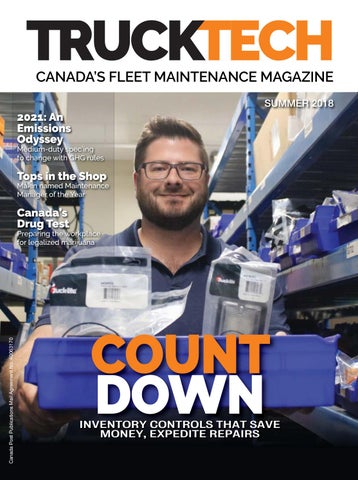
SUMMER 2018
2021: An Emissions Odyssey
Medium-duty spec’ing to change with GHG rules
Tops in the Shop
Makin named Maintenance Manager of the Year
Canada’s Drug Test
Canada Post Publications Mail Agreement No. 40063170
Preparing the workplace for legalized marijuana
Truck Tech_Summer 2018.indd 1
COUNT %j b
INVENTORY VENTORY CONTROLS THAT SAVE MONEY, EXPEDITE REPAIRS
2018-06-04 10:39 AM
Castrol reduces the amount of services that we do and it extended our drain interval by almost double. That’s been a big plus financially. Neil MacDougall, Service Manager Don Anderson Haulage
OUR CUSTOMERS KNOW THE ADDED VALUE CASTROL BRINGS TO BUSINESS. - Superior oxidation control up to 30% longer* for fewer costly repairs. - Extended drain intervals† and less time in the shop. - Superior viscosity retention and wear protection for longer oil life and lower maintenance costs.
LET’S TALK ABOUT THE CASTROL ADVANTAGE.
1-888-CASTROL | CASTROL.CA *Vecton Fuel-Saver 10W-30 FA-4 independent testings vs. SAE 15W-40 CJ-4 oil using SAE J1321 test method for Class-8 trucks. Vecton-Long Drain 10W-30 CK-4 and Vecton 15W-40 CK-4 compared to a CJ-4 engine oil in the Volvo T-13 engine test. † Extending oil drain intervals should only be done in conjunction with a comprehensive used oil analysis program like Castrol Labcheck.
Truck Tech_Summer 2018.indd 2
2018-06-04 10:39 AM
is written and published for owners, managers and maintenance supervisors of those companies that operate, sell and service trucks, truck trailers, and transit buses.
SUMMER 2018 VOL. 3 NO. 2 Vice President, Editorial Rolf Lockwood rolf@newcom.ca • (416) 614-5825 Contributing Editors Elizabeth Bate, Derek Clouthier, James Menzies, Jim Park, John G. Smith, Sonia Straface Managing Director Trucking and Supply Chain Group Lou Smyrlis lou@newcom.ca • (416) 510-6881 Creative Director Tim Norton tim@newcom.ca • (416) 510-5223 Production Manager Kim Collins kim@newcom.ca • (416) 510-6779
COVER STORY
COUNT DOWN NEWCOM MEDIA INC.
Save money, expedite repairs through accurate inventory controls
5353 Dundas Street West, Suite 400 Toronto, ON M9B 6H8 416/614-2200 • 416/614-8861 (fax) CHAIRMAN AND FOUNDER Jim Glionna PRESIDENT Joe Glionna VICE PRESIDENT, PUBLISHING Melissa Summerfield CHIEF FINANCIAL OFFICER Peter Fryters DIRECTOR OF CIRCULATION Pat Glionna Truck Tech is published by Newcom Media Inc. The contents of this publication may not be reproduced or transmitted in any form, either in part or full, including photocopying and recording, without the written consent of the copyright owner. Nor may any part of this publication be stored in a retrieval system of any nature without prior written consent.
Erick Buhr, corporate parts and warranty manager with Erb Group, shows off some of the fast-moving parts in the fleet’s Baden shop. (Elizabeth Bate photo)
Features LEADERS SPEAK: Jason Makin Cruickshank’s Jason Makin recognized as Canada’s Fleet Maintenance Manager of the Year.
Truck Tech_Summer 2018.indd 3
Editorial ................................................... 5 10
Inside the Numbers ................................ 30 13
2021: An Emissions Odyssey Medium-duty spec’ing processes will change with the second phase of GHG rules.
16
Active Maintenance Collision mitigation systems automatically apply brakes, but how well are your brakes working?
20
16
Quick Fix ................................................. 7 Equipment Watch .................................. 28
Canada’s Drug Test Legalized marijuana is coming, and that requires a closer look at workplace policies.
10 15 trucknews.com
Departments
28
20 SUMMER 2018 TRUCKTECH 3
2018-06-06 11:00 AM
Have What It Takes
Service Bearing Races. Faster. Safer. More efficiently. Whether you prefer servicing bearing races without removing the wheels from the hub or you’d rather rely on a shop press for a more economical solution — we’ve got a kit for you. No matter what your philosophy, Tiger Tool’s Bearing Race Starter Kits eliminate traditional welding, hammering and punching methods; all of which are time-consuming, cumbersome and regularly result in injury to the technician.
Bearing Race Starter Kit
Hydraulic Bearing Race Starter Kit
10908
10909
Bearing races can now be removed and
Bearing races can now be removed
installed precisely in minutes utilizing
and installed precisely in minutes
bearing specific adapters and a shop
while the wheels remain on the hub.
press once the wheels are removed
This is a hydraulically powered kit that
With a multitude of adapter kits
from the hub. The shop press is used to
horizontally services bearing races
to choose from, there simply isn’t
apply force, pressing the bearing race
when used together with bearing
a more comprehensive solution
out with little effort. The shop press can
specific adapters.
for servicing bearing races.
Adapter Kits
also be utilized to install new races in conjunction with one of the adapter kits.
Note: Adapter sets are compatible with either system. 10909 requires 10,000 hydraulic power source.
1.800.994.1871 | tigertool.com/bearingrace
Truck Tech_Summer 2018.indd 4
2018-06-04 10:39 AM
Editorial
Wheels Still Come Off No matter what we do, wheel security seems to remain an issue By Rolf Lockwood
Wheel security is a subject that just won’t go away, and I guess it shouldn’t uldn’t because we clearly haven’t managed ed to eradicate wheel-off incidents. No surprise, then, that it came up yet again as a few of us were reviewing this year’s Canadian Fleet Maintenance Summit mmit held in April. (A big success, by the way.) ck by We asked for attendee feedback ggesway of a survey that included suggesuture tions for topics we might cover in future urity summits. Sure enough, wheel security made that list. nI already knew it was an ongoing issue. Informal chats here and there always confirm it, and people are forever telling me to keep on pushing. So I do. Disturbingly, every time I write about wheel security, I get emails from technicians complaining about the complacency they see in their own shops when it comes to wheel care. There will be those of you reading this who say, “Not again,” but I make no apologies for harping on this. I write about wheel-offs every couple of years. Fact is, I’ve been addressing it since the 1990s when wheels seemed to be falling off trucks all the time – and killing people in the process. They still are, though maybe not so often because we understand more these days. But we all know they happen, and I don’t need iffy statistics to prove it. You guys tell me they do. I’m reminded of a very unsettling email I had not long ago from a veteran technician at a large fleet, which he described as “so-called leaders in preventive maintenance.” Not so, apparently. “I can assure you complacent thinktrucknews.com
Truck Tech_Summer 2018.indd 5
“I can assure you complacent thinking is the norm around here.” ing is the norm around here,” he wrote, requesting anonymity. “Sure we had the new procedures and some training thrown at us when wheel-offs were in the news, but that is not the case now. Of the 12 technicians working in my shop, there is only one installing wheels correctly, one comes close, and the others aren’t even in the ballpark. Management does nothing and will do nothing until a wheel-off occurs. And when that does happen
w review the procedures taken, they will wh they find the tech who didn’t and when do it rig right they will fire him and remind t those that are left of the proper procedures. A week or two later, things will be back to ‘normal’. “Are we doing enough? In the time I have been with this company, I have been on only nine training sessions, each o to three days in length. That’s being one maxi a maximum of 27 days for the 15-plus years I have been here. If it wasn’t for my own initiative, I would know how to g grease a truck and change oil and that’s it. With all the systems on a vehicle today, I hardly think 27 days of training covers it. We have senior technician cians who can’t adjust clutches, who can’t inspect brakes properly, who know little about fifth wheels or the electronics on a vehicle. Our company is adding to the problem by hiring unskilled labor to perform vehicle inspections. These same guys are mounting and dismounting tires without knowledge of what they are doing. Training doesn’t exist.” Is that typical? I think not. Is it rare? I fear the answer to that one, but you tell me. This is not just a safety concern, even though the calamity quotient of poorly attached wheels is mighty high. It’s also a business matter in an archly competitive marketplace. Whether we’re talking about wheel integrity or brake adjustment or any other such matter, haphazard maintenance is a cost multiplier. Downtime, unhappy drivers, bitching customers...you name it, they will all contribute to an ugly bottom line. Complacency in the shop can be a killer in more ways than one. TT SUMMER 2018 TRUCKTECH 5
2018-06-04 10:39 AM
Your bottom line doesn’t care if it’s cold. The new Mobil Delvac 1™ range of synthetic engine oils helps protect your fleet and your business.
See our new products at mobildelvac.ca
Truck Tech_Summer 2018.indd 6
2018-06-04 10:39 AM
QUICK FIX
Alliance wants emissions crackdown The Canadian Trucking Alliance (CTA) is calling on governments to help fight those who tamper with emissions controls on trucks. While most fleets have complied with ever-tighter emissions standards – and their related costs – other operators have been disconnecting equipment like diesel particulate filters (DPFs), or using electronic means to circumvent electronic control modules. The alliance wants provincial governments to give roadside enforcement teams the tools to scan and detect if emission systems are regenerating properly and in good working order, or whether they are non-compliant. This would be similar to the “read-only, plug-in” approach Ontario and Quebec use to determine speed limiters are working, says Geoff Wood, senior vice-president of policy. Ontario has already shown interest in the emissions-related enforcement, and the CTA has asked the Canadian Council of Motor Transport Administrators (CCMTA) to get other provinces to move with roadside enforcement plans of their own. The alliance is also suggesting an update to National Safety Code standards around annual inspections, requiring technicians to plug in to verify an engine complies. If that was followed, a failing vehicle would not earn a valid annual safety inspection.
Alberta program grounds 57 Alberta Transportation’s new Carrier Intervention and Discipline Policy, enacted March 1, places the onus on a carrier to prove an operation is compliant. And that “reverse onus” approach had suspended 57 carrier Safety Fitness Certificates as early as mid-April. Eight certificates were canceled altogether. Shaun Hammond, assistant deputy minister of safety policy and engineering, says carriers that can’t prove they are compliant will be given 90 days to 15 months (depending on fleet size) to trucknews.com
Truck Tech_Summer 2018.indd 7
Skills put to test in Ontario
School may be out for the summer in many locales, but seven apprentice truck and coach mechanics were recently demonstrating capabilities as the annual Skills Ontario competition – a showcase featuring 68 trade and technology contests. Competitors in the truck and coach category qualified to represent their respective colleges through in-school (File photos) and regional events, which like their provincial counterpart include a 100-question written test in addition to practical demonstrations. Working against the clock, the competitors had just 40 minutes at each of 10 stations to show their stuff. Each station was evaluated by a professor from one of the participating truck and coach programs. Bradley Lewis of Centennial College earned gold, while Kyle Hurtubise of MAESD – Northern secured silver. Joe Edwards of Algonquin College earned bronze.
become compliant. No extensions or excuses will be accepted.
Trucks missing GHG targets Evolving trucks are reducing greenhouse gas emissions, but the Conference Board of Canada believes the industry will still fall short of a 2030 target to reduce emissions 30% below 2005 levels. The findings were included in a report during the inaugural meeting of the Conference Board’s Centre on the Low-Carbon Growth Economy. Heavy-duty vehicles emitted 21 megatonnes (Mt) of carbon dioxide in 1990, 49 Mt in 2005, and 63 Mt in 2015, it concludes. Even if the industry aggressively adopts emerging technologies, the greenhouse gas emissions are
expected only to fall to 42 Mt by 2030 (20% below 2005), and 27 Mt in 2050 (49% below 2005). While equipment is evolving, the emissions from road freight have been growing in line with an expanding population and economy. Road transportation accounts for more than ¼ of Canada’s greenhouse gas emissions. And the share appears to be growing.
Kenworth La Sarre dealership relocates Kenworth La Sarre has moved into a new 12,000 sq.-ft. facility to support customers in Northwestern Quebec. The dealership – located at 745 Route 111 East in La Sarre, Que. – sits on 5.7 acres. There’s a 5,200 sq.-ft. parts warehouse, and 800 sq.-ft. parts display. It also has a six-bay service department. SUMMER 2018 TRUCKTECH 7
2018-06-04 10:39 AM
QUICK FIX
Tenneco buying Federal-Mogul Icahn Enterprises is selling Federal-Mogul to Tenneco for US $5.4 billion, while Tenneco has announced plans to split Federal-Mogul in two. Federal-Mogul is to be divided into an aftermarket and ride performance company, and a powertrain technology business that makes parts like pistons and spark plugs. Both will be publicly traded, with the split to occur in the last half of 2019. The sale itself is expected to close in the second half of this year, subject to regulatory approvals, and is not subject to any financing conditions.
Truck-Lite bids farewell to Van Riper Truck-Lite’s senior vice-president and chief technology officer Bradley C. Van Riper has died following a brief battle with cancer. The 64-year-old started his career at Truck-Lite in 1978 as a maintenance technician and steadily acquired more responsibility as the company grew. By 1994, he was promoted to vice-president of research and development and was in his most recent role since 2006. He held several U.S. patents, and was responsible for developing technology integration plans, monitoring intellectual property, and adapting regulatory standards for the global Truck-Lite organization.
Navistar rebrands reman lineup Navistar’s focus on uptime is being widened to include its expanding parts lines. The company is rebranding its ReNEWed line of remanufactured parts, and adding products to its Fleetrite private label parts brand. Both announcements were made at the Technology and Maintenance Council spring meetings. The ReNEWed brand goes beyond remanufacturing parts, and also includes re-engineering to incorporate many mid-cycle design modifications.
8 TRUCKTECH
SUMMER 2018
Truck Tech_Summer 2018.indd 8
Auction deals total $207 million Ritchie Bros. Auctioneers sold more than $207 million in equipment during an April 24-28 auction in Nisku, Alta. It attracted more than 14,000 bidders from 59 countries, including more than 9,750 online bidders. “We once again saw strong participation from Western Canadian registrants, bidding aggressively as they’re looking to purchase equipment for the spring construction season, resulting in strong pricing across most equipment categories,” said Brian Glenn, senior vice-president Approximately 89% of the equipment auctioned was sold to Canadian buyers, with 55% from Alberta. Buyers from the U.S. and other countries, such as China and the United Arab Emirates, accounted for the rest.
It’s supported by more than 700 dealer locations across North America.
St-Cyr acquires BWS Manufacturing The owner of Remorques Lewis has acquired trailer manufacturer BWS Manufacturing, headquartered in Centerville, N.B. The business specializes in manufacturing custom trailers for heavy road transport. Randy MacDougall, former president of BWS, will now assume the position of chief of operations while retaining 25% of company’s shares. Since the merger between Remorques Lewis and BWS Manufacturing, the company has hired 26 new employees and is poised for more growth this year, it says. Together, the two companies are aiming to net $40 million in sales and hire 130 qualified employees in 2018.
Hiway acquires Eskimo Refrigeration Hiway Refrigeration is acquiring Calgary-based Eskimo Refrigeration. Eskimo provides sales and aftermarket support in Western Canada for products in transport refrigeration, air conditioning, and heating. In business for 52 years, Eskimo sells
and services Carrier Transicold truck and trailer refrigeration and heating units, Red DOT’s complete product line, Webasto diesel-fired engine and cab heaters, Proheat coolant heaters, and Arctic Fox fluid warmers. In addition to Calgary, the company has locations in Edmonton and Lethbridge, as well as associate dealers throughout Alberta, B.C., and Saskatchewan.
Rocky Mountain acquires Dunlop Rocky Mountain Diesel (RMD) will be rebranded after its acquisition of Western Star dealership Dunlop Western Star Centre. With 19 years of history under its belt, RMD has been a Western Star dealer since 1991, and will now focus on unification, growth, and stronger brand awareness in Southern Alberta and B.C.
PacLease top franchise Kenworth Ontario PacLease has been named Kenworth North American Franchise of the Year for 2017. “PacLease and our franchise group had a banner year in 2017, with Kenworth Ontario PacLease and Allstate Leasing – a founding member of PacLease dating back to 1981 – leading
trucknews.com
2018-06-04 10:39 AM
the way,” said Ken Roemer, president of Paccar Leasing. “Our collective strength has been our Peterbilt and Kenworth product line, backed by the passion of our franchise group in customer support. It’s why we delivered 30% more medium- and heavy-duty trucks into our lease/rental fleet in 2017 (over 2016) while the leasing industry as a whole had sales numbers comparable to 2016 numbers.”
Sterling named top Volvo dealer
Reefer Sales & Service named top dealer
expansive parts operation, and a new training center.
Reefer Sales & Service has been named Carrier Transicold’s 2017 North American Dealer of the Year. The dealer has 130 employees and supports Ontario’s refrigerated transport industry. It recently consolidated several operations into a new 46,000 sq.-ft. facility with 20 service bays, an
Sterling Truck & Trailer Sales was named Canada’s top Volvo dealer for 2017, while S&S Volvo of Lima, Ohio, took top honors for North America. The company’s dealers were measured based on new truck sales, market share, parts sales, customer satisfaction, dealer operating standards, franchise investment, and support for other dealers.
Tallman Group opens used center Tallman Group has opened a used truck center at 1715 Britannia Rd. East in Mississauga, Ont. The lcoation will offer all makes of used medium-, heavy-, and severe-duty
trucks, as well as used truck warranties and financing. “We look forward to offering our customers even more options when it comes to expanding their fleet,” says Kevin Tallman, chief executive officer, Tallman Group. “By opening a dedicated used truck facility we are able to have even more trucks in stock and ready to go to work.” TT
OUR NORTH AMERICAN WARRANTY. YOUR ASSET. SIMPLE AS 1, 2, 3 1
HAVE YOUR REPAIR DONE in one of our service centres
2
KEEP YOUR INVOICE in your warranty file
3
PRESENT YOUR ORIGINAL INVOICE if you need warranty service, no matter in which TruckPro service centre you are, and let us do the work!
trucknews.com
Truck Tech_Summer 2018.indd 9
Visit our website for more information or call our warranty center
1-866-706-7770 SUMMER 2018 TRUCKTECH 9
2018-06-04 10:39 AM
LEADERS SPEAK
IN THE
TOP SHOP Cruickshank’s Jason Makin named Fleet Maintenance Manager of the Year By James Menzies
O
verseeing the maintenance of a diverse fleet of about 140 vocational trucks is a challenge. Now throw in responsibility for 20 gravel pits and quarries, six office and shop facilities, 100 light-duty vehicles, 70 pieces of heavy equipment, two stationary asphalt plants, a portable asphalt plant, two ready-mix plants and a couple of crushers. 10 TRUCKTECH
Truck Tech_Summer 2018.indd 10
SUMMER 2018
That, in a nutshell, is Jason Makin’s job description. He is vice-president of materials and logistics for Cruickshank Group and was named the 2018 Volvo Trucks Fleet Maintenance Manager of the Year during this year’s Canadian Fleet Maintenance Summit on April 19. “I have responsibility for the acquisition, disposal, maintenance and repair of the fleet,” Makin said in an interview
with Truck Tech at his Kingston, Ont., office. “I also have responsibility for all our properties – all the physical assets, properties, and buildings.” The fleet consists of about 140 heavy trucks, ranging from Classes 6-8, and includes everything from single-axle trucks to tri-axle dump trucks. Many of those trucks are multi-purpose vehicles, deployed as snowplows and sanders in trucknews.com
2018-06-04 10:39 AM
Opposite page: Jason Makin is responsible for not only a fleet of vocational trucks, but also Cruickshank’s heavy equipment and properties. Right: Getting to know his technicians personally, and being in touch with their issues and concerns, is a priority for Makin.
the winter, and then dump trucks the rest of the year. The company also operates a fleet of ready-mix trucks. Maintaining such a diverse fleet is not a new challenge for Makin. He began his maintenance career in the Canadian Armed Forces, where he spent seven years as a vehicle technician. “It was enjoyable, but not where I wanted to be,” Makin recalled. He moved to Toyota as it was expanding its manufacturing plant in Cambridge, Ont. It was there that Makin quickly moved up through the ranks from working on the assembly line to leading projects during the rapid expansion of the plant. “Toyota gave me a great base for process, developing workflows and understanding the steps that need to be taken,” Makin said. “Those opportunities are invaluable, and you take those skills with you everywhere you go.” But Makin’s roots were in Kingston, and the pull of home was too great to ignore. He found a job as general manager of equipment with Cruickshank in 2009, and after three years was promoted to his current role. But despite the challenges inherent in maintaining such a varied fleet, Makin says it’s the human element that is proving to be one of his biggest day-to-day challenges. “The biggest challenge right now is people,” he said. “The availability of technicians, whether apprentices or trained technicians. I think it’s a systemic problem in the industry.” Makin addresses the shortage by engaging his technicians, getting to know them personally, and providing trucknews.com
Truck Tech_Summer 2018.indd 11
“The biggest challenge right now is people. The availability of technicians, whether apprentices or trained technicians. I think it’s a systemic problem in the industry.” – Jason Makin, Cruickshank
as much flexibility as possible while ensuring the job gets done. “We put a lot of efforts into doing the right things for employees to make it a happy and enjoyable place to work,” he said. Makin has quarterly roundtable discussions with managers and technicians to ensure everyone is in touch with issues and concerns. “I lay out our vision for the next six months, give them an opportunity for feedback, find out what we can do better, what we need to improve on, and what are the issues they are facing,” Makin explained. “It gives them an opportunity to know what our plan is, and to know they have a voice and that we try to act on everything if we can. If we can’t, we always circle back around and say, ‘You had a great idea, here’s why we can’t do it now.’ Something I learned at Toyota is that it’s the person doing the job that usually has the best ideas for making improvements.” Sometimes, small gestures can have a big impact. Cruickshank became aware that the $120-a-year College and Trade fees charged to Ontario technicians
were a sore point for mechanics, and now covers half the cost. “It may be small to the company, but it’s big to the employees,” Makin said. When walking the shop floor, Makin engages his technicians and asks them how things are going. “Lots of times, the guys will quickly open up if something is bothering them,” he said. Like most maintenance operations, Makin struggles to bring in new talent. He acknowledges a different management style is required for younger techs. And he should know – his 23-year-old son Mitchell is an apprentice there. The key to preparing young technicians for success is to ensure they don’t get in over their heads early and become discouraged, Makin noted. “Making them understand their first day on the job, they’re not going to be doing field service calls. They have to spend some time in the shop, they have to prove they’ve got the capabilities. If we put them out there chasing down field services calls they’re going to get out there and get lost in the repair and SUMMER 2018 TRUCKTECH 11
2018-06-04 10:39 AM
LEADERS SPEAK it slows things down and reflects poorly on the shop,” Makin said. “We send the young guy out with a senior guy to give him exposure and let our veterans teach them how to approach things.” Other challenges for Makin include prioritizing projects. “We have two crushing operations,
and both think theirs is the most important,” he said. “The cost of any equipment being down, we want to reduce that as much as possible. But the impact of an asphalt plant being down – it stops the trucks, the crews, the work, the traffic on the highway. There’s always the competition between priorities and Jason Makin returned from CFMS to find his office filled with balloons, planted there during his absence by co-workers.
“THE RESULTS WE HAVE SEEN ARE REMARKABLE – IT DOESN’T GET BETTER THAN THIS!” LARRY SLAVENS, OPERATIONS MANAGER, DLM TRUCKING, SUNNYSIDE, WASHINGTON, USA
Want to double your drain intervals like DLM? Take the DURON™ Challenge. There’s no cost, and no risk. We’ll provide the DURON heavy duty engine oil, the technical expertise and oil analysis. And we’ll support you all the way. Visit DURONCHALLENGE.com now for more information.
12 TRUCKTECH
trying to keep everybody happy.” This includes drivers. “These guys are our customers, and we need to think of them that way and treat them that way,” Makin said. Cruickshank’s spec’ has evolved to help attract these very people. New trucks are now spec’d with Allison automatic transmissions. Full air suspensions are another recent change. The company keeps its trucks for about 10 years. “Our spec’ hasn’t changed a lot over the years with the exception of those two changes,” Makin said. The road construction industry has been busy in recent years, with an injection of government infrastructure spending. This has been good for business but has also attracted more competition and put greater pressure on rates. “Margins are tight, so we run things lean,” Makin said. One cost-saving initiative he is proud of is an anti-idling campaign that began with the heavy equipment and is now underway in the on-road fleet. “We saw the results in our maintenance costs, in our fuel costs, and we were able to get the whole company onboard,” Makin said. “We had monthly recognitions, T-shirts for our top operators, Tim Hortons gift cards, and at the end of the year we paid out a bonus to operators with the lowest idling time.” The initiative earned Cruickshank the Ontario Road Builders’ Association’s 2016 Outstanding Achievement Award for Green Leadership and Sustainability. TT
SUMMER 2018
Truck Tech_Summer 2018.indd 12
2018-06-04 10:39 AM
SUBSTANCE ABUSE
CANADA’S DRUG TEST
What employers should know about upcoming marijuana legislation BY SONIA STRAFACE
R
ecreational marijuana will be legal across Canada faster than you can say “puff, puff, pass” – whether you’re ready or not. But according to experts, you should get ready – and fast – before the legalization comes info full effect. Barbara Butler, who has been helping government, industry, and labor associations deal with workplace and alcohol and drug issues since 1989, says the news of the legislation should not be shocking to employers. “This is not new,” she said. “Employers should have drug and alcohol policies in place already…and not just for cannabis, but for every drug, mood-altering substance, and alcohol.” Butler said these policies need to cover all employees, not just drivers, and be clear and well-communicated. “You want to make sure your employees know their expectations by providing a clear policy around fitness for work, and be very clear on what is expected in the workplace,” she said. Corporate, commercial, and regulatory lawyer Jaclyne Reive agreed with Butler and strongly suggested employers update their drug and alcohol policies. “Even though (recreational marijuana) isn’t legal yet, employers shouldn’t wait until it is legalized,” she said. “We strongly recommend having a robust fit for duty policy in all workplaces as it allows employers to protect the health and safety trucknews.com
Truck Tech_Summer 2018.indd 13
of their workers and the general public.” This includes truck dealerships, repair centers, and truck fleets. Even though Reive warns that drug and alcohol policies are not a one-sizefits-all deal, she does advise that all policies have similar key items. “You should state that employees should arrive for work fit for duty and not impaired and remain that way through their shift,” she said. “And this goes for both legal and illegal substances. Employers should also consider prohibiting possession at work, and putting a duty on employees who are in safety-sensitive positions to report if they have a substance abuse problem, if they have a prescription for medical cannabis or any other medication that may impact their ability to do their job.” This is especially important for truck mechanics, Reive said, as it could be argued that they are in safety-sensitive positions. “Because they are ensuring these vehicles are in proper working condition and that they are safe for drivers to go out on public roadways with…you want to make sure your policy is clear,” she said. As well, Reive says policies should include a contact in the workplace that employees can turn to if an issue arises, such as if an employee is suspicious of another co-worker being unfit for duty or if someone has a substance abuse problem.
“Another thing is here in Canada, we are not allowed to do random drug and alcohol testing,” she said. “So, employers should be careful not to put that in their policy. And when you’re interviewing someone, you can’t ask if they’re a user of marijuana. Because then it becomes a human rights-related issue.” Reive also suggests putting consequences in the policy. “Make sure the policy states when termination would occur,” she said. “Because if you’re the employee, you want to know what’s expected and what’s going to happen if you break the rules.” Things become a bit more complicated if an employee comes forward with a substance abuse problem that meets the definition of a “disability” under Canada’s human rights legislation. “If somebody comes forward with an abuse problem, then the employer would have to accommodate them to the point of undue hardship,” she explained. If, for whatever reason, you don’t have a drug and alcohol policy in place, you better get one, and fast, both Reive and Butler suggest. Reive also advises that the law will apply differently to each business’s individual situation, and that you should seek your own legal counsel before taking any steps in an attempt to comply with any of the legal obligations discussed in this article. TT SUMMER 2018 TRUCKTECH 13
2018-06-04 10:39 AM
PARTS COUNTER
COUNT DOWN Save money, expedite repairs through accurate inventory controls BY ELIZABETH BATE
H
aving the right parts at the right time is a balancing act, one that can impact the bottom line in big ways. More than just considering carrying costs, effective inventory controls involve making sure expensive parts don’t languish in a dust-filled corner, and that repairs are not delayed because of a lack of the right parts. And what about non-parts inventory like personal safety equipment and tools? Frequently replacing those items can eat into budgets. Bill Mairleitner, the group parts manager for Cervus Equipment, says keeping track of parts used for common jobs can eliminate a lot of the guesswork when it comes to ordering. Most parts managers can recite the maintenance parts they think they use frequently – brake pads, taillights, and filters, to name a few – but using a formal spreadsheet to keep track of the
14 TRUCKTECH
Truck Tech_Summer 2018.indd 14
SUMMER 2018
parts numbers associated with such jobs, as well as how many times the part or job was used in a given period, helps shops maximize uptime while not over-ordering. This kind of tracking can also help a shop notice trends, says Mairleitner, who looks at the big picture for 11 Cervus locations. This winter, for example, there was a noticeable uptick in thermostats being replaced. While the previous few winters had been mild, the deep freeze at the end of 2017 saw a sudden need for the regulating devices. Computers are proving handy for parts help, with various programs providing a direct link to parts providers and OEMs – like Paccar. Cervus supplies Paccar parts to its own and other locations. Using the inventory control software allows parts managers to not only order components but keep track of the frequency a part is being used, how many are on hand, and
Parts line up in a Paccar PDC (above). Erick Buhr and fast-moving parts at Erb Group. (right)
when more need to be ordered. “Having the right part at the right time seems to be a lot bigger challenge today than it was in the past,” Mairleitner says. With an increase in parts and the frequency they change, it’s no longer possible to memorize numbers for ordering. Mairleitner says a job that used to take four to five parts could now take 10-15. Keeping a digital system with all those numbers, one that can be easily updated when parts numbers change, is necessary. The lists can also help keep track of missed opportunities by recording trucknews.com
2018-06-04 10:39 AM
PARTS COUNTER
Missing parts lead to missing maintenance opportunities, says Bison’s Mike Gomes.
every time a sale is lost or a truck is turned away due to a lack of available parts. That’s something Cervus says has had a real impact on how efficiently it’s able to serve customers. Mike Gomes, vice-president of maintenance at Bison Transport, says those missed opportunities can affect a fleet’s performance, taking a fix that should have been four or five hours to 10 hours or more. Once a shop has a list, it’s important to count the parts. Many shops are moving to a continuous-counting model, tracking a certain section of the shop every day or every week. Once the whole shop is done, they start over. As barcoding technology – complete with a scanning gun and instant uploading to a computer – becomes cheaper and more readily available, continuous counting becomes easier, providing shops the possibility of skipping a yearly inventory count altogether. For those that do choose to keep their end-of-year count, an increase in cycle counts means a better opportunity to correct mistakes. Erick Buhr, corporate parts and warranty manager with the Erb Group of Companies, says weekly cycle counts curb problems when they happen – a mechanic failing to record a part when it’s taken off a shelf, or a part number not trucknews.com
Truck Tech_Summer 2018.indd 15
“Having the right part at the right time seems to be a lot bigger challenge today than it was in the past.” –Bill Mairleitner, Cervus Equipment
being logged properly when it arrives, for example. Spotting these issues while memories are fresh saves searching for the cause of missing parts later on. Sometimes headaches can’t be so easily headed off at the pass, however. Parts numbers change so quickly that it can be hard to keep track of updates, and while most OEMs endeavor to work with their customers to provide easy returns for parts ordered in error, some parts just aren’t returnable. “Electronic components are pretty much a battle,” says Buhr. Once an electronic component is opened, returning it is often a no-go, which makes checking parts numbers to ensure they’re up-to-date even more important. There is no such thing as perfect, however, which makes maintaining a good relationship with parts suppliers all the more important. “Ordering the wrong parts, yeah it
happens. I got one sitting in my office right now,” Buhr says. In-line compressors are a common order, but an update in numbers meant Buhr was stuck with some that didn’t fit the VIN of the truck his shop was working on. They all had to go back. Parts suppliers are more likely to take back a tough-to-return part on a oneoff basis if they want to preserve a good working relationship. Maintaining that may mean more money on your bottom line in the long run. When it comes to non-electronic components, returning unused parts regularly is important to make the most efficient use of valuable floor space. Each shop’s practice for returning unused stock is different, but most shops that spoke to Truck Tech said they returned parts if they had been sitting for six to nine months. Parts aren’t the only inventory that needs reviewing in a shop. Tools and personal safety equipment can become a problem if not logged correctly. While most shops require mechanics to provide all their own tools, a few items – drill bits and personal protective equipment like goggles, for example – might be provided by the shop. Ensuring those items are accurately inventoried can mean keeping replacement costs down. While it’s been a while since Erb had a problem with missing tools, it does happen. Occasionally drills, wrenches, or other small tools have been misplaced, but implementing a control system on those items comes down to time versus reward for Buhr, who says the solution sometimes costs more than the problem. Cervus, meanwhile, is testing vending machines that distribute small tools and safety gear to mechanics with the swipe of a card. The machines have been in the Mississauga and Waterloo, Ont., locations for six months, with good results. The size of the two facilities make the machines a practical solution to having technicians wait for supervisors to sign out tools and equipment. “It’s a pretty neat system, actually,” says Mairleitner. TT SUMMER 2018 TRUCKTECH 15
2018-06-04 10:39 AM
POWERTRAINS
202 1 An Emissions Odyssey Medium-duty spec’ing processes will change with the second phase of GHG rules BY JIM PARK
16 TRUCKTECH
Truck Tech_Summer 2018.indd 16
SUMMER 2018
trucknews.com
2018-06-04 10:39 AM
POWERTRAINS
Medium-duty trucks are going to change in Model Year 2021. GHG Phase 2 emissions rules will require better fuel economy and lower carbon dioxide emissions.
With a range of up to 300 km, Volvo’s FE electric Class 7 will be in service in Europe by 2019. Will we see it with a VNR cab here in 2021?
T
he next round of greenhouse gas (GHG) regulations is due in 2021, but the model year of trucks affected by the rule will actually hit the road about two years from now. And while fleets that operate Class 7 and 8 heavy-duty trucks are already losing sleep over the rule, a significant share of the population operating medium-duty trucks doesn’t even know these rules exist. They’re the kinds of trucks operated by businesspeople and contractors who see vehicles as a tool for some other business. Think electricians, landscapers, bakers, and plumbers. Their passion is their business, not the truck they use. “Back when the 2007 and 2010 soot and NOx emissions rules kicked in, we had to educate our customers on those changes, as dramatic as they were,” says Brian Tabel, executive director of marketing for Isuzu Commercial Truck of America. “Most of them didn’t know the change was in place, but they sure noticed the price jump between 2006 and 2010 [Model Year] trucks. Customers that had bought pre-emissions 2006 trucks and were shopping for another one in 2010 were shocked. They were mostly utterly unaware of the changes that had occurred over the past 10 years.” Tabel and others in the medium-duty market are hoping there will be some awareness of the next round of changes. With them will come improved fuel efficiency, which they probably will notice, and a more complex vehicle. Ensuring those vehicles comply with the new rules will be challenging. The regulation, Phase 2 of the Heavy-Duty Greenhouse Gas and Fuel Efficiency Standards, is a comprehensive set of engine and vehicle standards jointly adopted by the U.S. Environmental Protection Agency (EPA)
trucknews.com
Truck Tech_Summer 2018.indd 17
and National Highway Traffic Safety Administration (NHTSA). Together they promote technology to reduce greenhouse gas emissions and improve vehicle fuel efficiency in three stages for Model Years 2021, 2024 and 2027. It builds on standards set in 2012 for Model Year 2014 and 2017 vehicles, which is where we are today. Canada has its own greenhouse gas regulation, aligning Canadian emission standards and test procedures with those in the U.S., while respecting the different regulatory environments – and to some extent, the differences in how Americans and Canadians spec’ and use trucks. By 2027, the rules that apply to Class 2B and 3 trucks, pickups, and vans will require lower carbon dioxide emissions and fuel consumption to be 16% lower than those seen in Phase 1. Class 4-6 vehicles will need carbon dioxide emissions and fuel consumption to be 24% lower than Phase 1. These are significant changes for vehicles that won’t maximize the benefit of improved aerodynamics. In the on-highway sector, a high percentage of the overall reduction in exhaust emissions will come from enhanced aerodynamics. In the medium-duty and vocational sectors, improvements will come from changes in engine and powertrain efficiency, lightweighting, low rolling resistance tires, and tire pressure management.
Developing strategies It’s still early in the development phase, but OEMs are establishing strategies to comply with the rules. Few were willing to share what they are working on, but Darren Gosbee, Navistar’s vice-president of engineering, SUMMER 2018 TRUCKTECH 17
2018-06-04 10:39 AM
POWERTRAINS
Battery-electric last-mile delivery vans and even rental vehicles could work quite well in many operational environments, but they won’t completely replace diesels anytime soon.
BEVs & GHG Phase 2 Greenhouse gas (GHG) Phase 2 rules for 2021 could be what jumpstarts the electric revolution. It won’t be Tesla’s Electric Semi that first hits the streets, but more likely a panel van or delivery truck from the likes of Workhorse, Chanje, Mitsubishi Fuso, Isuzu, or even Volvo or Navistar. Within the medium-duty domain, hundreds of Class 4, 5 and 6 trucks and vans are already in revenue service in many parts of the U.S. (few, if any, are here in Canada so far), with big carriers like United Parcel Service, FedEx, Frito Lay, and others. As regulations put the squeeze on carbon dioxide emissions for vocational and medium-duty trucks, truck makers will be looking for ways to generate emissions credits and to offset any potential credit imbalance. Through the magic of credits earned on more-efficient vehicles – like battery-electric vehicles (BEVs) – manufacturers could afford to apply less drastic measures to their fleets of conventionally powered vehicles. The U.S. and Canadian regulations for BEVs include credit multipliers as incentives to OEMs thinking about qualifying advanced technologies into their vehicles. “For every battery electric vehicle an OEM puts into the medium-duty domain, there is a multiplier that can offset, I believe, up to five diesel trucks,” says Darren Gosbee, vice-president of engineering at Navistar. “It will be very advantageous to an OEM to have electric vehicles in their portfolio to help with corporate averaging.” According to the California Air Resources Board (CARB), “... adopting multipliers in this range would make these technologies much more competitive with the conventional technologies, and could allow manufacturers to more easily generate a viable business case to develop these technologies and bring them to market at a competitive price.” Producers of electric vehicles will also be earning greenhouse gas credits on electric vehicles they sell, but they are useless to the producers because there’s no need to offset non-conforming vehicles. They can, however, sell those credits to companies that make diesels. “Valuation of credits in the averaging, banking and trading model has been questioned, because why would a company sell a credit to a competitor,” says Rick Mihelic, North American Council for Freight Efficiency program manager and co-author of the recently published guidance report, Electric Trucks Where They Make Sense. “In the case of a company that makes just electric vehicles, it’s a great opportunity to help offset the cost of those electric trucks by selling their useless GHG credits to manufacturers that need them.”
18 TRUCKTECH
Truck Tech_Summer 2018.indd 18
says the improvement in medium-duty vehicles will come from the engine and the chassis separately. In this case, we’re talking about straight trucks and delivery vans in Class 3-6 territory. “On the engine side, OEMs will be working to improve combustion efficiency as well as the gas exchange process – how efficiently you get the outside air into the combustion chamber and back out again. And to reduce parasitic or friction losses within the engine – oil and water pumps, engine gear train, piston rings, etc.,” Gosbee says. “Mild-hybridization is going to factor in the medium-duty environment. You’ll probably see engine stop/start technology coupled with energy recovery mechanisms such as regenerative braking and more-efficient electric technology, depending on the class and duty cycle.” On the chassis side, the reductions in carbon dioxide will come from shedding weight, reducing parasitic losses in the powertrain through more-efficient axles, and with low rolling resistance tires and tire pressure management systems. “Transmissions have a big role to play, too,” Gosbee says. “It comes down to the relative efficiencies of torque-convertor automatics versus a dual-clutch automated transmission, versus manual with direct gearing. Manual transmissions are the most efficient, technically speaking, but the least popular with medium-duty consumers.” On the heavy-duty side, customers will have options to get vehicles to comply, and the OEMs will earn greenhouse gas credits based on how efficient the vehicle turns out to be. The OEs will be incentivizing certain technologies to ensure more of them are adopted. Since there are fewer options to tinker with in the medium-duty domain, the manufacturers will be building trucks that help with their compliance pathway, with less input from the customer. “In medium-duty, the choices are more limited, and the OE’s choices for controlling greenhouse gas take on a different form,” says Gosbee. “Technology may have to be forced onto a truck that customers may not necessarily want.” Tabel says many of Isuzu’s tradition-
SUMMER 2018
2018-06-04 10:39 AM
POWERTRAINS al customer base many not be aware of the pending changes to their equipment, and they probably won’t worry about it. Where it will matter is on the maintenance and operational side. “Most of our customer base don’t know much about truck maintenance,” he says. “We went through this with the 2007 and 2010 changes. When the Check Engine light came on they ignored it, and some faced some pretty expensive repairs. We are doing a whole new round of customer training and education when the 2021 trucks hit the street.”
The case for electric Battery-electric vehicles (BEVs) could be ideal candidates to replace conventionally powered light- and medium-duty trucks in segments where the technology suits the application. There’s a lot of talk about range anxiety, but a recent study by National Renewable Energy Laboratories of a delivery fleet in the Seattle area shows that matching
the routes to a truck’s capability – rather than forcing the electric truck to replicate diesel duty cycles – was a better indicator of their potential. In studying PepsiCo’s Frito-Lay North America diesel and electric vehicles, the organization found that average daily driving time for both electric and diesel units was just 1.5 hours, with most of the electric vehicles running less than 70 km per day and consuming significantly less (55 kWh) than the battery’s 80-kWh capacity. Tabel says Isuzu customers have traditionally bought one truck for all their routes. “There’s room there to optimize the truck to the route – long routes for the diesels, and shorter for gasoline or maybe electric trucks,” he says. “When you look at the possible complexity of the 2021-and-beyond vehicle, battery-electric trucks could make a lot of sense for the consumer.” Isuzu now has five trucks set to go
WIN the race AGAINST downtime
into a year-long customer field test to see if they will stand up to the way customers use them. There are already many viable electric vehicles in medium-duty service bearing nameplates like Mitsubishi, Isuzu, Chanje, BYD, Workhorse, and others. We now have electric refuse vehicles from Mack, Volvo, and Daimler. But where are the medium-duty freight trucks from the big-four? Navistar has announced that, in partnership with Volkswagen Truck & Bus, it will have a medium-duty BEV truck available “probably by the 2020 timeframe.” Volvo has just announced two BEV platforms the will run in Europe by 2019. It’s pure speculation on our part, but could those trucks, with VNR cabs, be ready for North America by 2021? Truck Tech contacted several OEM for this story, including General Motors, Fuso, Paccar, and others, but they declined to offer comments. TT
ModulT Air Disc Brake TM
Win the race racce against time the new Haldex with tth ModulT air disc M brake. Its unique brake bra a pad simplifies pad replace e replacement. The entire air brake br k design desig is optimized to i i i th b of tools required minimize the number for the job and reduce maintenance time. The lightweight 22.5-inch trailer brake delivers the durability and performance you’ve come to expect from Haldex. Win the race against downtime with Haldex ModulT. See for yourself how easy maintenance can be at Haldex.com/en/North-America
Haldex.com 800-267-9247
trucknews.com
Truck Tech_Summer 2018.indd 19
SUMMER 2018 TRUCKTECH 19
2018-06-04 10:39 AM
BRAKING
ACTIVE MAINTENANCE Collision mitigation systems automatically apply brakes, but how well are the brakes working? BY JAMES MENZIES
T
rucks fitted with the latest collision mitigation systems featuring active braking will only be as good as your fleet’s maintenance practices. It’s crucial to remember those systems, which automatically apply the brakes when necessary to prevent or reduce the severity of collisions, still require a well-maintained braking system to perform to their full potential. “While an active safety system can help with reaction times to improve roadway safety, effectiveness relies greatly on the base components that are actually doing the work to slow or stop a vehicle – the tires and brakes,” says Keith McComsey, director, marketing and customer solutions, wheel-end, with Bendix Spicer Foundation Brake. “Keeping those components maintained to their intended performance capability has a direct impact on slowing and stopping.” To ensure collision mitigation systems with active braking work as designed, like-for-like OEM aftermarket replacement parts should be chosen, and tires should be properly inflated. Tread depth should also be carefully monitored, McComsey says, to ensure sufficient traction is required when the brakes are applied. “An active safety system will always do everything it can to help the driver mitigate a potential crash situation, but poorly maintained brakes or tires mean it will have to work harder – and what could have been a close call may wind up being a fender bender,” he explains. Mark Melletat, executive director of fleet sales and service, Wabco Americas, agrees with the importance of a fleet’s maintenance practices in en20 TRUCKTECH
Truck Tech_Summer 2018.indd 20
SUMMER 2018
suring safety systems achieve their expected performance. “The foundation braking systems and the anti-lock braking systems [ABS] are critical to collision mitigation functionality. Simply put, collision mitigation systems ask the ABS to decelerate the vehicle when necessary,” he says. “The radar- or LIDAR-based active safety system detects the moving or stationary object, [and] applies the brakes to help avoid or mitigate an unavoidable collision. The ABS and foundation brakes do the work of slowing or stopping the vehicle.” Wabco recommends properly install-
ing air disc brakes on trucks and trailers, and adhering to a preventive maintenance schedule. It also suggests technicians measure brake pad thickness with the wheels on every six months, and with wheels off every 12 months. “Adhering to a maintenance schedule supports early detection of potential issues and avoidance of more extensive brake damage,” Melletat says. “Therefore, a robust maintenance schedule helps reduce vehicle downtime and improve overall vehicle safety.” Fleets that have lax maintenance programs are not likely to see the full benefits of collision mitigation systems, notes Fred Andersky, director, customer solutions – controls, with Bendix Commercial Vehicle Systems. But sloppy maintenance practices don’t make them completely ineffective. “There’s more to mitigating a collision beyond just the technology,” he says. “This doesn’t mean, however, that a fleet won’t get benefits from a safety technology if its maintenance program isn’t on par with Nascar … The system will alert and activate but may need to apply more
Troubleshooting safety systems Many fleets immediately begin swapping out components when problems with antilock braking systems or active safety systems are identified. But this may be a costly and timeconsuming – not to mention unnecessary – approach to the problem, according to Bendix. “Our technical support teams find that component replacement is often the first response to an electronics problem within an antilock braking system, or within traction, stability, or collision mitigation technology,” says Fred Andersky, director, customer solutions – controls, with Bendix Commercial Vehicle Systems. “Many times, though, the issue isn’t the component itself, but a problem that’s more difficult to detect, but easier – and cheaper – to fix.” Bendix recommends that, when troubleshooting an electronic component, to first look for: frayed wires; corroded connectors; blown fuses; out-of-position wheel speed sensors; and misaligned radar. Also examine radar sensors to ensure they aren’t blocked by snow, ice, or debris, look for damaged sensor brackets, and inspect the vehicle’s J1939 communications and diagnostics network. Smashed radar units will have to be replaced, not repaired. Repairs such as front-end alignments or steering linkage service may require recalibration of the stability system’s steering angle sensor. Similarly, any work on the frame rail that involves removing or loosening the yaw rate/lateral acceleration sensor of the stability system will require the sensor to be recalibrated after being returned to its proper position. Changes in tire size may also necessitate the use of diagnostic software to update the new tire values, Bendix advises.
trucknews.com
2018-06-04 10:39 AM
BRAKING
“Technicians need to know what it is they have on the vehicle, and how maintenance may help or hinder the performance of the system.”
Acts on imminent unplanned departures from the current lane • Detects lane markings and evaluates related vehicle position • Recognizes when the vehicle begins to drift towards lane markings • Distinguishes between planned lane changes and lane drifting
Supports driver with improved comfort and safety • Enables driver to suppress or override steering torque • Provides driver assistance according to SAE Level 1 of automation • Driver remains responsible for steering control
– Fred Andersky, Bendix
braking power for a particular situation where maintenance is less than in the same situation where the vehicle is maintained at a higher level. Of course, depending on the situation, the results in both cases may be a crash avoided.” Melletat says fleets spec’ing collision mitigation systems must incorporate the technology into their preventive maintenance programs. “Collision avoidance systems require the same routine maintenance schedules as other truck components such as ABS,” he advises. “The inspection is very simple: test drive the truck and make sure the system is not setting any active fault codes.” Andersky says these systems are well tested, and failures are rare. When they do occur, it’s most likely due to the radar slipping out of alignment. “If the radar is out of alignment, the system will not perform optimally. Radar alignment is a relatively easy fix, however, as the system can typically easily inform the driver what needs to be adjusted,” explains Andersky. Melletat adds, “Any issues affecting the J1939 controller area network [CAN] can disable the collision mitigation systems. Fortunately, these failures are very rare and often can be avoided with routine inspections.” Drivers and technicians should be aware that if the ABS or stability system don’t work, the driver may still have traditional braking but not the stability control or collision mitigation functionality. “Think of this as a hierarchy of issues, with ABS as the foundation,” Andersky suggests. “Thus, keeping ABS up and runtrucknews.com
Truck Tech_Summer 2018.indd 21
Helps avoid potential collisions and run-off-road accidents • Intervenes before the vehicle reaches the lane markings • Autonomously applies a correction torque to the steering wheel • Smoothly releases steering torque as soon as the vehicle trajectory is reestablished
Mitigates imminent collisions with stationary vehicles • Alerts the driver via acoustic, visual and haptic signals • Provides partial braking to reduce impact of impending collision
Long range radar enables earlier identification of imminent rear-end collisions
Helps prevent imminent collisions with moving or stopping vehicles: • Alerts the driver via acoustic, visual, and haptic signals • Provides up to full braking and can bring vehicle to a complete stop
ning will keep stability up and running and collision mitigation up and running.” Fleets spec’ing collision mitigation systems for the first time must train technicians and drivers on how they work. “Technicians need to know what it is they have on the vehicle and how maintenance may help or hinder the performance of the system,” says Andersky. “Drivers need to know what the system is capable of doing, and most importantly, what it is not capable of doing.” Melletat says Wabco doesn’t have specific training requirements for fleets
or technicians purchasing and maintaining its collision mitigation systems, and that most fleets “will send the trucks to dealers to address any collision mitigation system-related concerns.” However, he adds, “Technicians working on these systems should have a strong well-rounded electrical background, including the ability to work on J1939 controller area networks, and experience working on the components of advanced driver assistance systems, such as radar and electronic displays, and the diagnostic software.” TT SUMMER 2018 TRUCKTECH 21
2018-06-06 8:27 AM
Discover what more than 900,000 visitors did last year
We deliver
MORE BLOGS
MORE VIDEOS
MORE NEWS
truck news.com
STAY UP TO DATE ON INDUSTRY NEWS, TRENDS AND EQUIPMENT RELEASES Visit the industry's most popular website
Truck Tech_Summer 2018.indd 22
2018-06-04 10:39 AM
TIRES
By 2048, Michelin is aiming to make its tires fully recyclable, and will construct them from 80% renewable and recycled materials. The company made the announcement at its Movin’ On conference on sustainable mobility in Montreal. Michelin says the move will save 33 million barrels of oil per year, equivalent to 16.5 supertankers. That’s also equal to France’s entire monthly energy consumption. “There are two major ambitions the group is taking for 2048,” said Cyrille Roget, who heads scientific and innovation communication for Michelin. “The two major ambitions concern what we put into tires, and what tires become.” Today, 70% of tires are recovered, according to Roget. That’s not bad when you consider only 14% of plastics are recovered. “If you think about that, the tire industry is very well advanced in recovering their tires,” Roget said, noting about 50% of tires are recycled into new materials
terials. Michelin launched its Biobutterfly program in 2012, which results in creating synthetic elastomers from biomass such as wood, straw, or beet. Today, Michelin tires are made from 28% sustainable materials, including bio-sourced and recycled materials.
Michelin’s Movin’ On conference is now in its second year. It brings together 155 partners, all of them interested in promoting sustainable mobility. Organizations at the event include businesses, universities, government representatives, and media. TT
PREMIUM BRANDS. LOCAL EXPERTS. THE RIGHT PEOPLE. THE RIGHT PARTS. THE RIGHT PLACES.
such as rubber asphalt, and shoe soles. Michelin will be using a high-tech approach to tire design to increase the recycling rate of its tires. It is working with partners such as Lehigh Technologies, a specialty chemical company that is part of Michelin’s High Technology Materials business unit. Lehigh produces micronized rubber powders (MRP), a sustainable raw material that reduces feedstock costs by up to 50%, according to the company. MRP replaces oil and rubber-based feedstocks. Another technology being employed is the use of bio-sourced matrucknews.com
Truck Tech_Summer 2018.indd 23
There’s no beating the ease of doing business with your trusted local truck parts distributor. As part of North America’s Leading Truck Parts Network®, your local VIPAR Heavy Duty Parts Professional offers the brands you want and the expertise you need, with the strength and resources of a network of over 620 locations throughout the U.S., Canada, Mexico, and Puerto Rico.
FIND A VIPAR HEAVY DUTY PARTS AND SERVICE PROFESSIONAL AT VIPAR.COM
SUMMER 2018 TRUCKTECH 23
2018-06-04 10:39 AM
Truck Tech_Summer 2018.indd 24
2018-06-04 10:39 AM
CFMS
Cummins focused on providing ‘power of choice’ BY JAMES MENZIES
T
he company best known for producing diesel engines wants it known that its capabilities extend beyond diesel. “We intend to be in the diesel business for a long time yet,” said Julie Furber, executive director of electrification with Cummins, during a keynote address at the Canadian Fleet Maintenance Summit April 18. “We think the diesel market has a long way to go, but we also think hybrids have a part to play and we believe fully electric has a part to play.” Cummins has committed to spending US $500 million in electric power research and development over the next three years, but Furber said the industry is still in the early stages of adoption. “How fast is this going to happen? We are king of thinking in the next 20-25 years,” Furber said, of the widespread adoption of electric power. The first phase is being driven by social requirements for cleaner air. But Furber said challenges such as charging time and vehicle range remain. The energy density of batteries today doesn’t allow sufficient range without compromising payload, she explained. The next phase will see the adoption of improved technologies, and smaller batteries at a lower cost. Regulations will still be required to promote the use of electric power, Furber said. And government subsidies will be needed. During this phase, lots of municipal return-to-base trucks will adopt electric power, as will smaller pickup-and-delivery vehicles. Phase 3 will see the economics work in a broader range of applications. Trucks will need to deliver a payback within a five-year initial lifecycle, she said. Further breakthroughs will be required to protrucknews.com
Truck Tech_Summer 2018.indd 25
vide 800 km of driving range per day, and questions about resale value will need to be answered. Battery recycling programs will be necessary, as will a more-expansive charging infrastructure. “Right now, we wouldn’t advocate an electric linehaul truck,” Furber admitted. Currently, Furber said Cummins believes diesel remains the best fit for longhaul, natural gas is ideal for regional haul and refuse, while hybrid is an ideal solution for utility fleets. Full electric power is best suited to urban transit bus applications. In the future, customers will choose between internal combustion engines, hybrids, battery electric power, and fuel cell electric models. “Many fleets will end up with a mixture of these vehicles,” she said. “We are moving from being an engine company, to being a power delivery company – to delivering the right power to customers at the right time.” Furber was somewhat dismissive of new arrivals into the industry, including Tesla. “We can all build one truck,” she said. “Anybody can build a truck and make an electric truck. The difficulty is the next piece – getting it on the road, doing it reliably, repeatedly and robustly is much more difficult.” She said Cummins has a global network of 3,000 distributors to support its engines, and that the company won’t disappear before electric power becomes mainstream. Others, invested in an electric-driven future, will be in a hurry to see the technology succeed. “There will be a lot of consolidation, and a lot of companies that run out of cash,” she predicted. “A lot of them care about how fast electrification adopts. If it doesn’t adopt fast enough, they will
“We can all build one truck. Anybody can build a truck and make an electric truck. The difficulty is the next piece – getting it on the road, doing it reliably, repeatedly and robustly is much more difficult.” – Julie Furber, Cummins
not have the cash to stay in business.” Furber said Cummins is already working with OEMs to integrate an electric powertrain. It plans to have fully electric buses in production by the end of next year, and trucks should come soon after – but initially as prototypes. TT SUMMER 2018 TRUCKTECH 25
2018-06-04 10:39 AM
th ANNIVERSARY
SURFACE TRANSPORTATION SUMMIT
Drive Results for Your Business OCTOBER 10, 2018 International Centre 6900 Airport Road, Mississauga, ON
GET Expert insights on the state of the industry and future trends Actionable strategies to increase efficiencies and productivity Networking with supply chain leaders Inspired with enlightening keynote speakers
Economic outlook | Freight transportation technologies | Shipper - Carrier roundtable | Last mile delivery | ELD mandate | Managing budgets | Small Carrier strategies | Freight brokerage & management | And more‌ Association Partners
Produced by
Media Sponsors
MEDIA INC.
www.surfacetransportationsummit.com
Truck Tech_Summer 2018.indd 26
2018-06-04 10:39 AM
CFMS
Track and Measure Sensors offer more data than ever, but can we cut through the noise?
T
he future of connected trucks lies in integration and reducing the number of entry points into a truck, according to industry experts. Speaking on a panel about data and “the internet of trucks” at the Canadian Fleet Maintenance Summit, Ric Bedard of Cetaris said some of his projects involved more than 400 connection and integration points because each technology manufacturer has its own proprietary system.
DeLarochelliere: The key is integration The disjointed technology leads to problems ranging from a flood of data that is almost unusable, to introducing more access points for potential cybersecurity attacks. Although sensors on every part of the truck have given fleet managers the ability to have a 360-degree view, inside and out, at all times, Bedard estimates up to 95% of that data is “noise” – either because it doesn’t provide enough information to be useful, or it takes too long to get to an end user to be valid. Bedard says when an engine sends a fault code, it often doesn’t include information about why a part is failing, how quickly it will need to be fixed, or what will need to be done when the truck gets into a service bay. Add a problem sensor to that, and a fault code becomes just another alert. If that alert trucknews.com
Truck Tech_Summer 2018.indd 27
also takes 24-48 hours to get to a maintenance manager, it’s useless. Jacques DeLarochelliere of Isaac Instruments agreed, saying the key to achieving better data was integrating systems to send the right data at the right time, and eliminating the number of connection points on a truck, eventually aiming for one SIM card on a vehicle. That reduction in connectivity points has the potential of reducing both the amount of transmitted noise and the potential for security risks. Jason Krajewski of Daimler Trucks North America says, with increased cyber attacks discussed by the media, everyone who connects their devices to the internet understands there is always some associated risk. But he hopes the security is improving. “The instant you put a wireless connection point on the vehicle, you’re introducing the potential for an attack,” he said, referring to over-the-air engine updates. With some trucks carrying eight or more connection points, all speaking to different partners, Krajewski said OEMs are starting to recognize the need to incorporate security from the ground up. Connected trucks are now coming straight from the manufacturer with encryptions and firewalls that may help prevent someone with ill intentions from gaining access to a truck, but just trusting the onboard security isn’t enough. Fleets need to examine their back-end structures and know they’re protected on all sides, said the panel. Back office applications that pull data off a truck could easily leave a virus behind. Protecting systems outside the truck could mean security audits and software, but sometimes it’s a task best left to someone else. While storing all your data in the cloud may seem like a risky prospect, Krajewski says companies storing data have the latest security software and
DRAWS 19,600
Discussions about equipment hardly came to an end when the latest Canadian Fleet Maintenance Summit concluded. The Truck World trade show that ran from April 19-21 attracted almost 19,600 people. The 14,807 visitors interacted with 4,788 exhibitor representatives. And there was plenty to see in the sold-out venue that included 525 exhibits. The largest Truck World in history required the addition of a fifth hall, and featured 179,000 sq.-ft. of booth space across nearly 400,000 sq.-ft. overall. The event is jointly produced by Newcom Media (the publishers of TruckTech) and Hannover Fairs, a division of DeutscheMesse. “I couldn’t be happier with this year’s attendance,” said Joe Glionna, president of Newcom Media. “Starting Thursday with 450 industry professionals at the opening breakfast, having the Ontario Trucking Association’s board meeting on-site, and announcements of truck deals right on the show floor, I’m hearing a tremendous amount of positive comments from the exhibitors. I think the excitement on the show floor is indicative of the general mood across the industry right now.”
patches, and are monitoring activity 24/7 – something that most fleets might find hard to match. “In terms of cost and scalability you can’t beat the cloud, but then you’re transferring the onus for the security onto the cloud owners.” Just like adding other technologies to a fleet, converting to a cloud-based system has to take a thoughtful and integrated approach. TT SUMMER 2018 TRUCKTECH 27
2018-06-04 10:39 AM
EQUIPMENT WATCH Cummins X15, Endurant available in LT and LoneStar Buyers of International LoneStar and LT Series trucks can now order a Cummins X15 engine paired with a 12-speed automated Endurant transmission – the product of an Eaton-Cummins joint venture. Featured as part of the Cummins Integrated Power portfolio, it’s paired with a Cummins X15 engine, and is capable of handling torques up to 1,850 lb.-ft. Max-
imum limits include a gross combination vehicle weight of 110,000 lb., and 510 hp. The X15 features an 80,000-km oil drain interval that can be extended up to 128,000 km with the Cummins OilGuard program. The Endurant, meanwhile, includes a self-adjusting clutch and 1.2-million-km transmission oil drain interval. Compared to competing automated transmissions, it consumes half the amount of oil. Cummins said performance and efficiency are both improved through communication between the engine and transmission.
Muncie tames the torque Muncie Power Products’ new Muncie Start option reduces the startup torques for high-inertia loads, allowing PTOs to smoothly engage in applications such as blowers, vacuum pumps, water pumps, compressors and generators. It’s made possible by modulating the clutch and eliminating the torque spikes that would otherwise occur through the power take-off, drivetrain, and mounted auxiliary equipment. And the option also prevents engine stalls at low-engagement rpms. Muncie Start is currently available for FR6Q Series power take-offs, and will soon be applicable for other clutch shift PTO models.
is designed to drop into existing suspensions and has a nominal voltage of 380 VAC and peak power of 130 kW. It features a water-glycol-cooled motor and inverter, and integrated electronically controlled parking feature. With disc brakes it weighs in at 673 lb. The axle’s larger counterpart – the eS9000r for Class 4, 5, and 6 – has 237 kW of maximum power and 400-650 VAC of nominal voltage, and weighs 816 lb. with disc brakes.
Transtex connects speeds and locations Transtex has unveiled a new generation of speed limiter with e-smart, a GPS-based device that sets maximum speeds based on vehicle locations.
Workhorse using Dana axle Dana and Workhorse Group have joined forces to develop a city delivery vehicle featuring Dana Spicer’s electrified integrated e-Drive axle.
The axle sheds 388 lb. when compared to other options, in an optimized package that allows for more battery space inside the frame rails and accommodates features such as side steps, the companies say. The eS5700r model for Class 3 vehicles 28 TRUCKTECH
Truck Tech_Summer 2018.indd 28
SUMMER 2018
Available for Class 4-8 trucks, the system pulls information about posted speeds from the company’s server, or data that is uploaded to the truck itself in case a cellular connection is lost. Users have the option of establishing the speeds drivers would be allowed to drive above posted limits as well. The map data from a third-party provider covers routes across Canada and the U.S., and in selected cases will track speed
limits in Mexico. When split speed limits are posted, the system is said to recognize the limits that are specific to trucks. Using geofencing, fleets will also have the option of limiting speeds in specific areas, such as around a client’s yard or school zone, or immobilizing a truck when it shouldn’t move at all. Those features are currently programmed by calling a toll-free number, but Transtex says it is developing a user interface for such work as well. As a power management tool, e-smart will also limit horsepower based on payloads. It all connects to the truck and engine through a J1939 interface, Bluetooth connection, and throttle position sensor. And a web portal can be used to track factors such as fuel consumption.
Maxxima unveils LED strip lights Maxxima has unveiled two sizes of flexible hybrid auxiliary stop-turn-tail/backup LED strip lights for trucks, trailers, buses, and other vehicles. Now available in 48- and 60-inch lengths, the combo STT/BU strip lights can be applied to the rear of any vehicle to produce bright white and red lighting. A PVC outer jacket blocks moisture and grime, and the self-adhesive backing provides a secure mount to any clean surface, the company says. Each strip comes with a standard fourpin flat trailer connector and an extra lead for the backup light circuit. The strips are backed by a two-year warranty. trucknews.com
2018-06-04 10:39 AM
Mahle jack has 50,000-lb. capacity The ShopPro CAJ25 from Mahle Service Solutions is a 25-ton commercial vehicle axle jack, with an eight-inch starting height and 50,000-lb. capacity. Incorporating an air-driven motor to power the hydraulic system, there’s no manual pumping involved. The ram can also be reset to the minimum starting height without requiring an air hose connection, which Mahle says is an industry first. Threaded ram adjustments are protected with an anti-corrosive Black Hard Coating, while the unit has several starting heights with the acme threaded screw extension and welded steel frame. The product line also includess tthe CAJb. 35, which offers a 70,000-lb. lifting capacity.
Ingersoll Rand unveils ils impact wrench ch Trying to bust loose a stububborn bolt? Ingersoll Rand has a new tool to help. The 2850MAX D-handle one-inch impact wrench is the most powerful one-inch pneumatic impact wrench in Ingersoll Rand’s vehicle service portfolio. It’s available with a six-inch anvil to remove bolts from deep tire wells, as well as a standard anvil. The wrench weighs in at 21 lb. – which the company says is 25% lighter than the industry’s leading one-inch impact wrench — and offers 2,100 lb-ft of maximum reverse torque to loosen stubborn lug nuts. The wrench also has a 360-degree adjustable side handle with an ergonomic grip, and delivers 5,500 rpm and 770 blows per minute, with a swivel hose connection that keeps hoses from becoming tangled as operators move around the garage. trucknews.com
Truck Tech_Summer 2018.indd 29
New controller for Solara Carrier Transicold’s Solara heating unit now features an APX controller with a dashboard-style display. The Solara uses a Z482 two-cylinder diesel engine to generate 50,000 BTU/hour at an ambient temperature of -18 Celsius, keeping sensitive commodities such as flowers and pharmaceuticals from freezing. Its new controller is preloaded with the company’s programmable IntelliSet software to help create heating parameters for different commodities. An integrated DataLink data recorder and USB port makes for easy downloads and uploads, Carrier Transicold adds, while troubleshooting is supported through built-in diagnostics. Options include DataTrak telematics software, flush- and surface-mount control panels, fuel-level sensors, open-door indicator, and shutdown switches. Fuel tank options range from 115 to 455 liters.
)IǼIGOXSV MRXVSHYGIW wheel covers to Canadian market For the first time in Canada, Deflecktor has rolled out its aerodynamic line of wheel covers. The polymer wheel covers feature an aerodynamic shape and have a fastening system that is hidden behind the smooth cover face. Schneider National has committed to equipping its fleet of Freightliner Cascadia P4 tractors with the devices. The wheel covers come in many fin choices, including mirror finish chro chrome, painted silver, clear po polycarbonate, and black.
Fleet Complete Vision draws on video Fleet Complete Vision is combining telematics and mobile video in an offering that fully integrates with the Fleet Complete platform. The system combines an outward-facing camera, video event recording, and Advance Driver-Assistance System voice coaching, which Fleet Complete says will help to improve safety scores, among other benefits. With the tool, fleet managers can create and maintain driver scorecards, detect and review events, share trip reports backed by video, and secure photographic evidence around collisions. Customers have the options of using
their own smartphones or a dedicated windshield-mounted camera. The program is jump-started through a mobile app, synchronizing video data with Fleet Complete analytics and driver behavior reports.
Geotab, Garmin SǺIV *1) FYRHPI Geotab and Garmin have joined together to offer the Geotab Garmin ELD Bundle to track, manage, and share Records of Duty Status. Building on Geotab’s Cloud ELD offering, the bundle includes a Garmin Fleet
790 Android tablet with Wi-Fi, an HD dash camera, LTE connectivity, vehicle charger, and suction cup mount. The companies say the connectivity ensures access to updated maps, as well as commercial truck navigation, and ELD logs. TT SUMMER 2018 TRUCKTECH 29
2018-06-04 10:39 AM
INSIDE THE NUMBERS with LOU SMYRLIS
Get used to it Canadian fleets think that buying used trucks is a viable option when responding to growing freight volumes. Our annual Equipment Buying Trends Survey finds that 7 in 10 carriers have purchased used trucks in the past. The age and mileage of a used truck, and its gross vehicle weight, are considered the most important aspects driving the selection process.
Most important factors in selecting a used truck (Scale of 1 to 5, with 5 most important)
3.87
Brand 0
1
3
0
1
3
Yes
70%
20%
30% No
80% No
0
4
1
3
1
0
3
1
3
2
3
1
2
3
4
5
4
5
4
5
Manual 13-speed
Manual 10-speed
23% of respondents Manual 18-speed
28%
Current trucks have reached replacement mileage
24%
3.92
Type of transmission most likely to prefer when selecting used truck(s)
Main reasons to purchase used trucks
26%
5
4.16
Availability of parts 0
4
4.02
History of the truck 1
5
4.02
Type of transmission
6%
Increasing costs of repairs on current vehicles
5
4.11
0
Yes
4
Gross vehicle weight/payload capacity
Availability of preferred engine brand
Plan to purchase used truck(s) in 2018
5
4.33
Age of truck/mileage
0
Purchased used truck in past
4
44% Automatic/ automated
of respondents Looking to improve fuel economy
Rating of own knowledge and ability to spec’ used trucks
13% 26% Adding to fleet due to growth projections
30 TRUCKTECH
Truck Tech_Summer 2018.indd 30
(Scale of 1 to 5, with 5 being highest)
11%
4.01
Other 0
SUMMER 2018
1
2
3
4
5
Source: Equipment Buying Trends Survey 2017, Newcom Trucking Group Research trucknews.com
2018-06-04 10:39 AM
, CO
OCKS
U’RE
R YO
THE WHE
GR STIN E V R HA
ATE LTIM
RU RN O
’LL G
, WE
ESS SUCC
.
HERE
UT ET YO
nd up a t eet l a f h t r you line eep product onitor k o g t ad tm tryin a bro lter smar . So you u’re ters has i e f o g y r . i d a l slu Fi hen zit ce s s nt w ime. WIX the Sen soot and y to suc a w , , t a w irt ers you wn ing om d ir filt y do l the st th ecessar y-duty a ehicle fr nning al a l e n v v ru Th ny s un ro hea and ect a ing i s.com runn s NanoP that prot hicles up filter x i w e e d rs inclu oil filte d your v an XD and ep you ke can ®
Truck Tech_Summer 2018.indd 31
2018-06-04 10:39 AM
More with Less. Volvo D13 with Turbo Compounding
The new Volvo VNL featuring the D13 with Turbo Compounding gives you greater fuel efficiency and increased performance for your application. Using Turbo Compounding, the VNL recovers an additional 50hp to get up to a 7.5% increase in fuel efficiency. Learn more at D13TC.volvotrucks.ca
the new volvo vnl Truck Tech_Summer 2018.indd 32
2018-06-04 10:39 AM