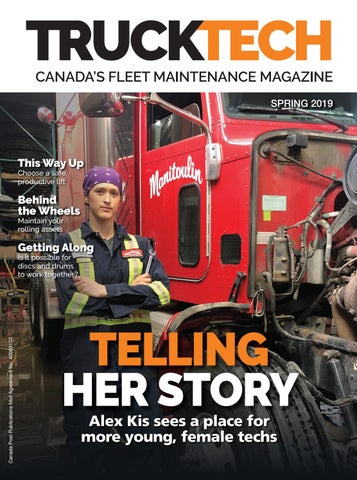
SPRING 2019
This Way Up Choose a safe, productive lift
Behind the Wheels Maintain your rolling assets
Getting Along
Canada Post Publications Mail Agreement No. 40063170
Is it possible for discs and drums to work together?
TELLING HER STORY Alex Kis sees a place for more young, female techs
One of the reasons we’ve gone with Castrol is the ability to do oil samples every oil change. LabCheck is one of the primary reasons we’ve been able to extend the operational life of our vehicle. Fred LaRue, President, LaRue’s Haulage
SCAN, OR SEARCH CASTROL HEAVY DUTY CUSTOMER TESTIMONIAL FOR THE FULL VIDEO!
WHEN YOU'RE ON THE JOB, EVERY MOMENT COUNTS. • Extended service intervals and less time in the shop • Limited aeration enables longer engine life • Resists oxidation for 30% longer than previous formulations for fewer costly repairs
ASK US ABOUT HOW WE CAN HELP YOUR BUSINESS AT
1-888-CASTROL
is written and published for owners, managers and maintenance supervisors of those companies that operate, sell and service trucks, truck trailers, and transit buses.
SPRING 2019 VOL. 4 NO. 1 Vice President, Editorial Rolf Lockwood rolf@newcom.ca • (416) 614-5825 Contributing Editors Eric Berard, Derek Clouthier, James Menzies, John G. Smith, Sonia Straface Managing Director Trucking and Supply Chain Group Lou Smyrlis lou@newcom.ca • (416) 510-6881 Creative Director Tim Norton tim@newcom.ca • (416) 510-5223 Production Manager Kim Collins kim@newcom.ca • (416) 510-6779
LIFTS AND HOISTS
THIS WAY UP NEWCOM MEDIA INC. 5353 Dundas Street West, Suite 400 Toronto, ON M9B 6H8 416/614-2200 • 416/614-8861 (fax) CHAIRMAN AND FOUNDER Jim Glionna PRESIDENT Joe Glionna VICE PRESIDENT, PUBLISHING Melissa Summerfield CHIEF FINANCIAL OFFICER Peter Fryters DIRECTOR OF CIRCULATION Pat Glionna Truck Tech is published by Newcom Media Inc. The contents of this publication may not be reproduced or transmitted in any form, either in part or full, including photocopying and recording, without the written consent of the copyright owner. Nor may any part of this publication be stored in a retrieval system of any nature without prior written consent.
Choose a safer, more productive lift for your shop
Features
Departments
After Dollars Your Class 6-8 shop is now part of a $4 billion business
10
Behind the Wheels Maintenance practices to keep your equipment rolling (literally)
12
A Question of Compatibility Is it possible for disc and drum brakes to get along?
18
TECHS TALK: Telling Her Story Alex Kis sees a place for more young, female techs like her
30
Editorial ................................................... 5 Quick Fix ................................................. 7 Equipment Watch .................................. 27 Techs Talk............................................... 30
27
Alex Kis of Manitoulin Transport is a rare example of a young, female tech. (Sonia Straface photo)
10 trucknews.com
12
18 SPRING 2019 TRUCKTECH 3
SU ATE
RN
G
ST
ARVE
EH OU’R ER Y
, CO OCKS ING R
LTIM OR U
E’LL
S, W CCES
TH
WHE
nd up a t eet l a f h t r you t line tor i keep produc n o o t g ad tm tryin you a bro smar ou’re ilters has air filter ludge. So ss. y n t e e i s F h z c d X c n w I e u an want ntime. W rs, the S irt, soot way to s you d e ow ilte g f h d m t n r i o i y l r l r h a f t a le ga last cess vy-duty ehic nnin The g is unne any v and ru hea t c o r n e i s.com t p P runn s Nano that pro hicles u filter x i w e e d rs inclu oil filte d your v an XD and ep you ke can ®
.
HERE
UT ET YO
Editorial
Bridging the Extremes Tools like predictive diagnostics show promise, but they’re not on everybody’s radar By Rolf Lockwood
Here I sit, fingers hovering over the keyboard, staring at the blank screen where this column will be built. It's late February and I've resolved to write about the technological innovations that impressed me in the last few seriously amazing years. There were many. But the more I think about it, the more I realize that, for me, the most interesting thing about recent years might be reflected in a moment, one particular week. It's about the contrast between two events I experienced in that seven-day stretch. I was transported from one technological extreme to its opposite, from one trucking culture to a comprehensively different one. It was both fascinating and instructive, and I've thought about it many times since. Written about it in a couple of ways, too. I think it's a key issue. That week started pretty well with a flight to luxurious digs in California's Napa Valley, wine country. A few days later I was in Notre-Dame-du-Nord, a very little town in northwestern Quebec. From extreme sophistication to almost no sophistication at all, at least not in the way we usually conceive it. In Napa I was with the Daimler Trucks North America (DTNA) aftermarket crew, three prominent dealers, one fleet customer, and the brass from a telematics company. I was in very good, very civilized company, mixing with big minds, and the conversation was about things that interest me greatly, among them the highest of high technologies like predictive diagnostics. Like the “connected” truck. Predictive diagnostics is closer than you might think, by the way. "I don't think we're further than five or 10 years away," said Friedrich Bautrucknews.com
“How do we make the latest technologies attractive to folks who don't pull white vans down smooth highways?” mann, then senior vice-president, aftermarket at DTNA, now with Navistar. The idea is that the moment of a turbocharger's failure, for instance, will be predictable, and with some accuracy. That's mighty compelling. Just think what that could mean to you in practice. So there was that. And in Quebec there was the roar of trucks in drag-race competition, some of them purpose-built for racing along with maybe 2,500 hp under the hood, pulling loaded 140,000-lb B-trains up a 12% grade in the middle of that little
French town. It's called the Rodeo du Camion and it's legendary. Thousands of people whooping and hollering for their favorites, all the more so when a driver throws torque at the matter in such a way as to lift the left front wheel a foot or even two feet off the ground when the lights turn green. Some especially strong trucks are still lifting that wheel on their second or even third shift. Impressive. All of this is fuelled – not by fine Napa wine, heaven forbid – but by thin beer carried in six-packs hanging from almost every guy's belt. There hasn't been this much fun since somebody invented laughter. I had good conversations up there in the north, too. As usual I met a few faithful readers and I ran across a couple of southern fleet managers who had made the trip because, at heart, they're gearheads like me. We had good chats, one common theme being the shrinking ranks of true truck people. Up there telematics isn't a thing. Up there trucks are sold to loggers, flatdeck owner-operators, and independents. Maybe small farm fleets. Old-school guys, not highway people. Very sophisticated in their knowledge of trucks and trucking, but many of the modern gizmologies aren't on their radar. Some of those new techno-tricks wouldn't work terribly well up there anyway, though some would be a boon. I'm left wondering, how do we make the latest technologies attractive – or even just comprehensible – to folks who don't pull white vans down smooth highways? Predictive diagnostics could mean a lot to them, after all. The industry forgets about these people too readily, too often. TT SPRING 2019 TRUCKTECH 5
BOOST UPTIME.
EVERY TIME. www.PrestoneCommand.com
Since 1927, eet owners have trusted Prestone to boost uptime by protecting engines regardless of their heavy-duty demands. For protection against heat, cold, and corrosion, Prestone works!
QUICK FIX
Tallman Group, Rush join forces in venture Tallman Group has announced a new joint venture with Rush Enterprises, operator of the largest network of commercial vehicle dealerships in North America. Both companies will own 50% of the new joint venture, which will operate Tallman Group’s network of Canadian commercial vehicle dealerships. The new entity was expected to be in effect by Feb. 25. Tallman Group will rebrand as Rush Truck Centres of Canada, but will retain its leadership with Kevin G. Tallman serving as chief executive officer and Roger Poirier as president. “This partnership will give us tremendous access to industry-leading technology, which should greatly enhance our entire customer service experience,” said Tallman. “Our cross-border customers will greatly benefit by having priority access to the largest commercial dealership group in North America. We are looking forward to utilizing this joint venture as a platform to accelerate our growth strategy in Canada with the support of Rush Enterprises.”
Bendix closes in on greener goals Bendix is not wasting any time as it pushes ever closer to sustainabilityrelated goals. Last year it diverted 25.5 million lb. of waste from landfills, representing 96% of all material waste. It wants to be 100% landfill-free by 2020. Over the last four years the company has also saved 9 million kilowatt-hours of energy through various projects. The goal this year is to trim energy consumption and carbon dioxide emissions by 10% when compared to a 2014 baseline.
Wide-base weight limits updated Recent changes to heavy truck weights and dimensions will allow for wide-
trucknews.com
Tire makers experiment with dandelions, soy Tire manufacturers are showing growing interest in plant-based materials that could be used to produce the next generation of truck tires. Continental, for example, recently announced that it has found promise in Russian dandelion rubber, a potential alternative to materials sourced from tropical climes. Related research is being conducted at the new Taraxagum Lab in Anklam, Germany, which opened Dec. 6. If initial tests prove viable, Continental says it will introduce the raw material into serial production within 10 years. “We see Russian dandelion as an important alternative and complementary to conventional natural rubber from hevea brasiliensis, allowing us to meet rising global demand in an environmentally compatible and reliable way,” said Nikolai Setzer, head of Continental’s tire division. Goodyear, meanwhile, is looking at using soybean oil to replace conventional oil when making select truck tires. The company is already producing several consumer tires with soybean oil, which offers performance benefits in cold weather. Mike Kerns, global research and development leader with Goodyear, said during a recent customer event that soybean oil boasts a lower glass transition temperature – the point at which material stops becoming elastic and becomes more “glassy”. “We thought at first, this is really going to improve our tread wear,” Kerns said. “There was maybe a marginal improvement. But what really stood out was the low-temperature pliability.” base single tires to run across Canada at the same weight limits as dual wheel assemblies. The decision was made in late January by the Council of Ministers Responsible for Transportation and Highway Safety. The next step is for provinces and territories to amend their individual regulations. In the interim, the widebase tires will run under permits, the Canadian Trucking Alliance (CTA) says. Geoff Wood, the alliance’s senior vice-president of policy, said the shift strikes a balance between preserving roads, productivity, safety, and environmental considerations. “It also levels the playing field with respect to Canadian and U.S. fleets in their tire spec’ing options,” he says.
Phillips Connect acquires Connected Phillips Connect Technologies (PCT) has acquired Connected Holdings, an Internet of Things service provider. Phillips Connect wants to develop intelligent trailers that will integrate information about component health, early fault notifications, and predictive analytics – ultimately bringing them together into simple-to-use online applications. The company is scheduled to launch its TrailerNet, ChassisNet, and ContainerNet platforms during American Trucking Associations Technology and Maintenance Council meetings in March. SPRING 2019 TRUCKTECH 7
QUICK FIX Freight efficiency council turns 10
Canadians named to Kenworth councils
Hino names Smith president in Canada
The North American Council for Freight Efficiency (NACFE) will celebrate its 10th anniversary this year, and it has already highlighted more than 85 technologies that help to improve fuel efficiency. “Ten years ago, the people who saw the need for NACFE probably were not aware of the widespread impact the organization would have on the trucking industry,” said chairman Rob Reich. The organization has: conducted seven annual fleet fuel studies; created a trucking efficiency program in partnership with the Carbon War Room; published 16 confidence reports on various technologies; issued two guidance reports; conducted more than 30 workshops with fleets, dealers, truck makers and industry suppliers; and completed the Run on Less fuel economy challenge.
Three Canadians have been named to the 2019 Kenworth Parts Council. Samuel Letendre of Kenworth Maska in La Presentation, Que., is joined by Clayton Zuchotzki of GreatWest Kenworth in Calgary. Rounding out the group is Boyd McConnachie, a Kenworth Dealer Council representative, who is based at Inland Kenworth in Burnaby, B.C. Adam Burrough of Edmonton Kenworth in Leduc, Alta., will join Nicolas Letendre of Kenworth Maska in Sherbrooke, Que., as a Canadian member of the Kenworth Service Council The Kenworth Dealer Council, meanwhile, will include Mike Nagle of Bayview Kenworth in St. John, and Boyd McConnachie of Inland Kenworth in Burnaby, B.C.
Eric Smith has been named president and chief operating officer of Hino Motors Canada, while Tony Caldarone has been appointed senior vice-president of sales and customer support. Smith succeeds Yumiko Kawamura, who held the position for three years and has now returned to Japan to be assigned to the role of general manager for the North American Division of Hino Motors. Smith is now the first Canadian-born president of Hino Motors Canada. Caldarone joined Hino in 2002, bringing with him experience in customer support and national accounts.
In a place where the work never ends,
Durability is king. New LifeSeal+ spring brakes from Haldex. Corrosion is an enemy force that never stops attacking. So Haldex developed LifeSeal+, the industry’s only completely sealed, double-diaphragm spring brake, to battle rust, inside and out. LifeSeal+ 2.5” and 3.0” stroke models are engineered smart, built strong, and road-tested tough for durable performance that outlasts ordinary spring brakes. That means fewer parts to buy, less downtime, lower operating costs and durability that never surrenders. New LifeSeal+. Long live the king. For questions or additional documentation, contact your Haldex sales professional.
haldex.com
Look for the blue Hytrel® collar that identifies the superior design and durability of the new
8 TRUCKTECH
SPRING 2019
trucknews.com
Sheehan’s named top Volvo dealer Sheehan’s Truck Center of Burlington, Ont., has been named Volvo Trucks’ 2018 Canada Dealer of the Year. General Truck Sales of Muncie, Ind., earned the top North American honors, while the 2018 Mexico Dealer of the Year is Tractoautobuses Del Norte S.A. de CV of Chihuahua.
Training Academy that already includes an overview of axle nomenclature. The training resource guides users through a series of slides and videos, covering such things as product functions, design, disassembly, and assembly. Each course is followed by a brief
quiz, and those who complete the work receive a personalized certificate that can be downloaded and printed. The training academy is available at www.training.dana.com. Continued on page 11
Texas A&M working with FP Innovations Texas A&M Transportation Institute (TTI) and FPInnovations have signed a memorandum of understanding to work together on transportation research. Areas of possible collaboration include: reducing emissions and fuel consumption, measuring freight performance and fleet efficiency, road safety, low-volume roads and infrastructure, data analysis, as well as developing and testing electric, automated, and autonomous vehicle technologies. “There are numerous opportunities to collaborate on research projects building on the strengths and facilities of TTI and FPInnovations,” said Katie Turnbull, executive associate director of TTI.
Jugovic to lead Mack in Canada Mack Trucks has named Steve Jugovic its regional vice-president, Canada. In the role, Jugovic will be responsible for dealer and fleet sales, full-service lease, rental, and contact maintenance services. He recently served as managing director of Mack Financial Services Canada.
Dana launches aftermarket academy Dana is taking to the internet to educate the commercial vehicle aftermarket, launching a Dana Aftermarket trucknews.com
Tire Pressure Monitoring Continental Digital Tire Monitoring Solutions Help Deliver Your Lowest Overall Driving Cost Saves You Time Manual tire pressure checks are time-consuming ng and often inaccurate. A driver er typically cannot feel or visually uallly identify an under-inflated tire tire, e, making monitoring essential. tial.
Improves Safety Keeps your drivers and other drivers safer on the road.
Extends Tire Life With a properly inflated tire trucks can in experience a 1% increase ex in fuel efficiency, 15% longer tread life and a lo 20 20% longer casing life verses a tire that is just ve 10% under-inflated. 10
Saves You Money Proper tire inflation n can reduce roadside de e breakdowns, saving ng you an average of $600 - $800 per incident. Digital tire e monitoring can also so detect creeping airr loss before it would d be noticed in a pre-trip inspection. n. Increase Mileage
H How it Works Our Ou O ur Digital Tire Monitoring solutions all start with so ollu olu u the th he ssensor. One sensor is placed on the inner liner of plac p each e ach tire for accurate tire pressure and temperature pres p data. d ata The sensor transmits data d ata via radio frequency to one of our many receiver o device d evi options. Longer Tread Life
Longer Casing Life
Reduce Roadside Breakdowns
The tire sensor transmits to any of the following Continental Digital Solutions:
ContiPressureCheck® (Telematics Compatible)
ContiConnect® Yard Reader
Single Vehicle Monitoring
Fleet Monitoring System with Web Portal
ContiPressureCheck® Solo
ContiConnect® Light
GHG2-compliant Stand-alone TPMS for Trailers
Digital Tire Inspection
Commercial Vehicle Tires | www.continental-truck.com
SPRING 2019 TRUCKTECH 9
AFTERMARKET REPORT
AFTER DOLLARS
Canada’s aftermarket now valued at $4 billion
T
he aftermarket serving Canada’s Class 6-8 trucks and trailers was worth $4 billion in 2018, and the underlying growth took analysts at MacKay and Co. by surprise. The market swelled 7.2% year over year when compared to the $3.7 billion recorded in 2017, said vice-president of sales and marketing John Blodgett, during a presentation at the annual Heavy Duty Aftermarket Dialogue. The growth isn’t done yet. This year the analysts expect Canada’s heavy-duty aftermarket to enjoy a 4.1% compound annual growth rate (CAGR). Parts prices are expected to rise 2.1%, too. While less than the 4.4% increases that preliminary results recorded for 2018, it's still higher than the 1.2% recorded in 2017. The growth isn’t expected to end there. Current forecasts show a gradual growth to a $4.1-billion aftermarket this year — gaining about $200 million per year from 2020-2022. Even when the business levels out in 2023, the aftermarket is still expected to grow by $100 million on the year, the analysts project. Truck dealers are earning most of the Canadian business. Of the $3.964-billion pie available in 2018, they accounted for 51%. Heavy-duty distributors had 17% of the business, independent garages held 13%, specialists had 8%, engine distributors had 4%, and auto parts distributors had 3%. Other business models carved out 4%. In contrast, the US $30.054-billion market south of the border saw truck dealers secure 49%, heavy-duty distributors with 18%, specialists with 7%, independent garages with 9%, engine distributors with 5%, and auto parts distributors with 4%. Other business models had 8%. Equipment growth hasn’t been limited to the aftermarket, of course. Class 8 sales were strong in Canada, reaching 35,700 units in 2018 – up 29% over 2017. And this year MacKay and Co. forecasts 36,800 such sales, projecting the market will dip 29% to 26,100 units in 2020. Canadians bought 11,100 Class 6/7 trucks in 2018, up 26% over the year before. But during 2019 that total is expected to drop 8% to 10,200 units, before dipping another 6% to 9,600 sales in 2020, the analysts add. The growth has not been limited to power units. The 49,500 trailers purchased in 2018 represents a 30% surge over the previous year. Although, Blodgett says that should be limited to a 3% increase in 2019, reaching 51,000 units on the year. By 2020, the trailer market is expected to drop to 36,100, representing a 28% plunge.
10 TRUCKTECH
SPRING 2019
Truck dealers hold the largest share of the Canadian aftermarket, says John Blodgett of MacKay and Co. Overall, Canada’s total vehicle population continues to grow. Last year there were 42,000 Class 6 trucks, 151,000 Class 7 trucks, 351,00 Class 8 trucks, and 553,000 trailers on the road. But the numbers are expected to dwindle slightly in the years to come. Totals in 2023 will dip to 35,000 in Class 6, 149,000 units in Class 7, 353,000 Class 8 trucks, and 552,000 trailers, MacKay and Co. projects.
The Amazon effect In the midst of it all, traditional aftermarket players need to consider the potential of new competitors including the e-commerce behemoth that is Amazon. “Amazon is selling my product and I don’t sell it to them direct,” says Walt Sherbourne, vice-president of marketing at Dayton Parts. But that business model creates a challenge with returns, as Dayton personnel look to identify who actually sold a part. Amazon certainly doesn’t have the traditional expertise at the counter. But customers are coming to expect ever-quicker deliveries and seamless business transactions they’ve enjoyed with consumer goods. The increasing demand for ever-quicker deliveries is already reshaping the location of distribution centers. Stefan Kurschner, senior vice-president – aftermarket at Daimler Trucks North America, cites his company’s commitment to turn repairs around in 24 hours or less as one reason. “Product availability is always a struggle,” adds Carl Mesker, SAF Holland’s vice-president of sales – Americas. “Distributrucknews.com
AFTERMARKET REPORT
tors can no longer stock your entire product line.” The focus instead is on tailoring inventories for existing customers, and drawing on support from suppliers. “This is why we have distribution centers we didn’t used to have.” While some of the related parts transactions require consultations, there are some that simply require a part to be delivered at a specific moment, he says. Amazon is using its transaction-related expertise to secure that niche. Dayton’s Sherbourne refers to the “omnichannel” sales model that could also transform the way parts are delivered. Retailers like Lowes now allow online shoppers to pick goods up at a store. “Is that going to come to us?” he asked. “Probably in the near future it will.” TT
Dayco Heavy Duty. Your Global Partner from OE to the Aftermarket.
QUICK FIX Continued from page 9
HDAW leaving Las Vegas Heavy Duty Aftermarket Week (HDAW), traditionally hosted in Las Vegas, will be moving to Texas for its 15th annual conference in 2020. Next year’s event will be at the Gaylord Texan Resort and Convention Center in Grapevine, Texas. In the process, the available space for a related product expo will grow 80%, reaching 180,000 sq.-ft. That will be accompanied by 250,000 sq.-ft. of meeting and event space to support meetings, events, and distributor education offerings. The next Heavy Duty Aftermarket Week will be held Jan. 2730, 2020.
Quebec dealer the top bulldog Mack Ste.-Foy of Quebec has been named Canada’s Mack Trucks Dealer of the Year. Vision Truck Group was named Canada Mack Financial Services Dealer of the Year. The North American Dealer of the Year was Kriete Truck Center of Milwaukee, Wisc. Kriete finished the year 17% above its sales plan and 29% better than its leasing plan, Mack announced.
Brown replaces Trailcon’s Boughton After 26 years at the helm of Trailcon Leasing, Al Boughton will be replaced by senior vice-president and general manager Jerry Brown. Brown joined Trailcon as senior vice-president and general manager in October 2018. Before that he served as vice-president and general manager for Ryder Canada, where he acted as country manager for its Fleet Management Solutions division. Brown also spent 24 years with Brinks Canada. TT trucknews.com
www.DaycoAftermarket.com
SPRING 2019 TRUCKTECH 11
WHEEL MAINTENANCE
BEHIND THE
WHEELS Maintenance strategies to keep trucks rolling. Literally. By Eric Berard
Low tire pressures can translate into wheel-related damage.
T
here are plenty of benefits to well-maintained wheels. They’re safer, to be sure, less likely to escape their bonds and go skipping across a highway. Something as simple as a clean appearance can help to make a lasting impression on customers as well. The most obvious wheel-related issues – like loose, missing, or broken fasteners – are spotted during pre-trip inspections. But there is also a place for thorough spec’ing procedures, in-shop inspections, and ongoing maintenance. While steel wheels are way cheaper – up to three times cheaper 12 TRUCKTECH
SPRING 2019
— than their aluminum counterparts, they require more maintenance to fight corrosion. They’re also heavier, which has an impact on payload and revenue in weight-sensitive applications. Spec’ing the right load rating will also have major maintenance implications down the road. Though less common than problems relating to studs or lug nuts, wheel overload is another threat to integrity. Once the tire has safely been dismounted, any wheel needs to be cleaned of road salt or any dirt – including rust chips – that could mask the actual condition. “A lot of times, a
wire brush takes care of it right away,” says Brandon Uzarek, field engineer at Accuride. Valve stems should also be replaced any time a tire is removed. This will reveal any corrosion that has formed underneath. And replacing the stem is an inexpensive way to avoid inflation-related issues. “They’re pretty cheap and it’s cheap insurance, but if you use the same valve stem again, you don’t know if that O-ring inside of it is worn out or brittle,” says Brian Thomas, marketing communications manager at Alcoa, noting that valve condition is too often overlooked. Once the wheel is clean and free of a valve, the inspection should involve looking for cracks in the metal, elongated bolt holes, torch cuts, rim damage in the bead seat contact area, and bent flanges or components, Uzarek says. Any type of crack or sign of altered integrity should place a wheel out of service. Don’t attempt to weld a damaged wheel, whether steel or aluminum. The related heat could do more harm by modifying structural integrity and durability, Uzarek warns. Attention should also be paid to the condition of fasteners. Any damaged
WHEEL MAINTENANCE
Fastener torque should fall between 450 and 500 lb-ft. pieces should be replaced, and the new ones lightly lubed with a drop of engine oil before being tightened again.
Measure up Wheel manufacturers agree that the correct torque for most applications should be somewhere between 450 and 500 lb-ft. Calibrated air or hand wrenches are essential to remove any guesswork, too. “In addition, wheel torque should be checked 50-100 miles [80 to 160 kilometers] after a tire change, using a calibrated torque wrench to ensure proper torque,” says Jayne Orr, Accuride’s vice-president, sales — regional and aftermarket. Elongated bolt holes will often indicate that a stud was under-torqued, while damaged threads could show the trucknews.com
“In addition, wheel torque should be checked 50-100 miles [80 to 160 kilometers] after a tire change, using a calibrated torque wrench to ensure proper torque.” – Jayne Orr, Vice-President, Accuride
opposite, Thomas says. Uzarek adds that, beyond fasteners, over-torquing can damage the wheel itself. “The flange on the nut can dig into the face of the wheel, creating a stress riser where cracks can initiate,” he says. Wheel flanges should also be inspected for signs of uneven wear. “Aluminum wheel flange wear could cut the tire. Vehicles with a high center of gravity are prone to this condition,” says Michael Palladino, director/prod-
uct management at Accuride. Many wheel manufacturers offer pretty simple gauges that indicate if both flanges are even, although a carpenter’s square can also be used.
Refinishing Though powder coating on steel wheels has evolved over the years, any model will also need to be painted again at some point. The wheels can be sent back to the manufacturer for refinishing, SPRING 2019 TRUCKTECH 13
#DeloDrives PERFORMANCE
The Next Generation of Heavy Duty Diesel Engine Oil ®
®
Delo 400 with ISOSYN Advanced Technology
Up to 35% Better Oxidation Control*
Up to 69% Better Wear Protection*
Up to 46% Better Piston Deposit Control*
Up to 60% Better
Component Durability*
canada.deloperformance.com
*As compared to previous generation HDMO product test limits.
Chevron Products are available from the following locations CHEVRON CANADA LIMITED 500-5th Ave. S.W. Calgary AB T2P 0L7 Toll Free: 1 (800) 822-5823 canada.deloperformance.com
CATALYS LUBRICANTS 7483 Progress Way Delta BC V4G 1E7 Toll Free: 1 (855) 946-4226 catalyslubricants.ca
NORTHERN METALIC SALES (GP) 9708-108 St. Grande Prairie AB T8V 4E2 Tel: (780) 539-9555 northernmetalic.com
UFA 4838 Richard Rd. S.W. Suite 700 Calgary AB T3E 6L1 Tel: (403) 570-4306 ufa.com
CHRIS PAGE & ASSOCIATES LTD 14435-124 Ave. Edmonton AB T5L 3B2 Tel: (780) 451-4373 chrispage.ca
RED-L DISTRIBUTORS LTD 9727-47 Ave. Edmonton AB T6E 5M7 Tel: (780) 437-2630 redl.com
49 NORTH LUBRICANTS 1429 Mountain Ave., Unit 2 Winnipeg MB R2X 2Y9 Tel: (204) 694-9100 Fax: (204) 775-0475 49northlubricants.com
CASE ’N DRUM OIL INC 3462 White Oak Road London ON N6E 2Z9 Toll Free: 1 (800) 265-7642 cndoil.ca
TRANSIT LUBRICANTS LTD 5 Hill St. Kitchener ON N2G 3X4 Tel: (519) 579-5330 transitpetroleum.com
LUBESOURCE 351 Caldari Rd. Vaughan ON L4K 4S9 Tel: (905) 695-0781 lubesource.ca
R. P. OIL LTD 1111 Burns St. East Unit 3 Whitby ON L1N 6A6 Tel: (905) 666-2313 rpoil.com
MACEWEN PETROLEUM INC 18 Adelaide St. Maxville ON K0C 1T0 Toll Free: 1 (800) 267-7175 macewen.ca
CREVIER LUBRIFIANTS 2320, Rue de la Métropole Longueuil (QC) J4G 1E6 Tél : (450) 679-8866 crevier.ca
NORTH ATLANTIC REFINING LTD 29 Pippy Place St. John’s NL A1B 3X2 Tel: (709) 570-5624 northatlantic.ca
© 2019 Chevron Canada limited. All rights reserved. All trademarks are property owned by Chevron Intellectual Property LLC or their respective owners.
WHEEL MAINTENANCE
road bumps and wheels, Uzarek says. although some people prefer taking care of it themselves. But there “If you run under-inflated, you may have less of a damping effect, and you are guidelines to follow if that’s the case. may harm the rim more.” Under-inflation could also put “The coating should be stripped in a way that does not damage the the wheel or its valve more at risk of damage if a curb is hit, especially thickness or material properties of the steel. Burn-off ovens are not when it comes to low-profile tires, recommended,” Uzarek says, adding Thomas says. that bead blasting can be a good alAluminum wheels, meanwhile, ternative to remove any trace of old are better able to dissipate heat paint or corrosion. than under-inf lated tires and other When wheels are repainted, the final wheel-end components like brakes, Powder-coated wheels still need to be result should be a flat, smooth, and he adds. refinished at some point. well-cured texture, no thicker than 3.5 To combine the cheaper price of mils (0.0035 inch). “Thick and understeel wheels with the shiny look of cured paint can cause issues with aluminum, some fleets will use steel clamping force when the wheel returns wheels on the inside of a dual assemto service,” Uzarek explains. bly and aluminum on the outside. It’s Despite its wide use in truck comnot forbidden, but maintenance teams ponents, galvanization as a mean of need to keep in mind that corrosion coating steel wheels instead of paint from the steel part of the assembly isn’t the solution, at least yet, accordcan travel to the aluminum wheel ing to Orr. and cause the two to seize together, “We have done some testing that Uzarek says. shows that the galvanization process Wheel guards – discs inserted can actually degrade the mechanical between the wheels in a dual assemproperties of the wheel. There’s a layer bly — can prevent this. “They are very between the steel and the galvanizauseful between steel and aluminum tion where it can become very brittle,” wheels and between the brake drum Aluminum wheels deliver weight savings. she says, adding that any time someand inner dual, where galvanic corrothing brittle is against steel, it can lead sion will occur,” he says. to cracks. Alcoa’s Thomas thinks Moisture is another it’s best to avoid any“We have done some testing that shows threat, and that’s why Althing that sits between that the galvanization process can actually the wheels. “What we do coa’s Thomas isn’t a big fan of aero wheel covers. degrade the mechanical properties of the recommend is keep that He refers to how they mounting surface clean. might trap dirt and moisWe did produce wheel wheel. There’s a layer between the steel ture inside. “Then you get guards many, many years and the galvanization where it can become ago, and we got out of the potentially problems with hubs and with rusting of business. We realized it very brittle.” the hubs, the brakes and was causing more hassle – Jayne Orr, Vice-President, Accuride all of that,” he says. than benefit.” Then there’s the fact And when it comes to that they can block the view of fasteners. aesthetics, it might be best to keep acidic cleaning products “You don’t know if the lug nuts are on, or if they’re tight; away from the aluminum designs. you can’t see them. It’s an extra maintenance step to get in “First we need to understand if the wheel is coated. If it’s to check torque or tension or to check [air pressure],” he says. coated, both us and our competitors recommend using a mild soap and water,” Uzarek says. “If you look under a tractor or a trailer that has been acid Tire pressure, galvanic corrosion washed many times, everything starts to disintegrate,” Even tire pressure is a factor when it comes to protecting the Thomas says. “Our wheels don’t like it either.” TT wheels themselves, because tires act as dampers between trucknews.com
SPRING 2019 TRUCKTECH 15
VEHICL
For the complete list of exhibitors, visit na
THE FLEET TECHNOLOGY SHOWCASE
OCTOBER REGISTRATION OPENS MARCH 7 ON nacvshow.com
28-31, 2019 GEORGIA WORLD CONGRESS CENTER ATLANTA, GEORGIA
NEW FEATURES FOR 2019 INCLUDE:
THE BIGGEST
CLASS 8
Expanded exhibit space On-floor education theaters Hands-on experience center Off-floor educational conferences
LE MANUFACTURERS IN ONE PLACE
acvshow.com/exhibitors
FOR MORE INFORMATION, GO TO
nacvshow.com
BRAKES
A QUESTION OF
COMPATIBILITY Can disc and drum brakes get along?
A
ir disc brakes are becoming a more frequent spec’, and have even been standardized at certain positions by some truck manufacturers. But as disc brakes become a more common – and likely welcome – sight in maintenance facilities, technicians need to understand the importance of maintaining balance in disc/drum combinations. Truck Tech reached out to brake experts at Bendix and Meritor, for advice on managing disc-drum compatibility.
Can disc and drum brakes be combined? The short answer is yes, assuming the brakes are optimized to work together, according to Joseph Kay, director of brake engineering with Meritor. “If they are, a split system could be a minimally disruptive combination in terms of Be sure to select OEM-quality friction material tractor/ trailer balancing,” when servicing brakes, to ensure performance he said. and compatibility aren’t compromised. A truck or trailer coming from the factory should arrive with a applications are required – higher compatible brake combination. Howspeeds, steeper grades and heavier ever, if the drum or rotor is of poor payloads – the brakes will generate quality or not sized for the applicamore heat and the drum brakes could tion, issues could arise, Kay warned. experience brake fade. This can require This can result in performance varithe disc brakes, which don’t fade, to ations and damage to the drum and produce more of the stopping power, rotor. Drivers may complain of a trailwhich could lead to premature wear. er that pushes or pulls the tractor “You’ll still get the stopping perwhen braking if the system isn’t propformance, but you could see decreased erly balanced. pad life on the air disc brakes as they In applications where heavy brake 18 TRUCKTECH
SPRING 2019
compensate for the extra work done during drum brake fade,” said Keith McComsey, director of wheel-end marketing and customer solutions at Bendix Spicer Foundation Brake. “This had led to questions about deliberately misbalancing an air brake system to compensate for the drum brake fading and keeping that extra work from shifting to the air disc brake wheel-ends in order to prolong the friction life.” This is a no-no, according to Bendix, since brake fade is typically a temporary situation that accounts for a small percentage of a vehicle’s operating time. Setting a braking system up to be balanced during drum brake fade situations mean it’ll be out of balance the majority of its running time. Another consideration is to ensure wheel compatibility with air disc brakes when switching wheels around. “A lot of older wheels were developed around drum brakes, and if they aren’t compatible with air disc brakes, it could result in a flat tire due to the valve stem coming in contact with the brake caliper,” Kay noted.
ADB: The performance advantage There’s no question air disc brakes provide better, more consistent braking, but drum brakes have improved as well since the FMVSS121 reduced stopping distance (RSD) requirements were introduced in 2011. This has narrowed trucknews.com
BRAKES
Heavy payloads and mountain grades are ideal situations for air disc brakes.
“A lot of older wheels were developed around drum brakes, and if they aren’t compatible with air disc brakes it could result in a flat tire due to the valve stem coming in contact with the brake caliper as the wheel rotates.” – Joseph Kay, Meritor
the performance gap between disc and drum brakes. “The raw materials were changed in the drum brake friction formulas that gave them performance characteristics very similar to a disc brake,” Kay explained. “The balance of a tractor and trailer has to be maintained, so things like in-stop fade resistance, more consistent stop-to-stop braking, and less reliance on burnish trucknews.com
and temperature to achieve maximum operating output performance are achieved.” Some of the biggest advantages of disc brakes over drums are found in the shop, in the form of longer service life and faster brake jobs. But both Bendix and Meritor fight the notion that disc brakes are maintenance-free. “There’s a perception that if fleets spec’ air disc brakes at all positions,
that they don’t have to do preventive maintenance – that it’s a hands-free system,” Kay noted. “However, air disc brakes do require preventive maintenance to ensure consistent and optimal performance, especially for pad and rotor life.” Kay said good inspection processes are required, as disc brakes are more compact in design, making it more difficult to detect issues. McComsey said drivers also have a role to play in how long disc brake pads will last. Bendix notes the importance of an engine brake is often overlooked. Under normal deceleration (about five feet per second), an 80,000-lb tractor-trailer uses about 1,000 hp to stop from about 100 km/h. The engine brake typically handles about 50% (500 hp) of the work required to stop that unit. However, braking that truck more aggressively, say 10 feet per second, doubles the horsepower required to bring it to a stop, but the engine retardSPRING 2019 TRUCKTECH 19
Sommet canadien sur l’entretien de flotte
APRIL 10, 2019 Hotel Bonaventure Montreal, QC
Practical solutions to keep your fleet roadworthy
Designed for fleet maintenance professionals,
SCEF includes
this summit provides industry leading information and
complimentary
networking to help you stay ahead of the competition and
access to ExpoCam
keep your fleets running efficiently.
($20 value)
Conference presented in French. Sponsored By: Produced By:
An official Association Partners:
event
www.scef.ca
BRAKES
er’s share doesn’t increase from 500 hp. “But since the overall need is now 2,000 hp, the foundation brakes on that system are taking about triple the load they’re handling under normal deceleration,� explained McComsey. “And again, the more work they do, the faster those pads will wear. Just think what that would be without an engine retarder.� Some fleets that have adopted disc brakes have foregone the engine brake, which is something Bendix advises against. “We’ve seen some fleets adopt air disc brakes, but then figure they didn’t need an engine retarder due to the higher performance of the air disc brakes,� McComsey said. “The problem is that while air disc brakes are more than capable of exceeding today’s stopping distance standards unassisted, that extra workload with every stop is going to have a huge impact on the life of their friction. As a result, it is not a true apples-to-apples comparison if you compare the friction life of a drum brake paired with an engine retarder to an air disc brake without one.�
Replacement friction With both disc and drum brakes, replacement friction is an important consideration for technicians and maintenance managers. All kinds of aftermarket friction materials are available, at a wide range of costs, but compatibility must be considered if you want to maintain the original braking performance. McComsey suggested choosing an OEM-quality replacement drum brake friction when relining. Otherwise, the drum brake will have a higher tendency to fade and will also transfer more work to the disc brakes. Meritor’s Kay agreed. “Meritor recommends using the original equipment specification when brakes need to be serviced,� he said. “Decisions are made for different reasons when it comes to service parts, however, the compatibility of trucknews.com
Bendix ADB22X Air Disc Brake axles sharing work appropriately is very important. Meritor recommends changing friction on complete tandems to avoid any issues that could
develop by mixing. At a minimum, the owner should change a complete axle.� Risks in not doing so include: torque output differences, leading to brake pull; underestimating the time for replacement due to different wear rates at various positions; and poorer stopping performance. The quality of some aftermarket friction materials leaves plenty to be desired. “Not all frictions behave the same,� Kay explained. “Some formulas have what we call ‘morning sickness,’ which is a condition where the friction gets heated up and it works fine until it sees a different condition.� For example, a truck that’s parked overnight may have low output torque the next morning until it warms up, making it underperform in an emergency stopping situation. Other formulas get more aggressive as they heat up. TT
For Total Lube Solutions,
*2 :,7+ 7+( )/2 √ Autogreasers for Your Mobile Equipment √ Fluid Handling Equipment for Your Garage √ Our Mobile Workshops Come to You
.JTTJTTBVHB 1.800.668.5458 t 8JOOJQFH TBMFT!GMPDPNQPOFOUT DPN t XXX GMPDPNQPOFOUT DPN
12: ,1 :,11,3(* SPRING 2019 TRUCKTECH 21
LIFTS AND HOISTS
THIS WAY UP
Boost productivity and stay safe by choosing the right style of lift By John G. Smith
N
othing reinforces the need for well-chosen shop equipment better than a truck suspended over your head – and that’s exactly what’s involved when it comes to choosing the lift for a service bay. “We’re encouraging people, when we talk about heavy-duty, to walk under 10,000 to 120,000 lb. of vehicles above us,” says Automotive Lift Institute (ALI) president R.W. “Bob” O’Gorman, referring to the trust that mechanics place in such systems. “We’re encouraging people to do what other industries say you don’t do.” Aside from the safety considerations, the right lifts and hoists certainly make a dramatic difference in a shop’s productivity, too. There are plenty of options depending on the available space and
work to be completed. Mobile columns can be wheeled from one bay to the next, engaging with vehicle wheels and relying on synchronized controls to ensure a level lift. There are multi-post runway designs that lift vehicles by their tires and offer full access to the undercarriage. Inground lifts tuck all their mechanisms below the surface of a garage floor when not in use. The right choice will largely be dictated by the nature of the vehicles being supported. “What vehicles are you going to service?” asks Peter Bowers, sales support manager for Stertil Koni, a maker of heavy-duty lifts. A local heavy-duty service bay, for example, might need to tackle equipment as diverse as an upfitted Ford F-450 to an over-theroad crane.
What service will the lift perform? But the type of service being performed will make a difference of its own. “When you look at service, you’ve got PMs or preventive maintenance,” Bowers says. “About 70% of the stuff that’s done on a vehicle is done with the brakes and suspension because that’s what takes the impact from the road.” Other shops, meanwhile, might require lifts to suspend equipment for an extended period of time during comprehensive rebuilds. Each task will require access to different components, which might require variations in the chosen lift. Platform lifts mounted on a concrete floor, for example, might require rolling bridge jacks that are used to elevate axles and allow wheels to roll free.
4-post lifts support a pair of Class 8 trucks at Westvac Industrial. 22 TRUCKTECH
SPRING 2019
trucknews.com
LIFTS AND HOISTS
Scissors lift, wheels are free.
Stertil-Koni's green Mobile Column Lift in action.
“About 70% of the stuff that’s done on a vehicle is done with the brakes and suspension because that’s what takes the impact from the road.” – Peter Bowers, sales support manager, Stertil Koni
It’s why Rotary Lift stresses the importance of evaluating available space, traffic flows, vehicle lengths and available turning radius when considering equipment. Mobile columns, which can be moved throughout a shop, are a good choice when there’s limited space to be had. “Mobile column lifts generally have the lowest upfront cost of any heavy-duty lift, plus there are no installation costs,” the company says on its website. “However, when comparing the cost of lifts, it’s imperative that you consider the overall lifetime value and choose a manufacturer that has the reputation and financial stability to be around for the life of your lifts. Top-quality manufacturers will provide superior support and offer products through distributors who are fully equipped to provide installation, service, inspections, and repairs to minimize any downtime.” trucknews.com
Further flexibility is emerging through lifts that run on battery power and synchronize their moves through wireless connections. “You don’t have requirements to hook them into the building, you don’t need to have three-phase power, and you don’t have any problems with tripping hazards,” says Stertil Koni’s Bowers. How things change. “Ten years ago, mobile columns were all connected with cables that ran on the floor and a high tripping hazard.” One Stertil Koni option known as the Green Lift even incorporates an active energy retrieval system, which captures the energy that would otherwise be wasted when a lift is lowered. The end result extends the time between charging by about 35%. Updates to in-ground lifts, a popular option for drive-through service bays, have included better approaches for containing the pistons and plumbing underneath.
“They [once] had a lot of environmental problems because you had steel pipe that was buried in the dirt,” Bowers explains of the lifts gone by. Today’s models hold the hydraulics inside a containment box, keeping groundwater out of the lift vault, and any oil inside the box. “Your ability to have any environmental leaking is pretty much eliminated.” A typical inground lift can require a pit that’s about nine feet deep, with the power units mounted underneath and controls mounted on the floor or wall. In contrast, the pit needed for a scissor lift will be much shallower. Just remember that the extra moving parts will equate to more maintenance than a simple hydraulic piston. Excavations are not always an option, certainly in a leased shop, so that has led to the increasing popularity of mobile column lifts that can sit on a flat slab or concrete shop floor. A mobile column rated at 18,500 lb., and used to lift a Class 8 truck, can sit atop nothing more than six inches of 3,500 psi concrete and a single layer of 6x6 welded wire fabric, Bowers says. “It’s not a highly reinforced slab.”
Lifts meeting the ALI standard Deciding on the style of lift is just the beginning, though. Purchasing teams need to keep an eye on design features that will deliver the all-important confidence in equipment. That’s where the Automotive Lift Institute (ALI) comes in. The group’s gold labels identify products that are certified to meet a series of standards. First among them are the American National Standard Institute (ANSI) safety-related requirements SPRING 2019 TRUCKTECH 23
You have options You receive Today’s Trucking in print (obviously). Well, we like giving you options and now you can read the Magazine wherever you want. Check it out on any device, even subscribe to receive a monthly email, letting you know that your next issue has been delivered. Canada Post can’t do that!
todaystrucking.com/magazine.cfm
LIFTS AND HOISTS
Maintaining your lifts
A Stertil Koni Skylift at work in Edmonton, leaving a clear floor underneath. to construct, test, and validate automotive lifts. Essentially, the third-party tests verify structural integrity, properly functioning controls and load-holding devices, proper loading speeds, and the all-important overload protection. Part of the process involves loading everything to 150% of the rated capacity to ensure none of the structural elements or components deform. Uniquely Canadian requirements ensure that the underlying electrical systems meet CAN/CSA C22.2 Number 68. “It’s going to have to deal with all of the resistors, the flame protection, the fire protection of the components – everything you would expect when you talk about protecting a building or a product from an electrical issue,” ALI’s O’Gorman explains. Some lift designs clearly fall short. “There are some manufacturers who are building products specifically for the U.S. market and they’re not intending it to cross the border. The electrical requirements are similar, but they do differ,” O’Gorman says. It’s not the only way that a lift’s country of origin can make a difference, particularly if a non-certified lift is imported from outside North America. “There may be no way of you getting that lift into operation because you can’t prove that it meets the Canadian code for electrical,
and you can’t prove that it meets the ALCTV [Automotive Lift Construction, Testing and Validation safety standards] – which a lot of the labor ministries have in their requirements,” he says. A European-produced lift might be validated by a CE marking, but not be accepted in Canada or the U.S.
“There are some manufacturers who are building products specifically for the U.S. market and they’re not intending it to cross the border. The electrical requirements are similar, but they do differ.” –R.W. “Bob” O’Gorman, Automotive Lift Institute (ALI) president
Grey-market offerings that have largely copied other designs present further dangers. Their manufacturers might not understand why an altered structural piece was used begin with, and they certainly wouldn’t have access to the tests that led to the final decisions, O’Gorman says.
The focus on a lift doesn’t end when it’s installed, either. “When you go into maintenance shops that are in the business of maintaining vehicles, one of the things that generally sees the least maintenance is part of the infrastructure – which is the lifts. People have a tendency to only worry about them when they break down,” Bowers says. Daily inspections, in large part, should focus on things like unusual noises, erratic operations, or evidence of metal chips or filings. But some maintenance activities will vary depending the lift being used, O’Gorman says, referring to replacement intervals for wire rope as an example. “You put it in the air, you walk around it, you make sure it’s safe and there’s no form of deformation,” Bowers adds of the regular checks. He also stresses that shops have the expertise needed for monthly inspections. “These folks that are using these lifts, they’re in the repair and maintenance business.” Periodic maintenance activities are covered in the ANSI/ALI Automotive Lifts – Safety Requirements for Operation, Inspection and Maintenance (ALOIM), and most provincial labor ministries require annual inspections that align with it. “Typically that qualified lift inspector’s going to be somebody from outside of the facility,” O’Gorman says of the annual inspections. About 500 ALI-trained people are conducting inspections across North America, and there is at least one in every province. “Many OEMs recommend or even mandate which truck lifts dealers should install. In some cases, the OEM has worked with a lift manufacturer during the vehicle design process to determine how to best pick up the vehicle, especially in situations where the lifting points are difficult to reach,” Rotary adds. It makes sense to pick up the phone to ask a few questions before buying equipment that will pick up vehicles rolling through the bay doors. TT SPRING 2019 TRUCKTECH 25
April 11-13, 2019 Place Bonaventure, Montreal, QC, Canada
www.expocam.ca
The Meeting Place for
CANADA’S TRUCKING INDUSTRY
SAVE $ 20
REGISTER NOW! www.expocam.ca
PROMO CODE: EX60
Platinum Sponsor:
NEW Equipment Products Technology Services
Produced By:
MORE THAN 230,000 sq ft of Exhibit Space
Endorsed By:
Official Show Publication:
Official Radio Partner:
EQUIPMENT WATCH Tire Anti-Skid Stick helps spot frozen wheels Whether brake shoes have frozen to a drum or there is another issue involved, Manufacturer Direct’s new Tire Anti-Skid Stick provides a visual indicator to help drivers spot frozen wheels. Dubbed TASS, the polyurethane tire stick will fold back against a wheel at speeds above 30 km/h. It is colored with a highdensity safety dye to help ensure it can be seen in low light. Its zinc-coated mounting clip hammers onto the wheel rim, and Manufacturer Direct says it will stay in place even after tire replacements. Unlike other models on the market, it will work on steel and aluminum rims alike, the company adds.
Meritor expands air disc TSVXJSPMSc Meritor has added caliper and brake pad offerings to its expanding air disc brake aftermarket portfolio. The new remanufactured caliper for ADB22x applications enhances a portfolio that includes calipers for SN7 and SB7 applications. The additional brake pads expand the overall value lineup coverage to 10 popular applications. The calipers are completely remanufactured in a company facility in Plainfield, Ind. The units are torn down and cleaned, and then remanufactured. Parts are inspected and tested to ensure they meet exact specifications, the company adds. The calipers fit several linehaul, trailer, and severe-duty applications. Additional value-priced air disc brake trucknews.com
Rocketail Wing trailer fairing IRLERGIW EMVǼS[ The Rocketail Wing system is a SmartWaycertified rear trailer fairing its makers say will save 8.42 liters of fuel per 1,000 km. The airfoil design is said to redirect rearward airflow behind the trailer while also producing lift – much like the wing on an aircraft. Placing the device an inch from the trailer wall also supports a uniform airflow. Integrated with the trailer door, it extends 14 inches from the rear of the trailer, eliminating a common source of damage. The system is always deployed, using swing hinges that lock the wings in an open position when the doors are closed. When doors are opened, the wings sit flush to the side of the trailer allowing the doors to swing a full 270 degrees without being blocked. Weighing less than 25 lb., it attaches with a pair of stainless-steel hinges rather than guy wires or struts, and can be installed with nothing but drill bits and tightening tools. Testing by PIT Group found the final result improves fuel economy by 3.3%. The Rocketail Wing is made of high-impact, gas-infused polymers with internal cross braces.
pads that will be available this March meet Federal Motor Vehicle Safety Standard 121 dynamometer specifications. The pads are made with Level N material and contain less than 0.5% copper, complying with 2025 regulations. This enables fleets to avoid multiple friction changes as manufacturers move from Level A material to Level B, and then from Level B to N.
ReadySet, no ream required with king pin kits Meritor’s ReadySet no-ream king pin kits have been launched to make it easier to find a pin kit for major axle applications. Through the launch, the company now offers a full portfolio covering multiple pin diameters and lengths. ReadySet with pre-sized bushings can be used in linehaul, vocational, city delivery, and bus applications. The kit itself carries Meritor’s aftermarket brand and fits axle applications from Meritor, Dana, Eaton, Spicer, and Ford. With this kit, king pin bushings don’t
need to be reamed after they are installed into the steering knuckle. Rather than pressing in the bushings, shops can use the applicable bushing drivers to ease installations. The ReadySet king pin kits are covered by Meritor’s standard one-year aftermarket warranty.
Pintle hook design delivers strength When it comes to a pintle hook, much of the strength comes through the choice of materials. SAF-Holland’s new PH-405 pintle hook features an austenitic manganese steel body that supports wear resistance. It “work hardens” at the contact surfaces with the drawbar’s eye. Building on features found with the PH-400, this model is the longest-lasting hook for 2-3/8-inch drawbars, and backed with a two-year warranty. The maximum SPRING 2019 TRUCKTECH 27
EQUIPMENT WATCH gross trailer weight is 100,000 lb., while the maximum tongue weight is 20,000 lb. The maximum eye X-section measures 1-5/8 inches, and the minimum eye opening is 2-3/8 inches. Its eight-bolt mounting pattern is compatible with the PH-400, Premier 2400, 100-4, and 470 models. Applications for the PH-405 include A-train doubles and triples that haul bulk liquids, dry bulk materials, aggregates, and quarry materials. It can be used with or without an air chamber.
Tramec Sloan gladhand ǻPXIV LIPTW GPIEV XLI EMV Tramec Sloan has introduced a new gladhand that will help take care of your air.
TOSS YOUR TORCH SAFETY CERTIFIED
Applications: > Motor Mounts > Fuel Tank Straps > Torque Nuts > Seatbelt Bolts
> > > >
U-Bolts Brakes Exhaust Bolts Graphics
Contact us today for more information. p
www.theinductor.com 877-688-9633 28 TRUCKTECH
SPRING 2019
Snap-on’s heavy-duty parts washer Snap-on’s PBC58 heavy-duty automatic parts washer is designed to clean everything from fasteners to diesel engine blocks and cylinder heads. The washer can accommodate loads weighing up to 1,000 lb., while the cleaning cycles can last up to 60 minutes. Oil and grease is removed with an integrated oil skimmer and pump reservoir filter, while sludge is trapped in a double intake filtration system featuring a perforated steel screen filter. The secret solution is a biodegradable aqueous soap concentrate that is sprayed from 24 high-pressure nozzles at 42 gallons per minute. The part itself is moved with a 5 rpm turntable driven by a #40 roller chain, and it pulls out a full 18 inches to make it easier to load the part. The sprocket drive and turntable motor also include dual-sealed bearing shafts to increase longevity and strength.
Integrated Filter Gladhands, as the name implies, incorporate a serviceable inline filter in their bodies to keep debris out of the air system. No separate line filters, fittings, or mounting hardware are required.
When vehicles are uncouple, color-coded swivel covers swing over the seal to further protect the air system. Quarterly maintenance activities can be completed with nothing more than a 3/8-inch hex key to replace the filter and O-ring that are available in a service kit. The anodized body helps resist corrosion along with stainless steel clamps and wear plates. The gladhands are available in 38degree and straight styles, as well as 45and 90-degree swivel-mounted versions.
Dana adds driveshaft to Spicer lineup Dana has added the SPL 250 Lite driveshaft to its Spicer lineup and expanded its Spicer Select portfolio to cover the Meritor Permalube RPL Series. The SPL 250 Lite aftermarket replacement offers a press-in mid-ship assembly and includes the complete driveshaft,
coupling shaft, and service components. No torque wrenches or boot clamps are required. The end result can handle up to 18,400 lb.-ft of torque, while being 25 lb. lighter than competitive products. The model shares service components with SPL 350 and 250 driveshafts, which helps simplify inventory requirements, Dana says. The SPL 250 Lite assemblies are built to order, while service parts are offered through a distribution center in Crossville, Tenn. The Spicer Select product range, meanwhile, expands to include two new replacement U-joints covering the Meritor Permalube RPL Series drivelines. The Spicer Select U-joints are permanently lubricated and sealed.
Diesel Winter Rescue to the rescue Hot Shot’s Secret oil and fuel additives now include Diesel Winter Rescue. The formula re-liquefies gelled fuel and de-ices frozen fuel filters to help get trucks back on the move. Unlike the company’s Diesel Winter Anti-Gel, which is a preventative maintrucknews.com
tenance product, Diesel Winter Rescue includes a military grade de-icer to disperse moisture through the fuel system’s tanks, lines, pumps, and filters. The additive also includes a lubricity agent to address the lower levels of lubricity in ultra-low sulfur diesel, the company says.
7SXEV] 1MJX SǺIVW VIQSXI or column controls The Rotary Flex Max is a wireless mobile column lift that can be operated by a remote or using controls found on every column. Available in two, four, six, and eight columns, it has lifting capacities of 14,000 or 18,800 lb. per column.
Chevin’s hub of workshop data Chevin Fleet Solutions’ Workshop Hub offers technicians a tool that can be used to view and track their progress and report on assigned workloads. Designed for tablets and smartphones, the web-based app makes it possible to view assignments in the workshop or in the field. It can be used to complete work orders, track activity, request parts, complete vehicle inspections, create timesheets, and record non-productive time from lunch breaks to training. Chevin says cost savings can be realized through greater workshop efficiencies and reduced administrative time. All the activities, forms, and reports are automatically transferred to Chevin’s FleetWave fleet management software. The tools are powered by an electric or air impact wrench, and will work with steel or aluminum rims. The junior option will accommodate 19.5 truck tires. TT
AME International has unveiled RimWit and RimWit Junior – tools to loosen stubborn truck wheels and rims without damaging tire sidewalls or the rims.
YOUR TRUCK. OUR PRIORITY. YOUR ADVANTAGE. OUR NETWORK. The Flex remote control guides technicians through setup activities and eliminates the need to stay at each column while it’s being sync’d. Flex and Flex Max units are battery operated and include an onboard charger, eliminating related cords in the service bay. Software updates can be completed without cords, keys, chips, or even opening the lift panel. The system’s LockLight also notes whether a lift is resting on its mechanical load-holding locks. If a vehicle is lifted and the locks are engaged, a green light illuminates on top of the column. Other features include adjustable forks, a protected hydraulic cylinder, automatic spring-loaded braking system with integrated steering, and a lower-to-locks button.
Our specialized mechanics provide you with a high level of expertise and professionalism for these services:
Clutch
Truck General Repair
Transmission
Engine
Brakes • ABS
Oil Change
Exhaust System
Service mobile
Suspension
Trailer General Repair
Driveline
Alignment
Electrical Repair
Electronic
PEP
Welding
Air Conditioning
Differential
AND MUCH MORE! www.truckpro.ca
RimWit loosens seized wheels Struggling with a wheel that’s seized in place? Put the sledgehammer away. trucknews.com
SPRING 2019 TRUCKTECH 29
TECHS TALK
Her Story Alex Kis embraces her rare role as one of the trucking industry’s young, female technicians
BY SONIA STRAFACE
L
ike many technicians, Alex Kis was influenced by her father – a police officer by day who doubled as a carpenter, engineer, and automotive mechanic. A true jack of all trades. But while Kis shares this part of her life with others in the industry, she’s different from the majority of those in trucking. She’s young, in her 20s. And she’s a she, the only woman on the floor at Manitoulin Transport’s shop in Mississauga, Ont. Her interest in trucks began when she was in high school and an auto shop teacher put the idea of fixing heavyduty trucks in her mind. “He was a heavy-duty truck mechanic before he became a teacher,” Kis said. “After I graduated, I took the year off to think about it.” Eventually she found her way to Conestoga College’s pre-apprenticeship program for truck and coach technicians. “Within a week, I was in love with the course,” Kis said. “I knew it was the right course for me because I like getting my hands dirty. I was so nervous being a woman that I wouldn’t get hired because I didn’t have any experience, so taking the pre-apprenticeship course made sense for me. I was the only girl in the class, but my teacher always said he had one girl every year. They don’t push away against it. I liked learning how things work, taking things apart. And something inside of me clicked when I joined that program.” Lucky for Kis, Manitoulin went to Conestoga in search of new truck technicians and hired her on shortly thereafter. She stayed at the company
30 TRUCKTECH
SPRING 2019
for three years before branching out to other shops, like Penske, to learn as much as possible before getting her licence. Then she found her way back to Manitoulin. “There’s always a new challenge to overcome, and every day you have to think outside the box,” she said. “Even if you have the same issue, the repair can be different, so you’re constantly looking for what’s wrong.” Kis is so passionate about her job that she sometimes finds herself back in high school, encouraging other youth to follow the career path. “I am still in touch with my high school mentor,” she said. “So I go into his high school from time to time to speak to classes, to let them know there [are] opportunities out there in the trades. I love to do that. And especially telling girls that they shouldn’t be afraid of doing stuff just because they’re girls. I tell them about the industry, how I find my work very rewarding, and very fulfilling. And how, by the end of the day, you have something to point and say, ‘I did that. That truck or trailer is on the road because of me.’” Her favorite part of her job, though, is how the diverse work makes her feel. “Just like my dad, I’m not just a truck mechanic,” she said. “I’m a welder. I’m a
fabricator. I’m a carpenter. I’m an electrician. There’s so many skills to learn in this industry and there’s so much more I can learn.” She has faced the occasional derogatory comment from drivers or mechanics. And she thinks women have to work harder, study harder, and do better than their male counterparts to be taken seriously. “I definitely feel the pressure to be better, do it right the first time, and to get repairs done the fastest,” Kis said. “I always make sure I never slack off. I’m not only trying to prove it to everyone else, but I’m trying to prove it to myself, too. I remember when I was writing for my licence … I put so much pressure to pass the first time. It was such a big thing for me to do it the first time. And you know what? I failed. But I got it the second time, and I’m, still here.” To date, she has yet to recruit anyone else into the trucking industry, though it remains one of her goals. “I really hope I can do that one day,” she said. “I did help out a friend of my sister’s who wanted to be a mechanic, but he ended up being a car mechanic instead. I’m going to keep promoting the industry when I can, and telling schools all the good things I have to say until then.” TT trucknews.com
YOU NEED TRAILERS. WE GET YOU TRAILERS. Reefer trailers. Heated vans. Customized trailers. Storage containers. Rentals. Leases.
YOU GET THE POINT. Go to trailcon.com or call 855-ROAD-RPR
Updates anytime anywhere À9 ¡Ú9 ¸Á¡SÁ e S À9/9P 9É å¹Úe 9
Taking a vehicle out of rotation to perform software and parameter updates decreases productivity. Remote Programming changes the way those updates are performed. Connect to the Volvo Uptime Center from virtually anywhere in the US and Canada and the upgrade is done while the truck is parked in as little as 20 minutes. Now you can download before sun up. Learn more at volvotrucks.ca
Uptime through Connectivity