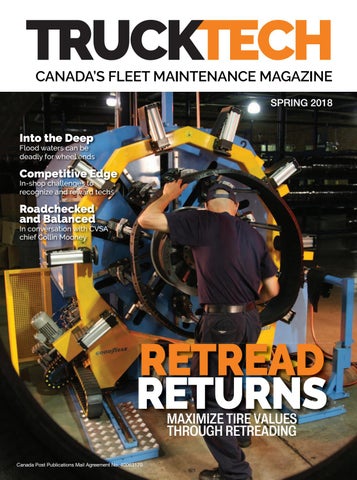
SPRING 2018
Into the Deep
Flood waters can be deadly for wheel ends
Competitive Edge In-shop challenges to recognize and reward techs
Roadchecked and Balanced
In conversation with CVSA chief Collin Mooney
RETREAD RETURNS MAXIMIZE M AXIM MIZE T TIRE IRE EV VALUES ALUES THROUGH RETREADING
Canada Post Publications Mail Agreement No. 40063170
is written and published for owners, managers and maintenance supervisors of those companies that operate, sell and service trucks, truck trailers, and transit buses.
SPRING 2018 VOL. 3 NO. 1 Vice President, Editorial Rolf Lockwood rolf@newcom.ca • (416) 614-5825 Contributing Editors Eric Berard, Derek Clouthier, James Menzies, John G. Smith Group Publisher Lou Smyrlis lou@newcom.ca • (416) 510-6881 Creative Director Tim Norton tim@newcom.ca • (416) 510-5223 Production Manager Kim Collins kim@newcom.ca • (416) 510-6779
13
COVER STORY
RETREAD RETURNS NEWCOM MEDIA INC.
5353 Dundas Street West, Suite 400 Toronto, ON M9B 6H8
A well-structured retreading program means a second life for your tire casings – and more.
CHAIRMAN AND FOUNDER Jim Glionna PRESIDENT Joe Glionna VICE PRESIDENT, PUBLISHING Melissa Summerfield CHIEF FINANCIAL OFFICER Peter Fryters DIRECTOR OF CIRCULATION Pat Glionna Truck Tech is published by Newcom Media Inc. The contents of this publication may not be reproduced or transmitted in any form, either in part or full, including photocopying and recording, without the written consent of the copyright owner. Nor may any part of this publication be stored in a retrieval system of any nature without prior written consent.
Equipment used by modern-day retreaders has become more refined, leading to improved product quality. (Goodyear photo)
Features
Departments
LEADERS SPEAK: Collin Mooney 10 Commercial Vehicle Safety Alliance executive director Collin Mooney discusses the role and evolution of roadside enforcement.
Editorial.................................................... 5 Equipment Watch................................... 28 Inside the Numbers................................. 30
Into the Deep 20 Flood waters can be deadly for wheel ends. Some are worse than others. Competitive Edge 22 In-shop competitions across North America are finding new ways to recognize and reward top performers. Are you up to the challenge?
28
Parts Defined 27 The Autocare Association’s HDDA Heavy Duty arm wants to re-define truck parts – with a Canadian software company.
10 15 trucknews.com
Quick Fix .................................................. 7
20
22 SPRING 2018 TRUCKTECH 3
MICHELIN® TIRE CARE
YOU TAKE CARE OF YOUR BUSINESS. WE’LL TAKE CARE OF YOUR TIRES.
®
A FLEET TIRE MAINTENANCE PROGRAM THAT HELPS YOU MAXIMIZE UPTIME AND GET THE MOST OUT OF YOUR TIRES.
$
REDUCE COSTLY DOWNTIME AND OPTIMIZE PERFORMANCE
Identify and address immediate tire needs that lead to downtime, low mileage and high fuel costs. ACCURATE, ACTIONABLE REPORTING
Comprehensive dashboards and reports for effective decision making.
To find a MICHELIN TIRE CARE provider near you, see your local Michelin Representative or visit michelintruck.com/tirecare. ®
©2018 MNA(C)I. All rights reserved. The “Michelin Man” is a registered trademark licensed by Michelin North America, Inc. (C15898)
Editorial
Climbing the Data Mountain The data challenge, coming to April’s Canadian Fleet Maintenance Summit By Rolf Lockwood
Managing data is utterly essential to the successful maintenance of a truck fleet in 2018. That was the issue tackled by a panel discussion I put together and moderated at the inaugural Canadian Fleet Maintenance Summit in Toronto two years ago. The session was a great success (see below), and the conference at large was equally well received by an audience of more than 200 fleet owners and managers. We held a similar event in Montreal last year. Happily, in concert with the PIT Group, as before, we’re about to do it again – on April 18, the day before our Truck World show opens at the International Centre near Toronto’s Pearson Airport. And we anticipate an even bigger audience this time, with a packed agenda that includes sessions on intelligent equipment spec’ing and the quest for ever greater fuel efficiency. While the slate of panelists was not yet cast in stone as I wrote this in early February, two of three keynote speakers had been confirmed. Fred Andersky, director of government and industry affairs at Bendix Commercial Vehicle Systems, will address collision mitigation and other active safety systems. For perspective on the rapid rise of electric power, Julie Furber will offer her insights as a somewhat surprising new player on the scene. She’s executive director of electrification at Cummins. And because it’s such a huge, sprawling subject, I’m going to re-visit the data battle in a panel session entitled Exploiting the Data Mass. In 2016, the panelists spoke of ways that data can help address maintenance and operational challenges. And the benefits of all that retrievable information aren’t limited to big outfits. That was a key takeaway. trucknews.com
“Small fleets can behave as big ones if they embrace the tools that the dealers and the OEMs have today.” “Small fleets can behave as big ones if they embrace the tools that the dealers and the OEMs have today,” said Skip Yeakel, principal engineer and government/industry/academia link at Volvo Trucks. He referred to his company’s Uptime Center and the way it diagnoses issues remotely as an example. It’s there for everyone. Yves Maurais, technical director of asset management, purchasing and conformity at Quebec’s Groupe Robert, stressed the need to set specific goals in data collection. “Once you know what you’re looking for, it’s easy to get the correct tools,” he said. Smaller fleets, said Maurais, might
want to focus on the data linked to regulations. “Make sure you’re compliant,” he said. “The rest would be icing on the cake.” Even though larger fleets have more resources to explore raw data, smaller operations can still look at single reports or receive alerts, added Larry Jordan, vice-president of product management at Zonar Systems in California. These are the details that can help avoid breakdowns and delays. “In a perfect world, I’d like to see a truck tell me what’s wrong with it,” said Kirk Altrichter, vice-president of fleet services for Ohio’s Kenan Advantage Group and former chairman of TMC, the American Trucking Associations’ Technology and Maintenance Council. The biggest challenge is sifting through the reams of available data to find hidden nuggets of info, he continued. Gathering the data can be a problem, and there can certainly be too much of a good thing. Altrichter said, “The goal is distinguishing between the codes that require immediate attention and those that can wait.” The secret to success on the data mountain is deciding where to aim your attention, he said. “Everyone in this room can look at the same data and come back with something different,” he explained. “What needs attention? What’s actionable?” Altrichter stressed the need to focus on three to five items, and work on those until they’re resolved. I have no doubt there will be many more such gems to be gleaned from the 2018 version of the Canadian Fleet Maintenance Summit, and I’d love to see you there. Check out the details at www.trucksummit.ca. TT SPRING 2018 TRUCKTECH 5
NEW
Have What It Takes
Remove and Install Bearing Races In Minutes! Bearing Race Starter Kit 10908 The split ring is expanded on a wedge, increasing the diameter of the split ring, causing the ring to clamp onto the bearing race. Using a shop press, force is applied to the assembly, which frees the bearing race with ease. A shop press can also be used to install new races s. in conjunction with any of the adapter kits. Designed to service bearing races on aluminum and steel hubs.
Adapter Kits With more than twenty different adapter kit kits tto choose h from, there simply isn’t a more comprehensive solution for servicing bearing races.
Requires a 20 ton minimum shop press and at least one adapter kit to operate
Patent Pending
Severe Heavy Duty U-Joint Service Kit 20160 The Severe Heavy Duty U-Joint Puller and Bearing Cup Extractor work together to remove u-joints and bearing cups found on Dana/Spicer SPL 350 and Meritor RPL 35 Series drivelines. The Bearing Cup Installer utilizes predetermined “installed heights� to ensure bearing cups are installed correctly every time.
1.800.661.4661 | tigertool.com tigert
QUICK FIX
Remorques Lewis tops at Talbert Remorques Lewis has been named one of the top 10 Talbert Manufacturing dealers for 2017. The Quebec dealership was also given the honor of Most Improved Dealer of 2017, with sales that more than doubled 2016 totals. “That’s more than a number. It’s being with customers when they need it, friendly and fast service and repairs, and a dedication to this business – something we recognize in a lot of our dealers, but Remorques has done particularly well,” said Troy Geisler, Talbert Manufacturing vice president of sales and marketing.
Two Canadians on Kenworth council Two Canadians have been named to the 2018 Kenworth Dealer Council. Boyd McConnachie of Inland Kenworth in Burnaby, B.C., and Mike Nagle of Bayview Kenworth in St. John, N.B., will be part of the group that works with Kenworth to provide customer support with the PremierCare and PremierCare Gold certified service programs. The Kenworth Service Council has named its own Canadian members in Adam Burrough, of Edmonton Kenworth, and Nicolas Letendre, of Kenworth Maska, in Sherbrooke, Que.
MacKay’s one of Mack’s top dealers MacKay’s Truck Center in Truro, N.S., has been named Mack Trucks’ top Canadian dealer for 2017. Vision Truck Group of Cambridge, Ont., was named Canada Mack Financial Services Dealer of the Year.
Trailcon Leasing to build in West Trailcon Leasing will build new facilities in Calgary and Edmonton to support it’s current and future growth. With construction set to commence this May and conclude in the secondq trucknews.com
Aftermarket growing, shifting The aftermarket serving Canada’s Class 6 to 8 trucks and trailers was worth $4.2 billion in 2017, and is projected to reach $4.4 billion this year, according to analysts at MacKay and Company. Parts prices are expected to rise 3.7% because of factors including the Canada-U.S. (File photo) exchange rate. “Obviously if the U.S. screws up NAFTA and provides some issues there … that could potentially have a negative impact,” said John Blodgett, vice-president of sales and marketing, during a presentation at the recent Heavy Duty Dialogue. “Hopefully level heads will figure that out and we won’t have too much impact from that.” Overall, Canada now has 41,000 Class 6 trucks, 148,000 Class 7s, 344,000 Class 8s, and 543,000 trailers, MacKay and Company says. By 2022 it expects the fleet to shrink somewhat, down to 37,000, 144,000, 342,000 and 533,000, respectively. Any change in the age of the fleet would have an undeniable effect on aftermarket sales. Trucks in the range of seven to nine years old are in the “sweet spot” for aftermarket demand, Blodgett said. Each amounts to about US $8,000 a year in parts, outside of warranty items. The nature of parts being sold continues to change as well. Aerodynamic enhancements require fewer parts in the form of fenders and flat brackets, he said. Should electric vehicles become the norm, thousands of moving parts on a truck could be replaced by fewer than 200. Bodies are also incorporating new materials like carbon fiber that will require a new level of training for technicians. Collision mitigation systems could have their own impact on the aftermarket. Fewer collisions, after all, require fewer replacement parts. Telematics and the Internet of Things also promise to determine when parts are failing or wearing out, affecting purchasing strategies. Emerging electric truck suppliers like Tesla, Thor, and Nikola are also exploring new distribution channels altogether.
uarter of 2019, both facilities will measure 20,000 square feet, and include another 5,000 square feet available for future expansion. “Trailcon has been growing at such a rate that we have outgrown our existing facilities in Alberta,” said company president Al Boughton. “The new
buildings will allow our staff to continue to meet and exceed the expectations of our expanding roster of customers.” The facilities will feature eight trailer bays with space for three additional bays, and have a fenced-in yard with truck gates to accommodate around 120 trailers. SPRING 2018 TRUCKTECH 7
THER
WHE
T RVES
HA U’RE
YO
COR CKS, O R ING
E
IMAT
ULT N OR
’LL
, WE
ESS SUCC
nd up a t eet l a f h t r you t line tor i keep produc n o o t g ad tm tryin you a bro smar ou’re ilters has air filter ludge. So ss. y n t e e i s F h z c d X c n w I n ant e. W s, the Se t, soot a ay to su ntim r ou w w ir ng y sary dow y air filte e from d i ll the h t icl ing a last ces dut h n e e y e n n v v h u n r T ny ea su and ro h ect a ing i s.com runn s NanoP that prot hicles up filter x i w e e d rs inclu oil filte d your v XD u an o and y keep can ®
ERE.
U TH
YO GET
QUICK FIX
Vierkant promoted at Link Manufacturing
Nikola to build in Arizona
Link Manufacturing has promoted Jeff Vierkant to vice president of manufacturing. In his new role, Vierkant will be responsible for overseeing all aspects of manufacturing including manufacturing engineering, production, quality, purchasing, sourcing, shipping, and receiving. He joined Link in December 2015 as director of manufacturing.
Nikola Motor Company will build its hydrogen-electric semi-trucks in Buckeye, Ariz. It has chosen a new 500-acre, 1-million-square-foot facility on the west side of Phoenix, where it says it will add more than 2,000 jobs. “Arizona has the workforce to support our growth and a governor that was an entrepreneur himself. They understood what 2,000 jobs would mean to their cities and state,” said Trevor Milton, CEO and founder, Nikola Motor Company. “We will begin transferring our R&D and headquarters to Arizona immediately and hope to have the transition completed by October 2018.” Nikola says it has more than 8,000 semi-trucks on pre-order.
Tallman Group earns International award Tallman Group has received the International Truck Presidential Award. Introduced in 2017, the honor is presented to the top 7% of International Truck dealerships that achieve the highest level of performance in terms of operating and financial standards, market representation, and customer satisfaction. “For 45 years, our customers have been returning to us because they know we deliver quality International products and services that help drive profits to their bottom line,” said Kevin Tallman.
Emissions shift leads to sales surge Canadian buyers scrambled to import logging, mining, and construction equipment in December, in a push to beat 2018 emissions regulations for off-road diesel engines and machines. The imports of such machinery jumped 24.6% on the month to a record $897 million, Statistics Canada reports. It was the third consecutive monthly increase in the category.
Paccar Parts reports record Paccar Parts enjoyed a record year in 2017, filling more than 16 million orders globally. “Paccar Parts’ number one goal is customer uptime. The effectiveness of our supply chain contributes to our high levels of productivity and efficiency, and these qualities are what make us stand out as the leader in aftertrucknews.com
market parts distribution,” said David Danforth, general manager. In addition to shipping 16 million global orders, Paccar Parts says it had an order accuracy rate of 99.98%, and a same-day order fulfillment rate of more than 98%.
Green vehicles applications online
the support and sponsorship received from companies including: Texis Truck Exhaust, Mid-West Truck & Trailer Service, Abrams Towing, Quality Collision Centre, Fort Garry Industries, ULT Powertrain Reman and Services, ClubLink, Premier Truck Group, Diesel Truck Centre, Newcom Media, Road Today, and others. TT
The Ontario Ministry of Transportation is now taking applications for funds through the Green Commercial Vehicle Program (GCVP), through Grants Ontario. The program was championed by the Ontario Trucking Association (OTA) as a way for the industry to receive the benefit of funds carriers pay through carbon pricing. It provides rebates towards the purchase of alternative-fuel vehicles and fuel-saving devices, including natural gas and electric technologies.
Maintenance group supports Toys for Tots The Automotive Transportation Service Superintendents’ Association (ATSSA) held its annual charity and fun night Dec. 14, collecting donations for the Toys for Tots program. Food items were also collected on behalf of the Dai Dham Food Bank. The event was hosted at the Red Rose Convention Centre in Mississauga, Ont. A performance was given by comedian Andrew Chapman. ATSSA says the evening was made possible by SPRING 2018 TRUCKTECH 9
LEADERS SPEAK
Roadchecked and Balanced
a scale house, I’m doing a quick cursory inspection as a truck is rolling by me. Some feel that, because I’m doing that, that is an inspection. We do not.
CVSA executive director Collin Mooney discusses the role and evolution of roadside enforcement
Mooney: We’re inspecting less than a fraction of a percent of the vehicles on the road. We’re not even making a dent in the bigger picture. The more we can leverage technologies such as weighin-motion, bypass systems – any sort of advancement in technology to help us target unsafe carriers – the better. We conduct 4 million roadside inspections annually in the United States and Canada. The goal under our electronic inspection program is 400 million a year. There is a vision of a port of entry or some strategic location with some sort of communicating device, whether it’s a transponder, or Bluetooth, or short-range communication. When a vehicle goes by the post, it will read the ELD, the driver’s licence, the vehicle permitting. There’s even an opportunity for weigh-in-motion, and reading the [electronic control modules] for equipment violations without that vehicle slowing down.
By John G. Smith
T
he Commercial Vehicle Safety Alliance (CVSA) has an international focus, finding common ground for roadside inspection practices across North America. But these days the alliance also has a decidedly Canadian face in Collin Mooney. The alliance’s executive director is a Saskatchewan native who began his career on this side of the border. He was studying law enforcement at Lethbridge College about three decades ago when introduced to a three-credit commercial vehicle enforcement course. That led to work as a summer student with the Saskatchewan Highway Transport Patrol, a job with the Alberta Commercial Vehicle Enforcement Branch, and successive staff roles with the alliance itself. Truck Tech caught up with Mooney to discuss the evolution of roadside enforcement, Roadcheck inspection blitzes, out-of-service rates, and a new U.S. mandate for electronic logging devices (ELDs).
Truck Tech: The Commercial Vehicle Safety Alliance is dedicated to ensuring consistent roadside inspections across North America, but we still hear from shop managers who say there are differences from one jurisdiction to the next. How can this issue be addressed? Mooney: The biggest thing I want to tackle here is the documenting of violations on a roadside inspection report. Before [the U.S. introduced CSA safety ratings], every province, state, territory, and even inspector had their own way of documenting violations. CSA presented itself as a program where every violation was going to be pointed. It shone a big bright light on the discrepancies. 10 TRUCKTECH
SPRING 2018
Truck Tech: Many carriers would like to see more favorable roadside inspections documented, and for good reason. A bigger share of passed inspections leads to a better safety rating. Why isn’t every inspection recorded? Mooney: We’ve always been there documenting and recording all ‘inspections’, regardless of whether there are violations or not. Where the subjectivity comes in is when you pull into a check stop or weigh scale and I just want to do a cursory look at your logbook, or check your registration because you’re missing your validation tab on your plate. You’re arguing it’s an inspection, when in fact it is not. When I’m sitting at
Truck Tech: Do you see an increasing role for scale bypass programs?
TruckTech: Do you think the general mechanical condition of equipment has improved over the years? Roadcheck results seem to suggest we’ve stalled in the search for ways to improve out-ofservice rates. Mooney: I think it has improved a little bit – especially with CSA and the violations counting towards motor carrier safety records. But I also feel equipment violations have leveled out and plateaued. When we look at our Roadcheck stats, they’re pretty flat. Mechanical fitness is still important because there are still things falling off vehicles and causing crashes and hurting people, but that’s not the leading cause of crashes on our highways. Fatigue and distracted driving are the two we are targeting. trucknews.com
“Fatigue and driver behavior is a contributing factor to crashes on our roads, and [the focus] just happens to coincide with the ELD rollout.” – Collin Mooney , CVSA executive director
TruckTech: So what role does the annual 72-hour Roadcheck inspection blitz serve? Mooney: Roadcheck is still important for communicating the safety message. It’s our opportunity to highlight the state of the environment. We wanted to see a continuous decline [in the program’s out-of-service rates] over the years. We saw a dramatic drop. Where we were in the 40 and 30 percents, now we’re down in the low 20s. Some people get frustrated and say, ‘How come they aren’t declining anymore?’ We’ve conditioned people to think we were in pursuit of zero. It’s a great goal, but what’s also changed is our inspection process. Instead of it being a random inspection, we are more targeted. We should be in pursuit of 100% because the rate is only reflective of the vehicles we stopped and inspected. Truck Tech: How should fleet maintenance teams look at their out-of-service violations? Mooney: Once a vehicle rolls off the manufacturing line, you have your annual inspection program. That is a regulated activity. You then have your daily pre-trip inspection. The last step is a random or targeted roadside enforcement program. When we stop a vehicle at roadside and find violations – a spring pack that’s broken all the way through, or rusted all the way through – that tells us you have a failing annual inspection program, and you have a failing driver trip inspection. trucknews.com
The violations we should be finding at the roadside are a bulb that just went out, or a tire that just ran over a nail. If you have four lights burnt out, this is a systemic problem. If we’re finding violations and documenting them at roadside, you have a failure within your annual inspection program, your preventive maintenance program, your driver trip inspection program. By the time we stop you we shouldn’t find anything. Truck Tech: Are shops losing sight of the fact that the out-of-service criteria are the bare minimum standards? Mooney: Sometimes they rely on the roadside inspection program as their preventive maintenance program. We see that a lot, and that’s not right. The carriers that invest in a preventive maintenance program are at a competitive disadvantage when you have motor carriers that do not. Truck Tech: Roadcheck blitzes have a special focus every year. Last year it was load securement. What will the focus be this year? Mooney: Hours of service. Fatigue and driver behavior is a contributing factor to crashes on our roads, and [the focus] just happens to coincide with the ELD rollout. Truck Tech: Canada is now considering an ELD mandate of its own. Should that happen, what lessons could our regulators learn from the experience in the U.S.?
The web services were released a very short period of time before the rule took effect, which then left vendors having to troubleshoot, to make sure all their ducks are in a row, to train their clients, to train their drivers. Then we as an enforcement community have to figure out how it works, all in a very short period of time. Let’s say [the U.S. Federal Motor Carrier Safety Administration] managed to a deadline six months earlier. It would have given the vendors, motor carriers, and enforcement community more time to work with the technology. The ELD rule did not change any of the underlying hours of service rules. However, having said that, it has become quite apparent that the ELD rule has become, for many, their first introduction to hours of service compliance, and that is disappointing. We are hopeful that with enhanced hours of service compliance over the years, that the crash and fatality and injury rates will fall. I want to be able to look at a map in a couple of years time and say, ‘Here’s where we were in ‘16/’17, and here’s where we are today. There’s more highway miles and more trucks on the road, but crashes and injuries and fatalities are going down.’ Truck Tech: You see ELDs as a tool for tackling fatigue, and not just addressing form and manner violations? Mooney: I hope. This interview has been edited for length and clarity. TT SPRING 2018 TRUCKTECH 11
Canadian Fleet Maintenance Summit Get equipment insights and stay ahead
APRIL 18, 2018 International Centre Q Mississauga, ON
Designed for fleet maintenance professionals, this summit provides industry leading information and networking to help you stay ahead of the competition and keep your fleets running efficiently.
CFMS registration includes complimentary access to Truck World and the VIP Kickoff Breakfast, an $80 value!
www.trucksummit.ca Sponsors Platinum:
Gold:
Award:
Silver:
Bronze:
12 TRUCKTECH
SPRING 2018
trucknews.com
RETREADING
T
ires are a fleet’s third-highest operating expense, just after wages and fuel. But while many fleet managers can tell you precisely how many drops of diesel they burn, tire life is often described in vague terms, says Lorenzo Borella, general manager of Montreal’s Système de rechapage RTS. A closer look at the life of rolling rubber will identify just how quickly tires are heading to the scrap heap, and stress the need to maximize the underlying investments. Having a healthy casing retreaded, for example, can save as much as 50% compared to buying a new version of the tire from the same brand. According to the Tire Retread Information Bureau, those savings add up to billions of dollars each year in the North American trucking industry, says Robert Palmer, director of market sales for Bridgestone Americas tire operations.
Under pressure To keep casings in good shape and suitable for multiple retreads, the first step is to maintain correct tire pressures. So measurements based on a quality gauge should even be part of the pre-trip inspection, suggests Palmer. “Underinflation in particular can be detrimental to casings, since this condition causes casings to flex as they roll under loads, which can result in heat,” adds Mahesh Kavaturu, marketing manager at Goodyear. Granted, removing valve caps one by one and checking each tire’s pressure takes time, which costs money, says RTS’ Borella. But the effort will pay in the long run if you save thousands on tires and avoid unpredicted downtime. Hitting tires with a hammer is better than nothing, but it will only tell you whether a tire is completely flat or not. “The hammer can’t tell the difference between a tire at 80 and another one at 85 psi,” Borella says. Neil MacDougall, service manager at Don Anderson Haulage in Gormley, Ont., stresses the importance of ensuring a tire program includes the trucknews.com
RETREAD RETURNS A well-structured retreading program will yield budget savings time and again
By Eric Berard
Retreading a healthy casing can cost half as much as a new tire of the same brand. people who work behind the wheel. “The way I look at it, every one of my drivers is one of my technicians, and we use our drivers to do their due diligence of pre-trips, post-trips, and report any issues with any part of our trailers – not only the tires,” says the over-dimensional carrier’s maintenance expert. This way, drivers become living data sources, and they are paid accordingly. “We give them a little incentive to help us. There is a safety bonus involved with
our company, so if a fellow has a flat tire because it was flat and he didn’t report it...it’s a deduction off of his annual safety bonus,” MacDougall says. Phil Boarts, Michelin Truck Tires’ product category manager – retreads, agrees that drivers have a vital role to play in preventing tire damage. “Fleets should always have a good written maintenance policy in place to specify the practices they want followed. Driver training and pre-trip inspections are a SPRING 2018 TRUCKTECH 13
THE ENGINE OIL THAT WORKS AS HARD AS YOU.
CAN A SYNTHETIC HELP EXTEND OIL CHANGE INTERVALS?* THIS ONE CAN. Change what your oil change can do.
Visit rotella.shell.com/T6 for more information. *Always follow OEM recommendations and utilize oil analysis when extending drains.
RETREADING tread depth when they’re matched per duals. But there are times when somebody will have a flat, and they’ll change the tire, and they’ll put a used tire on, and it may not be exactly matched up. So the next time we come up for service, we’ll try and match those tread depths up within 3/32nds,” says Don Anderson Haulage’s service manager. Also keep in mind that load and wear Matching the tires in a dual assembly will help prevent premature wear that can damage a casing, limiting the retreading opportunities.
critical step for tire and casing health and longevity,” he says. Hands-on demonstrations showcasing the damage from curbing and road hazards will help drivers understand the issues, adds Bandag’s Palmer. If you’re the person responsible for buying tires, it’s also important to beware of deals that seem too good to be true. Often they are that very thing. Lesser-quality tires can be offered at a low purchase price, but wear away significantly faster than their counterparts. MacDougall tried some of the low-cost rubber, but got four times more mileage with the Michelins or Continentals he normally spec’s. Now he says he’d rather use his own retreaded quality casings than brand new tires from a cheap brand.
Mismatches and rotation Unless you use wide-base singles, mismatches in a dual assembly are another threat to casing integrity. Tires that are different – by position, type, brand, or degree of wear – but still matched together will cause one tire to work harder than the other, accelerating wear and limiting the potential of retreading. In an ideal world, tires in a dual assembly should be matched by brand and model, says Borella. Each tire manufacturer has its own “recipe” and sidewall flexing range. So mixing different brands of casings, even if perfectly retreaded, will result in an imbalanced workload. The same issue will arise if there’s a mismatched tread depth. “Normally, tires run pretty close in trucknews.com
For more information, contact NEXIQ Technologies at 800-634-6774 or www.nexiq.com.
SPRING 2018 TRUCKTECH 15
Discover what more than 900,000 visitors did last year
We deliver
MORE BLOGS
MORE VIDEOS
MORE NEWS
truck news.com
STAY UP TO DATE ON INDUSTRY NEWS, TRENDS AND EQUIPMENT RELEASES Visit the industry's most popular website
RETREADING
Equipment used by modern-day retreaders has become more refined, leading to better quality in the end product.
on tires will vary between drive and trailer tires, which is why tire rotation is so important. Since most modern tires are directional, rotating in a criss-cross pattern is no longer such a good idea. It’s better to stick with front-to-back rotations. “If you have a tandem-axle trailer for instance, [let’s say] the front axle is 10/32nds and the rear axle is 7/32nds. You want to rotate those tires so that you put the highest tread depth on the rear,” says MacDougall. “When any tandem turns, there’s a little bit of scuffing that occurs. So if you put the higher tread depth on the rear, then it reduces that scuff. If the higher tread depth was on the front, then it would act as a pivot, and the rear axle would scuff more. All the little things add up on the bottom line.”
Timing and frequency To get the most out of every tire, the goal is to remove the tire late enough in its life to take full advantage of the current tread – but not too late. Waiting too long could increase the threat of a casing being damaged by stone drilling. It’s a balancing act, and there’s no single answer to decide when to remove a tire for retreading, or the number of times a casing can be retreaded. It all depends on the application. The terrain and routes, driving habits, fifth wheel positioning, season, even the trucknews.com
brand of vehicle – as engine torque and suspension calibration vary – can be deciding factors. Many fleets remove tires for retreading when they reach 4/32nds to 6/32nds of an inch, our experts agree. The number of times a casing can be retreaded also depends on the life it has led. In applications such as refuse or construction, for instance, tires can be retreaded as often as every 30 to 45 days. “When doing local hauling with a lot of stop and go, there’s little heat generated, so the casing isn’t really put to the test. On the other hand, the tread wears much faster in such an application,” says Borella. On long-distance applications, some fleets will allow one or two retreadings at the most, while it’s not unusual to see tires retreaded three times in regional operations. Once again, good judgement is the key, since many factors can shorten a casing’s life: • The more often a tire is mounted and dismounted, the more the bead – the area where the tire “sits” on the rim – can be damaged by installation tools. • Exposure to the sun can create cracks on sidewalls over time. • Exceeding the manufacturer’s recommended speed limit – which may be lower than posted speed limits – can cause a tire assembly to overheat. • Presence of moisture in the tire will corrode the steel belts.
• Trucks and trailers sitting idle for long periods of time put all the weight and stress on the same area of a casing, which can cause premature damage.
Save money, gain trust While retreading a tire is a means of saving money, there are ways to stretch every tire penny even more. Keep a close eye on your annual casings’ reject rates, and use them as key performance indicators to identify trends such as troublesome driving habits or tire brands. Take a few seconds to organize and mark your used tires by brand and wear level. That will avoid mismatches and tires being shipped for retreading while there’s still good mileage in them. And arrange for your retreader to handle the inventory burden. Most will accept that kind of deal, especially if you’re a good customer. In fact, mutual trust is an important part of a carrier-retreader business relationship. A carrier can do due diligence and inspect tires looking for cracks, bulges, cuts, or other signs of aging, but only a retreader has the sophisticated equipment to establish a tire’s true health. “The dealer that we use, we’ve been using for nearly 20 years, and I have the same tire man come and do all my tires. Every week he’s here. And if he can’t come, then I will wait for the next week when he can come,” says MacDougall. “He knows what I’m looking for.” TT SPRING 2018 TRUCKTECH 17
Everyth
EQUIPMENT. INNOVA
Le
Use VIP code TW71 to get you
• 500+ exhibitors –
• More to see! Now
• New trucks and g
• Over 75+ compan
www Show Sponsor:
18 TRUCKTECH
App Sponsor:
SPRING 2018
Endorsed by:
trucknews.com
hing Trucking
ATIONS. CONNECTIONS. SOLUTIONS.
everage it. APRIL 19-21 2018 INTERNATIONAL CENTRE MISSISSAUGA, ON
r FREE PASS. Register today at www.truckworld.ca.
including new and international exhibitors
w even bigger and better! ear in the New Product Showcase
nies hiring now
w.truckworld.ca Produced by:
Official Media:
WHEEL-ENDS
INTO THE DEEP Floodwaters can be deadly for wheel ends BY JAMES MENZIES
I
mages of trucks standing fully or partially submerged in contaminated floodwater during recent U.S. hurricanes were enough to make any maintenance manager cringe. Just ask Mark Irwin, head of Winix Developments, who in a former life oversaw a massive trailer leasing fleet. “When we have flooding, so many times the trailers are exposed to water levels that are above the axles,” he told Truck Tech. “As soon as that happens, then you are going to have water intrusion into the hub. Even the hub caps are vented. That means, when it changes temperatures, it will cause moisture to migrate into the hub. Those trailers are now running around with contaminated oil and water, and they will rust and they will fail. The problem is, nobody really knows what trailers have been exposed to the flooding environment.” That’s true of leasing fleets, but also for carriers that draw from trailer pools, or aren’t the best at tracking their assets. It can also be a concern for buyers in the secondary market. It’s not only an issue that’s prevalent 20 TRUCKTECH
SPRING 2018
in the U.S. – major flooding has occurred in recent years in Manitoba, Quebec, and Alberta. The key difference, however, is that Canadian flooding usually involves freshwater. And that’s a good thing. “At the top of the list is the question of whether the floodwater was saltwater,” said Jim Szudy, engineering manager for advanced systems engineering with Bendix. “If the answer is yes, then you should immediately begin replacing parts. Pneumatic air brake valves that have been submerged have likely lost their lubrication, for example. Couple that with the extremely corrosive nature of saltwater, and these valves could be at a much higher risk for sudden and premature malfunction. Any brake system valve that’s been submerged in seawater should be replaced, along with air compressors, air reservoirs, antilock braking system (ABS) relay modulators, and brake actuators.” Saltwater intrusion is bad news for wheel end components, where the probability of corrosion is heightened. Greg Sturdy, director, wheel end
Montreal experienced heavy flooding, which saw many truck and trailer wheel-ends submerged underwater.
product engineering with Accuride Wheel End Solutions, told Truck Tech that maintenance managers should assess the situation before taking action. “It really does depend on how bad, and how long, and how high up the wheel end (the vehicle was submerged to), and what they’re in,” he said. “It depends on a lot of those circumstances. If you were driving through flooded areas, I’m not really worried. If you’re talking trucks and trailers sitting underwater, that can be a problem. First and foremost, figure out what they have been submerged in and for how long, and what was in that fluid.” Possible issues that could affect the wheel ends include: corrosion inside the drum; corrosion of the brake linings; rusted springs; water entering the bushings; and carrier assembly corrosion. Even the tires can suffer erosion or flatspotting. But that’s just the start. trucknews.com
WHEEL-ENDS
Postsubmersion health check
Lafarge trucks sit partially submerged during 2013 flooding in Calgary, Alta. “Saltwater is going to be really bad,” Sturdy said. “If you’re sitting underwater with silts and other things, that’s also going to be really bad. If you’re in water in an area with oil contamination, that’s also really bad, but for different reasons. It depends on what’s in the water. You can’t assume it was clean water, so you have to tear into it and go with what you are seeing.” Trailers that have had their wheels submerged will require a thorough inspection. “Do a visual inspection of the trailer that has been submerged,” Sturdy advised. “First and foremost, tear it down. Almost assuredly it will need replacement drums.” He also suggested inspecting the carrier bushings, which are often overlooked. S-cams may be salvaged with some buffing, since the hardened steel used in their construction is fairly corrosion-resistant. But, “The S-cam bushings are almost assuredly going to be shot,” Sturdy added. “They’re not a tight seal.” If the flooding that occurred was freshwater, it doesn’t mean there won’t be consequences, warned Bendix’s Szudy. “Unfortunately, once water or contamination has entered into any of the air brake components – through the exhaust valves, for instance – it’s not possible to completely clear the system without total disassembly,” he said. “Given the importance of a fully functioning system with clean air, it’s necessary to replace all pneumatic air brake components if you trucknews.com
find signs of moisture or other contamination, just as you would in the case of saltwater submersion.” If no evidence of water or contamination is found, Szudy still suggested thoroughly testing the air brake system and ABS before returning the vehicle or trailer to service. He also advised checking the ABS wheel speed sensors to ensure they weren’t moved by the floodwater. When conducting a post-flood inspection, Bendix suggested to: check wheel ends for water, which will increase the potential for rustjacking; ensure the integrity of the friction coupling between the friction and the disc or drum; and verify that no water has entered the chamber through the airlines, by removing fittings and mounting stud nuts. If water is present, drain and re-install, Bendix advised, and follow appropriate relubrication procedures, including re-greasing the slack adjusters. Despite direct contact with floodwater, the wheels themselves will likely be fine. Dennis Winn, director of technology for Accuride Wheels in North America, said there’d be no concerns other than floodwater’s contribution to regular corrosion. “A short time in freshwater floodwater would not be a major concern,” he said. “If it is suspected that the wheels stood in contaminated water, they should be washed per the manufacturer’s service instructions for steel and aluminum wheels.” TT
Trucks that have been submerged underwater should be closely inspected before being placed back into service, to ensure they haven’t suffered damage such as rust and corrosion. MeritorWabco issued a technical bulletin following hurricanes in the U.S., which outlined the following procedures: Inspect components • Do not start vehicle before inspecting the compressor; • Inspect all air lines and connections for water and contaminant damage and replace damaged components; • Ensure all water is removed from the air filter and compressor air inlet. If water is present in the compressor, drain oil from the crankcase; • If engine is being replaced, replace the compressor. Air dryers • Inspect all air dryer components, air lines, and connections for water and contaminant damage, and replace damaged components (consider replacing entire air dryer); • If excessive moisture is present, replace air dryer cartridge. Air brake control valves • Inspect all valves for water and contaminant damage and replace damaged components; • Clean and lubricate the pins and plate on foot valve and quick release valves. Pneumatic and hydraulic ABS – wheel end sensing systems • Inspect ABS wheel-end sensors, sensor spring clips and tooth wheels for water and contaminant damage, including rust and corrosion. Replace all damaged components; • Inspect and clean the spring clip mounting blocks; • Lubricate sensors and spring clips with approved lubricant. SPRING 2018 TRUCKTECH 21
TECH CHALLENGES
COMPETITIVE EDGE Organizations across North America are holding challenges to recognize and reward top-performing technicians BY SONIA STRAFACE
B
eing a truck technician is often a thankless job. These days, it’s all about uptime, and even thinking about losing a truck for a few days of repairs can make a red-blooded driver cringe. But it’s truck technicians who keep things moving, and more importantly, keep trucks safe to operate. To recognize the hard work technicians do, many large operations hold technician competitions each year, to test and challenge in-house mechanics on their skills and see who stands out among the rest. Often, technicians are rewarded with an enviable prize, like a large cheque or even a fully loaded pickup truck.
22 TRUCKTECH
SPRING 2018
We spoke with organizers of large truck technician challenges, to hear their thoughts on why these challenges need to be more widespread, and how other shops can get started on creating their own competition.
Ask yourself, ‘why?’ Before anything else, said Bryan Burningham, director of maintenance at Trailer Wizards, you need to “ask yourself, as a company, what do you want to get out of this competition?” Burningham is one of the organizers for Super Wizards, the annual technician competition in which Trailer Wizards techs go head to head to compete for a grand prize. The
challenge sees close to 300 drivers compete. “Do you want the competition to make your people better techs? Do you want more consistency? Do you want to lower costs?” he asked. “All of these questions should come to mind when you begin planning a competition like this, so you can develop a program that works for you as a company and helps your technicians learn.” Renee Fisher, the director of maintenance, learning, and development for Ryder System, agreed. Fisher organizes Ryder’s giant competition – called Top Tech, that is now in its 17th year. Fisher told Truck Tech that there are more than 3,000 technicians who enter the trucknews.com
Creating your own technician challenges can help boost employee morale and knowledge, according to experts. (Ryder photos)
Start early and be organized
competition each year. “First, decide what’s important to your business,” she said. “You don’t just throw something into a competition to say, ‘Hey, we thought this was cool’ and see if anyone can catch it. You want to make sure it’s something that you want your technicians to work on … I would advise for shops to start with things that are pain points for technicians. Again, for us, we look at learning and gaining knowledge. This is a great way to get technicians focused on a subject or skilled area. So, if you find your technicians aren’t as focused on, say, aftertreatment, that may be something you’ll want to include in your challenge.” trucknews.com
You really want to make sure to start planning a competition months in advance, advised Fisher. “We really put a lot of planning into organizing the challenge,” she said. “It’s a lot of work and you want to make sure the day of [the event] goes smoothly, so make sure you plan in advance.” For Ryder, the challenge is set up in three sections. There’s an online written and timed portion that all techs can take. From there, the top 48 performers in the written portion compete in a hands-on competition at four regional sites. Then the top two from each regional event make it to the final challenge for another hands-on competition in which they have to diagnose and repair bugs planted on a truck. Fisher advised that challenges should be simplified. “You want to make sure any bug that you put into a vehicle for the technician to repair, it has to be something that is fairly routine,” she said. “You want to make sure the person can complete the task in under 30 minutes, and you want to make sure that bug can be duplicated over and over again. Because if you have eight competitors, eight competitors need to come by and complete that same task. You want to make sure it can be duplicated quickly and equally.” Burningham said preparation also
PROTECTS AIR BRAKE SYSTEMS ELIMINATES
AIR BRAKE FREEZE UPS
800.766.4243 expelloairproducts.com
TECH CHALLENGES
A professional competitor Ken Bilyea has been a competitor in eight of Ryder’s Top Tech challenges – and half of those times he’s made it to the finals. Bilyea has been with Ryder for more than 27 years and has been a technician for 34 years. In fact, last year the tech who works out of Ryder’s London, Ont., shop came in third place at Top Tech. In 2016, he placed second. And he’s not planning on throwing in the grease rag anytime soon. “It seems like unfinished business to me …that I haven’t fully won it yet,” he said. Bilyea said when he joined the competition initially, he thought it was a good way to see how he stacked up against other Ryder technicians. Today, after eight competitions, he says he’s a stronger technician, part of an even stronger team. “It’s an excellent program because it shows that Ryder really values its technicians,” he said. “Plus, having a competition like this is a win-win for businesses. Because it pushes a lot of technicians to extend their knowledge, and it sets a tone in the shops to make procedures better … I’ve met so many contacts through Top Tech, and some of those guys I still talk to weekly. We’ll share ideas and best practices with our own guys, and in the end, I think having Top Tech brings all the people in the Ryder world and makes us all stronger as a team.”
needs to be tied to guidelines specific to your shop. “You want to understand your expectations and goals, and create guidelines for your people so they know what success is,” he said. “It’s great to test, but you want to know what you’re testing against. Be prepared and have everything set out, and make sure you’re clear on the expectations from the start.”
“It’s not just about giving away prizes. We want people to understand and think about how to repair equipment and what’s important to us.”
Make room
– Bryan Burningham, Trailer Wizards
Another consideration is where to host such an event. “You want to make sure there’s enough space, too, for technicians to get around those vehicles,” Fisher said. “You’re also going to want to make sure there is sufficient space for judges and enough ventilation for all. We encourage our technicians to talk through the competition. Because if you’re leaned over working on it, the judge can’t tell what your thought 24 TRUCKTECH
SPRING 2018
process is. So, we encourage them to talk through it so they can understand your thought process and you can get top marks. So, you’re going to need to have enough room for all.”
Eyes on the prize To help drum up interest, make
sure you have prizes worthy of the honor you’re presenting, both experts advised. The prize at the end is a better recruitment tool, more than anything else,” Ryder’s Fisher said. “People see that we’re giving away a car or money, and they want to sign up for the competition.” However, Fisher added that, for most competitors, they’d rather have the recognition. “For the folks who are into the competition, the prize is really the cherry on top,” she said. “They love being named the top technician of the company. They like to know they are the best of the best.” Burningham added: “We want to make sure that it’s not just about giving away prizes ... We want people to understand and think about how to repair equipment, and what’s important to us.”
Family fun Making the competition a fun event is crucial, said Burningham. “If you don’t make it fun, people won’t want to participate.” Fisher said to make the event one to remember, allow participants’ families to watch and cheer on their loved ones. “If you can incorporate their loved ones in some way, if they can watch the competition or join the awards ceremony, that’s just another little bump for the technicians,” she said. “There’s nothing better than feeling like a hero and letting your family know that you are good at what you do. If you can incorporate those things, you’re going to have a successful competition regardless [of whether] you have 20 competitors or 10. Knowing they’re recognized is the secret. We want to make sure technicians, who we of course feel are essential and a core part of our workforce, are recognized for what they do and what they bring to the table every day for our customers.” TT trucknews.com
MERITOR
Canada key to Meritor strategy BY JOHN G. SMITH
Mississauga, Ont., will get a new distribution center this April as Meritor refines its North American aftermarket strategy. And it’s not the only way Canada is playing a key role in the company’s broader plans. “The aftermarket team has worked tirelessly this year to improve our delivery accuracy and speed,” says Brett Penzkofer, vice president – North American aftermarket. “Now we ship to customers on a daily basis, wherever they may be.” It’s come a long way. “A year and a half ago we didn’t even measure it,” admits Frank Williams, senior director of operations, North American aftermarket. The company tracked 48-hour deliveries, and at times was only making 60% to 70% of those. A weekly mindset has changed to a daily one. Rather than working with 16 truck fleets, the shipments are now in the hands of four operations, and warehouse hours have been extended to 8 p.m. “We said we’re going to ship every day, and we’re going to have the product on the shelf, and the mindset changed,” Williams said. The new Mississauga warehouse, which adds to one in Edmonton, brings Meritor closer to the goal of giving 90% of customers next-day service without the need for premium freight.
10 products and programs in the first quarter of the year alone, said Krishna Natarjan, senior director – steering suspension and drivetrain aftermarket. Launches during Heavy recently added to Meritor Duty Aftermarket Week Reman, Euclid, Meritor, included triple and double and Meritor Genuine convoluted, reversible and parts – providing what’s cab-mount air springs that can be used in 85% of applidescribed as good, better, Williams: “We’re going cations. Its aftermarket and best options. to ship every day.” hydraulic brake rotors for “The key is to have differentiation between the medium-duty vehicles are being given a Platinum Protect Coating, groups,” Williams says, explaining how the low-priced offerings won’t cannifighting oxidation and corrosion and balize potential sales of the better and doubling previous warranties to two best options. The biggest differentiator years/320,000 kilometers. And new King is expressed in warranties. Pin kits for the Meritor Genuine and Mach product lines mean the company New products can now cover 95% of the market for There is a busy year to come. Meritor is ream and no-ream applications. TT in the process of launching more than
Rebuilding Canada will also be the first country to be served by an authorized rebuilder program for carriers, with support from Capital Gear, ULT Powertrain, Coast Powertrain, and the Gear Center promising 24-hour deliveries. The model will now expand to the U.S., where 20 rebuilders will be required. Meanwhile, Meritor has been among suppliers adding new valuepriced brands to existing product lines. The entry-level Mach Brand was trucknews.com
www.cygnusinstruments.com e: sales@cygnusinstruments.com t: 410-267-9771 *Quote TT022018 for a 5% discount on a gauge
SPRING 2018 TRUCKTECH 25
GLOBAL PARTS
Changing Parts Heavy-duty aftermarket is increasingly global, online
T
he business of selling truck parts has become increasingly global, introducing a series of new brands along the way. But the source of the parts is only one thing to change, as the industry is further transformed by the tools of e-commerce. “It’s amazing to see what’s happened in the last 10 to 15 years,” Heavy Duty Manufacturing Association president Tim Kraus said during the recent Heavy Duty Dialogue. He referred to the global alliances of Volvo and Mack, Paccar and DAF, Navistar and Volkswagen, and equipment made under the Daimler umbrella. Stu MacKay of MacKay and company put it another way: “Globalization has disrupted the way things used to be.” In the medium-duty market, Volvo partnered with Freightliner in 1976. Iveco came to North America in 1978, with Isuzu following in 1984, and Hino and Mitsubishi Fuso came in 1985. Even Hyundai attempted to enter the market in 1997 with the failed Bering Truck venture. On the heavy-duty side of the business, Renault made its initial investment in Mack in 1979, followed two years later by Daimler’s acquisition of Freightliner, and Volvo’s acquisition of White Motor assets. By 1988, Volvo was consolidating GM’s heavy truck business, and in 1996 Paccar acquired Europe’s DAF. Detroit Diesel was purchased by Daimler in 2000. And just last year, Volkswagen purchased a stake in Navistar, while Geely acquired a stake in Volvo Trucks. “Supplier relationships, the competitive positions, virtually all of that has changed,” MacKay said. The new reality hasn’t been lost on the suppliers themselves. Bendix, for example, has long supplied products to International, which now is partly owned by Volkswagen. The latter company’s MAN truck maker has purchased more parts from Knorr Bremse, said Joe McAleese, chairman of Bendix Commercial Vehicle Systems. It means Bendix needs to become acquainted with MAN, building on relationships developed by members of its own European team, he added. The changing names on truck hoods have introduced an increasing focus on proprietary components as well. Mack was one of the early North American adopters of that strategy. Virtually all of the trucks it produced in 1986 had Mack engines. In this way it has operated like a European truck for decades, MacKay said. Last year, though, proprietary engines were found in 80% of Daimler trucks, 97% of Macks,
26 TRUCKTECH
SPRING 2018
and 93% of Volvos. Shares of proprietary Paccar power in Kenworths and Peterbilts also continue to grow. Cummins is the engine of choice for 80% of Internationals, but if that truck manufacturer’s emissions strategy had worked a decade ago, the proprietary share would be closer to 100%, MacKay said. “Disruption is not limited to the OE side of the business,” he added. “The whole character of the business has changed.” Vipar Heavy Duty’s distribution channel was established as recently as 1989, while Rush Enterprises went public in 1996. FleetPride came in 1999. And all of those are now major players in the aftermarket.
e-commerce No matter what company is involved in a transaction, though, the tools of e-commerce are reshaping the way business is conducted. And it’s easy to see why. As recently as 2007, a part made using $36 in labor and other direct costs translated to a final price of $230 for an end user, MacKay said. “It costs far too much to take that product from point of manufacture through the various distribution channels.” The massive distributor WW Grainger, for example, used e-commerce to complete 30% of its sales in 2012. Last year about half of its business transactions were completed that way. The increasing online shift has admittedly stripped away about four points of the company’s operating margin, MacKay said. But it’s also allowed the company to shed 20% of its physical locations, bringing it down to 300 sites. Even the behemoth that is Amazon could directly change how truck parts are ordered. “Amazon has changed some of our business – not because they have the product, but they have provided a conduit for a variety of suppliers,” MacKay explained. About ¾ of the products that it sells don’t even sit in its warehouses. Volvo filters, for example, can be ordered through Amazon from five dealers and four independent distributors. “What used to take weeks to get parts now comes in days,” said Ken Griswold, director – marketing strategy and sales at MacKay and Company. Offshore competitors are not even constrained by the need for a bricks-and-mortar presence. Direct online sales can be a particular fit for parts that are viewed as commodities. “Amazon is not going to be the last guy,” he said. “There’s going to be an impact on margins.” TT
PARTS
Parts )IǻRIH Group looks for common parts language
A
Brockville, Ont., business is playing a leading role in a North American initiative that hopes to bring order to the chaos of describing truck parts. The Autocare Association’s HDDA Heavy Duty arm is working with suppliers to adopt common ways to describe the different components, leveraging the expertise of Canada’s Pricedex Software. The advantage is that distributors and their customers would more easily be able to compare one offering to the next. The goal is to find the best way to express the details for the person who ultimately throws away the box of parts – whether it’s someone working in a fleet service bay, an independent shop, or owner-operator, said Terence O’Reilly, Pricedex president. “We, as an industry, have to be able to utilize data more efficiently,” added Bill
Hanvey, president and chief executive officer of the Autocare Association. “We have to be better businesspeople in order to be able to compete with the OEMs, because that’s who our competition is.” The task of developing product data standards is more challenging than it might appear at first glance. In terms of an air ride suspension, would a part be known as an air bag or an air spring? When different parts are measured, how should the numbers be expressed? Some companies also use the way they describe and measure parts as a way to differentiate themselves in the marketplace. Hanvey stresses that suppliers would still control who actually receives or sees their data. “It’s not a data grab by the Autocare Association. It’s not this master database to allow people to have access,” he says. The shift could potentially save
distributors hundreds of man hours currently spent sorting product data. And with a common language, it would be possible to easily integrate related data like Vehicle Maintenance Reporting Standards (VMRS). The initial push will zero in on 8,200 heavy-duty components, covering about 85% of the parts sold. About 120 companies are already participating in the initiative, including some unnamed component suppliers based in Canada, said Jeffrey Marshall, director of business development at Pricedex. Other industries have found ways to do it. Look no further than the hardware business. Lowes doesn’t sell lengths of lumbers in meters while Home Depot uses inches and feet. The automotive sector itself has already defined the formats for 12,000 personal vehicle components. It’s just one of several initiatives being launched by HDDA as it looks to support the aftermarket segment. The group has committed to expanding the heavy-duty content in its Autocare Fact Book, which offers industry forecasts. So, too, does it plan to offer new education initiatives for the aftermarket, much like it has in the automotive sector. The HDDA will also be advocating for the industry on issues like the lack of access to vehicle data. The MagnusonMoss Warranty Act guarantees that a warranty will not be void if aftermarket parts are used, Hanvey said. The sharing of data would be a natural extension. “We need representation in Washington and the state level,” he added. “We do not get the recognition or respect we deserve.” TT
“We, as an industry, have to be able to utilize data more effeciently ... We have to be better businesspeople in order to be able to compete with the OEMs, because that’s who our competition is.” – Bill Hanvey, Autocare Association president
trucknews.com
SPRING 2018 TRUCKTECH 27
EQUIPMENT WATCH Four new machines added to FluidPRO line Four new heavy-duty products have been added to Mahle’s FluidPRO line of fluid exchange systems for commercial vehicles. Mahle made the announcement during Heavy Duty Aftermarket Week in Las Vegas, with each of the four machines designed to increase shop productivity. The first – FluidPRO CFF-1HD multi-fluid filtration system – is an all-in-one machine
that can clean a variety of industrial fluids. It helps filter oil and water to minimize component wear and maximize the service life of hydraulic oil, engine oil, gear lube, and transmission fluid. New FluidPRO machines also include the VCX-32HD coolant exchange system, which allows for the extraction, storage, and refilling of large-capacity engine coolant systems up to 32 U.S. gallons. The FluidPRO EFP-150HD portable fuel priming system is a diesel fuel primer to help get stranded drivers back on the road. It eliminates manual roadside priming to get downed vehicle back in service. Lastly, the FluidPRO VOX-14HD oil exchange system uses air to purge used oil from a vehicle’s filter and oil passages while the oil pan is evacuated and replaced with clean oil.
Eaton enhances ServiceRanger 4 Eaton has enhanced its ServiceRanger 4 diagnostic and service software to better support its automated transmissions. The company is also simplifying the product offering to include just basic (read-only) and professional (full-service) versions. It has also created a new multi-year licensing option. 28 TRUCKTECH
SPRING 2018
Nylon cable wraps an alternative to spiral Phillips Industries has released nylon cable wraps, an alternative to spiral wraps. Making it easy to assemble and build custom three-in-one combination air and electrical assemblies, the cable wraps are made with nylon for protection against damage due to harsh weather conditions, chaffing, rubbing, and tangling. The wraps are also easy to remove for maintenance, cable replacement, or safety inspections. Phillips offers the nylon cable wraps exclusively through Canadian and U.S. distributors in 8’, 10’, 12’, and 16’ lengths to accommodate combination assemblies in varying lengths between 12’ and 20’.
New TruckSeries tool speeds up selection
FleetguardFIT helps QSRMXSV SMP ERH ǻPXIV
Mitchell 1 has added a new vehicle selector feature to its TruckSeries repair software. The company says the new tool will provide precise vehicle descriptions and eliminate the labor involved with manual entries and verification of vehicle identification numbers (VIN).
Cummins Filtration has introduced FleetguardFIT, a real-time filtration monitoring system that provides full visibility to filter and oil life through intelligent sensing and advanced data analytics. The system uses sensors, a control module, and existing telematics services to collect and communicate filter and oil life information in real time. It also offers a subscription portal and mobile app for equipment condition data reports.
Western Star’s “Wings of Awesomeness” continue to soar for 2018 Technicians can now enter the licence plate number of a truck, and the software will automatically convert the entry to the VIN registered to that particular plate. This new plate-to-VIN feature helps speed up vehicle selection by reducing the number of characters to enter, as well as providing greater accuracy. After the TruckSeries vehicle selector converts the plate number to the VIN, the software offers access to all the truck’s repair information such as color wiring diagrams, descriptions, specifications, testing steps and procedures, and labor estimating.
John Denver may have been on the “wings of an eagle,” but Western Star customers can drive a truck bearing the “Wings of Awesomeness.” For the limited edition graphics package’s 50th anniversary, the truck producer is extending its popular “Wings
trucknews.com
of Awesomeness” into 2018 for all its truck models and in any color. The design was originally offered in gold and silver to commemorate Western Star Trucks’ 50th birthday. The “Wings of Awesomeness” is now available as a premium factory paint design.
Hendrickson showcases air disc wear indicator Hendrickson Trailer Commercial Vehicle Systems has introduced a new air disc brake wear indicator. The patent-pending tool allows maintenance personnel to check brake pad and rotor thickness without removing the
Petro-Canada expands Traxon product line Petro-Canada Lubricants has expanded its Traxon gear oil line to include Traxon Synthetic MTF 75W-80. The new fluid was formulated to provide extended drain capability (up to 400,000 km or 250,000 miles), deliver all-weather protection, and reduce maintenance costs. The new product is recommended for extended drain service in heavy-duty manual transmissions, and has been fully approved by Volvo and Mack for use in their synchronized automated manual transmission applications.
New software helps dispatchers Speedee Transport has released new software it says will maximize scheduling efficiency. SpeedeeGo Trucking Dispatch comes with EDI integration capabilities, live GPS tracking, automated reporting, electronic signature capture, and real-time dispatch updates.
wheel or the brake pads from the caliper. Regular inspection of the thickness of brake pads and rotors helps to maximize performance and extend the life of a vehicle’s disc brake system.
Kinedyne announces new strap options
Volvo brings new LED headlights to VHD Volvo Trucks has announced new LED headlights for its VHD series of vocational trucks. Making the announcement at World of Concrete, the new LED headlights are now standard on the VDH 300 day cab and CHD 400 regional sleeper models. Volvo says the improved design helps reduce eye strain, increases visibility, and improves safety on roads and jobsites. The company also claims the new lights last 10,000 hours – 10 times longer than previous incandescent headlights.
trucknews.com
factured brake shoe with original equipment friction and coating and the same five-year warranty as on OE shoes. A new high-quality brake shoe, without the core charges associated with remanufactured products, is now available. It offers a steel/coreless shoe with Bendix Basic Friction or Bendix Advanced Friction lines. The new steel/coreless shoe uses an E-coat process, to protect against corrosion protection and rustjacking, Bendix announced. TT
The company says the software is customizable to dispatchers’ needs and boasts new features, such as scampers booking alerts, OSD checking, and appointments. SpeedeeGo also comes with SOP and Find Best Truck features, helping dispatchers coordinate entire routes by finding and selecting the most efficient uses of capacity among trucks, hubs, depots, and warehouses.
Bendix expands brake WLSI SǺIVMRKW Bendix has expanded its aftermarket brake shoe line, offering a remanu-
Kinedyne has introduced a family of new, ultra-heavy-duty load securement straps. The Rhino Max brand of winch straps and ratchet straps will replace Kinedyne’s abrasion-resistant Rhino Web line, and the K-Force brand of winch, straps, ratchet straps, and logistics straps is a new offering from the company. Rhino Max and K-Force winch straps have a working load limit of 6,670 pounds., 23% more than the current industry standard of 5,400 pounds. Rhino Max and K-Force ratchet straps have a working load limit of 4,000 pounds, and the K-Force logistics strap can withstand a maximum of 1,500 pounds. With the release of Kinedyne’s Rhino Max and K-Force, the company now has three tiers of strength and durability. TT SPRING 2018 TRUCKTECH 29
INSIDE THE NUMBERS
with LOU SMYRLIS
Tread truths
Importance of tire service offerings
While there are myriad tire service offerings, our annual Tire Buying Trends Survey reveals which offerings Canadian fleets find to be of the greatest importance. Basic but essential services such as retorquing, mount/ dismount, and tire pressure checks are perceived to be of the greatest importance, and most fleets prefer to handle them in house. Almost 6 in 10 fleets are purchasing truck tires through manufacturer fleet account programs – with price the major consideration by far.
Tires purchased through Manufacturers Fleet Account program
42% No
9%
Emergency road service
14%
of respondents
7% Central billing
30 TRUCKTECH
SPRING 2018
Tire balancing
3.69
Retorquing
4.48
Wheel refurb
3.40
Mounted wheel program
3.24
Tire pressure check
4.20
Fleet inspection
3.62
Tire tracking
3.39
Tire inventory management
3.58
Scrap analysis
3.07
Casing management
3.40
Preventive tire maintenance
4.13
Alignment in shop
3.70
Alignment mobile
2.73
Recycling
3.34
Where tire services are performed
Availability
Price
4.44
Yes 58%
Key considerations in using National Fleet Account program
70%
Mount/dismount
In house
Dealer
Not provided
Mount/dismount
50%
64%
0%
Tire balancing
19%
70%
14%
Retorquing
71%
51%
0%
Wheel refurb
22%
52%
28%
Mounted wheel program
35%
40%
29%
Tire pressure check
79%
40%
3%
Fleet inspection
66%
29%
11%
Tire tracking
70%
24%
12%
Tire inventory management
72%
25%
9%
Scrap analysis
35%
39%
30%
Casing management
46%
42%
19%
Preventive tire maintenance
75%
31%
6%
Alignment in shop
24%
64%
15%
Alignment mobile
7%
46%
48%
Recycling
32%
56%
19%
trucknews.com
NOR 23 HOURS OF DARKNESS NOR THE FAILED MISSIONS OF TRUCKERS’ PAST NOR ACTS OF GOD. . . SHALL STAY ME AND THESE CHAINED-UP WHEELS FROM REACHING THE FINAL OUTPOSTS OF THIS VAST FRONTIER. Lisa Kelly on History® Network’s Ice Road Truckers®
Delo® user since 2005
UNCOMMON JOBS REQUIRE UNCOMMON TOUGHNESS
Chevron Products are available from the following locations
CHEVRON CANADA LIMITED 500-5th Ave. S.W. Calgary AB T2P 0L7 Toll Free: 1 (800) 822-5823 canada.deloperformance.com
CATALYS LUBRICANTS 7483 Progress Way Delta BC V4G 1E7 Toll Free: 1 (855) 946-4226 catalyslubricants.ca
NORTHERN METALIC SALES (GP) 9708-108 St. Grande Prairie AB T8V 4E2 Tel: (780) 539-9555 northernmetalic.com
UFA 4838 Richard Rd. S.W. Suite 700 Calgary AB T3E 6L1 Tel: (403) 570-4306 ufa.com
CHRIS PAGE & ASSOCIATES LTD 14435-124 Ave. Edmonton AB T5L 3B2 Tel: (780) 451-4373 chrispage.ca
RED-L DISTRIBUTORS LTD 9727-47 Ave. Edmonton AB T6E 5M7 Tel: (780) 437-2630 redl.com
49 NORTH LUBRICANTS 1429 Mountain Ave., Unit 2 Winnipeg MB R2X 2Y9 Tel: (204) 694-9100 Fax: (204) 775-0475 49northlubricants.com
CASE ’N DRUM OIL INC 3462 White Oak Road London ON N6E 2Z9 Toll Free: 1 (800) 265-7642 www.cndoil.ca
TRANSIT LUBRICANTS LTD 5 Hill St. Kitchener ON N2G 3X4 Tel: (519) 579-5330 transitpetroleum.com
R. P. OIL LTD 1111 Burns St. East Unit 3 Whitby ON L1N 6A6 Tel: (905) 666-2313 rpoil.com
MACEWEN PETROLEUM INC 18 Adelaide St. Maxville ON K0C 1T0 Toll Free: 1 (800) 267-7175 macewen.ca
CREVIER LUBRIFIANTS 2320, Rue de la Métropole Longueuil (QC) J4G 1E6 Tél : (450) 679-8866 crevier.ca
NORTH ATLANTIC REFINING LTD 29 Pippy Place St. John’s NL A1B 3X2 Tel: (709) 570-5624 northatlantic.ca
A Chevron company product © 2017 Chevron Canada Limited. All rights reserved. All trademarks are the property of Chevron Intellectual Property LLC or their respective owners.
NEITHER RAIN, NOR SNOW
More with Less. Volvo D13 with Turbo Compounding
The new Volvo VNL featuring the D13 with Turbo Compounding gives you greater fuel efficiency and increased performance for your application. Using Turbo Compounding, the VNL recovers an additional 50hp to get up to a 7.5% increase in fuel efficiency. Learn more at D13TC.volvotrucks.ca
the new volvo vnl