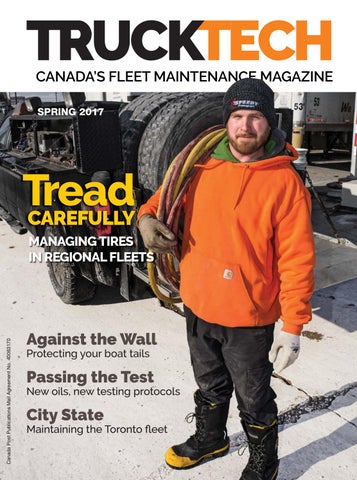
CANADA’S FLEET MAINTENANCE MAGAZINE SPRING 2017
Tread CAREFULLY Canada Post Publications Mail Agreement No. 40063170
MANAGING TIRES IN REGIONAL FLEETS
Against the Wall Protecting your boat tails
Passing the Test
New oils, new testing protocols
City State a±ĜĹƋ±ĜĹĜĹč ƋĘå ŅųŅĹƋŅ āååƋ
is written and published for owners, managers and maintenance supervisors of those companies that operate, sell and service trucks, truck trailers and transit buses.
SPRING 2017 VOL. 2 NO. 1 VIce President, Editorial Rolf Lockwood rolf@newcom.ca • (416) 614-5825 Contributing Editors James Menzies, John G. Smith, Nicholas Camilleri, Derek Clouthier Group Publisher Lou Smyrlis lou@newcom.ca • (416) 510-6881 Creative Director Tim Norton tim@newcom.ca • (416) 510-5223 Production Manager Kim Collins kim@newcom.ca • (416) 510-6779
COVER STORY
TREAD CAREFULLY NEWCOM BUSINESS MEDIA INC. 80 Valleybrook Drive, Toronto, ON M3B 2S9 416/614-2200 • 416/614-8861 (fax)
As regional trucking expands, customized tire management programs are required. Speedy Transport has found a model that works.
CHAIRMAN AND FOUNDER Jim Glionna PRESIDENT Joe Glionna VICE PRESIDENT, PUBLISHING Melissa Summerfield CHIEF FINANCIAL OFFICER Anthony Evangelista DIRECTOR OF CIRCULATION Pat Glionna Truck Tech is published by Newcom Business Media Inc. The contents of this publication may not be reproduced or transmitted in any form, either in part or full, including photocopying and recording, without the written consent of the copyright owner. Nor may any part of this publication be stored in a retrieval system of any nature without prior written consent.
Craig Matta of Stand Alone Tire helps keep Speedy Transport’s regional fleet on the road.
Features LEADERS SPEAK: Lloyd Brierley The director of Toronto Fleet Services discusses what it takes to keep one of Canada’s largest municipal fleets on the road.
12
AGAINST THE WALL Trailer tails are effective aerodynamic devices, but they’re also prone to damage at the dock. Advanced systems could prevent the problem.
RECRUIT, RETAIN AND REPAIR Stock a shop with all the parts and tools you want. Sound human resources strategies are still needed to keep any shop on the move.
14
Departments
PASSING THE TEST Two new diesel oil categories have been unveiled to meet 2017 emissions standards. But what did the oil tests actually prove?
24
12 trucknews.com
26
Editorial ....................................................5 Quick Fix ..................................................7 Equipment Watch ...................................28
28
14
26 Spring 2017 TRUCKTECH 3
NEW
Have What It Takes
Remove and Install Bearing Races In Minutes! Bearing Race Service Kit 10907 Bearing races can now be removed and installed precisely in mere minutes on aluminum and steel hubs utilizing bearing specific adapters. The design of the split ring clamp allows the tool to grip virtually the entire diameter of the race. Thread the pull rod into the clamp assembly, apply some hydraulic force, and the removal is complete!
• 20 tons of pulling power for efficient removal and installation of the race • Manufactured from high-grade steel for strength and durability Note: Requires 17202 hydraulic cylinder, 10,000 psi pump and at least one add-on kit to operate Patent Pending
Brake Anchor Pin Press 16002 Remove brake anchor pins and bushings on virtually all 16-½" S-Cam trailer and tractor "Q" brake systems easily and safely in just minutes. Compact design ensures the job can be done professionally without the removal of the hub assembly.
1.800.661.4661 | tigertool.com
Editorial
Literacy is a big deal Almost half of us can’t read, deal with numbers, or understand documents and forms well enough By Rolf Lockwood
Literacy is not a popular subject, one that’s seldom raised in the trucking context, but trust me, it’s a serious issue. And it’s not shrinking. We’re not talking about the simple ability to read. We’re really talking about something broader, about the skills needed to function successfully in a complicated world. And to hold down a job. In terms of training technicians, it simply can’t be assumed that every mechanic is going to understand what the trainer says or what he’s written. In some cases English isn’t their first language, but in other instances they just plain won’t be able to read well enough to comprehend a service bulletin. That’s not a knock against technicians, it’s just a fact about our society. The most recent literacy survey shows that a whopping 48% of adult Canadians are unable to read, to deal with numbers, or to understand documents and forms well enough to function successfully. It doesn’t mean they’re all downright illiterate, rather that they’re not sufficiently well equipped to hold a job for very long, to help their kids with school, maybe even to vote. That shocking reality more or less matches the results of similar testing done elsewhere, though we’re better than some other countries. Think about that: half of us are essentially out of it. And another third of us aren’t as well equipped for the modern world as we ought to be. I find this very disturbing. Literacy isn’t just the ability to read and write. That’s called prose literacy. There’s also quantitative literacy, namely the ability to comprehend numbers and do things like balance
In terms of training technicians, it can’t be assumed that every mechanic will understand what the trainer says a cheque book. A third component is document literacy, or the ability to find and use information from things like application forms and maps. These abilities are measured at five levels: Level 1 is the lowest, and this person may not be able to read the label on a medicine bottle. Some 22% of Canadians sit here.
Level 2 people can only deal with very simple material. They may have adapted to everyday life but learning new job skills is tough – and these folks tend not to know they’re so limited. About 26% of adult Canadians are in this group. Level 3 is where people, 32% of us, begin to be more or less fully functional in society. It’s a minimum level for success in life but many jobs demand higher skills. Level 4 includes just 16% of Canadians. Questions at this level on the literacy survey might ask the subject to calculate how much money a person would have if he invested $100 at 6% for 10 years. Level 5 represents an elite little group – just 4% of Canadians showed the ability to integrate several sources of information or solve more complex problems. A typical survey question at this level would ask the person to calculate the total calories in a hamburger based on a nutritional-analysis chart. What we’re talking about here are essential skills. Or, as Trucking HR Canada puts it, employability skills. They’re the foundation on which people build their jobs and personal lives, on which they climb career ladders and adapt to workplace changes. This has serious implications in the shop, where literacy demands have only risen in recent years. So I urge all of you in ownership or management positions to recognize just how big this problem is and then to consider attacking it within your own companies by way of the many local resources you’ll find with a simple search. A key thing to remember is that literacy is not fixed: it’s quite upgradeable. Which means that all is not yet lost. TT Spring 2017 TRUCKTECH 5
QUICK FIX Deal signed to support BYD Mississauga Bus, Coach and Truck Repairs has signed a deal to handle parts, service and warranty for BYD (Build Your Dreams) electric vehicles in Eastern Canada. “We were very impressed with the plants our team visited in China and in California. With the concern over emissions and the move toward zero-emission vehicles, we know that electric vehicles will be part of the future of transportation. Our dedicated technicians look at this as a great opportunity to learn a new skill,” said Mahendra Mahadeo, president of Mississauga Bus, Coach and Truck. Few of the trucks have been ordered in North America, but BYD enjoys financial backing from Warren Buffett and describes itself as one of the three largest battery makers in the world.
Goodyear adds tires, tech Goodyear is expanding its Total Solution lineup to include the Endurance LHD premium longhaul tire which is expected to launch later this year, and a new service management tool among other offerings. In addition, it has introduced three new SmartWay-approved Kelly Armorsteel longhaul tires. The new service management tool is built on the Goodyear Smart Tech App, and includes a live dashboard that helps dealers locate and check the status of road service technicians. Bluetooth capabilities being added to the tool will also allow those very techs to check and record fleet tire data. A new Over the Road proposal developer is available for sales teams, too, while a Preferred Fleet Dashboard extends to local customers the same reporting enjoyed by national accounts.
Mid-Ontario secures Volvo honors Volvo Trucks North America has named Mid-Ontario Truck Center of Barrie, Ontario as its 2016 Canada Dealer of the Year. North American Dealer of the Year honors went to General Truck Sales of Muncie, Indiana. trucknews.com
Volvo halts D16 production Volvo Trucks North America has discontinued North American production of the 16-liter Volvo D16 engine. A statement from the Original Equipment Manufacturer says the decision is the result of limited market demand for this engine displacement and the long-term investment that would be required to maintain the D16 for the unique operating requirements of the North American market. “We also continue to see a general shift among our highway customers toward the lighter, more fuelefficient Volvo D13 engine which comprises the most popular engine displacement in North America,” the company stated. The D16 engine was available in Volvo VNL and VNX models. The VNL will continue to be available with the Volvo D11, D13 and Cummins X15 engines. The VNX, in which the D16 was standard, will remain in the product lineup and Volvo is evaluating solutions for the future. Aftermarket service and support will continue for customers who currently have a D16 engine.
The awards recognize performance in new truck sales, market share, parts sales, customer satisfaction, dealer operating standards, franchise investment, and support for other dealers.
Tru-Nor Truck Centres now operates from facilities in Timmins, Sudbury and Sault Ste Marie. With over 100 employees, it has the largest dealer network in Northern Ontario.
More Isuzu service in Northern Ontario
Penske spec’s collisionavoidance, air discs
Tru-Nor Truck Centres Sudbury, a Tallman Group Company, is now a full-service Isuzu dealership offering sales, lease, rental, parts, and service support for the full line of Isuzu N-Series gas- and diesel-powered Low Cab Forward trucks. “Isuzu is excited to share in their growth into Northern Ontario with the establishment of Isuzu Sudbury. The addition of the Isuzu Class 3, 4, and 5 trucks available in both gas and diesel will provide Tru-Nor with a new opportunity for growth in Sudbury. Furthermore our new 2018 Class 6 FTR to launch mid-year 2017 will create additional interest in the Isuzu line in Northern Ontario.” said Andrew Craig, director - Canadian Operations for Isuzu Commercial Truck of Canada. Established in Sudbury in 1991,
Penske Truck Rental is making collision avoidance systems and air disc brakes its standard spec’ on commercial tractors within its rental fleet. “These added vehicle features underscore our commitment to overthe-road safety for our commercial truck rental customers and their drivers,” said Don Mikes, Penske’s senior vice president - rental. “These systems can help commercial drivers avoid collisions and the braking system provides additional stopping power when needed.” Penske has ordered more than 2,000 commercial semi-trucks from Freightliner, Volvo and Navistar with the new spec’. The 2018 Model Year units are set to begin going into service and will be available for rental starting as early as February. Spring 2017 TRUCKTECH 7
NOR 23 HOURS OF DARKNESS NOR THE FAILED MISSIONS OF TRUCKERS’ PAST NOR ACTS OF GOD. . . SHALL STAY ME AND THESE CHAINED-UP WHEELS FROM REACHING THE FINAL OUTPOSTS OF THIS VAST FRONTIER. Lisa Kelly on History® Network’s Ice Road Truckers®
Delo® user since 2005
UNCOMMON JOBS REQUIRE UNCOMMON TOUGHNESS
Chevron Products are available from the following locations:
CHEVRON CANADA LIMITED 1200-1050 West Pender St. Vancouver BC V6E 3T4 Toll Free: 1 (800) 822-5823 canada.deloperformance.com
CATALYS LUBRICANTS 7483 Progress Way Delta BC V4G 1E7 Toll Free: 1 (855) 946-4226 catalyslubricants.ca
NORTHERN METALIC SALES (GP) 9708-108 St. Grande Prairie AB T8V 4E2 Tel: (780) 539-9555 northernmetalic.com
HUSKY ENERGY CORPORATION 707-8th Ave. S.W. Calgary AB T2P 1H5 Tel: (403) 298-6709 huskyenergy.ca
UFA 4838 Richard Rd. S.W. Suite 700 Calgary AB T3E 6L1 Tel: (403) 570-4306 ufa.com
CHRIS PAGE & ASSOCIATES LTD 14435-124 Ave. Edmonton AB T5L 3B2 Tel: (780) 451-4373 chrispage.ca
RED-L DISTRIBUTORS LTD 9727-47 Ave. Edmonton AB T6E 5M7 Tel: (780) 437-2630 redl.com
49 NORTH LUBRICANTS 1429 Mountain Ave., Unit 2 Winnipeg MB R2X 2Y9 Tel: (204) 694-9100 Fax: (204) 775-0475 49northlubricants.com
CASE ’N DRUM OIL INC 3462 White Oak Road London ON N6E 2Z9 Toll Free: 1 (800) 265-7642 www.cndoil.ca
TRANSIT LUBRICANTS LTD 5 Hill St. Kitchener ON N2G 3X4 Tel: (519) 579-5330 transitpetroleum.com
R. P. OIL LTD 1111 Burns St. East Unit 3 Whitby ON L1N 6A6 Tel: (905) 666-2313 rpoil.com
CREVIER LUBRIFIANTS 2320, Rue de la Métropole Longueuil (QC) J4G 1E6 Tél : (450) 679-8866 crevier.ca
NORTH ATLANTIC REFINING LTD 29 Pippy Place St. John’s NL A1B 3X2 Tel: (709) 570-5624 northatlantic.ca
A Chevron company product © 2017 Chevron Canada Limited. All rights reserved. All trademarks are the property of Chevron Intellectual Property LLC or their respective owners.
NEITHER RAIN, NOR SNOW
QUICK FIX
Freightliner, Altec included in recalls The U.S. National Highway Traffic Safety Administration’s latest vehicle recalls include the instrument clusters and turn signals on selected 2016/17 Freightliner Business Class M2, 108SD and 114SD trucks, as well as telescoping aerial devices from Altec Industries. Freightliners affected by the recall were modified to include left and right instrument clusters, but due to a compatibility issue between the displays, instrument clusters and/or the turn signals may not respond. With the recall expected to begin March 19, 2017, owners of the affected models will be contacted by Daimler Trucks North America, and dealers will at no cost replace the left instrument cluster with one that’s compatible with the right display. Altec Industries, meanwhile, is in the process of recalling a range of telescoping aerial devices for an issue regarding the winch brake being improperly installed. If not looked after, this issue could cause the winch line to move unexpectedly. The aerial telescoping devices on Altec models TA37M, TA41M, and TA45M from years 2005-2016 are affected by this recall, expected to begin March 9, 2017. Altec will contact equipment owners and Altec dealers will reverse the direction of the winch brake, and will then check and adjust the winch brake torque setting at no cost to the owner.
Meritor pledges to “do better” Executives overseeing Meritor’s aftermarket business are pledging to “do better” as they take steps to improve everything from product portfolios to deliveries. “It’s extremely important that you’re seeing there’s a new Meritor, that we’re shaking things up,” Brett Penzkofer, vice president – North American aftermarket, told a crowd at Heavy Duty Aftermarket Week. “We’re going to earn your trust. We’re going to help us all collectively grow our businesses.” Penzkofer has held the role since June 2016, and says he was intrigued trucknews.com
by the quality of the company’s brands, products, employees and customer base. “But there are a number of things that I saw that we needed to do much better, so I grabbed the challenge.” One of the most dramatic shifts included moving the division’s headquarters to Florence, Kentucky, in what he says was a way to improve focus in the organization. Other steps involve finding ways to make it easier to do business with those in the distribution channel, and improving the depth of the product portfolio
– including genuine, all-makes, and remanufactured product lines. “In doing so we will guarantee and ensure that we have superior quality and dependability with our products,” he said. Then it’s a matter of ensuring consistent deliveries and fill rates. “We have not always done that,” he admitted, adding that steps are also being taken to improve package quality. Some packages shipped to Hawaii, for example, can hold 10 times more empty space than product. There had also been some internal resistance to crating export shipments. TT
New database focuses on aggregate weights The Ontario Ministry of Transportation’s (MTO) Aggregate Industry Working Group – including shippers, carriers, equipment suppliers, and the Ontario Trucking Association (OTA) – recently met to discuss efforts to develop a database that will be used to determine gross and axle weight allowances for each vehicle transporting aggregates. “This project, if realized, will be a significant step forward in ensuring compliance by all shippers and carriers in the gravel sector,” said Geoff Wood, OTA’s vice president - policy. The plan calls for a phased-in approach to measure the specifications and weight allowances for vehicles involved in the aggregate sector and enter that information into the secure database, which is now in its prototype phase. Aggregate shippers will then be able access the database to determine the proper amount and weight that can be loaded on a specific vehicle and verify compliance before it leaves a pit.
Vipar names exec team, eyes $1-billion target Vipar Heavy Duty has set aggressive goals for the next five years, and promoted several executives who will be responsible for meeting them. Larry Griffin has been named vice president of program management, Andrei Katibnikov vice president of information technology, and Jeff Paul vice president of marketing. All three had previously served as directors within the organization. Along with Jim Pennig, vice president – business development, they will join a new executive management team. Each will have responsibilities under the company’s new Game Plan for Growth that has targeted US $1 billion in annual reported program purchases as early as 2021. “To do that, we have to increase those purchases by $350 million,” noted Vipar president Chris Baer. Chris Baer, Vipar president
Spring 2017 TRUCKTECH 9
www.expocam.ca
Gold Sponsor:
Platinum Sponsor:
Endorsed by:
The Meeting Place for
Canada’s Trucking Industry April 20 -22, 2017 Place Bonaventure Montreal, QC, Canada X See more than 225,000 sq ft of new trucks, trailers and equipment X New Products
An official ExpoCam event
www.scef.ca
April 19
LEADERS SPEAK
keeping up with the training, tools and equipment is phenomenal.
City State Canada’s largest municipal fleet presents diverse maintenance needs By Nicholas Camilleri
T
oronto is recognized as one of the most diverse cities in the world, with many of its 2.3 million residents coming from the far reaches of the globe. Maybe it’s only appropriate that it is also home to one of Canada’s largest and most-diverse municipal fleets. Maintaining that equipment is no small task. Toronto’s Fleet Services department, which boasts 107 service bays across the city, must be versatile to keep services up and running. Overseeing it all is Lloyd Brierley, director of Toronto Fleet Services, who leans on more Dallas Walker, Toronto mechanic than 20 years of operations and maintenance experience to do the job. Truck Tech joined Brierley and Toronto Fleet Services mechanic Dallas Walker at their main facility in downtown Toronto to get an idea of what it takes to keep the equipment rolling.
Truck Tech – Can you offer a rough idea of the size of the fleet?
Truck Tech – How specialized is some of that equipment?
Brierley – The Fleet Services division is 5,200 units. And as far as the complexity of the fleet, that is a unique requirement to a municipal operation. Public works ... tends to have one of the most diverse fleets that there is. Just for on-road vehicles and equipment, we have 468 different models from over 212 different manufacturers.
Brierley – I’m from Western Canada. We have all kinds of equipment that we would not even have in Western Canada, such as things like snow melters. Because of the inability to move the snow places, we literally melt the snow. They’re massive machines.
Truck Tech – How many mechanics take care of it all? Brierley – We have just over 100 mechanics city-wide, not including temporary staff hired for specific maintenance projects that can last as long as one to two years. 12 TRUCKTECH
Spring 2017
Truck Tech – In general, what are the biggest challenges in maintaining Canada’s largest municipal fleet? Brierley – We work in a public environment. Everything has to be fair, open and competitive, keeping up with training, tools and equipment. Just for a regular dealer that might have 12 to 14 different models, it’s a challenge. When you have 460 different models,
Walker – Oh yeah, we could go from working on a hybrid to a front-end loader. It’s a massive range. But the training is good. If one person goes out to learn something, they come back and regurgitate that information. Truck Tech – So, for someone like yourself (Walker), would you be dedicated to a certain type of equipment? Walker: – Oh no, anything that comes through that door, I’m holding a wrench. I’ll take it on. Brierley – The specialization of having someone like Dallas focused on just one [type of equipment] is tough, because depending on what day of the week, what’s happening in the city, that might not be viable. Truck Tech – What sort of system do you implement to ensure such a diverse mix of units is fixed on schedule? Brierley – The standard approach might be a time-based PM [Preventive Maintenance inspection], where we would do Preventive Maintenance work every three months. Instead, what we’ve done – and we are working on the final installations – is we have devices on the vehicles and equipment called vehicle information boxes. They tie right into the [Electronic Control Module] and haul out engine hours, kilometers, operating data, and we feed that info into our fleet management information system, and we base our Preventive Maintenance schedule on that [data]. Truck Tech – What is your parts inventory like with a such a variety of equipment? Brierley – With parts management, there are a number of KPIs (Key Performance Indicators) in place. It’s between having absolutely everything in stock and the carrying costs of that, and trying to keep a lean inventory and then the waiting time to get it – which could be expensive in some cases. We still carry between 2-3 million pieces in inventory. trucknews.com
Truck Tech – Are there particular units you dread to see when you see them roll into the shop? Walker: – Well, each truck is a different challenge. I personally work the weekends, so I see a lot of solid waste [units] coming in. The garbage trucks that do come in – of course they’re not the greatest to work on – however, I don’t mind it. It’s just another truck you know, and it’s got to get done. Brierley – You can have a garbage truck that comes in with a failure and wasn’t able to dump, and the garbage has been sitting there rotting for a couple of days.
Brierley – We do have mobile techs, but even guys like Dallas end up going to breakdowns all the time. It’s just the nature of the operation. Truck Tech – With equipment getting more sophisticated in terms of technology, is there additional in-house training to prepare the teams? Brierley – It’s a challenge. We’ve put out an RFP (Request for Proposal) for training for all of the different classes – light, medium, heavy, off-road – and received very little response. We’ll have some select manufacturers that want to
Truck Tech – With a fleet this diverse, do you enjoy the chance to work on different equipment? Walker: – It’s nice, because you never really know what’s going to come through. It could be something simple like an oil change on a little Honda Civic hybrid, or it could be a front-end loader coming through the door that can barely fit because it is so big. Truck Tech – Where do you guys see city fleets in the future? Do you think the equipment selection is going to get more diverse, or narrow down a bit?
Walker: – In the winter, it’s not too bad cause nothing can really grow and multiply, but in the summer when it’s warm and there’s moisture, it can get a little stinky. Truck Tech – Do you guys outsource a lot of your work? Brierley – Of course, things like e-test, transmission work, specialty work. We outsource overflow. Truck Tech – As a government entity, do you have to follow a specific Request for Proposal process? Brierley – Yup. Anything we outsource goes through PRFQ (Proposal Request for Quote). In some cases, if it’s new, under warranty, based on the diagnostics, it would have to go back to the dealer. Truck Tech – How does the shop deal with breakdowns? Do you use your own mobile techs?
Dallas Walker and other mechanics with the City of Toronto oversee a diverse array of equipment.
train in certain areas and then beyond that we have an agreement with the local college to do some training. We try to approach the manufactures to get training. Manufacturers tend to be a bit more reluctant. The dealer staff tend to get much more in-depth training, and to send our staff to get that same training, it can be a challenge.
FAST
Brierley – As time goes on, things change and evolve. We talk about autonomous vehicles now and various things that add to the complexity and diversity of fleets. We try to keep things standardized as much as possible, but due to time, technology and an evolving world, there’s continued diversity and change. TT
Brought to you by the editors of Newcom Trucking Group, in partnership with Imperial Oil – Mobil Delvac™
FORWARD PART II
A DEEPER LOOK INSIDE THE FUTURE OF TRUCKING
DOWNLOAD YOUR FREE COPIES IN THE KNOWLEDGE CENTRES SECTION OF
www.trucknews.com
trucknews.com
Spring 2017 TRUCKTECH 13
RECRUITMENT & RETENTION
Recruit, Retain and Repair Sound HR strategies needed to keep shops on the move By John G. Smith
S
tock a shop with all the parts and tools you want. Unless you have the expertise to put these supplies to use, trucks and trailers might as well park outside the service bay. But finding techs – let alone keeping the ones who have already been hired – can be a challenge in the face of competitors who are trying to recruit the same personnel. “Technicians are going to be counted like the free agents in football and baseball,” predicted National Private Truck Council senior vice president Tom Moore, during a recent panel discussion at Heavy Duty Aftermarket Week. “If we don’t pay them, someone else will.” The competition extends beyond traditional fleet shops. Those who have mechanical know-how are coveted by employers in a broad array of industries. Even in trucking itself, Roy Svehla, senior manager – fleet maintenance at Republic Services, has seen training schools tailor students for future roles in dealerships. “They [trainers] are not talking about the Yellow Freights,” he said. The competition between dealerships and fleet shops doesn’t seem to end at graduation time, either. “We generally don’t pay as well as dealerships, so the dealerships get the technicians first,” admitted Gloria Pliler, director – parts
14 TRUCKTECH
Spring 2017
procurement at Swift. But her fleet has found another way to meet the demand for trained techs. It houses dealership personnel in the fleet shop. “We can control our downtime a little better,” she said, referring to one of the practice’s advantages. Another approach to tackling a technician shortage can involve looking beyond the traditional middle-aged candidate pool. Dan Samford of Peak Performance Asset Services and an executive advisor with the Association of Equipment Management Professionals, refers to the way industry associations are offering regular presentations on ways to recruit millennials. Of course, it’s not the only generational group to consider. Many fleets are reaching out to retirees as a source of part-time drivers when searching for candidates who are unemployed but qualified for a job, Moore said. Samford has found success hiring military veterans who have skills to apply in the civilian world. Maybe those approaches would work for maintenance teams, too.
Retaining The strategies to retain those who are ultimately recruited are not limited to paycheques, either. When Republic polled its technicians about what they
valued, the interest in higher pay was certainly on the list, Svehla says. Just not at the top. Additional training, defined career paths and recognition all rated higher. Different generations of employees are also attracted by different things. Where Baby Boomers were focused on rewards such as money and parking spots, their younger counterparts can be more interested in the chance to earn more time off, improving their work-life balance, says Angela Splinter, executive director of Trucking HR Canada. “Generation X as well as Generation Y both value professional development when it’s offered,” she adds. “As long as it’s targeted and relevant.” trucknews.com
Splinter cites Challenger Motor Freight’s Good to Great Program as an example of how that can be developed. The fleet surveyed employees in every department to see the training that would be embraced, and then rolled it out. Trailer Wizards also runs a Super Wizard program that gives technicians a chance to earn trophies and prizes, she says, noting how programs like these help transform staff into business ambassadors. Both companies have earned spots in Trucking HR Canada’s Top Fleet Employers program. Training opportunities are powerful recruiting and retention tools when they are presented as a benefit rather than a penalty to correct a wrong, says Mark trucknews.com
Murrell of CarriersEdge, which offers training programs and administers the Best Fleets to Drive For competition. “If the company presents it as an investment in their staff, an investment in career development, it’s very positive,” he explains. “They see it as building their skills.” An increasing number of companies that participate in Best Fleets to Drive For are also reimbursing tuition costs. “Inside trucking we haven’t seen very much of that, or it’s only for the office staff,” he says. But the HR-focused fleets have expanded the support to include the likes of drivers, warehouse staff and maintenance teams. Shops enjoy productivity gains in the process – and the extra training time
can be particularly valuable to mixed fleets. Construction operations, for example, need people who can tackle everything from hydraulics to electronics, Samford said. The diverse challenges can attract and retain candidates who might be bored of fixing the same equipment day in and day out. The additional training certainly makes the shop teams more valuable. Swift has directly tied training to compensation packages, offering techs an extra 50 cents per hour when they complete an approved training program and pass the related test. They can make an extra $2 per hour every year by enhancing skills in this way. Said Dwayne Haug, a consultant Spring 2017 TRUCKTECH 15
RECRUITMENT & RETENTION
STRAIGHT TALK TRAILER SUSPENSIONS Short cam shaft makes for reduced weight and performance. This simple alignment feature is quick and easy. Axle alignment adjustment capability is .25” at hanger. The Securelok pivot nut n helps to maintain m pivot clamping force. This system is highly resistant to loosening under vibration. SPIF compliant, parallelogram self steer keeps the dual draw key king pin in correct position for maximum performance and life expectancy. 337 lbs lighter than conventional steer axle with 9” of lift. Put the best on you equipment.
Email a request for more information to:
YES@ridewellcorp.com
16 TRUCKTECH
Spring 2017
A recent panel at Heavy Duty Aftermarket Week explored ways to better attract and retain skilled technicians. who once held senior roles at Werner Enterprises: “If they know how to do their job and how to do it efficiently, they’re an asset to the company.” Murrell also stresses the value in finding ways to address arguments before they emerge. “Some fleets have made a big effort to get their drivers and maintenance people together so they’re
“Some fleets have made a big effort to get their drivers and maintenance people together so they’re not siloed and at each other’s throats.” Mark Murrell, CarriersEdge not siloed and at each other’s throats,” he says. Murrell knows of one fleet that requires all newly hired drivers to spend a half day in the shop, where they learn proper maintenance practices and build relationships. Not only that, but drivers and technicians each earn a bonus when equipment receives a clean inspection on the road. Unlike larger bonuses that will only be available to a select few, smaller rewards affect a broader cross-section of the workplace, he adds. Wonder about the option that will be embraced by your particular shop? Consider asking the team to offer ideas. It may even be time to reconsider how
shop shifts are structured. “We have to think outside the box,” said Lee Long, director – fleet services at Southeast Freight Lines. “We saw a load of people leaving off the third shift.” Rather than accepting the bleeding as an inescapable reality, the fleet reduced the number of personnel who had to work on second and third shifts, and moved them to more desirable hours were possible.
The future Meanwhile, long-term solutions to the industry’s recruiting challenges can involve reaching out to potential candidates before they ever earn a red seal. Swift, for example, mentors high school students in its shop settings. The same electronics that require a fleet to ask for dealership support might also entice more youth into the business, Pliler adds. “There’s more computers on those trucks now than ever before. That gives them that [job] satisfaction.” The extra exposure offers value to students and fleets alike. Long notes that his fleet partners with secondary students to find candidates for on-thejob training, where star candidates of the future can be identified. “That allows us to determine their skill level, their interest in the business,” he said. And maybe it’s time to offer the broader industry a makeover. “We have painted this industry from the mechanic side as a dirty industry,” said Peak’s Samford. “We have to do a better job to change that.” TT trucknews.com
YOUR FLEET MAY RUN OUT THERE, BUT ITS SUCCESS STARTS RIGHT HERE. From this chair, you can see the business you’ve built. But you can also see where it can go. We can too. That’s why Shell ROTELLA is made to help you take your business farther. Shell ROTELLA T5 Synthetic Blend Technology Heavy Duty Engine Oil gives you up to 1.6% in fuel economy savings* and extended drain capabilities. So you can close the gap between the business you see today, and the one you can see tomorrow. Find out more at www.shell.ca/rotella ®
®
THE ENGINE OIL THAT WORKS AS HARD AS YOU.
*In on-the-road field testing in medium-duty trucks. (For 10W-30 viscosity-grade-only, highway cycles, compared to Shell ROTELLA® Triple Protection® 15W-40.)
Show Organizers:
Confirmed 2017 Exhibitors:
NORTH AMERICAN
COMMERCIAL VEHICLE SHOW
Where the
leaders of today, share their ideas for tomorrow.
Join the industry’s most influential executives at the first truck show of its kind. Leading manufacturers of commercial vehicles and parts will announce and showcase their newest technologies and innovations. This is a show you’ll want to be at.
Monday, September 25th by Invitation Only Tuesday, September 26th – Thursday, September 28th doors open to all Please visit our website in the coming weeks for full details
Atlanta, GA www.nacvshow.com
Bendix, Cummins, Detroit, Eaton, Freightliner, Hendrickson, Mack, Meritor, Navistar, SAF Holland, Volvo, Western Star and more…
TIRE MANAGEMENT
Tread Carefully As regional trucking expands, customized tire management programs are required By James Menzies
T
hree days a week, Craig Matta can be found in Speedy Transport’s Brampton, Ontario yard, meticulously examining every tire on the company’s fleet of about 200 trailers. The tire technician who operates Stand Alone Tire has become an integral part of Speedy’s tire management program, for the simple reason that investing money in Preventive Maintenance reduces the amount spent on roadside service calls and tire replacements. That’s the conviction of Andre Poirier, vice president - transportation maintenance at Speedy, who sees the benefits of having a dedicated tire pro working with the fleet. “Just one road call pays for a few hours of his labor and saves damage to other tires,” Poirier reasons. The objective of Matta’s visits is to identify any potential tire problems before the equipment leaves the yard. In
20 TRUCKTECH
Spring 2017
addition to checking inflation pressures, Matta is looking for any signs of irregular wear, and is checking to verify that tire tread depths aren’t mismatched – something that can easily happen when a tire is replaced at roadside. “I’m looking for any defects in the tire sidewalls, any mismatching of tires,” Matta explains. “But air pressure is the number one thing to keeping things rolling. A simple kick by a driver won’t be able to tell [if it’s improperly inflated]. A lot of guys are leaving with flat tires without even knowing. We try to catch as many as we can. The big thing here is yard checks.” A tire inflated to less than 80 psi is considered flat, and a driver isn’t necessarily going to identify that with the whack of a hammer. It’s important maintenance managers enforce rigorous inflation pressure checks on trucks and trailers. “Every driver should have an accurate pressure gauge and be instructed to
Craig Matta of Stand Alone Tire unloads supplies as he prepares to mount new tires at Speedy Transport. check the tires on their truck every day during the pre-trip inspection,” says Sharon Cowart, product marketing director, Michelin Americas Truck Tires. “A tire that is running 10% underinflated will lose 10% in tread wear and will come out of service quicker. A tire that is 20% below the optimal air pressure is considered a flat tire. A tire that is run under these conditions will experience casing fatigue that could lead to a catastrophic failure or a zipper rupture.” Cowart said technicians should keep a master air gauge in the shop to ensure tire pressures are taken accurately. It’s the Number 1 defence against premature wear and blowouts. An underinflated tire can also affect fuel mileage, notes Norberto Flores, marketing manager with Goodyear, as soft tires require the truck’s engine to work harder. “Maintaining correct inflation pressure levels is critical,” he says, “and underinflation in particular should be avoided.” Besides inflation pressure, one of the other tire killers most commonly seen in a regional fleet such as Speedy’s is mismatched tread depths. Matta said this should be looked for during trucknews.com
yard checks. Poirier says Speedy will immediately tag any trailers that receive a tire replacement on the road, so the tires can be matched up when they return to the yard. Matta adds, “Ninety percent of the time if you have a road call, the dealer will put on one new tire.” The maximum variance Matta will allow is 4/32nds to 5/32nds. Any more than that, and he says the tires will wear unevenly, with the newer tire taking on a disproportionate percentage of the load, compromising its service life. The alignment of the vehicle is another contributor to tire wear, according to Michelin’s Cowart, so a technician’s role in extending tire life goes beyond keeping them properly inflated and evenly matched. “Many tire problems can be traced to the mechanical conditions of the vehicle,” she explains. “To obtain maximized tire performance, vehicles must be properly maintained, including
alignment. Alignment refers not only to the various angles of the steer angle geometry, but also to the tracking of all axles on a vehicle, including the trailer.” Cowart says toe misalignment is the top cause of irregular wear on steer tires, followed by rear axle skew. With the explosion in regional haul trucking – driven by trends ranging from a move towards urbanization, to carriers’ desires to get drivers home more frequently – tire manufacturers have been bringing to market more offerings designed specifically for this application. Michelin has even coined the term “superregional” for applications that involve longer highway distances than what was traditionally considered regional. It’s a fast-growing segment. “We are seeing more fleets using drop-and-hook to better manage their drivers’ hours of service and a growing number of fleets are taking advantage of intermodal in an effort to create additional efficiencies,” says Flores.
Pressure Relief
Tire Pressure Management Systems watch over rolling assets By Sonia Straface Having a flat tire can be a drag for any driver or maintenance department. Thankfully, there’s technology available that has made it almost impossible to ignore when one is coming. Tire Pressure Monitoring Systems (TPMS) and Automatic Tire Inflation Systems (ATIS) are a valuable feature to consider, especially if you run longhaul. “There’s a pretty wide range of benefits for users that run longhaul,” said Vanessa Zaroor, Chief Operating Officer for PressurePro. Benefits of TPMS are threefold, Zaroor explained. Customers see safety benefits and save money, and systems like PressurePro’s are environmentally friendly, too, she said. “We affect so many different areas of the fleet,” she said. “With the TPMS installed, our customers save on fuel costs because they’re not running their tires improperly, and therefore experience less bend and flex. And properly inflated tires are also safer because they have a safe braking distance, and underinflation can lead to things like accidents and injuries.” Zaroor said in the U.S. it is estimated that underinflated tires waste more than 2 billion US gallons of fuel each year. And according to a study by the Technology and Maintenance Council (TMC), “improper tire inflation, defined as little as 10 psi low, reduces fuel economy by about 1%.” “By helping them maintain that pressure, we are able to help them extend their tire life as well,” Zaroor said. The extended life helps to
trucknews.com
Fleets such as Speedy fit into this category and it has learned the hard way that a linehaul tire installed at the factory isn’t always the best solution for a truck or trailer that’s making regional deliveries. “The last batch of trailers we bought had fuel-efficient tires and we found they were not made for our application,” Poirier recalls. “We were missing chunks out of the tires from scrub because the softer compound wasn’t the right tire for our application. We went back and took all that rubber off those trailers.” Poirier says Speedy is willing to sacrifice some fuel economy in exchange for durability, since its trucks spend much of their time at low speeds, negating the benefits of fuel-efficient tire designs. For tire manufacturers, striking the right balance demanded in regional applications is tricky. “Regional tires are designed and optimized to maximize wear and traction in usages that include highways
reduce tire budgets and is environmentally friendly because extended tire life means less landfill waste. Jim Sharkey, senior director - global sales and marketing at Pressure Systems International, said tire pressure systems are crucial to long-haul fleets in many ways. “Certainly, both TPMS and ATIS have value but it depends on how the fleets look at it,” he said. “We view active inflation as being a step above TPMS, because instead of monitoring the problem, it takes care of the problem.” Sharkey said that ATIS helps fleets manage downtime and increases driver productivity. “Typically, with longhaul fleets, the drivers tend to get paid by the mile. They don’t get paid to monitor if their tires are full – especially if one had a puncture,” he said. “This is downtime and downtime is expensive. ATIS will keep your tire aired up to normal pressure and allow that run to be completed without the driver stopping. Plus, that data can be sent back to dispatch to address the tire situation, so when it gets back to the home terminal, they know that trailer has a tire issue that needs to be addressed when it gets there.” This feature has helped customers improve driver retention too, Sharkey said, because drivers like doing their job – driving – and not sitting on the side of the road waiting for a tire truck to arrive. Properly inflated tires can also help you gain and maintain clientele, he added. “We had one fleet prior to having an Automatic Tire Inflation System, they would routinely lose loads because the trailer they thought they had available wasn’t, because it had a flat tire,” he said. As an added bonus, Sharkey said that with ATIS, fleets statistically get fewer tire violations and save time at roadside inspections.
Spring 2017 TRUCKTECH 21
TIRE MANAGEMENT and secondary routes,” says Cowart. “Typically, these routes will involve a higher level of abrasion, lateral scrub, and more starts and stops. Compounding specific to the usage plays a large part in the tire performance. Tread depth and tread design are also important, to maximize usable rubber for the wear challenge while also providing enough void and siping for traction.” Regional fleets, notes Flores, are inherently trying to “do more” with their equipment and as a result, they expect more from their tires. A truck that starts its day in Brampton, Ontario, makes a few deliveries in London, and then makes some afternoon drops in Hamilton, for example, has a different set of requirements than one that’s designed to run longhaul. “A truck that travels this kind of route on a daily basis will want a tough, durable tire that can withstand curb impact and other things often encountered in city driving, while providing the required traction, which is always important, especially this time of year
22 TRUCKTECH
Spring 2017
Craig Matta uses a tire gauge to inspect tire pressures.
in areas that see a lot of snow and ice,” says Goodyear’s Flores. One thing regional and linehaul fleets share is an opportunity to further stretch tire budgets through the use of retreading. Because of the attention Speedy Transport gives its tires, it can often run an initial set of trailer tires for eight to 10 years. But it does run Bandag retreads on its older trailers. “Retreads have been doing really well here,” says Matta. “We use an aggressive trailer tread here and it seems to be working pretty well. We do a lot of LTL, mostly in and around the city and to
Montreal and back.” Cowart says regional fleets may even see greater benefits from retreading than their linehaul brethren. “Regional fleets may actually benefit more than linehaul fleets because treads typically wear faster with regional usage,” she explains. “So, to maximize the investment in the tire casing, fleets can retread and gain more lives at a reduced cost compared to purchasing a new tire.” Flores agrees. “Retreads give fleets the ability to optimize the return on their new tire investment by extending the life-cycle of their casings,” he says. TT
trucknews.com
Dec, 1st
READY THEN. READY NOW. RUBIA OPTIMA Our New
CK-4
&
FA-4 Heavy-Duty Engine Oils
www.total-canada.ca
Questions? Call us at 1-800-463-3955.
Total Canada
Energizing performance. Every day
ENGINE OIL Research Institute’s Engine Fuels and Lubricant Research Division. “Everything from piston deposits to liner wear to filter plugging. Just about every parameter you can think of to measure the performance of the oil is captured in one of these tests. Any oil that can make it through this battery of tests is pretty robust.” “The physical properties of the CK4 oils are much better than the CJ4 designation, especially for those fleets that were using discount brands,” says Andre Bolduc, senior technical commercial advisor for Total Canada. “The chemical properties are the same but the tests have been tightened up. The tests are basically looking for the same thing as before — engine wear, fuel economy and after-treatment compatibility. Our company blends oils to the spec’s supplied by the OEMs, which are already a step above the API standards.” The newly introduced FA4 oils are intended to help reduce By Harry Rudolfs carbon dioxide, improving fuel economy. And there are other advantages according to the API: “These oils are especially effective at sustaining emission control system durability where particulate filters and other advanced after-treatment he American Petroleum Institute (API) has introsystems are used. FA4 oils are designed to provide enhanced duced two new heavy duty diesel oil categories protection against oil oxidation, viscosity loss due to shear, to meet EPA 2017 engine specifications. As of and oil aeration.” December 2016, CK4 oils replaced the existing CJ4 One new test is specifically intended for the off-road and formulas and are intended for 2017-and-earlier models. The construction sector. The Caterpillar Oil Aeration Test (COAT) lighter viscosity FA4 oils, however, are intended to maximize replaces a much older aeration test and involves running C-13 performance in the hotter 2017 engines and can’t be used in engines for 50 hours to determine the amount of air that stays older models unless specifically allowed by Original Equipment in the oil. Air retention is an issue with off-road vehicles that Manufacturers. have to deal with steep grades, making them more susceptible The new CK4 oils have viscosity grades similar to the former to swallowing air that can affect off-road performance. CJ4 category, while enhancing sheer stability, oxidation resistA corollary to the COAT is the D892 bench test, which ance and aeration control. The FA4s, meanwhile, have lower measures foamability. Small air High Temperature/High Shear (HTHS) bubbles that can build up on or near properties designed to improve fuel the oil’s surface can cause excessive economy without compromising engine oxidation and uneven lubrication. durability or performance. “Everybody is worried about With a couple of exceptions, API aeration,” says Kevin Ferrick, testing protocols are similar to the senior manager of API’s engine oil last test cycle for the 2010 engines. The licensing and certification system. majority of the tests remain largely “Air bubbles don’t lubricate very the same as the previous generation, well. If you get entrained air it could assuring they’re backwards compatible – James McCord, manager of the affect the lubrication of moving (able to be used in older engines). Engine Lubricants Research Department parts. Many engines rely on oil But some of the standards have been at Southwestern Research Institute for engine protection but they are upgraded and two new dynamic tests also concerned about some of the have been added. hydraulic functions, say for valve actuation, in which case the Both new oils are measured to the same criteria in terms of oil is behaving like an engine part in itself.” wear and protection levels. Aside from in-house testing and With the exception of COAT, all the other tests are concerned field trials, the API tests are carried out at an independent, thirdwith highway and on-road applications. The Volvo T13 party lab. Altogether there are 18 tests in this package: nine Oxidation test is also new, and perhaps the most intense in the dynamic engine tests, six bench tests, and three chemical tests. entire API package. This involves 360 hours of run time with The chemical tests set the standard for the amount of sulfated temperatures up to 130 Celsius and a high degree of Exhaust ash, phosphorous and sulfur allowed in the oil. Excessive levels Gas Recirculation. Oxidation stability is an important concern of any could harm the exhaust aftertreatment system. because the 2017 engines are running up to 10 Celsius hotter “There are a whole slew of tests that have to measure than previous models. different performance factors,” says James McCord, manager of “This is the most severe test I’ve ever seen,” says Dan Arcy, the Engine Lubricants Research Department at Southwestern
Passing the Test
New oil category includes extensive testing protocols
T
“There are a whole slew of tests that have to measure different performance factors.”
24 TRUCKTECH
Spring 2017
trucknews.com
The newly introduced FA4 oils are intended to help reduce carbon dioxide by improving fuel economy. Shell Lubricants global OEM technical manager. “When you heat up oil and oxidize it, it causes it to get acidic and thicken up.” The norm established by the T-13 is that viscosity can’t increase by more than 75% during the last 60 hours of the 360-hour procedure, and the results are measured by infrared readings. Viscosity levels for the CK4 oils haven’t really changed, but the FA4 has lower viscosity characteristics to improve fuel economy. Supplemental to the T-13 test, three bench tests are also geared to measuring viscosity performance. It’s worth noting that the tested oils already meet the SAE’s J300 viscosity standards, which include five tests of their own. Multi-viscosity polymers are added to the oils to maintain good flow characteristics during a range of operating conditions. Shearing standards had to be improved because some brands have been known to shear out of grade at raised temperatures. “Some of the marketers were using lower-quality polymers that would break down,” Arcy explains. “That means that at 15W40 oil could shear down to a 15W30, especially after a prolonged drain interval.” The pass/fail shear limits have been strengthened so that, even if an engine oils shears, it will still stay in grade. Measured at 150 Celsius, the D4683 (High Temperature/High Shear) bench test sets the viscosity range for FA4 oils between 2.9-3.2 centipoise, a measure of dynamic viscosity. Soot retention is the focus of the Mack T-11 test, to determine that viscosity doesn’t skyrocket when soot deposits increase. Those carbon particles can be abrasive but are only a problem if concentrated or coagulated. The T-11 measures how much the oil is thickening because of soot deposits,
and how well those deposits are dispersed. Even before the introduction of the latest EPA standards, soot oil deposits have been greatly reduced over the last decade or more thanks to new engine technology, according to Arcy. “Years ago, you might have seen 5% in used oil samples. Nowadays, even after an interval of 50-60,000 miles [80,000-95,000 kilometers], you’d be lucky to find 2% in the used oil.” For many fleets, the key measures involve engine wear and piston deposits. For instance, the Mack T-12 test measures bearing corrosion, piston ring loss and cylinder liner wear, while the Navistar ISB checks for valve train wear and ring loss. In addition, supplemental field tests are conducted by the engine manufacturers like Cummins and Volvo. Original Equipment Manufacturers also adjust the API test limits to suit their needs, especially for the premium synthetic oils used for factory fills. Overall the move is to lighter viscosity oils. The 10W30 oils are starting to supplant traditional 15W40s. And one European manufacturer is even running trials on SAE 20-weight oils. Drain intervals are based on test results, and those intervals are increasing due to less oxidation and better wear performance. Currently engine manufacturers are suggesting drain intervals from 65,000 to 120,000 kilometers. Longer intervals between oil changes mean the vehicle is in the shop fewer times per year, and this could be problematic according to Arcy. “The longer you go between drain intervals the more important it is to do used oil analysis. It’s like a blood test for your oil. You want to catch any number of issues early to avoid a catastrophic failure.” The engine lab at Southwestern Research in San Antonio is currently quiet, having recently completed the testing for the new CK4s and FA4s. But McCord is expecting a new round to start up again soon, as the oil providers continue to improve their product. “In six to eight months you could see a Rotella CK4 with extended drain intervals,” says McCord. “It could be the same oil that’s sold right now, but there are tweaks that take place throughout the year. You have to run the whole slate of nine engine tests again. Improving oxidation could lead to an increase in piston deposits, so you have to balance everything.” TT
CK4
trucknews.com
Spring 2017 TRUCKTECH 25
TRAILER TAILS
Against the Wall Boat tail damage is largely linked to forgetfulness By Carroll McCormick
T
railer tails, also known as boat tails, are the second most effective aerodynamic device that can be bolted onto a trailer, after side skirts. With one of the devices, a truck at highway speed will burn about 5.5% less fuel. Attached to the rear of a trailer, it is opened either manually or automatically, depending on the brand and model. That’s where maintenance needs can arise. Unless they are folded against barn doors, the boat tails are known to be damaged at docks, or when drivers back up against walls as a security measure. “Most of the damage has to do with the drivers not closing them. You think the latch is closed, but it pulls open. It is mostly the latches, especially in the winter,” says Andrew Lutz, shop supervisor at Nova Scotia’s Eassons Transport, which has installed Stemco TrailerTail units on about 370 trailers. The jury is still out around whether snow or ice accumulation is to blame. “Just a theory,” he says. “Snugging up against a wall is where a lot of damage is done.” The latch-related challenge popped up in conversation with Jim Pinder, corporate fleet director at The Erb Group of Companies in New Hamburg, Ontario. “We have had some issues with false latching. The driver thinks he has latched it, but the tail deploys when moving across the yard. They need to give the tail a tug test to know you have secure connection. This [tug test] has dramatically 26 TRUCKTECH
Spring 2017
reduced damage. I’ve had drivers who say they’ve latched the doors, but if you latch it properly, it won’t open.” Both Lutz and Pinder speak to the need for driver training and awareness to minimize the damage. Eassons has made instructional material available for drivers, often in the form of short on-line lessons called Mind Flashes. These are part of the regular homework Eassons assigns its drivers, and the company has put boat tails on the curriculum. “There are questions at the end that are part of the packages. And drivers get bonuses for completing them,” Lutz adds. Eassons also applies stickers provided by Stemco. They can be spotted on trailer sides, above the dollies, and on the driver’s side at the front corner.
See the orange tab? Developed by Eassons Transport in response to incidents of crunched boat tails, it is their in-house solution to signal drivers that they are open. (Andrew Lutz)
Stemco offers a variety of reminders, such as a decal reminding drivers to close boat tails before docking. Posters remind drivers to open them before driving as well. There is even a reminder card that can be put in the cab. Stemco, which has more than 50,000 TrailerTails on the road, is very engaged in driver training, says Drake Piper, vice president – innovative tire and mileage solutions. “We almost custom-design programs for fleets, depending on how involved they want us to be in their programs. For example, videos in driver lounges talking about TrailerTails, safety meetings, fleet nights, where we go and talk about TrailerTails, and increasing driver awareness. “We have cards you can place in the cabs, [reminding drivers to] make sure they open the TrailerTail when they leave the dock and close it before they back into the dock. We have designed signage for the yards, reminding drivers to open and close their TrailerTails as they leave and enter the yards. If we can help fleets save 5% of their fuel and lower pollution, that is a win-win for everybody.” Stemco’s research indicates that fleets typically experience the most damage in the first year, before driver habits are well-established. As they climb the learning curve, however, incidents drop off by 85% in the second year. If boat tails are the rule, rather than the exception in a fleet, there will be fewer “Oops, forgot to close it” moments. trucknews.com
Taking care back there Protecting your boat tails This sticker reminds drivers to watch for the warning light, which means they are backing up with their TrailerTail still open. (Tony Costa) Pinder emphasises the importance of driver training. “We belong to a benchmarking group, so we got a lot of positive feedback on trailer tails from the U.S. They did tell us that driver training was an issue.” Erb uses the identification stickers, but it has also run informational videos on Erb TV, which is in the driver rooms in every Erb terminal. Both fleets appreciate that if drivers could see that their boat tails were open when they backed up, they’d surely hop out and close them. To this end, one of Stemco’s three automatic deploy options, called AutoDeploy, comes with a warning light that flashes when the truck is backing up. AutoDeploy uses radar, mounted under the trailer, that senses when the unit is moving. When the rig hits about 55 kilometers per hour, the TrailerTail deploys. When a radar senses that the
Stemco supplies stickers like this one to remind drivers to close their TrailerTails before backing into docks. (Stemco) trucknews.com
The Erb Group of Companies runs about 500 Stemco TrailerTails. Jim Pinder, corporate fleet director, shares the following tips: “We have learned that washing the components of the TrailerTail is the best maintenance. The TrailerTails are washed as part of the normal trailer washing cycle here at the Erb Group. More exterior washing is required in the winter months due to road salting and sanding. “If a TrailerTail is binding, a pressure wash is the first step in diagnosing the problem. They are inspected at regular trailer service intervals for loose components, proper operation, and signs of wear. “We do not need to lubricate tie rod ends, as they have lubrication manufactured into the contact surfaces. Swiveling components have manufactured-in lubricant and do not benefit by secondary spray-on lubricants, which tend to hold dirt at the swivel location.” Carmen Transport has 125 Stemco TrailerTails. Tony Costa, fleet manager, shares a couple of tips of his own. “I have [them] programmed into my system exactly like it was an oil change [or any other scheduled procedure], with a VMRS code. They are checked every 182 days. We unplug the radar unit and plug in a test control box, which bypasses the radar to make sure all of the wiring and latches are correct. You flip a switch and the tail should open up. Other than that, check that the latch closes when the tail closes. The door hinges do not need lubricating.”
trailer it is mounted on is reversing, it activates a warning light mounted on the front corner of the trailer. “The warning light flashes when you have reverse speed,” says Tony Costa, fleet manager with Carmen Transportation, which has installed boat tails on 125 of its trailers since May 2015. WABCO, meanwhile, has just released its OptiFlow AutoTail, which automatically deploys at 70 kilometers per hour and closes at 15 kilometers per hour, drawing on speed data from the trailer’s Antilock Braking System. Rather than using hinges, the panels use cantilevers to swing into place. They’re also curved, 21 inches wide, and made of injection-molded thermoplastic. There’s a Canadian connection to the system as well. It’s the first product to emerge from WABCO’s purchase of Ontario-based Laydon Composites in April 2016. Perhaps thanks to the warning light on its units, Carmen has its own variation on the “Oops, forgot to close it” theme: “Not closing the TrailerTail doesn’t seem so much of an issue with deliveries. The majority of our [trailer] doors are barn doors. The driver gets out, closes the tail, opens the barn door, then reverses back to the dock. The question becomes
whether most of the accidents happen at a customer’s place or at truck stops.” Erb and Eassons did not choose an automatically deploying option. Absent a warning light, Eassons, bent on licking the problem, has been refining a little device that is riveted to the driver-side panel of a TrailerTail, and which extends a few inches into the slipstream. If the driver can see it, the TrailerTail is open. “The first ones had a metal bracket, spring and neoprene. It was a little complicated, and they broke off,” Lutz says. The latest version, which Eassons began testing in January, is a small piece of ¼-inch-thick orange neoprene that rivets to the side of the panel. When the boat tail is open, drivers can see it in the mirror. “We are waiting for word back on how they are working before I put on another ten. If they work, we’ll go with that style, if not, we’ll tweak it,” Lutz says. Stemco, inspired by what the crew at Eassons was doing, began developing a similar visual aid called the Visibility Tab. It is scheduled to be launched in 2017. With the benefits including enhanced fuel economy and the truer-running trailers that reportedly reduce tire wear, the devices are certainly worth protecting.” TT Spring 2017 TRUCKTECH 27
EQUIPMENT WATCH 3SVIKSR SǺIVW XIGL training videos Noregon has released updated training videos, each focusing on a specific feature or function of JPRO Commercial Vehicle Diagnostics Professional. “JPRO is the top in-shop diagnostic and repair tool because it was created with the technician in mind,” said JPRO product manager Jason Hedman. “For the training videos, Noregon consulted with ASE-certified technicians and chose the features of JPRO that would help service professionals expedite repairs and increase their efficiency levels.” Each video is less than 10 minutes long and provides training to help technicians in any situation, beginning with introductory information and progressing into more advanced capabilities, like aftertreatment diagnostics, reporting, and bi-directional controls. Noregon said the new videos complement other company offerings, such as instructor-led, one-hour online training, which is offered four times per month free of charge.
7SXEV] PEYRGLIW VIQSXI GSRXVSPPIH [MVIPIWW QSFMPI GSPYQR PMJX Rotary Lift has released a new version of its wireless mobile column lift, which the company said is easier, faster and more powerful and has the ability to lift more than 150,000 pounds. The company said the new Mach Flex powered by FedFire can lift any truck, bus or heavy-duty vehicle using a remote control that allows the technician to move around the vehicle while operating the lift from anywhere in the bay.
28 TRUCKTECH
Spring 2017
'IRHM\ VSPPW SYX RI[ GSEXMRK JSV FVEOI WLSIW Bendix has launched its new PermaGuard coating for its remanufactured brake shoes. Bendix said the new exclusive product was engineered to improve resistance to rust jacking and offers increased brake life while contributing to lower Total Cost of Ownership. With PermaGuard, the company offers a new, extended, three-year warranty against rust jacking -- a combination of corrosion and lining failure. According to Bendix, the combination of Bendix PermaGuard coating, along with coining and high flexural strength friction that resists cracking, adds even more rust-jacking protection. Mach Flex provides a new, higher lifting capacity of 18,800 pounds per column, enabling a set of eight columns to pick up vehicles weighing up to 150,400 pounds. The new mobile column lift is also the first to offer Rotary Lift’s patent-pending LockLight technology, which shows technicians at a glance whether the lift is resting on its mechanical load-holding locks. Other features include wireless operation, vehicle height and weight gauges with digital display, joystick control, auto resume feature, 99 system ID channels, spring loaded steering and braking systems, to name a few.
subscription service with the new software was in an effort to simplify the deployment, upgrade and renewal processes and “future-proof” the product offering, by automatically updating the Allison DOC when new versions are released. Annual subscriptions also allow customers to submit a yearly payment on a specified date, which Allison said would eliminate unplanned expenses during the year.
3I[ WSJX[EVI LIPTW manage Allison transmissions Allison Transmission is offering a yearly subscription service through the new Allison DOC Premium V2017.1.0 software program, a diagnostic tool for monitoring and reviewing all control systems for Allison transmissions. The all-inclusive software provides coverage of 1000, 2000, 3000 and 4000 series product families, 5000, 6000, 7000, 8000 and 9000 off-highway series transmissions and electronically controlled MT(B) 600, CL(B)T, HT(B) 700 series transmissions, TC10 transmissions and H40/50 EP systems. The Allison DOC for Fleets tool combines the 1000/2000 series and the 3000/4000 series into a single product in an effort to streamline the product offering for fleets. Allison said the decision to offer a
7SXEV] MRXVSHYGIW [LIIP WIVZMGI IUYMTQIRX PMRI No longer is Rotary all about lifts, as the company has expanded to include a full line of wheel service equipment. Offering tire chargers, wheel balancers and alignment equipment, the Rotary wheel service equipment line aims to provide the latest technology to help technicians safely improve productivity when changing tires, balancing wheels and performing alignments. “Shops have trusted Rotary for more than 90 years,” said Rob Dabrowski, vice president - wheel service equipment for trucknews.com
Rotary parent company Vehicle Service Group (VSG). “We know that technicians work most efficiently when they have the right equipment for the job. Like our vehicle lifts, Rotary wheel service equipment is the best there is. It’s manufactured to the highest standards and includes the productivity and safety features shops need to get jobs done right.”
now causing even small noises and rattles to become audible in the cab. “It’s not a common complaint, but it’s something you hear,” he said. “These sorts of rattles that have been there for ages are starting to be heard through all the other noises that are decreasing in amplitude.” According to Karrer, customers in applications with frequent clutch actuations will see a noticeable increase in service life.
)ERE PEYRGLIW RI[ I GSQQIVGI TSVXEP
*EXSR YTHEXIW &HZERXEKI IVMIW GPYXGLIW Eaton has updated its line of Advantage Series heavy-duty clutches to increase durability, reduce vibrations and improve shifting. The new clutches were shown for the first time during Heavy Duty Aftermarket Week in Las Vegas this past January, with production set to begin in the second quarter for OEMs and the third quarter for the aftermarket. “The improvements we have made support the changing requirements of contemporary diesel engines and powertrains, including downspeeding designs,” said Ben Karrer, global product strategy manager, Eaton. “In addition, this newest line of clutches is the smoothest and most durable ever developed by Eaton.” Improvements include: a new strap drive system, which affixes the intermediate plate to the housing and prolongs clutch life by eliminating lug fatigue; soft rate dampers that better absorb engine vibrations to prevent driveline damage; a spring separator that permits cleaner, quicker disengagement with the engine; and a second wear tab indicator. The new clutches will replace the existing Advantage Series clutches and parts numbers will be reduced from 41 to 28. The strap drive design also eliminates rattle when the clutch is open. Karrer said Eaton has increased its focus on noise reduction, as quieter cabs and engines are trucknews.com
Dana has launched a new parts ordering website to provide fleet customers with easier access to information and the ability for distributors to better fulfill orders. The new e-commerce platform will be accessible to both end users and distributors. It was demonstrated for the first time during Heavy Duty Aftermarket Week in Las Vegas this past January. Customers can search for their required parts and then request a quote from their distributor. The distributors have addi-
tional capabilities to track the purchase. “Whether you are a professional service technician, automotive enthusiast, seasoned parts distributor, or a new-generation user, the search functionality of our new platform provides a convenient tool to identify quality replacement parts from Dana and our family of brands,” said Peter Cirulis, vice-president of customer experience, strategy, and product planning for the Dana Aftermarket Group. “While we will continue to offer traditional, toll-free assistance for those who require additional support, we are confident that customers will appreciate the total self-service, one-stop-shop that our new platform offers, making it easier than ever to do business with Dana and our outstanding network of distributors.” The portal can be accessed at www. SpicerParts.com/aftermarket and at www. SVLParts.com/aftermarket.
2E\MSR XS SǺIV MXW ǻVWX EPYQMRYQ GSQQIVGMEP ZILMGPI [LIIPW Maxion Wheels is bringing to market its first aluminum commercial vehicle wheels. The forged aluminum wheels will be available in the four most common sizes: 22.5×8.25; 24.5×8.25; 17.5×6.75; and 22.5×14. The 22.5×8.25 size will weigh in at 45 pounds. “Maxion Wheels has been proudly serving the needs of the North American truck and trailer market for almost 100 years,” said Donald Polk, president of Maxion Wheels, Americas. “By adding forged aluminum to our product mix, our steel wheel commercial vehicle customers now have a one-stop alternative for their wheel needs. Our forged aluminum truck wheels are built for today’s toughest road conditions. They are designed, manufactured and tested in accordance with Maxion Wheels’ highest product quality specifications.” Polk said the decision was based on an industry-wide movement toward lighterweight aluminum wheels. The wheels will initially be offered in the aftermarket beginning this spring, but discussions are underway with OEMs to offer the wheels on new vehicles. The wheels are covered by a five-year standard warranty.
Spring 2017 TRUCKTECH 29
INSIDE THE NUMBERS
with LOU SMYRLIS
Canadian carriers consider buying used a useful option Purchased used trucks in the past
YES
NO
Main reasons plan to purchase used Current trucks have reached replacement mileage
36%
of respondents
Increasing costs of repairs on current vehicles
26%
Looking to avoid new engine emissions standards
26%
Adding to fleet due to growth projections
33%
Looking to improve fuel economy
13%
Most important factors in selecting a used truck (scale of 1 to 5) Brand
3.98 Age of truck/mileage
4.35 GVW/payload capacity
28%
72% of respondents
4.03
Type of transmission
4.05
Availability of preferred engine brand
Plan to purchase used truck(s) in 2017
4.13
History of truck
4.09
Availability of parts
4.20
YES
NO
Type of transmission most likely to prefer when selecting used truck(s) Automatic
Manual 18-speed
29%
39%
of respondents
5%
77%
Manual 10-speed
23%
of respondents Manual 13-speed
27%
Source: Equipment Buying Trends Survey 2016, Newcom Trucking Group 30 TRUCKTECH
Spring 2017
trucknews.com
Innovation that moves you.
Volvo Trucks’ new SuperTruck concept vehicle offers a glimpse into the future of fuel savings, achieving a remarkable 88 percent freight efficiency improvement with fuel economy topping 12 mpg. Many of the innovative aerodynamic solutions featured in this project can already be found in the Volvo VNL. And our new powertrain will offer additional fuel savings by featuring the SuperTruck’s wave piston design, common-rail fuel injection system and turbo compounding. Learn more: Supertruck.VolvoTrucks.ca
Fuel Efficiency
Volvo Trucks. Driving Progress