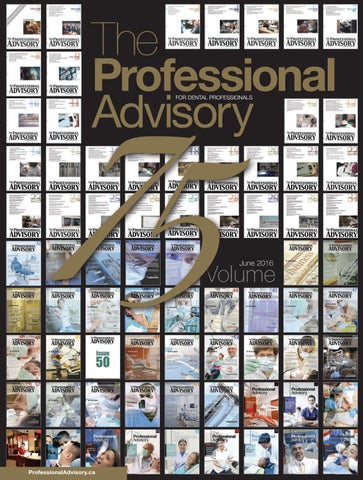
The Professional Advisory
75
75
for Dental Professionals
June 2016
Volume
ProfessionalAdvisory.ca
TPA 75.indd 1
16-05-25 1:35 PM
Contents
3 4
75 GREAT Volumes Ralph Crawford BA., DMD
Patients – Attract and Retain Legal Matters When Selling a Dental Practice
8
Investing To Fund Your Retirement Cash Flow
Colin Ross is a Partner in Professional Practice Sales Ltd. (www. ppsales.com), which specializes in the valuation and sale of dental practices. He can be reached at (905) 472-6000 or 1-888-777-8825 or e-mail at: colin.ross@ppsales.com
David E. Rosenthal BA., LL.B
Mark McNulty BA, CFP®, CM®
What I Have Learned in 30 Years of Lease Negotiation Ian D. Toms B.Sc. (Hons)
12
Ralph Crawford is an Honours Graduate from the University of Manitoba and has enjoyed a varied dental career. Prior to being editor of the Canadian Dental Association Journal from 1989 to 1997, he operated a Winnipeg private practice concurrently with being a clinical instructor at the University of Manitoba. He served as President of both the Manitoba Dental Association and Canadian Dental Association.
Colin Ross MBA
6 10
Biographies
Evolving Dental Practices: A 15-Year Retrospective
David Rosenthal is a senior lawyer whose law practice is devoted to business, corporate and healthcare law for dentists. David advises dentists on a broad range of legal matters, with particular emphasis and legal advice on purchases and sales of practices, corporate reorganizations and professional corporations. David also speaks frequently about such matters, including guest lectures at the faculties of dentistry.
Mark McNulty is President of McNulty Group, a firm responsible for managing $250 million of Ontario dentists’ retirement savings. McNulty Group helps professional families transition from a life of successful practice to a stress-free retirement by using a holistic approach of practice and personal retirement planning. Mark is the author of The Transition Coach 2.0–A Canadian Dentist’s Guide to a Perfect Retirement, and The $6 Million Dentist: Successful Succession in 7 Modules.
Dr. Ron Weintraub
14
Use Your Family to Relieve Your Tax Burden David Chong Yen CPA, CA, CFP Louise Wong CPA, CA, TEP
Ian D. Toms is a nationally recognized real property lease consultant with over 27 years experience. He is considered an authority on tenancy issues, lease features, facilities and technicalities, and the art of tenancy negotiation. Ian has drafted and negotiated thousands of lease arrangements for national retail and medical professional tenants in 16 states and 8 provinces, with a specific emphasis on the GTA. Dr. Ron Weintraub is the founder of Innovative Practice Solutions (IPS) and former owner and founder of Bayview Village Dental Associates and Downtown Dental Associates. He practiced dentistry from 1963-2004 and has consulted on behalf of major dental suppliers, manufacturing companies, as well as individual dental offices for over 20 years. In 2004, Ron gave up clinical practice in order to focus solely on Practice Management. David Chong Yen and his chartered accounting firm currently advise hundreds of dentists and healthcare professionals on tax, estate and financial planning, valuations and accounting. David obtained his Bachelor of Arts degree from the University of Toronto, attained his Chartered Accountant’s Designation while working at an international firm and has subsequently completed the CICA In-Depth Tax Courses.
The Professional Advisory | Vol. 75 June 2016
TPA 75.indd 2
16-05-25 1:35 PM
3
“The Professional Advisory consists of a group of six independent professionals who provide services to the dental profession, each of whom specializes in a different field. They have gathered to keep each other informed of the latest developments relating to the profession, and to produce this publication which is designed to provide expert information and advice solely for dentists and their advisors.”
Notes from the editor:
75 GREAT Volumes
Ralph Crawford BA., DMD
crawford@dccnet.com
T
his particular issue of The Professional Advisory cele- from 10 to 12 pages and again in September 2011, another brates 75 consecutive publications proudly distributed new cover and now 16 pages. In respect to content – and to Ontario dentists since May 2001. That first issue’s opening there have been a total of 511 articles published over 15 years introduction paragraph detailed the The Professional Adviso- – the only change the contributors ever make is to do their very, very best to comply and improve their original intent ry purpose that essentially hasn’t changed a bit in 15 years: What is success to you and your family? While the in, making the point that the world in which you live also answer to this question is uniquely personal and relative requires that you address a host of practice management, to you and yours as individuals, it is probably safe to legal, accounting and tax issues, risk and personal finansay that generally, you need much more than just good cial management, transition planning and retirement clinical skills to achieve your goals and whatever level planning issues, estate and investment issues. Just look how Volume #75 deals with the goals so clearly of success that you seek. Don’t misunderstand; we are not downplaying the absolute importance of good skills. described in the 2001 Volume #1. Ron Weintraub’s Evolving Rather, we are making the point that the world in which Dental Practices: a 15 Year Retrospective certainly deals with you live also requires that you address a host of practice changes in practice over the life of The Professional Advisory management, legal, accounting and tax issues, risk and and Mark McNulty addresses retirement issues with Investing personal financial management, transition planning and To Fund Your Retirement Cash Flow. Taxes were important in retirement planning issues, estate and investment issues, 2001 and still as much today as shown in Use Your Family to Relieve Your Tax Burden by David Chong Yen and Louand so on. Interestingly, of the authors presenting articles in today’s ise Wong. Ian Toms even goes beyond his 15 years with The The Professional Advisory #75, three of them – Ian Toms, Ron Professional Advisory when he describes What I have Weintraub and David Chong Yen – were original authors in Learned In 30 Years Of Lease Negotiation. What about legal that very first publication. Two other contributors – Mark matters? No doubt more complicated than 15 years ago as McNulty and David Rosenthal – were closely associated at David Rosenthal outlines 17 important points to consider the time with two of the original authors Barry McNulty and when dealing with Legal Matters When Selling a Dental PracBarry Spiegel. And contributors Colin Ross and David Lind tice. In his Patients – Attract and Retain, Colin Ross tells readwere closely associated with original author Graham Tuck ers of the major shift in the dental market that has occurred in the past 15 years and how to deal with it. who passed away in 2014. No, 15 years isn’t a great long span of time, but the proCertainly things change over time, even if it’s only 15 years. Statistics tells us that Canada’s population in 2001 was duction of 511 articles by outstanding contributors within 30,007,094 while today it’s over 36,000,000. In 2001 there that period is truly an accomplishment. The good news, as were 7,870 dentists in Ontario and 18,590 in Canada: today we celebrate Volume #75, is that we can look forward to more Ontario can claim almost 9,000 and Canada 21,000. And the and more worthy information that contributes so much dental andsale theoffulfilment of good news thatis life expectancy in 2001 was 80 years age to the success ColinisRoss a Partner in Professional Practice Sales Ltd.of (www.ppsales.com), which within specializes in thepractices valuation and dental practices. can be reached at (905) 472-6000 or 1-888-777-8825 or e-mail at:well-being. colin.ross@ppsales.com personal compared to 84 He today. Like statistics and life expectancy The Professional Advisory has also seen changes, but all for the better. In 2007 Volume #32 changed its cover format and grew Vol. 75 June 2016 | The Professional Advisory
TPA 75.indd 3
16-05-25 1:35 PM
4
Patients – Attract and Retain Colin Ross MBA
T
his is the 75th edition of The Professional Advisory. To mark that milestone, I would like to review a major shift in the dental market that has occurred in the 15 years we have been publishing, and how this change affects practice values and represents significant challenges for ongoing success into the future. The focus of this article is marketing, a very important discipline that is a necessity in today’s dental practices but hardly even existed 15 years ago! We are all aware of the fact that one of the main issues facing Canadian dentists is a shrinking dentist to population ratio. This trend is even more pronounced in urban areas. This has meant a marked increase in competition for patients. 15 years ago, most dentists found or could find a suitable location in a growing area, with not much threat of competition. In those days, locations were not as important, and marketing was generally nonexistent. Patients generally found you due to referrals or convenience. Marketing? What marketing? Marketing, now a very important part of any successful practice, used to be limited to making your patients feel welcome and well treated. You prospered because they referred their family and friends. Due to this increased competition, a changing demographic, and the significant changes in technology (social media, internet, smartphones, Search Engine Optimization (SEO) , etc.), marketing has become extremely important to maintain or grow your patient base. We consider the location of a practice as the first and possibly most important marketing factor that determines potential success. Each location has exposure that may attract patients. This type of patient has chosen your practice based on the convenience of your location. The location can be enhanced with modern signage and a frontage that is inviting. There are some locations that were successful in the past, but are simply deemed unattractive in the current market, and will never attract enough new patients. In these cases, the value is significantly reduced, and dentists may even need to sell the goodwill only and abandon the location. The location alone isn’t adequate to draw enough new
patients to successfully grow a practice. Additionally, the intense marketing from competitive practices means that your current loyal patients are constantly being bombarded with advertising or incentives from competitors to leave your office. This fact not only means that you need to have a strategy to attract patients, but even more important, a strategy to retain your existing patients. If you are fortunate enough to have a practice with consistent new patient flow due to the location, then your marketing plan can focus on patient retention and internal initiatives. If you location isn’t attracting the desired patient flow, you are then forced to implement a comprehensive strategy to ensure that you can both attract and retain patients. In developing a marketing plan, there should be a comprehensive review of your practice, the demographics of your area, and your unique skills. The objective of this is to determine what makes your practice stand out from others, and why a patient would choose to attend your practice and stay for the long term. Marketing consists of internal and external components. The internal component is the most effective, In fact studies have shown that over 70 per cent of new patients flow is from internal referrals. Internal marketing involves all aspects of the patient experience in your practice. Your entire team should embrace the philosophy that you establish. Your patients should be aware that you would like to also treat their friends and family. It is incredible how rarely we ask for referrals. If someone has a good experience, they want to share it, but you have to ask them to tell their friends. If they have a bad experience, they’ll share it on their own!
The Professional Advisory | Vol. 75 June 2016
TPA 75.indd 4
16-05-25 1:35 PM
5
External marketing includes advertising, web sites, search engine optimization, direct mailings, etc. This form of marketing is sometimes more expensive and the results vary. Some marketing produces excellent results, and some produces nothing. Most dentists are not experts in marketing. There are marketing firms dedicated to helping dentists spend their marketing dollars wisely. We recommend you consider retaining a marketing expert to assist in getting your message out to the right audience. No matter what form of marketing that you choose, there are key elements that must be considered; focus on a message that is believable and shared by all of your staff members. Staff should be properly trained to ensure that patients are being well treated and messages are consistent. Marketing should also focus on patients education, and not be focused on the features of your office, but should focus on the benefits. One of the newest forms of marketing is online, web based, or social media marketing. When we consider that Google has only been around for 17 years, it is clear that these forms of online marketing and technology are relatively young and evolving rapidly. Minimally, your marketing plan should include a mobile device optimized website, and may also include social media, search engine optimization, and/or e-mail programs to connect with your patient base. Marketing has now become a critically important part of a dental practice’s operating budget. The plan must be well thought out and consistently applied. Despite increased competition and the substantial increase in marketing activities, practice values are still climbing. However, we also see that there is a widening gap between practices with a good location and good marketing plan versus practices in a questionable location with no marketing plan. In order to ensure long term prosperity, make sure your practice falls into the first category.
We consider the location of a practice as the first and possibly most important marketing factor that determines potential success.
Please send comments to
David Lind is a Principal and Broker of Record in Professional Practice Sales Ltd. (www.ppsales.com), which specializes in the valuation and sale of dental practices. He can be reached at (905) 472-6000 or 1-888-777-8825 or e-mail at: david.lind@ppsales.com
Vol. 75 June 2016 | The Professional Advisory
TPA 75.indd 5
16-05-25 1:35 PM
6
Legal Matters When Selling a Dental Practice David E. Rosenthal BA., LL.B.
I
n May the Ontario Dental Association held a day long seminar at the Annual Spring Meeting in Toronto regarding transitioning out of a dental practice. I was one of the speakers and discussed legal matters when selling a dental practice. My handout included a checklist of legal matters to consider when selling a dental practice. Such checklist, together with the handouts by the other speakers, provide excellent learning resources for dentists. Outlined below is a checklist of some of the legal matters to consider when selling a dental practice.
1. Retain an industry recognized professional
2. 3.
4. 5. 6.
7.
8.
appraiser to conduct a detailed appraisal and valuation of your practice Determine what you are selling – shares or assets Review the appraisal carefully with your accountant to determine the allocation of purchase price and to assist in finalizing the purchase price Understand the tax effects of the allocation of purchase price to different asset classes if selling assets If you have an existing dentistry professional corporation, ensure the minute book and corporate filings are current If you do not have an existing dentistry professional corporation, consider forming such a corporation before closing and sell shares to take advantage of the capital gains exemption Review your cost share agreement or partnership agreement, if applicable, and determine if you are required to first offer to sell your practice to your cost sharers or partners Understand your rights and obligations (and purchaser rights and obligations) in the definitive legal purchase and sale agreement including, in particular, any post closing vendor liabilities
9. Review your existing arrangements with the
current associates working at your practice, including: a. D o proper written agreements exist b. Are associates bound by non-solicitation and non-competition covenants c. Can the associate agreements be transferred to the purchaser? 10. Carefully review your premises lease to determine: a. The term of lease is at least 10 years, including renewal options (the purchaser and purchaser bank will typically require 10 years) b. For the options to renew the lease, is rent to be fair market rent as mutually agreed by the landlord and tenant or failing agreement by arbitration c. W hat ‘danger’ clauses exist in the lease including: i. relocation – landlord right to relocate the practice within the building or plaza ii. demolition – landlord right to terminate the lease early if building to be demolished or substantially renovated iii. termination - landlord right to terminate lease when vendor sells the practice and requests landlord consent to transfer lease to purchaser iv. vendor liability after sale of practice – typically leases do not release the vendor from obligations under the lease even on a practice sale d. When negotiating the next renewal term with your
The Professional Advisory | Vol. 75 June 2016
TPA 75.indd 6
16-05-25 1:35 PM
7
11.
12.
13.
14.
15.
16.
17.
landlord, as part of that renewal process include making changes to the premises that will enhance the value of the practice and limit vendor liability after sale Review your equipment leases to determine early buyout rights and penalties (purchasers typically expect to acquire all assets free and clear of any lease obligations) Carefully review all staff arrangements you have, including: a. Do proper written agreement exist for all staff, whether dental hygienists, chairside assistants and others working at the practice b. Is notice to terminate an employee limited to Employment Standards Act (Ontario) minimums or does common law extended notice periods apply Introduce proper written agreements with all staff at least two years before a sale if you have only verbal agreements with your staff Determine if purchaser will retain all staff after closing and on what terms: a. Understand vendor legal obligations regarding staff after closing b. Typically if a purchaser terminates any staff after closing, the vendor is required to pay half of the staff termination costs for three months after the closing date Understand that the purchaser will require the vendor not to solicit patients after closing and not to compete with the purchaser within a defined geographic distance for a certain time period after closing Consider whether you wish to remain as an associate after closing and on what terms and conditions; typically a vendor can expect to be paid 45 per cent (not 40 per cent) of Collected Billings Hire industry recognized professional advisors who focus on advising dentists in transitioning and selling dental practices
Consider whether you wish to remain as an associate after closing and on what terms and conditions
Please send comments to
David Rosenthal is a senior lawyer with Spiegel Rosenthal Professional Corporation whose practice is devoted to corporate, commercial and business law, with special emphasis on advising dentists. He can be reached at (416) 865-0736 or e-mail to david@drlaw.ca.
Vol. 75 June 2016 | The Professional Advisory
TPA 75.indd 7
16-05-25 1:35 PM
8
Investing To Fund Your Retirement Cash Flow Mark McNulty BA, CFP®, CIM®
T
he following is an excerpt from Module Six of Mark McNulty’s new book, The $6 Million Dentist: Successful Succession in 8 Modules Each prior module in this guide dealt with important decisions you eventually must make on your way to a successful retirement, such as: 1. 2. 3. 4.
It would appear you would have been better off investing in the stock market, the S&P/TSX Index – XIU, with its average annual return of 8.06 per cent rather than the bond market, the Bond Index – XBB, with 6.16 per cent. However, now look at the second chart below. If you had invested $100,000 in both securities and started withdrawing 8 percent of the portfolio annually, you actually would have been better off in the bond market, XBB. After 10 years, the value of the portfolio invested in bonds is higher by $21,427. How is this possible? If your portfolio declines and you withdraw money, there are fewer dollars available to participate in the recovery. The charts illustrate two important points that should be the foundation of your investment strategy:
When you’re going to sell your practice How you’re going to sell your practice What you can spend in retirement Which accounts you’re going to draw on to fund your retirement cash flow.
This module is where it all comes together. You’re ready to implement “the plan” of how you’ll invest your nest egg money to generate the cash flow you’ll need to enjoy the rest of your life. In order for your nest egg to outpace inflation, you’ll need exposure to the stock market. Other types of investments such as bonds, GICs, and annuities are simply paying too little to keep pace with inflation. Since you’ll have no choice but to be exposed to the stock market, let’s begin this module by looking at some specific ways to mitigate the risks of this type of investment.
Sequence of return risk Even if your investments provide a good, long-term average return, the order in which those returns are received annually can have a negative effect. This is called sequence of return risk. To understand this concept, take a look at the chart below.
2001 2002 S&P/TSX (14.90%) (14.00%) Index - XIU Bond Index – 5.80% 9.80% XBB
1. Investing at this stage is not about getting the best return, it’s about getting the most consistent return. 2. The greatest risk you face isn’t that the stock market will decline, but that the stock market will decline and you’ll need to sell to fund your retirement.
2003
2004
2005
2006
25.30%
13.60%
26.10%
18.90%
6.20%
8.10%
6.10%
3.70%
2007
2008
2009
2010
Average
11.00% (31.17%)
31.94%
13.84%
8.06%
3.30%
5.41%
6.74%
6.16%
6.41%
The Professional Advisory | Vol. 75 June 2016
TPA 75.indd 8
16-05-25 1:35 PM
9 two important points that should be the foundation of your investment strategy
Stocks XIU
Year
Bonds XBB
Annual Return
Portfolio Value at Dec 31st
Annual Return
Portfolio Value at Dec 31st
$100,000
$100,000
2001
-14.90%
$77,100
5.80%
$97,800
2002
-14.00%
$58,306
9.80%
$99,384
2003
25.30%
$65,057
6.20%
$97,546
2004
13.60%
$65,905
8.10%
$97,447
2005
26.10%
$75,106
6.10%
$95,392
2006
18.90%
$81,302
3.70%
$90,921
2007
11.00%
$ 82,245
3.30%
$85,922
2008
-31.17%
$ 48,609
6.41%
$83,429
2009
31.94%
$56,135
5.41%
$79,943
2010
13.84%
$55,904
6.74%
$77,331
Better off
$21,427
The Four-Year Rolling Reserve Another way to mitigate the negatives of being in the stock market is a solution we came up with at McNulty Group called the Four-Year Rolling Reserve. We looked at the rolling annual returns of various stock markets since 1950. By rolling annual returns we mean, for example, January 1, 1950 to January 1, 1951; January 2, 1950 to January 2, 1951, etc. If we continue this sequence of annual rolling returns until Dec 31, 1952 to Dec 31, 1953, we have just one of the many four-year periods of rolling annual returns from 1950 to the present day. If we examine this period, we find there were many corrections and crashes but that, most significantly, only a small percentage of time did the various stock markets remain in a negative position for more than four years. What does this mean? If you ensure that sufficient money
for four years is set aside in low risk, liquid assets in the accounts where your retirement money is to come from (as discussed in a previous module), you can lessen the risk you’ll retire during a bear stock market. Granted, you’ll earn very little interest on the money set aside in money markets or short-term bonds for those four years. However, we consider this lost earning ability as an insurance premium, and we always have funds for the retirement paycheque.
In summary All in all, when it comes to the strategies for managing your retirement income you must be prepared to work with your financial advisor to make the best decisions for your future. If the strategies you choose aren’t a good fit with your lifestyle, they simply won’t work out in the long term – and the long term is what you need to start focusing on now.
Feedback can be sent to info@mcnultygroup.ca
Mark is President of McNulty Group, a firm responsible for $250 million of Ontario dentists’ retirement savings. McNulty Group helps professional families transition from a life of successful practice to a stress-free retirement by using a holistic approach of practice and personal retirement planning. In addition to multiple television and radio appearances, Mark is the author of The Transition Coach 2.0–A Canadian Dentist’s Guide to a Perfect Retirement and The $6 Million Dentist: Successful Succession in 7 Modules.
Vol. 75 June 2016 | The Professional Advisory
TPA 75.indd 9
16-05-25 1:35 PM
10
What I Have Learned in 30 Years of Lease Negotiation
Ian D. Toms B.Sc. (Hons)
W
riting the 75th article for this publication gives me cause to pause and reflect. There have been 75 articles for The Professional Advisory alone and countless other articles and presentations. Plus 30 years of lease negotiation. Thousands and thousands of lease negotiations from Hawaii to Alaska, Newfoundland, Rhode Island, Florida, New Mexico to California and many places in between. All this as well as 10 years negotiating and living with leases for my own retail tenancies from Sudbury to Kingston. I have the scars to prove it. I’ve learned a few things over the years. That’s why I do what I do. My experience is available to you so you do not make the costly mistakes that I made, or have seen others make. Based on my experience, here are the top five rules of thumb when it comes to managing your premises lease. 1. Don’t forget about your lease. For some reason most tenants do not pay any attention to their lease and often wait until a crisis occurs. Most tenants don’t know what their lease says or means, or even where their lease is! Remember, your lease controls amongst other things: a. your ability to sell your practice and retire, your ability to market your practice through signage, b. the ability for your patients to access your practice through parking and hours of operation, c. your ability to finance your practice, d. your practice profitability, e. what you can practice within the premises, and f. who you can share your premises with.
These are key issues concerning the very foundation of your practice! You need to be aware of what your lease says and how it works; those who fail to plan, plan to fail. Get your lease reviewed and become familiar with the fundamental terms, conditions and opportunities. Look for what’s there, and what could be there.
2. Choose who should manage your lease affairs carefully.
a. Do not negotiate your lease yourself. What you don’t know can and will hurt you. You wouldn’t hire a lease consultant, lawyer or a realtor to treat your oral health! b. Pay your representative to represent YOU, not themselves. i. Do not retain someone to represent your interest who is paid by the landlord, because that person is in a direct conflict of interest. Their incentive is to convince you to pay as much rent as possible because they are paid a percentage of rent. ii. Do not retain someone who charges an up-front flat fee, because that person is in a conflict of interest. Their incentive is to complete your file with minimum effort so that they – not you – make as much money as possible. c. Do not retain someone who does not have extensive personal experience. Even if the company they work for has experience, it’s the person, not the company, who will be doing the talking. The person representing you has to be able to walk the talk. Choose someone to represent you who is working for YOU, has extensive personal experience, and who bases their fees on a cost: benefit basis.
The Professional Advisory | Vol. 75 June 2016
TPA 75.indd 10
16-05-25 1:35 PM
11
3. Look for the positive. Being a tenant has certain advantages you need to keep in mind. Tenants generally spend a lot of time and energy complaining about what they don’t have and what they wished their landlord would do, often at the expense of realizing that there are opportunities as a tenant if you look for them. For example: a. With low interest rates, landlords are often looking for an opportunity to finance tenant improvements and will do so if terms and conditions permit. So instead of complaining about a high rental rate, ask for an allowance that makes the higher rental rate rational. b. Your capital is not tied up in a property, you can pack up and leave, and you enjoy the synergy of being one of many tenants. If you own a property, you are stuck with a large capital investment, you can’t leave, and you may be “off by yourself”. 4. If you don’t ask, you won’t get. If your representative has enough experience, they can quickly develop alternatives that will turn a negative situation into a positive. But your representative has to know what to ask for. 5. Time passes quickly. Let time negotiate for you. Your lease is a static document that controls a dynamic process – your tenancy. If you play your cards right, you can benefit in a negotiation by using passage of time to “get what you want”. Often, landlords will agree to something you really want if it doesn’t kick in right away.
I have enjoyed sharing 75 articles with you through The Professional Advisory and hope to share 75 more!
Still, after all of these years, I look forward to each day, each opportunity to resolve an issue and help a client become more successful. Recently a client emailed the following which summarizes why I do what I do: “It was my pleasure to work with you in negotiating my lease renewal. Your professionalism and diligence allowed me a beneficial lease arrangement that should take me to the end of my career. I also know that my landlord felt very comfortable working with you”. Please send comments to
Mr. Toms is president and Broker of Record of Realty Lease Consultants Inc. He has been creating and preserving realty leasehold value since 1986 and can be reached at (705) 743-1220, by e-mail at ian@realtyleaseconsultant.com, or through his web site at: www.realtyleaseconsultant.com.
Vol. 75 June 2016 | The Professional Advisory
TPA 75.indd 11
16-05-25 1:35 PM
12
Evolving Dental Practices: A 15-Year Retrospective
S
ome routine dental practices have been evolving over the past that are apparent to even casual observers. Many of the changes have been beneficial and others potentially less so. A few of the obvious changes over the last 15 years of the existence of The Professional Advisory listed below deserve our attention.
Dr. Ron Weintraub
Changes in the Physical Environment The future role of the former operator/owner dentist is usually prescribed in the legal Agreement of Purchase and Sale. Questions pertinent to establishing their involvement include the following: 1. Significant increase in the number and type of dental offices; 2. Proliferation of the large multi-provider practices; 3. On-going changes in the previous relationship between the general practitioner and the supporting certified specialists some of which fall under the beneficial while others fall under the detrimental categories; 4. The shifting to a new team approach to the patient experience of those attending their dental offices; for example, engaging with a treatment coordinator and an administration including greeters, dismissers, and recare coordinators--all with more emphasis than formerly on customer/patient service issues; 5. More welcoming reception areas containing beverage stations to make the patient experience a little friendlier and less stressful; 6. Increased recognition of each team member as an important element in maintaining and servicing the patient base; 7. Acknowledgment of the desirability of having practices located at ground level or store front as opposed to being hidden inside large office facilities; 8. The obligatory website to inform potential patients of the team and the working philosophy of the particular office they are contemplating attending; 9. Increased availability of dental services on evening and weekends when some patients can only present for treatment.
Positive Clinical Operational Advances In addition to administrative changes, there have been a number of positive clinical advances over the last 15 years: 1. The growing realization by both the public and allied medical community of the importance oral health plays in the general systemic well being of the population. This has resulted in a growing segment of the public who regularly attend dental facilities. The increased focus of dental practices on prevention and biologic intervention as opposed to the preoccupation some of us previously had with the esthetic component of dental service despite its significant importance; 2. Increased availability and use of extramural continuing education studies; 3. Increased ability to replicate an intact dentition by using implant supported prosthesis, where applicable, without having to compromise healthy tooth tissue as much as it had previously with conventional crown and bridge therapy; 4. Heightened use of digital radiography and CAT scanning allowing more benign access to the boney substrate of the areas that we must diagnose and restore; 5. The efficiency of instantaneously transferring information and reports and actual radiographic evidence to other support sources has also been a benefit. These innovations are only a few of many observable positive directions of which dental offices seem to be taking. In contrast, there are some negative directions I subjectively have observed.
The Professional Advisory | Vol. 75 June 2016
TPA 75.indd 12
16-05-25 1:35 PM
13
Commercialization Of Some Contemporary Dental Practices Change is a constant in life and dental practice. The challenge is to adapt successfully to the new realities presented without compromising the integrity and positivity of what has been historically perceived as professional practice. Undoubtedly, the landscape has changed; however, the bedrock principles that have underpinned our profession are still viable and productive of success. Ironically, at a time when dental treatment is getting long overdue recognition for the vigorous biologic health discipline that it is, a competing narrative I subjectively call “commercialization” has been accelerating over the past 15 years, such as the following: 1. The growth of third party ownership putting the office under significant control of office and area managers who may attempt to implement standard operating protocols for managerial control purposes without necessarily focusing on the particular needs of that specific patient base; 2. The inevitable danger of depersonalizing the patient experience by allocating appointments to different providers at successive appointments thereby making a trusting clinical relationship more difficult; 3. The many practitioners who see themselves in a competitive mode rather than seeing other dentists as conferrers; 4. The apparent trend towards advertising and promotion: • Promoting the dental office with large signs and pictures (often the same beautiful people) ostensibly patients of the office seem to place dental offices in the same general perception as spas; • Advertising free exams, free tooth whitening, sometimes prominently in the window, sending a dubious message;
Change is a constant in life and dental practice.
• Rewarding existing patient referrers with what seems like an excessively costly thank you token can appear to be seen as bribery; alternatively, donating to referrers’ favorite charity could be greatly appreciated and stimulate as many referrals; 5. The seemingly increasing proclivity of having the hygienist be the principle professional in the new patient experience (NPE) to the detriment of the dentist’s ability to initiate a personal clinical relationship; 6. The attempt to retain the majority of specialist treatments in-house by the generalist, thereby denying some of the benefits that highly trained specialists can offer. While those of us in the dental profession have much to be proud of, the progress of the past 15 years behooves us to evaluate some of the compromises we may have felt necessary in order to accommodate the seismic changes in patient demographics and expectations.
Please send comments to
Ron Weintraub is a founding partner with the Bayview Village & Downtown Dental Associates and brings over thirty-five years of knowledge and experience in the practice of general dentistry to The Professional Advisory. Large companies such as Patterson Dental, Ash Temple Ltd, Henry Schein Arcona, & the former Canadian Dental Co. have benefited from his insight. As owner of Innovative Practice Solutions, Ron advises dentists on practice enhancement, practice purchases, sales, location evaluations, associate buy-ins, and business mergers. Dr. Weintraub can be contacted at (905) 470-6222 Ext. 221 or drronips@rogers.com.
Vol. 75 June 2016 | The Professional Advisory
TPA 75.indd 13
16-05-25 1:35 PM
14
Use Your Family to Relieve Your Tax Burden David Chong Yen CPA, CA, CFP Louise Wong CPA, CA, TEP
F
or high income earners such as dentists, taxes can be the single largest expense you have. With the help of your family, and the strategies listed, you could save enough money to take the family out for a vacation or purchase a new family car. Pay your family members a salary or dividends
A single person earning $160,000 per year will pay more tax than two people who earn $80,000 each and significantly more than four people earning $40,000 each. This tax savings has been increased due to the 2015 new legislative proposal which reduced the 2016 tax rates on personal taxable income between $45,282 – $90,563. By paying a reasonable salary and/or dividends to your spouse, parents and children over 18 who are shareholders, not only is the tax burden shared among multiple people, but the burden itself is significantly reduced. In many cases, the savings could be tens of thousands of dollars. In order to receive dividends, one must be a shareholder of a corporation. Hence, a corporation is needed in order to pay a dividend. Pay other family members to watch your children
Not everyone can be a shareholder of your professional corporation, however most family members (>17) can be a babysitter. Consider paying a niece, nephew, parent in-law, brother or sister with little or no income to babysit your children. Depending on your earned incomes (e.g., salary), either you or your spouse would claim a childcare expense deduction and the babysitter would report the income. The maximum child care expense that can be claimed is $8,000 per child under seven years old and $5,000 per child between 7-16 years old. If the babysitter has little to no income, this may result in tax savings of up to a few thousand dollars.
Setup a Technical Service Corporation/Hygiene Service Corporation (TSC/HSC)
Professional Corporation (PC) shareholder rules prevent you from using other low income family members such as your siblings and in-laws from being part of the tax savings game. A TSC/HSC does not fall under the same rules and may be worthwhile if your practice has income (revenues minus expenses) over $500,000 and has a strong hygiene program or technical component (lab, x-ray services etc.). The proposals in the 2016 Federal Budget could add some risk to this maneuver. Invest in a Registered Education Saving Plan (RESP) for your children
Tax rules prevent you from saving taxes by paying minor children (under 18) dividends. However, you can still use them in the tax savings game. By investing in a RESP, you will be able to save for their future education while savings taxes. All grants and investment income earned in the RESP will be taxed in your children’s hands when they withdraw from the RESP. Many students have little to no income which means very little if any taxes upon withdrawal. You are able to save for your children’s education while avoiding taxes on the investment returns. Invest in appreciating assets for your children
Many dentists want to give their children a head start by investing in their children’s names. Few dentists know that special tax rules force investment income earned in your minor children’s name to be taxed in your hands. Even fewer know
The Professional Advisory | Vol. 75 June 2016
TPA 75.indd 14
16-05-25 1:35 PM
15
that these rules don’t apply to most capital gains. Instead of investing in assets that pay interest or dividends for your children, consider investing in assets which will appreciate and produce capital gains which will be taxed in your children’s hands. For example, instead of saving bonds for your children, invest in some stocks and equities that will produce a capital gain/rise in value. Invest in a spousal RRSP
Taking a million dollars from your RRSP when you are 71 means you will face a very high tax bill even in retirement. Instead, contribute to a spousal RRSP so that upon retirement both you and your spouse will only have to withdraw $500,000 each in your RRSPs. This will reduce your tax burden in retirement and may preserve your old age security benefits leaving you with more money. If it is too late to contribute to a spousal RRSP, you can still split the pension income with your spouse. Your spouse could report up to 50 per cent of your RRSP/RRIF withdrawal/pension in their name while you receive a tax deduction. Pay your family’s bills and invest the rest
It may seem unfair, but if you are the highest earning member of your household, you should pay all the personal bills. The income saved by the other members of household should then be invested so that any investment income is taxed at lower rates in their hands instead of yours.
A single person earning $160,000 per year will pay more tax than two people who earn $80,000 each and significantly more than four people earning $40,000 each.
Taking on the burden of taxes by yourself will lead to financial hardship, stress and less personal time to spend with your family. Working more hours to pay off your tax bills can become a vicious cycle as the more you earn, the more taxes you pay. Instead, share the burden with your family and reap the rewards of your hard work together. It never ceases to amaze us the lengths a dentist will go to in order to save a few pennies. But, we often see dentists paying thousands more in taxes than they should with proper tax planning. Please send comments to
This article was prepared by David Chong Yen, CPA, CA, CFP and Louise Wong, CPA, CA, TEP of DCY Professional Corporation Chartered Accountants who are tax specialists and have been advising dentists for decades. Additional information can be obtained by phone (416) 510-8888, fax (416) 510-2699, or e-mail david@dcy.ca / louise@dcy.ca. Visit our website at www.dcy.ca. This article is intended to present tax saving and planning ideas, and is not intended to replace professional advice.
Vol. 75 June 2016 | The Professional Advisory
TPA 75.indd 15
16-05-25 1:35 PM
Advisory TheProfessional Advisory FOR DENTAL PROFESSIONALS
The Professional Advisory
63
FOR DENTAL PROFFESSIONALS
VOL. 63 February 2014
Progressus – a going forward, advance
Visit our website at www.professionaladvisory.ca to view current issue and complete archives.
ProfessionalAdvisory.ca
TPA 63.indd 1
14-01-31 1:52 PM
Left to right: David Rosenthal, BA., LL.B. Spiegel Rosenthal Professional Corporation Barristers and Solicitors Ron Weintraub, DDS Innovative Practice Solutions David Lind Principal, Broker of Record Professional Practice Sales Ltd. Ian D. Toms, B.Sc. (Hons) Broker of Record Realty Lease Consultants Inc. Mark McNulty, BA, CFP, CIM Director, Private Client Group McNulty Group, HollisWealth David Chong Yen, CPA, CA, CFP DCY Professional Corporation Chartered Accountants
TPA 75.indd 16 TPA_FP.indd 1
16-05-25 1:35 PM 14-03-26 3:56 PM