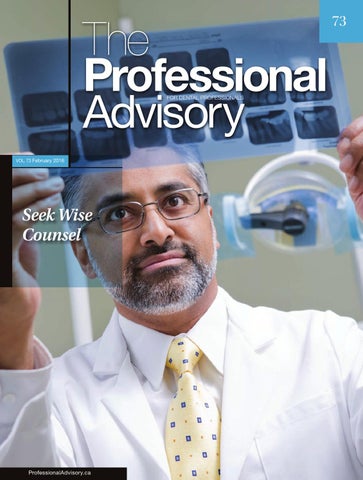
The Professional Advisory FOR DENTAL PROFESSIONALS
VOL. 73 February 2016
Seek Wise Counsel
ProfessionalAdvisory.ca
73
Contents
3 4 6 8
Seek Wise Counsel Ralph Crawford BA., DMD
The Coming Bond Crisis
Mark McNulty BA, CFP®, CM®
Detecting Rent Rip Off Ian D. Toms B.Sc. (Hons)
Geriatric Oral Health Care: A Challenge and an Opportunity to Private Practice Dr. Ron Weintraub
10
Interest: Good, Bad and Ugly Side of Debt
12
Is There a Buyer for Every Practice?
14
2016 Tax Increases – Corporations Revisited
David Chong Yen CPA, CA, CFP Louise Wong CPA, CA, TEP
Colin Ross MBA
David E. Rosenthal BA., LL.B
Biographies Ralph Crawford is an Honours Graduate from the University of Manitoba and has enjoyed a varied dental career. Prior to being editor of the Canadian Dental Association Journal from 1989 to 1997, he operated a Winnipeg private practice concurrently with being a clinical instructor at the University of Manitoba. He served as President of both the Manitoba Dental Association and Canadian Dental Association. Mark McNulty is President of McNulty Group, a firm responsible for managing $250 million of Ontario dentists’ retirement savings. McNulty Group helps professional families transition from a life of successful practice to a stress-free retirement by using a holistic approach of practice and personal retirement planning. Mark is the author of The Transition Coach 2.0–A Canadian Dentist’s Guide to a Perfect Retirement, and The $6 Million Dentist: Successful Succession in 7 Modules. Ian D. Toms is a nationally recognized real property lease consultant with over 27 years experience. He is considered an authority on tenancy issues, lease features, facilities and technicalities, and the art of tenancy negotiation. Ian has drafted and negotiated thousands of lease arrangements for national retail and medical professional tenants in 16 states and 8 provinces, with a specific emphasis on the GTA.
Dr. Ron Weintraub is the founder of Innovative Practice Solutions (IPS) and former owner and founder of Bayview Village Dental Associates and Downtown Dental Associates. He practiced dentistry from 1963-2004 and has consulted on behalf of major dental suppliers, manufacturing companies, as well as individual dental offices for over 20 years. In 2004, Ron gave up clinical practice in order to focus solely on Practice Management. David Chong Yen and his chartered accounting firm currently advise hundreds of dentists and healthcare professionals on tax, estate and financial planning, valuations and accounting. David obtained his Bachelor of Arts degree from the University of Toronto, attained his Chartered Accountant’s Designation while working at an international firm and has subsequently completed the CICA In-Depth Tax Courses.
Colin Ross is a Partner in Professional Practice Sales Ltd. (www. ppsales.com), which specializes in the valuation and sale of dental practices. He can be reached at (905) 472-6000 or 1-888-777-8825 or e-mail at: colin.ross@ppsales.com
David Rosenthal is a senior lawyer whose law practice is devoted to business, corporate and healthcare law for dentists. David advises dentists on a broad range of legal matters, with particular emphasis and legal advice on purchases and sales of practices, corporate reorganizations and professional corporations. David also speaks frequently about such matters, including guest lectures at the faculties of dentistry. The Professional Advisory | VOL. 73 February 2016
“The Professional Advisory consists of a group of six independent professionals who provide services to the dental profession, each of whom specializes in a different field. They have gathered to keep each other informed of the latest developments relating to the profession, and to produce this publication which is designed to provide expert information and advice solely for dentists and their advisors.”
3
Notes from the editor:
Seek Wise Counsel Ralph Crawford BA., DMD crawford@dccnet.com
J
ust prior to the holidays in mid-December we attended sel concludes that given the willingness on both sides to ada magnificent Christmas concert that featured an out- just and adapt, there is very likely a buyer for every practice. standing men’s choir and a military band. The event certain- And how about taxes? In his article, David Rosenthal’s wise ly helped in preparing us for the meaning of Christmas and counsel undertakes 2016 Tax Increases – Corporations Rethe joy that the holiday event brings to participants each and visited and emphasises that careful planning is required to ensure best results. every year. Who today isn’t paying interest? Very few we’re sure. DaThe concert was held in a large community church that accommodated the crowd that filled every pew. Having ar- vid Chong Yen and Louise Wong deal with Interest: Good, rived quite early to get a good seat, and not being familiar Bad and Ugly Side of Debt and their wise counsel clearly with the church, I had time to rustle through the bible, hym- shows how managing finances and debt repayment allows nary and papers that rested in a shelf on the back of the pew dentists to control debt. Mark McNulty deals with The Comin front of us. One small paper, that focused on “giving”, had ing Bond Crisis and his wise counsel outlines competently on the back a list of “Timeless Tips from the Bible”. One tip far that today when bond markets are facing largely unknown down the list immediately caught my eye: Seek wise counsel and unquantifiable risks, it isn’t worth the risk of capital when you prepare to invest your money (Proverbs 15:22). Ar- to maintain exposure to traditional bonds or bond trusts. riving home with the counsel words still rattling in my head Detecting Rent Rip Off! How many dentists are aware that – and not being very familiar with the Bible – I took time to such a matter may be affecting their premises? Ian Toms lists seek out what was actually written. And there it was in Prov- four specific examples of rent overcharge and it’s his wise erbs 15:22: Without counsel purposes are disappointed: but in counsel that clearly guides how to be aware of them and how the multitude of counselors they are established. The church to deal with the potential problem. Yes, the Christmas choir presentation was exceptional encertainly knew what was involved when asking people what tertainment and helped prepare the entire audience for anto consider when “giving”. Upon reflecting on all the different aspects that make up a other memorable holiday time with family and friends. But dental practice – patients, treatment, staff, equipment, sup- the adaptation of Seek Wise Counsel When You Prepare to Inplies, premises, budgets – just to name a few – it’s little won- vest Your Money was unexpected and only emphasized what der that one of the most important things for every dentist to we all know to be true. It’s that wise counsel that The Profesdo is seek wise counsel. That is precisely what The Profession- sional Advisory strives for in every publication. Read on. al Advisory is set up to do. In issue after issue, it provides the wise counsel that is so important towards making any dental practice a success. Consider Canada’s Practice growingSales senior popColin Ross is a Partner in Professional Ltd. (www.ppsales.com), which specializes in the valuation and sale of dental He can be reached at (905) 472-6000 or 1-888-777-8825 ulation.practices. Ron Weintraub’s Geriatric Oral Heal Care outlines or e-mail at: colin.ross@ppsales.com his wise counsel regarding the potential benefits of a dental practice that includes a geriatric focus. Colin Ross raises the question, Is There a Buyer for Every Practice? His wise counVOL. 73 February 2016 | The Professional Advisory
4
The Coming Bond Crisis Mark McNulty BA, CFP®, CIM®
W
e recently moved our fixed income portfolios to a near zero-risk position. We believe there is the potential for a significant sell off in the bond market – a market many investors consider a safe part of their investment portfolio. The following is our rationale:
RISING INTEREST RATES In December, the US Federal Reserve raised its benchmark rate by 25 basis points for the first time in nine years, ushering in a new rate-tightening cycle. The last time the Fed raised rates was in July 2006. Following the 2007 debt and housing crisis in the United States, the Fed lowered its rate to zero, where it has been since December 2008. Given that this has been the longest period of time between rate hikes on record, we are in some ways entering unchartered territory. Historically, rising interest rates have been bad for bond prices – when rates go up, bond prices go down. However, since we are in unchartered territory, we just don’t know how much bond prices can decline.
INCREASED RISK IN BOND FUNDS AND EXCHANGE TRADED FUNDS (ETFS) In this era of very low interest rates, bond fund managers have had a very difficult time producing satisfactory returns to unitholders. In order to increase returns, managers have been increasing maturities to get higher long term yields or going down the food chain to lower quality bonds, both of which increase the risk profile of the funds. There are billions of dollars invested in bond funds. Investors in these funds may not realize how much risk they have taken on. When prices do start declining, investors may quickly realize this is not a safe part of their portfolio and begin panic selling. Bond prices are similar to residential real estate in some respects. When your neighbour sells their The Professional Advisory | VOL. 73 February 2016
house at a “fire sale” price, your house is now worth that fire sale price as well. The abnormalities in today’s bond market are illustrated by a couple of real-world examples of how demand for yield has exceeded a rational assessment of risk. A 15-year, 7.5 per cent Russian Federation bond, trades at a yield of only 3.6 per cent, while an 8.25 per cent Republic of Lebanon, 6-year bond trades at a yield of 5.6 per cent. These compare, for example, to a ten-year IBM bond that trades at a yield of 3.5 per cent. Russia and Lebanon do not represent stable, economically sound debtors, so it is quite surprising their bonds trade at prices providing yields close to those of IBM bonds. And yet the search for yield, anywhere in the world, is in high demand.
POOR LIQUIDITY In addition to quality risk, liquidity in the bond market has become a major concern for traders. Many sectors, particularly resource companies and small caps, have been unable to raise capital by issuing bonds. This has reduced the available supply of bonds, resulting in higher prices, lower yields and less liquidity, as managers hold their positions longer. Liquidity dries up, bond spreads widen and any selling pressure exacerbates falling prices. We have already seen some smaller bond funds ban redemptions on their funds, most notably Third Avenue in the U.S. Third Avenue Management told investors in one of their mutual funds this past week that
5
they would be blocking redemptions from the fund. While Third Avenue is a distressed debt niche player, rather than a traditional bond fund, the mechanics of the outcome could affect any bond fund that runs into liquidity problems.
IN CONCLUSION Rising interest rates normally result in declining bond prices. This is evident by the negative returns shown this year by bond ETFs. If rising rates persist, returns decline and investors get nervous, redemption requests of bond funds will increase. This may force bond fund managers to sell longer term bonds and lower quality bonds into a declining market, significantly affecting net asset values. If negative sentiment persists and redemption requests mount, bond funds may reach the point where they freeze redemptions in an attempt to orderly wind down the fund. Our portfolio stance is that going into this new rising rate cycle, when bond markets are facing largely unknown and unquantifiable risks, it is not worth the risk of capital to maintain exposure to traditional bonds or bond funds.
Bond prices are similar to residential real estate in some respects. When your neighbor sells their house at a “fire sale” price, your house is now worth that fire sale price as well.
Feedback can be sent to info@mcnultygroup.ca
Mark is President of McNulty Group, a firm responsible for $250 million of Ontario dentists’ retirement savings. McNulty Group helps professional families transition from a life of successful practice to a stress-free retirement by using a holistic approach of practice and personal retirement planning. In addition to multiple television and radio appearances, Mark is the author of The Transition Coach 2.0–A Canadian Dentist’s Guide to a Perfect Retirement and The $6 Million Dentist: Successful Succession in 7 Modules.
VOL. 73 February 2016 | The Professional Advisory
6
Detecting Rent Rip Off Ian D. Toms B.Sc. (Hons)
I
f you do not check to make sure you are only paying the rent you agreed to pay for, who will? Do you think the landlord will check to make sure you are not overcharged? Consider the following examples of rent overcharge. 1. Check each additional rent cost.
a) Does each cost make sense? We reviewed a lease and an additional rent statement, which showed an unusually high common area cost. In particular, the cost of water was very high. It turned out that one tenant in the plaza, a florist, happily connected his coolers to the water supply for the plaza. So in fact, each tenant in the plaza was paying a share of the florists water use, and had been for several years. We negotiated a settlement on behalf of our client which cleared the overcharge and prevented such charges in the future, saving him $16,855.81. b) Are any costs extraordinary? One additional rent statement we reviewed for a premises in a small plaza showed a cost for landscaping of $57,000 in one year. I spoke to the landlord (who happened to be a landscaper with children in university) who claimed that the plaza was beautifully landscaped with fruit trees, lawns and flower gardens. When I visited the plaza, I could see that there were seven sapling fruit trees, with a small strip of grass growing along the parking lot. We negotiated a settlement which reduced our clients cost to its share of only a reasonable fraction of the total cost claimed by the landlord, saving our client $16,470.00. c) Did any cost increase dramatically one year to the next? We looked at an additional rent statement, which compared to previous years statements showed a significant increase in the “repair and maintenance” cost. We made one call to the landlord, who responded that “a review of the charges found that roof repair invoices were inadvertently charged to your CAM. We have removed these charges”. This saved our client $2,787.40. The Professional Advisory | VOL. 73 February 2016
2. Check rent calculations.
a. Are the rent values correct for the lease year? We have reviewed many leases which indicate that the rent being charged does not match with what the tenant agreed to pay for the particular year, in some cases by several dollars per square foot per year. By way of example, $3 per square foot by 1500 square feet is $22,500.00 over five years! b. Are the rent values calculated using the correct premises area? We reviewed a lease and an additional rent statement for a large practice in space owned by a large R.E.I.T. In this case, the landlord “forgot” to acknowledge a cap on rentable area gross up, effectively overcharging the tenant by 3.5 per cent or $7,909 per year. 3. Check that each cost is agreed to in the lease.
a. Are costs charged for not indicated in the lease? We reviewed an additional rent statement which added an administration fee of 15 per cent to additional rent. There was no provision in the lease for this cost to be added; the landlord (a large R.E.I.T.) simply claimed it was a standard charge in all of their leases and the tenant had to pay. All the tenant had to do was to stop paying what it did not agree to pay for, which saved the tenant $10,657.00. b. Is each cost administered properly? One lease we reviewed indicated that the additional rent would in no case increase more than two per cent on a year over year basis. We reminded the landlord that this provision was in the lease, and therefore the tenant had significantly overpaid additional rent. Our client was very pleased to receive a check for over $20,000.00.
7
4. Check that the premises area measurement is administered properly.
a) Do the premises area measurement criterion in the lease correspond to the area certificate? We reviewed rent statements, an area certificate and the lease, following which we reminded the landlord that we had measured the premises, and the rent charged according to the measurement was not correct. We corrected the measurement to correspond with lease criterion, reducing the premises area and therefore, rent payments by almost 20 per cent.
We recommend that you have your lease and rental statements read and understood annually
b) Was the premises ever measured and rent adjusted accordingly? We reviewed a lease for a premises which indicated that it measured approximately 1,100 sf. My estimate of no more than 950 square feet as confirmed by an engineer who determined that the premises measured 947.5 sf. The amount of rent overcharge in the five years was just over $4,000.00 per year, or $20,000.00 for the five years in, which we retrieved for our client. We recommend that you have your lease and rental statements read and understood annually, with particular attention to the areas of premises measurement, base and additional rent calculations, and what elements your additional rent includes and excludes. In most cases we can determine within an hour or two of our time whether there is overcharge.
Please send comments to
Mr. Toms is president and Broker of Record of Realty Lease Consultants Inc. He has been creating and preserving realty leasehold value since 1986 and can be reached at (705) 743-1220, by e-mail at ian@realtyleaseconsultant.com, or through his web site at: www.realtyleaseconsultant.com.
VOL. 73 February 2016 | The Professional Advisory
8
Geriatric Oral Health Care: A Challenge and an Opportunity to Private Practice Dr. Ron Weintraub
A
ccording to the Ontario Dental Association (ODA), Ontario seniors are the fastest growing patient population with frail seniors as the most vulnerable to oral disease and the attendant systemic consequences of poor oral health. Currently, there are more patients over 65 than under 25 years old. It is projected that in a few short years, in certain areas of the Greater Toronto Area, there will be a growth in population of elders of 26.5 per cent. The growth of the demographic needing dental services will soon meaningfully affect conventional dental offices as well as institutions offering senior care. In addition to retirement home residents, the cohort of seniors who are attempting to stay in their homes with assistance as they age, supported by government health care agencies, contribute to the influx of people needing dental services.
CHALLENGES ASSOCIATED IN TREATING A SOMETIMES FRAIL POPULATION Many challenges are associated in treating the geriatric population, some of whom are frail. Until recently, very few practitioners concentrated on the special needs of this demographic. Growing evidence shows that lately some practitioners are focusing on and providing appropriate facilities to treat the geriatric population who seek treatment. Among those challenges include the following: 1. Some valued patients, who have spent many years in our practices, find that the office may not be equipped to allow safe entrance to the operatory and transfer to the dental chair from a wheel chair or other device. 2. A number of patients may present with complex pre-disposing medical histories requiring investigation and interfacing with physicians, family members, or caregivers. 3. The nature of geriatric oral health care has evolved as a result of the expectation that many seniors will retain a mostly intact dentition for the rest of their lives; therefore, they require more comprehensive procedures than removable dentures represent. 4. The population may require increased time allocations for particular procedures as well as more supportive The Professional Advisory | VOL. 73 February 2016
clinical involvement. This entails the complication of potentially dealing with the patient as well as the family and/or the caregiver in addition to Powers of Attorney that can strain existing resources.
POTENTIAL BENEFITS OF INCLUDING GERIATRIC FOCUS • As the aging of Canada’s population accelerates and the ratio of dental practitioner to total patient potential pool increases, seniors automatically become a more important source of treatment opportunities for the dental team. • As geriatrics exceed paediatrics with its lower treatment opportunity demands, the focus will inevitably shift to an older demographic
SOME REASONS FOR GERIATRICS’ POTENTIAL IMPORTANCE Among the reasons for including a focus on patients over 65 are the following: They are 1. Least likely to have visited a dentist in the last year (58.6 per cent* visited the dentist); 2. Most likely to have lost teeth in the last year due to caries or periodontal disease (9.6 per cent*); 3. Least likely to cite cost as main reason for not visiting a dentist (6.4 per cent*). This group is significantly focused on their personal dental health issues. Many seniors have the personal financial resources and desire to look after their individual oral health needs. 4. Reflects the greatest growth of total population. In 2006, over nine years ago, 500 million people were 65 years old or older. This trend is proportionately greater in the developed world and certainly in our North American jurisdiction. 5. Financial responsibility: The ODA special fee guide developed specifically for disabled and medically complex seniors seeks to ameliorate the increase in time and resources required to treat the special needs of this popu-
9
lation by assessing an enhanced fee for increased degree of complexity. No office, therefore, would be negatively affected financially by welcoming this group into the general patient population in our offices. 6. Geriatric patients, in general, are less time constrained than other demographics, and they put less pressure on the office to “take me right on time”. However, their needs have to be respected based on the schedule imposed on them by their dietary and medical requirements. *Statistics are courtesy of Public Health Ontario
A MODEL OF EXCELLENCE: BAYCREST HEALTH SCIENCE CENTRE As a profession, we would do well to embrace the Baycrest Health Science Centre’s vision as they embark on a significant rebuild of their geriatric dental facility. Baycrest, the Canadian Centre for Aging and Brain Health Innovation, has an international reputation for geriatric care. Their Vision Statement provides sound guidelines:
It is projected that in a few short years, in certain areas of the Greater Toronto Area, there will be a growth in population of elders of 26.5 per cent.
Vision Statement
The Baycrest Dental Centre aims to be the pre-eminent dental facility in Canada; addressing the needs of frail, disabled, cognitively impaired and medically complex older adults in a compassionate setting, and being the leading training centre for evidence based geriatric dental care. The described patient population will expect and demand sophisticated dental procedures to replicate the intact dentitions with which they matured. Full dentures are not an acceptable solution for them. When aging patients who have been treated for many years present needing specialized care beyond the resources we can offer in-house, it is good to note that we can refer them to facilities like Baycrest Centre with confidence.
As we look forward to the inevitability of our dental practices having to adopt and shift some priorities, we should keep a close eye on our ability to serve this newly emerging, important demographic. Our economic viability may, in fact, be influenced by how seriously we embrace the challenge and the opportunity.
Please send comments to
Ron Weintraub is a founding partner with the Bayview Village & Downtown Dental Associates and brings over thirty-five years of knowledge and experience in the practice of general dentistry to the Professional Advisory. Large companies such as Patterson Dental, Ash Temple Ltd, Henry Schein Arcona, & the former Canadian Dental Co. have benefited from his insight. As owner of Innovative Practice Solutions, Ron advises dentists on practice enhancement, practice purchases, sales, location evaluations, associate buy-ins, and business mergers. Dr. Weintraub can be contacted at (905) 470-6222 Ext. 221 or drronips@rogers.com.
VOL. 73 February 2016 | The Professional Advisory
10
Interest: Good, Bad and Ugly Side of Debt David Chong Yen CPA, CA, CFP
F
or many dentists, loans are a necessary part of your career. Whether it is a student loan, car loan, home mortgage or a practice loan, at some point in your career you are likely to take out a loan, which means paying interest. Not all debt is the same, some are better than others. Managing your debt will help you become debt-free much faster and save you money.
Louise Wong CPA, CA, TEP
AFTER-TAX COST OF INTEREST Many dentists are unaware of the after-tax cost of their purchases. This important concept will help you understand why some debt is cheaper than others. The concept of “after-tax” costs applies to every single purchase you make. It is the final amount including taxes you must pay in order to make a purchase. In order to pay $100 of interest to the bank, you may have to earn as much as $215 (100/1-.5353) if you are in the highest tax bracket. Of your $215 of income, $115 goes to taxes and the remaining $100 goes to the bank as interest. The same concept applies to your interest rate. Even at prime of 2.70 per cent, the interest could have an after-tax cost as high as 5.81 per cent (2.70 per cent /(1-.5353)). This applies to all non-tax deductible interest on loans such as a home mortgage, student line of credit and personal line of credits. This is very different from tax deductible debt such as practice loans/line of credits, mortgages on rental property, investment loans and the business portion of automobile loans. When one incurs tax-deductible interest on loans, the total cost is equivalent to the actual interest rate being charged on the loan (i.e. 2.70 per cent if at prime). Consider the example below to see the total cost of paying interest for one year on a $100,000 loan at prime. Tax deductible
Non-Tax deductible
Annual interest
$2,700
$2,700
Taxes @ 53.53%
$
0
$3,110
Income required
$2,700
$5,810
The Professional Advisory | VOL. 73 February 2016
WHICH DEBT TO PAY OFF FIRST? Understanding the true costs of servicing debt will allow you to prioritize your debt repayment strategy and minimize your costs. For many dentists, consider paying off debts in the following order: 1. Credit card debt – Typically charges high interest rates at 20 per cent and above. We recommend paying this off in full each month even if you have to borrow to do so. 2. OSAP/Government student loans – Typically charges interest at prime + 2.5 per cent. 3. Personal line of credit/ Student line of credits – Usually at prime, but not tax-deductible. 4. Home mortgage – Usually at prime or below prime, but not tax-deductible in many cases. 5. Personal Investment loans – Usually at prime but tax deductible if used to invest and earn income. Repaid with personal after-tax dollars. If used for mixed purposes (some personal and some investment/business), interest will be partially tax deductible. 6. Practice loans – Usually at prime, tax deductible and repaid with cheap after-tax corporate dollars if held by a corporation. For new graduates, although there is a tax break associated with OSAP/Government student loans, the tax breaks do not compensate you for the higher interest that is charged, which is typically prime + 2.5 per cent. We recommend you forego
11
the tax breaks and take out a line of credit at prime to repay the OSAP/Government student loans.
TAX TRAPS CREATED BY BAD DEBTS If you have a professional corporation (PC), you may encounter a situation where there is no money to issue dividends to the shareholders and your PC has a deficit (i.e., total liabilities are greater than total assets). As a result, you may dip into the corporation’s line of credit in order to pay out dividends. This may convert good debt into bad debt. Under Ontario corporate law, there are restrictions on the ability to authorize dividends if your PC is in a deficit position. The CRA may take the stance that the interest paid on the borrowed funds to pay the dividends are not tax deductible resulting in additional taxes payable by the PC. Prior to issuing dividends, speak to your accountant to ensure you are onside to do so.
REORGANIZE YOUR DEBT AND SAVE TAXES
Caveats:
The investments purchased must be outside of a Tax-Free Savings Account or Registered Retirement Savings Plan. You should also review your mortgage to determine if there is a prepayment penalty.
TAKING BACK CONTROL Historically low interest rates have made it cheaper than ever to borrow and acquire assets such as a home or a dental practice. If used correctly, debt and leverage can help you to acquire and grow your assets; however, debt can be a slippery slope. If you thought a 20 per cent interest rate on your personal credit card balance was a lot, consider how much it truly costs after you factor in the personal taxes you would have to pay just to repay the interest. Managing your finances and prioritizing debt repayment will allow you to control your debt instead of the other way around.
Just as good debt can turn into bad debt, you may also be able to turn bad debt into good debt by reorganizing your finances. Consider the following example: Scenario:
• Investments owned personally of $300,000 • Mortgage on personal home of $300,000 Steps:
1. Sell investments for $300,000; assume original cost of investments was $300,000. Therefore, no gain was triggered on the sale. 2. Use $300,000 in 1) above to pay off home mortgage. 3. Borrow $300,000 and use loan proceeds to buy investments for $300,000.
Not all debt is the same, some are better than others.
Result:
Convert non-tax deductible interest on home mortgage into tax deductible interest on investments.
Please send comments to
This article was prepared by David Chong Yen, CPA, CA, CFP and Louise Wong, CPA, CA, TEP of DCY Professional Corporation Chartered Accountants who are tax specialists and have been advising dentists for decades. Additional information can be obtained by phone (416) 510-8888, fax (416) 510-2699, or e-mail david@dcy.ca / louise@dcy.ca. Visit our website at www.dcy.ca. This article is intended to present tax saving and planning ideas, and is not intended to replace professional advice.
VOL. 73 February 2016 | The Professional Advisory
12
Is There a Buyer for Every Practice? Colin Ross MBA
M
any practices are not saleable in their present state. Due to the high level of competition in the dental market, buyers are looking for practices that are either: 1) Very well established and have enough critical mass so as not to depend on the location to produce new patient flow, or 2) Are in locations that have proven track record (or clear potential) of attracting and retaining a significant number of new patients. Most, but not all, of the current buyer pool prefer main floor, retail strip plazas, in high visibility areas, with solid anchor tenants. This is great news for retiring dentists who own practices in these preferred locations, however, we see many dental practices that are located in locations that do not fit this description. Many of these less desirable practices were established when there were fewer dentists, and patients would essentially find you. There was no reason to change anything as all the equipment is paid for (and very old!), the dentist has no debt and can live comfortably and is happy. Who wants to endure the hassle and expense of moving to a better location with higher overhead? These locations may be on the higher floors of buildings, be less visible, on side streets, in competitive areas, etc. Generally, they are smaller practices too. In addition, there are locations which must be moved as part of a sale, as the lease may have expired or the building is being demolished. In these cases, practices could be sold as patients only. This process of merging patients to a nearby practice is one of the best strategies to create value and create win-win-win transitions for the buyer, seller and the patients. The reason that mergers work and are win-win-win is due primarily to the fact that patients are fundamentally loyal, and if requested by the current owner, will most likely follow him/her to another practice. This patient loyalty is attributable to multiple factors, which include the convenience of the location, skills and personality of the dentist, and the quali-
The Professional Advisory | VOL. 73 February 2016
ty of the staff. In addition, most people prefer not to change dentists unless given a good reason to change. With this in mind, for a merger to work, the new location must be reasonably close, have equal or better amenities, some staff should follow and must have similar treatment philosophies. The selling dentist should plan on staying for a year or so to assist with the transition. The reason that these mergers are win-win for both the buyer and seller is due to the financial benefits. Here is a specific example of a recent merger of a 700 patient practice: Stays in same location
Merged
Production
$416,000
$416,000
Expenses
$264,000
$183,000
Cash flow to dentist
$152,000
$233,000
Dentist 40 per cent portion
$108,000
$108,000
Net Income (after dentist)
$ 43,000
$125,000
The elimination of rent and other fixed costs in this merger almost tripled its net income! Further, in this practice because the premises lease was finished, there were no ongoing lease expenses, and all staff was absorbed into the new location.
13
Most patients transferred, and when we modelled the new practice formed from the merger, its value increased by far more than the actual purchase price of the merged practice. Further, for the seller of the above practice, they received a 45 per cent associate rate to work in the new practice. In addition to getting a very good tax-free sale price, for the same amount of work, their income dropped by a mere $30,000 to $122,000. For sellers of these practices, they must be willing to work in the new practice to transition the patients. In addition, they must determine how to deal with any premises lease obligations that may remain in the currents premises. For the buyers, they must understand the culture and philosophy of the incoming practice, be close enough to retain patients, and have the space to absorb the patients. This merger strategy requires many factors to be done correctly including matching philosophies, a focus on the patients, a win-win mentality, and an agreement which properly reflects the risk versus reward of this process. I know many smart dentists who have utilized this strategy to grow their practices, as they are aware of the incremental value that these mergers can create. Given the right structure and the willingness on both sides to adjust their expectations and adapt to change, there is very likely a buyer for every practice. It just may not be who you think it is.
Many practices are not saleable in their present state.
Please send comments to
Colin Ross is a Partner in Professional Practice Sales Ltd. (www.ppsales.com), which specializes in the valuation and sale of dental practices. He can be reached at (905) 472-6000 or 1-888-777-8825 or e-mail at: colin.ross@ppsales.com
VOL. 73 February 2016 | The Professional Advisory
14
2016 Tax Increases – Corporations Revisited David E. Rosenthal BA., LL.B.
I
n December 2015, the federal government tabled a notice of ways and means motion to implement tax changes effective January 1, 2016. Given the Liberal majority, it is expected the tax changes will occur as planned. Due to publishing deadlines, this article was written in December 2015, so it will be interesting to see what actually happens by the time this article is published. Such tax changes include a tax increase by four per cent for taxable income above $200,000. This means that dentists can expect to pay $4,000 more in income tax for every $100,000 of income in excess of the $200,000 threshold. For dentists who have dentistry professional corporations (PC), the tax increases would include their salary (ordinary income) and dividends paid to the dentist by the PC.
There are also references about the government:
• imposing limits on the PC low tax rate on the first $500,000 of income • possibly even restricting prescribed family members (dentist’s spouse, children and parents) as permitted shareholders of your PC! If all these measures come to fruition, this could substantially alter the way dentists order their business affairs and dental practices. From a legal perspective, only a dentist or a PC can own the professional dental goodwill of a dental practice. That goodwill includes custody and control of all patient records and files (including patient billing records and treatment plans), patient charts, X-rays and models, patient lists, and use of any dental practice names. However, the other assets of the dental practice can be owned by others. This creates opportunities for dentists to reorganize their practices on a tax efficient basis by involving their family members in the ownership structure. Family The Professional Advisory | VOL. 73 February 2016
members can participate in direct or, more typically, indirect ownership of the practice. Depending on the tax changes actually implemented by the federal government, it is worthwhile to review some alternatives. One option is to create a technical services corporation (TSC). A TSC is a separate corporate entity that provides services such as dental hygiene services to patients that are not required to be performed by a dentist. Net after tax profits generated by the TSC can be distributed to the TSC’s shareholders. The shareholders of a TSC are not restricted to a dentist. A dentist’s family members, including extended family members, can be the shareholders of a TSC. A family trust might be created to be the TSC shareholder. A trust is a rather strange hybrid entity (neither a person nor a corporation), administered by one or more people known as trustees. The family trust agreement can list numerous people as beneficiaries who may receive income from the trust each year. Typically the family trust agreement provides it is a discretionary trust, meaning the trustees determine which of the named beneficiaries may receive some or all of the trust income. That decision is wholly discretionary and may vary each year. One beneficiary might receive trust income in one year but a different beneficiary or beneficiaries receive such income in another year. Therefore, by creating a TSC with a family trust as the TSC shareholder, a dentist can provide for a broad group of beneficiaries who can receive profits from the dental practice. In a PC, only the dentist’s spouse, child, or parent can be
15
shareholders. But the dentist’s parents-in-law, brothers and sisters, and other relatives, whether by blood or marriage, can also all be named as beneficiaries in a family trust agreement. If structured properly so that the two companies are not associated, your PC and TSC may each enjoy the low corporate income tax rate. And with a family trust as the TSC shareholder, the ability to sprinkle profits among a much broader range of extended family members is created. Lastly, the beneficiaries of the family trust might even be able to take advantage of the capital gains exemption on the sale of the TSC shares. The purpose of these possible structures, in the context of this specific article, is to sprinkle the profits generated by the dental practice to family members who are in lower income tax brackets than the dentist. Simply stated, the goal is for the family unit to reduce their overall taxes. Each situation and dental practice is different. Careful planning is required to ensure the best results for you, the dentist, and your family members. It is critical to retain professional advisors who are very familiar with such structures and who focus on advising dentists on such matters.
This means dentists can expect to pay $4,000 more in income tax for every $100,000 of income in excess of the $200,000 threshold.
Please send comments to
David Rosenthal is a senior lawyer with Spiegel Rosenthal Professional Corporation whose practice is devoted to corporate, commercial and business law, with special emphasis on advising dentists. He can be reached at (416) 865-0736 or e-mail to david@drlaw.ca.
VOL. 73 February 2016 | The Professional Advisory
TheProfessional Advisory FOR DENTAL PROFESSIONALS
The The Professional Professional Advisory Advisory
72
63
FOR DENTAL PROFESSIONALS
FOR DENTAL PROFFESSIONALS
VOL. 72 November 2015
VOL. 63 February 2014
Progressus The Five “Cs” a going of–Success
Visit our website at www.professionaladvisory.ca to view current issue and complete archives.
forward, advance
ProfessionalAdvisory.ca
ProfessionalAdvisory.ca TPA 63.indd 1
TPA 72.indd 1
14-01-31 1:52 PM
15-10-28 9:44 AM
Left to right: David Rosenthal, BA., LL.B. Spiegel Rosenthal Professional Corporation Barristers and Solicitors Ron Weintraub, DDS Innovative Practice Solutions David Lind Principal, Broker of Record Professional Practice Sales Ltd. Ian D. Toms, B.Sc. (Hons) Broker of Record Mark McNulty, BA, CFP, CIM Director, Private Client Group McNulty Group, HollisWealth David Chong Yen, CPA, CA, CFP DCY Professional Corporation Chartered Accountants