Crash Barriers
International Engineering
Collision Mitigation Systems PG. 54
Introducing the A26 engine PG. 62
Canadian Mail Sales Product Agreement #40063170. Return postage guaranteed. NEWCOM Business Media Inc., 451 Attwell Dr., Toronto, ON M9W 5C4.
The Business Magazine of Canada’s Trucking Industry
April 2017
www.todaystrucking.com
SENSE SCALE OF
Bypass programs ready to expand
Engineered with the help of the top consultants in the business. Our customers.
Competitive financing available through Daimler Truck Financial. For the Freightliner Trucks dealer nearest you, call 1-800-FTL-HELP. FTL/MC-A-1453. Specifications are subject to change without notice. Copyright Š 2017 Daimler Trucks North America LLC. All rights reserved. Freightliner Trucks is a division of Daimler Trucks North America LLC, a Daimler company.
Why do we look to you, our customers, for inspiration? Simple. We only succeed if you succeed. You asked for the new CascadiaŽ to be equipped with an easy-to-remove bumper for quicker maintenance. We made it happen. You asked for a better way to access electrical components. We gave you eVault. You challenged us to boost fuel economy, even though we already are a leader in the industry. We improved it by up to 8%*. When it comes to knowing what your business needs to succeed, there’s no better expert than you. freightliner.com/new-cascadia
*Compared to previous Cascadia model with similar specifications.
Available exclusively in the new Freightliner Cascadia. DDC-EMC-ADV-0030-1216. Specifi cations are subject to change without notice. Detroit Diesel Corporation is registered to ISO 9001:2008. Copyright © 2017 Detroit Diesel Corporation. All rights reserved. Detroit™ is a brand of Detroit Diesel Corporation, a subsidiary of Daimler Trucks North America LLC, a Daimler company.
Slickest design in axles. Lubrication means combating friction for greater efficiency and durability. That’s why we’ve engineered the new Detroit™ axles with the innovative Axle Lubrication Management system.. It actively regulates the oil level at the ring gear while reducing friction and improving fuel efficiency. It’s a feature that’s only available from Detroit, exclusively in the new Freightliner Cascadia.® Don’t just want better business solutions. Demand them. DemandDetroit.com/TandemAxles
Bigger Fleet. Wider Reach. Broader Possibilities. Across town or across the continent, we have the fleet, range and technology to meet your transportation needs. Ensuring the safe transportation of temperature sensitive products across Canada and to and from the USA – over 450,000 shipments and 1.1 billion pounds of product per year, to be exact – VersaCold is more than Canada’s largest temperature sensitive supply chain solutions company, we are your trusted transportation partner. Whether you’re looking to go 3 blocks or 3,000 kilometres, standard or expedited, LTL or TL, domestic or cross border, we have you covered. Our exceptional food safety and cold-chain assurance ensures the integrity, quality and freshness of your product, and our transportation management system gives you total visibility every step of the way.
Call today for a free consultation. 1-800-563-COLD
WAREHOUSING
LTL & TL TRANSPORTATION
TRANSPORTATION MANAGEMENT & 4PL
3RD-PARTY LOGISTICS (3PL)
Performance Driven
/
versacold.com
DISTRIBUTOR SERVICES
NORTH AMERICA TRANSPORTATION
Contents April 2017 9 11 13 39
|
VOLUME 31, NO.4
Letters John G. Smith
14
20
44
48
Rolf Lockwood Mike McCarron
NEWS & NOTES
Dispatches 22 The Nuclear Option Radioactive loads back on the road
27 29 30 31 33 34 35
Heard on the Street StatPack Truck Sales Pulse Survey Trending Logbook Truck of the Month
In Gear
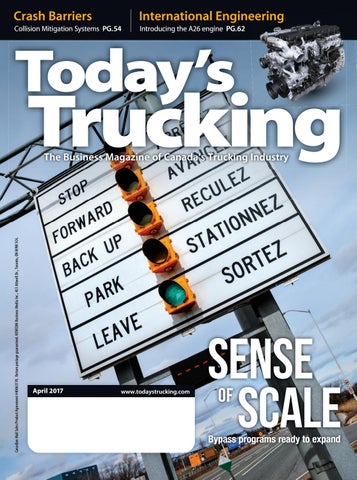
Features 14 A Sense of Scale Bypass technology has evolved, and the push is on to expand
By John G. Smith
20 Women at the Wheel 54 Crash Barriers
The shortage of female drivers is not exclusive to Canada
By Nicholas Camilleri
Collision Mitigation Systems
62 International Power 64 Lockwood’s Products 68 Guess the location, win a hat COVER PHOTO: JOHN G. SMITH Green means go at a scale, but what if you didn’t need to stop in the first place?
44 The Last Mile E-commerce is transforming one segment of trucking
By Peter Carter
48 Better Safe than Sorry Safety procedures are not an inconvenience. They exist to prevent injuries and save lives.
By Jim Park
For more visit www.todaystrucking.com APRIL 2017
7
Innovation that moves you.
JOIN US! EXPOCAM BOOTH
4733
Volvo Trucks’ new SuperTruck concept vehicle offers a glimpse into the future of fuel savings, achieving a remarkable 88 percent freight efficiency improvement with fuel economy topping 12 mpg. Many of the innovative aerodynamic solutions featured in this project can already be found in the Volvo VNL. And our new powertrain will offer additional fuel savings by featuring the SuperTruck’s wave piston design, common-rail fuel injection system and turbo compounding. Learn more: Supertruck.VolvoTrucks.ca
Fuel Efficiency
Volvo Trucks. Driving Progress
Letters Clean tech has a cost The Business Magazine of Canada’s Trucking Industry
PUBLISHER Joe Glionna joe@newcom.ca • 416/614-5805 VICE PRESIDENT, EDITORIAL Rolf Lockwood, MCILT rolf@newcom.ca • 416/614-5825 EDITOR John G. Smith johng@newcom.ca • 416/614-5812 ASSISTANT EDITOR Nicholas Camilleri nicholas@newcom.ca • 416/614-5828 CONTRIBUTORS: Steve Bouchard, Mike McCarron, Jim Park, Nicolas Trépanier DESIGN / LAYOUT Tim Norton, Frank Scatozza production@todaystrucking.com • 416/614-5818 SALES AND MARKETING CONSULTANT Anthony Buttino anthonyb@newcom.ca • 416/458-0103 REGIONAL ACCOUNTS MANAGER Nickisha Rashid nickisha@newcom.ca • 416/614-5824 QUÉBEC ACCOUNTS MANAGER Denis Arsenault denis@newcom.ca • 514/947-7228 CIRCULATION MANAGER Pat Glionna 416/614-2200 • 416/614-8861 (fax) PRODUCTION MANAGER Lilianna Kantor lily@newcom.ca • 416/614-5815
Kenneth R. Wilson Award Winner
NEWCOM BUSINESS MEDIA INC. 451 Attwell Dr., Toronto, ON M9W 5C4 416/614-2200 • 416/614-8861 (fax) CHAIRMAN AND FOUNDER Jim Glionna PRESIDENT Joe Glionna VICE PRESIDENT, OPERATIONS Melissa Summerfield CHIEF FINANCIAL OFFICER Anthony Evangelista DIRECTOR OF CIRCULATION Pat Glionna
Today’s Trucking is published monthly by NEWCOM BUSINESS MEDIA INC., 451 Attwell Dr., Toronto, ON M9W 5C4. It is produced expressly for owners and/or operators of one or more straight trucks or tractor-trailers with gross weights of at least 19,500 pounds, and for truck/trailer dealers and heavy-duty parts distributors. Subscriptions are free to those who meet the criteria. For others: single-copy price: $5 plus applicable taxes; one-year subscription: $40 plus applicable taxes; one-year subscription in U.S.: $60 US; one-year subscription foreign: $90 US. Copyright 2017. All rights reserved. Contents may not be reproduced by any means, in whole or in part, without prior written consent of the publisher. The advertiser agrees to protect the publisher against legal action based upon libelous or inaccurate statements, unauthorized use of photographs, or other material in connection with advertisements placed in Today’s Trucking. The publisher reserves the right to refuse advertising which in his opinion is misleading, scatological, or in poor taste. Postmaster: Address changes to Today’s Trucking, 451 Attwell Dr., Toronto, ON M9W 5C4. Postage paid Canadian Publications Mail Sales Agreement No.40063170. ISSN No. 0837-1512. Printed in Canada. We acknowledge the financial support of the Government of Canada through the Canada Periodical Fund of the Department of Canadian Heritage.
Member
Re: Natural Investments (February 2017) Technologies such as Diesel Exhaust Fluid systems, natural gas, etc. are great ways to reduce carbon output from trucks, but the cost associated with maintenance is significant as a percentage of total revenue. I’ve personally seen competing fleets modify their business models by reverting back to older equipment to avoid the costs associated with costly upkeep of machinery where depreciation is imminent. Freight rates haven’t kept up with the level of cost increases within the industry, and that just takes into account the regulations regarding environmentally friendly equipment. Shippers should be more aware of what “good” and “reliable” service costs the carriers. New trucks are anywhere from $163,000 and up. In five years, we’ll look at the outlook of the industry and the phrase “Elimination by Regulation” will be relevant. — Evan Sandhu Brampton, Ontario
Some more public speaking skills Re: Let me tell you a story (February 2017) Here are a few more tips when [Mike McCarron] writes Part 2. Make eye contact with the audience. Don’t look down at your notes. Engage the people with whom you are speaking. Be as cheerful as possible. Have some personality when you speak and don’t talk in a monotone voice. Speak slowly. Many people speak too quickly when they do public speaking. Their nerves get the better of them. If you want to be memorable, speak slowly, take some breaths and – as you say – take some pauses. — Dan Goodwill Toronto, Ontario
The value of third-party hiring Re: Great Expectations (January 2017) Nice commentary on the hiring process for drivers. While drivers want to be hired directly by fleet owners, it is important to know that carriers and private fleets rely on companies like In Transit to provide autonomy and to extend the probation term. We have the benefit of getting candid feedback from our applicants on their career experience and job search process, as well as from our clients on their hiring successes and challenges. Hiring drivers today is a complex process that must always be about selection, training and evaluating, and ultimately recognizing performance, especially given the extent of the driver demand. Drivers earn less than there are worth. We can’t afford to treat them any worse. — Tracy Clayson Mississauga, Ontario
Email: johng@newcom.ca
SEND YOUR LETTERS TO: Newcom Business Media, 451 Attwell Dr., Toronto, ON M9W 5C4 If we publish your letter, we’ll even send you a Today’s Trucking hat as our thanks. APRIL 2017
9
YOU MAY TAKE A BREAK. BUT YOUR DREAMS DON’T. Even on a coffee break, you’re dreaming up ways to grow your business. And you won’t rest until you do. Neither will we. That’s why Shell ROTELLA® makes products that help your hard work go further. Shell ROTELLA® T6 Full Synthetic Heavy Duty Engine Oil gives you improved protection in extreme temperatures, the engine cleanliness and wear protection you expect from Shell ROTELLA®, and up to1.5% in fuel economy savings.* All to help your engine work sun up to sun down, and then some. So you can work harder to bring your dream closer. Find out more at www.shell.ca/rotella
THE ENGINE OIL THAT WORKS AS HARD AS YOU. * As demonstrated in 2009 on-the-road field testing in medium-duty trucks, highway cycles, compared to Shell ROTELLA® T Triple Protection® 15W-40.
Editorial By John G. Smith
Clear the Way Bypass programs are the perfect carrot to offset the stick of enforcement
I
was introduced to the concept of a hospital triage by watching episodes of MASH in the 1970s and early ’80s. Centered around the happenings at a Mobile Army Surgical Hospital during the Korean War, the show’s TV doctors were regularly seen moving through the latest batch of wounded soldiers, deciding who could wait and who needed immediate attention. (They also looked for new ways to torment Frank Burns, but I digress.) It’s about setting priorities – and it’s a concept that plays out during roadside inspections every day. Lights by roadside scales begin to flash, and trucks make their way toward inspectors. With the exception of random blitzes, companies that are known to have strong safety records are often waved on through. The equipment that looks a little questionable receives a closer look. In the best-case scenarios, the safest trucks never have to pull off the highway in the first place. Pre-clearance programs like British Columbia’s Weigh2GoBC or Alberta’s Partners in Compliance electronically identify the trucks with the strongest safety records, and give most of them the green light to proceed on their way. Carriers save costs associated with idling, delays, and the simple wear and tear that emerges when trucks need to gear down, brake and accelerate. Governments can focus stretched resources where they will make the biggest difference. There are environmental gains, too, thanks to reduced emissions. Weigh2GoBC alone estimates that it has saved the trucking industry about $19 million in time and fuel. And what driver wouldn’t be attracted by the chance to simply wave at a “coop” as they continue their journey? That’s why it’s encouraging to see Manitoba and Ontario actively studying plans for pre-clearance programs of their own. This is an ideal time to explore the options available with emerging mobile apps that can – in selected cases – replace capital-intensive infrastructure that relies on transponders.
No matter what type of technology is embraced, however, regulators should take a moment to think beyond provincial borders. Yes, the inspections fall under provincial jurisdictions, but we’d be missing a great opportunity if the designers of new programs failed to explore how they could communicate with one another. A fleet that is safe in Manitoba will undeniably be safe as it crosses into Ontario. It’s no wonder that Partners in Compliance carriers are recognized by Weigh2GoBC. Surely there are ways to reduce the underlying administrative burdens for membership, allowing fleets to apply for multiple programs at once. And must we really clutter windshields with separate transponders for each program, when a single model could do? The Canadian Council of Motor Transport Administrators should be encouraged to explore an option like the Safety and Fitness Electronic Records (SAFER) that share files across state borders in the U.S. And this is clearly a topic that should be discussed around the board table of the Canadian Trucking Alliance. We don’t often have the opportunity to design anything from scratch when it comes to regulatory regimes. Let’s take a moment to find the common ground that’s possible. TT
“It’s about setting priorities – and it’s a concept that plays out during roadside inspections every day.”
John G. Smith is editor of Today’s Trucking. You can reach him at 416-614-5812 or johng@newcom.ca.
APRIL 2017
11
INTRODUCING THE INTERNATIONAL® A26 ENGINE. A NEW BREED WITH UPTIME IN ITS DNA. When we set out to create an engine that would lead the industry in uptime, we launched Project Alpha. Led by a new team of engineers, it fundamentally changed how we build engines. We set our sights on a more simplified, modern design built from proven components, then tested it beyond ordinary limits. In the end, the International A26 engine was born—lightweight, fuel efficient and ready to set a new standard in uptime.
rnationa © 2017 , Inc. All rights reserved. All marks are trademarks of their respective owners.
Lockwood By Rolf Lockwood
Hydrogen Revisited Hydrogen’s future as a source of motive power seems inevitable. Eventually.
T
here’s more to be said about hydrogen. Last month my article on the future of hydrogen fuel cells in the trucking world (see Hydrogen Highlights) barely scratched the surface of what is actually a long-standing debate. Hydrogen is not universally adored, and arguments about its value as a motive fuel have been going on for decades. Like, since 1807 – not a typo – when it was first proposed as a fuel for internal-combustion engines, 50 years before gasoline became the answer. Elon Musk, co-founder of Tesla and thus an active proponent of the battery-based electric option, calls the hydrogen fuel cell idea “bullshit”. Daimler, Honda, Hyundai, Toyota, and of course Nikola beg to differ. Just in case there’s someone on our corner of the planet who doesn’t know Nikola, it’s the Utah company developing a long-haul tractor powered by electric motors fed by a hydrogen fuel cell – supported by Ryder Systems and US Xpress. Amongst all those weighty outfits and many more, plus hordes of chemists and engineers across the globe, an enormous amount of money is pouring into hydrogen research and development. They’re not all wrong. Hydrogen is not “BS”. That said, can we call it a solution to the challenge of moving off fossil fuels in the near term? Yeah, well, that seems unlikely. Still, there are finally promising signs. In terms of commercializing hydrogen fuel cells, Hyundai is in the lead by way of its European arm. The South Korean company actually sells a fuel cell car, the ix35, over there and a Paris-based taxi fleet has had five of them since 2015 with a deal just signed for 60 more. It plans to have several hundred within five years. It’s said to be the world’s first mass-produced and commercially available fuel cell electric vehicle. There are now more than 300 of them running in 12 European countries, more than all other manufacturers combined. Unlike North America, Europe is actually building hydrogen filling stations at a fair clip. There are 100 or so in Germany now, for example, with many more planned.
All that sounds like progress, and it is, but it’s not truck progress. It seems cars will have to lead the way here unless the Nikola project sees huge success and spawns imitators. At least cars will help get the requisite infrastructure built in the meantime. But the debate will probably rage on. Is hydrogen safe? Can fuel cell costs be brought down? Can we afford to build the infrastructure? Can fuel cells last as long as gas or diesel engines? Or as long as electric-car batteries, for that matter? And the biggie, can we make hydrogen in a clean way without using natural gas? You wouldn’t believe how many disparate opinions there are in answer to those questions. In the course of writing my Marchissue story I gathered 159 separate documents – articles, scientific studies, charts, graphs, you name it. And that’s on top of 200 or so older digital files I’ve been collecting for the last couple of decades. I tell you, there isn’t quite enough agreement in that pile. And there are myths aplenty. The relative safety of hydrogen, for instance, is one that comes up often. But in an article entitled “5 Common Fuel Cell Myths” just published by the U.S. Department of Energy, the author wrote this: “Hydrogen is just as safe as any other transportation fuel (i.e. gasoline, diesel and natural gas). The tanks are put through rigorous testing (including crash tests and gunfire) and performance requirements... In addition, hydrogen fuel stations have redundant protection systems in place, so it’s virtually impossible to over-pressurize a vehicle fuel system.” Stay tuned for more. This subject isn’t going away. TT
Elon Musk calls “the hydrogen fuel cell idea “BS”
Rolf Lockwood is vice-president, editorial, at Newcom Business Media. You can reach him at 416-614-5825 or rolf@todaystrucking.com.
APRIL 2017
13
Typical visits to a scale can last about 3 ½ minutes. (Drivewyze photo)
A Sense of Scale Bypass technology has evolved, and the push is on to expand By John G. Smith Time is money when stuck in the lineups for roadside inspection facilities. Drivewyze, the Canadian maker of an app used to bypass these ever-dreaded “coops”, has clocked a typical delay at three minutes and 37 seconds per truck – or about $12 per visit when considering fuel, labor and downtime. Those who are actually pulled in for an inspection can expect higher costs than that.
14
TODAY’S TRUCKING
The very existence of the app proves that back roads are not the only way to avoid such delays. Pre-clearance programs including British Columbia’s Weigh2GoBC and Alberta’s Partners in Compliance (PIC) offer tools that allow inspectors to identify and wave through equipment that belongs to companies with strong safety records. Enforcement teams can then focus on companies that are
more likely to run afoul of Commercial Vehicle Safety Alliance standards. Now other provinces are looking to establish programs of their own. The Manitoba Trucking Association established a working group to study such programs after being approached last year by Manitoba Infrastructure, and the Ontario Ministry of Transportation recently issued
a Request for Information from potential system vendors. “Enforcement attention should be focused where it’s most required,” says Geoff Wood, the Ontario Trucking Association’s vice president – operations and safety. “And we think there’s an opportunity to capture a lot more than they’re capturing.” Ontario carrier profiles known as Commercial Vehicle Operator Records (CVORs), for example, don’t account for trucks that are waved through with a clean bill of health. Ontario tracks 120,000 inspections per year, he says. “We know the interactions are significantly higher than that.” It’s more like 2-5 million trucks in that timeframe. Capturing these numbers could make a difference on several fronts. Out-of-Service rates, which the general public sees as a barometer for overall industry safety, would drop significantly – down to as low as .026% from today’s 20%, according to the OTA. Inspection profiles and overall violation rates in CVORs could shift by as much as 5%, helping to avoid sanctions. The current inspection model just doesn’t leave enough time to generate such reports, with each taking 15-20 minutes to complete.
PG. 20
Women at the Wheel PG. 22
The Nuclear Option PG. 26
TFI Optimistic “It is unreasonable to expect drivers and carriers to support a protocol that would have their trucks sitting for this amount of time simply to generate a piece of paper,” the OTA says. “Similarly, it is not reasonable for industry to expect screen/triage inspections to stop – they work. There simply needs to be a recording of the event [electronic in long term, manual pilot in short term] and some credit given to carriers when this occurs.”
Different models, different regimes The question is what form the new bypass programs would take. Canada’s existing approaches vary in several ways. Weigh2GoBC allows any carrier to join, uses transponders to identify participating vehicles, and relies on individual carrier profiles to determine the share of trucks allowed to pass. Once a truck checks in with a participating inspection station, it is green-lit for the next 24 hours, with the exception of some random checks. PIC limits membership to those with the strongest safety ratings, and now uses the Drivewyze app to identify trucks that participate. Each carrier must have completed
a National Safety Code audit within two years, and pass benchmarks for internal monitoring, Hours of Service, loss claims and Out-of-Service rates. Entry interviews are performed as well. Terry Shaw, executive director of the Manitoba Trucking Association, is stressing the need to review each model, as well as similar programs in the U.S. “We don’t need to reinvent the wheel,” he says. But there are certainly some items high on his wish list, including provincial programs that might be able to work together, and memberships that would be open to anyone with an appropriate safety rating. Of course, some fleets clearly have more to gain than others. A truck driving from Vancouver to Calgary, for example, would in each direction pass inspection stations at Hope, Kamloops and Golden, British Columbia. Looking at the lost fuel alone, these vehicles waste about 0.41 to 0.733 liters of fuel per stop as they decelerate into a station, idle away, and then accelerate back to highway speed, according to Weigh2GoBC. Average that out to 0.5715 liters and diesel at $1 per liter, a 20-truck fleet saves $7,132 per year. Carriers that choose not to participate may simply not
THE CARRIER EXPERIENCE ➊ Wildwood Transport essentially stumbled into
the value of bypass programs. The open-deck fleet based in Oak Bluff, Manitoba had simply installed a PeopleNet system for its electronic logging capabilities, says fleet spokesman Matt Holland. The Drivewyze app came with it, and after a one-month trial it was hooked. “The ROI was very simple to understand and scale out. At a cost of $15.75 per month for the service, we could easily save hundreds,” he says. The advantages don’t end there. It’s now presented as a reward for drivers who make the switch from paper to electronic logs. “Our drivers love bypassing, and are often telling me of lineups at scales they get to cruise by. If driver happiness was the only benefit, we would still participate in the program.”
➋
Ontario-based J&R Hall, one of the first out-ofprovince carriers to participate in Weight2GoBC after that was expanded in 2014, has seen some clear advantages. “Why take up the scale people’s time when we try to do everything by the book?” asks safety manager Brad Hayes. “Let them focus on the carriers that we don’t want on the road.” There is a bit of an administrative burden up front, he says, referring to the need to upload data like transponder numbers, registered weights, serial numbers and unit numbers, but a truck is usually set up within 24 hours. Drivers just need to be instructed how to approach a scale, and what the lights on the transponders mean. The same transponder is also recognized in states including Washington, Idaho and South Dakota where the fleet travels. When J&R Hall first signed up, 85% of the trucks would bypass. Now it’s closer to 95%. “They are rewarding you for being a good carrier,” Hayes says. “We run an 82-truck fleet, and in one day we had 32 scales that we went past or through... there was at least 90-95% all green lights.”
APRIL 2017
15
Dispatches Bypass programs? There are apps for that.
(Drivewyze photos)
pass that many scales in the course of a day. This might explain why just 600,000 of the 4.5 million registered trucks in the U.S. belong to one bypass program or another. Partners in Compliance recognizes more than 14,000 units but just 75 carriers; Weigh2GoBC represents 6,200 vehicles but 380 carriers. In 2012, Quebec actually abandoned a preclearance program at St-Bernard de Lacolle because of limited enrolment, a spokesman with the province’s Transport Ministry confirms. Even Partners in Compliance faced the threat of funding cuts last year, before the support was renewed following lobbying by the Alberta Motor Transport Association. The benefits of that program aren’t even limited to pre-clearance.
Working together “I don’t think the scale bypass program has grown to the extent that all of us would have expected,” adds Louise Yako, president of the British Columbia Trucking Association. “You see the capacity for interoperability in the U.S., but there seems to be less of an opportunity here in Canada.” Pam McDermid, Weigh2GoBC’s Commercial Vehicle Safety and Enforcement manager – ITS initiatives, hopes the renewed interest from other jurisdictions will convince the Canadian Council of Motor Transport Administrators to create a common database of safety records like the Safety and Fitness Electronic Records (SAFER) system in the U.S. With that, and some common approaches, programs could reach beyond provincial boundaries, she says.
The border-related barriers include differences in hardware as much as philosophy and common records. Partners in Compliance was shifting to the Drivewyze app as this edition went to press, so Alberta won’t require infrastructure like overhead gantries to read transponders. But Alberta carriers that participate in Weigh2GoBC will need to hold onto their old transponders to support that program. McDermid is clearly a fan of sticking with government-owned hardware. “There are no fees for our program. The data is ours. The programs are ours. We control it all,” she says. Still, there is no small irony in the fact that Drivewyze is only this month rolling out as the technology choice in Alberta. The business was founded in the province, and already has a presence in 38 states. Another half dozen states are expected to come online in the first half of this year. Most participating fleets were simply switching on the capabilities available through platforms from the likes of Omnitracs, Peoplenet, Rand McNally and Zonar. One clear advantage of an app-based system is how quickly it can be rolled out, insists Drivewyze spokesman Doug Johnson. No special poles need to be installed, and the systems can also be used by mobile inspection teams. “The time that it takes to roll out from state to state took the other program a decade,” he said, referring to the transponder-based Pre-Pass. “It becomes far more expandable,” agrees Kim Hrushenski, director of Partners in Compliance. “We’ve tripled in size since I started in 2010, and I don’t see an early end to that.” TT APRIL 2017
17
16 LITERS OF LEGENDARY AWESOMENESS. AWESOMENESS Pu a Detroit™ engine in your Put ur Western Star and get the ultimate blend of toughness, power and efficiency. Even better, you can still max it out with the 16 liters of legendary awesomeness that is the Detroit™ DD16®. Because owning a Star always means getting bigger, better everything. Demand power – demand Detroit. Find out more at westernstar.com/powertrain
www.expocam.ca
Gold Sponsor:
Platinum Sponsor:
Endorsed by:
The Meeting Place for
Canada’s Trucking Industry April 20 -22, 2017 Place Bonaventure Montreal, QC, Canada X See more than 225,000 sq ft of new trucks, trailers and equipment X New Products
An official ExpoCam event
www.scef.ca
April 19
Dispatches Women with Drive brought together female drivers and industry executives from around the world for one panel discussion. (Photo by Peter Power)
Women at the Wheel The shortage of female drivers is not exclusive to Canada By Nicholas Camilleri Women make up about half of Canada’s workforce, yet account for just 3% of its truck drivers. It’s a disturbing thought for any recruiter worried about an intensifying shortage of truckers and looking for candidates of every persuasion. The issue is not unique to Canada, of course. Just 1% of drivers in Denmark are women. Australia’s share of female drivers is around 2%. In Sweden it’s closer to 6%. No matter where women drivers are based, however, they appear to share stories of similar barriers and misconceptions, and are often drawn to their career paths for reasons that will sound
20
TODAY’S TRUCKING
strangely familiar to their Canadian counterparts. “If you look at majority of the females coming into this industry, they have a dad, a brother or a friend in the industry,” said 26-year-old Swedish driver Elin Engström, during the Global Perspectives Panel at Trucking HR Canada’s Women with Drive summit. “For me, I was just unemployed.” After completing school she earned a forklift licence and found a job in a warehouse. There were some physical challenges, but she always considered them personal issues. Not because she was a woman.
The idea of becoming a truck driver emerged after she spent entire shifts filling logistical cages with freight, only to watch drivers show up at the end of the day and simply roll the cages onto trailers. That was clearly a better job. “All views of the trucking industry is that it’s super hard, it’s heavy, you need to be strong,” Engström said. But consider the stereotype of a typical middle-aged, overweight truck driver, she added. “Where is the strength in that?” “Sweden in general is pretty good at equality,” insisted Engström, who now test drives trucks at Scania’s research and development center. “We have a lot of organizations, both local government and companies, that travel around in Sweden, informing students about the trucking industry.” “We deserve respect, we deserve to be looked at as a person who can do whatever they want to do,” she added. But barriers still exist. It doesn’t matter
Dispatches where she goes or who she talks to. When she reveals that she’s a truck driver, people are surprised. It is never perceived as normal career choice for her. Engström wasn’t the only panel member who entered trucking as a result of poor economic conditions. Vibeke Theisel worked as nurse for five years in Denmark, but said after the government made financial cuts to its healthcare system, she found herself underpaid and looking for new career opportunities. Now referred to as the “Road Queen” by her coworkers, Theisel works with Frode Laursen, a large Denmark fleet. “If seven years ago, somebody had asked me, ‘Could you see yourself as a truck driver?’ I’d say, ‘No, why do you ask?’ Because what I thought of a truck driver was that they were fat, smelly and lazy,” said Theisel. She hadn’t thought much about what a truck driver actually did besides sitting and driving. Her perception changed after meeting her boyfriend, who is also a trucker. The idea of trucking as a career path was born there. The Danish driver said she was met with apprehension during both the training and hiring process. The school had never trained a woman before. “I always got told, ‘You’re a woman. You can’t do it because you’re too small and don’t have the power to do it,’” Theisel said. While some aspects of the job were physically straining at first, with time, she could do anything the men could do. The jobs for women in the industry are not limited to the driver’s seat, either. Over her 30 years in New Zealand’s transport industry, Meryn Morrison has served in a variety of roles, including director and general manager for a family-run heavy-hauling company, a driver trainer, an executive of a road transport association, and chairwoman of Women in Road Transport for New Zealand. In her experience, Morrison said the application process is typically easier for men in her country, as women are more likely to be apprehensive about qualifi-
cations, and feel doubtful if they can’t do everything outlined in a job description. “I think it’s a lot easier than it’s depicted. We’ve got 40,000 acres to play with, and various amounts of flatland and highlands where I come from,” said Heather Jones of Karratha, Australia. With over 25 years of experience as a heavy vehicle driver, Jones entered truck-
Karratha. Still, there is much to be done. “I’ve spent more than half my lifetime trying to promote women to the industry,” said Jones, “and we still only have 2% female truck drivers in Australia.” Having spent 12 years in the United Kingdom’s transport industry as a heavy goods vehicle driver and trainer, Jenny Tipping is frequently called upon to
Elin Engstrom, Heather Jones, Meryn Morrison, Vibeke Theisel, and Jenny Tipping offered a global perspective – but showed that misconceptions and barriers are not limited to borders. (Photo by Peter Power)
ing after she saw it as an accommodating career for her lifestyle as a single mother of two. Now she is director and owner of Success Transport, and an active voice in not just promoting the transportation industry as a viable long-term career path, but also breaking down barriers that prevent women from entering the industry. Her passion for helping women enter the industry led her in 2014 to form Pilbara Heavy Haulage Girls, an organization that mentors new drivers – particularly women – and prepares them for the industry with a 160-hour training program. Jones said that in Western Australia, trucking is an easy field for women to enter, as there is a lot of support from the men and companies in her hometown of
The role of women in the industry is not limited to the driver’s seat.
speak at conferences and produce content for industry publications. She originally pursued a career in academics, but believes her decision to join the trucking industry was destiny. Her father wasn’t pleased when he found out she gave up a doctorate to drive a truck, but eventually he got over it. “I think by getting out of academia and doing the job women aren’t supposed to do… I’m pretty sure I’ve changed far, far more lives or far more attitudes than academics ever can,” she said. Tipping said she is okay with the idea that women in general aren’t interested in truck driving and doesn’t expect to see equal shares of men and women in the job. For her, the concern is about the perception that driving a truck isn’t something a woman can do. “I think we need to get to a stage where it’s a completely free choice,” she says. TT APRIL 2017
21
Dispatches
The Nuclear Option Radioactive loads back on the road The first few hundred gallons of highly radioactive liquid nuclear waste were expected to begin a journey along Ontario highways in late February, in the wake of a U.S. court decision that allows the material to cross Fort Erie’s Peace Bridge into the U.S. About 6,000 US gallons of the material, officially known as Highly Enriched Uranyl Nitrate Liquid (HEUNL), were initially to be transported last year from nuclear research facilities in Chalk River, Ontario. However, a federal lawsuit filed last August by American-based non-profit Beyond Nuclear and six other U.S. environmental groups, stalled the shipments over concerns raised about potential public health, safety, and environmental hazards. The move has been years in the making. In 2010, then Prime Minister Stephen
Harper and U.S. President Barrack Obama agreed to have spent Highly Enriched Uranium (HEU) repatriated back to the U.S. for processing. The goal was to have all of that returned to the U.S. by the end of 2018. The process of shipping the spent uranium to the U.S. originates from a program spanning back to the 1950s, when American-produced HUE was imported into Canada for medical isotope research at facilities such as Canadian Nuclear Laboratories and Chalk River Laboratories, where the National Research Universal reactor is based. The Canadian Nuclear Safety Commission (CNSC) works with Transport Canada to oversee the transportation of solid and liquid nuclear materials. In 2015, CNSC approved NAC
International’s design for a package that would be used to contain the liquid waste during its 500-plus-kilometer journey. Aurèle Gervais, chief advisor with CNSC, says the safety of the shipment relies on the design of the transport package or casks, which must meet the Regulations for the Safe Transport of Radioactive Material, published by the International Atomic Energy Agency. The casks that contain the liquid waste come in the form of large metal cylinders that are loaded onto trailers, and must be certified by both the CNSC and the U.S. Nuclear Regulatory Commission before being used. In addition to companies like Canadian Nuclear Laboratories having to apply for transport licences from the CNSC to ship the waste, security plans have to be supplied as well. “This plan would address the security measures that have to be in place to ensure a safe and secure transport,” says Gervais. TT
With Canada’s largest selection of new and used shunt trucks, Glasvan has in stock for immediate delivery a yard truck for the operation and duty cycle you require. Expertly maintained we have a full fleet of shunt rentals, full service leasing and maintenance programs within the GTA. With a massive selection of new, used or refurbished yard trucks we ship across Canada.
TUGS, MULES, GRUNTS, SHUNTS. WE’VE GOT THEM.
2009 to 2012 Capacity C Off Road shunters, big selection, optional fresh sandblast and paint refurbish
2010 to 2013 Capacity and Kalmar DOT On Road shunters, range of hours
New 2017 Autocar tier3 Off Road and DOT single axle
Heavy Duty 2017 model Autocar 40000 lb rear axle equipped tier3 Off Road and DOT units for heavier Canadian gross weight loads
New 2017 model Autocar Tandem drive axle DOT On Road
Ministry of Transportation (MOT) Inspection and Certification Facility
See our new and used shunt truck inventory.
Visit glasvangreatdane.com 1∙888∙GLASVAN (452∙7826) Five southern Ontario Locations to serve you; Two locations in Mississauga, Putnam, Alliston and Whitby.
22
TODAY’S TRUCKING
FAST-TURNING INVENTORY OF USED TRAILERS
Dispatches
Doepker acquires Alberta’s ETM Doepker Industries has expanded its product line considerably, acquiring Edmonton Trailer Manufacturing (ETM) based in Acheson, Alberta. Dirk Woestenenk, previously general manager at ETM, has joined the Doepker team as heavy haul division manager. The entire product line, including sliding tilt decks, lowbeds, crane dollies, jeeps, and boosters, will be manufactured and supported by Doepker and its 54 authorized distribution locations.
“This is a great fit within the strategic growth plan of Doepker,” says president and Chief Executive Officer Evan Doepker. “We have been looking for ways to grow our capabilities, and this addition enables us to supply a proven design to both new and existing customers.” Established in 1948, Doepker serves customers in the agricultural, commercial, gravel, logging, heavy haul, and energy sectors.
Report defects for recalls: NHTSA The US National Highway Traffic Safety Administration’s (NHTSA) Office of Defect Investigation is calling on truck fleets to notify it about vehicle manufacturing or design defects. “We have a real hard time identifying defects on commercial vehicles,” said program manager Bruce York, making his plea to the American Trucking Associations’ Technology and Maintenance Council. Look no further than the statistics for proof. About 235 million vehicles in the U.S. generate about 45,000 complaints a year. In contrast, 9 million trucks only generate 600 calls to the office. Manufacturers jump on complaints raised by individual fleet customers, but
that doesn’t ensure similar vehicle issues are addressed, York said. “Get your trucks fixed, but also let’s get them all fixed.”
FAST facilities expanding Border crossings in Fort Erie, Ontario could become a little faster for selected carriers.
The Canada Border Services Agency has installed a dedicated lane and inspection booth for those that participate in the Free and Secure Trade (FAST) program. That builds on similar lanes in Windsor and Sarnia, Ontario, as well as the Pacific Highway crossing in British Columbia. Trucks can use FAST lanes when the driver is a member of FAST or
WIN OPTIMIZE. MANAGE. DELIVER.
You’ve got the right mission. You’ve got the right vision. Now get the right software, and the world is yours for the taking. Predictive analytics make decisions more profitable. Streamlined business operations reduce costs. It’s how TMW helps you reach your potential, achieve your business goals and WIN EVERY TIME.
tmwsystems.com SOFTWARE SOLUTIONS FOR: TRUCKLOAD | BROKERAGE/3PL | INTERMODAL D E D I C AT E D & P R I V AT E F L E E T | F I N A L M I L E | LT L ASSET MAINTENANCE | BUSINESS INTELLIGENCE
APRIL 2017
23
Dispatches Commercial Driver Registration programs; the carrier and importer are approved under Customs Self-Assessment (CSA) and Partners in Protection (PIP); and all cargo includes CSA-eligible goods from the U.S. or Mexico. Another FAST lane is planned for the crossing in Emerson, Manitoba, the Canada Border Services Agency says.
CTA seeks more meat in rules The Canadian Trucking Alliance (CTA) is supporting the Canadian Food Inspection Agency’s plans to modernize the rules for moving livestock – but wonders why certain livestock truckers are excluded from key aspects of the proposals.
No Deposits. Big Returns. Injector deposits won’t just drain your engine’s performance, they’ll drain your pockets too! Meaner Power Kleaner eliminates deposits and prevents them from coming back. So grab a bottle today, increase your fuel economy and save yourself some money.
From m the trusted makers of Howes Diesel Treat, the nation’s #1 Diesel Conditioner and Anti-Gel.
“The proposed amendments limit the reach of some of the regulations to ‘commercial carriers,’” said Susan Ewart, CTA’s regional vice president – Saskatchewan. “As written, this would exclude from key training and record-keeping provisions producers and processors who claim ownership of the animals or poultry during transportation and do not charge a fee for transportation services.” The changes are outlined in proposed amendments to Part XII (Transport of Animals) of federal Health of Animals Regulations. The CTA also wants consignors to declare whether any animals are compromised but still fit to move. “Provisions stipulating the actions a driver must take if an animal becomes compromised or unfit during transport could potentially result in unjust and unwarranted penalties being brought against the carrier and/or the driver,” the group notes in a release. “Such actions should only apply when a driver becomes knowledgeable about such changes in an animal’s condition.” Meanwhile, the alliance questions why provisions which require a receiving party to be present when an animal arrives are not mandated when the transportation process begins – particularly since the animal’s condition at the final destination largely depends on the condition when they were first loaded. Changes to the rules will also exempt carriers from specific training requirements if they can verify the required knowledge and skills.
PuroPost trims delivery times 1-800 GET HOWES (438-4693) www.howeslube.com
24
TODAY’S TRUCKING
Purolator International’s new PuroPost Plus service promises to deliver goods to any Canadian home within two to five days. “PuroPost has been a great success for our business, with [business to consumer] commerce making up nearly half of our current shipments,” says John Costanzo, president of Purolator International. “Since we launched PuroPost in 2013, many customers have asked for a ‘rush’ option. We’re proud to
Dispatches now deliver a solution to address that need, offering even faster delivery for consumers in Canada.” PuroPost and PuroPost Plus deliver to post office boxes, community mailboxes parcel lockers, and remote and rural location at no extra cost. Packages are hand delivered through the Canada Post postal network and are pre-cleared for entry into Canada, with taxes and duties paid ahead of time.
and dynamic dispatching applications to support navigation, and calculating savings that can be realized through scheduled or ad-hoc platoons of trucks from different fleets. Peloton begins filling pre-orders of its platooning product for Class 8 trucks this year, offering the technology that links pairs of trucks through Vehicle-toVehicle communications and radar-based
collision avoidance systems. The resulting tight following distances boost fuel economy 4.5% in a lead truck and 10% in the trailing truck, according to the North American Council for Freight Efficiency. The system works much like adaptive cruise control, but the communications network enables automated braking within 0.1 seconds of a brake application by the lead vehicle.
Trudeau, Trump talk trucking issues A statement that emerged after the inaugural meeting between U.S. President Donald Trump and Canadian Prime Minister Justin Trudeau didn’t mention the North American Free Trade Agreement (NAFTA) by name, but referenced the importance of deepening the relationship between Canada and the U.S. Trucking-related issues included plans for the Gordie Howe International Bridge linking Windsor, Ontario and Detroit, as well as a commitment to implementing pre-clearance operations for cargo. In a press conference after the two leaders met, Trump talked about the good relationship between Canada and the U.S., and when pressed about his past statements regarding NAFTA, he mentioned that “tweaks” could be made to better the situation on both sides of the border. The president also mentioned the U.S. trade relationship with Mexico is more problematic. It all seemed promising to Canada’s largest trucking association. “The opportunities to deploy state-ofthe-art infrastructure and technology – starting with key projects like the Gordie Howe International Bridge – to ensure that both security and trade facilitation is improved, are immense. We are encouraged by what we heard today,” says David Bradley, Chief Executive Officer of the Canadian Trucking Alliance.
Omnitracs, Peloton partner in platooning Omnitracs is partnering with Peloton Technology to bring platooning trucks to market – using Omnitracs routing
www.isaac.ca/fleet
APRIL 2017
25
Dispatches
TFI optimistic about economy Just months after acquiring a major truckload carrier in the U.S., TFI International is cautiously optimistic about the state of the North American economy. “Unemployment is low and consumer spending remains solid. Moreover, rising oil prices have given way to a modest
rebound in the level of investment in that sector,” said chairman, president and Chief Executive Officer Alain Bedard, when releasing year-end results. “These factors should produce a gradual recovery in freight volume and rates.” Referring to 2016 as a “transformational” year for the business – which now collects half its revenue south of the border – he also noted that package and
PUT MORE THAN JUST
‘SPRING’ IN YOUR RIDE
courier operations are well positioned to benefit from “bourgeoning” e-commerce activity. Fourth-quarter revenue from e-commerce fulfillment was up 38% to $96.2 million in the package and courier segment, and up 15% to $34.7 million in the truckload segment. TFI’s biggest acquisition of 2016 was undeniably the truckload operation of XPO Logistics, but the interest in finding other companies to bring under its corporate umbrella has hardly ended. “We remain committed to a highlydisciplined approach of acquiring profitable and well-managed companies,” Bedard said. “Our prime targets consist of ‘asset-light’ operations that offer synergies, reinforce existing operations and further expand our geographic footprint. We also look for specialized niche players with activities that generate higher returns and increase service offerings.”
ATA throws support behind new show
THE INDUSTRY’S LIGHTEST WEIGHT SLIDER AXLE SYSTEM
More features and benefits with the ULX40. • Lightest Weight for More Payload • SAF Composite Springs for Enhanced Ride Performance • Lowest Total Cost of Ownership • 10-Year Durasystem™ Warranty • Black Armour™ Corrosion Protection • SAF 53⁄4 ˝ Weight and Strength Optimized Axles
ULX40 FEATURING STANDARD SAF DRUM BRAKES OR OPTIONAL
Series
TM
Visit
www.ULX40.com www.safholland.com
WATCH THE VIDEO
888-396-6501
© 2017 SAF-HOLLAND, Inc. All rights reserved.
26
TODAY’S TRUCKING
AIR DISC BRAKES
*See warranty XL-MS10204WC
The American Trucking Associations (ATA) will be supporting the new North American Commercial Vehicle Show. “As the nation’s foremost trucking industry association, it only made sense for ATA to support our supplier community, many of whom have committed to this endeavor,” said Chris Spear, ATA president and Chief Executive Officer. “The North American Commercial Vehicle Show promises to be an excellent event and we are pleased to be a part of it.” The show is a joint venture between Hannover Fairs USA and Newcom Media USA, and will be held every two years, with the first one to be held September 25-29 at the Georgia World Congress Center. Newcom Business Media publishes Today’s Trucking among other titles. “ATA is a well-known and respected name in the trucking industry, and we are excited to have their support as we launch this new show,” said Joe Glionna, president of Newcom.
Dispatches
Heard Street on the
Kriska’s Wahba leaves for Canadian Pacific Jonathan Wahba is leaving his role as Chief Operating g Officer at Kriska Transportation in favor of the iron highway – taking aking a role at Canadian Pacific as vice president – sales and marketing, intermodal and grain. Wahba has also held leading roles at Schneider National, CN and Midland Transport. The appointppointment is effective immediately. “Better service, more in-depth depth analysis through trip planning and the most disciplined operating team in North America, combined with a strong ong sales and marketing team positions us well for the future,” re,” said John Brooks, the new senior vice president and Chief Marketing Officer at the railway.
Daimler names aftermarket, operations execs Daimler Trucks North America (DTNA) has made several executive appointments to support aftermarket and operations activities, with each effective June 1. Rich Simons becomes general manager – aftermarket parts sales, succeeding Jeff Wallis who retires after a 35-year career. Simons will be responsible for aftermarket sales, including parts and gliders. He moves up from the role of general manager – central service. Paul Romanaggi succeeds Simons as general manager – central service, where he will lead truck and powertrain service in the U.S. and Canada, including dealer and fleet field support, service engineering, call center support, new product service readiness, service literature and systems, and technical training. Carsten Kirchholtes becomes general manager – supplier management and launch change management, where he will be responsible for leading and driving targets and continuous improvement. Christoph Mertens succeeds Kirchholtes as general manager – procurement, and will oversee procurement in the NAFTA region and lead and drive global procurement activities in the cab commodity group. Rounding out the changes is Sungsoo Lee, currently the plant manager of Saltillo Truck Manufacturing in Mexico, who becomes general manager – operations planning and quality management. In this role he will direct and lead customer application engineering, quality management, Six Sigma and production planning.
Camilleri named assistant editor Today’s Trucking has appointed former fleet service writer Nicholas Camilleri to the role of assistant editor. Camilleri is a graduate of Humber College’s print and broadcast journalism program, which led to bylines in publications including the Brampton Guardian and the award-winning Convergence magazine. But most recently he supported maintenance departments at Canada Cartage and Muir’s Cartage.
Navistar promotes Clarke to board chairman Navistar has elected Troy A. Clarke, the company’s president and Chief Executive Officer, as the latest chairman of the board. He replaces the retiring James H. Keyes in a shift that became effective at the company’s annual shareholder meeting on February 14. Keyes has served as non-executive chairman since April 2013. General Stanley A. McChrystal (ret) was elected as an independent lead director. Said Clarke: “This is an exciting time for Navistar, as we pursue our growth strategies highlighted by significant new product launches and our pending strategic alliance with Volkswagen Truck and Bus.” Volkswagen now has a 16.6% stake in the Illinois-based manufacturer, forming a strategic alliance that will bring a Volkswagen powertrain to North America as early as 2019. Volkswagen AG also holds interests in MAN, Scania, and Caminhoes e Onibus truck brands.
TMW Systems promotes Ray West Transportation software development company TMW Systems has promoted Ray West to senior vice president and general manager. West will oversee TMW’s solution platforms including TMW.Suite, Innovative IES, and TruckMate. West was also an active member of the TMWSuite Advisory Board, while serving as vice president – information technology for Atlas Van Lines. He joined TMW in 2007. APRIL 2017
27
Dispatches
StatPack 1.5 MILLION DOWNLOADSS Trucker Path’s trip planning app has now been installed more than 1.5 million times, and is reportedly the first industry app to record more than 1 million downloads on Google Play. Trucker Path features over 6,000 locations where drivers can find available parking. More than 400,000 monthly parking updates are updated by users, and can be filtered through locations such as TA and Petro, Loves, Pilot and Flying J, independently owned truck stops, rest areas and even Walmarts that are verified to allow overnight truck parking.
32,800 U.S. TRAILER ORDERS Trailer orders in the U.S. reached 32,800 units in January – down 4% month over month, but up 86% year over year, FTR reports. The orders were strong for the third consecutive month and continue to exceed expectations, the analysts say. Backlogs also jumped for the third straight month. Dry van orders surged 146% over last year, while reefer orders dropped 52% when compared to December. Orders reached 234,000 units over the last year, and while production began the year in a weak position it was up 8% month over month.
$11,322 PER TRUCK New emissions-related upgrades to average 2027 Model Year tractors will cost $11,322, according to Canada’s Department of the Environment. The stat was released along with Canada’s version of Greenhouse Gas rules for 2018-29 Model Year equipment. Changes to vocational vehicles will cost $4,369, while trailers will see prices up $1,237. Overall, the emissions changes will cost Canada’s trucking industry an extra $4.1 billion, but make it possible to save $10.3 billion in fuel. When considering the overall lifespan of the affected vehicles, net benefits are expected to reach $8.8 billion between 2018 and 2050.
LOAD VOLUMES UP 43%
$50,000
January freight volumes for TransCore Link Logistics continue an upward trend after a surge in freight volume in December 2016. The January 2017 volumes were the second-highest to be recorded in the first month of a year. Compared to last year, load volumes leaped 43% year-overyear. Claiming 24% of the total volumes, intra-Canada loads climbed 45% compared to January 2016. Averaging at 72%, cross-border loads were up 5% from 67% in December 2016, while loads leaving Canada were up 35%, and loads coming into Canada sprang up 45% year-over-year.
The racers of big trucks will have a chance to earn big prizes this year, with $50,000 in prize money available during every race in the inaugural Bandit Big Rig Series. The season’s first race is scheduled for March 25 at the Hickory Motor Speedway in Newton, North Carolina. The series represents a return of circle track truck racing to the short track, and will pay $10,000 to the winners of feature event races. Everyone from first to 25th will earn cash. “This is the grassroots of the trucking industry – it’s intense, fun and a chance to get in front of the next generation of our industry,” said Craig Kruckeberg, Chief Executive Officer and Chief Visionary Officer of Minimizer, which is sponsoring the races.
RACING PRIZE
APRIL 2017
29
Dispatches
Class 8 order backlogs rise in January: ACT
Eastern Canada
Freightliner continued its role as the dominant Class 8 brand in January, accounting for more than 37% of sales in both Canada and the U.S. International held the second spot at 18% of Canadian sales, while Peterbilt secured that position in the U.S. with 17% of sales. When it came to Canada’s lighter vehicle classes, Hino held 30% of Class 7 sales, but International was close behind at 27.4%. Hino clearly led the way in Class 6, holding 54% of January sales. But in Class 5, Ford held the top spot with 56.7% of the market. Overall, orders for Class 8 trucks reached a 13-month high, thanks largely to the higher demand for vocational equipment, ACT Research reports. “Stronger orders, coupled with modest build, allowed backlogs to rise 7,600 units from December to 99,600 units,” said Kenny Vieth, president and senior analyst. Net heavy-duty truck orders reached 22,188 units in January, suggesting that the second and third quarters of 2016 marked the bottom of the current downturn, the analysts note.
Canada – January 2017 SALES CLASS 8
30
MARKET SHARES YTD
Jan. %
YTD %
519 248 204 150 118 71 67 0 1,377
519 248 204 150 118 71 67 0 1,377
37.7 18.0 14.8 10.9 8.6 5.2 4.9 0.0 100
37.7 18.0 14.8 10.9 8.6 5.2 4.9 0.0 100
CLASS 7
Jan.
YTD
Jan. %
YTD %
Hino International Freightliner Kenworth Peterbilt Ford Total
69 63 43 29 21 5 230
69 63 43 29 21 5 230
30.0 27.4 18.7 12.6 9.1 2.2 100.0
30.0 27.4 18.7 12.6 9.1 2.2 100.0
CLASS 6
Jan.
YTD
Jan. %
YTD %
48 23 14 2 1 0 88
48 23 14 2 1 0 88
54.5 26.1 15.9 2.3 1.1 0.0 100.0
54.5 26.1 15.9 2.3 1.1 0.0 100.0
CLASS 5
Jan.
YTD
Jan. %
YTD %
Ford Dodge/Ram Hino Isuzu International Freightliner Mitsubishi Fuso GM Kenworth Peterbilt Total
204 73 54 26 3 0 0 0 0 0 360
204 73 54 26 3 0 0 0 0 0 360
56.7 20.3 15.0 7.2 0.8 0.0 0.0 0.0 0.0 0.0 100.0
56.7 20.3 15.0 7.2 0.8 0.0 0.0 0.0 0.0 0.0 100.0
Hino Freightliner International Ford Peterbilt Kenworth Total
TODAY’S TRUCKING
www.westerncanada.cummins.com • Wholesale parts distribution • Retail parts sales • Engine and power generation equipment sales • Maintenance & Repair
U.S. – January 2017
Jan.
Freightliner International Kenworth Peterbilt Western Star Volvo Truck Mack Other Total
www.easterncanada.cummins.com
SALES CLASS 8 Freightliner Peterbilt International Kenworth Volvo Truck Mack Western Star Other Total CLASS 7 Freightliner International Peterbilt Kenworth Ford Hino Total CLASS 6 Ford Freightliner International Hino Kenworth Peterbilt Total CLASS 5 Ford Dodge/Ram Isuzu Freightliner Hino International GM Mitsubishi Fuso Kenworth Peterbilt Total
MARKET SHARES
Jan.
YTD
Jan. %
YTD %
4,077 1,862 1,293 1,188 1,178 1,070 272 4 10,944
4,077 1,862 1,293 1,188 1,178 1,070 272 4 10,944
37.3 17.0 11.8 10.9 10.8 9.8 2.5 0.0 100.0
37.3 17.0 11.8 10.9 10.8 9.8 2.5 0.0 100.0
Jan.
YTD
Jan. %
YTD %
2,202 940 349 247 129 72 3,939
2,202 940 349 247 129 72 3,939
55.9 23.9 8.9 6.3 3.3 1.8 100
55.9 23.9 8.9 6.3 3.3 1.8 100.1
Jan.
YTD
Jan. %
YTD %
2,086 1,332 873 514 170 9 4,984
2,086 1,332 873 514 170 9 4,984
41.9 26.7 17.5 10.3 3.4 0.2 100.0
41.9 26.7 17.5 10.3 3.4 0.2 100.0
Jan.
YTD
Jan %
YTD %
3,238 1,092 288 265 82 20 13 0 2 0 5,000
3,238 1,092 288 265 82 20 13 0 2 0 5,000
64.8 21.8 5.8 5.3 1.6 0.4 0.3 0.0 0.0 0.0 100.0
64.8 21.8 5.8 5.3 1.6 0.4 0.3 0.0 0.0 0.0 100.0
Source: WardsAuto
Dispatches
Pu se Reader Survey Tell us your views on... Training Big changes are coming to driver training. Ontario will require Mandatory Entry Level Training beginning in July. And a final rule requiring mandatory training for a U.S. Commercial Driver’s Licence is set to take effect March 21, with compliance to begin in February 2020.
Should entry-level drivers be required to complete more training before earning a licence?
Does your business pay employees during training sessions?
$
YES
78.7
DRIVER’S LICENCE
%
NO XXXX XXXX
4.3 % Sometimes
XXXX XXXX
17
%
$
Does your business have a formal training/onboarding program for newly hired drivers?
YES
66
YES
53.2 %
%
NO
NO
12.7 %
23.4 %
Not applicable
Not applicable
21.3
23.4 %
$
%
LICENCE DRIVER’S
Which of the following topics are covered by your company’s training program? 69.6% 60.9% 60.9% 56.5% 52.2% 50.0% 47.8% 45.6% 43.5% 43.5% 36.9% 32.6% 28.3% 26.1% 23.9% 21.7% 19.6%
Which of the following methods or tools does your company use to train employees?
Hours of Service Defensive driving “Site-specific Regulations entrances.” Load securement “Driver meeting, Customer service one per year.” Customer-specific procedures Health and safety procedures Fuel economy Cargo-specific requirements (i.e. reefer temperatures) Internal practices (i.e. company forms) Maintenance techniques Transportation of Dangerous Goods Personal health and wellness Owner-operator business skills New equipment g Trainin m Dispatching a r g o r P Literacy/life skills
54.4% 41.3% 28.3% 28.3% 26.1% 21.7% 6.5% 4.4%
Driver meeting Mentors Classroom lectures Training manuals (in-house) E-learning modules Training manuals (third-party) Supplier training programs Trade shows
Results are rounded to the nearest 1/10th percent.
Today’s Trucking Pulse surveys are conducted once per month, covering a variety of industry issues. To share your voice in future surveys, email johng@newcom.ca.
Next month: INSPECTIONS APRIL 2017
31
90% of all consumer freight won’t deliver itself.
Let’s Move. Nearly everything in Canada gets there by truck. And to tackle a job of this scale, you’ve got to have the right tools. With sleepers and day cabs designed by and for drivers, customizable 24/7 uptime solutions including GuardDog ® Connect, and lightweight and high-performing powertrains featuring the mDRIVE™ AMT transmission, Mack keeps your deliveries on-time and on-budget. So drive on, Canada, because the freight won’t move itself. See more at MackTrucks.com/LetsMove
Pinnacle® AB Sleeper
Pinnacle ® AF DayCab
Pinnacle ® AB DayCab
Dispatches
Trendingg on
.com
UPS launches drone from truck UPS has successfully tested a drone that launches from one of its famed package cars, delivering goods to a home and re-docking while the package car itself continues to the next destination. The test of the Workhorse HorseFly UAV Delivery System was conducted in Tampa, Florida with Ohio-based Workhorse Group, which developed both the electric vehicle and drone. As designed, an octocopter drone docks on the roof of the package car. Drivers load parcels into a cage that sits underneath, and send the rechargeable drone on pre-set autonomous flights. The prototype can carry packages that weigh less than 10 pounds and flies for 30 minutes at a time. “This test is different than anything we’ve done with drones so far. It has implications for future deliveries, especially in rural locations where our package cars often have to travel miles to make a single delivery,” said Mark Wallace, UPS senior vice president – global engineering and sustainability. “Imagine a triangular delivery route where the stops are miles apart by road. Sending a drone from a package car to make just one of those deliveries can
@todaystrucking Your go-to social media source
reduce costly miles driven. This is a big step toward bolstering efficiency in our network and reducing our emissions at the same time.” Saving each of the company’s 66,000 delivery drivers just a little more than 1.5 kilometers per day can reportedly save UPS US $50 million per year. “Drivers are the face of our company, and that won’t change,” Wallace said. “What’s exciting is the potential for drones to aid drivers at various points along their routes, helping them save time and deliver on increasing customer service needs that stem from the growth of e-commerce.” Last September, UPS staged a mock delivery of medication between Beverly, Massachusetts and an island off the Atlantic Coast. Drones have also been used to deliver blood and vaccines to remote locations in Rwanda.
20.7K FOLLOWERS
If you’re not following us on Twitter, you’re missing out on some interesting discussions in the world of trucking. From regulations to product news, we have you covered.
HERE ARE A FEW EXAMPLES OF TWEETS FROM AROUND THE INDUSTRY THIS MONTH
KEEP IN TOUCH facebook.com/ TodaysTrucking
OTA @OnTruck Panel: Incoming mandatory entry level training a Game Changer
Paul Beauregard @Paul_B_1979 Imagine getting this in your #Windshield on the 401 at 100 KM/H or any #Interstate at 65+ MP/H. Ouch. #Winter #Trucking #Ice #Canada #USA
TransCore Link @loadlink Women from Sweden, Denmark, New Zealand, Australia and the UK talk straigh straight about #trucking. #WWD17 #GlobalPerspectives @truckingHR
@todaystrucking Indo Canada Chamber @IndoCanadaCC ICCC signed MoU with Ontario Trucking Association
TodaysTrucking1 APRIL 2017
33
Dispatches
L gbook2017 APRIL 2-5 TRUCK RENTING AND LEASING ASSOCIATION’S ANNUAL MEETING Hyatt Regency Coconut Point Resort and Spa Bonita Springs, Florida www.trala.org
4-6 SAE WORLD CONGRESS EXPERIENCE Cobo Center Detroit, Michigan www.sae.org
21 B.C. TRUCKING ASSOCIATION’S ASSOCIATE DINNER Sandman Signature Hotel Langley, BC www.bctrucking.com
23-27 COMMERCIAL VEHICLE SAFETY ALLIANCE WORKSHOP Hyatt Regency Atlanta Atlanta, Georgia www.cvsa.org
27
NATIONAL HEAVY EQUIPMENT SHOW International Center Toronto, Ontario www.nhes.ca
TORONTO TRANSPORTATION CLUB’S TASTE OF TORONTO TRANSPORTATION NIGHT Palais Royale Toronto, Ontario www.torontotransportationclub.com
7
28-29
6-7
MANITOBA TRUCKING ASSOCIATION’S ANNUAL GENERAL MEETING AND SPRING GALA DINNER RBC Convention Centre Winnipeg, Manitoba www.trucking.mb.ca
ALBERTA MOTOR TRANSPORT ASSOCIATION’S LEADERSHIP CONFERENCE Rimrock Hotel Banff, Alberta www.amta.ca
29-May 3 MATERIAL HANDLING EQUIPMENT DISTRIBUTORS ASSOCIATION’S ANNUAL CONVENTION AND EXHIBITORS’ SHOWCASE The Grand America Hotel Salt Lake City, Utah www.mheda.org
April 30-May 2 NPTC EDUCATIONAL MANAGEMENT Conference & Exhibition Cincinnati, Ohio www.nptc.org
30-May 3 WAREHOUSING EDUCATION AND RESEARCH COUNCIL’S ANNUAL CONFERENCE Fort Worth Convention Center Fort Worth, Texas www.werc.org
MAY 1-4 ADVANCED CLEAN TRANSPORTATION EXPO Long Beach Convention Center Long Beach, California www.actexpo.com
2-4 IANA’S INTERMODAL OPERATIONS AND MAINTENANCE BUSINESS MEETING The Westin Lombard Yorktown Center Lombard, Illinois www.intermodal.org
20-22
Log your events Place Bonaventure Montreal, Quebec www.expocam.ca
34
TODAY’S TRUCKING
Do you have an event you’d like to see listed in this calendar or on the interactive online calendar?
Contact Nicholas Camilleri
www.todaystrucking.com
nicholas@newcom.ca
416-614-5828
Dispatches
THE SPEC’S TRUCK: 2004 Peterbilt 379 ENGINE: C15 Caterpillar CAB: Fiberglass front fenders, blind-mount bumper, drop skirts, straight pipes and visor TURBO: BD Diesel MANIFOLD: Performance Diesel Inc.
Truck of the Month
“We got ’ol Kansas out” Cody Bell was preparing to fly home empty-handed. An online truck seller simply stopped returning calls once the Saskatchewan truck driver had landed in Texas. Clearly that truck wasn’t meant to be. But under the lights of a bar in Austin, Texas, he decided to take one final look through an online flyer. That’s when he found her – a twotoned grey and red 2004 Peterbilt 379. The sellers, brothers Glen and Matt Ecton in Derby, Kansas, assured Bell that their truck did indeed exist, and even offered to pick him up from the airport. He took a chance, flew out to see them, and ended up driving the truck home. He named her Kansas. Most of the truck’s modifications were made before he bought it, but there have been a few changes since then. “I had to shorten it, which is probably the biggest modification I
have done to the truck, which made it notably less cool – but the laws in Canada required it,” says Bell. Another notable feature is the sound system, which features subwoofers owned by a friend who lost a battle with cancer. “I’m always conscious of that,” says Bell. “Feels like a piece of him is riding around making miles with me.” For two years, along with the assistance of Kansas, Bell has worked for his father’s company, Noduco Enterprises, typically hauling cars and trucks across the border. There were also tanks of petroleum to move until the Alberta oil market slumped. “It was a little slow in the fall so I hooked onto a cattle liner for a few weeks,” says Bell. “I’d do anything with it if the money was right.” Bell has made many memories in the truck, including a trip where he bobtailed to Ontario with his wife and nine-month-old daughter, but another involves his mother. When she
was ill with cancer, he moved back to Lloydminster, Saskatchewan to be with her, and found work with a local company doing short hauls. Upon arriving at his mother’s property one evening, Bell says he was feeling lazy and didn’t want to turn the truck around. That night it poured rain. The next morning he became stuck while trying to back out of his laneway. He even tried to pull the truck out with a backhoe, but had no luck. “I walked back to the house and my Ma had just woken up. She offered to come help me. So here she was in her housecoat, rubber boots and bandana covering her head, trudging out in the mud to help me get out and get to work,” Bell said. “She jumped in my semi and I got it in gear and chewing. I told her, when it got out, I’d honk the [backhoe’s] horn and all she had to do was push the clutch in and turn the key off.” “We got ’ol Kansas out no problem. Here I thought I was moving back home to take care of her. And she was still taking care of me,” he said. TT
Do you have an unusual, antique, or long-service truck to be profiled? Send your Truck of the Month ideas or photos to nicholas@newcom.ca, or mail Today’s Trucking Magazine, 451 Attwell Drive, Toronto, ON, M9W 5C4 APRIL 2017
35
peoplenetonline.com
Nobody grows up dreaming about ‘Hours of Service.’ PeopleNet’s electronic logs are all about streamlining the truck driving experience – from automatically recording drive time to real-time monitoring of driver performance. But anyone can just sell you an electronic log. With PeopleNet you get the backing of a full-service fleet mobility partner. One that’s dedicated to doing everything we can to make your fleet smarter, safer and more efficient. For you, the benefits go without saying. For your drivers, it means getting the job done and returning to the time that truly matters: The hours of living.
safety
efficiency
intelligence
PeopleNet’s electronic logs: one part of our full-service ConnectedFleet solution.
ConnectedFleet is a trademark of PeopleNet. ©2017 PeopleNet. All rights reserved. This information is subject to change without notice. Printed in the U.S.A. 02/17
screen simulation
TAKE ON THE FSMA
WITH THE NEW
STANDARD OF
CLEAN Make a statement with Great Dane’s Everest reefer, the only trailer on the market that offers broad-spectrum, 24/7 antimicrobial protection in its liner for the life of the trailer. Exclusive Microban® antimicrobial technology fights bacteria, odors and stains, promoting a clean environment for your temperature-sensitive deliveries. This breakthrough science now comes standard—because when it comes to safety and efficiency, we always go the extra mile. Take on the FSMA with industry’s most powerful antimicrobial protection. Let’s go.
Learn more at GreatDaneTrailers.com/Everest
GREAT DANE AND THE OVAL ARE REGISTERED TRADEMARKS OF GREAT DANE LLC. Confidential Scientific, Technical Information. Not for Public Release or Dissemination; Not an Offer for Sale. 702 DMD 0317
Open Mike
Success comes in your secret sauce By Mike McCarron
T
wo trucking company owners had a few too many pops late one night at the trade show. Stumbling back to their hotel rooms they both tripped and fell into a swimming pool full of Baileys Irish Cream. The first trucker quickly gave up and drowned a happy death. The second trucker kept kicking. She thrashed around so hard that she came up with a plan to churn the cream into butter and eventually crawled out of the pool. The image of these two truckers came to mind when, during the recent Truck Training Schools Association of Ontario convention, I was asked about the long-term survival of carriers with fewer than a couple hundred trucks. Can small and mid-sized carriers come up with ingenious ways to compete, or will they just give up and go under like the first trucker? My response: There will always be a market for a trucking company – regardless of size – that does something better than everyone else. Every successful trucker has a “secret sauce”, and two of the best forms involve geography and industry verticals.
Geographical sauce One way to compete with the big guys’ scale is to swim in your own small pool. Focus on a specific city, province, or region, and even the smallest player can be a big fish.
Think of it this way: Many small carriers go wherever their customers send them. Customer says, “Go” and trucker says, “When?” When your trucks are in different cities week after week, often the only way home is to move cheap broker freight. But when your trucks are always in the same zip code, you’re in a position to haul betterpaying freight direct from regular customers. Scale in a region can also attract drivers who love routine schedules. In recruiting, a geographic niche is a big advantage over Joe Competitor whose trucks are scattered all over hell’s half acre. Something to be said about having breakfast at the same diner every week. Regional scale is effective if your game is Less-thanTruckload. When I owned MSM, our niche was the Toronto-Los Angeles lane where we’d regularly pack 53-foot trailers with 100 feet of customer freight. That volume meant lower costs, the fastest service (freight moves freight), and a 28% gross margin.
Vertical sauce Everyone knows about the flatbed, reefer, and oversized hauler in their ’hood. But what about the fleets that specialize in blanket-wrapped freight, flowers, or dry food? A vertical or niche can be the lifepreserver that helps you stay afloat.
Cook-O ff These days I’m bullish on the growing final-mile and dedicated sectors. In fact, I saw on Twitter that Indianapolis-based Celadon Group plans to increase the dedicated portion of their business from 37% to 50%. Even the big guys are getting into the act. Being known as a specialist becomes the foundation of your brand. If all you move is hazardous material, you’re also in the chemical business. You can speak the industry’s lingo, and shippers will value your expertise in moving their scary stuff. It’s profitable being the only transportation expert in a room full of scientists. If your plan is to grow organically, it’s much easier when your sales efforts focus entirely on a vertical market. Your Customer Relationship Management software will
drool as you load in prospects from the trade association list that came with your $800 Associate Membership. Vertical and geographic specialization can go hand in hand. One of the poster boys for this strategy is Rosedale Group in Mississauga, Ontario, which has become a juggernaut hauling flooring (yes, flooring) between Canada and the southeastern U.S. Not sure why company president Rolly Uloth chose to focus on either niche, but I’m guessing he’s not drowning in the Baileys! TT Mike McCarron is the president of Left Lane Associates, a firm that specializes in growth strategies, both organic and through mergers and acquisitions. A 33-year industry veteran, Mike founded MSM Transportation, which he sold in 2012. He can be reached at mmccarron@leftlaneassociates.ca, 1-888-204-8434, or @AceMcC on Twitter. APRIL 2017
39
The key to increasing uptime is to make the most of your downtime. When the truck is in for Preventive Maintenance, go over it very thoroughly.
The
Quest for Uptime By Jim Park
W
e’re learning. We are doing a better job at keeping trucks out of the shop and out on the road earning money, but it’s been a steep learning curve. Ever since the first Diesel Particulate Filters appeared in 2007, fleets have been struggling to diagnose problems and make the necessary repairs. One of the greatest hurdles has been confusing messages and sometimes misleading information. Various sensors are often the culprit, but for the technicians working through the problem the troubleshooting exercise was at first new and unfamiliar. Each new generation of engine, and indeed mid-generation updates, brought new fault codes, new troubleshooting trees, and more diagnostic complexity. How much more complex? About tenfold. “If you go back to pre-EPA-07, you’d get about 200-300 codes out of the ECM (Electronic Control Module),” says Gregg Mangione, senior vice president – maintenance, Penske Logistics. Compare that to a GHG-14-generation engine, with over a dozen different controllers. Some trucks are throwing between 2,000 and 3,000 different fault codes.”
40
TODAY’S TRUCKING
A lot of those codes are just noise, Mangione says, and Original Equipment Manufacturers have learned to scale back on what they present and how they present it. “Every time they turned on the dashboard light it created a problem for the driver,” he says. “And that in turn created a problem for the shop. They had to decide whether the problem was serious enough to force the driver to stop. Now, with very inexpensive telematics and truck-to-terminal communications becoming commonplace, we can more easily sort through the codes and message the driver accordingly. While the trucks are throwing off more data than ever before, fleets are getting wiser about how they use that information.” One can imagine the scope of the problem at a company such as Penske Leasing with 246,000 trucks and 70 service locations. Mangione says every truck is going to have its share of problems, which means every technician will have a first encounter with a particular problem. However, many of those problems will be repeats, and the same faults will arise. The challenge then is to make it easier for the technicians to access an internal database of solutions.
The Quest for Uptime “Everybody watches how-to videos on YouTube, so we decided to create our own library of diagnostic and repair videos for our technicians,” Mangione says. “We call them How-2 videos and we create them in a studio at the Penske Technology Education Center. They are available across our network on each technician’s tablet. When confronted with a problem, they can watch the video and hopefully that helps them work through the problem.” The idea of equipping the technicians with tablets arose from an in-house study that Penske did several years ago, mapping the technicians’ time and travel through the shop just to access the information they need to tackle a problem. Mangione says they were walking back and forth to a computer that was plugged into the wall to get information and diagnostic data, and then walking to the printer to get something like wiring diagrams and wasting tons of time.
“Our intention now is to give them everything they need on the tablet,” he says. “We give them the troubleshooting trees for each code, wiring diagrams, diagnostic software and an internally developed knowledge base based on fault code data we have collected.” And, of course, they have access to the How-2 videos as well. If that’s not enough, there’s an in-house help desk staffed by senior technicians who talk the shop-floor tech through the problem.
Preventive Maintenance Fleets are beginning to understand that, to prevent an emissions system-related problem, they have to stay ahead of it and fix it before there’s a problem at roadside. That thinking is not even limited to Diesel Particulate Filters.
Technicians with the right tools and the right training will help keep your trucks out of the shop and out on the road where they belong.
Proactive emissions system service can prevent costly breakdowns.
Fleets are starting to do pre-emptive regens in the shop during the routine Preventive Maintenance (PM) service. To begin with, it’s a scheduled procedure so it won’t leave a driver high and dry on the road, possibly forced to decide whether to stop and do a parked regen and risk missing the delivery appointment or push the truck a little further. Timothy Dzojko, fleet engineering specialist at Air Products and Chemicals, says he was reluctant at first to do regens during a PM. “A manual regen takes between 20 and 40 minutes,” he points out. “I certainly don’t want that happening on the road, but neither did I want to see a mechanic babysitting the truck for that length of time, and then there’s all the fuel we waste doing it. But we’d have to burn that fuel, and probably more if the truck was in a position where it required a regen. So now we park the truck outside and let the procedure run its course. We are better off in the long run.” Dzojko says the Diesel Particulate Filter cleaning intervals are much better with current model trucks than with previous models, so that helps, and he believes the Preventive Mainentance regen procedure is helping reduce the frequency of roadside parked regens. Manual regens are a universal problem, but according to Montreal-based fleet maintenance consultant, Stephane Godbout, president of Service Conseil SG, Canadian fleets have the additional challenge of winter weather and the toll that takes on electrical systems and electronics. “Corroded wiring causes drops in voltage that the sensors often read as a fault with the system,” he says. “It’s not easy to tell where the problem is, and that makes it much harder to repair.” Godbout says that while little can be done about corrosion, fleets should do a better job at documenting problems and building database of failures and causes. “A lot of fleets still do not use the standardized Vehicle Maintenance Reporting Standards (VMRS) to record maintenance APRIL 2017
41
Armored for battle.
The 4000D-X Composite TBR is the right choice for high cube, heavy duty applications. Featuring a new heavy duty Tall Bottom Rail (TBR) that is 10" taller and 50% thicker at floor level than the standard bottom rail. The 4000D-X Composite TBR still achieves a minimum 101" inside width. ®
Visit your dealer or learn more at utilitytrailer.com © 2 017 Utilit y Tr a ile r M a nu fac tu r ing C o.
The Quest for Uptime and repair activities,” he says. “It’s a complex system and it takes time to learn how to use it properly. I think some fleet maintenance managers are just behind the curve on the electronic tolls we have now because they have difficulty keeping up with technology. That’s not to say these guys are bad maintenance managers, but they are just not keeping up with the changes in the industry.” Trucks spew out a ton of data these days, and there are clues in there as to what’s going wrong. It’s good that the truck can notify the maintenance staff of a problem, but the message is not always obvious. “The one big thing we lack in Canada, and in the U.S. too, is a good fleet maintenance manager training program that’s up to date with all the latest technology,” Godbout says. “The other problem, of course, is finding the time to sit down and learn.” Randy McGregor, fleet manager at Holland, Michigan-based Transway is on top of the game and he’s now able to stay ahead of his problems. Almost. When Selective Catalytic Reduction first appeared in 2010, McGregor noticed problems arising, mostly fault codes and warnings. He started matching the fault codes to the operating conditions, looking for patterns he could track. He watched percentage of engine load, elevation, fuel consumed and more. Sure enough, patterns began to emerge. “It would be almost impossible to do that without vehicle analytics,” he says. “We can see the codes as well as the operating parameters and from there the software does the analysis. All we have to do is pay attention to the message and take the appropriate action ahead of time.” McGregor says that approach works in a predictive fashion, too. He groups his fleets into bunches of trucks that do similar work and have similar duty cycles. “When one truck in the group develops a problem, I can be pretty sure the others will follow,” he says. So rather than wait and possibly get caught with a road call, I schedule the repair for the next PM.”
Condition analysis Fleet maintenance consultant Darry Stuart says that many problems with emissions systems and engines in general are
THE PRICE OF CLEANER AIR Back in 1998, following allegations that North American truck and engine manufacturers used engine control software to defeat certain emissions test cycles, the U.S. Environmental Protection Agency (EPA), the U.S. Department of Justice and the California Air Resources Board imposed penalties on truck and engine makers. Those penalties included advancing the implementation dates, which compressed product development and testing schedules. That decision came at enormous cost and nobody escaped unscathed. The truck and engine manufacturers have paid millions of dollars in warranty claims on failed components, while the cost to fleets in repairs, excess fuel consumption and aggravation is incalculable. Some estimates place just the hard maintenance costs related to emission systems for fleets at roughly the same cost as tires. “It depends on the miles traveled, applications, duty cycles and a bunch of other factors, but going back to 2002, I peg the fleet cost of emissions systems failures and the associated repairs at somewhere between 2-1/2 and six cents a mile,” says Darry Stuart, a fleet maintenance consultant. “That’s just hard costs – repairs, troubleshooting, labor, parts, etc. – and including the cost of extended warranty that fleets had to buy. Emissions systems are now the highest maintenance expense many fleets have.” As shocking as those numbers might be they don’t include the less-tangible cost of downtime, which include driver and customer dissatisfaction, lost productivity and resources diverted from other tasks. “I don’t think there are a lot of fleets that have an exact tally of just what the first two rounds of EPA emissions [2007 and 2010] actually cost them,” says Gregg Mangione, senior vice president - maintenance, Penske Logistics. “But most will tell you that it’s a lot more than the EPA led us to believe it would be.”
the result of some other failure, such as a coolant leak that contaminates the Diesel Particulate Filter (DPF). Coolant will foul the filter and create hot spots that could cause the substrate to crack. “You won’t notice the white smoke anymore, and your drivers might not report the make-up coolant they are adding,” he says. “How will you know if you have coolant flowing into the filter? Short of taking the DPF apart, which you’ll have to do anyway if there’s a leak, is to pressure test the cooling system.” It’s the same with oil. That can wreck a DPF too, and you won’t see the blue smoke. A sure way to tell if you have an oil problem is to track make-up oil. “PM remains a good time to do all the electronic checks as well as the quaint old checks we have always done ... haven’t we?” asks Stuart. The current generation of trucks, GHG17-compliant, seem to be performing well. There will be problems in the future, but today’s advanced diagnostics – coupled with telematics and the analytics capabilities on most trucks today – makes predicting the next problem a little
more reliable. Nobody wants to pull a part prematurely, but if several trucks in the fleet are having a problem, there’s a good chance others will, too. If the fleet lacks a sophisticated maintenance tracking program, help could come from a non-traditional ally – the accounting department. “The accountants are quick to point out when maintenance costs are going up, but they could also help track where the money is going by providing weekly reports on maintenance spending,” says Godbout. “Those reports could serve as trend indicators to show what is being repaired. From there the manager can implement a tracking system to note when and under what circumstances the failures are occurring.” Chances are, the failures will occur across a group of trucks. Once they’re identified, the repairs can be undertaken before the problem puts the truck out of service. OK, you may have an battle on your hands, explaining why you are replacing a part that still works, but all you have to convince accounting is that it costs less to fix the issue in the shop than on the road. TT APRIL 2017
43
By Peter Carter
C
onsumers are now a click away from just about anything they want to buy. But the story of convenience does not end there. These e-commerce transactions are also transforming the way goods are shipped from Distribution Centers, and even giving birth to new private fleet models. Some call it the Amazon effect. Others refer to it as Uberization. And this A-Z guide offers a glimpse at the many factors affecting the business. A: Amazon – From its origins as an online bookseller in 1994, Amazon has outgrown Walmart and is now the leading e-retailer in the U.S., and it has more than 304 million customers worldwide. “In a very short period of time, Amazon has been able to amass a simply astonishing level of market share,” says Ontario-based retail consultant Doug Stephens, author of the upcoming book Re-engineering Retail. “It’s really leaving its competitors in its wake.” In September, the Seattle-based retailer announced that certain Toronto and Vancouver customers known as Amazon Prime members would also be promised “same-day delivery.” Earlier, Amazon announced it would roll out “thousands” of Amazon-branded trucks, and is currently working on an Uber-style app that will eliminate freight brokers. In these situations, the retailer is competing with traditional couriers like FedEx and United Parcel Service.
THE LAST MILE Companies from Amazon to Zootly are transforming the way goods are delivered B: Bowflex – Yes, as in the workout machine. Here’s why: Bob Gauthier of Cornwall, Ontario-based Seaway Express admits that as direct-to-home retailing expands, drivers are expected to develop a broader repertoire of skills. “Last month a lady berated our driver because he showed up alone for the delivery and she expected the Bowflex to be installed in her house, ready to go. There is sometimes a huge disconnect between what we are paid to do and what the buyer expects.” C: Christmas – Holidays remain a good time to be in the business of last-mile shipments. Comments Lisa Lisson, president of FedEx Express Canada: “Each year we see strong evidence of the continued growth of online shopping throughout our FedEx network, especially during the holiday season where the number of packages making their way through our network continues to grow.” In its annual shopping survey, FedEx saw a 16% increase in the number of respondents planning to shop online in 2016, when compared to the number who said they did just that in 2014. Says Lisson: “E-commerce is now the new normal.”
44
TODAY’S TRUCKING
D: Distribution Centers – When asked how trucking companies might profit from the trend in last-mile shipments, Jonathan Starks of transportation analysts FTR Associates refers to warehousing and Distribution Centers. “We’re seeing some wholesalers holding on to a lot more inventory than they used to. It’s what you call the Amazon Effect: More warehouses that are more centrally located in order to do quick local delivery. Understanding where DCs are is going to be vital to setting up your truck operations so you can serve them.” E: E-commerce – It’s 2017. Time to view e-commerce as simply another word for commerce. F: Free – Consumers are increasingly expecting goods to arrive at their door for no extra charge. Katie Erb, accounts manager at refrigerated specialist Erb Group says, “New customers or households are sometimes naive about the fact that they have to pay for shipping in the world of ‘free-shipping-if-you-spend-so-muchmoney’ that Amazon has created.” These expectations of free shipments are going to be the undoing of Uber-like brokerages,
The Last Mile
argues Dick Metzler, Chief Marketing Officer at uShip, a sharing-economy-based company that focuses on delivering vehicles, furniture and other bulky goods. The former FedEx, DHL Express and APL Logistics employee predicts that services built on “ride sharing” platforms will not be able to meet on-demand orders for parcels or food in one to two hours. “What works is route density; short miles between stops. One-to-two-hour deliveries destroys the ability of a carrier to consolidate a route. But consumers don’t want one day. And they want free deliveries.” G: Garbage – Waste management fleets are responsible for the true last mile. If you think they’re immune from new business models, think again. Residential junk removal services now offer pricing and scheduling online, and customers often do little more than point at the trash they want to be moved. It doesn’t even have to be carried to the curb. H: Home deliveries – They currently represent a fraction of trucking business, but that fraction is growing. Canada’s largest for-hire carrier, TransForce, recently expanded its last-mile delivery business in the U.S. by acquiring Hazen Final Mile from parent company Hazen Transport. The acquisition gives TransForce an owner-operator-based “white glove” delivery service that runs nearly 500 daily routes in 20 U.S. cities, from Boston to Atlanta, Detroit and Texas. Package and courier operations represent TransForce’s fastest-growing segment, comprising numerous prestigious North American brands.
I: In-store retail – While e-commerce transforms many deliveries, it’s worth noting that more than 90% of shopping is still done in brick-and-mortar stores, according to Statistics Canada. J: Just In Time – Retailers are looking to streamline warehousing operations, and consumers want goods when they want them. Sound familiar? The stresses are similar to Just In Time deliveries that emerged when automotive manufacturers wanted to reduce the number of parts they needed to keep on hand. K: Katz Moving – This New York-City-based household mover is now part of the Zootly organization (see “Z”). Katz president Mitchell Newman says Zootly’s vetting process helps counter the bad reputation that the moving industry has acquired over the years. The company reportedly gets about 15% of its jobs from Zootly, while crew downtime has decreased. L: Last mile – This is the most inefficient and costly part of a commodity’s journey from manufacturer to end user. The phrase started life in the telecom industry but has migrated to transportation. This last leg of the supply chain sometimes comprises up to 28% of the total cost to move goods. M: Millennials – This generation from 18-35 is a driving force behind the Uberization of freight, and has been raised on free music, free movies, and want furniture and toys delivered for the same price. (We hope they let us know how that works out for them.) N: None – The exact number of goods and services that consumers can expect to be delivered at no cost to anybody. O: Online – Remember the millennials? A recent FedEx survey of online shopping showed that they’re also far more likely to shop online than other consumers. P: Projections – Toronto-based retail analyst Ed Strapagiel insists that getting a handle on online shopping is akin to herding cats because studies which measure online business are “based on projections rather than actual sales data from retailers, and many [market research firms] were including more than actual retail in there – a lot of them include travel, accommodations, entertainment, telecom services and even foodservice.” Q: Quarter – More than ¼ of the cost of getting an item to a customer involves the last mile, according to FTR’s Starks. R: Retailers – Legacy brick-and-mortar retailers are taking the shifting buying and shipping patterns very seriously. Hudson’s Bay spent $60 million last year to discerns strategies that will help it compete with Amazon. S: Skillsets – If drivers are entering consumer homes, they’ll have to bring new skills to the job, including above-average communication abilities and diplomacy. T: Transparency – There’s never been more demand for transparency in delivery models. Here’s Nicolas Dorget, vice president of strategic alliances at UPS Canada: “If you order something using UPS My Choice, you get full control of the delivery process. You’ll get a text or an email telling you it’s on the way and you have an option to redirect that package or have it delivered to an access point. If you talked to me about this back in, say 2000, I would have said that’s impossible.” U: UberFreight – The company that revolutionized the taxi business is hoping to do the same to trucking. Uber’s newest brainchild, UberFreight, opened its portal two days after Christmas, accepting carriers and shippers alike. So far it APRIL 2017
45
Meet sales goals and protect your net profits.
© 2017 Huayi Tire Canada, Inc.
Premium Truck and Trailer Tires Long Lasting OTR Tires Exceptional Warranty National Fleet Program Full Line and Available Now
HUAYI TIRE CANADA, INC. Call (888) 726 -3390 Visit huayitirecanada.com
Canada’s Premier Tire Marketer and Distributor
The Last Mile appears Uber is trying to do away with freight brokers, but industry watchers also suspect Uber will also spend considerable energy developing and expanding the autonomous trucking project known as Otto, which it bought for US $680 million. V: Vans – Expect vans to become an increasingly familiar sight on the road. The Ford Transit Connect has become the top-selling van in the world. And Mercedes’ proposed new electric powered Vision Van will be the world’s first vehicle to digitally connect the shipper to the recipient. The van — currently a prototype –comes equipped with drones that grab parcels through a roof-mounted slot. Power is provided by 75 kW electric drive system with a range of 270 kilometers. Stefan Maurer, head of future transportation systems for Mercedes-Benz Vans, says you can load this van in five minutes. “The racks are already filled with the parcels in the order they need to be distributed according to the most optimized tour planning.” W: Wayfair – Niraj Shah and Steve Conine founded Wayfair in August 2002, and it’s now the largest online retailer for furniture in the U.S. and the 33rd-largest online retailer overall. In 2015, the net revenue of Wayfair increased to US $2.25 billion. And they started shipping into Canada in 2008. They have no branded vehicles, but rely on third-party contractors for delivery and offer free delivery on purchases over $75. “Over 80% of our small parcel shipments for Canada spend less than three days in transit,” Wayfair Canada’s spokeswoman Emily Moran told Today’s Trucking. X-factor – When goods are delivered direct to homes, drivers have more direct interactions with consumers. Customer service becomes the deciding X factor in whether contracts like those are retained and renewed. Y: Yoga – What truck driver Walt Martin reportedly practised while his level-4 autonomous Otto truck delivered a load of Budweiser to Colorado Springs, Colorado, last fall. In another sign of its zeal to join trucking, Uber purchased Otto for US $680 million and Wired magazine reports that a fleet of six Ottos now operate in the San Fransisco Bay area.
Z: Zootly – A Canadian-born, NYCraised trucking app designed to find movers fast. Zootly contracts with existing licensed carriers. Traditional moving services require a multi-hour booking reserved days, weeks and even months in advance. By contrast, Zootly, launched in 2015, deploys vehicles and staff on short notice via the Zootly app. Residential or commer-
cial customers can then track movers and trucks from their phones to get instant updates. Currently, Zootly moves within a 160-kilometer radius of Manhattan, and now Toronto. Chief Executive Officer George Colwell is Canadian, as are a number of the company’s major investors. Most of the development and technical work on the app is done in Kitchener, Ontario. TT
APRIL 2017
47
Tires must be caged while being inflated. Potentially explosive consequences can injure shop personnel and damage equipment.
Profile By Jim Park
T
ire irons and jacks are not worth a human life, yet a tire service technician in Whitehorse, Yukon died while retrieving his tools from under a truck he had been working on. The incident happened back in 2011, but it has stuck with me for years because the death was needless and could have easily been prevented – and also because I can’t count how many times I have backed a truck out of a shop without first checking to make sure nobody was beneath it. It was a classic case of everyone involved mistakenly assuming someone else had done what they were supposed to do. Published reports indicate the technician had completed repairs on the truck and informed his supervisor that the truck was ready to be picked up. Just as the driver showed up to remove the truck from the shop, the technician decided to make one last check underneath for stray tools. That’s when the driver climbed into the running truck and backed up, crushing the fellow beneath the wheels. The judge said the tire shop did not have lock-out procedures in place to ensure the vehicle could not be moved, and that the carrier failed to properly train a dispatcher assigned to move the truck. The Yukon Workers’ Compensation, Health and Safety Board laid charges against the tire company, carrier and both supervisors, and fines of more than $90,000 were paid by the three parties following the findings of guilt. A fascinating television series aired a few years ago called Air Crash Investigation (you can still find it on You Tube). It revealed the causes of many high-profile airliner crashes and illustrated the chains of events that led to the incident. In most cases, the cause was not a single human or mechanical failure, but a chain or a combination of misunderstandings, errors, omissions, malfunctions and incorrect assumptions – as in the case of the tire technician’s death. “If one looks closely at even minor accidents, there’s usually not a single cause, but if there is, it’s probably not
48
TODAY’S TRUCKING
Better
SAFE than SORRY Sometimes inconvenient and often burdensome, safety procedures are not put in place to annoy workers, but to prevent injury, property damage, and even death. a case of not knowing any better,” suggests Stephen DeSousa of Vancouver’s SDS Safety Consultants. “In other words, those involved probably knew the correct procedure, but for some reason chose to ignore it; probably it took extra time or extra steps, or was simply inconvenient.
Not long ago in Edmonton, a rash of trailers became disconnected from their tractors on a single day. Chris Harris, Top Dawg (president) of fleet safety consulting firm, Safety Dawg, says the police investigation eventually put it down to some disgruntled individual with an axe
Better Safe than Sorry
10 SAFE IDEAS
➊ Pull the safety manager out of their office. Increasing the number of non-confrontational ➋ ➌ ➍ ➎ ➏ Protective gear must be worn when using corrosive cleaning compounds. Make sure the advisories are posted conspicuously and MSDS sheets are easily accessible.
➐ ➑ ➒ ➓
interactions with employees can help establish a more cooperative and productive relationship across the team. Embrace technology and social media to deliver the safety message. Hold online meetings and webinars for drivers and remote personnel. Incentivize drivers and shop personnel to take an active role in promoting safety. Identify possible threats in every facet of the operation and discuss how to address problems. Some of the best ideas will come from those most familiar with the situation. Establish a best practices manual with lots of employee input. Consider using a video or multimedia format to deliver the message rather than words on a page. Work with – or possibly audit – customers for compliance with company safety policies and procedures. Deal with violations, such as not providing proper fall protection for flatdeck operators or failing to ensure a safe maneuvering area around loading docks. Don’t ignore driver complaints. Share appropriate details of accident investigations so that everyone has an opportunity to learn from them. Identify the five most frequent accidents or incidents in your workplace and take steps to eradicate them. Repeat. Consider offering first aid training to drivers. With the knowledge of how to treat minor injuries comes an increased awareness of potentially dangerous or risky situations. Don’t take short cuts. Whether it’s a literal short cut through a shady part of town or disabling a safety feature on a tool because it’s inconvenient, not adhering to procedures can lead to trouble.
Employee Engagement
The right way or the highway. Driver training is essential when using equipment with potentially dangerous consequences.
to grind against truckers. But the incident also called the drivers’ actions into question. “Why did they not do a simple tug test before pulling the truck out onto the highway?” Harris asks. “Whenever I’m doing a driver training session, I stress the importance of protecting themselves and their equipment before they begin driving,” he says. “Walk around the truck, make sure nothing is under it, make sure all the lights work and tires are inflated, and then do a tug test and brake check before leaving the lot.”
Harris says trucking’s approach to safety has improved over the past few decades, but he says it’s still not ingrained in the culture. “We have safety meetings and discussions on maybe a quarterly basis, but many fleets lack the follow-up and the ongoing discussion they need to institutionalize the practices,” he says. “It shouldn’t be seen as punitive or a distraction to the main task. Safety is a way of doing things that prioritizes the health and wellbeing of everyone involved in a task.”
Harris admits it can be difficult to get workers excited about a safety program. They might be aware of the potential benefits of such a program, but if they don’t see themselves as part of the problem, they won’t be quick to embrace a solution. He points to fall protection as an example. “They probably know they are required to use some kind of fall prevention measure when they are working at heights six feet or more above the ground,” Harris says. “But what are they to do when tarping a load [and] the customer doesn’t provide the necessary facility, such as a rack and a harness?” Or cleaning snow off the roof of their trailer, he adds. “They know they are required in some places to do that, but they either don’t have the proper equipment, or if they try using a shovel and a ladder, they know the risk of a fall is much higher.” APRIL 2017
49
NORTH AMERICAN
COMMERCIAL VEHICLE SHOW
Where the
leaders of today,
share their ideas for tomorrow. Join the industry’s most influential executives at the first truck show of its kind. Leading manufacturers of commercial vehicles and parts will announce and showcase their newest technologies and innovations. This is a show you’ll want to be at.
Monday, September 25th by Invitation Only Tuesday, September 26th – Thursday, September 28th doors open to all Please visit our website in the coming weeks for full details
Atlanta, GA www.nacvshow.com
Show Organizers: Confirmed 2017 Exhibitors: Bendix, Cummins, Detroit, Eaton, Freightliner, Hendrickson, Mack, Meritor, Navistar, SAF Holland, Volvo, Western Star and more…
Better Safe than Sorry The risk, he says, is that workers might dismiss even a well-intentioned program because they are not supported in their compliance efforts. Penske Truck Leasing has been actively engaging its employees in working safely, and a program that is constantly being refined has already saved the company “millions” in lost-time and worker injury claims. Barry Kemper, vice president – insurance risk management attributes much of the program’s success to a collaborative approach. “We do a lot of facility reviews every year, and our approach is to be creative and helpful in getting the locations to resolve the problems,” he says. “We are not just going in and auditing the shops and dinging them for what [they] did wrong.” Kemper says technology has made the task much easier. Penske offers all its locations remedial training and safety discussion electronically, with video, slide presentations and live hosts who communicate directly with participants. Chuck Pagesy, director of safety at Penske Truck Leasing, is the one responsible for delivering that training, and much of it is developed internally, including the subject matter. “In addition to the regular training sessions we conduct, whenever there’s a serious incident, we investigate and document it, and then create a training session and share it across all of our branches in the U.S. and Canada,” he says. “They are required to take the session within 48 hours and they have to document their participation.” Pagesy says worker and supervisor participation is good and there’s a lot of two-way dialog. “It’s not just a lecture,” he stresses. “It’s a learning environment, and we do provide all the tools and assistance we can to get people engaged.” Penske also distributes a series of monthly safety posters that have QR codes on them. From that the worker can access more online material and they can do a quiz with a chance to win a $150 gift card just for taking the quiz. “The card is an incentive to drive engagement,” Kemper says. “But I think the stronger message comes from the corporate environment. The technicians know we want them to go home at the
end of the shift in the same condition in which they came to work. We ask a lot of them in terms of using the proper tools and procedures, but we have their back, too. It’s not a one-way street.” The judge deciding the fines in the Whitehorse tire technician fatality cited both the tire service company and the carrier that owned the truck for not pro-
viding enough training and for not have more defined procedures for clearing a truck from the shop. Having a keyboard and requiring a walkaround before starting the truck, or even requiring the horn to be sounded, might have saved that fellow’s life. A little inconvenience is certainly a small price to pay compared to a human life. TT
If you’re there, we’re there... coast to coast
The most trailers. The most locations.
Ready to go when you are! 1 855 327 9757 trailerwizards.com
APRIL 2017
51
OVERKILL
VS
Protecting your assets involves making well-informed decisions and investing just the right amount of money—not too much—on the right products and features that will provide optimum performance now and in the future. Why pay 40% to 50% on your next trailer floors with features that you really don’t need or don’t give you the best payback? PROLAM offers innovative solutions that are more affordable and give you what you need: durability and moisture protection. At PROLAM, we believe that product innovation should mean more money in your pocket, rather than throwing money out the window on features you really don’t need.
Say goodbye to OVERKILL. Say hello to PROLAM innovation.
PROLAM HAS A 20-YEAR TRACK RECORD IN DELIVERING PRACTICAL, PROVEN AND AFFORDABLE SOLUTIONS THAT PROTECT YOUR TRAILER FLOORS AGAINST MOISTURE DAMAGE. OUR ULTIMATE GOAL? TO SAFEGUARD YOUR VEHICLE INVESTMENTS AND IMPROVE YOUR LONG-TERM BOTTOM LINE. OUR BRANDS
prolamfloors.com
Feature Michal Krupski seemed destined for a trucking career. He gave it up.
Young Blood The search for a new generation begins before recruiting ads are placed By Nicholas Camilleri Michal Krupski – an AZ-licensed 26-year-old from Brampton, Ontario – sounds like he was destined for a career in trucking. He followed in the footsteps of his father, an immigrant from Poland who began working as a driver and eventually bought a few trucks of his own. Krupski filled the seat in one of those trucks as soon as he was 21, making overnight runs between Toronto and Montreal. He was discouraged quickly enough, though, particularly by the delays at loading docks. “You’d be running out of hours and want to get unloaded but they’d still make you wait,” says Krupski. “There’s a lot of rough working conditions and expectations for the pay.” It’s why he has abandoned trucking in favor of Information Technology. “With the amount of schooling needed to get it into it now, you may as well pursue another career path you know you’ll enjoy,” he says.
It’s a discouraging observation for industry recruiters who are desperate to tap into a new generation of employees. The trucking industry’s workforce is aging, and quicker than it is in many other workplaces. Canadian census data shows that a typical truck driver is now 7.5 years older than the average Canadian worker, and a large share of those drivers are now approaching retirement age. A new generation of employees is in demand. But where Krupski was exposed to the industry at an early age, many potential recruits haven’t been exposed to any of the opportunities that trucking can offer. According to several educators and guidance counselors who participated in the Truck Training Schools Association of Ontario’s recent annual conference, employers need to overcome several barriers such as a poor industry image if they hope to attract a new generation of employees.
“I would suggest most kids don’t have a perception of the industry. They don’t really understand the industry. They have a Hollywood version. What they see on movies and TV,” said Jacquie Latham, association consultant with the Ontario School Counselors Association. Student don’t have any real exposure to the industry and likely think of a career in trucking as a Plan C for when Plan B fails, she added. Latham said trucking companies need to do more than just drop off a pamphlet at their local high school’s guidance office. Many of those never escape the shrink wrap. Instead, she stressed the need for personal connections with guidance councilors and through local career fairs. Alyson Truax, an Employment Ontario counselor with a lifelong link to the industry, said she wants to connect the unemployed to career paths rather than jobs. “I’m the guidance counselor for adults,” Truax said. But when she suggests the opportunity of a trucking career, the reactions are polarized. Particularly when it comes to millennials like her. But when they are attracted to jobs, they are eager to share experiences through channels like social media. That can support broader recruiting goals. If the younger employees are brought into a workplace, however, employers need to embrace their related training roles and invest the time needed to build the qualities they’re looking for, she says. Al Wilson, executive director of the Workforce Planning Board, says the industry has a lot to offer a younger generation of workers. “When I look at the industry I see freedom, I see flexibility in hours, I see travel.” And he believes those are the attributes millennials are looking for. That and one other thing. “The question, we always get asked is, ‘What are the salary levels?” he says. Some employee demands are clearly universal, regardless of age. TT APRIL 2017
53
In Gear
59 61 62 64
It’s Electrifying Modest Measures International Engineering Lockwood’s products
EQUIPMENT NEWS, REVIEWS, AND MAINTENANCE TIPS The systems can react much faster than humans, thus helping to avoid collisions or at least getting the brakes on a little bit sooner.
Crash Barriers Advanced safety systems can help prevent collisions or mitigate the impact of a collision. Are they worth the investment? By Jim Park There will be an advanced safety system in your future. They are becoming increasingly effective and commonplace in both passenger cars and commercial vehicles, and regulations mandating the use of such systems are on many regulators’ radar screens. It’s no longer a question of if, but when. The systems have been available for nearly a decade now. The earliest versions were stability control only, which worked
54
TODAY’S TRUCKING
to prevent rollovers. They have evolved into full vehicle control systems closely integrated with the engine, transmission and braking systems. In the U.S., The National Highway Traffic Safety Administration mandated the use of stability control in 2015. That mandate took effect this year. In the fall of 2016, Transport Canada announced it would require electronic stability control system on new tractors beginning
in August of this year. While there’s talk of mandating the more advanced safety systems, nothing has appeared yet in the regulatory pipeline. “We anticipate that some of these safety systems will eventually be required by regulation,” says Wade Long, director of product marketing for Volvo Trucks. “Forward collision warning systems and automated emergency braking systems are likely to be among the first systems mandated, although it is difficult at the moment to say when, exactly, that will happen.” All the OEMs now offer some incarnation of the system on their vehicles, and Daimler now offers a proprietary system it calls Detroit Assurance that can be integrated with other systems from Bendix and Meritor Wabco.
In Gear Uptake on the advanced systems is typically slow. Various suppliers say the present “take rate” on such safety equipment – including adaptive cruise control, active braking and full electronic stability control systems – for new trucks is around 30% in the U.S., but they are quick to point out that it’s growing. It’s another story here in Canada. One source told Today’s Trucking the adoption rate for these safety systems is only 3%. Calls we made for this story showed a similar profile, with the majority of our inquiries coming up negative, that is, the fleets said they had not yet invested in these systems. Postulating on why the uptake is so low, Shawn Baird, president of Sharp Transportation in Cambridge, Ontario suggested cost is probably a factor. “The upcharge is about $3,500” he says. “When you’re looking at $175,000 for a new truck, an extra few thousand dollars for new technology might be keeping some people out of the game.” Baird is spec’ing various configurations of advanced safety systems on all his new trucks, and he says drivers are now insisting they will not drive trucks without the systems. “They can react to a problem so much faster and so much more precisely than a driver can, they will save you in high winds or in an event with a moose or another vehicle,” he claims. One fleet, reluctant to be exposed as a
Drivers could use all the help they can get in busy urban environments.
naysayer, said the hesitation stems from the “add-on” nature of the first generations of the systems coupled with pricing and reliability. “Those concerns have been addressed of late and now, more than ever, these systems are integral to the truck. We will be spec’ing them on our next order,” the fleet told us.
Adoption Curves Roy Craigen, president of Alberta-based Transcom Fleet Services likens the uptake curve to that of Automated Manual Transmissions, which are now selling like hotcakes. “The automated manuals have been around for more than 15 years, but only
now are they starting to become the predominant spec’ for fleets,” Craigen says. “They came with a significant upcharge that many had a hard time justifying. More recently, driver opinion and the ability to integrate with other systems and technologies, such as the advanced safety systems, has changed opinions. The ROI on AMTs is now a no-brainer.” Craigen follows such developments in his role as a fleet safety consultant. He watches for technology that can improve his clients’ bottom lines as well as their safety profiles. “What brought the effectiveness of these advanced braking systems home to me was the terrorist attack in Berlin last
Systems can steer and brake to prevent an impact while maintaining the stability of the vehicle despite possible driver over-control.
APRIL 2017
55
Canada’s Largest Inventory of New and Used Trucks and Trailers Visit us on the web at truckandtrailer.ca • 1-877-682-7469
Canada’s #1 Source for Heavy Trucks and Trailers
In Gear December when that guy drove the truck into a Christmas market,” Craigen says. “It had an active braking system on it. They say the carnage would have been much worse had the truck not stopped itself as it hit the crowd of merrymakers.” Published reports say the truck used in the attack was fitted with an automated braking system that detected the crowds of people and applied the brakes. “It came to a standstill after about 250 feet, preventing even worse consequences,” said Frauke Koehler, a spokeswoman for German prosecutors, as quoted by the London Telegraph. Such systems were adopted by EU countries in 2012. In a grizzly comparison, the truck used in the Bastille Day terrorist attack in Nice, France in July was older and not equipped with the advanced braking system. The driver was able to plow along the Promenade des Anglais for about a mile killing more than 80 people and injuring hundreds more. While those particular anecdotes are probably not the stuff of a marketing person’s dreams, they do demonstrate the efficiency of the systems in a very compelling way. Baird says while the trucking industry as a whole is not adverse to technology, many players are slow to adopt because they are waiting on the sidelines “for other guys to get in first.” “It’s new, not yet sufficiently proven and lots of questions remain,” he says. “We’re all in now and everything we buy going forward will be equipped with these systems, but I understand why some are willing to wait for a few years. It’s normal.” The question of payback hasn’t yet been answered. Baird’s trucks are all new, so he hasn’t seen what might happen at tradein. He expects to see some kind of a return on the resale value, but that can’t be proven yet. The obvious payback comes in crash reduction, but if you don’t have a lot of crashes, how to you calculate ROI? Jon Morrison, president, Americas, for Wabco, said recently that heavy-duty truck fleets using its OnGuard collision mitigation system have reported a 65% to 87% reduction in accidents, resulting in an up to 89% reduction in accident costs compared to vehicles without OnGuard. We hear similar figures from Bendix.
WHICH ONE’S FOR YOU?
A
dvanced safety systems offer fleets the possibility of preventing avoidable collisions or mitigating the potential damage from unavoidable collisions, usually a rear-end type collision or a roll-over. The systems from three major manufacturers use cameras and or radar to monitor traffic in front of the truck, calculating relative speeds, closing distance, lateral offset, etc., and will use the drivetrain and/or the service brakes to slow the truck. Stability control technology uses a combination of sensors and accelerometers to determine the vehicle position relative to a vertical and horizontal axis and can apply brakes at individual wheels to prevent loss of stability and reduce the potential for a rollover or jackknife event.
Bendix Wingman Advanced Bendix Wingman Advanced combines adaptive cruise control with braking features along with collision mitigation technology, and full-stability technology. Your fleet can benefit from a potent combination of active safety technologies that can help your drivers in collisions, rollovers, and loss-of-control situations. The system can also provide historical data, to help keep you in the know about what’s happening out on the road.
Detroit Assurance Safety Suite Detroit Assurance can help prevent rear-end collisions or slow the truck sufficiently, in the event a collision is inevitable, lowering the impact speed and thus reducing potential damage resulting from the impact. It uses forward-facing radar and an optional camera to track vehicles in the path of the truck. Detroit Assurance can be set to maintain a following distance, which the truck will maintain through power and brake applications.
Meritor Wabco OnGuard Active Collision Mitigation System OnGuard Active is a radar-based active safety system offering collision mitigation and adaptive cruise control. The system detects moving, stopped or stationary vehicles ahead and measures the vehicle’s position in relation to others on the road to warn the driver of possible rear-end collision by providing audible, visual and haptic warnings (modest brake applications). When appropriate, the system will apply the brakes to help avoid or mitigate an unavoidable collision.
If that’s not compelling enough, consider the threat of the ubiquitous ‘plaintiff ’s attorneys. They will make a pretty good case against you for not embracing available technology to make your fleet as safe as it can possibly be, even if the ROI can’t be proven. But they aren’t interested in ROI. There are more positives to consider as well, and that’s the data that these systems produce that can aid in evaluating driver performance. Each event is logged, and the data can show which drivers are triggering the system more frequently than the fleet average. They provide a good excuse to bring those
drivers in for a little schoolin’. On a final note, Air Products and Chemicals has been spec’ing electronic safety systems for quite some time. As a hauler of dangerous goods, Air Products has been a user of safety systems such as lane departure alert and electronic stability control so it made sense to add a collision mitigation system as our standard specification this year,” says Tim Dzojko the company’s fleet engineering specialist. “Although our safety record is very good, our greatest challenge is keeping other vehicles from hitting our trucks. If they ever invent a system for this, we are all in.” TT APRIL 2017
57
Sommet canadien sur l’entretien de flotte (Canadian Fleet Maintenance Summit) Marriott Château Champlain Montréal April 19, 2017
event
$Q RIÀFLDO
Keynote Speaker:
Alexandre Taillefer • Ambassador of entrepreneurship in Quebec and Dragon on the popular television series Dans l’oeil du Dragon (Dragon’s Den) • Visionary in Electric Transportation
Five Reasons To Attend
Discover
Be in the Know Learn More
New Technologies and Components
Future Industry Challenges
Autonomous Vehicles and Alternative Energy
Understand
Listen
Connected Technology
Experts on Transport and Electromobility
Conference will be presented in French with English visual support. See website for full details.
www.scef.ca Eligible training expenditures for Québec companies Platinum Sponsor
Bronze Sponsors
Les technologies du transport
Produced By
Association Partners
In Gear
It’s Electrifying Eaton predicts 48-volt future, and transmissions at its heart Eaton’s Technology Innovation Center has looked into the future and believes it’s electrifying. “I think the next 10 years are going to be very dynamic, probably more dynamic than they have ever been,” says Larry Bennett, who leads the supplier’s advanced research and development arm. He sees the transmission becoming the heart of vehicle hybrid and electrical systems, which will have their own roles increase because of factors such as jurisdictions that want to ban internal combustion engines. The predicted changes are not all about power sources, either. Future vehicles will be increasingly “connected and adaptable”, he said, referring to real-time changes and calibrations in the name of fuel economy, sometimes just a few seconds before they’re needed. Further Vehicle-to-Infrastructure and Vehicleto-Vehicle communications will make it possible to shift to things like a more fuel-efficient route. Then there is the emergence of autonomous vehicles. “The use of the vehicle and who owns it is going to change rapidly,
especially in the cities,” Bennet added, referring to ride-sharing systems. In the next five years, Original Equipment Manufacturers will be searching for the “low-hanging fruit” of available technologies that will help to earn Greenhouse Gas credits, he predicted. In the five years that follow, engine companies will increasingly look at options such as downsizing and also need to find ways to augment power in certain situations, perhaps with hybrids. Advances in the next five years could include electromechanical valvetrain actuators, dual-clutch transmissions, smart-charging batteries, intelligent vehicle control, and over-the air programming. “We can change the calibration on a transmission once it’s pulled in and parked for the night,” he said, offering one example. Look a decade out and the predicted technologies begin to include electric valvetrain actuators, Exhaust Gas Recirculation improvements, electric powertrains, efficient power management, predictive controls, and the systems that enable autonomous vehicles.
Picture a purpose-built transmission for electric vehicles. That can offer better gradeability and acceleration with a smaller electric motor, he said. A non-propulsion form of hybrid would be able to allow things like engineoff coasting and hotel modes, he added, predicting the quick adoption of 48-volt systems because of it. “They (manufacturers) want to take it off the engine and not have it spinning and creating parasitic losses.” Looking further to the future, there are questions about which vocations will not be allowed to use internal combustion engines in different cities, he continues. “There’s going to be a lot of electrification.” That will ensure machines are only used when needed and eliminate parasitic losses. While vehicles will still rely on 12- and 24-volt power, Eaton expects growing interest in 48-volt systems for the nonpropulsion needs. Electric propulsion systems, meanwhile, could require north of 300 volts. For the company itself, Eaton sees the transmission as the center of this universe. “We see the transmission as being ideally located on the vehicle to manage the electric power,” Bennett explained. A generator on the transmission, for example, could be used to run air conditioning compressors, offering cool air without the need for an $8,000 Auxiliary Power Unit, he said. “Now you have hotel mode with the existing system that’s on the vehicle.” New auto-docking technologies will shut the system down and apply the brakes before a trailer backs into a dock, and then creep into place. Emerging self-coupling features will also make the coupling of tractors and trailers less of a violent, damaging event. The company already has the components to develop power management systems and power distribution modules. Lessons have already been learned that make it possible to better manage batteries, extending their lifespans, minimizing sizes and reducing costs, he added. “Managing the electrical power. That’s where we believe our core competencies are.” TT APRIL 2017
59
You have options You receive Today’s Trucking in print (obviously). Well, we like giving you options and now you can read the Magazine wherever you want. Check it out on any device, even subscribe to receive a monthly email, letting you know that your next issue has been delivered. Canada Post can’t do that!
todaystrucking.com/magazine.cfm
In Gear
Modest Measures Variable engine-driven accessories offer limited fuel economy gains Variable engine-driven accessories offer “relatively modest” fuel economy gains and can be complex, making it difficult for fleets to justify the related investments, the North American Council for Freight Efficiency (NACFE) and Carbon War Room have found. The findings are included in the research teams’ latest Confidence Report, one in a series of documents that explore existing and emerging fuelsaving technologies. Engine-driven accessories use about 3-5% of the fuel consumed by a Class 8 tractor-trailer, NACFE says. About 40% of the fuel’s energy is delivered to the powertrain, with the remainder lost in the form of heat through the radiator, exhaust and charge air cooler.
Clutched air compressors that don’t draw on engine power when air tanks are at required levels ■ Dual-displacement power steering pumps which account for the fact that linehaul tractors spend most of their time traveling in a straight line ■ High-efficiency alternators used to recharge batteries and power electrical loads when the engine is running ■ Electrically-driven air conditioning compressors ■ Smart air dryers ■ Electrically-driven accessories Most of these components are still seen as emerging technologies, tested through programs such as the SuperTruck initiative. Fleets should continue to review the accessories and manufacturers should continue to develop the solutions, Roeth said. And since some will help to reduce Greenhouse Gas emissions, they may be added as standard features and help to improve the payback periods. “However, the savings enabled by improved accessories are unlikely to be a big driving force behind increasing vehicle system voltages,” the report says. TT ■
“We’re not talking a ton of fuel here, but it is fuel,” says Michael Roeth, operation lead – trucking efficiency. That said, the group didn’t find enough payback to support the broad adoption of several advanced engine-driven accessories. Not yet. That could change if the manufacturers begin to shift to 48-volt systems or waste heat recovery. The higher voltages, for example, can also lead to smaller wires and smaller motors, and introduce new approaches for everything from air conditioning to steering. Studied options for the latest report included: ■ Variable-speed water pumps that don’t operate at full power all the time ■ Cooling fans that run at multiple or variable speeds
Chinese-made tires escape trade penalties The U.S. Department of Justice has decided not to issue antidumping and countervailing duties on Chinese-made tires – something that would have undoubtedly led to related price increases – following a ruling by the U.S. International Trade Commission. “It was certainly a concern,” said Gary Schroeder, the director of Cooper Tire’s truck-related business, during an interview at the annual meeting of the American Trucking Associations’ Technology and Maintenance Council. “We believe in free and fair trade.”
Cooper is among the North American businesses that sell tires manufactured in China, and as recently as last December invested US $93 million for a 65% share of Qingdao Ge Rui Da Rubber, which is now operated as Cooper Qingdao Tire. More than 8.9 million Chinese truck and bus tires worth a collective US$1.07 billion were imported by the U.S. in 2015. Not everyone has taken the ruling as positive news. Trade commission chairwoman Rhonda K. Schmidtlein and commissioner Irving A. Williamson said U.S.
businesses were harmed by the prices of Chinese tires. Vice chairman David S. Johanson and commissioners Meredith M. Broadbent and F. Scott Kieff said they were not. Commissioner Dean A. Pinkert didn’t participate in the vote. “The ITC commissioners made a huge mistake,” said United Steelworkers International president Leo W. Gerard. “While the Department of Commerce identified subsidies of up to more than 60% and dumping of up to almost 23%, the [International Trade Commission] failed to support
relief for the injured workers. That simply ignores the facts and the harm that Chinese unfairly-traded exports have caused the workers. “The size of the margins clearly indicated the serious nature of the problem,” he said. “Our members can compete against companies, but not countries. That’s exactly what happens when it comes to competing against China.” TT APRIL 2017
61
In Gear
International A26 engine
International Engineering International’s newest engine builds on European components. More are coming. By John G. Smith International has launched a new 12.4liter engine, known as the A26, drawing on an engineering project that became known internally as Project Alpha – as well as selected European components. The A26 is replacing the N13 and comes with ratings of 370 to 475 horsepower and 1,350 to 1,750 lb-ft of torque. While built in Alabama, it shares a crankcase and rotating components with MAN’s D26. It will not be the last European influence to be found in International trucks. Volkswagen, which also has an ownership interest in MAN, has a 16.6% stake in Navistar, and there are plans to bring a Volkswagen powertrain to North America as early as 2019. “This is an opportunity for us to partner with a world-class organization,” said Bill Kozek, president of truck and parts. “It’s going to be a great opportunity for us to learn a lot from the Volkswagen team, and I think the
Volkswagen team will learn a lot from us.” Of course there is still plenty of North American content in the A26, and not just subtle design changes like the different wrist pin on the piston. The A6 has boosted fuel economy 5% over its predecessor, says Darren Gosbee, vice president – advanced engineering.
When mated to the recently unveiled LT series truck, the 2018 Model Year will offer a 9% bump in fuel economy compared to Model Year 2015. In three test runs on a 764-kilometer route it achieved 8 miles per gallon (29.4 liters per 100 kilometers), Gosbee said. “This did not include the use of predictive cruise or neutral coast.” Some of the improved fuel economy comes through reduced weights. The 2,229-pound A26 is 55 pounds lighter than the N13 it replaces, and is 700 pounds lighter than a 15-liter engine, but it also helps to shed another 200 pounds of extra weight in vehicle-mounted components, International says. Several upgraded materials have been introduced. Valve covers are made of a composite material, and the flywheel housing is made of shot-peened aluminum, both helping to save weight. The Compacted Graphite Iron crankcase is also said to be stronger than traditional gray iron. Meanwhile, the compressor wheel is now made of titanium, and is part of a simplified single-stage design. Fuel economy is further enhanced with a new Variable Geometry Turbocharger, while fuel is injected through a 36,300-psi high-pressure common rail fuel system. New cylinder head coolant passages are also 50% less restrictive than the ones they replace, reducing parasitic losses to the water pump. Piston pins have been enlarged, and connecting rods and bushings have been optimized. Smaller piston cooling jets have also been introduced to increase oil pressure and improve lubrication, and an oil cooler thermostat bypass lets oil
The innovative A26 cylinder head balances weight, strength, cooling and breathing.
Free breathing intake port geometry Lower water jacket cools the flame deck first
62
TODAY’S TRUCKING
Better flow achieved through the exhaust ports
In Gear bypass the oil cooler in cold weather. International will offer oil drain intervals of up to 70,000 miles (112,000 kilometers) for fleets that are achieving more than 6.5 miles per gallon (36 liters per 100 kilometers). Diesel Particulate Filters will also last 600,000 miles (about 950,000 kilometers) or 11,000 hours, which essentially eliminates the requirement for the first owners of the engines, Gosbee added. He also refers to the A26 as the “quietest engine in our stable”. That involves several improvements. For example, a rubber gasket designed for the sculpted crankcase isolates the oil pan to absorb vibration and reduce harshness. There’s also a six-blade fan with specially designed gear teeth that have been further calibrated to reduce engine noise. International continues to stress the importance of “uptime” in all of its product launches and business targets. In the last year, dwell times in shops were slashed 50%, and half of all repairs are now turned around in one day, Kozek said. The engine’s over-the-air programming and remote engine calibrations will help to further improve the shop times. “Those trucks do not visit the dealership,” he said. Other durability-related features include a stainless steel, laser-welded, single-stage Exhaust Gas Recirculation cooler, and the high-pressure common rail Bosch fuel pump has been tested for six years and been used on the 15-liter MAN D38 since 2015. Loads are distributed with a larger piston pin, connecting rod and bushing. The single variable-geometry turbocharger also features a titanium compressor wheel,
NAVISTAR, VW FINALIZE ALLIANCE
N
avistar International has finalized its strategic alliance with Volkswagen Truck and Bus, which gives the German manufacturer a 16.6% stake in
the business. “This alliance with Volkswagen Truck and Bus marks a significant milestone in our company’s history, and we expect it will create multiple benefits for both companies in both the near and long term,” says Troy Clarke, Navistar’s chairman, president and Chief Executive Officer. Now that the deal has closed, the company will be working quickly to collaborate with its new partner, he said. The alliance will involve sharing technology, and is expected to bring a Volkswagen powertrain to North America as early as 2019. Navistar expects business synergies to save US $500 million over the first five years. “Our newly founded purchasing cooperation will begin work immediately. This puts both partners in a stronger position for the future. The strategic alliance provides Volkswagen Truck and Bus with access to the all-important North American market,” says Andreas Renschler, Chief Executive Officer of Volkswagen Truck and Bus. The deal closed after the receipt of all necessary regulatory approvals, finalization of agreements pertaining to the procurement joint venture and technology collaboration, and finally, the satisfaction of other customary closing conditions. Volkswagen Truck and Bus acquired roughly 16.2 million newly issued shares in Navistar, which equates to a US $256 million investment effective February 28. Volkswagen executives Andreas Renschler and Matthias Gründle will join Navistar’s board of directors as part of the new alliance. The procurement venture is made up of representatives from both companies who will work together to combine the demand of five brands including Volkswagen Truck & Bus’s Scania, MAN, and Volkswagen Caminhões e Ônibus, as well as Navistar’s International and IC Bus brands.
promised to offer superior fatigue life. The engine is promised to have a B10 design life of 1.9 million kilometers, describing the point when just 10% of units will fail, and it comes with a twoyear warranty with unlimited miles. “It’s a great time to be at International. We’ve been through a lot,” Kozek said, alluding in part to past challenges with
the company’s emissions strategy. “We’re coming out of it.” International has submitted the A26 for approval under EPA 17 emissions standards, and is scheduled to enter production in April. The N13 engine, still used in severe service and vocational trucks, is being produced until the end of this year, Gosbee says. TT
APRIL 2017
63
PRODUCTWATCH WHAT’S NEW AND NEWS FROM SUPPLIERS
For more new product items, visit PRODUCT WATCH on the web at todaystrucking.com
Kenworth T880
All-wheel drive T880 Kenworth’s T880 construction truck gets new configuration Kenworth’s agship construction truck, the T880, is now available in an all-wheel drive conďŹ guration. The front drive axle is installed at the Kenworth factory, which speeds delivery time and saves money. For severe-duty applications where the ultimate in traction is required, the company says the new conďŹ guration will be a welcome spec’. The AWD T880 will see use in oil ďŹ elds, conďŹ gured as an off-road crane, in utility and
64
TODAY’S TRUCKING
construction work, and in ďŹ re/rescue duty, among other applications. The Marmon Herrington MT-22 front drive axle is available in 6x6 or 8x8 conďŹ gurations with a capacity rating up to 22,000 pounds. The truck requires a Fabco transfer case, and can be spec’d with Fabco’s 1-speed TC-142 or 2-speed TC-143 transfer case, depending on customer requirements. See www.kenworth.com
PROGRAMMING ON THE FLY MACK AND VOLVO UNVEIL OVER-THE-AIR PROGRAMMING, SOFTWARE UPGRADES
Mack and Volvo Trucks have each unveiled over-the-air programming that seamlessly connects trucks to software upgrades and service support. Powertrain and vehicle parameters like road speed will be updated remotely on new vehicles with proprietary 2017-compliant engines and transmissions, using Mack Over the Air and Volvo Remote Programming, wherever there’s cellular access. The optional service, tied to remote diagnostics programs, rolls out later this year. Instead of missing updates, truck owners can ensure they always have the
Product Watch
latest software to optimize performance. Updates can include things like transmission modes and maximum engine speed. The systems integrate with Mack’s GuardDog and Volvo’s Remote Diagnostics telematics systems, which are standard with 2017 equipment. Meanwhile, Mack and Telogis are offering a 30-day free trial of the Telogis fleet telematics system, which can be used to track truck and driver performance. It’s available on models built after 2014 with Mack MP engines and GuardDog Connect hardware. As many as 10 trucks can be hooked up through the trial, but customers need to sign up before June 30. See www.macktrucks.com and www.volvotrucks.ca
Service providers, meanwhile, can dig deeper into the Immediate Assessment feature to improve shop scheduling. Guidanz will be available this month through the Apple App Store or Google Play store. The INLINE mini and Intermediate Assessment feature is available through Cumminsauthorized channels. Meanwhile, the company’s new Connected Advisor telematics system gives engine owners information analyzed by engine experts who report on critical and non-critical issues, helping fleet managers to decide when service should be scheduled. Daily fault reports, including probable causes and recommended actions, help to initiate repairs. Immediate notice comes if a fault requires prompt attention. See cumminsengines.com
STOUGHTON 2017 UPGRADES
Self Steer For Trailers
Q 6LJQL¿FDQWO\ /LJKWHU
7KDQ &RQYHQWLRQDO 6HOI 6WHHUV Q /RQJHU /LIH
'XDO 'UDZ .H\ .LQJ 3LQ Q ¶¶ 8S 7UDYHO Q 3UH 6HW &DVWHU 6WD\V ,Q
&RQVWDQW $OLJQPHQW
MANY DESIGN IMPROVEMENTS, WITH A REEFER TO COME
Q +LJKHVW /DWHUDO 6WDELOLW\
,QFUHDVHV &RPSRQHQW /LIH Q ,QGXVWU\ 6WDQGDUG
CUMMINS ADDS DIGITAL TOOLS
6HUYLFH .LWV
GUIDANZ APP OFFER QUICKER ACCESS TO FAULT CODES AND MORE
Cummins is expanding its suite of digital tools, with apps that offer quicker and easier access to fault codes and more. And there’s a new telematics system to boot. Anyone with an iOS or Android smartphone or tablet can use the cloud-based Guidanz app to read fault codes and other information about engines built since 2007. When paired with the new Bluetooth-enabled INLINE mini – an adaptor that plugs directly into a standard J1939-13 interface – it generates prioritized data that can be emailed to an operations manager or service provider. The app helps to find a certified repair site, and even offline it can provide a list of engine faults.
BETTER
Q 0XFK /HVV ([SHQVLYH
Stoughton has unveiled a long series of design improvements for its trailers, including several new standard components. Standard substructure components include the slider ladder, super-sill crossmembers, landing gear structure, upper coupler, floor kit, rear frame, a new RIG design, rear doors, front wall, front corner panels, and sidewall components. The sidewall sheets now extend up behind the top rail to more effectively shed water. And roof bows are secured in place with a channel and T-bolt system that eliminates traditional holes through the top rail, to protect against water. A bow can be pushed straight up and in place rather than up and over a flange, ensuring that caulk is not smeared. APRIL 2017
65
7KDQ &RQYHQWLRQDO 6HOI 6WHHUV
233T 20K Trailer Self Steer
(PDLO D UHTXHVW IRU PRUH LQIRUPDWLRQ WR
YES@ridewellcorp.com
Product Watch The company has also offered a peek at a coming refrigerated trailer with bonded side posts, composite rear door, a six-inch scuff plate with 12-inch liner scuff, platen foamed sides and roof, aluminum crossmembers, and triple wiper seal. Orders will be taken in the fourth quarter for production in early 2018. See www.stoughtontrailers.com
WABCO’S NEW BOAT TAIL THE OPTIFLOW AUTOTAIL, FIRST NEW PRODUCT SINCE PURCHASE OF LAYDON COMPOSITES
The first new product to emerge since WABCO’s purchase of Laydon Composites a year ago is the OptiFlow AutoTail. With SmartWay designation through tests by Canada’s National Research Council, it automatically
DOWNTIME VS.
SEAT TIME THE TRUE COST OF WORN SHOCKS. The cost of a new set of shocks is roughly the same as the cost of just one steer axle tire. Worn shock absorbers not only add to driverr fatigue, but they can also impact safety on rough roads, lead to truck downtime, and could contribute to increased operational expenses. Be sure to include shock replacement as part off your preventative maintenance schedule and always remember to use high quality Monroe ® Commercial Vehicle replacement products. To learn more visit monroeheavyduty.com
C O M M E RC I A L V E H I C L E © 2017 Tenneco Automotive Operating Company Inc.
66
TODAY’S TRUCKING
deploys at 70 kilometers per hour and closes at 15, drawing on speed data from the trailer’s antilock braking system. The automated opening helps to ensure that the potential aerodynamic benefits are always realized at highway speeds, while the closing will help to prevent damage at loading docks. SmartWay tests show the panels can improve fuel economy by up to 4.3% at highway speeds. Unlike competing systems, the company says, the panels use cantilevers rather than hinges to swing into place. They’re also curved, 21 inches wide, and made of injection-molded thermoplastic. The OptiFlow AutoTail will be available in June. See www.wabco-optiflow.com
LIGHTWEIGHT AIR SUSPENSION SAF-HOLLAND’S CBX23 AEROBEAM WEIGHS JUST 465 POUNDS
SAF-Holland’s new CBX23 AeroBeam fixed-frame air suspension – designed for weight-sensitive flatdeck and tanker applications – has a base weight of 465 pounds, making it what the company calls the lightest air suspension available. It’s 45 pounds lighter than the previous generation of CBX23, and 25 pounds per axle lighter than the nearest competitor, SAF-Holland claims. Features include suspension beams made with a heat-treated cast alloy, 80 ksi frame brackets, and a 5.75-inch
Product Watch friction-welded axle that’s said to be 12% thicker than competing axles. The trailing arms are made of treated cast alloy steel. Multiple frame bracket styles mean it can be adapted to fit several types of trailers. There’s a five-year warranty on the beam, axle, frame brackets, and alignment system. The trailer arm bushing is covered for seven years. See www.safholland.com
CLOUD-BASED TIRE ANALYTICS
including poor Bluetooth connectivity, battery dependence, and a lack of a permanent compliant connection to the truck. The EROAD ELD has undergone rigorous internal and third-party testing procedures and protocols, the company says. Federal Motor Carrier Safety Administration approval is imminent. www.EROAD.com
DANA’S RHOMBUS PLATFORM OFFERS TIRE INSIGHTS
Dana’s new cloud-based Rhombus TireAnalytics platform offers added visibility into tire maintenance and management – complete with actual pictures of worn treads. Insights from the data will help to
IN-CAB ELD HARDWARE FROM EROAD COMES A PERMANENT IN-VEHICLE DEVICE
CONFERENCE
EROAD is the first company to offer permanent in-cab hardware as part of a comprehensive Electronic Logging Device (ELD) system. Launched in New Zealand back in 2000, EROAD specializes in compliance, operational, and road-use and fuel-tax management technology. Three years ago it entered the North American market, in Oregon, with the first approved electronic Weight/Mile Tax (WMT) service. Its ELD answer, introduced at the recent Technology and Maintenance Council convention, features an in-vehicle device with simple display and transfer capabilities to facilitate roadside enforcement and reduce administrative time and paperwork. With minimal training, drivers and fleet managers can monitor Hours-of-Service records with summaries and reports of on-duty status, rests, and resets. The new ELD provides fleet managers the ability to review and edit logs that drivers can accept on the in-vehicle display. Using a Software-as-a-Service platform, it provides additional compliance and operational solutions including fuel-tax management, GPS tracking, and driver performance monitoring. The company claims that app-based ELD solutions face a number of issues
WŚŽƚŽƐ ďLJ͗ &ƌĞĞƉŝŬ
JUNE 15 & 16, 2017
REGISTER ONLINE - WWW.PMTC.CA NETWORKING TRAINING ƪ
EXHIBITS
AWARDS
MORE INFORMATION: info@pmtc.ca / 905-827-0587
APRIL 2017
67
Product Watch identify trends in wear, standardize inspections, and support predictive maintenance activities, establishing the best timeframes for scheduled replacements, the company says. There’s a penalty for changing a tire too soon, the company says, and because tire performance can vary from brand to brand, it’s difficult to get an accurate assessment. The cloud-based system can draw data from existing mobile and desktop computers, so no extra hardware is required. See rhombustire.com Dana’s Rhombus
TANDEM DRIVE AXLE MERITOR AXLE IS LIGHTER, AIDS FUEL EFFICIENCY
IMMIGRATION LEGAL SERVICES FOR YOUR BUSINESS
Meritor’s new 14XE HE high-efficiency linehaul tandem drive axle has shed 30 pounds from existing 14X models, and improved efficiency by 1.5%. It comes with high-efficiency bearings, the Meritor Lube Management system, precision-finished gearing, and ratios as low as 2.15 for aggressive downspeeding. Many improvements were realized using laser welding. The axle’s ring gear is laser-welded to the differential housing, for example, creating a joint that eliminates fasteners and reduces oil-churning losses, the company says. See www.meritor.com
• Work Permits and Extensions • Temporary Visas • Express Entry Applications • Permanent Residence Applications • Provincial Nominee Program Rebecca J. Lockwood >à > iÝV Õà Ûi >vw >Ì Ü Ì Ì i >Ü "vwVià v ` > i ] vviÀ } iÝÌÀ> >Ãà ÃÌ> Vi v À V i ÌÃ Ü Ì Ì ià ` >°
> >`>\ ³£ È{Ç Î ää£ä v J V Ü ` i}> °V> ` >\ ³ £ Ç£ Ó{ x£ÎÇ v J >Ü vwVià w ` >°V
www.lockwoodlegal.ca
YOU CAN’T GET THERE FROM HERE The Rainbow Tunnel Toronto-area drivers were quick to identify the rainbow arch that appears over a tunnel that can be seen alongside the Don Valley Parkway. Berg Johnson, a mural artist known as the Caretaker of Dreams, was responsible for adding that splash of color in 1972. School children helped to complete it when he fell during the work and broke his leg. And he repainted it multiple times whenever it was covered by city officials. This month’s landmark is also in Ontario, but might be a little tougher to spot. Do you know where it is? The first 10 readers to correctly identify it will win a Today’s Trucking cap. Send your guesses to Nicholas@newcom.ca.
March Answer:
The rainbow mural adorns a tunnel next to Toronto’s Don Valley Parkway.
YOU CAN’T GET THERE FROM HERE c/o Today’s Trucking Magazine 451 Attwell Drive, Toronto, ON M9W 5C4 Phone: 416-614-5828 • Fax: 416-614-8861 Or email: nicholas@newcom.ca P.S. If you call your answer in, don’t forget to leave your contact details!
68
TODAY’S TRUCKING
National Advertisers Cummins Canada 30 www.cummins.com Detroit Diesel Engines 4-5 www.DemandDetroit.com/TandemAxles Detroit Diesel Engines/Western Star 17 www.westernstar.com/powertrain Eberspaecher 47 www.eberspaecher-na.com ExpoCam 18-19 www.expocam.ca Freightliner 2-3 www.freightlinertrucks.com Glasvan 22 www.glasvangreatdane.com Great Dane Trailers 38 www.greatdametrailers.com Hino 28 www.hinocanada.com Howes Lubricator 24 www.howeslube.com Huayi Tire Canada 46 www.huayitirecanada.com International Truck & Engine 12 www.InternationalTrucks.com
Isaac Instruments 25 www.isaac.ca Kenworth insert www.kenworth.com Mack Trucks 32 www.macktrucks.com Meritor 71 www.meritor14xhe.com North American Commercial Vehicle Show 50 www.nacvshow.com PeopleNet Communications 36-37 (split ad) www.peoplenetonline.ca Peterbilt back cover www.peterbilt.com Prolam 52 www.prolamfloors.com Ridewell 65 www.ridewellcorp.com PMTC 67 www.pmtc.ca SAF Holland 26 www.safholland.ca
SCEF www.scef.ca Shell www.shell.ca/rotella Tenneco Monroe www.monroeheavyduty.com TMW www.tmwsystems.com Today’s Trucking www.todaystrucking.com Trailer Wizards www.trailerwizards.com Truck & Trailer www.truckandtrailer.ca Utility Trailer www.utilitytrailer.com Versacold www.versacold.com Volvo Trucks North America www.Supertruck.VolvoTrucks.com Western Star www.westernstar.com/50
58 10 66 23 60 51 56 42 6 8 16
COMPANIES IN THE NEWS A Atlas Van Lines . . . . . . . . . . . . . . . . . . . . . . . . . . . . . . . . . . . 27 Air Product and Chemicals . . . . . . . . . . . . . . . . . . . . . 41,57 Amazon . . . . . . . . . . . . . . . . . . . . . . . . . . . . . . . . . . . . . . .44, 45 APL Logistics . . . . . . . . . . . . . . . . . . . . . . . . . . . . . . . . . . . . . 45 B Bendix . . . . . . . . . . . . . . . . . . . . . . . . . . . . . . . . . . . . . . . . .54, 57 BD Diesel . . . . . . . . . . . . . . . . . . . . . . . . . . . . . . . . . . . . . . . . . 35 Budweiser . . . . . . . . . . . . . . . . . . . . . . . . . . . . . . . . . . . . . . . . 47 Bosch. . . . . . . . . . . . . . . . . . . . . . . . . . . . . . . . . . . . . . . . . . . . . 63 C Caminhoes e Onibus . . . . . . . . . . . . . . . . . . . . . . . . . . . . . . 27 Canada Cartage . . . . . . . . . . . . . . . . . . . . . . . . . . . . . . . . . . . 27 Canadian Pacific . . . . . . . . . . . . . . . . . . . . . . . . . . . . . . . . . . 27 Celedon Group . . . . . . . . . . . . . . . . . . . . . . . . . . . . . . . . . . . 39 CN. . . . . . . . . . . . . . . . . . . . . . . . . . . . . . . . . . . . . . . . . . . . . . . . 27 Cooper Tire . . . . . . . . . . . . . . . . . . . . . . . . . . . . . . . . . . . . . . . 61 Cummins . . . . . . . . . . . . . . . . . . . . . . . . . . . . . . . . . . . . . . . . . 65 D Dana . . . . . . . . . . . . . . . . . . . . . . . . . . . . . . . . . . . . . . . . . . . . . 67 Daimler . . . . . . . . . . . . . . . . . . . . . . . . . . . . . . . . . . . . 27, 54, 70 Detroit . . . . . . . . . . . . . . . . . . . . . . . . . . . . . . . . . . . . . . . .54, 57 DHL Express . . . . . . . . . . . . . . . . . . . . . . . . . . . . . . . . . . . . . . 45 Doepker . . . . . . . . . . . . . . . . . . . . . . . . . . . . . . . . . . . . . . . . . .23, Drivewyze . . . . . . . . . . . . . . . . . . . . . . . . . . . . . . . . . 14, 15, 17 E Eaton . . . . . . . . . . . . . . . . . . . . . . . . . . . . . . . . . . . . . . . . . . . . . 59 Edmonton Trailer Manufacturing . . . . . . . . . . . . . . . . . . 23 Erb Group . . . . . . . . . . . . . . . . . . . . . . . . . . . . . . . . . . . . . . . . 44 EROAD . . . . . . . . . . . . . . . . . . . . . . . . . . . . . . . . . . . . . . . . . . . 67 F Fabco. . . . . . . . . . . . . . . . . . . . . . . . . . . . . . . . . . . . . . . . . . . . . 64 FedEx. . . . . . . . . . . . . . . . . . . . . . . . . . . . . . . . . . . . . . . . . .44, 45 Ford . . . . . . . . . . . . . . . . . . . . . . . . . . . . . . . . . . . . . . . . . . . . . . 47 Frode Laursen . . . . . . . . . . . . . . . . . . . . . . . . . . . . . . . . . . . . 21
H Hazen Final Mile . . . . . . . . . . . . . . . . . . . . . . . . . . . . . . . . . . 45 Hazen Transport . . . . . . . . . . . . . . . . . . . . . . . . . . . . . . . . . . 45 Hudson’s Bay . . . . . . . . . . . . . . . . . . . . . . . . . . . . . . . . . . . . . 45 I International. . . . . . . . . . . . . . . . . . . . . . . . . . . . . . . . . . .62, 63 J J&R Hall Transport . . . . . . . . . . . . . . . . . . . . . . . . . . . . . . . .15, K KatzMoving. . . . . . . . . . . . . . . . . . . . . . . . . . . . . . . . . . . . . . . 45 Kenworth . . . . . . . . . . . . . . . . . . . . . . . . . . . . . . . . . . . . . . . . . 64 Kriska Transportation . . . . . . . . . . . . . . . . . . . . . . . . . . . . . 27 L Left Lane Associates . . . . . . . . . . . . . . . . . . . . . . . . . . . . . . 39 Loves . . . . . . . . . . . . . . . . . . . . . . . . . . . . . . . . . . . . . . . . . . . . . 29 M Mack Trucks . . . . . . . . . . . . . . . . . . . . . . . . . . . . . . . . . . .64, 65 MAN. . . . . . . . . . . . . . . . . . . . . . . . . . . . . . . . . . . . . . . 27, 62, 63 Marmon Herrington. . . . . . . . . . . . . . . . . . . . . . . . . . . . . . . 64 Mercedes-Benz . . . . . . . . . . . . . . . . . . . . . . . . . . . . . . . . . . . 47 Meritor . . . . . . . . . . . . . . . . . . . . . . . . . . . . . . . . . . . . 54, 57,68, Minimizer. . . . . . . . . . . . . . . . . . . . . . . . . . . . . . . . . . . . . . . . . 29 Midland Transport . . . . . . . . . . . . . . . . . . . . . . . . . . . . . . . . 27 MSM Transportation . . . . . . . . . . . . . . . . . . . . . . . . . . . . . . 39 N Navistar . . . . . . . . . . . . . . . . . . . . . . . . . . . . . . . . . . . 27, 62, 63 Noduco Enterprises . . . . . . . . . . . . . . . . . . . . . . . . . . . . . . . 35 O Omnitracs . . . . . . . . . . . . . . . . . . . . . . . . . . . . . . . . . . . . . . . . 25 Otto . . . . . . . . . . . . . . . . . . . . . . . . . . . . . . . . . . . . . . . . . . . . . . 47 P Peloton Technology . . . . . . . . . . . . . . . . . . . . . . . . . . . . . . 25 Penske Leasing/Logistics . . . . . . . . . . . . . . . .40, 41, 43, 51 Performance Diesel Inc. . . . . . . . . . . . . . . . . . . . . . . . . . . . 35 Peterbilt . . . . . . . . . . . . . . . . . . . . . . . . . . . . . . . . . . . . . . . . . . 35 Pilot and Flying J . . . . . . . . . . . . . . . . . . . . . . . . . . . . . . . . . 29 Purolator . . . . . . . . . . . . . . . . . . . . . . . . . . . . . . . . . . . . . . . . . 24
R Rosedale Group . . . . . . . . . . . . . . . . . . . . . . . . . . . . . . . . . . . 39 S Safety Dawg . . . . . . . . . . . . . . . . . . . . . . . . . . . . . . . . . . . . . . 48 SAF-Holland . . . . . . . . . . . . . . . . . . . . . . . . . . . . . . . . . . .66, 67 Saltillo Truck Manufacturing . . . . . . . . . . . . . . . . . . . . . . 27 Scania . . . . . . . . . . . . . . . . . . . . . . . . . . . . . . . . . . . . . . . . .20, 27 Seaway Express . . . . . . . . . . . . . . . . . . . . . . . . . . . . . . . . . . 44 Service Conseil SG . . . . . . . . . . . . . . . . . . . . . . . . . . . . . . . . 41 Schneider National. . . . . . . . . . . . . . . . . . . . . . . . . . . . . . . . 27 Sharp Transportation . . . . . . . . . . . . . . . . . . . . . . . . . . . . . 55 Stoughton . . . . . . . . . . . . . . . . . . . . . . . . . . . . . . . . . . . . .65, 66 Success transport . . . . . . . . . . . . . . . . . . . . . . . . . . . . . . . . . 21 T TA and Petro. . . . . . . . . . . . . . . . . . . . . . . . . . . . . . . . . . . . . . 29 Telogis . . . . . . . . . . . . . . . . . . . . . . . . . . . . . . . . . . . . . . . . . . . 65 TFI International . . . . . . . . . . . . . . . . . . . . . . . . . . . . . . . . . . 26 TMW Systems . . . . . . . . . . . . . . . . . . . . . . . . . . . . . . . . . . . . . 27 TransForce. . . . . . . . . . . . . . . . . . . . . . . . . . . . . . . . . . . . . . . . 45 Transcom Fleet Services . . . . . . . . . . . . . . . . . . . . . . . . . . 55 TransCore Link Logistics . . . . . . . . . . . . . . . . . . . . . . .29, 33 Transway Inc. . . . . . . . . . . . . . . . . . . . . . . . . . . . . . . . . . . . . . 43 Trucker’s Path . . . . . . . . . . . . . . . . . . . . . . . . . . . . . . . . . . . . 29 U Uber . . . . . . . . . . . . . . . . . . . . . . . . . . . . . . . . . . . . . . . 44, 45, 47 UberFreight . . . . . . . . . . . . . . . . . . . . . . . . . . . . . . . . . . . . . . 45 UPS. . . . . . . . . . . . . . . . . . . . . . . . . . . . . . . . . . . . . . . . 33, 44, 45 uShip . . . . . . . . . . . . . . . . . . . . . . . . . . . . . . . . . . . . . . . . . . . . . 45 V Volkswagen . . . . . . . . . . . . . . . . . . . . . . . . . . . . . . . 27, 62, 63 Volvo Trucks . . . . . . . . . . . . . . . . . . . . . . . . . . . . . . .54, 64, 65, W WABCO . . . . . . . . . . . . . . . . . . . . . . . . . . . . . . . . . . . . . . . .66, 57 Walmart . . . . . . . . . . . . . . . . . . . . . . . . . . . . . . . . . . . . . . .29, 44 Wayfair . . . . . . . . . . . . . . . . . . . . . . . . . . . . . . . . . . . . . . . . . . . 47 Wildwood Transport . . . . . . . . . . . . . . . . . . . . . . . . . . . . . . 15 Z Zootly . . . . . . . . . . . . . . . . . . . . . . . . . . . . . . . . . . . . . 44, 45, 47
APRIL 2017
69
Faces Daum was named head of Daimler’s global commercial vehicle business March 1.
Daimler’s Daum Martin Daum, now head of Daimler’s truck and bus operations globally, is uncommonly down to earth By Rolf Lockwood Martin Daum is a very big wheel. Head of Daimler Trucks North America (DTNA) since 2009, he’s now the global chief. In official terms the new title is member of the board of management with responsibility for the Daimler Trucks and Daimler Buses divisions. As of March 1 he took on responsibility for all of Daimler’s commercial vehicle operations, in charge of the largest such enterprise on the planet. In his own words, he has reached “the pinnacle”. People in such positions often display a good measure of arrogance, and mostly with good reason. You don’t climb that high without being uber confident in your skills. While certainly confident, Daum is also uncommonly down to
70
TODAY’S TRUCKING
earth, with a healthy sense of irony and a rather charming ability to laugh at himself. Haughty he is not. Want proof? During a farewell phone interview in early March I asked him about his favorite moment while at DTNA and he said it was opening for Paul McCartney. Really. Several minutes of belly laughs ensued, I can tell you, not least because as the one-man warm-up band he played his recorder. Go back to the Freightliner customer appreciation dinner held during the
2015 American Trucking Associations Management Conference and Exhibition in Philadelphia, Pennsylvania. An annual affair, that dinner always features a surprise entertainer, never revealed until they take the stage. Last year it was the Rolling Stones, believe it or not, and in years past it’s been Elton John, the Eagles, and other such mega-stars. But McCartney was special for Daum. “Oh, there have been many favorite moments,” he told me. “I would say that if you had been at the Philadelphia ATA when we had Paul McCartney, I would say that was very special. I never thought when I was a kid in high school that I ever would be the pre-band to Paul McCartney. “I was more the nerdy guy in high school so if anyone had ever predicted that I would be on stage prior to Paul McCartney playing, to heat up the crowd, I would absolutely have called you... well I would have expected that you were smoking something that you shouldn’t smoke in high school. I was absolutely the most unlikely guy to be the pre-group for the Beatles. “With Paul McCartney, and me playing the recorder, that was very special. It really was a moment in my life. Nobody thought that I would pull out the recorder. To see the faces in the room... you know, the guys from DTNA thinking he’s now completely nuts and the customers unbelieving. So I played Barney – You Love Me, I Love You – and it was really cool. “I met Paul later and he said, ‘You really heated them up. That’s what I expect from warm-up bands.’ Customers said I will go down in history.” I think he’s got that right. TT
“With Paul McCartney, and me playing the recorder, that was very special. It really was a moment in my life.”
EFFICIENCY. EVOLVED.
meritor14xhe.com
Welcome to the new Meritor 14X ™ HE High Efficiency Tandem Drive Axle, the next evolution of the trusted 14X platform. Thirty pounds lighter and up to 1.5% more fuel efficient than its predecessor, the 14XHE outperforms the competition in efficiency and durability. Run with more than 100 years of axle innovation. Run with technology. Run With The Bull.
©2017 Me Meritor, Inc.