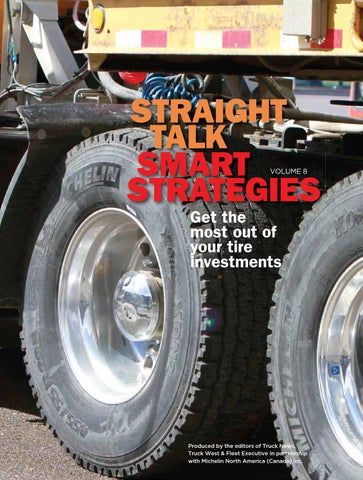
STRAIGHT TALK SMART STRATEGIES VOLUME 8
Get the most out of your tire investments
Produced by the editors of Truck News, Truck West & Fleet Executive In partnership with Michelin North America (Canada) Inc.
CHOOSE MICHELIN X ONE TIRES ®
®
FOR INCREASED FUEL EFFICIENCY, PAYLOADS AND UPTIME.
®
Switching to MICHELIN X One wide-base single tires can save you up to 10% in fuel1 and 1,410 pounds in payload. That’s why more than two million X One tires have worked hard for customers across North America. ®
®
®
Get in on all the advantages provided by MICHELIN X One tires today! ®
®
To learn more, visit michelintruck.com.
1 Based on industry standard rolling resistance testing of comparable tires and retreads. Actual results may vary, and may be impacted by many factors, to include road conditions, weather and environment, driver performance, etc. © 2015 MNA(C)I. All rights reserved. The “Michelin Man” is a registered trademark licensed by Michelin North America, Inc. (C13161)
Straight Talk; Smart Strategies
W
elcome to the second and final installment of our Straight Talk, Smart Strategies series focusing on tire management practices. The two-part series is brought to you in partnership with Michelin North America (Canada) Inc. Over the past two years the Straight Talk series has covered topics ranging from sustainable transportation practices, business advice for small fleets and owner/operators, best practices in the construction industry and now effective strategies for managing one of the main expenses for fleets and owner/operators: tires. In this installment we focus on how to track tire costs, look for effective solutions to maintaining proper tire inflation at all times, and examine if purchasing cheap offshore tires is really as cost effective a measure as the price tag suggests. In the previous installment (available for download on www.trucknews.com) we focused on the tread design connection, the benefits of low rolling resistance and we spoke with O/Os who are every bit as sophisticated about their tire programs as major fleets. I also encourage you to turn to the special Tire Management Practices Knowledge Centre we have created for you on www.trucknews.com containing more news, features and informative videos. The first part in this series is available there as well. It all makes for a multi-media educational package designed to help you make the most out of your tire management strategy.
Lou Smyrlis Publisher & Editorial Director Truck News,Truck West & Fleet Executive
INSIDE THIS ISSUE
4
TRACKING TIRE COSTS
8
UNDER PRESSURE
Tires are your second largest expense after fuel, so it’s important to track the importance of such a major investment. What’s the best way to determine the overall cost when comparing performance, price, longevity and fuel savings? Industry experts share their secrets.
Want the best fuel economy and wear mileage out of your tires? It’s as simple as maintaining proper inflation. Getting drivers to do that, however, isn’t quite so simple. Find out how technology can come to the rescue.
10
NO COUNTRY FOR CHEAP RUBBER The SmartWay list of approved tires has ballooned while knock-off brands are whispering sweet savings. Everybody likes a good deal but is purchasing a cheaper tire really worth the risk?
Brought to you by Michelin North America (Canada) Inc. I TIRE MANAGEMENT 3
TRAC TIRE
INDUSTRY EXPERTS SHARE T
S
o you're trying out a new tire or tread design on one of your applications. Tires are a f leet's second largest expense after fuel, so it's important to track the performance of such a major investment. But what is the best way to determine the overall cost when comparing performance, price, longevity and fuel savings? Tom Herr looks after thousands of tires for Challenger Motor Freight of Cambridge, Ont. His main analytical tool is an Excel spreadsheet that he's customized to keep track of the rubber in his f leet. Tire pressure, tread depths and any unusual wear is recorded each time a unit is brought in for service. The information is then keyed in to on an inhouse data base that can be accessed by Herr or the maintenance staff. “The easiest thing to keep track of is the tractor tires,” he says. “Trailer tires are a little trickier, even with hub odometers, you sometimes have to estimate the mileage.” Herr explains the basic math used to calculate cost per kilometer on a virgin tire. “We pull them at 5/32” and send them for recapping, although we try to leave 4 TIRE MANAGEMENT I Brought to you by Michelin North America (Canada) Inc.
CKING E COSTS
BY H A R R Y R U D O L F S
THEIR SECRETS TO HOW TO DO IT EFFECTIVELY the drivers with 7/32” or 8/32” during the winter months. Ideally you try to run them down to as close to 5/32” as possible. “So a new drive tire gives you 28/32” of tread depth, and if you wear it down evenly to 5/32” that gives you 23/32” to play with. If that tire goes 400,000 kms you can calculate how much wear you've been getting per 1/32” of tread and how much it's costing you per kilometer.” But this is only one possible metric. Some specialty f leets might want to calculate the cost per tire per driver hour, or per engine hour. Cement haulers might frame tire expenses in terms of the amount of concrete poured, while couriers might want the figures in terms of the number of packages delivered. Some f leets just use the cost of the tire and total miles driven in their calculations. But many include other components such as installation labour, tire repair and tire related breakdowns. What’s effective will vary from f leet to f leet. Derek Varley, national f leet manager for Mackie Transportation, doesn't use any special software to track his tires, but he has a maintenance program that allows him to separate tire work from other procedures, including outside labour. Varley can key in the unit number and the tire code and any costs associated
with the tires can be captured and assessed. “Every time a tire goes on a trailer or a truck, it generates an invoice that includes an odometer reading and a date,” he says. “So if we're getting any premature wear, I can look it up and often get an adjustment from the manufacturer. This happened to us recently, and it's another reason you should deal with a reputable manufacturer and account representative.” Service manager Tom Keenan looks after an inventory of hundreds of thousands of dollars of tires for Ayr Motor Express of Woodstock, NB. He uses a software application from TMW (formerly Maddocks Systems) to keep track of tire longevity and expenses. He thinks keeping good records is crucial to the success of a tire maintenance program, but he also has some suggestions for mitigating costs and premature wear. “Running at the right tire pressure is important,” he says. “But even more important, whenever we put on a new set of steering tires, the tires are balanced, and we do a full alignment on both the steers and the drives. If you don't align the drives, the tractor can be pushed to one side and the tires will try to compensate and wear unevenly. “Along with our laser alignment tool, the other most important tool we have is called a Run Out gauge. It cost $300 and it's probably saved thousands. Sometimes a driver will bring a truck in and say there is a shimmy
Brought to you by Michelin North America (Canada) Inc. I TIRE MANAGEMENT 5
or some vibration in the front end. You might have to replace the steer tires, but quite often we can remove the tire, clean up the rim, rebalance the wheel, and still get a lot of miles out of it.” Erb Transport of Baden, Ont., started tracking tires in 1985 and it must be working. As members of the American Trucking Association's Technology & Maintenance Council, they consistently post among the lowest costs per tire per mile when compared to similar f leets in their group. “We wanted to take control of our tire program,” says service manager Steve Haus, who along with his partner Dave Weber have been looking after Erb's tires for 30 years. Each virgin skin that arrives in Erb's system is branded with its own distinct number that will track it throughout its lifetime. Haus or Weber can punch in the tire's ID and find out what position and what truck it's on at any time. “It may not be as modern as some systems out there, but it works for us,” says Haus. “At first it was all done on paper, later we made up some little cards, which eventually progressed to a computer application. But we got some really good information from those cards – our costs and the mileage we were getting. Our fiscal year ends in November and the tire reps would be waiting for those figures to see how well their tires did.” Haus and Weber take a hands-on approach when deciding what tires need to get swapped out. Erb has ten terminals but most of the equipment eventually gets cycled through the Baden (Kitchener) yard. “Everything gets thumped,” says Haus, “and everything is done by visual inspection.” Haus estimates that the average age of one of his tires is about 2.5 years, and there's nothing older than 7 years in the f leet. Derek Varley thinks that retread technology has improved to such a degree that the retread rubber is sometimes outlasting the casing. “We're seeing all kinds of things like casings drying up
and cracking,” he says. “That's why we go with one cap, one casing. But so much depends on choosing the right tire in the first place. For instance, a spread axle tire is different from a standard tandem tire.” Fuel mileage is one of the most difficult things to assess, according to Varley. “To accurately measure mileage you need to run the same tractor and trailer combination and always have them coupled together.” Nonetheless, many carriers including Mackie have started adding units with “Super Single” tires to their f leet, because of the lighter weight and the expected fuel savings. “Companies in our insurance group, like Kriska and Robert, have done some testing and are getting better fuel mileage. I'm more interested how they will hold up and this generation is doing well. I'm even running some on my daycabs.” Canada Cartage fields a diverse f leet of 5,000 pieces of equipment involved in varied job descriptions. National f leet manager John Haines admits tracking tire costs and performance is a daunting task. It's not uncommon for f leets to run several different styles of tires from several manufacturers. But wherever possible, Haines thinks, f leet managers should try and stick to one or two styles and brands. “We have what we call the “grocery tire” that we use on most applications. Try to find a few standards and a few tread patterns that work for you. ” Haines suggests that the same holds true when trying different tires on a trial basis. “Don't go testing a million different brands because you'll never be able to track them.” But when it comes to choosing the right tire for the right application, how do you know when you've found it? “Certain tires seem to score better than others,” says Derek Varley, “but I can tell you which tires you shouldn't be buying. You see them all the time on the road now, very cheap truck tires that won't stand up to even one recapping. It doesn't matter where a tire is made. But at the end of the day you've got to have someone who will stand behind the warranty.” l
$$$$$
6 TIRE MANAGEMENT I Brought to you by Michelin North America (Canada) Inc.
$
STRAIGHT TALK SMART STRATEGIES VOLUME 7
Your guide to effective tire management practices
Download your FREE copies in the Knowledge Centres section of
www.trucknews.com
Produced by the editors of Truck News, Truck West & Fleet Executive In partnership with Michelin North America (Canada) Inc.
UNDER PRESSURE Nearly half of new trailers are being spec’d with tire inflation systems. What’s holding back everyone else?
T
BY JA M E S M E N Z I E S
he key to getting the best fuel economy and wear mileage out of your tires is simple: maintain tire inflation pressures. Getting drivers to do that, however, isn’t always so simple. This is especially true of trailers, which can sit in the yard for weeks at a time and often belong to someone else, making them more prone to neglect. But there’s technology available today, and more coming soon, which could help make improperly inflated tires a thing of the past. Tire pressure monitoring and tire pressure inflation systems both measure inflation pressure in real-time. Monitoring systems, however, still require drivers to manually adjust pressures when needed. Tire pressure inflation systems, on the other hand, add air when the trailer’s in motion, keeping tires properly inflated all the time. Some fleets prefer the simplicity of a tire pressure inflation system while others prefer the lower-cost monitoring systems and the driver oversight they require. Tire pressure monitoring systems also often provide more information about a tire’s status, while an inflation system simply ensures they’re properly inflated. Without a tire pressure inflation system, factors as simple as ambient temperatures are enough to affect inflation pressures. A tire can lose 6 psi when ambient temperatures drop from 10 C to -12 C, and it’s not uncommon for Canadian trucks and trailers to see a temperature swing of that magnitude in a single day of travel. But fleets are beginning to realize this and more than ever before are now spec’ing tire pressure inflation systems on their trailers. Tim Musgrave, president and CEO of Pressure Systems International (P.S.I.), manufacturer of the Meritor Tire Inflation System by P.S.I., said about 45% of new trailers are now being ordered with tire pressure inflation systems. Of those, about 80% are provided by P.S.I. “If you look at the top 100 fleets in North America, about 80-85% are using tire inflation systems,” Musgrave
8 TIRE MANAGEMENT I Brought to you by Michelin North America (Canada) Inc.
said. “When we started the tire inflation business in 1993, for the first five to seven years it was a pull-through. We thought they’d beat our door down. Now what’s happened is, with the price of fuel when it went up and the price of tires going up 10% a month for a while, it inured people to look really intelligently at what an automatic tire inflation system would do.” During an interview at a recent trade show, Musgrave explained the benefit this way: “If I were to put you in my grandkid’s little red wagon right now and pull you around this convention, and then take 10% of the air out and pull you around again, I’d be sweating a lot more the second time around with the tires underinflated.” There are lots of bad things that can happen due to underinflated tires. As Musgrave explained, it takes more energy (fuel) to pull a trailer that’s riding on underinflated tires, causing fuel bills to climb. Underinflated tires can also wear irregularly and prematurely. And once the casing has been damaged, the fleet will likely be able to achieve fewer – if any – retreads. A case study involving a private fleet and cited by the North American Council for Freight Efficiency (NACFE) in its Confidence Report on tire pressure inflation systems, revealed a 1.5% improvement in overall fuel economy when pulling trailers equipped with the systems. That was enough for a payback of one year, which Musgrave said is not unusual. “The ROI is always 10 months or less,” he said. Initially, P.S.I.’s marketing plan involved approaching maintenance managers, many of whom saw it as another maintenance item needing attention. Sales really began to take off when the company got in front of the CFOs and other bean-counters, who saw the value immediately. In November, P.S.I. will celebrate production of its one millionth unit. The popularity of the system and the resulting economies of scale mean it has been able to bring production costs down, paving the way for more widespread adoption. “Early on, I tried to slow sales down, because every one we sold we lost money on,” Musgrave joked. “So the more we sold the more money we lost. Over time, we’ve had one price increase in 20 years. What we’ve been able to do with the volume is maintain the price.”
It has also added more engineers to its staff and tweaked the system for greater performance. But while tire inflation systems are gaining popularity on trailers, there are fewer options available for power units. P.S.I. is working on an external system, which has been in development for about eight years, which would be retrofittable. With some chassis fairings obstructing the drive tires, Musgrave said there’s growing interest in tractor systems. Meritor and Dana are both working on their own solutions, which will be integrated with the drive axles and be available as factory specifications. The release date of these systems has not yet been announced. Another tractor-based inflation system comes from Aperia Technologies. The Halo Tire Inflator is a bolt-on system with an internal pump that’s powered by the wheel’s rotational motion, kind of like a self-winding watch. “Numerous studies, including research by the FMCSA, show that by eliminating tire underinflation, the average fleet can save more than US$2,200 annually for each tractor-trailer,” said Josh Carter, CEO and co-founder of Aperia when the system was launched last year. Interestingly, government may soon force the industry’s hand when it comes to adopting trailer tire inflation systems. The EPA/NHTSA Phase 2 greenhouse gas/fuel economy regulations for heavy trucks will for the first time cover trailers as well. Trailers will have to become more efficient to operate, translating to a fuel economy gain of 8%. Speaking at the Technology & Maintenance Council Fall meetings this year, Charles Fetz of Great Dane Trailers, said in the early stages of the regulation, which for trailers begins in 2018, low rolling resistance tires, side skirts and boat tails may be enough to meet the requirements. But eventually, when the full fuel-saving requirements are phased in by 2027, Fetz said additional items including tire inflation systems may be necessary, whether or not fleets want it. Surprisingly, P.S.I.’s Musgrave is disappointed the rule may require the use of his system. “We wish it was not regulated,” he said. “We’re doing just fine without it being regulated. I think the great fleets in America and Canada run a tire inflation system and the ones that aren’t will, and it doesn’t have to be mandated.” l
Brought to you by Michelin North America (Canada) Inc. I TIRE MANAGEMENT 9
no count
for chea
10 TIRE MANAGEMENT I Brought to you by Michelin North America (Canada) Inc.
try
ap rubber BY JA S O N R H Y N O
SmartWay’s list of approved tires is ballooning and knock-off brands are whispering sweet savings. Is purchasing a cheaper tire worth the risk?
A
side from it being SmartWay verified, I’m not entirely sure if the brand “Skyfire” is, in actual fact, a tire. But I can tell you two things. The first is that, without a shadow of a doubt, “Skyfire” is the name of a heavy-metal band. After 30 minutes of Googling the unfamiliar tire brand, finding no reliable sources of information on it aside from it being on the SmartWay approved list, I jokingly put “Skyfire” into Encyclopaedia Metallum, an online database of heavy-metal bands. And I got a hit. Pulling another name, repeating the process, it happened again. And again. The second thing I can tell you? Like heavy-metal, purchasing tires can make your head hurt — or at the very least, make you angry. “That’s not far off,” says David Henry, a driver with LCG Equipment, La Salle, MB, “because those offshore brands run like metal.” Henry spends his winters hauling loads up and down the ice roads. Right now, however, he’s hauling heavy equipment to Edmonton. “I had some brand new offshore tires on my (used) Volvo when I bought it, and I got 40,000 km out of the steer tires. If we’re talking heavy metal, it ran like a tank.”
Brought to you by Michelin North America (Canada) Inc. I TIRE MANAGEMENT 11
SmartWay for you, SmartWay for you, SmartWay for everybody! When we first took a close look at SmartWay in February 2015, there were 150 manufacturers with a SmartWay product. As of early December 2015, that number had climbed to 231. That is just the number of brands, never mind the amount of tires for each of those brands. The lengthy list speaks to the bloated tire market, which is challenged by an influx of brands that purchasers have no way of knowing if they are legitimate, well-performing tires, or cheap knock-offs that will blowout on any given run. SmartWay measures rolling-resistance. No other performance characteristics are measured, a fact
that the EPA is relatively upfront about: “EPA does not guarantee any performance or claims by the manufacturer, and the described performance is only applicable when the technology is installed and used in accordance criteria described herein,” it says in plain view on the SmartWay webpage. “While EPA may request related information, verification is not an indication of endorsement, safety, regulatory, compliance or other performance consumers should consider.” So why does SmartWay matter? “It matters because we have to run them in California,” says Bison’s director of maintenance, Lester Davis. If there is one good thing about SmartWay, he says, it’s that rolling-resistance has improved across the board. But there’s more to tires than rolling-resistance. Jennifer Singer, operations manager at Ron Singer Truck Lines in Calgary, AB., says SmartWay “means nothing to us. Sure, those tires might work great down there (California), but this is Canada, the weather changes are much more drastic.”
Give me a treadin’ break Singer says they have never used one of the newer, offshore brands. “They are all crap,” she says in no uncertain terms, adding that she is seeing more and more of theses types of knock-offs entering the market. “I get an email every week asking me to buy a set of these tires. And we’ve taken a look at them, but they don’t do seasons. They’ll tell you that they have good tread – well sure, they have good tread, picking up every rock and branch on the road, sandblasting the bottom of your truck.” Those tires on Henry’s Volvo that lasted a paltry 40,000 km? “They looked good because they had lots of tread on them,” he says when asked why he went with them. “I knew better, and I questioned them, but the dealer was very adamant that they were great. But I knew better.”
We all know better That’s the thing when it comes to purchasing tires; chances are you know better. “You need to look at the big picture,” Singer stresses. “Sure, you saved $200 a tire, but if you are in the middle of nowhere and get a flat, are they going to fix it for you? No. They say they can withstand the weight;
12 TIRE MANAGEMENT I Brought to you by Michelin North America (Canada) Inc.
BANG YOUR HEAD: TIRE BRAND, METAL BAND OR BOTH? Can you tell the difference between a SmartWay verified tire brand and a heavy metal band? One point for each correct answer. No Googling.
1. Glory 2. Bulldozer 3. Furious 4. Ironman 5. Kombat 6. Redsea 7. Rockstar 8. Starhorse 9. Skyfire 10. Earthsaker
no they can’t. They can’t withstand the tire chains,” she adds, “and sometimes my guys have to chain up three times on a run.” In the case of LCG Enterprises, the company Henry drives for, they pay for what they know will last. “We’re running heavy, so we pay for something that will handle that.” When Henry hits the ice roads, he has a specific set of tires that will see him through the season. “That’s not only performance, but safety, too.” And nobody can put a price tag on safety – another major unknown with many knockoff brands. Smaller fleets like Singer and LCG can’t afford to test tires, nor is it likely they have the bandwidth and depth of expertise to run extensive testing. But does a large fleet like Bison have the capabilities to run extensive tests? Bison does measure, Davis says, but “we don’t do side-by-side comparisons. We have never seen any benefit in that. Any time you are measuring, it needs
to be controlled as much as possible.” Accounting for weather, road conditions and driver behaviour, that’s tough to do, he says, even for a fleet with Bison’s resources. They always look at the “cradle to the grave cost,” he explains. We’re looking to get five to eight years of casing life – or at least two uses.” Ultimately, Davis says it comes down to diligence on PSI. “Pure and simple.” If you manage your PSI, the difference in tire life is a country mile.” It’s also simple things, like switching your tires when the seasons change. “You’ll get a longer life out of them,” Singer says. Naturally, it can be tempting to run on a cheaper set of knock-off tires, especially for smaller companies, never mind part-time owner-operators like Henry. “Yes, there will always be someone that will give you a better deal,” Singer says, “but you have to drive product. Do you really want to be stuck on the l side of the Kootenay Pass at 2:00 A.M.?”
Answer Key: Glory – Both; Bulldozer – Metal band; Furious – Both; Ironman – Tire brand; Kombat – Both; Redsea – Tire brand; Rockstar – Tire brand; Starhorse – Tire brand; Skyfire – Both; Earthshaker – Metal band
Brought to you by Michelin North America (Canada) Inc. I TIRE MANAGEMENT 13
DRIVE WITH CONFIDENCE,
WHATEVER THE CONDITIONS, WITH THE MICHELIN XDS 2 TIRE. ®
®
®
You can trust the MICHELIN® XDS® 2 tire to get you where you need to go, when you need to get there. Its Durable 3D Matrix SipingTM Technology and wider tread offer exceptional traction and improved* take off mileage.
*Compared to the MICHELIN® XDS® tire. ©2015 MNA(C)I. All rights reserved. The “Michelin Man” is a registered trademark licensed by Michelin North America, Inc. (C13161)