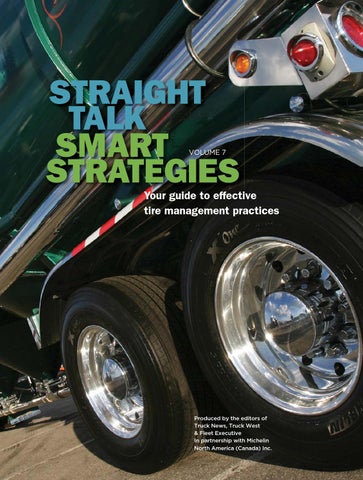
STRAIGHT TALK SMART STRATEGIES VOLUME 7
Your guide to effective tire management practices
Produced by the editors of Truck News, Truck West & Fleet Executive In partnership with Michelin North America (Canada) Inc.
CHOOSE MICHELIN X ONE TIRES ®
®
FOR INCREASED FUEL EFFICIENCY, PAYLOADS AND UPTIME.
®
Switching to MICHELIN X One wide-base single tires can save you up to 10% in fuel1 and 1,410 pounds in payload. That’s why more than two million X One tires have worked hard for customers across North America. ®
®
®
Get in on all the advantages provided by MICHELIN X One tires today! ®
®
To learn more, visit michelintruck.com.
1 Based on industry standard rolling resistance testing of comparable tires and retreads. Actual results may vary, and may be impacted by many factors, to include road conditions, weather and environment, driver performance, etc. © 2015 MNA(C)I. All rights reserved. The “Michelin Man” is a registered trademark licensed by Michelin North America, Inc. (C13161)
Straight Talk; Smart Strategies W
elcome to the next installment of our Straight Talk, Smart Strategies series. This time we focus on tire management practices. This twopart series is brought to you once again in partnership with Michelin North America (Canada Inc.) Tires rank among the top three expenses for fleets and owner/operators. It goes without saying then that tire selection, performance monitoring and maintenance are critical elements of a successful business. Putting together an effective tire management plan, however, requires knowledge of and access to resources in a variety of areas such ranging from the impact of tread design on performance to purchasing mistakes to avoid. In this first issue we focus on three key areas: The Tread Design Connection: The different tread compounds, designs and casings available with today’s heavy duty tires not only make for fascinating science, they greatly affect the performance of tires. We outline what you should know about each of these tire design variables. O/O Focus: Frequently, when we talk about tire management programs, we focus on what the large fleets are doing. However, there are many owner/operators who are every bit as sophisticated about their tire programs as the major fleets are.Three top owner/operators share their tips and techniques for choosing the right tire and then getting the most out of it. Benefits of low rolling resistance tires: LRR tires have long been touted to save fuel, and now there's proof. A recent study by the North American Council for Freight Efficiency (NACFE) has shown there are significant fuel savings to be realized by running LRR dual and wide-base single tires. More subjects will be covered in the next installment, available later this month. I also encourage you to turn to the special Tire Management Practices Knowledge Centre we have created for you on www.trucknews.com containing more news, features and informative videos.The first part in this series is available there as well. It all makes for a multi-media educational package designed to help you make the most out of your tire management strategy. Lou Smyrlis Publisher & Editorial Director Truck News,Truck West & Fleet Executive
INSIDE THIS ISSUE 4 FINER FOOTPRINTS Openings in a tread are hardly random slashes and gaps. They are introduced with specific tasks in mind, with openings such as sipes and grooves used to strike the perfect balance between traction, wear and fuel economy. Looking for better performance from your tires? See what you should be looking for in the tread design.
8 THE ROAD WARRIOR TEST Tire designs go through a lot of testing but perhaps nothing equals the real world situations and expectations provided by the nation’s owner-operators. We found three owner/operators who take tires very seriously and asked them to share their tips and techniques on how to choose the right tire for each operation to maximize their business.
11 THE LOW DOWN ON LOW ROLLING RESISTANCE TIRES Reducing rolling resistance is one of the most effective ways to improve fuel economy, so it’s little wonder low rolling resistance tires have exploded in popularity in recent years. But not all low rolling tires are created equal. To bring clarity to the issue, the North American Council for Freight Efficiency has issued a Confidence Report that examines the benefits as well as the myths of low rolling resistance tires.
13 INSIDE THE NUMBERS Both Canadian fleets and owner-operators are getting more comfortable with purchasing wide base single tires. Our survey probes their purchasing plans and the features they look for when purchasing.
Brought to you by Michelin North America (Canada) Inc. I TIRE MANAGEMENT 3
FINER FOOTPRINTS LOOKING FOR BETTER PERFORMANCE FROM YOUR TIRES? TAKE A CLOSE LOOK AT THE TREADS.
BY J O H N G . S M I T H
N
o two fingerprints are alike. That’s what we’re told. To the untrained eye, the lines and swirls look pretty similar, but forensic experts know better. They don’t simply see lines. They see crossovers, cores, bifurcations, islands, deltas and pores. Trained eyes identify tire features in much the same way. Openings in a tread are hardly random slashes and gaps. They are introduced with specific tasks in mind, with openings such as sipes and grooves used to strike the perfect balance between traction, wear and fuel economy. The tire’s geometry certainly affects traction. Grooves that run around the circumference of the tire are responsible for moving most of the snow and water from underneath the tire’s footprint, while individual blocks and the tiny incisions known as sipes bite at the road surface. Rib tires typically found on steering axles or other free-rolling positions such as trailer, dolly, tag and pusher axles tend to focus on fuel efficiency. They may even be found on axles that generate torque as long as trac-
4 TIRE MANAGEMENT I Brought to you by Michelin North America (Canada) Inc.
tion is not high on the wish list. They include grooves which run parallel to the tire’s bead, and range in depth from 11/32 to 23/32 inches. They are even playing a role in meeting emission standards, as manufacturers look across vehicles to meet the targets for Greenhouse Gases that can only be realized by burning less fuel. The next family comes in the form of block or lug tires that are typically found on drive or torqued axles. Their grooves run both laterally and perpendicular to the bead, with depths ranging from 14/32 to a full inch deep, helping to offset the natural scrubbing or spinning that happens when power is applied to the axle. They may not roll as easily as their ribbed counterparts, but they typically boast better traction and longer life. The differences hardly end in the product categories. Seemingly subtle changes in a tread design can affect everything from traction to wear and fuel economy. “People confuse open shoulders with traction,” observes Paul Crehan, director of product marketing for Michelin North America. There was a time when that was true, but no longer. Besides that, open-shoulder designs can also be more prone to excessive heel and toe wear. A tread with a broad array of features may not be superior to its more streamlined counterparts, either. “It’s how that feature gets balanced with performance,” he says. Some of the differences are only visible by examining a cross section of the tread. Open features in a tire can be shaped so they leave wider openings as the tread depth begins to decrease, Crehan says. This helps to maintain a void that will offer the required traction. “You need a certain amount of void in order to get the material to evacuate,” he says as an example. A teardrop shape at the base of a sipe can also relieve stress and prevent tears, while multiple sipes can effectively lock together to improve the stability normally associated with solid tread blocks. How these features “evolve” over the life of the tire will dictate many issues. Then there is a question of the layers underneath. “The belts and the casing are designed to put the footprint on the
ground in a certain way,” Crehan adds. Skimp here, and the tread will not hold its form correctly, leading to irregular wear. Chemistry makes a difference, too. The tread compound designed for specific applications will dictate durability and rolling resistance alike. Dual compounds offer the best of both worlds. The part of the tread that actually contacts the road needs to provide a higher level of traction than the material underneath, which can instead be formulated to reduce rolling resistance. “The portion of the tire which is designed to resist scrubbing and provide wear and traction is a different material than what sits underneath the groove,” Crehan says. There can even be dramatic differences in designs that share the same SmartWay seal of approval. The SmartWay program, initiated by the U.S. Environmental Protection Agency and promoted by Natural Resources Canada, helps to identify tires with a Low Rolling Resistance (LRR). That’s good for fuel economy. But there are other considerations such as the potential working life and traction. In many respects, available treads can both meet and exceed SmartWay goals. The actual improvement in fuel economy will vary depending on the tires a fuel-efficient design will replace. Double-digit percentages are certainly harder to realize these days. “There has been a lot of
Brought to you by Michelin North America (Canada) Inc. I TIRE MANAGEMENT 5
improvements in general,” Crehan says, referring to tires in every category. “More frequently you see 2-3% [improvements] because people aren’t using high rolling resistance tires throughout the whole fleet.” They may not even be an option for some Canadian fleets, which unlike selected American counterparts are more likely to travel regional routes and crowned secondary roads than long and steady divided interstates where treads with a lower rolling resistance would make the biggest difference. And, of course, there are the traction needs that come with snow. Still, some Canadian buyers may be selecting treads that are more aggressive than they need. Well-travelled corridors such as Highway 401, which slices through the Greater Toronto Area, will be regularly cleared, Crehan says. Fleets that travel into southern reaches of the US will also see far less snow than their regional counterparts in areas such as Northern Quebec or the Maritimes. “What are your real winter needs?” he asks. “Are you needing winter traction on the road surface because you’re heading into smaller places?” Some of the traction needs may be specific to yards and loading docks. If that is the case, the answers might involve improving yard maintenance practices and clearing the way, so fuel economy gains can be realized. “The biggest issue is the low speed in terms of instantaneous traction,” he says. “You don’t hear of people running through New Brunswick and getting stuck climbing a hill.” “The fleet has to know, in their own mind, from their experience, what level of traction they require,” he says. Those running through snow for extended periods of time will want something like the Michelin XDS 2, designed for snow and mud. On better-main-
tained roads, the better option might be the XDN 2. When fuel economy is a real concern, and the equipment will spend most of its time in southern climes, the choice might include a fuel-saving Low Rolling Resistance tire. It’s also important to remember that a tire’s application can change over time. Fleets that operate in areas which require added traction are in a good position to move drive tires to trailer positions. Typically, many trucks get new drive tires in the fall, while tires with less than 10/32 treads will find a home under the trailer. “It allows you to operate efficiently,” Crehan says. “It doesn’t hurt you from a rolling-resistance perspective very much.” Advanced approaches to retreading can even include treads with the same attributes as newer designs. “The molding technology to do that has evolved quite a bit,” he says. Imagine what it would be like to pull a lollipop through a rubber surface. That’s what it’s like to create a sipe with both a thin blade and rounded shape at the bottom. Even the width of the tread will be a consideration. Those who opt for wide base single tires can save between 700 and 1,300 pounds when compared to those with dual drive and trailer axles. (The largest gains are realized when also switching from steel to aluminum wheels.) There are clear fuel-economy benefits, thanks to the reduced rolling resistance, but some of the earliest adopters of these tires have been weight-sensitive applications that are able to translate the weight savings into extra cargo, he says. Tire pressures are also easier to maintain, in part because the valve stems are all easier to reach when it comes time to use a tire gauge. Of course, it is a matter of switching more than tires alone. Axles, hubs and bearings also have to be considered in these applications, ensuring a proper offset that maintains legal track widths. “The best way to do it is to integrate it into the fleet when you’re spec’ing new equipment,” Crehan says. Weights and dimensions are also something to consider. Manitoba adopted standardized loading for wide-base and dual tires earlier this year, even as other jurisdictions continue to impose weight penalties. But it’s one of the many new tire options that continue to gain traction across Canada. l
6 TIRE MANAGEMENT I Brought to you by Michelin North America (Canada) Inc.
VOLUME 6
STRAIGHT TALK SMART STRATEGIES The latest update on GHG regulations and the most effective fuel saving practices • Learn how to get your drivers onboard with fuel efficiency programs
STRAIGHT TALK SMART IES STRATEG VOLUME 5
most effective Your guide to the es fuel saving practic
• How much can retreading save from your tire costs? • What Phase 2 of the EPA/NHTSA fuel economy standards will mean for your future truck purchases
editors of Produced by the West Truck News, Truck & Fleet Executive Michelin In partnership with (Canada) Inc. North America
Download your FREE copies in the Knowledge Centres section of www.trucknews.com
Produced by the editors of Truck News, Truck West & Fleet Executive In partnership with Michelin North America (Canada) Inc.
the road war
OWNER/OPERATORS SHARE THEIR TIPS AND TECHNIQUES FOR CHOOSING THE RIGHT TIRE AND THEN GETTING THE MOST OUT OF IT
s
electing the right tires for your ride isn’t an easy process. The wrong tires can compromise everything owner/ops try to achieve – a cost-effective, fuel-efficient, comfortable and safe ride. Tires are a critical investment, and there’s a lot to consider when it’s your money used to purchase them. Do you go for the tire with the best traction? The greatest mileage to removal? Or do you go for the cheapest ones you can find? We found three owner/operators who take tires very seriously and asked them to share their tips and techniques on how to choose the right tire for each operation to maximize their business.
mark lee -----
Mark Lee is a new owner/operator to Canada. Though he has been driving for quite a while, and was an owner/op back in Britain, Lee is new to the life of an O/O in Western Canada where he pulls turnpike doubles. When asked about how owner/operators should go about choosing the right tire, Lee said that the price of the tires is something drivers shouldn’t even glance at because “the price of the tire is insignificant.” “There’s a lot of factors for you to weigh in on when purchasing a tire, but whatever factor that you do weigh in on to choose, definitely go for the lowest rolling resistance,” he said. Lee drives a 2014 Volvo and was lucky enough to have the tires he would have chosen for his truck come with the truck when he bought it – Michelin XZA3+ for the steer tires and XDN2s on the drive. He said he would have chosen those anyway because they work best for his operation pulling all the weight he does in Western Canada. “Tires have such a huge impact on fuel economy,” he said. “You can get side by side tires, say I’m XDN2 Michelin,
which has got a rolling resistance in the 130s. I need that because I run pikes 63 tonnes and my drives aren’t always heavy, so I got a lot of momentum to get away, so I need that extra bit of grip from the open shoulder.” Lee doesn’t trust offshore tires and says he would never use them on his truck. “It’s not so much quality issues, it’s the fact that there’s no rolling resistance number for them,” he said. “(Major name-brand tire manufacturers) do millions of dollars in research and development. I was like everyone else, I thought, you know a tire is just a tire but I learned this when I was a full time journalist…I was at a Michelin conference and I was captivated. My friends all think I have a rubber fetish now.” Maintenance wise, Lee says that it’s important to get a pressure gauge to monitor your pressures and tailor it to your specific application. “If you’re running around carrying light goods, then you don’t need to go with high pressures, but if you’re running heavy all the time, then you need all that pressure,” he said. “And pumping your tire with a hammer is a waste of time and energy. Get a pressure gauge and get it right.”
8 TIRE MANAGEMENT I Brought to you by Michelin North America (Canada) Inc.
He also says its important for other owner/ops to do research before they buy. “Your smartphone is such a fantastic thing because you can look up wear patterns and learn about tires,” he said. “The most important advice to aspiring O/Os or current O/Os is to learn about tires. They’re not just pieces of rubber. The trucks cannot move without the tire, or they could, but it wouldn’t be very comfortable if you tried.”
d rrior test BY S O N I A S T R A FAC E
david henry -----
Driving the ice roads up in Yellowknife comes with a great deal of skill. But the trucks wouldn’t be steady without a pair of sturdy tires, at least that’s what David Henry, a ice road owner/op who drives for Continental Cartage based out of Edmonton, Alta, said. Henry’s 2013 Freightliner is equipped with Michelin drive and steer tires, which he claims are his favourite tires to work with. “I run XDN2s for the drive tires and I find them to be very good with all-weather type traction,” he said. “They’ve got enough siping in the tires that can handle the icy conditions and yet they last a long time. I run Michelin steer tires as well – XZA3s.” Henry said that as a professional and long-time owner/op, he is a big believer in testing all sorts of tires, and has done so for each and every truck he’s had. “The funny thing with the steer tires is not every truck is exactly the same,” he said. “Tires are very important to me and I’ve run all kinds of different tires to see what works and for some trucks… unfortunately it takes a set of tires to see which tires works better on your truck…hopefully not more than one set because it can get awfully expensive.” Henry recalled the time he bought a 2006 Volvo that came with offshore tires. “I bought a truck a few years ago and the truck came with brand new virgin offshore tires and it wasn’t my first experience with them but it was the most
drastic,” he said. “I said to the salesman, ‘I don’t know about these..’ and he said, ‘Oh no, they’re perfect. They’re modeled after a Goodyear.’ And they lasted me 40,000 kilometres and they were rough riding. They were just like having a bunch of bricks strapped around your front wheel. After 40,000 kilometres I had to get rid of them.” He said he uses 200,000 kilometres as a benchmark for how long good tires last him. “So if I don’t get 200,000 kilometres out of a set of steer tires, then I’ve got to do something better, something different,” he said. He said mileage to removal is the most important factor to him when he buys a tire (as well as traction when he goes to the ice roads) because it reflects on his cost per mile. “To me, it comes down to, you have to make money and the truck has to handle well,” he said. “The tire really has to be the whole package and sometimes
the offshore guys like to look at a tire and say, ‘Look this tire is only $200 and if you buy (a name brand) its $450’ and so a lot of people think oh, that’s half the price, but if you only get a quarter of the miles out of it, what good is it? And when your truck is bouncing down the road because you can’t balance the offshore tires, it doesn’t matter how cheap that tire is, it’s not worth it.” He added that he doesn’t recommend buying cheaper, offshore tires because sometimes in the long run, it could cost you money. “If I’m running down the road and I have a tire that blows out on me because of poor manufacturing…if I have that happen, it not only costs me $500-$600 to get that tire changed on the road, but I also lose the money per hour when I’m sitting there,” he said. “ And if lose a day or half a day because of the tire, that’s a $1000 I lose. So saving myself $200 up front has cost me $800 down the road. That doesn’t make sense.”
Brought to you by Michelin North America (Canada) Inc. I TIRE MANAGEMENT 9
dean kennett -------
It’s all about having faith and trusting your tires, said Dean Kennett, an owner/operator who hauls for Payne Transportation in Manitoba, when asked about how he chooses his tires. Just like Lee, he was blessed with a set of tires that he loved when he bought his new 2015 Volvo VNL 780 recently. “The steer tires would have been my choice anyway, if I specified the truck myself,” he said. “Those are Michelin XZA3+. From previous experience, driving trucks with these tires, I found that they handle and grip very well, they provide a good quality of ride, and they wear very well. Tires are a long term investment, and these ones are a great choice.” He said mileage to removal is one of the most important factors he considers when choosing a tire, because where he runs – from Manitoba to Florida and back every two weeks – he can get up to 250,000 kilometres per set. The tires you choose and how safe you drive, go
hand in hand according to Kennett who says that’s the biggest factor for him when choosing a tire. “If you don’t have faith in the tires you’re using, then you’re not driving as safely as you could be,” he said. “Because you’re never fully comfortable and confident in the front end of the vehicle. If there’s no confidence in the front, there’s no confidence in the vehicle behind you. I need to know, when I turn the wheel…especially in bad weather, that the tires are going to follow the path that I’m setting them on. I need to have that confidence there.” When it comes to maintenance Kennett said preventative maintenance is key with tires. “The best advice I can give is check your tire pressures, fill your tires, see if there’s anything different with the wearing, regularly run your hand over them and have a look, because one pothole can make such a difference,” he said. “It’s all about preventative maintenance. Keep an eye on them, and if there’s any maintenance required go and get it done right away. It’s cheaper in the long run.” l
10 TIRE MANAGEMENT I Brought to you by Michelin North America (Canada) Inc.
THE LOWR DOWN ON LOW ROLLING RESISTANCE TIRES WHAT THE NORTH AMERICAN COUNCIL FOR FREIGHT EFFICIENCY’S REPORT REVEALS BY JA M E S M E N Z I E S
educing rolling resistance is one of the most effective ways to improve fuel economy, so it’s little wonder low rolling resistance (LRR) tires have exploded in popularity in recent years. To see evidence of this, one needs to look no further than the EPA SmartWay list of verified low rolling resistance tires, which has bloated to include hundreds of offerings from nearly 200 manufacturers. The SmartWay program looks at rolling resistance only, and not how it was achieved. There’s no way to determine when scanning the list, for instance, whether a tire employs advanced engineering to reduce rolling resistance without compromising on wear life or traction, or whether the tread was simply shaved down. After all, the most fuel-efficient tire is one that’s nearing the end of its useful life and as a result, has a shallower tread. To help bring clarity to the world of low rolling resistance tires, the North American Council for Freight Efficiency (NACFE) recently issued a Confidence Report that examined the benefits of LRR tires as well as some myths. The overriding theme in the report is that LRR do save fuel - perhaps even significantly more fuel than many fleets believe. While the purchase price of a new truck tire typically translates to about four cents per mile, its influence on fuel consumption can range from 14 to 28 cents per mile. This means fleets that are purchasing truck tires based on acquisition price rather than their fuel economy potential are not seeing the forest for the trees. “Tires have a much bigger effect on overall fuel efficiency than most people believe,” said Mike Roeth, operation lead, trucking efficiency with NACFE. “Traditionally fleets have looked at purchase price and wear; we’re highly suggesting you include fuel savings in any calculations.” The Confidence Report concluded that: LRR tires, whether in dual or wide-base configuration, save significant amounts of fuel compared to tires not designed for rolling resistance; tire configuration should be assessed based on total cost of ownership, including fuel economy; and more fleets are recognizing
Brought to you by Michelin North America (Canada) Inc. I TIRE MANAGEMENT 11
the benefits of LRR tires outweigh the challenges. An oft-cited challenge regarding LRR tires, especially in Canada, is that traction is not sufficient in snowy conditions. However, NACFE found this to be untrue when it interviewed fleets in the US and Canada. “The perception of traction issues and driver acceptance is worse than reality,” Roeth said. “It’s hard to measure these items but we continue to hear these tires are performing better on traction and drivers are accepting them.” But again it comes down to selecting the right low rolling resistance tire, one that’s been designed to improve fuel economy without sacrificing traction. Even within the SmartWay list of verified LRR tires, Roeth said a second category of tire is emerging, so-called ‘Super’ low rolling resistance tires. “The most advanced tire manufacturers are bringing new tires to the market that not only have amazingly low rolling resistance, but also don’t have the tradeoff of low miles to replacement,” he said. “A few mega-fleets are finding this and trying to figure out their next tire purchases to take advantage.” Fleets seem to be getting the message. NACFE surveyed 14 large fleets in the US and Canada and found more than 80% of dual tires they’re running are low rolling resistance tires. For smaller fleets that lack the resources to conduct reliable fuel economy testing, Roeth suggested looking to the large fleets for guidance. “If you have the capability of studying, parceling out the data, doing what the big boys do, by all means, go after it,” he said. “If you don’t, then copy them. If you’re a smaller fleet and you don’t have the means to do all that, look at the
The Confidence Report
bigger fleets that are concluded that: LRR tires, whether similar to you and in dual or wide-base configuration, do what they’ve done and don’t save significant amounts of fuel be ashamed to compared to tires not designed for do that.” rolling resistance; tire configuration Con-Way Freight is one of should be assessed based on total those mega-fleets cost of ownership, including fuel that’s using low rolling resistance economy; and more fleets are tires as a means of recognizing the benefits of LRR achieving greater tires outweigh the fuel economy. Brian Keck, fleet maintenance challenges. director, told an audience at the Technology & Maintenance Council’s fall meetings that LRR tires have improved fuel economy should deal with suppliers they know by 1.5% while also extending miles to and to not become fixated on acquisiremoval by 30%, which speaks to the tion price. improved design of the latest-generation “A lot of tires have been approved on LRR tires. He also said they cost about the SmartWay list that are quite low in 10% more than non-LRR tires, but price and we wonder about their total Roeth said the cost variance has narcost of operation, meaning they could rowed in recent years. possibly wear a lot quicker and they For Con-Way, low rolling resistance could cost less and just not have the rugtires are one important part of a multigedness against damage,” he pointed out. pronged approach to improving fuel He also recommends keeping the economy, which has been underway tires on as long as it’s safe to do so, to since 2013. That year, it reduced its fuel ensure you take advantage of the best consumption by 1.9% compared to its fuel economy the tire will offer as its 2012 baseline, in 2014 it boosted fuel tread wears down. economy another 4.5% and in 2015, so “The sweetest spot is right before far, it has gained another 3.5%, Keck you remove them; as the tire wears, the said. In addition to tires, it has been fuel efficiency improves,” he said. “Use deploying trailer skirts and automated all the tire, it makes sense from a wear transmissions and downspeeding the standpoint. Of course, pull the tire when engine. it needs to be pulled for safety, but use it But the beauty of tires is that the fuel all because its better fuel efficiency is in economy advantages can be gained at the latter part of its life.” any time; LRR tires don’t have to be The full Confidence Report built into the original spec’. can be downloaded for free from Roeth said fleets looking to make TruckingEfficiency.org. l the switch to low rolling resistance tires
12 TIRE MANAGEMENT I Brought to you by Michelin North America (Canada) Inc.
ROLL
WITH IT
Fleets and O/Os getting more comfortable with wide base tire selection
MOST IMPORTANT FACTORS IN PURCHASING DECISION (scale 1-5) ROAD AVAILABILITY
RETREADING
4.07
ROAD AVAILABILITY
RETREADING
2.97
STABILITY
4.00
MAINTENANCE
4.04
HOW WILL YOU OPTIMIZE TIRE COSTS IN THE FUTURE
3.88
2.72
STABILITY
3.57
30% MAINTENANCE
3.67
WEIGHT
3.72
WEIGHT
ROLLING RESISTANCE
3.73
ROLLING RESISTANCE
58% 12%
3.34
3.66
FLEETS FUEL CONSUMPTION
3.80
FUEL CONSUMPTION
3.64
OWNER/OPERATORS
FLEETS
43%
37% PLAN TO PURCHASE WIDE BASE TIRES 1m on
12 mon ths & +
on
3
m
11% 74%
nth s
Acquisition price
In-house preventive maintenance
on
ths
OWNER/OPERATORS
Better product selection
6m
FLEETS
3%
nths
49%
s th
6 mo
25%
12%
th
13%
3m o
12 mon ths & +
th
14%
20%
on
1m
OWNER/OPERATORS
Brought to you by Michelin North America (Canada) Inc. I TIRE MANAGEMENT 13
DRIVE WITH CONFIDENCE,
WHATEVER THE CONDITIONS, WITH THE MICHELIN XDS 2 TIRE. ®
®
®
You can trust the MICHELIN® XDS® 2 tire to get you where you need to go, when you need to get there. Its Durable 3D Matrix SipingTM Technology and wider tread offer exceptional traction and improved* take off mileage.
*Compared to the MICHELIN® XDS® tire. ©2015 MNA(C)I. All rights reserved. The “Michelin Man” is a registered trademark licensed by Michelin North America, Inc. (C13161)