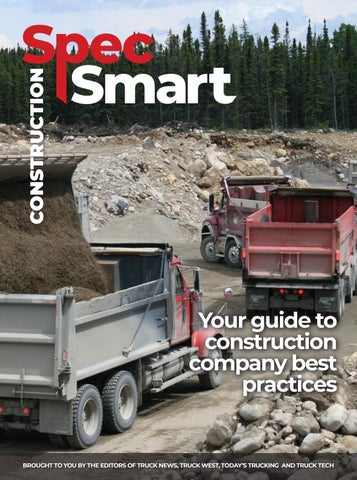
CONSTRUCTION
Your guide to construction company best practices
CONSTRUCTION | SPEC SMART 1 BROUGHT TO YOU BY THE EDITORS OF TRUCK NEWS, TRUCK WEST, TODAY’S TRUCKING AND TRUCK TECH
CLEANING POWER THAT PACKS A PUNCH NOW WITH
IDX4
Introducing IDX4, a new superior detergent package that offers the most powerful injector cleaning in the industry. IDX4 technology is guaranteed to both clean the toughest deposits from your injectors and keep them clean. Combating today’s HPCR System issues, Meaner Power Kleaner also safely eliminates water and increases lubricity. For the best year round performance you need the toughest product available, Meaner Power Kleaner with new IDX4.
Howes Tire Thumper & Flashlight
when you purchase 3 bottles of Howes Meaner Power Kleaner Visit www.howeslube.com or call 1-800 GET HOWES Offer ends: 9/30/18, available while supplies last.
1-800 GET HOWES (438-4693) • www.howeslube.com
IN THIS ISSUE
CONSTRUCTION
4
9
Truck drivers can avoid hazards on construction sites
C&G Haulage talks about the unique challenges of being an aggregate hauler
Play it Safe
12
Mack makes enhancements to its Granite model truck
Heavy haulin’
13
New MV Series truck designed with drivers in mind
Welcome to Spec Smart – Construction, our first in a series of digital supplements ex-
amining best practices in spec’ing and operational strategies for construction, regional and highway operations. Few work environments present as many risks as construction sites and in this issue we outline the technologies and practices necessary to achieve exemplary safety records. We also get up close with C&C Haulage in Ajax, Ont., a family-run business grown by immigrants and looking to solve the driver shortage by turning to immigrants. Finally, we also highlight the largest announcements from the Work Truck Show. I hope you enjoy reading this supplement Lou Smyrlis Managing Director, Newcom Trucking & Supply Chain Group
CONSTRUCTION | SPEC SMART 3
SAFETY
PLAY IT SAFE
TRUCK DRIVERS CAN AVOID HAZARDS ON CONSTRUCTION SITES BY ERIC BERARD
F
ew work environments present as many risks as construction sites. Especially when you’re at the wheel of a truck weighing tons by itself - plus it’s often unstable cargo and you’re driving around even bigger machines and workers on foot. The top 3 causes of injuries in the construction 4 SPEC SMART | CONSTRUCTION
sector for the occupation group called “Trades and Skilled Transport and Equipment Operators” by Ontario’s WSIB are: bodily reaction and exertion, contact with objects and equipment and falls. The Regina Bypass Project – the most important highway infrastructure of this province’s history at close to $2 billion
– is a good example of sound safety policies. Project director Alisdair Dickinson manages 200 to 300 simultaneous truck movements at peak times. Trucks bring in materials such as aggregates and sand, asphalt, concrete, reinforcing steel bars, steel and concrete bridge beams, overhead steel signs, pipes, ducts and electrical cables.
SAFETY
“If you have a truck reversing, we need to make sure that we don’t have anybody in harm’s way. So we create areas where it’s safe and where it’s not safe, we have designated people who are controlling the operations, to make sure that everything happens safely.” — Alisdair Dickinson, Project director
Spokesman Tony Playter underlines that the Saskatchewan capital highway project has exceeded 3 million hours of work without a lost-time-incident. To achieve such a safety record, knowing your surroundings is key, thinks Dickinson: “The biggest risk is a lack of familiarity, so we have a lot of full-time employees on the job who come in to work every day. The biggest challenge is making sure that our truck drivers are aware of the risks and hazards that are on the job before they step out of their cabs,” he says. Backing-up
Back-up manoeuvres are a serious safety concern on a construction site. “That’s when the most incidents occur,” says Jean-Pierre Garand, president of the Association nationale des camionneurs artisans Inc. (ANCAI), a 5,000+ member organization representing small size fleets and owner-operators doing bulk hauling in Québec. “If you have a truck reversing, we need to make sure that we don’t have anybody in harm’s way. So we create areas where it’s safe and where it’s not safe, we have designated people who are controlling the operations, to make
sure that everything happens safely,” says Dickinson. Gaétan Légaré is ANCAI’s executive director. He says that finding safe designated back-up areas is trickier on smaller sites. By definition, he says, a small construction site has limited space to lay out back-up areas. “That’s not much of an issue on major projects such as those piloted by Hydro-Québec or the Ministry of Transportation. But when you’re talking about smaller sites, like in the municipal world, that can be more of a problem,” he notes, adding: “That can be a major headache for the contractor himself trying to comply with safety regulations.” Garand thinks that such policies are great, but he also points the finger at the work pace that’s required from the drivers, which can be in contradiction with safety rules. “On one hand, we are told to make sure to have a visual contact before initiating any back-up manoeuvres. On the other hand, the truck driver might be told something like: ‘What are you waiting for?’ if the supervisor feels the process takes too long.” Back-up alarms can also be problematic, according to Légaré. “When there are too many beeping at the same time,
you can end up not even noticing them anymore. It’s like a funnel in which the sound disappears,” he says. More recent technology in the form of back-up cameras can help vocational truck drivers be safer when reversing and they’re becoming more and more common in the industry. Rollovers
A truck falling on its side can cause injuries to the driver but obviously to other people standing around, too. That’s why rollovers are a major concern on construction sites. “We spend a lot of time looking at the ground conditions of where these trucks are gonna turn, to make sure they’re flat and level,” says Dickinson. Rollovers can be particularly consequential in vocational applications because, as Navistar’s director, product marketing, severe service Chad Semler points out, the stresses of cab crush will be higher: “You don’t just have the weight of the truck, you’ve also got the weight of the payload,” he points out. The key to rollover prevention remains a well compacted ground on which the trucks can be driven. Yet, CONSTRUCTION | SPEC SMART 5
MINIMIZE DOWNTIME. MAXIMIZE EFFICIENCY.
WHEN YOU'RE ON THE JOB, EVERY MOMENT COUNTS. That's why Castrol VECTON products are engineered with advanced formulations that help improve your bottom line. • Superior oxidation control up to 30% longer* for fewer costly repairs. • Extended drain intervals† and less time in the shop. • Superior viscosity retention and wear protection for longer oil life and lower maintenance costs. LET’S TALK ABOUT THE CASTROL ADVANTAGE.
1-888-CASTROL | CASTROL.CA *Vecton Fuel-Saver 10W-30 FA-4 independent testings vs. SAE 15W-40 CJ-4 oil using SAE J1321 test method for Class-8 trucks. Vecton-Long Drain 10W-30 CK-4 and Vecton 15W-40 CK-4 compared to a CJ-4 engine oil in the Volvo T-13 engine test. †Extending oil drain intervals should only be done in conjunction with a comprehensive used oil analysis program like Castrol Labcheck.
SAFETY that compaction requires the repeated passage of bulk hauling trucks removing soft earth. “The 10 or 12 wheeled straight trucks are preparing the surface so that it’s OK for tractor trailer combinations to enter the site. But even then, the ground is not always perfectly level because that’s precisely these combination trucks that bring in the filling and hardening materials,” notes Légaré. Stability being so crucial in that work context, electronic stability control systems have become almost unavoidable. Kenworth has even made Bendix’s version standard equipment on its T680 and T880 models. Mitigating the consequences of a rollover can also be achieved with the RollTek seating system, offered by most vocational truck manufacturers. Designed by the company IMMI, these air ride seats are connected to a sensor inside the cab that monitors the truck’s stability, indicates Steve Lovelady, On-Highway Sales & Service Manager for IMMI. If the sensor detects an imminent rollover, it tightens the occupant’s seatbelt, pulls down the suspension seat to its lowest position to increase survivable space between the occupant’s head and the roof of the vehicle and inflates a side airbag to cushion head impact and to reduce head and neck injuries during the rollover. Cliffs can also play tricks on vocational truck drivers, says Légaré. “If there’s a ravine or a cliff near the spot where the truck is maneuvering, the weight and pressure it puts on the soil can cause it to collapse, dragging the truck with it in its fall. It’s always a matter of ground stability,” he says. Regular mechanical inspections are also crucial, reminds ANCAI’s president when referring to risks of rollovers. “If a dump bed axis is broken or in bad condition, it may break when stress is put on that component, like when lifting the bed to unload,” says Garand, referring to the fact that such an axis failure can cause the entire bed to fall off the truck chassis, likely causing a rollover. Another dump box-related injury can occur when a dump is left elevated by lack of attention and comes in contact with power lines or overhead structures
“If there’s a ravine or a cliff near the spot where the truck is maneuvering, the weight and pressure it puts on the soil can cause it to collapse, dragging the truck with it in its fall. It’s always a matter of ground stability.” — Gaétan Légaré, ANCAI executive director.
such as overpasses. To help ensure it doesn’t happen, the Regina site has stringent policies. “We don’t allow the trucks to move when they’re elevated. We’ve also got ‘goal posts’ as we call them installed where there’s overhead cables to make sure they’re well marked and delineated to prevent anything passing under them that could make contact with them,” says Dickinson. Once again, truck makers use technology – multiplexing in that case – to limit the risks of raised dumps hitting anything. Freightliner calls it SmartPlex and Kelly Gedert, director of product marketing, assures that: “Body equipment can’t engage unless the truck is in neutral, and an audible warning is
sounded if a door is opened and the vehicle’s parking brake is not engaged.” Navistar’s solution is similar and uses the company’s Diamond Logic system. “It’s a very simple application, but we can limit the gear, we can limit the speed,” says Chad Semler. The truck can still move with its dump raised to spread its load of aggregates but can’t go faster than an established threshold. “We can limit the truck to a set speed, per the customer recommendation. If they want 5 miles per hour or 10 miles per hour, we can limit that so that the truck does not move more than that until the bed is in a down position and stowed.” Mack and Volvo use their respective automated transmissions (mDrive and I-Shift) to make remote throttle use safer - for concrete mixers for example. They automatically get in neutral position when the parking brake is applied, reducing the possibility of the truck moving accidentally. See and be seen
Back-up cameras are handy, but a good line of sight when driving forward is just as vital. Sloped hoods can help in seeing people around a truck and the more glass surface you have, the better it is. Windows located at the bottom of doors can help in seeing pedestrians. Freightliner’s Gedert claims that her company’s M2 and SD models feature CONSTRUCTION | SPEC SMART 7
B U I LT T O H A N D L E S T R E S S . S O YO U D O N ’ T H AV E T O .
The new on/off-road BFGoodrich® CROSS CONTROL® tire lineup gives you proven traction and durability—guaranteed—for the tough jobs. It’s designed with a 75% wider protector ply than a leading competitor1 to help protect from penetrations and road hazards. It comes with groove bottom protectors to help reduce stone drilling and its serrated shoulder cuts through soft soil, mud, and snow like a chainsaw. bfgoodrichtrucktires.com 1 Protector ply width compared to the Yokohama® LY053 in size 11R24.5 LRH. Actual results may vary. © 2018 MAN(C)I. All rights reserved. (C15898 - 03/18)
CROSS CONTROL® S
CROSS CONTROL® D
SAFETY
“the largest windshield in the category and low sloping hoods to help drivers have a better view of work areas.” Her Daimler colleague at Western Star, Peter Schimunek, notes that his trucks offer “High visibility headlights, oversized windshields and door or cab-mounted mirrors for optimum driver visibility.” The subject of mirrors certainly gets Gaétan Légaré’s attention, according to whom the vocational truck segment could take lessons from the school bus industry, where the number of accidents has decreased, thanks to better engineered mirror systems that limit blind spots. Garand also reminds the importance of truck drivers being seen by other vehicles’ – bulldozers, loaders, etc. – operators. “Make sure there’s a visual contact between you and the heavy machinery operator and never assume that you have right-of-way. These guys are often in their own bubble on their work area, so a visual contact is essential,” he says, suggesting to use the horn to get attention if needed. Monkey bars
Climbing in to the bed of your truck is seldom a good idea, says Jean-Pierre Garand according to whom it’s a no-brainer that fuel tanks and truck components in general are no monkey bars. The problem, he says, is that dump bodies’ sides are high and difficult to reach, which can lead to falls and head injuries. On the plus side, he notes, some dump trailers’ manufacturers are starting to offer lateral accesses located at the front of the unit. This way drivers don’t have to be acrobats if they need to get in the bed to manually redistribute the load for axial weight rules compliance or if a contractor requires that a dump is decontaminated from a previous load of soil before hauling a load of rocks. Training and traffic management
Training and raising awareness is another way to ensure safety. At the Regina Bypass Project for instance, there are safety briefings daily, tool box talks weekly, mass safety meetings monthly and safety days annually. Collision mitigation policies can also
“Make sure there’s a visual contact between you and the heavy machinery operator and never assume that you have right-of-way. These guys are often in their own bubble on their work area, so a visual contact is essential,” — Jean-Pierre Garand
help. “We have traffic management plans on the site and we have designated parking areas which are delineated by different colored cones, so we make sure that people who are driving their cars to work stay in certain areas,” says Dickinson. His site also has one-way lanes and a passport policy that ensures, among other things, “that a truck driver entering the site knows where he should be, what he should do and how to perform the work safely. And if they didn’t have that passport, then they are asked to leave,” says Dickinson. The transition between regular highway and work site traffic is also cardinal. At the Regina Bypass Project, “We have controlled, designated access and egress points on and off the site and they’re designed in a way that they’re not cheap and nasty exits. We want to make sure that the trucks are coming on and off no different than they would be if they would make a turn at an intersection,” Dickinson adds. Agility can also make a difference. “The tighter a truck can turn, the fewer three-point turns you need to make and you don’t have to back up. Backing up, obviously, with the visibility that is associated with that, is a concern. So, the better
manoeuvrability the truck has, the safer the owner considers it to be,” Semler says, adding that spec’ing a wider track will further enhance a vocational truck’s stability, while still allowing the use of construction size tires since the wide track prevents them from scraping against the frame. Being unsafe could cost you
Lack of safety can cost big money. According to Professor Katherine Lippel, who holds the Canada Research Chair on Occupational Health and Safety Law at the University of Ottawa, if one of your drivers were to hurt someone on a construction site because of recklessness, your company could be exposed to an increase of its workers’ compensation premiums. It also could incur major fines from Government authorities and, possibly, law suits in some jurisdictions if the person who is injured is not a worker under workers’ compensation legislation - owner-operators or other self-employed contractors such as a plumber or an electrician for example. And if it’s one of your drivers who gets hurt on the job, remember that replacing him or her while on medical leave will cost just as much as the loss of a driver due to turnover. CONSTRUCTION | SPEC SMART 9
COMPANY PROFILE
HEAVY HAULIN’ C&G HAULAGE TALKS ABOUT THE UNIQUE CHALLENGES OF BEING AN AGGREGATE HAULER
I
BY SONIA STRAFACE
t’s hard to hire truck drivers these days, but it’s even harder trying to hire truck drivers who know how to handle a dump truck carrying the maximum weight limit. And that’s just one of the challenges faced today by successful C&G Haulage in Ajax, Ontario.
10 SPEC SMART | CONSTRUCTION
CONSTRUCTION | SPEC SMART 10
COMPANY PROFILE
“Trucking isn’t a job. “It’s a way of life. The people that are really in it, aren’t there because they need a job, it’s because trucking is what they want to do. This mentality and work ethic is a rare find today.” — Frank Naccarato
C&G Haulage is a family-founded and family-run business that specializes in the heavy hauling of aggregates for concrete and asphalt yard. The company came from humble beginnings, as many family businesses do, with just Guido Naccarato and his wife, Connie, using one truck from their home in Pickering in 1975. The company has enjoyed steady growth over the years and today has more than 40 trucks to show for its efforts. Over the years, Guido and Connie (whose initials are the namesake of the business) wrangled their kids into the company. Their son, Frank, is the general fleet manager and daughter, Mary, works in the office. Their grandchildren also work in the business, in the maintenance department and in the office. Both Guido and Connie are still active in the day-to-day operations of C&G Haulage. Frank Naccarato has been in the family business since he can remember. Officially he’s been working there for 30 years he says, and since then, the businesse’s number one goal has
always been exceeding customer expectations. “Our greatest strength is our employees,” he said. “We’re specialized in hauling gravel. We carry maximum weight. So, our standard for drivers is a little higher than most trucking companies out there. All of our drivers and staff give excellent customer service and we don’t take jobs we can’t do. My drivers take care of their equipment. They’ll keep the inside neat and some drivers even take the time to polish the outside of the trucks. Customer service is always on their mind. They’re in constant communication with the yard they are working at, to make sure anything the customer wants, they get.” For now, turnover is low at C&G. “Our core drivers have been here 20+ years,” Naccarato explained. “They like to work here because we give them nice trucks, they get paid fair wages. And being part of a family business, it’s like they’re part of our family.” However, these days, says Naccarato, it’s getting a lot harder trying to find drivers to work for the business. He is especially worried for the near future when some of his drivers plan to retire. “Trucking isn’t a job,” he said. “It’s a way of life. The people that are really in it, aren’t there because they need a job, it’s because trucking is what they want to do.” Naccarato said this mentality and work ethic is a rare find today. “Hiring is getting more difficult to do,” he said. “The driver shortage is going to hit us the hardest in the next 2-3 years. We have drivers that are approaching 65 and they’re going to want to reduce their work load and retire. We have no problem giving CONSTRUCTION | SPEC SMART 11
COMPANY PROFILE
them less work, but it’s hard for us to replace somebody with 25 years experience with someone who has just come out of school. Drivers out of school don’t learn to drive with 44 tons. “It’s a small world in our business. To get an experienced gravel guy, he has to come from another company. And we know everybody in our area. It’s like the NHL. People get traded here and there. There’s limited people. So, if you have new shiny trucks, some guys will come work for you, or if you pay more, they’ll come work for you.” To help combat the shortage, Naccarato said he is already thinking of strategies to help him when the shortage hits his business in the coming future. “Our usual strategy ( for recruiting) is usually word of mouth,” he said. “But now with the shortage, our strategy will be to focus more in the immigrant community. (Immigrants) have experience where they came from…and as long as they’ve carried weight before, it’s easy. You can’t teach people how to drive in a week. All our new drivers are new Canadians with experience in the gravel or trucking business.” Naccarato said he plans on tapping into the immigrant community because they have the work ethic he is looking for in employees. The same kind of work ethic his own parents came to Canada with years ago as new Canadians. CUSTOMER - QUALITY - SERVICE Leasing and Financing Available See Us At Booth # 5650
Use VIP Code JJTRAILER to register
“Hiring is getting more difficult to do… it’s hard for us to replace somebody with 25 years experience with someone who has just come out of school. Drivers out of school don’t learn to drive with 44 tons.” — Frank Naccarato
BUY FACTORY DIRECT AND SAVE! STEEL AND ALUMINUM FLATS DETACHABLE GOOSENECK FLOATS
FLAT BED AND EQUIPMENT FLAT BED TRUCK
PONY TRAILERS
AIR BRAKE TRAILERS
PARTS, SERVICE, ANNUAL SAFETY INSPECTION, COMPLETE REFURBISH, ALL TRAILERS
345 Finchdene Sq. SCARBOROUGH, ON 416-298-4482 877-294-4482 MAIN PLANT
12 SPEC SMART | CONSTRUCTION
“And if that doesn’t work, we’re going to have to start taking new drivers and take months to train them,” he said. Naccarato said his business is different from other trucking companies because of the nature of being an aggregate hauler. Carrying maximum weight allowed, he said, means his business needs to be on top of maintenance at all times. However, he said keeping on top of maintenance on newer engines with so much technology is a struggle. “Technology is a challenge,” he said. “With all the emissions…when it works it works,” he said. “But when it doesn’t, you get aggravated drivers frustrated with a check engine light that won’t go away. So we try and solve that by having a good relationship with our dealerships. Because if you don’t have a relationship with your dealer, that’s a big problem.” Naccarato is ambitious for the future of the family business and says he hopes C&G enjoys steady growth, and expands with more drivers and can entrench itself further into the gravel business. “I would like to get into making gravel, like having a gravel pit of our own,” he said. “So not only can we deliver it, but we can supply it ourselves. That’s where I would like to be in the next 5-10 years.”
WORK TRUCK SHOW
Mack makes enhancements to its Granite model trucks
W
ith continued economic growth in the U.S. and truck sales surging, Mack Trucks announced a handful of enhancements to its products during the Work Truck Show this March in Indianapolis, Ind. Most notable was an increase in ground clearance in six inches to the Granite axle forward model underbody scrapers. The escalation in chassis ride height provides additional clearance enabling the scraper to have a full range of motion to move in excess of 45 degrees in both directions, making them a more versatile vocational offering for both winter and summer applications. “In the offseason, these trucks are clearing gravel off the sides of roads, so they are multi-functional,” said Tim Wrinkle, construction product manager for Mack, during the announcement in Indianapolis, Ind. “The increased ground clearance allows for easier plow installation without the need to move other chassis components like fuel tanks and exhaust aftertreatment systems, saving the customer both time and money. The new configuration also allows for a shorter wheelbase for greater maneuverability and decreased weight, offering customers a cost savings without compromising performance.” The increased clearance offers up to 21 inches of ground clearance for installation without relocating chassis components. It also maintains a 24-inch maximum first step height for no compromise to ingress or egress. The Mack Granite is available with both the MP7 and MP8 engines and the mDrive HD 14-speed automated manual transmission with creeper gears. The new heightened configuration will be available in the third quarter of this year. The Granite medium heavy-duty (MHD)
model is also getting improvements. An additional lower horsepower rating of 330, a new under-frame exhaust system, shorter wheelbase 4x2 and 6x4 axle back or axle forward configuration, and all new interiors will be available on the vocational truck. “Vocational customers have a wide variety of needs,” said Wrinkle. “Some require lighter weight options but still need their trucks to meet the difficult demands of the application. The MHD model delivers both without compromise.” Wrinkle said the interior enhancements did not happen overnight. “We spent a lot of time researching and doing driver interviews to get this right,” he said. Coming with the Cummins L9 engine, the MHD lower horsepower option offers up to 1,000 lbs.-ft. of torque with the Allison 3500 transmission, gives customers the options for body adaptation with the new under-frame exhaust, such as tankers, flatbeds, box trucks and cranes, and can be spec’d as a Class 7 or 8 vehicle. The shorter wheelbase in the 4x2 configuration is ideal for a 10-foot dump body and provides better maneuverability.
GuardDog Connect
Mack Granite model trucks also come with GuardDog Connect, which has also seen some improvements of late. Mack’s proactive diagnostic and repair planning system, GuardDog Connect enhancement for uptime include a 50% increase in Mack OneCall staffing to assist customers with issues, a $2.5 million investment into technology for better data analytics and vehicle data, tripling the number of fault codes monitored, improved repair information in ASIST to speed repair, and Over the Air for remote repairs and parameter updates. “It’s a service, it is not a system,” said Roy Horton, Mack product strategy director, of GuardDog. “It’s about connecting the people with the technology.” Remote repairs with Mack’s Over the Air software and parameter updates have seen 20 customers, or 3,500 vehicles use the service since October 2017, averaging 23 minutes for an update, and saving more than 500 days of downtime. Horton said GuardDog Connect is the highest rated OEM uptime service in the industry, with 121,000 customer interactions last year. CONSTRUCTION | SPEC SMART 13
WORK TRUCK SHOW
New MV Series truck designed with drivers in mind
I
nternational Truck has taken the leash off its new MV Series vocational truck, as the company focuses on drivers and putting tough jobs to bed. “Vocational is a focus for us,” said Michael Cancelliere, president of truck and parts for International, during the unveiling at the Work Truck Show in Indianapolis, Ind. “Now is the perfect time to capitalize on our economic momentum.” Designed to “work harder all day, every day” the new MV Series truck offers redesigned features with drivers in mind, including new cab doors with lower bottom glass edges and removed vent window for better vision, reshaped doors and side glass, new premium gauge cluster with digital driver display, and up to 15 customizable digital gauges. Jeff Sass, senior vice-president of sales and marketing, said one thing drivers really wanted to see was wider switches on the dash so they could operate them 14 SPEC SMART | CONSTRUCTION
while wearing gloves – a request the new MV provides. “The new International MV Series reflects our vision for the future of commercial vehicles with a host of advancements that support improved driver safety and productivity,” said Sass. “We challenged ourselves to make the best even better and this new vehicle was designed to provide the best driver environment in the industry and we exceeded all of our targets.” The MV comes with an improved HVAC system, which includes a high-performance MAX defrost system. Diamond Logic, an electrical system that streamlines chassis and body equipment integration and permits programmable automated tasks is also included with the new MV truck. “Our Diamond Logic electrical system is known for its ability to provide control and communication between
trucks and body equipment,” said Sass. “We were a pioneer in custom programmable chassis electronics and multiplexing and we continue to partner with end users and body builders to further increase productivity and make it easy to integrate with our system.” The truck can be managed digitally through the OnCommand Connection platform, featuring Advanced Remote Diagnostics system which helps enhance fleet efficiency and over-the-air programming. The MV Series is also fit to be upfitted. “As a result of customer and truck equipment manufacturer feedback during the design process, we have designed the MV Series to seamlessly integrate with any body solution,” Sass said. “This truck can be easily configurable for any application.” The new MV Series truck will be available this spring, with orders now being accepted.
The new Mobil Delvac 1™ range of synthetic engine oils helps protect your fleet and your business.
See our new products at mobildelvac.ca
©2018 Imperial Oil. Mobil is a trademark or registered trademark of Exxon Mobil Corporation or one of its subsidiaries. Imperial Oil, licensee.
Your bottom line doesn’t care if it’s cold.