February 2018
Salaries up in 2018 Survey of the Canadian Logistics Professional, p18
Making a
DENSER CUBE Publication mail agreement #40063170 0
Inside the smart, icy heart of Ontario Refrigerated Services, p14
Lessons from Brexit p11
PLUS Food industry best practices Pest control, p28 Safety first, p38
ALSO INSIDE SUPPLY CHAIN SCAN MARIJUANA AT WORK DATA DELIVERANCE LEARNING CURVE LEADING EDGE
4 26 34 35 37
Same Inventory & Labor Team Support Multiple Channels Using One Order Fulfillment System Using One Order Fulfillment System
“We replenish retail stores, fill orders for e-commerce/ customer direct, and business-to-business wholesale channels, using one material handling system, one inventory and one labor pool.
�
Amy Carovillano, Vice President of Distribution, The Container Store The Dematic order fulfillment system at The Container Store has increased warehouse efficiency, order accuracy, and employee productivity while reducing order processing time and cost per order picked. In addition, the fulfillment system is scalable and can accommodate surges in demand as well as
The Container Store The Container Store is the nation’s leading retailer of storage and organization products and the only one solely devoted to the category. The Container Store has more than 11,000 multi-functional and innovative products for solving the smallest to most intimidating organizational challenges.
future growth.
Improve your competitive advantage, agility and speed to market. Visit www.dematic.com or contact us at usinfo@dematic.com or 1-877-725-7500.
Booths 3047 & 2946
TAKING STOCK
Diving Inside Logistics www.mmdonline.com EDITOR: Emily Atkins (416) 510-5130 emily@newcom.ca CREATIVE DIRECTOR: Tim Norton (416) 510-5223 tim@newcom.ca ART DIRECTOR: Barbara Burrows PUBLISHER: Nick Krukowski (416) 510-5108 nick@newcom.ca PRODUCTION MANAGER: Kimberly Collins (416) 510-6779 kim@newcom.ca CIRCULATION MANAGER: Mary Garufi (416) 614 5831 mary@newcom.ca
NEWCOM BUSINESS MEDIA INC. Chairman & Founder • Jim Glionna President • Joe Glionna HOW TO REACH US: MM&D (Materials Management & Distribution), established in 1956, is published six times a year by Newcom Business Media Inc. EDITORIAL AND ADVERTISING OFFICES: 80 Valleybrook Drive, Toronto, ON, M3B 2S9; Tel: (416) 442-5600; Fax (416) 510-5140. SUBSCRIBER SERVICES: To subscribe, renew your subscription or to change your address or information, contact us at 416-510-5113 or 1-866-543-7888 ext. 3258, or visit our website: www.mmdonline.com/subscribe SUBSCRIPTION PRICE PER YEAR: Canada $84.95 per year, Outside Canada $159.95 US per year. Single copy price: Canada $15.00, Outside Canada $32.65 CDN MM&D is published 6 times per year except for occasional combined, expanded or premium issues, which count as two subscription issues. ©Contents of this publication are protected by copyright and must not be reprinted in whole or in part without permission of the publisher. DISCLAIMER: This publication is for informational purposes only. You should not act on information contained in this publication without seeking specific advice from qualified professionals. MM&D accepts no responsibility or liability for claims made for any product or service reported or advertised in this issue. MM&D receives unsolicited materials, (including letters to the editor, press releases, promotional items and images) from time to time. MM&D, its affiliates and assignees may use, reproduce, publish, re-publish, distribute, store and archive such unsolicited submissions in whole or in part in any form or medium whatsoever, without compensation of any sort. PRIVACY NOTICE: From time to time we make our subscription list available to select companies and organizations whose product or service may interest you. If you do not wish your contact information to be made available, please contact us via one of the following methods: Phone: 1-800-668-2374, Fax: 416-442-2191 Email: vmoore@annexnewcom.ca Mail to: Privacy Office, 80 Valleybrook Drive, Toronto, ON M3B 2S9 Printed in Canada Publications Mail Agreement #43008019, ISSN: 0025-5343 (Print) ISSN: 1929-6460 (Digital).
We’re about the take the plunge. In the next couple of months we will be making an exciting change in this magazine. In case the headline didn’t give it away, it’s about the name. We are updating it to better reflect the subject matter we report on, and the trends in our industry. Starting in June 2018, MM&D magazine will be reborn as Inside Logistics, Canada’s Supply Chain Magazine. The team is already hard at work designing a new logo, refreshing the look inside the covers and making sure that our editorial is on point, fresh and timely. After 63 years, and several iterations of names aligned with the theme of materials handling, Materials Management & Distribution has become too clunky a handle, and frankly, no longer representative of how our industry operates. That’s why we strongly believe that Inside Logistics is a great new name. We cover what goes on inside distribution operations, from the family-run warehousing business (see this issue’s case study feature on Ontario Refrigerated Services, page 14, for example) to the multinational retailer (December 2017’s “Yes, we have bananas” all about WalMart’s Cornwall, Ontario DC). If it takes place within the walls of a warehouse, DC or distribution operation, we want to share it with you. As well, we have the inside line on industry news, trends and developments and we are here to share the news with you. Inside Logistics will continue to deliver the quality editorial you know and expect from this magazine. We will have case studies looking at how Canadian businesses are solving their logistics challenges, more of the in-depth features exploring the trends driving warehousing and distribution, and practical tips on how you can implement best practices in your own operation. In short – and as always – it will offer a toolkit of information to help you do your job inside logistics with more insight and more efficiently. And, as always, we continue to value your input, story ideas and suggestions! As we make the transition to our new name in the coming months, we h hope you’ll join us, Inside Logistics.
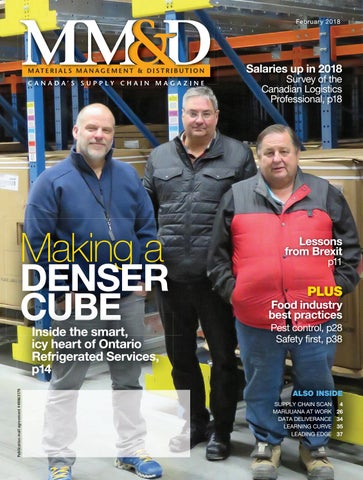
February 2018 • Volume 63 • Number 01 On the cover Ontario Refrigerated Services’s Albi Biancini (on the left) and Roger Kropf (right) flank Madzo’s Brian Keck (middle) in the deep freeze. Story on page 14.
18
26
28
34
Salary Survey
Dope at Work
Pest Control
Data Capture
2018 Survey of the Canadian Logistics Professional
It’s going to take years to sort out the rules for legal marijuana use
Best practices for sustainable pest management in the warehouse
Knowing what data to collect and how to use it is key to success
MM&D is indexed in the Canadian Magazine Index by Micromedia Limited. Back copies are available in microform from Macromedia Ltd., 158 Pearl St., Toronto, ON M5H 1L3
MEDIA INC.
www.mmdonline.com | February 2018
3
SUPPLY CHAIN SCAN
KION
M+S
BREXIT LESSONS
TAXES
Partners with Chinese manufacturer, p 6
Appointments and promotions, p 7
Canada’s auto makers can learn from the UK experience as they deal with NAFTA, p 11
The best and worst Canadian cities, p 10
VersaCold opens in Milton
By Emily Atkins
A
s if it hasn’t been cold enough this winter, it just got chillier in Milton, Ontario with the opening of VersaCold Logistics Services’s new multi-temperature cold storage facility. Grand opening ceremonies took place on January 11, 2018. When complete, the building will include three phases, but for now the company celebrated the operational startup of the first two phases. Together the two segments encompass 255,000 square feet and 9,336,408 cubic feet, with 25,958 pallet positions. Multiple temperature zones, from 4C to minus 30C, will accommodate a wide range of food products, largely from Nestlé Canada, VersaCold’s main partner in the facility. The 4
Milton DC will be shipping 2.7 million cubic feet of ice cream, 48 million pounds of pizza and 51 million pounds of frozen meals in an average year. Driven by changes in the food industry and robust demand for temperature controlled storage, the two companies characterize the new DC as a strategic partnership; once fully operational Nestlé Canada will occupy more than 50 percent of the cube. “Our frozen network was in three different warehouses, three different direct-to-market systems. As we are endeavoring to become a lean enterprise, taking as much waste out of the system as possible, it’s a lot of bulk and a lot of pallets and a lot of SKUs that need to be managed,” said Shelley Martin, Nestlé Canada president in an interview with MM&D at the opening. Partnering with
Cutting the ribbon L to R: VersaCold senior vice-president and chief commercial officer Mark Dienesch, Milton mayor Gordon Kranz, Milton MP Lisa Raitt, Shelley Martin, president of Nestlé Canada, Douglas Harrison, VersaCold president, and George Jenkins, VersaCold’s manager, warehousing solutions.
VersaCold on the new building “was how to we get everything – these three big businesses – into one…more efficient way that we can take some cost out and improve the service level to consumers, our customers.” Douglas Harrison, VersaCold’s president, added: “We’ve been under a transformation focus for the last four years, invested heavily in our network…We see great growth opportunities in the market in Canada. Our estiMM&D | February 2018
SUPPLY CHAIN SCAN
‘‘ ‘‘
We see great growth opportunities in the market in Canada. Our estimation is frozen or refrigerated supply chains are about a $10 billion market.” – DOUGLAS HARRISON, VERSACOLD PRESIDENT
We are endeavoring to become a lean enterprise, taking as much waste out of the system as possible.” – SHELLEY MARTIN, NESTLÉ CANADA PRESIDENT
Above: George Jenkins shows some of the facility’s Raymond material handling equipment that is using the iWarehouse system to monitor performance and ensure safety. Left: Nestlé Canada’s Shelley Martin and VersaCold’s Douglas Harrison celebrate their partnership on the new building.
IN CASE YOU MISSED IT Some of the top stories at www.MMDonline.com in the past month: Canadian Tire leases ex-Sears DC in Calgary
Z CHECK IT OUT: http://tinyurl.com/mmd-ex-sears-dc
Photos by Emily Atkins
Canadian companies in Montrealbased supply chain AI project
Z READ MORE: http://tinyurl.com/mmd-montreal-ai
mation is frozen or refrigerated supply chains are about a $10 billion market. We’re the largest player, but we’re a very small part of that entire footprint.” Part of the impetus behind the new building is increasing demand for innovative frozen food products, Martin said. Harrison agreed, noting that Canadian companies are increasingly “filling international demand for food” and that frozen and refrigerated foods are becoming more sophisticated in terms of “freshness, quality, and healthiness. It requires more sensitivity and handling. We’re spending more time www.mmdonline.com | February 2018
investing and focusing on how we train people in terms of handling requirements, and that’s requiring greater capacity and greater availability.” The Milton DC projects throughput of 17 million cases per year, with 30 inbound and 60 outbound loads a day. At the moment 49 staff are working in Phases One and Two, and when the building is operating at steady state VersaCold expects to employ 135. Phase Three is scheduled to be open by the end of the year. MM&D will be bringing you an inside look at the facility when it’s fully operational. MM&D
Ontario firms raise prices, may cut staff with minimum wage hike
Z LEARN MORE: http://tinyurl.com/mmd-minimum-wage
NAFTA doubt poses risks for railways
Z FIND OUT WHY: http://tinyurl.com/mmd-nafta-doubt
Sobeys launching online grocery sales, infrastructure
Z LEARN WHERE: http://tinyurl.com/mmd-sobeys-ecomm
5
SUPPLY CHAIN SCAN
Kion group partners with Chinese manufacturer
T
he Kion Group is entering into an in this growth, with exclusive global strategic partnerentry-level, lightship with Chinese manufacturer EP duty trucks playing Equipment in the fast-growing market a particularly imporfor entry-level, light-duty warehouse tant role within this equipment. segment. This is Kion is acquiring a minority stake in driven by the trend EP Equipment. The cooperation will for greater mechaniextend Kion’s product offering in the zation and upgradsegment both in China and around the ing of equipment. world. The partnership will focus on Gordon Riske, Kion CEO “We are delighted joint product development and supply to enter into this strachain synergies and is expected to make tegic partnership with EP Equipment. It will both parties more competitive. The transac- allow us to extend our product offering to a tion is subject to the usual closing conditions much wider range of customers,” said Kion and regulatory approvals and is planned for Group CEO, Gordon Riske. “The cooperation completion in 2018. will further strengthen our position in the The Chinese market is the largest in the booming warehouse equipment market.” world for industrial trucks and expanded “EP Equipment has been growing steadily by 40 percent in the first nine months of in China and globally, especially in the entry2017. Warehouse trucks were a major factor level warehouse segment, driven by its strong
customer focus and its innovative and competitive product range,” said Quek Ching Pong, member of the Kion Group executive board and chief Asia Pacific officer. “By entering into this partnership with EP Equipment, Kion will further strengthen its position as a leading provider of electricpowered material handling equipment.” “This is a historic moment for EP Equipment,” said He Jinhui, chairman of EP Equipment. “I am looking forward to our new partnership with the Kion Group, which will allow us to leverage each other’s strengths and capitalize on market opportunities in China and around the world.” He Jinhui founded EP Equipment in 1999. The company employs more than 1,000 people around the world and is particularly prominent in the Chinese and US markets. In 2017, EP Equipment shipped over 50,000 units, more than ever before. MM&D
Experience, Connections, Opportunities
6
MM&D | February 2018
SUPPLY CHAIN SCAN
MOVERS + SHAKERS Andreea Crisan, COO and EVP of Andy Transport, has been named a Top 100 Award Winner by Women’s Executive Network (WXN) 2017 Canada’s Most Powerful Women. She will receive the Telus Future Leaders award, which recognizes exceptional young women who have distinguished themselves early in their careers, and who show tremendous ANDREEA CRISAN potential. “It is a great honour for me to join a group of extraordinary women who share a strong sense of purpose and drive,” Crisan says. “I dedicate this award to all the women who work with passion at Andy as well as to all the women in the transportation industry that inspire me everyday and keep me committed to gender equality and diversity.” Sylvain Prud’homme has been appointed president, international, of Lowe’s Companies, Inc. He reports to chairman, president and CEO Robert Niblock and remains based in Boucherville, Quebec. Prud’homme continues to serve as president and CEO of Lowe’s Canada and adds responsibilities for the Mexico business, with the president of Lowe’s Mexico now reporting to him. This follows the SYLVAIN PRUD’HOMME announcement that Richard Maltsbarger is transitioning to chief operating officer of the US business in February 2018. Prud’homme joined as president of Lowe’s Canada in 2013 and, following the acquisition of RONA in 2016, was named president and CEO of Lowe’s Canada. Previously, Prud’homme served as executive vice-president of operations and merchandising for Loblaw Companies Limited. He was also president of western operations for Sobeys Inc and spent several years as senior vice-president of operations and merchandising for Walmart Canada. Prud’homme earned an MBA from the HEC Montreal business school. He is a member of the board of directors for the Retail Council of Canada. Judy Rogers has been appointed to the board of directors of the Vancouver Fraser Port Authority for a term of three years commencing December 14, 2017. Rogers is a senior advisor to private, public and Crown corporations, providing expertise in government affairs and communication. She held the role of city manager of the City of Vancouver from 1999 to 2008 and is chair of the BC Assessment Authority. Canadian Pacific Railway Ltd. has strengthened its sales and marketing team with the addition of two new vice-presidents, and reorganized the group’s structure. The sales and marketing team will comprise three business units, each led by a vice-president reporting to John Brooks, senior vice-president and chief marketing officer. The business units will be Grain and Fertilizers; Energy, Chemicals and Plastics (ECP), and Merchandise; and Intermodal and Automotive. Coby Bullard, who joined CP effective December 1, 2017 will lead sales and marketing for ECP and Merchandise. Bullard comes to CP
www.mmdonline.com | February 2018
from CR England and Crest Logistics where he was most recently president, intermodal. Bullard also brings almost a decade of railroad experience from BNSF. Eileen Pedante Stone also joined CP effective December 1, and will lead the Grain and Fertilizers business unit. Stone joined CP from UPS Freight, where she had more than 25 years of experience across the US, Canada and Mexico. Stone was most recently vice-president sales. Jonathan Wahba, who joined CP in February 2017 as vice-president sales and marketing, Intermodal and Grain, will now lead sales and marketing for Intermodal and Automotive. Joanne McLeod joined the board of directors of the Vancouver Fraser Port Authority for three-year term that began on December 20, 2017. McLeod has extensive banking, finance and capital project experience, and has served on professional and non-profit boards of directors. She is a former energy executive with Westcoast Energy Inc. and was vice-president and treasurer when Westcoast Energy was acquired by Duke Energy. Previously McLeod worked in corporate banking for CIBC. Five members have been added to WorkSafeBC’s board of directors. Ralph McGinn was appointed as the new board chair. Lee Loftus, Baltej Dhillon and Kay Teschke have been appointed as new board members, effective immediately. Margaret McNeil, a board member whose term ended December 1, 2017, has been reappointed for two years. As well, members who will continue on the board are Lynn Bueckert, Brooks Patterson, Alan Cooke and Lillian White.
GREG TAYLOR
Wynright Corporation, a wholly owned subsidiary of Daifuku North America Holding Company and a part of the Daifuku Group, has appointed Greg Taylor as vice-president project execution in Manchester, New Hampshire. He joins Wynright from Nortek LLC, a heavy manufacturing company, where he and his team were responsible for a US$150M supply chain. Before that, he was VP supply chain systems design and support at Staples.
Twinlode Corporation has appointed Angelica Mitranca as director of engineering. With more than 20 years’ experience in engineering for the material handling industry, Mitranca has joined the team to direct all aspects of engineering activities and projects for Twinlode and its clients. She started in the material handling industry in 2001 where she worked as a senior design engineer at Kingway. From there, ANGELICA she became engineering manager at UNARCO MITRANCA Material Handling, Inc for ten years where she worked on the manufacturing side of the rack industry. Mitranca holds a degree in Mechanical Engineering from Transylvania University in Romania.
7
SUPPLY CHAIN SCAN
Shopping in Canada going through a radical change By MM&D Staff
C
hanging consumer expectations and habits threaten to see even more Canadian retailers close in 2018, says KPMG’s Willy Kruh, global chairman, consumer and retail national leader, high growth markets Canada. “Retail is not in disruption but is disrupted,” says Kruh. “Consumer behaviour is changing rapidly and many Canadian retailers are not keeping pace with the fact that consumers and their shopping habits are undergoing fundamental change. But this is not just a Canadian phenomenon. Retailers in the US are grappling with the same issues. A record 8,600 stores are expected to close up shop stateside this year. Previously, the worst year for closures was the 6,163 stores in 2008 – and that was at
the height of the financial recession.” Kruh notes that the fundamental changes impacting domestic retailers have been somewhat masked by a couple of key factors that likely won’t continue into 2018 – a robust economy and low interest rates. “With the economy expected to slow next year and interest rates already up twice this fall, consumers are going to be hard-pressed to keep on spending. Debt is at record levels and the Bank of Canada has made the cost of carrying that debt even higher. So as consumers feel the squeeze, so will retailers – especially those who need to do more to optimize the shopping experience.” In addition to the expected drop in retail spending next year, Kruh says we are also currently witnesses to the collision of three revolutions that are disruptive and industry-
defining – creating a perfect storm that will hit retailers head-on.
Demographic revolution In two years the millennial generation will be the world’s largest single demographic grouping, as well as the largest demographic in the workplace. Close to 40 percent of millennials live with their parents and these parents are closer to their kids than any generation before. As a result, each generation is having a profound effect on the way the other shops. As millennials tend to be very tech savvy that is rubbing off on their parents, accelerating the shift to online and experience-based shopping.
Technological revolution As the proliferation of connected devices
Sp r St ing ar C t M ou ay rse 7 s
What’s the most rewarding career decision you’ll ever make?
Your best choice for complete career-long OHDUQLQJ FHUWLÀFDWLRQ in supply chain logistics
Earning the CCLP® designation is easily the single best thing you can do to boost your career prospects. It can set you up for better pay, more advancement opportunities, and a range of management pathways and options across the sector. Plus, you’ll develop and demonstrate cross-functional capabilities that can deliver better business results—and more personal job protection. Depending on your background, your CCLP designation might be within closer reach than you think. Call or click WR ¿QG RXW LI \RX TXDOLI\ IRU DGYDQFHG VWDQGLQJ
www.citt.ca/cclp • 416.363.5696 ®CCLP & &,77 &HUWLÀHG /RJLVWLFV 3URIHVVLRQDO LV D UHJLVWHUHG WUDGHPDUN RI I & &,77
8
MM&D | February 2018
SUPPLY CHAIN SCAN
continues to pervade all corners of society – from how we communicate, to how we transact, to how we operate our homes, or manage our health and wellbeing – the next decade will see another billion or more humans connected to the Internet. Game-changing automation developments in robotics, machine learning and artificial intelligence, as well as virtual and augmented reality will have profound impact on how we shop.
Geopolitical revolution Population growth in Canada is driven by immigration, so it is critical that domestic retailers understand and adapt to the shopping habits of new Canadians. A growing wave of populism and nationalism is affecting retailing in the US and Europe with spillover effects in Canada.
Six critical steps Kruh says there are six critical steps retailers need to understand and improve upon if
www.mmdonline.com | February 2018
they want to navigate the storm and avoid the same fate as the host of Canadian bricksand-mortar retailers who’ve closed their doors for good in recent years. 1. Unify data and analytics. Break down organizational silos that isolate consumer data. Create a culture and business structure that provides a unified view of the customer. 2. Go beyond the sale. Don’t just focus on the holiday sales transaction. Improve the consumer’s experience before and after. Let them discover and research merchandise. Make sure orders are accurate and delivered quickly. And offer convenient, speedy returns and refunds. 3. Upgrade technology. Update and rethink legacy systems for more advanced and agile technology. Integrate commerce and mobile technology to support automation of routine interactions with retailers and customers. 4. Tackle supply chain issues. Brands often struggle with inventory and supply chain
issues. Come up with a better way of anticipating supply chain disruptions, and make sure partners and suppliers are aligned with your customer strategy. 5. Improve ties between brands and retailers. Although brands are increasingly exploring direct-to-consumer selling, they still rely on retailers for the bulk of their revenue. Brands need to invest in digital technologies to improve the performance with existing retail outlets. 6. Expand partnerships. Go beyond the traditional retail outlets and work with fulfillment centres. Integrate your e-commerce operation with social media, and provide digital content to all your partners. “Investing in these areas is only part of the equation,” notes Kruh. “Retailers also must have a clear understanding of where and how they’re investing so they can fully benefit from the connected-customer approach. Only then will they be able to deliver what consumers want.” MM&D
9
SUPPLY CHAIN SCAN
Canada’s best – and worst – cities By MM&D Staff
S
askatoon tops the list of Canada’s best cities for investment, while Montreal has the most onerous local taxes.
10
The best and worst major cities for business investment are identified in a new report from the CD Howe Institute. In “Business Tax Burdens in Canada’s Major Cities: The
2017 Report Card” authors Adam Found and Peter Tomlinson compare business tax burdens in 10 Canadian cities, the largest in each province. “Before a business decides to locate or expand in a given jurisdiction, it must consider the tax implications. Heavy tax burdens drive investment away to other jurisdictions and, with it, the associated economic benefits,” Found says. The report finds the overall highest tax burdens to be in Saint John, New Brunswick; Charlottetown, Prince Edward Island; and Montreal, Quebec, with Montreal having the most burdensome local taxes. As for the most competitive overall business tax environments, Saskatoon and Calgary still lead the way, but Calgary increasingly lags behind Saskatoon as Alberta’s business tax environment deteriorates. The report quantifies the 2017 tax burden on business investment for the largest city in each province, focusing on – from the federal all the way down to municipal level – corporate income, retail sales, land transfer and business property taxes. Taken together, these taxes determine the tax burden on every dollar of new business investment, called the marginal effective tax rate (METR). The authors note considerable gaps in the way Canadian governments measure the overall tax burden on business investment, primarily because business property and land transfer taxes are omitted from the METR. As in previous editions in this series on inter-municipal business tax burden comparisons, the authors find this oversight of major significance: business property and land transfer taxes represent about twothirds of the total investment tax burden nation-wide. “As the federal Department of Finance provides the provinces’ METR estimates, our first recommendation is for the department to include business property taxes in these METRs,” says Found. “Once governments better understand the effect of business property taxes on the cost of investment, they are more likely to reduce the burden these taxes impose.” MM&D MM&D | February 2018
TRADE UPDATE
Lessons from Brexit Canada’s auto industry can learn from the UK experience By Christian Sivière
e hear a lot about the uncertainties the Canadian automobile industry faces due to the NAFTA renegotiations, and rightly so, since many Canadian jobs depend on it. Looking across the Atlantic, there are similarities with the uncertainties Brexit has brought to the UK automobile industry: There is no Canadian brand of automobile but several foreign brands have assembly plants in Canada – Fiat Chrysler in Brampton and Windsor, Ford in Oakville, GM in Oshawa and Ingersoll, Honda in Alliston, and Toyota in Cambridge and Woodstock. These plants rely on the free movement of parts and assembled vehicles between Canada, the US and Mexico made possible by NAFTA, as automotive supply chains crisscross the continent. Vehicles assembled in any NAFTA country contain parts produced in all three. Every year, Canada produces around 2.4 million vehicles, 85 percent of which are exported to the US, while about 900,000 vehicles assembled in the US are imported into Canada. Closely integrated into NAFTA, the Canadian automotive industry is a major contributor to our economy and employs over half a million people.
The UK auto industry Across the Atlantic, well-known UK brands are now foreign-owned, Jaguar Land Rover by Tata Motors of India, Mini Cooper and Rolls Royce by Germany’s BMW, Bentley by Germany’s Volkswagen, Vauxhall by France’s Peugeot and MG by China’s SAIC. Although theses famous brands are nolonger locally owned, they still have assembly plants in the UK, and in addition to these, several global brands manufacture automobiles there, namely Ford, Honda, Nissan and Toyota. The UK car industry, which employs close to 800,000 people, has enjoyed a renaissance over the past two decades, thanks to investments made by foreign car makers, premised on the UK being a member of the www.mmdonline.com | February 2018
Photo: Ford Motor Company
W
‘‘
Looking across the Atlantic, there are similarities with the uncertainties Brexit has brought to the UK automobile industry.
EU, which enabled the export of UK-made vehicles to continental Europe without incurring tariffs.
The Brexit challenge Brexit poses two big challenges to car makers with UK plants. First is the period of uncertainty during the Brexit negotiations. They could last at least two years and prompt these manufacturers to place important work on model upgrades with their operations elsewhere in the world. Second, if the UK’s access to the EU single
Ford Motor Company’s GT is a great example of a car that depends on crossborder trade. It is assembled at Multimatic in Markham, Ontario with parts from multiple sources.
market after Brexit involves trade barriers, tariff and/or non-tariff, some UK car factories could close as they become uncompetitive. And, in the meantime, companies are unlikely to make new investments in the UK, as long as there is uncertainty on tariffs.
What’s at stake To illustrate these challenges in logistics terms, every day, 1,100 trucks deliver some CA$60 million worth of parts and components from continental Europe to UK vehicle and engine plants. And every day, these components help build 6,600 cars and 9,800 engines, the bulk of which are then shipped back to EU customers and assembly plants. In 2016, 80 percent of the UK automobile CONTINUED ON PAGE 13
11
)DVW )OH[LEOH 6FDODEOH 6HH (92 LQ DFWLRQ DW 02'(; %RRWK $WODQWD *$ | 0RQGD\ $SULO
.1$33 ,QF | %DUUHWW 3DUN 'ULYH 6XLWH | .HQQHVDZ | *HRUJLD | | VDOHV XV#NQDSS FRP
SUPPLY CHAIN SCAN
production was exported, of which 52.8 percent went to the EU. And the other way around, 81 percent of vehicles imported into the UK came from the EU.
Customs tariffs Thanks to NAFTA, most Customs tariffs within the region are at zero percent, providing goods meet specific rules of origin, i.e. at least 50 percent of the net cost of auto parts must originate in the region. The UK’s integration with the EU goes way beyond NAFTA, since there is no border for goods within the 28-nation union, no Customs and therefore, no tariffs. During the Brexit negotiations, the UK government repeats that their objective is a “frictionless’’ Customs border. This may seem a bit unrealistic, as it’s hard to see how a country could leave the EU and still expect trade to flow without borders and/or tariffs. As the saying goes, it’s like having your cake and eating it too.
‘‘
The US GDP represents about nine times Canada’s and the EU’s GDP also represents about nine times the UK’s GDP, so we are in a situation similar to our UK cousins across the Atlantic.
In both contexts, NAFTA and Brexit, one option could be to revert to WTO tariffs. Under these, UK made parts would pay around three percent duties in the EU and UK made vehicles would face 10 percent duties. Canadian-made auto parts and vehicles would pay around 2.5 percent duties in the US, while US-made auto parts and vehicles would pay around six percent duties in Canada. To realize the importance of our bilateral
trade, let’s look at the relative sizes of our economies and of our trade with our respective partners. In 2016, the EU was the UK’s largest trading partner, with UK exports of goods to the EU reaching $405 billion (43 percent of total UK exports) while UK imports from the EU stood at $545 billion (54 percent of total UK imports). Canadian exports of goods to the US stood at $366 billion (76 percent of total Canadian exports) while Canada imported $267 billion worth of goods from the US (53 percent of the total). As to our economies, the US GDP represents about nine times Canada’s and the EU’s GDP also represents about nine times the UK’s GDP, so we are in a situation similar to our UK cousins across the Atlantic. The big difference is the UK has chosen to leave the EU – albeit by a very narrow margin – in a referendum held in June 2016, while it was not Canada’s decision to put NAFTA in question and renegotiate the agreement. MM&D
Retail predicted to grow in next three years Global sales expected to climb by three percent
O
mnichannel sales volume is predicted to help boost global retail sales by three percent up to 2021, according to a new study. The 2017 Retail Transformation Study examines the current and future retail marketplace in North America, Europe, the Middle East and Africa (EMEA). Conducted by Zebra Technologies Corporation with IHL Group, a research and advisory firm for the retail and hospitality industries, the report highlights the transformation of the retail sector as the model evolves to better serve consumers. IHL projects the North American and Europe / Middle East / Africa retail markets to each grow approximately three percent over the next five years to US$5.5 trillion and €4.4 trillion in sales respectively. E-commerce is projected to eclipse $1.5 trillion by 2021. 2017 saw more retail store openings than closures and store openings are expected to outpace closures through 2021. IHL research estimates that the enterprise retail market (companies with more than 50 stores) had 4,080 net stores opening through October 2017. In fact, 42 percent of retailers had a net increase in stores while only 15 percent had a net decrease. IHL projects technology spending among retailers to rise approximately three percent over the next three years as retailers continue www.mmdonline.com | February 2018
to evolve their operations to support unified commerce and provide a modern, engaging customer experience for today’s savvy, empowered shoppers. Mobility is a driver for most surveyed retailers who plan to invest in mobile barcode or thermal printers, handheld barcode scanners and mobile computers within the next three years. Store and fulfillment operations are transforming dramatically to adapt to evolving retail models. Among surveyed North American retailers expecting growth of more than five percent, 60 percent cited faster sales growth as a key driver for changes in store operations, while 52 percent cited the shift in sales to online purchases. Interestingly, 52 percent identified same-day delivery as a key warehouse operations driver as consumer demand is encouraging retailers to improve the in-store returns process and enhance their fulfillment and delivery strategies. In coordination with the IHL Group and Peerless Insights, Zebra Technologies Corporation’s Retail Transformation study included detailed interviews with leading retailers, 400 online surveys and an additional study of 1,800 publicly and privately held retailers across nine retail segments. The interviews and surveys were conducted between July and October 2017. MM&D 13
IN THE
co Automation allows Ontario Refrigerated Services to grow with efficiency
I
Up and away: Loading the top level of the racking. The Pallet Runner is waiting out of sight to move this pallet back into the rack.
14
nside the newest Ontario Refrigerated Services (ORS) warehouse in Woodstock, Ontario you are surrounded by a cornucopia of fruits, vegetables and other farm products. But you’d never know it. Inside the deep freeze, at minus 23 Celsius, this spotlessly clean facility is as quiet as a winter wheat field, colder than an ice cube. Densely packed racking is loaded with pallets that bear little clue as to their contents. A lone operator uses an Aisle-Master articulated reach stacker (made by CombiLift) to place palletized bulk cartons of frozen produce atop the highest rack. As the load rises to 35 feet in the air, the warehouse’s secret weapon whirrs into view. It’s a Pallet Runner, poised to receive its next load. The automated cart runs on rails in the racking. When called by the forklift operator using RF signals, it will be waiting at the loadin face for the massive crate of veggies. As the operator leaves the palletized box in place, the Pallet Runner slips underneath it, centres itself along the stringers using a laser eye, MM&D | February 2018
By Emily Atkins
old and then the sides lift a couple inches to carry the massive load deep into the racking to the next free pallet position.
Packing the cube The Pallet Runner system has allowed ORS to pack more into its chilly cube. At the Woodstock facility (the company has other sites in nearby Ingersoll, Ontario) two identical 32,000-square-foot freezers sit side by side, with a third, cooler room at one end. On one side of each freezer segment the racking is twenty-four pallet positions deep and on the other it’s nine. This kind of density could not be achieved without automation. “Space utilization was the biggest reason for it,” says Roger Kropf, ORS’s founder and owner. “There were a lot more pallets that we could create space for when you eliminated all the drive-in aisles. It gave us a density that was hard to ignore, really.” By implementing the Pallet Runner system, the warehouse gained 7,000 pallet positions over a pushback or drive-in rack configuration. Each row in the racking accommodates an entire truckload, and it’s impossible to get to the back of the racking without the Pallet Runner. The nature of the deep-freeze product means that last-in-first-out (LIFO) inventory control works just fine. Brian Keck, owner of Madzo, the material handling consultant who has had a long relationship working with ORS on its buildings, recounts how they tried various different configurations before they settled on the CONTINUED ON PAGE 16
www.mmdonline.com | February 2018
Chilling in the freezer: (L-R) ORS general manager Albi Biancini, Madzo’s Brian Keck, and ORS founder Roger Kropf.
15
A maintenance platform allows human access to the deep recesses of the racking in case or problems or for routine checks.
Pallet Runner system. They considered drivein or pushback racking, but “we were trying to do six-deep and there was no forklift that could do it. So we would have lost the whole top level of storage,” he says. It wasn’t an easy sell, however. General manager Albi Biancini was dubious after having encounters with similar – but unreliable – technology in a previous job. So, on the recommendation of the automation supplier, Automha’s Fred Grafe, Biancini and Kropf made the drive to Chicago to see a system in action in a freezer. “Once we spent the day with the owner of that company, and he explained how reliable the equipment was, and how easy it was to maintain, we decided that we had to go with the racking to utilize the space at it’s full capacity,” Biancini says. Now ORS has four Pallet Runner carts for the 100,000 square foot Woodstock building. Three serve the deep freeze areas and one stays out in the cooler. Keck notes: “The carts never come out of the freezer. You just leave them in all the time. What you do is you put a warming pack in them while they are not being used.” They are easily moved by forklift from one rack to the next, and magnets on the bottom help them stick securely to the forks. Batteries recharge in about five hours. ORS has been 16
Density: Pallet Runner allowed ORS to build extra dense racking.
using the system for about six months, since it opened the Woodstock warehouse in 2017.
cuts down on wear and tear on the actual material handling equipment as well.”
Early results
Eyes forward
Biancini is pleased. Because they are new to the system they are holding the Pallet Runners back to 80 percent of maximum speed. “We don’t want the carts running at full speed until we’re comfortable with the product we’re putting on it, and the pallets,” he notes. “The biggest learning curve is the quality of the pallet. So if the pallet is missing a board, the system seems to error-out a little bit more than it would on a perfect pallet. It’s looking for wood, looking for the stringers to inform it where it is.” Keck adds that this means they are putting a little more pressure on pallet suppliers to get better quality. But on the whole, the technology is deemed a win. Biancini notes that the carts mean they can get by with four fewer staff (and there are only five in the Woodstock warehouse). “It cuts down on travel time, it’s a very short distance from dock to rack. It’s really an efficient system from a manpower perspective,” he says. “You don’t have to pick orders until the truck arrives, because essentially the product is staged for you, waiting for it to be removed from the racking. All the traveling is done by the cart, not by the employee. It
Customer demand has long been the driver of growth at ORS. Kropf started the company in 2003 in Ingersoll with his wife Kate and one other employee in a 32,000-square-foot building. Now the company boasts three buildings and more than 70 employees, with more to come. ORS’s roughly 23 customers range from large multinationals with name brand recognition to smaller local firms. After starting with vegetables in 2003, the company now handles meat products as well. About 10 percent of the product is for export to the US, while up to 20 percent can be import product from the US, depending on the type of crop year, Biancini says. Expansion is Kropf’s modus operandi and vision. He admits that he is more of a visionary, a builder, than a warehousing guy, which is why he recently hired Biancini to take over as general manager. “As we were growing rapidly, we got to a point where it was a bit of a leveling out thing, and my wife said, ‘It’s time you come in and run this warehouse right.’ Well, I’m not a warehouse operator,” Kropf says with a sigh. “It was a number of years where I wasn’t MM&D | February 2018
Number 4: A Pallet Runner cart is at the ready to fetch and deliver pallets in the ORS cooler section.
‘‘
There were a lot more pallets that we could create space for when you eliminated all the drive-in aisles. It gave us a density that was hard to ignore, really. – ROGER KROPF, OWNER
excited about what I was doing, until I got back into building more projects.” In addition to building out his Ingersoll facilities, using his own teams to do the contracting work, Kropf also installed a massive solar array that powers the cold storage facility as well as returning power to the grid. With the Woodstock warehouse up and running, Kropf has his sights set on the next project. Coming soon, on an adjacent lot near the 401 highway, will be the company’s latest building, to be built – as usual – in 32,000 square-foot sections. The plan for now is to make it a freezer warehouse, but, says Biancini, “if someone www.mmdonline.com | February 2018
knocks on the door and says ‘we want 15,000 pallet positions of cooler’, then we would customize the space for the customer.” “The market is growing faster than the pallet positions are growing,” he adds. “We’re a little further out [from the GTA] than a lot of the big companies are. We’re kind of a niche operator.” He’s referring not only to ORS’s proximity to the local farmers, but also to the valueadded services they offer in Ingersoll. “We’ve got full blast freezers in the other facility and really state-of-the-art tempering rooms. In general, most of our customers either slaughter and we freeze for them, or they pluck the product from the fields and we freeze it. Most of the customers that we temper for are very impressed with our set-up,” Biancini notes. “It’s not a niche that other third party warehousing uses, or does. It’s a service that other ones don’t touch,” Kropf adds.
Improving efficiency With Kropf working on the new Woodstock building, Biancini has been focusing on streamlining operations. The company’s
throughput is about 115,000 pallets a year, with a maximum capacity of about 80,000 pallets, a number usually reached around Christmas time. To improve efficiency, in February 2018 he is introducing an upgraded WMS, with reduced reliance on paper and voice controlled operations coming soon. “The upgrade will allow us to use signature pads, and when a driver signs his paperwork, all that will come out of the printer is paperwork for the driver. Everything else will be stored electronically and the goal will be to eliminate as much paper as we possibly can.” Beyond that, Biancini says 2018 will be a year to focus on company culture, “making sure we’re treating our people right, and keeping them happy, because the happier they are the more productive they are. I think in the big picture we’re a small family business and we want the environment in the workplace to remain very much a family business.” Kropf is happy to have the operations manager on board. It allows him to focus on what he likes doing and to fulfill the company’s vision: “We build it, we fill it.” MM&D 17
Salaries up and the gender wage gap widens in the 2018 Survey of the Canadian Logistics Professional
by Emily Atkins
FROM THE SPONSOR
Reimer Associates Inc. was established in 1997 by Ross Reimer. We concentrate exclusively on recruitment and M&A within supply chain and transportation. Ross built the company by carefully selecting exceptional people with impressive careers in transportation and supply chain companies. The team has learned firsthand what kind of skills, experience and personality it takes to fill critical positions and close transactions. We operate confidentially and effectively from inside the industry. www.reimer.ca
HIGHS LOWS [AND]
T
here’s good news and bad news in this year’s Survey of the Canadian Logistics Professional. On the positive side, salaries are up pretty widely after a sluggish 2016. But on the downside, the gulf between male and female remuneration has widened yet again, leaving women with even more of a deficit than in previous years. But first a look at the good news. Overall supply chain salaries achieved an average of $99,902 around the country, across all industries. Regionally there was some slippage in the middle with Edmonton, Saskatoon and Regina posting declines, along with Halifax and St. John’s, but everywhere else wages climbed (see map at right for details.) CONTINUED ON PAGE 21
5-YEAR SALARY OVERVIEW $108,000 $100,000
$105,931
2017 |
$99,902
2017 |
$83,881
$92,000
average $84,000 $76,000 2013
Year
2014
2015
2016
2017
2013
2014
2015
2016
overall
$87,908
$86,987
$92,182
$90,566
$99,902
male
$94,492
$92,276
$97,945
$96,141
$105,931
female
$77,842
$78,819
$83,381
$76,919
$83,881
2013
2014
2015
2016
2017
$ Difference
$16,650
$13,457
$14,564
$19,222
$22,050
% Difference
19.3
15.7
16.1
22.2
23.2
Male vs Female
18
2017 |
2017
MM&D | February 2018
2018
CANADIAN LOGISTICS PROFESSIONAL
SURVEY OF THE
Yukon/ Northwest Territories/ Nunavut
British Columbia $101,709
K
$90,667
SALARY BY REGION & URBAN SALARY AVERAGES
K
Alberta $95,618
K
Manitoba/ Saskatchewan (NET) $103,500
Edmonton
$90,031 $106,095
K
K
$86,714
K
$85,000
Saskatoon
$93,750
L
Quebec $82,740
Calgary
$99,942
Winnipeg
K
$102,500 Regina
K
Ontario
K
$103,928
$118,333
K
Halifax
Montreal
$85,014
L
K
$98,000
Ottawa/Gatineau
$109,143
KL The arrows indicate if average
Cambridge/Guelph/ Kitchener-Waterloo
regional salaries have increased or decreased from last year.
$93,300
K
Greater Toronto Area/ Brampton/Oakville
K
$107,199
Windsor/Sarnia
$144,500
K
Hamilton/ Burlington/ Niagara
$97,450
SALARY BY SECTOR OVERALL MEAN FOR CATEGORY
105,931
83,881
123,075
K
K
110,777
84,548
78,903 133,486
$70,000
73,678
60,682
79,227
86,086
81,163
73,200
115,143
118,400
112,714
111,860
149,889
118,667
145,556 103,667 86,833
105,727 77,224
$90,000
96,875
118,121
112,521
107,763
92,969
95,092
113,221
99,922
93,235
$110,000
104,726
$150,000 $130,000
St. John’s
55,000
Vancouver
L
Atlantic Canada
$50,000 MALE
SECTOR MEAN
FEMALE
EXEC MGMT
MANUFACTURING
THIRD-PARTY LOGISTICS
TRANSPORTATION
RETAIL
www.mmdonline.com | February 2018
SENIOR MGMT
OP. MGRS/ SPRVSRS
SUPPORT & SALES STAFF
OTHER
19
L
L
FROM THE SPONSOR
ROADBLOCKS TO SUCCESSFUL HIRING The biggest firms offer the best pay. On the chart to As a recruiter I’m involved in the hiring processes of a large number the left showing of clients every day. Over the years I’ve been privileged to work with company size by companies who have outstanding hiring practices; I’ve also seen companies that struggle mightily because revenue, salaries of poorly planned or cumbersome are procedures. highestPeople for truly are the most important asset a company has, and the process by which new employees join the the Over $2 company is therefore critical. It can ensure the organization’s goals Billion and targets are metgroup. or it can be a big factor in a lack of success. The following are five roadblocks that prevail in failed hiring processes. When measured against number No concise position description of employees, The lack of an accurate and concise position description encourages failure companies from the get-go. Think inof it through the eyes of the potential employee: If the company does not provide clear specifics and the Over 25,000 expectations around each position, how can they possibly attract the group also best talent? Potential recruits need to see well-defined expectations so theydominate can judge whetherthe they have the skills and experience to meet the company’s intended objectives. best-paid group.A clear position description removes any mystery and ambiguity and gives the potential The highest employee the best opportunity to assess their own interest and ability averages are to succeed in the position. The development of a concise position highlighted. description is also a very healthy exercise that leads to increased BY ROSS REIMER
productivity, greater teamwork and substantially higher employee satisfaction.
A hiring process that drags on Sometimes companies have hiring processes that consume many months. There can be a number of reasons for this, including busy schedules that don’t allow for a tightly scheduled interview process, far too many interviews (I recently saw eight) or a lack of consensus among those involved in the hiring process. This does not communicate the right message to potential top-level candidates and quite frankly most will move on to another opportunity. However, it’s important to remember that companies are competing in the hiring marketplace with multiple opportunities in play. As a result they need to see that the hiring process is a direct reflection of their culture and their ability to make decisions. First impressions really do matter and potential employees can be won or lost at this stage.
potential candidate with 25 years of experience. I’m not sure it’s a fair request for companies to make of a junior person. I’ve personally interviewed people who’ve been turned away that I believe would have been excellent candidates had they been interviewed by the hiring manager. I realize time is precious but given the importance of hiring the right people, it would be time well spent.
Waiting for the perfect 10 We all want to find outstanding people for our organizations, but waiting for perfection can be disastrous. Obviously a hiring scorecard needs to be in place and top candidates should score very well, but companies that wait for perfection often pass over excellent potential employees. If you look within your own organization at your current top performers across a wide variety of positions you’ll realize that none of them would score perfectly in all areas, and yet you prize them as the best in your business. Hiring managers need to keep this in mind to be successful.
Underemphasizing cultural fit Every organization has a distinct culture. Whether large or small, multinational or local, companies develop a culture that reflects the values and personalities of leadership. When companies don’t clearly understand their own culture, or under-emphasize its importance, hiring mistakes are inevitable. A candidate’s specific skills and experience may align very well with your organization’s requirements, but if they lack a cultural fit, the hire will turn out to be painful. As a recruiter and talent scout, one of the most important aspects of my job is to ensure that cultural values line up when matching candidates with my clients. I have the unique privilege of interacting with a wide variety of companies in the transportation and supply chain industry. Observing their hiring processes has taught me a great deal and in my opinion, companies that have best practices at this stage have the most engaged and satisfied employees – and the best bottom lines.
Inexperienced interviewing skills Occasionally I’ve seen companies delegate the initial interviews – by telephone or in person – to the most junior people in their organization. In some cases a person who’s worked in the industry for two or three years is discussing a senior-level position with a
20
MM&D | February 2018
There’s a nice bump across the board from last year, with the average up more than $9,000 for the total pool as well as men. Women only gained about $7,000 in the past year. The bad news, relating to these female salaries, is grim. Women have come up 23.2% short of their male colleagues, netting just $83,381 versus the male average salary of $105,931. That $22,000 difference is a big chunk of change, representing, for example a new car, educational opportunities or home improvements. The discrepancy has been climbing again since 2013 when it had dipped to 15%. Women still have far to go in supply chain careers, before they reach parity with male counterparts.
employer, the higher the pay. As you can see in the two charts below, there are discrepancies in places, but the trend is true across most company sizes, whether measured by gross sales or number of employees. As for choosing an industry to work in, this year computers and electronics had the highest average salary ($121,669), closely followed by chemicals, petroleum and hazardous waste ($120,191). Women did best in the paper and print industries at $113,200. For executives, computers and electronics was the best, but there was a close group, all in the $135,000 to $137,000 range in pharmaceuticals, manufactured inputs, and clothing and textiles.
Where you work matters
What you do matters
Third-party logistics is the winning sector this year with the highest national average salary of $113,221. Men did best in 3PL jobs, while women received the highest pay in transportation. Senior executives did best in retail, while management, and operations manager were best rewarded in the transportation industry. Sales staff did best in 3PL jobs as well. Looking at company size, as is typical of our results, the larger the
As with last year, those working in sales and marketing positions netted the highest pay packages, with an average of $114,900. This was true of both male and female workers. Executive managers did best in warehousing, while senior managers did better in purchasing. Ops managers working in demand planning jobs were best paid. For the complete details see the Job Function chart on the following page. CONTINUED ON PAGE 22
SALARY BY COMPANY SIZE BY COMPANY’S ESTIMATED GROSS ANNUAL SALES, IN CANADIAN DOLLARS Sales in Canadian $
Mean $
Male $
Female $
Exec Mgmt $
Senior Mgmt $
Ops Mgrs./ Support & Svisrs $ Sales $
1 million or less
83,273
94,375
65,500
87,400
N/A
42,000
N/A
Over 1 million to 5 million
85,000
93,083
48,000
90,000
92,000
82,000
48,000
Over 5 million to 15 million
98,350
103,133
75,000
102,429
142,500
92,667
67,000
Over 15 million to 30 million
91,929
92,786
90,214
136,667
82,833
57,500
62,500
Over 30 million to 60 million
89,358
89,504
88,857
130,667
92,117
74,714
65,667
Over 60 million to 100 million
104,729
105,960
95,500
126,750
134,000
81,000
58,700
Over 100 million to 500 million
101,180
103,822
90,611
150,714
108,786
88,840
71,389
Over 500 million to 2 billion
106,818
119,133
78,083
201,000
114,867
81,781
79,688
Over 2 billion
123,038
136,747
90,346
350,000
133,050
97,625
111,925
In 2018 female supply chain employees are making about $23,000 a year less than their male counterparts.
BY NUMBER OF PEOPLE WORKING IN COMPANY Total Employees
Mean $
Male $
Female $
Exec Mgmt $
Senior Mgmt $
Ops Mgrs./ Support & Svisrs $ Sales $
25 or fewer
90,146
100,119
74,500
97,333
86,033
70,400
69,667
26 to 100
90,278
91,444
85,929
116,625
80,278
83,667
70,000
101 to 500
96,399
101,732
76,523
145,200
111,864
84,023
64,393
501 to 1,000
95,438
94,600
98,167
132,857
115,438
73,327
63,780
1,001 to 5,000
104,198
108,257
87,150
156,000
110,883
87,200
68,000
5,001 to 25,000
99,387
109,507
75,100
N/A
130,273
91,000
80,155
123,145
140,125
92,273
350,000
116,667
94,500
167,800
More than 25,000
www.mmdonline.com | February 2018
21
Don’t skip school
More years of experience is not proving to be a guarantee of higher salaries across the board this year. In fact, there is a grouping in the executive management category of very well-paid people with between 10 and 25 years of experience. However, those with 35-plus years in supply chain still command the highest averages across the board. See the Experience chart, next page.
Getting a higher education pays off in supply chain jobs. Those with university degrees averaged $110,926 this year, while those with post-graduate degrees were making $113,279. Women particularly benefit from higher education with averages of $120,000 with some post grad schooling and $105,600 with a post grad degree, significantly above the overall gender average.
CONTINUED ON PAGE 24
SALARY BY INDUSTRY Industry Mean TOTAL RESPONDENTS
Male
Female
Exec Mgmt
Sr Mgmt
105,931
83,881
123,075
110,777
Ops Mgrs./Svisrs 84,584
Support & Sales 78,903
Food and Beverage
98,574
100,682
88,882
116,650
110,170
82,078
87,150
Consumer Durables
110,475
111,557
102,000
125,857
113,894
84,092
114,889
Clothing, Apparel and Textile Products
111,191
114,070
97,571
136,700
109,182
90,233
107,600
Automotive Parts
109,448
109,595
108,750
130,385
104,793
86,150
112,333
Computers and Electronics
121,669
127,150
98,375
136,800
111,007
82,375
169,000
Chemicals, Petroleum and Hazardous Waste
120,191
127,885
94,800
107,200
137,940
101,342
122,455
Manufactured Industrial Inputs
110,105
114,643
93,143
135,000
108,839
77,444
124,800
Paper and Print
110,431
109,365
113,200
123,889
117,373
78,429
113,378
Lumber and Building Materials
105,980
115,067
86,625
119,167
101,875
83,333
128,486
Transportation Equipment
115,190
118,188
107,750
125,000
103,710
95,700
155,600
Pharmaceuticals
110,035
111,407
102,900
135,500
122,222
85,500
104,673
2018
SURVEY OF THE
JOB FUNCTION Job function
Mean
Transportation
98,475
102,757
86,000
116,081
109,866
85,314
69,865
Customer Service
97,994
103,587
87,507
120,188
111,688
82,378
67,139
Project Management
105,756
109,415
92,964
126,780
110,056
85,728
77,153
Training and Development
103,253
107,643
88,366
125,161
111,088
84,959
71,758
97,736
103,438
81,267
131,136
106,475
84,109
71,648
Purchasing
105,262
112,474
86,880
120,657
114,276
87,793
76,395
Warehousing
101,699
104,594
82,750
134,609
108,843
82,269
72,560
Demand planning/ Forecasting
105,067
111,288
90,920
123,031
113,803
97,750
74,329
Order Fulfillment
95,865
100,484
82,113
129,211
101,494
83,279
68,147
Customs
96,820
102,854
80,091
128,923
107,660
74,000
60,139
114,900
122,824
102,455
113,667
107,894
96,167
170,000
Information Technology
98,558
98,760
102,000
107,632
105,711
84,923
59,480
Other
98,368
100,750
85,667
126,800
96,825
95,000
58,467
Inventory control
Sales/Marketing
22
Male
Female
Exec Mgmt
Sr Mgmt
OPs mgrs/ Svisrs
Support & Sales
MM&D | February 2018
EDUCATION $190,000 $170,000 $150,000
A graduate degree continues to be the best educational gateway to higher supply chain salaries.
$130,000 110,000 90,000 70,000 50,000 MEAN
MALE
FEMALE
EXEC MGMT
SR MGMT
OPS MGRS/ SVISRS
HIGH SCHOOL GRADUATE
UNDERGRADUATE – BACHELORS DEGREE
COMMUNITY COLLEGE GRADUATE
POST GRADUATE DEGREE
SUPPORT & SALES
EXPERIENCE CANADIAN LOGISTICS PROFESSIONAL
Years of experience in supply chain
Mean
Male
Two to 5
63,786
71,125
54,000
N/A
N/A
42,000
65,900
5 to 10
72,841
72,200
73,827
93,000
79,167
75,932
57,136
10 to 15
86,673
92,438
77,450
150,500
86,500
82,167
77,636
15 to 20
108,185
119,359
78,727
160,000
103,529
84,091
125,300
20 to 25
111,036
111,713
106,750
156,667
120,667
85,892
73,750
25 to 30
97,687
96,390
102,400
107,182
112,381
77,667
85,271
30 to 35
117,855
125,283
82,200
149,286
117,629
95,667
56,000
more than 35
116,828
119,293
93,000
123,200
132,714
123,875
77,667
61,278
64,917
54,000
N/A
N/A
42,000
62,071
117,316
122,006
86,250
131,500
122,657
106,950
74,571
Less than 5 mean More than 30 mean
Female
Exec Mgmt
Senior Mgmt
Support & Sales
JOB SATISFACTION
AGE Mean
Male
Female
Exec Mgmt
26 to 35
74,094
79,286
70,056
36 to 45
85,560
88,011
79,074 114,000
Senior Mgmt
67,500 112,000
Ops Mgrs./ Support & Svisrs Sales
68,800
67,917
97,750
78,457
72,448
46 to 55
105,026 111,827
88,846 141,667 107,611
81,063
94,656
56 to 65
111,320 114,025
87,429 127,263 124,911
89,235
80,517
Over 65
117,900 123,222
70,000 123,800 110,000 155,000
70,000
29%
112,103 115,129
85,250 126,542 124,397
96,158
38% Very satisfied
Neither satisfied nor dissatisfied
18% Extremely satisfied
Dissatisfied 9%
Over 55 Mean
Ops Mgrs./ Svisrs
78,764 Not at all satisfied 4% No response 2%
www.mmdonline.com | February 2018
23
PICK MODULES & MEZZANINES
Engineered systems designed to move your products more efficiently.
We don’t sell our solution to your problem... It’s our problem to develop your solution.
3D
PALLET RACKING
PALLET FLOW
DRIVE-IN
CANTILEVER
PUSHBACK
CARTON FLOW
MEZZANINES
INDUSTRIAL SHELVING
STORAGE
SOLUTIONS
L I M I T E D
1 (877) 557-2257
3DSTORAGESOLUTIONS.COM
The survey was conducted online in the third quarter of 2017, among 379 readers of MM&D and Canadian Shipper magazines who are currently employed in the supply chain.
TOP THREE REASONS FOR CONSIDERING A NEW JOB 60%
50% 40% 30% 20%
2018
SURVEY OF THE
10%
CANADIAN LOGISTICS PROFESSIONAL
0% BETTER MONEY
BETTER WORK/LIFE BALANCE
BETTER GEOGRAPHIC CAREER LOCATION OPPORTUNITIES
BETTER BENEFITS
FLEXIBLE HOURS
REPUTATION OF FIRM
GREATER SAY IN MANAGEMENT DECISIONS
BETTER REWARDS PROGRAM
MORE RESPONSIBILITY
INDUSTRY OF CHOICE
LARGER FIRM
SMALLER FIRM
SERIOUSLY LOOKING FOR A NEW JOB?
Stay or go? These are many reasons to change jobs (see above), but money remains the number one motivator in our sample, closely followed by finding a better work-life balance. So it’s interesting to note that while only 35% of our sample feel that their salary increases over the past five years are exceptional or good, and 62% rate them fair or poor (see below), only 25% are seriously thinking about changing jobs. Fully 85% of our respondents are quite or extremely satisfied with their current jobs, 29% and satisfied and only 13% expressed serious dissatisfaction. What makes people happy? In our sample, having a personal bonus, career development, profit sharing and a company car correlated with the most satisfied staffers. Employers, after reading these results you have a better idea of what it takes to attract and retain the best staff. And now the staff you are trying to hire know what they should get paid! MM&D
73% NO
25% YES
No answer 2%
RATING OF SALARY INCREASES OVER THE PAST FIVE YEARS 100%
34% Fair
62%
MOST RELEVANT PROFESSIONAL DESIGNATIONS* 80%
FAIR/ POOR
60%
29%
29%
40%
Good
20%
Poor
35%
%
No response 2%
6
Exceptional
www.mmdonline.com | February 2018
EXCEPTIONAL/ GOOD
0% SCMA-SCMP
CSCB-CCS
CITT-CCLP
PLOG
APICS-CSCP
CIFFA
*Designations not listed did not have enough respondents to deliver a meaningful result
25
EATING WEED GUMMIES AT WORK Marijuana rules may take a decade to sort out By Tamara L. McCarron and Fiona Clement
Photo: AHPhotoswpg; iStockimages.com
A
customer walks into a downtown marijuana dispensary to browse the hash menu for the perfect after-lunch pick-up. Another flicks through images in an online store, planning to purchase a selection as a hostess gift. Like it or not, this will be the reality across Canada after the proposed Cannabis Act (or Bill C-45) comes into force this summer. Depending on which province or territory you live in, if you are of legal age to purchase marijuana, you will soon be able to drop into a licensed store or order it online from the comfort of your own home. But the promised legalization date of July 1, 2018, is approaching fast. Many aspects of marijuana regulation will not be finalized by then. We are both researchers from the O’Brien Institute for Public Health at the University of Calgary. Together with colleagues in the Health Technology Assessment Unit, we have produced a series of five evidence-based reports to help inform and support policy development in this area by the government of Alberta. We suggest that marijuana regulation in 26
Canada might be a 10-year project. There are some key issues that urgently need to be decided before legalization this year – such as online sales and occupational health and safety. Others – such as regulating cannabis edibles – might need to be shelved for a later date.
the provincial and territorial domains and it makes most sense for them to build upon existing tobacco and alcohol infrastructure, meaning there will be differences between jurisdictions. These variations could result in confusion (different age minimums) or provide unwanted advantages (lower taxation levels could boost sales in a particular province). Cities will be left to deal with bylaw issues – such as public consumption and policing. Here again, there will be a number of variations in policy and resources within municipal jurisdictions.
Weed delivered to your home A major issue facing each province and territory is how and where marijuana will be sold. Most producers are likely to want to provide online “delivery to your door” services. Many already do so for medical marijuana and are poised to expand their presence after legalization. Provinces will need to decide if they will allow online sales and how they expect retailers to enforce minimum age requirements. Purchasing online with home delivery creates additional issues that still need to be worked out. It is, after all, pretty easy to lie about your age to a computer screen.
Smoking safely at work Concentric policy circles In 2016, a Canadian task force was appointed to make recommendations on a new framework to support the production and sales of recreational marijuana. Bill C-45 still needs final approval from the Senate. But the provinces and territories have begun the preparation for this eventual reality. The policy environment is like three concentric circles, with each level of higher government setting the boundaries of the lower government’s regulations. Nationally, the focus has primarily been on youth, enforcement (training officers in time for legalization) and taxation (such as finalizing tax disbursement details between all parties). Within the provinces and territories, the conversation has been focused on minimum age, impairment and where to sell and by whom. These policy issues fall squarely under
Employers will have an interesting challenge. What are acceptable levels of impairment and how will we test and enforce them? For safety-sensitive occupations, many companies already have random work-site testing with a zero tolerance policy for alcohol and other impairing substances. For other occupations, the culture around marijuana is defined by its illegal status. Most people choose not to step outside for their smoke break and light up a joint – because it’s illegal, not because they wouldn’t enjoy it. In the context of legalized marijuana, smoking a joint with your coffee will be acceptable. But how will that be balanced with the expectation to work without impairment? This part still needs to be figured out. Freedom and privacy will be at the forefront of this debate. How employers will balance safety, privacy and their “duty to accommodate” employees who use medical MM&D | February 2018
marijuana is still not known. At minimum, employers may need to revisit workplace policies in order to balance the needs of employees who require the use of marijuana and the safety of their workplaces. Our hunch is that occupational health and safety issues will eventually be settled through the courts rather than through development of good sound policy.
Buying marijuana edibles Marijuana edibles come in all forms, from chocolate bars to gummy bears. These familiar-looking, colourful items are already a big hit in Colorado where marijuana was legalized in 2014. Marijuana-infused edibles will likely continue the myth of cannabis as a natural alternative with no harms. They may also increase the likelihood that children will accidentally consume these products. We need to learn more. What regulations or approaches limit accidental ingestion? How will the introduction
of edibles influence the number of users and their use patterns? How will edibles affect impairment levels differently than smoked product? These are just a few of the issues that we know very little about. Edibles are an easy part of the market to carve off and deal with later. The issues surrounding their inclusion are complicated and, wisely, several of the provinces have already stated that they will not allow edibles in the July 2018 regulations.
A 10-year project Canada is only the second country in the world to legalize marijuana (or the 10th jurisdiction if we count all the states in the U.S.). We will have to learn most of the lessons ourselves. Policy shortcomings or failings are inevitable. We should expect to make continual adjustments, modiďŹ cations and regulations over the next 10 years as we try to achieve the desired goals of limiting the black market,
decreasing the justice system drain and protecting youth. MM&D Fiona Clement, is assistant professor and director, Health Technology Assessment Unit, University of Calgary. She receives funding from Alberta Health, the BC Ministry of Health and CADTH. Tamara L. McCarron is a PhD candidate, Community Health Sciences, University of Calgary. She does not work for, consult, own shares in or receive funding from any company or organization that would beneďŹ t from this article, and has disclosed no relevant afďŹ liations beyond their academic appointment. This article is republished from The Conversation (https://theconversation.com/ eating-weed-gummies-at-work-marijuana-ru https://theconversation.com/eating-weed) under a Creative Commons license. https:// creativecommons.org/licenses/by-nd/4.0/
B40AC-DR AND B50AC-DR H DEEP REALCE NARROW AIFIST FORKL ÂŽ
Booth B3677
t Stacks Standard Pallets Double
ÂŽ
LANDOLL CORPORATION MATERIAL HANDLING PRODUCTS GROUP
www.mmdonline.com | February 2018
Deep from 8’ (2.5 M) Aisles t -JGU )FJHIUT UP w .
t MC LH $BQBDJUZ in Second Deep Position t 4JEF 4IJGUJOH BOE 5JMUJOH 'PSL $BSSJBHF
800-428-5655
t $BNFSB GPS 7JFXJOH 'PSLT GSPN 0QFSBUPS $PNQBSUNFOU t /P -PXFS #FBNT 3FRVJSFE GPS 0VUSJHHFS -FHT t 3FBDI "UUBDINFOU *OUFHSBUFE *OUP *OOFS .BTU $IBOOFMT
forkliftsales@landoll.com
landoll.com/mhp
27
EVEN PEST MANAGEMENT CAN
go green
By Alice Sinia
M
ore than a trend, green initiatives like fuel-saving cars and energy-efficient light bulbs benefit the environment and even help save money in the long run. As a result, many businesses have taken advantage of the opportunity to go green. And these efforts aren’t limited to technological innovations. Even pest management programs can improve a facility’s sustainability. From stored-product pests like grain beetles and Indian meal moths to common invaders like flies, ants, birds, rodents and cockroaches, pest infestations are a constant risk because facilities unknowingly provide the food, water and shelter they need to survive. Without an effective pest management program in place, facilities suffer the consequences. Products and structures can be damaged or contaminated, which ultimately bites into the bottom line and deals a blow to the business’s reputation.
Avoid pesticides But pest management efforts don’t need to be weighed down by the potential negative side effects of pesticide products. Sustainable pest management is not only achievable – it’s also a best practice. More often than not, pests are a symptom of underlying sanitation, housekeeping, storage or maintenance issues. By addressing these conditions to help rid the property of pests, you will naturally find yourself taking a greener approach, as reactive use of pesticides takes a backseat to more proactive and environmentally friendly techniques. 28
Integrated Pest Management (IPM) programs focus on strategies to eliminate conditions that attract pests and manipulate pest behaviour, biology and environment to proactively prevent the pests. By focusing on sanitation, maintenance, habitat modification and other less toxic control methods, IPM programs are cost effective and safer for your facility, food products and employees. Without an IPM program, pest control is always reactive, by which time problems can get out of hand and cost money, time and reputation. With a customized IPM plan, resources are more intently focused on specific challenges. One logistics provider that we work with said this about the effectiveness of their IPM program: “We have no pest problems – that’s the biggest result. We all realize the importance of food safety and pest control and how they intertwine. It’s great to know that our pest control program meets our industry standard.” Inspection, implementation and monitoring An effective IPM program involves three principles – thorough inspections, proactive implementation and ongoing monitoring. To get started, work with a licensed pest control provider to inspect your facility, including stored products. During the inspection, look for actual pests, signs of pest activity (body parts, droppings, cast skins, trails, gnawing), and other conditions that could attract them. In addition to evidence of pests on the property, here are a few things to look out for or note during the inspection. ◗ Sanitation issues – Poor sanitation can turn
your property into a pest haven. Note any
issues (dirty equipment, product spills, buildup in hard to reach areas and improper waste management) so that you can address these items in your pest management plan. ◗ Structural conditions – Leaks, worn-out door
seals and sweeps, unscreened vents, torn window and door screens and gaps around utilities, windows and doors can attract pests and let them inside your building. The age of your building can also contribute to pest problems. ◗ Hot spots – Map out the hot spots around
your facility that might attract pests. This includes employee break rooms, locker rooms, equipment storage areas, decommissioned equipment, silos, food storage areas and garbage or recycling rooms. ◗ Location – Your facility’s surroundings can
impact the types of pests that will infiltrate it. Ask your pest management provider how geography, climate and other businesses and buildings in the area will affect your pest risks. After the inspection, work with your pest management provider to create a plan that is customized to your facility. By addressing the issues noted in the inspection, you can tackle pest weak points head on – before they become a problem. Make it a habit Incorporating pest management efforts into your employees’ daily routines is the easiest way to ensure the effectiveness of your program. Sustainable pest management practices prevent pest problems by eliminating condiMM&D | February 2018
Storing food products up off the floor and on wooden pallets will help keep pests away.
tions that attract pests in the first place. In addition to remedying specific concerns, here are some best practices to use.
Sanitation • Line trashcans with strong, leak-proof lining and fit them with tightly sealed lids. Take out the trash at least daily and regularly wash the bins. • Mop up spills and sweep up crumbs immediately. • Instruct employees not to leave open food in break rooms or locker rooms. • Clean hard to reach areas like overhead ledges, equipment footings, voids in equipment and under vending machines regularly, as these areas are often overlooked. • Regularly clean floor drains by dislodging the drain and cleaning the rim and basket.
overhead ceilings are free of debris or buildup. • Make sure the building, including the exterior, is free of litter, pallets, dense vegetation and other clutter that could attract pests and provide harbourage.
Exclusion • Install a gravel strip (at least 46 centimetres) around the perimeter of the building to deter crawling pests. • Install and maintain door sweeps for all exterior exit doors. • Keep exterior exit doors closed as often as possible. • Inspect incoming shipments for signs of pest activity and develop a plan for quarantining or rejecting infested items. • Use air curtains at entrances to create a positive airflow that pushes flying pests back out the door.
Maintenance • Repair torn window and door screens. • Seal cracks and gaps around windows, doors and utilities with caulk. Also pay attention to gaps along wall-floor junctions. (This also will help prevent heat from escaping and make your building more energy efficient.) • Repair leaks immediately. Pests will take advantage of the moisture. • Screen or cap floor drains. • Ensure electrical circuits, duct works and www.mmdonline.com | February 2018
Other best practices • Use the “first-in, first-out rule” for food products. The first items to go on the shelf should also be the first to ship from distribution centres. • Store food items on wooden pallets that are raised off the ground. • Install exterior lights away from the building instead of against the building façade. Position the lights to shine on the building. Employees will still be able to see, but pests will be attracted to the source of the light – which is now a safe distance away.
Continuous monitoring With an effective IPM program in place, it’s crucial to monitor pest activity and maintain proper documentation. Through continuous monitoring, you can adjust your IPM plan over time as you identify pressure points and trends. This will not only alert you to any new issues but also help predict the likelihood of a pest occurrence so that you can prevent it. To maximize the sustainability of your pest management efforts, set action thresholds with your provider. An action threshold is the point at which a pest’s population becomes a nuisance, poses health hazards or causes economic damage. While a zero tolerance for pests is unrealistic, defining action thresholds ahead of time can help focus the scope and intensity of your efforts. If a pest population reaches the threshold, use nontoxic treatment strategies first. If unsuccessful, use pesticides products that have the least impact and focus them on the problem areas. In an industry where sustainability and food safety are top priorities, an IPM program is the best strategy. Over time, your business will conserve resources, save money and leave a smaller environmental impact. MM&D Alice Sinia, Ph.D. is quality assurance manager – regulatory/lab services for Orkin Canada, focusing on government regulations pertaining to the pest control industry. 29
Installation
Material handling and inventory control
inventory
installations from around the world
Compiled by Emily Atkins
Pre-trip inspections help reduce injury rates
N
orthgate Markets, a chain of supermarkets in Southern California, is reaping the results of recently fortified safety and compliance efforts at its distribution centre in Anaheim. Working with Crown Equipment, one of the world’s largest material handling companies, the family-owned and operated business has achieved its lowest injury rate in 11 years and reached full compliance with forklift operator pre-shift inspection requirements. Looking to improve inspection documentation and impact avoidance, Northgate Markets introduced Crown’s InfoLink wireless operator and fleet management system to monitor and manage every motorized vehicle in its fleet. This includes more than 100 pieces of mobile materials handling equipment. From setting impact thresholds for each forklift, to electronically filing vehicle inspection data and impact reports, the software has helped Northgate Markets improve operator compliance, productivity and safety. In fact, since implementation, the company has seen declining workplace injury rates for the past three years. “With InfoLink, I get pre-trip inspection reports on every piece of equipment that every individual gets on every day, period,” said Keith McCarron, director of distribution at Northgate Markets. “In every operation I’ve ever been in, it’s really difficult to fill out a piece of paper and turn it in every day at the beginning and end of a shift.
Workers are much more careful now that they now each materials handling vehicle’s threshold for bumps.
Now I get 100 percent return. No matter what, I know that piece of equipment is being operated safely.” Northgate Markets material handling fleet varies from forklifts working in the elements outdoors to reach trucks working on smooth floors indoors. According to McCarron, the ability to adjust InfoLink’s impact thresholds to meet these various applications has been critical in minimizing collisions, while also modifying operator behaviour. “The ability to set each individual piece of equipment at a different impact threshold is key,” said McCarron. “Now operators are more aware of that threshold in hitting a rack or bumping a pallet. Previously, they wouldn’t have given it a thought. We’ve had a steady decrease in injuries and this operator and fleet management system is a part of that program.” MM&D
Small parts storage and improved picking
W
ipotec has concentrated its storage capacity and restructured its processes with intelligent picking methods in order to gain flexiblity in supplying its production line. The Germany-based manufacturer of weighing and positioning systems has improved the organization, quality and monitoring of these components with automated storage systems. Every gram counts for Wipotec customers, because only products that have been weighed precisely will end up on the retail shelves. The medium-sized company’s core business is the development, production, 30
and integration of ultrafast precision weighcells and high-tech weighing and inspection solutions for high-speed applications. Wipotec makes checkweighers, X-ray inspection equipment, track and trace systems, and catchweighers. Last year, thanks to increased demand due to e-commerce, the company increased its production area by 108,000 square feet to around 377,000 square feet. Wipotec uses automated storage systems to store components and spare parts. Small parts are stored in a total of 22 Kardex Remstar Shuttle XP Vertical Lift Modules (VLMs) up to 39 feet
high. They hold 55,000 components and spare parts, ranging from tiny electrical components, engines and sheet metal to chains and long bars.
Storage capacity expanded Wipotec has now concentrated and expanded its storage capacity to cope with future challenges. They joined two of the existing VLMs together to form one central storage system for small parts, and added six new Shuttle XP 500 units. There are now two rows of storage systems, each with four units. A conveyor belt situated in the aisle in MM&D | February 2018
Data Capture: RFID trial follows shirts from shelf to change room
B
rick-and-mortar stores are making a comeback, ck, but behaviour. It also suggests which sizes or styles can be reduced beh only the digitally re-defined will thrive. Luckily, y, tools in vvolume due to low demand, reducing inventory cost and such as IoT, RFID, beacons and analytics are giving ving allowing for UNTUCKit to redirect their investments toward allo more popular SKUs, or new offerings. m retailers insights into operations that can give their “Moving from e-tail to multi-channel has its challenges, merchandise a boost. SATO Global Solutions, a wholly owned subsidbut we’ve found that our online experience helps us apply iary of SATO Holdings, and fast-growing retail digital strategies to our physical stores and reimagine brand UNTUCKit are working on a pilot that will retail in a way that other traditional retailers are not yet use data collected by RFID chips on men’s shirts, even considering,” said Chris Riccobono, UNTUCKit traffic counters and other in-store data points to founder and executive chairman. identify the optimal merchandising mix. Beacon-based traffic counters from RetailNext will allow When a customer enters the store, store associUNTUCKit to accurately count, observe and measure the ates help them choose shirts from a selection of traffic paths of shoppers and store associates. They can “try-on” shirts. Once a customer has decided on also gather data on when shopper-associate interactions size, style and fit, the store associate can retrieve a occur, how often, in what duration, and how they impact o fresh shirt for purchase. With a large volume shopper behaviour. With its high-touch of SKUs, UNTUCKit needs to ensure that it is approach, understanding how associate Moving from e-tail stocking just the right number of garments in behaviour influences shoppers is a valuable to multi-channel each SKU, based on demand. training and service insight for UNTUCKit. The pilot at UNTUCKit’s recently opened has its challenges, but “When people ask about examples of IoT Fifth Avenue, New York store will give manag- we’ve found that our online in retail, I talk about this pilot. We have the ers visibility into merchandise movement, to experience helps us apply ability to “upgrade” the physical store in a way that captures the same kind of data we better determine customer demand. Tiny RFID digital strategies to our get during online interactions,” said Keith tags placed on the “try-on” shirts will collect physical stores and real-time data on merchandise movement from Sherry, COO of SATO Global Solutions. showroom to fitting room (and back). Using a reimagine retail in a way “Retailers looking to compete in brick-andcombination of the chip data, overhead traffic that other traditional mortar have more tools than ever to undercounters from RetailNext and POS data, sales retailers are not yet even stand shopper behaviour. The key is then managers can identify which shirts (exact sizes considering. – CHRIS RICCOBONO applying these insights to align the customer and styles) are being tried on and purchased, experience with expectations across all allowing UNTUCKit to continue to improve channels.” customer service in their stores. UNTUCKit opened 20 locations across the country, with This data sheds light on which SKUs are bestsellers so store manag- plans to open an additional 25 in 2018, including international ers can optimize inventory levels in real time based on shopper expansion. MM&D
‘‘
INSTALLATION INVENTORY CONTINUES ON PAGE 33
between them transports the order boxes in which the picked assembly sets or spare part orders are placed.
Picking options To speed up picking, the company introduced both batch and multi-user picking. Up to 17 orders can be combined using batch picking. In so doing, the same articles for different orders can be retrieved with one single pick and then distributed across the various order boxes. In addition, Wipotec uses a batch put-away strategy, where the www.mmdonline.com | February 2018
items are combined in the system and put away together, saving time and resources. These operations are powered by Kardex Remstar’s inventory management software. Several orders can also be picked in parallel, with up to three staff employing multiuser picking. Here every operator is assigned a colour that shows them how many parts they have to pick and which box to put them in. The conveyor belt with the order boxes and the pick-to-light systems can be operated from both sides. Picking aids, pick-
ing strategies, the use of barcode scanners, and flexible software links to the company’s own ERP ensure high accuracy. Jörg Dandl, head of purchasing and logistics, noticed an improvement in quality following the reorganization of the warehouse: “Now the entire process is more structured and can be better scheduled. We have reduced the ad hoc orders from production by about 80 percent and achieved almost 100 percent picking accuracy.” For this logistics manager, inventory monitoring and cost savings due to the use of fewer resources are further arguments speaking in favour of the automated storage solution. MM&D 31
TM
TO ADVANCE YOUR CAREER, LEARN FROM INDUSTRY EXPERTS. EDUCATION AND TRAINING
As Ontario’s leading association of supply chain management professionals, SCMAO offers professional development and education connected to industry. • Taught by supply chain practitioners Our instructors translate real-world experience into meaningful classroom discussion that you can apply at work. • Supply Chain A-Z Whether you’re new to supply chain or managing at the highest levels, SCMAO offers programming to meet your needs. • Ongoing Support As a full-service association, SCMAO offers networking opportunities and career building events for maximum career growth.
ALIGN YOURSELF WITH SUCCESS! LEARN WITH SCMAO
For more information on our programs, please contact WKH 6&0$2 RIĂFH DW education@scmao.ca or Christopher Lau at 416-977-7566 (ext 2145).
Certified Supply Chain Management Professional ,QWHUQDWLRQDOO\ UHFRJQL]HG WKH &HUWLĂHG SCMP designation is the highest level of professional education in supply chain management in Canada. Diploma in Procurement and Supply Chain Management Developed for skilled supply chain professionals at the intermediate level. Supply Management Training Foundational courses and seminars in tactical and operational knowledge. Professional Development Seminars Keeping you up to speed on emerging trends and supply chain practices. Corporate On-Site Training Customized and cost-effective training delivered conveniently in your own facility.
INQUIRE TODAY!
Installation inventory Swedish retailer installs fast picking stations
W
Left: Employees can individually adjust the height of the pallet and easily load the goods by simply moving them horizontally.
Patented pallet buffer One of the highlights of the Fast Pick station is the integrated pallet buffer. This innovative solution immediately provides an empty pallet for loading as soon as the full pallet begins to lower, allowing the order picker to work continuously without interruption. Winkel has patented this system. The packed and wrapped pallet is fed directly from the As soon as a pallet is completely loaded, a vertical lift takes it downwards, shaft onto another conveyor line. The station will then wrapping it with stretch film as it descends to secure it for shipping. place a new, empty pallet in the buffer, ensuring work is carried out continuously. “It doesn’t get any more efficient than that,” Loupas adds. Thorough process management means that the error rate of the the efficiency of its palletizing, depalletizing, and picking. “Since installing five of our stations, the client now has a capacity Fast Pick stations is virtually zero. The stations can be installed in a very tight space and were easily of up to 4,000 picks per hour,” Loupas says. Furthermore, the integrated into the existing production and logistics processes of the employees are glad to have much more comfortable working electronics retailer company. conditions, and the safety of the goods in transit has improved With the Fast Pick stations, the company has managed to increase significantly as well. MM&D www.mmdonline.com | February 2018
33
Photo Credit: Winkel GmbH
inkel GmbH, a specialist in intelligent handling systems, has delivered five of its high-performance fast-pick stations to a major Swedish electronics retailer. The stations enable an efficient, ergonomic picking process with a significantly higher capacity. The innovative pallet buffer allows for continuous operation, as it reduces the time to prepare the next pallet for loading to a few seconds. The stations also ensure that the handling of goods is conducted with the utmost care. In addition, the stations’ integration into an in-house conveyor system facilitates a streamlined shipping process, thus, saving the company considerable time and money. The Fast Pick stations are designed with two levels: the upper level of each station comprises a loading table on a platform. Employees at the Swedish electronics retailer receive a variety of parcels, small packets, and trays with mixed goods via the in-house conveyor system and load these onto a pallet provided for the specific order. Below the platform lies a shaft into which the pallet can be gradually lowered. This allows the loading table to be adjusted to ensure that it is always at an optimal height for the employee. The employee does not have to lift the packages, which are often heavy, but only moves them horizontally onto the pallet. This is beneficial for the employee’s health while increasing efficiency: the Fast Pick station has a capacity of up to 800 picks per hour per station. An automatic pallet wrapper is integrated into the shaft. As soon as the pallet is completely loaded, a vertical lift takes it downwards, wrapping it with durable stretch film as it descends to secure it for shipping. “This provides optimal protection against dust and sliding around during transit for fragile items such as electrical goods,” says to Athanasios Loupas, Winkel’s sales manager.
DATA CAPTURE
The Data Dilemma How to Track the Right Warehouse Metrics
By Don White
W
arehousing is in the middle of a seismic shift, led by e-commerce giants such as Amazon. Consumers demand greater product selection and faster shipping, and companies with seemingly endless resources have transformed these expectations into realities. For warehouses trying to keep up with fewer resources, efficiency is key. Gathering data on your processes is essential for unlocking efficiency gains; however, the sheer amount of data warehouse managers have access to can be overwhelming. To benefit from data collection, you’ll need to consider two factors, what metrics you need to measure and what technology you employ to track those metrics. If you focus on the metrics that track your core pick, pack and ship processes, data collection doesn’t have to be intimidating. There are two “families” of metrics to monitor: productivity and quality. Productivity metrics focus on process and resource efficiency: How well is your labour moving items through the warehouse? Quality metrics focus on adherence to correct processes to drive the desired results and outcomes. As you embark on a project to improve warehouse efficiency, you’ll need to set measurable objectives for your efforts. Consider these productivity and quality metrics as the foundation for goal and objective setting.
Productivity Z Picked units per hour per picker: The highest level
Don White is vice-president of enterprise solutions at Snapfulfil, a Tier 1 SaaS cloud warehouse management system 34
of measure for productivity in your fulfillment operations. Once understood, you’ll be able to parse your data further: are employees in specific areas of the warehouse picking faster than others? Is lower productivity in that area a daily occurrence? Is a group of workers moving slower, or are items stored inefficiently, resulting in more distance traveled? Z Order cycle time: The amount of time from when an order is selected for fulfillment to when it is expended from inventory. Be careful you’re measuring your own cycle time and not your shipping services, however. Traditional cycle time measurement ends when the order is completely processed, rather than when the item is picked up by a carrier. Z Orders shipped: This can be a little more involved, especially if a warehouse is servicing multiple channels. E-commerce, retail, less-than-truckload and full-truckload shipping all contribute to this total, and the number needs
to be parsed so order measurement reflects the complexity of the order. For instance, a retail partner order for four pallets should not be weighed the same as a single SKU e-commerce order delivered through parcel post.
Quality Z Inventory accuracy resulting from ad hoc, responsive,
and scheduled cycle counts: How well your periodic inventory counts line up with recorded stock level is indicative of process adherence and attention to detail within your operations. It’s also a valuable measure used by finance and procurement/purchasing departments. Z Returns because of mis-shipment: How many items return to your warehouse because of a wrong address, or the wrong item received? Reverse logistics is a costly, but necessary, component of your operation. Understanding error rates and their causes is very valuable in determining internal auditing and shadowing requirements to improve the customer experience.
Let technology lighten your load Best of breed warehouse management systems (WMS) provide companies with rich data and the analytics and visualization tools they need to identify and address inefficiencies, set appropriate labour productivity standards and accurately forecast resource requirements to handle variances in demand. If you’re ready to invest in better warehouse management software, start by identifying your inefficiencies at a high level. Mold your goals and objectives around these inefficiencies; for example, if you notice items from one section of the warehouse take longer to pick and pack, set a measurable objective for improvement, such as a 50 percent decrease in order cycle time for those items. When you begin contacting WMS providers, you’ll want to use these objectives as the basis for your questions. Don’t just settle for the cheapest or flashiest solution – choose a system that makes it easy to collect and analyze the data that’s most important to you. Data-driven decision-making is no longer a pipe dream – it’s an expectation. Executives want to hear about the dollars and cents, so before you revamp their warehouse processes, you’ll need metrics to back up your rationale.Still, there’s no reason to fear data. With a little bit of planning and the right technology, you’ll have the resources you need to develop strategies informed by your numbers. MM&D MM&D | February 2018
LEARNING CURVE
Adjusting the sails – Preparing for job listing changes I can’t change the direction of the wind, but I can adjust my sails to always reach my destination. – JIMMY DEAN Tracy Clayson
D
epending on what sources you trust, Google holds somewhere between a 70 to 92 percent claim on Canadian Internet search volume. Even if the precise percentage could be disputed, it cannot be argued that changes in the way Google presents search results can make seismic impacts on a business’s success. In the human resources world, one such change organizations are preparing for is “Google For Jobs”. Google For Jobs (GFJ), is the search engine giant’s recent attempt to aggregate job board listings, along with content from actual employers, to present job seekers with their best possible options. In many ways, Google is looking to make job seekers’ lives easier the same way it did for local business searchers when it introduced its local search results years ago. Among many of its key features, GFJ provides available jobs based on the searcher’s specific query, including physical proximity of the job to the searcher. This routinely includes presenting available jobs at the top of its organic rankings, above the job board results. In the US market, Google For Jobs began making its debut in June of 2017, and has been regularly adjusting the way it presents jobs to users. Remarkably, Google has been unusually transparent in outlining a path to success for a business to be included in this program. Performing a simple Google search will provide great insights into many specific actions a business can take in order to “catch the wind”. Unlike much of the “hocus-pocus” local businesses struggled with to understand how to show up in local search results, the GFJ criteria have been made quite clear. While no specific timeframe has been outlined by the search giant for rollout in Canada, based on the ubiquity of this feature in the US market, it seems a foregone conclusion that it will not be long. So, what should a business be doing to prepare? In our organization, preparing for this change has resulted in evaluating our own current website and existing job listings. There are specific techniques that Google outlines which can help lead to success in appearing in its results. We discovered, after researching our own website construction, that our own site was not constructed to succeed. So, we began the prowww.mmdonline.com | February 2018
cess of rebuilding our site, based on many of the criteria that Google For Jobs and other subject matter experts have outlined. Another step has been to put some focus on making sure our jobs are listed on some of the sites that Google has been regularly displaying in its existing Google For Jobs results (Glassdoor, CareerBuilder, etc). Regardless of the lack of foothold several of these job boards have in Canada, it seems important to be in those platforms, then try to make adjustments based on what other boards are included when Google flips the switch to turn this feature on. Further, given how much “user-generated content” Google focuses on displaying, our organization is strategizing to make the best, simplest possible experience for a job seeker once they do interact with our listings. Businesses should prepare to do everything in their power to put their best foot forward, as Google will be encouraging job seekers to rate their experience with an organization. Rest assured those ratings and reviews will be prominently displayed for fellow job seekers to see. We want to excel in this area. Although commonsensical, a business should be doing everything in its power to be engaging and responsive to anyone demonstrating interest in employment. When this change occurs, similar to when Google makes changes to other components of its algorithms, the jockeying to appear in these results figures to be similar to a gold rush. Companies that have taken care of the fundamentals should expect to recognize gains from a recruiting standpoint. Failure to prepare, like most things in life, is a plan for failure. The key is to prepare for the changing winds. Top talent is the life-blood of any successful organization. Competing for top talent requires being able to make proactive adjustments to changes in the marketplace. Google For Jobs represents a looming change that promises results for companies that prepare. Even if it never does come to fruition, the very threat of its possible implementation can give any organization a reason to revisit the fundamentals, which in itself is a very worthwhile exercise! MM&D
Tracy Clayson is director of client development of In Transit / CPC Logistics Canada. t.clayson@ callcpccanada.com 35
LEADING EDGE
So…you have been restructured
I
n my work as a recruiter I meet every week with a wide variety of individuals, many of whom have been restructured out of their former positions. It happens across all levels of employment throughout supply chain and transportation, and every other industry as well. Margins are tight, and companies are looking for every way to improve productivity and profitability. Thus, restructuring takes place and results in some or many positions being reduced or redesigned. The purpose of this article is not to debate whether this should happen, but more importantly to accept that it often does, and to address what you can do to move forward with your career if it happens to you. First and foremost it’s important to recognize you’re not alone. Over the last few years the number of people who have been affected by some kind of restructuring has steadily grown. Not a day goes by where I don’t see outstanding résumés of people who have made great contributions and are now looking for their next career step. Being restructured no longer carries the stigma that it once did, and the vast majority of employers do not look at a person who’s been restructured as someone they should be careful about hiring. In fact, enlightened employers often view the situation quite differently and see it as an opportunity to add experienced, excellent talent to their organizations. It is critical to accept the facts of a restructuring and get prepared to move on. If you’re offered some kind of career counseling, accept it absolutely and use it wisely. In many cases people who are restructured haven’t prepared a résumé, networked effectively or interviewed for a position for many years. Using professional help in these areas is a great idea. If there is no formalized career counseling then by all means make use of friendships and other people in your network who have been in similar circumstances. It’s healthy to “talk it through,” process what has happened, and prepare for the transitional phase. A key to securing your next position will be developing a professional résumé. It’s imperative to understand you are competing in the job marketplace and your résumé will be viewed against dozens and perhaps hundreds of others. It therefore needs to be a strong summary of your career presented in a highly professional manner. www.mmdonline.com | February 2018
I often meet people who feel their career experience should speak for itself and they therefore resist investing the time and effort a top-notch résumé requires. Don’t make this mistake! Frankly the résumé is your opening statement to a potential conversation, so a lack of attention at this point can be very costly. The good news is that professional résumé writers are reasonable in cost and easily found. Many restructuring situations include some form of severance pay or salary continuance. In some cases if the years of service are significant this can be quite lengthy and may prompt the thought that there’s lots of time to find the next opportunity. This may be the case, but I usually encourage people to take just a short break and immediately get busy with the transition, networking, interviews and a clear focus on the next position. In most cases it takes longer than you think it will, and the ensuing stress is a distraction and very counterproductive. So for the vast majority of people, it’s time to get busy with every networking opportunity, call in every favour from industry friends, examine every jobsite and contact every reputable recruiter. Lastly, when the all-important interviews are secured, keep the discussion about the restructuring positive and succinct. The worst move at this point is to open with negativity, disrespect the former employer, and complain about the restructuring. I’ve seen it happen too many times and it turns the prospective positive interview into a negative experience right from the start. At this point it’s important to remember that the vast majority of people understand that restructuring takes place regularly, and they don’t have a negative opinion of it. Therefore, your best pathway to future success is to address the restructuring and quickly move on to the positive impact you can make for the new employer. If you do find yourself in the difficult spot of having been restructured, there is light at the end of the tunnel. It’s imperative that you understand that the transitional phase and all that goes with it is actually your new job until you are re-employed. Get all the support you can, read every positive article you can find, and focus clearly on your strengths and how you can help the next employer by bringing all of your experience and ability to a new position. MM&D
Ross Reimer
Ross Reimer has over 30 years of experience in transportation/ supply chain. For the last 20 years he has been President of Reimer Associates, a recruitment firm within supply chain. rreimer@reimer.ca 37
SAFETY FIRST
Food & Beverage – Understand your risks
W By Jennifer MacFarlane
hile more and more food and beverage distribution centres are increasing their focus on safety, they are not without hazards. Workers can be seriously injured or even die as a result of uncontrolled hazards, virtually all preventable. As the industry grows, you need to understand the risks that could be present in your facility and what you can do to protect your staff.
Hazards to watch for
Jennifer A. MacFarlane is a Safety Engineering Technologist. She is a Certified Health & Safety Consultant and a Canadian Registered Safety Professional with over 25 years’ experience. She provides occupational health & safety solutions for Workplace Safety & Prevention Services as a Senior Account Manager. jennifer.macfarlane@wsps.ca 38
Loading and unloading areas can expose workers to a range of high-risk hazards at indoor and outdoor shipping and receiving areas, including loading docks. A review of events in food and beverage distribution centres over the past 10 years shows workers continue to suffer serious injuries and fatalities as a result of these hazards. These injuries have resulted from workers being: • Pinned between forklifts on loading docks • Pinned between a loading dock and truck or trailer • Pinned between a truck and trailer • Struck by or run over by a truck • Struck by falling items that were not secured • Workers and equipment falling due to substandard dock plates or premature removal of trailers. Workers in shipping and receiving areas can also be exposed to hazards involving external trucking firms contracted to deliver and carry loads. Distribution centre staff and truck drivers can be at risk if they are not familiar with the workplace, or are complacent around the equipment. For example, there may be: Different measures and procedures for securing vehicles against accidental movement; different levels of access to each workplace; unique features involving the yard layout; specialized dock-levelling and dock-locking systems; and, lifting equipment which staff or contractors may not be trained to use. Slips, trips and falls continue to be an issue in most work environments. In Canada over 42,000 workers are injured annually in falls. This number represents about 17 percent of the “time-loss injuries” that were accepted by workers’ compensation boards or commissions across Canada (based on statistics from the Association of Workers’ Compensation Boards of Canada, 2011). Let’s identify some situations in a food and beverage distribution centre environment where these could occur: Slippery surfaces, perhaps caused by oil or grease; seasonal trip hazards like snow and ice; improper ladder use; changes in walkway levels and slopes; unsecured mats; debris and items stored in pedestrian walkways; and, falls from working at heights.
Material handling, which involves repetitive lifting and moving of heavy or bulky items can cause back injuries and muscular strains. Not surprisingly, these types of injuries account for almost 40 percent of Ontario’s WSIB claims and are caused by factors including: • Overexertion from working with poor postures or damaging lifting techniques; • Being stuck by items improperly secured within a load; • Cuts and/or crush injuries to the hands and feet. But that’s not all. Food and beverage distribution centres can have many additional unique and changing business activities that could pose hazards to people onsite. Things like: • Power tool hazards from crating and packaging activities; • Unique equipment hazards from shrink-wrap machines, compactors, conveyers and carousel storage devices; • Contractors doing various hazardous tasks onsite; • Chemical exposure hazards from a sudden release of broken containers or substandard equipment; • Unique cleaning and repairs done within the facility causing chemical exposures and fall hazards. Storage and racking systems used to support heavy loads are also potentially hazardous. These structures could collapse and severely injure or kill a worker if improperly installed or damaged. A critical support for any business to reduce the risk of racking collapse and product falls is the newly released CSA 344-17, User Guide to Steel Storage Racks. Hazards associated with racking include: • Partial or total failure/collapse of racking systems ; • Lift trucks colliding with racks, causing material to be displaced or causing damage to the racking itself; • Material falling from racks when improperly stored; • Layout and bin bay design challenges that pose risks to staff. Appropriate training is the key to ensuring workers know what hazards they face and what they are expected to do to remain safe. Supervisors or others involved in training need to be familiar with the unique health and safety concerns faced in the food and beverage distribution industry and all employees should be encouraged to communicate any safety questions or concerns they may have. By understanding food and beverage distribution centre hazards and confirming awareness, work practices become safer and your organization’s productivity will surely benefit. MM&D MM&D | February 2018
POLYBAG PREDATOR 65 million years from now, your polybag may still exist. Plastic doesn’t break down over time, and less than 15% of plastic used in packaging is ever recycled. It’s time to consider a change in the way you ship your products. Packsize On Demand Packaging® builds the perfect-sized box for every product, every time. It’s as convenient as polybag shipping, without the extreme cost to the environment—or your bottom line. Make the switch to On Demand Packaging®
packsize.com