Security Products and Technology News
960 H 2-Way Audio No Licensing Fees WiFi
See our ad on pg. 2
www.sptnews.ca
Serving Installers, Dealers and Integrators Across Canada
V.18 I.4 MAY 2014
SpecoSnipe_SPT_March.indd 1
Canadians in Vegas
2014-02-1
Vendors, integrators and end users share their experiences of ISC West p. 6
New uses for biometrics
Facial, fingerprint and iris tools are finding new applications in unexpected markets p. 26
Q&A with 3VR’s CEO
Al Shipp on why security technology is following the same disruptive path as IT and what’s next for analytics p. 34
PM# 40065710
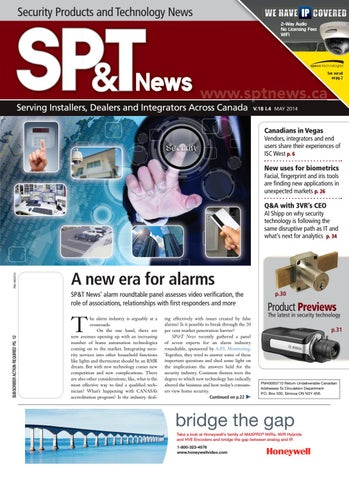
A new era for alarms SP&T News’ alarm roundtable panel assesses video verification, the role of associations, relationships with first responders and more
T
SUBSCRIBER ACTION REQUIRED PG. 12
he alarm industry is arguably at a crossroads. On the one hand, there are new avenues opening up with an increasing number of home automation technologies coming on to the market. Integrating security services into other household functions like lights and thermostat should be an RMR dream. But with new technology comes new competition and new complications. There are also other considerations, like, what is the most effective way to find a qualified technician? What’s happening with CANASA’s accreditation program? Is the industry deal-
ing effectively with issues created by false alarms? Is it possible to break through the 20 per cent market penetration barrier? SP&T News recently gathered a panel of seven experts for an alarm industry roundtable, sponsored by A.P.I. Monitoring. Together, they tried to answer some of these important questions and shed some light on the implications the answers held for the security industry. Common themes were the degree to which new technology has radically altered the business and how today’s consumers view home security. Continued on p.22
p.30
Product Previews
The latest in security technology
p.31
PM40065710 Return Undeliverable Canadian Addresses To Circulation Department P.O. Box 530, Simcoe ON N3Y 4N5
bridge the gap Take a look at Honeywell’s family of MAXPRO® NVRs, NVR Hybrids and HVE Encoders and bridge the gap between analog and IP. 1-800-323-4576 www.honeywellvideo.com
honeywell_SPT_May.indd 1
2014-04-24 9:53 AM
Indoor/Outdoor Full HD 1080p 2MP
WiFi 2-Way Audio
Clear Digital Zoom
No Licensing Fees!
O2PTZ22D5W
O2D4
Check Out the NEW 5MP 360° Pancake Camera with Panorama & PTZ Views!
So Smart, It’s Simple!
N4NSP, N8NSP, N16NSP
4, 8 and 16 Channel NVR with Built-In PoE & Digital Deterrent®
O5MDP1W
AUTOFIND EZ CAMERA
quickly autofinds & installs Speco’s OnSIP & VIP cameras. Compatible with all ONVIF Profile S IP cameras.
VIP2P1N
EZ EZ EZ EZ EZ
Setup: for quick system setup Network: be up and running in a few clicks! Search: thumbnail search events Record: setup recording resolutions and recording type Copy: auto copy onto a USB flash drive
We’ve Simplified IP Products • Training • Support
Contact us at: sales@specotech.com • Toll Free: 1-800-645-5516 • specotech.com
VIP2B1M
Contents MAY 2014
www.sptnews.ca Departments
Cover Story
4 Editor’s Letter 6 Line Card 34 Q&A
22 Forging ahead
In an alarm industry roundtable sponsored by A.P.I. Monitoring, participants address the issues that are taking security to the next level
Al Shipp, CEO, 3VR
Columns 18 Dispatch Digest
Educating the alarm abuser
By Ron Walters
18 Lessons Learned Enjoy the ride
By Victor Harding
20 CANASA Update
Features
Video after Boston
By JF Champagne
26 Eye catching
Biometrics technology is catching on in new markets. Hospitals, retailers and educational institutions are all finding innovative ways to deploy it
20 People Skills
Engaging new graduates
By Laurie Cooper
By Linda Johnson
32
30
Compact IP mini-bullet
Z-Wave deadbolts
The American Dynamics Illustra 610 Compact IP Mini-Bullet Camera provides video within a small framework, making it appropriate for situations where the camera needs to blend in.
The new Real Living Key Free Push Button B1L and Key Free Touchscreen T1L Deadbolts from Yale offer streamlined installation, enhanced security, one button Z-Wave enrollment, and a clean, modern appearance.
visit us online
www.sptnews.ca
Integrator Roundtable: The role of IT depts.
@ www.twitter.com/SecurityEd
The latest in security products
IT managers often have a seat at the table when it comes to security projects. Roundtable participants discuss how customer roles are changing.
Looking for the latest IP camera? What about a new managed access control system? Find these products and more at our online buyer’s guide www.securitypages.ca
Follow us on
www.sptnews.ca/videos
Presented by SP&T News and Tri-Ed Distribution, new product announcements from FLIR, Kantech, Bosch and AG Neovo.
www.sptnews.ca/videos @SecurityEd •
May 2014 3
EDITOR’S LETTER
By Neil Sutton
4K goes forth Buckle up and get ready for ultra high-definition cameras
F
or security media outlets, ISC West traditionally kicks off with the Axis Communications press breakfast. The company usually has a theme for these events. Evoking memories of Sesame Street, breakfast was brought to us by the number four. Founded in 1984, Axis is now entering its fourth decade, but the “four” that drew everyone’s attention was the launch of Axis’ 4K camera, which will be available later this year. Axis was only one of many surveillance manufacturers to showcase new 4K technology at ISC West. Also known as Ultra HD, 4K brings surveillance equipment more in line with the high resolution consumers have come to expect from their television screens. Some might argue — and a few people I spoke to at ISC did — that 4K is really more of a show piece with limited practicality. What’s the point, especially when so many people are still getting mileage out of their five- and even 10-year old systems? The truth is, the application of 4K, at first at least, will likely be small. Most end users probably don’t need that kind of resolution and may not even have the infrastructure to support it. It makes sense for surveying very large areas like sports stadiums and parking lots, but you’re not likely to see it in your average building lobby. But to the naysayers, I would suggest that the security industry needs to keep raising the bar and stretching its goals. Without innovation, there can be very little progress. If device manufacturers didn’t keep up with their massive R&D efforts, we’d all still be making calls on cell phones the size of house
bricks. And 4K may become commonplace sooner than some think. One manufacturer, Sentry360, recently suggested it will become the standard for surveillance by 2016. That might be optimistic, but it’s not beyond the realm of reason. Another camera technology that has yet to come into its own is Cloud-based surveillance. Technology-wise, it couldn’t be much further apart from the super high-res of 4K, but in its own way, it’s just as important — probably more so. It offers small businesses a means to monitor their premises via a hosted solution for a relatively small monthly fee. As IP cameras get cheaper, the equipment cost is going down, and open market competition continues to drive down the price of storage. What’s more interesting than the technology itself is how people are using it. Pelco by Schneider Electric quietly launched a Cloud-based service last year called “Multisight” and showcased it in their booth at ISC West. Interestingly, the primary use for the service is operational management for small restaurants and retailers, not security. The idea that surveillance and security are interchangeable terms when it comes to cameras no longer applies. I’ve heard anecdotally from a few integrators that the Cloud just isn’t ready for security (or perhaps security isn’t ready for the Cloud). But I think it’s vital that security companies continue to try new technologies and push the envelope of what’s possible. In order to keep the future in focus, we need more development today.
“Without innovation, there can be very little progress.”
Your Partner in Securing Canada Security Products & Technology News is published 8 times in 2014 by Annex Business Media. Its primary purpose is to serve as an information resource to installers, resellers and integrators working within the security and/or related industries. Editorial information is reported in a concise, accurate and unbiased manner on security products, systems and services, as well as on product areas related to the security industry. Feature articles and all other types of newsworthy submissions should be forwarded to the Editor for consideration via mail, e-mail or fax (all listed below). These should be written to reflect the interests of professionals serving the Canadian protection industry.
Group Publisher, Paul Grossinger pgrossinger@annexweb.com Publisher, Peter Young pyoung@annexweb.com Editor, Neil Sutton nsutton@annexweb.com Online Editor, Rob Colman rcolman@annexweb.com Art Director, Graham Jeffrey gjeffrey@annexweb.com Account Coordinator,Trish Ramsay tramsay@annexweb.com President, Mike Fredericks mfredericks@annexweb.com
EDITORIAL ADVISORY BOARD Carlo Di Leo, Double Vision Group Colin Doe, Veridin Systems Canada Anna Duplicki, Lanvac Travis Firth, Tyco Security Products Mike Jagger, Provident Security Carl Jorgensen, Titan Products Group Bob Moore, Axis Communications Tom Richards, Lionsafe Security Paul Swan, Tri-Ed Distribution Josh Weidman, Allegion
@SecurityEd
ARE YOU RECEIVING
Head Office: 222 Edward Street Aurora, Ont. L4G 1W6 Canada T: 905-727-0077 F: 905-727-0017 PUBLICATION MAIL AGREEMENT #40065710 RETURN UNDELIVERABLE CANADIAN ADDRESSES TO CIRCULATION DEPT. P.O. Box 530, Simcoe ON N3Y 4N5 e-mail – lthomson@annexweb.com Printed in Canada ISSN 1482-3217 CIRCULATION e-mail: lthomson@annexweb.com Tel: 866-790-6070 ext. 201 • Fax: 877-624-1940 Mail: P.O. Box 530, Simcoe ON N3Y 4N5 SUBSCRIPTION RATES: Canada: $40 + hst/yr, USA: $60/yr and International: $75.00/yr Published 8 times a year
e-news? Subscribe today!
www.sptnews.ca 4
SP&T News • www.sptnews.ca
Occasionally, SP&T News will mail information on behalf of industry-related groups whose products and services we believe may be of interest to you. If you prefer not to receive this information, please contact our circulation department in any of the four ways listed above. ©2014 Annex Publishing & Printing Inc. This publication, or any part of it, may not be reproduced, stored or transmitted in any form whatsoever without the express written consent of the publisher.
We acknowledge the financial support of the Government of Canada through the Canada Periodical Fund of the Department of Canadian Heritage. Annex Publishing & Printing Inc. disclaims any warranty as to the accuracy, completeness or currency of the contents of this publication and disclaims all liability in respect of the results of any action taken or not taken in reliance upon information in this publication.
DIGITAL WATCHDOG megapix
nvr series
cameras
ipvms
Complete IP Solution DW Spectrum IPVMS
• Powerful and user-friendly IP Video Management • Optimized to provide unmatched bandwidth savings • Simplified system management with cutting-edge User Interface • Region of Interest with Forensic SpyGlass, Advanced System Health Monitoring. • Text-to-Speech Event Notifications, Events and Actions Archive Log, and e-Mapping
Blackjack NVR Series
• Support for 16 up to 128 IP Megapixel cameras, unlimited scalability • NAS, RAID-5, Redundant Power Supp Supply, Hot Swappable HDD Bays (E-Rack Models) • Real time full 1080P @ 30fps recording • Analog Integration with DW’s VMAX Analog DVR DVRs (Cube and E-Rack Models) • 1~ 144 TB internal storage options
MEGApix
IP Camera Series • 2.1 MP (1080P @ 30fps) and 5MP (2592x1920 @ 10fps) • Simultaneous Dual Stream, PoE, OnVIF Profile S • WDR, 3D-DNR, Optical and Digital Zoom • SDHC Card support, 2-Way Audio • Available in Weather and Vandal Resistant models, Indoor Domes, and Discrete small size housings
866.446.3595
w w w. d i g i t a l - w a t c h d o g . c o m
sales@dwcc.tv
LINE CARD Exploring ISC West
Security Stats.....................................................14 Market Watch....................................................14 Applications ......................................................16 Calendar ............................................................16 Appointments ...................................................16
SHOW FLOOR REVIEWS FROM • Products CANADIAN ATTENDEES and announc ements • nPs winners
For more coverage, read our ISC West Wrap-up Edition at www.sptnews.ca
Canadian end users, integrators and vendors delve deep into new technology By Neil Sutton
A
ccording to the Security Industry Association, more than 28,000 security professionals attended ISC West this year — a record number for the annual Las Vegas conference. It’s clear from talking to Canadians on the exhibit floor that most were able find security solutions that met their specific needs. For Scott Hammond, it was his first experience of an ISC West show. Hammond, a data/comm product specialist at Guelph, Ont.-based Hammond Manufacturing, says he was “super-impressed” by the sheer scale of the event. “It’s definitely the largest trade show I’ve been to in a long time.” A standout for Hammond was the range of access control technology on display. He says he was impressed by the “amount and complexity” of locking mechanisms on display at the ASSA ABLOY booth. He was also interested in recent developments in wireless access control. “I know that it was a technology that was coming of age, but I didn’t know it was so active already, was all the Bluetooth locking mechanisms for your house. I saw a near-field communication (NFC) unit where you can have your phone linked up to your latch.” Another booth that caught Hammond’s eye was Arteco, an Italian manufacturer of security, industrial
ISC West hit record attendance numbers in 2014. More than 28,000 were at the annual Las Vegas, Nev. conference
automation and building automation tools. “They had some pretty cool stuff. I talked to those guys for a while. The technology they had was a step up from the DVR and NVR world.” Mike Soberal, manager of security, safety and sustainability for H&R REIT Management Services, attended ISC West on a specific mission. “I was looking for analytics software and camera technology . . . specifically facial recognition and people-counting analytics.” Soberal says he found what he was looking for but didn’t see a “wow product” like he had in previous years. He lamented the fact that large
security trade shows often feature the same vendors and technology, making it difficult to justify multiple trips. “I’m sort of on the fence for this one. I actually got what I was looking for, but I didn’t get wowed by anything. I just didn’t find anything like that this year.” He was, however, impressed that the organizers showcased some of the international exhibitors in an area separate from the main exhibit floor. “I thought that was a great move.” Colin Doe, CEO of Veridin Systems Canada says that, like Soberal, he went to ISC West “with a game plan.” The Toronto-based integrator
D
6
SP&T News • www.sptnews.ca
cultures are a good fit. Customer and channel synergies were apparent from the start.” Farpointe product applications include physical and logical access, secure identity and vehicle identification. The company also makes long-range RFID solutions that transmit up to 150 feet (45 m), suitable for parking gates and vehicle barriers. “We are very excited to be partnered with DORMA, and are confident they are the right company to support Farpointe’s next level of growth,” says Scott Lindley, president of Farpointe Data.
SPECIAL DIGITAL SUPPLEMENT
p Editio n
ISC SPIRIT
LAS VEGAS CONFER RECORD ATTEND ENCE DRAWS ANCE IN 2014
SP_ISC west
edition 2014.indd
1
2014-05-08
met with a number of vendors “for product we wanted to pick up. “We were looking for a Cloudbased card access solution. We looked at Avigilon’s solution [with technology] from their acquisition of Red Cloud. It was interesting. We liked what we saw,” he says. For many people attending the show, networking opportunities are as important as the technology on display. “We need to be there,” says Doe. “We’re a medium-sized company and we’re expected to be at the show. We take those expectations seriously, so we go.” Kim Caron, director of business development for Armstrong’s National Alarm Monitoring, says she was impressed by the number of Canadians who attended the show. “I think it’s the biggest Canadian show outside of Canada. I’ve always thought you should be there if you’re Canadian.” She notes that distributor TriEd’s annual Canada Night event, held the second night of the conference “was full.” Caron says a good indicator that the security industry is alive and well is the number of non-security companies that chose to exhibit at ISC West. “It was interesting to see players like American Express and Dodge. It shows the economy is getting stronger and it shows that they understand security is a larger business to get in to,” she says. ISC West will return to Las Vegas April 15-17, 2015.
DORMA buys RFID specialist
ORMA Americas has acquired Sunnyvale, Calif.-based Farpointe Data, a provider of radio frequency identification (RFID) for access control products. The deal closed April 1, day one of the ISC West exhibition in Las Vegas. According to a DORMA statement, “advanced RFID technology is a Farpointe hallmark.” The company manufactures contactless smart card readers, cards and tags. “It would be hard to imagine a better-realized combination than DORMA and Farpointe Data,” says DORMA AME area president Wil VandeWiel. “The corporate
I S C We s t Wrap u
Wil VandeWiel, DORMA
3:20 PM
The Next Generation in Security Systems
Technologies come together in the most spectacular way. Flexible by virtue of the modular, hardwired system, coupled with the simplicity of wireless devices and peripherals, PowerSeries Neo is ideal for scalable commercial security installations. PowerG – the industry’s leading-edge wireless intrusion technology, infuses the system with powerful tools such as visual verification to offer superb system reliability. With optimized partitioning, integration potential and compatibility with leading-edge interactive solutions supported by DSC, infinite opportunities make PowerSeries Neo an undisputed first-class investment for the long term.
PowerSeries Neo by DSC is Security Redefined. www.dsc.com © 2014 Tyco Security Products
From Tyco Security Products
LINE CARD Graybar wins environmental award
Protection 1 recognized for charitable efforts
Protection 1 employees contributed to numerous chartable causes, including food banks
M
ission 500, a charitable organization that encourages security professionals to sponsor needy children through the World Vision organization, has named Protection 1 as the recipient of its 2014 Mission 500 Corporate Social Responsibility award. Protection 1 was recognized for its community involvement programs. The Chicago-based home security company’s 1 For All program is both national and local. Nationally, they host All For 1 Day, a service day, and Food For All Month,
ATTENTION
a food drive. With each of these events, their locations are encouraged to participate by helping out a local organization. Many locations work with local food banks, women’s shelters and animal shelters on a regular basis and not just during their national events. In 2013, Protection 1 aided almost 150 local and national charities by donating more than 25,000 hours of service. Previous winners of the Mission 500 CSR award include Pelco, Vivint and Convergint Technologies. The 2014 Mission 500 Humanitarian award was presented to Dom D’Ascoli, an industry veteran and past president of ESA. D’Ascoli’s long list of community and charitable work includes serving as chairman of the Children’s Home Society of Broward County, chairman of the Macon County (NC) Department of Social Services, and president of REACH of Macon County, which provides help for battered women. The Mission 500 awards were presented in April during ISC West. SP&T News is pleased to be a media sponsor for the Mission 500 organization.
Authorized Dealer Program
ALARM COMPANY
OWNERS!
National Acquisition Program
CANADA’S MOST FLEXIBLE PARTNER PROGRAM!
G
raybar Canada’s Hamilton, Ont., branch was recently recognized for its environmental responsibility by Horizon Utilities at its annual Energy Savings Champions Awards. The awards, held March 26 in Hamilton, recognize local businesses for implementing innovative energy conservation and demand management projects. The award received by Max Cananzi, president and CEO, Horizon Utilities, with Matt NewGraybar Canada recman, Graybar Canada ognizes participating contractors. Graybar Canada submitted 21 applications resulting in energy savings of 189 kW and 743,521 kWh. “We are very pleased to receive the award and be recognized by Horizon Utilities,” says Matt Newman, branch manager. “It means a lot to us to be able to contribute to the improvement of our community by sharing our green practices.”
• You sell & install, we service & monitor • Business & funding flexibility • Substantial equipment discounts • SecureMoreBusiness.com, our dedicated dealer website
• We’ve been acquiring accounts nationwide for 25 years • We offer attractive purchase multiples • Smoothest integration purchase process • Stay in business after selling your accounts
• 4 ULC state-of-the-art interlinked monitoring centres • All of our monitoring centres are Canadian and 5 Diamond certified by the CSAA • Top-quality service from coast to coast in both official languages
8
SP&T News • www.sptnews.ca
Reliance_SPT_May.indd 1
|
www.securemorebusiness.com
É PA GU
DE IRES NA LABORATO DU CA
dealers@protectron.com
R
SA DA SSUREU RS
LIST
ED BY
CALL US TODAY! 1 866 711-6111
HOM OLO
• We offer the latest products and services
’ AN LABOR ADA ATORIE S
Security24 Wholesale Monitoring
RS RITE C UNDERW OF
2014-04-30 1:56 PM
THE FUTURE OF ACCESS CONTROL IS HERE Now shipping Fuelled by 25 years of research and development, Keyscan Aurora is the software platform that eclipses industry standards. With new features, enhanced capabilities and expanded capacity, Aurora anticipates your evolving needs. • Support for 45,000 credentials (with expansion to 90,000*) • Ten (10) assigned groups to a single credential holder • Multiple credentials assignable to a single user • Unlimited optional user definable fields • Full or partial facility lock down from client, reader or input device • New multi-threaded communication structure • Optional licensed and Add-on modules for enhanced functionality
Ensure your customers get the latest and very best in access control management software. Contact your Keyscan Regional Sales Manager today.
Toll Free Canada or USA 1.888 KEYSCAN (539-7226) www.keyscan.ca
* Requires special order hardware
LINE CARD Senstar acquires Optellios
O
Optellios employs 16 people in its Newtown, Penn., ttawa-based Senstar has acquired Optellios, a headquarters. That facility will become a centre of excellence maker of fibre optic sensing technology, to bolster for fibre optic technology, says Rich, bringing Optellios and its product set and broaden its market appeal, Senstar’s own fibre optic products under one according to Senstar president Brian Rich. roof. He adds that the company will retain The deal was first announced in March the Optellios name since “there’s value in the and closed in April. Terms of the sale were brand. We’ll leverage that.” not disclosed. David Smith, Optellios president, will Rich says Senstar had originally aimed to depart the company. He was brought in by develop its own fibre optic sensing products, Optellios’ previous owner, a venture capital but ultimately it made sense to bring that techfirm, to transform the business, according to nology in-house through a purchase. “Perhaps Rich. “He’s been a great leader and built the in a few more years we may have been able to company significantly.” do that, but the acquisition of Optellios is cerRich says that Optellios’ technology is tainly a much better solution for us,” he says. able to service longer perimeters and may “The acquisition of Optellios fills that gap. Its Brian Rich, Senstar provide new market opportunities. “Pipeline advanced fibre optic sensing perimeter security security is a huge vertical market that we’ll be able to access products fit very well within our portfolio.” with this product set,” he explains. “Also borders, large oil Senstar has had an OEM relationship with Optellios and gas sites, plus any large facility that prefers to use a fibre for several years, adds Rich, making the acquisition even optic sensor.” He adds that Senstar’s international reach will more attractive. “This was kind of a next logical step in the potentially widen the audience for Optellios. relationship that we’ve been building.”
Study reveals false expectations about surveillance
A
study conducted by Leger on behalf of Axis Communications indicates the degree to which popular TV crime shows are skewing Canadians’ perceptions of what today’s surveillance can accomplish. According to the study of 1,500 Canadians, 68 per cent said they watch crime dramas like CSI, Criminal Minds, Castle and Law and Order. Seventy-one per cent believe that recorded surveillance can be enhanced using software and 75 per cent believe facial recognition technology can identify one person out of a crowd.
75
th
Anniversary
m mi
tted to Your Succe
Committed To Your Success www.apainc.ca
Co
ss
The reality is somewhat different, says Axis Canada country manager Bob Moore. “If you don’t start out with high resolution video, enlarging it will result in a bigger, blurrier, more pixelated image. Video clarity cannot be fixed after the fact. As a rule of thumb, an image must supply 80 pixels from ear to ear to ID a face.” Canadians surveyed are also unsure of most video storage policies; 27 per cent said they have “no idea” how long video is retained, while 26 per cent believe it is stored indefinitely.
We've made some GRAND Changes to APA-Toronto Branch
Raise a glass with us as we celebrate APA-Toronto Grand Re-Opening
Wednesday June 18th 2014 From 5 to 9 pm Come visit our new larger office, meet our friendly staff, and enjoy soft drinks and hors d’oeuvres.
Please RSVP at: www.apainc.ca
Or by fax at : 905.612.9689 Or with your sales rep at : 905.612.1666 APA - Toronto 6845 Rexwood Rd. unit 1&2 Mississauga ON L4V 1S5
Door Prizes!!! MayIssue.indd 1
10 SP&T News • www.sptnews.ca APA_SPT_May.indd 1
4/16/2014 3:05:05 PM 2014-04-24 9:44 AM
ONVIF adds new membership level
S
tandardization body ONVIF has added an “observer level” to its membership structure, allowing consultants, systems architects and engineers, and members of the media to join its organization. “Our new membership level is intended to offer openness about the ONVIF process to industry stakeholders that wouldn’t normally join ONVIF,” says Per Björkdahl, chairman of the ONVIF steering committee. Per Björkdahl, ONVIF “The vast majority of our members are manufacturers who offer or plan to offer ONVIF conformant products or technology included in conformant products. So this is really geared toward the architect/engineer or consultant channel.” Benefits accorded to these new members will include access to ONVIF’s network interface specification test tools. Observer members will thus be able to independently test products and see how well they conform to ONVIF profiles. “So if you are a consultant, architect or engineer, you can perform these tests to verify conformance prior to including a particular product, or groups of products for an integrated access and video system, in a specification for a particular project,” he says. ONVIF hopes that a side benefit of the observer level will be to raise awareness of the organization and its standards to the specifier community, adds Björkdahl, “and that they will view the test tools and other resources available to this level of ONVIF membership as a tool when vetting and recommending products.” As of March 2014, ONVIF claimed almost 500 members. In addition to the new observer level, the organization provides membership through “user,” “contributing” and “full” member levels. Full and contributing members are able to participate in the development of ONVIF standards, whereas user members can use the network interface specification and have access to specification proposals.
PLUG, PLAY WALK AWAY
It’s that easy Introducing Milestone Husky™ M10 – our small and sleek hardware appliance, preinstalled with Milestone video management software and configured for efficient performance and reliability. Ideal for entry-level video surveillance. Set up in minutes and instantly access live and recorded video from any Internet enabled device. No training required. Milestone Husky M10 is compatible with thousands of cameras and supports Milestone services such as free Customer Dashboard to enable your installer to monitor the health of your system and proactively resolve technical issues. You can also add Milestone Interconnect™ to gain XProtect® Corporate features such as video evidence management. Learn more about the entire Milestone Husky™ series: www.milestonehusky.com TM
Video surveillance your way
M10
LINE CARD PSIA working towards physical-logical access spec
The Physical Security Interoperability Association (PSIA) has released a
draft proposal of its Physical-Logical Access Interoperability (PLAI) specification. “We’re excited about the potential the PLAI specification has for reshaping physical and logical identity access for the security industry,” says David Bunzel, executive director. The PSIA released the PLAI draft during a special session of the PLAI Working
Group at ISC West in Las Vegas. During the ISC West demonstration, the PLAI specification enabled an identity to be entered into Microsoft’s and LDAP-compliant Active Directory, and then to automatically propagate all of that identity’s associated privileges and credentials to physical access control systems (PACS).
Tri-Ed to carry Nest products
Tri-Ed recently announced a distribution agreement with Nest, makers of home products such as smoke alarms, CO detectors and thermostats. “We are very pleased to partner with Nest,” says Pat Comunale, president and CEO, Tri-Ed Distribution. “Nest’s professional product solutions will create a unique opportunity for security dealers to provide added value to their customers, while increasing value in their own business development as well.” Earlier this year, Google announced it would purchase Nest for US$3.2 billion. The Tri-Ed distribution arrangement with Nest is currently limited to its U.S. branches.
Hikvision, Solink form integration partnership
Hikvision and Ottawa-based Solink announce the integration of Hikvision’s embedded recording solutions with Solink’s event-based video discovery platform. The integration allows Hikvision’s video recorders to access Solink’s contextual analytics and business applications for loss prevention, operations, risk management and other data intensive fields. Solink’s retail application uses video data to help retailers make decisions around loss prevention and content management. “With integrations to many point of sale and retail solution vendors currently available, Solink can analyze customer and employee behaviour by leveraging video and data analytic triggers,” says Solon Angel, head of product at Solink.
FST21 rebrands to FST Biometrics Israeli biometric access solution provider FST21 has rebranded to FST Biometrics. As part of the initiative, the company says it will further concentrate its efforts on its In Motion Identification (IMID) technology. “As our team continues to establish our global presence, I believe this rebrand highlights our commitment to exceptional security and seamlessly convenient access in populated cities around the world,” says Major-General Aharon Zeevi Farkash, founder and CEO.
12 SP&T News • www.sptnews.ca
WITH 5 MONITORING STATIONS ACROSS CANADA TO SERVE YOU
Monitoring Your Way for Over 30 Years! Wholesale Monitoring Interactive Services Video Monitoring Managed/Hosted Card Access Acquisition and Funding Program Authorized Dealer Program
FOR MORE INFOMATION CALL:
1.800.897.1039 www.apidealers.com
LINE CARD SECURITY STATS Worldwide home network penetration is expected to climb from 24.8% in
2013 to 33.2% by 2018.
market watch
Source: ABI Research
Company (ticker) Price (Apr. 15) 52-week low 52-week high
Approximately one-third of Canadian employees transfer work files to their personal devices because their companies don’t provide a formal way to access them outside of the office.
ADT (ADT) $29.94 AlarmForce Ind. (AF.TO) $11.38 Allegion (ALLE) $49.96 Avante Logixx (XX) $0.33 Avigilon Corp. (AVO.TO) $26.80 Checkpoint Systems (CKP) $12.38 Cisco Systems Inc. (CSCO) $22.89 Diebold (DBD) $39.61 Flir (FLIR) $35.10 Gentex (GNTX) $28.55 Honeywell (HON) $91.71 Johnson Controls (JCI) $45.96 Mace Security (MACE) $0.37 Napco (NSSC) $5.91 Richardson Elec. (RELL) $10.21 ScanSource Inc. (SCSC) $39.13 Stanley (SWK) $80.22 Tyco Int. (TYC) $40.92 United Technologies Corp. (UTX) $115.84 Verint Systems Inc. (VRNT) $44.61 Vicon Industries (VII) $3.09 Viscount Systems (VSYS) $0.11
Source: Softchoice
How important is a social networking strategy to your business? It’s not important right now, but will be in the future
We are in the process of developing it
5.9%
17.6%
We use it regularly for business
It’s not on the radar at all
52.9%
23.5%
Source: Conducted in March/April 2014 on www.sptnews.ca
$27.93 $8.66 $40.24 $0.05 $11.01 $10.50 $19.98 $27.89 $23.00 $20.21 $70.92 $31.94 $0.30 $3.98 $10.00 $25.83 $73.77 $30.62 $90.30 $32.25 $2.43 $0.04
$46.05 $11.60 $55.78 $0.45 $34.50 $18.25 $26.49 $41.45 $37.35 $34.41 $95.90 $52.50 $0.59 $7.70 $12.27 $43.65 $92.76 $44.10 $120.49 $49.99 $4.35 $0.15
C
M
Y
CM
MY
CY
CMY
K
14 SP&T News • www.sptnews.ca Canasa_SPT_May.indd 1
2014-04-24 9:26 AM
LINE CARD Applications
Calendar McCarran Airport updates breach control McCarran International Airport in Las Vegas is the ninth-largest in the United States, serving more than 41 million annually. With last year’s opening of its Terminal 3 expansion, McCarran implemented a number of passengerprocessing technologies, including automated exit lanes to facilitate the egress of arriving passengers as they exit from the secure portion of the airport on their way to baggage claim. Kaba’s automated Exit Lane Breach Control (ELBC) System works in accordance with all applicable regulations without a requirement to physically staff the exit lane. The Kaba Lane is designed to control passenger flow while preventing unauthorized entry, or breach, to the secure airside of the airport.
Denver transit adopts mobile video solution
NICE Systems is providing the Denver Regional Transportation District (RTD) with a mobile video recording and investigation solution for its new bus fleet. The solution, which leverages the NiceVision IP video management software and NICE Inform is expected to enhance RTD’s investigative efficiency by automatically offloading video recordings and integrating them with other video and audio sources to create an event timeline. The solution enables automatic secure download of video recorded on any RTD bus upon arrival at a bus depot. In the initial phase of deployment, RTD is equipping 52 buses with the software solution which will run on Panasonic’s Transit Solutions hardware consisting of specialty cameras and a mobile recording platform.
Wine superstore deploys surveillance for fulfillment protection
May 29, 2014 Anixter Showcase Montreal, Que. www.anixter.com/events/ montrealshowcase May 29, 2014 ADI Expo Ottawa, Ont. www.adiglobal.com June 4, 2014 Security Canada Ottawa Ottawa, Ont. www.securitycanadaexpo.com
Total Wine & More has standardized on March Networks’ next-generation retail video surveillance solution. The privately-owned chain is using the solution to maintain its security and loss prevention efforts across 100 outlets located in 15 states, and to capture clear video evidence to assist with liability protection as it grows its e-commerce business. Total Wine transitioned to the March Networks 8000 Series Hybrid NVRs and Visual Intelligence software when it began opening Internet fulfilment centres in its stores. The 25,000-sq-ft retail outlets hold almost 14,000 types of wines, beers and spirits and feature walk-in cigar humidors and keg rooms, wine tasting areas and classrooms.
June 19, 2014 Canadian Security’s Focus On Series: Retail Security Richmond Hill, Ont. www.focusonseries.ca June 23-26, 2014 Electronic Security Expo Nashville, Tenn. www.esxweb.com June 24, 2014 ADI Expo Winnipeg, Man. www.adiglobal.com June 25, 2014 Security Canada West Richmond, B.C. www.securitycanadaexpo.com July 10, 2014 ADI Expo Calgary, Alta. www.adiglobal.com Aug. 14, 2014 Tri-Ed Halifax Customer Appreciation Event Hammonds Plains, N.S. www.tri-ed.com
Appointments
Sept. 16, 2014 Canadian Security’s Focus On Series: Commercial/Property Management Richmond Hill, Ont. www.focusonseries.ca Sept. 18, 2014 Security Canada Atlantic Moncton, N.B. www.securitycanadaexpo.com
Earl Muise
•
•
•
Barb Geisel
Earl Muise has been appointed director of the Toronto branch of APA. Muise has spent more than 20 years in security sales and marketing and is an integral part of the management of the branch and sales development in collaboration with Martin Laplante, national sales manager. Barb Geisel has recently joined Reliance Protectron Security Services as Toronto Area Residential Sales Manager. Geisel’s industry experience includes ADT Security, Chubb Security and Canadian Security magazine. AMAG Technology has appointed Derik Beier as its
16 SP&T News • www.sptnews.ca
Derik Beier
•
Robert (Bob) Fee
new Eastern Canada regional sales manager. Beier will support existing Symmetry authorized resellers, and develop new business in Ontario, Quebec, New Brunswick, Nova Scotia, Nunavut, Northwest Territories, Newfoundland and Labrador. Robert (Bob) Fee has joined Zwipe as North American director of sales. Fee has more than 20 years of domestic and international sales and marketing leadership with technology manufacturers. He was most recently general manager, Americas with LEGIC Identsystems AG, located outside of Chicago.
Garnet Saunders
•
•
Travis Merrill
Huronia Alarm & Fire Security has appointed Garnet Saunders as senior technician. Saunders will help Huronia service an increase in demand, particularly in Collingwood and the surrounding area, for fire and safety products and services as well as security and CCTV systems. Travis Merrill has joined FLIR Systems in the newly-created position of senior vice-president and chief marketing officer. Reporting to CEO Andy Teich, Merrill will be tasked with developing and leading FLIR’s global marketing and brand building efforts.
Sept. 18, 2014 Anixter Showcase Mississauga, Ont. www.anixter.com/events/ torontoshowcase Oct. 7, 2014 Anixter Showcase Calgary, Alta. www.anixter.com/events/ calgaryshowcase Oct. 22-23, 2014 Security Canada Central Toronto, Ont. www.securitycanadaexpo.com Nov. 25, 2014 Security Career Expo Sheraton Parkway Richmond Hill, Ont. www.securitycareerexpo.ca Dec. 10, 2014 Canadian Security’s Focus On Series: Health Care Sheraton Parkway Richmond Hill, Ont. www.focusonseries.ca
high-speed frame rate (1080p@60fps)
sharp detailed WDR (130dB)
exceptional low light
capture the smallest details
the power of technology… Samsung video surveillance solutions set the benchmark for exceptional performance and added value. With innovative technologies like WiseNetIII that provides proprietary imaging technologies to capture the smallest details – and all the speed you need for efficient networked IP systems.
1.877.213.1222 • samsung-security.com
DISPATCH DIGEST
By Ron Walters
Educating the alarm abuser Consider multiple approaches to fixing the issue with problem customers
F
or more than a decade, the Security Industry Alarm Coalition (SIAC) has developed many close and worthwhile relationships with law enforcement agencies. The largest benefit of these has been the open exchange of information. Most recently, these agencies have been sharing some impressive statistics that prove that all of our combined efforts have been worth every minute and dollar invested. We are finding that where a well thought out alarm management program is in place and is well enforced, 85 per cent of the alarm systems have no dispatches in any given 12-month period. What is just as impressive is that another five to seven per cent have only one. This means that no more than eight per cent of all of our systems are creating almost the entire dispatch problem. It also means that if we can successfully address this small piece, we can lay claim to a solution. Many people believe that SIAC is in business to fight onerous alarm ordinances, but this is a very small part of our actual mission. Some believe that SIAC is against verified response; again this isn’t always true.
LESSONS LEARNED
There will always be that 10 per cent of alarm users who are abusers. Many of these systems will experience dozens of dispatches annually, and a great many of them are public buildings. This can be the result of a broken system, refusing service or even a failure of the customer training process. Traditionally, the method of dealing with these abusers was for them to pay high fines. However, many just budget for the fines and pass the costs along to their customers and, more often than not, municipal buildings are exempted from paying fines. The best way to address these abusers is an active process within the alarm company that quickly identifies problem accounts and invests the time and dollars to fix the problem. But what do you do when a customer refuses to repair their alarm or learn how to responsibly use it? One way is to look at the account and measure how much it means to you. Do they pay their monitoring on time? Just how high is their level of activity? Would you do the repairs if the customer agrees to a new five-year agreement? If the client is unwilling to work with the alarm company, then
response to that account should be suspended, either by a strong ordinance or the alarm company refusing to continue to dispatch. No company wants to lose customers but the real truth is we can’t continue to jeopardize all of the customers for such a small handful of abusers. Since user error accounts for almost 80 per cent of all dispatches, every company should put an educational process in place that begins at the completion of every installation and is available for retraining. If you don’t want to face developing such a program there is one available for free at www.siacinc.org. If all else fails, ask the local alarm co-ordinator to meet with you and the customer, but one way or another, if the problem can’t be fixed then private response should be considered. We can’t claim success until we address these problem accounts and this is why SIAC supports removing response to chronic abusers. Ron Walters is the director of the Security Industry Alarm Coalition (www.siacinc.org).
By Victor Harding
Enjoy the ride There may be a few bumps along the road, but the alarm industry is picking up speed
I
want to pass on some information I have learned from the security market over the last year.
1
If you are a Canadian alarm dealer, have more than 750 alarm accounts and are looking to sell, there are U.S. buyers (other than just ADT) interested in your base as well as Canadian buyers. These U.S. buyers will likely want to leave you and your company in place, paying you to service the accounts and buying new accounts that you put on. However be prepared for a much more rigorous due diligence process than you would get from a Canadian buyer.
2
Some dealers forget there is a double benefit in having monitored accounts with higher rates when it comes time to sell. Not only is your purchase price higher because your rates are higher, but often you will get a higher multiple on those higher rates as well. Selling 1,000 accounts at $20/month might
18 SP&T News • www.sptnews.ca
attract a multiple of 32x RMR or a gross selling price of $640,000 before any deduction for prepaid revenue. But the same 1,000 accounts monitored at $25/month will get you 1,000 x $25 x 32 = $800,000 just from the higher rates but most likely a higher multiple as well — e.g. 1,000 x $25 x 34 = $850,000. That is an extra $210,000.
4
3
5
The conventional wisdom that alarm dealers should always hang onto their alarm accounts is not always true. If I owned a sizable block of accounts (say 3,000 or more) I would look at two factors every year to determine my course of action: my attrition rate and my cost to create a new replacement account. The numbers that I see indicate that attrition numbers are creeping up, probably because of the recession. As annual attrition rates climb, it becomes less attractive to hold onto an alarm account base because it takes more replacement accounts to stay even. A company with 3,000 accounts experiencing eight per cent attrition has to replace 240 accounts very year.
From now on, I am going to suggest to all my sellers that they think about negotiating a onetime, purchase price reduction for attrition up front with their buyer rather than go through the hassle of managing a holdback of 10-15 per cent over the year after the deal is done. This process can cause friction between the buyer and the seller. The future for the alarm industry looks good. The industry weathered the recession better than most. The number of monitored accounts in the U.S. rose substantially just in the last year. There are new players coming into the industry — cable companies and telcos. Average monitoring rates are climbing primarily due to new interactive panels. Penetration rates are going up beyond the magic barrier of 20 per cent. The Internet is proving to be a reliable conduit for alarm signals. Finally, there is a lot of outside money interested in the alarm industry today.
Victor Harding is the principal of Harding Security Services (www.hardingsecurity.ca).
Wherever you are, you can rely on DSC to bring home closer.
Interactive -- with DSC, it’s simply a matter of choice A selection of quality security products by DSC are now compatible with leading-edge solutions offered by trusted interactive service experts. Maximize the full potential of your security system with a variety of smart home control and monitoring features offered through DSC’s interactive service partners Telguard* and Alarm.com. It’s reliability, flexibilty and service excellence at it’s finest. For more information on available features and packages, talk to your security professional or visit www.dsc.com
A world of interactive choice – with DSC * In Canada, Telguard products and services are offered and sold under the Telular brand.
For more information:
Call: 1.888.888.7838 | Email: info@dsc.com Visit: www.dsc.com © 2014 Tyco Security Products.
CANASA UPDATE
By JF Champagne
Video after Boston A year after the marathon attacks, the role of surveillance in public life comes into focus
I
returned from ISC West in Las Vegas with the belief that our industry is stronger than ever. To quote Don Erickson, CEO of the Security Industry Association (SIA), “ISC West is a good indicator of how vibrant our industry is and ISC West 2014 is the largest show since 2007.” SIA is the primary sponsor of ISC West and a close partner of CANASA. There were also a record number of people for the annual Mission 500 Security 5K event, a security industry initiative that supports World Vision and benefits children in need. More than 700 people registered and raised in excess of $100,000. I ran next to Fredrik Nilsson, general manager for Axis Communications — a regular at Security Canada Central and other industry events in Canada, and a great resource if you want to learn more about what is happening in the industry. We spoke about his participation on a panel discussion at ISC where they talked about privacy and CCTV.
PEOPLE SKILLS
He referenced the bombing during the Boston marathon a year ago to illustrate how the public’s perception is changing.
“I suspect younger generations will embrace new models of privacy and data protection.” Fredrik mentioned a Time magazine survey following the Boston events that showed that 80 per cent of Americans are in support of more cameras in public spaces, a sharp increase from a previous poll a decade or so ago. The reasoning being that the public is able to appreciate the positive impact of video surveillance and is more accepting as a result. The same survey also saw a decrease in support for “data surveillance,” such as monitoring of emails and cell phones where the public did not see a positive impact for the population.
We can appreciate the efforts that went into identifying the people behind the bombing and we know many privately-owned and installed CCTV systems were leveraged in this effort. In fact, the first pictures of the suspects were from a private business while they were in a “public space.” I like to believe that this is great news for the private sector. It would be hard to refute the positive impact the systems we install have on protecting the public and helping law enforcement solve crimes. I suspect younger generations will embrace new models of privacy and data protection. There will be boundaries placed on government and public agencies to prevent the concentration of information while allowing private enterprises to protect their interests and also serve the greater good. We may have to improve how we interact with law enforcement to exchange information but it is all good for business. JF Champagne is the executive director of CANASA (www.canasa.org).
By Laurie Cooper
Engaging new graduates When recruiting students to your organization, consider options beyond career fairs
A
re you looking to hire the best and the brightest students out there? Do you sometimes feel lost in a sea of booths at a career fair and wonder if you’ll really get noticed? While career fairs still, and will likely always, play a key role in student recruitment, the key to a successful campus recruitment strategy is often a multi-pronged one. A hot topic, but not necessarily the most widely-used strategy (yet), is social media. LinkedIn, YouTube, company blogs, Twitter, Facebook, Instagram (and much more) are all ways in which students stay connected. Social media is one of the most current and fastest growing methods to reach students. Depending on the organization, some are able to execute on a social strategy quickly. However, many have protocol to wade through prior to being able to truly embrace it. If this is you, know that you’re not alone! Social media encompasses a lot and it may make sense for a company to focus on one or two
20 SP&T News • www.sptnews.ca
areas and do them well versus attempting to do it all. When employing a social media campaign, it is also important to remember that creativity goes a long way. For example, holding contests for grad positions where potential candidates have to create their own Twitter or Facebook campaign as part of the selection process. Relationship recruitment should also be a key component of your strategy. It involves building direct, more meaningful relationships with students, career offices, and professors through various methods such as: small and interactive information sessions, panel discussions, social settings (i.e. barbecues), focus groups and special events. While students may initially be introduced to you through Twitter or job postings, they will get to know you, and better yet, get a sense that you care. There is a multiplicity of other options that can be considered when planning your campus recruitment strategy. These include: a high calibre student employment website, mobile recruitment (e.g., using QR codes and ensuring your career site is mobile
enabled), radio advertising, online chat sessions, virtual recruitment fairs, campus ambassador programs and rotational/graduate programs that provide feelings of camaraderie, importance and support. But with so many strategies available, how do you choose? First and foremost, know your business. What are the short, mid and long term goals of the organization and how can your recruitment program support you in reaching these goals? It’s also imperative to have a sense of the competitive landscape and how other companies are engaging with students. What opportunities are you missing out on and how can you stand out from the rest? Become a subject matter expert by staying on top of the latest tools and trends. Last but definitely not least, develop key performance indicators (KPIs). Measuring your results will be critical for reporting back to the business and for continued improvement. Understand these results and make required changes. Laurie Cooper is practice leader, recruitment solutions and human resources at HirePower (www.hirepower.ca)
wire at your fingertips
Go to m.honeywellcable.com with your smartphone. Select the right low voltage wire for your installs from any location. View wire spec sheets, flyers and more. It’s that easy! Honeywell Genesis® Series Cable has significantly expanded our Canadian product line. This wider selection is available through ADI branches throughout Canada. Intrusion, Access, Fire, IP, Audio/Video, Networking or Coaxial & CCTV, whatever your application…We’ve Got a Cable for That!
Put wire selection at your fingertips by scanning the QR code. For more information, please call 1-800-222-0060 or visit www.honeywellcable.com. © 2013 Honeywell International Inc. All rights reserved.
From left: Joseph Rossano, L’Aquila Electronic Systems; Kolin Lee, Canadian Security Alarms; Chris Currie, Damar Security Systems and Security Response Center; Roger Barnes, Roger’s Security Systems; Rob Cherun, UCIT Online; Kevin Leonard, Huronia Alarms. Not pictured: Victor Harding, Harding Security Services (joined via teleconference).
Sponsored by
FORGING AHEAD In an alarm industry roundtable sponsored by A.P.I. Monitoring, participants address the issues that are taking security to the next level Continued from front cover SP&T News: How did the ice storm that hit the Greater Toronto Area last year affect your business? Joseph Rossano: Because of the stations we use, they have back-up stations right across Canada, so it really didn’t affect the response with the monitoring stations. But as far as my company is concerned, we worked on the blackout that we had in the ice storm in 2002 in Quebec. That took a lot of power out, so we ended up putting in a generator system for our business. So it really didn’t affect us too much, other than clients calling in, “My system is beeping.” “So press star 7, get the reset.” That was about it. So we were pretty prepared. What we weren’t prepared for was the extra business we had. It’s always happens. Even though you tell the customer, this is what you should have, they always say, no, not right now. Then something happens, and all of a sudden “I’m getting it,” and their neighbours call, “Can we get that, too?” Something has to happen before someone does something about it. Roger Barnes: We found that it actually increased the business. Obviously, our monitoring station — rock solid. We’ve had no issues there. Where we found
22 SP&T News • www.sptnews.ca
problems was with a lot of downed trees that had taken down phone lines. It opened up an opportunity for us to get out there and put in GSM radios. We did replace a lot of batteries at the time because of hydro being out for a few days. It killed the batteries right down on the older systems. With the newer systems we had no problems; they came back online and the time-clocks set up on them. With the older systems, we had to go through quite a few, getting clocks set up again. But batteries, it was quite a few. The nice thing that happened for us as well is that once we had made contact again with a customer, we were able to do some upselling and get them into new systems. Chris Currie: For us, being in southwestern Ontario, Sarnia, we didn’t get hit that bad. On the Damar side of things, it wasn’t a huge ordeal for us. But on the Security Response Center (SRC) side, which does the monitoring for about 150 dealers, it was a more significant event. We do about 44,000 accounts, primarily in Ontario, but some stuff across Canada. I
pulled together some numbers. We received a total of 230,223 events, which is about a 30 per cent increase over those three days. Of exceptional events, which are events that require operators to pick it up and take action, there were 7,410, which is a 183 per cent increase over normal operations. Total police dispatches over the three days in December was 1,065. That was 47 per cent increase. Total fire department dispatches were 47, which is a 62 per cent increase — so a relatively small number of fire dispatches, but still fairly significant increase. Victor Harding: I was involved in the sale of a fire company in Calgary that went through the flood. The one thing you have to watch for — I don’t think it happened as much in this ice storm as in Calgary — this guy’s business went up 800 to a million dollars, out of $4.5 million. So, you end up gearing up to pick up the slack from the flood, and then, of course, you have to gear back down or beat the bushes that much harder. The flood in Calgary presented to some com-
“A lot of the information I’m getting is that we need to get our customers more engaged in the systems.” — Kevin Leonard, Huronia Alarms
THE PARTICIPANTS “It comes down to educating the customer . . . showing them the wide dynamic range, the HD resolution and then making it into a package that makes sense.” — Rob Cherun, UCIT Online panies a huge bonanza, but there were issues after things went back to normal. Kevin Leonard: We’re a smaller operation located in central Ontario. We weren’t really affected as much. We do a few third-party accounts in Toronto, and I know it was quite traumatic for people there. I think we’re a little more used to it because we tend to get a lot more power outages in our areas, especially in Muskoka. It’s not uncommon for people to be without power for a couple of weeks. So we’re a little more acclimatized to that. Where we are, a lot of people have backup generators — so we run into the same thing and it does create a whole flurry of activity. You end up updating a lot of batteries and things like that. Kolin Lee: I’m like Kevin, I’m up north so we didn’t really get hit by the ice storm as bad as you guys did in Toronto. I’ve only been around for seven years on the intrusion, owning my own company, side of things. So we didn’t have a lot of panels that needed to be upgraded. And because of where we are, too, because trees go down and a lot of times they lose their phone lines, we do a lot of cell backups, just out of the gate. Rob Cherun: We’re a video company, so we do a lot of monitoring across Canada. We’ve had our headaches in Calgary. We’ve had our headaches in Toronto. Toronto was an interesting time because it was late December. We have about 16 technicians in different regions, but in Canada we have about eight that are typically installing. But during that holiday time, they’re not installing; they’re going off on vacation. We’re going down to a skeleton crew. So basically we just brought them back in, overtime, to do service. It was almost a blessing it was during the holiday time, as opposed to two weeks after, when things start getting busy again. So it probably disrupted some vacation schedules, but with the overtime, it turned out. SP&T News: Did you deal with a lot of customer service issues on that end, too? RC: It was more notifying customers that we weren’t able to provide service, and a lot of customers were on vacation. So that had its own impacts. You have your three contacts, and all three contacts are not available. And you’re like, now what? It was proactive management: emails, phone calls, triaging. It wasn’t that disruptive, and by January, we were back on track. SP&T News: What are the new sources of business for you? Where is your business growing? RC: We see security-as-a-service as a growing part of our business. We’re checking our customers’ security solutions, so we say, we’re checking your cameras multiple times a day. We’re making sure the hard
drive’s recording. We’re making sure your system is up and running so that you don’t try and retrieve a video of an incident and the camera was obviously down for the last month. We’re seeing that as a growing service. We’re also seeing geographical expansion. Our company’s expanded out West in the last couple of years. We just opened up an Edmonton office in February. We see video as becoming more and more of a sphere in security and that’s to do with security protocol, bandwidth and just quality of camera. And we’re just now looking to do more of that across Canada to take advantage of that. K. Lee: I started off as more of a residential security intrusion company, and as you go along in business you develop more and more channels. So we’re doing more access control now than in the past. We’re doing a ton of IP cameras. We don’t do analogue cameras anymore unless someone absolutely says their budget is so low. I say, “We’ll put it in, but we’re not happy with it.” So we’re moving more towards the commercial/industrial and away from that kind of residential market. K. Leonard: We actually did that a few years ago, where we moved into more of the high-end residential and the commercial end of it. So we’ve seen a huge growth in card access, camera systems. One of the things that has started to take off now is commercial fire alarm monitoring. So we’ve had a bit of growth on that end of it. We became part of the CSAA last year, and a lot of the information I’m getting is that we need to get our customers more engaged in the systems. So even if it’s a matter of getting an email sent every day regarding a latchkey event: when their kids come home, they get an email telling them the system’s open or closed. So the idea is they feel they’re using the system a lot more, instead of just sending the police when it goes off. Because that’s the biggest challenge — people’s budgets get tighter. You want to make sure that they’re always going to need that monitoring side of it. And the advent of alarm.com and those types of things are going to create more opportunities for them to self-monitor, as well. So I think, as an industry, we need to make sure we’re relevant to the customer and they see the value of it. CC: I like a lot of Kevin’s comments. The ULC certificate, fire monitoring side of things, the push for it seems to be inconsistent across the province – or pretty much across Canada. I’d like to see more consistency there in what the authorities in jurisdictions are asking for. Some places are aggressively asking for it; other places, it’s no big deal. It strikes me as bizarre. Especially when it comes down to institutions like schools, health-care centres, that type of thing, where you want to have the best of the best in place when it comes to the monitoring standard. God forbid, there’s a fire and somebody loses their life, you want to be able to stand up and say, “I had the best of
Rob Cherun CEO, UCIT Online
Kolin Lee Owner, Canadian Security Alarms
Kevin Leonard President and CEO, Huronia Alarms
Chris Currie Vice-president, Damar Security Systems and Security Response Center
Roger Barnes President, Roger’s Security Systems
Joseph Rossano Owner, L’Aquila Electronic Systems
Victor Harding Principal, Harding Security Services
they need to do more advertising to get the name out there. That’s why I think that while we’re in this lull of the 20 per cent [market penetration rate] that they say – well, it’s not going to change till there’s public awareness. And in order to get public awareness, you have to do some advertising. As a company myself, I don’t have all the resources or the funds to be able to pump that all the time. I can do that my little community, but national wide — I can’t do that. That’s that the association is there for. I think we’ve been quiet over these years; everybody does their own thing. But the association needs to step it up. And that means the dealers need to back them up and step them up.
SP&T News’ alarm industry roundtable, convened March 28, 2014, covered topics ranging from end-user perceptions of the alarm industry, to the changing facing of home automation, to the growth of video verification and more.
the best in monitoring in place.” On the Damar side of things, the national accounts is a big, big area for us right now, to the point where we’re in the process of developing a whole separate national accounts division. You start out with one fairly large account and think, this is pretty good; this is cool. And then word starts to spread, and you start to bring more and more on board. And now, it’s “We’ve got to start to get all our resources in place to be able to handle this.” And that’s where we’re at: we’re bringing more and more accounts on across Canada, and we’ve got to build our infrastructure and our resources to be able to support that. Now, one of the benefits of the unique situation we’re in, where there’s two parts to our company, Damar and SRC — and, Roger, stop me if I’m talking out of turn here — but we’ve actually turned quite a bit of work to our dealers. Damar itself at this point can only handle so much work, so we’ve actually been able to turn to our dealer base (Roger being one of them), and they’ve been able to step up and help us out. It’s been fantastic. RB: We’ve always been a company that’s pushed life safety. We received an award, with Damar/SRC, from Larry King Live on saving a family in Oakville. We got three of them out of a fire before the place burnt to the ground. So those things being in place work for us. It could have gone the wrong way, but it went the proper way with the equipment. It did its job, and we got people out. As for the business growth, we’re seeing a lot of change in access control. More people want access control now. I would say it’s probably jumped to about 30 per cent in our business. On the security side of it, with the Total Connect — because we’ve really adopted the Honeywell 5100 Lynx panel — what we’ve done with it is, we’re going in now, and we’re trying to educate the customer: “Let’s not worry about your phone lines anymore; let’s go strictly cellular and WiFi on the system.” And that’s how we do our packages now. CC: I was born and raised in this industry. So when people ask me how long I’ve been in this industry, I say 37 years. And I have to say, I recently got the opportunity to upgrade my system in my house. It’s like an auto mechanic: the last thing he wants to do when he gets home is fix his own car. I upgraded my system to include some Z-Wave stuff and the remote app on the phone. And I get a kick out of being able
24 SP&T News • www.sptnews.ca
to turn my front lights on from anywhere, adjust my temperature, turn the alarm on and off, lock and unlock the door. For me, after being in this business for as long as I have, it’s got to be one of the coolest things for me. That’s where we can really build the value into the systems for customers, through these interactive services, these remote services. JR: I agree with Kevin and Chris as far as the way the industry, the sales side, the automation side. But we’ve never lost contact with any of our clients. We send out letters on a yearly or bi-yearly basis just to say, “Hello, how are you?” or “Happy Thanksgiving. Is there anything we can do for you?” That idea was brought to us by another dealer almost 20 years ago. CC: When people call up and ask, “what’s your base package start at?” we need to have something that’s going to compete with the ADTs and the Rogers. Fortunately, we’re got reps on staff that will sell that system and then tack on $2,000 or $3,000 worth of add-ons. And at the end of the day, I would much rather save somebody’s life than protect the bigscreen TV on the wall. I’d like to break it down into three different areas. The first and foremost is life safety, and that’s where you’re dealing with smoke, carbon monoxide and that type of thing. As I said, I’d rather save a life than save the TV. The second would be environmental, and this is more on the residential side: the freezing pipes, flooding, that type of thing. That would actually remove the family from the house while it’s getting fixed. And finally, is protecting the TV. So that’s my three levels of priority when it comes to customers and selling. SP&T News: We’re talking about life safety. Do you think the public has that view of the industry? CC: I think the industry as a whole is viewed around protecting assets versus the life safety side of things. RB: Right now, being in CANASA — and I love the association, and I put as much time in it as I can — but the problem is, you talk to any average Joe out there that might know a bit about security and they just look at you and say, “What’s CANASA?” And I think, as companies, we need to come together more and work with CANASA. I don’t know if it means we have to put a bit more money into the association, but
VH: I’m not 100 per cent convinced that you want to sit back and wait for CANASA to be trying to raise the profile of life safety. Get five or six dealers in your area together and take an ad out in the newspaper or do something. But if I was an active dealer, I would not be counting on CANASA to be spending money on that kind of stuff. I’m not sure, if I was on CANASA’s board, that I would say that was a worthwhile expenditure. I think that should come from the private side. I’m a member of ESA; I’m a member of the Canadian Fire Association; I’m also a member of the Central Station Alarm Association. And I don’t think that any of those are doing bulk advertising. K. Leonard: I want to mention the CASC (Canadian Accredited Security Contractor) program. I’m on the committee, and we’re one of the first members to be involved in this. Part of the challenge we’re having in getting people involved in it is no one knows what CASC means. We’ve written a lot of tender documents that go out municipalities to help that end of it. But if we want the program to grow, we have to get the information out to the general public. And I think the only way you’re going to do that is by getting either TV ads or radio ads. I think in the past CANASA was an association amongst ourselves; we shared information. Now, if we’re trying to get it out to the public to say, hire a CASC or CANASA company, we need the public to know about it. So until the public starts to ask for these things, none of those programs are going to grow. JR: We keep forgetting that CANASA’s not just an office. CANASA is the membership of alarm companies in Canada. And until we step it up, CANASA’s not going to step it up. VH: You can’t possibly think about going to the public and getting them to hire a CASC, if you have less than 20 members out of some 2,500 members in Canada that are not signed up to the program. RB: But, in order for it to become successful, it has to get out to the public. So, as a membership, the association should be pushing it. Yes, it is expensive to do, but look at other alternatives. SP&T News: Are you finding the people you need to effectively staff your company? RC: In terms of technicians, it’s always difficult. You’re looking for skilled labour that’s available around the clock to help your customers. And they need to be courteous; they need to be knowledgeable; to be well
“We’re doing a ton of IP cameras. We don’t do analogue cameras anymore unless someone absolutely says their budget is so low.” — Kolin Lee, Canadian Security Alarms trained. Our own issue is, now we have offices across Canada. Which then leads to how do you train, how do you hire, how do you find people in more difficult spots, such as Calgary and Edmonton, where there’s a lot of oil and gas competition for those same employees? And then, how do you pay them effectively and then charge the customer effectively? So we have our own set of concerns. What we’ve done is we’ve grown in-house a lot of our own technicians, and now we have an intensive training program that we do in-house. So we’re typically looking for talent and hard work, and then we’ll build a lot of the skills internally. That’s what has worked most successfully. And then for much more difficult jobs, we’ll either use very senior people on staff or outsource it because we know what it takes to do a very specific task. K. Lee: We’re a smaller shop. I’m still in the field doing stuff. But in terms of finding good technicians for the alarm industry, whenever we’ve used guys in the past, it’s been guys that I know. And now WSIB is a big factor, so you always have to make sure you’ve got their certs. And if we were going to hire fulltime employees, they’d have to go through in-house training because we don’t want guys going out there saying something different than what the company represents. Sometimes, technicians have different views. K. Leonard: It’s always a challenge, finding proper technicians because there’s no real trade for it. Most of the time, you’re having to train someone who’s either an electrician or does something else. I think that’s a problem we have in North America, that we don’t put as much emphasis on the trades as other areas. Europe has pushed the trades a lot more. My daughter’s coming out of high school this year, and they’re pushing everyone into university. There isn’t a lot of push to get people to be electricians or in the trades that we really need, and that’s where the jobs are. So that skill set, we’re losing that a little bit. Part of the problem we’re running into now is, you may have a great guy who can run wires and drill holes. It looks beautiful, but give him a laptop and ask him to program an IP-based camera and he’s lost. CC: I think we need to start to look outside the industry for technicians, and I’m thinking we need to start looking at the IT side of things for technicians. I can take a guy out of college or university and ask him to program the cameras, program the access control system, the IP stuff, and then I can back-train him on how to run the cables and how to use the drill. RB: I think Kevin hit the nail on the head. We’re finding with our industry — we are actually in the process right now of trying to find another technician — and it is difficult. I have a technician, and he is fantastic at putting in cameras, setting up security panels, wiring it up, and you look at it and say, beautiful! But give
him a laptop, and we’re in trouble. So that’s where our drawbacks are. And as much as I try and educate my employee to do that and to try and bring him on, it’s just not for him. I’ve been in touch with the colleges to find employees. Nobody knows the alarm industry. I don’t know what the problem is. They all want to be electricians. JR: I sit on the trade task force, and I’ve been trying to make this a trade for the last 18 years. Let’s make it a trade; let’s get the schooling out there, and make it now impossible for a technician or someone who thinks they can pull wire to open up a security company without having a minimum of 3,000 hours. And if we keep sitting back, we’re still going to find Joe Blow opening up a security company the day he gets fired from his job pushing paper across the table. He’s now opening a security company because he thinks he knows how to wire up a security system. How many times have you gone to a place where a glass break detector isn’t in the proper spot ? K. Leonard: I think part of the challenge is, yes, we need to have a trade, but we need to get youth or people wanting to be in our industry. And that’s part of what we need to do, is educate people about it. JR: But they’re looking at the electricians; they’re looking at how much money they’re going to be making in that trade. K. Lee: We’re getting sexy now; we’re getting cool cameras now. It’s changing. JR: You can make a lot of money in this industry. All you have to do is sign up, become a trade. They do it in the electrical association. Why can’t we? What’s so different about us? Everybody’s here to make money. SP&T News: How has video verification changed the industry? RC: Video means so many things to everyone. And that’s another thing that plagues our industry, in that there’s no regulation around what type of cameras, how is it being monitored, what are the backups, what’s the bandwidth and what’s the security protocol? There’s like 300 issues with light, and everyone just installs cameras, and the customer is expecting a similar level of service. And then it comes down to educating the customer why they should be spending money on an Axis camera versus the eight cameras they see at Costco, for the same price. So, showing them the difference, the wide dynamic range, all the HD resolution and then making it into a package that makes sense. RB: Roger’s Security is partners with UCIT, and we do car dealerships. We have had in the past four years
five arrests on the dealerships, where people are taking tires or trying to steal a vehicle. So it works well. I know over the years just watching it — because I get the reports from UCIT — and we will have an alarm go off, SRC will call into UCIT and let them know. UCIT’s moving over to do the video verification on these sites, and if we have something that is actually happening, when UCIT makes the call to the police, they respond a heck of a lot quicker. When they get that video verification . . . I think that is the future. RC: The other thing is, the police love it because now you’re saying, that burglar’s actually hiding behind this van. And so it’s making the police safer in a lot of situations. JR: We installed Videofied systems. We get the whole picture, but also 10 seconds worth of video and that goes online. Video verification is the way it’s going. We have caught our share of perpetrators, just in the Alliston (Ontario) area. They walked by the cameras; they looked right at the camera. Thank you very much for that picture. K. Leonard: One of the things that’s important is managing customers’ expectations of video. We’ve had a lot of dealers, and the dealers seem to think we can tell if someone’s keying a car instead of just looking at the car. So I think it’s important to manage what the customer expects because they’re assuming we can see everything even though they have a bunch of cameras on the site. But video verification is a huge asset. I agree it’s the future. I think all motion sensor should have some video attached so they know what has tripped it. The challenge is going to become: recognizing, is that a good person or a bad person on the key pad? Is that a good person who’s forgotten their coat or a bad person trying to figure out how to beat the system? We don’t know. VH: I liked Kevin’s comments about not knowing whether it’s a good guy or a bad guy. That’s one of the issues connected to video verification. In monitoring, determining when you call the police, when you call the premise, that’s still an art, not a science. In other words, trying to limit the number of times those cameras pop up in your station so that your operators are not driven crazy by a bunch of false alarms has got to be a tricky exercise, is it not? RC: In terms of understanding whether it’s a burglar or not or, in our case a lot of times, a worker wearing a protective vest or construction hat. Is it a worker doing something late at night? Which is 99 per cent of the time. Or is it that one per cent of time when someone is causing mischief? It typically comes down a lot to site knowledge, so we try to get as much colour around the site and set up rules accordingly and have a lot of history, in terms of reporting what we’ve seen in the past. K. Leonard: I think we need to look at all the challenges the municipalities are having in regards to their policing and fire costs. They’re looking at, how do we reduce costs? I think we have to look at it more from their point of view. How do we work with them to reduce their costs for policing and fire? As we try to think about reducing false alarms we have to look at it from their [perspective].
@SecurityEd • May 2014 25
EYE CATCHING Once the stuff of super high-security facilities, biometrics technology is moving downstream. The next wave could help combat data theft and prove useful for health care, retail, education and much more By Linda Johnson
N
o card to carry, no password to remember; biometric authentication offers huge convenience. But, perhaps nothing is fuelling the move from the password to the fingerprint today more than recent, high-profile data breaches. Hacking exploits, such as last year’s attack on Target’s system, which led to the theft of the personal information of 70 million people, have demonstrated how vulnerable information today is — whether it belongs to a retailer, a bank or a hospital. “It’s just a question of time before someone hacks into a Canadian hospital or provincial system and steals thousands or even millions of records of patients with their birth dates, addresses and social insurance numbers,” says Eric Talbot, CEO of Montreal-based S.I.C. Biometrics. “That’s a big risk. And when someone has his ID stolen, you cannot give him back his ID. You need to change everything.” S.I.C. provides biometric authentication technologies for mobile devices, smart phones and physical access control. Currently, S.I.C’s biometrics technology is used in several U.S. government departments, including the State Department and Homeland Security. The company also provides biometric technologies to the commercial and health care markets, Talbot says, and has seen a lot of growth in both. In addition to saving time, it guarantees the medical
26 SP&T News • www.sptnews.ca
facility is in compliance with laws protecting access to sensitive information. “In health care, there’s a lot of traction for our technology. The doctors sign e-prescriptions, sign reports, have access to patients’ e-records. You cannot rely on a PIN of six digits or a password to have access to sensitive information,” he says. The hot product on the market now, Talbot says, is the company’s “smart case,” a plastic case that covers an iPad, smart phone or tablet. The case has a fingerprint sensor built in and usually includes a smart card reader. The smart card, which can encrypt files and emails, contains a picture of the person’s face. The case can provide triple authentication, by fingerprint, iris or facial recognition. Their technology does not take an image of the fingerprint, he explains. Instead, it captures unique details (ends of lines, Y-shapes, for example), takes the x and y co-ordinates and measures distances between points. “It’s very efficient. There are no privacy concerns because it’s not actually an image. And it’s really fast because it’s only a few points’ match. With an image, there’s about 92,000 points, and the minutiae fingerprint template is only 80 points,” he says. S.I.C.’s retail projects are largely in the developing world, Talbot says. These countries offer huge
opportunities due to population sizes and the absence of existing systems. “We have a lot of success there. I do much more selling in Africa than in Canada. I have one project in Canada, and I have hundreds of projects around the world,” he says. iView Systems, an Oakville, Ont.-based security reporting firm, began using biometric technology in gaming and is now moving into retail and other markets, says James Moore, vice-president. Their facial recognition system is deployed in casinos in Canada and the U.S., including all Ontario Lottery and Gaming Corporation (OLG) casinos, slots and racetrack. The system alerts staff to the arrival of people previously caught cheating or involved in criminal activity, and also those enrolled in the province’s selfexclusion program, Moore says. When a person signs up to be kept out of a casino, their information goes into a database. “Now when they walk into any facility, cameras are automatically scanning faces for potential identification of self-excluded individuals. That reduces the liability of the operator in terms of best effort of keeping those self-excluded patrons out,” he says. In retail, facial recognition is used to reduce theft, he says. Shoplifters often work in groups and hit many stores in an area. By getting the thieves’ pictures in one store, a company may be able to protect locations not yet struck, isolating the individuals as they come into the store. Many companies also want to be able to recognize people who are potential assets to their business, Moore says. Thus, a retailer finds it useful to identify
“You cannot rely on a PIN of six digits or a password to have access to sensitive information.” — Eric Talbot, S.I.C. Biometrics
There are now high-definition cameras that scan for facial recognition as an individual approaches from 15 feet away.” — Peter Dyk, TycoIS potential purchases of high-value items, or returning customers, as they walk into the store. In the future, he sees the company extending its use of biometrics into sectors such as education and corporate visitor management. “The on-premise visitor who is a contractor at a corporate security environment, or maybe in a preschool: now, you can start managing parent enrolment in a preschool or kindergarten. So, you’re managing the pickup of authorized individuals to that child,” he says. In the last five years, Albuquerque, N.M.-based Lumidigm, now part of HID Global, has focused almost exclusively on commercial and industrial markets, with financial services and health care constituting the two principal vertical application segments, says Phil Scarfo, senior vice-president, sales and marketing. Most of their business in financial services is in Latin America. By the end of 2014, some 75,000 ATM and lottery terminals in Brazil will be equipped with their fingerprint technology. In health care, he says, Lumidigm’s fingerprint readers are used by medical staff when they sign onto electronic medical records, helping to ensure the hospital is complying with confidentiality legislation. They are also used in medical dispensing. “So, they would know that it was really nurse Joan at such and such a time who took that particular opiate out of that drawer, and not someone who just happened to be walking by.” In the biometric arena, Scarfo says, Lumidigm focuses today almost entirely on fingerprint recognition. Its technology, which captures both the surface image and the subsurface impression of a finger, allows them to take a fingerprint in poor conditions, where skin is damaged, or contaminated by dust or dirt. In industrial/commercial applications — the monitoring of time and attendance, for example — a fingerprint is often a second factor, required in addition to a physical credential, such as card or user ID. “The company wants to make sure it really was Phil who entered the building at 8 a.m. and left at 5 p.m. So they like the idea of a biometric being used and not just their password or PIN number,” he says. Lumidigm uses the technology for other physical access control applications, including the clearance of travellers at border crossings, Scarfo says. “In Hong Kong, a couple of thousand people go through the gates every day. If each of them had to be screened manually, it would be a nightmare. By accurately identifying people with their card and finger biometric, life is made a lot simpler, safer and more convenient,” he says. A fingerprint credential may also be used to identify a proper car or bus driver. At amusement parks, Lumidigm biometric authentication has been deployed to prevent the sharing of tickets and passes.
28 SP&T News • www.sptnews.ca
TycoIS deploys an access control system that uses a fingerprint, iris scan or combination of attributes to restrict access to sensitive operations and assets, says Peter Dyk, director, product management and engineering at Boca Raton, Fla.-based Tyco Integrated Fire and Security. The company’s main market is the federal government, focusing on personal identity verification for employees and contractors, while some agencies are also deploying biometrics technology on their card readers. TycoIS expects biometrics will continue to grow and enter new markets, Dyk says, although it’s unclear which markets these will be. In the past, acceptance of the technology was hindered by concerns about possible transmission of disease — touching fingerprint readers, for example. However, companies are increasingly aware of and concerned about this issue. “[They] are starting to implement biometrics at a distance. This segment of biometrics will continue to expand. For instance, there are now high-definition cameras that scan for facial recognition as an individual approaches from 15 feet away. This completely wipes any concern over spreading disease or germs out of the picture,” he says. Cotuit, Mass.-based Biomids has designed enterprise and consumer/small business applications, says Frank Mann, CEO. It provides facial and iris recognition products and will soon be adding voice recognition, which identifies users by voice wavelengths. The company’s software allows access to PCs and laptops through facial recognition. Once users have recorded their face, using their webcam or camera, they will be prompted to authenticate their face whenever they try to go to protected websites. Biomids also provides a facial recognition authenticator for access to apps on iPads and iPhones. The company works mainly in financial services (iris recognition for online banking) and health care, Mann says. By making access to electronic medical files faster, biometrics allows doctors to see more patients. In an enterprise application, replacing passwords eliminates most help desk calls. “About 40 per cent of help desk calls are to reset passwords. A help desk call is a cost to the organization of between $40 and $70, and the average person calls in four times a year,” he says. Biomids is now moving into the academic market, as higher education institutions seek ways to reduce cheating. Students cannot get a friend to write an online exam for them or search Google for an answer. “If a student taking an exam has to put her face in front of the camera, get logged and authenticate herself, we know she hasn’t cheated,” Mann says. Biometrics, Scarfo says, is certain to continue expanding. In addition to providing a higher level of security, the recognition technology provides the means to connect a patient, guest, or shopper across various events and locations, thus making the collection of information more intelligent and efficient. “We have thousands of virtual identities today — passwords, PINs, all kinds of virtual credentials — but only one physical identity,” he says. “Wouldn’t it be nice if everything in the virtual world were linked to that one physical identity?” Linda Johnson is a freelance writer based in Toronto.
Product Previews
Locks and Door Hardware
Retrofit lock Medeco
Cabinet door lock Olympus Lock
The extended bolt for the N Series 100DR and R Series 500DR cabinet door locks provide an additional 3/4” to the bolt length when in the locked position. This allows the lock to be located farther from the edge of the cabinet door while still providing enough bolt material to engage the strike. Extended bolts are available separately (item number 15-1-35) or factory installed in the lock. Olympus Lock is a manufacturer of rekeyable, pin tumbler cabinet locks and interchangeable core cabinet lock bodies for a range of commercial applications.
The M100 Prox is a retrofit lock that eliminates the cost and inconvenience of adding wiring to the door. It works with most Mortise & Rim applications and provides flexible access control and alarm notifications with limited configuration. Users can also receive real-time door lock status monitoring with integrated tamper and low battery signal notifications. The new M100 Prox now utilizes the HID 125KHz Prox contactless credentials. In addition, the lock supports a 360°+ bi-directional rotation thumbturn allowing it to retrofit more applications.
www.medeco.com
Smart deadbolt Kwikset
When paired with a Z-Wave-based home automation system, the SmartCode 914 Deadbolt with Home Connect technology includes a range of enhanced design features, as well as new certifications and capabilities. The design offers a new exterior style and reduced interior size for enhanced aesthetics inside and outside the home. Features include: an all-metal interior escutcheon with decorative inset; a 10-digit backlit pushbutton keypad; a dedicated lock button; and a Master Code option, that allows the user to prevent user codes from being added to or deleted from the lock.
Door lever PDQ
The Real Living Key Free Push Button B1L and Key Free Touchscreen T1L Deadbolts offer streamlined installation, one button Z-Wave enrollment, and a clean, modern appearance. The Yale key free deadbolts eliminate the cylinder and as a result, the lock can’t be picked or bumped. The push button version comes with a black push button keypad that illuminates when touched. The touchscreen model features a durable black acrylic capacitive touchscreen that illuminates when touched.
The Orlando Lever is designed for any décor and offered for both mortise and cylindrical locks. In the MR Mortise Series, Orlando is available in J and JW Trim 630 (US32D) stainless steel types. In the TJ Apartment Series, it’s provided in 630 (US32D) stainless steel. In the SD Cylindrical Lock Series, users may choose from 605 (US3) Bright Brass, 613 (Dark Oxidized Satin Bronze, Oil Rubbed) or 626 Satin Chrome finishes.
www.yalerealliving.com
www.pdqlocks.com
www.olympus-lock.com
www.kwikset.com
Z-Wave deadbolts Yale Locks & Hardware
Electronic cabinet locks CyberLock
These electronic cabinet locks are designed to retrofit into standard cam lock openings and are installed without power or wiring, enabling access control and auditing capabilities to any location. The CyberKey smart keys can be programmed with key-holder schedules and permissions for accessing CyberLock electronic cylinders. The electronic locks and keys record lock openings as well as unauthorized attempts to gain entry. The system’s email alerts and audit reporting of each person’s key and lock activity keep management updated so informed decisions can be made when potential security issues arise.
www.cyberlock.com
Weatherproof padlocks Abloy
Super Weather Proof (SWP) padlocks, a range of super-tough locks that can withstand severe weather conditions and environmental extremes. SWP padlocks are available in two styles: mechanical locks and electromechanical locks that incorporate ASSA ABLOY’s CLIQ programmable electronic locking technologies for the added security of electronic access control. SWP padlocks are available with two levels of protection – with and without a weather seal cap. The cap seals the shackle and protects the keyway and cylinder against the ingress of dust and water. Abloy Super Weather Proof locks with caps have an IP 68 rating, indicating a hermetic seal. SWP CLIQ models have an IP 57 environmental rating; they can be completely submerged in water and will still operate.
www.abloy.ca 30 SP&T News • www.sptnews.ca CGury_SPT_Feb.indd 1
12-01-20 9:59 AM
Product Previews
The latest in security technology
Laser measurement sensor SICK
Architectural speakers Core Brands
New models of Emphasys in-ceiling and in-wall speakers incorporate a thin-bezel design that eliminates the wide plastic flange found on previous designs. The new look allows the speakers to blend in better with home décor. Installation is essentially the same, except that the new magnetically attached grille is easier to install than the old friction-fit grille. The new line includes six standard in-ceiling models, four standard in-wall models, three inceiling LCR speakers, two in-wall LCR speakers, and two in-ceiling dual-channel stereo models.
A new surveillance solution is available for LMS Laser Measurement Sensors using software developed by Savvux Technology Solutions, creators of The HawkEye Effect software. This combination enables integration of SICK’s LMS devices with Milestone XProtect video management software (VMS). The HawkEye Effect software has been customized specifically to interface with SICK’s LMS Laser Measurement Sensors, which are used in perimeter guarding and intrusion detection applications within building security and automation.
www.sickusa.com
Low profile cover STI
The Universal Stopper Low Profile (STI-14200NY) cover has a flat profile and conduit spacer and is less than four inches in depth. It offers protection against physical damage (both accidental and intentional), dust and grime as well as severe environments inside and out (Type rating pending). This indoor/outdoor cover helps protect devices such as dual action pull stations, keypads for entry systems, intercom stations, emergency buttons, electrical light switches, duplex plugs, etc. Other mounting options include a flush mount cover or a waterproof Type 4X enclosed back box (Type rating pending).
www.emphasysav.com
www.sti-usa.com
16-door access control panel Secura Key
The NOVA.16 (Model SK-MRCP) multi-reader access control panel provides a technology upgrade to Secura Key’s legacy SK-NET system. The NOVA.16 connects to the local area network, and it also connects to a high speed, RS485 peripheral network consisting of up to 16 single-door Smart Readers, each containing all of the inputs and outputs to control and monitor a single door. To add individual doors, the user can connect additional smart readers and make all door connections at the reader. To go beyond 16 doors, additional NOVA.16s can be added to the network or daisy chained using RS485. NOVA.16 also communicates with the SK-WIO-1 Single Door Wiegand Interface. The SK-WIO-1 allows any Wiegand device to be connected to NOVA.16, including keypad readers, biometric readers, long range readers, and non-Secura Key card readers.
www.securakey.com
Real-time monitoring Matrix Systems
Frontier 2010 provides real-time monitoring of access doors and alarm points for local and remote locations of virtually any size. The latest version offers built-in interfaces for Schlage wireless lock solutions. The systems can access privilege changes and audit records available at central control terminals, simplifying data entry/management. Frontier 2010 also has a built-in interface for CyberLock, which replaces conventional key cylinders with electronic cylinders that allow door access only with preprogrammed/assigned electronic CyberKeys.
www.matrixsys.com
IP cameras
Bosch Security Systems The DINION IP 4000 and 5000 cameras offer a range of features with regard to image quality, management of bit rates, and storage requirements, as well as audio capabilities, cloud-based services, and easy and cost-effective installation. The cameras are available in two versions: the DINION IP 4000 HD with 720p resolution and the DINION IP 5000 HD with 1080p resolution. The desired amount of detail can be selected according to the intended application. Both models feature intelligent Dynamic Noise Reduction (iDNR) to automatically adjust the level of noise reduction based on movement in the scene. This ensures crisp images and saves up to 50 per cent on bit rates and thus memory requirements.
ipp.boschsecurity.com
Security management platform Pacom Systems
Unison is an open, product-agnostic security management platform designed for campus organizations. It integrates access control, intrusion detection, video, fire and intercom into a single user interface, making it suitable for prisons, airports, universities, hospitals and other markets. Unison features a role-based Graphical User Interface (GUI). The platform’s usability enables operators to search, bulkupdate and report on data across all modules with minimal training.
www.pacom.com
VMS solution WavestoreUSA
V5.44 is the latest version of WavestoreUSA’s advanced IP video surveillance software suite. V5.44 features include support for a new mobile application, increased storage, additional cameras per server and new levels of system expandability, along with greater compatibility in open architecture and platform support. WaveEye is a mobile application which allows users to stream and review video.
www.wavestoreusa.com @SecurityEd • May 2014 31
Product Previews
The latest in security technology IP encoder/decoder Marshall Electronics
Compact IP mini-bullet
American Dynamics The Illustra 610 Compact IP Mini-Bullet Camera is appropriate for indoor or outdoor active surveillance situations where the camera needs to blend into the environment. With 1080p resolution for clear high-definition video, the camera provides various viewing angles, including a horizontal view and a corridor mode. Using a builtin IR LED, the camera delivers useable video in a variety of lighting conditions. Multiple streams of H.264 and MJPEG compression ensure image clarity with controlled bandwidth usage. The camera also features a built-in micro SD/SDHC card slot.
www.americandynamics.net
2014
SECURITY
INTEGRATOR OF THE YEAR
The VS-104-3GSDI 1080p60 Full HD IP Video Encoder/Decoder, with a max framerate of 60fps @ 1920 x 1080, is a High Definition Video Server that allows real-time transmission of video and embedded audio over standard IP networks and the Internet. The VS-104-3GSDI has configurable inputs and outputs: CVBS, HDMI, SDI, HDSDI and 3GSDI. Unicast, multicast, push and pull streaming are supported and controlled from a browser interface now featuring 4:2:2 Color Space. Advanced features of the VS-104-3GSDI include POE+ and multiple programming interfaces, including ONVIF. The unit offers quad streaming of H.264/H.264 and H.264/MJPEG.
www.lcdracks.com
Paging solution Barix
Simple Paging reproduces live announcements from a desk or on the move with clarity, giving security professionals an intelligible and flexible emergency response tool through a free Barix mobile app. The all-in-one solution offers simple deployment for new and existing buildings. Multiple paging groups can be set up in as little as 10 minutes, with no need for in-depth IT knowledge; tags are easily associated with paging zones to establish groups. IP voice paging announcements can be made from paging stations, tablets and smartphones without further configuration once power, the network and loudspeakers are connected.
Thermal camera DVTEL
The ioimage Thermal 5320 PT camera offers round-the-clock thermal technology and a power consumption index of less than 12.95 watts which simultaneously deliver image clarity while reducing utility costs and eliminating the need for PoE+. Multiple lens technology also gives the ioimage Thermal the ability to deliver image clarity. Image Contrast Enhancement (ICE) adjusts contrast to pick up even more detail in the optimal focus range, while the 320 X 240 pixel array ensures quality of visibility. Users can also choose between four adaptable lens options. The camera works with ONVIF Profile S Conformant and stores on the edge (SoE).
www.barix.com
www.dvtel.com
SHINE THE SPOTLIGHT
on an integrator making a difference
Integrators are the engines that help drive the security industry forward. Help us recognize excellence, ingenuity and customer service and nominate a shining example for Integrator of the Year 2014. Full details are available at www.sptnews.ca/integrator-of-the-year.html www.sptnews.ca/integrator-ofor contact Neil Sutton at nsutton@annexweb.com
Security Products and Technology News
PLUG & PLAYWORK Autofind IP Cameras So SmartIt’s Simple! See Our Ad On Page 2.
www.sptnews.ca
Serving Installers, Dealers and Integrators Across Canada
V.17 I.7 OCTOBER 2013
PERS potential SpecoSnipe_SPT_June.indd 1
Personal emergency response systems could be the next big RMR opportunity p. 26
2013-06-19 2:49 PM
Enjoy your stay
How integrators can provide a full suite of security options to hotel operators p. 34
Q&A with Daniel Demers Reliance Protectron’s president on the impact of home automation on the residential alarm market and what he thinks about Rogers p. 62
Submission Deadline: June 27, 2014
Alan Dawes, facility general manager, Carillion; Dave Trudel, president, Marcomm Systems Group; and Geordie Seed, director of sales and marketing, Marcomm Systems Group help keep the security tight at Toronto’s Forensic Services and Coroner’s Complex.
Integrator of the Year 2013:
Marcomm Systems Group From autopsy suites to a ballistics lab, Marcomm installs a security system in the challenging and complex environment that is the new Forensic Services and Coroner’s Complex in Toronto
p.52
Product Previews The latest in security technology
p.59
By Neil Sutton
Sponsored by:
PM# 40065710
T
here’s a building in Toronto that exists to uncover the truth. The Forensic Services and Coroner’s Complex, which opened in September 2013, is tasked with conducting investigations into fatalities that require sometimes microscopic L_L5100iOSCNA_D_STPBANNER_Layout 1 6/12/13 levels 11:42of AMinquiry Page 1and
analysis. The building, located at the intersection of Keele St. and Wilson Ave., houses autopsy suites, a ballistics centre, coroners’ courts, a CL3 (containment level three) lab and other facilities designed to both protect and investigate. Continued on p.28
PM40065710 Return Undeliverable Canadian Addresses To Circulation Department P.O. Box 530, Simcoe ON N3Y 4N5
app-ealing!
Want to connect to more customers? Offer mobility at home. Honeywell’s new LYNX Touch L5100 Connect iOS app lets your customers control their security system and Z-Wave® enabled locks, lights and thermostats from anywhere in the comfort of their homes when using Apple® mobile devices. For even more convenience, they can perform these functions anywhere in the world with Honeywell Total Connect™ Remote Services—a great way for you to earn more RMR. What could be more appealing than that?
1-800-467-5875 or visit www.honeywell.com/security/canada
Honeywell_SPT_June.indd 1
Spt October 2013.indd 1
2013-06-18 10:27 AM
2013-10-01 10:04 AM
2013 WINNER MARCOMM SYSTEMS GROUP
32 SP&T News • www.sptnews.ca
“Putting a new face on an old friend”
CML Security
is the new name of Consolidated Monitoring Ltd. “Trusted & Dedicated to protecting lives & property”
Welcome: Independent Alarm Companies 3rd Party Monitoring Station Remote Internet Database Access Monitoring via IP, Cellular & Landline ULC Listed Station Video Monitoring Solutions Dealer Enquiries: sales@cmlsecurity.com Phone: 1(877) 525-4109 Website: www.cmlsecurity.com
Helping security professionals build their brand since 1977.
CONTACT VICTOR HARDING 416.925.7474 victor@hardingsecurity.ca
UNLOCKING OPPORTUNITIES IN THE SECURITY INDUSTRY
Great Exposure....Great Value
Consolidated_SPT_Feb.indd 1
Maxwell_SPT_March.indd 1
2014-01-17 2:17 PM
2014-02-20 10:06 AM
SP&T ad 2.75 x 3.375
Reaching Canadian security professionals has never been more affordable. Contact us today to learn how your company can make its mark in SecurityPlace! Peter Young: 905-713-4344; pyoung@annexweb.com
FYI
FOR YOUR INFORMATION PHONE #
Technologies
COMPANY
PAGE #
ADT
27
WEB ADDRESS
APA
10
API
13
Axis Communications
36
800-444-AXIS
www.axis.com
CANASA
14
905-513-0622
www.canasa.org
CML Security
33
877-525-4109
www.cmlsecurity.com
Digital Watchdog
5
866-446-3595
www.digital-watchdog.com
DSC
7,19
888-888-7838
www.dsc.com
Harding Security Services
33
416-925-7474
victor@hardingsecurity.ca
Honeywell Security
1
800-467-5875
www.security.honeywell.com/canada
Honeywell Cable
21
800-222-0060
www.honeywellcable.com
J.C. Gury Company
30
800-903-3385
www.jcgury.com
Keyscan
9
888-KEYSCAN
www.keyscan.ca
Maxwell
33
800-472-7336
www.maxwellmfg.com
Milestone
11
503-350-1100
www.milestonesys.com
Optex
29
Reliance Protectron
8
866-711-6111
www.protectron.com/careers
Samsung
17
877-213-1222
www.samsung-security.com
www.sptnews.ca
Speco Technologies
1, 2
800-645-5516
www.specotech.com
TRI-ED
35
800-398-7282
www.tri-ed.com
twitter.com/SecurityEd
joinADTdealer.ca/SPT 905-612-1666
www.apainc.ca www.apidealers.com
News Trends Products
www.optexamerica.com
@SecurityEd • May 2014 33
QA &
A
l Shipp’s résumé reads like the Silicon Valley phone book. He has worked with and for numerous technology companies on the West Coast and some of the most recognized names in IT. Since taking over the top role at 3VR five years ago, he has applied his expertise to the field of analytics, helping to drive innovation as video technology continues to take gargantuan leaps forward. SP&T News: Can you provide some details about your background? Al Shipp: I’m an engineer by training. I’ve loved engineering. I designed chips for General Motors, designed printers for IBM. I moved into product management, then, as a part of my career development, moved into sales. I fell in love with it, so I stayed in sales for another two decades or so. IBM moved me out to the West Coast and I was running about a $2 billion business for them in software. I was blown away by the start-up culture and all the innovation going on around the Bay area. I ended up leaving IBM and went to a number of small companies — all with usually enterprise customers, mostly software. I ended up talking to Apple and they convinced me to come over and run their enterprise group, so I did that for five years. It was a fantastic experience. It was basically enabling any business or government to use Apple technology. I was there from the beginning of 2004 to the end of 2008. SP&T: How much of your experience with IBM and Apple comes into play at 3VR? AS: I guess there’s a couple of things. The customer expects a good experience. They expect the technology to work; they want your company to be there if it doesn’t. I’ve told this to multiple companies: if you’re in the technology business, invariably something will break. That’s not the issue; everybody has that issue. It’s how you respond when that happens is what differentiates you. When I say customers, that includes the partners who work with the [end users]. That’s a key part of our culture and it’s always been something that’s important
34 SP&T News • www.sptnews.ca
with Al Shipp, CEO, 3VR By Neil Sutton
to me. The other thing that’s kind of interesting — being a technology guy, I’ve watched technology trends ... I was an engineer at the end of the mainframe era, and watched [technology] move to distributed computing to PCs, to the Internet to mobile devices. The security business is going to participate
already building cameras that can resolve more information than the human eye can. The use cases for those cameras get more and more limited. Ultimately, I think the market gets smaller as we get more dense cameras. The flip side is, I believe there is technology that will rise up and leverage that. Analytics is a great
“Anything that a human can do visually, odds are you can do it with video.” in those waves of technology in a similar way. They might end up being more disruptive at the end of the day. In some cases, security is relatively slow to adapt to new technology, and there’s good reasons for that. So I think when shifts happen, it can be profound. SP&T: Do you mean “profound” within the security industry itself? AS: If you look at the implications of technology shifts, the guys who are the winners in the current wave are usually not the winners in the next wave. Rarely do you see that happen. Sometimes they come back in a subsequent wave, but you never see companies pull off two waves in a row. In my view, security is going to see a similar kind of change. It’s happening in front of us as we speak. I just think that change might be more abrupt than traditional technology. SP&T: Is that what’s happening with IP-based technology? AS: IP is a great example. In video and surveillance, it’s been a little more painful. It’s painful because there’s a huge investment that already exists. You’ve already pulled BNC cables, you’ve got analogue cameras . . . it’s not a rip and replace situation . . . the economics don’t make sense. Even though digitizing video is not a new idea, it’s just now becoming economically feasible. I think the shift to IP is going to accelerate because of the economics, not because of the technology. I think that shift will have some profound implications. Depending on where you are in the marketplace as a vendor or a technology company, those shifts will affect you. Just like computers get faster, cheaper and more powerful, so do cameras. They’re prototyping 1,000 Megapixel cameras today. I’m thinking, What in the world do you do with that? We’re
example. The bulk of analytics research today is to mimic what a human can do — so, teach a system to recognize information on video just like a human would. That’s interesting and important, but now I’m going to have the capability to see more than a human can see. It bodes to a whole other class of analytics that can resolve video information at a much more granular level than a human can. But now I’ve got to have more computational resources to deal with all that information. That’s where Cloud infrastructure will probably have an interesting implication eventually. SP&T: Where does 3VR fit into this? AS: What it’s always done and what it was built to do is be the best at getting information from video. Our platform can manage dozens and dozens of analytics simultaneously while processing hundreds of video streams. It gets this metadata and combines it with other data. The security industry is interested in transaction systems like ATMs; it’s interested in access control information. We can do GPS, barcode — any kind other of information that gives the video information more context. The ability to combine this information has always been a unique proposition for 3VR. We’ve also done a really good job at helping customers leverage this technology while utilizing their own technology. A lot of customers have analogue cameras installed. We’ve helped them migrate gradually into IP cameras and megapixel technology. We see that accelerating. We’re watching our product mix go more and more IP. We’re not surprised with that. And then we’re starting to think really hard and to build solutions where we think the next generation of stuff is going to happen. It’s going to be video, it’s going to be security, but it’s going to be tons of non-security stuff.
We recently launched a retail analytics product which is basically: take this video and give me customer insights. How are my customers doing in my stores? Is the experience good or bad? Measure my effectiveness. We’ve had a ton of positive pull on that. If you think of video as just a source of information, it opens up all kinds of places you can use it. SP&T: How much of your business is strictly security? AS: We’re predominantly security today. Our two largest markets are banking and retail. Retail is probably our fastest growing. In terms of places we’re looking at . . . You can think of things like manufacturing and operations. Anything that a human can do visually, odds are you can do it with video. There’s two big categories of technology that are coming together at once. One of them is big data. For the first time, I’ve got the ability to store and access tons of information and that has not been easy to do in the past. The world’s unstructured data is probably more than 10 times structured data today and it’s growing well over 10 times faster. It’s this huge mountain of information that no one can get their arms around. We think we’re helping to solve that problem. The other wave of technology that’s going to be interesting is the Internet of Things. Video should be a big part of that. The question is, how do you do that? We’re architecting that . . . We see that happening pretty quickly. Unfortunately we don’t see it happening in the U.S. market first because the Internet infrastructure is pretty poor in the U.S. North America is probably not going to be the place where this emerges. Asia, where high speed networks are commonplace, may be the place where some of this cool video that’s participating in the Internet of Things could emerge first. SP&T: How is the security market changing with more data and IT players coming into it? AS: Any large technology company or carrier that makes a living on moving bits through a network should be interested in this business. There’s one thing that’s going to cause the most bits to move through the network and that’s going to be video. If you get paid on moving bits, you should be incredibly excited about the potential of video.
Your distributor should be more than just a warehouse. The right partner can make the difference.
Make the SMART choice… TRI-ED is your optimal distribution partner.
S M A R T
ales Support anufacturer Registration ggressive Pricing ewards Program echnical Training
Contact us for all of your security, connectivity, fire and automation needs.
North America’s Largest Independent Security Distributor Tel 800 398 7282
www.tri-ed.com
TRI-ED carries the industry’s leading video manufacturers…
formerly
VIV T K
For a full list of our supplier partners, visit www.tri-ed.com
We’ve had HDTV at home for years. Now we’ve got it in the parking lot. With Axis HDTV network cameras we can now get superbly sharp, detailed images of our entire property, inside and out. And that means our ability to identify people, vehicles and objects – even at long range – has improved dramatically. When you’re responsible for the security of an airport like me, that’s invaluable. To learn more about HDTV, image usability and the surveillance solution that’s right for you, visit the Axis interactive guide at
www.axis.com/imageusability