CE
CE
G
Security Products and Technology News YEA RS
YEA RS
CE
BRATIN LE G
BRATIN LE G
CE
BRATIN LE G
BRATIN LE
YEA RS
Serving Installers, Dealers and Integrators Across Canada
SPT_SpecoSnipe_May.indd 1
YEA RS
UCIT Online and G4S enter concierge deal
2016-04-18
Remote service will roll out to condo residences in the GTA and beyond p. 6
Senstar buys Aimetis VMS and analytics help round out portfolio for perimeter security company p. 6
Q&A with Aartech’s founder and president
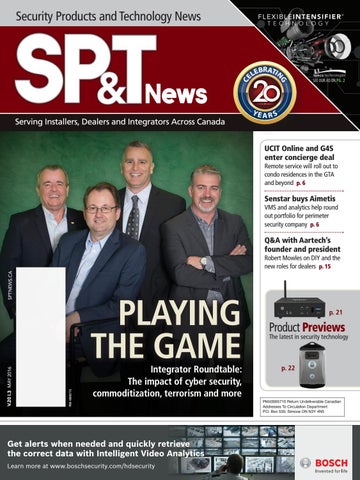
Playing the game PM# 40065710
V.20 i.3 May 2016
sptnews.ca
Robert Mowles on DIY and the new roles for dealers p. 15
Integrator Roundtable: The impact of cyber security, commoditization, terrorism and more
Get alerts when needed and quickly retrieve the correct data with Intelligent Video Analytics Learn more at www.boschsecurity.com/hdsecurity
p. 21
Product Previews
The latest in security technology
p. 22
PM40065710 Return Undeliverable Canadian Addresses To Circulation Department P.O. Box 530, Simcoe ON N3Y 4N5
Contents May 2016
www.sptnews.ca www.sptnews.ca
Departments 4 Editor’s Letter 6 Line Card
• UCIT partners with G4S for remote concierge • Senstar acquires VMS and analytics expertise • Tech Systems sets up Canadian operation • Managed security to grow: IHS • Morpho Detection to join Smiths
26 Archive A good bet
Columns 10 CANASA Update
The benefits of membership By Stéphanie Roy
Cover Story 16 Playing the game
SP&T News sits down with integrators and experts to get their take on what’s currently shaping security, including price structure, new technology, customer expectations, networking solutions, staff training, terrorism and much more
visit www.sptnews.ca/video
uiyui
IP video appliances
The Razberi ServerSwitchIQ is a new generation of all-in-one, intelligent IP video surveillance appliances. The product line is optimized to reduce the impact of megapixel cameras on the IP network.
Get it in writing By Victor Harding
12 20 Years and Counting The evolution of law By Elliott Goldstein
14 Camera Corner
Please visit our video library for interviews, product information, thought leadership and regular updates from trade shows across North America.
21
11 Lessons Learned
Patience: the ultimate app By Colin Bodbyl
22
Glass break detector
The PG9922 Glass Break Detector from DSC adds an extra layer of protection to home and business perimeters, providing instant identification and notification of a broken window or glass door. Its proprietary microphone technology detects and analyzes sounds and patterns.
EDITOR’S LETTER
By Neil Sutton Your Partner in Securing Canada
The appetites of IT giants Tech players are coming to the security table with menu items in mind
I
f we don’t wake up and smell the coffee, Microsoft will eat our lunch.” I’ve heard words to that effect for years now. And it’s not just Microsoft… IBM, Apple, Google, Cisco. All of these companies have been cited as potential disruptors of the physical security market. It’s almost as if their massive reputations are enough to cast a shadow over the entire industry. I have serious doubts that will ever come to pass. Microsoft isn’t much more likely to take away your customers than Häagen Dazs is. I think the initial fear was that a company the size of Microsoft might decide it needs to create a physical security division and start blowing away the competition. That hasn’t come to pass in a substantial way. The truth is that all the aforementioned tech companies participate in the physical security arena, but they do so in ways few expected them to. Cisco has probably made the biggest overtures in the traditional physical space, but the main role that they and the likes of Microsoft and Amazon play today is in providing infrastructure solutions for security. I’ve been writing about the Cloud and how important it is for security for several years now. I can tell you, especially after visiting the most recent ISC West show in Las Vegas, that Cloud is here to stay. Its significance is almost on par with the advent of IP solutions in the surveillance world, partly because it’s an evolution of that same trend. Ask a surveillance vendor how their Cloud-based offerings work and many of them will casually mention
Microsoft or Amazon as an infrastructure partner. These companies have become part of the security ecosystem. They are more interested in providing bandwidth and hosting space than they are in challenging the traditional surveillance market with their own hardware solutions. Admittedly, Google has stepped into the security equipment arena. Google’s acquisition of Nest, which later purchased Dropcam, has given the company immediate access to hardware, but even then, it’s tough to draw a straight line between physical security and Google. It feels far more like the company is testing the waters of the as-yet unproven home automation market than a ploy to topple established camera manufacturers. To suggest that the intentions of all these companies are completely benign is naïve, but I firmly believe they should be viewed as a support mechanism or as a partner rather than a threat. The security industry is changing. Equipment, by itself, is no longer enough to impress customers. Camera resolution is nice to have, but it’s not always going to be the subject of the first question asked by the customer. A camera’s intelligence and ability to parse out complex data (i.e., analytics) is what will drive the security industry forward. To be sure, Microsoft, IBM and all the others are going to play an increasing role in security, but I suspect they’ll bring their own lunch to the party. Everyone can go home feeling full.
“A camera’s intelligence is what will drive the security industry forward.”
@SecurityEd
Are you receiving
Security Products & Technology News is published 8 times in 2016 by Annex Business Media. Its primary purpose is to serve as an information resource to installers, resellers and integrators working within the security and/or related industries. Editorial information is reported in a concise, accurate and unbiased manner on security products, systems and services, as well as on product areas related to the security industry.
Group Publisher, Paul Grossinger pgrossinger@annexweb.com Publisher, Peter Young pyoung@annexweb.com Editor, Neil Sutton nsutton@annexweb.com Online Editor, Cindy Macdonald Art Director, Graham Jeffrey gjeffrey@annexweb.com Account Coordinator,Trish Ramsay tramsay@annexweb.com Circulation Manager, Barb Adelt badelt@annexbizmedia.com Director of Soul/COO, Sue Fredericks
EDITORIAL ADVISORY BOARD Carlo Di Leo, Double Vision Group Colin Doe, Veridin Systems Canada Anna Duplicki, Lanvac Travis Firth, Tyco Security Products Mike Jagger, Provident Security Carl Jorgensen, Titan Products Group Bob Moore, Axis Communications Tom Richards, Lionsafe Security Paul Swan, Tri-Ed Distribution Josh Weidman, Medeco Head Office: 222 Edward Street Aurora, Ont. L4G 1W6 Canada T: 905-727-0077 F: 905-727-0017 PUBLICATION MAIL AGREEMENT #40065710 Printed in Canada ISSN 1482-3217 CIRCULATION e-mail: asingh@annexbizmedia.com Tel: 416-510-5189 Fax: 416-510-5170 Mail: 80 Valleybrook Drive, Toronto, ON M3B 2S9 SUBSCRIPTION RATES: Canada: $40.95 + HST/yr, USA: $71.95/yr and International: $82.00/yr Published 8 times a year Occasionally, SP&T News will mail information on behalf of industry-related groups whose products and services we believe may be of interest to you. If you prefer not to receive this information, please contact our circulation department in any of the four ways listed above. Annex Privacy Officer privacy@annexbizmedia.com Tel: 800-668-2374 No part of the editorial content of this publication may be reprinted without the publisher’s written permission. ©2016 Annex Publishing & Printing Inc. All rights reserved.
e-news? Subscribe today! www.sptnews.ca 4
SP&T News • www.sptnews.ca
Annex Publishing & Printing Inc. disclaims any warranty as to the accuracy, completeness or currency of the contents of this publication and disclaims all liability in respect of the results of any action taken or not taken in reliance upon information in this publication.
LINE CARD
Applications............................................8 Appointments....................................8 Calendar..............................................8 Market Watch.................................................9
UCIT partners with G4S for remote concierge
T
oronto-based video monitoring company UCIT Online has partnered with G4S Canada to offer remote concierge service in condominium buildings. A remote or virtual concierge offers the same services as an on-site concierge (access control, visitor management, interacting with tenants, accepting package delivery) but remains off-site. Their sole interface is a monitor. Robert Cherun, CEO of UCIT, says a remote concierge can be used to replace certain guard shifts, depending on the size of building and what the individual client prefers. The providers work with property managers and condo boards to determine a best fit based on their budget, adds Katie McLeod, national director of communications and sales for G4S Canada — it could be for certain hours or certain guard posts. “There’s all kinds of different scenarios,” she says. As of the announcement of the partnership, in late March, the two are now working in an exclusive relationship so far as the Canadian residential market is concerned. (G4S already offers commercial monitoring services through a monitoring centre in the U.S.) Cherun says his company has spent several years perfecting a virtual concierge solution. Training is paramount, and virtual concierges are required to undergo training that would allow them to deal with all manner of situations.
UCIT Online’s remote concierge service can be deployed for specific shifts or in specific locations for condominium buildings and their tenants.
The onboarding process is “huge” says Cherun. Concierges will visit actual sites before they engage with them virtually and tenants are informed of the changes every step of the way in order to familiarize themselves with the process. “One thing I’ve learned in refining this product,” says Cherun, “is that tenant communication is everything.” Each building must also undergo a security audit before the service can be installed. Cameras, for example, should be of sufficient quality to recognize faces. As such, there is an integration component potentially for both UCIT and G4S if new equipment is required. “Basically, it comes down to utilization and work flow between the two parties at this point,” says Cherun.
The service is currently available in about 20 buildings in the Toronto area in a full or partial capacity. “What we’re really hoping to do is expand this outside of Toronto,” says McLeod. She estimates there are 7,500 condo corporations or high-end condo buildings operating in Canada. “We have to assume that 25 per cent of them, at least, could be in the market for something like this. It’s got huge potential for us. That’s why we’re so excited about it.” There is also the potential to expand the agreement into the U.S. McLeod says the American division is very interested in exploring the opportunity, particularly to gated communities. Cherun’s business is already expanding into the U.S. — the company opened an office in the Seattle area last fall. “For sure we’ll be launching remote concierge into the U.S. in the next 12 months,” he says. He estimates that the service currently accounts for about three per cent of UCIT’s overall business but “I can honestly see, in five years, this being the majority of my business.” Residential is the immediate target, but he says the technology has applications for banks, car rental establishments, and more. “I see a real opportunity there in basically every vertical you can imagine.”
— Neil Sutton
Senstar acquires VMS and analytics expertise
C
arp, Ont.-based Senstar, best known for its perimeter protection products, announced in April that it has purchased Waterloo, Ont.-based Aimetis.
The deal, according to Senstar’s parent company Magal S3, is valued at approximately US$14 million. Aimetis is a developer of video analytics and video management software — technology that has obvious synergies with perimeter solutions,
6
SP&T News • www.sptnews.ca
says Stewart Dewar, product manager at Senstar. “One of the attractive aspects of Aimetis was that they have outdoor-quality video analytics that can — and are — being used for perimeter protection,” he says. “[We are] answering that need that we haven’t been able to answer up until now… What if someone wants to use their camera system — and all the investments they’ve made in cameras and lighting, etc. — to get perimeter detection through analytics,” adds Dewar. “You can imagine it’s a perfect complement to a tradition sensor with the analytics. They can work very well together. People often want a certain degree of defence in depth.”
Up until now, Senstar did not integrate with Aimetis’ products, but that will be a top priority for Senstar in order to take full advantage of the technology. Senstar currently supports numerous VMS manufacturers, including Genetec, says Dewar, and will continue to do so. “We see [the Aimetis acquisition] primarily as a broadening of our portfolio,” says Dewar. “Now we have more to offer.” Dewar says Aimetis will operate as a subsidiary under Senstar and its personnel will also be able to access and sell the Senstar portfolio into the markets they serve. — Neil Sutton
Tech Systems sets up Canadian operation
A
ntoinette Modica has joined American systems integrator Tech Systems to manage the company’s expansion into Canada. Buford, Ga.-based Tech Systems was founded in 1987 by Darryl Keeler and now employs more than 250 people across 40 states. It serves mostly enterprise cusAntoinette Modica, Tech Systems tomers across multiple verticals including health care, education, utilities, manufacturing and transportation. The company’s Canadian footprint up till now has been to manage customers north of the border from its U.S. operations and through local contractor relationships. Many of those Canadian customers are owned by a
Managed security to grow: IHS
A
ccording to IHS, the North American managed security services is expected to be worth US$26.9 billion in 2020, up from US$16 billion in 2015, due to the rise of hacking and persistent threats. “Changes in technology and architecture are helping this already very large market to continue to grow for the next five years and beyond,” says Christoforos Papachristou, critical communications and cybersecurity analyst for IHS Technology, in a statement. The defence, intelligence and security sector accounts for more than 25 per cent of the overall managed security services market, with a predicted increase from US$13.4B in 2015 to US$23.5B in 2020. The next largest sectors are banking and finance, and industrial utilities.
U.S. parent that Tech Systems also serves. By hiring Modica, the company aims to develop a much larger presence here. Modica, who was previously general manager at Mitsubishi Electric Sales Canada, says she and Keeler have known each other for a long time — they both worked in the
broadcasting industry before Keeler set up Tech Systems. Modica also ran her own integration business approximately 30 years ago, Triangle Technologies. “This is the next step [for me],” says Modica. “I decided that this is where I want to be. It’s solutions selling, managed services, risk assess-
ment — all by qualified personnel.” The initial target, says Modica, is to expand the customer base in Ontario and ultimately spread out across the country. In the short term, she will be hiring staff up here, including local sales support and field service technicians.
— Neil Sutton
HELIX. CONNECTED TO LIFE, NOT THE WALL. The first and only platform designed to provide control and automation from user phones and tablets. We removed the panel touchscreen to provide flexible installation options and to reduce the user learning curve. No unfamiliar user interface – Just instant control and convenience from the devices they already love.
Helix allows your customers to: + Control locks, lights and thermostats over the smart phone interface. + Be notified when kids arrive home, and view them over application integrated camera interfaces.
+ Experience instantaneous response to commands through SecurNet Technologies “always-on” connection to interactive services. + Have immediate emergency response through a direct to central station reporting capability.
+ Enjoy peace-of-mind through the high-performance security sensors with CryptiX™ encryption technology.
Now Available INTERACTIVE SERVICES POWERED BY
WWW.RESOLUTIONPRODUCTS.COM 715.808.8225
I
SALES@RESOLUTIONPRODUCTS.COM
I
1402 HEGGEN STREET, HUDSON, WI 54016
@SecurityEd • May 2016 SP&T_Resolution_May.indd 1
7
2016-04-19 11:05 AM
LINE CARD Applications Security on Sunset
The Sunset Plaza Hotel in Los Angeles has partnered with Hikvision for a 24/7 surveillance solution. The hotel, located on L.A.’s Sunset Strip, required an upgrade from a legacy analogue system as well as coverage in both indoor and outdoor environments. The system also had to be intuitive to use, in order to allow staff to keep an eye on the premises at all times. “We wanted something that we could use from an operational standpoint and from a safety standpoint,” says Brenda Elias, operations manager for the Sunset Plaza. Local integrator Darkcad Tec, which has provided integration services to the hotel for 10 years, installed more than 20 Hikvision IP cameras throughout the hotel. The DS-2CD2332-I turret is being used in the parking garage, for example, and a 3MP fisheye camera, the DS-2CD6332FWD-I, provides a 360° view of the main entrance.
Calendar Loss prevention in Sweden Seventy-five Åhléns department stores in Sweden are being monitored by Milestone Systems video software as a means to document incidents, prevent shrink and improve overall security. Nokas, a Milestone partner, designed a solution using Milestone’s VMS XProtect for all of the Åhléns locations in Sweden. The retailer is also using the solution for purposes beyond security, such as people counting, and is planning to take greater advantage of analytics tools. Ultimately, the stores will be connected via a single security network using Milestone’s Interconnect technology. “It is of huge importance for us to be able to freely pick the best and most cost effective visual security solution for our needs. The use of Milestone XProtect allows us to do exactly that, while at the same time giving us a user friendliness that enables an effective handling of incidents,” says Anders Lundqvist, Security Manager, Åhlens AB.
U.K. hospital secures doors
May 17, 2016 ADI Expo Ottawa, Ont. www.adiglobal.ca June 1, 2016 Security Canada Ottawa Ottawa, Ont. www.securitycanadaexpo.com
Health-care provider NHS Northumbria selected Tyco Security Products’ CEM Systems access control product for its new Emergency Care Hospital in Cramlington, U.K. The system was installed by SPIE Scotshield, along with a total fire and security solution. Part of a £200-million ($364-million) investment towards health-care in the Northumberland and North Tyneside regions, the hospital, which first opened in June 2015, includes an Accident & Emergency department, diagnostics, critical care, a short stay paediatric unit and midwifery lead maternity unit. The hospital will deploy the AC2000 VIPPS (Visual Imaging & Pass Production System), which allows users to design ID passes featuring graphics, barcodes and signatures, and the AC2000 AED (Alarm Event Display). The CEM sPass reader will secure more than 400 doors in the hospital.
Appointments
June 2, 2016 ADI Expo Winnipeg, Man. www.adiglobal.ca June 15, 2016 Security Canada West River Rock Casino Resort Richmond, B.C. www.securitycanadaexpo.com September 21, 2016 Security Canada Atlantic Moncton, N.B. www.securitycanadaexpo.com September 22, 2016 ADI Expo Vancouver, B.C. www.adiglobal.ca September 30, 2016 Anixter Showcase Montreal, Que. www.anixter.ca October 6, 2016 Focus on Government Security Ottawa, Ont. www.focusonseries.ca October 13, 2016 Anixter Showcase Toronto, Ont. www.anixter.ca October 17-19, 2016 SecTor Toronto, Ont. www.sector.ca
Jean-Pierre (JP) Lapointe
Mark Folmer
• Jean-Pierre (JP) Lapointe has been appointed as the Canada leader for the Honeywell Security and Fire North America (HSF NA) business. Lapointe previously was leading the Canadian region for Honeywell Security. • Mark Folmer has joined Montreal-based security software company Tracktik as
8
SP&T News • www.sptnews.ca
Eric Widlitz
Jim Cisneros
vice-president, industry. • Eric Widlitz is Vanderbilt’s new vice-president of sales for North America. Widlitz previously held several senior management roles at HID Global. • Jim Cisneros has joined AMAG Technology as vicepresident, technical services. • BICSI past president Jerry L.
Jerry L. Bowman
Anthony Berticelli
Bowman has been reappointed as the association’s security liaison. Bowman is currently the chief business development officer for IMTAS and president and CEO of InfraGard. • PSA Security Network announced the addition of Anthony Berticelli as the director of education.
October 19–20, 2016 Security Canada Central Toronto, Ont. www.securitycanadaexpo.com October 25, 2016 Anixter Showcase Edmonton, Alta. www.anixter.ca December 7, 2016 Focus On Health Care Security Toronto, Ont. wwww.focusonseries.ca
Morpho Detection to become part of Smiths
S
afran announced in April it has agreed to sell Morpho Detection to Smiths Group in a transaction valued at US$710 million. According to the company, Morpho Detection, which provides solutions for the detection and identification of chemical, biological, radiological, nuclear and explosive (CBRNE) threats, recorded US$320 million in revenue in 2015. “The threat environment for people and critical infrastructure around the world is constantly evolving and becoming more complex and sophisticated. The response, to keep people safe and the world running, demands cutting-edge tech-
nology and cost-efficient solutions,” says Andrew Reynolds Smith, CEO, Smiths Group, in a company statement. “Morpho Detection is a high quality business with a strong management team, and I am convinced that this combination provides a compelling competitive platform for product, service and technology leadership,” he adds. Morpho Detection will become part of Smiths Group’s detection business. Safran says the deal, which is expected to close early next year, is in line with its previously announced strategy to focus on aerospace and defence markets.
market watch Company (ticker)
Price (April 26) 52-week low 52-week high
ADT (ADT) AlarmForce Ind. (AF.TO) AlarmCom Hldg (ALRM) Allegion (ALLE) Anixter International (AXE) Avante Logixx (XX) Avigilon Corp. (AVO.TO) Checkpoint Systems (CKP) Cisco Systems Inc. (CSCO) Diebold (DBD) Flir (FLIR) Gentex (GNTX) Honeywell (HON) Johnson Controls (JCI) Mace Security (MACE) Napco (NSSC) ScanSource Inc. (SCSC) Stanley (SWK) Tyco Int. (TYC) United Technologies Corp. (UTX) Verint Systems Inc. (VRNT) Vicon Industries (VII) Viscount Systems (VSYS)
$41.96 $10.60 $23.09 $65.67 $62.20 $0.28 $16.35 $10.13 $28.45 $27.75 $31.31 $16.22 $114.80 $42.21 $0.44 $5.93 $42.07 $112.78 $39.44 $104.80 $34.32 $0.86 $0.01
$24.22 $9.87 $10.26 $52.95 $37.60 $0.17 $11.20 $5.07 $22.46 $22.84 $25.12 $12.93 $87.00 $33.62 $0.31 $4.95 $27.46 $88.72 $28.94 $83.39 $29.76 $0.71 $0.01
$41.97 $11.97 $24.22 $68.08 $72.32 $0.42 $21.39 $11.03 $29.90 $38.94 $34.08 $17.90 $116.56 $54.52 $0.50 $7.60 $42.54 $113.69 $41.14 $119.66 $66.45 $2.55 $0.04
Our focus is to alert you when needed and help you quickly retrieve the correct data
Add sense and structure to video data with Intelligent Video Analytics After only 20 minutes, you can miss 90% of the activity on a screen. Intelligent Video Analytics (IVA) assists by alerting you when predefined alarms are triggered. Combine up to eight IVA rules to make complex tasks easy and reduce false alarms. IVA also adds sense and structure to your video with metadata. This enables you to quickly retrieve relevant images from hours of stored video. Learn more at www.boschsecurity.com/hdsecurity
@SecurityEd • May 2016 SPT_Bosch_May.indd 1
9
2016-04-19 8:50 AM
canasa update
By Stéphanie Roy
The benefits of membership What you can expect to gain by joining the Canadian Security Association
W
hether you are new to the Canadian Security Association or a longstanding member, here is a refresher on some of the benefits and resources that can help your organization achieve a competitive edge. Proudly CANASA: The public recognizes CANASA members as being committed to meeting top industry standards and abiding by a strict code of ethics, so members are encouraged to proudly display the CANASA logo on business cards, websites, vehicles, etc.
Affinity Program: CANASA’s Affinity Program provides members with exclusive discounts on business related products and services used every day, such as insurance, legal services, travel, equipment, shipping, and much more. Alarm Service Contract Templates: CANASA offers members access to alarm service contract templates for all Canadian provinces, for both commercial and residential use, free-of-charge. Online False Alarm By-law Repository: CANASA’s false alarm by-law repository, a free resource
for members, includes a summary of false alarm by-laws, registration requirements and fees across Canada. Alarm Technician Course (ATC): The ATC covers a wide range of topics and trends relevant for today’s alarm technician, including new technologies such as networking, wireless and false alarm prevention. Members save 50 per cent. Online Education Repository: CANASA has launched a onestop-shop compiled from the educational offerings of leading security organizations. The repository consists of online courses, class-
room courses and more. Bond program: CANASA offers members RBQ licence bonding at $130 a year for specialized contractors and $260 for general contractors. Members also enjoy exclusive savings on BSP bonds (also $130). Stay tuned for updates and industry news by subscribing to our monthly CANASA Updates email newsletters. Stéphanie Roy is the director of marketing, communications and membership for CANASA (www.canasa.org).
CANASA Presents
Security Canada
Security Canada
Edmonton, Alberta May 11, 2016
Ottawa, Ontario June 1, 2016
Alberta
Ottawa
Security Canada
Security Canada
Security Canada
Richmond, British Columbia June 15, 2016
Moncton, New Brunswick September 21, 2016
Toronto, Ontario October 19 – 20, 2016
West
Atlantic
Central
Visit securitycanadaexpo.com and register for free. 10 SP&T News • www.sptnews.ca
half_print_ad.indd 1 SPT_Canasa_May.indd 1
4/15/16 3:27 PM 2016-04-18 2:21 PM
LESSONS LEARNED
By Victor Harding
Get it in writing Don’t overlook important paperwork in the pursuit of alarm deals
I
n reflecting on this past year’s deal activity, it occurs to me that my deals have been held up mostly by two mundane details: a lack of signed monitoring contracts and an inability on the part of the seller to easily fill in what I call the acquisition spreadsheet on their account base.
“Getting contracts signed by customers is not that difficult.” Monitoring contracts Regarding alarm monitoring contracts, here is what is important today if you are thinking of selling your accounts. Increasingly, buyers in Canada are look for monitoring contracts signed by the customer with at least the all-important waiver of liability, assignability and auto-renewal clauses on the back of the contract. For U.S. buyers, these clauses are almost mandatory whether they are buying Canadian or U.S. alarm accounts. With ADT Canada taking over both VOXCOM and Protectron buying activity in the Canadian market, signed monitoring contracts with these three clauses are now also almost mandatory. Some deals can be done where a small portion (10 per cent) of a seller’s accounts are contracted either by the seller or buyer after the deal is closed. Getting contracts signed by customers is not that difficult. It is clerically demanding for the seller but not a stretch for the customer. Most buyers will make do with a signed one year contract with the appropriate clauses. Most customers in this day of cellular and other service contracts understand having to sign a oneyear contract. The process of get-
ting contracts signed can be done by the seller all at once or as the accounts comes up for billing. The process requires clerical time both in filling out the contract details to be sent out and the follow up but from what I hear, most dealers get a good response rate. Quite frankly, when you think of the risk of dealing with all those customers without a waiver of liability signed, I would not want to face the prospect of not having signed contracts on all of my accounts. Acquisition spreadsheet The real surprise to me in doing deals recently is how many sellers I have encountered who have had trouble filling out what I call the “acquisition spreadsheet” on the accounts they are selling. Every seller of alarm accounts has to list out the key details on the accounts they are selling. As an aside, an abbreviated version of this
list is usually attached to the purchase and sale agreement and the fuller version is used by the buyer to set the monitored accounts up in their billing system. The acquisition spreadsheet is usually an Excel spreadsheet listing out the key details on the account base: • system number; • account name; • premise address; • billing address; • monthly monitoring rate; • billing cycle; • last and next billing date; and • whether the account is billed using an invoice or using pre-authorized payment through a bank or credit card. It sounds straight forward, but many sellers have accounting and billing software that does not make it easy to transcribe the data required above onto an Excel spreadsheet.
Believe it or not, the process can end up taking weeks if the seller has 1,000 accounts or more. I strongly recommend to anyone who is planning to sell their account base in the next year or so that they start asking questions now about how difficult it will be to get this information out of their systems. You may get a surprise. In the process of doing the spreadsheet, sellers often find that they don’t have the number of monitored accounts they thought they had. If you want to get the format of what an acquisition spreadsheet looks like please contact me at victor@hardingsecurity.ca. I recommend that you attend to these two important details if you are planning to sell in the near future. Victor Harding is the principal of Harding Security Services (www. hardingsecurity.ca).
@SecurityEd • May 2016 11
20 YEARS AND COUNTING
By Elliott Goldstein
The evolution of law How the legal structure around video surveillance has changed over the decades
M
any changes have occurred in the last 20 years to the law of video surveillance.1 These changes were caused primarily by five factors: 1. Canadian video surveillance law has become “Americanized” for the following reasons: (a) The adoption of the Charter of Rights and Freedoms in 1982 containing a provision (Section 8)2 that is almost identical to the 4th Amendment to the American Bill of Rights.3 Section 8 (Canada) and the Fourth Amendment (U.S.A.) protect citizens of Canada and the United States, respectively, against unreasonable search or seizure by agents of the government. The result is that cases decided by the United States Supreme Court have become relevant and applicable to Canadian law and are being referred to by the Supreme Court of Canada and provincial courts of appeal.4 (b) The adoption of a modern American theory of the admissibility of visual evidence, which replaced the traditional British theory. The British theory, referred to as the “Illustrative” theory or “Pictorial testimony” theory held that a visual image (photo, video, digital) merely clarifies the oral testimony of an eye witness. The American theory, referred to as the “Silent Witness Theory” holds that a visual image “speaks for itself” once a proper foundation has been laid for its admission. The Silent Witness Theory does NOT require an eye witness to authenticate the image. Therefore, an image recorded automatically by a surveillance camera may be admitted if proof
12 SP&T News • www.sptnews.ca
is provided of the technical aspects (e.g., location, calibration, operation, proper functioning and position, etc.) of equipment used to record that event. The Silent Witness Theory was adopted in 1996 by the Supreme Court of Canada in the Nikolovski case. 5 The result of this change has been that more video surveillance evidence, recorded by non-monitored systems, is now admissible in Canadian courts. 2. The enactment of privacy legislation, which governs the collection, use, and disclosure of “personal information” by the private sector, changed the alarm and security industries.6 Surveillance videos where individuals may be identified fall within the definition of “personal information” in privacy legislation. Therefore, recorded visual images are governed by it. This legislation places restrictions on how and where video surveillance can be used and applied. Fortunately, the various federal and provincial privacy commissioners have issued guidelines for the use of video surveillance by the private and public sectors.7 The result of this change has been to strengthen the privacy rights of individuals whose behavior and activities have been recorded by surveillance. 3. The change in video surveillance technology from analogue to digital has also affected the law. Digital images, it is said, are more easily manipulated than analogue images. Editing and “enhancement” of digital images can more easily be accomplished without detection. This has generated a whole new industry of persons who can copy, enhance and clarify photo and
video images using image manipulation software such as Photoshop and forensic video and image analysis software such as dTective.8 This means that judges must now play a greater role as “gatekeeper” when it comes to this type of evidence. The criteria for the admission of photographs and motion picture films (remember them?) now apply to videos and digital images recorded on tapes, CDs, DVDs, memory sticks, flash cards, hard drives and thumb drives, etc. 9 The result is that judges still need your help in understanding the technology and how to forestall and prevent the admission of images that are not true, accurate, and fair (i.e., not misleading).
tributed to the education and professionalism of the industry. Good luck for the next 20 years! Elliott Goldstein, B.A., J.D., is a Thornhill, Ont.-based lawyer (elgold@ rogers.com). 1. My book “Visual Evidence:
A Practi-
tioners Manual” was published by Carswell Legal Publishers (now Thomson Reuters Canada Limited) in 1991 as one volume. After numerous updates it now spans 3 volumes. 2. Section 7 of the Canadian Charter reads: “Everyone has the right to be secure against unreasonable search or seizure.” 3. The Fourth Amendment to the American Bill of Rights reads: “The right of the people to be secure in their persons, houses, papers, and effects, against unreasonable searches and seizures, shall not be
4. The change from closed circuit systems to networked systems has meant that video surveillance can now be viewed by a much wider audience, across greater distances, in real time. The result is that authentication by qualified witnesses, who see the event take place on surveillance monitors and simultaneously record it, is now possible.
violated, and no Warrants shall issue, but upon probable cause, supported by Oath or affirmation, and particularly describing the place to be searched, and the persons or things to be seized” 4. See for example, Katz v United States, 389 US 347 (1967) which established the “reasonable expectation of privacy” test), was cited in R. v. Duarte, [1990] 1 S.C.R. 30 and many other cases. 5. R. v. Nikolovski [1996] 3 S.C.R. 1197. 6. For federal legislation see Personal Infor-
5.The focus on training and education of suppliers/installers and users of video surveillance. No business ever wasted money educating its employees. Subcontractors, and customers/clients. Over the past 20 years there has been a steady increase in the number of courses, training seminars, and workshops.
mation Protection and Electronic Documents Act (PIPEDA). Substantially similar provincial privacy legislation includes the Personal Information Protection Act (PIPA) in Alberta and British Columbia, respectively. There is also municipal legislation regarding privacy. 7 See Guidelines for Overt Video Surveillance in the Private Sector, March 2008 and Guidelines for the Use of Video Surveillance of Public Places by Police and
I have been speaking to the alarm and security industries at conferences and seminars since my book was published in 1991. I was always impressed with the quality and thoughtfulness of the questions that I was asked by those attending. I hope that I have con-
Law Enforcement Authorities, March 2006 are available for download from the website of the Office of the Privacy Commissioner of Canada, www.priv.gc.ca 8. See www.oceansystems.com for various types of digital evidence software. 9. See R. v. Doughty 2009 ABPC 8 (CanLII), 468 AR 11; [2009] CarswellAlta 38
New from Keyscan — Access control solutions that fit. The updated version of Aurora Access Control Management software now integrates with Kaba E-Plex® wireless locks and Saflok hotel locks to provide a single software platform solution. Advanced security functions include managing, auditing and controlling access for any number of users, using the same credential at every door throughout a facility.
The new K-PROX3 proximity reader increases system performance. Its ultra-modern design features dedicated functions for Aurora’s updated software.
Our new K-PROX3 proximity reader features added technologies and dedicated functions designed for Keyscan systems. Its anti-tamper “heartbeat” intelligence triggers alarm conditions when the signal is interrupted. Plus, auxiliary LED indicators provide visual confirmation of our exclusive Present3, facility lockdown mode. At Keyscan, technology is the pulse of access control solutions that fit.
Kaba Access & Data Systems Americas 1.888.539.7226 kaba-adsamericas.com
CAMERA CORNER
By Colin Bodbyl
Patience: the ultimate app Camera technologies may take years to mature, but it’s often worth the wait
M
ulti-imagers and analytics have been a hot trend for the past year, but both technologies have been around for several years. It seems like every year there is at least one product or feature that manufacturers suddenly start climbing over each other to develop. It is not unusual to see revolutionary products take years to catch on. Most times it is the result of working out the kinks and bringing down cost that drives a product out from the shadows and into the spotlight. With thousands of products and features available today, here are three that stand out as future trends.
Thermal Thermal cameras have been around for years. Until recently, one manufacturer dominated the thermal market, but other manufacturers have started to release their own lines of thermal cameras and the competition is heating up. Thermal cameras have a multitude of applications. They are ideal for
intrusion detection since they are not impacted by lighting conditions and are in turn able to detect objects hundreds of feet away even in complete darkness. For infrastructure monitoring they are able to monitor large machines or transformers and trigger an alarm before they overheat. The most likely turning point for thermals will be when prices decrease to a more affordable range. Two other factors that could cause thermal cameras to take off are: if resolution increases; or if dual cameras with both thermal and visual sensors became more cost effective.
Wireless Another potential trend (though currently very unpopular) are wireless cameras. Wireless cameras have never had a good reputation, but on paper they are a great idea. They reduce installation costs and in some cases make an installation possible where running wires is not an option. In the case of wireless cameras, cost is not the issue as much as reliability and security. Standard Wi-Fi is not secure enough for
commercial security systems, nor is it stable enough. Advancements in both areas will ultimately lead to wireless IP cameras becoming a hot trend that may seriously impact the long-term success of HD over coax. There are countless ways wireless cameras would change the surveillance industry but only if they are secure and reliable.
Edge Edge recording is still a very interesting technology that I have addressed before in previous columns. Manufacturers are divided on how it should be done, which is similar to how analytics was treated several years ago. The industry is questioning if SD cards are really a reliable storage technology. While they are cheap and easy to implement, SD cards do not offer the long-term stability of other storage methods. Hard disk drives consume too much space and power when installed in a camera housing, while solid state drives (SSD) are simply too expensive. The most likely turning point for edge storage will be when SSD costs come
down to a more affordable level. In the meantime this will remain a controvertible technology rather than a trend every manufacturer is fighting to perfect.
Determining factors It is always nice to see an old technology persist through years of evolution before it suddenly takes off and becomes the trend everyone is talking about. In the last few years we have seen multi-imagers and video analytics explode in popularity. By analyzing what caused these products to suddenly take off, we can determine what other products have bright futures ahead of them. Thermal cameras, wireless cameras, and edge storage are all products with obvious advantages. All three are being held back by challenges such as cost and quality that will eventually be overcome. For these products to become an industry-wide trend is not a question of if, but when. Colin Bodbyl is the director of technology for UCIT Online (www. ucitonline.com).
SP&T turns 20
Come Celebrate With Us!
BRATIN LE G
CE
Visit www.sptnews.ca/20years to share your thoughts on how Canada’s alarm and security industry has changed since we first began publishing in 1996.
YEA RS
1996
2003
14 SP&T News • www.sptnews.ca
2010
2016
QA &
I
n many ways, Robert Mowles is a classic example of basement to boardroom: an entrepreneur who started a business in his own home, and through hard work and determination, made it a flourish. He has expanded his business several times and is about to move into a new 7,000 sq.-ft. facility in the Oshawa, Ont., area.
“I saw the opportunity to really take this to the dealers and installers and create awareness.” But Mowles is also part of a movement in security that has seen DIY and dealer models begin to coincide and overlap. SP&T News recently spoke to Mowles about how home security is changing and how dealers and installers may ultimately benefit. SP&T News: How did you get your start in security? Robert Mowles: The business started in my basement [in 2002]. We were buying and selling X10 Automation gear back then. I remember my wife coming downstairs and saying, “What are you doing?” It was 11 o’clock at night and I had the tape gun going. I said, “I think this might pay the bills one day.” That was literally the start of the company. Really, it’s been an ongoing concern and full time business for more like seven or eight years.
With Robert Mowles president, Aartech Canada By Neil Sutton
SP&T: Why did you decide to branch out into different product types? RM: A lot of it was customer driven. We started out with very simple automation. When our customers started putting this into their homes back then, they were asking for products to go with it. I think back then it was security cameras. From there, [it was] “Now I would like to secure the place.” So we got into security equipment. These products all go hand in hand and a lot of it was customer-focused. SP&T: Has your focus always been residential? RM: We started dealing with DoIt-Yourself strictly. Over the years it has grown to more of a mix. Initially it was all one or two residential do-it-yourself applications. We still do some of that, but today it’s more about helping installers and dealers find solutions. Because our business started as the direct-to-consumer, do-ityourself business, that was initially the focus. As we started building the brands and building the vendor relationships — back then, I would say that even the large distributors were not focusing at all on this type of product line. I saw the opportunity to really take this to the dealers and installers and create awareness and build our professional installer base. Aartech Pro was born out of that drive to work with the pro installer and help them find solutions and find products. SP&T: How are you able to balance selling to both end users and installers? RM: The security and automation business has morphed and grown and changed so quickly that the reality is that everyone from Amazon to Best Buy to Lowe’s and everyone in-between is now in this business.
We know that customers are going to do their research online; they’re going to check retail stores; they’re going to check other retail sites . . . because we are in this business and we touch those customers, we find a lot of those customers who need installation service. As a result, we give out a lot of leads . . . I don’t know how many thousands of dollars of business we’ve given to installation firms as the result of a simple lead. If the customer is looking for a one-off product and they’re completely content to do it on their own, fine. But many times they get partway through that process and they realize that they don’t really have the skill or the time or the inclination to do it for a larger job, and at that point we love to refer to installing dealers. SP&T: As you see the market changing, how much of your business is selling direct to the end user and how much is going to the dealer? RM: It’s probably 60/40 – 60 per cent retail. Two years ago, it probably would have been 80 per cent to retail. The trend is, and the intention is, to push more of that through professional installers. That’s the focus of our business: to embrace that. We’re trying to help them embrace it at the same time. The customer doesn’t always want to have the after-the-fact monthly bill associated with the product. Do I agree with that? Not always. When it comes to an alarm or a life safety system, I disagree with only self-monitoring. But there’s something to be said for being able to check on your system remotely. I believe strongly that if you’re doing this for personal safety or personal security, then it should be monitored.
SP&T: Do you see yourself in competition with the big, multinational distributors? RM: Certainly, if I’m going to grow my direct-to-dealer model, that’s who we’re competing with on one side — the regional distributors and the multi-branch, multi-national distributors. Yes, we share a number of lines with them. We also have a number of lines that are unique to us. The fact of the matter is, because we represent dozens of lines versus hundreds of lines, we can perform a different level of problem-solving, support, trouble-shooting and guidance. SP&T: Do you think people are ready for an IoT world? Is it well understood? RM: I think part of the problem is it’s an “Internet of Things,” and not a cohesive solution in many cases. What I think is happening is we’re starting to see, or I hope we’ll start to see, all the pieces coming together, instead of everybody screaming that they have the best technology — whether it’s through co-operation or by consolidation of companies. SP&T: Are you able to grow organically and add lines as you see fit? RM: The intent is to grow by adding sales and support staff. Being a trusted solutions provider — that’s really our intent. I hope to be able to drive more business through dealers as a result of our experience with both sides of the channel [direct and through dealers] and help them understand some of the different business models other than selling inexpensive of free alarm systems and looking for only the RMR. We’d like to show them other ways to go to market and do business. Today, we’re a Canadian-only company with a single branch. My intent is to grow and add other offices as well.
@SecurityEd • May 2016 15
facing future
Sponsored by
the
Security experts share their thoughts on commoditization, diversification, cyber security and what it takes today to make the customer happy
W
e all know the industry is changing, but it’s important to understand why. SP&T News assembled leading integrators (and one distributor) to ask them to comment on some of the major trends currently underway in security. Some have always been with us (the important of training) while others provide us with sharp reminders of the issues the security industry needs to address (the growing threat of terrorism). There are also issues that have been brewing for what may have been decades, but have recently risen to prominence. The most obvious of these is cyber security — both in terms of what it means for the installation of equipment, as well as the people most closely involved in the purchasing and decision-making process. SP&T News editor Neil Sutton recent sat down with Dominic Burns, president and CEO, AC Technical Systems; Spike Anderson, director of global security integrators (Canada), Anixter Canada; Rob Plume, director, sales and technology - client solutions, G4S Secure Solutions (Canada); and Greg Taylor, vice-president of Eastern Canadian operations, Convergint Technologies, in roundtable session sponsored by Bosch Security Systems. SP&T News: What has the declining price of equipment meant for the industry? Dominic Burns: I think the biggest challenge we’ve had is not so much the price of the equipment declining, it’s that there’s been a shift in the industry where we’re starting to see a lot more CIOs involved. They’re not necessarily looking at the cheapest product. They’re visibly taking the same approach as they would be with a Cis-
16 SP&T News • www.sptnews.ca
co or Avaya. Nobody ever gets fired for buying a Cisco switch or Avaya switch. It’s exactly the same with the technology. I find, with these guys, when you get them comfortable with something and it works, there’s no issues with it, they will continue to move forward with it. And it’s very, very difficult to get them to change. And most of the CIOs we’re dealing with now — we’re dealing with quite a lot — they want the best of the best. They do not want the phone calls; they do not want the service calls. Rob Plume: I’d add to the falling price issue, Internet shopping and MSRP.
Often you re-work your pricing and all of a sudden, they go, “How come you’re charging me more than MSRP?” They don’t consider all of the other factors in there, when you’re trying to build in warranty, different service levels in an agreement. It’s forced us to be really good at our job: we can’t ignore it, we can’t just say, it’s cheap, it’s offshore, it’s this, it’s that. You need to know about the other products, and the pros and cons of deploying other types of solutions. Quite honestly, it also makes it really hard to make quota. Selfishly, we’ve got big targets to hit. Companies care about margin, but they also care about
DB: So we’re finding that every year we’re picking up more and more clients, who are coming to us, saying, “We’ve been through the rest. It didn’t work. What can you guys offer us?” The second they start talking about price, we walk away because if this is being driven by price, I’m not interested. It has to be driven by value.
top line. There are a whole bunch of factors, and so we rethink the entire impact to the economics of the company. I think we have to get smarter about it. Spike Anderson: This isn’t the first time we’ve seen this in the industry. We’ve watched the analogue space go from high-cost product down to $100 for a 600-line colour camera. So I don’t think this is anything new to us. But I think how it affects us eventually is that companies grow and expand based on what you [Rob] were talking about, the margin expectations, the profitability. And now, if you’re selling the same volume at half the price, even if it’s more margin you’re making, you have to look at how your company is overall sized. Do I need to shrink the number of personnel? Do I have to put more resources into the services side of my business, etc., to try to maintain the same momentum that your company has enjoyed for a number of years? Greg Taylor: It is kind of exciting, though, when you look at, as the price points are coming down, the feature sets are increasing rapidly. And I think what you said, Dominic, is really interesting: you can do so much more with it and it really becomes incumbent upon the integrators to sell a different value proposition around: you’re not just selling them a video solution or an access control solution. You’re actually selling something that drives a different type of business outcome. SP&T: Are end users looking for more advice from their integrators? SA: I think the end user is becoming infinitely more engaged when it comes to decisions that are going into their buildings and into the solutions, just based on the amount of information you can gather in a relatively quick amount of time, and it’s readily available. The users are much more educated about the product decisions that they’re making. And that makes it difficult for some to offer just one brand solution, when there are so many choices they can research online. GT: And, to build on that, 10 years ago, if you walked into a
“You’ve become a partner to that user, as opposed to just a supplier of a service or a product.” — Spike Anderson, Anixter Canada
business environment, it was leading edge; it had everything. But we’ve seen with the advent of smart technology and iPhones and such, where end users expect to have the same experience in their personal life and in their business life. So they come to the table fully expecting that they can do all kinds of things: they can do their “Snapchatting” with their kids at home, and they think they can bring that same type of environment into the business world. So they actually challenge people, from the integrator standpoint, “How come I can’t do this? What are the types of things I can do?” Their expectations seem to be higher. At the same time, it really creates some great opportunities if you can turn that into: What’s the business outcome that I am trying to accomplish? RP: I think we’re finding clients are falling into two or three camps. There are the ones that are coming to us and all they want us to be is labour: they’ve got it figured out. They’ve either got a consultant that’s feeding them information or they’re doing their own homework, and they’re saying, “This is what I want. This is the solution. How much to install it?” And you get [clients who] go out and procure a product and they just need you to come in and install it. And then we have clients who want to have a conversation, that are willing to engage: “Help me develop this; help me come up with solutions.” You’ve got the ones that are just saying, “You guys need to be the experts. Come to us with solutions. Tell us how it’s going it work, how it’s going to go together. Can we see it? Can we touch it?” And then they’ll buy into your concept. So we have these different camps, and we need to almost scale our business. You need to be able to shift gears depending on who you’re engaging at what point.
SA: I’ve been in this industry long enough — we’ve all been sales people — and the easiest way to sell is on price. It’s refreshing to hear at this table that people are serious about selling the value. The question now is, based on all the different people involved in the decision-making process, when push comes to shove: Is the person signing that final cheque placing a value on the service we provide? And those are becoming the more difficult questions. I think we need to work on coaching our sales folks to dig deeper into those questions. One of the best lines I ever got from a mentor, who was outside of this industry, is this: when someone stops you in a conversation and says, “Sorry, you’re still priced too high,” your response should be: “My apologies, I didn’t realize I hadn’t explained the value proposition we bring to the table.” I think we need to stop and think about that before we drop our price. SP&T: Has the role of the integrator changed to more of a business solutions focus? DB: For us, no. That’s how we have always done business. A huge problem, particularly in the integration piece, is it’s not a regulated industry from an installation and service perspective — more from an installation perspective, because you’re going to minimize service calls if you install the product properly. But if there was some sort of governing body that set some sort of installation standard, almost like an electrical apprenticeship, or plumbing apprenticeship. There are standards there [and] for the most part, everybody’s adhering to a certain standard. And that would go a long way to cleaning up our reputation. Because, let’s be honest, the security industry doesn’t necessarily attract a lot of quality people, particularly at the entry level piece of the pyramid, where the reputation hasn’t been stellar. I see service as a way of making money. Service is a huge part of our business, a massive part, better margin than some of the installed stuff. So when you blend the margin, you’re a very healthy company, if you’re doing it properly. GT: To your point, there is almost that need for some type of governing body because you’ve got very low-cost product where almost anybody can install it, or they think they can — if I’m an electrical guy, I’ve pulled cable. You’re right, there’s almost that need, because there’s got to be that separation between those trunk slammers and those other types of companies that really want to move the customer along a value curve where it’s: you’re not necessarily buying a video solution or an access control system, you’re actually buy-
@SecurityEd • May 2016 17
ing something that drives either public safety or employee security or a number of different value propositions that really tie in to other things.
your organization, because it’s really important. Some want to be sales; some of them are excellent technicians.
SA: I like the standards discussion. It’s something that I’ve always lived by, even when I was installing. What’s the quality of the infrastructure at the backend? I think what we have to do is look at the value that some of the people that are providing those products to you as integrators bring to the table, as well. You look at structured cabling in an IT environment. Some of the vendors out there carry multi-year, even multi-decade warranties, if the installation is done to a certain standard. But it’s as you said, we’ve all grown up in the security industry; it’s much easier to pull a piece of cable across a ceiling and crimp two ends on it and be done. The problem with that is the first person they point the finger at is either the integrator or whoever’s got the largest name on the device that’s attached to it. And a lot of the time, if you’ve got standards in place, where things are done a certain way every single time, you know that you’re not going to have downtime, you’re not going to have returned calls because of poorly installed systems.
RP: It’s funny. Training always seems to me to be the toughest topic. You talk to some business owners, and it’s, “I can’t take them off the road because it’s billable hours” or “the sales guys need to be selling.” In the days when we got into this industry, the way we learned primarily was we took the product home, because you were installing it the next day. And you had in your basement, or your living room, or your dining room table and you learned how to use it. You became the “expert.” There are so many options available today; it all comes down to time. We have to make the time to educate.
SP&T: Is training different now for people in the field or for the technicians? GT: As much as we like to say things have changed, they’ve really stayed the same, in the sense that there’s some tremendous young talent that’s coming up in the industry. So I’m always encouraging our organization, Who’s in that second and third tier down? Who are those up-and-coming people that are going to become your sales leaders, your sales people? [You must] really make sure you’ve got a development plan for each one of your colleagues or employees in
DB: That’s why we put in a training room. It had been a dream of mine for 15 years. We got it in three years ago. So guys are scheduled to be off the road, in the training room. We’ve got a couple of internal engineers. If there’s something new, they bench-test it, they add up the pros and cons. They make a decision based on a business perspective, whether we’re going to move forward with it or not. Before we sell it, it’s brought into the office, and two or three guys are trained on it. GT: I think there’s some good in what you’re saying. I love that approach because you can send someone away for certification training to California, and people love it. But what’s the follow-up process to make sure that they were actually in class and actually paying attention? When you’re talking about certification, you’ve got to have that follow-up process around. Are you bench-testing stuff, and are you actually able to put a system together that’s going to work? DB: Our process is, we send someone south of the border, and whenever he comes back, we have the equipment in the office. Then his job is to teach the other guys who have never seen the product. That gives us a much better understanding of what he was taught. And again, from a cost perspective, and getting back to the issue of taking people off the road, it’s more important for me to take them off the road to keep them educated. SP&T: How has the recent spate of mergers and acquisitions, both on the equipment and service sides, affected the security business?
“You need to be able to shift gears depending on who you’re engaging.” — Rob Plume, G4S Secure Solutions (Canada) 18 SP&T News • www.sptnews.ca
GT: I did M&A for 11 years at my other company. And it was fascinating to watch because, at the end of the day, the things that make the M&As very successful is the cultural cohesion that comes together. It goes back to: with every company, there are technology components, but it comes down to the people. The people create that culture, and that culture of bringing those companies together. What makes it a success or failure is often the people and the cultures that you’re bringing together.
“We’re starting to see a lot more CIOs involved in the industry now.” — Dominic Burns, AC Technical Systems
SA: And it has a lot to do with the motivation for the acquisition in the first place. You touched on it before. Am I buying market share, or am I buying the expertise that that company is going to bring to my company? Instead of having a jack-of-all-trades, master-of-none type of mentality, now you’ve got masters in all these different divisions within your company. And culture is a huge piece of it. I went through that in my past life. A large company bought another large company, but they weren’t going to sell unless the culture was maintained. And I think that’s key, rather than just swallowing up a company and saying, “You’re now part of us. You should now assimilate.” DB: You hit the nail on the head, Greg; it’s all about people. When you’re working for a company, it’s about trying to get some sort of a balance. You have your personal life; you have your business life. You will stay with a company, you will work with a company, if that balance is there. It’s not always going to be 100 per cent, in any way, shape or form. But if, all of a sudden, the company is moving off into another direction — it could be for a lot of different reasons — and it’s not a good fit for you, then it’s time to go. I find it interesting that with the large, large companies, and I know quite a few people who work for them, there are senior management roles where they spend one week a month talking about the budget for the month before, and then they spend one week a month talking about that particular month, and then they go, “By the way, why are there no sales coming in? Why are you not hitting your targets? What happened with this? What happened with this?” Whenever a company is more afraid of their shareholders than they are afraid of the customers, that just makes the world a perfect place for me because
Graybar Canada is a Wholesale Distributor of Security and Comm/Data Products
Graybar Canada has the products, technical expertise, and available inventory to complete all your end-to-end system requirements from a basic security system to a full IP physical security solution.
• • • • • • • • • •
Security Video Access Control Intrusion Power Solutions Audio Visual & Notification Cable, Connectivity & Accessories Networking Tools & Test Equipment Cabinets & Racking Media Conversion
Visit Us At These Upcoming Events: Security Canada Alberta May 11, 2016 Edmonton, Alberta Booth #705 Security Canada Ottawa June 1, 2016 Ottawa, Ontario Booth #503 Security Canada West June 15, 2016 Richmond, BC Booth #400 Security Canada Atlantic September 21, 2016 Moncton, NB Booth #TT301 Security Canada Central October 19-20, 2016 Toronto, ON Booth #822
they’re taking their eyes off their customers. And that’s why we get the phone calls, and that’s why we can go in and sit down and have the value conversation, not the price conversation. SP&T: How are you dealing with the growing impact of cyber security on physical security? DB: So we all did the same thing: we took our smartest guy, sent them on an IT course, got them Microsoft MCSE certified, got them Cisco certified, and we were good to go. As far as we were concerned, that was the right direction to go. It depended on how talented your guy was; you maybe got them to about 65 per cent. The other approach was, you hire an IT guy, and you train him on the security side. I found the IT guys came up to about 70 per cent. But you still didn’t have someone who could sit at a table with a CIO, who could have that cyber security conversation at that IT level. Because it is a totally different world, when you’re sitting in the room and you’re talking to these people, about what their challenges are and what they use from a technology perspective to embrace it. I’ve got a partner in the business, and I’ve had that partner for 12 years. He and I went through the discussion, that we were going to embrace this. So what we did four years ago, we went out and bought an IT company that we run totally separate; it’s not connected. It’s doing exceptionally well on its own. But anytime there’s an opportunity where we’ve got to go and sit at the table with the CIO, we’re bringing in the best brains from that side, and we have our CISO from our side. Everybody’s on board, everybody’s liking each other because they’re all hearing exactly what they want to hear. And we’ve been very successful with that model. Because just trying to take the smart guy and turning him into a smarter guy doesn’t necessarily work. SA: Cyber security isn’t anything new on that side of the industry. It was new to us from a security perspective as we were going through this convergence. I like that approach: you have two choices, educate or buy. But it was an approach that I think, initially, as we started convergence, was ignored. And the companies that ignored that and said, “Our guys will get up to speed,” they’re the ones that are suffering now in this IT world when it comes to video surveillance and various other pieces now that are on a network. GT: Dominic’s approach is probably the most practical approach when you think it through. The problems that your customers are trying to solve in the IT space — like “Where is John logging onto the network?” and “Does he have the proper credentials to do that?” — are very different. You talk about persistent, real threats that go on all the time in everybody’s network. The problems that the security director is trying to solve are very different. They might as well
20 SP&T News • www.sptnews.ca
“As the price points are coming down, the feature sets are increasing rapidly.” — Greg Taylor, Convergint Technologies
be completely different worlds. Everything’s IP connected. You get into the Internet of Things, it’s a real thing. Everything’s connected. The very prominent retailer that was hacked simply by going through the HVAC unit, and you go, who would have thought? SA: The discussion comes around to the device. “What device are you hanging on my network? Is that device secure? What are the threats associated with that device as it’s hanging onto my network?” At one point, we tried to circumvent that by saying we’ll just create our own network. Also, part of the responsibility is the manufacturer’s to make sure the products you folks are representing when you’re going out to the end users are secure. I think there was a learning curve there, as well. SP&T: Terrorism was probably most keenly felt in the industry after 9/11, but it seems incredibly prevalent again. Are you having different discussions today with end users? SA: It definitely opens opportunities for technology in our industry. I was watching a show about analytics that are being created and deployed in Israel right now. They can figure out who people are by the way they walk. It is very interesting. And then, talking about where city-wide deployment is a shared deployment. So now we have to look at: How is our infrastructure put in place? Who do we know that can create a city-wide Wi-Fi deployment successfully and have the bandwidth to support the number of cameras? GT: I think the constant vigilance and in-thenews is helpful in the sense that it’s driving public awareness that there needs to be public
video surveillance and that kind of activity. That is helpful in making sure that there’s less public resistance to having cameras on the highways and things like this. People will be aware: this is good, this is to help, and they get used to certain types of things like, “security screening going through the airport is important.” And so they become much more conditioned to doing certain things, which is helpful. When you look at it behind the scenes, there’s a lot of stuff that happens in the background around threats, the problems of threats. We do lots of work in oil refineries and things. And every time there’s an incident or activity going on, all those companies are already notified all the time because it’s a real, constant threat. SA: The average consumer, Joe Public, they’re becoming much more cognizant of the fact that they’re responsible for their own safety as well. So the days of walking around with your head down and not paying attention to what was going on around you are going away. DB: [You see that with] access control systems and piggy-backing. I’ve presented my card, opened the door and somebody walks in behind me. You will see people challenge people like that, whereas before, your system was only as good as the people using it. That is a very simple example, but somebody could have a backpack, walk in behind and just because they smile the big smile — and who knows what happens? RP: I think events always drive some sort of market reaction. Sometimes, they spend money; sometimes, they just want to talk about it. We’re finding a lot of multi-nationals coming to us, talking about thought leadership. They want to understand what’s going on. So we’ve seen double-digit growth in our global travel and threat risk assessment work, and it’s been a significant improvement for us in that space. I think whenever you can have a global conversation and then bring it back to Canada and bring it back to our local market, people are always listening now. There’s a bunch of events that have brought it to Canada and brought it to our shores. And I think people now are starting to think, we need to be prepared for this. We don’t know what it looks like; we don’t know when it’s going to come. But if we’re not having that conversation, we will never be ready. I think they’re taking it much more seriously now. DB: What changed the dynamics a lot, too, was that Canada as a military role was always known as a UN peacekeeper. The guys in blue went into countries to help people and help stabilize countries. Once things changed and they went into Afghanistan, then they became legitimate targets as far as those guys are concerned. A couple of things have leaked out that have been prevented, and there’s been a lot more that have never leaked out that could have been a lot bigger.
Product Previews
Storage and Network Appliances
IP video appliances Razberi Technologies
Video recorder Exacq
The exacqVision LC-Series Una recorder includes exacqVision video management system software, server and integrated PoE+ camera ports. Users can connect up to 16 cameras per recorder and store up to 12 TB of video per system. The high output power supply provides up to 25 watts per camera and a maximum of 100 watts per eight cameras and 200 watts per 16 cameras. Users can view and administrate live and recorded video directly from the recorder using the included exacqVision client or remotely using a web browser or exacqVision client.
The Razberi ServerSwitchIQ is a new generation of all-in-one, intelligent IP video surveillance appliances. The product line is optimized to reduce the impact of megapixel cameras on the IP network. The new appliances are compatible with leading VMS and IP camera providers and represent a complete suite of video recording appliances scalable for enterprise-wide to rugged locations. All models include Cloud-based cyber security and health monitoring features. The appliances embed a managed PoE switch, server and video storage.
NVR with facial biometrics
American Dynamics
The Eagle Eye Bridge 304w is an on-premise bridge appliance that connects both wireless and wired cameras to the Eagle Eye Cloud Data Center, as part of the Eagle Eye Security Camera Video Management System. The Bridge 304w supports up to 15 high definition IP cameras, of which six can be wireless. It works with wireless and wired cameras from a range of manufacturers, including wireless cameras from Axis, Bosch and Hikvision.
Facial biometrics can be added to a VideoEdge network video recorder. Users can conduct a SmartSearch within VideoEdge to automatically find a matching face and view the associated corresponding video. This allows security operators to identify criminals, terminated employees, VIPs and other persons of interest, while also enrolling and saving known faces with video associated for faster future investigations. Users can save up to 1,000 faces per NVR enrolment database.
www.eagleeyenetworks.com
www.americandynamics.net
www.razberi.net
Bridge appliance Eagle Eye Networks
www.exacq.com
Cloud-based video platform OpenEye
OWS is a Cloud-enabled video management platform that platform consists of five major components: Apex Server, OWS Web Client, Command Station VMS, OpenEye Mobile app, and Apex NVR appliances. The OWS platform prevents unauthorized users from opening an inbound port to enable client user access. Additional security measures including two-step verification and AES-256 data encryption provide advanced protection for client users.
www.openeye.net
The most widely deployed dedicated lone worker emergency response communicator device in the world.
Hybrid NVR 3xLOGIC
The VIGIL V250 Hybrid NVR is a 2U chassis hybrid NVR with an 8-port POE switch and 16 analogue looping inputs. This NVR comes standard with a 2TB hard drive, and VIGIL Server and Client software. By combining an NVR and analogue DVR in the same chassis, users can replace an old DVR without the expense of replacing existing cameras or network infrastructure, while gaining the ability and benefits of adding IP cameras. Among the target markets for the V250 Hybrid are replacement of old (up to 16 channel) analogue systems, typically in the small to medium-sized footprint and primarily in the retail/convenience store sectors.
www.3xlogic.com
To learn more go to www.SoloProtect.com/ca @SecurityEd • May 2016 21
SPT_JanFeb_Securtek.indd Securetek_quarter.indd 1 1
2016-01-19 3:53 1/17/16 7:43 PMPM
Product Previews
The latest in security technology
Security enclosure Middle Atlantic Products
Glass break detector DSC
The PG9922 Glass Break Detector adds an extra layer of protection to home and business perimeters, providing instant identification and notification of a broken window or glass door.Its proprietary microphone technology detects and analyzes sounds and analyzes patterns. Smart data analysis reliably captures real broken window /glass door events only. The detector’s threestage, multi-level classification minimizes false alarms to near zero. Immediate siren activation upon glass break can deter burglars, preventing a full break-in.
www.dsc.com
The new End Cable Chase is a full-height, slim enclosure option that optimizes the space at the end of an enclosure bay by allowing additional devices to be mounted, including those that would otherwise reside on the wall. This enables the containment of all system components in one enclosure. The Internal Cable Duct routes cables within 30” wide SNE enclosures, ensuring signal performance and system reliability for mission-critical applications.
www.middleatlantic.com
Nest-integrated touchscreen lock Yale
Linus, an official Works with Nest product, is a key free touchscreen lock. It can lock and unlock doors from anywhere, create passcodes that provide different levels of access for family members and guests, and revoke access at any time – all from the Nest app. Homeowners can also receive alerts based on guest passcodes, set Linus to automatically lock after a specified number of seconds, and see a history of who has come and gone with timestamps. Linus is the only residential door lock that allows a homeowner to remotely check to see if the door is secured and locked.
Yale2you.com/LinusLock
Mini-dome cameras Illustra
Illustra Pro 2 megapixel minidome cameras feature new UltraVision low light technology to capture high quality colour video in the extreme low light conditions. Illustra UltraVision technology allows the camera to effectively maintain colour video well below 1 lux. The minidomes also feature advanced on-board analytics, including motion detection, face detection, blur detection and tampering. To minimize bandwidth use and storage requirements, users can program up to five individual regions of interest.
www.illustracameras.com
Lockdown solution STANLEY Security
Keyway-less deadbolt Kwikset
This touchscreen deadbolt is keyway-less, removing the threat of lock-picking and lock bumping. In the unlikely event the four AA batteries run out of power, backup power can be supplied via a 9V battery. The keyway-less touchscreen will be launching with the new Z-Wave 500 Series chip which comes with a number of enhancements including increased wireless range and robust wireless encryption. The unit features a responsive, capacitive touchscreen for keyless entry.
www.kwikset.com 22 SP&T News • www.sptnews.ca
BEST SHELTER is a lockdown solution designed specifically for educational K-12, business and health-care environments. The SHELTER fob by BEST allows for communication with the SHELTER wireless system to initiate a lockdown and third-party notification of an event. This multi-purpose fob permits lockdown of one door, hallway or entire building. When initiated from the fob, it is communicated to an attached BEST SHELTER 9KX Cylindrical Lockset (9KX).
www.stanleysecuritysolutions.com
Smoke detector sensor Nortek Security & Control
The 2GIG Smoke Detector Sensor (aka 2GIG “Smoke Ring”) mounts directly between an existing AC-powered interconnected smoke detector and the wall or ceiling and converts the existing smoke detector into a wireless device that can be used in conjunction with the 2GIG GC2 and new 2GIG GC3 alarm panels and systems for more advanced monitoring. The 2GIG Smoke Detector Sensor does not react to the sound of the interconnected smoke detector but is instead triggered by an electric signal which cuts down on false alarms and increases reliability.
www.nortekcontrol.com/2GIG
Event analytics Arteco
Arteco Event Analytics is an intelligence-based platform that enhances event management by applying an additional layer of intelligent monitoring to video surveillance and business intelligence applications. A Web-based platform, Arteco Event Analytics helps users determine valuable data from non-critical information. It drives intelligence building through reporting of alarm events to streamline video monitoring while aiding in improving processes within an organization. Event Analytics delivers the ability to monitor, analyze and compare the health status of connected systems for diagnosis.
www.arteco-global.com
Articulating wall mount Video Mount Products
Hands-free switches Camden Door Controls
The SureWave CM-330 Series of active infrared, hands-free switches are wireless ready. The CM-331, 332 and 333 models can function as area detectors with an operating range of up to six feet. The CM-332 model offers two relays, with three selectable sensor operating modes and four relay operating modes, including door sequencing. The CM-333 model offers battery power with a wired relay, which enables the switch to be instantly used in place of any non-powered door control pushbutton or push plate.
www.camdencontrols.com
The FP-XMLPAB “extra medium” low profile articulating wall mount features tilt and list adjustment capabilities. The FP-XMLPAB holds most 32- to 52-inch flat panels up to 100 lbs. It features a closed depth of 1.5 inches and a fully opened extension of 16.2 inches along with a fully adjustable 15 degree tilt, 3 degrees list adjustment and ± 45 degrees of rotation. It also includes an integrated cable management system, an integrated level, and 600mm x 400mm maximum flat panel hole pattern.
www.videomount.com
Edge camera Avigilon
The H4 Edge Solution Camera line combines high-definition imaging, self-learning video analytics, network video recorder functionality, and embedded Avigilon Control Center video management software. The camera records video directly to an onboard solid-state drive and eliminates the need for a separate network video recorder. The cmera line offers deployment options ranging from standalone installation, multi-camera solutions, to integration into a conventional network video surveillance system.
www.avigilon.com
Visitor management tablet STOPware
The latest addition to this line of ruggedized PassagePoint Visitor Tablets comes pre-loaded with the company’s PassagePoint Visitor Management software and integrated with appropriate hardware to enable fully-functional mobile visitor check-in from virtually any location. A driver’s licence scanner, camera and barcode scanner are built in to the tablet. By adding a mobile printer, users can verify visitors at any location, including remote entry gates and checkpoints to create accurate audit trails.
www.stopware.com
SIP video station Vingtor Stentofon
Alarm horns
E2S Warning Signals The new ‘D1x’ range of alarm horns, PA loudspeakers and integrated alarm horn/Xenon strobe warning units employ the latest electronic technology and acoustic engineering in marine grade, LM6 aluminum enclosures. Designed to create effective warning signals available for use in Class I/II Division 1, Zone 1 & Zone 20 environments, the UL/cULs approved alarm horns and combined units are available with traditional directional flare horns or omni-directional radial horns that generate a uniform 360° sound dispersion.
www.e2s.com
TCIV is an IP and SIP video station designed to withstand treacherous, noisy, and demanding environments. HD quality, broadcast level amplification audio with active noise reduction, echo cancellation, and HD video provide effectiveness in user comprehension and communication. The TCIV overcomes the problem of unintelligible communication and low resolution video by providing a dynamic HD quality solution that is flexible, expandable, and easily integrated.
www.Vingtor-Stentofon.com
Video management software Wavestore
V6 Video Management Software Wavestore’s graphical display has been updated with new icons and graphics. The addition of dockable components and configurability of the live event stream window provides an enhanced user experience which gives the ability for individual operators to arrive at their pre-customised screen layouts each time they log in. V6 also introduces camera shortcut keys using the keyboard number pad for added convenience and security enhancements to protect against malicious hacking attempts, including enhanced encryption and a high-security password policy.
www.wavestore.com
Ruggedized controller Senstar
The UltraLink Rugged Controller is a ruggedized, embedded controller for unmanned sites that enables remote management of Senstar security sensors and provides local control of security functions. The UltraLink Rugged Controller connects to a site’s Senstar sensors and I/O devices and provides a standard Ethernet/IP-based interface for communication with the Security Management System (SMS) using the facility’s own WAN/ SCADA network.
www.senstar.com @SecurityEd • May 2016 23
Product Previews
The latest in security technology
4K network camera Sony
Communication solutions Napco Security Technologies
The StarLink Series Cellular & IP Alarm Communications solutions line now includes original StarLink Intrusion Radios, StarLink Fire Dual Path Cellular &/or IP Models, Mercantile (Metal) Models, and StarLink Connect Communicators. Advanced Universal StarLink Connect will support a growing number of large panel brands besides Napco Gemini, including providing Honeywell and DSC dealers with full panel communications support.
www.napcosecurity.com
The new SNC-VB770 camera achieves high resolution and sensitivity, in addition to low noise due to its image processing and full-frame 35mm Exmor sensor. The SNC-VB770’s E-mount lens series accommodates a variety of lens options from wide angle to telephoto, allowing easy integration into a range of video capture applications. The camera’s Intelligent Cropping feature lets users capture a full view while cropping images in its native 4K resolution from multiple images at the same time.
www.sonybiz.ca
Break glass stopper STI
The large Break Glass Stopper (STI-4100-FR) is now available with French labeling. This version of the Stopper II is designed for areas where a “break glass” cover is specified, such as unsupervised areas. The Stopper consists of a red polycarbonate cover, mounting frame, a pane of single-strength clear glass (which is easily replaced when broken), French labeling, a glass-breaking bar, screws and anchors for installation.
Network cameras
Canon Canada
Five new network cameras share core technologies including a Genuine Canon Lens for capturing high-clarity, virtually distortion-free video, and Canon’s DIGIC DV III Image Processor. Models include: the VB-R12VE (outdoor) and VB-R13 (indoor) vandal resistant indoor fixed dome network cameras (also available, the TVB-R13VE with audio and external I/O support); the VB-H651V vandal resistant indoor fixed dome network camera; and the VB-H652LVE infrared vandal resistant outdoor fixed dome network camera.
www.canon.ca
www.sti-usa.com
Audio analytics system Louroe Electronics
The LE-802 intelligent audio analytics system offers a solution for unattended monitoring for audio events such as gunshots, aggressive speech, breaking glass and car alarms. The LE-802 is a customizable audio analytics system, in which the microphone, analytics software and processor are housed in a weather and vandal resistant enclosure for outdoor applications. The LE-802 can be programmed to activate output ports, send notifications to network devices, store or send audio recordings of an event, or play a prerecorded message to a connected speaker system.
www.louroe.com
CAD system Zetron
The new release of Zetron’s computer-aided dispatch (CAD) system offers a range of new capabilities that improve the ways public-safety agencies obtain, use, and track incident information and resources. Improvements include: enhanced incident handling and incident management; support for multiple database operation; interface support for next-generation ALI standards; improved National Crime Information Center (NCIC) search capabilities; enhanced resource management; and improved location validation.
www.zetron.com 24 SP&T News • www.sptnews.ca
“Putting a new face on an old friend”
LOOKING TO SELL? WE’RE BUYING!
CML Security
is the new name of Consolidated Monitoring Ltd. “Trusted & Dedicated to protecting lives & property”
RETIREMENT? CASH FLOW? LIFESTYLE?
BUYING OR SELLING ACCOUNTS? VALUING YOUR BUSINESS? Welcome: Independent Alarm Companies 3rd Party Monitoring Station Remote Internet Database Access Monitoring via IP, Cellular & Landline ULC Listed Station Video Monitoring Solutions
AUTHORIZED DEALER PROGRAMS?
UNLOCKING OPPORTUNITIES IN THE SECURITY INDUSTRY
For more information contact: (416)-705-8215 or chris.welling@securtek.sk.ca
victor@hardingsecurity.ca
Dealer Enquiries: sales@cmlsecurity.com Phone: 1(877) 525-4109 Website: www.cmlsecurity.com
Consolidated_SPT_Feb.indd 1
CONTACT Victor Harding 416.925.7474
FUNDING PROGRAMS! WHOLESALE MONITORING! FULL OR PARTIAL ACCOUNT ACQUISITIONS!
Harding_SPT_Feb.indd 1
2013-02-01 9:28 AM
2016-01-20 9:24 AM SPT_JanFeb_Harding.indd 1
Sercutek SPPM Jan 2016 good.indd 1 2016-01-19 4:01
www.sptnews.ca
2016-01-19 4:03 PM
Technologies
twitter.com/SecurityEd
Trends
News Products
SPT_Watchnet_April.indd 1
2016-03-23 11:44 AM
Ad Index
Bosch...................................................................... 1, 9 www.boschsecurity.us
J.C. Gury Company.................................................... 24 www.jcgury.com
Speco Technologies................................................ 1, 2 www.specotech.com
CANASA.................................................................... 10 www.securitycareerexpo.com
Kaba......................................................................... 13 www.kaba-adsamericas.com
TRI-ED....................................................................... 27 www.tri-ed.com
CML Security............................................................. 25 www.cmlsecurity.com
Resolution Products................................................... 7 www.resolutionproducts.com
WatchNET................................................................. 25 www.watchnetinc.com
Graybar..................................................................... 19 www.graybarcanada.com
SecurTek................................................................... 21 www.soloprotect.com/ca
Weiser....................................................................... 28 www.weiserlock.com
Harding Security Services......................................... 25 victor@hardingsecurity.ca
Smart Eyes Direct....................................................... 5 www.smartvisiondirect.com
@SecurityEd • May 2016 25
Archive
Historical Headlines 2016 Iowa casino integrates access control, surveillance
YEA RS
CE
2009 iView deals winning hand for casino security: Company provides integrated suite of security and surveillance software for multiple vertical markets
BRATIN LE
2009 Casinos have their eyes on problem gamblers
G
BRATIN LE
G
A good bet W
BRATIN LE
G
BRATIN LE
ell-travelled security professionals are all too familiar with the gaming and casino
G
26 SP&T News • www.sptnews.ca
G
CE
CE
G
try’s desire for complete surveillance has helped move the entire industry forward, producing smaller, smarter and higher resolution camera sysY E A industry. Y E A Rtems. S RS In July 2008, SP&T News reportOne of the largest events on the ed that Harrah’s Operating Co. security calendar, ISC West, signed a 10-year deal is traditionally held in R A with Cisco to provide Las Vegas, the epiEB TIN L R A B T networked video centre of North IN LE systems to 31 of the American gamcompany’s casino bling. But gaming locations, including establishments Casino Windsor in aren’t just the Ontario. The article hosts of security YEA RS Y E Aevents, described the deal as they are also RS allowing Harrah’s to one of the industry’s “adopt the latest networked biggest clients. technology for both security surveilEvery casino ceiling is a sea lance and digital signage.” of mini domes, recording countless That same year, SP&T News hours of player and employee activiprofiled the Saskatchewan Indian ty. In many ways, the gaming indus-
CE
2008 Cisco signs 10-year deal with Harrah’s
YEA RS
CE
CE
2013 Arizona casinos track keys
Gaming Authority (SIGA), which had deployed software from Oakville, Ont.-based iView Systems to help manage incident reporting. By keeping track of incidents, and potential incidents, the casinos could help to reinforce the importance of security, according to SIGA’s director of surveillance Daniel Morin. “Say we have a gaming cheat, or somebody whose stealing from one of our tables, we look at the losses there and potential losses that could have occurred if we didn’t track this information,” he told SP&T News. Cameras aren’t just about ROI — they are also there to help promote responsible gambling. Self-excluder programs allow confessed problem gamblers to voluntarily register for a service that helps reinforce their resolve to stay out of
casinos. The Ontario Lottery and Gaming Commission, for example, researched facial recognition technology in 2008, in co-operation with the Ontario Privacy Commissioner, to help identify lapsed gamblers in casinos. Gaming security also goes beyond the casino floor. Back in April 2001, SP&T interviewed Winnipegbased Pollard Banknote, which designs and prints scratch-and-win lottery tickets and other games for customers across the world. At the time, the company revised its entire access control system to help protect its facilities, adopting HID proximity readers. Casinos may be known for taking in more money than they pay out, but they are willing to spend serious cash on good security.
Helping You Make the Complex Simple Don’t wait for a product to show up on site. With in-store pick up, drop shipments or just-in-time delivery, we get you the products you need when you need them. And with local stock, specially designed systems and plug-and-play kitted solutions, you don’t have to worry about wasting time on the job site.
For more information, visit anixter.com/security.
Products. Technology. Services. Delivered Globally. anixter.com
tri-ed.com
CANADA’S #1 SELLING LOCK BRAND*
Weiser Smartcode Locks With Home Connect Can Grow Your Business Provide access control via locks as a natural extension of your current offering in order to deliver remote access and convenience to your customers. With a simple 10-minute installation of a Weiser Electronic Lock, you provide your customers with increased security and a world of wireless possibilities.
weiserlock .com *Vision Critical, Brand Performance Research, Oct 2013