NOVEMBER/DECEMBER 2019 | WWW.PLANT.CA | $12
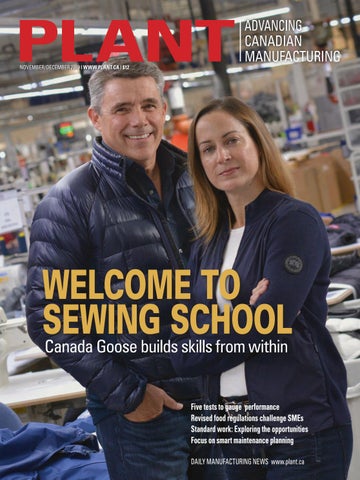
WELCOME TO SEWING SCHOOL Canada Goose builds skills from within Five tests to gauge performance Revised food regulations challenge SMEs Standard work: Exploring the opportunities Focus on smart maintenance planning DAILY MANUFACTURING NEWS www.plant.ca
PLT_NovDec2019_AMS.indd 1
2019-11-29 2:45 PM
From work boots to water coolers, Acklands-grainger has you covered. AcklandsGrainger.com
PLT_Oct_AcklandsGrainger.indd PLT_NovDec2019_AMS.indd 2 1
2019-09-23 2019-11-29 10:50 2:45 PM AM
3 10:50 AM
CONTENTS
November/December 2019 Vol. 78, No. 08
MORE FEATURES 15 PERFORMANCE Giving conflicting instructions is confusing and the reaction is often to ignore them. Three tips that will help avoid confusion. 16 WORKFORCE A CME survey finds a shortage of skilled personnel is affecting manufacturers’ competitiveness. 20 MAINTENANCE The role of critical thinking and finding the root cause when handling complex issues.
12 GARMENTS
Sewing school at Canada Goose trains the unemployed, underemployed and new immigrants for Canadian production, and there’s opportunity for advancement.
23 THINK LEAN Exploring best practices such as standard work requires slowing down before you go faster.
DEPARTMENTS 17 FOOD & BEVERAGE Revisions to Canada’s food and beverage regulations challenge SMEs but offer opportunity.
19 CCOHS SAFETY TIPS How to accommodate workers mental health issues, learning challenges and physical disorders.
21 STRATEGY It’s not easy keeping up with emerging technologies. Focusing on smarter planning leads to excellence.
25 TROUBLESHOOTING A set of standard tests and measurements at key points will avoid production disruptions.
4 Editorial 6 News Bulletins 7 Careers 8 PLANT Online 9 Industry Mix 10 Economy PLANT Pulse 26 Leading Edge: Innovative ideas for plants 28 Products and Equipment 29 Plantware Events 30 Postscript
Cover image of John Moran and Kara MacKillop at Canada Goose by Stephen Urhaney.
PLANT—established 1941, is published 8 times per year by Annex Business Media. Publications Mail Agreement #40065710. Circulation email: blao@annexbusinessmedia.com Tel: 416442-5600, ext 3552 Fax: 416-510-6875 or 416-442-2191 Mail: 111 Gordon Baker Road, Suite 400, Toronto, ON M2H 3R1. Occasionally, PLANT will mail information on behalf of industry-related groups whose products and services we believe may be of interest to you. If you prefer not to receive this information, please contact our circulation department in any of the four ways listed above. Annex Privacy Officer: privacy@annexbusinessmedia.com Tel: 800-668-2374. No part of the editorial content of this publication may be reprinted without the publisher’s written permission. ©2019 Annex Publishing & Printing Inc. All rights reserved. Performance claims for products listed in this issue are made by contributing manufacturers and agencies. PLANT receives unsolicited materials including letters to the editor, press releases, promotional items and images from time to time. PLANT, its affiliates and assignees may use, reproduce, publish, re-publish, distribute, store and archive such unsolicited submissions in whole or in part in any form or medium whatsoever, without compensation of any sort. This statement does not apply to materials/pitches submitted by freelance writers, photographers or illustrators in accordance with known industry practices. Printed in Canada. ISSN: 1929-6606 (Print), 1929-6614 (Online).
www.plant.ca
PLT_NovDec2019_AMS.indd 3
PLANT 3
2019-11-29 2:45 PM
EDITORIAL
The skills shortage and jobs for women
L
adies, the time has come for you to once again step in and help propel Canadian manufacturing forward. Yes, there are many of you heading up companies, holding executive positions and working on plant floors. You are also grievously under-represented in this industry sector. The world is split roughly 50-50 between the sexes, as is Canada (although women have a slight edge). Women account for 48% of the labour force, but only 28% of manufacturing jobs, according to a report by Canadian Manufacturers & Exporters (CME). There was a time during an ominous period of world history when the opposite was true. Canadian women powered the Allied war machine that went on to defeat Hitler’s Nazis during World War 2. An excellent article in the Kingston Whig Standard (Nov. 20, https://bit.ly/2XTtbZ3) provides an illuminating recounting of their efforts. It describes how the Canadian government called on them to fire up the nation’s factories to produce critical war materials and 323,000 out of a total population of 11 million responded. But with the Axis defeated and the boys returning home, the ladies were sent packing. That would not happen today. Skilled women are needed on the industrial front line. Manufacturing employs 1.7 million Canadians, it accounts for two-thirds of export sales and it’s responsible for 11% of the country’s GDP. However, there are factors at work that are impeding this vital sector’s progress. One of these is job vacancies going unfilled. Companies are enduring a seemingly endless shortage of people who have the skills needed to propel their businesses forward. There are plenty of studies that tell the tale. Most recent and specific is the skills study from CME that shows 85% of small to large companies are having trouble filling job vacancies. The hardest of these positions to fill include skilled production workers, general labour and production support, followed by management and a variety of support positions. According to Statistics Canada, women account for about one-third (34%) of science, technology, engineering and math (STEM) bachelor degrees. The numbers also show women were less likely to pursue higher-paying STEM fields such as engineering or computer science in 2016. So how do we get more women and others interested in manufacturing? CME will be pushing three recommendations at the government level: realigning the education system and promoting manufacturing as a career choice; doubling employer investment in training; and increasing the number of economic immigrants to 500,000 a year. But manufacturers can move the needle by reaching out to their communities. Canada Goose, the premium winter garment maker, actively recruits women, new immigrants and others to train in its sewing schools, where employees build skills and have opportunities to advance to managerial positions. Innovative Automation engages area schools with mini trade shows that target Grade 10 students. It also leads career discussions with its Innovative in the Classroom initiative. Three employees take a 72-minute module into high school classrooms that runs though a project covering design, manufacturing and testing. The aim is to generate interest in manufacturing and the different activities involved. This effort is paying off. Some of the participants from the first round who are in university have submitted resumes to the company. There’s always talk of the need to better co-ordinate recruitment efforts between schools at all levels, governments and industry. In the meantime, companies will have to help themselves fill job vacancies by reaching out to women and other under-represented groups, and demonstrating that manufacturing offers a rewarding career path.
Editor Joe Terrett 416-442-5600 ext. 3219 jterrett@plant.ca Senior Publisher Scott Atkinson 416-510-5207 satkinson@annexbusinessmedia.com National Account Manager Ilana Fawcett 416-829-1221 ifawcett@annexbusinessmedia.com Media Sales Manager Jason Bauer 416-510-6797 / 437-218-0941 jbauer@annexbusinessmedia.com Media Designer Andrea M. Smith asmith@annexbusinessmedia.com Circulation Manager Beata Olechnowicz 416-442-5600 ext. 3543 bolechnowicz@annexbusinessmedia.com Account Coordinator Debbie Smith 416-442-5600 ext 3221 dsmith@annexbusinessmedia.com Vice President/Executive Publisher Tim Dimopoulos 416-510-5100 tdimopoulos@annexbusinessmedia.com COO Scott Jamieson sjamieson@annexbusinessmedia.com
Subscription Price Canada $76.00 per year, US $154.50 (US) per year, Foregin $174.50 (US) per year. Single Copy Canada $12.00. Add applicable taxes to all rates. Combined, expanded or premium issues, which count as two subscription issues. Mailing Address Annex Business Media 111 Gordon Baker Road, Suite 400 Toronto, ON M2H 3R1 Circulation Bona Lao 416-442-5600 ext. 3552 blao@annexbusinessmedia.com Fax: 416-510-6875 or 416-442-2191
Joe Terrett, Editor Comments? E-mail jterrett@plant.ca.
4 PLANT
PLT_NovDec2019_AMS.indd 4
November/December 2019
2019-11-29 2:45 PM
3721A
FULLPAG
79383
© 2019 Penske. All Rights Reserved.
Delays not only hurt your reputation, they also damage your bottom line. It’s why we’re dedicated to getting perishable products to market quickly and efficiently. All so you can keep your promises and your profits. It’s how we deliver confidence. Learn more at gopenske.ca.
3721A0161_PT_CanFarm_9x12_AD_1
FULLPAGE 9 x 12.indd 1 PLT_NovDec2019_AMS.indd 5
2019-07-18 2019-11-29 10:06 2:45 PM AM
NEWS BULLETINS Leviton, a lighting manufacturer based in Melville, NY, has acquired Viscor, a Toronto-based manufacturer of lighting for architectural, commercial, medical, institutional and industrial applications. Viscor has a state-of-the-art, 200,000 square-foot facility where it employs 300 people. Two Lassonde Industries Inc. subsidiaries have entered into an agreement with subsidiaries of The Jim Pattison Group, a Vancouver-based conglomerate, to acquire Sun-Rype Products Ltd. The fruit-based snack and beverage manufacturer based in Kelowna, BC has two US affiliates in Selah and Wapato, Wash. The purchase is valued at $80 million. Lassonde, a manufacturer of ready-to-drink fruit and vegetable juices, is based in Rougemont, Que. Conifex Timber Inc. has sold its Fort St. James sawmill and forest licence to Hampton Lumber, a building materials manufacturer based in Portland, Ore. The transfer received BC government approval in October. Hampton has committed to build a new sawmill that will be operational within 36 months of the sale’s conclusion. Namaste Technologies Inc., an online platform for cannabis products, accessories and education based in Toronto, is advancing $300,000 Choklat Inc., a Calgary-based chocolate manufacturer as it gears up for Canada’s cannabis edibles market. ElectraMeccanica Vehicles Corp., in Vancouver, has established EMV Automotive Technology Inc. (Chongqing), a wholly owned subsidiary, in China. The manufacturer of electric vehicles is working with Zongshen Industrial Group on the production of its SOLO EV. EnWave Corp. subsidiary NutraDried Food Co. LLC in Ferndale, Wash., is installing a third large-scale 120 kilowatt Radiant Energy Vacuum (REV) machine to expand production capacity for its shelf-stable Moon Cheese snack line. EnWave, an advanced tech company based in Vancouver, developed REV for the precise dehydration of organic materials.
6 PLANT
PLT_NovDec2019_AMS.indd 6
Corbec investing $40M in Ontario plant Quebec steel company plans to create 100 local jobs in project infrastructure will hire about 100 full-time workers – from plant managers and production supervisors to forklift operators and sales representatives – to work at the 100,000 square-foot facility. Annual production capacity will be 100 million pounds. Corbec said the facility will be one of the most technologically advanced galvanizing plants in North America, with state-of-the-art safety and green features. Galvanized products will include (L-R) Nick Papas, executive vice-president, Corbec; Godfroy St-Pierre, engineered structures such as bridges, president; Hon. Vic Fedeli, Ontario’s Minister of Economic Development, Job Creation and Trade; John Hall, CEO, Corbec; Fred Eisenberger, Hamilton windmills, towers, exposed architecturPHOTO: CORBEC al steel structures, fencing and farming Mayor; and Donna Skelly, MPP, Flamborough-Glanbrook. equipment, OEM products, and a variety of metal parts and hardware. HAMILTON, Ont. — Corbec Steel broke ground Corbec has galvanizing plants in Quebec City, at its first galvanizing plant in Ontario on Nov. 7. The Quebec steel company said the plant locat- Montreal and Princeville and employs more ed in Hannon, near Hamilton is to be complete by than 300 people across its Quebec facilities. The company’s annual production capacity is 250 the end of 2020. Total investment is $40 million. million pounds. The hot-dip galvanizing plant will serve cusCanadian Manufacturing tomers in the south-west Toronto region. Corbec
Transdev wins Hurontario light rail transit project TORONTO — Transdev, as a member of the Mobilinx consortium, has been awarded a $4.6 billion contract by Infrastructure Ontario and Metrolinx for the Hurontario LRT in the Toronto region. Mobilinx, a consortium of local and global firms that specialize in the delivery of infrastructure projects, will design, build, finance, operate and maintain the light rail line for a 30-year term. The Hurontario LRT is an 18-kilometre, 19-stop light rail transit system that runs along Hurontario Street from Port Credit in Mississauga, Ont. to Gateway Terminal in south Brampton. The LRT will operate in a separated guideway with traffic priority throughout most of the corridor. Within the consortium, Transdev will be responsible for operations, maintenance and rehabilitation. Throughout the construction and mobilization phase, Transdev will support its partners and advise them on all system operability aspects. Transdev, based in Saint-Jean-surRichelieu, Que., operates 24 light rail systems in 10 countries.
GF divisions expand with new Vaughan facility Centre features sales and service for two companies LINCOLNSHIRE, Ill. – GF Machining Solutions and GF Piping Systems are expanding their presence in Canada. A new joint headquarters housing direct sales and service support. The companies, which make machining and pipling system products, have broken ground for a 67,000-square-foot facility located in Vaughan, Ont. The new Canadian headquarters will feature a 4,800-square-foot demonstration and distribution centre that will streamline the sales and acquisition process for customers, while shortening delivery times. John Giroux, country manager of GF Piping Systems, said the new facility
(L-R) Heather Newman, operations and inside sales manager, GF Piping Systems; John Giroux, managing director; Mark Sanhamel, director of operations, GF Machining Solutions; Sean Smith, sales manager – Canada; and Philipp Hauser, president, head of market region North and Central America at the groundPHOTO: GF breaking ceremony.
will expand warehouse space and inventory by 100% for more availability of and access to all industrial and utility products. “To further support Canadian customer needs, there will also be an expanded custom fabrication area along with clean room and header capability up to 24” diameters,” said Giroux.
November/December 2019
2019-11-29 2:45 PM
Boom truck fall at Skyjack plant leads to $45,000 fine GUELPH, Ont. — A manufacturer of elevating devices has been fined $45,000 by an Ontario court as a result of a worker falling from a boom truck. Skyjack Inc., a Linamar company, entered a guilty plea to not providing a suitable and safe platform for carrying out work, and not taking measures to protect the worker from falling. The company makes elevated material handling equipment such as boom trucks and scissor lifts. The offence occurred on Aug. 22, 2018 at the manufacturer’s plant in Guelph, Ont. A worker who was removing a flange pin from the truck’s boom was kneeling on top of the vehicle’s cowling, a body cover that was about seven feet above the ground. The cowling, made of smooth fibreglass, sloped toward the boom, and was only 21 inches wide. The worker was using pry bars to release the flange pin when the pin gave way. This caused the worker to fall backwards off the cowling and sustain critical injuries. In addition to the fine, the court imposed a 25% victim fine surcharge as required by the Provincial Offences Act.
Magna scores largest transmissions order
CAREERS
Nova Chemicals joins an international product stewardship program. PHOTO: NOVA CHEMICALS
Nova Chemicals to participate in Operation Clean Sweep Blue Program prevents plastic pellet, flake and powder leakage into the environment CALGARY – Nova Chemicals Corp. said it’s the first Canadian-based company to publicly commit to Operation Clean Sweep Blue (OCS Blue) and verify compliance by Jan. 1, 2022. The international product stewardship program aims to prevent plastic pellet, flake and powder leakage into the environment. It requires enhanced company engagement, transparent reporting and formal audit. The Calgary chemicals company said OCS Blue metrics for all its facilities will be reported in compliance with the program in the chemical firm’s annual Sustainability Report. Nova Chemicals recently joined the Alliance to End Plastic Waste as one of its founding members. The group consists of more than 40 global companies. It has pledged more than US$1 billion and set a goal to invest US$1.5 billion over five years to help eliminate plastic waste in the environment, especially in the oceans. The company is also a partner in the global Project STOP since 2018, pledging nearly US$2 million over three years to prevent plastic debris from reaching the ocean.
The hybrid variants also use a compact, 48-volt, high-rpm electric motor within the transmission housing for additional improvements in fuel efficiency. BMW multi-year deal covers The transmissions will be built at Magna use in 170 applications plants in Neuenstein, Germany and Kechnec, Slovakia. SAILAUF, Germany — BMW Group has awardMagna has also received a grant from the US ed Magna Powertrain its largest ever production Department of Energy to order for transmission techdevelop and ‘auto-qualify’ nologies. advanced electric motor The multi-year contract technologies. covers all front-wheel drive, In partnership with the dual-clutch transmissions, Illinois Institute of Techincluding hybrid transmisnology and University of sion variants. Wisconsin-Madison, Magna Magna Powertrain, based aims to deliver an electric in Aurora, Ont., said transmotor that is half the cost mission technologies will be with eight times the power used in more than 170 different vehicle applications. Magna dual-clutch transmission hybrid. PHOTO: MAGNA density of current e-motors, while delivering 125 kW of The hybrids will not affect peak power. The cost reduction will come from the overall package size of the transmission, eliminating rare-earth permanent magnets. which gives BMW manufacturing flexibility.
www.plant.ca
PLT_NovDec2019_AMS.indd 7
Agropur Cooperative has appointed Emile Cordeau CEO. He replaces the retiring Robert Coallier at the dairy processor based in Longueuil, Que. He moves up from senior vice-president Emile Cordeau and CFO. Agropur processes more than 6.2 billion litres of milk per year at its 39 plants across North America.
Brad Corson
Rich Kruger
Brad Corson has been appointed president of energy company Imperial Oil Ltd. as chairman and CEO Rich Kruger retires. Corson will assume the role of chairman, president and CEO of Imperial Oil Limited on Jan. 1. Over his 36-year career with the company, Corson has held a variety of technical, operations, commercial and managerial assignments around the world. EHC Global, an Oshawa, Ont., a manufacturer and supplier of escalator and elevator parts and systems to the transportation industry, has appointed Jeff Coles managing director, North American Operations. From 2015 to 2018, he was vice-president, Jeff Coles Central Region, with Thyssenkrupp Elevator. Lily Ning has been promoted to vice-president, marketing for the SRP group. Superior Radiant Products designs and manufactures energy efficient infrared heating solutions in Stoney Creek, Ont. Over her 10-year career with SRP, Ning has developed overseas business and handled internal projects, including the company’s recent migration to the new MS Dynamics Navision.
PLANT 7
2019-11-29 2:45 PM
NEWS
Sheridan launches Industrial Distribution Program Working with partners focusing on industrial parts to provide hands-on training`
(L-R) IDP program steering committee: Rossana Gorys, associate director, Sheridan College; Paul Meo, president and CEO, NTN Bearing Corp. of Canada Ltd.; Cindy Russell, sales director Canada, Continental ContiTech; Janet Morrison, president, Sheridan College; Hazel McCallion, college chancellor; Jos Sueters, vice-president, Tsubaki of Canada Ltd.; Matt McCloy, director of sales and marketing, Regal Beloit Canada ULC; Vanessa Antonoff, branch manager, BDI Canada Inc.; and Nazlin Hirji, director, Sheridan College. PHOTO: SHERIDAN COLLEGE
BRAMPTON, Ont. — Sheridan College’s Continuing and Professional Studies division and industry partners are launching an intensive 16-week Industrial Distribution Program (IDP) focused on the distribution of bearings, power transmission products and other industrial parts. Courses delivered at the college’s Davis Campus in Brampton, Ont. (starting Jan. 6) will cover the key disciplines relevant to distribution. There will be eight weeks of classroom instruction and eight weeks of hands-on training at an industrial machinery company. Workshops will feature distribution management, territory sales, marketing, negotiation skills, inventory management, sales management, human resources, leadership and information technologies.
PLANT ONLINE SOUNDING OFF
What readers have to say about breaking news Have you checked out PLANT’s daily news online? Here are some headlines that have inspired members of the Canadian manufacturing community to chime in. They’re edited, but use the links to see the raw – and for some – longer versions of their remarks plus the stories that inspired their reactions. Stay up-to-date on the developments – domestic and global – that affect Canada’s industrial sectors by watching the news feed at www.plant.ca or reading PLANT’s twice-weekly newsletter (hit Subscribe on the website). Ford electric vehicle chief sees more products, sales growth http://www.plant.ca/Vl7op Canadians will not adopt electric cars en-masse until there is a convenient infrastructure to support charging that will provide for travel at distances between major cities. Many Canadians travel distances exceeding 800 kilometres on a single drive. There are no electric vehicles or charging facilities that can support this. Additionally electric battery performance is dramatically decreased at lower temperatures, further reducing range and recharging performance.
8 PLANT
PLT_NovDec2019_AMS.indd 8
Sobeys benches divert 720,000 plastic bags from landfill http://www.plant.ca/CxPJX Great, but how do I carry my groceries out of the store? Trudeau’s post election priorities are climate and pipeline http://www.plant.ca/Us0Mk Why do the politicians not explain to the voting public that Canada’s contribution to global GHG emissions is around 1.6%? So if Canada eliminated 100% of its emissions it would have a negligible effect on global emissions but so doing would devastate Canada’s economy
and put thousands out of work. CannTrust to destroy $77M of cannabis to comply with rules http://www.plant.ca/lkyGh Typical government. Stupidity. Take possession as part of the penalty and auction off 50 million to legit buyers! New tech institute for Surrey takes pressure off Vancouver: Horgan http://www.plant.ca/BiUaO Do guys like Horgan and Ralston even know what quantum computing is? Or isn’t, at the moment? Kenney vows to counter Texas poaching of Canadian companies http://www.plant.ca/1eGyP Let us now build a giant federally owned winter diesel refinery at Fort McMurray and send the entire production into pipelines to fuel the NWT, and Arctic mining development.
De Havilland books first Dash 8-400 order Turboprop will be operated by Air Tanzania
Dash 8-400 inflight.
PHOTO: DE HAVILLAND
TORONTO — De Havilland Aircraft of Canada Ltd. says Tanzania, represented by the Tanzanian Government Flight Agency (TGFA), has signed a firm purchase agreement for a turboprop Dash 8-400 aircraft. The Toronto-based aerospace company said the aircraft, which will be leased to and operated by Air Tanzania, will join three that are already in service with another on order. This brings the airline’s fleet of Dash 8-400 aircraft to five. It will be delivered in a 78-seat configuration. Another sale comes from a subsidiary of Russian airline Aeroflot. It signed a letter of intent at the Dubai Airshow to buy five of the aircraft. Aurora, based in Sakhalin, Russia, currently operates eight Dash 8 aircraft, including two Dash 8-400 turboprops. The Dash 8 aircraft program was acquired from Bombardier by Longview Aviation Capital, manager of a portfolio of long-term investments in the Canadian aerospace industry. De Havilland Aircraft of Canada Ltd. is a subsidiary that will operate the worldwide Dash 8 aircraft business.
Kruger certified for ISO 50001 GATINEAU, Que. — Kruger Products’ plant in Gatineau, Que. has been certified to the ISO 50001 standard. The manufacturer of tissue products is the first company to receive the energy management certification from the Bureau de normalisation du Québec. Kruger says its Gatineau plant has significantly improved its environmental performance since 2009, by reducing its energy intensity by 25%. With the ISO 50001, the company can continuously monitor its energy intensity.
November/December 2019
2019-11-29 2:45 PM
INDUSTRY MIX Sobeys benches its grocery bags Sobeys Inc. is getting out of plastic grocery bags by January. The plan is to take 225 million bags out of circulation at 255 locations across Canada each year. The Ultimate Picnic Table, unveiled by Sobeys Inc. But they’ll be put to PHOTO: SOBEYS good use elsewhere. The Stellarton, NS-based national grocer is donating public seating made entirely of recycled bags and heavier recycled materials, such as bins, for use in community spaces across Atlantic Canada. Making the benches and picnic tables will divert 720,000 plastic bags from landfill. The first piece – dubbed the Ultimate Picnic Table – was made by LakeCity Plastics in Dartmouth and installed at the Halifax Waterfront. The table and bench system seats 20 and used 60,000 recycled bags. LakeCity Plastics, a social enterprise that provides employment opportunities to youth and adults living with mental illness, is collaborating with Goodwood Plastic Products of Colchester County. It’s sourcing Goodwood’s plastic lumber, which is made from used plastic bags and containers, to produce outdoor furniture. Each regular sized picnic table diverts more than 15,000 plastic bags from local landfills.
Seabed surveyor releases the Kraken Kraken Robotics Inc., the marine tech company based in St. John’s, NL, is doing its bit to drive electric power underwater. Ocean Infinity, a seabed exploration company based in Houston, has been testing the endurance of its Kongsberg Hugin AUVs using new pressure-tolerant batteries from Kraken. Several missions were more than 5,000 metres deep and one went more than 100 hours without recharging while running a full survey payload. Ocean Infinity has increased survey ranges to nearly 700 line-kilometres per deployment while optimizing mission plans, increasing area coverage, managing weather impacts, and reducing launch and recovery operations. The modular bat- Nearly 700 line-kilometres per deployment. teries are also hot swappable PHOTO: KRAKEN and include an integrated battery management system. “We now have the capability to conduct AUV missions of over four days duration without a battery recharge or change out,” said Josh Broussard, Ocean Infinity’s chief technical officer. And on the green side, Kraken’s pressure tolerant gel encapsulation technology for lithium polymer batteries is more environmentally friendly than oil compensated batteries currently used for subsea applications. For landlubbers, Tesla’s Model 3 electric vehicle is good for about 500 kilometres before recharging.
www.plant.ca
PLT_NovDec2019_AMS.indd 9
MISCELLANY FROM THE WORLD OF MANUFACTURING
Experiencing sculptures in 3D Art lovers that are visually impaired can visit the Nasher Sculpture Center in Dallas to engage with some of the great works by modern sculptors, thanks to NVision in Southlake, Tex. The provider of 3D non-contact optical scanning/ measurement technology was commissioned to scan sculptures by Auguste Rodin (Hanako and Head of Balzac), Julio González (Mask: Reclining Head) and Raymond Duchamp-Villon (Baudelaire) to produce print3D version of Balzac’s head, by ed-to-scale replicas for patrons’ tactile enjoyment. PHOTO: NVISION Rodin. NVision’s HandHeld scanner scanner attaches to a mechanical arm that moves about the object. As a part is inspected, the scanner generates a point cloud consisting of millions points each with x,y,z coordinates and i,j,k vectors. Integrated software converts the point cloud to an STL polygon. “It is particularly meaningful when visually enjoying the lines, textures and emotive qualities of a work is not possible due to blindness. These scans of works by significant artists of the 20th century allow our public a rare, hands-on experience,” says Lynda Wilbur, manager of tour programs at the Nasher.
We have this mindcrushing idea that a political appointee or a mid-level trade official is going to know better than a major automaker where to put a plant. Once you start ... trying to influence those decisions politically, I mean, then we’re in Bolivia.” Flavio Volpe, president, Automotive Parts Manufacturers Association, who called the idea that the White House would be able to force US automakers to make “politically expedient” investment decisions “breathtakingly stupid.” — Toronto Star
EVs charging into 2030 Electric vehicles represent about 3% of the cars on the road today, but imagine the impact of rapid adoption and how it would alter Canada’s emissions profile and energy infrastructure. Okay, 3% doesn’t seem like much but EY notes Canada is the tenth fastest adopter of EVs in the world, with sales in 2018 growing 165% year-over-year. It says rapid adoption of electric vehicles could mean as many as 13.2 million of them on the road by 2030. EY’s Canadian electric vehicle transition – the difference between evolution and revolution report outlines how all EV rapid, moderate or slow adoption scenarios will affect Canadian oil and gas, power companies and utilities. The research suggests rapid adoption (30% EVs of Canada’s vehicle stock) would reduce domestic oil consumption by roughly 252,000 barrels per day and could trigger convergence of energy and power utilities companies. Rapid adoption could also cause an 11% spike in Canadian electricity demand, requiring utilities to make significant investments in grid infrastructure to allow consumers to charge cars at home and in public spaces. Distribution network upgrades would also be required to improve power transmission across the country, including to rural areas. Even a moderate adoption scenario – 6.5 million EVs on Canadian roads by 2030 – would require a 5.5% increase in electricity demand.
PLANT 9
2019-11-29 2:45 PM
ECONOMY
Support for global trade
C
anadian small and medium businesses (SMEs) believe economic growth and international trade are closely linked. A survey by Morning Consult on behalf of the Canadian subsidiary of global courier FedEx Corp. shows 83% of respondents agree increasing trade with other countries will improve the economy overall. Most SMEs (57%) believe increasing international trade will help their businesses, but only 37% are currently selling goods online, compared to 44% of American SMEs. They support both NAFTA (90%) and USMCA (86%). Eighty-one per cent of the companies say fees and tariffs have had a great deal or some effect on the growth of their businesses. The poll was conducted from Sept. 17-20, among 500 SME Canadian decision makers. The margin of error is plus or minus four percentage points.
Employment is steady Canada lost 1,800 jobs in October but a small enough number to conclude employment held steady following two months of growth. Statistics Canada reports an unemployment rate of 5.5%. Year-over year, employment grew by 443,000 or 2.4%, driven by gains in full-time work. Total hours worked increased 1.3%. However, employment in manufacturing declined by 23,000, mostly in Ontario although year-over-year it’s virtually unchanged. Canadian employment grew 4.4% compared to the US at 3.6%. A year earlier, Canada declined 0.3 percentage points compared to a US decline of 0.2 percentage points. Labour force participation was 65.5% versus 63.3% in the US. In a Weekly Bottom Line report, TD Economics noted the labour market is tight. Senior economist James Marple writes that unemployment is at a near record low and vacancy rates are at an all-time high, which is being reflected in wage growth. Average hourly wages increased 4.3% yearover-year for the month.
10 PLANT
PLT_NovDec2019_AMS.indd 10
millions of current $ 8,000
INTERNATIONAL MERCHANDISE TRADE BALANCE Canada’s imports fell 1.7% in September and exports were down 1.3%. As a result, Statistics Canada reports the merchandise trade deficit with the world narrowed to $978 million from August’s $1.2 billion. Exports to the US for the month were down 0.6%, while imports slipped 0.4%, trimming the trade surplus from $4.9 billion to $4.8 billion.
Trade balance with the United States Total Trade Balance Trade balance with countries other than the United States
6,000 4,000 2,000 0 -2,000 -4,000 -6,000 -8,000
Nov 2016
2017
2018
Source: Statistics Canada, CANSIM
$1,146
Average earnings in August for manufacturing. That’s up 3.8% yearover-year, reports Statistics Canada. Transportation equipment and food manufacturing contributed the most to the increase, partially offset by a marked decline in machinery manufacturing.
87%
Canadian entrepreneurs’ lwho are optimistic about the future success of their businesses, according to a CIBC survey. They are less upbeat about the economy with 44% listing it as their top concern for 2020.
Sept 2019
2,209 Petajoules of energy consumed as part of the production process in 2018 by manufacturers. That’s an increase of 2.3% from 2017, reports Statistics Canada. Paper and primary metal manufacturers were the top consumers.
169,800 Number of Ontario manufacturing jobs lost from 2007 to 2017, while Michigan added 47,000 above prerecession levels over the same period, says a study by the Fraser Institute.
305,000
Demand for digitally skilled talent by 2023 for total employment of more than 2 million in the digital economy, according to a report by the Information and Communications Technology Council. Talent and skills needs are being redefined by artificial intelligence, 5G, virtual and augmented reality, advanced manufacturing processes and blockchain. Full stack developers, data scientists and DevOps engineers are identified as three of the 15 top digital jobs most needed. Job growth areas include: cleantech; clean resources; advanced manufacturing; interactive digital media; health and biotechnology; and agri-foods and food-tech production.
STOCK.ADOBE.COM
SMEs tie it to economic growth
November/December 2019
2019-11-29 2:45 PM
PLT_Nov
Technology will upgrade with or without you. Stay ahead with Industry 4.0. Manufacturers stay competitive by strategically enabling: Technology adoption X Innovative recruiting efforts X Digital transformation initiatives X Big data and blockchain STOCK.ADOBE.COM
X
Explore how BDO professionals tackle the manufacturing industry on insights.bdo.ca/advanced-manufacturing.
PLT_NovDec19_BDO.indd 1 11 PLT_NovDec2019_AMS.indd
2019-11-28 2:45 2019-11-29 1:15 PM PM
GARMENTS
WELCOME TO SEWING
SCHOOL
TRAINING AND ADVANCEMENT AT CANADA GOOSE Opportunity beckons women, men and new immigrants in three cities. BY KIM LAUDRUM
A
John Moran, executive vice-president, manufacturing and supply chain, with Kara MacKillop, executive vice-president, PHOTO: STEPHEN URHANEY people and culture on the plant floor in Toronto.
12 PLANT
PLT_NovDec2019_AMS.indd 12
t a time when other apparel companies are migrating production offshore to exploit lower labour costs, luxury-brand parka-maker Canada Goose is soaring at home with plans to hire 900 people this year. Steadfastly refusing to outsource manufacturing, Canada Goose instead plans to offer them training at sewing schools in three major Canadian cities: Toronto, Montreal and Winnipeg. Training and the opportunity for advancement are attracting new Canadians, among others – particularly women – to the winter garment manufacturer. Headquartered in Toronto, Canada Goose Holdings Inc.’s financial growth since going public in 2016 is astounding. Since then the company’s annual revenues have more than doubled from $290.8 million to $591 million in 2018. Thirty plants across Canada produce the company’s winter vests, gloves, hats, parkas and jackets. Eight of those plants are owned by Canada Goose. The down-filled parkas with a $1,000 price tag and iconic Arctic map shoulder patch are the ubiquitous urban winter uniform of the 16- to 24-year old crowd. To appeal to international fashionistas, Canada Goose established a retail presence in high-end boutiques in Toronto, Chicago, Paris, Milan, Stockholm and Beijing. Yes, China. Despite China’s threats to boycott Canadian products because of the detainment of Huawei’s CFO Meng Wanzhou, Chinese shoppers lined up to rush the winter parka retail outlet when it first opened in December 2018. In 1957 Sam Tick founded Metro Sportswear Ltd. in Toronto to make woolen vests, raincoats and snowmobile suits. In the 1970s, Tick’s son-in-law David Reiss introduced a volume-based down-filling machine and launched the Snow Goose label, which
November/December 2019
2019-11-29 2:45 PM
would later become Canada Goose. The Expedition Parka put Canada Goose on the map. Developed for use by scientists at the coldest place on the planet, the big red parka became standard issue. In 1997, Tick’s grandson Dani Reiss joined the firm, becoming president and CEO in 2001. One would think shareholder pressure would push the extreme-weather garment maker to pursue greater profits by outsourcing production. Yet Reiss is adamant, despite selling a 70% share to American investor Bain Capital back in 2013, that Canada Goose winter apparel be made in Canada. The company currently exports to more than 50 countries. “We are an ambassador for our country on a global stage,” the CEO says. Canadian-made brands have a reputation for good quality. “That’s part of our value proposition and it’s supported by our commitment to keep the core down-filled product made exclusively here in Canada, which we believe is the best place to make cold-weather apparel,” says John Moran, executive vice-president of manufacturing and supply chain at Canada Goose from the company’s 180,000 squarefoot plant and headquarters in Toronto. “I’ve been in apparel manufacturing in North America pretty much for over 30 years and I watched it during the late ’80s and ’90s go offshore, chasing lower price points. So to be a part of bringing it back to North America – Canada specifically – is a great thing,” Moran says. He is quick to point out Canada Goose never did manufacture offshore, but is part of the reason for the resurgence of the domestic apparel business, employing more than 6% of the nation’s cut-and-sew industry. Moran says Canada Goose’s transition in 2015 from a tradi-
www.plant.ca
PLT_NovDec2019_AMS.indd 13
Close-up at the sewing machine.
PHOTOS: CANADA GOOSE
Parka on Arctic Tech fabric.
Sewing the iconic Arctic shoulder patch onto a garment.
tional apparel-making environment to one that embraces lean-manufacturing principles allowed it to realize an easier way to train workers. “Lean manufacturing, faster throughput, lower work in process, better quality, continuous improvement – it’s all here,” Moran says. “But what really drove us is the ability to train into specific locations within those production lines.”
Building sewing skills Canada Goose trains workers to gain sewing skills, then trains them by product category, so – for example – they understand the difference in the handling of the material, Moran explains. As it gets closer to launching those trainees into the production line, they’re taught specific style training. Then they are launched on a production line with specific operations throughout. “That
has created the flywheel of our manufacturing in Canada.” Producing in Canada allows Canada Goose to keep a close eye on quality control. Moran points out why that’s important: “If you’re going to manufacture something in possibly more than 20 out of 30 facilities, you have to consider in a retail store those garments are likely to be resting side-by-side. Our level of quality has to be extraordinary to pull that inventory and compare [garments] next to each other. … We’re dealing with things like fabrics that have a certain shade. How we ensure that those things stay consistent takes an extraordinary team effort.” To do so, between 25 and 85 people keep track of hundreds of quality control items. There are 3,000 people in Canada manufacturing for Canada Goose, Moran says. The Toronto facility alone has reached close to 300 people and is “growing every day. The other facilities in Winnipeg, for example, now have a population around the 1,200 to 1,500 range and Montreal is similar to (Toronto). All have room to grow.” Training happens daily at seven sewing schools. “We have people arriving that want to join us, knowing that we train, which is fantastic. We have great relationships with local agencies in all provinces that channel the unemployed, the underemployed, or the new immigrant population to us. We ask them, ‘Do you want a job?’ We can train them,” Moran says. “The part that we don’t talk about too much though, is that with all the production personnel we have, we need assistant supervisors, supervisors and engineers. And we grow our own. It’s an industry where we’ve already drawn the best of the best. We invest in that as well. It’s a career path.” Akie Tagawa is a good exam-
PLANT 13
2019-11-29 2:45 PM
ple. The production manager at Plant 2 in Montreal has held three successive positions in two years at Canada Goose. An immigrant from Brazil where she had apparel experience, she applied online to be accepted into Canada Goose’s training program as a sewing machine operator. “When I applied I was new to Canada.” For two years Tagawa was in learning a new language and studying Canadian culture. “Canada Goose was the first opportunity to open the door for me.” Kara MacKillop, executive vice-president, people and culture says, “We happily employ anybody who is eager
Akie Tagawa, production manager at Plant 2 in Montreal.
and looking for a job, whether they are unemployed, underemployed, new Canadians, men or women.” The six-week program offers trainees onthe-ground learning. They are seated with the rest of the employees, next to supervisors on part of a line. Small flags at their stations identify them; some show a hatchling, a duck or a goose.
Opportunities to advance
Above, top to bottom: Canada Goose retail location in Toronto’s Yorkdale Mall;garments on display in the Yorkdale store; and vaults where garments are stored.
14 PLANT
PLT_NovDec2019_AMS.indd 14
The training program taught Tagawa how to sew, clean and maintain the machine. “But it also taught me how to be efficient, how to be professional by being on time, and how to communicate effectively,” she says. Canada Goose offers second language program certification in English or French to staff, which Tagawa found helpful. “The down jacket is very complicated to make. Some have over 200 pieces to them. The down can come out of a very small needle hole so we have to be exacting with our standards,” Tagawa points out. ‘That makes good communication very important.” Sewing machine operators are paid a basic salary plus a per-piece above quota incentive. At each Juki sewing machine station, bar codes keep track of the individual operator’s batch. A ticker posts quotas, production and productivity at the end of each line. Opportunities for advancement help attract and retain workers at Canada Goose. “I saw other women in good positions and it inspired me,” Tagawa says. “We’re hiring so many
people. We want them to succeed and we want to keep them. There is a very good culture here. People are motivated, many have found new friends.” Tagawa says workplace diversity offers many opportunities for celebrations. “People here come from many different backgrounds, not just different countries, but different occupations, too,” she says. They learn much from each other, she adds. MacKillop says more than 800 people have taken the training program to date and gone on to work in various capacities at Canada Goose. “We benefit from the diversity and inclusion in our workplace. Employees feel in control of their destiny here. They feel there is a career path for them. We also do well from our employees referring others to work here.” The company also benefits from employees feeling free to ask questions and offer suggestions. “Innovation is one of our core values,” MacKillop says. “If someone on the floor comes up with a better way of doing things, we want to hear about it.” Employees also feel good about what they do. “We are making beautiful, tailored garments. True craftspeople understand that. It’s a source of pride.” Manufacturing in Canada also helps to maintain local jobs. “We’ve been in the Bowie Ave.-Caledonia area (in Toronto) for 40 years,” MacKillop says. “Our employees have built families and their lives within the community.” As far as the future goes, Canada Goose just launched Project Atigi, a line of bespoke parkas created by Inuit designers using their traditional skills, unique designs and Canada Goose materials. The company also launched a merino-wool knitwear leisure line. “We don’t see a stop to this growth,” MacKillop says. “Our goal is to continue manufacturing in Canada. We will continue to make our down-filled product here. There’s a reason why (our headquarters) are attached to this (Toronto) plant. We can get products right off the line. Our designers are here, too. It keeps us close.” And she’s proud of the unique opportunity Canada Goose has been given. “Not a lot of people can say they are rebuilding an industry.” Kim Laudrum is a Toronto-based business writer and regular contributor to PLANT. E-mail klaudrum@rogers.com. Comments? E-mail jterrett@plant.ca.
November/December 2019
2019-11-29 2:45 PM
PERFORMANCE
Training people to ignore some instructions.
PHOTO: STOCK.ADOBE.COM
How to create
CONFUSION
GIVE WORKERS CONFLICTING INSTRUCTIONS
Three tips for avoiding the inevitable resistance. BY HUGH ALLEY
S
ometimes, as supervisors and managers, we’re our own worst enemies. One way we do this is through unclear directions. When you give someone conflicting instructions, they can’t help but resist them. For example, an overhead bus hatch has two conflicting instructions on it: “Do Not Open Hatch” and “TURN THE PUSH KNOB TO OPEN.” What’s a person supposed to do? Now some readers will dismiss this as being a bit dense. “Of course it’s clear,” they will say. “It’s an emergency exit. You don’t want people opening the bus hatch for normal ventilation, but if you do need to open it, here’s how. ” Except, that’s not what’s written, so to follow the written instructions, we’re asking people to guess. A bus hatch may be a non-critical matter. No one is going to die if the bus travels with the hatch open. We don’t just create these problems for workers, we create them for our customers too. In a recent hotel stay I needed
to read the instructions for an accessory four times before I figured out how to use it. And on a recent delivery from a retailer, I had three conflicting instructions about what I was supposed to do when I received a shipment of 79 pieces.
succeed. So how do we deal with this? By improving the instructions we give. Here are three ways: • Ensure the details are com-
Quality versus delivery You’ll find contradictory instructions given to the workers in most plants. Sometimes the potential consequences are serious. In one instance the instructions for the start-up of a boiler contained two conflicting instructions, one of which, if followed, could have resulted in an explosion. A common conflict is the issue of quality versus delivery. Managers will state how important quality is, but in a crunch, they’ll wave through products that don’t meet the quality standard to make the shipment. In a situation like that, it isn’t surprising employees will resist added steps designed to improve quality. They’ll see the extra steps as slowing them down, making the work unnecessarily harder. In effect, a conflicting message trains people to ignore some instructions, which we interpret as resistance. In fact, we’ve set them up so they can’t
Hugh Alley is an industrial engineer based in the Vancouver area who helps organizations achieve significant performance gains in delivery, quality and cost in a short timeframe. Call (604) 866-1502 or e-mail hughralley@gmail. com. Comments? E-mail jterrett@plant.ca.
MURPHY MEANS
MORE More
VALUE
No One Gives You More!
Feature for feature: Murphy packs-in more for your money. Get it done right the first time.
N.R. MURPHY LTD. DUST COLLECTORS 430 Franklin Blvd., Cambridge, ON N1R 8G6 E-mail: 4nodust@nrmurphy.com
(519) 621-6210
www.nrmurphy.com
PLANT 15
www.plant.ca PLT_NovDec19_NRMurphy.indd 1
PLT_NovDec2019_AMS.indd 15
plete and unambiguous; • Ensure the training for standard work processes accounts for the real complexity staff experience, then reference that training in the instructions. • Redesign processes so there are fewer details that need to be communicated. Each one these options reduces the chance employees will face conflicting instructions, which will reduce “resistance.”
2019-10-22 2:05 PM
2019-11-29 2:45 PM
WORKFORCE CME survey shows 85% of companies are having trouble filling job vacancies. BY PLANT STAFF
M
anufacturers unable to find people with the right skills are hampered from operating at an optimum level, which is impeding their productivity and competitiveness, according to a skills survey conducted by Canadian Manufacturers & Exporters (CME). The survey of 225 manufacturers, unveiled during CME’s annual conference Oct. 17-18 in Toronto, showed 85% of small to large companies from across Canada are having trouble filling job vacancies. The hardest positions to fill include skilled production workers, general labour and production support, followed by management and a variety of support positions. Manufacturing employs 1.7 million Canadians, accounts for two-thirds of export sales and contributes 11% of GDP. “Labour and skill shortages in the manufacturing sector are alarming. They are holding back the entire sector and, by extension, Canada’s economic growth,” said Dennis Darby, CME’s president and CEO. “Our members tell us it is not unusual for successful manufacturers to put off plans to grow because they do not have the workers and skill sets they need to support their expansion.” Darby said skills shortages impact every step of manufacturers’ businesses: from selecting the right technology to integration, customization, operation, troubleshooting, and maintenance and repair. “Each of these steps require workers with specialized and specific skills. Unfortunately, 85% of manufacturers are struggling to find the workers they need, both in terms of their availability and, their skills. With this report, CME will be able to show governments
16 PLANT
PLT_NovDec2019_AMS.indd 16
The goal of CME and partners’ Women in Manufacturing initiative is to increase their number in the sector by 100,000 within five years. PHOTO: GORODENKOFF - STOCK.ADOBE.COM
Wanted: skilled
WORKERS SHORTAGE HAMPERS BUSINESS COMPETITIVENESS and the public the magnitude of the problem. It gives us the tool we need to advocate for solutions that will help manufacturers grow,” he said. The survey shows the top three impacts of this ongoing skills shortage are: forcing companies to hire ill-suited candidates that require significant upskilling and training; foregoing production opportunities; and a decline in business investment investment and product development. All of these factors contribute to lagging productivity growth and a general competitive disadvantage. The top four barriers to hiring include a lack of qualifications, low reply rates to posted jobs, hires are a poor fit, and wage demands are too high. The CME survey links skills issues with lagging investment and productivity, which affect a manufacturer’s ability to compete. Statistics Canada shows machinery and equipment invest-
ment for the year unchanged from 2015 at $14 billion and down 4% from 2007 while investment in many OECD countries as risen significantly. Closer to home, in the decade preceding 2016, US investment has grown 20% while Canada’s has declined 17%. Research by the Conference Board of Canada shows Canada productivity rising 20% over the past 15 years while the US shows a 50% increase.
Attracting youth The CME report also notes too few Canadian youth are seeking careers in manufacturing, an industry that continues to be viewed as dirty with low pay. The survey offers three recommendations to alleviate the skills shortages plaguing industry, starting with measures to attract youth. The goal is to create 150,000 full time jobs for young people by realigning the education system and enlisting government help to promote manufacturing as a desirable
career choice. This includes creation of regional industry councils and expanding efforts to attract candidates from under-represented groups, such as women and Indigenous people. Goal No. 2 is to double employer investment in training, including management, aided by the creation of an training tax credit, and helping employers expand work-integrated learning. The third goal is to increase the number of economic immigrants to 500,000 a year. This involves updating the immigration point system to align with employer needs, expanding the provincial nominee program, better leveraging the post secondary system and enhancing the temporary foreign worker program. “Canada’s next government needs to prioritize the manufacturing sector and its skills, labour and training shortage crisis in its first 100 days in office to ensure Canada’s economic well-being,” Darby said. Moving forward, he said CME will work with the new federal government, and all provincial governments to turn its recommendations into action. Download We’re Hiring: Manufacturing Workforce Survey Report at https://bit.ly/37x54nu. Comments? E-mail jterrett@plant.ca.
November/December 2019
2019-11-29 2:45 PM
FOOD & BEVERAGE Recent revisions to Canadian food and beverage regulations offer challenges and opportunities for SMEs.
Making sausages. PHOTO: VIPAVLENKOFF - STOCK.ADOBE.COM
BY CAROLYN COOPER
“H
ealth Canada and the Canadian Food Inspection Agency (CFIA) have bitten off quite a bit in terms of what they’re trying to accomplish,” says Gary Gnirss. “Anticipating how it’s going to unfold has created a little anxiety in the industry.” Gnirss, partner and president of Legal Suites, a Milton, Ont.based regulatory consulting business serving the food industry and regulatory professionals, is referring to the ongoing and largely unprecedented federal project to modernize Canada’s highly complex food and beverage regulations. A major step towards that goal is the Safe Food for Canadians Regulations (SFCR), which came into effect on Jan. 15, 2019 and outlines how the 2012 Safe Food for Canadians Act (SFCA) will be implemented and enforced. It’s just the first in a series of legislative changes hitting food and beverage manufacturers, changing how food is processed and inspected in Canada. “Awareness is certainly a key thing for industry because there’s so much going on,” says Gnirss, who helps manufacturers navigate the regulatory waters. “It’s not just one element. We’ve got a whole bunch of waves of stuff coming at us.” Food in Canada is governed by the CFIA and Health Canada under the Food and Drugs Act and Food and Drug Regulations. Canadian food and beverage products have always been considered some of the safest in the world, but several high-profile cases of foodborne illness over the past two decades, combined with increased consumer and media scrutiny of food production, led to calls for changes to
www.plant.ca
PLT_NovDec2019_AMS.indd 17
Law, order,
FOOD
…AND MODERNIZED FEDERAL SFCR REGULATIONS how food safety is monitored and enforced. The feds also announced their intention to modernize the industry’s inspection system and regulations, while ensuring all Canadian foods for export comply with international standards. The result was the SFCA, which consolidated several major food commodity statutes – the Fish Inspection Act, the Canada Agricultural Products Act, the Meat Inspection Act, and the food provisions of the Consumer Packaging and Labelling Act – in hopes of giving the CFIA a clearer picture of the Canadian food landscape. Its main goals are to improve consistency in food safety practices and inspection; eliminate some of the regulatory burden on food and beverage operators; and to better track foods that are sold interprovincially and internationally. The SFCR puts more scrutiny on food importers and export-
ers (who now need a licence to operate), as well as food manufacturers, who must be licensed to produce food and beverages for sale interprovincially or internationally. Previously only certain commodities, such as meat, were required to be federally registered to operate interprovincially, regardless of company size or food safety risk. That meant many operations fell through the cracks in terms of food safety oversight, while inspection resources were spread thin in specific sectors.
Documented plan Companies applying for a licence must show they have an effective Preventative Control Plan (PCP) – defined by CFIA as “a written document that demonstrates how risks to food and food animals are identified and controlled” – in place to mitigate food safety risks. They must also have a traceability plan that allows them
to track all their ingredients and products from farm gate to dinner plate, which should make product recalls faster and more effective. Most significantly, the SFCA&R move Canada’s food inspection regime from a highly prescriptive model to a scienceand outcomes-based system that focuses on prevention. In other words, manufacturers will no longer be explicitly told how to prevent foodborne illness outbreaks in their plants; instead, they will have to demonstrate compliance through their PCP and traceability plan. “The old days of CFIA inspections are past now that these are outcome-based regulations,” says Al Grant, senior manager of Consulting Services at Guelph, Ont.-based NSF International. “So an inspector is not going to come in with his list of CFIA criteria. He’s going to come in and say ‘Show us your program and we’re going to do a spot audit on it while you’re actually executing what you say you do. You really need to have a buttoned-down PCP, and you’re going to have to make sure all your processes are validated.” Gnirss notes, however, that “the CFIA isn’t going to stop inspecting. They’re just going to refocus it. They may show up depending upon the frequency of the hazards that your product could potentially pose, or if you’ve been non-compliant before. For those who are low-risk and who have a good track record of compliance, their frequency of inspection will be lower.” At the same, SFCR introduces tougher penalties for non-compliance. Both fines and potential jail times have jumped dramatically, and there’s now the additional penalty of having your licence revoked. Since inspectors are also able to request a warrant by phone, any facility found in non-compliance could be shut down on the spot.
PLANT 17
2019-11-29 2:45 PM
The feds hope that the move to a more flexible, outcomes-based regime will help level the playing field for food manufacturers, and encourage them to re-examine their processes with safety and productivity in mind. “We are moving in a positive direction,” says Ron Wasik, president of Delta, BC-based RJW Consulting Canada. Wasik assists food companies with issues such as food safety, sanitation, and quality assurance and control, and believes the shift in focus “should foster innovation.”
Tech support Investing in data management technology, enterprise resource planning (ERP) systems and other digitally connected programs could help operators during the transition. “Certainly electronic systems help expedite the management of food safety,” says Grant. “A lot of processors
that they need licensing,” says Gnirss. At NSF International, Grant says, “We’ve had a flurry of activity from these companies wanting help to understand what the licensing requirements are and when they have to be compliant. He adds that “probably the larger piece is helping clients write a PCP – that’s one of the biggest gaps. And not having a traceability program is not an option. Even if it’s on paper, you’ve got to have something.” Grant also urges businesses to make and test a recall plan. So will the changes make our food system safer and more efficient? “Health Canada and CFIA hope so,” says Wasik. “However what they have not disclosed is how they will go about monitoring the effectiveness of SFCA&R. When pressed, they either say they don’t know or that it will take five to 10 years to know what impact the
don’t have deep pockets to invest in that, and I point them in the direction of federal grant programs.” At the very least, says Wasik, “small- to medium-size companies (SMEs) will have to upgrade paper-based traceability programs to digital computerized systems. And there will certainly be automation in the area of food safety as firms migrate from paper to digital formats.” Because inspectors will now be responsible for covering all sectors of the food industry, Wasik says “Health Canada and CFIA are counting on upgrades to IT to help inspectors perform this wider mandate.” Not surprisingly SMEs will likely have the steepest learning curve with the new regime, especially if they have never been federally regulated. “There are still so many people out there who just recently found out
regulations have had.” But Grant believes the effects of the new regime will be evident sooner, once CFIA begins full enforcement. “The people that I’ve been talking to are waiting to see how CFIA is going to start doing their enforcement actions. That’s going to be the litmus test to say ‘Ok, what did that company have in place, and why did they lose their licence?’ That’s what’s going to change behaviours faster than anything else.” For more information visit www.inspection.gc.ca. Carolyn Cooper is a freelance business writer based in Kawartha Lakes, Ont. who has deep roots in the food and beverage industry. E-mail cjcooperbrown@outlook.com. Comments? E-mail jterrett@plant.ca.
BETTER FLOW WITH CREFORM PLACON CONVEYORS
Placon Roller Conveyors from Creform® provide smooth, quiet and reliable flow for racks & workstations. They are particularly effective for addressing the challenges associated with totes that feature soft bottoms, open cell designs or unpackaged parts. Roller options include plastic, ESD or even stainless covered. Use along with or separate from the Creform system of pipe and joints. When incorporated into carts, flow racks, workstations and AGVs, Creform Placon Rollers can be a key component in an integrated and systems approach to material handling. Create other economical, flexible, reliable structures and AGVs. ®
CARTS
PLACON CONVEYORS CRE-457 8x5.375.indd 1
18 PLT_NovDec19_Creform.indd PLANT
PLT_NovDec2019_AMS.indd 18
WORKSTATIONS
AGVs
w w w. c r e f o r m . c o m • 8 0 0 - 8 3 9 - 8 8 2 3 9/25/19 4:57 PM
1
November/December 2019 2019-10-22 1:06 PM
2019-11-29 2:45 PM
CCOHS SAFETY TIPS
Conditions include learning disabilities, mental health PTSD and physical disorders.
Despite growing awareness, workers can still feel misunderstood.
O
ne in five Canadians between the ages of 25 and 64 has at least one disability, according to the 2017 Canadian Survey on Disability. That’s about 4 million adults who experience limitations, many of which are not immediately apparent to others. Accommodating workers with nonvisible disabilities is a legal requirement, but it’s also good business practice. Most accommodations are not costly and lead to a positive return on investment with a productive, committed and engaged employee. Nonvisible disabilities cover a range of limitations from chronic pain to cognitive, neurological and mental conditions. They include learning disabilities such as dyslexia, mental health conditions such as post-traumatic stress disorder, and physical disorders such as fibromyalgia and diabetes. These disabilities are severe enough to limit daily activities, including the ability to work. Workers may be reluctant to reach out, fearing they’ll be discriminated against or stigmatized. At the federal level, discrimination is prohibited based on 13
www.plant.ca
PLT_NovDec2019_AMS.indd 19
PHOTO:JEGAS RA - STOCK.ADOBE.COM
Nonvisible
DISABILITIES HOW TO ACCOMMODATE WORKERS’ LIMITATIONS
grounds identified in Section 2 of the Canadian Human Rights Act, including genetic characteristics and disability. The provinces and territories have their own laws for conditions not federally regulated. Employers have a duty to accommodate (case-by-case) employees who fall into these groups up to the point of undue hardship, taking into account health, safety and cost. If an employer does not know about an employee’s disability, the duty to accommodate does not apply. However, supporting workers with nonvisible disabilities makes good business sense. It helps reduce absenteeism, turnover, presenteeism and longterm disability rates, as well as other costs. Planning for accommodation or a return to work resulting from nonvisible disabilities is based on similar guiding principles that apply to a physical injury. Focus on the functional abilities of the worker, not the
symptoms of the injury or illness, or the causes. When planning modifications to work or a return to work: • consider recommendations from treating professionals; • begin with tasks the employee agrees would be easiest to accomplish; • gradually increase working hours over a period of time; • allow flexible scheduling to attend medical appointments; and • consider employee energy levels at various times of the day and schedule work accordingly.
Flexible scheduling Some accommodations involve flexible scheduling that allows time off for medical appointments, helps the worker prioritize work and activities, and fits his/her energy and concentration levels. The workspace may need changing based on noise, space, light and other ergonomic factors that impact concentration and
wellbeing. Does the worker have access to a private, quiet space if needed? Additional job training may be needed for a worker with a learning disability. If social anxiety is an issue, help the worker prepare by providing advance notice of meetings, events and projects. Allow exemptions to workplace policies and rules if they make a positive difference for the worker. For example, a worker may be permitted to take naps if chronic fatigue syndrome symptoms would otherwise adversely affect job performance. Additional tips for successful accommodation include: • Ensure policies and procedures are accommodation-friendly. • Base accommodations on fostering healthy social interaction rather than providing physical tools or aids. • Educate managers and workers on diversity and inclusion. • Consider wider organizational changes that prioritize a healthy workplace culture. • Review and evaluate programs regularly to look for areas of improvement. Note, employers only need to be aware of the functional limitations and not the actual diagnosis. A comprehensive accommodation plan should involve the worker, manager, human resources, any treating healthcare professionals and a union/ professional association representative. Each participant has a shared responsibility. The Canadian Centre for Occupational Health and Safety (CCOHS) in Hamilton contributed this article. CCOHS provides information, training, education, management systems and solutions that support health and safety programs and the prevention of injury and illness in the workplace. Visit www.ccohs.ca. Comments? E-mail jterrett@plant.ca.
PLANT 19
2019-11-29 2:45 PM
MAINTENANCE Apply critical thinking when handling complex issues and analyzing problems.
W
What’s the root
CAUSE?
ith the flow of easily available capital greatly diminished, plants need to tap into the underutilized resources that exist within their processes. That’s why Jeff Robinson, • Make thinking processes regional managing consultant visible (using all senses, not at Kepner Tregoe in Princeton, just sight) to capture progress NJ, and Michael Curran-Hays, and outputs; avoid jumping practice leader and principal, to conclusions; improve decided to run a comprehensve communications; establish a workshop on dealing with the consistent approach; promote root causes of asset problems use of common language and during a MainTrain maintenance terminology; and provide a conference convened by the foundation for effective quesPlant Engineering and Maintetioning. nance Association of Canada • Effective questioning is (PEMAC). MRO-PickupDelivery-MannuInbox.pdf 1 22/03/2017gathering 10:55:49 AM the most specific Here are key points from their and complete information, presentation:
SIX TIPS TO HELP PREVENT RECURRENCES and that effective listening is receiving, understanding, acknowledging and assessing information from others. • To find the cause of a deviation describe, state and specify the problem. Develop the understanding of possible causes from a knowledge of differences and changes, and verify the true cause by identifying the most probable ones. • Create cause statements for testing against the facts. What
could cause this problem? What would experts say? What was the initial hunch? • To solve recurring problems find the root cause, keep track of “when” dates, be specific about the equipment’s life cycle, and note differences and changes. • Extend the analysis beyond the immediate true cause to make the fix last and` prevent recurring problems. What other damage could this problem create? Where else could this cause create problems? What precipitated the cause? What identical things need the same fix? What problems could this fix? Using a step-by-step root cause analysis leads to operational excellence that’s sustainable. — Steve Gahbauer Comments? E-mail jterrett@plant.ca.
C
M
Y
CM
MY
CY
CMY
K
20 PLANT
PLT_NovDec2019_AMS.indd 20
November/December 2019
2019-11-29 2:45 PM
STRATEGY Sharpen your thinking on the role of the planner. BY STEVE GAHBAUER
W
e are hard-wired for progress, but it isn’t always easy to keep up with fast emerging technologies that are often seen as disruptive. Attitudes, expectations and the work environment are rapidly changing. Employers look for soft skills such as communication, collaboration and critical thinking, and they’re increasingly turning to software codes rather than resumes to source employees. All of this has an impact on how we do maintenance and train asset management personnel. Focusing on smart maintenance planning shows how effective work orders and insightful planning leads to excellence. Ben Stevens, the principal of DataTrak Systems Inc. in Godfrey, Ont., an asset management solutions provider, has written a three-part paper on rethinking the planning part of maintenance. The following is a summary of his insights. He emphasizes the need to sharpen our thinking about the key role of the planner. The two essentials for maintenance improvement are better skilled technicians and better quality work orders for inspections, preventive maintenance (PM), redesign and repairs. It’s the planner’s job to make this happen. Stevens cites three central and critical roles for the planner: to ensure best practices get to the fingertips of its technicians (key role of the work order); to sync the potential failure point, the lead time and the functional failure point; and to plan for failure. Best practices must be dynamic, continuously updated and consistently applied to the tasks on the work order. The planner is in the best position to be the core of knowledge building and should take the initiative to seek
www.plant.ca
PLT_NovDec2019_AMS.indd 21
Key to improving maintenance is better quality work orders.
PHOTO: SIKOV - STOCK.ADOBE.COM
Smart
PLANNING HOW EFFECTIVE WORK ORDERS LEAD TO OPERATIONS EXCELLENCE improvements. It’s a mistake to regard the planner’s job as an entry-level position. Planners should be a plant’s best technicians. They think through the steps from the experience of past job completions, get the steps in the right sequence, and identify the materials and consumables needed, as well as the skills and permits required. The functional failure point (FF) is the performance level at which equipment no longer produces the required output. The potential failure point (PF) recognizes degradation that, if the trend continues, will lead to a functional failure. The PF interval is the amount of time
between the potential and the functional failure. The lead time has historically been used to identify the amount of time required to source a spare part, but should be redefined to include all activities required to prevent a functional failure.
Getting the PF point The logical conclusion is that the PF point becomes a variable the planner sets in terms of time earlier or later, according to whether the PF interval accommodates the lead time activities or not. But the PF point still has to be expressed in terms of performance degradation so the inspector can determine whether and when to trigger preventive
maintenance. Early setting of a PF and initiating a PM does not mean the work is done earlier. It means planning long cycle actions is kicked off earlier. It’s also a reminder the inspections should become more frequent as the PF point is approached. Missing the PF point by a week means the loss of a week’s worth of lead time. As the degradation process is accelerating, the inspection frequency may be increased before the work starts to ensure any sudden changes in the degradation pattern are not missed. Is this too much work, or too much to ask of the planner? Not if you look at the cost of failure. The whole idea is to prevent it.
PLANT 21
2019-11-29 2:45 PM
There are a few alternatives, centred on what’s the best planning response when failure does occur. Stevens explores three scenarios.
1.
Run to failure (RTF), an expected and acceptable outcome of the reliability centred maintenance (RCM) analysis. It says failure is not necessarily bad maintenance when it’s
non-critical, or when it’s critical, but no logical preventive or redesign action is feasible. RCM analyses suggest about 25% to 35% of outcomes fall into this category. Where the cost of prevention is greater than the cost of failure, it’s sensible to run to failure. Likewise, where cost of redesign is greater than the cost of failure, run to failure.
2.
Critical failure that compromises safety, the environment, operational output or cost. Where the cost of prevention is less than the cost of failure, it makes sense to go to preventive maintenance. In this case, plan the repair to restore the functionality of the equipment or system, and initiate a root cause analysis.
STAINLESS STEEL WITH CARBON STRENGTH
www.tsubaki.ca 22 PLANT
PLT_NovDec2019_AMS.indd 22
1-800-263-7088
3.
Critical electrical and electronic equipment failures. Because of their nature, there’s little or no advance warning failures will occur and there’s no reasonable way degradation can be predicted; therefore PM programs will have little impact. In this case, job one for the planner is to recognize these failures will occur. Cost reduction is best achieved by a combination of fast replacement, stand-by and back-up and redundancy. Initiate root cause analysis with the appropriate follow-up work orders and updates to the CMMS/EAM programs. Stevens says tracking failure frequency will only be useful for predictive purposes if there’s a sufficiently high number of failures to show a reasonably predictable useful life. This will include not only measuring the mean time between failures (MTBF) but, equally important, the distribution around the mean. A tight distribution indicates a time-based repair or replacement is the best response, subject to the cost equation. This brings us back to the all-important work order system. A weak and inadequate work order results in a weak and inadequate execution of maintenance work – or worse: vital maintenance tasks are not performed at all. Stevens says it’s the planner who must capture the best practices as they are developed, and ensure they’re consistently and completely applied to the tasks on the work order. By combining an effective work order system with meticulous planning, a plant saves time and costs, while avoiding grievances and many kinds of aggravation. Steve Gahbauer is an engineer, a Toronto-based business writer and a regular contributing editor. E-mail gahbauer55@ gmail.com. Comments? E-mail jterrett@plant.ca.
November/December 2019
2019-11-29 2:45 PM
THINK LEAN As best practices evolve, it may be necessary to slow down before going faster. BY RICHARD KUNST
T
he purpose behind creating accurate standard work is to detail the process steps necessary to deliver quality product as efficiently and cost effectively as possible. Toyota defines it as “a detailed definition of the current best practices for performing a process.” But there are challenges. The percentage of an employee’s day dedicated to standard work increases the closer he/she is to the line where repetitive tasks are performed. Standard work for executives must be viewed within a matrix. This allows the shifting of tasks to improve the operational matrix. For example, there could be a significant lag in communication if one manager decides to respond to e-mails first thing in the morning, while another does it at noon and finally someone else does it at end of day. Creating bandwidth cadence improves throughput and agility. Here are some examples: • Start of shift to 11 a.m. Focus on disturbances to flow and elimination or resolution. • 11 a.m. to 2 p.m. Shift and department update meetings. • 2 p.m. to end of shift. Focus on capital projects or continuous improvement. As we migrate closer to our production processes, standard work ensures consistent throughput and outstanding quality. Because these are repetitive tasks, team members develop muscle memory.
...So what is standard work? Creating, clarifying and sharing the most efficient way to perform a task. Three elements include takt time, work sequence and standard in-process inventory.
www.plant.ca
PLT_NovDec2019_AMS.indd 23
Standard work as the current best practice.
PHOTO: .SHOCK - STOCK.ADOBE.COM
Standard
WORK
EXPLORING OPPORTUNITIES IN REPETITIVE TASKS A quick story – a company had a gig that involved disassembling TV cable boxes. Time studies were conducted to determine a potential “mode” for the operation. One of the most difficult tasks was to disassemble the faceplate to access the other components. Three people were studied: one who was experienced, a recent hire and a new hire.
Muscle memory The experienced person used brute force, got the job done but it was apparent he would never be able to maintain the pace for the entire shift. The recent hire was a better executor but still needed to apply some brute force to complete the task. The new hire approached the workstation and positioned his tools. With minimal effort and in no time, he was able to remove
the faceplate flawlessly several times. The balance of the afternoon was spent learning his process and documenting the steps. Asked how he managed to find such an easy way, the response was simple: “I am a lazy person and I don’t plan to make this position my career.” Two great instincts of an excellent operator. Training meant reprogramming the muscle memory inherent within team members. The next challenge was to share this new best practice with the other team members. The hard work continued through the rest of the day and continued into the next one. Team members suffered while productivity and throughput dropped but this new method would ultimately be beneficial to both the process and the employees.
Standard work is all about creating organizational cadence with those who support the product or service delivery while programming muscle memory to perform repetitive assembly tasks. Said Henry Ford (in 1926), “Today’s standardization…is the necessary foundation on which tomorrow’s improvements will be based. If you think standardization as the best you know today, but which is to be improved tomorrow, you get somewhere. But if you think of standards as confining, then progress stops.” Consider the best way to implement standard work. Use visual management techniques wherever possible so it’s easily read from the operator’s position. Document poka-yoked online systems and machine controls for the operator. In short, simplify the communication. Richard Kunst is president and CEO of Cambridge, Ont.-based Kunst Solutions Corp., which helps companies become more agile, develop evolutionary management and implement lean solutions. Visit www. kunstsolutions.com. E-mail rkunst@kunstartofsolutions. com. Comments? E-mail jterrett@plant.ca.
PLANT 23
2019-11-29 2:45 PM
Sponsored Content provided by PLANT partners:
Rittal and EPLAN provide end-to-end solution for North American Automation Systems Integrators to automate within their own walls A&E Engineering Inc., South Carolina, is an automation systems integrator providing electrical engineering design, panel fabrication, electrical construction and software for plant floor control and information systems for the automotive, manufacturing, food and beverage, chemical, pharmaceutical, energy and defense markets.
Rittal, EPLAN and A&E: A strategic partnership
Wright Sullivan, President of A&E says, “We’ve been using Rittal enclosures for three decades. But the nature of our relationship has evolved from the tactical use of their products to a truly strategic partnership. We see the combination of EPLAN and Rittal, as a pivotal point between design and equipment; it provides us with an end-to-end process.“
Perforex, the Automation Giant
A&E invested in Rittal’s Perforex machining center, which offers A&E a fully automated, reliable drilling, milling and thread tapping for panels and enclosures. “The Perforex has improved our business on multiple fronts,” explained Hughes. “The efficiency gain comes directly from the design aspect.” He explained that previously A&E would spend time creating a design, reviewing the design, taping the panel, marking the panel for all cutouts and penetrations, then manually drilling and tapping the panel, before finally adding the devices. On a small panel this process could take a few hours. On larger panels the process could take two to three times as long. “What may have taken us a full day to do before can be put on the Perforex and completed in about an hour,” said Hughes. “It shortens the time significantly and delivers a great deal of labor and waste savings.” The integration of Perforex has freed up A&E’s team to focus on other aspects of panel development, and increases the shops throughput.
Impact of the Perforex on A&E’s customers EPLAN tools make design more efficient.
A&E has been working with EPLAN for more than 15 years. EPLAN provides software and service solutions for electrical, automation and mechatronic engineering, including design software for machine and panel builders. EPLAN software gives A&E’s employees the solid footing in electrical design at the beginning of the process. A&E does more than just use the software; they also host EPLAN training in their state-of-the-art onsite training facility in Greer. “EPLAN’s design tools make us more efficient in design, but it flows seamlessly through the Rittal Automation System equipment, all the way through to the Rittal panels,” said Gary Hughes, senior team leader at A&E.
Rittal’s Perforex machining centre.
“When customers come through our doors and see that we’re actually automating panel fabrication, it puts us on a whole new level in their eyes,” said Sullivan. “Equipment like the Perforex, will work with any supplier’s enclosure, but it works best with Rittal enclosures,” said Hughes. “It gives us the end-to-end appreciation for EPLAN on electrical design, all the way through to a Rittal enclosure. It makes our jobs easier and makes the company more efficient.” In addition to end-to-end solutions, A&E finds value in the support that Rittal and EPLAN provide to them. “I think that they are great partners, and the combination of our own efficiency initiatives coupled with the tools Rittal and EPLAN have available, are going to continue to significantly increase our capabilities,” concluded Sullivan. Through the end-to-end solutions provided by partnering with Rittal and EPLAN, A&E has become even more nimble in their market, realized more business opportunities with their increased output and have been able to pass value on to their customers through quicker turnaround times and lower overall costs.
Rittal’s modification centre in Mississauga, Ont.
Perforex Machining Centres in Canada: Custom from Standard Enclosures
Rittal’s Modification Centre in Mississauga offers fast turnaround time for modified enclosures! • Quick conversion of your DXF and CAD drawings • Off-the-shelf enclosures modified to your specs • Drilling, tapping & milling of enclosures completely automated in a single cycle • Holes, threads and cut-outs created on mounting plates, doors, sidewalls, enclosure housing • All standard materials can be machined-copper, stainless steel, aluminum, plastics, fiberglass. Rittal’s Modification Partners have invested in the Perforex Machine and are able to offer customers enclosure modification services closer to their location. These Modification Partners will: • Assemble all accessories offered by Rittal based on your required configuration • Present customized solutions by integrating doors, mounting panels, baying enclosures • Provide custom cut-outs, drilled and tapped holes in standard off shelf enclosures • Support you with an extensive local supply of Rittal products • Offer fast turnaround — located close to you!
Visit www.rittal.ca/ras for more about our Mod Centre & Partners! To contact the Rittal Modification Centre in Mississauga, contact marketing@rittal.ca or call 1-800-399-0748. To learn more about Rittal Automation Solutions, visit www.rittal.ca/ras
https://info.rittalenclosures.ca/ras-handbook-download
PLT_NovDec2019_AMS.indd 24 PLT Nov2019_Rittal advertorial_AMS.indd 1
2019-11-29 2:45 PM 2019-11-13 9:26 AM
-
s
1-13 9:26 AM
TECHCENTRE TROUBLESHOOTING
SUPPLY LINES
Make maintenance a priority to ensure system uptime.
M
otor drives transform constant voltage from the main AC power supply into a voltage that varies to control motor torque and speed. They’re higher efficiency than directly driven motors, providing energy cost savings, higher production performance and longer motor life. Troubleshooting and testing motor drives, also known as variable frequency drives (VFD), variable speed drives (VSD) or adjustable speed drives (ASD), can be challenging because work history for the equipment is often incomplete or missing. Advances in testing technology have eliminated some of the challenges. Newer instruments provide documentation capabilities of the process at each step, storing reports for comparison against subsequent tests to get a bigger picture of motor drive maintenance history. Getting to the root cause of a failure or performing a routine preventive maintenance check is best done with a set of standard tests and measurements at key points within the system. Here are five essential troubleshooting tests:
1.
Drive input. Analyzing the power going into the motor drive determines if a feeder circuit to the drive has distortion, disturbance or noise that may be affecting power ground. If nominal rated voltage and the actual supplied is more than 10% out of range, there could be a supply problem. Determine if the input current is within the maximum rating and the conductors are suitably sized. More than a 0.5 Hz difference
www.plant.ca
PLT_NovDec2019_AMS.indd 25
The WestRon team. PHOTO: ATLAS COPCO
WESTRON JOINS ATLAS COPCO
Fluke’s MDA 510 and 550 (pictured) combine the functions of a meter, handheld oscilloscope and recorder guided by instructions from motor drive experts. On-screen prompts, clear setup diagrams, and step-by-step instructions guide users through the PHOTO: FLUKE essential tests.
Maintaining
MOTOR DRIVES
FIVE ESSENTIAL TESTS TO GAUGE PERFORMANCE between measured and specified could cause problems. Is harmonic distortion within an acceptable level? Flat-top waveforms, for example, suggest a nonlinear load is connected to the same feeder circuit. Over 6% indicates a potential problem. Check the voltage unbalance at the input terminals to ensure the phase unbalance is less than 6% to 8%, and the phase rotation is correct. A reading over 2% can lead to voltage notching, tripping the overload fault
protection or disturbing other equipment. A current unbalance reading of over 6% could point to a problem within the inverter of the motor drive.
2.
DC bus. High ripple voltage may be an indicator of failed capacitors or incorrect sizing of the connected motor. Determine if the DC bus voltage is proportional to the peak of the input line voltage. Except
Atlas Copco Canada has acquired the WestRon Group of companies. The supplier of small industrial compressors and blowers, is based in Calgary with branches in Ontario and BC. It joins Atlas Copco’s Compressor Technique service division. The company also added Central Air Equipment Ltd. in Calgary to its distributor network. CAE will promote and sell the industrial air range of products and service equipment with OEM spare parts. CAE has been an Atlas Copco distributor for the power technique business area for many years and now adds compressors to its portfolio.
SOFTWARE PILOT SUCCESSFUL Kontrol Energy Corp. has completed a second major pilot involving its SmartSite software with Toyota Tsusho Canada Inc. in Cambridge, Ont. The 90-day pilot’s goal was to increase the automotive supplier’s operating efficiencies by upgrading heavy machinery operations to Kontrol’s real-time monitoring and analytics platform. The customized digital solution included a real-time dashboard integrating energy, utilities and production data. Toyota Tsusho can also automate various manual functions and make optimization decisions in real-time. Kontrol Energy, based in Concord, Ont., provides energy efficiency solutions through IoT, cloud and SaaS technology.
PLANT 25
2019-11-29 2:45 PM
for controlled rectifiers, it should be about 1.31 to 1.41 times the RMS line voltage. A low reading caused by low input mains voltage or input voltage distortion such as flat topping trips the drive. Distortion or error in peak amplitude of the line voltage can cause an over- or under-voltage error. A DC voltage reading +/- 10% from the nominal voltage indicates a problem. Determine if the peaks of the AC ripple have a different repetition level. Ripple voltages above 40 volts can be caused by malfunctioning capacitors or a drive rating too small for the connected motor or load.
3.
Drive output. Testing the drive output offers clues to problems within the drive circuits. Determine if the voltage and current are within limits. High output current may make the current run hot, decreasing stator insulation life. Check the voltage/frequency ratio (V/Hz) to ensure it’s within the motor’s specified limits. A high ratio causes overheating; a low ratio makes the motor lose torque. Stable frequency and unstable voltage points to DC bus problems; unstable frequency and stable voltage suggests switching (IGBT) problems. Unstable frequency and voltage indicate potential issues with the speed control circuits. Check voltage to frequency ratio (V/F), and voltage modulation. High ratio measurements can lead to overheating. At low V/F ratios, the motor may not provide the required torque at the load to sufficiently run the intended process. Check for voltage modulation using phase-to-phase measurements. Peaks higher than 50% nominal voltage can damage motor winding insulation and cause the drive to trip. Check the steepness of the switching impulses. The rise time is indicated by the rate of voltage changeover time and should be compared to the motor’s specified insulation. Test the switching frequency with phase to DC. The signal floating up and down may indicate an issue with electronic switching or
26 PLANT
PLT_NovDec2019_AMS.indd 26
grounding. Voltage unbalance should not be more than 2% (preferably measured at full load). It causes current unbalance, resulting in excessive heat in the motor winding. Single phasing causes a motor to run hot, not start after stopping, lose significant efficiency and potentially results in damage to the motor and its connected load. Current unbalance in threephase motors should not exceed 10%. Large unbalance while voltage is low points to shorted windings or phases shorted to ground. It also causes drive tripping, high motor temperatures and burnt windings. Motor input. Incorrect cabling selection can result in both drive and motor damage due to excessive reflected voltage peaks. These tests are mostly identical to those for drive output.
4. 5.
Motor shaft voltage. Voltage pulses coupling from a stator to the rotor causes a voltage to appear on the rotor shaft. When the insulating capacity of the bearing grease is exceeded, flashover currents occur causing pitting and fluting of the bearing race, damage that can cause a motor to fail prematurely. Measure the voltage between the motor chassis and the drive shaft to detect the presence of destructive flashover currents. Impulse amplitude and count of events will enable you to take action before failure occurs. Motor systems drives deliver significant cost savings related to electricity use. Applying these tests to motors driving mechanical loads will help to ensure efficiency and performance are at peak levels while uptime is maximized. This is an edited version of a longer article contributed by Fluke Corp., a manufacturer of test, measurement and diagnostic equipment based in Everett, Wash. Fluke Electronics Canada LP is based in Mississauga, Ont. Visit www.fluke.com/en-ca. Comments? E-mail jterrett@plant.ca.
LEADING EDGE Innovative ideas for plants
GREATER FLEXIBILITY WITH NEW AGV
Reduces the amount of space needed Creform’s low profile CA-B50100-NSI AGV provides greater material handling flexibility. This newest, bidirectional edition to the company’s materials handling AGV systems is controlled remotely Bi-directional, and can rotate in place. PHOTO: CREFORM via a smart phone, tablet or ProFace Remote HMI. When necessary, it rotates in place. Dual drive wheels give the AGV higher load capacity and a greater ability to travel laterally. Both ends are guided as each of the dual drive wheels independently follows the magnetic guide path. This high level of control reduces the amount of space the AGV requires when routing, especially in turns or space restrictive areas. The unit (powered by 24-volt batteries) travels up to 50 m/min. with an estimated towing capacity of 2,222 lb. (1,000 kg). It has an electro-mechanical emergency/parking braking system with a minimum turning radius of 31.5 in. (800 mm), and 11.8 in. (300 mm) – only in the lateral direction travelling at a slow speed. Creform is a manufacturer of material handling systems based in Greer, SC. www.creform.com
GO WITH THE FLOW
Measurement device is enhanced Picomag has been enhanced with temperature compensated conductivity measurement and increased accuracy from ±2% to ±0.8%. Endress+Hauser’s pocket-sized flow measurement device needs no inlet/outlet runs, so it mounts directly before or after pipe bends. Configuration data is exported as a PDF for archiving in a computer or mobile device. Configure in the field via Bluetooth and SmartBlue App with a commissioning wizard. A user-friendly, auto-rotatable 1.4-in. display automatic adjusts to the mounting position. Select analogue or digital communications with IO-Link, which reduces the complexity of connecting simpler devices to any fieldbus system. Picomag comes in a range from DN 15 (1/2 in.) to DN 50 (2 in.) where the focus is on high repeatability (±0.2% ofs) and reliable measured values. It’s suitable for process temperatures between –10 to (temporarily) 85 degrees C, and process pressures up to 16 bar (232 psi). It installs into any pipe up to 50 millimetres (2 in.) in diameter, even in confined spaces. Endress+Hauser Canada Ltd., based in Burlington, Ont., is a supplier of measurement instruMounts before or after pipe beds. mentation. PHOTO: ENDRESS+HAUSER www.ca.endress.com
November/December 2019
2019-11-29 2:45 PM
SUITE SIMPLIFIES AUTOMATION
Installation in five easy steps Customizable interface.
PHOTO: FESTO
SKF PULSE GOES ANDROID
App monitors rotating equipment
Collect real-time information.
PHOTO: MARPOS
MONITOR YOUR MACHINE TOOLS
Streamlines data collection, analysis If your machine tools are equipped with Artis machine monitoring systems, C-THRU4.0 software from Marpos streamlines the collection and processing of data via a central hub. Information is accessed remotely via an iPad, computer or laptop and integrates with MES and higher-level ERP systems. Use the data to analyze tool life, machine capability and cost comparisons, as well as alarm tracing and counts, profit and loss accounting and profitability analysis. Real-time information from the machine tools goes to a cloud platform network where it’s accessed and its use either centralized or decentralized. This interconnectivity optimizes production flow from preventative maintenance, process stabilization and quality assurance to resource planning. Marpos Canada Corp. is a supplier of inspection, measurement and process control solutions based in Markham, Ont. www.marposs.com
www.plant.ca
PLT_NovDec2019_AMS.indd 27
SKF Pulse, the Bluetooth sensor and mobile app for monitoring rotating equipment, is now available for Android. Vibration and temperature data is stored and shared for further analysis. The app creates asset profiles and customizes standards around assets as needed, and an intuitive visual interface guides users through the data collection process. Requesting an SKF Pulse Check directly via the app provides more advanced analysis. The request goes to the SKF Rotating Equipment Performance Center where experts remotely analyze the machine data and respond with recommended corrective actions to improve equipment performance. Download the app on Google Play or through the App Store. SKF is a supplier of bearings, seals, mechatronics, lubrication systems and services with Canadian operations in Toronto. http://skf.ca/pulse
Instant machine health.
Simplify and accelerate automation projects using Festo and third party controllers with the PC-based Festo Automation Suite. Set parameters and configure all parts of an installation in five easy steps. The suite displays status, provides process data and pending diagnostic messages. The interface is customizable. Import only those components and other plug-ins and sub-programs relevant to that installation or application. The software contains the basic workings of all Festo drive-related electric and pneumatic components. Download device information, manuals and application descriptions without opening a web browser each time. For advanced optimization, use the CMMT-AS plug-in to access all device parameters. It integrates into the CPX-E controller program in just two clicks. After the drive has been connected to the controller on the screen, everything else is performed automatically. Festo Canada is a supplier of automation technology based in Mississauga, Ont. www.festo.com
PHOTO: SKF
PLANT 27
2019-11-29 2:45 PM
PRODUCTS AND EQUIPMENT LIGHTING
www.brecoflex.com
LEDS FOR ELECTRICAL PANELS
SENSORS GREATER ULTRASONIC SENSING DISTANCES.
Install quickly.
Energy efficient LED lighting fixtures from ITC Electrical Components mount inside electrical and control panels and enclosures. These lightweight, compact fixtures install inside most panels either with clips (supplied) or by the magnets on the back. There are two models: one with and On/Off switch and the other with a motion sensor. ITC Electrical Components is a master distributor of electrical components based in Concord, Ont. www.itcproducts.com
TIMING BELTS TIMING BELTS REDUCE REPLACEMENT TIME Timing belt replacement is a routine part of machine maintenance that can Reduces downtime. sometimes hold up production. PinLock belts from BRECOflex reduce downtime from several hours to one hour, especially on conveying machines that might require complicated disassembly. PinLock belts use a precise waterjet-cut finger splice pattern in conjunction with holes in the belt teeth and threaded pins that insert through the splice to connect the belt. Six-pin or 10-pin versions assemble/disassemble using a screwdriver. Belts are available in T10, T20, AT10 and AT20, T1/2 in. and HTD8. BRECOflex Co., LLC is a manufacturer high precision timing belts and drive components in Eatontown, NJ.
28 PLANT
PLT_NovDec2019_AMS.indd 28
Cover 60 mm to 8,000 mm.
Ultrasonic sensors measure the distance to an object using ultrasonic sound waves. SU, UK, UT and TU round body and UQ cubic plastic sensors from AutomationDirect cover distances from 60 mm to 8,000 mm. Analogue and discrete sensors (plus models that switch outputs) come in metal or plastic housings, and M18 (18 mm) or M30 (30 mm) barrel and head sizes. The discrete models with adjustable sensitivity provide one sensor that can be standardized for many materials. Operating voltages are from 10 to 30 VDC and temperature ranges are up to 70 degrees C. Most sensors provide LED status indicators and have 2 m output cable or M12 quick disconnect connection options. All ultrasonic sensors are rated IEC IP67. AutomationDirect is a distributor of automation products based in Cumming, Ga. www.automationdirect.com/ ultrasonic-sensors
COMPRESSED AIR NO DRIP NOZZLES CONSERVE LIQUID
Stops when air flow is shut off.
When spraying any type of liquid, unwanted drips can ruin product function on sealing or mating surfaces, and ruin the appearance of painted or coated finishes. There are also waste coatings, chemicals or water. EXAIR’s 1/2 NPT No Drip Internal Mix Atomizing Spray Nozzles positively stop liquid flow when compressed air is shut off. Liquid and air are mixed inside the nozzle and produce the finest atomization of liquids up to 300 centipoise. No additional airline is needed to control the No Drip feature. When compressed air is shut off, the no drip nozzle positively seals off the flow of liquid. The nozzles come in four patterns: narrow angle round, wide angle round, flat fan and 360 degree hollow circular pattern. They’re adjustable to minimize air and liquid consumption and have interchangeable liquid and air caps. Flow ranges from 0.14 gph to 303 gph (0.5 lph to 1,147 lph). They’re also available in 1/8 NPT and 1/4 NPT, and they’re CE compliant. EXAIR Corp. is a manufacturer of compressed air technology based in Cincinnati. www.exair.com
PHOTODIODES SILICON PHOTODIODES LINE-UP EXPANDED Marktech Optoelectronics Inc. has expanded its standard silicon Additional processes. photodiode products to include additional processes, active area sizes, case isolation and packaging. Four unique processes accommodate an expanded range of UV and NIR applications. These include the 365 nm UV-enhanced Series 4, for spectral ranges of 300 nm to 1,100 nm (also offered in 7.5 mm2 active area size); the general-purpose Series 8,
for spectral ranges of 350 nm to 1,100 nm; and the UV- and NIR-enhanced Series 11, for spectral ranges of 254 nm to 1,100 nm. Marktech is a manufacturer of silicon photodiode products based in Latham, NY. https://marktechopto.com
DUMP STATIONS BAG STATION FOR MANUAL DUMP The BPS Bag Dump Station is equipped with a self-contained, dust-contained environment for manual dumping of 50 to 100 Self-contained lb. bags. dust options. The screen prevents paper, foreign products and oversized lumps from entering the process system. With the self-contained dust options, the air vibrator and shaker grate conveniently clean the bag in the collector and return dust into the product flow hopper beneath the system. Features include: dust port, gas strut to hold the door open; vibrator mounting channel; mild steel, stainless steel; and a metering device. Best Process Solutions Inc. makes dump stations in Brunswick, Ohio. www.bpsvibes.com
RECYLCING SHRED HARD TO PROCESS PLASTICS Process plastics in high volumes with the EWS 60/210 from Herbold Meckesheim USA. This single-shaft machine with a 23½-in. diameter rotor has a 3 ton/hour capacity and pre-shreds baled, bulky or other hard to process plastics. Wet or dry materials include 3 ton/hour capacity.
November/December 2019
2019-11-29 2:45 PM
PLANTWARE film, agricultural film, mixed plastics and die drool. Large items or bundles are fed into the unit’s hopper by a forklift or optional infeed conveyor. The material falls onto the rotor and a feed guide device helps it maintain positive engagement with the rotor. Because the EWS 60/210 is often used in the first stage of a plastics recycling line where foreign bodies are present, a well-protected rotor with bolted armour plating eliminates frequent re-welding. And an integrated clutch mechanism protects the rotor and other key components if an unshreddable foreign body enters the destruction chamber. Herbold Meckesheim USA manufactures granulators and shredders in N. Smithfield, RI. www.herboldusa.com
MACHINING OPTIONS FOR HIGH-SPEED MACHINING Samag MFZ multi-spindle horizontal machining centres focus on flexibility.
Four sizes.
The XYZ axes of the two-spindle unit are corrected independently of one another. Four sizes and two types of drive offer options for high-speed machining and heavy-duty cutting. The number of spindles, the variable distance between them and the extendable tool magazine allow machining of diverse workpiece dimensions and capacities. All models come with a linear or ball screw drive and up to four working spindles. Samag is a German manufacturer of multi-spindle machines. They’re available from German Machine Tools of America (GMTA) in Ann Arbor, Mich. www.samag.de/en
Sciemetric Instruments Inc. has released a new industrial analytics platform called EDGE to control a variety of manufacturing and industrial processes. Its distribPowerful data processing. uted data analytics system removes barriers to continuous process monitoring, making any sensor intelligent. Users gain data-driven insight to monitor machinery, part/process quality and equipment performance. The compact module is managed by Sciemetric Studio software, while QualityWorX provides the data storage and management. It bolts onto a machine, eliminating enclosures, and a low-power processor saves energy. Sciemetric, based in Ottawa, is a provider of Industry 4.0 tools. www.sciemetric.com/edge
BASICS OF STATIC ELECTRICITY EXAIR’s Basics of Static Electricity and Electrostatic Discharge white paper will help you learn what causes static electricity. Discover how to eliminate static and which products are helpful to control static within your facility. Gen4 Static Eliminators include Super Ion Air Knife, Ion Air Cannon, Ion Air Gun, Ion Air Jet, Ionizing Bars and Ionizing Point. Applications include web cleaning, prepaint blowoff, bag opening and neutralizing plastic parts. Visit www.exair.com/18/sebasics18_lf.htm EXAIR Corp.
IEIM 2020 Science and Engineering Institute, USA Jan 15-17, Paris, France The International Conference on Industrial Engineering and Industrial Management (IEIM) presents the most recent and relevant research, theories and practices in industrial engineering and management. Visit http:// www.ieim.org Advanced Transportation Manufacturing Summit Abe-Advance Business Events Feb. 4-6, Toronto A supplier’s forum for disruptive technologies in the automotive, aerospace and defence industries. Visit https:// 10times.com/atms-toronto.
PLT_NovDec2019_AMS.indd 29
GET A DIGITAL EDGE
The Pramet ISBN10 high-speed cutter handles high-feed High-speed cutting. milling, copy milling, ramping, helical interpolation, slotting and plunging. Diameters range from 0.625 to 1.500 in. with multiple types, including parallel and modular shanks and shell mills. Dormer Pramet is a manufacturer of drilling, milling, threading and turning tools with offices in Mississauga, Ont. www.dormerpramet.com
Industrial Literature Review
EVENTS
www.plant.ca
MILLING WITH VERSATILITY
MMTS 2020 SME May 11-13, Montreal The Montreal Manufacturing Technology Show (MMTS) specializes in machine tools, tooling, metalworking, automation, additive manufacturing, design and physical asset management. Visit https://mmts.ca/attend/ ICIBE 2020 International Research Conference June 18-19, Toronto The International Conference on Industrial and Business Engineering (ICIBE) brings together leading academic scientists, researchers and research scholars. They exchange and share experiences as well as research results on all aspects of industrial and business engineering. Visit https://waset.org/industrial-conferences-in-june-2020-in-toronto.
EPIC I/O EXTENDED Opto 22 has extended its industrial I/O portfolio with three new groov EPIC input/output modules. They provide more options for bringing existing devices into groov EPIC, and met precise temperature and control requirements. GRV-IDCSW-12 monitors the open/closed status of dry contact switches, and provides the necessary excitation voltage to power the circuit. GRVThree new modules. IVI-12 eliminates segregating I/O signals over multiple modules, providing a significant space reduction for mixed voltage applications. GRV-IRTD-8 increases options for accuracy and I/O density in temperature applications. Opto 22 manufactures industrial products for automation and other applications in Temecula, Calif. www.opto22.com
PLANT 29
2019-11-29 2:45 PM
POSTSCRIPT
Manufacturing jobs and the future BY JAYSON MYERS
I
“IN CANADA AND THE US, MANUFACTURERS OUTSOURCING THEIR TECHNICAL, LOGISTICAL AND OTHER SERVICES REQUIREMENTS CREATE MORE JOBS INDIRECTLY.”
30 PLANT
PLT_NovDec2019_AMS.indd 30
t’s common today to read that technology is displacing jobs in manufacturing. Popular media stories concentrate too much on bad news such as plant shutdowns, closures and job losses. All too often academic studies focus on the falling share of the manufacturing workforce, contrast it with surging output and productivity performance, and conclude automation is a job killer. Then there’s the speculation that artificial intelligence (AI) is well on its way of replacing humans. One recent global study by a group of Oxford economists forecasts AI will replace more than 20 million manufacturing jobs by 2030. Well, it’s fake news, which can be dangerous when policy makers take it seriously. We can’t afford to have our governments ignore the most innovative, productive and internationally oriented sector of our economy because they think fewer jobs – and fewer votes – depend on manufacturing. So, what are the facts? It is true fewer people work in manufacturing than 10 or 20 years ago. In 2000, 2.3 million Canadians were employed in manufacturing. The number fell to 1.7 million by 2010 where it has remained. Because of growth in the whole workforce, manufacturers who employed 15% of Canadian workers in 2000 now employ 9% of the working population. The trend is similar in all advanced industrial economies. But that doesn’t mean manufacturing is less important as a creator of well-paying jobs. Value chains have expanded enormously over the past 20 years. In Canada and the US, manufacturers outsourcing their technical, logistical and other services requirements create more jobs indirectly. When considered together, jobs connected either directly or indirectly to manufacturing have grown more rapidly in Canada and the US than the workforce as a whole. My bet is the same holds true in other countries as well. Open innovation, working with partners to share risks and focus on core competencies, and outsourcing to suppliers with greater degrees of expertise and specialization have all contributed to expanding manufacturers’ value chains. This is especially so when you consider the exponential increase in technological capabilities that have characterized advanced manufacturing since 2010. Manufacturing continues to be an important anchor of value creation. As Linda Hasenfratz, CEO of Linamar and chair of Canada’s Advanced Manufacturing Supercluster likes to say, manufacturing is the ultimate integrator of technology. We need to take a broader look at the job-creating impact of manufacturing for that reason. Countries with the highest degree of automation
– those that use robotics the most, such as Japan, South Korea, Germany, France, (northern) Italy, and the Scandinavian countries – have extremely low levels of unemployment and high labour costs. With fewer people available to work in the sector, automation has not threatened jobs – it’s necessary for manufacturers to compete. It’s a sign of things to come in Canada, the US, China, and elsewhere. According to the World Manufacturing Forum, job openings in manufacturing around the world have quadrupled over the past 10 years, but only a quarter of them have been filled. It’s important to recognize technology is changing the nature of manufacturing jobs as it continues to automate standard tasks. Jobs are safer, healthier, less manual, more knowledge intensive and focused more on solving problems than on repetitive tasks. Leading companies are focusing on human-centred production methods. They’re using advanced technologies to help employees achieve more customer value by working more flexibly and more efficiently on tasks that require the human skills and judgment machines do not yet possess. The World Manufacturing Forum is forecasting a significant increase in the tasks smart technologies will perform over the next 10 years. Yet, it sees a growing number of data-rich human-machine interfaces such as smart controls, collaborative robots, indicative and predictive systems and virtual reality presenting new problems for operators to solve. Some industry experts call this a Fifth Industrial Revolution that combines AI and production technologies to give workers revolutionary new productive capabilities. Again, the point is not to displace people, but to enable them to create value in new ways, if manufacturers can keep pace with upgrading the skills of their employees and attracting the workers they need. In a recent global survey of manufacturers, more than 75% reported they were experiencing skills shortages with 56% attributing the problem to the rapid pace of technological change. More than half complained the labour market does not provide people with the needed skills. One lesson to be drawn from the global survey is that manufacturers need to take a more active role developing new skill sets internally. Skills shortages present a greater threat to manufacturing than technology displacing jobs. Jayson Myers, the CEO of Next Generation Manufacturing Canada, is an award-winning business economist and advisor to private and public sector leaders. E-mail jayson.myers@ngmcanada.com. Visit www.ngmcanada.com. Comments? E-mail jterrett@plant.ca.
November/December 2019
2019-11-29 2:45 PM
CO849_A PLT_May
WHAT IF… YOU COULD SAVE MILLIONS OF LITERS OF WATER BY MAKING A FEW SIMPLE CHANGES? REPLACE NOZZLES AT THE FIRST SIGN OF WEAR Worn nozzles spray over capacity, resulting in water waste. Check nozzle flow rates regularly; visual checks won’t detect wear. Replacing nozzles that are spraying just 15% over capacity can save millions of liters of water. Using less water means you’ll reduce chemical and energy use too.
AUTOMATE TANK CLEANING
Automated washing of tanks, totes, drums, vats and more will ensure thorough, repeatable cleaning using the least amount of water possible in the shortest amount of time. Processors often reduce cleaning time by as much as 75% and water use by 50% or more.
RIGHT-SIZE YOUR NOZZLES In many operations, lower capacity nozzles can be used without compromising product/process quality. We helped one processor save more than one billion liters of water annually on conveyor cleaning. Evaluate and test your nozzles to see if you can experience similar benefits.
Reducing water use is good for the environment and the bottom line. Let us help you make some of the simple changes described above. We help companies around the world reduce water, energy and material use, decrease waste, minimize environmental impact and improve worker safety. Let our spray technology advance your sustainability initiatives.
MAKE EVERY DROP COUNT! To learn more visit spray.com/sustainability
CO849_AD_Whatif-Tank_9x12_PlantMag_052019.indd 1 PLT_MayJune_Spraying.indd 31 PLT_NovDec2019_AMS.indd 1
5/20/19 4:19 PM 2019-05-21 2019-11-29 11:05 2:45 PM AM
Your Success is Our Success
AutomationDirect is your trusted source for cost-effective control solutions
www.impactsandandgravel.com
Todd Timpa
Brandon Sembrick
Special Projects Manager CTC Crushing
Electrician CTC Crushing
CTC Crushing, an IMPACT family company, supplies quality sand, gravel and specialty rock products to the Las Vegas and Boulder City, NV areas. They’ve been responsibly mining and crushing native rock for 20 years and are experts in aggregate production.
“We recently upgraded our entire plant from a hardwired, manually-controlled operation to a PLC-controlled one using the Productivity2000 and C-more HMIs from AutomationDirect. These products have performed remarkably well in the quarry’s harsh environment and have provided the simplicity, reliability and efficiency we were looking for.” - Todd Timpa At AutomationDirect, customer satisfaction is priority one and we are continually expanding our offering of practical, cost-effective industrial control products to meet a wide range of applications. Our Productivity2000 controller has many advanced features for a surprisingly low price. The $273.00 CPU boasts 5 built-in communications ports, OLED status display, 50 MB of user memory and many other features that will provide you with the easy network integration, faster troubleshooting and minimal development time you’ve been looking for.
www.Productivity2000.com
Orders over $49 get FAST FREE SHIPPING Our shipping policies make it easier than ever to order direct from the U.S.!
Fast free standard shipping* is available for most orders over $49 U.S., and that includes the brokerage fees (when using an AutomationDirect nominated broker). Using our choice of carrier, we can reach most Canadian destinations within 2 to 3 days. Order by 6pm ET and in-stock orders ship the same day! *2-day free shipping does not apply to drop-ships, or orders requiring LTL transport, but those shipments can take advantage of our negotiated super-low flat rates (based on weight) that include brokerage fees. See Web site for details and restrictions at: www.automationdirect.com/canada
To see all products and prices, visit www.automationdirect.com All prices shown are U.S. Dollars
Order Today, Ships Today! * See our Web site for details and restrictions. © Copyright 2019 AutomationDirect, Cumming, GA USA. All rights reserved.
PLT_NovDec19_AutomationDirect.indd PLT_NovDec2019_AMS.indd 32 1
1-800-633-0405
the #1 value in automation
2019-11-13 2:45 2019-11-29 1:14 PM PM