JUNE 2016
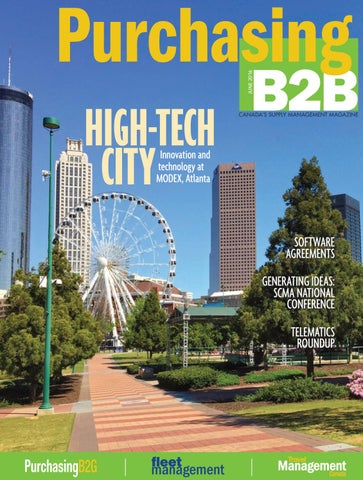
HIGH-TECH CITY
CANADA’S SUPPLY MANAGEMENT MAGAZINE
Innovation and technology at MODEX, Atlanta
SOFTWARE AGREEMENTS GENERATING IDEAS: SCMA NATIONAL CONFERENCE TELEMATICS ROUNDUP
PB2B Jun2016_issue_AMSbeigespread.indd 1
2016-05-30 3:20 PM
All the business technology you need. Staying on top of the latest tech is
Ready to get started?
easy when you shop Staples Business Advantage™. We’re adding new products to our assortment every day.
We will take
50 off *
$
your first order.
*Minimum spend of $300 on the first order to qualify. Must be a new Staples Business Advantage customer. Other conditions apply.
PB2B_Staples_June.indd PB2B Jun2016_issue_AMSbeigespread.indd 1 2
54846_0516
Visit StaplesBusinessAdvantage.ca/new
2016-05-18 11:49 2016-05-30 12:12 AM PM
Table of Contents
Vol. 58, No. 3 • JUNE 2016
Features
13
8 LOST CLAUSES The complex world of software procurement. 13 GENERATING NEW IDEAS Share the wonder at the SCMA National Conference. 15 SHIFTING LANDSCAPE IT procurement at the CAMSC Diversity Procurement Fair. 16 TECHNOLOGY 2016 Trends and innovations from the MODEX show in Atlanta.
Also inside 4 UP FRONT
7 IN THE FIELD
5 BUSINESS FRONT
10 PUBLIC PROCUREMENT
6 FINANCE CORNER
38 THE LAW
14
16
24
21
Cover photo: Dorothy Jakovina
We encourage you to visit us online to stay in touch with what’s happening in your industry and to view enhanced articles.
Connect With Us Online .ca
PurchasingB2B.ca
@PurchasingB2B
Michael Power
Features DIVESTITURES AND SUPPLY CHAIN
8 12:12 PM
©ClaudioVentrella/Getty Images/Thinkstock
54846_0516
Why the volatile marketplace makes it tough for a newly divested company to succeed without the expertise of a 3PL.
EVALUATION SCORING: PART 2 Why you need to develop proper variance calculations like standard deviations for averages. www.PurchasingB2B.ca/features
ISM2016 CONFERENCE Highlights from the Institute of Supply Management Conference in Indianapolis, IN, May 15-18. www.PurchasingB2B.ca/features
PurchasingB2B Weekly eNewsletter Sign up today for regular industry news and insights. www.PurchasingB2B.ca/e-newsletter-subscription PurchasingB2B.ca | June 2016 | 3
PB2B Jun2016_issue_AMSbeigespread.indd 3
2016-05-30 11:49 AM
Up Front 80 VALLEYBROOK DRIVE TORONTO, ONTARIO M3B 2S9
www.PurchasingB2B.ca
The State Of Technology
PUBLISHER/ADVERTISING SALES
Dorothy Jakovina 416-510-6899, djakovina@PurchasingB2B.ca EDITOR
Michael Power 416-442-5600 ext 3259, mpower@PurchasingB2B.ca ART DIRECTOR
Andrea M. Smith
ACCOUNT COORDINATOR
A
cross history, technology has never moved so quickly, nor has it affected so many across the globe at once. Picture a person being told, even a few generations ago, that science was working on a chip that could be implanted into people to monitor enzymes in their blood. These (at the moment theoretical) chips would detect changes in those enzymes that predict hear attacks. The chip could then send a message notifying an ambulance to attend that person’s house. Health crisis averted. It sounds like science fiction, and at the moment it is. But Jahan Ali, CEO of mobileLIVE, mentioned during the CAMSC Diversity Procurement Fair in April that companies are looking into the possibility of such technology. Another practitioner I spoke with recently told me that technology is changing so fast that the human brain is incapable of keeping up with those changes. She likened it to the industrial revolution in terms of it breadth and impact. In our attempt to keep up, the focus in this issue is technology, with a look at how advances are shaping procurement and the supply chain. On page 15, you can read about an education session at the recent CAMSC Diversity Procurement Fair, during which panelists—including Ali—talked about supplier opportunities in IT and described some major technology trends affecting business today. There’s also a five-page feature (see page 16) highlighting many of the technology advancements and products from the recent MODEX 2016 show in Atlanta, GA. Our Fleet Management section also features an article starting on page 28 on telematics, which describes some of the technology advances in that area as well. These days, professionals in all fields would do well to keep abreast of technology, along with what’s coming in the future, and procurement is no exception. In business as in our personal lives, technology will be even more of a driving force going forward. Developments in 3D printing, artificial intelligence, the Internet of Things, autonomous vehicles and other areas will present no shortage of changes and opportunities. The promise of technology—not only for procurement professionals but for everyone—is to make our lives easier, simplier and more efficient. Less time spent on tactical tasks means more time freed up to focus on strategic endeavours. This shift, in turn, can aid in elevating the profession to a more strategic position within companies. Technology can also help to give the procurement function a more global role, connecting professionals with suppliers and partners around the world. Hopefully, this issue of PurchasingB2B can help shed at least some light on the technology currents shaping the industry today.
Tracey Hanson 416-510-6762, thanson@annexbizmedia.com CIRCULATION MANAGER
Barbara Adelt 416-442-5600 x 3546, badelt@PurchasingB2B.ca ANNEX PRINTING & PUBLISHING INC.
VICE-PRESIDENT: T im Dimopoulos (416)510-5100, tdimopoulos@annexweb.com PRESIDENT & CEO: Mike Fredericks, mfredericks@annexweb.com For over 58 years, PurchasingB2B has been a trusted source of information for Canadian purchasing/supply chain management professionals in the private and public sectors. Special features and supplements include Fleet Management, Canadian Automotive Review (CAR), PurchasingB2G, and Travel Management Canada. PurchasingB2B is published six times a year, except for occasional combined, expanded or premium issues which count as two subscription issues, by Annex Business Media. © Contents of this publication are protected and may not be reproduced, in whole or in part, without the written consent of the publisher or editor. NOTICE: PurchasingB2B accepts no responsibility or liability for claims made for any product or service reported or advertised in this issue. PurchasingB2B receives unsolicited materials including letters to the editor, press releases, promotional items and images from time to time.PurchasingB2B, its affiliates and assignees may use, reproduce, publish, re-publish, distribute, store and archive such unsolicited submissions in whole or in part in any form or medium whatsoever, without compensation of any sort. SUBSCRIPTION SERVICES: To subscribe, renew your subscription, or to change your address or information, contact us at 416-510-5713 or 1-866-543-7888, ext 3258, apotal@annexnewcom.ca, or visit us at www.PurchasingB2B.ca. Subscription price per year: $99.95 CDN; Outside Canada per year: $172.95 US; Single issue Canada: $18 CDN. Annual Supply Chain Survey issue, Canada: $45; Outside Canada: $70 US. Taxes extra. From time to time we make our subscription list available to select companies and organizations whose product or service may interest you. If you do not wish your contact information to be made available, please contact us via one of the following methods: Phone: 1-800-668-2374, Fax: 416-442-2200 Mail to: Privacy Officer, 80 Valleybrook Drive, Toronto, ON M3B 2S9 Printed in Canada. ISSN: 1497-1569 (print); 1929-6479 (digital) Publications Mail Agreement No. 40065710 We acknowledge the [financial] support of the Government of Canada
4 | June 2016 | PurchasingB2B.ca
PB2B Jun2016_issue_AMSbeigespread.indd 4
2016-05-30 11:49 AM
Business Front
An Adult Conversation Tallying the true economic value of the Alberta Oil Sands
Toronto-based Michael Hlinka provides business commentary to CBC Radio One and a column syndicated across the CBC network.
By Michael Hlinka
A
quote from George Orwell came back to me in the wake of the devastation from the Fort McMurray wildfires: “So much of left-wing thought is a kind of playing with fire by people who don’t even know that fire is hot.” In some ways the metaphor is unfortunate. I don’t want to in any way, shape or form either trivialize the suffering there or appear annoyingly clever. Rather, the reason why these words resonated was because of a report that was released by the Royal Bank at the very front end of the disaster. First, a bit of context—maximum oil sands production is approximately 2.3 million barrels per day. The fires slashed output by one million barrels, or
It calls for a transformation to “a country powered by renewable energy” with the transition “designed to systematically eliminate racial and gender inequality.” There are stirring calls to pass legislation that would make it impossible for oil companies to operate profitably in Canada which means they would take their machinery and head to—literally and figuratively— greener pastures. A few years ago, I was asked to appear as a cast member in a work of Performance Art entitled The Trial of David Suzuki. The show’s premise was that David Suzuki had accused the Canadian government of various energy related crimes and as a result he was charged with treason. But the “trial” was really about energy policy in this country, and the audience of approximately 300, overwhelmingly voted for acquittal, which really meant (remember, this was performance art) that Alberta’s Oil Sands should be shuttered immediately. I return to the Royal Bank estimates. If production from Fort McMurray alone “If production from Fort McMurray halted would be halted for two weeks, this would shave one-half of 1 percent off the entire for two weeks, this would shave one-half of Canadian economy. The good economic one percent off the entire Canadian economy.” news here is that the Royal Bank believes that after those two weeks are over, there about 44 percent. If this continues for just two weeks, would be a surge in production and we’d be able to more-or-less make Canada’s—not Alberta’s—Canada’s GDP growth for that back in the remaining seven months of 2016, so that when we tallied May will be brought down by one-half of one perthe ledgers at the end of 2016, it would be—at least in a macro-economic cent. I was astonished. Canada is a large country. sense—as if those wildfires had never happened. Only about 60,000 people live in Fort McMurray. the leap manifesto cites a study suggesting that within 20 years, Canada We’re talking about less than two-tenths of one percould get 100 percent of its electricity from renewable resources. This is cent of the entire country’s population. Yet this much nonsense. Canada could get 100 percent of its electricity from renewvalue is created by so few. able resources in five years, if it really had to. It could happen if there And it’s important to keep the one-half of one perwas the type of consensus that, for example, was forged around World cent estimate in context. The Royal Bank is assuming War II when about seven percent of the population served in the milithat after two weeks, it would be back to business as tary. If 2.3 million young and able-bodied men and women were trained usual in Fort McMurray. People who had fled would in industrial production, we could surely make enough wind turbines and return and rebuild the community. They would go back manufacture and install enough solar panels to provide for this country’s to work in the oil fields and all the industries that support economic needs. that production. Because we can all agree that if not for And in the process, rip the heart out of this country’s standard of livthat Black Gold, Fort McMurray would not exist. And ing and quality of life. We have a very good thing going in Canada. The a segment of the Canadian body politic would seem to only reason that we could show the humanity and generosity we did be more than happy if this were the case. with Syrian refugees is because we can afford to. Oil sands production, On April 19, the NDP released a document called as this recent episode indicates, is integral to our wealth. So before we the leap manifesto (note: The words were not capitalthink about shutting it down too quickly, let’s have an adult conversaized…this is how “outside-the-box” thinking this doction and give crayons and pacifiers to the 40,000 or so who have signed ument is!). the leap manifesto begins by asserting, and thE leaP manifestO. here I quote in full context: “And Canada’s record on I’m so forward thinking, that I capitalize the last letter in each senclimate change is a crime against humanity’s future.” tence. B2B PurchasingB2B.ca | June 2016 | 5
PB2B Jun2016_issue_AMSbeigespread.indd 5
2016-05-30 11:49 AM
Finance Corner
The World Of Finance
Helen Tueffel is senior vice-president of APEX Analytix
Building a better cash flow through global financial supply chains By Helen Tueffel
I
t’s time to take a closer look at how you operate your global financial supply chain. Often through a combination of imperfect procure-to-pay (P2P) practices and the complications of global deployment through a financial shared services model, money is lost. Fraud and error are resulting in lost profits. Cash discount management is under utilized. And working capital is no longer working quite so hard on your behalf. Let’s change that.
Challenges of going global Another layer of complexity is how the global financial supply chain plays in. In addition to the normal complexities of managing procurement orders and invoices, you throw in curveballs that may include multiple currencies, different duplicated vendor bases and varied regulatory environments that govern how financial P2P process happens, from the way transactions occur to how POs are issued to the payment process itself. Companies in Asia and Latin America, for example, often rely more heavily on paper versus electronic invoices and payments. The point is, even though it’s a plus that businesses are growing globally and that there is some consistency in how global financial P2P takes place, there are still many points where fraud and error are creating lost profit. AP managers need to evaluate how an organization operates globally to see where it may be exposed in terms of errors and overpayments. Is your ven-
More than one supply chain When referring to supply chains, most people’s minds turn to manufacturing. Perhaps it’s an automotive company acquiring the parts necessary to send to the assembly line, or a company creating a finished good for its customers, such as transforming crude oil to petroleum. Regardless, at its core, a supply chain brings together a system of resources (people, departments, et cetera) to move a product from a supplier to the end consumer. What might be involved in this process? Common sense tells us that a company looks to procure goods of the appropriate quality, delivered in the most efficient manner and suitable for the finished product, all at the right price. A financial supply chain mirrors this process. Only, instead of a part or service that’s being ordered, tracked and evaluated, the company is tracking and evaluating purchase orders “If terms aren’t clearly laid out, opportunities or invoices that are based on contracts (that are, in turn, based on negotiations) for cash management capture at a later point with suppliers as they move through the are diminished.” financial supply chain toward payment. dor master clean and scrubbed continuously? Do you Like the traditional supply chain, AP departments want to process these receive daily alerts for changes in existing vendor stainvoices at the right price, in a timely and efficient manner. tus? Does your system alert you when the opportuManaging cash and working capital throughout this process is, ideally, nity arises for dynamic discounting or, even better, a seamless process. Unfortunately, there are certain points in the financan your suppliers initiate a request for early payment cial P2P process that too often serve as the weak points where money leaks from you in return for price reductions? out. Let’s look at the big buckets in the global financial supply chain and Your goal is to optimize your global financial supply wherein lie the opportunities to shore up weaknesses. chain to ensure you’re not leaking profits from the P2P SOURCE: From a global supply chain standpoint, sourcing involves process and that you’re properly taking advantage of contract terms capture, such as defining 2/10 net 30 terms or defining cash management strategies around the world. The opportunities for early payment discounts. If terms aren’t clearly laid out, best way to do this is with full insight into your curopportunities for cash management capture at a later point are diminished. rent processes, contracts and financial commitments, BUY: Here, we see everything from vendor vetting and setup to ongoing as well as an end-to-end audit of software, processes supplier data management, deal capture, report processing and invoice and cash management strategies. pre-processing, and invoice verification/approval. Millions are lost daily Returning to our example, if a car part fails to ship to companies due to vendor master lists that contain duplicate or frauduto the assembly line, it causes a supply chain disruplent vendors, as well as non-real time audits and reports that fail to capture tion where time and money is lost when spent trying fraud and errors as they occur. to recover the part. Similarly, if there is a disruption in PAY: During the pay process, buyers can present early payment offers the process of finding, confirming and paying invoices, for discounts, check for duplicate payments and do continuous monitoring efficiency and money is lost—as is the opportunity to for fraud, as well as perform contract compliance reviews. Neglecting any keep money in-house, working for you. B2B of these opens the door for overpayments, errors and fraudulent activity. 6 | June 2016 | PurchasingB2B.ca
PB2B Jun2016_issue_AMSbeigespread.indd 6
2016-05-30 11:49 AM
In the Field
How To Manage Change Applying change management principles to supply chain management
Patrick Etokudo is senior director, supply chain management at Enbridge
By Patrick Etokudo
I
rrespective of structure or name, the supply chain management (SCM) function must be dynamic to satisfy business needs. Whether the change is evolutionary or transformational, the profession can benefit from the skills of change management. Organizations are in a web of relationships, with competition, customers, suppliers and so on, and in this networked environment, supply chains are relying on and competing with each other. Businesses rely on their supply chains to fulfill their mission and deliver customer value. This extended enterprise is often the difference between a good business and a great one. A successful SCM function is recognized by its management approaches and measures of success. It pursues effectiveness before efficiency, helping its organization identify needs, manages risks by taking a long-term view of requirements and fashions sourcing approaches to reflect the market. SCM must manage supplier relationships to sustain value and facilitate innovation. For many, recognizing this and doing something about it remains a challenge. Organizations and people seek to maintain status quo. Phrases like “we have succeeded so far, why change?” and “I have been here many years and we have always done it this way” are indicative. Similarly, everyone believes that they can perform SCM duties. Changing behaviors is not easy. However, changing to a strategic function requires different skills and competences. Often, these are lacking in established organizations where depth in SCM bench strength is lacking and there is need to invest in people, acquire additional expertise and rotate employees to more fitting roles. This is not trailblazing—other functions have gone through this. The key is adopt CM practices, as most people are reasonable and will change if the case is well made. Here are some proven CM practices. Set a shared vision A successful transition to strategic SCM will be a vision’s outcome. This is a critical first step, and it’s your responsibility to create the imperative of the change and your accountability to articulate it in a manner that captures stakeholder imagination. Change that is envisioned and designed without stake-
holder buy-in has a limited chance of success or sustenance. Make the case for the change, have people buy into it and allow your vision to evolve on the basis of new information. Take quick additive decisions and actions to solidify the change by creating momentum and a sense of inevitability. Align goals to strategic direction Leading a SCM transition with goals at odds with the organization’s strategic direction is a losing proposition. Neither your commitment nor the organizational levers you pull can sustain it. Change that does not align with the strategic direction gets people confused, leading to resistance and turnover. Create co-ownership When change is introduced, people want to understand what’s changing, how it’s different, how long it will last and how it benefits them. The answers provide direction and practicality to people and convert your vision into actionable expectations. Make stakeholders share in the ownership of your vision and the roadmap to the destination. Go out and sell, but more important, listen and be seen to listen. Adjust your vision or roadmap to reflect insightful feedback and do not be shy to engage. Leverage champions It is a natural instinct for people to maintain the status quo and so are likely to resist change. However, there will be those who believe in the vision, are early adopters or are dissatisfied with the struggles of getting things done. Find them, cultivate their support, recruit them and leverage their influence. They will be your champions in circles beyond your reach. Engage broadly Professor Adel Aladwani’s 2001 work found resistance to change or innovation comes from habits or perception of risks. The perceived risks of SCM change arise from fear of: loss of control, prestige, job security, pay increases and discretion. Recognizing and alleviating these concerns improves the chances of success. Identify, segment and target stakeholders appropriately as a defense against resistance. Support from the top level of management is crucial. Engage with them, share your vision, answer their questions and address their concerns. Sometimes, you have to give in to make progress. Measure, share and correct course Finally, what’s not measured can’t be managed. Identify milestones, KPI’s and targets of your change. Measure and track them regularly and communicate progress. When things don’t go as planned, admit it, find out why and take steps to right things. This is the “check-and-act” part of the plan-docheck-act cycle. Design and implement a suitable scorecard that measures effectiveness and efficiency, and reflects not just the function’s performance but progress on the change initiative. B2B PurchasingB2B.ca | June 2016 | 7
PB2B Jun2016_issue_AMSbeigespread.indd 7
2016-05-30 11:49 AM
By Phil Downe
Clauses What to look for in IT agreements
I
loathe the banality of “the devil is in the detail”, but you can’t discount its wisdom when it comes to IT agreements. Let me tell you a true story about what happened during a software deal as a result of a divestiture. The original agreement provided for a divestiture re-assignment to another party with the vendor’s written permission, which permission would not be unreasonably withheld. I’m facing the vendor’s vice-president of sales and with a straight face he states; I’m allowing the assignment, I’m giving written permission but I never said there wouldn’t be a transfer fee and proceeded to demand a $900,000 fee. Ever since that blatant cash-grab I’ve asked vendors to include the words, “at no additional cost” in a number of areas where it may appear redundant, but I’d rather be overly cautious than face that situation again. That got me thinking about several areas within technology agreements, (terms, SOWs, SLAs, et cetera) where ambiguity could create issues that can easily be avoided. While discussing similar experiences with associates in the software procurement industry, the group came to refer to these wishful additional terms as the “lost clauses.” The Ethical Wall Software procurement can be quite complex these days. There always seems to be a core product representing the “easy sell” then the add-on enhanced licenses, modules, premier support and so on, which tend to run up costs significantly, especially with professional services, which are required to configure, customize, develop interfaces for, and test the code prior to production. Most procurement professionals will try and steer away from an open-ended time and materials professional services agreement in favor of a fixed-price arrangement. This obviously introduces a degree of financial risk for the vendor and a safety buffer gets built into the price to cover minor overruns and delays. Anything that might cut into the vendor’s profit margins will incur a change request and each of those will increase the
Scalable support Vendors hate giving customers this future flexibility. Support revenue gross margins are reportedly in the 85-to-90-percent range. Some vendors go to great lengths to lock you in to the highest cost support agreements and make it incredibly difficult to cancel or suspend support for portions of the software that are no longer in use. A couple of well known vendor tactics are: if you attempt to cancel support for any software product on a single order (presumably purchased at a discount) then the support charges for every other product on the discounted order goes up to the latest full list price; and if you purchase premium support on one licensed product then you must have the same level of support on all licensed products. I would like to think a client might feel more comfortable or require premium support initially, but should have the right to downgrade it to a basic support package in the future. That might be a difficult concession to get from a vendor when you’re already captive, or well into the deal but if you ask for that flexibility in a competitive RFP the vendor will hardly risk losing the business with a refusal. Parking Licenses In the first example above the cancelled support might also compel the client to give up the rights to the licensed product, but what if we find ourselves in a bit of a financial contraction and just want to suspend the use of the licenses for a short period? The concept of “parking” has been around for a while for fully paid, perpetual licenses. Parking gives you the right to shelve the unused portion of high-volume licenses or unused modules so you can reduce annual support charges on the unused, pro rated portion. Negotiated terms can govern the process to re-instate the licenses, if needed at a later date. Any reactivation fee should be considerably less than the basic annual support charge as the vendor expended no effort in bug fixes or helpdesk support while the license was parked. Back to on-prem In the case of cloud-based monthly subscriptions retrofitting on-prem might apply if the alternative exists. What choice will you have in the future if the new version of subscription Product or interface is undesirable, or your new monthly sub-
©alexaldo/Getty Images/Thinkstock
LOST
fixed-fee implementation costs. One way for the purchaser to reduce risk is to create a “wall,” an idea borrowed from the financial industry to ensure ethical trading by separating market makers from stock traders. It could also be useful as an in-scope/out-of-scope listing to increase clarity within a technology deal. One schedule, Schedule A of a proposed software licensing and implementation agreement, could list everything that is in-scope and at no additional charge, (interfaces, reports, training materials, et cetera). A second, Schedule B would list everything that is out-of-scope and must be vetted by the vendor for accuracy. The caveat is if it’s not listed on Schedule B, then it’s automatically assumed to be included on Schedule A, at no additional cost.
8 | June 2016 | PurchasingB2B.ca
PB2B Jun2016_issue_AMSbeigespread.indd 8
2016-05-30 11:49 AM
scription charges are going up significantly? If you’re dealing with a sole-source vendor and in many cases you will be, then your vendor will likely not discount any alternative, on-premises solution if they want to keep you buying subscriptions. Consider keeping your options open. If you’re going from on-prem to cloud don’t forfeit your rights to the on-prem version, park the licenses instead. Future terms Prohibit retroactive changes to T & C’s. When a software vendor updates its T & C’s (usually on a website you will never visit) the changes are typically to lower their risk and increase revenue and are always for the benefit of the vendor, not the customer. If you’re in negotiations and both parties agree to the T & C’s it would be best to ensure that the vendor cannot unilaterally change those T’s & C’s without your consent. One example comes to mind where a vendor initially required a user license for every employee who used the product. Eventually they changed that wording to read every employee who could use the product. Several years into the deal the client needed another 100 Time & Labor licenses and were shocked to find that they actually needed another 900 licenses to comply with new vendor terms. Software audits I’m certain by now you have thought of many other lost clauses
that could have been added to this article, but space is limited so please let me conclude this by touching on one last issue that seems more relevant than ever. Vendors are auditing customers relentlessly. Whether the vendor calls it a SAM engagement or a compliance audit you should assume the only purpose is increased revenue generation. I’d pay special attention to the initial agreement terms and the vendor’s rights to verify the products in use, especially when it comes to providing access to your systems. If they can see the target product, then they can probably see every other vendor’s product as well and that can’t be good. A non-disclosure agreement (NDA) is a must. It should limit the vendor’s authority; they can coach and provide input to the scripts to be run but not have direct system access. The NDA should limit the data collection to the specific product in question and it should also have a definitive completion date. These audits will drag on forever, especially if the customer is compliant and the vendor isn’t finding any low-hanging fruit. B2B Phil Downe is an IT negotiations contractor and president of Relations Management Group Inc. based in Toronto. He can be reached at 416-920-2228 or Phil.Downe@ITnegotiations.com.
π SHIPPING SUPPLY SPECIALISTS
• Over 31,000 Products IN STOCK • Order by 6 PM for SAME DAY SHIPPING • 11 North American Locations Mean FREIGHT SAVINGS and FAST DELIVERY • Pricing in CANADIAN DOLLARS • NEW! FRENCH WEBSITE – fr.uline.ca
OVER 1,400 BOX SIZES IN STOCK
COMPLETE CATALOG
1-800-295-5510 uline.ca
PB2B_Uline_june.indd 1
PB2B Jun2016_issue_AMSbeigespread.indd 9
PurchasingB2B.ca | June 11:48 2016 AM | 9 2016-05-20
2016-05-30 11:49 AM
PUBLIC PROCUREMENT
Does Average And A Half Exist? Evaluation scoring transformation: part 1
I
n public institutions, procurement professionals have constructed tendering programs to ensure the fairness and transparency of procurements and their compliance to legislative requirements and case law. They guide stakeholders through developing specifications that are not biased towards a single supplier for the product or service they are seeking. They ensure the integrity of those involved with the procurement by validating their confidentiality and conflicts. Lastly, effort goes to scrutinizing the evaluation process with stakeholders to ensure the award’s defensibility. The typical evaluation approach proportions the scoring based on a number of criteria. Table 1 illustrates a typical scoring breakdown applied in procurement projects where the award decision will be based on five criteria: specifications; performance; warranty; references and pricing. These criteria are weighted differently to emphasize the importance each plays in determining the outcome the buying organization is seeking. What anchors the criteria is a scoring assessment that applies an objective approach to how well a respondent meets the evaluation criteria. Great care is taken to guide evaluators by providing them a scoring scale that ensures consistency in the evaluation. Often, the scoring scale is given a descriptive range of categories from “nonresponsive” at one end to “exceptional” at the other (Table 2). To ensure an accurate assessment of the responses, integers are often assigned to the categories to augment the scoring scale. This tendering overview probably sounds fairly familiar. It is a methodology that is used not only in public procurement but also in most tendering projects, globally. Why would a universally
accepted best practise for tendering be subject to review? What could be wrong with such a tried-and-true methodology? The answer is that it’s not the process that needs reviewing; it’s the data collection. Ordinal versus interval data The most fundamental component of the evaluation scoring design is the creation of the measurement scale. In the example above, the scoring scale was created by building a descriptive range of categories, for example “poor, average, above average” et cetera in Table 2. Technically (mathematically) the information that is collected from this type of measurement is called ordinal data. By definition, ordinal data is an ordering of responses where the “distance” between the responses is not measurable. Practically, we know that average is better than poor and that above average is better than average. Unfortunately, we can’t tell whether the difference between poor and average is the same as the difference between average and above average. The uncertainty of these differences means that averages cannot be calculated when you have ordinal data. Ordinal data can only provide interpretations of relative differences. To calculate averages, the scale has to have measureable intervals. Measurements with this kind of scale are called interval data. Perhaps a better description of the differences between ordinal and interval data is to imagine that three runners, Usain, Andrew and Ben, run a race—
By Eddy Jin
Table 1. Evaluation Criteria. CATEGORY Specifications Performance Warranty References Pricing
WEIGHTING 25% 25% 20% 10% 20%
Table 2. Scoring definitions. DESCRIPTION Exceptional Above Average
SCORE 5 4
Average (meets requirements)
3
Poor Inadequate Nonresponsive
2 1 0
and all that’s known is that Usain wins, Andrew is second and Ben is third. We know the order of how they finished but we don’t know whether Usain finished well ahead of Andrew, it was a photo finish or if Ben was way behind the top finishers. We know the relative differences between the runners but we don’t know the distance between the racers at the finish. Their placements of first, second and third are equivalent to the descriptive categories (poor, average, above average and so on) provided in Table 2—they are ordinal data. Imagine however, if we timed the runners and recorded that Usain’s time was 9.5 seconds, Andrew’s was 9.6 seconds and Ben’s time was 15 seconds. These
Figure 1. Continuous slider with selected score displayed.
10 | June 2016 | PurchasingB2B.ca | PURCHASING B2G
PB2B Jun2016_issue_AMSbeigespread.indd 10
2016-05-30 11:49 AM
member committees typically perform evaluations so averaging of scores is key in tendering events. Continuous scoring scale There is general agreement in the field of statistics that the inappropriate calculation of averages and standard deviations (see note at end of article for further discussions on standard deviations) with ordinal data is fairly common. Fortunately, there is a practical solution. To begin with, creating descriptive evaluation categories and
“What anchors the criteria is a scoring assessment that applies an objective approach to how well a respondent meets the evaluation criteria.” Integer augmentation error Evaluation scoring with ordinal scales break down in practise when integers are assigned to the descriptive scoring categories (e.g. average=3, in Table 2). By default, assigning integer values to ordinal data does not make it interval data. In practise, it is common for evaluators to calculate the average between ‘average (= 3)’ and ‘above average (= 4)’ from the information in Table 2 as 3.5 (i.e. [3+4/2]). In doing so, they’re stating that the average between ‘average’ and ‘above average’ is ‘average and a half’. Statisticians would claim that ‘average and a half’ does not exist, which in practical terms means you can’t calculate averages with ordinal data. In actual tendering projects, a supplier is awarded a contract because they are better than the other suppliers in many or all of the assessment categories. The challenge is to be able to quantify it by using an appropriate scoring system. As stated above, it’s incorrect to assume that assigning integers to ordinal data converts the scoring to interval data. In other words, calculating averages with the converted ordinal data should not be done. This is where a better scoring system is needed because averages are important. Multi-
their subsequent augmentation with integers should be avoided. Instead, use continuous scoring scales because they will generate interval data and as a result, enable the calculation of averages. A continuous scale is simply any measure where the intervals within the scale are fixed, defined and theoretically, measured in infinitely small units. Temperature and time are examples of continuous scales. A continuous scale can be created with a continuous line or slider bar (Figure 1.) Continuous scoring scales can be set up to measure from worst to best. Evaluators can determine their responses (scores) by moving a slider between the extremes and a value is selected along the scale that reflects their assessment score. The numerical range can be set to any value. The three most important components in creating a continuous scoring scale are: to assign the low/worst and high/best descriptive labels for the end points; create a numerical range between them; and allow the respondent to select a score within the end points. In Figure 1, the extremes scoring categories from the Table 2, “Nonresponsive” and “Excellent” illustrate how a continuous slider can be designed. A demo of such
a continuous slider bar can be found at: www.eddyjin.ca/slider. In summary, continuous scoring scales generate interval data and therefore averages can be calculated. Although the technical details of creating these continuous scales are beyond this article, it’s helpful to note that the intervals should allow for real numbers (e.g. decimal values) as this level of precision often reflects what is required in practise. A random survey of bid opportunities from major tendering sites suggests that many organizations have applied some form of integer augmentation to their scoring categories. Although the process yields practical results that reflect the true outcome of the evaluations, it’s not the most prudent approach as it presents a possible risk if the evaluation methodology is scrutinized. Implementing continuous scales to the bidding process can add both numerical rigor and scoring simplification to the evaluation process. Great strides have been made in the past decade to create a more defensible procurement process by development of f lexible tendering terms and formats. Organizations have allocated efforts to build better contracting documents and processes to serve the purpose. It seems appropriate to compliment the contractual evolution in procurement with a more rigorous scoring methodology. This will only enhance the defensibility of tendering projects, as suppliers are owed the fairness, transparency and rigor in all components of the tendering process. B2B
PUBLIC PROCUREMENT
measurements provide interval data. Interval data offers clarity of the exact differences between each interval or unit in the scale. With the interval data, we know that Usain and Andrew finished first and second but we also know they had a close race (only 0.1 seconds between them). Ben came in third but he lagged way behind the two leaders, finishing 5.4 seconds behind Andrew. In addition, we also know the average time of the race for all three runners is 11.4 seconds (i.e. [9.5+9.6+15]/3).
See Purchasingb2b.ca/features/ for Evaluation Scoring Transformation: Part 2 to understand why you also need to develop proper variance calculations like standard deviations for averages. Eddy Jin is a principal consultant at Eddy Jin & Associates.
PURCHASING B2G | PurchasingB2B.ca | June 2016 | 11
PB2B Jun2016_issue_AMSbeigespread.indd 11
2016-05-30 11:49 AM
19th Annual SCMAO Conference
DRIVING VALUE CREATION IN SUPPLY CHAIN October 21, 2016 The Westin Prince Toronto
SPEAKER Nicole Verkindt Founder, OMX “Dragon”, Next Gen Den
Join us for Ontario’s premier event for supply chain professionals! Driving Value Creation in Supply Chain brings you a full day of quality education, networking, and the most up-to-date information on industry trends and best practices. WHY ATTEND? • Learn from the leading professionals in supply chain management • Network with over 400 of your industry peers • Discover how the latest research, innovation and technology can
help you and your company achieve success Register for the SCMAO Conference, and let us know at events@scmao.ca where you saw our ad to receive a FREE webinar! Offer ends July 29th. Restrictions may apply.
Visit www.scma.com/on today!
PB2B_SCMAO_June.indd PB2B Jun2016_issue_AMSbeigespread.indd 1 12
2016-05-24 11:49 2016-05-30 11:42 AM
4 11:42 AM
Generating New Ideas The SCMA National Conference provides education sessions, keynote speakers and networking opportunities for attendees
L
By PurchasingB2B Staff
©m-kojot/Getty Images/iStockphoto
ooking to generate new ideas? The Supply Chain Management Association’s 2016 National Conference has what you need. This year’s event is in Niagara Falls, Ontario June 15-17 and begins with the Conference Kick-Off event at the Edgewaters at Victoria Place, June 16, 6pm-12am.
During a session called From Best Price to Best Practices: Evolving Procurement Needs for Managed Services on June 16 (11:05-12:05pm), attendees will learn some of the challenges, pitfalls and best practices of procuring managed services that deliver maximum client benefits. Alan Spence, national manager, managed document services sales and strategic alliances, RICOH Canada Inc, will lead the session. Keynote speakers Public procurement attendees may want to attend a session The conference features several education and keynote speakers. entitled Evolution of Public Procurement in Ontario on June Linda Edgecombe is the lunch keynote on June 16, 2pm-3pm. 16 (3:10-4:10-pm). This session explores the evolution of pubHer presentation, Holy Crap I’m Busy—Changing our Culture lic procurement policy and practice, led by professionals from from Chaos to Calm, offers a hands-on approach to re-energizing the Ontario Public Service (OPS). The session will chart the work and home life. The new norm of chaos and busy has made course that the OPS has taken to strengthen public procureus unproductive and unhappy, and Edgecombe ment. It will also discuss emerging themes reveals solutions to get us back on track. shaping the future of public procurement. SPONSOR SHOWCASE On June 17 (8:30-9:30am), Peter Hall, VP The education sessions continue on the final day JUNE 16 and chief economist with Export Development of the conference, with one looking at e-bidding 10:25-11:05am Canada, kicks off the day with his address, The practices. The session, called E-Bidding—A Sponsor showcase/ Economic Outlook: Is Growth It’s Own Worst 360-Degree Perspective, on June 17 (10:10refreshment break Enemy? Hall will present insights into global 11:40am) looks at the evolution of e-bidding, its 4:10-6:00pm Staples Advantage Wine uncertainty while discussing the economy, challenges and developments in the future of the & Cheese Reception movements in commodity prices and financial practice. From a bonding, municipal and conmarket turbulence. sulting perspective, the session’s leaders presJUNE, 17 The conference’s closing keynote on June 17 ent challenges tackled to date, as well as ways to 9:30-10:00am (2:15-3:15pm) is Ron Buist, marketing expert refine the process going forward. Sponsor showcase/ and inventor of Tim Hortons’ “Roll Up The A session from 12:10-1:10pm looks at how busirefreshment break Rim To Win.” Buist will share how Tim Hortons ness has become more complex and susceptible 11:40-12:10pm grew from a single doughnut shop to a multi-bilto disruption. The session, called Transforming Sponsor showcase/ refreshment break lion-dollar company. He’ll also discuss the 12 Your Supply Chain Into A Collaborative Global points to business success he used at Tim Hortons. Network, shows how technology can provide a KNOWLEDGE PODS picture of the physical and the financial supply JUNE 16 Education sessions chain that enables hundreds of inter-company 10:30-10:45am One session on June 16 (9:25-10:25am) entitled processes on a global scale, across trading comStaples Business Advantage Reverse Logistics: What’s Your Remarketing munities, to drive efficiency and agility. 10:50-11:00am Strategy, covers how maximizing value for MERX returned and excess merchandise can be Networking reception achieved by better understanding the secondary Unwind, network and meet new friends at the JUNE 17 market, reassessing liquidation options, avoidScotiabank Convention Centre Wine & Cheese 9:35-9:50am ISN ing channel conflict and building a scalable proreception, June 16, 4:10-6pm. There are no cess. Paul Busch, director, sales Canada, B-Stock scheduled events after the reception, providing 11:45-12:00pm Grand & Toy Solutions Inc., leads the session. a free evening to discover Niagara Falls. B2B PurchasingB2B.ca | June 2016 | 13
PB2B Jun2016_issue_AMSbeigespread.indd 13
2016-05-30 11:49 AM
A Focus On The Traveller CEO of HRS Tobias Ragge talks about the shifting landscape in corporate travel By Michael Power
A
Image courtesy of ACTE
lthough he holds the ti- the rise of a traveller-centric approach deciding the value of measuring travtle of CEO, Tobias Ragge to the business travel experience. eller satisfaction in hotel programs. stressed that he’s not That’s especially true for markets like She asked Ragge what recommendareally the boss. The North America and Western Europe, tions he could provide to overcome chief executive officer due to low unemployment rates, that challenge. Since corporations of HRS (Hotel Reservation Service) booming markets and the so-called compete for the best talent, Ragge resaid that entrepreneurial companies war for talent. It involves not only sponded, satisfaction among employtend to be centered on who the boss working to ensure traveller satisfac- ees needs to be top of mind for organiis—and for HRS that boss is the cus- tion, but also finding ways to measure zations. But when trying to measure tomer. That customer-centric ap- that satisfaction. Customer surveys their happiness with a travel program, proach has marked the company’s and reviews are a good way to start organizations must be clear regarding push away from a Germanic, Eurocen- doing so, he said, as well as monitoring what they’re measuring. When you tric organization towards becoming a whether travellers are adhering to talk about the product, what exactly global entity over the past 10 years their organizations’ travel policies. are you talking about? For example, of its 44-year history. is it the usability of the travel Ragge made the comments booking process, or someduring an interview conductthing else? “To make sure peoed with ACTE board member ple adhere to something you Georgie Farmer, group managhave built together is the key er, strategic sourcing, global driver,” he said. travel & meetings, global proRagge also addressed the curement group, Microsoft recent merger between StarCorporation, during the Assowood and Marriott, as well as ciation of Travel Executive’s its consequences on the corpo(ACTE) Global Conference in rate traveller. The first step in Dallas, Texas last April. analyzing the move is to look “I think this is true for the at the hotel industry’s market way we look at people who structure, he noted. Globally, want to join our team,” Rag25 percent of the inventory ge told the conference audicomes from chains. So the ence. “At the end of the day, merger means a huge consoliwe’re only as good as a com- CEO of HRS Tobias Ragge (right) speaks with Georgie Farmer of dation in that 25 percent, Ragpany as the sum of our peo- Microsoft during the ACTE Global Conference in Dallas last April. ge said, noting that the market ple. We’re looking for specific will likely see more consolidavalues from good people.” “Because the biggest challenge today tion. “Which means, if people just During the wide-ranging discus- in corporate travel…is leakage,” he fished in the ponds of the chains, then sion, Ragge noted that cost savings said. “This is where you see more and obviously they have to deal with supremained a key point of interest for more corporations putting KPIs to- pliers who will get more powerful,” he today’s corporate traveller. The push gether and trying to measure this.” noted. The merger also means that is towards a more holistic approach to travellers and the corporations they controlling those costs, he noted. The traveller’s experience work for must adopt different tactics in These days, organizations are consid- Farmer noted that “experience-cen- order to keep costs down. “Obviously ering all process costs involved in cor- tricity” has become a buzzword in the there will be huge impact on the porate travel—not just direct costs corporate travel world. But measuring topline, which means ADR will go up in but indirect as well. Also, Ragge noted that was a challenge for buyers, as was certain markets.” B2B 14 | June 2016 | PurchasingB2B.ca | TRAVEL MANAGEMENT CANADA
PB2B Jun2016_issue_AMSbeigespread.indd 14
2016-05-30 11:49 AM
Shifting Landscape Seminar at CAMSC Diversity Procurement Fair looks at trends and opportunities in IT By Michael Power
N
Photos: Shan Qiao
ote to suppliers in the IT field: “Organizations will take the time to help you succeed, find out to make the decisions,” he said. “You what your customers’ pain may be able to pitch yourself today points are, then offer them specific but the demand might come in a year solutions. And if you deliver on a paror two. You have to have patience.” ticular job, the message gets passed The size of the business or operaaround not only within the organization is irrelevant when searching for tion but also to potential clients outnew suppliers, Sankar said. In some side of the organization as well. instances, he has brought in one-perThat was some of the advice during son operations for specific partneran educational panel session at the ships. If the organization provides Diversity Procurement Fair 2016, innovation and the pitch is interesthosted by the Canadian Aboriginal ing, a partnership may be possible. Kiruba Sankar of RBC Financial Group (left) and & Minority Supplier Council, held A supplier should offer continuJahan Ali of mobileLIVE discussed IT trends during April 12-13 in Toronto. The event ous improvement in order to keep the CAMSC Diversity Procurement Fair. provides networking, learning and the partnership going, Sankar said. business building opportunities for global corporations and There is competition everywhere, he noted, and suppliers must Aboriginal and minority owned businesses. ask themselves constantly how they can improve a client’s expeThe session, entitled Trends & Opportunities in IT, fea- rience. “If we’re able to find another supplier who is investing tured Kuriba Sankar, director of IT consulting and profes- more than you, it’s difficult for you,” he said. “If you’re proactive sional services, RBC Financial Group and Jahan Ali, CEO of in finding solutions you’ll be a superstar.” mobileLIVE. Forood Malekzadeh, senior partner and CEO of Doing exceptional work and delivering results will earn a supVTRAC Consulting, moderated the session. plier a great reputation within an organization, Sankar noted. As At the conversation’s beginning, Ali discussed the trends well, that reputation will spread to other companies and organitowards digitization, or the application of technology across zations. Within banking IT, for instance, while buyers may be functions within an organization. He noted three drivers of this competitors, they still talk and a referral to another interested trend: a search for revenue or new revenue streams; as a way to buyer may be a phone call away, he said. “If you’ve done a good increase productivity and to make business operations more effi- job in one bank it’s likely it will spread to others,” he told the audicient; and as a way to improve the end-user experience. ence. “If you do a good job for a VP in one bank, go pitch the There are four areas that organizations are investing in: same to other VPs in other banks.” the Internet of Things; Big Data; artificial intelligence; and “Deliver, but exceed expectations. omni-channel delivery. These trends are connected, Ali noted, If you get a thank you without asking and all relate to improving the customer experience. The workforce is therefore changing and organizations are looking to hire then you’ve done your job.”— Jahan Ali millennials due to the different mindset they bring to the job. Sankar also saw shifts—brought by technology—in the way Ali agreed on many of the points offered by Sankar. He also businesses operate. Just as the video stores of past decades have recommended looking at what an organization’s pain points are given way to online streaming services, other fields like banking and presenting specific ways to solve those challenges. It can face shifts, he noted. The key, he said, was to move into where also pay for a supplier to start with small projects to show how the transformation lies while also keeping an eye on the cus- they can provide value, then build upon those successes. Ali also tomer and where their needs are. agreed that doing a great job is an excellent way to create future business. “Deliver, but exceed expectations,” he counseled. Advice to suppliers Companies aren’t small or big. It’s about being faster and better. Be specific regarding what you can do for organizations, advised Don’t think about your company as small, it’s all in your mind. Sankar. He suggested that suppliers not pitch too many services at It’s about what value you’re delivering.” once but to continue to follow up with potential clients. Dealing To conclude, business is changing because of the changes in with a large enterprise requires a long-term approach, he said. technology. From the comments of the panel participants, orgaRather than trying to sell something immediately, build relation- nizations and suppliers alike would do well to adjust to the new ships that may lead to doing business together in the future. normal that these advances bring. B2B PurchasingB2B.ca | June 2016 | 15
PB2B Jun2016_issue_AMSbeigespread.indd 15
2016-05-30 11:49 AM
Supply Chain
The MODEX show in Atlanta, April 4-7 offered a look at a huge array of technology available to organizations to address manufacturing and supply chain challenges. The show attracts 850 providers. PurchasingB2B attended the conference and provides the roundup below of just some of the solutions and technology innovations that were displayed during the event.
SOLUTIONS
By PurchasingB2B Staff
SELF-GUIDED WAREHOUSES Yale has partnered with Balyo, an automation and guidance company, to provide automation technology for lift trucks. The company uses its surface network to deal with the complexities associated with integration and systems computing that occur, says Mick McCormick, VP, warehouse solutions, Yale. That removes much of the anxiety from putting in automation. But because the technology automates conventional lift trucks, manual capabilities remain to deal with peak need times and other situations that arise, McCormick says. Drivers can simply get into a truck that’s been automated and use it as a normal truck—when the driver is finished, it is easy to switch it back to its automated function. “It’s becoming a self-driving world,” he says. “More and more, the trucks are being told where to go and then they have to find their way there. We think this is the beginning of a change that’s quite significant.” A trend McCormick notes is the increase in guided products, with Yale currently offering a pallet truck and tugger, or towing truck, with automated capabilities. www.yale.com
MOBILITY SOTI Mobicontrol is an enterprise mobility management (EMM) product designed to help organizations manage, secure and deploy mobility across an organization, according to SOTI’s COO, Ron Hassanwalia. The product is most often used after the purchase of computer software for mobile devices, he says. Often, during deployment, the software is put onto those devices, then they’re configured. “After that, when it’s deployed and you realize you have to iterate the configuration, make changes and update—those costs start rising,” Hassanwalia says. Mobicontrol provides a platform to lower those costs to a baseline, making the process easier to manage. With a scan of the barcode, the device can be configured with the right applications, security settings and configurations. It can then also be monitored and tracked. As well, SOTI MobiControl’s security features can help businesses to maintain control over who is using mobile devices and how they are using them. “Your investment is constantly being looked at,” Hassanwalia says. “We know the usage of devices. We know which devices are online or offline, when they’re online or offline, their quality of battery, and Ron Hassanwalia, SOTI their quality of signal status.” www.soti.net
All photos: Dorothy Jakovina
Mike McCormick, Yale
16 | June 2016 | PurchasingB2B.ca
PB2B Jun2016_issue_AMSbeigespread.indd 16
2016-05-30 11:49 AM
CLOUD SOLUTIONS
Skip Miller (left) and Jason Adlam, CHEP
All photos: Dorothy Jakovina
VALUE STREAM MAPPING
Voxware’s focus is providing advanced technology to the supply chain, says the company’s president and CEO, Keith Phillips. For example, the company offers a cloud solution for voice automation and the warehouse. The software replaces past warehouse practices that have been predominantly paper based, says Phillips. The company has focused recently on introducing predictive analytics into the marketplace, as supply chain becoming more of a focus for companies. That focus is because consumers no longer tolerate incorrect or late products, with retail the most affected. For example, the food service industry is under this sort of pressure, with younger customers insisting on fresh, healthy foods. These industries were keen to adopt voice picking technologies and are early adopters of voice and analytics technologies, Phillips says. To deal with these issues, Voxware offers their software as a cloud-based, subscription model on a per-month, peruser basis. The company is able to add functionality not offered within current systems without having to buy a new WMS. “It’s very palatable from a price perspective,” says Phillips. “Because of that we have customers that are as small as one warehouse with ten users and customers that are as large as 70 warehouses Keith Phillips, Voxware with 5,000 users.” www.voxware.com
CHEP is a provider of supply chain solutions serving the consumer goods, fresh food, beverage, manufacturing and retail sectors in more than 60 countries. The company offers a wide range of logistics and operational platforms and support services, some of which were on display at MODEX. And one of the company’s main messages at the show was that it’s more than just a pallet company. Rather, CHEP provides expertise across the entire supply chain, says Skip Miller, VP of customer service and solutions. Those solutions include within a manufacturing environment, where the company can identify opportunities to improve efficiencies, lower costs, look at packaging performance, unit load optimization HYDROGEN FUEL CELLS and so on. Or, CHEP looks at transportation activities Nuvera Fuel Cells designs and manufactures hydrogen fuel cell to determine where efficiencies might be. “When and generation solutions. At MODEX, the company displayed its we look at a customer’s supply chain and do a value PowerEdge Fuel Cell system that acts as a replacement for the stream map,” he says, “we typically find about 12 standard lead acid battery for lift trucks. The system produces different opportunities that will then lead into different emissions-free power output, said Jon Taylor, CEO of Nuvera who, solutions that we can bring in to help along with director of sales Alan Marder was on hand to answer them improve that portion of questions about the product. Refueling happens the value stream.” Within nine at locations around a facility—both outdoors or months, CHEP was able to indoors—allowing drivers to refuel in three minutes or help their customers save less. That way, lift truck operators are able to charge $13 million through their at any time during their workday. They don’t have to supply chains. Roughly wait until it’s 80 percent empty, and there’s no impact 16 million pounds of on the fuel cell battery. “Hydrogen is becoming an C02 was eliminated increasingly popular option,” notes Taylor. “It has through getting rid of the convenience and efficiency of an electric truck empty miles. Within the operation combined with the convenience of a last nine months, Miller fuel. That means the operation is able to free their notes, CHEP has seen 31 operators and their lift truck fleet and keep them more customers take part in productive and not lose the time that the traditional their solutions, 18 of those fleets have of going to the battery room discharge. It Alan Marder, Nuvera Fuel Cells are repeat customers. really increases the productivity of the facility.” solutions.chep.com www.nuvera.com
PurchasingB2B.ca | June 2016 | 17
PB2B Jun2016_issue_AMSbeigespread.indd 17
2016-05-30 3:21 PM
RUGGED TABLETS
Samuel Mueller, Scandit
ORDER MANAGEMENT Scandit’s CEO and co-founder, Samuel Mueller, says that his company is focused on unlocking the power of the mobile device through apps or dedicated deployments. For example, Scandit Order Entry is a rapidly deployable mobile solution for smartphones, tablets and wearables that’s designed to streamline order management processes for customers and employees alike. The crossplatform mobile solution comes with a customizable order entry application, mobile frameworks and backend services that integrate with existing IT systems. Customers and employees can manage orders by adding products through browsing, scanning a barcode or searching a catalogue—with or without network connectivity. Once orders are finalized, users submit orders directly from their mobile device and track order progress. Another of the company’s solutions, dubbed FieldTrac, is a field service app that tracks assets from a mobile device. The cross-platform mobile app enables employees to identify products and report quality assurance details quickly. Scandit’s solutions are available through a subscription model, says Mueller. “We can constantly update this solution over the air at any point,” he notes. “Your investment is safe, even over a longer period of time.” www.scandit.com
The X Tablet T8650 is the world’s first rugged tablet with an integrated 3D camera, according to its manufacturer, MobileDemand, which showcased the product at MODEX. The camera can get the length, width and height of an object and calculate the volume, says Derek Oja, the company’s marketing project manager. A transportation company can charge customers based on shipment volume within a truck rather than weight, which many are switching to. The tablet includes standard 4GB of RAM and 64 GB of storage backed by an Intel Atom X5-Z8550 processor and secure, enterpriseready Window OS. System expansion ports include multiple USB along with a single microHDMI, which come with covers to keep out water, dirt and dust. The device is IP65 sealed and meets mil Derek Oja, Mobile Demand specs for drops from five feet. “We’re seeing a lot of companies replacing traditional VMTs—the vehicle mounted terminals—and laptops with tablets so they can have it mounted in a forklift, they’d be able to hook up a barcode scanner, either blue tooth of USB to the tablet,” says Oja. “They could run their full windows-based software so they don’t have to do any type of custom software to fit this device.” www.RuggedTabletPC.com
LIFT TRUCKS Hyster-Yale Group unveiled the Hyster 50-XT at the show, a lift truck the company says was designed to operate in a variety of applications at a lower cost of acquisition and ownership. The new XT truck series will be offered in 4,000 and 6,000 pound models. The series incorporates design and component elements of the premium Hyster Fortis truck series, ensuring that the new trucks Mark Koffarnus, Hyster-Yale Group deliver dependability. The new truck will be available with a PSI 2.4L dual-fuel engine featuring Hyster variable power technology, which includes selectable performance modes that allow customers to maximize productivity or fuel economy to fit specific application requirements. The truck delivers power at low speeds with accurate and responsive traction and hydraulic controls, allowing operators to place loads quickly where intended. “We felt there was a gap,” says Mark Koffarnus, director of business development with Hyster-Yale. “We were selling a premium product in that marketplace for many years. We found that customers wanted more value than what that offered, especially in those medium duty cycles. So this product was designed from that perspective and absolutely delivers what those customers were looking for.” www.hyster-yale.com 18 | June 2016 | PurchasingB2B.ca
PB2B Jun2016_issue_AMSbeigespread.indd 18
2016-05-30 11:49 AM
PALLET WRAPPING Muller LCS introduced a solution for wrapping pallets with its new Raptor HPL high profile turntable stretch wrapper. The Raptor HPL features Muller’s branding tool, Logo Wrap. Logo Wrap—previously only available as an option for the Octopus line of ring stretch wrappers—promotes an organization’s brand on pallet loads, reduces products tampering, shields product visibility and can be applied anywhere on the load. Logo Wrap is also designed to minimize waste and labor from hand-applied stickers and labels. “This machine also comes with a roping feature,” says Neil Weisensel, brand and marketing director at Muller. “The benefit is that it secures the actual product to the pallet with an enhanced rope when you get near the bottom of the skid.” The heavy-duty, semi-automatic Neil Weisensel, Muller machine, which can wrap up to 35 loads per hour, has an elevated turntable platform, intuitive controls and an easy-to-use interface. As well, the patented strain gauge technology allows for electronic film feed and optimized handling on pallet load corners. The turntable also contains a lubrication-free power pre-stretch carriage with variable pre-stretch levels from 100 to 300 percent, guaranteeing users optimal film usage while preventing film breaks and product damage. www.mullerlcs.com
CMMS SOLUTION
David McNeill, Hyster-Yale Group
LITHIUM ION BATTERY In the past year, Hyster-Yale Group has launched a lithium ion battery in the company’s MPB 45BG, its 4,500-lb pedestrian walkie. The benefits of lithium ion batteries include that customers can keep the battery in a partial state of charge without damaging it, says David McNeill, the company’s manager of product strategy-warehouse products. That gives the batteries a “phenomenal shelf life,” he says. The battery can sit on the shelf for years, then be utilized like a new product. “We felt like an application where you have a walkie truck that has two to three hours of usage per day, a lithium ion battery is far superior than a lead acid battery” McNeill says. Applications where such a battery are especially useful include beverage delivery, retail delivery and the back of retail stores where an operator uses the truck for a few minutes at a time. The product also has an onboard charger, so during non-use it can be charged and ready the next time it’s needed. It takes about 2.5 hours from fully discharged to full charge, McNeill notes. www.hyster-yale.com
Intelligrated, an automated material handling solutions and software provider, showcased several solutions, among which was its computerized maintenance management software (CMMS) designed for material handling systems. Known as the Intelligrated Reliability Intelligence Solution (IRIS), the software comes with implementation support, OEM maintenance expertise and a deep pool of relevant, reliable data. IRIS collects and analyzes system data to help plan and execute a preventive lifecycle maintenance program. The software is able to create work orders and daily maintenance schedules, maintain accurate inventory of spare parts and automatically place orders for necessary replacements as well as improve budgeting, reporting and tracking of KPIs. According to Intelligrated, this can help facilitate regulatory compliance, improve lifecycle productivity and increase uptime with reduced overtime and paperwork. “We continue to have the very best aftermarket sales and support,” said Chris Cole, the company’s CEO. “We have very strong programs that allow customers—if you dial our 800 number—to get two things that happen. One, you get an engineer who talks to you who also can help you with your problem. And we promise that in two minutes or less—we average less than 15 seconds.” www.intelligrated.com
Chris Cole, Intelligrated
PurchasingB2B.ca | June 2016 | 19
PB2B Jun2016_issue_AMSbeigespread.indd 19
2016-05-30 11:49 AM
SOFTWARE AUTOMATION
Ken (left) and Stephen Beckerman, FLEXcon
CUSTOM TOTES
STEPLogic is a software development tool that automates development tasks, replacing them with configuration steps. The product provides the user with the tools to build decision tree navigation so users can enhance their current warehouse management system (WMS) to meet specific needs. The platform was designed to eliminate the “pain points” in WMS systems, says Bob Kennedy, the company’s senior vice-president of business development. Business environments change rapidly these days, and systems can struggle to keep pace. While large companies may have IT departments, those departments can lack the time to help address needed changes. “It’s the list of those pain points that their system doesn’t address that they have to live with— that’s where STEPLogic comes in,” Kennedy says. The platform has automated features and functions designed to make the process of developing software easier, quicker and less expensive, he notes. Organizations can also broaden the scope of employees who are able to evolve the software. That puts companies in a position where they are able to address those pain points. “They can take care of personalizing their packing screens, personalizing their RF processes to make themselves incrementally that much more efficient,” Kennedy says. www.dmlogicllc.com
Most companies can offer a limited number of styles and sizes of containers. But FLEXcon is different—and the company tailors both the size and style of its totes to suit the customer’s needs. “This is exactly what people need with no compromises,” Stephen Beckerman, the company’s president, says of the company’s offerings, which were on display at MODEX this year. “And it’s the same price as doing it standard.” For example, the company was able to custom-make handles for a client who said that no other offering provided comfortable tote handles, even while dealing with heavy weight. The client also had a bar code on every tote that identifies that tote. Each time there’s an order, the company puts a bar code label on. This leads to multiple labels. So FLEXcon made a removable bar code label. Those are just some examples of the specific challenges that FLEXcon is able to solve for its clients. “We don’t say ‘here are Bob Kennedy, STEPLogic our containers, buy it and make it fit your system,’” says Beckerman. “We say, ‘tells us about your system—what do you really PARCEL OPTIMIZATION need? We can do it.’” Experts in print, mail and parcel automation, Bell and Howell showed a number www.flexcontainer.com of innovations in the lifecycle of a parcel from purchase through to distribution to fulfillment at the last mile of delivery. The company creates high-performance systems used in larger distribution centres, says Mark Durrett, the company’s vice-president of marketing. The company’s “sweet spot,” Durrett notes, rests in facilities that, for example, process anywhere from 4,000 to 30,000 parcels a day. The e-commerce world is driving a shift in the industry, he said. The expectations of the consumer are rising as companies like Amazon offer same-day delivery. Some niche organizations are finding alternatives to same-day delivery that work very well. The company works to cut the cost, increase efficiency and drive the speed of the process so that customers can meet demand and expectations. Bell and Howell offers an automated packing system that’s capable of processing packages of variable sizes that come through a conveyor. “We wrap it with a box that ships zero air,” Durrett says. “That innovation drives efficiencies—it’s like a ten-fold improvement over Mark Durrett, Bell and Howell human packing systems. You’re not just saving on labour.” www.BellHowell.net 20 | June 2016 | PurchasingB2B.ca
PB2B Jun2016_issue_AMSbeigespread.indd 20
2016-05-30 11:49 AM
Whatever your business needs. We’ve got it. Every industry. Any size. Anytime.
2016_StaplesSupp_AMSplan#14.indd 1
In
This Issue President’s Message A Workplace Like Home Doing More With Less Technology’s Business Advantage Quinte West’s Lean Strategy Emergency Preparedness In Action Sustainability Product Showcase
page page page page page page page page
3 5 6 8 10 13 16 18
2016-05-20 9:24 AM
Original HP Ink | Original HP Toner
Proven reliability. Efficient performance. Exceptional quality.
Always use Original HP.
Visit your nearest Staples location or find us online at staplesbusinessadvantage.ca.
Š Copyright 2016 HP Development Company, L.P. The information contained herein is subject to change without notice.
2016_StaplesSupp_AMSplan#14.indd PB2BStaples_Hewlett_June.indd 1 2
2016-05-19 2016-05-20 10:17 9:24 AM AM
9 10:17 AM
President’s Message Michael Zahra, President, Staples Business Advantage Canada Welcome to the Staples Business Advantage Supplement! Although
Staples is a household name across the country, not all businesses understand the full extent of what we can do for them. The phrase “Business Advantage” in our new name will help Canadian businesses to look at us with fresh eyes, the way they would look at a new company for the first time. Years ago, we built our reputation as a supplier of traditional office products who focused on servicing the needs of organizations. Over time, we expanded that, often in response to customer requests, to include facility supplies, print solutions, furniture, technology products, safety products, medical supplies—essentially everything most businesses will ever need. Because of the way this unfolded, many customers see us as a traditional office supply vendor with a vastly expanded product range. Staples Business Advantage, however, goes a lot further than that. Essentially, we go beyond products and deliver something far more comprehensive. There are some great examples in this supplement. In one case, we are a key partner in our customer’s lean stocking strategy. In another, we are the key supplier in their emergency preparedness plan. This is not just a matter of moving boxes from our warehouse to their shipping receiving dock—it’s a lot more complicated than that. We have, for example, the flexibility to do just-in-time delivery, provide proprietary stock, and sometimes, incredibly complicated logistics where, for example, you might be shipping to an oilrig off the coast of Newfoundland. Staples Business Advantage is defined by the day-today experiences of each customer. Let’s consider what a purchasing manager in a mid-sized company might confront before she even arrives in her office. Let’s say she stops for a coffee on the way to work because she knows the coffee machine in the cafeteria wasn’t working yesterday. So she wonders, do we need a coffee program? Who
could do that for us? Then she gets a phone call, and notices a crackling noise in her wireless headset. Maybe time to replace it, not to mention the 100 she needs for all the fleet drivers. Who could provide these? Then she arrives in the parking lot, and notices the walkways are icy. Are they out of salt again, or do they need more shovels? Then, coming into the lobby, the floor is wet, but there are no safety signs. Maybe we need some sort of program to look after these things automatically. Staples Business Advantage is about taking all of these problems off the table by managing them proactively through a single partnership. There may be many product categories involved, but why should that be the customer’s problem? As I see it, it’s our job to bring all those together. Of course, we could never deliver on this promise without having great people. When we succeed, it’s because we gave our people what they needed to help our customers at every stage of their journey. Our success, therefore, depends on being able to hire and retain the best consultative sales and support people in the business. So an important part of our work has been making Staples Business Advantage an attractive career choice for new employees. Of course, we’re a growing company with a solid financial base, so that’s a great start. But the people we seek are looking for more than that. They ask us about our record in corporate social responsibility, the willingness of the company to accept new ideas, and our attitudes about diversity and inclusiveness. I’m very proud of the answers we can provide to these questions. We’re way ahead of the curve on the environment, we support community events across Canada, we promote people internally for senior positions, and we’ve built a culture that celebrates, rather than hides, religious and national diversity. All this means is that when our customers call, they connect with people who came to Staples for more than a job—they’re with us because they truly want to help. Staples Business Advantage Advertorial Feature
2016_StaplesSupp_AMSplan#14.indd 3
3
2016-05-20 9:24 AM
INFINITY
TM
Glass Dry-Erase Boards Sophisticated. Unique. Cutting Edge.
Quarterlyort Rep
Magnetic White
Magnetic Black
Magnetic Red
Where Quality and Function Meet QuartetŽ Infinity™ Glass Dry-Erase Boards provide a modern, aesthetic appearance for your office while providing long-term durability. The glass surface erases cleanly every time and will not stain or ghost. With a wide range of colours, sizes and features to choose from, these frameless glass boards are the right choice for any environment!
Magnetic
Frosted
Blue
Premium magnetic surface.* Dry-erase surface allows secure hanging of papers. *Excluding Frosted Glass Dry-Erase Boards
Mounts horizontal or vertical. Tray can be mounted and used in either orientation.
ACCO Brands Canada Inc. 7381 Bramalea Road Mississauga, ON L5S 1C4 CANADA P105_16
PB2BStaples_ACCO_June.indd 1 2016_StaplesSupp_AMSplan#14.indd 4
2016-05-06 9:24 2016-05-20 8:59 AM AM
06 8:59 AM
A Workplace Like Home
O
ffice furniture is one of those essentials that many people don’t give a lot of thought to. For a professional architect, however, chairs, workstations, cabinets, or conference tables are integral components of a design, and critical to achieving the kind of work environment that the customer requires. Respect for professional designers and their work is essential to the philosophy of the furniture team at Staples Business Advantage. That’s why Brenda Bjarnason, principal of Toronto-based architectural firm Bjarnason & Associates, turned to them for help with a challenging project; finding a furniture solution that met the unique needs of her client, Plan International Canada. Bjarnason knew that Staples Business Advantage had provided solid solutions in the demanding not-for-profit sector. She also knew that when it came to dealing with them, she would not be talking with an ordinary sales person, but a peer. Gino Citarella, her Furniture Account Representative at Staples Business Advantage is a trained architect. Plan International Canada is part of a global not-forprofit that helps lift children in the developing world out of poverty. Their objective was to create an open workspace where people of all ranks, from CEO to entry-level employee, could work side-by-side in an egalitarian environment. This meant finding a common workstation that could serve the needs of any employee in the organization. Size of work area, ergonomics, storage space, and the ability for employees to personalize their own work area were all factors that had to be weighed. All this had to be achieved within a limited space, and within the budget of a not-for-profit. Working as a team with Plan International Canada, Bjarnason and Citarella experimented with a variety of options. Citarella found the process demanding, but exciting from a professional standpoint. “Bjarnason’s really the genius behind the project, because she was able to visualize many alternatives in terms of design of the building, along with the furnishings,” says Citarella. “Being an architect as well, I was able to speak in the same language with Brenda. It was a very good dialogue.” A few months into the planning exercise, the project hit
a bump in the road. Plan International Canada realized that the existing facility wasn’t large enough to support future growth. While other suppliers might have been frustrated, Staples takes a long-term view of these relationships. “The exercise wasn’t wasted,” said Citarella. “It helped us to understand the expectations of the client, and to get to know them better.” Fortuitously, an ideal location soon became available for Plan International Canada’s new home, and the planning process began again based on the new space. And sure enough, patience paid off, and Citarella was able to combine his knowledge of architecture, furniture, and Plan International Canada’s needs to recommend a solution that Bjarnason described as “brilliant.” “We came up with a simple solution, taking into account that Plan International Canada is a non-profit organization,” says Citarella. “Basically, the station consists of a 24 X 32 work platform, and a tower that houses storage components. That way we were able to provide the exact same footprint for everyone.” The implementation went smoothly, and when it became time to grow, Plan International Canada called on Staples Business Advantage once again. “Last year, they decided to take over the second floor because they were projecting substantial growth,” says Citarella. “So we implemented another 180 workstations, along with meeting areas, a conference room, and training tables.” In the process, Staples brought in several specialty partners, which they are able to do through their well-developed relationships. According to Sandra Vyse, National Director of Furniture at Staples Business Advantage, Citarella represents what her organization is all about. “He’s an architect, he’s a people person, and he’s meticulous in detail. So he brings in a lot of value for our clients.” When it comes to value, however, Citarella is quick to cite his team members. “Our customers appreciate what we do,” he says, “and how we come up with solutions and the way we approach details. But all that depends on my designers and coordinators. So I’m part of a team. I try to orchestrate things, but there is a whole team behind me supporting Plan International Canada.” Staples Business Advantage Advertorial Feature
2016_StaplesSupp_AMSplan#14.indd 5
5
2016-05-20 9:24 AM
DOING MORE
WITH
I
LESS
n a charitable healthcare organization like St. Joseph’s Home Care, it’s critical that every dollar is stretched to the maximum so that patients get the best care the organization can deliver. For Ellen Silverglen, Manager of Operations and IT, this means not only procuring necessary goods and services at the best possible price, but also streamlining operations so that valuable employee hours aren’t tied up with price shopping, management of multiple vendor accounts, and other time-consuming procurement activities. Before Staples Business Advantage entered the picture, Silverglen had a series of vendors handling product areas such as furniture, office supplies, and medical supplies. The relationships were adequate by conventional standards—some of them had been in place for 10 years—but they were nothing special. The rep for St. Joseph’s office supply vendor, for example, would typically call Silverglen once or twice a year to stay in touch. Silverglen found Staples Business Advantage almost by accident. Searching the web one day for a table that could be used in conjunction with a hospital bed, she was surprised to find one on their website. “I didn’t realize they had that range of products,” says Silverglen. Silverglen soon discovered that Staples had a division dedicated to servicing business needs. When she contacted Staples Business Advantage, Business Development Manager Brent Prangley got back to her immediately with a competitive offering. After the order had been fulfilled, Prangley invited Silverglen to take a closer
6
look at them for their more traditional office product needs. “We had long relationship with our current supplier,” says Silverglen, “but we are a charitable organization, so we’re always looking for ways to save money and improve efficiencies. So I agreed to explore it.” Prangley asked for a small list of products that St. Joseph’s bought on a regular basis, and Silverglen soon learned that Staples Business Advantage had better pricing on every product on the list. “So I gave him a bigger list,” says Silverglen, “and he went through it—and I’d say for 98 percent of the items on the list, he was able to give us a better price. It was amazing.” When Silverglen opted to go with Staples Business Advantage, Prangley made the transition to a new vendor painless. “We have a number of different departments, and we have other sites other than our head office,” says Silverglen, “so he went through all of those details and set up accounts so that not only were shipping addresses appropriate for the different types of programs, but our billing code numbers were also
Staples Business Advantage Advertorial Feature
2016_StaplesSupp_AMSplan#14.indd 6
2016-05-20 9:24 AM
set up properly.” The intuitive online ordering portal, eway, made the transition easier as well. Silverglen, however, was soon to discover more advantages about partnering with Staples Business Advantage. That began when she was introduced to Becky Blake, her Account Manager. “Here’s where it gets interesting,” says Silverglen. “We had started the relationship with office supply type ordering. And then when Becky came in and we chatted, I explained to her that we provide both PSW (personal support worker) homecare services and nursing homecare services. When Becky heard the type of work that we do, she said ‘well, you know, we do have someone who specializes in sourcing products for medical businesses. And we’d love to see if we can help you out in that area too.’” As Silverglen explains, the process was the same as it had been with office products. Darrin Dawe, the Facility Supplies Specialist, was given a list, and could consistently beat the three incumbent vendors on pricing. “So we’ve actually been able to consolidate all of our purchasing because of the fact that their pricing is so good,” says Silverglen. “And most of our medical supplies are now ordered through Staples Business Advantage as well. I was not expecting that at all.” For Suhayl Muhtaseb, Vice-President, National Lines of Business at Staples Business Advantage, this is one more example of a strategy that is working. “It’s great to hear stories like this,” he says. “We really want our people to go beyond just taking an order. So we’re training our folks on listening a little bit more than talking. And when I say listening, I mean listening to the actual opportunity to fill a need by helping the customer to consolidate vendors and find efficiencies.” The account team continues to surprise. When Silverglen was looking
for an affordable case for employees’ iPads, the technology representative was able to find one that was “$10 to $13 cheaper than what we had been offered elsewhere.” There were some unexpected perks as well. All St. Joseph’s employees have access to the Staples Business Advantage’s online system to buy their own personal supplies at St. Joseph’s special pricing using their personal credit cards. And because Staples delivery trucks pick up recyclable items, such as batteries, toner cartridges and used electronics, employees are welcome to bring in their recyclables from home. In the end, it’s all about the people that make it happen. “They are constantly checking in,” says Silverglen. “Do we have everything we need? Have we thought about this? They’re very proactive, and they really live the customer service mantra. It’s been a pleasant surprise, and it’s turned into a really nice partnership.”
Staples Business Advantage Advertorial Feature
2016_StaplesSupp_AMSplan#14.indd 7
7
2016-05-20 9:24 AM
8
Staples Business Advantage Advertorial Feature
is proud to introduce our new line of air purifiers! AP100 Med Edition
DESTROYIT paper shredders have set the industry standards for over half a century. In addition to their innovative and functional design, the exclusive SPS safety features put them among the safest paper shredders in the world. Models are available in 5 of the 6 security levels defined under the DIN 66399 international standard and cutting shafts are constructed entirely of hardened steel.
AP45
AP30
AP40 Med Edition
AP15
The new Ideal air purifiers are the perfect solution for improving indoor air. The product line consists of five models with performance sizes for spaces ranging from 150 to 1,000 square feet. All five models are equipped with AEON Blue cleaning system, which scrubs the room air using high-efficiency, multi-level filters. A six-stage cleaning system, a filter combination, and built-in plasma cleaning technology, leanses the air of 99.97% of pollutants.
DESTROYIT 4005
ÂŽ
DESTROYIT 4002 DESTROYIT 2604
Please visit eway.ca and search for DESTROYIT or IDEAL AIR PURIFIERS to learn more information!
2016_StaplesSupp_AMSplan#14.indd Untitled-4 1 PB2BStaples_IdealMBM_June.indd 1 9
2016-05-20 2016-05-05 9:24 2016-05-09 3:28 AM 9:31 PM AM
SUPPORTING
Quinte West’s LEAN STR W less by reducing waste. One of the key targets is inventory, which occupies costly storage space and also ties up capital that could otherwise be deployed elsewhere. To keep inventory low without impacting users, Lean companies have strict requirements for vendors, who must perform in what is called a “just-in-time” (JIT) scenario. Forder, who also teaches Lean Management at Loyalist College in Belleville, found that Staples Business Advantage was by far the most qualified to meet his exacting standards. “A couple of companies came back with that kind of solution,” he said, “but Staples Business Advantage was by far the most advanced when it came to that.” The team at Staples Business Advantage have since proven they were the right choice. By delivering in smaller quantities on an as-needed basis instead of in large batches, they help Quinte West operate with minimal inventory. As well, notifications to re-stock are triggered by demand, and flow through their order processing system almost instantaneously, preventing facilities from running short. “As we lower our inventory levels, I know that I have a 24-hour turnaround * 29737 from Staples Business Advantage,” he Mod* Electronic HRT Dispenser says. “They have a very intuitive online • Combine touchless technology ordering system, where my facility with bacteria-reducing benefits operators are able to go in and place of drying with paper towels the order, which comes to me on a which decreases bacteria on 1 workflow for approval. After I approve fingertips by up to 77% the order, it arrives here 24 hours later, ® • Use compostable Scott and 36034 ® 2 with a fill rate of, as we’ve calculated it, Mod* Slimroll* Kleenex brand towels Towel Dispenser 34830 98 percent.” Mod* Slimfold* Forder also uses the system to keep Towel Dispenser track of back orders. If there are issues, he always knows he can reach out to a “real person,” as he puts it. “There are two reps at Staples BusiTo learn more, search Mod* Towels at kcprofessional.ca ness Advantage that I have immediate ¹ Comparative Hygiene Study on three different hand drying methods: paper towel, access to,” he says. “If I don’t get them warm air dryer, jet air dryer – UNIVERSITY of WESTMINSTER (November 2008) All Kimberly-Clark Professional* paper towels can be aerobically composted in on the phone right away, they call back municipal or industrial facilities in the United States and Canada by ASTM D6868-11. ®/* Trademarks of Kimberly-Clark Worldwide, Inc. or its affiliates. Marques déposées in five minutes.” de Kimberly-Clark Worldwide, Inc., ou de ses filiales. © KCWW. A15-6181C 04/15 Another important objective was to
hen Quinte West, a Southern Ontario city with a population of approximately 43,000, sought a single supplier for their facilities products, this wasn’t your typical RFP. In fact, Bob Forder, the City’s Manager of Buildings and Facilities, had a very particular agenda—he wanted to apply the same Lean Management principles that he had employed in the private sector. Forder needed to supply his 26 locations with a full range of facilities products—paper towels, toilet paper, cleaning products, dispensers, garbage containers, “anything to do with the cleanliness of our facilities.” But a conventional supplier wasn’t going to be good enough— he needed a partner that could help him implement a Lean stocking strategy. Lean management helps organizations do more with
They say image is everything. We say performance helps, too.
Mod Towel Dispenser Systems:
2
10
Staples Business Advantage Advertorial Feature
2016_StaplesSupp_AMSplan#14.indd 10
2016-05-20 9:24 AM
TRATEGY standardize the products used in all 26 facilities. Here, Forder found he was working with professionals. “Our team members come on board with an average of 15 years industry experience, so they understand facilities as a business,” says Jeff Milton, National Sales Director, Facility Solutions at Staples Business Advantage. “They know these products, but they also know how they fit in and how our customers can get the most out of what they are buying from us.” “We’ve consolidated to one paper product, one dispenser, etc., which has lessened our need to order multiple types of something, which in turn has really helped with our inventory,” says Forder. The big picture here really epitomizes what the Staples Business Advantage team is working so hard to accomplish, explains Margaret Blake, Vice-President of Merchandising and Purchasing. “It’s really a testament to what we do, and our commitment to maintaining stocking levels and delivery schedules,” says Blake. “We’re very driven by process, and being able to maintain a fill rate, and ensure that our trucks are en route next day. So it’s great when two great processes come together like this.” Quinte West is a great example of Staple Business Advantage’s commitment to helping businesses achieve their objectives. Here, it’s not just about supplying towels and cleaning fluids; it’s about participating in a unique procurement process that ultimately saves money for taxpayers. And whenever Forder is supervising the
building of a new facility, such as the recently completed Trent Port Marina, he knows that he can count on Staples Business Advantage to provide furniture, or anything else that the new facility might require.
Staples Business Advantage Advertorial Feature PB2BStaples_Canon1_3_June.indd 1
2016_StaplesSupp_AMSplan#14.indd 11
11
2016-05-09 3:25 PM
2016-05-20 9:24 AM
Make More Happen
Safety in the sun. At Staples Business Advantage™, we know heat protection takes priority. From safety vests and cool drinks to sunscreen and eye protection, we have everything you need to keep your employees cool and safe all summer long.
Ready to get started? We’ll take
* 50 off your first order of $300 or more.
$
*Minimum spend of $300 before tax on first order to qualify. Must be a new Staples Business Advantage customer. Other conditions apply.
Visit StaplesBusinessAdvantage.ca/new
Purchasing_Staples_April.indd 1 2016_StaplesSupp_AMSplan#14.indd 12
2016-04-11 9:24 2016-05-20 1:35 AM PM
en
EMERGENCY PREPAREDNESS
es
11 1:35 PM
E
In Action
mergencies, by definition, don’t come announced. When an ice storm, tornado, or flood suddenly disrupts or imperils thousands of lives, a government body may have to spring into action on a moment’s notice, repairing damage to infrastructure, bringing emergency aid to individuals and families, or providing accommodation for thousands of people. No organization can stockpile all the amenities that might be required in any emergency, so on-the-spot procurement is a critical part of any emergency preparedness plan. To address this, the Halton Cooperative Purchasing Group (HCPG) has partnered with Staples Business Advantage to be the first source of supply in an emergency. This means that in an ice storm such as the one that occurred in 2013, Staples Business Advantage might be called upon to keep an evacuation centre for 2,000
people supplied with bottled water, blankets, toilet paper, and even coloring books and crayons to keep small children occupied. In the past, the emergency preparedness plan called for the HCPG to work with multiple vendors. That all changed with this strategic partnership. “We have a great alliance with them, so they are able to make recommendations based on their knowledge of our needs and the products they have available,” says Simone Gourlay, Manager of Purchasing, Town of Halton Hills, “but as well, it’s a lot easier to make one phone call and have one truck coming in versus, three, four, or 10 people to call, and then three, four, or 10 delivery trucks.” The partnership takes the pressure off individual agencies that are likely to be stretched to the limit in an emergency scenario. Because Staples Business Advantage Staples Business Advantage Advertorial Feature
2016_StaplesSupp_AMSplan#14.indd 13
13
2016-05-20 9:24 AM
“No organization can stockpile all the amenities that might be required in any emergency, so on-the-spot procurement is a critical part of any emergency preparedness plan.” ously our vendors are going to be inundated with requests for water that’s needed in an emergency situation, so we need to know we’re first supplied.” Getting product, however, may only be the beginning. “When you’re talking about emergency preparedness it’s not just merchandising,” says Blake. “There’s a heavy dependence on operations as well. We need to ensure that we have our buildings open for picking at a moment’s notice, if it’s the middle of the night on the 2:14 PM weekend, we need to ensure drivers are available, or some kind of transport to be able to get it where it needs to go. So there are multifunctional dependencies. And communication is key, always.” Another key practice in emergency preparedness is staging mock emergencies and giving the appropriate teams a chance to test and fine-tune their plans. The last exercise included MOST COST EFFECTIVE seven employees from Staples Busi65% cost savings vs. ness Advantage. a shredder service Last year, the HCPG hosted an MOST PRODUCTIVE emergency certification exercise with 98% time savings vs. associates from Staples Business Ada traditional shredder vantage as well as members of other HIGHEST SECURITY cooperatives in Ontario. PIN-Lock code protects “This workshop walked through an un-shredded documents emergency scenario, from a procurement perspective, so we could see how the strategic partnership would work,” says Leslie Williamson, Manager, Purchasing and Risk Services, Town of Milton and HCPG Chair. An emergency plan is the one thing that the staff at the HCPG agencies hope is never used. But in the event that it is, Staples Business Advantage is ready to spring into action.
has reviewed the lists in advance and has internal plans to supply what the HCPG needs in a variety of scenarios, the HCPG plan has a unique benefit. When it comes to delivering on this critical mandate, Staples Business Advantage relies heavily on Margaret Blake, VP of Merchandising and Procurement who in turn, relies on strong vendor relationships to ensure supply. “What we do need to have is an excellent relationship with our vendor-partners,” says Margaret Blake, “so we copy.pdf 1 2016-05-04 have first HR_P089_16_SWI_SA_B2B_Shredder_Ad source or second source or third source so we can tap into their inventory at a moment’s notice. Obvi-
Hands-free Shredders ISSwingline® YOUR DATA SECURE?
The Complete Shredding Solution
Swingline® Hands-free Shredders
C
M
Y
CM
MY
CY
CMY
K
The Complete Shredding Solution 14
Staples Business Advantage Advertorial Feature
PB2BStaples_Acco1_3_June.indd 1
2016_StaplesSupp_AMSplan#14.indd 14
2016-05-06 9:27 AM
2016-05-20 9:24 AM
PB2BSta
PB2BStaples_CanonFP_June.indd 1 15 2016_StaplesSupp_AMSplan#14.indd
2016-05-09 9:24 2016-05-20 3:19 AM PM
SUSTAINABILITY at St
A
s sustainability continues to infiltrate corporate agendas in virtually every sector, strategies are becoming more holistic and broader, notes Susan D’Souza, Senior National Manager of Quality, Sustainability, and Regulatory. “Ten years ago, customers said ‘I’ll buy green if its not too expensive’”, says D’Souza. “That was the beginning. Now we’re finding that it’s mandatory, and part of a much larger picture about the way companies do business.” D’Souza has worked for the past six years to keep Staples Business Advantage at the leading edge of the CSR (Corporate Social Responsibility) movement. On the product offering side, it started small, with a handful of green products. Today, a substantial proportion of Staples’ product offerings fall into the green category. “We’ve been tracking a number of metrics on this,” says D’Souza. “Twenty-eight percent of the products that we sell are now eco-friendly. This represents over 2,700 ecofriendly products. And 18 percent of our products now have more than 30 percent post-consumer content. All
this is increasing, and the demand is increasing as well.” Interestingly, the growth is affecting all aspects of Staples’ diverse product range, spanning multiple lines of business. Staples’ own Sustainable Earth Brand products, for example, can be found in diverse product areas such as toner, paper, cleaning products, and break room products. These and other metrics are found in the Staples Business Advantage Corporate Social Responsibility Report for 2016, which was published in March on the Staples Business Advantage website. As President Michael Zahra notes in the report, Staples Business Advantage’s CSR activity isn’t just about increasing catalogue offerings—it’s about changing the way the company does business. “Since 2009, our focus on reducing our impact on the environment has played a significant role in everything we do. We have worked hard towards reducing our waste through monitoring the environmental impacts of our operations, sourcing environmentally-responsible vendors, and offering a wide assortment of eco-products to our customers.” The report outlines the company’s sustainability pledge, which contains four pillars: • Easy to Choose: Offer sustainable choices in all product groups. • Easy to Recycle: Provide industryleading recycling solutions for all our products.
Look to IDEAL.MBM for all your needs
CUTTERS | TRIMMERS | SHREDDERS | AIR PURIFIERS FOLDERS | DIGITAL FINISHING SOLUTIONS | COLLATORS BOOKLETMAKERS | SUPPORT PRODUCTS AND MORE!
Please visit eway.ca and search for MBM to learn more!
16
Staples Business PB2B_Ideal_Mbm_May16_EJS.indd 1
2016_StaplesSupp_AMSplan#14.indd 16
Advantage Advertorial Feature
2016-05-10 12:08 PM
2016-05-20 9:24 AM
at Staples Business Advantage • Easy to Operate: Achieve zero waste and maximize energy. • Easy to Impact: Drive positive change in the world community. The scope of this pledge is significant, and Staples Business Advantage has been working hard to build an internal sustainability culture to support it. As with the selection of green products, the transformation started small, in this case, with a single green team in Mississauga. “The key to building a sustainability culture is something we used to call green teams,” says D’Souza. “Now we call them ‘S’ teams, for sustainability, because we’ve broadened the scope. Now we’re addressing giving back to the community and volunteerism —a wide variety of things— not just environment. So it made sense to change our green teams to sustainability teams.” Today, there are sustainability teams right across Canada, with every province represented, and a national team that functions like a steering committee for all the regions. “Local is great, but we want to leverage all the common threads,” says D’Souza. “The more we align, the bigger the impact. So we are putting together national goals.” Activities vary. A popular annual event is Earth Week, where vendors get the opportunity to showcase their green products. Staples Business Advantage employees across Canada participated in Run for the Cure, a race supporting
cancer research, and over $100,000 was donated through their associates. Waste Reduction Week is another popular event, providing not only practical awareness about diverting from landfill, but helping people to understand the reasons for diverting. “We provide both the why and the how,” says D’Souza,” and the how really helps.” Staples Business Advantage has become a role model for other companies, and customers come to D’Souza for advice on their own CSR strategies. Sometimes, needs are specific, like the product mix that will help accumulate the most LEED credits. Some companies want advice on ISO 14000 certification, which they did long before it became popular. Often, it’s knowing where to start. “We tend to lead by example, by showing what we’ve done,” says D’Souza. “We’ll use our CSR report as a starting point. If they’re early on in the game as far as sustainability, we at least plant the seed by showing what we’ve done, and the metrics we have in place, and the successes we’ve had to date. Hopefully that will help them with some best practices for their own journey.”
Printer security breach? Not on your watch. For more information, visit staplesbusinessadvantage.ca or contact your account manager.
53%
ers nag ters o a t T m rin of I lize p erabl1e a n . re vul ime are er cr cyb
1. Ponemon Institute, “Annual Global IT Security Benchmark Tracking Study,” March 2015. © Copyright 2016 HP Development Company, L.P. The information contained herein is subject to change without notice.
Staples Business Advantage Advertorial Feature PB2BStaples_Hewlett1_3_June.indd 1
2016_StaplesSupp_AMSplan#14.indd 17
17
2016-05-19 11:24 AM
2016-05-20 9:24 AM
Product Showcase Keurig Brewing System
Hard Hat
• Perfect for large offices for 30+ people. • LCD Interface provides brewing instructions in English, Spanish or French. • Automatic used K-Cup portion pack ejection and storage. • Separate hot water spigot. • Drip tray flips up for travel mugs • Choice of four cup sizes: 4 oz., 6 oz., 8 oz., and 10 oz. • 17 3/8"H x 18.0"D x 12.0"W • Plumbed installation required.
• Uvicator lets wearer know when to replace hard hat due to UV exposure. • Suspension sits lower on head to reduce pressure and increase security. • Smooth, easy turning ratchet suspension. • Meets requirements of ANSI/ISEA Z89.1-2009 Type 1, Class C, G and E.
Muse Brain-Sensing Headband • Muse is your personal meditation assistant. • During meditaion, Muse measures whether the mind is calm or active, and translates that data into weather sounds. Muse is easy to use—just put the headband on, put in your earbuds, start the app, listen to the instructions, and begin to meditate. When you’re calm, you’ll hear the sounds of peaceful weather. • If Muse senses that your mind is wandering, the user will hear the weather sounds get stronger, gently guiding him or her back to calm. • After your session, review your results, set personal goals, track your progress, and build the habit in as little as three minutes a day. Connect. Meditate. Track. Improve! • Muse makes meditation easy so that you can experience the many benefits of meditation.
DeWalt Drill • 20-Volt max lithium-ion compact hammer drill kit. • Compact, lightweight design fits into tight areas. • High-speed transmission delivers two speeds (0-600 & 0-2,000 rpm) for a range of fastening and drilling applications. • ½" ratcheting chuck provides superior bit gripping strength. • 20V voltage. • 14 clutch settings. Includes: DCD785 hammer drill, (2) 20V max lithium ion battery packs, charger, belt hook, kit box, Dewalt Li-Ion Compact ½" hammerdrill/driver (1.5Ah) 20V MAX 2 batteries and kit box.
Emergency Standard Auto-Kit • For use in vehicles or designated sites during distress or natural disasters. • Combination of first aid, emergency, and vehicle supplies. • Packaged in a red nylon bag, can be stored in a car, truck, trailer, campsite, cottage, boat, aircraft, at a remote work site, or with rescue response teams gear. • Contains two batteries (for flashlight), blanket, booster cables, “call police” banner, two 15-hour candles, cotton knit gloves, two flares, flashlight, matches, promo 5 kit, siphon pump, and tire sealant.
Upright Vacuum • High productivity, dual motor cleaning. • Quick-draw detail wand with secure easyaccess tools. • HEPA filtration traps 99.97% of particles down to 0.3 microns. • Simple brush height adjustment knob. • Non-marking bumper. • 50" safety yellow cord.
Safco Zenergy Ball Chair • Provides movement that helps the user sit comfortably, concentrate and supports better posture and balance. • Choose for yoga studios, offices, reception areas, libraries, fitness centers, Pilate’s rooms, doctor’s offices, lounge areas, media centers or presentation rooms. • Durable mesh fabric cover over 17½" anti-burst inflatable exercise ball. • Chrome finished legs provide stability. • Dimensions: 23"H x 22½"W x 22½"D. • Includes pump; minor assembly required • Weight rated for up to 250lbs.
For more information on these products and more visit www.eway.ca 18
Staples Business Advantage Advertorial Feature
PGC-109 2016_StaplesSupp_AMSplan#14.indd 18
2016-05-20 9:24 AM
To learn more, search GreenHarvest* at www.kcprofessional.ca
We’re changing the world of fiber. GreenHarvest* Kleenex® and Scott® Brand towels and bathroom tissue are made with 20 percent rapidly renewable fiber, such as bamboo and wheat straw. It’s a pioneering approach to fiber sourcing that: • Reduces pressure on natural forests • Promotes environmental stewardship And it doesn’t stop there. GreenHarvest* towels – like all of our towels – are compostable 1.
41884
25630
43751
07001 43851 25678
All Kimberly-Clark Professional* paper towels can be aerobically composted in municipal or industrial facilities in the United States and Canada by ASTM D6868-11. ®/*Trademarks of Kimberly-Clark Worldwide, Inc. or its affiliates. Marques déposées de Kimberly-Clark Worldwide, Inc., ou de ses filiales. © KCWW. A15-6179C 4/15
1
2016_StaplesSupp_AMSplan#14.indd 20
2016-05-20 9:24 AM
JUNE 2016
24 C-SUITE WHEELS
Highlights of some of the latest executive vehicles.
28 TELEMATICS
24
28
Trends and developments in telematics for fleets.
32 FIRST DRIVE: MERCEDES METRIS
Vehicle is a great option for maneuvering around the city. 32
34 FUEL EDUCATION
Getting drivers up to speed on saving gas.
36 WE THE NORTH…AND SOUTH
Differences and similarities between US and Canadian fleets.
Fleet Management is a special section of PurchasingB2B magazine, running in the February, June, August and December issues. It is an important resource for Canadian procurement professionals who recommend, select and manage fleet vendors and service providers. Editorial inquiries: Michael Power, MPower@PurchasingB2B.ca. Advertising inquiries: Dorothy Jakovina, 416.510.6899, djakovina@PurchasingB2B.ca.
Canadian Jeff Meggitt Wins 2016 Fleet Excellence Award Jeff Meggitt, manager of fleet services at the Regional Municipality of York, has taken home a Fleet Excellence Award (FLEXY) at the NAFA Institute & Expo Conference in Austin in April. Meggitt won the Outstanding Achievement in Public Fleet Management. The FLEXYs are open to all fleet professionals, regardless of whether they’re NAFA members. Industry leaders, acting as judges in the selection process for finalists and winners, never saw the names of nominees or the organizations they work for. Voting was 100 percent blind; based solely upon the actions and ideas listed by the nominees on their submission forms. This allowed for unbiased selection based strictly on the quality of nominee accomplishments.
FCA Canada Launches Mopar Certified Collision Repair Facility Program With Certified Collision Care FCA Canada has inked an agreement with Certified Collision Care, the Canadian division of the Assured Performance Network, made up of body shops from across the country. FCA Canada said that Certified Collision Care will be an integral strategic partner, co-developing, launching and managing the Mopar Certified Collision Repair Facility program. The program will deliver joint-effort collision repair facility certification, infrastructure and turnkey programs. This will allow dealers and independent collision repair facilities to meet the qualifications necessary to be certified by FCA Canada as a collision repair facility for its vehicles. The program will ensure that FCA Canada vehicle owners can choose a Certified Collision repair provider. Existing Certified Collision Care facilities are now recognized by FCA Canada as Mopar Certified Collision Repair Facilities on June 1, 2016, and will receive special “FCA Certified” signage. FLEET MANAGEMENT | PurchasingB2B.ca | June 2016 | 21
PB2B Jun2016_issue_AMSbeigespread.indd 21
2016-05-30 11:49 AM
GM Vehicles Named Best For Fleets
Five General Motors vehicles have earned Vincentric 2016 Best Fleet Value in America awards. Fleet operators use the awards to understand vehicle life cycle costs, which is a key part of the purchase decision process. GM Best Fleet Value winners are: » Chevrolet Impala Limited LS – Large Sedan
» Chevrolet Express G2500 – Full-Size ¾-Ton Passenger Van
» GMC Sierra 1500
– Base Reg Cab 2WD SWB – Full-Size ½-ton pickup » Chevrolet Silverado 2500 – W/T DBL Cab 2WD SWB – Full-Size ¾-ton pickup » Chevrolet Silverado 3500
– W/T DBL Cab 4WD LWB SRW – Full-Size 1-ton pickup “General Motors received awards in a wide range of segments,” said David Wurster, president of Vincentric. “It’s clear that GM’s strong product portfolio provides measurable value to fleet customers.” The automaker also announced that each of the award-winning vehicles has the Lowest Lifecycle Cost in its class and GM also earned the Vincentric honor for Best Value FullSize Pickups. To determine the Vincentric Best Fleet Value in America awards, eight costs for each of the 2,700 qualifying vehicles were measured in the 50 states and Washington, D.C., with data used to create US totals. The areas where cost was measured were depreciation, fees and taxes, financing, fuel, insurance, maintenance, opportunity costs and repairs.
Fleet Complete Releases HoS App
Uber Testing Self-Driving Car
Fleet Complete, a fleet, asset and mobile workforce tracking and management solutions provider, has launched an Hours of Service (HoS) mobile app available through its distribution partners. The app allows drivers to record their duty status, available drive time by monitoring engine hours, vehicle movement, distance driven and location information as well as choose current HoS rules and perform vehicle inspections. Optimized for all fleet sizes, the app has Bluetooth connectivity and the ability to display timely violation warnings, send emails to designated managers, share data and store logs for six months among other enhanced features. Additionally, with the U.S. Federal Motor Carrier Safety Administration (FMCSA) enforcing Electronic Logging Devices (ELDs) for easier and more accurate tracking of Hours of Service by December 18, 2017, Fleet Complete HoS is designed to be an ELD-compliant solution well before the rule date. Similarly, the HoS app will be updated as required to reflect changes to any U.S. or Canadian regulations.
By The Canadian Press Uber is testing a self-driving car on public streets in Pittsburgh. The company says it has outfitted a Ford Fusion hybrid with radars, laser scanners and high-resolution cameras. It’s using the car to test self-driving capability and collect mapping data. A trained driver remains behind the wheel for now. Uber says it’s still in the early stages of its self-driving tests and needs to make sure the technology is safe. The San Francisco ride-hailing company says Pittsburgh is an ideal place to test self-driving cars because it has a wide variety of weather and road types. Uber Technologies Inc. announced a partnership with Pittsburgh’s Carnegie Mellon University last year. It has also opened its own Advanced Technologies Center, which is led by a former Carnegie Mellon robotics engineer.
22 | June 2016 | PurchasingB2B.ca | FLEET MANAGEMENT
PB2B Jun2016_issue_AMSbeigespread.indd 22
2016-05-30 11:49 AM
CARSup
B E U N ST O P PA B L E .
WE PUT YOUR TEAM FIRST. A vehicle that drives your business needs to be business-minded, and the new 2017 Escape is that and more. With highlights that include an available adjustable load floor, a 60/40-split rear seat that allows for loads of additional cargo room and three exhilarating engine options, it’s a vehicle that works for you and your business.
Make us the team behind your team. fleet.ford.ca | 1.800.668.5515 Vehicle(s) may be shown with optional feature(s). ©2016 Ford Motor Company of Canada, Limited. All rights reserved.
PB2B Jun2016_issue_AMSbeigespread.indd 23 CARSupp_Ford_April.indd 1
2016-05-30 11:49 AM 2016-03-31 11:40 AM
The definition of an executive car really is in the mind of the buyer. If the budget fits and the car does what you need, then anything goes. But there’s a certain finesse required to make a car truly fit the C-suite buyer’s image. The group of cars we’ve selected will each appeal to a different niche, from the limo-riding head honcho to the family-oriented explorer and the fast-driving sportscar lover. We hope you’ll find one that works for you.
Riding
HIGH
Executive rides for every taste and budget
Credit: Emily Atkins
Mercedes Benz C-Coupe The 2017 C-Coupe arrived at Canadian dealers this spring, bringing both style and substance to a sporty package. The base model C-300 4Matic is an easy to drive and luxurious car, loaded with safety technology and exceptional quality. The car is bigger than its predecessor C-Coupe, and superbly comfortable for the driver and front passenger. However, those trying to get into the rear seats will need flexibility for the maneuver. Pricing starts at $48,100. For that you get a 2.0litre turbocharged 4-cylinder engine, 7-speed automatic transmission with 241 HP. Fuel economy is not yet rated. For the more ambitious, there is also a C 63 S Coupe on the market with a stunning 503 HP and track-worthy handling.
Credit: Emily Atkins
Lexus RC-F This is a sweet ride for the true sportscar lover. Although the 2016 RC-F is not inexpensive, with a base price of $82,750, compared to other similar cars it’s a bargain. The RC-F draws 467 horsepower from the 5-litre, 8-cylinder engine. It has an 8-speed automatic— with paddle shifters—that delivers beautiful, precise shifts even in purely Automatic mode. Fuel economy is 15.2 L/100km city and 9.5 highway. With active torque vectoring, rear-wheel drive and limited slip diff, it handles and brakes like a much more expensive car. And it’s drop-dead gorgeous, especially in the “Liquid Platinum” colour of our tester. The sheet metal is sexy and sinister at the same time, drawing stares wherever it goes.
24 | June 2016 | PurchasingB2B.ca | FLEET MANAGEMENT
PB2B Jun2016_issue_AMSbeigespread.indd 24
2016-05-30 11:49 AM
Credit: Emily Atkins
Nissan Maxima The eighth generation Nissan Maxima is looking younger than ever. Re-launched last year, the 2016 Maxima is a very sporty, sleek looking sedan. It punches well above its price bracket in terms of technology, performance and handling, making it an extremely good value proposition for the style and budget conscious exec. Even the $35,900 base SV model is gorgeously appointed with leather seats, wood trim and a cockpit inspired by a fighter jet. The engine is a 3.5-litre, V6 that makes 300 HP. It’s frontwheel drive and has a continuously variable transmission. Fuel economy is 9.5 L/100 km combined.
Credit: Volvo Car Corporation
Volvo XC 90 For the exec with an active family, the 2016 XC 90 offers good looks, capacity and tremendous capability. This is a vehicle you can load with stuff and go back-country camping one weekend, and cruise elegantly to a downtown show the next. Pricing starts at $66,800, with a 2.0-litre turbo 4-cylinder engine, 8-speed automatic and all-wheel drive. It makes 320 horsepower, which is plenty for both highway and offroad expeditions. It’s got three rows of seating, and many options for cargo storage. Requiring premium gas, the XC 90 gets 11.5 L/100km city, 9.5 on the highway and 10.6 combined.
Credit: BMW Canada
BMW 7-series The 2016 BMW 7 Series shows off the carmaker’s lightweight design, driving dynamics, comfort, and connectivity. Thanks to the use of carbon-fiber-reinforced plastic (CFRP) the car is now both lighter and stiffer, making for a more refined drive. The all-new BMW 750i models will be offered in Canada in both short and long wheelbase xDrive versions, while the 740 will only be the long-wheelbase limo version. If you’re the kind of exec who wants to ride in style while someone else does the driving, this is the car. The 750i xDrive is all-wheel drive powered by a 4.4-litre V8 twin turbo making 445 HP. The base price is $113,900 and combined fuel economy is 11.8 L/100 km.
Credit: Lincoln
Lincoln MKS The 2016 Lincoln MKS is a four-door, five passenger luxury sedan, design to make life easier for the busy businessperson. With available features like park assist, voice control and safety technology such as lane keeping and forward collision avoidance, the MKS is well suited for the urban exec. Two engines are available—a 3.7-litre V6 making 304 HP, or a 3.5litre twin turbo ecoboost V6 that makes 365 HP. Both are mated to a 6-speed automatic. Fuel economy for the 3.7-litre engine is 9.8 highway and 14.2 city. The MKS is all-wheel drive, making it secure and practical choice for Canadian winters as well. The optional skylight, power sunshade and front opening sunroof together make for a spacious-feeling interior for front and rear passengers alike. FLEET MANAGEMENT | PurchasingB2B.ca | June 2016 | 25
PB2B Jun2016_issue_AMSbeigespread.indd 25
2016-05-30 11:49 AM
Advertorial
Fleet and Procurement
Sustainabil
What Soucing Professionals Need to Know . . .
W
hile representing a significant annual spend, fleet has historically been far removed from procurement. Over the past several years, this has begun to change, with procurement professionals becoming more involved with fleet management throughout the sourcing process. And while standardized strategies can bring some clarity to the fleet procurement process, there are a number of considerations to manage when sourcing for the right fleet management partner. As a leading fleet provider in Canada, ARI has worked closely with hundreds of procurement professionals. Part of that involves sharing just what makes fleet so different. “While every supplier likely says ‘but our business and
segment is different,’ I truly believe that with fleet there are some unique considerations,” says Peter Nogalo, Marketing Manager at ARI. “We’re talking about hundreds, sometimes thousands vehicles, across dozens of suppliers, whether they be manufacturers, fuel companies, maintenance vendors, technology providers, and of course fleet management companies.”
The Trend Towards Outsourcing Not surprisingly, procurement’s involvement with fleet coincided with a general trend towards fleet outsourcing. “Well over a decade ago, companies began to focus on
Sustainability:
Can I really save on fuel, mainteance and acquisition costs, and still be green?
ARI B2B April 2016.indd 1 PB2B_ARI_June.indd PB2B Jun2016_issue_AMSbeigespread.indd 1 26
The
says
“Lo valu the
Business Value: Do you have big data management tools to help better predict my fleet spend?
As was man
The initi
What to Ask Your Fleet Management Partner Analytics:
wha man
to b
How can I manage down fleet costs, while ensuring business value and a total cost of ownership approach?
For less perc mor from
“At can clie imp pred the fees
Innovation:
What fleet innovations has your company introduced?
2016-05-30 11:49 AM
Advertorial
Business Value
Innovation
Analytics
Sustainability
Downtime
ere alo,
nds be ors, ent
eet ng. on
what they do best, and in most cases, that does not involve managing vehicles,” says Nogalo. As organizations began to look for outside expertise, it was natural that procurement would take a leading role in managing that process.
The Pursuit of Business Value The advent of procurement may have been met with some initial suspicion, both internally and on the supplier side, says Nogalo, but this has since changed. “Looking at total costs and the push towards true business value by procurement professionals has really changed the game,” says Nogalo. ‘It has allowed companies like ARI to better explain the true value of what we offer.” For example, fleet management fees typically make up less than 3% of the total fleet spend. At such a small percentage, from a business value perspective it is often more strategic to focus on what value is being delivered from those fees. “At ARI, we have focused on the 97% of fleet costs that can be managed down. Our role is to work with our clients to identify potential cost savings through process improvements, best practices and most recently through predictive analytics. We report on those targets and return the savings back to our clients, which often exceed the fees themselves,” says Nogalo.
PB2B Jun2016_issue_AMSbeigespread.indd 27
What to Know With so many moving parts, fleet can be complex, says Nogalo, particularly for people who are new to it. Like with any product or service, it is critical to engage with user groups and experts within the organization. When sourcing for a fleet management partner, another challenge can be in how best to standardize the process while still measuring true business value. “There is always the challenge of comparing apples to apples, especially when managing a leasing and services contract,” says Nogalo. Beyond the actual services provided, as important is how they are delivered. What investments have been made in leading edge reporting and analytics tools? How is downtime measured? Are there truck and equipment experts on staff? Is there a record of delivering quantifiable savings to clients? In fact, what do current clients say about the partnership? These answers can help procurement professionals find the right fleet partner to drive total business value.
About ARI ® ARI is a leading provider of fleet management services, and operates in Mississauga, Laval, Ottawa, Calgary, Edmonton, and Burnaby. ARI manages over 1,200,000 cars, trucks and equipment globally, including 177,000 in Canada. ARI has been providing fleet management solutions for over 65 years.
For a comprehensive analysis of your existing fleet spend, visit the ARI Booth at the upcoming SCMA Conference or contact ARI at 1-800-361-5882 or visit www.arifleet.ca. 4/7/2016 10:42:00 AM 2016-05-17 11:49 2016-05-30 10:53 AM
The Growth of Adoption of telematics has increased across the board, with the shift particularly noticeable in trucking
TELEMATICS By Kara Kuryllowicz
Mandated e-logs While Telematics’ adoption has certainly increased across the board, the growth
is particularly noticeable in trucking as federal regulations are expected to mandate that drivers monitor hours of service with e-logs by late 2017 or early 2018. Telematics data can also be used to inform dispatchers of drivers’ hoursof-service availability to facilitate logistics decisions and safeguard against exceeding the HOS thresholds. “It makes sense for freight and goods transportation and distribution, passenger transportation, aggregate haulers and more,” says Ryan Driscoll, marketing director, GPS Insight, Scottsdale, Arizona. Wifi and Bluetooth connectivity com-
bined with the 30 to 50 different CPUs (also known as the brains of a computer) on today’s average vehicle, a current F1 racecar has about 100 CPUs, give fleet managers a massive amount of relevant data. In the case of factory-installed telematics, the manufacturer is able to monitor engine diagnostics and fault codes, but OEM and after-market telematics will both track the information required to schedule preventive maintenance and repairs and monitor driver behavior and performance. “That history can be used to keep the assets, vehicles and people, on the road and generating revenue,” says Frey.
©carloscastilla/Getty Images/iStock
T
he Internet of Things is having an extraordinarily positive impact on fleets and their drivers through increasingly sophisticated telematics technology. “This is absolutely one of the best manifestations of the Internet of Things, because strategically deployed tele matics positively affect everything from driver safety, performance, productivity and engagement to reduced downtime and maintenance costs as well as improving the use of existing assets and the better selection of future assets,” says Kelly Frey, vice-president, product marketing, Telogis, Aliso Viejo, California, which offers an aftermarket telematics platform, builds its solutions into General Motors, Ford and many other vehicles and is a preferred, premier supplier to Element. Adds Kimberly Clark, lead telematics, Element, Eden Prairie, Minnesota. “We’re well on our way to a future in which the vast majority of our customers will be connected.”
28 | June 2016 | PurchasingB2B.ca | FLEET MANAGEMENT
PB2B Jun2016_issue_AMSbeigespread.indd 28
2016-05-30 11:49 AM
PB2B_Su
Resale. Safety. Versatility. It adds up. Subaru makes the most sense. Earning your trust... At Subaru, our number one priority is to provide Canadians with vehicles that instill high levels of confidence. Over the past few years, our efforts have earned recognition from customers and third-party organizations alike, which is something that fills us with a definite sense of pride. More importantly, these awards and accolades should make you feel very good about your choice in Subaru.
...with an award-winning line-up ª
5 Subaru models achieved an IIHS Top Safety Pick+: 2016 Crosstrek, Impreza, Forester, Outback & Legacy®
*
2016 Outback
Subaru is ALG’s 2016 Best Mainstream Brand for residual value (2nd year in a row) 2016 Crosstrek Residual Value Award Best Compact Car
It all adds up. Subaru makes the most sense.
PB2B_Subaru_June.indd PB2B Jun2016_issue_AMSbeigespread.indd 1 29
Best Midsize Car of the Year
2016 WRX Residual Value Award Best Sports Car
2016 Outback Residual Value Award Best Midsize Utility, 2 - Row (6th year in a row)
fleet.subaru.ca or call 1-877-293-7272
2016-05-20 2016-05-30 12:00 11:49 PM AM
For every fleet, maximizing the top and bottom line is the priority second only to safety and Clark notes that even those who tackle just the “low-hanging fruit” should cover the cost of their new telematics system in the very first year. To get the best results, fleets must home in on specific telematics’ capabilities and master those first, because as Clark points out, additional tools can be added over time. Change management and training will also support the adoption of telematics and ensure uptake. “Fleets may not be aware of what they aren’t using and when our account management team shows them, they love the feature and find even more savings,” says Driscoll.
feels there is little resistance, but Clark notes her customers are generally more concerned about that than even cost. Both point out that in large part, telematics’ acceptance depends on the company culture and approach as well as the fleet manager’s ability to promote the benefits, for example greater convenience, reduced downtime and improved safety. Carrot and stick Focus on the positive first, or as Frey puts it, leverage the carrot rather than the stick to realize measurable results. For example, drivers will receive alerts congratulating them on driving 3,000km without exceeding the speed limits or hard braking. They may be acknowledged for an
“Telematics data can also be used to inform dispatchers of drivers’ hoursof-service availability to facilitate logistics decisions and safeguard against exceeding the HOS thresholds.” As important, telematics are about enhancing performance and productivity and maximizing the value of every maintenance dollar spent, in addition to boosting uptime and reducing if not eliminating, the risk of accidents. Telematics can accurately monitor everything from odometer readings to oil and tire pressure as well as airbag alerts and accident events. “Of course, safety is key—an imploding or flat tire is a potential hazard, but it also affects fuel efficiency and tire wear which has a cumulative effect across an entire fleet,” says Clark. Fleet managers tend to see the benefits immediately and while telematics’ ability to monitor and share data is increasingly accepted in a highly connected world with a preponderance of smart devices, the perception of technology as “big brother” is still a concern for some. Frey
idle rate that is amongst the firm’s top two percent and outstanding productivity. Rewards run the gamut from digital badges and trophies to an even more tangible show of appreciation in the form of a movie voucher, a coffee card or a pin for the driver’s hat. “Gaming really helped inspire the Telogis Coach app because it acknowledges that we’re all competitive, whether we’re reaching for a personal best or intent on outperforming a colleague,” says Frey. “We’re sharing performance information in real time, while enabling recognition and insights from management and peers and going for a positive emotional response.” In addition, alerts can serve as reminders that company policies exist around certain metrics, such as speed, idling, hard braking and harsh accelerations, but such data also identifies areas where
additional education and training may be required. If a driver receives a certain number of speeding or hard braking alerts, the telematics system can send an advisory to their smart device and follow it up with a tailored video clip they can watch at their convenience. The employer will be informed that they watched that video and give them the opportunity to ask questions. Drivers do appreciate the new information and most recently, driver responses have included, “Thanks I didn’t know I had a problem with hard braking.” and “I wasn’t aware of the risks of following too closely when I’m hauling a full load.” “We appeal to them emotionally and remind them that it could be their own lives or someone else’s,” says Frey. “As importantly, if the employer knows they’re doing something improperly and allows them to continue without intervening, there may be serious negligence and liability issues.” The more common, basic warnings may consist of in-cabin buzzers and flashing lights, but the more sophisticated will include voice-enabled texts that let drivers know they should slow down as they head into a curve on a cold, rainy night. In addition, Telogis Navigation gives drivers the opportunity to provide feedback on routes, roads and points of interest to help the system to become “smarter” and share that information across its network of more than 150,000 professional drivers who all benefit from the first-person contributions. Navigation tools can also help employees meet delivery deadlines or the daily call quota by directing them around construction and traffic jams. “Drivers and operators like to have personal input,” says Frey. Different tools can give managers visibility into irregularities in a driver’s day, for example, a late start, long lunch, or an extended supplier or customer visit so that managers can managers can address a policy concern or schedule visits to avoid service disruptions. B2B
30 | June 2016 | PurchasingB2B.ca | FLEET MANAGEMENT
PB2B Jun2016_issue_AMSbeigespread.indd 30
2016-05-30 11:49 AM
PB2B_To
PB2B_Toyota_June.indd PB2B Jun2016_issue_AMSbeigespread.indd 1 31
2016-05-18 11:49 2016-05-30 11:16 AM
O
City Slicker By David Miller
The 2016 Mercedes Metris
n the surface, Mercedes and the cargo van sector appear not to be a match. The German luxury brand is not your typical player in an environment that’s filled with vehicles from Ford, Ram and Nissan. The reality of the situation is the cargo van sector is atypical, and for many years, Mercedes has been a player in this market throughout the world. The challenge has been North America and Mercedes has done an admiral job in gaining a foothold with its large-and-in-charge commercial Sprinter. In a way, the Sprinter has provided the commercial community with another option, forcing the others to up their games. Given the popularity of the Sprinter and its rising sales in North America, Mercedes has decided to send another one of its vans across the pond. This one is called the Metris—a smaller configuration than the Sprinter that’s
more suited for the city. It actually has been around in other markets since 1996, going by the name Vito; but don’t worry, you won’t need to owe The Don any favours if you choose to pick one up. The Metris is labelled as a mid-size commercial van that comes in two configurations: cargo and passenger. For this review, we took out the two-seat cargo version that can be customized with your business logos on it whether it’s for commercial trade or shipping deliveries. The passenger version can also be customized, but it’s all about transportation. It has room up to seven passengers with an optional eight-passenger setup to shuttle people around. The concept of the Metris in Canada makes sense, especially in urban communities. Having tested the Ram Promaster 2500,
I can attest to having fears driving it on some narrow city streets. And that’s not even bringing up parking. Oh, the joys of parking. The Metris sits 202.4 inches long, 88.3 inches in width including its mirrors and a ride height of 74.4 tall. The size is in line with more familiar minivans like the Toyota Sienna and the new Chrysler Pacifica, but in this case, you’ll be able to make deliveries, carry large loads and represent your business in style. The bonus is that it can also fit in a garage. For a standard car review, we would normally always go over its looks. However, cargo vans place style second to its cargo space and ease of use. Nevertheless, the famous Mercedes three-point star logo is front and centre. It’s hard to miss the logo as it shines well off of its grille that features three perforated horizontal slats. This tester has a plain all-white body, but that can be designed in any way you desire. The cargo version only has one sliding door on the right side and a backside that can fully open up both its doors for easy loading and unloading. Inside, the styling stays simple with fabric-covered seats, a basic grey dash with your common 5.8 -inch entertainment console filled with lots of buttons. Save for the thick full-leather Mercedes steering wheel, the Metris stays commercial to its core. Don’t expect any bells and whistles as in other luxury vehicles, but the seats remain comfortable, unfortunately without the massaging features. One beef I have comes down to the rear view camera being optional for an extra $730. I feel that all new cars should come with this feature, especially in a cargo van where visibility from
32 | June 2016 | PurchasingB2B.ca | FLEET MANAGEMENT
PB2B Jun2016_issue_AMSbeigespread.indd 32
2016-05-30 11:49 AM
higher gears creating an impressive weekly combined fuel economy rating of 10.3 L/100km considering this cargo van weighs 1,915kg. You can make the Metris more fuel economical by adding an optional start-stop system, but that wasn’t packaged in this test model. Currently, the Metris has a rear-wheel configuration that was big on acceleration. Right from the get-go this thing wanted to move with quick off-the-line speed that settles down as you pass the 70 km/h mark. To help you with setting a driving style tailored more to your liking, Mercedes offers up three available transmission programs: Eco, Comfort or Manual. Handling is on the lighter side, so it took a little time to get used to while handling tight corners. Just be firm on the wheel and don’t let it have a mind of its own. Overall, the Metris is easy to drive and to get around the city. Like any the sides to the back isn’t exceptional and a safety concern at times when merging. Obviously, those business concerns can be alleviated by adding a rear view camera, but I just feel the least Mercedes can do is package a rear view camera into its starting pricing. Visibility may be questionable surrounding the Metris, but when you take that step into the van, it provides a great, elevated look towards the road ahead. Going back for a second to that step up into van, I actually found the whole process awkward; at least it was for me when hopping on and off. Perhaps, it was my 6´0´´ frame and with time I’m sure I would eventually adjust accordingly. Not to belabour minor details, but walking around in the front row was also a challenge. There are times when you want to exit from the passenger side, and this was only accomplished after a few awkward bends and leg swings. When you finally make it up onto your seat, the Metris offers a ride that feels like a typical SUV or minivan. Yes, the Metris carries a rear storage capacity of 186 cubic ft., a towing capacity of 2,250kg and payload up to 1,135kg, but this thing can move. This is mainly due to 258 lb.-ft. of torque that accompanies its 208-hp 2.0-litre four-cylinder turbocharged engine with direct injection—the same engine found in the C-Class, CLA and GLA. Keep in mind the Metris has a pure gasoline engine, unlike its Sprinter cousin that only offers diesel. This engine is matched to a seven-speed automatic transmission that’s geared for fuel economy. It up-shifts quite a bit to AS TESTED: Price: $36,820 ($33,900 starting price) Engine: 2.0-litre four-cylinder turbocharged gas engine Power/Torque: 208 hp/ 258 lb.-ft. Transmission: seven-speed automatic Observed fuel economy: 10.3 L/100 km combined
cargo van, you will deal with road noise and bumps along the way. But that comes with the territory. As with any vehicle, safety is always a priority and the Metris offers a full range of driver assistance packages. Standard equipment includes six airbags for the cargo model, along with Attention Assist and Crosswind Assist. If you wish to opt for the Full Monty including Lane Keeping Assist, Collision Prevention Assist and Blind Spot Assist, those can be had as an optional package that’s coupled with leather steering with chrome trim, as well as heated and power adjustable side mirrors for an additional cost of $1,660. The 2016 Mercedes Metris comes with that Mercedes badge, but not with Mercedes prices. The base cargo model starts at $33,900 and with only a few options this test model rang in at a modest $36,820. Compared to some of its competitors like the Ford Transit Connect, Ram Promaster City and the Nissan NV200 Compact, this may appear to be on the high scale, but it’s nice to offer companies a variety of choices for them to represent their respective businesses, and it doesn’t hurt that it bests all the above in cargo volume, payload capacity and in engine performance. And if you toss in its SUV-like driving, it’s definitely a great option to manoeuvre around the city. B2B FLEET MANAGEMENT | PurchasingB2B.ca | June 2016 | 33
PB2B Jun2016_issue_AMSbeigespread.indd 33
2016-05-30 11:49 AM
FUEL SMARTS
F
Driver education, fuel monitoring boosts bottom line for fleets By Josh Ferguson
uel costs and maintenance are the two largest variable expenses for any fleet manager. While many variables are beyond their control, certain measures can make a fleet more efficient, reducing fuel costs and wear-and-tear. These measures include smarter driving techniques, improving fleet management through fuel monitoring and vehicle maintenance plans. Managing costs starts with drivers. How they operate a vehicle will determine its fuel consumption and how often it needs maintenance. Therefore, ongoing driver training and education in smart driving practices should be a priority. Fleet managers should at least consider the following areas: » Drive smoothly: When combined, speeding, quick acceleration and hard stops—all considered aggressive driving— can increase fuel consumption by up to 25 percent. » Avoid excess idling: Idling burns significant amounts of fuel. Encourage drivers to turn off their engines when in a motionless lineup, waiting for someone or expecting to be stopped for more than 60 seconds. » Plan and combine trips when possible: Encourage drivers to be smarter about when and where they drive. Drivers can avoid rush hour or construction zones to save time on the road. Also, trips of less than five kilometres don’t allow the engine to reach peak operating temperature, which increases fuel consumption and exhaust emissions. Therefore, drivers should try to combine several short trips into longer trips. » Avoid high speeds: The faster a vehicle is driven, the greater the wind resistance encountered, the more fuel the vehicle will consume to maintain speed. Reducing speed to 90km/h from 110 km/h can save up to 20 percent of fuel. Fleet drivers should follow the speed limit and use cruise control on flat highway terrain to prevent inadvertent speeding. » Keep an eye on tire pressure: Monitoring tire pressure isn’t just the responsibility of maintenance staff. Even if it doesn’t involve a pressure gauge, drivers can eyeball their tires to see if they look low on air. Properly inflated tires last longer, make a vehicle safer to drive and save fuel. » Use air conditioning sparingly: Due to the extra load on the engine, air conditioning can increase a vehicle’s fuel consumption by up to 20 percent. » Keep a safe driving distance: Drivers should leave distance between their vehicles and those ahead of them to give ample time to brake evenly. Hard braking uses more fuel than controlled, smooth braking does. Fortunately, it has become a lot easier for fleet managers to monitor progress in the above areas thanks to modern technol-
ogy. Telematics in fleet vehicles permit the collection of data that provides insight into drivers’ habits, allowing corrective action. Some telematics systems even provide real-time feedback on braking, acceleration and other areas so a driver knows when to adjust behaviour behind the wheel to be more fuel efficient. Fleet fuel cards have also provided fleet managers with insights that help improve overall fleet management. The insights gained from using a fuel card present a distinct advantage over filling up using a corporate credit card. For example, Shell’s Fleet Navigator card comes with online management software called eTRAC, which allows fleet managers to analyze transactions according to criteria—such as when, where and by whom a fuel card is used. Managers can use the collected and stored data to
By providing fleet managers 24/7 access to information about their fleet, managers can actively look for opportunities to improve efficiencies. access ready-made reports and receive alerts to assess whether there are any problem areas within the fleet. By providing fleet managers 24/7 access to information about their fleet, managers can look for opportunities to improve efficiencies. If a fleet manager sees that a particular driver is filling up more than the fleet’s average, the manager can work with the driver to determine the cause, such as poor route planning or inefficient driving practices. Fleets can then develop strategies for improvement and track progress. These savings can justify investment in driver training, telematics or fleet cards, which facilitate improved fuel efficiency. Financial gains can be redistributed to the employees who helped achieve them by way of an incentive program. Fleet managers looking to encourage fuel efficient driving can offer bonuses or rewards tied to performance, which is easy to track using the technologies described above. Fleet managers have a lot to consider when evaluating fuel management practices, including vehicle maintenance, load weights, fuel types, etc. One way to improve fuel efficiency is to encourage employees to drive smarter. Josh Ferguson By investing in training and is national technologies that monitor sales manager, driving practices, fleet mancommercial agers can reduce fuel usage fleet for Shell Canada and keep vehicles on the road longer. B2B
34 | June 2016 | PurchasingB2B.ca | FLEET MANAGEMENT
PB2B Jun2016_issue_AMSbeigespread.indd 34
2016-05-30 11:49 AM
PB2B_El
Element Fleet Management
This is not a service van. It’s a business-building, to-do-list-dominating, customer-delighting productivity machine.
ADVANCED TELEMATICS END-TO-END ASSET OpTimizATiON
managed maintenance
With Element Fleet Management, these four wheels can do so much more than get you from point A to point B. Boost vehicle performance, productivity and customer satisfaction with our comprehensive fleet services and focused fleet experts - so your business can get the best results from each and every mile. Discover how we’re empowering extraordinary. elementfleet.com/performance | 800-665-9744
PB2B_Element_june.indd 1 PB2B Jun2016_issue_AMSbeigespread.indd 35
2016-05-20 11:49 1:53 PM 2016-05-30 AM
©ronniechua/Getty Images/Thinkstock
We The North… And South NAFA education session looks at fleet management differences and similarities in Canada, the US and Mexico
M
iles or kilometres? Litres or gallons? Private or government insurance? If you handle fleets in more than one country in North America, chances are you’ve noticed some differences in the way things are done. That topic is just what several fleet managers weighed in on during the recent NAFA Industry and Expo in Austin, Texas. The panel, during an education session entitled Differences and Similarities of Fleets in Canada and the US, spoke about not only divergent characteristics among North American fleets, but also ways in which the countries resembled each other. On the panel were: Carla Cantu, corporate procurement manager, Honeywell; Oleg Cytowicz, senior fleet analyst North America, Unilever; and Nancy Greb, fleet manager at BASF. Ruth Alfson, NAFA president and manager, Fleet Centre of Excellence, Serco Group Inc., led the discussion. Greb noted some basic differences between Canada and the US, such as the use of kilometres in Canada and miles south of the boarder. Duration times are different between the two countries regarding taxable benefits, Greb also noted. There is now an Option B, and if you do 50-plus business use, it’s possible to get a better rate. Regarding insurance, Greb said that three Canadian provinces require government insurance—British Columbia, Alberta and Manitoba. As well, another difference is that some provinces have mandatory snow tire requirements, so she encouraged US-based fleet managers to ensure a snow tire retrieval program is in place to get them back. When it comes to fleet policy, Greb
noted that around 80 or 90 percent of those policies were the same. Rules regarding smoking in vehicles, children driving and maternity leave are similar regardless of which side of the border a vehicle operates. Driver attitudes towards company cars are also similar. “We just reiterate that it’s a tool and not there for your personal lifestyle,” she said. Cantu, who manages vehicles in Canada, the US and Mexico, noted that Mexicans equate leasing with debt so leasing vehicles isn’t popular there. Still, leasing culture is creeping in, including
By Michael Power
“That was a very big shock to them,” he told the audience. Cytowicz noted that in Canada, he relies heavily on a third-party provider and that the type of vehicle needed can differ depending on the region. In Rocky Mountain provinces, for example, the vehicles that suit the terrain are different than in other regions. “It is what it is,” he said. “There are similar problems, you just have to navigate through it. The weather up north is definitely different. We get blasted with rain and they get blasted with snow. You just deal with it.”
“The weather up north is definitely different. We get blasted with rain and they get blasted with snow. You just deal with it.”—Oleg Cytowicz, Unilever fixed rates to make the process easier. Differences in safety requirements exist, with Mexico not requiring airbags in vehicles, for example. Vehicles also have different warranties, Cantu noted. OEMs cover different types of promotions on purchased vehicles. Maintenance, tires and brakes are all different and more loose than in the US and Canada. Cytowicz, who manages 250 vehicles in Canada, noted his company has a global fleet policy, which drivers in both Canada and the US must comply with. Canadian drivers, he noted, follow policy diligently and know it well. But the culture shock of a global policy has still hit Canadian drivers accustomed to more options in some areas. Safety requirements mean drivers can’t have bumper hitches for towing.
The biggest issue he’s encountered has been the fact that his organization runs a US auto cycle, while Canada operates on a global calendar year, said Cytowicz. This difference has led to missing dates in Canada, he noted. “Lesson learned, but in regards to getting vehicles it can add to the complexity,” Cytowicz said. When asked about fleet cards that can be used in both countries, panelists said they weren’t aware of any. For his part, Cytowicz said that his drivers expense purchases not covered by a fleet card. As well, there’s no cross-border territory that drivers cover. “If you’re going to Canada, that’s vacation,” he said. As well, Greb added that if her drivers cross the border they carry two cards, one for each country. B2B
36 | June 2016 | PurchasingB2B.ca | FLEET MANAGEMENT
PB2B Jun2016_issue_AMSbeigespread.indd 36
2016-05-30 11:49 AM
PB2B_SU
subscribe FREE to
www.purchasingb2b.ca
Subscribe online at www.purchasingb2b.ca/subscribe or fax this completed form to 416-510-5172 m YES! I wish to receive/continue to receive PurchasingB2B magazine absolutely FREE! m YES! Send me the PurchasingB2B enewsletters for the latest industry news and information! I wish to recieve my publication in the following format:
m Digital Edition
m Print Edition
m Both Digital and Print Editions
Name: ________________________________________________ Title _________________________________________________ Company: _____________________________________________ Dept:_________________________________________________ Email (required): ______________________________________________________________________________________________ Address: ____________________________________________________________________________________________________ City, Province, Postal Code: ______________________________________________________________________________________ Business Phone: ________________________________________ Business Fax:__________________________________________ Signature: _____________________________________________________________________________ Date:_____ /_____/ _____ (Must be signed and dated to be valid) DD MM YYYY We ask that you please provide ALL information below. This is an important requirement for audit purposes. Thank you! 1. Are you involved with sourcing, recommending, influencing and/or the purchasing/procurement of products and services for your business? m Yes m No 2. What is your primary business? (Check one only) m Agriculture, Forestry & Fishing, Mining m Chemical & Allied Products Mfg m Computer Equipment m Electric, Gas & Sanitary Services m Fabricated Metal Products Mfg m Finance /Insurance/ Real Estate Industries m Furniture & Fixtures Mfg m Government (Fed/Prov/Municipal) m Leather & Leather Products Mfg m Lumber & Wood Products Mfg m Miscellaneous Manufacturing m Petroleum Refining & Related Industries Mfg m Primary Metal Industries Mfg m Retail Trade m Textile Mill Products m Transportation Equipment Ind Mfg m Trucking and Courier Services (Exclude Air) m Storage And Warehousing m All Other Services
m Apparel & Other Finished Prods Mfg m Communication Services m Electronic & Electrical Equip & Components Mfg m Engineering and Architectural Services m Facilities for Motor Freight m Food & Kindred Products Mfg m Construction m Industrial & Commercial Machinery m Local & Suburban Transit m Measuring, Analyzing Equip etc Mfg m Paper & Allied Products Mfg m Pipelines, Except Natural Gas m Printing Publishing & Allied Products Mfg m Rubber & Misc Plastics Mfg m Tobacco Products Mfg m Transportation Services m Stone, Clay, Glass & Concrete Prods Mfg m Wholesale Trade m Others Allied to the Field (please specify) ________________________
3. What is the approximate number of employees at this location? m1 - 19 m20 - 49 m50 - 99 m100 - 199 m200 - 499 m500 - 999 m1000 - 1499 m1500 - 2499 m 2500+ Mailing Address: 80 Valleybrook Drive Toronto, ON M3B 2S9
For customer service contact: Angie Potal: 416 510-5113 Fax: 416 510-5170 apotal@annexbizmedia.com
Publisher reserves the right to determine qualification & limit distribution. To read our privacy statement, please visit our website: http://www.annexweb.com/privacy
m I consent to receive electronic messages from Annex Publishing & Printing Inc., including industry newsletters, digital magazines, updates and promotions. I also agree to receive product and/or service information from select companies that may interest me. You may withdraw your consent or update your preferences at any time. Annex Business Media | 80 Valleybrook Dr. Toronto, ON. M3B 2S9 | 1-800-668-2374
PB2B_SUBSCRIP16-KFS.indd 1 PB2B Jun2016_issue_AMSbeigespread.indd 37
16-05-12 11:49 2:39 PM 2016-05-30 AM
The Law
20/20 Vision
Paul Emanuelli is the general council of the Procurement Law Office.
How to relaunch your tendering system By Paul Emanuelli
D
o you feel trapped in a tendering time warp, working in an institudivergence in scores. This helps evaluators quickly tion that clings to technological platforms created in the 90s? Are you identifying potential problems areas, which reduces worried about keeping up with time pressures that seem destined to the risk of evaluation errors and cuts group evaluadouble between now and 2020? You are not alone. Fortunately, as this artition times down from days to hours. cle explains, leading-edge innovations in tender call drafting, bid evaluaWhen it comes to price negotiations, best-and-fition and price negotiations are taking the art of tendering to new heights of nal-offer tendering formats represents the current speed and precision. state of the art. Two or three short-listed finalists Most organizations remained mired in outdated tendering templates engage in concurrent negotiations with the purchasthat work on the same “fill in the blanks” logic of the standard form ing institutions and are typically given about a week documents we once rolled into typewriters. Word processing software, to submit their final price offers. These final offers are high-powered computers and shared drive technologies only serve to then scored to identify the best bid. As cutting edge obscure the fact that tendering templates remain dumb documents that as this may appear compared to a “one-shot” bidding require manual data entry, produce drafting gridlock and create version process, two-stage tendering remains a primitive first control chaos. These problems are made worse when your drafting team step in the evolution to electronic reverse auctions. realizes mid-stream that they started drafting in the wrong template and In electronic reverse auctions, multiple finalists now have to start over. (not just two or three) can compete head-to-head in Smart templates that talk to drafting software represent a quantum leap real-time online auctions. These finalists are given in RFX drafting speed and precision, helping end-users develop project multiple opportunities to bid down their prices to blueprints, automatically identify appro“Smart templates that talk to drafting software priate tendering templates, and assign drafting roles to different project team represent a quantum leap in RFX drafting members. Smart templates take us light speed and precision.” years ahead of current drafting procebeat their competitors. In addition to price only comdures by enabling team members to upload concurrently their content petitions, purchasing institutions can pre-load the to facilitate coordinated document drafting and editing and allowing for technical scores of finalists into the system so that final document assembly with the push of a button. each bidder knows in real-time exactly how much it Current bid evaluations tend to drag on for days. Evaluation team needs to lower its price to overtake the total score of members get buried in a mountain of paper, inputting individual scores its competitors. in spreadsheets, sitting through lengthy group scoring debates and waitRather than waiting a week to receive and evaling for someone to manually tally their individual scores into a final scoreuate a final slow motion bid, electronic reverse auccard. Manual evaluations are also prone to high human error rates and tions enable multiple bids from a larger group of are associated with poor recordkeeping practices. In recent years, these competitors and convert the process from days to evaluation procedures have become easy targets for audit reviews and minutes. This results in significant price improvelegal challenges. The delays and risks are compounded when projects get ments over dramatically accelerated timeframes more complicated and evaluation teams get larger. and allows the purchasing organization to declare Automated evaluation platforms help accelerate the evaluation process its winners in real-time. and enhance its defensibility in three key ways. First of all, electronic evaluIt doesn’t take 20/20 vision to recognize that time ation platforms accept online bid submissions and provide evaluators with pressures will continue to accelerate at unprecedirect access to those bids. This reduces the risks created when bids get dented rates in the next few years. To keep up with lost in traffic jams and have to be rejected as late and also eliminates the the pace of change, purchasing institutions need mountain of paper created by physical bid submissions and evaluations. to invest in the technological innovations that will Secondly, automated evaluation platforms allow individual evaluators to enable them to take tender call drafting, bid evaluaenter their scores and notes into a system that maintains a reliable audit tions and price negotiations to the next level of speed trail. This enhances the defensibility of the evaluation process. Thirdly, and precision. B2B automated evaluation platforms quickly identify areas with a significant 38 | June 2016 | PurchasingB2B.ca
PB2B Jun2016_issue_AMSbeigespread.indd 38
2016-05-30 11:49 AM
PB2B_Ho PB2B_SU
THIS ANNUAL BENCHMARK SURVEY IS DESIGNED TO PROVIDE YOU WITH VALUABLE SALARY AND OTHER JOB-RELATED INFORMATION. What are the average salaries from a regional, gender, education, and industry perspective across Canada? How are current economic factors shaping the role of procurement within the Canadian supply chain? What are the trends, challenges and other opportunities that are affecting the profession? Your valuable insights on these and other topics will help shape the results of this survey.
TAKE PART IN THE SURVEY TODAY! As a bonus, you’ll be entered into a draw for one of two $250 Air Canada gift cards! TO ACCESS THE SURVEY, VISIT WWW.PURCHASINGB2B.CA OR USE http://bit.ly/1qgLvZv THANK YOU FOR YOUR PARTICIPATION!
*Your individual responses will remain confidential. **Survey is in the field until July 31, 2016
PB2B_HouseSurvey_June.indd PB2B Jun2016_issue_AMSbeigespread.indd 1 39 PB2B_SURVEYFPJUNE16_BAS.indd 1
2016-05-30 2016-05-17 10:18 11:49 1:19 PM AM 2016-05-16 AM
Our line of work. Built to help yours. Since 1896, we’ve been at work building a line of commercial vans that has no equal. We built the Sprinter, and revolutionized the Canadian van market. We built the groundbreaking Sprinter 4x4, Canada’s only 4-wheel drive commercial van. And now, we’ve introduced Canada’s only mid-size work van, the Mercedes-Benz Metris. This is innovation at work. See how it can work for you at Mercedes-Benz-Vans.ca.
/MercedesBenzVansCA
CAR Magazine_PrintAd_8.125x10.75.indd 1 PB2B Jun2016_issue_AMSbeigespread.indd 40 PB2B_Mercedes_June.indd 1
@MBVansCA
/MercedesBenzVansCanada
4/5/16 12:09 PM 2016-05-30 11:49 AM 2016-05-03 2:12 PM