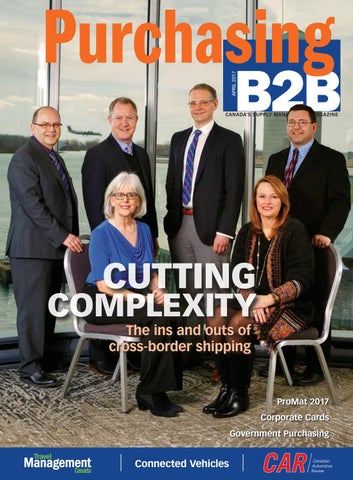
APRIL 2017
CANADA’S SUPPLY MANAGEMENT MAGAZINE
CUTTING
COMPLEXITY The ins and outs of cross-border shipping
ProMat 2017 Corporate Cards Government Purchasing
Connected Vehicles PB2B April2017_AMS.indd 1
2017-04-18 7:36 AM
Save thousands for your business. Get the latest tech products for your business from Staples Business Advantage™—from laptops and printers to wearable tech and tablets.
FREE#
Get a FREE# Keurig® OfficePRO® Brewing System when you sign up for a Staples Business Advantage Premium membership.
Plus you’ll get access to exclusive discounts and promotions*. Visit StaplesPremium.ca to sign up.
#Offer valid until May 31, 2017. New Staples Business Advantage accounts only. Not valid on Premium memberships opened prior to April 1, 2017. Cannot be combined with any other offers. There may be a delay in receiving your free giveaway due to supply and demand. Giveaway subject to change due to manufacturing availability. Speak to a Staples Business Advantage representative for complete membership details and fees. *Additional savings on our top products over standard Staples nationally advertised pricing. Contact a Staples Business Advantage representative for agreement and complete details.
april2017_SBA_purchasingb2b_EN.indd 1 PB2B_Staples_Apr.indd PB2B April2017_AMS.indd1 2
06/04/2017 5:39:53 PM 2017-04-07 7:36 2017-04-18 1:19 AM PM
Table of Contents
Vol. 60, No. 3 • APRIL 2017
Features 7 SUPPLY CHAIN: THE FUTURE IS NOW The reinvention of industry—so-called Industry 4.0— dominated the discussion at ProMat 2017 in Chicago. 9 FRONTIERS OF COMMERCIAL CARDS It’s a brave new world of corporate cards. See what the latest trends are and what you’re company can do to take advantage of these developments.
7
11 CROSS-BORDER SHIPPING’S INS AND OUTS A roundtable report outlining the challenges and pressures of moving goods securely across the border, including tips to make the process as smooth as possible.
9
Supplement Inside
Also inside 4 UP FRONT
April 2017 Vol. 19, No. 1
5 BUSINESS FRONT 17 FINANCE CORNER 18
WIRED
RIDES The rise of the connected vehicle
THE LAW
IN THIS ISSUE: 3 6 10 12 14 18 20
News Canadian Auto Show Nissan Titan Advanced Driver Training Connected Cars Mazda CX9 Up fitting
11
Cover image: Joel Robertson
Connect With Us Online We encourage you to visit us online to stay in touch with what’s happening in your industry and to view enhanced articles.
Features
.ca
PurchasingB2B.ca
@PurchasingB2B
Michael Power
UNDERSTANDING LIFECYCLE COST Getty Images
How to use total cost of ownership to drive a cost containment strategy. http://bit.ly/2pcQwn4
© lkunl/Getty Images/Thinkstock
CORPORATE CARDS: ENHANCED FEATURE
CATCH THE MAGIC Career highlights and business tips from Earvin “Magic” Johnson’s keynote appearance at ProMat 2017. http://bit.ly/2nuySxD
Don’t miss this expanded version of our feature article on corporate cards, providing even more insights into card trends and benefits. http://bit.ly/2oE6xV0
PURCHASINGB2B ENEWSLETTER Each week, we send out an eNewsletter that highlights industry news and insights. Sign up today and receive it each Tuesday. www.PurchasingB2B.ca/e-newsletter-subscription/
PURCHASINGB2B IS ON FACEBOOK Visit us on Facebook to friend us, comment on a post or simply catch up on our online content. facebook.com/PurchasingB2B PurchasingB2B.ca | April 2017 | 3
39:53 PM
07 1:19 PM
PB2B April2017_AMS.indd 3
2017-04-18 7:36 AM
Up Front 80 VALLEYBROOK DRIVE TORONTO, ONTARIO M3B 2S9
www.PurchasingB2B.ca
PUBLISHER/ADVERTISING SALES
Dorothy Jakovina 416-510-6899, djakovina@PurchasingB2B.ca
Procurement’s Digital Transformation
C
hange is coming. It’s already here, in fact. If it feels like we all blinked and now the Internet rules our lives, just wait and see how the rise of technology will transform the world in the coming years. Whether it’s in the auto industry—through the hat trick of autonomous vehicles, connected cars and electric energy— through blockchain ledgers with the potential to actualize a new form of Internet, or wearable do-dads that can predict (and help prevent) medical calamities like heart attacks, much of how the world works will change. And it’s because of technology. Likely, procurement and supply chain will be as affected as other areas. Advanced analytics, cloud-based applications and mobile computing, and robotic automation of processes are already disruptors. Procurement professionals are well aware that the new digital world of technology will alter the way in which they do their jobs, just as it will change many areas of modern life. But how prepared are they (and their organizations) to handle these changes? How confident are they in that preparation? Not very confident, according to recent research from strategic consulting firm The Hackett Group, based in Miami, Florida. Their recent paper, The CPO Agenda: Keeping Pace With and Enabling Enterprise-Level Digital Transformation, is based on survey results gathered from executives from over 180 large companies in the US and abroad, most with annual revenue of $1 billion or greater. According to the research, 85 percent of respondents said digital transformation will “fundamentally change the way they deliver services over the next three to five years.” But only 32 percent of those surveyed have a formal digital strategy. Meanwhile, 25 percent have the needed resources and competencies to deal with these changes. The study found that procurement budgets are expected to grow by less than one percent in the coming year. So how should procurement prepare? For starters, go digital to keep up. Like everyone else, procurement must upgrade their skills to ensure they’re prepared for whatever changes lie ahead. Make the case to the C-suite, which procurement is now a part of in many organizations, for the need to keep up with these changes and for the resources to do so. Procurement would also benefit by positioning itself as a partner in that change. The more that organizations see procurement as an enabler of a positive transformation through digitization, the better poised the field will be to roll with the body shots technology dishes out.
EDITOR
Michael Power 416-442-5600 ext 3259, mpower@PurchasingB2B.ca ART DIRECTOR
Andrea M. Smith
ACCOUNT COORDINATOR
Tracey Hanson 416-510-6762, thanson@annexbizmedia.com CIRCULATION MANAGER
Barbara Adelt 416-442-5600 x 3546, badelt@PurchasingB2B.ca ANNEX PRINTING & PUBLISHING INC.
VICE PRESIDENT/EXECUTIVE PUBLISHER: Tim Dimopoulos 416-510-5100, tdimopoulos@annexweb.com COO: Ted Markle, tmarkle@annexweb.com PRESIDENT & CEO: Mike Fredericks, mfredericks@annexweb.com For over 56 years, PurchasingB2B has been a trusted source of information for Canadian purchasing/supply chain management professionals in the private and public sectors. Special features and supplements include Fleet Management, Canadian Automotive Review (CAR), PurchasingB2G, and Travel Management Canada. PurchasingB2B is published six times a year, except for occasional combined, expanded or premium issues which count as two subscription issues, by Annex Business Media. © Contents of this publication are protected and may not be reproduced, in whole or in part, without the written consent of the publisher or editor. NOTICE: PurchasingB2B accepts no responsibility or liability for claims made for any product or service reported or advertised in this issue. PurchasingB2B receives unsolicited materials including letters to the editor, press releases, promotional items and images from time to time. PurchasingB2B, its affiliates and assignees may use, reproduce, publish, re-publish, distribute, store and archive such unsolicited submissions in whole or in part in any form or medium whatsoever, without compensation of any sort. SUBSCRIPTION SERVICES: To subscribe, renew your subscription, or to change your address or information, contact us at 416-510-5713 or 1-866-543-7888, ext 3258, apotal@annexnewcom.ca, or visit us at www.PurchasingB2B.ca. Subscription price per year: $99.95 CDN; Outside Canada per year: $172.95 US; Single issue Canada: $18 CDN. Annual Supply Chain Survey issue, Canada: $45; Outside Canada: $70 US. Taxes extra. From time to time we make our subscription list available to select companies and organizations whose product or service may interest you. If you do not wish your contact information to be made available, please contact us via one of the following methods: Phone: 1-800-668-2374, Fax: 416-442-2200 Mail to: Privacy Officer, 80 Valleybrook Drive, Toronto, ON M3B 2S9 Printed in Canada. ISSN: 1497-1569 (print); 1929-6479 (digital) Publications Mail Agreement No. 40065710 We acknowledge the financial support of the Government of Canada through the Canada Periodical Fund of the Department of Canadian Heritage
4 | April 2017 | PurchasingB2B.ca
PB2B April2017_AMS.indd 4
2017-04-18 7:36 AM
Business Front
The Tip Of The Iceberg? Driverless cars may be the first among enormous changes technology brings
Toronto-based Michael Hlinka provides business commentary to CBC Radio One and a column syndicated across the CBC network.
By Michael Hlinka
I
don’t know if you know who Sam Harris is, but if you don’t and I can introduce you to this American thinker, then this column may have already accomplished something important. His own website touts him as a best-selling author (which is true) but that alone doesn’t do the range of his intelligence justice. His writing and podcasts cover a wide variety of topics, anything and everything from religion to violence to neuroscience. But it was an aside he made—tangential to the larger point that was being discussed—that flat-out blew my mind. The conversation was about driverless automobiles. The consensus is that sooner or later the technology will exist and use of these vehicles will be widespread. When I heard about them the first time,
thing bad happening increases so much, we make the rational collective decision to make impaired driving illegal, independent of possible consequences. By way of analogy, if the technology of driverless cars is perfected and accidents then become as rare as solar eclipses, it would be reasonable—just as we prevent intoxicated people from driving—to prevent anyone who is after all both human and imperfect from getting behind the wheel. This means that if you drive a truck for a living, your services are no longer required. This would affect approximately 250,000 Canadians who make, on average, about $50,000 annually if they drive locally or something closer to $75,000 a year if they are long-haul drivers. This is a middle-class to upper middle-class wage. And a valid question arises: What will these people do to pay the bills? This becomes particularly troubling when one realizes that this is truly only the tip of the iceberg. At some point, robots rather than humans will dominate assembly lines. How many manufacturing workers would be displaced? “At some point, robots rather than humans But this Brave New World will not will dominate assembly lines. How many only impact what we understand as working-class, blue-collar occupations. manufacturing workers would be displaced?” I have heard the theory that it will be possible to program robots to perform I imagined the suburban white-collar worker who complex medical surgeries. No robot will ever have a shaky hand; thereinstead of wasting 90 frustrating minutes in traffic fore for similar reasons and logic why driverless cars will supplant the could now use that time productively in a rolling human behind the wheel, so too will the robot replace the human suroffice. It seemed to me a great alternative for so many geon. Then what will be left for humans to do? And what are the public different people. When my father was in his eighties, policy impacts? he felt that driving exposed too many innocent peoThere have been increased calls for a minimum guaranteed income. ple to too much risk, so he voluntarily gave up the Right now, the model—even in Canada which has a robust welfare freedom associated with individual car travel. state—is that there is the expectation that each of us should be responBack to Sam Harris. He argues that it is an almost sible for taking care of himself or herself, with the promise that the state inevitable certainty that sometime in the future it will be there to take care of you if you are either unable to work or will be illegal for humans to get behind the wheel and choose not to. But public policy attempts to ensure that you’d be better drive any car themselves. At first, this sounds borderoff working rather than relying on the state’s largesse. But with a miniline delusional, but think about it for a moment and mum guaranteed income, this more or less goes out the window. it makes sense. In fact, there is a reasonable analogy And once the minimum guaranteed income were enshrined as pubbetween humans driving when the driverless techlic policy, there would be an even bigger incentive for people from nology exists and the current public policy of driving the developing world to find their way to the developed world. There under the influence, which virtually everyone agrees are already huge tensions in Europe with the recent wave of refugees. should be illegal. Imagine how much more powerful that economy would be. But why do we come together on drunk driving? Perhaps in the grand sweep of human history, these are relatively small Because in the majority of cases, people who are and manageable problems. Perhaps. But I’ve been thinking increasingly legally impaired and then get behind the wheel, do about where phenomenon like robotics, artificial intelligence, and technot get into accidents, let alone ones where anyone is nology in general could have a profound impact—and sooner than we seriously hurt. Yet because the probability of somemight think—on the way we work and live. B2B PurchasingB2B.ca | April 2017 | 5
PB2B April2017_AMS.indd 5
2017-04-18 7:36 AM
WORKING YOUR WAY UP? TAKE THE NEXT STEP! Earn an Accredited Diploma in Procurement and Supply Chain Management, offered exclusively by Supply Chain Management Association Ontario. Advance your career through practical and relevant training for intermediate level supply chain professionals.
LET SCMAO TAKE YOU HIGHER ENROLL TODAY AND GRADUATE AS EARLY AS NEXT YEAR!
This unique part-time program of study incorporates online courses and in-class seminars to cover immediately applicable management concepts for a successful career in supply chain.
For more information on the Accredited Diploma in Procurement and Supply Chain Management please contact the SCMAO office at education@scmao.ca or Vyry George at 416-977-7566 (ext 2148).
PB2B_SCMAO_April.indd 1
Going
THIS AD PREPARED BY: FILE NAME: DOCKET: CLIENT: TRIM SIZE: COLOURS:
on June 1 !
RYAN EDWARDS SCMAO_DIPLOMAAD_HALFPAGE SCMAO16-05 SCMAO 7" X 4.875" CMYK
st
2017-03-31 1:49 PM
The 2017 Annual Purchasing and Supply Chain Professional Survey • What are the trends, challenges and opportunities that are affecting the profession? • How are economic factors shaping the role of procurement within the supply chain? • What are the average salaries from a regional and industry perspective? Thank you for your participation. Your insights on these topics and more will help shape the results of this survey.
Coming to your Inbox on Thursday, June 1st! And accessible on www.PurchasingB2B.ca Survey results will be published in the October issue of PurchasingB2B.
PB2B_Apr2017_Surveyhousead_AMS.indd 1
PB2B April2017_AMS.indd 6
2017-03-21 2:32 PM
2017-04-18 7:36 AM
By Michael Power
The Future of
Getty Images
SUPPLY CHAIN
ProMat 2017 conference offers a look at how Industry 4.0 is changing supply chain
T
he reinvention of industry— so-called Industry 4.0—dominated much of the discussion at ProMat 2017 at the McCormick Centre in Chicago in April. The tagline of the materials handling trade show was “Solve For X,” with manufacturing and supply chain professionals walking the show floor and attending education sessions to learn what’s new in the field. Markus Lorenz, partner and managing director with The Boston Consulting Group, addressed the issue during his keynote address, Industry 4.0: Bringing Revolutionary Changes to a Supply Chain Near You. In defining Industry 4.0, Lorenz said that it represents the fourth time that industry has reinvented itself. The invention of the loom and the industrial revolution was the first time, followed by the early 20th Century and the introduction of the assembly line. The third time was during the 1970s when automated industrial robots were introduced to manufacturing. Today and the near future represent the fourth reinvention. The core idea of Industry 4.0 is the movement away from isolated cells to integrated data and production flows, Lorenz told the audience. Until now, factories have often been full of automated cells. The move now is towards machines both communicating with each other as well as sensing certain conditions. As an example, Lorenz referenced yogurt flavours, noting that when he was a child there were four flavours available from a certain company. Today, there are 96 flavours available from the same
brand. This has resulted in an explosion of complexity in the production process, as well as an increased risk of things going wrong. If a machine pours hazelnut yogurt into chocolate containers, the mistake is unfortunate, costly and could even lead to additional problems if someone with an allergy accidently consumes the wrong flavour. Unfortunately, the machines lack the intelligence to “sense” that they are pouring hazelnut into chocolate package. The solution to these challenges lies in a digital and integrated approach to supply chain management, along with flexible and efficient manufacturing, Lorenz said. Machines that communicate with each other, know their next step and work alongside people will help solve such dilemmas. Lorenz provided an additional food example by discussing robots that could pick good oranges using a camera or monitor VOCs coming from the oranges then put those emitting VOCs into a separate box. Producers can benefit from such developments, but so too can equipment providers. And while there is an element of not wanting or needing people to perform certain tasks in the future, trends such as self-driving logistics vehicles, augmented reality glasses and other developments will create other roles for workers. While Germany may stand to lose 600,000 factory jobs over the next decade, there will also be new positions created at the same time. “The gain in jobs is something like one million, so that’s a net gain,” he said. While someone operating a factory
machine won’t become a data scientist overnight, that person can be educated to use, for example, augmented reality glasses to become more productive. Disruptive technologies Industry 4.0, robotics in manufacturing and related topics also featured during a state-of-the-industry panel discussion at the conference. According to a recent report from Deloitte Consulting, cloud computing, storage and sensors lead in terms of adoption rates, while robotics and automation are set to rise in the next five years, said Scott Sopher, a principal with Deloitte. As well, 86 percent of those surveyed for the report thought that digital supply chain would be the predominant model in five years, and 16 percent feel the supply chain is digital today. “I think that’s a pretty stunning statistic that came out of the survey,” Sopher told the audience. As well, 53 percent of companies surveyed will spend $1 million or more on these technologies, while 50 percent are training their workforce in how to use them. But while it’s clear that these technologies are driving change in the supply chain, it’s not a single technology doing so. Rather several developments, including the Internet of Things (IoT) and augmented reality. Panelist Venkat Venkataramani, director, CoE for digital supply chain at SAP, referred to the IoT as being about sensors, and can be both a disruptor or a competitive advantage. For example, coffee providers can put sensors into coffee machines to see what pods are used, where they’re used and to collect similar PurchasingB2B.ca | April 2017 | 7
PB2B April2017_AMS.indd 7
2017-04-18 7:36 AM
data. Companies can then use that information to decide how to re-route distribution. “It’s really transformed how they look at supply chain and supply chain management,” he said. Sensors can also be used for tracking and traceability by embedding them into work uniforms, said Randy Bradley, assistant professor of IS and supply chain management at the University of Tennessee. An organization can then know where employees are, if they’re taking the best route or how they’re doing, for example whether they’re too hot. While sensors are largely operational and tactical tools, organizations should begin viewing them as a more strategic instruments. Automation is now moving towards “co-bots,” referring to robots that stand and work alongside people, Bradley noted. They’re still semi-automated because those people must tell them what to do, as well as when and how to do it. The next generation of robots will
become more “self-aware,” he said. Vendor selection is critical when it comes to robotics, said Mario Adamy, VP corporate warehouse, Albertsons. There will be several options, from semito fully autonomous, so Adamy urged the audience to have clear and collaborative partnerships with vendors that understand the business and its needs. Other areas to explore with vendors include risk management and what to do when a robot or automated machinery fails, as well as performance management and how the machinery will be optimized, Adamy noted. “That whole area of vendor selection is critical.” Also, human capital is important when it comes to dealing with vendors, and the investment in that capital upfront counts towards successful implementation. Those buying such equipment can sometimes be too dependent on vendors, so Adamy recommended asking about training modules and an execution plan. Large vendors sometimes offer to oper-
ate and maintain a solution, he said. When dealing with these changes to the supply chain, Venkataramani recommended looking at the issue in terms of people, process and technology—in that order. Technology isn’t what you lead with, he said. Organizations should look at where they want to be as well as the people running the operations. Then ask about technology. It can be challenging to pick the right partner, but the key to doing so is to crawl rather than run. If you fail, then fail fast and learn quickly from the experience. Ultimately, ProMat 2017 provided attendees with a look at not only what supply chain solutions exist today, but also what the future holds for the field. Supply chain and procurement professionals would do well to ensure they are up to speed on these developments going forward. B2B For more coverage of ProMat 2017, see the upcoming June issue of PurchasingB2B.
17_0422 Purchasing B2B_APR Mod: March 14, 2017 2:07 PM Print: 03/24/17 9:49:30 AM page 1 v7
π OVER 5,000 MATERIAL HANDLING PRODUCTS IN STOCK
ORDER BY 6 PM FOR SAME DAY SHIPPING
COMPLETE CATALOG
1-800-295-5510 uline.ca
8 | April 2017 | PurchasingB2B.ca PB2B_Uline_April.indd 1
PB2B April2017_AMS.indd 8
2017-04-11 10:12 AM
2017-04-18 7:36 AM
By Michael Power
These days, the world of corporate cards includes more than what fits in your wallet
F
Beyond Cards
or any company looking to improve how it handles expenses, corporate cards offer several advantages. Improved security, saved process costs and better analytics are among the reasons to adopt a card program. And there’s quite a bit that’s new in the corporate card world, says Paul Roman, VP and general manager of global commercial payments at American Express Canada. One trend Roman sees is a move from traditional areas of card usage like travel expenses, phone bills and other incidental areas. Over the past two years there has been a shift in the type of spend that organizations are using cards for, Roman says. “People had already tackled some of the low-hanging fruit in terms of where they were using these cards and saying, ‘I really want to get rid of cheques, I really want to automate and make some of my payments electronic and be able to do that on a bigger and bigger payable footprint,’” he says.
“You have to catch up with how the transaction will actually take place so that it makes sense not only for the buyer but also from the supplier side.”
Fotolia
—Paul Roman As the purchases made on cards get larger, organizations can take a look at the way goods and services are priced, Roman says. A purchaser can buy software or a laptop using a card in the traditional way. But when buying a server costing hundreds of thousands of dollars, the economics of a traditional card transaction don’t work. Amex, for example, owns both the buy and supply side of the relationship and works to customize the pricing so the economics make sense. “As people want to spend it in broader areas, you have to catch up with how the transaction will actually take place so that it makes sense not only for the buyer but also from the supplier side as well,” he says. Often, the card is likely to be just a number, or a single-use card where the number is generated and can only be used for specific transactions, Roman notes. The corporate card sector continues to grow, he says. The incentive for companies to adopt corporate cards comes down in large part to process efficiency, control and visibility, along with ease of implementation. So-called virtual cards—meaning a number with no physi-
cal card associated with it—have become more common, says Steve Pedersen, VP and head of North American corporate card program, BMO Financial Group. But the technology has pros and cons, and the falling costs of employing virtual cards means more customers using them, he notes. “That’s where you’re seeing an explosion,” Pedersen says. Cheques remain a payment option, he adds, but aren’t as commonly in Canada as the US. As technology evolves to become more efficient and less expensive, that migration away from cheques will continue. Data remains important in the administration of corporate cards, Pedersen says. Procurement and others who use cards look to optimize their supplier base so data from cards can show them where money is spent. This facilitates negotiations with suppliers for better terms, he says. Patrick Sulston, VP & SBL-business development at MasterCard, also sees growth in the use of virtual cards, specifically products where the buyer provides an account number to a merchant for each transaction. This allows for one-to-one matching on an invoice payment. One reason for this trend is security. “It gives the buyer flexibility to restrict how, when and where cards can be used by individuals, departments or divisions,” he said. “This includes changing purchasing authorizations and spending criteria quickly and easily.” The commercial card industry is evolving constantly, says Katie Beatty, community engagement specialist, NAPCP. As new technology develops, card issuers and provider banks are quick to embrace and incorporate new payment technologies. For example, electronic accounts payable programs (ePayables) are more common, and more expense management systems are utilizing mobile apps. Companies are implementing mobile alerts that lessen fraudulent transactions. Another method used to make P-cards more secure is tokenization, which protects card data by substituting a card’s primary account number (PAN) with a unique, randomly generated sequence of numbers, Beatty says. The service provider can reverse the “token” to its true PAN value. Tokens can be single- or multi-use and only used with specific mobile devices or merchants. There are several advantages for companies to incorporate cards into their payment structures. Organizations not using cards would do well to explore these payment options. B2B To read an enhanced version of this article, please visit http://bit.ly/2oE6xV0.
PurchasingB2B.ca | April 2017 | 9
PB2B April2017_AMS.indd 9
2017-04-18 7:36 AM
SAVE THE DATE SEPTEMBER 11 & 12, 2017 ProcureTech Canada will showcase the latest procurement software solutions on the market, help procurement professionals build a business case for adopting software solutions, and support best practice guidelines for implementation.
ProcureTechCanada.com launching May 2017
PARTICIPATE IN PROCURETECH CANADA! EXHIBITOR & SPONSOR OPTIONS AVAILABLE
Presented by:
CONTACT:
Dorothy Jakovina djakovina@purchasingb2b.ca Tel: 416-510-6899
PB2B April2017_AMS.indd 10 PB2B_Feb17_Procuretech_AMS.indd 1
2017-04-18 2017-04-17 7:36 2:27 AM PM
April 2017 Vol. 19, No. 1
WIRED
RIDES The rise of the connected vehicle
IN THIS ISSUE: 3 News 6 Canadian Auto Show 10 Nissan Titan 12 Advanced Driver Training 14 Connected Cars 18 Mazda CX-9 20 Upfitting
CAR_April 2017_AMS.indd 1
2017-04-19 7:34 AM
CAR_JimPattison_Apr.indd CAR_April 2017_AMS.indd 2 1
2017-04-10 7:34 2017-04-19 2:28 AM PM
10 2:28 PM
Ram Commercial launches virtual upfitting tool
Consumer Reports 2017 Brand Report Card released
Ram Commercial has announced two new programs for commercial upfitters, dealers and customers in viewing, certifying and installing truck-mounted products: Ram Augmented Reality Upfit Configurator and Q Pro. The Ram Augmented Reality Upfit Configurator is a computer-generated visual program for upfitters and dealers to virtually showcase several solutions. Prospective buyers have the opportunity to virtually walk around the vehicle and view inside to assess options via computer simulation. Originally offered on the Ram ProMaster full-size van, the configurator has now expanded to the Ram ProMaster City and the entire Ram Chassis Cab line (3500, 4500 and 5500). Q Pro is a new qualification process for upfitters to certify their product with Ram Engineering. Q Pro allocates Ram Engineering resources to survey, make recommendations and certify upfitter products. Once certified, the upfitter uses Ram’s Q Pro co-brand to help market their product.
Luxury cars from brands like Audi, Porsche, BMW and Lexus are some of the best autos on the road, according to the 2017 Brand Report Card from Consumer Reports. For the second year in a row, Audi (81) earned the highest overall brand score in Consumer Reports’ annual indicator of which brands make the best cars. Porsche (78), BMW (77), Lexus (77), and Subaru (74) rounded out the top five in the rankings. Though the top five brands are unchanged from last year, there was some shuffling in the standings. Porsche and BMW each rose by two spots, while Lexus fell back one spot and Subaru moved down by three. Consumer Reports said its analysis also revealed that consumers don’t have to spend luxury car money to get a quality vehicle. Kia finished just outside the lead pack in sixth place and Mazda came in seventh. CR recommends 100 percent of the Mazda models and 71 percent of the Kia models it has tested. “Our annual analysis reveals that building one or two great vehicles is achievable, but making a whole lineup of excellent ones is much more difficult,” said Jake Fisher, Consumer Reports director of automotive testing. In total, 31 brands were included in the 2017 Brand Report Card. To determine which brands consistently deliver cars that serve consumers well, the company tabulated the overall score, which is a combination of road test score, predicted reliability, owner satisfaction and safety results for each tested model of a brand. Auto experts then averaged those scores at the brand level. Brands with just one tested model were omitted. CR’s rankings are based only on vehicles that are currently for sale on the market and that the organization has tested. Tesla made its debut in CRs rankings in eighth place, though its position is based on just two tested models. Buick’s strong reliability score was enough to balance its middling road test score and secure tenth place, just ahead of Toyota. Lincoln, Chevrolet and Ford finished mid-pack. Chrysler gained seven places and finished just below Cadillac. Honda also finished in the top 10, in the number nine spot. Toyota (11) WIRED fell out of the top 10. CR is currently RIDES Recommending 86 percent of the The rise of the connected vehicle Honda models it has tested, and 78 percent of the Toyotas. Meanwhile, Hyundai landed close behind in the 12th position and Nissan was ranked Cover: iStock 22nd.
80 VALLEYBROOK DR, TORONTO, ONTARIO M3B 2S9 PHONE: 416-442-5600 FAX: 416-510-5140
www.PurchasingB2B.ca
Vol. 19, No. 01
April 2017
EDITOR: Michael Power (416) 442-5600, ext. 3259, mpower@purchasingb2b.ca ART DIRECTOR: Andrea M. Smith PUBLISHER/ADVERTISING SALES: Dorothy Jakovina (416) 510-6899, djakovina@purchasingb2b.ca ACCOUNT COORDINATOR: Tracey Hanson (416) 510-6762, thanson@annexbizmedia.com CIRCULATION MANAGER: Barbara Adelt (416) 442-5600 x 3546, badelt@annexbizmedia.com
ANNEX PUBLISHING & PRINTING INC. VICE-PRESIDENT: Tim Dimopoulos (416) 510-5100, tdimopoulos@annexweb.com COO: Ted Markle, tmarkle@annexweb.com PRESIDENT & CEO: Mike Fredericks CAR, established 1991, is published twice annually (April and October), by Annex Publishing & Printing Inc. © Contents of this publication are protected and may not be reproduced, in whole or in part, without the written consent of the publisher or editor. From time to time we make our subscription list available to select companies and organizations whose product or service may interest you. If you do not wish your contact information to be made available, please contact us via one of the following methods. Phone: 1-800-668-2374, Fax: 416-442-2200, Mail: Privacy Officer, 80 Valleybrook Drive, Toronto, ON M3B 2S9. NOTICE: CAR accepts no responsibility or liability for claims made for any product or service reported or advertised in this issue. CAR receives unsolicited materials including letters to the editor, press releases, promotional items and images from time to time. CAR, its affiliates and assignees may use, reproduce, publish, re-publish, distribute, store and archive such unsolicited submissions in whole or in part in any form or medium whatsoever, without compensation of any sort. Printed in Canada Publications Mail Agreement No. 40065710
April 2017 Vol. 19, No. 1
IN THIS ISSUE: 3 6 10 12 14 18 20
News Canadian Auto Show Nissan Titan Advanced Driver Training Connected Cars Mazda CX9 Up fitting
APRIL 2017 CANADIAN AUTOMOTIVE REVIEW | 3
CAR_April 2017_AMS.indd 3
2017-04-19 11:21 AM
Getty Images
Ontario drivers struggle to identify auto insurance fraud
NAFA announces new board of directors
A survey of Ontario drivers raises concerns about their ability to recognize, reject and report auto insurance fraud, says a recent survey. The survey, done by Ipsos for the Financial Services Commission of Ontario (FSCO), gauged drivers’ knowledge and attitudes toward auto insurance fraud. Among drivers surveyed, 27 percent got a failing grade when confronted with accident scenarios and true or false statements. Baby Boomers (55 and over) were most knowledgeable while Millennials (18-34) were least likely to identify acts of fraud. Other findings include: • T he most popular type of admitted fraud was convincing an auto body repair shop to add unrelated fixes and put the full cost through insurance (five percent); • 35 percent knew how to report auto insurance fraud; • 35 percent did not know that defrauding an insurance company is an offence under the federal Criminal Code; and • 25 percent did not know that auto insurance fraud affects auto insurance premiums. Men and Millennials were more likely to admit to auto insurance fraud than other groups. Five percent of men admitted to claiming false injury from an auto accident compared to one percent of women. Nine percent of Millennials admitted to this compared to one percent of Boomers.
The Board of Directors of NAFA Fleet Management Association (NAFA), operating under new bylaws and election procedures adopted in 2016, recently elected the first slate of officers under its new guidelines. The new rules saw four new directors elected to the board in January, joining nine directors whose terms were continuing. In February, the full board of 13 directors elected from among themselves NAFA’s new president, senior vice-president, vice-president, and secretary/ treasurer. The officers for the 2017-2018 term are: • President—Bryan Flansburg, CAFM • S enior vice-president—Patti Earley, CAFM • V ice-president—Jeff Jeter • S ecretary/treasurer—David Hayward Also on the NAFA board of directors are: • R uth Alfson, CAFM (immediate past president) • Patrick Barrett, CAFM • R ay Brisby, CAFM • M ichael Cole • R obert Martines • D eanne Radke • S teve Saltzgiver, CAFS • G eorge Survant • K athy Wellik, CAFM
Is now the best time for car buying? Those looking to buy a new car may want to do so sooner rather than later, according to Viraf Baliwalla, president of Automall Network, a vehicle buying service. This is the best time of year to buy a new vehicle because there is the best balance between large incentives from manufacturers, availability in the market and dealer willingness to dip into their profit margins to make the sale, says Baliwalla. Manufacturers will soon stop taking orders for current model year vehicles to re-tool their plants for the next model year. Then, availability will dwindle through the summer, the incentives will increase slightly but the tighter availability becomes the less dealers are willing to negotiate.
Getty Images
4 | CANADIAN AUTOMOTIVE REVIEW APRIL 2017
CAR_April 2017_AMS.indd 4
2017-04-19 7:34 AM
PB2B_Fo
EXPERTISE. EXPERIENCE. EASE. THAT’S FORD FLEET. When it comes to building the fleet that your success rides on, trust yours to Ford Fleet. Our experts will be by your side before, during and after sale, offering vehicle advice, customized financing and maintenance solutions, and a nationwide network of Ford-approved up-fitters and modifiers. Our mission is more than just vehicles. We’re driven to make supporting your fleet easier. FLEET.FORD.CA
2017 F-150
2017 FOCUS ELECTRIC
2017 ESCAPE
2017 TRANSIT
Vehicles may be shown with optional features. ©2017 Ford Motor Company of Canada Limited. All rights reserved.
CAR_April PB2B_Ford_Feb.indd 2017_AMS.indd 1 5
2017-04-19 2017-02-03 7:34 9:42 AM
By Lesley Wimbush
DRIVEN COMFORT Executive rides more versatile than ever
Image: Volvo
50 percent of luxury fleet sales, compared to 35 percent in 2009. And of the 15 top selling luxury cars in Canada last year, eight were crossovers. It’s no wonder that Queen Elizabeth chooses to ride in a Range Rover instead of a Rolls, when the SV Autobiography model offers an extra 7.3 inches of legroom, reclining and massaging rear seats, power tables and a cooler for drinks. Not to be left out, Swedish company Volvo has now introduced their most luxurious and expensive model yet; the XC90 Excellence. Based on their award-winning XC90 crossover, the $120,000 CUV has perforated leather captain’s chairs with heating, cooling and massage, two folding tables and cup holders that both heat and cool. Perfect for keeping a drink warm in its Swedish Orrefors crystal cups—included. But you don’t have to shell out five-figure sums to travel in luxury. The Genesis G90; the flagship sedan of Hyundai’s luxury sub-brand, tops out at $87,000 all-in—including delivery, destination and five years (or 100,000km) of free scheduled maintenance. “This car is for a Korean chairman of the board,” says Hyundai interior designer Andrew Moir. Lincoln Continental, the quintessential mainstream limousine, has made a comeback; transformed into an elegant cruiser with suggestions of Jaguar and Bentley in its sheet metal. Its base price of $56,900 is relatively modest; but you’ve got to spring for the $60,400 Reserve trim in order to get the optional $5,0000 rear seat package—which adds reclining seats with heat and ventilation, four-way adjustable lumbar support, a centre console with digital display, sun blinds and extra legroom provided by the sliding front passenger seat. The automotive landscape greatly reflects the changing nature of how we work, as well as how our vehicles fit into our daily commute and the rest of our lives. Even the most traditional sedan buyer may now consider cross-shopping luxury SUVs for their next purchase. A busy executive no longer has to settle for the traditional sober, four-door sedan but has myriad choices available. C.A.R.
T
hink of an executive’s choice of vehicle, and chances are, a sleek, luxury sedan comes to mind. Indeed, premium brands such as Mercedes-Benz, Audi, and BMW have built their reputations on their full-size flagship sedans. It’s not hard to picture the typical Mercedes-Benz S-Class owner in the reclining rear seat, laptop plugged into the charge port and file folders on the handy pull-down table. At his fingertips, there’s access to a large display screen embedded in the seat-back ahead, a built-in cooler that’s just right for sparkling water, and the touch-controls for heat, ventilation, and massage. There’s even a power footrest. While the private jet-like S-Class cabin sets the standard for luxurious back-seat utility, it’s a reflection of our fast-paced world—and lives lived on the move—that a wide range of vehicles now offer similar features for the busy executive. Buyers today demand a lot more versatility, especially at the luxury level, and with the pending arrival of autonomous vehicles, many automakers know there will be more emphasis on passenger comfort. In fact, many of the top selling luxury vehicles today aren’t even sedans at all—they’re crossovers. According to a recent survey by IHS Automotive, luxury SUVs now account for nearly
“With the pending arrival of autonomous vehicles, many automakers know there will be more emphasis on passenger comfort.”
6 | CANADIAN AUTOMOTIVE REVIEW APRIL 2017
CAR_April 2017_AMS.indd 6
2017-04-19 7:34 AM
By Lesley Wimbush
LUXURY CHOICES A wide range of executive rides on display at the Canadian International Auto Show
Image: Cadillac
Cadillac CT6 Plug-In
Cadillac’s CT6 flagship sedan now boasts a hybrid powertrain. The turbo-charged four cylinder is paired with two electric motors with a combined output of 335 hp and 432 lb ft. of torque. Available in one trim, the CT6 hybrid features the same equipment level as the top-spec CT6 Premium Luxury, with a full suite of driver safety aids, 10 speaker Bose sound system, heated front and rear seats, rear seat entertainment system and night vision camera. While pricing starts at $85,995, the CT6 Hybrid is eligible for an $8,000 green vehicle incentive in Quebec, and $3,000 in Ontario.
Image: Alfa Romeo
Alfa Romeo Giulia
Image: Porsche
Porsche Macan Turbo with Performance Package
The small crossover has been an undeniable success for Porsche, who market it as the sportscar of the compact SUV segment. Expanding the model range is this new twin-turbocharged V6 equipped Macan with 440 hp. It also features larger performance brakes, lowered body, controlled sports chassis and sports exhaust. Pricing starts at $97,600.
C
anada’s largest consumer event enjoyed recordbreaking attendance this year with nearly 340,000 people passing through the Metro Toronto Convention Centre. Officials are calling it one of the most successful in the CIAS’s 44-year history, showcasing not only new cars and concepts but also what the future may bring in automotive trends and technology. Certainly those trends are apparent in the executive and luxury vehicle segments. Where traditionally a busy CEO’s choices were limited to large sedans, the market has seen a tremendous uptick in luxurious crossovers. That doesn’t mean that automakers have given up on producing premium sedans—far from it. These flagship four-doors now offer a greater wealth of comfort and technology than ever before. The wider range of choices reflects consumer’s changing needs; from the executive who tows his boat to the cottage on the weekends, then works from the back seat of his versatile crossover, to the big-city investor who enjoys the business class comfort of his Mercedes-Benz S-Class. Or simply the businessman or woman whose reward for their hard work is owning a beautiful ride. There were a variety of vehicles that fit that description on display at CIAS; here are some of our favourites.
This gorgeous Italian-designed sedan has arrived in Canada, and is well-poised to compete with segment leader BMW 3 Series. Available in three trim levels, buyers can choose between the base Giulia, or Ti with 280 hp four-cylinder engine, or the twin-turbo six-cylinder putting out 505 hp and 443 lb. ft. of torque in the range-topping Quadrifoglio. Pricing starts at $48,995, but soars to $87,995 for the Quadrifoglio. Alfa will also be bringing its new Stevio SUV to Canada early next year. Boasting 505hp, and a 0-100 km/hr time of four seconds, the Stevio will have a standard AWD system. Using the same platform as the Giulia, the Stevio promises equal luxury and refinement with a modicum of utility. Its price should be competitive with Audi’s Q5, Jaguar F-Pace, BMW X3 or Porsche Macan—roughly $40,000-$50,000. APRIL 2017 CANADIAN AUTOMOTIVE REVIEW | 7
CAR_April 2017_AMS.indd 7
2017-04-19 7:34 AM
Kia Cadenza
Image: Kia
Making its Canadian debut, the 2018 BMW M760Li XDrive marks the first time there’s been an M model in the flagship 7 Series lineup. The luxurious sedan boasts a 600 hp twin-turbo 12 cylinder engine, and rockets from 0-100 km/hr in only 3.7 seconds. The user interface now offers gesture control to perform such functions as adjusting volume, or accepting an incoming call. For $10,000 you can add a limousine—like rear seat experience with the Executive Lounge package—including a flip down foot rest, heat, ventilation and massage. Pricing is expected to start around $150,000.
You don’t have to spend six figures to have a classy ride. Kia’s 2017 Cadenza features elegant design and a comfortable and luxurious interior and tops out at $45,795 for a fully equipped Limited trim. It owes its crisp clean lines to former Audi designer Peter Schreyer, and the refinement carries over to the interior with quilted leather, wood grain and 14-way adjustable seats with electrically extending seat bottoms. There’s a comprehensive list of technology that includes four driving modes and a full suite of safety systems.
Image: Volvo
Volvo V90 R-Design
Volvo’s stunning V90 R-Design puts paid to the idea of wagons as simple family haulers. Elegant and refined and loaded with interior amenities, the R-Design package ramps it up with 5-spoke rims, and trim-specific grille and body cladding. R-Design V90s feature all-wheel-drive, sportier suspension tuning, a lower ride height, and for now, one engine choice, a 2.0L four-cylinder with 316 hp. Pricing starts at $64,450 Canadian.
Image: Kia
Kia Stinger
This super hot version of Audi’s A3 sedan features the exceptional craftsmanship expected of the German automaker, with outrageous performance. The 2018 Audi RS 3 features, electronically adjustable suspension, Quattro AWD, and 400hp from its 2.5L five cylinder. Yet the inside is as plush as any executive ride with Virtual Cockpit 12.3 inch TFT gauges, and a 705-watt Bang and Olufsen sound system. Pricing starts at $62,900.
Audi RS 3
Image: Audi
Image: BMW
BMW M760Li XDrive
Yet another reveal from this Korean automaker, once known strictly for its budget economy cars. The Stinger, making its Canadian debut, is the first genuine luxury performance car from the Koreans that’s considered capable of competing with the Europeans. In top-spec GT form, the Stinger puts out 365hp and 376lbs-ft. of torque from a 3.3L twin turbo V6. Available as a rear- or all-wheel-drive sedan, the Stinger is equipped with standard 7.0-inch touchscreen and Navigation, and such driver aids as adaptive cruise control, lane keeping assist, collision warning and automated emergency braking. Optional is a 720-watt Hardon Kardon sound system. Pricing will be announced closer to the Stinger’s late 2017 launch date.
8 | CANADIAN AUTOMOTIVE REVIEW APRIL 2017
CAR_April 2017_AMS.indd 8
2017-04-19 7:34 AM
PB2B_AC
AC Delco full page pg #9
PB2B_AC DELCO_Feb17.indd CAR_April 2017_AMS.indd 9 1
2017-02-03 7:34 2017-04-19 1:55 AM PM
By Howard J. Elmer
F
or 2017, Nissan continues the rollout of its revamped Titan by adding another model aimed at the meat of the market—half-tons. This release follows the splash made by the Titan XD last year. That was a completely new truck with a gross weight that put it into the ¾-ton category. It features a Cummins 5.L V8 Turbo Diesel that comfortably tows 12,000lbs. But, that new truck was just the tip of the spear. Now they’ve dropped the Titan, which becomes the little brother to the XD. This Titan is a half-ton and unlike the XD does not try to be anything else. It rides on a different chassis, is about 15-inches shorter than the XD; does not offer diesel and is available in a two-door regular cab. However XD and Titan do share the same crewcabs. This is how Nissan is growing its truck family. While the prospect of a regular cab pickup is probably most attractive to fleet buyers, Titan will most often be purchased as
LARGE &
This Nissan Titan is a half-ton that doesn’t try to be anything else
Images: Nissan
In Charge
a crewcab. With its gas motor it offers 9,300lbs of towing and 1,610lbs of payload capacity in a full-size, four-door pickup that can seat five/six. The base engine in this truck is the 5.6L V8 that makes 390hp and 394lbs-ft of torque pushed through a seven-speed automatic transmission. This engine too has been fully updated. It’s worth noting how this new Titan came to be—as the first one (introduced in 2004) was never a big seller. This time around Nissan followed Detroit’s lead and built a truck that conforms to the expectations of the very unique North American truck culture. The look is large and in-charge, with powerful wheel arches, a muscled hood and aggressive tires. You can see the American in it. It’s no wonder considering that the design came out of California, the engineering from Michigan and the production takes place in Mississippi. Another lesson Nissan has learned from Detroit is that truck buyers like electronic and creature comforts—these days, the more the better it seems. Nissan has obliged, spending considerable effort on these electronics including ones that contribute to safety, and some to making the jobs you’ll do with your truck easier. These driving aids include RearView Monitor and Around View Monitor with Moving Object Detection, including Blind
10 | CANADIAN AUTOMOTIVE REVIEW APRIL 2017
CAR_April 2017_AMS.indd 10
2017-04-19 7:34 AM
Images: Nissan
trucks that do double duty—work as well as carry the family. To that end, Nissan offers interiors that are comparable to any others currently on the market. For instance in the top-of-the line Platinum Reserve you’ll find leather-appointed seats with “Platinum Reserve” branding, heated steering wheel, chrome exhaust tailpipe finishers, 20x7.5-inch dark chrome-like wheels, driver and passenger heated and cooled front seats, heated rear seats, two-tone paint, dark chrome door handle, leather-wrapped steering wheel with a wood insert, wood instrument panel finishers, leather-wrapped shift knob with a dark-painted trim ring, and dark chrome-accented vent knobs and cup holder trim. Beyond the opulent, there are four other trim packages starting with the utilitarian S version. Here you’ll get the cloth front split bench seat Nissan offers interiors that are comparable to any others currently on the market. with a workman-like interior; yet it still offers audio and entertainment via a five-inch colour display. With Spot Warning (BSW), Front and Rear Sonar System and Tire AM/FM/CD/AUX/USB/MP3 player you have all the connecPressure Monitoring System (TPMS). All these are constants for the truck, but when hooking up tions you’d want plus Bluetooth and hands-free text messagtrailers they add another dimension to safety and one-maning. Also available is an SV version and an SL trim package— operation convenience. each adding content. Of particular interest is an available Trailer Light Check The one piece of the pie that is currently missing is a V6 system that allows one person to check the trailer lights—inoffering. Nissan says there will probably be one—they are just a little behind getting it ready for production. So now with cluding turn signals, brake lights and running/clearance lights these Titan ½-ton models added to the Nissan stable it’s while standing at the rear of the trailer. becoming more likely that prospect truck buyers will crossThe Around View Monitor (AVM) is also unique giving a shop these as well when searching for a new ride—and that’s “bird’s eye” view of the surrounding area from front, rear and what Nissan is hoping for. side cameras. The Moving Object Detection (MOD), alerts the Pricing for the 2017 Titan Crew Cab (V8 gas) base model driver to hazards approaching the truck—this includes an starts at $44,650. Trucks are available at dealers now. C.A.R. on-screen notification and warning chime. For the off-roader the Titan is available in a PRO-4X model. This package features Bilstein mono-tube off-road shocks, a rigid rear axle, hefty leaf springs, stabilizer bars and a two-speed 4WD transfer case. A skid plate protects the rad and tranny, and it also comes with front tow hooks and hill descent control. Also available is an electronically locking rear differential. As for towing, like the larger XD, the Titan is well equipped with a Class IV hitch receiver, an integrated trailer brake controller, trailer sway control, tow/haul mode and downhill speed control. The truck is wired to handle both four- and seven-pin trailer connectors. As I mentioned earlier, Nissan gets that The Around View Monitor (AVM) gives a “bird’s eye” view of the surroundings from front, rear and truck guys want their trucks tough—but the side cameras. interiors can be soft. This is the new reality for APRIL 2017 CANADIAN AUTOMOTIVE REVIEW | 11
CAR_April 2017_AMS.indd 11
2017-04-19 7:34 AM
By Emily Atkins
BEYOND the BASICS
Advanced Driver Training teaches skills that make driving more enjoyable —and safer
T
his is not your teenager’s driving class. The day started in a classroom, learning about vision, situational awareness and physics. After a safety briefing, we filed out, met our coaches and jumped into our own cars. Some students rode shotgun while the instructor drove to show them the layout of a racetrack where they would practice new skills. Others went to a slalom course, while a third group headed to a skid pad. After working on these exercises for a while, we returned to the classroom, then everybody switched to the next exercise. While this is not how every advanced driver training (ADT) course works, it is a pretty typical program—one that I enrolled in years ago. It’s driving lessons all right, but a good ADT course teaches skills that go well beyond the basics.
Who it’s for The objective is to create safer drivers with a lower risk of incidents. Thus, ADT can benefit just about anybody who’s been driving for anywhere from a few to many years. Having safer, better drivers on your staff offers numerous benefits for an employer. Whether those people drive their own cars or a company vehicle, offering them ADT is an exercise in risk mitigation. If you reduce the number of motor vehicle related incidents, you will have less lost time, lower costs and declining insurance rates as a result. An ADT program can also be offered as a fun, reward day for staff. Sure, they’ll be learning to be better drivers, but they will also have an enjoyable day out of the office, possibly at a race track. Even the most timid of drivers can be coaxed out of their shells to enjoy the activities. ADT is good for people who commute to work every day or staff who drive to sales appointments, and fleet drivers. Companies use ADT courses for their fleet drivers, as a matter of course. But many more are now recognizing the value of offering advanced training for all staff. “One of the problems with driving, is that everyone does it,” says Rick Morelli, managing director of DriveTeq, a Torontobased provider of advanced driver skills training. “People think because they drive regularly, they’re good at it.” Ben Badenoch, a Southern-Ontario-based professional high-performance driving instructor, concurs: “For someone who has been driving for some time, we try to correct the bad
habits—and we all have them!” Another area ADT can address is remedial skills for specific situations. DriveTeq was recruited to help a company whose delivery van drivers had a tendency to “bang into things” in parking lots, Morelli recounts. “We talked about seating position, mirrors, and looking around,” he says. “We asked them, ‘what’s to stop you from getting out and doing a walk-around to look for hazards?’” In that case, the drivers just needed to be reminded that a few minutes spent planning and observing could save a lot of grief and cost by preventing slow-speed collisions. Other instructors specialize in teaching post-collision return to driving for those who suffer from anxiety getting back behind the wheel. Advanced driver training is a review of the principles of common sense. It teaches you to be aware of the situation around you so you can predict what might happen. The most important skill you’ll learn is vision. Applying good visual techniques “will cure 80 percent of ills in poor driving,” Morelli says. Practically, that means teaching drivers to look up, look around and think about what’s going on. For example, Morelli teaches drivers to look seven to 15 seconds ahead when driving on the highway. That gives you time to plan your maneuvers if something untoward happens in front of you. “In traffic, we usually focus on the bumper of the car ahead, and no further; this can lead to trouble. The further ahead you’re looking, the more time you have to react to any issues that may arise. In any emergency driving maneuver, where your eyes are looking is always one of the most important steps to avoidance or recovery,” Badenoch agrees. Looking further ahead will actually make you a smoother driver, he adds. When your inputs—steering, braking, throttle— are proactive, that not only makes you safer, “but can also make you a more efficient driver, and will also result in less wear and tear on your vehicle.” Even with good vision, you cannot predict everything that might happen. ADT also teaches you skills you’ll need to react when something unpredictable takes place. “We build on top of what you already know, and teach you how to react to emergency driving situations,” Badenoch adds. “When that box falls off the truck in front of you, how should you react? If your car goes into a skid, how should you react?”
12 | CANADIAN AUTOMOTIVE REVIEW APRIL 2017
CAR_April 2017_AMS.indd 12
2017-04-19 7:34 AM
He also notes that many experienced drivers are not necessarily familiar with advances in automotive technology. “Over the last 20 years, there has been a huge leap in driver aids; the biggest being stability control,” he notes. “We can show you how the car has changed, and how it will now react in extreme circumstances.” Familiarity with how your own vehicle reacts is an important piece of the ADT experience. Most schools will advocate using your own car or truck for the course, as each vehicle has its own attributes and dynamics, and you are better off training in the car you drive every day. Some students worry about damaging their daily driver on the practice track or skid pad, but Morelli says such fears are misplaced. With a good instructor, it’s completely possible to drive your car to its limits without fear of damage. The first thing you must do is to figure out what you need. Different outfits offer different specialties. Some are more track and race-focused, while others are set up primarily as risk mitigation courses. There are three places you can look for advanced driver education: Car clubs, private schools and individual coaches. Consider these criteria: Track record, reviews and curriculum.
Ask for references and check them. Advanced driver training is not regulated, and there are no certifications for instructors, but experience is a good indicator of ability. A reputable school will be willing to customize the classes to your business requirements. Also be sure to inquire about insurance. Another way to judge is the quality of the location they offer. A well-run school will usually hold its courses at an established facility like a racetrack. That’s a good sign they are running a safe operation. Both Morelli and Badenoch can recount stories of drivers who thought they were great, only to realize after some sobering lessons during the school that they had a lot to learn. People arrive with a simplistic linear view of how to drive a car: turn the wheel, apply the gas and the brakes. By the end of the day they are “turned on to what the car is doing”, Morelli says. “Now they’ve got the tools to observe, adapt and respond to changing conditions.” Ultimately, advanced training will make drivers more engaged with the task of driving and hopefully, will also instill a sense of enjoyment. As Morelli concludes, if the training can help people enjoy driving, instead of seeing it as a necessary chore, the job is done. C.A.R.
PRICE? CHECK. DURABILITY? CHECK. WARRANTY? CHECKMATE. We don’t provide the best warranty in the game because we have to – we do it because we can. An unmatched combination of quality and durability means you can rest assured that you’re making the best decision when you make it a Mitsubishi.
Visit mitsubishi-motors.ca/fleet for more information on how you can add a Mitsubishi to your fleet.
** Whichever comes first. Regular maintenance not included. See dealer or mitsubishi-motors.ca for warranty terms, restrictions and details. Some conditions apply.
APRIL 2017 CANADIAN AUTOMOTIVE REVIEW 13 2017-04-07 3:09| PM
CAR_Mitsubishi_Apr.indd 1
172 John St., Toronto, ON M5T 1X5 Studio Hotline 416 348 0048 x411 CAR_April 2017_AMS.indd 13
AD CODE: MITBRD17031-Q1-1-2-PG-CdnAutoReview-E
Colour Information Printing Inks: X Colours
Creative (Designer/AD/CD) 2017-04-19 7:34 AM
Vehicles are more connected with the outside world—and each other— than ever before
“T
he world is changing, and we have to be both an automotive and mobility company.” Those were the words of Mark Fields, president and CEO of Ford Motor Company at its 2016 Further with Ford conference in Detroit. To some, that may be surprising. To others, this has been in Ford’s rhetoric, as well as General Motors and others, for quite some time. The statement has just never been so blatant. “We are at an inflection point, and mobility is the natural extension of our business model,” adds Raj Nair, executive vice-president, product development at Ford Motor Company. So how did we get to a point where Ford is labelling itself a mobility company? The root exists in one simple term: connectivity. And that could mean different things to different people, but when talking about connected vehicles, its most simplistic meaning is best described by any vehicle that has connectivity to the outside world. Connectivity is nothing new within our
vehicles—General Motors’ On-Star safety system has been connected to the wireless network for the past 20 years. It exists through infotainment units, connecting our cell phones via Bluetooth, or Wi-Fi and hotspot capabilities. It’s the driving force of change, as society hankers for constant connectivity to the outside world, and the vehicle is turning into an extension of one’s self with daily activities being incorporated.
The growth of the connected vehicle The connected car is a phenomenon that some experts, including Paul Zikopoulos, IBM vice-president, big data & analytics describes, as “the next wearable device.” And automakers are taking this consumer demand to implement seamless connectivity through the development of advanced applications and experiences. It has created a type of arm’s race where millions are being invested into software experts, as well as partnerships with software companies and start-ups, to figure out how to stay connected with work, friends and the Internet world while
Fotolia
By David Miller
behind the wheel. The original forms of connectivity: phone, music, and Wi-Fi are standard equipment and old news on today’s new vehicle. Connectivity is now found in furthering vehicle safety and collision avoidance technologies, customer profiling, cognitive computing, personalized assistance and semi-autonomous vehicle features. And this is just the tip of the iceberg, as Barrie Kirk, executive director, Canadian Automated Vehicles Centre of Excellence estimates that new cars average four-five percent of its value in technology, and that will grow to 40-60 percent by the mid 2020s. The same projections are found on the automaker end when talking to Arwed Niestroj, president and CEO at Mercedes-Benz Research & Development North America. “A couple of years ago, bringing the Internet into the car was a big thing. But now, it’s time to bring the car into the Internet world—part of an intelligent cloud by using vehicle-to-vehicle
14 | CANADIAN AUTOMOTIVE REVIEW APRIL 2017
CAR_April 2017_AMS.indd 14
2017-04-19 7:34 AM
ARI Co
ARI full page pg #15
You can wait for “the future” of fleet technology that others promise. Or get it now, from ARI.
25% of ARI’s operating budget is dedicated to developing technology. The result is using Big Data to solve complex problems so you get out in front of your fleet with confidence – where you belong.
Go to ARIFleetForward.ca Watch our experts explain how ARI innovation can lower your total cost of ownership in this 5-part Technology Video Series.
www.arifleet.ca
ARI Competitive.indd 1 15 CAR_April 2017_AMS.indd
|
1-800-361-5882
2017-02-08 7:34 1:37AM PM 2017-04-19
communication or being a personal assistant which predicts driver wishes.” The team at General Motors takes a similar approach. “Information technology is part of the foundation of General Motors’ development process,” explains Brian Tossan, director, General Motors Canadian Technical Centres. “It’s embedded into our four disruptive forces—electric, connected, shared and autonomous, which are the focus of our technology/ innovation mandate.” We don’t have to look far to believe the projections of Kirk and Zikopoulos. Canadian company Blackberry and its QNX software have budding relationships with most of the major automakers in selling software, operating systems, and human interface systems. Ford’s connection with Blackberry goes even further with a partnership agreement that sees Blackberry software engineers developing customized software for the Blue Oval. At the same time, General Motors has acquired Cruise Automation—a self-driving tech start-up—to further develop personal mobility and accelerate autonomous vehicle technology.
The next big thing Developing from the connected car is the ultimate form of connectivity—autonomous vehicles. It’s the biggest rage, and we already have testing being conducted globally on private grounds. Autonomous vehicles is where the connected car will eventually go, but differing opinions exist to when fully autonomous vehicles become widespread. Dates such as 2020 or 2021 have been announced, leading to another race with more money and R&D thrown into the pot. Developing the technology isn’t so much the problem with plenty of semi-autonomous aids already in existence. The worry is about safety and regulations. It’s not just vehicle-to-vehicle communication that has to exist, but vehicle-to-infrastructure communica-
tion—an area that according to Kirk needs a lot of attention, but is restricted by national and provincial legislation. “Nobody is going to flick a light switch for fully autonomous cars to launch,” adds Kirk. “It will be a gradual roll-out with low-speed electric autonomous taxis coming out first in urban/downtown areas, and by mid-decade we will start to see a business or personal extension to that.”
Drawbacks With the rapid rise in technology, the auto industry hasn’t been immune to drawbacks. Two of the biggest concerns involve distracted driving and security threats. The more technology put in a car, the larger potential for a driver to be distracted. This has forced automakers to take a cautious approach on how they introduce technology within the vehicle. “The average attention span used to be 20 seconds, and that’s now down to eight,” warns Zikopoulos. “This is a social problem beyond driving, but it’s dangerous at speeds around 80-90km/h that can potentially kill people.” Zikopoulos points out that mitigating the problem could come from automakers changing its vehicle add-ons. “In most cases, safety technology is an add-on feature, yet the automakers are stuffing in convenience features for free.” Distracted driving can bring physical harm to you and others, but cyber-security hacking is a whole other ball game. The connected car is a cyber-security nightmare, brought to the surface by two hackers who took control of a Jeep Cherokee. We’re not talking just the infotainment screen, but control of its steering wheel, engine and brakes, leading to a recall by Jeep. Perhaps, this hack was a blessing in disguise for consumers, as automakers have started to place more attention to this serious problem. By simply connecting a phone via Bluetooth, consumers are consenting to their personal data being downloaded, exposing it to hackers. With consumer vulnerability at
high levels, it’s the automakers that could potentially be at fault and responsible for its own added technology. “We need to be able to download the latest operating systems and software into vehicles in a secure fashion, and that starts with firewalls,” says Kirk. “The techniques to do that in a safe and secure way are still being worked out, but I believe the IT systems for the operation and infotainment in a vehicle need to be separate.” The luxury German brand MercedesBenz are securely prepared for the car of the future through its own security mechanisms (public key cryptography, certificates, firewalls, virus scanners, etc.), and three basic principles: transparency, self-determination (customers decide what they want their services to be), and data privacy. “We already bear data protection in mind when designing connected services, and from the very start we have developed our systems and services in consideration of the highest data protection standards,” adds Niestroj.
The times they are a changin’ Connected vehicles started out by assisting the consumer with cellphones or music choices. However, it’s morphed into big business with the influx of software experts that are changing the car into a technology hub that will see connectivity become more safe and personalized. Ford and General Motors have pointed out that the future of the auto industry is in transportation, not just vehicles. That has started to become evident with the advent of car sharing programs and vehicle-to-vehicle communication—already introduced in the 2017 Cadillac CTS sedan. Connectivity in the auto industry is the space to watch in the next five years. There are still several security challenges, and many solutions are still to be tested, but it will be interesting to see what connected vehicles eventually look like, and how automakers attempt to monetize it. C.A.R.
T
16 | CANADIAN AUTOMOTIVE REVIEW APRIL 2017
CAR_April 2017_AMS.indd 16
2017-04-19 7:34 AM
CARSup
When reliability is key, Subaru makes the most sense.
IIHS TOP SAFETY PICK PLUS (WITH OPTIONAL EYESIGHT® & HID HEADLIGHTS) (9th year in a row IIHS TSP winner)
7TH CONSECUTIVE YEAR 2011 – 2017
Think about it. It’s simple. Subaru makes the most sense. With a great model lineup to suit your business needs, it simply makes sense to add the safety, value and reliability of Subaru symmetrical full-time All-Wheel Drive vehicles to your fleet. Thanks to the Subaru symmetrical full-time All-Wheel Drive system, all Subaru vehicles are uniquely equipped to offer unsurpassed control and safety in all types of weather conditions and on all types of road surfaces. Affordable acquisition costs, high residual value and volume fleet incentives make Subaru vehicles an excellent value and a smart investment.
fleet.subaru.ca or call 1-877-293-7272
CARSupp_Subaru_April.indd CAR_April 2017_AMS.indd 171
2017-03-14 7:34 2017-04-19 3:18 AM PM
By David Miller
The Mazda CX-9
Offering up excitement in a three-row package
I
seven-seat CX-9 SUV. Until 2015, the CX-9 hadn’t had a generational change since its inception. IThe vehicle has now transitioned into one of the best looking three-row haulers out there with SkyActiv performance and better fuel efficiency. Initial impressions of the top-tier Signature trim starting at $45,500 (the base GS starts at $35,600) is splendid. It’s the perfect vehicle for the family guy or gal that still wants some spark in their everyday ride. To many families, a depressing
Images: David Miller
ndependence is in Mazda’s DNA. Not only is it a small, yet successful independent automaker, it stands alone in almost everything it does from its rotary engines of the past (soon to be making a comeback) to its “Takumi” craftsmen that bring a never-compromising quality build to its products. Mazda’s innovation and style are best exemplified by its MX-5 roadster, but if you start to look down its roster, that same Kodo “Soul of Motion” design is present all the way up to its three-row,
feeling creeps in from the thought of purchasing a mundane three-row SUV or minivan, and Mazda attempts to solve that problem with the CX-9. The 2017 CX-9 exudes a more elevated and athletic appearance both inside and out. It all starts front and centre with its bold and expanded grille flanked by thinly stretched LED lighting that’s capped off by sleek fenders. From the front, its swept-back roofline gives off the appearance of a smaller vehicle until you walk along its side where it shows off its size. The back side finishes off its chiseled look with a touch of chrome connecting its LED taillights, and a little more for good measure on its bumper above its dual exhaust. As impressive as its exterior is, the CX-9’s interior receives a luxury feel. The biggest impact comes from its trim-exclusive plush Chroma Brown Nappa Leather that sets the tone with all the other accoutrements: shiny chrome, rosewood touches, contrast stitching and soft leather, even on the steering wheel. The upgraded eight-inch infotainment unit (seven-inch for other trims) sits on
AS TESTED: Price: Engine: Power: Transmission: Drivetrain: Rated Fuel Economy (L/100 km): Observed Combined FuelEconomy (L/100 km):
$35,600 – 50,100 2.5-litre turbo SkyActiv four-cylinder 227 hp (250 hp with 93 octane fuel), 310 lb.-ft. of torque six-speed automatic all-wheel-drive (front-wheel-drive in base model offered) City 11.5/ Hwy 8.9 (AWD) 11.6
18 | CANADIAN AUTOMOTIVE REVIEW APRIL 2017
CAR_April 2017_AMS.indd 18
2017-04-19 7:34 AM
the dash. Controlling that unit are push buttons and a rotary dial located behind the gearshift. Its location takes time to get used to, and it’s not the easiest system to use, but even more worrisome is that it lags behind other more technologically advanced infotainment offerings. With most vehicles, there are areas of concern, and with the CX-9 they all centre around space. For the comfort found in the first row, and the ease of entering the back rows with slide and tilt functions, there may be a headroom issue for taller individuals. In addition, the third row is smaller than other segment competitors, and cargo space tends to be on the smaller scale with 2,017 litres of space when both back rows are folded flat (1,082 litres behind the second row and 407 litres behind the third).
Canadian Aboriginal and Minority Supplier Council
Doesn’t feel like a three-row SUV Powering the CX-9 is a new turbocharged, 2.5-litre four-cylinder SkyActiv engine that produces 227 horsepower (250 with 93 octane) and 310lbs-ft. of torque that’s matched to a six-speed automatic transmission. The base version comes standard in front-wheel-drive, but this upscale trim only comes with Mazda’s i-Activ predictive all-wheel-drive. Behind the wheel, a smooth and frisky ride is found, eliminating thoughts of its three rows and its 1,917kg bulk. That’s largely due to its SkyActiv weight savings, making the drive resemble more of a compact crossover feel; only made better by a quiet ride thanks to more sound deadening devices. If there’s need for more power, you can find additional torque instantly and at
Conseil canadien des fournisseurs autochtones et membres de minorités
your disposal. That’s carried over to the handling, where its light frame can pull off sharp turns while staying balanced. All this can be achieved with reasonable fuel economy numbers officially listed at 11.5 L/100km in the city and 8.9 L/100 km on the highway. My numbers seemed to reach higher levels at a combined 11.6 L/100 km under mostly city driving under chilly conditions. The 2017 Mazda CX-9 is unique in every sense. Compared to other three-row offerings like the Honda Pilot and Toyota Highlander that focus on versatility, cargo space and room; the CX-9 still offers ample space and flexibility, but aligns itself more with top-notch styling and turbocharged performance, staying true to its independent ways. C.A.R.
CROSS BORDER
B2B FORUM Windsor
June 6, 2017, Caboto Club 2175 Parent Ave., Windsor, Ontario
Meet with a wide range of manufacturing, logistics, transportation, construction and indirect suppliers serving the automotive sector in both Canada and the USA. 2:00 p.m. Opening & Mingle 2:30 p.m. Marketplace Appointments 4:30 p.m. Networking Reception
Register Now! www.camsc.ca Forum Sponsors:
CAR_CAMSC_April.indd 1
CAR_April 2017_AMS.indd 19
APRIL 2017 CANADIAN AUTOMOTIVE REVIEW 19 2017-04-06 11:03| AM
2017-04-19 7:34 AM
By Howard J Elmer
UPFITTING Your Work Vehicle pallets. Gasoline and diesel engine options are also a feature of these vans—and if 4WD is a concern, Mercedes offers that as well.
What to consider when equipping a van or truck
P
utting together a work or service vehicle starts obviously enough— with a truck. However, deciding which truck and how that truck should be outfitted requires a plan that is a bit more involved. So, while most start out with loose tools in the trunk a well-equipped service vehicle can make the work easier and also more profitable. After all, time is money and a decently upfitted van or truck always saves time. So, if you are considering (or have) a van or truck for business then the following breakout of what to consider in equipping it may help. There are two types for trucks to choose from—not brands, there are several of those. No, what I’m referring to is a factory stock van/truck, versus a chassis cab that is a factory cab and running gear but with clean frame rails
that is ready to accept an aftermarket service body. In large part the decision here has to do with how specialized is your business and how much space do you need. However, where your service vehicle needs to get to is also a concern. For very rough country access, 4WD pickups are still the gold standard; but the new European inspired vans are fast becoming popular. To start with the current crop of vans from Ford, Nissan, Mercedes, Ram and GM cover a lot of interior real estate size-wise. They range from 1500 to 3500 series weight ranges and include dual rear wheels in some cases. In terms of height, most offer as many as three roof heights, the tallest giving ample standing headroom. These vans also offer seating for up to three, wide side and rear doors, most of which are wide enough to accept standard
Once you’ve chosen your truck/van you’ll want to outfit it. Obviously you’re the best judge of what interior racks/shelving or hangers you need—but there is an advantage to talking to a company who supplies this equipment and listening to what they recommend. The fact is they are current on new trends specific to the model of van you’ve bought and with many companies this consultation is just part of its service. Jason Hewitt, of Woodfield Canada Inc, suggests that prospective customers come into Woodfield’s offices to see all the products displayed in its showroom. Then a consultation determines what the customer needs by talking about what tools and supplies they use, how often, the sizes of each and how accessible each needs to be. Over the years, to help in this process, Woodfield has created three standard packages that will suit most buyers and fit all current OEM models, (custom needs not withstanding). These standardized packages are designed for capacity and efficiency— they also offer the best pricing. From there, Hewitt invites customers to inspect vehicles currently under construction in the factory. This is also where buyers can see what the packages that Woodfield sells look like in the vehicles.
Fotolia
Next steps
20 | CANADIAN AUTOMOTIVE REVIEW APRIL 2017
CAR_April 2017_AMS.indd 20
2017-04-19 7:34 AM
CAR_Nis
T:8.125» S:7»
S:10»
ADD A FEW HARD WORKERS TO YOUR CREW. The 2017 Nissan Titan XD with Cummins® Turbo Diesel Engine* offers superior capability and performance. With over 12,000 lbs of towing capacity** and 555 lb.-ft. of torque, you can trust that a fleet of Titans can handle anything your workers throw at it. Or in it.
*Available feature. **When equipped properly. The Nissan names, logos, product names, feature names, and slogans are trademarks owned by or licensed to Nissan Motor Co. Ltd. and/or its North American subsidiaries. Always wear your seat belt, and please don’t drink and drive. ©2017 Nissan Canada Inc. All rights reserved.
CAR_Nissan_April.indd CAR_April 2017_AMS.indd 1 21
2017-04-19 2017-04-07 11:44 1:27 PM AM
S A Installs and equipment are warrentied, can be adjusted as new needs arise, and even be removed and reinstalled in a new vehicle when that day comes. The other type of service vehicle you might be considering is built on what’s known as a chassis cab. These factory built trucks are ready to accept the custom designed and/or standard built box of your choice; generally one that is specifically aimed at a target industry. This type of marriage requires the mating of two industries, the automotive OEM and the body builder. To help these two industries mesh companies like Ram have a dedicated design team that regularly meets with upfitters to coordi-
Its onsite inventory also covers the needs of various trades and these bodies come in several sizes. In fact, for customer convenience and the quickest possible delivery Unicell has a pool of new chassis available at their production locations that a customer can buy or lease and have the appropriate body added—often within a few days. If a customer is in a more remote location Unicell can work through a local dealer or through a third-party leasing company. Probably one of the most cost effective features of a service body is that it can be stripped off a truck that is worn out and transferred to a new chassis cab whereby it continues to offer
“You’re the best judge of what interior racks/shelving or hangers you need—but there is an advantage to talking to a company who supplies this equipment.” nate current and future engineering on its chassis cabs. This kind of cooperation ensures that what the body builders design will fit what comes out of the automotive factories. The obvious starting place is standardizing frame rail spacing, but companies like Ram also provide factory installed electrical connections for easy tie-in to the trucks circuits, left or right-side PTO placement (as needed) and out of the way locations for fuel filler stems including DEF fluid tanks. This type of cooperation between these two businesses simplifies the ordering process and streamlines the costs. Consider a body builder like Unicell Limited. They design one-piece fibreglass service bodies that will fit most every version of chassis-cab offered by most of the manufacturers. These bodies are tougher than aluminum, are smooth and seamless and last for years. Unicell has been building a variety of shapes and sizes since the 1980s.
value to its owner. Companies, such as Unicell, also carry steel service bodies by other manufacturers such as Knapheide, KUV, Reading and Adrian fittings. While they don’t build these—having everything available from one location is a convenience for fleets that have varied needs in vehicles. In general, when looking for an appropriate truck or van for your business most of your attention is taken up with the nuts and bolts of the vehicle and the upfitting. After all it has to do the job it’s intended to do and do it efficiently. But now comes the question of how to pay for it. Do you purchase everything outright? Or do you lease it? This question needs to be answered before you marry the truck and the upfitting. So, while most small businesses own their vehicles, leasing a van/truck from the manufacturer is always an option. The cost of upfitting can also be bought
or leased in some cases. And if you are arranging all this yourself with more than one supplier it can also get complicated. That’s why there comes a point in the growth of many businesses where a one-stop leasing company becomes more attractive as you add to the fleet. Jim Pattison Lease is an example of a company that offers leasing solutions for fleets of vehicles (from five to 500 typically). And while it’s obvious that you’d lease your trucks/vans through Jim Pattision Lease, what is also included is the management of that fleet. That’s a real cost often overlooked by owners. Tom Simmons, vice-president of business development, of Jim Pattison Lease services, describes what they do “as finding the right fit for the customer.” This process starts with meeting the prospective buyer and exploring their needs and also looking at what they currently drive/use. JPL will order the vehicles, have them upfitted appropriately, establish a projected lifecycle based on the customers normal usage and offer a set lease rate that covers all costs for the life of the deal. From a predictable cash flow perspective this is what makes this type of lease attractive. However, the other aspect of JPL’s service is also valuable—management. They can offer fuel accounts, provide maintenance schedules and the contacts with local service providers for things like tires, oil changes and routine maintenance. Keeping track of these records, they can also offer occasional report cards on the real costs being incurred by your fleet. They also know (and share) what the lifecycle costs of new vehicles might be—this is valuable information when choosing your next service vehicle. So, whether you are specking your first service truck or your 100th, rest assured that between the auto OEMs, upfitters and leasing companies there are a variety of products and services available to suit any trade and every budget. C.A.R.
* m th
®
™
a
22 | CANADIAN AUTOMOTIVE REVIEW APRIL 2017
CAR_April 2017_AMS.indd 22
^
2017-04-19 7:34 AM
CAR_Sh
SOME SEE A FLEET
WE SEE A CHANCE TO MAKE YOUR DAY EASIER We look after every detail so you can focus on making your fleet perform better. That’s why we provide comprehensive reporting and control options that are accessible online 24/7. Plus, our universal card is accepted at most fuel sites in the country so your drivers don’t waste time trying to find a place to fuel.
YOUR PARTNER
ON THE ROAD
Receive Discounts* on Select Maintenance Services with
Get AIR MILES®† reward miles
*Certain restrictions apply.10% Discount on the first $100 (before applicable taxes) worth of products and services on every visit at Jiffy Lube locations, including Jiffy Lube Signature Services Oil Changes and other preventative maintenance services. Valid for Jiffy Lube Signature Service® Oil Change services and additional preventative maintenance services which vary by location. Visit www.jiffylube.ca to locate a Jiffy Lube service center near you and view the services offered. Jiffy Lube® and Jiffy Lube Signature Service® are registered trademarks of Jiffy Lube® International, Inc. Jiffy Lube service centres are owned and operated by independent franchisees. ®†™†
Trademarks of AIR MILES International Trading B.V. Used under license by LoyaltyOne, Co.and Shell Canada Products.
Trademark of Shell Brands International AG. Used under license. The Shell Fleet Navigator MasterCard Corporate Fleet Card® is issued by Comerica Bank pursuant to a license by MasterCard International Incorporated. MasterCard and MasterCard Corporate Card are registered trademarks of MasterCard International Incorporated. ™
^
Transactions at non-Shell branded locations can take up to 48 hours to appear on your account.
CAR_Shell_Apr.indd CAR_April 2017_AMS.indd 1 23
2017-04-10 7:34 2017-04-19 1:24 AM PM
CARR_Totota_April.indd CAR_April 2017_AMS.indd1 24
2017-04-05 2017-04-19 10:09 7:34 AM AM
17 2:27 PM
THOUGHT LEADERSHIP
CUTTING
COMPLEXITY Making sense of the ins and outs of cross-border shipping By Michael Power
Jeff Russell Director of procurement, Crane Supply
All photos: ŠJoel Robertson
Ruth Snowden Executive director Canadian International Freight Forwarders Association (CIFFA)
John Kreller Logistics manager Rimowa North America
A Thought Leadership Roundtable brought to you in association with:
Experts in freight forwarding, customs brokerage, import and export, as well as procurement and supply chain met in Toronto on March 9 to participate in a thought leadership roundtable focusing on the challenges associated with moving products
Joy Nott President and CEO Canadian Importers and Exporters Association (IE Canada)
across international borders. The roundtable was a thought leadership collaboration between PurchasingB2B and FedEx Trade Networks. FedEx Trade Networks provides international freight forwarding services, and integrates air and ocean freight forwarding, customs brokerage, trade and customs advisory and other services. For more information on FedEx Trade Networks (Canada) Inc.’s products and services visit www.ftn.fedex.com/ca. The following is an editorial report based on the roundtable conversation.
Kyri Fabios Managing director of operations, Canada, FedEx Trade Networks PurchasingB2B.ca | April 2017 | 11
PB2B April2017_AMS.indd 11
2017-04-18 7:36 AM
THOUGHT LEADERSHIP
Where it becomes a little disconcerting is, we import into the US, they might use terminology like, ‘falsifying and fraudulent information,’ when it’s just a mistake. John Kreller
C
ross-border shipping can be a daunting task for organizations moving goods internationally. Security issues, a shifting regulatory landscape, duties and tariffs, the intricacies of free trade deals such as the North American Free Trade Agreement (NAFTA) and the Canada/ Europe Comprehensive Economic and Trade Agreement (CETA)—all of these factors present challenges for Canada’s importers and exporters. To help with this complexity, PurchasingB2B—in collaboration with FedEx Trade Networks (Canada)— held a roundtable conversation on March 9 at the Radisson Admiral Toronto Waterfront Hotel. The experts who gathered for the event outlined the main challenges and pressures associated with moving products safely and securely, while providing tips and strategies to make the process as smooth and effective as possible. At the table were: Kyri Fabios, managing director of operations, Canada, at FedEx Trade Networks; Joy Nott, president and CEO of the Canadian Importers and Exporters Association (IE Canada); Jeff Russell, director of procurement, Crane Supply; John Kreller, logistics manager at Rimowa North America Inc.; and Ruth Snowden, executive
director of the Canadian International Freight Forwarders Association (CIFFA). First on the agenda was trade compliance, which covers several areas, said Fabios, including issues involving the CBSA, international freight forwarding and free trade agreements like NAFTA. When it comes to CBSA and the US’s Customs and Border Protection, the rules are defined through regulations—but there’s room for interpretation which can depend on an officer’s opinion. This is often a pain point for companies, Fabios said. “We’ve seen situations where, in the case of compliance, there’s typically wiggle room if it’s done properly,” Fabios said. “Nine times out of ten the import community tries to be compliant, and wants to be compliant. By the same token there have been circumstances were we’ve seen non-compliance. It’s not the fault of the importer, it’s just not knowing or not being aware enough about the regulations—that’s where we step in.” Nott described IE Canada’s role, noting that the organization contacts the government about regulatory leeway. Many assume that, within North America, rules and regulations surrounding goods must be the same in the US as in Canada or Europe. “Unfortunately, in the world of global trade and the movement of goods across borders, it’s a combination of where policy meets politics, because there are often slight differences in regulatory environments, and that’s done on purpose by countries,” Nott said. “That’s where the politics comes into things.” Trade organizations like IE Canada explain to government agencies how policies can protect the Canadian economy and jobs, but can also move Canada towards becoming less competitive, Nott said. Over the past five years, several regulatory changes and reforms have cropped up due to security, political or economic rea-
12 | April 2017 | PurchasingB2B.ca
PB2B April2017_AMS.indd 12
2017-04-18 7:36 AM
sons, as well as the work of government policy analysts. Sometimes, Nott said, those analysts lack a full understanding of how an integrated global supply chain works. “They have the very best of intentions when they draft a piece of regulation or put a policy in place, and they’re not trying to slow down the Canadian economy,” she said. “However, if they don’t have that full view of how it works, they often end up with unintended consequences.” As a manufacturer, his company imports goods from around the world—primarily Europe, said Kreller. Some information about those imports isn’t always available; much background work is necessary on certain imported items. The company relies on its brokers to help clarify HS codes and other details to help ensure compliance. “Where it becomes a little disconcerting is, we import into the US, they might use terminology like, ‘falsifying and fraudulent information,’ when it’s just a mistake,” Kreller said. “It’s just a wrong piece of information that we’re not aware of, that we work tirelessly to correct and become more compliant. The more education we can get doing our documentation the better it will be for us going forward.” Procurement hits compliance problems when it’s out of touch and unaware of requirements for sending purchase orders overseas, said Russell. As well, companies in countries like China or Korea may not be aware of CBSA requirements. “‘Why do you need this document? Why do you need a statement of origin with this shipment? It’s coming from China,’” said Russell, noting frequent supplier questions. “I understand it’s coming from China, but this is a requirement for CBSA. You either give me a certificate of origin or you can give me a statement of origin. It’s basically a statement that says, ‘this product originated from this country.’ Without it, we could be taxed.” Kreller agreed, noting that another challenge arises
(eManifest) is going to drive uniformity, it’s going to get rid of paper, it’s going to allow us to have nationally standardized practices and procedures across the whole country. Ruth Snowden when overseas suppliers may be required to submit documents but aren’t accustomed to the process. “They are used to a domestic customer, rather than an international customer, who may not have the necessary knowledge,” he said. Kreller also noted that he had begun bringing expertise in house. There’s a complexity inherent with trade compliance since it involves more than just CBSA regulations on goods coming into Canada, said Snowden. When exporting into the US, if the goods are manufactured in China but are travelling on Canadian wood pallets, CBP notes the origin of the wood as the same as the product—in this case China—which can cause delays. “Just these arcane little rules; how does an organization bring that knowledge—whether it’s of product compliance, CFIA (Canadian Food Inspection Agency) compliance—into an organization?” Snowden said. “They do it different ways, through training and systems, and through using a competent freight forwarder and customs broker who has these systems.” Nott noted that most companies have well-trained accountants to handle the intricacies of the tax world— but that standard doesn’t hold true for international trade. Even a company’s customs or logistics manager can lack the necessary training or background. “Or, the company doesn’t realize that this is a very comPurchasingB2B.ca | April 2017 | 13
PB2B April2017_AMS.indd 13
2017-04-18 7:36 AM
THOUGHT LEADERSHIP
plex job with huge legal ramifications and potential financial ramifications if this person isn’t trained right and doesn’t have the right kind of support,” she said. Several panelists agreed that proper skills and training is an important component of dealing with trade. And whether it’s taking courses, attending webinars or reading online, it pays to stay current, said Snowden. Kreller agreed, noting that an ever-evolving landscape means it’s more important than ever to not only stay on top of information but to work with outside organizations. “Those partnerships are very important and you have to stay on top of continuing education,” he said. Several panelists agreed that, with a rapidly changing regulatory environment, joining an association provides valuable information. It’s tough to stay abreast of US regulatory changes otherwise, noted Snowden, while Nott said she encourages IE Canada members to view their customs brokers, freight forwarders and other service providers as partners that, for example, can sit in during strategic planning sessions. “We strongly encourage that, because a service pro-
In wholesale distribution, the last thing you want is to start moving product from warehouse to warehouse to warehouse, because now you’ve got all the extra material handling involved, so you try to do full containers directly into primary DCs. Jeff Russell
vider is only as good to the degree that they actually understand your company,” she said. Over the past 15 years, the trend has been towards collaboration with service providers, said Fabios, with larger customers having FedEx Trade Networks representatives attend quarterly reviews and other strategic sessions. Smalland medium-sized businesses haven’t yet followed suit to the same degree. “I think you do need to integrate as partners more, rather than looking at each other as vendor and customer,” Fabios said. “That said, there does still have to be that cost-benefit ratio.” Duties and tariffs The group then moved on to discussing duties and tariffs with Fabios explaining tariff classifications—numbers used to determine duty rates on commodities entering or leaving the country. Sometimes, confusion arises when a company thinks a classification should be one thing, while customs gives another opinion, Fabios said. It’s therefore important to investigate product lines beforehand, as a company can incur penalties if there’s a classification mistake. There’s also a trend towards customs performing more reviews, Fabios noted. Sometimes, reviews are based on what the commodity being shipped is, while other times it’s a random spot check. “It’s important that you’re doing the work up front, and making sure the quality is on the front end rather than waiting for the bill that’s going to come out the back end,” he said. “So the importing community is getting smarter. They’re starting to say, ‘when I have a new product I’d rather get a ruling done first to make sure I have the appropriate tariff classification attached to it, and then it’s not up for argument down the line when I have a shipment sitting at the border.’” While customs provides a list twice a year explaining what’s being targeted for inspection, that list doesn’t include spot checks, Fabios said. There’s no defined strategy regarding what the government is looking for. While e-commerce is changing the landscape, some key targets include valuation, country of origin and commodity description. It can attract customs’ attention when a description is only a series of numbers, or if it’s too brief. “To this day, I see shipments where the description is ‘stuff.’ Those are definitely going to get the attention of customs,” Fabios said. Nott recommended considering a tariff classification number as like a trade compliance key—that key determines whether a product will qualify for NAFTA or another agreement and whether it’s subject to other government department or agency regulatory requirements. “It’s a key, so think about international trade like a door, and it’s locked, and you need to ensure you’ve got the right key,” she said. “That key is your tariff classification.” Such potential issues make education all the more important, noted Kreller. Employees developing a product may not realize its value, or may even assume it has no value if it’s a prototype. “Again, it’s that internal education where I could go and take courses and then bring that information back
14 | April 2017 | PurchasingB2B.ca
PB2B April2017_AMS.indd 14
2017-04-18 7:36 AM
and say, ‘here’s exactly why,’” he said. “Whereas, they think shipping is, ‘oh, you just give that to a shipper and it crosses the border and that’s that, easy-peasy.” It’s good strategy to get customs authorities involved in a company’s business, said Snowden. Meet them, show them products and ask them to visit your facility, she advised. Belonging to programs like C-TPAT and Partners In Protection is also helpful. “If you’re a member of one of those programs, you have a secure profile, you’re a trusted trader with the customs organization so they trust you better because they know you,” she said. Meanwhile, the US has for years been known as a finicky regulator, said Nott. In the past few years, Canadian authorities have begun adopting a similar kind of fussiness. Authorities should know—after a few audits or visits—when a company has good governance in place regarding customs practices, she added. “Mistakes may happen, but if they’ve come once, twice or three times and they really haven’t found any egregious evidence of you either trying to defraud or gross non-compliance and negligence (issues) and whatever else, then the question becomes, ‘why are you going back the third time, the fourth time?’” she asked. eManifest Among the other topics that the group touched on was eManifest. The term describes the advance, electronic conveyance of freight information to customs officials before a shipment arrives at a border. The concept is “brilliant,” noted Snowden, with the Canadian International Freight Forwarders Association supporting the project. “It’s going to drive uniformity, it’s going to get rid of paper, it’s going to allow us to have nationally standardized practices and procedures across the whole country—rather than having to train employees differently in Winnipeg than we do here,” she said. “And we could centralize our import operations if we wanted to.” The highway eManifest program for trucks is working well, with high compliance and truckers reporting before they get to the border, Snowden said. The program is also working for railways, she said. For freight forwarders, the program isn’t working as well. The final phase of the program covers importers. “And that’s later,” Snowden said. “They haven’t even started the regulatory process for the importer piece yet, and any regulatory process takes 18 months to two years, and then it would probably have a one- to two-year roll out on that.” Nott added that most likely, importers will have a service provider do the transmission portion, but the importer will be responsible for some data—but what data remains unclear. Some data elements the importer will never know, because it involves the movement of goods. “The freight forwarder might know it, the customs broker might know it, the transportation company might know it, but you will not know that piece of data,” she said. Kreller said his organization has told some overseas providers that when they book a container, they must forward
The importing community is getting smarter. They’re starting to say, ‘when I have a new product I’d rather get a ruling done first to make sure I have the appropriate tariff classification attached to it.’ Kyri Fabios a copy of the commercial invoice and packing slip to ensure they match the purchase order. The container is then released if everything matches. “Sometimes we’ve got good suppliers that will actually provide it to us, and then we’ve got others that we’re constantly chasing,” he said. In the future, replied Nott, that information will be a government requirement. “It’s a load, no-load kind of thing,” she said. “If all the data’s not in place, the container won’t load.” Going forward, the importer will be responsible for ensuring that information is transmitted in a timely fashion. FedEx Trade Networks has a team dedicated to help companies comply with eManifest, said Fabios. The company advises customers to ensure equivalent information on both sides and to have a single database regarding tariffs, with a single product dictionary. “As the importer of record, if you’re ultimately responsible for all of this, don’t leave it in the hands of your shipper to define HS (harmonized item description and coding system) tariff,” he said. Free trade agreements Regarding free trade agreements, several participants agreed that while offering benefits, they could also present challenges. Protectionism is rising in several countries with free trade blamed for jobs and manufacturing moving overseas, said Nott. But often, advancing technology causes that change. “I think free trade agreements overall actually do open markets, and they help create jobs, and they help create PurchasingB2B.ca | April 2017 | 15
PB2B April2017_AMS.indd 15
2017-04-18 7:36 AM
THOUGHT LEADERSHIP
I think free trade agreements overall actually do open markets, and they help create jobs, and they help create opportunities— I know that that may not seem like a popular thing to say these days, but it’s true. Joy Nott opportunities—I know that that may not seem like a popular thing to say these days, but it’s true,” she said. From procurement’s perspective, such agreements open doors to sourcing globally and in the short term eliminate some duties, said Russell. At the same time, there can still be trade action launched if the goods are dumped in Canada. Worst case, a company may say it manufacturers in the US, but its product doesn’t qualify for NAFTA if it imports certain parts from overseas before finishing the product in the US, Russell said. A US origin product versus qualifying for NAFTA aren’t necessarily the same thing. “It opens rules around the country of origin, and how you properly assess the true country of origin for a given product that will allow you to either be free trade or non-free trade,” Russell said. Often, the issue isn’t free trade agreements but the cost of labour in other countries that can drive domestic job losses, noted Kreller. In China, for example, labour can be inexpensive but purchasers must ensure that the quality of goods doesn’t suffer. “You have to look at what markets opened up because of all these trade agreements and what you can do with that,” he said. To know the right rule of origin for goods in a free trade agreement, the first thing to know is the tariff classification, said Nott. To learn that, companies can ask for a ruling from the government on what the classification should be. That way, the government is obliged to adhere to that classifica-
tion. But be careful what you wish for, she cautioned. “You look at the rule of origin for Z and now you’re, ‘oh my goodness, all my supply and all my procurement contracts, now I don’t qualify,’” Nott said. “So how do you ensure that you’re dealing with the right tariff classification? Get a ruling, but beware. Do your homework before you actually request it.” In wrapping up, the group discussed transportation modes and effective ways to shift among those modes. A trend that Fabios noted was, while airfreight was once the main way to move cargo, ocean freight is becoming more common. That shift is mainly the result of cost, he said. Still, the mode chosen depends on factors like the model a company chooses to support its supply chain, the commodity imported and the type of customer being serviced. “Is it a just-in-time model? Is it a model where you want to maintain a warehouse here in Canada? A bonded situation?” said Fabios. “When it’s trade with the US, we’re seeing a lot more truck than anything else, where in certain circumstances you would see a courier air shipment coming up, now they’re saying to themselves, ‘I can wait for a couple of days, it’s not that big a deal.’” What modes a company uses, and what can be done to mitigate challenges, depends on the industry a company is operating in, said Kreller. In consumer electronics, in which products become obsolete relatively quickly, airfreight is often the first choice, he said. “We’re using ocean pretty much when we’re shipping overseas,” Kreller noted. “We’ll have to airfreight something based on the customer’s urgency, but they’re paying for that. Much of the focus now is on adaptability, said Snowden, and with the cost of ocean freight low, companies are building time into the process. But the challenge is that, if something goes wrong on the ocean, it’s virtually impossible to recover. “When something goes sideways like a Hanjin (bankruptcy) or a port strike or your containers are called for exam, what do you do? Then you air freight. Then you’re over-flying the next order,” she said. The time it takes for shipments to cross the Pacific to Canada may be quick, but goods may then dwell in the Vancouver or Prince Rupert terminals, thereby lengthening the overall journey. Infrastructure needs to catch up to the larger container vessels that now cross the Pacific. Unfortunately, the cost to freight goods across the country from the West Coast is similar to that of moving a container from Shanghai to Toronto, Russell noted. “Rail car, truck, it’s pretty costly, especially across Canada,” he said. “In wholesale distribution, the last thing you want is to start moving product from warehouse to warehouse to warehouse, because now you’ve got all the extra material handling involved, so you try to do full containers directly into primary DCs.” Cross-border shipping is an endeavor filled with challenges—but there’s no shortage of resources available to help deal with those challenges. Supply chain and procurement professionals would do well to tap those resources when dealing with this complex but crucial component of the supply chain. B2B
16 | April 2017 | PurchasingB2B.ca
PB2B April2017_AMS.indd 16
2017-04-18 7:36 AM
Finance Corner
Net Profit Boosters Ten ways to boost net profit through sourcing and finance orchestration
Eugene Fernandez is principal consultant, Eugene Fernandez & Associates.
By Eugene Fernandez
T
his article covers ten tested best practices to increase net profit by more than 10 percent through finance and sourcing orchestration. Any one of these practices generates a one- to five-percent net profit increase, but only some may be applicable in a given company or industry. But when combined they have enabled over a 10-percent net profit improvement in six months, with no investment. In the examples below, the organizations have between $200 million to over $10 billion revenue in the US and Canada. Payment Terms—Increase payment terms to two percent 20 net 60 days. In one organization with $3 billion addressable spend, the new terms were broadcast using a blitz, and vendors with 25 percent of
the 10 percent in savings that sourcing initially contracted. Forecasting—The use of demand management solutions—including algorithms in SAP (APO), JDA, and global trade management in retail—can result in errors running into millions of dollars, and as a consequence getting 10 cents to the dollar for consignments arriving after the season is over. Instead you can replace 200 vendors with two preferred distribution vendors responsible for all inventory. This can result in a gross margin increase of three to five percent and the elimination of obsolescence of one percent of revenue. CAPEX spend—Value analysis can reduce project cost by at least 10 percent. The construction costs of 100 stores have been reduced by 40 percent by elimination of false ceilings that enabled using cheaper roof mounted lights, sprinklers not in the ceiling and no air duct lowering. In this case, reducing CAPEX spend enabled an increase in net profit through reduced amortization. One organization eliminated their truck fleet amortization by getting a $700-million payment towards work“Dynamic payables discounting and ing capital, then leasing back the trailsupply chain financing/factoring are other ers with drivers at a lower OPEX cost. opportunities that can be implemented.” Addressable spend increase— Addressable spend is 50 to 65 percent spend accepted immediately, thus enabling $3 milof revenue per CAPS, while for banks it’s around 20 percent since banks lion savings. Dynamic payables discounting (used by report revenue, net of interest. Financial institutions that include interJP Morgan) and supply chain financing/factoring est, credit card fees, agency commission and brokerage fees as part of are other opportunities that can implemented. addressable spend enable an increase in net profit of over 10 percent. Corporate and vendor rebates—Corporate rebates Licensed users and maintenance support—Define ‘user’ in a contract from a parent company based on total annual spend as the actual user of the software and exclude managers, IT, database need to be negotiated. Differentiate by contract interarchitects and trainers can reduce license cost by over 50 percent somepretation the higher rebate of 1.5 percent on munictimes. Adding a clause stating that 20 percent of support payments can ipal sales, against 1 percent for federal sales. Group be reduced pro rata when ‘users’ reduce also helps to increase net profit. buying enabled rebates of over $20 million on $2 bilTail end spend—Tail end spend is 10 percent of addressable spend, lion revenue with no investment. through ‘C’ class vendors numbering 1,000 to 40,000 depending on comAudits—Sourcing access to invoice scans enables pany size. Concentration on ‘A’ class vendors in a mature procurement one percent to two percent audit savings of addressorganization can result in only six-percent spend savings on ‘A’ class venable spend. Audits identify penalty payments, correct dor spend. Meanwhile, for ‘C’ class vendors, savings can be 25 percent. transaction volumes/hits and avoid payments for sysTherefore, ‘C’ class tail end spend savings are about 60 percent of saving tems/users/HW not used. of ‘A’ class. Tail end spend best practices are group buying (like Advantage Contract serial number—Payment should be of Coupa) or spot buy (like eBay and monthly invoicing using Ariba). made only against a contract with the contract filed Taxes, Duty and insurance—Detailed AP analysis can show opporin a database. Yet less than 25 percent of such docutunities for net profit increases with no investment. Such areas include ments are in a database for reference and rate checks. TMI (taxes, maintenance and insurance) contracted at 10 to 20 percent A spreadsheet maintained by finance can provide of lease/rental payment but actually 40 percent of lease payments; duty serial number control. Poor contract management reduction business/municipal tax reduction; self insurance; profit insuradditionally results in a three- to five-percent loss of ance by Lloyds, SR&ED credits, et cetera. B2B PurchasingB2B.ca | April 2017 | 17
PB2B April2017_AMS.indd 17
2017-04-18 7:36 AM
The Law
International Treaties
Paul Emanuelli is the general council of the Procurement Law Office.
Procurement law calls for proactive governance By Paul Emanuelli
G
overnment purchasing institutions must navigate a complex web of trade treaty rules while also complying with an increasingly complex list of common law duties. As this article explains, to effectively manage these legal obligations, public bodies must proactively establish institutional frameworks so that their project teams can succeed in their specific procurements. By entrenching policies in favour of open public procurement, the trade treaties create a core distinction between government procurement and private sector procurement. While private-sector institutions may voluntarily adopt tendering procedures to award certain contracts, most public institutions are compelled by trade treaties to openly tender all contracts over specifically prescribed values. The treaties contain a series of anti-avoidance
Free Trade Agreement, come into effect July 2, 2017 and will expand these legal enforcement mechanisms to sub-federal levels so that most public bodies across Canada will soon be subject to treaty-based legal challenges. In the interim, decades of administrative and commercial law court rulings involving public bodies at all levels of government across Canada have filled that regulatory gap with a series of case law precedents creating similar legal duties and sanctions to those that are enforced under trade treaty disputes. For project teams, the trade treaties, along with the implied common law duties, heavily regulate the content of their tender call documents, prescribing the detailed public disclosure of bidding process rules, bid evaluation criteria and contract requirements. These duties also require project teams to carefully consider material background information since the failure to meet those material disclosure duties can result in extra cost claims from contractors and cause significant project delays. Once established, these bidding rules must be followed with a high degree of precision since competing bidders can challenge everything from tender compliance assessments, to the scor“By entrenching policies in favour of open public ing of competing proposals, to the procurement, the trade treaties create a core distinction decision to cancel a bidding process between government and private sector procurement.” due to budgetary constraints. These fair process duties also require rules that restrict direct contract awards to narrow project teams to carefully manage and document their bid evaluations exceptions. The treaties also regulate and restrict to ensure that they are fairly conducted and not compromised by bias the ability to expand or extend a contract, compelor conflict of interest. The failure to keep proper evaluation records can ling government institutions to retender in situations also result in the failure to defend against a legal challenge. where a private institution may have added new Addressing these challenges is no easy task. While project teams requirements to an existing contract or extended a should implement project-specific good governance practices, comcontract beyond the original extension options. pliance with open public procurement duties is far too complex to be The trade treaties also give suppliers the right to efficiently managed on an ad hoc project-level basis. Full and timely launch bid challenges, which can result in financompliance can only be realistically achieved by proactively establishcial or procedural remedies against the governing winning conditions through the creation of proper institutional polment body. Financial penalties can be significant icies and procedures and the adoption of advanced document drafting since they are typically quantified as the amount and bid evaluation protocols, systems and tools. of the complainant’s lost profits. Procedural sancThe current state of the law calls on a heightened level of institutions can also have significant impacts since they tional governance. Failing to meet that challenge is not a realistic can result a re-evaluation order or in the voiding of option for those public bodies that are serious about properly serving a contract award. the public interest by maintaining standards of open, fair and transWhile formal treaty-enforcement mechanisms parent competition. B2B within Canada have historically been limited to federal government bodies, the new Comprehensive This article is extracted from the brand new fourth edition of Paul Emanuelli’s Government Procurement textbook. Paul can be reached at paul.emanuelli@ Economic and Trade Agreement between Canada procurementoffice.com. and Europe, along with the new domestic Canadian 18 | April 2017 | PurchasingB2B.ca
PB2B April2017_AMS.indd 18
2017-04-18 7:36 AM
PB2B_SC
2017 SCMA NATIONAL CONFERENCE
#SCMA17
Canada’s largest and premier conference for professionals in supply chain management
JUNE 14-16 | WINNIPEG, MB SCMA.COM/NATIONALCONFERENCE
REGISTER NOW!
CONNECT WITH INSPIRING KEYNOTE SPEAKERS PAUL NEDEAU, HOSTAGE AND CRISIS NEGOTIATOR Learn from a hostage negotiator, international peace keeper, and professional interrogator how closing a sale is not an art — it’s a science.
MICHELLE CEDERBERG, WORK LIFE ENERGY EXPERT Identify and integrate proven energy habits embraced by high-performers from every profession and walk-of-life.
SPARK YOUR IMAGINATION WITH THOUGHT-PROVOKING EDUCATION SESSIONS
JUDY THOMPSON & GALE HALLGREN, NETWORKING EXPERTS Leverage the power of positive networking to leap forward in work and life.
Link the nation with hundreds of Canada's top supply chain professionals!
Build enhan and ce profes your sio netwo nal rk!
TOPICS INCLUDE: Category management Leveraging vendor relationships Measuring performance beyond saving Finance and procurement: Bridging the divide between finance and procurement
HIT THE GROUND RUNNING WITH A PRE-CONFERENCE SEMINAR
Best practices in responsible and sustainable supply chains Supply chain workplace safety Navigating your way through a diverse workplace Supply management of blood and plasma resources in Canada
Learn strategies for successful binding and non-binding RFP processes. Become a better leader by learning strategies from a leading executive coach.
THANK YOU TO OUR SPONSORS FOR THEIR GENEROUS SUPPORT! SILVER
BRONZE
LEAD MEDIA PARTNER
APP SPONSOR
MEDIA PARTNERS
SCMA.COM/NATIONALCONFERENCE | EVENTS@SCMA.COM | 1-877-799-0877
PB2B PB2B_SCMA_April.indd April2017_AMS.indd1 19
2017-04-18 2017-04-04 7:36 9:24 AM AM
Business beyond borders. Your business is unique and so are your international freight forwarding needs. Let our global team deliver a solution to keep your supply chain moving forward. See how at ftn.fedex.com FedEx. Solutions That Matter.ÂŽ
PB2B April2017_AMS.indd 20
2017-04-18 7:36 AM