MARCH 2017
> IN SIDE < CON
T R AC & THE TORS L AW PG. 54
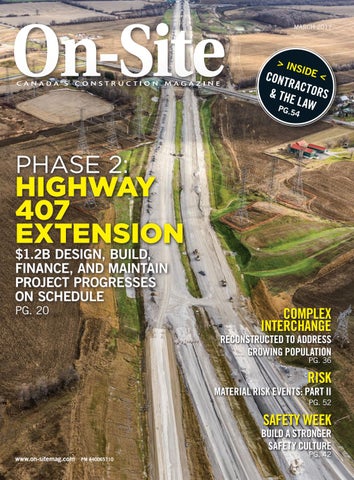
PHASE 2:
HIGHWAY 407 EXTENSION $1.2B DESIGN, BUILD, FINANCE, AND MAINTAIN PROJECT PROGRESSES ON SCHEDULE PG. 20
COMPLEX INTERCHANGE
RECONSTRUCTED TO ADDRESS GROWING POPULATION
PG. 36
RISK
MATERIAL RISK EVENTS: PART II
PG. 52
SAFETY WEEK
BUILD A STRONGER SAFETY CULTURE www.on-sitemag.com
ONSITE_MARCH17_LAZ.indd 1
PM #40065710
PG. 42
2017-03-06 3:02 PM
Competitive financing available through Daimler Truck Financial. For the Freightliner Trucks dealer nearest you, call 1-800-FTL-HELP. FTL /MC-A-1368. Specifications are subject to change without notice. Copyright © 2017 Daimler Trucks North America LLC. All rights reserved. Freightliner Trucks is a division of Daimler Trucks North America LLC, a Daimler company.
88326_VOC_2017_TEMUpFitPrint_OnSite.indd 1 OnSite_Freightliner_March.indd ONSITE_MARCH17_LAZ.indd 21
2017-03-06 3:02 PM
HELPING TEX-MIX KEEP THEIR PAYLOAD MOVING WHILE LOWERING THEIR REAL COST OF OWNERSHIP. Tex-Mix is only as profitable as their trucks are reliable. That’s why they choose Freightliner. We design trucks for easy upfit, productivity and low maintenance. Backed by a support team that’s there when you need us. And because Tex-Mix trucks are equipped with the powerful Detroit DD13 ® engine and Detroit Virtual Technician onboard diagnostic system, TM
TM
it’s not only a tough truck, but also a smart one. Built to increase profitability and lower their Real Cost of Ownership. We’re proud to say that’s why Freightliner has become the industry leader in work trucks.
To learn more about how Freightliner Trucks are working hard for Tex-Mix, visit RCO.FreightlinerTrucks.com/Tex-Mix.
ONSITE_MARCH17_LAZ.indd 3
2/22/17 3:08 PM 2017-02-24 3:02 2:36 PM PM 2017-03-06
Daimler Detroit #88904 Engineered to Carry Businesses Engine Print Ad
4C, Full Bleed, Single Page Onsite Magazine
Engineered to carry businesses on its back. High-performing engines help create high-performing businesses. And we’re proud to say we have one of the best solutions in the industry for keeping businesses on the move. It’s Detroit™ Connect Virtual Technician remote diagnostic service integrated with the Detroit DD13 engine. This advanced solution immediately notifies you if repairs are needed. And with hundreds of authorized Detroit service locations, service is quickly scheduled, parts are made available, and your truck is back on the job in no time. Don’t just want better business solutions. Demand them. SM
®
DemandDetroit.com/DD13
Available exclusively in Freightliner and Western Star trucks. DDC-EMC-ADV-0023-0716. Specifications are subject to change without notice. Detroit Diesel Corporation is registered to ISO 9001:2008. Copyright © 2017 Detroit Diesel Corporation. All rights reserved. Detroit™ is a brand of Detroit Diesel Corporation, a subsidiary of Daimler Trucks North America LLC, a Daimler company.
88904_DET_EngineeredToCarry_Onsite.indd 1 OnSite_DetroitDieseL_March.indd ONSITE_MARCH17_LAZ.indd 4 1
2/9/17 1:47 PM 2017-02-24 2017-03-06 2:59 3:02 PM PM
VOLUME 62, NO.2/ MARCH 2017
COVER STORY 20 Phase 2: Highway 407 Extension The second half of the ambitious Highway 407 extension, known officially as the Highway 407 East Project, is well underway in the Greater Toronto Area.
DEPARTMENTS 7 Comment
20
Take care of your tools
10 News
Industry news
18 Construction Stats The latest numbers on construction activity and employment
42
COLUMNS 50 Software Making sense of your data
52 Risk Part 2: Material risk events
54 Contractors and the Law Your insurer’s duty to defend
29 53 Index of Advertisers
features 29
Raising the bar
The use of Reclaimed Asphalt Pavement is reducing construction costs and advancing sustainable road building to new levels of excellence and expertise.
36
42
Derry Road was reconstructed from 2 lanes to 4, including a grade separation at the CN Rail crossing to accommodate rapid growth in Milton.
With Safety Week coming up May 1-6, contractors are offered these tips to build a stronger safety culture, and make sure everyone gets home safe at the end of their shift.
Derry Road and CN Rail grade separation
5 ways to build a stronger safety culture
on-sitemag.com / 5
9/17 1:47 PM
24 2:59 PM
ONSITE_MARCH17_LAZ.indd 5
2017-03-06 3:02 PM
JohnDeere.com/MMC
JOHN DEERE MACHINE MONITORING CENTER
WE’LL WATCH YOUR FLEET SO YOU CAN
RUN YOUR WORLD. Imagine being able to diagnose and fix problems before they lead to unplanned downtime. Specialists at your dealer’s Machine Monitoring Center remotely keep an eye on your fleet. When a potential problem is spotted, they can leverage expert alerts developed by our central Machine Health Monitoring Center to make sure you stay up and running. Which leaves one less thing for you to do to Run Your World.
OnSIte_JohnDeere_March.indd ONSITE_MARCH17_LAZ.indd1 61 38251-7OSM_8x10.875.indd
2017-02-24 2:19 PM 2017-03-06 3:02PM PM 2/15/17 5:14
COMMENT
Take care of your tools, big and small
C
24 2:19PM PM 7 5:14
I
Get the latest construction news! Follow us on Twitter @OnSiteMag
t’s difficult to put an exact number on the total cost of theft to construction companies in Canada, but according to a report from Zurich Canada, it’s safe to say the amount exceeds $46 million per year in insurance claims alone. This number doesn’t account for lost productivity. There’s no doubt that tools are valuable. Whether they’re pocket-sized, or of the 100-ton variety, jobsites are reliant upon equipment to complete projects on time and on budget. With this in mind, training your workers to take care of their tools, will save money, and reduce lost productivity. Fastfence.ca offers these 10 reminders to prevent theft on the jobsite: LIGHT IT UP – A well-lit job site makes it difficult for thieves to get into the site and leave unseen. SECURE YOUR PERIMETER – Temporary fencing is an inexpensive way to deter thieves by making it difficult for them to access your site. IMMOBILIZE LARGE EQUIPMENT – Prevent the theft of large equipment such as excavators and forklifts by installing immobilization or battery disconnect devices. Use locking devices such as boots, or surround equipment overnight with stacked materials. Have a system in place to manage equipment keys and keep them in a secure location. KNOW WHO’S WHO – Do detailed background checks on new hires and keep the use of subcontractors to a minimum. Make sure all workers and visitors sign in and out. SET THE TONE – Make sure everyone who enters the site knows that theft of any kind will be reported to the police. Give your employees the opportunity to anonymously report any worksite thefts by providing them with a ‘hotline’ number or the contact details for Crimestoppers. TRACK YOUR TOOLS – Whether you use a simple engraver, bar code tracking or a sophisticated microchip tracking system to manage tools on your smartphone, put a system in place and use it. A thorough tracking system helps prevent theft from occurring in the first place, but if a burglary still occurs, a detailed
list of tools and equipment is essential if you have to complete a police report or make an insurance claim. LOCK AWAY TOOLS AND MATERIALS – at the end of the work day, make sure all materials and tools are securely locked away in a storage container, locked job site trailer or locking tool box, and be sure to invest in good locks. PLAN MATERIAL DELIVERIES – Arrange for materials to arrive only when needed (just-intime delivery) because the longer materials are sitting around on your site, the more opportunity thieves have to steal them. If materials must be ordered in advance (to take advantage of sales pricing, for instance), make sure they are securely locked away or stored off-site. GET NEIGHBOURS ON YOUR SIDE – If you are working near a residential area, get the site manager to introduce himself/herself to neighbours and give them his/her phone number. If they see anything suspicious such as a truck that rolls up alongside the site with its lights off, they can call you right away. At the end of the job, give them a small token of appreciation. CONSIDER A SECURITY SERVICE – If you have a large site or an extensive inventory of valuable materials or equipment, a thirdparty security plan may be in order. This might include on-site, 24-hour security personnel, online tool and heavy equipment tracking, security alarms and video monitoring. If a theft does occur, report it to the police immediately, as your theft may be part of a pattern. Whether you have property coverage, contractor’s equipment insurance or builder’s risk insurance, make sure you know what your insurance covers and what it doesn’t. No job site is completely safe from determined thieves, but the more steps you take to prevent theft at your site, the more likely the thieves will set their sights elsewhere.
Corinne Lynds / Editor CLynds@on-sitemag.com
on-sitemag.com / 7
ONSITE_MARCH17_LAZ.indd 7
2017-03-06 3:02 PM
CONTRIBUTORS
MEET OUR CONTRIBUTORS FOR THIS ISSUE DAVID BOWCOTT / Global Director – Growth, Innovation & Insight, Global Construction and Infrastructure Group at Aon Risk Solutions On material risk events: “In the February issue we talked about material risk events that manifested in the Canadian P3 space up to 2011 and up to 2016. In this issue, I will focus on what is causing these risk events and how we can reduce the frequency (and severity) of their manifestations.”
www.on-sitemag.com / Fax: 416-510-5140
PUBLISHER | Peter Leonard (416) 510-6847 PLeonard@on-sitemag.com EDITOR/EDITORIAL DIRECTOR | Corinne Lynds (416) 510-6821 CLynds@on-sitemag.com MEDIA DESIGNER | Lisa Zambri lzambri@annexbizmedia.com ASSOCIATE PUBLISHER | David Skene (416) 510-6884 DSkene@on-sitemag.com SALES & MARKETING COORDINATOR | Kim Rossiter (416) 510-6794 KRossiter@on-sitemag.com ACCOUNT COORDINATOR | Cheryl Fisher (416) 510-5194 CFisher@annexbizmedia.com CIRCULATION MANAGER | Urszula Grzyb 416-442-5600 x3537 ugrzyb@annexbizmedia.com Vice President | Tim Dimopoulos (416) 510-5100 tdimopoulos@annexbizmedia.com
NATE HENDLEY / Freelance Writer & Author On Phase 2 of Highway 407 Extension: “The second half of the ambitious Highway 407 extension, known officially as the Highway 407 East Project, is well underway in the Greater Toronto Area (GTA). Phase 2 of the project will see Highway 407 extended eastward from Harmony Road in Oshawa to Highway 35/115, near Clarington in southern Ontario. An ancillary branch, Highway 418, will link Highway 407 with Highway 401 to the south.”
JACOB STOLLER / Principal, StollerStrategies On making sense of your data: “One of the most important IT trends happening in construction right now is that of data analytics. The practice of analyzing stored company data to help make business decisions, is gaining ground in companies of all sizes.”
COO | Ted Markle tmarkle@annexweb.com President & CEO | Mike Fredericks Established in 1957, On-Site is published by Annex Business Media 80 Valleybrook Drive, North York, ON M3B 2S9 Publications Mail Agreement No. 40065710 ISSN: 1910-118X (Print) ISSN 2371-8544 (Online) Circulation email: apotal@annexbizmedia.com Tel: 416-442-5600 ext 3258 Fax: 416-510-5170 Mail: 80 Valleybrook Drive, Toronto, ON M3B 2S9 SUBSCRIPTION RATES Canada $81.00 per year, Outside Canada US$139.00 per year, Single Copy Canada $13.00. On-Site is published 7 times per year except for occasional combined, expanded or premium issues, which count as two subscription issues. Occasionally, On-Site will mail information on behalf of industry-related groups whose products and services we believe may be of interest to you. If you prefer not to receive this information, please contact our circulation department in any of the four ways listed above. Annex Privacy Officer privacy@annexbizmedia.com Tel: 800-668-2374 Content copyright ©2017 by Annex Publishing & Printing Inc may not be reprinted without permission.
DIRK LAUDAN / Borden Ladner Gerbais LLP On your insurer’s duty to defend: “Builders’ Risk (or Course of Construction) insurance policies are commonplace on construction projects. Although they provide coverage for physical loss or damage to ongoing construction works, these policies typically include a “defects” exclusion for faulty or defective workmanship, materials or design.”
On-Site receives unsolicited materials (including letters to the editor, press releases, promotional items and images) from time to time. On-Site, its affiliates and assignees may use, reproduce, publish, re-publish, distribute, store and archive such unsolicited submissions in whole or in part in any form or medium whatsoever, without compensation of any sort. DISCLAIMER This publication is for informational purposes only The content and “expert” advice presented are not intended as a substitute for informed professional engineering advice. You should not act on information contained in this publication without seeking specific advice from qualified engineering professionals.
We acknowledge the financial support of the Government of Canada through the Canada Periodical Fund of the Department of Canadian Heritage.
MEMBER OF
Canadian Construction Association
8 / MARCH 2017
ONSITE_MARCH17_LAZ.indd 8
2017-03-06 3:02 PM
OnSite_
ONSITE_MARCH17_LAZ.indd OnSite_CMIC_Feb.indd 1 9
2017-03-06 2017-01-31 3:02 1:43PM PM
INDUSTRY NEWS
INDUSTRY>NEWS Partnership launch promotes a safer and more productive workplace for women In construction, safety is not only a priority it’s a core value for all workers and employers. Everyone deserves to come home at the end of the workday. This value was reflected at a launch event on February 8, to announce the official partnership between the Alberta Construction Safety Association (ACSA) and Women Building Futures (WBF). These two prominent provincial bodies gathered with almost 100 invited guests to launch their ‘Breakfast with the Leaders’ series, which aims to connect more women to the growing safety community in Alberta. Outgoing CEO of WBF, and keynote speaker at the breakfast event, JudyLynn Archer, spoke about how the partnership will bring people and ideas together to make a positive difference in workers’ lives. “We are facing a national challenge, as 250,000 construction tradespeople are expected to retire and we are left with a tax base lost from the mass exodus of these high income earners that these upcoming retirements will bring,” said Archer. “This does, however, present a tremen-
dous opportunity for Canadian women working in the industry. Together with the ACSA, we plan on providing as much assistance as we can to attract and prepare women with a safety mindset, giving them the best chance to gain employment in Canada’s construction and maintenance workforce. “With approximately 36,400 construction jobs being done by women across Alberta, and jobs in the sector expected to grow steadily over the next decade, there’s more opportunity now than ever for women with a strong safety mindset to enter this sector and make a positive change. The impact this partnership has on safety in the industry could be a real game changer,” Archer concluded. ACSA’s chief operations officer, and fellow keynote speaker at the event, Tammy Hawkins, spoke from experience when she discussed the challenges and opportunities encountered when striving towards her goal to mentor and lead in safety. ”Diversity in all areas is today’s reality in our workplaces. It enhances our skill
sets and our daily interactions. Through this partnership, we wish to convey our commitment to Alberta workplaces, and our belief in the ability of each participant to contribute meaningfully, and safely to our workforce,” she said. ”This partnership will make a real difference for women across Alberta. Our efforts will empower them to succeed in non-traditional careers, inspiring positive economic change for women, and forever transforming the face of construction in this province,” said Hawkins. In addition to the regular breakfast speaker series events, this partnership will see the ACSA provide access to its programs and services for WBF students, alumni and staff. This strategically positions WBF students and alumni to successfully compete for employment, complete their apprenticeships, contribute to safer more productive workplaces, and enhance the culture of safety among WBF staff. SOURCE: Alberta Construction Safety Association
George Massey Tunnel Replacement project granted Environmental Assessment approval Environment Minister Mary Polak and Community, Sport and Cultural Development Minister Peter Fassbender issued an Environmental Assessment Certificate to the Ministry of Transportation and Infrastructure for the George Massey Tunnel Replacement project, which includes: • Building a new 10-lane, clear span bridge over the South Arm of the Fraser River;
• Replacing the Westminster Highway, Steveston Highway and Highway 17A interchanges; • Widening Highway 99 between Bridgeport Road in Richmond and Highway 91 in Delta to accommodate dedicated transit/High Occupancy Vehicle lanes; and • Decommissioning the George Massey Tunnel. The decision was made after considering a review led by British Columbia’s Environmental Assessment Office. The ministers have issued the certificate with legally enforceable conditions that have given them the confidence to conclude that the project will be constructed and operated in a way that ensures no significant adverse effects are likely to occur. There are 33 conditions that are part of the Environmental Assessment Certificate. Design requirements are specified in the certified project description. Each of the conditions and the certified project description are legally binding requirements that the Ministry of Transportation and Infrastructure must meet to be in compliance with the certificate.
10 / MARCH 2017
ONSITE_MARCH17_LAZ.indd 10
2017-03-06 3:02 PM
OnSite_
THIS IS THE 2017 SUPER DUTY®
THE SMARTEST, TOUGHEST AND MOST CAPABLE SUPER DUTY® EVER. UNDISPUTED. BEST-IN-CLASS MAX. TOWING 32,500 LBS*
BEST-IN-CLASS MAX. PAYLOAD 7,630 LBS^
BEST-IN-CLASS DIESEL TORQUE 925 LB-FT‡
BEST-IN-CLASS GAS TORQUE 430 LB-FT†
Vehicle may b Vehicle be shown wit with h option optional al equip equipm ment. *Maxim ment *Maximum um towin towing g capaci capacity ty of of 32,500 32,500 lbs b on F-45 F-450 0 DRW DRW 4x4 4x4 with with 6.7L6.7L-V8 V8 diese iesell en ngin gine i . When When prope properly rlyy equ equipped pped wit with h availa available b fact ble factoryory-inst insttalle alled d equipm equipment. ent. Cla Class ss is FullFull-Size Size Hea Heavy vy Duty Duty Pick P ups p over ve 8,5 8,500 00 lbs. GVWR bas based ed on on Ford Ford segme segmentat ntation. ion. ^When pro properl perlyy equipp uipped. ed. Maxi Maximum mum payl payload oad a of 7,630 7,630 lbs on F-35 F-350 0 DRW DRW 4x2 4x2 with with 6.2L6.2L-V8 V8 gas gas engin engine. e. Class Class is Full Full-Siz -Size e Heavy Heavy Duty Pic Pickups k kups over 8, ove 8,500 500 lbs. GVW GVWR R based based on Ford Ford segm segmenta entation tion.. ‡Maxi Maximum mum dies diesel el torqu torque e of 925 lblb-ft ft on on F-250/ F-250/F-35 F-350 0 with with 6.7L6.7L-V8 V8 diese diesell engine engine.. When When prop properly erlyy equ equippe ipped. d. Class Class is Full Full-Siz -Size eH Heavy Duty Pic Pickups kups over 8,5 8,500 00 lbs. lbs GVWR bas based ed on on Ford Ford segme segmentat ntation. ion. †Maxi Maximum mum gas torq torque ue of of 430 430 lb-ft lb -ft on F-250 F-250/F-3 /F-350 50 with with 6.2L 6.2L-V8 -V8 gas engi e ne. When pro properl perlyy equipp equipped. e Clas Cla s iis Ful Fu l-Si S ze eH Heavy eavy Dut utyy Pickup Pickupss over over 8,500 8 lbs bs.. GVWR bas based ed on on Ford Ford segme segmentat ntation. i ion. ©2017 7 Ford For Moto tor C Compan ny of Can C ada, ada Lim Limited ited. All All rights rights res eserve erved. d
ONSITE_MARCH17_LAZ.indd OnSite_Ford_march.indd 1 11
2017-03-06 2017-02-24 3:02 2:44PM PM
INDUSTRY NEWS
New procurement and financing approaches needed to close infrastructure gap in Canada’s Northern and Aboriginal communities A long list of infrastructure concerns in Canada’s Northern and Aboriginal communities needs to be addressed, from poor access to basic amenities such as clean water, sewage treatment, and waste management systems to transportation and telecommunications. A new report by The Conference Board of Canada suggests that governments should be more open to private sector and Aboriginal participation to help close the infrastructure gap in a timely and efficient way. “The isolated location of many Aboriginal communities substantially raises the costs and complexity of infrastructure construction projects. Limited transportation links, shorter building seasons, and harsh climate conditions present unique challenges to infrastructure planning, financing, operation and maintenance,” said Christopher Duschenes, director, Northern and Aboriginal Policy, The Conference Board of Canada. “Closing the infrastructure gap is a huge undertaking and new infrastructure procurement and
financing options are needed to help move this critical agenda forward. The public sector will not be in a position to assume full responsibility for the required infrastructure projects to close the gap.” Report highlights: • Public infrastructure procurement and financing must be more open to private sector and Aboriginal participation to effectively address the issue. • Geography will always present important constraints. • Aboriginal financial institutions and some of the major banks in Canada have facilities to support Aboriginal participation in major infrastructure projects but need to be explored in more detail. There is a need for on-going dialogue and coordination around this issue. Indigenous and Northern Affairs Canada (INAC) has calculated that the infrastructure gap on First Nation reserves alone is expected to reach $9.7 billion by 2018. This number only addresses existing
Silvio Bot and Robert Taylor inducted into ORBA’s Hall of Fame Silvio Bot (receiving the award posthumously) and Robert Taylor were inducted into the Ontario Road Building Hall of Fame on Tuesday, February 7, at ORBA’s 90th Convention and Annual General Meeting. Silvio Bot was a founder of Bot Construction. He led the company over some 38 years of growth and expansion and was a well-known and prominent member of Ontario’s roadbuilding industry. Robert Taylor is the former chairman and president of McLean Taylor Construction Limited. Rob retired in December 2012. He was also president and chairman of sister companies Stone Town Construction Ltd. and Meadowridge Properties Ltd.
Silvio Bot
Robert Taylor
infrastructure needs, such as power, transport and communications. New infrastructure, including broadband connectivity, renewable energy, and regional transportation corridors that could catalyze greater economic and social development is not factored in. Re-Thinking Infrastructure Financing for Canada’s Northern and Aboriginal Communities proposes that alternative procurement models are needed and would allow the private sector greater opportunity to take the lead on designing innovative solutions to infrastructure challenges. Alternative modes of transport, such as airships and drones, advances in modular housing design, and the application of smart micro-grid technologies for electricity and connectivity are a few of the creative solutions that could become more readily available under private sector leadership. The report also suggests Aboriginal communities and businesses need greater opportunities to invest in and become more involved with infrastructure development. Aboriginal financial institutions have developed programs to encourage Aboriginal participation in procurement and development by assisting businesses and communities to build their portfolios and improve their creditworthiness. Many of Canada’s leading banks also now offer Aboriginal banking services and related infrastructure financing options. “The goal is to rethink how we pay for infrastructure, and encourage greater involvement from Aboriginal communities and the private sector,” added Duschenes. The findings in this report are based on a roundtable hosted by The Conference Board of Canada and The Canadian Council for Public-Private Partnerships, which brought together experts from the public and private sectors to discuss how new approaches to procurement and financing could help close Canada’s Northern and Aboriginal infrastructure gaps. SOURCE Conference Board of Canada
12 / MARCH 2017
ONSITE_MARCH17_LAZ.indd 12
2017-03-06 3:02 PM
BURNCO acquires Bestway Concrete of Colorado Calgary’s BURNCO Rock Products Ltd. has acquired Bestway Concrete Company, a leading ready mix concrete and aggregate producer in the metro Denver and northern Colorado regions. “We are extremely pleased that Bestway is joining the BURNCO family,” said Michael Powell, CEO of BURNCO. “The combination of BURNCO and Bestway will create a stronger company, with an exciting future. We are also excited to be expanding into the vibrant Colorado economy, where we see tremendous growth potential.” Clifford Hahne, vice-president of BURNCO USA, said: “we are also very pleased that the Bestway management team has agreed to stay on with the company. Bestway will still be locally managed, providing continuity as well as ensuring our long-term success. Bestway will continue to deliver the same quality products, exceptional service and great value.” Bestway Concrete Company was founded in 1981 and currently has nine ready mix concrete plants, four aggregate pits and more than 200 employees, of whom are expected to remain with the business. The company provides high quality ready mix concrete and aggregates for a broad range of applications including commercial, residential, industrial and infrastructure developments. Bestway president Gene Wagner said “Bestway management and employees are pleased to be joining the BURNCO family and we look forward to a strong future together.” BURNCO Rock Products Ltd. is a fourth generation family business established in Calgary in 1912 by James F. Burns. The company has operations across Western Canada and in Texas, supplying ready mix concrete, aggregates, asphalt and landscape supplies to a broad range of customers.
QEW and 7th Street Bridge named Project of the Year EllisDon has been awarded the OPWA’s 2016 Project of the Year Award for Transportation in the $2 to $10 million category for work completed on the QEW and 7th Street Bridge Project located in St. Catherines, Ont. The driving force behind the project was the need to replace the QEW Underpass Bridge followed by reconstruction of the interchange to include roundabouts at the ramp terminals, and sidewalk reconstruction. The QEW and 7th Street Interchange Reconstruction Design-Build project was the first of its kind for the Ministry of Transportation, Ontario. It provided residents with a durable replacement structure to accommodate the QEW widening and improved Ontario’s highway safety by reducing the number of accident incident points.
on-sitemag.com / 13 OnSite_Towmaster_March.indd 1
ONSITE_MARCH17_LAZ.indd 13
2017-02-24 2:15 PM
2017-03-06 3:02 PM
INDUSTRY NEWS
Highway 401 widening to improve safety and traffic flow The governments of Ontario and Canada are investing in Highway 401 to build stronger, more efficient transportation corridors, and improve safety and traffic flow for all highway users, including local residents, tourists and commercial drivers. Marwan Tabbara, Member of Parliament for Kitchener South-Hespeler and the Honourable Kathryn McGarry, Member of Provincial Parliament for Cambridge, were in Cambridge January 27 to announce funding to widen Highway 401. The Government of Canada is contributing more than $96 million and the Government of Ontario is responsible for all remaining costs of the project. “This is an important project for people in Cambridge and across our region, as it will improve road safety, reduce congestion, and support new jobs and economic opportunities. Working collaboratively with the federal government, Ontario is continuing to build modern and efficient infrastructure that will help all of Ontario’s communities thrive,” said McGarry. The project involves the widening of Highway 401 from six to 10 lanes for a distance of approximately five kilometres, between Hespeler Road and Townline Road. The work includes new high occupancy vehicle lanes and the replacement of two bridges at
Hespeler Road and Franklin Boulevard over Highway 401. Once completed, the project will improve safety and traffic flow to get kids to school, employees to work, and seniors to the services they need on time and back home quickly. The addition of high occupancy vehicle lanes will promote environmentally friendly transportation such as carpooling and the use of public transit.
Maple Reinders Consortium selected as preferred proponent on Hamilton biosolids project Maple Reinders Group Ltd., announced February 8, that the Harbour City Solutions (HCS) consortium – in which it has a 50 per cent interest for design, construction and capital works – has been selected as the preferred proponent to build the Hamilton Biosolids Management project. The project is being delivered through a public-private partnership (P3) using the design-build-finance-operate-maintain model, with a 30-year contract operations term. The Hamilton Biosolids facility will treat all of the City’s biosolids processed by their wastewater treatment system using an advanced thermal drying process, the first of its level of quality and reliability in the province. The new facility will produce ‘Class A’ pellets that will be sold to the agricultural community as a slow release organic fertilizer, or to coal burning industrial facilities as a renewable fuel replacement for coal. This technology will also greatly reduce the number of transport trucks required to remove solids from the plant on a daily basis, greatly improving air quality in the area. Reuben Scholtens, Maple Reinders’ director of Infrastructure Development, states: “A large number of the civil projects that Maple Reinders has constructed in our 50-year history have been in the water and wastewater sector. As an established leader in the design, construction and commissioning of these types of treatment facilities, we welcome the growing popularity of the P3 model to deliver projects in this sector. The City of Hamilton’s leaders and their advisors were able to transfer risk from the municipality, while retaining cost certainty and maintaining ownership. They should be commended for making this project a reality for their citizens.” The Hamilton Biosolids project is the third municipal biosolids-focused P3 project in Canada and the second to secure federal funding from PPP Canada. HCS plans to reach financial close in March of this year and immediately upon notification thereof will commence with design and construction.
14 / MARCH 2017 OnSite_Insite_March.indd 1
2017-02-24 1:20 PM
2017-On ONSITE_MARCH17_LAZ.indd 14
2017-03-06 3:02 PM
OnSite_
AutomAted to mAKe the PRoduCtion You need
Want to make your next machine acquisition really count? Komatsu’s lineup of automated excavators, including the all-new PC360LCi-11 and PC490LCi-11 feature a revolutionary, factory integrated, machine control system. The exclusive intelligent Machine Control technology lets operators focus on moving materials efficiently, without worrying about digging too deep or damaging the target surface. Contact your Komatsu distributor to learn how you can hit pay dirt today with Komatsu innovation.
komatsuamerica.com Copyright Š2017 Komatsu America Corp. All Rights Reserved Photograph may show optional equipment.
2017-OnSite_AD-20_DigGrade.indd 1 ONSITE_MARCH17_LAZ.indd OnSite_Komatsu_March.indd 115
020
3/1/17 2:25 PM 2017-03-06 2017-03-02 3:02 9:52PM AM
INDUSTRY NEWS
Mayor Crombie, Councillor Colle debate use of road tolls BY AONGHUS KEALY The decision by Queen’s Park preventing tolls from being placed on the Gardiner Expressway and the Don Valley Parkway in Toronto continues to be discussed as displayed by a recent public debate on road tolls in the GTHA. The Empire Club of Canada recently presented a sold-out panel discussion called “For Whom the Road Tolls” in downtown Toronto. Moderated by Postmedia chair Rod Phillips, the discussion involved a good cross-section of opinions on municipal autonomy, funding and congestion management. Mississauga Mayor Bonnie Crombie and Toronto Mayor John Tory were at odds before Premier Kathleen Wynne’s decision to block road tolls. At the debate, Crombie said she supported Tory’s right to seek permission for road tolls but disagreed with placing tolls on the Gardiner and DVP. A gas tax is a better way to fund transit, Crombie stressed, adding that Ontario’s municipalities need “permanent, long-term funding for cities.” Toronto Councillor and TTC chair Josh Colle, who voted with Tory for tolls in a 32-9 Toronto city council vote, said the city “can’t take another 20 years off infrastructure building.” He added that denying Tory’s request for regulatory approval for road tolls has led to the “feeling that a municipality can’t control its own destiny … The debate on tolls is far from over.” Teresa Di Felice, director, government and community relations, CAA South Central Ontario, said that road tolls were unfair to all drivers who pay “their share” in other ways. Di Felice noted CAA would support a toll only if the money it generated paid for new infrastructure. Mahrokh Arefi, CEO, Emovis Technologies America, said that road tolls “were a no-go 10 years ago, in the U.S. but attitudes have changed” since then. In fact, there are at least 30 areas in the U.S. that
Mississauga Mayor Bonnie Crombie explains a point as, from left, moderator Rod Phillips of Postmedia, Mahrokh Arefi of Emovis Technologies America, Toronto Coun. Josh Colle and CAA’s Teresa Di Felice listen.
“Despite the recent decision by Queen’s Park, road tolls are inevitable for GTHA roads as well as other urban centres facing serious traffic congestion across Canada,” use road pricing, including HOT lanes, to manage congestion and raise funds. She finished up the debate by saying that Toronto can’t delay the decision for another 20 years: “Do it for your future.” Event co-organizer Andy Manahan, executive director of the Residential and Civil Construction Alliance of Ontario (RCCAO), said the discussion was a success and the debate on tolls will continue. “Despite the recent decision by Queen’s Park, road tolls are inevitable for GTHA roads as well as other urban centres
facing serious traffic congestion across Canada,” Manahan said. “Road tolls have had positive results in the GTHA with the 407 ETR, 407 East and the current HOT lanes pilot project on the QEW. All forms of road pricing have proven to help manage traffic congestion around the world. That should be the main priority of implementing this tool; revenue is secondary.”
© Al
Aonghus Kealy is director of communications at the Residential and Civil Construction Alliance of Ontario. Send comments to editor@on-sitemag.com
16 / MARCH 2017
ONSITE_MARCH17_LAZ.indd 16
2017-03-06 3:02 PM
OnSite_
© 2016 , Inc. All rights reserved. All marks are trademarks of their respective owners.
INTRODUCING THE NEW INTERNATIONAL® HX™ SERIES. DESIGNED TO OUTWORK AND OUTLAST. You need more than a truck that’s capable of doing its job. You need it to overperform, week after week, year after year. That’s why we designed the HX Series with the strongest single rail in its class — a 3.5 million RBM rating — a best-in-class steering system and a 150,000-lb front tow pin. So when the others are begging for a break, the HX Series steps up and asks for more.
ca.InternationalTrucks.com/HXSeries
ONSITE_MARCH17_LAZ.indd OnSite_Navistar_March.indd 117
DOCKET #: 12670
FILE NAME: 12670-INTNT-P-018-2016-E
2017-03-06 2017-02-22 3:02 2:20PM PM
CONSTRUCTION STATS A selection of data reflecting trends in the Canadian construction industry
17% 35%
15% 17%
18%
35%
BUILDING PERMITS DOWN IN DECEMBER Municipalities issued $7.2 billion worth of building permits in December, down 6.6 per cent from November. Lower construction intentions were recorded for all components, led by commercial buildings and multi-family dwellings. In the residential sector, eight provinces posted declines while Ontario reported a record high. The average age of a construction worker in 2016 is 41 years old.
15%
Source: Statistics Canada
17%
18%
35%
RESIDENTIAL SECTOR
70%
50% 15%
Though the industry shines as a major employer, the average construction firm is quite small. In the residential sector, nearly 70 per cent of firms have fewer than five employees. In the non-residential sector, almost 50 per cent have five employees or fewer. NON-RESIDENTIAL SECTOR
70%
50%
18%
17% 35%
In 2016, 35 per cent of the construction labour force worked in Ontario, followed by Alberta (18 per cent), Quebec (17 per cent) and British Columbia (15 per cent).
Source: BuildForce Canada
18 / MARCH 2017
B
70% ONSITE_MARCH17_LAZ.indd 18
50% 2017-03-06 3:02 PM
OnSite_
370/75-28 14PR 400/75-28 16PR
BKT Tires (CANADA) Inc. - 55 York Street, Suite 401, Toronto, Ontario M5J 1R7, Canada - Tel: OTR (+1) 780 888 5667 - Fax: (+1) 416 229 1711 - AG/ IND (+1) 905 641 5636
ONSITE_MARCH17_LAZ.indd OnSite_BKT_March.indd 1 19
2017-03-06 2017-02-27 3:02 9:53PM AM
4 20 / MARCH 2017
ONSITE_MARCH17_LAZ.indd 20
2017-03-06 3:03 PM
COVER STORY
407 CHECKING IN ON THE
HIGHWAY EXTENSION The $1.2-billion design, build, finance, and maintain Phase 2 project is progressing on schedule
T
he second half of the ambitious Highway 407 extension, known officially as the Highway 407 East Project, is well underway in the Greater Toronto Area (GTA). Phase 2 of the project will see Highway 407 extended eastward from Harmony Road in Oshawa to Highway 35/115, near Clarington in southern Ontario. An ancillary branch, Highway 418, will link Highway 407 with Highway 401 to the south. Part of Phase 2 will be finished later
BY NATE HENDLEY this year, with the entire project slated for completion in 2020. Once all is done, the extension from Harmony Road to Highway 35/115 will be a 22-kilometre, four lane roadway. The Highway 418 link will be a 10 kilometre north-south, four-lane roadway. “Things are progressing very well and we are on schedule with the project,� says Brian Fox, communications director for the Blackbird Infrastructure Group (BBI), the construction consortium handling Phase 2. Highway 407 is owned and controlled by the province of Ontario, as are connect-
ing Highways 412 and 418. It is the first publicly-owned highway in the province with electronic tolls (but not toll booths or barriers). While Highway 407 is linked to the already existing Highway 407 Express Toll Route (ETR), the latter is a separate roadway leased and operated by a private firm. At present, the 407/407 ETR system starts in Burlington, weaves through various cities near Toronto, then ends at Harmony Road in Oshawa. According to the provincial government, the Highway 407 East Project will boost traffic flow around the GTA and on-sitemag.com / 21
ONSITE_MARCH17_LAZ.indd 21
2017-03-06 3:03 PM
COVER STORY
“Revenue generated from the tolls will be used to help fund new infrastructure and transit projects across the province. Toll rates for Highways 407 and 412 are lower than tolls on Highway 407 ETR…”
support future economic growth and development. It will also create business opportunities, accommodate increases in population and employment and offer emergency detour routes for Durham Region near Toronto. The $1.2-billion design, build, finance and maintain contract for Phase 2 was awarded to the Blackbird Infrastructure 407 General Partnership (Blackbird) by Infrastructure Ontario in March, 2015. This consortium is also referred to as the Blackbird Infrastructure Group. A different consortium handled Phase 1, which covered Highway 407 from Pickering to Harmony Road. This section is now mostly complete
and open to traffic, subject to newly instituted tolls. Blackbird is a partnership between CRH Canada Group Inc., headquartered in Concord Ont. and Spanish construction giant, Cintra Infraestructuras. Construction work for Phase 2 is being done by the Dufferin Construction Company, an Oakville-Ont. based division of CRH Canada Group Inc. and Ferrovial Agroman Canada, headquartered in Mississauga, Ont. Under the terms of the contract, CRH Canada Group and Cintra are responsible for providing 30 years-worth of maintenance. Cintra is one of the biggest private-sector developers of transportation infrastruc-
ture in the world, when it comes to number of projects and volume of infrastructure. The Blackbird website states that Cintra currently manages more than 2,180 kilometres of toll roads in 27 concessions in North America and Europe. CRH Canada Group Inc., meanwhile, is “one of the country’s largest vertically integrated building materials and construction companies, manufacturing cement, aggregates and ready-mix concrete. Dufferin Construction Company is one of Ontario’s leading construction firms with more than 100 years’ experience building infrastructure in Ontario,” reports the same website. Ferrovial Agroman Canada is a branch of Spanish firm Ferrovial Agroman, which has a specialty in toll roads. Design work on Phase 2 began in March 2015 with construction commencing in October that same year. Phase 2 actually consists of two individual segments: Phase 2A covers the area between Harmony Road and the
22 / MARCH 2017
ONSITE_MARCH17_LAZ.indd 22
2017-03-06 3:03 PM
Hyundai
TomorrowsEdgeToday.com
Who’s herding who?
ONSITE_MARCH17_LAZ.indd 23 Hyundai_March17.indd 1
2017-03-06 2017-02-15 3:03 1:35 PM PM
COVER STORY Taunton Road/Highway 418 interchange. If all goes to plan, this part of the roadway will be open to traffic in late 2017. Phase 2B, meanwhile, extends Highway 407 from the Taunton Road/Highway 418 interchange to Highway 35/115. Phase 2B also includes the Highway 418 linkup to Highway 401. Under the current schedule, the section of roadway covered by Phase 2B should be open to traffic in 2020. As for other specifics, Phase 2A and 2B will, according to Blackbird plans: • Include freeway-to-freeway interchanges at Highway 401/Highway 418 and Highway 407/Highway 418; • Include a freeway-to-freeway interchange at Highway 407/Highway 35/115; Include interchanges at: • Highway 407 at Enfield Road; • Highway 407 at Regional Road 57; • Highway 407 at Darlington Clarke Town Line; • Highway 418 at Highway 2; • Highway 418 at Taunton Road (partial interchange); and
• Establish a maintenance facility to provide support services. Once Phase 2 is complete, the roadways involved will be incorporated into Highway 407’s electronic toll network. The province insists the tolls are a relative bargain and that money raised through them will ultimately benefit drivers. “Revenue generated from the tolls will be used to help fund new infrastructure and transit projects across the province. Toll rates for Highways 407 and 412 are lower than tolls on Highway 407 ETR. The province’s rates are, on average, approximately 15 per cent lower during off-peak periods, and approximately 30 per cent lower during peak periods, as compared to Highway 407 ETR,” explains a press release from Ontario Ministry of Transportation, issued January 3, 2017. Phase 1 saw Highway 407 extended from from Brock Road in Pickering to Harmony Road. Another segment, Highway 412, veered south from the 407, connecting with Highway 401 between Ajax and Whitby. Work on Phase 1 began
in 2012. On June 20, 2016, Highway 407 was opened to traffic from Brock Road to Harmony Road. Highway 412 is also open to vehicles. Tolling on Highway 412 and the parts of Highway 407 covered in Phase 1 began February 1, 2017. According to a project source, there are still some parts of Phase 1 that aren’t done. The Highway 401 eastbound exit ramp at Lake Ridge Road, which was part of the Phase 1 plan, has not opened but will shortly. This opening is being delayed until a final inspection of the contractor’s work can take place. A few other minor bits and pieces need to be completed as well. As mentioned, a different cast of companies handled Phase 1. A consortium called the 407 East Development Group (407 EDG) won the billion-dollar design, build, finance and maintain contract for Phase 1 in May, 2012. 407 EDG had two equal equity partners, Cintra Infraestructuras and SNC-Lavalin Inc. of Montreal, via its SNC-Lavalin Capital division, reported a previous article in On-Site. The contract stipulates that 407 EDG is responsible for
24 / MARCH 2017
ONSITE_MARCH17_LAZ.indd 24
2017-03-06 3:03 PM
OnSite_S
TS 420 & TS 500i STIHL Cutquik®
TS 420
The STIHL TS 420 is a light and convenient 3.2 kW cut-off saw with a 350 mm cutting wheel for use on all types of jobs. The innovative long-life air filter system with cyclone air routing ensures an extremely long filter service life and increases service intervals. Low vibration levels makes working with this model less strenuous. The TS 500i is equipped with STIHL’s fuel injection technology which provides a simplified starting procedure - no choke, just purge and pull. It combines precision, efficiency and user-friendliness with cutting-edge technology. The X2 low-maintenance air filtration system allows filters to enjoy a long service life and ensures effective engine protection. Its electronic water control remembers the last setting used - water flow adjusts easily while in operation and no water at idle. So you can focus on what matters most - your work.
Displacement Power Output Weight * Max. Wheel Size Max. Cutting Depth
66.7 cc 3.2 kW 9.6 kg/21.2 lb 14”/350 mm 4.9”/125 mm
TS 500i
Displacement Power Output Weight * Max. Wheel Size Max. Cutting Depth
72.2 cc 3.9 kW 10.2 kg/22.5 lb 14”/350 mm 4.9”/125 mm
* Without fuel and cutting wheel.
FREE
¥
DIAMOND WHEEL WITH THE PURCHASE OF A
STIHL CUTQUIK® SAW
¥ Receive a STIHL B10-12” diamond wheel valued at $109.99 with the purchase of a TS 410 or TS 480i, a STIHL B10-14” diamond wheel valued at $145.15 with the purchase of a TS 420, TS 500i or TS 700, and a STIHL B10-16” diamond wheel valued at $181.49 with the purchase of a TS 800. The TSA 230 is excluded from this promotion.
QUALITY AT WORK FOR OVER 90 YEARS. For over 90 years, STIHL has been a world market leader and innovator in outdoor power equipment. German engineered products featuring the latest pioneering technologies make STIHL the preferred choice for professionals, consistently providing uncompromising quality. STIHL products are only available at independent STIHL Dealers who provide personal advice and expert service. Thank you for the continuous support and for making STIHL the brand you trust.
*
* “#1 Selling Brand in Canada” is based on an independent market share analysis of gasoline-powered handheld outdoor power equipment from 2016. Source: TraQline Canada.
e CLUB
EVERYONE IS TALKING ABOUT
GREAT PRIZES TO BE
WON
STIHLCLUB.CA
STIHLCanada
OnSite_Stihl_Feb.indd 1 ONSITE_MARCH17_LAZ.indd 25
stihlclub.ca
www.stihl.ca
2017-01-27 3:03 1:36 PM PM 2017-03-06
COVER STORY 30 years-worth of maintenance services on Phase 1 freeways. A source from Infrastructure Ontario speaking on background explained why the same consortium didn’t handle both parts of the 407 extension. Phase 1 and Phase 2 were independent projects, stated the source, each of which featured an open, competitive procurement. Blackbird just happened to earn the highest score during the Phase 2 evaluation process by the province of Ontario and was awarded the gig. While the teams doing the work might be different, there are significant similarities between Phase 1 and Phase 2. For a start, both feature a Superpave asphalt mix and involve an immense amount of materials. Phase 2 alone will entail the estimated use of 540,000 metric tonnes of asphalt, 72,000 cubic metres of concrete, 650 concrete girders, two structures of steel girders and 10,000 metric tonnes of re-bar, among other supplies, states Blackbird. Just as with Phase 1, Phase 2 has involved a series of community consultations. Key to these consultations are “Public Information Centres” (PICs)—events where citizens can discuss various matters with Highway 407 project organizers. Officials at PIC sessions have provided information on environmental concerns, property issues, agricultural agreements, construction timelines, storm water management, surface water monitoring, procurement processes, selling and relocating heritage structures, etc. Community consultations have also been a vehicle to garner input from Aboriginal groups. Once again, limiting damage to flora and fauna is a top priority. To this end, Phase 2 involves restoring forest and wetland at a 1:1 replacement ratio (a commitment that encompasses 35 hectares of forest and 19 hectares of wetland), establishing 77 hectares of nesting habitat for Bobolink and Eastern Meadowlark birds, planting 40 butternut tree stems, building a dozen nesting kiosks for barn swallows along with four nesting structures for bats and constructing 18 highway bridges and culverts for wildlife passage, states BBI. Noise pollution is also on the agenda. To dampen the sound of cars and trucks zooming along the asphalt, a noise wall approximately 1.35 kilometres in length is going to be built on the south side of Highway 407, near the hamlet of Hampton. For its part, the Ontario government seems quite content with how things are progressing on Phase 2 of the Highway 407 extension. “We are pleased with the pace of construction. BBI has been fortunate with great weather throughout 2016. As with any project, there are scheduling challenges but the province is pleased with BBI’s efforts to mitigate the impact of these,” says Calvin Curtis, manager of major projects, Central Region, Ontario Ministry of Transportation. Scheduling challenges aside, if work continues at its current rate, drivers can expect to be motoring on at least part of the Phase 2 extension in less than one year’s time.
Nate Hendley is a Toronto-based freelance writer and author. Please send comments to editor@on-sitemag.com.
26 / MARCH 2017 ONS_Mar17_Minnich.indd 1
ONSITE_MARCH17_LAZ.indd 26
2017-02-14 9:16 AM
2017-03-06 3:03 PM
ONSite
REAL ROAD WARRIORS. SINCE 1842.
Our deep, rich history has led us to develop an array of simple, innovative, class-leading features. It’s the reason we created the best support programs in the industry. It’s why our equipment has built and maintained thousands of miles of roadway across North America. Learn more at CaseCE.com/Roads
©2017 CNH Industrial America LLC. All rights reserved. CASE is a trademark registered in the United States and many other countries, owned by or licensed to CNH Industrial N.V., its subsidiaries or affiliates.
ONSITE_MARCH17_LAZ.indd ONSite_CASE_March.indd 1 27
2017-03-06 2017-02-23 3:03 1:45PM PM
The Office of Experience – 233 N. Michigan Avenue, Suite 1710 – Chicago, IL
$125B of infrastructure won’t break ground by itself.
Let’s Build. Canada has big plans for infrastructure development. And to handle a job of this size, you’ve got to have the right tools. With the hardworking mDRIVE™ HD automated manual transmission and 24/7 uptime solutions featuring GuardDog® Connect, it’s no wonder the Mack Granite® is the #1-selling conventional straight truck in North America.* So build on, Canada, because this infrastructure won’t build itself. See more at MackTrucks.com/LetsBuild
Granite®
TerraPro®
Granite® MHD
* Based on IHS Automotive, Polk TIP Net U.S. Class 8 Straight Truck Conventional, 10 liter and larger engines. Report period January 2015 through November 2016.
Mack_CON_OnSite_FP_8x10-7/8_Apr17.indd 1 ONSITE_MARCH17_LAZ.indd 28 OnSite_Mack_March.indd 1
3/1/17 3:31 PM 2017-03-06 10:06 3:03 AM PM 2017-03-02
ASPHALT Since the 1970s, Reclaimed Asphalt Pavement (RAP) has been a proven high quality product used in the design and production of asphalt mixes. According to a 2011 report by the U.S. Federal Highway Administration (FHWA), the performance of pavements containing up to 30 per cent RAP is similar to that of pavements constructed from virgin materials. The report also provides
Raising THE BAR Producing quality HMA incorporating RAP BY LISA FATTORI
A
s specifications change to allow for a higher content of RAP in asphalt mixes, quality assurance throughout the supply chain of a road construction project must become more stringent. From stockpile management and materials evaluation to mix design and construction techniques, each stage in handling the recycled material is equally important in ensuring that the end product is of high quality. Higher standards will instill greater confidence in the allowance of increased RAP content. The use of RAP will become more mainstream, which will not only reduce construction costs, but also advance sustainable road building to new
best practices for increasing the use of RAP in pavement mixtures, while maintaining high quality pavement infrastructures.
on-sitemag.com / 29
7 3:31 PM 10:06 AM
ONSITE_MARCH17_LAZ.indd 29
2017-03-06 3:03 PM
ASPHALT
Fractionating RAP.
“Putting RAP under cover isn’t as widespread as it should be, but moisture control is another example of the attention to detail that is needed in managing recycled materials.” – Ron Sines
levels of excellence and expertise. “At the end of the day, the use of RAP in the production of hot mix asphalt (HMA) is a way for the industry to be more sustainable, but if the material being produced isn’t the best quality, then the value that we’re trying to provide to the owner isn’t there,” says Ron Sines, Vice President – Asphalt Performance, Oldcastle Materials Inc. “As we’re advancing higher percentages of RAP, quality becomes even more of an issue. We can just meet the specifications of a project, but sometimes owners’ specifications aren’t written to ensure that they get the best quality. We need to meet industry’s expectations, which I would say should be higher. We need to think about the use of recycled materials in a holistic manner and ensure that high quality is a priority throughout the entire process.” The holistic paradigm begins with a clear understanding of the intended application of the mixture, and if RAP will be used in the surface, binder or base courses of a pavement. Designers need to consider anticipated loadings, and whether or not the mix will require a high stiffness. There is a direct relationship between the material characteristics of the RAP and where it is placed in the structure. A one-size-fits-all approximation is an over simplified approach in assessing the material requirements of a project. For high RAP content mixes, it is important to conduct durability performance tests. Designers have to run tests to understand the quality of the recycled binder to determine how the virgin binder is going to be impacted by the recycled materials. While the practice has been to grade in six degree increments, continuous grading for both virgin and recycled binders offers a
higher level of specificity in knowing the overall binder performance. “If I continuously grade the binders, it helps me to better understand the materials and what the end product is capable of doing,” Sines says. “In designing the mixture, maybe I can go to 26 per cent RAP, but not 27 per cent. We shouldn’t just limit ourselves to using 25 per cent RAP content. If we want to run a higher percentage of recycled material, then we have to work a little harder to make that happen. We have to step up to the plate and give owners the confidence that they are getting the best quality.” A detailed analysis on the impact that RAP has on the volumetrics and constructability of the mix design reveals the subtleties of the mixture and how it influences the durability of the pavement. While the Long-Term Pavement Performance (LTPP) program has been around for decades, the tool is not widely used by designers in determining the reliability of the binder in their mixes. However, with the use of a higher RAP content and continuous grading, knowing the reliability of a particular binder is essential. Developed by LTPP, LTPPBind is a software tool that uses historical data from 7,920 weather stations throughout North America. Drawing on this data, LTPPBind determines the estimated high and low air temperatures for a specific site and provides a low pavement temperature model for Superpave
30 / MARCH 2017
ONSITE_MARCH17_LAZ.indd 30
2017-03-06 3:03 PM
OnSite_
PLAY! COME OUT AND
ICUEE 2017 | Louisville, Kentucky | October 3-5
There’s only one place you can play with all the new toys in the construction and utility industry before you buy them — ICUEE, North America’s Premier Utility Demo Expo. Come get your hands dirty on our 2-mile outdoor test track. Or while exploring 25 acres of exhibits. And learn about the newest technology at our indoor demo stage. Every other year we gather over 950 of the leading manufacturers. So you can come play in our sandbox. Pre-register now at ICUEE.com and receive the latest show alerts and early bird specials.
ONSITE_MARCH17_LAZ.indd OnSite_ICUEE_March.indd 1 31
2017-03-06 2017-02-24 3:03 2:24PM PM
ASPHALT
Fractionated RAP. (NAPA - QIS 129)
(NAPA - QIS 129)
binder selection. Designers have improved temperature estimates of depth and reliability in PG selection, which helps them to develop more custom mixes. Quality control in the management of materials is also becoming more sophisticated, and has its own set of best practices to ensure that pre-production RAP is sorted, stored and processed to a higher standard. Moisture control is critical and, ideally, stockpile yards should be graded and paved so that water is directed away from stockpiles and the RAP is kept free of moisture. To
help reduce the moisture in stockpiles, RAP should be covered with a shelter or building and RAP should be placed in a wellbuilt conical stockpile. There should be no depressions in piles to avoid any accumulation of water. “Putting RAP under cover isn’t as widespread as it should be, but moisture control is another example of the attention to detail that is needed in managing recycled materials,” Sines says. “To dry off all of that water, I need a higher temperature of my virgin aggregate and, if I’m using a higher percentage of RAP, I have less virgin material to transfer that heat. This is a cost issue. If you’re using more burner fuel, energy costs are going to be higher and you’ll have more emissions. When, really, all you have to do is cover your stockpiles and have the proper drainage to keep the RAP as dry as possible.” While some agencies require captive stockpiles, with RAP coming from a single source, it’s more common to use RAP from continuously replenished stockpiles. RAP from multiple sources must be processed to create a uniform material with no segregation. It is considered a best practice not to further crush millings, but to use it as-is in mix designs, or to screen the milling to remove larger particles. The crushing process should ideally only break up agglomeration, so that the integrity of aggregates remains intact. There is a variety of crusher equipment used for processing RAP, but the Horizontal Shaft Impacter is the preferred technology because it breaks up chunks of pavement rather than reducing the size of the aggregates. Stockpiles of fractionated RAP offer flexibility in meeting mix
32 / MARCH 2017
ONSITE_MARCH17_LAZ.indd 32
2017-03-06 3:03 PM
178_Do OnSite_
RUN STRONG.
Packed with the features that operators demand, Doosan® wheel loaders bring strength to every job. See machines, features and specs:
DoosanEquipment.com/WheelLoader 1.877.745.7814 Doosan ® and the Doosan logo are registered trademarks of Doosan Corp. in the United States and various other countries around the world. ©2017 Doosan Construction Equipment. All rights reserved. | 178
178_Doosan_WL-Tough_OS_8x10-875_Mar.indd 1 ONSITE_MARCH17_LAZ.indd OnSite_Doosan_March.indd 133
2/21/17 8:07 AM 2017-03-06 2017-02-23 3:03 2:01PM PM
ASPHALT
Year over Year Average RAP Gradation 100 90
88.3
88.4
67.9
66.9
32.4
32.2
7.1
7.6
2012
2013
88.7
90.4
88.7
65.3
66.2
65.8
30.4
30.2
30.6
6.8
6.1
7.0
6.9
2014
2015
2016
Average
87.8
80 Percent Passing
70
62.8
60 50 40 30
27.6
20 10 0
Year 9.5 mm
4.75 mm
600 µm
75 µm
RAP is very consistent year-to-year at a specific location as shown on the chart from a typical Ontario plant. The asphalt binder content for this series averaged 4.10 per cent with a standard deviation of 0.25 per cent.
design requirements. Typical gradations include 3/4” to 3/8”, 3/8” to 3/16” and minus 3/16”. Fractionating should be considered when a plant site has space for multiple RAP stockpiles and when typical specifications allow more than 20 per cent RAP. “Fractionating is a more costly process, so if I’m usually using 15 per cent RAP in my mixes, then it isn’t worth the expense,” Sines says. “However, if I’m using 50 per cent RAP, then I need different gradations to target the mix that I’m trying to produce. As your recycled content increases, your controls are going to have to increase, and fractionating RAP is just one of those controls.” Not all mixes have the same amount of RAP, which can be problematic in the production of mixes. High RAP content may raise baghouse temperatures above what is typical. Plants have to be configured to accommodate a range of RAP usage, and operators need to calibrate the burner to offer the highest level of flexibility. The construction of a pavement with higher RAP content is the final phase in transforming the recycled material into a valuable component of a top performing pavement. Best practice includes ensuring that the mix is delivered to the construction site at the right temperature, and that it doesn’t get segregated from the truck to the hopper. Because high RAP mixes are stiffer,
there is a direct correlation between paving speed and/or the need for more compaction equipment. Density levels must be precise to ensure that the material is impermeable to water. While some projects, such as a parking lot, may not specify a high level of testing, best practices call for the same testing diligence that would be afforded a roadway to ensure that the product being delivered to the owner will perform. “We’re now at the point of increasing the amount of RAP while producing high quality mixes, and this requires a lot more attention to detail,” Sines says. “Economically, there are a lot of benefits. If I am able to run higher recycled levels than my competitors, it impacts my success in winning contracts. The cost of materials goes down, but I have more jobs, which forces competitors to up their game. As the bar gets raised, the competition has to keep up, or go the way of the dinosaurs.”
This article is being republished with permission from the Ontario Asphalt Pavement Council. Lisa Fattori is a freelance writer, specializing in the construction industry. Send comments to editor@on-sitemag.com.
34 / MARCH 2017
ONSITE_MARCH17_LAZ.indd 34
2017-03-06 3:03 PM
ONS_V
JOIN US! NATIONAL HEAVY EQUIPMENT SHOW
Ready. Set. slow.
BOOTH #1214
Introducing the new I-Shift with Crawler Gears from Volvo Trucks. It allows drivers to travel at speeds as slow as 0.6 miles per hour and maintain a precise, controlled roll. It’s an ideal automated transmission for applications like pouring curbs or laying asphalt, where low speeds are crucial to doing the job right. See the new standard in powertrains: DoWork.VolvoTrucks.ca
I-shift with crawler gears ONSITE_MARCH17_LAZ.indd ONS_Volvo_Issue_CSS.indd 135
Volvo Trucks. Driving Progress
2017-03-06 2017-02-14 3:03 9:49PM AM
DERRY ROAD AND CN RAIL
GRADE SEPARATION
Complex Milton interchange reconstructed to address growing population BY VIREAK HINH & JENNIFER TRIMBLE
B
ack in 2006, the Derry Road/ CN Rail Grade Separation was identified as part of the 2006 Environmental Study Report (ESR) completed for the Derry Road corridor. The report recommended that Derry Road be reconstructed from 2 lanes to 4, including a grade separation at the CN Rail crossing. The ESR confirmed the existing at-grade crossing at the CN Rail line would not be able to accommodate the anticipated travel demand projected for 2021. An underpass was identified as the
preferred solution. Derry Road is an arterial road running across Halton Region from the City of Hamilton border to Halton’s boundary with Peel Region, crossing through both the City of Burlington and the Town of Milton. The underpass was identified to satisfy east-west capacity requirements, to reduce delays and improve safety for cyclists, pedestrians and vehicular traffic. The crossing consists of CN right-of-way passing through a densely populated area. R.V. Anderson Associates Limited
was retained by Halton Region as the prime consultant to design and manage construction for grade separation capable of carrying two tracks across a four span railroad bridge. New Alliance was the General Contractor. The project included a number of unique challenges requiring innovative solutions for lane configurations and detours to maintain traffic flow and address safety for workers and pedestrians. Project features include a 4,200 cubic metre precast storm detention tank buried under Derry Road, a fully computerized
36 / MARCH 2017
ONSITE_MARCH17_LAZ.indd 36
2017-03-06 3:03 PM
CASE STUDY
pumping station and two oil-grit separators to address debris and pollutants from stormwater runoff. In tandem with the bridge construction, Derry Road has been lowered by approximately seven metres and accommodates four lanes of traffic. The construction of the underpass was accelerated from 2018 to 2013 to accommodate the rapid growth in Milton. The work was completed in two contracts with the road widening and detour commencing in 2009 and the underpass in 2013.
DESIGN SUMMARY Bridge substructure Before excavating to road sub-grade, augured caissons and piers were constructed at grade level just below pier cap elevation. This approach allowed for cost savings and avoided deep excavation and expensive shoring system. The caissons extend down and installed into sound bedrock. A total of 34 caissons were installed in rock sockets to support the bridge structure. Each abutment is built with connecting wingwalls for ground stability near the tracks. The substructure design comprised a large diameter caisson, which transitioned into a smaller diameter pier to increase spacing between the columns while maintaining strength of the system. Forming the size change between pier and caisson became a major challenge and required careful planning. The contractor used a double steel casing technique that allowed them to achieve the design requirement.
Bridge superstructure After the bridge substructure was completed, the deck was formed by a falsework shoring system, which extended approximately 2 metres above grade. Constructing the deck in a shallow excavated area was the preferred solution to avoid expensive excavation costs. The deck slab is 1.5 metres thick and spans over 3 piers. Once the bridge deck was formed and reinforcements were in place, it was ready for 680 cubic metres of concrete. The continuous pour took place over an 8-hour window, which required careful coordination and staging. All bridge bearings of the piers and abutments are spherical bronze bearings that provide excellent corrosion resistance and full freedom of rotation in all directions. These bearings weigh approximately 1,900 kilograms each. Sliding plates in the bearings also allow for longitudinal expansion and contraction of the bridge deck. The bearings are self-lubricating and outfitted with bird screens to prevent corrosion from feces accumulation. Stormwater detention tank The lower elevation of the new road at the underpass will result in surface runoff collecting and ponding underneath the bridge if adequate drainage is not provided. The stormwater detention system is used to detain surplus water during storm events and then allow it to drain during periods of lower flow. The amount of water to be detained during a 50-year storm is 4,200 cubic [Figure 1: Bridge Elevation]
on-sitemag.com / 37
ONSITE_MARCH17_LAZ.indd 37
2017-03-06 3:03 PM
CASE STUDY
Top photo shows installation of the precast detention tank. Below photos illustrate the fully developled section of Milton that the project took place in. The interchange is bordered by Milton District Hpspital and the Milton Fire Department headquarters.
metres. To accommodate this large volume of water, a storm tank 10.5 m wide by 120 m long with varying height was designed. Rail traffic was continuous through all stages of excavation and tank construction. The stormwater detention tank consists of a V-shaped cast-in-place concrete channel with upstand walls on either side and then topped with 66 - 1.8 m wide precast concrete arches spanning across the walls. After being completed, the tank was buried beneath engineered backfill before
the road was constructed on top.
CONSTRUCTION CHALLENGES
Pumping station To pump out the storm water from the detention tank, it was necessary to add a pumping station at the grade separation. A 3 m diameter precast maintenance shaft approximately 15 m deep was constructed to house three submersible pumps. Whenever the tank is full of water, the pumps are turned on automatically and a forcemain carries the water to a nearby manhole.
Railway requirements Before track diversion could take place, a railway protection wall was constructed to support the existing CN freight operation. The track protection comprised of steel pile and lagging, which were tied back with inclined grouted anchors. Track settlement and pile deflection points were installed to monitor and measure movements of the wall during construction. CN Rail freight operations were
38 / MARCH 2017
ONSITE_MARCH17_LAZ.indd 38
2017-03-06 3:03 PM
OnSite_
S:7”
S:9.75”
Your business relies on quality tools. Equip yourself with a quality network. Power your business with Bell, Canada’s fastest, as ranked by PCMag 2016, and largest network1. Download blueprints and documents at amazing speeds and keep your team connected at any job site with smartphones, rugged devices and tablets. Plus, our reliable connections, strong LTE signals and amazing in-building coverage make it easier for you to contact workers. The right network makes all the difference for your business.
Visit a Bell store • 1 888 832-7224 • bell.ca/therightnetwork Current as of Feb 10, 2017. Available within network coverage areas available from Bell Mobility where technology permits; see bell.ca/coverage. One-time connection ($15) and SIM card charges ($10) may apply. 9-1-1 government monthly fee in Alta.: $0.44, N.B.: $0.53, N.L.: $0.75, N.S.: $0.43, P.E.I.: $0.70, Que: $0.46, Sask.: $0.62. Taxes extra. Other conditions apply. If you end your Commitment Period early, a Cancellation Fee applies; see your Agreement for details. Subject to change without notice. (1) As ranked by PCMag. Reprinted from www.pcmag.com with permission. © 2016 Ziff Davis, LLC. All Rights Reserved. Largest network based on total square km of coverage on the shared LTE network available from Bell vs. Rogers’ LTE network. See bell.ca/LTE for details.
ONSITE_MARCH17_LAZ.indd OnSite_BellMobility_March.indd391
2017-03-06 2017-02-16 3:03 12:09 PM PM
CASE STUDY
required to remain uninterrupted throughout construction. In order to maintain rail operations, a detour track was constructed to the east of the existing track and used until the new CN Bridge was completed. Careful coordination between Contractor and CN flagging contributed to an integral role for the success of the switchover.
to ensure settlements were avoided. A detailed survey of the surrounding properties was undertaken. Particular care was taken to look out for existing cracks. Total stations were used throughout construction to survey track positioning and possible shoring wall deflection.
WRAP UP Traffic requirements The nature of the construction, with limited space for equipment and materials required a series of road closures that resulted in an enhanced communication strategy with the community. Halton used a wide variety of communication tools from social media to traditional print and on-site Police services, to help the motorists and residents navigate the road closures. A detour road was constructed to maintain traffic around the construction zone.
proposed utilities within the Derry Road right-of-way. Existing Milton Hydro transfer station is located in the northwest quadrant of the CN Rail crossing Derry Road. Hydro One transmission lines with Bell Canada plant are located on a pole line southwest and north boulevard of the CN Rail Crossing. Road protection wall at the southwest corner was installed to allow the staging for the excavation.
Site constraints The underpass is located in a fully developed section of Milton. The project included 1.3 km of Derry Road between Scott Boulevard and Bronte Street and is bordered by Milton District Hospital and Milton Fire Department Headquarters (Station #3). Approximately 30,000 vehicles travel on Derry Road every day. There are a number of existing and
Settlement monitoring The grade separation is located in close proximity to many different residential and commercial properties. In combination with high volumes of dewatering, there was risk of settlement damage to adjacent properties without proper project controls. Adding to the risk was the fact that the railroad tracks were also not allowed to settle. Careful monitoring was performed
Construction was complete in 2015
MAXIMIZE
The Derry Road grade separation successfully overcame a number of significant engineering and coordination challenges to provide improved traffic and pedestrian flow to the surrounding neighbourhood. Cooperation between the General Contractor, CN, Town of Milton, Region of Halton and local property owners contributed to overcoming many challenges. The project was completed in 2015, and was recognized late last year with an Ontario Concrete Award for its design and construction innovation.
This article is being reprinted with permission from the Transportation Association of Canada. Vireak Hinh, P.Eng., with R.V. Associates Ltd., and Jennifer Trimble, Region of Halton, are co-authors. Send comments to editor@on-sitemag.com.
Make tighter turns, cut smoother grades, and get the most out of your machine. This revolutionary system features our advanced
YOUR MACHINE
blade technology that lets you work faster and smarter than ever before. With intelligent automation that intuitively guides you to cut the right depth, grade, and slope every time. And it’s versatile enough to work on just about any machine. For more info, visit topconpositioning.com/MAX
with
MC-MAX technology
3D-MC MAX CONSTRUCTION SOLUTIONS topconpositioning.com/MAX
40 / MARCH 2017 OnSite_TopCon_March.indd 1
ONSITE_MARCH17_LAZ.indd 40
2017-02-16 12:14 PM
2017-03-06 3:03 PM
OnSite_
ONSITE_MARCH17_LAZ.indd OnSite_LinkBelt_Feb.indd 1 41
2017-03-06 2017-02-01 3:03 1:50PM PM
SAFETY
WAYS TO BUILD A STRONGER
safety culture E
nsuring every worker safely returns home at the end of the day is constantly at the forefront of our minds. It takes continued due diligence. With a fresh start in 2017, now is the time to access the right plan for your workforce, to significantly reduce incidents, accidents and near misses. Safety Week 2017, an industry-wide event dedicated to the education and celebration of safety in the workplace across North America, takes place May 1 to 6. It is an opportune time to examine and reinforce your company’s commitment to safety. This commitment is strongest when it’s woven into the culture of an organization and a visible part of everyday routines and processes. Here are five ways to build a stronger safety culture:
COMMIT TO SAFETY
Top: MySafeWork president Rob Ellis (r), and Walsh Canada VP Craig Lesurf (l) celebrate a successful on-site safety event at TTC Pioneer Village Station in Vaughan, Ontario.
Bring the commitment to safety to an individual, personal level by asking company leaders to consider these questions: • How engaged am I in company safety programs? • How can I increase my engagement levels with project teams? • Can I make a difference to our workers’ safety by engaging more?
42 / MARCH 2017
ONSITE_MARCH17_LAZ.indd 42
2017-03-06 3:03 PM
Bottom: Workers sign the Jersey of Courage as a symbolic commitment to workplace safety at TTC Pioneer Village Station in Vaughan, Ontario.
While on location, attend safety-specific meetings and briefings, complete a jobsite safety audit/inspection, engage in safety-specific discussions with foremen and other crew members. This is also an ideal opportunity to solicit feedback from workers on site conditions and company values.
• What are we doing well? • What can we do better? • Do you feel safe on the jobsite? • What does safety mean to you?
SAFETY EVALUATION • Does our company empower me to make a difference in workplace safety? • How do I influence our company and my leadership? After your leaders consider these questions, ask them to make a pledge to commit to something this year that they believe will make a difference in their personal safety performance and help provide an injury-free workplace. These should become action plans that are shared with employees, asking for feedback. If you are a leader in your company, then ask yourself what can I do to be a
better leader? What can I do to engage all workers on our project sites and offices? How do I enable others to become leaders and adopt a culture of safety?
VISIT PROJECT SITES & OFFICES The commitment to safety begins at the highest levels, in an effort to showcase that safety promise, executives and management personnel should make safety-specific visits to each jobsite throughout Safety Week. Maximize your time on the jobsite by meeting with workers and identify what their daily workloads and responsibilities include.
Challenge your project teams to confidentially assess where the project measures in terms of safety performance (non-compliant, compliant, good practice, best in class). During the evaluation, focus on safety culture, employee competency/training, communications (best practices, incident reviews, etc.), compliance with regulations, and subcontractor performance. If you have not done so already, use Safety Week to put your safety plans into motion, and begin to work toward achieving “best in class” status. Engage trade personnel to join in this effort as well, as they are a valued partner and will carry your safety on-sitemag.com / 43
ONSITE_MARCH17_LAZ.indd 43
2017-03-06 3:03 PM
SAFETY commitment with them into the future.
HOLD EVENTS THAT FOCUS ON SAFETY The official safety Week 2017 website (www.constructionSafetyWeek.com) offers a widerange of events and activities to hold throughout the first week in May,
including sharing photos of weekly activities on social media using #SafetyWeek2017; hosting a safety Roadshow and inviting vendors to showcase new tools and safety equipment; and holding safety training sessions (hand injury prevention, fall protection, ladder safety, etc.). Safety education events are extremely productive. Tool Box Talks, educational
materials and best practices can be shared from safety leaders across North America. Free handouts and giveaways provide extra incentive, along with safety breakfasts or lunches that celebrate safety and promote camaraderie. Contests also drive up safety engagement – consider posters, golf putting, dunk booths, best safety ideas and family cookouts. Involving the children and family of our workforce is powerful, these are the people who rely on us to keep their mothers, fathers, sisters, brothers, sons and daughters safe.
CONDUCT JOBSITE SAFETY REFRESHER COURSES Safety Week is an opportune time to review policies and procedures on individual jobsites. Here are some activities: • Hold Emergency Response Drills: Invite emergency response teams (Fire Department, Police, EMT, etc.) to come on site to assess emergency response protocols specific to that jobsite. • Perform a Safety Rollback: Include site housekeeping, cord/tool inspections, rigging inspections and proper storage, assured grounding inspections, PPE inspections, fire safety inspections. • Educate your workers - in 2017 the focus for Safety Week 2017 is on hand safety, but the week will cover all forms of safety. The slogan for the week is “Take FIVE for safety.” Tool box talks, educational material and best practices will be shared from safety leaders across North America.
BUILT FOR YOUR BUSINESS
NHES Show booth #2801
Husqvarna’s all-around power cutters have you covered, no matter the application. The K 760 and the more powerful K 970 power cutters are the perfect solution for most jobs. The K 760 boasts the lowest vibrations, 2.4 m/s2, on the market and both feature a fuel-sipping X-Torq® engine. The K 970 features a more powerful 6.5 hp engine, perfect for highway or demolition work. To learn more about our power cutters and our whole product offering, visit booth #2801 at the NHES Show or call your local representative. facebook.com/husqvarnaconstruction
youtube.com/husqvarnaCP
HusqvarnaCP_Americas
Copyright © 2017 Husqvarna AB (publ.). All rights reserved. Husqvarna is a registered trademark of Husqvarna AB (publ.).
Rob Ellis, president of MySafeWork often asks, “What do good companies look like? Well, they care for their staff, they care for others, are proactive about safety and lead by example.” The main objectives for raising the bar for safety in our industry are generating awareness, increasing education, promoting positive reinforcement, evolving cultures, and sharing best practices. These objectives will support our collective efforts to ensure our workforce works safe, that our new workers are
44 / MARCH 2017 OnSite_Husqvarna_March.indd 1
ONSITE_MARCH17_LAZ.indd 44
2017-02-24 2:28 PM
2017-03-06 3:03 PM
OnSite_
ONSITE_MARCH17_LAZ.indd OnSite_B2W_Feb.indd 1 45
2017-03-06 2017-02-02 3:03 3:25PM PM
SAFETY
– We are safer and stronger together. The project team at Ashbridges Bay Wastewater Treatment Plant in Toronto, ON gathers to celebrate safety.
protected and everyone returns home in the same condition as when they arrived. Here’s what YOU can do to raise the bar for safety: 1. Challenge the status quo. 2. Participate in Safety Week 2017. 3. Take part in additional initiatives specific to your provincial construction association in May. Join the League of Champions to use
as your lever to improve safety culture at your company. 4. Volunteer through a local construction consortium to make a difference for safety in our industry. 5. Share; after all safety is not proprietary! 6. Make it personal – use personal reasons to motivate people.
step up to make a difference, people will continue to get hurt in our industry, and that is unacceptable. So, ask yourself, are you a leader?
Craig Lesurf is vice-president, Walsh Canada, and chairman of the board for the Toronto Construction Association. Please send comments to editor@on-sitemag.com.
Leaders need to lead, and unless we all
Check out these Heavy Features • Snow & Ice Removal • The Rental Pavilion • Recruiting Here • OHMPA Spring Operation Seminar • Safety Products • Educational Program And don’t miss the Gravel Pit &
Top 10 Under 40!
REGISTER NOW! PRE-REGISTER ONLINE TO SAVE 50% WWW.NHES.CA
Stay tuned to our website for updates:
46 / MARCH 2017 OnSite_NHES_Feb.indd 1
ONSITE_MARCH17_LAZ.indd 46
2017-01-27 1:50 PM
2017-03-06 3:03 PM
OnSite_
RACK
AdrianSteel.com
DROP DOWN LADDER RACK
Exclusive twist-to-adjust feature Fit the rack to your ladder in mere seconds with innovative adjustment knobs. Easy reach handles and two-stage drop down Easily load and unload ladders with the most ergonomic load height of any ladder rack available. Anyone 5’4” and taller can operate! Corrosion resistant design The natural aluminum finish and sealed steel drive shaft protects your ladder rack from the elements and reduces corrosion, all while lightening your load with a rack that’s 15% lighter than traditional steel racks.
‘N ROLL GRIP LOCK LADDER RACK
Exclusive tilt angle Anyone 5’7” or taller can easily load and unload ladders. Secure clamping mechanism Save time and gain peace of mind by quickly clamping your ladder into place. Eliminate the uncertainty of strapping your ladders down. Corrosion resistant design The natural aluminum finish protects your ladder rack from the elements and reduces corrosion, all while lightening your load with a rack that’s 15% lighter than traditional steel racks.
FINALLY, A LADDER RACK DESIGNED AROUND YOU. LEARN MORE AT ADRIANSTEEL.COM/LADDER-RACKS © Adrian Steel Company 2016, all rights reserved. Adrian Steel Company is an independent equipment manufacturer, prices may vary. Please visit AdrianSteel.com to contact your local distributor for further details.
ONSITE_MARCH17_LAZ.indd OnSite_AdrianSteel_March.indd471
2017-03-06 2017-02-24 3:03 1:36PM PM
STATEMENT
Statement from the Minister of Transportation on improving Ontario road construction
O
n February 17, Steven Del Duca, Minister of Transportation, issued the following statement: “Ontario is committed to maintaining the safest roads in North America. Since the Auditor General released her report last November, Ministry of Transportation staff have been hard at work identifying ways to address the Auditor’s seven recommendations (see sidebar). The result of that work is a comprehensive plan that will enhance oversight, ensure value for money and improve asphalt pavement quality for Ontario’s roads. The Action Plan for Highway Construction Contracts and Oversight outlines nearly 50 specific actions that will be implemented starting this construction season, bringing both immediate and long-term benefits. These actions will ensure Ontario’s highway network can withstand regular use and our harsh climate. Some of the actions detailed in the plan include removing incentives related to asphalt properties and compaction, raising the benchmark for asphalt smooth-
ness, continuing to penalize contractors whose work fails to meet ministry standards, incorporating the Extended Aging test in all contracts tendered after March 1, 2017, conducting more inspections and requiring suppliers to certify that they are providing high quality asphalt cement, and creating a panel of third-party experts to advise the ministry on key contract provisions. The ministry will also take over responsibility for the care, control and oversight of asphalt samples for all new contracts, create a fraud reporting tip-line by the end of spring 2017 so suspected violations can be reported anonymously, and build a new Centre of Excellence for Transportation
Infrastructure, which will allow for better research and testing of materials including asphalt. A full list of actions being undertaken by my ministry is contained within the report. As minister, I take my responsibilities for the safety and quality of Ontario’s transportation network very seriously. Through this action plan, I am confident that we will continue to deliver a transportation system that meets the needs of Ontario’s growing population, while providing value for taxpayers.”
Send comments to editor@on-sitemag.com.
The Action Plan for Highway Construction Contracts and Oversight addresses all seven of the Auditor’s recommendations: 1: Minimizing cracks on asphalt highways 2: Incorporate the “Extended Aging” test for asphalt 3: Making decisions that are in the best interests of Ontarians 4: Appropriate care and control of asphalt samples 5: Obtain a high level of assurance 6: Enforce and modify warranty provisions 7: Take action on poor performance or behaviour Visit http://www.mto.gov.on.ca/english/publications/ action-plan-highway-contracts-oversight.shtml, to read the Ministry of Transportation’s Action Plan for Highway Construction Contracts and Oversight
48 / MARCH 2017
ONSITE_MARCH17_LAZ.indd 48
2017-03-06 3:03 PM
March 2017
FREE TO QUALIFIED SUBSCRIBERS! Please fill in the following and mail/fax today!* For faster service, go to simply visit on-sitemag.com and click on Subscriptions
Y ES! I wish to receive/continue to receive absolutely FREE. Digital
Choose your edition:
Signature (required)
Professional content for professional contractors
Both
Date
Name Title
/
/
DD MM YR
Company Address City
Prov.
Postal Code
email Tel
Do you wish to receive our E-Newsletter?
Yes
No
Please answer the following questions to renew your free subscription. Incomplete forms cannot be processed. What best describes your primary business? (Choose only one) Contractor engaged in Highway & Heavy Construction Contractor engaged in Building Construction Distributors & Rental Houses Government & Public Works Other (please specify) Do you rent equipment?
Yes
No
What is the approximate number of employees at this location? Are you a contractor who works with concrete related Yes No products and services? Do you purchase and/or approve the purchase of construction products or services? Yes No
If Yes, please indicate which products Earth moving equipment Compact Equipment Safety Equipment Paving Equipment Dump Trucks Used Equipment Pick-Up Trucks Trailers Generators Attachments Hand Tools Compressors Lifting Equipment Power Tools Welding Tools
On-Site Magazine 80 Valleybrook Drive, North York, ON M3B 2S9
visit
on-sitemag.com to subscribe today
Fax: 416.510.5172
*Publisher reserves the right to determine qualification & limit distribution.
ONSITE_MARCH17_LAZ.indd 49
2017-03-06 3:03 PM
SOFTWARE By Jacob Stoller
Garbage in, garbage out – Making sense of your data The explosion of specialty apps and smart devices has made it very easy for contractors to collect data. The question is, how much of this data is actually useful?
O
ne of the most important IT trends happening in construction right now is that of data analytics. The practice of analyzing stored company data to help make business decisions, is gaining ground in companies of all sizes. Even a contractor with several pieces of earth moving equipment, for example, can collect data from the equipment’s recording devices and use it to determine which operator or crew is most productive. The challenge is that collected data is not necessarily usable data. If the data is of poor quality, that is, it contains errors, redundancies, or variations in how it is stored; this can lead to users receiving incomplete or wrong information. Such discrepancies can be difficult to detect – data is an intangible and invisible entity that can only be properly visualized by highly specialized IT professionals. The unseen, however, can be dangerous – data quality issues account for some of the thorniest IT problems. No contractor should try to become an expert in this highly technical area, but everybody should be aware of the high level issues. Here, based on the advice of experts, are a few best practices for managing some of the more mysterious aspects of data.
STORE DATA IN UNIFIED FORMATS Today, it’s easy to store data in a variety of formats. It is difficult, however, for software applications to extract information from data when formats are inconsistent. “Businesses may be storing data in a wide
variety of formats such as pdf, web pages, word, excel, etc.,” says Chris Kimberley, manager, data architecture and problem management at EllisDon, “It can be difficult to derive insight from these different formats. A strong data governance presence can ensure that businesses are collecting their data in unified formats that
make life much easier when it’s time to perform analytics.”
DON’T STORE WHAT YOU DON’T NEED The ease of collecting data has led many companies to store far more than they can handle. “You don’t want to be storing data that you’re not going to use in the future,”
50 / MARCH 2017
ONSITE_MARCH17_LAZ.indd 50
2017-03-06 3:03 PM
says Andrew Lockwood, data architect for Toronto-based construction software provider Bridgit. “Extra data is noise. It costs you money, and it makes it harder to get accurate results.”
diverse applications and minimal reporting requirements might find NoSQL a better choice; while a larger company operating an integrated software suite might be better off with a relational database.
MATCH THE TYPE OF DATABASE TO YOUR BUSINESS
INTEGRATE APPLICATIONS WHEREVER POSSIBLE
Not all databases are created equal. A big trend to be aware of is the rise of NoSQL, which is an alternative to the traditional relational databases such as the familiar
Diverse applications tend to store data in different formats, and this makes it difficult for companies to share common data such as employee information and
Gate Three. “Are they going to aggregate it with everybody’s data, take some intellectual information there and sell it back to people?”
BE VIGILANT Database problems, unlike system crashes or network issues, can be difficult to detect, and when they persist, they get harder to fix as more bad data accumulates. Decision makers, Lockwood suggests, should make a habit of looking carefully
“A strong data governance presence can ensure that businesses are collecting their data in unified formats that make life much easier when it’s time to perform analytics.”
financial numbers. This necessitates a lot of manual re-entry work, and increases the chances for errors. It is also one of the strongest arguments for purchasing an integrated construction software suite, or working with a vendor that can integrate various components to provide a reasonable degree of integrated functionality.
MAINTAIN CONTROL OF YOUR DATA
Microsoft SQL Server, which have been the industry standard for decades. The difference from a business owner perspective is that NoSQL is more flexible in terms of inputting and storing diverse forms of data, while relational databases are more rigid in that respect, but have much more flexible and powerful reporting capabilities. A smaller contractor with a portfolio of
Due to substantial investments in security, major cloud vendors have convinced many doubters that the cloud is now safer than on-premises data storage. The issue of control, however, remains. “It’s easier for database administrators to have data stored in house as you have the data in its raw format, and full control,” says Kimberley. “However, the potential benefits of utilizing Cloud-based services can outweigh the benefits of simplicity in-house.” As well, some vendors extract information from data under their care and create benchmark reports and other business intelligence. “You can be signing away the rights to your data if you’re not careful,” says Jagodich, VP and CIO at EllisDon and president of construction software provider
at business intelligence reports to confirm that they make sense. “You might poll your data, run your queries, put the information into a graph, and then see that it doesn’t match reality,” he says. “So if you add some reporting functionality, use it right away, and then keep an eye on it and monitor it. Is it always doing what you want? If not, immediately dig into why. If you let issues go for some time, it can be so much harder to correct after the fact.”
THE BOTTOM LINE Probably the most important thing to remember is that data, depending on how it is used and managed, can become very valuable, or a serious liability. “It’s important to recognize that data is an asset, and you have to take the same type of attitude towards data as you would any other asset of the company,” says Jagodich.
Jacob Stoller is principal of Toronto-based consultancy StollerStrategies. Send comments to editor@on-sitemag.com.
on-sitemag.com / 51
ONSITE_MARCH17_LAZ.indd 51
2017-03-06 3:03 PM
RISK By David Bowcott
Material risk events in P3s: Causes and potential solutions
I
n the February issue we talked about material risk events that manifested in the Canadian P3 space up to 2011 and up to 2016. In this issue, I will focus on what is causing these risk events and how we can reduce the frequency (and severity) of their manifestations. For this column, I’ll focus on the 70 per cent of all material risk events up to 2016 within the P3 community – professional risks (40 per cent) and workmanship risks (30 per cent).
PROFESSIONAL RISK – SELECT CAUSES Profit Compression – The P3 market place is awash with competition. Not only are most of Canada’s top contractors heavily focused in this sector, but the world’s largest global contractors have all set up shop in the last 20 years as well. This competition naturally drives down profitability of the P3 market and causes some players to carry pricing that leaves little profit or contingency to procure/manage/design effectively. Thus, the frequency and severity of professional liability claims have gone up. In 2011 it was 30 per cent of all events, and in 2016 it was 40 per cent. Fast-Track Design – P3s use a designbuild methodology that starts construction prior to the completion of design documents. This is done to accelerate the project completion and allows the consortium bidding the P3 to win the job. With Fast Track design you are building foundational components of an asset, and if later design requirements don’t line up with how the foundational components were built, you have a problem. And, when there’s a design problem, professional liability policy claims often occur. Experience in the Design and Construction Sector – Our best, and most experienced people are retiring, and it seems the next generation isn’t quite ready to take over.
Experience is a primary pillar of success and when it isn’t there, poor decisions lead to poor results, and poor results lead to claims under professional liability policies.
PROFESSIONAL RISK SELECT SOLUTIONS Improved Request for Qualification (RFQ) Practices – Owners should review current RFQ documentation to ensure comprehensive vetting of a design-build team’s ability to deliver. The concept of RFQs is relatively new in the construction sector and should continuously be improved as new counter-party risk solutions make their way into the market. Through better qualification of the bid team you can protect your project against inadequate job pricing, better communicate Fast Track design strategies, and improve the level of experience through deeper dives into capabilities of the individuals working on your project. The RFQ process shouldn’t be exclusively conducted by the owner. Various parties involved in the P3 should RFQ their partners to ensure comfort with the team. Fast Track design best practices – Fast Track is riskier than other delivery models that have more complete designs when construction takes place. Be sure to consider what is the best percentage of design completion you should have prior to starting construction? Is it 30 per cent? Is it 40 per cent? Is it more? Additionally, what best practices can you use to ensure optimal communication amongst all stakeholders? Improved QA/QC Practices – Having solid protocols in place around quality assurance and quality control will ensure you limit the risk of professional and workmanship issues. Use of Technology – There are several collaborative and easy to use technologies
that improve communication of design amongst project stakeholders. Use them to reduce professional event risk. (There are, of course, others not mentioned here.) I haven’t addressed the causes and solutions to the next biggest risk event – workmanship, but that’s because professional and workmanship events are two halves of the same coin. Insufficient profit/ contingencies due to competition, Fast Track design making it harder to perform accurate workmanship, and a lack of experience in the construction industry are also the primary reasons why workmanship risk manifests on a project. As such, the same solutions apply. Not only do design and construction teams need to better integrate with each other, but so too does the owner. It is a three-party collaboration, and investigating these causes of design and workmanship risk will go a long way in mitigating and preventing future risk events.
David Bowcott is Global Director – Growth, Innovation & Insight, Global Construction and Infrastructure Group at Aon Risk Solutions. Please send comments to editor@on-sitemag.com.
52 / MARCH 2017
ONSITE_MARCH17_LAZ.indd 52
2017-03-06 3:03 PM
ADVERTISERS’ INDEX & WEBSITES Adrian Steel....................... www.AdrianSteel.com......................................47
John Deere.......................... www.JohnDeere.com/MMC.................................6
B2W Software..................... www.b2wsoftware.com/ONE............................45
Komatsu............................. www.komatsuamerica.com..............................15
Bell Mobility....................... www.bell.ca/therightnetwork...........................39
Kubota Engine.................... www.KubotaEngine.com/success.....................55
BKT Tires Canada Inc......... www.bkt-tires.com...........................................19
LBX Linkbelt....................... www.lbxco.com................................................41
Case................................... CaseCE.com/Roads.........................................27
Mack.................................. www.macktrucks.com......................................28
CMiC.................................. www.cmicglobal.com.........................................9
Minnich Mfg....................... www.minnich-mfg.com....................................26
Detroit Diesel..................... www.DemandDetroit.com/DD13.........................4
Navistar............................. ca.InternationalTrucks.com/HXSeries..............17
Doosan Infracore................ www.DoosanEquipment.com/WheelLoader.......33
NHES ................................. www.nhes.ca...................................................46
Ford.................................... www.ford.ca.....................................................11
Stihl................................... www.stihl.ca....................................................25
Freightliner........................ RCO.freightlinertrucks.com/Tex-Mix...................2
Topcon................................ www.topconpositioning.com/MAX....................40
Husqvarna......................... www.husqvarnacp.ca......................................44
Towmaster.......................... www.towmaster.com........................................13
Hyundai.............................. www.TomorrowsEdgeToday.com.......................23
Volvo Trucks....................... DoWork.VolvoTrucks.ca.....................................35
ICUEE................................. www.ICUEE.com...............................................31
Western Star....................... www.westernstar.com/50.................................56
InSite Software................... www.insitesoftware.com..................................14
on-sitemag.com / 53 ONSITE_House Ads Half Page LAZ.indd 1
ONSITE_MARCH17_LAZ.indd 53
16-06-02 3:47 PM
2017-03-06 3:03 PM
CONTRACTORS & THE LAW By Dirk Laudan
Your insurer’s duty to defend you in court
L
iability insurance provides construction contractors, professionals, and others with essential risk management. Although there are differences among available forms of liability insurance – CGL, errors and omissions, wrap-up liability – what they typically share are the insurance company’s obligation to indemnify the policyholder for an insured loss, and the insurance company’s obligation to pay for the policyholder’s legal fees in defending a claim. Litigation can be expensive, and therefore the obligation to cover defence costs is a key benefit of liability insurance. This article discusses some of the characteristics of “duty to defend”. Whether an insurer is required to pay for a policyholder’s defence depends upon the nature of the claim as set out in the formal legal pleadings. If the pleadings outline a claim that might fall under the policy, then typically the insurance company will be required to defend the policyholder. This is really the first stage
there is no coverage after all, the policyholder might be required to reimburse the insurance company for legal fees that the insurance company already paid. Since most construction cases settle before trial, however, it is uncommon for the insurer’s original decision to provide a defence to be revised in light of a later court decision on the underlying liability claim. Where the insurance company agrees to pay for a policy holder’s defence, the insurance company will typically appoint legal counsel acceptable to the insurance company, or at least insist upon having a say on who is appointed. Who is selected as defence counsel can be a point of debate between the insurance company and the policyholder. It is important for a policyholder to provide early notice to the insurance company of any claim it receives. Failing to provide such notice can give the insurance company justification for denying coverage. In some cases, the courts have decided in favour of policy holders who
“It is important for a policyholder to provide early notice to the insurance company of any claim it receives.”
of the lawsuit from the perspective of the insurance company. The second stage is determining whether there is, in fact, any liability for the insurance company under the insurance policy, once the claims against the policyholder are decided. Even if the insurance company initially agrees to provide a defence based upon what the plaintiff stated in its pleadings, the loss might not be within insurance coverage once the facts ultimately come out. At that point, if
provided late notice, ordering the insurance company to reimburse defence costs anyway, where the late notice did not adversely affect the position of the insurance company. Judicial decisions are not consistent on the circumstances when a policy holder should be excused for failing to provide timely notice, however, and the safer course is to ensure that notice is given to the insurance company at the earliest reasonable time, and compliant with the policy terms.
If the insurance company wrongfully refuses to provide that defence, the policy holder can sue the insurance company, asking the court to order the insurance company to pay for the policy holder’s costs of defending the insured claim – both future costs, and those spent up to the time of the court order. Ironically, suing an insurance company to get it to pay for legal fees can be expensive. Doesn’t that defeat the purpose of having insurance coverage for legal defence? Many Canadian judges have said so, most recently in the 2016 British Columbia case Williams v. Canales, which involved litigation against a gym for an injury incurred during training. The gym had liability insurance In that case, the gym successfully sued its insurance company to pay for its defence costs. Having decided that the insurance company was wrong to deny the gym a defence, the court went on to say that the special nature of a liability policy is to provide a defence to the policy holder at no cost.The court therefore also ordered the insurance company to pay all of the gym’s reasonable legal costs in its claim against the insurance company for a defence. This is over and above the award of “court costs” which is usually given to a successful party in a lawsuit, and which seldom covers all of the actual legal fees spent. The same very favourable approach (for policy holders) is followed in Ontario and several other provinces. This article is for information purposes only, and should not be relied upon for legal advice.
Dirk Laudan is a partner at the law firm of Borden Ladner Gervais LLP who practices in the area of construction dispute resolution. Send comments to editor@ on-sitemag.com
54 / MARCH 2017
ONSITE_MARCH17_LAZ.indd 54
2017-03-06 3:03 PM
OnSite_
START IT UP.
YOU CAN ALMOST HEAR YOUR BUSINESS PURR. You want an engine that has a reputation for doing everything right so your product can do what it’s designed to do. In other words, you want a Kubota. THE ENGINE OF SUCCESS
Learn more at KubotaEngine.com/Success
ONSITE_MARCH17_LAZ.indd OnSite_Kubota_March.indd 1 55
2017-03-06 2017-02-27 3:03 11:55 PM AM
Bleed Size: 8.25 x 10.125 Close Date: 02.20.2017 App: InDesign CC Colors: 4cp
★ Western Star - A Daimler Group Brand
11850_WS_STGT_FULLPAGE_ONSITE_outlined.indd 1 OnSite_WesternStar_March.indd ONSITE_MARCH17_LAZ.indd 561
2/20/17 4:11 PM 2017-02-24 2017-03-06 1:30 3:03 PM PM