MANAGING GROWTH
REGIONAL OUTLOOK PG. 22
TOP 10 TRENDS PG. 31
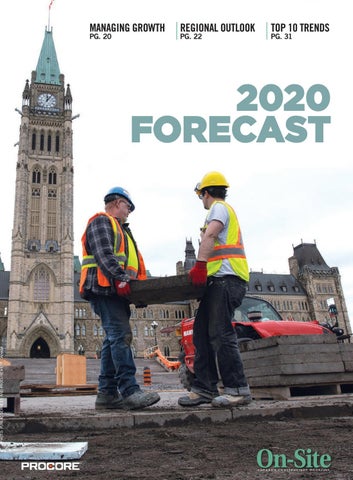
2020 FORECAST
PHOTO: PUBLIC SERVICES AND PROCUREMENT CANADA
PG. 20
on-sitemag.com / 17
One platform to connect everything and everyone. Manage your projects, resources, and financials on one open, easy-to-use platform—designed for how you actually build. With every stakeholder working off the most up-to-date information, Procore helps you cut back on rework and concentrate on the real work.
The majority of Procore customers
20+
report that their project staff save 20+ hours per month.
90% %
92% %
90% say their client satisfaction has increased since using Procore.
92% say their company is more protected against claims due to the data tracked by Procore.
“
We have one measure of success— your success.
“Everybody who works at Procore is fantastic. There’s been much more support than we expected, and we think
”
that’s probably the best part of Procore. They listen to
their customers and really try to improve the software.” TANG LEE MAGIL CONSTRUCTION
procore.com | 866 477 6267
2020 FORECAST
WELCOME LETTER
P
rocore is proud to sponsor On-Site Magazine’s 2020 Forecast report, which looks at the major Canadian construction trends industry leaders are watching for in the upcoming year. As the leading provider of construction management software, we are aware and mindful of the challenges owners, general contractors, specialty contractors and engineers can face. With issues like the skilled labour shortage, the gender gap and the lack of technology, now is the time for the construction industry to embrace change. It would be impractical to expect the industry to be able to continue growing in its current form without innovating operationally and looking at ways to boost productivity – all of which ties back to adopting and effectively leveraging technology and the insights it drives. There has never been a better time to embrace change. This will enable the industry to keep pace with increasing complexity and do more with less. It’s not too late to start the journey towards a digital transformation of your business. We can use this report to help us identify specific market signals, and build an agile and enduring business that can effectively weather what 2020 has in store for us. Sincerely,
Jas Saraw Vice President, Canada Procore Technologies
on-sitemag.com / 19
MANAGING GROWTH Positive momentum to continue in 2020, but industry needs to embrace change BY DAVID KENNEDY
A
steady stream of building projects in most regions of Canada, and particularly within its big urban centres, have kept the construction industry busy through the second half of 2019. Though concerns about how long growth can continue persist, much of the same is forecast for the year ahead, with most industry experts seeing the nationwide outlook for 2020 as positive, or at least steady. In a country as large and as diverse as Canada, there are exceptions. Certain provinces are expected to just hold their own over the next 12 months, or see slight declines in activity. The continued muted performances of the oil and gas and resource sectors, for instance, mean the Prairie provinces will be getting little help. In Atlantic Canada as well, industry watchers see few catalysts that will propel
20 / DECEMBER 2019
the building market beyond neutral. Elsewhere, most see reasons to be optimistic growth will continue. As has been the case in recent years, significant expansion in cities – Montreal, Ottawa, Toronto and Vancouver most notably – will likely lead the way, fuelled by new residential and commercial builds, as well as a laundry list of multibillion-dollar infrastructure projects vital to supporting growing populations. The positive sentiment comes with an asterisk. For the most part, the construction industry and its labour force have been able to absorb burgeoning demand across the country over the past several years. In 2020 and beyond, this may begin to change. As fewer young workers embrace construction and a large cohort of industry veterans step out of their steel toes for good, experts agree that simply maintaining the status quo isn’t an option. Along with
changes that will make the industry more welcoming to groups that have traditionally shunned working on job sites, the industry needs to take steps to increase productivity. New technologies, innovative operational processes and methods that force stakeholders to take a more collaborative approach to projects all have a role to play in Canada’s construction industry recalibrating itself to meet the demands of the modern world.
ACROSS THE COUNTRY From a national perspective, there’s no immediate shortage of work heading into 2020. “The industry is very busy overall,” says Gary Webster, a partner at KPMG, as well as the firm’s national head of Infrastructure for Canada and the global head of Capital Projects Leadership. “If you look at the supply
2020 FORECAST
PHOTO:METROLINX
Work on the new Avenue Station on Toronto’s Eglinton Crosstown LRT. Construction above and below gound is progressing on the transit megaproject, which is scheduled to open in 2021.
side, there are more projects, it seems, than there is demand side to deliver them these days.” “There is so much out there that contractors are taking informed choices,” he adds, noting that some large public jobs are down to a single bidder, or even no bidders at all, as contractors pick and choose what they want to work on. Gerard McCabe, managing director for Turner & Townsend Canada, is similarly bullish for the industry in 2020. “We’re certainly not growing at the rates overall that we were a few years ago, but it feels positive,” he says. With the federal election now in the rear view and a strong minority entrenched in Ottawa, McCabe anticipates a bit more stability in the coming months. “I think it’s fairly safe to say that it feels like for the next year or two, that government will stay and the provinces
are fairly well settled.” Further investments in infrastructure could also help mend fences between certain segments of the country following the election, says Mary Van Buren, president of the Canadian Construction Association. “With the polarization that we’re seeing politically [and] regionally, infrastructure is such a great uniter,” she says, adding that a significant portion of Canada’s existing infrastructure still needs work. Van Buren pointed to the 2019 Canadian Infrastructure Report Card, which found that about 40 per cent of Canada’s roads and bridges are in fair, poor or very poor condition. Though prospects are generally good for builders next year, where you look in the country is a factor. Toronto’s skyline, for instance, is dotted with more cranes than any other city in North America. The same
can’t be said of the Prairies, where next year’s outlook is less optimistic. Paul De Jong, president of the Progressive Contractors Association of Canada, is more cautious in his forecast for the industry in 2020. “I think there’s a lot of headwinds that we’re facing still,” he says. “Until we have more clear and committed political leadership and the ability to demonstrate to investors that we are a fit and a vibrant industry that is worth the investment, I think the construction industry is going to be facing the wind.” De Jong points to the passing of bills C-48 and C-69 earlier this year, which placed a moratorium on oil tankers on B.C.’s northern coast and overhauled the country’s environmental review process, as major obstacles for construction as a whole. He acknowledges the industry covers a far wider scope than just the energy sector, but feels the effects will trickle down across the country. “If [the energy] industry is constrained, I have grave concerns about the level of economic activity in general in Canada,” he says. “You see fewer dollars going into provincial and federal coffers… and you see corporate and institutional investors looking at Canada with a doubtful eye and wondering if it’s really a healthy place to do business.” Having taken the temperature of countless contractors over the last few months, Douglas Correa, executive vice-president of Global Specialties and national leader of the Construction Services Group at Aon Canada Inc. is cautious in his outlook for 2020 as well, particularly when it comes to smaller contractors that don’t play in larger arenas, such as the P3 market. “I’m not hearing a lot of the sky is falling, but I’m hearing a lot of pessimism rather than optimism,” he says, adding that after years of strong economic growth, contractors are viewing 2020 with more trepidation than they have any other year in the past five.
on-sitemag.com / 21
2020 FORECAST
Regional outlook A look across Canada at what experts are watching next year, as well as a survey of economic expectations, which are typically a good indicator of construction activity
BRITISH COLUMBIA There are few causes for concern on Canada’s West Coast. Between LNG work, pipelines and big civil projects such as the new Pattullo Bridge and the Broadway Subway Project in Vancouver, “B.C. will continue to be busy,” Webster says. “There are some new projects that could hit the street as well.” Construction on the Site C project in northeastern B.C. is also scheduled to continue well into next decade. Work on the substantial earthworks required to support the $10.7 billion dam on the Peace River are already well underway. The real estate market in the Vancouver area and the strong demand for multi-unit residential is another driver. In its most recent Provincial Outlook, released in mid-October, Scotiabank forecast B.C.’s real GDP to advance 2.8 per cent next year.
ALBERTA After several years in the doldrums, Alberta’s economy is forecast to finish 2019 little changed, but is poised to perform better next year. In a recent research note, RBC Economics says it expects the province’s real GDP to grow 1.9 per cent in 2020. Likewise, Bill Ferreira, executive director of construction research organization BuildForce Canada, expects greater consistency for the province’s labour force. “Alberta does seem to be through the worst,”he says. “We are now hitting a period of greater stability.” That doesn’t mean there aren’t challenges. Coming off a slowdown, the province’s construction market is already running at lower capacity than those in other provinces. Recent developments – most notably the provincial government reining in spending on light rail lines in Calgary and Edmonton – could also force the two cities to slow down these public transit projects considerably. “With the austerity measure that the government of Alberta has taken, they’re going to be reducing investment in infrastructure or at least delaying investment in infrastructure,” McCabe says. “So, that is not going to help what is already a fairly difficult construction market.” McCabe does not anticipate Alberta will climb out of its slow construction period until pipeline projects can get off the ground and oil prices begin to inch back up.
22 / DECEMBER 2019
SASKATCHEWAN With crews completing the $1.9 billion Regina Bypass this fall and low levels of investment expected to continue in the oil and gas and resource sectors, Saskatchewan builders are likely looking at a limited number of major projects in 2020. Insiders expect the building market to remain steady, though this translates to little change in what’s already a down market. “In Saskatchewan we’re not seeing much of anything happening,” Ferreira says. “It’s fairly consistent with last year’s forecast, unfortunately.” In its most recent annual report, BuildForce noted Saskatchewan has lost more than 7,000 construction jobs since the resource sector peaked in 2014. The residential segment of the market will offer little help. The Conference Board of Canada expects housing starts to be under 1,400 next year, just above the post-recession high of 1,200 projected for 2019.
MANITOBA Construction reaching completion, or beginning to wind down, on several long-running projects, most notably the Keeyask Generating Station in the northern part of the province and a segment of Enbridge’s Line 3 pipeline, will take their toll on Manitoba’s building market in 2020. In a research note this fall, TD Economics said it expected to see non-residential investment decline next year with major project work slowing. Overall, the bank forecast real GDP growth of 1.7 per cent next year. De Jong, likewise, sees some construction activity continuing across the province, but few new major sources of work. Construction ramping up on the approximately 200-kilometre Manitoba-Minnesota Transmission Project, worth $453 million, is one exception that will provide some positive momentum.
QUEBEC
ONTARIO A construction market already running close to full steam and a substantial load of new work for 2020 and beyond mean Canada’s most populous province will remain very busy. “The real estate market just continues to defy all odds... in the Greater Toronto Area, but the activity across the province of Ontario is very high in all regions,” Ferreira says. “There’s been a slight uptick in mining interest in the north, the southwest remains very busy with a number of major projects both projects in Sarnia, the bridge in Windsor [and] a new food processing facility in London.” In Toronto, the slate of building projects remain diverse. Work on the Eglinton Crosstown LRT is progressing above and below ground, while new large-scale residential, commercial and institutional projects continually add to company backlogs. If the province-led initiative to build four new or expanded transit lines worth about $30 billion moves forward, it will keep infrastructure construction crews busy for at least another decade. Strength in the Ottawa market is expected to continue as well, between residential, transportation infrastructure and government rehabilitation work. McCabe pointed to the overhaul of Centre Block on Parliament Hill – that’s been described as the “largest, most complex heritage rehabilitation” ever undertaken in Canada – as one prominent example. Few insiders have any concern for the Ontario construction market, with the exception of uncertainty about where contractors will find the labour force to take on new projects. In a November research note, RBC said it anticipates the province’s real GDP growing by 1.5 per cent in 2020.
The outlook in Quebec is positive, with Montreal leading the way. Webster singled out work on the city’s port, airport and transit infrastructure as key areas to watch. Construction on the Réseau express métropolitain, or REM, is already underway and early prep work for the extension of the Metro’s blue line could start as early as next spring. As in the country’s other urban centres, the tight Montreal real estate market and increasing need for density is also driving residential development activity. Outside Montreal, construction is expected to remain steady. Strong real GDP growth in Quebec has outpaced much of the rest of the country in recent years. Though its pace of economic expansion is expected to slow slightly in 2020, Scotiabank still anticipates the province to record 1.6 per cent growth.
ATLANTIC CANADA There’s not a “big boom” of new projects coming to Atlantic Canada in 2020, but all parties view the East Coast market as relatively steady. Some provinces are forecast to do better than others. In Newfoundland and Labrador, major projects, such as the Muskrat Falls dam that brought an influx of workers to the province, are expected to begin winding down after years of work. “Newfoundland and Labrador is coming off an exceptional period of investment that required an increase to its non-residential labour force,” Ferreira says. “We’re now readjusting back to a more normal level of activity.” With few drivers, experts expect similarly slow forward momentum in New Brunswick. Stronger growth is forecast for Nova Scotia, and for Halifax in particular. With a growing population and real GDP growth of 2.1 per cent expected for the city in 2020, according to the Conference Board of Canada, builders will be kept busy on residential work. Several health care projects are also moving through procurement in Nova Scotia and an investment decision on the multibillion-dollar Goldboro LNG project is expected next year. Though it remains a small market, population growth in P.E.I. continues to fuel new infrastructure projects and the construction market. The province plans to spend about $156 million on infrastructure in 2020.
on-sitemag.com / 23
2020 FORECAST
Transit tunnel construction in Toronto. A major expansion of the city’s subway network is one of the many building programs to watch in 2020 and beyond.
Certain pockets of the country are busier than others, but overall, the relatively healthy economy and long list of major new projects scheduled to get underway in 2020 and beyond mean securing work is unlikely to be the construction industry’s biggest challenge. When it comes to finding and retaining workers, the industry is on looser ground. If stockpiles of key materials, such as steel or concrete, begin to run low, suppliers can typically increase production capacity to meet demand. The supply of labour, McCabe notes, is far more temperamental. “The level of skilled resources is decreasing over time and it doesn’t seem to me as if we’re doing enough about it,” he says. “We’re just waiting for something to change, but we’re not actually doing anything to make the change.”
24 / DECEMBER 2019
‘‘
The issue is well documented and while industry advocates are undeniably focussing on addressing it, the impending wave of retirements is daunting. In its most recent assessment, BuildForce, which publishes nationwide figures on the topic annually, expects the industry will need to attract about 80,000 more workers over the next decade than it currently expects to. A new batch of data will be available in early 2020. Along with the sheer numbers, the breadth of the shortage raises alarm bells. “It’s at all levels of the demand side,” Webster says. “From management, down though the trades to the labourers, there’s a shortage.” Without an adequate workforce at its foundation, the industry won’t be able to deliver on the significant pipeline of new projects. Solving the problem will require new
“It’s at all levels of the demand side. From management, down through the trades to the labourers, there’s a shortage.” – Gary Webster, KPMG
innovations and a willingness to adopt new ways of thinking. “Five to 10 years in the future, if we adopt technology correctly, there’ll be many more construction sites,” Webster says. “There probably aren’t many more people employed in the industry, but those people that are will be on more construction sites because productivity increases will allow more to be built.”
PHOTO: METROLINX
A SHAKY FOUNDATION
PER MONTH POWER THROUGH THE HARSH CONDITIONS WITH PRODUCTIVE AND RELIABLE SNOW REMOVAL EQUIPMENT.
5 years or 5000 hour warranty
3.5yd3
48 hours
capacity and standard exclusive guaranteed limited slip front and uptime agreement rear differentials
√ NO DPF √ NO UREA √ NO REGENERATION √ WINTER TIRES INCLUDED
* Please see terms and conditions on our website
Contact us today!
For more details visit go.wajax.com/zw180
XXXXXXXX
Construction of Montreal’s new REM, another of Canada’s major transit infratructure initiatives crews are currently working on.
Just under 10 years ago, the first iPad hit the market. Today, it’s tough to find a construction site without one. For an industry notoriously behind the times, the transformation has been a bolt from the blue. Following this example, experts see Canadian builders embracing tools such as building information modeling (BIM), drones, automated equipment and machine learning, with increasing frequency in the year ahead. Most expect novel equipment and software systems to boost worker productivity and help the
26 / DECEMBER 2019
PHOTOS: REM
THE RISE OF TECH
‘‘
2020 FORECAST
“We could use technology far better than we are using it right now, but at the end of the day, we need skilled trades, we need skilled engineers, management staff, all the way through the hierarchy of how we deliver projects.” – Gerard McCabe, Turner & Townsend
industry mitigate some of the worst effects of the labour crisis. “We’re seeing that dialogue shift in the perception of technology and the need for construction project management technology,” says Jas Saraw, vice-president of Procore Canada. “It’s almost like it’s become table stakes for the industry. We’ve got this massive amount of data that we have to consume and we’ve got a level of complexity that’s increasing daily on the types of jobs that contractors are running.” Among other benefits, software capable of making use of job site data can save valuable time, often letting existing crew refocus on tasks machines can’t do.
“Technology is an enabler, whether that’s augmenting processes, helping people become more productive, or that’s investing in technology that can automate where workers just aren’t available,” Van Buren says. While workers in other industries – manufacturing being one prominent example – have seen their productivity nearly double since the 1990s, global construction productivity has barely budged, according to McKinsey & Co. Insiders see this trend beginning to change as technology companies purpose-build more solutions for construction. “There’s been a big shift over the past five years for the construction industry to find technology,” Correa says, “and suppliers with the industry are bringing technology solutions to projects.” The lively construction tech start-up scene in both Canada and around the world is a case in point. With high levels of venture capital funding available to innovative new companies, contractors are getting custom tools and services that solve long-nagging issues. So far, adoption remains inconsistent, with some contractors aggressively investing in new job site tech and others content to pull in just the tools that have proven themselves invaluable. Before long, however, Webster anticipates those shifting too slowly will be left behind. “If our contractors don’t adopt it now, there’ll be new players that come in. We’re seeing technology companies experiment in construction techniques right now,” he says, adding that tech firms aren’t necessarily looking to become builders, but are
innovating more quickly. “They will take over the construction sites of the future if we don’t smarten ourselves up.” Tech is guaranteed to play an ever-increasing role in construction, but it’s doubtful it offers a complete answer to the labour crunch. “I think we could use technology far better than we are using it right now,” McCabe says, “but at the end of the day, we need skilled trades, we need skilled engineers, management staff, all the way through the hierarchy of how we deliver projects.”
LEVELS OF SOPHISTICATION The need for change goes well beyond the job site itself. “We’re not that sophisticated,” McCabe says. “The industry needs to evolve beyond where it is right now and do business in a different way – whether it’s using technology, whether it’s changes in how we procure construction work… to how we negotiate construction contracts.” The diverse list of challenges require a diverse set of solutions, but all revolve around bringing a higher level of sophistication to construction processes. The low-cost bid framework that still dominates much of the public sector, for instance, certainly limits job site experimentation. It may also be holding the industry back. “What we’d like to see is more piloting [and] a little bit more room for including innovation within the project itself,” Van Buren says. “Whether that’s trying out new materials, whether that’s investing in technology, whether that’s new processes
on-sitemag.com / 27
“I can see updates to any plan—in real time?” You heard right. With Bluebeam, project partners around the world can all work from the same plan — at the same time. Life-changing software bluebeam.com
© [AGNORMARK] / ADOBE STOCK
2020 FORECAST
‘‘
“You can get performance by having a big stick, or you can get performance by having value that is shared and gains that are shared.” – Phil Verster, Metrolinx
that can be tried, or new ways of working together.” Van Buren says the CCA would like to see the Infrastructure Bank step in and play a role in this arena, helping to de-risk projects that test new methods. Other countries have already started moving away from the low-cost bid environment in favour of more nuanced approaches. Webster points to New Zealand as one example. This fall, the country introduced a so-called “broader outcomes” framework that takes more into account than just a low cost to the public purse. In conjunction with this price point shift, increasingly, stakeholders throughout the construction pyramid are abandoning traditional top-down project models for a more collaborative approach. “The traditional way is owners will police contracts and so that automatically creates an adversarial relationship in the delivery,” Webster says. “Contractors don’t know the challenges that owners go through to get projects approved… Conversely, owners don’t really understand the challenges of the contractors,” he adds. “When you get this collaborative contract that they’re working together to those ends, all of a sudden, you’re seeing a different view, you’re able to solve problems better.” Integrated project delivery (IPD) and early contractor involvement (ECI) are just two examples of new strategies being used to deliver jobs. Insiders expect the appetite for these alternative procurement models will only increase in 2020 and beyond. In Ontario, for instance, provincial agencies Infrastructure Ontario and Metrolinx recently awarded the Canadian sector’s first Alliance contract for an upcoming expansion of Toronto’s Union Station. At the annual conference of the Canadian Council for Public-Private Partnerships this November, Phil Verster, president
and CEO of Metrolinx, said all segments of the industry need to do a better job working in partnership with one another. “That requires that we have a contracting structure that is more incentivizing rather than penalizing,” he said. “You can get performance by having a big stick, or you can get performance by having value that is shared and gains that are shared.” Slowly, these sort of approaches are taking root. Often they’re helping to address other long-nagging issues, such as the burden of risk. “Projects are seeing more and more risks added to them and I would say stakeholders within projects are looking for ways to mitigate risk,” Correa says, adding that all levels of the industry are experimenting with a range of tools that adjust how jobs are delivered. “The essence of it is, much more collaboration on the front of the projects, so the surprises don’t occur procuring and on the back end.”
For more information and to secure your space, please contact: MARK CUSACK, National Show Manager mcusack@mpltd.ca • Toll Free: 1.888.454.7469
on-sitemag.com / 29 OS_Dec19_AHES2.indd 1
2019-11-20 2:26 PM
2020 FORECAST
10 CONSTRUCTION TRENDS TO FOCUS ON IN 2020
1. INFRASTRUCTURE AS AN ENABLER OF NATION-BUILDING At a time of Canadian domestic polarization and lackluster performance among OECD countries, we have the opportunity to invest in infrastructure to stimulate weak provincial economies and build the Canada of the future while tapping into the emerging millennial workforce and technology.
2. INFRASTRUCTURE IN CRISIS The 2019 edition of the Canadian Infrastructure Report Card (CIRC) reveals the country’s public infrastructure requires urgent attention to reverse its current state of disrepair. Government policies supporting contractors and commitments to long-term infrastructure investments can bring much needed stability to the industry.
3. THE WAR FOR TALENT Construction is facing a critical workforce shortage. Not only are firms competing with each other for highly skilled talent, the industry is competing with virtually all other sectors of the economy. Despite the variety of careers available, the industry is not seen as an employer of choice.
4. SAFETY CULTURE Safety is a priority for construction firms and this culture is being led from the top. The goal is to raise the bar for all.
© [HODA BOGDAN] / ADOBE STOCK
C
anadian contractors enter 2020 with most experts optimistic about their prospects. Still, changes in technology, political divisions and the sheer scale of many new building projects will present both opportunities and challenges. These are the top trends the Canadian Construction Association and its President, Mary Van Buren, are keeping tabs on in 2020.
5. RISK TRANSFER LEAVES NO ROOM FOR INNOVATION Contractors are expressing increased concern that the public-private partnership model, or P3 projects, have shifted all the risk to the contractor. When the continued culture of low cost bid is added in, there is little to no appetite to invest in innovation.
6. MISALIGNED SOCIAL PROCUREMENT POLICIES The industry has long been a significant supporter of communities and has been actively recruiting from under-represented groups. Federal policies tying social procurement to infrastructure projects may work at cross purposes with industry workforce realities and the government’s own challenges.
7. GROWTH OF MEGAPROJECTS The expected growth of megaprojects could polarize the industry into large general contractors and small sub-contractors, leaving little room in the market for mid-sized firms to compete for business.
8. MODULARIZATION The continued focus on productivity is
generating interest in practices such as applying Lean principles to construction projects. Modularization is also on the upswing as some firms adopt more of a manufacturing approach to construction components.
9. AUGMENTATION BEFORE AUTOMATION New construction technologies can automate some jobs, but the Canadian construction industry is likely to start with augmentation before automation. It is time for Canada to catch up with its international counterparts in developing and acquiring cost-saving technologies that address labour shortages.
10. BIG DATA AS A PROJECT MANAGEMENT TOOL Big data has entered the construction industry. From streamlining business practices to improving safety and productivity, the construction industry is leveraging big data to improve how the industry functions. Big data is being used by construction companies to make more real-time, information-driven decisions.
on-sitemag.com / 31