C A N A D A’ S O C C U PAT I O N A L H E A LT H & S A F E T Y M A G A Z I N E J A NU ARY / F E BRUARY 2016
C A N A D A
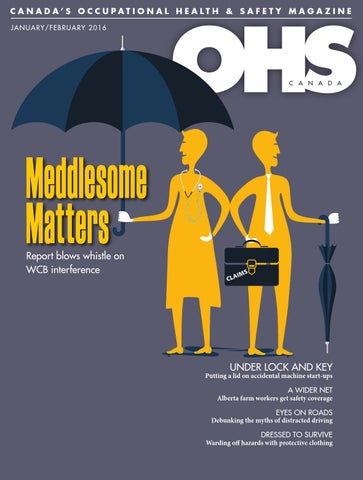
Meddlesome Matters Report blows whistle on WCB interference
IMS
CLA
UNDER LOCK AND KEY
Putting a lid on accidental machine start-ups
A WIDER NET
Alberta farm workers get safety coverage
EYES ON ROADS
Debunking the myths of distracted driving
DRESSED TO SURVIVE
Warding off hazards with protective clothing
01 COVER JanFeb 2016.indd 1
16-02-10 12:12 PM
INSPIRED BY THE GRIT OF THOSE WHO WEAR IT. FL AME-RESISTANT WORKWEAR Workrite Uniform brings more than 40 years of trusted FR experience to each of our four top-quality FR brands, offering unparalleled variety and uncompromised safety.
LEARN MORE AT WORKRITEFR.CA | (800) 521-1888
Workrite is an affiliate of Williamson-Dickie Manufacturing Company © Workrite Uniform Company, Inc.
TRY WORKRITE UNIFORM COMPANY’S NEW FR CLOTHING APP
02-03 CONTENTS JanFeb 2016.indd 2
16-02-08 10:07 AM
C A N A D A’ S O C C U PAT I O N A L H E A LT H & S A F E T Y M A G A Z I N E
C A N A D A
J A N U A RY/ F E B R UARY 2 0 1 6 Vo l u m e 3 2, Nu m b e r 1
FEATURES
R ETUR N TO WOR K 20
A Different View
A report alleging that Ontario’s workers’ compensation board interferes with medical opinions has raised concerns about the board’s return-to-work practices. BY KELLY PUTTER
LOC KOUT/TAGOUT 26
In a Split Second
It may be human to err, but instituting a good lockout/tagout program and ensuring compliance can reduce the chances of severe or fatal injuries. BY MATT DUDGEON
20
DEPARTMENTS 32
AC C ID EN T P R EV EN TION
Somewhere Out There
Separating the facts from fiction of distracted driving requires taking a long, hard look at the factors that contribute to lack of focus behind the wheel.
34
WOR KER S ’ C OM P EN S ATION
The Wait Is Over
The extension of workplace-safety protection and coverage to farm and ranch workers in Alberta, which took effect this year, has drawn both applause and ire.
26
BY JEAN LIAN
36
S AF ETY GEAR
Donning for Danger
The clothes on our back are more than just garbs of modesty. Protective clothing also shields workers against injuries from exposure to chemicals, steam or fire.
IN THIS ISSUE
BY JEFF COTTRILL
ED IT O R IA L
4
PA N O R A MA
6
L ET T ER S
7
O H&S U P D AT E
8
Policing the Police
British Columbia firm fined for explosion; ammonia leak claims Alberta worker; PTSD gets presumptive coverage in Manitoba; Ontario worker assaulted; New Brunswick hires safety officers; and more. D IS PAT C HES
18
A D IN D EX
39
Nod to on-the-job resistance training; safety boosts profitability, productivity; and more.
AN N UAL P OLL
40
TIM E OUT
42
Christmas heist; nuts about donuts; hoot attack; justice in rhyme; from the horse’s mouth; and more.
Safety brings first aid to the uninjured.
— F.S. HUGHES
www.ohscanada.com
02-03 CONTENTS JanFeb 2016.indd 3
J A N U A R Y / F E B R U A RY 2 0 1 6
3
16-02-08 10:07 AM
EDITORIAL
C A N A D A’ S O C C U PAT I O N A L H E A LT H & S A F E T Y M A G A Z I N E
Policing the Police I
C A N A D A
Vol. 32, No. 1 JANUARY/FEBRUARY 2016
EDITOR JEAN LIAN jlian@ohscanada.com
t is never easy being the good guy, but the recent verdict that found Toronto Police officer James Forcillo guilty of attempted murder over the 2013 shooting of Sammy Yatim on a streetcar shows just how fuzzy the line between a good guy and a bad one can be. There are several reasons why the ruling on this incident has grave workplace-safety implications. First, the incident occurred when a police officer was on duty, responding to a potentially lethal confrontation with a knife-wielding man on public transit. Second, the verdict could strike fear throughout law enforcement and lead to hesitation in the use of force in future confrontations. Some argue that this could put both officer and public safety in jeopardy. Toronto Police Association president Mike McCormack, who spoke to the media after the trial, said the verdict had affected the psyche of frontline officers. “Clearly, that sends a chilling message to our members,” McCormack said. “A big concern for us is that, are they going to hesitate when they should take action?” Forcillo was convicted not for firing the first round of shots that killed Yatim, but for the second volley of six shots, which the jury regarded as excessive. This incident begs the questions: why did Forcillo deem it necessary to discharge a second round of shots after Yatim was clearly incapacitated, and should employees be held legally responsible for causing harm or death in a work-related scenario that sanctions the use of force? The verdict has clearly answered the latter question with a resounding yes. While the use of force by law enforcers is officially sanctioned, its use must be reasonable. As with all other things, authority and accountability go hand in hand. Canada’s national use-of-force framework for police officers provides guidelines on how to act in a reasonable manner during a confrontation. Under the framework, an officer can respond to a situation in six ways: officer presence; communication; soft physical control; hard physical control; intermediate weapons; and lethal force. The response chosen is determined by an officer’s assessment of prevailing circumstances, the subject’s behaviour, the officer’s perceptions and tactical considerations. In real life, considering all the above factors when faced with a volatile situation can be a tall order, considering that the officer has to make a split-second decision without the benefit of hindsight, as was the case in the encounter between Forcillo and Yatim, which lasted barely a minute. But that is the inevitable responsibility that comes to those in positions of authority who have been given the right to bear and use arms — and to use them reasonably and responsibly when circumstances call for it. With the ubiquitous use of digital media, the need for accountability among law enforcers will only become more prominent. Forcillo’s lawyer, Peter Brauti, told the media following the delivery of the verdict that the video of the streetcar shooting was posted all over YouTube within seven minutes of the incident taking place. This has resulted in what Brauti called a “trial by YouTube.” He added that this was one trial in which jurors had already formed an opinion about the case beforehand. This prompted Brauti to write to the Attorney General for consent to have the case determined by a judge instead of a jury — a request that was turned down. As the deadly tasering of Robert Dziekanski at the Vancouver airport in 2007 has shown, law enforcers and their actions are constantly under the watchful eye of the public. While body and dashboard cameras can absolve officers from false accusations, it will hold them equally accountable for their actions. If there is one lesson that Forcillo has learned, it is that judgement by cell phones is swift and often unforgiving.
EDITOR
JEFF COTTRILL
CANADIAN OCCUPATIONAL HEALTH & SAFETY NEWS jcottrill@ohscanada.com
ART DIRECTOR
ANNE MIRON
PRINT PRODUCTION MANAGER
PHYLLIS WRIGHT
PRODUCTION MANAGER
GARY WHITE
MARKETING SPECIALIST
DIMITRY EPELBAUM
CIRCULATION MANAGER
DIANE RAKOFF drakoff@annexnewcom.ca
ASSOCIATE PUBLISHER
SHEILA HEMSLEY shemsley@ohscanada.com
PUBLISHER
PETER BOXER pboxer@ohscanada.com
PRESIDENT, ANNEX-NEWCOM LP
ALEX PAPANOU
EDITORIAL ADVISORY BOARD MEMBERS DAVID IRETON, Safety Professional, Brampton, Ont. AL JOHNSON, Vice President, Prevention Services WorkSafeBC, Richmond, B.C. JANE LEMKE, Program Manager, OHN Certification Program, Mohawk College, Hamilton, Ont.
DON MITCHELL, Safety Consultant, Mississauga, Ont. MICHELE PARENT, National Manager, Risk Management and Health and Wellness, Standard Life, Montreal, Que.
TERRY RYAN, Workers’ Compensation and Safety Consultant, TRC Group Inc., Mississauga, Ont.
DON SAYERS, Principal Consultant, Don Sayers & Associates, Hanwell, N.B. DAVID SHANE, National Director, Health and Safety, Canada Post Corporation, Ottawa, Ont.
HENRY SKJERVEN, President, The Skjerven Cattle Company Ltd., Wynyard, Sask. PETER STRAHLENDORF, Assistant Professor, School of Environmental Health, Ryerson Polytechnic University, Toronto, Ont.
JONATHAN TYSON, Association of Canadian Ergonomists/Association canadienne d’ergonomie, North Bay, Ont. OHS CANADA is the magazine for people who make decisions about health and safety in the workplace. It is designed to keep workers, managers and safety professionals informed on oh&s issues, up to date on new developments and in touch with current thinking in the oh&s community.
WEBSITE: http://www.ohscanada.com INFORMATION AND RECOMMENDATIONS contained in this publication have been compiled from sources believed to be reliable and to be representative of the best current opinion on the subject. No warranty, guarantee nor representation is made by Annex-Newcom LP as to the absolute correctness or sufficiency of any representation contained in this publication.
OHS CANADA is published six times per year by Annex-Newcom LP, a leading Canadian information company with interests in daily and community newspapers and business-to-business information services. The yearly issues include: January/ February, March/April, May/June, July/August, September/October and November/December.
ADDRESS: OHS CANADA MAGAZINE, 80 Valleybrook Drive, Toronto, ON M3B 2S9. TELEPHONE: Customer Service: 1-866-543-7888; Editorial: 416-510-6893; Sales: 416-510-5102; Fax: 416-510-5171.
SUBSCRIPTIONS: Canada: $110.50/year; USA: $132.50/year; foreign: $137.50. (Prices include postage and shipping; applicable taxes are extra.)
SINGLE COPIES: Canada: $6.00; USA: $8.00; foreign $10.00 Bulk subscription rates available on request. Indexed by Canadian Business Periodicals Inc. ISSN 0827-4576 OHS Canada (Print) • ISSN 1923-4279 OHS Canada (Online) Printed in Canada. All rights reserved. From time to time, we make our subscription list available to select companies and organizations whose product or service may interest you. If you do not wish your contact information to be made available, please contact us via one of the following methods: Circulation Customer Service: Silva Telian (Tel) 416-442-5600 ext. 3636; (Fax) 416-510-6875; (E-mail) stelian@annexnewcom.ca; (Mail) Privacy Officer, Annex-Newcom LP, 80 Valleybrook Drive, Toronto, ON M3B 2S9 Canada. The contents of this magazine are protected by copyright and may be used for your personal, non-commercial purposes only. All other rights are reserved, and commercial use is prohibited. To make use of any of this material, you must first obtain the permission of the owner of the copyright. For further information, please contact the editor. We acknowledge the financial support of the Government of Canada through the Canada Periodical Fund of the Department of Canadian Heritage.
Jean Lian
Publications mail agreement no. 43005526. Date of issue: JANUARY/FEBRUARY 2016
4
J A N U A RY / F E B R U A RY 2 0 1 6
04-05 EDITORIAL JanFeb 2016.indd 4
ohs canada
16-02-08 10:07 AM
P L
G
Protect Your Lone Workers GeoPro: A connection they can use to obtain assistance anywhere.
GeoPro is a complete work alone monitoring solution that increases their safety, and your peace of mind. • Easy check-in from cellular or satellite devices • SOS, man down, and missed check-in alert monitoring • Journey monitoring
Free 30-day trial
www.geoprosolutions.com/OHS
04-05 EDITORIAL JanFeb 2016.indd 5
16-02-08 10:07 AM
panorama
50,000
Fine issued to Ontario’s Peel District School Board on January 12, in connection with an incident in which a student sustained a fracture injury during a class on manufacturing on April 9, 2014. Source: Ontario Ministry of Labour
1 2
4 3
5
Heart to Heart: Alberta Premier Rachel Notley posted an open letter on Facebook on December 4, addressing concerns about Bill 6, which brings the province’s agriculture sector under health and safety legislation. Notley clarifies that the bill will not interfere with children’s and neighbours’ rights to help out with farm chores or Source: Government of Alberta require a registry of children with the provincial workers’ compensation board.
1.
A Bigger Stick: Drivers in Manitoba who operate a vehicle while impaired or who commit serious driving-related offences now face harsher penalties, as the Safer Roads Act took effect on December 1. Changes include increasing the immediate suspension of roadside driver’s licence for first-time low blood alcohol concentration (0.05 to 0.08) and drug-impaired drivers from 24 hours to three days and hiking the three-day suspension to seven Source: Government of Manitoba days when a person under 16 years of age is in the vehicle at the time of the offence.
2.
Raising the Bar: The Electrical Safety Authority has launched a new safety code for electrical work in Ontario, which will take effect on May 5. Electrical work conducted after this date must meet the Ontario Electrical Safety Code’s requirements. The revised code includes new guidelines for solar-energy installations, clearances between light fixtures and combustible materials, installation of light-emitting-diode luminaires and locations of Source: Electrical Safety Authority electrical hook-ups for parked recreational vehicles.
63
Number of orders regarding fall-protection violations issued by Nova Scotia’s oh&s authorities, following a blitz of unannounced inspections targeting 53 residential and commercial sites in November. Source: Ministry of Labour and Advanced Education
3.
On the Go: Job insecurity, high work demand and stress are among the most common reasons why people go to work while ill, according to a report on presenteeism by Montreal’s Concordia University and the Source: Journal of Occupational Health Psychology University of East Anglia in Norwich, England, published in November.
4.
No Fear: Changes to Nova Scotia’s Labour Standards Code will enhance protections for employees who make inquiries or provide information to Labour Standards officials. On November 20, Labour and Advanced Education Minister Kelly Regan introduced the amendments to protect workers against employer retaliation in these situations, such as asking about employment rights, initiating an investigation or helping a colleague who is concerned Source: Labour and Advanced Education about his or her rights.
5.
360° 6
TRAPPED MINERS SEE LIGHT OF DAY On February 1, rescuers in eastern China pulled out four miners who had spent 36 days trapped underground in a gypsum mine that collapsed on Christmas Day. The incident, which registered as a seismic event with a magnitude of four, killed one and left seven missing. Rescuers retrieved the workers by drilling two access tunnels and pulling them out in a capsule. Source: The China Post
J A N U A RY / F E B R U A RY 2 0 1 6
06 panorama JanFeb 2016.indd 6
33%
Percentage of employees at risk of depression, according to a survey of more than 14,000 people from 34 leading companies in 67 countries, released on January 13. Source: Global Corporate Challenge
3
The number of times that construction workers in British Columbia are more likely to die from job-related injuries than workers in the rest of Canada. Source: B.C. Federation of Labour
ohs canada
16-02-08 10:06 AM
LETTERS
Recent issues of ohs canada and our website, www.ohscanada.com, have provided readers with plenty to chew on. SYSTEM IN CRISIS The Ontario Public Service Employees Union urges the provincial government to address understaffing and overcrowding in the correctional system. (canadian occupational health and safety news, (cohsn), December 1, 2015) There is an inherent safety risk to everybody in a correctional facility. The risks can be managed to a certain extent. However, the many changes I have seen over 37 years in this industry has created a whole new dynamic with which at least the Ontario government has not kept pace. The Charter of Rights and changes to the Canadian Mental Health Act are two major changes, which have caused many of the safety issues. To a certain extent, changes in health and safety laws have also affected this situation. The government’s hiring freeze for staff did escalate issues, as staff can only work so much and after a point, the staff become affected by the stress put on them. The more important issue is that governments have been trying out alternate methods on what to do with corrections, as this is one of those ministries that does not make money and causes governments to pay out monies they do not want to. Corrections is a fact of life; there are, and will always be, people who do not fit into society for either short or long periods of time. There is a need for mental-health training for officers and more mental-health workers — not for computer systems to open doors. Mike Laderoute
Actually, what really happened in the court is completely different from what the cops reported. I was establishing common law jurisdiction in the court as opposed to statutory jurisdiction. The judge proceeded to say I was absent and began proceeding with the trial. At this time, I had not assumed liability of the violation and I did not cross the bar. They refused to recognize me, even though I was standing right in front of them. The judge ordered the bailiff to remove me. He aggressively grabbed me and pushed me, which was unnecessary. I wasn’t causing any harm. Gene Hum, my father, stepped in and blocked him. He did not attack the officer. The officer proceeded to slam my dad onto the ground, and my dad brought him down with him. Two other officers were holding onto my dad, while another officer began kneeing my dad in the ribs. Before each knee, he told him to get on his stomach. How can he do that if an officer is kneeing him in the ribs? During this time in court, they would not recognize me, I did not have my freedom of speech and the judge was practising from the bench. By the end of it, my dad had about six officers around him. The crown came out of the courtroom, looked at me in disgust and said he could not believe this; we (my dad and I) are human beings. There was no respect in the courtroom. While I was establishing myself, the judge and crown blurted out that I was a freeman and said I was doing a poor job at it. How fair is that? And put yourself in my dad’s shoes. Would you be able to watch your daughter being harmed by another man, police officer or not? The excessive force was unnecessary. My dad is now suffering injuries as well, including a fractured rib. Jessica Hum
A DIFFERENT VIEW A man faces charges after a sheriff was assaulted while escorting a woman out of a courthouse in Edmonton. (the canadian press, December 10, 2015)
FARM BILL MEETS RESISTANCE There is pushback in rural Alberta against including farm and ranch work-
ers in workplace safety legislation. (the canadian press, November 27, 2015) If the farms had a better safety record, this legislation wouldn’t even be up for discussion. If putting farms under the workplace safety legislation is not the solution, then what is? Wayne Wood
BOY KILLED ON FARM A boy was killed after a forklift he was driving toppled into the ditch. (the canadian press, November 24, 2015) Legislation for the agriculture sector and protection for farm and ranch workers is long overdue! A 10-year-old would never be allowed to work in a convenience store or fast-food place — yet they are allowed to operate farm equipment? It makes no sense! Mary Lauchlan
ILL WHILE AT WORK A report says workers with job insecurity and stress tend to come to work while ill. (cohsn, November 24, 2015) How can any worker take action to eliminate this common scenario, which will continue as long as company owners are supporting or encouraging the process of hiring low-income earners or employment-insurance recipients who are not declaring their income and are, therefore, at the mercy of employers, who themselves are not providing proper numbers to their provincial work and safety governing body? John Roussel Follow us on Twitter @OHSCanada
Would you like to share a comment? Send an email to jlian@ohscanada.com. Letters may be edited for style, grammar and length.
www.ohscanada.com
07 letters JanFeb 2016.indd 7
J A N U A R Y / F E B R U A RY 2 0 1 6
7
16-02-08 10:05 AM
OH&S UPDATE
LACK OF VISUAL CUES CITED FEDERAL — A lack of visual cues for the pilot to assess altitude may have caused a helicopter crash that killed three people in the M’Clure Strait two years ago, according to a report from the Transportation Safety Board of Canada (TSB) published on December 7. The incident took place on September 9, 2013 at 4:38 p.m., when a Canadian Coast Guard Messerschmitt-BölkowBlohm BO 105 lifted off from a ship for an ice-measurement and reconnaissance mission, carrying a pilot, scientist and the vessel’s master. The helicopter did not return at the expected time and was eventually found 458 metres below the surface of the strait. TSB investigators speculated that the chopper’s low position over the open water had led to a dearth of the necessary visual cues for judging altitude and that pilot distraction had probably been a factor that led to the helicopter’s loss of altitude.
In addition, the pilot and passengers were insufficiently trained to use the flight-tracking system, which resulted in a delayed rescue from the ship Amundsen. “If flight crews and passengers do not wear suitable immersion suits when flying over cold water, then there is a greater risk that they may experience hypothermia once in the water,” the report reads.
TSB MAKES RECOMMENDATIONS FEDERAL — The Transportation Safety Board of Canada (TSB) has completed its investigation of a collision between a VIA Rail train and an OC Transpo bus that killed six and injured 34 passengers on September 18, 2013. The TSB’s report, published on December 2, notes 15 interrelated factors that contributed to the collision, including the speed of the bus, an obstructed view of the crossing, the driver’s distractions by passenger conversations and a perceived need to monitor the vehicle’s upper deck on a video screen.
The TSB makes five recommendations: new guidelines to reduce driver distraction; better crashworthiness standards for transit buses; the installation of data recorders in buses; grade separations at busy rail crossings; and specific guidelines for grade separations.
ARSON RAISES SAFETY CONCERN MAPLE RIDGE — A serious fire, believed to have been set intentionally, resulted in 19 correctional officers needing medical attention at the Fraser Regional Correctional Centre on January 20. According to a statement from the B.C. Government and Service Employees’ Union (BCGEU) dated January 22, the officers required medical assistance for smoke inhalation and burning eyes and lungs. Only one correctional officer was working in the prison’s segregation unit at the time when inmates set the fire. “The incident once again raises serious concerns about chronic overcrowding and increasing violence at B.C.’s
TRACK CONDITIONS DERAIL TRAIN FEDERAL — Poor track conditions caused the derailment of a freight train near Faust, Alberta on June 11, 2014, concludes a Transportation Safety Board of Canada (TSB) report published on December 22. The report also points out that track failure in the area led to five other derailments during the spring and summer of 2014. The derailment occurred as the Canadian National (CN) train was heading eastbound from McLennan to Smith. As the train went through the Slave Lake Subdivision at about 3:30 p.m. local time, the last 20 cars derailed, including 17 Class 111 tank cars that contained diesel-fuel residue. Although the derailment did not result in any injuries or fatalities and none of the product was released, the incident damaged more than 350 metres of track. A subsequent investigation by the TSB determined that irregular and insufficient rail anchoring, unstable subgrade and high stress buildup had caused the track to shift laterally under the moving train. Investigators also speculated that track stress had accumulated due to repeated brake exposure from eastbound trains on a descending grade. No defects on the locomotive or cars were identified. The report cites three other derailments that occurred in the Slave Lake Subdivision in 2014 — on May 8, June 12 and September 16 — as well as two that happened in the Westlock Subdivision over the same period. These
8
J A N U A RY / F E B R U A RY 2 0 1 6
08-17 NEWS JanFeb 2016.indd 8
areas had been accommodating a significant increase in rail traffic since the Lac-Mégantic disaster of July 2013, after which these subdivisions were identified as recommended “key routes”. “The condition of the track could not handle the traffic levels that had increased significantly on this corridor since 2013, in advance of the recommended infrastructure improvements,” the TSB report states. “If the impact of increased traffic levels on track infrastructure is not adequately assessed or mitigated, the risk of derailments will increase.” In the wake of this and other derailments, the TSB issued a rail safety advisory about possible infrastructure issues in the Slave Lake and Westlock Subdivisions, as well as a letter to CN regarding potential risks in these areas, both on September 19, 2014. In response, CN performed a risk assessment of the Slave Lake Subdivision area and increased ultrasonic and geometry testing programs there. “As this occurrence demonstrates, the increase in the transportation of flammable liquids — such as crude oil — by rail across North America has created emerging risks that need to be effectively mitigated,” the report says. “The TSB has called on railway companies to conduct route planning and analysis and perform risk assessments, to ensure that risk-control measures are effective.” — By Jeff Cottrill
ohs canada
16-02-08 10:05 AM
provincial prisons,” BCGEU notes in the statement. The union says it will launch an investigation of the incident and contact the workers’ compensation board, which recently conducted a review of all provincial prisons and identified serious violations of safety regulations.
PENALTY ISSUED FOR EXPLOSION RICHMOND — A British Columbia company was fined nearly $56,000 on December 21, after WorkSafeBC completed its inspection of an explosion that injured three workers at a wood-pellet plant in Burns Lake on October 9, 2014. According to an incident investigation report released on December 22, the incident took place during a maintenance shutdown in the dryer system of a plant owned by Pinnacle Renewable Energy Inc. Three of the employees were standing by a burner door when the explosion knocked them backwards and left them with bruises and burn injuries. The subsequent investigation found that exposing flammable gases to high temperatures and oxygen had caused the explosion. An in-rush of oxygen through the open burner door had hit a hot spot inside the contained system. WorkSafeBC determined that the company had not followed proper procedures for burner cleanout, which required adequate cooling time before opening. Additionally, there was no operator in the control room to monitor the system’s temperature. “Lack of coordination between the Production Superintendent, the Lead Hand and the Welder were factors in this incident, as well as the failure to effectively coordinate the control-room operator’s duties,” the report reads. The burner outlet had reached a temperature of 390 degrees Celsius before the explosion occurred; it had been at 358 degrees when the first burner door was unbolted. The company’s written procedure states that the burner must cool down to a temperature below 80 degrees before shutting down the combustion air fan and there must be a lockout procedure before a door is opened. “This employer has not provided workers with adequate information, instruction, training and supervision to ensure the health and safety of those workers in carrying out their work and to ensure the health and safety of other workers at the workplace,” WorkSafeBC states in a summary of outstanding orders.
SERIOUS INJURY YIELDS FINE DAWSON CREEK — Horizon Drilling, a division of Western Energy Services Corp., was fined $75,000 over a worker injury at an oil and gas site near Dawson Creek on September 9. According to WorkSafeBC’s January/ February issue of WorkSafe magazine, the company was drilling a well on the site at the time of the incident. The worker was seriously hurt while troubleshooting a steam heater’s fan. A subsequent investigation found that Horizon had not developed specific lockout procedures for the equipment at the worksite, which was a high-risk violation, although WorkSafeBC had ordered the firm to do so after an inspection prior to the incident. Horizon was fined for failing to train and supervise workers adequately.
FALL FROM HEIGHT PROVED FATAL EDMONTON — An employee of a steelmanufacturing plant in south Edmonton died from a fall on January 19. The 50-year-old victim, who worked for CESSCO Fabrication and Manufacturing Ltd., was on a Genie lift at the top of a tank when the incident occurred at about 6 p.m. According to Christine Wronko, a spokesperson for Alberta’s Ministry of Jobs, Skills, Training and Labour in Edmonton, the worker was doing some welding on the top of the tank when he fell just under six metres to the ground below. He suffered critical injuries and died on the way to the hospital. The Edmonton Police Service (EPS) responded to the accident at approximately 6:30 p.m. Occupational health and safety representatives from the Ministry received a call about an hour after the incident. EPS information officer Anna Batchelor confirms that police officers attended the scene, but cannot release further details, as the police do not deem the incident to be criminal in nature. Oh&s officials have since taken over the investigation. Wronko says the worker was wearing fall-protection equipment at the time. “Part of the investigation will be, obviously, to try and determine what happened,” she notes. A January 20 announcement on CESSCO’s website confirms the incident occurred and that the company is conducting its own internal investigation in
addition to the Ministry’s. The company also states that the Ministry and EPS released the area of the incident back to the employer after investigating it. “While we are assisting with the ongoing investigation,” CESSCO president and general manager Don McFarlane says in a statement released on the day following the fatality, “our primary focus at this time is providing any necessary assistance to the family and the wellbeing of our employees.”
WORKER KILLED IN FALL CALGARY — A 54-year-old male worker has died in a hospital after falling from a roof at a business in Calgary. The incident occurred on the morning of December 2, when a roofer fell from a height of about 2.7 metres at a commercial roofing renovation project, according to Christine Wronko, spokesperson for Alberta Ministry of Jobs, Skills, Training and Labour. The worker was sent to the hospital, where he succumbed to his injuries. Wronko says a stop-work order was issued for that site. According to a statement from EMS spokesperson Adam Loria, “it is unclear at this point, at least from an EMS perspective, if a medical episode precipitated the fall, or the relationship of this individual to the workplace.” It is also unclear if safety mechanisms were being used, Loria adds. The incident happened at the headquarters of McLean Lumber Sales Ltd., a lumber company in southeast Calgary. According to a source with the firm, the victim was not an employee of McLean. “We just hired a roofing company to come in to do our roof on our office here, so it was one of their employees.”
AMMONIA LEAK CLAIMS ONE MEDICINE HAT — A 49-year-old male worker has died following an ammonia leak at a nitrogen plant in Medicine Hat. According to Alberta Ministry of Jobs, Skills, Training and Labour, the incident occurred at the Medicine Hat Nitrogen Complex owned by CF Industries on December 7. A second worker, who had also been exposed to ammonia, was treated in hospital and released with minor injuries. Both victims were employees of Aluma Systems Canada, which CF had hired for contract work, Ministry
www.ohscanada.com
08-17 NEWS JanFeb 2016.indd 9
J A N U A R Y / F E B R U A RY 2 0 1 6
9
16-02-08 10:05 AM
spokesperson Christine Wronko reports. “They were weatherproofing the outer layer of a large ammonia tank,” Wronko says. “It appears a piece of equipment struck the tank’s valve, which caused the ammonia leak.” Aluma’s Calgary location could not be reached for comment, but a spokesperson with CF’s head office in Deerfield, Illinois says the company is planning to conduct its own investigation.
THREE FIRMS RECEIVE FINES REGINA — Three employers in Saskatchewan have been fined for workplace safety contraventions. According to two separate statements issued by the Ministry of Labour Relations and Workplace Safety on December 9, Potash Corporation of Saskatchewan Inc. pleaded guilty to fail-
ing to control the movement of strata to protect workers in underground excavations, which led to an incident in which falling earth killed a miner on February 17, 2014. Potash was ordered to pay a fine of $280,000. Another firm, Calgary-based Elswick Energy Ltd., was fined $28,000 over the lack of a written procedure to protect workers handling flammable substances. This sentence stemmed from an incident that occurred on July 9, 2013 at an oilfield near Midale, Saskatchewan, where a worker sustained burns, according to a ministry statement dated December 10. A third company, Venture Construction Inc., was fined $51,800 on December 2 for an accident near Peerless, where material that had fallen out of a hopper bin killed an employee on September 12, 2013.
TRANSIT LAUNCHES SAFETY CODE WINNIPEG — Winnipeg’s mass transit system has unveiled a new Code of Conduct listing safety rules for riders as part of a public education campaign. Starting on January 18, Winnipeg Transit (WT) buses, stations and service centres had signs and decals posted, indicating 13 rules of conduct in English and French. A statement that WT sent out on January 15 announced that the Code had been finalized in the previous month and was based on Transit By-Law No. 89/2014. Among the rules listed in the Code of Conduct are the following: assault and threats are not tolerated; never cross the safety line near the front of the bus while it is moving; never disrupt the movement of workers or other passengers; and no weapons or flammable or toxic materials are permitted onboard. “The goal of this public education campaign is to improve the safety and security of transit employees and customers,” WT director Dave Wardrop says. WT developed the Code in partnership with Amalgamated Transit Union Local 1505, Wardrop adds.
PROVINCE CREATES ASSOCIATION WINNIPEG — SAFE Work Manitoba (SWM) announced on January 13 that it had teamed up with Canadian Manufacturers & Exporters Manitoba to found a new association, Made Safe. A statement from SWM says the new
10
J A N U A RY / F E B R U A RY 2 0 1 6
08-17 NEWS JanFeb 2016.indd 10
ohs canada
16-02-08 10:05 AM
INSPECTION PROMPTS COMPLIANCE ORDERS VANCOUVER — A WorkSafeBC inspection of B.C. Place — the Vancouver stadium that hosted the 2010 Winter Olympics and the home venue for Canadian Football League team The B.C. Lions — yielded orders for the venue to comply with anti-violence workplace regulations. Following an inspection of the stadium on November 20, WorkSafeBC issued a report citing three outstanding compliance orders. The workers’ compensation board also accused B.C. Pavilion Corporation (PavCo), the Crown corporation that owns the venue, of failing to establish anti-violence policies and procedures, inform employees of the risk of violence at the venue and prepare sufficient supplementary instructions for employees at risk. “There have been instances of violence at this worksite. Some of these incidents have resulted in workers requiring medical treatment,” the report states. A consultant was hired to review violence at this worksite, but the results of this review have not been communicated to workers, the report adds. Duncan Blomfield, PavCo’s manager of marketing and communications, says the company held an internal meeting on December 16, the day on which management was expected to communicate to B.C. Place staff the results of a risk assessment conducted earlier in 2015. “Management contracted an independent specialist to conduct a rigorous assessment of the potential risks of violence at the stadium,” Blomfield explains. “The report confirms that staff exposure to violence has been low.” Blomfield adds that the employer has already been training staff on how to deal with potential violence on the job. organization is tasked to decrease occupational illness and injury and promote safety culture in the province’s manufacturing industry. It will also facilitate the implementation of health and safety practices by employers. As part of the provincial government’s Five-Year Plan for Injury and Illness Prevention, Made Safe is the third safety association launched in Manitoba over the past year, following the creation of the Motor Vehicle Safety Association of Manitoba and RPM Trucking Industry Safety. “Safety associations have a vital role to play in making our workplaces safer,” Manitoba Labour and Immigration Minister Erna Braun says. About 6,000 workers in the industry become ill or injured every year from work-related causes, SWM reports.
PTSD COVERAGE FOR ALL A FIRST WINNIPEG — Manitoba has classified post-traumatic stress disorder (PTSD) as a disease that is eligible for workers’ com-
“Staff training at B.C. Place begins with a full orientation, including training on workplace safety specific to the busy stadium environment,” he explains. B.C. Place invests in additional staff training throughout the year, focusing on the various aspects of crowd management, fan behaviour, alcohol management and defence-tactics training. All event staff are also trained to manage fanbehaviour issues. “Security staff are specifically trained in de-escalation and self-defence techniques and are licenced by the Justice Institute of B.C,” Blomfield adds. But Stephanie Smith, president of the Burnaby-based B.C. Government and Service Employees’ Union (BCGEU), says the stadium’s violence problem has been going on for years. Recommendations from a previous WorkSafeBC inspection report in 2011 went unheeded, she claims. “PavCo had promised to put a violence-prevention strategy in place for December of 2012, but it hasn’t happened yet.” Blomfield reports that PavCo has conducted three violence risk-assessment reports for B.C. Place since 2009. “So it is not like nothing has been done,” he counters. “We have taken significant steps for workplace procedures and trainings for staff.” Smith says she would like to see PavCo develop a violence-prevention program that includes conducting regular risk assessments, working with its members on the occupational health and safety committee, providing training for staff and making sure that it is a safe environment for both the union’s members and the public. — By Jeff Cottrill
pensation benefits. Recent amendments to the province’s Workers Compensation Act to recognize PTSD as a compensable work-related disorder — meaning that the Workers Compensation Board of Manitoba will presume that a sufferer’s job caused the condition — took effect on January 1. “PTSD causes tremendous pain and suffering to those affected by it,” Manitoba Premier Greg Selinger says in a statement issued on December 22. “This first-in-Canada legislation will offer all workers who have experienced traumatic events in the workplace the support they need to heal and get back to work.” The new legislation makes it easier for workers diagnosed with PTSD to gain access to support and treatment, Selinger adds. The new law was proposed as a bill on June 8, and it covers all workers suffering from PTSD, regardless of occupation. The bill was part of the Manitoba government’s Five-Year Plan for Workplace Injury and Illness Prevention, the government’s website notes.
CULTURE OF HARASSMENT CITED TORONTO — The Canadian Olympic Committee in Toronto (COC) has released the results of an independent workplace review conducted in the wake of sexual-harassment allegations directed at former president Marcel Aubut. The summary report, dated January 4, was authored by employment lawyer Christine Thomlinson, partner with Toronto firm Rubin Thomlinson LLP. In a press release dated January 13, the COC announced that its board of directors had voted to implement all eight of the report’s recommendations. The anonymous employee whose complaint had sparked the Aubut scandal approved of the recommendations. “Harassment of any kind is not acceptable. It is not welcome in our workplace or in our community,” current COC president Tricia Smith says in a statement about the report. “These actions have proven to be a catalyst for change.” Smith also apologizes to all COC employees who have been victimized
www.ohscanada.com
08-17 NEWS JanFeb 2016.indd 11
J A N U A R Y / F E B R U A RY 2 0 1 6
11
16-02-08 10:05 AM
by Aubut’s behaviour. She adds that the COC will be holding harassers and enablers accountable. Based on more than 100 confidential interviews with COC staff, Rubin Thomlinson’s investigation found that the majority of them had either experienced or witnessed harassing behaviour during Aubut’s presidency and that the Senior Leadership Team (SLT) had known about this behaviour, but had taken no action. “There exists a perception amongst the COC staff that the Board and the SLT were aware… that harassment was occurring in their workplace and they were unable or unwilling to take steps to address it,” Thomlinson writes. “Many COC staff feel that the Board and the SLT failed in their obligation to provide a safe environment.” The summary report offers the following general recommendations: • Improve COC’s harassment policy; • F amiliarize staff with the policy; • Appoint an individual to oversee the implementation and administration of the policy; • Establish a record-keeping system on policy training;
12
J A N U A RY / F E B R U A RY 2 0 1 6
08-17 NEWS JanFeb 2016.indd 12
•E stablish a system for anonymous employee complaints; • Revise the ethics commissioner’s terms of reference to create a means for workers to raise policy-related concerns; • Emphasize respect and well-being as core COC workplace values; and • Monitor the COC’s workplace culture and policy adherence through surveys and reviews.
CLINIC FOR INJURED WORKERS OTTAWA — Ontario launched a new occupational health clinic in Ottawa on January 21. The full-service clinic will treat injured workers in Eastern Ontario and help to reduce work-related injury and disease. A statement from the Ontario Ministry of Labour (MOL) says the provincial government will provide $777,000 for the new clinic, with ongoing financial support continuing every year. The Ottawa clinic is the sixth fully staffed occupational health clinic in the province. None of the other five are located in Eastern Ontario, so injured workers there have
previously had to travel to Toronto or Sudbury for consultations. “This clinic is an excellent addition to the services provided to injured workers by our government in the region,” says Ontario Labour Minister Kevin Flynn, who attended the opening ceremony in Ottawa. The ceremony included a ribbon cutting, followed by an open house and lunch reception, according to a statement from the Occupational Health Clinics for Ontario Workers (OHCOW). “This new clinic is all about putting workers first and making sure Ontario continues to be one of the safest places to work in the world,” Yasir Naqvi, Member of Provincial Parliament for the Ottawa Centre riding, says in a statement. He adds that the Ottawa clinic would “boost support for local workers and expand resources to improve worker safety right across eastern Ontario.” The MOL notes that the new clinic will offer clinical, diagnostic and preventive services for injured workers living in Eastern Ontario. Employees can access the clinic’s services by contacting OHCOW directly, although the Ottawa clinic is not yet listed on the OHCOW website’s con-
ohs canada
16-02-08 10:05 AM
ONTARIO HOSPITAL SEES LATEST ASSAULT HAMILTON — St. Joseph’s Healthcare in Hamilton, Ontario is facing an urgent violence crisis, the Ontario Nurses’ Association (ONA) warns following a January 12 attack on a female nurse at the organization’s Mountain site — just one reported incident in a series of brutal assaults against staff over the course of several weeks. A patient at the facility threw a boiling cup of coffee into the face of a registered practical nurse (RPN) that day, according to ONA president Linda Haslam-Stroud. The nurse hit the emergency button on her personal alarm, but the batteries were dead. “These batteries are supposed to last two years,” HaslamStroud says. “The Ministry of Labour was in, in the last few weeks, actually testing some of the joint health and safety committee members’ alarms, and two of them that they tested were not even working.” The coffee incident joins a litany of attacks against St. Joseph’s employees since mid-December. On January 4, a patient at the Charlton Campus threw a cell phone at two employees, causing minor injuries. The patient was later arrested. On December 23, another patient beat up a registered nurse and an RPN. “Their heads were pummelled into the cement floor, and one of them lost consciousness,” HaslamStroud says about the latter incident. Both nurses were taken to the emergency room. Earlier, a man out of the hospital on a day pass bought a gun with a relative’s help. “This patient had actually been threatening to kill one of my nurses, and he has also been threatening to kill other staff,” Haslam-Stroud says. “He was basically stopped when he was trying to purchase ammunition.” Another patient, who destroyed property at the Charlton site on Christmas Eve, had such a high record of aggression that the police brought in a SWAT team to detain him. St. Joseph’s president Dr. David Higgins acknowledges tact page. The Ottawa clinic has been temporarily set up in a building adjacent to the permanent space, which is currently being renovated, OHCOW notes.
CONTRACTOR GETS FINE, JAIL TIME BROCKVILLE — A Bolton-based contractor was fined $45,000 and sentenced to 30 days in prison for failing to comply with oh&s regulations and procedures for removing asbestos. A court bulletin from the Ontario Ministry of Labour (MOL) dated January 15 identifies the contractor as Daniel Lane, whose business, HomeSeal, provided asbestos-removal services throughout Southern and Eastern Ontario. In August 2014, Lane and one of his employees were contracted to remove insulation from the attic of a house in Gananoque. But the employer had not notified the
that violence has been an issue at the facilities, but cannot provide specific details due to patient confidentiality. “Any incident of violence against our staff is a great concern to us, something we take seriously and investigate,” says Dr. Higgins, who elaborates on the measures that St. Joseph’s has taken to deal with violence. “We encourage reporting of violent incidents and embarked on a campaign to ensure staff is aware of the broader definitions of violence — for example, that it might include verbal abuse,” he explains. “This increases opportunity for reporting.” He adds that the organization has developed a collaborative process with its health and safety committees and a good relationship with the police. It has also established many measures, such as code systems, personal alarms, security cameras, security backup and proper de-escalation training. “The challenge we face is recognizing the importance of reporting, preventing and managing violence in the workplace, but also recognizing our mission to care for those with mental illness and those whose minds have been affected by other toxicities and cognitive problems, such as dementia,” Dr. Higgins says. Haslam-Stroud stresses that more needs to be done. According to her, ONA has tried to persuade St. Joseph’s to follow the example of Toronto East General Hospital by putting up signs warning that no violence will be tolerated. “And 18 months later, they still don’t even have the signs.” The ONA is also concerned that violence in the healthcare sector will get worse, in view of the threat of budget cuts to healthcare institutions across the province. “Like all Ontario hospitals, we are facing inflationary pressures that require us to find cost-saving measures,” Dr. Higgins concedes. He reveals that St. Joseph’s will be seeking $26 million over two years. — By Jeff Cottrill
MOL of the job, did not have a written health and safety procedure and did not post a copy of the Occupational Health and Safety Act at the worksite. Lane also had not completed the proper training for asbestos removal. In addition, he and his employee failed to seal off the rest of the house from the job, post warning signs about the asbestosdust hazard and provide decontamination facilities. Although the workers wore respirators, they had not been properly trained to use them and wore only Tshirts and jeans during the task. A subsequent investigation by the MOL, the Ministry of the Environment and Climate Change and the Kingston Police Force found that HomeSeal had illegally dumped 13 large vacuum bags full of asbestos-containing insulation. The bags were not properly sealed and had no warning marks. Lane was found guilty of nine charges.
MINING FIRM GETS PENALTY THUNDER BAY — A mining company was fined $65,000 and $300,000 respectively on January 18 for its culpability in two unrelated incidents in 2014. On February 22 of that year, an equipment operator employed by Lac Des Iles Mines Ltd. became trapped inside an excavator when part of a material stockpile collapsed onto it, causing hand and leg injuries to the worker, a court bulletin from the Ontario Ministry of Labour notes. On July 10, 2014, a miner with the company was killed instantly by a run of rock or muck that crushed the scoop tram that the victim had been using to haul ore. Senior Justice of the Peace Raymond Zuliani found Lac Des Iles guilty of failing to make sure that a stockpile of unconsol-
www.ohscanada.com
08-17 NEWS JanFeb 2016.indd 13
J A N U A R Y / F E B R U A RY 2 0 1 6
13
16-02-08 10:05 AM
LUNG CANCER DEEMED PRESUMPTIVE FOR FIREFIGHTERS
Train PS i
ng
WS
TORONTO — Ontario’s Workplace Safety and Insurance Act (WSIA) has been amended to include lung cancer as a presumptive work-related disease for firefighters and fire investigators. The change to the province’s workplace safety legislation went into effect on January 1. Now, Ontario firefighters and fire investigators who meet the employment-duration criteria are no longer required to prove that their lung cancer resulted from their occupation in order to receive workers’ compensation benefits. The Workplace Safety and Insurance Board (WSIB) is obligated to assume that the disease is work-related. The WSIB’s revised operation-policy manual for cancers in firefighters and fire investigators, published online on January 4, includes “primary-site lung cancer” on its list of prescribed cancers. The term refers to “malignant neoplasm of trachea, bronchus and lung.” An employee of the firefighting sector can claim lung cancer as a chronic occupational disease if he or she has worked in the profession for a minimum of 15 years. “The eligible years of service is the sum of all employment periods as a firefighter or fire investigator from the date of hire until the date of diagnosis, whether consecutive or non-consecutive,” the WSIB writes in the manual. “If a worker served in more than one capacity as a full-time, part-
MOL
JH
on
APPROVED
SC
Certifica
ti
time or volunteer firefighter or fire investigator in the same period, this period will only be counted once towards the eligible years of service.” The amendment is retroactive to January 1, 1960. Any firefighter’s cancer diagnosis on or after that date that meets the listed criteria is now presumed occupational, and families of eligible firefighters who have died can also claim benefits. The new WSIB manual replaced the previous one, which was dated April 27, 2015. According to the amended WSIA, the presumption for lung cancer applies to a claimant who “was employed as a full-time firefighter, parttime firefighter or fire investigator or served as a volunteer firefighter” for the required duration prior to diagnosis and who “did not smoke a tobacco product in the 10 years before being diagnosed.” This is the latest addition to the types of cancer presumed occupational in Ontario for firefighters. In April 2014, Premier Kathleen Wynne announced that breast cancer, multiple myeloma and testicular cancer would be classified as presumptively work-related for firefighters, with prostate, lung and skin cancer to be added to the list by 2017. The legislative changes were spurred by a private member’s bill by Vaughn MPP Steven Del Duca, Wynne said. — By Jeff Cottrill
JHSC CERTIFICATION TRAINING New standards. New courses. WSPS offers certification training under the new standards in classrooms across Ontario or on-site at your workplace. At WSPS, we want everyone to go home safe.
SAVE
15% OFF
LIMITED TIME OFFER! Until May 1, 2016 Only If you register for both Parts One & Two*
REGISTER TODAY!
wsps.ca/cert | 1-877-494-WSPS (9777) *Certain conditions apply.
CERT Training Half Pg Ad_FINALb.indd 1 J A N U A RY / F E B R U A RY 2 0 1 6 ohs canada
14
08-17 NEWS JanFeb 2016.indd 14
2016-02-01 5:11 PM
16-02-08 10:05 AM
idated material was safe before an employee could work with it in the former case and to establish written safety precautions and procedures in the latter case.
NEWLY HIRED OFFICERS UNDERGO TRAINING TORONTO — In the wake of an averted strike and a new contract deal for officers in correctional institutions, Ontario’s Ministry of Community Safety and Correctional Services (MCSCS) says that it has begun training 144 new officers. According to a ministry statement issued on January 13, the recent hires will increase staffing levels in the province’s prisons and improve worker safety. The new recruits will undergo an eight-week Correctional Officer Training and Assessment program that includes techniques for inmate management, mentalhealth training and full evaluation. Those who complete the training successfully will begin work across Ontario in March. “It is my pleasure to welcome these 144 new correctional officers, the largest class of recruits ever to enter the Ontario Correctional Services College,” Community Safety and Correctional Services Minister Yasir Naqvi says in a statement, calling the new officers “a vital part of the work that is underway to transform the province’s correctional system.” The MCSCS has hired 571 correctional officers since 2013.
METRON MANAGER GETS JAIL TERM
An employee was disassembling a Fort Vale valve for routine maintenance on that day, when the high pressure inside the valve drove a threaded rod through the employee’s head. A court bulletin from the Ontario Ministry of Labour states that the worker was alone at the time of the incident and that a colleague found him later. The employee died from the injury two days after the incident. A subsequent investigation determined that the worker, whom the company had hired a few months before and who had worked on only one Fort Vale valve at the time, had not received any formal training on this type of valve. Supervisor Joe Heynsbergen incorrectly assumed that the employee had been sufficiently trained on the valves’ hazards. Judge Anna Hampson sentenced the firm and Heynsbergen on January 6, after the former pleaded guilty to failing to provide information, instruction and supervision regarding a worker’s safety and the latter to failing to ensure that the worker had been trained on safety.
CITY PLEADS GUILTY TO SAFETY CONTRAVENTIONS WELLAND — The City of Welland was ordered to pay a fine of $150,000 on December 16, after it had pleaded guilty to failing to provide information, instruction and supervision on safe-work practices to an employee. The sentence stems from an incident on December 9, 2013, when a City worker was critically injured while helping to cor-
TORONTO — A construction-site manager found guilty of negligence in the deaths of four employees who plunged from a swing stage on December 24, 2009 was sentenced to serve three-and-a-half years in prison on January 11. Vadim Kazenelson, who was a site supervisor for Metron Construction at the time, received the sentence at the Ontario Superior Court of Justice in Toronto, according to information from the Ontario Federation of Labour (OFL). Both the OFL and the United Steelworkers in Canada (USW) applaud the court’s decision. An OFL media advisory calls the sentence “historic” and “the first of its kind in Ontario,” but warns that more needs to be done to promote justice in workplace fatalities. “Justice won’t be fully served as long as only supervisors go to jail. The OFL won’t stop campaigning until the employers who put workers’ lives at risk to earn another buck find themselves doing hard time,” OFL president Chris Buckley says in a statement. Ken Neumann, USW national director, calls the sentence “a national precedent,” but adds that “the minimal application of the law over the last 12 years has not changed the culture that sees workers’ lives as expendable and death as a cost of doing business.” Kazenelson was found guilty of four counts of criminal negligence last June.
COMPANY FINED FOR FATALITY SARNIA — The Ontario Court of Justice in Sarnia has ordered Professional Valve Service Ltd. to pay a fine of $125,000, and one of its supervisors to pay an additional $5,000, following a worker fatality on February 10, 2014. www.ohscanada.com
08-17 NEWS JanFeb 2016.indd 15
J A N U A R Y / F E B R U A RY 2 0 1 6
15
16-02-08 10:05 AM
rect a sewer backup, a court bulletin from the Ontario Ministry of Labour (MOL) notes. During the task, the employee was struck by a pressure hose, causing multiple puncture wounds on the body. Treatment at a hospital revealed that the worker had also contracted an infection from the puncture wounds. The worker passed away shortly after the incident. A subsequent MOL investigation found that the workplace had no mandatory written policies or procedures prohibiting workers from activating a rodding system when they cannot see the lateral sewer pipe. In addition, workers were unfamiliar with the manual of the Vactor truck involved in the incident and had not operated the jetting nozzle properly or safely.
REPORT RANKS WCB SYSTEMS OTTAWA — A report from the Canadian Federation of Independent Business (CFIB) has ranked WorkSafeNB as the country’s top workers’ compensation system, with an overall score of 7.00 on the report’s Small Business Workers’ Compensation Index for 2015. In the 57-page report, A Small Business Assessment of Workers’ Compensation, published on December 10, WorkSafeNB scores well in the areas of cost of premiums and classification and assessment. Ranking second with an overall score of 6.69 is the Workers Compensation Board (WCB) of Prince Edward Island, which scores a perfect 10.00 in claims management and classification and assessment, while Alberta’s WCB has shown the most improvement since the CFIB’s previous ranking in 2011. “A majority of small-business owners feel that WorkSafeNB’s staff is accessible, knowledgeable and professional,” Denis Robichaud, the CFIB’s director of provincial affairs for New Brunswick, says in a statement dated December 16. “We hope to continue to work with WorkSafeNB to continue to improve the system for small businesses in the province.” The Workplace Safety and Insurance Board in Ontario ranks last in the report, with an overall score of 3.59.
AMENDMENTS TO ACTS PASSED TORONTO — The Government of Ontario has passed several new amendments to its current oh&s legislation to
16
J A N U A RY / F E B R U A RY 2 0 1 6
08-17 NEWS JanFeb 2016.indd 16
improve the safety and rights of workers in several different sectors, including construction and firefighting. On December 9, the province approved new training and safety requirements for construction workers who operate rotary foundation drill rigs, according to a statement from the Ontario Ministry of Labour (MOL). Amendments to the Occupational Health and Safety Act will instill mandatory training and certification, as well as standard technical and operational safety measures and procedures, for the use of these drill rigs, which bore holes in soil for the installations of foundations or earth-retention structures. “The number of fatalities in our construction industry is still far too high,” Ontario chief prevention officer George Gritziotis says in a statement. “I am pleased that these new changes enhance training for drill-rig operators.” The province saw 21 fatalities in the construction industry in 2014 and about 200 critical injuries, according to background information from the MOL. The new laws, which will take effect on July 1, will make Ontario the only province with mandatory training requirements for drill-rig operators in oh&s legislation, the ministry notes. The day after these amendments went through, the government also passed amendments to the Workplace Safety and Insurance Act, the Fire Prevention and Protection Act and the Public Sector Labour Relations Transition Act to strengthen the rights of injured workers. An MOL statement dated December 10 reports that the new Employment and Labour Statute Law Amendment Act will accomplish the following: • calculate survivors’ benefits based on the deceased workers’ average earnings at the time of the latter’s diagnosis, not on the current legal minimum; • make it a legal offence for employers to prevent workers from reporting work-related illness or injury to the Workplace Safety and Insurance Board (WSIB); • raise the maximum corporate penalty for knowingly providing a misleading statement to the WSIB, or for deliberately failing to inform the WSIB of material changes in circumstances regarding an employer’s obligation within 10 days, from $100,000 to $500,000; • make it mandatory for the WSIB to appoint an ombudsman for injured workers and employers; and
• p ermit the Ontario Labour Relations Board to hear labour-relations disputes in the firefighting sector.
SNACK MAKER FINED FOR INJURY KITCHENER — The Ontario Court of Justice issued a $60,000 fine to snack-manufacturing company Dare Foods Limited on December 4, following a worker’s hand injury last year. According to the Ontario Ministry of Labour, the incident happened at the company’s facility in Kitchener on August 18, 2014. The employee was cleaning a roller in a tower-stacking table when the cloth and the worker’s hand were sucked into an in-running nip hazard between the roller and a belt. The employee had turned the conveyor off to perform the task, but had spotted an unclean spot after switching the conveyor back on and tried to clean it. A Ministry investigation found that the employer had not equipped the machine’s rollers with a guard to prevent access to the conveyor’s pinch point, as required by section 25 of the province’s Industrial Establishments Regulation. The company also contravened the Occupational Health and Safety Act by failing to carry out measures and procedures prescribed by law.
IMPROVE PSYCHOLOGICAL HEALTH TORONTO — The Canadian Broadcasting Corporation (CBC) has recently conducted an internal employee-engagement survey to measure staff perception of the working environment, as it continues to recover from the Jian Ghomeshi scandal that rocked the national broadcaster in late 2014. The survey follows up on CBC Workplace Investigation Regarding Jian Ghomeshi, also known as the Rubin Report. This unsettling 55-page investigative report reveals the extent of the disgraced Q host’s consistent abuse of colleagues and the “host culture” that allowed such behaviour to flourish at the CBC’s Toronto headquarters. According to a statement issued by the CBC on December 9, the survey results were “mixed,” indicating that employees’ psychological health was a particular area of concern for the employer. “CBC/Radio-Canada continues to lag on recognition, development and a
ohs canada
16-02-08 10:05 AM
sense of progress on the job,” the statement notes. “Overall satisfaction has dropped significantly… Well-being and psychological health are of concern.” But the CBC points out that its employees are still committed to quality work and that the organization has scored well in terms of ethics and integrity. Marc-Philippe Laurin — the CBC branch president for the Canadian Media Guild, the national union that represents CBC employees outside of Quebec — says low employee morale at the broadcaster was a result of fiscal cuts and downsizing as much as it was of the Ghomeshi situation. “It is tough to be an employee of the CBC and keep your cheery face on when you are faced with thousands of cuts in such a short time,” says Laurin, citing the $150 million cut that the Stephen Harper government imposed on the CBC in 2012. “The Ghomeshi situation is one incident that really scarred the CBC, hurt a lot of people.” Laurin explains that the most significant action that the CBC has taken to date was to establish a phone hotline for employees to get guidance on where to direct a complaint about bullying or harassment. “But it is not a hotline for reporting, which is one of the Rubin recommendations,” he says, adding that the broadcaster is currently training its managers and hotline supervisors on how to handle complaints. According to the CBC, it will continue working on employee engagement. Action plans are to be established early this year, the broadcaster notes.
SAFETY OFFICERS HIRED SAINT JOHN — New Brunswick’s workers’ compensation authority is stepping up its efforts to improve workplace safety in the province by hiring additional health and safety officers. WorkSafeNB announced on December 1 that it had hired seven new officers who will, starting this year, begin visiting employers in high-risk sectors who have not undergone inspections over the past five years. Inspections of residential construction sites and workplaces with non-traditional hours are slated to take place in the spring. The move is meant to increase accident-prevention activities, educational resources and support for employers. “This increased investment allows us
to be more collaborative and more proactive. We will reach even more workers and employers before an accident happens,” WorkSafeNB president and chief executive officer Gerard Adams says. “We know the best benefit we can give New Brunswick workers is to prevent them from being hurt in the first place.” Orientation, incident reporting, health and safety committees and first aid are among the criteria on which upcoming inspections will focus. WorkSafeNB plans to provide resources such as a video, fact sheets and checklists to help employers prepare for safety inspections, the organization notes.
MAN ASSAULTS HEALTH WORKER HALIFAX — A 24-year-old man has been arrested for attacking a male employee at the IWK Health Centre in Halifax. According to a statement from the Halifax Regional Police (HRP), the assault occurred on January 6, when the suspect entered the Centre and confronted the 52-year-old worker in an elevator. During the exchange, the younger man pulled out a small pair of scissors and stabbed the staff member several times. Security personnel at the hospital subdued the attacker and contacted police. HRP officers responded at about 12:40 a.m. The employee was hospitalized with non-life-threatening injuries. The suspect was arrested for threats, assault with a weapon, assault causing bodily harm and several other charges. The HRP investigators have determined that the incident was not a random act and that the victim and the assailant knew each other.
DEPARTMENT ISSUES APOLOGY PORT AUX CHOIX — Following its conviction for oh&s violations that resulted in the death of a fish and wildlife enforcement officer, the Newfoundland and Labrador Department of Justice and Public Safety issued a formal apology for the tragedy on December 30. A provincial court in Port aux Choix sentenced the Department to pay a $70,000 fine for three contraventions of the Occupational Health and Safety Act, including the failure to provide adequate safety information and training and to ensure that proper protective equipment was used. The incident took place on February 21, 2013, when Officer Howard Lavers, 57, drowned after his vehicle broke through the pond’s ice and sank during a snowmobile patrol at Eastern Blue Pond near Bellburns, according to court documents released by the Department. The fine money will go towards a safety audit and ice-safety training, the Department adds. Follow us on Twitter @OHSCanada Many of the preceding items are based on stories from our sister publication, canadian
occupational
&
safety
a weekly e-newsletter that provides detailed coverage of Canadian oh&s and workers’ compensation issues. For more information, please call (416) 442-2122 or toll-free (800) 668-2374.
Didn’t see it here? Why not check out www.ohscanada.com for more web-exclusive news?
So, what’s on your mind? Ever wonder what other oh&s types are thinking about? Find out by making our website poll at www.ohscanada.com a regular stop.
Does union representation make workplaces safer? Yes
81%
No
14%
Not sure Total Votes
www.ohscanada.com
08-17 NEWS JanFeb 2016.indd 17
health
news,
5% 2007
J A N U A R Y / F E B R U A RY 2 0 1 6
17
16-02-08 10:05 AM
DISPATCHES
Study gives nod to on-thejob resistance training By Jean Lian
H
aving aching shoulders or wrestling with painful wrists? Implementing workplace-based resistance training can help prevent musculoskeletal disorders (MSDs) of the upper extremity, according to the key findings of a systematic review conducted by Toronto’s Institute for Work & Health (IWH), published last November in the Journal of Occupational and Environmental Medicine. Stretching exercise programs (including yoga), workstation forearm supports and vibration feedback on the use of computer mouse also have a positive effect on preventing and managing MSDs of the upper extremity, the study shows. “Employers should consider implementing these prevention measures if they are suitable to the workplace,” advises Dwayne Van Eerd, an associate scientist at the IWH and colead of the systematic review. “Suitability to the workplace is important, because evidence-based practice should not only incorporate research findings such as these, but also incorporate the knowledge and experience of practitioners and endusers,” he notes, citing oh&s professionals and workers. The findings should give employers pause, considering that MSDs account for 40 to 60 per cent of Canada’s work-related injury claims involving time off work since 2000. Workrelated MSDs comprise a constellation of painful disorders involving the muscles, tendons, joints and nerves, which can affect all body parts, with the neck, upper limb and back being the most common areas. This systematic review is an update of an earlier IWH review, published in 2010, which also focused on studies about workplace interventions to reduce upper-extremity MSDs. The findings in support of resistance training, which refers to exercises that increase muscle strength, tone, mass and endurance through contracting the muscles against an external resistance such as weights, were the strongest coming out of this latest review. “While the studies on the effectiveness of resistance programs varied in the level of detail provided, according to those that supplied specifics, the resistance programs ranged from 20 minutes to one hour per week, spread across one or multiple days per week, with and without the involvement of a physiotherapist,” says Emma Irvin, head of the IWH’s systematic review group and
18
J A N U A RY / F E B R U A RY 2 0 1 6
18-19 DISPATCHES JanFeb 2016.indd 18
co-lead of the study. While flexing muscles can help keep MSDs at bay, some programs have no effect on preventing MSDs. These include job-stress management, electromagnetic biofeedback and workstation adjustments alone with minimal worker involvement, according to the study. Jean Lian is editor of
ohs canada.
Strike averted after union reaches deal with province By Jeff Cottrill
T
he Ontario Public Service Employees Union (OPSEU) has reached a deal with the provincial government concerning contract issues with correctional officers, averting a strike on January 10 that would have put public-service managers in the positions of officers — a move that some feared would endanger prison workers across the province. In advance of the strike deadline, OPSEU’s bargaining team met with representatives from the Ministry of Community Safety and Correctional Services (MCSCS) on January 8 for final mediation in a last-ditch attempt to avoid a strike. Talks continued until the early-morning hours of the following day, and OPSEU’s website announced that the parties had reached a collective agreement. “This is a first step to stabilizing a correctional system that is in crisis. But it can’t be the last,” OPSEU president Warren “Smokey” Thomas says in a statement following the deal. “Our jails are bursting at the seams, and our probation officers have the highest caseloads in Canada. We are facing a severe staffing shortage. Violence continues to escalate.” He says OPSEU wants to be part of a constructive dialogue with the government on ways to ease the crisis and ensure the safety of the public, correctional staff and inmates. On January 6, Thomas wrote an open letter to Ontario Deputy Premier and treasuryboard president Deb Matthews regarding the risks of allowing unqualified public-service managers to serve as temporary correctional officers during a strike. Thomas asked Matthews to guarantee the safety of non-striking workers in writing. “Under these circumstances, without experienced and properly trained staff, the ministry may be forced to resort to lockdowns, which in turn greatly increase tensions and the risk of violence,” Thomas wrote. He also warned that allowing public-service managers
ohs canada
16-02-08 10:04 AM
to take the place of correctional professionals would endanger their lives, as well as those of inmates, the community and employees in the OPSEU Unified Bargaining Unit working in correctional facilities, such as kitchen staff, maintenance workers and nurses. But MCSCS representatives responded that the appointed managers had sufficient training for correctional-officer duties. “Our government respects and values the critical services performed by our Correctional Services employees,” Matthews says in a statement following the collective agreement. She adds that the Ministry acknowledges the “difficult challenges” they face. Jeff Cottrill is editor of canadian occupational health & safety news.
Job safety boosts bottom line, productivity By Jean Lian
C
ompanies with a good safety record may well be laughing all the way to the bank, as a recent study finds a link between stock-market performance and employee health and safety programs. According to a study published in the Journal of Occupational and Environmental Medicine, firms that invested in health or safety outperformed Standard & Poor’s (S&P) 500 average rate of return in investment simulations. Researchers say the results provide evidence that the stock appreciation of companies recognized for excellence in safety and health and wellness, or both, outperforms that of other companies that are less recognized. The findings are “consistent with — and augment — the growing body of work that is associating excellence in health, wellness and safety with superior financial performance in the marketplace,” notes a statement issued on January 6 by the American College of Occupational and Environmental Medicine (ACOEM) in Elk Grove Village, Illinois. Researchers studied the stock-market performance of companies that had applied for or received ACOEM’s Corporate Health Achievement Award (CHAA), which gives annual recognition to the healthiest and safest companies in North America. To be considered for the CHAA, companies must be engaged in measurable efforts to reduce health and safety risks among their employees. By using six investment modelling scenarios, the researchers tracked the stock-market performance of 17 CHAA applicants or recipients. The companies studied had achieved high CHAA scores in either health or safety, or in both categories. Investment scenarios were created and analyzed for the period spanning from 2001
to 2014, using a hypothetical initial investment of $10,000. Over the 13-year period, the hypothetical investment returns for CHAA companies were higher than average S&P 500 returns by as much as triple in some of the scenarios. In the best-performing scenario, the CHAA firms achieved a 333 per cent return, compared to an S&P return of 105 per cent during the same period. In the lowest-performing scenario, the CHAA companies achieved a 204 per cent return, compared to an S&P return of 105 per cent during the same period. The authors conclude that companies that score high in CHAA health and/or safety categories are associated with superior marketplace performance. Like profitability, productivity does not necessarily have to be achieved at the expense of safety. A study, Are safety and operational effectiveness contradictory requirements: The roles of routines and relational coordination, published last May, hypothesizes that safety and operational effectiveness are complementary when an organization manages safety and operations in a coordinated fashion. The study’s results, which are based on a combination of survey and archival safety data from 198 manufacturing firms in Ontario, show that safety and operational outcomes are indirectly related via routines. According to this study, plants that manage safety and operations using a joint management system make these priorities complementary and do not create trade-offs between safety and operational performance.
Extreme turbulence grounds flight By Jeff Cottrill
S
evere air turbulence that had injured passengers and jeopardized crew safety compelled an Air Canada flight to make an emergency landing in Calgary on December 30. Flight AC088, a Boeing 777-300ER carrying 332 passengers and 19 crew members, was on its way to Toronto from Shanghai when it hit extreme turbulence, a series of statements from the airline confirms. The flight was diverted to an unscheduled stop at Calgary International Airport, landing there at 3:23 p.m. local time. Upon the plane’s arrival, Air Canada teams met with the crew and passengers, and medical personnel examined them for injuries. The airline reports that 21 passengers were transported to a hospital, eight of them with non-life-threatening injuries and 13 for observation. Air Canada has not revealed whether any of the crew was injured. “Safety is always our first priority, and so any incident involving the safety of our passengers and crew is of utmost concern,” Klaus Goersch, the airline’s executive vice president and chief operating officer, says in a statement. Air Canada is cooperating fully with the Transportation Safety Board in its investigation of this incident, the airline adds. Follow us on Twitter @OHSCanada
www.ohscanada.com
18-19 DISPATCHES JanFeb 2016.indd 19
J A N U A R Y / F E B R U A RY 2 0 1 6
19
16-02-08 10:04 AM
RETURN TO WORK
20
J A N U A RY / F E B R U A RY 2 0 1 6
20-25 WSIB JanFeb 2016.indd 20
ohs canada
16-02-08 10:04 AM
A
DIFFERENT
view
BY KELLY PUTTER
Allegations of interfering with medical care and disregarding the opinions of medical professionals within the ranks of the Workplace Safety and Insurance Board (WSIB) have fuelled a scathing report against Ontario’s workers’ compensation board. A protest held in front of the WSIB’s office in Windsor, Ontario on De-
IMS
CLA
cember 15 followed the release of the report in November.
IMAGE: VECTORAART / SUPIRLOKO89 / TRIFONENKO / STOCKERTEAM/ ISTOCK / THINKSTOCK
20-25 WSIB JanFeb 2016.indd 21
16-02-08 10:04 AM
T
he 16-page report, entitled Prescription Over-Ruled, was researched and written by the Ontario Federation of Labour (OFL), the Ontario Network of Injured Workers’ Groups (ONIWG) and concerned healthcare professionals — some of whom are refusing to take on WSIB claimants as patients. The report alleges inappropriate regulation of medical care on the part of the WSIB and that the board ignores the advice of medical practitioners, resulting in the victimization of injured workers by the very system designed to protect and compensate them. Six registered psychologists helped produce the report, three of whom attended a Toronto press conference where the report was released to the public. “My main reason for not taking WSIB clients now is that the process is abusive and I don’t want to participate in it,” says Dr. Keith Klassen, a Sudbury-based rehabilitation psychologist, who contributed to the report and attended the press conference. “I have been working with the WSIB for 22 years, and they have always been difficult to work with. But in the last five years, we have seen a huge change where they just ignore us.” Since then, other medical professionals have come forward with similar stories about the WSIB’s failure to heed medical advice regarding injured workers’ readiness to return to work, providing insufficient treatment, blaming “pre-existing” conditions for ongoing illnesses and using independent medical reviews that proclaim patients to be healed, despite conflicting evidence from treating practitioners. Dr. Klassen claims that a growing number of medical practitioners are coming together to effect change, but in the meantime, increasing numbers are refusing to accept WSIB clients for fear of being burdened with yet another claim that will become ignored or tangled in bureaucratic red tape. “Right now, I am not accepting clients from WSIB, because it is impossible to deal with them,” says Dr. Ed Bassis, a registered psychologist with a private practice in Sudbury. “Most physiotherapists won’t take WSIB clients any more. My general experience is that I spend more time trying to help clients with the emotional consequences of dealing with the WSIB than the reason for the initial referral and whatever problems they were having as a result of that.” Some practitioners, including Dr. Klassen and
22
J A N U A RY / F E B R U A RY 2 0 1 6
20-25 WSIB JanFeb 2016.indd 22
Dr. Bassis, have resorted to treating WSIB clients free of charge in an effort to avoid entanglements with WSIB adjudicators. FINGER POINTING Nancy Hutchison, secretary-general with the OFL, notes that the report confirms what injuredworker advocates have been hearing for years. “These doctors are blowing the whistle on the WSIB’s punitive practice of ‘deeming’ injured workers eligible to resume work when their treating physicians and medical professionals have clearly stated the opposite,” she says in a statement issued on November 5. Hutchison adds that she hopes that the release of the report, which documents the stories of doctors and their patients, will result in a formal investigation into the WSIB’s practices and lead to systemic change. According to the report, the WSIB fails to live up to its mandate to provide an employer-funded system of compensation to cover healthcare costs for injured workers. It alleges that the board accomplishes this by shifting the costs of necessary treatment onto the backs of injured workers, who often cannot afford the cost of treatment, or to the publicly-funded healthcare system if the healthcare service is covered by the Ontario Health Insurance Plan. It also points out that the Canadian Medical Association has, as far back as 2007, raised concerns about workplace injury-related costs being shifted to the public system. When the WSIB deems an injured worker to have recovered and halts wage-loss benefits, taxpayers end up picking up the tab, as many workers who can no longer work due to their injuries end up on the Ontario Disability Support Program. The report also alleges that healthcare providers are prevented from doing their jobs by the long wait for services when patients’ needs are urgent, denials of physician referrals for therapy, lack of sufficient time for a specialist to do proper assessments and reports and cutting off psychological treatment before the treating psychologist deems appropriate. When this happens, psychologists have to stop seeingIMthese patients or provide treatment pro S CLA The report also criticizes the WSIB for using bono. attempts to return to work as evidence that workers have recovered, even when the return-to-work attempt fails, resulting in a loss of benefits. Perhaps the most unsettling assertion is that the WSIB often seeks second opinions from doctors who never actually meet with the patients in question. These “paper doctors” were at the heart of a lawsuit filed by Hamilton, Ontario-based
ohs canada
16-02-08 10:04 AM
physician Brenda Steinnagel, who claims that she was fired by the clinic where she worked upon the request of the WSIB because she refused to change her medical opinion. She is suing her former employer, Vaughan-based Workplace Health and Cost Solutions, and the WSIB to the tune of $3.2 million. The OFL and ONIWG are both calling for a formal investigation by the province’s ombudsman into complaints that the WSIB routinely ignores medical advice. They also urge the collection of statistics on incidents of the board disregarding medical advice, the creation of a protocol that regulates and upholds rapid response times in responding to requests from injured workers’ healthcare providers (especially for urgent-care requests), the elimination of the use of “paper doctors” and attribution of proper weight to the opinions of medical professionals. A COSTLY DISTRACTION While the report has brought to light issues that need to be addressed, complaints about the WSIB do little to solve the issue at hand, which is returning injured workers to the workplace, says Liz Scott, chief executive officer of Burlington-based Organizational Solutions Inc. (OSI), a disabilitymanagement firm with 150 employees across Canada. Scott, who has more than 20 years of experience in the disability-management business, thinks that it is imperative for injured workers to focus on recovery and return to work. “In my experience, the vast majority of injured workers are legitimate and want to get back to work,” Scott says. “The real concern I have is when it starts to become about fighting.” Instead of focusing on wellness or health outcomes, they focus on the wrangle. “And now, they are going to want to prove that they are disabled so they can maintain their worker’s comp benefits, when really, the focus should be about how we assist them in regaining their health so that [they] can re-enter the workforce.” Scott cites her firm’s new program, Cognability, a disability-management strategy designed for the most challenging mental-health claims. It was launched at a large Canadian manufacturing plant in 2013 and is now being rolled out among OSI’s other clients. Cognability gives workers suffering from depression, anxiety and other mental-health conditions immediate access to cognitive-behaviour therapy with a focus on developing resilience skills and return to work. The result? The manufacturing client reported a 56 per cent reduction in the number of new mental-health claims and a decrease in the average number of days off work stemming from
mental-health claims from 86 to 45, according to a whitepaper from OSI and Dalton Associates. “The outcomes are just amazing,” says Scott, whose firm recently completed a two-year study of the program, focusing on the manufacturing client. “And why? Because we stopped fighting.” The study measured if there would be a noticeable difference in both the number of complex mental-health claims and how long the employee was away from work following the implementation of the program. Scott believes that protesting the The workers’ compensation system on the part of physicians and medical practitiominute a ners is a waste of resources, since their healthcare roles lie in therapeutic intervention and assisting injured workers on the road to provider starts recovery. “The minute a healthcare procommiserating vider starts commiserating with patients about the system, then it stands in the with patients way of recovery,” she notes.
“
about the system, then it stands in the way of recovery.”
HE SAYS, SHE SAYS For its part, the WSIB says in a statement issued on the same day on which the OFL and the ONIWG released the report, that the OFL failed to share or discuss the findings of its report with the WSIB in advance. The board adds that it is happy to review the files that were cited in the report, although none have, so far, been brought forward. The WSIB adds that it values the relationships it has with thousands of healthcare practitioners across the province and relies on their professionalism and expertise. “Annually, we make well over one million decisions relating to new and ongoing entitlement to benefits,” WSIB spokesperson Christine Arnott says in the statement. “Today, 92 per cent of injured workers are back at work within one year of their injury at full wages. Fewer than two per cent of claims are appealed, and in 2015, we have received the fewest number of appeals since 1989.” The board asserts that it is doing the utmost on behalf of injured workers, as evidenced in two recent studies by the Institute for Work and Health in Toronto. The 2014 Work Injury and Poverty report found that workers’ compensation benefits were an important part of the earnings that kept injured workers out of poverty. Another study comparing earnings and benefits among injured workers with permanent injuries to the earnings of a similar group of noninjured workers over 10 years concluded that the average earnings replacement rate for injured workers was 105 per cent of the non-injured www.ohscanada.com
20-25 WSIB JanFeb 2016.indd 23
J A N U A R Y / F E B R U A RY 2 0 1 6
23
16-02-08 10:04 AM
worker group’s, which means that the injured workers fared better financially. But David Newberry, a community legal worker with the Injured Workers’ Consultants Community Legal Clinic in Toronto, argues that the numbers do not add up. “They are comparing two groups of poor and saying the injured workers are doing just as good as the other poor people,” Newberry says. “But not everyone was poor before they were injured. We see injured workers who lose their houses and their cars, and sometimes, their relationships start to fall apart.” In a letter dated September 2, 2015 to WSIB chair Elizabeth Witmer, ONIWG president Eugene Lefrancois says he finds it “insulting” that the WSIB uses the studies as evidence that the board’s “The truth poverty-prevention tactics are sufficient. He demands that the board stop rests using studies to give a false impression somewhere that poverty among injured workers is in the not a serious concern. “Setting aside the absurdity of commiddle.” paring multiple groups of people living at unacceptable levels of poverty and declaring it a victory,” writes LefranSM cois, “there are several ways in which the IAL C board’s characterization of the study is either inaccurate or disingenuous.” On the use of “paper doctors,” the WSIB says it may refer a case for external medical review to assist staff in understanding the available medical information, diagnosis and treatment plan, but this only occurs in a small percentage of claims. “Where an independent medical consultant reviews a case, a phone discussion with the worker’s treating physician often occurs to ensure a comprehensive understanding of the findings and recommendations by the worker’s health professionals,” Arnott says. “The WSIB has quality-assurance programs to ensure the efficacy and quality of these services.” QUESTIONABLE PRACTICES While the use of “paper doctors” is not illegal, the recommended course of action relating to ascertaining medical evidence is to have a medical practitioner meet with the patient, preferably several times, advises Joel Schwartz, a staff lawyer with IAVGO Community Legal Clinic in Toronto. “Often, they will have a sus24
J A N U A RY / F E B R U A RY 2 0 1 6
20-25 WSIB JanFeb 2016.indd 24
tained relationship where they see the injured worker multiple times and are clearly in a better position to assess the patient than somebody who is reading papers in a file,” says Schwartz, who agrees with the report’s claims that the WSIB often ignores critical evidence. Regarding the use of paper doctors, “I am slightly uncomfortable calling it ‘illegal’ rather than really bad, low-quality adjudication.” What Schwartz finds unsettling is how the WSIB routinely disregards the recommendations of doctors and other medical professionals, particularly involving the treatment of those with mental-health issues. In his experience, it is an exception rather than a norm that someone with a permanent injury does not develop a mentalhealth condition. According to Schwartz, who presented a paper on psychotraumatic disability to the Ontario Bar Association in 2013, the report does not go far enough in championing the rights of those with mental-health illnesses. He says the WSIB must often be “pushed” to consider a worker’s mental health, which is especially troubling if the worker has no support network and is navigating the system unassisted. Also, he takes issue with a recent WSIB requirement that a worker making a mental-health claim must submit five years’ worth of medical records. “It is troubling from a privacy perspective,” Schwartz contends. “Medical records contain a lot of personal information, which may at some point be disclosed to an employer. It is difficult to see the real purpose of this, other than that it is a fishing expedition.” The WSIB offers safeguards, such as the Workplace Safety and Insurance Appeals Tribunal (WSIAT) and the Office of the Worker Adviser, an independent agency of the Ontario Ministry of Labour offering services to those who wish to appeal a decision. With an internal appeal, injured workers typically wait three to six months. If that fails to satisfy an injured worker, he or she can appeal to WSIAT, but the wait times — spanning two to three years from start to finish — are onerous. “The decision-making quality is higher at the independent tribunal, and they are far more likely to grant an oral hearing, which is usually advantageous and easier to explain,” Schwartz says. “The process is quite complicated and cumbersome and
ohs canada
16-02-08 10:04 AM
very difficult for workers to navigate on their own,” he suggests. According to the OFL, the ONIWG and medical professionals, the WSIB has been trying to reduce benefits paid, disallow claims and make entitlement more difficult to achieve to reduce its unfunded liability, which is the gap between the board’s future obligations to pay injured workers and the money it has on hand to pay them. In 2009, the gap was so wide that the Auditor General warned that the system faced collapse, because the WSIB’s costs had greatly exceeded its revenues. “The thought has always been that the board will be creative with ways they want to reduce unfunded liability,” Hutchison suggests. “But in our view, the unfunded liability is like a red herring, because there will never be a time when the WSIB will have to wind up. But it sounds really tragic to the public.” Dr. Klassen believes that the board’s success in slashing billions from its unfunded liability in recent years through cost-cutting measures was accomplished at the expense of thousands of people across the province. Clients are living in or close to poverty, some are suicidal and the hands of medical practitioners are tied, he adds. “How they are saving money is not serving people.” COMING OUT Since the Auditor General’s warning in 2009, the board has managed to reduce its unfunded liability from an all-time high of $14.2 billion in 2011 to nearly half of its current $7.5 billion through making operational changes and ensuring financial accountability. In addition, Arnott says, the last few years have seen a decrease in new claims received by the WSIB, improved return-to-work and recovery results, higher employer premiums and improved investment returns — all of which contribute to better financial results, including reducing unfunded liability. The OFL also takes issue with the fact that it is not mandatory for employers to participate in the WSIB. Although most businesses with employees must register with the WSIB within 10 days of hiring their first full- or part-time worker, there are several industries, which include banks, trade unions, private daycares and travel agencies, that are exempted. As well, premiums, which were reduced in the 1990s, have only increased marginally, resulting in a system that depends heavily on the public purse. The WSIB provides workplace-injury support and compensation for more than five million workers and no-fault insurance for 300,000 businesses in the province, which accounts for rough-
ly three-quarters of employers. “If this government mandated employers to be in the WSIB system and paying their fair share, we wouldn’t have this unfunded liability,” Hutchison argues. “The system would be fully funded.” But the WSIB states in its 2015 Economic Statement report that employers are paying far more than what is needed to cover the costs of new claims. Due to the declining number of claims, improving recovery and return-to-work outcomes, employers in 2014 paid $4.5 billion in premiums compared to $3.2 billion in 2009 — a surplus that goes far in reducing the board’s unfunded liability. The timing of the report hinges on the fact that medical practitioners have decided to voice their complaints, which have been given credence by the lawsuit filed last September by Dr. Steinnagel. If Ontario’s worker’s compensation board appears to be a singular victim of scorn compared to other boards, that is likely to be a matter of optics. “Ontario is a very large province,” says Scott, noting that the volume of people receiving workers’ compensation and the number of staff at the WSIB means that the board has the opportunity to get in the news more often. She adds that complaints directed at worker’s compensation bodies are common in provinces across the country and even around the world. “I have done guest tours in Australia, and we see exactly the same thing,” Scott says. “No matter where you are in the world, workers are caught in the middle. Unions are on one extreme, saying everyone is treated poorly, and employers on the other extreme, saying all employers are treated poorly, and the truth rests somewhere in the middle.” While Lefrancois believes that the ONIWG has an ethical obligation to advocate and fight for the rights of injured workers, “we will always be looked at as whining, but this time, we have actual doctors beside us,” he says. “We have doctors who were told to change their opinions, and more are coming out.” Follow us on Twitter @OHSCanada
Kelly Putter is a writer in Beamsville, Ontario. www.ohscanada.com
20-25 WSIB JanFeb 2016.indd 25
IMS
CLA
J A N U A R Y / F E B R U A RY 2 0 1 6
25
16-02-08 10:04 AM
LOCKOUT/TAGOUT
IN A
BY MATT DUDGEON
A workplace accident cannot be undone once it has occurred, and the resulting injury can have lifelong ramifications on those who live to tell the tale.
26
J A N U A RY / F E B R U A RY 2 0 1 6
26-31 LOCKOUT JanFeb 2016.indd 26
ohs canada
16-02-08 10:03 AM
IMAGE: COBALT88 / ISTOCK / THINKSTOCK
SECOND
26-31 LOCKOUT JanFeb 2016.indd 27
16-02-08 10:03 AM
I
n the movie Next, the character played by actor Nicolas Cage has the ability to see two minutes into his future. This enables him to preview scenarios and avoid harmful results, opting for actions that lead to favourable outcomes. But that is Hollywood. In real life, anytime a workplace accident occurs, the consequences can be debilitating, if not fatal. Kina Repp, an Ione, Washington-based safety-awareness advocate who speaks at industry events and to numerous companies about the importance of safety programs, is one such example. She went to Alaska in June 1990, the summer between her sophomore and junior college years, to earn her tuition fees in a well-paid job at a fish-processing plant. Within her first hour at work, an accident changed her life forever. She lost her left arm when a co-worker unexpectedly turned on the machine she was cleaning, which pulled her arm into the conveyor. Several factors led to the incident. The conveyor was turned off, but not locked out, and Kina had not been trained on how to work safely with the equipment. In fact, the business did not have a lockout program in place at the time. The worker who started the machine failed to do a line-of-sight check — a standard restart procedure that involves checking all sides of the machine to ensure that no one is within the danger zone — before hitting the “on” button. Machine guarding on the in-running nip point would have prevented the accident, but the guarding had been removed because it obstructed the cleaning process necessary to sanitize the conveyor belt on which Repp was working. In addition, an emergency-stop cord running alongside the conveyor leading to an emergency-stop or estop switch — a type of control circuitry that immediately interrupts normal machine functioning in an emergency situation, but does not de-energize or address other hazards — could have been pulled to deactivate the equipment. But the e-stop switch, which was uncommon at that time, had not been installed. “It took just one second, one choice to change everything for me,” says Repp, who has overcome the adversity and earned her degree. Now, she leads a full, active life with her husband and four children. “You are responsible for your own safety,” Repp says. “If something seems dangerous, it probably is; don’t do it.”
SETTING STANDARDS Making safe choices starts with being aware of the dangers and how to avoid or eliminate them. For those who work with energized equipment, a lockout/tagout program is imperative to prevent serious accidents that could result in maimings and even fatalities. Numerous Canadian standards require companies to assess workplace hazards, identify skills and equipment needed for employees to perform production or maintenance tasks safely and train workers accordingly. And that responsibility for occupational safety extends from the plant floor to the executive management team. According to the Canadian Centre for Occupational 28
J A N U A RY / F E B R U A RY 2 0 1 6
26-31 LOCKOUT JanFeb 2016.indd 28
Health and Safety in Hamilton, Ontario, management, supervisors and workers all have a responsibility in a lockout program. In general, management is responsible for the following: drafting, periodically reviewing and updating a written lockout program; identifying employees, machines, equipment and a process for inclusion in a lockout program; providing protective equipment, hardware and appliances; and monitoring and measuring conformance. The supervisors’ role is to distribute protective equipment and ensure its proper use among workers. They are also responsible for establishing equipment-specific procedures in their respective areas and ensuring that only fully-trained employees perform maintenance or service requiring lockout and follow proper procedures. “It took just one Employees contribute to their own safety by helpsecond, one ing to develop and execute equipment-specific procechoice to change dures, reporting problems everything for me.” relating to procedures, equipment or lockout/tagout processes and following lockout procedures. In Canada, lockout/tagout requirements vary by province. This can be challenging to companies with operations in more than one area. To support these regulations, the Canadian Standards Association (CSA) developed CSA Z460 lockout standards for the control of hazardous energy in 2005. Updated in 2008 and 2013, CSA Z460 standards have been adopted by the federal government as “best practices” in worker protection. The standard defines lockout as the placement of a lock on an energy-isolating device in accordance with an established procedure; likewise its removal. Putting a lockout/tagout program in place is a methodical process that starts with listing energy sources for each machine, such as electricity, mechanics, hydraulics and heat, and determining how to control each source. Control steps will point to the lockout devices required, and employees must be trained in the procedures and use of the devices. Government- and industry-driven lockout initiatives have yielded positive outcomes, with worker injuries and fatalities having seen a general decline over the years. While the trend is encouraging, accidents continue to occur. In 2009, Ontario’s Workplace Safety and Insurance Board (WSIB) reported 2,171 lost-time injury claims (LTIs) from workers caught in or compressed by equipment, 427 LTIs from being rubbed or abraded by friction, pressure or jarred by friction and 361 amputations. According to the WSIB’s 2010 data, LTIs involving guarding and lockout rank among the top four causes of injuries, which tend to be more severe. Statistics from Safe Work Manitoba paint a similar picture. Although 677 workers were caught in objects while
ohs canada
16-02-08 10:03 AM
123 were rubbed and abraded in 2014, the province’s total of 722 injuries caused by machinery is a sharp decline from the 1,244 reported in 2000. ENGINEERING SAFETY While developing an effective lockout program may seem like a daunting task, hazards presented by normal operation can be addressed simply by using barrier guards designed to prevent human access to, or contact with, machine areas such as belts, drive chains, feed rolls and punch presses, when unexpected startup could result in serious or fatal injuries. Guards can be removed for servicing, but the equipment needs to be shut down and locked out. Barrier guards are fixed safety devices that need to be disassembled in order to gain access. An alternative to preventing inadvertent contact is a safeguarding device, which senses human presence through contact, pressure or interruption. Examples of safeguarding devices include interlocked movable barrier guards and two-hand controls. An interlocked barrier guard is a fixed or movable barrier guard attached and interlocked in such a manner that the machine tool will not cycle, or continue to cycle, unless the guard itself or its hinged or movable section encloses the hazardous area. Two-hand controls are actuation devices that require the concurrent use of both hands to start and maintain the cycle of equipment. The operation stops if one or both hands are removed, thereby preventing any part of the operator’s body from coming into contact with the hazardous area during the cycle. Newer-generation, control-reliable safeguards include interlocked safety switches and electronic, human-presencesensing devices like light curtains, lasers and pressure-sensitive mats. Interlocked safety switches monitor the position of a guard or gate and are designed to block machine function by affecting control circuitry without shutting off power to the equipment when the guard is open. Electronic sensors can automatically stop a machine if a worker steps on a mat or reaches in and breaks a light curtain beam. Activating an e-stop can also stop the machine, but it is important to bear in mind that operators who routinely use e-stops as on/off switches can cause the switches’ failure in an emergency. There are also more advanced safety systems that can integrate flexible protections and controls into production lines to slow down machines safely for maintenance, rather than stopping and restarting them. Regardless of the safety mechanisms that are available, dangers cannot be engineered out completely. So it is important to educate workers and provide instructions and tools for them to work safely. The top six factors contributing to serious injuries and fatalities arising from the lack of a lockout/ tagout program are the failure to do the following: • Stop equipment; • Disconnect equipment from its power source; • Secure or lockout equipment during servicing; • Dissipate residual energy; • Clear a work area before restarting equipment; and • Restart equipment by accident.
HIDDEN DANGERS Hazards come in many forms, and best practices for controlling hazardous energy are detailed in CSA Z460. While primary energy sources can usually be identified, virtually all machines retain residual, stored energy after being shut down. If not dissipated, energy from these sources can pose a hidden danger to workers performing maintenance or other tasks. Hidden-energy hazards highlight the importance of performing control-panel testing as a final step in locking out any machine. To validate that a piece of equipment has been properly locked out, try operating it after it has been shut
The Lowdown on Lockouts Routine maintenance, repair, setup and clearing clogged or misaligned feeds are among a host of reasons why workers remove barrier guards to get up close and personal with machinery and equipment. Having a proper lockout/tagout program is key to preventing accidents when performing any of the above tasks. Todd Grover, global senior manager of applied safety solutions with Master Lock Company, recommends the following measures through which both new and established lockout programs can be more consistently applied to ensure a safer workplace: • Normalize lockout: Incorporate equipment shutdown and lockout as a single, routine step in daily production processes. The more often workers perform lockout, the less time it takes them to do it and the more proficient they become. • Provide ready access: Give employees immediate access to lockout instructions and devices to minimize the effort required on their part. For example, having to make a round trip to get locks and devices needed to perform lockout and fix equipment can result in unsafe behaviour on workers’ part, such as cutting corners. • Regard lockout as a safety measure: Foster the perception of lockout/tagout as a means of protecting people from machinery and equipment, rather than as a technical procedure. • Establish a mentoring program: Select employees who are familiar with lockout to serve as resource persons who can train and mentor others, provide tips and answer questions relating to lockout/tagout. • Verify instructions with users: Have a worker read and carry out the lockout/tagout procedures. In the process of doing so, the worker may uncover vague information or even errors, which can be corrected and verified. • Validate effective lockout: After a machine has been shut down, go to the control panel and try operating it in various ways. If it does not move or generate any energy flow, it is safe for workers to perform the necessary maintenance work on it. Validating that a machine has been effectively locked out is the final and most important step when shutting down a machine.
www.ohscanada.com
26-31 LOCKOUT JanFeb 2016.indd 29
J A N U A R Y / F E B R U A RY 2 0 1 6
29
16-02-08 10:03 AM
Hazardous energy comes in many forms, all of which are potentially harmful to workers.
(Source: Master Lock)
Type of Energy Electrical
Mechanical
Hydraulic
Pneumatic
Chemical
Thermal
Gravity
Examples of sources
Electrical work
Rotating machinery
Lines, pumps and cylinders
Compressed air systems
Chemical dispensing
Refrigeration/ heating units
Shifting or falling objects
Residual energy
Capacitors and secondary or backup circuits
Spin-down time, Captured pressure torque release, in lines or load shift movement equipment
Captured pressure in lines or equipment
Toxic or flammable liquid or gas residue
Warm-up or cool- Release of power down period or linkage causing movement
Potential dangers
Burns, electrocution, shock, equipment damage
Amputations, lacerations, fractures, crushing injuries
Similar trauma from movement, embolic air injection injuries
Skin and eye injuries, inhalation injuries, organ damage
Heat burns, heat exhaustion frostbite, hypothermia
Similar trauma from movement, hydraulic oil injection injuries
down and de-energized. If the machine moves or displays any other operation, the operator might have made an error, such as locking out the wrong power source or missing a step. This is where specific and detailed lockout instructions become key. Instead of giving general instructions to turn off electrical power or throw the breaker switch, a lockout/tagout procedure should provide step-by-step guidance by referring to the specific labels on the breaker, for example “Go to Panel 7, breaker #4 — AG601; move it to the off position and secure with a safety padlock.” As companies develop or upgrade their lockout/tagout programs, they can tap on various sources for information and ideas, such as networking with safety professionals in other firms and seeing how their lockout/tagout programs work. Other options include joining and attending the meetings and seminars of local safety councils and organizations, and contacting local provincial/territorial government agencies for guidance. A COLLABORATIVE EFFORT Putting together a functional and compliant safety program can be time-consuming. Safety managers need to devote enough time, attention and expertise to the process by involving key production and maintenance personnel. Alternatively, they can hire external or consultants Even in companies specialists with the required experience and knowledge. with established Over the years, observations have been made that programs, lockout excellent programs are often developed in-house, with seprocedures may lective assistance from extersometimes be nal safety professionals who can assess current lockout/ overlooked or tagout status and needs, prioritize key areas on which to ignored. focus, flesh out the program and provide initial employee training. This “best-of-both-worlds” method can jumpstart a program and establish a foundation for easy updates to meet changing needs. It also involves an organization’s entire team and helps to ensure buy-in and implementation. Various firms offer software or real-time programs that can speed up the preparation of lockout/tagout procedures. 30
J A N U A RY / F E B R U A RY 2 0 1 6
26-31 LOCKOUT JanFeb 2016.indd 30
Amputations, lacerations, fractures, crushing injuries w/trapping
More importantly, they improve instructional accuracy and lockout effectiveness. By using a tablet or a similar device, companies can gather details for each machine on the plant floor by inputting the machine number, getting a description of the machine and taking photographs of each lockout point to identify it visually for each step in the procedure. In this way, energy sources, control methods and specific lockout steps are captured for daily use and can be easily updated. Also available in the market are software offerings that go the extra mile to ensure adherence to proper lockout procedures. One such software program is Field iD by Master Lock, which allows one to track the use of lockout procedure anytime, from anywhere via a Smartphone or tablet. Workers can input a machine number or scan a bar code or a radiofrequency identification chip to call up the specific piece of equipment and step-by-step lockout instructions instantly. If a worker is interrupted in the lockout process and one step was inadvertently skipped, the software will not let the user proceed to the next step. Even in companies with established programs, lockout procedures may sometimes be overlooked or ignored, especially when workers have to conduct brief servicing. Time and production pressures, lack of training and monitoring, employees who are eager to prove themselves, complacent veteran workers and even the lack of a prior accident could all pave the way to an incident down the road. As well, it is not uncommon for workers to perceive lockout activities separately from, or as an adjunct to, the production process and that lockout is between them and a machine. Repp’s experience is a cautionary tale illustrating that this perception cannot be further from the truth. The choices that an employee makes can have a great impact on co-workers and their families and friends. Normalizing lockout as a routine process in daily production can correct misperceptions and increase compliance. At the end of the day, lockout/ tagout is more than just locking out machines; it is protecting the very people who work on them. If there is one piece of advice Repp has to offer, it is that no job, paycheck or deadline is worth any part of one’s body. Safety should never be an afterthought, because as Repp says, “the day that changes your life starts out like any other day.” Follow us on Twitter @OHSCanada
Matt Dudgeon is director of product marketing for the safety business with The Master Lock Company.
ohs canada
16-02-08 10:03 AM
@OHSCanada
OHS CANADA
Your #1 SOURCE of Occupational Health & Safety Information
95
$
+ TAX
SUBSCRIBE TODAY! Don’t miss an issue.
{$220 Value}
Every issue contains relevant and timely advice on:
Accident Prevention Ergonomics Workplace Legislation Training Safety Purchasing Worker’s Compensation...and much more
Subscribe to OHS Canada and receive: BONUS Handbook - choose one: TILT! - Everything you need to know about Lift Truck Safety Stayin’ Alive - An introduction to Health & Safety on the job training for Young Workers and New Employees A Measure of Security - Tips, advice and cautions for building a safe and secure workplace
FREE ACCESS to OHS Canada Digital Edition Where you can enjoy the exact replica of the magazine and archived back issues, anytime you’re online
SUBSCRIBE TODAY!
Tracking Code: OHSAD15
Call: 1-866-543-7888 ext. 3553 / 416-510-5189 Email: asingh@annexnewcom.ca Web: www.ohscanada.com/subscribe
26-31 LOCKOUT JanFeb 2016.indd 31
16-02-08 10:03 AM
ACCIDENT PREVENTION
DISTRACTED DRIVING
Somewhere Out There 24/7: Multitasking has become a catchphrase for productivity today. But constant accessibility, made possible by digital communications, has also given rise to distraction as a workplace risk, especially for those in safety-sensitive positions. Much has been said about the dangers of distracted driving, but distraction can endanger any employee who operates machinery, or works in a hazardous environment. A construction worker who is talking on a cell phone may not be aware of a reversing truck. Similarly, a distracted employee can be injured by moving parts on a factory floor. According to the Canada Safety Council, common reasons for on-the-job injuries include taking shortcuts, being overconfident, starting a job without all the required information and mental distraction.
SHADES OF DISTRACTION: Distraction can occur at many levels. The National Institute for Occupational Safety and Health (NIOSH) in Washington, D.C. groups distracted driving into three types: • Visual: Taking one’s eyes off the road, such as when reading a text message, “rubbernecking” at a collision site or looking at a map. • Manual: Taking hands off the wheel, especially when picking up a cell phone, connecting a music device or eating. • Cognitive: Making a conference call, thinking about one’s next appointment or arguing with a passenger. Other distractions include adjusting the radio, accessing Wi-Fi, programming the navigation system, connecting or disconnecting a portable music device and applying makeup, according to the NIOSH.
LEADING CULPRIT: Cell phones are one of the most common distractions for drivers. The Canadian Automobile Association says drivers engaging in the following distractions are more likely to experience a crash or near-crash event: • Texting on a cell phone: 23 times more likely • Talking on a cell phone: four to five times more likely • Reading: three times more likely • Applying makeup: three times more likely • Reaching for a moving object: nine times more likely • Dialing on a hand-held device: three times more likely • Talking or listening on a hand-held device: 1.3 times more likely
FACT OR FICTION: While the market offers a variety of hands-free devices, these gadgets do not make talking while driving any safer. The National Safety Council in Itasca, Illinois highlights four myths associated with drive-and-talk: • The brain can multitask: Driving and talking at the same time requires the brain to switch between these tasks constantly, relegating driving to a secondary activity and diminishing attention to driving and surrounding roadway hazards. • Talking to someone on a cell phone is no different from talking to an in-vehicle passenger: A 2008 study by the University of Utah found that drivers talking on their cell phones are more oblivious to changing traffic conditions. In contrast, drivers with adult passengers in the car have extra sets of eyes to help them stay alert to traffic problems. • Hands-free devices eliminate the danger of cell-phone use during driving: Talking on a cell-phone while driving is risky with or without hands-free devices. Activity in the parietal lobe, the area of the brain that processes the movement of visual images, decreases by as much as 37 per cent when listening to language, according to a 2001 study by Carnegie Mellon University in Pittsburgh. • D rivers talking on cell phones have quicker reactions than those driving under the influence of alcohol: Drivers using cell phones are as impaired as motorists who drive at the intoxicated legal blood-alcohol limit of 0.08, according to a 2006 controlled-driving-simulator study by the University of Utah. 32
J A N U A RY / F E B R U A RY 2 0 1 6
32-33 Accident JanFeb 2016.indd 32
ohs canada
16-02-08 10:02 AM
MUSIC TO THE EARS: Many drivers listen to music while behind the wheel. But a 2013 study of 85 young novice drivers conducted by researchers at Ben-Gurion University of the Negev in Beersheba, Israel found that the type of music a driver listens to and its volume have a significant impact on the ability to navigate safely. Drivers who listen to their own choices of music at a high volume are much more distracted than those who listen to different music at a lower volume. A similar study, published in 2013 by researchers at London Metropolitan University who examined the results of an experiment conducted by an insurance-comparison website in the United Kingdom, showed that music that most closely mimics the resting rate of the human heartbeat (60 to 80 beats per minute) was the best music to listen to while driving. Aggressive, fast-paced music like heavy metal, hard rock and some hip hop led to faster, more distracted driving and caused drivers to pay more attention to the music than to the road.
TWO TO TANGO: As employers can be held liable if their workers are involved in accidents while using mobile devices, all provinces in Canada, as well as Yukon and the Northwest Territories, have some form of cell-phone or distracted-driving legislation in place. Many employers have established policies that prohibit workers from using cell phones and similar devices while driving company vehicles or ones that they own on company time. The Canadian Centre for Occupational Health and Safety in Hamilton, Ontario recommends the following measures that employers can adopt: • Educate workers on the risks of distracted driving; • Instruct workers to have voicemail messages indicating that they cannot respond to calls; and • Establish work schedules that allow employees to focus on driving and not their work while operating vehicles. Drivers, too, need to take responsibility for their behaviour when behind the wheel. The following tips help to eliminate or minimize distractions: • Make allowance for lots of time to get to the destination; • Familiarize oneself with the route; • Pre-program the route on a Global Positioning System (GPS) device; • Listen to the GPS device, but avoid looking at it; • Put reading materials and distracting objects away in the trunk; • Always focus the eyes and mind on the road; and • Keep two hands on the wheel.
www.ohscanada.com
32-33 Accident JanFeb 2016.indd 33
J A N U A R Y / F E B R U A RY 2 0 1 6
ILLUSTRATION BY SCOTT PAGE
STAY FOCUSED: For employees who do not have to be on the road constantly, minimizing distraction will not only enhance productivity, but also keep them safe. Those in safety-sensitive positions, which includes operating heavy machinery, motorized equipment or power tools as well as working in confined spaces, or who are safety guardians like lifeguards and security personnel, should be included in policies relating to curbing distraction in workplaces. Apart from setting rules for use of cell phones while at work, companies can encourage coworkers to speak up about incidents of distracted behaviour while performing a safety-sensitive task. That said, the best safety precaution is probably to focus on just one thing at a time. 33
16-02-08 10:02 AM
WORKERS’ COMPENSATION
FARM WORKERS
The Wait Is Over By Jean Lian
T
he passing of Bill 6, or the Enhanced Protection for Farm and Ranch Workers Act, in Alberta’s legislature on December 10 has put an end to the province’s status as the only jurisdiction in Canada that exempted the agricultural sector from workplace-safety legislation. Since January 1, paid, non-family employees on farms and ranches in Alberta have enjoyed the same basic oh&s protection that exists for agricultural workers in other provinces. Workers’ compensation board (WCB) coverage is also mandatory for these wage-earning workers, and employers have until April 30 to register with the board. “WCB will work with farms and ranches to ensure that they are registered,” says John Archer, spokesperson with the Office of the Premier of Alberta in Edmonton. Under the bill, employers must take reasonable steps to provide a safe and healthy workplace and workers have the right to refuse unsafe work. The bill also gives the provincial workplace-safety Not department the authority to investigate serious injuries and fatalities. everyone is “Oh&s will be able to investigate in the event of an accident or fatality inenamoured volving a wage-earning, non-family worker on a farm or ranch. Our goal is to of this prevent accidents and fatalities on farms and ranches; penalties are only used as a development. last resort for industries covered under oh&s,” Archer explains. The bill does not cover the following: family farms that do not employ waged workers; relatives, neighbours and friends helping out on a family farm without pay; and children doing chores or participating in 4-H activities. Recreational activities, such as hunting on farmland, also fall beyond the purview of the Act. “What Bill 6 does is bring Alberta farm and ranch safety standards in line with other provinces and ensure that if a wage-earning employee is injured or killed on the job, that person and their family have the same access to financial supports as employees in other sectors,” Oneil Carlier, Alberta Minister for Agriculture and Forestry, says in a statement. The provincial government cites British Columbia as an example of a province where legislation has made the agricultural sector safer. Since British Columbia introduced laws to protect farm and ranch employees, the farm fatality rate had dropped by 68 per cent, while the rates for farm injury and serious injury decreased by 52 and 41 per cent respectively.
SAME BILL, DIFFERENT VIEWS Good intentions aside, not everyone is enamoured of this development. In response to the backlash against Bill 6 over concerns that it would affect family farms and their overall way 34
J A N U A RY / F E B R U A RY 2 0 1 6
34-35 Workers COmp JanFeb 2016.indd 34
of life, Alberta’s NDP Premier, Rachel Notley, posted an open letter on Facebook on December 4 to assuage these concerns. Lori Sigurdson, Alberta Minister for Jobs, Skills, Training and Labour, also clarifies in a statement that it is not the provincial government’s intention to interfere with how family farms operate. “Statutory protection of farm and ranch employees and the preservation of family-farm traditions are complementary goals of Bill 6,” Sigurdson says. “Our legislation allows us the flexibility to develop common-sense regulations to achieve this goal.” According to information from the Alberta government, detailed oh&s technical standards specific to the farm and ranch industry will be developed or amended over the next 18 months. Employment standards and labour-relations codes will also be developed following consultations with industry. “In the coming weeks, the government will consult with a range of stakeholders from the farm and ranch sector on how best to implement changes for oh&s, employment standards and labour relations,” Archer says. Areas that will be consulted on include the following: labour-relations code, employment-standards code; oh&s code; Oh&s: Best Practices for Safety within Existing Alberta Farming Operations; OHSA — Best Practices for Agriculture; and OHSA — Awareness, Education, Certification. Gail Cumming, an advocate for injured workers with Adorn Consulting Inc. in Edmonton, is skeptical that Bill 6 will improve farm safety. She cites the incident involving three girls who suffocated after they were buried while playing in a truck loaded with canola seeds last October near Withrow, Alberta as a case in point. “That was a family farm; they wouldn’t have been covered under the WCB. They were kids playing in grain.” She adds that the amount of injuries on farm and ranches are minimal compared to those in other industries. “That is why they have always been exempt.” And when it comes to paid farm employees like seasonal or foreign farm workers, neither will this group of people benefit from the bill, Cumming suggests. “Coverage doesn’t mean they are entitled to benefits,” she says of seasonal foreign workers, who often get caught between the conflicting policies of the provincial and federal governments. According to WCB policy, Cumming explains, a foreign worker who is injured on the job must take on modified work in Canada in order to be eligible for benefits. “If you have a foreign farm worker injured who cannot do his job, the federal government expects them to leave the country. That is a fact of law. So what benefit do these workers get?” she questions. The Alberta Federation of Agriculture (AFA) in Lacombe, Alberta welcomes some of the changes in the proposed legislation, but thinks that more consultation and communication are needed. “The quick implementation schedule and unclear communication about the scope of this legislation has meant a significant learning curve for farmers. Their frustration was
ohs canada
16-02-08 10:02 AM
evident during the information meetings we attended,” the AFA notes in a statement issued on December 4. The Federation also expresses concerns over the exclusion of unpaid farm workers and the removal of family, friends and neighbours from coverage. “Applying oh&s legislation only to operations with one or more paid workers means a majority of farm family fatalities/serious injuries would be exempt from investigation,” the statement notes, citing statistics from the Canadian Agricultural Injury Reporting showing that injuries and death are most frequent among owners, followed by family members and paid employees. With such coverage being left to the discretion of the farm owner, the AFA thinks that an extensive education campaign that clearly identifies the risks and benefits is warranted. It also recommends deferring the implementation of the legislation to 2017 to give producers more time to familiarize themselves with its requirements and budget for it, considering that in many instances, salaries and working conditions have already been negotiated for the current year without producers taking into account the additional costs of the employment-standards legislation, thus putting producers at a disadvantage. It also highlights the need to differentiate between employment and farm chores and between paid farm employment and children learning how to farm through family activities. For Cumming, it is education through agricultural associations — not legislation — that keeps farm workers safe. She also recommends that instead of offering employers rebates
annually, the WCB should invest that money into farm-safety programs and equipment upgrades. “In other words, if they are giving a huge oil company $500 back in rebate[s] for the year, it is going into the employer’s coffers; that is not improving health and safety education,” she cites by way of example. “Put it into a safety program.” The WCB acknowledges that the changes brought about by Bill 6 are significant and anticipates many questions from farm and ranch owners. “We are working with farm owners throughout the province to help them understand their responsibilities under the Workers’ Compensation Act. We know it is a change for them, and we are here to help them through the transition,” says Dayna Therien, Edmonton-based director of corporate communications with WCB Alberta. The board has developed industry classifications that group farming businesses with similar operations and risks together. The new industry classifications and each industry’s premium rate for 2016, which ranges from $1.70 to $2.97 per $100 of insurable earnings, are available on the WCB’s website. Cumming advises farm and ranch owners who are affected by the legislation to educate themselves about their entitlements and requirements of the bill. “They need to find somebody as a resource, a consultant,” Cumming says. “And they must know their rights and the process of sending people to medical facilities and establishing a claim.” Follow us on Twitter @OHSCanada
Jean Lian is editor of
ohs canada.
Announcement - Board of Canadian Registered Safety Professionals 2016 Executive Officers Dave Turner, Board Chair, is the President and Lead OHS Specialist for Turner Safety Systems Ltd in Maple Creek, Saskatchewan. Mr. Turner is the twenty-first chair of the BCRSP since the certification body’s incorporation in 1976. He graduated from the University of Nottingham with a B.Sc.(Hons) in Mining Engineering and holds an MBA from City University of Seattle. Mr. Turner has been a Canadian Registered Safety Professional (CRSP)® since 2001.
Paul Andre, Board Vice Chair, is Vice-President of Prevention Services with Workplace Safety North based out of North Bay, Ontario. Mr. Andre holds a Forestry Technician and Forestry Technologist Diploma from Sir Sanford Fleming College and an Occupational Health & Safety Certificate from Ryerson University. Mr. Andre has been a Canadian Registered Safety Professional (CRSP)® since 1996.
Paula Campkin, Board Secretary-Treasurer, is the Vice President, Industry Development & Chief Safety Officer at Enform in Calgary, Alberta. Ms Campkin has several academic achievements, including an MBA from the University of Calgary’s Haskayne School of Business. Ms Campkin has been a Canadian Registered Safety Professional (CRSP)® since 2006.
Dan Lyons, Board Past Chair, is the Vice President, Health, Safety & Environment of Armtec based in Guelph, Ontario. Mr. Lyons has several academic achievements, including a Master’s degree in Environmental Health Sciences from Tulane University School of Public Health and Tropical Medicine. Mr. Lyons has been a Canadian Registered Safety Professional (CRSP)® since 1995.
In addition to the Executive Committee, the 2016 Governing Board includes Governors: Kevin J. Dawson, MBA, PEng, CRSP, Alireza Golbabai, CRSP, John Hollohan, BSc, BASc, CRSP, Geeta Sharma, MPH, CRSP, CRM, Peter Sturm, BA, CRSP, CHSC, Andrea Cotroneo (Public Member), and the Executive Director is Nicola J. Wright, BA (Hons), CAE. The Board of Canadian Registered Safety Professionals (BCRSP) is a federally incorporated self-regulating, self-governing, ISO 17024 accredited and ISO 9001 certified organization established in 1976. The Board governs its certificants in order that the public interest may be served and protected. Board of Canadian Registered Safety Professionals/Conseil canadien des professionnels en sécurité agréés 6700 Century Avenue, Suite 100, Mississauga, ON L5N 6A4 905-567-7198, 1-888-279-2777, www.bcrsp.ca
BCRSP_NewExecutiveCommittee Announcement2016_OHS Canada.indd 1
11/4/2015 2:58:33 PM
www.ohscanada.com
34-35 Workers COmp JanFeb 2016.indd 35
Board of Canadian Registered Safety Professionals
J A N U A R Y / F E B R U A RY 2 0 1 6
35
16-02-08 10:02 AM
SAFETY GEAR
PROTECTIVE CLOTHING
Donning for Danger By Jeff Cottrill
M
any workers — think police officers, airline attendants and fast-food employees — wear uniforms or other distinct clothing to indicate their professions. Self-identification aside, protection is another reason for donning work clothing. Protective apparel is a broad category that encompasses fire-resistant (FR) gear and garments, as well as clothing that shields workers from the elements. It also comes in a variety of forms, including frocks, jackets, overalls, gowns, laboratory coats and even high-visibility apparel. The two primary markets for protective work clothing in Canada are businesses that need garments to protect against chemicals, hazardous materials, dust and dirt, and those in sectors requiring FR gear, according to Randy Hillmer, national sales manager with Lakeland Canada, a protectiveclothing manufacturer based in Brantford, Ontario. “Firefighting clothing is kind of the most technically advanced, if you will, of protective apparel,” says Hillmer, whose company specializes in disposable clothing and garments protecting against chemicals, heat and fire. He adds that employers need to consider all the hazards in an environment before deciding what types and brands of protective clothing to acquire. “They are going to fall into one of those classes where it is going to be a chemical hazard or it is going to be a flame hazard, electrical hazard,” he says. “They really need to con-
sider clothing the same way you would consider respiratory protection or glove protection.” The specific protective clothing that an employer looks for depends a lot on industry needs, according to Mark Saner, a technical manager with Workrite, which manufactures FR gear in Oxnard, CaliConducting fornia. “The oil and gas industry wears a lot of coveralls, whether they be just a hazard single-air coveralls or insulated coveralls, overalls. They are also going to wear assessment bib a lot of outerwear, jackets and parkas and sweatshirts and those kinds of things, just is the because they are outdoors all the time.” Electrical workers also need basic first step. protective gear, often shirts and denim jackets, Saner adds, while research laboratories and similar environments where workers deal with chemicals and other caustic materials tend to use traditional laboratory coats. UNDER COVERS According to the Canadian Centre for Occupational Health and Safety (CCOHS) in Hamilton, Ontario, the selection of materials and fabrics for protective clothing is just as diverse. A multilayer laminate of polyethylene and ethylene-vinyl alcohol can protect a worker against many chemical exposures, while Nomex, an aromatic-polyamide (aramid) fibre, is a common choice for resisting high temperatures and in-
A VARIETY OF STANDARDS
While many kinds of personal protective equipment come with specific, certified standards for selection and use — typically authored by CSA Group in Canada and the American National Standards Institute (ANSI) in the United States — consistent standards for general protective clothing are scarce in North America. Part of the problem is that protective work clothing is a diverse category, and what works for one kind of clothing may not apply to another kind. “In European standards, there is a standard called ISO 16602, which actually covers six different types of protective apparel, but it is not really adopted in North America,” explains Randy Hillmer, national sales manager with Lakeland Canada, a company that manufactures protective clothing in Brantford, Ontario. “CSA has reflective-clothing standards. But there is very little in the way, at least of accepted standards in North America.” CSA Z96-09, or High-Visibility Safety Apparel, is a standard that deals with performance requirements concerning colour, retro-reflection, minimum areas, configuration of the materials, conspicuity and minimum amounts of retro-
36
J A N U A RY / F E B R U A RY 2 0 1 6
36-38 Safety Gear JanFeb 2016.indd 36
reflective materials in high-visibility gear. As far as FR clothing goes, the Canadian General Standards Board offers Workwear for Protection against Hydrocarbon Flash Fire, or CGSB-155.20, but manufacturers usually go by ASTM International standards ASTM F2733 (Standard Specification for Flame Resistant Rainwear for Protection Against Flame Hazards) and ASTM F1891 (Standard Specification for Arc and Flame Resistant Rainwear). Hillmer adds that the National Fire Protection Association (NFPA) in Quincy, Massachusetts has standards for the use of chemical-protective clothing. “But they are generally only followed by the fire-services industry. They are not necessarily followed by general industry,” he notes. Among relevant NFPA standards are NFPA 1952 (Surface Water Operations Protective Clothing and Equipment), NFPA 1977 (Protective Clothing and Equipment for Wildland Fire Fighting), NFPA 1992 (Liquid Splash-Protective Ensembles and Clothing for Hazardous Materials Emergencies) and NFPA 1999 (Protective Clothing and Ensembles for Emergency Medical Operations).
ohs canada
16-02-08 10:01 AM
PHOTOS (CLOCKWISE FROM TOP): WORKRITE UNIFORM CO.; LAKELAND CANADA; INTERNATIONAL SEW RIGHT
dustrial chemicals, for example. Tychem is a tear- and puncture-resistant material, while Kevlar is another aramid fibre known for its protective strength against cuts, heat, flying fragments and even bullets. Chemical-protective clothing often contains polymer or plastic film that acts as a barrier against specific or families of chemicals, Hillmer notes. “Certain plastics are going to be better for organic acids or inorganic acids, or hydrocarbons.” The primary difference between chemical-protective clothing and standard FR gear is that the former is made of inherently fire-retardant material, explains Lyse Moreau, owner and president of International Sew Right in Niagara Falls, Ontario. “It has not been treated onto the fabric; it is right into the thread of the garment,” she says about anti-chemical gear, which is made of fabric that is woven, dyed and dipped in solution that is absorbed into the fabric, before it is put through a dryer process. Conducting a hazard assessment is the first step in determining what kind of protection employees need. Employers must evaluate where people are working, the various hazards they might be exposed to and the potential degree of exposure, and all of that determines what type of garments could be appropriate, Saner advises. Regarding electrical hazards, electrical workers may have to perform a variety of tasks with energized equipment. As a result, the garment that these workers wear and its make may vary depending on the level of risk, such as the number of calories of electricity, Saner adds. In the United States, the Washington, D.C.-based Occupational Safety and Health Administration requires employers to conduct hazard assessments before donning workers with the necessary protection. In Moreau’s experience in Canada, firms tend to go by their own guidelines. “Their health and safety Protective clothing comes in area will have policies and many forms, such as Workrite’s standards that they have to standard fire-retardant coveradhere to,” she says, adding alls (top), International Sew that her company occasion- Right’s aluminized furnace coats ally receives detailed stan- (middle) and Lakeland’s antidard policies from clients chemical suits (right). who need a certain kind of protective gear. “And they will send me printouts of what the spec sheets are, and it can be up to 50 pages long,” Moreau reports. “They will specify that they want the surging to be done with the same type of thread, or that the stitches have to be so many per inch. And we have all the computerized sewing machines to do that here.” In some cases, those who operate in environments con-
taining more than one hazard, such as a worker who handles chemicals, may also need FR protection from flash fires, arc flashes or steam. Employers in these situations may be looking for a type of protective clothing that is non-permeable, meaning that it does not allow any steam, chemicals or flashes to get under the clothing and onto the skin. The problem with this, Saner points out, is that standard protective garments are designed to be breathable rather than completely nonpermeable. For example, employees working with hazardous chemicals may not need non-permeable gear required in a hazmat setting; a laboratory coat that is permeable to some degree would provide sufficient protection. “So there are degrees of apparel that might be appropriate,” Saner says. LAYERS, LAYERS Another way to use protective work clothing to guard against a variety of hazards is a process known as “layered” clothing, says Moreau, who lists several categories of layering that are standard in the industry. “Category one, you can get away with wearing a shirt and pants. When you get into category two, and you are moving up higher, you have to get into what we call the layering effect,” Moreau explains. “You have your garments that you were issued in the past, but then you will have your undergarments, long T-shirt, long underwear.” The higher categories, three and four, involve insulated clothing, such as those used for cold weather, she adds. International Sew Right produces protective clothing of all kinds, including FR gear, high-visibility clothing and garments protecting from extreme temperatures. But its specialty is custom-designing protective work clothing according to employer requests, which means that the company sometimes needs to think outside the box — or outside the categories — when manufacturing original garments, especially when shielding workers from heat stress. “We will get companies that will say, ‘I need to have something specifically designed,’” Moreau relates. “And then they want ventilations put in a certain area, so that the flow of heat that is occurring inside the coat has a way of getting out, and we will design it whichever way they want.” Mount Vernon FR, a Trion, Georgia-based company that produces flame-resistant fabrics and other components for FR clothing, has some prototypes underway for protection against multiple hazards, including flash fires, heat and hot fluids, according to Carolyn Black, the company’s FR technical specialist. Black’s role involves promoting Mount Vernon’s www.ohscanada.com
36-38 Safety Gear JanFeb 2016.indd 37
J A N U A R Y / F E B R U A RY 2 0 1 6
37
16-02-08 10:01 AM
products in Canada. “You could select a fabric,” she explains, “that is component-certified to the two flash-fire standards as well as having an arc rating, and then these fabrics can be used in a welder’s situation.” This would be especially useful as welders are very vulnerable to burns from heat, she adds. “There is still some protection given on some arc fabrics for that hazard.” HEAT OF THE MOMENT Heat stress is an important issue to consider with protective clothing, especially for firefighting and chemical-protective apparel, Hillmer points out. The plastic and polymer film in anti-chemical garments tends to be part of the problem. “If you have a serious chemical hazard, then heat stress can become an issue, because chemical-protective clothing does not offer any kind of breathability,” he cautions. Saner says that a mix of air permeability and moisture management, or the ability to absorb sweat rapidly in a fabric is the best way to relieve heat stress. “You want fabrics that have high degrees of air permeability, so you get a lot of airflow that can go in and out, allow the heat out,” he explains. “You have some that will absorb moisture well, but they don’t dry very fast, and then you have Another way to some that will both absorb and dry quickly, and that is the ideal situause protective tion,” he adds. But workers can also manage heat stress through simple rest work clothing to and rehydration — if that is an guard against option on the job — regardless of the thickness or breathability of a variety of the clothing worn. Saner has conducted research on how protechazards is a tive clothing relates to heat stress and found that the garments have process known relatively little effect on the latter if they are breathable. “Rest breaks, as “layered” and getting out of the sun and drinking water — a lot of fluids — clothing. are probably more important than what they are wearing,” he says. Pricing is determined by the make of the garment, according to Moreau. “When you get into a fabric that is 100 per cent cotton, compared to one that is fire-retardant, or inherently fire-retardant, you are talking a lot of money per garment,” she notes. The price ranges anywhere from $70 to approximately $200, depending on the specifications required. “Your cotton and your poly-cotton are your two cheapest to go by.” Cotton and poly-cotton clothing are most commonly used for high-visibility garments in the paving industry, she adds. “They will use the high-viz orange 100 per cent cotton or the poly-cotton that will protect them so that they can be noticed, but they don’t need the fire-retardant.” OUT WITH THE OLD As with any other kind of personal protective equipment, maintenance and care are vital if one wants to make a protective garment last longer. Black recommends regular cleaning of garments to keep them both functional and free of residue that may compromise the garment’s integrity. 38
J A N U A RY / F E B R U A RY 2 0 1 6
36-38 Safety Gear JanFeb 2016.indd 38
If a piece of clothing has a rip or tear in it, it must be mended immediately, and the mending process needs to be done with flame-resistant thread. If a patch is required, the patch needs to be flame-resistant fabric, ideally of the same type from which the garment was originally made. “Those types of things will help a worker get more wear out of his or her garment,” Black notes. A regular inspection process is also necessary. “Sometimes, people don’t notice that maybe, there is starting to be a rip or something,” she adds. “It is important at the cleaning stage that they are doing the inspection process and that the zippers are checked and all the clothes are checked and the seams are checked, so that things can be caught early.” According to Black, the following instances indicate that it may be time to replace a garment: the zippers are broken or not working properly; the garment has already been mended too many times and has succumbed permanently to wear and tear; the seams are coming apart; there are holes or other defects; or the garment has become contaminated with flammable material or any chemicals that could be dangerous. “If the garment has been contaminated with stuff that you just can’t wash out, then the garment needs to be retired as well,” Black says. “There are a lot of different reasons why you would want to retire it, but the main one being that the garment may not protect the individual anymore.” Chris Ransome, president and chief executive officer of Ranpro, a manufacturer of protective clothing in Simcoe, Ontario, agrees. “Especially when you are looking at the high-risk environments, that proper garment care is very important,” he stresses. A protective garment that has absorbed a lot of grease and oil on its surface can add to the burn injury if it is caught in an accident, he cautions. “Proper maintenance and care of those garments is very critical to ensure that you are wearing a garment that will protect you in the event of an accident.” Hilmer says that much industrial chemical-protective clothing is designed to provide “limited-use” wear. “Limited use is designed to be worn either until the garment is damaged or until it is contaminated,” he explains. “Essentially, it is a little bit more disposable, but it is really only designed to be used once if it is exposed to a chemical. Once the process of chemical penetration or permeation is standard, there is no way to stop it.” The only way to test the fabric to see if it retains its function as a protective barrier is to conduct destructive testing, which is counterproductive, he notes. If a limited-use garment is worn without exposure to chemicals, it is best to clean the garment and make sure that it is dry before putting it away. “If you are going to fold it up and keep it in bags and stuff like that, it should be dried before it is folded,” Hillmer advises. The CCOHS warns that no material can resist all chemicals, nor will any material be capable of resisting a specific chemical indefinitely. Some chemicals can permeate a fabric in a few seconds, while others may go through the same material in days or weeks. As such, it is vital to ensure that the material used is correct for the relevant chemicals and that regular inspections identify and replace garments before they become ineffective. Follow us on Twitter @OHSCanada
Jeff Cottrill is editor of canadian occupational health and safety news.
ohs canada
16-02-08 10:01 AM
C A N A D A
3M
Workrite
www.3M.ca/safety For ad see page 44
www.workrite.com/canada For ad see page 2
BCRSP
WSPS - 2016 Partners in Prevention Conference
www.bcrsp.ca For ad see page 35
www.geoprosolutions.com/OHS For ad see page 5
Glove Guard www.gloveguard.com For ad see page 10
Latchways SRL offers a dependable means of fall protection and has been designed for use in a number of different environments enabling a hands-free fall protection solution. Utilizing modern engineering and innovative design, they are the most advanced, reliable selfretracting lanyards on the market today.
http://www.wsps.ca/pip/ pip_home.html For ad see page 12
ADVERTISING DIRECTORY
GeoPro
www.ohscanada.com
LATCHWAYS SELF-RETRACTING LANYARD
A D V E R T I S I N G D I R E C T O RY
WSPS certification program wsps.ca/Cert For ad see page 14
Martor www.martorusa.com For ad see page 15
www.MSAsafety.com/latchways
Canadian Occupational Health & Safety News
So, what’s on your mind? JANUARY/FEBRUARY 2016 Does union representation make workplaces safer? Yes 81% No 14% Maybe 5% Total Votes
2007
NOVEMBER/DECEMBER 2015 Would you use a pedalling device under your workstation to enhance physical activity? Yes 58% No 27% Maybe 15% Total Votes
949
Go on — have your say. Check out www.ohscanada.com to vote in our latest poll.
www.ohscanada.com
39 AD INDEX JanFeb 2016.indd 39
J A N U A R Y / F E B R U A RY 2 0 1 6
39
16-02-08 10:00 AM
JUST ASKING In 2015, OHS Canada magazine covered numerous issues that are close to the hearts of safety professionals across industries. From workplace violence, sexual harassment and the debilitating effects of job-related injuries to the chemicals used in fracking fluids, our articles have analyzed these matters, asked tough questions and offered food for thought to our readers. Below is a summary of what you had to say in our online reader poll, which surveyed your thoughts on some of these issues:
OIL & GAS Should Canada mandate the full disclosure of chemicals used in hydraulic fracturing?
95% 3% 2% 1095
Yes No Not sure Total votes:
WORKPLACE VIOLENCE Are hospitals doing enough to protect healthcare workers from workplace violence?
Yes 14% No 63% Not sure 23% Total votes: 241
Harassment Should sexual harassment be considered an oh&s issue under the law?
Yes 67% No 29% Don’t know 4% Total votes: 845
40
J A N U A RY / F E B R U A RY 2 0 1 6
40-41 annual poll JanFeb 2016.indd 40
ohs canada
16-02-08 9:59 AM
HAZARDOUS MATERIALS Is your firm ready for the Globally Harmonized System, which takes full effect in Canada in 2018? Yes 40%
No 39% Not sure 21% Total votes: 270
JOB INJURY Can workplace injury shorten lifespan?
Yes 96% No 2% Not sure 2% Total votes: 705
SEDENTARY WORK Would you use a pedalling device under your workstation to enhance physical activity?
Yes 58% No 27% Undecided 15% Total votes: 947
Go on — have your say. Check out www.ohscanada.com to vote in our latest poll.
www.ohscanada.com
40-41 annual poll JanFeb 2016.indd 41
J A N U A R Y / F E B R U A RY 2 0 1 6
41
16-02-08 9:59 AM
OHS e-
TIME OUT
NAUGHTY SANTA: Santa Claus dropped by a jewellery on government workers, clawing at least three people outside store in Stettler, Alberta on Christmas Eve — not to dole out presents in stockings, but to load up his sleigh with loot before heading back to the North Pole. Instead of playing nice, Santa pulled off a heist at the store at gunpoint, demanding jewellery and diamonds from a clerk before taking off in a sport utility vehicle, Reuters reported on December 30. No one was hurt, and the Santa suit was believed to be a ploy to distract victims from noticing identifying details. To top things off, Santa might have been abetted by an elf, as surveillance video showed a second vehicle leaving the area. Bad Santa may have gotten away with the deed this time, but his name has certainly made it to the naughty list.
CLIPPED WINGS: Heightened vigilance in airports may
be the new norm today, but Canada took that one step too far by flagging a six-year-old boy from Markham, Ontario on the no-fly list. The revelation came about when the boy’s family was travelling to Boston on New Year’s Day. Frustrated, the father tweeted a picture of the computer screen showing his son as a security risk. Apparently, the boy has been on the no-fly list since he was a toddler, and the parents reported that they had never gotten a straight answer from staff at the Transportation and Public Safety departments as to why their son is on the list, CBC News reported on January 3. MP Jane Philpott and Public Safety Minister Ralph Goodale said they would look into the matter. The government could also consider holding a vote of confidence on the no-fly list.
SWEET TEMPTATION: Call it critter craving, but a raccoon hankering after a sweet treat managed to overcome all odds and stole a donut from a coffee shop in Toronto. The raccoon was caught red-handed by a man who captured the act on video and posted it on YouTube. The footage shows the raccoon reaching down from the shop’s ceiling tiles and balancing itself on a donut case, CBC News reported on December 30. After a few moments of deliberation, it settled on an orange-flavoured donut and headed back into the ceiling. NO-PANTS RIDE: Those who work in and around Vancouver’s SkyTrain stations may have to get used to a new sight: riders going pantless. The No Pants SkyTrain Ride is organized by Vancouver Improv Anywhere (VIA), which organizes and executes flashmobs and improv games in Vancouver. The stunt, which took place on January 10 in celebration of silliness, saw participants gathering at the Vancouver Art Gallery before splitting into three groups and heading to one of three designated stations to ride a loop that ends at Broadway Station. According to a CBC News report, the only requirement for participants is to take their pants off on the ride and keep a straight face about it. No kidding. GIVING TWO HOOTS: Employees of state government offices in Salem, Oregon are looking over their shoulders after reports of an owl attacking public servants have come to light. The rogue owl, which gained notoriety last winter for attacking joggers in a park, is now turning its sight 42
J A N U A RY / F E B R U A RY 2 0 1 6
42 -44 TimeOut JanFeb 2016.indd 42
the state Capitol since late November, Reuters reported on December 30. These airborne blitz attacks are not believed to be politically motivated, but are likely carried out in an attempt to impress potential mates, considering that they occur during the courtship season. Police are monitoring reports of owl attacks, but have yet to arrest any owls at press time.
POETIC JUSTICE: Courtrooms are serious business, but a court decision — delivered in a poem by a judge in Columbus, Ohio — brought some levity to what is normally a sombre workplace. The decision relates to a $2 million lawsuit filed by an inmate at the Correctional Reception Center in Orient near Columbus, alleging that a guard’s refusal to let him leave a line to use the bathroom led to an accident and caused him “emotional distress,” Reuters reported on January 8. The poem, which made references to “the foul, unsightly, putrid mess” that “caused the plaintiff major stress”, has been given a warning of graphic content. The decision concludes that “neither runs nor constipation/Can justify this litigation.” What better way to dismiss a frivolous lawsuit? ROBBER MEETS MONK: A robber at a gas station in
Philadelphia almost met his match when he targeted a monk who refused to take it lying down after being robbed of his wallet containing $350. The 61-year-old monk, who was buying lottery tickets at the Sunoco station on January 3, chased the robber into the parking lot, where a struggle ensued. The monk suffered a cut to the leg when he was pushed to the ground, and the perpetrator took off in a vehicle. Although the monk failed to nab the robber, he could seek solace in the fact that he got away from the ordeal with minor injuries.
A CLASH OF PALATES: One man’s meat is another man’s poison. A British employee working at Kyrgyzstan’s biggest gold mine was deported after offending local cultural sensibilities when he called a national dish “horse’s penis.” The dish in question is chuchuk, a sausage made from horse meat and intestines, Reuters reported on January 4. The Briton sparked a brief strike at the mine and calls for criminal prosecution after he posted a comment on Facebook, saying that his Kyrgyz colleagues were queuing for their “special delicacy, the horse’s penis” at New Year celebrations. The man was eventually ordered to leave the country within 24 hours, after the local court found out that he had worked as a welder for a contractor at the mine without an official permit. BLINDING LIGHT: In wintry Canada, it is not uncommon
for trains to be delayed or cancelled due to snow. But in the United Kingdom, it is the sun that is causing transport woes. According to an Associated Press report on January 12, rail operator Southeastern tweeted that severe congestion due to dispatching issues was a result of — you heard it right — strong sunlight. The company said that the low winter sun was hitting monitors at an angle that made it impossible for drivers to see them. Time to step on the brakes. Follow us on Twitter @OHSCanada
ohs canada
16-02-08 9:59 AM
OHS e-learning PAGE gm2004 OIL RIG.qxd
12/16/08
10:41 AM
Page 1
OHS Canada’s E-Learning: train anywhere, anytime at your own pace. Benefit from the rewards of a web-based education. OHS Canada’s E-Learning provides you with a solid foundation in Workplace Health and Safety standards. OHS Canada’s E-Learning – log on from any computer, from any location, at anytime AND... • Take only the courses you need • Choose from Diploma or Certificate courses • Receive Certification Maintenance Points from the Board of Canadian Registered Safety Professionals (BCRSP) • Save on costly travel expenses • Avoid costly down time and maintain productivity • Invest in your staff with the right training and help improve morale
NEW CERTIFICATE COURSES NOW AVAILABLE ✔ ✔ ✔ ✔
Self Contained Breathing Apparatus (SCBA) Fire Extinguisher Training Gas Detector Training H2S Recognition
learning
Learn more about OHS Canada's E-Learning courses.
visit: www.ohscanada.com/elearning 42 -44 TimeOut JanFeb 2016.indd 43
16-02-08 9:59 AM
Scotchgard™ Anti-Fog Coating
Anti-fog technology. Applied to help workers see clearly, longer. Now available on 3M™ Solus 1000 Series Safety Eyewear and 3M™ Goggle Gear 500 Series Splash Goggle
Scotchgard™ Anti-Fog Coating
Uncoated When microscopic water droplets land on the lenses, they bead up and form condensation and fog, obscuring your vision.
LENS
LENS ANTI-FOG COATING
3M, 3M Science. Applied to Life., and Scotchgard are trademarks of 3M. Used under license in Canada. © 3M, 2016. All rights reserved. 160104504 BA-16-20985
42 -44 TimeOut JanFeb 2016.indd 44
Scotchgard™ Anti-Fog Coating produces a reduced-contact angle, flattening the water beads into a thin, transparent film of water that allows light to pass through.
3M.ca/Solus 16-02-08 9:59 AM