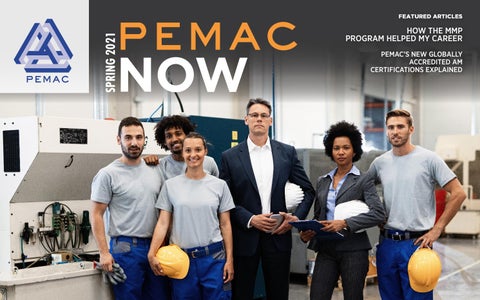
SPRING 2021
FEATURED ARTICLES
NOW
HOW THE MMP PROGRAM HELPED MY CAREER PEMAC’S NEW GLOBALLY ACCREDITED AM CERTIFICATIONS EXPLAINED
P E M A C N O W S P R I N G 2021
1
TABLE OF CONTENTS
7
9
SECTIONS 04 PRESIDENT’S MESSAGE 05 CONNECTING AMID COVID
ON MY BOOKSHELF By Len Middleton
NEW PEMAC GLOBAL ASSET MANAGEMENT CERTIFICATIONS By Susan Lubell
12
SPRING 2021 VOLUME 2, NUMBER 1
06 PEMAC NEWS
Publisher: Paul Burton PBurton@annexbusinessmedia.com Editor: Mario Cywinski MCywinski@mromagazine.com
13
Associate Editor: Maryam Farag mfarag@annexbusinessmedia.com
21 MEMBER SPOTLIGHT MMP CAPSTONE AWARD PROJECT By Ryan Berg
15
AMP CAPSTONE AWARD PROJECT By Lorena Mueller
www.pemac.org
INFOGRAPHIC PAGE
23 CONNECT CONTRIBUTE CORNER
17
19
Cindy Snedden, PEMAC Executive Director Executive.Director@pemac.org Jean-Pierre Pascoli, PEMAC President JP.Pascoli@pemac.org
We do not assume any legal liability or responsibility for the accuracy, completeness or usefulness of any information, apparatus, technique or process disclosed herein.
In association with
HOW THE MMP PROGRAM HELPED MY CAREER By Dylan Rowsell Cover Image: Drazen Zigic from Shutterstock
THE FIRST PHASE IN ANY IMPROVEMENT INITIATIVE By Cliff Williams
ISO DEVELOPMENTS By Boudewijn Neijens
Produced Under Contract By
MACHINERY AND EQUIPMENT
P E M A C N O W S P R I N G 2021
3
President’s Message Jean-Pierre (J.P.) Pascoli | President PEMAC Welcome to the third edition of PEMAC NOW, the magazine of PEMAC Asset Management Association of Canada. What a year it has been! Just more than 12 months ago we quickly pivoted to expanding our online offerings for our members to address the need for physical distancing as our response to COVID-19. Many of our back-office functions were already online, but 2020 certainly pushed us to meet the connect, learn, contribute and get recognized objectives of our membership in an online format. The professional development activities of our annual MainTrain conference, technical symposium days, chapter events and regular webinars all successfully transitioned to an online environment. MainTrain boasted that more than 50 per cent of the attendees were joining us for the first time — travel had been an obstacle, but with the bright spot of online delivery members could now attend. Our educational partnerships with colleges and universities quickly pivoted to an online teaching model. Building on 15-plus years of successful online delivery with Northern Lakes College meant that PEMAC’s courses were ready to go as Canadian educational institutions all transitioned. Our members did not miss a beat in their education. PEMAC members continue to contribute to PEMAC and on the global front through our partnerships with the the Global Forum on Maintenance & Asset Management (GFMAM) and World Partners in Asset Management (WPiAM). PEMAC was a key technical contributor and project lead on the revisions to the GFMAM Maintenance Framework. We also actively participated in the WPiAM development of global competency standards and an accreditation framework for asset management certifications. The learning from and outcomes of both these initiatives will be incorporated into our PEMAC offerings to ensure members are informed and up to date on the latest thinking in the fields of maintenance management, reliability and asset management. Finally, PEMAC continues to expand its recognition offerings for our members. In November, we launched three new Asset Management Competency Certifications — CSAM, CPAM and CTAM — to complement our existing MMP, CAMP and CAMA. This broadens our ability to recognize the competency and demonstrated capability of our members within the field of asset management. As we head into the second quarter of 2021, our maintenance, reliability and asset management community can embrace the opportunities in front of us.
P E M A C N O W S P R I N G 2021
4
PEMAC Meetings
Connecting amid COVID-19 Connecting amid COVID-19
Highlights Highlights of of initiatives initiatives and and events events hosted hosted or or facilitated facilitated by by PEMAC PEMAC that that allowed allowed members members and and practitioners practitioners to to connect, connect, learn learn and and contribute contribute in in spite spite of of the the COVID-19 COVID-19 pandemic. pandemic. Highlights of initiatives and events hosted or facilitated by PEMAC that allowed members and practitioners to connect, learn and contribute in spite of the COVID-19 pandemic.
55 Part Part COVID-19 COVID-19 Webinar Webinar Series: Series: March March -- May May 2020 2020 5 Part COVID-19 Webinar Series: March - May 2020
PEMAC PEMAC hosted hosted aa webinar webinar series series designed designed to to give give members tools to cope with adjusting to the, members tools to cope with adjusting to the, then then PEMAC hosted a webinar series designed to give new new COVID-19 COVID-19 pandemic. pandemic. members tools to cope with adjusting to the, then new COVID-19 pandemic.
Opportunities Opportunities to to Learn Learn and and Connect Connect Opportunities to Learn and Connect Winnipeg Winnipeg
AMMS 2020 AMMSWinnipeg 2020 hosted hosted by by PEMAC PEMAC Winnipeg Winnipeg Chapter Chapter AMMS 2020 hosted by PEMAC Winnipeg Chapter
Alberta Alberta
Alberta Chapter AlbertaAlberta Chapter Online Online One-Day One-Day Symposium Symposium Alberta Chapter Online One-Day Symposium
Online Online PEMAC PEMAC Chapter Chapter Events Events Online PEMAC Chapter Events
56 56
Online Online offerings offerings of of MMP MMP Courses Courses Online offerings of MMP Courses
Lunch Lunch & & Learn Learn Webcasts Webcasts Lunch & Learn Webcasts
13 13
Online Online offerings offerings of of AMP AMP Courses Courses Online offerings of AMP Courses
The The association association continues continues to to provide provide opportunities opportunities for for its its members members and and the the professional professional asset asset management management community community to to build build connections connections and and expand expand their their skills. skills. Look Look out out for for Thefuture association continues to provide opportunities for its members and the professional our events and be sure to join us! our future events and be sure to join us! asset management community to build connections and expand their skills. Look out for our future events and be sure to join us! Connect, www.pemac.org/events Connect, Learn, Learn, Contribute. Contribute. www.pemac.org/events
Connect, Learn, Contribute.
www.pemac.org/events
PEMAC’s Alberta Chapter hosted a one day Online Symposium in May of 2020, providing the PEMAC community a daylong opportunity to connect with peers, learn across industries and contribute to the advancement of maintenance, reliability and asset management in Alberta.
The PEMAC Winnipeg Chapter hosted its annual Asset Management Manitoba Summit. The event shifted to an online Virtual Summit held on May 5th and included 3 tracks focused on Asset Management Information Standards, Decisions Making and Business and Financial Principles.
The Global Forum on Maintenance and Asset Management (GFMAM) held meetings over two weeks in the month of November. PEMAC, was represented by our then-President, Susan Lubell and Executive Director Cindy Snedden. The GFMAM, has not been slowed down by the pandemic, making significant progress in many of its ongoing projects.
P E M A C N O W S P R I N G 2021
5
MainTrain Originally planned to take place in New Brunswick, the MainTrain 2020 Conference went virtual for the first bringing together maintenance, reliability and asset management professionals from all around the world for the 2-day online conference. The MainTrain 2021 Conference will also be held online and we hope you will join us. Photo taken during and impromtu breakout room at the end of the event.
P E M A C N O W S P R I N G 2021
6
On My Bookshelf “Maintenance Planning and Scheduling Handbook” by Doc Palmer By Leonard G Middleton
I
have had this book for a while and though it is not the most recent edition, I nonetheless find it an extremely useful reference. Effective maintenance work management is extremely important to asset reliability, and, done properly, it can greatly improve maintenance effectiveness and costs, and improve uptime and revenue. Unfortunately, few organizations do it well. As a Reliability Centered Maintenance (RCM) practitioner, I understand how assets can fail to perform to the level wanted by the asset owner, what can cause them to fail, whether the failure matters and what to do about it. The preferred recommendations are often proactive maintenance tasks (condition monitoring, preventive maintenance, failure-finding tasks) done on a regularly sched-
uled routine basis (aka “PMs” by CMMSs). The schedule is determined by the frequency required to be effective for the tasks (PF interval, asset/module/component lifetime, calculated failure-finding interval). For those tasks to be effective, they need to be done properly when required. A key forecast measure for asset reliability and maintenance effectiveness (e.g., maintenance costs per unit of output) is routine maintenance schedule compliance. To achieve high routine schedule compliance (> 95 per cent), organizational discipline and effective maintenance planning, scheduling and execution are a must. Now that we have the context, why this book? For me, many of the other books are too prescriptive. In his book, Doc Palmer provides insight on the why. I want to understand
why things are being done, as the prescribed solution may not be appropriate in all situations, and there may be better solutions for the context. Palmer includes “maintenance planning principles” and “maintenance scheduling principles” with explanations of the rationale behind them. The focus of the book, from my perspective, is to minimize avoidable delays. That gets the best use of scarce technical resources executing the work, to get more work done with the existing workforce. With an understanding of the principles and their rationale, you can better understand how best to apply the principles given the context, and where, under certain circumstances, alternate solutions could be better. For example, Palmer does not recommend
planning all jobs, as the nature of a job may be too simple (e.g., changing a lamp in a fixture). The individual changing the lamp would already know what needs to be done and the parts and special tools or equipment required (correct lamp and a ladder), and can execute the task effectively. Therefore, there would be little benefit relative to the effort of a planner developing a job plan for such a simple job. In addition, the planner’s scarce time and skills could be better invested elsewhere. The key is to plan the work to the level possible (and required) in the time available. The iterative process of planning will help improve a job as information found during execution is provided by feedback in closing the work orders. Once I recommended to a client one approach for their assets clustered in sepaP E M A C N O W S P R I N G 2021
7
rate locations (water injection/oil and water separation plant, electrical power generating plant, gas compression engines) versus another approach for their assets (pumpjacks) that were scattered over a large area requiring up to two hours of travel by truck from the central dispatch area. The contradiction made sense given the differences in context, as the benefit achieved in planning each individual’s remote job would not be worth the effort that a planner would expend. Standard job plans could be developed for routine scheduled tasks and common corrective tasks on the near-identical remote assets, and the technicians would apply the instructions appropriate to the situations found. Although not highlighted in Palmer’s book, for my purposes, I use the six-block model for maintenance work management of “identify” (reliability analysis, operator or maintainer observations and work requests, etc.), “plan,” “schedule,” “assign,” “execute” and “feedback”/“learn.” In an emergency situation, work moves from “identify” directly to “assign” and “execute” (likely not bothering with “feedback”). That bypasses any benefit that effective planning and scheduling could provide. In that model, I look at planning as the “what” and the “how,” and scheduling as the “who” and the “when.”
What and How “What” is the description of the work to be done and the desired results. “How” is the instructions and identification and co-ordina-
tion of the resources (technical information, required labour skills and quantity, parts and materials, special tools and equipment, safety/ permitting, co-ordination between work groups, etc.). These are addressed in detail in the book. As the planner has a high-level skill set, Palmer instructs they be focused on future (i.e., planned) work only. Otherwise, in many organizations, the planners would get buried in the day-to-day emergencies and little would get planned, and the organization would remain forever in a reactive mode. Maintenance, both routine and corrective, is often work that has been done in the past and likely must be done again. The iterative process can provide ongoing improvements in the job plan, with information found on the job and provided in the feedback/learn effort. Feedback should include all labour, parts and materials used (organizational investment in the asset), what repairs were done, what was found (failure effects in asset reliability analysis) and potential additional information to improve the job plan for future work.
Who and When “Who” is what group the work will likely be assigned to, with the “named” resource determined by the work group supervisor for many jobs. “When” will be determined upon a number of factors, including work priority, available resources to execute work and co-ordination requirements. For complex jobs — or jobs that need co-ordination between groups (operations, multiple skilled trades), or need
to be performed at a particular time or event (shutdown) instead of assigning the work to the week it is to be performed — the scheduler will schedule them for a particular date and time. Given the importance of proactive maintenance schedule compliance for maintenance effectiveness, planned maintenance work should be given high priority; otherwise, the result could be ongoing reactive efforts. Palmer emphasizes that all the pieces to effectively and efficiently execute the work must be in place. This includes a reliability program to generate effective maintenance tactics, effective management of special tools and equipment, suitable management of MRO stores and supply chain, and measures to drive continuous improvement in work management and its supporting functions. Back then, Palmer viewed computerization not as the solution for maintenance work management but as a tool, and that viewpoint remains true to this day. Tools provide value based on their suitability to the task they are used to perform, and the skill and capability of those that wield them. Palmer provides a number of forms and templates in the book. If you can understand how you could manage the work management effort on a manual basis, then understanding what you need to do and how the CMMS could support your efforts will improve your use of it as a tool. The benefits achieved through effective maintenance work management are numerous. Here are just a few. • With effective planning and scheduling,
avoidable delays can be reduced, allowing more work done by the workforce. • There are tasks that need to be done (getting instructions and technical information, getting special tools or equipment, getting parts and materials, etc.), but if provided all together at the beginning of work, multiple trips to gather these resources will be unnecessary, reducing avoidable delays. • Palmer indicates that unplanned work results in around 25 per cent “wrench time” of a technician’s day, where “wrench time” is the amount of time working performing tasks that only a skilled technician can do (diagnostics and “pulling wrenches”). With effective planning and scheduling, it can be increased to 50 per cent. • If the routine scheduled maintenance work is performed when required, then asset reliability is higher, resulting in higher uptime, higher revenue and higher profitability. • If feedback is provided when the work is closed, chronic problems can be addressed, improving asset reliability. If work is being performed on a timely basis, then the relationship between maintenance and operations is improved, as work is done when promised. If you are a maintenance or reliability specialist, this book deserves a place on your bookshelf. It certainly earned its spot on mine. P E M A C N O W S P R I N G 2021
8
New PEMAC Global Asset Management Certifications By Susan Lubell
O
n Nov. 2, 2020, PEMAC launched three new Asset Management Competency Certifications — CSAM, CPAM and CTAM — to complement our existing MMP and CAMP certifications. These new certifications are globally accredited by the World Partners in Asset Management (WPiAM), marking an important and formal foray for PEMAC into the internationally recognized Asset Management (AM) Certification community. By now, you will have seen the PEMAC advertising for these new certifications. However, you may still have some questions. What’s in it for me (WIIFM)? What’s in it for my organization (WIIFO)? Where does this fit with my existing MMP or CAMP? This article will begin to address those questions.
What’s in it for me (WIIFM)?
A key factor in today’s labour market is recognition of competence — knowledge, skills and work experience — and portability within, between and across companies and industries. The global certification scheme (GCS) for AM has been developed specifically for those pursuing an AM career path. The key attributes of GCS-accredited certifications are as follows: • Global recognition of your AM knowledge, skills and experience achieved via various pathways • Staying current with advancements in the field of AM
• Providing a clear pathway to career advancement and increased earning potential • Increased job opportunities • Global transferability of AM competency recognition across various industries and countries • Transportability across industries, organizations and career roles • Building your network through PEMAC’s AM community engagement and events The newly launched PEMAC AM certifications (CSAM, CPAM and CTAM), coupled with our existing certifications (MMP and
CAMP), seek to fill the gap that was identified for those advancing their careers by providing “career path recognition” for AM professionals — both for individuals to advance and for organizations that want to hire them. The GCS-accredited CPAM (Certified Practitioner in AM) and CTAM (Certified Technical Specialist in AM) enable PEMAC members who have demonstrated competency in several of the GFMAM Landscape 39 subjects — collectively referred to as a domain — to be recognized for their knowledge, skills and work experience. PEMAC’s MMP program brings great strength and depth to maintenance management knowledge and skills,
particularly in the operation and maintenance phase of the asset lifecycle, but does not easily evaluate a candidate’s AM work experience acquired through other means. Similarly, PEMAC’s AMP program brings strength to AM knowledge and skills by its alignment to the landscape and its thorough application across the entire asset lifecycle from conception to retirement, but does not easily evaluate AM competence gained throughout a career. The CPAM and CTAM certifications also recognize that many AM practitioners bring a wealth of AM competency developed throughout their careers that does not hinge on having completed our PEMAC educational
Developed specifically for those pursuing an asset management career path. P E M A C N O W S P R I N G 2021
9
offerings. The CPAM and CTAM will appeal to AM specialists who are advancing in their careers or who have reached a fully qualified practitioner level and prefer to focus on gaining depth in one or more domains, including application of the business management aspects of AM. The GCS-accredited CSAM (Certified Senior Principal in AM) is a measure of the competency of AM practitioners who are responsible for establishing, updating and managing oversight of a holistic and integrated AM framework across a significant area of the portfolio at their organizations. It is this breadth of responsibility for delivering organizational strategic objectives paired with depth in several of the AM domains that makes the CSAM a desirable rung on the AM career ladder. In time, the GCS will be expanding to include an associate level for those new to the AM profession, and a fellow level for those at the pinnacle of their AM careers who demonstrate depth, breadth and significant levels of responsibilities in AM competence. But, you may say, “The skeptic in me says my supervisor already knows what I can do. Why should I bother?” That is very true. Your immediate supervisor likely already does know what you can do, what your strengths are and where you add value to your organization. Certifications may not make much of a difference for you in your current role. Where certifications can make a difference in today’s labour market is in the recognition of your AM competence by other departments
In time, the GCS will be expanding to include an associate level for those new to the AM profession
or locations in your organization for potential internal transfers or assignments to new AM strategic initiatives. They can also make a difference when your organization is acquired by another, and the new leadership and HR department are evaluating the competency and experience of their new staff, or when you find yourself looking for new employment or a career change into a new organization or industry.
What’s in it for my organization (WIIFMO)? The globally accredited certification provides a common platform and specification requirement that indicate to organizational leadership and HR departments that the individual has the competency to perform AM activities at the required level of expertise. Whether
your organization is looking at internal career path promotions and compensation, internal transfers between departments or locations or assignment of staff to strategic initiatives, or hiring externally for new employees or consultants, externally recognized certifications provide a measure of competency in those assigned or hired to perform the job. Promoting or hiring individuals who hold any of PEMAC’s five certifications brings a demonstrated level of competence — education, skills and work experience — plus a continuing professional development component that requires certificants to stay up to date with the current thinking and learning in the field of AM to the success of their organizations.
Where does this fit with my existing MMP or CAMP? PEMAC’s MMP educational content can be thought of as AM targeted for the frontline maintenance manager, while the AMP program was developed with an eye to the broader focus of the GFMAM Landscape and ISO 55000 core domains of expertise. These two certification programs fully align to the knowledge and applied skills components of AM competency. MMP and CAMP are well established and respected across industries, and employers know the value that individuals holding these certifications bring to their work every day. There’s a reason we often see these certifications listed as a requirement in job postings. PEMAC’s MMP certification builds on our P E M A C N O W S P R I N G 2021
10
strength and roots in maintenance and reliability. It enhances the business management, fundamental reliability knowledge and skills of participants such that they can contribute to improving maintenance management at their organizations with a particular emphasis on the operate and maintain phase of the asset lifecycle. The certification’s capstone project brings all the gained knowledge together in a business case for a project that can be implemented at the participant’s workplace. The CAMP certification introduces participants to the GFMAM Landscape’s 39 subjects and six subject areas, and to the ISO 55000x in a format that encourages learning and exploring how these concepts can add value to their current organizations. Both certifications recognize the depth of knowledge that comes from formal education, offer a co-ordinated set of courses to explore the breadth of asset management, and, through their final capstone courses, bring it all together as a holistic learning experience. The new AM certifications — CSAM, CPAM and CTAM — recognize that individuals come to the field of AM from many career paths — not just maintenance and reliability. Instead of PLAR (prior learning and recognition) on a course-by-course basis towards an MMP or CAMP, the CSAM, CPAM and CTAM certifications recognize the holistic work experience, broad knowledge base and applied skills of certificants. Just as AM is focused on collectively delivering value from assets through the asset lifecycle, PEMAC’s AM certificants come from many walks of life,
The new CSAM, CPAM and CTAM certifications recognize that individuals come to the field of AM from many career paths, not just maintenance and reliability.
industries and career roles. It’s not surprising to see individuals who started their careers in business, supply management, information systems and accounting and finance, in addittion to engineers, technologists and technicians, who all contribute to and are pursuing a recognized career path in AM. The infographic below shows how the MMP and CAMP certifications align and complement the new AM certifications: CSAM, CPAM and CTAM. The new CPAM and CTAM do not require applicants to complete PEMAC’s MMP or AMP education to become recognized as CSAM, CPAM or CTAM, although this will be an easy way to gain and demonstrate knowledge and skills.
How do these certifications fit PEMAC’s direction? • In late 2019, PEMAC set forth five key strategic goals for its five-year strategic plan 2020–2025. • Expand our strength in maintenance and reliability management • Raise awareness for the professional field of AM • Grow the capacity of PEMAC to support our vision • Broaden community engagement through “connect, learn and contribute” • Set high standards for AM excellence in Canada The introduction of new AM certifications — paired with the complementary existing MMP and CAMP certifications — ticks all the boxes in this strategic plan for our individual,
organizational and future members. In addition, these certifications will help to grow the capacity of PEMAC to enable us to deliver for our members.
How are these certifications different from other AM training courses? Many of the training courses that are now available — one- and two-day and weeklong — serve to address the knowledge aspects of competency. PEMAC’s MMP and CAMP go several steps further in terms of depth and breadth of AM knowledge through their respective eight- and six-course programs offered at the post-secondary level that culminate in a capstone project tying all the learning together to demonstrate skills in applying this knowledge. The GCS-accredited certifications build out to recognize the various career paths that lead to AM and the substantial work experience that certificants have acquired. These certifications are globally recognized for equivalency in AM competence.
Conclusion The expansion of PEMAC’s certification offerings to include MMP, CAMP, CTAM, CPAM, CSAM and CAMA represents a significant step forward in the professionalization of AM and recognition for its practitioners. These certifications will close the gaps in our PEMAC competency recognition and provide benefits to our individual members, our organizational members and the broader AM community. P E M A C N O W S P R I N G 2021
11
2020 MMP Capstone Award Project Orano, McClean Lake Calciner Scrubber Fan By Ryan Berg
As is and to be
O
since 2008 and is currently processing all the ore for Cameco’s Cigar Lake operation. The ore is sent to McClean Lake — roughly 90 kilometres away — using specialized totes transported by semi-tractor trucks.
How the project was identified McClean Lake is currently licensed by the Canadian government to produce 18 million pounds of uranium (U308) annually. In case of any potential increases in our production annually, availability and equipment reliability are going to be of incredible importance. We will need to evaluate assets to ensure there is an appropriate gap between performance and equipment capability. The Calciner Scrubber Fan was identified through our “bad actor” program. (“Bad actors” are assets that have chronic
The current fan design is from 1995. Since then, the process has changed a few times as it would in any facility, but now it’s time to update the design. The replacement fan will be designed for high pressure wet gas, with a speed of 1,800 rpm, to provide a much more robust fan. A larger diameter, slower rotating impeller will be needed to generate the required tip speed to meet system pressure requirements. As a result, sensitivity to minor imbalance would be reduced, as would maintenance on bearing and other fan components. Additional motor margin is warranted in many wet gas applications to enable on-line spray cleaning of the impeller, which increases operating amps. Enabling on-line cleaning will be a key contributor to increased availability. The impeller will remain a radial blade, which is appropriate for wet gas scrubbing applications as it is the most robust, self-cleaning design available. A new fan would provide Orano with significant operating flexibility and likely additional throughput capacity without other system upgrades. Scrubber fans are often the most important bottleneck to consider in a gas cleaning system design.
Calciner Scrubber Fan
Considerations
The current fan design is from1995. Since then, the process has changed a few times as it would in any facility, but now it’s time to update the design. The replacement fan will be designed for high pressure wet gas, with a speed of 1,800 rpm, to provide a much more robust fan. A larger diameter, slower rotating impeller will be needed to generate the required tip speed to meet system pressure requirements. As a result, sensitivity to minor imbalance would be reduced, as would maintenance on bearing and other fan components. P E M A C N O W S P R I N G 2021
Calciner Scrubber Image provided by Ryan Berg
[Editor’s Note: The MMP Casptone is the last of the eight modules that make up the Maintenance Management Professional Education program. Through the application of the key learning elements from the previous seven MMP modules participants apply the principles, latest concepts and techniques to a final project. Participants select a project that will audit, assess and improve their current maintenance departments or develop a new maintenance strategy in their company or resolve a significant maintenance issue within their departments. Ryan Berg won the MMP Capstone award for his MMP Capstone project on Orano’s Calciner Scrubber Fan project. This article is a short summary of that work.]
rano is a French Crown corporation, previously known as Areva, that began in 1976 under the name French Alternative Energies and Atomic Energy Commission. It rebranded in 2017 from Areva to Orano to refocus the company. That same year, the nuclear division separated from the mining division of Areva and merged with the American company Framatome. Orano Canada Inc. (OCI) operates in the business unit of mining. The mining division includes resource extraction, mining and exploration. OCI has one operation in Canada located at McClean Lake. The Canadian head office is in Saskatoon and McClean Lake — 750 kilometres north of Saskatoon — is “fly in, fly out.” McClean Lake has been mined out
problems.) We are going to focus on two areas: first, maintenance cost, and second, production loss. We have a unique scenario at McClean Lake with production because we have a licensed cap that allows some flexibility with production schedules.
12
2020 AMP Capstone Award Project Nanaimo Departure Bay Pump Station By Lorena Mueller [Editor’s Note: Lorena Mueller won the 2020 AMP Capstone Award for her Capstone project on Nanaimo’s Departure Bay Pump Station. The AMP Capstone is the final project a participant has to complete and allows participants to review the elements of the previous courses and take the opportunity to bring the concepts together in an applied project that requires the development of an Asset Management Policy and Strategy for an organization as well as the development and implementation of an Asset Management Plan for a particular class of assets. This article is simply a short summary of that work].
T
he Regional District of Nanaimo (RDN) is located on the east coast of Vancouver Island in B.C. It provides regional governance and services to four incorporated and seven unincorporated communities on the central east coast of the island. Its core services include wastewater treatment for these communities. Since many of the provided services are asset intensive, incorporating best asset management practices will ensure the RDN fulfills its mission to serve the public by providing effective governance and delivery of services to community residents throughout the region.
Asset Management Governance at the RDN Based on its 2019–2022 Strategic Objectives ,
The capstone project allowed me apply what I had learned to a critical asset within the RDN.
the RDN set the goals and vision of its board during its tenure. The key strategic areas — environmental stewardship and growth management — support the vision, which, in part, states that “the Regional District of Nanaimo honours and protects its natural assets, respects its diverse communities....” • Under environmental stewardship, the board identified a goal to “protect and enhance the natural environment, including land, water and air, for future generations,” with the action to “continue to improve the quality of treated wastewater in the region.” • Under growth management, the board identified the goal to “provide effective regional land use planning and responsible asset management for both physical infrastructure and natural assets,” and listed “fully develop our asset management plan” as one of the action items. The ISO 55001 standard provided the guide for this capstone project. ISO 55001 identifies the need for an asset management policy, a strategic asset management plan (SAMP) and asset management plans (AMPs) that align with the organization’s strategic plan and objectives. • An asset management policy identifies the principles asset management intends to achieve in meeting the “strategic plan” as formally expressed by top management. • The SAMP defines how the principles identified in the asset management pol-
icy must be implemented. It guides the setting of the organization’s asset management objectives and the role of the asset management system in achieving them. Included in the capstone project was an outline of the SAMP, which shared alignment with the RDN’s asset management policy. • AMPs for the RDN outline the actions required to meet its asset management goals of providing cost-effective service to its residents and communities at service levels deemed necessary by its stakeholders.
The Departure Bay Pump Station Project For my capstone project, I chose the RDN’s Departure Bay Pump Station (DBPS), since it is a critical asset for the district. The DBPS is the RDN’s largest pump station and pumps approximately 70 per cent of the City of Nanaimo’s wastewater to the RDN’s wastewater treatment plant located in the city. The pump station was constructed in 1974 at Departure Bay, and although the station has undergone various upgrades, much of the critical equipment there is still original. The population of Nanaimo has increased significantly since the DBPS was constructed, as has the service area. This, along with the aging interceptor and collection system, has resulted in increases in sanitary wastewater and inflow and infiltration in the interceptor feeding the pump station. P E M A C N O W S P R I N G 2021
13
The DBPS is key to meeting the strategic goal of protecting the environment in the RDN’s strategic plan because it transports so much wastewater to the treatment plant. Therefore, developing an AMP to ensure it meets its service requirements now and in the future is important in achieving the district’s growth management objective. The asset management capstone project was an opportunity to apply what I had learned in the first five courses of the program to a critical asset within the RDN. My capstone project included an overview of an AMP specific to the DBPS. For the DBPS, stakeholders include residents, the City of Nanaimo, regulatory agencies and the various persons responsible for operating and maintaining the DBPS, including operators, maintenance staff and managers. The capstone project also considered service level for residents and their current and future needs, regulatory requirements and the RDN’s strategic plan. The DBPS is required to pump all wastewater delivered to it, 100 per cent of the time. The City of Nanaimo is growing, and the DBPS must
measures to reduce them. Communication around asset management included reviewing direct communications and asset management training requirements. We have an engaged workforce, and it is important that our employees understand their roles in asset management for it to be as effective as possible. As part of the project, I came to understand the need for reviewing the competency requirements of staff involved in ensuring the level of service at the DBPS is maintained, and considered communication strategies that would improve understanding of asset management and employees’ roles at the DBPS. An organization’s asset management policy, SAMPs and AMPs need to be aligned with the organization’s strategic plan and objectives.
have the capacity to transport all of its delivered wastewater for years to come. A review of potential health and safety hazards to our employees and the community and environmental risks was completed, and ways
ISO 55001 identifies the need for an asset managment policy, a strategic asset management plan and asset management plans that align with the organization’s strategic plan and objectives.
of mitigating these hazards were identified. The review of lifecycle management included acquisition, operation, maintenance strategies, budget and risks to equipment failure, and considered when equipment should be refurbished or replaced and the responsibilities of various positions in asset management at the DBPS. Because of its significant role in transporting wastewater, the DBPS presents risks to the two strategic objectives to which it is aligned: meeting service requirements and protecting and enhancing the environment. Identifying the greater risks through a risk matrix provided an opportunity to consider mitigating
Conclusions Through completion of the asset management capstone project, the concept of alignment of asset management with the strategic goals of the organization became engrained in me. First, I realized that asset management should be considered before the purchase or construction of an asset to ensure it meets an organization’s strategic goals, and that proper asset document management is critical to make the best decisions about assets. Second, ISO 55000 is an excellent guide, and following it will ensure you consider all the requirements for successful implementation of an asset management program. Finally, I learned that all of us in the RDN play a role in asset management for those assets owned and managed by the organization, and that maintaining an engaged workforce is critical to the successful implementation of an asset management program. P E M A C N O W S P R I N G 2021
14
How the MMP Program Helped My Career By Dylan Rowsell
Completing the MMP certification gave me instant credibility, as well as the foundation and confidence I needed in the maintenance community at a professional level. cash to pay for university. Fast-forward 10 years: I was still working as an operator for big-league players like Shell, BP and Apache. So much for my university plans. In the late 1990s and early 2000s, the upstream oil and gas energy sector’s maintenance management space looked a bit dif-
ferent than it does today. Operators planned and scheduled maintenance activities, handled big-budget turnaround projects and performed minor maintenance activities like changing oil and lubricating equipment. Automation in the sector, compared to others like automotive manufacturing, was in its P E M A C N O W S P R I N G 2021
Credit: Joseph Mucira
P
EMAC’s maintenance management professional (MMP) program is one of the most valuable and insightful programs for maintenance managers and practitioners today. My name is Dylan Rowsell, and I’m one of those oil and gas energy operations guys who have jumped into the exciting maintenance management space. Below, I will touch on how the MMP certification helped me achieve my personal goals and become a better employee. Although I have experienced many benefits by taking and completing the MMP program, three stand out. One, the program has provided the foundation to play big in the work management space at a professional level, providing the “street cred” needed among my peers and leaders. Two, it has enhanced my ability to communicate effectively and confidently, not only from a maintenance lens but in all aspects. Three, it has provided connections, knowledge and a network of resources to tap into. Before I dig further into these benefits, here’s a little background on me. As a Western Canadian oil and gas patch brat, I was one of those lucky guys who graduated from high school and went into the patch as an operator for Berkley Petroleum to make some quick
15
early development stages. I was fortunate to have learned different skills that ranged from maintenance management activities to operations, to project management and budgets. In 2010, I was asked to tackle the planning portfolio of both O/M (operations and maintenance) and turnaround work, from a maintenance management perspective — not operations. I thought, I’m an ops guy. Why do you want me to do this? With a bit of reluctance, I accepted the opportunity and challenge. But it was the best decision of my career; I have never looked back. At that point in 2010, I needed some sort of credibility — street cred — with the folks in the back office and in the C-suite. If I wanted to make an impact and change things, I needed something other than my experience and reputation as a good ops guy. In 2016, PEMAC’s MMP quickly became a clear winner to address an issue I was experiencing in my professional career — I was at a stall. In the maintenance management space, people I worked with who held an MMP certification seemed to have the edge over others. But in 2016, I met my new people leader and mentor, Tonnie, who gave me the support and resources I needed to tackle the MMP. Many thanks to Tonnie, as her mentorship has changed my career for the good. Now, back to the three benefits of the MMP program.
Professional Level Credibility and Street Cred Completing the MMP certification gave me
The MMP was the missing link that enabled me to work confidently and professionally, applying sound maintenance principles and practice while communicating confidently, using the correct terminology.
instant credibility, as well as the foundation and confidence I needed in the maintenance community at a professional level. Now, I did not win over everyone. However, it provided enough street cred that I had the masses behind me. Before earning my certification, I felt I knew the principles, practices and elements of maintenance management from my diverse experience, but I still felt something was missing. The MMP filled that gap and provided the advantage I needed: solidifying my experience while building my knowledge in the maintenance management space. The MMP was the missing link that enabled me to work confidently and professionally, applying sound maintenance principles and practice while communicating confidently, using the correct terminology.
Confidence in Writing and Talking On a personal level, the MMP program initiated the growth I needed to realize my true potential in my professional career, while overcoming a genetic literacy disability with phonetics. It is the main reason any schooling was challenging for me; any type of task that required me to write was daunting and discouraging. The MMP program provided support and tools to assist me. It provided a safe space to learn, all while not killing my confidence. The program enhanced my communication skills — from emails to reports and presentations — and helped build my confidence. I was on a roll, and it felt good. The
MMP program even provided me with the foundation and confidence to tackle an MBA. (I graduated in July 2020.) Simply put, the program kick-started my writing and speaking abilities and gave me the foundation to do more — and I did.
A Network of Resources and Tools The PEMAC membership and community have provided valuable connections and a wealth of resource material to leverage. In my current assignment — helping to develop a new enterprise resource planning software solution for asset and work management, and finance and supply chain management — I have leveraged resources from PEMAC to communicate best practices to help change old mental models, and avoid the “lift and shift” of bad practices. Through the program I met people who share diverse viewpoints from various industries and I still leverage that MMP community today. In sum, I would like to thank you for reading my MMP journey, and I hope my story can spark some interest and fire in your belly to kick-start your MMP journey. For those who have taken the MMP program, I hope my story has added a smile and raised positive memories while reflecting on your own journeys. For those who believe as strongly as I do in the program, may I suggest you provide mentorship and guidance. I am sure happy someone did that for me, and I am doing the same today to pay it forward. P E M A C N O W S P R I N G 2021
16
Assessment — The First Phase in Any Improvement Initiative
P
erhaps one of the most frustrating times for maintenance managers is when they are trying to improve the performance of the department but constantly hear “We need to do better.” Quite often, it is the plant manager who tells them this — sometimes it is someone from the corporate office, but, whoever it is, it certainly takes the momentum out of what maintenance managers are trying to achieve. Now, the maintenance managers knew things were not where they needed to be — comments like these had been made many times before — but they thought things had started to improve, so they were not really sure what was wrong. 1. Some had read about the need for having high preventative maintenance (PM) compliance, so they started to enforce the com-
When you are experiencing repeat failures or are in an extremely reactive mode, then it usually pays to do some form of root cause analsyis so you can deal with it.
pletion of the PMs on time and it certainly seemed to be better — or at least the number of PM work orders coming back in as completed on time had increased. 2. Some had heard they should be doing at least 80 per cent planned work, so they insisted that the planner/scheduler develop a schedule to achieve that number — and they had — so at least they were planning 80 per cent of the work they intended to do. 3. Some had heard that availability was the key to improved performance, and that one measure that could be used to figure out how long it took to get back up and running from a repair scenario was mean time to repair (MTTR), so they started measuring it and it started to improve. So, why were those plant managers and people from corporate still going on about needing
to do better? Well, we need to look a little deeper at each issue to understand the reasons. PM Compliance: In the case of the plant that focused on PM compliance for improvements, the plant manager did not really know much about PM compliance, and, to be honest, he did not really care. What he wanted was for his equipment to stop breaking down — the same equipment his maintenance team were PM’ing at close to 100 per cent compliance! Even though what the maintenance manager had read or heard about the importance of PM compliance was true, he had missed the even more important point: develop the right PMs first, and then enforce the compliance. In this case, the fact that the equipment keeps breaking down is a sure indicator that either the right PMs were not being done or, if they were, then maybe they were not at the right frequency P E M A C N O W S P R I N G 2021
Image: Matthew Henry from Burst.com
By Cliff Williams
17
things take to repair is one of the important contributors. The question is, is it the one you should concentrate on, and are you going to manage it properly? In this instance, the maintenance manager got the desired result in reduced MTTR, but availability actually went down. Again, the plant manager did not really care about the actual MTTR number; he (like our other two plant managers) just wanted his equipment to stop breaking down so he could get the availability to produce the products he was supposed to. MTTR is a measure of the maintainability of equipment or how skilled the tradespeople are at repairing the equipment, but it is not the first measure most organizations need to focus on. I’m sure that if the mainte-
nance manager took a step back from the chaos he would agree that he should only be measuring the time it took to complete the jobs he really needed to do — such as overhauls, setups, etc. — rather than the frequent breakdowns that should actually have been prevented. (It’s a little like cheering the firefighters for putting out the fire quicker instead of spending time with the fire prevention officer and figuring out how to stop the fires from breaking out!) The other danger with MTTR is that, similar to all measures, it is going to drive behaviour and, in this case, it might lead to short cuts. What is the easiest way to spend a shorter time on a job? Yes, short cuts. This results in repeat failures, poor quality repairs and, in some more undesirable
instances, injuries or safety infractions. So, what was the common error in these three examples? Each maintenance manager had good intentions; they wanted to improve, and the things they did could improve the situation…eventually. Where they missed out was at the very beginning. What was the current state of their department? How were they doing in all aspects of maintenance? Unless they know this, how can they prioritize the work they need to do? How do they know where the biggest problems, and therefore the biggest opportunities, lie? Most often, those within a plant are too close to carry out an objective analysis, so getting someone from outside is usually a better option. You may get someone within the organization, but it is usually better if they are detached so they do not bring biases or paradigms. Once you have completed your objective analysis, look at your assessment through the eyes of “what is important to your plant or organization,” as this will help you to prioritize your efforts. Next, understand what is achievable. How do the best in class perform? Or, how well must you perform so your plant or organization can succeed? Lastly, calculate the gaps and fit them into your priorities. This process is usually known as the assessment and it is critical to guiding the improvement initiative to get the results you need as quickly as possible. Without it, you can just wander in the reactive wilderness. In fact, you will need to develop a map to get you out of that wilderness. But that is another step for another article. P E M A C N O W S P R I N G 2021
Image: Alexander Supertramp from Shutterstock
or were not being done correctly. Quite often when we focus on the quantity of an action, the quality suffers along the way. Planned Work Per Cent: The plant where they focused on the planned work percentage really struggled to get anywhere near the desired completion of the plan, and they certainly were not getting anywhere near the completion of the 80 per cent plan. They even failed to notice that, over time, they were scheduling the repeat failures month after month. This plant was so mired in a reactive and breakdown mode that the goal of completing 80 per cent planned work was a dream. Just like the previous plant, the plant manager did not know much about planned work and schedule compliance — he, too, just wanted his equipment to stop breaking down. The poor maintenance manager was under so much pressure to improve things, he chose one thing he thought he could control — planning and scheduling — but because of this, he failed to notice the repeat failures. He just felt that if he could carry out the repairs according to his schedule then he was moving forward. Sometimes you have to forget that the final purpose of the exercise is to drain the swamp. If you are up to your armpits in alligators, simply kill off a few of them so you can concentrate on getting the pumps running. When you are experiencing repeat failures or are in an extremely reactive mode, then it usually pays to do some form of root-cause-analysis so you can deal with it — simply repairing the symptoms will not get you where you want to go. Availability: This is important to all organizations, and, as in our third plant, how long
18
By Boudewijn Neijens
A
sset management is becoming strategically important for most asset-intensive organizations. A perfect storm created by aging assets, retiring subject matter experts, increasingly engaged stakeholders and rapidly changing technology has triggered the need for increased sophistication and rigour in asset management. This need for rigour has led to the development of a standardized management system specifically aimed at asset management: ISO 55000. This series of international standards was released in 2014 and is gaining widespread adoption in multiple sectors, particularly in electrical and water utilities. ISO management system standards typically consist of at least three documents. • ISO 55000 outlines why you need a management system and its benefits. • ISO 55001 focuses on what processes and systems an organization should put in place to be recognized as competent in asset management; ISO 55001, therefore, is the standard to which an organization can be formally certified. • But because ISO management standards are industry agnostic, they are generic, leading to the often-heard criticism that the standards fall short on practical implementation advice (i.e., how to deploy asset manage-
ment in a specific environment). This led ISO to issue a new version of ISO 55002 in November 2018, offering better and more comprehensive guidance on how to interpret the requirements mentioned in ISO 55001. Those who have implemented or even simply read other ISO management system standards such as ISO 9001 or 14001 will rapidly identify that ISO 55001 has a very similar structure. This is intentional: all ISO management system standards share a common core and are built on the popular plan-do-check-act model. This means, all these standards cover the same topics. In our case, the focus is on assets and asset management. • Context requires the organization to under-
stand its internal and external context, to take into consideration the needs and expectations of its stakeholders and to therefore align its asset management objectives to its overall organizational strategic objectives. It also requires the organization to define the scope of its asset management system; for instance, a company might decide to limit the scope to only one of its plants, before adopting the management system across all its operations. • Leadership requires the organization’s leadership team to show its commitment to asset management by putting in place the necessary resources, by developing an asset management policy that all employees in the organization must understand and follow, and by giving those in asset management roles the necessary authority and support to
perform their functions efficiently. • Planning requires that objectives are clear and plans are put in place to achieve these objectives, including alignment with the organization’s other functions such as finance and HR. It also requires the organization to document its plans — most notably by maintaining a strategic asset management plan (SAMP) and by ensuring it has considered the risks and opportunities related to this plan. • Support ensures that the necessary resources are put in place, that the employees involved in asset management are competent, that the rest of the organization is aware of its asset management system and plan, and that the appropriate communication mechanisms are available. It also highlights the need to identify the information requirements for assets, asset management and the management system. This might include the need for specific information management systems (e.g., an asset register or a capital planning system). Information might need to be documented, not only for legal or regulatory purposes but also for conformance to the management system (e.g., the need for a SAMP and for a written asset management policy). Note that information is often exchanged between different departments; for instance, between asset management and finance. This highlights the need for alignment between departments on what information is maintained by whom — and how. ISO has recently published P E M A C N O W S P R I N G 2021
Image provided by Boudewijn Neijens
Asset Management Systems and ISO 55000
19
do-check-act circle. The organization should engage in continuous improvement of its processes and asset management system. Importantly, it should have processes in place to address non-conformities (which include asset failures) and to develop preventive measures where applicable.
How ISO Works The ISO system relies on volunteer experts worldwide to contribute their knowledge and experience. Each country can elect to participate in the development of a specific standard and set up a “mirror committee” to contribute to the work of the global technical committee (TC) managing the standard (TC 251 for ISO 55000). Thirty-five countries including Canada have mirror committees, and another 18 countries have observer status. The TC typically sets up various workgroups (WGs), each tasked
with a particular project or work area. TC 251 has five major WGs: WG3 – Communications manages all outbound communications and the promotion of ISO 55000. In particular, it runs the TC’s website, committee.iso.org/tc251, and manages the register of known certified organizations, which includes more than 300 organizations worldwide. Sadly, there are only two in Canada to date. WG4 – Product Improvement manages all inbound communications (e.g., suggestions for improvements, new ideas, liaisons with other TCs) and is tasked with the revision of ISO 55000 starting in 2022. WG5 – Finance developed the recently released ISO/TC 55010 and publishes key guidance around the alignment of finance and asset management. WG6 – Revision of ISO 55001 This WG finished the revision of ISO 55002 in late 2018. It is now working on the revision of the common structure to all ISO management systems (aka Annex L), and will start the revision of ISO 55001 next year. WG7 – Development of ISO 55011 This standard will offer “guidance on the development of government asset management policy,” a key subject in Canada, as we are recognized as leaders in municipal asset management. In addition, TC 251 occasionally creates ad-hoc groups (AHGs) to tackle more specific topics. For instance, in 2019, we created a group to better define the concept of “value” in asset management. Similarly, this year we worked on guidance around multi-criteria decision-making. A recently created group is exploring the
importance of information management. The output of these AHGs is typically incorporated into the next revision of the standards and might also be published as free guidance on TC 251’s website committee.iso.org/tc251. The Canadian mirror committee is managed by the Standards Council of Canada and is one of the most active teams within TC 251. It counts 32 expert members of various industries and academic bodies. Many of its members are active in the international WGs mentioned above. Find out more at www.scc. ca/en/standards/committees/iso-tc-251-assetmanagement. P E M A C N O W S P R I N G 2021
Images provided by Boudewijn Neijens
a new technical specification, ISO 55010, that addresses this challenge in more detail. • Operation requires that the necessary processes and control mechanisms be put in place to execute the asset management plans. It also addresses the importance of change management, which might be required to achieve the asset management objectives. It requires the organization to assess and control the risks of any outsourced asset management activities. • Performance Evaluation requires an organization to monitor, measure and analyze the performance of its assets, of its asset management function and of the asset management system itself. This information should be reviewed regularly by management, which should also evaluate any risks and opportunities for improvement. • Improvement is necessary to close the plan-
20
PEMAC Member Spotlight - John Duby One of the reasons we are presenting member profiles is to give those just starting out in their careers an idea of how careers in maintenance, reliability and asset management get started and where they can lead. For PEMAC member John Duby, the subject of this issue’s profile, the answer to the latter is…all over the world! Travel is so restricted these days due to the global pandemic, but I’ll take you on a vicarious world tour as I share some details of my interview with John.
By Cindy Snedden
First job — Boblo Island Amusement Park: John’s career journey started on the Canadian side of the Detroit River at historically significant Bois Blanc Island, Ont., home to the Boblo Island Amusement Park, which began operating in 1898 and closed in 1993. When he was just out of high school, John went to work at the park as an apprentice millwright and stayed for about nine years. “There was no union, so we just did everything. Winter months, we did inspections and would tear the rides apart, carry out the non-destructive testing, replace bearings and wheels. When the park was open, we had to do physical checks each day before releasing the rides to
operations. Some of the rides were very old, made by companies that were long since out of business, so we’d have to make the parts if they needed repaired or replaced. Everything was odd sizes. There were five millwrights and two electricians on staff. It was a very good experience. I achieved journeyman status at this job but left before [the park] went out of business. I could see that attendance was down and that they weren’t investing, so I joined the Navy in 1989.”
Navy: After completing basic training, John was stationed in Victoria, B.C. His background as a millwright helped him in obtaining the Marine Engineering Technologist rating, which is similar to an apprenticeship — you study and apply what you are learning imme-
diately on the job, which, in John’s case, was tending to the power systems that propelled the ships. He mostly worked on steam-powered ships, but towards the end of his tenure, he tended a combined power system (gas turbine/diesel) ship. “I loved the Navy. We had five people on each watch crew, and we got to know one another very well because we were on watch together in an intense operating environment where we had to have one another’s backs. And we were also off-watch together in ports all over the world. We went to the Persian Gulf, Alaska, Falkland Islands, Diego Garcia, through the Mediterranean, through the Panama Canal, the Caribbean, Chile, Hawaii and San Diego. I even participated in the 50th anniversary of the end of World War II in Red Square! “So, it was another really good expe-
rience, both personally and professionally. And really, it has been some of the greatest training I ever got.”
Ontario: When he returned to Ontario, and civilian life, John found that his military Marine Engineering Technologist ticket was recognized as equivalent to the 4th Class Power Engineering Certification. He spent the next years in industrial power plant maintenance — first for TransAlta in Windsor, then Greenfield Energy and finally Invenergy. “When I worked at TransAlta, I was the only mechanical maintenance person for a small cogeneration plant. We also looked after the Chrysler assembly plant power house and they used our rejected steam for their process. When my boss left the project, I followed him to a power plant construction project in Sarnia. Right around this time, Ontario was working to eliminate coal plants. There were a number of alternative fuel power generation ventures cropping up in Sarnia to fill the gap; their strategy was to make use of the transmission hub that was there. A joint venture was building a 1000 MW combined cycle power plant and I stayed with this project through construction and comP E M A C N O W S P R I N G 2021
21
Iraq: “From there I got a call from a friend who had an opportunity to go to Iraq but didn’t want to go. This was to set up a computerized maintenance management system (CMMS) for a company that had an ‘operate and maintain’ contract at a simple cycle power plant. It was a six-month plan, but I ended up staying 18 months. It was quite an adventure being in Iraq during this time. We had security and wore vests and body armour. We were not allowed to go into town. From our expats’ compound we could see gunfire in town at night. In the end,
the contractor that hired us lost the contract and we had to pack up and turn the operation over to the nationals within three days.”
Cuba: “When I got home, I did a stint planning and scheduling for Devon Energy at their Jackfish site near Conklin, Alta. But then I got a call from someone wondering if I might be interested in going to Cuba. Sure! Why not? “For the next 18 months I was the Operations Service Manager (Maintenance Manager) for three power plants and a gas compressor station. The job was to train up a Cuban counterpart. The plan was, once the Cuban technical committee felt he was competent, I would be
repatriated back to Canada. This was another very interesting experience. The first thing I learned was, ‘This is not Alberta.’ Nothing happens fast, and, of course, the U.S. embargo makes things interesting in terms of the supplies you could and couldn’t get and the kinds of workarounds that have to be figured out.”
Alberta and B.C. Again: “Since I’ve been back in Canada I’ve been living in Victoria and working fly-in rotations in Northern Alberta oil sands sites as a planner–scheduler and CMMS instructor and coach. COVID-19 has brought a lot of challenges to the work, but we are managing to keep things going while observing distance guidelines as safely as possible.”
Career Reflections:
“I’ve had a very interesting career with so many different opportunities and experiences. Some of the greatest training I ever got was through the military. I highly recommend that, if you are in the military, take whatever learning opportunities they offer you. You might not think it’s useful, but everything I learned was directly transferable to industry. I highly recommend the MMP and AMP programs as well any time I go into plants. It’s especially powerful to get a team working through them together and talking about the concepts as they work. This is something they are working towards where I am now.” P E M A C N O W S P R I N G 2021
Top Left; Boblo Island Image by James Marvin Phelps on Flickr / Top Right: Navy Ship Image from Thomas-Park on Unsplash
missioning. It was near the end of this period when I first started taking the MMP program.”
22
Connect and Contribute Corner
W
elcome to the Connect and Contribute Corner, a section of PEMAC Now magazine that features fun competitions and creative ways for the association’s members to connect and contribute to the content of the magazine. For this edition, PEMAC hosted a mug caption contest which tasked our members with submitting maintenance and asset management-related captions they would be proud to display on their office coffee mug. The PEMAC community then voted to decide on the two (2) best captions. The winners and their winning captions can be found below:
1st Place “Preparation + Opportunity = Success” Adrian de Groot
2nd Place “Learn Together, Excel Together” Robert Markoja Adrian de Groot’s submission also contained an explanation that was so good we need to include it here: 1. Preparation is all about a lifelong learning approach towards events and situations we encounter. 2. Opportunity takes on the myriad prospects either provided or left. It’s about the choices we make about how we live our lives and how it impacts the environment around us. 3. Success is the achievement we share when we can say “a job well done”. Or however we want to define what personal success means.
The winners will be receiving a custom-made mug with their winning caption. These mugs will also be made available online for PEMAC members to purchase, allowing them to showcase their PEMAC pride the next time they have a coffee in the office or at home. Congratulations to both winners and thank you to all those who entered the competition and voted to help us decide the winners. Be sure to check out the PEMAC website to purchase your mug when they become available for order at the end of the month! If you are looking to contribute to our next edition, be sure to subscribe to PEMAC’s weekly newsletter, PEMAC this Week, to learn the details about the next competition and stay up to date with all news related to the association.
This issue of PEMAC Now has been stewarded by the PEMAC Editorial Board whose current members are Ron Gavrin, Sue Lubell, Len Middleton and Cindy Snedden with Ron Gavrin serving as the Editor in Chief. This team has set an objective to increase the number of PEMAC members who contribute editorial content to PEMAC Now and to external publications with a current focus on MRO Magazine, Canadian Business Quarterly and Municipal World. If you are interested in opportunities to contribute please submit your expression of interest to editor@pemac.org. The Editorial Team would like to thank our advertisers and MRO Magazine for making this edition of PEMAC Now possible. Until next time, may you continue to connect, learn and contribute, in your organizations, communities and beyond!
Mock-ups of the mugs with the winning captions. The final product may vary. P E M A C N O W S P R I N G 2021
23
The Podcast for MRO Professionals The podcast features conversations with industry experts about maintenance, reliability, and operations. Topics that are of utmost importance to MRO readers. Previous guests and topics have included: • Scott MacKenzie – Maintenance at TMMC Plants with a Focus on the Environment • Martha Myers – Importance of Networking and Education in Maintenance • Doc Palmer – Focus on Scheduling and Planning of Maintenance • James Reyes-Picknell – Managing Maintenance and Reliability • Shawn Casemore – Engaging Your Employees in a Safety Culture
For sponsorship opportunities, contact Paul Burton, Senior Publisher, pburton@annexbusinessmedia.com
For guest/topic suggestions, contact Mario Cywinski, Editor, mcywinski@annexbusinessmedia.com
A Podcast brought to you by MACHINERY AND EQUIPMENT
mromagazine.com/podcasts/