Vol. 35, No. 3
June 2019
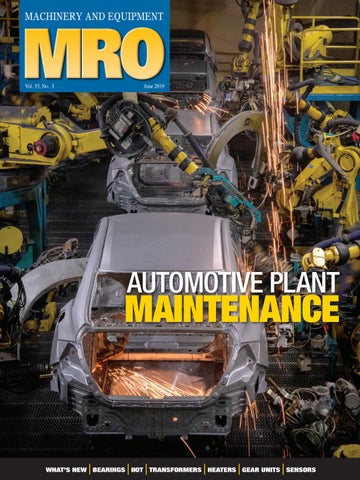
AUTOMOTIVE PLANT
MAINTENANCE
WHAT’S NEW NEW BEARINGS TRANSFORMERS HEATERS TOOLS GEAR UNITS SENSORS WHAT’S PUMPSIIOT VALVES MOTORS BEARINGS MODULES
E D I T O R ’ S
N O T E B O O K
3
Machinery and Equipment MRO
MONTH JUNE 2019 2019
Vol. 35, No. X 3 Established 1985 www.mromagazine.com Twitter: @mro_maintenance Instagram: @mromagazine Mario Cywinski, Editor 226-931-4194 mcywinski@annexbusinessmedia.com Contributors Bryan PhilipChristiansen, Chow, L. TexTed Leugner, Cowie,Douglas L. Tex Leugner, Martin, Douglas Carroll McCormick, Martin, Doc Palmer, Peter Phillips, Peter Phillips, Bavan Poologarajah, David Rizzo, Brooke BrookeSmith Smith Michael King, Publisher 416-510-5107 mking@annexbusinessmedia.com Mark Ryan, Media Designer Barb Vowles, Account Co-ordinator 416-510-5103 bvowles@annexbusinessmedia.com Beata Olechnowicz, Circulation Manager 416-442-5600 x3543 bolechnowicz@annexbusinessmedia.com Tim Dimopoulos, Vice-President tdimopoulos@annexbusinessmedia.com Scott Jamieson, COO sjamieson@annexbusinessmedia.com Mike Fredericks, President & CEO Machinery and Equipment MRO is published by Annex Business Media, 111 Gordon Baker Rd., Suite 400, Toronto ON M2H 3R1; Tel. 416-442-5600, Fax 416-510-5140. Toll-free: 1-800-268-7742 in Canada, 1-800-387-0273 in the USA. Printed in Canada ISSN 0831-8603 (print); ISSN 1923-3698 (digital) PUBLICATION MAIL AGREEMENT #40065710 CIRCULATION e-mail: blao@annexbizmedia.com Tel: 416.442.5600 ext 3552 Fax: 416-510-6875 or 416-442-2191 Mail: 111 Gordon Baker Rd., Suite 400, Toronto ON M2H 3R1 Subscription rates. Canada: 1 year $65, 2 years $110 United States: 1 year $110 Elsewhere: 1 year $126 Single copies $10 (Canada), $16.50 (U.S.), $21.50 (other). Add applicable taxes to all rates. On occasion, our subscription list is made available to organizations whose products or services may be of interest to our readers. If you would prefer not to receive such information, please contact our circulation department in any of the four ways listed above.
Always Make Time for Education
O
ne of Plato’s famous quotes — “If a man neglects education, he walks lame to the end of his life” — rings very true in the world of maintenance. As machines change, processes change, technologies change, and the need to learn how to maximize uptime is a never-ending cycle. Using the old adage Well, that's how we've always done it does not hold water in 2019. In fact, in order to stay in business in an ultra-competitive world, you need to be constantly improving. Recently, MRO went down to Cleveland, for the Reliable Plant Conference and Exhibition. A big part of the show was a wide selection of learning sessions, which were all well attended. At any given time, multiple sessions were taking place, so it was important to select the session that was most relevant to each individual. Sessions were broken down into 10 categories: maintenance management, IIoT, reliability engineering, root cause analysis, condition monitoring, oil analysis, lubrication program management, contamination control, lubricant selection, and hydraulics. One of the main takeaways from the sessions I attended was that today, there is not just one right answer to any given question. Depending on the needs of your organization, what has worked in the past may not work now. Take, for example, sensors. They can be wired or wireless, with pros and cons for each, and with ever-changing technology. While one may think that just putting wireless sensors on everything is the best solution, this may not be the case. Wireless sensors use batteries and depending on the number of readings needed from the sensor, the batteries may need to be replaced too often to be practical. On the flip side, using wired sensors allows for continuous power and readings; however, wires are needed and may be a safety issue. New wireless technology allows for sensors to last longer, with a greater range, and some can even recharge themselves based on what machine they are attached to. As technology improves, so does the range of options available to companies. What the sessions provided was an overview for attendees to learn about what may be the best option for them, as well as the technologies on the market they may not have been aware of. Another big part of learning is to learn from others. Case studies are important to look at as other options that may work for you. In the end, they may not, but seeing all that is available and how things are done, is the best way to have an organization that is efficient and operates with the most uptime. I’ll end with another of Plato’s quotes that sums things up: “A good decision is based on knowledge and not on numbers.” MRO Good day,
Annex Privacy Officer Privacy@annexbusinessmedia.com, 800-668-2374 No part of the editorial content of this publication may be reprinted without the publisher’s written permission © 2019 Annex Publishing & Printing Inc. All rights reserved. Opinions expressed in this magazine are not necessarily those of the editor or the publisher. No liability is assumed for errors or omissions.
PEMAC
Mario Cywinski Editor
SKF Pulse
Machine monitoring made easy. Predict machinery issues before operations are impacted. Simplified inspection, machine health data collection and analysis are now within everyone’s reach. With SKF Pulse, anyone can monitor machine health without the need for training or diagnostic expertise. Combining an easy-to-use sensor with a free mobile app, you can quickly and easily identify machine condition and share machine health data within your organization. In-app SKF Pulse Checks also provide access to expert analysis and advice from SKF. It’s easy to get started, and with a cost-effective price point, there’s no need to make the case for capital expenditure.
skf.ca/pulse
5
C O N T E N T S Machinery and Equipment MRO
June 2019
in this issue
Departments Editor’s Notebook / 3
Industry Newswatch / 6 Mr. O / 38 Spare Parts / 38
12
Events COVER STORY: Maximum Uptime Honda of Canada Manufacturing uses preventative and predictive maintenance to ensure production keeps moving.
Health and Safety Top of Mind at Partners in Prevention / 8 CanWEA Hosts Spring Forum in Banff / 8 Education and Networking Highlight Reliable Plant 2019 / 9
Toyota Commits to Manufacturing Vehicles in Canada / 10 TMMC makes manufacturing announcements at its Cambridge plant.
Critical Cranes / 18 Twenty-four bridge cranes keep Tremcar’s production lines rolling.
What’s Up Doug / 20
MRO Quiz / 22
Conveyor Bearings: typical damage and progression of damage in such applications.
Lubricating grease selection and application.
Product News What’s New in Products / 34
Cover
32 32
Mac hine ry an
Honda of Canada Manufacturing. d Eq uipm ent M RO
EQUIP
M A I N T E N A N C E
MENT
Equ ip tech ment re nica l relia storatio n an BY PET bility d ho . ER PH w it ILLIPS rela te
E
Automated Process Helps Products Move / 24 Distributor uses a collection of systems combined with best practices to ensure it minimizes downtime.
Electric Vehicles and Charging Stations / 28 Is your facility and its electrical infrastructure prepared?
1 0 1
REST
ORAT
June
ION
s to quip m unle World ent rest ss or routi we con progr Class M ation is on ti n anufa ams. e men e repair nue to ke of la A th ct gies t will ep it and are ke rs equipm long wit uring an e basic st T here eventual mainten in good h ture d need shap of W y compon ent restor other W other imeps in WC ly fa ance eq u ll s e. ip C C are n M is en ot bei M, TPM or ts to eq ation an M princi provemen , becau ment or to be a p back to it importa Keeping d mai restor ples lan to s orig up w uipm the ng ig nt or se th t eq other an m n at n en e an te or d io u in re t n ip p ed h n pow mainta inal unre the eq ith enga ere; fo dustrial reliability ance stra il- stan ment w liability er an in th uipged to and wh liable p w ill e y we d dard te erform . The cus w parti Gener wan cond certainly ill be shor money restored state. big p ill ci an Fo al p b t at Man ce ly sp r sp it e p ic y of eakin e year aft to do it an given on initiati - tion example ions they help relia t lived. R ent will iece of u ve even ,an spill epla g rest s hav er ye bility be equ d how won s we ge ipment will run age will ew motor ’t last as but if cing par lost pain restored e restored oration ar. they not ts h t, t peo m that lo an ol sit in on ple ing like n ot, which last to becom ng as ex object rotten w d hou an old p eans to subits ew pec oo mak iece main w se or e gener like new d and tenan conditio ill cause expecte es covere ted. rusted car. W of furnit new ag d lif d in it to agai ns bec ce st Wh e u ai well ally are prod omes fail pre e span. very n. When old par painfully re or may n. equ at is the rategy. we ar ucT m ve ts h ip p p w e at e b ro la re ry m in e mor e ar Thin motor n an ud mov impor urely. or d wh To st ent to re M feren king ab e likely to of our e done th der to m e old ta ai nt fo n ac ou ak ce, th proce art with storatio at’s the e tr r lon tainn? so it p e pro t equipm y it agai complish restorat e the , g-term w and ss. The te you need What w rocess th our re ill run w cess is th ent at ou n and ag ment. If ion we effor am n a team ill keep at take ain. e sam t to it wen ithou op stored r faci sap it lik com com eeds a e. R tb lit t Ju mainte iece furn nance plete eq compellin mitted to e new? of iture reakdow estore a ies, there st ab u , hom n for g, piece ou th st ip is e or ca as of eq no dif- some ca t every rategies ment re why, to sp e restorat stor facilit ses re u for ea r it w long as io end and pos ipmen y the ti n lia on’t st su ch eq ations an m ay th sible. Lik t failed cceeded bility pro has or h , and as h uipment d to dev e at w e gr b ec am ad re ause ay lo new. tired elcom s an lia ng N p th an long eglect ch ere was d faile d project bility is onent. d. So su the en sh an n gine ging the o plan to me succ ave bee es. In Bac oil in eeded n tired ke store k to the te last. your ep the the eq am; th equip and late re st tinu ored uipm r ey e car an ment lik ent to need a we re keeping e vision d see new eq ce how co of debat ntly wor uipmen t like ndition. why they e and ked w Why new wor Thei ith they want to nance r vision d smithin created a for year w re stat g. vision s to co ant to co p nme. The rofessio ement after a few A team need vision is nals in su is: "To lead hours s th (Our ing it to buy in e drivin staining of Com a . to g that Dependin the visi force beh zero bre panies) main n on; th g on ind th akdow fore eed to teey ho n e
Maintenance 101 / 32
Equipment restoration and how it relates to technical reliability.
2019
6
6
I N D U S T R Y
N E W S W A T C H
Machinery and Equipment MRO
June 2019
Business Briefs News and views about companies, people, product lines and more. • Essentra announced the re-launch of Reid brand and its e-commerce web site. Reid (formerly Reid Supply) appointed Shelly Koeck as GM. She brings a range of operational and strategic expertise in manufacturing, technology, and OEM engineered product offerings. Reid has launched centralized centres of excellence to create a hybrid model of advanced digital services combined with personalized customer support, distribution, sales, engineering, and other unique services to create an enhanced customer experience. ReidSupply.com enables customers to browse and purchase from a digital catalogue of over 40,000 products from various brands. The site also offers the company’s own line of Reid Select products. Sameday shipping is available for standard in-stock products – available directly from the company’s US supply chain. The U.S.-based service team helps where the web site leaves off, to source, advise, sell, and deliver the products and services for customers. • Greene Tweed launched The Right FITT (Factory Innovation and Technology Transformation), a multi-year manufacturing strategy for Industry 4.0. The plan includes new equipment, data integration systems and controls, and three-phase maintenance improvement plan with a goal of zero equipment stoppages. Under The Right FITT, Greene Tweed engineers can make product adjustments inline in real time, and customers can track orders in real time. Data integration will include digital inventory controls and cloud computing by augmenting modules to the current SAP systems at all manufacturing locations, and new equipment will include robot and co-bot technology. • The Timken Company acquired The Diamond Chain Company from Amsted Industries. Diamond Chain is a supplier of high-performance roller chains for industrial markets. Founded in 1890 and headquartered in Indianapolis, Indiana, Diamond Chain has manufacturing operations in the United States and China. The company employs approximately 370 people.
With the acquisition of Diamond Chain, Timken’s power transmission portfolio now accounts for roughly onethird of company revenues.
• Xylem is entering into the rental solutions business, as it debuts Xylem Rental Solutions, which has a fleet with a broad range of sizes and configurations. It will also rent specialty products and systems. Xylem designs and manufactures its own equipment, including Godwin, Flygt, Goulds Water Technology, AC Fire Pump, and MJK. The company operates across the various industries, including: agriculture, commercial buildings, construction, de-watering, environmental, industrial, marine, mining, municipal, oil and gas, power utilities, and tunnelling. • Technymon Global Bearing Technology (GBT), announced the acquisition of Bimetal Experience. Bimetal will be a division of Technymon GBT, which manufactures ISO-certified quality products in Europe, the United States, and India. Technymon GBT specializes in manufacturing self-lubricated, pre-lubricated, and polymer bearing products for automotive, oil/gas, hydraulics, industrials, mining/construction, agriculture and renewable energy industries. • Tesco Controls Inc. has acquired Trimax Systems Inc. a systems integrator for the water/wastewater market; and the utility, solar and renewable environmental energy industries. Trimax will provide opportunities for Tesco to increase its water/wastewater market share in Southern California and gain entry to additional industries served by Trimax. Professional services capabilities will be expanded and technological synergies added. Trimax will become Trimax, a
Tesco Controls Company. Tesco’s CEO, Shain Thomas, will serve as CEO of both companies. Trimax executive team will stay on after the transaction. • The Government of Canada announced an investment of over $3.8 million to the Government of Nunavut's Department of Economic Development and Transportation and the Canada-Nunavut Geoscience Office in support of geoscience research and economic development in Nunavut. The investment will involve geological research mapping of 40,000 km2 for natural resources development, permafrost studies in Western Hudson Bay and the Kitikmeot region to determine the territory's vulnerability to climate change, and studies on earthquake potential and landslide hazards in the Baffin Bay region. • ELYSIS's new research and development facility will be in Saguenay–LacSaint-Jean in Québec. It is set to employ over 25 experts when fully operational. ELYSIS's joint venture is by Alcoa and Rio Tinto, working to commercialize by 2024 a breakthrough technology that eliminates all direct greenhouse gases from the traditional aluminum smelting process, instead producing pure oxygen. ELYSIS's Research and Development Centre will be located at Rio Tinto's Complexe Jonquière, the site of the Arvida smelter, Vaudreuil refinery and Arvida Research and Development Centre. It is expected to be fully operational in the second half of 2020. • Northcliff Resources Ltd. named Mark Peters as CFO. He is taking over for Bryce Hamming, who has resigned. Peters has over 18 years of experience in financial reporting and taxation, working with Canadian and U.S. public corporations. He is an experienced CFO, having served as CFO for Hunter Dickinson Inc., and Heatherdale Resources Ltd. Before that, he lead the tax department for the HDI group of companies. Peters has also worked for Pricewaterhouse Coopers LLP in the tax group. Peters is a Chartered Public Accountant and has a BA in Economics from the University of Victoria. • Gold Corp. appointed Michael (Mick) McMullen as CEO and Director. McMullen has over 25 years of international experience in the mining industry with a background in all aspects of the mining business, including exploration, permitting, mine development, financing, operations, product sales, and asset acquisition and divestments and the debt and equity markets.
I N D U S T R Y
7
N E W S W A T C H
Machinery and Equipment MRO
He has managed multiple operations (open pit and underground mines) across multiple jurisdictions. His experience covers a range of commodities, including copper, gold, iron ore and PGMs. • Behr Technologies Inc. (BTI) announced the appointment of Dr. Catharine Farrow, professional geoscientist and highly regarded mining industry veteran, to its Advisory Board. As a member of the BTI Advisory Board, she will advise on the distribution and growth of BTI’s wireless connectivity solutions within the mining industry. Farrow has over 25 years of experience in the mining industry. She currently serves as a Director of Franco-Nevada Corp., and Chair of the Board of Exiro Minerals Corp., and is President of FarExGeoMine Ltd. Farrow also serves as Chair of the Advisory Board of the Mineral Exploration Research Centre, Harquail School of Earth Sciences, Laurentian University and is a member of Laurentian’s Goodman School of Mines Advisory Board. Farrow served on a number of not-forprofit and government advisory boards and has been honoured as one of the 100 Global Inspirational Women in Mining
June 2019
in 2015 and 2018. She is also a past recipient of the William Harvey Gross Medal of the Geological Association of Canada (2000). She holds a M.Sc. in geology and PhD in earth sciences. • Victory Metals Inc. has appointed Jeffrey Woods, as its Chief Metallurgist. Woods has over 35 years of experience as a specialist in mineral processing and hydrometallurgical operations, with an emphasis on; heap leaching, crushing and grinding, flotation, plant construction, commissioning, operations and process optimization. He has a background in metallurgical and mineral processing testing and process flow sheet development. He also has experience in engineering, design and construction and has played key roles in moving a number of significant process facilities from initial test work through to plant commissioning. From 2011 to 2016, Woods was VP of Metallurgy and Process Engineering for Frontera Mining Corp. Woods has a B.Sc in metallurgical engineering from the University of Nevada, Mackay School of Mines, and is a Registered Member of the Mining and Metallurgical Society of America and the Society of Mining Engineers.
• Continental Gold Inc. appointed Ana Milena Vásquez as Senior Vice-President, External Affairs and Sustainability. Vásquez has experience in mining, infrastructure, and community and government relations in Colombia. Most recently, she was President of Minera Vetas. Previously, she was co-founder and President of CB Gold Inc. Vásquez was also CFO and GM of Carbones del Cesar S.A. in Colombia and GM of Carbones Nueva Naricual C.A. in Venezuela. She was a founding partner of Bogota-based D&PE S.A. • Norican Global A/S named Anders Wilhjelm as its new President and CEO. He will report to Jean-Marc Lechêne, Chairman of the Board. Wilhjelm has line management operational expertise and relevant board experience. He began his career at Carlsberg A/S and McKinsey & Co., spending 10 years in escalating international leadership roles within Danisco A/S, eventually becoming the Executive Vice President. He spent the next six years as President and CEO of GEA Process Engineering. His most recent role was Group CEO of Solar A/S. MRO
π MOBILE UNIVERSAL SPILL KIT
OVER 2,600 JANITORIAL PRODUCTS IN STOCK
ORDER BY 6 PM FOR SAME DAY SHIPPING
COMPLETE CATALOG
1-800-295-5510 MRO_June_Uline.indd 1
uline.ca
2019-05-10 2:52 PM
8
8
E V E N T S
Machinery and Equipment MRO
June 2019
Health and Safety Top of Mind at Partners in Prevention BY MARIO CYWINSKI
B
eing safe and healthy at work was the theme of the day at the Partners in Prevention 2019 conference and trade show at the International Centre in Toronto. The show is billed as "the largest and longest-running health and safety conference and trade show in Canada," and this year it put a special focus on "safety superheroes." To that end, one of the booths was Batman with his Batmobile, available for photos and a quick chat. In all, over 400 booths were on the show floor, with various exhibitors showcasing their products, technologies, and the latest and greatest. The highlight for many visiting the show was a keynote by Canadian comedian Rick Mercer. A standing-room-only crowd took in the Mercer's talk while enjoying lunch. Social media influencer Scott Stratten presented The Age of Disruption: Everything Has Changes and Nothing Is Different, and mental health advocate Mark Henick gave the final keynote: A Moment on the Edge: How Small Encounters Change Lives. Additionally, over 60 sessions were available to learn about various health and safety topics. A quick cross-section of sessions included Serious Injury and Fatality Prevention: Perspectives and Practices; Misconceptions and Pitfalls of PSRs – A Honda Canada Perspective; Mental Health in the Workplace Forum; Smartphones and the Pursuit of Workplace Wellness; Up the Ante on Workplace Mental Health/Wellness; and Millennial Management – Maximizing Millennial Tenure and Leveraging Their Potential.
CanWEA Hosts Spring Forum in Banff BY MARIO CYWINSKI
C
anWEA recently held its two-day Spring Forum at the Fairmont Banff Springs in Banff, Alberta. Over 170 professionals from the wind energy industry were on hand to discuss the state of the industry, Alberta election results, new technology, and much more. “The four key attributes of wind energy, low price, emission-free, reliable and flexible, underpin my optimism that wind energy can compete with, and win against, every other large-scale electricity option to meet Canada’s future needs,” said Robert Hornung, President, Canadian Wind Energy Association. “We are the lowest-cost provider; we generate emission-free power; our product is increasingly contributing to the reliability of the grid; and we offer a flexible and scalable solution to system operators as well as decentralized grids.” The keynote speaker, Peter Tertzakian, Executive Director, ARC Energy Research Institute, discussed the new energy revolution driven by
competition, innovation, supply additions, and lower prices. “Prices for wind, solar, energy storage, and fossil fuel extraction have come down rapidly,” said Tertzakian. “Alberta, with an abundance of energy sources, both renewable and non-renewable, is well positioned to lead as an energy powerhouse in Canada.” Chris Turner, author and journalist, provided insights on challenges the wind energy industry must address to capitalize on potential clean energy development opportunities offered by the Alberta electricity system. “There is a global energy transition underway, and Canada has a huge opportunity to join the front ranks of this vital project,” said Turner. “We have extraordinary renewable energy resources, conventional energy resources, and a really strong tech sector — all the tools we need to become global leaders.”
Speakers at the forum spoke about how the wind energy industry must work closely with the new United Conservative Party (which was elected just one day before the Forum). “Alberta is a proud leader in all forms of energy, with some of the best wind resources found in Canada, a skilled workforce, excellent training capacities, and a desire to diversify the economy and add jobs,” said Evan Wilson, Regional Director – Prairies, Canadian Wind Energy Association. “More wind energy will not only keep electricity affordable, but will result in increased revenues for local municipalities, supplemental income for landowners, and increased spending in host communities.”
9
E V E N T S Machinery and Equipment MRO
Education and Networking Highlight Reliable Plant 2019 BY MARIO CYWINSKI
T
he Reliable Plant 2019 Conference and Exhibition brought North American maintenance and reliability professionals to the Huntington Convention Center of Cleveland for learning sessions, a keynote, and an exhibition. By far the largest part of the conference was the learning sessions, which allowed attendees to discover the ins and outs of the industry as well as where it is going. Sessions included Operational Reliability: What it Is and How You Can Achieve it; IoT Fundamentals for Non-IT Reliability Professionals; A Day in the Life of a Maintenance Planner; Exploring the Future of Maintenance; Case Study: How to Develop and Manage Your Plant’s Maintenance Strategy; The Industry 4.0 Evolution: Taking Advantage of Connected Reliability; Going Beyond Routine Oil Analysis to Root Cause Analysis; and Wired vs. Wireless IIoT Solutions: The Pros, Cons and Key Considerations. This year’s keynote address was Battle-Tested Principles for World-Class Leadership, presented by Mark McGinnis, Founder, SEAL Leadership LLC, and a former United States Navy SEAL. Over 100 exhibitors were at Reliable Plant, displaying new products, services, and technologies, as well as networking with industry professionals. Also part of the conference was a Rock and Roll Hall of Fame Tour, a TestOil Lab Tour, an ALS Tribology Tour, certificate programs, and pre- and post-conference workshops. MRO will have more in-depth coverage of the learning sessions in upcoming issues.
June 2019
VALUE ADDED PARTNER FOR AUTOMATIC LUBE SOLUTIONS Are you looking for...? √ √ √ √
Machine Reliability Predictability No downtime No surprises For Total Lube Solutions,
GO WITH THE FLO!
Tel 1.800.668.5458 www.flocomponents.com
10
10
A U T O M O T I V E
P L A N T S
Machinery and Equipment MRO
June 2019
TOYOTA COMMITS TO MANUFACTURING VEHICLES IN
CANADA
BY MARIO CYWINSKI
T
Lexus NX to Be Produced in Canada Prime Minister Justin Trudeau was in attendance for TMMC’s announcement that it will produce the Lexus NX and NX Hybrid at its Cambridge production plant beginning in 2022. “Today is a great day for Toyota, for Cambridge, and for Canada. Canadian auto workers are among the world’s best, and they have the skills and knowhow to design and build cars that meet the needs of people today and tomorrow,” said Trudeau. “Toyota’s new commitment to its Cambridge facility is a vote of confidence in our auto sector, and will help Canada lead in the new high-tech economy of the future.” Christine Elliott, Deputy Premier of Ontario and Ontario Minister of Health and Long-Term Care, as well as dignitaries, media, and Toyota workers were also present. TMMC has been producing Lexus vehicles since 2003, when it became the first facility to produce them outside of Japan. Since that time, it has produced 1.3 million Lexus RX and RX Hybrid vehicles. TMMC’s history in Canada goes even further, as it has manufactured vehicles in Canada for over 30 years, investing over $8.5 billion since 1985. “Building on our recent Toyota RAV4
announcement and our recent facility modernization investments, we are excited to announce that TMMC has been selected to produce the popular Lexus NX and Lexus NX Hybrid models for the entire North American market,” said Fred Volf, President, TMMC. TMMC currently employs over 8,500 people at its Cambridge and Woodstock plants and, since coming to Canada, has built over eight million vehicles. “Together with the company’s recent investments in our facilities, today’s announcement demonstrates the tremendous amount of trust that Toyota has in the team members here at TMMC,” said Volf. “It has been an honour to be producing a Lexus model, and now we’re being trusted to produce two of them.”
Toyota Cambridge Plant Starts RAV4 Production TMMC celebrated the first Toyota RAV4 coming off the production line at its Cambridge North plant, which has, until recently, produced the Toyota Corolla compact car. However, with everchanging driver tastes, the plant has been retooled to join TMMC’s West plant in Woodstock, Ont., to produce the RAV4. On hand at the production launch was Ontario Premier Doug Ford; Todd Smith, Minister of Economic Development, Job Creation and Trade; Belinda Karahalios,
MPP for Cambridge; Amy Fee, MPP for Kitchener South — Hespeler; and Mike Harris Jr., MPP for Kitchener — Conestoga. “Our government continues to send a message to job creators like Toyota — Ontario is open for business and open for jobs,” said Ford. “Our government is working for the people by cutting red tape and lowering business costs. We are putting Ontario back at the top of the list as a place to invest and support good local jobs.” The RAV4 is the top-selling sport utility vehicle in Canada, and the topselling non-pickup truck in North America. Because of strong demand, the decision was made to have both Woodstock and Cambridge TMMC plants in Ontario produce the RAV4. TMMC is one of the top automobile producers in Ontario. With the recent change to the machines and tooling to accommodate its top-selling North American vehicle, TMMC hopes to continue that trend. MRO Mario Cywinski is the Editor of Machinery and Equipment MRO magazine, a member of the Automobile Journalists Association of Canada, and a judge for Canadian Truck King Challenge. He has over 10 years of editorial experience and over 15 years of automobile industry experience, as well as small business industry experience.
Photo credit: Mario Cywinski
oyota Motor Manufacturing Canada (TMMC), Toyota Canada’s manufacturing arm, recently made announcements that demonstrate its commitment to manufacturing vehicles in Canada. Its plant in Cambridge, Ontario was the scene for the announcements, with various leaders in attendance.
12
12
A U T O M O T I V E
P L A N T S
Machinery and Equipment MRO
June 2019
MAXIMUM
UPTIME Honda of Canada Manufacturing uses preventative and predictive maintenance to ensure production keeps moving. BY MARIO CYWINSKI
Photo credit: Honda of Canada Mfg.
B
ack in 1986, Honda Motor Company became the first Japanese automotive manufacturer to build a production plant in Canada, creating Honda of Canada Manufacturing (HCM). The plant in Alliston, Ontario began by building the Honda Accord mid-size sedan, a popular vehicle that, while no longer produced at the plant, is still being sold. Today, the plant builds two of its most popular models, the compact Honda Civic Sedan and Coupe (and the Si variants), and in a world increasingly dominated by SUVs and crossovers, the CR-V. The plant also has an engine production facility, which builds four-cylinder engines (2.0 litre and 2.4 L), used at HCM as well as at a plant in Indiana. In all, 400,000 vehicles and 260,000
MAINTRAIN EDMONTON
2019 SEPTEMBER 16-19 DoubleTree by Hilton
Connect | Learn | Contribute Canada’s largest annual maintenance and physical asset management conference exhibition and networking event, MainTrain gathers leading experts, practitioners and professionals from across Canada and around the world to share their insights and strategies that support professionals and their organizations. Events@pemac.org | 1.877.523.7255 # 4 | www.maintrain.ca
Be a Sponsor:
Network with existing clients, and make new connections. Connect and build relationships with key decision makers from the public and private sector, from across the country, and around the world. Opportunity to promote your products and services in a variety of ways including during the 2.5 day exhibitor trade show. Get recognized through our many branding opportunities throughout the week.
Be a Speaker:
Submit an abstract by April 15, 2019 for a chance to speak at MainTrain. Connect with your industry peers through online promotion, the printed program, and the conference app. Learn from delegates on what is being asked in your industry through the question and answer period of your presentation. Contribute to the advancement and education of attendees by showcasing your work, lessons learned, success stories, results, and expertise. Receive a complimentary 4 day registration for the conference which includes all tours, workshops, off sites, exhibit hall and MORE. (If abstract is chosen)
Be a Delegate: Connect, Learn and Contribute through: workshops, learning sessions, hospitality suite, exhibit hall, off site dinner, plenary sessions, networking events, round table discussions and much more!
Register before June 29th to get an early bird discount Thank you to our Platinum Sponsors:
A U T O M O T I V E
P L A N T S
Machinery and Equipment MRO
June 2019
engines are produced annually. Amazingly, when the plant first opened, it produced eight vehicles per day. Today that number has increased just a bit; it’s now at 820 per day. What, exactly, is done at the plant? The operations performed range drastically, but here are a few examples: steel blanking, stamping, welding, painting, plastic injection moulding, aluminum casting, aluminum machining, ferrous machining, vehicle sub-assembly and assembly, engine assembly, vehicle testing, and quality assurance. Just how much space does it take to build the vehicles and engines? The plant is four million square feet and sits on 890 acres of land. In all, it has received $4.7 billion in capital investment and employs over 4,000 people. An operation of this size and scope requires a lot of maintenance. With so many machines, moving parts, robots, and so on, the potential for downtime is ever-present. The maintenance team at HCM is tasked with making sure that downtime is as close to zero as possible. To find out how that is accomplished, MRO spoke with Mike Riddall, CMRP, CRL, Equipment Service Leader, Technical Planning Department, HCM.
Data Collector
Detect, Measure, Analyze
Ultrasound and Vibration
MRO: How many robots do you have at the plant? Riddall: We have over 1,100 robots on campus, with our welding departments having the highest robot density with approximately 800 in total. The robots used have payload capacities ranging from four to 900 kilograms. Robots are used for a combination of material handling, welding, painting, adhesive dispensing, inspection, grinding, and fastening applications. Several different manufacturers including ABB, Fanuc, and Yaskawa make the robots in use.
sdtultrasound.com/sdt340 Scalable Multi-technology Multi-platform
MRO_June_SDT.indd 1
UAS4.0 Analysis Software
2019-05-28 11:15 AM
MRO: What machines are used at the plant? Riddall: Many different classes of asset types are utilized to manufacture our products. The most common asset classes include robots, conveyors, parts transfers and lifts,
Photo credit: Honda of Canada Mfg.
14
14
FOR UNSURPASSED QUALITY, PERFORMANCE AND VARIETY...
LOOK TO LUBRIPLATE®
HYDRAULIC FLUIDS SYN LUBE SERIES 32-68
PAO-BASED 100% SYNTHETIC
• High-Performance, 100% Synthetic, Polyalphaolefin (PAO)-Based Fluids. • Provides extended drain intervals and excellent compatibility with seals. • Available in ISO Viscosity Grades 32, 46 and 68.
HO SERIES HYDRAULIC OILS PETROLEUM OILBASED • Premium-Quality, Petroleum-Based Hydraulic Oils (ISO Grades 32-100). • Anti-wear fortified to protect hydraulic system components. • High aniline points ensure long seal life with fewer leaks.
SFGO ULTRA SERIES 7- 68
FOOD GRADE NSF H1 REGISTERED
• NSF H1 Registered and NSF ISO 21469 Certified - Food Machinery Grade. • High Performance, 100% Synthetic Food Machinery Grade Fluids. • Available in ISO Viscosity Grades 7, 15, 22, 32, 46 and 68. • Fortified with Lubriplate’s proprietary anti-wear additive .
SYNXTREME FRH1-46
FM APPROVED FIRE RESISTANT NSF H1 REGISTERED FOOD GRADE
• High-Performance, FM Approved, Fire Resistant Hydraulic Fluid. • NSF H1 Registered and NSF ISO 21469 Certified - Food Machinery Grade. • ECO-Friendly, Readily Biodegradable (OECD 301F). • Fortified with Lubriplate’s proprietary anti-wear additive .
ZF SERIES HYDRAULIC FLUIDS
ECO
FRIENDLY ZINC-FREE
• Heavy-Duty, High-Performance, Extended Life, Hydraulic Fluids. • ECO-Friendly - Free of zinc or silicone compounds. • Provides long service life and extended fluid change intervals.
BIO-BASED GREEN SERIES
ECO FRIENDLY BIO-BASED
• Vegetable-Based Oils for use in environmentally sensitive applications. • ECO-Friendly - Ultimately Biodegradable (Pw1). • Zinc-free additives provide exceptional anti-wear and anti-rust protection.
MARINE SAFE
NON-TOXIC ECO FRIENDLY, TO AQUATIC LIFE (LC-50)
• For equipment operating in environmentally sensitive locations. • Zinc-free and non-toxic to aquatic life. • Exceeds U.S. EPA LC50 and US Fish and Wildlife requirements. • Meets or exceeds the requirements of most hydraulic equipment. - MEETS BIO-SYNXTREME HF SERIES ECO FRIENDLY VGP REQUIREMENTS
• Advanced Synthetic Polyalkylene Glycol (PAG)-based hydraulic fluids. • Designed for environmentally sensitive industrial and marine applications. • Meets U.S. EPA Vessel General Permit (VGP) Requirements. Readily biodegradable. • Does not leave a sheen on the water. VGP COMPLIANCE STATEMENT - LUBRIPLATE BIO-SYNXTREME HF Series Hydraulic Fluids are Environmentally Acceptable Lubricants (EALs) according to the definitions and requirements of the US EPA 2013 Vessel General Permit, as described in VGP Section 2.2.9
Newark, NJ 07105 USA / Toledo, OH 43605 USA / Tel: +973-465-5700 www.lubriplate.com / LubeXpert@lubriplate.com
- REPRESENTATIVES IN CANADA Southern Alberta, Saskatchewan & Manitoba: Summit Agencies Ltd. / Calgary Office / 403-236-8655 / www.summitagencies.ca Northern Alberta and Saskatchewan: Summit Agencies Ltd. / Edmonton Office / 780-406-7462 / www.summitagencies.ca British Columbia: Summit Agencies Ltd. / Vancouver Office / 604-329-7848 / www. summitagencies.ca Ontario,Quebec and the Maritimes: Mechanical Sales Co. / 800-263-7226 / www.mesaco.com
16
16
A U T O M O T I V E
P L A N T S
Machinery and Equipment MRO
June 2019
• Predictive maintenance (PdM): these tasks utilize a combination of tools to measure the condition of the equipment by sampling characteristics like heat, torque, lubrication contamination, vibration, or sound and looking for changes in the reading that would indicate a pending failure. If a change is detected, follow-up investigation activity is assigned. This is a cost-effective solution to reduce high-risk failures for critical assets like compressors, presses, and large body lifters. • Scheduled overhauls are also utilized to refresh the condition of the asset and extend usable life. This is reserved for larger or critical assets that are not economical to replace or have become obsolete. The decision to overhaul is based on several factors, including the asset's cost to maintain and its MTBF performance.
presses and extrusion machines, pumps, tanks, CNC machines, fastening tools, compressors, and a variety of custom testing and inspection equipment. In all, we have over 60,000 assets listed within our Computerized Maintenance Management Software, and a significant quantity of these have defined maintenance strategies developed to increase the Mean Time Between Failure (MTBF) rate and extend the usable asset life.
1986 – Production begins. 1988 – First Civic built (three-door model). 1993 – Civic Coupe begins production. 1998 – Plant 2 opens; Odyssey is built there. 2002 – Pilot is built at the plant. 2006 – Four-millionth vehicle produced. 2008 – Engine plant opens. 2012 – Six-millionth vehicle produced. - CR-V begins production at the plant. 2015 – HCM is global lead for Civic. 2018 – Two-millionth engine produced at engine plant. - Plant 2 celebrates 20 years. - Engine plant celebrates 10 years. are tasks that consist of cleaning, lubrication, inspection and scheduled component replacement.
MRO: Do you have dedicated people handling MRO for the plant? Riddall: Yes. We have a dedicated department that manages our site MRO inventory. We also have auto-dispensing machines for many smaller components to allow our production departments swift and easy access.
Photo credit: Honda of Canada Mfg.
MRO: What is maintenance, repair, and overhaul like on the machines? Riddall: Assets with maintenance plans established use several different strategies to maintain their intended functions. These strategies include: • Preventative maintenance (PM): these
Milestones
Most scheduled maintenance is performed on weekends or during nonproduction times (midnight shift), with the exception of some PdM measurements, which are performed while production is running. The majority of PM work takes one hour or less to complete per job, and we try to limit the maximum duration to four hours or less. Overhauls are generally scheduled for weekends or scheduled plant shutdowns and require many weeks of preplanning and preparation to execute without error.
MRO_Feb_Bucan.indd 1
2019-01-25 11:54 AM
A U T O M O T I V E
17
P L A N T S
Machinery and Equipment MRO
June 2019
MRO: What would you say is the biggest expense in terms of MRO? Riddall: For planned maintenance like PMs: equipment filters, flexible cables and batteries represent consistent transaction quantities. For unplanned maintenance (breakdowns): end-of-arm tooling utilized on robots and robot internal components can represent a significant cost. MRO: How often are machines replaced? Riddall: Jigs, dies, moulds, and tooling customized to the model of vehicle being produced are replaced every major model change or approximately every four to five years. For base equipment like conveyors, robots, transfers, and compressors, the assets are maintained until obsolescence or until the overall cost of ownership becomes too high. Typically, robots have a lifespan of 15 to 20 years, and for larger assets like presses, conveyors, and transfers, they typically last over 30 years. MRO: Do you have autonomous machines? If so, what jobs do they do? Riddall: We utilize a small number of Unmanned Autonomous Vehicles in our vehicle assembly departments to move assembled components from the sub-assembly areas to the main line for installation into the car. Many of our larger, highly automated manufacturing processes will run attended in an automatic mode, but they do require some supervision and external part load support to ensure uninterrupted operation.
shift of equipment downtime. This requires equipment efficiency, or uptime, approaching 100 per cent when multiple machines are connected in a synchronous configuration. Given our need to continually improve, we continue to work together to relentlessly eliminate loss from our operations. This includes designing new equipment with increased reliability, availability, maintainability, and sustainability, evolving our maintenance programs to increase defect detection capability and, more importantly, empowering our as-
Mario Cywinski is the Editor of Machinery and Equipment MRO magazine, a member of the Automobile Journalists Association of Canada, and a judge for Canadian Truck King Challenge. He has over 10 years of editorial experience and over 15 years of automobile industry experience, as well as small business industry experience.
ROTALIGN® touch rocks! O�en Copied, Never Matched
Save �me, effort, and cost with the most accurate laser alignment system on the market: the ROTALIGN® touch
Single-laser sensALIGN technology In-situ cardan shaft alignment
MRO: How many spare parts do you have, and how are they stored/replaced? Riddall: Our central stores area carries over 62,000 items. This does not include vendormanaged inventory available through our dispensing machines within the departments. MRO: Can you speak about operations at the plant? Riddall: To remain profitable and competitive, HCM has set very high production efficiency targets. For example, in our assembly departments we target less than seven minutes per
sociates to identify defects in their work areas. It is this combined effort, linked to our core values, that makes HCM successful, as we strive to be a company society wants to exist. MRO
Real-time simultaneous multicoupling measurement intelliSWEEP, vertiSWEEP and Live Trend analysis
www.rotalign-touch.rocks PRUFTECHNIK Inc. | Philadelphia | Montreal | 1-877-778-3832 | info.na@pru�echnik.com
MRO.indd 1
06.02.2019 08:24:55
MRO_April_Pruftechnik.indd 1
2019-03-26 10:33 AM
18
18
B R I D G E
C R A N E S
Machinery and Equipment MRO
June 2019
Bridge cranes positioned to move tankers down two production lines.
Critical
CRANES Twenty-four bridge cranes keep Tremcar’s production lines rolling. BY CARROLL MCCORMICK
MRO_Feb_Daido.indd 1
2019-01-25 10:49 AM
Photo credit: Carroll McCormick
O
ver 100 times a shift someone does something with a bridge crane at Tremcar’s tank trailer manufacturing plant in Saint-Jean-sur-Richelieu, Quebec. Workers and a third-party crane maintenance company maximize uptime. Walking around Tremcar’s 100,000 square-foot production area, two dozen tanker trailers in various stages of manufacture provide plenty to occupy the senses: tank barrels taking shape in huge sheet metal rollers, tall racks of metal stock, bulkheads, barrels sprouting bright red chassis, piping, exposed insulation, catwalks, and the blue crackling of welders. Then you look up and notice a bridge crane, then another, and another. There are yellow bridge cranes everywhere, poised on runway beams running lengthways and crossways under the ceiling: KONE, REM, Pont Roulant Protech Inc., ½ tonne, 2 x 2 tonne, 2 x 3 tonne, 38-foot, 40-foot, and 58-foot bridge girders. The company has assorted other cranes, a jib crane here, a halftonne monorail crane there, a three-tonne drive-through gantry crane out in the yard, but the bridge cranes rule the plant, without which its five production lines could not function. Two bridge cranes and slings stabilize a bulk tanker in midair. Another lowers a huge round end cap that will be welded onto a 48-foot long barrel in the process of becoming a tanker. A worker guides a sheet of stainless steel, attached with suction cups to a device attached to a bridge crane, through the air. Others are poised to simultaneously reposition several tankers further along the production lines. All these bridge cranes are in the service of moving tanker trailers in ever-increasing levels of assembly 460 feet and through seven production line sectors from the plant’s west to east ends, to where gleaming machines exit into a market
B R I D G E
C R A N E S
Photo credit: Carroll McCormick
Machinery and Equipment MRO
19 June 2019
extending across the North American continent. Tremcar ranks itself as the largest family-owned tank trailer manufacturer in North America. Last year, Tremcar delivered over 959 tank trailer and 217 truck mounts designed to transport products ranging from milk, juice, and chocolate to dry bulk such as cement, lime, sugar and flour, and acids and petroleum products. Just over 12 years ago, when Maintenance Manager Marcellin Bélanger joined Tremcar, it was rolling five or six tankers out the doors a week. Now it is around 20. “A lot has changed. We used to have four sectors. Now we have seven. We want to optimize the production lines, and that puts more stress on the bridge cranes, because we use them more often,” said Bélanger. Pont Roulant National Inc., Tremcar’s bridge crane service company, came in a few years ago, did deflection tests, and beefed up a few bridge girders to harmonize them with the hoists they carry, two per girder, so their total load capacity did not exceed that of each bridge girder. Pont Roulant National brought other bridge cranes up to modern health and safety norms. When Bélanger began at Tremcar, there were no spare hoist controllers. Now each hoist has one spare on the floor and a second in a big black box beside his desk in the maintenance shop. Controllers tend to take a beating, and lots of spares keep downtime because of broken controllers to bare minutes. The plant workers all receive training from Pierre Gaudreault, the plant operator responsible for health and safety training, on how to use the bridge cranes and to keep their eyes and ears open for irregularities. Before I visited the plant, someone told Bélanger that one of the hoists had a kinked cable. Bélanger called Pont Roulant National for counsel. Was this a pressing problem or one that could wait until their next visit? He makes notes of any issues that workers report. If the issues are sufficiently minor, they become part of a to-do list for Pont Roulant National during their next visit. “We have a list of non-pressing things for them to do to try and optimize their visit and time,” said Bélanger. Some fixes can be taken care of in-house, like uncrossing a cable in a hoist take-up reel, or clearing debris from a bridge drive. Workers use a scissor lift to reach and fix small issues. Since work safely at height is part of their everyday work, they are equipped and trained to rise up a few more feet. Blocking off sectors when using the scissor lift is among the safety precautions they take. (Unbroken runway beams run the length of the plant, but there are safeguards and green and yellow lights that indicate that a sector is blocked off and that bridge cranes from other sectors are unable to enter it.) The bridge cranes are reliable; Pont Roulant National makes about 10 unscheduled visits a year to fix problems. Otherwise, they send down a team during the two-week annual construction shutdown at the end of every July. They do a plantwide inspection (a checklist for a single crane runs to at least 48 items) and perform any maintenance and repairs that are required. That work usually takes three weeks. “Good crane maintenance is not so much about laws. We are driven by health and work safety. This is why we deal with a firm that specializes in these types of equipment. They are the experts. This is why we make sure we have a maintenance report prepared by a firm every year,” said Melanie Dufresne, Director of Marketing and Communications, at Tremcar. Every year, Pont Roulant National sends Tremcar a letter outlining things such as how many employees it has, their
Two bridge cranes stabilize this bulk tanker.
specialties, and their service rates. What does Bélanger look for in a crane maintenance provider? “We like to see a low turnover of employees. We got a reference [as part of] choosing Pont Roulant National. When we call, if [a company] says, ‘We’ll come tomorrow,’ that is not acceptable. They have to come today.” MRO Carroll McCormick is an award-winning writer who has been profiling plant maintenance and safety training for Machinery and Equipment MRO magazine since 1998. He is based in Montreal.
MRO_June_Darmex.indd 1
2019-05-29 9:22 AM
20
20
W H A T ’ S
U P
D O U G
Machinery and Equipment MRO
June 2019
CONVEYOR
BEARINGS BY DOUGLAS MARTIN
R
ecently, I was asked to inspect four bearings from two pulleys from an oil sands mine. One of the assemblies was removed due to indications of damage caused by vibration analysis. The four bearings gave a good picture of typical damage and progression of the damage in such an application. What was seen in the least damaged bearing is typical of these applications, a load zone that spans about 120 degrees. This is the area of the outer race that is carrying the load of the application. At each end of the load zone, the load in it-
self lessens to zero and the pattern has a tapered look. What is typical of conveyor bearings is the area in which the roller is entering into the load zone. Often, a rectangular worn area, which is the full width of the roller path at the start of the load zone, is seen. It is believed that at this “entry” into the load zone, the roller is not turning with the same surface speed as
The World of Bearings and Power Transmission... Your Resource for Precision Bearings enables us to respond rapidly to your requests. Our manufacturing can handle any size order. Our quality control procedures ensure consistent tolerances and our engineering expertise give you a deep knowledge base to draw on.
BALL BEARING UNITS One of the world’s oldest mounted bearing manufacturer, they are available in wide array of sizes and styles.
XtendaTM Stainless Steel Cam and Cam Yoke Followers
For Special Environments try Ceraball Hybrid Bearing Units good for up to 450° C (842° F)
Hi-RollerTM Bearings
MONTREAL (514) 685-6006 Fax (514) 685-6007 montreal@ringball.com MRO_Ringball_April.indd 1
TORONTO (905) 826-1100 Fax (905) 826-9691 toronto@ringball.com
WINNIPEG (204) 694-1455 Fax (204) 633-7230 winnipeg@ringball.com
EDMONTON (780) 465-3311 Fax (780) 490-4664 edmonton@ringball.com
VANCOUVER (604) 294-3461 Fax (604) 294-4680 vancouver@ringball.com 2017-03-28 2:06 PM
Photo credit: Douglas Martin
• Standard Needle Bearing Cam and Cam Yoke Followers • Eccentric Stud Cam Followers • Heavy Stud Cam Followers • Neverlube ™ Cam and Cam Yoke Followers
W H A T ’ S
U P
21
D O U G
Machinery and Equipment MRO
June 2019
the race and as it gets loaded it begins to rotate. During this period of “no rotation” the roller is sliding across the race. Due to abrasive particles in the grease, this sliding abrasively wears the race. It is as if each roller is a piece of sandpaper wiping across the raceway. Once the roller is fully loaded, it achieves the needed rolling velocity and there is rolling contact. With rolling contact the wear rate is significantly reduced. As with all rolling elements, there are two zones of rolling contact that surround a zone of sliding contact. If this bearing was rotating fast enough and had a good lube film, there would be no metal-to-metal contact. However, since conveyor bearings are going relatively slowly, there will be some degree of metal-to-metal contact. The degree of wear will then be a function of how effective the lubricant’s additive package is. As this bearing turns the centre section of the roller, contact slides and wear occurs. Then there are two bands of rolling contact, and beyond them to the roller end is sliding contact. Since the load on a roller is heaviest at the centre and lightest at the ends, there is a corresponding drop in the rate of wear as one moves from the centre to the ends of the roller. The centre area of the rollers and race wear faster than the outer edges. Eventually what happens is that the roller develops a flat spot between the rolling contacts. This will essentially shift the heaviest contact of the roller from its centre to the less worn areas just past the pure rolling areas. Since the load is now carried over a smaller area, fatigue cracking will set in. This is seen not in the centre of the races, but on either side of the centre. We see a smoother flat area between the fatigued areas of this outer race. Once the raceway begins to fatigue and
flake, the generated steel particles act as abrasive particles, further accelerating the wear process. At some point in time, the ring itself may begin to fracture as it is worn thinner.
So What's the Solution? One answer may be to improve the sealing to prevent the ingress of abrasive particles. Another solution may be to increase the frequency of re-lubrication to purge out the contamination. However, the issue may also be that the speed of rotating may be too slow to create a lubrication film. The only way to address this is to use a lubricant with a proven additive package or even solid additives. MRO Douglas Martin is a heavy-duty machinery engineer based in Vancouver. He specializes in the design of rotating equipment, failure analysis, and lubrication. Reach him by e-mail at mro.whats.up.doug@gmail.com.
DISTRIBUTED IN CANADA BY
Linear Rail Systems
Great Products. Great Reputation.
SBC
Photo credit: Douglas Martin
Quality bearings are only one aspect of RBL’s product line. We take pride in our products that encompass bearings, rod ends, bushings, sprockets, roller and leaf chains along with a range of power transmission products. To assure product availability and the best possible service for our customers, we have extensive inventories at our five regional warehouses.
Linear Rail System Ball Screw Support Units Linear Bushings Cross Roller Guide Robot Carrier Guide Linear Actuator
Ball Bearings Adapter Sleeves Ball Bearing Units Cylindrical Bearings Locknut & Lockwashers Stainless Steel Units Spherical Roller Bearings Slewing Rings Spherical Plain Bearings Split Pillow Blocks Rod End Bearings Bronze Bushings
www.ringball.com
22
22
M R O
Q U I Z
Machinery and Equipment MRO
June 2019
Lubricating Grease Selection and Application BY L. (TEX) LEUGNER
FUTURE-READY
INDUSTRY 4.0 NETWORKS - NOW
ETHERLINE®
Secure, Reliable Automation Control • Industrial Ethernet cable connectivity solutions • Engineered to withstand impact, flexing, torsion, and temperature extremes • Enables real-time factory communication to optimize productivity • Full range of CAT.5 to CAT.7 options works across multiple protocols -- flexible, scalable
www.lappcanada.com
BEARING TYPE
BEARING DIMENSIONS
RPM
RE-LUBRICATION INTERVAL
AMOUNT OF GREASE
Radial Ball
2" OD x 1/2 ID x 3/4" W
3,600
10,912 hours (15 months)
5 grams
Tapered Roller
3" OD x 2" ID x 1" W
500
3,725 hours (5 months)
10 grams
Cylindrical Roller
6" OD x 4" ID x 2" W
1,800
1,826 hours (2 months)
36 grams
Spherical Roller
7" OD x 5" ID x 2" W
1,800
182 hours (7 days)
45 grams
Tapered Roller
10" OD x 7" ID x 4" W
600
1,038 hours (1 2 months)
129 grams
Double Spherical Roller
16" OD x 12" ID x 8" W
200
2,790 hours (4 months)
413 grams
Where:
OD = outside diameter of bearing ID = inside diameter of bearing W = width of bearing
the bearing void filled with grease. Bearings used in lower speed applications may have as much as 80 per cent of the void filled with grade three grease. Consequently, the amount used in the bearing will be less critical. As a result, NLGI grade two grease is very commonly used in all industrial applications, while NLGI grade one is used extensively in centralized lubrication systems. 1. How do you select grease type and grade for rolling element bearings? Logic: When operating conditions preclude the equipment manufacturer or lubricant supplier recommendations: calculate the surface or DN speed of the bearing. Surface speed is determined by multiplying shaft diameter in millimetres x bearing rpm and adhere to the following guidelines. If the DN speed is less than 200,000, use grades one or two. At 200,000, use grade three, which will stay in place and a channel will form, permitting oil to separate from the thickener to lubricate the bearing. At speeds higher than 200,000, conversion to oil is recommended. Ball, roller, or needle bearing types see variations of load within these speed ranges and the grease required should have mechanical stability and excellent oxidation resistance. Where operating temperatures do not exceed 121°C, lithium greases find wide use. Where temperatures are consistently higher, lithium complex or polyurea greases are superb. 2. How do you select grease type and grade for journal bearings and open gears? Logic: Selection and application of grease for journal bearings and open gears is opposite of rolling element bearings. These applications require grease to stay in place and a higher NLGI grade, such as three, four, or five, might be necessary. Extreme pressure or solid lubricant additives such as molybdenum or graphite may be required for wear control. 3. Is your maintenance staff trained in grease lubrication practices? Logic: Knowledgeable lubrication specialists will be aware of the following considerations. If too much grease is present, internal friction will cause the temperature to rise above its dropping point, causing oxidation of the grease. Mixing of in-
Photo credit: Getty Images
G
reases can be a complex subject, but a sound knowledge of grease types and their uses ensures intelligent maintenance decisions. The National Lubricating Grease Institute (NLGI) has a publication entitled The Lubricating Grease Guide, which provides grease lubrication guidelines, that, if followed, provide sound maintenance practices. The grease type, grade selected and amount used are directly dependent upon factors such as the application, bearing type and speed, operating temperature, seal or retainer design, contamination potential, re-lubrication interval and quantities of grease required. Although there are many grease types based on their thickener (soap), type (calcium, lithium, aluminium, or sodium), or NLGI grades, (000 semi-fluid to six-block grease), this quiz will deal only with the most common grades of one, two, and three, as well as more common thickener types like lithium, lithium complex, and non-soap polyurea. NLGI grade one grease has a tendency to churn in a bearing; therefore, a lesser amount must be used in precision bearing high-speed applications and may have as little as 20 per cent of
M R O
Q U I Z
Machinery and Equipment MRO
compatible greases can result in extreme softening, causing the lubricant to separate from the thickener (conventional polyurea greases are not compatible with most greases, while lithium grease is compatible with many types). Pressures of up to 15,000 psi can be generated with a common grease gun, and when lubricating a bearing in housings without a grease vent, seals are frequently damaged. When greasing a vented bearing housing, remove the vent with the bearing stopped and apply grease until the new grease comes out of the vent. With the vent still removed, rotate the bearing slowly so that excess grease can escape from the vent. After one to two hours of operation, check the temperature of the bearing housing to ensure that it is normal and replace the vent. The temperature at the housing should not exceed about 60°C. When re-lubricating an electric motor, it may not be necessary to stop the motor, but re-greasing at a standstill will minimize the possibility of grease leakage along the shaft past the seals. If re-greasing is carried out while the bearing is rotating, the temperature of the bearing will increase 10 to 25o. This is normal due to the internal friction created by the new additional grease. The temperature should drop after an hour or two of operation, depending upon the application. If the temperature does not return to normal and the correct amount of grease has been added based on the calculations described below, do not add more grease but determine the cause of the increase in temperature. 4. Does your maintenance staff apply correct re-lubrication intervals and grease quantities based on operating temperatures and contaminationconsiderations?
23 June 2019
Logic: Mineral-based oil begins to oxidize at 70°C and it is important to remember “the service life of mineral oil based grease in rolling element bearings is reduced by half for every 15oC increase in temperature above 70oC.” For example, the calculated re-lubrication interval for a bearing is 1,000 hours at 70°C; this interval should be halved to 500 hours if the operating temperature reaches 85°C. At 100°C the interval decreases to 250 hours. At 115°C the interval further decreases to 125 hours. Therefore, when choosing a grease to lubricate at elevated temperatures, consider its oxidation resistance, base oil viscosity (for conventional greases), and thickener type used. Estimate the maximum temperature that the grease can withstand. For example, typical lithium grease has a dropping point temperature of 175°C. Subtract the 40-degree standard from 175; the resulting number of 135 is approximately the maximum intermittent operating temperature that a grease can withstand before oxidation begins. The chart on page 22 provides guidelines for re-lubrication intervals and grease quantities for common rolling element bearings and their corresponding speed at room temperature and ambient conditions. MRO L. (Tex) Leugner, the author of Practical Handbook of Machinery Lubrication, is a 15-year veteran of the Royal Canadian Electrical Mechanical Engineers, where he served as a technical specialist. He was the founder and operations manager of Maintenance Technology International Inc. for 30 years. Tex holds an STLE lubricant specialist certification and is a millwright and heavy-duty mechanic. He can be reached at texleug@shaw.ca.
Drive Rite™ line: the solution to traditional industrial requirements.
Drive Rite™ line provides the best value of cost/performance for most popular applications in Fans, Compressors, Pumps and many others in all types of industries such as HVAC, Aggregates, Wood Processing.
MRO_Feb_Dayco.indd 1 DAYCO_ADV_DriveRite_149x200mm_CANADA_ENG.indd 1
2019-02-11 11:43 AM 08/02/19 11:39
24
24
D I S T R I B U T I O N
C E N T R E
M A I N T E N A N C E
Machinery and Equipment MRO
June 2019
AUTOMATED PROCESS
HELPS PRODUCTS MOVE
Distributor uses a collection of systems combined with best practices to ensure it minimizes downtime. BY MARIO CYWINSKI
increased productivity as they can pick and put away items a lot faster,” said Paul Distefano, National Senior Manager, DC Network Facilities, Acklands-Grainger. The system requires very minimal maintenance. When
Photo credit: Acklands-Grainger
W
hat do a wire guide system, a computerized maintenance management system, and a continuously moving conveyor system have in common? These are the advanced systems being used by Acklands-Grainger at its modern distribution plant in Ontario. Intrigued about how it all comes together, MRO recently toured the plant located just north of Toronto, in Caledon, Ont. The facility, which opened in June 2015, is a sight to behold, boasting 537,227 square feet of space, approximately 150 employees, and a number of automated processes to flow products through. One of those automated processes is a wire-guide system used by forklifts for order picking and supply restocking while going up and down aisles in the facility. Once entering the aisles, the Raymond forklifts are locked into place on the system and the operator does not need to steer the unit, which can be quite a challenge in very narrow aisles. This improves the efficiency and safety of the process by removing the possibility of human error. “From a safety perspective, you don’t have to worry about the truck hitting the racking, so the operator can run the truck more comfortably while going up and down, which results in
D I S T R I B U T I O N
Photo credit: Acklands-Grainger
Machinery and Equipment MRO
C E N T R E
M A I N T E N A N C E
25 June 2019
the forklifts come in for scheduled maintenance, the wiring system is checked to make sure it is still properly bolted down, while the computer card is checked to make sure it is functioning properly. The facility utilizes the Tririga Computerized Maintenance Management System (CMMS) from IBM, which captures all of the assets in the facility, including the spare parts needed by the maintenance staff. It allows workers to go into the system and see what schedule of work was done on a certain asset (allowing maintenance to keep track of everything on the system in real time). Work orders can be printed out from the system as needed. Further, Acklands-Grainger stores spare parts in a centralized area, which is managed by CMMS. Issues that arise are quickly addressed as the inventory of parts and consumable items (such as belts and bearings) are easily accessible. Spare parts make up around 10 per cent of the whole facility system. A facility of this size needs to ensure peak efficiency and reduce downtime. The facilities team at the facility take on that task, following the preventative maintenance schedule with daily, weekly, and monthly checks of critical assets. More specifically, maintenance on the conveyors is scheduled monthly, and they have a lifespan of 20 years if maintained properly. The forklifts, by contrast, are replaced every 10,000 hours. Other machines that need maintenance at the facility include but are not limited to conveyance sortation system, forklifts, bailers, and pallet racking. According to the company, the biggest expense in terms of maintenance is the conveyor consumable belts (V-belts/transport belts), which need to be replaced regularly. Other maintenance considered preventative includes facility maintenance: HVAC, dock door maintenance, fire system inspection, and service, as well as roofing and lighting. For a plant MRO_Sept_Tsubaki.indd 1
2018-08-23 12:32 PM
26
26
D I S T R I B U T I O N
C E N T R E
M A I N T E N A N C E
Machinery and Equipment MRO
June 2019
of this scope, every aspect of it needs to be maintained at peak operating efficiency to ensure minimal downtime. MRO at the facility is done by fully licensed millwrights (industrial mechanics), heavy-equipment mechanics (for any repairs needed on forklifts), and vendors, who Acklands-Grainger makes sure to have strong partnerships with, ensuring operations stay seamless if any issues arise. “What sets us apart from other companies is the relationship building from a contractor/vendor/manufacturer perspective
with our sales team and operations. This ensures that we have a strong partnership with the vendors and, in turn, have a disproportionate amount of attention from them,” said Mindy Weir, Director, DC Operations, Acklands-Grainger. “They also have Acklands-Grainger participate at other sites and companies to do best practices sharing.” Best practices at the facility are definitely on display everywhere within the building. From the time a product comes into the facility and makes its way through the process until it goes onto a trailer to be delivered, you get a sense of the many different processes that are going on in the background. Outside of the norm, one of the most interesting machines at the facility custom builds cardboard shipping boxes for
the multitude of odd-shaped objects that need to be shipped. Workers take measurements of the object and the machine creates a box that fits it nearly perfectly. This custom process ensures that there is minimal to zero waste of cardboard, thus reducing cost and ensuring less shipping material to dispose of for the customer. Speaking of cardboard boxes, as the facility goes through a staggering number of them at the inbound process, a secondary system breaks down the boxes, compacting them and bundling them for recycling. This process is all part of Acklands-Grainger’s commitment to reducing waste and recycling. While the facility in Caledon is the biggest, Acklands-Grainger has three other facilities in Canada. Facilities in Edmonton (328,228 square/feet), Saskatoon (112,224 sq/ft), and Winnipeg (54,000 sq/ft) serve the western Canadian market. In all, approximately 500 people work at the facilities and Acklands-Grainger stocks over 110,000 products in its network. “Our Caledon distribution centre, one of four DCs across Canada, brings smart design, automation, and technology together to make getting product to customers fast and efficient,” said Distefano. “With that comes a continuous responsibility to keep the facility performing at peak capacity, and that’s where a rigorous maintenance facility plan comes into play. Trained, vendor-certified technicians on staff, strong vendor relationships, and a multi-layered proactive maintenance schedule help us keep our operations running so we can get our customers the products they need to keep their operations running.” MRO Mario Cywinski is the Editor of Machinery and Equipment MRO magazine, a member of the Automobile Journalists Association of Canada, and a judge for Canadian Truck King Challenge. He has over 10 years of editorial experience and over 15 years of automobile industry experience, as well as small business industry experience.
A quick breakdown of the inbound and outbound process at the Caledon facility shows how the company has optimized it and why it shares best practices within its facilities as well as with its industry partners. Inbound Process • The receiving process supports efficiency, safety, and travel within the distribution centre and cadence. • Receiving stations are placed along the automated inbound conveyance line with support of hydraulic lifts to bring the work to a height that supports flow efficiency and team member safety. • As shipments come in, products are re-
ceived and the system generates a label that indicates where the product is to be stored. • Products are inducted onto the conveyance line, which carries the product to the put away area based on the stocking position of the item. • The conveyance line automatically diverts product off the conveyance at the assigned zone. • The final step in the scanning process makes the inventory available in the system and online for customers. Outbound Process • Work is delivered to team members through RF units, providing employees with a spec-
ified pick path. • Employees execute the pick task, which generates a label that follows the order through the pick process. • Once the order is completed, it is inducted onto the outbound conveyance where it is carried to the next stage based on whether there are additional items to be consolidated to complete the order and carrier/courier selection. • Once consolidation, packing, and preparing the shipment are complete, the RF unit sends the message to print any corresponding documents (packing slip, carrier/courier waybill). • Labels are applied and the product is inducted back onto the outbound conveyance to the appropriate courier trailer.
Photo credit: Acklands-Grainger
Acklands-Grainger Plant Processes
From cordless drills to coffee makers, we’ve got you covered. Get them now at AcklandsGrainger.com
28
28
E L E C T R I C A L
Machinery and Equipment MRO
U P G R A D E S June 2019
ELECTRIC VEHICLES AND CHARGING STATIONS Is your facility and its electrical infrastructure prepared?
E
lectric vehicles (EVs) are becoming an increasingly popular mode of transportation amongst Canadian drivers. With government incentives (in some provinces and federally), consumers have been able to offset cost premiums associated with purchasing EVs. Coupled with the benefits of improved battery technology and driving range, EV sales are on the rise, now making up approximately eight per cent of new Canadian light vehicle sales in the third quarter of 2018. EVs present a challenge for institutional-type facilities with a significant amount of on-site, long-term parking, in terms of how to address the charging requirements of vehicle owners. With a three million square-foot campus on Bayview Avenue, vehicular traffic that exceeds 10,000 cars per day, and 4,535 parking spots, Sunnybrook Health Sciences Centre recently completed a project that involved installing dedicated EV charging stations for 20 EVs. Located in Toronto, Sunnybrook Health Sciences Centre is a
full-service 1,359-patient bed hospital affiliated with the University of Toronto and Veterans Affairs Canada. The campus has approximately 31 separate parking lots of varying sizes and arrangements for visitors and staff. In early 2018, Sunnybrook’s Plant Operations and Maintenance (POM) department began receiving reports of localized power outages in several staff parking lots. Upon investigation, maintenance staff discovered EV owners had been plugging into housekeeping receptacles, using 120V adapters and extension cords to charge their vehicles. The increase in electrical demand load subsequently tripped circuit breakers in local lighting and receptacle panels. Notices discouraging the use of housekeeping receptacles for charging EVs were circulated; however, the lack of charging facilities for drivers with longer commutes would mean that likelihood of future occurrences would be high. “Sunnybrook recognized the growing use of electric vehicles by commuters and that the need for on-site charging stations would require an engineered review of how available technologies could integrate with the campus power distribution system,” said Michael McRitchie, Director of POM. After recognizing the need for EV charging stations, Sunnybrook knew the next step was to review available funding sources that would support a project. The POM department has an internal energy management group, which works to reduce overall energy (both electricity and natural gas) and water consumption, and promote green initiatives within the organization. Another important function of the energy management group is keeping abreast of various government incentives and rebates for upgrades aimed at promoting energy efficiency. Incentive programs are often an integral part in the budget for larger infrastructure projects, as they help offset hospital
Photo credit: Philip Chow
BY PHILIP CHOW AND BAVAN POOLOGARAJAH
E L E C T R I C A L
U P G R A D E S
Machinery and Equipment MRO
29 June 2019
funding, so it can be used for other important needs. While maintenance work orders for inadvertent tripped circuit breakers started arriving, Sunnybrook’s energy management group was working to finalize a funding application for the Workplace Electric Vehicle Charging Incentive Program (WEVCIP). It was offered through the Ministry of Transportation through the Government of Ontario’s previous cap and trade program. For Michael Lithgow, Manager of Energy and Climate Change and Sunnybrook’s project lead, WEVCIP offered the perfect solution for an EV charging station project. “WEVCIP would provide the funding necessary to ensure a meaningful number of EV charging stations are installed at Sunnybrook.” The first step in the project was to select what type of charging station would best meet Sunnybrook’s needs and determine how many charging stations could be installed within budgetary constraints. Similar to the EVs that they service, EV charging stations are available in a variety of implementations, with varying options and functionality. One of the first decisions to be made was what charging level to provide. Three levels of charging are available, classified by charging voltage and time to fully recharge a battery. ™ Level 1 charging utilizes a 120 VAC source and an adapter that plugs into a standard 5-15R or 6-20R wall-mounted receptacle. Typically found in household garages, Level 1 charging is a simple means of charging an EV and takes the longest to fully charge a battery. Level 2 charging utilizes a 208/240 VAC, single-phase
source and an SAE J1772 electrical connector, which is accepted by many EV models. Level 2 charging stations are the most common form of charging found in public parking areas and an EV can be fully charged in four to six hours. Also known as DC fast charging, Level 3 charging utilizes a 480 VAC input and recharges most EV batteries (up to approximately 80 per cent charge) within 30 minutes to an hour. While Level 3 charging offers the most expedient means to recharge a battery, charging stations are the most expensive option. Numerous Level 2 charging stations can be installed for the cost of one Level 3 charging station and a CHAdeMO charging socket is required, which is not universally available in all EVs. Furthermore, operability of a Level 3 charging station is comparable to that of a traditional gas station, where cars
New!
3M DT Series Duct Tapes
Three duct tapes that can do it all Tackle your everyday tasks with 3M™ DT Series duct tapes in three strengths. They resist curling, have a consistent unwind, and tear off the roll cleanly for the ultimate in ease of handling and application. Photo credit: Philip Chow
Right performance. Right price.
Learn more at 3M.ca/DTSeries. 3M and 3M Science. Applied to Life. are trademarks of 3M. Used under license in Canada. © 2019, 3M. All rights reserved. 1902-14021 E
MRO_April_3M.indd 1
2019-03-26 9:53 AM
30
30
E L E C T R I C A L
Machinery and Equipment MRO
U P G R A D E S June 2019
NSK rolling bearings are engineered to provide robust performance and optimal bearing life in the prevailing severity of mining and quarrying applications. Withstanding arduous loads and marginal lubrication in grit and moisture laden environments, NSK bearing solutions deliver every possible opportunity to maximize the performance of heavy machinery and equipment.
ROLLING BEARINGS FOR MINING AND QUARRYING
www.nskamericas.com
refuel and leave shortly thereafter, making re-fuelling space available to the next customer. This mode of operability is not suitable for long-term parking and would require a separate short-term area within a parking lot, along with additional enforcement to ensure users leave in a timely fashion. Level 2 charging stations were selected as the optimal means to provide a reasonably fast recharge for long-term parking users at Sunnybrook. With the type of charging station and proposed locations for installation selected, the next step was structuring a project that would give stakeholders direct input into equipment selection, while maximizing the number of charging stations that could be installed with the available project budget. Procurement was split into two separate scopes: a request for proposal for the supply of Level 2 EV charging stations and a construction tender for the installation of owner-supplied charging stations. Main considerations for the supply of EV charging stations included physical construction and design features of charging stations (retractable charging cords were an important feature that promoted good housekeeping in parking areas) service agreements to manage maintenance and revenue generation; built-in wireless connectivity (Wi-Fi or cellular) to minimize the requirements for communications cabling; and warranty coverage (it was found that a number of third-party resellers have more warranty limitations, when compared to the original supplier). An important feature that had direct input into the installation design was the use of single-head versus dual-head EV charging stations. Dual-head units would allow two vehicles, in adjacent parking spaces, to be serviced by a single charging station, equipped with two charging cords. Two separate 40A, 2P, 208V branch breakers would be required for each dual charging station to avoid impacting the recharge time. While dual-head units would require the use of slightly larger electrical raceways, there would be savings on installation costs by decreasing the number of locations and electrical raceways run to more locations. A review of the increase in electrical demand load, due to added EV charging stations, was performed and it was determined that 208V power distribution equipment, local to the proposed parking lots, would not have sufficient capacity for the number of circuits and increased load. New power distribution equipment, connected to upstream 600V distribution, would be required. This would involve modifications to existing 600V switchgear, new distribution panels and dry-type transformers, and new receptacle panels dedicated to the EV charging stations.
Photo credit: Philip Chow
HIGH PERFORMANCE. STANDARD.
E L E C T R I C A L Machinery and Equipment MRO
June 2019
rented Chevrolet Bolt completed final commissioning. The entire project was successfully completed in approximately four months. By understanding the growing need for EV charging stations and undertaking the necessary project planning, institutional facilities can help ensure their parking areas are ready for the increasing number of EVs on Canadian roads. Within several weeks of completion, all EV charging stations at Sunnybrook were in use. Sunnybrook has started planning for the installation of additional EV charging stations to keep pace with demand. MRO Philip Chow, P.Eng. P.E., was the lead engineer on the project and is a senior project manager at H.H. Angus & Associates Ltd. He specializes in electrical projects and construction in critical facilities and can be reached at philip.chow@hhangus.com. mon Ayeneababa, Manager Parking and Transportation Services, at Sunnybrook Health Sciences Centre. Parking spaces were repainted and new signage was installed to identify dedicated parking spaces for EV use. The project engineers with the use of a
Bavan Poologarajah, EIT, was the senior electrical designer on the project and worked on the project from initial concept design to final commissioning. Bavan has worked on a number of electrical projects in critical facilities and can be reached at Bavan.Poologarajah@hhangus.com.
BE UNSTOPPABLE
Photo credit: Philip Chow
Feeder routes through occupied hospital areas and through the use of existing beam pockets in parking areas were carefully detailed. Engineered drawings and specifications for the power distribution upgrades and the installation of EV charging stations were produced and the scope of work was tendered to electrical contractors. As the supply of EV charging stations was procured separately from the installation scope of work, both unit prices and itemized scopes of work with add/delete prices were utilized in both procurement processes. This provided flexibility to maximize the number of charging stations that would be installed, within the project’s budget. The supply of Level 2 EV charging stations was awarded to Precise Parklink Inc., and the installation scope of work was awarded to Ontario Electrical Construction Ltd. Ten dual-head charging stations were installed, providing dedicated charging infrastructure for up to 20 EVs. The installation was evenly split between two separate parking garages, on opposite sides of the campus. Site work was co-ordinated by Saleh Daei, Manager of Energy and Sustainability and Solo-
31
U P G R A D E S
Fast and accurate 24/7/365
SELECTION SUPPORT MRO_June_SEW.indd 1
On hand inventory means
SHORT WAIT TIMES 2019-05-29 2:39 PM
32
32
M A I N T E N A N C E
Machinery and Equipment MRO
1 0 1 June 2019
EQUIPMENT RESTORATION Equipment restoration and how it relates to technical reliability. BY PETER PHILLIPS
E
quipment restoration is one of the basic steps in World Class Manufacturing (WCM) and other improvement programs. Along with other WCM principles and pillars, equipment restoration and maintenance strategies are key components to equipment reliability. The big picture of WCM, TPM or other industrial performance initiatives are not being ignored here; focus will be given on equipment restoration and why we want to do it and how we get people engaged to participate year after year. Generally speaking, restoration means to make new again. Many of us have restored an old piece of furniture or maybe even restored an old house or car. We painfully remove old paint, rotten wood, and rusted old parts in order to make the object like new again. When we are done the restoration, we are generally very proud of our accomplishment. If it went well, we are more likely to try it again and again. Thinking about equipment at our facilities, there is no difference; the process is the same. Restore a piece of equipment so it will run without breakdown for as long as possible. Like our restored furniture, home, or car, it won’t stay that way long
unless we continue to keep it in good shape. Keeping up with routine repair and maintenance is important, or the equipment will eventually fall back to its original unreliable state. There needs to be a plan to maintain the restored piece of equipment, or the manpower and money spent will be lost because the reliability will be short lived. Replacing parts on equipment will certainly help reliability, but if they sit in substandard conditions they won’t last as long as expected. For example, a new motor that becomes covered in production spillage will not last to its expected lifespan. The motor will run hot, which will cause it to fail prematurely. Maintaining like-new conditions becomes very important for long-term maintenance strategy. So what's the plan, and what’s the process that takes a piece of equipment to restoration? What will keep it like new? To start with, you need a team committed to the restoration process. The team needs a compelling why to spend the time and effort to complete equipment restorations and to develop maintenance strategies for each equipment component. Just about every facility has or has had reliability issues. In some cases, reliability programs and projects have been tried and succeeded, and tried and failed. Some succeeded and later failed because there was no plan to keep the equipment like new. Neglect changing the oil in your restored car and see how long the engine lasts. Back to the team. They need a vision of why they want to restore the equipment to new condition, why they want to continue keeping equipment like new for years to come. A team we recently worked with created a vision after a few hours of debate and wordsmithing. Their vision statement is: "To lead (our companies') maintenance professionals in sustaining a zero breakdown culture." The vision is the driving force behind the why. Every person needs to buy into the vision; they need to know why we are doing it. Depending on how many pieces of equipment you have that need to be restored, this could be a long journey. Therefore, the vision needs to be strong enough to keep the team on course over the long haul. Have the vision statement printed on large banners and hang it over the entry to the maintenance shop, meeting rooms, and maintenance shop walls. Talk about it at maintenance meetings; celebrate the successes. Keep the vision alive and fresh in every maintenance person’s mind. Equipment reliability needs to be a way of life and it all starts with the why. Next, the process needs to take restoration into reality. What steps need to be taken to restore and maintain equipment in like-new condition? Resources will be needed to support the steps. Commitment from corporate upper management, plant managers, and the production and maintenance departments to support the journey is needed. MRO Peter Phillips is the owner of Trailwalk Holdings Ltd., a Nova Scotia-based maintenance consulting and training company. Peter has over 40 years of industrial maintenance experience. He travels throughout North America working with maintenance departments and speaking at conferences. Reach him at 902-798-3601 or by e-mail at peter@trailwalk.ca.
MRO_June_Wainbee.indd 1
2019-04-29 11:35 AM
Mark October 9, 2019 on your calendar Bingemans Centre, Kitchener, Ontario
Keynote Speaker Discusses the future of Automotive Manufacturing in Ontario
• MEET face-to face with suppliers & develop new business opportunities • SEE new products and services • ENJOY FREE PARKING on-site ATTENDANCE IS FREE – REGISTER TODAY See the latest products and services… • Precision Maintenance • Bearings and Power Transmission • Lubricants, Adhesive and Sealants • Motion Control • Hydraulics & Pneumatics • Instrumentation • Safety Products • Plant Automation • Pumps and Fluid Handling • Filtration …and more
Don’t miss the 1hr workshops! Learn about best practices, the latest technologies and products face to face with industry experts !
Register TODAY and be entered to Win a $250 Gift Card Presented by:
Booth and Exhibiting inquiries contact: Mike King, Publisher • 416-510-5107 • mking@mromagazine.com
34
34
P R O D U C T
N E W S
Machinery and Equipment MRO
June 2019
WHAT’S NEW IN PRODUCTS Polygon PolyLube Composite Bearings
Polygon Company, has a line of PolyLube high-performance customengineered and standard composite plain bearings (bushings). Featuring high load-bearing capacity, low
frictional values, and corrosion resistance, Polygon composite bearings are self-lubricated, reducing maintenance labour costs and increasing maintenance intervals. Polygon composite bearings are made of continuous filament-wound glass fibres, polymer resins, and polytetrafluoroethylene (PTFE) fabric liners. Fibreglass filament and epoxy resin
combine to form a high-strength backing. The bearings are retained through outside diameter interference fit. www.polygoncomposites.com.
LK Metrology Software LK Metrology, Inc. has Altera CMM models equipped with MODUS software, one with Renishaw’s REVO-2 scanning system and multisensor technology, the other with Camio 8.5 software. Altera ‘S’ 8.7.6 CMM is a multipurpose CMM with multi-sensor-ready technology allowing the user to expand the capability to meet customer requirements without expensive controller updates. Altera ‘M’ 10.10.8 CMM is designed for high-speed tactile probe-scanning and laserscanning applications. It will be equipped with a Renishaw REVO-2 scanning probe. The CAMIO software allows the user to focus on accelerating lead times and improving product quality. Whether inspecting stamped, moulded or machined parts, CAMIO 8.5 offers inspection programs for geometric features and full surface analysis with part-to-CAD comparisons. www.lkmetrology.com
Grace Engineered Products IIoT Smart Devices
Grace Engineered Products GraceSense Predictive Maintenance System has endto-end solution with wireless sensors, configurable hardware
MRO_Feb_Emotors.indd 1
2019-02-07 9:16 AM
P R O D U C T
35
N E W S
Machinery and Equipment MRO
June 2019
architecture, and intuitive user interface. Initial product offering consists of battery-powered GraceSense Vibration and Temperature Node, which can be deployed onto any rotating equipment to predict anomalies; battery-powered GraceSense Temperature Node monitors the surface temperature of any asset; and GraceSense Panel-Mount/CloudGate collects data wirelessly from the nodes and transmits to the remote cloud using either an LTE or plant Wi-Fi connection. GraceSense also offers Hot Spot Monitor (HSM), designed to detect the temperature abnormalities in electrical equipment such as switchgear, MCCs, transformers, and bus-bars using bolted connections. A single HSM can be deployed to monitor up to 18 connections within critical electrical assets. GraceSense Maintenance Hub serves as a secure remote user interface for configuring devices and monitoring their analytics. www.gracesense.com
cut, aluminum transformer winding material improves performance with close tolerances used during manufacturing to eliminate burrs. www.larsonelectronics.com
Remee Wire & Cable REMnant Program
Remee Wire & Cable new service program offers its surplus inventory to installers, end users, and distributors. REMnant Excess Inventory program
includes 500 feet (or larger) cables, and random lengths from mill ends. Remee's new web page communicates various REMnant fibre optic and/or copper cables that are available, and their lengths. There are two categories of surplus inventory offered by Remee. Excess Inventory – includes a variety of cables available in 500-foot lengths or longer. Random Lengths – varying lengths, from a few hundred feet to 1,000 feet, and available in many cable types. remee.com/remnant-excess-inventory
THE
SPLIT MAKES THE
DIFFERENCE Announcement Global Bear Inc. is pleased to announce the opening of a branch in Langley, BC. The 3000sq. ft. facility will be stocked with a broad range of all the products distributed by Global. “The plan has always been to have coverage across Canada”. “That dream has now become a reality”, stated Harold Benz, founder and President of Global. We look forward to servicing our Western Canadian customers from the new facility and welcome all inquiries for bearings, belts and power transmission products. Our stock, featuring CRAFT and NKE bearings in Langley, will help distributors service the “end-user” markets in Alberta and British Columbia.
Larson Electronics Transformer
Larson Electronics released a three-phase Delta buck and boost 50/60 Hz transformer. It provides protection against critical equipment failures by isolating the power source from the connected device. The 2.48 kVA unit provides 208V Delta with 6.88 amps on the primary side and 230V Delta with 6.25 amps on the secondary side. This unit’s cores are manufactured with non-aging, cold-rolled silicon steel laminations and are energy-efficient. This unit is suitable for indoor or outdoor use with a NEMA 3R painted steel enclosure. The transformer can be wall or floor mounted and features o o 180 C insulation with a 115 C temperature rise. Precision-
Please visit our web site(www.globalbear.ca) for all the products we offer and/or call us with your inquiries.
Tel: 604-256-3553 • Toll free: 1-888-567-1399 • Fax: 604-371-0056 Email: rolandv@globalbear.ca or davida@globalbear.ca Global Bear Inc. striving to service the market through distribution.
MRO_GlobalBear_MRO_V2.indd MRO_April_GlobalBear.indd 1 1
2019-04-04 2019-04-04 10:23 11:04 AM AM
36
36
P R O D U C T
N E W S
Machinery and Equipment MRO
Explosion-proof Fixture/ Extension Cord Plug
Larson Electronics explosion-proof plug rated at 20 amps, compatible with its EPO-20A explosion-proof, 20-amp outlet when coupled with the EPP-20A series plug. This unit can only be used in T-style outlets and must be mated to an explosion-proof outlet. The EPP-20A-3FT-1P-TWL explosionproof extension cord plug fixture is
June 2019
watertight and rated for use in Class I, Divisions 1 and 2, Groups B, C, and D; Class II, Divisions 1 and 2, Group G; and Class III hazardous locations. This 20-amp rated plug is made of non-sparking aluminum, with longer housing and brass pins. Cord is approved for hot-work permit applications, allowing operators to use their non-explosion-proof equipment within an explosion-proof environment. www.larsonelectronics.com
Range of high performance lubricants
BriskHeat ATEX Heaters
BriskHeat ATEX-certified bulk storage container heaters protect contents of bulk containers such as drums, IBC tanks, and gas bottles from damage due to cold temperatures and can be used in hazardous areas. They can also be used for warming. They’re rated IP65/I and acceptable for indoor or outdoor use. BriskHeat also has an ATEX-certified temperature controller/highlimit combination unit for use with all ATEX heaters. www.briskheat.com
MAXXDRIVE XT Industrial Gear Units
Guy Lévesque • 78, 8e avenue Ouest • La Sarre Qc • J9Z 1N3 • 819 333-4205 • petrolescarufel.com
MRO_April_TotalMining.indd 1
2019-03-19 10:39 AM
NORD Gear Corp. MAXXDRIVE XT series of industrial gear units expanded line of IGU production has increased surface design and optimized fan design. NORD is introducing seven MAXXDRIVE XT sizes with a power range of 67 to 2,000 horsepower with speed ratios of 6.3 to 22.4. Output torque ranges from 132,000 to 660,000 psi. The power and speed range were specifically designed for industries in which high-speed ranges are required in combination with high powers. www.nord.com
Where smart Engineers go for
smart Solutions Thousands of engineers in fluid power, power transmission and motion control will come together at IFPE 2020 to exchange knowledge, solve technical
problems and discover new solutions. Join them in Las Vegas in March 2020.
SEE WHO’S EXHIBITING AT IFPE.COM
INTERNATIONAL FLUID POWER EXPO MARCH 10-14, 2020 LAS VEGAS, NV, USA
SHOW OWNERS:
CO-LOCATED WITH:
38
38
S P A R E
P A R T S
Machinery and Equipment MRO
June 2019
Geotab to Acquire BSM Technologies
G
eotab has signed an agreement that it plans to acquire BSM Technologies. BSM provides telematics and asset management solutions to over 165,000 vehicles in government and private fleets in Canada and the United States. "BSM had previously standardized on using the Geotab platform as their base and then created a competitive advantage by building new products on top of our technology,” said Neil Cawse, CEO, Geotab. “An example of this is winter ops – support for data and the management of snow plows and spreaders. This technology is key for our resellers to be able to win government business.” BSM’s customers in government and other verticals will only benefit from Geotab’s engineering expertise and focus on security, scalability, and reliability, and will also gain access to solutions for enhanced visibility into vehicle performance, driver habits, accident detection, and more. “BSM’s activity in the government space coupled with Geotab’s proven success and commitment to security and scalability will work in tandem to dramatically accelerate Geotab’s presence across North America, including in the electric vehicle space, which is an increasingly important emerging market,” said Cawse. “We are excited about what BSM will do to strengthen our ecosystem and believe that the resultant platform enhancements will benefit our customers around the globe.” BSM will contribute some of its product and services development in asset tracking, winter ops, third-party integration, and off-road equipment tracking to the Geotab Marketplace. “Following the announcement of our expanded partnership with Geotab in late 2018, it became clear that BSM’s growing analytics and optimization capabilities combined with Geotab’s best-in-class telematics solution result in an enhanced product offering to fleet management customers. As part of the Geotab team, we will be able to offer these capabilities across all of Geotab’s partner network,” said Louis De Jong, President and CEO, BSM. “The combination of BSM and Geotab is a great outcome for all of BSM’s stakeholders.”
Mr. 0, The Practical Problem Solver
Meaningful Work Order Closing Comments: WIIFM? The important thing is that the job was done and completed. Job plans already described what is supposed to be done. Why add more details to the work order? Wrench time is more important than time on the keyboard. No one looks at that stuff, etc…. These are some of the common thoughts that go through your staff’s mind when finishing a job. They're always told to add closing comments to the work order. It’s not a secret that closing comments are one of the most neglected fields on a work order but one of the most important when looking back at the asset history. The problem is that our primary source of data — technicians, millwrights, work order executers in general — do not see the value of spending extra time describing what they just did, as they believe that once a work order is closed it’s gone. The truth is that they own this field in the CMMS and this little piece of information is the greatest value to them than to anyone else. If it contains what was actually done at that time, it will allow them to look back in time and have a reference to troubleshoot and resolve the problem the next time a similar problem comes around. It will actually free up memory space in their brains to focus on other important things. It will help communicate between shifts, cover their back, and enable continuous improvement as their feedback could optimize job plans, making their life easier, making them look good. Closing comments don’t need to be lengthy. Short bullet points that summarize what was done will help everybody to understand better the story of the asset, especially when it is under their direct care. Create an easy way to locate records in the system and show your workforce how to find them. Communicate to your CMMS users how important their feedback is. Review and act on it regularly. Worthwhile feedback will help everybody win. MRO
Erika Mazza Duffin Creek WPCP erika.mazza@durham.ca
Quebec Businesses Set to Improve Productivity
M
étal Marquis Inc. and Usinage Filiatrault Inc. will receive a total of $987,304 in repayable contributions from Canada Economic Development for Quebec Regions. With $550,000 in financial assistance, Métal Marquis will now be able to purchase digital equipment and complete the necessary fit-up work to manufacture parts intended mainly for the mining industry.
"By supporting Métal Marquis and Usinage Filiatrault, the Government of Canada is helping these businesses acquire the equipment they need to develop innovative technologies and processes that will benefit Canadian businesses in the mining sector,” said Stéphane Lauzon, Member of Parliament for Argenteuil — La Petite-Nation, Parliamentary Secretary to the Minister of Veterans Affairs and Associate Minis-
ter of National Defence. Usinage Filiatrault will receive a $437,304 contribution to purchase digital equipment and set up a point of service in Malartic. This project will ensure business growth by increasing its production capacity, and its exports and innovation capacity. The projects will generate total investments of nearly $4M and create 18 jobs in Abitibi-Témiscamingue. MRO
Stray Electric Current: Meet Your Match
The problem: Damage caused by electrical current passing through bearings in electric motors. The solution: Current-insulated bearings from Schaeffler — including hybrid ceramic or ceramic-coated versions featuring our proprietary Insutect™ coating — that have been engineered to stop stray electric current in its tracks. Now that’s electrifying! www.schaeffler.ca ©2019