MACHINE SAFETY: Integrated safety technology boosts motion system functionality. p.15
LET’S DIGITIZE:
A look at how connected manufacturing benefits both manufacturers and customers. p.24
SECRET TO SUCCESS: Industry players share how they achieve longevity in a turbulent market. p.21
AutomationMag.com
Your resource for Canada’s industrial automation news
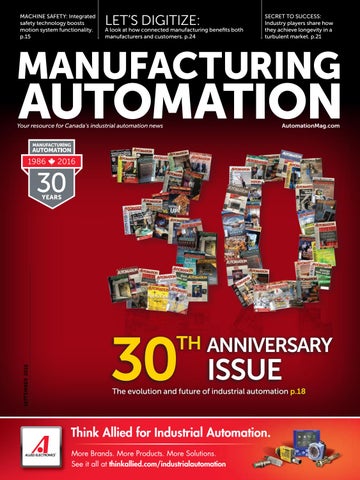
30
SEPTEMBER 2016
TH ANNIVERSARY
ISSUE
The evolution and future of industrial automation p.18
Think Allied for Industrial Automation. More Brands. More Products. More Solutions. See it all at thinkallied.com/industrialautomation
Get MORE I/O for LESS with the Productivity2000 PLC!
CPU ONLY:
$255.00 P2-550
FREE
Programming Software
Discrete I/O
Analog I/O
$40.00
$143.00
starting at:
starting at:
P2-08NE3
P2-08ADL-1
More DIN Rail Density: The Productivity2000 PLC is designed with a space-saving, slim form factor that provides for lots of I/O in a little space. Easily fit over 220 discrete input points in a single 7-slot, 10 1/2� base and save your valuable real estate.
Easy Expansion with Remote I/O:
Remote I/O Expansion Module priced at:
$225.00 P2-RS
Add thousands more I/O points to your system with the P2-RS high-performance Ethernet remote I/O expansion module. Up to eight remote base groups can be added with each I/O point being auto-configured in the software. The P2-RS also includes a high-contrast OLED display for status messages and a micro USB port for remote CPU programming and monitoring.
Get more than you paid for . . .
www.Productivity2000.com
Orders over $49 get FAST FREE SHIPPING Our shipping policies make it easier than ever to order direct from the U.S.!
Fast free standard shipping* is available for most orders over $49 U.S., and that includes the brokerage fees (when using an AutomationDirect nominated broker). Using our choice of carrier, we can reach most Canadian destinations within 2 to 3 days. Order by 6pm ET and in-stock orders ship the same day! *2-day free shipping does not apply to drop-ships, or orders requiring LTL transport, but those shipments can take advantage of our negotiated super-low flat rates (based on weight) that include brokerage fees. See Web site for details and restrictions at: www.automationdirect.com/canada
To see all products and prices, visit www.automationdirect.com All prices shown are U.S. Dollars
Order Today, Ships Today! * See our Web site for details and restrictions. Š Copyright 2016 AutomationDirect, Cumming, GA USA. All rights reserved.
1-800-633-0405
the #1 value in automation
September 2016 Vol. 31, No. 5
DEPARTMENTS 4 From the editor 5 Automation upfront
18
The latest industry news, deal makers, and movers and shakers
16 Centre stage
Roger Hallett, Festo Canada president and CEO
COLUMNS 12 Industry watch
The great adventure of life
CONTENTS
14 Lean insights
COVER STORY
Look around you — it’s a Lean world
18 Where are we going?
15 Machine safety
The evolution and future of industrial automation By Jim Pinto
Integrated safety technology boosts motion system functionality
34 Backstory
Becoming a disruptor in your industry
NEW PRODUCTS
14
28 Enclosures & workstations 28 RFID 29 Machine safety 29 Programmable control 30 Connectivity 30 Wireless technology & security 32 Wire & cable 33 Power supplies
MANUFACTURING AUTOMATION · September 2016 MA_Murrelektronik_May.indd 1
20 30 years of print A look at our magazine’s transformation through the decades By Alyssa Dalton
21 The secret to their success Industry players share how they achieve longevity in business By Alyssa Dalton
22 The IIoT or Industry 4.0: Who will win? Two mega-trends that are striving to modernize the shop floor By Dave Edstrom and David McPhail
24
24 Digital transformation Connected manufacturing benefits manufacturer & customer By Sean Riley
AutomationMag.com
3
2016-04-21 10:11 AM
FROM THE EDITOR BY ALYSSA DALTON
NOTABLE TWEETS
Your resource for Canada’s industrial automation news
@IEEEorg Friendly competition can spark some of the best ideas. #IEEE #Engineer #Engineering #quote #qotd #MondayMotivation @CiscoCanada Here’s to innovations big and small, and the technology that exists right now to make it all happen. #NeverBetter AUTOMATION SOFTWARE: Four big-picture benefits of PLM for small manufacturers. p.24
HANNOVER WRAP-UP:
Couldn’t attend this year‘s Hannover Messe? Catch up on standout moments from the action-packed fair. p.26
LESSONS LEARNED: Tips for how you can avoid pitfalls and make the best decisions in automation. p.28
AutomationMag.com
PM 40065710
Your resource for Canada’s industrial automation news
A RECIPE JUNE 2016
FOR GROWTH Our editorial advisory board discusses the challenges in Canada’s manufacturing future, and how to overcome them p.18
Think Allied for Industrial Automation. More Brands. More Products. More Solutions. See it all at thinkallied.com/industrialautomation
AlliedCover_MA_Jan.indd 1 1 2016_MA_june16_GWJ.indd
2015-12-23 2:54 2016-06-02 1:58 PM PM
@PengSangCau Timing is everything #CNCAssembly RT @ AutomationMag 248,000 industrial robots sold in 2015: IFR bit. ly/2cmqz2q @BalluffSensors We’d like to give a special thank you to our summer co-ops! They all did an amazing job this summer. @MadeonMainCo Always interesting things going on in the world of #mfg RT @ AutomationMag Volkswagen says it has reached an agreement to resolve supplier dispute 4
Celebrating 30 years of service
2
016 marks the 30th anniversary of Manufacturing AUTOMATION as the leading publication of the Canadian industrial automation market, reaching manufacturers and engineers from the shop floor to the top floor. As the only true Canadian publication reporting on the world of industrial automation, we at Manufacturing AUTOMATION take our job very seriously. We work hard to keep you, our readers, informed in as many ways as possible, so you can get the latest manufacturing trends, news and application stories whether you are in the office or on the road. However, success at the publication isn’t just a result of our efforts, but yours as well. We are able to do our jobs thanks to the help we receive from you in the industry — whether it’s by informing us of business shakeups and technological developments, inviting us into your workplace for one-on-one visits, or continued financial support through client advertising. Starting out three decades ago as a humble magazine, Manufacturing AUTOMATION has grown to include digital products, exclusive videos, webinars and event coverage, a social media presence and much more. Our success is not only a team success, but an industry achievement — a product of the longstanding friendship Manufacturing
AUTOMATION has developed with so many of you over the years. It’s important to celebrate milestones — they serve as a reminder of the challenges and obstacles we have come across in our journey, and offer the opportunity to reflect on the progress we have made. Flipping through our archives, it’s easy to see how the magazine’s transformation mirrors the evolution of the automation industry; pages of black and white articles on newsprint slowly evolved to modern illustrations and stylish layouts on glossy paper as large, bulk machines got smaller, lighter and more agile. (Check out the infographic on page 20 to read more about the evolution of the magazine.) What a blast from the past it was revisiting some of the industry’s major milestones. The face of manufacturing seems to evolve faster and faster, as the need for maximum efficiency has propelled the industry into a snowball of disruptive technology. I can’t help but wonder where this journey will take us, but one thing is for sure — I’m hanging on tight and I can’t wait to see where we go. Happy 30th, Manufacturing AUTOMATION! Here’s to many more birthdays!
EDITOR
Alyssa Dalton adalton@annexweb.com PUBLISHER
Klaus B. Pirker kpirker@annexweb.com VICE PRESIDENT & EXECUTIVE PUBLISHER
Tim Dimopoulos tdimopoulos@annexbizmedia.com ART DIRECTOR
Graham Jeffrey gjeffrey@annexweb.com ACCOUNT CO-ORDINATOR
Kathryn Nyenhuis knyenhuis@annexweb.com CIRCULATION MANAGER
Urszula Grzyb ugrzyb@annexbizmedia.com DIRECTOR OF SOUL/COO
Sue Fredericks CONTRIBUTING WRITERS
Shawn Casemore, Dave Edstrom, Darrell Gibson, Paul Hogendoorn, David McPhail, Jim Pinto, Matt Prellwitz, Sean Riley Manufacturing Automation is published seven times a year by: Annex Business Media 222 Edward Street, Aurora, Ontario L4G 1W6 Tel 905-727-0077 Fax 905-727-0017 Printed in Canada ISSN 1480-2996 Publication Mail Agreement #40065710
CIRCULATION email: lmalicdem@annexbizmedia.com Tel: 416-510-5187 Fax: 416-510-5170 Mail: 80 Valleybrook Drive, Toronto, ON M3B 2S9 SUBSCRIPTION RATES Canada — $40.95 per year United States — $71.95 (US) per year and Foreign — $82 (US) per year Students — $20 per year
CONNECT @AutomationMag
adalton@annexweb.com
AutomationMag.com
EDITORIAL ADVISORY BOARD AL DIGGINS, President and General Manager, Excellence in Manufacturing Consortium, and Chairman and CEO, Canadian Manufacturing Network DAVID GREEN, Technology and Business-to-Business Consultant KARIN LINDNER, founder and owner of Karico Performance Solutions DON MCCRUDDEN, Vice-President, Business Development, Festo DAVID MCPHAIL, President and CEO, Memex Automation NIGEL SOUTHWAY, Business Productivity Consultant and Author on Lean Thinking BILL VALEDIS, Vice-President, Precision Training, Products and Services Inc.
@AutomationMag
Occasionally, Manufacturing Automation will mail information on behalf of industry related groups whose products and services we believe may be of interest to you. If you prefer not to receive this information, please contact our circulation department in any of the four ways listed above. The contents of Manufacturing Automation are copyright © 2016 by Annex Publishing & Printing Inc. and may not be reproduced in whole or part without written consent. Annex Publishing & Printing Inc. disclaims any warranty as to the accuracy, completeness or currency of the contents of this publication and disclaims all liability in respect of the results of any action taken or not taken in reliance upon information in this publication. We acknowledge the [financial] support of the Government of Canada.
AUTOMATION UPFRONT
NEWS OPERATIONS
Honeywell to serve as main automation contractor for new Nova Scotia plant Honeywell Process Solutions (HPS) has announced it will provide full automation and safety systems and serve as the integrated main automation contractor (I-MAC) for a new liquefied natural gas (LNG) facility being built in Eastern Canada to process North American natural gas for international export.
(DCS), safety instrumented systems, fire and gas systems, and operator training simulator (OTS) for the project. Honeywell will also be responsible for helping Pieridae integrate all plant infrastructure to the business enterprise systems. “I am excited to have developed this highly collaborative relationship with a globally recognized industry leader
such as Honeywell,” said Alfred Sorensen, president and CEO of Pieridae Energy. “I am confident that Honeywell’s experienced infrastructure team will work very well with my engineering contractor, and their advanced software team will help Pieridae put the right plan in place to start the business up effectively and efficiently on day one of operations.”
EXPANSION
Multimillion-dollar expansion creates new jobs at Ferrero Canada Ferrero Canada is embarking on a $36.1-million expansion project at its Brantford, Ont., facility to add production lines for three additional products and pursue new markets across
PHOTO: HONEYWELL PROCESS SOLUTIONS
International export: Startup for the new liquefied natural gas facility in Nova Scotia is scheduled for 2021.
Located on the eastern shore of Canada in Nova Scotia, Pieridae Energy’s Goldboro LNG project will include a natural gas liquefaction terminal and facilities for LNG storage and marine export. The facility will be able to process 10 million metric tons of LNG a year and have a storage capacity of 690,000 cubic meters. Startup is expected in 2021. “Honeywell’s Integrated-MAC role will help Pieridae eliminate significant project risk, compress its schedule, and ramp up to nameplate production capacity faster,” said Vimal Kapur, HPS president. “Honeywell’s latest technologies, project delivery capabilities and expert services will create a highly integrated infrastructure to boost this new venture’s profitability.” According to Honeywell, it will design, deliver and install the distributed control systems MANUFACTURING AUTOMATION · September 2016 MA_Beckhoff_September16_CSA.indd 1
AutomationMag.com
5
2016-08-18 11:27 AM
AUTOMATION UPFRONT
EPC’s Tru-Tracs™ are your encoder & measuring wheel solution in one, easy-to-install unit.
Job growth: The expansion will create 55 new jobs and retain 831 existing ones, says the confectionery group.
and a catalyst for us to expand our business and grow our presence in North America,” said a spokesperson for Ferrero Canada. “We are committed to helping our communities grow and investing in strategic partnerships that bring jobs and prosperity to
When you need linear motion feedback
From the compact TR1 to the robust TR3, we’ve got your motion feedback solution.
1.800.366.5412 | www.encoder.com
6
our province. Our government is pleased to support Ferrero Canada through the Southwestern Ontario Development Fund, which will help the company launch new products and reach new markets,” added Brad Duguid, minister of economic development and growth. ROBOTICS
Report estimates collaborative robots market to worth US$3.3B by 2022 The global collaborative robots market will reach US$3.3 billion by 2022, and will grow at a CAGR of 60.04 per cent between 2016 and 2022, according to a new report by MarketsandMarkets. Titled Collaborative Robots Market by Payload (Up to 5 Kg, Up to 10 Kg, & Above 10 Kg), Application, Industry and Geography Global Forecast to 2022, the report believes the market will be driven by high ROI, the low price of collaborative robots, and increased investments in automation. “The global collaborative robots market is driven by application in industries such as automotive, metal and machining, furniture and equipment, food and beverages, plastic and polymers, and others. Collaborative robots used in the automotive sector accounted for the largest share of the global collaborative
INVESTMENT
GE breaks ground on multi-modal “brilliant factory” in Welland GE global executives, Ontario premier Kathleen Wynne, Chrystia Freeland, federal minister of international trade, and other government representatives attended the groundbreaking ceremony of GE’s multi-modal “Brilliant Factory” in Welland, Ont., last month. Describing it as the “first–ofits-kind facility in Canada,” GE says the factory will “combine decades of experience building innovative industrial machines with cutting-edge data science and analytics expertise to enhance efficiency and streamline production.” Roughly 220 jobs are expected to be created, with operations commencing early 2018. The first phase of the investment is US$165 million. “Today is a significant day for GE
September 2016 · MANUFACTURING AUTOMATION
@AutomationMag
MA_Encoder_September16_CSA.indd 1
robots market in 2015; this market is expected to grow at a significant rate between 2016 and 2022, driven by the growing focus of consumers on safety features provided by collaborative robots in the field of manufacturing and automation. In developed regions, such as North America and Europe, growth in the collaborative robots market in the automotive sector is expected to be driven by rise in safety rated manufacturing and the growing trend of precision which were not possible due to the common human errors, while, in developing regions, such as Asia-Pacific and RoW, it is likely to be driven by the rise in industrial automation during the forecast period,” noted the report. MarketsandMarkets found Europe to be the largest market for collaborative robots in 2015, but expects Asia-Pacific to surpass Europe by 2018 and hold a “large market share” through 2022.
2016-08-22 9:14 AM
PHOTO: PINKCANDY / SHUTTERSTOCK.COM
North America. Expected to be completed by next August, the expansion will create 55 new jobs and retain 831 existing jobs, said the confectionery group. Brantford is Ferrero International’s only Canadian facility. It currently manufactures and distributes products under the Ferrero Rocher, Nutella, Tic Tac, Kinder Surprise and Raffaello brands. The project will receive $1.5 million in support from The Southwestern Ontario Development Fund. Established to help foster job creation and business innovation, the fund covers up to 15 per cent of eligible project costs, with the recipient company funding the remainder from its own resources. “We appreciate the support of the Ontario government and the people of this province. Brantford has proven to be a great manufacturing location for us
PHOTO: FACEBOOK
in Canada and for GE’s Distributed Power business. Today, we’re breaking the ground on which we will grow our reciprocating engines business for decades to come,” said Heiner Markhoff, president and CEO of GE Water and Distributed Power Business at the event. “Here, we will run three-dimensional machining simulations for CNC programs, gain real-time analytics to better understand the operating conditions of a machine or a test cell, install lights-out machining, and combine all with advanced Lean manufacturing practices.” The facility will initially manufacture GE Power’s reciprocating gas engines, components for compression, mechanical drive, and power generation, and manufacture components for GE transportation diesel engines, said the company in a statement. The company announced in
June that it had selected Welland due to its proximity to the U.S. border, availability of skilled labour and education facilities. 3D PRINTING
Candy bar debuts 3D printed gummies Dylan’s Candy Bar has teamed up with Magic Candy Factory to produce 3D printed candy in its stores. Billed as the “first 3D printer for candy,” the 3D gummy printer lets customers choose from more than 100 different designs and gives them the ability to write words, upload images and create different shapes, “on demand in any colour and flavour,” said the candy bar on its Facebook page. “With the product you’re able to create any customized candy that you can imagine,” said Melissa Snover, founder of Magic Candy
Printed edibles: 3D gummy printer lets customers create “any customized candy” they can imagine.
Factory, to The Associated Press. “We were really surprised when we found out that over 70 per cent of people make their name.” The candy is made of pectin, which is apple-based. Since its launch in New York, the 3D candies have been introduced at Dylan’s Chicago, Los Angeles, and Miami locations.
COMMUNITY OUTREACH
Siemens donates 230 refurbished laptops to Syrian refugees Decommissioned laptops received a second life thanks to Siemens Canada and three charities working to ease the transition to
Your One-Stop Source for Process Measurement and Control Votre Unique Arrêt pour la Mesure et le Contrôle de Procédes Flow Débit et Niveau
Data Acquisition Acquisition de Données
Temperature Température Pressure Pression
Same Icons in White Same Icons in White
Automation Same Icons in White Automatisation
Same Icons in White
Same Icons in White
100,000 Products Customized Solutions Expert Technical Support Easy Online Ordering Fast Delivery
100,000 Produits Solutions Personnalisées Support Technique Expert Commande en Ligne Facile Livraison Rapide
omega.ca 1-888-826-6342
© COPYRIGHT 2016 OMEGA ENGINEERING, INC ALL RIGHTS RESERVED
MANUFACTURING AUTOMATION · September 2016 MA_OmegaHalf_September16_CSA.indd 1
AutomationMag.com
7
2016-08-18 1:43 PM
AUTOMATION UPFRONT
is that the donated laptops will help these new Canadians feel more connected, and help them achieve their goals for life here.” The refurbishment process involves secure removal of all data from hard drives, as well as physical cleaning, installation of licensed software and testing. The computers were also customized to offer both English and Arabic language capability. TRADE-UP PROGRAM
Mitutoyo Canada debuts “CMM Trade-in, Trade-up” program
Shared technology: A Siemens Canada employee affixes Arabic language stickers to a keyboard at a workshop preparing computers for donation.
porate computers for donation. The laptops will be distributed by the Centre for Newcomers and Calgary Immigrant Women’s Association, said the parties. “Access to technology is something most of us take for granted, but it can be incredibly difficult to navigate today’s digital world without it,” said Robert Hardt, Siemens Canada CEO. “Our hope
8
@AutomationMag MA_Emphatec_Septmber16_CSA.indd 1
A new program at Mitutoyo Canada gives all current Mitutoyo coordinate measuring machine (CMM) users an opportunity to trade in existing CMMs for a new, higher accuracy model. Through the “CMM Trade-In, Trade-Up” program, customers can “receive the latest technology, ensuring reliable uptime, lower maintenance costs, improved accuracies, faster machine speeds and the latest digital technologies,” said the company. “Mitutoyo’s latest coordinate measuring machine technology has been designed to maximize throughput without compromising precision. In addition to the obvious benefits of new technology, users will also gain from Mitutoyo’s exclusive Gold Care program — a value-added package delivering supplemental
equipment and extended services that provides cost-of-ownership peace of mind for years to come,” it added. INTERNATIONAL MEXICO
Harting North America expands into Mexico Following a “record-breaking” fiscal year in 2015, Harting North America has expanded by opening a sales office and manufacturing facility in Mexico. The sales office is located in Mexico City, while the plant is in Silao in the GTO region. The company said the sales office and manufacturing facility enable better support for North
American customers and are an “important step forward” in its strategy. “We have consciously chosen this location because here in Mexico City we’re close to our key customers and the decision-makers at the centre of the Mexican economy,” said Philip Harting, CEO and general partner, during the event’s opening speech. According to the manufacturer, the new manufacturing facility is “designed for high-volume, high-quality production, and optimized for operational efficiency and cost savings.” The facility will undergo “constant” in-process inspections, including visual, hipot, pull-force and cross-sectioning testing, as well as customer-specified tests, said Harting.
Increased footprint: Company officials say the current economic conditions in Mexico offer “enormous potential for Harting.”
September 2016 · MANUFACTURING AUTOMATION 2016-08-24 7:40 AM
PHOTOS: CNW GROUP/SIEMENS CANADA LIMITED; HARTING
Canadian life for Syrian refugees in Calgary, Alta. Siemens employees, charity representatives and Syrian families volunteered at a workshop in June to complete the refurbishment of 230 computers at Siemens’ Canadian headquarters in Oakville, Ont. The workshop was conducted by Corporations For Community Connections (CFCC), a registered charity that refurbishes decommissioned cor-
The Silao site was chosen due to its close proximity to the Guanajuato International Airport with a co-located customs warehouse, for “quick, uninterrupted delivery from plant, to warehouse, to customer,” as well as various universities in León. Harting said the plant operates under the IMMEX Program and is expected to create more than 200 manufacturing jobs in the next five years. “The current economic conditions in Mexico offer enormous potential for Harting,” added Jon DeSouza, president and CEO of Harting North America. “This is exemplified by the country’s expansion of their railway system, which indicates strong growth now and for the future in the transportation and machinery market — incidentally two of Harting’s largest vertical markets.” PORTUGAL
Helukabel selects Portugal for 26th subsidiary Helukabel has opened its newest branch in Portugal, bringing its total number of global affiliates to 26. “Cables and wires, predominantly for industrial applications, from conventional control cables to highly flexible data cables, will soon be stored in a 600 square metre warehouse in Coimbra, located between the industrial centres of Lisbon and Porto,” said the company in a statement. “There is a thriving electrical industry in Portugal, and developments in the mechanical engineering and renewable energy industries are also very promising. Applications in these industries are increasingly becoming more sophisticated, which is in turn making the requirements on cables and connection technology higher as well. Helukabel’s top-quality, internationally certified products, together with our local service network, will allow us to perfectly meet these
increasing demands,” continued Eduardo Soares, director of the branch. According to company representatives, the location will help serve the European market and African countries where Portuguese is the official language. MALAYSIA
Toyota to build new $488 million plant in Malaysia Toyota Motor Corp. says it has decided to build a new vehicle plant in Malaysia to meet rising local demand. The new 2 billion ringgit ($488 million) plant will be built by Toyota and local partner, UMW Corp. The plant, to be built in the central state of Selangor, will have an initial capacity of around 50,000 units a year, doubling the company’s production volume in Malaysia to around 100,000 units a year. UMWT says it will discontinue the manufacturing of passenger vehicles at its existing plant by early 2019, using that location instead as a dedicated commercial vehicle plant as the new plant will exclusively manufacture passenger vehicles. According to the Japanese automaker, the new plant is the next step in Toyota’s efforts to create competitive plants using production technologies such as freely extensible lines and compact painting booths.
.
CLARIFICATION June 2016, “A recipe for growth” The following is a clarification from speaker Karin Lindner on her thoughts about Lean manufacturing: “Many companies focus too much on the specific Lean tools rather than on their corporate culture, yet culture is the key to longterm sustainability and buy-in. If organizations don’t focus on getting the people process right, Lean will never work.”
MANUFACTURING AUTOMATION · September 2016
AutomationMag.com Hiwin_MA_Jan.indd 1
9
2015-12-10 12:54 PM
AUTOMATION UPFRONT
DEAL MAKERS
Ximea appoints Framos as distributor in North America German camera manufacturer Ximea has selected Framos Technologies as its North American distributor. According to the parties, the new partnership “promises additional growth in the North American camera market in the upcoming years.” “Ximea’s multifaceted product range is comprised of highly compact cameras of extremely small size and low power consumption. These cameras are available with a wide range of modern interfaces, such as Thunderbolt, USB, and PCIe — the different series are optimized for industrial automation, scientific imaging, hyperspectral
imaging, or high-speed applications. Thus we are able to serve the North American customers in a variety of application and industry areas,” said Sebastien Dignard, president of Framos Technologies. Headquartered in Ottawa, Ont., Framos Technologies is part of a worldwide group of approximately 100 associates that offers imaging components, technical consulting and support. Jürgen Hillmann, COO of Ximea GmbH, added, “Over the years our businesses and opportunities have increased considerably in North America. It is a very logical step to pair up with a company that understands our business and technology and thus serve the imaging community better. Especially with Framos’ competence, we will also be considerably enhancing the solution spaces we can offer to our customers.”
One Source for Everything You Need
Safety
Lighting
Fanuc America has named Mike Cicco president and CEO, where he will have responsibility for all company operations in North and South America. In addition, Rick Schneider has been named chairman of Fanuc America and will continue in his role as a board member of parent company, Fanuc Corp. Since joining the company in 1999, Cicco has held various management positions including software/controls manager and district sales manager at the company’s southern California facility. Bluff Manufacturing has hired Charlie Wood as regional sales manager, Midwest and Canada. With more than 15 years experience in sales, Wood was most recently a national sales manager with Sentry Protection Products, where he increased product sales more than 30 per cent in the U.S. and more than 34 per cent overall in North America, says the company. Bluff describes Wood as a “goal-oriented individual with the ability to complete complex projects from concept to operation and a strong desire to continue to be first in sales.”
Electrical
Electromechanical & Electronics
Industrial Automation & Control
Wire & Cable
Broadband & Data Communications
Solar & Wind
Utility
To locate your nearest WESCO Branch or shop online visit buy.wesco.ca 1-866-WESCOCA (937-2622) | wesco.ca
10
MOVERS & SHAKERS
ATS Automation Tooling Systems has announced that Anthony Caputo, CEO, will be leaving the company February 2017. In connection with this, Caputo and the company say they have entered into a transition agreement that, among other things, provides for “continuity, an orderly transition of leadership, and that Mr. Caputo may leave earlier if a transition is completed.” He will remain on the board of directors throughout the transition. ATS says it will initiate a “thorough search and selection process” for a successor to lead the
Schneider Electric has appointed Annette Clayton president and CEO of its North America operations, where she will be based at the company’s North American headquarters in Andover, Mass., and responsible for driving business strategy and execution for the region. In addition to her new role, Clayton will continue to serve as the group’s chief supply chain officer leading the global supply chain organization. In her dual capacity, she will remain a member of Schneider’s Executive Committee, said the company. She replaces Laurent Vernerey, who has led the North America region for the last three years and concludes a 30-year career at Schneider Electric. Dave Matthews has been named product line manager, power distribution and control assemblies, at Eaton Canada, where he will report directly to Darko Matulic, Eaton marketing manager, Electrical Assemblies Canada. Matthews joined the company in 1984 and was most recently the industrial sales manager for Northern Alberta after holding roles of increasing responsibility. Meanwhile, Shelly Woods will hold the position of products manager, marketing, Electrical Canada, Electrical Sector – Americas, where she will be responsible for “leading Eaton’s growth for identified markets and vertical segments by providing strategic direction and leadership of assigned product lines. Most recently, Woods was the manager, distribution and control, EatonCare, for Electrical Canada. | MA
September 2016 · MANUFACTURING AUTOMATION
@AutomationMag
MA_Wesco_September16_CSA.indd 1
company as it “continues to realize on its growth and value creation ambitions.”
2016-08-24 9:18 AM
INDUSTRY WATCH BY PAUL HOGENDOORN
Paul Hogendoorn (paulh@getfreepoint.com) is co-founder of FreePoint Technologies, “Measure. Analyze. Share.” (Don’t forget to share!) Visit www.getfreepoint.com for more information.
The adventure continues
B
usiness is an adventure, and entrepreneurship is a little adventure within the great adventure of life. Sometimes a single business trip can provide more adventure than you might otherwise experience in a whole year, or even a career — and such was my most recent business trip. I left on a Sunday to avoid the chaos of airports typical on Monday mornings. I made it home late the following Saturday. In between, I visited 12 plants in seven cities, crossed borders four times, stayed in six different hotels, and travelled about 8,000 km. Three of the plants were in the U.S., the other 11 in Mexico. My schedule was fluid — everyday I would make my flight reservation for the next day and my hotel reservation for that night. One night, I got dropped off at a hotel in Juarez, only to find out they didn’t have my reservation, and didn’t have any rooms left either, nor did any others in the immediate area. The next day, I was making a tight connection in Monterrey and our plane was grounded after accidently being hit by a baggage vehicle. The day after that, we followed our GPS through a weird series of twists and turns looking for a small manufacturing company, but instead ended up at the end of a donkey trail, completely lost. We needed to ask
a couple of local folks to lead us back to the centre of a small town, from where we called the customer and arranged an escort. After the last customer visit on Friday, we faced what we believed was a four-hour drive to the airport in
Mexico City, but that was before we factored in traffic and experienced the kind of roadside shakedown we often hear others talking about but never personally experienced. It was just after 1 a.m. We were 2.5
Fuego!
The Spanish word for Fire
Relax, tomorrow has already been tested. Say goodbye to hardwiring with HARTING connectors.
Reduce the number of wiring errors, save time and headache. HARTING, first established in 1945, delivers unrivaled reliability, efficiency, innovation and performance in connectors. With HARTING you have a partner who ensures you dependable connections that stand the test of time. HARTING.ca 12
@AutomationMag
Hardwiring_Ad_0001_R01_MA_8x3.5_JUNE2016.indd 1 MA_Hartig_September16_CSA.indd 1
September 2016 · MANUFACTURING AUTOMATION 5/16/2016 4:32:42 PM 2016-08-24 9:14 AM
hours behind due to traffic, but we were only about 30 minutes from the airport, so our spirits were picking up —just one more toll booth on the new highway, and we’d pretty much be there. Upon exiting the toll booth, several officers were doing “routine inspections,” and we were “randomly” directed to the side. Flashlights were shone throughout the vehicle and papers thoroughly inspected. After a while, we were told we were breaking the law. For our own security, we were told, they would not let us drive between the hours of 1 a.m. and 5 a.m. Instead, we had to stay parked on the side of a dark highway and wait until at least 5 a.m. The officer changed tones frequently; one minute he was calm and gentle, the next he was loud and agitated. The person I was travelling with spoke Spanish and did all the talking, always respectfully. I didn’t understand a word that was spoken, but I know the impasse was eventually resolved. We made it to the hotel just after 2 a.m. Over the years, I have had the pleasure of many other adventures in numerous countries — 18 by my last count. In Venezuela many years ago, I learned my first Spanish words, starting with the word “fuego!”. (I learned that even ahead of how to order “two beers please.”) In northern Italy, I learned the importance of communication; the jobsite engineer spoke no English and I spoke no Italian. We both spoke a little bit of French, and together, we created a serious ground loop which fried the power supplies in our newly installed systems. As we dashed through the mountains from village to village trying to find parts, the other thing I learned there was even one-armed men driving Volvo sedans really want to be driving Formula 1 cars instead. But, in between all these crazy and zany events are a wealth of great memories and positive experiences; we were able to stitch enough of them together to build something pretty good. I am reminded that good things seldom
come easily, and things that come easily are often not as good. Manufacturing AUTOMATION is celebrating its 30th year in business this year, and I’m sure it wasn’t always easy. As a publication, its goal is to be an accurate reflection of our manufacturing industry today, to highlight and honour the people in it, and perhaps to help nudge along the future a bit as well. Even though
MANUFACTURING AUTOMATION · September 2016 MA_Yaskawa_September16_CSA.indd 1
it chronicles successes and adventures of people and companies throughout the industry, it has its own unique story, filled with ups and downs and crazy moments. It started with a vision — someone’s dreams and ideas — and from there its own adventure began. Remaining sustainable, and relevant, 30 years later is something everyone in the organization should be proud of.
As I recover from the lingering effects of my last business trip, I am busy preparing for the next one. The manufacturing industry after all, is a very “tactile” industry, and it’s important to meet people where they are at. In its own way, that’s what MA does — it meets the people in the industry, where they are at. Congratulations, and keep it up! The adventure continues! | MA
AutomationMag.com 13 2016-08-22 4:12 PM
LEAN INSIGHTS BY DARRELL GIBSON
Darrell Gibson is a plant manager located in Vegreville, Alta. Thirty-seven years in the trenches of industrial manufacturing has culminated in a thorough understanding of how plants function. From humble beginnings as a saw operator/cleaner, Gibson has climbed the ladder of a system that favours degrees over experience.
It’s a Lean world
I
was recently on vacation in Nanaimo/Victoria, B.C., and as always, I did some touristy things. The tourist industry just about everywhere has Lean down to a science. They move many people through a maze, usually quite efficiently. They have accomplished this by analyzing their data, number of guests, complaints, lost children, etc. This has me now watching other industries for good Lean principles. Likewise, if you look at road construction, they put merge lanes up with plenty of notice. If everyone were to heed these signs, the traffic would flow quite well. However there are always people that try to gain just one more spot by budding and others that don’t seem to understand merging should start as soon as you are aware of the situation, not at the last minute. In a world consumed by speed, everyone is looking to get more done in a shorter time frame. Just watch a soccer mom schedule her week — it’s awe-inspiring. I can’t count the number of people I’ve overheard saying our favorite drive-thru should have two lines: one for food and beverages, and one for only beverages. We are all becoming Lean experts. I have witnessed a pharmacy that had me taken care of in under five minutes. It was unlike any pharmacy I have ever seen, everyone had a role and they were all good at their roles. Any big box store is full of efficiencies, just watch them — their shelves are full everyday with the items we need to live our lives. They do this with minimum-wage employees that take ownership of tasks. I’ll leave the moral argument of that business model to others. How does this translate to being helpful for you? Here are some examples of Lean principles I have utilized from the real world. • I needed to send a complex machine to a part of the world with assemblers that do not speak my language. I sent drawings that were stapled together in order of build, and all relevant parts were numbered for each drawing. Pictures say a thousand words — this method was copied from a toy block company.
14
@AutomationMag
• I have set up warehouses to mirror a large furniture supplier. All relevant parts and their locations were on the work order, simplifying even the most complicated build. • To Lean down employee numbers, cross training is an absolute necessity. This makes bottlenecks a thing of the past. Again, this was inspired by a fast food chain that always impresses me with its efficiency. • A drill index is the case that holds drill bits in sequential order. This level of organization with bits inspired the creation of a paint hook numbering system that allows even new employees the ability to quickly identify our various types of hanging hardware. The Canadian Armed Forces put on a good air show. If you have ever been to one, their logistics for dealing with traffic and attendees are second to none. When you are involved in an efficient situation, you get a warm feeling inside. You feel you are taken care
Everyday interactions happen and they can possibly solve some of your life’s inefficiencies.
of, that all possible outcomes will be dealt with well, and you feel safe. This same feeling can be felt through any organization that is well-planned. The calm that every employee feels moves well toward a stress-free environment. This is the most desirable situation, as stress-free employees, hands down are the most efficient employees. As a plant manager, I always look for the most stressed employee. Since stress is an indicator of inefficiency, it is my duty to help eliminate it. This helps me better understand the limits of any particular person, and to better help set them up for success. This large planet is becoming a very small world. Pay attention, it’s amazing what you can see. Everyday interactions happen — between people, machines, systems, technology and environments — and they can possibly solve some of your life’s inefficiencies. All it takes is a little thought and a lot of creativity. We cannot reinvent the wheel, but we can always make a more efficient one. | MA September 2016 · MANUFACTURING AUTOMATION
MACHINE SAFETY
Matt Prellwitz is the drive technology product specialist at Beckhoff Automation.
BY MATT PRELLWITZ
Integrated technology boosts system functionality
D
efining safety rules and regulations in motion control applications is a relatively new concept, with standards only recently being officially defined. Currently, two specific automation safety standards exist: IEC 61800-5-2 and DIN EN ISO 13849-1:2008, applicable in North America and Europe. Existing within these jumbles of letters and numbers are basic functions and features that must be enabled in the machine to ensure compliance. However, integrating safety into a motion system presents a much more complicated set of problems than just to equip the machine with the safety protocols and walk away. To illustrate this point, imagine a vertical axis with a substantial load of some sort. Standard safety protocol for an error condition for this type of axis would most likely be safe torque off, halting the linear motion of the axis to allow for error correction. However, if this axis is 20 feet tall and the load is currently at the top, safe torque off turns the now resistance-free load into a significant hazard to operator safety without some
sort of external application to latch and restrain the load from falling. In addition, regardless of the number of light curtains, safe stops, and gates a company installs on a machine, there may still be a way for an operator to circumvent the precautions and endanger themselves or others through their actions. Much of the difficulty in implementing safety in a motion system is thinking outside the box, gathering detailed information about the application and determining the best course of action to maintain safety. Intimate knowledge of the process is vital for discovering areas where standard safety operations may be insufficient to maintain safe operation. In addition, ensuring that machine operators receive proper training and understand the risks involved with operation of the machine is paramount. Implementation of a safe motion system ultimately boils down to a partnership between the integrator and the end users. The collaboration will enable the group to plan for as many possible hazards as possible and ensure safe operation.
Next-generation communication protocols, such as FSoE (Functional Safety over EtherCAT), remove much of the need for additional contacts, safety relays, and other components by connecting directly to the motion components. In addition to streamlining the system, an enhanced communication system such as this allows for much greater precision with sensing of potential hazards, for example noting the presence of an operator within a predetermined range of a light curtain and slowing the machine, rather than stopping the process altogether. Maintaining production processes, even at a reduced speed, will ultimately save the company from lost revenue due to downtime while still keeping their employees safe. As machines get more powerful, and companies look to maximize throughput and production, motion control safety will need to continue adapting to new challenges in order to ensure the safety of employees. New technologies will remain a significant factor in making these production increases a reality, while still caring for the safety of machine operators. | MA
CARLO GAVAZZI Automation Components
CARLO GAVAZZI Automation Components
SENSORS: Inductive and Capacitive Proximity Sensors • Photoelectric Sensors • Level Sensors • Ultrasonic Sensors • Magnetic Sensors • Motion Sensors • Environmental Sensors • Limit Switches • Light Curtains • Safety Interlocks
SWITCHES: Solid State Relays • Contactors and Overloads • Definite Purpose Contactors • Soft Starters • Manual Motor Starters • Mini Circuit Breakers • Electromechanical Relays • Pushbuttons and Pilot Devices
Whether it’s our industry leading range of solid state relays, our new HMIs and mini-circuit breakers or our A u of t osensors, m a t i ocontactors, n Compo n e n supplies, ts vast offering power and energy meters, GAVAZZI has the solution for your USA Tel:CARLO 847.465.6100 Fax: 800.222.2659 Canada Tel: 888.575.2275 Fax: 905.542.2248 many demanding application requirements.
CARLO GAVAZZI
Mexico Tel and Fax: 55.5373.7042 www.GavazziOnline.com • Info@CarloGavazzi.com twitter.com/CarloGavazziNA facebook.com/CarloGavazziNA
CONTROLS: Energy Meters and Transducers • Power Supplies • HMIs • Digital Panel Meters • Time Delay Relays • Current- Voltage- and Phase Monitoring Controls • Current Transformers • Safety Modules • Counters
Contact us today, and one of our field sales representatives will show you why CARLO GAVAZZI is one of the fastest growing automation companies worldwide. We’ll be more than happy to provide a free evaluation sample to qualified OEMs.
GavazziOnline.com • 888.575.2275 • Gavazzi@CarloGavazzi.com
Visit our website for downloadable data sheets, brochures and pricing: www.GavazziOnline.com
MANUFACTURING AUTOMATION · September 2016 MA_March_CarloGavazzi.indd 1
AutomationMag.com 15 2016-02-12 3:24 PM
CENTRE STAGE
President and CEO of Festo Canada, Roger Hallett, shares his views on the impact of globalization on the manufacturing landscape.
MA: How would you describe the manufacturing landscape in Canada right now? RH: I’ve got high hopes for it. I think we’re behind, I [recently] 16
@AutomationMag
came back from a week in Germany and when you see the scope of manufacturing and the technology level there, it makes you think we’ve got a long way to go. Having said that, it used to be that we were very much built around automotive, and I think that’s changed. We’re starting to see some new technologies and Canada is right in the beginning of them. We just need to help them develop and keep them onshore. So it’s not all bad news — a lot of opportunity is the way we see it. What I’m also seeing is a growing awareness in the political world that manufacturing is something to be encouraged and supported. MA: What do you see as the biggest challenge for Canadian manufacturers? RH: I think it’s that globalization topic. They have to compete on a worldwide platform and they
all have competitors coming into Canada to compete with them. Maintaining your position, keeping up with technology, and keeping ahead of your competition is much harder than it used to be. You have to be much quicker in all your development and engineering cycles to stay ahead and I think that’s a challenge for everybody. I don’t think we are any worse in that position, we’ve got some great universities — some really fantastically skilled people — but it’s a race. MA: During a media open house in June, you mentioned the new advanced manufacturing and logistics facilities in Ohio. How will this benefit Canadian customers? RH: The advantage is fast access to a very wide range of products. When we had our own facility in Canada, we didn’t have
the volume in our business or market to be able to maintain the same lead time and quality of products. Right now, we can typically deliver something in 24 or 48 hours which we could never have done before. [As a result,] we’ve transformed our activities in Canada away from stocking and handling components and towards value-added engineering and some assembly work. If you visit our facility now, we’ll see we are building customer-specific solutions — little handling solutions for other machine makers — and trying to give them access to that technology. I think while it’s in Mason, Ohio, and not Canada, it’s actually proving to be really positive for us. It’s that globalization topic again. Some things shouldn’t be done here and are better done somewhere else; it’s the right thing to do in the big picture. I don’t think at this point we need to do something like this in Canada, the logistics are so smooth and fast that it really wouldn’t make any sense to do that. MA: What’s next for Festo Canada? RH: We’ve had a good run, and we continue to have a good run. I think we’ve achieved that by pushing technology and the idea of increasing productivity, and not by selling components out of the catalogue but by getting close to our customers and understanding what they need and showing them options. We’re [invested in] helping manufacturing develop in Canada because it helps the future market. I’m also doing it because I have a young son growing up and I would like him to have options to be in that field without having to leave the country. | MA
September 2016 · MANUFACTURING AUTOMATION
PHOTO: FESTO CANADA
MA: You’ve been in the automation business since the early 1990s. How have you seen it evolve over the years? RH: From a technology point of view, I’ve seen huge changes from the days when automation used to be 100 relays in a cabinet with lamps flashing on and off and you pressed big pushbuttons the size of your thumb to make things work, through to all the phases of the PLC and automation, and now the big data world. The recent manifestation of that is what you can do with all the data you can now gather, and not just gather but process in a sensible amount of time. The technology shift has been huge, but the way business is actually done has also changed a lot, [thanks to] globalization. The fact that you used to do business within a couple of hundred miles of your base or in your country at least and now, a lot of business is done online through an e-business platform. It’s changed the whole landscape, and whole industries have moved from one country, or even one continent, to another; everyone’s working in a much more competitive environment. But people are looking at manufacturing now in a more positive sense and looking at improving productivity and keeping them onshore. In terms of Industry 4.0, I think this is probably the first time anyone has looked around and said maybe we’re going through one of these shifts now. In previous changes, I think it was always through looking back that these things were noticed.
The Only Switch that Matters Is the One You Need And We’ve Got It
In stock and ready-to-ship. See it all at thinkallied.com/switches
1.800.433.5700 © Allied Electronics, Inc 2016. ‘Allied Electronics’ and the Allied Electronics logo are trademarks of Allied Electronics, Inc.
An Electrocomponents Company.
COVER STORY
WHERE ARE
WE GOING? instruments and actuators. There are many companies in each market sector, each serving specific niches in a broad array of diversified industrial markets. This article will cover the major product growth arenas.
The evolution and future of industrial automation BY JIM PINTO
M
anufacturing AUTOMATION started publication 30 years ago, through some 20 Moore’s Law technology cycles. With accelerating technology and continuing profusion of smarter sensors, instruments and systems, the industrial automation business continues to be stable and solid. Industrial instrumentation and controls has always been a hotbed of new products — improved sensors, amplifiers, displays, recorders, control elements, valves, actuators and other gadgets and gismos. The markets for each category are relatively small, specialized and fragmented, and it’s rare that any significant volume results directly from individual products. Today, automation growth occurs primarily in international markets where new factories and plants are 18
@AutomationMag
Mobile devices being built. In a tough, global environment, organic growth will not come easily. As China and India advance, expect one or both countries to make major automation acquisitions to enter American and European markets. The North American Free Trade Agreement (NAFTA) between Canada, Mexico and the U.S. came into force in January 1994, with strong benefits for all three countries. All of the largest industrial automation companies have strong sales and service operations throughout North America. Canada- and Mexico-based automation companies are mostly all systems integrators, specializing in turnkey solutions in the largest markets for automation products. Beyond peripheral companies involved with sales, distribution and support, manufacturing automation can be separated into four primary product segments: software, sensors,
IoT
McKinsey Global Institute ranks IoT as one of the most disruptive technologies to 2025
Wireless connectivity is now commonplace in businesses, and growth has spread into all manufacturing and process plants through Wi-Fi-connected tablets, smartphones and other mobile devices. “There’s an app for that!” can be said for many common and automation applications. A steady stream of new uses for mobile products is generating substantial growth, increased productivity, and improved operating efficiency in virtually all automation arenas. In the manufacturing environment, there’s a big switch to app-based calculations and displays. Nobody wants to walk over to a central, stationary, large computer display when they could view and change settings on a handheld personal device. Already, a lot of manufacturing and process plants are using them widely. The debate over company-issue and BYOD (bring your own device) continues. September 2016 · MANUFACTURING AUTOMATION
ANNIVERSARY SECTION
changes: data is no longer local and isolated and it represents the holistic productivity of complete manufacturing organizations. Industrial Internet — Industry 4.0 The 1970s brought PLCs, DCS and SCADA, and this conventional automation technology has seen only incremental developments, centred mainly on size and price, with minimal real overall productivity performance improvements. Many are simply slipping back into commodity supply and replacement. McKinsey Global Institute ranks the Internet of Things (IoT) as one of the “most disruptive technologies to 2025.” It suggests much of that growth will be at the expense of older technologies and new revolutionary shifts will force entire industries to slide into obsolescence. McKinsey warns that change is imperative — no business can afford to be among the last. In the manufacturing automation business, IoT is advancing steadily. There is clearly strong interest among large end-user customers, especially for cutting costs and improving productivity for worldwide markets.
Generally speaking, tablets and smartphones typically don’t have outside access points except through secure Wi-Fi. However, their very portability introduces serious security issues: they may be lost, stolen or “borrowed,” allowing unauthorized access to sensitive data. The “freebie” is the camera, which can be used to view and recognize the user to authorize or disable the device.
Infotech and the Cloud In many manufacturing businesses, use of Cloud-based processing and storage is minimizing the need for in-house IT; strong financial incentives are driving change — no need for investment in local computers, hardware, software and personnel. Traditional networks with multiple PCs and workstations are steadily disappearing in manufacturing. Major software applications, such as manufacturing execution systems (MES) and production planning systems (PPS), are primary targets for Cloud computing and storage. For automation product and system suppliers, significant gains in efficiency, cost and capability can be achieved as products become more intelligent and connected through the Cloud. Manufacturing plants are moving from being separate and isolated towards becoming completely connected enterprises. There are several major advantages driving these MANUFACTURING AUTOMATION · September 2016
to make more with less — pack more information and knowledge into less matter using less energy while making more effective products. Jobs will continue to move from manipulating matter to playing with information and ideas. Several capabilities will be expected from future automation systems: improved efficiency and reduced manufacturing costs; steady product improvement in smaller batches; optimum asset utilization; integrated factory and information technology; production flexibility, making it easy to expand, with high redundancy, self-recovery and rapid reconfiguration; integrated control, safety, security and information systems; products and systems interoperability; self-diagnostics and predictive maintenance; and health, safety and environmental responsibility.
One of the key problems is that most automation majors cling to bulky, old products to maintain their high gross margins.
Pinto prognostications
People and workplaces
Let’s end this three-decade appraisal with a glimpse of what automation could look like in the next 10 to 15 years. With continued and rapid technology acceleration, any projections beyond that timeframe can only be conjecture. Today, many manufacturing factories still have a vast capital investment in old style systems with the chaos of conventional wiring. The continued growth of industrial wireless will continue to reduce the clutter. One of the key problems is that most automation majors cling to bulky, old products to maintain their high gross margins. The results of conventional product pricing are yielding only incremental revenues and profit growth. Those who can offer high-performance, lowcost industrial wireless will be rewarded with significant growth surges. Some large companies will invest in high-volume production of standard products. But, there will also be millions of small- and medium-sized businesses that will benefit from new materials, cheaper robots and 3D printers to economically produce a wide-ranging variety of products in small numbers, offering competitive variety. New generations of robots will be inexpensive and simpler to set up; they will work with humans rather than replace them. There will be proliferation of smarter software and an abundance of Cloud-based services which will continue to de-escalate costs and prices. The continuing manufacturing drive will be
Manufacturing will still need people, if not so many in the factory itself. Automated machines need people to design, program and service them. As manufacturing transforms into a high-tech workplace, the new generation of process and automation engineers and technicians will be completely different — they will have grown up with the Internet, smartphones and video games. Old-fashioned ideas about the need for years of training, job tenure and rank will quickly become outmoded. The high demand and insufficient supply of skilled engineers and technicians will cause more and more of this type of work to be outsourced worldwide via the Internet — mostly to individuals or small design companies. Innovation will trump everything else. Old-style factories will disappear. Future workplaces will be bright and stimulating places where people enjoy working and their jobs are challenging and rewarding — no more striving for high pay with long hours. Today, young people (the millennials) are astute enough to seek a balanced life. They would like to work, but unlike their parents, they won’t tolerate drudgery. Those are the productive and effective manufacturing automation engineers and technicians of tomorrow. | MA Jim Pinto is an international speaker, technology futurist, automation consultant and writer. AutomationMag.com 19
MANUFACTURING AUTOMATION A look at the publication’s transformation over the years BY ALYSSA DALTON
The September 1990 issue revealed a new name for the magazine, Automation Systems, reflecting the changes in the industry itself. Then-editor Graham Pitcher wrote, “It is important that we evolve just as quickly as the industries we cover.”
1997
The magazine celebrated its 30th birthday with a sleek redesign in January. In addition to its print and digital platforms, the publication has grown to include live event coverage, social media posts, roundtables, videos and webinars. Despite its transformation over the past three decades, its mandate has never waived — to report on the latest automation news, technologies, products, and trends in an informative and constructive manner.
2016
The Manufacturing AUTOMATION name and automationmag.com both emerged in 1997. In 2009, Advanced Manufacturing, a sister publication, was folded into the publication, “resulting in enhanced editorial coverage from the shop floor to the top floor,” wrote then-editor Mary Del Ciancio.
Automation Systems was rebranded and debuted a new name, Manufacturing & Process Automation. The tabloid magazine began printing on recyclable paper and maintained its focus on news, products and application stories for the increasing blurred process and discrete industries.
1993
1990
1986
A new magazine was born in September 1986, setting out to deliver automation news to Canada’s manufacturing, process and resource industries. It initially went by the title Automation Products & Technology (AP&T).
20
@AutomationMag
September 2016 · MANUFACTURING AUTOMATION
ANNIVERSARY SECTION
THE SECRET TO THEIR SUCCESS 85
20
“Success to us is being able to look back over the last 20 years with the satisfaction of having developed long-standing relationships, with customers, suppliers and employees alike, that are built on integrity, respect and achieved goals.”
years
“We’re celebrating our 85th year as a company, and our 39th year in Canada. We attribute our continued success to customer relationships from our headquarters and offices in Ontario and Quebec, and around the world.” Jon Bach, VP marketing, North and Central America, Carlo Gavazzi
Manufacturing AUTOMATION isn’t the only one celebrating a milestone anniversary this year. In preparation for this commemorative issue, we came across a number of businesses who are also celebrating a special birthday in 2016 — some of who shared their secret to success with us. Whether you have achieved the 10, 50 or 150 year-mark, we wish you congratulations and many more years of service.
95
years
years
Dave Nelson, president, TCA Technologies
“As a family-run company, traditional values such as sustainability and quality are important to us. We accept the challenges of the market and ensure the advancement of automation for our customers through innovation and development.” Norm Clarke, president, Balluff Canada
20
70
COMPILED BY ALYSSA DALTON
years
“For 70 years, the SICK name has stood for innovative sensor products and solutions. Brilliant ideas and an exceptional pioneering spirit have produced automation technology that has changed the world.”
years
Craig S. Smith, president, SICK Canada
“We introduced the industry’s first weight processing modules 20 years ago to help our customers succeed, and evolving customer needs are what inspire our continual innovation — faster speeds, embedded features, new integration tools and more.”
180
years
“Our evolution is not only in response to changing customer needs, but it also produces innovation that fuels market transformation. We have a strong leadership bench that identifies global trends and dynamics.” Juan Macias, Canada president and U.S. SVP of energy, Schneider Electric
Rodger Jeffery, director of business development & marketing, Hardy Process Solutions
MANUFACTURING AUTOMATION
AutomationMag.com 21
CONNECTIVITY
THE IIOT OR INDUSTRY 4.0:
Who will win? BY DAVE EDSTROM AND DAVID MCPHAIL
A
t Memex, we are frequently asked questions about both the Industrial Internet of Things (IIoT) and Industry 4.0. The questions usually start off, “What do you see happening in [IIoT/Industry 4.0]?” The conversation will quickly zero in on their real concern, which is to find an answer to the question: “What and when should I be doing something with [IIoT/Industry 4.0]?” Conceptually, are either IIoT or Industry 4.0 really new in manufacturing? The answer to that question is an emphatic “no.” One only needs to go back 36 years to the Manufacturing 22
@AutomationMag
2011
The year Industry 4.0 was first introduced
Automation Protocol (MAP) effort led by GM to see just one standardization attempt applied to manufacturing. For either to be successful, they must provide a net bottom line benefit for the dollars invested by delivering tangible and measurable business outcome(s). At Memex, we would argue what is changing even faster is that manufacturing is catching up, and even surpassing, other industries in truly understanding what is happening on the plant floor. Only two to four per cent of all shops or plants are monitored, a fact Dave Edstrom, Memex CTO, picked up when surveying the industry during his time as president and chairman of the board of the MTConnect Institute. When asked, most plant or shop managers will state their plant utilization is in the 65 to 75 per cent range. When hardware/software is deployed that can properly quantify this number, it is shown time and
again to be actually 25 to 32 per cent. A significant inflection point for both IIoT and Industry 4.0 is MTConnect. A fact that cannot be overstated is that the open and royalty-free manufacturing interconnectivity standard MTConnect has been a huge enabler for manufacturing and provides the viable highway for information sharing from the shop floor to the top floor.
The evolution Industry 4.0 first came to life in 2011. The name Industry 4.0 represents the fourth industrial revolution, with steam power being the first, mass production using electricity being the second, and digital computing being the third revolution for improving manufacturing. It is interesting to note in 1966, Karl Steinbuch, a German computer scientist, stated, “In a few decades’ time, computers will be interwoven into almost every industrial
September 2016 · MANUFACTURING AUTOMATION
product.” Industry 4.0 recognizes there are significant technical challenges that all come into play and the only way to address those are with a comprehensive framework. A key paper for Industry 4.0 is the Working Paper No. 01/2015, titled Design Principles for Industrie 4.0 Scenarios: A Literature Review by Mario Hermann, Tobias Pentek, and Boris Otto. In this paper, they bring out key design principles for Industry 4.0: • Interoperability • Virtualization • Decentralization • Real-time capability • Service orientation • Modularity Interoperability is listed as the first design principle and this is where a standard, such as MTConnect, becomes critically important. While MTConnect is not yet part of Industry 4.0, there are conversations going on at very high levels. This fact was stated by Prof. Dr.Ing. Dr. h.c. Detlef Zühlke when he sat on an Industry 4.0 panel with Dave Edstrom, Memex CTO, at McMaster University this past April. GE is credited with coining the term IIoT, while Cisco is credited with coining the term IoT. By adding Industrial to Internet of Things, how does GE differentiate the two? We find the following on the GE Digital blog: “In today’s ever-changing and volatile market, manufacturers seek a single version of the truth that will help them make the right decisions for improving profitability, while at the same time mitigating risk as much as possible. They wish to grow their profits and their organization, while ensuring safety for employees, the general public and the environment. To obtain all of this, they need increased visibility and better insights into the performance of their equipment and assets.” GE is positioning IIoT brilliantly in its commercials. In one, “Owen” is given a hammer by his father and is told it was his grandfathers. Owen’s father asks Owen to pick it up. Owen tells his parents that while GE builds industrial equipment, he will be writing software that will allow machines to speak to each other. These commercials are laying the groundwork for data-driven manufacturing. Taking advantage of the platform Now that we have provided the definitions directly from the sources and the relevant context, let’s look at how we would respond to the next question, “What does Memex see MANUFACTURING AUTOMATION · September 2016
The bottom line with any effort in manufacturing should answer the fundamental question, “How does this help me improve my efficiency so I can make more parts and more profits with less resources in less time?” happening in [IIoT/Industry 4.0]?” For many, IIoT means that after a plant has attached all of their manufacturing equipment, they come to the conclusion that data analysis begets more data analysis and they want to start adding sensors — everywhere. These sensors include coolant, vibration, temperature, humidity, motion, current and amperage, to name just a few. These sensors come into play after shops have electronically connected to their major assets, such as machine tools and operators. This attention on connecting everything in manufacturing underscores the importance of interoperability, the first design principle of Industry 4.0. What both of these efforts are trying to establish is to be the platform for manufacturing. What is a platform? Microsoft Windows, Apple’s iOS, Google’s Android and Apple’s OS X are all examples of platforms. A platform is not just the operating system, but it is also the rules of the road in terms of interoperability between systems, security, licensing, interfaces, reference implementations, working groups and countless other critical aspects of a platform. Building a platform that becomes an industry standard is extremely difficult and expensive. What should a shop owner or plant manager being doing today with either IIoT or Industry 4.0? The tremendous interest in both Industry 4.0 and IIoT are proving the point that many of us in manufacturing have known for years manufacturing is ripe for analytics. Both Industry 4.0 and IIoT fall into the data-driven manufacturing camp. Woody Allen once said, “If you live in a country run by a committee, make sure you are on the committee.” Your level of involvement today with these efforts should directly reflect the possible outcomes and the tangible net business benefits to your business. If you are running a large plant with many software developers, you might want to invest some of a software developer’s time into either investigating these efforts or possibly joining Industry 4.0. What steps should a plant manager take with either IIoT or Industry 4.0? • Realize these efforts are a means to an end, not an end in itself.
• The bottom line with any effort in manufacturing should answer the fundamental question, “How does this help me improve my efficiency so I can make more parts and more profits with less resources in less time?” • Far and away, the best investment of time is to truly understand what is happening on your plant floor. The way to accomplish this is with a shop floor monitoring system. The ROI of shop floor monitoring is measured in weeks and months, delivering an average of 300 per cent Internal Return Rate of capital — the percentage is based on the information we track from our customers. • When it comes time to connect your assets on your shop floor, use MTConnect as the interconnectivity standard. • If you are one of the less than five per cent who have completely connected your plant floor and can see exactly what is happening on any given manufacturing asset at anytime and from anywhere, then you should start looking into where it makes sense to work with Industry 4.0. In our opinion, IIoT for manufacturing is really about adding sensors to manufacturing and the basic challenge is interoperability; interoperability is always the challenge in computers. Will IIoT or Industry 4.0 be the MAP of the 21st century and end up in the graveyard of industrial standards initiatives that promised much but didn’t deliver, or will both truly be worthy of the term “revolution?” Only time will tell, but our bet is it doesn’t matter what you call it, if you are not connecting your plant’s assets to be monitored, then it is not if you will go out of business, but when. | MA David McPhail is the CEO and president of Memex, and a current member of Manufacturing AUTOMATION’s editorial advisory board. He has chaired several working groups of U.S.-based MTConnect Institute. Dave Edstrom is the CTO for Memex, as well as the former president and chairman of the board for the MTConnect Institute. Based in Burlington, Ont., Memex is the global leader of M2M manufacturing productivity solutions. Its connectivity technologies bridge the shop floor to the top floor and provide machine efficiencies, maintenance savings, and eradicate productivity gaps. AutomationMag.com 23
ROBOTICS
DIGITAL TRANSFORMATION Connected manufacturing benefits manufacturer and customer alike
goals of improving customer value, productivity and product quality across the entire enterprise, not just the shop floor.
BY SEAN RILEY
24
@AutomationMag
The role of robotics platform. With smart manufacturing, machinery and equipment will no longer simply govern and drive the production process, they will be capable of continuously optimizing the production process and also connecting it to the outside world: the enterprise, customers and suppliers. The production process will give off enormous amounts of data that can be used to optimize quality, yield, energy utilization and uptime by understanding and adjusting current performance while predicting future needs, such as remaining useful life for components and equipment. The Industrial Internet of Things (IIoT) is a key enabling technology as it provides the data for continuous streaming analysis. But analyzing and optimizing production efficiency is only a single outcome of the larger objectives for smart manufacturing. The real purpose is the merging and harmonizing of data, robotics and people — with the main
3D
printing allows for customized components without disrupting the production line
In a smart factory, intelligent manufacturing equipment is connected to a series of modules that can communicate with operators, as well as with each other. Each module performs a different task and can be rearranged in any order. These modules are able to understand when it’s their turn to carry out a task, and have the ability for new modules to be added at any time. Each piece of equipment can self-assess, self-regulate and communicate a constant stream of accurate data about its activity. When building a circuit board for instance, a programmable logic controller (PLC) can tell a paintbrush that is applying adhesive to one side of a semi-conductor wafer to depress the brush by a specific level and to apply 1/16-inch worth of adhesive. In reality, the brush will degrade and more or less adhesive may find its way onto the back of the wafer. Testing can determine on intermittent variables when the brush may need to be replaced, but that takes September 2016 · MANUFACTURING AUTOMATION
PHOTO / SHUTTERSTOCK.COM
T
oday, and more than ever in the future, technology is sitting right at the heart of the manufacturing industry. Through digital advancements, the scope for revolution is enormous, and for those who recognize that digital transformation is the only way to survive and thrive, the time to strike is now. Much is being written about smart manufacturing or Industry 4.0 — the next industrial revolution — yet few actually understand the holistic benefits this trend can provide to the entire value chain. In essence, smart manufacturing is the fusion of the online world — its capabilities for real-time insight, connectivity and interactive communication — with existing manufacturing production capabilities and processes. All underpinned by a combination of software, sensors, processors and communications technology, or a digital manufacturing
Your Global Automation Partner
CH A R T W E L L
Your productivity is priority number one at Turck. Keeping your automated operation running at peak performance with maximum up time is our mission. We do it by providing an extensive line of durable, dependable products and unsurpassed customer service and support. Turck Works!
uproxÂŽ3 Inductive Proximity Sensors
QR24 Rotary Inductive Sensors
IO-Link Solutions
Third-generation factor 1 sensors offer compact
Expanded line of contactless rotary position
Our solutions are designed for reduced
design and the farthest sensing range of any
sensors provides superior performance and a
machine costs, improved machine availability
inductive sensors on the market.
wide range of outputs options.
and enhanced process efficiency.
A global leader in industrial automation technology, Turck Chartwell provides best-in-class products, solutions and support.
Call 1-877-513-7769 or visit chartwell.ca
ROBOTICS
Design automation meets nail board
EPLAN Harness proD is 3D engineering software that automates many tasks of a wire harness project from schematics to production whether you are working in a 3D or 2D environment. Import wiring lists from the EPLAN Platform, optimally route cables, generate project documentation and nail board drawings – all automatically. Enjoy seamless integration with MCAD systems. With EPLAN Harness ProD, projects are accelerated and project quality is improved on a continuous basis. For more information, contact us at info@eplanusa.com
www.eplanusa.com
26
time and isn’t exactly foolproof. In connected manufacturing, maintenance technicians understand when to take action because brush wear is understood and remaining useful life is predicted based on vibration during application, adhesive usage or other factors used to determine adhesive application quality. Through this one example, it is easy to see how efficiencies in production can be made almost immediately. While advanced robotics are critical pieces of equipment, proper smart manufacturing also requires people to work alongside the automated equipment where appropriate, to allow for more flexible production. What makes a factory truly smart — and not just an efficient production line — is the ability to use the data coming off the sensors, in real time to improve operational efficiencies inside and outside the plant. Being able to see and react to customer and supplier data immediately becomes the core of a well-functioning, smart supply chain hub. Advanced robotics will bring about a future where humans will work alongside robotics in combined work cells without a fear of injury, as the robots will be smart enough to not only avoid humans, but interact with them. The technology underpinning this will be similar to the smart cars that can drive themselves or, at a minimum, avoid collisions. This will enable a new level of flexibility in manufacturing as there will be cases when extra flexibility is required — for example when the production requirement is extremely small or a short time frame exists, and the requirements cannot be entered into the advanced robot. Interestingly enough, this also changes the requirements for labour in production as these positions will require an individual to be able to perform a large variety of tasks with speed and consistent quality, most likely resulting in a wage increase to find and retain the right persons.
While increasing efficiencies and reducing costs are attractive prospects, the biggest value driver for the adoption of automation is actually the potential impact on product quality. Calculating the tradeoff is actually easier than expected. To do this, data on quality certainty, yield and productivity can be evaluated between manual processes and automation. Where this gets very interesting is that currently this calculation requires understanding the maintenance costs of the automation equipment in addition to the capital expenditures and cost of capital over the term of the loan. However, connected manufacturing extends beyond the four walls. It provides data to equipment manufacturers and services so they can provide an outcome-based cost model, allowing for the value comparison to be much simpler and the true cost to be aligned with actual requirements, which is uptime, yield, quality and availability. Ultimately, smart factories are about enhanced, more finite control over the production line — ensuring the line is not overproducing, not under producing, and that planned, finished good yield consistently occurs. The potential of 3D manufacturing Although the development and integration of 3D printing, or additive manufacturing, is still in early stages, there is huge potential for its impact on the industry’s future. Plenty of manufacturers are finding uses for it, and it will likely be the last piece in the technology puzzle needed to streamline a facility and maximize production line flexibility. 3D printing is already revolutionizing business for some manufacturers. Rather than buy specially made parts and components, this technology enables production on premise to be a fraction of the cost, whilst eliminating lengthy lead times and intellectual property worries. Some see a future where customized consumer products can be ordered online and September 2016 · MANUFACTURING AUTOMATION
@AutomationMag
MA_Eplan_September16_CSA.indd 1
Maintaining quality control
2016-08-18 11:46 AM
manufactured on demand; Amazon is already said to be planning fleets of lorries with 3D printers on board for instant manufacture and delivery, the moment an order is placed. The real significance of successfully implementing 3D printing on the factory floor is the potential to incorporate customer specific components and items put together without disrupting the production line. Smart 3D printers will pave the way for mass customization — the ability for manufacturers to make huge amounts of product that are very personalized. This, coupled with the data stream coming off the sensors on the production line, will allow customers to make changes to their product orders and afford suppliers the ability to react within reason. Let’s digitize The vast majority of manufacturers have not gotten further than the initial stage of making their factories smart — a process which should begin by pursuing technology with less critical, slower moving SKUs. This is where manufacturers can begin to iron out the kinks and realize the true potential of robotic
Today’s digital technologies can provide manufacturers with rich insights to better understand its customers’ needs, buying behaviours, preferences and pain points. technology, 3D printing and a flexible, digital manufacturing environment. Technology has enabled businesses to collect and analyze more data about their customers than ever before. It has also facilitated a two-way flow of information, meaning customers can communicate with brands as much as brands can communicate with customers. With real and deep insight, manufacturers can create products, services, pricing models and business processes that best suit their customers and offer a level of service that puts them ahead of the competition. At the end of the day, the goal of moving towards intelligent manufacturing is to deliver the customer exactly what they want, at the price they want, while still maximizing efficiency and productivity as an enterprise. For manufacturers, being able to control, customize and manipulate capacity based on what components and products are coming off the
product line allows them to shift capacity from one product to another without bankrupting themselves — a reality hitting home for more companies recently. As manufacturers around the world aim to meet increasing customer demands, smart factories will be the key to success. Harnessing the power of robotics and intelligent manufacturing technology will provide greater agility, efficiency and flexibility to deliver customized products without pushing the limits of capacity. There has never been a time riper for companies to invest in smart technology, and those able to digitize will find themselves at the head of the pack. | MA Sean Riley is the global industry director, Manufacturing & Transportation at Software AG. His focus areas include value discovery and enablement; process improvement; financial and economic modelling; and collaboration enablement. He has more than 10 years of experience in supply chain related fields with a specific focus on logistics operations.
Performance Reinvented.
KR CYBERTECH ARC nano. The evolution of continuous-path motion. With new controller structures, the KR CYBERTECH ARC nano robot family has extremely high path accuracy and speed. The acceleration values and new ergonomic design reveal what the robots of the low payload category were created for: continuouspath motion at the highest level – even deep inside the workpiece. To learn more visit: kuka-robotics.ca (905) 670-8600
MANUFACTURING AUTOMATION · September 2016 MA_Kuka_September16_CSA.indd 1
AutomationMag.com 27 2016-08-19 9:26 AM
NEW PRODUCTS ENCLOSURES & WORKSTATIONS Workcell adapts to changing production demands
Yaskawa Motoman describes its ArcWorld 2000 welding workcell as a modular solution specifically designed for robotic welding of large workpieces. The workcell is adaptable to changing production demands; it can be scaled from a singlestation layout with a reduced floorspace footprint to a tworobot dual station configuration. Suitable for low- to mediumvolume manufacturers with a medium to high mix of parts, the workcell promises to be able to handle parts up to 5 meters in width and payloads up to 6,300 kg. The workcell is configured with one or two six-axis Yaskawa welding robots directed by the DX200 controller with menudriven arc welding application
software, an integrated welding package (power source, wire feeder and welding torch), positioner(s), operator interface and safety barriers, says the company. Two station layouts can be configured with a “blank station,” which Yaskawa says will allow end-user supplied equipment to be installed, and each station can have a different positioner. In dual robot installations, the second robot controller can be a dual-robot control type module (DRC). www.motoman.com
Cage nut assembly for enclosures
using the centre nut for the square attachment hole, then secured by hand with the fastener screw. The tightened screws expand the cage nuts to secure the required components, says Rittal, adding that six cage nut assemblies can be installed in the time it takes to place two capture nuts, all without tools. The fastener cage nut is compatible with 19-in. enclosure rails that meet EIA 310 standards. www.rittalenclosures.com
Customized enclosure features transparent panels
Ductless workstation
Rittal has added a 19-in. cage nut fastener for enclosures (PN 2090000) to its parts offering. The 1RU cage nut assembly consists of a three-in-one expanding nut that is attached
Hexagon Manufacturing Intelligence has released a
RFID RFID reader
Featuring a cast aluminum housing and rugged M12 connectors, the Harting Ha-VIS RF-R300 mid-range UHF RFID reader boasts “extremely reliable, long-lasting performance in rough environments in warehousing, transportation, manufacturing and more.” Harting says customers can use the reader to pinpoint which loads are on conveyor belts, which products are on the assembly line or which train is at the platform. The RF-R300 has PoE and eight configurable 28
@AutomationMag
customized protective enclosure for the TIGO SF shop-floor coordinate measuring machine. Hexagon says the enclosure delivers “enhanced protection” for systems operating in the “most extreme workshop conditions,” and helps shield against dust, airborne pollutants, and oil particle suspension. The unit features transparent panels that claim to allow visual checks from every direction, while openings on three sides give users access to the measurement volume. Integrated lighting benefits operators working in dark or changeable light conditions, and a Signal Tower option for long-distance machine status monitoring. www.hexagon.com
IOs, and boasts a maximum UHF output power of 500 mW at its two antenna ports, and supports several UHF antenna types. www.harting.ca
RFID-enabled safety switches Wieland Electric has expanded its family of sensorPRO contactless safety switches with a range of RFID-coded sensors that promise “flexible protection against unauthorized access or manipulation for machine operators and equipment.” The STS series is available in three options: Unique, which exclusively accepts input signals from its factory-paired actuator; Fully-Coded, which can be programmed to accept input from a specific STS actuator; and
Coded, which can accept input from any STS actuator. They can be used as stand-alone safety switches or wires in series in sets of up to 30 sensors. The series is rated for IP69K protection for use in harsh environmental conditions, including high pressure and high temperature wash-down applications. www.wieland-safety.com
Hemco says its MicroFlow II is an “ideal” Class 1 ductless carbon filtered workstation equipped with activated carbon filtration, for fumes, odours, and nonhazardous chemical vapours. Describing the workstation as a “completely self-contained [cell] with integral recessed work surface to contain spills,” Hemco says the MicroFlow II is suitable for various applications, including: tissue staining and processing, gluing & drying operations, school demonstration workstations, solvent cleaning of electronic parts, and more. The workstation features a filter change light to alert the user when it is time to replace the filter, as well as a clear hood around the work area and a hinged viewing sash to help protect users. www.hemcocorp.com
September 2016 · MANUFACTURING AUTOMATION
MACHINE SAFETY Safety rope pull switches for indoor and outdoor use
Omega says its GLHD series of safety rope switches are designed to mount on machines and sections of conveyors which cannot be protected by guards. The stainless steel heavy-duty switches promise to protect long conveyor lengths up to 250 m (820 ft). Unlike traditional mushroom head type emergency stop buttons, the GLHD safety rope switches can initiate the emergency command from any point along the installed rope length and provide “robust” emergency stop, rope pull protection for exposed conveyors or machines, says Omega. All GLHD switches conform to ISO13850 and EN60947-5-5 and are suited for indoor or outdoor use including washdown NEMA 6 (IP67) rating. www.omega.com
Risk assessments to help companies protect employees Omron Safety Services estimates
93 per cent of active machines that have not been assessed in plants around the world are not adequately safeguarded. The company says it is offering “comprehensive” machine safeguarding assessments, which will determine whether machines meet compliance with OSHA, ANSI and other safety standards. Performed onsite by an Omron safety consultant, the risk assessment comprises of two steps: risk level identification and risk reduction. According to the company, Omron works with machine operators and maintenance personnel to understand the intended use of machine, tasks and hazards to determine risk associated with machine operation. safetysolutions.omron.com
Safety light curtains
AutomationDirect is now offering Datalogic safety light curtains in basic and advanced
function models. With 14 mm and 30 mm resolution styles, the SG4-series safety curtains boast finger and hand protection, as well as product/machine safety where risks cannot be eliminated by machine design and the process might require open and frequent access, says AutomationDirect. SG4 basic function models promise protected heights from 150 to 900 mm and operating distances
of up to 7 m (14 mm resolution) or 300 to 1800 mm with up to 20 m operational distance (30 mm resolution), selectable external device monitoring and more. The SG4 advanced models feature zero dead zone, selectable operating distance, integrated muting and blanking functions, advanced configuration mode through included GUI software and more. www.automationdirect.com
PROGRAMMABLE CONTROL Controller promises “better performance and user experience” The iQ-F compact controller from Mitsubishi Electric Automation claims to help OEMs build powerful automation systems with “fewer components, shorter engineering time, and at lower total cost.” Based on Mitsubishi’s FX series, iQ-F promises to deliver the same control capabilities as its predecessor, as well as new functionalities for “even better performance and user experience.” The iQ-F series offers synchronized motion control, data logging, and security features. The controller family shares the same design
concepts as Mitsubishi Electric’s other iQ Platform controllers, says Mitsubishi. Each controller can have a security key that lets users manage access to and operation of software and hardware. The iQ-F series controller also offers a range of embedded functions, including analog and digital I/O, positioning control, security features, data logging, serial and Ethernet communication. us.mitsubishielectric.com
DO YOU HAVE AN INNOVATIVE IDEA? Here’s one…$50, 000 is waiting for you! AIME INITIATIVE GLOBAL The Yves Landry Foundation wants to help your business reach its full potential through a new program called AIME (Achieving Innovation and Manufacturing Excellence) Global.
WHO CAN APPLY? AIME provides up to $50,000 to any southern Ontario Manufacturer (includes eastern and central Ontario) that is exporting or export-ready to help with skills training related to innovative new processes or products.
THE AIME GLOBAL PROGRAM WILL BE ACCEPTING APPLICATIONS STARTING JANUARY 2017. MANUFACTURING AUTOMATION · September 2016 Yves Landry Foundation_1/3Hor.indd 1
WHAT IS THE MONEY FOR? To foster training that will lead to advancements in innovation within the manufacturing sector in Ontario.
1. Go online to yveslandryfoundation.com 2. Call 1-866-232-4411
AutomationMag.com 29 2016-08-30 8:37 AM
NEW PRODUCTS CONNECTIVITY New connectivity solutions at IMTS 2016
protection system. www.mornsun-power.com
LVDT signal conditioner
Sandvik Coromant revealed new connectivity-based solutions designed to help manufacturers optimize their machining and decision-making process at IMTS 2016. According to the company, the solutions were developed to “improve every aspect,” from design, production planning and through machining to post-process analysis and intelligence. The solutions will collect data from the digital machining processes that will then be interpreted and optimized to help manufacturers increase their overall profitability. www.sandvik.coromant.com
AC/DC converters
Alliance Sensors Group has expanded its line of LVDT/RVDT signal conditioners to include the SC-100 DIN-rail mountable AC-LVDT, boasting “smart and fast” LVDT setup with built-in null indication and “simple” front panel pushbuttons to set zero and full scale. According to ASG, the SC-100 is engineered to work with the “widest range” of AC-operated LVDTs, RVDTs, and inductive halfbridge position sensors, and was specifically designed to be compatible with both Marposs and Solartron analog pencil gaging probes. The module offers: power inputs from 15-30 VDC; four LVDT excitation frequencies (2.5, 5.0, 7.5 and 10.0 KHz); six analog DC outputs; RS-485 digital communications link with an available GUI; and two current loop DC outputs (4-20 mA or 0-20 mA). www.alliancesensors.com
DC-DC converters boast 3.5Vn surge withstand capacity
Absopulse says its RWR 252-P400 series of dual output, railway quality DC-DC converters deliver up to 250W. With an input surge withstand capability of 3.5Vn for 20 msec., the series meets RIA12 specification for the protection of traction and rolling stock equipment from transients and surges in DC control systems, notes the company, adding that the units also meet the requirements of EN50155 for electronic equipment used on rolling stock. www.absopulse.com
Solution suite serves as IIoT analytics platform Honeywell Process Solutions (HPS) has launched Uniformance Suite, an integrated system of
process software solutions that turn plant data into “actionable information enabling smart operations,” it says. Using a common asset model, the company says the Uniformance Suite performs several functions: collects and stores data for retrieval and analysis; helps to predict and detect events based on patterns and correlations; links process metrics with business KPIs for better decision making; and enables IIoT, mobility, Cloud, big data,
and predictive and enterprise analytics. As part of the expanded suite, Honeywell has also introduced Uniformance Insight, which it says allows customers to visualize process conditions and investigate events from any web browser and can “increase productivity and reduce investigation time by up to 50 per cent.” www.honeywellprocess.com
WIRELESS TECHNOLOGY & SECURITY Mornsun has released its 3W three-phase four-wire AC/ DC converter LS03-16BxxSS and LD03-16Bxx series which meet UL60950/EN60950/FCC part 15 standards. The series offer a 90~528VAC input range and meet the requirements of 3×220VAC/380VAC nominal voltage and two-wire connection from three-phase four-wire system, says the company. Boasting up to 76-per-cent efficiency, the series promise to deliver 4000VAC isolation and output short-circuit and over-current protections. The converters are suitable for various applications, such as: three-phase electric meter, industrial control, instrumentation, and fire 30
@AutomationMag
Wireless solutions Advantech’s IIoT Automation Group has announced the launch of two “high performance” wireless solutions, the EKI6331AN and the EKI-6332GN, describing them as “cost-effective” solutions for a range of environments requiring 2.4 GHz (802.11 b/g/n) and 5 GHz (802.11 a/n) channels. Both models come with omnidirectional external antenna to provide increased flexibility in position, an operating temperature range of -20 to 70 C, IP55 certification for
harsh environments and include passive PoE to reduce the amount of wiring required, says Advantech. Additional features of the two models include wall or pole ring mounting, enterprise level encryption, 802.11 DFS (dynamic frequency selection) and support for WMM and IGMP snooping protocols. www.advantech.com
Mobile app offers remote access for controllers Unitronics has launched the Remote Operator mobile app for the Vision and Samba controller series, allowing customers to “define and access multiple controllers from a single mobile
device.” Available from Apple’s App and Google Play stores, the Remote Operator app allows users to remotely access their Unitronics controller using a smartphone or tablet, and operate the controller’s HMI “as if [they] are physically touching it.” Users can also monitor automation processes, press keys and touch HMI objects, change parameter values, view alarms and process value trends using the mobile app. www.unitronicsplc.com
September 2016 · MANUFACTURING AUTOMATION
MARK YOUR CALENDAR & REGISTER! An exclusive two-day event that connects suppliers of ERP software with focused buyers through informed discussions, presentations and networking opportunities.
2016 October 4 & 5, 2016 - Four Points By Sheraton Meadowvale, Mississauga, ON
Attend and you will: • Evaluate multiple ERP solutions
Join us at the ERP Vendor Congress and perform side-by-side evaluations of leading manufacturing ERP software from Microsoft, Infor, IFS, Epicor and abas. Participate in scripted software demonstrations, learn best-practices for software selection and implementation, and network with peers.
• Define business requirements for your project • Build a business case including planning and budgeting documents • Prepare for ERP implementation • Learn best-practices for ERP implementation SPEAKERS Define your ERP requirements Peter Santaniello, Principal Consultant, Pemeco Consulting, will take you through how to define key process and data requirements, and organize them into a document that can be used to evaluate ERP vendors and their systems.
SPONSORS
Premium
Build your business case for ERP Jonathan Gross, VP, Pemeco Consulting, will lead a hands-on session where you’ll align your ERP project with strategic goals, build a total cost of ownership analysis and prepare an implementation roadmap.
Gold
Prepare your business for implementation Peter Gross, President, Pemeco Consulting will work with you to build project teams, free-up key personnel capacity and establish critical business process and data foundations.
Bronze
Register at: erpvendorcongress.com
For sponsorship opportunities, please contact:
Brought to you by:
PEMECO C O N S U LT I N G
Klaus B. Pirker
Group Publisher, Manufacturing AUTOMATION kpirker@annexweb.com • 905.726.4670
NEW PRODUCTS WIRE & CABLE New cable entry system at IMTS 2016
engineering; mobile studio and lighting technology; wind power and solar energy technology; and electrical installation. www.mencom.com
connection option for wiring large conductors.” According to the company, users can contact conductors up to 300 kcmil by simply swivelling the operating lever. The unit boasts “easy” voltage pick-off due to optional retrofittable terminal blocks;
Wireway system for cable protection Mencom says its new KADP cable entry system offers a “simpler and faster” assembly for inserting and sealing cables for enclosures, machines and junction boxes. Through the pre-punched membrane, standard cables with diameters from 1.5 to 20 mm can be pushed into the control cabinets, panels or machines, and sealing with an IP66 rating, says Mencom, adding that the system provides 10 times faster assembly time and takes up 50 per cent less space than traditional solutions. The KADP series fits into a standard cutout for the size of 24-pin industrial multipole connectors (11 mm x 36 mm) and can be mounted in a wall with a thickness from 1.5 to 2 mm. According to the company, the KADP series, which launched at IMTS 2016, is suitable for use in: mechanical and plant engineering; measuring and control technology; drive OMEGA introduces our Customizable Smart Graphics Displays
The OMEGA® OM-SGD Series of panel meters with bright color TFT smart graphics displays are available in 3 screen sizes. They offer a wide operating power supply voltage range of 4 to 30 Vdc and two alarm outputs. Waterproof NEMA 6 (IP67) versions are also available. Using the provided Simple Wizard based configuration software, select from over 40 standard display configurations to program in seconds to your exact requirements. Customize colors, text labels, input scaling and units before uploading the selected display configuration to the meter via USB interface to the PC. The OM-SGD is ideal for process monitoring in industrial or laboratory applications in the following industries: Chemical, automotive, water, petroleum, R&D, HVAC, electronics, semiconductor. CA Price Starts at $119
Email: info@omega.ca http://www.omega.ca/om-sgd-series 32
The 1487SS modular pullthrough wireway system from Hammond Manufacturing consists of three cross-section sizes: 4 x 4, 6 x 6 and 8 x 8 in., all with a smooth brushed stainless steel finish. Components are available in standard 12, 24, 36, 48, 60 and 120-in. straight lengths with a range of fittings that enable required configurations to be constructed from standard elements. The 1487SS system sections are formed from 14 gauge 304 stainless steel and are fitted with 10 gauge flanges at each end. The top of each straight section consists of a hinged cover, secured with screw clamps to give access to the cables. The system boasts “rapid” installation, is sealed to NEMA Type 4X and IEC60529 IP66, and is constructed with stainless steel components. www.hammondmfg.com
A single terminal solution TE Connectivity’s Deutsch Jiffy splices, part of the company’s portfolio of harsh environment electrical connectors, claim to be a unique, field-serviceable alternative to permanent splices. According to the company, they protect connections from dirt, dust and water immersion for up to three feet, and can be used to “quickly” repair damaged electrical connections on equipment at the jobsite. Jiffy splices accept one Deutsch pin and socket
Flat servo cables for semiconductor automation
continuous marking and test options; and “easy” potential distribution, thanks to plug-in or insertion bridges. www.phoenixcontact.ca
Board level connectors
Rated for Class 1 Clean Room Environments, Cicoil’s flexible servo motor, feedback and resolver cables promise to be free of halogens, excel when utilized in continuous motion applications, and not shed surface particulates. Each flat servo cable can incorporate shielded feedback pairs, power conductors, Cat 5e/Cat 6A, USB, tubing for liquid or air transfer, coax and Cicoil’s StripMount fastening strip, all in a single cable design. Custom and standard cables are available in continuous lengths, cut to order, or as assemblies, complete with the end-user’s connector of choice. www.cicoil.com
High-current spring cage terminal block Phoenix Contact says the PTPOWER high-current spring-cage terminal blocks with Power-Turn connection technology offer the “fastest and most user-friendly
The Amphenol Industrial Products Group says it has enhanced its Max M12 product line to include board level connectors that mate to a PCB board with straight or right angle solder pins. According to the company, these connectors are ideal for high-speed data transmission devices found in harsh environments. The field installable and repairable Max M12 series boasts
discrete connections that seal in harsh environments without requiring overmolds. The Max M12 family of connectors is based on IEC 61076-2-101 and SAE J2839. They are backward compatible and can be mated with any standard M12 connector with the same indexing, says Amphenol. The in-line mate is housed in an HDM 12 EX impact resistant metal or plastic shell and both are available as 90° right angle or straight versions, it adds. www.amphenol.com
September 2016 · MANUFACTURING AUTOMATION
@AutomationMag
MA_OmegaProd_June.indd 1
and are available in two sizes. Part number JS-12-00 accepts size 12 Deutsch contacts (25 amps) and utilizes 10-14 AWG. For 14-20 AWG wire, part number JS-16-00 accepts size 16 Deutsch contacts (13 amps). If servicing a Jiffy Splice is required, the contacts can be removed with standard Deutsch removal tools. www.te.com
2016-05-16 1:08 PM
POWER SUPPLIES Triple output power supply
Saelig has released Aim-TTi MX180T, a 375W laboratory power supply offering three full performance outputs, each with multiple ranges. Outputs One and Two can provide up to 180W in three ranges (60V/3A, 30V/6A, 15V/10A), with four further ranges available on output One, with output Two disabled, to provide up to 360W from a single output (120V/3A, 60V/6A, 15V/20A). Output Three has two ranges: 5.5V/3A and 12V/1.5A, both with adjustable constant voltage and constant current
capability. Saelig says all outputs are isolated and independent but voltage tracking can be selected to make two or three outputs track a single voltage control, adding that the isolated tracking capability is useful for creating tracking voltages to ground points, tracking voltages of opposite polarity, or series and parallel connection of outputs. www.saelig.com
DIN-rail power supplies Idec has launched the PS5R-V line of DIN-rail power supplies,
replacing its existing PS5R and PS5R-S series with “more efficient, compact and cost competitive models.” The line includes 7.5W, 10W, 15W, 30W,
MANUFACTURING AUTOMATION · September 2016 MA_SME_September16_CSA.indd 1
60W, 90W, 120W and 240W versions. All models boast a compact form factor, with overall dimensions reduced by up to 25 per cent from previous generations, says Idec, adding
that combined with DIN-rail mounting, the reduced form factors “free up control panel space and reduce installation costs.” www.idec.com
ADVERTISER INDEX Allied Electronics Inc. 1,17 AutomationDirect 2 Beckhoff Canada 5 Carlo Gavazzi (Canada) Inc. 15 Eaton Canada 11 Emphatec Inc. 8 Encoder Products Company 6 EPLAN Software & Services LLC 26 ERP Vendor Congress 31 HARTING Canada Inc. 12 Hiwin Corporation 9 KUKA Robotics Canada Ltd. 27 Murrelektronik Canada 3
Omega Engineering, Inc. 7,32 SCHUNK Intec Corp. 35 Siemens Canada Ltd. 36 SME Canada 33 TURCK Chartwell Canada Inc. 25 WESCO Distribution Canada LP 10 Yaskawa America, Inc Motoman Robotics Division 13 Yves Landry Foundation 29 TO ADVERTISE Contact Klaus B. Pirker kpirker@annexweb.com
AutomationMag.com 33 2016-08-22 11:24 AM
BACKSTORY WHAT WE PUBLISHED IN... 2004 “I believe that engineering is an improvement skill, while innovation is a disruptive skill.”
2005 “To enter the future, here’s my two cents: stay loose and drink stimulants like coffee. You will need it!”
2008 “I’m not saying that we have no innovative spirit in our country, but I do believe that most of us are under the illusion that we are more innovative than we truly are.”
2013
2010
“Report finds Canadian firms use the least successful innovation strategies.”
“Innovation and automation are key to survival, auto parts supplier says.” 2015
Becoming a disruptor in your industry
I
f I asked you to describe the current environment in your market, what would it look like? This is a question I ask a lot of the CEOs and executives I meet and hands-down there is one word that comes up more than any other. Disruption. Virtually every industry and sector I’ve come in contact with seems to have been experiencing disruption in some way, shape or form. If you are driving a taxi, then Uber likely comes to mind; if you are a distributor then Amazon is likely a name that makes you shudder. Even the automotive industry has recently been shaken by Tesla’s unprecedented pre-order sales of its Model 3, which will take two years to build. The question we must answer then is not how to avoid disruption, but how can we become the disruptor in our industry? The good news is, 34
@AutomationMag
disruption is not driven by technology, although technology is a vehicle upon which disruption can exist. No, being a disruptor begins with your people… have I got your attention? Think about it for a moment. It’s your employees that are the drivers of innovation, and in turn the instigators of disruption in your business. In fact, the good news is that in my experience, you most likely have dozens of employees (possibly hundreds) who can help you become a disruptor. Here is a test for you to consider. This week, take a few minutes and spend some time on the front lines of your business, asking your employees the following questions: 1. What do you think we should do/ introduce that would set us apart from our competition? 2. What changes should we institute
“In past years, a risk averse attitude helped protect manufacturers in Canada during periods of volatility. But now, this approach may not be enough to keep pace with their global counterparts, according to KPMG’s Canadian Manufacturing Outlook 2015.”
to improve our productivity? 3. How can we better serve our customers, while reducing our costs and increasing efficiency? It is simple questions like these that will yield responses and spawn creativity in your organization and creativity leads to innovation, which if successful, results in disruption. So if you’re tired of waiting for or accepting disruption in your business, spend less time seeking out “the next big thing,” relative to technology. Instead, begin interacting with your employees to learn about the creative ideas they have to resolve and overcome your greatest challenges. At worst, you’ll increase the level of engagement in your organization, but at best, you’ll identify the next big idea that will allow you to become a disruptor. | MA Shawn Casemore is the president and founder of Casemore and Co Inc., a management consultancy helping business owners and executives improve the performance and profitability of their business through their people.
September 2016 · MANUFACTURING AUTOMATION
Š 2016 SCHUNK INTEC, Inc
SCHUNK grippers. Proven since 1983
High tech from a family-owned company
The new SCHUNK Grippers PGN-plus-P und PGN-plus-E of the
With more than 4,000 standard components, the most extensive line of robust and durable small component and universal grippers sets worldwide standards in all industries.
Generation Permanent With lubrication pockets in the multi-tooth guidance.
25% higher gripping force. SCHUNK miniature parallel gripper MPG-plus pneumatic. Jens Lehmann, German goalkeeper legend, SCHUNK brand ambassador since 2012 for precise gripping and safe holding.
Closing time:
0.03 seconds. SCHUNK 2-finger small component gripper EGP 25-Speed, electric.
Easiest integration. SCHUNK 2-finger long-stroke gripper EGA, electric.
DFFA-A10084-00-7600
Safety? All built in! SIMATIC S7-1200 with Safety Integrated The first microcontroller in Standard and Safety SIMATIC S7-1200 Basic Controllers offer enhanced performance with their extensive range of technological functions and integrated IOs as well as their particularly compact space-efficient design. They are the intelligent choice for automation tasks with a small-scale project. SIMATIC S7-1200 CPUs with Safety Integrated can additionally perform the monitoring of safety functions such as safety door with interlock. Connection of the fail-safe sensor technology and final control elements is made through fail-safe signal modules.
Integrated safety solution with a fail-safe controller of the S7-1200
Advantages at a glance • Optimal integration of the safety functions in the overall course of the manufacturing process
• Less wiring work: All information (for example signal states and diagnostics) already in the system
• Efficient engineering in the TIA Portal
• Efficient error diagnostics centrally available on an HMI panel
• Increased productivity thanks to minimized downtimes through efficient error diagnostics • Even a few safety functions means reduced costs
siemens.com/simatic-safety