RETURNING HOME How Canada can “compete wisely” and get a piece of the manufacturers’ reshoring pie
AUTOMATION SOFTWARE Discover ways your business can benefit from implementing an ERP system
LEAN MANUFACTURING Tips for implementing lean techniques that improve quality and cut wasted space
M AY 2 015
www.AutomationMag.com
M AC H I N E D E S I G N • S YS T E M S • T E C H N O L O G Y
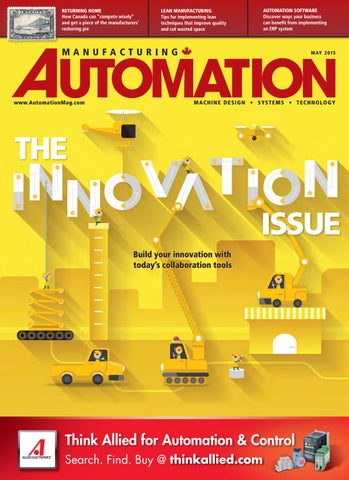
THE ISSUE Build your innovation with today’s collaboration tools
Think Allied for Automation & Control Search. Find. Buy @ thinkallied.com
Precision Gearboxes for Servomotors SureGear® Precision Servo Gearboxes
$674.00
(PGB070-05A1)
The SureGear PGA series of high-precision servo gear reducers is an excellent choice for applications that require accuracy and reliability at an exceptional value. These planetary gearboxes, now available in both right-angle and inline versions, have a thread-in mounting style, along with precision and torque capacity that is best in class. • • • • • • • • • • • •
Example models shown
$398.00
(PGA070-05A1) NEW right-angle models are perfect for space-limited applications Industry-standard mounting dimensions Best-in-class backlash Four gear ratios available (5, 10, 15, 25:1) Helical-cut planetary gears for quiet operation and reduced vibration Uncaged needle roller bearings for high rigidity and torque Adapter bushing connection for simple and effective attachment to SureServo motors Maintenance free: no need to replace the grease for the life of the unit At nominal speed, service life is 20,000 hours Can be positioned in any orientation 5-year warranty Starting at: $398.00 (70mm Frame - PGA070-05A1)
Use SureGear with our practical SureServo systems start under $1,000**
The SureServo family of brushless servo systems from AutomationDirect is fully digital and offers a rich set of features at dynamite prices. Beginners to experienced users can take advantage of this easy-to-use family for as little as $986.00** (100W system).
Mates easily to SureServo motors
AutomationDirect
Price/Part Number
Digital Servo Drive
$488.00 SVA-2040
$1,340.00 2098-DSD-005
100W Servo Motor with connectorized Leads
$325.00 SVL-201
$558.00 TLY-A130T-HK62AA
Breakout Board Kit for CN1 Control Interface
$94.00 ASD-BM-50A
$263.00 2090-U3BK-D4401
10’ Motor Feedback Cable
$49.50 SVC-EFL-010
$90.00 2090-CFBM6DF-CBAA03
10’ Motor Power Cable
$29.50 SVC-PFL-010
$101.00 2090-CPBM6DF-16AA03
Configuration Software
FREE SV-PRO*
$75.00 2098-UWCPRG
*SureServo Pro software is FREE when downloaded and is also available for $9.00 on a CD
Complete 1-axis 100W System
** All components sold separately.
• • • • •
Allen-Bradley
Price/Part Number
Servo Systems
Eight standard systems from 100 W to 3 kW Use with most AutomationDirect PLCs or any other host control Drives feature on-board indexer and adaptive tuning modes Free set-up software 2 year warranty
Research, price, buy at: www.automationdirect.com/motion-control
$986.00
$2,427.00
All prices are U.S. list prices, AutomationDirect prices as of 4/15/2015. The Allen-Bradley 100W system consists of part numbers shown in table above with prices from www.wernerelectric.com 10/29/2014.
Orders over $49 get
FAST FREE SHIPPING
Our shipping policies make it easier than ever to order direct from the U.S.! Fast free standard shipping* is available for most orders over $49 U.S., and that includes the brokerage fees (when using an AutomationDirect nominated broker). Using our choice of carrier, we can reach most Canadian destinations within 2 to 3 days. Order by 6pm ET and in-stock orders ship the same day! *2-day free shipping does not apply to drop-ships, or orders requiring LTL transport, but those shipments can take advantage of our negotiated super-low flat rates (based on weight) that include brokerage fees.
See Web site for details and restrictions at: www.automationdirect.com/canada
For more information go to: www.AutomationDirect.com/Canada
Order Today, Ships Today! * See our Web site for details and restrictions. © Copyright 2014 AutomationDirect, Cumming, GA USA. All rights reserved.
1-800-633-0405
the #1 value in automation
w H A T ’ S
I N S I D e
DEPARTMENTS 4 5
FROM THE EDITOR AuTOMATIOn uPFROnT
In brief Deal makers Movers and shakers
FEATURES
12
MAKE THE MOVE How manufacturers can use the Cloud as a springboard for business innovation
THE ISSUE
By Larry Korak
COLUMNS 9
InDuSTRY WATCH
Paul Hogendoorn stresses a need to change the management-worker paradigm
10 MACHInE SAFETY
Douglas nix outlines how to match reliability requirement with the risk
14
A BUSINESS ALLY Centring in on the benefits of Canada’s innovation centres By Alyssa Dalton
26 DISTORTED REALITIES
Dick Morley suggests going outside the “police tape” is the key to innovation
16 RESHORING Poor quality and rising labour costs are leading companies to reshore their overseas manufacturing efforts — how can Canada attract this returning business?
NEW PRODUCTS
By Vanessa Chris
22 COMMunICATIOnS 22 23 23 24 24 25 25
& nETWORKInG MOTIOn COnTROL WIRELESS TECHnOLOGY AnD SECuRITY PROCESS COnTROL MACHInE SAFETY WIRE & CABLE POWER SuPPLIES DATA ACQuISITIOn
Murrelektronik_MA_May.indd 1
MANUFACTURING 18 LEAN Implementing these lean manufacturing practices can help improve quality and reduce wasted space and money By John H. Grover Jr. PURCHASING
SALES ENTERPRISE
RESOURCE PLANNING PRODUCTION
(ERP)
ENGINEERING FINANCE
SOFTWARE 20 AUTOMATION Discover ways the purchasing, production, finance and
engineering department can benefit from an ERP system By David Doyle
www.AutomationMag.com • May 2015 3 2015-04-28 10:04 AM
F R O M
T H e
e D I T O R www.automationmag.com • vol. 30, no.3 Canada’s leading publication providing industrial automation news and technology information aimed at the discrete and process industries.
the future, the family pet and the Woz
I
n March I attended my very first Automate show, and what a show it was! There were dozens of robot demos and various machine vision and safety setups. According to Jeff Burnstein, president of the Association for Advancing Automation (one of the event sponsors), this year’s tradeshow was 80 per cent larger in terms of floor space and attendance was up 50 per cent from 2013. New to the hall this year was the Ontario booth, which housed a group of Canadian exhibitors. Featuring companies such as M&R Automation, Konnexio and Tech-Con Automation, the shared booth was a proud symbol that Canada is an active member of the global automation market. At most conferences, the keynote addresses tend to draw the largest turnouts. Well, Steve Wozniak, co-founder of Apple, did not disappoint as the final Automate keynote. His talk on What’s Next - The Future of Technology drew an overwhelming crowd, with dozens more standing along the back wall. “When I was young, it seemed like there was almost no change at all. In the last few decades [...] it’s like you can’t keep up with it. I think we’re changing much faster than ever before,” said Wozniak, also known as “the Woz.” The way he sees it, the industry is building technology “to make it easy so we don’t have to do the thinking, it’s pre-done.” He noted that these machines “are taking care of us and that makes me think we want to be the family pet — the well taken care of dog. In 20 years, machines will be thinking faster and better than us.” You couldn’t even hear the faintest whisper after he said that. Leaving the auditorium, I couldn’t help but look at the robots on the show floor differently — some were extremely agile, others followed intricate codes at turbo speed, and one even mimicked the sensitivity of a finger on a touchscreen. If you could add all these components together, you would end up with quite the “superhuman” robot. How much more advanced will these machines be at the next Automate? •
EDitOR Alyssa Dalton adalton@annexweb.com
ARt DiRECtOR svetlana Avrutin savrutin@annexweb.com
EDitORiAL DiRECtOR Paul Grossinger pgrossinger@annexweb.com
ACCOUNt CO-ORDiNAtOR Kathryn Nyenhuis knyenhuis@annexweb.com
GROUP PUBLisHER Klaus B. Pirker kpirker@annexweb.com 905-726-4670
CiRCULAtiON CO-ORDiNAtOR Lisa thomson 866-790-6070 ext. 201 Fax: 877-624-1940 lthomson@annexweb.com
COLUMNists Paul Hogendoorn Dick Morley
DiRECtOR OF sOUL/COO sue Fredericks
EDitORiAL ADvisORY BOARD Piero Cherubini, Dean, Faculty of Skilled Trades and Apprenticeship, Mohawk College of Applied Arts and Technology Al Diggins, President and General Manager, Excellence in Manufacturing Consortium, and Chairman and CEO, Canadian Manufacturing Network David Green, Technology and Business-to-Business Consultant sherman Lang, Industrial Technology Advisor, Industrial Research Assistance Program, National Research Council of Canada Don McCrudden, Vice-President, Business Development, Festo David McPhail, President and CEO, Memex Automation Nigel southway, Business Productivity Consultant and Author on Lean Thinking Bill valedis, Vice-President, Precision Training, Products and Services Inc. Manufacturing AUTOMATION is published seven times a year by Annex Publishing & Printing Inc. 222 Edward Street, Aurora, Ontario L4G 1W6 Tel: (905) 727–0077 • Fax: (905) 727–0017 • PM # 40065710 The contents of Manufacturing Automation are copyright ©2015 by Annex Publishing & Printing Inc. and may not be reproduced in whole or part without written consent. Annex Publishing & Printing Inc. disclaims any warranty as to the accuracy, completeness or currency of the contents of this publication and disclaims all liability in respect of the results of any action taken or not taken in reliance upon information in this publication. send address changes and return undeliverable Address Blocks to: Manufacturing AUTOMATION, P.O. Box 530, Simcoe ON N3Y 4N5. Return postage guaranteed. subscription rates: Canada — $40 per year. United States and Foreign — $60(US) per year. Student subscription rate $20 per year. ISSN-1480-2996
Members of
Alyssa Dalton adalton@annexweb.com Twitter @AutomationMag
Funded by the Government of Canada
CARLO GAVAZZI Automation Components
Your Source for Innovative Automation Solutions CARLO GAVAZZI Automation Components
SENSE: Inductive and Capacitive Sensors • Photoelectric Sensors • Level Sensors • Ultrasonic Sensors • Magnetic Sensors • Motion Sensors • Environmental Sensors • Wind Sensors • Limit Switches • Light Curtains • Safety Interlocks
SWITCH: Solid State Relays • Contactors and Overloads • Definite Purpose Contactors • Soft Starters • Manual Motor Starters • Mini Circuit Breakers • Electromechanical Relays • Pushbuttons and Pilot Devices
CARLO GAVAZZI
CONTROL: Energy Meters and Transducers • Power Supplies • HMIs • Digital Panel Meters • Timer Delay Relays • Current- Voltage- and Phase Monitoring Controls • Current Transformers • Safety Modules • Counters
A uHMIs t o m a t iContact o n C o mus p otoday, n e n t sand one of our field sales representatives will show you Whether it’s our industry leading range of solid state relays, our new USA Tel: 847.465.6100 Fax: 800.222.2659 and mini-circuit breakers or our vast offering of sensors, contactors,Canada power why CARLO GAVAZZI is one of the fastest growing automation compaTel: 888.575.2275 Fax: 905.542.2248 Mexico Tel and Fax:nies 55.5373.7042 supplies, and energy meters, CARLO GAVAZZI has the solution for your worldwide. We’ll be more than happy to provide a free engineering www.GavazziOnline.com • Info@CarloGavazzi.com many demanding application requirements. sample to qualified OEMs. twitter.com/CarloGavazziNA facebook.com/CarloGavazziNA
Visit our website downloadable data sheets, GavazziOnline.com • 888.575.2275 •forGavazzi@CarloGavazzi.com brochures and pricing: www.GavazziOnline.com
4
May 2015 • Manufacturing AUTOMATION CarloGavazzi_MA_March.indd 1
2015-02-17 2:42 PM
A U T O M A T I O N
U P F R O N T
Yaskawa turns 100 years old!
Yaskawa commemorates its 100th anniversary this year by debuting its new corporate logo and identity as a “symbol of evolution and future growth.”
Congratulations to Yaskawa Electric on reaching 100 years of service! The Japanese company will commemorate its 100th anniversary this year across all global locations in 28 countries. In addition to the celebration, Yaskawa will renew its corporate logo and identity as a “symbol of evolution and future growth.” Established in 1915, the company began as a producer of coal mining equipment by its founder, Daigoro Yasukawa. During the 20th century, Yaskawa developed various technologies, such as the super synchronous motor, minertia motor and Motoman L10 robot. Today, Yaskawa is a developer and manufacturer of robotics and automation solutions, with about $3 billion in annual revenue and more than 14,000 employees worldwide. “Celebrating our 100-year anniversary provides an opportunity to reflect on the values that have made us successful,” said Junji Tsuda, representative director, chair and president of Yaskawa. “Our ability to develop products that help society progress will ensure a prosperous future for Yaskawa and our customers.” Yaskawa America, a subsidiary overseeing operations in North and South America, is comprised of the Drives & Motion division and Motoman Robotics division. “For any organization, company or brand, the ability to stay relevant and provide value to customers for a century is an extraordinary accomplishment,” continued Jason Farmer, director of marketing for Yaskawa America, Motoman Robotics division. “For Yaskawa, we feel fortunate to provide products and solutions that help advance society and alleviate people from jobs that are dirty, dangerous or dull.” “We are a very customercentric organization,” added Dennis Fitzgerald, vice-president of customer satisfaction for Yaskawa America’s Drives & Motion division. “We have and will continue to invest in people, products and technology that prioritize customers, and their satisfaction, to the highest level.”
In brief • Cheaper, better robots will replace human workers in the world’s factories at a faster pace over the next decade, pushing labour costs down 16 per cent, noted a report by the Boston Consulting Group.
• Spoc Automation, an American oil and gas industry engineering, software and automation equipment manufacturing firm, has completed its acquisition of KJ Controls Canada, a Spruce Grove, Alta.-based company.
• Canada Bread Company will be moving its Halifax bakery production to its other locations in New Brunswick; the consolidation will create 35 jobs.
With files from The Associated Press and The Canadian Press
EK08__USA__Canada.indd 8 Beckhoff_MA_May.indd 1
10.03.15 09:31
www.AutomationMag.com 2015-04-22 • May 2015 5 1:10 PM
U P F R O N T
Photo © A. dAlton
New trumpf Canada space better serves customers; new managing director named
Trumpf Canada, a manufacturer of fabricating machinery and industrial lasers, celebrated the grand opening of its relocated office in Mississauga, Ont., on March 10. Boasting 50 per cent more space, the new facility shows off a wider range of fabricating solutions, and can stock a larger selection of spare parts, it said. The manufacturer moved locations last fall. Festivities also included a surprise announcement — Manufacturing AUTOMATION learned that effective April 1, Stefan Fickenscher will serve as managing director for Trumpf Canada, taking over for Stefan Schreiber, who will move back to Germany and serve as head of central sales subsidiaries, Machine Tools Sales division. Fickenscher was most recently product manager of TruLaser product group. Visitors of the grand opening got the opportunity to check out a variety of Trumpf technologies in the new demonstration room, including the TruLaser 2030 fiber, TruLaser 3030 fiber with Rotolas, TruPunch 2000, TruBend 3100 press brake, TruBend 7036, TruMark laser marking system, and power tools. “With additional technologies on display and increased access for local visitors, we hope our customers will love the new location as much as we do,” said the company.
Encoder solutions that just make sense. Model 25T for Motor Feedback
Manufacturing AUTOMATION was there March 5 as Festo Canada celebrated its 40th anniversary with a media event with executive presentations and a demonstration of its various flying bionic robots. “Over the past 40 years, Festo has become a substantial part of the Canadian industrial landscape,” said Thomas Lichtenberger, president and CEO of Festo Canada. “We have built strong relationships with our customers from coast to coast, thanks to our unique and holistic approach to meeting their requirements. As a product innovator, solutions provider and leading industrial educator, Festo will continue to lead industry into the smart factory world of Industry 4.0 here in Canada.” The event took place at the Ontario Science Centre in Toronto, Ont. Dr. Eberhard Veit, president and CEO, and Dr. Ansgar Kriwet, board member/global supply chain, flew in from Germany to join their Canadian colleagues Lichtenberger and Greg James, national Didactic manager, for the media event. The speakers discussed the company’s business strategy and gave insight into the production of the future, its challenges here in Canada, and future production trends in the era of Industry 4.0/Internet of Things (IoT). Four flying bionic robots were also demonstrated. As part of the Bionic Learning
1.800.366.5412 sales@encoder.com www.encoder.com
Siemens Canada is hitting the road for its 2015 Innovation Tour, travelling to cities across the country to showcase its latest in PLCs, HMIs, IPCs, networks, RFID, drives, motors and industrial components. According to the company, attendees will learn how to improve engineering productivity; shorten commissioning times; and utilize true integration (Totally Integrated Automation) to deliver efficiency, flexibility, and scalability. There are also 12 different technology sessions and a mini fair where company experts will be on hand to discuss aspects of Totally Integrated Automation. Session topics include automation, drives, HMIs, process instrumentation, safety controllers, RFID technology and more.
The bottling facilities in Hope, B.C., and Puslinch, Ont., of Nestlé Waters Canada, a beverage manufacturer and distributor, have achieved Excellence in Manufacturing standing from the Canadian Bottled Water Association (CBWA). “On behalf of CBWA, I want to congratulate the Nestlé Waters Canada team on, once again, achieving this very high manufacturing standard at both of its bottling plants in Canada,” said Elizabeth Griswold, executive director of CBWA. “Our members produce the highest quality bottled water in the world and Nestlé Waters Canada typifies what consumers can expect when they purchase bottled water
May 2015 • Manufacturing AUTOMATION
Encoder_MA_May.indd 1
Network, the robots fly by applying some of the principles that nature has perfected over millions of years, encouraging engineers and scientists to imagine how these concepts can be applied in industry, said the company. “They are learning projects for developing prototypes of breakthrough products of tomorrow that improve industrial automation in particular,” it added.
innovation tour 2015 visiting a city near you!
Nestlé plants earn CBWA Excellence in Manufacturing standing
• Innovative 2.5” housing dissipates heat • High performance Opto-ASIC sensor technology • Versatile—one encoder replaces dozens
6
Festo Canada celebrates 40 years of success with flying robots
Photos © A. dAlton
A U T O M A T I O N
2015-04-17 2:12 PM
produced in Canada that conforms with the CBWA Model Code.” CBWA membership dictates that the company must pass an annual, unannounced plant inspection which is administered by an independent, internationally-recognized organization. According to the association, this inspection audits quality and testing records, reviews all areas of plant operation from source through finished product and checks adherence to the CBWA Model Code and its code of ethics. The code of ethics adheres to a “philosophy of sustainable development, environmental protection and collaboration with local communities in the management of the water resource.” As well, bottlers must pass an annual water analysis administered by an independent government-certified laboratory and regularly conduct microbial testing by qualified personnel. “Our single-minded focus on quality improvement at Nestlé Waters made for a very busy 2014, but this award illustrates how beneficial that training is — and how deserving of this recognition our employees are for their commitment to quality, day-in and day-out,” added Kevin Thorburn, plant manager, Hope, Nestlé Waters Canada.
A U T O M A T I O N
U P F R O N T
DeaL Makers Ontario, Howa Canada partner for new auto parts plant Ontario is partnering with Howa Canada to establish a new auto parts plant in Alliston, Ont., creating 40 new jobs in the process. The $1-million-plus investment from the Southwestern Ontario Development Fund will support facility upgrades and specialized equipment at the new “state-of-the-art” manufacturing plant, which will supply interior trim components for the 2016 Civic built at the Honda assembly plant. While Howa Textile Industry Co. has operations in the U.S. and Asia, this will be the company’s first manufacturing facility in Canada. “Today’s announcement underscores the value of our comprehensive approach to partnering with the auto industry, with a strong focus on quality and innovation, as we work to secure new investments and product mandates,” said Brad Duguid, minister of economic development, employment and infrastructure. “Our company is excited by the opportunity to build on our 60 years of manufacturing heritage with our first location in Canada,” continued Tatsuya Usami, president of Howa Canada Manufacturing. “As we develop our skilled team and advanced production plant in Alliston, we look forward to working closely with our auto industry customers to exceed their expectations and deliver the very best interior trim products possible.” The province is in the top two in North America for vehicle production and is the only sub-national jurisdiction to have five major global automotive
assemblers: Chrysler, Ford, General Motors, Honda and Toyota, as well as truck manufacturer Hino. Heinz, Kraft merge to form The Kraft Heinz Company H.J. Heinz Co. has announced it will buy Kraft Foods Group Inc. to create what they say will be the third largest food and beverage company in North America. Representatives said they expect to save $1.5 billion by the end of 2017 through moves, such as combining manufacturing and distribution networks. However, the effect of the merger on Canadian operations is unknown at this time. “We’ll be looking at all of our operations over the coming months, but for now it’s business as usual,” said Michael Mullen, senior vice-president of corporate and government affairs at Heinz. “Every time you put two major public companies together, there are natural synergies and efficiency opportunities associated with that,” added Alex Behring, Heinz chairman managing partner at 3G Capital. The combined company — with brands including Kraft, Heinz, Oscar Mayer, Philadelphia and others — will be named The Kraft Heinz Company and will be co-headquartered in Pittsburgh, Pa., and the Chicago, Ill., area. “We are thrilled about the unique opportunities this merger will create for our consumers worldwide, as well as our employees and business partners,” said Bernardo Hees, Heinz CEO. “Over the past two years, we have transformed Heinz into one of the most efficient and profitable food companies in the world while reinvesting behind our key brands and
continuing our relentless commitment to quality and innovation.” “Together we will have some of the most respected, recognized and storied brands in the global food industry, and together we will create an even brighter future,” added John Cahill, Kraft chair and CEO. Kraft has three distribution centres and two manufacturing and processing facilities in Canada, according to a recent filing with the U.S. Securities and Exchange Commission. The company has around 2,000 Canadian employees. Mullen said Heinz’s Canadian operations are based in Toronto and St. Mary’s, Ontario. Heinz also has a small office in Leamington, Ontario. The deal is expected to close later this year.
— With files from The Associated Press and The Canadian Press
Your One-Stop Source for Process Measurement and Control Votre Unique Arrêt pour la Mesure et le Contrôle de Procédés!
© COPYRIGHT 2011 OMEGA ENGINEERING, INC. ALL RIGHTS RESERVED
Handheld OMEGA® Bluetooth® Wireless Temperature, Humidity & pH Transmitter Gamme de transmetteurs portatifs OMEGA® Bluetooth® sans fil de Température, d’Humidité et de pH
8/16-Channel Thermocouple/Voltage Input USB Data Acquisition Module Module USB d’Acquisition de Données d’Entrée Thermocouple/ Tension 8/16 Canaux OM-DAQ-USB-2401 $555
Series/Série UWBT Starts at/à partir de $332
Visit/Visite omega.ca/om-daq-usb-2400
Tablet not included. Tablette non incluse.
Ambient Temperature and Thermocouple Data Logger Enregistreur de Données de Température Ambiante et Thermocouple
• Free App Available for Android™ and iOS Devices, Configurable in 9 Different Languages • Turn Your Smart Phone or Tablet into a Data Logging Device • Application gratuite disponible pour les appareils Android™ et iOS™, configurable en 9 langues différentes • Transformez Votre Smart Phone ou Tablette en Dispositif d’Enregistrement de Données
OM-CP-TC101A $152
Visit/Visite omega.ca/om-cp-tc101a
1-888-826-6342
Visit/Visite omega.ca/uwbt
omega.ca
976 Bergar Laval, Québec Canada H7L 5A1
© COPYRIGHT 20152011 OMEGA ENGINEERING ALLRIGHTS RIGHTS RESERVED © COPYRIGHT OMEGA ENGINEERING,INC. INC. ALL RESERVED © COPYRIGHT 2015 OMEGA ENGINEERING, INC. TOUS DROITS RESERVES ® Prices listed are those in effect at the time of publication and are subject to change without notice. Please contact OMEGA’s sales department for current prices. Les prix indiqués sont ceux en effet au moment de la publication et sont sujets à changement sans préavis. Veuillez contacter un réprésentant des ventes d’Oméga pour obtenir les prix courants.
Omega_MA_May.indd 1
www.AutomationMag.com • May 2015 7 2015-04-23 3:08 PM
A U T O M A T I O N
U P F R O N T
Honda Canada to export to Europe for the first time
Honda Canada announced it will produce the next generation CR-V model for the European market, making it the first time Honda of Canada Mfg. (HCM) will export vehicles to Europe. According to Honda CEO Jerry Chenkin, the Canada-EU trade deal was the catalyst for the plan to export the next generation of the CR-V model for the European market. “This expansion decision was made possible due to our deep, mature, and rich talent pool with nearly 30 years of automotive manufacturing experience. We are so proud that our Canadian associates have the reputation of producing high quality vehicles that will meet the needs of the discerning European customer,” he said.
Prime Minister Stephen Harper called the announcement a “breakthrough moment.” “Europe will accept a great many Canadianbuilt cars — no less than 100,000 — thousands of which are going to be from right here at this plant,” he noted.
The free-trade deal calls on Europe to scrap a 10-per-cent tariff on passenger vehicles, but it remains unclear when exactly it will take effect. Canada now has free-trade agreements with 43 countries. “It’s because our government negotiated a free-trade agreement that, in the years to come from this plant, cars built right here in Canada by a Japanese company will then be exported virtually tariff-free to Europe, one of the world’s wealthiest, richest markets.” In March, Honda Canada produced its sevenmillionth vehicle, a manufacturing milestone that took place at its flagship Alliston, Ont., plant. • — With files from Colin Perkel, The Canadian Press
Movers & Shakers Michael Blundell will now lead KSB Group’s American operations, while continuing to serve as president of KSB’s Michael Blundell Canadian subsidiary, where he will align the “management and strategy in the two North American countries,” said the company. “We are confident that Mike’s energy and commitment will help grow KSB’s presence and profile in North America,” said Klaus Barmann, North American regional executive officer. Hammond Manufacturing welcomes Andreas Sobotta, an “experienced new talent” as its vice-president North American sales and marketing. The company says the addition will help the company focus on significant long-term growth in both Canada and the Andreas Sobotta U.S. He has held senior roles at various electrical/controls companies, including Festo, Siemens, Phoenix Contact and Davis Controls. Craig McDonnell has been named vice-president and general manager of the automation and control business within TE Industrial. In this role, he will be responsible for the continued growth of the business, by working to improve the Craig McDonnell customer experience, expanding the product portfolio into field applications, improving customer coverage in the machinery market, and building a performance-oriented culture. Wago has named Ron Bin a field application engineer for Ontario, where he will facilitate the transfer of technical application information to customers and distributors in the region. 8
“Ron brings to this role a thorough knowledge of automation products and the ability to address any application challenges as they arise,” Ron Bin said Toby Thomman, vice-president sales.
laminated and edge bonded shims, tapers and spacers, received the Innovation award at the Markham Board of Trade’s 2014 Business Excellence Awards Gala. According to the board, the award recognizes a successful business that fosters a culture of innovation in technology, manufacturing or marketing.
Carlo Gavazzi has appointed Tony Lee as account manager for Midwestern Ontario and the Golden Horseshoe/Niagara regions. With 12 years of front-line sales experience and a “solid track record of successful Tony Lee industrial sales efforts,” Lee is a dynamic addition to the team, said the company.
After 37 years at Motion Industries, Bill Stevens announced his plans to retire. Tim Breen, president and CEO, will succeed Stevens in leading the business. The two have worked closely together during the last few years to ensure a smooth transition, said Bill Stevens the company. Stevens began his career with Motion Industries in 1978 as director of human resources. After several promotions, he was named president and CEO in 1997, where he helped grow company sales from $1.85 billion (1997) to $4.8 billion in 2014. He most recently served as chairman.
EOS, a global manufacturer for high-end additive manufacturing solutions, has named Glynn Fletcher president of EOS North America. Fletcher previously served as the president of GF Machining Solutions (GFMS) Americas. He will also be managing Glynn Fletcher two companies within the EOS family: Advanced Laser Materials (ALM), the provider of high-performance polymers, including customized blends, and Integra Services, which offers service and support for rapid prototyping and additive manufacturing technology.
Photo courtesy Anil Mungal Photography
Shimco, a Markham, Ont.-based manufacturer of precision parts,
May 2015 • Manufacturing AUTOMATION
Doosan Infracore America Machine Tools (DIA) is promoting Hee Eun Ahn to the position of CEO, after more than 12 years with the company. During his tenure, he has served several roles including chief of staff for the CEO of Doosan Infracore, head of Doosan Corporate Strategic Planning team, Hee Eun Ahn and executive vicepresident sales and marketing for AP/E of Construction Equipment. Toyota has announced sweeping management changes that consolidate power with North American CEO Jim Lentz and promote various U.S. executives to posts in Japan. Previously leading sales and marketing, Lentz will now head Toyota’s North American manufacturing operations. North
American engineering and research operations also will report to him. The automaker said the move will give Lentz control over manufacturing, engineering and styling as its works to revamp its image. Akio Toyoda, company president, said that the changes and a diverse team of executives will help Toyota serve customers better around the world, and give Lentz a strong support base “as he continues to build upon the strong momentum he has achieved with dealers and customers in this key market.” Linx/AS, a consulting and software development firm specializing in product lifecycle management (PLM), has named Mike Cammarata senior vice-president of sales where he will manage revenue growth and help to broaden its global market reach. Bringing with him 20 Mike Cammarata years of experience in the software and services industry, Cammarata comes to Linx/AS from SAP, where he worked for three years as vice-president sales for the Line of Business (LOB) Solutions division. Hirschmann Car Communication, a supplier of transmitter and receiver systems for M2M (machine-to-machine) and automotive communications, has appointed Christopher Bala as vicepresident of sales and marketing for the North American business. Based in Auburn Hills, Mich., Bala is responsible for all sales and marketing activities for Hirschmann’s Solutions business in the North and South American m a r ke t s, i n c l u d i n g b u s i n e s s development for infotainment, antenna, tuner systems, telematics, asset tracking and automation and energy applications. •
I ndustr y
W atch
Closing the gap: minding what matters most BY PAUL HOGENDOORN
W
e live in a precarious time. As some get richer, many others drift towards unsustainability, and our middle class is shrinking. When people slide into unsustainability, it often becomes the responsibility of government to meet their needs. Many people in the middle class don’t even realize it, but they too have slid into positions of unsustainability, where they can’t accomplish the critical things on their list without some form of government aid; things like subsidies for their children’s tuition, relief from debt, extra allowances or benefits just to make ends meet every month. This is not a political issue, a left-wing or right-wing debate. This is first and foremost a people issue, a manufacturing issue, and a company issue. Many plants I visit pay their workers barely more than what they would make flipping hamburgers, or greeting shoppers at a big box store, and that is where this problem begins. People in our manufacturing companies add value — real value — with their daily activities. There’s a big difference between ‘serving’ and ‘adding value’; both are good and honourable employment activities, but the ‘adding value’ jobs have a far bigger effect in creating wealth in our economies than the ‘serving’ jobs do. This needs to be appreciated more in our society, and reflected more in what we pay our ‘value adding’ workers. Let me continue for just a bit further. We live in a competitive manufacturing world, where we lose business and jobs to far off, low-cost labour regions. We can’t afford to simply raise our rate of pay. But that’s not a good enough reason to justify near minimum wage pay. There are other options. One option that I’ve been advocating a lot lately is to change the managementworker paradigm. Going back to the beginning of the mass production era, we made it management’s job to measure and the workers’ job to do. Previous to the creation of this type of employment, a person could easily measure the fruits of their days’ efforts; how many acres he or she planted, cows they milked, miles of fences that were mended, or cords of wood that were chopped. Along with measurement came the satisfaction of accomplishment. Work was much more than simply a means to make a living, it provided meaning as well. We’ve disconnected meaning with many of our factory jobs. The primary measurement of work that workers have now is how many hours they are in the building and on the job, not the job itself. There’s nothing wrong with paying people for the hours they work, but the accomplishment measurement we feed back to them should be directly tied to the actual work they’ve done, independently of how many hours they are in the building and being paid far. We believe the common expression “what gets measured, gets done”, but the problem is that we hold on to the belief that its management’s job to do the measuring and the workers’ job to do the doing. To change this requires a different way of thinking, from the top down. Management feels entrusted with the corporation’s mandate and vision, and this is a role they hold on to dearly, because that responsibility gives them meaning. But, meaning and responsibility can be, and should be, shared. In the current model, information collected off the plant floor flows up, while only you-know-what flows down. If the people on the floor were more connected to their value adding roles and functions — i.e. the only activities that actually make the company any money — they would be more engaged employees; more satisfied and productive contributors. More productive means more profit, and more profit allows their value to be properly rewarded. We can continue trying to compete with countries that consider human labor a commodity, or we can once again change the game. Our strength and differentiating advantage is our people; everyone bringing their “A game” and sharing responsibility, and meaning, more equally. Manufacturing in North America created the middle class, and the middle class is what makes our countries great. I don’t believe that the solution to what ails us is in the hands of governments, or political parties, or schools, or organized labour. I think it begins with ‘us’, the manufacturing companies and workers that made our countries great. It’s time to get on a new page. With the information technology readily available today, there’s no reason that only some should measure, while others only do. • Paul Hogendoorn (paulh@getfreepoint.com) is co-founder of FreePoint Technologies, “Measure. Analyze. Share.” (Don’t forget to share!) www.AutomationMag.com • May 2015 9 Hiwin_MA_Jan.indd 1
2014-12-17 3:17 PM
M achine
S afet y
Connecting risk and reliability By Douglas Nix
O
ne of the big challenges that control systems designers and safety engineers face is the relationship between machinery risk and control system reliability. Machinery safety standards began introducing the idea of control reliability, more often called functional safety, back in the early 1990s. The earliest standards used a prescriptive approach, introducing circuit architectures with names like single channel, single-channel monitored, and control reliable. In the mid-1990s, CEN in the European Union brought in some similar, but slightly different, architectures which were called out as “Category B” and “Categories 1 through 4.” Unfortunately, while this was an
important advancement, it also introduced a lot of confusion for designers. Since then, functional safety standards have advanced considerably. The latest documents now provide a more flexible, probabilistic approach to determining the control system design requirements based on risk. The old category system is still in use, and the architectures of those categories remain unchanged, if you choose to use the current edition of ISO 13849. There are additional choices available to control systems designers in terms of the component selections and diagnostics that they can use to boost the reliability of designs to meet the requirements. If ISO 13849 doesn’t adequately model your
control system, a designer could also choose to use IEC 62061 or IEC 61508, which provide a much greater degree of freedom in design, with a tradeoff in more complex analytical techniques. Despite all the advancements, one key problem remains — how to match the reliability requirement with the risk? Both ISO 13849 and IEC 62061 offer suggestions about how this might be done. See Figure 1. Annex A of both standards provide decision trees or matrices that can be used to select the Performance Level (PL), or the Safety Integrity Level (SIL), based on risk. The methods given in the Annexes work, and there is no major reason not to use them, except one: they require you to effectively reassess the risk
Figure 3 Direct mapping
Figure 1 Risk Graph, ISO 13849-1:2006, Annex A
Figure 2 Risk Assessment model from ISO/TR 14121-2:2012, Annex A
Table 1 Variable Comparison Variable Severity of Injury
Frequency or Duration of Exposure
Probability of the Hazardous Event
Probability of Avoiding or Limiting the Harm
10
ISO/TR 14121-2
ISO 13849-1
S1
Slight injury (usually reversible), for example, scratches, laceration, bruising, light wound requiring first aid).
Slight (normally reversible injury)
S2
Serious injury (usually irreversible, including fatality), for example, broken or torn-out or crushed limbs, fractures, serious injuries requiring stitches, major musculoskeletal troubles (MST), and fatalities.
Serious (normally irreversible injury or death)
Twice or less per work shift or less than 15 min cumulated exposure per work shift.
Seldom-to-less-often and/or exposure time is short
More than twice per work shift or more than 15 min cumulated exposure per work shift.
Frequent-to-continuous and/or exposure time is long
F1 F2 O1
Mature technology, proven and recognized in safety application; robustness.
O2
Technical failure observed in the two last years: Inappropriate human action by a well-trained person aware of the risks and having more than six months experience on the work station.
O3
Technical failure regularly observed (every six months or less): • Inappropriate human action by an untrained person having less than six months experience on the work station; • Similar accident observed in the plant in the preceding ten years. Possible under specific conditions
A1 (P1)
Possible under some conditions: • If parts move at a speed less than 0,25 m/s AND the exposed worker is familiar with the risks and with the indications of a hazardous situation or impending hazardous event; • Depending on particular conditions (temperature, noise, ergonomics, etc.);
A2 (P2)
Impossible.
Scarcely possible
May 2015 • Manufacturing AUTOMATION
for each hazard using the scales provided, but they provide an output in terms of reliability, rather than risk. If a method existed for mapping directly from the risk output to the reliability requirement, time could be saved and some confusion eliminated. ISO 12100, Safety of machinery — General principles for design — Risk assessment and risk reduction, requires that risk assessments consider four key variables: potential Severity of Injury, Frequency or Duration of Access, Probability of the Hazardous Event, and Probability of Avoiding or Limiting the Harm. ISO/TR 14121-2 gives some examples of decision trees, Figure 2, and matrices that meet this requirement. As long as your risk scoring tool incorporates these variables, then you can map the output of your risk assessment tool to the functional safety requirements. How can a designer map from a 1-6 scale like that in Figure 2 to a reliability scale from a-e like that in Figure 1? At least two approaches can be considered:
Using Figure 3, you can see that a low level of risk, 1 or 2, maps to PLa or PLb, relatively low reliability levels, and likewise, the higher levels of risk also map to higher levels of reliability. None of the current machinery safety standards prescribe a specific risk-scoring tool. At most, they will prescribe the minimum variables that must be considered, leaving the selection of a decision tree, matrix or probabilistic calculation method to
the risk assessor. On the other hand, the functional safety standards all prescribe certain functional safety bands, whether PLa-e or SIL1-SIL3. These standards don’t prescribe the approach taken to determine the initial reliability requirement, only that it must be based on risk. Control systems designers and safety engineers must find ways to map their preferred risk-scoring tool to the functional safety input requirements. Whether you choose
to use one of the example methods shown in the functional safety standards or develop your own mapping, care must be taken to ensure that your system does not underspecify the reliability requirements. • Douglas Nix, C.E.T., SM-IEEE, is managing director at Compliance Insight Consulting. He has more than 25 years of engineering technology expertise, though he has focused on risk assessment and machinery safety since 1996.
1) Factor mapping, and 2) Direct mapping. In the first method, each variable iMan the risk-scoring tool is compared against the counterpart variable in the reliability decision tree (Table 1). As you can see from Table 1, a problem exists. There is no variable for Probability of the Hazardous Event given in Figure 1, so no factor mapping is possible, unless it can be assumed that the O factor is always taken to be a certainty, or a probability of 1. Even this doesn’t provide a direct match, since the highest probability of occurrence in Figure 2 is O3, and even that does not describe a certainty of injury. If a designer develops their own scoring tool using all the required variables, it would be possible to set the O factor to 1 when dealing with direct factor mapping, but this serves to illustrate the difficulty in using this approach. Direct mapping gives the designer the ability to ignore the input variable details, and simply map the output scale from the risk model directly to the input scale for the reliability model, as seen in Figure 3. In this approach, the maximum risk is assumed to match the maximum reliability, and the minimum risk is assumed to match the minimum reliability. The intermediate values are then mapped across to each other. Note that this will only work if the two scales are linear. If one is logarithmic this method cannot work. F&B ad 6.375x9.75 MA final.indd 1 Eaton_MA_May.indd 1
15-04-16 5:42 PM
www.AutomationMag.com • May 2015 11 2015-04-17 11:35 AM
C O v E R
S T O R y
builD yOuR innOVATiOn WiTH TODAy’s COllAbORATiOn TOOls
Innovation and collaboration don’t need to be scary words. While not all businesses may think these concepts go hand in hand, the following cover stories explore how Canadian manufacturers can take advantage of two collaborative tools — the Cloud and local innovation centres — in an effort to boost innovation and drive growth. The belief is that by relying on partners and collaborators, manufacturers will be able to band together and strengthen the industry. Who knows, perhaps the key to your next innovation is right under your nose.
MaKe tHe MoVe using the Cloud as a springboard for business innovation
BY LARRY KORAK
E
arly predictions suggested that manufacturing would lag behind other industries in Cloud adoption by two to three years. This has not been the case. In fact, a 2013 KPMG survey revealed that 41 per cent of respondents are already using Cloud-enabled services in finance, accounting and financial management and 35 per cent of respondents are likely to adopt such services within the next 18 months. The primary driver of Cloud adoption was also thought to be Total Cost of Ownership (TCO) and, in reality, speed, agility and risk mitigation have proven to be great motivations for Cloud investments. In this marketplace, very few industry experts would deny that Cloud computing has become a fixture of the business landscape. In fact, for most organizations, it is not a matter of if they will transition to the Cloud but when, especially in an industry such as manufacturing, where organizations need to manage complex value chains, fast-paced projects and meet escalating customer demands. Why are CFOs turning to the Cloud? There are three main reasons: cost efficiency, flexibility and speed.
New technology offers cost efficiency and more effective resource usage
The ability for a manufacturer to update business and operational processes while moving away from technologies that are outdated, growth constraining and difficult to maintain and support is more than a motivator — it is a business imperative. When moving operations to the Cloud, the vendor takes on the responsibility of managing upgrades, supporting the environment, maintaining authentication, authorization and access controls, as well as data security. Subscription based pricing and immediate scaling based on changes in headcount are also added benefits to today’s CFO.
More options and more choices are available to all-sized businesses As the Cloud market continues to mature, a 12
May 2015 • Manufacturing AUTOMATION
number of trends are emerging that are likely to accelerate Cloud adoption. One is the ability to adopt hybrid architectures that offer incredibly flexible deployment options for core Enterprise Resource Planning (ERP) and edge applications. For example, let’s say a manufacturer selected an ERP solution in past years but suddenly needs to support a new plant in a distant location. Using today’s flexible technologies, they can now choose an appropriate Cloud ERP solution and support a new location without risking business integrity. This hybrid approach also allows companies to select focused edge applications that extend core ERP capabilities while maintaining some legacy systems on premise. This is also becoming a popular option for organizations looking to test the waters. Larger businesses are now more likely to pursue a hybrid model rather than entertain total replacement, as they would have done in the past. Motivated by a growing recognition that the cloud can serve more broadly as a springboard for process transformation, innovation and increased business agility, CFOs are increasingly anxious not to get left behind. Initially, the Cloud was attractive to smaller and mid-sized organizations but there is now clear evidence of larger organizations transitioning to the Cloud. In fact, Gartner previously noted that nearly half of large organizations will have hybrid cloud deployments by the end of 2017. In addition, the Cloud is also where many businesses will find the latest innovations and opportunities for process improvement, since newer applications developed specifically for the Cloud are displacing older, on-premise capabilities. CFOs are finding that it is easier to drive innovation since the SaaS (Software as a Service) business model allows all users to take advantage of new functions and capabilities as soon as they become available, without resorting to individual upgrades and migrations which has historically been the case. Organizations who have yet to invest in Cloud solutions will be relieved to find that there are
also more trusted vendors in the marketplace offering these solutions. There has been a notable shift toward increased dependability, with established vendors introducing new Cloud-based applications that have been specifically developed for deployment.
Businesses are more flexible and agile in the face of change
Perhaps the greatest benefit is the business agility that companies can realize through Cloud deployment. For example, companies expanding into emerging markets in pursuit of growth are able to test the market, rapidly deploy Cloud applications into new ventures, and scale them up or down in concert with market developments. Similarly, Cloud-based applications can help businesses to standardize transaction processing and reporting in new acquisitions or smaller subsidiaries where traditional solutions based around on premise applications would have taken months to bring to fruition. The accessibility and immediacy of Cloud-based solutions means that a newly acquired company could be up and running on a new budgeting application in the Cloud, for example, within a matter of days, where a comparable on premise solution requiring investment in infrastructure could take weeks or months. CFOs are moving to the Cloud, and cost efficiency, flexibility and speed are the key reasons. Aging legacy applications just can’t keep pace with the agility of new solutions and outdated systems continue put a drag on productivity — and profits. With this in mind, 2015 should prove to be a banner year for cloud applications as more and more companies realize the cost savings associated with the Cloud and solidify its position firmly in the mainstream. • Larry Korak is Industry Strategy Director for Infor’s Industrial Manufacturing vertical. He has extensive experience in product, customer and supply chain consulting.
Au
tho
riz
Your 1 Choice for Automation & Control ST
ed
Di
str
ibu
1.800.433.5700 © Allied Electronics, Inc 2015. ‘Allied Electronics’ and the Allied Electronics logo are trademarks of Allied Electronics, Inc.
An Electrocomponents Company.
tor
S tor y
Photos © Steve Newman, Canadore College
C o v er
A business ally Centring in on the benefits of Canada’s innovation centres By Alyssa Dalton
W
ith a yo-yoing Canadian dollar and the lingering uncertainty of the industrial sector, the need for manufacturers to pursue innovation has never been more pertinent. These days, there is pressure for manufacturers to be innovative, stay innovative and, of course, stay cost-competitive. Hoping to help achieve that goal, a number of innovation centres have popped up across the country recently, boasting state-of-the-art equipment, technology and skilled support personnel for manufacturers.
The risk in risky business
“For virtually every manufacturer in Canada, R&D budgets are tight. There are often tight margins, and companies are struggling to keep pace and compete,” says Evan Butler-Jones, applied research lead at the Innovation Centre for Advanced Manufacturing and Production at Canadore College. Better known as ICAMP, the 8,500-square-foot centre is structured as both a technology showcase and working lab for local businesses. It hosts a variety of technologies onsite, such as several 3D printers, CNC machines, 3D scanners, a scanning electron microscope, as well as a 12-seat 3D theatre for design visualization, and rooms for designing, testing and prototyping. “We found that because of the [fast pace] of advancement in manufacturing technology, investing, learning and adopting those technologies is both expensive and high risk,” he says. He points to 3D printing, 3D scanning, robotics, machine vision, and machine learning algorisms as some examples of these trends. “New offerings come onto the market several times a year sometimes. They all tell you their technology is what you need for your business. And if you add to that, new materials, increasing use of composites, advances in data analytics, 14
May 2015 • Manufacturing AUTOMATION
all of these different things can make it difficult for R&D and production managers to keep abreast of what’s happening,” he says. “Essentially what we’re doing is supplementing — we are de-risking the innovation investment.” Butler-Jones says what makes ICAMP so successful is the fact that the centre is industry-driven. In fact, the senior leadership team spoke to various businesses and manufacturers to find out what they needed when the centre was in early development. “A lot of our clients now incorporate our centre regularly into their own R&D process, whether that is to use the equipment, use our team, or both,” he says. “It allows them to come in and get up to speed on this technology without having to make the capital investment in their own company.” Jannatec Technologies is an electronics designer and manufacturer for the mining industry, and has been working with ICAMP for approximately the last year and a half. “From my point of view, if people [at the centres] have the right training and knowledge, you are able to use [them] to really streamline the product development cycle,” says Stephen Podrucky, Jannatec product designer. He says that by working with ICAMP, the company was able to turn certain phases of its development cycle from months into weeks for several projects. “It’s been a really great resource for us, so I would recommend it to other manufacturers who are interested in innovating,” he adds.
Strength in its people
Founded in 2003, the Composites Innovation Centre Manitoba (CIC) has already worked with more than 130 companies, estimates Mike Hudek, vice-president business development and operations.
This “one-stop shop technology centre” supports a variety of businesses in Western Canada, he says, specifically through engineering support in the design and analysis of composite components, material process selection, and prototype manufacturing, testing and evaluation. “When manufacturers approach us, we make sure they’re connected to the right person on our team,” says Hudek. CIC has about 30 employees broken into groups with different specialities. Once the appropriate contact is determined, the parties work together to outline the scope of the project, including the deliverables, timeframe, budget and eligible funding. “Many of the small- to medium-sized companies I meet may not even have an in-house engineering or technical capability,” he says. “Sometimes it’s because they’ve had to downsize and remove those positions [...] or maybe they aren’t able to justify a permanent position in that area. In this case, we can be a central resource for multiple companies so they don’t have to cover the full cost of that worker.” As a result of working on multiple projects with different clients, Hudek believes that shared-service personnel, such as those working at CIC, can often end up developing skills at a faster rate than a manufacturer’s internal R&D team. He gives this example — a given worker at CIC may go through the design process numerous times annually from working on different projects, while an internal team at a manufacturer may go through the same process once every five years, let’s say.
Steve’s had enough…
…enough of cobbling together a production plan that always falls apart.
Ready, set, action
PaperNuts offers a unique solution to fill the empty space inside boxes — its title product boasts an alternative to Styrofoam and other starch-based peanuts, bubble wraps and air bags. The company went to Niagara College’s Niagara Research several years ago for additional R&D support when it needed to develop a new paper stand to sustain its 800-pound paper rolls. The Industry Innovation Centre at Niagara (IIC@N) implemented a solution by identifying machine deficiencies and improving the production machinery. Since then, the company has turned to IIC@N for assistance with other projects involving machine, production and dispensing efficiency. “Each time we do a project together, it’s been successful,” says Scott MacRae, president and founder of PaperNuts. According to MacRae, the company was able to save “a lot of money and time” by working with the centre. Two months ago, the college marked the official beginning of the construction of its new Walker Advanced Manufacturing Innovation Centre, an establishment that exclusively serves the manufacturing industry. With support from a $4.2-million provincial investment and a $1.2-million donation from Walker Industries and the Walker family, the centre will provide more than 15,000 square feet of lab space for hands-on applied learning, innovation space for companies to work onsite, and office space for students and industry staff. “On behalf of our family and our employees, we are incredibly proud to invest in Niagara College through its Achieving Dreams Campaign,” says Sheila (Walker) Bonapace, a Walker Industries’ shareholder. “For businesses like ours that depend on skilled workers that our college educates and trains, it’s important that we support this campaign. The future of our region depends on it.” Construction of the centre aims to be completed by early 2016.
…enough of chasing down materials that should be in inventory. …enough of working late to keep the facilities running smoothly.
Learn how SYSPRO fixed these problems and made Steve’s day easier.
The art of collaboration
In a world where companies are often fighting to stay ahead of the curve, it’s important to learn how to join forces with industry peers, says Butler-Jones. “Without sharing your trade secrets, there is a lot of value in working together and in gaining the knowledge that needs to be gained,” says Butler-Jones. According to him, finding ways to share information, work together and keep up-to-date on technology is critical for all businesses. “Most of us are too small to compete locally on our own without help of some sort. It just seems to be the reality, and we need to be able to rely on partners and collaborators to move things forward.” •
www.syspro.com/en
A sampling of innovation centres manufacturers can tap into:
Innovation Centre for Advanced Manufacturing and Production (ICAMP) Composites Innovation Centre Manitoba Red Deer College’s Centre for Innovation in Manufacturing (CIM) Conestoga College’s Centre for Smart Manufacturing Niagara College’s Advanced Manufacturing Innovation Centre Mohawk College’s Additive Manufacturing Resource Centre
1-888-259-6666 ext 5250
info@ca.syspro.com
www.syspro.com
ACCOUNTING MANUFACTURING DISTRIBUTION www.AutomationMag.com • May 2015 15
Syspro_MA_May.indd 1
2015-04-15 9:38 AM
R E S H O R I N G
HOME
SWEET HOME How to focus our reshoring efforts to Canadian soil
BY vANEssA CHRis
A
s overseas labour costs continue to rise — and long supply chains grow more expensive — the once-popular trend of offshoring is on its way out in many sectors. Rather than searching for the cheapest labour to manufacture their goods, companies are finding that true financial value lies in better servicing local markets. For many, this means bringing manufacturing operations back to the home of their prime customer base — North America. “When you run the numbers, we’re at a tipping point in quite a few sectors,” says Nigel Southway, chair of the Toronto chapter of the Society of Manufacturing Engineers. “When you consider transportation costs, support costs — such as surveillance, communication, and infrastructure — it becomes obvious that, while labour might still be cheaper than in North America, there are a lot of hidden costs associated with manufacturing offshore.” On the surface, this appears to be great news for the North American manufacturing sector which has taken a series of hits in recent years. The problem is, these new reshoring efforts aren’t coming back to the traditional manufacturing regions — such as Ontario, or the U.S. ‘rust belt’ — but instead are gravitating toward Mexico and the southern United States. Between Mexico’s cheap labour and burgeoning economy, and the southern United States’ Right to Work legislation and geographical proximity to Mexico, it’s difficult for Canada to compete. It also doesn’t help that many of these markets are offering tempting tax incentives for businesses choosing to bring their manufacturing efforts back to North American soil. “If you’re a car manufacturer and you have capital to spend on another plant, you’re going to look at where the customers are,” says Southway. “Most of the new customers are in Mexico, because that’s the quickest growing market. Being close to the customer, you’ll go to Mexico for 16
May 2015 • Manufacturing AUTOMATION
three reasons — the labour is cheaper, Mexico is supporting you with tax breaks, plus you’re closer to a desirable growth market. It’s a very hard case to tell someone to build their plant in Canada.”
Quality over quantity
Despite the deck being stacked against it, there are advantages to manufacturing in Canada — Kevin Merritt, president of Superior Radiant Products, can attest to that. After attempting to manufacture one of his company’s higher-end products in China — a commercial-grade, luxury patio heater — he eventually decided to bring it back to the company’s Stoney Creek, Ont. facility. “In China, the lead times were getting longer, the minimum order quantity was getting higher, and the quality was getting unreliable,” Merritt says. “We would have to pay upfront for three container loads before it shipped, and when it came to us, it got to the point where we had to open every box because there were so many inconsistencies. We were trying to make a high-end, luxury product and it just wasn’t acceptable.” Canada’s labour may not have been cheaper, but it offered better quality, without the mandatory large batch requirements and shipping costs. Manufacturing the product close to home also allowed the company to acquire inventory as it needed it, in a much more efficient manner. And while Superior Radiant could have produced the product at its U.S. location — with cheaper labour — it opted to come back to Canada. “In our case, coming back to Canada made more sense. There are lower corporate tax rates — U.S. corporate tax rates are much higher — and because we do a lot of R&D, the R&D credits here are very good for us,” he says. “For large mass production, maybe Canada isn’t as good as other markets because the cost of labour and set-up is very high. But for us it made sense.”
Competing wisely
Merritt is convinced that other smaller companies, like SRP, are coming to the same reshoring decision and moving back to Canada — he’s heard of a higher-end patio furniture manufacturer, for example, who is doing just that. These reshoring efforts are flying under the radar, however, because little companies don’t attract the same media attention as the big multinationals, he says. But they’re exactly the type of manufacturing stories Canada should be pursuing in that they speak to our manufacturing strengths, according to Hoda ElMaraghy, professor of Industrial and Manufacturing Systems Engineering at the University of Windsor. “We can’t compete on wages,” says ElMaraghy. “We can compete on quality, on innovation. Companies are coming back to manufacture locally because they find the quality is better here.” ElMaraghy says Canadian manufacturers can differentiate themselves by making smarter products, in a smarter way. This means employing new manufacturing practices such as flexible manufacturing, reconfigurable manufacturing and adaptable manufacturing — concepts on which she consults and studies at the Centre for Intelligent Manufacturing Systems at the university. “We can’t only be part of the supply chain. We have to own our designs. We need innovation — not just in the products we produce, but in how we make things,” she says. Many companies that ElMaraghy has collaborated with through the university have seen great success from these strategies — particularly reconfigurable manufacturing, which allows companies to invest in equipment on the shop floor as needed, when needed and if needed. Instead of investing upfront in a large system with many impressive but unnecessary capabilities, a reconfigurable manufacturing system is modular; meaning, it can be expanded as necessary. “To benefit from reconfigurable manufacturing, companies need to design their initial system so that it’s easy to add machines as needed,” she says. To illustrate the benefits of such a system, ElMaraghy uses the example of one Windsor-based OEM that had the foresight to implement a reconfigurable manufacturing line that could adapt to production volume changes. It left extra space on its plant floor, and designed the machines, stages and overhead cranes in such a way that all the components could accommodate another line. When the automotive manufacturer eventually needed to produce another engine, despite being at its production capacity, this OEM was able to meet the new demands.
“If they couldn’t add machinery, they couldn’t accommodate the new work. They’d lose that business to another plant somewhere else to make additional engines,” she says. “Because they thought about it ahead of time, and allowed for features to make it practical to add those machines, including leaving physical room for them, they were able to increase production.” Essentially, Southway says that Canada’s less-than-ideal location and lack of government incentives is
a significant roadblock when it comes to attracting returning offshore business, and to overcome it, Canadian manufacturers will have to find new ways to adapt — possibly by partnering with Mexican plants or opening operations closer to Mexico, as well as finding new ways to differentiate themselves. This might mean implementing smarter practices, targeting niche markets, or simply changing the way we’ve always done things. “We should take a look at our
traditional industries and add technology to make them competitive. We should find new ways to convert our natural resources into valueadded products — shipping them out of the country as finished product will be our export drive,” says Southway. “Manufacturers have to be either very nimble or differentiate themselves on core costs like materials.” • Vanessa Chris is a freelance writer based in Guelph, Ont.
What’s the driving force behind the performance and profitability of your packaging machines?
It should be your automation partner! At Omron, we deliver a comprehensive range of products and services designed to increase the speed, versatility, and safety of your machines. Empower your production with highly advanced solutions that have the
proven reliability to maximize your customers’ loyalty. If you are developing a new machine or upgrading an existing model, look to Omron as your knowledgeable partner for superior automation.
Discover how we can increase your packaging profitability. OMRON AUTOMATION AND SAFETY Toll free: 800.556.6766 • www.omron247.com
DPN Omron Jr Pg Ad_2015.indd 1 Omron_MA_May.indd 1
1/16/15 9:24 AM
www.AutomationMag.com 2015-04-14 • May 2015 17 10:43 AM
L E A N
M A N U F A C T U R I N G
ConfiGure Your
worKPlaCe Tips for implementing lean manufacturing practices
BY JOHN H. GROvER JR.
Y
ou may be thinking about implementing lean manufacturing practices in your facility, or perhaps you have heard about lean manufacturing and want to know more. Whatever the case may be, these tips can help you determine whether your manufacturing process can benefit from lean techniques, and if yes, the best way to go about implementing them. Key steps in lean manufacturing implementation include: performing value-stream mapping, optimizing storage configurations, giving workers tools for success, working towards consistency, and continually reassessing what further changes will benefit your process. If you take advantage of these tips, you can significantly cut wasted space and money, boost customer and worker satisfaction, and improve quality.
1.
Assess your needs
You may think you have an extensive understanding of your manufacturing process, but taking the time to assess the needs 18
of your facility with the goal to cut down on waste is the first step in implementing lean manufacturing practices. You may be surprised by what a difference this step makes! Work with team members from your manufacturing process to determine what parts and tools are needed for current production demands. Assess everything in your production warehouse, and get rid of everything that isn’t currently being used. Depending on the item and your predicted future demands, you may choose to relocate the item away from production areas or dispose of it entirely. Excess stock takes up valuable space in your production facility, slows down manufacturing and can hide production issues.
May 2015 • Manufacturing AUTOMATION
In addition, an important part of assessing your facility’s needs is performing value-stream mapping. This will help you see what steps are currently being taken in your manufacturing process, where delays occur, where other waste may come into play, and how to resolve these issues. Value-stream mapping is essential to the streamlining process, and can be used not just to determine the current state of your manufacturing facility, but also to map out an ideal future-state process.
2.
Reconfigure storage
Once you have a firm grasp of your facility’s needs, have developed a value-stream map and a future-state
map, you can make a plan for how to implement new processes. A key aspect of this plan is figuring out how and where to store tools, parts and other items to most effectively use space and time. For example, open shelving often wastes space between shelves and at the back of each shelf, and therefore is an inefficient storage method for all but the largest, bulkiest items. High-density drawer storage can be used in its place and can dramatically reduce storage footprints. Drawer storage provides for customized subdividing, allowing similar items to be grouped together and every item to have its own clearly labeled space. This cuts down on wasted space and search time, enabling workers to locate specific items quickly. Purchasing all new high-density storage units is one option for increasing storage efficiency. This opens up the option for completely customizing your storage spaces, allowing for the most efficient use of space. Another option is to retrofit existing shelving with modular
high-density drawer storage inserts for highly customized organization. Finally, assessing what items need to be stored nearest to and away from production areas will increase efficiency of production. Items that are used often should be stored where they are used, while lower-traffic items and those that are bulky and in the way of production should be stored farther away.
3.
Set workers up for success
Workers who are comfortable in their workspace are more likely to be successful and productive than those who feel uncomfortable. Factors that come into play in worker comfort include cleanliness, accessibility, safety and ease of use of working environments. Clean environments are more enjoyable to work in, and can lead to improved worker morale. Moreover, clean environments — that is, environments free from spills, dust, airborne particles, and toxic or irritating substances — are safer workplaces for everyone. Making sure that workspaces are clean should be one of the top priorities of a lean manufacturing process. It is also easier to maintain when storage, workspaces, and workflow are streamlined.
4.
Be consistent and continually reassess
Of course, these lean manufacturing practices will only bring about the desired results if they are implemented consistently. Not only does a workstation or storage area have to start out clean and organized and a process plan streamlined, but they need to remain that way. Ensuring that workers at all levels are invested in the lean manufacturing process and are accountable for maintaining the environment is crucial. In addition, you will need to adapt and change things along the way. Be sure to stay on top of how efficient the workflow is and how well practices
“If you take advantage of these tips, you can significantly cut wasted space and money, boost customer and worker satisfaction, and improve quality.” are being implemented to determine whether changes need to be made. Continuous improvement is one of the main tenets of lean manufacturing, and with good reason. These tips, and all initial lean manufacturing practices, can only serve as a starting point for streamlining your
manufacturing process and eliminating waste. Once lean manufacturing practices are implemented, you should continue to perform value-stream mapping, identify areas where improvements can occur, plan for the future, and execute these plans. Through a willingness
to evaluate new solutions, you will ensure your practices, efficiency and process flow continually improve. • John H. Grover Jr. is the lean manufacturing manager and automotive repair America at Lista, a manufacturer of workshop and storage systems.
Building a high-precision actuator is easy! Simply couple any servomotor to one of our precision Quick Connect™ gearheads! • • • • • • •
Complete line of gearheads now available Harmonic Drive® or Harmonic Planetary® gearheads Zero backlash and low backlash versions Ratios: 3:1 - 160:1 Peak Torque: 3.9 N•m - 3940 N•m Sizes: 40mm - 230mm Output Configurations: Hollow Shaft, Flange, Keyed Shaft
TM
Harmonic Drive LLC 247 Lynnfield Street Peabody, MA 01960 800-921-3332 www.HarmonicDrive.net
Electromate Industrial 6221 Highway 7, Unit #15 Vaughan, Ontario, Canada L4H 0K8 (877) SERVO98 (737-8698) www.electromate.com
Harmonic Drive® and Harmonic Planetary® are registered trademarks and Quick Connect is a trademark of Harmonic Drive LLC.
MA_V1_HP.indd 1 Harmonic_MA_May.indd 1
4/16/15 9:29 AM
www.AutomationMag.com 2015-04-16 • May 2015 19 10:02 AM
S oft w ar e
Software Solutions Problems commonly solved by deploying ERP
PURCHASING
SALES ENTERPRISE
RESOURCE PLANNING PRODUCTION
(ERP)
ENGINEERING FINANCE
By David Doyle
P
eter worked long, frustrating hours trying to keep production moving. He moved from crisis to crisis trying to hunt down materials that were supposed to be in inventory, changing the production schedule on the fly to adapt to the latest obstacle. Peter wasn’t bad at his job, he just didn’t have the information he needed to do his job properly. Peter’s story is pretty typical for manufacturers who have outgrown spreadsheets and systems that don’t share information where a whole host of problems start to manifest: problems that are best solved by Enterprise Resource Planning (ERP) software. ERP software helps manufacturers run their business smoothly and efficiently. It lets sales see what can be made and when. It helps production know how to best meet that demand. It lets purchasing know what to order. And finally it gives finance insight in to all of those activities so they can make sure the business has enough cash to keep running. Here is how the various departments in a business can benefit from ERP:
Sales
The types of problems that your sales team experience when the company is ready for ERP are primarily related to time and administration. From a 20
May 2015 • Manufacturing AUTOMATION
ballooning number of order takers who are prone to error to salespeople becoming frustrated with the effort related to forecasting, ERP systems can help sales by reducing the time spent on order entry, improving the accuracy of information, and increasing the time they spend selling. Order taking can be sped up by pulling orders automatically from customers’ ERP systems or by generating the sales order from quotes. Similarly, estimating and quoting through an ERP system makes the whole process more repeatable and efficient — you can reuse more from past quotes and query data from past jobs. The most important improvement comes in how an ERP system helps salespeople by automating forecasts using historical data and booked sales with little human oversight. This results in more accurate forecasts with less effort.
Purchasing
The increased predictability brought by automating sales forecasts and improving their accuracy unlocks a cascade of benefits throughout the operations department. If your purchasing department is struggling to keep the right materials in stock and you’re doing a lot of expediting, then you might need an ERP system.
Materials requirements planning combined with sales forecasting in an ERP system lets you automate purchasing. Your purchasing department can quickly make sure really important materials will be on hand when you need them. It also lets everyone in the company check how long it will take to deliver on an order with stock, materials, goods in transit, and lead times all in one system. As well, buyers will also have more time to spend on strategic activities such as sourcing, qualifying suppliers, and negotiations.
Production
The main problems that an ERP system can solve for your production team relates to planning and scheduling. If production is mainly reacting to the latest crisis, then they would benefit from the improved predictability and access to information that ERP systems provide. Improved predictability from sales forecasting doesn’t just help purchasing. It also helps production create realistic plans that meet the demand of sales in the most efficient way — greatly reducing the number of work orders that need to be expedited. And operations will be able to identify bottlenecks before they happen and make alternate arrangements. Similarly, because purchasing is now able to better source materials in time, production won’t have to suddenly drop plans because of shortages nearly as often. By formalizing your estimating and quoting processes in ERP, you can then use your quotes to automatically generate the necessary job orders and other related documents. This is a huge time-saver because production no longer needs to re-enter the data that estimating quoted. It also ensures accuracy, as it makes sure production builds what was actually quoted.
Engineering
Engineers who spend too much time supporting the sales process could have much of that time freed up to spend on engineering with the right ERP system. With highly-customizable products or in engineer-to-order production environments, engineers will always have some contact with sales. Transferring the engineer’s knowledge into a product configurator for customizable products lets engineers spend less time supporting sales, and sales can spend less time chasing engineers.
“Peter worked long, frustrating hours trying to keep production moving. He wasn’t bad at his job, he just didn’t have the information he needed to do his job properly.”
Finally, when your finance team is crushed under the weight of your month-end procedures, it might be worth considering an ERP system. Any decent ERP system will greatly reduce the time you spend on month-end and year-end procedures. The increased predictability of the business will also streamline purchasing and production resulting in lower costs while improving perfect order rate resulting in higher revenue.
crippling, you are probably better off sticking with whatever disparate systems that you have in place. The cost in both dollars and time of an ERP means that smaller companies are better off running their businesses on Microsoft Excel, paper and whatever other standalone system each department prefers. But if you keep growing, your business will get too big and too complex to manage without one. The improvements to your business that flow from better forecasting and sharing of information are only available in an integrated ERP system. And the challenges faced by companies that need a system reverberate throughout the company. •
There’s nothing wrong with running a business on non-integrated systems. As long as the workarounds stay manageable and inefficiencies aren’t too
David Doyle (david.doyle@ca.syspro.com) is vice-president sales at Syspro Canada. He has 25 years of experience in the ERP software field.
Finance
I CAN CONNECT ANYTHING. WITH MY PREFERRED NETWORK, EVERY DEVICE IS LINKED.
Better information, better control. IO-Link.
www.balluff.ca/iolink Balluff_MA_May.indd 1
www.AutomationMag.com 2015-04-24 • May 2015 21 9:48 AM
P R O D U C T S
C O MMUNIC AT I O N S Cloud-based infrastructure
&
N E T W OR K ING
mGuard technology, it guarantees confidentiality, authenticity and integrity of all information and data transmitted between the operator and the system. www.phoenixcontact.ca
Configurable control system
The mGuard Secure Cloud (mSC) from Phoenix Contact promises to be a highly secure, web-based service for instant remote access to any machine and system in the world that is connected to the Internet. According to the company, the mSC forms a powerful cloudbased infrastructure that securely interconnects service staff with machines via the Internet, and can identify and solve problems remotely, provide program updates, and ease commissioning of new equipment. Using IPsec Virtual Private Network (VPN) and FL
M OTION
Five channel CAN to USB interface and datalogger
The configurable control system PNOZmulti 2 from Pilz Automation Safety Canada can be used as a stand-alone or as a modular expandable alternative. Now there are two additional communication modules available
Kvaser has introduced a five channel high-speed CAN to USB interface and datalogger that allows users to monitor and log data from multiple CAN channels using only one device. The Kvaser Memorator Pro 5xHS not only time synchronizes the data transmitted and received across all five buses, but also automatically synchronizes with other Kvaser
interfaces connected to the same PC, resulting in simpler, more accurate multichannel data capture, says the company. The device has a 26 pin HD DSUB that connects to a splitter with five 9 pin DSUBs, and one USB connector that links to any USB port on a host computer. Only one USB port needs to be allocated when monitoring multiple CAN buses, which helps reduce the need for an external hub in many applications. It is suitable for use in a range of industries, such as machine control, automotive development, and industrial network connectivity. www.kvaser.com
CO N T RO L
Simotion motion control system version 4.4
Siemens Simotion motion control system version 4.4 promises to offer users many new functions that make the engineering of motion control projects even easier and more efficient. According to the company, Simotion applications can be quickly, easily and efficiently engineered, configured and commissioned through the Siemens TIA Portal. Within the portal, various motion control functionalities can be used quickly through the innovative graphical user interface, says Siemens, adding that users will benefit from a full graphical configuration of hardware and networks. All parameters can be selected and modified by the click of a mouse. Additional automation components, such as the HMI or Sinamics drives, can be connected to Simotion. www.siemens.ca 22
for connection: Ethernet/IP and PROFINET. The user can configure the virtual I/O in the usual manner in the software tool, PNOZmulti Configurator. Instead of wiring, the user can configure the safety circuit on a PC. As an open, configurable control system, PNOZmulti 2 can be used in multiple industries. The base unit promises to consume up to 80 per cent less energy than comparable products. www.pilz.ca
Multi-axis motion controller
Servotronix Motion Control has announced the softMC, multi-axis motion control software and hardware package, promising extensive programming capabilities that have been successfully implemented in a variety of automation and robotic applications. Operated by Linux with
real-time extensions, the softMC runs on a qualified industrial PC for an open and modular machine control environment. Various motion and robotics functionalities support standard robot types such as Delta, Puma and Scara, as well as for other non-standard robotic kinematics, such as traverse, scissors, etc. Customized software solutions can be designed per customer’s hardware or embedded in other industrial PC platforms upon special request. www.servotronix.com
May 2015 • Manufacturing AUTOMATION
Stainless steel gear reducer
Baldor Electric Company has introduced an addition to its washdown family of enclosed gear reducer products – the Baldor•Dodge Ultra Kleen Tigear-2. According to the company, the device showcases a new standard for stainless steel gear reducers with an all-new sanitary design that is completely sealed against high pressure, high temperature and caustic washdown environments. It boasts all stainless steel construction, including a laser-etched nameplate for permanent, sanitary product identification, input ratings up to 5HP, and five available case sizes. The reducer is protected by a two-piece harsh duty output sealing system that includes an axial sealing lip for superior wear and contamination exclusion, and a rounded housing to prevent water pooling, it adds. www.baldor.com
Power Transmission eBook in Kindle and Apple formats
The new Power Transmission Handbook eBook from the Power Transmission Distributors Association (PTDA) offers content that has been adapted from the fifth edition of the handbook, a reference on power transmission motion control products and the processes where these products are used. The eBook is currently available in both Apple and Kindle formats as searchable, bookmark-able, transportable content for users on the go. It features nearly 400 pages of vetted content, graphics and application examples. Chapter
highlights include: adjustable speed drives; bearings; clutches and brakes; controls and sensors; linear motion; and conveyors and components. www.ptda.org
P R O D U C T S
WIRELESS TECHNOLOGY& SECURITY Gateway for wireless sensor and I/O networks
OleumTech, a manufacturer of wireless industrial automation systems, has launched the DH3 Ethernet Wireless Gateway with AES encryption for securing RF traffic. The new wireless gateway is a primary data collection point for OleumTech Wireless Automation Networks, offering remote viewing of Modbus data, data logging and trending capabilities and Ethernet connectivity. According to the company, it is an optimal solution for eliminating costly conduit and wiring while enabling 24/7 monitoring and control of process conditions. Other benefits include on-site and remote access to logged data. www.oleumtech.com
P RO CE S S
C O N T R OL
Temperature and process controllers
VFD promises energy-efficient process control
full autotune PID with fuzzy Logic Adaptive Control, up to 99 chainable Ramp Soak programs with 16 Ramps and Soaks including Ramp/ Soak Events, USB communications, and built-in excitation firmware selectable at 5V, 10V, 12V and 24V. The series is best suited for factory automation, laboratory and chemical industries. www.omega.ca
According to Bosch Rexroth, the EFC 3600 variable frequency drive (VFD) series improves process control through integrated PID controllers and a sequence control system with eight steps. The settings boast energy-efficient operation of equipment and machines at their optimal operating point. Due to its intermittent overload capacity of up to 200 per cent and initial torque of up to 150 per cent, the EFC 3600 can be used for various applications. The freely scalable V/Hz characteristic allows load-dependent adjustment of the voltage/frequency curve, which ensures a longer motor service life, it adds. www.boschrexroth-us.com
The Platinum series of microprocessor-based PID controllers from Omega boasts unparalleled flexibility in process measurement. Describing it as an “extremely powerful and versatile CE, UL and cUL compliant” series, the company says the units are intuitive to use. Each model features a three-colour (red, green, and amber) nine segment LED display,
Expand Your Automation Computing
Up to 4 x PoE or USB 3.0 via iDoor Technology
Full port ball valves
Assured Automation’s 26 series is a full port, 316 stainless steel, NPT threaded end automated ball valve. Available in 1/4-in. to 3-in. line sizes, it can be equipped with a manual handle or with direct mount pneumatic or electric actuators.
The series is suitable for a variety of applications, including: process control, bottling and dispensing, ink and paint dispensing, sterilizing and air drying equipment. The company says the direct mount actuators eliminate the valve-actuator mounting kit, which adds unnecessary height and expense. Users can choose from a full range of accessory items such as limit switches, solenoid valves, positioners and manual override devices. www.assuredautomation.com
Designed for High-performance Communication Applications
• Fanless, rugged design for reliability in industrial applications • Various iDoor expansion modules offer flexible customization • Modular DIN-Rail PC design for easy installation and upgrades • Connectivity support includes serial, digital I/O, fieldbus, and wireless networks
www.advantech.com
Advantech_MA_May.indd 1
UNO-2483P Intel® Core™ i7/ Celeron DIN-Rail PC with 4 x PoE, 4 x GbE, HDMI/VGA
UNO-2483G Intel® Core™ i3/i7/ Celeron DIN-Rail PC with 4 x GbE, 3 x mPCIe, HDMI/VGA
UNO-1483G Intel® Core™ i3 DIN-Rail PC with 4 x GbE, 3 x mPCIe, DP/VGA, 8 x DI/O
PCM-24R2PE 2-Port Gigabit Ethernet, IEEE 802.3af (PoE) Compliant, mPCIe, RJ45
PCM-24U2U3 2-Port USB 3.0, mPCIe, USB-A Type
PCM-27D24DI 24-Channel Isolated Digital I/O with Counter mPCIe, DB37
www.AutomationMag.com 2015-04-28 • May 2015 23 10:15 AM
P R O D U C T S
MACHINE
S AF ET Y
Multilingual light curtain for global use
Omron Automation & Safety’s new F3SG-RA global safety light curtain comes with stickers in eight languages: English, Spanish, French, Chinese, Korean, Japanese, German and Italian. Each sticker has a QR code that can be scanned by an operator with a smartphone or tablet whenever a problem occurs. Scanning the code brings up a website that provides online support and troubleshooting in the user’s language, keyed to the diagnostic signals provided by the light curtain. The QR code also provides quick access to a manual in the user’s language. According to the company, the series also simplifies the installation process, as it features mounting brackets that slide onto channels in the light curtain body, with a single 3-mm hex head to tighten. www.ia.omron.com
Safety products comply with North American standards
RFID locking safety switches AutomationDirect’s safety product offering now includes non-contact locking safety switches. IDEM’s MGL safety switches combine magnetic locking and radiofrequency identification (RFID) technology to provide noncontact operation promising a high degree of anti-tamper protection, “making them virtually impossible to override,” says the company.
Heavy-duty or medium-duty holding force models are available in either master coded or uniquely coded actuation configurations. The safety switches feature plastic, die cast metal or stainless steel housings; stainless steel housings have an IP69K rating for use in food processing applications. Additional features include two normally-closed overloadprotected safety outputs and one normally-open auxiliary output for door open indication; two LEDs, clearly visible on either side of the cable exit point, indicate all the possible switch states. www.automationdirect.com
DVD encourages workers to speak up about unsafe behaviour
B&R Automation’s portfolio of products featuring integrated safety technology has received IEC 61508, IEC 62061 and ISO 13849 certification. In particular, functional safety certification by UL verifies compliance with applicable North American standards such as ANSI/UL 1998. Having successfully completed the certification process, the company’s portfolio of integrated safety technology is now UL-listed in the FSPC category (Energy and Industrial Systems Certified for Functional Safety), as well as the corresponding FSPC7 category for Canada. www.br-automation.com 24
An employee safety program has been released and deals specifically with encouraging employees to speak up when they see a co-worker engaged in unsafe behaviour so injuries and fatalities can be prevented. In this telling of the safety poem “I chose to look the other way,” viewers will witness examples of three common scenarios of workers not speaking up about safety. The storylines feature a failure to follow lockout/ tagout, an employee neglecting to wear personal protective equipment (PPE) and a worker choosing not to wear fall protection as the primary causes of incidents that result in fatalities. Each scenario deals with a worker’s reluctance to speak up. Some of the other safety concerns addressed in the program include supervisors, rushing, habits, shift
May 2015 • Manufacturing AUTOMATION
WIR E work and intimidation. This program from ERI Safety Videos is available from Electrolab in DVD and streaming media formats. www.electrolab.ca
Safety brakes for safeguarding personnel
Nexen says its spring engaged/air released safety brakes are necessary for safeguarding personnel, machinery and processes. Designed to stop and hold devices, such as direct or redundant brakes, the safety brakes are ideal for lockout/tagout and emergency stop situations. According to Tony Kliber, Nexen engineering director, the brakes can also prevent damage to machines or the process in an unplanned power loss. Suitable applications include industrial production, packaging machinery, conveying systems, machine tools and food production. www.nexengroup.com
Safety devices for hazardous areas
IDEC has released the EU2B family of safety devices including pushbuttons, pilot lights, selector switches and ammeters, all of which comply with ATEX, C-UL, IEC and UL/NEC safety standards for use in hazardous areas. The devices are fully sealed to prevent the release of sufficient electrical energy which could ignite explosive gases or particles in the environment, says the company. The pushbuttons are available in flush, extended and mushroom styles, and contain up to three sealed contact blocks, each rated up to 10A, in normally open or normally closed configurations. Emergency stop pushbuttons feature push-to-lock and turn-toreset operation, and are supplied with a yellow body and a standard red mushroom head. Multiple contact configurations are available. Pilot lights are available in amber, green, pure white, red, blue, white and yellow, and can operate from a power source of 110Vac, 220Vac or 24Vdc. Selector switches are available with two or three selector positions, and with a variety of spring return options and circuit configurations. www.idec.com
&
CA BLE
Cat 6A cable for harsh environment applications
Cicoil has announced its new “lightweight and ultra flexible” Cat 6A cable, which promises exceptional reliability when flexed, twisted or routed through tight spaces thanks to its flat design. Compared to other Cat 6A cables, the cable’s design allows for easy stripping and a significant decrease in cable prep time, adds the company. According to Cicoil, the extrusion process allows four individually shielded 28 AWG 100 Ohm pairs to be placed in a small, flat profile, precisely controlling the spacing of each component, insulation thickness and the overall cable shape. Cable assemblies, complete with connectors, are offered in 3-ft, 6-ft and 12-ft lengths. www.cicoil.com
Connector selector available
Ladd Distribution has released the latest edition of its Ladd Connector Selector for TE Connectivity’s Deutsch, Ampseal and Ampseal 16 connectors. First released in 2003, the selector serves as a reference guide to industrial environmentally sealed electrical connectors and accessories. Now in its sixth edition, the 2015 selector builds on previous versions, says the company, and is arranged by connector cavity count. It offers product overviews, connector descriptions, contacts, tooling and accessories, and features more than 400 new parts, metric dimensions and connector performance specs. Users can download a digital version, or request a free copy. www.laddinc.com
P R O D U C T S
P O WE R
SUP P L I ES
Connector sets for explosionproof environments
Harting has launched the Han Ex industrial connector portfolio for explosion-proof applications with a series of five size 3A sets, each comprised of a hood, housing and high pin count insert. The Han Ex rollout is for use exclusively in intrinsically safe circuits of categories “ia”, “ib” and “ic” of explosion protection method “Ex i”, and is suitable for Zones 0, 1 and 2 for gas and Zones 20, 21 and 22 for dust, says the company. The “Ex i” protection method assures intrinsically safe electrical circuitry that is limited for maximum voltage, current, capacity and inductance, it adds. The sets are available with 4, 7, 8 or 12 contacts. There are three variants with crimp termination and two with Han-Quick Lock termination technology. www.harting.ca
Low-profile AC-DC power supplies
Schaefer has unveiled its low-profile TERa series of advanced thermal technology AC-DC power supplies, offering three output power classes of 700W, 1200W and 2000W that are sealed in a heat-conducting potting material. With a temperature range of -50 to 85 degree C, the units claim to be the perfect solution for space critical projects that demand reliable and shock resistant performance in the harshest operating conditions. All models are designed for easy-to-connect parallel/series operation if higher power or redundancy is needed, says the company. Other features include high power density, Power Factor Correction (PFC), 100 - 242VAC universal inputs, galvanic isolation, single or multi-output operation, output voltage adjustment and compliance to EN55022 Class A (Class B with filter). www.schaeferpower.com
DATA Miniature magnetic encoders for motion control integration
RLS, Renishaw’s affiliate company, has introduced a series of three miniature magnetic encoders for embedded OEM motion control applications. Suitable for optics positioning, robot control, 3D printers and handheld devices, the miniature encoders come in four different shapes and provide linear resolution up to 0.244 µm, or 753,664 cpr for rotary applications. The encoders consist of
AC QU IS IT I ON
Updated data acquisition software boasts improved trending and file handling
Fluke has introduced the DAQ 6.0, the latest version of its data acquisition application software, describing it as a powerful application that provides effortless configuration, data logging, and analysis for the 2640A and 2645A NetDAQ networked data acquisition unit; 2680 series data acquisition systems; 2638A Hydra series III data acquisition system/digital multimeter and calibration; and 1586A SuperDAQ precision temperature scanner. The current hardware configuration pre-populates the configuration set-up area, which can then be edited if necessary, while the copy-and-paste feature
makes “quick work” of setting up multiple channels with similar input. Version 6.0 boasts improved trending with up to 32 trends visible on one graph and the ability to save and load historical charts, as well as add new chart formats. Data can be extracted from any portion of the historical chart data and saved to a .csv file format. A new Web interface and controls allow users to display trend charts and alarm screens in a browser to share with up to four remote users. www.fluke.com
a miniature sensor and a magnetic scale or a ring. The sensors are available in a potted housing or as PCB board level sensors. Position information can be output in incremental quadrature TTL or RS422, as well as parallel in SSI and BiSS-C formats, with the option of a unique or periodic reference mark. The series includes: RoLin, for integration into small motion systems; RLC, with two designs for direct PCB installation or cable soldering; and RLB, with FPC flat cable connector. www.renishaw.com
Nano power modules claim to be industry’s smallest packages
Texas Instruments (TI) has introduced four Simple Switcher nano power modules that claim to redefine power supply design for space-constrained applications. The 17-V and 5-V modules boast high performance in what they say is the industry’s smallest packages. The 17-V, 0.65-A LMZ21700 and 1-A LMZ21701, and 5-V, 1-A LMZ20501 and 2-A LMZ20502 DC/DC power modules promise to achieve an overall solution size of up to 40-per-cent smaller than a discrete implementation, and are suitable for servers, factory automation, test and measurement, and network security cameras. The modules offer high efficiency with high density and reduce EMI, even while operating at low power, says the company, adding that low component count simplifies design and increases system reliability. www.ti.com www.AutomationMag.com • May 2015 25 EMC_MA_March.indd 1
2015-02-26 10:40 AM
R E A L I T I E S
Police line: Do not cross BY DiCK MORLEY
M
y reading list includes more than physics books. I do read “guy” stories, and in recent columns, I have talked about my Saturday forays into the movie theatre to see a “no-content” movie. It helps relieve and empty the stuff running around my head. One day, I was in my ever-willing Jeep listening to a detective story. In the fictional story, the hero complained that blocking off the crime site with tape that states, Police line - do not cross, constrains the possible solutions. In other words, isolation of the field limits solutions. Containment of possible solutions implies a connection to history that is likely invalid. Good financial analysis looks over the outside of the tape. One of my favourite quotes is not to solve a problem, but to “make a problem for others.” Innovators should not work in history but rather into the future. The Gaussian curve, often quoted in error, displays the population of events over a baseline. We have to realize that the outlying distributions of solutions contained may offer more information than the middle lump implied by the Gaussian curve. Let’s give some examples of this principle. The one that’s most exciting to me was during a press interview in Japan, where I was being interviewed by large companies to help establish innovation within the companies. One of the questions was, “How did your leader know to tell you to invent the PLC?” Even today, almost a decade after the question, I can’t think of an answer that makes sense to cross the chasm of culture. We do not seem able to work with our right brain as well as the left “logic” side. I’m an automobile nut. We solve many problems by using inference instead of deductive logic. My friend Kris had an Unimog, a Mercedes-Benz
off-road vehicle. He couldn’t seem to get the power right, and so he asked me and another friend what was wrong. We both said, “You need to change the spark advance.” We knew that I didn’t really know. We knew we couldn’t justify that decision. The solution was outside his suspected problem. His deducted solution could not reach over to the spark timing system — the police line was in the way. Hindsight makes the solution obvious. Another story emerges as I write this. I was involved in the design of early fast food cash registers. White Castle, the originator of the fast food concept, wanted a computer cash register on its service counter. Decades ago, a register cost about $150 per station. The best minicomputer for the job then was Digital Equipment’s minicomputer. The parts alone would require $3,200 hardware cost — well above any superhuman effort on cost reduction. The customer didn’t know why he wanted a computer but insisted that we build a computer “cash register.” He had no rational reason for doing this, but he knew he had to have a computer. No rational reason other than the coolness, probably. Well, we designed and built a unit and it was bulletproof. The hardware cost was $3,200. Because of the software, the end-of-shift reporting was fast and accurate. We designed the keyboard not with a typewriter layout but with images of the products being sold. This keyboard required no personnel retraining. We finished the task and informed the buyer of the $6,000-price tag. He said okay and we left money on the table. It turns out the auditing function alone saved him an hour a day, everyday of the year, and the big keyboard with images reduced
DON’T MISS OUT
OMEGA Introduces PLATINUM ™ SERIES CN32PT, CN16PT, CN8PT Temperature and Process Controllers
employee turnover. It also gave him an extra hour of sleep. Again, he didn’t know why he wanted the computer, but he knew he had to have it. It’s okay to trust the right brain after all. Most education teaches us how to solve solutions using the universe of history. It helps us to make better machines and devices that are faster, better and cheaper, but does not allow us to extrapolate from history future solutions. In physics, we know that anything can happen, and it often does. Quantum mechanics and basic physics do not prohibit innovation. I was taught in my physics education that someone has already solved “all” the problems. What? That’s right. You assume a solution of a certain form and find out what solution format fits the problem. We are dragged into a solution domain already existent in the history of solutions. Students often ask how I solve problems. Innovative people make connections that others cannot see. Youth is the place where that happens (oh, to be young again) and they have no pre-canned solutions. The educational process gives you the calculations for existent problems and prohibits innovative solutions. Go outside the “police tape” that constrains your solution of the murder mystery. This is not implying that the solution is outside the police line area, but it doesn’t let you look at the entire solution not just the one that is fenced off. By the way, a book I like is Reacher by author Lee Child, and about my hero. • Dick Morley (morley@barn.org) is the inventor of the PLC, and author, speaker, automation industry maverick and self-proclaimed ubergeek.
A D
I N D E X
Advantech Industrial Automation Group..........23 Allied Electronics Inc.................................. 1 + 13
on your next issue of
AutomationDirect ............................................IFC Balluff Canada Inc. ...........................................21 The most powerful PID controller on the market is now also the easiest to use!
IT’s fasT, IT’s easY anD IT’s free! For fastest service visit www.automationmag.com and click the subscription button FINDING FUNDS
Government funding that supports HR and training
MACHINE SAFETY
The challenge of developing a custom guarding solution for a sterile environment
ROBOTIC SIMULATION Software helps build advanced assembly systems for an Ontario manufacturer
AUTOMATION TRENDS
The top technologies that will impact the plant floor in 2014
INVESTING IN ERP Food manufacturer optimizes business processes with ERP software
FUNDING NEWS Feds invest in Centre for Smart Manufacturing in Ontario
J U N E 2 014
J A N . / F E B. 2 014
CYBER WARFARE Manufacturers arm themselves for battle
www.AutomationMag.com
M AC H I N E D E S I G N • S YS T E M S • T E C H N O L O G Y
SAFETY Q&A Important questions to ask machine builders when buying new equipment
AUTOMATION UPFRONT Ontario unveils new vision for education
www.AutomationMag.com
M AC H I N E D E S I G N • S YS T E M S • T E C H N O L O G Y
M AY 2 014
www.AutomationMag.com
PM #40065710
Investing in
EMPLOYEE EDUCATION Ottawa-based manufacturer launches work-supported apprenticeship program
M AC H I N E D E S I G N • S YS T E M S • T E C H N O L O G Y
THE
BRIGHT SIDE
Our editorial advisory board discusses positive trends in the manufacturing industry, and where we go from here
www.automationmag.com 26
The PLATINUMTM series of microprocessorbased PID controllers offer unparalleled flexibility in process measurement. This extremely powerful and versatile CE, UL and cUL compliant product is also easy and intuitive to use. It features high accuracy inputs and outputs, full autotune PID with fuzzy Logic Adaptive Control. Ideal for laboratory, factory automation and chemical industries. Price Starts at $205 Twitter: @OmegaEng Facebook: http://facebook.com/pages/ Omega-Engineering/121219014465 Email: info@omega.ca Phone: 1-888-TC-OMEGA
Beckhoff Canada ................................................5 Carlo Gavazzi (Canada) Inc. ...............................4 Eaton Canada ...................................................11 Encoder Products Company................................6 Excellence In Manufacturing Consortium.........25 Harmonic Drive LLC ..........................................19 Hiwin Corporation ..............................................9 Murrelektronik Canada ......................................3 Omega Engineering, Inc. ........................... 7 + 26 Omron Automation and Safety.........................17 SCHUNK Intec Corp. ....................................... IBC Siemens Canada Ltd. .....................................OBC SYSPRO .............................................................15
May 2015 • Manufacturing AUTOMATION NewOmegaProd_MA_March.indd 1
2015-04-24 8:53 AM
Meistermacher. Made in Germany.
Rainer Scholl, Master Gripping System Components
Jens Lehmann, German goalkeeper legend, SCHUNK brand ambassador since 2012 for precise gripping and safe holding.
German champion with Borussia Dortmund 2002 English champion with Arsenal London 2004
www.gb.schunk.com/grippingsystems
SCHUNK Gripping Systems More than 4,000 standard Components for Automation Solutions from standard components available for more than of all applications
SCHUNK gripping system components. The largest standardized gripping system product portfolio worldwide for all industries for higher productivity in your automated production processes.
Rotary modules
Linear modules
Robot accessories
Pick & Place units
Gripping hands
Lightweight arms
Š 2015 SCHUNK GmbH & Co. KG
SCHUNK grippers
90%
Most powerful fail-safe CPU SIMATIC S7-1500F
siemens.com/simatic-safety
SIMATIC Safety Integrated – Integrated Added Value One controller, one engineering and one communication for standard and fail-safe automation SIMATIC Safety Integrated facilitates the seamless integration of safety technology in the integrated automation system of SIMATIC - and thus stands for the consistent implementation of safety technology in accordance with the Totally Integrated Automation concept. This unique, real integration allows for the considerably faster, easier and more efficient realization of safe machines and creates genuine added value in every respect:
• Minimized logistics, wiring and training expenditures thanks to uniform system for standard and safety • Easy reusability of the programmed SIMATIC safety solution • Efficient validation of company-internal safety standards through utilization of the global library concept • Uniform engineering of standard and fail-safe automation in the TIA Portal
Answers for industry.