FINDING FUNDS Five steps to improved energy efficiency
DEMAND MANAGEMENT Automation puts manufacturers in control of energy costs
THE FUTURE OF SENSORS Harnessing technology to create smarter plant floors
M A R C H / A P R I L 2 014
www.AutomationMag.com
M AC H I N E D E S I G N • S YS T E M S • T E C H N O L O G Y
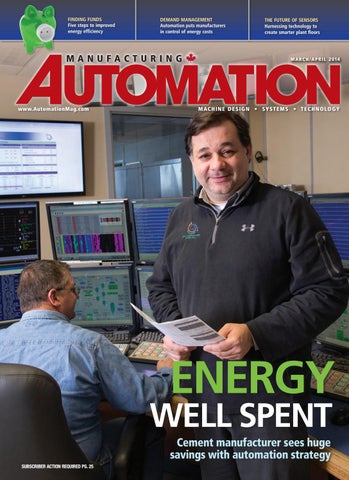
ENERGY
WELL SPENT Cement manufacturer sees huge savings with automation strategy SUBSCRIBER ACTION REQUIRED PG. 25
Need control everywhere? TM
Spend Less.
Local (CPU-based) node supports up to 256 I/O
Half and full-size modules
Distributed Machine Control
Basic Process
Fused outputs standard
Triple stack terminals standard ETHERNET
Do-more® in small spaces For control applications that are space-constrained or need distributed I/O, why not consider the new Do-more T1H series PLC? We took our popular Terminator field I/O system and added the Do-more T1H CPUs as a new brain - an incredibly powerful controller in a compact, flexible form factor. The Terminator distributed I/O system combines the features of terminal blocks and I/O modules into one convenient package. • Reduces panel space by as much as 30% over conventional PLC system with terminal blocks • Distribute I/O nodes close to field devices for faster and more efficient wiring and troubleshooting • I/O modules fit into individual I/O terminal bases for quick replacement without disturbing field wiring • Easy troubleshooting at the device termination, with status and blown fuse indicators The new T1H series CPUs give the Terminator field I/O system all the super powers of the Do-more PLC family, including expansive program memory and I/O capacity, fast processing and an intuitive instruction set. • Onboard communication ports include USB, serial, plus Ethernet (on T1H-DM1E) • Up to 256 I/O in local node (with CPU), and thousands more with optional Ethernet I/O • Coupon for 30 days free online video training included with every CPU Our shipping policies make it easier than ever to order direct from the U.S.!
Free standard shipping is available for orders totaling over $49 U.S. (except for orders which require LTL shipping, see Web site for details). Also, save on brokerage fees when shipping standard ground to Canada - allow AutomationDirect to choose the broker.
Motion
ETHERNET
H0-CTRIO2 h speed outpu Cutter interface
Create your programs and documentation with the FREE Do-more Designer software. Download it online - with the built-in simulator, you can try out your logic right away. T1H-DM1
T1H-DM1E USB 2.0 Port (Type B) • Programming
RS 232 Serial Port (RJ12) • Programming • Multipurpose Serial Communications Port
T1H-DM1
$359 .00
10/100 MB Ethernet Port (RJ45) • Programming • Modbus TCP Client and Server • Ethernet I/O Master • TCP/IP, UDP/IP • SMTP Client, SNTP Client, • TimeSync, PEERLINK
T1H-DM1E
$459 .00
Great prices, plus ...
þ þ þ
FREE software FREE online training FREE Phone Tech Support
Research, price, and buy at www.automationdirect.com/ do-more-plcs
See Web site for details and restrictions at: www.automationdirect.com/canada
Order Today, Ships Today! * See our Web site for details and restrictions. © Copyright 2013 AutomationDirect, Cumming, GA USA. All rights reserved.
PLC with H0-CTRIO2 module
1-800-633-0405
the #1 value in automation
W h A T ’ S
I N S I D e
FEATURES
DEPARTMENTS 4 5
FROM THE EDITOR AUTOMATION UPFRONT
Movers and shakers Deal makers
COLUMNS 8
COLUMNBUS
9
MACHINE SAFETY
COveR PhOTO BY SANDRA STRANgeMORe
Ian Verhappen outlines standards that help manufacturers improve the way they work with control systems Doug Nix questions whether industry is getting a good ROI for the costs associated with functional safety
10 AUTOMATION SOFTWARE
Jeremy Pollard reviews Rockwell Automation’s Connected Components Workbench 5.0
11 INDUSTRY WATCH
Paul Hogendoorn talks about lost time in the manufacturing process, and how to realize productivity gains
12 LEAN INSIGHTS
Dr. Timothy Hill reveals how using lean manufacturing principles can deliver green results
14
26 DISTORTED REALITIES
Dick Morley examines improving efficiency and reducing costs in manufacturing operations
NEW PRODUCTS 21 22 22 23 23 24 24
SENSORS ENCLOSURES & WORKSTATIONS PROGRAMMABLE CONTROL MACHINE VISION & INSPECTION RFID ELECTRONIC COMPONENTS HMI/OPERATOR INTERFACE
EnErGY WEll sPEnT
Cement manufacturer sees huge savings with automation strategy By Mary Del Ciancio
17
EmPoWErEd
18
THE PlanT Floor oF TomorroW — TodaY
Automation puts you in control of your energy costs By Patty Solberg
The technology to create smarter plant floors exists, but harnessing it requires some creativity By Vanessa Chris
20 Es inTroduc
FindinG Funds: ParT 2
Five steps to improved energy efficiency By Ryan Weaver
TECHNOLOGY HANDBOOKS TECHNOLO
GY HAND BOOK
Manufacturing AUTOMATION’s Technology Handbooks are a collection of digital magazines that focus on a single product category within Canada’s manufacturing sector. Posted on MA’s website as an interactive flip-style magazine, each Technology Handbook provides readers with specific product category information, while offering advertisers the opportunity to share their thought leadership, brand and product offering in a unique and interactive format. Don’t miss this unique and targeted opportunity to reach our readers — machine builders, component manufacturers, end users, contractors, consultants and system integrators — who turn to Manufacturing AUTOMATION for the latest industry news, products, technology solutions and expert opinion.
SENSORS
A LOOK INTO THE AND SOLUTIO PRODUCTS, TECHNO LOGIES NS SHAPING THE MARKET
DIGIT
SUPPLEMENTAL TO
MACHINE
DESIGN
• SYSTE MS
• TECHN OL
For more information and/or to book an ad in any of MA’s Technology Handbooks, please contact Klaus Pirker: 905-726-4670; kpirker@annexweb.com www.AutomationMag.com • March/April 2014
OGY
3
F R O M
T h e
e D I T O R www.automationmag.com
Vol. 29, No.2
Canada’s leading publication providing industrial automation news and technology information aimed at the discrete and process industries.
let’s talk energy
I
f you’ve ever driven on Hwy 401 passed Courtice, Ont., you’ve likely seen Canada’s largest cement plant, St. Marys Cement, off in the distance. You wouldn’t know it just by looking at this large, industrial structure, but the plant’s employees put a huge amount of work into managing energy usage at the facility. Their efforts have saved the company millions of dollars in energy costs over the last eight years. I met the plant’s operations manager, Fabio Garcia, at an Excellence in Manufacturing Consortium event focused on energy management back in the fall. He was one of the speakers, and I was impressed with his passion on the topic and the results the plant has seen thanks to his — and his team’s — efforts. When I learned about the huge role automation played in their success, I asked him if I could write a story about it in an upcoming issue. He agreed, and invited me to visit the plant and meet with the energy management conservation committee that he created. What I learned at this meeting might surprise you. I don’t want to give away the punch line, but it’s They are many strategies true what they say – “Don’t judge a book by its cover.” You may ask yourself how such a large facility, which that a company can take sits on just under 800 acres, could be energy efficient — especially in the cement industry, which typically when embarking on its operates 24-7, 365 days a year. I think there is much energy management to be learned from the approach this plant took to decrease its energy costs. Find out more on page 14 mission, including of this issue. There are, in fact, many strategies that a company demand management. can take when embarking on its energy management mission, including demand management. A demand management system, for example, can automatically curtail only the loads needed to meet your energy savings goals. Check out page 17 to learn about some demand management strategies. St. Marys Cement also incorporates demand management into its energy management strategy. They are a good example of how companies can decrease their energy use with actions that are of little to no cost to the organization. But not every company has the knowledge in place, or the technology on hand, to be able to implement their strategies. For some, an investment is required — one that will be returned once you realize the results of your energy management efforts, but an investment nonetheless. There are, however, funding opportunities available to manufacturers in Canada who want to improve their energy efficiency. Several opportunities are outlined on page 20. If you haven’t already guessed it, the theme of this issue is energy management. What steps does your company take to decrease its carbon footprint? I’d like to hear about the strategies you take to lower your energy costs, the challenges you’ve faced along the way, as well as the successes you’ve seen as a result of your efforts. Send me an email with details, and perhaps you could end up in a future issue of Manufacturing AUTOMATION! In fact, one of my goals for 2014 is to meet and chat with more readers to keep my finger on the pulse of what’s happening in the industry. So I invite you to email me, introduce yourself and let me know about the challenges that your company faces, or tell me about something exciting that your company is doing. I look forward to chatting with more of you in the coming year!
Mary Del Ciancio Editor mdelciancio@annexweb.com
Svetlana Avrutin Art Director savrutin@annexweb.com
Paul Grossinger Editorial Director pgrossinger@annexweb.com
Kathryn Nyenhuis Account Co-ordinator knyenhuis@annexweb.com
Klaus B. Pirker Group Publisher kpirker@annexweb.com (905) 726-4670
Luanne Morrison Circulation Co-ordinator 866-790-6070 ext 206 Fax: 877-624-1940 lmorrison@annexweb.com
Dick Morley Ian Verhappen Dr. Timothy Hill Paul Hogendoorn Jeremy Pollard Columnists
Michael Fredericks President mfredericks@annexweb.com
Editorial Advisory Board Al Diggins, President and General Manager, Excellence in Manufacturing Consortium David Green, Technology and Business-to-Business Marketing Professional Piero Cherubini, Dean, Faculty of Skilled Trades and Apprenticeship, Mohawk College of Applied Arts and Technology Sherman Lang, Industrial Technology Advisor, Industrial Research Assistance Program, National Research Council of Canada Don McCrudden, Vice-President, Business Development, Festo Bill Valedis, Vice-President, Precision Training Products & Services Inc.
Manufacturing AUTOMATION is published seven times a year by Annex Publishing & Printing Inc. 222 Edward Street, Aurora, Ontario L4G 1W6 Tel: (905) 727–0077 Fax: (905) 727–0017 PM # 40065710
The contents of Manufacturing Automation are copyright ©2014 by Annex Publishing & Printing Inc. and may not be reproduced in whole or part without written consent. Annex Publishing & Printing Inc. disclaims any warranty as to the accuracy, completeness or currency of the contents of this publication and disclaims all liability in respect of the results of any action taken or not taken in reliance upon information in this publication. Send address changes and return undeliverable Address Blocks to: Manufacturing AUTOMATION, P.O. Box 530, Simcoe ON N3Y 4N5. Return postage guaranteed.
Subscription rates: Canada — $40 per year. United States and Foreign — $60(US) per year. Student subscription rate $20 per year. ISSN-1480-2996
We acknowledge the financial support of the Government of Canada through the Canada Periodical Fund of the Department of Canadian Heritage.
Mary Del Ciancio mdelciancio@annexweb.com Follow me on Twitter @AutomationMag
4
March/April 2014 • Manufacturing AUTOMATION
Members of
A U T O M A T I O N
U P F R O N T
Helukabel continues international growth with three new affiliates
H
elukabel has expanded its global reach by adding local branches in three strategic markets. During the third quarter of 2013, the cable manufacturer launched new affiliates in the United Kingdom and the Middle East. And in the beginning of the fourth quarter, Helukabel Indonesia became the 23rd
affiliate to join the global network. “The addition of local affiliates in the United Kingdom and Indonesia and the
Middle East region will allow our customers in the U.S. and Canada to have a seamless network for supplying cable orders that are bound for these international markets,” said Helukabel USA president Markus Dannheim and Alex Kanouni, vice-president of sales and marketing of Helukabel Canada, jointly. Helukabel UK, with central offices located in Liverpool, will be responsible for customers in England, Scotland,
Wales and Northern Ireland. Helukabel Middle East will cover the United Arab Emirates, Saudi Arabia, Qatar, Oman, Bahrain, Kuwait, Yemen, Egypt, Iraq, Libya, Jordan, Lebanon, Syria and Pakistan from its UAE base of operations. Helukabel Indonesia will provide cable and wire solutions throughout Indonesia from its facility in the capital city of Jakarta.
Franklin Empire opens new branch
F
ranklin Empire, a family-owned electrical distributor that also specializes in automation systems for manufacturing processes, opened its 20th branch in January 2014, this one located in Sept-îles, Que. The branch manager, Jean Levasseur, comes with many years of experience in electrical and mechanical distribution. The company now has 11 branches in the Quebec area, with its head office in Montreal, four branches in the Greater Toronto Area, one in Ottawa and three in southwestern Ontario.
Ontario’s Eclipse Automation plans U.S. expansion
C
ambridge, Ont.-based Eclipse Automation will expand its operations to Charlotte, N.C., by opening Eclipse Automation Southeast, LLC, effective March 1, 2014. The new facility will feature 25,000 square feet of engineering and manufacturing space, and be located in the Whitehall Technology Park in Charlotte. “We have recognized an exponential demand for our innovative custom automation solutions over the past three years and the need to expand our operations to better service our customers,” said Steve Mai, president and CEO of Eclipse Automation in Cambridge, Ont. “We have not only identified the need to expand operations, but the equally important requirement to bring our services closer to customers in the U.S.A.” Eric Nitsche, president of Eclipse Automation Southeast in Charlotte, added, “We are extremely confident that the Eclipse business model will flourish in the Southeastern U.S. The region continues to be vibrant and is poised for further growth. In the end, we want to ensure that this active manufacturing sector has ready access to Eclipse’s exceptional solutions and our people who deliver them.” Eclipse Automation, founded in 2001, is a supplier of custom automated manufacturing equipment for the solar, health sciences, transportation, mining, consumer/ industrial and telecommunications/electronic industries. With a workforce of more than 150 employees in Cambridge, Eclipse provides in-house system design, fabrication, system integration and commissioning capability. Beckhoff_MA_March.indd 1
www.AutomationMag.com • March/April 2014 5 2014-02-19 9:56 AM
A U T O M A T I O N
U P F R O N T
DEAL MAKERS adept Technology enhances sales network in North America Adept Technology, Inc., a provider of intelligent robots, autonomous mobile solutions and services, has enhanced its sales network in North America with the addition of several manufacturers’ representatives and distributors. Shelley Automation, based in Toronto, Ont., is Adept’s distributor covering all of Canada. vINSSA, based in Saltillo, Mexico, will cover Mexico. Factory automation specialists Anton and Associates (Denton, Texas) will represent Adept in Texas, Oklahoma, Arkansas and Louisiana, while Phister equipment Company (Cincinnati, Ohio) will cover Ohio, Indiana and Kentucky. Sunstate Sales (Bradenton, Fla.) is Adept’s representative for Florida.
belden and exida partner on security solution for manufacturers Belden Inc., a provider of signal transmission solutions for mission-critical applications, has signed a global agreement with exida, a consulting firm specializing in industrial automation safety and cybersecurity services. The partnership will enable the two companies to combine their areas of expertise and offer a single, streamlined source for all of their customers’ security needs. The Belden-exida partnership will provide automation suppliers, system integrators, manufacturers and end users with a simpler, more efficient process for securing their industrial network. With a single source co-ordinating the details — from the initial security assessment to the installation
IN BRIEF • Heroux-Devtek Inc. said it will lay off about 55 employees at one of its Montreal-area plants due to lower demand from the U.S. military market. The layoffs are expected to start in April and take place over 12 months, leaving 15 workers at the plant in nearby Longueuil. • Bombardier announced plans to lay off 1,700 employees from its aerospace division, mostly in Montreal, due to delays in the launch of new planes and tough market conditions. The layoffs represent six per cent of the Bombardier Aerospace workforce. • Toyota remained the top-selling automaker for a second year in a row, beating U.S. rival general Motors by some 270,000 vehicles in 2013. The Japanese auto giant also set an ambitious target to sell more than 10 million vehicles in 2014, up from the record 9.98 million vehicles it sold worldwide last year. No automaker has ever topped annual worldwide sales of 10 million.
With files from the Canadian Press and the Associated Press
of the solution — customers can optimize their industrial network resources, resulting in maximized uptime and enhanced operational productivity. “We’ve worked with exida for a number of years, tapping into their best-in-class risk analysis and security recommendations. Now we’ve formalized that partnership, and when our customers ask ‘how much security do I need?’, we can make their next steps seamless,” said Frank Williams, senior product manager at Belden’s Tofino Security. “exida’s experience in the industrial setting is the ideal match to our existing portfolio of physical and cybersecurity solutions. Together, we will help ensure the uptime and reliability of our customers’ networks is not compromised.” exida focuses on assessing new or existing
control systems, as well as policies and procedures, to help customers identify and correct vulnerabilities. After collecting and analysing the data, exida can train personnel and contractors to improve their cybersecurity countermeasures, among other services. “Our experience is unique in that we understand the devices, systems and applications used by industrial process control and factory automation engineers, as well as the IT side of security,” said John Cusimano, director of the cybersecurity division at exida. “After we perform our assessments or trainings, Belden can step in to address and resolve any security issues we identify. This partnership takes our combined services to the next level to deliver an allin-one offering.”
north American robotics shipments hit record numbers in 2013
T
he North American robotics market recorded its best year ever in 2013 in terms of robot shipments, according to statistics from the Robotic Industries Association (RIA), the industry’s trade group. A total of 22,591 robots valued at US$1.39 billion were shipped to companies in North America in 2013, beating the previous record of 20,328 robots valued at US$1.29 billion shipped in 2012. These new records for robotic shipments represent growth of 11 per cent in units and seven per cent in dollars. When sales by North American robot suppliers to companies outside North America are included, the totals are 25,772 robots valued at $1.57 billion. While robot shipments set record highs in 2013, new orders fell. A total of 21,562 robots valued at US$1.34 billion were ordered from North American companies in 2013, representing a decrease of five per cent in units and 10 per cent in dollars from 2012. While the 2013 totals for robot orders represent a contraction from 2012, they remain the second highest annual figures ever recorded for North America. “We are pleased to see another strong year for the robotics market in North America,” said Jeff Burnstein, president of RIA. “It’s exciting to see companies of all sizes continue to find value in automating with robotics.” The top industries in terms of units ordered in 2013 were life sciences (73 per cent) and food and consumer goods (67 per cent). “While the highly cyclical purchases by
automotive companies contracted in 2013 for robotics, we saw strong growth in non-automotive industries,” said Alex Shikany, director of market analysis for RIA. “The total number of robots ordered for use in non-automotive industries grew 22 per cent over 2012,” he added. In terms of applications for robot orders, increases were seen in assembly (61 per cent), material handling (13 per cent), and coating and dispensing (five per cent). The robotics market in North America ended 2013 on a strong note. New robot orders in the fourth quarter of 2013 totalled 5,831, the third highest quarterly total ever recorded (RIA began recording data in 1984). RIA estimates that some 228,000 robots are now in use in United States factories, placing the U.S. second only to Japan in robot use. “Many observers believe that only about 10 per cent of the U.S. companies that could benefit from robots have installed any so far,” Burnstein said. “A very large segment of small and medium-sized companies who may have the most to gain are just now beginning to seriously investigate robotics.”
For the most up-to-date news, stories and videos, check us out at
www.AutomationMag.com.
6
March/April 2014 • Manufacturing AUTOMATION
A U T O M A T I O N
U P F R O N T
Cisco security report documents growth of advanced attacks and malicious traffic
T
he Cisco 2014 Annual Security Report reveals that threats designed to take advantage of users’ trust in systems, applications and personal networks have reached startling levels. According to the report, a worldwide shortage of nearly a million skilled security professionals is impacting organizations’ abilities to monitor and secure networks, while overall vulnerabilities and threats reached their highest levels since 2000. The report’s findings offer a vivid picture of rapidly evolving security challenges facing businesses, IT departments and individuals. Attacker methods include socially engineered theft of passwords and credentials, hide-inplain-sight infiltrations, and exploitation of the trust required for economic transactions, government services and social interactions. According to Cisco, there is an increased sophistication and proliferation of the threat landscape. Simple attacks that caused containable damage have given way to organized cybercrime operations that are sophisticated, well funded and capable of significant economic and reputational damage to public and private sector victims. The report also reveals an increased complexity of threats and solutions due to rapid growth in intelligent mobile device adoption and cloud computing. New classes of devices and new infrastructure architectures offer attackers opportunities to exploit unanticipated weaknesses and inadequately defended assets. Some of the report’s key findings include: • Overall vulnerabilities and threats reached the highest level since initial tracking began in May 2000. As of October 2013, cumulative annual alert totals increased 14 per cent year-over-year from 2012.
• The report indicates a shortage of more than a million security professionals across the globe in 2014. Most organizations do not have the people or the systems to continuously monitor extended networks and detect infiltrations, and then apply protections, in a timely and effective manner. • 100 per cent of a sample of 30 of the world’s largest multinational company networks generated visitor traffic to websites that host malware, while 96 per cent of networks reviewed communicated traffic to hijacked servers. Similarly, 92 per cent transmitted traffic to web pages without content, which typically host malicious activity. • 99 per cent of all mobile malware targeted Android devices. At 43.8 per cent, Andr/Qdplugin-A was the most frequently encountered mobile malware, typically via repackaged copies of legitimate apps distributed via non-official marketplaces. • Specific business sectors, such as the pharmaceutical and chemical industry and the electronics manufacturing industry, have historically had high malware encounter rates. In 2012 and 2013, there was remarkable growth in malware encounters for the agriculture and mining industry — formerly a relatively low-risk sector. Malware encounters also continued to rise in the energy, oil and gas sectors. “Although the Cisco Annual Security Report paints a grim picture of the current state of cybersecurity, there is hope for restoring trust in people, institutions and technologies — and that starts with empowering defenders with real-world knowledge about expanding attack surfaces,” said John N. Stewart, senior vice-president, chief security officer, Threat Response Intelligence and Development, Cisco. “To truly protect against all of these possible attacks, defenders must understand the attackers, their motivations and their methods — before, during and after an attack.”
MOVERS AND SHAKERS Methods Machine Tools, Inc., a supplier of precision machine tools, automation and accessories, has named James “Steve” Previti as YASDA product Steve manager. Previti will create Previti and execute the North American sales strategy for Methods’ new line of machines. YASDA Precision Tools is a Japanese builder of machining centres and jig borers. Previti has more than 16 years of experience in the machine tool industry, most recently as regional sales manager for Mitsui Seiki, and prior to that as a sales engineer at Able Machine Tools, Inc. he holds a B.Sc. in electrical engineering from the University of Maryland College Park. John Parker is the new North American product manager for controls at Heidenhain Corporation. Bringing nearly 30 years of experience in the machine John Parker tool industry to this position, Parker will serve as heidenhain’s point person for the CNC product lines, and serve as a liaison between the company’s sales, marketing and engineering departments. Parker holds an electronics degree from Devry Institute of Technology.
Automation Equipment for Process Control Équipement d’Automatisation pour le Contrôle de Procédé PLC + HMI with Data Logging API + IHM avec enregistrement des données
⁄8 DIN Universal Process Panel Meter with Built-In USB Indicateur de procédé universel 1⁄8 DIN à montage sur panneau avec USB intégré 1
DP63100 Starts at Á partir de $ 339
Série OCS-XL Starts at/ À partir de $450
Visit/Visitez omega.ca/dp63100 Web Enabled Controllers Contrôleurs optimisés Web
• More Compact and Affordable than Separate PLC and Operator Interface • Best of Class Graphics Display for Better Process Visualization and Machine Indication • Plus compact et économique qu’un API et une E/S séparés • Meilleur afficheur graphique de sa classe pour mieux visualiser les procédés et les indications machine
Visit omega.ca/ocsxl_series
© COPYRIGHT 2011 OMEGA ENGINEERING, INC. ALL RIGHTS RESERVED
©©COPYRIGHT 2014 OMEGA OMEGA ENGINEERING, ENGINEERINGINC. INC. ALL RIGHTS RESERVED COPYRIGHT 2012 ALL RIGHTS RESERVED © COPYRIGHT 2014 OMEGA ENGINEERING, INC. TOUS DROITS RESERVES
Omega_MA_March.indd 1
CSMSTR Series/Série Starts at/ À partir de $975
DCT Series/Seríe Starts at À partir de $ 535
Visit/Visitez omega.ca/csmstr
1-888-826-6342
Angular Pneumatic Grippers 180° Series DIRECTCONNECT TM Appareils de préhension angulaires pneumatiques sur 180° série DIRECTCONNECT M C
Visit/Visitez omega.ca/dct_series
omega.ca
®
976 Bergar Laval, Québec Canada H7L 5A1
www.AutomationMag.com • March/April 2014 7 2014-02-18 2:13 PM
C O L U M N B U S
Sound the alarm: Standards that help you deal with the unexpected By Ian Verhappen
O
ne of the best ways to save energy and minimize waste is to better manage your processes and know what is going on every step of the way. ISA is trying to help manufacturers do this, with three standards committees that are focused on developing documents to improve the way we work with our control systems and their human machine interfaces (HMIs). The oldest of these standards is the ISA-18 series on “Instrument Signals and Alarms,” which includes the ISA-18.1 standard on annunciators, sequences and specifications. The ISA-18.2 series of documents, however, is presently before the IEC to become a global standard, and this is more relevant to modern alarm systems. (Note that the keywords “alarm systems” are now being used when referring to taking control and managing the data used to inform you of an abnormal situation.) The committee released three documents — “Enhanced and Advanced Alarm Methods,” “Alarm Monitoring, Assessment and Audit,” and “Alarm Design for Batch and Discrete Processes” — in 2012. They plan to complete an additional four documents — “Alarm Philosophy,” “Alarm Identification and Rationalization,” “Basic Alarm Design,” and “Alarm Management for Packaged Equipment” — this year before submitting all seven documents to the IEC.
With EPLAN Electric P8, the leader in design automation, you can accomplish in a day what takes a week or more using CAD tools. EPLAN performs the most time-consuming tasks like wirenumbering, device-tagging, cross-referencing and error-checking so you can focus on what’s most important – quality and innovation. Standardization is another powerful project accelerator – storing and re-using data the way only EPLAN can. Creating simple, complex, even scalable macros is a snap. So is finding components you need with a Data Portal search. It takes only seconds. Drag and drop it into your project. EPLAN makes the master data set for you. Automation and standardization are the future. EPLAN Electric P8 maximizes their potential. Feel the power at your fingertips. Request your free 30-day trial at
With an effective alarm design process in place through ISA-18, the resulting information then has to be presented to the operator. This is where the second series of standards, ISA-101, comes into play. ISA-101 documents on “Human Machine Interfaces” are intended for those responsible for designing, implementing, using and/or managing HMIs in manufacturing applications. The documents will include such items as: menu hierarchies; screen navigation conventions; graphics and colour conventions; dynamic elements; alarming conventions; security methods and electronic signature attributes; interfaces with background programming and historical databases; popup conventions, help screens and methods used to work with alarms; program object interfaces; and configuration interfaces to databases, servers and networks. These two standards are starting to take advantage of networks and device intelligence by incorporating device health information into the associated logic, reports and displays. As part of its recommendations, ISA-101 recommends that a status matrix or status box adjacent be associated with each tag/control loop as per the following table: Condition
Position
Description
Activated Symbol & Colour
RGB
Colour
Alarm State
1
Alarm acknowledged (steady) or unacknowledged (flashing)
255,30,102
Red
Manual Mode
2
Manual mode
40,20,220
Dark Blue
Forced Mode
3
Input or output to forced mode
255,255,0
Yellow
Local Mode with respect to station
4
Local mode, internal mode, panel mode, external set point
130,100,160
Purple
Action Mode
5
Priority command active, interlock command active or action from voting logic
255,150,170
Orange
Disabled/Inhibited Mode
6
Disabled or inhibited alarms
40,125,245
Blue
The colours above are only suggestions, but the philosophy is to use colour to display an abnormal situation so that an operator can quickly identify that something is happening and start the corrective action process. It is all well and good to know that something is happening in your facility; however, the important part is how you respond to the situation. This is where the third of the ISA standards, ISA-106 “Procedure Automation for Continuous Process Operations,” helps by automating the response from the control system to either take action directly or provide direction to the operator on how to respond to events that do not occur regularly. To do this, ISA-106 develops standards, recommended practices and technical reports on the design and implementation of procedures for automating continuous process operations. They do this by providing guidance on: models and terminology; modularization of procedural steps to foster re-use and lower total cost of ownership; exception handling for abnormal situations; physical, procedural and application models; process unit orientation with operational perspective; recommended best practices; implementation of startup, shutdown, abnormal situations, hold states and transition logic; recommended target platform (i.e., control system vs. safety system) for different types of procedures; life cycle management best practices; and training and certification best practices for continuous processing applications. Effectively, the tools that ISA-106 provide allow you as an operator to not only capture best practices for your facility from all the knowledge that will soon be retiring, but in doing so will also increase your compliance with regulations while providing a documented procedure in the rare event something out of the ordinary does happen. We have not yet perfected the HMI and likely never will; however, we are getting better at taking into consideration how we interact with our control systems and the new information now available to us. I may not always know what I am doing, but with the new standards and practices available today, I can now at least quickly see how I am doing, which is certainly a step in the right direction for managing our processes to operate most efficiently, saving energy and minimizing waste in the process. • Ian Verhappen, P.Eng. is an ISA Fellow, ISA Certified Automation Professional (CAP), and a recognized authority on Foundation Fieldbus and industrial communications technologies. Verhappen leads global consultancy Industrial Automation Networks Inc., specializing in field-level industrial communications, process analytics and heavy oil / oil sands automation. Feedback is always welcome via email at iverhappen@gmail.com.
8
March/April 2014 • Manufacturing AUTOMATION
plan_MA_Oct.indd 1
12-09-18 1:00 PM
M ac h in e
S af e ty
Functional safety: Are we getting good ROI? By Doug Nix
M
achine builders put a lot of time, effort and component costs into reliable safety systems for machinery. The requirements for these systems are increasingly complex, with some practitioners estimating as much as 90 hours of design and documentation time required to meet the standards requirements. This begs the question, “Is industry getting good return on investment for the cost associated with functional safety?” Why do we need standards? Machine safety is about protecting workers from injury. Many studies have shown the extremely high cost of workplace injuries. Machine safety experts began to realize in the 1970s that effective machine guarding could provide significant risk reduction for workers. Even in 1974, some types of safety-related controls, like two-hand, anti-tie-down controls on power presses, had been in use for many years. It soon became clear that requirements covering the design of the control systems were needed, and since the machinery sector had little direct experience with these kinds of requirements, work done in the aerospace and nuclear industries was used to develop the basic requirements. It was reasonable at that time to implement some structure to the design of safety systems without knowing whether or not the end result would be reduced workplace injuries, when the balance of probabilities said that it would, and the practice was accepted. Oddly, government and industry failed to monitor the effectiveness of these new measures, with the exception of a few small studies. Machine safety standards have continued to evolve. We are now almost 20 years downstream from the introduction of EN 954-1, and we still don’t know if our efforts have reduced injuries in the workplace. The need for data It has long been said that you can’t manage what you don’t measure, but when it comes to the effectiveness of control reliability as a risk control technique, this is exactly what we are doing. In 2012, VDW, the German Machine Tool Builder’s Association, conducted a study of injuries related to machine tools, and produced a report that showed that the majority of injuries occurring to users of machine tools were not happening during normal operation. In fact, most injuries were happening to maintenance and service technicians when they were attempting to troubleshoot or repair the machinery when the safety systems were bypassed intentionally or offline for some reason. It is reasonable to say, based on this, that safety systems reduce injuries when they are working, but nothing more. If the results from the study could be generalized to all machines, we might say that we have gone above and beyond to address the risks posed to workers using machine tools. The problem we have is this: There is no data that supports the idea that today’s machines are measurably safer than those built 15 years ago. We have absolutely no way to gauge the effectiveness of the increased reliability of these systems on risk reduction. To answer this question, we need data that discriminates between injuries that occur due to safety control system failures and those from other causes. At the moment, we cannot say that we are getting a good return on our design and compliance investment in this area. Government regulators need to be pressed to gather this information. The bigger question The VDW study brings up another question: What is being done to reduce injuries occurring when the machinery should be under lockout or some other hazardous energy control procedure? Based on VDW’s data in German industry, the injury rate in this phase of the life of the machinery is hundreds of times higher than during the normal operation, set up and related phases. Standards like ISO 12100 require machine builders to consider all aspects of the life cycle of their machinery. To achieve significant risk reduction for maintenance and service workers, focus needs to be placed on these parts of the life cycle. For the moment, this continues to fall on employers and machine users instead of machine builders, with an unacceptable level of workplace injuries as a result. • Doug Nix is managing director at Compliance InSight Consulting (www.complianceinsight. ca). He has more than 25 years of engineering technology expertise, though he has focused on risk assessment and machinery safety since 1996. Read his blog at machinerysafety101.com. www.AutomationMag.com • March/April 2014 win_MA_May.indd 1
9
12-04-26 10:54 AM
A U T O M A T I O N
S O F T W A R e
A review of Rockwell Automation’s Connected Components Workbench 5.0 By JErEMy pOllArD
I
have never thought of myself as being “out of a loop,” but I fear I have been. By all accounts, the Connected Components Workbench (CCW) has been around for a few years. It is a free programming and monitoring platform for Rockwell Automation’s Micro800 PLC product line, which supports certain HMI platforms, as well as drives, soft starts, safety devices and expansion modules for the Micro800 system. My first impression is that it still needs some work. The software is based loosely on the IEC-61131 programming specification and includes three of the five languages — Ladder Diagram (LD), Structured Text (ST) and Function Block (FB). It supports user-defined FBs and data types. I installed the DVD in a Windows 7 Professional virtual machine, and while everything runs, it is a bit sluggish, suggesting that the more horsepower you have the better. The interface is very clean, but busy. There are tons of options for controllers, setup and devices, which is nothing new for a seasoned ControlLogix user. But if you haven’t ventured into that arena, it might be slightly intimidating. There is a plethora of assistance for this product. Guides, sample code and a very intense help file can take the user anywhere they want to go. Having said that, IEC61131 is not as widely accepted in North America as it is in other parts of the world. In my experience reviewing other IEC software integrated development environments (IDEs), it has always been a tedious transition for an RSLogix user. Is this time different? I would suggest yes. The environment is way different than anything else that Rockwell has developed. I was disappointed that the free-form keyboard editor is not present. There are, however, keyboard shortcuts that are non-intuitive. But as you learn the more important shortcuts, they provide some time savings. So really, this is a mouse and data entry-based IDE. The IEC specification involves data types, language integration, program organizational units (POUs), user-defined function blocks, etc. It is not the same as RSLogix, so there will be a learning curve. It took awhile to install. It requires Windows XP/7/8. I tried installing it on XP SP3, but didn’t record the error message. So Win7 it was. It is visually pleasing, with the ability to configure how many slices of bread it can toast at once. The help system is full, complete and may even provide too much information. It is context sensitive, which means that help is provided on the object that the cursor is on at the time. Based on my experience with IEC IDEs, I get the feeling that Rockwell did not want to fall flat with their effort, so effort was put in. For a simple tour, a local variable is associated with a given POU, while a global variable is the hardware, along with any data you need to see from all POUs. An understanding of the IEC approach is somewhat helpful here. The toolbar views can clean up the display if your video resolution doesn’t allow for a lot of canvas
A screenshot of the Connected Components Workbench IDE workspace canvas viewing space. For whatever reason, you can’t view the instruction address/variable alias (formerly known as a symbol) along with the comment (formerly known as address comment) on screen. As of this writing, I haven’t figured out how to get it onto the printed documentation either. Drag and drop is active, but for some reason it doesn’t allow the copy function. And don’t be fooled with the grid layout. You can place many commands on a single rung. I didn’t bother to find out how many, but as with most hardware platforms, it would be limited by the PLC’s/PAC’s firmware. Single click and double click take you to different places, which is just something you have to get used to. Instructions that need attention are indicated by a small yellow triangle. A major advantage of the IEC platform is the ability to abstract certain actions through the use of function blocks. And with the ability to integrate HMI, motion and drives into a complete platform IDE, this one-stop programming environment deals with all of the hardware components. This isn’t new. Many companies have been using IEC-based systems forever, and include this integration, but they don’t have near the market share that Rockwell has. So by learning about this tool, it may in fact give users a better feeling about trying out the other guys. Regardless of whose hardware platform you use, get a copy of this software and learn some of the attributes. Consider it an investment! • Jeremy Pollard (jpollard@tsuonline.com) has been in the industrial automation industry for more than 25 years. He has worked as a systems integrator, consultant and educator.
‘
Don t lose your cool!! Cooling solutions that offer maximum reliability for maximum up time Performance guaranteed by TÜV Nord Up to 70% in Energy-Savings (45% average)
ENCLOSURES ENCLOSURES
POWERPOWER DISTRIBUTION DISTRIBUTION
CLIMATE CLIMATE CONTROL CONTROL
IT INFRASTRUCTURE IT INFRASTRUCTURE
SOFTWARE SOFTWARE & SERVICES & SERVICES www.rittal.ca
10 Rittal_MA_March.indd March/April 20141 • Manufacturing AUTOMATION
2014-02-13 3:46 PM
I ndustry
W atc h
Making up for lost time By Paul Hogendoorn
T
© 2014 SCHUNK GmbH & Co. KG
here are many instances when our different ways that time is lost, it becomes make time for productivity improvement. It Paul Hogendoorn (paulh@getfreepoint.com) recently processes regularly lose production a matter finding the biggest causes of lost will improve the bottom line today, and help launched FreePoint Technologies (www. getfreepoint. time — before shift end, before time and the easiest ones to resolve. assure continued success tomorrow. It’s too com), developing and delivering productivity measurement tools for manufacturing companies. and after breaks, or as a result of extra setup As business leaders, we need to continually critical a task to ignore. • or maintenance time, adjustment time and time waiting for parts. All of this is lost time that has to be made up or accounted for. Sometimes we overcomplicate things related to productivity and profitability. We add systems, employ specialists, devise calculations and spend a lot of time estimating and benchmarking, not to mention adding expensive software, IT infrastructure and SWS Quick-Change System the people to deploy and manage those things. And, in some cases, all of this expenfaster gripper change sive activity results in even more lost time. Many company leaders understand and ascribe to the credo that “you have to spend money to make money,” but they are also SRH-plus Swivel Head quick to recite an even more common mantra — “time is money.” Regular readers standard protection class of this column have often heard me recite one of my favourite mantras — “you can’t improve what you don’t measure.” This rings instantly true for most, but many still get stalled by the mere thought of the time and expense involved in putting in a measurement system. When I encounter people stuck in the middle, I suggest taking a few PGN-plus baby steps. Savings realized and profits 2-Finger Parallel Gripper improved from these initial efforts then get with multi-tooth The re-invested into the next step, and so on. At guidance No. the same time, the confidence to invest in more significant productivity improvement measurements grows. A good example of baby steps is measuring the time of the first part produced by a person, machine or process, and the time of the last part produced. I observed this first hand at a local manufacturing facility, where a critical machine routinely produced its first part around 7:30 am and its last part at around 4:40 pm. The regular shift was from 7 am to 5 pm. With normal breaks and typical production interruptions, the machine was running for an average of six hours and 10 minutes Your automated handling system. per day, producing just over 900 parts. We It’s time to make use of installed a simple productivity monitor on your machine’s full potential. the machine, and after a week, the averwww.ca.schunk.com/machine-potential age machine running time increased to six Jens Lehmann, Brand Ambassador of hours and 45 minutes a day, and production SCHUNK, the family-owned company increased to over 1,100 parts. They now routinely exceed 1,300 parts per day! The keys to success with a baby step like this are simple: the measurement has to be automatic and done in real time without operator intervention; and the resultant information has to be shared as a tool with the operator. Sustainable productivity gains can be very easily achieved without spending too much time or money. Identifying lost time is the first step. After identifying all the
90 %
IP 67
1
AnzSynergie_PGNplus_SRH_SWS-I_CA_0413_162x248_2.indd 1 Schunk_MA_March.indd 1
www.AutomationMag.com • March/April 201415:2111 26.02.14 2014-02-26 10:30 AM
L e A N
I N S I g h T S
Lean and green: Use lean manufacturing principles to deliver green results By Dr. TIMOTHy D. HIll, pH.D., ClSSMBB, pMp
O
ne of my heroes from the lean and quality movement, Japanese organizational theorist Masaaki Imai, used to say this about successful lean and kaizen implementation: “My definition of lean is to employ minimum resources for the maximum benefits. Therefore, kaizen leads to lean, and lean leads to green. Kaizen is the most environmentally friendly approach.” While there’s no doubt that lean results in lowered waste, material and labour costs, there is less discussion about the benefits of lean in relation to green manufacturing,
warehousing, the office, health care and the like. Consumers, regulators, shareholders and stakeholders are all asking for more sustainability. It’s a different world than it was even 10 years ago. Here are a few examples of results cited in the U.S. Environmental Protection Agency’s “The Lean and Energy Toolkit”: • From 2005-2007, General Electric reduced greenhouse gas emissions by 250,000 metric tons and saved $70 million in energy costs. • A Baxter International facility combined lean/Six Sigma and
energy-efficiency efforts to save $300,000 in energy costs in one year. • Toyota Motor Manufacturing North America has reduced average facility energy consumption per vehicle by 30 per cent since 2000. In fact, Toyota has reduced its landfill contribution down to functionally zero, and achieved ISO 14000 certification because of it. It’s interesting that these three companies are bridging the continuous improvement gap between operational performance and environmental performance. It’s true that when many of
From the bookshelf
lean and Green: Profit for Your Workplace and the Environment by Pamela J. Gordon The main point that gordon makes is that if you reduce waste and increase recycling, it will be good for the environment and for profits. It’s really as simple as that. Plus, if you’ve already started your lean journey, enhancing that journey to increase recycling shouldn’t be that hard. There’s still a sense out there that business profitability and environmental responsibility are at odds with each other. In much the same way as we’re not able to see the truly transformational nature of the introduction of the Toyota Production System (TPS) because it was so long ago, we’re still holding on to this belief. Toyota turned the world on its ear when it brought forward TPS, and most everything that they did was very innovative, even if today we take some elements of TPS for granted. gordon proves that capitalism and environmentalism are not mutually exclusive. She shows how green business practices enable organizations to save millions of dollars each year with more than 100 examples of how it’s been done. She details such waste-saving,
profit-building acts as basic as digging out usable preworn shoe covers to wear in the clean room, and as broad as the city of Santa Monica paving residential streets with white top to reduce urban heat and increase surface longevity. These ideas all came from those closest to production, a key tenet of lean. Many business leaders have invested time, energy, attention and financial resources in environmental protection, but sometimes their efforts are not consistent, appreciated or even encouraged. To her credit, gordon personally visited 16 of the companies cited, adding a higher degree of authenticity to her work and this book. In short, this is a well-researched and very readable, practical guide aimed at people just beginning their journey. It proves that integrating environmentally friendly processes and procedures in manufacturing operations is not only necessary for code compliance and corporate public relations, but can also improve a company’s financial performance.
Make a lasting connection with HARTING Canada
Ethernet Connectivity Switches
us implement lean in our organizations, we try focus on easy-to-change items all the way up to equipment reliability. Embracing lean and green manufacturing requires giving more focus to environmental and energy concerns than just the implementation of reliability improvement projects. It’s easy to do, but it requires a subtle change in perspective. Improvements geared toward equipment reliability have distinct linkages to environmental performance, such as reducing the amount of product and raw material waste through: • The elimination of catastrophic breakdowns through formalized root cause analysis; • Providing routine monitoring of system parameters through predictive technologies; and • Preventing interruptions to production cycles with a focus on overall equipment effectiveness. From lean to green The similarity between lean and green is waste. So it should make sense that to achieve higher levels of environmental performance, your organization must first adopt the principles and practices of lean. Two examples from the EPA’s research on lean and the environment help to illustrate this point. • Eastman Kodak conducted numerous lean kaizen events focused on energy reductions by asking “what do we use energy to do?” They found
Han® Rectangular & Han-Eco® Connectors
HARTING PushPull Connectors
Han-Inox® & Han-Yellock®
Reliable, time-tested solutions
With HARTING you have a partner who ensures you dependable technologies that stand the test of time. For more than 25 years in North America we continue the proud tradition of our German parent company delivering unrivaled reliability, efficiency, performance and innovation. www.HARTING.ca Manufacturing_Final.indd 1
12 Harting_MA_March.indd March/April 2014 1 • Manufacturing AUTOMATION
2/24/2014 8:49:50 AM 2014-02-26 10:13 AM
Add some green to
Get your free ebook:
your lean by looking over the next horizon and thinking about what else you might achieve
Supply Chain Optimization Winning Formulas
in your lean efforts. that over the seven-year period, energy reductions resulted in savings of nearly $15 million. • Baxter International Healthcare Corporation used value stream mapping. In one plant, 96 opportunities for environmental impact improvement were identified, prioritized and implemented, with an estimated energy reduction value of 170,000 gallons of water per day. Other lean concepts, such as operator care, kanban and SMED, can potentially improve the environmental performance of your organization as well. Operator care programs focus on developing standard work within the operating units to decrease variation, which reduces the amount of product and raw materials waste. For example, a global leader in alumina refining and manufacturing of aluminum products successfully reduced energy consumption as a result of training operators in better standards of loading, starting and operating manufacturing equipment. Kanban is designed to provide the right materials at the right time to support manufacturing needs. Kanban
reduces excessive inventories of raw or work-in-process materials. Cell-based manufacturing processes that signal a pull for materials based on the demand for product can significantly reduce raw material consumption, decreasing the amount of waste material delivered to landfills, as well as reducing the demand on raw material resources. SMED, or single minute exchange of dies, has the potential to reduce the amount of waste generated from raw and unprocessed materials left over in manufacturing processes. For example, an aluminum door and window manufacturing facility found that they could reduce the amount of paint wasted per changeover from 50 gallons per day to less than 10 gallons. Paint disposal costs dropped by as much as $280,000 annually, and paint and solvent disposal were reduced by more than 40 per cent. So add some green to your lean by looking over the next horizon and thinking about what else you might achieve in your lean efforts. It might be reducing your landfill contributions by composting, using less cardboard packaging by using totes that are standardized, or by reducing the work-in-process that leads to waste.
One of the most important “consequences of using SYSPRO is that our inventory control has tightened considerably without having to add additional people or increase anybody’s workload.
”
Blair Stunder, General Manager Arctic Manufacturing
Question from the floor QUESTION: We’re starting our lean initiative with a kaizen approach. We’re getting people to come up with small improvement suggestions and then letting them take care of these issues. We started off good, but our progress has really slowed. Can you help? ANSWER: Henry Ford once said, “Whether you think you can or that you can’t, you are usually right.” I’m guessing that you started off picking the low-hanging fruit and moved quickly on to more complex issues. You have to shift your collective mindset from talking about why this won’t work to reframing the discussion around making it work. I would also suggest getting everyone together and asking them to list the things that they welcome from this new kaizen initiative, as well as the things that they’re afraid of. I’ve done this in diverse areas — from manufacturing to health care — and the answers may surprise you. Mostly people are afraid of changes to their routine. Take care to point out the items that you want to reduce or eliminate. Make sure that they’ve got some vested interest in this list. It’s not all about maximizing profit. Include items such as unsafe work, high-risk items, high boredom items and the like. Show them that they will be improving their working lives. Lastly, try to move forward at a reasonable pace. I’ve seen too many senior leaders push their employees too quickly. • Dr. Timothy Hill is an Industrial and Organizational Psychologist and Certified Lean Six Sigma Black Belt with global expertise in Human Resources/Human Capital. He can be reached at drtim@kyoseicanada.ca.
Visit www.syspro.com/IO Call 1-888-259-6666 ext 5228 Email sales@ca.syspro.com
www.AutomationMag.com • March/April 2014 Syspro_MA_March.indd 1
13
2014-02-13 2:22 PM
C o v e r
S tory
Energy
well spent
Cement manufacturer sees huge savings with automation strategy By Mary Del Ciancio
W
hen Fabio Garcia moved to Canada to work for St. Marys Cement’s Bowmanville plant in 2003, he saw an opportunity to save the plant money — millions of dollars, in fact.
Coming from Brazil, where industry’s use of energy is very tight, the operations manager knew the plant could better manage its energy, which accounts for 35 per cent of its overall costs. “It’s a huge impact on your cost,” Garcia says. “It was hard to understand, why would you not take care of that?” But where would he start? Cement manufacturing is different than most industries in that it’s a 24-7, 365-days-a-year operation — and St. Marys Cement has been operating this way since 1912. Its Bowmanville plant, the largest cement plant in Canada, would have to undergo a paradigm shift if they were going to be successful in reducing energy consumption. “The kiln takes 24 hours to heat, 24 hours to cool. It’s certainly not something that we would want to start and stop rapidly. So that means that all the ancillary processes that feed that system are generally ones that run 24-7, 365, and most cement plants operate with that mentality. Everything runs all of the time,” says Jason Schultz, the facility’s quality manager. “What we’re doing is looking at how we can take blocks of our process, control volumes of our process, and add in levels of complexity and control that give us the flexibility to operate some equipment at less than that 24-7 interval.” Their success would hinge on gathering the information needed to make decisions, getting the right people in place to steer the charge, and implementing automation.
Putting a plan in motion The plant began focusing on energy management in 2005. They started by gathering information about their energy costs to determine exactly how much they were spending. They went through their bills and found three occasions where there was missing metering data, and historical data was substituted on occasions where the plant had slowed down its operations and the costs shouldn’t have been that high. This simple process saved the plant $50,000. The next step was to get people on board. In 2006, Garcia launched the Energy Management Conservation Committee, or E=MC2, with eight 14
March/April 2014 • Manufacturing AUTOMATION
representatives from various departments within the facility. This group would be tasked with reviewing the entire operation and coming up with ideas to reduce energy consumption, and then implementing them. Today, the group, which meets every Tuesday to discuss ideas and review progress, has expanded to include 11 individuals from such departments as production, electrical, quality control, environmental, mechanical maintenance, HR and finance.
The group also focused on educating the workforce about energy management. Their approach was to teach employees how to conserve energy at home, with the hope that once they started seeing results, they would bring this mindset to work with them and help save the plant money, too. Over the last eight years, the team has identified and acted on more than 223 separate energy efficiency initiatives, reduced electrical consumption by over 14.2 million kilowatt-hours, and avoided energy costs worth more than $3 million in the process. Much of these savings, however, can be attributed to a system they created “from the ground up” that allows them to automate all of their energy initiatives and systems.
The automation factor
“If you get one representative for each department, the idea is, if I need to implement an energy initiative, that normally is going to involve operations, it’s going to involve [the] electrical department, it’s going to involve [the] mechanical department, it’s going to involve maybe the quarry. So I know that the spokesman for this department, that he’s part of the committee. He’s going to be the one that’s going to be the driver from his department to make this happen. So the ideas should be able to flow much faster,” says Garcia. The next step was to go after the low-hanging fruit — initiatives they could implement themselves with little to no cost that would yield a great return on investment. For example, they discovered a redundant fan while reviewing their operations. The team saw the opportunity to shut it down without impacting productivity — a step that saved the plant $100,000, or 1,500-kilowatt-hours of energy. Another discovery was an ineffective heating system in the quarry garage. The team installed ceiling fans to lower the temperature and improve heat distribution.
E=MC2 team member and plant systems administrator Peter Boorsma built an energy management dashboard, based on input from several team members, that manages energy usage in the plant, detailing exactly how much power is being used. Boorsma was able to do this without purchasing additional computers or control systems, but rather through utilizing their existing computers and control system infrastructure. The main dashboard in the control room shows the plant’s power, the demand for the province of Ontario and the hourly electricity price. It also shows the plant’s five critical peaks, and what their contribution is to the five critical peaks for Ontario. There are screens in the control room that show the main dashboard, load shedding, kiln startup, calciner startup and raw mill startup. Efficiency indicators, alarms and automatic shutdown were put in place throughout the plant to help employees better manage energy usage. “We started out by going through a lot of our systems and looking at purge times — how long the system was running to empty out. And rather than just taking the safe approach and having systems run probably twice as long as necessary to completely purge the system, we actually timed it and staged the shutdown so that we didn’t have the equipment running any longer than necessary on various systems throughout the plant,” says Jim Storey, electrical maintenance manager and member of E=MC2. There is a panel meter on the operator’s display in each process area that shows the pre-determined
photos by Sandra Strangemore
Fabio Garcia, operations manager with St. Marys Cement’s Bowmanville plant, has helped the company save millions with his approach to energy management.
www.AutomationMag.com • March/April 2014
15
St. Marys Cement’s energy management conservation committee includes representatives from various departments tasked with coming up with ideas to reduce energy consumption. Six of the committee’s 11 members (from L to R) are: Jason Schultz, Fabio Garcia (sitting), Steve Hunter, Jim Storey, Peter Boorsma (sitting) and Nick Papanicolaou. optimal operational energy consumption. The operators get visual indicators on their process control screens when systems are running less than optimal, empty or at low tonnages. “If we have high energy consumption in areas, there will be alarms generated, or if the system is running empty and there’s an energy savings opportunity, alarms will come on so that we know we can go out and shut systems down when they’re not productive,” explains Storey. “We’re basically taking a look at how the entire circuit needs to start, piece by piece, and organizing all equipment with frequencies and wait times between the different starts,” says Nick Papanicolaou, production manager and member of E=MC2. “It’s literally the click of one button to say, ‘I want this system to start up,’ and the automation in place starts up every piece of equipment in a proper sequence so that nothing will overload something else and it’s going to balance itself out. A lot of automation has been put in to allow our operators to be effective at running our process.” The plant manages energy in terms of consumption and hourly pricing. They have set pricing alarms so that they’re notified when price points are going to change. For example, explains Storey, “We can automatically start up dewatering systems in our quarry based on pricing. So if the level of the water in the quarry is above a certain level, we may have to pump, especially in the spring, continuously. But other times of the year we can pump when the price is less a certain amount, typically in the evenings and weekends. So it’s all automated.” “There’s been dashboards built where we’ll get an alarm at noon that says ‘tonight your power prices could be very low in comparison to now,’” explains Papanicolaou. “That alarm will trigger the thought process amongst our group to say, ‘Is there something that’s running now that doesn’t need to? Do you have inventory in other areas that will allow you to stop it 16
March/April 2014 • Manufacturing AUTOMATION
and run it tonight because it’s going to be more cost effective?’ So all of that is automated where we’re prompted to make those management-level decisions by the automation that’s in place.” Automation also allows the team to co-ordinate load shedding. “If we know that there’s going to be a critical peak for a certain day, then we can choose which equipment is going to shut down, we can choose the time at which it is going to shut down, and it will just happen,” says Boorsma. “We don’t have to send instructions to anybody. It will just happen.” Automation allows the plant to effectively participate in the Ontario Power Authority’s demand response program — a program where companies get paid to reduce electricity consumption. By participating in DR3 — a contract-based program where participants are required to reduce loads when they are called upon — they have the opportunity to generate increased revenue provided they meet the contractual obligations. The plant has received $2.3 million back over the last two years just by participating in this program. (This is in addition to the more than $3 million in savings they’ve seen since their efforts began.) “It’s a pretty elaborate amount of automation, but it’s working, and I think the results speak for themselves,” says Papanicolaou.
Going for excellence Thanks to all of their efforts, the Bowmanville plant has received the Certification of Energy Excellence (CEE) from 360 Energy — a certification awarded to organizations using international best practices for sustainable energy management. They have also received ISO 50001 certification — the first to receive this designation in North America, they say. This specification lays out the requirements for establishing, implementing and improving an energy management system, and allows the plant to follow a systematic approach to
achieving their energy goals. “We have a world-class system, and certification can help validate that world-class system,” says Schultz. “We rely and live and die on our systems, which means that we have to have procedures in place and standardized books for doing business, standardized principles for workers so that when Nick goes home and his expertise isn’t available to his team, that they’ve got procedures and policies and tools at their disposal to help them do this job so that they do it the same way that we’ve determined to be the best way,” explains Schultz. “And when we find better ways to do it, we have a system we can go back to and modify.”
Paradigm shift achieved Nowadays, energy plays a big part in the decision-making process at St. Marys Cement’s Bowmanville plant. “If we are going to shut down a kiln, because we do have to do maintenance on them, a big part of that decision is based on energy — peak times or a summer period of a heat wave,” says Storey. “We always are considering energy now in those decisions. “We went from being a plant that had to worry about production and when would you get time to do maintenance, to being a plant that says, ‘Well, we need to produce a product, we have to do maintenance and we need to be considering the energy implications and cost,’” he adds. The team members say that this paradigm shift, and the energy savings success the plant has seen, are all thanks to their committee-based approach, the group of people on the committee who thrive on the challenge of coming up with ideas and seeing them through and, of course, the automation to manage it all. The team is proud of their accomplishments because they not only save the plant money — thanks to Garcia’s forward thinking from an early start — but they’re also helping the environment and, says Schultz, being “good corporate citizens” in the process. •
e N e R g Y
M A N A g e M e N T
EMPOWERED
automation puts you in Control of your energy Costs
P
By pATTy SOlBErg
eak power is expensive power — sometimes very expensive. In Ontario, for example, businesses with an average peak demand over five megawatts could pay a “global adjustment” charge of $350,000 per megawatt of load they contribute to this year’s top five peaks, according to the consulting firm NRG Matters Corp. And that’s in addition to regular usage charges. But industrial facilities are not simply at the mercy of peak power charges, and manual shutdowns are not the only option for reducing peak usage. Businesses that use an automated demand management system can cut energy costs without compromising production or quality — even when they have complex, demanding production processes. The key is to take full advantage of a suite of demand management strategies: demand control, demand response and dynamic pricing optimization. Using technology with sophisticated analytic capabilities allows businesses to optimize each of these strategies by drilling down into the performance of specific loads, comparing current and historical data, and viewing data across the enterprise.
• Pricing intelligence: An algorithm calculates peak demand based on your utility rate schedule, avoiding needless reductions that bottleneck your processes. • Rule-based actions: The system lets you specify which loads it can reduce at which times — and doesn’t break them. It can prioritize loads sequentially, by group, or by process logic to optimize your energy use, and it can synchronize load shedding to achieve both savings and productivity targets. • Facility-wide control: Incorporating as much of your facility as possible into control actions broadens the opportunities for load shedding, letting you optimize energy use and minimize disruptions.
managing demand peaks safely and effectively
Essential demand management strategies
A demand management system automatically curtails only the loads needed to meet your savings goals, rather than making large, predefined reductions (as peak demand limiters do). The ideal demand management system will integrate with your existing control systems and extend their functionality. A system that includes the following features will let you manage demand optimally without endangering critical processes or reducing overall production output:
Such a system will not only reduce your facility’s electricity costs, it will also deliver business insights. Demand management automation gives you access to real-time data from plant equipment, and with full visibility into your facility’s energy use, you can monitor equipment efficiency, calculate product costs more accurately, anticipate equipment failures, and act on data in real time.
Demand control: Demand control (DC) involves preventing demand spikes, rooting out inefficiencies and shifting power demand to the lowest-rate periods. An advanced demand management system allows you to do this safely and reliably by automating strategic demand reductions over a collection of loads so that you can maintain productivity. It can prioritize loads sequentially, by group or by other conditions such as process status, type of material, time limits or when a load was last curtailed. It can also orchestrate load shedding to achieve both savings and productivity targets. Actions the system might take include: • Turning equipment off when there’s a process buffer; • Adjusting temperature setpoints; • Slowing or shutting down fans; • Reducing power to finishing equipment, such as grinders or motors, when it’s not needed; • Reducing wastewater treatment loads to minimize energy consumption by blowers, agitators and pumps; • Shutting down battery chargers; and • Delaying the start of vacuum tubes or grinders. The savings can be significant. Peak-time energy use can account for as much as 40 per cent of an industrial user’s electricity bill, so avoiding these spikes can reduce the overall bill by as much as 15 per cent. For example, one northeast foundry saved more than US$64,000 annually using demand control. Another foundry in Mexico achieved a 26 per cent decrease in kilowatt-hour usage and a 55 per cent reduction in peak demand, resulting in US$45,000 of monthly savings. And a Toronto-based food distribution operation is saving US$38,000 a year through demand management and energy efficiency measures. Demand response: Utilities and power system operators — including those in Alberta, Ontario and Quebec — use demand response (DR) programs to relieve stress
on the grid and reduce the need to build new power plants. DR programs pay electricity users to reduce consumption on demand, typically when the grid is experiencing spikes in power demand. For example, when a heat wave or cold snap causes a demand spike, a utility might call on DR participants to reduce their usage by an amount specified in their contract. There are numerous types of DR programs with varying names and requirements. With more traditional programs, which provide advance notice of events that typically last two to four hours, businesses may participate manually by simply turning off equipment for the DR period. However, manufacturers who use a demand management system can draw on the inherent capacity in their processes to make fine-tuned reductions in power use and avoid complete shutdowns. Canadian plants subject to global adjustment charges can use a demand management system in a similar way. Class A customers (those with an average peak demand more than five megawatts) pay the system operator a global adjustment charge — essentially their share of peak power demand — to cover power costs not covered by fixed business and residential rates. This charge has risen steadily in the past several years, and companies subject to it typically sign up for a peak advisory notification service to warn them of forecasted high peaks so that they can avoid “coincident peaks” (the ones that incur charges). A demand management system allows manufacturers to react to those warnings with strategic, automated load-shedding actions that minimize global adjustment charges as well as production impact. The latest DR programs require automation, and they tend to be the most lucrative. In these programs, the business’s and the utility or grid operator’s systems “talk” with each other using a standard such as Open Automated Demand Response (OpenADR), with a Smart Demand Response Automation Server (Smart DRAS) client providing a dynamic connection. The utility’s system notifies the user’s system of a DR event, and the user’s system takes action according to the energy usage rules set for that facility. Dynamic pricing optimization: Dynamic pricing strategies, such as paying spot market costs for electricity, involve rate changes based on the market price of electricity, weather events or other conditions. An advanced demand management system lets businesses respond automatically to ongoing price fluctuations by shifting consumption to lower rate periods or reducing consumption during costly super-peak times. Implementing such strategies, in addition to the automation to manage it all, can result in significant savings for manufacturers. Power doesn’t have to be expensive. • Patty Solberg (pattys@poweritsolutions.com) is the director of product marketing at Powerit Solutions (www.poweritsolutions.com), a Seattle-based international technology company that focuses on advanced energy demand management. www.AutomationMag.com • March/April 2014
17
S e N S O R S
The plant floor of tomorrow —TODAY the teChnology to Create smarter plant floors eXists, But harnessing it reQuires some Creativity By VAnESSA CHrIS
A
s electronics become smaller, faster, cheaper and smarter, it’s safe to say that the plant floor of the future is here — at least on paper. After all, if we can heat, cool and arm our homes via mobile apps — and create cars that park themselves — that technology should be able to translate into more energy-efficient plant floors, forklifts immune to human error, and machines that can alert appropriate technicians when they run into trouble. Right? Well, it’s not that simple. The manufacturing world has always been slow to adapt to new advances in technology — primarily due to costs. Creating a “smarter” plant floor is no different. Behind every smart device ultimately lies a sensor — and despite what you may have heard, not much is changing on that front. “Everyone is used to things moving so fast, but that’s not the case with sensors,” says Jim Pinto, a speaker on technology futures, automation industry writer and commentator. “You’ll see new sensors in 2014, but they won’t be cheap or terribly small. They’ll ultimately stay the same — but how we use them will be different.”
Evolution of bluetooth Many sensors, for example, will now be packaged with Bluetooth capabilities. Since the advent of Bluetooth Version 4 (V4) last year, manufacturers have more opportunities at their fingertips — without a huge price tag. Although Bluetooth has been around for a while, V4 is 18
March/April 2014 • Manufacturing AUTOMATION
low power with a range of 50 to 100 metres. It has a low bandwidth, with only six to eight channels, making it more difficult to intercept than previous versions. The biggest advantage of Bluetooth V4, however, is that it’s small enough to put on a meta tag. “You can stick these Bluetooth meta tags on something you want to find later — such as a part, for example — and it will respond to another Bluetooth device that is searching for it,” says Sherman Lang, industrial technology advisor at the National Research Council of Canada. “Add a sensor to it and you can place it on a machine and test for temperature, humidity — anything you’d like.” These Bluetooth tags will likely take the place of RFID tags, which are lower power and need to be close to a transmitter to work. Bluetooth is more powerful and can respond to any type of device that is equipped with Bluetooth capabilities — including smartphones and tablets.
increased mobility Bluetooth is one reason that mobile devices are increasing in popularity on the plant floor. They’re also relatively inexpensive, easy to use and incredibly popular in the commercial world as well. It’s this popularity that is causing more companies and software developers to find new ways to use these devices in manufacturing settings. “The way it works is the guy at the top of a big company has an iPad. He walks into a meeting and says, ‘Tell me how this is going to work in our facility,’” says Matt Crandell, president of Automation Control Products, a company that
offers centralized thin client and terminal server management software for the automation industry. “Now these big companies are forming ‘mobility committees’ to figure it out — and the demand for software is increasing.” Crandell’s company is responding to this push. In February, it launched its Relevance software — a program that integrates mobile devices into the company’s existing Thin Client system. Thin Clients are essentially PCs with no hard drive and no resident operating system that take the place of more expensive industrial computers. They are merely terminals that are connected to a PC that is offsite — in a cleaner office environment. When brainstorming ways to integrate mobility into their existing operating structure, there were a lot of questions to consider. “We had to ask ourselves, ‘How do we make this work in our environment?’” he says. “When you’re in a tethered world — Thin Clients are strapped to the floor — the device isn’t going anywhere. When you go mobile, you have to consider who has the device, where do they have it, where are they?” It was pretty obvious that a Bring Your Own Device — or BYOD — approach wasn’t going to work in the manufacturing world. (“No one wants to bring the new iPad they got for Christmas onto the plant floor,” Crandell says.) Instead, companies are required to buy mobile devices that remain on the plant floor, and users sign into them. The mobile devices are then connected to Thin Client terminals via Bluetooth.
back into the system — which can prove helpful, not only for record keeping, but for maintenance as well. “The technology is out there to turn an iPhone into a thermal imaging camera,” says Lang. “If there’s an issue, you can take a picture, send it to the service rep in Germany and they can offer advice.”
obstacles ahead Obviously, like all change in the manufacturing realm, increased mobility comes with its share of challenges. For starters, while new Bluetooth tags are not overly expensive, they still cost more than existing RFID tags — about $10 per tag, compared to just pennies.
Increased mobility also means the extinction of the operator position, which could pose a problem in unionized environments. There will also be a learning curve involved as people become acquainted with mobile devices. That being said, the plant floor of the future has never been more attainable. It’s literally right at our fingertips — and many companies will be reaching out and touching it in 2014. “The automation business is traditionally conservative — that’s why it lags behind,” says Pinto. “For the first time ever, we’re seeing a grassroots movement. Users will embrace mobile applications. This has never happened before.” • Vanessa Chris is a freelance writer based in Guelph, Ont.
“The content isn’t delivered to a person, but to the device. The device then becomes a GPS — the software knows the location of the device and the people on the floor,” Crandell says. As an example of the benefit of this system, imagine an alarm goes off on a machine. The software will detect that there are 20 users on the floor. Of those 20, only five are qualified to deal with the issue at hand. It will then find the qualified user closest to the situation and send the alarm directly to them. This is just one example of how this new technology can make manufacturing more efficient — but there are many others. “This technology offers so many benefits to planning and scheduling on the shop floor,” says Weiming Shen, a researcher and expert in intelligent distribution at the National Research Council. “It can help managers make decisions faster by collecting information in real time. Plant operators can get to information quicker and more accurately. And it offers improved tracking of components and people.” All this tracked data can also easily go CONEC_MA_Sept.indd 1
12-07-25 10:04 AM www.AutomationMag.com • March/April 2014 19
e N e R g Y
Finding funds: PART 2
M A N A g e M e N T
five steps to improved energy efficiency
By ryAn WEAVEr
C
anadian manufacturers who improve their energy efficiency can save money and protect the environment, while increasing industry productivity and competitiveness at the same time. The message sounds like a broken record, but some small to mid-sized businesses are still not following through — perhaps because they do not know where to start. The following list outlines five steps that manufacturers can take to drastically improve energy efficiency, including where to look for help and funding.
1
contact your local utility companies for a list of incentives for replacing outdated equipment. Utility companies across Canada are committed to helping businesses — regardless of size or sector — improve energy efficiency and save money through a variety of incentives and programs. They tend to group their programs and incentives in one of three ways: by business type (i.e., small, commercial, industrial); by industry; or by type of equipment. Utility companies can also offer businesses expertise, and even perform energy audits to help determine the best incentives and upgrades to maximize efficiency.
2
use the sr&Ed tax credit to save money on equipment upgrades and energy R&D projects. SR&ED (Scientific Research and Experimental Development) is a federal tax incentive program administered by the Canada Revenue Agency (CRA) that encourages businesses of all sizes and in all sectors to conduct R&D in Canada. It is the largest single source of federal government support for industrial R&D. The SR&ED program gives claimants cash refunds and/or tax credits for their expenditures on eligible R&D work done in Canada. This program offers tax credits related to both equipment and salaries.
3
apply for government incentives. There are federal incentives available for the support of energy efficiency measures and for developing new technology in the sustainability sector. • Canadian Industry Program for Energy Conservation (CIPEC): CIPEC and Natural Resources Canada (NRCan) can help your organization cut costs, improve energy efficiency and reduce industrial greenhouse gases. CIPEC leaders have access to the following resources: Cost-shared assistance to 20
March/April 2014 • Manufacturing AUTOMATION
perform ISO 50001 implementation pilots, process integration studies and/or computational fluid dynamics studies; industry networking opportunities with CIPEC sector task forces; customized energy management workshops and toolkits; and technical information and calculators. • NextGen Bio-fuels Fund: The NextGen Bio-fuels Fund offers repayable funding to support the development and production of bio-fuels using next-generation processes. Funding is repayable over 10 years upon project completion, based on cash flows. • SD Tech Fund: This program offers two rounds of funding annually to support the late-stage development and pre-commercial demonstration of new technologies that address clean technology solutions (climate change, clean air, water and soil quality).
4
Take advantage of industry canada tools to learn more about saving energy and money. Consider becoming familiar with the following:
• Green Globes - Environmental Assessment of Buildings is an online building and management audit that helps property owners and managers measure the environmental performance of their buildings against best practices in areas such as energy, water, hazardous materials, waste management and indoor environment. • Green Procurement: Environmental Awareness Tool Kit is made available through Public Works and Government Services Canada. It provides information on green procurement tools, the development of specifications for environmentally preferable goods and services, green product certification programs and standards, purchasing guides, checklists and related federal government information. • Eco-S.A.T.: A Green Purchasing Self-Assessment Tool consists of a two-part best practices guide, as well as a corresponding checklist. The intention is for professional purchasers to evaluate their own organization’s overall environmental purchasing initiatives. • The Environmental Accounting Online Training Tool, made available by the Canadian Centre for Pollution Prevention, is designed to familiarize participants with the steps and tools available for
identifying and estimating the costs and benefits associated with pollution prevention options. • The Extended Producer Responsibility (EPR) Product Evaluation Tool, from the Canadian Council of Ministers of the Environment (CCME), is designed to assist decision-makers across Canada in the prioritization of candidate products for an EPR program. • Pollution Prevention for Small Business is a site offered through the Canadian Centre for Pollution Prevention that delivers access to information, tools and networks for the purposes of improving the environmental performance of small businesses. • SmartSteps is a set of tools, technical assistance and information offered by Metro Vancouver to help businesses become more eco-efficient and competitive. It includes sector-specific guides for the manufacturing and service industries. • The Environmental Management Tool Kit is a website containing a series of downloadable tools that can help a company improve its environmental performance while reducing waste, water, energy and other costs. • The Global Environmental Management Initiative is a business-sponsored site created to provide tools and strategies to help businesses foster global environmental, health and safety excellence and economic success.
5
Take advantage of nrcan’s oEE guide to energy efficiency incentives. NRCan has a section on its website called the “Office of Energy Efficiency,” where you will find numerous links to energy efficiency initiatives, tools and information. There is information available on recommended equipment — that is either more energy efficient or that monitors and optimizes energy usage — for commercial and industrial businesses. In the next issue, my three-part series on funding will conclude with information on funding opportunities available to companies looking to demonstrate innovation. • Ryan Weaver is a marketing analyst at Mentor Works Ltd. (http://mentorworks.ca). Mentor Works helps companies identify and apply to government funding programs from both the provincial and federal levels.
P R O D U C T S
sEnsors Sensor cord sets
result is a thin sensor terminal block with a width of 3.5 mm (26-14 AWG wire). In addition to the extremely thin form, the ability to distribute power has been incorporated. The distribution of the potential in the PTIO 1,5/S series is done by fixed plug-in colour bridges from the power terminal to the adjacent sensor terminal block. www.phoenixcontact.ca
Carlo Gavazzi has expanded its line of sensor accessories with the launch of the CONM Series of sensor cord sets and AMB Series mounting brackets. The sensor cord sets are available with M8 and M12 connectors, with either a straight or right-angle head, and come in two-, five- and 10-metre lengths, with three, four and five wires. The mounting brackets are available in sizes ranging from eight to 30 mm, straight or right-angle “L” brackets, and galvanized or stainless steel. www.gavazzionline.com
Push-in terminal blocks
Phoenix Contact push-in terminal blocks for sensors (PTIO) are designed to save time and space, and to improve wiring. PTIO combines the product advantages of the push-in technology with dedicated features for wiring sensors. The
also a programmable switching output through IO-Link, enabling users to set the amount of deceleration needed to trigger an output. www.sickcanada.com
Multi-purpose laser sensor
Digital Hall effect sensors
Inductive sensor
SICK has announced the launch of the SAM inductive sensor for speed and acceleration monitoring. Previously, a rotational speed had to be determined and adjusted using a basic speed monitor, which is a slower way to determine breakage since it takes time for a machine to decelerate to a determined switching output. However, the SAM’s acceleration monitoring functionality measures the change in speed, detecting a break almost immediately, the company explains. The sensor gives both a raw pulse output and a programmable, discrete switching output. It has a monitoring range of up to 12,000 pulses per minute and a unique startup delay. To reduce false trips, the SAM offers three modes — no delay, fixed time delay and upper threshold delay — to account for fast or slow machine startup times. In addition, integrated monitoring via onboard adjustment tools makes it easy to set parameters and display errors directly on the SAM. The sensor not only provides the raw pulse output, but
Honeywell Sensing and Control’s new SS360PT and SS460P High Sensitivity Latching Hall-Effect Sensor ICs with built-in pull-up resistors are suited for such applications as commuting brushless DC motors used for medical equipment and appliances, as well as for flow-rate sensing, speed and RPM sensing, tachometers, counter pickups, motor and fan controls. The sensors provide reliable switching points with a high magnetic sensitivity of 30 Gauss typical, at 25 degrees C, and 55 Gauss maximum over the full -40 to 125 degrees C temperature range, allowing for the use of smaller magnets or a wider air gap. These sensor ICs do not use chopper stabilization on the Hall element, providing a cleaner output signal and a faster latch response time when compared to competitive, chopper-stabilized, high sensitivity Hall-effect bipolar latching sensor ICs, the company says. Latching magnetics make these sensors well-suited for accurate speed sensing and revolutions per minute measurement. www.honeywell.com
Keyence’s LR-T Series multi-purpose laser sensor has a high level of detection ability due to its Time of Flight (TOF) technology and custom integrated circuit. When paired together, the LR-T provides consistently stable detection over long or short distances, regardless of target surface type, colour or finish, the company says. Even environmental factors like ambient light, mist or excessive dust will not affect the LR-T’s detection ability, they added. The display screen shows the operator all of the important values needed for setup, calibration and operation. Intuitive menus are designed to make navigation through functions and settings fast and simple. A large, bright indicator light that can be seen from any angle specifies the status of the sensor to the operator. Advanced features like an adjustable beam spot and application-specific detection modes allow the LR-T to be configured and tuned to maximize performance in any situation, while its long-distance capability allows the sensor to be mounted out of the way. Additionally, the LR-T’s compact and durable metal housing boasts an IP65/IP67 enclosure rating, making it suitable for both wash-down and other harsh environments. www1.keyence.com
Quality Products. Service Excellence.
Heavy Duty Stainless Steel Wallmount Enclosure Easy to open & close handle system offers: • User Convenience • Increased Safety • Improved Equipment Protection
hammondmfg.com Hammond_MA_March.indd 1
CAN 519.822.2960 | USA 716.630.7030 www.AutomationMag.com • March/April 2014 21 2014-02-26 9:47 AM
P R O D U C T S
Enclosures and Workstations
Pr o g r a m m a b le
Heat exchangers for enclosures
Motion logic controller
of the air surrounding it. The ambient air is used to cool refrigerant, which removes the heat from the air inside the enclosure, at a high temperature and pressure. The units satisfy an ingress protection category of IP54. www.rittal.ca
Version 13 fully supports the Open Core Engineering system solution, which combines the previously separate PLC and IT worlds into one comprehensive automation portfolio comprising open standards, software tools, function packages and the Open Core Interface. www.boschrexroth.ca
Multiple mounting options AutomationDirect has expanded its Stratus line to include air-to-air heat exchangers in 120 VAC and 24 VDC models. This closed-loop cooling system employs the heat pipe principle to exchange heat from an electrical enclosure to the outside. Each heat pipe has an evaporator section and a condenser section separated by a permanent baffle so as to provide a closed loop. The coil systems use aluminum end plates and baffles, which are designed to improve conduction and reduce corrosion for longer life, the company says. www.automationdirect.com
Stainless steel cooling units
A selection of wall-mounted cooling units, with nominal outputs in the 300to 1,500-W range, and rated operating voltages of 230 and 400 VAC, are now available from Rittal from stock. Cooling units keep the air inside an enclosure below a maximum permissible temperature, which may be even lower than that
Con tr ol
Safety controller
EIC Solutions, Inc. now offers multiple mounting options for its thermoelectric air conditioners. The standard throughmount option assures optimum airflow, which promotes efficient cooling of cabinet contents, the company says. Through-mounting is ideal as long as the equipment housed in the enclosure allows enough clearance for the air conditioner; however, if there is no room in the enclosure interior, an extension frame mount is available, which creates an alcove in the cabinet panel. If there is room inside the enclosure, but any protrusion on the outside of the enclosure would create an issue, EIC offers a recessed frame mount, which places the cooling unit entirely within the cabinet so that all external enclosure surfaces are flat. When the enclosure must be installed in a snug area with little or no room around the cabinet exterior, or the standard mounting would cause the AC to extend out into a high traffic area, the recessed frame mounting option permits controlled cooling of cabinet contents in a compact package. www.eicsolutions.com
The Rexroth MLC motion logic controller with Version 13 firmware features a new set of capabilities and function modules designed to make it faster and easier to implement such automation capabilities as integrated safety, robotics functions and new mobile apps tools. The open IndraMotion MLC combines motion and logic control with robotics to create a control architecture that is both integrated and powerful, the company says. Its runtime system provides motion and logic control functions in accordance with the open PLC standard IEC 61131-3. An enhancement includes integrated CIP safety with Sercos, a safety protocol that ensures safe communication from the control unit to the drive without additional wiring. The SafeLogic safety PLC on the MLC Version 13 provides an expansion module that safely controls the drives for complex machines and plants, such as printing or packaging machines. For smaller to mid-size machines, SafeLogic compact allows for integrated engineering, powerful diagnosis and fast troubleshooting, the company says. The MLC
The VAS-2A8L-KE4-8SE programmable safety controller from Pepperl+Fuchs provides four redundant safe inputs and two independent safe electronic outputs. It runs on standard 24 VDC and allows any safe device with dry contacts or electronic safe outputs to be used. Removable terminals are designed to simplify installation and field service. An intuitive drag-and-drop application interface makes it easy to configure even complex safety operations in just minutes, the company says. When the configuration is downloaded into the safety controller, documentation is automatically created, and all necessary data is backed up on a memory card. www.pepperl-fuchs.us
JOIN US AT THE SKILLS CANADA NATIONAL COMPETITION JUNE 4-7 2014
TORONTO
40+ SKILLED TRADES AND TECHNOLOGY AREAS 500+ COMPETITORS FROM ACROSS CANADA VIP NETWORKING EVENTS WITH INDUSTRY LEADERS
CONNECT WITH CANADA’S FUTURE SKILLED TRADES AND TECHNOLOGY WORKFORCE CONSTRUCTION / TRANSPORTATION MANUFACTURING AND ENGINEERING SERVICES / INFORMATION TECHNOLOGY EMPLOYMENT
SKILLSCOMPETENCESCANADA.COM 22 SkillsCanada_MA_March.indd March/April 2014 • Manufacturing AUTOMATION 1
2014-02-21 12:11 PM
P R O D U C T S macHinE
Vi s i o n
r F id
High-performance vision system
Teledyne Dalsa’s GEVA 3000, the newest addition to the GEVA line of vision systems, has more than six times the processing performance of the entry-level GEVA 300 and up to three times the performance of the GEVA 1000. Designed for applications on the factory floor, the fanless GEVA 3000 reduces downtime and maintenance costs associated with deploying standard PC solutions in harsh industrial environments, the company says. The system is equipped with a Gen3 Core i7 processor, a choice of camera interface and ready-to-use application software. The GEVA 3000 is offered in two models for interfacing GigE or Camera Link cameras. The standard model includes six GigE ports that support a wide range of expandable camera configurations. www.teledynedalsa.com
Frame grabber
RFID transponder
within the field of view of the camera. The fully-automated system combines the Chromasens truePIXA multichannel line scan camera with its Corona II broad-band line light, powered by software that mimics the functionality of a traditional spectrophotometer. Because each component is modular in design, the systems can be customized so that any colour inspection requirement can be met. Chromasens’ truePIXA cameras feature 12 spectral selective sensors that simultaneously scan the object within the complete visible spectrum. The resulting spectral images provide for precise space-resolved spectral measurements in the whole image and in arbitrary areas of interest. With up to 3,500 pixels per channel and 21.1 kHz line frequency, the cameras achieve high resolution at speeds up to six metres per second. www.chromasens.com
Advanced defect detection tools BitFlow, Inc.’s Cyton CXP4 fourchannel frame grabber is based on the CoaXPress (CXP) standard, which facilitates video capture speeds of up to 6.250 Gb/S in applications deploying one to four CXP-6 cameras. CXP also allows control commands, triggers and power to be sent to and from cameras over the same 75-Ohm coaxial cable. The frame grabber incorporates the Gen 2.0 x8 PCI Express bus interface on its back-end, an advancement that doubles the data rate of the Gen 1.0 bus. The Cyton CXP4 supports not only simple triggering modes, but also complicated, application-specific triggering and control interactions within any hardware environment, the company says. www.bitflow.com
Multi-spectral colour inspection system Chromasens GmbH has introduced a vision-based inspection system that achieves what the company calls “unprecedented colour accuracy” by incorporating the spectral image capture of pixels in 12 individual colour channels (instead of just three like most systems). Being vision-based, it also allows measurements everywhere
Cognex Corporation’s In-Sight Explorer 4.9 software offers an expanded set of inspection tools and an enhanced Cognex Connect communications suite featuring the iQ Sensor Solution network. This latest version of In-Sight Explorer software includes the surface flaw tool and the scene correction filter. The surface flaw tool simplifies the detection of surface defects, such as scratches, discolouration, burn/black spots, label wrinkles, small dents, tears or pinholes. The new scene correction filter balances images with uneven illumination to help present the defect detection tools with evenly lit images. Ensuring the security of factory floor applications is another critical requirement in the automation architecture. In-Sight Explorer 4.9 works with Cognex Directory Server to centralize authorization and authentication control for all In-Sight vision system users, network-wide, as part of the overall enterprise information security architecture. www.cognex.com
Harting has given its new VT92 transponder for North America a read range up to five metres by adjusting the antenna structure to pitch to 920 MHz. Passive UHF RFID operates globally from 866 to 930 MHz, but within this range there are target frequencies based on the location of the user. For Europe, it is typically 866 to 868 MHz, and for North America and Asia it is 905 to 930 MHz. Tags designed to transmit the same way globally sacrifice read range by not targeting a particular regional frequency. By pitching to the North American frequency, the VT92 nearly doubles the usual read range for tags on metal read by a stationary reader, the company says. Suitable for virtually any RFID application, the VT92 features an IP69K housing for reliable operations in -65 to 210 degrees C storage temperatures. www.harting.ca
For more details on these and other products, visit
www.AutomationMag.com
THE INDUSTRIAL CYBERSECURITY
SYMPOSIUM
Brought to you by
SAVE THE DATE:
Tuesday, June 3, 2014 Hilton Garden Inn, Toronto/Vaughan
www.automationmag.com/cybersecurity www.AutomationMag.com • March/April 2014
Ma_Cybersecurity Symposium_ad.indd 1
23
14-02-21 10:48 AM
P R O D U C T S
Electron i c
C o mpo n en t s
Float level switches
AutomationDirect’s ProSense line has been extended to include float level switches, a solution for single point monitoring of liquid levels in a variety of applications. The float switches are designed with internal permanent magnets that actuate a hermetically sealed reed switch as the float rises and lowers with liquid level, the company says. Reed switches carry electrical ratings for both AC and DC voltage for adaptability to many control interface applications. The float switches are available in different material constructions for compatibility with many types of liquids, temperature ranges and system pressure requirements. Vertical and horizontal mounting styles with several mounting thread variations are also offered. www.automationdirect.com
Pushbutton switch
C&K Components has developed a latching pushbutton switch with a full 4.5 mm of travel. The PS Series of switches feature latching contacts and are designed to work in conjunction with standard male commercial pin and socket connectors. The single pull double throw (SPDT) PS Series pushbutton switch changes electrical state on the down stroke of the plunger and delivers “on-off” or “on-on” functionality. The switch’s operating temperature range is from -20 to 70 degrees C. www.ck-components.com
Electronic overload relay The Allen-Bradley E300 electronic overload relay from Rockwell
24
H M I
Automation integrates communications, including EtherNet/ IP, patented current-measurement technology, and time-saving I/O options, all in a modular design. The E300 overload relay’s native dual-port EtherNet/IP option is designed to simplify network wiring by allowing E300 overload relays to be daisy-chained and by eliminating the need for an Ethernet switch. The relay also provides an embedded web server, which allows maintenance personnel to use a web browser to integrate the E300 overload relay from any Internet-enabled device without the need for special software. To maintain uptime in the event of a network node interruption, the E300 overload relay supports a device-level ring (DLR) network topology. It is designed to integrate into the Rockwell Software Studio 5000 control environment via an add-on profile. This integration brings users five mouse clicks away from communicating data between the device and a Logix controller, the company says. The E300 overload relay contains an embedded Allen-Bradley DeviceLogix logic engine with pre-programmed motor control logic for local and remote motor operation, simplifying device integration into an automation system. One cable connects the E300 overload relay to the operator station for local motor operation. http://ca.rockwellautomation.com/
HMI terminals and controllers
Fused disconnect switch
Beckhoff Automation’s CP26xx Panel PC series is equipped with an ARM Cortex A8 processor, and is designed for use in PLC and motion control applications, particularly for control of small to medium-sized machines, the company says. The ARM Cortex A8 processor has a hardware-based floating point unit, which makes floating point operations (Real, LReal) significantly faster. The company’s TwinCAT automation software turns the Panel PC into an all-in-one HMI, PLC and motion control system. Users have a choice of eight different multi-touch TFT displays in sizes between seven and 24 inches, as well as 4:3, widescreen, landscape or portrait formats. The operating temperature range for the panels is zero to 55 degrees C. www.beckhoffautomation.com
Omega’s KKVM series of fused disconnect switches feature acrossthe-line motor starting and a general use rating of 30A. Designed for automotive, chemical, packaging and general manufacturing, the switches have three-pole, 600 VAC, an interrupting capacity rating of 10kA, and knock-outs on the top and bottom of the enclosure. Auxiliary contacts are available and fuses are sold separately. www.omega.ca
March/April 2014 • Manufacturing AUTOMATION
B&R has added two new series to its Power Panel HMI family: Power Panel T-Series terminals and Power Panel C-Series controllers — both featuring touchscreens. Equipped with an embedded browser, the Power Panel T30 terminal is fully web compatible and can be used as a VNC client. The terminal series is offered with four TFT display sizes ranging from 4.3 to 10.1 inches, and comes with two Ethernet interfaces, two USB ports and an extensive array of configuration options. The Power Panel C70 controller is equipped with a 333-MHz Intel Atom CPU, 256-MB DDRAM, 16-kB FRAM and two-GB onboard flash EEPROM memory. The controller provides a built-in touchscreen and is offered in three display sizes ranging from 5.7 to 10.1 inches. www.br-automation.com
environments. Available in two new sizes, each with an Ethernet connection, the HMC7000 series is Class I/Div 2, cULus, RoHS and CE compliant, and is capable of performing in hazardous conditions, the company says. In addition to two new screen sizes, the capability of these units has been expanded with nine new I/O units, which feature 16-bit resolution and high-speed data transfer.
A newly available analog input/output module has four inputs, all of which are individually configurable for current, voltage, RTD and thermocouple readouts. High-speed input for counters and motion detection, along with PWM outputs for motor control, are also available. www.maplesystems.com
Robust operator workstations
Multi-touch panel PCs
Controller and HMI combo line Maple Systems is expanding its HMC7000 product line, which combines a controller with modular I/O and a touchscreen HMI into a compact, robust form factor. HMCs can be customized with a variety of I/O connections that interface with most industrial control
Pepperl+Fuchs’ VisuNet XT Operator Workstation features a high-bright LED-backlit LCD panel display with an optically bonded, glove-friendly and sunlight-readable 15-inch (38.1cm) or 19-inch (48.3-cm) touchscreen for clear resolution in all lighting conditions. An Intel Core i7 processor supports modern software applications. The workstation is ideal for harsh oil exploration and extraction applications in temperatures ranging from -40 to 65 degrees C. The front panel features user-configurable function keys. Ergonomic touches such as brightness control down to zero illumination, monitor-off button and a touchscreendisable button enable the touchscreen to be cleaned without accidentally activating random control functions. Diagnostic LEDs keep the operator informed of touchscreen status, heater status and monitor status. The workstations also include such networking options as redundant LAN ports, a multi-mode fibre-optic LAN connection and wireless Ethernet. The HMIs feature advanced heat pipe heat dissipation for fanless operation. www.pepperl-fuchs.us
R e A L I T I e S
A look inside the magic box By DICK MOrlEy
W
is always an efficient decision. But why stop there? If you increase the frequency beyond the classic 60 Hz, efficiency will go up. I would recommend that you look at 400 Hz and 2,400 Hz. Yes, I know, the motors are more expensive, but they’re smaller and less energy is used to hold the magnetic field during the switches between pulses. These pulses are the cycles on the line. Some of that is helped by multiple phase sources, but this higher frequency can generally only be used in greenfield projects. Let’s try something else and examine what it is we are making. My favourite story is one about Toyota (I hope the story is true). I heard that Toyota was making aluminum engine blocks — not for performance, but for efficiency. Aluminum is easier and less expensive to machine and ship, and the machines to machine them are smaller and cheaper. They win on the cost of power, machinery and shipping, and pay for it with the increased cost of the material. Aluminum is one of the most prevailing elements in the surface of the earth. If, in the design, we think about the production process, we can substantially reduce the costs of materials, product and power. I recently had a mechanic complain about having to replace the entire mechanism of the headlight just to replace a bulb. If we only have to replace the bulb, the energy to make that area of the automobile increases. Removing separate items is a key to retained energy. The computer and TV set were made with many components. When it breaks, we replace the whole thing. There is no way to make part of a TV screen small. Keeping the number of separate parts down requires less information and saves on transportation. Let’s now look at “just-in-time” manufacturing, which reduces standing inventory. A car company should only have 10 of its models in the parking lot
hen I first learned that this issue of Manufacturing AUTOMATION was going to focus on the power consumption of the automatic process, I shivered. “Goodness, I’ll have to be politically correct,” I thought. But then I decided to focus my column on the factors to consider when trying to reduce power consumption with the “magic box.” The magic box, in this case, is the discrete products box, the “stuff” box — all refineries or any system that converts raw material into needed products in the marketplace. It is a box that has four fundamental surfaces — power input, waste output, raw material input and product output. Inside the box we can imagine many things for improving efficiency and reducing costs. One of the most obvious is improving the power factor — the balance between current and voltage. Make sure you don’t use excess current to deliver the required power. We must make the magic box look like a non-inductive resistor. Since most of the factory boxes have motors, inductive loading is high. Correction where capacitance is added by third-party packages improves the efficiency of the system. Do you remember your j or i homework? These are the power factor considerations to reduce power usage. When I was a machinist working my way through college, I noticed the capacitors hanging from the ceiling correcting the power factor. The power company knew about this and would charge for the apparent power used rather than the real power used. Higher-than-necessary currents also require larger wires and more dissipation in the distribution system. Another consideration is when terminal systems are not being used or, as mom says, “Turn the lights off when you leave the room.” It is also important to size electric motors correctly. Matching the tool to the job
DON’T MISS OUT •
on your next issue of
M
A
N
U
F
A
C
T
U
R
of its sales outlet. You point to the one you want and the next day it appears on the lot. We keep minimal inventory and transport to the needs of the day. A concept that I like is called “the moving now” — deal with it now and pay less for the past and the future. There’s much more to learn about the magic box. Look at both inputs to the box (power and raw material) and outputs (waste and product). Most of the power can be reduced by considering design factors. But, as you know, there are many other considerations when trying to reduce energy. So much to do, so little time. • Dick Morley is the inventor of the PLC, an author, speaker, automation industry maverick and a self-proclaimed ubergeek. Email him at morley@barn.org.
Fused Disconnect Switch KKVM Series
Automationdirect.com ................................ IFC
I
N
G
Beckhoff Canada............................................ 5
D E S I G N
•
S Y S T E M S
•
T E C H N O L O G Y
encoder Products Company ........................... 6
IT’S FAST, IT’S EASY AND IT’S FREE! For fastest service visit www.automationmag.com and click the subscription button THE BuSINESS Of AuTOMATION
M Ay 2 0 1 3
AuTOMATION upfrONT
COMMuNICATIONS & NETwOrkING
M
A
N
U
GReeN MANUFACTURING
Innovations and technology advancements to watch
How to get useable data from the plant floor
•
F
A
C
T
U
R
I
N
G
Is Canada an environmental laggard when it comes to energy use?
MArch/April 2013
M A C H I N E
D E S I G N
•
S Y S T E M S
•
T E C H N O L O G Y
www.AutomationMag.com
2.0
InnovAtIon on PM #40065710
MA_May2013.indd 1
Technology, creativity and problem solving are paramount to staying competitive in 21st century manufacturing
2013-04-26 9:53 AM
M
M A C H I N E
AUTOMATION UPFRONT
WIRE & CABLE
INNOVATION THROUGH AUTOMATION
Team Canada shines at World Skills 2013
When hard wiring isn’t a cost saving
Made in Canada takes on a new look in Vancouver
SEPTEMBER 2013 www.AutomationMag.com
A
N
D E S I G N
U
F
•
A
C
T
S Y S T E M S
U
•
R
I
N
G
www.AutomationMag.com
INNOvATION THrOuGH AuTOMATION TOMATION
LEAN MANufACTurING
Want to improve your processes? There’s an app for that
•
M
M A C H I N E
T E C H N O L O G Y
2013
SOFTWARE CASE STUDY GUIDE
Canadian PM #40065710 manufacturers see big gains with the latest CAD/CAM, ERP and CRM software solutions MA_MarApr2013.indd 1
A
N
D E S I G N
Realize the true benefits of Lean by focusing on your people
U
F
•
A
C
T
S Y S T E M S
U
•
R
I
N
G
T E C H N O L O G Y
leAding the
w wAy 3M Canada sets the
standard for energy management at its Brockville plant
2013-02-27 3:32 PM
www.automationmag.com PM #40065710
26
I N D E X
Conec Corporation ....................................... 19 M A C H I N E
What to do after your company is sold
A D
ePLAN Canada Inc. ........................................ 8 hammond Manufacturing Co. Ltd................ 21 Omega’s new KKVM series of fused disconnect switches feature across-the-line motor starting and has a general use rating of 30A. It has 3-pole, 600 Vac, interrupting capacity rating 10kA, knock-outs on top and bottom of enclosure, auxilary contacts are available and fuses are sold separately. This product is ideal for automotive, chemical, packaging and general manufacturing.
hARTINg Canada Inc. .................................. 12
Price starts at $175
Rittal Systems Ltd. ....................................... 10
For more information go to: omega.ca/kkvm_series Email: info@omega.ca Twitter: @OmegaEng Facebook: http://www.facebook.com/pages/ Omega-Engineering/121219014465 Phone: 514-856-6928
SChUNK Intec Corp...................................... 11
March/April 2014 • Manufacturing AUTOMATION OmegaProdShow_MA_March.indd 1
2014-02-21 12:02 PM
hiwin Corporation ......................................... 9 MA’s Industrial Cybersecurity Symposium.... 23 Omega engineering, Inc. ........................7 + 26 Pepperl+Fuchs ............................................IBC
Siemens Canada Ltd. ................................ OBC Skills/Compétences Canada ......................... 22 SYSPRO ........................................................ 13
Now you have a choice: There or Where Distance-based photo sensors address more challenging applications by not just determining if an object is THERE, but also WHERE it is located. Three methods have emerged as front runners to show you Where: n Background Suppression n Multi-Pixel Array n Pulse Ranging Technology Download our eBook that explains how these technologies will work for you. www.sensing.net/where
Scan. Learn More.
Distance-based photo sensors will have your standard photo sensor nervously looking over its shoulder. Pepperl+Fuchs, Inc. 330.486.0001 www.pepperl-fuchs.us
Engineered with TIA Portal
SIMATIC S7-1500 plus TIA Portal Power + Efficiency The ultimate plus in automation
Highest performance – highest usability: SIMATIC® S7-1500 is the new generation of controllers in the TIA Portal and a milestone in automation. Your plus of power: + Outstanding system performance for shortest response times and highest quality of control + Technology Integrated for perfect integration of drives through motion control functionalities and PROFIdrive + Security Integrated – consistently incorporated for highest investment protection
Your plus of efficiency: + Innovative design and easy handling for simple usage and commissioning as well as safe operation + Integrated system diagnosis for full transparency of the plant status, automatically generated and consistently displayed + TIA Portal for highest engineering efficiency and reduced project cost
Intuitive, efficient, proven: Totally Integrated Automation Portal (TIA Portal) redefines engineering.
Experience the controller’s highlights online: www.siemens.com/s7-1500
Answers for industry.