ROBOTIC SIMULATION Software helps build advanced assembly systems for an Ontario manufacturer
INVESTING IN ERP Food manufacturer optimizes business processes with ERP software
FUNDING NEWS Feds invest in Centre for Smart Manufacturing in Ontario
J U N E 2 014
www.AutomationMag.com
M AC H I N E D E S I G N • S YS T E M S • T E C H N O L O G Y
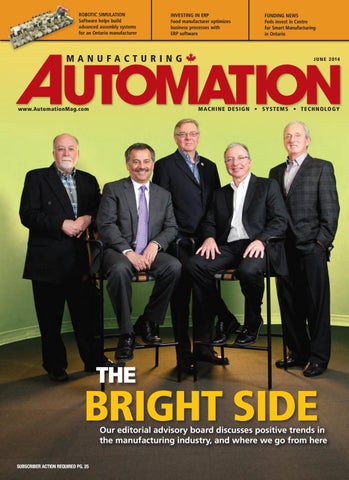
THE
BRIGHT SIDE
Our editorial advisory board discusses positive trends in the manufacturing industry, and where we go from here
SUBSCRIBER ACTION REQUIRED PG. 25
Need new controls? Spend Less.
®
Machine Control
®
Basic Process
Motion
PLC with H0-CTRIO2 module
H0-CTRIO2 high speed output Cutter interface
Try our practical supercharged Do-more™ PLC Whether replacing or starting from scratch on a control system, why not consider the Do-more PLC? We took the best ideas for practical product design and created the Do-more H2 series - an incredibly powerful controller at an incredible bargain.
Watch videos at: www.n2adc.com/domorevids for details. For just $399, the H2-DM1E CPU includes: • 1Mb memory for program, its documentation, and user-partitioned data types • Onboard communication ports include USB, serial, plus Ethernet with Modbus TCP or I/O support • Up to 256 I/O in one base, and thousands more with optional Ethernet-connected I/O • Supports discrete, analog, motion, and additional serial and Ethernet communications modules • Powerful instruction set featuring easy-to-configure math, trending and motion
Our shipping policies make it easier than ever to order direct from the U.S.!
Free standard shipping is available for orders totaling over $49 U.S. (except for orders which require LTL shipping, see Web site for details). Also, save on brokerage fees when shipping standard ground to Canada - allow AutomationDirect to choose the broker.
Ethernet-connected I/O
Get plenty of I/O in the local base, or expand with Ethernet-connected I/O right from the CPU. Create your programs and documentation with the FREE Do-more Designer software. Download it online - with the built-in simulator, you can try out your logic right away. Or, choose a Do-more starter kit to get going with a simple working system with I/O, plus a coupon for 30 days free online video training. Great prices, plus ...
Starter Kit
$626 with H2-DM1E CPU
FREE software FREE 30 days online training FREE Phone Tech Support
Are you getting all that from your current supplier? Think about it!
Research, price, and buy at www.n2adc.com/domore2
See Web site for details and restrictions at: www.automationdirect.com/canada
Order Today, Ships Today! * See our Web site for details and restrictions. © Copyright 2014 AutomationDirect, Cumming, GA USA. All rights reserved.
1-800-633-0405
the #1 value in automation
W h A T ’ S
I N S I D e
DEPARTMENTS 4 5
FEATURES
FroM tHe eDitor AutoMAtion uPFront
Movers and shakers in brief
COLUMNS 6
CoLuMnBus
7
MACHine sAFetY
8
inDustrY WAtCH
9
AutoMAtion soFtWAre
ian Verhappen discusses gateways and their role in networks We take a look at a forensic engineer’s role in investigating workplace accidents Paul Hogendoorn talks about what’s needed to revive the manufacturing industry in the Windsor-to-Woodstock corridor Jeremy Pollard reviews Dream report, a real-time reporting generator solution for industrial automation
10 LeAn insiGHts
Dr. timothy Hill discusses the state of lean manufacturing in Canadian industry
26 DistorteD reALities
Dick Morley examines the future of automation technology and why we resist change for innovative automation processes
NEW PRODUCTS 21 21 22 22 23 24 24 24
roBotiCs HYDrAuLiCs & PneuMAtiCs test & MeAsureMent HMi sensors Motors & DriVes interConneCtion DeViCes soFtWAre
Murr_MA_June.indd 1
Cover photo by Sandra Strangemore
12
tHe bRiGHt side
our editorial advisory board discusses positive trends in the manufacturing industry, and where we go from here By Mary Del Ciancio
16
ViRtual Reality robotic simulation software helps build advanced assembly systems for an ontario manufacturer By Vanessa Chris
18
inVestinG in eRP Food manufacturer optimizes business processes with erP software By Heather Angus-Lee
20
build oR buy? important factors to consider when deciding between building a linear positioner in-house or purchasing an existing technology By Ben Furnish
www.AutomationMag.com 2014-05-26 • June 2014 3 10:08 AM
F R O M
T h e
e D I T O R www.automationmag.com
good news travels fast
M
anufacturing is a good news sector — that was the refreshing message from Jayson Myers, chief economist with Canadian Manufacturers & Exporters, at last month’s Manufacturing Summit in Kitchener, Ont. Myers told the crowded room at Bingeman’s Conference Centre that good things are going on across the country, calling the sector a “hub of value creation.” In fact, Statistics Canada reported that Canadian manufacturing sales hit a post-recession high of $50.9 billion in March. Indeed, signs are pointing to strong Canadian economic growth in the coming quarters. But, according to Myers, the only way to continue to grow the industry is through business investment and exports, while focusing on continuous improvement, lean manufacturing, as well as our strengths. Canada is not a low-cost jurisdiction. We can’t Canadian manufacturing compete on that front. But where we can compete, he said, is on high-value manufacturing, whether sales hit a post-recession that’s the technology, design or engineering or services such as education, training high of $50.9 billion in solutions, or maintenance for a product. He added that March. Indeed, signs are automation, machine-to-machine communications, robotics and additive manufacturing will transform pointing to strong Canadian manufacturing in Canada. Myers isn’t the only one who had good things economic growth in the to say about the manufacturing sector. I recently down with Manufacturing AUTOMATION’s coming quarters. sat editorial advisory board members to talk about the status of the Canadian manufacturing industry. I wanted to take a glass-half-full approach to this year’s meeting, and focus on the positive trends they are seeing in the sector — and there were plenty! In fact, we spent much of the two-hour meeting talking about the good things that are happening, and how we can leverage these positive trends to continue the momentum. I don’t think we do that enough. It takes so much more energy to be negative. I think if we, as an industry, share our successes, talk about what we’ve learned, and the good things that are happening, it will go a long way towards attracting young people to the sector, as well as making those in the industry feel good about what they’re doing. Is it a perfect world? No. Are there still challenges that remain for manufacturers? Absolutely. (And we talked about these in the meeting, too.) It’s important to be aware of the challenges. But it’s just as important to be aware of the successes and the things that are working. It’s time we focus on the silver lining — the bright side. Take a look at this month’s cover story on page 12, and share the good news with someone else. Good news, as they say, travels fast. And if we focus on the positive — our strengths and our successes — it will go a long way towards reviving an industry that’s been a bit battered over the last six years.
Vol. 29, No.4
Canada’s leading publication providing industrial automation news and technology information aimed at the discrete and process industries. Mary Del Ciancio Editor mdelciancio@annexweb.com
Svetlana Avrutin Art Director savrutin@annexweb.com
Paul Grossinger Editorial Director pgrossinger@annexweb.com
Kathryn Nyenhuis Account Co-ordinator knyenhuis@annexweb.com
Klaus B. Pirker Group Publisher kpirker@annexweb.com (905) 726-4670
Lisa Thomson Circulation Co-ordinator 866-790-6070 ext. 201 Fax: 877-624-1940 lthomson@annexweb.com
Dick Morley Ian Verhappen Dr. Timothy Hill Paul Hogendoorn Jeremy Pollard Columnists
Michael Fredericks President mfredericks@annexweb.com
Editorial Advisory Board Al Diggins, President and General Manager, Excellence in Manufacturing Consortium David Green, Technology and Business-to-Business Marketing Professional Piero Cherubini, Dean, Faculty of Skilled Trades and Apprenticeship, Mohawk College of Applied Arts and Technology Sherman Lang, Industrial Technology Advisor, Industrial Research Assistance Program, National Research Council of Canada Don McCrudden, Vice-President, Business Development, Festo Bill Valedis, Vice-President, Precision Training Products & Services Inc.
Manufacturing AUTOMATION is published seven times a year by Annex Publishing & Printing Inc. 222 Edward Street, Aurora, Ontario L4G 1W6 Tel: (905) 727–0077 Fax: (905) 727–0017 PM # 40065710
The contents of Manufacturing Automation are copyright ©2014 by Annex Publishing & Printing Inc. and may not be reproduced in whole or part without written consent. Annex Publishing & Printing Inc. disclaims any warranty as to the accuracy, completeness or currency of the contents of this publication and disclaims all liability in respect of the results of any action taken or not taken in reliance upon information in this publication. Send address changes and return undeliverable Address Blocks to: Manufacturing AUTOMATION, P.O. Box 530, Simcoe ON N3Y 4N5. Return postage guaranteed.
Subscription rates: Canada — $40 per year. United States and Foreign — $60(US) per year. Student subscription rate $20 per year. ISSN-1480-2996
Mary Del Ciancio mdelciancio@annexweb.com Follow me on Twitter @AutomationMag
We acknowledge the financial support of the Government of Canada through the Canada Periodical Fund of the Department of Canadian Heritage.
Members of
4
June 2014 • Manufacturing AUTOMATION
A U T O M A T I O N
U P F R O N T
Feds invest in Centre for Smart Manufacturing in Cambridge, Ont.
C
anada’s Natural Sciences and Engineering Research Council (NSERC) will invest $2.3 million over the next five years for the establishment of a new Centre for Smart Manufacturing at Conestoga College in Cambridge, Ont. The Centre will accelerate innovation and support the region’s manufacturing sector. The funding was awarded through NSERC’s College and Community Innovation program, which supports applied research partnerships between colleges and local businesses to move ideas into the marketplace, create jobs and contribute to greater economic prosperity for Canadians. “This investment in applied research at Conestoga will be instrumental in expanding the college’s capacity to partner with manufacturing enterprises to support innovation, commercialization, productivity and competitiveness in our region’s most economically significant sector,” said Conestoga president John Tibbits. “The new Centre for Smart Manufacturing will also provide our students with additional opportunities to develop the advanced skills that today’s employers are seeking as they propel their businesses forward.” The centre will provide industry-focused, applied research for the development and implementation of technologies and processes that will improve the performance of participating manufacturing enterprises. Building on Conestoga’s established strengths in automation technologies, software and hardware design, the centre’s activities will generate innovative manufacturing solutions focused on high-performance manufacturing, and information and computer technology (ICT)-enabled manufacturing. The Centre for Smart Manufacturing will undertake a variety of projects, including the design of new manufacturing processes, the creation and testing of prototypes, the design of embedded systems, and the development of new visualization and software-related systems. Projects will draw on resources provided through Conestoga’s state-of-the-art labs for prototyping, advanced sensors, applied software, embedded systems, advanced materials, welding and robotics. Research projects will be led by faculty experts in engineering, information technology and business, with additional expertise provided by partners from area post-secondary and research institutions and commercialization centres.
In brief
• BRP Inc., the former recreational products division of Bombardier Inc. that makes Ski-Doos and off-road vehicles, says it will invest $55 million to build a third manufacturing plant in Mexico that will lead to the introduction of a new product line. Construction of the 46,000-squaremetre plant is slated to begin next year and be completed by the end of 2017. The plant will employ 900 full-time workers. • A Unilever plant in Bramalea, Ont., that manufactures dry mixes for soups, sauces and other foods will close, and its production capability will be shipped to the United States. Most production is expected to finish by the end of next year, with the final plant closure expected in March 2016.
• A new research, development and manufacturing centre in Calgary is being set up to try to make the workplace a little safer. Olds College is joining Alberta Garment Manufacturing to establish what is believed to be Western Canada’s first apparel research and development facility. When it opens in 2015, the Calgary-based facility will test, design and manufacture protective clothing for the energy and construction industries, as well as for the Canadian Forces. The federal government has chipped in nearly $3 million to help purchase equipment.
With files from the Canadian Press
2014 WINNER
Beckhoff_MA_June.indd 1
www.AutomationMag.com 2014-05-23 • June 2014 5 10:32 AM
A U T O M A T I O N
U P F R O N T
C O L U M N B U S
Gateways and their role in networks
MOVerS AnD SHAKerS Malcolm Haines has been named dean of NAIT’s School of Trades, the largest provider of trades-related programming in Canada. A former student who returned to become an instructor, associate chair, associate dean and, most recently, acting dean, haines leads a team of more than 350 faculty and staff who will serve more than 15,000 students in Malcolm Haines 2014-15. haines first came to NAIT in 1991 to train as a sheet metal worker after graduating with a degree in psychology from the University of Alberta. he returned to NAIT in 1997 as an instructor, and last year was named acting dean. Mark Barfoot, managing director of hyphen, a rapid prototyping and environmental testing facility, is the new president of the 2014-2015 board of the Additive Manufacturing Users Group (AMUG). A Canadian, Barfoot is the first international board member to hold the president’s title for the U.S.-based association. AMUG is an independent, all-volunteer association that works closely with industry professionals, OeMs and vendors to educate and advance the uses and applications of additive manufacturing technologies. As part of Barfoot’s accountabilities as incoming president of AMUG, he will oversee the board’s activities and planning in preparation for the 2015 AMUG conference, taking place at the hyatt Regency Jacksonville Riverfront in Jacksonville, Fla., April 19-23, 2015. Barfoot was instrumental in bringing additive manufacturing to Christie and building its in-house capabilities before launching hyphen in October 2012. As a division of Christie, hyphen now operates a comprehensive rapid prototyping and environmental testing facility that is open to the public, with all services under one roof.
Visit our online video portal at WWW.automationmaG.com to hear Mark Barfoot’s thoughts on the opportunities and challenges associated with additive manufacturing.
6
June 2014 • Manufacturing AUTOMATION
By Ian VerHaPPen
E
very industrial network has more than a single protocol within it. A simple analogy for a protocol is to think of it as a language. So if we are changing from one protocol to another, we are effectively translating between languages. And because of the complexity of today’s networks, you can almost guarantee that it will be necessary to translate protocols between different networks. Gateways are an important part of any network. The IEC’s online data dictionary (www. electropedia.org) defines a gateway as a “functional unit that connects two computer networks with different network architectures and protocols.” Gateways are also used to connect networks operating at different transmission speeds. I imagine that the most widely deployed gateway is therefore used when converting from a serial or field-level (fieldbus) signal to its Ethernet equivalent, such as Modbus RTU to Modbus/TCP. Practically every fieldbus also has its equivalent Ethernet version — i.e., Foundation Fieldbus H1 with HSE; Profibus with Profinet; and Devicenet and Controlnet with Ethernet/ IP. These types of gateways, however, represent the most common configuration because both versions of the protocol continue to follow the same basic rules and principles while providing a single configuration environment, including — in most cases — the same tools to manage the full network. In addition, most facilities strive to manage and minimize the number of different protocols they have on a site. The real workhorse gateways are those that transfer across or between protocols, such as between Modbus/TCP and DNP3 or Modbus/ TCP and Foundation Fieldbus H1, because these devices require more intelligence and tools to map parameters from one protocol to the other. For example, the basic Foundation Fieldbus H1 parameters contained in a single process update command of PV, status, time stamp and quality need multiple Modbus registers, each of a different type (real, discrete, integer) and, therefore, typically also require manual intervention to create the linkage or map between the parameters. So how do gateways accomplish this? In an industrial setting, control information has the highest priority, so the gateway’s primary role is to transfer cyclic I/O data (control information) between two networks. This data transfer can either be a slave-slave combination or a master-slave combination. In all cases, the fieldbus or Ethernet network side connected to the field devices of the gateway acts as a slave to the controller with which the data is being shared. Depending on the network combinations, acyclic data can also be transferred, enabling the transfer of non-time critical messaging and diagnostic information. Because the gateway can define which bytes from the serial data stream are data and which bytes are commands and control information — typically differentiated as cyclic and acyclic messages respectively — the overall
network determinism can be maintained. During the translation process, I/O data is temporarily stored in an internal memory buffer inside the gateway. One of the benefits of doing this translating and processing in the gateway, instead of in the PLC or controller, is that it simplifies the integration of serial devices into modern industrial networks and control systems. The penalty for this buffering, processing and conversion to the data format, the typical transfer time between the two networks, is in the range of 10 to 15 milliseconds. Gateways may be used in single-drop mode to connect one device via its serial interface to a fieldbus or industrial Ethernet, or in multi-drop mode to connect one to many devices. In addition to their translating function, because gateways need to support layers one through seven of the OSI (Open System Interconnect) model, they can be configured to do other functions as well. For example, two installations or networks being connected can also be logically and physically isolated from each other without losing the capability to transfer the selected data between them. Once the system has been designed, the gateway and, in many cases, the devices connected to it also need to be configured to arrange the parameters in a format compatible with the protocol being used and in a way meaningful to all nodes/devices in the network. In all cases, the parameters have to be selected and arranged in a logical way. Logical means it must make sense for both the gateway and the person doing the configuration, so that when it needs to be changed in the future, someone other than the person who did the original work can understand the objective of the work, as well as how it was done. Though a slave/slave configuration is a single step, a master/slave gateway configuration is made in two steps. The first step is to define the amount of I/O and parameter data, as well as the mapping of the data between the two networks. Then, if the gateway is for use with at least one Ethernet-based interface, the second step is to set up the Ethernet-based network interface with its IP address settings. Just like effective communications require a common understanding of the words, language constructs, syntax and associated phrases, the same is true for industrial network communications. Fortunately, gateways are able to work as those effective interpreters — as long as the person setting them up has provided them the correct configurations (dictionaries) with which to work. • Ian Verhappen, P.Eng. (iverhappen@gmail.com), is an ISA Fellow, ISA Certified Automation Professional (CAP), and a recognized authority on Foundation Fieldbus and industrial communications technologies. Verhappen leads global consultancy Industrial Automation Networks Inc. specializing in field-level industrial communications, process analytics and heavy oil / oil sands automation.
M A C h I N e
S A F e T y
Forensic engineers: What is their role after a workplace accident? By danny MarMOra
I
f you’ve ever been involved in a workplace accident, you’re likely familiar with what happens next. Emergency personnel arrive to tend to the injured employee, and the police investigate whether a crime has been committed. Once the police release the scene (given no crime has been committed), the Ministry of Labour (MOL) starts its investigation. The machine is taped off, power locked out, interviews scheduled, statements taken, and interim order may be issued. Then the lawyers are called. However, another phone call that manufacturers should consider making is to a forensic engineer. This could be critical in their defence against the MOL’s prosecution.
What is a forensic engineer? Forensic engineers provide independent opinions to legal matters where an investigation into a material failure, accident, personal injury, fire investigation, etc., requires a technical investigation surrounding the circumstances to establish the origin and cause of an incident. For a forensic engineer to be considered an expert permitted to give evidence in court, they have to be qualified in court. This is a process whereby their academics, technical expertise and practical forensic knowledge are reviewed, questioned and tested by the court. Some of the most important characteristics a forensic engineer should have include: • They have the technical, educational and practical field experience related to the industry they serve. • They are thorough and detailed investigators working
within a framework of impartiality and independence. • They are clear and concise communicators who understand the audience they are dealing with (i.e., employee, supervisor, MOL, judge). They must also know how to write a fact-based report that is defendable in court. • They are recognized and qualified experts by the courts.
Why hire a forensic engineer? Retaining a forensic engineer allows the manufacturer to have an independent voice investigating a loss. The forensic engineer explains complex technical matters, machinery, failures, etc., to the court in an open and unrestricted manner. At trial, an MOL engineer may provide evidence for the Crown based on their investigation. Not having prepared your own forensic investigation could be disastrous, as your witnesses may not have the required technical knowledge to understand the MOL report’s findings and conclusions. A forensic engineer’s investigation could discover evidence and a different cause. As the forensic engineer undertakes a loss investigation, the outcome could be negative, exposing liability for the client. In these cases, the client (along with their counsel) is best served by understanding the liability exposure as soon as possible. This allows the opportunity for a timely legal position/strategy to be developed by counsel. At that point, the engineer would not be required to produce a report. The greatest value to a client is to always tell the truth. While bad news may not be good, trying to “help” a client by “working” the technical arguments to the client’s
favour is no help at all. Further, when the courts expose the practitioner’s “extra efforts” outside of their independent role as a technical advisor to the court, they are branded as advocates, and their impartiality is diminished.
When should you retain a forensic engineer? The best time to retain a forensic engineer is the same time you call your lawyers and/or insurance company. Loss investigation and forensic engineering come down to two variables — location of the origin and establishment of the cause. Locating the loss origin does not have to be difficult, because in many instances it is obvious (i.e., a broken machine part, a failed water line, etc.). The challenge is establishing cause. Because multiple contributing factors to the cause can be transient in nature, examining the loss as soon as possible is critical. Every incident has its own unique set of circumstances, and evidence can reside anywhere in and around a loss scene. Therefore, the timely collection and preservation of evidence, and evaluation and disposition of multiple data and information streams are critical to understanding the true circumstances surrounding a loss when a serious accident has occurred. • Danny C. Marmora, B.Eng., P.Eng., CET, (danny@ marmoraconsulting.com) is the principal at Marmora Consulting (www.marmoraconsulting.com), based in Stoney Creek, Ont. His firm specializes in pre-start health & safety reviews, fire code consulting and forensic engineering.
Wide Selections of HMI’s and Sensors at omega.ca Large Sélection de Sondes et d’IHM à omega.ca Web-Enabled Graphic Operator Interface Terminals Borne d’Interface Web de 3,2 Pouces
High Accuracy Pressure Transducers Capteurs de Pression de Très Grande Précision PX409 Series/Série Starts at/ À partir de $480
G3 Series/Série HMI Starts at/ À partir de $625
Visit/Visitez omega.ca/ px409_series
3-Wire DC Inductive Proximity Sensor Capteur de Proximité Inductif CC à 3 Fils
• Up To 5 RS232/422/485 Communications Ports (2 RS232 and 1 RS422/485 On Board, 1 RS232 and 1 RS422/485 on Optional Communications Card) • 10 Base T/100 Base-TX Ethernet Port To Network Units and Host Web Pages • Jusqu’à 5 RS232/422/485 Ports de Communication (2 RS232 et 1 RS422/485 Intégrés, 1 RS232 et 1 RS422/485 sur la Carte de Communication en Option) • Port Ethernet 10 Base T/100 Base-TX pour Communiquer Entres les Unités et Héberger les Pages Web © COPYRIGHT 2011 OMEGA ENGINEERING, INC. ALL RIGHTS RESERVED
Visit/Visitez omega.ca/g3_hmi303
Prices in Canadian Dollars © COPYRIGHT 2012 OMEGA ENGINEERING, INC. ALL RIGHTS RESERVED © COPYRIGHT 2014 OMEGA ENGINEERING INC. ALL RIGHTS RESERVED © COPYRIGHT 2014 OMEGA ENGINEERING, INC. TOUS DROITS RESERVES
ManufAuto 0614.indd 1 Omega_MA_June.indd 1
E2E-3DC Series/Série Starts at/ À partir de $81 Visit/Visitez omega.ca/e2e-3dc
1-888-826-6342
omega.ca
®
Prices listed are those in effect at the time of publication and are subject to change without notice. Please contact OMEGA’s sales department for current prices. Les prix indiqués sont ceux en effet au moment de la publication et sont sujets à changement sans préavis. Veuillez contacter le département des ventes d’OMEGA pour les prix courants.
976 Bergar Laval, Québec Canada H7L 5A1
5/16/14 12:39 PM
www.AutomationMag.com 2014-05-26 • June 2014 7 11:19 AM
I ndustr y
W atc h
Solving the Windsor-to-Woodstock problem By Paul Hogendoorn
M
any Canadian manufacturers are producing advancements and innovations that have the potential to help these companies — and the industry as a whole — grow and create jobs. Many governments are trying to do their part to fan any small sparks of growth, or to encourage employers to take leaps of faith to make fresh investments in their region. But for some of the traditional manufacturing regions that have been hardest hit in the recent decade, this will not be enough. Organized labour needs to participate in any potential manufacturing revival, and our governments may need to play a new role, too. The area where I live — the Windsor-to-Woodstock corridor that follows Canada’s busiest highway — is the best case in point. The plant closures and job losses that have occurred in this region in the last decade and a half are staggering. Lower taxes will not entice the companies that have left to come back, or other companies to make major new investments. Lower electricity rates won’t do it, nor will innovation, employment or training incentives. On my travels, I see renewal in manufacturing in some other regions of North America, but I see very little between Windsor and Woodstock. Not only that, but plant closure announcements in this region are still regular news, and good jobs are still being lost. These plant closures come from a diverse range of industries — automotive, food and beverage, medical furniture and transportation — and include companies ranging
in size from thousands of workers (Ford) to hundreds (Kellogg’s and Heinz), to tens. Why was this region so hard hit, and why has it lagged in recovery? The geographic location cannot be considered a disadvantage thanks to the proximity to major highways, nor can it be a shortage of available skilled workers in the area. The region also has strong colleges and universities, and plenty of federal and provincial job creation and support activities. The last piece of the puzzle — and a factor I feel plays a key role in the region’s issues — is the legacy effect of having had the country’s strongest concentration of private sector union presence and influence for the last 50 or so years. I am certain that people who have worked in some of these plants for most of their lives will say that I’m way off base with this suggestion. I’m not saying it’s a “union thing,” but rather I’d suggest it is more of a “unioncompany working relationship thing” that deteriorated over many decades, and was never significantly reshaped, recast, reconfigured or redesigned. We all know what happens to car companies if they keep pumping out the same models year after year, or if they produce new looking models based on the previous models’ platforms. And that’s what I think has happened here. The platforms and foundations were so strong that they were held on to for far too long. The contracts between the parties may have been adjusted and altered, but the relationship didn’t
change as the times and situations did. While southwestern Ontario remains stuck in neutral (or sometimes reverse), other parts of the continent, and even the rest of the province of Ontario, are moving forward, attracting new investment and creating new manufacturing jobs. In some cases, the region (the state, province or even county) have helped establish a basis for a new “company-worker” relationship model, and in other cases, the plants simply had a different relationship model right at the start. There’s a provincial election in Ontario this month, and there’s a growing tension caused by the “creating jobs” and “protecting jobs” rhetoric coming from the different sides. None of this will help create, or even save, the manufacturing jobs in Ontario, because they are not pointing to the answers; they are merely illustrating the problems. Adaptation is key to survival in all of life, and innovation is key to survival in the competitive lives of our businesses. Our company-worker relationship needs to be adaptive to survive, and innovative if we want to get ahead. The first step will be to get creative, constructive and innovative voices from all sides, aiming for the same outcome. It’s the only way to solve this critical relationship issue. • Paul Hogendoorn (paul@tpi-3.com) is the founder of TPI Associates (www.tpi-3.com), an organization dedicated to helping entrepreneurs and business leaders pursue their vision and build their companies.
Advantech New Touch Panel Computer with Flexible Expansion
The TPC-1582H/1782H touch panel computer with a 15” XGA/17” SXGA LCD, low power embedded Intel 4th Generation Core i3 1.7 GHz processor and 4 GB DDR3 SDRAM provides the high computing performance in a compact fanless system. To enhance its durability, the TPC-1582H/1782H is designed with IP65 front protection, die-cast Al alloy front bezel and 5-wire resistive touchscreen. It also includes a PCIe slot and Mini-PCIe slots to extend the functionality and meet a variety of automation application needs. Through the Mini-PCIe slot, Advantech iDoor technology can provide more I/O connectors such as isolated Digital I/O, Fieldbus protocols, 3G/GPS/GPRS/WiFi communication and MRAM storage. A 2nd monitor and speaker can be attached via the integrated HDMI and audio port.
TPC-1582H/ TPC-1782H 15” XGA/17” SXGA LCD Intel 4th Generation Core i3 Touch Panel Computer
8
June 2014 • Manufacturing AUTOMATION
Advantech_MA_June.indd 1
iDoor Modules Fieldbus Protocol
iDoor Modules Communication
PCM-26D1PB Hilscher netX100 Fieldbus, PROFIBUS, D89 x1
PCM-24D2R2/24D2R4 OXPCIe-952 isolated RS-232, isolated RS-422/485, DB9 x2
PCM-26D2CA SJA1000 CANBus, CANOpen, DB9 x2
PCM-24D4R2/24D4R4 OXPCIe-954 UART, nonisolated RS-232, nonisolated RS-422/485, DB37 x1
iDoor Module Digital I/O
PCM-27D24DI Digital I/O, isolated 16DI/8DO, DB37 x1
2014-05-23 1:11 PM
A utomation
S oftwar e
Is Dream Report a dream come true? By Jeremy Pollard
D
ream Report, from France-based Ocean Data Systems, is marketed as a realtime reporting generator solution for industrial automation. It is interesting to note that the company is trying to get Dream Report recognized as the global standard for reporting in automation. This is a new development, and while it is unclear to me what this really means, it is worthwhile to examine the technology. Reporting is paramount in any business, but with some reporting tools, it is difficult to identify the contents, let alone aggregate disparate databases for the information that may be required for maintenance, operations and/or management. Dream Report is a very comprehensive product. Covering all aspects is beyond the scope of this column, so I will keep it basic. There are many reporting tools available, and if you use Wonderware InTouch and only that, for instance, Dream Report may lose some of its shine since you are paying for the ability to use multiple disparate databases for the reports. It may not be worth the investment if you aren’t going to take advantage of this feature. Integrated access to industrial data sources is Dream Report’s The Dream Report Wizard template claim to fame. It seems it can get to with the OPC setup dialogue any data anywhere from most any system, so the time spent on the learning curve is a good investment. Big data, KPIs and the Internet of Things are all buzz words that Dream Report addresses, so the scalability of users is an important benefit, along with information distribution locally or via the web. The product is tag- and concurrent user-based. The pricing reflects these two parameters, but it doesn’t seem like the differential should be that much of an issue. The interface for the product is very slick. It’s icon- and mouse-driven, which allows the company to declare a programmatic-free zone for reports. It can be a bit overwhelming, so you need to take your time. I like scripting, but for a quick and relatively easy report generation process, I ran the project wizard on startup. The rich interface is a pleasure to build with. Once you have defined the reason for creating the report, you need to name it and define the data connection, which can vary from real-time OPC or various historians, as well as open database connectivity connections. Real-time or historical reports can be created, which makes a dashboard somewhat easy to deploy. This is where some of the concepts can get confusing. Reporting by definition is historical, so having a report generated (or a web page updated) in real-time data is a novel idea. Couple that with a pre-defined template approach and a web browser, and your mobile device can become a window into your metrics. While I am not suggesting that Dream Report is or could become a SCADA/ HMI solution, it can most definitely be a connector to your process or machine sequences. One of the report triggers is on an event such as data change. Select the data source and tag, along with the condition such as change by ‘x%’, and the report gets triggered. Other report definitions, such as frequency of report generation, are part of the wizard. Once the dataset is created, it is now time to design the presentation. I was duly impressed with the myriad of templates available so that you can create simple reports easily, but also aggregate reports with relative ease. Using your own backgrounds and other images, your custom presentation can make you a rock star. At the end of the wizard, you add components such as charts and tables, which you would select based on the report audience. While I only had the RSView historical database and a network OPC server for the data, I was able to put together a report within 30 minutes. It was simple, but I would not say that the learning curve is easy. You have to behave in the way the software needs you to behave. Unlike code, your innovation may take a back seat. But for most of the control guys out there, this could be the ticket to creating very usable reports for a varied audience. It’s definitely easier than Excel! • Jeremy Pollard (jpollard@tsuonline.com) has been in the industrial automation industry for more than 25 years. He has worked as a systems integrator, consultant and educator. www.AutomationMag.com • June 2014 win_MA_May.indd 1
9
12-04-26 10:54 AM
L e A N
I N S I G h T S
The state of lean manufacturing in Canadian industry By dr. TIMOTHy d. HIll, PH.d., ClSSMBB, PMP
T
here are Toyotas in our midst. That’s the good news. The bad news is that lean has been misappropriated, misapplied and just passed over as another management fad. But first, the good news! Lean has taken hold in the manufacturing sector, better than in the health care industry, the office and other sectors. A great deal of this success can be laid at the feet of Toyota and its suppliers for pulling us along, but a very large portion is due to organizations seeing the need to transform their businesses, becoming more customer- and process-focussed, and thereby earning the savings and efficiencies that they’re seeing now. People really do see the need for human capital models, a different view of accounting and the radical differences that running lean organizations
Most economists agree that one of the most immediate causes of the problems in manufacturing, at least recently, is the rise in the value of the Canadian dollar. can bring. Moreover, they see that these things all have a multiplying effect. You can’t really have a lean organization run by old-fashioned accounting rules, just as you can’t run your lean organization without putting your people first, training them well, taking time to select them and empowering them so they can become the changes they want to see. In this regard, John Shook was right when he talked about the A3 being the change agent for lean organization culture change. Toyota doesn’t do “organizational change”; they practise it every day with every suggestion.
The bad news is that we still have organizations that say, “What we’re doing is good enough,” or “We’re too busy to change.” Most economists agree that one of the most immediate causes of the problems in manufacturing, at least recently, is the rise in the value of the Canadian dollar. This reflects an overriding interest in cost grazing as opposed to finding efficiencies in what you’re doing right here. Cost grazing has manufacturers moving their production operations all over the world to places where rates of pay are dramatically lower. They argue that when the
From the bookshelf
the remedy: Bringing Lean thinking out of the Factory to transform the entire organization, by Pascal Dennis. I was flying to Ireland to teach a group of Black Belt students about strategy deployment (hoshin Kanri) and I thought this would be a good book to relax with. After all, Pascal Dennis is a Canadian lean sensei and spins a good yarn. It turned out that this book was a great read! Along the lines of Andy and Me, it told the story of the struggles that a hypothetical person (Tom Papas) was going through. I felt that this story resonated with every one of my client organizations. This book does a great job of explaining a very broad variety of topics related to the lean quality improvement philosophy. It is not meant for a fully lean or mature organization. After all, how many of us are there? It is easy to read, even down to the quick and dirty. It also does an excellent job showing how the lean approach can
be applied outside of the manufacturing setting, and illustrating how lean production is only one part of a business system that affects all parts of a company’s operations and strategy. The book does a good job of indicating just how deep each topic goes and how much more there is to learn than what can be covered in the book. It tells the story of a fictional auto plant manager who has transformed his plant with lean thinking and now has to spread the philosophy to the other parts of the enterprise. As a novel, the book is not likely to be made into a film anytime soon, but the story moves rapidly and (spoiler alert) has a happy ending, so it doesn’t take away from the book’s value.
Canadian dollar goes up, they must look for “efficiencies” in lower cost because most of their costs are labour. This is the wrong way to think. Toyota builds cars where they sell them and does not cost graze. They save millions of dollars every year through their employees’ kaizen suggestions. They hire well and they hire those people who can do kaizen well. They then keep those people, realizing a return on investment for their training that multiplies for every year they remain working. Data suggests that every Toyota facility of about 3,000 people will save over $100 million a year. This will more than offset any labour cost. These organizations do not consider their error rates, reject rates, quality defects and so on. Like the GM scandal with low-cost ignition switches, they are not putting the customer first and then getting their error rates down to Six Sigma (3.4 or fewer mistakes per million). I had one client in southwestern Ontario that had an 80 per cent error rate for their number-one product and they (initially) thought that was fine. They would simply throw the defects back into the smelter and make more! Consider the downfall of a major Canadian handset manufacturer. They had such a high error rate that they had to overproduce just to break even. They weren’t watching the competition and they certainly weren’t watching their error rates! Where are we now? Though thousands of jobs have been
‘
Don’t lose your cool... ...use Rittal’s industry leading enclosure cooling solutions! Cooling solutions that offer maximum reliability for maximum up time Performance guaranteed by TÜV Nord Up to 70% in Energy-Savings (45% average)
ENCLOSURES ENCLOSURES
POWERPOWER DISTRIBUTION DISTRIBUTION
CLIMATE CLIMATE CONTROL CONTROL
IT INFRASTRUCTURE IT INFRASTRUCTURE
SOFTWARE SOFTWARE & SERVICES & SERVICES www.rittal.ca
10 Rittal_MA_June.indd June 2014 • Manufacturing AUTOMATION 1
2014-05-21 9:17 AM
Question from the floor Question: We tried lean once years ago. It started off okay, but then it petered out and we kind of lost it. Now I’m thinking about bringing it back, but the folks have said it failed and they don’t really want to try again. Any help? Answer: Don’t call what you’re doing “lean!” I’m only half joking here. In
lost in the manufacturing sector since 1972, I believe that this sector can make a recovery. It’s already starting, but lean needs to be an integral part of the recovery. We need to truly value our employees and listen to our customers. We can do this by having our senior leaders practise what they preach, go out there and do their gemba (go and see) walks, and entrust their employees with the powers to make change. We need to trust the employees to become the changes they want to see. Then we need to sustain this success so it doesn’t turn into the flavour of the month. We need to differentiate between capacity and utilization. I often hear, “Our people are busy right now, and they don’t have time to be lean!” Fine. Your people may be busy, but busy at what? Are they busy creating value or are they waiting on a machine, some process or someone to get back to them? Are they waiting while they could be doing something else? I remember stories about Taichi Ohno walking up and down lines asking why someone was just standing at a machine. “They’re waiting for that machine,” was often the answer. “Can’t this person prepare work for the next cycle,” would often be his reply. Ohno was great at looking at a situation and seeing waste. Too many people do not see waste — they see how it’s always been done. Are your employees working to the best of their capacity? We need to just do it! Lean, at its core, is simple. Look for waste and eliminate it! Since Ohno first shared the Toyota Production System outside of Japan in 1978, everyone has been in a hurry to emulate Toyota’s success. They forget that it took decades of work to get to that 1978 point. Go ahead, put up a lean board, get employees’ feedback and input, and allow them to make changes. Someone once asked me, “Does this mean I get to fix the stuff that’s been bugging me for 20 years?” When I said yes, he replied enthusiastically with, “I’ll take more of those A3s!” • Dr. Timothy Hill is an Industrial and Organizational Psychologist and Certified Lean Six Sigma Black Belt with global expertise in Human Resources/Human Capital. He can be reached at drtim@kyoseicanada.ca.
fact, where I’ve seen lean fail is when they put together all kinds of change management, organizational development and lean guidance teams. For the most part, this is a waste of time. You need to start off simply with a couple of lean events — perhaps a simple kaizen or something larger. Then you need to have a conversation about those events (hansei) and somehow annotate them and make them available to others so that they won’t make the wheel all over
again. Then you need to share these successes for others to see (yokotan). Share these gains with your senior leaders for them to see and become involved with. Establish your own local successes and spread the news about them. Don’t follow the guidance from a mature lean organization if you’re not a mature lean organization. The Toyota Kata approach to coaching and mentoring will work well when you’re ready for them. In organizations that are just
starting (or restarting) their lean journey, I recommend just asking the first two questions from the Toyota Kata. Coach people to become better problem solvers by asking them about what their target condition actually is and what their current state actually is. If you can instill a sense of problem solving, keeping an eye open for waste and getting them to do something about it, I think you’ll overcome any resistance you might find.
You want to save energy. You demand sustainable operations. We are the catalyst for your efficiency.
WE ARE THE ENGINEERS OF PRODUCTIVITY.
Security Simplicity Efficiency Competency www.festo.ca
WhyFesto_EfficiencyPillar_JuniorPage.indd 1 Festo_MA_June.indd 1
20/05/2014 10:21:49 AM
www.AutomationMag.com • 2014-05-21 June 2014 11 3:32 PM
C O V e R
S T O R y
tHe bRiGHt side By Mary del CIanCIO
1. the canadian dollar The Canadian dollar, which opened at 91.01 cents US the day of our meeting, was the first positive mentioned by board member Al Diggins, president and general manager of the Excellence in Manufacturing Consortium (EMC), calling it the “most prominent” positive trend he’s seen. Don McCrudden, vice-president of business development for Festo, agrees. “The lower dollar is an advantage, or at least stimulates more manufacturing, stimulates more employment,” he says. For Bill Valedis, vice-president of Precision Training Products and Services, the lower dollar has had a big impact on the demand for the training simulation products his company provides. “Since most of our business is in Canada and the U.S.,” he explains, “the lower Canadian dollar is really in our favour…All of a sudden, we see much more interest in what we have to offer to the market. It’s more competitive. It creates more opportunity for us.”
Manufacturing AUTOMATION’s editorial advisory board (L to R): Don McCrudden, Bill Valedis, David Green, Al Diggins and Piero Cherubini (Missing: Sherman Lang) 12
June 2014 • Manufacturing AUTOMATION
Photos by Sandra Strangemore
I
t happened. Statistics Canada reported that Canadian manufacturing sales reached a post-recession high in March, increasing 0.4 per cent to $50.9 billion — the highest level since August 2008. That’s good news. The RBC Canadian Manufacturing Purchasing Managers’ Index reported the manufacturing sector grew in April for the 13th month in a row. More good news. And to top it off, an economic report released in April by CIBC deputy chief economist Benjamin Tal suggested that factories that survived the recession have positioned themselves for better times. Essentially, they’ve survived the worst of it and come out “leaner and meaner” as they prepared for recovery. Even better news. On that note, when Manufacturing AUTOMATION’s editorial advisory board gathered for our annual meeting in Aurora, Ont., in April, we started the discussion with a focus on the positive trends that have happened over the last year in the Canadian manufacturing industry. And the members had plenty to say.
Our editorial advisory board discusses positive trends in the manufacturing industry, and where we go from here
Although the Canadian dollar is in a good place right now, Diggins cautions manufacturers not to get lulled into a false sense of security. “I do hope that they (manufacturers) continue to budget at par. I think that’s where the big downfall was when the dollar went ripping through the roof,” he says. “The together companies were budgeting at par long before the dollar started to climb, and those that didn’t really got caught, and that took a lot of people off the street. I’m hoping that they continue to budget at par and treat the advantage as a bonus.”
Don McCrudden, vice-president of business development, Festo
“We do have lots of shining examples of expertise…”
Bill Valedis, vice-president, Precision training Products & services inc.
2. Funding of innovation Another plus, says David Green, technology and business-to-business marketing professional, is the availability of funding to help drive innovation. “The funding of innovation is something that’s starting to happen,” he says. “There’s all sorts of people focusing on trying to support innovation [to] improve productivity. And some of that is being taken up now, it’s happening. There are real initiatives,” he says. Diggins agrees. He shared a recent comment from the person who helps EMC members get funding. “Her comment was, ‘There’s lots of money out there right now.’ And we haven’t heard that for a long time. In all four corners, too – innovation, training, skills, development. So that’s a positive thing. And I’m hoping that the governments are realizing that they are good investments, [that] they’re not a cost. That’s a mindset that we need to ensure keeps going in that direction. It is an investment in the future, not a cost.” Green adds, though, that people may need help identifying innovation and understanding what they can do — whether it’s improving productivity, applying automation or training people — to really take advantage of the funding.
3. employer engagement There seems to be more employer engagement with academia, the board members say. Diggins notes that he’s seeing more colleges working with industry. “That’s very positive that the colleges, in particular, are really reacting well,” says Diggins. “Throughout Ontario, we’ve seen [in] almost every corner of the province that the college system has been very positive to react to [industry needs]. They’re actually listening now and I think their reaction time is quicker.” Piero Cherubini, dean of the Faculty of Skilled Trades and Apprenticeship at Mohawk College of Applied Arts and Technology, says response time depends on what it is you want to get approved. “If it’s a complete new program, there’s still a lot of hoops to go through. The ministry is a little bit more responsive, although they’ve had a freeze on new programs for the last seven or eight months now.” But Cherubini agrees that employer engagement is a positive trend he’s been seeing. “They’re talking to us about upskilling their workforce. We’re spending a lot of time in those companies on process automation stuff. I don’t know if it’s a huge trend, but we’re seeing it,” he says. “That to me is one of the most positive things that has happened for us in the past year — the employer engagement. I don’t know if it’s being driven by their demographics, because we’ve been hearing about aging workforces since I’ve been in the workforce, and not a lot of real attention being paid to it. But I’m feeling this year that they are paying a lot of attention to [it].” Companies are spending a lot of time talking about retooling, upskilling their existing workforce, plus taking a lot of co-op students, says Cherubini. “They’re actually upskilling their existing workforce in that automated, the advanced automation kind of stuff. So it’s good.” Valedis has his own take on this trend. “A few years ago, we talked about, ‘oh my god, the population is retiring and we need to train people.’ What did we do? Nothing, basically. And now the reason why you’re sensing that positive effect is because the components that we manufacture, whether it’s a sub-assembly or a complete assembly of something, have increased in complexity 10-fold,” and companies need to upskill their employees. “The skills gap has increased from a little gap into a canyon, and we are trying to react now to things that we did not plan,” he says. But McCrudden says the expertise is there. “When it comes to assembly automation, the leading company in the world is a Canadian company. So you say, ‘Do we have the in-house expertise to be able to pull that off?’ And the answer is absolutely…We do have lots of shining examples of expertise in really high-tech areas. We’ve just got to have more.”
“The lower Canadian dollar is really in our favour…”
David Green, technology and business-to-business marketing professional
“There’s all sorts of people focusing on trying to support innovation…”
Al Diggins, president and general manager, excellence in Manufacturing Consortium
“You’ve got to learn from those who have already solved the problem…”
Piero Cherubini, dean, Faculty of skilled trades and Apprenticeship, Mohawk College of Applied Arts and technology
“They’re actually upskilling their existing workforce…”
www.AutomationMag.com • June 2014
13
4. Reshoring While the board members haven’t seen much reshoring on Canadian soil, they say the reshoring activity in the U.S. can only mean good things for Canada. Although we have been losing some manufacturing in Canada, says McCrudden, “our Tier 1s have remained rather vibrant. And the more cars that are produced, at least in the U.S. with the reshoring, it’s good news for our Tier 1s…Tier 1 automotive is doing better than they certainly have for awhile, and I see as a silver lining that the reshoring activity in the U.S. will only fuel that, and hopefully that’s just the tip of the iceberg.” Valedis agrees. He shared a story about Valiant Tools, based in Windsor, Ont. “For the first time I’m bumping into systems in the U.S. that are just starting up right now as part of this automotive investment in upgrading, and I see Valiant equipment installed. And that’s very positive. I see a new beginning again for Canadian and U.S. OEMs. So that reshoring thing that we talked about last year, it’s real, it’s here, it’s now.” “You just look at where our exports go and they’re going to the U.S., so the more activity there is in the U.S., by default it has to have a positive impact on us,” McCrudden explains.
5. an entrepreneurial spirit There is a fundamental entrepreneurial spirit that many individuals and companies in the manufacturing industry possess. McCrudden calls it a driving force for recognizing opportunities, which has led to success for many manufacturers. Green agrees. “I think the entrepreneurial piece you mentioned is a very big component,” Green says. “The piece of that is the entrepreneurial frame of mind that companies allow to happen with their employees so that no idea is a bad idea” — whether that’s giving people the opportunity to work on a side project or allowing them to work together to come up with ideas. “Allowing some of that entrepreneurial type of ethic and spirit and practise,” says Green, “is happening more and more.” The common thread that McCrudden sees in companies with that “fundamental entrepreneurial spirit” is that they’re all global thinkers. “They’re selling equipment all over the world, and they’re meeting global demands for safety of the equipment, for energy efficiency of the equipment, for speed of the equipment, for uptime of the equipment, all of these broad-based topics. And the ones that seem to be doing that are the successful ones,” he says.
challenges that remain Because we don’t live in a perfect world, there are still challenges facing manufacturers. Although it seems companies are engaging more with academia, Green says a big issue is getting businesses to collaborate with one another more, to learn from each other and to share ideas. Diggins says that companies will share with one 14
June 2014 • Manufacturing AUTOMATION
another given the opportunity, but they have to give themselves permission first. “It’s a learned behaviour. It’s not a normal behaviour. Learning how to share is something you give yourself permission to do,” says Diggins, whose organization’s goal is to bring manufacturers together to share ideas. “Small manufacturers out there with 500 or less could use all those brains. I mean, you drive down any of the streets here, there’s thousands of people in those buildings, and they’re not talking to one another. So creating an environment for that to happen is the way of the future. “You’ve got to learn from those who have already solved the problem,” he says. Much of the meeting focused on the importance of collaboration and the value that can be gained when companies share ideas. Green stresses that when companies collaborate, they can take research and engineering work and look at where else it might apply, and what other places they might be able to use it effectively in their sectors. He also suggests that it’s the colleges who should facilitate this conversation. “There’s a bigger opportunity to look at funding and formally drive some discussions that are appropriate for the industries that are served by those institutions,” Green says. Cherubini agrees. “The [manufacturers] that are coming to us, they don’t need to go at this alone, and they’ll tell us that. They’ll say to us, ‘If you’ve got other companies that are experiencing the same thing, let’s get together,’” he explains, talking specifically about training challenges for companies. “I think what we can do to influence this trend that we see is to bring some people together — networking, collaborating — because at the end of the day, they’re looking for the same thing…the same sort of skill sets.” And part of that discussion needs to include governments, institutions and the companies that are producing the widgets and the technologies. These groups need to work together and formalize the technical skills education programs, says Valedis. “We need to set some criteria of what is required for a person with x qualifications to be employed and what that person can produce on day one when they are hired. [That’s] number one,” he says. Valedis also sees a lack of funding in secondary schools to purchase new technology for education. “That’s where you create the ideas and develop the juices and get the world flowing,” he says. “When you go to a high school and they don’t have enough money to spend for a $1,000 widget that will enhance a particular tech program, it’s a real problem.” Another challenge is machine safety, says McCrudden, who wonders whether colleges are aware of the requirements for manufacturers. “Now all electrical devices have got safety PLCs, dual redundancy, dual channels. All of that stuff has only just come on the horizon,” he says. “How in the world is a community college on top of that topic? And yet,
when you’re talking about the manufacturing sector, it’s a huge topic for the employer because now all of a sudden they’ve got to make sure that their machines are compliant to safety. Who is training these people?” Valedis says machine safety is one of his biggest concerns. “We haven’t made any progress in that area. Not very much,” he says. “We go to companies because we do safety training, and they are completely unaware. They are completely unaware of safety regulations in Canada.” Valedis adds that sometimes infractions are so severe that if companies don’t take safety seriously, they could be put out of business depending on the size of the operation. “Multiple lawsuits can become a reality,” he says. “It will put you under.” Diggins sees both compliant companies as well as laggards when it comes to machine safety. “It’s all over the map. We have a whole health and safety program with our own people, and yes some plants it’s frightening when you go into them, [but] a lot of them are more and more proactive in all aspects — from machines to the entire building. Let’s go back to the word investment as opposed to a cost. At the end of the day, those that view health and safety as an investment do well, and they get it back. I think the ones that don’t care and don’t address the health and safety thing have a pretty short future, not only because of the MOL (Ministry of Labour), but the workforce is becoming more and more informed about safety. Let’s talk about skilled shortages; that’ll be one of the things that will be one of the attractions for me to work for you, because you’ve got a really good health and safety program.” The cost of energy is another challenge that Diggins points out. “It’s going to put many companies out of business,” he says. “You can have the perfect day in manufacturing. Everything has gone right. Everything is in line. You’re going to have a profitable day.” But if you do a full analysis, he adds, you may realize you lost money that day because for about 15 minutes the price of energy spiked. Over-regulating is another issue, he says. In some cases, it’s not that companies don’t want to meet the regulations, it’s that they just can’t do it. “What we’re getting really good at in this country is regulating — over-regulating — so many aspects of the manufacturing business that it’s almost paralyzing,” Diggins says. “They’re going to be out of business if they do everything that the government asks for. Overregulation,” he says, “is just getting ridiculous.” But despite these challenges, Diggins says the industry is heading in the right direction. “Yeah, there are ups and downs. The world will change around us,” he says, “but I think…those that are left standing after a double-dip recession, and the dollar going [up] like that seven or eight years ago, I think the manufacturing community is a hell of a lot more resilient than they used to be.” Those who survived are stronger for it. And that’s the best news of all. •
THE ULTIMATE
HOUSE
alliedelec.com/PowerHouse
The most trusted brands in Power, all under one roof.
1.800.433.5700 © Allied Electronics, Inc 2014. ‘Allied Electronics’ and the Allied Electronics logo are trademarks of Allied Electronics, Inc.
An Electrocomponents Company.
R O B O T I C S
VIRTUAL REALITY Robotic simulation software helps build advanced assembly systems for an Ontario manufacturer
Centerline uses Delmia V6 Robotics to create, program, simulate and validate robotic work cells in a virtual 3D environment, which has enabled the company to produce complex work cells of more than 60 robots.
By VaneSSa CHrIS
I
n the automotive industry, cutting lead times — and costs — is the secret to staying ahead of the competition. Wasting time is just not an option, especially when it comes to building new assembly systems. Automotive manufacturers need to know that the system they install on the plant floor is going to work immediately, and the robots are going to be programmed perfectly to meet their specifications.
With the average Tier automotive assembly system consisting of approximately 90 robots, this is no small feat. Gone are the days when robot specialists would physically install and program a two- or three-robot cell on the plant floor. Today, to win the business of the Tier 1, 2 and 3 suppliers, programming must first happen in the virtual world.
establishing a virtual presence Centerline Limited, a Windsor, Ont.based company that specializes in advanced automation processes and technologies, including the manufacture of advanced assembly systems, recognized the importance of robotic simulation
early on. The company launched an entire department devoted to digital manufacturing and robotic simulation in 2007. Back then, Centerline worked on much smaller cells, usually using one brand of robot — and its associated branded software — at a time. In 2008, however, after the economic collapse that devastated the global economy and the automotive industry in particular, automotive suppliers started to look for more efficient ways to run their businesses. One way was by building more efficient, complex assembly systems by reconfiguring robots they already owned. Suddenly, Centerline was faced with the challenge of finding robotic simulation software that would allow them to integrate different brands of robots into single assembly systems. “Basically, we had all these different individual software programs with the smaller software cells,” says Luciano Mancini, robotic simulation specialist at Centerline. “When the simulation department started to expand, we needed more flexibility with the software.” Both Mancini and J-P Girard, Centerline’s robotic simulation leader, had
With the Delmia arc welding capability, Centerline can automatically generate a robot arc welding tool path based on the geometric design of the seam to be welded, and automatically update weld trajectories with a single mouse click if the part design changes. experience with Dassault’s Delmia brand of robotic solutions, and felt it would be a good fit for their needs. So in 2011, after getting a few different quotes and learning about the different options available, they gravitated towards the Delmia V5. Not only did they like it, but it was seamlessly compatible with Dassault’s Catia 3D CAD design software, and easy to translate from other CAD programs used by Centerline’s design department. Girard and Mancini also looked forward
to the next version, V6, which they were told would be ready for their offline programming needs in a couple of years. That day came in 2013 when, as part of Centerline’s global expansion, the company decided to upgrade its PLM system, amalgamating all departments under one platform. For the robotic simulation department to be able to communicate with the design department, it was going to have to upgrade its Delmia software to integrate with the new PLM system.
Versatility. precision. confidence. NSK Linear Guides NSK Linear Guides are innovatively engineered to ensure high precision and outstanding performance for a wide variety of applications. They feature advanced series designs for high accuracy, rigidity and dust resistance, as well as interchangeable series for great versatility and flexibility. NSK Linear Guides are the ultimate solution, providing high dependability, optimum operating life and total confidence in performance. Learn more at thinknsk.ca 1.877.994.6675 www.ca.nsk.com
16
June 2014 • Manufacturing AUTOMATION
NSK_MA_June.indd 1
2014-05-23 9:35 AM
With Delmia V6 ready to go, Centerline became one of the first companies to implement the new version.
night and day Right from the beginning, Mancini and Girard noticed a significant difference with the revamped Delmia V6. Not only did it feature an improved user interface and a database that contained all the files in one place, without the risk of having them lost or corrupted, but it simplified tasks that were previously time-consuming and complex — kinematics being one of them. “Sometimes the designer may need us to apply kinematics to test, say, a new welder or servo gun, to see if it will be able to move in such a way on the floor,” says Mancini. “With the V6, it’s very easy to do. You could still do it in the older software, but there were less capabilities and it was more complicated. There’s more functionality in the V6.” They also noticed a significant improvement when simulating arc welding. “Robotic arc welding is kind of an art. It takes a lot of skill to understand how a robot is supposed to be able to arc weld,” says Mancini. The V6 allows users to graphically view and properly configure the different weld parameters — the torch, push/ pull angle and weld angles, for example — providing visual verification that the robot will perform a good weld to the required specifications. “A lot of the time, we’re talking to people who aren’t welders,” says Mancini. “These simulations help us teach people, and show them where their parameters and tolerances are.” The Delmia V6 offline programming capabilities have also saved Centerline a lot of time — mainly because of how the software approaches custom instructions. Previously, after program adjustments were sent from the plant floor, the simulation department would spend hours going through and deleting all the custom instructions that weren’t supported by Delmia. Now, with V6, more robot-specific instructions are supported, and those that are not supported are still uploaded into the software but are treated as “comments” automatically. “Say you have to move your robot two feet. Now, we can upload the program, move the robot two feet, redownload the program, and everything is as it should be,” says Mancini. “We don’t have to touch anything on the programming side. It’s just another major benefit to the V6.”
“As one of the first integrators to go full production into V6 2013, we had the benefit of a close relationship with Delmia R&D,” says Mancini. “The support we’ve had has been phenomenal. It’s amazing to offer our suggestions to R&D and see those suggestions being implemented. It’s saved us quite a bit of time.” Centerline plans to upgrade to Delmia V6 2014x in the near future, and have it fully implemented by the fall of this year. Despite the learning curve, Centerline is confident the upgrade is worth it.
It’s projecting a 10 to 15 per cent productivity gain once the implementation is complete, and the company is already seeing improvements in time savings. “Building a spot welding gun in V5, with all the kinematics required, would probably have taken us half an hour,” says Mancini. “In V6, I can probably finish it in 10 minutes.” Similarly, Mancini is confident that the new graphical interface, and the arc welding changes, will prevent issues from occurring on the plant floor. And the V6
also allows them to program a machine before it’s built, so the client simply has to download a program to get a robot up and running. “We’re taking a lot of guesswork out of automated assemblies,” says Mancini. “Now our clients can just flip a switch and they have the peace of mind knowing their design will work. This is cutting lead times significantly.” • Vanessa Chris is a freelance writer based in Guelph, Ont.
investing time to save time Because of the significant advancements of the V6, its implementation has come with a learning curve. It took a couple of months to fully get up to speed, but the Delmia research and development team was there to provide assistance throughout the entire process. CONEC_MA_Sept.indd 1
12-07-25 10:04 AM
www.AutomationMag.com • June 2014
17
e R P
INVESTING IN
ERP
Food manufacturer optimizes business processes with ERP software The boxing team packages pizza sauce from the water chiller in the Edmonton facility of Kitchen Partners Ltd.
By HeaTHer anguS-lee
W
hen you’re selling to the national chain of Boston Pizza restaurants, the reputation of your food products has to be solid. It also has to meet the franchising requirements for consistent quality, taste and look of food
items sold across all locations. As one of Boston Pizza’s suppliers, Edmonton, Alta.-based Kitchen Partners Limited (KPL) meets the grade with its products that include frozen entrees, fresh and frozen soups and sauces, dips and dressings, cooked
ground beef crumble for toppings on pizzas and taco salads, and made-toorder food based on customer recipes or the development of new ones. All of its products are private labelled, about 40 per cent frozen, and sold to major retailers — such as Sobeys and Costco — across Canada, as well as the Boston Pizza chain of restaurants. Close to 90 employees at KPL work in stirred foods, assembled foods and veggie processing teams at the company’s plant in Alberta where, says Daren Hawrish, vice-president of finance, “everyone works in the quality assurance department.” Known as Floron Food Services from 1984 to 2006, the renamed Kitchen Partners Ltd. made a decision in 2008 to discontinue the distribution arm of the business to focus just on food manufacturing. The decision paid off: KPL has since grown five-fold, running at 40 per cent compound growth each year.
explosion in requirement for boms
AEMC’SBRIGHT IDEA: ENERGY BUYING GROUP Excellence in Manufacturing Consortium has a mandate to help manufacturers in Canada succeed. We established Ontario’s only non-profit energy buying group to help them save money. EMC’s Energy Buying Group offers flexible, customized strategies for businesses of any size in all sectors, with no hidden penalties, balancing, or additional fees. You’ll also enjoy no-cost access to our team of energy experts. Joining makes good sense, and it’s just one of the many ways we can help you succeed. Contact us today to find out more.
1.866.323.4362
energy@emccanada.org
18
All that growth meant data, processes and procedures were getting out of hand, notes Hawrish. “We experienced an exponential explosion in the requirement for BOM (bill of materials) when we got to the point where we were manufacturing 100 custom food items…It was too unwieldy to do everything in Excel, and we had duplication of efforts in data entry,” he says. In addition, the company was starting another stirred food line to increase production capacity. The “most glaring need for us was to have MRP (materials resource planning) and MPS (master production schedule),” says Hawrish. “We wanted to reduce the amount of materials kept in our facility.” KPL has a somewhat unique business requirement in that the company pushes product to offsite storage. With its legacy business software, that created challenges around production lot numbers being reassigned after getting to storage. The
June 2014 • Manufacturing AUTOMATION
EMC_MA_June.indd 1
2014-05-26 10:12 AM
former software system included lot tracing, but only for finished goods. KPL wanted to optimize tracing on the inputs side as well. Rotation of fresh produce is a major issue at the company, and the team wanted to move from hand-written to machine-written (barcode) labels to minimize human error.
Power of industry peer testimonial Brandy Zukowski, supply chain manager at KPL, led the charge to find the right ERP software and implementation partner. About 15 ERP vendors responded. The team narrowed it down to two, and invited both companies to KPL’s plant to pilot their software with actual data. They selected JustFoodERP, software built for the food industry on the technology platform of Microsoft ERP. Zukowski and Hawrish visited a JustFoodERP customer, Texan food manufacturer CF Chefs, where “they put it to us: ‘We looked at lots of companies. You can burn a bunch of time and energy looking, or go with JustFoodERP,’ which is what they strongly recommended,” says Hawrish. “I cannot emphasize enough the power of that testimonial.”
Push transactional work to the floor The selection of the new ERP system reflected organizational changes, says Hawrish. “We made a conscious business decision to get as close to real-time information as possible, and we wanted to push a lot of the transactional work down to the floor, with terminals in the warehouse for the receivers to see data live, and lead hands and supervisors entering data themselves.” He adds, “I’m an optimist; I believe that, if given the right tools and the reason why they’re doing something, employees do it better.” The KPL implementation team involved leads from each area of business so they’d have ownership, know what was going on, and be a big part of the configuration to make sure the system
up the game on tracing of inputs “When we went live, I was very careful to make sure everyone understood there are two parts,” notes Hawrish. “One is the implementation, the other is that we made a business decision to up our game on the tracing of inputs.” Lot traceability and mock recalls have significantly improved as a result, he says, and so has inventory accuracy on finished goods. “With MRP functionality now, we have just the right amount of materials stored,” he says. When it comes to the offsite storage of product, Hawrish says, wherein the company’s old software couldn’t maintain the linkage between production lot numbers and offsite storage numbers, the ERP system makes it simple to map each production lot to its corresponding storage lot. As well, using the new system to print pallet labels has given KPL clarity and easy reference for its production order numbers. Since KPL does much of its own produce preparation — chopping carrots, mushrooms and other perishable items — “now we have an even clearer understanding about our yields…With the new system, everything is down to the receiving date assigned,” says Hawrish. Employees are also using the “Suggest Lot” feature on all production orders within the JustFoodERP system. “This feature will say you have half a case of celery left over from this date, use that first,” Hawrish explains.
— specifically, the addition of JF Floor, the web interface to JustFoodERP that allows for mobile warehouse management, from receiving to putting away goods, moving and counting inventory. KPL is also working on the implementation of JF Plant — an application that connects directly to the ERP system for immediate consumption and output activity tracking. JF Plant displays valuable business data — production schedule, batch ticket, job report, etc.
© 2014 SCHUNK GmbH & Co. KG
works for all processes, says Zukowski. “We learned from JustFoodERP not to fret too much about setup because, as we go through implementation, we would learn how some of our processes might need to change to become best practices,” she says. The first phase of KPL’s ERP implementation included financials, product development and quality management, and electronic data interchange (EDI), which is mandatory for doing business with larger customers like Costco.
— on the screen of any web-enabled device, with security features that allow employees to view assigned lists relevant to their work. KPL continues to grow its business, in large part due to the continued investment in software technology to automate data, processes and procedures. Jeff Clark, president of Kitchen Partners Limited, says the ERP system has been nothing short of “transformative” to the organization.
Heather Angus-Lee (heather.angus-lee@ justfooderp.com) is a former editor of Manufacturing AUTOMATION. She now writes for JustFoodERP.
SWS Quick-Change System
gripper change 90 % faster
SRH-plus
IP 67
Swivel Head
standard protection class
PGN-plus The No.
1
enter nutritional data into eRP As a custom shop, KPL often gets a recipe or is asked by a customer to match an existing product, working with the customer’s chef. Because of this, product development features, such as translating recipes into a BOM, are a critical aspect for KPL production. As well, KPL’s product development manager, a Master of Food Science, is able to enter all nutritional data directly into the ERP system — a large savings in time and reduction in error compared to the employee working offline and then someone else having to enter the data into the system. KPL is currently working on the next phase of the ERP implementation
“JustFoodERP has streamlined many of our processes and increased our access to critical information. We look forward to building on the solid foundation with further software modules and applications in the years to come.” •
2-Finger Parallel Gripper
with multi-tooth guidance
Your automated handling system. It’s time to make use of your machine’s full potential. www.ca.schunk.com/machine-potential Jens Lehmann, Brand Ambassador of SCHUNK, the family-owned company
AnzSynergie_PGNplus_SRH_SWS-I_CA_0413_162x248_2.indd 1 Schunk_MA_June.indd 1
www.AutomationMag.com • 2014-05-26 June 2014 19 26.02.14 15:21 2:13 PM
M O T O R S
A N D
D R I V e S
BUILD OR BUY?
Important factors to consider when deciding between building a linear positioner in-house or purchasing an existing technology By Ben FurnISH
T
ypically, a manufacturer’s main goal in developing or implementing an innovative automation technology is to speed production and boost the bottom line. In this endeavour, it almost always pays to keep an eye on the basics. For example, in applications involving high-volume, single-axis positioning systems, how does a company decide whether it makes sense to build a potentially more innovative linear actuator inhouse or purchase an existing off-theshelf technology? Many companies assume that building a linear positioner from scratch and producing the high volumes needed for an application makes for the lowestpriced approach. That’s because at its most basic level, designing or building a positioner in-house versus buying an off-the-shelf unit seems purely a function of cost and volume. The approach seems simple and straightforward because cost and volume directly relate. The cost for building in-house will be higher initially than the cost for buying, but the cost will level over time. Therefore, producing a positioner in-house might seem to be the best option for companies with plenty of time, resources, product demand and
money. Unfortunately, engineers typically learn whether building in-house was the correct decision only after they are well into the development process and have invested heavily in time and money. Engineering decisions are rarely this easy and usually require considering many factors.
making versus buying guidelines Following this checklist can help ensure you make the right decision for your organization. Materials – Make sure that the bill of materials (BOM) is complete, including hardware, bolts, fasteners, bearings, motors, drive
Relax, tomorrow has already been tested. Simplify with HARTING connectors
mechanisms and other components. Account for all the materials needed to build the positioner in-house and find the suppliers that can deliver the desired quality and quantity. Volume – Another significant factor for cost comparison is the actual volume of positioners needed over a given period of time. At higher volumes, it might be worth the effort to build the positioner in-house to ensure integration and quality. On the other hand, spending the required time and labour may not be worthwhile when it detracts from a company’s core competency and more pressing priorities that are critical to the business. When the positioner is being used as a new product, consider market conditions and analyse projected sales. Because demand determines volume, analyse whether your facility is equipped to sustain production demands or whether outsourcing is a more efficient option. Labour – Don’t forget to factor in time to market and lead times. Time to market includes the time it takes to design and develop prototypes. It also includes the months of work necessary to build a reliable, validated and verified positioner. Also, don’t forget to factor in machining time and labour times for assembly. Support – Consider support costs and study them. When a unit fails, what are the implications? How long will it take to replace or repair the unit?
Reduce the number of needed components and save space. HARTING, first established in 1945, delivers unrivaled reliability, efficiency, innovation and performance in connectors. With HARTING you have a partner who ensures you dependable connections that stand the test of time.
www.HARTING.ca
20
Application – The positioner must work well in varied applications, such as a lab instrument, small diagnostic device and semiconductor. Deciding to make or buy can depend on finding a supplier with a compatible product that is customizable to your needs. Expertise – Is your time best spent designing positioners or focusing on your expertise? It is sometimes tempting to keep engineering in-house, but in some cases, partnering with a company that specializes in positioners reduces risk, costs and frustrations.
June 2014 • Manufacturing AUTOMATION
06.2014 Manufacturing Automation .333pg - Two Faces.indd 1 Harting_MA_June.indd 1
5/13/2014 1:59:24 PMAM 2014-05-26 11:12
Risk of ownership – When building a positioner, a company assumes every risk — from concept to product launch. When buying a positioner, a company should choose a reputable supplier that has already thoroughly tested the product to help reduce risk. Within these guidelines, be sure to consider hidden costs that are often overlooked. For example, companies usually consider design costs, but fail to note that a larger inventory and higher overhead can also keep lead times short. Labour costs should include the times an employee must touch an order to expedite, track or receive it. They should also include the time it takes for employees to inventory, pick or inspect parts. The issue might not seem significant, but for positioner assemblies that include 30 components, time can quickly become a production concern. Likewise, companies sometimes estimate business risks too optimistically, which can be a disaster. It is necessary to spend a lot of time early in the design process using concept feasibility and performance tests to build a reliable product.
coming to a conclusion The decision between building and purchasing a linear positioner is easier to calculate and quantify when all the considerations have been accounted for. Tools are available and experienced suppliers can help with a discussion to reveal hidden costs. When building in-house, companies should use concept feasibility and performance testing early in the design process. When purchasing a technology, companies must ensure the vendor has application experience and can provide good customer support. • Ben Furnish is a market development manager for Parker Hannifin Corporation’s Automation Group.
P R O D U C T S
Robotics
Hydraulics
&
Pneumatics
Six-axis robot
Pressure pumps
The MH12 six-axis robot from Yaskawa Motoman features a curved upper arm designed to enhance its reach, and allows for use in a wider range of applications. This patented double yoke design also offers additional strength if the robot crashes due to a programming error, the company says. Thru-arm cable routing provides longer cable life and reduces the risks of snagging or interference. A large 50-mm thru-hole in the upper arm provides ample space to minimize wear and maximize cable life. This model has a 1,440-mm reach and a large work envelope that extends behind the robot, permitting space for robot tool storage or maintenance. The MH12 robot features an increased 12-kg (26.5-lb) payload, and higher moment and inertia ratings over previous “payload class” models. It has brakes on all axes and can be floor- or wall-mounted for layout flexibility. www.motoman.com
Palmer Wahl Instrumentation Group’s new line of hydraulic and pneumatic hand calibration pressure pumps includes the Palmer PV10K Hydraulic Calibration Pressure Pump, a dual-stage pump that includes a selector valve, increasing the priming speed and greatly reducing the effort required to generate high pressures, the company says. Pressure SEW-ManuAutomation6x9-Bacon-05-14.pdf 5/22/2014 range is zero to 10,000 PSI or zero to 7001bar. For
pneumatic applications, the Palmer PV600 Combination Pneumatic Pressure and Vacuum Calibration Pump can create a range of vacuum 28 inches of mercury up to 600 psi. Full-time rotation of gauge and process connections maximizes viewing angle during operation. Featuring ergonomically designed handles and an adjustable stroke, the PV600 reaches 100 psi with only four pumps. 8:28:05 AM www.palmerwahl.com
Robotic welding system C
M
Y
CM
MY
CY
CMY
K
Esab Welding and Cutting Products’ Swift Arc ML (Mobile Learning) System is a fully contained robotic welding system for education and training. The system is part of Esab’s Swift Arc series of pre-engineered robotic welding cells offered as complete ready-to-weld units. The robotic education cell is designed to demonstrate, develop and teach proper welding techniques, robot programming and welding skills. Its mobile platform facilitates on-site training and quickly transforms any space into a robotic welding training environment. The cell is comprised of Esab Aristo U5000i power source, Kuka KR6 900 robot and controller, touchscreen robot pendant, expandable cell walls, and interlock safety system. Its construction features a steel tube frame with acrylic windows and heavy-duty casters for easy mobility. www.esabna.com SEW_MA_June.indd 1
www.AutomationMag.com • 2014-05-23 June 2014 21 2:56 PM
P R O D U C T S
Test
&
Measurement
Connected test tools app
The Fluke Connect system app allows maintenance technicians to wirelessly transmit measurement data from their test tools to their smartphones for secure storage on the cloud and universal team access from the field. More than 20 Fluke tools connect wirelessly with the app, including digital multimeters, infrared cameras, insulation testers, process meters, and specific voltage, current and temperature models. Technicians can AutoRecord measurements and infrared images to Fluke Cloud storage from wherever they’re working, without writing anything down. Everyone on the team with a smartphone and the app can see the data. Team collaboration is made easy with ShareLive video calls, where technicians can share measurements with other team members in real time, get approvals for repairs or get questions answered without leaving the field. The Fluke Connect app
features EquipmentLog history, which allows technicians to assign measurements to specific equipment, creating a cloud-based history of test measurement data for easy access during both troubleshooting and reliability maintenance. And TrendIt enables technicians to instantly graph data, helping to identify trends and quickly make informed decisions. The Fluke Connect app can be downloaded for free from the Apple App Store and the Google Play Store. www.flukeconnect.com
Handheld meter
Handheld thermometer and core temperature recorder
The Foxboro Eckardt LevelWave Radar Series from Invensys is a measurement solution for liquids, including corrosive, sticky or difficult media. Each device in the series has a 360-degree rotation, which allows for side or top mounting as standard, making it much simpler to fit into an existing space, the company says. All LevelWave instruments feature an external display, offering easy, intuitive configuration for a new operator. There is an option for full digital remote electronics up to a distance of 100 metres. www.invensys.com
Parker Hannifin’s SensoControl Diagnostic Serviceman Plus is a handheld meter that provides portable maintenance and diagnostic data for hydraulics and pneumatics. Serviceman Plus features Parker’s “Plug and Play” automatic sensor recognition that immediately scales the measurement range, eliminating confusing and time-consuming setup routines. With the ability to measure pressure, flow, temperature and RPM (rotations per minute), Serviceman Plus is versatile for use with mobile and industrial systems, the company says. All measurements captured on the handheld meter can be stored on a nano USB drive, or transferred to a PC for analysis and documentation using the SensoWin software provided with the meter. Two versions of the meter are available: an analog version with two analog inputs, and a CAN version that supports up to three CAN sensors at one time. www.parker.com
TandD Corp’s wireless RTR-601 handheld thermometer and core temperature recorder is designed to measure the internal temperature of food items and liquids using an insertion probe. A single press of the REC button allows the user to record, not only the temperature, but also the time, date, operator and item IDs, and a pre-programmed measurement judgment. The RTR-601 has a measurement range of -25 to 235 degrees C, and is suitable for both hot and cold readings. Current readings and Go/NoGo judgment results are displayed on a backlit LCD display. The RTR-601 incorporates a temperature stabilization algorithm that will not allow recording until the probe tip temperature has reached a final, steady state value, and can store up to 1,800 data readings before downloading to a LAN over a 900-MHz wireless link. The penetration probes are available in two different lengths and can be attached either directly to the unit or to a handle with a three-foot cord. The RTR-601 is designed to be integrated into a wireless network with TandD’s RTR-500 Series of Wireless Data Loggers, which allows for automated data collection and remote monitoring and management of both warm and cold. www.tandd.com
CNC operator panel
HMI
Sunlight-readable LCD monitors
Measurement tool
HMI Touchscreen interface panels
AutomationDirect has added its new EA9 series operator touch panels to the C-more line. The colour TFT touchscreens are available in six-, eight-, 10-, 12- or 15-inch versions. The EA9 series touch panels are equipped with 800-MHz CPUs, 64k colours and 50,000-hour backlights. Hardware includes three serial ports (one on the six-inch base model), an Ethernet 10/100BaseT port (full-featured models), two USB 2.0 ports (one type A, and one type B), and one slot for an optional SD memory card. The 12- and 15-inch models support two SD cards and are equipped with one HDMI video output port. The six-, eight- and 10-inch units support 26 MB of project memory, while the 12- and 15-inch units contain 82 MB of project space. An audio output port, when attached to an amplifier and speaker(s), can play warning sounds or pre-recorded messages (full-featured models). All touch panels are 12-24 VDC powered. www.automationdirect.com 22
Siemens OP 019 is a CNC operator panel with advanced technology, enabling seamless design integration to the Sinumerik Operate graphical user interface and Sinumerik 840D sl CNC for use on high-end milling, turning, grinding, laser-cutting and other machine tools. With the benefit of modern touchscreen operation, the Sinumerik operator panel OP 019, now extended to include the new Power Control Unit (PCU) 50.5, allows high-speed key actuation at the large 19-inch glass front, which conforms to the IP66 protection rating. Another new feature of the OP 019 design is the wide LEDs, which allow the operator to clearly visualize every key actuation no matter what the angle of vision, plus an integrated key lock that helps safeguard against operating errors. The operator panel is able to provide a basic machine display with three or four channels showing up to 13 axes. www.siemens.com
June 2014 • Manufacturing AUTOMATION
Kollmorgen’s Automation Suite HMI are rugged IP65-rated touchscreen HMI panels featuring a single-surface screen with widescreen format, a rugged aluminum chassis housing, and premium configuration and screen-building software. In addition, all models provide Ethernet, are quickly and easily programmed with the Kollmorgen Visualization Builder graphical tool, and feature display and input capabilities suited for use in a wide range of packaging, food processing and printing machinery applications, as well as material forming, laboratory automation and test and measurement applications, the company says. Kollmorgen’s HMI uses a 16:9 format and provides up to 30 per cent more usable screen area than previous generation models. All standard models also feature integrated Ethernet, as well as data logging and trending software. Nine different panels can all be programmed using the same premium software. www.kollmorgen.com
The SRM-11.6H 11.6-inch sunlightreadable LCD monitor from TRU-Vu Monitors uses ultra-bright LED backlights to produce 1,000 nits of brightness, which is up to five times brighter than a standard LCD monitor or a typical laptop, the company says. The SRM11.6H offers 720p HD resolution, a 16:9 widescreen, VGA and HDMI video inputs, lockable on-screen display buttons and a rugged powder-coated steel enclosure. www.tru-vumonitors.com
Operator workstations The VisuNet XT Operator Workstation from Pepperl+Fuchs is an HMI solution with global certifications. It features a high-bright LED-backlit LCD panel display with an optically bonded, glovefriendly and sunlight-readable 15- or 19-inch touchscreen for clear resolution in all lighting conditions. The Type 4/4x operator workstation can operate in temperatures ranging from -40 to 65 degrees C. www.pepperl-fuchs.us
P R O D U C T S
sensoRs sensors
signal conditioner
Sick’s R/IR sensors are designed for zero pressure accumulation applications, and can be mounted between the rollers on conveyors where mounting space is limited, making the sensors less susceptible to damage. The IP 67-rated R/IR sensors provide both mounting and system flexibility to help control product flow, prevent jams and improve operational efficiency. Using M12 mounting connectors, users have the ability to daisy chain 50 zones in a series, reducing reflector hardware and installation costs, the company says. The two variants, R and IR, include outputs for both electric- and pneumatic-driven rollers. The R sensors, which are available as standard sensors, feature an adjustable 900-mm proximity sensing range on a five per cent black target, eliminating the need for a reflector. The IR sensors, which have integrated logic, don’t require a PLC or PC, eliminating I/O and commissioning time. www.sickcanada.com
When paired with AC-operated position sensors, Macro Sensors’ EAZY-CAL LVC 4000 Signal Conditioner converts output to RS-485 output, enabling a host computer to retrieve measurement data, receive operational status, perform remote calibration, and perform hot swap reconfiguration. Configurable with LVDTs, RVDTs and VR half-bridge position
Laser sensor
sensors, the LVC 4000 Signal Conditioner digitally communicates with up to 16 devices simultaneously, and can be connected together in master/slave configuration for multiple channel applications. Signal conditioners can be remotely located by up to 100 feet to facilitate LVDT linear position sensor operation in extreme environments. www.macrosensors.com
Visit www.techspan.ca Call 1-800-363-1588 Email sales@techspan.ca
WIRE DUCT • Smooth Fingers • Non-Slip Cover • Built-in Rail • Double Score Line • Staggered Mounting Hole Pattern
Banner Engineering’s LE550 noncontact laser sensor, designed with linear array technology, provides high repeatability and accurate measurement for challenging targets ranging from shiny metal to black rubber, the company says. The LE550 measures 100 to 1,000 mm right out of the box, and features an intuitive two-line, eight-character display, making adjustments and menu navigation simple and easy to read. The visible red, Class 2 laser beam and small spot size ensure quick setup and alignment, according to the company. www.bannerengineering.com
Wide Finger & Narrow Finger Duct In Stock
Board mount pressure sensors The Basic Board Mount Pressure Sensors, Compensated, Unamplified, TBP Series, from Honeywell, are used to measure gauge pressures, and may potentially be used in such industrial applications as HVAC transmitters, air movement control, environmental control, leak detection and pneumatic control. The sensors offer a wide pressure range and an operating temperature range from -40 to 125 degrees C, and a zero to 85 degree C compensated temperature range. www.honeywell.com
• LEAD FREE • RoHS Compliant • Self Extinguishing rigid PVC Class 1 (UL 94-VO) CORNER EDGE DUCT • Modular angular trunking • Save space in panels • Now available in 2 sizes: S1106080 (110mm X 60mm X 80mm) S904060 (90mm X 40mm X 60mm) • More finished look through corners • Temperature range for use: -5˚ to 60˚C • Accessories available
Techspan_MA_June.indd 1
www.AutomationMag.com •2014-05-22 June 2014 23 10:20 AM
P R O D U C T S m otoRs
&
d R i V es
servo drives
changes to the load profile — caused by wear, for example — have no affect whatsoever on the drive due to predictive compensation for disturbances. www.br-automation.com
enclosed starters
B&R has expanded the functionality of its ACOPOS line of servo drives with repetitive control. The company says this latest advancement improves the accuracy of production processes with stationary disturbances by using predictive following error compensation. Repetitive control is available for all ACOPOS models by installing a firmware update. When using position-controlled drives with constant speed, mechanical conditions can cause stationary disturbing torque fluctuations, which often results in following error localized to a certain area. Optimizing the drive controller configuration can minimize these lag errors, but will not completely prevent the disturbance. Embedded in the standard speed control loop for the ACOPOS drive family, repetitive control adjusts the torque setpoint of the drive in a way that drastically reduces the periodic portions in the speed or following error. The algorithm undergoes a constant learning process so that
The CGP Series Enclosed Motor Starters from Carlo Gavazzi are manufactured in Canada to both Canadian and U.S. standards. They are housed in NEMA 4 metallic enclosures (NEMA 4X non-metallic enclosures are available upon request), and are available for both single- and three-phase motors up to 600V/200Hp. Available options include a broad range of control and pilot light layouts, integrated control transformer and both fused and non-fused disconnects. www.gavazzionline.com
Hollow shaft planetary gear The new HPF Precision Hollow Shaft Planetary Gear from Harmonic Drive, and distributed by Electromate, was designed based on the popular HPG Harmonic Planetary gearhead. The large coaxial hollow shaft allows cables, shafts, ball screws or
inte Rcon n ect i o n Connector lineup
24
servo drives The AZB10A4 and AZBDC10A4 µZ ultra-small analog plug-in brushless servo drives are the smallest off-theshelf servo drives from Advanced Motion Controls. Pronounced “micro-Z,” these plug-in drives are designed for embedded applications in a wide range of industries, to drive brushless and brushed DC motors at a high switching frequency. To increase system reliability and to reduce cabling costs, the drives are designed for direct integration into your PCB. Weighing just 8.5 grams, µZ drives operate with a bus voltage range of 10 to 36 VDC, and are fully protected against over-voltage, under-voltage, over-current, over-heating and shortcircuits, the company says. www.a-m-c.com
universal drive module ACS Motion Control’s line of compact EtherCAT modules features two and
d eV ic e s
Omega’s M12CM series of M12 cables with compensated connectors for thermocouples feature a straight and right-angled M12 field-mountable connector sensor end, compensated thermocouple cable, sockets and pins, and two cable insulation options in IEC and ANSI colour codes. The M12CM series has a variety of connection methods to work with instrumentation. This product is ideal for process control applications, especially where the operating temperature exceeds the limitations for standard M12 cables and sensors, the company says. www.omega.ca
Wire-to-board connectors AVX Corporation now offers custom cable assemblies for its extensive 9159
June 2014 • Manufacturing AUTOMATION
four universal drives with a rating of 12 to 80 VDC and 2.5 to 20 amps (five- to 40-amp peak) per drive. Each drive is programmable to control a two- or threephase servo motor, a DC brush motor, a voice coil motor, and a two- or three-phase step motor. The UDMMC EtherCAT motor drive addresses the needs of demanding multi-axis motion applications with limited space, such as wafer-handling robots, wire bonders, die bonders, electronics packaging, small manipulators, and tabletop motion stages, the company says. www.acsmotioncontrol.com
Brush DC motors Portescap introduces the 22NT Athlonix Brush DC Miniature motor, which provides high power up to 12.7 watts. This enables OEMs to build smaller, lighter and higher performing machines and devices, the company says. The 22NT is an ultracompact motor — weighing just 54 g — which features an energy-efficient coreless design with an optimized selfsupporting coil, magnetic circuit along with Graphite commutation system. www.portescap.com
soFtWa R e Cost management tool
power, signal and/or data. Any Han 3A insert — over 25 in all — will fit in this modular connector. It can carry up to 40 A / 690 V of power, data for Ethernet applications, and optical data transmission. www.harting.ca
Cables with compensated connectors Harting has expanded its Han-Yellock line of modular industrial connectors with the introduction of the smallest size yet. The Han-Yellock 10 can fit both rectangular and circular panel cutouts, allowing direct replacement of circular connectors with a panel cutout diameter between 28 and 30 mm. It joins the Han-Yellock sizes 30 and 60, and comes with either cable glands M20 or M25, top or angled entry. The robust steel mechanism locks both housing halves in place. Turning the distinctive yellow button on the hood 90 degrees prevents accidental disconnects. For unlocking, turning the yellow button to the open position, then pressing it, means the two halves can be separated in seconds. The Han-Yellock10 can be used for power only, or for combinations of
lasers to pass directly through the axis of rotation. The HPF also incorporates a large output flange for mounting the driven load. This flange is integrated with a cross-roller bearing, which can support high axial, radial and moment loads without the need for additional support bearings. www.electromate.com
Series two-piece wire-to-board (WTB) connectors. Paired with the twopiece contact system, which features an integral latch to prevent unmating in harsh commercial and industrial applications, the new bonded cable assemblies match the pitch of the connector, provide a cleaner appearance than discrete wires bound by cable ties, and simplify the assembly process, the company says. The build-to-print cable assemblies also enable a near infinite number of complete WTB solutions by accommodating any combination of connector size and orientation, wire type and colour, and single- or doubleended assemblies. AVX’s 9159 Series two-piece plug and socket connectors can operate in temperatures spanning -40 to 125 degrees C. www.avx.com
Oracle In-Memory Cost Management for Process Industries is a transformational set of applications that uses in-memory technology to provide real-time insights from cost changes to its impact on the overall business. Catering to cost accountants, finance, procurement, manufacturing and operations, this in-memory application provides a simple yet powerful tool that virtually eliminates long wait times associated with batch processing of large volumes of cost data to enable users to make faster, better strategic cost management decisions that impact the bottom line, the company says. Oracle In-Memory Cost Management for Process Industries includes a cost impact simulator, gross profit analyser and cost comparison tool that helps analyse granular cost structure data from recipe, formula and routing in a familiar spreadsheet-based user interface. www.oracle.com
R e A L I T I e S
Shock and automation By dICK MOrley
T
his month’s column focuses on two major subjects: the future of automation technology and why we resist change for innovative automation processes. I have been involved with the Congress on the Future of Engineering Software (COFES) for about a decade, and have written about my adventures there over the years. The COFES charter aims to keep engineers that build and design “stuff” on top of technology. The COFES 2014 conference took place in Scottsdale, Ariz., in April. The conference has changed. The talks and subject matter focused on events that we anticipate happening in five years. In the past, we talked about what will happen in two years. There were some exciting keynotes and roundtable discussions this year. I co-hosted two discussion groups at this year’s conference, and I was overwhelmed by the number of people in attendance. One session was entitled “Swarms, Autonomous Devices and Self-programming Machines,” and the other was “Cognitive Computing and the Engineering Workplace.” Let me expand on these sessions. In regards to swarms, we need to be able to program things to program themselves. Concepts are emerging. What tools will we need for this? And how do we set them in motion? Even more important, what don’t we know? In cognitive computing, we can take a lesson from IBM’s computer, Watson, which is designed to process information more like a human by understanding natural language, generating hypotheses based on evidence and learning as it goes. The ability to generate hypotheses allows one to deal with customer relations, finance and R&D. What will this technology mean to engineering and design? It certainly will change the workplace and help engineers solve tough problems.
AUTOMATION POST
But we have a problem with new technologies, and the strong blockages that occur. Let me share two stories. I was one of the young drivers of the early rubber-tired tractors (Fordson). The farm equipment at the time was horses and the big, tall tractors with steel tires. My Uncle Digger was the first in Boston, Mass., to utilize these newfangled Fordson tractors, and his friends would come by to make fun of it. But Uncle Digger got three crops a year compared to the two using horsepower. Although his friends could see the difference, they did not turn over to the new technology. The second story is about my involvement in the development of the anti-lock braking system for automobiles. We used to argue about automatic choke for automobiles. Acceptance of anything new is slow. Humans seem to have a propensity to never
NETWORK OF
PROFESSIONALS DIRECTORIES . PROMOTIONS PROJECTS . FORUMS
For More Details Visit
automationpost.com 26
Omega’s new exclusive M12LCP series of thermocouple probes with high temperature M12 molded connectors are available in standard and metric sizes. This series features type J, K, T, E thermocouple calibrations, single and dual element configurations, ungrounded junctions and a -50 to 260 degrees Celsius (-58 to 500 degrees Fahrenheit) connector temperature range. The sensor can be used as-is or mounted into your process using one of Omega’s line of compression fittings. The thermocouple compensated M12 connector offers a quick and reliable method for connecting this sensor to your instrumentation. This product is widely used in process control applications where the temperature exceeds the limitations for standard M12 cables and sensors. Price starts at $50 For more information, go to omega.ca
OmegaProd_MA_June.indd 1 2014-04-23 3:36 PM
I N D E X
Advantech Industrial Automation Group................8 Allied electronics Inc. ...........................................15 Automation Post ..................................................26 AutomationDirect ................................................IFC Beckhoff Canada ....................................................5 Conec Corporation ...............................................17 encoder Products Company ...................................6 excellence In Manufacturing Consortium.............18 Festo Inc. ..............................................................11 hARTING Canada Inc. ..........................................20 hiwin Corporation ..................................................9 Murrelektronik Canada ..........................................3 NSK Canada Inc. ..................................................16 Omega engineering, Inc. ............................... 7 + 26 Pepperl+Fuchs.................................................... IBC Rittal Systems Ltd.................................................10 SChUNK Intec Corp. .............................................19 SeW-eurodrive .....................................................21 Siemens Canada Ltd..........................................OBC Techspan Industries Inc. .......................................23
June 2014 • Manufacturing AUTOMATION
AutomationPost_MA_May.indd 1
Dick Morley is the inventor of the PLC, an author, speaker, automation industry maverick and a self-proclaimed ubergeek. Email him at morley@barn.org.
A D
OMEGA Introduces Thermocouple Probes M12LCP
JOIN A
change, no matter what. “What’s good enough for me should be good enough for you.” The above two stories are great examples of the 20-year wall of acceptance — most technologies take 20 years to be accepted in the marketplace. But still, new technologies will continue to emerge and evolve. One of the obvious changes in future automation systems is machine-to-machine (M2M) being performed in the Cloud. Envision, if you will, all sensors and effectors having the same access to the Cloud. The topology of connection is software in the Cloud. Software content goes from five to 10 to 20 per cent, and future systems will be 80 per cent software. I used to give lectures to Mitre, a not-for-profit organization that operates R&D centres sponsored by the U.S. federal government, about the future of computers. The hardware would just be memory, a processor and input/output. They would ask where the logic was. Today that’s funny, but it wasn’t funny at the time. Our future automation engineers will smile when somebody asks, “But where is the network?” I’ve already met resistance on this concept, although other technologies have jumped on board the Cloud boat. We talked about two significant advances being presented at the conference and another one being offered by the software people. Both will take time and will eventually overcome questions such as security, availability and reliability. Fear not; the future does not need your approval. It will happen anyway. •
2014-05-23 2:42 PM
Online Ordering Now Available at: www.pepperl-fuchs.ca
Pepperl+Fuchs–the leader in sensor design and manufacturing–now offers secure, online ordering and fast delivery! Over one thousand commonly stocked items are available and ready to ship to you, with only a few clicks. We accept all major credit cards, or you can use your PayPal account. And for a limited time, enjoy free shipping with your order. Now it is easier than ever to order sensors and accessories direct from the manufacturer.
FREE
Shipping For A Limited Time Pepperl+Fuchs, Inc. 1-800-425-7367 www.pepperl-fuchs.ca
Engineered with TIA Portal
Reduce your commissioning time by up to 30% The perfect match: S7-1200, Basic Panels and TIA Portal siemens.com/s7-1200
Intuitive, efficient, proven: TIA Portal redefines engineering.
With its intelligent, intuitive and taskoriented editors, TIA Portal Basic serves as a common engineering framework for the SIMATIC S7-1200 controller and SIMATIC HMI Basic Panel. By providing many engineering efficiencies for your daily work, it offers you a distinct competitive advantage.
• Comprehensive networking offers you a wide variety of communication options for both local and remote applications as well as integrated PROFINET for distributed I/O, HMI and drive architectures
• Investment protection with Security Integrated safeguards against unauthorized code or process value changes, thereby helping you increase your operational availability
• System flexibility modular board concept allows additional I/Os without increasing the CPU footprint; adding just one RTD input is no problem
• Know-how protection uses passwords to prevent unauthorized third parties from opening your blocks and accessing your algorithm
• Engineering efficiency with intelligent drag and drop functionality between editors saves you configuration time and engineering costs
• Broad industry application space via integration of technology for motion, drives and PID
Answers for industry.