FINDING FUNDS
Government funding that supports HR and training
MACHINE SAFETY
The challenge of developing a custom guarding solution for a sterile environment
AUTOMATION TRENDS
The top technologies that will impact the plant floor in 2014
J A N . / F E B. 2 014
www.AutomationMag.com
M AC H I N E D E S I G N • S YS T E M S • T E C H N O L O G Y
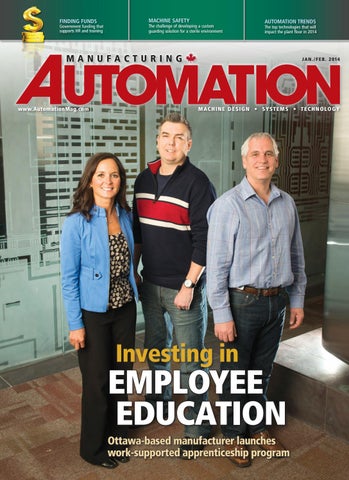
Investing in
EMPLOYEE EDUCATION Ottawa-based manufacturer launches work-supported apprenticeship program
See things from a new Point of View
HMI/SCADA Software for PC-based visualization Starting at:
$225 .00 PV-500-DEV
Point of View is powerful software for developing HMI, SCADA, and OEE/Dashboard projects for your control system that can be deployed anywhere. Create graphical screens that are easily understood, plus show data, alarms, trends, and more. You get all this capability for a very practical price, no matter how small or large the system.
Save time View your process from your desk or Web-enabled mobile phone using a standard browser (Internet/intranet including XML support) Save money Develop once and deploy on many Microsoft supported platforms Clear information Multi-language (UNICODE) so operators understand immediately Fix problems fast Understand alarms quickly, visually on-screen, or via E-mail, PDA, mobile phones or Web browsers Reduce downtime
Intuitive software gives you the tools to create dynamic objects and screens, easily saved and re-used to speed development. If you need alarms, events, recipes, schedulers, database interface - it’s all available!
Use open technologies (ActiveX, .NET) to visualize documentation, repair videos or audio messages
Each Point of View package includes one thin client, one secure view thin client, and one mobile thin client license. (Additional licenses are available separately.)
Enterprise integration Easily tie into ERP and “back-office” systems using built-in relational database connectivity Flexibility Contains 18 built-in drivers for connection to the most popular industrial controllers: AutomationDirect’s Productivity3000 and DirectLogic; plus many Allen-Bradley, Omron, Siemens, GE and Mitsubishi series. Also includes a driver for Modbus communication.
Our shipping policies make it easier than ever to order direct from the U.S.!
Free standard shipping is available for orders totaling over $49 U.S. (except for orders which require LTL shipping, see Web site for details). Also, save on brokerage fees when shipping standard ground to Canada - allow AutomationDirect to choose the broker.
Three software packages are available in 500, 1000, and 5000 tag count versions: • • •
Complete Package - Development + Runtime starting at: $495.00 [PV-500] Development Package - Development Only starting at: $225.00 [PV-500-DEV] Runtime Package - Runtime Only starting at: $345.00 [PV-500-RT]
If your project gets bigger than expected, smaller versions can always be upgraded to the next larger tag count.
Research, price, and buy at: www.automationdirect.com/point-of-view
See Web site for details and restrictions at: www.automationdirect.com/canada
Order Today, Ships Today! * See our Web site for details and restrictions. © Copyright 2013 AutomationDirect, Cumming, GA USA. All rights reserved.
1-800-633-0405
the #1 value in automation
W h a t ’ S
i n S i d e
FEATURES
DEPARTMENTS 4 5
FROM THE EDITOR AUTOMATION UPFRONT
Movers and shakers Deal makers
14 EDUCATION NEWS
COLUMNS 6
MACHINE SAFETY
7
INDUSTRY WATCH
8
AUTOMATION SOFTWARE
9
COLUMNBUS
cOVer PhOtO By cOLin rOWe
A look at integration challenges with the new ANSI/RIA R15.06-2012 robot safety standard Paul Hogendoorn reveals the missing ingredient for many entrepreneurial ventures Jeremy Pollard reviews Pilz’s PNOZmulti configurator Ian Verhappen offers suggestions on protocol selection
10 LEAN INSIGHTS
Dr. Timothy Hill outlines the items to consider when looking for lean education
12
22 DISTORTED REALITIES
inveSTinG in eMPLoyee eduCaTion
Ottawa-based manufacturer launches work-supported apprenticeship program By Mary Del Ciancio
11
Dick Morley discusses education and the value of understanding versus memorizing
NEW PRODUCTS
16
2O POWER SUPPLIES 2O TEST & MEASUREMENT 2O WIRE & CABLE 20 MACHINE SAFETY 21 INTERCONNECTION DEVICES 21 MACHINE TOOLS
TOP IN 2014
21 MOTION CONTROL
eS inTroduC
18
findinG fundS: ParT 1
Government funding that supports HR and training By Ryan Weaver
Safe and STeriLe
The challenge of developing a custom guarding solution for a sterile environment By Michelle Morra-Carlisle
ToP 5 in 2014
The technologies and trends that will impact the plant floor in the coming year Compiled by Mary Del Ciancio
TECHNOLOGY HANDBOOKS TECHNOLO
GY HAND BOOK
Manufacturing AUTOMATION’s Technology Handbooks are a collection of digital magazines that focus on a single product category within Canada’s manufacturing sector. Posted on MA’s website as an interactive flip-style magazine, each Technology Handbook provides readers with specific product category information, while offering advertisers the opportunity to share their thought leadership, brand and product offering in a unique and interactive format. Don’t miss this unique and targeted opportunity to reach our readers — machine builders, component manufacturers, end users, contractors, consultants and system integrators — who turn to Manufacturing AUTOMATION for the latest industry news, products, technology solutions and expert opinion.
Machin
SAFETYe
A LOOK INTO THE PRODUC AND SOLUTIO TS, TECHNO NS SHAPING LOG THE MARKET IES
DIGIT
SUPPLEMENTAL TO
MACHINE
DESIGN
• SYSTE MS
• TECHN OL
For more information and/or to book an ad in any of MA’s Technology Handbooks, please contact Klaus Pirker: 905-726-4670; kpirker@annexweb.com www.AutomationMag.com • January/February 2014
OGY
3
F r O M
t h e
e d i t O r www.automationmag.com
education: Whose responsibility is it?
E
ducation is important. That’s not really a ground-breaking statement. You’d be hard pressed to find someone to argue against that point. Indeed, education is important, and it is a key factor in fighting the looming skilled trades shortage. Employers in the manufacturing industry (among other sectors in Canada) are finding it increasingly difficult to find workers with the right skills to meet their business needs. But whose responsibility is it to make sure that today’s youth have the needed skills? And what is the best way for them to get these skills? I recently chatted with the SME’s Nigel Southway. He is one of a group of stakeholders in the manufacturing industry developing a new vision of what they believe industrial apprenticeships should look like in Canada. The SME, Professional Engineers Ontario, Canadian Manufacturers and Exporters, the Ontario Society of Professional Engineers and the Ontario Association of Certified Engineering Perhaps it’s time to try a new Technicians and Technologists are in the process of finalizing the details of this vision, but once approach to educating our they have agreed on the mechanism to put such a system in place, they’ll be bringing it to current and future workforce. government in hopes of getting it on the agenda for the next provincial and federal elections. According to Southway, Canada needs an integrated and scalable apprenticeship system to administer education and training with full support and involvement from industry sectors, educational institutions and local governments. Southway says that for the system to be successful, it needs to be directed by government, with incentives for manufacturers; industry needs to own it by setting the curriculum and training the students; and the education system needs to support it by tailoring the courses in a format that will support the industrial needs defined by the apprenticeship program. Details about this vision are on page 14 of this issue. He is suggesting a formalized approach, but there are manufacturers who are already taking it upon themselves to train their workforce with the skills they need to make their businesses successful. This issue’s cover story on page 12 highlights one such company. Abbott Point of Care in Ottawa, Ont., has sent 140 of its manufacturing employees back to school for an Instrumentation and Control Technician apprenticeship program. Developed in partnership with Algonquin College and the Ontario Ministry of Training, Colleges and Universities, course work is completed on-site during working hours, and the program includes comprehensive training and mentoring to help employees every step of the way. Why is the manufacturer taking it upon itself to educate its workforce? It all started when the company began experiencing double-digit growth year after year, and replaced many of its manual processes with automation and advanced technology to support that growth. But as the company introduced technologies like robots and pick-and-place machines, it also needed to educate its workforce so that employees had the training and skills to support the investments the company was making. It makes sense. Train from within to help support your growth. It’s no surprise that this company’s approach to investing in employee education is a hit with its employees. Christopher Janzen, dean of the Faculty of Technology and Trades at Algonquin College, told me he wished more companies would take this approach. Is this the way of the future? It doesn’t seem that the skilled trades shortage is going anywhere. Perhaps it’s time to try a new approach to educating our current and future workforce. What do you think?
Vol. 29, No.1
Canada’s leading publication providing industrial automation news and technology information aimed at the discrete and process industries. Mary Del Ciancio Editor mdelciancio@annexweb.com
Svetlana Avrutin Art Director savrutin@annexweb.com
Paul Grossinger Editorial Director pgrossinger@annexweb.com
Kathryn Nyenhuis Account Co-ordinator knyenhuis@annexweb.com
Klaus B. Pirker Group Publisher kpirker@annexweb.com (905) 726-4670
Luanne Morrison Circulation Co-ordinator 866-790-6070 ext 206 Fax: 877-624-1940 lmorrison@annexweb.com
Dick Morley Ian Verhappen Dr. Timothy Hill Paul Hogendoorn Jeremy Pollard Columnists
Michael Fredericks President mfredericks@annexweb.com
Editorial Advisory Board Al Diggins, President and General Manager, Excellence in Manufacturing Consortium David Green, Technology and Business-to-Business Marketing Professional Piero Cherubini, Dean, Faculty of Skilled Trades and Apprenticeship, Mohawk College of Applied Arts and Technology Sherman Lang, Industrial Technology Advisor, Industrial Research Assistance Program, National Research Council of Canada Don McCrudden, Vice-President, Business Development, Festo Bill Valedis, Vice-President, Precision Training Products & Services Inc.
Manufacturing AUTOMATION is published seven times a year by Annex Publishing & Printing Inc. 222 Edward Street, Aurora, Ontario L4G 1W6 Tel: (905) 727–0077 Fax: (905) 727–0017 PM # 40065710
The contents of Manufacturing Automation are copyright ©2014 by Annex Publishing & Printing Inc. and may not be reproduced in whole or part without written consent. Annex Publishing & Printing Inc. disclaims any warranty as to the accuracy, completeness or currency of the contents of this publication and disclaims all liability in respect of the results of any action taken or not taken in reliance upon information in this publication. Send address changes and return undeliverable Address Blocks to: Manufacturing AUTOMATION, P.O. Box 530, Simcoe ON N3Y 4N5. Return postage guaranteed.
Subscription rates: Canada — $40 per year. United States and Foreign — $60(US) per year. Student subscription rate $20 per year. ISSN-1480-2996
We acknowledge the financial support of the Government of Canada through the Canada Periodical Fund of the Department of Canadian Heritage.
Members of
Mary Del Ciancio mdelciancio@annexweb.com Follow me on Twitter @AutomationMag 4
January/February 2014 • Manufacturing AUTOMATION
a u t O M a t i O n
u P F r O n t
DEAL MAKERS aCM facility Safety partners with autopro automation Consultants acM Facility Safety and autopro automation consultants recently announced a partnership focused on providing real-time risk visualization solutions to process industries in canada. the partnership is designed to deploy SafeGuard Sentinel software, a solution that allows users to monitor their process safety risks in realtime, and provide risk performance indicators,
equipping management to proactively track process safety performance without incidents. autopro is qualified to integrate SafeGuard Sentinel into existing control and industrial information systems that need to be monitored to ensure process plants are operated with visibility into their level of risk. “risks take many forms within operating facilities — from safety and environmentalrelated risks to equipment damage, process upsets, production interruption and damage
to corporate image,” said david nakaska, president of autopro automation consultants. “acM has developed a unique product in Safeguard Sentinel, which can make a real difference in achieving safer and more productive facilities by identifying risks in real-time. autopro is delighted to add our expertise in industrial automation, functional safety, industrial it and systems integration to complement acM’s process safety and risk experts in the design and implementation of this high-value solution.”
do you have SoMeThinG To Say? Let us know what you think about our magazine and content. Send your comments and thoughts to editor@automationmag.com.
MOVERS AND SHAKERS Elizabeth Sanchez has been named plant manager for eaton’s low-voltage distribution assemblies facility in Milton, Ont. She Elizabeth succeeds Mike Masur, Sanchez who was recently named national engineering manager, eaton’s electrical Sector canada. Sanchez will be responsible for managing and directing the low-voltage distribution assemblies operations in Milton and in new richmond, Que., to assure attainment of strategic, operational, financial, quality and employee-related objectives. recently, Sanchez served as plant manager for eaton’s fluid conveyance facility in Guelph, Ont. Prior to joining eaton, she held plant manager positions for General electric’s digital energy and Lighting operations. She is also a certified Six Sigma Black Belt. Sanchez holds a Bachelor of Science degree in electrical engineering from universidad rafael urdaneta in Venezuela. eaton has also appointed Helen Veldhuis manager, canada’s quick-ship satellites and lowvoltage enclosed control facility in Mississauga, Ont. Helen Veldhuis in this new role, Veldhuis will be responsible for managing and directing the canadian satellite sites and the low-voltage enclosed control manufacturing facility to ensure attainment of financial, growth, market and quality objectives. this includes responsibility for pricing, negotiations, promotion, order entry, customer order engineering, customer service, health and safety, quality and employee development. recently, Veldhuis served as the manager of project management and customer service. She holds a Masters of Business administration from the university of Phoenix and a Bachelor of arts (Psychology) from the university of Guelph.
Beckhoff_MA_Jan.indd 1
www.AutomationMag.com • January/February 2014 5 2013-12-31 2:56 PM
M a c h i n e
S a f e t y
Integration challenges with the new robot safety standard By Danny Marmora
I
attended the Robotic Industries Association’s 25th National Robot Safety Conference this past October in Indianapolis, Ind. Attending the conference proved very informative, leaving me with many questions regarding the impact the new ANSI/RIA R15.06-2012 robot safety standard will have on current integration methods and control system architecture given the current state of accepted safety control system design in North America. The current 2012 revision of the ANSI/RIA R15.06 standard is a harmonization with its European counterpart — ISO 10218 Parts 1 and 2. I believe it carries significant weight that has yet to be fully understood in North America. Our Canadian Standards Association harmonized the existing CSA Z434 standard in 2003 with the then in force ANSI/RIA R15.06-1999 edition of the standard. At that time, other than a few specific “Canadian” requirements in Z434 that differed from its U.S. counterpart, the two standards were aligned from a technical, safety and integration standpoint. By way of this North American harmonization, the transfer of robots, robot cells and integration was easier, and consumers of such equipment had an increased confidence that the robots and allied equipment were compliant to one robot standard. What further made this environment palatable from a safety control design and integration standpoint was that the accepted safety circuitry/control architecture platform that was being used across North America (for most industrial machinery and robots) was based on BS EN 954-1 “Safety of Machinery. Safety Related Parts of Control Systems - General Principles for Design.” This standard outlined the five basic safety circuit designs, their functional requirements, monitoring and failsafe reliability. Those categories were identified as B, 1, 2, 3 and 4 (B being the lowest and 4 being the highest). In many instances, without a defined directive from an existing machine safety standard to rely on, the application’s safety devices
6
January/February 2014 • Manufacturing AUTOMATION
The summation of PL systems could limit/change how current multi-device safety circuit chains are designed. and the overall safety control system were chosen via the use of well-tried and accepted risk analysis (such as those provided in CSA Z432, Z434 and many ANSI standards). The outcome of the risk analysis would ultimately decide the circuit category the safety system was to be built to. Conversely, a number of years ago, the European Commission announced that EN 951-4 was to be withdrawn (circa 2011) and replaced with two new standards: EN 62061 and EN ISO 13849-1. These two new standards deal with the functional safety aspects of machinery and electrical/electronic control systems. Briefly (and specific to robots and most industrial machinery), 13849-1 deals with safety-related parts of control systems and all types of machinery, regardless of the type of technology and prime energy source (i.e., electrical, hydraulic, pneumatic, mechanical, etc.). 13849-1 also lists special requirements for safety-related parts of control systems with programmable electronic systems. 13849-1 has the familiar category hierarchy of EN 954-1, but bases circuit performance not only on the physical wiring configuration (i.e., a single or dual channel), but also on a Performance Level (PL). This PL is the average probability of dangerous failures per hour. It is a statistical value, and each of the five PLs within 13849-1 has a defined value range. This method of establishing and measuring circuit performance is quantitative, unlike the qualitative aspects of EN 954-1. 13849-1 examines the complete safety function, including all of the components involved in their design. Where 13849-1 is different and goes beyond the qualitative approach of EN 954-1 is that it includes an assessment of the various safety functions — be it electrical, hydraulic, pneumatic or mechanical. A PL is established for each safety sub-system/block. The current version of the ANSI/RIA R15.06 robot safety standard is now reflective of that functional safety requirement given its harmonization with its European counterpart. And since safety control design in North America still primarily relies on EN 954-1, many machine builders, integrators, etc., still use the risk graph and category selection for safety system design. Where I believe the immediate challenge lies with robot cell builders and integrators is that the functional safety requirements of the current ANSI/RIA R15.06 2012 standard do not coincide well with the existing BS EN 954-1 methodology. This is not to mean that the existing safety controllers, relays, contacts, etc., cannot satisfy the requirements of 13849-1. In fact, these devices are built and tested to satisfy functional safety requirements. The challenge is going to be integrating these new functional safety requirements within the existing framework of 954-1
applications, whether they are new or existing/older applications seeking robotic integration/upgrade. When designing and implementing a functional safety system under the requirements of 13849-1, one needs to consider several variables, including safety system structure, reliability, diagnostics, resistance and process testing. Within these areas are the requirements to review and establish mean time to failure/dangerous failure and sub-system design. What I find interesting about this new method is that the summation of PL systems could limit/change how current multi-device safety circuit chains are designed. Understanding that the functional safety method deals with the probabilistic life cycle of the devices physically connected to one another, one draws the conclusion that integrating an increasing number of devices in a series/parallel circuit could effectively reduce the overall probabilistic life of the circuit. This concept is not limited to safety design, but any connected system where those devices have a known reliability. Hence, under 13489-1, each increasing PL from a to e has an associated maximum number of physical components that can be allowed in that resulting PL circuit (PLa being the highest and PLe the lowest). By way of example, the current ANSI/RIA R15.06 standard requires that safety related parts of a controls system shall be designed with a PLd. Therefore, the “traditional” method of building a robot cell with several interlocked doors tied electrically into one safety relay that is control reliable or Category 4 may not work under the requirements of the new standard because the number, arrangement and probabilistic life of each component becomes important in the overall circuit design and requires consideration. Further, many of the larger-scale integration projects I have reviewed have included the robot controllers integrated with machine tools, welding operations and/or other standalone process equipment. The current EN 954-1 and CSA Z434 (at this time), do not specifically preclude this type of integration so long as the required safety circuit reliability, monitoring and failsafes are maintained. Considering this practice through the lens of functional safety, we need to ask the following questions: Can we rely on the machine tools controller for a contribution to overall safety?; What is the performance level of the welding operation?; What are the external process safety sub-systems and mean time to dangerous failure?; Does their integration into the robot cell allow us to maintain the prescribed PLd as per the standard? What are the answers to these questions? Only time will tell. • Danny C. Marmora, B.Eng., P.Eng., CET, is the principal at Marmora Consulting (www.marmoraconsulting.com), based in Stoney Creek, Ont. His engineering firm specializes in pre-start health & safety reviews, fire code consulting and forensic engineering. He can be reached at danny@marmoraconsulting.com.
I n d u s t r y
W a t c h
Entrepreneurship – the missing ingredient By Paul Hogendoorn
“E
ntrepreneur is just another word for unemployed.” This remark is doubly cutting — first, because my wife made it; and second, because more often than not, I realize it’s true. I enjoy being an entrepreneur. I think it’s a good thing and our society needs more of them. Defining what an entrepreneur is, or what makes an entrepreneur, is subject to wide and varied — and often passionate — discussions. “Inventor,” “visionary” and “business builder” are the most common definitions, but being an entrepreneur is more than that. It’s more than having big dreams and bright ideas, or working hard and investing your time and energy into something you created. Yes, it does take persistence and determination, imagination and vision, strategic thinking and skill, but there’s still more to it than that. It may require a bit of luck (or perhaps a lot of luck), the help of a strong supporting cast, and the availability of key resources at just the right time. But even having all of that doesn’t make someone a successful entrepreneur. What’s often missing is just that — success. Entrepreneurs are often thought of as the conceiver or initiator of a new venture, but they don’t have to be. People that buy franchises or existing companies definitely deserve the title, too. Entrepreneurs are usually builders and cultivators, but building or cultivating an idea or company is not enough. Some people are seeders, some are builders (cultivators), some are harvesters, and some may be a combination of the three. Most people that call themselves entrepreneurs are seeders — they are good at starting new things. They see opportunities that others do not see. They have a vision for what can be. A lot of them are likely also builders — they are able to grow that thing they see into something bigger, and they are able to recruit others into the pursuit of that vision with them. But the difference between many self-described entrepreneurs and successful entrepreneurs is the ability to harvest — to make it pay off, not just for the entrepreneur, but for everyone that got recruited into the vision and got involved in pursuing the dream. Sustainability is an equally important objective for the entrepreneur. Success is often slow in coming, and the entrepreneur has to be able to reap enough along the way to make it to the times of harvest. I have sometimes described myself as an “incurable entrepreneur,” but that could be easily interpreted as something akin to being an “eternal optimist.” The
truth is, by nature I am a seeder and a cultivator, and the harvesting role was the most unnatural of the three for me.
CONEC_MA_Sept.indd 1
Those were skills that I had to learn along the way, and that I was fortunate enough to develop — either through persistence,
a bit of luck, the support of others, or a combination of all three. continued on page 10
12-07-25 10:04 AM
www.AutomationMag.com • January/February 2014
7
a u t O M a t i O n
S O F t W a r e
First impressions: Pilz Safety PNOZmulti configurator By JereMy PollarD
I
have often wondered, “What’s the big deal about safety? There can’t be that much to it!” In fact, I’ve actually said those words to Kevin Pauley, the Canadian manager for Pilz Automation and Safety, whom I have known forever. And that’s when he educates me. Pilz is a unique company whose only focus is on safety. But of course you need software to develop, monitor and document your safety strategy. Their product offerings go from zero to 60. This column looks at their 30 mph solution. Version 9.4 of Pilz’s PNOZmulti configurator is full of new things. I have used the previous versions, but stopped at early 6.x. So, going into this, I wondered what was different and how much more mature the platform had become. The Multi is the hardware platform that interfaces with all things safety. All other products interface with this device, and the configurator software does the things you need to do to program the strategy. The Pilz PNOZ configurator application canvas is a segregated template where placeholders are deposited on the screen. I say strategy because it is not a program as such. It is a protective approach, which is different than a PLC-type control program. K2’ main power contactors, which provide main power to the process so it can be The configurator install went well on a 64-bit Windows 7 platform. Since I had stopped when it needs to be. previous projects, I first brought an existing strategy into the editor. As long as you Documentation is so vital, and the only way you can get to the full description don’t use any new devices or components, the resulting program(s) are backwards is to put the mouse over the icon. Toggling between European and American views compatible. It is fast, which is good, and the fact that it is very picture-oriented allows yields no difference in the text. You begin by creating a narrative of how you want the safety system to operate. you to see exactly what the canvas looks like. Because Pilz deals in various devices, such as foot switches, mats, light curtains Once that is done, the rest becomes seemingly easy. and the like, the software supports all of them pictorially. I found the software very responsive both online and offline. I recommend starting The main canvas is a segregated template where placeholders are deposited on the with the end result first, by placing the K1/K2 output on the canvas first. Depending screen. Each icon has wired placeholders to create the strategy to control the ‘K1/ on how many devices you have, you can create sheets and use source connection points to navigate the logic to various sheets. These connection points form the entry to the final template. Once you define the outside devices, such as e-stops and gate switches, they are placed on a separate canvas with a connection point to the final sheets. The real benefit of the software is the ability to see the strategy due to its graphical nature. When you leave out a link, the software tells you. You cannot download code without it passing a battery of tests. The online monitoring is very intuitive, and someone with basic logic training should have no trouble following the path. Each icon represents a device, such as an e-stop, by graphics, including each icon’s configuration. If the block’s reset is manual vs. automatic, the graphics are altered. Knowing these little details can help. The ability to produce macros to populate the canvas with an automatic flair is interesting, but the project would have to be big to use this feature. Spreadsheets for import/export are supported. There are a few annoying roadblocks, such as looping back behind the elements on the canvas. If you try and traverse the logic flow, you will be denied. It seems that Pilz logic solving is similar to Modicon’s cell-based execution. The menu sidebars are very helpful, and carry on the consistent graphical nature of the platform. They have done a good job of defining the safety devices used in industry to be communicative to the user monitoring the system. The printouts are self-documenting, if you will. I have always liked the ability of Pilz to keep it simple. Safety systems are there to just work, and Pilz does a great job of that. You can access the connected state of the devices by Ethernet using ModbusTCP. It holds the current program on a chip card — which means no batteries — and protects us from ourselves by not being able to remotely download. The PNOZmulti hardware platform is very cool, and the configuration software is easy to use. Let me know what you think! • Jeremy Pollard (jpollard@tsuonline.com) has been in the industrial automation industry for more than 25 years. He has worked as a systems integrator, consultant and educator.
8
January/February 2014 • Manufacturing AUTOMATION
Helukabel_MA_Jan.indd 1
2013-12-31 2:53 PM
C O L U M N B U S
By Ian Verhappen
Picking from a plethora of protocols
T
he present version of the IEC 61158 standard includes 19 different protocols. However, while at an ISA meeting recently, I was approached by a Japanese organization about the addition of another, so I believe we will soon be up to 21 protocols in a single standard — and this is only for industrial processes. There are also multiple standards for other industries. With so many options, how do you decide which one to use? Despite the “fieldbus wars” of the mid-1990s that resulted in the amalgamated IEC 61158 standard, each protocol in that standard was developed from a specific industry and has continued to remain strong in the vertical niche or sector from which it came. Therefore, one of the primary considerations when selecting a protocol for your project is whether it is designed for your application. Does it address items such as response time/baud rate (real time is different for a process storage tank or temperature reading than it is for a multi-axis robot), network length, area classification and packet size (an indicator of its ability to support discrete as well as analog signals)? Of course, if you already have one or more protocols (hopefully not more than two) in use at your facility, that is also a big factor in the decision process because you not only have to have the infrastructure in place, but you also need staff familiar with and trained in how to maintain and make effective use of the protocol’s features. You also need to consider what protocols are supported by your present control system, since a direct interface is always much better than needing to use a gateway. A gateway is effectively a “translator” that converts one protocol or language to another. As we know, with any translation, it is never perfect or without the potential for misunderstandings. Gateways also require configuration and, though they are very reliable, are another potential source of failure in your system. Geography also plays a factor in the decision process because some standards have predominance in that market in certain parts of the world — e.g., electrical distribution SCADA systems are divided into DNP3 in North America and IEC 61850 in most of the balance of the world. On a smaller or more regional scale, you also need to consider the level of local support for the protocols being considered, since certain parts of a country may have many multi-national companies that support a protocol from another part of the world (i.e., a European pharmaceutical manufacturer in the Eastern Seaboard) rather than the North American market-leading protocol for that industry, for example. Another consideration I include in my deliberations is whether the protocol supports an “Ethernet version” so that, if desired, I can migrate to an Ethernet packet-based network, especially for the backhaul or “controller-to-controller” communications. Then I can also use that Ethernet infrastructure, including the Internet (assuming I have the appropriate cyber security configurations on the network), if desired. Fortunately, most protocols support Ethernet, including the newly released HART/IP. Once you have converted to an Ethernet packet, it is now possible to send the resulting information wirelessly using the same IEEE 802.11 infrastructure that we use in our homes or public places. Then, if you are using wireless for your backhaul and have the necessary infrastructure in place to support the next wireless step of industrial networks, you can bring your wireless network to your field sensors (not to replace wires, but rather to provide measurements that are not feasible with wired devices). Unfortunately, there are few such products on the market yet, though many innovations in the RFID and SAW (Surface Acoustic Wave) sensor field may soon change that. Having gone “full circle” from wired field-level networks back to field-level wireless networks, I may not have answered the initial question of how to select the protocol for your project, but hopefully I provided you with some guidance on the associated thought processes used during the initial Front-End Engineering Design (FEED) to help you narrow the list down to what protocols are worth considering further. • Ian Verhappen (iverhappen@gmail.com) is a professional engineer, ISA Fellow, Certified Automation Professional, member of the Control Automation Hall of Fame and a recognized authority on industrial communications and process analyzer technologies. He has more than 25 years of experience in the hydrocarbon industry. Verhappen provides consulting services specializing in industrial communications, process analytics and heavy oil/oil sands automation. www.AutomationMag.com • January/February 2014 win_MA_May.indd 1
9
12-04-26 10:54 AM
L e a n
i n S i G h t S
Getting a lean education: A penny saved is (more than) a dollar earned By Dr. TIMoTHy D. HIll, PH.D., ClSSMBB, PMP
L
ean education and training should pay for itself. You should be able to find a direct relationship between having your people trained in lean and a direct measure of savings. You should be able to see yourselves having fewer mistakes, less rework and more quality work, not to mention happier customers and employees. But how do you get that training or education for your employees? Here are some of my “to do” items to consider when you’re looking for lean education. Be prepared to ask your prospective lean educator about the following: 1. How will they get to the meat of the matter? Very often, people only provide training for the tools, are sector-specific, or have trainers that don’t have deep experience or lack expertise in training, adult education methods or methods to facilitate transfer of training. Training on the tools, if you’re lucky, will get you lean success 20 per cent of the time. People like to train on the tools largely because it’s an easy thing to do. If you want lean to have a sustainable success, you’ve got to be able to change the organizational culture. Ask your trainer about how they will build a lean culture. 2. How will they let your people revisit the training? I use the Toyota “train then do” method in conjunction with a real-world value stream mapping (VSM) exercise. This involves training them on a small,
focused bit and then allowing them to experience that in the real world by doing it for themselves. There’s no “adult day care,” and I tell them to select a real problem from their workplace — one that they’d like to improve, if not eliminate. • I will let them revisit the training when I involve them in their waste walks or their trips to the gemba (their “go and see” walks). They go to the gemba in order to get the “three reals” — the real facts, the real problem and the real situation. I “connect the dots” for them during these walk-abouts. • This is in addition to whatever cases, simulations, games, videos and other methods I bring that will let them revisit the training. I just don’t print out binders of the PowerPoint that they’ve already seen! • For the VSM work, I will come back every other week to supervise the delivery of their lean implementation plans. This serves two purposes: First, it allows me to refresh them on the training, and secondly, it keeps the suggestions theirs and builds the lean culture, while keeping them on the correct path for lean deployment. I practise my Toyota leadership skills, demonstrating these skills for them to follow. 3. How will they be able state lean savings in clear terms? I help them to state their savings in three ways:
• The first way is for when they want to share their results and savings in their department and throughout their facility. I show them how to state their savings in footsteps saved, defects reduced, time and motion saved and so on. I show them how to state these savings and make sure that they’ve got consistency right across the whole organization. • The second way is for when they’ve got to present to the senior team. I show them how to spell out their savings, but also in the lingua franca of senior team members — often in dollars and cents. • The third way I show them is reserved for when they’re making a capital request. I show them how to use the A3 as a business case. Basically, they make the argument in their A3s that the problem is costing them “X” dollars per year now, but if they were able to eliminate that problem, they would be saving “Y” dollars per year, along with all of the other savings. For those who are wondering what an A3 is, it’s the one piece of paper approach to telling the story of how you will improve something. If you can satisfy yourselves that you’ve got these few rudimentary questions answered, then you’re likely good to go. Remember that lean leaders will train during the downturn periods for their sector. In that way, they’ll be
From the bookshelf...
Poka-yoke: improving Product Quality by Preventing defects edited by nKS/factory Magazine i read a review of this book that said if your goal is to eliminate your defects, then this book is for you. i agree completely. the book is aimed at supervisors and shopfloor workers, but it’s really for everyone who wants to prevent anything from going wrong. i often tell people, “if it’s predictable, it’s preventable,” and that’s the spirit conveyed in this book. Poka-yoke, or mistake-proofing (sometimes also called error-proofing), works best if the suggestions come from those people closest to production — the employees doing the job. you can get help from engineering staff, tooling people or machine specialists, but the ideas come from those that do the work. this way you get lean buy-in, and one success often leads to another.
continued from page 7
Entrepreneurship – the missing ingredient
An entrepreneur should never aim for anything short of success. Success is not something that is owed to the entrepreneur, but rather success is something that the entrepreneur owes to everyone that helped along the way. To be called an entrepreneur doesn’t mean you have to have achieved success;
10
the book is divided into two parts. the first section uses a simple, illustrated format to summarize many of the concepts and main features of poka-yoke. the second part is comprised of some 240 examples of poka-yoke improvements. now these are all implemented in Japanese plants, but they should serve as very good examples of innovative problem-solving for facilities here. there’s even some sample improvement forms at the very back of the book for you to sketch out your own ideas. i’d like to see some poka-yoke examples from areas other than electronics, automotive, cameras and heavy industry — perhaps some back-office, agri-business, sales and other examples. Overall, this is a delight to read — simple but very effective.
it means that you are able to define it clearly so that you can aim for it persistently, share it clearly, and engage others, allowing them to invest their talents and energies in support of yours. Not having that clear picture of what success looks like, and a reasonable map on how to get there, may not be critical to visionaries,
January/February 2014 • Manufacturing AUTOMATION
able to ride the recovery with a strengthened workforce. As you build your lean culture, you’ll find your savings will more than pay for your employees’ lean educations! These savings will come from decreased waste, wait times, defects and the like. If you want, you could think of these savings as adding capacity to your operation or recovering time that can be applied to other processes.
Question from the floor
QUESTION: When I watch Toyota senseis, I am surprised. I expect them to follow the steps outlined in the TPS house — you know, 5S it, introduce stability and standard work up to problem solving and then put some tools to work. They don’t do it that way. What am I missing? ANSWER: The senseis will likely tell you that they’ve been dealing with the problems in the order that they appear. I believe that your experience with Toyota senseis differs from your TPS studies because the literature typically describes a plan of implementation of lean solutions and techniques. My experience as a sensei is that we do have broad roadmaps in our minds, but these are more about changing the culture rather than training people on specific tools or a specific technique. You’ll find that your biggest lean challenge is getting everyone’s head around basic problem-solving — getting them to understand their problems as a means of improving their processes and their work. My experience is that the projects they pick for you are rarely to your liking. This is about what they think you should learn as opposed to what you’d like to learn. Broadly speaking, the journey is about getting people’s attention first, then “cleaning the window” or “clearing the clouds” by focusing on quality, then getting into rough just-in-time conditions, at which point the real lean work can start in the form of challenging kaizen projects.• Dr. Timothy Hill is an Industrial and Organizational Psychologist and Certified Lean Six Sigma Black Belt with global expertise in Human Resources/ Human Capital. He can be reached at drtim@kyoseicanada.ca.
By Paul HogenDoorn
inventors, researchers, academics or people that dream of improving their world. Those are all good things to be, but added to all of those things, an entrepreneur needs to be success focused. It’s what they owe to the people that believe in them and support them, and it’s what our world needs more of right now. •
Paul Hogendoorn founded TPI Associates, an organization dedicated to helping entrepreneurs and business leaders pursue their vision and build their companies. For more on this topic, visit www.tpi-3.com or contact Paul directly at paul@tpi-3.com.
e d u c a t i O n
a n d
t r a i n i n G
Finding funds: PART 1 Government funding that supports HR and training By ryan WeaVer
T
he success that Canadian small and mediumsized businesses (SMEs) experience in today’s knowledge-based economy is largely determined by how well they can predict and adapt to change. This continually evolving environment in which businesses exist has seen R&D and training become increasingly vital to business success. After all, organizations improve through learning. In the past, businesses initiated the learning process by enrolling their employees in company training courses. Now, with the breakneck speed of innovation, learning is initiated through the act of solving problems, which often calls for introducing a new engineering process or technology, or the development of a new product or service.
hr and training complements r&d The known link between innovation, R&D and training isn’t new. As far back as 1995, Statistics Canada released a report providing strong evidence of how the incidence of training was closely related to the importance a firm gave research and development, the use of technologies, and other strategies all closely related to innovation. To support Canadian SMEs that are looking to get a step up on competitors and contribute to our nation’s economic growth, provincial and federal governments have set aside funding and resources to ensure SMEs have qualified workers with the requisite skills and capabilities to support ongoing and future business plans. This funding for human resources and training programs can help organizations hire or retrain staff, improve their marketing effectiveness and train their staff in areas such as new technology or operational processes.
Small business grants for organizational learning and development What should be understood about the government’s support of learning and development initiatives taken on by Canadian SMEs is that available funding focuses on training required to adapt to the implementation of new and improved technologies and processes. Thus, it should come as no surprise that new employee orientation and other soft skill development programs are not covered by provincial or federal business grants programs. Accordingly, many of the manufacturing firms that our business has helped in developing strategic funding plans for have
tapped into government funding for human resources and training programs like Yves Landry, while simultaneously receiving small business grants through the Industrial Research Assistance Program (IRAP). As a general rule, if your business has qualified for SR&ED (R&D tax deductions), then your firm will likely also qualify for IRAP funding to assist with projects that aim to tackle a technical challenge. And because solving technical challenges usually means the adoption of new technology and processes, the training required of your employees to adapt to these changes will qualify for small business grants of up to $50,000 through the Yves Landry Global and Northern AIME Initiative.
Government grants for small business hiring of recent graduates and experienced export managers While the Yves Landry AIME Initiative is not currently offering funding to active training projects, manufacturers can benefit from several other opportunities in the form of government grants for small business hiring. Some of the most popular programs over the past few years have included Canadian business grants for hiring recent graduates, such as various streams of Career Focus funding programs, Graduate Enterprise Internships (also referred to as iSTEM), ICTC CareerConnect and Mitacs. Manufacturers across Canada have leveraged these programs to receive anywhere from $12,000 to $20,000, or 50 per cent of an employee’s wage. Generally, these programs require participating employees to be under 31 years old and a recent graduate of a Canadian post-secondary institution, and a permanent Canadian resident, citizen or refugee. The Ontario Exporter’s Fund (OEF) is one Ontario government funding program for hiring that offers an opportunity to receive up to 50 per cent or $40,000 per year for two years ($80,000 maximum) for hiring an experienced export manager or international business development manager. The Ontario Chamber of Commerce (OCC) administers OEF funding with the support of the Ontario government. Eligibility requirements for this funding program include having the company be
incorporated in Canada for at least two years, have five to 500 employees, and between $1 million and $20 million in revenue, of which 10 to 50 per cent comes from export sales. This is an excellent chance for Ontario businesses that are looking to enhance their international presence, and many firms have simultaneously accessed government funding of up to $30,000 to attend foreign tradeshows.
receive strategic support through Canadian government grants and loans Canadian government funding has been positioned to help Canadian SMEs strengthen and grow their operations to compete globally, while at the same time creating jobs and developing the economies of local communities. Funding programs are numerous and accessible to most incorporated businesses with more than 15 employees that conduct research and development and/or manufacture in Canada. Nonetheless, it’s astounding at the number of firms that don’t take advantage of government subsidies that have been set aside to reward them for playing a continual role in growing the Canadian economy. What is more, Canadian government funding programs are project specific, and businesses that regularly tap into government funding often say the process has had a positive effect on their business’ attention to their short- and long-term growth strategy. In the next issue, I will highlight government funding opportunities available to Canadian manufacturers to increase their energy efficiency.• Ryan Weaver is a marketing analyst at Mentor Works (www.mentorworks.ca), a company that helps organizations secure Canadian government funding to support their strategic initiatives. Weaver has a B.A. in economics, a M.Sc. in management, and several published works, including two books. www.AutomationMag.com • January/February 2014
11
c O V e r
S t O r y
INVESTING IN
EMPLOYEE EDUCATION OTTAWA-BASED MANUFACTURER LAUNCHES WORK-SUPPORTED APPRENTICESHIP PROGRAM
PhOtOS By cOLin rOWe
By Mary Del CIanCIo
(From left to right) Cathy Lewis, business excellence manager; Sean Tomalty, plant director; and George Ferguson, incoming quality control inspector and student
12
January/February 2014 • Manufacturing AUTOMATION
S
chool is in session at Abbott Point of Care in Ottawa, Ont. One hundred and forty of the manufacturer’s employees started an Instrumentation and Control Technician apprenticeship program in September — a program aimed at helping employees gain the skills they need to adapt to a changing manufacturing industry, and support the investments in automation and advanced technology that the company has made throughout the plant in recent years. The Instrumentation and Control Technician apprenticeship program, developed in partnership with Algonquin College and the Ontario Ministry of Training, Colleges and Universities, allows course work to be completed on-site during working hours, and includes comprehensive training and mentoring to help employees every step of the way. And the employees don’t pay a cent. Abbott Point of Care foots the bill, with some support from government funding. This isn’t the first time the company, which manufactures cartridges for an advanced, handheld, diagnostic tool for rapid blood analysis, has provided valuable training to make sure its employees have an upgraded skillset. The company has a long history of investing in its employees, and has won numerous awards for being a top employer. It all started when the company began experiencing doubledigit growth year after year, and replaced many of its manual processes with automation and advanced technology to support that growth. But as the company introduced technologies like robots and pick-and-place machines, it also needed to educate its workforce so that employees had the training and skills to support the investments the company was making, and could grow with the organization as well. In 2007, the company launched a Microelectronics Manufacturer apprenticeship program so that employees could learn to better operate and monitor the high-tech automated equipment that the company had invested in, while receiving the necessary skills to improve processes and automation. With a total of 304 class hours over the course of three years, the program has allowed close to 400 staff members to upgrade their education and gain enhanced skills in communication, science and mathematics, teamwork, critical thinking and problem solving. “We were going into automation. We were expanding. We wanted to make sure that we had the talent we needed to continue to grow the business,” says Sean Tomalty, plant director at Abbott Point of Care. “We saw this as the way to improve our uptime, improve our troubleshooting skills and get a standard across the facility that would facilitate continuous improvement.” The new apprenticeship program trains employees to become Instrumentation and Control technicians. One hundred and forty of the facility’s more than 850 employees are enrolled in the program, which features a customized curriculum, including 15 courses over three years — eight hours a week of class time and on-the-job training — plus a fourth year to finalize onthe-job training requirements. That’s a total of 720 hours over four years. And since this program is very technical, employees will also have to dedicate time each week outside of work to complete assignments and study for tests. “It’s a requirement for your provincial apprenticeship certification that you demonstrate skills learned in an on-the-job fashion,” says Cathy Lewis, Abbott Point of Care’s business excellence manager in charge of the apprenticeship program. “And we’ll work with them over the three years and then extend their learning through the fourth year to ensure that they’ve had an opportunity to demonstrate all of those skills.” The Instrumentation and Control Technician apprenticeship program has the added advantage of being “Red Seal” certified, which allows qualified tradespeople to practise their trade anywhere in Canada. “Should they choose, there is a Red Seal exam that we will support and they can take a cumulative one more step and get Red Seal certified,” explains Lewis. “So these folks, when they finish the program, will be eligible to write that interprovincial exam,” says Christopher Janzen,
dean of the Faculty of Technology and Trades at Algonquin College. “With their certificate of qualification, they’ll be able to go anywhere in Canada and work. And Abbott is aware of that, and aware that they could lose some of their highly trained people by doing this sort of a program. But at the same time, this is the skillforce that they need, and they would much rather develop from within so that the culture and climate and the expectation of work ethic is instilled already in their employees…I wish more companies would do it.” For Abbott, this is the best way to make sure they have employees with the right skillset. “I don’t know how else we would be able to train this many people at this scale,” says Lewis. “It’s quite ambitious, and we juggle production with academic goals. The model with the Ministry of Training and Colleges and Universities and Algonquin College and us has worked very, very, very well. We couldn’t do what we’re doing without them. And we’re providing exceptional programming for our employees.” Tomalty says that, while employers investing in their staff may not be unique, what makes their program stand out is that they’ve provided the infrastructure to go to college on-site, which makes it a lot easier and a lot more convenient for employees. Convenience is key, says Lewis. “In a manufacturing environment, our guys work shiftwork — 12 hours on, 12 hours off, nights, days. So for some of them, on a rotating shift, it would be impossible for them to attend a college course on a regular basis if it wasn’t at work, on work time,” she says. George Ferguson, an incoming quality control inspector at the Ottawa plant, is a graduate of the Microelectronics Manufacturer program, and is currently enrolled in the Instrumentation and Control Technician apprenticeship program. “This is an opportunity for me to get that education and further my career,” says Ferguson, who has aspirations of becoming an equipment technician at the plant. “It’s great. It’s something I can actually brag about to other friends who work for other companies. How many companies will pay for an education? I love it,” he says. But for Abbott, investing in employees and providing on-thejob training is how they respond to a changing economy and a rapidly growing sector. And it’s something they will continue to do if they see the need, says Tomalty. “Abbott’s apprenticeship program is designed to better equip employees to do their advanced manufacturing jobs safely and effectively, while fostering innovation, opportunities for advancement, and a culture of learning,” he says. “We continue to look for unique ways to create a development-focused working environment.” Lewis describes their approach to employee education as “win-win.” “We have a co-ordinated, highly effective, innovative workforce development program, and our people get to go to college. So it’s just awesome.”•
Abbott Point of Care’s Instrumentation and Control Technician apprenticeship program allows employees to complete course work on-site during work hours.
interested in offering employee training? where do you start? abbott Point of care’s cathy Lewis has this advice: “When considering an apprenticeship program, the first step would be to review and prioritize development needs that support operational and strategic priorities of the business now and into the future. alignment with a training delivery agent, such as a local college, as well as the relevant provincial ministry of education, is required in Ontario to implement apprenticeship programming. this three-way partnership requires creative collaboration among private, public and educational institutions. “the next step,” Lewis says, “would be to evaluate options for delivery that balance business needs and classroom time. abbott chose to offer classes on work time, which best supports our 24-hour shift operation and balances the personal obligations and work responsibilities of our apprentices. Other proactive considerations to facilitate long-term success include assessing pre-apprenticeship learning needs, incorporating adult learning best practices, and working with community partners to ensure that academic supports are in place for students to respond to individual learning needs throughout the journey. “Lastly,” she adds, “it is helpful to look at other programs and how they operate in other provinces. For example, alberta is a great reference in terms of its leadership in apprenticeship programs.”
www.AutomationMag.com • January/February 2014
13
EDUCATI O N
NE W S
New apprenticeship vision aimed at reshaping skilled trades education in Canada By Mary Del Ciancio
A
group of stakeholders in the manufacturing industry is developing a new vision of what they believe industrial apprenticeships should look like in Canada, and they’re getting ready to bring this vision to government. The SME, Professional Engineers Ontario (PEO), Canadian Manufacturers and Exporters (CME), the Ontario Society of Professional Engineers (OSPE) and the Ontario Association of Certified Engineering Technicians and Technologists (OACETT) are still in discussions about the details of this vision, but once they have agreed on the mechanism to put such a system in place, they’ll be bringing it to government in hopes of getting it on the agenda for the next provincial and federal elections. The availability of a future manufacturing workforce that is both well-educated and well-trained is one of the imperatives that came out of the “Take back manufacturing” (TBM) initiative launched by SME more than two years ago, with the goal of getting government, educators and industry leadership to work together to plan the recovery of the declining manufacturing sectors in Canada. According to the vision document posted on the SME’s website (thanks to research conducted by Ron Kurtz, an executive team leader of the SME in Toronto, and the leader of the TBM integrated apprenticeship initiative), without significant re-planning and action now, Canada will “experience a drastic and increasing shortage of experience,
knowledge and skills when we try to rebirth most manufacturing sectors.” The document says that Canada needs to manage its manufacturing workforce and “focus on creating a highly knowledgeable, skilled, competent and integrated workforce at all levels and disciplines within and across the industrial sectors.” This, the stakeholders say, will require an integrated and scalable apprenticeship system to administer education and training with full support and involvement from industry sectors, educational institutions and the local governments. The problem with the current system, says Nigel Southway, past chair and secretary, SME Toronto, is that it’s not efficient, it’s not scalable and it’s not integrated well with industry. “The real issue is there’s no really organized apprenticeships for both the trades and the professional grades that are really integrated well with industry,” he says. “We’re trapped in educational silos right now between the universities and the colleges and the trade schools. There’s no continuity between the educational systems. They’re very vertical; they’re not horizontal. So one thing [that] needs to change is that the educational systems need to be made more horizontal so you don’t waste any years. We hear a lot of complaints about, you know, you start this particular course and then if you want to switch up, you have to retake a lot of stuff. That’s not really efficient. So it’s not scalable.
“The other problem,” Southway continues, “is that the industry, other than at the trade level, the students go to school, they go for educational training in a college or university and then try to find a job in industry to get experience. That’s not an apprenticeship. Apprenticeship is where you are indentured to the industry, and the industry sends you to school. The educational system is too siloed between the various grades of education — trade up through engineer — so that it takes a lot of effort to create a pathway for somebody that wants to grow through that process.” Southway says that industry needs to take responsibility for training. “It’s all the responsibility of the student and the educational system to provide the training, and that’s wrong. It should be the other way around,” he says. “It needs to be organized or led by government. Government needs to actually direct it, industry needs to own it, and the educational system needs to support it.” Government, he says, needs to “induce the right behaviour in the industry by some form of inducement taxes or benefits. It’s not going to happen just by wishing it or just by talking about it. It’s got to be driven by the government system. “It’s clear that industry expects the educational system to put people through a system so that they’re viably capable of being employed. That’s not doable as an educational system. There’s got to be a joint partnership between the educational system and industry,” he adds. To undertake such an apprenticeship system, the stakeholders say that it is necessary to form one body for joint industry education and training that will convene fulltime to design and administer the system. The Joint Industrial Apprenticeship Board would include a member of cabinet from both the federal and provincial levels. In addition, the stakeholders say the following activities must take place: • Design and undertake an integrated and graduated apprenticeship program for all trades and professions, and link this with industry demand projections for industry
employment and development; • Support apprenticeships for both current professionals and those new to manufacturing by allowing entry at various stages of the program; • Set up job creation programs for young people; • Communicate and promote this process to young people and their parents; • Rebuild strong employment goals for the next generation; • Define and plan for professional re-training of management and technical staff, and link this with industry demand projections to support industry employment and development; and • Provide career development consulting centres, and link this with industry demand projections to support industry employment and development. The group feels that it needs to be an indentured apprenticeship process to ensure stability, and that funding should be shared between industry, government and the student. The system, they say, must include all grades of skill — from trade entry positions to professional engineer — and integrate government, industry and professional regulating organizations. For this to work, they say that all current professional societies and associations must integrate requirements and operate one system of acceptance within the apprenticeship process. The organizations have agreed on the principle of the vision, but are currently working on the details of the mechanism to put such a system in place so they can have a unified voice when they bring it to government in the first quarter. Southway encourages industry to talk about this. “The more people that talk about an apprenticeship program being useful, the more likely it is to happen,” he says. The bottom line, adds Southway, is that there is no choice. “If we carry on like we’re going, we’re going to have more and more unemployment of youth. We’re not going to even have any manufacturing because we’re not going to have the skills to match the demand.”
Sureway Construction commits $500,000 to NAIT scholarships and programs
E
dmonton, Alta.-based Sureway Construction Group Ltd. is supporting student success at NAIT with a $500,000 gift that is allocated to programs and new scholarships. “Today we are recognizing a unique partnership — one that benefits four NAIT programs, our students and staff and Alberta,” said NAIT president and CEO, Dr. Glenn Feltham. “I am proud to announce the establishment of the Sureway Construction Group Ltd.
14
Scholarships that recognize outstanding full-time students.” The funds will be used for priority projects in Civil Engineering Technology, Geomatics Engineering Technology, Welding Apprenticeship and Heavy Equipment Technician Apprenticeship programs, and create eight new scholarships within these programs, each valued at $2,500. These will be awarded to students annually for five years based on academic achievement and community involvement.
January/February 2014 • Manufacturing AUTOMATION
“NAIT provides employers with an exceptional, skilled workforce. These are the kind of people Alberta needs — and these are the people that Sureway hires,” said Bruce Hagstrom, vice-president and general manager of Sureway Construction Group Ltd., and a NAIT alumnus (Civil Engineering Technology, ’71). “Personally, NAIT has been very good to me. My NAIT education prepared me for a meaningful and challenging career. It was a great place to start.”
Founded in 1973, Sureway Construction is one of Alberta’s largest privately owned civil construction contractors. Since its inception, the company has experienced exponential growth, and now includes a number of subsidiaries to handle transportation, sand and mineral extraction and processing, constructions aggregates and labour contracting. The company looks to NAIT for project managers, co-ordinators, welders, heavy-duty mechanics and office staff.
e d u c a t i O n
n e W S
new 3D simulation tool for automation training By Mary Del Ciancio The simulation software comes with built-in industrial components ready to use, or that can be edited to create your own.
Factory I/O allows users to create their own industrial systems using a library of more than 30 working components.
A
new educational tool — a flexible, user-configurable 3D simulation application for automation training — is now available to educators and manufacturers in Canada. Developed by Real Games and available in Canada through Precision Training Products and Services, Factory I/O “takes the simulation environment for educational purposes to a new level,” says Bill Valedis, vice-president with Precision TPS. The tool is designed for automation training in educational institutes (i.e., colleges, universities or high schools), but also for manufacturers who want to train their staff. The flexible industrial simulator software allows users to use built-in industrial components for inspiration to create their own systems. “Students will be able to be involved in a realistic 3D environment that really
brings gaming to a different level,” explains Valedis. “They will be able to interact with objects. They will be able to observe the behaviour of sensors and actuators, and be able to control them interactively on the screen, which has not been done before.” Factory I/O is the next evolution of ITS PLC, an interactive training simulation system for PLCs, PACs and PC-based control systems, also developed by Real Games and available through Precision TPS. (Manufacturing AUTOMATION wrote about this tool in the January/ February 2011 issue.) What is the difference between the two applications? “The main difference,” says Valedis, “is that ITS PLC had five fixed applications that the user was not able to configure. Once you launched an application, the movement of sensors
and actuators was impossible. With Factory I/O, the user actually builds the application itself. The user selects from a library of objects, conveyors, diverters, elevators — all kinds of different devices — assembles them in the way that their process needs to be configured, to mimic as close to their manufacturing environment as possible. And once the components are all assembled together, the user selects the number of sensors, the number of actuators, and their position in a process. So complete flexibility with creating your own environment.” The ability to create your own industrial system was one of the most requested features by ITS PLC users, according to Real Games. Now, with Factory I/O, the software works as a “sandbox,” where users can build from simple to very complex industrial systems. The application
comes with more than 30 working components — from simple sensors to user-defined components. The variables that the user can control are now both binary and analog, which allows both open- and closed-loop control. Factory I/O can be connected to other technologies through Connect I/O — an application that is able to communicate with different types of technologies (i.e., a PLC or microcontroller via TCP/IP). The application can be connected to both software and hardware and will work as a bridge between them. Another feature of Factory I/O is that it allows users to save and share what is being created during the entire process. For more information, visit www. precisiontraining.ca. And check out the video portal at www.automationmag. com to view an on-camera interview with Bill Valedis about this new tool.
national Instruments and the lego Foundation introduce robotics to schools in Indonesia
N
ational Instruments teamed up with the Lego Foundation in November to help facilitate a three-day robotics workshop for children from underserved schools in Jakarta, Indonesia. They did this while in town for the World Robot Olympiad (WRO) championship. At the workshop, 30 children — who under normal circumstances would not get the opportunity to work with Lego Mindstorms — got to spend a few days solving open-ended challenges while building, programming and having fun. On day one, the students got an introduction to robotics. Within a few hours, the students were programming their own robots, National Instruments said in a recent newsletter. On the second
day, students were invited to attend the WRO championship to talk to participating peers and see the potential of these robotics systems. On the final day, students attending the workshop participated in their own mini robotics competition. After the event, teachers and students took the robotics sets back to their schools to integrate robotics into their education programs. This workshop is part of a multi-faceted partnership between National Instruments and the Lego Foundation. Through this partnership, National Instruments supports the foundation’s work to introduce robotics to students in developing countries through their engineering expertise and mentorship programs.
Manufacturing automation’s 15th annual automation education and Training Guide — a directory of automation-specific education and training courses offered at colleges and universities across Canada — is available in the education portal at www.AutomationMag.com.
• ROBOTICS • ELECTRONICS • ELECTROMECHANICAL • PROGRAMMABLE LOGIC CONTROLLERS
Study online, at your own pace and earn your technical certificate. Our Programs feature: • Pay-as-you-learn registration • Industry recognized • Hands-on experience through lab simulation • Full college level accreditation • Free & unlimited tutorial and technical help • Continuous enrolment
Call a Program Advisor now! Toll-free 1-888-553-5333 www.gbctechtraining.com
www.AutomationMag.com • January/February 2014
15
M a c h i n e
S a F e t y
SAFE STERILE
and
CIBA Vision’s Li Feng and Vickers-Warnick’s David Jones were part of a team that made sure CIBA got a safe and sterile solution for its cleanroom setting production lines.
THE CHALLENGE OF DEVELOPING A CUSTOM GUARDING SOLUTION FOR A STERILE ENVIRONMENT By MICHelle Morra-CarlISle
S
everal years ago, CIBA Vision Sterile Manufacturing was faced with a challenge. The Mississauga, Ont.-based manufacturer of contact lens care products required a custom machine guarding solution for its manufacturing environment — an environment that must be sterile to meet stringent regulatory requirements. During a routine internal safety audit of the company’s manufacturing environment in 2010, the health and safety committee’s machine guarding team identified the need for more protective guarding for two of the plant’s production lines consisting of two machines. One of these machines sorts the empty bottles and stands them up, and the other machine fills, plugs and caps each bottle. A risk assessment flagged a few pinch points and other moving machine parts that could potentially injure a worker. CIBA needed a way to separate operator from machine for two reasons: to eliminate the risk of injury, and to further reduce the likelihood of compromising the product since human intervention is the number one source of contamination. The solution would need to have a modular design and be well planned for mechanical and electrical installation. Creating a solution of this magnitude involves several steps: design, fabrication, implementation and project
16
management, not to mention ensuring compliance with safety laws which, in Ontario, are among the most strictly enforced in the world. Vickers-Warnick was awarded the project because it could fulfill all of these functions. Also, having worked with the company as a supplier of high-tech automation products and services through their distribution division, CIBA trusted that it could provide a turnkey solution with mechanical and electrical engineering and machine guarding expertise.
The process The engineers faced a challenge that is unique to the pharmaceutical and food and beverage sector: making the machine both safe and sterile — two requirements that can sometimes conflict. “You want full access to clean the equipment, so ideally it would be open; but for safety reasons, to protect the worker, you need it enclosed,” explains David Jones, director of sales and safety projects, Vickers-Warnick Ltd. The guarding had to comply with the CSA Z432-04 standard Safeguarding of Machinery. It must not impede the operators’ work or slow down production. Nor could any piece of it hinder in any way the airflow of the room’s HEPA filters in the ceiling, which, in this cleanroom environment, must generate greater than 240 air changes per hour.
January/February 2014 • Manufacturing AUTOMATION
Vickers-Warnick proposed a complete design package: “A category 3 stop and interlock circuit to achieve CSA standard and code compliance, while maintaining machine functionality and flexibility.” To achieve compliance, this standalone interlock control system would interface with the existing line control. Time was a factor. The custom guarding solution would have to be implemented during production shutdown, which gave the company 10 days. That’s 10 days for final fabrication, installation, wiring, programming, troubleshooting, commission and startup, and operator training on the new safety interlock system. “The Vickers-Warnick team was asked to work on a second shift to avoid conflicts with other shutdown activities,” says Li Feng, CIBA Vision’s chief design engineer. Collaborating with a CIBA project team right from the start, Vickers-Warnick conducted a risk assessment to precisely identify the plant’s machine safety and guarding needs. Meanwhile, CIBA hired a Pre-Start Health and Safety Review (PSR) engineer at the start of the project. Vickers-Warnick worked with the PSR engineer to confirm requirements, risks and vulnerabilities identified during previous risk assessments, and designed a comprehensive solution that could be implemented within the tight timeframe.
the guard, is easily accessible for cleaning, maintenance and changeovers; the Lexan panels located at the top of the perimeter are easily removable to allow access to the HEPA filters located in the ceiling; and • Finally, hygienic considerations for this aseptic operation comply with FDA guidelines for Sterile Drug Products Produced by Aseptic Processing, under cGMP and Health Canada GMP guidelines. Operators started using the new system in the fall of 2012. Thanks to Vickers-Warnick, this machine, which sorts the empty bottles and stands them up, is now complete with a category 3 stop and interlock circuit to achieve CSA standard and code compliance, while maintaining functionality and flexibility.
Normally, to custom-build a guarding solution, engineers would work right on the shop floor where the operation actually takes place. But the Vickers-Warnick team didn’t have access to this cleanroom environment and had to find another way. They had to build in flexibility that would allow them to make any necessary changes on the spot during installation. “The good thing was they worked closely with our operators to find out how they work. They even built a 2x2 wooden mockup and brought it in for the whole team to see it,” Feng says. Indeed, after the drawings were approved, engineers created a mockup for testing in order to ensure the proposed solution would meet all of the plant’s criteria. Operators were able to test it themselves and, with their confirmation, Vickers-Warnick built and implemented the solution. As managers of the entire project, Vickers-Warnick collaborated with the CIBA HSE team, engineering group, production team and maintenance personnel to make sure the needs of all stakeholders were considered and satisfied.
“The end result was an impressive machine guarding solution that satisfied all requirements,” says Feng, adding that the guard looks as though it originally came with the machines. Feng believes that teamwork was key to the project’s success. “Because [Vickers-Warnick] did their due diligence and got buy-in from the operators, everyone was satisfied in the end.” • Michelle Morra-Carlisle is a freelance journalist and corporate writer based in Toronto.
Uptime, all the time ÖLFLEX ® cables can stop electrical failures before they stop your packaging lines.
Safe, clean and sound The new solution provides adequate separation and machine guarding on CIBA’s equipment, meeting both the safety requirement and hygienic considerations. And it has had zero negative impact on productivity — a fortunate result of involving operators in the design and consultations from day one. “We at Vickers-Warnick come from an automation background, so we don’t see a successful machine unless it is both safe and productive,” Jones says. Also, having a custom-built solution means it addresses several needs that are specific to CIBA Vision: • It maximizes operator safety without hindering productivity or access to the machines; • It does not let any part of the guarding impact airflow; • The materials used are mostly 304L grade stainless steel and Lexan to minimize the likelihood of rust; • Every element of the machine, including
Keep Running with LAPP
ÖLFLEX ® goes the distance in production environments. • Engineered insulation and jacket • Unmatched flexibility • Easy to route and install • VFD connections without failure Scan, click, or call 877-799-5277 to receive a a free technical paper on VFD cable from our packaging resource center at www.lappusa.com/canada/packaging resource center.
LappCanada-MfgAutomation.indd 1 Lapp_MA_Jan.indd 1
1/4/13 3:32 PM www.AutomationMag.com • January/February 2014 17 2013-01-07 9:05 AM
a u t O M a t i O n
t r e n d S
TOP IN 2014 Jim Pinto is an internationally renowned speaker on technology futures, an automation industry writer and a commentator. Sign up for his monthly e-newsletter, read his recent columns and read excerpts from his books, Pinto’s Points and Automation Unplugged, at www.jimpinto.com.
1
Cloud computing: Cloud computing is one of the hottest technology fields today. In manufacturing, clear targets include applications such as manufacturing execution systems (MES) and production planning systems (PPS). Having cloud servers to run multiple applications such as HMIs and engineering workstations has many advantages. For automation product and system suppliers, significant gains in efficiency, cost and capability can be achieved as products become more intelligent and connected through the cloud. The key transition point is the movement from an isolated world into the completely connected enterprise, providing vastly increased productivity. Internet of Things (IoT): What GE terms the “Industrial Internet” is about to transform the next decade. Some estimate that 50 billion devices will be IoTconnected by 2020. IoT is starting to spread in factories and industrial plants. The addition of intelligence, via sensors and connected networking technology, will take measurement and control to the next level. Growth will be bottom-up, not top-down. Robotics, 3D printers: Innovations will spark new demand, and global manufacturers will have substantial new opportunities. There will be some super high-tech factories that make smaller quantities of highly specialized products. But there will also be millions of small and medium-sized businesses that will benefit from new materials, cheaper robots and 3D printers that can economically produce a wide variety of products in small numbers. The next generation of robots will be cheaper and easier to set up, and will work with people rather than replace them. The continuing manufacturing drive will be to make more with less — pack more information and knowledge into less matter using less energy, while making more effective products. Mobile devices spread: The use of Wi-Fi-connected tablets, smartphones and mobile devices is starting to generate explosive growth in industrial automation and process control. Integration of mobile technology reduces costs, improves operating efficiency, boosts productivity and increases throughput using existing people and resources. Any process that involves collecting data with paper documents and centralized data entry is a candidate for mobile solutions. Most automation companies are now offering new features and functions using iPad, iPhone and Droid apps. More
The technologies and trends that will impact the plant floor in the coming year Manufacturing AUTOMATION asked a handful of industry experts to name the top five technologies and trends that Canadian manufacturers should watch out for in 2014 and beyond. Like last year, cloud computing and mobile devices were top choices, as was security. Also topping this year’s list is additive manufacturing (3D printing) and the Internet of Things. Read on to learn the role these technologies and more will play in the manufacturing industry this year.
diagnostics and service functions are now accessible via mobile phones, with cheap two-way audio and video visibility to aid troubleshooting and service procedures. Control systems security: Most automation systems — DCSs, PLCs and RTUs — have been optimized for real-time I/O performance, not for secure networking. In spite of apprehensions over the impacts of Stuxnet and similar security breach events, industrial cyber security has mostly been ignored due to lack of understanding of solution costs. Beyond more newsworthy cyber attacks on commercial businesses, industrial-incidence rates have been relatively low. Many companies struggle to justify what is seen as added cost to secure their operation. In today’s competitive, cost-cutting environment, using traditional return on investment calculations doesn’t seem to work. Here’s the rub: If a system doesn’t have an “event,” then security is an added cost; if it does, it can be priceless.
5
Sherman Y.T. Lang is an industrial technology advisor for the NRC’s Industrial Research Assistance Program in London, Ont. He is also a member of Manufacturing AUTOMATION’s editorial advisory board.
2
3
4
18
1
Additive manufacturing (3D printing): Additive manufacturing has experienced rapid growth in the last couple of years — in interest by consumers and in the availability of low-cost systems. The PC support at the operating system level for the file formats and printers could drive innovation rapidly. While the technology is still better suited to one-offs and for use in design and prototyping, manufacturers should consider new ways of exploiting the popularity of 3D printing. Releasing 3D design files of replacement parts for consumers to print on their own is a powerful strategy for building customer goodwill and satisfaction. Inviting customers to improve on your designs could be a powerful form of ethnographic marketing to gather product improvement ideas based on real usage. Mobile apps: With 64-bit processers and powerful GPSs, the compute power of mobile devices is allowing tablets and phones to take over the tasks that previously required a PC or specialized instrument. There is no longer any need to limit access to information and data to a fixed workstation. Connected mobile devices can allow information and tools to be brought to the locations where they are immediately needed, and speed the flow of communications throughout an organization. Information can be shared, analysed and acted on as it is being collected. Product solutions catalogues, 3D multimedia maintenance manuals, and a variety of tools for field operations and logistics are some of the creative ways that mobile apps are being used in manufacturing.
3
Cloud computing: Cloud computing is making ondemand software and compute power a reality. Cloud-based ERP, CRM, HR, business process management and engineering analysis allow manufacturers to dispense with the management and maintenance of IT systems. Licensing models that charge on a usage basis mean that costs will track with business growth and revenues. Not every manufacturer needs a super computer every day, but every manufacturer can now access a cloud-based compute cluster when the need arises. Cloud-based storage can also help with disaster recovery by having important functions and data mirrored off-site. Digital marketing: More than having a web page and doing search engine optimization, digital marketing utilizes social media platforms to allow manufacturers to connect directly with customers and engage in meaningful dialogue. With product life cycles shortening, modern product development is becoming a series of sprints or iterations that more closely resembles agile methods in software engineering. Modern digital tools help to integrate the voice of the customer into a rapid development cycle, and help speed the marketing messages in a targeted fashion. Advanced sensors: While still at an early stage, as discoveries in nanotechnology get integrated into printable electronics, new classes of low-cost, low-power devices will emerge. Graphene-based inks are being developed to allow circuitry to be printed on flexible surfaces, hinting at a future when advanced sensors will be printed directly on products or low-cost labels that can be attached to products. In the future, manufacturers will be able to embed intelligent advanced sensors into products or packaging. A product label of the future could embed sensors for chemicals, accelerometers, light sensors, displays, transceivers and computing and power in a disposable package.
4
5
Muthuraman Ramasamy (Ram) is a Frost & Sullivan industry manager in the Industrial Automation and Process Controls practice.
2
January/February 2014 • Manufacturing AUTOMATION
1
Collaborative Work Environments (CWE): 2014 will continue to be the year of oil and gas. As the industry has unseen production levels in the U.S. and large finds in Coober Pedy, Australia, it is set to drive significant growth for the value-chain participants. One of the underlying technologies that will see extensive growth is CWE. The decline in a skilled workforce bundled with the need for technology transfer fosters a platform to collaborate with any resource at any time. CWE gives providers the ability to integrate diverse technologies all the way from field devices to corporate systems, and deliver a dashboard-type approach to
pertinent issues in real time. As “easy-tofind” oil declines, end users are expected to invest in this technology significantly to secure bottom-line benefits. Security-as-a-service: Connected industries, Internet of Things (IoT) and Internet of Everything (IoE) are some of the trends that are progressively infusing agility and flexibility into the manufacturing world. The market will see competition from non-traditional solution providers as the markets expand into unchartered and near-adjacent territories. The complexity of BYOD (bring your own device), mobile integration and prescriptive workflow processes creates an intrinsic challenge of managing security at the device enterprise level. We also foresee wearable computing devices and augmented reality solutions deeply influencing manufacturing processes. While these are next-generation solutions, managing the security aspect of it is an entirely new challenge that the industry has not thought about. Hence, a smart way to solve this in simple steps is through the as-a-service model. The base technologies would need remote queuing, monitoring, management and continuous network monitoring from an external interface so that threats can be predicted, managed and prevented from disrupting businesses. Industrial mobility: BYOD, smart devices, wearable computing and platform neutrality are expected to sweep changes and drive the future of manufacturing and production. As these next-generation technologies permeate the manufacturing shop floor, it ardently supports the zero-hour worker that is willing to work anytime and anywhere. These key technologies would disrupt many markets like simulation, training, maintenance, services, etc. The industry could also see the development of an app world focused on developing platformneutral applications for various process functions. This is just the beginning of a billion-dollar industry to come in the next few decades. Prescriptive analytics: The availability of qualified personnel is a challenge faced by several end users across the process and discrete industries. The inability to effectively transfer learned knowledge to the digital natives creates insecurity for end users. However, the influence of software-driven analytics is replacing many of the experience houses to create prescriptive-based actions. A case in point could be that of a control room issue. The prescriptive analytics platform could mine the underlying data and connect issues on its own to provide a dashboard of key problems pertaining to the system. It could then extend it to the kind of suggested actions that need to be executed to resolve the issue. The technology is the algorithms that are written for specific applications to resolve issues in real time with little or no assistance from experienced personnel.
2
3
4
5
Smart energy architecture: Energy efficiency will be a massive trend in 2014. As regulatory mandates drive incremental changes to the industry, the industry will realign to adopt solutions that focus on energy efficiency mandates. There is a growing focus by corporations to be more responsible and to develop strategies to cut down on energy consumption and emissions. The industry is expected to adopt a platform-type approach to tie heterogeneous components to create a homogeneous output of energy efficiency and emissions management.
Mark Davidson is a principal research analyst at LNS Research, with his primary focus being research and development of the Manufacturing Operations Management practice. He has more than 35 years of experience in automation and information technology-based products and services. The LNS Research Blog is at http://blog.lnsresearch.com.
advantage of the intelligence that lower cost, connected devices can deliver, making the links between people, machines and the environment stronger than ever before. In 2014, focus will be on taming this unrelenting explosion of data by creating solutions that simplify the management of Machine to Machine (M2M) and orchestrated workflows across organizations, along with the associated contextualization of the data. In the past, many companies did not see the value of Ethernet connections all the way to the edge of the network. However, we now expect even the smallest devices and sensors to start becoming connected in 2014. As the issue of cyber security again comes into play, it is likely that we will see the need for updated and even new standards in this ever more connected space. Cloud/SaaS: 2013 saw manufacturing applications being run in virtualized servers and placed into private, public and hybrid clouds. Features like automatic updates, unlimited capacity upgrades, built-in disaster recovery and universal remote access capabilities are already appearing in manufacturing businesses, and
4
without the capital expenditures and life cycle maintenance costs that come with implementing on-premise solutions. Our research shows that in 2014, accelerated adoption of not only Cloud technology, but also Software-as-a-Service business models, will take place. Nearly three times the current adoption is expected in 2014, and 90 per cent of manufacturing operations software vendors either have cloud offerings or are turning their attention to the cloud in their future developments. Additive manufacturing: PLM/3D design software is shortening design and new product introduction times, and enabling more closed-loop quality processes across the design, manufacturing and life cycle of products. These design and engineering tools are being coupled with the 3D printing/creation of not only prototypes, but production parts as well. We see the cost/performance for creating high-tolerance mechanical parts using these additive manufacturing techniques coming down enough to be a practical option for a subset of manufactured parts and components in 2014. •
5
1
Mobile: After seeing many traditional manufacturing software functionalities, such as HMI and Historians and Enterprise Manufacturing Intelligence (EMI), migrate to the cloud in 2013, we expect to start seeing even more corresponding mobile releases in 2014. In fact, we could see role-based, mashed-up applications that combine HMI, EMI and MES into a single coherent user experience on mobile devices. These mobile-based manufacturing applications will take advantage of smartphones’ native functionality, such as GPS and other location services, cameras, and voice and fingerprint recognition. Accordingly, as BYOD continues to become more commonplace in business, we expect to see manufacturing software vendors roll out solutions that ease concerns with authentication, permissions, loss and cyber security. Big data analytics: The excitement of big data analytics will carry over into 2014 and beyond. We expect to see more enterprise-level solutions that derive intelligence around areas like consumer demand and price optimization, but with the maturity of the space we also expect to see big data analytics go deeper into the realm of the manufacturing shop floor. Manufacturing software vendors will release out-of-the-box applications that push big data analytics to the edge of the shop floor, particularly in the areas of predictive and preventative maintenance. We still see challenges with available talent and expertise for building models and using analytics. Therefore, these out-of-the-box applications will help bring targeted applications of analytics to the masses. Connected everything: The Internet of Things and the Internet of Everything are becoming more than buzzwords in the business world. Manufacturers are taking
2
3
www.AutomationMag.com • January/February 2014 Lafert_MA_March.indd 1
19
2013-02-22 12:52 PM
P R O DUCT S
P o we r
Power supply Wago recently expanded its EPSITRON family to include a power supply with integrated UPS controller. The compact 787-1675 combines two core functions — a standard single-phase power supply with an uninterruptable power supply (UPS) controller — into one unit. With local and remote monitoring and temperature-controlled charging in three stages, the 787-1675 can be used across a variety of applications. EPSITRON’s UPS products offer battery status and extended battery life utilizing the following features: temperature compensation, which offers actual temperature sensor feedback for optimal charging; and battery control, which provides status of battery condition and advanced warning of battery life. Wago also offers free software for configuration and monitoring. The power supply accepts a range of 85 to 264 VAC input, and provides backup battery power to loads up to five amps at 24 VDC. www.wago.us
T e st
&
AC/DC power supply
Absopulse Electronics has released the HVI 3K series of AC/DC power supplies, designed for three-phase, high-voltage ACinput requirements. The 3kW power supplies operate from a 480 VAC, threephase line input, and deliver any single output voltage between 24 and 600 VDC. A DC-input version, which accepts any voltage between 500 and 800 VDC, is also available. The supplies are ruggedized and all printed circuits are conformal coated, providing immunity to shock, vibration (IEC 61373 Categories 1 A&B) and moisture. Heavy ruggedizing can be provided to ensure reliable operation under severe environmental conditions. The enclosure has a total footprint of 187 by 132 by 407 mm. Cooling is by built-in fans. www.absopulse.com
Me as u r em en t
Handheld tachometers
AutomationDirect’s Shimpo handheld stroboscopes and tachometers are available in AC-powered, rechargeable and batterypowered models. The Shimpo DT-100A series battery-powered handheld tachometers measure and record rotational and linear speed, as well as linear travel. Units are constructed of rugged die-cast aluminum, and feature large, five-digit displays and an expansive 10-measurement memory capacity for quick retrieval of stored data, the company says. The DT-200LR series is combination contact/non-contact units that enable precise non-contact RPM measurement up to 20 feet away. The series incorporates laser technology and features a field-upgradable contact adapter for linear rate measure. The PT-110 non-contact tachometer is a rugged test instrument. The optical laser unit is a velocity analysing and measuring device ideal for rotational machine inspection and process speed analysis. This battery-powered device automatically records maximum, minimum and last value, as well as up to 96 data points during testing. www.automationdirect.com
20
M ach in e
S u ppl i e s
Precision pressure calibration products Fluke Corporation is broadening its suite of precision pressure calibration products with the addition of 14 new 700G Series Pressure Gauges and two new models of pressure calibrators: the Fluke 719Pro and 721 Dual Range Pressure Calibrator. The 700G Series Precision Pressure Test Gauges feature pressure measurements ranging from 10 inH20/20 mbar to 10,000 psi/690 bar and 0.05 percent accuracy with new absolute pressure measurement ranges, and reference class accuracy gauges with reading accuracies of 0.04 percent. The 719Pro Electric Pressure Calibrator is designed for calibrating high-accuracy transmitters, pressure switches and pressure gauges. It features high-accuracy pressure measurements and an onboard electric pressure pump that can generate up to 300 psi (20 bar), eliminating the need for an external hand pump. It also measures, simulates and sources 4-20 mA loop current signals and can measure up to 30 VDC. The Fluke 721 Dual Range Pressure Calibrator with dual isolated pressure sensors allows technicians to take simultaneous static and differential pressure measurements in a single tool for gas custody and transfer applications. www.fluke.com
January/February 2014 • Manufacturing AUTOMATION
Sa f et y
Safety controller
Omron Automation and Safety’s new NX Series Safety Controllers combine automation and safety on the same EtherCAT network in a mixed I/O backplane to promote design flexibility and minimize wiring costs. A single intuitive software programming environment reduces machine and safety design time, while an auto configuration restart function eliminates the need for tools or software to exchange I/O hardware, the company explains. www.omron247.com
Keypad module with e-stop B&R’s illuminated ring keypad modules with IP65 protection are designed for installation directly on the machine. First
Wir e
&
introduced in early 2012, the latest addition to this series is a model that includes an integrated e-stop button. With both the button and the electronics integrated in a low-profile housing and standard M8/M12 connectors, installation and wiring are about as easy as it gets, the company says. The keypads can be mounted anywhere on the machine at intervals of up to 100 metres. Installed using only two screws, they require no additional accessories and can be connected to any common bus system. The signals for the e-stop button can be connected directly to a safety circuit or incorporated via SafeIO modules into an integrated safety network such as openSAFETY. www.br-automation.com
C a ble
Micro cable carriers
The latest E2 Micro chain from igus features a new double-stop dog system, which makes it sturdier and quieter than its predecessors, the company says. The E2 Micro range is made up of small one- or two-part cable carriers, designed especially for restricted spaces. They are lightweight, which makes them suitable for use on automatic doors, handling equipment or pick-and-place robots. E2 Micro cable carriers can be mounted to a machine in any direction. Available in three different designs, they can be delivered completely enclosed or open on either the inner or outer radius. www.igus.com
Power cables Cicoil’s Hi-Flex Motor Power Cables are available in four conductor non-shielded (24 AWG to four AWG) and individually shielded (24 AWG to 10 AWG) versions. The compact, flame-retardant cable design is free of halogens and contaminants, and is engineered to provide overall weight reduction, space savings, enhanced cable strength and uninterrupted reliability. Cicoil’s patented computer-controlled extrusion process allows each power
conductor to be placed in a flat parallel profile, precisely controlling the spacing of each individual component, insulation thickness and the overall cable shape. This ensures that each of the shielded or unshielded conductors do not rub against each other, wear during operation and provide optimum EMI/RFI suppression. www.cicoil.com
Latching assembly Autosplice has introduced a new latching assembly based around an actuator that uses Nitinol (Nickel Titanium) shape memory wire to drive the latching and unlatching functions. The latch assembly is designed for use in applications that require small size and low power, along with repetitive and reliable latching/unlatching operations. The design optimizes energy efficiency through an approach that combines a spring/lever arm with the shape memory actuator, the company says. The input power requirement is 2.55 to three VDC at 200 m/sec pulse, with power consumption of approximately 0.28 watt-seconds and drive force of 50 grams. www.autosplice.com
P R O DUCT S I n t e r c o n n e ct i o n Plug-in connectors
The Heavycon EVO from Phoenix Contact is a plastic connector system designed for applications with high impact and vibrations. Cable glands are available in M20, M25, M32 and M40 sizes, and can be combined with any B6, B10, B16 and B24 housing. The black polyamide housing is UV-, salt spray- and corrosion-resistant for reliability in harsh indoor or outdoor applications. Heavycon EVO can operate in temperatures between -40 and 100 degrees C. www.phoenixcontact.ca
Slim design connector
Harting’s slim design version to its harspeed X-Code M12 connector lineup was developed for the type of Category 6A Gigabit Ethernet installations increasingly used in machine and plant automation. The har-speed M12 Slim Design with crimp connection, significantly smaller in diameter and length than other M12 connectors, works in any application requiring an X-Code M12 connector, but especially those where space is an issue, the company says. The external diameter is only 16.5 mm to facilitate high integration density on devices like switches. The design
Mot ion
M ac h ine
d ev ic e s
features a robust housing capable of resisting torques greater than 1.5 Nm, and is IEC/PAS 61076-2-109 compliant for the eight-wire Ethernet environment. www.harting.ca
Miniature USB connectors
Conec has developed a series of vibrationresistant, bayonet locking USB 2.0 Type-A and Mini-USB 2.0 Type-B connectors designed for harsh environments, including portable test and measurement equipment. Designed to withstand the effects of torque during repeated mating and un-mating cycles, the rugged interface of the USB 2.0 Type-A and Mini-USB 2.0 Type-B connectors meet IP67-rating requirements when mated or covered with a protective cap. The waterresistant USB 2.0 Type-A and Mini-USB 2.0 Type-B products feature robust internal components housed in black plastic with a compact bayonet locking method. Compared to threaded connections, the bayonet feature offers fast assembly and an audible “snap” that indicates a proper and secure connection. The USB 2.0 connectors can be front- or rearpanel-mounted on an enclosure panel (up to 3.2-mm thick) and also feature an M28 thread as a supplemental connection method to bayonet locking (front-mount only). The Mini-USB 2.0 Type-B product line includes a panel receptacle that can be PCB-mounted or used with a flex circuit, protective caps and pre-terminated jumper cables with an overmoulded Mini-USB Type-B plug. The patch cables are available in various lengths. www.conec.com
Machine building tools Rockwell Automation has enhanced its free Connected Components Accelerator Toolkit (CCAT) and Connected Components Workbench software tools. The CCAT is a one-stop solution for standalone machine control design and implementation. A clear start page directs users through the drop-down menu of options. Machine builders choose their controller, and the toolkit provides a full suite of compatible components and application development tools, including a list of compatible materials; panel layout and wiring drawings (usable in CAD software); prewritten control programs; quick-start guides; and sample HMI screens. In addition, the toolkit now provides a bill of materials electronically, allowing transfers to the Rockwell Automation ProposalWorks software. This software helps machine builders find exact catalogue numbers for Allen-Bradley products and services, access current
Co n tro l
Proportional solid-state controllers
version that prevents high inrush currents associated with loads with high cold/hot resistance ratio. www.gavazzionline.com
Fused disconnect switch Carlo Gavazzi Inc.’s new generation of proportional output three-phase controllers, the RGC2P and RGC3P Series, covers three-phase solid-state switching controllers that deliver output power in proportion to the control input voltage or current, as well as external potentiometer. The RGC2P Series consists of a three-phase, two-pole switching device, which only switches L1 and L3, while the RGC3P Series consists of three-phase, three-pole switching devices. Various switching modes are available to cater to different application needs, such as phase angle switching for light dimming; full cycle switching for precise temperature control; and a soft starting
T o o ls
Omega’s new KKVM series of fused disconnect switches features across-the-line motor starting and has a general use rating of 30A. These polycarbonate-enclosed fused disconnect switches can be used for general purpose disconnects, or locally for acrossthe-line manual motor control. The series has three-pole, 600 VAC, an interrupting capacity rating of 10kA, as well as knockouts on the top and bottom of the enclosure. They are NEMA Type 4X (IP66), for indoor or outdoor use, and are resistant against many chemicals and UV exposure. www.omega.ca
pricing and build a proposal document. Once machine panels are designed and built from the CCAT-provided bill of materials, the Connected Components Workbench software enables machine builders to program controllers, configure devices and design HMI screens. www.rockwellautomation.com
Five-axis machining centre The newest addition to Makino’s family of five-axis vertical machining centres, the D800Z is designed for high-performance job shops, precision parts machining, die/ mould and aerospace applications. Like the other two D-Series machines, the D800Z offers easy access to the spindle and table, a highly rigid structure for responsive cutting, outstanding surface finishes and optional automation devices, the company says. Workpieces of up to 1,000 mm in diameter and 1,200 kg in weight can be machined in five axes. www.makino.com
With EPLAN Electric P8, the leader in design automation, you can accomplish in a day what takes a week or more using CAD tools. EPLAN performs the most time-consuming tasks like wirenumbering, device-tagging, cross-referencing and error-checking so you can focus on what’s most important – quality and innovation. Standardization is another powerful project accelerator – storing and re-using data the way only EPLAN can. Creating simple, complex, even scalable macros is a snap. So is finding components you need with a Data Portal search. It takes only seconds. Drag and drop it into your project. EPLAN makes the master data set for you. Automation and standardization are the future. EPLAN Electric P8 maximizes their potential. Feel the power at your fingertips. Request your free 30-day trial at
www.AutomationMag.com • January/February 2014 plan_MA_Oct.indd 1
21
12-09-18 1:00 PM
REA L ITIE S
Understanding versus memorizing By DICK MORLEY
B
efore I sat down to write this column about education, I spoke with Neil Parmenter, an adjunct professor at Southern New Hampshire University, and my mentor. The combination of classroom teaching and online learning are fast making changes in education. Parmenter believes that teaching over the Internet reduces costs and helps people learn quicker. He says that you need a hybrid approach — a combination of both classroom and Internet learning — to achieve the best results. But it is important that you don’t lose the physical connection in the classroom — the mentoring. Parmenter says that one of the biggest things missing from online learning is mentoring — actually talking to the student. You could always have online office hours, but the net is not the same as waving your arms in front of the student. Another problem with online learning is it doesn’t meet the bureaucratic accreditation. Parmenter says that the paperwork for managing an online course — or any course for that matter — has increased by a factor of 10 over the last decade. Fill out the paper, grade it and teach. In addition to talking with Parmenter, I did my own research online. An interesting result of this research was a wonderful TED lecture by Ken Robinson. In his lecture, he makes a moving case for nurturing instead of what we do now. He suggests that we are undermining creativity and need to challenge the way we are educating our children and our adults. A homework assignment for the reader is okay. Have you ever noticed that all of the tests and quizzes on television game shows are memory questions, not understanding questions? I bring this up because here at the barn we educate teenagers and kids up to the age of 60. I try to put in understanding first and memory as a distant second. One specific example comes to mind. A child was having problems in the state of Maine and was tested at the seventh percentile in the sixth grade. When he entered the seventh grade in Maine, his grades went down. So he came to us halfway through the seventh grade. My daughter, an artist, decided to help home school him in my conference room with formal school hours. She focused on understanding. After completion of the seventh grade here, his mother wanted him back home. We did have to prove, however, that he had a valid seventh-grade education. So he took a test and performed at the 93rd percentile across the board with 98 per cent in science and math. He went back to Maine and the old high school and crashed, bored out of his mind. A pity. He just wasn’t engaged. For older students, I recommend two to four days of summer courses at one of these three institutes: Caltech, Harvard or MIT. I don’t know whether they educate well, but they sure do teach understanding. For some reason, these three schools are the kings of understanding in the world. I am always asked about Stanford. Stanford is a wonderful school, but a long time ago the Dean of Engineering at Stanford said to me, “I know why Stanford is not an MIT.” He gave a deep philosophical answer — “We play football.”
22
I am reminded of something that Albert Einstein once said, which pretty much sums up my column: “The only thing that interferes with my learning is my education.” It’s really about the approach. Opening the door to understanding is different than opening the memory door. We have had approximately 40 children living in our barn environment over the years. All but one of them got to college, and they all did it on scholarships. I don’t know how we managed this — really. The joke is that we treat our kids like dogs. How do dogs teach their puppies to behave? My neighbour once asked me, “How do you get such a well-mannered dog, and so smart?” I decided to watch the teaching process of a dog. The teacher took a new puppy on board to teach it how to behave. The new puppy would come along and pick up flowers, chase cars and ignore humans. The puppy thinks, “This is a good life here. Someone feeds me, keeps me warm and allows me to be innovative.” Then the puppy decides to eat out of the old man’s dish. Wow. In about five seconds he learns everything he needs to know — don’t eat out of the old man’s dish. We try to apply this principle to the kids. Do anything you want, but don’t bother us with the details. The silverback gorilla has roughly the same method of teaching — don’t eat out of my dish. Don’t pander to the puppy. Allow solutions to emerge from the brain, not from a textbook. As an adult, go to one of the three universities mentioned for two to three days. You’ll never forget it. For kids, amplify education with home tutoring.
January/February 2014 • Manufacturing AUTOMATION
Remember, creation is the mother of civilization. Crowds can’t think in large groups and they suppress creativity. When I think about this, I am reminded of something that Albert Einstein once said, which pretty much sums up my column: “The only thing that interferes with my learning is my education.” • Dick Morley is the inventor of the PLC, an author, speaker, automation industry maverick and a self-proclaimed ubergeek. Email him at morley@barn.org.
A d
I n d e x
Automationdirect.com ................................ IFC Beckhoff Canada ........................................... 5 Conec Corporation ......................................... 7 CSA............................................................... 23 Encoder Products Company ........................... 6 ePLAN Canada Inc. ...................................... 21 George Brown College ................................. 15 Helukabel Canada ......................................... 8 Hiwin Corporation ......................................... 9 Lafert North America ................................... 19 Lapp Canada Inc. ......................................... 17 Siemens Canada Ltd. ............................... OBC
USE THIS CHART TO BUILD YOUR PLAN Publication UPDATED CSA Z460 Control of
Hazardous Energy – Lockout and other Methods
CSA Z462 Workplace Electrical Safety NEW CSA Z463 Maintenance of
Electrical Systems
2012 Canadian Electrical Code, Part I CSA Z1000 Occupational Health & Safety Management NEW CSA Z1001 Occupational
Health & Safety Training
Training
Guidebook/ Tool
Engineered with TIA Portal
SIMATIC S7-1500 plus TIA Portal Power + Efficiency The ultimate plus in automation
Highest performance – highest usability: SIMATIC® S7-1500 is the new generation of controllers in the TIA Portal and a milestone in automation. Your plus of power: + Outstanding system performance for shortest response times and highest quality of control + Technology Integrated for perfect integration of drives through motion control functionalities and PROFIdrive + Security Integrated – consistently incorporated for highest investment protection
Your plus of efficiency: + Innovative design and easy handling for simple usage and commissioning as well as safe operation + Integrated system diagnosis for full transparency of the plant status, automatically generated and consistently displayed + TIA Portal for highest engineering efficiency and reduced project cost
Intuitive, efficient, proven: Totally Integrated Automation Portal (TIA Portal) redefines engineering.
Experience the controller’s highlights online: www.siemens.com/s7-1500
Answers for industry.