JANUARY 2016 || VOLUME 52 || ISSUE 1
EBMAG.COM
INSIDE
+ THE 2016 BLUEBOOK + Less greening and
more meaning + 2016 Canadian Truck King Challenge
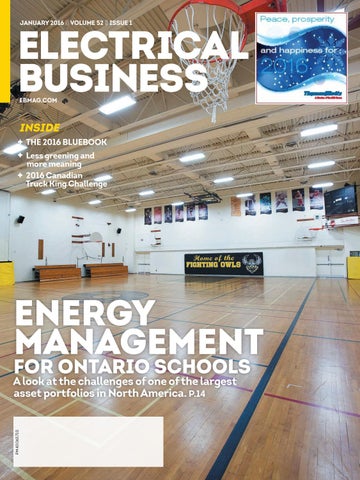
ENERGY MANAGEMENT
FOR ONTARIO SCHOOLS
PM40065710
A look at the challenges of one of the largest asset portfolios in North America. P.14
from the EDITOR ANTHONY CAPKUN
New packaging, same ingredients!
W
elcome to Electrical Business magazine’s new look and feel. While the design has changed, we will continue to deliver the same relevant industry coverage you expect. Smaller than usual, but still slightly oversized, we hope you will find this design clean and easy-to-read, especially when you go to read it online as a digital edition, or download it as a PDF to read on your device or share with colleagues. As with anything else we publish, your comments are always welcome. I am also very pleased to recognize the winners of our inaugural Electrical Safety Champion Awards program, who were announced back in December. But before I get to them, a big Thanks to the industry partners who stepped up to help us launch this madein-Canada, first-in-Canada awards program: Southwire Canada and CSA Group, as well as L’industrie électrique and Energy-Manager.ca. Without further ado, congratulations to our 2015 champions:
COVER PHOTO: ONTARIO POWER AUTHORITY
• Electrical Contractor: Tarpon Energy Services • Electrical Maintenance Team: Fabrene Inc. • Individual Champion: Kevin Holm • Electric Utility: London Hydro You will learn more about these inaugural winners in a Feature Article in our February issue. Of course, for every winner there are non-winners; truly, every nomination could have been declared a champion in its own right so, even though you may not have been named a winner this year, please submit a nomination again when we open the Call for Nominations for the 2016 awards program. Speaking of which, we will open the Call for Nominations for the 2016 Electrical Safety Champion Awards program next month in our February 2016 edition. There is no fee to enter, and the Nomination Form is short and straightforward. Check out the dedicated website we’ve set up for the awards program: ebmag.com/esca. There you’ll find the Categories, Rules, FAQs and—come February—the Entry Form. Quite simply, creating and maintaining an electrically safe environment is not just good business, it’s a moral obligation. Congratulations to these inaugural winners, as their good work—along with the other amazing submissions we received—serve as an example to us all.
acapkun@annexweb.com EBMAG.COM
CONTENTS JANUARY 2016 || VOLUME 52 || ISSUE 1
54
48
14 21 48 54
14
Energy management for one of the largest asset portfolios in North America Hint... did your kids’ schools come to mind? By Robert Smith
The 2016 BlueBook
The only comprehensive buyers’ guide for the electrical market in Canada.
2016 Canadian Truck King Challenge
Who brought the toughest iron to the competition? By Howard J. Elmer
Less greening and more meaning
The painful realities of Ontario’s failed green energy experiment. By Ron Bergeron
DEPARTMENTS
COLUMNS
4 Letters 6 Industry news 58 Products & solutions 60 Calendar 61 Code conundrum
12 Electrical safety 360 Card parties, smashed cars, powerlines and you 62 Code file New Subrule and Table 68 in Rule 8-102 Voltage drop January 2016 · ELECTRICAL BUSINESS
3
LETTERS
A 1/4" can save the octagonal box
i’m a master electrician and 1-1/2” octagonal boxes are a pain in the ass! Every ceiling I work in has 3/4” strapping and 1/2” drywall, which does not add up to 1-1/2”. So every time I install one, I have to mount my crosspiece a 1/4” up from the bottom of the joists. If the client wants a light where the joist is, then I have to put a piece of strapping under the joist and mount a 1/2” box. If the fixture they want has a transformer, it’s not going to fit; or, if I have more than one wire in the box, the alternative is to put a 1/4” shim under the joist, mount a 1/2” box and add a 1/2” extension ring. Ridiculous! All these problems—the extra cost of having to buy two expensive boxes, the wasted time—could be avoided buy making the exact same octagonal box 1-1/4” deep (and you save 1/4” of metal on every box. I’m sure every electrician and contractor that works in residential would buy them. For me, it’s a no-brainer.
VIDEO EXCLUSIVES ON
EBMAG.COM “I think this may be one of the most exciting potential places to be in the next 30 years,” said UL’s global CEO, Keith Williams, of the electrical industry during an exclusive interview with Electrical Business magazine. He shared his thoughts with us on everything from the Internet of Things to the sea change involving distributed generation and energy storage. Watch it at tinyurl.com/ q46o57t. Energy Efficient Lighting Co. (EEL) and Ultrasave Lighting celebrated the official grand opening of their new facility in Markham, Ont. and we were there to capture the excitement of this two-unit, 33,000-sf building. Take a look for yourself at tinyurl.com/q3nr4gm. For the latest industry news, reviews, products, stories and people in the electrical industry, go to EBMAG.COM 4
ELECTRICAL BUSINESS · January 2016
The fact that the box is smaller and cannot fit as many wires doesn’t matter because nobody wires houses like octopuses (having all the wires going to the centre light) any more—that’s part of the past now, hopefully to be joined by those 1-1/2” octagonal boxes. — Pascal B., Ottawa, Ont.
About time we harmonized construction and industrial electricians
These comments follow our news item posted online November 17, 2015, at EBMag.com, “CCDA’s Harmonization Initiative Phase 2 to include electricians” (tinyurl.com/hmfcq9x) about time. I have been an instructor at NSCC in Nova Scotia and have had both Construction and Industrial students in the same class. They receive the same material, with the only difference being the 5th-Year material the Industrial students get. This could be easily covered in the previous four years. — Reg R.
Overhead powerline contact... when will it end?
These comments follow our news item posted online November 24, 2015, at EBMag.com, “PGC hydrovac operator dies from electrical contact incident in Vaughan” (tinyurl.com/ ojmkbne) this is a very sad incident, especially since it involved an electrical-associated employee. Can we not put a White and Red sign in the eyesight view of the operator in these trucks reading “Overhead Voltage Danger” to promote continual awareness of the hazard? Such simplicity works every second. — Roy T. a sad day for his family and friends. This is also a wake-up call for his co-workers. Look out, look up, and think about your surroundings. I have had to repair numerous overhead services torn down by boom trucks and excavators. Work safety is the most important job that we do. — Reg R. We always welcome your Letters to the Editor. We also encourage you to leave Comments below any of the content we post online. Some of you may even score some prizes for your efforts.
January 2016
|| Volume 52 || Issue 1
ELECTRICAL BUSINESS is the #1 Canadian resource for electrical contractors, maintenance & engineering professionals, distributors, manufacturers and their agents, and associated stakeholders.
Editor Anthony Capkun acapkun@annexweb.com Group publisher John MacPherson jmacpherson@annexweb.com Account manager Deborah Taylor dtaylor@annexweb.com Account manager Melanie Kirk mkirk@annexweb.com Assistant editor Renée Francoeur rfrancoeur@annexweb.com Redesign Janice Van Eck www.janicevaneck.com Account Coordinator Kathryn Nyenhuis knyenhuis@annexweb.com Circulation manager Urszula Grzyb ugrzyb@annexbizmedia.com Director of soul/COO Sue Fredericks Published by Annex Business Media 222 Edward Street, Aurora, Ontario L4G 1W6 Tel. 905-727-0077 • Fax 905-727-0017
Printed in Canada ISSN 0013-4244 Publication Mail Agreement #40065710 Circulation email: asingh@annexbizmedia.com Tel: 416-510-5189 Fax: 416-510-5170 Mail: 80 Valleybrook Drive, Toronto, ON M3B 2S9 Subscription rates Canada: Single issue $7.00 12 issues: $35.95 USA: $62.95 (US) International: $76.00 (US) per year Occasionally, Electrical Business will mail information on behalf of industry related groups whose products and services we believe may be of interest to you. If you prefer not to receive this information, please contact our circulation department in any of the four ways listed above. The contents of Electrical Business are copyright ©2016 by Annex Publishing & Printing Inc. and may not be reproduced in whole or part without written consent. Annex Publishing & Printing Inc. disclaims any warranty as to the accuracy, completeness or currency of the contents of this publication and disclaims all liability in respect of the results of any action taken or not taken in reliance upon information in this publication. Funded by the Government of Canada
EBMAG.COM
INDUSTRY news
ECAA sports new look
Electrical Contractors Association of Alberta (www.ecaa.ab.ca) recently retired its previous brand and has launched a colourful, sleek new look and website. The retired logo will make its way into a time capsule, which will be opened at ECAA’s 100th anniversary celebration in 2062. EBMag asked ECAA’s communications chair Jeanette DeBruin to discuss the
new logo, and she said it is “clean, bold, modern, clever, professional”. The crest in the middle mimics the Alberta crest and, at its heart, is the circuit symbol for a wire coil that also depicts the letter “E”. Finally, the logo employs a “friendly green and black, that is welcoming, strong, trustworthy, and ties back to the industry”.
Pole-digger dies from electrical contact
“PowerStream and its employees are deeply saddened by this loss of life; our thoughts and prayers are with his family, co-workers and friends at this most difficult time,” said Maurizio Bevilacqua and Brian Bentz, board chair and president/ CEO, respectively, of PowerStream (www. powerstream.ca)—an electric utility jointly owned by the Ontario cities of Barrie, Markham and Vaughan. Bevilacqua and Bentz were referring to an electrical contact incident on Hwy 7 in November, just east of Dufferin Street in Vaughan, involving a 25-year-old employee of PGC Services. York Regional Police tweeted the worker had been electrocuted and “sadly succumbed to his injuries in hospital”. According to PowerStream, the incident involved unintentional contact with overhead high-voltage electrical distribution lines by hydrovac excavation equipment being used by PGC Services to dig holes for new electrical poles. PowerStream adds the Ministry of Labour has been advised and is investigating the incident, and that its own health & safety department opened an internal investigation. Visit EBMAG.COM for the latest news, stories, products, videos, photo galleries and industry events. 6
ELECTRICAL BUSINESS · January 2016
Andy Cleven wins Lieutenant Governor Safety Award
Congratulations to Andy Cleven for receiving the Excellence in Electrical Safety Award as part of the BC Safety Authority’s (www.safetyauthority.ca) 9th annual Lieutenant Governor Safety Awards. Cleven has 43 years of experience as an electrical journeyperson, the organization stated, and is the director of the Electrical Joint Training Committee (EJTC). Among many achievements, Cleven developed the national program standards and certification for photovoltaic solar installations and electric vehicle infrastructure, according to BC Safety Authority. He also serves on the National Electrical Trades Council steering committee.
CCDA’s Harmonization Initiative - Phase 2 to include electricians
The Canadian Council of Directors of Apprenticeship (CCDA), the administrator of Canada’s Red Seal Program (www.red-seal.ca), has announced its Harmonization Initiative will include construction electricians and industrial electricians in Phase 2. The Harmonization Initiative was launched in 2013 to align apprenticeship systems across Canada by making training requirements more consistent in the Red Seal trades, says CCDA. CCDA says changes are now underway in most jurisdictions for six of the first 10 Red Seal trades (carpenters, welders, ironworkers and metal fabricators), aiming for implementation of harmonized training by September 2016. Phase 2 of the Harmonization Initiative, which includes construction and industrial electricians along with millwrights, plumbers, pipefitters and more, is expected to be implemented by September 2017, according to the CCDA.
2015 Ontario Electrical Safety Code now available
The 2015 edition of the Ontario Electrical Safety Code (tinyurl.com/hoj6buq) has been finalized and is now available for purchase, says the Electrical Safety Authority (ESA, www.esasafe.com). The Code comes into effect on May 5, 2016. The 2015 edition includes the Canadian Electrical Code, Part I, plus several Ontario-specific amendments. ESA explains this edition expands requirements for the use of arc fault circuit interrupters (AFCIs) in homes to help reduce wiring-related fires, and includes changes for renewable energy installations, including specific changes for solar. It also features: new guidelines for the safe clearances needed between light fixtures and combustible material to help minimize potential fire hazards; details on wiring at non-commercial docks (such as cottages); new requirements for the installation of LEDs in residential buildings; and specifics on the location of electrical hook-ups for recreational vehicle (RV) parking (to harmonize with the United States’ National Electrical Code). It will be available in print for $219 or a searchable, digital format for $195. To purchase, visit www.csagroup.org/oesc or call 800-463-6727.
MaxLite files suit against three former employees and ATG
MaxLite announced it filed suit against ATG Electronics (a California-based LED lighting company) and James Steedly, Sophia Galleher and Matthew Kim—all former employees of MaxLite. In its lawsuit, MaxLite alleges that its former employees breached their Proprietary Information Agreements and, together with ATG, improperly used MaxLite’s confidential and proprietary information to, among other things, attempt to enhance ATG’s products, divert business to ATG, and solicit MaxLite’s customers and suppliers for the benefit of ATG. The confidential and proprietary infor-
BC code comes into force February 2016
BC Safety Authority (safetyauthority.ca) reports the Electrical Safety Regulation in British Columbia has been amended as per Ministerial Order M392, and is effective as of February 29, 2016. This provides for adoption of the 2015 Canadian Electrical Code—with BC amendments—as the BC Electrical Code 2015. BC Electrical Code Reg. 2012 remains in effect until February 28, 2016. For more information on the changes, visit tinyurl.com/opeb9f3. EBMAG.COM
mation alleged to have been improperly used includes information relating to MaxLite’s product R&D, as well as its relationships with customers, representatives, vendors and other service providers. The company further alleges that ATG impermissibly used MaxLite confidential and proprietary information it had obtained from the former MaxLite employees. Filed in February 2015, the suit is pending in the U.S. District Court for the District of New Jersey.
EFC 2015 Scholarship recipients awarded record $120,000 Congratulations to the 2015 recipients of Electro-Federation Canada’s (www.electrofed.com) Scholarship Program! EFC and its members have awarded Canadian university and college students $120,000 across 52 scholarships this year—a record amount of cash for the program, according to EFC.
Predicting large solar storms 24hr+ in advance
Large magnetic storms from the sun—which can affect technologies such as utility grids and GPS—could soon be predicted more than 24 hours in advance, thanks to a new measurement and modelling tool. “As we become more entwined with technology, disruption from large space weather events affects our daily lives more and more,” explained Dr. Neel Savani, an alumnus and visiting researcher at Imperial College London (www.imperial.
EBMAG.COM
From left: Electrozad’s Paul Bouteiller, president Bill Smith, student Nicole Bouteiller, Jim Milne, John Jenner and Dave Taylor.
Tony Taylor from Jebco Agencies presents the Standard Products Recognition of Excellence Award to Richard-Anthony Aquino.
PHOTO COURTESY AD CanadA
PHOTO COURTESY STANDARD PRODUCTS
“I am truly grateful that EFC and Standard Products will play such a large role in my educational endeavours”, said Richard-Anthony Aquino, the winner of the Standard Products (www.standardpro. com) Recognition of Excellence Award, as part of the EFC Scholarship Program. “I can personally identify with Standard’s vision and core values. I promise to
uphold these values and to be impactful in everything that I do moving forward”. For a full list of the winners, visit tinyurl. com/njk2f28. This initiative has supported students with over $1 million in funding since it started in 1994. The 2016 EFC Scholarship Program will be accepting applications February 2016.
ac.uk), and a space scientist at NASA’s Goddard Space Flight Center. “Breaking through that 24-hour barrier to prediction is crucial for dealing efficiently with any potential problems before they arise.” Coronal mass ejections (CMEs) are eruptions of gas and magnetized material from the sun that have the potential to wreak havoc on satellites and Earthbound technologies, disrupting radio transmissions and causing transformer blowouts and blackouts. Solar storm predictions had previously relied on measuring the initial CME
eruption, but were not efficient at modelling what happened between this and the cloud’s arrival at Earth. The new technique—developed by a team led by Savani—takes a closer look at where mass ejections originate from on the sun and makes use of a range of observatories to track and model the evolution of the cloud. Savani and colleagues have tested the model on eight previous mass ejections, with the results showing great promise, they say, at improving the current forecasting system. Visit tinyurl. com/olc2ga9 to see a video.
January 2016 · ELECTRICAL BUSINESS
7
INDUSTRY news
Tony Dean turns in his homework on Ontario College of Trades Appointed just over a year ago to review “key areas of Ontario’s skilled trades system” that fall within the mandate of the Ontario College of Trades (www.collegeoftrades.ca), Tony Dean has completed his task, and the province says it will accept the recommendations made by former secretary of cabinet. According to the province, Dean’s recommendations will help improve the college’s processes and clarify its mandate by: • Supporting the existing trade boards to update and bring consistency to all trades’ scopes of practice • Reviewing how trades are classified through the establishment of an independent and evidence-based process that will use risk of harm as a key criterion • Establishing clearer and more concise criteria on how journeyperson-to-apprentice ratios are determined • Developing an enforcement and compliance committee and appeal process to resolve potential conflicts earlier, as well as ensure enforcement activities are consistently carried out with safety and the public interest in mind Ontario says it will bring forward proposed legislative changes in the spring legislative session and “work closely with the College of Trades to implement Mr. Dean’s recommendations”.
Defective CFLs cost Philips $2-million civil penalty
The U.S. Consumer Product Safety Commission (www.cpsc.gov) says Philips Lighting North America Corp. has agreed to pay a $2-million civil penalty to the government to settle charges that the company knowingly failed to report to CPSC information about a defect and a risk of injury with EnergySaver CFLs (a.k.a. Marathon or Marathon Classic). According to CPSC, Philips (Somerset, N.J.) failed to report the matter to them after numerous complaints about glass separating from the body of the lamps and striking people and objects, and attempting multiple design changes to fix 8
ELECTRICAL BUSINESS · January 2016
the problem. The incidents resulted in 10 reports of lacerations and seven reports of property damage. The lamps were recalled in 2011. Philips (www.philips.ca) does not admit to CPSC staff’s charges. In addition to paying the $2 million civil penalty, CPSC says Philips has agreed to implement and maintain a compliance program.
Defective CFLs cost Philips $2-million civil penalty. PHOTO COURTESY CPSC
Nova Scotia to strengthen Marine Renewable-Energy Act
The government of Nova Scotia (novascotia.ca) says it will usher forth changes to strengthen the Marine Renewable-Energy Act. These changes are the result of consultations with communities, environmental groups, academia, industry and government over the summer after legislation was introduced in April 2015 to ensure “safe and responsible development of the marine renewable-energy industry and the resource”. Changes include a stronger requirement for environmental monitoring, several administrative changes, and the creation of three new marine renewable-electricity areas for small-scale tidal energy development. The three areas cover Fundy Tidal Inc.’s (www.fundytidal.com) approved community feed-in tariff projects in the Digby Gut, Grand Passage and Petit Passage.
SaskPower launches mobile power engineering lab
Jeff Boulton, principal of Prairie South Virtual School, explains the boiler to students. PHOTO COURTESY SASKPOWER Division (www.prairiesouth.ca) in the west-central part of Saskatchewan—has launched a new tool to help young people in the province get the experience they need to fill these roles. SaskPower has presented a “mobile lab” to support Grade 11 and 12 students as they work toward building credits for their Fifth Class Power Engineering Certificate. The lab is essentially a boiler room on wheels, SaskPower says. Students participating in the program can find it challenging to travel to the nearest power station to complete their mandatory lab hours so the mobile lab creates easier access for students while increasing awareness of a high-demand career. The lab was most recently stationed at Assiniboia. It available to any school that registers students in Prairie South’s online Introduction to Power Engineering courses for the 2016-2017 school year.
Know any clever energy conservation kids on The Rock?
Teachers and students in Newfoundland & Labrador! TakeCharge (takechargenl.ca) has launched the 3rd annual Kids In Charge (KICStart) province-wide school contest that encourages participating students to express why they believe energy conservation is important, and to demonstrate what they do to save energy. The contest (which features iPads for prizes) has been expanded this year to include students of all grade levels (K-12), who are invited to submit entries in the form of a video, book, song, poster or other creative media that communicate energy savings. Entries must be submitted by mail or email to your local utility: • K-6 teachers: by January 29, 2016. • 7-12 students: by April 15, 2016.
SaskPower (www.saskpower.com) says power engineers are critical to the electricity industry across the country, but these specialized positions are difficult to recruit. In response, the utility—in partnership with the Prairie South School EBMAG.COM
INDUSTRY news
Review process begins for ManitobaMinnesota Transmission Project Manitoba Hydro (www.hydro.mb.ca) has announced it is moving forward with the final preferred route for the Manitoba-Minnesota Transmission Project (MMTP). The utility said it recently filed an Environmental Impact Statement (EIS) with provincial regulators, as part of the process for securing a license for the transmission line under the province’s Environment Act. “The filing of the EIS with Manitoba Conservation and Water Stewardship begins the formal regulatory review process for the project,” said Shane Mailey, Manitoba Hydro’s vice-president of transmission. “As part of the process, the public will have an opportunity to comment on the project and the route through Manitoba Conservation and Water Stewardship,” he added. “The selection of the route and submission of the EIS are the culmination of several years of planning, environmental studies, and engagement with a broad range of interests.” The MMTP is needed to both export surplus electricity and enhance the reliability of the province’s electricity supply in emergency and drought situations, the utility said. The 213-km, 500-kilovolt alternating current line will originate at the Dorsey Converter Station—located near Rosser, northwest of Winnipeg—and travel south into Minnesota. The estimated cost of the project is $350 million with an anticipated in-service date of mid-2020, according to Manitoba Hydro.
The blue line shows the preferred Manitoba-Minnesota transmission route. PHOTO COURTESY MANITOBA HYDRO
10
ELECTRICAL BUSINESS · January 2016
A view of Milan taken from the ISS. PHOTO COURTESY SAMANTHA CRISTOFORETTI
Best way to gauge light pollution? From a space station, of course! Scientists are tapping into photographs taken by astronauts aboard the International Space Station (ISS) to measure the amount of light pollution worldwide and, not surprisingly, their results confirm that the diffuse glow that brightens the night skies in and around cities is scattered light from streetlights and buildings. In a new study, scientists from Canada’s Cégep de Sherbrooke and Spain’s Universidad Complutense de Madrid—together with members of the public—have worked on a project called Cities at Night, whose aim is to produce a global colour map of the Earth at night from pictures taken by ISS astronauts using a standard digital camera. Starting in July 2014, the project required the cataloguing of over 130,000 images (the ISS’s entire high-resolution archive) and geo-referencing them to places on a map. The researchers discovered that European countries and cities that have a higher public debt also have a higher energy consumption of streetlighting per inhabitant. The total cost of the energy consumption for streetlights is estimated by the study to be 6300 million euros/year in the European Union. Studying lighting technology from orbit is of even greater importance now than before, insist researchers, due to massive transitions to LED technology. LED streetlights make light pollution such as sky glow significantly worse, researchers find, as they emit more blue and green light than the high-pressure sodium (HPS) lights they typically replace. The researchers’ findings were presented at the International Astronomical Union (IAU) General Assembly in Honolulu, Hawaii.
Riello signs Enviro-Energy as 1st Canadian distributor
Riello UPS (www.riello-ups.com)—which claims it is the fourth largest manufacturer of uninterruptible power supplies (UPS) in the world—has now extended its distribution partnership in Canada with Enviro-Energy (canusenviro.com), a division of Liaison Can./U.S. Logistics Inc. Enviro-Energy will assume responsibility for marketing and sales of 3-phase, UL-listed Riello UPS products from their Quebec headquarters.
Ontario permanently BANS coal-fired electricity generation
The Province of Ontario has passed legislation to permanently ban coal-fired electricity generation in the province. The Ending Coal for Cleaner Air Act prevents new and existing facilities from burning coal for the sole purpose of generating electricity. It sets maximum fines for anyone who violates the ban, and “enshrines the health and environmental benefits of making coal-fired electricity illegal” in law.
Alterra Power acquires four BC hydro projects from Sigma
Alterra Power Corp. (www.alterrapower. ca) says it has agreed to acquire the water rights for four hydroelectric development projects from Sigma Engineering (the Chusan, Powell, Eldred North and Eldred South projects). The projects are located approximately 20-30 km from Alterra’s existing Toba Montrose and Jimmie Creek projects, and are situated along the Toba Montrose transmission line in British Columbia. Each project is expected to have between 10-15MW of generation capacity, and could be eligible for power purchase agreements under BC Hydro’s Standing Offer Program, Alterra noted. Visit EBMAG.COM for the latest news, stories, products, videos, photo galleries and industry events. EBMAG.COM
ELECTRICAL SAFETY360 MIKE DOHERTY
Card parties, smashed cars, powerlines and you
G
eorge Minow is the manager of health, safety & wellness with Kitchener-Wilmot Hydro. He and I are members of a group called the Association of Electrical Utility Safety Professionals (AEUSP) and, at the last meeting George hosted in October, he mentioned that an important public safety video he and the utility had been working on was just about ready for release. A month or so later, George emailed me to say the video had gone live, and encouraged me and other recipients to share the link with all the other municipal hydro companies, as well as our family and friends. I clicked the link immediately, of course, curious to know what this video was all about... what could be so important that George would want us to share the video with pretty much everyone we know? All it took was just 1 minute and 11 seconds—the length of the video itself, actually—to realize George and his team put together an incredibly important electrical public safety message, which answers a very straightforward question: Do you know what to do if your vehicle comes into contact with live powerlines?
“What was the main reason that At that point, George spoke prompted your group to create up and told the guests he worked this video?”. for the local hydroelectric comGeorge explained that too pany and teaches safety. He many drivers simply don’t know discussed, then demonstrated, what to do in the event the best practices for their vehicles come dealing with this situaAs the into contact with a live discussion tion—which only took powerline. few minutes—and continued, aeveryone The seed for the felt better George idea was planted last for it. winter while George He decided then listened to was at a card party. hear whether and there that someIt was a particularly thing more needed anyone in stormy night, and to be done. There had the room someone at the party to be a way to reach (Kudos also go out to George’s had mentioned driv- actually knew a large number of colleagues here in Ontario that ing by a vehicle that what to do. people and succinct- assisted with the video, like had crashed into a ly explain—just as Christine Matu, communicaThe room hydro pole. Another he did at the card tions specialist with Kitchenerwas silent. party—the proper Wilmot Hydro, as well as Guelph person at the party asked, “What would safety protocol. So Hydro, Waterloo North Hydro you do if a wire came down on he and all the folks behind the and Cambridge & North Dumyour car?”. video worked on that simple phries Hydro.) As the discussion continued, A subject-matter expert on electrical safety, Mike Doherty is the director of learning & George listened to hear whether continual improvement at Shermco Industries Canada Inc. He is a licensed electrician anyone in the room actually and an IEEE senior member, and has served as the Technical Committee chair for CSA Z462 since its inception. His specialties include electrical safety and health & safety knew what to do. management, maintenance, consulting, training, auditing and electrical incident The room was silent. investigations. Mike can be reached at mdoherty@shermco.com.
PHOTO: Kitchener-Wilmot Hydro
After watching the video, I contacted George and asked him,
Driver education: Be sure to visit and share youtu.be/1FjgEXG1SoU
premise: to create something short and to the point that could be easily communicated across numerous media. After you watch the video, I think you’ll agree they succeeded. The animation in the video is clear and gets right to the point regarding the toxic energy that can be unleashed from an overhead powerline that has fallen upon or near a vehicle that has hit a distribution pole. The diagrams showing how to escape your vehicle, when necessary, are simple to understand and communicate. You can make a real difference in the safety and lives of others just by sharing this video. The slippery winter season is upon us, and this video should be mandatory viewing—not just for professionals in the electrical sector, but for every driver on Canada’s roads and highways. No one ever plans to crash into a distribution pole and become surrounded by lethal electrical energy, but any one of us could find ourselves in that situation in a heartbeat. We want those we love to know exactly what to do.
12
ELECTRICAL BUSINESS · January 2016
EBMAG.COM
ENERGY MANAGEMENT
ENERGY MANAGEMENT FOR ONE OF THE LARGEST ASSET
PORTFOLIOS IN NORTH AMERICA Hint... did your kids’ schools come to mind? / BY ROBERT SMITH, CET, CEM
14
ELECTRICAL BUSINESS · January 2016
Overview of asset portfolio
OVER
250 MILLION
Square footage of Ontario's education sector
72 Number of district school boards in Ontario
Initially, it might appear that schools sound like a simple, straightforward asset portfolio. Many of us received an education in one or both of the two classic types of buildings—elementary schools (JK to Grade 8) and secondary schools (Grades 9 to 12)—but consider the following complexities of the portfolio that impacts energy management: • The year of construction ranges from 1791 to present day. • Site sizes range from as small as 750 sf to as large as 270,000 sf. • The number of sites within a board’s portfolio can range from as few as nine to as many as 634. • The geographic territory can be quite small and centralized in large, urban centres (e.g. the Greater Toronto Area) or can be a vast area with only a few schools scattered across it, and travel times of up to six hours between outlying sites (as is the case for many northern, rural or French boards). • In addition to the standard K-12 schools, boards may also have administrative offices (Education Centres), outdoor education facilities, daycares, maintenance/ warehouse facilities, and sites with
joint ownership, such as a school that is owned by two school boards, or with a municipality (e.g. community centres, libraries, pools). See Table 1.
Additional energy management challenges In addition to the diversity of the overall asset portfolio, Ontario’s education sector is undergoing a number of transitions that will have an impact on energy consumption: Since 2002-03, student enrolment has been declining across the province. In some northern communities, declining enrolment has reached as high as 15%.
Utilization of some sites can be as low as only 29.1%. Funding allocations for boards are based on student enrolment, which means administrative funding has also been declining. Energy management and operational capacity across the province is inconsistent.
Boards with larger budgets have greater flexibility to be able to hire a dedicated resource—an expert in energy management that can focus on reducing energy consumption. In contrast, energy management EBMAG.COM
PHOTO: Ontario Power Authority
O
ne of the largest asset portfolios in North America isn’t made up of the shiny glass towers of corporate America or the glitter of retail malls. Instead it’s the network of schools that stretch across Ontario. With more than 5,500 sites and over 250,000,000 sf, Ontario’s education sector is larger in size than several of Canada’s leading national property management companies’ portfolios combined! Ontario’s education sector consists of 72 district school boards, grouped into four categories: Public, Catholic, English, French. Each district school board is autonomous and makes its own decisions about policies and programs related to operations issues, such as energy management. School boards receive 100% of their funding from the Ministry of Education. Funding allocations are announced each Spring for the subsequent school board fiscal year, which runs from September 1 to August 31. Boards receive a Plant Operations allocation, which covers expenditures related to maintenance, custodial supplies, salaries and utilities.
10:00 pm. As more constraints are placed on funding across the entire public sector, municipalities are looking to use local schools and their infrastructure as community hubs to provide programs both during the week and on weekends, further expanding the traditional hours of operation. Across the province, school boards have relationships with 68 electricity local distribution companies (LDCs) and four natural gas LDCs.
Many boards, especially those with large territories, have relationships with multiple LDCs—in some cases, as many as 12 electricity LDCs for one board.
The Ministry of Education cares about energy management The Ministry of Education has four renewed goals: Powering education: Ontario schools range from 750 sf to 270,000 sf and school boards are facing a variety of energy challenges.
within a small board would likely be combined with a series of other functions, such as maintenance, student transportation, custodial management, snow removal, etc., and, as a result, the individual may not have a high level of knowledge or expertise in energy management. Over the next few years, Human
Source: Ministry of Education, 2014-15, Revised Estimates
Resources analysis indicates there will be a significant departure of key management and operational personnel across all school boards as baby boomers reach retirement age.
A substantial amount of corporate knowledge and understanding of how to effectively manage and operate facilities will leave the sector.
Economies of scale exist for larger boards, such as:
1. Depth of expertise in energy management; 2. Lower per-unit costs resulting from volume procurement (buying 1,000 versus 200,000 replacement lamps); 3. Leveraging procurement processes to cover multiple sites (new roof for five sites in a year) and the ability to write one RFP for multiple projects. Increased hours of operations. Schools are no longer a 9 to 3:30 business; with daycare, after-school programs, community use and continuing education programs, schools can open as early as 6:00 am and remain in use up until
Table 1: This chart demonstrates the differences that can exist between two school boards within Ontario (2014-15). Board Toronto District School Board
Enrolment 243,264
1,431 Superior North Greenstone
EBMAG.COM
Facilities
Area (km2)
Funding
476 elementary (82.5% util.) 125 secondary (68.6% util.)
634
$2,821,726,822
11 elementary (30.1% util.) 5 secondary (30.9% util.)
18,716
$31,613,834
68 Number of electricity local distribution companies (LDCs) that service Ontario schools
4
Number of natural gas local distribution companies (LDCs) that service Ontario schools
1. Achieve excellence: Children and students of all ages will achieve high levels of academic performance, acquire valuable skills and demonstrate good citizenship. Educators will be supported in learning continuously, and will be recognized as among the best in the world. 2. Ensure equity: All children and students will be inspired to reach their full potential, with access to rich learning experiences that begin at birth and continue into adulthood. 3. Promote well-being: All children and students will develop enhanced mental and physical health, a positive sense of self and belonging, and the skills to make positive choices. 4. Enhance public confidence: Ontarians will continue to have confidence in a publicly funded education system that helps develop new generations of confident, capable and caring citizens. So what do any of these four goals have to do with energy management? In a nutshell, it is believed that there is a direct correlation between how a school board is managed and student achievement; the better managed the board, the higher the levels of student achievement. January 2016 ¡ ELECTRICAL BUSINESS
15
ENERGY MANAGEMENT
SOLUTION
Acting on this premise, the Ministry initiated Operational Reviews of all school boards beginning in 2007. The purpose of these reviews was to examine all functional areas of governance, administration, management and operations against leading business practices in a board. At the conclusion of each Operational Review, the board received a report outlining the findings and identifying opportunities for improvement. In the early stages of the reviews, energy management was identified as an area that was either weak or non-existent for many boards.
Norm Vezina, Senior Manager of Environmental and Office Services, York Catholic District School Board (YCDSB), was appointed as the ECO for the sector. Over a decade, Vezina had reduced YCDSB’s energy consumption by 44%. In addition, he was the lead for the Catholic School Board Services Association’s (CSBSA) Electricity and Natural Gas Procurement Consortia, and he was well-known and respected by his peers across the sector. RESULTS
Given the complexity and diversity of the asset portfolio, the unique challenges related to geography and structure, the large number of decision-makers and their varied level of knowledge/expertise, any strategy to build energy management capacity across the education sector needed to be multi-faceted to address both the distinct challenges and varying capacity of front-line staff. Fortunately, the Ministry and its 72 school boards have a collaborative relationship and a long history of partnering to find ways to improve and build on identified successes across the sector. Through this partnership, the Ministry identified the cornerstones that were required by the sector: information, resources and tools. In 2008, the Ministry launched its Energy Management Initiative, and here’s what they did:
Norm Vezina of the York Catholic District School Board was appointed as Energy Conservation Officer for the sector to champion the Ministry’s initiative.
management champion” to lead the initiative; someone who had: • recognized credentials and a technical background in energy management, • knowledge and experience of education facilities, and how the sector worked, • a track record of consistently reducing energy consumption across a board’s asset portfolio over an extended period, and • credibility within the education sector as a leader in energy management.
ENERGY CONSERVATION OFFICER (ECO) THE CHALLENGES To give the Energy Management Initiative credibility within the education sector as a whole but, specifically, with senior plant managers or energy managers. Within the sector, there were individuals with expertise in energy management, but there wasn’t a formal structure for sharing that knowledge or nurturing it within boards that lacked that expertise. STARTING POINT
The Ministry needed an “energy 16
ELECTRICAL BUSINESS · January 2016
The role of the ECO is to: More than
5,500 Number of elementary and secondary schools throughout Ontario
• provide interested school boards with technical support and advice in energy management, • lead and manage specific energy initiatives, such as the Incentive Programs Advisor, • provide the Ministry with advice on how to implement specific energy projects in the education sector, and • work with energy managers across the sector to identify best practices in energy management within the sector and to promote them.
• Interested boards now have a key contact person with relevant knowledge and experience to ask specific questions about energy management. • Specific energy initiatives were tailored to meet the sector’s needs because they had a spokesperson who represented their perspective, and was key in developing each project from concept through implementation stage. • Each energy management project was built to work in conjunction with the other existing or planned projects that were being done by both the Ministry and other sector organizations so as to maximize their effectiveness. • Acting as Chair of the Operations, Maintenance and Construction (OMC) Energy Subcommittee, the ECO asked boards to share their best practices in energy management, and these were promoted to all boards. UTILITY CONSUMPTION DATABASE (UCD) THE CHALLENGES The underlying premise of conservation is that you can’t conserve what you can’t measure, and only a handful of boards had the tools in place to measure energy consumption. For energy consumption data to have meaning, it has to be done at the site level, by utility, and include factors that impact a site’s energy consumption, such as building area. Furthermore, data had to be collected over an extended period and allow for weather norEBMAG.COM
PHOTO: Ontario Power Authority
The Ministry of Education’s Energy Management Initiative
ENERGY MANAGEMENT
malization so that year-over-year comparisons could be made to assess the effectiveness of specific energy management strategies. In 2006, the Ministry of Energy passed the Energy Conservation and Leadership Act, which proposed creating regulations that would require all Broader Public Sector (BPS) organizations to report on their energy consumption. In 2009, the Green Energy Act replaced the existing legislation and, in 2011, regulations came into force requiring all BPS organizations to submit an Annual Energy Consumption and Greenhouse Gas Emissions Report to the Ministry of Energy detailing the energy consumption by type for each site.
and across the sector to allow for benchmarking. • Compare energy consumption for an individual site, an entire board’s asset portfolio or the entire sector’s asset portfolio from one year to another without skewing for weather variations (weather normalized data). • Identify trends in energy consumption i.e. high-performing sites, low-performing sites, overall reduction in energy consumed, etc. • Meet the regulatory reporting requirements of the Green Energy Act. Given the size of the project—more than 5,500 sites—the Ministry made the decision to limit the data collection at the time of launch to two utilities: electricity and natural gas. This decision was based on the following key factors:
STARTING POINT
In 2008, the vast majority of school boards did not measure energy consumption at all (neither site nor board levels). A few boards had stand-alone systems that collected data, but those systems collected data for a small number of sites for a single board (typically through a manual process pulled from billing statements). For most boards, the only means of measuring energy was via utility costs, which was ineffective due to price volatility, and inappropriate as it did not allow for either meaningful comparisons (e.g. year-over-year, similar sites) nor the ability to meet regulatory reporting requirements. SOLUTION
The Ministry of Education created a tool for all school boards that would track the historic energy consumption of every site across the sector: the Utility Consumption Database (UCD). Its goal was to create an analytical tool that would give every school board and the Ministry the ability to: • Review energy consumption by type for an individual site, a board’s aggregate total, a regional aggregate total or provincial aggregate total. • Compare the energy consumption of sites with similar features (e.g. year of construction, building area, number of portables, hours of operation, percentage of air-conditioned area) both within a board 18
ELECTRICAL BUSINESS · January 2016
5,483 Number of sites participating in the Ministry’s Utility Consumption Database (UCD)
7,235
Number of electricity meters in the Ministry’s UCD
5,765
Number of natural gas meters in the Ministry’s UCD
1. Electricity and natural gas are the only utilities required by regulation to provide consumption data to customers in an electronic format. 2. Based on total Utility Expenditures in FY2006-07, electricity and natural gas costs represent almost 98% of total utility costs (N.B. when the decision to create the UCD was made in 2008, FY2006-07 data were the latest figures available). In 2015, the UCD expanded to collect data on Alternative Utilities (e.g. heating fuel, propane, wood, district heat/cool), renewable energy (e.g. solar PV, solar air, solar water, wind turbines, biomass) and water. RESULTS
In 2009, the Ministry launched the UCD. It is currently one of the largest databases of its kind in North America with: 5,483 sites, 7,235 electricity meters and 5,765 natural gas meters. The UCD is remarkable... not just for the quantity or quality of the data, but the number of participants involved in the process—specifically, 72 school boards and the 68 electricity LDCs and four natural gas LDCs that provide the UCD with electronic consumption data. In 2013—the first year of the Green Energy Act’s Annual Energy Consumption and Greenhouse Gas
Emissions report was due—school boards were able to use the UCD to automatically pre-populate the reporting template, which significantly reduced the quantity of administrative work required to complete the report. As a result, the education sector has had the highest level of reporting compliance across the entire Broader Public Sector (BPS) for the past three consecutive years. INCENTIVE PROGRAMS ADVISOR THE CHALLENGES School boards had difficulty accessing incentive program funding for the following reasons:
More than 40 energy efficiency incentive programs existed, and there was confusion about which programs were applicable. Various incentive funding and delivery agents and rules. Numerous documentation requirements. Lengthy approval processes STARTING POINT
Because of all the perceived challenges, many school boards were simply opting not to apply for incentive funding. As a result, there wasn’t a financial reason to make better long-term choices, or they were implementing energy-efficient equipment and losing out on a valuable opportunity to leverage additional public funding to support its implementation. SOLUTION
The Ministry identified the need to make the application process to incentive funding programs easier. What was needed was a sector-wide resource that was an expert at completing incentive applications and dedicated to assisting school boards with the process. Through a partnership between the Ministry and YCDSB, the ECO applied to the Ontario Power Authority (OPA) for a Conservation Fund Grant to pilot the creation of an Incentive Programs Advisor (IPA). The IPA pilot ran from 2009 to 2011 with matching Ministry of Education and OPA funding. At the conclusion of the pilot in 2011, the Ministry of EBMAG.COM
ENERGY MANAGEMENT
Education took over sole funding for the IPA position. (Note: OPA was merged in with Ontario’s Independent Electricity System Operator [IESO] effective January 1, 2015.) Available to all interested school boards at no cost, the role of the IPA is to: • Provide information and advice on energy incentive programs (e.g. federal/provincial, electricity/natural gas) to interested school boards. • Liaise with senior plant officials to identify appropriate incentive programs for specific schools. • Assist individual boards in completing applications for government, utility or agency energy-incentive funding. • Document best practices/lessons learned about incentive programs and promote them to the sector. • Identify existing barriers to boards accessing incentive programs. • Develop strategies to maximize the number of schools that participate in incentive programs to ensure boards access as many as possible. RESULTS
Since 2009, the IPA has completed more than 600 incentive funding applications on behalf of school boards. The total value of the applications is over $7 million. To date, school boards have received over $5 million in incentive funding, with another $2 million in process or pending approval. In 2013, the Ministry reviewed the impact of incentives in the sector and found that there were both immediate
Table 2: In 2013, a review of 75 projects that received incentive funding showed the associated immediate and short-term savings/cost avoidance. Review of 75 projects that received incentive funding Total estimated project costs
$7.5M
Incentives received
$1M
Annual total kW (avoided)
1,706
Annual total kWh (avoided)
5,045,183
Average incentive per project
$13K
Estimated cost avoidance Annual demand (kW) @ $5.00 per kW
$102K
Annual energy (kWh) @ $0.125 per kWh
$631K
Average project payback/project
reduced by 16 months
and long-term savings/cost avoidance through: • Reduced payback period • Decrease in demand (cost avoidance) • Decrease in energy used (cost avoidance) One of the unintended results of creating the IPA position is that the OPA recognized this position as a “super user”—that is, the IPA’s volume of incentive applications was so high, it reflected a level of expertise with incentive programs that could be tapped by funding agents to determine better ways of helping the education sector participate in specific incentive programs, and to identify ways of tailoring programs to make them work. For example, the goal of many incentive funding agents is to reduce peak demand on the province’s
$7 MILLION
Total value of incentive applications from Ontario school boards, with over $5 million funded and $2 million in process or pending approval
Table 3: Calculations of the long-term cost avoidance associated with the 75 projects that received incentive funding with an annual increase of either 5 or 10%. Fiscal year
With a 5% annual rate increase $ per kW
$ per kWh
Avoided costs
With a 10% annual rate increase $ per kW
Avoided costs
$ per kWh
2013-14 (base year)
$ 5.00 $ 0.120
$ 733,008
$
5.00 $
0.125 $ 733,008
2014-15
$ 5.25
$ 0.131
$ 769,658
$
5.50
$
0.138 $ 806,309
2015-16
$ 5.51
$ 0.138
$ 808,141
$
6.05
$
0.151
2016-17
$ 5.79
$ 0.140
$ 848,548
$
6.66
$
0.166 $
2017-18
$ 6.08 $ 0.152
$ 890,975
$
7.32
$
0.183 $ 1,073,197
2018-19
$ 6.38
$ 935,524
$
8.05 $
0.201 $ 1,180,517
$ 0.160
Total 20
ELECTRICAL BUSINESS · January 2016
$ 4,985,854
$ 886,940 975,633
$ 5,655,604
electrical system, yet schools—by the nature of their business—cannot shift their consumption patterns outside the primary hours of operation, which left some incentive programs irrelevant to the sector. Another sector-specific challenge for incentive programs is the requirement for pre-approval of applications before work can begin. As everyone knows, schools run on a non-negotiable schedule: students occupy the buildings from September to June (and sometimes July and August for summer school and other activities), leaving very little opportunity to complete major projects. However, the approval process for some incentives can be quite lengthy—on average, about 50 calendar days. The result in many cases is that boards have applied for an incentive program but have not received the pre-approval to proceed with the implementation of the equipment by the scheduled start date, forcing them to implement the project without it. Gradually the OPA and LDCs are beginning to improve the approval process. An example is the recent change to the Unitary AC program that now allows a 45-day retroactive period for unplanned equipment replacements.
Summary The education sector’s Energy Management Initiative has been built around three key cornerstones: • Information: Energy Conservation Officer • Resources: Incentive Programs Advisor • Tools: Utility Consumption Database Together the Ministry and the education sector have laid the foundation for building energy management capacity across Ontario.
An incentive programs advisor, Robert Smith, possesses over 35 years of experience in the energy sector. He is a Certified Engineering Technician (CET) and a Certified Energy Manager (CEM). He works with Ontario’s Ministry of Education helping school boards access incentive programs to help fund their energy conservation projects. Robert has completed over 429 incentive applications, and has been successful in helping school boards secure over $5.1 million in incentive funds since 2009. EBMAG.COM
WORK TRUCKS
2016 CANADIAN TRUCK KING CHALLENGE Who brought the toughest iron to the competition? / BY HOWARD J. ELMER
F
or the past nine years, veteran automotive journalists have donated their time to act as judges in the only annual North American truck competition that tests pickup and van models head-to-head, including while hauling payload and towing. The Canadian Truck King Challenge started in 2006, and these writers return each year because they believe in this straightforward approach to testing (and they know their readers crave the results). I launched (and continue to run) the challenge for the same reason, plus my belief that—after 40 years of putting trucks to work—I know what’s important to Canadians! I mean, it’s OK for a truck to be pretty, but good looks aren’t enough; it had better do its job, and do it well.
How we challenge our trucks This year, nine judges travelled from Quebec, Saskatchewan and across Ontario to the Kawartha Lakes Region where we test the trucks each year. Days before the judges arrive, all the entries are delivered to my 70-acre IronWood test site to be prepared for hauling and towing, and to be fitted with digital data collectors. These gadgets plug into the USB readers on each vehicle and transmit fuel consumption data to MyCarma (Kitchener, Ont.), which 48
ELECTRICAL BUSINESS · January 2016
records, compiles and translates those readings into fuel economy results that span the almost 4000 test kilometres we accumulate over two long days of testing. These results are as real-world as they get. The numbers are broken into empty runs, loaded results and even consumption while towing. Each segment is measured during test loops with the trucks being driven by five judges, one after the other. That’s five different driving styles, acceleration, braking and idling (we don’t shut the engines down during seat changes). The Head River test loop is a combination of road surfaces and speed limits. At 17-km long, it runs on gravel, secondary paved road and highway. Speed limits vary between 50 km/h to 80 km/h, and the road climbs and drops off an escarpment (like ridgeline several times) Plus, it crosses the Head River twice at its lowest elevation. The off-road part of our testing is done on my own course at IronWood. Vans are not tested off-road, though it’s noteworthy that the Mercedes Sprinter was equipped with a 4WD system this year. This is the third year we have used the data collection system and released the final fuel consumption report that MyCarma prepares for the Truck King Challenge. It’s become one of our most anticipated results.
It’s OK for a truck to be pretty, but it had better also do its job.
EBMAG.COM
Judges travelled from Quebec, Saskatchewan and across Ontario to the Kawartha Lakes Region for testing.
Each segment is measured during test loops with the trucks being driven by five judges.
EBMAG.COM
Veteran automotive journalists donate their time to test pickups and vans head-to-head.
January 2016 ¡ ELECTRICAL BUSINESS
49
WORK TRUCKS
And in this corner...
Days before the judges arrive, entries are prepared for hauling and towing, and fitted with digital data collectors.
So, how do we decide what to test? Well, as anyone who’s bought a truck knows, manufacturers never sleep, bringing something different to market every year. As the challenge looks to follow market trends, what and how we test must change each year, too. The coming 2016 model year proved no different. We had a field of 14 contenders at IronWood this year covering four (4) categories. They were: #1 FULL-SIZE 1/2-TON PICKUP • Ford F-150, Platinum, 3.5L, V6 EcoBoost, gas, 6-speed Auto • Ford F-150, XLT, 2.7L, V6 EcoBoost, gas, 6-speed Auto • Chevrolet Silverado, High Country, 6.2L, V8, gas, 8-speed Auto • Ram 1500, Laramie, 3L EcoDiesel, V6, diesel, 8-speed Auto #2 MID-SIZE PICKUP • Toyota Tacoma, TRD Off-Road, 3.5L V6, gas, 6-speed Auto • GMC Canyon, SLT, 2.8L Duramax, I-4 diesel, 6-speed Auto • Chevrolet Colorado, Z71, 3.6L V6, gas, 6-speed Auto
The results are separated into empty runs, loaded results and fuel consumption while towing.
#3 FULL-SIZE COMMERCIAL VANS • Ford Transit 250, 3.2L Power Stroke I-5 diesel, 6-speed Auto • Mercedes Sprinter 2.0L Blue-Tec I-4 diesel, 2X4 • Mercedes Sprinter 3.0L Blue-Tec V6 diesel, 4X4 • Ram ProMaster 1500, 3.0L I-4 diesel, 6-speed Auto/Manual #4 MID-SIZE COMMERCIAL VANS • Ram ProMaster City, SLT, 2.4L Tigershark I-4 gas, 9-speed Auto • Nissan NV200, 2.0L I-4, gas, Xtronic CVT Auto • Mercedes Metris, 2.0L I-4, gas, 7-speed Auto
Each of these vehicles is all-new, or have significant changes made to them. This year we introduced the Returning Champion category. 50
ELECTRICAL BUSINESS · January 2016
Each of these vehicles is all-new, or have significant changes made to them. This year we introduced something new: a Returning Champion category. The idea had been growing for a while, having everything to do with the engineering cycles that each manufacturer follows. Simply put, trucks are not significantly updated each year and, to date, we have only EBMAG.COM
WORK TRUCKS
Score for the Ram 1500 EcoDiesel, winner in the full-size half-ton pickup category
76.30 %
Score for the GMC Canyon Duramax, winner in the mid-size pickup category
73.90 %
Score for the Ford Transit 250, winner in the full-size commercial van category
Let’s get to this year’s winners The judges score each vehicle in 20 different categories; these scores are then averaged across the field of judges and converted to a score out of 100. Finally the ‘as tested’ price of each vehicle is also weighted against the average (adding or subtracting points) for the final outcome. And this year’s segment winners are: FULL-SIZE 1/2-TON PICKUP 82.97% • Ram 1500 EcoDiesel MID-SIZE PICKUP 76.30% • GMC Canyon Duramax FULL-SIZE COMMERCIAL VAN 73.90% • Ford Transit 250 MID-SIZE COMMERCIAL VAN 75.69% • Mercedes Metris
75.69 %
Score for the Mercedes Metris, winner in the mid-size commercial van category
The overall top-scoring 2016 Canadian Truck King Challenge winner is the Ram 1500, Laramie, 3L EcoDiesel, V6, diesel, 8-speed Auto. Congratulations to all the winners, and to the two repeating champions: the Ram 1500 EcoDiesel and the Ford Transit 250.
Howard J. Elmer is an award-wining automotive journalist, and a member of the Truck Writers of North America and the Automotive Journalists Association of Canada. He is an on-air reporter for Motoring Television and chief contributor to Autofocus.ca. 52
ELECTRICAL BUSINESS · January 2016
EBMAG.COM
CHARTS: 2016 REAL-WORLD FUEL CONSUMPTION REPORT, CANADIAN TRUCK KING CHALLENGE
82.97 %
included ‘new iron’ in each year’s competition. However, we began to think a truck shouldn’t be allowed to compete just because a truck is in the second or third year of its current generational life. So, this spring we decided that, for the first time, the immediate previous year’s winner (in each category) would be offered the chance to send its current truck back to IronWood to compete against the newcomers to the market. This year, the invitation was sent to the Ram 1500 EcoDiesel, Ford Transit 250 and Nissan NV200—all previous winners that accepted the offer to return and fight for their crowns. They, along with the new vehicles, took the tests over two days with the judges evaluating everything from towing feel to interior features.
GREEN ENERGY
Ron Bergeron travelled with the expedition to the Arctic that found one of Sir John Franklin’s lost ships, HMS Erebus, in 2014.
LESS GREENING AND MORE MEANING The painful realities of Ontario’s failed green energy experiment / BY RON BERGERON, P.ENG.
54
ELECTRICAL BUSINESS · January 2016
show up first in the North—the proverbial canary in the coal mine. These experts have observed melting sea ice, stressed animal and marine life, receding glaciers, ponds drying up, estuaries becoming saltier, etc. They can also pinpoint where coal is being burned to create power. Pollution doesn’t stay at its point of origin, but travels around the world. For example, the atmospheric source of 65% of the mercury in the Canadian North comes principally from China, and it is increasing. Only 8%
How not to tackle fossil fuels
65%
Percentage of the atmospheric source of the mercury in the Canadian North that comes from China
The Province of Ontario, sadly, is a classic example of how not to tackle fossil fuels. Why? Because of green. Governments want to look like they’re doing the right thing, but they often get so excited about anything green that they lose common sense, like lemmings rushing to the sea. In January 2015, I presented some green energy facts and figures to the Standing Committee on Finance EBMAG.COM
Photo by Ron Bergeron
C
limate change is real. The world is heating up. I saw this firsthand a decade ago when I arrived at the North Pole on a Russian nuclear icebreaker. There was no ice. We had to wait a day for the current to push ice floes our way. In 2014, I travelled with the twoweek expedition that found Sir John Franklin’s ship. Around 20 Arctic experts spoke to us about the problems of pollution and heating, which
comes from North America, and that amount is decreasing. So far, our lives have been only slightly inconvenienced but, once the glaciers in Greenland and Antarctica melt, serious problems are coming. Burning fossil fuels for our power, vehicles, homes, etc., is the main cause. Fossil fuels helped make our modern world possible, but if we are to avert a global climate disaster, we have to imagine a future without those fuels. So how do we power our planet without making things worse? By intelligently generating and storing electricity.
& Economic Affairs of the Government of Ontario. Among them, $2.7 billion is wasted every year because of the Green Energy Act (GEA). This conservative figure was forecast in the province’s Auditor General’s report of 2011, and the AG 2014 report confirmed this loss. Green energy contracts are for 20 years. That’s a minimum of $54 billion.The AG’s report clearly suggests that all technical and economic analyses were ignored because of the word green. As Ontario doubles the amount of connected wind capacity, that amount will likely double to some $100 billion. It will get worse as even more is connected. The Fraser Institute estimates the GEA cost could reach $38 billion/year. The Green Energy Act was proclaimed for three main reasons:
solutions for reducing coal emissions (e.g. Saskatchewan’s Boundary Dam Integrated CCS Demonstration project [Unit 3] and Denmark). 3. REDUCE GREENHOUSE GAS EMISSIONS
$54 BILLION
The minimum loss to Ontario over the next 20 years because of the Green Energy Act
1. Attract investment in renewable energy 2. Increase job opportunities 3. Reduce greenhouse gas emissions Let’s look at the results: 1. ATTRACT INVESTMENT IN RENEWABLE ENERGY
The GEA did attract investors. In fact, the response was overwhelming. Investors were salivating because return was calculated at 11% after tax on equity. That’s 11% guaranteed for 20 years—certainly much better than the average GIC.
50%
Percentage of oversupply of electricity produced in 2015
2. INCREASE JOB OPPORTUNITIES
More jobs? Other jurisdictions have shown that most jobs are temporary construction jobs. As for permanent jobs, for every green energy job created, two to four jobs are lost in other sectors of the economy because of higher electricity prices. Ontario’s economy does not function in a vacuum. It must compete globally. Places like China, India and Eastern Europe are putting in place the least-costly energy systems, mainly coal. China, for all its green energy approaches (including nuclear ), continues to install coal-fired power plants at the rate of one per week! Ontario, meantime, closed five coal power plants while other jurisdictions that compete against us are building some 1,200 more, and/or finding EBMAG.COM
$2.6 BILLION
The cost of exporting power from Ontario to the States between 2006 and 2013
Green energy does reduce greenhouse gas emissions, but is it a meaningful reduction? Could it have been accomplished by other means? How much do people want to spend to accomplish this? Wind power must be backed-up nearly 50% by spinning gas-fired systems in case the wind drops. This results in greenhouse gas emissions. Ontario could have closed all five coal plants simply by utilizing all the hydropower it had available. Wind and sun produce less than 5% of Ontario’s energy while over 50% of hydroelectric potential goes wasted. The DSS Management Consultants report (2005) to Ontario’s Ministry of Energy—as summarized by a Fraser Institute Report (2013)—never recommended renewable power. It outlined a plan of pollution control methods that would have yielded the same environmental benefits as the GEA, but at a 10th of the current cost. The proof is in the pudding: several years ago, Saskatchewan started applying technology to reduce harmful emissions from coal-fired power plants. This was completed for $1.4 billion. Even though there are still technical problems, the European Commission reps who viewed Saskatchewan’s efforts said they were very confident of the technology. The AG 2011 report states “... people are prepared to pay a modest increase for renewable electricity…” but “... only 27% would agree to an increase in their electricity bills of more than 5%”. For all the talk about reducing pollution, people won’t walk the talk. The Ontario Society of Professional Engineers (OSPE) published an article stating “... the public is paying for its own generators to produce power it doesn’t need, and then paying its neighbours to take excess electricity off its hands [...] This happened in 2011 and will get worse...” It’s mind-boggling that people are paid to not produce electricity. They have a word for this: curtailment. In 2015, electricity supply exceeded demand by some 50%. Adding insult
to injury, we deliver power below our costs to the States—Ontario’s major competitor—all in the name of green. Between 2006 and 2013, the cost of exporting power exceeded revenues by $2.6 billion. The single-biggest issue is green energy’s unrestricted access to the power grid, which is a balanced system of energy input and output. There is no energy storage system. All other sources of energy—including hydraulic and nuclear—are managed as part of an integrated system. Green energy, though, creates an unstable situation because it has unrestricted priority.
The future is distributed energy But this is all just part of a much bigger broken picture. Tens of billions of dollars are being wasted on continuing to enable the technology of the 1900s: namely, today’s power grid. The future is distributed energy, but not via modern windmills that essentially exploit the basic Dutch technology of 600 years ago. We should encourage concepts that capture energy for the 21st Century. We already have the indicators... airborne wind turbines, wind absorbers (no moving blades), energy storage with and without batteries, and clothing that absorbs body energy and charges our phones and laptops. Toyota is putting a fuel cell car on the market, and Elon Musk is making his PowerWall battery available for commercial purposes. A potassium air system that has 3x the storage of the Tesla battery at half the price is in development. Toronto-area utility PowerStream is working on a concept called PowerHouse in which solar homes with energy storage capacity are connected to other solar energy homes. The utility controls all the battery systems and decides how and when the stored energy can support the grid. Ideally, consumers will have energy systems comprising three modules: • energy capture • energy transfer • energy storage These modules can be upgraded/ replaced with each technical breakthrough until, eventually, the conJanuary 2016 · ELECTRICAL BUSINESS
55
GREEN ENERGY
21st Century electrical flight, according to Airbus
sumer is completely off-grid. Buildings, vehicles and, yes, even people will have their own power systems. The aerospace industry is looking well into the future. This past July, Airbus flew a two-seater electrically powered aircraft called the E-Fan across the English Channel. The radical design employs distributed propulsion, where single big engines are replaced with multiple electrically driven fans. The small planes will be in production by 2017, with larger ones (e.g. the Airbus VoltAir) in about a decade, assuming present battery technology. These quiet planes will produce no in-flight emissions and reduce costs by 30%.The limitations are being dealt with in two ways: first, lots of research into better energy storage and superconductivity.The second, as an interim measure, is to use hybrids of jet engines and electric fans. Centralized power grids are controlled electronically. Foreign powers have been mapping the North American electrical grid for some time now. There are many symposia and efforts to protect this system, but the reality 56
ELECTRICAL BUSINESS · January 2016
Meantime, the VoltAir technology concept platform supports the vision of a zero-emission air vehicle which could become a reality 20 years from today. The VoltAir’s next-generation electric energy storage system (batteries) will power highly efficient superconducting electric motors that drive counter-rotating, shrouded propellers. Combined with a “radical approach” to airframe design, the expected promising developments in electric propulsion technologies could pave the way toward ultra-quiet and emission-free flight.
is that, in the case of conflict, it is certain our power grid will be paralyzed. With distributed energy, many of these security concerns disappear. In Ontario, unfortunately, the future is being hamstrung by perpetuating the old grid technology. Instead, we should be investing and encouraging new concepts of capturing energy for the 21st Century. We need a systematic approach that balances our need to minimize pollution with the resources available without compromising our economy in today’s competitive world. Worldwide, the single-largest stumbling block are the fossil fuel subsidies of over $2.5 trillion, with coal being subsidized the most. Once these subsidies on fossil fuels are stopped and shifted to new technologies, we will all enjoy a quantum leap in our quality of life. Opportunities for electrical contractors will abound as the fossil-fuel era shifts to distributed electrical energy. Changes to our electrical landscape—including power systems changing from AC to DC—mean
$2.5 TRILLION The estimated worldwide total of present fossil fuel subsidies
SOURCES • Ontario’s Auditor General (AG) 2011 and 2014 reports • The Fraser Institute • CBC, October 2, 2014 • The OSPE Voice, 2011 • The Ottawa Citizen, September 21, 2011 • The Economist, January 2014 and December 2014 • The Guardian, November 20, 2012 • National Geographic, November 2015
more complexity and, yes, more work for those who keep up. In the far future, DC will be the common mode just as surely as solid-state replaced vacuum tubes. There are already proposals for 750kVDC powerlines (Edison would be proud!). Granted, this progression appears slow; however, it will be similar to the now unbelievably rapid advance of LED lighting in making incandescent, fluorescent and HID sources obsolete. Just think: 125 years of legacy lighting will disappear in 10 years. So be ready folks. It’s coming our way!
Ron Bergeron is a professional engineer in good standing since 1969 and an electrical contractor since 1971. He purchased his family business, Bergeron Electric, in 1980, and has held his Master Electrician’s licence since 2006. His firm received the Minister’s Award for Apprenticeship Training in 2012. Ron served as a generator consultant for Cornwall and area during Ontario’s Ice Storm of 1998, and served as both chair and vice-chair of the utility Cornwall Electric. He was also involved with Ontario’s Electrical Safety Authority as a member of the Industry Advisory Council, Fee Restructuring Committee and Contractor Advisory Council. He can be reached at ronb@bergeronelectric.com. EBMAG.COM
PHOTOS: COURTESY AIRBUS
Airbus describes the E-Thrust concept behind the E-Fan as a serial hybrid propulsion system. The E-Thrust is a distributed propulsion system that features numerous electric fans arranged in clusters along the length of each wing. A battery powers the fans, which is also charged by an on-board advanced gas power unit. The gas plant powers the fans directly, though the battery can be charged to power an emergency landing should the gas system fail. A sleek airframe design also allows for reduced weight and drag by decreasing the size of the vertical tail and improving weight distribution.
lighting PRODUCTS
LED Fluorobar from Liteline
GL-EM01F. It has a 3000mAh Lithium IronPhosphate (LiFePO4) battery and meets safety standards cURus 1310 and 924. GLACIALLIGHT / www.glaciallight.com
WattStopper FSP-201 sensor Canadian manufacturer Liteline has launched the LED Fluorobar, a linear light expandable to a maximum link of 10 fixtures. The Fluorobar comes with a builtin On/Off switch and no shadow linking connector. It has six lengths to choose from, is dimmable, can be hardwired, and is available in 3000K, 4000K and 5000K colour temperatures. LITELINE / www.liteline.com
GlacialLight GL-EM01F
GlacialLight now offers an emergency backup module for its PL0606 & PL0312 ceiling panel lights and an emergency light version of its TL0606 troffer light: the
WattStopper has announced new capabilities for its FSP-200 series sensors. Suitable for areas such as parking facilities, gas stations, pedestrian pathways, and warehouses, these sensors “maximize safety and security,” the company claims, and simplify compliance with the latest ASHRAE 90.1 (2010) garage and outdoor lighting control requirements. WATTSTOPPER / www.wattstopper.com
Prescolite LBS5LEDA, LC8LED, RLC8LED & LCC6LED
The Orbeon LED is suited for parking garage applications and measures 4.5 x 5.3 x 11.25 in. It is equipped with an electro-galvanized mounting bracket for mounting to an overhead junction box. An optional drop lens moulded from impact-resistant acrylic is also available. BEACON PRODUCTS / www.beaconproducts.com
Zumtobel’s Basys LED The Basys LED II 2.75-in. offering from Zumtobel is available in both square and round versions with 45 and 55 degree cutoff. It also features a colour rendering index range of up to ELECTRICAL BUSINESS · January 2016
Banvil Greenlux lamps: MR16, PAR20, PAR16, PAR30
Banvil 2000 has added a new line of LED lamps to its portfolio, featuring Seoul SMD chips, anti-glare lenses. This lineup comes with a five-year warranty and includes: MR16, PAR16 GU10, A19, GU24, BR30, PAR30, PAR38, BR20, BR30, BR38. All products in this line are Energy Star certified. BANVIL 2000 / www.banvil2000.com
MaxLite’s Filament Series
Prescolite has launched a 5-in. LiteBox surface-mount (LBS5LEDA), 8-in. LiteFrame Commercial and Retroficient (LC8LED and RLC8LED), LiteForm cylinder (LCC6LED), and added dimming options to its D2, A2 and LiteFrame LED products. PRESCOLITE / www.prescolite.com
Orbeon from Beacon Products
58
Ra 90+. One of the highlights is the adjustable version with the patented tiltShift technology. With tiltShift, the luminaire can be tilted between 0 to 40 degrees and simultaneously shifts dependent on the angle so that the beam remains in the centre of the aperture, Zumtobel explains. ZUMTOBEL / www.zumtobel.us
MaxLite’s new Filament Lamp Series includes decorative bulb shapes (A19, ST18, T14, G30 and B11) to complement ceiling, pendant, wall, and post top fixtures. The lamps are constructed of a tinted, antique-looking glass cover and visible linear LED filaments. MAXLITE / www.maxlite.com
ConTech’s CPL series of LED pendants
The CPL series of LED pendants from ConTech Lighting has a decorative design with a thin ceiling canopy and a compact driver and heat sink. The series offers coloured glass shades in 12-in. sizes with optional enhancing legs. Metal cylinder and double glass cylinder shades are also available. CONTECH / www.contechlighting.com EBMAG.COM
PRODUCTS
Eaton’s 600V UPS Power Xpert 9395
Available now, Eaton’s all-new 600V UPS (uninterruptible power system) solution is built upon its Power Xpert 9395 platform, promising up to 99% efficiency across most loads through the company’s Energy Saver System (ESS). Watch our exclusive VIDEO interview with Ed Spears, who explains the benefits for electrical designers/specifiers and electrical contractors at tinyurl.com/ nqy7qnf. EATON CANADA / www.eatoncanada.ca
Platinum Tools keystone jacks, couplers & wall ports
Platinum Tools says it has expanded its structured wiring solutions to include new Keystone jacks, couplers, and multi-port wall plates for data, voice and video installations and applications. Keystone jacks and couplers for Cat3, Cat5e, Cat6 and Cat6A applications are colour-coded to make EIA/TIA 568A/B wiring easier. PLATINUM TOOLS / www.platinumtools.com
Buyers Products XD series
CALENDAR
of 1/8-in. thick aluminum with an extruded aluminum front frame. They also feature heavy-duty bolt-on stainless steel hinges with 1/4-in. pins and a die-cast 3-point latch system with a built-in compression roller. BUYERS PRODUCTS / www.buyersproducts.com
Legrand expands Q-Series family
Legrand’s Q-Series cabinet is a UL 2416 listed, 19-in. EIA solution. The company says Q-Series cabinets are ideal for a range of applications, from single racks to small computer rooms to data centres of all sizes. LEGRAND / www.legrand.ca
GM now offers “box delete” option
Customers who rely on Chevrolet and GMC trucks to get their work done can now modify all sizes of trucks with a “box delete” option, General Motors (GM) says. GM is making the option available to fleet and retail customers on its 1500 2WD and 4WD regular cab Chevrolet Silverado and GMC Sierra. GENERAL MOTORS / www.gmfleet.com
AFL’s FlexScan OTDR Buyers Products has a new line of heavy-duty underbody aluminum tool boxes. The XD series boxes are two-door, barn-style boxes constructed 60
New from AFL is the FlexScan, a pocket-sized, hand-held OTDR that provides fiber
ELECTRICAL BUSINESS · January 2016
optic network characterization and fault location. Combining SmartAuto data acquisition with event analysis and LinkMap display, FlexScan troubleshoots faulty optical networks, or characterizes newly installed networks. SmartAuto technology selects the most appropriate OTDR settings and LinkMap technology applies pass/fail limits to detected events, displays the network using colour-coded icons and recommends corrective action. AFL / www.aflglobal.com
BICSI Winter Conference & Expo Jan. 31-Feb. 4, Orlando, Fla. www.bicsi.org
HD series truck cap from A.R.E. Accessories
The Work Truck Show Mar. 2-4, Indianapolis, Ind. www.ntea.com/worktruckshow
A.R.E. Accessories now offers a new HD series truck cap, a “heavy-duty, functional design” available for all current model trucks, it says. The centrepiece of the series is an interior aluminum support framework, which reinforces the fiberglass cap construction by routing all roof rack and toolbox weight to the bedrail of the pickup truck. This nearly triples load capacities, allowing a 550 lb capacity on the HD series roof rack and 200 lb in each toolbox. A.R.E. ACCESSORIES / www.4are.com
Greenlee AirScout
Greenlee says its new AirScout is designed to characterize the Wi-Fi environment, optimize the wireless network setup, and produce an on-screen report. It measures multiple locations simultaneously, then uses the data to select the best channel and optimum location of the wireless access point, according to Greenlee. GREENLEE / greenleecommunications.com
NEMRA Annual Conference National Electrical Manufacturers Representatives Assoc. Feb. 3-6, Dallas, Texas www.nemra.org ECANB course on CSA Z463 Electrical Contractors Assoc. of New Brunswick Feb. 11, Fredericton, N.B. www.eca.nb.ca
98th CCA Conference Canadian Construction Assoc. Mar. 6-10, New Orleans, La. www.cca-acc.com IEEE IAS Electrical Safety Workshop Mar. 7-11, Jacksonville, Fla. www.ieee.org IEEE IAS Electrical Safety, Technical & Mega Projects (ESTMP) Workshop Mar. 13-16, Edmonton, Alta. www.ieee.org NETA PowerTest InterNational Electrical Testing Assoc. Mar. 14-18, Fort Worth, Texas www.powertest.org AEL Electrical Learning Expo Alberta Electrical League Mar. 23, Red Deer, Alta. albertaelectricalleague.com LEDucation 10 Mar. 29-30, New York, N.Y. leducation.org Canadian Commtech East Show Apr. 12-13, Mississauga, Ont. www.commtechshow.com Indicates EB will be there. Visit EBMAG.COM for an extensive list of upcoming industry events. EBMAG.COM
CODE conundrum
TACKLE THE CODE CONUNDRUM IF YOU DARE! Answers to this month’s questions in February’s Electrical Business. How did you do? 3 Master Electrician 2 Journeyman 1 Apprentice 0 Plumber?!?
Compiled by Ontario’s Electrical Safety Authority
QUESTION 1
ANSWERS
When a 2-conductor NMS cable is used for a switch loop, does the CE Code require you to tape the white wire with black tape at the switch when the connections are made so that the actual black wire is the return conductor from the switch to the outlet? a) Yes b) No
Electrical Business, December 2015
QUESTION 2 Wiring of an essential electrical system in a patient care area shall be permitted to occupy the same raceway as non-essential wiring. a) True b) False
QUESTION 3 Both Class 2 power supply as well as Class 2 circuit wiring are limited to 100VA and 42.4V Peak or DC. a) True b) False
Question 1 What is the maximum length of 12 trade-size liquid-tight flexible conduit permitted for connecting equipment? d) 1.5 m. Rule 12-1302. Question 2 For single dwelling units, the CE Code requires minimum ___ duplex receptacle(s) to be installed in a two-car garage with an overhead door opener, a cord-connected central vacuum and a garbage disposal unit installed. c) 4. Rules 26-710, 26-714. Question 3 The maximum rating for overcurrent protection for exposed wiring, permanent outdoor lighting is: c) 30A. Rule 30-1120(1).
ADVERTISER INDEX AD Rewards 64 Arlington Industries 19 Bridgeport Fittings 9 CSA Group 59, 62 Dymo 37 Eaton 51 FLIR Canada 17 Hubbell Wiring 31 Ipex Electrical 2 Mersen 63 Northern Cables 7 Power Systems 58 Schneider Electric 11 Stelpro 57 Standard Products 13 Techspan 53 Thomas & Betts 1, 5 Underground Devices 61 TO ADVERTISE Contact John MacPherson jmacpherson@annexweb.com
www.esafe.com
EBMAG.COM
January 2016 · ELECTRICAL BUSINESS
61
CODE file NANSY HANNA, P.ENG.
New Subrule and Table 68 in Rule 8-102 Voltage drop
A
new Subrule (3) has been added to Rule 8-102 “Voltage drop”—along with a new Table 68—in the CE Code 2015. These additions provide maximum conductor lengths for general-use branch circuits in dwelling units, and compliance with the specified lengths will be considered acceptable in lieu of voltage drop calculations. In Ontario, a similar Director’s Order on Rule 8-102 had been issued in November 2013 (and enforced since February 2014), so this Rule has already been applied in Ontario for single-dwelling units only prior to being added in the CE Code for all dwelling units. To ensure the Rule is not misapplied, there are some important points regarding how to measure conductor length. The new Rule indicates the length is measured from the supply side of the consumer’s service to the furthest point of utilization. In single dwellings, the meter base is considered the supply connection (demarcation) point when determining voltage drop for feeders and branch circuits within the unit. Where the consumer’s distribution panel is located some distance from the meter base, the voltage drop on the feeder in between should be considered. Rule 8-102 requirements shall be applied to both the feeder and branch cir-
62
Figure 1: Consumer’s distribution panel is some distance from the meter base.
3%
The maximum voltage drop in either the feeder from the meter base to the panel, or a branch circuit from the panel to the furthest outlet on the circuit
5%
The maximum combined voltage drop in the feeder from the meter base to the panel, and a branch circuit from the panel to the furthest outlet on the circuit
Figure 2: Combination service panel.
cuits. The voltage drop in either the feeder from the meter base to the panel, or a branch circuit from the panel to the furthest outlet on the circuit, cannot exceed 3%, and the total voltage drop of the two portions combined cannot exceed 5% (Figure 1). Where the consumer’s main
ELECTRICAL BUSINESS · January 2016
combination panel is beside the meter base, the voltage drop on the feeder can be ignored, and lengths in Table 68 can be applied directly to the general-purpose branch circuits (Figure 2). Here are non-compliances ESA has been finding regularly: 1. Underestimating the length
of a branch circuit run Installer estimated the run to the bedroom to be less than 30m. Field measurement revealed 65m runs with #14AWG copper. 2. Insufficient measures for voltage drop mitigation The contractor for a 9000-sf bungalow (with full basement) had used #12AWG for most branch circuits, and added a subpanel to feed some others. Inspection found circuit runs of 86m, which exceed the maximum length (60m) allowed for #12AWG on a 15A breaker.The decision to use #12AWG and adding a subpanel without taking the time to estimate circuit runs led to non-compliance. Had the time been taken to estimate circuit runs correctly, other means of voltage drop mitigation might have been less costly, such as feeding outlets with more branch circuits and routing circuits differently to reduce daisy-chaining. Circuit runs may exceed expectations, so take the time to plan a compliant installation. Always consult your AHJ for more specific interpretations. Nansy Hanna is the director for Engineering & Program Development at Electrical Safety Authority (ESA) where, among other things, she is responsible for product safety, code development, improving harmonization and alternative compliance, worker safety, and aging infrastructure programs. She is a LEED-Accredited Professional and a member of CE Code-Part I, Sections 24, 32, 46, 50 and 64. Nansy can be reached at nansy.hanna@electricalsafety.on.ca.
EBMAG.COM