an Annex Publishing & Printing inc. publication • volume 51 • issUE 12
December 2015 T&BCover_EB_Dec.indd 1
2014-11-24 9:22 AM
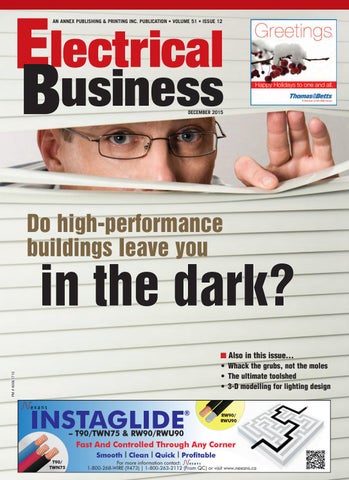
Do high-performance buildings leave you
in the dark? Also in this issue...
PM # 40065710
• Whack the grubs, not the moles • The ultimate toolshed • 3-D modelling for lighting design
C
M
Y
CM
INSTAGLIDE
®
– T90/TWN75 & RW90/RWU90 Fast And Controlled Through Any Corner
MY
CY
Smooth Clean Quick Profitable
CMY
K
RW90/ RWU90
T90/ TWN75
For more information contact: 1-800-268-WIRE (9473) | 1-800-263-2112 (From QC) or visit www.nexans.ca
The Scepter® JBoxTM has a new feature…the Hinged Cover. Designed to work with your existing PVC conduit runs, the Scepter JBox Hinged Cover opens more than 180º for complete and easy access to control devices and instruments. NEMA 3R and 4X rated, the Scepter JBox Hinged Cover is ideally suited for indoor and outdoor use, in washdown environments and includes all the features that contractors have come to appreciate in the new Scepter JBox.
VISIT WWW.SCEPTERINNOVATION.CA Available in 8" and 12" | NEMA Rated 1, 2, 3R, 4, 4X, 12 & 13 UL 50 / CSA C22.2 No. 94.1 | UL 50E / CSA C22.2 No. 94.2 CSA C22.2 No. 40 | CSA C22.2 No. 85
Products are manufactured by IPEX Electrical Inc. and distributed in the United States by IPEX USA LLC. JBox™ is a trademark of IPEX Branding Inc.
(866) 473-9462
from the editor
Can you do this? Yes
Figuring out and simplifying controls is where you can add a lot of value.
strikes fear into the hearts of some, others see the opportunities that come with increasingly smarter tech and strategies that help us wrangle energy use like never before. When speaking about Robert Mowles (right) the installation of things discusses the simplicity of like IP security cameras, this video doorbell. video doorbells, etc., Robert Mowles of Aartech Canada (a home automation and security provider) had this advice:
Photo A. Capkun
Christian Ryan Photography
A
s regular readers of Electrical Business and, hopefully, regular visitors to EBMag.com, you know the worlds of electrical generation, storage, transmission and end use are changing. On the end use side, smart internet-connected devices are the rage, soon to become the norm in new developments and retrofits. This means traditional trades work is also changing. Years ago I asked an electrical contractor whether he pulled any datacom cabling. He answered, No, that he only does the rough-in for someone else. These days, that someone else is not only going to get the datacom work, they’ll get the electrical, too. To end users, cabling is cabling, regardless of jacketing, voltage, armour, etc. Take a look at Cisco’s new Toronto HQ, Waterpark Place III, where the lighting is all PoE (power over ethernet). That’s right... datacom cables power the lights. “Everything is connected; it’s here now,” said Mike Skurla of Philips during a presentation at AD’s recent North American Meeting, noting that once disparate technologies are being increasingly packaged together, e.g. smoke, occupancy, light levels, etc., combined into just one sensor, which is why, “Figuring out and simplifying controls is where you can add a lot of value.” Although Skurla’s discussion was aimed at electrical distributors, his advice holds true for you, too. He also mentioned we should start expecting Title 24 in Canada. While it may go under a different name(s) when it gets here, the spirit of California’s aggressive energy strategy will nonetheless permeate throughout North America. And while the thought of Title 24
When someone asks you, “Can you do this?”, you say “Yes”. His point is that some of these technologies have become so, well, simple, that just some basic instruction from the vendor or its agents is all you need to do the work, keeping it out of someone else’s hands. No one can drill holes and pull cable like an electrician, said Mowles; in fact, a number of security installers team up with electrical contractors to have that work done. Knowing that end users want to deal with as few contractors as possible, strive to become the contractor who goes beyond rough-in and not only installs everything, but makes everything work.
Contents stock photo
10 3-D modelling casts contractors and owners in the best light
On the Cover and Page 14 Occupants are in the dark about high-performance buildings More than one-third of new commercial building space includes energy-saving features, but without training or an operator’s manual, many occupants are in the dark as to how to go about using them.
The commercial lighting team at Paramont EO utilizes 3-D modelling and imaging on many of its projects to visualize, evaluate and share with building owners, architects and electrical contractors different lighting scenarios in a room before the equipment is specified, purchased and installed.
departments
12 The ultimate toolshed: more than just a place to set the drill
5 Personalities
In the final instalment of our series House of Unlimited Budget, we present some ideas for the ultimate toolshed, which isn’t just stuffed with hole saws and grinders, but some bigger toys that are sure to make the neighbours jealous.
4 6
The 7th annual U.S.-based Socket Survey from Osram Sylvania finds 65% of respondents have purchased LEDs for use in their homes, and the majority of them purchased LED bulbs for use in sockets for general illumination.
17 Ryerson research shows us how to harness the wind With the abundance of wind in the Great White North, one might think that harnessing it would be a breeze. But that isn’t the case. Fortunately, a Ryerson University researcher has found a way to address the major challenges related to wind power.
Industry News
7 Electrical Safety 360
16 Socket survey finds consumers are more aware of smart lighting
Letters to the Editor
Whack the grubs, not the moles
15 Calendar 20 Products & Solutions 22 Code File Rule 14-100: Nothing new to see here (Part 1)
22 Code Conundrum
18 Rethinking office lighting to accommodate an aging workforce The one-light-for-all principle is outdated at a time when we are all living and working longer. Today, 30% to 50% of people in work are over 45 years old, and Royal Philips says office lighting needs a serious rethink at a policy level.
page 20
www.EBMag.com • December 2015 • 3
letters
We always welcome your Letters to the Editor, which can be sent to acapkun@annexweb.com. Some of you may even score some prizes for your efforts. Thanks to our friends at Milwaukee Tool (www.milwaukeetool.com), we sent Jim a 12-pc magnetic drive guide set, 8-in. long-nose pliers and bottle opener. Shortcuts... short circuits... short life
Boring receptacles need not be If I had the time to do the research and be part of the development and manufacturing, the “boring receptacle” (see EBMag October 2015, “Say good-bye to boring receptacles”) would undergo a revolutionary change. An automated receptacle that could be switched On/Off at the point of use for residential and commercial applications has been one of my pet dreams and projects for years. Designing such a receptacle that could be switched On/Off by one of the communications platforms now used for the switching and automation control of power systems is attainable (and has been for some time). And what about using larger boxes in residential applications? Electrical contractors have been short in supplying good, roomy outlet boxes... just the bare minimum. I know, some will say they have to do this to stay competitive, but we need a modern-day revolution in this area of the electrical field, and stop being cheap and doing the bare minimum of the code. While I’m at it, what’s with not enforcing the busand-tap method for feed-through wiring of outlets, thereby ensuring maximum energy-efficient current flow to the lowly receptacle? This used to be the minimum standard, but professional complacency in all quarters has contributed to this important wiring issue. Let’s all work hard to eliminate boring receptacles. — Jim A., Ontario Forget range anxiety... convenience is the concern
December 2015 • Volume 51 • Issue 12 ELECTRICAL BUSINESS is the magazine of the Canadian electrical community. It reports on the news and publishes articles in a manner that is informative and constructive. Editor Anthony Capkun acapkun@annexweb.com Group Publisher John MacPherson jmacpherson@annexweb.com Account Manager Deborah Taylor dtaylor@annexweb.com Assistant Editor Renée Francoeur rfrancoeur@annexweb.com Art Director Svetlana Avrutin savrutin@annexweb.com Account Co-ordinator Kathryn Nyenhuis knyenhuis@annexweb.com Circulation Manager Urszula Grzyb ugrzyb@annexbizmedia.com Subscriber Customer Service blao@annexnewcom.ca Director of Soul/COO Sue Fredericks
These comments follow our news item posted online October 2, 2015, at EBMag.com, “Powerline Plus fined $80k after workers suffer burns” (tinyurl. com/nsrkv53): Like the saying goes, measure twice cut once. The same goes for power: check and check again. You can’t depend on anybody when it comes to power in the field. Too many people get hurt, and it takes a lifetime to recover. —Danny H. I wonder how many other companies will get the message. I wonder how many older electricians will get the message. I wonder how many journeymen will set the example for apprentices. “Old habits die...” — Mike L. When instructed by others (supervisor), never assume the power is off, especially in a confined vault area, where live (energized) equipment normally operates. Check, check and check. Your life is in your own hands, and not those of the supervisor. Shortcuts... short circuits... short life. — Roy T. There are inexpensive devices available now that would have prevented this tragedy. Hopefully, something comes out of the investigation to prevent it from happening again. — Rick I.
4 • December 2015 • www.EBMag.com
Published by Annex Business Media. 222 Edward Street, Aurora, Ontario L4G 1W6 Tel. 905-727-0077 • Fax 905-727-0017
This comment follows our news item posted online October 2, 2015, at EBMag.com, “Charging stations NOT needed everywhere for greater PEV adoption” (page 8 and tinyurl.com/qyahls2): This article is partly correct. The continued adoption of plug-in hybrid (e.g. Volt) and fully electric (e.g. Leaf, Tesla) vehicles will not depend on the number of plug-in stations. Rather, it will grow based on convenient rapid-charging locales, as well as home and workplace chargers. Convenience is the biggest barrier. People are used to a 15-30 minute stop on the highway to fill up the gas tank, get food and use the restrooms. Fast electric chargers must be placed in all well-travelled areas to enable longer trips. Tesla is rapidly expanding its network of superchargers in North America. Users can expect a 75% charge (about 350-km range) in a 30-minute charging session. The CHAdeMO system—while not quite as rapid—can fully charge a Leaf or Volt (125-150-km range) in 30 minutes. Both systems are abundant in metropolitan areas, but further development and infrastructure is required to build a nationwide ‘electric highway’. — Murray C.
Publication Mail Agreement #40065710 Printed in Canada ISSN 0013-4244
Subscription Rates: Canada: Single issue $7.00 12 issues: $35.00 USA: $59.00 (US) International: $75.00 (US) per year
The contents of Electrical Business are copyright ©2015 by Annex Publishing & Printing Inc. and may not be reproduced in whole or part without written consent. Annex Publishing & Printing Inc. disclaims any warranty as to the accuracy, completeness or currency of the contents of this publication and disclaims all liability in respect of the results of any action taken or not taken in reliance upon information in this publication.
Funded by the Government of Canada
personalities David Weinstein is the new president and CEO of CSA Group (www.csagroup. org), which employs more than David Weinstein 1800 people serving about 35,000 customers globally across a portfolio of standards development & solutions, training and advisory services, and testing & certification. Most recently, Weinstein served as CEO of ABS Group—a 2400-person, membership-based technical services firm with operations in over 30 countries.
Marcus Rozycki has joined Sonepar Canada (soneparcanada.com) as the new talent acquisition manager. He reports directly to Alison Growse, vice-president of human resources. As a talent acquisition manager, he supports operating company leaders in their pursuit of senior level management,
Sonepar said. Positions that they find “particularly difficult” to fill are lead directly by Rozycki. The Canadian Wind Energy Association (CanWEA, canwea. ca) has welcomed Tracy Walden as its director of media and communications. Formerly with
the Canadian Electricity Association (CEA), Walden will work out of CanWEA’s Ottawa office. She Tracy Walden also previously worked with the Propane Gas Association of Canada.
Greg Gare has rejoined Electrozad Supply (www. electrozad.com) as branch manager of the Sarnia, Ont. Location. He attended Fanshawe College in London, Ont., taking the Electrical Engineering Technician Program before starting his career in 2003 with Electrozad Sarnia in customer service and as a sales account manager until 2011. Over the last four years Gare has worked as an independent contractor for Imperial Oil Ltd. and was most recently stationed in their Calgary office. It is with sadness we report the passing of Ronald Joseph Trottier, a sales representative of Standard Products (www.standardpro. com) in the Alberta market, who passed away suddenly on October 26, 2015, in Calgary. He was 58. Ron “will be deeply missed by all,” relayed Standard Products’ Roxanne Lafond. In memory of Ron, a tree will be planted at Fish Creek Provincial Park. Condolences can be forwarded through McInnis & Holloway Funeral Homes (www. mhfh.com).
WORK SAFER AND MORE EFFICIENTLY with the new FLIR® CM174 clamp meter with built-in thermal imaging camera. Featuring Infared Guided Measurement (IGM) technology, the CM174 visually points you to the precise location of potential electrical issues. You’ll find problem faster, get more done, and boost your credibility.
Congratulations to Terry Kwas for taking home the 2015 WiRE (Women in Renewable Energy) Woman of Distinction Award for Wind Power at the 2015 CanWEA banquet dinner in Toronto. Kwas is the manager of environment, health and safety for Wind Operations with TransAlta. The award recognizes Canadian women in the renewable energy sector who have “served the industry with distinction, gone above and beyond the call of duty, and contributed significantly to the expansion and improvement of the power sector”, according to WiRE (www. womeninrenewableenergy.ca).
TO SEE IGM IN ACTION GO TO WWW.FLIR.CA/CM174
Flir EB Nov 2015.indd Flir_EB_Dec.indd 1 1
2015-11-13 2015-10-23 10:28 9:58•AM AM www.EBMag.com • December 2015 5
industry news
[PHOTO ABB Montreal] Nathalie Pilon, CEO of ABB Canada, and Roger Plamondon, senior VP of Broccolini, exchange hats in front of the new Montreal construction site. ABB (www.abb.com) says it is building a “state-of-the-art, world-class” home in Technoparc Montreal with a new 300,000-sf facility for corporate headquarters, as well as research and development, manufacturing, assembly and testing for ABB’s “energy value chain” in Quebec. An investment of $70 million over 10 years into the ABB Saint-Laurent Campus will “consolidate the company’s complete energy value chain”, ABB said, and the 700 employees presently spread across six locations in Greater Montreal will be united under one roof by March 2017. The campus will include spaces for technological demonstrations and for training clients on solutions and systems developed by ABB, the company said. Construction of the campus, entrusted to Broccolini, officially began in early September. Spaces dedicated to manufacturing will be completed in December 2016, while office spaces will be completed in February 2017, ABB noted. Indoor parking, charge stations for electric cars, a gym, bicycle racks, and better access to public transportation are all part of plans for the campus, according to ABB.
Photo A. Capkun
ABB, Schneider, T&B, Stelpro have this in common
Alongside eight other electrical manufacturers and distributors, ABB Canada, Schneider Electric, T&B Canada and Stelpro were honoured for their marketing savvy by the EFC Annual
6 • December 2015 • www.EBMag.com
Marketing Awards program, and Electrical Business Magazine was a proud sponsor of one the categories. Kudos to the following: Event & Tradeshow (Sponsored by Electrical Business Magazine, and presented by John MacPherson) • ABB Canada, accepted by Susan Gromak • Lumen, accepted by Alain Bergeron & Johanne Rousel (left & centre) • Wesco, accepted by Christy Morrison Integrated Marketing • Schneider Electric, accepted by Susan Uthayakumar Merchandising & Display • Osram Sylvania, accepted by John Preville • RAB Design Lighting, accepted by Kamna Mirchandani (left) Sustainability • Thomas & Betts (member of ABB Group), accepted by John Sencich & Carole Poirier (left & centre) Corporate Social Responsibility • Stelpro Design, accepted by Connie Chabot (centre) • Wesco, accepted by Jessica Smith “Click & Order” e-commerce • Dimplex North America Ltd., accepted by Scott Ringler • Convectair, accepted by Étienne Bolze • Gescan, accepted by Jeff Derkuch
curriculum “dense with hands-on and in-class training” more than eight years ago, the rebranded college launched its first-ever plumbing course this fall, as part of its new formalized plumbing apprenticeship-training program. STC noted it has already graduated more than 800 electrical students at its Vaughan and Mississauga locations and is planning on opening its third campus in Oshawa in 2016. AD member sales up 3% to $25.4 billion in Q3 2015 Sales for Affiliated Distributors (AD) members grew by 3% in Q3 of 2015 to $25.4 billion, AD reports. “Strong growth in residential and commercial markets was offset by increased softness within some industrial segments and lower copper prices,” Bill Weisberg, AD’s chairman and CEO, said. “However, AD’s scale and efficiency ensures that 100% of supplier rebates are distributed to our members and allows us to invest in people, services and innovative programs to support the business growth and profitability of our Members. For example, The AD eContent Service program is enabling us to take the battle we fight, on behalf of independents, onto the internet.” CEA honours Occupational Health & Safety Award winners
And while not everyone can be a winner, the awards committee did share a list of Honourable Mentions, which included Acuity Brands, Mercor Lighting, E.B. Horsman & Son, Stanpro Lighting Systems and GE Lighting. Electro-Federation Canada (EFC) says it will launch the 3rd annual marketing awards program in February 2016. Acuity Brands to acquire Juno Lighting Group Acuity Brands Inc. announced it will acquire all of the equity interests of Juno Lighting LLC, a unit of Schneider Electric that provides downlighting and track lighting fixtures for residential and commercial applications. Juno’s product family includes Juno, Indy, AccuLite, Aculux, DanaLite and NaviLite. It operates manufacturing facilities in Des Plaines, Ill., and Fishers, Ind., and generates current annual revenues of about $250 million, says Acuity. The terms of the agreement reflect a cash purchase price totalling about $385 million, which will be financed utilizing Acuity’s cash on hand. The acquisition is subject to regulatory approvals and other customary closing conditions, and is expected to be completed late 2015. Electrical College of Canada expands, rebrands as Skilled Trades College The Ontario-based Skilled Trades College of Canada (STC, www.skilledtradescollege.ca), formerly known as the Electrical College of Canada, is expanding its curriculum. After creating an electrical apprenticeship
Photo courtesy NTPC.
Photo courtesy Broccolini.
Ground broken on $70-million ABB campus in Technoparc Montreal
NTPC president and CEO Emanuel DaRosa, right, accepts the Safety Award from Francis Bradley, VP of the CEA. The Canadian Electricity Association (CEA, www.electricity.ca) recently celebrated the accomplishments of its member utilities at the 2015 Occupational Health and Safety Awards reception. Utilities recognized for safety excellence included ENMAX Corp., Columbia Power Corp., Ontario Power Generation Inc., Capital Power Corp., Saint John Energy, AltaLink, Hydro Ottawa, New Brunswick Power Corp., City of Medicine Hat - Electric Utility, FortisAlberta Inc., Newfoundland and Labrador Hydro, and Northwest Territories Power Corp. CEA compiles data from its corporate utility members annually and since 2009, there has been a 19.55% decrease in the injury/illness frequency rate of participating electric utilities, it reported.
H ACTH
electrical safety 360
Mike Doherty
Whack the grubs, not the moles
A
d rande t S C M ized Overs al r Neaut
HN MC TH Solid
HN MC TH d e Strand
stock photo
HCF
ed Strand HCF
fter any significant event in the electrical trades—be it a near miss, direct contact shock and/or arc flash injury—it is imperative that world-class root cause evaluation techniques be executed by competent staff. All too often, the blame for a problem falls upon the worker(s) and/ or supervisor(s) involved, and too little time is spent digging deep to uncover possible systemic problems in the overall managed system. Root cause is the fundamental originator of a problem that, when corrected, prevents the problem from recurring. True root cause evaluation—one that brings real value to a business— is not about blame, but about identifying the facts. Certainly, workers and supervisors must shoulder some responsibility for an incident; however, when you continually ask “Why did this happen?”, you get that much closer to a real solution to the problem that caused the incident. Root cause evaluation should be about fact-finding, not fault-finding. You must endeavour to find and correct the root cause, otherwise you can count on that incident potentially happening again and again. Managed systems usually have imperfections of some kind, and equipment can fail. People at any level can sometimes exhibit problematic behaviours. Corrective action plans are only effective when they start from the right place. Two colleagues and I have recently been preparing a co-presentation on Human Performance in Electrical Safety for the upcoming IEEE IAS Electrical Safety Workshop, being held March 7-11 in Florida. In the Preamble of this paper, I touch upon root cause evaluation in electrical incidents, which brought back memories of my presentations from roughly a decade ago: one was from the 2005 IEEE IAS Electrical Safety, Technical & Mega Projects (ESTMP) workshop entitled “Grubs not moles: mole-whacking versus grub-hunting in electrical safety” and a similar one from the 2006 IEEE IAS Electrical Safety Workshop (ESW) entitled “Grubs not moles in electrical safety”. Everyone has seen the Whack-a-Mole game at a carnival: the goal is to hit the moles as they pop out from their holes. Think of those moles as electrical safety problems: you work very hard at smacking those problems back down, but you often never gain any ground. The moles just won’t stay down. Have you ever thought about why there are so many moles in the ground in the first place? Could it be because there are so many tasty grubs found underground? Were you to dig deep down and remove all the grubs (root causes), would the moles go away? Digging out the deep-seated grubs means getting to the real nature of your problem(s).
Granted, grubs are much harder to find and dig out than whacking at the moles. The process of effective root cause evaluation will, no doubt, point to workers and supervisors but, almost guaranteed, also point to all levels of the managed system... all the way to the top. Everyone in the organization is usually involved and accountable in some way, but those with great leadership focus on making fact-finding—not faultfinding—the pervasive culture. Notes It’s time to start preparing your business case for attending the two IEEE events I mention above. The IEEE IAS ESW “Super Bowl of Electrical Safety” is being held March 2016 in Jacksonville, Fla., while the IEEE IAS ESTMP is being hosted shortly thereafter in Edmonton, also March 2016. I highly recommend these events for those who want to take their electrical safety awareness to the next level. Visit EBMag. com’s calendar for links. A subject-matter expert on electrical safety, Mike Doherty is the director of learning & continual improvement at Shermco Industries Canada Inc. He is a licensed electrician and an IEEE senior member, and has served as the Technical Committee chair for CSA Z462 since its inception. His specialties include electrical safety and health & safety management, maintenance, consulting, training, auditing and electrical incident investigations. Mike can be reached at mdoherty@shermco.com.
lid MC So d ize Overs al r Neaut
Our AC90, made with RW90 -40° LSZH - ST1, meets all requirements CEC 12-102 Insulated Conductors
No ExCEptioNs No CrACkiNg!
P RO u d Ly CAnAdIAn
d N Soli H H T or MC nduct o C i t M ul
AC-90 Made in Canada, for Contractors that demand a product that will perform inside and out in our Canadian winter!
1.888.524.5050 North_EB_Dec.indd 1
lid HN So g r Le ral Pe
canadiansales@northerncables.com
www.northerncables.com
2014-11-21 11:28•AM www.EBMag.com • December 2015 7
industry news Charging stations NOT needed everywhere for greater PEV adoption Apparently, public charging infrastructure is not needed everywhere to enable PEV (plug-in electric vehicle) adoption. Instead, infrastructure should be focused at homes, workplaces and public hot spots that serve multiple venues. This conclusion stems from Idaho National Laboratory (INL), which recently reported analysis results from what it calls the largest collection of lightduty PEV and charging infrastructure demonstrations in the world. Boralex Inc. (www.boralex.com) says it has officially The analysis reveals that PEV private inaugurated the 22MW Jamie Creek hydro station in owners performed an average of more British Columbia. than 85% of charging at home. When Boralex President and CEO Patrick Lemaire credited away from home, they tended to favour the “teamwork” that led to construction wrapping up in just a few public charging stations, with one year, “in spite of the isolated location and complexity workplace stations being most popular and of the project”. less expensive to install. Factors that drive the popularity of public charging locations “We established close co-operation with the host are community-specific. community and we hope to see that relationship The study also finds that drivers develop further as the years go by,” Lemaire added. adjust their charging habits based on Covered by a 40-year power sales contract with BC conditions such as fees and rules for use. Hydro, the Jamie Creek station is a run-of-river facility When privately owned Volts are charged with 477m high head. One of the power station’s features is its two water intakes with a bypass line frequently, they achieved better than 120 of over 1.1 km and a penstock pipe of over 2.6 km, mpg in normal consumer use patterns. supplying the two Pelton turbines. Also, workplace charging was found to enable significant electric range extension. New website for L’industrie électrique Project participants with access to charging Our French publication, L’industrie électrique, has at work were observed to drive 25% more launched its sleek new look. The magazine has an on electricity alone than the overall group updated website, in line with Electrical Business’ of vehicles in the project. appearance. Visit www.lindustrieelectrique.ca for the latest in industry news and research as well as product Energy Efficient Lighting information and events. Also check out their twitter and Ultrasave move in account at @LIEQuebec. together Energy Efficient Lighting Company (EEL, www.eelighting.ca) and Ultrasave Lighting (www.ultrasave.ca) recently celebrated the Canadian Construction Association official grand opening of their new facility Accredited Estimating Courses in Markham, Ont. This two-unit, 33,000-sf building has been the new home for both Solid Bidding is the Core of Your Business companies since late July 2015. “The joint move to a larger space, has Attend our hands on estimating courses and learn how to systematically put together an accurate bid. allowed the two companies to operate totally independently, which is something that we needed to achieve in order to improve our EDmoNtoN AB: DArtmouth NS: operations, since Energy Efficient Lighting February 1st & 2nd January 14th & 15th opened its doors in 2013,” says Francis Chan, general manager at Ultrasave. CALgArY AB: LiStowEL oN: Ultrasave says it has been engaged in February 4th & 5th January 21st & 22nd ballast manufacturing for more than 20 years and noted its products are tested toroNto oN: BurNABY BC: in-house at the UL certified lab, also in February 22nd & 23rd January 28th & 29th Markham. EEL notes its main focus is LED lighting fixtures. The new facility at 331 Amber St. boasts Fall Courses in Winnipeg MB, Ottawa ON, a complete conversion of their lighting Cambridge ON, Montreal QC, system to LED units. See our video at: Regina and Saskatoon SK tinyurl.com/q3nr4gm. Tel: 877-275-7194 or E-mail sudermanestimating@bellnet.ca SU DE R MAN
Estimating Systems Inc.
www.sudermanestimating.com
8 • December 2015 • www.EBMag.com
Suderman_EB_Dec.indd 1
New CAF-FCA report finds no deadends in skilled trades For anyone who believes career opportunities are limited when it comes to the skilled trades, the Canadian Apprenticeship Forum (CAF-FCA, www.caf-fca.org) published a new
2015-11-26 9:18 AM
national report indicating the opposite is true. With insights and observations from 754 certified journeypersons across Canada, The Benefits of a Skilled Trades Career: Journeyperson Perspectives and Experiences sheds new light on career progression in the trades. Journeypersons point to benefits including good pay, interesting work, fulltime employment and the job satisfaction that comes with building or creating something, the report found. Based on surveying tradespeople at various stages of their career, 50% of respondents reported making more than $80,000 annually, it also stated. “In recent surveys to gauge parent and youth understanding of the skilled trades, we were disappointed with the perception that skilled trades careers are ‘dead-end jobs,’” said Sarah Watts-Rynard, CAF-FCA’s executive director. “This study reflects a much different reality.” The survey found that the majority of journeypersons valued their Red Seal endorsement because it made them more employable and enhanced their labour mobility. Many had also become mentors themselves. “Learning Loft” at Fleming thanks to $100k from Siemens Photo courtesy Siemens Canada.
Photo courtesy Boralex.
Boralex inaugurates Jamie Creek hydro station in B.C.
Laurel Schollen (left), Fleming’s VP academic, and Maxine Mann, dean of the School of Trades and Technology show off the new loft. Siemens Canada (www.siemens.com) says it has donated equipment, software and training valued at $100,000 to Ontario’s Fleming College School of Trades and Technology (www.flemingcollege.ca). In recognition of their support, Fleming College has renamed an area of the Instrumentation Lab, located on the mezzanine level on its Sutherland campus in Peterborough, “The Learning Loft” which houses the majority of the donated equipment. “Currently there are three programs that will benefit from the Learning Loft, training and support services provided by Siemens Canada—the Electrician Apprentice program, the Electrical Technician program and the Instrumentation and Control program,” said Maxine Mann, dean of trades and technology. “That is approximately 200 students a year”. The donated products are from the factory automation and process instrumentation portfolios, which are widely used in the automotive, food and beverage, chemical, O&G and other process industries, according to Siemens.
LIQUID TIGHT FITTINGS
429-LT2 Bridgeport is your one source for Liquid Tight solutions in all the configurations you need.
FLEX CONNECTORS
601-DC2
There’s a Bridgeport liquid tight fitting for just about any application – straight 45° and 90° connectors in nonmetallic, zinc, steel and malleable iron.
SPLIT GROUNDING BUSHINGS
Weather the storm with Bridgeport. It’s liquid tight done right.
SGB SERIES
MIGHTY-RITE® Split Grounding Bushings feature a hinged design and can be installed before or after you pull wire and make connections. It’s another contractor innovation from Bridgeport.
Mighty-Rite® for any job.
IT HOLDS EVERYTHING.
BETTER. ®
Get all your flex jobs done fast, and done right with Bridgeport.
MIGHTY-HOLD® UNIVERSAL CLAMP STRAPS
From duplex snap-ins and single- and double-screw connectors to transition couplings and stronger straps – you get it all with the industry’s leading flex line from Bridgeport. All the choices you need in steel, malleable and zinc share the most important product attribute: a Bridgeport “Circle B” on the fitting. Choose the product that shows you take pride in your work. Choose Bridgeport.
NOW AVAILABLE: UCSC SERIES
POLYOLEFIN COATED UNIVERSAL CLAMP STRAPS
Original UCS Series Zinc-Plated Steel
BRIDGEPORT’S WORLD-CLASS QUALITY AVAILABLE THROUGH NESCO With two decades of on-time delivery, competitive pricing, exceptional service and same-day shipping, NESCO delivers the Bridgeport innovation that helps your customer do their job faster and for less.
Call (866) 446 3726 or visit nescocanada.com and start saving today.
One clamp strap secures cable or conduit – EMT/Rigid/IMC, coated Rigid/IMC, liquid tight metallic and nonmetallic, FMC, AC/MC and schedule 40 and schedule 80 PVC Unique ergonomic design makes supporting conduit quick and easy Polyolefin offers superior chemical and corrosion protection and provides long-term UV protection in exposed installations
Pack just one part to secure dozens of different jobs – even in corrosive environments. Polyolefin coating adds a new level of versatility to our Universal Clamp Straps. Now they’re protected from corrosive chemicals with a tough environmental shield. More job site problem solvers available only from Bridgeport Fittings.
Thermally set coating prevents liquids from migrating under and is suitable for direct burial 1/2" – 3/4" and 3/4" – 1" designs Meets NEC and ETL requirements for use in wet and corrosive locations Patent Pending
SCAN TO WATCH OUR VIDEO
stock photo
Time for lighting “Show & Tell”
3-D modelling casts contractors and owners in the best light Scott Shellberg
L
ighting is a technically complex yet astonishing medium requiring mastery of varied and continually evolving disciplines and products. As a lighting design consultant and distributor, Paramont EO integrates the art, science and business of illumination to create productive and aesthetically appealing environments using the latest, most energy-efficient and cost-effective lighting technologies.
10 • December 2015 • www.EBMag.com
The commercial lighting team at Paramont EO utilizes 3-D modelling and imaging on many of our projects to visualize, evaluate and share with building owners, architects and electrical contractors different lighting scenarios in a room before the lighting equipment is specified, purchased and installed. Our lighting design team uses advanced 3-D modelling software that includes both lighting
calculation and rendering capabilities. Our software and tools enable us to build a truly remarkable simulation, calculating the amount of light that will be delivered based on user-set parameters, then photo-realistically render the results to create a plan that customers will love. Our tools can calculate the amount of light that will be delivered in any kind of design, interior or exterior, and incorporate
Photo courtesy Paramont EO.
A screen shot of a recent Paramont EO project, done with 3-D modelling, gives customers a true idea of how the lighting design and fixtures will look in their space with a realistic illustration of how the lights will illuminate a space.
surrounding objects, obstructions and varying shapes, like vaulted ceilings or rooms in nonlinear design configurations. The software is designed to determine the amount of light reaching a designated surface or work plane for any type of application. The impact of obtrusive light, such as exterior daylight, can also be calculated and rendered. We can determine the light level of a room for a given number of lamps and their lumens. Alternatively, we can determine how many lamps, with how many lumens, will be required to generate a specified level of lighting. When we change any of the variables, there is a corresponding dynamic change in the values.
Lighting it right The flexibility of 3-D essentially allows us to take on the role of lighting designer and specifier, as well as supplying product for a new construction or retrofit project. In the lighting design world, we are general practitioners. You know how in healthcare you have your primary care physician? That’s us. We’re a customer’s primary “lighting doctor”. When the customer has very specific lighting needs that are outside our comfort level, we’ll hike them up to a lighting design specialist we trust. But if you’re the West Chicago Rec Center, a township, an owner of multiple buildings or an architect working on a project that doesn’t require an army of designers, then we’re the lighting design and spec solution. The main benefit of 3-D imaging is that it promotes early customer involvement and visualization of different lighting choices before construction begins which, in turn, validates lighting design decisions and supports customer ownership of the final design. Additionally, 3-D improves the accuracy of estimating a project and also minimizes re-work onsite. I’ve been managing lighting projects for 18 years, and there’s nothing in the world that’s going to make change orders go away—the owner wants something different than the approved plan, the architect wants to refine something, the ceiling in this room is actually too low—but 3-D does reduce change orders during construction because everyone is getting and reviewing a lot more information upfront. When we begin a project using 3-D modelling, we try to get our hands on the blueprints. Specifically, we want the CAD files. The photometric software really wants its foundation to be from CAD. When we’re doing work for architects, the CAD files will come from them. When we’re working with a contractor, he will either reach out to the architect or the building owner, who will get those files for us from his architect. Covering all the angles Let’s say the project is remodelling a lobby with a front desk. Does the customer want LEDs or linear fixtures? 2x2s? Recessed cans? Pendant lighting? Do they want to accent the walls and put less light in the middle of the space? With 3-D, we’re able to take a space and quickly do different versions of it. Here’s the lobby with LEDs; here’s the space lit with linear fixtures. These options are going to be on the high side of the customer’s budget. Now, here are 2x2s and cans—the regular side of their budget. We can visually show options. When a customer says, “I want to redo my lobby. Can you give me
a good-better-best on price?”, 3-D modelling allows us to show them what they’re going to get. 3-D modelling also helps the customer visualizes price points. We’re able to take a 3-D model and say, “If you want the $50 fixture, this is how it makes the room look. Or here’s what the $110 fixture looks like”. The customer can’t know the difference when it’s just about price in a vacuum, but when we show them the difference in price through modelling, that’s another story. Everyone relies on photometrics and the foot candle numbers on the floor, but people don’t walk through a space looking down at the floor. When you’re walking, you’re looking straight ahead at vertical and horizontal surfaces, so photometrics only show a part of the real picture. Customers rarely take that into consideration when they’re making their lighting decisions. We try to show a lot of verticals and angles in our renderings, so the customer can actually understand what a room looks like to a person walking into the space. You’re not 190 feet in the air looking down, but that’s exactly where you find yourself when you’re looking at blueprints. 3-D modelling is more like a video of a video game: you can see the room from different angles. When we build a model, we’ll put the desks, chairs and partitions in there, too, so the room appears as close to what it actually is going to look like as possible. Lighting the way Beyond the building owner, the other person who benefits mightily from 3-D design is the electrical contractor. Modelling helps contractors close jobs. It’s very beneficial to the contractor because he is wrapping up both the cost and the design of the job. When the contractor presents a 3-D design to a potential customer, the contractor is claiming ownership of the design. Modelling gives them value and differentiation against the competitors who don’t have 12 pages of 3-D renderings and the product cut sheets. Modelling gives the contractor ownership and control of the design. It makes them look like design/build contractors. To the building owner, that contractor is more knowledgeable and proactive. Modelling puts contractors in their best light. At Paramont EO, we see 3-D modelling as a key value-added service that is increasingly essential to the construction process. Utilizing 3-D saves time and money on a lighting project from the get-go, and gives us the opportunity to strengthen our customer, contractor and architect partnerships. Through 3-D modelling and imaging technology, our lighting consultants add value to existing buildings and new construction through improved lighting that increases safety, productivity and visual appeal while controlling project costs. Scott Shellberg is director of lighting design and application at Paramont EO, a family-owned and operated electrical distributor based in Illinois, which has been involved in some notable area projects, including O’Hare Airport, McCormick Place expansion and Millennium Park. Visit www.paramont-eo.com.
www.EBMag.com • December 2015 • 11
Welcome to the final instalment of House of Unlimited Budget 2015, where we explore electrical technologies, products and systems for the discerning homeowner... and cost is not an issue! This month we present some ideas for the ultimate toolshed, which isn’t just stuffed with hole saws and grinders, but some bigger toys that are sure to make the neighbours jealous.
More than just a place to set the drill The ultimate toolshed
5
stock photo background
3 8 12 • December 2015 • www.EBMag.com
1 9 2
Renée Francoeur
A
h... the traditional earthy-smelling toolshed, stocked with screwdriver sets and nails. You have your major electrical-specific tools stashed away at work for the most part, so this should be your own lair of R&D and “round the house” toys. Take a look at our thoughts as to what goes into nonconventional, cream-of-the-crop toolsheds and maybe add a few items to your Christmas wish list.
4
1
A fridge that never runs out of beer
2
Blowing up a storm
3
Your own mini digger!
4
Spider overhead
5
Rugged tablet
6
Mean, green cabinets
7
Irons of the gods
8
Drills and grinders
9
...And of course an electrician’s kit
When long hours of tinkering call for a cold one, the Linq IQ Smart Fridge, also known as the Bud-e in Canada (it’s licensed to Budweiser) can’t let you down. It has a system of sensors and analytics that will “not only notify consumers when their beer stocks are running low, but will predict when they might run out,” says Buzz Connect, which developed the product with Mnubo. The fridges are available for $499 plus tax and shipping.
Say bye-bye to the days of gas blowers. Dewalt’s 10.4-lb DCBL790M1 is a 40V Max lithium-ion XR brushless blower (4Ah) ready to take care of lawn fly-aways, demolition messes and whatever else you need tidied up. It sports 400 cfm and 120 mph performance, with variable trigger and speed lock. It comes with a 3-year limited warranty.
John Deere upgraded its G-series excavator lineup earlier this year with the mini 17G version. Its retractable undercarriage and foldable blade narrow to just over 3 ft, “letting you take hydraulic muscle to places that might otherwise require manual labour”, says Deere. Prices start around $38,000.
7
Warm up your hands while you work with the likes of the catchy Spider ceiling fan heater from Stelpro. This 4000W arachnid comes in yellow, red or stainless steel. “We chose those colours so customers could match them to their power tool sets,” said Stelpro’s Richard Paquet. The stainless steel Spider is $422 and the others retail for about $312.
Stream video or look up information from the comfort of your shed with a tablet that isn’t afraid of getting dirty. Xplore’s new Windows-based PC, the XSlate B10, has eight ports, (four sealed from behind) and an IP 65 rating. It comes standard with 8GB of RAM, Intel Core i5 CPU and is upgradeable to i7 vPro CPU.
6
When it comes to storing all those small bits and working in an organized space, shelving is crucial. Greenlee’s box assembly field office could do the trick. The storage unit can fit through standard 36-in. doorways, has space to accommodate most 55-in. flatscreen monitors, comes with pre-drilled cable pass-through holes, and a single lock secures the whole box with a shrouded guard. No sticky fingers on these tools!
If the sheer number of tournaments is any clue, golf is something our industry rather relishes. Show off your prowess at the next one with new Apex irons from Callaway. According to Callaway’s Jeff Newton, “they are a premium forged irons—including our face cup in the long irons and a precise quadruple net forging”. The set runs for around $1199.99.
We know you are most likely already satisfied in this department, but check out some of the products from Milwaukee, like the M18 Fuel drills, impact drivers and wrenches, new this fall. Milwaukee says they feature an enhanced Powerstate brushless motor with highergrade magnets, as well as upgraded Redlink Plus intelligence. The company also notes its M18 compact brushless products deliver over 50% longer run-time than previous models. Additionally there is “the world’s first cordless braking grinder solution”: the M18 Fuel grinder.
Everyone needs a set at home as well as work. Take a look at Ideal’s Master Electrician’s kit (35-809) and the 26-piece Journeyman insulated kit. Tucked into a Tuff-Tote pouch with a shoulder strap, the Master collection includes everything from a hammer to a cable cutter to a Hawkbill knife. The Journeyman boasts double-insulated tools certified to 1000V that meet ASTM F1505-01 and IEC 60 900 standards.
www.EBMag.com • December 2015 • 13
stock photo
Occupants kept in the dark about high-performance buildings
J
ulia Day was a Washington State University graduate student in interior design when she walked into an office that was, supposedly, designed for energy efficiency and noticed that the blinds were all closed and numerous lights were turned on. The building had been designed to use daylighting strategies to reduce dependence on electric lighting, thereby saving energy. After enquiring, Day learned that cabinetry and systems furniture throughout the building blocked nearly half of the occupants from access to blinds controls. Only a few determined folks would climb on—or under—their desks to operate the blinds. More than one-third of new commercial building space includes energy-saving features, but without training or an operator’s manual, many occupants are in the dark as to how to go about using them. “People couldn’t turn off their lights, and that was the whole point of implementing daylighting in the first place,” says Day.
“The whole experience started me on my path” Day recently published a paper showing that building occupants who have effective training in using the features of their high-performance buildings were more satisfied with their work environments. (She did the work as a doctoral student at WSU, but she is now an assistant professor at Kansas State University.) Working with David Gunderson, professor in the WSU School of Design and Construction, Day looked at more than 50 high-performance buildings across the U.S. She gathered data,
14 • December 2015 • www.EBMag.com
including architectural and engineering plans, and performed interviews and surveys of building occupants. She examined how people were being trained in those buildings and whether that training was effective. Day learned that, sometimes, the building’s high-performance features were simply mentioned in a meeting or in a quick email sent to everyone, and people did not truly understand how their actions could affect the building’s overall energy use. One LEED Gold building had lights throughout the premises to indicate the best times of day to open and close windows to take advantage of natural ventilation. A green light indicated it was time to open windows. “I asked 15 people if they knew what the light meant, and they all thought it was part of the fire alarm system,’’ she said. Educating for an energy-focused culture Day says that, according to CBRE Research, the amount of commercial space that is certified as high-performance in energy efficiency through the U.S. EPA’s Energy Star or USGBC’s LEED has grown from 5.6% of commercial space in 2005 to 39.3% at the end of 2013. Yet, in many cases, the corporate culture of
energy use in buildings hasn’t caught up. While at home our mothers nagged us to turn off the lights when we left a room, or to shut the door because “you don’t live in a barn”, office culture has often ignored—and even discouraged— common sense energy saving. Day finds that making the best use of a highly efficient building means carefully creating a culture focused on conservation. In buildings with an energy-focused culture, workers are engaged and participate, and are satisfied with their building environment. “If they received good training, they were more satisfied and happier with their work environment,’’ she said. Day is now working to develop an energy lab and would like to develop occupant training programs to take advantage of high-performance buildings. “With stricter energy codes, the expectations are that buildings will be more energy efficient and sustainable,’’ she said. “But we have to get out of the mindset where we are not actively engaged in our environments. That shift takes a lot of education, and there is a huge gap right now.” — With files from Tina Hilding, WSU Voiland College of Engineering & Architecture
Special digital delivery! Looking for that special something to reach new customers? Reach our 100% CASLcompliant subscriber list with one of our custom eBlasts and go directly to your prospective customer’s Inbox. Contact John MacPherson • (905) 713-4335 • jmacpherson@annexweb.com
calendar IN CASE YOU MISSED IT... VIDEO • Searching for
Canada’s competitive advantage in manufacturing was the theme at an Ivey Idea Forum we attended, where leaders such as Siemens Canada’s Robert Hardt and Linamar Corp.’s Linda Hasenfratz shared their thoughts on what Canadian manufacturers already do well and what more can be done to give us that global competitive edge. See tinyurl.com/pey93rq.
AEL Electrical Learning Expo Alberta Electrical League Mar. 23, 2016, Red Deer, Alta. Visit albertaelectricalleague.com LEDucation 10 Mar. 29-30, 2016, New York, N.Y. Visit leducation.org Canadian Commtech East Show Apr.12-13, 2016,
Mississauga, Ont. Visit www.commtechshow.com WILL BE
THERE!
WILL BE
THERE!
WILL BE
WILL BE
Lightfair Apr. 26-28, 2016, San Diego, Calif. Visit lightfair.com
Upper Midwest Electrical Expo Apr. 13-14, 2016, Minneapolis, Minn. Visit www.ncel.org
BICSI Canadian Conference May 1-5, 2016, Niagara Falls, Ont. Visit www.bicsi.org
Electric Power Apr. 18-21, 2016, New Orleans, La. Visit www.electricpowerexpo.com
OEL Electrical Industry Conference May 11-14, 2016, St. Thomas, Ont. Visit www.oel.org
THERE!
WILL BE
THERE!
WILL BE
THERE!
WILL BE
THERE!
WILL BE
THERE!
WILL BE
THERE!
PHOTOS • Over 250 people came out for the second edition of Connected+ (formerly Home Connect) in Toronto, Ont. to hear the latest on home automation, smart energy and take a glimpse into the future. See what we captured from the two-day event at tinyurl.com/oy8gldm.
BICSI Winter Conference & Expo Jan. 31-Feb. 4, 2016, Orlando, Fla. Visit www.bicsi.org NEMRA Annual Conference National Electrical Manufacturers Representatives Assoc. Feb. 3-6, 2016, Dallas, Texas Visit www.nemra.org
THERE!
WILL BE
THERE!
WILL BE
THERE!
ECANB course on CSA Z463 Electrical Contractors Association of New Brunswick Feb. 11, 2016, Fredericton, N.B. Visit www.eca.nb.ca The Work Truck Show Mar. 2-4, 2016, Indianapolis, Ind. Visit www.ntea.com/worktruckshow IEEE IAS Electrical Safety Workshop Mar. 7-11, 2016, Jacksonville, Fla. Visit www.ieee.org IEEE IAS Electrical Safety, Technical & Mega Projects (ESTMP) Workshop Mar. 13-16, 2016, Edmonton, Alta. Visit www.ieee.org
WILL BE
THERE!
WILL BE
THERE!
WILL BE
THERE!
NETA’s PowerTest InterNational Electrical Testing Association Mar. 14-18, 2016, Fort Worth, Texas Visit www.powertest.org EEL_EB_Dec.indd 1
THERE!
THERE!
PHOTOS • EBMag took in the annual North American Meeting of Affiliated Distributors’ Electrical Supply Division (NAM ESD), where it was not only great catching up with independent distributors from across Canada and their valued suppliers, but to also celebrate this year’s Spirit of Independence Award winners. More at tinyurl.com/nj5yewb.
WILL BE
WILL BE
2015-11-12 PM www.EBMag.com • December 2015 3:16 • 15
WILL BE
THERE!
WILL BE
THERE!
7
Socket th Survey
finds consumers are more aware of smart lighting
T
he 7th annual U.S.-based Socket Survey from Osram Sylvania finds 65% of respondents have purchased LEDs for use in their homes, and the majority of them (64%) purchased LED bulbs for use in sockets for general illumination. Of the respondents who were identified as LED bulb users, the most valued benefits of making the switch were reduced energy consumption (96%), longer bulb life (93%) and cost savings (93%). The survey also shows 78% of Americans switched to a more energyefficient lighting technology since the phase-out of incandescent light bulbs went into effect in January 2014 (again, this is a U.S.-based survey), with 30% of respondents indicating they made the switch to LED bulbs. The two biggest drivers for LED light bulb purchases were the lifespan of the bulb and the amount of light produced, with 95% of respondents indicating these qualities had some influence on their decision. The 7th edition of the Socket Survey also endeavoured to take a deeper look at consumer attitudes and awareness of smart lighting technologies. While 62% of respondents indicated they were aware of smart lighting technology, only 10% have actually purchased smart bulbs for their homes. However, 83% of those surveyed believe smart lighting is a good introduction to home automation technologies, and 72% felt smart lighting will eventually replace traditional light bulbs. Most respondents (86%) believe at least one room in their home would benefit from smart lighting technology, with living rooms (58%), kitchens (49%) and bedrooms (42%) topping the list. However, the next most common hotspots were not inside the home, but in outdoor applications (40%) and in the garage (36%). While price was not the top consideration for regular light bulb purchases, it was the top purchase influence for smart lighting products (90%), followed by the life span of the bulb (87%) and the ability to turn the bulbs On/Off remotely (74%). Though in the minority, current smart lighting owners are more likely to expand their smart homes with other technologies than nonusers, with products like smart thermostats (84% versus 58%), house alarms (80% versus 51%) and door locks (80% versus 45%). Additionally, the 7th annual Socket Survey finds that the top sources of information on lighting for consumers are in-store displays and store employees (43%), product packaging (36%) and friends and family (30%). Consumers who already use LED bulbs in the home are more likely to purchase LED bulbs again (44%) as opposed to non-LED bulb users (18%). Millennials were more likely to switch to LED bulbs following the incandescent phase-out (38%) as opposed to those over 55 (22%). “The increasingly rapid pace of innovation makes this an exciting time to be in the lighting industry,” said Jes Munk Hansen, CEO Osram Americas and CEO Osram Lamps.
16 • December 2015 • www.EBMag.com
Ryerson research shows us how to harness the wind Dana Yates
W
ith the abundance of wind in the Great White North, one might think that harnessing it would be a breeze. But that isn’t the case. Fortunately, a Ryerson University researcher has found a way to address the major challenges related to wind power. Bhanu Opathella, (Ph.D., (Electrical Engineering) is a post-doctoral fellow in Ryerson’s Centre for Urban Energy (CUE), a research and technology demonstration centre that’s devoted to the discovery and commercialization of innovative, practical solutions to urban energy issues. He led a 2012 study that explored how to optimize Ontario’s wind farms. Also involving Bala Venkatesh (CUE’s academic director), the study was published in IEEE’s “Transactions on Power Systems” journal. Wind power is associated with three difficult problems: wind is unpredictable and inconsistent, and the energy it produces cannot be dispatched on demand. So how can the Ontario electricity system enhance the efficacy of the province’s dozens of wind farms? By getting them to work together, says Opathella. While regulation changes are needed to facilitate that collaboration, Opathella says the results will be worth it. That is, when farms work in partnership, an area experiencing a great deal of wind can offset an area experiencing very little wind. “Since each generator has a different output, a turbine on one farm can work at full capacity while a turbine on another farm can operate at just 10% capacity,” says Opathella. Using economic models, the researchers studied a hypothetical, first-of-its-kind “Wind Generators Cooperative” that involved 10 wind farms in Ontario. The study showed that the uncertainty and variability of wind energy can be minimized when the farms work together and store their resulting energy in a common hydroelectric facility. Due to daily fluctuations in the demand for electricity and the changing availability of wind—which blows intermittently and is stronger at night—backup power is needed to make this renewable resource a viable source of energy. The coordinated operation of wind farms, however, reduces the need for backup power in the electricity system. What’s more, using a pumped-storage hydro power plant eliminates the
problem of too little or too much supply. And since these facilities are too expensive to build to serve a single wind farm, a cooperative of wind farms improves the overall
Leviton_EB_July.indd 1
efficiency and cost-effectiveness of pumped-hydro power plants. “For all these reasons, a “Wind Generators Cooperative” is a pragmatic solution to integrate large
quantities of wind energy into the Ontario electricity system,” says Opathella. “Also, the strategy can be applied across Canada and around the world.”
2015-06-11 AM www.EBMag.com • December 20159:24 • 17
photo courtesy philips
Rethinking office lighting to accommodate an aging workforce
T
he one-light-for-all principle is outdated at a time when we are all living and working longer. Today, 30% to 50% of people in work are over 45 years old, and Royal Philips says office lighting needs a serious rethink at a policy level. In Europe, the minimum lighting requirements for writing, typing, reading and data-processing in offices is 500 lux, but Philips says it has gathered research showing this amount of lighting is considered insufficient by almost a third of today’s global workforce. We all experience physiological changes to our eyes as we get older. Over the age of 45, people begin to experience a deterioration of their near-sight vision. Research shows a 60-year-old person needs between two and five times as much light as a 20-year-old to see the same visual detail (let alone to concentrate). “People often call in sick due to headaches and fatigue. These symptoms may have many underlying causes, but perhaps one of these could be the result of prolonged eye-strain due to poor lighting conditions in their working lives,” says Dr. Bianca van der Zande, principal Scientist at Philips Lighting. “Inadequate lighting can lead to visual discomfort, neck pain, headaches, fatigue and, perhaps, eventually sick leave.” But concentration and performance are not the only factors to consider. The same lighting that boosts concentration for one employee could damage the creativity of another. A laboratory study from 2011 demonstrates that while 1000 lux is required to support concentration, it is dimmer lighting that enhances creative thinking. The solution: personalized workplace lighting In 2013, Philips conducted a survey among people who tested a desk lamp that allowed them to adjust its light intensity and colour temperature according to personal preference. Some 90% reported sharper vision, optimum eye comfort, the ability to see smaller details and improved contrast. The ability to adjust individual workplace lighting conditions according to personal preferences has been associated with better mood, improved lighting quality ratings and environmental satisfaction. Because individual preferences vary widely, individual control is the only practical means to
18 • December 2015 • www.EBMag.com
ensure that people have a good chance of obtaining light that is best suited to them. “Regulatory bodies should take these findings into account for the well-being and productivity of today’s workforce,” says van der Zande. “People spend 80-90% of their time indoors, from which around 20% is spent at work, so the indoor environment determines to a large extent the comfort and well-being of the office employee, influencing their performance. It is important that human-centric lighting becomes a part of the regulatory standards, allowing architects and building designers to advise for the best solutions—not only for offices, but for all building environments.” In a world where employers are under pressure to increase productivity and consider employee well-being—while simultaneously cutting costs and reducing their carbon footprint—investing in personalized lighting can be seen as an expensive indulgence. Meantime, providing desk lamps only for those over 45 can be expensive, and perhaps considered discriminatory. Philips suggests its power-over-ethernet (PoE) connected office lighting provides personalized lighting without increasing employers’ costs and carbon footprint. The lighting uses the same cabling as computers, becoming another device on the network, enabling office workers to control and set their personal lighting preferences in their personal space using their smartphone. “Imagine being able to adjust the lighting directly above you with just a tap of an app on your smartphone,” says Adrie de Vries, senior lighting consultant at Philips. “You can select a high light level to boost your energy, or a lower light level to promote creative work. What’s more, the system can remember your personal preferences.” The interaction between smartphones and ceiling lighting is made possible via wireless communications access points integrated into each lighting fixture, using technology Philips has developed and patented. Each light point has its own IP address. “The result is highly energy-efficient, personalized lighting for employees and useful real-time data for building managers,” noted Jeff Cassis, head of global systems at Philips Lighting. — With files from Philips Lighting
When he reduced costs by 13% with a new RTU, he wasn’t just saving money. He was setting a precedent. Once your clients start seeing the benefits of our incentives for upgrading to high efficiency HVAC systems, they will want to look into making other parts of their building like lighting, pump systems and building automation more efficient too. When they do, they’ll be joining thousands of organizations across Ontario who are already enjoying the savings that our programs deliver. Take a look at their stories and our incentives at
saveonenergy.ca/business
Subject to additional terms and conditions found at saveonenergy.ca. Subject to change without notice. OM Official Mark of the Independent Electricity System Operator.
lighting products Scala stairwell luminaire from Beghelli
The Scala LED stairwell luminaire has integrated occupancy controls and bi-level dimming, says Beghelli. When no motion is detected, the Scala bi-level dimming lowers the light levels by 50%, according to the company Once motion is detected, the fixture comes back up to full brightness. BEGHELLI www.beghellicanada.com
Liteline’s LED T8
Liteline has launched the LED T8 as a direct replacement for F32 T8 fluorescents. It is also compatible with all electronic ballasts: instant start, rapid start and pre-heat start, according to the company. These 19W LEDS are dimmable, suitable for totally enclosed luminaires, have a 160degree beam angles, and 3000K, 3500K, 4000K, 5000K colour options. LITELINE www.liteline.com
Amerlux Curvano LED luminaires
The Curvano linear direct LED from Amerlux has a minimalist styled form factor for a range of commercial, retail and supermarket environments. Curvano,
products a direct ambient lighting fixture, uses an integral driver and is engineered with a LED board. The luminaire is available in 5W or 10W per ft models in standard individual units of 4-ft or 8-ft lengths, or in linear run lengths. AMERLUX www.amerlux.com
Cree KR8 and LR6 downlights
Cree’s KR8 expands the KR Series by adding Cree’s first 8-in. LED downlight, and features WaveMax technology and TrueWhite technology. The addition means the portfolio now addresses ceiling heights from 8 ft up to 40 ft. The next generation of the LR6 downlight provides “even better light quality at a lower price”, and delivers up to 1800 lumens at a minimum CRI of 90. CREE www.cree.com
Dual-Lite Dynamo
Dual-Lite has launched the Nema 4X Dynamo emergency light. Designed for complex industrial applications, the high-output Dynamo enables spacing up to 74 ft at 12 ft mounting heights or 81 ft at 7.5 ft mounting heights—the widest spacing in the industry, Dual-Lite says. DUAL-LITE www.dual-lite.com
Eaton B-Line series conduit & cable clamp
Eaton has introduced its B-Line series conduit clamp, featuring a one-piece assembly for installation on strut profiles and most B-Line series cable tray rungs. Available in multiple finishes for commercial environments, the clamp and its saddle help to secure and protect conduit, flexible conduit and cables to cable tray rungs and strut profiles. EATON www.cooperindustries.com
VitaLink cables pass circuit integrity to ULC-S-139
VitaLink (a business unit of RSCC Wire & Cable) reports that its MC (metal-clad) cables pass the circuit integrity test in accordance with ULC-S139, and are now ULC listed as being protected against exposure to fire for a period of 2 hours with hose stream. All VitaLink Type MC/RC90 are marked ULC S-139, and can be used in installations where the protection of conductors against exposure to fire is mandated by Article 3.2.7.10 of the National Building Code of Canada, as well as by provincial/territorial building codes or municipal building bylaws. VITALINK www.r-scc.com/exane
Burndy’s Versipole blocks no chip off the old ones
The Versipole configurable series power distribution blocks are not a “chip off the old block”, says Burndy. These are listed to Standard UL1953. Each configuration is also now available in an “Open” style and “Finger-Safe” style. Finger-Safe styles include a plastic top cover and plastic end plates that meet requirements of IEC 60527 with an IP-20 rating. BURNDY www.burndy.com
Snake Tray PON cable system
Snake Tray says it has designed an application-specific, cable conveyance system to bring the fiber from the optical line terminals to the optical network terminals. The system for PON (passive optical networks) cables protects and secures fiber cables while maintaining the proper bend radius, the company says. It is available in 8 ft sections with a standard metallic finish or colourcoded powder coat finish. SNAKE TRAY www.snaketray.com
Hubbell adds NX intelligent daylighting
Expose yourself online! EBMag.com boasts over well 25,000 page views per month. That’s a whole lot of good online exposure for very reasonable rates! Contact John MacPherson • (905) 713-4335 • jmacpherson@annexweb.com
Video killed the radio star! If video is king, then we are the power behind the throne. Onsite or in our studio, we provide full-service corporate video filming and production. Cue the red carpet! Contact John MacPherson (905) 713-4335 • jmacpherson@annexweb.com
20 • December 2015 • www.EBMag.com
Hubbell Building Automation’s NX networked lighting controls now have added daylighting capability. The NXDS daylight sensor is designed for open loop operation, measuring natural light coming in through a window. It communicates and auto-configures with the NXRC series room controller and the devices connect via standard CAT5 cables. HUBBELL www.hubbell-automation.com
Bud Industries’ PTQ enclosure
The PTQ Series enclosure, an IP67 rated box, is made of polycarbonate plastic infused with 10% fiberglass, Bud Industries noted. The series is available in 10 sizes ranging from 5.91 in. x 5.91 in. x 3.34 in. to 24.8 in. x 20.87 in. x 10.04 in. and features a hinged latching lid or a clear polycarbonate lid. BUD INDUSTRIES www.budind.com
products Appleton Speedlock connectors
According to Appleton, electricians can connect armored cable, metal-clad cable or flexible metallic conduit to steel boxes and enclosures “twice as fast and at less cost than traditional connectors” with the new Speedlock double snap connectors. Speedlock connectors require no tools or a locknut and are available in several configurations: straight, straight for old work, duplex for installing two cables in a single KO, and 90 degree. APPLETON www.emersonindustrial.com
NSA’s ArcGuard faceshield
National Safety Apparel (NSA) says its ArcGuard faceshield boasts features such as high-visible light transmission for increased visibility, an attached see-through chin cup for enhanced peripheral vision, and a lightweight design. It comes in both 12 cal and 20 cal options (HRC 2) with adjustable settings. NSA www.thinknsa.com
need help prospecting? Has Canadian Anti-Spam Legislation reduced your email prospects list? EBMag’s newsletter reaches 12,000 CASL-compliant subscribers, and it does so every week! Contact John MacPherson (905) 713-4335 • jmacpherson@annexweb.com
DoorBird enters North American market
DoorBird, a smartphone video doorbell from Bird Home Automation LLC, can now be ordered from and shipped to Canada, the company says. The DoorBird offers an extended WiFi range as well as a “fast and high quality connection” with a low latency in audio and video. It connects to an existing door chime and electronic lock, gate or garage door opener. DOORBIRD www.doorbird.com
Greenlee’s BendWorks software
Greenlee says its new BendWorks software helps designers optimize conduit runs more efficiently. BendWorks combines electrical trade knowledge and Greenlee bending parameters to ensure “error-free and export-ready” conduit runs for prefabrication or on-site bending. It is available for Autodesk Revit and Revit MEP. GREENLEE www.greenlee.com Standard_EB_Dec.indd 1
2015-11-13 PM www.EBMag.com • December 2015 1:41 • 21
code file
David Pilon
Rule 14-100: Nothing new to see here (Part 1)
C
E Code Rule 14-100 “Overcurrent protection of conductors” can seem complex and confusing, so it’s a good idea to break it down into its individual parts to fully understand it. First, note that Appendix B makes it clear this rule is only for the interconnection of electrical equipment. It does not apply to overcurrent protection of equipment covered elsewhere in the code. Let’s start at the top and work our way down through the subrules. I have provided a few examples along the way so that, hopefully, it makes sense to you on the job. Rule 14-100 states that
junction box and be reduced for termination at the overcurrent device or equipment because it may not fit under the equipment lugs. b) where the smaller conductor [this is a tap rule] (i) has an ampacity not less than the combined computed loads of the circuits supplied by the smaller conductor and not less than the ampere rating of the switchboard, panelboard or control device supplied by the smaller conductor. Subrule (b)(i) covers, for example, tapping off of a 400A splitter to feed a 30A fused disconnect feeding a soft-start motor controller for a conveyor.
each ungrounded conductor shall be protected by an overcurrent device at the point where it receives its supply of current and at each point where the size of the conductor is decreased, except that such protection shall be permitted to be omitted in each of the following cases: a) where the overcurrent device in a larger conductor protects the smaller conductor
(b)(ii) is not over 3m long, (b)(iii) does not extend beyond the switchboard, panelboard or control device that it supplies; and (b)(iv) is enclosed in non-ventilated raceways, armoured cable, or metal-sheathed cable when not part of the wiring in the switchboard, panelboard or other control devices.
An example would be when a conductor size has been increased due to voltage drop to an electrical room on a different floor. The conductor may need to terminate in a splitter or
Add these all together and what we get is the disconnect needs to be within 3 m of the splitter (conductor length). The feeds must stop at the disconnect and shall not be tapped off of the line
Questions and answers compiled by the Electrical Safety Authority
Tackle The Code Conundrum... if you dare! Answers to this month’s questions in January 2016’s Electrical Business.
How did you do with the last quiz? Are you a... Master Electrician ? (3 of 3) Journeyman ? (2 of 3) Apprentice ? (1 of 3) Plumber ?! (0 of 3)
Question 1 b) 750 mm
c) 1.0 m
d) 1.5 m
c) 6 m horizontally and 1 m vertically. Rule 20-402 (1).
For single dwelling units, the CE Code requires minimum ___ duplex receptacle(s) to be installed in a two-car garage with an overhead door opener, a cord-connected central vacuum and a garbage disposal unit installed. b) 3
c) 4
Q-2: The minimum headroom in the working space around an elevator controller and disconnecting means shall be:
d) 5
Question 3
b) 2.0 m. Rule 38-005.
The maximum rating for overcurrent protection for exposed wiring, permanent outdoor lighting is: a) 15A
b) 20A
c)30A
Q-3: Conductors of Class 1 circuit of No. 16 AWG copper that does not extend beyond the equipment enclosure are not required to be protected by overcurrent protection.
d) 40A
Always consult the
electrical inspection authority in your province/territory for more specific interpretations.
Visit www.esasafe.com
Q-1: In a manufacturing facility, where objects are sprayed outside of a spray booth with flammable finishes, the space around the sprayed goods is considered Class I, Zone 1 as follows:
Question 2
a) 2
David Pilon has been an electrical inspector with SaskPower since 2000, and is currently the vice-chair of the Canadian Certified Electrical Inspector (CCEI) committee of the International Association of Electrical Inspectors (IAEI), Canadian Section. David can be reached at dpilon@saskpower.com.
Answers: EBMag November 2015
What is the maximum length of 12 trade-size liquid-tight flexible conduit permitted for connecting equipment? a) 600 mm
side of the disconnect to other equipment. The conductors shall be run as armoured or metalsheathed cable, or in a non-ventilated raceway, as described, and once they have overcurrent protection, may feed to the equipment they are intended to power e.g. the conveyor. So could you tap off of the gutter to feed a baseboard heater mounted directly below the splitter (1.5m in conduit) without installing protection (as the thermostat is a control device)? No. CE Code Rule 62-114 references the requirements of the branch circuit protection for a baseboard heater. This rule is about the conductors interconnecting equipment only.
a) True. Rule 16-104(1).
Advertiser index Advertiser..............................................PAGE
AD Rewards.............................................24 Arlington Industries..................................23 Bridgeport Fittings.....................................9 CSA Group...............................................22 Energy Efficient Lighting..........................15 FLIR Canada..............................................5 IESO........................................................19 Ipex Electrical............................................2 Leviton....................................................17 Nexans......................................................1 Northern Cables.........................................7 Standard Products...................................21 Suderman Estimating Systems Inc.............8 Thomas & Betts.........................................1
CE CODE TRAINING DATES SAVE $90 - $130
CSA Group CE Code training can help you better navigate the new and existing requirements to ensure installations are performed in accordance with Code rules and regulations. Register for any December, January, February or March dates and SAVE! Register By JULY 1
www.csagroup.org/cecode
22 • December 2015 • www.EBMag.com
CSA_EB_Dec.indd 1
855 847 0452
Explore CE Code Training Options ! 2015-11-16 9:15 AM
NON-METALLIC EMT
FAN & FIXTURE
Made in USA
Made in USA
BUSHINGS
MOUNTING BOX
TH E B EST C A B LE P R OTEC TI O N
F O R C AT H E D R A L C E I L I N G S I N N E W C O N S T R U C T I O N
• Fast, easy press-on installation
FBB900
• Holds tight as cables are pulled
NEW
Also for rigid, IMC and PVC rigid conduit
• Less expensive alternative to costly fittings when used just for wire
Arlington’s fan/fixture Mounting Box has an installed 16" long steel mounting bracket that saves time and money in new construction box installations. Forget the need to cut a wood 2x4 to attach the box to! The bracket takes its place. Plus, it’s pre-drilled for screws and the ends are angled for easy fitting.
Mounting Box w/ installed steel mounting bracket
EMT400
• Protects cable from abrasion
FBB900 for cathedral ceilings installs next to a rafter for easy centering. Taller sides on the box allow it to fit ceiling angles greater than 80°.
In a variety of sizes for 1/2" to 4"
• No loose parts. Captive installation screws. Installed steel mounting bracket.
- EMT - Rigid - PVC
©2001-2011 Arlington Industries, Inc.
with installed Steel Bracket
• 14.5 cubic inch box with 8" square mounting surface for large fan canopies
Patent pending
• CSA load ratings: 50 lb fan or fixture UL ratings: 70 lb fan, 200 lb fixture
Listed for Air Handling Spaces
FBB900 SOLVES THIS PROBLEM
X
Also available...FBB450 mounting box with installed 12" steel mounting bracket – for sloped ceilings
Arlington
800/233-4717 • www.aifittings.com
Arlington
800/233-4717 • www.aifittings.com
© 2015 Arlington Industries, Inc.
THE INDUSTRY STANDARD FROM ARLINGTON
SHIPS AS AN ‘LB’...
ANYBODY
SNAP
...BUT IT’S ANY BODY YOU WANT IT TO BE!
EASI EST CAB LE I NSERTION
®
2
L& META IC! T S PLA
IT CONNECTORS ®
•
NO TO O LS • SEC U R E H O LD
3810AST
4010AST 5010AST
935NM 2" Plastic
Arlington’s aluminum or plastic AnyBODY™ ships as an LB, but converts to a T, LL, LR or C - FAST - by switching the cover plates and threaded flanges to create the style you need. Easy and convenient, it saves you the hassle and cost of carrying five different conduit bodies. • Competitively priced with LBs NO EXTRA COST for the normally more expensive T • Plastic 1/2" to 4" includes three flanges w/ glue-in pipe joint.
™
FASTEST 1n7ds o c e INSTALLATION s WIDEST CABLE RANGES 404010AST
(383810AST)
SAVE
or! nnect per co
• Easiest cable installation - Super-secure installation No chance of pullout!
Aluminum T...C...LR...LL
• Widest total cable ranges for our ENTIRE line: 14/2 to 8/3. • Widest variety of cables AC90 and ACG90, AC, MC, HCF, MC continuous corrugated aluminum cable, MCI-A cables (steel and aluminum).
• Aluminum 1/2" to 4" includes threaded flanges for three openings. 1/2" to 2" are combination bodies: threaded for rigid, they also have a set-screw for use with EMT.
• Removable, reusable from cable or box...easy!
CABLE DIAMETER RANGES AC90, ACG90
MC/HCF/AC Steel and Aluminum
MCI-A Steel and Aluminum
Flex. Metal Conduit Steel and Aluminum (RWFMC)
CABLE RANGES
3810AST or 383810AST
.460 to .480
.370 to .490
.450 to .550
3/8" Flex
14/2 to 12/2
4010AST or 404010AST
AC90 .460 to .505 ACG90 .450 to .550
.405 to .610
.405 to .580
3/8" Flex
.590 to .920
.610 to .780 .590 to .820
1/2" Flex
SNAP2IT®
• UL/CSA Listed
Patented
5010AST ............ .550 to .850 505010AST ...... .650 to .850
View Video
Made in USA
14/2 to 10/3 10/3 to 8/3
Arlington
Made in USA
Arlington
about
800/233-4717 • www.aifittings.com
Patented.
800/233-4717 Scranton, PA 18517 www.aifittings.com