AN ANNEX PUBLISHING & PRINTING INC. PUBLICATION • VOLUME 50 • ISSUE 3
MARCH 2014
Also in this issue... • To play in a smart grid sandbox • Fuel management for diesel backup generators • Counterfeit breakers discovered in government facilities
PM # 40065710
ANSI/EASA AR100: What’s in it for the end user?
suBsCriBEr ACtion rEQuirEd Pg. 28
innovation
ARRIVES MARCH 2014
it’s loaded with features a professional solution with Scepter Quality
Do you want to be the first to know
?
learn more at www.scepterinnovation.ca scan to find out more
Tough products for tough environments®
from the guest editor
Codes & standards are both germane and persuasive
T EBMag is featuring a different guest editor on this page every issue during our 50th anniversary year. You can always reach the editor at acapkun@annexweb.com. John B. Salmon, ME, president of John B. Salmon Technical Consulting, is a licensed construction and maintenance electrician, and a master electrician. He is VP at Electrical Contractors Assoc. of Ontario (ECAO) and chair of Ontario’s Electrical Contractor Registration Agency (ECRA). A voting member on CEC Part 1, John also represents both ECAO and CECA as the Codes & Standards chair.
he electrical sector has been heavily regulated by electrical codes since 1927, and with good reason! Electricity is a hazardous energy that can cause fatalities and significant injuries, as well as property damage. And while it may not be for everyone, I have enjoyed the development of codes & standards (C&S) for many years. I was called Mister Code while attending trade school, where I rather enjoyed debating the instructor on the interpretation of parts of the code. I believe that—for our trade in particular—a strong knowledge of C&S makes you both a better electrician and electrical contractor. A great example of a standard that became a code and significantly influenced our industry is CSA 22.1 a.k.a. “Canadian Electrical Code-Part 1”, which provides guidance on safe electrical equipment installations. As an electrical contractor, understanding C&S can give you a competitive edge and, of course, reduce defects. This is why we need more electricians and electrical contractors to get involved in code development. I recently had the opportunity to meet with some senior representatives from the Standards Council of Canada to discuss a new initiative aimed at identifying and validating the challenges, opportunities and strategic standardization priorities for the electrical sector. One of those challenges is getting the younger generation
Contents 12 it’s well past time for cogeneration in Canada
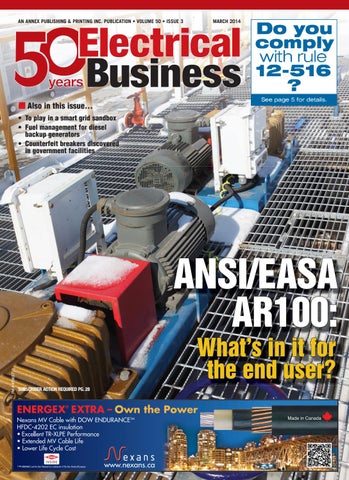
On the cover and page 8 Ansi/EAsA Ar100: what’s in it for the end user? In just 22 pages, AR100 details good practices for mechanical repair, rewinding and testing that help apparatus rebuilders maintain or enhance the energy efficiency and reliability of both AC and DC motors and generators. STOCK PHOTO.
involved in standards development, thereby allowing a transfer of knowledge. Another great example of a standard that has had a profound influence on the electrical industry is CSA Z462 “Workplace electrical safety”. Whereas existing regulations mandated workplace safety, the release of Z462 prompted regulators, manufacturers and owners to develop programs, assess the hazards associated with electrical equipment, and train workers on how to work safely and use personal protective equipment (PPE). I am currently the vice-chair and drafting editor of the recently released guideline, CSA Z463 “Maintenance of Electrical Systems”. I really enjoyed working with a great group of members from across the country who brought all of their combined knowledge to produce a great document that will help our industry maintain electrical assets. I treasure the camaraderie and memories that come from attending code meetings across Canada. While the code development process may seem tedious to some, the committee members love it—especially when they have the opportunity to call out another member’s argument as non-germane and non-persuasive! I strongly encourage you to get involved in the codes & standards development process. It enriches you professionally and, like me, you will make new friendships that will last a lifetime.
DEPARTMENTS 4
Industry News
In the deregulated world, cogeneration would seem to be king. Not only does the owner get the benefit of reduced transmission and distribution costs, but the essentially free heat energy can be used to satisfy other energy requirements, such as domestic hot water and space heating.
18 From The Legal Desk
16 to play in a smart grid sandbox
23 Letters
Key considerations in equipment supply agreements
20 Personalities 21 Calendar
Schneider Electric and Toronto’s Ryerson University have partnered to create what they call a state-of-the-art smart grid laboratory for research, development and testing of smart grid algorithms, products and systems for Ontario institutions.
27 Products & Solutions
19 Fuel management for diesel backup generators
30 Code Conundrum
30 Code File Do we need arc fault circuit interruption in the code?
Diesel is by far the most commonly used fuel supply for backup power in critical power applications. Here we list eight things every organization using diesel backup generators needs to know to keep their fuel clean, dry and emergency-ready.
22 A new idea for spec’ing digger derricks
To help prevent customers from buying the wrong equipment—either because the truck is undersized or oversized and expensive—a new comparison called “Work Zone Capacity” is being promoted by Terex, a manufacturer of digger derricks and aerial devices.
page 27
25 Counterfeit breakers discovered in government facilities
Public Works and Government Services Canada has carried out inspections in various Crown-owned buildings across the country to identify possible counterfeit moulded case circuit breakers (MCCBs).
page 28
www.EBMag.com • March 2014 • 3
industry news Schneider aims for lead in prefab data centres with AST acquisition Schneider Electric (www.schneider-electric.com) says it has acquired Barcelona, Spain-based AST Modular, which offers a portfolio of “prefabricated data centre modules, services, manufacturing expertise and project engineering support”. “Schneider Electric’s global presence, world-class power, cooling and data centre infrastructure management solutions—backed up by an excellent service network—will be a major benefit for our customers,” said Henry Daunert, CEO of AST Modular. Schneider feels this acquisition adds capabilities to its “already strong position” in the prefab data centre solutions market.
March 2014 • Volume 50 • Issue 3 ELECTRICAL BUSINESS is the magazine of the Canadian electrical community. It reports on the news and publishes articles in a manner that is informative and constructive. Editor Anthony Capkun - acapkun@annexweb.com group Publisher John MacPherson - jmacpherson@annexweb.com Account Manager Scott Hoy - shoy@annexweb.com Associate Editor Alyssa Dalton - adalton@annexweb.com Art director Svetlana Avrutin - savrutin@annexweb.com Production Manager Kathryn Nyenhuis - knyenhuis@annexweb.com subscriber Customer service representative Marie Weiler - mweiler@annexweb.com President Mike Fredericks - mfredericks@annexweb.com
• Free Air Ampacity Rating in ABOVE and BELOW GROUND Installations* • Up to 8000 AMP / 600 V to 230 kV • Reduced Power Losses • Lowest Cost System • Suppresses EMF’s • Expandable Enclosure • Quick & Easy Installation • Underwater Installations
Published by Annex Publishing & Printing inc. 222 Edward Street, Aurora, Ontario L4G 1W6 Tel. 905-727-0077 • Fax 905-727-0017
Publication mail Agreement #40065710 Return Undeliverable Canadian Addresses to Circulation Department P.O. Box 530, Simcoe, ON N3Y 4N5
e-mail: mweiler@annexweb.com
A
B
C
United States Second Class Postage paid at Lewiston, NY (USPS-741-470) US POSTMASTER: Send address changes to ELECTRICAL BUSINESS, P.O. Box 8145, Lewiston, NY 14092
B
A
C
B
A
C
B
A
Printed in Canada ISSN 0013-4244
C
N
N
CIRCULATION: Marie Weiler e-mail: mweiler@annexweb.com Tel: 1-866-790-6070 • Fax: 1-877-624-1940 Mail: P.O. Box 530, Simcoe, ON N3Y 4N5
N
suBsCriPtion rAtEs: Canada: Single issue $7.00 12 issues: $35.00 (includes tax) usA: $59.00 (US) international: $75.00 (US) per year
N
Trefoil Cable Configuration. *Patent Pending
Replaces BUS DUCT, ARMOURED CABLE IN TRAY, UNDERGROUND DUCT BANK, DIRECT BURIED and CONDUIT SYSTEMS United Wire & Cable’s expertise in cable and enclosure design, manufacture and application engineering ensures a reliable, versatile and cost effective MAXIAMP cable bus system. For further information please email us at: sales@unitedwc.com Tel: (905) 771-0099 or 1-800-265-8697 • Fax: (905) 771-1658 or 1 800-461-4689
Going to great lengths to serve you
Wire_EB_Mar.indd 1 4 United • March 2014 • www.EBMag.com
www.unitedwc.com
2014-02-27 11:02 AM
occasionally, Electrical Business will mail information on behalf of industry-related groups whose products and services we believe may be of interest to you. If you prefer not to receive this information, please contact our circulation department in any of the four ways listed above. the contents of Electrical Business are copyright ©2014 by Annex Publishing & Printing Inc. and may not be reproduced in whole or part without written consent. Annex Publishing & Printing Inc. disclaims any warranty as to the accuracy, completeness or currency of the contents of this publication and disclaims all liability in respect of the results of any action taken or not taken in reliance upon information in this publication.
We acknowledge the financial support of the Government of Canada through the Canada Periodical Fund of the Department of Canadian Heritage.
industry news OPG fined $75,000 under Occupational Health and Safety Act Ontario Power Generation (OPG, www.opg.com) has been fined $75,000 for failing to follow notification procedures required under Ontario’s Occupational Health and Safety Act. Between August 20 and August 31, 2011, three workers were assigned the task of dismantling shielding canopies and other equipment at the Darlington Nuclear Generating Station on Holt Road South in Bowmanville. One of the workers was cutting the frame of the canopies with a torch when he saw a liquid substance emerge along with white smoke. It was later learned that the frame contained lead shots and that the worker had melted one or more of those shots. Neither the supervisor nor the workers were aware of the presence of the lead shots prior to beginning the work, according to the report. The workers were wearing face shields appropriate for torchcutting activities but because the supervisor was not aware of the presence of lead shot in the frame, the workers were not wearing respiratory protection required for use when exposure to lead is possible. As a result of the lead content in the lead shot and the lack of respiratory equipment in use at the time of the work, the workers were potentially exposed to lead-containing particles. On or about October 11, 2011, two of the workers filed claims with the Workplace Safety and Insurance Board (WSIB) in respect of an occupational illness potentially resulting from their possible exposure to lead that August. OPG was advised of the claim at that time but did not, within the required four days, provide the required notice to the Ministry of Labour, contrary to section 52(2) of the Occupational Health and Safety Act. OPG pleaded guilty to failing to comply with the required notification and was fined $75,000, plus a 25% victim fine surcharge. Affiliated Distributors achieves sales of $28 billion in 2013 North American industrial and construction products buying group, Affiliated Distributors (www.adhq.com), reports record sales in 2013 of $28 billion. AD’s members across all divisions grew
4% in 2013, with Electrical up 3.5%. “I’m really proud of the growth and performance of our market-leading independents and supplier partners,” said Bill Weisberg, AD’s chair and CEO. “2013 was the 26th year, out of the last 30, where AD members achieved double-digit growth with AD suppliers. Our team is laser-focused on our mission and bullish about 2014.” Member growth with AD’s supplier partners was more than double AD member total purchase
growth, says AD. Net distributions to AD members grew 13%. Also in 2013, AD members hired 1618 new employees, opened over 100 new locations and made 37 acquisitions.
Solutions for residential construction.
Rule 12-516 requires. New additions to the CI66 Series respond. To prevent cable damage from nails and screws, Rule 12-516 (1) of the Canadian Electrical Code requires that a safety zone of at least 32 mm be left between non-metallic sheathed cable and the edges of the studs, joists and similar structures through which it is pulled. Whilst this rule is often interpreted as meaning 32 mm in depth from the front of the stud, there is also the potential for mechanical injury on either side of the structure, at cable entry and exit points.
CI66-T protector cylinder
CI66-XL single protector plate
If the contractor is unable to provide a 32 mm safety zone, the cable must be protected using approved metal protection devices. Thomas & Betts has responded to this requirement with three new additions to the Iberville® CI66 protector plate family. Designed and manufactured in Canada, these products will help you meet code requirements quickly and efficiently, without obstructing dry wall installation.
CI66-XL-2 double protector plate
Check out our installation video at www.tnb.ca/video.
Thomas & Betts. Your best connection for innovative solutions. Wire & Cable Management
•
Cable Protection Systems
•
Power Connection & Control
•
Safety Technology
w w w . t n b . c a
T&B_JR_EB_Nov.indd 1
2013-10-17 2:22•PM www.EBMag.com • March 2014 5
industry news
JOIN US AT THE SKILLS CANADA NATIONAL COMPETITION CONNECT WITH CANADA’S FUTURE SKILLED TRADES AND TECHNOLOGY WORKFORCE
JUNE 4-7 2014
TORONTO
40+ SKILLED TRADES AND TECHNOLOGY AREAS 500+ COMPETITORS FROM ACROSS CANADA VIP NETWORKING EVENTS WITH INDUSTRY LEADERS CONSTRUCTION / TRANSPORTATION MANUFACTURING AND ENGINEERING / SERVICES INFORMATION TECHNOLOGY / EMPLOYMENT
SKILLSCOMPETENCESCANADA.COM
6 • March 2014 • www.EBMag.com 2014-02-27
Skills_EB_Mar.indd 1
Southwire Canada talent show winners donate to food bank Southwire Canada (www.southwire. ca)—headquartered in Mississauga, Ont.—has donated $2000 to the Mississauga Food Bank (www. themississaugafoodbank.org), after several employees won first prize in a company-wide talent show at a recent sales conference. The winning employees decided to donate their $1000 prize to the food bank, which was then matched by Southwire Canada president, Axel Schlumberger. The donation was formally presented on January 30, 2014. From left, Southwire’s Erin Hawley, Joanne Peacock and “We are extremely proud of Richard Do (right) present the cheque to executive director our talented employees and their generosity in donating their winnings Christopher Hatch at the food bank’s warehouse. to benefit the local community,” said Schlumberger. The team won first place with a version of “Gentleman” by South Korean popstar, Psy, with the lyrics changed to reflect a company theme. “The Southwire Canada donation illustrates a creative way in which companies and individuals can donate and become involved with the Food Bank,” said Pamela Sleightholm, marketing and fund development coordinator for The Mississauga Food Bank. Through a network of neighbourhood food banks, the Mississauga Food Bank provides about 2.8 million meals each year, with a majority of the meals going to children under the age of 18.
Sensus deploys FlexNet AMI solution for SaskPower and SaskEnergy Sensus (sensus.com) has announced it will deploy its FlexNet advanced metering infrastructure (AMI) solution for SaskPower (www.saskpower.com) and SaskEnergy (www.saskenergy.com) in “one of Canada’s most ambitious AMI projects that will help support unprecedented economic growth in the province”. The Sensus FlexNet system is an interoperable infrastructure platform based on open standards and supports multiple applications. It serves as a dedicated and secure two-way communications highway that reaches all points in a utility’s service area, said Sensus, adding that all data is protected and secured in local SaskPower data centres. Included in the network will be almost 1 million electric meters and gas modules through Saskatchewan’s service territory. “Our customers at SaskPower and SaskEnergy were looking for a flexible and secure platform that would support their continued growth,” said Sensus president Randy Bays. “Our technologies will help them reach their environmental goals while delivering improved operational performance and savings from day one.” The Sensus network will be the foundation for different applications, beginning with meter reading and billing, new electric smart meters and a two-way radio module upgrade to existing natural gas meters. Data collected from the meters allows SaskPower to bill its customers every month based on actual consumption—instead of estimates sent four times a year, said Sensus.
3:53 PM
Added benefits of the system include customers seeing cost savings sooner related to energy efficiencies initiatives, billing questions resolved more efficiently, no manual on-site reads and simple and quick tenancy changes when preparing to move, it continued. The project began in October 2013 and will continue until summer 2015. SaskPower estimates that the system will pay for itself in 11 years and SaskEnergy expects a cost recovery for its portion of the project within seven to 10 years. Federal funding to help propel women into construction leadership The Canadian Association of Women in Construction (CAWIC, www.cawic.ca) says it has received funding from the Government of Canada (through Status of Women Canada) to promote women into leadership roles within the Canadian construction industry. CAWIC is a volunteer-led, not-for-profit association supporting “the entry, retention and advancement of women within the Canadian construction”. The funding grant of $249,900 is slated for a three-year project to conduct research and develop an action plan for construction industry employers, unions, alternative unions and open shop contractors to improve women’s advancement into leadership roles within the construction industry. “Today’s announcement by the federal government and the initiatives of CAWIC will certainly promote and reinforce the contribution that women bring to the skilled trades,” said Valerie Vanderwyk, Joint Apprenticeship Training Committee UA Local 67.
industry news
The United Nations launched a new campaign (www.unodc.org/counterfeit) to raise awareness about the links between organized crime and the $250-billion/year trade in counterfeit goods: “Counterfeit: Don’t buy into organized crime”. “As a crime which touches virtually everyone in one way or another, counterfeit goods pose a serious risk to consumer health and safety,” said the Vienna-based UN Office on Drugs and Crime (UNODC). “With no legal regulation and very little recourse, consumers are exposed to risk from unsafe and ineffective products since faulty counterfeit goods can
lead to injury and, in some cases, death.” The campaign informs consumers that buying counterfeit goods could be funding organized criminal groups, putting consumer health & safety at risk and contributing to other ethical concerns, such as labour exploitation and migrant smuggling, as well as posing environmental challenges due to the lack of any regulations. Through the campaign, consumers are urged to look beyond counterfeit goods and to understand the serious repercussions of this illicit trade, which provides criminals with a significant source of income and facilitates the laundering of other illicit proceeds. Electrical consumer goods, tires, brake pads and airbags, airplane parts, baby formula and children’s toys are just some of the many different items that have been counterfeited, says UNODC. “In comparison to other crimes such as drug trafficking, the production and distribution of counterfeit goods present a low-risk/ high-profit opportunity for criminals,” noted UNODC executive director Yury Fedotov.
IEEE group looks at standardizing Spectrum Occupancy Sensing IEEE (standards.ieee.org) has formed the IEEE 802.22 Spectrum Occupancy Sensing (SOS) Study Group to explore standardizing SOS technology for optimizing usage of radio frequency (RF) spectrum for wireless broadband services. “Standardization could lead to the more efficient use of spectrum, especially in places where the information about the primary users is difficult to find,” said Dr. Apurva N. Mody, chair of the working group. “To better understand the standardization requirements, the study group will explore ongoing research and the various challenges associated with the technology.” The study group will use the IEEE 802.22 standard as a baseline for future SOS standards
and efficient use of the technology. SOS is intended to bring the Spectrum Sensing Functions (SSF) and sensing-related messaging formats out of the current IEEE 802.22 standard to create a stand-alone system of external sensors dedicated to creating a spectrum occupancy survey. “For example, the locations and characteristics of the radiators are not well documented,” said Mody. “Individual and collaborative spectrum sensing is one of the tools to complement the information contained in databases to create an accurate spectrum occupancy survey, which would combine information from multiple sensors along with local terrain information to predict the spectrum occupancy patterns.”
Don’t buy into organized crime, pleads new United Nations campaign
Untitled-5 1
Vestas’ first 8MW prototype uber-wind turbine produces its first kWh
Vestas (www.vestas.com) says its first V164-8.0 MW prototype wind turbine has successfully produced its first kWh of electricity, and claims this makes it the world’s “most-powerful turbine in operation”. “We have now completed the production, testing and installation of the V164-8.0 MW as planned, thanks to the team’s intense effort during a time when Vestas has reduced its investments and lowered fixed costs. We now look forward to evaluating the turbine’s performance onsite,” said chief technology officer Anders Vedel. The turbine will be monitored in the coming months to further validate reliability and energy output. The V164-8.0 MW will be the flagship product for the offshore joint venture between Vestas and Mitsubishi Heavy Industries. “Combined with the experience and capabilities of both Vestas and Mitsubishi Heavy Industries, this puts us in a strong position in the growing offshore market,” said Jens Tommerup, president of Vestas Offshore. The V164-8.0 MW turbine prototype boasts a 140-m tower and a turbine tip height of 220 m. The swept area of more than 21,000 sq. m promises to increase the amount of energy captured, while reducing operational and maintenance costs by enabling customers to run fewer, larger turbines, with fewer service visits.
4/15/11 11:59:45 AM
www.EBMag.com • March 2014 • 7
StoCk PHoto.
ANSI/EASA AR100:
What’s in it for the end user? Thomas H. Bishop, PE
A
NSI/EASA AR100 “Recommended Practice for the Repair of Rotating Electrical Apparatus” (2010) provides good practices for mechanical repair, rewinding and testing that help apparatus rebuilders maintain or enhance the energy efficiency and reliability of both AC and DC motors and generators. The focus of this article is strictly on the electrical aspects of AC machine repair prescribed in this standard. Many of the practices in AR100 help maintain motor efficiency. These practices were identified as part of a comprehensive ‘rewind study’ that was published in 2003 by EASA (Electrical Apparatus Service Association) and the Association of Electrical and Mechanical Trades (AEMT), a service centre association in United Kingdom. One value of AR100 for end users is that it concisely describes good repair practices in just 22 pages. Another is that, by requiring service centres to comply with the recommended practices in AR100, end users can be assured that repairs will be made in accordance with a recognized standard. The result should be a quality repair without shortcuts. General guidelines General guidelines provided by AR100 include recording and reviewing the nameplate data. By doing so, the service centre can check the machine’s suitability for its application and ensure that repairs will maintain its original ratings. The standard also recommends the service centre determine the root cause of failure and suggest ways to prevent recurrence. This requires careful inspection and testing of the machine before repairs are made. Some of the good practices in AR100 seem inconsequential, but their combined effect establishes the document as the repair standard for motors and generators. And, although it’s not explicitly stated, a strong underlying theme of the document is maintaining or improving motor and generator efficiency. Rewinding AR100 concisely describes the requirements for a good practice rewind in just two pages, beginning with inspection of the windings (Figure 2) and rotor squirrel cages. It’s important to remember that the rotor is an electrical component— the rotating secondary of a transformer, with the stator being the primary— because defective rotor bars or end rings (Figure 3) could reduce output torque or cause vibration.
tABlE 1 Recommended minimum insulation resistance (IR) values for various types of windings. not increasing the average length of the coil extensions. Following these good practices will maintain or reduce winding resistance and losses, thereby maintaining or increasing winding life and energy efficiency.
Stator core testing. Stator cores consist of a stack of thin steel laminations that are insulated on all surfaces and have a circular opening for the stator bore. Evenly spaced notches around the circumference of the opening form slots to hold the winding. When shorts develop between laminations, circulating currents will increase stator heating and losses. AR100’s good practices for core inspection and testing focus on detectWinding data. Exact duplication of the original winding is crucial for maintaining ing core degradation such as shorted laminations. Among them are loop or motor performance and energy efficiency. AR100 therefore recommends recordcore testing (Figure 5) before and after winding removal, investigation of ing and checking the accuracy of the as-found winding data (Figure 4) before any increase in core losses, and repair or replacement of damaged laminadestroying the old winding. It also recommends keeping the cross-sectional area tions. This helps identify a faulty core before repair, not after or, worse, of the conductors the same in the new winding (or increased, when possible), and after the repaired machine is put in service.
8 • March 2014 • www.EBMag.com
FigurE 1 ANSI/EASA AR100-2010, “Recommended Practice for the Repair of Rotating Electrical Apparatus”.
FigurE 2 A random wound stator damaged by contact with the rotor.
FigurE 3 open rotor bars detected by visual inspection.
FigurE 5 Core testing a stator prior to rewind.
FigurE 4 Form for recording winding data.
FigurE 6 the burnout oven should be equipped with a part temperature sensor and water spray to control temperature.
FigurE 7 Random class H coils being made on a semiautomated winding machine.
FigurE 8 this rotor end ring was not properly brazed to the bars, resulting in a complete open circuit failure.
FigurE 9 this stator has been preheated in a bake oven prior to dipping.
FigurE 10 Use of a digital megohmmeter to check winding insulation resistance.
FigurE 11 A form coil stator being surge tested.
FigurE 12 An example of a faulty surge test pattern. A good pattern would appear as a single trace.
FigurE 13 A motor about to be final test run on a test bed.
FigurE 14 Micrometers with clearly evident calibration labels.
www.EBMag.com • March 2014 • 9
Winding removal. AR100 pays special attention to removing the old windings from the stator core without damaging the laminations. For instance, it recommends thermally degrading the winding insulation in a temperature-controlled oven (Figure 6) as the first step, while monitoring the temperature of the part (typically the stator). This helps prevent damage to the stator core 2216-08 FLIR Mission Equip EB when the windings are removed.
Insulation system. AR100 recrandom windings and class B ommends that the new winding’s (130C) form coil windings. insulation system be equal to or better than the original, using only Rewind procedure and slot fill. compatible components. Service Regarding the rewind process, centres typically achieve the ‘better AR100 says the new winding should than’ option by using class H have the same electrical charactersystems (180C) for random windistics as the original. This is best ings (Figure 7) and class F systems accomplished by ‘copy rewinding’ (155C) for form coil windings. i.e. using the same-sized conductors Most original manufacturers use (wire cross-sectional area), the same Connects Jr FFeb14:Layout 1 1/30/14number 1:48 of PM turns Page either class (155C) or B (130C) per1 coil, and the
same coil dimensions as the original. One good practice in AR100 that can improve efficiency in some cases is to increase the wire cross-sectional area, which increases conductivity and reduces losses. Another is to reduce the average length of coil turns, which reduces resistance and losses. Guidance on how to repair rotor squirrel cage windings reinforces the need to maintain the machine’s original performance characteristics. This includes making certain that rotor bars fit tightly in the core slots; that bar-to-end ring connections are welded or brazed (Figure 8); and that the rotor cage retains its original electrical characteristics and can withstand normal thermal and mechanical forces. Winding impregnation. Although every part of the rewind process is important, the cured varnish/ resin binds the winding components together while ensuring good heat transfer from the winding to the stator core and the cooling air. AR100 therefore stresses the importance of winding impregnation practices (Figure 9) that include preheating the stator winding; selecting a varnish/resin with an adequate thermal rating; and using a treatment that’s both compatible with the insulation system and suitable for the application environment. Testing and inspection The good practice procedures in AR100 build quality into the repair. To verify the machine’s ability to perform in accordance with its nameplate rating, for example, the document’s recommendations include careful inspection, followed by winding resistance, surge comparison and hipot (high potential) testing. As explained later, these procedures may detect faults or anomalies that could cause premature winding failure. Inspection. AR100 recommends the windings and insulation system be carefully checked for damage or degradation before performing insulation resistance, surge comparison or hipot tests. The main purpose (and benefit) of this procedure is to detect and correct existing damage that might escalate under test and possibly destroy a new or overhauled winding. Insulation resistance test. Following inspection, testing begins with the insulation resistance test (Figure 10). Often called a ‘megger’ test (based on the Megger trade name), it measures winding insulation resistance in megohms after a constant test voltage has been applied for one minute. This is long enough for insulation dielectric stress conditions to begin to stabilize,
1 10Flir_EB_Feb.indd • March 2014 • www.EBMag.com
2014-01-30 2:37 PM
resulting in repeatable test values. AR100 recommends testing the insulation resistance of the winding prior to hipot testing; this could save a winding with weak ground insulation from a test that could cause it to fail. The document includes acceptable test ranges for various machine ratings, as well as recommended minimum insulation resistance values, corrected to 40C (Table 1). When a winding doesn’t meet these minimum values, a hipot test should not be performed.
provides details on tests that should be performed at this critical point. For example, the exact operating speed should be checked, typically with a digital tachometer. Instrument calibration. The testing section concludes by stressing the importance of another good practice: having instruments calibrated to a national standard at least annually, and clearly labeling
them with the vendor’s name and calibration date (Figure 14). This helps users avoid issues such as a winding failure due to a hipot tester that outputs a higher voltage than indicated.
are made in accordance with a recognized standard. Thomas H. Bishop, PE, is a senior technical support specialist at the Electrical Apparatus Service Association, an international group of more than 1900 firms in 58 countries that sell and service electrical, electronic and mechanical apparatus. To view or download AR100-2010, visit www.easa.com/energy.
Conclusion By specifying that apparatus rebuilders follow the procedures in AR100, end users can be assured of receiving quality repairs that
Surge comparison tests. Whereas insulation resistance tests apply only to the ground insulation system, surge comparison tests (Figures 11 and 12) can detect shorts within the winding (e.g. turn-to-turn, coil-to-coil or phase-to-phase). AR100 provides a suggested test level for surge comparison testing—two times the circuit rating plus 1000 volts. This essentially ‘breaks new ground’, because this criterion isn’t dealt with specifically in other standards. High-potential tests. Hipot testing stresses the insulation system of the winding conductors to ground, so AR100 cautions against using it without first obtaining acceptable inspection and insulation resistance test results. The standard provides test levels for new, reconditioned or notreconditioned windings, as well as comprehensive tables illustrating AC and equivalent DC test voltages. (The AC test voltage level is multiplied by 1.7 to obtain the equivalent DC voltage.) Among its advantages, the DC hipot test requires an instrument with a much smaller capacity than the AC version. It, therefore, does less damage should a failure occur. For a new winding, the test level is the maximum value (100%) given in the tables. After machine assembly, the test level is 80% of the maximum. Both the 100% and 80% test levels are limited to one-time tests of a winding; that is, to prevent insulation damage, a winding may be subjected to each test level only once in its lifetime. When subsequent hipot tests are desired (or for reconditioned windings), AR100 suggests testing at 65% of maximum (new winding) level. This is another example of a recommended practice other standards do not address. For windings that haven’t been reconditioned, the document recommends limiting testing to insulation resistance tests—a good practice that could prevent a winding failure under test. No-load testing. Following repair and assembly, a motor is normally no-load tested (Figure 13). AR100
Safe and easy for customers. Smart for your business. Introducing EVlink: the best-in-class infrastructure solution for electric vehicles. With electric vehicles (EVs) becoming a driving force in transportation, a charging infrastructure is needed where you and your customers live, work, and play. From fleet and commercial parking lots, to homes and quick-charge stations, EVlink™ chargers are the more reliable, efficient, productive, and green choice.
Faster charging. Charge approximately four times faster than a standard 110 volt home outlet. With a full 30 Amp Level 2 charging rate, EVlink charging station users can charge up to two times faster than other 16 Amp Level 2 charging stations — at home or on the go.
Energize a smarter, more sustainable future.
Offer customers or employees safe, convenient electric vehicle charging stations.A simple interface and an integrated authentication system make EVlink charging stations quick and easy to use. Remotely monitor and control charging stations conveniently through a Web-based portal. Plus, have access to analyze charging profiles, optimize maintenance, and economically plan for expansion.
EVlink chargers offer the widest product breath in the industry. Choose from the widest collection of products in the industry, from indoor or outdoor, basic or networked functionality, 4 – 6 hrs Level 2 charging or 30 min DC quick charging. Schneider Electric is your partner for all your EV charging needs.
Trust Schneider Electric,™ the world’s energy management expert, to deliver a charging solution that adapts to emerging EV models, evolves with your business, and perfectly supports your environmental commitment.
EVlink charging station services provide complete peace of mind. Rely on our network of electrical contractors to provide quick, dependable installation and service support for your EVlink chargers.
Learn how EVlink charging solutions can help build your business!
Download this FREE brochure and register to WIN a Samsung Galaxy Note™ 3! Visit www.SEreply.com Key Code g460u ©2014 Schneider Electric. All Rights Reserved. Schneider Electric and EVlink are trademarks owned by Schneider Electric Industries SAS or its affiliated companies. All other trademarks are the property of their respective owners. www.schneider-electric.com • 998-6299_CA-GB_EV_Note3
Schneider_EB_Mar.indd 1 ElectricalBusiness_CA_Mar_g460u.indd 1
www.EBMag.com • March 2014 • 11
2014-02-26 4:09 PM 2/12/14 3:00 PM
Dan Clouthier and John Hodson
E
urope and Asia are well-versed in the benefits of combined heat and power (CHP) a.k.a. cogeneration, considering their landscape of $0.25/kWh electrical costs and $2.50/L gasoline costs, along with multiples of two or more for any comparable energy source in North America. Our focus in this article is not renewable energy, though it certainly contains significant green content and, depending on the fuel, CHP can be a very green solution. A CHP’s generators will normally run on natural gas, but options include propane, diesel, gasoline, oil and, in some cases, naturally occurring offgassing/ methanes or biodiesel. Some applications allow for multiple fuel options, enabling the generator to run on the most economically viable and readily available fuel at the moment.
it’s well past time for
cogeneration in Canada
12 • March 2014 • www.EBMag.com
A little-known fact The greatest use of energy on our planet is transportation, and we include all modes: from trains, planes, ships and trucks to automobiles and recreational vehicles. The second greatest expenditure of energy is waste heat in the generation of electrical power at large central power plants—be they coal, nuclear or fossil fuels—and in losses related the transmission and distribution of power to end users. This constitutes a full 27% of the annual global energy use, or 30 quadrillion BTU during 2014 in North America alone. (Industrial energy use is a close third at 23%.) So generating electrical power out in the boondocks and transporting it after first transforming the voltage to higher transmission levels then down again to distribution and again to utilization levels has serious efficiency drawbacks. In addition, the resistive (I2R) losses over long distances can be significant. The heat generated is usually pumped into lakes, which may cause some aquatic issues, or up the stack—again, creating potential environmental concerns. The bottom line is that the heat energy is wasted, and while we see more local distributed energy by utilities (such as Enmax’s new downtown distributed energy centre, where hot water is used to heat nearby buildings), the reality is they are a drop in the bucket compared to overall electrical generation and consumption waste. We need to get our heads out of the sand and realize the future is here now. We need to start planning infrastructure that makes sense for the next 20 to 25 years and beyond. Having a gas-fired boiler sitting beside a conventional standby or peak-shaving generator makes no sense; it would be like running a separate electric heater in your car rather than gathering heat from the engine. Amazingly, cogeneration projects typically pay for themselves in three to five years. In some cases, the costs are recovered in less than two. We cannot think of another just-as-viable payback option since regulated electricity times when the reduction of annual peak energy charges could be realized through power factor improvement or peak-shaving technology.
Talk To The experTs aT aBB What is Power Quality all about? Most loads in modern electrical systems are inductive, the reactive nature of which causes a lagging current and therefore a low power factor. Going further, when coupled with increasing proportions of non-linear loads that cause harmonic disturbances, the effects on any network can be far from desirable. What are the characteristics of poor Power Quality? 1. Low power factor (cosΦ): Inductive loads, most commonly comprised of induction motors have an active component (kW) and a reactive component (kVAR). The active component is the power that actually does the work, resulting in the mechanical output in a motor. The reactive component sustains the electromagnetic field that facilitates the operation of the motor and is characterized by that portion of the current which lags the voltage by a 90° phase shift. The geometric combination of the active and reactive components result in the apparent power (KVA). The ratio of the active (kW) and apparent (KVA) components is referred to as cosΦ which is indicative of the efficiency of utilization of electrical power. When cosΦ = 1, the utilization is said to be most efficient and the aim is to bring the real-life value as close to 1 as possible. 2. Harmonic disturbances Increasing proportions of non-linear loads on networks causes harmonics to be fed back into the system. Such loads would most commonly include variable frequency drives (VFD) and even energy saving lamps of different kinds. 3. Voltage imbalance caused by imbalanced loads 4. Flicker caused by rapidly varying load conditions What are the most common and visible consequences of poor Power Quality? 1. Frequent and mostly unexpected equipment failures 2. Reduced operating life of equipment 3. Production losses 4. Health and safety issues in installations 5. Increased operating costs and carbon footprint 6. Non-compliance with utility regulations 7. Need to oversize installations to offset the additional stress Most of the above consequences directly translate into financial losses. How can ABB add value? ABB’s Low Voltage Power Quality Solutions (PQS) serve to restore real system conditions closer to desirable levels and better efficiencies by way of: 1. Improved power factor 3. Balanced power 2. Reduced harmonics 4. Reduced flicker What specific solutions does ABB have to improve Power Quality? 1. Power Factor Improvement Capacitors produce reactive power and thereby compensate for the reactive power consumption of electrical motors, transformers, etc. The results can be seen in the form of more stable power grids with increased transmission capacity and reduced losses thanks to higher power factors. Capacitors also constitute a key component in the various filter solutions reducing harmonic contents. A non-distorted sinusoidal voltage without harmonics reduces the risk of problems in the form of disturbances in equipment, metering errors and malfunctions in relay protection. It also extends the service life of connected equipment. ABB has complete solutions from capacitor units all the way up to stepless power compensators. 2. Harmonic Filtering ABB modular PQF active filters provide a reliable and cost-effective solution to the harmonics problem by continuously monitoring current in real time and then injecting harmonic currents in the network with exactly the opposite phase to the components that are to be filtered. The two harmonics cancel out each other resulting in a sine wave at the point of feed.
Advantages of ABB harmonic filters: • Filter up to 20 harmonics simultaneously. • Selection of harmonics up to the 50th harmonic • Harmonic attenuation factor better than 97% • Desired harmonic levels can be preset for each selected harmonic • Compliance with all aspects of harmonic regulations at individual harmonic levels
• Resolving problems due to both low frequency and high frequency harmonics 3. Dedicated Touchscreen Controller RVT All monitoring and control from digital controller with 3.5 inch colour touchscreen • Active (kW), Apparent (kVA) and Reactive power (kvar) for 3ph/1ph • Cos ϕ-3ph/1ph with preset Reactive power (kVAR) to achieve target cos ϕ, for 3ph/1ph • Voltage (V) and Current (A) -3ph/1ph • Total Harmonic Distortion on Voltage/ Current: THD V/I (%) • Voltage/Current Harmonics: H2 up to H49 (%-spectrum) • Ethernet connection RJ-45 on 10/100BASE-T interface with ABB PQ Link software • USB2.0 connection to directly link up to PC/Laptops
• Up to 8 Temperature alarm outputs to monitor hot-spots in the capacitor bank • Real time clock for time-stamped event logging and alarming • Hardware and software lock for access control to device and parameters
Mohamed Mekarnia Product Specialist - Power Quality 514-420-3100 ext. 3260 mohamed.mekarnia@ca.abb.com
The positive environmental impact is large and can result in several recognized benefits, such as a reduction in transmission and distribution infrastructure (e.g. steel, aluminum, concrete and copper), as well as unsightly overhead lines. Reduced I2R losses due to in situ generation means no wasted energy. For the commercial sector, cogen can provide one of the best returns for the dollar on LEED (Leadership in Energy & Environmental Design) points.
The how and the know-how Engineering and installation are preengineered, making the process as simple and straightforward as possible. The units are supplied in an indoor or outdoor soundproof enclosure. All requirements for controlling and protecting the generator—including advanced diagnostics, and remote control and alarms— are self-contained. The connections include: • fuel for the engine (typically natural gas) • exhaust to atmosphere • heat transfer medium (typically cold water) • heat transfer out (typically hot water or steam) • electricity out (typically 600V, 3-phase, 4-wire) • electrical instrumentation signals (PT & CT) Naturally, installation time depends on size and location, and can be as short as a few days. Work is usually performed turnkey by the generator supplier but, in certain cases, the roles are split between a customerselected engineering firm and contractors. Financing can be provided by external financial institutions, the generator supplier or even on a lease basis. Typically, the dynamics of the project cost and payback drive the customer to self-finance based on three- to five-year payback period. Installed cost, all in, is generally about $1800-$2600/kW for systems larger than 150kW. This, of course, varies on size and location and, the larger the generator, the lower the cost per kW installed. Cogen
14 • March 2014 • www.EBMag.com
units are designed (budgeted) for continuous operation with regular maintenance practice to last 20 years. Longer duration is certainly possible but, typically, maintenance and repairs will start to be onerous (depending on actual in situ operation). Maintenance can be performed by the owner, but is usually performed under contract and extended warranty by the system’s representative. To this point, the benefits of cogen have been promoted based on economics and, of course, saving money. This is a driving force and is usually justification on its own, but there are several other collateral benefits, too, including: Standby power in the event of normal supply failure. The cogen can power important loads in the event of storm, flood, infrastructure upset or other catastrophic event. Dual-use as critical load/emergency generator to meet with building code compliance. The cogen can serve as a power supply for base building loads and, when emergency power is required, the generator will serve this function until the requirement passes. Extra stability to the facility power system when utility connection is weak or prone to voltage fluctuations. The generator can also be used to correct power factor for additional savings when penalties for low power factor are realized. The generator can also reduce peak energy penalties or peak shave.
The time is now for cogeneration In the deregulated world in which we find ourselves, CHP would seem to be king. Not only does the owner get the benefit of reduced transmission and distribution costs, but the essentially free heat energy can be used to satisfy other energy requirements, such as domestic hot water and space heating, or even chilling requirements via a heat exchange system. The CHP system is designed to maximize heat recovery, including the engine jacket and the exhaust, and squeeze out every bit of available energy. Cogen will work in any application where a baseload of electrical power (kWh) and relatively sized thermal load (BTU) exist. The thermal load is seasonal in some cases but, in many cases, an annual electrical and thermal load can be matched up for an extremely attractive application. There are thousands of installations already running in Europe and Asia, including hotels, supermarkets, industrials, car washes and institutional facilities. A good example of a perfect match for cogen is a hotel where the heat generated is used to warm the pool, heat the water for showers and laundry, and space heating. Sizing the generation usually depends on the facility’s base minimum electrical load. In some cases, where the thermal load is larger than the comparative generation output, the additional power can be exported to the electrical utility. This requires some additional interconnect protection and control, but this is normally possible without too much trouble in our deregulated energy environment. There are applications where the electrical and thermal energy can be shared among several related facilities using internal or utility conduits, like the Enmax Boyle Renaissance Project in Edmonton. Cogen can make sense for applications from 5kW to 100MW and beyond; the majority of corporate-financed projects for medium-sized distributed power are in the 250kW to 5MW range. As with any newer idea, there will be cogeneration leaders and followers but, inevitably, it will become a regular part of our energy infrastructure. This is a value investment with many benefits. The time for cogen is now. John Hodson is the founder of Magna IV Electrical Engineering Calgary, co-founder of Power System Asset Management Solutions, and a shareholder of Power Ecosystems, while Dan Clouthier is the president of Power Eco Systems, a distributor of CHP equipment.
FLUSH-TO-THE-WALL MOUNTING OF FLAT SCREEN TVs
NON-METALLIC
Made in USA
MOUNTING
PLASTIC TV BOX
FOR CLASS 2 LOW VOLTAGE WIRING
R EC ESS E D P OW E R / LOW VO LTAG E CO M B O B OX ES
TM
BRACKETS
NEW
Nail-on LVN1 CED130
New Construction
LV1 for Existing Walls
TVBU505GC POWER and LOW VOLTAGE BOX
for NEW WORK
with CED130 cable entry device
LVMB2
...or RETROFIT
View LV1 Video DVFR2GC
LVS1
with voltage separator installed
Arlington’s non-metallic mounting brackets are the best way to install Class 2 wiring! They seat wall plates flush with the mounting surface – install faster and cost less than metal!
CED130 CABLE ENTRY DEVICE
In existing construction, centered mounting wing screws pull bracket securely against the wall. The LV series (LV1 and multiple gang brackets) adjust to fit 1/4" to 1" wall thicknesses.
Arlington’s PLASTIC recessed combination power and low voltage boxes – TV BOX™ and Indoor IN BOX™ – offer the secure, easy way to mount flat screen TVs flush against a wall. The job looks great because plugs and connectors stay inside these Listed boxes without extending past the wall.
LVMB1
LVS2
Made in USA
Patented
Arlington
©2008-2011 Arlington Industries, Inc.
LV2
800/233-4717 • www.aifittings.com
© 2008-2013 Arlington Industries, Inc.
For new construction, the nail or screw-on LVN series brackets attach to a wood stud. They cost less than extension rings and install faster than mud rings. For screw-on, steel stud installations, try the LVS or LVMB series. All are available in one to four-gangs.
DVFR2GC POWER and/or LOW VOLTAGE COMBINATION BOX
View T V BOX Video
Available in 2-, 3- and 4-gang styles for retrofit or new work. Each offers power and/or low voltage in one or more of the other openings. There’s a box to fit nearly any application! • Non-metallic box with paintable white trim plate • RETROFIT Mounting wing screws pull box against wall NEW WORK Box screw-mounts to stud • Includes ground clip; optional covers available
TVBU505GC TV BOX™ For Power and Low Voltage
DVFR2GC IN BOX™ with separator for Power and/or Low Voltage
Arlington
3-GANG TVBU507GC
Patented. Other patents pending.
www.aifittings.com Scranton, PA 18517 800/233-4717
TM
4-GANG TVB613GC
2-GANG TVBU505GC, DVFR2GC
A NEAT COVER UP...
CABLE SPACER FOR POWER & LOW VOLTAGE CAB LE
NON-METALLIC BOX COVER FOR UNUSED FAN/FIXTURE BOXES – FITS PAN BOXES TOO!
The SPACER™ cable spacer holds up to eight individual cables centered on a 2x4. Easy to install. Just nail or screw The SPACER to a wood or metal stud! Holds single or double row of power or low voltage cables: -One to eight 14/2 -One to four 14/3, 12/2, 10/2 -One or two 12/3
Tab for easy centering on 2x4
CS14, CS14SC hold up to eight 14/2 cables CS14 Easy, nail-on installation towood
© 2010 Arlington Industries, Inc.
Positions, fastens, routes power or datacom cable Complies with article 300.4(d) of NEC Also available... Screw-on CS14SC
CP3540 Box Cover
Our non-metallic, paintable CP3540 Box Cover is the neatest way to cover unused fan/fixture boxes, pan boxes or poorly cut drywall. • No visible screws on ceiling plate • Fits 3.5", 4" round or octagonal boxes
Patented
Versatile Bracket Design with ‘A’ and ‘B’ openings for use on flat or uneven ceilings. Easy installation. Attach the bracket to the box with #8 or #10 screws. Back the screws out far enough to slip the bracket on.
‘A’ for flat ceilings Push stud into opening to seat cover ‘B’ for uneven or textured ceilings Stud
Thread stud into opening until tight
Made in USA
Arlington
800/233-4717 • www.aifittings.com
Arlington
800/233-4717 • www.aifittings.com
© 2002 Arlington Industries, Inc. REV 0107 Patented
Made in USA
to play in a smart grid sandbox A smart partnership creates the first smart grid university lab in Canada
EBMag Staff
“I
see the smart grid as a very important initiative. It’s also part of a great goal, and that greater goal is energy efficiency,” said Daniel Peloquin, president, Schneider Electric Canada. “I think we’re such a wasteful society, globally, and something needs to change, and the smart grid can be an enabler of this change.” Schneider, a global player in energy management, is partnering with Ryerson University in Toronto to create what it calls a state-of-the-art smart grid laboratory within the university’s Centre for Urban Energy (CUE): The Schneider Electric Smart Grid Laboratory. The announcement was made at a smart grid conference in Toronto last fall, and EBMag had the opportunity to interview several key players involved in this announcement, including Peloquin, Adam Kahan, Ryerson’s vice-president of university advancement, and Bala Venkatesh, academic director, Centre for Urban Energy. The lab will be the first smart grid laboratory in Canada on a university campus, says Schneider, and will be a collaborative facility for research, development and testing of smart grid algorithms, products and systems for Ontario institutions. “It’s going to provide a fantastic, real-world living opportunity to test these systems...” said Kahan of the new lab, which is scheduled to open in July. Venkatesh likens the lab to a sandbox, which “is like a small distribution company” where you can plug in different things, such as renewable energy sources, energy storage and smart meters, “and then you can see how it functions. You don’t have to go all the way to a utility to test those products”. On the subject of smart meters, we asked our interview subjects about the bad press smart meters had been suffering, particularly along the lines of privacy invasion. Venkatesh told us “There will be a lot of policy research that will go on at the centre, which will try to see ‘How does policy affect the way these solutions get implemented?’ ”. Peloquin took a more realistic approach, noting the privacy problem with smart meters is primarily a generational thing: “So here’s this consumer that says ‘Oh, I don’t want Hydro One or anybody else to know my consumption profile, but I’ve got this iPad and, yes, I’m going to download this application and, yes, I’m going to allow Location Services... and you can know a lot more about how I behave with my iPad’ [than with a smart meter]. The younger generation, they don’t have any problems.” Do we need a smart grid lab? “We’re an urban university committed to urban issues,” noted Kahan, “And we felt that we needed to obligate ourselves to research in urban energy, and we had the ability to do so with the faculty we had and with the approach that we were going to adopt.” The lab will offer students hands-on experience, facilitating the training of highly qualified personnel with a specialization in smart grid technology. It will be a platform for research and pilot testing, enabling researchers to evaluate new designs and mitigate the risks of new projects by helping ensure standards compliance prior to full completion and implementation. “We’re also big on demonstration projects,” enthused Venkatesh. “We’re hoping that we’ll get large utilities to show up at our doors and ISSUE 2 INC. PUBLICATION • VOLUME 48 • AN ANNEX PUBLISHING & PRINTING
Electririccaaall Business
PUBLICATION & PRINTING INC.
• ISSUE 11 • VOLUME 47
ON L4G 3S9
FEBRUARY 2012
Technology and economics
Simcoe ON N3Y
To Circulation Department
Canadian Addresses
HERE’S
Return Undeliverable
Overhead cabling saves energy in
4N5
530, Simcoe ON N3Y 4N5
es electric vehicl surge!
data centres P.O. Box 530,
Department
To Circulation
Canadian Addresses
Don’t miss out on your next issue of
NOVEMBER 2011
240 Edward St, Aurora
DECEMBER 2011
in Opportunities
To Circulation Department P.O. Box
work with us to demonstrate different technologies in that space so that, when they want to experience new energy storage, they don’t have to take it into the field, they can come to the laboratory and mock it up and test it out, so they spend fewer dollars.” The CUE’s stated vision is to be a world-class research and innovation centre dedicated to solving urban energy challenges. Schneider’s contribution to Ryerson includes a substation and feeder automation portfolio, real-time software suite for global grid management and custom switchboard and metering products. When asked whether the lessons learned at the new lab will have application outside of the urban environment, Peloquin explained, “I don’t see why not. To me, at the end of the day, what the smart grid is going to facilitate is the integration of renewables. Whether this renewable is out in Kapuskasing or in Markham, whether your electric vehicle is in Thunder Bay or here, it’s the same problem. It’s just the magnitude of it is bigger because you’re in a big city. But I don’t see why the solutions can’t be applied to other areas.” “As we move towards a new era of intelligent energy management, it is increasingly important to continue learning about the ways smart grids are able to transform energy use,” said Peloquin. “Ryerson University is a Canadian leader in education and innovation and we are excited to work with them in this area.” “This is not a cloistered university,” Kahan said. “We are not doing theoretical research hidden from society. We want to be totally integrated within society, and so we wanted to have partners.” CUE at Ryerson is a collaborative research centre set up by Ryerson and founding sponsors Hydro One, Ontario Power Authority (OPA) and Toronto Hydro. The smart grid lab is an essential part of this vision, and will help the CUE to provide future energy solutions. “For us, it’s important to educate the younger generation,” said Peloquin. “So it was really a match made in heaven in terms of location, in terms of intent and in terms of our strategic ambitions”.
AN ANNEX PUBLISHING & PRINTING INC. PUBLICATION • VOLUME 47 • ISSUE 10
AN ANNEX PUBLISHING
HOW:
Also in this issue...
Also in this issue...
PM # 40065710
Return Undeliverable Canadian Addresses
Left to right: Daniel Peloquin, president, Schneider Electric Canada; Adam kahan, vice-president of university advancement, Ryerson University; Bala Venkatesh, academic director, Centre for Urban Energy. Photo A. Capkun.
• Return Undeliverable
controls • LEED with well-designed lighting • Moving to world-class safety performance
Also in this issue...
PM # 40065710
Guide 2012 Buyers’ • The BlueBook arc flash switching versus • Time-delay storage options • Picking tool
• Confusion over electric vehicles? • Delta to wye conversions • Community power renewable energy fuels
12-01-30 2:22 PM
Untitled-2 1
Nexans_EB_Feb.indd 1
PM 2/11/10 1:26:15
1/13/11 9:06:23 AM
0.indd 1
Nexans_EB_March1
16 • March 2014 • www.EBMag.com
sign up for your FREE SUBSCRIPTION it’s fast, it’s easy and it’s free! For fastest service visit www.EBMag.com and click the subscription button
Recessed Lighting at its finest NEW - Recessed Fixtures We have taken our years of lighting expertise and incorporated it into our new line of high quality recessed fixtures designed with ease of installation and versatile lighting options in mind. Recessed fixtures not only provide convenient unobtrusive general lighting for residential and commercial applications, with STANDARD’s extensive assortment of trims and housing, you can create an unparalleled look. Our wide varieties of trims suit all applications and complement every decor. Paired with Canada’s largest selection of LED lamps you’ll be sure to find the best combination for all your lighting needs.
www.standardpro.com
from the legal desk
Ian J. Houston
Key considerations in equipment supply agreements
M
ost projects of a significant size involve the provision of major equipment that needs to be installed and commissioned at the project site. The proper performance of the equipment supply work can be fundamental to the overall success of the project. A key factor for an electrical consultant to consider is the specific role he is asked to fulfil in the purchase of such materials and/or equipment. The most common are: • Procuring equipment as part of an engineering procurement and construction (EPC) scope. • Managing the procurement of equipment as a consultant to the owner. • Acting as the owner’s consultant while equipment is being procured by others. Vendors of major equipment often insist customers use the vendor’s standard form agreements, which are typically (and not surprisingly) slanted in the vendor’s favour, so they need to be reviewed carefully. It will depend upon the particular circumstances of the purchase as to the extent to which any of these terms are negotiable. In my experience, some degree of negotiation is usually possible, though it depends on the commercial leverage the purchaser possesses. From a risk management perspective, an important issue involves the entity contracting with the equipment vendor. Most projects involving the purchase and installation of major equipment are schedule-driven, and the delivery, installation and commissioning of equipment will be on the project’s critical path. Interfaces between the vendor and any other contractor at the site are key points of interaction that need to be successfully managed if the project is to be completed according to schedule.
Hubbell Circuit-Lock® Motor Controllers For today’s industrial and commercial environments! • Approved for use as disconnects • Ensures safety, compliance, flexibility and productivity
Ian Houston is regional leader of the Construction and Engineering Group in the Toronto office of Borden Ladner Gervais LLP (www.blg.com), and a Fellow of the Canadian College of Construction Lawyers. His practice ranges from providing commercial law advice on contractual and procurement issues, to assisting clients in resolving disputes through litigation or alternative dispute resolution methods. Ian can be reached at ijhouston@blg.com or (416) 367-6111.
Hubbell Canada LP
18 • March 2014 • www.EBMag.com
EB-quarterTabMar2014c.indd 1 Hubbell_EB_March.indd 1
The party that contracts with the equipment vendor is normally responsible to the project for ensuring delivery commitments are respected. Aside from clear delivery dates within the equipment supply agreement, timely delivery is often secured using a liquidated damages provision, which makes the vendor liable for a pre-estimated damage amount (usually expressed as a per diem) should the actual delivery be late. Another key vendor obligation is ensuring that, once commissioned, the equipment performs to specified standards. These performance requirements are normally established by performance or acceptance tests that occur as part of the commissioning process. Vendors may be prepared to provide a guarantee related to the performance of the equipment, and this is sometimes secured by performance liquidated damages. (However, the main performance obligation usually relates to the operations phase of the project, which is covered in a separate operations agreement.) Aside from the foregoing, there are other key commercial terms to keep in mind. Obviously, price and payment terms are fundamental. Often, vendors will require a significant down payment, and some even require payment security. Most purchasers try to resist having to provide payment security, for obvious reasons: establishing the creditworthiness of the purchaser entity is sometimes enough to avoid the requirement of providing security. As for the down payment, careful consideration should be given to the issue of what occurs should the vendor default prior to delivery. In that event, what percentage of the down payment does the purchaser get back? To the furthest extent possible, payment terms should be weighted in favour of the bulk of the purchase price being paid on or after equipment delivery. As noted, equipment delivery is often a key milestone from both a scheduling and commercial prospective. Equipment supply agreements should contain clear terms respecting the purchaser’s right to inspect the equipment (or its components) upon delivery. Typically, title to the equipment passes to the purchaser upon either delivery or payment (a major payment is often triggered by delivery). A relatively recent issue to keep in mind involves whether a holdback needs to be retained from an equipment vendor so as to comply with the provisions of the Construction Lien Act (Ontario). Recent amendments to act expanded the definition of “improvement” to include the installation of industrial, mechanical, electrical or other equipment on the land where the equipment is essential to the normal or intended use of the land. Effectively, that means a 10% holdback should likely be retained from every equipment vendor to a construction project, and this should be incorporated into the payment terms. In my experience, many equipment vendors have not adjusted to this change in the law, so purchasers might experience some resistance. Other key commercial terms include: • Warranty: this is a matter of commercial negotiation, but ensuring the vendor is obliged to re-attend on short notice to respond to warranty claims is very important. • Choice of law: foreign vendors will sometimes include provisions in their standard forms making the law of a foreign jurisdiction the governing law for the contract. This needs to be carefully considered. • Insurance: consultation with an insurance advisor is necessary for ensuring insurable risks are properly addressed. • Limit of liability: again, this is a commercial issue that needs to considered in each case but, as a rule of thumb, a vendor should likely be exposed to the extent of the purchase price for the equipment. As you can see, equipment supply agreements can involve quite a few important considerations. Managing the issues associated with them is key toward ensuring the success of a project.
18/02/2014 3:42:14 PM 2014-02-21 10:29 AM
stock photo.
Fuel management for
diesel backup generators
8
D
iesel generator owners ought to know that government mandates have drastically changed the composition of diesel, and that fuel can no longer sit unmanaged until backup generators are required in an emergency. The introduction of ultra-low sulphur diesel (ULSD) and biodiesel blends in the past six years has caused relentless and accelerated corrosion rates and stability issues in systems utilizing diesel in Canada. Diesel is by far the most commonly used fuel supply for backup power in critical power applications. Due to its widespread use, it has been subject to rigorous mandated changes as governments strive to improve air quality, decrease greenhouse gas emissions and reduce reliance on fossil and imported fuels. These changes have had a dramatic, albeit relatively hidden, effect on critical power applications. Here we list eight things every organization relying upon diesel backup generators need to know to keep their fuel clean, dry and emergency-ready:
things
owners should
know
1.
Following 2010, diesel in Canada has sulphur limits of 15ppm (excluding large marine vessels and large stationary engines). Reducing sulphur in diesel benefits the environment but it requires additional steps in the refining process. During this process, the lubricating and cold-flow characteristics in diesel can be adversely impacted. To compensate, oil refiners include additives to supplies that do not meet the required standards. Such fuels are often blended with other supplies for bulk distribution.
2. 3.
Biodiesel is blended with diesel as an additional measure to reduce its environmental impact. In Canada, diesel is blended 2% biodiesel (the blend is denoted B5).
Engines created after 2007 are less tolerant of water and particulate matter. They have very high-pressure fuel systems and strict tolerances in an effort to improve efficiency and reduce emissions. Water and particulate matter introduced has dire effects on engine functionality.
4.
Biodiesel is considered an additive to diesel fuel. Biodiesel and certain additives included in ULSD are surfactants, meaning they increase diesel’s ability to absorb and hold onto water. Biodiesel is hygroscopic and degrades faster than regular diesel.
5.
Water materializes in two main forms: freestanding water (where a layer of water settles out below the fuel) and emulsified water (water that exists as tiny micro-droplets within fuel). ULSD and biodiesel blends bond so thoroughly to water that they often become emulsified. Emulsified water in oils leads to lubrication starvation, sludge formation, corrosive wear and eventually failure. Traditional filters and centrifugal purifiers cannot separate it out, leaving considerable water content in the fuel, damaging the engine.
6.
The fuel/water interface is a breeding ground for microbial growth, leading to microbial contamination, aggressive corrosion and sediment buildup. The result is fuel degradation, reduced fuel shelf life, filter and pipe blockage, fuel nozzle clogging, engine failure and—in the worst case—total system failure, risking economic loss and reputational harm.
7.
Traditional filters cannot remove emulsified water, but coalescing filters certified by the Society of Automotive Engineers (SAE) can. SAE J1488:2010 is a test that determines the ability of a fuel/ water separator to separate emulsified water or finely dispersed water from fuel. It is currently the only recognized test that covers emulsified water and specifically targets fuels with a biodiesel component.
8.
A comprehensive fuel management strategy must be employed to protect critical power investments. Evaluate the tank, piping and generator setup to identify areas of weakness. Consider the impact of likely site temperatures and humidity ranges, and ensure your fuel management system includes: • Regular onsite and offsite testing. • A fuel polishing system with coalescing filters that remove emulsified water. — With files from Puritas Energy Inc. of Halifax, N.S., a distributor of filter technologies (www.puritas.ca).
www.EBMag.com • March 2014 • 19
personalities William A. Sundermeier, president of Government Systems Division at FLIR (www.flir.com), has resigned to pursue other personal and business opportunities. Thomas A. Surran—who most recently served as president of the Commercial Systems Division—has been appointed COO, assuming responsibility for FLIR’s
global commercial and government operations. “I want to thank Bill for his tremendous contributions to FLIR,” said Andy Teich, FLIR’s CEO. “He has been an instrumental part of FLIR’s growth and evolution over the past 19 years.” Royal Philips has appointed Brent Shafer as CEO of Philips
North America (www.philips. com), where he is responsible for “strengthening Philips’ culture of entrepreneurship and growing revenue and market share in the United States and Canada”. He succeeds Greg Sebasky, who retired from Philips on February 3, and reports directly to Royal Philips’ CEO, Frans van Houten.
Shafer previously served as CEO of Philips’ Home Healthcare Solutions business group. Hubbell (www.hubbellonline. com) reports that Bill Tolley, current president of Hubbell Power Systems, has been named to the newly created position of senior vice-president, Growth & Innovation, reporting to president and CEO David G. Nord. “This newly created position is essential to meeting our long term growth targets and provides a tremendous opportunity for our organization to further drive innovation and best practice sharing,” said Nord. Meantime, Gerben Bakker has been promoted to president, Hubbell Power Systems. In this role, Bakker is responsible for leading a $900-million division that serves utility customers around the world. Shermco Industries (www. shermco.com) has promoted Kevin Alewine to director of marketing, where his new kevin Alewine responsibilities involve overseeing Shermco’s corporate marketing efforts in both Canada and the United States. His responsibilities will include market development and strategic planning, as well as advertising, trade events, public relations and online visibility. He is an active member of several IEEE and American Wind Energy Association working groups, and is also the current chair of the AWEA Operations and Maintenance Working Group. Ideal Industries (www. idealindustries. com) has promoted Terry Stevens to VP of sales for its North American Electrical Division, terry Stevens replacing Joe Saganowich who was appointed VP/GM of Ideal subsidiary, SK Hand Tool (www.skhandtool. com). An executive with more than 20 years of sales and senior management experience, Stevens will be responsible for managing the North American Electrical Division sales organization, its national accounts, as well as its customer service department. She previously served as the company’s senior sales manager for the Central Region for the past five years.
CONEC_MA_Sept.indd 1
20 • March 2014 • www.EBMag.com
12-07-25 10:04 AM
calendar Visit EBMag.com and click Calendar to see an extensive list of upcoming events.
Partners in Prevention “Power-up Your health & safety roi” Health & Safety Ontario April 29-30, Mississauga, ont. Visit www.healthandsafetyontario.ca
WILL BE
THERE!
IN CASE YOU MISSED IT... Photos • EBMag kicked off 2014
WILL BE
THERE!
oEl Electrical industry Conference Ontario Electrical League April 30-May 3, toronto, ont. Visit www.oel.org
WILL BE
with a visit to the Nedco West AGM & tradeshow in Vancouver, B.C. Visit bit.ly/1eYwWNL. Photos • Where else can you bump into so many professionals with a shared passion for electrical safety but at the IEEE IAS Electrical Safety Workshop? Visit bit.ly/1gaknRw. VidEo • At ESFi-Canada’s Electrical Safety Summit, EBMag editor Anthony Capkun spoke with four electrical industry players for their perspective on why electricity is “uniquely unforgiving”. Visit bit.ly/N9DwLl. Photos • this year’s AcklandsGrainger The Works MRO & Safety Show marks AGI’s 125th anniversary in Canada. Visit bit.ly/1dprNwC.
THERE!
CansiA solar ontario 2014 Canadian Solar Industries Association May 7-8, ottawa, ont. Visit www.cansia.ca
PEArl Conference & Exhibition Professional Electrical Apparatus Recyclers League May 3-5, Phoenix, Ariz. Visit www.pearl1.org WILL BE
THERE!
MEEt show 2014 May 7-8, Moncton, N.B. Visit www.meetshow.ca * EBMag is pleased to once again serve as official electrical partner!
WILL BE
THERE!
WILL BE
THERE!
Canadian utility Fleet Forum 2014 May 13-14, Regina, Sask. Visit www.cufconline.com
WILL BE
THERE!
WILL BE
THERE!
WILL BE
THERE!
Partners in training returns in 2014: • Edmonton • Winnipeg • Ottawa • Dartmouth • Kitchener-Waterloo DEtAILS at www.partnersintraining.ca AEl Electrical learning Expo Alberta Electrical League March 19, Edmonton, Alta. Visit albertaelectricalleague.com Future Building 2014 Ontario Construction Secretariat April 8-10, Burlington, ont. Visit www.futurebuilding.ca All-Energy Canada Exhibition & Conference April 9-10, toronto, ont. Visit www.all-energy.ca
WILL BE
THERE!
WILL BE
THERE!
SAVE Time & Money with Cor-Line ENT & Kwikon Fittings WILL BE
THERE!
An ENT system you can count on! WILL BE
THERE!
WILL BE
THERE!
WILL BE
THERE! In 1986 we made in-slab electrical raceways faster to install
by introducing the industry’s first true, integrated ENT system – long lengths of flexible tubing that reduce the number of WILL BE
THERE!
WILL BE
THERE!
WILL BE
THERE! couplings needed. Cor-Line tubing and Kwikon fittings are
designed to work together and provide the most robust concrete-tight ENT system on the market.
CanwEA western Forum 2014 Canadian Wind Energy Association April 14-15, Calgary, Alta. Visit www.canwea.ca
• Strong and flexible ENT tubing • Six locking tabs for umbreakable connections • Boxes are installation ready and concrete-tight
iEEE PEs transmission & distribution Conference & Expo IEEE Power & Energy Society April 14-17, Chicago, Ill. Visit www.ieeet-d.org
• Form stubbies eliminate the need to drill to the deck • Labour saving design compared to traditional EMT
EFC AgM & leadership Program 2014 Electro-Federation Canada April 16, Brampton, ont. Visit www.electrofed.com WILL BE
THERE!
BiCsi Canadian Conference & Exhibition April 27-30, Vancouver, B.C. Visit www.bicsi.org WILL BE
THERE!
WILL BE
THERE!
Kwikon Slab Boxes… Installation Made Easy • Approved for support of ceiling fans up to 35 lbs and luminaries up to 50 lbs •
NEW corner mounting tabs to guide nails inside the trim area
•
NEW Clear Vue vacuum formed, removable covers allow markings to be seen and prevent slur or stucco from entering the box
• Ready to install – no assembly required
WILL BE
THERE!
Toll Free: 866-473-9462 | www.ipexelectrical.com Products are manufactured by IPEX Electrical Inc. Cor-line® and Kwikon® are trademarks of IPEX Branding Inc. WILL BE
THERE!
WILL BE
THERE!
IPEX_EB_Jan.indd 1
2014-01-03 2:58 PM
www.EBMag.com • March 2014 • 21
A new idea for spec’ing
digger derricks
terex advocates new work Zone Capacity comparison
M
ost utility companies and contractors use their digger derricks for digging holes and setting poles (at 0 degrees with the second extended) the majority of the work day. In fact, research shows that 75% to 80% of the time that a digger derrick is in use, it is doing just those tasks. However, there is no current comparative specification that really allows customers to easily match the size of their digger derrick fleet to the work capacity that they need. In fact, with the range of work that a digger derrick is tasked to do, the usual specs and comparisons only tell part of the story, and can lead to oversights when selecting equipment. To help prevent customers from buying equipment that takes too long to complete tasks because the truck is undersized, or is oversized and expensive, a new comparison called “Work Zone Capacity” is being promoted by Terex, a manufacturer of digger derricks and aerial devices. At its simplest, Work Zone Capacity is the ability of a digger derrick to perform the tasks for which it is built: digging holes and setting poles. For digger derricks to be as efficient as possible, it’s imperative to understand and to match the truck’s capacities to the range of work needed to complete the tasks for which the digger derricks are used. The Work Zone Capacity standard is designed to help utility companies and contractors do just that. How digger derricks work The most important measure of how a digger derrick performs is called the ‘Load Moment’, which is a calculation that takes into account all of the geometric derivatives of boom angles, the distance of the winch line or auger from the centre line of rotation and the lifting capacities of the equipment. When operators dig a hole for a pole, for instance, they have to consider how far away from the truck they are going to dig, what kind of soil they’ll be digging in, along with how deep and wide they will have to make the hole, which impacts digging capacity. Operators also have to know the pole specs, including height, weight and diameter to determine the best ‘hooking’ point to achieve lifting capacity.
22 • March 2014 • www.EBMag.com
Most operators set their derricks within 2 ft to 3 ft of the maximum digging radius, no matter the size of the hole. The 2 ft to 3 ft of boom reserve assists in keeping the pole hole as straight as possible. For instance, a digger derrick with a sheave height of 47 ft has a maximum digging radius of about 26 ft with a boom angle of 0 degrees. When digging, the boom angle will drop to less than 0 degrees as the hole goes deeper. Operators need that extra room to extend the boom and keep the digger moving down in a straight line. Taking that into account, then, the operator would set up the unit to dig a hole at 23-ft to 24-ft out from the centre line of rotation. However, when the digging conditions are less than optimal due to wet, heavy material, and the digger derrick is set up to use a larger auger diameter (such as a 24-in., 30-in. or more), the operator may have to reposition the digger derrick to achieve the ability to lift the auger, full of material, back out of the hole while digging. Adding the extra step to reposition the truck can impact the overall efficiency of the crew constructing a new powerline or changing a pole. After digging the hole, the operator will set the pole by positioning a sling around it, attaching it to the winch-line hook and lifting it to an upright position where the derrick can ‘grab’ it and lift it into the hole, which should be fairly easy to accomplish... so long as an operator knows the parameters of the load the truck is lifting and is able to match that to the lifting capacity at the radius within the work zone. It is therefore very important for operators to truly understand all of the capacities of their digger derricks—not just those capacities readily available on manufacturers’ specifications sheets. Current comparison methods Throughout the evolution of digger derricks, various methods have been used by fleet managers and linemen to compare the working capacities of different models built by different manufactures. Early on, digger derricks were compared by their capacity rating with the booms fully retracted and fully elevated but, as these are not practical working positions, comparisons had to evolve
to better reflect how these utility trucks were actually being used. Traditionally, the design of a digger derrick requires an emphasis on either the digging capacity or lifting capacity, so most comparison methods have included: • Winch capacities: a comparison of the styles and capacities of winches used with digger derricks. • Lifting capacities: a comparison of digger derricks that accounts for both the boom strength and the capacity and style of winch. • 10-ft radius lifting capacity: a ‘working’ comparison developed by Terex Tel-E-lect in the early 1980s that considers a truck’s ability lift loads within a 10-ft radius from the centre line of truck’s rotation. But it is important to understand the differences along these more recent specs and comparison methods, as they often do not account for all of a digger derrick’s capacities. For instance, none of these comparisons take into account a truck’s in-the-hole (ITH) digging and out-of-the-hole (OTH) lifting capacities. To illustrate this, let’s take a look at the capacity comparisons within a 10-ft load radius from the truck’s centre line of rotation. This comparison can be misleading because the load may be too close to the truck to safely handle it. The lifting capacity within the work zone of the truck is more accurately measured from lower angles of the boom, like 15 degrees down to -15 degrees, and out to 16 ft to 42 ft rather than 10 ft, as this is the radius where the most of the truck’s work is done.
TABLE 1: SOIL DATA Soil type
To get to the 10-ft radius, the boom would, in many cases, need to be elevated above 60 degrees, which eliminates over half of its overall potential work area. The 10-ft load radius is an effective measurement for digger derricks only 5% to 10% of the time, usually when these trucks are used to set larger padmount transformers. The 10-ft load radius capacity standard is not as effective when comparing digger derricks’ digging capabilities—the core job of a digger derrick. For example, as mentioned before, digging holes and setting poles is done in the 20-ft to 40-ft range at 0 to -15 degrees, depending on the size of the digger derrick. The Work Zone Capacity standard proposed by Terex reflects not only the boom’s lifting capacity, but also accounts for the digger derrick’s auger digging and lifting capacity. These capacities need to be close so as to ensure the truck is able to lift the auger, while full of material, out of the hole. For digger derricks designed to maximize working capacity in the digging zone (including the Terex line), Work Zone Capacity gives utility companies and contractors the confidence to select a truck is properly sized to perform all of the jobs it is tasked to do.
Material
1 2 3 4 5 6 7 8 9 10 11 12 13 14
Top soil Top soil Loam Loam Sand Sand Clay Clay Mud- Steady Mud-flowing Limestone Limestone Fractured Rock Fractured Rock
2:55 PM
Page 1
• Energy Savings • Free Audits/Analysis
W IRELESS L IGHTING C ONTROL S YSTEM
• Wireless Communications Over Long Distances
DIMMED
FULL POWER 24/7 Control from Any Electronic Device with Internet Access
PROBLEM: Lifting T-bar tiles to install electrical cable, communications cable, etc., as there is always the danger of damaging the tiles.
Y
E
EL
E B R AT IN
1983
2013
AR S
O F
G
IC
LI AN C E
C
I
L
SOLUTION: The fewer tiles you lift, the better, which is why I devised the Slingshot Method. HOW IT WORKS: First, attach a string to a small lead ball. Using the slingshot, shoot the lead ball from point A to point B. This carrier will travel about 50 ft or more. If needed, you can use it to pull in a stronger line. Now, attach your cabling and pull it through. This is a safe, inexpensive and quick way to pull cable through the T-bar ceiling.
12/5/13
I N N O V A T I O N ... D E L I V E R E D
Slingshot your way across the plenum
In our December 2013 edition, David Herres presented some neat ideas in his article “Electricians’ tools you can make” (p.22), and we asked you to share your own clever idea for a labour-saving tool or device. Jerome A. from Coquitlam, B.C., answered the call with his submission below, so we’re sending him a prize pack that includes a Professional 25-ft FatMax auto-locking tape rule from our friends at Stanley (www.stanleyblackanddecker.com) as well as assorted swag from our friends at GM Fleet & Commercial (www.gm.ca).
Dry Wet Dry Wet Dry Wet Dry Wet Dry Wet Dry Wet Dry We
The Work Zone Capacity advantage To select the right digger derrick for the job, the truck should be able to dig a hole and set the pole without the need to reposition the digger derrick. This means that operators need to consider both the lifting capacity within 10-ft load radius of the truck, as well as the digging and lifting capacity out of the hole. The object of the new Work Zone Capacity standard is to match these capacities to the job. Digger derrick operators know the weight of their loads, but don’t often consider the force their digger derrick needs to lift the auger and the dirt out of the hole. For example, A Class 1, 55-ft wood pole
VentureLighting_EB_Jan14_v1.qxd
letters
Soil condition
BR
800-265-2690 For more information about these products, and where to find a local representative go to
VentureLighting.com/Canada © 2014 Venture Lighting International.
Venture_EB_Jan.indd 1
VLC-0025A5_v1-1213
www.EBMag.com • March 2014 • 23
2014-01-03 1:59 PM
TABLE 2: AUGER LOADING DATA stem diameter
stem Area
Auger diameter
Auger area
Flighting length
soil capacity
soil type
soil weight
3.75
11.04
24
441.35
60
15.32
6
957
when upTime is YOur biggesT COnCern,
SPDs thAt weAr out juSt DoN’t cut it.
surgepure - A surge prOTeCTOr ThAT wOn’T weAr OuT... YOu’ll see. SurgePure is a Non-Degrading surge protector that
• Highest Surge Capacities in the Industry
is built with technology developed by a former NASA
• Non-Degrading ‘Single-Element’ Design
engineer. SurgePure not only offers the highest surge capacities available in the industry but also has a non-degrading design that is backed with a full replacement lifetime warranty that engineers and
• Lifetime Warranty - Mach 2 models and up • LISTED to the new UL 1449, 3rd Ed. Standard • SCCR on all models - 200kAIC
contractors alike have known to trust. SurgePure extends the life of all equipment thus increasing productivity, profits, and saving on landfills makes SurgePure a very green product!
USA 1.866.959.7873 www.surgepure.com CANADA 1.877.833.5440 www.surgepure.ca
weighs just under 2000 lb. Picking and setting this pole from a trailer is easily handled by most digger derricks, as it is closer to the 10-ft radius capacity. But these units are also designed to dig holes for the poles. When digger derricks are designed to maximize lifting capacity in the 10-ft radius, they are normally challenged to have enough digging capacity to pull the auger full of material out of the hole, which is needed during this phase of the project. In an attempt to set their trucks apart from manufacturers who design their digger derricks to the current 10-ft load radius capacity standard (which means that they excel at craning or lifting applications), Terex has designed its line of digger derricks to excel at digging and OTH lifting capabilities, where it feels the majority of work is performed. Calculating the Work Zone Capacity To best calculate a digger derrick’s Work Zone Capacity, operators need to take into account the soil conditions and density of the material in which the truck will be working, the auger sizes they will be using, and the flighting size and number of flights needed (Table 1). In this case, operators can work with Terex to input those numbers into a calculator designed to determine a digger derrick’s Work Zone Capacity (Table 2). The Work Zone Capacity comparison standard is designed to give utility companies and contractors the confidence that the digger derrick equipment they buy fits their businesses’ overall operation needs and are properly sized to perform a variety of jobsite tasks. The work digger derricks do for utility companies and contractors is too valuable to have the wrong size of truck on a job. In an increasingly competitive bidding environment, it is vital that a digger derrick be spec’d to complete the jobs it is tasked to perform, on time and on budget. To best match a digger derrick with the tasks it needs to do, customers must start asking their equipment manufacturers and distributors to provide them with the truck’s Work Zone Capacity: the only standard that takes into account all of a truck’s capabilities. — With files from Amber Reed, Signature Style on behalf of Terex Utilities (www.terex.com/utilities).
24SurgePure_EB_Oct.indd • March 2014 •1 www.EBMag.com
2013-09-19 11:30 AM
Counterfeit breakers discovered in government facilities Investigations into MCCBs uncover problems and actions
P
were discovered. The breakers were removed and examined by the presumed manufacturer. One circuit breaker was described by the manufacturer as a used and possibly scrapped MCCB that was retrieved, tampered, polished and relabelled
with incorrect electrical rating information. Furthermore, it had no CSA or UL markings. The second circuit breaker had counterfeit labels indicating the circuit breaker had an interrupting rating of 200,000 amps when this
type of breaker had a maximum interrupting rating of 100,000 amps when new. This tampering and misrepresentation of fault interrupting capability could have resulted in a serious failure of the breakers had a fault occurred.
ublic Works and Government Services Canada’s (PWGSC’s) Real Property Branch has carried out inspections in various Crown-owned buildings across Canada for the purpose of identifying any moulded case circuit breakers (MCCBs) with counterfeit labels. These inspections began in November 2011 and were completed in September 2013. In that time, 142 MCCBs with counterfeit labels were discovered. Most have already been replaced, with the remaining to be replaced shortly. Counterfeit-labelled MCCBs are used breakers obtained from questionable sources that are cleaned and polished to look new, and sport freshly printed labels with counterfeit certification marks and manufacturer logos. In some cases, forensic examination of circuit breakers having counterfeit labels has shown that internal components are been missing have been changed, and the rating information on the labels is not always correct. This has all been done without the knowledge of the original manufacturer, and since there are no standards for modifying or refurbishing moulded case circuit breakers, these breakers without genuine labels cannot be relied upon to perform safely when required. The investigation launches PWGSC’s Real Property Branch manages one of the largest and most diverse portfolios of real estate in the country, and is the Government of Canada’s real property expert. PWGSC provides work environments for 110 federal departments and agencies, accommodating about 272,000 employees at more than 1750 locations across the country. PWGSC’s inventory consists of 331 Crownowned locations, over 1450 leases and nine lease-purchase buildings. The inspections for counterfeit-labelled MCCBs were carried out in the PWGSC Crown-owned buildings. Several years ago, during a routine maintenance inspection at one of its facilities in the National Capital Region (Ottawa Gatineau), two counterfeit-labelled MCCBs
www.EBMag.com • March 2014 • 25
As a result of those findings, PWGSC decided to audit its other buildings in the National Capital Region. This audit involved 270 Crown-owned buildings and was limited to MCCBs of a single manufacturer, and to those breakers whose labels were visible without having to remove panel covers. The result? 62 additional instances of counterfeitlabelled breakers were discovered.
An action plan was subsequently developed based on the discovery of the additional counterfeitlabelled MCCBs. The purpose of this plan was to minimize the risk associated with any counterfeitlabelled MCCBs that may have been installed in PWGSC Crownowned facilities. It involved the inspection of PWGSC Crownowned facilities for the presence
of counterfeit-labelled MCCBs, replacement of any such products discovered, and the development of procedures to prevent the future installation of counterfeit MCCBs. Educate for protection PWGSC worked with ElectroFederation Canada (EFC) and private sector consultants to develop training materials and procedures
MEET (Mechanical Electrical Electronic Technology) has become Atlantic Canada’s most inclusive event, giving visitors a unique opportunity to network and compare the latest products and services available to the industry. • Cutting Edge Seminar Program • Exciting Skills Canada NB Competition • Innovative New Products & Services for your Business!
ATTENTION VISITORS!! PRE-REGISTER ONLINE TODAY AT WWW.MEETSHOW.CA TO
SAVE 50% OFF ADMISSION! MEET INDUSTRY DINNER
WEDNESDAY, MAY 7TH AT THE DELTA BEAUSÉJOUR...
SURE TO SELL OUT!
SHOW HOURS Wednesday, May 7 Thursday, May 8
9:00am - 5:00pm 9:00am - 5:00pm
VISIT
WWW.MEETSHOW.CA FOR ALL THE EXCITING DETAILS!
that would assist in the identification of counterfeit-labelled products. A national training session for key personnel was organized, which was attended by about 70 from PWGSC and their Alternate Form of Delivery (AFD) service provider, SNC-Lavalin Profac. EFC, including representatives from Eaton, Schneider, Siemens and CSA, the Special Investigations Directorate of the PWGSC Departmental Oversight Branch, and the RCMP also participated. Unlike the initial audit, the later inspections were expanded to include MCCBs manufactured by several major manufacturers, and also those breakers whose labels were obstructed by panel covers. Including the breakers whose labels were obstructed by panel covers increased the complexity of the inspections because either power outages were required to be scheduled, or live work procedures had to be followed. The inspections were carried out by PWGSC staff, AFD staff or by AFD contractors. Photos of suspicious breaker labels were forwarded to key contacts within the major manufacturers’ organizations and confirmed to be either genuine or counterfeit. The inspections are now complete, and an additional 78 MCCBs were confirmed to bear counterfeit labels. In total, from the more than 25,000 breakers examined, 142 MCCBs with counterfeit labels were discovered. Any MCCBs identified as having counterfeit labels have been replaced or are scheduled for replacement. PWGSC has also taken additional measures to ensure only genuine circuit breakers are provided in their facilities. An advisory notice was sent to PWGSC regional project managers advising them of the counterfeitlabelled MCCB issue. This notice was shared with engineering consulting firms providing services to the department, and included instructions on how to ensure only genuine MCCBs are provided on new projects. A “Counterfeit Labelled Moulded Case Circuit Breakers Identification Procedure” support document was developed and shared with the regions. The National Master Specifications that are used on PWGSC construction and renovation projects was updated to ensure only genuine MCCBs are provided on new projects. PWGSC continues to work to ensure only genuine MCCBs are installed in their facilities. — With files from Wayne J. Edwards, vice-president, sustainability and electrical safety with Electro-Federation Canada (www.electrofed.com), and chair of CACN, the Canadian AntiCounterfeiting Network (cacn.ca).
26Meet_EB_March.indd • March 20141 • www.EBMag.com
2014-03-03 10:30 AM
lighting products Standard Products offers new recessed fixtures
Standard Products has introduced a new line of recessed fixtures, as well as an assortment of trims and accessories, for remodeler, new construction and IC type housings, and specialty applications. The recessed fixture housings are made of industrial-strength galvanized steel and are tightly fitted to prevent noise and/or vibration from the fixture, says the company. They come equipped with a socket, a junction box, wire-to-wire connectors and built-in thermal protection. The mounting system features a self-positioning screw, which allows for secure installation in double drywall ceiling, it adds. STANDARD PRODUCTS www.standardpro.com
Universal Lighting expands Everline LED driver and module family
Universal Lighting Technologies has launched the latest generation of its LED drivers and linear modules in the Everline family. The new Zhaga and Zhaga-Hybrid LED
modules and drivers will allow for easier installation of full featured, high-efficiency linear LED lighting systems in multiple applications, says the company. From 1 x 2 troffers to high bay fixtures, the module and driver configurations produce outputs from 1000 to 10,000 lumens. The modules are available in 11-in., 22-in. and 23-in. overall lengths, while the drivers come in 30W, 55W, 80W and 90W power outputs. Analogue dimming and control options are also available to help manage lighting and energy levels. UNIVERSAL LIGHTING TECHNOLOGIES unvlt.com
Leviton releases Sapphire lighting control system
Leviton has launched its Sapphire 7-in. wall mount LCD capacitive touch screen controller, which it says will provide an easy-to-use, customizable graphical interface for controlling lighting within a facility. The system features an 800 x 480 WVGA backlit screen with 24-bit colour display, 130° x 110° viewing angle and various design finishes. Users can establish channel and group-level control functionality,
What’s Your Workplace Electrical Safety Plan? If your employees are required to work on or near electricity, then they are at risk for injuries, even fatalities. CSA Group offers print & electronic publications, classroom, online & on-site training, and other tools & resources that can guide you in implementing an effective workplace electrical safety plan. For more information and/or course dates and locations, visit shop.csa.ca or call 1-800-463-6727
CSA_EB_Mar.indd 1
adjusted in the field for optimum coverage, range and time delay using optional IR remote control. LAMAR LIGHTING www.lamarlighting.com set fade levels and fade time-outs, combine and separate room control, and brighten or dim light levels. Software updates can be uploaded through a USB port located behind the system’s front panel. LEVITON www.leviton.com
LaMar Lighting introduces DS-LED dual sensor luminaire
LaMar Lighting has added DS-LED—a dual sensor luminaire with an optional 90-minute emergency battery pack—to its Occu-smart line of bi-level lighting. Controlled by two external infrared (IR) motion sensors, the DS-LED operates at 5W (20%) in standby mode and 25W at full capacity upon occupancy. The unit covers a 360°, 26-ft diameter range using two motion sensors, which can be
Osram’s Ultra SE LED family features sunset effects dimming
Osram Sylvania has introduced the Ultra SE LED family of reflector bulbs with sunset effects, incandescent-like dimming down to 10%. Available in R20, BR30 and BR40 types, the Ultra SE LED bulbs are designed for track lighting, wall washing, and recessed downlighting. According to Osram, the bulbs feature no warm-up time, instant-on with full light output and stable colour and are RoHS-compliant. “The bulbs evoke images of the setting sun as lamps dim and offer the benefit of energy-efficiency without sacrificing the design aesthetics of incandescent light sources,” it adds. OSRAM SYLVANIA www.sylvania.com
USE THIS CHART TO BUILD YOUR PLAN Publication
Training
Guidebook/ Tool
UPDATED CSA Z460 Control of Hazardous Energy – Lockout and other Methods
CSA Z462 Workplace Electrical Safety NEW CSA Z463 Maintenance of
Electrical Systems
2012 Canadian Electrical Code, Part I CSA Z1000 Occupational Health & Safety Management NEW CSA Z1001 Occupational
Health & Safety Training
2014-02-26 3:54 PM www.EBMag.com • March 2014 • 27
products Beghelli Canada debuts Nova UAC emergency lighting inverter
Beghelli Canada says its new Nova UAC emergency lighting inverter series can be used to convert general lighting into emergency lighting to provide greater safety, savings and flexibility. Designed to work in conjunction with LED, linear fluorescent, compact fluorescent and
incandescent light fixtures, the series provides up to 1440W of power in the event of a power failure for 30 minutes. According to the company, the series eliminates the need for special emergency lighting fixtures and battery units/remote heads in the space. BEGHELLI CANADA www.beghellicanada.com
Weg releases rolled steel motors in EPAct and NEMA models
Weg Electric has introduced its new line of rolled steel motors, which come in both high efficiency (EPAct) and NEMA Premium models and in frame sizes NEMA 56 to 254/6T. Rated 0.25 to 25 HP, the motors can be specified as foot mount, C-face or footless configuration with TEFC and ODP enclosure as standard, and TEAO and TENV as options. There is a single eyebolt on frames 182/4T and up, and a second eyebolt is located on the non-drive end for vertical lifting on frames 213/5T and 254/6T. The terminal box also rotates, in 90° increments, for added flexibility. WEG ELECTRIC www.weg.net
Electro Static handbook details best practices for motor repairs
A 36-page, colour handbook— the Aegis Shaft Grounding Ring Motor Repair Handbook— explains how to diagnose electrical bearing damage caused by variable frequency drives (VFDs), also known as inverters. Available from Electro Static Technology, the book then goes on to highlight several best practices for preventing such damage to motors of various sizes and horsepower ratings. The handbook is available in PDF format for downloading free of charge at www.est-aegis. com/bearing. ELECTRO STATIC TECHNOLOGY www.est-aegis.com
28CASL_EB_Feb.indd • March 20141 • www.EBMag.com
2014-01-30 10:57 AM
products Eaton releases Ampgard XP3 MV motor control centre
Management System) combines SCADA (Supervisory Control and Data Acquisition), outage management, and fault and network analysis functions on a software platform. According to Siemens, the system allows network operators to control and monitor their distribution network more reliably, as well as track and restore outages and carry out maintenance and repair work more efficiently. The system also leverages the intelligent use of smart meter data for outage prediction, fault detection and clearance, it adds. SIEMENS www.siemens.com/smartgrid
Designed to help identify equipment fatigue and simplify preventative maintenance, the Eaton Ampgard XP3 motor control centre boasts superior contactorfuse coordination to quickly clear faults and minimize equipment damage. Digital and analogue input/output boards eliminate complex control wiring to simplify circuit changes, says Eaton, while a starter display module indicates starter status, available fault current, incident energy and recommended personal protection equipment (PPE). The module also calculates the thermal age of motors to provide motor repair or replacement timing alerts to help minimize downtime. EATON www.eaton.com
Systems—are available in 20A, 50A, 100A and 250A models and boast revenue-grade and IEEE C57.13 and IEC 600440-1 accuracy. According to Onset, the unit can be easily opened and installed with one hand, even while wearing safety gloves. ONSET www.onsetcomp.com
Onset has launched a series of split-core current transformers for measuring AC current and amperage in commercial building energy audits, building commissioning studies, and other applications. The Accu-CT Series current sensors—manufactured by Continental Control
Siemens Smart Grid has introduced a distribution management system specifically developed for enhancing and expanding smarter grids—Spectrum Power ADMS (Advanced Distribution
Marigold rubber insulating gloves for electrical workers
Ansell has introduced the Marigold Industrial rubber insulating gloves to help protect workers interacting with exposed energized, de-energized or re-energized electrical circuits. The increased flexibility and dexterity of Marigold gloves allow for comfortable, prolonged wear, it describes. Users can choose between low voltage (Class 00 and 0) and high voltage (Class 2) protection—low voltage gloves allow for a maximum use voltage AC/DC of 500/750 (Class 00) and 1,000/1,500 (Class 0) and the high-voltage gloves allow for a maximum use voltage AC/
WANTED Aluminum Cable Tray Systems
NEW
Molded Case Circuit Breakers. new & used, All Brands. Motor Control & MCC. Buckets in A&B, s.d. & w.h. & C.h. Please call, email or fax Ralph Falvo with your list.
BX4 SERIES CSA, Class D 4" High
NO DRILLING!
NEW
BW6 SERIES CSA, Class C 6" High
BX6 SERIES CSA, Class D 6" High
3 NEW PRODUCTS
www.RangeRack.ca
RangeRack_EB_March.indd 1
FAlVo ElECtriCAl suPPlY ltd. 5838-87A St., Edmonton, Alberta 1-800-661-8892 780-466-8078 Fax 780-468-1181 email: rjf@falvo.com
www. EBMag.com Visit
and click the icon for our
1 866 818 0299
Made in Canada
Arlington debuts FR series exterior vapour boxes
Onset debuts Accu-CT current transformers
New Siemens distribution management system for smart grids
NEW
DC of 17,000/25,500 (Class 2). The products meet all applicable ASTM, NFPA, OSHA, CSA and EN standard. MARIGOLD INDUSTRIAL www.marigold-industrial.com
®
DIGITAL EDITION! 2014-02-24 2:06 PM
Designed for new construction, the non-metallic FR series device and fixture vapour boxes from Arlington Industries mount directly to a flat exterior surface, promising no need to cut an oversized hole in the substrate. The boxes feature interchangeable backs and extension rings, and claim to works with almost any cladding system, including engineered foam/stucco systems. Additionally, extra-wide flanges claim to prevent water and air-intrusion between flange and substrate, with no need for gaskets or caulking. The series is UL listed and ship pre-assembled, ready for use with 1-3/8-in. wall finish or cladding thickness. ARLINGTON INDUSTRIES www.aifittings.com
ADVERTISER INDEX ADVERTISER . . . . . . . . . . . . . . . . . . . . . . . . PAGE ABB . . . . . . . . . . . . . . . . . . . . . . . . . . . . . 13 A-D Rewards . . . . . . . . . . . . . . . . . . . . . . 32 Annex Business Media . . . . . . . . . . . . . . . 28 Arlington Industries. . . . . . . . . . . . . . . . . . 15 Canadian Standards Association . . . . . 27, 30 Conec . . . . . . . . . . . . . . . . . . . . . . . . . . . . 20 Falvo Electrical Supply . . . . . . . . . . . . . . . 29 FLIR Canada . . . . . . . . . . . . . . . . . . . . . . . 10 Hubbell Canada . . . . . . . . . . . . . . . . . . . . 18 IPEX Electrical. . . . . . . . . . . . . . . . . . . . 2, 21 MEEt 2014 . . . . . . . . . . . . . . . . . . . . . . . . 26 Mersen . . . . . . . . . . . . . . . . . . . . . . . . . . . 31 Nexans . . . . . . . . . . . . . . . . . . . . . . . . . . . . 1 Northern Cables . . . . . . . . . . . . . . . . . . . . . 7 Range Rack . . . . . . . . . . . . . . . . . . . . . . . 29 Schneider Electric . . . . . . . . . . . . . . . . . . . 11 Skills Canada . . . . . . . . . . . . . . . . . . . . . . . 6 Southwire . . . . . . . . . . . . . . . . . . . . . . . . . 25 Standard Products . . . . . . . . . . . . . . . . . . 17 Surge Pure . . . . . . . . . . . . . . . . . . . . . . . . 24 thomas & Betts . . . . . . . . . . . . . . . . . . . 1, 5 United Wire & Cable . . . . . . . . . . . . . . . . . . 4 Venture Lighting . . . . . . . . . . . . . . . . . . . . 23
www.EBMag.com • March 2014 • 29
code file
Nancy Hanna, P.Eng
Do we need arc fault circuit interruption in the code?
A
TABLE 1
rc fault circuit interruption (AFCI) was first introduced in Canada in the Canadian Electrical Code 2002 Ed. to provide protection for branch circuits supplying receptacles in the sleeping areas of dwelling units. The technology has advanced since then; now there is detection for series and parallel arcing faults through varying breakers and receptacles technologies, or a system solution comprising both. The question face today is whether it is time we expanded the requirements in the CEC to provide more protection from arcing faults, similar to the National Electrical Code (NEC) in the States, where AFCI requirements have steadily increased over the last 15 years to cover all branch circuits in dwelling units. To consider the expansion of requirements, we need to be sure there is a positive safety impact—that AFCI actually decreases the number of fires in homes. For this reason, Dr. Joel Moody* analyzed The Ontario Office of the Fire Marshal’s (OFM) data for loss fires where the fuel of the ignition source was reported as electricity for single residential
dwellings and multi-units from 2000-2011 (see Table 1). The OFM’s data indicated 11 different ignition sources within the electrical system that caused fires. (It is worth noting that, according to the National Building Code of Canada, most multi-units are required to be of non-combustible construction.) In looking at the nature of ignition sources in Table 1, we can see that fires resulting from six out of 11 sources may have been prevented by complete branch circuit AFCI protection.
Questions and answers compiled by the Electrical Safety Authority VISIT WWW.ESASAFE.COM
Tackle The Code Conundrum... if you dare! Answers to this month’s questions in April’s Electrical Business.
How did you do with the last quiz? Are you a... Master Electrician ? (3 of 3) Journeyman ? (2 of 3) Apprentice ? (1 of 3) Plumber ?! (0 of 3)
Question 1
Answers: EBMag February 2014
a) True b) False
Q-1: For interconnection of power production sources, means of isolation shall be provided:
Question 2
c) to isolate all sources of supply. Ref. Rule 84-026.
a) True b) False
Q-2: Overhead consumer’s service conductors shall not be less than [___] aluminum wire
The CEC does not permit a furnace to be cord-connected using an attachment plug and receptacle.
Where a flexible cord is used to plug an appliance, no live parts shall be exposed when one end is connected to the supply and the other end is free.
Question 3
For residential applications, when a transfer device is used to connect a portable and/or standby generator to feed essential loads, the transfer device is required: a) to be approved for the purpose b) adequate to supply essential loads c) to ensure no backfeed to Utility Supply d) all of the above
c) #8 AWG. Ref. Rule 6-302 (4). Q-3: Type FCC systems shall not be used where subject to corrosive vapours or liquids. a) True. Ref. Rule 12-806.
That could have resulted in a 71.6 % (for single units) and 62.5% (for multi-units) reduction in the number of the fires, which is a staggering number! But, to achieve this reduction, AFCI would need to successfully prevent the fires in all of these cases, which is very optimistic. That said, were there a reduction in only half of these numbers, isn’t the positive impact on safety still worth consideration? The data also suggests that by providing outlet branch circuit (receptacle type) AFCI only, the number of fires could be reduced by 16.5% to 43.9% and 19.7% to 39.5% by preventing fires caused by cords, cables for appliances or extension cords, and assuming the prevention of up to 2/3 of fires caused by circuit wiring and terminations. Also note that the number of fires in single dwellings is much higher than in multi-units, so distinguishing between these two types of construction may be warranted when considering AFCI protection options. After going through this simple data analysis, one can see that AFCI can have a positive impact on safety. Before expanding requirements in the code, however, many questions need to be addressed for achieving an optimum approach that will match the maximum impact on safety with the minimum cost. Until then, the expanded use of AFCI protection should be encouraged as a positive safety provision. Nancy Hanna, P.Eng., is the engineering manager for Codes & Standards Department at Electrical Safety Authority (ESA) where, among other things, she participates in the development of bulletins, guidelines and technical communication concerning code interpretation and consistency issues. She is a LEED Accredited Professional, and is a member of several CSA TSCs for CEC Part 1, including Sections 24, 32, 46, 50 and 64. Nancy can be reached at nancy.hanna@electricalsafety.on.ca. * Author of Electrical Safety Authority’s (ESA’s) Ontario Electrical Safety Report. Always consult the electrical inspection authority in your province/territory for more specific interpretations.
General Requirements for the Safety of Electrical Products The CE Code Part II series of standards work collectively to help ensure that electrical products evaluated to the applicable standards are suitable for installation in accordance with the CE Code Part I. Together they help form the back bone of the Canadian Electrical System.
30 • March 2014 • www.EBMag.com
CSA_EB_Mar.indd 1
2014-02-26 3:50 PM
Reduce wire installation time up to 75%
Mersen USG Series UltraSafeTM Fuseholders Innovative UltraSafe class CC and midget fuseholders with screw-less, spring pressure, wire termination technology.
ep-ca.mersen.com
Ferraz Shawmut is Mersen