AN ANNEX PUBLISHING & PRINTING INC. PUBLICATION • VOLUME 50 • ISSUE 7
JULY 2014
See page 5.
T&BCover_EB_June.indd 1
YE ARS of serving
Canada’s
professional
PM # 40065710
electrical
community SUBSCRIBER ACTION REQUIRED PG. 84
2014-05-22 9:17
What happens when you think inside the box? rds.ca
Sc
Rewa epter
✓ Hand-close Fasteners ✓ Integrated Gasket ✓ Molded Mounting Feet ✓ Smooth Flat Cover ✓ Gridlines for drilling
To get the full picture go to
scepterinnovation.ca Install Videos
Toll Free: 866-473-9462 | www.ipexelectrical.com
Free Sample
Enter to Win
3D Model
Tough Products for Tough Environments ® Products are manufactured by IPEX Electrical Inc.
from the editor
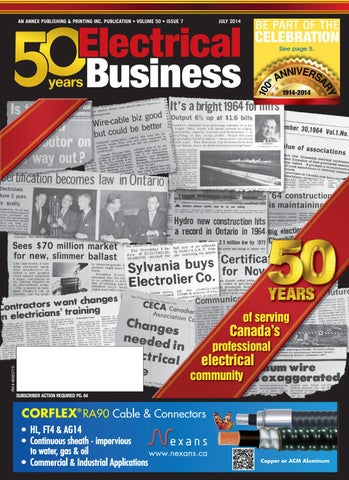
Celebrating 50 years of service
W
Electrical Business is more than a magazine—it’s an institution.
e’re celebrating our 50th anniversary as the leading publication serving Canada’s professional electrical industry. Founded in May 1964 by J.W. Kerr, Jim Wilson (president of Canada Electric) and James Wilson (president of the Canadian Electrical Contractors Association), Electrical Business Magazine has stayed true to its roots in that it continues to be a family-managed affair; it is owned and operated today by Mike and Sue Fredericks of Annex Business Media—Canada’s largest privately owned business media company. And while EBMag has seen many changes over the years, its mission is to always serve the needs of its readership first and foremost, in harmony with its client advertisers and supporters. Despite our years in the industry, we recognize our readers and advertisers’ attention and loyalty are not a birthright. If we don’t continue to deliver quality content— to push new ideas and initiatives—we don’t deserve to serve... plain and simple. The electrical landscape is made up of numerous professionals—including contractors, engineers and linemen, manufacturers, distributors and agents, codes and standards professionals, inspectors, associations and more—and no one tries harder than EBMag to bridge the gap between these seemingly disparate entities to create a sense of community.
Contents
16 Electrician puts skills to work
On the Cover and Page 56 50 years of serving Canada’s professional electrical community What started as a single print publication 50 years ago is today the most multi-faceted Canadian offering for both buyers and specifiers of electrical products and services, and those who offer them.
EBMag’s Guests of Honour on page 59 We couldn’t have earned a place in your reading habits without the strong support of folks like our 50th Anniversary Guests of Honour—our advertisers. They are here because they support EBMag’s mandate, and because you matter to them.
That’s why it’s not enough to merely report on the happenings in our industry from afar, but to be an integral part of our industry... to show our solidarity with electrical professionals everywhere. We strive to participate in both major and niche electrical events across Canada and the States, providing on-the-spot coverage, investigating new trends, and networking with key people that shape our industry. This enables us to provide the insights you have come to expect. What started as a single print publication 50 years ago is today the most multi-faceted Canadian offering for both buyers and specifiers of electrical products and services, and those who offer them. Electrical Business is more than a magazine—it’s an institution. And like the owner of a fine watch, we are not so much EBMag’s publishers as we are its caretakers. It has been an honour to be part of EB’s history, and we look forward to many more years to come.
DEPARTMENTS 4
31 Smokin’ hot wiring and
on a ship of mercy
the very helpful tenant
For nearly four years, B.C. electrician Chris McCaffrey has diagnosed and ‘treated’ electrical and maintenance problems aboard the MV Africa Mercy, the world’s largest non-governmental hospital ship.
This 50-year-old building has continuously failed annual mandatory electrical infrared surveys, and building management was instructed repeatedly to make corrections by the insurance company. Despite always paying the premiums, the building’s insurance was all of a sudden about to be cancelled.
20 Has the electrical safety pendulum
swung too far?
We support working safely, and want everyone to return from work in the same condition they left home. But as evidenced by numerous conversations with rank-and-file electrical professionals, there is a sentiment that perhaps electrical safety has gone too far.
24 Whites aren’t “whiter than white” under some LED bulbs Numerous companies have been adding whiteners to laundry detergent, paints, plastics and fabrics to make whites look “whiter than white” but, with a switch away from incandescent and fluorescent lighting, some experts say many LEDs may fail to differentiate between whites.
26 What is the perfect electricity grid?
Certain principles underpin this drive to perfection, including efficiency, responsiveness, robustness, sustainability, minimal environmental impact and, of course, ratepayer affordability and system reliability. Using these criteria, wind energy has an important role to play in today’s balance.
Industry News
52 Calendar 54 From the Legal Desk Contract administration liability
58 Electrical Safety 360 Starting a new electrical safety conversation
79 Personalities 80 Products & Solutions
34 Out with the old, in with the new
86 Code File
High-quality LED lighting is no longer a work-inprogress. At the forefront of this revolution are many electrical contractors in North America, embracing LED technology as an energy-saving solution for their customers instead of the outdated fluorescent technology of the past.
Luminaire retrofits and ‘approved kits’
86 Code Conundrum
38 Turning trash into electrical treasure
Anaerobic digestion has become the sustainable energy of choice for several Canadian players. The success behind the movement, they say, is largely due to the fact organic waste will always be available, independent of environmental factors and weather conditions.
page 80
42 Plug in the way-back machine... and polish up the crystal ball Several months ago, we put out the call to get your take on where we’ve been as an industry, and where we are going. Here are some musings from regular readers of—and sometimes contributors to—Electrical Business Magazine.
page 80
www.EBMag.com • July 2014 • 3
industry news
PHOTOS R. COLMAN AND A. DALTON.
Ontario, Alberta take Electrical gold at Skills Canada Nationals
Last month, 500 of Canada’s best skilled trade and technology students and apprentices participated in the 20th Annual Skills Canada National Competition (www.skillscanada.com), the country’s Olympiad of skilled trades, and EBMag was there for all the action! Featuring more than 40 unique trade competitions, it is the only event of its kind where young Canadians studying a skilled trade or technology can be tested against industry standards and vie for the honour of being named the best in their chosen discipline. Competitors were also fighting for a spot on WorldSkills Team Canada 2015, heading next to Sao Paolo 2015, in Brazil. “I think it’s been a really good experience for young people,” said Shaun Thorson, CEO of Skills Canada, adding that the event is “key and crucial to raising the awareness and profile of skilled trades”. Congratulations to the following winners in the Electrical Installations competition. Secondary competition (first photo): Gold - Travis Gabryelski, Ont. Silver - Simon Vigneault, Que. Bronze - Andrew Land, Man.
Editor Anthony Capkun - acapkun@annexweb.com Group Publisher John MacPherson - jmacpherson@annexweb.com Account Managers Scott Hoy - shoy@annexweb.com Melanie Kirk - mkirk@annexweb.com Associate Editor Alyssa Dalton - adalton@annexweb.com Art Director Svetlana Avrutin - savrutin@annexweb.com
Subscriber Customer Service Representative Marie Weiler - mweiler@annexweb.com
stronger in the future. How this might affect ECANB will depend on how well it can resist the trend, and on how well it can integrate non-union members. Whatever the case, it is inevitable ECANB will grow.” “ECANB is a member of the Canadian Electrical Contractors Association (CECA) and, since 1977, a fully integrated member of both the Canadian Construction Association (CCA) and the Construction Association of New Brunswick Inc. (CANB). This membership makes available numerous services and resources to all members of ECANB.” RECALL: Cordelia two-lamp fluorescent shop light CESL401-06 Health Canada has informed us of a recall involving Commercial Electric brand basic hanging shop lights that use two T8s, as the lamp sockets can allow loose connections, posing a risk of an electrical arc and fire. In Canada, Cordelia Lighting has received 462 reports of incidents, including 149 incidents of units smoking, 143 incidents of units catching on fire, 97 incidents of units sparking, 68 incidents of units burning out, and five incidents of units with electrical arcing. No injuries have been reported. The recalled shop light is a metal light fixture with four plastic lamp sockets and a white finish. It measures 48 x 4.25 x 2.5 in. and has two 10.5-in. hanging chains. The lamp sockets must be snapped into place during installation. Model number CESL401-06 and SKU number 201-462 are printed on a white label on the top of the fixture. About 111,300 of the recalled lights were sold at Home Depot stores across Canada from August 2013 through March 2014. They were manufactured in China. Consumers should immediately stop using and unplug the shop lights, then return them to any Home Depot store for a full refund. N.B. Canada’s Consumer Product Safety Act prohibits recalled products from being redistributed, sold or even given away in Canada. Continued on page 8
4 • July 2014 • www.EBMag.com
ELECTRICAL BUSINESS is the magazine of the Canadian electrical community. It reports on the news and publishes articles in a manner that is informative and constructive.
Production Manager Kathryn Nyenhuis - knyenhuis@annexweb.com
Post secondary competition (second photo): Gold - Jacob Fluker, Alta. Silver - Nicholas Hirtle, N.S. Bronze - Nicolas Filteau, Yukon Happy 50th anniversary to our friends at ECANB! EBMag has learned the Electrical Contractors Association of New Brunswick Inc. (www.eca.nb.ca) is also celebrating its 50th anniversary this year. Congratulations! We spoke with ECANB’s Judy Monteith to learn more about the association... where’s it has been, and where it’s going: “New electrical generation projects in the early to mid-1960s meant electrical contractors found themselves trying to claim their share of construction work while, on the other hand, trying to keep labour costs to a reasonable level. It was agreed that management needed solidarity to match the solidarity of labour. Hence, electrical contractors pursued the idea of forming a provincial association.” “On November 14, 1964, a group of electrical contractors in New Brunswick gathered at the Lord Beaverbrook Hotel for an inaugural meeting of the Electrical Contractors Association of New Brunswick. Nothing of the kind—a meeting of 26 electrical contractors from around the province—had ever happened before. Along with representatives from the three major cities of Fredericton, Moncton and Saint John, there were also contractors from Sussex, St. Stephen and Meductic.” “On July 1, 1975, Judy Gibson was hired as secretary. In 1989, she was promoted to executive assistant and assumed a greater range of responsibilities. In 1990, David Ellis was hired as executive director to replace Stuart F. Card. Today, the association still maintains a provincial office in the city of Fredericton staffed by a full-time executive director and executive assistant.” Where is ECANB going? “What is the future of the unionized construction movement? Political and economic trends seem to indicate that the non-union movement will only get
July 2014 • Volume 50 • Issue 7
President Mike Fredericks - mfredericks@annexweb.com Published by Annex Publishing & Printing Inc. 222 Edward Street, Aurora, Ontario L4G 1W6 Tel. 905-727-0077 • Fax 905-727-0017
Publication mail Agreement #40065710 Return Undeliverable Canadian Addresses to Circulation Department P.O. Box 530, Simcoe, ON N3Y 4N5
e-mail: mweiler@annexweb.com United States Second Class Postage paid at Lewiston, NY (USPS-741-470) US POSTMASTER: Send address changes to ELECTRICAL BUSINESS, P.O. Box 8145, Lewiston, NY 14092 Printed in Canada ISSN 0013-4244 CIRCULATION: Marie Weiler e-mail: mweiler@annexweb.com Tel: 1-866-790-6070 • Fax: 1-877-624-1940 Mail: P.O. Box 530, Simcoe, ON N3Y 4N5
SUBSCRIPTION RATES: Canada: Single issue $7.00 12 issues: $35.00 (includes tax) USA: $59.00 (US) International: $75.00 (US) per year Occasionally, Electrical Business will mail information on behalf of industry-related groups whose products and services we believe may be of interest to you. If you prefer not to receive this information, please contact our circulation department in any of the four ways listed above. The contents of Electrical Business are copyright ©2014 by Annex Publishing & Printing Inc. and may not be reproduced in whole or part without written consent. Annex Publishing & Printing Inc. disclaims any warranty as to the accuracy, completeness or currency of the contents of this publication and disclaims all liability in respect of the results of any action taken or not taken in reliance upon information in this publication.
We acknowledge the financial support of the Government of Canada through the Canada Periodical Fund of the Department of Canadian Heritage.
Be part of the “Marrette ” 100th Anniversary Celebration. Tell us your predictions for the next design innovation that will revolutionize another century of wire connectors and get a chance to ®
A total of 106 Visa* Prepaid Cards will be given away!
• 100 prizes of $100 • 5 prizes of $1,000 and • 1 grand prize of $20,000 It’s easy to enter.
Purchase specially-marked Marrette® 833M Flip-Pak® containers at participating electrical distributors until September 30, 2014. Find the unique code on the card inserted in each package. Register the code – and your prediction – online at www.tnb.ca/marrette2014 before 11:59 PM (Eastern Standard Time) on September 30, 2014. For complete contest details, visit: www.tnb.ca/marrette2014.
* Registered trademark of Visa International Service Association, used under licence. All other trademarks are the property of their respective owner(s).
TALK TO THE EXPERTS AT ABB
E
very day throughout the world, hundreds of people face serious injury or death due to arc accidents. What’s more, this is not restricted to countries with low safety standards. According to public data, one person dies each day in North America due to arc flash accidents. Several more are injured. In just one second, enough power can be generated from an arc flash to blow up switchgear or kill a person. In any plant, the risk of arc accidents can be reduced by the design of systems (mechanical and electrical) and the procedures for working with electric equipment. The importance of safety has led several manufacturers to develop ‘arc-proof’ or ‘arc resistant’ switchgear, where the mechanical design as well as the choice of electrical components reduces both the risk of an arc accident and its consequences. Unfortunately, these measures are most often not sufficient for two reasons; (1) Most accidents happen with the switchgear door open, which reduces the effects of mechanical protection, (2) Breaker protection is based on over-current only and often includes time delays. When do arc flash accidents occur
The most common reasons for arc flash accidents
25% without operator
1. 2. 3. 4. 5.
10% with operator in front of a closed door 65% with operator working in the switchgear
Human errors Mechanical faults Bad connections Pollution Animals
In the majority of incidents, work on the electric equipment is ongoing and the panel-door is open. Human error, therefore, is the most common reason for accidents. As mentioned earlier, today’s switchgear are built to be ‘arc-proof’ by containing the arc inside and/or using cell separation. But when the door is open, a fast and separate arc protection device is needed to maintain the safety level. Reducing the consequences of arc faults is all about time (see chart). This is why the ABB TVOC-2 (Arc Guard System™) reacts in just a couple of milli-seconds, thereby over-ruling standard protection time delays when tripping breakers. Safety is becoming more and more important. As legal and regulatory requirements increase, old equipment soon becomes out-of-date. Arc Guard System™ can help increase equipment safety and thereby prolong its life-cycle. Arc Guard System™ will not prevent the accident from happening – but it will significantly reduce the damage caused. The new generation of ABB’s Arc Guard System™ replaces the old generation that served as a benchmark in the industry for the past 35 years. With TVOC-2, we set an entirely new standard. 1. Detectors sense the arc flash inside the equipment. 2. Optical fiber transfers the arc flash light to the arc monitor unit. 3. Monitor sends a trip signal to the circuit breaker.
To meet the demands of our customers and end-users, the TVOC-2 focuses on Reliability, Flexibility and Simplicity. In addition to being cULus and CSA certified, the TVOC-2 is designed with functional safety in mind. With its SIL 2 design, it is approved for today’s applications as well as tomorrow’s industry needs. The TVOC-2 is tested and approved for functional safety and reliability according to IEC 61508 (similar to ISO 13849-1 PL level ‘D’. This SIL 2 compliance means that the product is designed so that a fault in a component will not result in a safety function failure. For example,
certain capacitors have a redundant copy if the first one fails. The system also monitors itself and lets you know if anything seems wrong. Many of the added functions are handled by a microprocessor, but more importantly, none of the safety functions. Both you and your business can feel safe with TVOC-2. Using TVOC-2 means that you can meet the highest safety requirements! For example, NFPA70E, a US standard for the safe installation of electrical wiring and equipment, states: “a flash hazard analysis shall be done in order to protect personnel from the possibility of being injured by an arc flash. The analysis shall deter-
Pictures from test with TVOC. Pictures from test with TVOC. Arc fault with Arc Guard system. Arc fault without Arc Guard system. mine the Flash Protection Boundary and the personal protective equipment that people within the Flash Protection Boundary shall use.” With Arc Guard System™, these calculations will show that the energy from an arc flash is decreased to an extent
that reduces the need for additional protection or increased levels of PPE. Mark E Djerrahian Product application specialist, enclosed products. Phone: 514-420-3100 ext 2263 mark.e.djerrahian@ca.abb.com
industry news
Continued from page 4
Take note, OEMs! ISO 9001 draft available for comment ISO 9001 Quality Management Systems (www.iso.org/iso/iso9001_revision) has been made available as a draft international standard (DIS), meaning all interested parties can submit feedback that will be considered before the final draft is published by the end of 2015. The main changes in the draft relate to its format and the increased importance on risk, including the identification of risk and risk control as requirements, and requiring top management to take a more active role in aligning quality policies with business needs. The iconic Marrette celebrates 100 years!
The Marrette wire connector is what Kleenex is to facial tissue, and the iconic brand is celebrating its 100th anniversary. Congratulations! Meantime, Thomas & Betts is celebrating the milestone with an end user promotion and over $35,000 in prizes. But first, a little history... At the turn of the last century, Bill P. Marr was employed as an electrician by the T. Eaton Company converting gas-lit homes to electrical incandescent lighting for Ontario Hydro. Convinced there had to be a safer and more efficient way to connect wires than the accepted method of ‘solder and tape’, he worked in his basement workshop to invent an alternative. In 1914, he introduced the first pressuretype wire connector, which was the forerunner to the modern twist-on wire connector and the foundation of the Marr Group company. So successful was this invention and subsequent new products, that the Marrette trademark went on to become synonymous with ‘wire connectors’ in the trade’s lexicon. In 1997, Thomas & Betts (www.tnb.ca) acquired the Marr Group and the Marrette brand name. Today, Marrette wire connectors are still made in Canada at T&B’s PointeClaire, Que., facility. Now the fun part... To celebrate, end users who purchase specially marked Marrette 833M Flip-Pak containers at participating electrical distributors until September 30, 2014, can enter online at www. tnb.ca/marrette2014 for a chance to win one of 106 VISA gift cards. Five random draws to determine winners will be held from June to October 2014 to determine winners of $100, $1000 or $20,000 gift cards. Visit T&B’s Promotions Page for complete details (bit.ly/1ln6HY8).
8 • July 2014 • www.EBMag.com
ISO 9001 is reviewed every five years, and is being revised to ensure it is relevant and current. Organizations certified to the current standard, ISO 9001:2008, will be given a three-year transition period after the new version has been published to migrate to the new edition. For information on the draft international stage and how to contribute, contact the Standards Council of Canada (www.scc.ca). If interested, the draft version can be purchased now, giving you the opportunity to get a taste of the new standard before final publication. — With files from Clare Naden Generac genset control patent suit against Kohler breaks down Kohler Power Systems—a manufacturer of generators, transfer switches, paralleling switchgear and related accessories (www. kohlergenerators.com)—announced the U.S. Court of Appeals for the Federal Circuit upheld an earlier court decision that a Generac (www.generac.com) patent was invalid, meaning Kohler did not infringe the patent. This decision upholds an earlier judgment in favour of Kohler Co. from the U.S. District Court for the Eastern District of Wisconsin in Generac Power Systems Inc. v Kohler Company and Total Energy Systems LLC, in which a jury found Kohler did not infringe the patent and, further, that Generac’s patent was invalid based on earlier technology. “We appreciate the Court of Appeals’ diligence in its review of the case and look forward to putting the matter behind us,” said Larry Bryce, president, Kohler Power Systems. “We are continuing to invest in product innovation that meets the needs of our residential and commercial customers to be prepared for power outages.” The rulings stem from litigation initiated by Generac in 2011 against Kohler and its distributor TES, says Kohler, claiming infringement of a patent relating to control systems on gensets. Kohler manufactures standby generators with a control system for which Generac claimed patent protection. NB Power and UNB team up to develop wind energy solutions for utilities NB Power (www.nbpower.com) and the University of New Brunswick (www.unb.ca) have partnered for wind energy research, which they say will help residents make better use of green energy. “This partnership is resulting in one-of-a-kind research that will help further develop wind energy solutions for utilities around the world,” said NB Power president and CEO, Gaëtan Thomas. “It has already helped us better understand how to incorporate renewable energy onto our grid more effectively, reducing our reliance on fossil fuels and furthering our goal of keeping our rates low and stable for customers.” The project will allow heating and cooling systems at the WU Conference Centre on the university’s Fredericton campus to be powered by wind energy. The technology pilot is part
of an international award-winning project led by NB Power called Powershift Atlantic. Launched in 2010 as part of the Government of Canada’s Clean Energy Fund, it is a collaborative research project led in partnership by NB Power, Natural Resources Canada, Saint John Energy, Maritime Electric, Nova Scotia Power, New Brunswick System Operator, the University of New Brunswick, the Government of New Brunswick and the Government of Prince Edward Island. The project also showcases wind forecasting research created by UNB’s Dr. Liuchen Chang, which claims to identify the best opportunities to use wind energy in homes and businesses. “We’re extremely proud of the research Dr. Chang is contributing to this game-changing project and the innovative energy solutions NB Power is helping to create as a result,” said University of New Brunswick president, Eddy Campbell. “Projects like this help New Brunswick get recognized on an international stage, and opens the doors for future innovations to be created in our province.” The research portion of the program is expected to wrap up in the fall after a full year of piloting this technology is complete. Once completed, NB Power says it will use this data to determine if a business case is possible to introduce new products and services to New Brunswickers that utilize wind power. OSHA offers interactive training webtool for identifying workplace hazards
The Occupational Safety & Health Administration (OSHA) in the U.S. released an interactive training tool (www.osha.gov/ hazfinder) to help small businesses identify hazards in the workplace. “This new tool not only educates employers about how to take control of their workplaces and protect workers, it also demonstrates that following well-established safety practices is also good for the bottom line,” said Dr. David Michaels, assistant secretary of labour for occupational safety & health. Employers and workers can virtually explore how to identify common workplace hazards in the manufacturing and construction industries. Users of the new training tool will learn not only hazard identification skills but also learn about hazard abatement and control. Through the hazard identification tool, users can play from the perspective of either a business owner or an employee as they learn to identify realistic, common hazards and address them with practical and effective solutions. The tool explains the key components of the hazard identification process, which include information collection, observation of the workplace, investigation of incidents, employee participation and prioritizing hazards.
A
B
C
B
A
C
B
A
C
B
A
C
N
N
N
N
industry news Atlantic Provinces streamlining apprenticeship across the region Nova Scotia says it has taken another step toward helping apprentices complete their training and land good jobs in the province and across Atlantic Canada by way of a memorandum of understanding with the other Atlantic Provinces that will establish common training, certifications and standards to help apprentices complete training, and find work within the region more easily. “Apprenticeship is a priority for Nova Scotia, and we’re focused on helping young people find jobs and training opportunities in the trades, close to home,” said Premier Stephen McNeil. “This agreement is a clear indication that positive things can happen when jurisdictions work together.” According to Nova Scotia, this agreement is the first of its kind in the country, adding there are 13 apprenticeship systems across Canada, each with different requirements. Inconsistencies such as different curriculum, log books or sequencing of courses can make it difficult for apprentices to complete training if they move, and for employers to recruit the people they need. The project will focus on 10 trades, including construction electrician, and instrumentation and control technician. By early next year, it is expected apprentices in those trades will benefit from improvements. By 2017, all 10 trades will be harmonized. The province adds it is creating an industry-led apprenticeship agency that will give employers a bigger role in Nova Scotia’s apprenticeship system, including delivery of the “new streamlined, Atlantic Canadian approach”. This project will complement work to streamline training and certification requirements in targeted Red Seal trades (www.red-seal.ca) across Canada.
Electro-Federation Canada salutes Electrical Business on their 50th Anniversary and acknowledges their sponsorship support for the EFC Scholarship and Marketing Awards programs.
Nominations open for 2014 Spirit of Independence Awards North American marketing group Affiliated Distributors (AD) is now accepting nominations for its Spirit of Independence Awards, and they’re being accepted until August 1, 2014. There are several possible awards open to the electrical channel: • Best Conversion to an AD Supplier Awarded to a new partnership between an AD Affiliate and Supplier. This award is important to AD because it demonstrates how investing in relationships can accelerate growth. • Giving Back Award Presented to an AD Affiliate or Supplier who makes the success and health of their community a priority to their company. • Supplier of the Year, Marketing Excellence Awarded to the Supplier whose marketing programs make the greatest Power-One renewable energy business rebrands to ABB name ABB (www.abb.com), a power and automation technology group, has announced the Power-One renewable energy business will transition to the ABB brand. Last July, ABB acquired Power-One Inc., a provider of renewable energy and of energy-efficient power conversion and power management solutions—a move which allows the ABB brand to “represent the most comprehensive solar value proposition on the market today and one of the industry’s broadest inverter product portfolios”, it said. The current Power-One renewable energy product offering—including product names Uno, Trio and Ultra—will remain intact under the ABB brand, and all product certifications will remain valid. “By transitioning Power-One’s Renewable Energy business to the ABB brand, we will be able to take full advantage of the combination of these two companies. We will have one of the most comprehensive solar inverter offerings under one brand, meeting customers’ needs across all key segments—utility, commercial and residential,” said Pekka Tiitinen, head of ABB’s Discrete Automation and Motion division. Widespread outages drive demand for faster service restoration The destruction of electric infrastructure from storms such as Tropical Cyclone Sandy in 2012, triggers customer-driven demand for faster service restoration in the way of fault location, isolation and service restoration (FLISR) systems—a global hardware market that, according to Navigant Research (www.
10 • July 2014 • www.EBMag.com
EFC_EB_July.indd 1
2014-06-19 10:13 AM
overall impact in sales and market share growth for AD Affiliates. • Most Valuable Player (MVP) A front-line, non-network member of an AD Affiliate who has contributed a best-in-class idea or action that drives the AD message within the Affiliate’s company. The winner will have demonstrated significant personal leadership by implementing AD initiatives within their organization. • Best Annual Planning Process Winners are AD Affiliates who execute the most-effective AD Field Marketing Summits. Winning Affiliates continue to communicate with their AD Supplier Partners throughout the year. They keep track of goals and update Suppliers on marketing plan progress. Visit bit.ly/1v4hURR to nominate your company or one of your AD partners. The electrical channel awards will be presented at AD North American Meeting in Chicago, Ill., in October 2014. — With files from Stephanie Santangelo navigantresearch.com), will grow from $2.4 billion annually in 2014 to nearly $5.4 billion by 2023. FLISR systems combine hardware, software, telecommunications and grid engineering to decrease the duration of outages as well as the number of customers affected. “FLISR is one of the more effective applications of distribution automation technology, and can noticeably improve utility performance metrics such as the system average interruption duration index (SAIDI) and the system average interruption frequency index (SAIFI),” explained Bob Lockhart, research director with Navigant. “Improving these indicators can lead directly to improved customer satisfaction...” In the United States, investment grants funded rollouts of advanced metering infrastructure (AMI) systems. Between 2009 and 2012, more than $1 billion was spent on distribution assets, including about $300 million on automated switches that could be used for FLISR. While utilities are genuinely interested in smart metering, according to the report, they also see those AMI deployments as a means to acquire the necessary network for distribution automation applications such as FLISR. The “Fault Location, Isolation and Service Restoration” report analyzes the global market opportunity for FLISR applications. It examines the market drivers and barriers that are affecting FLISR deployments worldwide, including government funding, regulatory reforms and standards adoption. An Executive Summary is available for free download on the Navigant Research website.
industry news “What’s holding back co-generation?” asks IEA A new publication from the International Energy Agency (IEA, www.iea.org) spotlights, it says, two implementable technologies that efficiently integrate heat and electricity systems, provide flexibility and enhance energy security: “Linking Heat and Electricity Systems: Cogeneration and District Heating and Cooling Solutions for a Clean Energy Future”. Cogeneration (a.k.a. combined heat and power [CHP]) provides enhanced energy efficiency compared with conventional thermal generation by recovering some of the heat produced during electricity generation that otherwise would be wasted, notes IEA. Worldwide, cogeneration plants’ average conversion efficiency rate was 58% in 2011, compared with 36% for conventional thermal power plants, adds IEA. District heating and cooling (DHC) systems, which distribute thermal energy among end users in a network, can be coupled with generation sources such as CHP or other locally available energy Keeping nuclear reactor operators on the level with antineutrino monitoring
PHOTO WENZEL SCHUERMANN / TU MUNCHEN.
Dr. Nils Haag developed an experimental setup that allows him to determine the missing spectrum of uranium 238. When monitoring nuclear reactors, the International Atomic Energy Agency (IAEA) has to rely on input given by operators, explain physicists at Technische Universitat Munchen (TUM), adding that, in the future, antineutrino detectors may provide an additional option for monitoring. However, the cumulative antineutrino spectrum of uranium 238 fission products was missing... until now. TUM physicists say they have closed this gap using fast neutrons from the Heinz Maier Leibnitz Neutron Research Facility (FRM II). In addition to neutrons, the fission reaction of nuclear fuels like plutonium or uranium releases antineutrinos. These are also electrically neutral, but can pass matter very easily, which is why they can be discerned only in huge detectors. The physicists explain that recently, however, detectors on the scale of only one cubic metre have been developed, and they can measure antineutrinos from a reactor core. Prototypes of these detectors already exist, collecting data at distances of around 10 metres from a reactor core, adds TUM. Changes in the composition of nuclear fuels in the reactor (i.e. when weaponsgrade U-239 is removed) can be determined by analyzing the energy and rate of
12 • July 2014 • www.EBMag.com
sources (e.g. waste heat, renewables or natural cooling from water sources) for further environmental gains. DHC networks based on these sources can be five to 10 times more efficient than traditional electricity-driven equipment, says IEA. Despite their proven advantages, IEA notes global deployment of cogeneration and efficient DHC has been limited. A select number of countries use cogen to meet a share of their energy demand, but it has lost ground overall, declining from 14% of global electricity generation in 1990 to around 10% in 2000, and remaining stagnant since then. “Linking Heat” looks at use of these systems in a variety of countries and applications to analyze existing barriers and opportunities. It delves into three case studies for industrial cogeneration in Mexico, Spain and Scotland and three others for efficient DHC in Denmark, France and Saudi Arabia. The analysis addresses not just the technologies’ mechanics, but the flexibility they offer, financing mechanisms, business models and policy frameworks.
antineutrinos. This would free the IAEA from having to rely on representations of reactor operators. In the 1980s, the antineutrino spectra of three main fuel isotopes—uranium 235, plutonium 239 and plutonium 241—were determined, explains TUM. However, the antineutrino spectrum of the fourth main nuclear fuel—uranium 238 (which accounts for about 10% of the total antineutrino flux)—remained unclear. It had only been estimated using inaccurate theoretical calculations and, thus, limited the accuracy of the antineutrino predictions, add the physicists. But Dr. Nils Haag from the Chair of Experimental Astroparticle Physics at TUM recently developed an experimental setup at the FRM II that allowed him to determine the missing spectrum of uranium 238. The neutrons induce nuclear fission in a film of U-238. The radioactive decay products then emit electrons and antineutrinos. The electrons were investigated using a scintillator—a block of plastics that converts the kinetic energy of the electrons into light. A photomultiplier then translates this into electrical signals. The nuclear decay also generates gamma radiation that produces unwanted events in the scintillator, so Haag placed a second detector right in front of the scintillator: a so-called multi-wire proportional chamber. Since only charged particles like electrons trigger a signal in the gas detector, the researcher was able to determine and subtract the proportion of gamma radiation. Haag then inferred the antineutrino spectrum using this background-free measurement data. The measurement of the antineutrino spectrum can be used to monitor the status, performance and even composition of reactor cores. “Our results open the door to predict with significantly higher accuracy the expected antineutrino spectrum emitted by a reactor running on a fuel composition reported by the operator,” explained Haag. “Deviations of antineutrino detector measurement data from expected reactor signals can thus be exposed.”
Meet the new Electrical Association of Manitoba!
Peter Bernatsky, president of the Manitoba Electrical League (MEL, www.meleague.ca), announced the league’s board of directors has approved to change the name of the MEL to Electrical Association of Manitoba Inc. (EAM) effective immediately. (EBMag just learned of this announcement from association general manager, Gord Macpherson.) The board has also approved a new logo with the tagline: Strength in Connection. In making these changes, the association is rebranding itself to be seen as an organization that offers “stability, strength and professionalism”. Its stated mission is to represent, promote and strengthen the electrical industry in Manitoba through advocacy, professional development and member support. According to MEL’s website, MEL began as The Electrical Service League in 1957 (26 member companies), providing service to its members and promoting the Red Seal Wiring Program. In 1991/92 it amalgamated with the Manitoba Electrical Association (MEA) to form the Manitoba Electrical league Inc. EAM provides a variety of services to its members, including: • educational and training programs • representation to various levels of government and government agencies • up-to-date industry information • networking opportunities and social events • group insurance Membership in the non-profit Electrical Association of Manitoba represents all electrical industry sectors in the province, including electrical contractors, low-voltage systems integrators, wholesalers, distributors, manufacturers, agents, utilities and associate members.
For more information, contact your Stanpro representative
industry news Special EBMag 50th Anniversary Tool Totes
Our friends at Ideal Supply (Canada) Corp. surprised the heck out of us! Recently, Ideal’s national sales & marketing manager for Canada, Bill Stephens (left), presented EBMag’s editor, Anthony Capkun (right), with several Tuff-Tote Tool Pouches—customized with our 50th Anniversary logo— in recognition of our 5 decades of serving Canada’s professional electrical community.
Canada gets its first nuclear emergency management program standard
PHOTO A. CAPKUN FROM CSA COMMITTEE WEEK 2014.
CSA Group (www.csagroup.org) has released Canada’s first national standard on nuclear emergency management programs, addressing all components of emergency management with a specific focus on preparedness, response and recovery. “CSA Group’s new nuclear standard is a first of its kind in Canada,” said Bonnie Rose, standards president, CSA Group (photo). “This standard was the result of input from all levels of government, owners and operators of nuclear power plants, first responders, emergency management professionals and not-for-profit organizations.” CSA N1600-14 is particularly unique, says CSA, in its requirement for the development of recovery plans for both the community and nuclear power plant. One of the key drivers behind the development of the new standard, explains CSA, was a recommendation made by the Canadian Nuclear Safety Commission’s (CNSC, nuclearsafety.gc.ca/eng) Fukushima Task Force to further enhance the safety of nuclear power plants (NPPs) in Canada by developing a dedicated document on emergency management. The standard covers both onsite and offsite organizations, and provides criteria on how to develop, implement, evaluate, maintain and continuously improve a nuclear emergency management program. The CSA N1600 committee will begin meeting again this fall to commence work on the next edition.
14 • July 2014 • www.EBMag.com
A VERY SPECIAL THANKS to Ideal Industries (www.idealindustries.ca) for this generous gift, and we cannot wait to share it with you! Remember, keep those Letters to the Editor coming, and watch for other opportunities to engage with Electrical Business Magazine. You may find yourself in possession of a truly unique collectible! — Editor, acapkun@annexweb.com P.S. Don’t delay... remember to RENEW your print and digital subscriptions.
Power of Wind Contest 2014 comes with $1000 prizes To mark the 6th Annual Global Wind Day (www.globalwindday.org), the Canadian Wind Energy Association (CanWEA, www.canwea.ca) launched a redesigned Power of Wind contest: this year, there are four bursary prizes of $1000, each awarded for the best blogs, the most creative submissions and the best use of multimedia. Students entering or in post-secondary education are eligible to submit multimedia or written entries on the theme of why wind energy is important to Canada’s future energy mix. “Our Power of Wind Contest provides Canadian students with an effective platform to present their views and make their voice heard in support of wind energy,” said Robert Hornung, CanWEA president (photo). Participants can submit their blog entries until September 15, 2014. The winners will be announced at CanWEA’s Annual Awards Banquet on October 29, 2014. Details can be found on CanWEA’s Friends of Wind website (www.friendsofwind.ca). Global Wind Day occurs annually June 15. It is coordinated by the European Wind Energy Association (EWEA) and the Global Wind Energy Council (GWEC) through a network of partners, such as CanWEA. Northern Gateway gets Canadian federal approval Enbridge Inc. announced that—pursuant to the Joint Review Panel’s (JRP) recommendation—the Northern Gateway Project (www.gatewayfacts.ca) has received Governor in Council (GIC) approval by the Canadian federal government. (The JRP’s recommendation was subject to 209 conditions.) “Enbridge and our partners in the Northern Gateway Project welcome today’s decision. The Joint Review Panel recommendation and the GIC approval are important milestones and reflect years of work by all stakeholders,” said Enbridge president and CEO, Al Monaco. “However, we have more work ahead of us. The decision is one more step in the process; a process that requires a considered and respectful approach with our stakeholders.” Monaco went on to say Enbridge will focus on three priorities: meeting the JRP’s conditions; working with the Province of B.C. on its five conditions for supporting oil pipelines; and continuing to engage Aboriginal communities “to build further trust and seek additional input that would make the project even better”. “Natural resource development is central to a prosperous and competitive province, and projects
like Northern Gateway promise to play a vital role in the growth of our economy,” noted Manley McLachlan, president of the British Columbia Construction Association. “More importantly, they will provide improved employment opportunities and enhanced training resources to our membership across Northern B.C.” The JRP acknowledged the potential benefits on local, regional and national economics would likely be significant, added Enbridge. “In the broader context, opening new markets for our energy resources is critical for all Canadians. It will mean a major boost to our provincial and national economies. It will create jobs and result in new tax revenues for communities and governments to support social programs and infrastructure,” said Monaco. “Importantly, Northern Gateway will involve Aboriginal communities as owners and partners in the project, and it provides meaningful training, job and business opportunities in communities along the right-of-way.” This is the first pipeline project to be approved to enable Canada to diversify markets for its crude oil and achieve full-market-value pricing, notes Enbridge. With the project, Canadian producers will have greater access to the markets in the Asia Pacific Rim.
PHOTO © CANWEA.
The totes boast a lifetime warranty, exclusive leather grab-handle for carrying comfort and shoulder strap (removable) to alleviate lower back strain. They feature a convenient 6 x 8-in. organizer with 4 centre screwdriver slots, 2 interior compartments, 2 divided outside pockets and 4 outside tool loops. The stand-alone design keeps tools upright for easy access, while the rust-resistant, plated steel hardware and heavy, lock-stitched nylon thread promise long-term durability. And did we mention the oil- and moistureresistant reinforced bottom?
NON-METALLIC
LOW PROFILE • NON-METALLIC LOW COST
THE SCOOP
CED1 facing OUT
CONNECTOR
TM
ENTR ANCE P L ATES & H O O DS
3 SIZES HANDLE WIDEST CORD RANGE
The SCOOP™ series of reversible, non-metallic, single and two-gang entrance HOODS and PLATES protect cable while delivering good looks and installation versatility. They also reduce labor and eliminate extra connections.
View Video
Scan for Info
CED1
Grommet BEFORE tightening
LPCG50BL (black)
CE1 facing IN
View Video
CED1, CEDH1 vertical or horizontal HOODS for decorator-style wall plates. CABLE ENTRY DEVICES, CE1, CE2 single or two-gang PLATES that install facing in or out and other time saving styles! CED130 • Easy to install facing IN or OUT cable entry device w/ slotted cover • Low voltage cable protection in Arlington’s • All white paintable plastic TV BOX™ • Best way to run cable where needed CED1
Horizontal CEDH1
Grommet tightened
CE2 facing IN
LPCG50
CE1 Box: TVBU505
Arlington’s non-metallic, low profile cord grips offer the largest cord range in the industry, so you’ll have fewer items to stock!
Arlington
FOR CATHEDRAL CEILINGS IN NEW CONSTRUCTION
• Meets UL 35 lb pullout test (GRAY) Catalog No.
Trade Size
Cord Range
LPCG503 * LPCG50 * LPCG507
1/2 1/2 1/2
.100 - .300 .200 - .472 .385 - .750
LPCG753 * LPCG754 LPCG757
3/4 3/4 3/4
.100 - .300 .240 - .472 .385 - .750
t
© 2012 Arlington Industries, Inc.
knu
Made in USA
MOUNTING BOX
• Sealing ring; locknut assure liquid-tight seal in knockouts
Loc
on Nyl y Bod
Notes
FB900GC
* UL not applicable to For BLACK connector add suffix BL; for WHITE add suffix W to catalog number. er
p Grip
et mm Gro
• Large, 8" square mounting surface handles large fan canopies
on Nyl t Nu
Made in USA
Arlington
800/233-4717 • www.aifittings.com
800/233-4717 • www.aifittings.com
© 2005 Arlington Industries, Inc.
EASY CENTERING ON CATHEDRAL CEILINGS
TH E B EST C A B LE P R OTEC TI O N
• Fast & easy press-on installation FBX900GC
EMT400
This one-piece mounting box saves time, money. Expandable brackets mount securely between joists, eliminating the need to cut and nail 2X4s to center a fan or fixture. • Self-contained; No loose parts
Also for rigid, IMC and PVC rigid conduit
In a variety of sizes for 1/2" to 4"
- EMT - Rigid - PVC
Listed for Air Handling Spaces
800/233-4717 • www.aifittings.com
• Supplied template levels and positions bracket between rafters
©2001-2011 Arlington Industries, Inc.
• Less expensive alternative to costly fittings when used just for wire
Patented
MOUNTING BOX
BUSHINGS
Arlington
• UL ratings: 70 lb fan, 200 lb fixture CSA rating: 50 lb fan or fixture
NEW CONSTRUCTION FAN & FIXTURE
Made in USA
• Protects cable from abrasion
THIS PROBLEM SOLVED!
• 14.5 cubic inch box for new construction
FB900GC
• Holds tight as cables are pulled
/
• No loose parts – self-contained
Mounting Box for cathedral ceilings
EMT
Get a safe, secure fan/fixture installation on cathedral ceilings with Arlington’s FB900GC Mounting Box. It installs fast – next to a rafter, for easy centering. Taller sides on the FB900GC box allow it to handle cathedral ceiling angles greater than 80°.
wire dia. under .240
Connector Components LPCG50
Arlington
Made in USA
© 2009 Arlington Industries, Inc. Patented
FAN & FIXTURE
• Unique grommet and gripper deliver superior pullout resistance...and a liquid-tight, oil-tight seal when the nut is tightened
ling Sea g Rin
800/233-4717 • www.aifittings.com
CENTERED! Expandable brackets
Position box between framing members by sliding it along the expandable brackets
Arlington
800/233-4717 • www.aifittings.com
• Fits cathedral ceiling angles greater than 80° • 8" square mounting surface for fans with large canopies • UL rating: 70 lb fan/fixture CSA rating: 50 lb fan/fixture © 2005 Arlington Industries, Inc. Patented
Electrician puts skills to work on a
ship of mercy
JoJo Beattie
“L
ittle George came in with a dislocated hip... he needed some traction so I ended up building a set of braces to hang dive weights off the bed to pull his hip back into joint. I got to visit him everyday... he’s my favourite kid in the whole world.” Being a part of something that changes your life through the use of your skills is an incredible way to find purpose in your craft, and 32-year-old electrician Chris McCaffrey has done just that. McCaffrey, from Comox, British Columbia, has been serving as a volunteer crew member aboard the MV Africa Mercy—the world’s largest nongovernmental hospital ship—for nearly four years.
That’s not in the job description... or is it? McCaffrey’s title may be Electrician, but his responsibilities go above and beyond what would be required of him working as an electrician in Canada. Not only does he maintain the 30-year-old ship, but he builds and modifies braces for the orthopedic department, is a member of the Dive Team (where he provides regular maintenance under the ship), helps with the task of dry docking the vessel, and even plays stand-up bass in the ship’s band.
PHOTOS © MERCY SHIPS.
“Working on the ship is like working in a city, but it’s not just a city—it’s a hospital,” says McCaffrey. “There are many different systems I would never have to deal with in Canada.”
McCaffrey’s journey begins “When I first came to Africa I wanted to go on an adventure and see the world from a different point of view. Before volunteering with Mercy Ships, I knew I was lucky, but after spending time in countries that have a 1 to 10,000 doctor-to-patient ratio, I realized how fortunate I am to be born in Canada,” says a passionate McCaffrey. The Africa Mercy is part of a fleet of ships belonging to international charity Mercy Ships (www.mercyships.ca). The organization, founded in 1978 by Don and Deyon Stephens, delivers free world-class healthcare services, capacity building and sustainable development to those without access in the developing world. Each year, Mercy Ships has more than 1200 volunteers from over 40 nations jump on board to help make a difference in the lives of thousands. Medical professionals make up a portion of the crew, but tradesmen like McCaffrey (as well as teachers, cooks, housekeepers and more) provide the essential support needed to keep the vessel afloat. The job can be difficult, and does not come with a paycheque, but the goal of working together to help people find hope and healing and to be able to succeed in life, makes the blood, sweat and tears worth it. What started as a short trip in January 2011 turned into three years and counting for McCaffrey: “My first trip to the ship was only supposed to be for three-and-a-half months (which I originally thought would be an eternity), however, after seeing the need here and seeing the difference we can make... that’s what keeps me coming back”.
Interested in learning more about Mercy Ships? Take a tour of the Africa Mercy in this 8:35 video on YouTube at youtu.be/SmFW1J_qCWQ and be sure to check out this other video clip (12:55) by the folks at 60 Minutes (youtu.be/ JPojrMobnyI), and you’ll truly be amazed by some of the people you meet.
16 • July 2014 • www.EBMag.com
The Africa Mercy is part of a fleet of ships belonging to international charity Mercy Ships, which delivers free world-class healthcare services, capacity building and sustainable development to those without access in the developing world.
Visit www.techspan.ca Call 1-800-363-1588 Email sales@techspan.ca
WIRE DUCT • Smooth Fingers • Non-Slip Cover • Built-in Rail • Double Score Line • Staggered Mounting Hole Pattern
Wide Finger & Narrow Finger Duct In Stock
• LEAD FREE • RoHS Compliant • Self Extinguishing rigid PVC Class 1 (UL 94-VO) CORNER EDGE DUCT • Modular angular trunking • Save space in panels • Now available in 2 sizes: S1106080 (110mm X 60mm X 80mm) S904060 (90mm X 40mm X 60mm) • More finished look through corners • Temperature range for use: -5˚ to 60˚C • Accessories available
Massive goiters, cleft lips and palates, cataracts, bowed legs and fistulas are some of the common issues seen by Africa Mercy medical staff as they move from port to port in West Africa about every 10 months.
Working with Mercy Ships not only means helping people, but it also provides individuals with the opportunity to immerse themselves in a different culture, practice language skills, and learn from others in the same/similar field.
PHOTOS © MERCY SHIPS.
Being a part of something that changes your life through the use of your skills is an incredible way to find purpose in your craft, and 32-year-old electrician Chris McCaffrey from Comox has done just that.
“My first trip to the ship was only supposed to be for threeand-a-half months (which I originally thought would be an eternity), however, after seeing the need here and seeing the difference we can make... that’s what keeps me coming back.” Just as the doctors on board are trained in all things medical, McCaffrey is prepared to correctly diagnose and apply the correct ‘treatment’ to any electrical or maintenance problem. “No day is the same,” says McCaffrey, “There is always a new challenge, and we are constantly taking on new projects. For instance, I recently rebuilt our starter compressor panel, as we were changing over from 34-year-old controls to brand new computer controls. In Canada, if you haven’t done this before, they will get someone else to do it. It is a really good place to learn and improve your skills.” The 520-ft vessel boasts five operating rooms, 82 patient beds, full laboratory services, living quarters, cafeterias, a small shop and even a donated Starbucks café. “Working on the ship is like working in a city, but it’s not just a city—it’s a hospital,” says McCaffrey. “There are many different systems I would never have to deal with in Canada. We have to generate all of the electricity, treat our own sewage, run a vacuum system for the sewage, run the galley and run the laundry, etc.” The Africa Mercy goes through 22,000 litres of water and 7000 litres of diesel every day. The generators on board produce the ship’s power and sit in specially made cases that absorb vibrations, making the ship stable for surgeons when operating. “When/if the equipment breaks down, we end up doing appliance repairs and all the electrical work. We also make our own oxygen for the hospital, which means making our own vacuum system and, in between that, we still have to be ready to sail at any time. It’s definitely interesting. If you show the interest, you have the opportunity to do a lot of things you wouldn’t get to do in Canada.” McCaffrey has shown an interest in going beyond his duties on more
18 • July 2014 • www.EBMag.com
than one occasion. “Last year I was working for plastic surgeon Dr. Frank, and I ended up building a new casting table for his team. A few kids had to have casts up to their rib cage, and I built and modified one with casting cable so it could be done,” he says. Massive goiters, cleft lips and palates, cataracts, bowed legs and fistulas are some of the common issues seen by Africa Mercy medical staff as they move from port to port in West Africa about every 10 months. Where do you go from here? Working with Mercy Ships not only means helping people, but it also provides individuals with the opportunity to immerse themselves in a different culture, practice language skills, and learn from others in the same/similar field. McCaffrey will have an advantage in the job market when he returns home thanks to his experience of working methods outside of Canada. McCaffrey’s four years in the engineering department and time spent in Togo, Sierra Leone, Guinea, Congo and the Canary Islands have led him to work in, and gain skills from, various professional areas, but he has no plans to leave the field of electrical work when he returns from Africa in September 2014. “When I get home I’ll set up my own electrical company in addition to doing general construction. We will see what happens. It will be different!” says McCaffrey. “Volunteering with Mercy Ships has been an amazing journey. The doctors and nurses cannot do what they do without technical staff. So far it’s been one of the best adventures I’ve ever had!” Through Mercy Ships, McCaffrey has found place where he has grown personally, professionally, and has been able to create a positive change and a lasting impact in an area he is passionate about.
Every great company has a story to tell.
2014 Acquires Coleman Cable Inc, ranking Southwire amongst the top three cable providers in the world
2009 Acquires Maxis™ Tools
2010 TODAY
2014 CEO Stu Thorn named Copper Man of the Year by the Copper Club
2007 Establishes initial set of sustainability goals
2000 In partnership with the Oak Ridge National Laboratory, the U.S. Department of Energy, and others, Southwire develops superconductor power cable technology and throws the switch on the first real-world application of superconductors
1912 Roy Richards born in Carroll County, GA
2000 1980 1970
1968 Develops and patents aluminum alloy AA-8176 as triple e™ aluminum alloy. NEC establishes AA-8000 series aluminum alloy as the standard for aluminum building wire
1950
1963 Southwire revolutionizes the industry with the invention of the Southwire Continuous Rod for copper rod, developed by engineer D.B. "Pete" Cofer
1950 Roy Richards founds Southwire Company, starting out with three used machines and twelve employees
1940
1937 At age 25, awarded $118,000 REA contract to build 108 miles of power lines. Within two and a half years, Richards hangs 3,500 miles of REA power lines, ranking second in nation in miles strung
1960
1964 Receives American Success Story Award
1953 Develops and patents continuous casting method for aluminum rod
1973 Named a “Giant of the Electric Century” by Electrical World magazine
At Southwire Canada, we take pride in our history, and the legacy of our founder, Roy Richards.
1967 Issued first of 20 patents received during career
1962 Receives President John F. Kennedy’s “E for Export” Award for export relations with 17 countries
1992 The D.B. Cofer Technology Center opens, providing a home for innovations in wire and cable design, metallurgy and plastics compounding 1986 Awarded the Mordica Memorial Award by the Wire Association International for a lifetime of achievement to the wire industry
1977 Receives Golden Plate Award, American Academy of Achievement 1971 Builds the South’s first electrolytic copper refinery in Carrollton, GA
2002 Richards family names Stu Thorn President & CEO 2002 Introduces colour-coded residential building wire
1985 Roy Richards passes away at age 73. Leadership shifts to Roy Richards, Jr.
1984 Named Man of the Year of the copper industry by the Copper Club
2008 Introduces SIMpull Solutions® - engineered to make wire pulls safer, faster, & easier for contractors 2006 With the incorporation of Southwire Canada, Southwire becomes the largest supplier of wire & cable in North America
1990
2004 Introduces revolutionary SIM Technology® that leads to development of ROMEX® SIMpull® and NoLube® SIMpull T90™ wire
2010 Introduces Proof Positive Copper®
1935 Graduates Georgia Tech with an honours B.S. in Mechanical Engineering
Today, as one of world’s largest wire and cable providers, we continue to set milestones of innovation and growth, and share Richards’ belief in delivering exceptional value to our customers. To learn more about our products, our community involvement and our vision for a sustainable Southwire, please visit us at www.southwire.ca
Congratulations, E.B. on 50 years of sharing our stories!
www.southwire.ca
1-800-668-0303
@SouthwireCanada
Has the electrical safety pendulum swung too far? Joe Electrician Regular readers of Electrical Business Magazine, not to mention visitors to EBMag.com, know our passion for electrical safety. We regularly run safety columns and features in print and online; we attend and report on the IEEE IAS’s electrical safety and ESTMP (Electrical Safety, Technical and Mega Projects) workshops, and cover Electrical Safety Foundation InternationalCanada; we publish news of recalls, warnings, counterfeit product, etc.; we interview experts, like Sunnybrook’s Dr. Joel Fish, and speak with electrical shock and burn survivors, like Paul Hebert and his wife, Lorraine. Let there be no mistake: we support working safely. We want everyone to return from work in the same condition they left home. But as evidenced by numerous conversations with rank-andfile electrical professionals, there is a pervasive sentiment that perhaps workplace safety—and electrical safety, specifically—has gone too far. Let’s be clear: the opinions expressed below are those of the anonymous author, Joe Electrician. But we are also the Town Hall of Canada’s professional electrical community, and because you’re talking about it, we’re giving Joe Electrician the chance to talk about it. We look forward to spirited and mature debate and, as always, Letters to the Editor can be sent to acapkun@annexweb.com. — Editor
I
first started out in this industry as an electronic technologist (for nine years), then electrician for five years (completing my journeyman accreditation in two) then power system specialist for 30 years. I have seen many changes over this period, not the least of which are the advances in technology that make our power systems more reliable and safer and, as they say, ‘intelligent’. Also during this time I have seen electrical safety (and safety in general) evolve, highlighted by events like the Westray disaster (resulting in Bill C45 in 2004), NFPA 70E out of the States shortly thereafter, the IEEE 1584 arc flash calculation standard, the veritable flood of electrical PPE (and those dreaded moon suits) followed by CSA Z462 in 2009. A solid, knowledgeable and common sense approach to improving electrical awareness and making workers safer in the electrical environment was evident. I wholeheartedly welcomed this improvement but, somewhere along the track, the train got derailed by vendors, bureaucrats, risk managers and whoever thought they knew more about worker safety than the workers themselves. So what have we learned? We should not test live power with wet fingers as we may be inadvertently standing in a puddle with wet feet and come to know what it feels like to be a light bulb for a short period. High voltage will reach out and touch you if you get too close; an arc flash—depending on the energy levels available—will cause catastrophic damage. We should wear clothing that protects us from instantaneous incident energy, and use tools and PPE that reduce the risk of incident. We should take training and retrain periodically to make us more aware of the hazards of electricity. We should be competent and capable of performing the work we set out to do. We should not cut corners that compromise safety. We should have a safety plan and procedures in place that help us do our work more safely. So where are we now? Safety specialists and operations staff—not electricians and power system specialists—dictate how and where to apply lockout-tagout (LOTO).
20 • July 2014 • www.EBMag.com
347V LED DRIVERS Fulham’s ever-expanding series of ThoroLED™ brand LED drivers is comprised of many cURus Universal Voltage models and 347V 0-10V Dimming Constant Current Single Output varieties. The versatile, reliable and efficient, new 347V models of 28 Watt and 40 Watt output have a minimum operating temperature of -20ºC and a maximum case temperature of 90ºC.
347V CFL BALLASTS Fulham offers high power factor RaceHorse™ brand 347V CFL ballasts (cULus) from a max. load of 26W through 84W (models 213, 218, 226, and 242). These programmed start, auto restart and cold start ballasts have End-of-Life (EOL) protection and operate from -30ºC minimum starting temp to 90ºC max case temp. RaceHorse CFL ballasts are offered with or without mounting studs, and also in Contractor Kits with a stud adapter plate, lead wire set and wire removal tool.
Fulham offers a comprehensive set of Engineering Services that enable customers to retrofit existing fixtures to take advantage of LED technology. Fulham’s ThoroLED™ “L.E.A.P.” program (Light Engine Application Program) makes it easy to convert existing fixtures or design new fixtures optimized with LED technology, to minimize your time to market for new LED products, to ensure the reliability that LED technology offers, and to maximize the expected life of your fixtures. Fulham’s unique, engineered solutions include ThoroLED standard offerings, such as LED highbay retrofit kits and LED solutions for troffers that are field-installable. Ask us for more information. Also in development are Fulham’s exciting Lighting Controls solutions. Utilize our plug-n-play Room Solution to equip your existing fixtures with money-saving LED or Fluorescent technology without the need for commissioning. Or, expand the controllability within your facility by adding commissioning and a controller to encompass floors, larger areas, buildings or multiple structures.
thughes@fulham.com Tel: (604) 228-2609
En: www.fulham.com Fr: www.fulham.com/francais
Rules are applied in an overbearing, no-compromise manner under which no leeway for common sense is available. This ensures that, no matter your skill level, you will not be put in a compromising or dangerous situation. This is for our own good. Management autocrats—not technocrats—dictate how the work is to be performed, and under what restrictions and limitations. Hazards and risk levels of all types are lumped into one absolute condition (unsafe energy) that must be addressed by one all-encompassing procedure. Case in point: high-voltage high-power (MVA) and low-voltage lowpower (VA) energy sources requiring LOTO and permits. Case in point: first-year apprentice and 30-year veteran must follow the same procedure. We are a long way from the days of don’t do anything stupid or you’ll pay the price, but to not do anything because you might get hurt is not a preferred option among a lot of experienced professionals. Somewhere along the line, the balance between getting the work done safely and getting the work done became unhinged. Here’s the reality: excessive delays and standby time are often the norm for aligning all the permits, locks, permissions, signatures, etc., before work can begin. This time can be easily measured in hours and, sometimes, days. While safety should not be monetized, delays can cause workers to become discouraged and demoralized as they await the opportunity to get the job done. This is especially true when work is out of town; workers are away from home, and targets for work completion slip again and again, resulting in longer time away and, possibly, unscheduled weekend time. In the shorter term, work is usually delayed in the morning until all permitting and associated preparation is complete. This results in a compressed workday, at which point efforts to put in a day’s work becomes problematic due to other concerns. Longer days and fatigue can certainly play a part, to which anyone who has started a 12-hour shift with 10 hours of work planned and 7 hours to get it done can attest. The five hours of waiting and shortened breaks and workthrough lunches and dinners lead to a less-than-effective workforce. An 8 am start, noon lunch and 5 pm stop are hard to maintain in this environment. Safety takes precedence to the point where production and the workers’ psyche are sacrificed for procedure and process.
the most expertise and exposure would, in most cases, take control under prime contractor status, or work directly through an owner’s rep. A reporting system would be established should any dispute arise between parties, and corrective action taken by the prime contractor and/or owner. As an electrical power specialist, our company was often responsible for switching and safe isolation for our work, and for other electrical work impacting secondary and tertiary work taking place at the time. Notwithstanding unforeseen circumstances, this process seemed viable, as work scope and schedules were usually aligned and met. That’s not to say the methodology was perfect, or that improvements could not be realized. When the new understanding of safety and, specifically, electrical safety was first explored, we seemed to be heading in the right direction. We were given new tools for better understanding, identifying, mitigating or controlling workplace hazards. A very positive addition were daily toolbox and regularly scheduled safety meetings. The safety meetings, for example, were a good place for management, supervision, employees and, sometimes, consultants and owners to get together to discuss and improve the safety process. They were also a good forum for reviewing past experiences, where we’d discuss near misses, incidents and accidents. Previously hidden transgressions were now brought to light for the benefit of all in an open and positive, non-accusatory fashion. In some cases, this is no longer the case, as some companies are penalizing employees and contractors for first-time safety infractions. Granted, this sends a very clear signal to those who do not tow the corporate safety line explicitly, but runs contrary to the original concept where the sharing of experience and learning—not rigid rulemaking—leads to positive behavioural changes. The push toward zero accidents needs to be looked at more realistically; perhaps as a push toward zero serious injury. I remember a case where, during the scheduled shutdown of a large petrochemical plant involving some 800 tradesmen, a worker tripped on a steel catwalk and was rewarded with a gash on his shin. The cost of the half-day stoppage must have been astronomical as we all gathered in a large auditorium to hear management tell us how disappointed they were with all of us and how, now, they would not be able to meet their shutdown target of zero accidents. There were no other accidents during that shutdown that we knew of, even though we were not only working with energized LV equipment, but HV equipment, too. The majority of us did not feel the stoppage was warranted or beneficial, and many felt management’s knee-jerk reaction was more about a weird pride in safety statistics rather than a bona fide concern for the injured worker, or further cuts and scrapes. Let’s be realistic: it is fairly lofty to expect that, out of some 800 tradesmen working in a large petrochemical plant who are trying to get work done over the span of 10 days, not a single one among them will get even the tiniest bit injured.
The workplace safety pendulum has swung too far, and it’s time for a grassroots movement to swing the pendulum back a few degrees.
Overzealous race to zero Statistics and risk analysis are important for determining proactive and constructive action. It would appear, however, that in the zealous race to reduce all accidents to zero (and, in some cases, incidents), we’ve effectively blocked the ability of trained and competent power system technologists and electricians to exercise their knowledge and ability in the field. We’ve been trained to acknowledge and respect electricity, ever aware that mistakes could be costly and potentially lethal. This background allowed us to develop skills for working in and around energized equipment, which improved with experience and mentoring. This promoted an understanding of power system equipment and how best to work safely within inherent design safeguards. We were able to recognize hazards based on operating voltage and power system capacity (now called incident energy... same thing, new name). This modern panic regarding hazardous energy under all circumstances— without evaluating the risk or the experience of the personnel involved— leads to a heavy-handed approach that prevents skilled professionals from exercising their ability and expertise. Our future power system specialists are hamstrung before they even begin their journey of learning how to work with energized electrical power systems. At the risk of over-generalizing, safety has become a detriment rather than a positive influence in the workplace—specifically as it applies to situations where bureaucracy and non-technical safety experts trump common sense and practicality. In days past, a group of invested workers with representation from the owner would meet and decide how work should be done; who would control the lockout; where potential conflicts between trades may occur; and how best to manage the risk. To my memory, the contractor with
22 • July 2014 • www.EBMag.com
What can we learn from dinosaurs? On various occasions I have argued successfully (other times, not) that trying to wear a hard hat and safety glasses in a cell while wiring is actually a hazard to me and preventing me from doing my work efficiently and safely. But the time of the safety expert walking around and blindly telling workers to put on their hard hats and safety glasses—regardless of what they are doing or trying to do—has begun. The safety community will likely ignore this article, or trash it as the ramblings of a dinosaur that needs to be led out to the boneyard. But based on my own experience, and conversations with numerous other electrical professionals, I know there is support for my arguments... and not just from other dinosaurs. The workplace safety pendulum has swung too far, and it’s time for a grassroots movement to swing the pendulum back a few degrees. Want to connect with the anonymous author? Visit Joe Electrician’s LinkedIn Group “Safety....Can We Swing The Pendulum Back?”.
Her decision to cut energy costs by 70% with LED lighting was a great idea. And a great start. Once your clients start seeing the benefits of our incentives for LED lighting, they will want to look into making other parts of their business like HVAC, refrigeration and building automation systems more efficient too. When they do, they will be joining organizations like Canadian Tire, Shoppers Drug Mart and Sears who are already enjoying the energy savings that our incentives helped deliver. Take a look at their stories and our incentives at
saveonenergy.ca/electrical-business
Subject to additional terms and conditions found at saveonenergy.ca. Subject to change without notice. OM Official Mark of the Ontario Power Authority.
Whites aren’t
“whiter than white”
under some LED bulbs
F
Kevin Houser, professor of Architectural Engineering at Penn State, sorts cards in a light box in the department’s illuminating engineering lab for observation under several light sources.
PHOTOS © PATRICK MANSELL, PENN STATE.
Photo shows the same set of white cards as seen under a violet-pumped LED (top) and under a blue-pumped LED (bottom).
This is a rainbow pattern as seen under a longlinear, fluorescent light source common for commercial interiors (top), and the same rainbow pattern as it appears under a non-commercial, fluorescent light source (bottom). The colour differences result from the use of different phosphors in the lights glass tubing.
24 • July 2014 • www.EBMag.com
or years, companies have been adding whiteners to laundry detergent, paints, plastics, paper and fabrics to make whites look “whiter than white”, but with a switch away from incandescent and fluorescent lighting, different degrees of whites may all look the same, according to experts in lighting. “Retailers have long been concerned with the colour-rendering qualities of their lighting, but less aware how light sources render white,” said Kevin W. Houser, professor of architectural engineering, Penn State. Not long ago, the only practical choices for home, office or commercial lighting were incandescent or fluorescent bulbs. More recently, compact fluorescent bulbs, which use less energy than incandescent bulbs, became popular, but CFLs are not always accepted by consumers because of poor colour rendition, lack of dimmability, slow warm-up to full output and because they contain mercury. The most recent popular entry into home or commercial lighting are LED (lightemitting diode) bulbs that, while currently expensive, are often even more energy-saving than CFLs. While some LED bulbs will make colours pop, the vast majority do not showcase or differentiate the appearance of white products, according to Houser, because not all white light is the same. How does white look under LEDs? Different light sources contain different combinations of the wavelengths of light. A broad variety of wavelengths will create light that appears white to the human eye, but different mixtures of wavelengths will affect how colours are rendered. When it comes to seeing the colour White, the light source is very important because of how product manufacturers make white products appear white using whiteners. Whiteners contain fluorescent materials that glow under violet and ultraviolet light. Sunlight, fluorescent light and incandescent light all produce some light in the violet and ultraviolet range. The whiteners used in consumer products work under those conditions, resulting in a bright white perception. However, most current LED bulbs use blue LEDs to excite a phosphor that then glows white, but produces no violet or ultraviolet light.
Testing the whiteness of white Houser, working with a Penn State student and researchers from Soraa Inc. of Fremont, Calif., asked 39 participants to observe various combinations of light sources and white objects to see how the light source affected perceptions of White. (They report their results in an issue of Leukos, the journal of the Illuminating Engineering Society.) The participants completed three tests—Selection, Forced Choice and Sorting—using five different light sources: a blue-pumped LED, filtered halogen lamp and three violet-pumped LEDs with differing levels of violet emissions. In the sorting experiment, the researchers placed six calibrated whiteness cards of varying whiteness on a table in a booth enclosed on three sides. They asked participants to arrange the cards in order of whiteness under each of the five light sources. Under the halogen light and violet-pumped LED lights with 7% and 11% violet emission, the order was correct. Two of the cards were flipped under violet-pumped LEDs with only 3% violet emissions. Under the blue-pumped LED, notes Houser, the order became random. “People simply couldn’t tell the difference between the cards under the blue-pumped LED, which is notable because blue-pumped LEDs are by far the most common type for general lighting.” In the Forced Choice test, two nominally identical cards were placed in each of two booths containing different light sources. Participants were asked to choose the card that was whiter under all of the permutations of each of the five light sources. “The light sources with higher violet component permitted the best discrimination between the targets,” said Houser. In the Selection test, researchers asked the participants to look at a reference card in one booth and rank the cards in a second booth as either as white or whiter than the reference card. Again the blue-pumped LEDs did not fare well. The researchers note that “engineering of an LED source’s spectrum is necessary for an accurate rendering of whiteness”. Other researchers on this project included Minchen Wei, graduate student in architectural engineering, and Aurélien David and Michael Krames. Soraa Inc., a manufacturer of lamps using LEDs built from pure gallium nitride substrates (GaN on GaN), funded the study. — With files from Penn State
Easy-Twist™ Tan winged wire connectors for 22-8 AWG
It’s easy on the hands and it’s
Less time and less
finger friendly. It grabs wires
labor. That’s why there’s an Easy-Twist
quickly. Fewer twists are
in over half a billion
needed to secure the wire.
safe and secure
Find out more about the
TM
connections.
engineering behind a twist. Easy-Twist™. 9730 Northcross Center Court, Huntersville, NC 28078
NSi Industries. Innovative Electrical Solutions Since 1975
800.321.5847 www.nsiindustries.com
What is the perfect electricity grid? A look at wind energy’s benefits and current constraints Tom Levy
A
PHOTO © MANITOWOC
t the invitation of Electrical Business Magazine, the Canadian Wind Energy Association (CanWEA) has prepared the following article on what it sees as the current technological constraints faced by the wind energy industry, and to respond to the question: What does the perfect grid balance look like? Given that supply technologies and demand patterns are constantly evolving, a perfect grid balance is a continual work-in-progress. However, certain principles underpin this drive to perfection, including efficiency, responsiveness, robustness, sustainability, minimal environmental impact and, of course, ratepayer affordability and system reliability. Using these criteria, wind energy has an important role to play in today’s balance. Much like every other source of electricity, wind energy has its share of constraints that limit deployment opportunities depending on particular circumstances. It seems prudent, therefore, that before we discuss what those constraints may be—as well as how industry is addressing them—we should first lay out what a potentially perfect grid could look like from our perspective under today’s parameters and outlook.
26 • July 2014 • www.EBMag.com
regard to efficient operation of power systems with high volumes of variable and renewable sources of electricity. It turns out that uncertainty and variability are easily managed, so long as they are addressed using appropriate market and technology-based solutions.
PHOTO © SIEMENS ENERGY.
We need interconnectedness So what does our collective operational experience demonstrate? One of the most well-articulated criteria for what it may take to achieve a low-carbon power grid containing large volumes of variable and renewable electricity was put forth by the authors of the Eastern Wind Integration and Transmission Study. This extensive body of work2 lists a number of actions that can be taken to ensure the reliable operation of power systems with high wind energy penetrations, and summarized below:
Siemens uprated its D3 onshore platform wind turbines, promising improved performance from 3MW to 3.2MW.
PHOTO FROM NREL’S NATIONAL WIND TECHNOLOGY CENTER © DENNIS SCHROEDER, NREL.
Research from NREL—along with partners from the Electric Power Research Institute (EPRI) and University of Colorado—challenges the notion that the power system’s resources have to be adjusted around wind power to support a reliable and efficient system.
28 • July 2014 • www.EBMag.com
Wind is a significant workhorse The U.S. Department of Energy’s National Renewable Energy Laboratory (NREL) and the Utility VariableGeneration Integration Group (UVIG) continue to be involved in a number of studies1 in North America and abroad that examine how future grids may look, with very high penetrations of variable and renewable sources of electricity, such as wind energy. Importantly, these studies also seek to highlight what operational and economic/market changes must be undertaken to achieve high penetration of variable renewable sources of electricity. There is no doubt that, in many of these studies, wind energy is a significant workhorse of the renewable generation fleet, and for good reason: wind energy is one of the most mature new sources of renewable energy. CanWEA president Robert Hornung maintains that, while we now have a range of options for new sources of electricity, few of these can match wind energy’s ability to meet the public’s demand for affordable, reliable and environmentally sound electricity. Add to this wind energy’s ability to be quickly deployed, and the resulting grid will be better suited to match today’s economic fluctuations. However, wind’s single biggest technical obstacle is uncertainty and variability associated with electricity production. The studies undertaken by NREL and others aim to address the uncertainty and variability commonly associated with renewable energy. They also think big, examining scenarios involving 20, 30 and even 80 or 100% wind and renewable energy penetration levels. Indeed, there is an extensive and rapidly-growing body of documented real-world experience with
• Deploy more flexible generation and load technologies • Improve wind plant output forecasting tools • Improve grid codes and wind plant models • Aggregate wind plant output over large regions • Improve balancing area cooperation/ Area Control Error (ACE) sharing • Recognize wind contributions to capacity value • Develop well-functioning Day Ahead, Hour Ahead and real-time energy and price-responsive load markets • Adequate transmission capacity and comprehensive regional planning processes are critical Based on the above, it seems clear that, to pursue a more ideal grid of the future (using the criteria mentioned earlier, including one that is efficient and contains large volumes of variable and renewable sources of electricity), we require deeply interconnected and widely coordinated energy systems. These interconnected systems will have to share resources, contain significant flexibility from both generation and load, and will have to forecast effectively to manage the uncertainty and variability associated with renewable sources of electricity. Furthermore, to achieve a wellbalanced grid that includes large volumes of variable sources of power (and assuming wind energy is one of the workhorses of this renewable fleet), wind technology has existing constraints that must be overcome. For example, improvements are needed with respect to the accuracy of wind plant output forecasting and wind plant models, as well as continuing to grow our confidence and understanding with respect to wind plant capacity value contribution to power system reliability planning.
Over 50 years of innovation, reliability and quality products. Niche products
Core Products • Exclusive Commercial branding • Unique Contractor/user friendly features • Alarm latch • EZ Access battery replacement
• Wireless interconnect technology eliminates the need to pull wires through existing walls • Multiple configurations provide flexibility to meet any residential needs • Ideal for retrofit and home addition projects
NEW Innovative Designs 7010BSLA Strobe alarm. The only all in one smoke/strobe alarm for the hearing impaired.
Expanding the category
Zero Waste
The only full recycling program in the Fire Safety category.
Security
Safes
BRKCanada.ca
Moreover, to achieve broad system level balance, a number of improvements are necessary from other generation technologies; nuclear energy, for example, is facing tremendous hurdles in Ontario due to its contribution to surplus baseload generation. Nuclear fleets in Ontario and around the world have very poor system level flexibility and load-following capabilities (this is a significant hurdle that, to date, the nuclear industry has been unable to resolve in jurisdictions aggressively adopting renewables). In addition, and most importantly, governments and system operators have fundamental roles to play with respect to efficient market design, balancing jurisdictional cooperation, ensuring sufficient transmission capacity and, lastly, ensuring overall cooperation with respect to long-term regional (or continental?) integrated system planning. Working within constraints Another critical area to be addressed by the wind energy industry is to learn from historical development and operations with respect to regional geographic distribution—noted as a critical feature for a balanced grid with large volumes of variable wind energy. An excellent example of what limited fleet-level geographic distribution can do is in the case of wind development in Alberta; historically focused in the Pincher Creek area, the concentration of wind plants in the southern part of the province has the potential to result in significant and rapid swings in wind fleet output. Because a large majority of the wind fleet auto-correlates, windy days are consistently the lowest cost, meaning wind farms capture the lowest pool prices, while major swings in wind patterns can make life challenging for the system operator in the absence of accurate wind forecasts. (Fortunately, the Alberta Electric System Operator [AESO] incorporates a wind forecast into its operations).
hammondmfg.com CAN 519.822.2960 | USA 716.630.7030 | sales@hammfg.com
30 • July 2014 • www.EBMag.com
Hammond_EB_March.indd 1
The Vestas V110-2.0MW prototype turbine features a rotor using 55-m blades, and is optimized for production on low-wind sites. PHOTO © VESTAS.
One way the industry can help overcome these challenges is to ensure broader geographic coverage of wind plants; meaning, in places like Alberta, taking advantage of northern development opportunities with a lower wind resource compared to southern areas. A few other obstacles to dealing with poor geographic distribution are listed below: • Wind technologies must be able to take advantage of low wind resource sites • Wind technologies must be able to be deployed in deep offshore environments, far from coast lines • HVDC transmission technologies must deployed to remote areas and distant offshore environments • Forecasting capabilities must be improved in the Hour Ahead and Day Ahead time frames Addressing the shortfalls The wind industry is already addressing these areas; for example, GE has recently unveiled a new tower system that is lighter and taller than conventional steel tubular towers. Existing transportation and materials logistics limit the size and height of conventional steel tower sections. Through the adoption of taller and more modular towers made with lighter materials, wind turbines can be deployed in more difficult-to-reach and remote areas, and can be deployed in regions with lower annual average wind speeds. Another area of focus is deep offshore environments. Floating foundations are critical in overcoming expensive and complicated foundation systems for deep offshore environments. By ensuring a more cost-effective platform and foundation—as well as overcoming engineering challenges with anchoring wind turbine structures in deep offshore environments—wind fleets can be deployed in new, more broadly distributed ways.
2013-02-22 10:33 AM
Meeting our future grid aspirations All of this is to say that game-changing technologies are presently entering the market, and the perfect grid of today is unlikely to be the perfect grid of tomorrow. The power grid must evolve to foster new technologies that are poised to disrupt conventional power grid systems approaches—the holy grail of which is efficient and cost-effective storage. When that comes on-stream, the way we think of and interact with our grid—our largest, and most complex human invention—will change forever. Like governments in other advanced economies around the world, it is critical to recognize the importance of blending increasing amounts of renewable sources of electricity like wind energy in the electricity supply to meet public needs. Wind energy is a proven, reliable and costcompetitive energy solution that drives economic diversification, environmental sustainability and rate-base value. These are what I consider to be highly valuable components of a balanced grid, as they meet our low-carbon and sustainable aspirations while continuing to deliver reliable and affordable power. Notes 1. I encourage you to visit variablegen. org/resources/#!/ for a full list of the most recent and significant wind integration studies. 2.
http://www.nrel.gov/docs/ fy11osti/47078.pdf
Tom Levy, P.Eng., is a Professional Engineer licensed in the Province of Ontario, and serves as director, technical and utility affairs, at the Canadian Wind Energy Association (CanWEA, www.canwea.ca). He has over 10 years of progressive experience in the consulting field as an environmental engineer, and provides technical support to CanWEA regional directors, and liaises with CanWEA members, utilities, government officials and the public on technical matters.
Smokin’ hot wiring and the very helpful tenant
Your In suranc e Polic is abou y t to be Cance lled
Patrick J. Lynch, P.Eng.
T
hat was the bombshell our building owner client had just received. Their 50-year-old building was a 30-storey, multi-tenant office building located in a major North American city. They had always regularly paid their insurance premiums and, now, their building insurance was all of a sudden about to be cancelled. The owners could not afford the liability risk, and would have to shut down the building if they couldn’t find alternative insurance coverage. Further enquiries revealed the building had been continually failing annual mandatory electrical infrared surveys, and building management had been instructed repeatedly to make corrections by the insurance company. Year after year, the management company considered the IR surveys a low priority and time-consuming items to investigate; they might involve shutting down power to various parts of the building to troubleshoot, and that would cause a major disruption and inconvenience to all their building tenants. So they kept putting this issue on the backburner, hoping it would go away. But with this looming building insurance cancellation, the low-priority item suddenly got red hot, and became a No. 1 priority, extreme emergency building deficiency item. (The very frustrated building owners were also considering terminating the contract with this underperforming building management company.) We were commissioned directly by the building owners to completely take over this project and solve the problem quickly. Were anything or anyone to get in our way, we were to simply notify the owners and “they would take care of it”.
rds.ca
Rewa
er Scept
Hand-close fasteners No loose hardware makes it very handy indeed. The new Scepter JBox features quarter-turn fasteners that are hand-close and tool-assist to open. No more loose screws to fumble with or over tighten. Our non-metallic fasteners will make this the easiest box you’ll ever use.
To get the full picture go to
scepterinnovation.ca Install Videos
Toll Free: 866-473-9462 | www.ipexelectrical.com
Free Sample
Enter to Win
3D Model
Tough Products for Tough Environments®
Products are manufactured by IPEX Electrical Inc.
Where do we start? Without ruffling too many Ipex1JR_EB_July.indd 1
2014-06-23 AM www.EBMag.com • July 201410:37 • 31
feathers onsite, we needed to gather all the past site infrared reports, information on building loading patterns, electrical single lines, back-up generation placement and wiring, tenants with newly added electrical installations, etc. The bottom line: we needed the complete cooperation of the existing building management personnel to provide all this electrical information before we could get started. At the same time, building management personnel knew there was a 90% chance they were all going to get the boot. Needless to say, this was an extremely poor working environment when you need to get to the bottom of a problem quickly.
Further investigations revealed this electrical feeder was a 1000A-rated feeder dedicated to feeding tenant computer servers down on the 12th floor. Net current measurements performed on this feeder and all the 12th floor computer server loads revealed all power cabling was okay, and 100% of the phase currents were contained to all this power cabling (i.e. there was no leakage current from the phase conductors to ground).
That’s a hot signature While the office tower had 30 storeys, only Floors 12 through 20 had failed the IR scan surveys. On those floors, all the ground wiring at the main distribution panels for each floor displayed a ‘hot signature’ on the infrared scans. The infrared reports going back for the last seven years showed the same ‘hot’ ground wires. We measured 60Hz ground currents on these hot wires at various floor locations, from 5A to 20A. This high ground current condition appeared to be restricted exclusively to Floors 12-20. Is there anything electrically unique about the tenants on these floors? Most were standard office layouts; there was a main electrical room located on Floor 20 that electrically fed these lower floors. Measured currents on the ground wiring inside this main 20th Floor electrical room were much higher: 5A to 30A, and with one feeder with over 80A of ground current (this bare ground/bond cable was extremely hot to the touch a.k.a. smokin’ hot). Could this 80A ground current associated with the electrical power feeder be failing and leaking current to ground without tripping the breaker or fuse?
Think Safety. Think Hubbell® Twist-Lock®
How can this be? The power cabling system is intact (no leakage), yet we still measured 80A of 60Hz ground current on this feeder’s equipment bond conductor. This is a continuous bare wire ground/bond cable (about 3/0 wire gauge size) running from the 12th floor vertically straight up through the building riser closets to the 20th. Ground current measurements on this same ground cable also varied from floor to floor (Floors 12 to 20). It was 80A on some floors in these riser closets, while on others it bounced around: 20A, 35A, 42A, 15A, 5A, etc... and it’s the same piece of wire! This did not make any sense at all... or did it? There was absolutely no consistency in these ground current readings, and the measured current in this bare ground/bond cable radically changed from floor to floor. Where does this current go, or come from? That was the million-dollar question. As per code, the conductors are 1 corflex* cable/phase with a bare wire ground/bonding wire running with the 3-phase, 3-wire 600V system conductors. The 600V-rated corflex sheath grounds are grounded at the 20th floor electrical room, and not grounded using a fiber plate at the 12th floor load end (again, as per code). It would appear all electrical code provisions had been implemented, but there still exists a very high ground current condition. Fortunately, we had the complete cooperation of the 12th floor computer server tenant. All his 12th floor electrical loads were backed up by UPS (uninterruptible power supply) systems, all of which were located on that floor. Enter the very helpful tenant We asked this tenant whether it was possible to transfer over all of his loads to complete UPS battery power (i.e. turn off the utility input to the UPS systems) for a 5-minute test so our group could to take current measurements on the UPS input corflex feed bare (high current) ground/bond wire and power cables. With all the necessary arrangements and safeguards in place, the UPS systems were run completely on their internal batteries. The result was ZERO. That’s correct: there were 0 amps of ground current now flowing on this bare wire equipment bond conductor. Ground current measurements throughout the rest of the building’s electrical distribution system floors 12 to 20 also revealed there were now 0 amps of stray ground current. The insurance problem had been solved! But wait... the UPS batteries were only good for about 20 minutes. Once the UPS transferred back to normal utility input power, the high ground current problem immediately reoccurred on Floors 12 through 20. So we were getting close, but no cigars just yet. Have we stumbled upon some dreaded UPS harmonic problem, or was it something else? Should the building owners now evict this very helpful 12th floor tenant with all his UPS systems? If they did, all their electrical problems would go away and the owners would be able to get their insurance coverage reinstated. It would appear this electrical installation was done per code, after all, and received all the necessary electrical approvals. But were the building owners successful in evicting this 12th floor
®
Electrical Systems
32 • July 2014 • www.EBMag.com
EB-quarterTabJuly2014.indd 1 Hubbell_EB_July.indd 1
10/06/2014 3:41:38 PM 2014-06-19 10:16 AM
tenant with just cause, what was to prevent another tenant from moving in and installing a similar type of electrical installation in this building, and producing similar high ground currents that led to repeated insurance coverage issues? (Incidentally, this same type of cable installation is probably installed in hundreds of other buildings across North America.) No, we had to find the root cause and develop alternative, specialized electrical solution for this building. We pleaded with these now extremely frustrated building owners not to evict this tenant, promising we would find an alternative solution for them. Eviction was not a solution.
adjusted to coordinate with these de-rating factors; that is, this cable can now only supply about 70% of its original rated ampacity, but is still oversized for the electrical load it currently has to support. The high ground current condition had now completely left the building. The management company, too, left the building shortly thereafter: they had left
Eviction was not a solution Upon closer examination of this corflex cable installation, we discovered:
the high ground current problem uncorrected for too long, and the owners cancelled their contract. On the plus side, the building’s insurance policy was reinstated, and the very helpful 12th floor tenant got to stay. Note * Corflex is a registered trademark of Nexans Canada Inc.
Patrick J. Lynch, P.Eng., has been the president of Power Line Systems Engineering Inc. since 1986. He graduated Electrical Engineering from the University of Waterloo in 1975, and has successfully directed Power Line’s completion of over 1100 complex electrical engineering site disturbance investigations around the globe. Visit www.powerlinesystems.ca.
rds.ca
rRewa
e Scept
1. The bare (high current) copper ground/bond wire was tie-wrapped to phase C conductor only (radiating additional heat directly into this phase C conductor) all the way up from the 12th to 20th floors. (This wiring configuration arrangement was also now essentially acting like a single-turn transformer.)
Leak-free integrated gasket puts it squarely at the junction of reliability & performance.
2. Each building floor was constructed using standard metal steel pans; the vertically bare wire ground/bond conductor went through a drilled hole in each steel floor pan and was in partial electrical contact with this steel floor pan on each floor. This created multiple ground current loops on each floor, fed by this ‘single-turn transformer’.
The new Scepter JBox features an injected, fully integrated gasket. No more wasted time spent positioning a loose gasket into a cover or replacing a lost gasket on the job-site. The proprietary gasket meets a wide range of NEMA ratings – including 6P!
This had the makings of a perfect storm (electrically speaking). Without getting into heavy magnetic field induction theory, the simple explanation was that highcurrent inductive ground loops through the complete building structure steel were being generated by this phase C conductor/ ground/bond wire arrangement. The field solution, in this specific case, was to electrically disconnect and remove this bare ground/bond wire at both ends (12th and 20th floors) and reconnect the corflex cable sheath ground wire at the 12th floor to establish a new bond. Corflex cable ampacity de-rating factors were applied and upstream breaker trip settings were
To get the full picture go to
scepterinnovation.ca Install Videos
Toll Free: 866-473-9462 | www.ipexelectrical.com
Free Sample
Enter to Win
3D Model
Tough Products for Tough Environments®
Products are manufactured by IPEX Electrical Inc.
Ipex2_EB_July.indd 1
2014-06-23 AM www.EBMag.com • July 201410:27 • 33
Jeff Hungarter
Out with the old, in with the new Obsoleting linear fluorescent lighting
34 • July 2014 • www.EBMag.com
PHOTOS A. CAPKUN FROM LIGHTFAIR 2014.
W
hen considering the needs of an electrical contractor, the words longlasting, easy-to-use and flexible are sought-after terms for lighting products and solutions. These words—which are eerily similar descriptors for the light-emitting diode (LED) lighting market—don’t exactly align with the more than 2 billion antiquated linear fluorescent sockets in the United States alone, and those that are still being purchased, installed and recommended by electrical contractors across North America. High-quality LED lighting is no longer a work-in-progress. A change is on the horizon for electrical contractors and their customers, alike. Recent innovations, including improved quality of light and efficacy across the lighting industry, have inspired a stark revolution, cutting energy consumption in commercial, industrial and municipal applications by 30%. At the forefront of this revolution are many electrical contractors in North America, embracing LED technology as an energysaving solution for their customers instead of the outdated fluorescent technology of the past. While fluorescent T5 and T8 lamps offer some improvements in terms of efficiency relative to legacy T12 fluorescent lighting, they ultimately force end users into a paradigm of compromise. LED lighting is poised to obsolete fluorescent lighting by
Rather than a direct bulb replacement like the T8, one lighting OEM’s LED upgrade kit uses magnetic mounting clips on its lightbars and simple quick-connects from the driver to retrofit existing fluorescent ballasts.
With nearly universal compatibility, electrical contractors no longer have to worry about whether the LED replacement is compatible with the existing ballast. Instead, it just works. delivering no-compromise solutions that perform better than the fluorescents they replace, exceed end user experience and offer real economic value.
With more than 70,000 electric contractors who generate more than $5 billion in revenue annually across Canada, their buy-in and acceptance of LED technology is critical to achieving 100% LED adoption. Contractors have the opportunity to drive a massive refresh of the installed base while building owners and operators reap the benefits of energy and maintenance savings for years to come. How fluorescent survived In commercial lighting, electrical contractors are, for good reason, focused largely on driving their bottom line and working with products that simplify their installation process while enabling lower operating expenses for customers. Until recently, fluorescent T8s fit the bill for most applications and bottom-line energy savings. Fluorescent tubes have long been considered, begrudgingly, the only viable option because they enabled energy savings that could meet government and building codes. Despite its noble premise built from energy policy to reduce consumption, fluorescent lighting requires compromise in almost every way: from flickering and inadequate dimming to mercury use and poor-quality light. LED lighting offers electrical contractors and their customers a number of benefits, ranging from no-hassle installation to seamless
building integration. In addition to the energy cost savings and ease of use, growing government attention to energy efficiency in both Canada and the United States has further made LED technology an attractive solution. LED comes of age The rise of LED lighting—in both breadth and price point— has reached a tipping point. Customers are seeing advantages in almost every aspect: from light quality and energy efficiency to long-term maintenance savings. As customers realize these benefits, the long-accepted compromises of fluorescent lighting will become unacceptable. Some interesting LED advantages include:
for mass conversion, often facing compromised features, complicated installations or slow payback. Recent innovations have allowed the technology to advance beyond these barriers, including cost, compatibility and performance. Cost While early LED linear fluorescent replacements for fluorescent T8s have ranged from $45 up to $200 per lamp, innovations have driven down upfront cost and improved efficiency, allowing for rapid payback to be
• LED linear fluorescent replacements are 30% more efficient than linear fluorescents. • LED lighting is directional, which can increase the efficiency of light fixtures. • LED luminaires can offer better light quality and demonstrate consistent colour and light quality across different luminaires over the lifespan of an installation. • LED components emit no ultraviolet (UV) light, offering benefits ranging from improved produce environments for retailers to decreasing HVAC loads. • Unlike linear fluorescents, which die at the end of life and will not emit light, LED lighting does not die at the end of its life. Lifetime is determined by a rating called L70, which means that, after the lifetime hours, the lamp will perform at about 70% of the original light output, which is the percentage at which the average human eye has been known to notice a difference. • LED luminaires perform better than traditional technologies in cold environments or applications susceptible to vibration.
realized. (One manufacturer’s LED T8, for example, is available for a suggested price of $30 per lamp). Compatibility Another long-standing challenge for the LED linear fluorescent replacement market has been compatibility. In the United States, there are more than 2.3 billion fluorescent sockets still in use across the commercial market, and more than half are T8 sockets. Within that installed base, more than 1 billion T8 sockets feature electronic ballasts.
rds.ca
rRewa
e Scept
Built-in gridlines Makes drilling knockouts easy as 1-2-3 Contractors will appreciate the embossed gridlines on our new Scepter JBox. Locating and aligning conduit entry holes has never been easier and the “drill zone” ensures sufficient clearance on the inside of the box – everytime.
To get the full picture go to
Obsoleting linear fluorescents LED luminaires designed to replace linear fluorescent lighting offer an abundance of options for nearly every application, with wattages ranging from 15W to 25 W, sizes including 2-ft and 4-ft, varying colour temperatures and aesthetics, and the ability to operate with or without existing ballasts. Until recently, LED linear replacements were not truly viable
scepterinnovation.ca Install Videos
Toll Free: 866-473-9462 | www.ipexelectrical.com
Free Sample
Enter to Win
3D Model
Tough Products for Tough Environments®
Products are manufactured by IPEX Electrical Inc.
Ipex3Jr_EB_July.indd 1
2014-06-23 AM www.EBMag.com • July 201410:18 • 35
PHOTOS © CREE
Most LED T8 replacement lamps are only compatible with T8 electronic ballasts and, of those, many are only compatible when the ballast is Instant Start, adding a layer of hesitation for many facility managers looking to replace a fluorescent T8 with an LED tube. Additionally, much of the LED replacement market requires extensive rewiring, creating drawn-out complexity for contractors and facility management. These factors for complexity have been addressed by the lighting market, too, enabling new solutions that offer greater T8 compatibility and eliminate the need to rewire. With nearly universal compatibility, electrical contractors no longer have to worry about whether the LED replacement is compatible with the existing ballast. Instead, it just works. Achieving greater compatibility eliminates a significant barrier to adoption, and enables easy transition to LED for the facility owner, contractor and maintenance crew. Aside from one-to-one tube replacements, the LED troffer market has been growing for years, offering high-quality and efficient options for both new construction and upgrades. Compared to new construction, the existing building market is still in the early stages of transitioning to LEDs, largely due to the cost and compatibility challenges previously mentioned. Thanks to new LED upgrade kits, upgrading fixtures (which can typically offer extended lifetime, a new aesthetic and improved efficacy) has become increasingly attractive. Electrical contractors can provide building owners with luminaires that have the light quality and lumen levels required all with simple installation. Rather than a direct bulb replacement like the T8, one lighting OEM’s LED upgrade kit
36 • July 2014 • www.EBMag.com
uses magnetic mounting clips on its lightbars and simple quick-connects from the driver to retrofit existing fluorescent ballasts. This design makes it a versatile upgrade option for many different fluorescent lamp and length configurations. Performance Today’s advanced LED lighting solutions deliver continuous performance innovations, including more lumens per watt, increased energy savings and higher colour rendering that address many of the compromises fluorescent technology simply cannot overcome. Tops Friendly Markets—a full-scale grocery retailer in the northeast United States—was considering a fluorescent T5 system for its new store in upstate New York when it had heard about LED’s technology progress and its enormous performance benefits. Rather than settling for the flickering and inadequate light that T5 fluorescents designs provide, Tops installed linear LED luminaires that delivered 90 CRI (colour rendering index) and 70% energy savings over the T5 fluorescent option. Tops was able to improve its lighting quality and performance without compromising the lighting levels. For electrical contractors, delivering a no-compromise lighting solution is critical for customers in retail, hospitality and commercial real estate, offering a tremendous LED advantage over fluorescent. Embracing reality: future lighting potential As LED manufacturers introduce products that make the switch to more-efficient light sources an easy decision, the best manufacturers will continue to innovate and create new opportunities
for growth that meet needs throughout the building, design and end user channel. LED luminaires are designed to last longer, instantly tackling failure concerns and extending the average lifetime of the fixture. For instance, the average lifetime of an LED fixture nears 50,000 hours compared to the 30,000-hour lifetime of typical fluorescent lamps. When you factor that, on average, linear fluorescent luminaires are expected to fail halfway through their rated life, adopting LED technology eliminates maintenance expenses associated with continued relamping. Gone are the days of customers with a large stockpile of fluorescent light fixtures. Electrical contractors are the cornerstone of the building and lighting industry, but they’re also the driving force behind the disruptive transition from outdated linear fluorescent lighting to LED technology. For many, this move to LED provides a significant business opportunity, especially as facility owners look to retrofit existing buildings to take advantage of the energy and maintenance ROI offered by LED lighting. What’s more, electrical contractors—many with their own lighting design and specifying capabilities—can go back to their existing customers with reduced installation budgets and suggest an LED solution that pays for itself. While there are still challenges to overcome, like the billions of fluorescent sockets in use, the industry has spoken, and LEDs are no longer just another light source. LED adoption signals a new age of building infrastructure, design and energy efficiency that electrical contractors can bring to customers. Jeff Hungarter is product portfolio manager with Cree Inc. (www.cree.com).
Quality Performance Small Panel Solutions Ex9 Minature Circuit Breakers DIN mounted devices for branch circuit & supplemental protection
Broad product range • Amperage ratings: 0.5 A - 63 A Global acceptance • Certified to UL 489/489A and 1077, CSA C22.2 and IEC 60947-2 Flexible terminals • Less physical demand • Detachable shield makes it faster and easier for installer Three terminal options • Lug terminal • Box terminal • Quick connect Multiple accessories • Extended rotary handle* • Electrical auxiliaries • Locking device* * only available for 489/489A
Ex9C/CS 9C/CS Series AC Contactors & Ex9R Overload Relays
Ex9CD/CM 9CD/CM Series AC Contactors & Ex9RD Overload Relays
Ex9CK Definite Purpose Contactors
Ex9SN Manual Motor Starters
NT
IT
Ex9 Series - B1 Miniature Circuit Breakers UL 1077 & 489
A
LIM
Ex9 Series - M Molded Case Circuit Breakers & Switches
Y
5
YEAR ED
WAR
R
Ex9 Series Push Buttons & Indicator Lights
Contact NOARK Sales for more information at: (626) 330-7007 • NASales@Noark-Electric.com • www.NoarkUSA.com
The Harvest Power Energy Garden in London, Ont.
PHOTO COURTESY GLOBAL WATER ENGINEERING.
Turning trash into
electrical treasure How anaerobic digestion generates energy from leftovers
Alyssa Dalton
H
ow many sources of sustainable energy can you name? While solar, wind, biomass and geothermal seem to be popular sources, several Canadian players are turning to waste as a reliable electricity generator through anaerobic digestion. The process uses naturally occurring bacteria to break down organic matter and convert it to biogas—a mixture of methane and carbon dioxide—just like the biological activity that takes place in a cow’s stomach (rumen), described Ross Blaine, director of innovation and sustainability at Grober Inc., a national supplier of fresh, frozen, and fully cooked veal and other meat products. The biogas is then combusted to generate electricity or upgraded to pipeline natural gas quality. The power of excrement Some 2700 calves—producing about 21 million litres of manure annually!—are helping to generate electricity in Cambridge, Ont., using the exact technology mimicking the rumen process. Several years ago, Grober’s Delft Blue Veal farm decided to embark on anaerobic digestion for various economic and environmentally sustainable reasons. Construction of the digester started in August 2010 and, in September 2011, it began exporting power to the grid. According to Blaine, Grober is the first to employ this process, using low-solids manure (1.5% to 1.8%) in place of the usual solid content of 10% to 15%. Along with manure, other materials are added that would otherwise end up in a landfill, such as coffee, glycerol from the production of biodiesel, and waste produce. The off-farm waste is pasteurized to remove all pathogens and fed into the digester at 38C to begin the conversion process. The digester is continuously stirred and must be fed at least 12 times daily using computerized feeding for both liquid and solid feedstock. Two engines burn the biogas to produce up to 500 kW of electricity, which is enough to power about 500 homes, that Delft then sells to
38 • July 2014 • www.EBMag.com
the grid under the province’s Feed-In Tariff (FIT) program. As well, the farm’s dependence on fossil fuel has been lowered by 80%. An automatic flare ensures all excess biogas not consumed by the engines is destroyed. Blaine believes anaerobic digester power generation is the lowest-cost source of power to the grid, adding that an anaerobic digester should run at 90% to 95% efficiency when the operator is able to feed it regularly. “With consistent and reliable feedstock input, performance on Grober/ Delft Blue gensets has been as high as 98% efficiency,” he said, adding that the Delft team has developed preventive maintenance programs to help optimize peak-time revenues with shutdown maintenance occurring during off-peak times. In addition to biogas, the unit produces digestate—a high-value fertilizer that can be used for land application for crops, golf courses or straw bale gardens. Organic cycle of energy British Columbia “I came at this business from the standpoint that the end-product needs to help plants grow. In addition to producing renewable energy through the anaerobic digestion process, we make a product that, at the end of the day, is going to create a more sustainable lifecycle,” said Paul Sellew, founder and executive chair of Harvest Power. Describing himself as a “farm boy” with more than 30 years of experience in the organics recycling and agriculture business, Sellew launched Harvest Power in 2008 with the goal of helping communities better manage and re-use their organic waste. Today, the company manages more than 2 million tons of organic food and yard scraps through about 40 operating sites in North America, features nearly 65,000 MWh/year of heat and power generating capacity, and sells about 33 million bags of soil, mulch and fertilizer products annually.
TIMELINE OF INNOVATION
2014
Designer Series alarms released
2012
Security Cameras line debuts
MORE TO COME!
For over 50 years BRK has lead the way in product development with innovation in the commercial fire safety category. Since the first commercial smoke alarm in 1964, BRK has continued to grow it’s value as a dedicated commercial brand with added value products and features that exceed expectations. A lot has changed since 1958, wait and see what’s next! SMARTBRIDGE
2013
Complete DIY Home Safety and Security System
First alarm with “VOICE LOCATE” technology
LOCATE LOCATE
2009
Safes line debuts
2011 The 7010BSLA Strobe alarm is introduced to the market. The first all in one smoke/strobe alarm for the hearing impaired
2008
BRK CELEBRATES THEIR 50 YEAR ANNIVERSARY!
1997 First combination Smoke and CO alarm
1976 BRK introduces First Alert brand for retail distribution
1964 First commercial smoke alarm marketed by BRK
1958
BRK founded
brkcanada.ca
PHOTOS A. CAPKUN.
The heart of the biogas system at Delft Blue Veal farm is the anaerobic digester, which processes about 21 million litres of calf manure annually.
Last September, Harvest Power teamed up with the City of Richmond, B.C., to open an Energy Garden boasting the largest commercial-scale, high-solids anaerobic digester of its kind in North America. With the capacity to convert up to 40,000 tonnes of food and yard waste annually, the site operates GICON’s batch two-stage anaerobic digestion technology to power about 900 homes. It also provides a bounty of soil products to local farms, gardens and landscapes. “The City of Richmond is pleased to work with Harvest Power to manage and beneficially reuse our organic waste,” said Malcolm Brodie, Richmond mayor and chair of the Zero Waste Committee for Metro Vancouver at the time. “Together we are creating opportunities to reach our recycling targets while improving the soil for future generations and developing the increased use of renewable energy sources.” Accepted materials include vegetative discards; meat and fish; pet food; restaurant and cafeteria plate scrapings; paunch manure; cereals/ grains; and used fryer oil. “We see an organic cycle of energy and nutrients: a pizza crust from last night’s dinner gets turned into power today, and soil that grows tomatoes in tomorrow’s garden,” said Sellew. Financing for the Richmond Energy Garden was supported by a $4-million contribution from Natural Resources Canada and a $1.5-million contribution from BC Bioenergy Network. Ontario In London, Ont., another Harvest Power Energy Garden converts more than 65,000 tons of organic waste and energy crop (substrate) into 2.85 MW of electricity and 8.7 tons a day of dry bio-fertilizer. Processing more than 15 different waste streams, the 4.5-hectare plant features a Global Water Engineering (GWE) RAPTOR (which stands for Rapid Transformation of Organic Residues) system for the liquid-state anaerobic digestion process. It begins with waste reception and storage, depackaging and conditioning, and the removal of contamination such as plastics, metals and glass. It then undergoes thermophilic acidification, anaerobic digestion by the RAPTOR process, post digestion, aerobic treatment, sludge conditioning and drying. This is followed by biogas sweetening (removal of hydrogen sulphide), drying and then use in combined heat and power (CHP) systems and engine generator sets of 2.85 MWe feeding back into the local electricity grid. According to GWE, the RAPTOR process consumes about 76% of the Chemical Oxygen Demand (COD) content of the waste, which comprises content of natural origin that can be broken down into biogas by anaerobic bacteria.
40 • July 2014 • www.EBMag.com
A baseload source of power The success of anaerobic digestion, said Sellew, is largely because organic waste is a firm, baseload source of power. As long as humans continue to eat, matter will be available to feed into a digester to generate power regularly, independent of environmental factors and weather conditions. “This is not some new technology. It’s something that has been around for a long time, has evolved and is robust,” he added, pointing to Germany as an example. “It has built a significant renewable energy industry around anaerobic digestion... you can add together the amount of energy from wind and solar [power] in Germany, multiply it by two, and it still wouldn’t equal the energy gained from organic waste.” According to the 2013 report, Anaerobic Digestion: A Market Profile, Germany maintained about 7500 anaerobic digester plants in 2012 to help produce electricity. No opportunity wasted One of the newest anaerobic digesters in the works is the Disco Road Biogas Utilization Project in Toronto, Ont. The city’s Solid Waste Management Services has initiated a Renewable Energy Application to use biogas from the organics processing facility to heat and power other facilities onsite, as well as an adjacent city property. If approved, the facility—which processes roughly 75,000 tonnes of organic materials each year—would have a total maximum nameplate capacity of up to 2.8 MW, noted the city. Two biogas generators will operate 16 hours per day, 5 days per week, while a single generator will operate during the evening and weekend hours with the other placed in standby mode or removed from operation for planned maintenance. As part of the application, the city must prepare necessary documents and reports to consult with the public and nearby property owners. Two open houses, scheduled for this July and October/November, have also been announced. Construction of the project is expected to be completed in spring 2016. Meanwhile, the City of Edmonton, Alta., and the University of Alberta have partnered to divert 40,000 tonnes per year of organic solid waste to the new high solids anaerobic digestion facility at the Edmonton Waste Management Centre. Officials say the project will bring in about 50 jobs during the construction process and 10 jobs will be created when the facility begins operation. To help encourage anaerobic digestion for organics in Canada, Sellew recommends attractive energy prices, a steady food processing industry, source separation and diversion programs, as well as strong government policies. “If [the government] does that job well, that will attract the capital that’s needed to see that those policies are implemented in a costeffective manner.”
THERE’S A BETTER WAY TO LOWER YOUR LIGHTING COSTS
Upgrading your CFL or HID downlighting to LED is much more than just changing a bulb. But retrofitting to Code doesn’t have to involve major costs or tenant disruptions. Liteline’s new QuickChange LED installs from roomside with no drywall cutting, requires almost no maintenance and is compatible with whatever downlight fixture is in your ceiling. And at less than 10 minutes a fixture, it’s a quick and cost effective way to lower your total lighting costs.
Learn more Liteline.com/QuickChangeLED Eligible for all applicable government rebates.
Plug in the way-back machine...
and polish up the crystal ball
We put out the call several months ago to get your take on where we’ve been as an industry, and where we are going. Here are some musings from regular readers of—and sometimes contributors to—Electrical Business Magazine. We envy the future staff of EBMag who, years from now, will have the chance to review these thoughts and pass judgment on their accuracy. — Editor Continued on page 46
42 • July 2014 • www.EBMag.com
WHEN UPTIME IS YOUR BIGGEST CONCERN,
SPDs THAT WEAR OUT JUST DON’T CUT IT.
SURGEPURE - A SURGE PROTECTOR THAT WON’T WEAR OUT... YOU’LL SEE. SurgePure is a Non-Degrading surge protector that is built
• Highest Surge Capacities in the Industry
with technology developed by a former NASA engineer.
• Non-Degrading ‘Single-Element’ Design
SurgePure not only offers the highest surge capacities available in the industry but also has a non-degrading design that is backed with a full replacement lifetime warranty that
• Lifetime Warranty - Mach 2 models and up • LISTED to the new UL 1449, 3rd Ed. Standard • SCCR on all models - 200kAIC
engineers and contractors alike have known to trust. SurgePure extends the life of all equipment thus increasing productivity, profits, and saving on landfills makes SurgePure a very green product!
USA 1.866.959.7873 www.surgepure.com CANADA 1.877.833.5440 www.surgepure.ca
Two options are better than one Choose QO or HomeLine Loadcentres to meet your project needs and deliver proven reliability and value.
QO Loadcentres For residential, commercial, industrial applications QO quality has you covered. TM
Premium quality loadcentres for demanding electricians
New exciting loadcentre changes coming
Square D QO™ offers industry-leading breakers, AFCIs, and GFCIs all with time-saving Visi-trip indication. QO circuit protection can be mounted in 1-PH or 3-PH loadcentres up to 400 A, generator panels, spa packs, and recreational vehicle panels. We have you covered for all of your business needs.
To simplify and speed up installation, QO residential loadcentres are evolving to include new endwalls, main breaker trims and plug-on neutral AFCI’s. Learn more at www.schneider-electric.com/ca or from your authorized Square D Brand distributor.
Lifetime warranty for ensuring customer satisfaction Square D brand electrical equipment has a proven track record that is a testament to its quality. We offer a lifetime warranty on all QO breakers and loadcentres.
With over 100 years of reliability, put your reputation on us instead of on the line — ask for Square D QO — the brand of choice for quality and reliability.
Electrical contractors — sign up to receive 5 QO golf shirts* or 10 HomeLine t-shirts* co-branded with your company name and a chance to win $5,000 towards sponsoring a local youth sports team of your choice. Visit www.SEreply.com Key Code g464u *Shirt quantities limited. While supplies last. Available to electrical contractors only.
©2014 Schneider Electric. All Rights Reserved. All trademarks are owned by Schneider Electric Industries SAS or its affiliated companies. www.schneider-electric.com • 998-1238984_CA
HomeLine Loadcentres For residential construction — HomeLine has features designed specifically for your needs.
The choice for value and quick installation
New enhancements available this summer
For new construction or renovation, HomeLine™ loadcentres are easy to work with and install. The box is remarkably flexible, with convenient KOs, distributed neutrals, and multiple ground bar mounting positions to customize the panel to your needs. The appliance white panel and trim — a HomeLine standard feature — eliminates the need for painting.
New endwall knockouts for main feed flexibility, elongated sidewall mounting holes for easier adjustment in studs, and factory-removed main breaker twistout on our trim are the new features designed to speed up your installation. See the new features at www.schneider-electric.com/ca or visit your authorized Schneider Electric™ Distributor to learn more.
The design-rich panel with features such as backed-out terminal screws, stud or keyhole mounting, hinged main breaker barriers, and self-adjusting surface/flush trims reduces installation time.
Lifetime warranty and space-saving design Twin and quad breakers cut the breaker space to ½" per pole. We know breaker technology better than anyone. The same premium level, lifetime warranty offered on QO circuit breakers is also available on all HomeLine circuit breakers.
Make the most of your energy
SM
Plug in the way-back machine... and polish up the crystal ball Continued from page 42
RON BERGERON, P.ENG., ME, (ONTARIO)
When I started electrical contracting in 1971, estimating was done manually. We used squared paper, slide rules, pencils and BIG erasers. We communicated by phone, by mail or personal visits. Letters were written carefully as carbon copies were virtually impossible to correct. There were no photocopiers! There have been all kinds of innovation. It is difficult to state one advance that revolutionized the industry. Where accidents were very common, safety standards have improved the situation dramatically. There has been a continuous spectrum of changes from computers and cell phones, to scissor lifts, to low-key advances such as wire that decreased costs and installation time. Consider: working with rigid conduit is a lost art since the advent of Teck cable. I would not want to go back to “the good old days”. The end result is that current construction takes 50% less time than it did 25 years ago. Products and techniques increased efficiency; however, the compression of schedule increased costs. I decry however the continuous decrease in the practical application of knowledge since 1971. We have a massive disconnect between designers and installers. In the industrial sector, there are extremely few knowledgeable electrical engineers. We do most of our own designs. Some contractors have “value engineering” departments. The fancy words mean “the design is lacking technically and economically and we are fixing it!”. This much lower quality of design results in a high percentage of change orders. We have had jobs where “extras” were as much as the contract. I have read that, on average, poor design adds 20% to costs. We often see pages and pages of addendums prior to tender as the design is being redone because of questions from contractors. We spend more time deciding if we will bid than in actual estimating.
46 • July 2014 • www.EBMag.com
The future Distributed energy will make our world change as much as electricity changed the world 125 years ago. Buildings, vehicles and even people will have their own power systems. We have the indicators. For example, there is clothing that absorbs energy from motion, heat and sun that can charge cell phones and laptops. Consider the car in the future. It will absorb energy from sun, wind, rain etc., and transmit it to a fuel cell type of energy system. Storage of energy will be throughout the car body using materials we have not yet even considered. Ceramics perhaps? Less energy for similar results (ex. LED lighting) as well as energy conservation techniques will result in efficiencies that will permit self-contained vehicles and buildings. The umbilical cord to the power grid will no longer be required as vehicles and buildings can connect interchangeably. Power grids will go thru the same ugly contractions that Canada Post is going through now with the mail. The impact on the quality of life (less pollution, global warming, etc.) will be as major as the medical advances we have seen since the advent of antibiotics. JOHN HODSON (ALBERTA)
Looking back over 40 years involvement in the power system electrical and electronic testing industry I realize that many changes have occurred that are now the accepted norm. Some of the most significant advances I remember as I reflect back in time are mostly tied to the computer age. This being the case, still other advances preceded this, which made a significant difference in the way power systems are designed, installed and maintained. Major changes that come to mind are the first version of electronic protection relays and meters (replacing the tried and true electromechanical predecessors) followed by ever more powerful and feature filled versions. The advent of reliable vacuum breaker technology has also been a game changer for metal clad distribution equipment and motor control. Although under consideration for sometime
the perfection of the technology in the 1970s has revolutionized switchgear design ever since replacing air magnetic technology almost exclusively between 1000 and 35,000 volts. Cable technology has also seen some major advances as well. XLPE insulation has for the most part become the de-facto choice for general-purpose applications. Along with this have come revolutionary changes in the way high voltage cables are terminated and spliced. Heat shrink, cold shrink, premade slide on has revolutionized the old means of matching cable characteristics by layering different types of tape. This has in many cases reduced the skill and care. It is interesting to notice that as these new technologies become more aged and in service a new set of challenges not originally suspected has been realized. Electronic “gremlins” in relays, vacuum loss in breaker “bottles” and current chopping concerns as aging compromises zero crossing arc interruption. XLPE insulation has shown signs of treeing and voids leading to partial discharge and premature failure. Certain terminations have not stood the test of time due to incorrect application or inherent problems in composition. As much as we move forward, and strive for constant improvement sometimes the old ways show. What’s next? Looking forward is always an interesting experience. Many influences affect our present day life and future, arguably the most impactful may be our world of instant communication and information, data storage and processing capability, short description computers. As much as the first printed word and television are noted as historical game changers I believe the digital world has and will continue to outstrip all predecessors regarding impact on society and technology. The most radical change I see coming down the pipe in electrical maintenance is reliable real-time diagnostics with online advanced monitoring. The initial concept is with us wearing names like CBM and RCM; meaning, if it is not broken, do not touch it. This is very beneficial in a world where uptime means money; do not shut it down unless it needs to be. With advances in technology we now have the capability to not only monitor power systems for protection and control in upset condition but to actually evaluate equipment performance and serviceability in operation. The key to this is the ability to digitize information and store massive amounts of data over long periods of time. The availability of new devices that measure, monitor and evaluate electrical power apparatus and accessories is growing monthly and exponentially. Devices to perform tests normally done in the laboratory are readily available at reasonable cost.
Plug in the way-back machine... and polish up the crystal ball
Breaker contact timing and wear evaluation, measurements, real-time temperature monitoring by direct contact with energized parts, on line partial discharge, ultrasonic detection, battery condition, rotating machinery vibration and winding diagnostics, yes all available and the list grows. The key is what we might call smart software, which not only stores data but also analyzes and reports on power system components and overall network reliability. These are operated via flexible historian software such as OS π, which when coupled with specialized and complex algorithms can evaluate condition on a continuous basis. The most powerful of these analysis macros allows not only for the input of on line data from numerous devices but for input from off line test information gathered from factory and site testing. Manufacturers specifications and other specific data are added to the equation for more precise and accurate determination of condition. This process once refined I believe will be a major game changer in the future operation and maintenance of electrical power equipment.
it’s incredibly busy for myself and other companies, in that people are adopting it left, right and centre and they know that it’s a game changer themselves. They can become micro-generators and generate their own electricity for their home or building. Pretty much every province does have something,
we just have an micro-generation regulation that allows Alberta citizens to connect their systems to the grid, whether it’s wind, solar or some other renewable energy source, and be paid for the export of electricity. In other places like Ontario, you get what’s called the feed-in tariff where you’re paid a
RANDALL BENSON (ALBERTA)
I’ve only been in the trade for just under 20 years. It was approximately 15 years ago where I saw something that caught my eye; that was solar power, solar electricity, photovoltaic (PV), that sort of thing, and I thought that would be a game changer and I still do. In fact, here in Alberta right now, there is no policy to support PV but Leviton_EB_April.indd 1
2014-03-20 AM www.EBMag.com • July 201410:36 • 47
Plug in the way-back machine... and polish up the crystal ball
48 • July 2014 • www.EBMag.com
niversal_EB_July.indd 1
Call 1-888-224-4552 today and get the power you need.
We’d stick with “quick as lightning” if all the ULTim8® Programmed Start ballast had to offer was its ultra fast start time. But with its ability to dramatically improve lamp life and reduce energy consumption, parallel lamp operation function and its easy installation, the ULTim8 ballast is pretty slick, too.
Find us at unvlt.com
The global leader in commercial lighting controls
premium price for everything that’s generated not just what’s exported. In some ROI scenarios, it’s already the cheapest form of electro-generation in Alberta. Within the next two years, for reasons of social license, the Alberta government is going to be coming out with the first policy for renewable energy, we
just don’t know what it will be yet. Will it just be for the big players, like the Epcors or the Enmaxs, or will it be something that will help Alberta citizens, too? Even though it is the cheapest form of electricity generation in Alberta, these systems are still expensive because it’s like purchasing your electricity for the next 30 years upfront. ARK TSISSEREV (BRITISH COLUMBIA) In my view, one of the most remarkable developments is the ability of the stakeholder to intelligently embrace change. Your publication, Electrical Business, really became the necessary voice of the industry because it respected those changes and allowed people to actively communicate. New technology, not only in the electrical industry but in our communications, in information dissemination, allows people a more sophisticated way to embrace new technology, become more educated, be more prepared for it and, of course, contribute in a positive way... and this will be growing exponentially. It doesn’t matter what the technology is—right now renewable energy is a big thing, and we are also moving toward electric vehicles, wind turbines and we might eventually get rid of transmission lines—but the fact is, people become more involved, and we’re developing much better means of communication. BOB NELSON (ONTARIO) For example, I take a look at what we’re doing with lighting—LEDs and stuff... technology is changing, and changing for the better. We’ve got arc fault circuit interrupters that will help stop fires. And I firmly believe what we’ll see in the future is a way of storing energy. MIKE DOHERTY (ONTARIO) The biggest thing that’s really happened in the last 50 years is the ability to find leading-edge knowledge, share it and improve it very quickly. When I started in 1975, everything was paper-based. Even to write up a safety or technical procedure, you literally had to write it out on a piece of paper with a pen, bring it over to the secretary, and she would type out the whole thing on a typewriter. At the end of the day, it was slow and difficult to produce highend documents. Things really changed with the use of computers. Now, the expectation is to produce really good documents with lots of procedures, so much so that people
12-06-05 2:00 PM
are drowning in paper in many places. Without question in my opinion, the biggest innovation is the use of computers and the knowledge that is available. With the internet, you can go on and find almost anything—the ability to learn is off the charts. Before you had to be in a high-end place where they had enough technical books and where you could actually go and find out what you needed to know. In 1999, I went on the internet and started looking around for electrical safety information and found NFPA 70E: Standard for Electrical Safety in the Workplace, which I truly wasn’t aware of, and that research eventually led me to the IEEE (Institute of Electrical and Electronics Engineers). Now I’m an IEEE senior member and have been to the Electrical Safety Workshop (IEEE ESW) for 14 years in a row. All of that was found on a computer and on the internet. As for advances in the industry, I would point to the standards of safety management systems, which are not really emerging but are starting to materialize more in the psyche of safety professionals and gain more awareness. Merging the health and safety managed systems with human performance best practices from airline and nuclear power stations is truly the wave of the future. For example, CSA Z1000, ANSI Z10 and OHSAS 18001 have all been around for a number of years but are really just starting to break through as a really good way to manage health and safety systems. I would say in the last 4-5 years, there have been a lot of software programs that you can now buy to take these concepts and put them in more practical applications in the field. People are starting to use tablets and cell-based transmission technologies, allowing workers to have all of the information that is now so readily available, which just wasn’t there before. Now, you don’t have to be in the shop or office, this information can be right there in the field, standing in the mud, out at the power plant or wherever you are.
PAPER FACT 1
2
3
4
The paper trail 1. Deforestation Transportation 2. Warehousing 3. Manufacturing 4. Waste 5. Plumbing 6. Janitorial 7. Landfill
7
6
A typical fast food restaurant with t wo re st ro o m s uses on average 2,000 pounds of paper towels the equivalent of 34 trees each year! A typical school might use five tons of paper towels annually about 89 trees.
5
HAND DRYERS
The New Comac Hand Dryers are now intelligent with GSM technology
Ecological Energy Efficient Hygienic LEED® Compliant Sustainable Waste Reducing
Comac... helps keep your MONEY where it belongs!
Troubleshooting by smart phones Capability of establishing usage frequency Ideal for leasing with 100% distance control SECHE-MAINS COMAC HAND DRYERS 4137 Boul. Industriel, Laval, QC. H7L 6G9 – Tel: 1-855-550-0303 – Fax: 450-628-0909 www.comaccorporation.com
IPLC, the Best Parking Lot Control Solution Since 1996...
Intelligent Parking Lot Controller (IPLC)
Smart, Durable, Reliable and Proven Technology That’s Quick and Easy to Install
A 65% Savings in Power Costs Will Help Pay for Unit in as Little as One Year
• IPLC control components are CSA rated for 20 amps.
• Easy Easy low-cost retrofit to existing parking lot junction boxes low-cost retrofit boxes and stall-by-stall conversions provide phase-in flexibility. and stall-by-stall conversions flexibility.
• Red and green LEDs indicate live outlet or block heater problems. • ptical data port permits individualized outlet programming. • Electronics embedded in weatherproof elastomer block to assure long-term reliability. • 20 amp rated -slot receptacle. • Unit attaches securely to a variety of parking lot junction boxes. • Unit controls two power circuits independently. • Cast metal case ensures durability. • Each unit installs in 15 minutes.
• Factory Factory programmed or fully programmable for programmed custom needs. custom needs. • Smart technology measures temperature to regulate power delivery, ensuring starts at any temperature for maximum efficiency. • Internal unit diagnostics save unnecessary service calls and avoid tripped breakers know the what, when and where of any problem. • Customer-friendly colour LEDs alert car owners to faulty extension cords or block heaters, and reduce needless complaints. • wo decades of use in the field with 99.
Engineers, eed Specifications?
reliability.
AVAILABLE FROM ELECTRICAL DISTRIBUTORS ACROSS CANADA. CHECK WITH YOUR PROVINCIAL ELECTRIC UTILITY FOR ANY INSTALLATION REBATES OR INCENTIVES THAT MAY BE AVAILABLE.
CONTACT US. Toll-free 866-353-2785 A Made In Canada Solution
C
US
...Controlling Hundreds of Thousands of Stalls from the North to South Pole
IP3 Series Parking Pedestals WITH OR WI WITHOUT IPLC CONTR CONTROLS
THE IP3 SERIES PEDESTAL HAS A MODULAR DESIGN ALLOWING FOR MANY OPTIONS FUNCTIONALITY WITH STYLE
INSTALLATION MADE EASY
• Rust-free anodized aluminum tower construction.
• Pedestals anchored with universal mounting rings to fit standard 6” and 7” grid mounts.
• 15” or 29” pedestal heights. • Available with or without the IPLC control and in single or dual control models.
• Sliding pedestal enclosure allows easy access to all connections.
• Unique 450 down coverless receptacle bonnet or FS mount with in-use cover that meets Canadian Electrical Code requirements.
PEDESTALS WITH IPLC CONTROL • Control components are CSA rated for 20 amps. • Deliver customized programmable power by adjusting load limit temperature schedules, and initial power delay. IPLC Smart technology and short circuit protection ensures vehicle starts at any temperature for maximum efficiency. • Customer-friendly colour LEDs alert car owners to faulty extension cords or block heaters, and reduce needless complaints.
Got custom requirements?
CONTACT US.
AVAILABLE FROM ELECTRICAL DISTRIBUTORS ACROSS CANADA. CHECK WITH YOUR PROVINCIAL ELECTRIC UTILITY FOR ANY INSTALLATION REBATES OR INCENTIVES THAT MAY BE AVAILABLE.
Toll-free 866-353-2785 Enclosure Type 3R
A Made In Canada Solution
C
US
calendar IN CASE YOU MISSED IT...
This April, the Ontario Electrical League (OEL) hosted its 2014 Electrical Industry Conference with speakers from Electrical Safety Authority, Hydro One, CSA and more. See photos from ‘Contractor Friday’, where delegates met with multiple vendors to learn about the latest solutions. Visit bit.ly/1kFZH3Q.
At the generous invitation of Electrical Contractors Association of Alberta (thanks Sheri and Jeanette!), EBMag was in Edmonton to cover the association’s Training Day, Annual General Meeting and President’s Gala. Couldn’t attend this year’s event? Visit bit.ly/1l3bNc4.
The recent Ideal Supply tradeshow in Stratford, Ont., featured an ‘Amazing Race’ theme whereby, through some fun challenges, attendees had the chance to win airfare for two anywhere in Canada. According to exhibitors, the show rated among the best in terms of visitors. Visit bit.ly/1m8bE3H. International Utility Locate Rodeo & Expo August 7-9, Atlanta, Ga. Visit www.locaterodeo.com
TEMPESTATM NOW AVAILABLE IN LED! TEMPESTATM CASE STUDY
SCHOOL APPLICATION Georgian College – Barrie, Ontario
NETCO Annual Training Conference National Electrical Trade Council August 9-10, Ottawa, Ont. Visit bit.ly/1hRl0jg IEEE IAS PCIC Annual Conference September 8-10, San Francisco, Calif. Visit ewh.ieee.org/soc/ias/pcic/index.html CUEE (Canadian Utilities Equipment & Engineering) September 9-10, Mississauga, Ont. Visit bit.ly/1fLpDN9 IES Street and Area Lighting Conference Illuminating Engineering Society of North America September 14-17, Nashville, Tenn. Visit www.ies.org/salc
ELECTRICAL BUSINESS CONGRATULATIONS
ON 50 YEARS!
The Tempesta™ is ideally suited to school applications which require reliable emergency lighting systems with low maintenance, durable construction and a longer run time. FEATURED PRODUCTS
TempestaTM
TempestaTM LED
With the Tempesta™ LED, maintenance is minimal. The Samsung LEDs are projected to last for 100,000 hours at L70. Auto-test self-diagnostics are optional on the unit and it provides automatic testing at pre-programmed intervals. Results are communicated simply and intuitively via a single multicoloured LED. The Tempesta™ comes with an optional 90 minute emergency run time to ensure that in the event of a power failure, all the students and staff can exit the facility safely.
The Tempesta™ series housing is constructed from high quality corrosion, flame and vandal resistant polycarbonate. The Tempesta™ lens reflector cover has been designed to fully enclose the lamp assembly; this protects the LEDs from any tampering. Vandal resistant housing latch clips ensure the integrity of the Tempesta™ and discourage fixture tampering.
TEMPESTA™ The Tempesta™ boasts unique Italian design, reliability and increased fixture to fixture performance. The use of LED or fluorescent technology allows for an improved spread of light, fewer units to install and maintain lower energy consumption and creates a safer environment during a power failure. The Tempesta™ is available for wall or ceiling installations and can be surface or recess mounted.
IAEI Canadian Section Meeting Int’l Assoc. of Electrical Inspectors September 26-28, Niagara-on-the-Lake, Ont. Visit bit.ly/1gv5z2U NECA Convention & Trade Show Nat’l Electrical Contractors Association (U.S.) September 27-30, Chicago, Ill. Visit bit.ly/1ivhw7M
WILL BE
THERE!
WILL BE
THERE!
WILL BE
THERE!
WILL BE
THERE!
CANEW (Canadian Airports Nat’l Electrical Workshop) Canadian Airports Electrical Asst. (CAEA) September 29-October 3, Regina, Sask. Visit www.canew.ca
- Wet location / IP65 rated - Over 1300 lumens in Emergency mode - Auto-test self-diagnostics - Vandal resistant design - 100% UV stabilized polycarbonate construction - Samsung LED technology - Sanitation listed for food preparation areas
Beghelli Canada 3900 14th Avenue, Markham, ON L3R 4R3 p: (905) 948-9500 f: (905) 948-8673 www.beghellicanada.com
52 • July 2014 • www.EBMag.com
AEL’s Round-up Alberta Gala Alberta Electrical League September 18, Calgary, Alta. Visit albertaelectricalleague.com
AD North American Meeting, Electrical Supply Division Affiliated Distributors October 5-8, Chicago, Ill. Visit www.adhq.com
Visit EBMag.com’s
Upcoming Events on the homepage to see an extensive list of industry events.
WILL BE
THERE!
WILL BE
THERE!
from the legal desk
Ian J. Houston
Contract administration liability
A
lthough many design professionals and their insurers focus on the potential liability associated with the provision of design services, statistics indicate the greatest number of professional liability claims are brought against them in relation to the rendering of contract administrative or field services. The contract administrative services of a designer typically include: • reviewing a contractor’s work to ascertain defects and deficiencies • reviewing a contractor’s payment applications and certifying such applications in reference to a schedule of values • preparing and issuing change orders • certifying the substantial performance of the work • responding to queries from the contractor in relation to the design details, as necessary • reviewing shop drawings, project data and sample submittals • evaluating at first instance contractor claims for schedule or cost relief • interpreting the contract documents and making initial findings in relation to entitlement As for why the provision of such services has resulted in a large number of claims, the primary causes appear to be as follows: 1.
2.
54 • July 2014 • www.EBMag.com 2014-02-03
Bemag_EB_Feb.indd 1
11:49 AM
Many contracts for professional design services contain an inadequate definition of the nature and extent of the field services the designer is expected to perform. In some cases, the quantity of site attendances was established before the client’s functional, budgetary, time, environmental and other project requirements were known. Since most courts will expect the designer is onsite to observe the progress of the work at critical times, a premature establishment of the number of attendances may prove costly to the designer. Since he will likely be found to owe his client an independent legal obligation to ascertain defects in the work, provisions in the project specs requiring the contractor to advise the owner’s consultant prior to conducting certain tests or other construction operations may not suffice. Experience suggests the designer should assess the appropriate level of site attendance based upon project criteria. A second common factor in many claims involves the contractor’s methods. For whatever reason, designers appear to be predisposed to involve themselves in the contractor’s means, methods and procedures related to construction operations. While most contracts for designers stipulate he is not required to make exhaustive or continuous onsite reviews of the contractor’s work, other language often indicates he will review the contractor’s work
at intervals appropriate to the stage of construction to determine whether the work conforms with contract documents. This apparent inconsistency has resulted in a number of judges deciding in favour of clients for apparent failures of designers to protect their interests in relation to the contractor’s work. An alignment of the contract’s language to accord with the parties’ expectations would be in order. 3.
In many cases, designers establish their fees for contract administrative services on the basis of a fixed price or as a percentage of the cost of the work, rather than on a per diem or hourly basis. When the designer underestimates the amount of field services required in a particular case, the practical inclination is to expend less time on such services. Such an inclination means the designer is less likely to do a thorough job of reviewing the contractor’s work, which increases the likelihood that defects or deviations from contract requirements will be missed or overlooked.
4.
Many designers wait until the work is complete or virtually complete before conducting a thorough review. This practice increases the owner’s risk because, should significant deficiencies become identified late in the project timeline, it is unlikely the owner will have sufficient contract funds on hand to address the problems. Furthermore, the contractor’s motivation to correct and complete deficiencies typically diminishes by the end of the project.
5.
A further area of exposure involves the responsibility for certifying payment. The determination of the quantity and quality of the contractor’s work is fundamental to both the owner and the contractor. In many contract forms, the designer is identified as the person who decides disputes, at first instance, and makes contractual findings and interpretations. This role, which sometimes involves the designer assessing his own design or field services, places him in a precarious position.
Given the foregoing, it is important for designers to take a realistic approach with their contracts, particularly in relation to the scope of field services. It is vital that the parties’ expectations are reflected in the contract language. Ian Houston is regional leader of the Construction and Engineering Group in the Toronto office of Borden Ladner Gervais LLP (www.blg.com), and a Fellow of the Canadian College of Construction Lawyers. His practice ranges from providing commercial law advice on contractual and procurement issues, to assisting clients in resolving disputes through litigation or alternative dispute resolution methods. Ian can be reached at ijhouston@blg.com or (416) 367-6111.
YEARS OF
HEADLINES JAN 1965
MAY 1964
SEP 1964
MAY 1964
SEP 1964
OCT 1965 NOV 1964
OCT 1964
OCT 1964
NOV 1964
FEB 1965
OCT 1964
MAR 1965 DEC 1965
JUN 1975
DEC 1974
MAY 1974
SEP 1975
NOV 1974
NOV 1975
MAY 1974
JUL 1975
FEB 1984
APR 1984
MAY 1984
56 • July 2014 • www.EBMag.com
JAN 1984
AUG 1984
JAN 1984
A LOOK BACK AT NEWS AND ISSUES OF CONCERN TO THE ELECTRICAL INDUSTRY OVER THE PAST FIVE DECADES
MAY 1985 FEB 1985
SEP 1985
APR 1985
JAN 1994
MAY 1985
JUN 1985
AUG 1994
APR 1994
JAN 1994
APR 1995 JAN 1995 MAY 1995
SEP 1995
SEP 2004
SEP 2004
FEB 2005
OCT 2004 SEP 2005
SEP 2004 OCT 2005
NOV 2005
www.EBMag.com • July 2014 • 57
electrical safety 360
Mike Doherty
Starting a new electrical safety conversation
I
am intrigued and honoured to kick off my inaugural Electrical Safety 360 column for EBMag in this special 50th anniversary edition. Intrigued because there are so many topics, so many paths I want to explore. The real goal and only vision I have for this column is to start new conversations and renew older ones that enhance and improve the role of worker safety in all electrical sector work tasks. My discussions will revolve primarily around industrial, commercial, power generation, transmission & distribution and electrical construction, but will also include those who work around and with electrical energy (albeit classified as non-electrical workers). Honoured because of the opportunity to share some of my almost 40 years in the trade, where I’ve interacted with some of the finest people a guy could ever hope to meet: trades men and women, from the shop floor and the field; supervisors, managers and executives from all levels; electrical engineers and technologists; electrical skills and safety trainers and educators at trades schools, community
colleges and universities; journalists in the electrical sector; and people involved with selling inherently safer electrical equipment. The electrical sector is unique in that most everyone involved is very high-end and effective at what they do. The levels of expertise, knowledge and experience required to execute safe and timely work in the electrical sectors are arguably second to none. The public demands that electricity be available 24/7 and, quite frankly, does not always truly appreciate the time, effort, risks and costs involved to deliver that kind of reliability. The source energies providing this electricity can be hydraulic, thermal (including coal, gas or diesel), nuclear power or emerging technologies, like wind or solar. Each one of these technologies has an upside and downside, usually within the economic parameters of efficient and reasonable cost. But what does it take to ensure that no one gets hurt from this potentially “toxic energy” we call electricity? What does it take to
ensure no one on your watch as supervisor or manager gets injured, or worse? What does it take to ensure your business reputation and your financial livelihood is not damaged from a horrible incident at your place of business? All of these things can happen individually or collectively to varying degrees—often in the blink of an eye. None of them are good. All of the aforementioned people who work in the electrical sector take these things extremely seriously. It is a testament to the trade’s practices, and supervisory and management professionalism,
that terrible incidents do not happen with greater frequency. The other side of the coin is that serious electrical incidents, when they do happen, can have severe and wide-ranging consequences. Everyone in this sector works really hard, every day, to reduce the risk of these events. I want to investigate some of the technical details and knowledge required for safe electrical work; the challenges to performing work safely when executing non-typical troubleshooting and repair, for example. I want to discuss the similarities and differences between electrical sectors, like industrial, commercial, power generation and T&D, for maintenance and construction tasks. One of my best friends and colleagues likes to say there are far more similarities than differences between these sectors when it comes to safe electrical work. I will also explore some of the industry’s best practices from around the globe, including established standards from organizations such as CSA, ULC, NFPA, NESC and the IEEE. I will be speaking with some of the movers and shakers and thought leaders in electrical safety from different countries, looking for their leading-edge opinions to add to this column. I will also report from some of the very best electrical safety conferences and workshops to ensure everyone is up to speed with the latest knowledge. It’s extremely exiting to kick this off, and I await next month’s column with great anticipation. I hope you do too. A well-known subject-matter expert and speaker on electrical safety, Mike Doherty is a health & safety manager/consultant with PowerTel Utilities Contractors Ltd. An IEEE senior member, Mike has served as technical committee chair for CSA Z462 since its inception in 2006. He is a member of NFPA 70E and official liaison between Canada (CSA) and U.S.A. (NFPA) for electrical safety. His specialties include electrical safety and health & safety management, consulting, training, auditing, and electrical incident investigations. Mike can be reached at mdoherty@powertel.ca.
58Ushio_EB_July.indd • July 2014 •1 www.EBMag.com
2014-06-19 10:34 AM
SPECIAL ADVERTISER SECTION
Thank you, E BMag Guests of Hon our Anthony Capkun
IN VOLUME 1, ISSUE 1 OF ELECTRICAL BUSINESS, BACK IN MAY 1964, THE PUBLISHER NOTED THAT:
The publisher also discussed some of the serious effort that would go into publishing EBMag so as to “serve as a useful vehicle of communication between an audience of men with some common aims”:
On this latter point, just consider how things have changed since our inception. While Electrical Business continues being printed, the immediacy of news has been utterly redefined with EBMag.com, our digital news, social media, etc. And colour is everywhere! But I’d like to point out the nod our founding publisher gave to EBMag’s advertisers when he wrote “at economic cost”. Like any other venture—like yours—EBMag has costs. We have staff. We pay to manufacture our book and digital properties, and to mail or email those items to you—who gets them for free. We are proud to have earned a place in your reading habits, but we couldn’t have done it (and likely could not continue to do so) without the strong support of the folks I call our 50th Anniversary Guests of Honour—our advertisers, some of which from the early years you see scattered around this page. To all our valued partners who, over the years, have helped us execute our mandate of delivering “news of meaning to the electrical industry group”, I extend a heartfelt
For example, its technique for manufacturing enables a faster flow of news from editors to subscriber [...] The technique also permits unusual effects visually, such as the greater use of photographs at economic cost, the employment of colour [...] and a variety of other techniques we hope will be of interest without intruding.
Please take some time to flip through this special Guests of Honour section, and give serious consideration to the solutions you find within. They are here because they understand the importance of supporting EBMag’s mandate, and because they want your business. You matter greatly to them, so give them a call.
Electrical Business is intended to be essentially a vehicle for quick communication—what is called news—the common currency of daily life. But it is intended, too, to select news of meaning to the electrical industry group, as far as possible, or news which is of significance with appropriate interpretation. The publishers believe it is possible that, if they correctly judge the needs of the industry group, Electrical Business can win a place in the industry’s reading habits.
THANK YOU!
www.EBMag.com • July 2014 • 59
EBMAG’S 50TH ANNIVERSARY GUESTS OF HONOUR • Special advertiser section
ADVERTORIAL
Power and Productivity for a Better World Vital 1 Controller for safe and reliable machine operation
OTDC DC Switches are the optimal choice for solar PV installations
A
BB is a global leader in power and automation technologies. Based in Zurich, Switzerland, the company employs 150,000 people and operates in approximately 100 countries. ABB has a long history and a rich heritage of technology innovation. ABB not only invented or pioneered many power and automation technologies that have shaped the world we know today, but has managed to maintain its technology leadership in these areas, often for decades. The company in its current form was created in 1988, but its history spans over 120 years. ABB’s success has been driven particularly by a strong focus on research and development. The company maintains seven corporate research centers around the world and has continued to invest in R&D through all market conditions. Every year the company devotes more than $1 billion to various research and development activities. ABB maintains seven corporate research centers, employs 8,000 scientists and supports 70 university collaborations around the world. ABB’s business is comprised of five divisions that are in turn organized in relation to the customers and industries we serve: Low Voltage Products, Power Products, Power Systems, Discrete Automation and Motion, and Process Automation. Low Voltage Products The Low Voltage Products division manufactures low-voltage circuit breakers,
ABB Canada Low Voltage Products Tel.: 1-800-567-0283 lvp.support@ca.abb.com
60 • July 2014 • www.EBMag.com
AF STAR motor protection and power switches switches, control products, wiring accessories, enclosures and cable systems to protect people, installations and electronic equipment from electrical overload. The division further makes KNX systems that integrate and automate a building’s electrical installations, ventilation systems, and security and data communication networks. Products and solutions suitable for multiple electrical applications from residential home automation to industrial buildings, including low-voltage circuit breakers, switches, control products, wiring accessories, enclosures and cable systems designed to ensure safety and reliability. ABB ships over 1 million to products to customers worldwide every day. Power Products The product offering across voltage levels includes circuit breakers, switchgear, capacitors, instrument transformers, power distribution and traction transformers, as well as a complete range of medium voltage products. ABB is the world’s largest supplier of transformers and recently developed the highest-voltage direct current (DC) transformer ever. Power Systems Turnkey solutions for traditional and renewable energy based power generation plants, transmission grids and distribution networks. These solutions play a key role in the optimization of electricity generation and the evolution of more flexible, reliable
and smarter grids. ABB pioneered HVDC technology nearly 60 years ago and has more than half of the world’s installed base. Discrete Automation and Motion Motors, generators, drives, mechanical power transmission, robotics, PLCs, wind converters, solar inverters, voltage regulators, rectifiers, UPS systems, excitation systems, traction converters, fast DC chargers. ABB is the world’s largest supplier of industrial electric motors and drives. Process Automation Products, systems and services designed to optimize the productivity of industrial processes. Solutions include turnkey engineering, control systems, measurement products, life cycle services, outsourced maintenance and industry specific products (eg, electric propulsion for ships, mine hoists, turbochargers and pulp testing equipment). ABB delivered the world’s first power-fromshore solution for an offshore rig. The result has been a long track record of innovation. Many of the technologies that underlie our modern society, from high-voltage DC power transmission to a revolutionary approach to ship propulsion, were developed or commercialized by ABB. Today, ABB stands as the largest supplier of industrial motors and drives, the largest provider of generators to the wind industry, and the largest supplier of power grids worldwide.
Special advertiser section • EBMAG’S 50TH ANNIVERSARY GUESTS OF HONOUR
ADVERTORIAL
It Pays to be Affiliated
I
n 1981 there was an idea, what if likeminded independent distributors could band together to share best practices, offer manufacturers chain like volume while supporting accelerated growth and brand loyalty while still maintaining their independent identity and flexibility. That one idea led to the founding of Affiliated Distributors. Today, A-D’s collective sales volume is over $28 Billion dollars across North America. Our distributor and supplier members are market leaders who create local jobs, invest in their people and communities and take great care of their customers and grow at a rate far exceeding the industry. A-D credits its success as an organization to the democratic structure of their Affiliate networks and committees. These networks provide leadership and guidance to A-D management and are a forum for Affiliate executives to share successes, challenges and best practices in their respective local markets so they can better serve their customers. A-D is dedicated to providing marketing leadership to both distributor and supplier members through a series of programs and events, such as the award winning AD Rewards loyalty program. These programs stimulate sales and marketing excellence for our members to help independents grow in local markets. For independent distributors, A-D offers sales and marketing tools superior to those of large international conglomerates. With A-D, national account customers can retain everything you love about buying from local independents, such as their amazing service and product quality, while using national account co-ordination to service you anywhere in North America. In January 2013, A-D Canada and Independent Electrical Distributors merged to create a single entity. The collective strength of A-D Canada represents over $1.4 Billion dollars in sales.
A-D has dedicated staff and an office located in Mississauga, Ontario to support our Canadian distributors and suppliers. The Mississauga office also manages the AD Rewards and Inside AD Rewards programs. A-D Rewards originated in 2001 as a short promotion to the former IED distributors. The promotion was a huge success and was developed into its current form. Today, customers all across Canada are enjoying the benefits of their AD Rewards points. From patio furniture and accessories to kitchen appliances and kid’s toys, you can get whatever you’ve been wishing for with AD Rewards. The A-D Rewards promotions, such as the award winning Light it up and Win promotion have sent customers on The Ultimate Hockey Road Trip in private jets or cruising in the Bahamas in a 110 foot yacht. The AD Canada team has been working hard getting ready to launch a new updated website for AD Rewards with added functionalities and we’re making it even easier for everyone to use! We’re also lacing up our marketing skates and getting ready to shoot off another big promotion in 2015. So stay tuned! There’ll be lots coming from AD Rewards! Don’t forget – while you’re earning AD
Rewards points from your local independent AD distributor, you are supporting your local economy by buying local and keeping your money within Canada. Seeing as all the other nation-wide distribution companies in Canada are American, French or English, the A-D group of independent companies is the only national electrical distribution network where your money will stay within Canada. So here are the facts: • A-D Customers earn AD Rewards points while purchasing electrical products from their local independent distributors that they love. • A-D distributors get to keep their independent identity while gaining the marketing and program support of a $28 Billion dollar international organization. • A-D distributor staff have access to the best employee spiff program in the industry with the Inside AD Rewards program. • A-D suppliers gain marketing and sales support from distributors that want to grow with them. Then isn’t it obvious? It Pays to be Affiliated.
Affiliated Distributors Canada 2195 Dunwin Drive, Mississauga, Ontario, L5L1X2 Tel: 905-607-6600 www.ADHQ.com www.EBMag.com • July 2014 • 61
EBMAG’S 50TH ANNIVERSARY GUESTS OF HONOUR • Special advertiser section
ADVERTORIAL
Arlington… Where Innovation Grows
A
s a leading U.S. manufacturer of traditional and unique metallic and nonmetallic electrical fittings and datacomm products, Arlington is committed to developing products that offer very specific and innovative solutions to jobsite challenges and situations. Our commitment to ‘Made in USA’ product innovation is easy to see in the hundreds of new or unique products we’ve introduced and the hundreds of patents (or patents pending) we hold. We design products that solve problems, meet code requirements, and save time and money. Here are just a few of those products. Visit our website to learn more: www.aifittings.com CSA/UL Listed Box Extenders overcome the problem of setback electrical boxes. Made of heavy-duty, non-conductive plastic, they extend setback boxes up to 1-1/2”. We have one for round or octagonal boxes, and single and multiple-gang styles for standard devices, switches and GFCIs. They not only extend setback boxes, but level and support wiring devices and protect wires from damage.
Our Non-Metallic Mounting Brackets offer the best way to install Class 2 wiring! They seat wall plates flush with the mounting surface, install faster and cost less than metal! In retrofit applications, centered mounting wing screws pull the bracket securely against the wall. The LV series (LV1 and multiple gang brackets) adjust to fit 1/4” to 1” wall thicknesses. For new construction, the LVN series brackets nail or screw to wood studs. They cost less than extension rings and install faster than mud rings. For steel stud installations, we offer the LVS or LVMB series. We also offer low voltage brackets for specialty applications.
CSA/UL Listed Gard-N-Post™ Enclosures and Supports offer the attractive, safe, and easy way to install a light fixture and/or one or two devices outdoors! Made of non-metallic, heavy-duty UV rated plastic, they hold up to extreme abuse from lawn maintenance equipment. Available in four permanent colors, there’s no chipping or loss of color – the color runs throughout the product. GARD-N-POST supports and enclosures come in a variety of styles from 9” to 73” tall. Arlington’s 19.5” tall GPD19 UL Listed enclosure – has a clear, extra-duty weatherproof-inuse UV-rated plastic cover and reinforced hinge that meets extra-duty requirements. The 19 and 26 inch supports for fixtures and devices have power and low voltage openings. Plus, built-in stabilizers that need no assembly.
Low voltage mounting brackets for new work or retrofit The SPACER™, Arlington’s versatile Cable Spacer holds a single or double row of power or low voltage cables centered on a 2x4. Installation is easy – just nail or screw The SPACER to a wood or metal stud! It holds: One to eight 14/2…One to four 14/3, 12/2, 10/2…or One or two 12/3.
Box Extender extends setback electrical boxes up to 1-1/2”
The SPACER™, cable spacer
Arlington Industries Inc. 1 Stauffer Industrial Park Scranton, PA 18517 Tel: 800-233-4717 www.aifittings.com
62 • July 2014 • www.EBMag.com
Gard-N-Post™ Support
Enclosure
Made in USA
Special advertiser section • EBMAG’S 50TH ANNIVERSARY GUESTS OF HONOUR
EBMAG’S 50TH ANNIVERSARY GUESTS OF HONOUR • Special advertiser section
ADVERTORIAL
Latest RoHs Technology - Energy Efficient – Environmentally Friendly
C
our participation in the APWA CONFERENCE in Toronto from August 17- 20, 2014. We will also be participating in several other trade shows throughout Canada, USA as well as Europe and the Middle-East. Please check our web site for the dates and locations
OMAC HAND DRYERS is introducing GSM Technology to the hand dryer industry. This new Technology will change the whole perception of hand dryers and will cut maintenance cost by over 50%. Since the acquisition of: SECHE-MAINS COMAC HAND DRYERS by the ENERGY GROUP of Companies in July 2013 R&D was the priority. As we are well aware hand dryers have evolved considerably in the last 10 years and although everyone thought that there were limitations in developing new models and designs COMAC the only CANADIAN manufacturer of hand dryers will be leading the way into a new era.
YOU’RE REPRESENTATIVES BY REGION: BRITISH COLOMBIA & ALBERTA The Next Step Agency Dave Henderson 604-941-6333 SASKATCHEWAN & MANITOBA Hi-Tech Sales Tiffany Pestaluky 204- 694-0000
ENERGY GROUP is a leading manufacturer of electronic boards who works with the latest technology the YAMAHA GSM surface mount producing over 24G boards per hour. ENERGY GROUP is proud to be under contract for prestigious Companies such Samsung Medical, Bombardier Transport, Lamda Medical and many others. This new ownership has permitted SECHEMAINS COMAC HAND DRYERS to develop an intelligent hand dryer the new I-BLAST and soon to follow the I-ONE. Both dryers have kept the same drying power and unique features but now have the following selfdiagnostic capabilities when used with an intelligent phone: • Voltage being used • On Off feature
ONTARIO Quality Sales Agency John Pellerin 519-279-4899 • Heater on or off • Phase in phase out light • Diagnostic of motor, element, board and sensor. Dear Distinguished Distributors and Customers We invite you to communicate with your local representative to set up a meeting so you can have the Comac I-Dryers demonstrated. We will be introducing these new COMAC I-DRIERS to our DISTRIBUTORS in the following weeks and are pleased to announce
QUEBEC Contact Delage 450-449-9444 MARITIME PROVINCES Jean-Louis Chausse 514-919-9503 NEWFOUNDLAND & LABRADOR Jean-Louis Chausse 514-919-9503
Seche-Mains Comac Hand Dryers 4137, boul Industriel Laval QC H7L 6G9 Canada Tel: 1-855-550-0303 www.comaccorporation.com
64 • July 2014 • www.EBMag.com
Special advertiser section • EBMAG’S 50TH ANNIVERSARY GUESTS OF HONOUR
ADVERTORIAL
The Global Leader in Thermal Imaging Infrared Cameras
F
LIR was established in 1978 to pioneer the development of high-performance, low-cost infrared (thermal) imaging systems for airborne applications. Thermal imaging systems detect the infrared energy (heat) that is emitted by all people, objects and materials. Infrared cameras allow the operator to see in total darkness, adverse weather and through such air pollutants as smoke and haze. Toward the close of the 1980s, FLIR began to leverage its experience in infrared imaging technology to develop hand-held and laboratory systems for a variety of commercial applications that required not only superior image quality, but also the ability to detect and measure temperature differences. This effort accelerated with the acquisition of the industrial infrared imaging group from the Hughes Aircraft Co. in 1990. The acquisition of Agema (Sweden) in 1998 and of Inframetrics (Boston, MA) in mid-1999 has given FLIR an engineering team and a sales and support infrastructure that are unmatched. Together, Agema and Inframetrics represented over 60 years of significant infrared camera development and thermography applications expertise. Agema Infrared Systems, formerly AGA, developed the first commercial infrared scanner, designed for powerline inspections, in 1965. Pioneers in the development of infrared cameras for industrial inspection, other notable Agema achievements included the first battery-operated portable infrared scanner in 1973, the first dual-wavelength system capable of real-time analog recording for R&D markets in 1978, and the first uncooled infrared camera, the Agema 570, and 1997. Inframetrics, also a pioneer in commercial infrared cameras and thermography training, developed the first TV-compatible infrared system in 1975 and the first full-featured camcorder-style focal plane array (FPA) infrared camera in 1995. In 2003, FLIR acquired Indigo Systems, a leading developer and supplier of a wide range of infrared imaging products, including cooled and uncooled infrared detectors, camera cores and finished cameras. The fruits of these acquisitions have had an extremely positive impact resulting in FLIR’s dominance in the commercial infrared camera market with more infrared cameras sold than any
in the world. From VOC emission detection to Automation solutions; from SF6 gas leak inspection to UAV mounted systems, FLIR Canada has infrared solutions covered In 2013, FLIR launched a new line of electrical test instruments to compliment the full line of IR cameras, providing a full range of diagnostic tools for electrical troubleshooting. Affordable and rugged hand held devices are now accessible below $1000. FLIR’s Meterlink technology uses BlueTooth to communicate critical electrical data to imbed in thermal jPeg images. Images from the camera to the client in seconds with Wifi wireless communication will provide professional reports on your tablet or smartphone.
other manufacturer. In 2007, FLIR acquired Extech Instruments based in the US. Extech is the major supplier of test and measurement equipment, with operations in over 90 countries. The addition of Extech has expanded FLIR’s access to key distribution channels for its emerging lowprice thermography products and provided access to low-cost manufacturing in Asia. In 2008, FLIR acquired the French company Cedip, specialized in R&D systems that are application-specific with a greater range of cooled detector combinations. Currently, FLIR operates three manufacturing plants: two in the USA (Portland, OR and Boston, MA) and one in Stockholm, Sweden. Coupled with worldwide sales, marketing and service network in over 60 countries, FLIR employs a total of over 1,300 dedicated infrared specialists, ready to help you with your infrared needs. FLIR Canada boasts the only full-service calibration and repair facility as well as Canada’s busiest Infrared Thermography training centre. From its’ Burlington location the FLIR team provides cooled and uncooled thermal imaging cameras which have set the standard for thermography testing and analysis and are the most widely used IR noncontact temperature measurement systems
Infrared for Predictive Maintenance Nearly everything that uses or transmits power gets hot before it fails. Cost effective power management is critical to maintaining the reliability of your electrical and mechanical systems. And today, no one would argue that infrared thermography is one of the most effective proven predictive maintenance (PM) technology available to quickly, accurately and safely locate problems prior to failure. Finding and fixing a poor electrical connection before a component fails can save you the much greater costs associated with manufacturing downtime, production losses, power outages, fires and catastrophic failures. Infrared Cameras and Software that Work Together But using infrared images to find a problem is sometimes not enough. In fact, an infrared camera image without an accurate measurement says very little about the condition of an electrical connection or worn mechanical part. And, an IR survey without a simple, fast way to report and analyze inspection results provides no ability to make timely repair decision or locate and separate those ‘hot spots’ that can cause problems from those associated with equipment operating normally. FLIR’s infrared cameras, software and electrical test instruments not only quickly locate problems, their measurement and analysis capabilities instantly deliver the answers you need to understand the problem, what repair action to take, and when.
www.flir.com/CA www.EBMag.com • July 2014 • 65
EBMAG’S 50TH ANNIVERSARY GUESTS OF HONOUR • Special advertiser section
347V 0-10V DIMMING CONSTANT CURRENT SINGLE OUTPUT Fulham’s ever-expanding series of ThoroLED™ brand LED drivers is comprised of many cURus Universal Voltage models and 347V 0-10V Dimming Constant Current Single Output varieties. The versatile, reliable and efficient, new 347V models of 28 Watt and 40 Watt output have a minimum operating temperature of -20ºC and a maximum case temperature of 90ºC.
120mm
6 8 .4 mm
3 0 mm
T1M1 347 0700-28C
T1M1 347 0700-40C
cURus, CE 347V 60Hz
cURus, CE 347V 60Hz
1
1
28 18~40VDC
40 18~57VDC
700
700
Metal
Metal
-20ºC
-20ºC
90ºC
90ºC
Dimming Range
0-10V 0-1V=Off; 9-10V= Full Output
0-10V 0-1V=Off; 9-10V= Full Output
Conforms to IP Rating:
64
64
Certifications Input Voltage Frequency Number of Channels Output Wattage Output Volts Output Current (mA) Case Material Min. Operating Temp Max. Case Temp Dimming Type
thughes@fulham.com Tel: (604) 228-2609
En: www.fulham.com Fr: www.fulham.com/francais
Fulham Exhibits Strong LED and Controls Presence at Lightfair
Lighting industry changes spark the dawn of a new era at Fulham
F
ulham Co., Inc., built its reputation based upon the quality and design of its electronic fluorescent ballasts, particularly its WorkHorse product line. Today’s highlydynamic, ever-progressing lighting landscape, however, has generated the necessity for significant expansions to Fulham’s product offerings well beyond fluorescent ballasts. These days, Fulham is “much more than just ballasts.” The Fulham booth at Lightfair International 2014 in Las Vegas
demonstrated their latest commitment to innovation, particularly in the areas of LED drivers, LED modules, LED light engines, LED retrofit kits, LED emergency systems, Controllable LED systems and Controllable Fluorescent solutions. On display were interactive demonstrations of 0-10V and TRIAC dimming LED solutions for new or existing fixtures, new bendable LED modules that can literally be wrapped around poles, etc., 347V LED drivers, and more. The unique HotSpot2 LED emergency lighting system was also available as a test demo; cut power to an LED fixture, and the HotSpot2 system uses a supplemental battery and LED driver to power the fixtures’ existing LED modules at either partial or full brightness in emergency mode (thus eliminating the need for a
separate emergency fixture). Across four separate areas of their booth were controllable, dimming LED and fluorescent systems that were all in synch with each other. More importantly, the scalability of Fulham’s offering was easy to recognize, as booth attendees could literally plug and unplug the CAT5 connections between each of the controllable stations to affect whether it was individually controllable or worked in concert with the remaining connected components. For a fuller explanation of Fulham’s product offerings and its fresh perspective to product innovations for industry, visit ww.fulham.com (or www. fulham.com/francais for the French translated version).
Special advertiser section • EBMAG’S 50TH ANNIVERSARY GUESTS OF HONOUR
ADVERTORIAL
The Quickchange LED Retrofit Kit – the perfect fit for upgrading your downlight fixtures
E
arlier this year, Liteline Corporation was approached to assist in the renewal of an office environment within a Toronto-core building. Tenants of the space were searching for an easy and affordable transition to replace their current downlight fixtures for something more fitting. Equipped with compact fluorescent lamps, the large office space required long periods of lighting to accommodate the business’ operational hours. With ongoing lighting that often ran for 24-hours straight, the tenants quickly began to see the costly effects of their current fixtures. Along with what seemed to be a constant need for maintenance upkeep and the astonishingly high hydro bills, they had also received various complaints from staff members, addressing the issues of consistent light flickers upon impacts such as a door shutting. With noticeable and increasing effects produced by their CFL fixtures, the tenants wanted to find a cheaper and more environmentally-friendly way to power their office space, as well as improve the area to better suit the employees. With over 300 units to be replaced, a costly renovation was anticipated, but longingly dreaded. Hoping to find an alternate way to replace the current lamps without having to relocate or stop production, Liteline presented them with the solution for every issue addressed the Quickchange LED Downlight Retrofit kit. It didn’t take much to assure the tenants that these ALR components would fix and prevent the problems their current fixtures were creating. Offering quick installation, green lighting upgrades, 15 years without maintenance repairs, and the potential to save up to 70% on energy costs, these kits eliminated every issue concerned, and were undoubtedly the perfect adjustment needed for the space. These Quickchange LED kits are unbeatable when deciding to upgrade existing CFL, HID, or incandescent downlighting; with a 5-year warranty in place, each unit produces 30% more light with 50% less power, provides a long-lasting warm and natural white colour consistency, and can fit into virtually every downlight fixture. With their Energy Star® approval, the tenants were able to receive a rebate of
$29 per unit from the Ontario Power Authority’s LED rebate program - a program that many provincial hydro corporations run to promote the usage of environmentallyfriendly energy products. It was a clear choice to be made - why go through the inconvenience of construction and renovations for a product that might solve your continuing issues, when you have the opportunity to solve all your issues easily, without breaking the bank – or the drywall? Deciding on upgrading to the Quickchange LED kits was the best choice for the building, the company, and the employees; it was an offer that they couldn’t pass up on. After decisions had been made, the next steps were to arrange for the installation process. To convenience the employees from having to relocate or leave the office, the tenants organized for installation to take place during evenings and weekends. Installed in just under 50 hours, the office had transformed and reclaimed shape as a brighter and more efficient environment.
The tenants were exceedingly happy with the results, stating “We couldn’t be happier; installation couldn’t have gone any smoother, and everything about our new lights speak volumes to both our employees, as well as office visitors. The service we received from Liteline was impeccable!” Although the beginning outcome looked grave, working together Liteline was able to fulfil everything for the tenants, raising their expectations, and providing them with lasting assurance. “Liteline’s representatives were very knowledgeable, and provided amazing customer service. They were able to deliver the units by the next business week, and upon completion of our office transformation, you can truly tell that this is a superior product.” Liteline has assisted hundreds of clients with their office, high-rise, and commercial space projects; we believe in going above and beyond, and working with our customers to create the perfect products for them. Looking to upgrade your downlight fixtures, but fearful about the hassle of renovating? Contact Liteline Corporation today to get in contact with an experienced representative who can answer all of your questions about our Quickchange LED Retrofit kits, and how you can avoid the headache of construction.
Liteline Corporation 8 Abacus Road, Brampton, ON Tel: 905.794.2396 • Email: sales@liteline.com http://liteline.com www.EBMag.com • July 2014 • 67
EBMAG’S 50TH ANNIVERSARY GUESTS OF HONOUR • Special advertiser section
ADVERTORIAL
Mersen, not just a circuit protection company
M
ersen, a company that has undergone a number of changes in the past 14 years. Fourteen years ago we were known as Gould Shawmut with roots going back to Thomas Edison. His invention of a safety conductor led to the creation of the Shawmut Fuse Wire Company founded in 1885 located in Boston, Mass. Through the years it underwent additional name changes to The Chase-Shawmut Co. (1920) and in 1953 was purchased by I-T-E Circuit Breaker Co. of Philadelphia. In 1976 Gould Inc. acquired I-T-E Imperial Corp. which led to the formation of Gould Shawmut. During and prior to this phase, the company was instrumental in developing many new products, such as the Class J, Class R, Cable protectors and semiconductor fuses, to mention a few. As the company grew, it realized that if it wanted to succeed, the North American market was only a small portion of the global pie. Through acquisitions in Spain and Germany, the company caught the eye of another large European fuse manufacturer. In 1999 Groupe Carbone Lorraine acquires Gould Shawmut and becomes Ferraz Shawmut. Groupe Carbon Lorraine has its beginnings when the The Fabius Henrion plant is built in 1891 in the Lorraine Region of France (electric motors, dynamos and lamps). In 1892 Le Carbone is founded in Paris and specializes in the manufacture of brushes for motors. In 1937 the Fabius Henrion plant and Le Carbone merge to become Groupe Carbone Lorraine and in 1985 a company known for its unparalleled design of semiconductor fuses is acquired by Groupe Carbone Lorraine. This company is known as Ferraz, hence the name change in 1999 to Ferraz Shawmut. In 2006 RTheta is acquired to make us a global leader in cooling devices and in 2011, Eldre is acquired, the world’s largest pure manufacturer of laminated bus bar. With these acquisitions, a number of new products are made available, such as high power switches, a broader line of semicon-
ductor and European fuses, cooling devices and laminated bus bars. Since, the organization is made up of many different business’s, it does not do justice to the company. In 2010, the company changes its name to Mersen, ( Materials, Electricity, Research, Sustainability and Energy). Our products can be found all over the globe including not on this world and all types of applications providing safe operation of electrical and non-electrical equipment. From high precision motors on the Mars Rover to non-critical circuit protection on the A380 Airbus and power control for the largest wind tunnel in the world located at NASA Ames. In addition to these applications, Mersen products can be found in original equipment manufacturers equipment, such as Siemens, Eaton, Rockwell, Schneider, ABB to name a few. Headquarted in Courbevoie, France, Mersen is a global manufacturer present in 35 countries around the world with facilities in North and South America, Asia, Europe, Africa, India and Oceania with over 6,000 employees world wide. As to the core markets that Mersen services, these include Energy where we have supplied
controls and electrical equipment to Solar, wind and hydroelectric producers. The most recent Canadian project was the supply of a three pole off load 13.8Kv, 16.8kA switch gear for Hydro Quebec. Moving on to Electronics, the next core market, Mersen provides materials for the manufacture of LED’s for the smart phone and tablet markets, also enabling the power electronics market by being named “Top Supplier” in the “Best Technology” by Large Drives Division of Siemens, later in 2013 Siemens chose Mersen to equip its latest generation wind turbines. A specific core market that Mersen specialized in is Chemical. These products include containment vessels and manufacture of volatile acids such as Hydrochloric and phosphoric acids and using our Polytube graphite tube heat exchangers made this possible. Transportation is the next core market where Mersen was recognized for its expertise in sintered silicon carbide used in the production of telescopic mirrors for the Euclid and IASI-NG projects. In addition to this Mersen won a major contract with the Alstom-Bombardier consortium for the supply of current collectors for the new Montreal metro. This was after the completion of the London Tube and Lille tramway new motor maintenance project. Almost all of the newly installed and existing TTC switch stands have been supplied by Mersen, making them safer and easier to operate and use by transit personnel. This leads us to the last core market addressed by Mersen, which is Process. The process industry includes metal, mining, glassware, pharmaceuticals, optical fibers. That is why Becton, Dickson and Co., the leading US producer of medical supplies, contacted Mersen to replace the traditionally used parts in its process with graphite. Graphite is selflubricating and retains its geometric stability, thereby enabling glass producers to manufacture superior quality glass. Mersen, Expertise, our source of energy.
Mersen Canada Toronto, Inc. 6200 Kestrel Rd. Mississauga, ON L5T 1Z1 Tel: 416-252-9371 www.mersen.com
68 • July 2014 • www.EBMag.com
Special advertiser section • EBMAG’S 50TH ANNIVERSARY GUESTS OF HONOUR
ADVERTORIAL
Nexans
I
n 2011 Nexans North America celebrated 100 years of service. Over the last twenty years the company has seen challenges and overcome them with incredible growth. Our success is based on three core capabilities: manufacturing a quality and reliable product, anticipating the right channel to market and working efficiently through innovation, while being customer focused and responsible to both the environment and our community. RPV90 / RPVU90 We operate many facilities and ofPhotovoltaic Cable fice space in North America including our Head Office in Markham, Ontario. Over the last twenty years we have become more efficient and made many innovations to our lines in order to increase capacity and keep costs down. Nexans North America employs over 1800 staff and operates six business units that are vital to the modern global economy with a diversified A new High Voltage plant currently under product portfolio covering the cable construction in Goose Creek, South Carolina is industry landscape. These business units are: due to be completed in 2014. Building – Supplies cables and network soluSpecialty Industrial Cables (Nexans tions for all types of structures including resiAmerCable) – Focuses on very specialized dential, commercial and industrial. Nexans power cables for the Oil & Gas and Mining has pioneered innovative solutions for safety markets. These are very rugged products and communications to ensure our products created for the harshest environments. We contribute to the sustainable buildings of the currently run one production facility in El future. Our production is best in class in the Dorado, Arkansas, a specialized repair opconversion of raw material to finished goods. eration in Utah and two offices in Houston, Our cost is based on 97% material, therefore Texas. Our ability to offer customized solulength, dimension and scrap control are key. tions has again given us a leadership position By focusing on this area we have created sysin North America. tems that ensure our long-term competitiveness to provide value to our customer base. LAN (BerkTek a Nexans Company) – Infrastructure – Provides cables for the trans- Specializes in both fiber and copper Local Area Network Data transmission cables. Our mission and distribution of electricity from advanced solutions for Data Centres, Security the power generation station to the electriServices and Storage Area Networks protect cal panel. The medium voltage cables are operations in sensitive conditions and give manufactured in our Weyburn, Saskatchewan organizations high-speed transmission with plant. Our Medium Voltage business in North the ability to protect and retrieve vital inforAmerica, finds success similar to our Building mation. Today, we are also working to provide business based on material waste control and fiber solutions for the mining industry. efficiency best practices.
Another new development is our recent partnership with Leviton for connector production. We have leveraged this relationship to offer the best end-to-end connectivity to our customer base. We operate two facilities located in New Holland, PA and Fuquay Varina, NC. Aerospace – As North America’s newest division in 2013 the mission for this group is to design, manufacture, and supply high performance cables and cabling system solutions to meet the current and future needs of the global aerospace market. We currently operate in Elm City, NC. Dynamic Line Rating (The Valley Group a Nexans Company) – Nexans North America acquired The Valley Group (TVG) in 2007 to offer an innovative solution to utilities. The Valley Group, is the world leader in providing Dynamic Line Ratings (DLR) by monitoring real time line tension. DLR unlocks 5%-30% additional transmission capacity over conservative static weather assumptions. Utilities have used DLR to improve reliability, relieve congestion, avoid stranded investments, and increase wind deliverability. Copper Rod Mill – This is a Nexans owned and operated business located in Montreal, Quebec that produces copper rod to satisfy all of our internal manufacturing requirements across North America. We operate a highly efficient system with little to no waste. Not only is this important to the environment it is another best in class for cost savings. Nexans North America is a responsible industrial company that regards sustainable development as integral to its global and operational strategy. Continuous innovation in products, solutions and services, employee development and engagement, and the introduction of safe industrial processes with limited environmental impact are among the key initiatives that place Nexans at the core of a sustainable future.
Nexans 140 Allstate Parkway, Markham, Ontario, Canada L3R 0Z7 Tel: 905-944-4300 • 1-800-268-268-9473 • 1-800-263-2112 (from Quebec) www.nexans.ca www.EBMag.com • July 2014 • 69
EBMAG’S 50TH ANNIVERSARY GUESTS OF HONOUR • Special advertiser section
variety of customer needs, ranging from components to intelligent system solutions. Our global product
Electric was established in 2007 and covers the globe with regional headquarters in North America and Europe. Globally, NOARK Electric serves the industrial, commercial, utility and residential markets. In North America, NOARK Electric focuses primarily on industrial OEMs, users and associated channel partners. Our motto is “Excellent Product...Exceptional Value,” which NOARK Electric delivers to our customer by maintaining local inventory, providing local sales,
Exceptional Value
5
YEAR
D
E
intelligent control. Based in Shanghai, China, NOARK
Backed by a fi e e r i ite warranty*
LIMIT
lines include: circuit breakers, contactors, relays and
Quality Product
TY
distribution and control products that address a
N
NOARK Electric is a global supplier of electrical
WARRA
Reduce the cost of products pro e profit i it Increase margins
Local Support and Local Inventory
Superb customer service Knowledgeable technical support Dedicated sales force Well-stocked inventory North American headquarters
customer service and support and manufacturing quality, aggressively priced products backed by a fi e e r i ite
rr nt
NOARK Electric North America (626) 330-7007 o r o es o r e tri 70 • July 2014 • www.EBMag.com
*Contact NOARK Electric for complete details.
o
Special advertiser section • EBMAG’S 50TH ANNIVERSARY GUESTS OF HONOUR
ADVERTORIAL
Northern Cables Inc. Our History Northern Cables Inc. was started up by 5 individuals in 1996 that once worked at Phillips Cables in Brockville. In 1996 Phillips Cables a Division of BICC had decided to move their Brockville Manufacturing Operations out of Canada and left our founding team with some tough decisions! All were offered Positions with the Philips but it meant they had to uproot family and move to other facilities in the USA or Mexico. Fortunately together they decided there was a better choice for them, they knew the Wire and Cable Industry from the Manufacturing side, they knew the Canadian Electrical Distribution channel and many of the key partners in it! They knew that they could produce a world class product, at a competitive price, daily perform best in class customer service and as they only sell through Electrical Distribution that they had an opportunity to earn Electrical Distribution Support and Partnership! Fortune smiled on this group as they found many local Business Leaders that were dedicated to keep business like this home in Canada, and fortunately for Northern Cables this group which some became their Board wanted to actively offer advice, time, business expertise and a great deal of encouragement Northern Cables developed many key Supplier partnerships, developed new talent to bring into the business and listened and learned from their Partners in Distribution! Now, in our 18th year, the company operates three manufacturing sites totaling over 200,000 square feet in Brockville and Prescott, Ontario and employ 180 Employees. Northern Cables Inc. manufactures low voltage power cable up to 1000 volts in both copper and aluminum conductors for the Canadian and the United States markets. The original five are Shelley Bacon, Joe Brunner, Kevin Charlebois, David Chartrand, and Richard Trapp. After 5 years they were rejoined by Todd Stafford who as well was a manager at the Philips plant! Within the group are 4 engineers, one technologist, and one has many years of cable making experience.
Our Products Northern Cables is one of few cable manufacturers that draw, strand and anneal our own conductors. Our current capability allows us to make conductors in Copper up to 600MCM and Aluminum 750 MCM. We produce copper and aluminum cables to CSA and UL Standards, 100% sourced from North America!
Northern Cables Inc. also provides custom interlocked armour services on other manufactured cores supplied by the customer. The most common materials for armour are aluminum or galvanized steel. Choice of material thickness and grade can vary depending on the physical properties required by the end user. Other materials are available upon request.
• Teck 90 Copper & Aluminum, #14-600MCM CU, #14-750MCMAL • AC90 Copper, #14-#2 • AC 90 Aluminum, #8-750 MCMidentically to the copper based ones. • ACWU90,#8-750 MCM • ACTHH,#14-1/0 • HCF,#14-1/0 • MC THHN,#14-4/0 • NMD 90 Copper,#8-#2 • NMD 90 Aluminum,#8-#2 • Specialty Cables
We operate three Manufacturing facilities and six Distribution Centers to service our Customers throughout North America. Raw materials used in the manufacture of our cables are sourced in North America, and our finished goods qualify for NAFTA designation. For security, our facilities are Customs – Trade Partnership against Terrorism (C-TPAT) approved by the Canadian Border Services and U.S. Customs and Border Protection.
Northern Cables Inc. P.O. Box 1564, 50 California Avenue, Brockville, Ontario, Canada K6V 6E6 Tel: 613-345-1594 canadiansales@northerncables.com www.northerncables.com www.EBMag.com • July 2014 • 71
EBMAG’S 50TH ANNIVERSARY GUESTS OF HONOUR • Special advertiser section
ADVERTORIAL
Over 170 Years of Innovation From 1836 to today, Schneider Electric has transformed itself into the global specialist in energy management. Starting from its roots in the iron and steel industry, heavy machinery, and shipbuilding, it moved into electricity and automation management. After 170 years of history, Schneider Electric has become today the solution provider that will help you make the most of your energy. Discover its transformation below. 19th century • 1836: The Schneider brothers took over the Creusot foundries. Two years later, they created Schneider & Cie. • 1891: Having become an armaments specialist, Schneider innovated by launching itself into the emerging electricity market. First half of the 20th century • 1919: Installation of Schneider in Germany and Eastern Europe via the European Industrial and Financial Union (EIFU). In the years that followed, Schneider associated with Westinghouse, a major international electrical group. The Group enlarged its activity to manufacturing electrical motors, electrical equipment for power stations and electric locomotives. • Post war: Schneider gradually abandoned armaments and turned to construction, iron and steel works and electricity. The company was completely reorganised in order to diversify and open up to new markets. Late 20th century • 1981-1997: Schneider Group continued to focus on the electrical industry by separating from its non-strategic activities. This policy was given concrete form through strategic acquisitions by Schneider Group: Telemecanique in 1988, Federal Pioneer in 1990, Square D in 1991 and Merlin Gerin in 1992. • 1999: Development of Installation, Systems and Control with the acquisition of Lexel, Europe’s number two in electrical distribution. In May 1999 the Group was renamed Schneider Electric, to more clearly emphasize its expertise in the electrical field. The company engaged in a strategy of accelerated growth and competitiveness.
MDS
Acquisitions and new product innovations, such as the Multi-Distribution Switchboard (MDS) and HomeLine loadcentre, have enabled Schneider Electric to more than double its size over the last 10 years. Early 21st century • 2000-2009: Period of growth through organic development and numerous acquisitions, positioning itself in new market segments: UPS (uninterruptible power supply), movement control, building automation and security through acquisitions of APC, Clipsal, TAC, Pelco, Xantrex, becoming the global specialist in energy management. • 2010: Schneider Electric strengthens its lead in the development of the Smart Grid, with the acquisition of the distribution activities of Areva T&D. • 2011: Schneider Electric acquires leading software firm Telvent to reinforce its solution capability for the smart grid and mission-critical infrastructure • 2012: Schneider Electric acquires Invensys plc, a leader in engineering and information technology, to reinforce its position in industrial automation and electro-intensive segments
Schneider Electric Canada, Inc. 5985 McLaughlin Road, Mississauga, ON L5R 1B8 Tel: 1-800-565-6699 • www.www.schneider-electric.com/ca
72 • July 2014 • www.EBMag.com
HomeLine Loadcentre
Between energy generation and its usage, Schneider Electric provides technology and integrated solutions to optimise energy usage in markets like energy & infrastructure, industry, data centres, buildings and residential. The company has a unique portfolio in electrical distribution, industrial automation, critical power & cooling, building management and security, enabling people to experience and transform efficiency together at home, in enterprise, across the grid, in towns and cities, and in energy-poor countries. Integrated and open, the company’s solutions improve financial performance while conserving resources, for a more sustainable world. After 170 years of history, Schneider Electric has become the solution provider committed to helping individuals and organizations make the most of their energy.
Special advertiser section • EBMAG’S 50TH ANNIVERSARY GUESTS OF HONOUR
ADVERTORIAL
Southwire’s Keys To Success
V
ision, determination, and innovation have always been Southwire’s keys to success. When Roy Richards founded a wire and cable manufacturing business to help bring electricity to rural Georgia, he had a particular customer in mind, and was determined to bring her power, despite facing obstacles along the way. Fresh out of the U.S. Army, Richards sought to run power lines to his grandmother’s home. Getting the lines there was no problem. Richards’ construction company erected poles and ran wire for utilities. The trouble was finding enough wire. During a conversation with a wire manufacturer, Richards learned it would be three years before the company could deliver wire to western Georgia. A company representative asked why Richards was in such a hurry, joking that farms in the area had operated for hundreds of years without power. Richards’ stern reply brought his vision into clear focus. “My grandmother is 85 years old, and she has never had the pleasure of sitting under an electric light in her own house,” he told the manufacturer. “She’s seen it two times she’s been to Atlanta, but she’s never had it.” That pivotal moment marks the beginning of Southwire Company. When Southwire was started in 1950, it had 12 employees and three second-hand machines. Two years later, the company had shipped 5 million pounds of wire and had doubled its plant size. Today, Southwire employs over 7000 people internationally (including four locations across Canada), and is ranked among the top three wire and cable providers in the world. Southwire’s history of innovation began soon after its founding. In those days, electrical wire was made by welding lengths of aluminum rod end-to-end. The brittle welds often broke in the process, causing production delays.Frustrated by the inefficiency of traditional methods, Richards sought a better way to produce electrical wire. He learned that an Italian industrialist had developed a machine for continuously casting the lead and zinc wire used in fences. Determined to adapt the machine to the production of copper and aluminum wire, Richards presented the task to D.B. “Pete” Cofer, a young engineer fresh out of Georgia Tech. By 1963, Southwire had successfully developed and patented the Southwire Continuous Rod system, which today makes up to half of the copper rod continuous-casting capacity in the world.
“The only reason Pete ever managed to build a machine that would continuously cast copper and aluminum rod was because he didn’t know it couldn’t be done,” said George Ward, once Cofer’s assistant. Cofer’s invaluable contributions to Southwire led to the establishment of the D. B. Cofer Technology Center in 1992. The Cofer Center is a dedicated 50,000 square foot research and development center staffed with industry experts including metallurgists, polymer chemists, and process and applications engineers. In this environment, the link between real-world customer needs and truly innovative - and practical solutions starts with advanced research. “Our objective is to deliver innovation that positively affects the bottom line of our customers,” says Vince Kruse, director of the Cofer Center. “That goal drives our research strategy. The most painstaking research isn’t worth much unless it results in better products.” Some of the many innovations to emerge from the Cofer Centre include Southwire’s patented SIM (Slikqwik® Infused Membrane) Technology®, which led to the development of SIMpull® Romex® wire, which can be pulled without lubricant. Shortly after, SIMpull T90® building wire was introduced, leading to SIMpull Solutions®, a full line of products and services engineered to make wire installation safer, faster, and easier for contractors. Southwire’s SIMpull Solutions including coloured, paralleled wire, SIMpull pulling heads, and the revolutionary SIMpull Barrel™ and CoilPAK™ packaging have gained industry-wide acceptance among users. Southwire’s Cofer Centre was also instrumental in the first real-world application of superconductors. Working with partners includ-
ing the U.S. Department of Energy, and Oak Ridge and Argonne National Laboratories, in 2000 Southwire Company dedicated the world’s first high-temperature superconductor (HTS) power delivery system to provide power for industrial use. Superconducting power cables lose only about a half-percent of power during transmission, compared to 5 to 8 percent lost by traditional power cables. HTS cables also deliver more power, about three to five times more power than traditional power cables. Southwire’s success does not rely entirely on technology alone. Roy Richards envisioned a company that would help provide power through its products and service, and by helping empower its customers, employees and communities. In 2007, Southwire established its initial set of sustainability goals around its key pillars of Building Worth, Growing Green, Living Well, Giving Back and Doing Right. Progress is reported each year on specific goals such as, improving safety, achieving zero landfill use, and improving employee wellness. Looking to the future, in 2014 Southwire announced its acquisition of Coleman Cable Inc. “The combination of Southwire and Coleman will create one of the wire and cable industry’s preeminent companies,” said Stu Thorn, president and CEO of Southwire. “Our shared focus on technology and innovation will allow us to better serve our respective customers, while also saving them time and money.” It all started with one man’s desire to make life easier for his friends and neighbors. That commitment to technological innovation, customer service, employee empowerment and improving our communities remains the cornerstone of Southwire today.
Southwire Canada Company 5705 Cancross Court, Suite 100 Mississauga, ON L5R 3E9 Canada Tel: 1-800-668-0303 • www.southwire.ca www.EBMag.com • July 2014 • 73
EBMAG’S 50TH ANNIVERSARY GUESTS OF HONOUR • Special advertiser section
ADVERTORIAL
Standard Products Inc.
T
oday, STANDARD is not just about components. It’s about providing a complete lighting solution that allows you to improve the quality of light, enhance the overall ambiance, all the while reducing maintenance, energy and operating costs. Building upon its experience, STANDARD continues to develop new product innovation focussing on complete lighting solutions.
LED Panels + Controls - Wirelessly connected STANDARD’S new generation of dimmable LED panels provide an optimal alternative to traditional fluorescent luminaires. Utilizing its own patented optical system our panels provide totally uniform, smooth and visually comfortable lighting with no glare or shadow. STANDARD’s Wireless Controls line was designed with the installer in mind; the wire-free devices can be installed and mounted on any surface providing ease of installation and immediate return on investment. Match the LED panels with the Wireless Controls and save on installation while providing your customer with a top of the line solution.
Fluorescent Luminaires - Solutions that are illuminating With a full line of ballasts available in all voltages, and ballast factors coupled with an extensive offering of fluorescent lamps, including long life and high lumen options, STANDARD’s Fluorescent Luminaires provides a full system solution. STANDARD’s expertise in energy audits and utility programs allows customers to benefit from reduced energy consumption and costs, enhanced light quality, all the while providing longer lamp life for reduced maintenance and related expenses.
Recessed Fixtures + LED lamps - Giving you options STANDARD’s new line of high quality recessed fixtures is designed with ease of installation and versatile lighting options in mind. Recessed fixtures not only provide convenient unobtrusive lighting for residential and commercial applications, with STANDARD’s extensive assortment of trims, housing and Canada’s largest selection of LED lamps, you can create an unparalleled look in 3 easy steps. STEP 1 - Determine your application Choose between remodeler, new construction, insulted ceiling or outdoor soffit housings. STEP 2 - Choose the desired effect and look With a selection of over 50 trims in different sizes, shapes, colours, and finishes. STEP 3 - Choose your ambiance Select your lamp from our large selection of ENERGY STAR approved lamps available in a multitude of shapes, bases, heat sink colours, beam spreads, and colour temperatures.
Standard Products Inc. 5905 chemin de la Côte-de-Liesse, Saint-Laurent QC H4T 1C3 Tel: 1-800-361-6965 • www.standardpro.com
74 • July 2014 • www.EBMag.com
Special advertiser section • EBMAG’S 50TH ANNIVERSARY GUESTS OF HONOUR
ADVERTORIAL
Manufacturing Alive and Well in Canada!
T
he Canadian manufacturing scene has changed dramatically over the last two decades. Manufacturing facilities have been closing, moving and consolidating. These shifts have affected the entire electrical industry and haven’t spared any segment, particularly the lighting segment. Company mergers, improvements in logistics, ease of imports, and favourable currency exchanges are just some of the factors that have influenced these changes. Despite the changes to the Canadian manufacturing landscape, some companies decided to swim against the current and increased their manufacturing footprint in Canada instead of reducing it. One such company is Stanpro Lighting Systems. Stanpro Lighting Systems is a Montreal based company with sales offices throughout the country. We penetrate the market via factory direct sales representatives and some of the best sales agencies the country has to offer. In just eleven years Stanpro has moved three times from a 2000 square foot facility to 10 000, to 60 000 and most recently to 160 000 square feet. Stanpro now boasts 190 employees, 26 production tables and a state of the art CSA, ETL and QPS testing facility comprised of over 24 staff in engineering. Despite difficult economic times, Stanpro continues to grow double digits year after year primarily because of new product development and product launches. Stanpro launches well over fifty new products per year and has most recently launched a complete LED area lighting family as well as a commercial fluorescent line which now completes a medium to large lighting package. This growth along with the impressive amount of product launches could not be possible if it wasn’t for our employees. Employees at Stanpro are not simply employees, they are family. For the most part Stanpro employees have been associated over the years in one way or another with Sam Rimoin, President of Stanpro. We began as mostly an H.I.D. company, then emergency lighting, vapour proof fixtures, recessed, track,
and fluorescents and now LED. Stanpro has over 30 percent market share in emergency lighting and has become a Canadian leader in the National Account retail segment. In September 2014, Stanpro will be inaugurating its new state of the art show room which will feature many lighting application scenes such as : grocery stores, clothing, jewelry, hospitality, and a car showroom just to name a few. Stanpro takes pride in is its relationship with its suppliers. As Sam Rimoin has often said “In this day and age, it’s hard to find a good customer, and even harder to find a good supplier” so if you find a good one, keep it. Stanpro recognized early in its development that the world is a small place and quality suppliers are at its disposal if you do your research to find them. Today Stanpro enjoys relationships with suppliers from all over the world; Italy, Poland, Brazil, Taiwan, Turkey, Australia, South Korea and China. Despite our wide variety of suppliers, in order to be “Stanpro qualified” is not an easy task. Stanpro is an ISO 9001 manufacturing facility which has a stringent quality system and all suppliers need to meet our high standards. Once approved, all the components are brought to the Montreal production facility where they are assembled and distributed throughout our country with pride. Stanpro products are made in Canada, by Canadians for Canadians. Our ability to build to Canadian specifications such as 347v or customize product is truly what sets us apart from our competition. Stanpro Lighting Systems is one of Canada’s fastest growing companies and certainly one of Canada’s fastest growing lighting companies. Stanpro is positioned alongside North America’s large lighting conglomerates and we are determined by our commitment and passion to become Canada’s #1 lighting manufacturer. Jeff Beare Vice President of Marketing Stanpro Lighting Systems
Stanpro Lighting Systems 2233 Rue de l’Aviation, Dorval, QC H9P 2X6 Tel: 514-739-9984 • www.stanprols.com www.EBMag.com • July 2014 • 75
EBMAG’S 50TH ANNIVERSARY GUESTS OF HONOUR • Special advertiser section
ADVERTORIAL
SurgePure - A game changer in the SPD Industry
S
urgePure Canada is proud to announce that we are about to celebrate 10 years in business this Fall and we would like to thank everyone that has helped in making that possible. One of the most gratifying things my colleagues and I have embraced over the years is our satisfied users of our products. We all believed SurgePure SPD’s (surge protection devices) are the best out there and now the end users are thinking the same. I remember when we started out. People would ask, “What do you do?” And we would say, “We do surge protection.” And they would say, “Like power bars?” Well let’s just say we had a lot of educating to do in the beginning. SurgePure has been the real pioneer in the surge protection industry celebrating 40 years this month! Staying true to integrity SurgePure products and the people behind it are in actuality the real industry leaders hands down. One of the misconceptions of the SPD industry that we had to overcome was that ‘all surge protectors wear out’. Virtually all the surge protectors you will find out there are of a ‘multi-element’ design and due in part of the multi-element design they are prone to degradation due to the unequal stressing of the surge amongst the paralleled MOV’s (metal oxide varistor) thus putting them into a thermal runaway and burning out leaving users partially protected with no way of knowing it. This is not the case with SurgePure. SurgePure offers very-high-energy surge capacities that are virtually non-degrading due to ‘single-element’ technology. ‘Single Element’ is where we incorporate only one very large MOV for any given surge path making SurgePure either 100% operational or 0% operational. The ‘Non-degrading’ design is achieved through SurgePure’s proprietary ‘thermal-control circuitry’ preventing the MOV to degrade. To top it off SurgePure backs all of its ‘single element’ modules with a Lifetime warranty. Trying to contain high amounts of surge capacity within its enclosure is no easy feat as we have seen the new industry standard UL 1449, 3rd Edition being put into place Sept. 29th, 2009. The standard has cleaned up the marketplace but
offering high amounts of surge capacity in a small enclosure is the real trick. No one can figure out how SurgePure can get so much mustard (surge capacity) in the jar and keep it in the jar. Offering small enclosures is key to achieving ‘close-coupling’ which is getting the SPD as close as we can to panelboards and making the leads as short as possible for faster response times.
For myself, I come from a background of electrical knowhow. Before my time my parents (Zygmond & Muriel Piebiak) started Foothills Electric Ltd. in 1973 specializing in motor rewinding and equipment repair. My parents still continue their business today celebrating their 40th year in business last December. After high school I started the electrical trade at SAIT. My 4-year apprenticeship will always be some of my greatest memories. After waiting the three years as a journeyman to take the Masters program, then writing the seven-hour exam and passing with over 80%, I received my Master Electrician certificate. Only in Alberta is the Masters program this stringent but this program is great and should be nationwide. My apprenticeship was in the large buildings in downtown Calgary. Then as a journeyman I was working on gas plants and power plants. Later through my Dad’s business I crossed paths with Coby Heikoop, National Marketing Manager for SurgePure Canada, my longstanding colleague, and the great people of SurgePure Corp. in the U.S. and from there it was off to the race’s. Coby has been an amazing person to work alongside. Prior to SurgePure Coby worked with many engineers in Canada selling large turbine generators and reactors. With almost two totally different skill sets that Coby and myself bring together we have done great things in the new immerging power quality industry with SurgePure in Canada. We would like to send a thanks to Steve Falk and Dan Bulmer of Trotter & Morton for making SurgePure their first choice of SPD for the $1.4B dollar SHC Hospital (South Health Campus) as well to all of the engineering group at SMP Engineering. The SHC is a truly genuine grand scale showcase project and we are glad to have been a part of it. SurgePure would like to thank all of its customers and specifying engineers for taking the time to look our way. We are proud to have you on board and we look forward to another great 10 years in the Canadian marketplace with you. Doug Piebiak, ME | CEO SURGEPURE CANADA
SurgePure Canada 3932 3A Street N.E. Calgary, Alberta Canada T2E 6R4 Tel: 1-877-833-5440 www.surgepure.ca
76 • July 2014 • www.EBMag.com
Special advertiser section • EBMAG’S 50TH ANNIVERSARY GUESTS OF HONOUR
EBMAG’S 50TH ANNIVERSARY GUESTS OF HONOUR • Special advertiser section
ADVERTORIAL
It’s the profit, stupid!
“I
n 1992, I asked a distributor customer what he expected from Techspan. Paraphrasing from the Bill Clinton campaign slogan, he said… it’s the profit, stupid!” says Frank Dunnigan, President and CEO. “Our company has never lost sight of this objective. When customers make more profit with Techspan, they will continually give us more business. This is THE basis of the Techspan model. A business philosophy that has allowed Techspan to grow consistently since 1989. We are thrilled to be celebrating our 25th anniversary this year.” “While many manufacturers have pulled their stock and staff out of Canada, we’re expanding and investing at our Mississauga head office. Our 60 plus employees concentrate on efficient and easy delivery of our 16,000 sku’s and 60 plus product families. Techspan recently invested half a million dollars on new warehouse automation equipment (picture 1) to maintain our industry leading same day shipment Frank Dunnigan shows VP Sales Brian Power service. Service that our Canadian distributor customers have come to love the new automated storage and picking modules and expect.” of Loblaw’s annual revenue. (ref: http:// “We will continue to innovate. Like our en.wikipedia.org/wiki/President’s_Choice) compact and fast installing teck connector or “Why wouldn’t this concept work in the unique Arctic Tie cold weather cable ties for electrical market? It did. Canadian winters.” What does President’s Choice have to do with Techspan? “In 1981, at a University of Western Ontario business lecture, I had the opportunity to listen to Dave Nichol, president of Loblaw’s. He was promoting “no frills” products. Low quality and low price. This product didn’t really fly. Enter President’s Choice products in 1983. Here was the concept…” “Dave Nichol promoted President’s Choice as being as good as or better than the national brand and told his readers how he and his team were committed to developing products superior in quality and to sell them at substantially lower prices… The line now represented $1.5 billion in sales, or 20 percent
Our Story In 1989, free trade was about to have a profound impact on the Canadian scene. There were dozens of excellent U.S. manufacturers with no presence in Canada. They had class leading products and cost base, but no knowledge of the Canadian electrical industry. Enter Techspan Industries. The concept was to form joint venture agreements with these companies to act as their Canadian head office. The model was unique at the time, but very successful. Many of the products required some modification or repackaging to suit Canadian customers, but the market was open to a new brand and alternative designs and price points.
Techspan Industries Inc. 3131 Pepper Mill Court Mississauga, ON L5L 4X6 Tel: 905-820-6150 • 1-800-363-1588 www.techspan.ca
78 • July 2014 • www.EBMag.com
Since then, we have developed dozens of strategic partnerships worldwide. To quote the June 2010 Electro Federation survey of mid-sized electrical contractors… “Lower cost foreign brands did not generate high interest.” But they are looking for good options. “We knew early on that quality was the most important cornerstone” said Dunnigan. “Canadian contractors would never sacrifice quality for price. But they would accept new brands with equivalent or better features and benefits. Even today, 85% of Techspan products are produced in our North American or European factories. CSA, UL, and ISO certifications satisfy the most discerning OEM’s, panel builders, and contractors.” Three D’s of Success in a Rapidly Changing Market We are in exciting times. The electrical market place is changing rapidly. The last three years of Electro Federation conferences have explored these changes in depth. Specialty distributors, internet distributors (i.e. Amazon Supply), and access to global pricing (the ability to Google any part number to see the lowest world price for that item) are just some of the threats facing our channel of choice. Techspan has developed a 3D plan our distributors to flourish in this changing marketplace. The three D’s are… • Defend against new threats • Develop a segmented product offering • Double your Net Profi ts *for an access to a white paper on an action plan of the three D’s, email sean@techspan.ca with subject line 3D “Techspan is a Canadian family business with a personal touch” said Dunnigan. We are committed to Canadian customers. They can count on us for quality, service, and profitable growth. It has been a very satisfying 25th anniversary. We are excited to charge forward into our next 25 years.”
personalities
Ideal Supply Co. Ltd. (www. idealsupply.com) has promoted three members of its executive management team. Jerry Rozendal has been appointed vice-president, branch operations. He has been with Jerry Rozendal Ideal for over 40 years and has nearly 35 years of branch operations management experience. In his new role, his primary responsibilities include assisting in new acquisitions, leadership in P&L accountability for all Howie Pruden locations, HR committee and management committee functions. Howie Pruden has been appointed vice president, purchasing & distribution. He has worked for Ideal Supply for nearly 35 years, and has gained “extensive experience Stephen Smith in purchasing efficiency, electrical and automotive vendor relations, inventory control, warehouse management, and warehouse-to-branch distribution”. Pruden sits on the company’s management committee, HR committee and IT steering committee. Stephen Smith has been appointed chief financial officer for the company. Stephen joined Ideal in 2000 and has led the organization in a number of strategic initiatives, says the company, including financing, business planning, corporate IT and quality systems management. Electrical Business Magazine recently expanded its team with the addition of Melanie Kirk as account manager. She joins veteran account manager Scott Hoy and group publisher John MacPherson Melanie Kirk on the sales and promotion side of the business for all of EBMag Group’s properties, including: Electrical Business
magazine, L’industrie électrique magazine, The BlueBook Source Guide, Distribution & Supply, Energy Manager.ca and NETcomm, as well as all associated digital products and special projects. Fully bilingual, Kirk is based at the Aurora, Ont., office of Annex Business Media, along with her teammates. She can be reached at mkirk@annexweb.com and (905) 726-4657.
worked with Horsman as district branch manager for the Lower Mainland since 2011. He possesses 15+ years of technical, sales, management and marketing experience with various companies, including Siemens.
During its Committee Week 2014, CSA Group (www. csagroup.org) bestowed Awards of Merit to deserving Amerlux (www.amerlux.com) individuals for demonstrating president and CEO, Chuck leadership in developing Campagna, has announced voluntary standards. Martin Christopher McQuillan to Marty Cole (Marty) Cole, manager of the position of vice president harsh and hazardous industries of global operations, where at Hubbell Canada, was he will oversee factories in Chris McQuillan New Jersey, Texas and China. recognized for “dedicated leadership, exceptional McQuillan, who was named the company’s knowledge and insightful vice president of sales last November, will advancement of safety standards report directly to Campagna. In his new role, for products used in hazardous his responsibilities include upgrading overall Barry Fleet locations”. Barry Fleet, who operational effectiveness, maximizing quality recently retired from Ontario assurance, creating process stability and Power Generation where he implementing lean manufacturing techniques was the nuclear regulatory affairs and continuous improvement processes manager, was recognized for throughout the organization. In addition, he “skillful leadership, professional will oversee construction of new manufacturing integrity and unrelenting facilities in Pearland, Texas, and Oakland, N.J. advocacy of fire protection Frank Saunders standards for Canadian nuclear Lighting Science (www. power plants”. Frank Saunders, vice-president lsgc.com)—a player in LED nuclear oversight and regulatory affairs at lighting solutions—appointed Bruce Power, was recognized for “exemplary Jennifer Sethre as president leadership, valued influence and unwavering and Randy Mortensen as executive vice-president of sales support for the development and advancement of nuclear safety standards”. and business development. Jennifer Sethre Prior to joining Lighting Mike Masino has been named division Science, Sethre founded Lumena SSL Inc., a provider of commercial LED lighting products, president of Gardner Bender (www. gardnerbender.com), a division of Power where she oversaw strategic planning, R&D, Products LLC, reporting to David Scheer, the product design, manufacturing, and marketing CEO of Power Products. Masino possesses over and sales. According to Lighting Science, 12 years of experience with the Gardner Bender Sethre has “extensive sales and marketing brand, having served from 1997-2009, most relationships” with retailers such as Wal-Mart, recently as vice president. He spent the last 4.5 Sears, Target, Costco and The Home Depot. years as executive vice-president at Technical Mortensen possesses 30 years of experience in Consumer Products Inc. (TCP), a manufacturer sales and management. Most recently, he spent of lamps and fixtures. the last eight years as president of World Wide Village, a non-profit organization providing clean water, education, sanitation, healthcare and job creation to communities in Haiti, the Bahamas, India, Zimbabwe and Liberia. PHOTOS A. CAPKUN
Steve Boccadoro has been named senior vice-president and general manager, Eaton Electrical Canada (www.eatoncanada.ca), and reporting to him will be Perry D’Ortenzio, who has been Steve Boccadoro named vice-president, sales and marketing, Electrical Canada, Electrical Sector-Americas. Boccadoro joined Eaton in 1987 and has held numerous roles in Canada and the U.S., including controller, plant manager, marketing manager, VP/ GM and SVP corporate sales & marketing. D’Ortenzio, meantime, will be responsible for the overall marketing strategy, execution and commercial approach for Eaton’s electrical business in Canada. He will also be responsible for sales synergies, channel management and coordinating the commercial segment strategy, including Oil & Gas and Mining. In addition, D’Ortenzio will oversee the Electrical Canada sales and marketing teams.
After 13 years, Maureen Bzowy has retired from E.B. Horsman & Son (ebhorsman. com), where she worked in just about every role, including administration, sales, warehousing, purchasing, Maureen Bzowy assistant manager of marketing, executive vice-president and, eventually, vicepresident marketing. She has been involved with the Canadian electrical industry since 1966, serving as past-chair of the Canadian Affiliated Distributors Marketing Committee, as well as sitting on various committees with British Columbia Electrical Association (BCEA) and Affiliated Distributors (AD). Her successor as VP marketing is Tyson Carvell, who has
PHOTO COURTESY TECHSPAN
Nearly 200 customers, associates and electrical industry friends attended Techspan’s ‘Bluez Brotherz’-themed 25th anniversary party at the recent EFC Electrical Council Conference in Montreal. Congratulations! Since 1989, Techspan (www.techspan.ca) has been introducing joint venture-produced electrical products to electrical distributor customers from coast to coast. Predominantly North American and European manufactured products are redesigned, packaged and marketed to match the specific needs of Canadian customers.
www.EBMag.com • July 2014 • 79
lighting products Standard Products unveils A19 Energy Saver lamps
The A19 Energy Saver lamp from Standard Products boasts the same amount of light as a traditional incandescent lamp, while saving 28% in energy consumption. It has been designed to meet all prescribed efficiency requirements while providing pleasant lighting and aesthetic shape, says the company. Promising a crisp white light, the A19 is dimmable and can be used in enclosed fixtures. STANDARD PRODUCTS www.standardpro.com
ByteLight and GE light the way to social shopping
At Lightfair 2014, GE Lighting and ByteLight showcased “the next generation” of LED lighting
fixtures which communicate with shoppers’ smart devices while in-store, enabling retailers to provide location-based services using LED infrastructure. ByteLight’s indoor location technology embedded inside GE LED fixtures will deliver “high-value applications to retailers”, providing the ability to understand the precise location of shoppers using an opt-in app powered by ByteLight on their smartphones and tablets. The solution combines visible light communication (VLC), Bluetooth low energy (BLE) and inertial device sensors, and supports any Android or iOS application on a smart device equipped with a camera and/or Bluetooth Smart technology. GE LIGHTING www.gelighting.com BYTELIGHT www.bytelight.com
various applications and spaces of intermittent use. It is available in 2-ft and 4-ft lengths and can be ceiling or wall-mounted. LAMAR LIGHTING www.lamarlighting.com
Kim Lighting boasts “industryfirst” Bluetooth controlled LED outdoor luminaire
to contour around objects while maintaining colourful and uniform light, says Corning. Visit bit.ly/1h4VhsD to watch the video. CORNING www.corning.com/fibrance
LaMar debuts VO-LED motion sensor controlled bi-level lighting
Corning’s Fibrance light-diffusing fiber enables FUN lighting
Corning’s Fibrance light-diffusing fiber is a glass optical fiber optimized for thin, colourful, aesthetic (i.e. fun) lighting, as it enables decorative lighting to be designed or embedded into small places where other bulky lighting elements cannot fit. “Fibrance light-diffusing fiber maintains the bend performance of our data-transmission fiber but, instead of transmitting data, it emits vibrant, continuous light,” said Paul Then, commercial technology director, Advanced Optics, Corning Specialty Materials. The flexibility and tight-bend capability of the fiber allows it
LaMar Lighting has added the VO-LED series of motion sensor controlled bi-level lighting to its occu-smart line. Users can adjust VO-LED’s standby light levels to 5%, 10%, 20% or 30% of the full output—with minimum standby wattage of 4W—and a time delay to 5, 10, 15 or 30 minutes. Controlled by ultra-sonic motion sensors triggering the light levels from low to high upon occupancy, the luminaire is suitable for
Hubbell Lighting says it has launched the first outdoor LED luminaire controlled by Bluetooth technology—the Kim Lighting LightVault 8. The solid brass fixture uses high-speed Bluetooth technology to enable field aiming and dimming while offering control from the iPhone, Android or tablet. Capable of moving 15° in any direction, the in-grade luminaire offers variable dimming to 20% in 1% increments. It is available in spot, wall-wash and narrow flood in-grade applications; various colour temperatures; up to 2500 lumens output; and flat-lens, halfshield, eyeball, rock guard and directional marker-style housings. KIM LIGHTING www.kimlighting.com
products Scepter JBox “the easiest junction box to use”
Ipex Electrical describes the Scepter JBox as the “quickest and easiest junction box for contractors to install, no matter the situation”. Offering quarter-turn fasteners that are hand-close and tool-assist to open, the JBox promises no more loose screws to fumble with or over tighten. No more wasted time will be spent positioning a loose gasket into a cover or replacing a lost gasket on the jobsite, thanks
80 • July 2014 • www.EBMag.com
to the integrated gasket, adds the company. Meanwhile, built-in gridlines boast easy reference for drilling knockouts. The nonmetallic boxes provide NEMA Type 1, 2, 3R, 4, 4X, 6, 6P, 12, and 13 protection. SCEPTER www.scepterinnovation.ca
Schneider offers Masterpact circuit breaker to replace existing DS-type
Schneider Electric has debuted the Masterpact circuit breaker as a direct replacement modernization solution for customers with an installed base of DS-type circuit breakers. “Upgrading with Masterpact Circuit Breakers not only provides the latest in circuit
breaker technology, but enables facility managers to improve energy management while enhancing safety, productivity and electrical system reliability,” says the company, adding that the Masterpact lowers maintenance and operating expenses. Designed to fit into existing switchgear, the solution features an adapter cradle, which is permanently installed into the existing switchgear cubicle that housed the DS-type circuit breaker. SCHNEIDER ELECTRIC www.schneider-electric.com
Bosch debuts GLM 100 C laser measure for 330-ft distances
Bosch Measuring Tools says it has combined the precision of laser measures with the convenience of
Bluetooth wireless technology with the launch of the GLM 100 C laser measure. Boasting an extended measuring distance of 330 ft, increased memory storage of up to 50 measurements and angle measurements in two axis, the product syncs to transfer measurements to smartphones and tablets through the free Bosch Measurement mobile application. An integrated 360°-tilt sensor provides improved angle functionality, while the large, automatically illuminated flip display makes measurements easy to read and interpret, adds the company. BOSCH www.bosch.ca
What do these three products have in common? They are cUL Listed to control LED lighting. Leading the industry in lighting controls, Tork engineers modern timers that meet the standards of today’s E lighting.
TORK® 1100B Series Mechanical Time Switch with SPST & DPST combinations, cUL Listed for LED Drivers.
TORK® SS700Z Series cUL Listed for LED Lighting, 3-Way capable. Available for use with or without neutral.
TORK® SS403: Auto Off Switch No Neutral equired - For etrofit TORK® SS423: Neutral Required New Code Compliant
TORK . Energy Savings Solutions Since 1922 ®
9730 Northcross Center Court, Huntersville, NC 28078 800.321.5847 www.nsiindustries.com
products Use Hilti tools for projectspecific needs with Tools On Demand Service
Hilti’s Tools On Demand Service allows customers to access Hilti tools for a time period of 3 to 24 months to match seasonal and project-specific needs. “This means less downtime, less risk, more reliability,
Are you getting the respect you deserve? Are your training dollars getting the respect they deserve? Are you ready for Electrical Training that Delivers the Goods?
greater protection and an improved monthly cash flow, with even less up-front capital investment,” said the company. The program is related to Hilti’s Tool Fleet Management Program and includes a comprehensive review of the customer’s current tool fleet and recommendations based
THEN YOU’RE READY FOR ELECTRICAL BUSINESS TRAINING
Canada’s leading electrical industry publication, is teaming up with Canada’s top subject matter experts to deliver focused electrical training across the country. EBU will redefine professional electrical training in Canada. It is founded on one very basic principal:
RESPECT VISIT WWW.EBMAG.COM TO LEARN MORE ABOUT TRAINING DAYS BEING OFFERED IN YOUR AREA.
We promise to deliver: • Only the best, industry-recognized subject matter experts. • Topics and program delivery that are respectful of the time and resources invested by BOTH you and EBU’s trainers. • Takeaways that can be used immediately in the performance of one’s work.
Should an area show a strong interest in a particular subject, EBU will mobilize to deliver desired training where and when it’s needed: be it an open public session, or a private event held onsite at a client’s facility.
EBU_ad.indd 1
Brother Edge PT-E550W labeller offers Wi-Fi connectivity
Brother Mobile Solutions has launched the P-touch Edge PT-E550W wireless industrial handheld labelling tool, which it describes as the most powerful member of Brother’s Edge family of industrial handheld labelling tools. Featuring Wi-Fi connectivity to Windows, iOS, Mac and Android devices, users can download and store custom label files and databases from select tablets, smartphones or PCs to print full project labels or individual labels wirelessly. The tool prints labels up to 24mm wide, including heat shrink tubing, and is further differentiated by a dual-blade autocutter for easy peel label strips. BROTHER MOBILE SOLUTIONS www.brothermobilesolutions.com
The Blundstone UTE 165 CSA Met Guard boot now available
We know training dollars aren’t easy to come by, which is why you need training & education that delivers immediate ROI on your investment. You need EBU.
Should EBU come to your town? To your workplace? WE’VE THOUGHT OF THAT, TOO!
82 • July 2014 • www.EBMag.com
RESPECT FOR YOUR TRAINING DOLLARS. RESPECT FOR YOUR TIME. RESPECT FOR YOUR INVESTMENT.
on tool usage intensity, tool age and the profitability drivers of upcoming projects. HILTI www.ca.hilti.com
Contact EBMag’s
Scott Hoy
shoy@annexweb.com or (905) 726-4664 for more information.
14-03-24 1:41 PM
Blundstone Footwear new boot— the UTE 165 CSA Met Guard— promises the same “easy pull-on, kick-off” function as your regular Blundstones, but also features flexible and comfortable Poron XRD foot-top met guards, steel toes, protected side elastics with leather covers, kevlar stitching and shockproof soles. In addition to shielding you from on-the-job hazards, the boots promise to protect you against the weather. Blundstones have been available in Canada since 1993 at Australian Boot
products Company and other retailers, and are now sold at more than 600 locations across Canada. BLUNDSTONE www.blundstone.ca
According to Mieremet, the yield is 80% of the maximum that is theoretically feasible. THE ARCHIMEDES dearchimedes.com
AeroVironment debuts TurboCord portable EV charging cordset
ASSE offers revised “Construction Safety & Mgmt Engineering book
AeroVironment says its TurboCord—a dual mode 240V/16A and 120V portable charging cordset—has set a new standard for electric vehicle (EV) charging. Boasting no charger installation, the TurboCord plugs directly into the electrical outlet and features built-in thermal sensors for protection against faulty wiring or inadequate power. Since the other end of the cord is the coupler that plugs into the car, the user does not have to contend with a box on the cord between the vehicle and the wall socket that is found on most other cordsets. AEROVIRONMENT www.avinc.com
Unlike any wind turbine you’ve ever seen: the Liam F1
Rotterdam-based R&D company The Archimedes revealed what it calls a “totally new generation of wind turbines for domestic use”, adding it will gain much more energy out of the wind than current wind turbines. The Liam F1 Urban Wind Turbine generates an average of 1500 kWh at a wind-speed of 5m/s, says the company. Liam F1 inventor Marinus Mieremet believes he has created a new turbine that hardly has any resistance in a design that is virtually soundless. Because of its screw-form, the Liam will automatically aim to the optimal position of the wind, just like a pennant.
The American Society of Safety Engineers (ASSE) released the
second edition of its “Construction Safety Management and Engineering” book with updated standards and technical issues in construction. This edition includes construction standards adopted over the last 10 years, as well as chapters devoted to fall protection, steel erection, scaffolding safety, electrical safety and
excavation. “The aim is to provide a tool to address the many hazards in construction and ensure that human suffering and harm is eliminated in construction throughout the world,” said Dr. Daryl C. Hill, a past-president of ASSE. AMERICAN SOCIETY OF SAFETY ENGINEERS www.asse.org
ADDOREDIT YOUR LISTING TODAY! ARE YOU A MANUFACTURER, DISTRIBUTOR, ASSOCIATION, SERVICE PROVIDER OR INDEPENDENT SALES REPRESENTATIVE?
prehensive
The only com
IDE BUYERS’ GU al and for the electric s communication markets in Canada
Available both in print and as an online searchable directory, the BlueBook is Canada’s buyers’ guide for the electrical and datacom markets. To ensure customers can find you when they are looking for new suppliers, products and services, set up your FREE listing today! Listings can be created or edited anytime throughout the year.
Set up your FREE listing by visiting
www.EBmag.com Click on BlueBook Search on the menu bar, then click Add Listing or Edit Listing or enhanced listin options please contact Scott o - • sho anne we .com or ohn ac herson - • macpherson anne we .com www.EBMag.com • July 2014 • 83
products Vacuum Interrupters MAC-TS4 predicts usable interrupter life
Vacuum Interrupters has announced its MAC-TS4 vacuum interrupter tester, which claims to be the only test set capable of conducting predictive testing on vacuum interrupters in the field. The device uses magnetron atmospheric condition (MAC) testing to
measure the pressure inside vacuum interrupters and predict remaining life, in particular those approaching an unsafe pressure, says the company. New features include a backlit LCD display, detachable high voltage cable, built-in thermal printer, and PC compatibility. VACUUM INTERRUPTERS www.vacuuminterruptersinc.com
HD Electric announces Cap Check capacitor testers
HD Electric’s Cap Check capacitor testers from HD Electric are designed to identify internal problems with a capacitor or capacitor bank, which according to the company, has proven to be a valuable asset in maintaining both polemounted and substation capacitors. The testers identify bad or failing capacitors that may rupture upon energizing. Cap Check I and II are designed for pole mounted and individual capacitors and can enable a two-man crew to check a bank of 12 capacitors in about 20 minutes, it says. Cap Check III (shown here) is specifically designed for checking capacitor units in substation banks. HD ELECTRIC www.hdelectriccompany.com
3M offers QS4 integrated splice for medium voltage cables
The Cold Shrink QS4 integrated splice from 3M claims to integrate all of the layers of a shielded power cable splice into one compact joint to make installation quick and easy. Based on 3M’s QS-III Cold Shrink splice body, the QS4 is specifically designed to meet IEEE standards and features an integrated design that promises to reduce parking space and simplify installation. Once installed, a cold shrink splice creates a reliable electrical interface without sealants or adhesives, says the company. Each splice is tested for partial discharge and 1 min. AC withstand in the 3M factory before it is shipped. 3M www.3m.com
84 • July 2014 • www.EBMag.com
products Hannay releases CR6600 cable reel for trucks
Designed specifically to handle live electric cable, the CR6600 cable reel from Hannay Reels promises to keep cables safely stored, yet easily accessible. Boltedon components and conveniently located swivel joints also make maintenance and servicing trouble-free, it adds. This model features a manual, gear-driven crank rewind or a power, chain and sprocket drive powered by an electric, compressed air or hydraulic motor. An auxiliary rewind and pinion brake is standard, although other brake options are available. It is equipped with a 3-conductor, 45A, 600V collector assembly with #8 gauge wiring. HANNAY REELS www.hannay.com
Mitsubishi Electric unveils 9900C UPS for large data centres
HellermannTyton solar label packs help meet labelling codes
Tyco SimplexGrinnell commences 2014 road show series
Mitsubishi Electric has introduced the 1 MW (1.05 MVA) 9900C uninterruptible power supply (UPS), calling it the first true online double conversion UPS at this power level to feature the highest efficiency at all load levels. Boasting up to 97% efficiency, the 9900C three-phase UPS claims to reduce operation and cooling costs and is suitable for large data centre applications. It is scalable up to eight units for N+1 redundancy or N capacity. Additional features include an LCD touch panel to access system status, monitoring and control, Digital Signal Processor and Direct Digital Control (DDC). MITSUBISHI ELECTRIC www.meppi.com
Solar label convenience packs from HellermannTyton claim to make it easier for contractors to meet 2014 National Electrical Code (NEC 2014) for the labelling of solar electrical equipment. According to the company, the pre-printed and pre-cut label packs are the same labels as HellermannTyton’s preprinted solar label rolls, but come in smaller packs of 10. Offered in 19 different labels, the convenience packs are a great option for smaller installers who want highquality, code-compliant labels, but do not need a large quantity, says the company. HELLERMANNTYTON www.hellermann.tyton.com
Tyco SimplexGrinnell has kicked off its 2014 North American road show series, with stops planned between now and the end of the year. The day-long sessions feature presentations by Tyco life safety experts on codes, technologies and applications, group breakout sessions, and displays of solutions for fire alarm, sprinkler, special hazards, nurse call and security. “The road shows provide a great opportunity for us to fulfill our commitment to education by keeping industry professionals updated about changes in the life safety industry,” noted Dave Baer, vice-president, strategy and marketing. Enrolment is free to AHJs (authorities having jurisdiction), building owners and managers, engineers, fire and life safety professionals and code compliance officials. TYCO SIMPLEXGRINNELL www.simplexgrinnell.com
ADVERTISER INDEX ADVERTISER
PAGE
ADVERTISER
a company as flexible as its product
A Canadian Manufacturer of Metallic Flexible
PAGE
ABB ............................................................. 6,60
Liteline ...................................................... 41,67
A-D Rewards ............................................. 61,88
Mersen ...................................................... 68,87
Annex Business Media.................................... 84
NSi Industries ............................................ 25,81
Arlington Industries.................................... 15,62
Nexans ........................................................ 1,69
BRK ........................................................... 29,39
Noark ........................................................ 37,70
Beghelli .......................................................... 52
Northern Cables ........................................... 7,71
Bemag Transformer ........................................ 54
Ontario Power Authority .................................. 23
Bluebook ........................................................ 83
Schneider Electric .................................44-45,72
Canadian Standards Association ........... 27,63,86
Southwire .................................................. 19,73
Comac ....................................................... 49,64
Standard Products ..................................... 55,74
Your one stop shop for: custom extrusions—lengths CSA certified products UL certified products Nylon conduits & fittings
P.O. BOX 665 COBOURG, ONTARIO CANADA K9A 4R5 TEL 905-355-2959; 1-800-561-4216 FAX 905-355-3384; 1-800-230-9753 Email: sales@superiorflex.com Website:www.superiorflex.com
Stanpro...................................................... 13,75
EBU ................................................................ 82
Superior Flexible Conduits .............................. 85
FLIR Canada .............................................. 11,65
SurgePure ................................................. 43,76
Fulham ...................................................... 21,66
Thomas & Betts ........................................ 1,5,77Superior_EB_July.indd Techspan ................................................... 17,78
Hubbell Canada .............................................. 32
United Wire & Cable .......................................... 9
IPEX Electrical............................... 2,31,33,35,53
Universal Lighting Technologies ...................... 48
IPLC ...........................................................50-51
Ushio .............................................................. 58
Leviton ........................................................... 47
Valvo Electrical Supply .................................... 85
Non Metallic Conduits & fittings Expandable and high temperature sleevings—CSA and or UL Cable accessories
AND MUCH MORE………… We take pride in offering you exemplary customer service and exceptional workmanship
Electro-Federation Canada.............................. 10
Hammond Manufacturing ............................... 30
2014
WANTED 1
2014-06-24 10:42 AM
Molded Case Circuit Breakers. New & Used, All Brands. Motor Control & MCC. Buckets in A&B, S.D. & W.H. & C.H. Please call, email or fax with your list. VALVO ELECTRICAL SUPPLY LTD.
More products can be found online.
Visit us at EBMag.com
5838-87A St., Edmonton, Alberta 1-800-661-8892 780-466-8078 Fax 780-468-1181 email: dianne@valvo.ca www.EBMag.com • July 2014 • 85
code file
Nancy Hanna, P.Eng
Luminaire retrofits and ‘approved kits’
E
nergy efficiency legislation and rebates have encouraged luminaire retrofits and field conversions to more efficient sources of lighting but, after a luminaire is modified, questions arise regarding the voiding of the original luminaire approval, and the need (or not) for re-approving the retrofit. CEC mandates the approval of electrical equipment to ensure it is safe for use. This is enforced by the AHJ (authority having jurisdiction) adopting the CEC, which is responsible for determining whether a retrofitted product is acceptable. Luminaire retrofits have evolved dramatically over the last couple of years, and could include modifications to the reflectors and/or lampholders, as well as changing the lamp types. When a luminaire is retrofitted this way, it is no longer approved, so there is a need to re-approve the luminaire—even when using an approved retrofit kit. Earlier retrofits included conversions in tubular fluorescent luminaires from T12 ballasts to T8s. As this type of retrofit only included a ballast change and rewiring of the luminaire, Ontario’s Electrical Safety Authority
(ESA), for example, considered them a wiring installation and did not require re-approval of the luminaire (but did, however, require an application for installation inspection). Retrofits kits are approved to TIL B79 for LEDs and TIL B64 for fluorescents, while both TILs require luminaires to be retrofitted according to installation instructions (part of the retrofit certification) and exhibit warning markings regarding the replacement lamp to be used. When certified retrofit kits are used and installed in accordance with the manufacturer’s instructions, they do not adversely affect operation of the complete unit. The safety concern is minimized, therefore, when using an approved retrofit kit. However, you still need overall re-approval by a field evaluation/certification agency (accredited by Standards Council of Canada) or by an AHJ’s acceptance process. The purpose of this is to record that the retrofit kit is approved, suitable for the existing luminaire, the installation instructions were followed, and the new warning labels affixed. Conversely, there may be some safety issues when an unsuitable retrofit kit is used for the
Questions and answers compiled by the Electrical Safety Authority
Tackle The Code Conundrum... if you dare! Answers to this month’s questions in August’s Electrical Business.
Question 1 No. 8 AWG stranded copper conductor is permitted to be connected by means of nuts that have upturned lugs. a) True b) False
Question 2
How did you do with the last quiz? Are you a...
The system grounding conductor for dc systems shall be a minimum: a) No. 8 AWG copper c) No. 2/0 AWG copper b) No. 6 AWG copper d) No. 1/0 AWG aluminum
Master Electrician ? (3 of 3) Journeyman ? (2 of 3) Apprentice ? (1 of 3) Plumber ?! (0 of 3)
Question 3 Bonding continuity for photovoltaic modules and panels in a source circuit shall be ensured so the removal of any module or panel does not interrupt bonding conductor. a) True b) False
existing luminaire. For example, when a reflector is inappropriate, there may be gaps between the reflector and luminaire case, resulting in exposed wires and terminals at the ballast end that could present a shock hazard. * Recognizing the evolution of retrofitting luminaires, ESA is launching a program for accepting retrofitted luminaries utilizing approved kits. It will require pre-assessment to facilitate the acceptance of the retrofit in lieu of requiring field evaluation/certification. However, when approved kits are not employed, field evaluation/certification will be required as currently mandated. Most AHJs have a published direction on what is required when a luminaire is retrofitted, so be sure to follow it. Nancy Hanna, P.Eng., is the engineering manager for Codes & Standards Department at Electrical Safety Authority (ESA) where, among other things, she participates in the development of bulletins, guidelines and technical communication concerning code interpretation and consistency issues. She is a LEED Accredited Professional, and is a member of several CSA TSCs for CEC Part 1, including Sections 24, 32, 46, 50 and 64. Nancy can be reached at nancy.hanna@electricalsafety.on.ca.
VISIT WWW.ESASAFE.COM
Answers: EBMag June 2014 Q-1: Where non-metallic sheathed cable is exposed, switch, outlet, and tap devices of insulating material shall be permitted to be used without boxes.
Always
consult the electrical inspection authority in your province/territory for more specific interpretations.
a) True. Ref. Rule 12-522(1). Q-2: Where conductors are used in exposed wiring and are subject to corrosive liquids or vapours in a Category 2 location, they shall be of a type with corrosion-resistant protection and be located more than [___] horizontally from floors, decks or stairs b) 1.5 m. Ref. Rule 22-202(1). Q-3: Capacitors associated with diagnostic imaging equipment are not required to have automatic means for discharging and grounding the plates if all current carrying parts are at least 2.0 m from the floor and are inaccessible to unauthorized persons.
EB
b) False. Ref. Rule 52-010(2).
S ER E R CA
Looking for a new career opportunity?
Visit EBMag.com and CLICK on Careers
CONFERENCE SERIES Don’t miss your chance to preview the 2015 Canadian Electrical Code and related Electrical Safety Standards and discover how they will impact the safety and efficiency of your electrical projects and your business. Register By JULY 1
SAVE $100
86 • July 2014 • www.EBMag.com
CSA_EB_July.indd 1
2014-06-19 10:13 AM
Reduce wire installation time up to 75%
Mersen USG Series UltraSafeTM Fuseholders Innovative UltraSafe class CC and midget fuseholders with screw-less, spring pressure, wire termination technology.
ep-ca.mersen.com
Ferraz Shawmut is Mersen
With AD Rewards, customers are rewarded for purchasing participating suppliers’ products from an AD Canada Distributor. You earn one point for every dollar spent(1) at any AD Rewards Distributor(2) across Canada. You may already have points from purchases and not even know it. It’s the best rewards program in the industry. Isn’t it time you started rewarding yourself today?
Browse our catalogue at ADRewards.ca to find something for everyone. EXCLUSIVE PROMOS & GIVEAWAYS
NO CARDS, NO HASSELS
FAST DELIVERY
EASY ENROLLMENT
(1) Points earned on purchases from participating AD Canada Distributors and participating suppliers only. (2) Rules on website apply.
ADRewards.ca