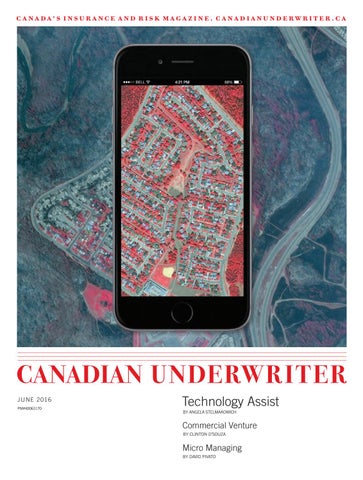
C A N A D A’ S I N S U R A N C E A N D R I S K M A G A Z I N E . C A N A D I A N U N D E R W R I T E R . C A
JUN E 2 0 1 6 PM#40063170
Technology Assist BY ANGELA STELMAKOWICH
Commercial Venture BY CLINTON D’SOUZA
Micro Managing BY DAVID PIVATO
I am a CEO. Protect me. I have thousands of employees worldwide, working in dozens of offices. I have a C-suite of talented executives and my company’s reputation and profitability to protect. I have a broad range of risks facing me, my business and my employees. I want a particular kind of protection and level of service that comes from decades of experience insuring large corporations and their unique assets. Not just coverage. Craftsmanship.SM Not just insured.
Chubb. Insured.
SM
©2016 Chubb. Coverages underwritten by one or more subsidiary companies. Not all coverages available in all jurisdictions. Chubb®, its logo, Not just coverage. Craftsmanship.SM and all its translations, and Chubb. Insured.SM are protected trademarks of Chubb.
new.chubb.com
CANADIAN UNDERWRITER
VOL. 83, NO. 6, June 2016 Canada’s Insurance and Risk Magazine. Published by newcom business media inc.
www.canadianunderwriter.ca
Cover Story
Technology Assist
26
Growing use of technology solutions during natural disasters — as evidenced by happenings in Fort McMurray — looks poised to continue, with different options and more applications becoming a natural part of response. Technology will likely become a key part of customer service in future. By Angela Stelmakowich
features
12
16 Limitation Periods
38 Commercial Innovation Personal lines is taking the spotlight when it comes to innovation, but it is key to also explore commercial lines, which hold great promise. By Clinton D’Souza
20
Microcircuitry Breakdown Equipment that is smaller and faster holds promise, but also brings vulnerabilities and the chance of breakdowns. By David Pivato
46
42 Auto Insurance Satisfaction
A new Ontario court ruling explores what limitation period applies to an insurer’s duty to defend. When an insurer denies the duty to defend, is this a “loss” that triggers a limitation period?
Customer satisfaction with auto insurance has turned a corner. Customer experience, not rates, is driving newfound improvement, but is the momentum sustainable?
By Michael Teitelbaum
By Valerie Monet
24 Farm Insurance Portals Although the number of farms has declined, with the right investment in technology, including in portals, the farm insurance business can be a contributor for farm and general insurers. By Tracy MacDonald
Community Resilience
App Security
Building resilient communities demands all stakeholders take part, including the public. Can use of technology like apps bolster public buy-in?
Mobile app developers can reduce security risk. But security also depends on the devices themselves, which are not always within the control of insurers or developers.
By Mazdak Moini
By Greg Meckbach
June 2016 Canadian Underwriter
3
Editor astelmakowich@canadianunderwriter.ca
PROFILE PROFILE
Senior Publisher steve@canadianunderwriter.ca
Angela Stelmakowich Steve Wilson Canadian Underwriter’s Insurance Media Group committed Underwriter’s Insurance Media is committed (416) 510-6793 Group @InsuranceMedia the industry, providing marketers with aTwitter: range ofis specialized astelmakowich@canadianunderwriter.ca steve@canadianunderwriter.ca (416) 510-6800 (416) 510-6793 Twitter: @InsuranceMedia Associate Editor timely to providing the most and relevant news, information to providing the most timely and relevant news, information and highly effective marketing communications opportunities. Editor
VOL. . 2, FEBRUARY 2014 VOL. 81, 81, NO. NO. 2, 2, FEBRUARY FEBRUARY 2014 2014 Canadian PROFILE PROFILE
Senior Publisher Editor Senior Publisher EditorMeckbach Senior Publisher (416) 510-6800 Greg Art Director Associate Editor Angela Stelmakowich Steve Wilson Angela Stelmakowich Steve Wilson Angela Stelmakowich Steve Wilson and resources to insurance professionals from all segments of resources professionals from all segments of gmeckbach@canadianunderwriter.ca Gerald Heydens Editor Senior Publisher Editorto insurance Senior Publisher EditorMeckbach Senior Publisher Greg Art Director astelmakowich@canadianunderwriter.ca steve@canadianunderwriter.ca astelmakowich@canadianunderwriter.ca steve@canadianunderwriter.ca astelmakowich@canadianunderwriter.ca steve@canadianunderwriter.ca Twitter: @CU_Greg VOL. 83, NO. 6, June 2016 Angela Stelmakowich Steve Wilson Angela Stelmakowich Steve Wilson Angela Stelmakowich Steve Wilson gmeckbach@canadianunderwriter.ca Gerald Heydens Consultation (416) 510-6793 Twitter: @InsuranceMedia (416) 510-6793 @InsuranceMedia (416) 510-6793 the marketers industry, providing marketers with aArt range of specialized Twitter: @InsuranceMedia the industry, providing with aTwitter: range of specialized (416) 510-6796 astelmakowich@canadianunderwriter.ca steve@canadianunderwriter.ca astelmakowich@canadianunderwriter.ca steve@canadianunderwriter.ca astelmakowich@canadianunderwriter.ca steve@canadianunderwriter.ca PROFILE Twitter: @CU_Greg Sascha Hass (416) 510-6800 (416) 510-6800 (416) 510-6800 Art Consultation (416) 510-6793 Twitter: (416) 510-6793 Twitter: @InsuranceMedia Associate Editor (416) 510-6796 510-6793 Associate Editor Twitter: @InsuranceMedia @InsuranceMedia Associate Editor (416) Online Editor and highly effective marketing communications opportunities. and highly effective marketing communications opportunities. EditorMeckbach Senior Publisher Sascha Hass Canadian Underwriter’s Insurance Media Group is committed Production Manager profile (416) 510-6800 (416) 510-6800 Greg Art Director Greg Meckbach (416) 510-6800 Art Director Greg Meckbach Art Director Harmeet Singh Editor Associate Editor Senior Publisher Associate Editor Associate Editor Angela Stelmakowich Steve Wilson Online Editor Gerald Heydens Gary White gmeckbach@canadianunderwriter.ca to providing the most timely and relevant Gerald Heydens gmeckbach@canadianunderwriter.ca gmeckbach@canadianunderwriter.ca Gerald Heydens hsingh@canadianunderwriter.ca Angela Stelmakowich Production Manager news, information Steve Wilson Greg Meckbach Art Director Greg Meckbach Art Director Greg Meckbach Art Director astelmakowich@canadianunderwriter.ca steve@canadianunderwriter.ca Harmeet Singh (416) 510-6760 from all segments of Twitter: @CU_Greg Twitter: @CU_Greg astelmakowich@canadianunderwriter.ca Twitter: @CU_Greg stevew@newcom.ca and resources to insurance professionals Twitter: @CU_Harmeet Gary White gmeckbach@canadianunderwriter.ca Gerald Heydens gmeckbach@canadianunderwriter.ca Gerald Heydens gmeckbach@canadianunderwriter.ca Art Consultation Gerald Heydens Art Consultation (416) 510-6793 510-6793 Twitter: @InsuranceMedia Art Consultation hsingh@canadianunderwriter.ca (416) 510-6800 (416)510-6796 (416) (416) 510-6796 (416) 510-6796 (416) 442-5600 ext. 3652 the industry, providing marketers with a rangeService of specialized (416) 510-6760 Subscriptions/Customer Twitter: @CU_Greg National Twitter: @CU_Greg Twitter: @CU_Greg Sascha Hass Sascha Hass (416) 510-6800 Sascha Hass Twitter: @CU_Harmeet Art Director Art Art Consultation Art Consultation Consultation Associate Editor Associate Editor Gail Page (416) 510-6796 (416) 510-6796 and highly effective marketing communications opportunities. Online Editor (416) 510-6796 Online Editor Online Editor Claims (416) 442-5600 ext. 3652 Associate Publisher Gerald Heydens Subscriptions/Customer Service Greg Meckbach Sascha Hass Canadian Underwriter’s Media isis committed Sascha Hass Canadian Underwriter’s Insurance Media Group is committed Production Manager Sascha Hass Greg Meckbach Production Manager Canadian Underwriter’s Insurance Media Group Group committed ArtInsurance Director Production Manager 14 Leading by Example gpage@bizinfogroup.ca Harmeet Singh Harmeet Singh Harmeet Singh greg@newcom.ca Paul Aquino Gail Page Art Consultation Online Editor Manual Online Editor Online Editor Gary White gmeckbach@canadianunderwriter.ca Gary White Gerald Heydens Gary White to providing the most timely and relevant news, information to providing the most timely and relevant news, information Associate Publisher to providing the most timely and relevant news, information James Cameron, president of (416) 510-5187 hsingh@canadianunderwriter.ca (416) 510-6796 hsingh@canadianunderwriter.capaul@canadianunderwriter.ca Production Manager Production Manager hsingh@canadianunderwriter.ca Production Manager 14 Leading by Example Sascha Hass gpage@bizinfogroup.ca Harmeet Singh InsuranceMarketer.com Harmeet Singh Harmeet Singh (416) 510-6760 Twitter: @CU_Greg (416)professionals 510-6760 (416) 510-6760 Paul Aquino and professionals from insurance from to all segments of Cameron & Associates and resources resources to insurance insurance professionals from all all segments segments of of Twitter: @CU_Harmeet Twitter: @CU_Harmeet and resources Gary White Gary White Twitter: @CU_Harmeet Online to Editor Gary White Art Consultation Twitter: @InsuranceCanuk James Cameron, president of (416) 510-5187 Circulation Manager hsingh@canadianunderwriter.ca Production Manager hsingh@canadianunderwriter.capaul@canadianunderwriter.ca hsingh@canadianunderwriter.ca (416) 510-6796 Jason Contant (416) 442-5600 ext. 3652 Insurance Consultants Limited, the industry, providing marketers with a range of specialized (416) 442-5600 ext. 3652 (416) 510-6760 the industry, providing marketers with a range of specialized (416) 510-6760 (416) 442-5600 ext. 3652 Subscriptions/Customer Service the industry, providing marketers with a range of specialized (416) 510-6760 Sascha Hass Subscriptions/Customer Service National Subscriptions/Customer Service (416) 510-6788 Karen Samuels Cameron & Associates Mary Garufi Twitter: @CU_Harmeet Twitter: @CU_Harmeet National Twitter: @CU_Harmeet jcontant@canadianunderwriter.ca Twitter: @InsuranceCanuk Circulation Manager Online Editor (416) 510-5190 was recognized by the CIP Gail Page Gail Page and highly marketing communications opportunities. Gail Page andClaims highly effective marketing communications opportunities. andClaims highly effective effective marketing communicationsService opportunities. mgarufi@bizinfogroup.ca (416) 442-5600 ext. 3652 Insurance Consultants Limited, (416) 442-5600 ext. 3652 (416) 442-5600, Ext. 3652 Associate Publisher (416) 442-5600 ext. 3652 Associate Publisher Subscriptions/Customer Subscriptions/Customer Service National Associate Publisher Production Manager Subscriptions/Customer Service (416) 510-6788 Account Manager Mary Garufi Leading by Example the insurance industry’s social network ng by Example 14 Leading by Example Harmeet Singh gpage@bizinfogroup.ca gpage@bizinfogroup.ca Circulation Manager Society when he received its gpage@bizinfogroup.ca Claims (416) 442-5600 ext. 3545 Paul Aquino Paul Aquino was recognized by the CIP Gail Page Associate Publisher Gail Page Paul Aquino Gary White Gail Page Manual Manual Michael Wells mgarufi@bizinfogroup.ca Associate Publisher Associate Publisher Mary Garufi Cameron, president of hsingh@canadianunderwriter.ca meron, presidentJames of Leading Associate Publisher (416) 510-5187 (416) 510-5187 James Cameron, president of Manual (416) 510-5187 Established Award.its Account Manager 14 by Paul Aquino ng by Example Leading by Example paul@canadianunderwriter.ca paul@canadianunderwriter.ca gpage@bizinfogroup.ca gpage@bizinfogroup.ca paul@canadianunderwriter.ca (416) 510-6760 Society whenLeader heExample received gpage@bizinfogroup.ca InsuranceMarketer.com InsuranceMarketer.com InsuranceMarketer.com InsuranceMarketer.com mary@newcom.ca michael@canadianunderwriter.ca (416) 442-5600 ext. 3545 Print Production Manager Paul Aquino Paul Aquino Twitter: @CU_Harmeet Paul Aquino Cameron & Associates & Associates paolo@newcom.ca Cameron & Associates Michael Wells STELMAKOWICH Twitter: @InsuranceCanuk James Cameron, president Twitter: @InsuranceCanuk meron, presidentBY ofANGELA (416) 510-5187 (416) 614-5831 (416) 510-5187 Twitter: @InsuranceCanuk James Cameron, president of Circulation Manager (416) 510-5187 Circulation Manager Circulation Manager Established Leader Award. of (416) 510-5122 Phyllis Wright (416) paul@canadianunderwriter.ca paul@canadianunderwriter.ca (416) 510 442-5600 ext. 3652 paul@canadianunderwriter.ca Subscriptions/Customer Service Insurance Consultants Limited, michael@canadianunderwriter.ca Insurance Print Production Manager (416) (416) 510-6788 Cameron & Associates (416) 510-6788 510-6788 Mary Garufi &Consultants Associates Limited, Print Production Manager Mary Garufi Cameron &Consultants Associates Limited, Mary Garufi BY ANGELA STELMAKOWICH INSURANCE the insurance industry’s social network Twitter: @InsuranceCanuk Twitter: @InsuranceCanuk Account Manager Twitter: @InsuranceCanuk Circulation Manager Circulation Manager Gail Page Circulation Manager (416) 510-5122 was recognized by the CIP nized by the CIP Account Manager Phyllis Wright was recognized by the CIP President Phyllis Wright Associate Publisher mgarufi@bizinfogroup.ca mgarufi@bizinfogroup.ca Insurance Consultants Limited, mgarufi@bizinfogroup.ca Consultants Limited, Insurance Consultants Limited, National National Michael Wells National (416) 510-6788 DIRECTORY 14 Leading by received Example (416) 510-6788 Account Manager (416) 510-6788 Account Manager Mary Garufi gpage@bizinfogroup.ca Mary Garufi industry’s social network Account Manager the industry’s Mary Garufi the insurance the insurance insurance industry’s social social network network Elliot Ford Society when he its en he received its Bruce Creighton Society when he received its Paul Aquino insBlogs Claims President (416) 442-5600 ext. 3545 Claims (416) 442-5600 ext. 3545 michael@canadianunderwriter.ca Claims (416) 442-5600 was recognized by the CIP nized by the CIPwas Account Manager recognized by president the CIP of President Michael Wells James Cameron, Michael Wells mgarufi@bizinfogroup.ca (416) 510-5187 ext. 3545 mgarufi@bizinfogroup.ca Michael Wells mgarufi@bizinfogroup.ca INSURANCE eford@canadianunderwriter.ca Manual Manual (416) 510-5122 Jim Glionna Established Leader Award. Manual Account Manager denLeader Award.its paul@canadianunderwriter.ca Account Manager Established Leader Award.its Account Manager Elliot Ford Society when he he received Bruce Creighton Society when he received received its InsuranceMarketer.com Vice President DIRECTORY InsuranceMarketer.com michael@canadianunderwriter.ca michael@canadianunderwriter.ca (416) 442-5600 ext. 3545 InsuranceMarketer.com (416)Production 442-5600 ext. 3545 michael@canadianunderwriter.ca Cameron & Associates Print Production Manager (416) 442-5600 ext. 3545 Print Manager Print Production Manager (416) 510-5117 Michael Wells Twitter: @InsuranceCanuk Account Manager Michael Wells Vice President & General Manager BY ELMAKOWICH Michael Wells Circulation Manager BY ANGELA ANGELA STELMAKOWICH STELMAKOWICH eford@canadianunderwriter.ca Established Leader Award. d Leader Award.Established Alex Papanou (416) 510-5122 Leader Award. (416) 510-5122 (416) 510-5122 Phyllis Wright Phyllis Wright Insurance Consultants Limited, Phyllis Wright 10 Leaps and Bounds Insurance Blogs hosted by Canadian510-6788 Underwriter Christine GiovisPrint Production Manager JoePresident Glionna (416) michael@canadianunderwriter.ca michael@canadianunderwriter.ca insBlogs Vice michael@canadianunderwriter.ca Mary Garufi Manager Print Production Print Production Manager (416) 510-5117 BY ANGELA STELMAKOWICH ELMAKOWICH BYwas ANGELA STELMAKOWICH INSURANCE the christine@canadianunderwriter.ca Property &INSURANCE Casualty Insurance Newswire the insurance industry’s social network theinsurance insuranceindustry’s industry’ssocial socialnetwork network recognized by the CIP SPECIAL FOCUS Sam Natur, chief executive Alex Papanou (416) 510-5122 (416) 510-5122 Account Manager Property & Casualty InsurancePresident Newswire (416) 510-5122 mgarufi@bizinfogroup.ca Account Manager Phyllis Wright Phyllis Wright Account Manager Phyllis Wright President President (416) 510-5114 Account Manager DIRECTORY DIRECTORY Society when he received its Elliot Ford (416) 442-5600 ext. 3545 Elliot Ford officer of online commercial Elliot Ford Creighton Bruce Creighton Bruce Creighton insBlogs Bruce insBlogs SPECIAL FOCUS Michael Wells Connect with Canadian Account Manager Account Manager Account Manager President PresidentUnderwriter President Leader Award. INSURANCE 6Established Editorial INSURANCE eford@canadianunderwriter.ca eford@canadianunderwriter.ca INSURANCE eford@canadianunderwriter.ca insBlogs.com brokerage Bullfrog michael@canadianunderwriter.ca Elliot Ford Elliot Ford PrintPresident Production Manager Elliot Ford Bruce Creighton Bruce Creighton Vice DIRECTORY Bruce Creighton Vice President DIRECTORY Insurance Blogs hosted by Canadian Underwriter Vice President DIRECTORY Connect with Canadian Underwriter BY ANGELA STELMAKOWICH (416) 510-5117 (416) 510-5117 (416) twitter.com/CdnUnderwriter facebook.com/CanadianUnderwriter Ltd., has been an (416)510-5117 510-5122 6 Insurance Editorial eford@canadianunderwriter.ca eford@canadianunderwriter.ca Phyllis Wright eford@canadianunderwriter.ca Alex Papanou Alex Papanou Alex Papanou Insurance hosted by Insurance hosted byUnderwriter Canadian Underwriter by Canadian Underwriter InsuranceBlogs BlogsBlogs hosted byCanadian Canadian Underwriter Vice President insBlogs Vice 8 early-adopter Marketplace Vice President President insBlogs of technology Insurance Blogs hosted(416) (416) 510-5117 510-5117Property (416) 510-5117 twitter.com/CdnUnderwriter facebook.com/CanadianUnderwriter & Insurance Newswire Property & Casualty Insurance Newswire Property & Casualty Casualty Insurance Newswire Account Manager President SPECIAL CUS Alex Papanou .ca SPECIAL FOCUS FOCUS Alex Papanou Alex Papanou Property & Casualty Insurance Newswire Property & Casualtylinkd.in/CanadianUnderwriter Insurance Newswire instouch.com/group/CanadianUnderwriter Property & Casualty Insurance Newswire InsuranceMediaGroup.com for more than 30 years and 8 Marketplace Elliot Ford Bruce Creighton 56 Moves Views needs SPECIAL FOCUS CUS SPECIAL FOCUS Connect with Canadian UnderwriterInsuranceMediaGroup.com Connect with Canadian Underwriter believes the&industry Connect linkd.in/CanadianUnderwriter instouch.com/group/CanadianUnderwriter eford@canadianunderwriter.ca Published bywith Canadian Underwriter 6 Editorial torial insBlogs.com www.CanadianUnderwriter.ca/MediaGroup insBlogs.com Vice President 56to embrace Moves &technology. Views (416) 510-5117 Insurance Blogs hosted by Canadian Underwriter Insurance Blogs hosted by CanadianCanadian Underwriter Insurance Blogs hosted by Canadian Underwriter Connect with Underwriter Connecttwitter.com/CdnUnderwriter with Canadian Underwriter Connecttwitter.com/CdnUnderwriter with Canadian Underwriter facebook.com/CanadianUnderwriter facebook.com/CanadianUnderwriter 58 Gallery twitter.com/CdnUnderwriter Alex Papanou facebook.com/CanadianUnderwriter 6 By Greg Editorial torial www.CanadianUnderwriter.ca/MediaGroup Meckbach Canadian Underwriter is published thirteen times yearly (monthly + the Annual Statistical Issue) by
INSURANCE – we have it covered.
VOL. 81, NO. 2, FEBRUARY 2014 and
instouch.com
insBlogs Ontario instouch.com instouch.com instouch.com Ontario
Photo: Peter Tym
Photo:Thompson Patrick Thompson Photo: Patrick
Photo: PatrickThompson Thompson Photo:Thompson Patrick Thompson Photo:Patrick Patrick Thompson Photo: Patrick Photo: Patrick Photo: Thompson Photo: Patrick Thompson
– INSURANCEINSURANCE – we have it covered. we have it covered.
insBlogs insBlogs insBlogs Ontario Ontario
instouch.com instouch.com Ontario Insurance Blogs hosted by Canadian Underwriter
insBlogs
Ontario
insBlogs.com insBlogs Insurance Blogs hosted by Canadian Underwriter
rketplace rketplace ves & Views ves & Views lery lery
8 Marketplace SPECIAL FOCUS 58 Gallery 8 Marketplace 56 & Views 6 Moves Editorial 56 Moves & Views 58 8 Gallery Marketplace 58 Gallery 56 Moves & Views
6 Editorial 8 Marketplace 50 Moves & Views 52 Gallery 4 Canadian Underwriter February 2014 4 Canadian Underwriter February 2014
Canadian 44 2014 Underwriter February Canadian Underwriter Underwriter February February 2014 2014 Canadian 44 2014 Underwriter February Canadian Underwriter Underwriter February February 2014 2014
4 Canadian Underwriter February 2014 Canadian Underwriter June 2016
.ca
insBlogs.cominsBlogs.com
NEWCOM BUSINESS MEDIA INC. Insurance hosted Canadian Underwriter Insurance Blogs hosted by Canadian Underwriter InsuranceBlogs Blogs hostedby by CanadianMEDIA Underwriter NEWCOM BUSINESS INC.
special focus 58 Gallery
4
Insurance InsuranceBlogs Blogshosted hostedby byCanadian CanadianUnderwriter Underwriter
twitter.com/CdnUnderwriter
facebook.com/CanadianUnderwriter facebook.com/CanadianUnderwriter facebook.com/CanadianUnderwriter InsuranceMediaGroup.com .ca twitter.com/CdnUnderwriter twitter.com/CdnUnderwriter
Canadian at thirteen 80 Valleybrook Drive,(monthly Toronto, + Ontario, M3B Statistical 2S9 Canadian Underwriter Underwriter is is located published times yearly the Annual Issue) by
.ca
linkd.in/CanadianUnderwriter instouch.com/group/CanadianUnderwriter linkd.in/CanadianUnderwriter Phone: instouch.com/group/CanadianUnderwriter linkd.in/CanadianUnderwriter instouch.com/group/CanadianUnderwriter InsuranceMediaGroup.com InsuranceMediaGroup.com InsuranceMediaGroup.com (416) 442-5600. NEWCOM BUSINESS MEDIA INC.
Connect withPrinted Canadian Underwriter All rights reserved. in Canada. contentsDrive, of this publication mayM3B not be reproduced or transmitted Canadian Underwriter is located at 80 The Valleybrook Toronto, Ontario, 2S9 linkd.in/CanadianUnderwriter instouch.com/group/CanadianUnderwriter instouch.com/group/CanadianUnderwriter linkd.in/CanadianUnderwriter instouch.com/group/CanadianUnderwriter Published by Published linkd.in/CanadianUnderwriter by Published byeither in any form, in part or in full, including photocopying and recording, without the written consent of the Phone: (416) 442-5600. www.CanadianUnderwriter.ca/MediaGroup www.CanadianUnderwriter.ca/MediaGroup www.CanadianUnderwriter.ca/MediaGroup copyright owner. Nor may any part of this publication be stored in a retrieval system of any nature without All rights reserved. Printed in Canada. The contents of this publication may not be reproduced or transmitted facebook.com/CanadianUnderwriter prior writtentwitter.com/CdnUnderwriter consent. in any form, either in part or in full, including photocopying and recording, without the written consent of the www.CanadianUnderwriter.ca/MediaGroup Canadian Underwriter is thirteen times yearly ++ Annual Statistical Issue) by www.CanadianUnderwriter.ca/MediaGroup Canadian BUSINESS UnderwriterMEDIA iswww.CanadianUnderwriter.ca/MediaGroup published yearlyowner. (monthly the Annual Issue) by NEWCOM BUSINESS MEDIA INC. NEWCOM INC. thirteen times © Published monthly as apublished source news, technical information comment, and as link between Canadian Underwriter is published thirteen times yearly (monthly the Annual Statistical Issue) by NEWCOM BUSINESS MEDIA INC. copyright Nor +may any partofStatistical of this publication be (monthly stored inand a the retrieval system of aany nature without NEWCOM BUSINESS MEDIA NEWCOM BUSINESS MEDIA INC. NEWCOM BUSINESS MEDIA INC. INC. all segments of the insurance industry including brokers, agents, insurance and reinsurance companies, prior written consent. linkd.in/CanadianUnderwriter instouch.com/group/CanadianUnderwriter adjusters, risk managers and consultants. Canadian Underwriter is at 80 Valleybrook Drive, Toronto, Ontario, M3B 2S9 Canadian at thirteen 80 Valleybrook Drive, Toronto, Ontario, M3B 2S9 Canadian Underwriter is published thirteen times yearly (monthly + the Annual Issue) by Canadian Underwriter is located at 80 Valleybrook Drive, Toronto,and Ontario, M3BStatistical 2S9as a link Canadian Underwriter Underwriter is is located published times yearly (monthly the Annual Issue) by © Published monthly+ as alocated source ofStatistical news, technical information comment, and between Canadian Underwriter is published thirteen times yearly (monthly + the Annual Statistical Issue) by Phone: (416) Phone: (416) 442-5600. NEWCOM BUSINESS MEDIA NEWCOM BUSINESS MEDIA INC. Phone: (416) 442-5600. NEWCOM BUSINESS MEDIA INC. INC. all segments of442-5600. the insurance industry including brokers, agents, insurance and reinsurance companies, Privacy Notice adjusters, risk managers and consultants. All rights Printed in Canada. The contents of publication may not reproduced All rights reserved. Printed in Canada. contents of reserved. this publication may not or transmitted Canadian Underwriter is at 80 Valleybrook Drive, Toronto, Ontario, 2S9 Canadian Underwriter is located at 80 The Valleybrook Drive, Toronto, Ontario, 2S9 All rights reserved. Printed in M3B Canada. The contents of this this publication mayM3B not be be reproduced or or transmitted transmitted Canadian Underwriter is located located atbe 80reproduced Valleybrook Drive, Toronto, Ontario, M3B 2S9 www.CanadianUnderwriter.ca/MediaGroup to either time make subscription list available select companies and organizations whose of in any form, in part or in full, photocopying without the in any form, in part or in full, includingFrom photocopying andwe recording, the written consent to ofand the recording, Phone: (416) 442-5600. Phone: (416)either 442-5600. in anytime form, in part orour inwithout full, including including photocopying and recording, without the written written consent consent of the the Phone: (416)either 442-5600. product or service may interest you. you do not wishwithout your contact to beof available, copyright owner. any of be stored in retrieval any without copyright owner. Nor may any part of this publication be storedNor in may amay retrieval system of publication any nature copyright owner. Nor any part part ofIfthis this publication be stored in aainformation retrieval system system ofmade any nature nature without Privacy Notice All Printed in Canada. The contents All rights reserved. Printed in Canada. The contents of reserved. this publication may not be reproduced or of transmitted All rights rights reserved. Printed in Canada. Themethods: contents of this this publication publication may may not not be be reproduced reproduced or or transmitted transmitted please contact us via one of the following prior written consent. prior written consent. prior written consent. From time to time we make our subscription list available to select companies and organizations whose Canadian Underwriter is published thirteen times yearly (monthly + the Annual Statistical Issue) by any form, either in part or in full, including photocopying and recording, without the written consent of the in any form, either in part or in full, includingin photocopying and recording, without the written consent of the in any form, either in part or in full, including photocopying and recording, without the written consent of the Phone: 1-800-668-2374 416-442-2191 product or service may interest you. Ifnews, you do not wish your contact to beas available, newcoM BuSineSS MeDiA inc. © Published monthly as aaFax: source of technical information and comment, and aany link between © Published monthly as a any source technical information comment, and as aany link between copyright owner. Nor may any part of this be stored in aainformation retrieval system of nature without copyright owner. Nor may partofofnews, this publication be stored inand amay retrieval system of publication nature without © Published monthly as source of technical information and comment, and as aany link between copyright owner. Nor any part ofnews, this publication be stored in retrieval system ofmade nature without E-mail: jhunter@businessinformationgroup.ca please contact via one of the following methods: all segments of the insurance industry including brokers, agents, insurance and companies, all segments of the insurance industry including brokers, agents, insurance and companies, prior written consent. prior written consent. all segments ofus the insurance industry including brokers, agents, insurance M3B and reinsurance reinsurance companies, prior written consent. canadian underwriter is located atreinsurance 80Drive, Valleybrook Drive, Toronto, 2S9 Mail to: Privacy Officer, 80 Valleybrook Toronto, Ontario, M3BOntario, 2S9 adjusters, risk managers and consultants. adjusters, risk managers and consultants. adjusters, risk managers and consultants. Phone: 1-800-668-2374 Fax: 416-442-2191 (416) 442-5600. © Published monthly as aa source news, information © Published monthly as a source of news, technical information and and as atechnical link between ©Phone: Published monthly ascomment, source of of news, technical information and and comment, comment, and and as as aa link link between between E-mail: jhunter@annexnewcom.ca all segments of insurance including brokers, agents, insurance companies, all segments of the insurance industry including brokers, agents, insurance and reinsurance companies, allAll segments of the the2013 insurance industry including brokers, agents, insurance and reinsurance companies, GST Registration number 890939689RT0001 Subscription Rates: Canada rights reserved. Printed inindustry Canada. The contents of this publication mayand notreinsurance be reproduced or transmitted Mail to: Notice Privacy Officer, 80 Valleybrook Drive, Toronto, Ontario, M3B 2S9 adjusters, risk managers and consultants. Privacy Notice adjusters, risk managers and consultants. Privacy Privacy Notice adjusters, risk managers and consultants. Second Class Mail Registration Number: 08840 in any form, either in part or in full, including photocopying and recording, without the written consent of the 1 Year $49.95 plus applicable taxes time time we our subscription list available to select and whose From time to time we make our subscription From list available to select companies and whose From time to to time we make make ourpart subscription list available to select and organizations organizations whose copyright owner. Nor may any of organizations this publication be stored in companies acompanies retrieval system of any nature without Publications Mail Agreement #40069240 2 Years $73.95 plus applicable taxes GST Registration number 890939689RT0001 Subscription Rates: 2015 Canada you. or service may interest you do wish your information to product or service may interest you. If you doproduct not wish contact made available, product oryour service mayinformation interest you.toIfIfbe you do not not wish your contact contact information to be be made made available, available, prior written consent. Privacy Notice Privacy Notice Privacy Notice Return undeliverable Canadian addresses to: Second Class Mail Registration Number: 08840 please contact us via one of the following methods: please contact us via one of the following methods: 1please Year Copies $51.95 plus applicable contact$10 us via one of thetaxes following Single plus applicable taxes methods: From time to time we make our subscription list available to select companies and organizations whose From time to time we make our subscription list available select and organizations whose From time toto time we companies make our subscription list available to select companies and whose © Published monthly as a source of news, technical information and comment, andorganizations as a link between Circulation Dept. Publications Mail Agreement #40063170 2 Years $75.95 plus applicable taxes Phone: 1-800-668-2374 Fax: Phone: Fax: 416-442-2191 product or service may interest you. you do wish contact information be product1-800-668-2374 or service may interest you. If you doElsewhere not contact information made available, Phone: 1-800-668-2374 Fax: 416-442-2191 416-442-2191 product oryour service may interest you.toIfIfbe you do not not wish your your contactinsurance information to be made made available, available, all wish segments of the insurance industry including brokers, agents, andto reinsurance companies, Canadian Underwriter Return undeliverable Canadian addresses to: E-mail: jhunter@businessinformationgroup.ca E-mail: jhunter@businessinformationgroup.ca please contact us via one of the following please contact us via one of the following methods: E-mail: jhunter@businessinformationgroup.ca please contact us via one of the following methods: adjusters, risk managers and consultants. Single $10 plus applicable taxes methods: 80 Valleybrook Drive, Toronto, Ontario 1 Year Copies $73.95 Circulation Dept. M3B to: Officer, 80 Ontario, Mail to: Privacy Officer, 80 Valleybrook Drive,Mail Toronto, Ontario, M3B 2S9 Mail to: Privacy Privacy Officer, 80 Valleybrook Valleybrook Drive, Drive, Toronto, Toronto, Ontario, M3B 2S9 2S9 M3B 2S9 Phone: 1-800-668-2374 Fax: Phone: 1-800-668-2374 Fax: 416-442-2191Elsewhere Phone:Statistical 1-800-668-2374 Fax: 416-442-2191 416-442-2191 Canadian Underwriter Annual Issue E-mail: jhunter@annexnewcom.ca E-mail: jhunter@annexnewcom.ca E-mail: jhunter@annexnewcom.ca Privacy Notice WeValleybrook acknowledge the financial support 80 Drive, Toronto, Ontario 1Subscription Year Registration $71.95 (included with above subscription) Registration number 890939689RT0001 Subscription Rates: 2013 Canada GST number 890939689RT0001GST Subscription Rates: 2013 Canada GST Registration number 890939689RT0001 Rates: 2013 Canada to: Privacy Officer, 80 Drive, Toronto, Ontario, M3B 2S9 Mail to: Privacy Officer, 80 Valleybrook Drive,Mail Toronto, Ontario, M3B 2S9 Mail to:time Privacy Officer, 80 Valleybrook Valleybrook Drive, Toronto, Ontario, M3B 2S9 through From to time weapplicable make ourNumber: subscription list available to select companies and organizations whose of the Government of Canada M3B 2S9 or separately $38 plus taxes Second Class Class Mail Registration 08840 11Second Year $49.95 plus applicable Second Class Mail Mail Registration Registration Number: Number: 08840 08840 1 Year $49.95 plus applicable taxes Year $49.95 plus applicable taxes taxes Annual Statistical Issue product or service may interest you. If you doPublications not Canada wish your contact information the Periodical Fund of the to be made available, Mail Agreement #40069240 Publications Mail Agreement #40069240 Publications Mailthe Agreement #40069240 2 Years $73.95 plus applicable taxes 2 Years $73.95 plus applicable We acknowledge financial support 2 Years $73.95 plus applicable taxes (included with above subscription) GST Registration number 890939689RT0001 Rates: 2015 Canada Subscription Inquiries/Customer Service GST Registration number 890939689RT0001 Subscription Rates: 2015 Canada taxes please contact us via one of the following methods: Department of Canadian Heritage GST Registration number 890939689RT0001 Subscription Rates: 2015 Canada ISSN Print: 0008-5251 of the Government of Canada through Return Canadian undeliverable Canadian to: or separately $39 plus applicable taxes Second Class Number: 08840 Bona Lao (416) 442-5600 ext addresses 3552 Second Class Mail Registration Number: Return undeliverable Canadian addresses addresses to: 1Single Year $51.95 plus applicable taxes Secondundeliverable Class Mail Mail Registration Registration Number:to: 08840 1 Year Copies $51.95$10 plus applicable taxes Single Copies $10 plus applicable taxes 1Return Year $51.95 plus applicable Single plus applicable taxes Copies $10 plus applicable taxes 08840 Phone: 1-800-668-2374 Fax: taxes 416-442-2191 the CanadaDept. Periodical Fund of the Circulation Dept. Publications Mail blao@bizinfogroup.ca Publications Mail Agreement #40063170 Circulation Dept. Publications Mail Agreement Agreement #40063170 #40063170 ISSN Digital: 1923-3426 22Circulation Years plus applicable taxes 2 Years $75.95 plus applicable taxes Years $75.95 $75.95 plus applicable taxes E-mail: jhunter@businessinformationgroup.ca Subscription Inquiries/Customer Service Department of Canadian Heritage Elsewhere Canadian Elsewhere Canadian Underwriter Elsewhere Canadian Underwriter Underwriter ISSN Print: 0008-5251 Return undeliverable Canadian MailLao to: Privacy Officer, 80ext. Valleybrook Drive,80 Toronto, Ontario, M3B 2S9 addresses Return undeliverable Canadian addresses to: Bona (416) 442-5600 3552 Return undeliverable Canadian addresses to: to: Single Copies $10 plus applicable taxes Single 80 Valleybrook Drive, Ontario 1 Year $73.95 Single Copies $10 plusToronto, applicable taxes 1 Year Copies $73.95$10 plus applicable taxes 80 Valleybrook Valleybrook Drive, Drive, Toronto, Toronto, Ontario Ontario 1 Year $73.95 ISSN Digital: 1923-3426 Circulation Dept. Circulation Dept. blao@annexnewcom.ca Circulation Dept. M3B 2S9 M3B 2S9 M3B 2S9 Elsewhere Canadian Underwriter Elsewhere Canadian Underwriter Annual Statistical Issue GST Registration number 890939689RT0001 Subscription Rates: 2013 Canada Elsewhere Canadian Underwriter Annual Statistical Issue Annual Statistical Issue We acknowledge the financial support We acknowledge thesubscription) financial support 80 Valleybrook Drive, Toronto, We acknowledge the financial support Valleybrook Drive, Toronto, Ontario 1(included $71.95 Second Class Mail Registration Number: 08840 (included with 1 Year $71.95 80 Valleybrook Drive, Toronto, Ontario Ontario (included with above subscription) 1Year Year $49.95 plus applicable taxes 180 Year $71.95 with above above subscription) of the Government of of the2S9 Government ofapplicable Canada through M3B 2S9 of the Government of Canada Canada through through Publications Mail Agreement #40069240 or separately $38 taxes M3B 2S9 or separately $38 plus applicable taxes orM3B separately $38 plus plus applicable 2 Years $73.95 taxes Annual Statistical Issue Annual Statistical Issue the Canada Periodical Fund of Annual Statistical Issue Fund of the the Canada Periodical the Canada Periodical Fund of the the We acknowledge the financial support We acknowledge the financial support Return undeliverable Canadian addresses to: We acknowledge the financial support (included with above subscription) Subscription Inquiries/Customer Service (included with above subscription) Subscription Inquiries/Customer Service Department of (included with above subscription) Single Copies $10 plus applicable taxes Department of Canadian Heritage Subscription Inquiries/Customer Service Department of Canadian Canadian Heritage Heritage ISSN ISSN Print: 0008-5251 of the ISSN Print: Print: 0008-5251 0008-5251 the Government ofapplicable Canada through Circulation Dept. of of the Government Government of Canada Canada through through or separately $39 plus taxes Bona Lao 442-5600 ext or separately $39442-5600 plus applicable taxes Bona Lao (416) ext 3552 orof separately $39 plus applicable taxes Bona Lao (416) (416) 442-5600 ext 3552 3552 the Canada Periodical Fund of the Elsewhere the Canada Periodical Fund of the Canadian Underwriter ISSN Canada Periodical Fund of the ISSNthe Digital: 1923-3426 blao@bizinfogroup.ca ISSN Digital: Digital: 1923-3426 1923-3426 blao@bizinfogroup.ca blao@bizinfogroup.ca Subscription Inquiries/Customer Service Subscription Inquiries/Customer Service Department of Canadian Heritage of Canadian Heritage 80 Valleybrook Drive, Toronto, Ontario Subscription Inquiries/Customer Service 1Department Year $73.95 Department of Canadian Heritage ISSN ISSN Print: 0008-5251 ISSN Print: Print: 0008-5251 0008-5251 Bona Bona Lao (416) 442-5600 ext. 3552 M3B 2S9 Bona Lao Lao (416) (416) 442-5600 442-5600 ext. ext. 3552 3552 ISSN Annual Statistical Issue ISSN Digital: 1923-3426 blao@annexnewcom.ca ISSN Digital: Digital: 1923-3426 1923-3426 blao@annexnewcom.ca blao@annexnewcom.ca We acknowledge the financial support (included with above subscription) of the Government of Canada through or separately $38 plus applicable taxes the Canada Periodical Fund of the Subscription Inquiries/Customer Service Department of Canadian Heritage ISSN Print: 0008-5251 Bona lao (416) 442-5600 ext 3552 ISSN Digital: 1923-3426 blao@bizinfogroup.ca
InsuranceMediaGroup.com InsuranceMediaGroup.com
.ca
.ca
InsuranceMediaGroup.com InsuranceMediaGroup.com
See Your Entire Book of Business As a digital brokerage, Drayden Insurance understands to grow and thrive in today’s changing marketplace, you need a single view into your customer relationships, sales opportunities, financial accounting, and policy administration across all lines of business. See how Drayden Insurance gains a single view of its book of business with Applied: Appliedsystems.ca/singleview
LOREEN BELOVICH
SVP and CFO, Drayden Insurance
appliedsystems.ca
T-68143_Drayden_ad_Canadian_Underwriter_June_r2_FIN.indd 1
5/18/16 1:51 PM
editorial
Keeping Pace
PwC estimates that within the next three to five years, cumulative global investment in FinTech could well exceed $150 billion. Angela Stelmakowich Editor Canadian Underwriter astelmakowich@ canadianunderwriter.ca
6
Canadian Underwriter June 2016
Is everything fine with financial technology? Beyond financial institutions, what impact will fast-paced, innovation-packed FinTech have on property and casualty insurance? Being early in the game — although, clearly, not that early — it may be tough to tell. Regardless, FinTech is stirring the pot and has spurred plenty of discussion. A recent blog by Tom Benton, vice president of research and consulting for Novarica, notes “many emerging tech advances are implemented in banking first, followed in five years or so by property and casualty insurers, then after another five-year lag, they begin to appear at life and annuity carriers.” FinTech is still unfolding, meaning attention to related concerns and possibilities should remain on the radar. Consider the findings of a new global survey, reflecting input from 544 respondents in 46 countries, released by PricewaterhouseCoopers (PwC). More than eight of 10 polled financial services firms, including banking and insurance, report believing that part of their business is at risk of being lost to standalone FinTech, PwC reports. Insurers are faring better than some others, but respondents still say they could lose about 21% of their market share to FinTechs by 2020. Less encouraging, asked which part of the financial services sector is the most likely to be disrupted by FinTech over the
next five years, 74% of insurance company respondents identified their own industry. FinTech firms appear confident, anticipating they could capture 33% of incumbents’ business. PwC estimates that within the next three to five years, cumulative global investment in FinTech could exceed $150 billion. The issue has even caught the attention of Canada’s Competition Bureau, which has launched a FinTech market study. The study will explore the competitive impact that FinTech is having on the industry, barriers to entry faced by companies, and whether or not a need exists for regulatory reform to promote greater competition while maintaining consumer confidence in the sector. There is plenty of good about FinTech, the bureau suggests, from lower costs to more choice by bundling existing products and services, the introduction of new products and facilitation of direct transactions without the need for intermediaries. All this seems to make sense in light of the fact that, whether financial service or insurer, focusing on customers, getting more detailed about their wants and needs, and promoting enhanced engagement has become vitally important. It is also key, however, that p&c providers have the infrastructure, approach and readiness that today’s customers are demanding. Customers are showing little patience with companies
unable to quickly offer what they want, by whichever device they choose. That is likely because, as has been stated repeatedly, customers are benchmarking performance against all providers, not just those in p&c insurance. In mid-May, TD Bank Group announced it would be the first Canadian bank to join Plug and Play Tech Center, the largest global technology accelerator, as a corporate collaborator in its FinTech program. TD will be among the financial institutions working with 23 start-ups by providing mentorship and business development support to help them come up with a working prototype. Despite all the activity, Canada’s competition bureau notes “Canada appears to be lagging other countries in adoption of FinTech.” The bureau review will not cover insurance, but that does not mean decisions made cannot have an impact. Waiting and seeing, it is likely, may be waiting too long for the p&c industry. Quickly adapting, implementing and collaborating will be critically important to face the building FinTech wave and not end up all wet. Benton’s recommendation? “Insurance leaders need to look at personalizing products and customer experiences,” including “developing digital solutions that are stable and agile.” The new age of Insurtech must be about preparing for “disruption by being proactive, and not just reactive.”
RECOGNIZES 2015 AWARD RECIPIENTS FOR TECHNOLOGY IMPLEMENTATION CSIO would like to recognize the following companies for achieving CSIO Certification, and the brokerages that achieved a score of 100% on the CSIO Technology Scorecard. We applaud these members for their standardized implementation of technology solutions designed to advance the broker distribution channel in Canada.
eDELIVERY RECIPIENTS eDelivery allows broker and insurer members to leverage CSIOnet and eDocs to deliver personal lines policy documents to insureds through Canada Post’s epost™ platform.
COMMERCIAL LINES eDOCS RECIPIENTS eDocs save brokers time and money by allowing policy documents to be downloaded directly from an insurer’s system to a broker’s BMS via CSIOnet.
PERSONAL LINES eDOCS RECIPIENTS
CSIO TECHNOLOGY LEADERS Recognizing brokerages across Canada that demonstrated leadership in technology by achieving a score of 100% on the CSIO Technology Scorecard.
To learn more, visit www.csio.com
marketplace
Technology IBM TO TEACH WATSON system LANGUAGE OF CYBER SECURITY IBM Security has announced that eight universities, including three in Canada, will help train its Watson computer system on the “language of security” as part of a year-long research project. Watson for Cyber Security is a new cloud-based version of IBM’s cognitive technology trained on the language of cyber security. To further scale the system, IBM will work with eight universities — including the University of New Brunswick, the University of Ottawa and the University of Waterloo — “to greatly expand the collection of security data IBM has trained the cognitive system with.” The idea is for IBM to begin beta production deployments that take advantage of the offering later this year. The company’s X-Force research library — which includes 20 years of security research, details on 8 million spam and phishing attacks, and 100,000-plus documented vulnerabilities — will be a central part of the materials fed to the system. The research project “will be the first technology to offer cognition of security data at scale using Watson’s ability to reason and learn from ‘unstructured data’ — 80% of all data on the Internet that traditional security tools cannot process, including blogs, articles, 8
Canadian Underwriter June 2016
videos, reports, alerts and other information.” Natural language processing will also be used to understand the nature of human language in unstructured data.
INSURER WEBSITES lagging CUSTOMER EXPECTATIONS Insurer websites are not keeping up with customer expectations, with just 55% of those polled saying they “definitely will” return to the site for their servicing needs, notes a new J.D. Power study. The survey is based on responses from 3,854 shopping evaluations and 3,340 service evaluations of auto insurance websites. Consumers did several tasks online and then rated how easy they were to do on a five-point scale. Ratings were used to compute an overall index for shopping and servicing experiences based on a 500-point scale. While overall satisfaction among customers shopping online for auto insurance improved, some of the more basic service tasks — such as printing or requesting new or replacement ID cards, updating the user profile or adding a driver or vehicle to the policy — earn the lowest experience scores. Satisfaction has not suffered yet, but likely will if insurers do not invest in websites and keep pace with other industries.
SLOW SHIFT TO PUBLIC CLOUD BY ORGANIZATIONS Transitioning to public cloud is a slow-moving process for most businesses, suggests a
poll of 250 senior IT decisionmakers and 250 line of business managers in Canada and the United States. About 61% of organizations taking part in the survey by Softchoice are still experimenting with (23%) or have limited use (37.5%) of public cloud, while 13.5% consider public cloud to be an internal corporate standard. Just 26% of respondents report public cloud is in “widespread use.” Among other findings, 52% of IT leaders lack a formalized cloud strategy, 53% are struggling to acquire the necessary skills to support cloud initiatives within their organizations, and half have cancelled or postponed an important initiative because of the IT department’s inability to provide necessary resources or support.
Canadian Market ECONOMICAL INSURANCE LAUNCHes DIRECT CHANNEL Economical Insurance’s new direct channel — part of an updated corporate strategy to position the company as among the top property and casualty insurers in the country — went live in early May. The insurer has activated multi-channel distribution with the launch of Sonnet Insurance Company. The new digital platform will initially offer personal home insurance policies, including homeowner
tenant, condo and landlord insurance. Personal auto is scheduled to follow in the second half of 2016. Customers will be able to get a customized quote, purchase a policy and make updates to their accounts online, on any device. The platform brings multiple data inputs in real time to produce the quote and insights allow pricing “each customer individually and appropriately,” the insurer adds.
AVIVA CANADA DEVELOPS PRODUCT FOR QUEBEC RIDESHARING PROGRAMS Aviva Canada has developed an insurance product that the company suggests “would bridge the insurance gap in Quebec,” if the provincial government decides to allow ridesharing programs. The coverage is independent of ridesharing facilitators and is an addition to an Aviva Canada-insured personal auto policy. It would be available for Quebec drivers with the required approval of the Autorité des marchés financiers. Ridesharing drivers (like those contracted with UberX) would be protected from the moment they start looking for passengers through to collecting and dropping off those passengers. Eligibility for coverage would be based on some simple underwriting criteria, including a maximum of eight passengers, licensed for a minimum of six years and no other commercial use. This coverage would be available for drivers spending
marketplace
as much as 20 hours weekly ridesharing. Cost for the coverage would be calculated using factors such as time spent ridesharing, area driven and driving record.
TELEMATICS PROGRAM THROUGH alberta BROKER CHANNEL launched Ontario-based Pembridge Insurance Company has launched what is being called the first telematics program offered through the broker channel in Alberta. The usage-based insurance offering was created to help reward drivers who exhibit safe driving behaviours with discounts on their premiums. The product records data on how a vehicle is driven, including time of day, number of kilometres driven and speed and braking habits. Once drivers are enrolled in the program and the device is installed, their driving will be monitored for a six-month period, after which the data collected will determine the earned discount (as much as 30%) to be applied at renewal.
Claims possible fallout of lower AUTO ACCIDENT BENEFITS The reduced accident benefits under Ontario’s auto reforms may prove a shock to drivers with non-catastrophic injuries, but perhaps should also elicit concern over the potential for treatment to come second to attendant care, Daniel Strigberger, a lawyer with Samis+Company,
said at an industry event. For non-catastrophic injuries, the old scheme allowed for $50,000 in medical and rehabilitation benefits and $36,000 in attendant care benefits, Strigberger said at the Insurance Institute of Ontario’s seminar on auto insurance reforms in Toronto. Under the scheme taking effect in June, the two have been combined and reduced to a total of $65,000. Not only may a person exhaust the new limits, if providers push “a lot of attendant care, that just takes away from the treatment that’s available,” Strigberger cautioned. “Attendant care is very different from treatment. Attendant care is there to help you today; it doesn’t necessarily get you better tomorrow,” he added.
Regulation ONTARIO’S HIGHWAY TEXTING ZONES BILL PASSES SECOND READING A private member’s bill in Ontario proposes the transportation minister have the power to “create designated highway texting zones.” The zones detailed in the Safe Texting Zones Act are intended to remind drivers of legal opportunities to use their mobile devices. The bill has been referred to the Standing Committee on Finance and Economic Affairs. If the bill gets the green light, the transportation minister would be able to create designated highway texting
zones “where a driver is able to stop safely to use their device,” says Progressive Conservative MPP Vic Fedeli. “This includes existing commuter parking lots, transit stations or service stations, and does not require any new infrastructure,” Fedeli noted.
HIGHER FINES FOR DISTRACTED DRIVING IN BRITISH COLUMBIA The government of British Columbia has announced new financial penalties for distracted driving came into force June 1, 2016. Penalties will be calculated using the base fine of $368 combined with escalating Insurance Corporation of British Columbia driver penalty point premiums. Each offence will include the base fine of $368 (up from $167) and add four penalty points to a person’s driving record (up from three); first-time offenders will face a minimum $543 in penalties; and repeat offenders, upon a second offence within 12 months, will pay the $368 fine plus $520, which escalate further for any additional offence.
Risk GAPS IDENTIFIED IN CRISIS MANAGEMENT READINESS OF CANADIAN BOARDS More diligence is required to protect board members in the wake of a crisis, notes a paper prepared by Osler, Hoskin & Harcourt LLP for the Institute of Corporate Directors.
Based on a survey of 400 Canadian directors, director roundtable meetings and a series of panel discussions, findings indicate 50.6% of respondents fail to review directors and officers (D&O) indemnity agreements yearly, and 44.7% fail to have D&O insurance policies reviewed yearly by an external advisor. Osler, Hoskin & Harcourt notes the results suggest overarching confidence expressed by directors is at odds with survey data in some key areas. Consider that while 66.9% of respondents report having a formal crisis response plan and 79.3% believe their management teams have the skills to handle a sudden crisis, just 29.3% state they were “comfortable that [their] enterprise risk management system has identified the material risks of the business.”
GOVERNMENT-HELD PERSONAL DATA at risk? More than half of Canadians report believing their personal and confidential information held by all levels of government is vulnerable to a security breach, notes results of a survey conducted by Ipsos on behalf of Accenture. Another 20% believe they are “very vulnerable” and 33% “somewhat vulnerable.” Overall, 62% of Albertans feel vulnerable to data security breaches, followed by those in British Columbia (58%), Ontario (55%) and Atlantic Canada (53%). Quebec, Saskatchewan and Manitoba tied last, each with 49%. June 2016 Canadian Underwriter
9
Profile
Leaps and Bounds Greg Meckbach Associate Editor
Sam Natur, chief executive officer of online commercial brokerage Bullfrog Insurance Ltd., has been an early-adopter of technology for more than 30 years. As a teenager during the 1980s, one of Sam Natur’s hobbies was writing computer gaming software. Three decades later, Natur continues to apply his computer skills — this time as president and chief executive officer of Bullfrog Insurance Ltd., a Mississauga, Ontario-based brokerage that sells commercial coverage over the Internet. “Bullfrog is something that’s sort of long overdue for the industry,” he suggests of the brokerage, established in 2013 by the Canadian Broker Network (CBN), made up of seven brokerages, and launched in March 2015. “We may say the industry is moving very quickly and all that, but I think we often forget that the customer out there is not benchmarking Bullfrog or anyone else against the insurance industry. They are benchmarking us against Amazon,” he says. 10 Canadian Underwriter June 2016
Born and raised in Toronto, Natur initially attended Glendon College, a bilingual affiliate of York University. “I received a summer scholarship to attend Université Laval,” north of Montreal, Natur says. “I guess on my way back I thought, ‘It’s a bit of a corner-cutting job if you do French during the day, but you go home and speak English... so I thought, ‘I’ll spend a year there.’” Natur actually spent more than a year at Laval, eventually earning a masters degree in literature with a minor in French. He is fluent in both of Canada’s official languages, as well as Arabic, his parents’ first language. “It’s a funny thing,” Natur suggests of his academic specialties. “Growing up, I was really into computers. I was programming games by the time I was 14 years old,” he recalls, using the leadingedge technology of the day: the Commodore VIC-20 and the Commodore 64. “My dad was always saying, ‘Hit the books,’” Natur says. “He viewed the computer as a toy rather than an actual tool, so I got the degree to satisfy my parents. I did well in it, but as soon as I got out, I went into project management and, eventually, back into IT,” he adds. While studying for his graduate degree, Natur was employed by World Travel Protection Canada Inc.,
working on air ambulance repatriations. The work was nowhere close to what he had studied. “I did nothing career-wise based on my education,” Natur points out. “When you’re bringing back ailing patients, you have to make sure the airline’s got oxygen for them, that there is a hospital bed secured here in Canada, air ambulance crews are on standby, that everything is transitioning smoothly with the medications and all that,” he says. “It really took a combination of insurance and project management and absolute delivery management.” Before taking the helm of Bullfrog Insurance, Natur spent almost 15 years as a management consultant, most of them as principal of Natour|Global, the consulting firm he founded in 2001. Over the years his clients have included, among others, Deloitte, IBM Global Services, BDO, the Toronto-Dominion Bank, the Canadian Imperial Bank of Commerce, Symcor, the Royal Bank of Canada and some government clients. One client was Aviva Canada Inc., which starting in 2010, retained Natur as a program manager, a role he held in launching online brokerage Insurance Hunter Services Inc. four years ago. He then went on to work for Mississauga-based MedAvail Technologies Inc.,
which makes the MedCenter automated pharmacy kiosk. It is a product Natur cites as an example of a technology that is challenging people’s assumptions. “You would say, ‘Holy smokes, if I am dispensing narcotics, I’ve got to be talking to the person face to face,’” says Natur. But with MedCenter, users can have a video call with a pharmacist based in a different location. Around the time, he was working for MedAvail Technologies, officials with
“It really took a combination of insurance and project management and absolute delivery management.” CBN were referred to Natur by Aviva Canada. “Bullfrog was a concept the owners of the seven CBN brokerages wanted to bring to market, but did not have the time or project management expertise to do so,” explains Natur, who, along with the seven CBN brokers, now own the brokerage. “I was brought on board to build and launch Bullfrog and, subsequently, was offered the opportunity to be chief executive officer and president,” he says. It took “pretty much all of 2014”
Profile
SUITING THE CUSTOMER
Photo: Peter Tym
to establish the brokerage “and work through all the mechanics with the insurers,” before officially launching the following March. The brokerage currently places insurance for commercial clients in Ontario, British Columbia and Alberta. Approximately 40% of sales are online, Natur reports, but adds that the portion is “certainly climbing.” The lion’s share of the brokerage’s prospective customers are in the building trades, followed closely by office professionals such as management consultants, executive trainers and software and IT consultants, he notes. As prospective customers are filling out applications online, Bullfrog Insurance can see the data being entered. “We have notifications in here that show us a visitor has come, they are a returning customer, and when they get stuck, we surface our chat box and say, ‘Hey, can I help you out with this?’” Natur says. Between 8:00 am and 8:00 pm eastern time, the brokerage has “a licensed agent right there walking them through the tough questions while leaving them alone if they want to get through there quickly and efficiently.” Outside of those hours, the chat capability is still available and the ticket is dealt with first thing the next morning. “We often just get on the
phone with them,” Natur says, but not always. “When you think about small business owners, they are the quintessential multitaskers. That’s somebody who is more than happy to continue the process online and through chat,” he notes. Customers can apply for insurance, pay premiums by credit card and have it bound without signing paper, Natur says. There is an attestation on the website explaining that everything must be correct and true. If anything is found to be false, “the premium could increase or the policy could be void,” he notes.
Once the customer applies a checkmark showing they understand things, they type in their name and purchase. Customers can then receive insurance contracts in PDF format by e-mail. A lot of building trades people are applying for commercial coverage from mobile devices, Natur reports. “I can tell you, several days a week, I get notification of a purchase well before 7:00 am, and that could be somebody on their way to the job site and you can see it because the system says the person has been quoted a premium, and two minutes later there is the purchase,” he says.
Flexibility is just one way in which providers can give the customer what he or she wants and demands. Industries outside of insurance are being disrupted as a result of changes in customers’ expectations, he suggests. “You can say, ‘the technology changed’ or ‘the processes changed,’ but really the customer changed,” Natur comments. “Television is going through unprecedented changes now with the arrival of shomi and CraveTV and Netflix,” Natur says as an example. “I was streaming back in 2006. I was an early-adopter, but by 2010, people were coming on board to this and now, it’s become so simple and easy that I don’t think there’s a single household right now that only has television.” There is now more of a comfort with technology and doing things online, including shopping, and the insurance industry needs to get on board. “I think everybody is doing the best that they can with the circumstances that we have,” Natur says. “But I think sometimes we have to step back and go, ‘Hold on, I’m going to sit here and say that I can’t sell this online in the office today and then I’m going to go home and I’m going to buy my vitamins online.’ We don’t see the double standard there.” June 2016 Canadian Underwriter 11
Transforming Commercial
Clinton D’Souza Manager, Canadian Operations, Starr Insurance & Reinsurance Limited
Given that insurance is fundamentally the trading of information (data for a policy product), the personal lines market in Canada today is being disrupted by a number of developments: traditional broker-based companies going direct, direct insurance carriers taking steps to increase market share, and new technology disruption via start-ups employing untraditional distribution models. Personal lines, though, is not alone as a target for disruption. The most logical next steps for disruption for the Canadian insurance industry should be to focus on the commercial insurance space.
focal point Making changes On many levels, focusing on innovation and disruption in the commercial lines market makes sense. Commercial lines are becoming a tremendous source of value creation and hold significant promise for new partnership models. In addition, commercial insurance policies are complex financial instruments, unlike personal lines, which is more a commodity transactional business model. As technology is changing the interaction between consumers and insurers in personal lines, so can it also increase interactions between insurers and business owners. Businesses want to purchase insurance through a trusted channel and
12 Canadian Underwriter June 2016
have access to coaching and guidance through what can be a complicated decision process involving risk management and data. Outside of investments in Canada’s small commercial insurance space by new entrants — including a Canadian insurance brokerage dedicated to commercial insurance for small business enterprises and a flexible, home-based business insurance offering for those who work from home — these investments are small compared to investments that are being made globally on other commercial lines segments. One need only consider what is happening outside of Canada to ask why the Canadian industry is not following suit? Why is Canada lagging behind other countries in commercial lines innovation? Still, Canada’s insurance industry is seeing major investments in creation of innovation labs with a number of insurers and potentially others. Already, investment has led to technology labs in Kitchener, Ontario and Toronto. Taking advantage Carriers and brokers each do a lot to bring innovations to market, but, unfortunately, insurance buyers do not always appreciate or take advantage of them. Consider, for example, usage-based
Illustration by Dave Whamond/threeinabox.com
Canada’s insurance industry, already focused on innovation in the personal lines market, needs to expand its view. Innovation in the commercial lines space holds great promise for creating new business models, developing new partnerships and taking advantage of the data that the Internet of Things offers.
NexCenter is now BrovadaOne Connectivity A single platform. The better way to connect. BrovadaOne Connectivity is Willis Towers Watson’s broker/carrier integration product. It is currently installed in over 1,400 brokerages and over 50 different insurance companies. BrovadaOne Connectivity handles over 80% of the real-time traffic between brokers and insurers in Canada. BrovadaOne Connectivity automates the workflow and entry of data into a multitude of carrier systems, saving time, while improving efficiency and accuracy. We have built interfaces that connect with all the major broker management system vendors in Canada. Available transactions include single sign on; policy, billing and claim inquiries; new business submissions; policy change; and first notice of loss. BrovadaOne Connectivity is now available to brokers at no charge. For more information about BrovadaOne Connectivity, email TW.RCS.Brovada.Sales@willistowerswatson.com. For training, email TW.Contact.Training@willistowerswatson.com.
willistowerswatson.com
insurance (UBI) and its slow adoption in Canada, likely because of how the auto insurance product is regulated in this country. However, commercial lines is not subject to these same hurdles. The industry is not doing enough to champion innovation in commercial lines because the focus has been on the personal lines market because of its size. However, the personal lines market continues to face unprecedented competition from new distribution models, including peer-to-peer insurance. Having never before seen this amount of new entrants coming into the business, unfortunately, that history may lead some in the personal lines market to underestimate the potential challenges posed by entrants such as large retailers, online shopping sites and more.
fundamentally things that are connected and can offer valuable opportunities to try new business models and gain insights into customers. Consider that locations like offices, warehouses and factories have environmental sensors able to detect conditions such as temperature, smoke, fumes and other hazardous conditions.
IDENTIFY NEED Listening to customers Innovation must start with understanding the need or problem. That understanding comes from ordinary interactions with customers and business partners. The innovator must then determine how existing tools and approaches could be employed to fix the problem, or understand why current capabilities are inadequate. Innovation can then fill the gap between the need and the lack of available solutions. Ask any innovator where good ideas come from, and the answer is likely to be “everywhere.” That is equally true in the insurance industry, although the best ideas tend to come from conversations with consumers. Commercial lines is ideally suited for this type of innovation since brokers, loss control representatives and claims adjusters have direct contact with a business during the underwriting and/or claims processes. Sourcing IoT A significant part of the opportunity in commercial lines is to curate the experience, as well as leverage the Internet of Things (IoT) and the connectivity of devices and data generated by those devices. A factory, an airplane, machinery, a boat, an oil rig or a truck are all 14 Canadian Underwriter June 2016
Carriers offering homeowner, commercial property and general liability lines would all be able to “write right risk” and improve loss ratios based on IoT-connected environmental sensors. A Forbes article from February notes that with two-way communication, these IoT devices can provide predictive alerts on potentially dangerous conditions in the near future. Carriers offering homeowner, commercial property and general liability lines would all be able to “write right risk” and improve loss ratios based on IoT-connected environmental sensors, the article suggests. For insurance companies, these new types of business models need to be incorporated into product pricing. Business owners vary widely: some may want
commodity pricing; others demand premium-quality policies and services today from their policies. This might include innovations in pricing and underwriting, such as UBI being extended beyond the auto product to include such coverages and liability. In addition, collaboration is key to innovation and to changing the forecast of the insurance industry. Tapping into the knowledge of partners, peers and competitors will be essential, and in response, insurers should work with them to innovate something new and gain fresh perspectives on new approaches. Strengthening bonds Some of the very first applications of connected sensors, the precursors to IoT, were in factories using process control automation, the Forbes article notes. As manufacturers enable IoT, specialty insurance carriers providing extended warranty protection on these products will also offer predictive and preventive service prior to product breakdown or component failure. This could, in turn, present opportunities to cross- and upsell for additional insurance products. Insurers can use IoT and its enriched relationships to connect more holistically with customers and influence their behaviours. New business models could emerge, perhaps including buying devices from insurers or partners of those carriers. In Holland, for example, a lighting company is helping drive adoption of smart homes by partnering with telecom, insurance and energy companies. With lighting being a main interest in connected homes, along with energy and security, these sorts of collaborations not only help drive adoption of IoT, but create new business models for insurance. As part of that venture, the insurer has synced the lighting company into its app, thereby allowing its customers to do their parts to prevent the risk of theft, water damage and fire. Through the app, for example, lights will turn red when the alarm goes off, and a notification will be sent to the customer’s smartphone to alert the client of the risk.
The possibilities of such an approach are endless, given that lighting systems in manufacturing, retail and other commercial insurance product lines could use this same type of solution. Possibilities also exist around another company’s move to link its elevators to the cloud. Sensors in the lifts or the associated linked systems gather information about movements, temperature and pre-emptive service, while the software further has dynamic predictive models to show where and when service is needed. The potential benefits are a huge reduction in down time and lower maintenance costs. This IoT application could easily be used in other industries, and the implications for the insurance industry are endless with regard to better maintenance and risk control.
FULL BENEFIT Research released by McKinsey & Company in June 2015, Unlocking the potential of
the Internet of Things, indicates that IoT and its potential use in commercial insurance business-to-business (B2B) applications can create more value than pure consumer applications. While consumer applications such as fitness monitors and self-driving cars attract the most attention and can certainly create significant value, researchers estimated that B2B uses can generate almost 70% of potential value enabled by IoT. As well, most IoT data is currently not being used, the report points out. For example, only 1% of data from an oil rig with 30,000 sensors is examined. Data used today are mostly for anomaly detection and control, not optimization and prediction, which provide the greatest value. Consider that there is great potential for carriers that specialize in energy insurance products to create partnerships with a manufacturer of oil rigs or solar panels, for example.
TECHNOLOGY REBOOT For the full benefits of IoT to be realized, however, improvements are needed in insurance technology, skills and processes. Additionally, conditions in the industry must be conducive to IoT adoption, including that there be sufficient demand to justify investment, support and collaboration among industry players. These conditions can only exist if the industry in Canada realizes it needs to focus its efforts on commercial insurance innovation before clients demand it or seek other alternatives. The insurance industry currently has the ability to know in advance of an event, ultimately improving the experience, security and well-being of both customers and potential customers. Data is becoming more important for all lines, but there needs to be a call to action by the insurance industry to start focusing on commercial lines getting their systems prepared to manage the data being produced by IoT.
June 2016 Canadian Underwriter
15
Determining
Limits
A recent Ontario appeal court ruling exploring what limitation period applies to an insurer’s duty to defend sheds light on an issue not yet comprehensively addressed in the province. When an insurer denies the duty to defend, this is considered a “loss” for the purpose of the triggering of a limitation period.
Michael Teitelbaum
Partner, Hughes Amys LLP Hughes Amys LLP is a member of The ARC Group of Canada, a network of independent insurance law firms across Canada.
In the December 2015 ruling by the Court of Appeal for Ontario, Daverne v. John Switzer Fuels Ltd., the court dealt with the issue of what limitation period applies within the context of an insurer’s duty to defend. The successful appeal found the insured’s claim was barred by the limitation found in the subject liability policy of one year. In rendering its decision, the three-person panel considered an issue that has not been comprehensively addressed in Ontario. The court, which applied the “correctness” standard of review, concluded that when an insurer denies the duty to defend, this is a “loss” for the purpose of the triggering of a limitation period. In light of the application of the limitation period, the appeal court held that the analysis at first instance of the duty to defend did not have to be considered.
seeking compensation for damage to their home and the additional living expenses they incurred because of the leak. Federated Insurance Company of Canada insured McKeown & Wood until the last policy expired on October 24, 2007, just months before the leak occurred. On February 11, 2010, McKeown advised Federated Insurance of the Daverne claim, but the insurer denied coverage on the basis that the occurrence took place in January 2008, and that McKeown & Wood was not insured on the date of loss. The company defended the main action, assuming its own legal costs, and brought a third-party action against a number of insurers, including Federated Insurance, on March 15, 2012, seeking a declaration that the insurers were required to provide a defence under three different policies.
BACKGROUND
SUMMARY JUDGMENT MOTION
The main action arose out of a fuel tank leak that caused damage to the Davernes’ property. McKeown & Wood sold the fuel tank to the Davernes in 2000, but at some point after the last fuel delivery was made in January 2008, the tank began to leak. The Davernes discovered the leak after returning from vacation late that month. They started the main action against McKeown & Wood and others on December 31, 2009,
Justice Graeme Mew of Ontario’s Superior Court of Justice found that the defendant oil tank seller was owed a defence under one of three policies and the claim against Federated Insurance, the insurer with the defence obligation, was not limitation-barred. On a motion for summary judgment, the insurer argued the third-party claim was filed after the one-year limitation in the policy had expired.
16 Canadian Underwriter June 2016
Federated Insurance relied on a statutory condition that was incorporated into the policy that stated an action against the insurer must be commenced within one year after the loss or damage occurs. Its position was that for the purpose of liability coverage, “loss or damage” equated to the “loss” that occurs when an insurer denies an insured’s claim for coverage. Justice Mew held that Federated Insurance could not succeed on this limitation defence. Citing the 2003 Supreme Court of Canada decision, KP Pacific Holdings Ltd. v. Guardian Insurance Co. of Canada, he stated the fire statutory conditions that were incorporated into the policy, and the one-year limitation period that the conditions contained, did not apply. In KP Pacific, Canada’s high court considered statutory conditions that were essentially identical to those contained in the Federated Insurance policy. Writing for the court, Chief Justice Beverley McLachlin concluded the comprehen-
sive policy at issue on the appeal could not be “shoehorned” into the fire insurance section without “contrived reconstruction and anomalous consequence.” Justice Mew found that Federated Insurance should not be able to rely on a limitation defence because the result of including a statutory condition that was intended for first-party insurance as a policy condition, and applying it to cover third-party risks, would yield an anomalous consequence akin to those envisioned by the Supreme Court of Canada in KP Pacific. Therefore, he held that the limitation period in the statutory condition did not apply to claims made under the commercial liability coverage provided by the policy and the applicable limitation period was the two-year limitation provided for in Section 4 of Ontario’s Limitations Act, 2002. ISSUES ON APPEAL Correctness The Court of Appeal for Ontario con-
cluded the standard of review applicable to the motion judge’s interpretation of the insurance policy was correctness. Justice Peter Lauwers, writing for the court, stated that since the appeal was heard, the appeal court determined in 2015, in MacDonald v. Chicago Title Insurance Company of Canada, that the correctness standard of review applies on standard form insurance contracts. Justice Lauwers cited reasoning in MacDonald that it would be “untenable” to give insurance policy wording different meanings by different judges. Because of the nature of insurance policies, with similar language and general principles of law, he concluded there is a public policy argument that the high degree of generality and precedential value justifies a standard of correctness. Limitation period Ontario’s appeal court held that the one-year limitation period in the policy is enforceable. Justice Lauwers found that
Make your name stand out. The Chartered Insurance Professional (CIP) designation is recognized as the hallmark of professionalism in the property and casualty insurance industry. Employers across Canada know that a CIP has completed several years of rigorous study, adheres to a strict code of conduct and has the experience to offer clients fully qualified professional service. If you want to be assured employers will take note of your resumé—earn your CIP.
Learn more at www.insuranceinstitute.ca/CIP 1-866-362-8585 Follow the Insurance Institute
T L
Be assured.
June 2016 Canadian Underwriter
THIS AD PREPARED BY: CLIENT:
RYAN EDWARDS INSURANCE INSTITUTE
17
the third-party claim for a declaration that Federated Insurance owes McKeown & Wood a duty to defend the main action should be dismissed. Justice Lauwers cited Section 148 of Ontario’s Insurance Act, which makes certain conditions part of every fire insurance contract in Ontario. Statutory Condition 14 was included in Federated Insurance’s policy as clause 14 of the “Basic Policy Statutory Conditions” form included in the policy and that provides a one-year limitation for action after the loss or damage occurs. He held that clause 8 of “Additional Conditions” applies as a contractual limitation period the limitation provided for in clause 14 to the other perils insured against in Federated Insurance’s policy and to the liability coverage provided by it. The Limitations Act, 2002 has a two-year limitation and Section 22(1) prohibits contracting out of the limitation period. However, a subsequent exception to the no-contracting-out rule was permitted in the case of “business agreements.” The court observed it is plain that none of the parties to Federated Insurance’s insurance policy is a consumer and the parties are business entities. Justice Lauwers held the combination of clause 14 and clause 8 clearly varies the two-year limitation period provided for in the Limitations Act, 2002. He found the motion judge incorrectly concluded that the phrase “loss or damage” in clause 14 did not include loss or damage suffered by a third party who then seeks compensation from the insured. Justice Lauwers also found the motion judge should have applied the basic principle that the insured “suffers a loss from the moment the insurer can be said to have failed to satisfy its legal obligations under the policy of insurance.” Furthermore, he disagreed the difference between first-party property claims and a third-party claim for defence is a point of distinction that affects the application of the principle that the insured suffers a loss when the insurer fails to meet its obligation under the policy. Because the insurance policy in this case is a business agreement for the pur18 Canadian Underwriter June 2016
pose of Section 22 of the Limitations Act, 2002, the one-year contractual limitation period is enforceable by Federated Insurance. Therefore, because the thirdparty claim was issued almost two years after Federated Insurance’s letter denying coverage, the claim that the insurer owed a contractual duty to defend McKeown & Wood is barred by the one-year contractual limitation period. Despite the fact that Federated Insurance did not have a duty to defend the insured, this does not dispose of the insurer’s possible obligation to indemnify.
COMMENT The 2015 decision by Ontario’s Superior Court of Justice, Zochowski v. Security National Insurance, is consistent with Daverne. In Zochowski, the plaintiff, Ludwick Zochowski, while riding a bicycle in 2006, struck and injured a pedestrian, Sophia Tubis. Tubis sued the plaintiff for damages, but Zochowski’s insurer denied coverage and refused to fund his defence.
The court observed it is plain that none of the parties to Federated Insurance’s insurance policy is a consumer and the parties are business entities. Zochowski then sued the insurer, but waited almost three years to do so. The insurer argued the plaintiff’s action was time-barred. The motion judge dismissed the plaintiff’s action, but the court held the plaintiff suffered a loss because of the insurer’s failure to defend, and the time for bringing an action ran from the date of denial. In the “Issues in Focus — Limitation Periods and Liability Insurance in Ontario” section of Insurance Law in Canada, the view is expressed that subject to the terms of the policy, the statutory twoyear limitation period for the duty to defend begins with the denial of coverage, where there is a denial. However, there is a “good argument that the limita-
tion renews itself with each dollar spent on defence,” it adds. Thus, it may be arguable that the limitation begins to run with each defence costs account. However, with Daverne, the question is whether this possibility may no longer be viable. That said, the court’s finding that the loss can be the damages claimed by the injured party, as opposed to the damages sustained by the insured when its defence accounts are not paid, is an interesting interpretation of what constitutes a loss. Still, it does appear to be consistent with recent decisions about when a limitation begins to run, namely, from the date of denial. What is the effect of the Court of Appeal for Ontario’s March 2016 decision, Pickering Square Inc. v.Trillium College Inc.? Decided after Daverne, the case explored, in the circumstance of a commercial lease, when a claim is discovered for limitations purposes in the context of a continuing breach of contract. The court specifically endorsed the concept of a “rolling limitation,” (which is discussed in Insurance Law in Canada, where the authors note that causes for action for recovery of ongoing payments, such as accident benefits, continually renew themselves each time an installment becomes payable because the insurer is under a continuing liability for each succeeding benefit), and discusses the concept of a “breach of a continuing obligation under a contract.” Would the obligation to pay defence costs qualify? It remains to be seen if the courts may be called upon to reconcile the Daverne and Pickering Square decisions at some point. As well, as can be seen from Daverne and Zochowski, and not surprisingly, there are two different limitations in respect of liability coverage, one for defence costs, and the other in respect of entitlement to indemnification, which would presumably run from when a determination is made of the damages an insured is obliged to pay. Many thanks to Stephen Hopkins, student-at-law in Hughes Amys LLP’s Toronto office, for his excellent assistance in the preparation of this article.
SPECIAL ADVERTISING FEATURE
INSURANCE TECHNOLOGY Commitment to technological innovation In 2015, we began a major transformation of our business. This included a $300 million investment to support the broker channel, to ensure we are easy to do business with, offer competitive pricing and products so that brokers can continue to focus on providing independent expert insurance advice to their customers. A central priority for us through this journey has been to listen closely to the needs and expectations of our brokers. Based on our ongoing dialogue with them, we know that technology is at the forefront of customer expectations. That’s why our transformation is centered on implementing technology improvements across our business that will support our operational efficiencies, broker service, pricing sophistication and claims handling. As a result, we’re enabling new workflows with greater efficiencies, and creating flexibility so that we can innovate in today’s dynamic market. Our continued commitment to customer-centric innovation is how we will ensure that we remain a trusted and preferred insurance provider, and allow us to be more competitive to a larger market. Revisiting our digital vision We are re-vamping our digital vision to ensure we can meet the evolving needs of brokers and their customers. We just completed an enterprise view on how to better use the digital channel to support the business, our brokers and RSA’s customers. Sometimes this digital focus may mean making quick, strategic investments to make our business more effective today. It could also mean larger “core” investments such as our claims transformation and back office policy systems. We are also taking a Broker-centric “designthinking” approach to our digital tools. We’ve been speaking to brokers and customers to get feedback on digital concepts and tools to make sure that what we build will work for them. We are utilizing agile methodologies to ensure we can get tools to market faster, despite the challenges of an industry built on legacy systems. We may not get it perfect right away, but will get tools to market faster, and will be able to more quickly adjust when we
12404_RSA-CU-Article_F2.indd 1
“We see the opportunity in technology and are embracing it through our efforts to modernize our business.”
get live feedback. RSA’s market-facing websites are designed for mobile and tablet use, as an ever growing percentage of our brokers demand quick access to our sites and tools. Another way we are investing in the broker channel to ensure its ongoing success is by enhancing our broker digital tools, providing expertise and financing. We are putting more of an emphasis this year on developing broker and customer strategies in order to help brokers educate their clients and provide value to them. And in order to fulfill our commitment to our brokers to be a best-in-class insurer partner, we are also investing in putting the right talent and internal training in place. In the insurance industry, technological advances can be view as a risk, and certainly there is if you are unprepared. However, we see the opportunity in technology and are embracing it through our efforts to modernize our business. Enhancing our web tools In Personal Insurance, we have taken a number of steps to improve the functionality of our existing online tools; including streamlining our underwriting filters to expedite policy processing, better integrating partners such as AIR MILES into the system, enhancing functionality across our WebBusiness portal to reduce errors, helping brokers identify better rate opportunities in third-party quoting tools, and providing instant feedback through web chat to promote one and done service. The end goal
is to enable a seamless interaction with our broker partners. In May, we also launched Wise Up™, our new online continuing education program for brokers that launched in British Columbia, Alberta and Manitoba, and will be available nationally by year end. This learning platform allows brokers to complete training wherever and whenever they want – all they need is an internet connection. We are launching a new web platform in Quebec this year followed by the remaining provinces in 2017/2018. This will greatly drive our ease of doing business proposition and build a foundation for our future digital broker and customer offerings. In Commercial Insurance, our aim it is to align with how our broker partners do business, not how we internally manage the opportunities—that includes a number of similar undertakings to PI, but ultimately rethinking what ease of doing business looks like. Conclusion We recognize that in order to stay relevant in the face of changing environmental, regulatory, technological and digital pressures, insurers’ and brokers’ entire proposition has to evolve. At RSA, we’re building our systems in such a way that we’re offering the digital capabilities brokers will need to connect with customers in creative ways and demonstrate value, in a cost-effective way, to drive our mutual growth and success.
2016-06-07 3:53 PM
Getting Personal Building a strong foundation for resilient communities demands the participation of stakeholders ranging from the insurance industry to government and the public. Can technology be used to bolster public buy-in and educate individuals about the role they can play in making communities more resilient?
Vice President, Commerical Lines and Reinsurance, Aviva Canada
20 Canadian Underwriter June 2016
Plenty of effort and energy has been directed at educating the public about its role over the years. Much of this effort, however, has focused on traditional communications, which may be informative, but lack a personal connection. People are likely to be more invested in taking action if the information speaks to their specific circumstances and allows for greater interaction. Such information could help members of the public understand that by taking steps to prevent damage, they are not just helping themselves, they are increasing the overall resilience of their communities.
CONNECTING WITH CONSUMERS With a growing segment of the population preferring to research and shop for insurance digitally, it is clear many are comfortable and open to using apps. Insurance 2020: Future of Insurance, a 2014 global survey by PricewaterhouseCoopers, shows that 68% of polled consumers would be willing to download and use an app from their respective insurance provider. (The survey is based on responses from 9,281 consumers of non-life insurance around the world, including in Canada.) Given this, it seems a safe bet that one option for enhancing engagement on how insurers can
Illustration by Dave Whamond/threeinabox.com
Mazdak Moini
In the face of ever-increasing severe storms and natural disasters, governments, insurers and relief organizations often talk about resilience — the ability to bounce back after a destructive event occurs. Taking preventive measures to minimize damage and loss is fundamental to resilience. But government-instituted measures are not enough; individuals have a responsibility, too. The public plays a key role in building resilience and preparedness on the private property side. “Government can do everything possible to foster resilience on the public side. However, if nothing is done on the private side, huge gaps/ vulnerabilities would still exist,” says Glenn McGillivray, managing director of the Institute for Catastrophic Loss Reduction (ICLR). “For instance, we often hear that up to 60% of basement floods are due to problems on the private lot and have nothing to do with public infrastructure. Power outages due to ice storms often occur due to failure to maintain trees on private property.” The United Nations Office for Disaster Risk Reduction (UNISDR) reports a holistic approach to preventing, mitigating, preparing for, responding to and recovering from disaster is necessary, requiring the engagement of businesses, citizens and governments.
WICC Announces A New National Sponsor WICC is delighted to announce a recent addition at the Platinum Level to its National Sponsorship Program.
Few organizations have galvanized the insurance industry more than WICC in their quest to eradicate cancer during our lifetime. As WICC embarks on its 20th anniversary,
AIG will mark its 50th anniversary in Canada by sponsoring WICC at the national level to demonstrate the company’s commitment to the health and wellness of all Canadians.
AIG is now a part of a very special group of WICC National Sponsors. WICC is extremely thankful to this group of organizations which share a vision and desire to put an end to cancer! WICC National Sponsors at the Platinum Level also include:
ÂŽ
Design compliments of
30030_WICC_Ad_ AIG.indd 1
6/15/16 10:41 AM
help foster resilience in their communities is to offer a mobile app that provides users with customized information about what to do before, during and after catastrophic events such as floods, wildfires and earthquakes. Indeed, UNISDR has pointed to mobile apps and web-based systems of engagement (for example, crowd sourcing or disseminating data on preparedness) as ways of educating people and creating public awareness programs and, thereby, strengthening societal capacity for resilience. With the goal of improving engagement, Aviva Canada teamed up with ICLR to discuss finding new ways of influencing positive change to mitigate risks and damage from extreme weather. One of those ideas was a free mobile app. “We all liked the app idea because mobile communications were exploding. So we did some research and found that nobody had done an app aimed at providing advice to help people before, during and after an emergency,” says McGillivray. The first step towards mitigation and resilience is risk awareness. Providing individuals with customized risk information educates them about the source and level of catastrophic risk to which their properties are exposed, as well as empowers them to take steps to address the risk before an event occurs. By having information before an emergency, the goal is to prevent the loss altogether or prevent it from being a big loss; having information during tends to relate to preventing conditions from getting worse; and having information afterwards typically focuses on clean-up and restoration, as well as taking steps to prevent a repeat. It is not unusual for policy documents to be left behind and/or destroyed during an event, and an app that stores digital copies of policies offers peace of mind and a reference source post-event.
LEVERAGING TECHNOLOGY Any mobile app presents a number of advantages that are especially relevant in the context of emergency preparedness: • because information is downloaded to a device, the user has 24/7 access 22 Canadian Underwriter June 2016
even if the power goes out; • since many people keep their phones with them at all times, an app allows the user access to critical information whatever his or her location (the use of social media during wildfires and ice storms in the past few years has revealed that many Canadians depend
Because different types of natural disasters are more common in certain parts of the country, being aware of the specific risks and the protective measures that can be taken is critically important. on their cellphones and devices to get information during emergencies); and • an app can provide a user with access to information tailored to that user. Having immediate access to information most relevant to the user enables that person to figure out what needs to be done. This information can empower decisions and actions that can lessen the impact of an emergency or disaster.
using INDUSTRY, PUBLIC skills With the Aviva Canada/ICLR app, for example, the key goal is to provide Canadian households with personalized infor-
mation and advice they can use before, during and after floods, wildfires, severe wind, winter storms and earthquakes. The app includes information and advice from a variety of sources about what can be done to prevent and reduce risks from severe weather, including ICLR, the Canadian Red Cross and Public Safety Canada. Individuals can use the app to access specific advice and steps to reduce risk, depending on the type of event. Insurance Bureau of Canada (IBC) reports that from 2009 to 2014, insured losses from catastrophic events, most due to water damage, have been close to, or above, $1 billion annually. Canada’s total hit an all-time high of $3.2 billion in 2013 because of flooding in southern Alberta and Toronto. Because different types of natural disasters are more common in certain parts of the country — or even in certain areas within a particular city or region — being aware of the specific risks and the protective measures that can be taken is critically important. For example, having an app that generates a personalized risk report based on postal code, number and age of people in the household, and the home’s construction, would allow the user to know if he or she is at low, moderate or high risk of damage from a number of different types of emergencies. Consider that an individual may not be aware that his or her property is located in a high-risk flood, sewer backup or earthquake zone. Simply knowing that may encourage individuals to seek out methods to mitigate, minimize or transfer that risk. At an aggregate level, individuals acting in self-interest to address vulnerabilities of their properties will strengthen the resilience of the community as a whole. The expected frequency and severity of loss in a high-risk hazard zone can be multiples of that in a low-risk zone. For an insured, this means higher probability of incurring a deductible, and a longer period of displacement when a loss occurs. Consequently, insureds who are more educated about their risk exposures can make more informed decisions about
deductibles with which they are comfortable and can make value-based decisions on any investments that may help make their properties more resilient.
CREATING RESILIENT COMMUNITIES “We’re trying to inform people that the future isn’t going to be the same as the past with respect to severe weather and that it’s important that each of us understands what we can do to lessen the impact of such events,” McGillivray says. The hope is technology, such as mobile apps, will prove “a useful tool that fulfills our common goal of prompting Canadians to read, understand and take action,” he emphasizes. Using technology to bring attention to the individual’s role in making cities and communities resilient is gaining traction. In 2014, for example, in support of UNISDR’s Making Cities Resilient campaign, Esri, a technology company that spe-
cializes in mapping software, sponsored a global disaster resilience app challenge. One app allowed users to quantify the level of community resilience to climate-related hazards so they could see the factors that increase or decrease their resilience numbers. Apps are just one of the technologies proving useful for emergency preparedness and emergency management. Consider the fires that have ravaged Fort McMurray, displacing thousands of people. The Alberta government released an app that uses satellite images to allow evacuees to see how their homes have been affected and keep abreast of when they can return. The app has been championed by IBC. Social media is another important tool that is becoming important for engaging citizens in emergency management, notes an October 2015 review in the International Journal of Information Management. Social media, like Facebook and Twitter, can help with disseminating in-
formation during emergencies and for providing real-time situational awareness about an emergency, the review found. The Federal Emergency Management Agency’s National Preparedness Report, released in March 2013, notes that in the two-week period during and immediately following Superstorm Sandy’s landfall in New Jersey and New York, users sent more than 20 million Sandyrelated tweets, despite the loss of cellphone service during the storm’s peak. Insurers can also use social media to provide useful information to customers that can help the public play their role in resilience. The insurance industry has a history of engaging and educating the public about what it can do to mitigate the impact of risks. It is believed that apps and other digital tools will not only appeal to the digital generation, they can also help users and, by extension, communities, bounce back after disaster.
Opinion/Analysis
Port in a Storm Farm portals are an example of an underserved market. Although the number of farms has declined, with the right investment in technology, including in portals, the farm insurance business holds considerable promise for mutual and general insurers alike.
Tracy MacDonald
Associate Vice President, Corporate Services, Trillium Mutual Insurance Company
For many Canadian insurers, particularly for mutuals, it all started on the farm. Mutuals, and even insurers focused on other markets, count farm insurance as an important part of their businesses. However, over the years, as the country urbanized, and as other insurance markets grew, farm insurance shrunk in numbers and in priority. While automobiles, new homes and new businesses have increased over time, the number of farms has decreased. This has had an impact on investments in insurance technology, with broker connectivity and portal solutions provider Hubio reporting that farm business has received less new technology than the more commoditized personal lines products, in which automation could be more easily replicated. Farms have historically not received the same level of technology investment, Hubio notes. As a result, farms and agribusiness customers can face slower processing times to get new business quotes, incur delays in getting answers to their insurance questions, experience lags in updating their policies and renewals, and may see potential inaccuracies as a result of human errors. While farm numbers are down, farm and agribusiness production is at an all-time high. Statistics Canada figures show that farm cash receipts were up 11.2% to $49.2 billion in 2011, attributable mainly to an increase in crop receipts that make up more than half of total farm receipts. The Canadian Association of Mutual Insurance
24 Canadian Underwriter June 2016
Companies notes that in 1940, there were approximately 750,000 farms in Canada compared to 175,000 today. But acreage farmed per farm has increased from an estimated 200 acres in 1940 to 850 acres today. As well, income per farm continues to rise, with more than half of farms generating over $1 million in annual revenue in 2016. Slightly less than 20% of the gross written premium (GWP) of Canada’s mutual insurers is generated by farms and agribusiness. For mutuals to succeed, they will need to make new technology investments to keep pace with user demands. In many cases, new technology has been developed, and solutions are lower cost and more functionally rich than ever before. These solutions include upgrades to policy administration solutions to properly capture and manage the new types of farm assets, new liability coverages and the ability to handle agribusinesses. For example, while hand-milking equipment used to cost hundreds of dollars and was captured as a general field on the policy, now computerized milking costs can exceed $500,000 per station, requiring specific policy treatments. Combines, tractors, seeders and sprayers, for their parts, are more specialized than the family car, and can each cost hundreds of thousands of dollars. Other solutions include enabling brokers to evaluate new farm business and quote/secure new business online via mobile devices at a farm site. At present, much of this activity is done man-
ually. Unlike personal lines auto and home, much farm business relies on rating books and manual look-ups. Portals that allow brokers to input complete underwriting details on a new farm policy — be that a family farm or a complex agribusiness — can be implemented quickly and cost-effectively. This helps to improve accuracy of data, generate faster response times and apply underwriting rules more consistently, while also providing wider access and ease of doing business. Integrating these portals with a company’s policy system — and across the organization — is now affordable, and offers real-time interaction. Such integration is as relevant for farm insurance as any other line of business. Trillium Mutual, for example, initiated its new farm portal project because brokers clearly indicated they needed better technology to meet their farm underwriting needs. While farm business has one of the highest retention rates for insurance companies, it was recognized that not only changing demographics within farm ownership, but also within the brokers serving farms, necessitated the move to new technology to maintain high retention rates and ensure customer satisfaction. In terms of return on investment, this is an area where significant gains can be realized immediately. Investing in new technology could help brokers and farm customers have a more positive digital experience when interacting with insurers. Beyond operational benefits, it is expected that improvements in broker and customer satisfaction would lead to increased business and stronger loyalty. An additional plus may be the positive gains achieved within a company’s own underwriting team, since members will have access to more information, and be connected to agents, brokers and, in some cases, farm or business owners.
GETTING BROKERS ENGAGED Some brokers may prefer to do business by starting and ending transactions within their broker management systems (BMSs). But for farm policies, most BMSs
cannot handle the breadth of coverages and capture the overall information required. This means submissions are often done manually via paper forms. As well, while a BMS can capture details on some farm buildings, the process is oftentimes disjointed and inefficient. As such, brokers may view investing in a quote/new business submission/ endorsement portal as positive, especially where partial upload from the BMS is also supported whenever possible. Farm portals enable a broker to provide all the information necessary for a new business quote. This can be done in a broker office, but is much better at the farm location, via laptop or tablet. Using refinements in questioning and data capture, the information presented can vary depending on coverages offered without bogging down the process. The more intuitive and easy-to-use the system is, the higher the usage rates. Brokers would likely view an awkward system that is difficult to use and understand as worse than no solution at all. Automation of this stage in new business standardizes what is collected, and greatly assists in pre-qualifying risks. When compared to paper-based options, the speed of processing is improved, the accuracy is upgraded, the underwriting rules are applied more consistently, and the experience is much improved. “The technology allows us to save time in our quoting process, alleviates pressure on our (Trillium Mutual’s) underwriters and, most importantly, delivers new business to our clients at an accelerated rate,” says Jeff Gerber, agriculture manager for Zehr Insurance Brokers Ltd. “From quote to new business submissions, the transfer of data is accurate and time-efficient. Nice touch on being able to save the quotes for an extended period of time. This saves enormous time on re-quoting,” Gerber adds. But farm portals are not simply about introducing new technology; their success will depend on both promoting and generating usage. As such, it is essential to design proper roll-out plans that include frequent communication, training and a support
desk to handle any broker concerns. Technology does not replace the faceto-face interaction between a broker and farm customer. Instead, portal technology offers the promise of complementing the interaction, providing a tool to complete a transaction more accurately and efficiently. The popular “what-if” scenarios, which were impossible to address in manual systems, can be queried and modelled in real time.
IMPORTANCE OF UNDERWRITERS Underwriters cannot be forgotten in discussions around the need for technology. Providing underwriters with complete, accurate information enables them to more efficiently underwrite new farm business. A farm portal can help facilitate this, and depending on the insurer processes, can be used to enable underwriter/broker and underwriter/customer interactions. Portals can allow underwriters to enter new business using technology provided by technology partners. By capturing more data and more detail, for example, this data can be analyzed to improve offerings and the accuracy of ratings. Portals can further be used to collect greater detail than that required by a company’s policy administration system. This information could be captured, stored within the content management system and be available to help with underwriting issues, thereby allowing underwriters to better understand the market and be able to better determine what new coverages can be offered. Current manual systems cannot guide brokers about what to look for. One Ontario-based mutual insurer indicated that as older brokers retire, gone is the vast amount of information they have collected over the years. That information has proved key for accurately underwriting risks on a farm property. As the guard is changing in the sector, newer brokers will require online tools to help them identify risks. It is time for insurers to invest in technology solutions to make sure that farm customers receive the best solutions the insurance industry can offer.
June 2016 Canadian Underwriter
25
Technology Assist Using technology solutions during natural disasters is on the rise. The marked growth — as evidenced by tools both used and available in the devastating wildfires near Fort McMurray — looks poised to continue, with different options, more applications and enhanced information likely becoming a natural part of response. Technology being tablestakes may very well be key for the property and casualty industry to best serve and respond to customers in future. ANGELA STELMAKOWICH
26 Canadian Underwriter June 2016
I
t may seem odd to talk technology in the context of an event as devastating as the Alberta wildfires that have since spread into Saskatchewan — projected to become the largest insured loss from a natural catastrophe event in the history of the country. Odd, that is, until one considers how technology has likely helped advance assessment, the claims process and preparing worried customers facing what ranges from damage to ruin. The wildfire in and around Fort McMurray, receded enough from the city for voluntary re-entry of citizens beginning June 1 and scheduled to end June 21, nonetheless, continues to burn. As of early June, the Alberta government reported that wildfires, including those extending into Saskatchewan, covered in excess of 580,000 hectares. The month-old wildfire laid to waste, damaged or spared individual properties and businesses within Fort McMurray — a city nestled amidst boreal forest and at the centre of Canada’s oilsands sector. It has been estimated that roughly 10% of built structures have been destroyed, although only a thorough first-hand look will tell the true tale. Now comes the tremendous work not only to clean up, organize and process, but also to help flesh out skeletal loss assessments that technology helped develop and will likely help advance as the claims process unfolds. Technology solutions ranging from satellite imagery to map applications, geocoding, smartphones and online tools may be just a start. Others, such as drones, could follow to offer enhanced detail, context and understanding for policyholders and the property and casualty insurance industry as a whole. Trying to get a fix on what has already proved a heavy emotional toll — and, no doubt, will be a massive insured loss, with early estimates ranging from $2 billion to $9 billion and recent ones around the $4 billion mark — could inject technology and how it can help more squarely into response discussions by all stakeholders. Discussions of the technology options now available — inevitably, to be joined by others in future — has found a launching pad with the tragic events of May, and then June, and could become “the way of doing things.” That may be one positive from a monstrous event that, so far, has offered little more than disbelief, damage and loss.
June 2016 Canadian Underwriter 27
COVER STORY
Technology Assist HELPFUL TOOLS The Fort McMurray wildfire raged, growing greedily, until apparently jumping a river and taking the city. People were evacuated, the peril clear, and for a time, access slammed shut to all but military, emergency and government officials. Amid all this, the technology that most immediately had an impact from an insurance standpoint — one quickly and astutely provided by the Alberta government for the use of all — was satellite imagery. Maps offered via an application were meant to provide a high-level satellite overview of the city’s status, initially indicating only the most severely damaged areas. From the initial and subsequent images came a first look for insurers, claims adjusters, restoration professionals and, most important, policyholders, at what was not accessible first-hand. With those images, the provincial government could make decisions about allocating resources, homeowners could see if their properties were affected and by how much, and insurers could begin thinking about deploying claims teams, disaster restoration company resources and their needs vis-a-vis reserving for the loss, says Glenn McGillivray, managing director of the Institute for Catastrophic Loss Reduction (ICLR). There was not much insurers were able to do “until the app came out and [evacuees] were able to see images of their neighbourhoods,” says Leonard Sharman, a spokesperson for The Co-operators. “The municipality also completed a damage assessment of every structure in Fort McMurray and made the results available online,” Sharman reports. Jim Eso, senior vice president of property and casualty for Crawford & Company (Canada) Inc., says the Regional Municipality of Wood Buffalo’s “very, very good” interactive aerial photography map showed before and after photographs of addresses in the city. These helped both residents and insurers in identifying risks more clearly, Eso says. Jim Mandeville, FirstOnSite Restoration’s senior project manager of large loss, North America, says satellite imagery has been a huge asset for customers af28 Canadian Underwriter June 2016
fected by the Fort McMurray fires. Billy Short II, vice president of large loss operations for FirstOnSite, calls the use of satellite imagery unprecedented. “Even during our restoration efforts after Hurricane Sandy, we didn’t see this level of satellite imagery in use,” Short says.
With satellite images, government could make decisions about allocating resources, homeowners could see if their properties were affected and by how much, and insurers could begin thinking about their needs vis-a-vis reserving for the loss, says Glenn McGillivray of the Institute for Catastrophic Loss Reduction. Having access to data from satellite imagery and geo-mapping “ahead of time means we can start helping customers as soon as possible,” says Stephanie Sorensen, director of external communications for Intact Financial Corporation. “Our customer management system is such that we can group homes according to postal codes and/or physical locations to understand where customers are located,” Sorensen says. “Not only does all this help us assess damages, it also helps place claims representatives in the field.”
Other technology can also help advance the claims process. Ingrid Himmelman, FirstOnSite’s national business process manager, says“digital security cameras in residences allow people to reach out to insurers and start the claims process a lot more quickly. This is a big step up from what was available during Slave Lake.” Technology that can conduct a full 3D scan of damaged buildings “is becoming very commonplace in the accident reconstruction industry,” Mandeville says. Remote access has been especially important to commercial clients and property owners, he suggests. “Cloud-based building management systems have allowed clients to turn on and off their HVACs (heating, ventilation and air conditioning) and monitor temperature and humidity conditions. This allows victims of the fire some control in what happens in and around their property.” However, the technology that “did not play the role that we might have hoped it could have is drone technology,” suggests Eso, explaining that flight permits for drones could not be issued because the area was an active forest fire zone (drones could pose a danger to firefighting equipment in the air) and the airspace was also closed to all but military use. This was “sort of a double hit around the difficulties and challenges of getting drones up,” Eso says. Crawford Canada, in fact, had requests within a few days of the fire to see if it could obtain flight certificates for any of its drones, but as noted, it was not possible, says Eso. “I think what it did do, though, was it reinforced the need for us, and the opportunity for us, to continue to expand in the drone space because if it wasn’t a forest fire, we would very likely have been able to get drones up to get immediate access visually to all of the loss site,” he says. Had it been, say, a flood, “we would have been able to get a lot more early information from other means than having to wait to go in.” Joe Colby, head of claims for Swiss Re Canada, says that “drone technology is probably the most effective and
For 50 years, AIG has helped Canadian businesses solve challenges through innovative thinking. We enable clients to discover personalized insurance solutions powered by strategic partnerships and industry-leading experience. Now we look forward to the next 50 years of emerging technology, evolving risks, and helping to make the impossible possible. Learn more at AIG.com/innovativetech
AIG Insurance Company of Canada is the licensed underwriter of AIG property casualty insurance products in Canada. Coverage may not be available in all provinces and territories and is subject to actual policy language. Non-insurance products and services may be provided by independent third parties. Š American International Group, Inc. All rights reserved.
COVER STORY
Technology Assist efficient technology available to complete an early and quick assessment of the scale of damages sustained from the wildfire.” For example, they can be used to help with “mapping high-resolution images of damaged property against an insurer’s database of geo-coded risks to get a preliminary view of both the scale and severity of loss or damage,” Colby says. Eso would likely agree. What drones offer is “finer detail about what kind of damage might be involved,” he says. For example, Eso notes, the expectation is there will be plenty of warped siding or things like seals damaged on window systems because of heat. “Fort McMurray is going to be significant in that regard because a lot of these homes were exposed to a fairly significant amount of heat and they may appear on the surface not to have been damaged,” Eso says. “A drone is very good at getting in at a low altitude and getting a very highresolution photograph. It might be that it’s on an individual basis or on a blanket basis to allow insurers to try to get a better handle on reserving as early as they possibly can,” he says. “A drone with a simple camera can assess things like roof damage and help determine if it is safe to enter firedamaged structures without endangering any personnel,” says Patrick Lundy, president and chief executive officer of Zurich Canada Once no-fly zone restrictions are lifted, Colby says, a practical question for the insurance industry with respect to the deployment of drone technology is can this be co-ordinated through one firm and data shared with the industry at large? “Attempting to have multiple insurers and loss adjusters launch multiple drones in a relatively small geographic radius in a short amount of time may introduce logistical complexities that perhaps can be avoided,” he notes. Lundy agrees the Fort McMurray airspace presents some special challenges. “The airport is right in the town. That means the nine-kilometre, no-fly buffer 30 Canadian Underwriter June 2016
around airports that Transport Canada says drone pilots must normally observe covers most of the town,” he explains. Adds Himmelman, “We’ve found that, in Canada, there are a number of challenges with licensing drones, airspace restrictions, and possible interference by drones with first-responders in the air.”
“A drone is very good at getting in at a low altitude and getting a very high-resolution photograph,” Crawford Canada’s Jim Eso says. “It might be that it’s on an individual basis or on a blanket basis to allow insurers to try to get a better handle on reserving as early as they possibly can.” ON THE RISE “This is probably the first catastrophic event we’ve had where, I think, technology has played a role greater than perhaps in previous events,” suggests Rocco Neglia, Economical Insurance’s vice president of claims. Technology is so much more present than even during the massive flooding in southern Alberta three years ago, Neglia notes. “I would say technology had no particular impact other than being able to plot certain areas and what kind of business one writes in those areas.” Economical Insurance used satellite imagery and geo-coding technology, both that supplied by the Alberta government
and a third-party vendor, to come up with an idea of total losses compared to not total losses, Neglia reports. “It was invaluable using the technology this time around. Otherwise, we would have been as in the dark today as we would have been back” when the fire originally broke out, he suggests. Given that insurers initially had no access, “technology is proving to be particularly useful in this event,” notes Nora Hohman, vice president of claims for Travelers Canada. Her company was able to use the government-supplied satellite imagery in conjunction with imaging pictometry technology from a vendor to “give us a really accurate aerial sketch of our customers’ properties.” The information from those two technologies “feeds right into our buildingestimating tool,” Hohman points out. With the latter being the same system used by most contractors, this “will also make it easier through the reconstruction phase,” she suggests. “We’ve been able to build estimates with a high degree of confidence we’re pretty confident in from the aerial view. What that means is we’re able to start the claims process a lot more quickly, in fact, before we’re ever on site,” she says. Satellite imagery and Google map images “only show macro exterior damage. There may also be damage as a result of other factors that is not visible in the images, such as water damage from firefighting efforts,” says Philipp Wassenberg, president and chief executive officer of Munich Reinsurance Company of Canada and Temple Insurance. A full picture will only develop with in-person inspections. “The full extent of the damage won’t be understood until homeowners return to their homes and survey their own damage. There will be some structures that sustain damage that will not be apparent from satellite imagery,” says AIR Worldwide scientist Tammy Viggato. “The reality is that a lot of this will come down to traditional adjusting,” says Eso, working face-to-face with policyholders and physically being on site.
There
when you need us most
Any time, day or night, Crawford is ready to help Crawford puts you and your clients first during catastrophic events, no matter when or where they happen. We have helped countless businesses recover and thrive after disaster strikes. For more information on how Crawford can help, contact us at info@crawco.ca.
www.crawfordandcompany.ca
COVER STORY
Technology Assist Technology has also promoted greater engagement with policyholders, perhaps providing some time for them to come to grips with what they may face upon their returns, Eso suggests. “You don’t have to go back more than a few years before a similar event like this, people would still be wondering. ‘Is my home still standing?’” he notes. “Those sorts of things, at least partly because of the new technology available, there’s been a lot of progress well ahead of time before you go back in,” he adds. Going forward, Neglia suggests that carriers are going to need to make decisions about what technology they will need when responding to Cats. “Do we need a tool that will provide us with better and quicker information up front?”
RISK PROFILE Despite the use of technology in Fort McMurray, McGillivray says “we do not appear to have really good tools to rate the risk of wildfires striking communities or individual properties in Canada.” Bill Adams, vice president of Western and Pacific for Insurance Bureau of Canada, said during a recent press briefing that it is not yet possible to assess what measures — if any — could have helped mitigate damage. “Clearly, when you have a community of the size of Fort McMurray in the centre of a boreal forest, that’s inviting problems. The reality is we have a lot of Fort McMurrays in Canada and so we need to learn from this event, as we have from past, that there are things that we should be doing, that we should be investing in advance to prevent these type of tragedies,” Adams noted. “I think as Canadians, governments have to, perhaps, start thinking about ways to mitigate these type of events,” comments Neglia, pointing out the costly wildfires in Slave Lake, Alberta and Kelowna, British Columbia were not that long ago. “With forests being drier and drier, the risk is that much greater.” But some fires may defy rating. “This fire was exceptional for its size and ferocity. Once this fire got going, little could have been done to stop it,” 32 Canadian Underwriter June 2016
McGillivray says. “Even the largest water bombers would not have beat back this fire.” Ross Betteridge, president at ClaimsPro Inc., might agree. “This was a natural Cat. Wildfires spread fast and furious and this one could not have been mitigated due to its unpredictable nature.” Reports indicate the fire hopped the Athabasca River at a point where it was a kilometre wide. “Fire breaks work
Going forward, Economical Insurance’s Rocco Neglia suggests that carriers are going to need to make decisions about what technology they will need when responding to Cats. “Do we need a tool that will provide us with better and quicker information up front?” for fire that spreads on the ground, but aren’t very effective for crown fire,” McGillivray suggests. Emphasizing that AIR Worldwide has no first-hand knowledge of mitigation efforts taken in the Fort McMurray area, Viggato says “although mitigation techniques can never guarantee a home or community is safe, they can assist firefighters and give them more time to implement suppression measures.” Lundy, whose company insures just commercial operations in Fort McMurray, reports “the larger energy producers took
extensive mitigation efforts well before the fire even occurred. These include ensuring large areas surrounding assets are clear of trees and brush, installing dedicated fire suppression systems, and employing private firefighting forces that are on location.” But wildfires, by their nature, are unpredictable. “There are often structures that are a complete loss and others that sustain only minimal damage, even within the same neighbourhood,” Viggato says, explaining that many structures lost to wildfire are lit from embers that land in a nearby fuel source. “The best defence homeowners can take is to keep debris off roofs and gutters, remove flammable materials (firewood, propane tanks) within 30 feet of the house, and maintain a defensible space around their homes,” she advises. “We have seen certain areas with entire cul-de-sacs gone, yet one house remains standing. Is this phenomenon circumstantial, or is it construction feature-based?” Betteridge asks. “We are doing further analysis of this, and will leverage what we have learned from this Cat in the future.” While identification of any patterns that could prove useful in future efforts is not yet known, McGillivray says “one thing is a certainty: once a few structures in town catch fire, the issue then becomes building-to-building spread. We need to address this issue to prevent large, urban, wildfire-triggered conflagrations in the future. This can be done through building materials, spacing buildings out, and FireSmarting communities and properties,” he argues.
CUSTOMER RESPONSE “In times of crisis like this, there is a lot of emotion and a lot of confusion. Being there to answer questions and provide information and resources helps put their minds at ease,” says The Co-operators’ Leonard Sharman, adding a top priority is maintaining contact with clients. “It has been striking how active things have been on social media compared to major events of just a few years ago, such as the Alberta floods or the fire in Slave Lake,” he says.“The number of inquiries
COVER STORY
Technology Assist on our social media channels is something we’ve never seen before,” he adds. With no access to the city, “what we’ve been able to do is really use that gap in time between when the claim is reported and when we get to see it to develop more information than we otherwise would have been able to develop, so to accelerate that claims process and issue payments sooner,” says Hohman. Knowing whether or not something is, or is likely to be, a total loss is of benefit to both insurers and insureds since that information can help advance the process. Neglia says his company’s plan was to go ahead independently to look at a home’s characteristics and square footage so work could begin on estimating replacement and rebuilding costs. Aside from the whole preparatory work and aside from the technical adjustment component being expedited, says Neglia, “it also helps us to better appreciate and relate to the policyholder, to the insured, actually, to our customer, in a way that is more humanistic.”
CLAIMS PICTURE Betteridge says ClaimsPro is “handling thousands of claims at this time and have a great deal of capacity to help our clients.” Intact subsidiaries, for their part, insure approximately 1,500 homeowners, 1,400 condos/tenants and 350 commercial buildings in Fort McMurray. “Since the municipality was fully evacuated, most clients have some form of claims. Some will have significant property damage, while for many others, the claim will be limited to ALE (additional living expenses) or replacement car while evacuated,” Sorensen says. “Beside property damage to houses, contents and cars, we expect some smoke damage and refrigerator/freezer content lost due to power outage. In commercial lines, some policies cover business interruption (BI) as well,” she adds. For The Co-operators, as of May 20, Sharman notes about three-quarters of claims have been home claims. At that point, the insurer had more than 4,300 34 Canadian Underwriter June 2016
claims reported, with roughly 3,000 home claims, 1,100 auto claims and 300 commercial and farm claims. For RSA Canada, “we have been able to estimate those properties that are a total loss and are preparing to talk to our customers for those circumstances,” says Paul MacDonald, senior vice president of claims. “Partial losses require access and inspection to determine type and extent,” MacDonald explains. “As re-entry occurs, we expect a spike in property and auto claims, as residents return home to see the full extent of the damage.”
“What we’ve been able to do is really use that gap in time between when the claim is reported and when we get to see it to develop more information than we otherwise would have been able to develop,” says Nora Hohman of Travelers Canada. Heather Sanderson of Sanderson Law says her expectation is that “business interruption losses will form the largest component of the insured losses flowing from the Fort Mac wildfire, with losses from civil authority coverage coming in at a distant third after the homeowners’ claims.” Businesses closed by the evacuation orders can claim lost business income under civil authority coverage, Sanderson points out, adding
that most policies have a waiting period of about 72 hours after an emergency evacuation order is issued, but only provide two to four weeks of coverage. After that point, she says any business income losses, less expenses, will be covered, if at all, by the BI coverage, triggered by covered physical damage that has caused a loss of business income. Sanderson expects that “almost every structure in Fort McMurray has sustained covered smoke and, in some cases, heat damage. In addition to those causes of loss, insurers will be facing novel challenges as to the meaning of ‘physical loss or damage’ and insureds may be challenged to prove that the alleged physical loss has caused business losses.” Munich Re Canada’s Philipp Wassenberg suggests a concern that may cause additional insurance exposure is soil or rainwater run-off contamination. “Ash, soot, tars, chemicals and heavy metals are now present,” he says. “When it does finally rain in the area, much of these contaminants may seep into the ground or into local sewers. In turn, this water may make it to the Athabasca or Clearwater rivers.” Flooding, too, is a potential issue, he points out. “After a wildfire, the ground becomes hard and crusty. Any rain quickly runs off, leading to possible localized flooding.”
COST OF DEVASTATION Assessing damage for the industry as a whole will, clearly, take time. That said, technology has provided related efforts a running start. In May, AIR Worldwide released an estimate that industry insured losses could range from $4.4 billion to $9.0 billion. The estimate assumes “nearly 100%” insurance take-up in Alberta. The estimate “explicitly captures residential, commercial and automobile losses, as well as BI losses, except those related to the oil industry,” reiterates the company’s Tammy Viggato. “Our analysis shows that losses will be dominated by residential losses, with several neighbourhoods experiencing catastrophic loss.”
2016 RIMS CANADA CONFERENCE
“RESILIENCE IS OUR STORY” CALGARY TELUS CONVENTION CENTER September 11–14, 2016 Canada’s most vibrant city Powered by resourcefulness Sustained by resilience www.rimscanadaconference.ca
COVER STORY
Technology Assist
Heather Sanderson of Sanderson Law expects “business interruption losses will form the largest component of the insured losses flowing from the Fort Mac wildfire, with losses from civil authority coverage coming in at a distant third after the homeowners’ claims.” Costs not taken into account include land, energy and timber industries, infrastructure, indirect BI losses, loss adjustment expenses and demand surge. In early June, Property Claim Services (PCS), a Verisk Analytics business, issued an estimate of $4.6 billion in insured losses. The estimate includes property damage losses under residential, commercial and auto lines, as well as ALE and BI losses among the categories of data that carriers submit to PCS. Liability and loss adjustment expenses are not included in the estimate figure. In mid-May, the Conference Board of Canada reported the wildfires’ impact on oil production in Alberta could translate into a $985 million loss in gross domestic product, although rebuilding effort will result in elevated construction activity in the area through 2018. “The severity of the wildfire damage in Fort McMurray is an unfortunate reminder of how significant insurable losses can be from the peril,” says Adam Podlaha, global head of Impact Forecasting, which issued an insured loss estimate of in excess of $4 billion. Some insurers have developed early estimates. Intact Financial Corporation’s assessment of its insured damages using satellite imagery and its exposure geocoding technology ranges from $1.00 to $1.20 per share after taking into account the effect of its reinsurance program and net of tax effects, Sorensen reports. “This analysis assumes wildfires will not return to Fort McMurray.” The Co-operators, for its part, issued a preliminary estimate that its after-tax 36 Canadian Underwriter June 2016
cost “consolidated, net of reinsurance and inclusive of reinstatement premiums, will be in the $70 million to $90 million range,” Sharman reports. And on May 11, Economical Insurance estimated that its pre-tax losses related to the Fort McMurray wildfire will be $35 million to $45 million, net of reinsurance recoveries and reinstatement premiums. The initial loss estimate, which also assumes the wildfire does not return, is based primarily on claims reported to date, known exposures in the area, and reported percentage losses in various parts of the community. “We have been able to estimate those properties that are a total loss and are preparing to talk to our customers for those circumstances,” MacDonald says of RSA Canada’s customers. Whatever the number, McGillivray, says, “ICLR is on the record as calling this the largest wildfire loss in world insurance history, overtaking the 1991 Oakland Hills event (US$2.96 billion, 2014 dollars).” Although “fire is the most straightforward of coverages,” McGillivray says, “difficult areas could include quantifying business interruption. It will also be interesting to see how accurate the industry’s full replacement value calculations are.” Another wildcard will be ALE. “How long will people be out of their homes and are there limits on their coverage? Also, how many people will chose not to rebuild?” he asks. “Companies will, no doubt, blow through their Cat covers and will require reinstatements. Reinsurers will
pick up about two-thirds of the loss, but will gain some back in reinstatement premiums,” he adds. Betteridge notes “there are geographical players, those who only write in specific provinces, who may find themselves falling short on reinsurance treaties.” It may be there are “some Alberta providers who may not have purchased enough coverage,” he suggests. The thing that cannot be forgotten is the thousands of traumatized residents of Fort McMurray who need help, says Eso. “To them, the discussion about reserving and reinsurance is irrelevant.”
FUTURE POSSIBILITIES With the combination of the downturn in the oil patch, the potential losses due to the anticipated failure of the population to return to pre-fire levels and the anticipated failure of some landlords to rebuild, forcing relocation of a business, “the Fort Mac wildfire will likely produce new law as to the meaning of ‘the period of restoration’ or, as it is sometimes referred to, the ‘period of indemnity,’” Sanderson expects. “Unfortunately, severe weather events are happening with increasing frequency and severity in our country. We can’t just continue to respond to these. We need a more strategic and disciplined approach,” said IBC’s Bill Adams. “Typically,” McGillivray says, “insurers never appeared to care much about wildfire. That may change, at least for a while.”
Open minds. Understand Risk. “Cyber exposures continue to evolve at a fast pace and it is important that we challenge the status quo when assessing risks. At Sovereign, we understand the importance of looking beyond offering coverage for a cyberattack alone. I encourage my team to be empowered, proactive and intentional when partnering with our brokers and insured’s to create structures for both risk mitigation and claims handling. We look at each account individually and keep an open mind to the various classes facing the technology segment. Our aim is to empower our broker partners with knowledge and innovative solutions to enhance their ability to meet client needs now and into the future.� Robin Shufelt AVP, Techonology & Cyber Direct 416-673-5077 robin.shufelt@sovgen.com
sovereigngeneral.com
Small Matters
Vice President, Boiler Inspection and Insurance Company of Canada
In a digital world, technology shapes the way people live and work. However, it also introduces new risk. Equipment keeps getting smaller, faster and smarter, but is also becoming more vulnerable to breakdown with the proliferation of microelectronics and controls. Cyber risk exposure also increases when this equipment is connected to the Internet. The microcircuitry in today’s equipment is vulnerable to breakdowns and the damage can be difficult or impossible to see. Breakdowns result-
38 Canadian Underwriter June 2016
ing from failures when physical damage is not detectable can involve virtually any electrical and electronic equipment used by a business or commercial organization, as well as most household equipment and systems. To manage the risk, not only is keeping up with evolving exposures key, it is equally important not to assume failure of microelectronics will be covered by all equipment breakdown insurance.
GROWING CONNECTEDNESS It is essential to understand how much equipment risks have changed. Think of all the equipment that contains microcircuitry. From computers to elevators, heating and cooling equipment, production machinery, medical equipment and retail systems, if it uses electricity, it probably contains tiny transistors and microprocessors. How small is small? Thousands of transistors can fit in a space less than the width of a human hair. That means 100 million transistors can fit on the head of a pin. Insurance claims data from Boiler Inspection and Insurance Company of Canada (BI&I) shows that equipment with microcircuitry is likely to break down in new ways that are difficult to diagnose and repair. Microelectronics also makes equipment more portable, upping the exposure
Illustration by Dave Whamond/threeinabox.com
David Pivato
Use of microelectronics and controls is ubiquitous today. But along with the efficiency and performance that microelectronics offer, equipment that is smaller, faster and smarter also brings with it vulnerabilities and the chance of breakdowns that could prove disruptive and costly.
Illustration by Dave Whamond/threeinabox.com
as equipment is used in remote locations. Consider a television or mobile device that just stops working. There is no obvious damage and no indication of where to start looking for the problem. Business equipment is no different. Equipment may stop functioning for no known reason, with no apparent physical damage. The expectation is equipment and systems will continue to grow more complex. Advanced nanotechnology is integrated into computing, communications and other applications. Quantum mechanics may someday be used to create transistors small enough to operate with a single electron. In what seems like science fiction, some researchers want to break through the limits of conventional electronics by integrating biological and nano-electrical systems. As individuals and businesses become more dependent on microelectronics to power equipment and devices, any breakdown could result in a catastrophic loss. Some problems are not even physical. With cloud computing, for instance, the loss may be virtual. Estimates for cloud usage — even how “cloud” or “usage” is defined — are all over the map. Although many numbers focus on the United States, Canada is likely similar. A conservative average is an estimated 75% of businesses use some type of cloud services and cloud service providers rely on equipment to store information at a physical location. That equipment can break down and cut off access to a client’s business data. The Internet of Things (IoT) is another emerging technology risk. IoT connects business equipment through global networks that expand capabilities, but create new liability, property and equipment exposures. Consider, for example, if a software download to connected equipment causes that equipment to break down which, in turn, results in damage to the property. Or there could be a cyber attack resulting from a hacker infiltrating equipment connected through IoT.
Cyber insurance coverage might cover parts of these examples, while equipment breakdown might apply to the equipment damage or business interruption. But because equipment is interconnected, a breakdown can affect operations at multiple locations and result in a costly business interruption (BI). And BI losses can add up quickly. In BI&I’s experience, the average severity of BI claims exceeds that of equip-
ment damage claims in the equipment breakdown losses that have been paid out. The risk of a loss of business income because of equipment breakdown is especially high for retail and other businesses that need to sustain their operations, such as restaurants, stores and manufacturers. Cisco Systems reports the number of things connected to the Internet exceeded the number of people on earth in 2008,
The Broker’s Source for Specialty, Niche & Non-Standard Risk since 1973!
10
15
Search the Marketer Online at: InsuranceMarketer.com Order Extra Copies of Print Edition (published July): http://bit.ly/marketerorder For more than 40 years, Canadian Underwriter magazine’s Insurance Marketer has been the trusted source to assist insurance brokers in finding a market for the most unique risks. June 2016 Canadian Underwriter
39
further estimating there will be 50 billion connected devices by 2020.
EVOLVING COVERAGE As the pace of change accelerates, some of the traditional concepts of property insurance, developed over a century ago, may no longer serve businesses as well. Most property insurance, including many equipment breakdown policies, is triggered by evidence of physical damage. The problem is that microelectronics impairments are often invisible to the human eye. If a wire one micron wide breaks, the break is almost undetectable. Only time-consuming, costly forensic failure analysis can find the impairment. In response, some insurers are changing the products they offer. Traditional equipment breakdown insurance still requires proof of damage, but some policies will repair or replace equipment when microelectronics fail, even when there is no evidence of physical damage. The coverage is triggered when equipment suddenly stops functioning, and replacing the equipment or a part containing electronic circuitry restores it to working condition. Some other considerations when choosing equipment breakdown coverage are if service interruption coverage includes equipment-related cloud outages and if there are any payouts for lost business income and extra expense. Commissioned by Hartford Steam Boiler (HSB), the parent company of BI&I, Ponemon Institute surveyed about 900 small businesses (revenues of US$10 million or less) across the U.S. in 2014. The survey found that 48% had experienced an interruption of cloud services and, of those, 56% reported that at least one such interruption prevented their respective company from functioning. Data restoration services are a critical part of coverage in today’s business environment. Including data restoration in the service interruption coverage could help with recovering or recreating essential information. The miniaturization of technology has spawned another important trend: 40 Canadian Underwriter June 2016
equipment is more portable and more frequently used off premises, where its sensitive electronic circuitry is exposed to greater risk of damage. For those looking to insure equipment, one consideration would be whether or not the policy follows equipment with expanded coverage for mobile equipment used off premises.
The risk of a loss of business income because of equipment breakdown is especially high for retail and other businesses that need to sustain their operations, such as restaurants, stores and manufacturers. In addition, buyers should consider if an equipment breakdown policy offers public relations coverage for services from reputation management professionals, to guard against an equipmentrelated shutdown or production backlog seriously harming a company’s image.
DISRUPTING BUSINESS The risks of today’s technology go beyond equipment failure. Using the connections made possible by microelectronics and
Web-based applications, cyber criminals can steal confidential business data, as well as disrupt and corrupt systems and software from anywhere in the world. BI&I investigated a cyber insurance claim from a manufacturer that noticed a high volume of outgoing Internet traffic on its servers. Criminals were secretly using the system to transmit spam emails and to launch denial-of-service attacks against other computer systems. Cyber threats like these may increase as hackers target and take control of connected equipment or steal information by attacking IoT devices, which provide multiple entry points. HSB BI&I’s 2015 Cyber Poll, conducted on site at the RIMS Canada conference last fall, reflects input from 102 risk management professionals representing businesses of different sizes and sectors. The survey found that 87% of respondents had experienced at least one hacking scare or incident in the past year, while almost half reported more than 10 incidents. Beyond actual breaches, social media adds to the exposure with negative comments about computer cyber attacks or BIs that can harm a company’s sales and reputation. It is important for every organization, big and small, to include cyber insurance with coverage and limits appropriate to the business and budget. Although cyber policies so far lack a common form or standard, making it somewhat challenging to choose the right coverage, there are many options in the market and packaged coverage can make the process simpler. The risks of cyber attacks, equipment breakdown and BI will only increase as technology continues to leap ahead with new forms of equipment, machines and applications — all relying on fragile microelectronics. With technology evolving so quickly, insurers must predict what new coverages might be important in the future. Brokers and carriers must also be able to help business owners understand these emerging exposures.
Recent Insurance Press Releases featured on insPRESS.ca CHES Special Risk Inc. Continues Expansion with Key Ottawa Hire
Newtron Group Equipment Restoration & Technical Services are Prepared to Reduce Losses in Fort McMurray
May 31 - by CHES Special Risk Inc.
May 12 - by Newtron Group
CHES Special Risk Inc. Strengthens Senior Management Team with Toronto Hire
Westminster Mutual Insurance Company (WMIC) goes live in the Cloud with their technology partners, Mutual Concept Computer Group (MCCG) and iVedha Inc. (iVedha)
May 31 -by CHES Special Risk Inc.
Kent & Essex Mutual Insurance Company (K&E) selects Mutual Concept Computer Group Inc. (MCCG) to implement an Online Quoting Solution to drive Digital Consumers to their Broker Partners May 31 - by Mutual Concept Computer Group Inc. (MCCG)
What can health care workers do when medical errors occur?
May 12 - by Mutual Concept Computer Group Inc.
Because Spills Happen, Oil and Gas Contractors Need Insurance May 12 - by APRIL Canada
ClaimsPro Delivers CAT Services Powered by Opta Analytics in Support of Fort McMurray Wildfires
May 30 - by APRIL Canada
May 11 - by SCM Insurance Services
Statistics Review: Business Interruption Time after Equipment Restoration versus Replacement
Accidents Happen, So Freight Brokers Must be Prepared
May 27 - by Newtron Group
CEP Ottawa welcomes new Fire and Explosion Forensic Investigator
Wellness Workers Face Malpractice Problems Too
May 11 - by APRIL Canada
May 26 - by APRIL Canada
May 10 - by CEP
FirstOnSite Restoration mobilizing large loss crews to Fort McMurray
Court Approves Sale of FirstOnSite to Interstate Restoration
May 26 - by FirstOnSite Restoration
PT&C|LWG Forensic Consulting Deploys Team of Experts to Fort McMurray
ServiceMaster Restore and “Hoarders” TV Personality Partner to Train Industry Professionals May 24 - by ServiceMaster Restore
ServiceMaster Restore of Edmonton Starts Cleanup of Fort McMurray Hospital May 19 - by ServiceMaster Restore
Golf Fore a Cure on July 13th! Register today for WICC Ontario’s 2016 Golf Tournament May 17 - by WICC Ontario
Economical Insurance to acquire largest pet insurer in Canada May 17 - by Economical Insurance
Veterinarians Should Always Double-Check Malpractice Insurance May 17 - by APRIL Canada
CRU Adjusters : Updates From The Road (Fort McMurray) May 17 - by CRU Adjusters
Build the Right Solution for your Group Clients May 16 - by DAS Canada
Denis Dei Cont joins Totten as EVP & Chief Operating Officer
May 9 - by FirstOnSite Restoration
May 9 - by PT&C|LWG Forensic Consulting Services
Economical Drives Insurance Industry Innovation May 9 - by Economical Insurance
Connect With FIRST Canada at the IBAA Convention May 9 - by FIRST Insurance Funding of Canada
The Canadian Association of Insurance Women Announces ‘2015 Insurance Woman Of The Year’ May 6 - by The Canadian Association of Insurance Women
Burst Pipes Can Pose a Real Problem for Homeowners May 6 - by APRIL Canada
SCM’s Companies Deploy Significant Resources for Services to Fort McMurray May 6 - by SCM Insurance Services
Industry Cooperation needed for response to Fort McMurray Wildfires May 5 - by On Side Restoration Services Ltd.
The Guarantee supports communities affected by Alberta wildfires by donating $10,000 to the Canadian Red Cross
May 15 - by Totten Insurance Group
May 5 - by The Guarantee
CRU Adjusters Mobilizes Disaster Response for Fort McMurray Area Fires
Interstate Restoration CEO Addresses new Canadian Partners
May 14 - by CRU Adjusters
May 5 - by Interstate Restoration
To Read the Full Story for Each Press Release visit insPRESS.ca
SwitchingGears? Customer satisfaction with auto insurance in Canada is improving, representing a complete turnaround from several years of declining satisfaction. Customer experience, rather than rates or rate reductions, is the driver of this newfound improvement, but is the momentum sustainable?
Valerie Monet Director, Insurance Practice, J.D. Power
For the first time in five years, satisfaction among auto insurance customers is on the upswing in Canada. Insurers know that this is critical for several reasons. First off, any declines in customer satisfaction are a leading indicator of churn, so increasing numbers of satisfied customers mean better customer retention rates. Second, because it is less expensive to retain existing customers than to acquire new ones, there is a clear-cut dollar value to keeping customers satisfied. Most of all, though, customer satisfaction is one of the best ways a company can differentiate itself in an increasingly competitive marketplace. In spite of knowing this, insurers have been focused on a multitude of other challenges — from significant catastrophic claims to dealing with issues of fraud — resulting in significant rate hikes impacting customers in the Greater Toronto Area. The good news is that these challenges have not stopped insurers from making headway in improving the customer experience. J.D. Power surveys more than 10,000 auto insurance customers each year in Canada and has found customers are significantly more satisfied in this year’s study compared with previous years. The newly released 2016 Canadian Auto Insur-
42 Canadian Underwriter June 2016
ance Satisfaction Study, which measures customer satisfaction with primary auto insurers on a 1,000-point scale, shows satisfaction is up in every region covered in the study: Alberta, Ontario, Quebec and the Atlantic provinces. This change is momentous, not just because it is a complete turnaround after four years of declining satisfaction, but because no part of this change is driven by rates or rate reductions. The true driver of the improvement is an evolving customer experience. There are many different models insurers have when it comes to servicing their customers. Some are focused on direct service provision and digital self-service, while others are focused on making sure representatives of the insurer are equipped to handle customer questions and concerns. Some insurers have invested in technology that supports improved customer experience strategies, while others have focused on education and training for their staffs to improve their knowledge base and ability to respond to customer concerns.
IMPROVED CUSTOMER EXPERIENCE There does not seem to be one silver bullet that high-performing insurers use to improve the
#RESILIENCE Be a part of Canadian Underwriter’s AUGUST ‘RISK MANAGEMENT’ issue to be distributed at the 2016 RIMS Canada Conference – Calgary! Ensure your marketing message is top-of-mind this September, as Risk Managers from across Canada descend upon Calgary... …with your advertisement in the AUGUST 2016 Risk Management issue of Canadian Underwriter magazine – with bonus distribution at the RIMS Canada Conference — ‘RESILIENCE’ — Sept. 11-14. In addition to Canadian Underwriter’s 15,000+ national circulation – the AUGUST issue will be distributed within all RIMS Canada Conference delegate kits and at the exhibits – ensuring the greatest exposure for your ad. Reach the largest number of risk professionals within Canada’s most editorially advanced and well-read insurance and risk publication!
For more information and to reserve your ad space, please contact: Steve Wilson (416) 510-6800 steve@canadianunderwriter.ca Paul Aquino (416) 510-6788 paul@canadianunderwriter.ca Mike Wells (416) 510-5122 mike@canadianunderwriter.ca
Advertising Space closing: July 29, 2016 Ad Materials due: August 11, 2016
Canada’s Insurance and Risk Magazine since 1934
CanadianUnderwriter.ca
#RiskManagement
#AlbertaStrong
experience; they did not all change their systems to the newest technology or their mode of interacting with customers. The one thing improved insurers all have in common is that they invested in understanding their customers — what they want, how they want to interact, what they do not know — and they moved forward from there. This makes good sense. Interactions are where insurers have the opportunity to show customers just what they are paying for. Insurance is something that everyone needs, but no one really wants to use. If, indeed, a person must use insurance, he or she is likely already overwhelmed with the laundry list of unknowns that come next. At its most basic level, insurance is designed to help cover the costs of something that has the potential to be prohibitively expensive for most consumers. Everything else about insurance is complicated. If it is complicated for those who know about insurance, imagine what it is like for someone purchasing his or her first auto insurance policy or making that first claim. This is where insurers have the most opportunity to do things right, by educating the customer and making sure the customer finds those interactions easy and valuable. The new study shows the interactions customers have with their insurers are the largest driver of satisfaction with the overall customer experience. That is important, considering that more than three in every five customers have contacted their respective auto insurer in the past 12 months — either directly through a call centre or agent, through a broker or on the insurer’s website. A growing number of customers are interacting with their insurers through email, chat, text and mobile apps. For some of the largest insurers in Canada, this means that they are literally getting thousands of opportunities to get the customer experience right — or wrong — on a daily basis, across several different communications platforms. 44 Canadian Underwriter June 2016
Nationally, regardless of why a customer chooses to interact with his or her insurer, satisfaction with those experiences is improving more than any other aspect of dealing with the insurer. Overall, satisfaction with the claims experience among respondents is up a significant 19 points and interactions related to other inquiries are up a significant 13 points from 2015. A number of insurers provided highly satisfying interaction experiences, while several others improved significantly from the previous year in interactions with their customers. In general, there were fewer customerreported problems and first-contact resolution rates improved. Both are significant contributors to customer satisfaction with insurers.
While the growth in digital channel usage — such as websites, smartphone apps, email, chat or text message — in the insurance industry is generally slower than in other industries, the study finds that increasing numbers of insurance customers are using these channels. CHANNEL-SPECIFIC CHALLENGES Other improvements in satisfaction are channel-specific, with insurers having a differing focus depending on their operating models. The study found that customers contact their respective insurer most frequently through a call to an agent or broker, with more than three in five surveyed customers doing so. These interactions with agents and brokers receive the highest satisfaction score (816) of all channels. Other communication channels, such as call centres (789) and website visits (752) did not score as high. Satisfaction with agent/broker interac-
tions also improved the most of the interaction channels (14 points), demonstrating that agents and brokers are getting it right when it comes to providing service. Polled customers report across-theboard improvements, from some of the softer skills like courtesy to the ability to explain the nuances of the auto insurance policy and how quickly the agent/ broker was able to resolve the issue. Call centre interactions have historically been a little more of a challenge for insurers. Many industries, including insurance, have struggled with complex interactive voice response lines and meeting expectations regarding wait times. In addition, first-call resolution has also been a challenge for insurers in satisfying customers. More than half (51%) of customer interactions with their insurance providers are through a call centre, so it is encouraging to see that call centre satisfaction is up eight index points from 2015. Insurers have made some moderate improvement in same-day resolution rates through call centres and streamlining the process so that customers do not have to repeat information more than once after calling in. Call centre wait times have shown the most significant improvement, with 66% of polled customers indicating they waited one minute or less to speak with a call centre representative.
EVOLVING ROLE OF TECHNOLOGY Ongoing technological advances alter many aspects of everyday life, including the way people interact with their insurers. While the growth in digital channel usage — such as websites, smartphone apps, email, chat or text message — in the insurance industry is generally slower than in other industries, the study finds that increasing numbers of insurance customers are using these channels. The percentage of surveyed insurance customers who interact with their insurers via digital channels has increased by six percentage points nationally to 24% in 2016 from 18% in 2011. In contrast, interaction via the more traditional agent/broker channel has
declined two percentage points during the past five years to 62% in 2016 from 64% in 2011. Website usage among surveyed Gen Y customers (born between 1977 and 1994) has increased to 20% in 2016 from 16% in 2011. Additionally, the segment’s chat, text message and mobile app usage has increased four percentage points during the same time frame. Although customer satisfaction with website interactions improved slightly, improvements are nominal at an industry level (up five index points annually). Comparatively, website satisfaction improved significantly in the United States where satisfaction scores among respondents are nearly 100 points higher than in Canada. Insurers face a number of challenges when it comes to online interactions and providing data to their customers on carrier websites — from both regulatory and technology standpoints. Although the main reason for visiting a website in both the U.S. and Canada is similar — typically to gather information or pay a bill — utilization is much higher south of the border. More than nine in 10 customers in the U.S. who used these websites in the past 12 months indicate having an online account set-up and more than eight in 10 can resolve their issues completely on their insurer’s website. When diverting customers towards self-service models, websites should be as comprehensive as possible regarding issue resolution. Nearly one in five (19%) surveyed consumers in Canada experience a problem on their respective auto insurer’s website, and 28% cannot resolve the issue entirely on the Web. Website satisfaction among customers unable to resolve the issue online is significantly lower (693) than among those who achieve online resolution (811). Digital channels remain a significant opportunity for Canadian insurers as they look to improve the overall customer experience. This should not take away from the notable improvements made in other interaction channels.
These improvements have been a long time coming and are the result of efforts to improve process, technology and education of both consumers and insurer representatives who interact with insurers’ customers on a daily basis. The customer experience has been evolving and improving. The digital migration is just another part of the evolution. Good or bad, customer expec-
tations around digital interactions are already high — set by other industries that have been solely focused or deeprooted in the online experience like Google, Amazon and even the banking industry. No doubt insurers have a long road ahead, but with careful planning and strategy, hopefully the positive momentum is sustainable.
Recent Insurance Press Releases featured on insPRESS.ca Improving an Individual’s Mental Health Care Pathway May 5 - by SCM Insurance Services
FIRST Canada Offers Support to the People and Businesses Impacted by the Fort McMurray Wildfires May 5 - by FIRST Insurance Funding of Canada
Your Clients are Pre-approved with FIRST Canada at the IBABC Conference May 5 - by FIRST Insurance Funding of Canada
ClaimsPro Temporarily Relocates its Fort McMurray Branch Office May 4 - by SCM Insurance Services
Crawford mobilizing resources to respond to Fort McMurray wildfire May 4 - by Crawford & Company (Canada) Inc.
Creechurch Underwriters in Production with Oceanwide’s Cyber Risk Assessment Tool May 3 - by Creechurch International Undewriters
FIRST Insurance Funding of Canada Announces a Partnership with CNA May 3 - by FIRST Insurance Funding of Canada
Ever Wondered How We Do it Right? DAS Canada Launches a New Video Series May 2 - by DAS Canada
High Valued Homeowners and Personal Article Floaters Provided by CHES Special Risk Inc. Supports the VIP Homes Market Place May 2 - by CHES Special Risk Inc.
To Read the Full Story for Each Press Release visit insPRESS.ca
June 2016 Canadian Underwriter
45
App Flap Associate Editor
Mobile application developers can do plenty to reduce the security risk of their apps. That said, information security also depends on the devices themselves, which, unfortunately, are not always within the control of insurers or their developers. With annual shipments of smartphones rising ever-higher, there is a push for companies to provide apps so consumers can use their wireless devices to do business. However, insurance providers who plan to outsource the development of mobile apps would be well-advised to ask their vendors some hard questions before using those apps to deliver customer-sensitive data. “We are definitely seeing an increase in mobile apps being created by insurance companies,” reports Bruce Snell, cyber security and privacy director for Intel Security. “What insurance companies are facing, and
46 Canadian Underwriter June 2016
what companies all over the world are facing, is they are either driving towards embracing mobile or they are being pushed,” suggests Tom Mulvehill, mobile security strategist for IBM Corporation. “If they are forward-thinking companies, they are looking for ways to better reach and provide products and services to their customers, and they know that using mobile applications is a great way to do that,” Mulvehill comments.
PRESSURE TO KEEP PACE Vendors shipped approximately 334.9 million smartphones worldwide in the first quarter of 2016, International Data Corporation (IDC), a Massachusetts-based market research firm, notes in an April 27 press release. IDC further reported in March that the company is forecasting 1.5 billion smartphones will be shipped in 2016, up 5.7% from 2015, and that annual shipments will reach 1.92 billion units by 2020. Insurance providers “look at what their competitors are doing and if they are not keeping pace, then there is a lot of pressure on them to competitively respond to embrace mobility,” suggests Mulvehill. “In the rush to respond and, perhaps, to leap-
Illustration by Dave Whamond/threeinabox.com
Greg Meckbach
Illustration by Dave Whamond/threeinabox.com
frog the competition, many organizations are going very fast and focusing on feature function at the expense of security,” he points out. “But the risk is too severe and you have to account for mobile security risk. It’s as important as accounting for the security risk associated with your Web-based applications,” he cautions. Many mobile apps “are not developed in-house,” Snell says. “They are using third-party vendors, so the key is when they start evaluating who they are going to use to develop their app, (companies) need to start asking questions about what security features the developers work with and do they have their source code audited by a third party for security vulnerabilities or security risk?” Some firms who hire third parties to develop their mobile apps are making false assumptions, suggests Altaz Valani, senior research director for the application development practice of Info-Tech Research Group, an IT research and consulting firm based in London, Ontario. “There is an assumption that the thirdparty developer I am going to be engaging with actually knows how to manage data security,” cautions Valani. “The truth is this actually requires more than just development skills. We are talking about domain analysis, security analysis and testing, so it goes beyond just the development domain,” he explains.
SECURITY CHECKS Intel Security — which acquired antivirus software vendor McAfee Inc. in 2011 — has a “malware zoo” of 500 million unique pieces of malicious software for desktop computers, Snell reports. This vastly outnumbers the population of Intel Security’s malware zoo for mobile devices, he says, noting that the number of unique samples of mobile malware doubled, from 6 million to 12 million, between the start and end of 2015. “What that’s an indicator of is that cyber criminals are targeting mobile devices more heavily now,” he says. “The malware mines for data and that means that you have to protect the data the app uses,” Mulvehill notes. “You have
insBlogs
to make sure it’s encrypted,” he adds. so definitely take the time to research who When outsourcing the development you’re using, make sure they have good of mobile apps, insurers should have references and really check and see what “stringent acceptance criteria,” Mulve- their secure programming policies are,” hill advises. Snell advises. Snell would likely agree. “The advice “If you ask somebody whether they I would give is to make sure you are do secure code review and they give using a well-known app developer,” he you a blank look, it’s probably best to says. “Everybody and their dog seems to move on. So many problems can be be developing mobile apps these days, solved with good strong secure coding Insurance Blogs hosted by Canadian Underwriter
insBlogs
Recent Blog Posts Featured on
insBlogs.com
Insurance Blogs hosted by Canadian Underwriter Industry impacts of the Fort McMurray wildfire by Glenn McGillivray – June 9
An Accident Benefits option that’s well worth considering by Peter Morris – June 8
Another Sneak Peek at Cyberrisk and -insurance by Christian Bieck – May 30
ICLR investigates resilience of some homes in Fort McMurray by Glenn McGillivray – May 27
SABS Privacy Consent Scores by Daniel Strigberger – May 26
How Insurance (and Insureds) Can Weather the Storms by Catherine Smola – May 25
How to Create Industry-Leading Digital Customer Engagement by Christian Bieck – May 23
Changes to Ontario Accident Benefits: The E&O implications for agents and brokers by Peter Morris – May 20
Insurance Education that Matters by Peter Hohman – May 18
June 2016 Canadian Underwriter
47
Putting the pieces together.
Events and Seminars Calendar You work hard to protect your clients’ property. Now, it’s time to ensure that you apply the same kind of energy and commitment to your own success. CIP Society Events and Seminars give you the opportunity to learn, to network, to catch up on industry developments and to think about your career.
CIP Society Seminars and Events Calgary - Lie to Me Interview Essentials and Linguistic Lie Detection ���������������������������������������������������������������������������������������������������������������������June 22 Victoria - CIP Society Golf Tournament �����������������������������������������������������������������������������������������������������������������������������������������������������������������������������������������June 22 Live National Webinar – Emerging Issues: Automated Vehicles �����������������������������������������������������������������������������������������������������������������������������������June 23 Edmonton – CIP Society 28th Annual Golf Fun Day ���������������������������������������������������������������������������������������������������������������������������������������������������������������� July 18 Moncton - 20th Annual CIP Society Golf Tournament���������������������������������������������������������������������������������������������������������������������������������������������������� August 11
Looking for information and research on the latest trends in the p&c industry? Go to insuranceinstitute.ca and visit the CIP Society’s INFORMATION SERVICES section for a free online library of Trends Papers, with topics like Uber, Airbnb, and Drones.
practices and code reviews before (mobile) applications are launched.” Snell says that there are “vulnerability assessment companies” that insurance providers can use to review apps for security holes. “Take a little bit more time, make sure you have gone through multiple code reviews so when you launch, make sure you are not launching with a vulnerability,” he advises. Mobile app developers should “review the system logs to understand what third-party code may be logging,” Hewlett Packard Enterprise Company (HP) advises in its paper, Mobile Application Security Report 2016, released March 1. Based on a scan of more than 36,000 apps written for Google Inc.’s Android operating system and Apple Inc.’s iOS operating system, about 95% of those apps “included logging methods,” HP notes in a statement. “During application development, logging can be a critical component of correcting buggy code,” HP reports. “But once an application is running on a user’s device, unnecessary logging can expose data to unauthorized third parties,” the report explains. When contracting with third parties, insurers need to write policies and enforce them, Valani emphasizes. The Mobile Top 10 — an annual list of security problems compiled by Open Web Application Security Project (OWASP) — can be used as a guide, he suggests. OWASP is a non-profit organization focused on improving security of software. For example a company that provides an app for its customers “might say, ‘We will create test cases from the OWASP Top 10 list,’” Valani says. “A lot of the risk associated with the Mobile Top 10 has to do with data leakage,” Mulvehill points out. “We recommend, at a minimum, that organizations follow the OWASP guidelines,” he says. Many products that allow companies to test the security of mobile apps “provide a report in terms of the risks associated with the OWASP Mobile Top 10,” Mulvehill says. “If they do nothing else other than make sure there are no OWASP Mobile
Top 10 vulnerabilities in their mobile applications, they will have done a lot of the legwork in terms of protecting their users’ data,” he suggests.
“If you ask somebody whether they do secure code review and they give you a blank look, it’s probably best to move on. So many problems can be solved with good strong secure coding practices and code reviews before (mobile) applications are launched.” However, one problem with businessto-consumer apps, “is that they can’t manage the users’ devices,” Mulvehill points out. For example, users of Apple iOS devices often “jailbreak” their devices, he says. Apple defines jailbreaking as making “unauthorized modifications” to iOS. “When they do that, they are effectively bypassing the mobile operating system security controls,” Mulvehill says of jailbreaking. “They can go to a bogus
app store and, suddenly, they have installed a malicious app. It chiefly mines for data. It tries to exfiltrate whatever it can, but increasingly there are instances where some of the information it captures are log-in credentials, user names and passwords, so the risk for an insurance provider would be there is malware on the mobile device, the insurance provider doesn’t know about that malware, that malware may try to capture the login credentials and, then, what the hackers do is they may use a Web channel to access the accounts,” he explains. Consumers using insurers’ mobile apps need to be educated, especially about the risks of using public WiFi hot spots, suggests Valani. “I think the company that’s actually producing the app can help with some of the initial education, but at a certain point, you can’t rely 100% on the fact that an end-user will not go in there and hop onto an open network,” he says. “I think it’s something that the app developers or companies should counsel their customers about,” Snell says of WiFi hot spots. “Maybe as part of the boot-up screen, or as you are connecting, give a little message in there that says, ‘Make sure that you are using a secure connection and not connecting from a WiFi access point that you don’t know or that you don’t trust,’” Snell says. “There is no control over the user device and there is no control over the sophistication of that user, so it’s really incumbent upon the mobile app developer — in this case, our insurance company — to do two things,” Mulvehill recommends. “First, build it secure and, second, keep it secure. That’s really what’s in the scope of their control.” Snell agrees a mobile app developer cannot guarantee privacy. “Somebody may have their operating system up to date with their mobile device, but maybe one of the applications that’s running has a vulnerability that allows somebody to get in,” he cautions. “So it’s really difficult to verify that you have a secure operating system on a mobile. It’s out of the hands of the app developer.” June 2016 Canadian Underwriter
49
MOVES & VIEWS
upcoming events: for a complete list visit
www.canadianunderwriter.ca
and click ‘my events calendar’ on the home page
1
Carolyn Rogers [1], superintendent and chief executive officer of British Columbia’s Financial Institutions Commission, will become assistant superintendent, regulation sector for the federal Office of the Superintendent of Financial Institutions (OSFI). A chartered professional accountant, Rogers has chaired the Canadian Council of Insurance Regulators and the Canadian Credit Union Prudential Supervisors Association, notes a statement from OSFI. Her appointment is effective August 15.
2
Chris Lay [2a] has been appointed president and chief executive officer of commercial brokerage Marsh Canada. Lay succeeds Alan Garner [2b], who is taking on the chairman’s role for Marsh Canada, as of July 1. Lay, who has more than 30 years of experience, most recently served as president of Marsh’s global captives business. As chairman of Marsh Canada, Garner will also serve as country corporate officer for Marsh & McLennan Companies Inc.
3
Denis Dei Cont [3] is taking on duties as executive vice president and chief operating officer of Totten Insurance Group Inc.
50 Canadian Underwriter June 2016
1
2a
2b
4d
5a
5b
“For the past 30 years, Denis has held a variety of senior positions with major insurers,” Totten Insurance reports. Leading the company’s National Specialty division and its Ontario Region, Dei Cont will be responsible for enhancing broker relationships, developing new products and fostering a culture of professionalism.
4
Arthur J. Gallagher & Co. has announced the acquisition of B.R. Rhymer Insurance Agencies Ltd., a personal and commercial lines broker in Winnipeg. The agreement will see B.R. Rhymer Insurance, which has been operating under a franchise agreement since 1995, become wholly owned
by Illinois-based Arthur J. Gallagher. B.R. Rhymer Insurance, which trades under the Ranger Insurance brand, will continue to service its customers from its Winnipeg office. Debra Lynn Litman [4a], Karl Rhymer [4b] and Ravneet Sidhu [4c] of B.R. Rhymer have joined the Arthur J. Gallagher Canada team. Brokerage founder Blaine Rhymer [4d] is retiring from the market.
succeeded Colin Simpson [5b], former chief executive officer of Kingsway Financial Services Inc. and head of IBAO subsidiary Independent Broker Resources Inc., who served as interim CEO from December 2014. Noting that the broker channel faces exciting developments, IBAO chair Michael Brattman says IBAO is “committed to finding a new CEO who will offer leadership and vision.”
5
6
Jim Murphy [5a] has moved on from his role as Insurance Brokers Association of Ontario’s (IBAO) chief executive officer, the association’s executive committee announced in June. Murphy, who took on the role in July 2015,
Allstate Insurance Company of Canada announced June 2 that Twiggy Lemercier [6] has been promoted to vice president, data analytics and chief risk officer (CRO). Lemercier was previously assistant vice president,
MOVES & VIEWS MOVES & VIEWS
of Calgary; Gordon Adams; Robert Cartwright, Jr.; Al Gorski; Leslie Lamb; John Phelps; Michael Phillipus; Frederick Savage; and Lori Seidenberg.
3
5
3
4a
9
10
positions have included general 6adjuster, branch manager, vice president of operations business strategy and and Lloyd’s Division leader. transformation, a position she has held since 2013.
6 7
Macdonald Chisholm Economical Mutual Trask Insurance (MCT) Insurance Company announced in early agreed buypropJanuaryhas that it willtojoin the and Winnipeg-based pet erty casualty brokerage insurance carrier, Western BrokerLink. The terms of the Financial Insurance transaction were not Company dis(WFIC), which pet closed, notes a sells statement insurance throughBrokerLink the from BrokerLink. PetSecure brand. WFIC companies, subsidiaries also of writes Financial pet insurance Intact Corp.,under Loblaws84 Inc.’s President’s include offices serving Choicein brand, andCanada, for clients Atlantic customers of Hudson’s Bay Alberta and Ontario. Dating and the Canadian Automobile back more than 60 years, Association. Thethan sale110 of WFIC, MCT has more inwhich will remain headsurance professionals in 18 quartered in Winnipeg, is offices. Michael Brien, who expected to close in 2016 Q3 has led MCT over the last 12 and isjoins subject to customary years, BrokerLink as closing conditions and reguhead of its Atlantic operations.
7 8a
Carolyn Snow [7] will lead RIMS as president latory approval. WFIC, part of for the 2014 term, Western Financial Group, which took effect January is1. owned by Desjardins Snow, who has been Group, on the which will continue to for RIMS Board of Directors distribute WFIC’s productdiseven years, is currently through Desjardins rector ofits risk management for Insurance andShe Thepreviously Personal Humana Inc. Insurance brands. treasurer, served as RIMS’s
8
secretary and director of Agathe Côté and external affairs. The[8a] RIMS Louis Têtu [8b] have board for 2014 also includes been elected to the vice president Richard Board of Directors (BoD) Roberts, Jr.; treasurer Julie of Quebec City-based Pemberton; corporate secreIndustrial Alliance Insurance tary Nowell Seaman, director and Financial Services Inc. for of global risk management Côté, deputy governor Potash Corporation of of the Bank of Canada from July Saskatchewan Inc.; Gloria 2010 until her retirement Brosius; Steve Pottle, director in and Têtu, president, ofJanuary, risk management services chief executive officer and BoD at York University; Jennifer member CoveoStein, Solutions Santiago;ofJanet direcInc., L.G. Serge and tor ofreplace risk management Gadbois and Pantelidis. insurance at Jim the University
8
As of January 8, Toronto insurance broker Jones DesLauriers Insurance Management Inc. 4b (JDIMI) had acquired Whitley Insurance and Financial Services. Whitley Insurance has offices in Belleville, Ontario and the nearby communities of Trenton, Deseronto and Stirling. “The acquisition is expected to build a solid presence for JDIMI in Eastern Ontario and position the firm to8b better service their clients, with strengthened commercial and personal insurance Amherst, Nova and a offerings in the region Scotia-headquartered new financial services diviInsurance,from sion,” Archway notes a statement one of Atlantic Canada’s JDIMI. President and CEO largest owned Shawn independently DeSantis will lead the brokerages, has purchased teams from both companies. Solutions Insurance Broker Loris Clarke [8] has been Inc. in Dieppe, New named successor to Paul Brunswick. The move will Whitley, president of Whitley increase Archway Insurance’s Insurance, who will remain footprint in New Brunswick. during a transition period. Former Solutions Insurance owner Lisa MacDonald-Allen will stay on Rayner temporarily to Ken [9] has help with the Anderson management joined transition and move to a McTague & Associates new Dieppe location. Ltd. as its director of busi-
9
9
10
ness development, Central Scott Ashby [10] Region. “Ken brings a wealth is Safe-Guard of experience to our comProducts pany, having held various International’s new general senior management positions manager of Safe-Guard with insurers and other MGAs,”
says Chuck McTague, president of Anderson McTague & Associates, a familyowned MGA based in New Brunswick. In January, Anderson McTague & Associates announced it was expanding, adding an office in Toronto to service the brokers of Ontario and Manitoba. Rayner’s appointment confirms the company’s “commitment to 4c the Ontario/Manitoba marketplace, and to the building of a local support team to assist brokers with their surplus lines and difficult to place business,” McTague adds.
10
The Guarantee Company of 10 North America has announced that Tara Canada notes a vice Wishart Ltd., [10] became statement from the Atlantapresident of claims for the based auto warranty service insurer’s Toronto branch on provider. Ashby has 15-plus December 2, 2013. Having years of experience in finance 21 years of experience in The and insurance, automotive Guarantee’s claims product development, department, Wishart will be operations responsiblemanagement for the operations and automotive retail. Claims. of the Toronto Branch
11
She first joined The Guarantee in 1995Toronto-based as an adjuster RRJ Insurance and has held roles of increasGroup Ltd.coming seniority with the purchased Topping Insurance pany, including, most Brokers in Peterborough, recently,Ltd. claims manager for Ontario, May 2.isThe specialtyeffective lines. Wishart a purchased brokerage will now member of both the Surety operate as Topping Insurance Association of Canada and Brokers, a division of RRJ of the Canadian Association Insurance Ltd. Women in Group Construction. Follow @CdnUnderwriter on http://twitter.com/CdnUnderwriter
June 2016 Canadian Underwriter 51 February 2014 Canadian Underwriter
57
GALLERY See all photos from this event at www.canadianunderwriter.ca/gallery
Strategic Underwriting Managers Inc. (SUM Insurance) celebrated it’s fifth birthday March 1, and commemorated the event with a 5th Anniversary Cocktail Event April 7, at TERRONI Adelaide in Toronto. The event was a chance to thank customers, suppliers, service providers and families for their support in helping SUM grow to 36 staff in three offices, who underwrite over a dozen products insured by eight markets. In 2015, SUM acquired Montreal MGA Morin Elliott Associés Ltée.
52 Canadian Underwriter June 2016
Risk Solutions
GALLERY See all photos from this event at www.canadianunderwriter.ca/gallery
CCR’s 15th Annual Blues Night was held at The Merchant in downtown Toronto April 19. Guests were treated to an evening of great food and a musical performance by “That Piano Player – Stan Chang & Erick Bruck.”
Appointment Barbara Amodeo The Board of Directors of HSB BI&I is pleased to announce the appointment of Barbara Amodeo to the position of Vice President, Engineering and Claims. Barbara joined the company in 2014 as Assistant Vice President, with 36 years of industry experience. She recently revamped the Claims organization to deliver highly responsive service to the Equipment Breakdown business in both Commercial and Personal Lines, as well as the growing Strategic Products portfolio (CyberOne®, Data Compromise and Identity Recovery). Barbara holds a Bachelor of Science degree, Civil Engineering, from Rutgers University in New Jersey. The Boiler Inspection and Insurance Company of Canada, a member of HSB Group and part of Munich Re‘s Risk Solutions family, provides the industry-leading range of equipment breakdown and other specialty coverages for business and home. Visit munichre.com/HSBBII
June 2016 Canadian Underwriter
53
GALLERY
The Insurance Institute of Ontario held its 11th CIP Society Symposium, the theme of which was Ensuring Innovation: Products, People & Packages, at the Toronto Region Board of Trade April 21. The symposium committee welcomed more than 100 current and future leaders. The full-day program provided a platform for learning about a variety of issues, including the following: Winning Consumers: Their Way; The Dawn of a New Insurance Era; and Growth Strategies in an Evolving Industry. The breakfast keynote speaker was Anthony Lacavera, founder of WIND Mobile; the luncheon keynote was delivered by Veronica Scotti, president and CEO of Swiss Re Canada. The afternoon offered “Up Close and Personal� sessions with industry leaders.
54 Canadian Underwriter June 2016
GALLERY See all photos from this event at www.canadianunderwriter.ca/gallery
June 2016 Canadian Underwriter
55
APPOINTMENT
GALLERY See all photos from this event at www.canadianunderwriter.ca/gallery
Darren D’Aguilar
GROUPASSUR is pleased to welcome Darren D’Aguilar CIP, CAIB, CRM to the position of Vice President Broker Relations. Darren is a highly accomplished sales professional with extensive experience in the property and casualty insurance industry, specializing in commercial brokering,
underwriting
and
technology. Darren is well known by many brokers and industry representatives His
connections,
across
Canada.
expertise
and
knowledge will contribute greatly to GROUPASSUR’s regional and national success. By making you, the brokers, the center of our business model, we continue to develop and improve our products to go beyond your needs. GROUPASSUR provides
specialized
insurance
products across Canada. For more details visit www.groupassur.com To contact Darren, please call 1-866-254-4221 Ext. 10025 or email him at darren.daguilar@groupassur.com
56 Canadian Underwriter June 2016
The Ontario Chapter of the Risk & Insurance Management Society (ORIMS) held its 2016 Professional Development Conference Day and Spring Fling Network Reception May 4 in Toronto. Held at the McCague Borlack LLP offices, the PD conference featured a panel of the firm’s lawyers discussing a range of timely topics. The Spring Fling reception immediately followed at The RUM Exchange on Richmond Street West.
Risk Solutions
GALLERY See all photos from this event at www.canadianunderwriter.ca/gallery
Lloyd’s Canada held its first MGA Roadshow in Kitchener, Ontario April 20, featuring a RIBOaccredited lunchtime seminar. Underwriting experts from various Lloyd’s MGAs presented separately to 60-plus broker attendees from across the Kitchener-Waterloo region. Presenting MGAs included ABEX; Creechurch Underwriters; Eagle Underwriting; Evolution Insurance; MedThree Insurance and Special Risks Insurance.
Appointment Brian Storey The Board of Directors of HSB BI&I is pleased to announce the appointment of Brian Storey to the position of Vice President, Special Risks and Energy All Risks. Joining HSB BI&I in 2001 as Manager, Special Risks, Brian was appointed Assistant Vice President in 2006. As Vice President, he will continue to meet the needs of our Brokers, Risk Managers and large risk Reinsurance partners. Brian holds a BA in Economics from Victoria University of Manchester, England, and is a Chartered Insurance Professional. The Boiler Inspection and Insurance Company of Canada, a member of HSB Group and part of Munich Re‘s Risk Solutions family, provides the industry-leading range of equipment breakdown and other specialty coverages for business and home. Visit munichre.com/HSBBII
June 2016 Canadian Underwriter
57
GALLERY
Canada’s insurance community raised more than $250,000 for Starlight Children’s Foundation Canada at the 22nd Annual Best Exotic Starlight Insurance Gala, held April 23 at the Fairmont Royal York Hotel in Toronto. Starlight Children’s Foundation Canada is dedicated to helping seriously ill children and their families cope with their pain, fear and isolation through entertainment, education and family activities. Starlight’s programs are designed to distract children from their
58 Canadian Underwriter June 2016
pain, help them better understand and manage their illnesses and connect families facing similar challenges so that no one feels alone. 2016 Starlight Insurance Charity Gala co-chairs, Sara Runnalls and Karen Akeson, say that in the event’s 22 years, it has donated more than $4 million to Starlight Children’s Foundation Canada, fulfilled over 1,000 wishes, placed 100 Fun Centers in hospitals across Canada, and brought thousands of smiles to the faces of seriously ill children.
GALLERY See all photos from this event at www.canadianunderwriter.ca/gallery
June 2016 Canadian Underwriter
59
GALLERY
The Insurance Brokers of Toronto Region (IBTR) held its 25th Anniversary Friendship Night at Le Parc in Thornhill, Ontario May 5. The Viva Las Vegas-themed social event brought together insurance brokers, insurance company reps and many dedicated industry sponsors, providing all with a chance to meet face to face and enjoy a fun-filled evening together with their industry peers.
60 Canadian Underwriter June 2016
APPOINTMENT
GALLERY See all photos from this event at www.canadianunderwriter.ca/gallery
Chris Schmidt DKI Canada Ltd. is pleased to announce the appointment of Chris Schmidt to the position of Chief Executive Officer. “The handover and smooth transition to Chris Schmidt, comes at an important stage in DKI Canada’s development,” stated Dany Roy, Chairman of the DKI Canada Board. “Over the past four years, Chris had led the company’s growth and expansion extending DKI’s reach to almost 80 locations servicing all provinces across the country.” “I leave the company in the very capable hands of Chris” stated Ken Tucker, past DKI CEO. “He has been a key pillar of DKI Canada’s transformation to date and has shown the superior leadership skills and industry expertise that will propel DKI Canada forward in the future.” Ken will remain as an advisor to the Board and CEO. Mr. Schmidt has over 15 years of insurance claims and restoration industry experience. Since joining the company in 2012, his strong background and industry knowledge accelerated his growth within DKI Canada Ltd. quickly progressing through senior level positions including Vice President and most recently COO. DKI is the largest disaster restoration contracting organization in North America. The restoration services that DKI provides to insurance, commercial and residential clients include: emergency response, water damage mitigation, fire and contents cleaning, mold remediation, complete reconstruction and much more, 24 hours a day, 365 days a year.
www.dki.ca June 2016 Canadian Underwriter
61
GALLERY See all photos from this event at www.canadianunderwriter.ca/gallery
The CIP Society – Ontario’s Annual Fellows’ Reception was held at the Mill Street Toronto Brewpub on May 10. The newest Fellow Chartered Insurance Professional (FCIP) graduates were greeted and recognized as part of a reception featuring good food and great company. Parag Gupta, FCIP, National Manager - Process and Compliance at Northbridge Financial Corporation, delivered the valedictorian address to graduates and guests. This year, John Sharoun, FCIP, FCIAA, CRM, Executive General Adjuster and Senior Consultant with Crawford & Company (Canada) Inc., received the 2015 Greater Toronto Area Fellow of Distinction Award. The award, recipients of which have achieved their FCIP designations, is presented each year by The CIP Society, a division of The Insurance Institute of Canada, to recognize outstanding achievement in the insurance industry in Toronto. Colleagues nominate insurance professionals, and a nominating review committee makes the final selections of award recipients.
62 Canadian Underwriter June 2016
REGISTER TODAY!
Tuesday, August 30, 2016 SHERATON CENTRE TORONTO
PRESENTED BY
Turning Insurance Outside-In
Leading analysts and practitioners agree: To meet customer expectations over the next decade, we need to turn insurance Outside-In. Other industries are already there; insurance has awakened. Continuous improvements in the total customer experience — from product development and marketing, through the sales and service domain, to fulfillment at time of claim — will be an essential differentiator for the next decade. The 2016 Insurance-Canada.ca Executive Forum will bring together a faculty that understands — and lives — the broader customer experience from a variety of perspectives. Subject matter experts and executives from outside the industry will offer their points of view; those on the inside will offer leading thoughts from the homefront. Confirmed sessions include: Keynote Presentation: “Defining and Operationalizing an Effective Digital Strategy” –Joseph Cooper, Global Technology Executive Joe will underscore key digital elements impacting insurers, and the dramatic pace of change facing the insurance community. “Digital Psychology: Evoking Emotion to Sell Insurance” –Andrew Lo, COO, Kanetix Ltd and Brian Cugleman, PhD, Senior Scientist and Director, Alterspeak Andrew and Brian will focus on the science of digital psychology, an emerging methodology which will improve conversion and increase sales from online channels.
$875 REGULAR RATE $750 FOR INSURERS $525 FOR BROKERS Check online for info on multiple discounts
For full information and to register, please visit www.insurance-canada.ca/icef
For information on sponsor opportunities, please contact
Other presentation topics include: • • • •
EARLY BIRDS:
Save 10% if you book before July 15th!
Where is disruption happening; what are the outcomes Innovating the next insurance product The moment of truth: Claims goes digital IOT and Insurance: Transitioning from theory to reality
Kathryn Bertsch 416-244-4361
Join your colleagues at the 2016 Insurance-Canada.ca Executive Forum to see how insurance looks — from the Outside-In.
kathryn.bertsch@insurance-canada.ca
Thank you to our sponsors! PLATINUM SPONSOR
GOLD SPONSORS
SILVER SPONSOR
BRONZE SPONSOR
MEDIA SPONSOR
Keith Timothy, Property Claims Field Adjuster
property
|
auto
|
business
“Economical Insurance is a good group of people to have on your side.” We’re proud of how our adjusters make our customers feel: taken care of and reassured. Thanks, Keith, for all you do to get our customers back on their feet again. Because their story is ours too. economicalinsurance.com/stories
The Economical brand includes the following property and casualty insurance companies: Economical Mutual Insurance Company, Perth Insurance Company, Waterloo Insurance Company, The Missisquoi Insurance Company. ©2016 Economical Insurance. All rights reserved. All Economical intellectual property, including but not limited to Economical® and related trademarks, names and logos are the property of Economical Mutual Insurance Company and/or its subsidiaries and/or affiliates and are registered and/or used in Canada. All other intellectual property is the property of their respective owners.