F E B R U ARY 201 8
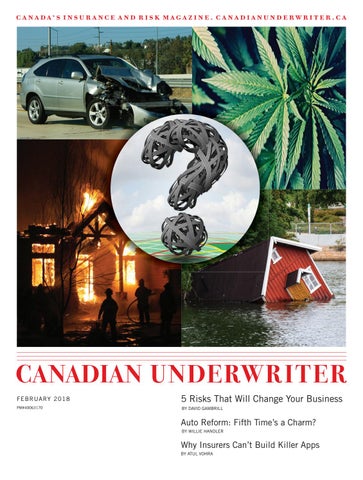
5 Risks That Will Change Your Business
PM#40063170
BY DAVID GAMBRILL
Auto Reform: Fifth Time’s a Charm? BY WILLIE HANDLER
Why Insurers Can’t Build Killer Apps BY ATUL VOHRA
We’re putting our money where our mouth is. Tom Reikman, SVP & Chief Distribution Officer
$125M may sound like a lot to invest in a policy administration system, but, to Economical, it’s money well spent. That’s because, as the backbone of our business, our broker partners have always deserved our best. You’ll experience an extraordinary ease of doing business, improved underwriting capabilities and service, and advanced analytics to drive profitable growth.
Get ready for the future, with us. economical.com/brokers PROPERTY | AUTO | BUSINESS
Economical Insurance includes the following companies: Economical Mutual Insurance Company, The Missisquoi Insurance Company, Perth Insurance Company, Waterloo Insurance Company, Family Insurance Solutions Inc., Sonnet Insurance Company, Petline Insurance Company. ©2018 Economical Insurance. All rights reserved. All Economical intellectual property, including but not limited to Economical® and related trademarks, names and logos are the property of Economical Mutual Insurance Company and/or its subsidiaries and/or affiliates and are registered and/or used in Canada. All other intellectual property is the property of their respective owners.
VOL. 85, NO.1, FEBRUARY 2018
CANADIAN UNDERWRITER
CANADA’S INSURANCE AND RISK MAGAZINE. PUBLISHED BY NEWCOM BUSINESS MEDIA INC.
www.canadianunderwriter.ca
COVER STORY
Costly Future Claims professionals have identified five evolving risks that will change the way you do business. BY DAVID GAMBRILL
20 FEATURES
15
27
31 39
Claims Robots
Sole Consequence
New Cyber Opportunities
Killer Apps
Robots can be your friends. They cut down the tedious work associated with claims processing, allowing you to focus on your clients.
How one word, ‘solely,’ limited the scope of coverage for additional insureds in an Ontario court decision.
Your clients will soon be required to report data breaches to all affected individuals and the privacy office. Here’s how you can help.
Why it’s not worth your money and effort to try and build a killer app.
BY MICHAEL S. TEITELBAUM
BY EDUARD GOODMAN
BY MONICA KUZYK
17
BY ATUL VOHRA
29 35
Play it Again
Fraud Squad
Adjusting Hazards
Ontario has announced yet another auto insurance reform initiative. Will it bring down insurers’ claims costs this time?
Insurers hope Ontario’s new office of dedicated fraud prosecutors can put the brakes on insurance fraud.
What claims professionals must do when they find an environmental hazard while adjusting a loss.
BY WILLIE HANDLER
BY KIM DONALDSON
BY CHRIS CIASNOCHA, JOELLE REID, AND JEFF REITSMA
February 2018 Canadian Underwriter
3
VOL. 85, NO.1, FEBRUARY 2018
PROFILE Editor-in-Chief
Managing Director, Insurance Media Group
David Gambrill
Ian Portsmouth
david@canadianunderwriter.ca (416) 510-6793
ian@canadianunderwriter.ca (416) 510-6800
Associate Editor
Greg Meckbach
Director, Business Development
gmeckbach@canadianunderwriter.ca (416) 510-6796
Sandra Parente sandra@canadianunderwriter.ca (416) 510-5114
Online Editor
Jason Contant
Account Manager
jcontant@canadianunderwriter.ca (416) 510-6893
Michael Wells mike@canadianunderwriter.ca (416) 510-5122
Art Director
Production Manager
Gerald Heydens
Karen Samuels
Circulation Manager
(416) 510-5190
Mary Garufi
Print Production Manager
mary@newcom.ca (416) 614-5831
Phyllis Wright
12 Global Picture
Published by
NEWCOM MEDIA INC. 451 Attwell Dr., Toronto, ON M9W 5C4 (416) 614-2200 • (416) 614-8861 (fax)
Chairman and Founder
President
Jim Glionna
Joe Glionna
Vice President, Operations
Controller
Melissa Summerfield
Peter Fryters
Karen Gavan has kept a low profile since retiring as CEO of Economical Insurance, but she’s about to step onto the world stage as a board member of the world’s largest reinsurer. BY GREG MECKBACH
Director of Circulation
Pat Glionna
Canadian Underwriter is published twelve times yearly by NEWCOM MEDIA INC. All rights reserved. Printed in Canada. The contents of this publication may not be reproduced or transmitted in any form, either in part or in full, including photocopying and recording, without the written consent of the copyright owner. Nor may any part of this publication be stored in a retrieval system of any nature without prior written consent. © Since 1934, Canadian Underwriter has been the voice of Canada’s insurance industry - a monthly magazine providing the highest quality and most relevant news and insight to insurance professionals from all segments of Canada’s property and casualty insurance market. The magazine is delivered on a direct-request circulation basis to nearly 15,000 senior decision makers nationally, including insurance brokers, risk managers, insurance and reinsurance company personnel, claims managers and adjusters. Since its beginnings, Canadian Underwriter has been a link between all segments of the insurance industry, providing insurance professionals with award-winning coverage of industry issues, trends, news, personalities and events - written by Canada’s leading insurance journalists.
Subscription Rates: 2018 Canada 1 Year $51.95 plus applicable taxes 2 Years $75.95 plus applicable taxes
Subscription Inquiries/Customer Service Mary Garufi (416) 614-5831 mary@newcom.ca
Single copies $10 plus applicable taxes, except $49 plus applicable taxes for July issue featuring annual Statistical Guide.
GST Registration number 890939689RT0001 Second Class Mail Registration Number: 08840 Publications Mail Agreement #40063170
Elsewhere 1 Year $71.95
Return undeliverable Canadian addresses to: Circulation Dept. Canadian Underwriter 80 Valleybrook Drive, Toronto, Ontario M3B 2S9
FOCUS
6 Editorial 8 Marketplace 42 Moves & Views 45 Gallery
Member
ISSN Print: 0008-525 ISSN Digital: 1923-34
4
Canadian Underwriter February 2018
Markel. Expect more from your insurance carrier
Commercial general liability Cyber risks insurance Directors and officers liability Environmental impairment liability Life sciences Professional liability Property and inland marine Security and protection industry Umbrella and excess liability
Helping brokers with effective insurance solutions since 1966 Calgary Montreal Toronto Vancouver www.markelinternational.ca
EDITORIAL
Some assembly required
“It’s time for the industry to provide clear direction to our elected officials. Pick an auto insurance model that works, and sell it to the politicians.” David Gambrill Editor-in-Chief Canadian Underwriter david@canadianunderwriter.ca
6
Canadian Underwriter February 2018
Auto lines across Canada are in dire need of repair right now. In a fairly benign year, with virtually no major catastrophe events, the Canadian property and casualty industry still came dangerously close to losing money, posting a relatively disappointing overall combined ratio of 96.8 per cent. How could that happen? Blame the car. The financial results in auto lines last year basically squandered an opportunity for the industry to put money in the bank for a rainy day in 2018. Reasons for the poor auto results vary. They include distracted driving, increased liability awards, higher repair costs, damage/injuries caused by uninsured drivers, auto insurance fraud, generous nofault compensation, inflexible regulatory regimes for setting rates, etc. etc. How bad is the situation? Auto insurers generally get nervous when their loss ratios start to approach 60 per cent. Contrast this with the following loss ratios posted in auto lines last year, based on MSA Research statistics: New Brunswick 90%, Nova Scotia 86.9%, Newfoundland 84.3%, Alberta 82.7%, and Ontario 72.7%. A blip on the radar? A bad year? Insurance professionals only wish. The auto personal accident line has been deteriorating since 2012, A.M. Best reports. So what do insurers do about it? Historically, the industry has lobbied governments to fix it.
To their credit, politicians throughout the country have heeded the call, vowing to introduce the latest, greatest sweeping changes to auto insurance. However, their insistence on low rates for consumers, regardless of the risk certain drivers may represent to insurers (and the public), often further damages the auto product. In Ontario, where half of the country’s auto insurance premiums are written, four major reform initiatives and public consultations since 1999 have been a total write-off. Back in 2010, it took the government seven years to complete a mandatory five-year review of auto insurance, only to introduce the final reform package in a piecemeal manner, without a catastrophic impairment definition in place. Five years later, Ontario’s 2015 reform package once again failed to bring down insurers’ claims costs. The province subsequently commissioned an expert to undertake a thorough review of the system; he outlined 35 new recommendations for reform. The province proceeded to contemplate its navel for the better part of a year -- until now, an election year. Now that Ontario politicians are currying favour with the public, it’s anybody’s guess whether the province’s most recent reform package, announced in December, will see the light of day. If not, the opposition parties are keeping their cards close to the vest regarding alternatives. It’s probably safe to say they don’t have a clue either. Ban territo-
rial ratings? Introduce public auto? Anything is possible in the province of never-ending auto reforms, where a hybrid no-fault and tort system is clearly not working. Which brings us to the obvious conclusion: The industry should not leave auto insurance reforms to the politicians. That’s like tossing the keys to your Ferrari 488 Spider into the outstretched palms of your 16-year-old son. To be fair, most politicians don’t know how to change insurance because they don’t understand it. They need help. Here’s where P&C industry professionals come in: they need to educate our elected officials about proven and successful models for bringing down claims costs — and hence, consumer premiums. To do this, the insurance industry needs to figure out which auto insurance models work best, and under what conditions. Should the model be a no-fault system? A pure tort system? Some hybrid model between the two? What about a Quebec model, in which the insurers fix the cars, and the government looks after the injured drivers? Whatever the model, insurers should be able to supply ample actuarial data to help our elected representatives figure out how to strike the appropriate balance between product affordability and profitability. It’s time for the industry to provide clear direction to our elected officials. Pick an auto insurance model that works, and sell it to the politicians.
You can expect more at Trisura.
Find out more about our industry leading specialty insurance and surety solutions at www.trisura.com
a step above
Trisura Guarantee Insurance Company is a Canadian owned and operated Property and Casualty insurance company specializing in niche insurance and surety products. We are a proud supporter of the Insurance Broker’s Association of Canada.
MARKETPLACE
Canadian Market P&C MUTUALS LINE UP AGAINST DEMUTUALIZATION Two years after Economical left the gate on the track to demutualization, the Waterloo, Ont.-based mutual insurer appears to be the lone horse among its industry peers. Four Canadian life insurers demutualized in 1999-2000 but regulations allowing mutual property
and casualty insurers to demutualize have only been law for two years. Manitoba-based Wawanesa Mutual Insurance Company has “no plans to demutualize,” Wawanesa CEO Jeff Goy said in a statement to Canadian Underwriter. Ditto for Lindsay, Ont.based Commonwell Mutual Insurance Group – which, unlike Economical and
INSURING HOMES ON WHEELS Aviva Canada has joined the RV adventure, insuring the expansion into Canada of Outdoorsy, an online platform to rent recreation vehicles. Outdoorsy is billed as the largest online RV rental marketplace, allowing RV owners to rent their units to people traveling across Canada or the United States in motorhomes, campervans, travel
trailers and adventure vehicles. It has 140,000 users in the United States, and boasts 1.2-million interactions, with 240,000 vacation nights booked through the U.S. platform. Aviva Canada has underwritten a $2-million, third-party liability
8
Canadian Underwriter February 2018
Wawanesa, could not legally demutualize in any case because it is not regulated by the federal government but by the Ontario government. Ontario would have to have “regulations developed and enacted and put in place before we could even consider” demutualizing, Commonwell CEO Tim Shauf said in an interview. “We
insurance program in partnership with Outdoorsy and backed the company’s launch in Canada. The fleet policy covers Outdoorsy for RV units rented on the Outdoorsy platform. Plus, Aviva Canada saw an opportunity to offer personal property coverages for certain types of RV units. For example, RVs might be driven into a trailer park, and then the plates are taken off while the RV owners stay parked in the location for any number of seasons. “Anything that’s plated is covered under the auto [policy], but you will have some units that aren’t plated,” said Daniel Ignoto, vice president of lifestyle personal insurance at Aviva Canada. “Some customers might have a parked model unit that you would leave in a park, and it’s still considered part of the RV lifestyle. That can’t be insured on an auto policy, so that would be insured under a property policy.”
don’t have any intentions of demutualizing ourselves,” he added. In addition to Wawanesa and Economical, other federally-regulated P&C mutuals include Portage, The Kings, Saskatchewan, Heartland Farm and Gore, the latter of which announced earlier that its board of directors voted not to demutualize.
POLITICIANS OPPOSE TERRITORIAL RATING Using postal codes to determine auto insurance rates could come to an end if the Progressive Conservatives win the next Ontario election, which is scheduled to be held on or before June 7, 2018. “Geographic discrimination should be eliminated while not raising rates on other parts of the province,” a spokesperson for PC finance critic Vic Fedeli wrote in an email to Canadian Underwriter. When asked about its plans for Ontario auto insurance, if elected, NDP told Canadian Underwriter it “will end discriminatory insurance rates that hit low-income people the hardest.” When asked about which rates it considered to be discriminatory, the NDP spokesperson said merely, “We’re not making any platform announcements today. Stay tuned!” The Ontario opposition’s party stances appear to be at odds with the industry’s position on using territory as one of several factors in assessing risk. Insurers have told their industry association, the Insurance Bureau of Canada (IBC), that territory is actually a good predictor of risk. Plus, reducing rates for certain territories doesn’t address the core problem of rising claims and auto insurance fraud, IBC told Canadian Underwriter. The industry has been warning for years of clinics invoicing insurers for services that were not actually rendered, staged collisions and other methods of fraud.
MARKETPLACE
Claims NEW CHIEF JUSTICE PENNED DECISION AGAINST INSURERS IN LEDCOR Supreme Court of Canada Justice Richard Wagner, a judge who wrote landmark rulings against Northbridge, RSA, Sovereign General and other Canadian insurers, is now Chief Justice of Canada.
AUDITOR ON THE HOOK AFTER FAILING TO DETECT WHITE-COLLAR CRIME Auditing firm Deloitte must pay $40 million in damages to a Canadian broadway musical company whose founders perpetrated a fraud that the auditor failed to detect, the Supreme Court of Canada ruled in a recent divided decision. Canada’s highest court allowed, in part, Deloitte’s appeal of an Ontario Appeal Court decision. That ruling was characterized by Deloitte as a finding that a corporation should “effectively be indemnified by its auditor for the disproportionate losses suffered by stakeholders.” Livent produced Phantom of the Opera and Joseph and the Amazing Technicolor Dreamcoat, among other shows. Livent successfully sued Deloitte after it went into receivership in 1999. Garth Drabinsky and Myron Gottlieb were sent to jail for fraud and forgery in 2009, 20 years after founding Livent
Wagner will succeed Beverly McLachlin, who retires Dec. 15 after serving for 17 years as Chief Justice and 28 years on the Supreme Court of Canada. Wagner penned the Supreme Court of Canada’s 2016 ruling in Ledcor Construction Ltd. v. Northbridge Indemnity Insurance Co., in which he noted that the insurers promised to cover ‘physical damage [that] results’ from...‘faulty workmanship.’” Wagner also wrote the Supreme Court of Canada’s 2013 ruling upholding convictions in Quebec against The Sovereign General Insurance Company, resulting in $560,000 in fines against the insurer. A Winnipeg-based broker, Flanders, was not licensed in Quebec but had placed policies for a vehicle financing firm with Sovereign General.
and 11 years after being fired by new management. Livent’s receiver filed its lawsuit against Deloitte in 2002. Deloitte argued at trial in 2013 that Livent’s losses were caused by Livent’s own illegal acts. But in 2014, Justice Arthur Gans of the Ontario Superior Court of Justice awarded Livent $84.75 million ($118 million including interest), finding that Deloitte failed to meet its professional standard of care as an accounting firm. The Supreme Court of Canada knocked the damages down to $40 million in its Dec. 20, 2017 ruling, but reiterated the liability of the auditor.
DRIVER FAILS TO YIELD, AWARDED $151,000 In another reminder of the high costs of settlements in Ontario’s auto insurance industry, a driver convicted of failing to yield the right of way after turning into the path of a different vehicle has nonetheless collected $30,000 from the other motorist and was awarded an additional $151,000 in legal costs. In Duncan v. Taylor, the Superior Court of Ontario considered the case of Ontario motorist David Duncan, who was catastrophically injured in a collision. Although Duncan was convicted under the Highway Traffic Act for failing to yield when he made a left turn directly into the path of the vehicle driven by Charles Taylor, he sued Taylor for general damages and loss of income, claiming Taylor was speeding at the time of the accident. Competing forensics reports did not resolve the issue, and the parties settled. The settlement required Taylor to pay $30,000 for all damages, plus Duncan’s legal costs determined by the court. Duncan sought $202,323 in legal fees, but Justice Bryan Shaughnessy reduced the amount to $151,045. “The case was not unduly complex and having three lawyers plus a law clerk working on the file appears to be excessive when one considers the obvious liability hurdle from the date of the accident,” Shaughnessy ruled.
February 2018 Canadian Underwriter
9
MARKETPLACE
Technology NOT ALL DRIVERS ARE FANS OF TELEMATICS’ Opportunities for brokerdriven, usage-based auto insurance are likely down the road, but brokers are telling a large Canadian mutual that their insurance customers don’t want their insurers monitoring how they use their vehicles. “Our brokers are advising us that our customers are not fans of telematics,” Wawanesa chief strategy officer Carol Jardine told Canadian Underwriter. Insurers using telematics to determine auto rates include The Co-operators Group Ltd., Canadian Automobile Association (CAA)’s club in south central Ontario, Intact Financial Corp. and Desjardins General Insurance Group.
Some insurers monitor the times their customers drive, total distance driven, and behaviour such as sudden acceleration and hard braking. Ontario’s regulator allows carriers to offer discounts for low-risk behaviours, but does not let carriers raise rates for risky behaviours. “Our customers that buy from our brokers do not wish to have a telematics device installed in their car,” Jardine said. “Whether they are concerned about privacy, or monitoring of their driving behaviour, lots of people don’t like telematics and our brokers are telling us that the customers who like telematics are not the customers of our brokers.”
HOW INSURERS SPEND TECH FUNDS For all the discussion about artificial intelligence, big data and the Internet of Things (IoT), in the real world of IT, Canadian property and casualty insurance companies are currently investing in projects that will allow their core legacy technologies to provide more consumercentric services in the future. “When it really comes to the money that an insurance company has to spend over the year in technology, usually 90 to 95 per cent is going to what we call ‘the basement,’” said Sven Roehl of msg global solutions Canada. “It’s literally going into the legacy environment.” Roehl facilitates The Cookhouse Lab, Toronto’s first insuretech open innova-
tion lab, a forum in which Canadian property and casualty insurance companies develop IT solutions. And so what kinds of tech are insurance companies working on right now? Insurance companies are primarily looking into cloud services — for example, application programming interface (API) services that can be embedded into the existing landscape. In several Cookhouse Lab projects, multiple p&c insurers are working together to explore industry tech solutions for particular opportunities. “They are looking into commerce solutions so they are ready to compete with organizations like banks, for example, that have created a very good online experience for their customers,” Roehl said.
Risk Management SEXUAL HARASSMENT: ARE YOUR COMMERCIAL CLIENTS PROTECTED? With a recent spate of sexual misconduct and workplace harassment complaints, commercial brokers need to make sure employment practices liability insurance covers legal defence costs arising from allegations of poor behaviour towards workers. Workplace harassment of all types, from sexual harassment to bullying, verbal abuse and discrimination, is becoming more openly discussed in even the most privileged workplaces, and tolerance for such behavior is at an all-time low, Toronto-based employment lawyer Laura Young wrote in an email to Canadian Underwriter. 10 Canadian Underwriter February 2018
Employees suing for harassment will sometimes name the employer and its directors and officers, in addition to the person alleged to have committed the harassment, says James Bennett, manager of executive solutions at Trisura Guarantee Insurance Company. Therefore, when advising commercial clients, brokers should ensure that employment practices liability policies cover defence costs for the employer and its directing officers for civil, criminal, administrative, regulatory mediation and arbitration proceedings. “Brokers should be looking to make sure that the employment practices liability policy includes wrongful acts arising out of employment, whether it be sexual harassment, discrimination, or workplace bullying,” said Bennett.
Canada’s First Online Buyer’s Guide NATIONAL
Insurance brokers! Find the specialized insurance coverage your clients need in the National Insurance Marketer: Canada’s original online directory of specialty, niche and non-standard insurance products, redesigned for 2017.
• Find markets for 100s of risks, from air conditioning to zebra mussels • Fully searchable by product and provider • Continually updated by carriers, MGAs and wholesalers themselves • Query providers directly from the site
Save time. Satisfy more customers. www.InsuranceMarketer.com Prefer print? You can still order your 2017 edition of the National Insurance Marketer for just $10. www.CanadianUnderwriter.ca/buynim
PROFILE
Gavan’s Global Perspective Greg Meckbach
PROTECTION GAP
Associate Editor
One of her chief objectives with Swiss Re is to reduce “protection gaps,” the difference between economic and insured losses. Worldwide, economic losses from natural and man-made disasters in 2017 totaled US$306 billion, while insured losses were $136 billion, Swiss Re figures for December show — a gap of US$170 billion. Gavan says there will continue to be large gap unless insurance penetration rates increase. “Even Canada has a significant protection gap,” says Gavan, referring to a Swiss Re report released this past July, Earthquake risk in eastern Canada: mind the shakes. Swiss Re predicts Montreal homeowners could experience $45 billion in economic losses if a 5.8-magnitude earthquake were to hit the city. A magnitude 5.0 earthquake bordering Ottawa and Quebec happened in 2010. A medium-strength earthquake striking close to Montreal, Ottawa or Quebec City “would be the most destructive disaster” that Canada has ever experienced, Swiss Re added in the report. “While about 65 per cent of homeowners in Vancouver and Victoria have earthquake coverage, across all of eastern Canada between 95 and 98 out of 100 homes are
Karen Gavan once led Economical Insurance in its pursuit to demutualize. Now retired, she is nominated to enter the boardroom of the world’s largest reinsurer. Huge gaps in earthquake coverage in eastern Canada, the impact of climate change on property damage, and harmonizing regulations across the globe are all top of mind for Karen Gavan, the former CEO of Waterloo, Ont.-based Economical Insurance. Perhaps best known in the Canadian property and casualty industry for leading Canada’s first P&C mutual insurer into the demutualization process, now Gavan is poised to enter the boardroom of global reinsurer Swiss Re. Based in Toronto, Gavan was nominated for election as a non-executive and independent member of the board of Swiss Re America Holding Corporation, which tops A.M. Best Company Inc.’s list of global reinsurers as ranked by premiums. 12 Canadian Underwriter February 2018
uninsured against earthquake losses,” Swiss Re noted. The vast majority of eastern Canadian homeowners are declining to buy earthquake coverage because they “really don’t think it’s going to happen – not this year,” Gavan said. “There’s a huge opportunity for an increased understanding and education of consumers globally about the risks they face and what they can do to protect themselves.”
DEMUTUALIZATION AND BEYOND Raised in Thunder Bay, Ont., Gavan is a chartered accountant by trade. In the 1980s, she worked for Coopers & Lybrand, which merged 20 years ago with Price Waterhouse to form PwC. She audited a number of life and P&C insurers for about six years before joining Prudential of America. Gavan went on to work for Imperial Life and was working for Canada Life at the time it demutualized in 1999. She was chief financial officer for Transamerica when she left the firm in 2005. For the next six years, she served on various boards of directors, joining Economical’s board in 2008. In 2010, Katherine Mabe left Nationwide Insurance Company of America to join Economical as CEO, but she
resigned the following year to work in the United States for Allstate. To replace Mabe, Economical’s board asked Gavan to step in as CEO of Economical for five years. “At that time, I had been sitting on a number of boards,” Gavan said. “Prior to that I spent more of my career in life insurance side.” Her previous experience with the Canada Life demutualization proved to be valuable in 2015,
“Risks don’t follow national borders, so the lack of harmonized global regulation makes delivery of the product globally a lot more complicated.” when Gavan was CEO of Economical. Under her leadership, Economical became the first federally-regulated P&C mutual whose board of directors and mutual policyholders voted in favour of demutualization. Economical still needs to clear several more hurdles, including federal government approval, before it can demutualize. The process would lead to an initial public offering (IPO) of stock.
PROFILE
retirement is not having to do the commute” from Toronto to Waterloo on Highway 401, she quips.
Photo courtesy of Economical Insurance
CLIMATE CHANGE AND INSURANCE
Economical made a number of other changes with Gavan at the helm. Among them, it closed its Hamilton, Ont. and Moncton, N.B. offices in 2013, acquired Winnipeg-based Western Financial Insurance Company (which provides pet insurance through the PetSecure brand), and launched direct writer Sonnet in 2016.
After retiring from Economical in 2016, Gavan continues to sit on the boards of both Mackenzie Financial and Swiss Re America. Since leaving Economical, “I have laid pretty low in terms of the industry and the profession,” Gavan says. “The best part of
At Swiss Re, Gavan will be looking at the global picture, including climate change. A major issue for the industry right now is global warming, which is causing rising sea levels, flooding, increased severity of storms and wildfires, Gavan noted. “Literally California has been burning all fall,” Gavan said, adding 2017 has been one of British Columbia’s worst wildfire seasons. More than $127 million in insured damage was caused by wildfires in British Columbia, Insurance Bureau of Canada (IBC) reported earlier, quoting Catastrophe Indices and Quantification Inc. (CatIQ). At press time, thousands of people north of Los Angeles remained under evacuation order, while California’s state government reported more than US$9 billion in insured losses from wildfires earlier this year in the northern part of the state. “All that is part of climate change,” Gavan said of the California and B.C. wildfires.
GLOBAL REGULATIONS In addition to extreme weather, the lack of regulatory harmony across jurisdictions is also a concern for the P&C industry. “That’s a challenge because it really is a global industry,” Gavan said. “Risks don’t follow national borders, and so the lack of harmonized global regulation makes delivery of the product globally a lot more complicated.” Worldwide, regulators are focused on “the use of big data and advanced analytics,” Gavan said. But the consistency of regulating data is proving to be a challenge for insurance organizations. “It’s the data you can use in the underwriting and the provision of the product I am concerned with,” Gavan said. “Because our industry is highly regulated, putting limits and constraints on its use constrain our ability to meet customer expectations.” Consumers tend to expect things to be delivered as easily as they can order rides on Uber or rooms through Airbnb, she said. “But when regulators put constraints on how and where you can use big data and advanced analytics, it will challenge our industry’s ability to really leverage technology and digital innovation to simplify the products and the delivery to the end consumer.” February 2018 Canadian Underwriter
13
REGISTER NOW! February 27-28, 2018 BEANFIELD CENTRE, TORONTO
Insurance Vectors in Play: Risk, Technology, Engagement The 2018 Insurance-Canada.ca Technology Conference The business of insurance is undergoing fundamental changes, driven by: • Rapidly emerging exposures including Smart Homes, Internet of Things, Cyber Risk, Autonomous vehicles – all are creating new risks and new opportunities • Customer experience is much more than a slogan. New technologies are emerging to detail client preferences and significantly improve sales. • Digital technologies are replacing expensive, low-value manual tasks, offering real-time results, and providing opportunities for personalized value-add benefits. Forward thinking insurance organizations are developing in-house digital production facilities to achieve the previously unthinkable in product, service and support.
One thing is clear: This is not insurance as usual THE ICTC 2018 PROGRAM WILL HELP YOU UNDERSTAND A SPECTRUM OF OPPORTUNITIES, INCLUDING:
• • • • •
Delivering a Next-Gen Experience Differentiation Through Data Science Integrating Telematics Data in Claims Blockchain: Future of Insurance? How to Train Your Artificial Intelligence
• • • • •
Extreme Weather Risk in Canada CX: Path Ahead for Insurance Changing Shape of Mobility and Insurance Insurers meeting generational expectations Connected Customers and Brokers
Additional information and registration: www.insurance-canada.ca/ictc If you are interested in sponsor opportunities, please contact: Kathryn Bertsch 437-222-4222 Ext 244 kathryn.bertsch@insurance-canada.ca
PRESENTED BY
I, Robot
Monica Kuzyk Vice President Claims Curo Claims Services
Overcoming our fear of robots will allow our best people to focus on the customer at the time of claim, when they need us most. Emerging technologies are poised to change our claims industry. Robotic process automation has already made a significant impact by reducing manual work, creating capacity and alleviating strain from adjusters who are regularly inundated with repetitive data entry tasks. Our office provides an illustration of how automating processes through robotics can help streamline your claims operations. When considering automation within our organization, we identified “non-value-added” processes as the area of greatest opportunity. Such processes are non-customer facing and human intervention adds little value. These are the tasks you don’t like to do: they are very repetitive and, in the words of claims staff, they are “tedious” and “uninteresting.” Our staff readily identified processes perfect for automation.
Next, staff qualified in process mapping — people with a demonstrated commitment to reducing complexity, and who have a fulsome understanding of the customer experience — came together to work with the robotics provider to develop a project plan. Recognizing that the robot imitates human keystrokes and mouse clicks, the team identified the mail process as a “pilot process” for automation. The mail process had already been partially automated through scanning, thanks largely to the paperless claims environment since 2002. But robotics provided greater process automation of the entire workflow, including data entry and identification of mail items requiring immediate escalation. It also allowed for a non-invasive, compatible functionality with the claim system. The initial automation deployment took approximately five months, from process development and launch to the point when we could “trust” the new system would function as intended. Our claims team adapts quickly to change and is committed to continuous improvement. They are eager to try new things, naturally curious and always look to ensure the work they are doing matters. As true pioneers, they now continually
February 2018 Canadian Underwriter 15
look to identify additional processes to automate. As additional processes are automated, the period between the initial programming and launch times has narrowed. As part of our evolution, we came to understand that robotics can be implemented in addition to existing programs. A robot can be launched outside of normal business hours, and it is able to retrieve data from multiple sources in mixed formats. Automating data retriev-
Rather than a nice-to-have, robotics has become a necessary component within the claims value stream. al reduces errors and prevents inconsistencies in the claims handling process. Also, software robots are scalable with
Canada’s leading provider of pre and post-loss appraisal and consultation services. SPECS provides the insurance industry with expert, impartial, and comprehensive structural consultation. Our customers benefit from precise valuation of damages, accurate reserves, a reduction in claim cycle times and enhanced claimant satisfaction. Trust SPECS to assist with any residential, commercial, industrial or CAT claim.
SERVICES • PROPERTY LOSS SCOPE AND ESTIMATING • BID ANALYSIS AND MANAGEMENT • PROJECT MANAGEMENT AND CONSULTING DIVISIONS • TECHNICAL SERVICES • CONTENTS APPRAISAL • STORM AND CATASTROPHE BENEFITS • REDUCED CLAIM AND PROJECT TIMELINES • EFFECTIVE EXPENSE AND COST CONTROL • PRECISE VALUATION OF DAMAGES
2017 2018 © All rights reserved. Specialized Property Evaluation Control Services Limited
16
Canadian Underwriter February 2018
specs.ca 888-737-7327
24/7 capabilities; as a result, a robot can be leveraged for process automation in other areas of the business. It is understandable that some claims staff may be anxious at the thought of robotic automation. The idea that a software program could replace a daily task that a human has completed every day can be overwhelming. The “fear factor” associated with the assumption of job loss is real despite leadership’s regular reassurances to the contrary. Organizational change management can assist in supporting adaptation. Creating a customized plan for ensuring that
affected employees receive the awareness, coaching, and training they need through the change and transition is an important part of the process. Every staff member must understand the answer to the question, “What’s in it for me?” Our journey to automation is defined by the need to create capacity for growth, and to ensure that our claims staff are focused on meaningful work that adds value to the consumer experience. Creating a compelling vision that resonated with the staff created a greater opportunity for success. Recognizing that successful claims processing is fundamental to maintaining a competitive advantage, we will continue to see the increased use of robotics, artificial intelligence and machine learning in our industry. Rather than a “nice-to-have,” robotics has become a necessary component within the claims value stream. Automation enables us to think creatively, work differently, and to ensure our best people remain focused on the customer at the time of claim, when they need us most.
Play it Again, Sam
Opinion/Analysis
Key features of Ontario’s latest auto reform package have been attempted before – and ended in heartbreak. Willie Handler Consultant Willie Handler and Associates
Once again, Ontario has announced another package of auto insurance reforms. With a provincial election just months away, the Ontario government recently announced yet another plan to make auto insurance affordable for Ontario drivers. The plan is focused on addressing fraud and providing better access to care. The announcement by Charles Sousa, Ontario’s minister of finance, along with attorney general Yasir Naqvi, follows several months of consultation with a broad range of stakeholders regarding David Marshall’s report, Fair Benefits Fairly Delivered: A Review of the Auto Insurance System in Ontario, released in April 2017. Marshall’s report contained 35 recommendations to reform the auto insurance system.
I reviewed Marshall’s report and the province’s subsequent announcement in December 2017 with interest. I spent more than 20 years of my professional life designing similar reform packages and have a good sense of how the Ontario system will respond to Marshall’s proposed reforms. Although the government’s plan announced in December 2017 purports to flow from Marshall’s report from last spring, only the creation of a new network of independent evaluation centres [IECs] originated from Marshall’s report. Programs of care and contingency fees, announced in December and mentioned in Marshall’s report, are work already underway by the government. Marshall, an advisor to Ontario’s finance minister on auto insurance and pensions, never dealt with fraud. For me, Ontario’s plan is an admission that the Marshall report does not provide much in the way of workable solutions for the government. It would be a stretch to suggest that there will be savings derived from the proposed IECs. The system will not cease to be adversarial with the introduction of the IECs just as the Designated Assessment Centres (DACs) had no impact. Lawyers and insurers will continue to access their own medical opinions.
February 2018 Canadian Underwriter 17
With an election on the horizon, there is little time for the government to implement their plan. What will happen to this plan following the election is unknown at this time. Other than providing more resources to combat fraud, there is little here to provide premium relief for consumers. Considering how long it takes to prosecute a fraud case, those savings are years away.
WHAT’S IN ONTARIO’S PLAN
that programs of care will simplify access to treatment and reduce disputes in the system. If that does occur, it will potentially reduce some of the transactional costs in the system. Will statutory accident benefits (SABS) be simplified when the programs of care are introduced? Will the number of disputes drop? That did not occur with the introduction of the minor injury guideline. It can’t be assumed that programs of care will significantly
The government will be establishing a panel to guide the enactment of proposed reforms, which include: • Standard treatment plans (programs of care) for common collision injuries (soft tissue injuries) and changing the emphasis from cash payouts to ensuring appropriate care. • Reducing disputes by instituting independent examination centres. • Launching a Serious Fraud Office in spring 2018. • Directing the Financial Services Commission of Ontario (FSCO) to review territorial rating factors used by insurers. • Ensuring that lawyers’ contingency fees are fair, reasonable and more transparent. Programs of Care I initiated the Programs of Care project before I left FSCO in 2011 and agree with its introduction. Led by Dr. Pierre Côté, the work on developing programs of care was completed in three years. Long overdue, this aspect of the Marshall recommendations and subsequent government announcement has been in development for six years. Programs of care were first developed by the Workplace Safety and Insurance Board (WSIB) to deal with low back pain. The initial whiplash associated disorder guidelines were created in 2003 based on the WSIB low back pain program of care. FSCO had undertaken to develop programs of care for a range of soft tissue injuries. An interim solution was the introduction of the minor injury definition and minor injury guideline in 2010. The expectation is 18
Canadian Underwriter February 2018
change the landscape. The WSIB experience will not necessarily be duplicated in the Ontario auto insurance system because the structures of the two systems will continue to be fundamentally different. The government would like to move away from cash settlements. Prior to the introduction of the Ontario Motorist Protection Plan (OMPP) in 1990, it was standard procedure to settle minor lawsuits. The introduction of the OMPP was intended to address the needs of accident victims with minor injuries so that they could access wage loss and rehabilitation without the need to sue. Cash settlements undermine the principles of no-fault. In his 2014 report, Ontario Automobile Insurance Dispute Resolution System Review, Douglas Cunningham, now an arbitrator and a former associate chief justice of the Ontario Superior Court of
Justice, acknowledged that cash settlements could be counter-productive. But he compromised in the end by recommending that settlements be prohibited in the first two years of a claim. A settlement prohibition is more feasible in a pure no-fault system such as the WSIB. However, Ontario’s auto insurance system provides access to tort. If there is a tort claim, the lawyers often push for a cash settlement with the first-party payer because the third-party payer is only responsible for damages in excess of the SABS. Independent Examination Centres (IECs) The government continues to support Marshall’s recommendation that a network of IECs be created to provide neutral assessments of auto collision injuries. Fortunately, the government has backed away from locating IECs in public hospitals. However, IECs are a bad idea. It sounds like a great concept, but it’s been tried before and failed. I had the policy lead when the former DACs were introduced in 1994. The language we used back then was identical to what appeared in the recent government plan. IECs reflect Marshall’s lack of institutional memory and understanding of the auto insurance industry. I learned a few things through the DAC experience. When you are conducting over 100,000 assessments each year, you need a lot of physicians and other allied health professionals. That means you will have to rely on the same professionals who provided assessments to legal representatives and insurers. No matter what measures you take through standard guidelines and protocols, fee schedules, accreditation, no one will consider these assessors to suddenly become neutral. The criticisms directed at the current assessors will follow them when they join IECs. IECs will require substantive oversight just like the DACs did. This will not only require a government bureaucracy to support IECs, but will likely increase administrative requirements for the assessment providers. Currently,
the average insurer examination costs under $1,400 based on HCAI data. The last DAC fee schedule (dated February 2004) contained much higher fees: assessing treatment, $2,000; assessing disability, $3,900; assessing attendant care needs, $2,600; and no cap on catastrophic impairment assessments. I predict assessment costs will rise under the IECs. Marshall uses New Jersey’s dispute resolution mechanism as an example of where a neutral medical review is successfully being used. Marshall has misinterpreted the New Jersey system. I spoke to officials from New Jersey on behalf of Justice Cunningham as part of his review of the auto insurance dispute resolutions system. The New Jersey medical reviews are peer reviews; they do not involve an examination of the claimant. They are not automatically conducted — one of the parties needs to request a review. The claimant and insurer still conduct their own medical assessments, upon which the neutral
medical reviewer comments. As well, the arbitrator does not always follow the opinion of the medical reviewer. As is the case in New Jersey, establishing IECs will not eliminate the need for provider and insurer-initiated assessments. Despite the insurance industry’s strong support of the creation of IECs, I do not believe insurers will be willing to give up insurer exams. They are an important component in any private disability system. Instead, IECs have the potential to add another layer of assessments and costs, similar to the experience with the DACs. Serious Fraud Office For the third time in the past five years, the government has announced their intent to create a Fraud Office to deal with auto insurance fraud. Fraud was not mentioned by Marshall but raised by stakeholders during consultations. It would be nice if it happens this time.
Territorial Rating This aspect of the plan has me puzzled. Directing the regulator to look at territorial rating can only go two ways: 1) the status quo, or 2) adjusting some rates up and others down. Ultimately, the review will not reduce rates overall and I sense the government knows this. Reducing rates in the GTA will only increase rates in other regions of the province. Contingency Fees The Law Society of Upper Canada has been working on new rules for lawyers regarding contingency fees for more than a year. They’ve asked the government to approve new regulations to provide the legal regulator with the ability to enforce the new rules. This overlaps with a recommendation made by David Marshall and was included in the government auto insurance plan. Cracking down on contingency fee abuses will put more money in the pockets of claimants but will not reduce auto insurance rates.
February 2018 Canadian Underwriter 19
The Costly Future of Claims 5 evolving risks that will change the way you do business By David Gambrill
20 Canadian Underwriter February 2018
COVER STORY
Costly Future of Claims
1
Oops, the industry did it again. In 2017, Canada’s property and casualty insurance industry paid out a total of $1.33 billion in insured losses following catastrophic events primarily related to climate change. It’s the fifth time over the past seven years that the industry has paid out more than $1 billion annually in catastrophe claims. This year, the industry did it without benefit of a single whopper claims event such as the Fort McMurray wildfires (which cost the industry about $3.8 billion).
Climate Change
Annual $1-billion cat costs
“There are so many factors to relate to it,” said Laura Twidle, director of catastrophic loss analysis at Catastrophe Indices and Quantification Inc. (CatIQ). “People have more [flood] coverage, and more events are occurring
over populated centres. This summer, the cat season, we had a lot of hail events and thunderstorms throughout the Prairie provinces. It’s not that hard to hit the $25-million [cat] threshold when golf-ball-sized hail goes over a town like Red Deer [Alta.].”
Natural CAT Events Canada Top 1 1 CAT Events since 1983 Date and Place
Loss + Loss Adjustment Expenses (2016 $million)
Event
1
2016 May 03 - May 19; Alberta Fort McMurray
Fire
3,772.3
2
1998 Jan. Quebec, Ontario, New Brunswick
Ice storm
2,213.7
3 2013 June 19-24 Alberta - Southern Alberta
Flooding, Hail, Wind
1,910.3
4
Flooding, Wind
1,045.1
2013 July 8 - 9 Ontario - Toronto and other areas
5 2011 May14-17 Alberta - Slave Lake
Fire
794.6
6 2005 Aug. 19 Ontario
Hail, Tornadoes, Wind
750.5
7
Flooding, Hail, Wind
592.9
8 2010 July 12-13 Alberta Calgary and other areas in southern Alberta
Hail, Wind
584.1
9 2014 Aug. 7 to Aug 8, 2014 Alberta
Flooding, Hail, Wind
583.4
10 1991 Sept. 7 Alberta - Calgary
Hailstorm
531.5
11 2016 July 30 - August 1, AB, SK, MB
Hail, Windstorm, Flood, Water
462.5
2012 Aug 12-12 Alberta - region around Calgary
Source: IBC Facts Book, CatIQ, PCS, Swiss Re, Munich Re & Deloitte February 2018 Canadian Underwriter 21
COVER STORY
Costly Future of Claims
Those fancy big monster SUVs, with the gilded video screens for the kids, and the sensors that keep the kids safe in the TV commercials, are turning out to be a real headache for insurers. Why? Because it takes longer and costs more to repair them, increasing the severity of auto insurance claims. In its 2017 Q3 performance update, Intact Insurance said the trend of increasing physical damage claims in its personal auto lines were higher than expected, and was a central driver in the company reporting a combined ratio of 105.1% in the third quarter this year. Intact is one of several companies to observe that all kinds of sensors are now placed in car mirrors, bumpers and windshields. These sensors are supposed to help prevent crashes, but as Aviva Canada told Canadian Underwriter, they aren’t perfect. “More safety technology has been introduced in newer vehicles such as automatic emergency braking, lane keeping assist and lane departure warning, yet we have seen an increase in rear-ended collisions in the past year,” Aviva reported. This may be a consequence of other distracting technologies in the vehicle, including video screens and mobile devices. “More technological advances, in-car gadgets and cell phone use could mean more distracted driving,” Aviva says. “The RCMP says that in 4-out-of-5 collisions, drivers have their eyes off the road for just three seconds prior to crashing.” In many car collisions, the mirrors, windshields and bumpers “are often the first [parts] getting damaged in car collisions. We’ve seen the trend on those things accelerate in newer car models,” Patrick Barbeau, senior vice president of claims at Intact Insurance, said in the company’s 2017 Q3 report. Repair is more finicky because of the placement of the sensors in these exposed car parts. Like Intact and Aviva, RSA Canada is reporting increased severity of auto physical damage claims this past year.
22 Canadian Underwriter February 2018
2
Auto Repair Safety tech LQÁDWHV costs
“Increased technology in vehicles has made repair significantly more complex and costly,” RSA told Canadian Underwriter. “This requires new methods, tools, training and technology. For instance, in 2010, the assembly of a bumper on a common SUV required 19 parts, while in 2017 the same vehicle has 49 parts in the bumper.” Adds RSA: “The increased use of proximity sensors, blind spot monitors, back up cameras, and Xenon/LED headlights has also added to the complexity and cost of repair.” Another factor is the additional time it takes to repair the new technologies. This increases costs further down the line of the repair process, says Barbeau. ”When you think of rental cars, when it takes more time to repair [a damaged car], those [rental] costs go up as well.” Also, it takes longer to determine if a damaged car is a total write-off. That “adds pressure” to towing and storage fees, Barbeau says, because when it’s a more complex repair, it’s tougher to identify up front if the car can be repaired. It adds to an insurer’s costs if the vehicle is towed and stored for repair, only to find out later that the auto cannot be repaired and is deemed to be a total write-off.
“Increased technology in vehicles has made repair significantly more complex and costly .”
COVER STORY
Costly Future of Claims
Leading the way in big catastrophe losses this year were the record wildfires in British Columbia. Ignited by lightning and people, various fires blazed through 1.2-million hectares of land, forcing evacuations in Williams Lake and Prince George, among other places, and led to a provincial state of emergency between July and September of 2017. Insurance claims by residents in the Williams Lake area came in at close to $100 million for damage to homes, vehicles, and businesses. Even though the wildfires did not score a direct hit on the populated centre, claims costs related to the evacuation added up, says Laura Twidle of CatIQ. “It was surprising how much of an impact those claims had on the insurance industry,” she told Canadian Underwriter. “The indirect, non-physical damage as-
)RUHVW )LUHV WR LQFUHDVH
25
%
by 2030
3
pect plays a large role in that. The claims would have been [additional living expenses], so people living in hotels, renting cars, power outages during the evacuation, and spoiled food in refrigerators.” Although water made its usual intrusion on the balance books in 2017, wildfires are a looming concern for P&C industry professionals. “More people are developing in forested areas, which is increasing that wildland/ urban interface,” says Twidle. “[Canadians] are moving into areas where natural wildfires do occur, so it’s certainly possible [that more wildfire cats could occur].” IBC commissioned a report in 2012, Telling the Weather Story, which notes “the occurrence of forest fire activity is projected to increase by 25% by 2030, with major regional variations as certain parts of the country become hotter and drier than others.”
:LOGÀUH 0RUH KRPHV LQ IRUHVWHG DUHDV
February 2018 Canadian Underwriter 23
COVER STORY
Costly Future of Claims
The president of the Canadian Independent Adjusters’ Association (CIAA) is calling for a national dialogue about adjuster mobility, so that independent adjusters can better respond to future catastrophe events. “The thought of an adjuster in Newfoundland, who is professionally qualified by experience and knowledge, being unable to come quickly to Ontario and respond to an event is not in the best interests of this industry,” Kuzyk told Canadian Underwriter. “So we need to continue to have that conversation.” As Kuzyk envisions it, the conversation would involve all interested P&C industry stakeholders, including carriers, adjusters, brokers and regulators, among others. The discussion would explore how to streamline regulations to allow independent adjusters to move from one province to another quickly, as emergencies arise. “In the Maritimes, they created that,” says Kuzyk. “I think there’s an opportunity to expand that kind of ease of licensing across the country.” Effective Mar. 1,2017, the Nova Scotia Finance and
24 Canadian Underwriter February 2018
Treasury Board announced an agreement reached between the Council of Atlantic Premiers, the Atlantic Superintendents of Insurance and the Office of Regulatory Affairs and Service Effectiveness “to allow quick dispatching of qualified insurance adjusters to provide services to Atlantic Canadians in a severe weather or catastrophic event that requires a quick insurance response.” The protocol to obtain a 60-day license to adjust emergency cat events is now the same for adjusters in all the Atlantic provinces. In all Maritime provinces, the process time for a license is now 24 hours. The unpredictable timing and nature of cat events is bringing adjuster response time to the forefront, Kuzyk says. For example, the California wildfires in 2017 presented a “moving target” for adjusters and response personnel, eating up forested areas quickly. Policyholders over a vast swath of shifting territories were disrupted. The impact of climate change, including the increasing frequency and severity of catastrophe events, is challenging adjusters to be ready to go anywhere in the country at any given time. For example, only three weeks after Calgary had a major flood, costing insurers a thenrecord $1.9 billion [now the third-highest claims event in Canada], Toronto had a recordsetting rainfall that resulted in Canada’s fourth-highest claims event of $1 billion. “We have one event like the flooding in Calgary, and then the Don Valley Parkway [in Toronto] is under water,” Kuzyk says. “So you have sent your adjusters out to Calgary, and now you need to bring some of them back to respond to this [Ontario] flood event. You need a very dynamic workforce to able to respond to these events appropriately. Because of the environment, because of climate change, everything has changed. Mobility is so very, very important at this point.” Also on the agenda, Kuzyk says carriers and adjusters need to discuss giving independent adjusters more authority to answer policyholders’ questions while they are on the ground adjusting a major cat event. “There has to be enough trust within the industry to say, ‘That [independent adjuster] with boots on the ground can actually answer some questions for that policyholder, and does have some sort of limited authority to address problems for them,” she says.
4
Adjuster mobility All hands on deck
COVER STORY
Costly Future of Claims
allowed to have any alcohol in their system when they drive. It could also create issues for insurers seeking to keep costs down in homeowner insurance lines as well. In a Q&A posted on the Government website, one question asks: Is the Government not concerned that cannabis produced at home would be more easily obtained by Canadian youth? To which the government responds: “Small amounts of cannabis for personal use can be safely and responsibly cultivated by adults. Adults will want to take suitable precautions to protect children and young persons living in their home as they do now in storing prescripCanada’s claims community sees tion medicine, alcohol or other potentially harmsocial host liability issues coming ful substances.” into play when the Cannabis Act But adjusters can foresee the same issues that comes into force by no later than arise when serving alcohol at home. If a stoned July 2018. person leaves a house party where marijuana was “If somebody goes to a home served, for example, and gets involved in a car where cannabis is available becrash, what is the host’s responsibility for getting cause the homeowner is able to them stoned in the first place? grow four plants, and the driver Adjusters will need to do “a very comprehenleaves the home impaired, that sive investigation when they believe there is a becomes a social host issue,” says social host issue at play,” Kuzyk says. “We don’t know that much CIAA president Monica Kuzyk. “It’s the whole alcohol issue, about it.” but it’s cannabis, and it’s more complex.” Potential questions for adjusters to ask include: The Government of Canada says its goal for legalizing, • Why was the claimant at the home? strictly regulating, and restricting access to cannabis is “to • What was the homeowner doing when the claimant was at keep cannabis out of the hands of Canadian youth, and to the home? prevent organized crime from continuing to profit from the • Was there a party going on? illegal cannabis market.” • Did the homeowner make cannabis available to guests? The Government of Canada website notes that Canadians • What was the consumption level at that point? continue to use cannabis “at some of the highest rates in • Did the claimant bring their own cannabis, or did they the world.” In 2015, 21% of youth and 30% of young smoke the homeowners’? adults reported using cannabis within the last year,” the What Canadian adjusters do know about the issue is based partgovernment’s backgrounder reads. ly on networking with adjusters’ associations in the U.S. states In auto liability product lines, that could create an iswhere marijuana is legalized to some degree. The non-medical sue for young and novice drivers, who are currently not use of cannabis is legal in eight states (Alaska, California, Colorado, Maine, Massachusetts, Nevada, Oregon, and What the Cannabis Act allows Washington) and decriminalized in Upon coming into force of the Cannabis Act, adults in Canada will be allowed to another 14 states (plus the U.S. Virgin legally engage in the following activities: • Purchase fresh or dried cannabis, cannabis oil, plants and seeds for cultivation Islands). from either a provincially or territorially regulated retailer, or where this option Anecdotal evidence from Colorado is not available, directly from a federally licensed producer; shows several situations in which • Possess up to 30 grams of dried legal cannabis or equivalent in public; people are unknowingly consuming • Share up to 30 grams or equivalent of legal cannabis and legal cannabis products containing cannabis. An elproducts with other adults; derly woman, for example, had a hash • Cultivate up to four plants in their own residence (four plants total per household); brownie offered by a beauty salon. and She went to the hospital thinking she • Alter cannabis at home in order to prepare varying types of cannabis products was suffering from a stroke, only to (e.g., edibles) for personal use provided that no dangerous organic solvents are have her emergency room doctor inused in the process. form her that she was high. The womIt will be up to the provinces to decide how to enforce the Act. an took the beauty parlour to small claims court.
5
Marijuana legalization Social host liability
February 2018 Canadian Underwriter 25
JOIN US FOR THESE BIG EXPERIENCES AND MORE... NEW! INNOVATION HUB
Attend exciting 20-minute presentations on emerging risks, claims management and cyber risk right outside the Marketplace.
NEW! RIMS HQ
The RIMS Hub is now RIMS HQ. Our newly expanded booth includes Thought Leader Theater sessions, Professional Development Lounge, Publications Corner, Wellness ZENter, Advocacy Lounge, Member Lounge and Smart Bar in one convenient location.
BIG ACHIEVERS
Hear from inspirational keynote speakers who achieved BIG success in their respective fields.
SOLDIERS’ ANGELS
Give back in a big way. Support our armed forces and their families by participating in projects throughout the convention center.
CERTIFICATION
Take the RIMS-CRMP Certification exam in San Antonio and check off a big accomplishment before the conference even kicks off.
HEAR FROM THESE KEYNOTE SPEAKERS WHO ACHIEVED BIG SUCCESS IN THEIR RESPECTIVE FIELDS.
ALEX SHEEN
VERNICE “FLYGIRL” ARMOUR
JAY LENO
FOUNDER, BECAUSE I SAID I WOULD
ENTREPRENEUR / AUTHOR / AMERICA’S FIRST AFRICAN-AMERICAN FEMALE COMBAT PILOT
AWARD-WINNING LATE-NIGHT TV SHOW HOST / STAND-UP COMEDIAN / BEST-SELLING AUTHOR
www.RIMS.org/RIMS2018
Sole Consequence
How a single word limited the scope of additional insured coverage in an Ontario court decision.
Michael S. Teitelbaum Partner Hughes Amys LLP
Will one word – ‘solely’ — affect the scope of additional insured coverage? In Brookfield Johnson Controls Canada LP v. Continental Casualty Company, Ontario Superior Court Justice Jane Ferguson considered the breadth of an insurer’s duty to defend an additional insured, potentially shedding new light on how extensive — or in this case, restrictive — that coverage can be. Justice Ferguson found that an insurer did not have to defend an additional insured under a CGL policy because “the claims made against it are not, in substance, claims arising solely out of the operations of” the named insured. The role that the inclusion of the term “solely” played in the reasoning of this decision appears significant. It remains to be seen whether, depending on how this and other cases unfold, this term will be adopted in other policies when including coverage for additional insureds.
THE BACKGROUND A commercial contract between Olympic Dust Control and Brookfield Johnson Controls Canada, a property manager, obliged Olympic to supply rental floor mats for a variety of CIBC branch locations. The contract included a provision requiring that Olympic name Brookfield as an additional insured on Olympic’s insurance policy. Olympic was to obtain comprehensive liability insurance covering “all operations of the Olympic products and completed operations…”.
A certificate of insurance was issued to Brookfield purporting to add it as an additional insured under Olympic’s CGL policy. The certificate stated: “Brookfield Johnson Controls Canada LP […] are added as Additional Insured but only with respect to liability arising solely out of the operations of the Named Insured and only with respect to Commercial General Liability [my emphasis].” The policy provided that “an additional insured is insured but only with respect to their acts within the scope of your business.” The definitions section includes a definition for “your work” as follows: • Work or operations performed by you or on your behalf; and • Materials, parts or equipment furnished in connection with such work or operations. Your work includes warranties or representations made at any time with respect to the fitness, quality, durability or performance of any of the items included in (a) or (b) above. The plaintiffs in the underlying action are claiming general and special damages in excess of $1 million for injuries that resulted after the injured plaintiff tripped on a floor mat that was “loose” and “not level with the floor.” In addition to the claim against Olympic for allegedly supplying the floor mat that triggered the incident, various allegations were made against Brookfield and other defendants relating to, among other February 2018 Canadian Underwriter 27
things, the design, placement, inspection, repair and maintenance of the mat and premises. Often when a party is named as an additional insured, that party is found to be entitled to coverage from the insurer. However, this is where the very particular wording of the certificate of insurance issued to Brookfield played a pivotal role in guiding the court’s decision. As indicated, Brookfield was afforded coverage as an additional insured “but only with respect to liability arising solely out of the operations of the Named Insured.”
THE SOLE DIFFERENCE In making its successful submission, the insurer Continental focused primarily on the deliberate inclusion of the word “solely” and the impact this term should have in determining whether coverage should be extended to an additional insured in the circumstances. Justice Ferguson agreed with the insurer’s position on the basis that the claims being made were not in substance
claims “arising solely out of the operations of Olympic.” Rather, the claims against Brookfield were “in substance and true nature, claims arising out of its own allegedly negligent operations (as property manager).” Further, the claims against Brookfield did not involve “any allegations of vicarious liability for any negligence of Olympic.” In determining the “true nature” of the claim against Brookfield, the court considered the actual responsibilities that Olympic contracted to perform. In accordance with their contract, Olympic was responsible for the “supply of floor mats” and the “removal of worn or defective mats.” On this basis, the court decided that coverage provided to Brookfield as an additional insured is “therefore limited to any liability that might be imposed against Brookfield because of the supply or removal by Olympic of floor mats.” Comparing this finding on coverage with the specific allegations contained in the statement of claim, Justice Fergu-
son found there was no allegation that the trip incident arose out of the supply or removal by Olympic of the floor mats. Instead, the allegation is that the plaintiff tripped and fell because a floor mat was “loose” and “not level with the floor,” which relates to the “placement” of the mat in question, not its supply. There was therefore no allegation in the claim that “any conduct of Olympic leads to liability of Brookfield,” Justice Ferguson concluded.” Thus, the court determined that the allegations against Brookfield were within the scope of its own business as a property manager, so no coverage was available to it under Continental’s policy, since the claims did not arise solely out of Olympic’s operations. Justice Ferguson noted that the “addition of the word solely emphasizes the limitation of coverage provided to additional insureds.” It remains to be seen whether this decision may become the precursor for efforts to limit the scope of additional insured coverage.
Get on Board with National Education Month
February 1-28, 2018
Learn how the Insurance Institute can help you create a successful “onboarding” experience for new insurance industry employees as local Institutes and Chapters across Canada host seminars, networking events and meet and greet opportunities throughout the month of February.
Attend local events to find out more about our insurance industry onboarding programs including:
• Insurance Fundamentals Seminars and Webinars • General Insurance Essentials (GIE) • C11, the first course in our Chartered Insurance Professional (CIP) designation program • Licencing courses and training • CE OnDemand
Also, check out “mycareer” www.insuranceinstitute.ca/mycareer our online career management resource where you’ll find tools to support your employees in their insurance career and on-going professional development.
To find out what’s happening in your area, talk with your local Institute or Chapter manager, or visit: insuranceinstitute.ca/NationalEducationMonth 28
Canadian Underwriter February 2018
Fraud Squad
Ontario wants to stamp out auto insurance fraud by creating a dedicated team of fraud prosecutors. Here’s what P&C insurers think of the plan...
Kim Donaldson Vice-President, Ontario Region Insurance Bureau of Canada
In the long march to affordable and sustainable auto insurance for drivers in Ontario, things took a turn for the better on Dec. 5, 2017. That day featured Finance Minister Charles Sousa’s announcement that the province has agreed to adopt some of the key recommendations contained in David Marshall’s report, Fair Benefits, Fairly Delivered: A Review of the Auto Insurance System in Ontario. One of its commitments, the establishment of a serious fraud office (SFO), has great potential to reduce auto insurance costs for Ontario’s almost 10 million drivers. As so many other jurisdictions have realized, fraud takes resources out of the insurance system, causing companies to pay for benefits that aren’t needed or that are billed but not provided. Overall, auto insurance fraud costs Ontario drivers approximately $1.3 billion each year. This means that 13% of a driver’s auto insurance pre-
mium pays for the costs imposed on the system by fraudsters. The bottom line is that they cheat, and we all pay. Ontarians pay among the highest insurance premiums in the country, so getting a handle on the heavy impact of fraud is critical if drivers are ever going to have substantial and sustained relief in their auto insurance costs. Ontario’s commitment to a SFO comes as fraudsters develop increasingly sophisticated schemes that are harder to detect. Often, they collaborate with businesses that give every appearance of legitimacy. Fraudulent auto insurance claims originate from various stakeholders operating in the auto insurance ecosystem, including dishonest medical/rehabilitation providers and commercial health clinics, claims adjusters, tow truck drivers, mechanics, scrap yards, used car sales businesses and lawyers.
February 2018 Canadian Underwriter 29
Until the SFO opens, criminals know that fraud often goes unpunished in Ontario. Crown attorneys rarely take on insurance fraud cases because of the belief that there are more pressing cases to prosecute. Ontario plans to solve this problem by equipping the SFO with dedicated prosecutors and investigators who will combat systemic fraud in Ontario and support activities to address auto insurance fraud. This approach has worked well in parts of the United States, including California. This type of staffing allows jurisdictions to operate a rigorous program of enforcement, and this has the potential to curtail fraudulent activity and directly ease the pressure on Ontario drivers and their premium costs. To make serious progress on the goals of reducing the incidence and cost of insurance fraud, the work of the new SFO will need to complement and build on the insurance industry’s substantial ongoing work to research, identify and investigate serious fraud.
After all, combating auto insurance fraud is a joint effort between the insurance industry and the government. By working with insurers, the SFO’s investigators will be more effective because of this expanded circle of collaboration;
this circle will be properly fortified if the collaboration is extended to support the industry’s effort on data collection. Detailed, high-quality and reliable data are an essential aspect of correctly rating risk for insurance customers. Their rates depend on it. As it stands, the insurance industry faces a number of obstacles, some of a regulatory nature, in its efforts to collect data. For example, while insurers can access Ontario’s statutory accident benefits data, they cannot access industry-wide bodily injury claims data – a data set that insurers could use to better detect, suppress and prevent auto insurance fraud. Regulatory changes will be required to solve this problem. In the government’s commitment to create a modern regulatory office for financial services, the property and casualty insurance industry is again hopeful that broader access to data will be provided in short order.
( ( $ ( ( ( ( " ( (((((((( %( " ( ( ( ( " ( '( ( ($ ( ( ( ( ( $ %( $ ( %( ! (
30
Canadian Underwriter February 2018
The Latest Opportunity in Cyber Coverage
Canadian businesses will soon be required to report all data breaches. Here’s how you can meet their need for cyber coverage. Eduard Goodman As of this writing, Canada does not yet have a Global Privacy Officer CyberScout
national data breach notification requirement. A handful of regional mandates exist, but their reach is limited, and most companies today are outside the data privacy compliance framework. That’s about to change, as the country prepares for the implementation of Bill S-4: the Digital Privacy Act. The Government of Canada published regulations in September 2017 outlining the new mandatory data breach reporting requirements, but they have not yet come onto force. As for the specific timeline of implementation, the regulations say only: “To facilitate compliance with
the new data breach reporting regime under PIPEDA, the proposed Regulations…allow for a lag period between the publication of final Regulations and their coming into force.” Whenever the regulations do come into force, a sea change is coming to property and casualty (P&C) insurers across Canada. Not just because of the volume of customers seeking cyber and data breach coverage, but also because of the types of services and supports those business clients will require. With a huge opportunity in front of them, forward-looking carriers will want to prepare now to meet this new level of need.
LEGISLATIVE CHANGES Back in 2000, the Personal Information Protection and Electronic Documents Act (PIPEDA) began setting out laws about the treatment and handling of personal information. The Digital Privacy Act of 2015 updated this earlier legislation and added mandatory breach-reporting requirements. In the latest round of rule-making, the Breach of Secu-
February 2018 Canadian Underwriter 31
rity Safeguards Regulations is prepared to put those regulations into action. The regulations will bring Canada’s data privacy environment into close alignment with the both the United States and its state-led data breach notification model. More importantly, Canada’s legal environment will be aligned with the EU’s General Data Protection Regulation (GDPR) legislation, which is anticipated to take effect in May 2018. The new mandate will give us many things to consider, but a handful are of particular interest to us here. First, if a breach is suspected, organizations will be required to undertake a risk assessment to determine how much risk of “significant harm” is posed to anyone whose data was exposed by the breach. That assessment must take into consideration the sensitivity of the compromised data and how likely it is to be misused. Notification requirements will also change. If the risk assessment uncovers the potential for serious harm, the breached entity must notify victims and report the breach to the Office of the Privacy Commissioner of Canada. These breach reports are expected to contain important details, such as forensic information about the breach — its cause and scope, for example — in addition to the timeframe of the compromise, what type of data was exposed, how many victims are estimated to be at risk of harm, what has been done to minimize the potential harm and what notification actions the company took (or plans to take). The final requirements, however, are still murky. The law has been passed but the business community — as well as its insurers — still await guidance on the details. Many questions remain: How will the new law be enforced? What will regulators expect? This uncertainty will make the coming months more difficult for companies that want to get their ducks in a row. It also creates a number of unknowns for carriers keen to offer clients robust solutions in a changing environment.
32
Canadian Underwriter February 2018
BUSINESSES WILL LOOK TO P&C INSURERS FOR DIRECTION Nearly every organization in the country will now be exposed to a broader array of data breach hazards, a noted negative effect of the new rules. Companies that didn’t fall under earlier legislation will need to become familiar with data breach risks, mitigation steps and, most importantly, prevention strategies. For P&C insurers, the upcoming shift will bring with it a potential benefit. Given that everyone is now exposed to similar risk, the market for those who will need cyber coverage grows exponentially. In addition, insurers will be able to spread that risk across the en-
tire business marketplace, as opposed to spreading the risk over a narrower subset of firms affected by provincial breach laws and enforcement. Data breach coverage will effectively become a “must have” once the new law takes effect. Any insurers who were on the fence about offering a program will find themselves under pressure from competitors. A majority of carriers will now need to offer at least a minimum level of coverage and services provided to all of their insureds. In addition to new customers, insurers should expect to see requests for buyups and additional limits from their existing book.
How Your Clients Should Report a Breach Below are excerpted passages of the Government of Canada’s Breach of Security Safeguards Regulations. A data breach must be reported to the affected individuals and to the Office of the Privacy Commissioner of Canada. Here’s what must be reported:
formation about the breach; and (g) information about the organization’s internal complaint process and about the affected individual’s right, under the Act, to file a complaint with the Commissioner.
Report to Commissioner Notification to Affected Individual Contents of notification 3 The notification provided by an organization, in accordance with subsection 10.1(4) of the Personal Information Protection and Electronic Documents Act, to an individual affected by a breach of security safeguards must contain, in addition to the information set out in that subsection, (a) a description of the circumstances of the breach; (b) the day on which, or period during which, the breach occurred; (c) a description of the personal information that is the subject of the breach; (d) a description of the steps that the organization has taken to reduce the risk of harm to the affected individual resulting from the breach or to mitigate that harm; (e) a description of the steps that the affected individual could take to reduce the risk of harm resulting from the breach or to mitigate that harm; (f) a toll-free number or email address that the affected individual can use to obtain further in-
Report — content, form and manner 2 A report of a breach of security safeguards referred to in subsection 10.1(2) of the Act must be in writing and must contain: (a) a description of the circumstances of the breach and, if known, the cause; (b) the day on which, or the period during which, the breach occurred; (c) a description of the personal information that is the subject of the breach; (d) an estimate of the number of individuals in respect of whom the breach creates a real risk of significant harm; (e) a description of the steps that the organization has taken to reduce the risk of harm to each affected individual resulting from the breach or to mitigate that harm; (f) a description of the steps that the organization has taken or intends to take to notify each affected individual of the breach in accordance with subsection 10.1(3) of the Act; and (g) the name and contact information of a person who can answer, on behalf of the organization, the Commissioner’s questions about the breach.
With many businesses shopping for new or increased coverage—particularly small and mid-sized firms that may have very little knowledge about cyber risks—P&C insurers need to get their arms around the necessary service components that go along with offering data breach coverage. Unlike many other policy types, data breach and cyber risk are heavily reliant on service support, rather than simple monetary reimbursement. Definitely, insurers will do some soul-searching to determine whether they truly have the expertise internally to deal with the claims aspect of data breach policies; they will also consider the most effective ways to help policyholders manage a breach exposure within the coverages offered.
QUESTIONS SET THE STAGE FOR EXPANDED COVERAGE As insurers work to broaden their coverage offerings — either to tap into this
sary to properly service small and medium-sized enterprises while keeping claims costs down? • How can insurance organizations build or enhance a program from which they can learn and derive revenue without having to cede risk (and premium) to reinsurers? Unless a deep knowledge base already exists within the carrier’s workforce, it may be prudent to engage cyber product development services or similar outside support to answer these questions and create a detailed go-tomarket plan. It demands careful planning to provide customers with robust services that they are likely to need as they work toward compliance with the new legislation. With a smart approach in place, data breach coverage solutions in the new regulatory environment can be profitable, sustainable programs in a market that will continue to increase in value.
soon-to-be-expanded market for the first time, or to better position their current data breach offerings based on increased competition in their space — they will need to ask several questions to align their programs with the market demand. • What risks are associated with data breach? • Is the insurance organization familiar with industries at high risk of data breaches such as healthcare, professional services and financial services, and does it understand their needs? • What types of coverages should insurance organizations offer? • What types of coverage limits and sub-limits should be offered? • Which services of outside vendors should insurance organizations use, such as forensics and identity theft resolution, and what are the direct costs associated with them? • What claims components are neces-
The only directory serving the Ontario insurance market exclusively! MORE TH AN 2,00 0 INDUST
Used on a daily basis by all segments of the Industry — the Ontario Insurance Directory is the Undisputed Source for insurance professionals to identify solution providers quickly and easily.
RY LIST INGS
2018 The Fast W Solution ay to Find s & Supp liers
HIGHLIGHTS OF THE 2018 EDITION 200+ pages of information 2,000+ company listings Published
10 key sections OID 2018
COVER
final.indd
Just $59. Order today at bit.ly/oid18. d18 *
By:
1
*Plus shipping and applicable taxes February 2018 Canadian Underwriter 33
2018 Symposium
Insurance Disrupted… Threat or Opportunity?
CIP SOCIETY
BREAKFAST KEYNOTE SPEAKER Fab Dolan
Tuesday, April 10, 2018 Toronto Board of Trade
Head of Marketing Google Canada
Featuring inspiring keynote speakers, insightful seminars and our Up Close and Personal session, Symposium is the premier industry event for GTA’s insurance professionals.
UP CLOSE AND PERSONAL
This annual event brings together bright minds who provoke engaging discussion about the future of our industry.
Heather Masterson President & CEO Travelers Canada
Insurance Disrupted…Threat or Opportunity?
Charles Quenneville
Sessions include:
Managing Partner Platform Insurance Management Inc.
•
InsurTech: The Top New Products Changing the Industry
•
Succeeding in a Dynamic Environment
•
Cyber 2.0. What’s Next?
•
A Decade of Change: Implications for the Industry’s Workforce
John Taylor President Ontario Mutual Ins. Association
Silvy Wright
“Thought-provoking day with engaging sessions and speakers. Not to be missed.”
President & CEO Northbridge Financial Corporation
Learn more at www.insuranceinstitute.ca/gta
Thanks to our generous sponsors:
Book now! Visit www.insuranceinstitute.ca/gta
Hazards of Adjusting
Chris Ciasnocha Senior Associate Multidisciplinary Remediation 30 Forensic Engineering
Joelle Reid Associate Environment 30 Forensic Engineering
Jeff Reitsma Practice Lead Multidisciplinary Remediation 30 Forensic Engineering
Discover an environmental hazard while adjusting a loss? You’d better report it. Property losses make up a large portion of files that end up as insurance claims, often requiring the involvement of multiple parties to return the insured property to a pre-loss state, including insurers, engineers, and contractors. Fundamentally, under the terms of Ontario Regulation (O.Reg.) 297/13—Occupational Health and Safety Awareness and Training, failure to make parties aware of hazards and hazardous materials can be deemed as an offence chargeable under the act. In an insurance context, this obligation to disclose may well flow through to adjusters, contractors and their organizations more broadly. Understanding the requirements is critical, therefore, for all parties in the safe and proper execution of both simple and complex files.
REPORTING HAZARDOUS MATERIALS When dealing with property losses in Ontario, many aspects of the Ontario Building Code, Electrical Code, Fire Code and Municipal By-Laws drive the assessment and reinstatement phases. The environmental aspect of a loss should be an important consideration at the onset of the assessment phase, especially if any portion of the project will be tendered. Section 30 of the Occupational Health and Safety Act (OHSA) outlines the following duties of project owners regardless of the urgency, be it a planned or emergency situation: • Before beginning a project, the owner shall determine whether any designated substances are present at the project site and shall prepare a list of all designated substances at the site. • If any work on a project is tendered, the person issuing the tenders shall include, as part of the tendering information, a copy of the designated substances assessment.
February 2018 Canadian Underwriter 35
• The owner shall ensure that a prospective constructor of a project on the owner’s property has received a copy of the designated substance assessment. • The owner who fails to comply with Section 30 is liable to the constructor and every contractor who suffers any loss or damages as the result of the subsequent discovery on the project of a designated substance that the owner ought reasonably to have known of but that not listed in the designated substance report. In Ontario, designated substances are defined by O.Reg. 490/09 and include acrylonitrile, arsenic, asbestos, benzene, coke oven emissions, ethylene oxide, isocyanates, lead, mercury, silica and vinyl chloride. In addition, O.Reg. 278/05—Asbestos on Construction Projects and in Buildings and Repair Operations requires that an asbestos survey be completed to identify the type of material that contains asbestos, the type of asbestos presence, the location within the building, and the condition of the asbestos-containing material. This applies to residential buildings with more than four units. O. Reg 278/05 also makes clear the owner’s responsibility to have an asbestos survey completed prior to arranging or contracting for the demolition, alteration, or repair of all or part of machinery, equipment, building, aircraft, locomotive, railway car, vehicle or ship, even if no tenders are requested. The procedure for installing some friable asbestos-containing materials (materials that can be crushed to a powder by hand pressure) has been banned. But be aware that regulations still permit the installation of non-friable asbestos-containing materials (materials that cannot be crushed to a powder by hand). Regulations require the constructor to inform the Ministry of Labour when some specific types of asbestos abatement work procedures are to be followed due to disturbance of asbestoscontaining materials. The notification to the Ministry of Labour is known as a Notice of Project, as outlined in O.Reg. 36
Canadian Underwriter February 2018
213/91—Regulation for Construction Projects. When the total cost of a project’s labour and materials is expected to exceed $50,000, or when a part of the permanent or temporary work is required to be designed by a professional engineer, a Notice of Project is required. One significant way non-compliance with OHSA requirements can occur on a property claim is after a Notice of Project has been made and the workplace in the building undergoes a Ministry of Labour (MOL) inspection. MOL inspectors show up to a building unannounced and must be granted access
to all areas. An inspector will likely check that all documentation under the OHSA is in place and will then proceed to inspect the workplace to determine its compliance with the OHSA and regulations. If an inspector identifies non-compliance with the OHSA, several enforcement tools are available. An inspector may issue compliance orders, stop work orders, tickets under the Provincial Offences Act, or can initiate prosecution for non-compliance. These orders can be directed towards either the owner or the constructor and can bring an entire claim to a halt until the orders are complied with. The orders can negatively impact the relationship between the owner and the constructor, as owners can have different levels of involvement in the loss and little or no knowledge of their duties under the OHSA. Both aforementioned issues can complicate the execution and resolution of a property claim. A common non-compliance item associated with non-commercial residential build-
ings with more than four dwellings is the lack of asbestos surveys for management purposes and a lack of designated substance surveys for previous renovations.
WHAT ADJUSTERS MUST DO How do all of the above acts, regulations and inspection procedures directly impact the adjuster, specifically? On a property loss claim, it is in the insurance adjuster’s best interest, in conjunction with the constructor and engineers on the claim, to ensure that the owner provides any OHSA-required documents that are already available. Assessment of loss-related areas can reveal an owner’s non-compliance with several aspects of the OHSA and can reveal that the compliance lies outside of the coverage of insurance policies, which can leave the owner responsible for the associated costs. The adjuster, the constructor, and/ or the engineers should ensure that the owner is in receipt of any assessment documents that contain recommendations relating to OHSA; this information should not be concealed from the owner. In addition, the constructor should provide proof of disposal — bills of lading, weigh bills, etc. — of designated substances to the adjuster and the owner, since the owner is responsible for the designated substances from the point substances leave the building or property until they reach an appropriate disposal site. The OHSA referenced above is applicable only to the province of Ontario, but each province administers its own act, designated substances regulations, and hazardous materials regulations. There are differences among the provinces, though many do require surveys for specific designated substances or hazardous materials as part of a renovation project, under which a property loss falls. All parties involved in assessment and remediation of property losses needs to be aware of their duties under the law, as well as the associated rules, so that they can best protect themselves personally as well as legally.
Your Insurance News Source .ca
Sign-Up at http://bit.ly/cudaily to receive Canadian Underwriter’s free DAILY e-Newsletter each morning – containing all of the latest industry news, press releases, blogs, events, careers and more.
Why insurers will never build a ‘killer app’
Atul Vohra Regional Managing Director Solera Canada, India and Australia
Making an insurance claim isn’t as fun as buying a coffee, so how can you compete for attention on people’s smartphones? Competition nowadays for a space on a consumer’s smartphone screen is fierce. We all hear stories of the so-called “killer apps” — they seem to be on everyone’s device, set record download numbers, and propel their creators to fame and, quite often, fortune. So, the killer question: is it realistic for an insurance organization to aspire to create such an app? Nope. Insurance organizations should instead aim to develop app(s) that strategically integrate a platform of services related to the sphere of the insured’s policies. For example, if your customers chiefly insure vehicles and property, a smart app idea may involve trackers for fuel/energy
consumption, combined carbon footprint, asset depreciation and include insurance options such as online claims. Want to provide a useful app to your policyholders? Consider the two key concepts of user context and use frequency. Insurance solutions on their own rarely, if ever, clear competitive thresholds on these two measures; hence the requirement to leverage interrelated services and technologies.
FUNDAMENTALS OF A GOOD APP An app must solve a problem for users, but it must also clear a contextual hurdle. Context is about time, place, convenience, user activity and preferences. An Uber user needs transportation right here, right now, just as a Starbucks customer wants immediate access to their favourite latte. If apps are merely about solving a problem, then a public transit app could solve a user’s transportation problem just as an app for Joe’s Coffee Hut could meet their refreshment needs.
February 2018 Canadian Underwriter 39
But neither public transport nor Joe’s Coffee Hut clear the contextual hurdle of time, place, convenience or preference as capably as app-enabled Uber and Starbucks seem to do. Transaction frequency is also critical. One Toronto customer used Uber’s service 1,688 times in 2016 – nearly five rides per day. In Canada, Starbucks’ app was second only to PayPal in terms of the number of people who reported using it to make a mobile payment in the past year. These apps have become integral to users’ daily lives, allowing them to move about or enjoy a café mocha when and how they choose.
policyholders will see it as a musthave download. The one exception might be providing first notice of loss (FNOL) capability and claims initiation. That still requires a consumer to select an app for an event they probably don’t—and would rather not— think about. Although the challenge for insurance organizations is significant, there are reasons to believe it is not insurmountable. In 2017, GEICO’s solution
CHALLENGES FOR INSURERS Insurers face a daunting contextual hurdle as well as a transaction frequency of close to zero with most customers. Many interactions between insureds and their carriers are limited to policy administration (i.e. buying, renewing, amending, or cancelling a policy) or claim management (making or settling a claim). Policy administration may be limited to as little as one annual event, a renewal each year, while claim frequency is beholden to a probability curve, with many insureds going years between claims. None of these insurance transactions are particularly welcome or exciting to the policyholder. A 2016 study of Canadian smartphone behaviour found that users had 18 apps on their phones on average, down from 27 in 2014. Lack of use was the most common reason for users to remove an app, followed by device memory limitations. An app designed to enhance the execution of low-frequency transactions might as well be wearing a target on its back. It will have a hard time competing for real estate on the device, to say nothing of the user’s mental space. From a context standpoint, it is hard to imagine a situation in which time, place, convenience, the policyholder’s current activity or preferences will so advantage a mobile solution that 40
Canadian Underwriter February 2018
was again recognized by Forrester as the best mobile app from a United States insurer. The app includes some useful functionality for policy administration and immediate agent chat connectivity, but it also offers access to GEICO’s optional roadside assistance service and a vehicle maintenance service (powered by a third party, CARFAX). Desjardins’ app takes a similar approach, delivering access to the company’s telematics program, Adjusto, which permits drivers to track their driving behaviour and possibly qualify for premium discounts of up to 25% on renewal. The program is gamified to encourage participation and usage by offering in-app medals. Core to both: they offer reasons for insureds to use the apps at least somewhat regularly and provide contextual benefits.
A WELL-STOCKED TOOLBOX Home and auto insurance are not an end-game for consumers; they are important constituents of car or home ownership. Autos and homes provide bundles of benefits to owners ranging from the tangible, (transportation or shelter) to the intangible (status or a sense of security). Insurance is not defined here as a benefit, but rather as an enabler helping to provide access to the desired benefits. Other enablers include fuel, repair and maintenance, or utility services. Like insurance, most of these enablers do not elicit a lot of consumer involvement: consumers do not get excited or engaged by them. Enablers are nevertheless necessary to ensure trouble-free ownership and enjoyment of a vehicle or property. Because ownership is multi-dimensional, and multiple enablers are required to support it, the pathway to delivering a valuable — if not a “killer” — app lies in strategically aggregating these services, as GEICO and Desjardins have already begun to demonstrate. For example, an insurance organization might provide a flexible platform where applications from multiple service providers are hosted. Or it might connect the relevant data streams from these providers in a proprietary fashion. To the consumer, the result is a wellstocked toolbox.
LEVERAGE YOUR SUPPLIERS An app built to manage random, nearzero frequency events, or one that focuses narrowly on one aspect of ownership, does not provide a compelling value proposition. An app allowing users to manage across a range of needs with varying frequencies has a much better chance of gaining and retaining space on smartphone screens. Insurers already have established relationships with a variety of suppliers. The time is ripe for extending and leveraging those relationships. A true ‘killer app’ might not be attainable, but building a solid multi-partner, high utility ‘keeper app’ is surely within reach.
Putting the pieces together.
Events and Seminars Calendar CIP Society Events and Seminars give you the opportunity to learn, to network, to catch up on industry developments and to advance your professional and career development. CIP Society Seminars
Convocation & CIP Society Events
Ajax, ON—Sharing Economy ...................................................................February 2 Calgary—Oil & Gas Insurance..................................................................February 6 Vancouver—Demystifying Cyber Liability...............................................February 6 Calgary—Risk Management Essentials ...................................................February 7 Ottawa—The SWOT Team .....................................................................February 13 Edmonton—Understanding Property Claims Investigation.................February 14 St. Catharines—Industry Trends & Predictions 2018 ............................February 15 Toronto—Cannabis: Insurance & Risk Management Implications .......February 21
IIO—Kawartha/Durham Convocation ......................................................February2 Vancouver—Wine Tasting at Salt ............................................................February 7 IIO—Hamilton Convocation...................................................................February 28 IIO—Conestoga Convocation ......................................................................March 1 Vancouver—Battle of the Insurance Bands .................................................March 1 Calgary—Symposium 2018 Emerging Risks .............................................March 15 IADQ—Montreal Convocation ...................................................................March 28 Vancouver—Symposium BC .......................................................................... April 2
Looking for insight and research on the latest trends in the p&c industry? Visit our free online library of Trends Papers at www.insuranceinstitute.ca/cipsociety/information-services. Looking for information to advance your career? Visit: www.insuranceinstitute.ca/mycareer.
MOVES & VIEWS
UPCOMING EVENTS: FOR A COMPLETE LIST VISIT
www.canadianunderwriter.ca
1
Jean-Francois Blais has retired as president of Intact Insurance. Blais joined Intact when it acquired AXA’s Canadian operations in 2011. He led AXA Canada’s operations for seven years as a board member and chief executive. Elected in 2016 as board chair of The Insurance Institute of Canada, Blais has a bachelor’s degree in actuarial science from Laval University and is a Fellow of the Casualty Actuarial Society and the Canadian Institute of Actuaries. Alongside Blais’s retirement, Intact announced other changes to the senior leadership team. Louis Gagnon, currently president of service and distribution of Intact Financial Corporation, will become the company’s president of Canadian operations. Mike Miller continues as president of U.S. operations and North American specialty lines. Mathieu Lamy will become chief operating officer for Intact Financial Corporation, with North American accountability for claims, technology, Intact Lab and Data Lab, ventures and people operations. Gagnon, Miller and Lamy will report to CEO Charles Brindamour. 42 Canadian Underwriter February 2018
2
Benjamin Graham [2a] will become the new president and CEO of Manitoba Public Insurance (MPI), effective Feb. 1. Graham will succeed current president and CEO Dan Guimond [2b], who announced his retirement plans earlier this year. Originally from Australia, Graham’s most recent appointment was as the head of risk for QBE Insurance Asia Pacific, headquartered in Hong Kong.
3
Constance Lemieux [3a] is retiring as president and chief operating officer of La Capitale Financial Group Inc.’s property and casualty insurance sector, effective Feb. 24, 2018. She joined La Capitale in 2008 as vice president, development of new financial sectors and organizational effectiveness. Two years later, she was appointed president of La Capitale General Insurance. Her successor will be Christian Fournier [3b], currently vice president of claims at La Capitale General Insurance. Fournier, a Fellow of the Canadian Institute of Actuaries and the Casualty Actuarial Society, joined La Capitale General Insurance in 2011 and was appointed to his current position in 2013.
1
2a
5a
5b
4
Crawford & Company (Canada) Inc. has added Neal Jardine to its team as cyber practice leader for Canada. A senior general adjuster with Crawford’s Global Technical Services (GTS) division, Jardine has more than a decade of experience adjusting claims, including cyber losses. His knowledge of network architecture, data management systems and their supporting technologies enables him to identify risks and respond to client needs following a cyber incident, Crawford says.
5
The Guarantee Company of North America has appointed Bev Wittmack [5a] and Dawn Tattle [5b] to its board of directors. Wittmack is a director of JEH Enterprises Inc., a privately-owned business consortium with major holdings in commercial and residential real estate in Canada and the United States, as well as in the Canadian hotel and agricultural industries. She has served on corporate and government board and committees, primarily in Alberta. Tattle is a geo-structural engineer with more than 30 years
MOVES & VIEWS
9 2b
8 of experience in the construction industry. She also serves on the Ontario Ministry of Labour’s Prevention Council. Prior to full-time consulting, Tattle was president and partner of Anchor Shoring & Caissons Ltd.
6
Ron Leclerc is returning to FirstOnSite Restoration as Winnipeg branch manager. The company also appointed Brendan Murphy as director of client solutions for the Greater Toronto Area (GTA) and Sarah Crouch as client solutions manager for Ottawa/Gatineau. Prior to joining FirstOnSite, Murphy was the capital project
3a
10 manager for Ontario and Western at Timbercreek Asset Management, where he handled projects for 6,600 units. Leclerc worked for FirstOnSite from 2007 through 2013 as a district general manager for FirstOnSite’s Winnipeg branch. He was most recently a branch manager for Specs Ltd.
7
John Martin has joined EFI Global Canada as a senior fire investigator to help develop and implement the organization’s fire investigation services. He will also be responsible for determining the origin and cause of fires to vehicles, residential property and commercial property. Martin will be based in the Woodstock
3b and London area, responding to fires in southern Ontario and the Greater Toronto Area. He has more than 15 years of experience investigating fires, including fire inspections, staff training, document control, fire safety plan development and implementation and smoke alarm verification.
8
Nancy Miller has joined MSA Research as executive vice president and chief operating officer. She was most recently an associate vice president at TD Bank. She was senior manager of marketing at TD from 2007-13, and head of product management and sales—term deposits at TD from 2003-05. “Her 20 years of leadership experience at TD includes product management, digital channels, and marketing, which uniquely positions her to make a significant contribution to MSA Research, CatIQ and Northwind,” says MSA president and CEO Joel Baker.
The recently-launched Canadian Managing General Agents forum (CAMGA) is seeking a president or chairperson. Gary Hirst, president and CEO of CHES Special Risk, is CAMGA’s membership secretary. He says the CAMGA will look at a variety of issues, including regulatory compliance and recruiting. While Canadian insurers are regulated by the Office of the Superintendent of Financial Institutions, individual broker licensing authorities for each province regulate brokerages. “MGAs fall unfortunately right in the middle,” Hirst said.
10
Pat Durepos is a key figure in a management buyout at Hubio Exchange, which has provided industry tech solutions to Canadian insurers for more than 15 years. Hubio Exchange is currently working on developing accelerator solutions to facilitate regulatory reporting. Durepos, the head of Keal Technology, is to become a shareholder in the newly incorporated acquirer, which will operate as Hubio Technology. Durepos is expected to play a critical role in guiding Hubio Technology in the development of enhanced broker connectivity solutions.
February 2018 Canadian Underwriter
43
PROUDLY PRESENTS
ALL YOU NEED IS
May 2, 2018 THE FAIRMONT ROYAL YORK, 100 FRONT STREET W, TORONTO TICKETS
5:00 PM
Individual: $235 + HST
Cocktails & Silent Auction
Table of 10: $2,300 + HST
7:00 PM Dinner
#wicclove18 #Britishinvasion
For sponsorship inquiries or ticket purchases visit www.wicc.ca
OBITUARY
GALLERY See all photos from this event at www.canadianunderwriter.ca/gallery
A record crowd of nearly 750 packed a Hilton Toronto ballroom for the annual Christmas Luncheon of ORIMS, the Risk and Insurance Management Society’s Ontario chapter. Held December 7 to celebrate the season and give back to the local community, this year’s event directed all proceeds from a raffle and food drive to Toronto’s Daily Bread Food Bank.
Ronald Firstbrook
The shareholders of FCA Insurance Brokers are saddened to announce that Ronald C. Firstbrook passed away on Christmas Day, 2017, at eighty nine years of age. Ron was the President of the firm for many years, and during his time saw the firm of FIrstbrook Cassie & Anderson begin its expansion from a few individuals to the nearly 100 professionals it includes today. Though Ron was retired for over twenty years, he was well known in the insurance industry and had a wide circle of friends. Ron was an avid golfer and sixty-five years ago he instituted the FCA Annual Invitational Golf Tournament that is still an industry tradition. He loved people, and revelled in telling stories and jokes. Some will still remember some of his standard, albeit politically incorrect, golf tournament jokes which served as background to good times and fine company. Ron was an enthusiastic supporter of many good causes, but perhaps none more than the Sunshine Centre for Seniors, where FCA is establishing a fund in his name. Donations are encouraged at www.sunshinecentres.com
continued on page 46... February 2018 Canadian Underwriter
45
APPOINTMENT
GALLERY ...continued on page 45
Mark Morency Gallagher has strengthened its Canadian team with the addition of Mark Morency as Senior Vice President, Financial Institutions Practice Leader. With 23 years of sector experience, Mark has established a strong reputation in risk management in both the Canadian and global banking space. As an MBA and Certified Financial Risk Manager, Mark has worked in a Senior Leadership position for one of the largest banks in the world, gaining significant insight into the needs of global financial institutions. “The expertise and strength of our practice leaders reinforces our determination to provide the very best in insurance and risk management solutions to the organizations we work with,” said Stephen Bryant, President, Gallagher in Canada. “Mark’s credentials and in-depth understanding of financial risks and trade credit will bolster an already talented team that is focused on delivering the highest standards of service to customers.” Gallagher continues to expand its operations in Canada, with approximately 900 colleagues across 25 offices. Globally, Gallagher has a 26,000 strong team spanning 34 countries that is committed to helping clients address risk, protect assets and recover from losses. The organization provides expertise in retail and wholesale property and casualty brokerage, alternative risk transfer services, employee benefit consulting, actuarial services, claims and information management, risk control consulting and appraisal services, human resource consulting, and retirement services. Gallagher is the only insurance company or broker recognized by the Ethisphere Institute as a World’s Most Ethical Company. For more information visit: www.ajgcanada.com.
46
Canadian Underwriter February 2018
WHAT MAKES OUR
CORPORATE INSURANCE UNIQUE? OUR
SPECIALISTS KNOW... You can differentiate yourself in the market with The Guarantee.
Financial Institution Crime Commercial Crime Directors & Officers Liability (D&O) Miscellaneous Professional Liability (E&O) Office Package Fiduciary Liability Cyber Insurance We have a long history of protecting Canadians by offering solutions that respond to emerging exposures. Our committed, experienced team actively monitors new risks and trends to tailor coverage to your clients’ unique needs. Find out how we are different. theguarantee.com
Excellence, Expertise, Experience ‌ Every time
Load up on the right ingredients, and stack the odds in your favour.
We pile on the benefits to help you win business in your territory. CAA Insurance comes stacked with benefits that are easy for Brokers to sell. We start by serving up to our Brokers the same product at the same price as your customer would get no matter how they choose to buy. We dish up home and auto insurance bundles with a side order of complimentary coverage. Our secret ingredient? CAA Members can save even more! CAA Members can save up to 20% on auto insurance and 10% on home insurance. Hungering for a way to grow your book? We have all the ingredients you need.
Want to learn more about partnering with CAA Insurance? Talk to us. broker.caainsurance.com | Join the conversation @CAAforbrokers Kathy Corbacio at 905-771-3297 (Ontario and Atlantic)
Products and discounts only available in Ontario and Atlantic region. To qualify for the discount you must be a current CAA Member in good standing (CAA Membership dues paid in full by membership expiry date). Eligible CAA Members may qualify to receive a Member Loyalty Discount based on membership tenure and Roadside Assistance usage. Auto and Property Insurance are underwritten by CAA Insurance Company. Subject to certain conditions and approvals. Underwriting eligibility rules apply. ÂŽ CAA trademarks owned by, and use is authorized by, the Canadian Automobile Association. (1879-01/18)