C A N A D A’ S I N S U R A N C E A N D R I S K M A G A Z I N E . C A N A D I A N U N D E R W R I T E R . C A
A UG U S T 2 0 1 6 PM#40063170
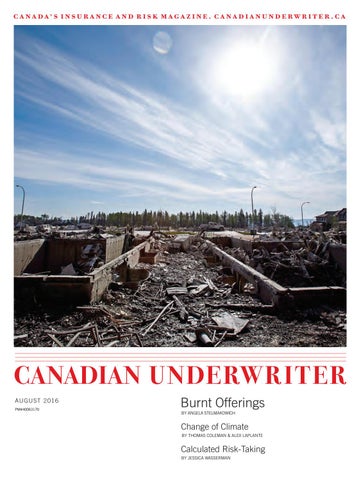
Burnt Offerings BY ANGELA STELMAKOWICH
Change of Climate BY THOMAS COLEMAN & ALEX LAPLANTE
Calculated Risk-Taking BY JESSICA WASSERMAN
14.16 CUW August_Cover_FA.indd 1
2016-08-09 6:52 PM
CANADIAN UNDERWRITER
Photo: ‘THE CANADIAN PRESS / Codie McLachlan’
30
VOL. 83, NO. 8, AUGUST 2016 CANADA’S INSURANCE AND RISK MAGAZINE. PUBLISHED BY NEWCOM BUSINESS MEDIA INC.
www.canadianunderwriter.ca
COVER STORY
Wildfire Risk Management Recovery from the Fort McMurray fire is continuing. But how can stakeholders work together to parlay unprecedented damage and loss into a living, sustainable approach to manage wildfire risks? Lessons learned, coupled with buy-in from all, could help in the future. BY ANGELA STELMAKOWICH
FEATURES
12 Climate Change Resilience
40 Ethics Series: Renewals
The insurance industry is inherently susceptible to risks related to climate change. But it is also well-positioned to promote global resilience.
While friendliness between a broker and client is welcome, brief chats and assumptions should never take the place of a comprehensive review of risk come renewal time.
BY THOMAS COLEMAN & ALEX LAPLANTE
BY THE CIP SOCIETY
22 50 Duty to Defend
Brexit Vote
A British Columbia court explored weighty coverage issues in its review of the duty to defend in the context of forced labour allegations.
The Brexit vote in the United Kingdom is creating uncertainty for some risk managers here, although there is no need to panic.
BY HOLLIS BROMLEY
BY GREG MECKBACH
18 RIMS: Risk-Taking Risk professionals would do well to consider “taking risk” as part of the risk management role. But the art of taking that risk demands having both a clear understanding of conditions and a solid plan. BY JESSICA WASSERMAN
26 Vehicle Recall Joint responsibility for automotive recalls among owners, vehicle manufacturers and dealers may be key to ensuring as timely and effective a response as possible. BY MARCOS GARCIA NORRIS
46 Insurance Analytics Canada Summit To truly understand and reap the benefits of ever-growing data, related information needs to be properly analyzed and the benefit of first-movers understood. BY ANGELA STELMAKOWICH & JASON CONTANT
54 World Conference on Disaster Management Disasters and emergencies vary widely, and can touch everything from social media to business continuity and supply chains. BY ANGELA STELMAKOWICH & GREG MECKBACH
August 2016 Canadian Underwriter
3
Editor astelmakowich@canadianunderwriter.ca
PROFILE PROFILE
Senior Publisher steve@canadianunderwriter.ca
Angela Stelmakowich Steve Wilson Canadian Underwriter’s Insurance Media Group committed Underwriter’s Insurance Media is committed (416) 510-6793 Group @InsuranceMedia the industry, providing marketers with aTwitter: range ofis specialized astelmakowich@canadianunderwriter.ca steve@canadianunderwriter.ca (416) 510-6800 (416) 510-6793 Twitter: @InsuranceMedia Associate Editor timely to providing the most and relevant news, information to providing the most timely and relevant news, information and highly effective marketing communications opportunities. Editor
VOL. . 2, FEBRUARY 2014 VOL. 81, 81, NO. NO. 2, 2, FEBRUARY FEBRUARY 2014 2014 Canadian PROFILE PROFILE
Senior Publisher Editor Senior Publisher EditorMeckbach Senior Publisher (416) 510-6800 Greg Art Director Associate Editor Angela Stelmakowich Steve Wilson Angela Stelmakowich Steve Wilson Angela Stelmakowich Steve Wilson and resources to insurance professionals from all segments of resources professionals from all segments of gmeckbach@canadianunderwriter.ca Gerald Heydens Editor Senior Publisher Editorto insurance Senior Publisher EditorMeckbach Senior Publisher Greg Art Director astelmakowich@canadianunderwriter.ca steve@canadianunderwriter.ca astelmakowich@canadianunderwriter.ca steve@canadianunderwriter.ca astelmakowich@canadianunderwriter.ca steve@canadianunderwriter.ca Twitter: @CU_Greg VOL. 83, NO. 8, August 2016 Angela Stelmakowich Steve Wilson Angela Stelmakowich Steve Wilson Angela Stelmakowich Steve Wilson gmeckbach@canadianunderwriter.ca Gerald Heydens Consultation (416) 510-6793 Twitter: @InsuranceMedia (416) 510-6793 @InsuranceMedia (416) 510-6793 the marketers industry, providing marketers with aArt range of specialized Twitter: @InsuranceMedia the industry, providing with aTwitter: range of specialized (416) 510-6796 astelmakowich@canadianunderwriter.ca steve@canadianunderwriter.ca astelmakowich@canadianunderwriter.ca steve@canadianunderwriter.ca astelmakowich@canadianunderwriter.ca steve@canadianunderwriter.ca PROFILE Twitter: @CU_Greg Sascha Hass (416) 510-6800 (416) 510-6800 (416) 510-6800 Art Consultation (416) 510-6793 Twitter: (416) 510-6793 Twitter: @InsuranceMedia Associate Editor (416) 510-6796 510-6793 Associate Editor Twitter: @InsuranceMedia @InsuranceMedia Associate Editor (416) Online Editor and highly effective marketing communications opportunities. and highly effective marketing communications opportunities. EditorMeckbach Senior Publisher Sascha Hass Canadian Underwriter’s Insurance Media Group is committed Production Manager profile (416) 510-6800 (416) 510-6800 Greg Art Director Greg Meckbach (416) 510-6800 Art Director Greg Meckbach Art Director Harmeet Singh Editor Associate Editor Senior Publisher Associate Editor Associate Editor Angela Stelmakowich Steve Wilson Online Editor Gerald Heydens Gary White gmeckbach@canadianunderwriter.ca to providing the most timely and relevant Gerald Heydens gmeckbach@canadianunderwriter.ca gmeckbach@canadianunderwriter.ca Gerald Heydens hsingh@canadianunderwriter.ca Angela Stelmakowich Production Manager news, information Steve Wilson Greg Meckbach Art Director Greg Meckbach Art Director Greg Meckbach Art Director astelmakowich@canadianunderwriter.ca steve@canadianunderwriter.ca Harmeet Singh (416) 510-6760 from all segments of Twitter: @CU_Greg Twitter: @CU_Greg astelmakowich@canadianunderwriter.ca Twitter: @CU_Greg stevew@newcom.ca and resources to insurance professionals Twitter: @CU_Harmeet Gary White gmeckbach@canadianunderwriter.ca Gerald Heydens gmeckbach@canadianunderwriter.ca Gerald Heydens gmeckbach@canadianunderwriter.ca Art Consultation Gerald Heydens Art Consultation (416) 510-6793 510-6793 Twitter: @InsuranceMedia Art Consultation hsingh@canadianunderwriter.ca (416) 510-6800 (416)510-6796 (416) (416) 510-6796 (416) 510-6796 (416) 442-5600 ext. 3652 the industry, providing marketers with a rangeService of specialized (416) 510-6760 Subscriptions/Customer Twitter: @CU_Greg National Twitter: @CU_Greg Twitter: @CU_Greg Sascha Hass Sascha Hass (416) 510-6800 Sascha Hass Twitter: @CU_Harmeet Art Director Art Art Consultation Art Consultation Consultation Associate Editor Associate Editor Gail Page (416) 510-6796 (416) 510-6796 and highly effective marketing communications opportunities. Online Editor (416) 510-6796 Online Editor Online Editor Claims (416) 442-5600 ext. 3652 Associate Publisher Gerald Heydens Subscriptions/Customer Service Greg Meckbach Sascha Hass Canadian Underwriter’s Media isis committed Sascha Hass Canadian Underwriter’s Insurance Media Group is committed Production Manager Sascha Hass Greg Meckbach Production Manager Canadian Underwriter’s Insurance Media Group Group committed ArtInsurance Director Production Manager 14 Leading by Example gpage@bizinfogroup.ca Harmeet Singh Harmeet Singh Harmeet Singh greg@newcom.ca Paul Aquino Gail Page Art Consultation Online Editor Manual Online Editor Online Editor Gary White gmeckbach@canadianunderwriter.ca Gary White Gerald Heydens Gary White to providing the most timely and relevant news, information to providing the most timely and relevant news, information Associate Publisher to providing the most timely and relevant news, information James Cameron, president of (416) 510-5187 hsingh@canadianunderwriter.ca (416) 510-6796 hsingh@canadianunderwriter.capaul@canadianunderwriter.ca Production Manager Production Manager hsingh@canadianunderwriter.ca Production Manager 14 Leading by Example Sascha Hass gpage@bizinfogroup.ca Harmeet Singh InsuranceMarketer.com Harmeet Singh Harmeet Singh (416) 510-6760 Twitter: @CU_Greg (416)professionals 510-6760 (416) 510-6760 Paul Aquino and professionals from insurance from to all segments of Cameron & Associates and resources resources to insurance insurance professionals from all all segments segments of of Twitter: @CU_Harmeet Twitter: @CU_Harmeet and resources Gary White Gary White Twitter: @CU_Harmeet Online to Editor Gary White Art Consultation Twitter: @InsuranceCanuk James Cameron, president of (416) 510-5187 Circulation Manager hsingh@canadianunderwriter.ca Production Manager hsingh@canadianunderwriter.capaul@canadianunderwriter.ca hsingh@canadianunderwriter.ca (416) 510-6796 Jason Contant (416) 442-5600 ext. 3652 Insurance Consultants Limited, the industry, providing marketers with a range of specialized (416) 442-5600 ext. 3652 (416) 510-6760 the industry, providing marketers with a range of specialized (416) 510-6760 (416) 442-5600 ext. 3652 Subscriptions/Customer Service the industry, providing marketers with a range of specialized (416) 510-6760 Sascha Hass Subscriptions/Customer Service National Subscriptions/Customer Service (416) 510-6788 Karen Samuels Cameron & Associates Mary Garufi Twitter: @CU_Harmeet Twitter: @CU_Harmeet National Twitter: @CU_Harmeet jcontant@canadianunderwriter.ca Twitter: @InsuranceCanuk Circulation Manager Online Editor (416) 510-5190 was recognized by the CIP Gail Page Gail Page and highly marketing communications opportunities. Gail Page andClaims highly effective marketing communications opportunities. andClaims highly effective effective marketing communicationsService opportunities. mgarufi@bizinfogroup.ca (416) 442-5600 ext. 3652 Insurance Consultants Limited, (416) 442-5600 ext. 3652 (416) 442-5600, Ext. 3652 Associate Publisher (416) 442-5600 ext. 3652 Associate Publisher Subscriptions/Customer Subscriptions/Customer Service National Associate Publisher Production Manager Subscriptions/Customer Service (416) 510-6788 Account Manager Mary Garufi Leading by Example the insurance industry’s social network ng by Example 14 Leading by Example Harmeet Singh gpage@bizinfogroup.ca gpage@bizinfogroup.ca Circulation Manager Society when he received its gpage@bizinfogroup.ca Claims (416) 442-5600 ext. 3545 Paul Aquino Paul Aquino was recognized by the CIP Gail Page Associate Publisher Gail Page Paul Aquino Gary White Gail Page Manual Manual Michael Wells mgarufi@bizinfogroup.ca Associate Publisher Associate Publisher Mary Garufi Cameron, president of hsingh@canadianunderwriter.ca meron, presidentJames of Leading Associate Publisher (416) 510-5187 (416) 510-5187 James Cameron, president of Manual (416) 510-5187 Established Award.its Account Manager 14 by Paul Aquino ng by Example Leading by Example paul@canadianunderwriter.ca paul@canadianunderwriter.ca gpage@bizinfogroup.ca gpage@bizinfogroup.ca paul@canadianunderwriter.ca (416) 510-6760 Society whenLeader heExample received gpage@bizinfogroup.ca InsuranceMarketer.com InsuranceMarketer.com InsuranceMarketer.com InsuranceMarketer.com mary@newcom.ca michael@canadianunderwriter.ca (416) 442-5600 ext. 3545 Print Production Manager Paul Aquino Paul Aquino Twitter: @CU_Harmeet Paul Aquino Cameron & Associates & Associates paolo@newcom.ca Cameron & Associates Michael Wells STELMAKOWICH Twitter: @InsuranceCanuk James Cameron, president Twitter: @InsuranceCanuk meron, presidentBY ofANGELA (416) 510-5187 (416) 614-5831 (416) 510-5187 Twitter: @InsuranceCanuk James Cameron, president of Circulation Manager (416) 510-5187 Circulation Manager Circulation Manager Established Leader Award. of (416) 510-5122 Phyllis Wright (416) paul@canadianunderwriter.ca paul@canadianunderwriter.ca (416) 510-6788 442-5600 ext. 3652 paul@canadianunderwriter.ca Subscriptions/Customer Service Insurance Consultants Limited, michael@canadianunderwriter.ca Insurance Print Production Manager (416) (416) 510-6788 Cameron & Associates (416) 510-6788 510-6788 Mary Garufi &Consultants Associates Limited, Print Production Manager Mary Garufi Cameron &Consultants Associates Limited, Mary Garufi BY ANGELA STELMAKOWICH INSURANCE the insurance industry’s social network Twitter: @InsuranceCanuk Twitter: @InsuranceCanuk Account Manager Twitter: @InsuranceCanuk Circulation Manager Circulation Manager Gail Page Circulation Manager (416) 510-5122 was recognized by the CIP nized by the CIP Account Manager Phyllis Wright was recognized by the CIP President Phyllis Wright Associate Publisher mgarufi@bizinfogroup.ca mgarufi@bizinfogroup.ca Insurance Consultants Limited, mgarufi@bizinfogroup.ca Consultants Limited, Insurance Consultants Limited, National National Michael Wells National (416) 510-6788 DIRECTORY 14 Leading by received Example (416) 510-6788 Account Manager (416) 510-6788 Account Manager Mary Garufi gpage@bizinfogroup.ca Mary Garufi industry’s social network Account Manager the industry’s Mary Garufi the insurance the insurance insurance industry’s social social network network Elliot Ford Society when he its en he received its Bruce Creighton Society when he received its Paul Aquino insBlogs Claims Chairman (416) 442-5600 ext. 3545 Claims (416) 442-5600 ext. 3545 michael@canadianunderwriter.ca Claims (416) 442-5600 was recognized by the CIP nized by the CIPwas Account Manager recognized by president the CIP of President Michael Wells James Cameron, Michael Wells mgarufi@bizinfogroup.ca (416) 510-5187 ext. 3545 mgarufi@bizinfogroup.ca Michael Wells mgarufi@bizinfogroup.ca INSURANCE eford@canadianunderwriter.ca Manual Manual (416) 510-5122 Jim Glionna Established Leader Award. Manual Account Manager denLeader Award.its paul@canadianunderwriter.ca Account Manager Established Leader Award.its Account Manager Elliot Ford Society when he he received Bruce Creighton Society when he received received its InsuranceMarketer.com Vice President DIRECTORY InsuranceMarketer.com michael@canadianunderwriter.ca michael@canadianunderwriter.ca (416) 442-5600 ext. 3545 InsuranceMarketer.com (416)Production 442-5600 ext. 3545 michael@canadianunderwriter.ca Cameron & Associates Print Production Manager (416) 442-5600 ext. 3545 Print Manager Print Production Manager (416) 510-5117 Michael Wells Twitter: @InsuranceCanuk Account Manager Michael Wells President BY ELMAKOWICH Michael Wells Circulation Manager BY ANGELA ANGELA STELMAKOWICH STELMAKOWICH eford@canadianunderwriter.ca Established Leader Award. d Leader Award.Established Alex Papanou (416) 510-5122 Leader Award. (416) 510-5122 (416) 510-5122 Phyllis Wright Phyllis Wright Insurance Consultants Limited, Phyllis Wright 10 Strategic Thinking Insurance Blogs hosted by Canadian510-6788 Underwriter Christine GiovisPrint Production Manager JoePresident Glionna (416) michael@canadianunderwriter.ca michael@canadianunderwriter.ca insBlogs Vice michael@canadianunderwriter.ca Mary Garufi Manager Print Production Print Production Manager (416) 510-5117 BY ANGELA STELMAKOWICH ELMAKOWICH BYwas ANGELA STELMAKOWICH INSURANCE the christine@canadianunderwriter.ca Property &INSURANCE Casualty Insurance Newswire the insurance industry’s social network theinsurance insuranceindustry’s industry’ssocial socialnetwork network recognized by the CIP SPECIAL FOCUS RIMS 2016 president Alex Papanou (416) 510-5122 (416) 510-5122 Account Manager Property & Casualty InsurancePresident Newswire (416) 510-5122 mgarufi@bizinfogroup.ca Account Manager Phyllis Wright Phyllis Wright Account Manager Phyllis Wright President President (416) 510-5114 Account Manager DIRECTORY DIRECTORY Society when he received its Elliot Ford (416) 442-5600 ext. 3545 Elliot Ford Julie FOCUS Pemberton may have Elliot Ford Creighton Bruce Creighton Bruce Creighton insBlogs Bruce insBlogs SPECIAL Michael Wells Connect with Canadian Account Manager Account Manager Account Manager President PresidentUnderwriter President Award. INSURANCE 6Established Editorial INSURANCE eford@canadianunderwriter.ca eford@canadianunderwriter.ca INSURANCE eford@canadianunderwriter.ca insBlogs.com entered riskLeader management michael@canadianunderwriter.ca Elliot Ford Elliot Ford PrintPresident Production Manager Elliot Ford Bruce Creighton Bruce Creighton Vice DIRECTORY Bruce Creighton Vice President DIRECTORY Insurance Blogs hosted by Canadian Underwriter Vice President DIRECTORY Connect with Canadian Underwriter BY ANGELA STELMAKOWICH (416) 510-5117 (416) 510-5117 (416) twitter.com/CdnUnderwriter facebook.com/CanadianUnderwriter but quickly (416)510-5117 510-5122 6 reluctantly, Editorial eford@canadianunderwriter.ca eford@canadianunderwriter.ca Phyllis Wright eford@canadianunderwriter.ca Alex Papanou Alex Papanou Alex Papanou Insurance hosted by Insurance hosted byUnderwriter Canadian Underwriter Insurance Blogs hosted by Canadian Underwriter InsuranceBlogs BlogsBlogs hosted byCanadian Canadian Underwriter Vice President insBlogs Vice 8 developed Marketplace Vice President President insBlogs a passion (416) 510-5117 (416) 510-5117Property (416) 510-5117 twitter.com/CdnUnderwriter facebook.com/CanadianUnderwriter & Insurance Newswire Property & Casualty Insurance Newswire Property & Casualty Casualty Insurance Newswire Account Manager President SPECIAL CUS Alex Papanou .ca SPECIAL FOCUS FOCUS Alex Papanou Alex Papanou Property & Casualty Insurance Newswire Property & Casualtylinkd.in/CanadianUnderwriter Insurance Newswire instouch.com/group/CanadianUnderwriter Property & Casualty Insurance Newswire InsuranceMediaGroup.com for the field. That has 8 Marketplace Elliot Ford Bruce Creighton 56 Moves & Views SPECIAL FOCUS CUS SPECIAL FOCUS Connect with Canadian UnderwriterInsuranceMediaGroup.com Connect with Canadian Underwriter proved helpful given the Connect linkd.in/CanadianUnderwriter instouch.com/group/CanadianUnderwriter eford@canadianunderwriter.ca Published bywith Canadian Underwriter 6 Editorial torial insBlogs.com www.CanadianUnderwriter.ca/MediaGroup insBlogs.com Vice President 56many Moves & Views changes in the (416) 510-5117 Insurance Blogs hosted by Canadian Underwriter Insurance Blogs hosted by CanadianCanadian Underwriter Insurance Blogs hosted by Canadian Underwriter Connect with Underwriter Connecttwitter.com/CdnUnderwriter with Canadian Underwriter Connecttwitter.com/CdnUnderwriter with Canadian Underwriter facebook.com/CanadianUnderwriter facebook.com/CanadianUnderwriter 58 twitter.com/CdnUnderwriter Alex Papanou facebook.com/CanadianUnderwriter 6 riskGallery Editorial torial www.CanadianUnderwriter.ca/MediaGroup Canadian BUSINESS UnderwriterMEDIA is published management role NEWCOM INC. thirteen times yearly (monthly + the Annual Statistical Issue) by Insurance hosted Canadian Underwriter Insurance Blogs hosted by Canadian Underwriter InsuranceBlogs Blogs hostedby by CanadianMEDIA Underwriter 8 Marketplace rketplace NEWCOM BUSINESS INC. twitter.com/CdnUnderwriter facebook.com/CanadianUnderwriter SPECIAL FOCUS twitter.com/CdnUnderwriter facebook.com/CanadianUnderwriter 58overGallery twitter.com/CdnUnderwriter facebook.com/CanadianUnderwriter the last 20 years. Canadian at thirteen 80 Valleybrook Drive,(monthly Toronto, Ontario, M3B Statistical 2S9 .ca .ca Canadian Underwriter Underwriter is is located published times yearly + the Annual Issue) by
INSURANCE – we have it covered.
– INSURANCEINSURANCE – we have it covered. we have it covered.
instouch.com
Photo: Courtesy of RIMS, the risk management society
Photo: PatrickThompson Thompson Photo:Thompson Patrick Thompson Photo:Patrick Patrick Thompson Photo: Patrick Photo: Patrick Photo: Thompson Photo: Patrick Thompson
Photo:Thompson Patrick Thompson Photo: Patrick
VOL. 81, NO. 2, FEBRUARY 2014 and
insBlogs Ontario instouch.com instouch.com instouch.com Ontario
insBlogs insBlogs insBlogs Ontario Ontario
instouch.com instouch.com Ontario Insurance Blogs hosted by Canadian Underwriter
insBlogs
Ontario
insBlogs.com insBlogs Insurance Blogs hosted by Canadian Underwriter
Insurance InsuranceBlogs Blogshosted hostedby byCanadian CanadianUnderwriter Underwriter
.ca
insBlogs.cominsBlogs.com
rketplace ves & Views ves & Views lery lery
8 By Greg Marketplace Meckbach 56 & Views 6 Moves Editorial 56 Moves & Views 58 8 Gallery Marketplace 58 Gallery 56 Moves & Views special focus 58 Gallery
6 Editorial 8 Marketplace 58 Moves & Views 60 Gallery 4 Canadian Underwriter February 2014 4 Canadian Underwriter February 2014
Canadian 44 2014 Underwriter February Canadian Underwriter Underwriter February February 2014 2014 Canadian 44 2014 Underwriter February Canadian Underwriter Underwriter February February 2014 2014
4 Canadian Underwriter February 2014
4
Canadian Underwriter August 2016
InsuranceMediaGroup.com
linkd.in/CanadianUnderwriter instouch.com/group/CanadianUnderwriter linkd.in/CanadianUnderwriter Phone: instouch.com/group/CanadianUnderwriter linkd.in/CanadianUnderwriter instouch.com/group/CanadianUnderwriter InsuranceMediaGroup.com InsuranceMediaGroup.com InsuranceMediaGroup.com (416) 442-5600. NEWCOM BUSINESS MEDIA INC.
Connect withPrinted Canadian Underwriter All rights reserved. in Canada. contentsDrive, of this publication mayM3B not be reproduced or transmitted Canadian Underwriter is located at 80 The Valleybrook Toronto, Ontario, 2S9
InsuranceMediaGroup.com InsuranceMediaGroup.com
linkd.in/CanadianUnderwriter instouch.com/group/CanadianUnderwriter instouch.com/group/CanadianUnderwriter linkd.in/CanadianUnderwriter instouch.com/group/CanadianUnderwriter Published by Published linkd.in/CanadianUnderwriter by Published byeither in any form, in part or in full, including photocopying and recording, without the written consent of the Phone: (416) 442-5600.
.ca
.ca
www.CanadianUnderwriter.ca/MediaGroup www.CanadianUnderwriter.ca/MediaGroup www.CanadianUnderwriter.ca/MediaGroup copyright owner. Nor may any part of this publication be stored in a retrieval system of any nature without All rights reserved. Printed in Canada. The contents of this publication may not be reproduced or transmitted facebook.com/CanadianUnderwriter prior writtentwitter.com/CdnUnderwriter consent. in any form, either in part or in full, including photocopying and recording, without the written consent of the www.CanadianUnderwriter.ca/MediaGroup Canadian Underwriter is thirteen times yearly ++ Annual Statistical Issue) by www.CanadianUnderwriter.ca/MediaGroup Canadian BUSINESS UnderwriterMEDIA iswww.CanadianUnderwriter.ca/MediaGroup published yearlyowner. (monthly the Annual Issue) by NEWCOM BUSINESS MEDIA INC. NEWCOM INC. thirteen times © Published monthly as apublished source news, technical information comment, and as link between Canadian Underwriter is published thirteen times yearly (monthly the Annual Statistical Issue) by NEWCOM BUSINESS MEDIA INC. copyright Nor +may any partofStatistical of this publication be (monthly stored inand a the retrieval system of aany nature without
InsuranceMediaGroup.com InsuranceMediaGroup.com
NEWCOM BUSINESS MEDIA NEWCOM BUSINESS MEDIA INC. INC. all segments of the insurance industry including brokers, agents, insurance and reinsurance companies, prior written consent. linkd.in/CanadianUnderwriter instouch.com/group/CanadianUnderwriter adjusters, risk managers and consultants. Canadian Underwriter is at 80 Valleybrook Drive, Toronto, Ontario, M3B 2S9 Canadian at thirteen 80 Valleybrook Drive, Toronto, Ontario, M3B 2S9 Canadian Underwriter is published thirteen times yearly (monthly + the Annual Issue) by Canadian Underwriter is located at 80 Valleybrook Drive, Toronto,and Ontario, M3BStatistical 2S9as a link Canadian Underwriter Underwriter is is located published times yearly (monthly the Annual Issue) by © Published monthly+ as alocated source ofStatistical news, technical information comment, and between Canadian Underwriter is published thirteen times yearly (monthly + the Annual Statistical Issue) by Phone: (416) 442-5600. Phone: (416) 442-5600. NEWCOM BUSINESS MEDIA NEWCOM BUSINESS MEDIA INC. Phone: (416) NEWCOM BUSINESS MEDIA INC. INC. all segments of442-5600. the insurance industry including brokers, agents, insurance and reinsurance companies, Privacy Notice adjusters, risk managers and consultants. All rights Printed in Canada. The contents of publication may not reproduced All rights reserved. Printed in Canada. contents of reserved. this publication may not or transmitted Canadian Underwriter is at 80 Valleybrook Drive, Toronto, Ontario, 2S9 Canadian Underwriter is located at 80 The Valleybrook Drive, Toronto, Ontario, 2S9 All rights reserved. Printed in M3B Canada. The contents of this this publication mayM3B not be be reproduced or or transmitted transmitted Canadian Underwriter is located located atbe 80reproduced Valleybrook Drive, Toronto, Ontario, M3B 2S9 www.CanadianUnderwriter.ca/MediaGroup to either time make subscription list available select companies and organizations whose of in any form, in part or in full, photocopying without the in any form, in part or in full, includingFrom photocopying andwe recording, the written consent to ofand the recording, Phone: (416) 442-5600. Phone: (416)either 442-5600. in anytime form, in part orour inwithout full, including including photocopying and recording, without the written written consent consent of the the Phone: (416)either 442-5600. product or service may interest you. you do not wishwithout your contact to beof available, copyright owner. any of be stored in retrieval any without copyright owner. Nor may any part of this publication be storedNor in may amay retrieval system of publication any nature copyright owner. Nor any part part ofIfthis this publication be stored in aainformation retrieval system system ofmade any nature nature without Privacy Notice All Printed in Canada. The contents All rights reserved. Printed in Canada. The contents of reserved. this publication may not be reproduced or of transmitted All rights rights reserved. Printed in Canada. Themethods: contents of this this publication publication may may not not be be reproduced reproduced or or transmitted transmitted please contact us via one of the following prior written consent. prior written consent. prior written consent. From time to time we make our subscription list available to select companies and organizations whose Canadian Underwriter is published thirteen times yearly (monthly + the Annual Statistical Issue) by any form, either in part or in full, including photocopying and recording, without the written consent of the in any form, either in part or in full, includingin photocopying and recording, without the written consent of the in any form, either in part or in full, including photocopying and recording, without the written consent of the Phone: 1-800-668-2374 416-442-2191 product or service may interest you. Ifnews, you do not wish your contact to beas available, newcoM BUSineSS MeDiA inc. © Published monthly as aaFax: source of technical information and comment, and aany link between © Published monthly as a any source technical information comment, and as aany link between copyright owner. Nor may any part of this be stored in aainformation retrieval system of nature without copyright owner. Nor may partofofnews, this publication be stored inand amay retrieval system of publication nature without © Published monthly as source of technical information and comment, and as aany link between copyright owner. Nor any part ofnews, this publication be stored in retrieval system ofmade nature without E-mail: jhunter@businessinformationgroup.ca please contact via one of the following methods: all segments of the insurance industry including brokers, agents, insurance and companies, all segments of the insurance industry including brokers, agents, insurance and companies, prior written consent. prior written consent. all segments ofus the insurance industry including brokers, agents, insurance M3B and reinsurance reinsurance companies, prior written consent. canadian Underwriter is located atreinsurance 80Drive, Valleybrook Drive, Toronto, 2S9 Mail to: Privacy Officer, 80 Valleybrook Toronto, Ontario, M3BOntario, 2S9 adjusters, risk managers and consultants. adjusters, risk managers and consultants. adjusters, risk managers and consultants. Phone: 1-800-668-2374 Fax: 416-442-2191 (416) 442-5600. © Published monthly as aa source news, information © Published monthly as a source of news, technical information and and as atechnical link between ©Phone: Published monthly ascomment, source of of news, technical information and and comment, comment, and and as as aa link link between between E-mail: jhunter@annexnewcom.ca all segments of insurance including brokers, agents, insurance companies, all segments of the insurance industry including brokers, agents, insurance and reinsurance companies, allAll segments of the the2013 insurance industry including brokers, agents, insurance and reinsurance companies, GST Registration number 890939689RT0001 Subscription Rates: Canada rights reserved. Printed inindustry Canada. The contents of this publication mayand notreinsurance be reproduced or transmitted Mail to: Notice Privacy Officer, 80 Valleybrook Drive, Toronto, Ontario, M3B 2S9 adjusters, risk managers and consultants. Privacy Notice adjusters, risk managers and consultants. Privacy Privacy Notice adjusters, risk managers and consultants. Second Class Mail Registration Number: 08840 in any form, either in part or in full, including photocopying and recording, without the written consent of the 1 Year $49.95 plus applicable taxes time time we our subscription list available to select and whose From time to time we make our subscription From list available to select companies and whose From time to to time we make make ourpart subscription list available to select and organizations organizations whose copyright owner. Nor may any of organizations this publication be stored in companies acompanies retrieval system of any nature without Publications Mail Agreement #40069240 2 Years $73.95 plus applicable taxes GST Registration number 890939689RT0001 Subscription Rates: 2015 Canada you. or service may interest you do wish your information to product or service may interest you. If you doproduct not wish contact made available, product oryour service mayinformation interest you.toIfIfbe you do not not wish your contact contact information to be be made made available, available, prior written consent. Privacy Notice Privacy Notice Privacy Notice Return undeliverable Canadian addresses to: Second Class Mail Registration Number: 08840 please contact us via one of the following methods: please contact us via one of the following methods: 1please Year Copies $51.95 plus applicable contact$10 us via one of thetaxes following Single plus applicable taxes methods: From time to time we make our subscription list available to select companies and organizations whose From time to time we make our subscription list available select and organizations whose From time toto time we companies make our subscription list available to select companies and whose © Published monthly as a source of news, technical information and comment, andorganizations as a link between Circulation Dept. Publications Mail Agreement #40063170 2 Years $75.95 plus applicable taxes Phone: 1-800-668-2374 Fax: Phone: Fax: 416-442-2191 product or service may interest you. you do wish contact information be product1-800-668-2374 or service may interest you. If you doElsewhere not contact information made available, Phone: 1-800-668-2374 Fax: 416-442-2191 416-442-2191 product oryour service may interest you.toIfIfbe you do not not wish your your contactinsurance information to be made made available, available, all wish segments of the insurance industry including brokers, agents, andto reinsurance companies, Canadian Underwriter Return undeliverable Canadian addresses to: E-mail: jhunter@businessinformationgroup.ca E-mail: jhunter@businessinformationgroup.ca please contact us via one of the following please contact us via one of the following methods: E-mail: jhunter@businessinformationgroup.ca please contact us via one of the following methods: adjusters, risk managers and consultants. Single $10 plus applicable taxes methods: 80 Valleybrook Drive, Toronto, Ontario 1 Year Copies $73.95 Circulation Dept. M3B to: Officer, 80 Ontario, Mail to: Privacy Officer, 80 Valleybrook Drive,Mail Toronto, Ontario, M3B 2S9 Mail to: Privacy Privacy Officer, 80 Valleybrook Valleybrook Drive, Drive, Toronto, Toronto, Ontario, M3B 2S9 2S9 M3B 2S9 Phone: 1-800-668-2374 Fax: Phone: 1-800-668-2374 Fax: 416-442-2191Elsewhere Phone:Statistical 1-800-668-2374 Fax: 416-442-2191 416-442-2191 Canadian Underwriter Annual Issue E-mail: jhunter@annexnewcom.ca E-mail: jhunter@annexnewcom.ca E-mail: jhunter@annexnewcom.ca Privacy Notice WeValleybrook acknowledge the financial support 80 Drive, Toronto, Ontario 1Subscription Year Registration $71.95 (included with above subscription) Registration number 890939689RT0001 Subscription Rates: 2013 Canada GST number 890939689RT0001GST Subscription Rates: 2013 Canada GST Registration number 890939689RT0001 Rates: 2013 Canada to: Privacy Officer, 80 Drive, Toronto, Ontario, M3B 2S9 Mail to: Privacy Officer, 80 Valleybrook Drive,Mail Toronto, Ontario, M3B 2S9 Mail to:time Privacy Officer, 80 Valleybrook Valleybrook Drive, Toronto, Ontario, M3B 2S9 through From to time weapplicable make ourNumber: subscription list available to select companies and organizations whose of the Government of Canada M3B 2S9 or separately $38 plus taxes Second Class Class Mail Registration 08840 11Second Year $49.95 plus applicable Second Class Mail Mail Registration Registration Number: Number: 08840 08840 1 Year $49.95 plus applicable taxes Year $49.95 plus applicable taxes taxes Annual Statistical Issue product or service may interest you. If you doPublications not Canada wish your contact information the Periodical Fund of the to be made available, Mail Agreement #40069240 Publications Mail Agreement #40069240 Publications Mailthe Agreement #40069240 2 Years $73.95 plus applicable taxes 2 Years $73.95 plus applicable We acknowledge financial support 2 Years $73.95 plus applicable taxes (included with above subscription) GST Registration number 890939689RT0001 Rates: 2015 Canada Subscription Inquiries/Customer Service GST Registration number 890939689RT0001 Subscription Rates: 2015 Canada taxes please contact us via one of the following methods: Department of Canadian Heritage GST Registration number 890939689RT0001 Subscription Rates: 2015 Canada ISSN Print: 0008-5251 of the Government of Canada through Return Canadian undeliverable Canadian to: or separately $39 plus applicable taxes Second Class Number: 08840 Bona Lao (416) 442-5600 ext addresses 3552 Second Class Mail Registration Number: Return undeliverable Canadian addresses addresses to: 1Single Year $51.95 plus applicable taxes Secondundeliverable Class Mail Mail Registration Registration Number:to: 08840 1 Year Copies $51.95$10 plus applicable taxes Single Copies $10 plus applicable taxes 1Return Year $51.95 plus applicable Single plus applicable taxes Copies $10 plus applicable taxes 08840 Phone: 1-800-668-2374 Fax: taxes 416-442-2191 the CanadaDept. Periodical Fund of the Circulation Dept. Publications Mail blao@bizinfogroup.ca Publications Mail Agreement #40063170 Circulation Dept. Publications Mail Agreement Agreement #40063170 #40063170 ISSN Digital: 1923-3426 22Circulation Years plus applicable taxes 2 Years $75.95 plus applicable taxes Years $75.95 $75.95 plus applicable taxes E-mail: jhunter@businessinformationgroup.ca Subscription Inquiries/Customer Service Department of Canadian Heritage Elsewhere Canadian Elsewhere Canadian Underwriter Elsewhere Canadian Underwriter Underwriter ISSN Print: 0008-5251 Return undeliverable Canadian MailLao to: Privacy Officer, 80ext. Valleybrook Drive,80 Toronto, Ontario, M3B 2S9 addresses Return undeliverable Canadian addresses to: Bona (416) 442-5600 3552 Return undeliverable Canadian addresses to: to: Single Copies $10 plus applicable taxes Single 80 Valleybrook Drive, Ontario 1 Year $73.95 Single Copies $10 plusToronto, applicable taxes 1 Year Copies $73.95$10 plus applicable taxes 80 Valleybrook Valleybrook Drive, Drive, Toronto, Toronto, Ontario Ontario 1 Year $73.95 ISSN Digital: 1923-3426 Circulation Dept. Circulation Dept. blao@annexnewcom.ca Circulation Dept. M3B 2S9 M3B 2S9 M3B 2S9 Elsewhere Canadian Underwriter Elsewhere Canadian Underwriter Annual Statistical Issue GST Registration number 890939689RT0001 Subscription Rates: 2013 Canada Elsewhere Canadian Underwriter Annual Statistical Issue Annual Statistical Issue We acknowledge the financial support We acknowledge thesubscription) financial support 80 Valleybrook Drive, Toronto, We acknowledge the financial support Valleybrook Drive, Toronto, Ontario 1(included $71.95 Second Class Mail Registration Number: 08840 (included with 1 Year $71.95 80 Valleybrook Drive, Toronto, Ontario Ontario (included with above subscription) 1Year Year $49.95 plus applicable taxes 180 Year $71.95 with above above subscription) of the Government of of the2S9 Government ofapplicable Canada through M3B 2S9 of the Government of Canada Canada through through Publications Mail Agreement #40069240 or separately $38 taxes M3B 2S9 or separately $38 plus applicable taxes orM3B separately $38 plus plus applicable 2 Years $73.95 taxes Annual Statistical Issue Annual Statistical Issue the Canada Periodical Fund of Annual Statistical Issue Fund of the the Canada Periodical the Canada Periodical Fund of the the We acknowledge the financial support We acknowledge the financial support Return undeliverable Canadian addresses to: We acknowledge the financial support (included with above subscription) Subscription Inquiries/Customer Service (included with above subscription) Subscription Inquiries/Customer Service Department of (included with above subscription) Single Copies $10 plus applicable taxes Department of Canadian Heritage Subscription Inquiries/Customer Service Department of Canadian Canadian Heritage Heritage ISSN ISSN Print: 0008-5251 of the ISSN Print: Print: 0008-5251 0008-5251 the Government ofapplicable Canada through Circulation Dept. of of the Government Government of Canada Canada through through or separately $39 plus taxes Bona Lao 442-5600 ext or separately $39442-5600 plus applicable taxes Bona Lao (416) ext 3552 orof separately $39 plus applicable taxes Bona Lao (416) (416) 442-5600 ext 3552 3552 the Canada Periodical Fund of the Elsewhere the Canada Periodical Fund of the Canadian Underwriter ISSN Canada Periodical Fund of the ISSNthe Digital: 1923-3426 blao@bizinfogroup.ca ISSN Digital: Digital: 1923-3426 1923-3426 blao@bizinfogroup.ca blao@bizinfogroup.ca Subscription Inquiries/Customer Service Subscription Inquiries/Customer Service Department of Canadian Heritage of Canadian Heritage 80 Valleybrook Drive, Toronto, Ontario Subscription Inquiries/Customer Service 1Department Year $73.95 Department of Canadian Heritage ISSN ISSN Print: 0008-5251 ISSN Print: Print: 0008-5251 0008-5251 Bona Bona Lao (416) 442-5600 ext. 3552 M3B 2S9 Bona Lao Lao (416) (416) 442-5600 442-5600 ext. ext. 3552 3552 ISSN Annual Statistical Issue ISSN Digital: 1923-3426 blao@annexnewcom.ca ISSN Digital: Digital: 1923-3426 1923-3426 blao@annexnewcom.ca blao@annexnewcom.ca We acknowledge the financial support (included with above subscription) of the Government of Canada through or separately $38 plus applicable taxes the Canada Periodical Fund of the Subscription Inquiries/Customer Service Department of Canadian Heritage ISSN Print: 0008-5251 Bona Lao (416) 442-5600 ext 3552 ISSN Digital: 1923-3426 blao@bizinfogroup.ca NEWCOM BUSINESS MEDIA INC.
Your
insights
Our
strengths and expertise
Top-class
protection around the world
You know your business inside out. You know your markets, your customers, your competitors. Above all, you know the risks facing your business. At Swiss Re Corporate Solutions, we have the capabilities and the financial strength to meet the risk transfer needs of businesses worldwide. But that’s only half the story. Whether your risk is basic or complex, whether the solution is off-the-shelf or highly customised, we believe that there’s only one way to arrive at the right solution. And that’s to work together and combine your experience with our expertise and your strengths with our skills. Long-term relationships bring long-term benefits. We’re smarter together. swissre.com/corporatesolutions Swiss Re Corporate Solutions offers the above products through carriers that are allowed to operate in the relevant type of insurance or reinsurance in individual jurisdictions. Availability of products varies by jurisdiction. This communication is not intended as a solicitation to purchase (re)insurance. © Swiss Re 2016. All rights reserved.
US Letter - No bleed - CMYK PDF - File: ARM-16-09314-P1_CS_Generic_CRIMS_Cong-Guide-7-19.indd
editorial
Over There, Over Here
Business leaders with global footprints are encouraged to adopt a more strategic risk management approach to limit the impact of attacks on their people, operations and assets. Angela Stelmakowich Editor Canadian Underwriter astelmakowich@ canadianunderwriter.ca
6
Canadian Underwriter August 2016
It would be folly to think that political risk is something that only happens “over there.” The effects over here can be just as damaging. That the number of such incidents may not be as high as has traditionally been the case in emerging markets should offer neither comfort nor serve as a basis for complacency. A newly released report from RIMS, the risk management society, explores the political risk insurance market. “The paradigm dividing the world into developed and developing countries is antiquated and can lead risk managers astray,” it notes. RIMS reports that capacity in the political risk market has ballooned from about US$700 million in 2009 to US$2 billion today. Highprofile attacks perpetrated or inspired by the Islamic State of Iraq and Syria “is driving a rapid increase in business for terrorism coverage.” Earlier this year in the United States, in fact, the Federal Insurance Office asked insurers to voluntarily submit certain insurance information regarding their participation in the Terrorism Risk Insurance Program. The requested data relates to lines of insurance with exposure to such losses, premiums earned on such coverage, geographical location of exposures, pricing of such coverage, take-up rate for coverage and amount of private reinsurance for acts of terrorism purchased. Among the current concerns
to Western countries is the increasing number of attacks in public places and involving shooters. “ISIL presents a global terrorist threat which has recruited thousands of foreign fighters to Iraq and Syria from across the globe and leveraged technology to spread its violent extremist ideology and to incite terrorist acts,” reports the U.S. State Department. Aon Risk Solutions reported this spring that 2015 was the most lethal year for terrorism in Europe in almost a decade. For the first time since Aon began issuing its annual Terrorism and Political Violence Map in 2007, shootings overtook bombings in the Western world and the move to target civilians in public spaces became more commonplace. It suggested since the start of 2015, 31% of attacks in the West targeted private citizens and public gatherings, up from 25% in 2010 to 2014. “This means that terrorism re-emerged as a significant business risk over the past year, with major high-profile international attacks targeting tourism-related sectors (hotels, resorts, airports and civil aviation) and crowded public spaces (including retail and sports venues).” Aon Risk Solutions noted the threats should encourage business leaders with global footprints to adopt a more strategic risk management approach to limit the impact of attacks on their people, operations and assets.
Bombs are also a concern. March’s terrorism blasts in Brussels were “a somber reminder of the difficulty of preventing attacks against transportation infrastructure,” like airports and bus stations,” stated a report from Risk Management Solutions. “As security at military bases, embassies and other government facilities increases, there has been a trend among terrorists in targeting softer targets such as public transportation infrastructure.” The blasts shut down flights and discontinued the metro system for a time. A 2016 viewpoint report by JLT Re and JLT Specialty Limited further suggested insurance is absorbing only a fraction of the economic impacts of terrorist attacks. Aon Risk Solutions’ 2015 political risk map showed Canada as among nine developed economies with increased terror threat. It reported terrorism and geopolitical uncertainty are risks that businesses, whether in developed or emerging markets, cannot ignore. True, Canada’s risk still remains low. However, that should not be a barrier to improving risk mitigation. Alan Bell, president of Globe Risk International Inc., recently said that emergency management planning should take into account terrorismrelated factors. “You have to learn to liaise with other agencies, more enforcement agencies, more security agencies,” Bell advised.
Personal Insurance Personal Insurance commercIal Insurance commercIal Insurance Global sPecIalty lInes Global sPecIalty lInes
you could offer your commercial clients an Ironclad™ defence? corporate governance is evolving at a rapid pace. Increased disclosure, litigation and environmental regulations are exposing board members—and their personal assets—to financial risk. Ironclad™ by rsa was designed specifically with these changes in mind. this enhanced side a DIc includes multiple limit reinstatements, coverage certainty and a number of best-in-class policy features. let Ironclad™ be your clients’ last line of defence when the going gets tough.
because we believe that together, we’re better. rsabroker.ca/ironclad
© 2016 royal & sun alliance Insurance company of canada. all rights reserved. rsa, rsa & Design and related words and logos are trademarks and the property of rsa Insurance Group plc, licensed for use by royal & sun alliance Insurance company of canada. rsa is a trade name of royal & sun alliance Insurance company of canada. Ironclad coverage, Ironclad coverage & Design, and related words and logos are trademarks and are the property of royal & sun alliance Insurance company of canada.
12498_RSA-GSL-CU-072216_FA.indd 1
2016-07-19 3:31 PM
marketplace
Risk ottawa urged to revisit APPROACH TO DISASTER RESPONSE, RECOVERY Uneven distribution of disaster events in Canada means the federal government should rethink its current approach to disaster response and recovery, including reinstating Ottawa’s share of disaster-related costs, note Canada’s premiers. “Premiers agreed that the federal government’s current approach to disaster response and recovery does not stabilize impacted jurisdictions or address the increasing frequency of extreme weather events related to climate change, such as wildland fires and floods,” they note. The premiers cite changes to Ottawa’s Disaster Financial Assistance Arrangements last year that “substantially reduced the federal government’s share of disasterrelated costs, offloading these onto individuals, provinces and territories.” Ottawa is urged to, among other things, reinstate funding to pre-2015 levels, expand program coverage of Cat events, and work with the insurance industry to expand availability of and access to related insurance products.
MOST firmS UNPREPARED FOR AUTONOMOUS VEHICLES: MUNICH RE Most companies are unprepared for the emergence of autonomous vehicles (AVs), with 64% of polled risk 8
Canadian Underwriter August 2016
managers saying their firms have done nothing to prepare for that emergence in the auto market, Munich Re reports. The in-person survey of 100-plus risk managers was done on site at the annual RIMS conference in April. In all, 23% of risk managers note they have discussed the new technology internally, 8% have established a task force and 4% have created an operational plan. For challenges to adoption, 41% cite regulatory or legislative obstacles, safety (24%), security of technology (19%), cost (11%) and ability to function in all weather and road conditions (5%).
2016 to date DOMINATED BY MALICIOUS EMAIL, NEW RANSOMWARE VARIANTS The first five months of 2016 were dominated by malicious email campaigns of unprecedented volume, with new ransomware variants emerging and actors “repeatedly [shifting] tactics with new loaders, document attachment types and obfuscation techniques to evade detection,” reports Proofpoint, Inc. JavaScript attachments led an explosion of malicious message volume, up 230% quarter over quarter. Also observed was multiple payloads being distributed in a single campaign, and a “crossover” campaign that attached malware to credential phishing. “Threat actors are using a wide variety of techniques to expand attack surfaces and capitalize on clicks in socially engineered attacks.”
Canadian Market RBC COMPLETES SALE OF RBC GENERAL INSURANCE COMPANY TO AVIVA CANADA Royal Bank of Canada (RBC) has completed the previously announced sale of RBC General Insurance Company to Aviva Canada Inc. The purchase price was earlier said to be $582 million. The deal also includes a 15-year strategic agreement between RBC Insurance and Aviva Canada. “Aviva Canada will provide policy administration and claims services, and RBC Insurance customers will access Aviva Canada’s full suite of property and casualty products,” reports Aviva Canada. About 550 RBC Insurance employees will join Aviva Canada and provide dedicated support to the RBC Insurance business. RBC notes that, subject to change, the company will record a net gain on the sale of about $230 million after tax. For Aviva Canada, the move further strengthens its market position in Canada, increasing gross written premiums by $800 million.
INTACT’S RIDESHARING INSURANCE POLICY GETS GREEN LIGHT IN ONTARIO The Financial Services Commission of Ontario has approved a commercial ridesharing insurance policy offered by Intact Financial Corporation (IFC) in partner-
ship with Uber Canada. Effective July 7, the product provides protection to all drivers and passengers who participate in ridesharing with Uber in the province. “Every ridesharing driver operating on the Uber platform in Ontario will automatically be covered under the commercial policy provided by Intact Insurance Company, a subsidiary of IFC, and purchased by Uber,” IFC notes. The coverage will “apply from the moment drivers make themselves available to accept a ride request until passengers have exited the vehicle,” the insurer adds. This is the same approach IFC used in Alberta, which July 1 became the first province to offer an insurance policy for transportation network companies (TNCs) to insurers licensed in Alberta. Alberta’s policy provides adequate access to insurance protection and benefits in the event of an accident, and will cover statutory accident benefits for all three periods: when the TNC driver activates the TNC app with no passengers, as well as when the fare is accepted and when the TNC driver has picked up a passenger.
TRANSRE UNDERWRITING MANAGER FOR GEN RE IN both CANADA, U.S. New York-based Transatlantic Reinsurance Company is acting as exclusive underwriting manager for General Reinsurance Corporation’s property and casualty treaty reinsurance business —
marketplace
Claims
monitoring and prevention tool called “flood sensory system.” Deployed in floodways, the system monitors and alerts on the current water level activity, wind speed and velocity action in a specific location. Flood Risk Canada reports the system allows property owners to access the data online from any location and monitor it live, setting alerts for when the flood barrier deployment is needed.
INSURED DAMAGE OF prairie storms ESTIMATED AT $50 MILLION: CATIQ
PEN UNDERWRITING OFFERS BROKERS QUOTE-TO-COVER CAPABILITY for d&O
Insurance Bureau of Canada (IBC) reports a severe storm that swept across the Prairies in late June has resulted in estimated insured damage of $50 million, based on figures from Catastrophe Indices and Quantification Inc. (CatIQ). The warm, humid air mass that crossed the region June 28 to 30 resulted in multiple severe thunderstorms, heavy rainfall causing localized flooding, strong winds, intense lightning, significant hail in Okotoks and a small tornado near Ponoka, Alberta. Most damage occurred in Alberta, notes IBC, but claims were also reported in Saskatchewan and Manitoba.
Pen Underwriting Canada’s new e-trading platform allows brokers to quote and issue a policy within five minutes that provides directors and officers a range of D&O cover. The e-trading platform is meant to meet broker demand for a quick-quote, competitive D&O insurance solution in line with the fastevolving risks and liabilities that directors and officers are facing, notes Pen Underwriting Canada, a division of Arthur J. Gallagher Canada Limited. Requiring Internet access, it is accessible from any computer or mobile device.
produced by brokers and intermediaries — in Canada and the United States, effective August 1. “This new arrangement provides brokers and intermediaries access to Gen Re’s traditionally direct-only capacity through a new underwriting platform fully managed by TransRe.” The agreement does not include facultative business.
Technology FLOOD RISK CANADA LAUNCHES LIVE FLOOD SENSORY SYSTEM Flood Risk Canada, Inc. will be launching a new flood risk
Regulation CANADA ACCELERATES PHASING OUT OF TANK CARS Federal transport minister Marc Garneau has issued an order to accelerate phasing out of unjacketed DOT-111 tank cars for crude oil service.
Garneau announced older DOT-111 rail tanker cars will not be able to transport crude oil or other dangerous goods as of November 1, six months earlier than planned and legacy jacketed DOT-111 cars will be phased out 16 months early. In addition, DOT-111 cars must be completely phased out for all flammable liquids by April 30, 2025. The cars are the same model involved in the LacMegantic tragedy in 2013. The legacy DOT-111 tank cars will be replaced by tank cars designed with additional safety features, including thicker steel, head shields, thermal protection and top-fitting protection.
ALBERTA GOVERNMENT CONSULTING ON PRIVATE AUTO INSURANCE SYSTEM The Alberta government is conducting technical consultations with stakeholders on the private automobile insurance system. The consultation is under way to gather evidencebased information to inform potential technical changes to regulations governing the private insurance system, reports Alberta Treasury Board and Finance. The Automobile Accident Insurance Benefits Regulations, Automobile Insurance Premiums Regulation, Minor Injury Regulation and Diagnostic and Treatment Protocols Regulation will be reviewed. Feedback will be collected until August 31.
Reinsurance WIDESPREAD REINSURANCE PRICING STABILIZATION ELUSIVE: WILLIS RE Any indication of widespread reinsurance pricing stabilization remains elusive amidst an environment of continuing market softening, lack of catastrophe losses and abundant capacity, Willis Re notes. “Relief that market pricing in some areas may be nearing the bottom of the cycle is counterbalanced by concern over how and when reinsurance rates might start to increase, even modestly, on a wider basis,” notes John Cavanagh, Willis Re’s global chief executive officer. “The alternative is a market that faces a number of years bumping along at current levels earning very modest returns.”
BP FACES US$2.5 BILLION CHARGE OVER 2010 SPILL The Deepwater Horizon accident and oil spill will cause BP plc to take “an after-tax non-operating charge of around US$2.5 billion” in its 2016 Q2 results. Following “significant progress” in resolving outstanding claims, BP “can now reliably estimate all of its remaining material liabilities in connection with the incident,” the company reports. With the US$2.5 billion charge, it is expected that the total cumulative pre-tax operating charge related to the incident will amount to US$61.6 billion, or US$44 billion after tax. August 2016 Canadian Underwriter
9
Profile
Strategic Thinking Risk management is becoming more about strategy and less about buying insurance and managing hazard risk, Julie Pemberton, RIMS president for 2016, says. Julie Pemberton has seen some major changes in the risk management role over the past 20 years. “Risk leaders in the past had been very focused on risk insurance transfer and managing hazard risk,” notes Pemberton, president of RIMS, the risk management society, for the 2016 term. “The world has most definitely evolved over the years to be closer to strategy. The enterprise risk and strategic risk processes that have evolved over the past 10 years have become more prominent, I would say, in our industry, and have certainly challenged risk leaders to think bigger about the business, the risks that are impacting the business and strategy,” she suggests. Pemberton, whose full-time job is director of enterprise risk and insurance management for Outerwall Inc. near 10 Canadian Underwriter August 2016
Chicago, leads the company’s enterprise risk, insurance and safety functions. As of the end of 2015, Outerwall had US$2.1 billion in revenues and 2,670 employees. Like so many others who have made risk management a career, however, Pemberton did not always want to be a risk manager. “I was kind of thrown into risk management,” she recalls of her days working for Cincinnati Bell, the phone company serving her hometown, during the 1980s. Her first job out of high school was in reception for a small insurance agency, and she later joined Cincinnati Bell in an administrative role. Within a year, though, there was a corporate reorganization. “They said, ‘Next week you will be reporting to this person in the risk management department,’” Pemberton remembers being informed. “I said, ‘What?’ I went in kicking and screaming because I didn’t want to be in insurance, quite frankly.” Pemberton’s clear reluctance to risk and insurance quickly waned. “As I dug my teeth into the work, I developed a passion for it and decided I wanted to move forward with it,” she recounts. Since 2000, Pemberton has been an active member
of New York City-based RIMS, a global body with approximately 11,000 members working for more than 3,500 organizations in 60 countries. A RIMS board member since 2010, she has also been the board liaison for RIMS Canada Council, whose annual conference is scheduled for September in Calgary, treasurer from 2006 through 2009 and a member of the society’s enterprise risk development committee. “I met a lot of leaders in that role and became a lot more engaged in volunteering for the organization,” she says of her work on the committee.
REACHING BEYOND Pointing out that RIMS’ mission statement is to educate, engage and advocate for the global risk community, Pemberton further notes the society’s strategic goal is to “enhance the way we engage the broader risk management community.” That broader community, she says, could include professionals in internal audit, strategy and compliance. “The board (RIMS Board of Directors) has become more and more strategic over the years that I have been engaged, and I want to build on that great work that staff and the organization have been do-
ing,” Pemberton reports. It may be that her past work experience, and the perspective it gave her, can help to meet that goal. Some of Pemberton’s experience in risk management was on the other side of the desk, including working in Cincinnati as an account manager for Aon Risk Services Inc. from 1995 through 2000. Over that
Pemberton’s clear reluctance to risk and insurance quickly waned. “As I dug my teeth into the work, I developed a passion for it and decided I wanted to move forward with it.” time, she learned plenty both on and off the job. “I learned a tremendous amount at Aon,” Pemberton says. “I worked on a portfolio of accounts that gave me a broader view of risk management functions.” Off the job, Pemberton attended Thomas More College in Crestview Hills, Kentucky during that time, eventually earning a business degree.
Photo: Courtesy of RIMS, the risk management society
Profile
At Aon Risk Services, one of Pemberton’s clients was Chiquita Brands International Inc., a North Carolina-based firm she joined in 2000. As well as distributing bananas from Central America, Chiquita also makes the Fresh Express brand of bagged salad. “Chiquita’s insurance program and risk management program was huge,” Pemberton relays, noting that the company was exposed
to risks in agriculture, property, food processing and manufacturing. A couple of years into her tenure at the company, Pemberton earned her Associate in Risk Management (ARM) designation from the Insurance Institute of America in 2002. She left Chiquita in 2011 to join Coinstar Inc. as director of enterprise risk and insurance management,
initially working near Seattle. Coinstar, which operates self-service kiosks that allow people to convert coins to cash or stored value products, changed its name to Outerwall in 2013. In addition to Coinstar, Outerwall operates ecoATM, which provides self-service kiosks and an online service where consumers can sell electronic devices. A third Outerwall unit, Redbox, provides self-service kiosks from which people can rent or buy movies and video games. Currently working out of the Redbox head office in Oakbrook Terrace, Illinois, Pemberton notes that her role at Outerwall is similar to the one she held when she was with Chiquita. “I am responsible for the enterprise risk role, along with the insurance and claims management functions, and have been heavily involved in safety initiatives, as well as crisis management work.” As Outerwall grew, “there was a lot of work to do to transition what I would identify as a middle markettype account to a larger risk management account,” Pemberton says. “My challenges have been refining their model to be more in line with a business of its size and type,” she adds. While some things with
risk management are similar today, there is plenty that has changed. Since Pemberton’s first job as a receptionist for an agency, she has seen risk management and insurance evolve. Today, one of the most high-profile changes and needs relates to the demand for coverage for cyber security risk. “It’s not a new risk for businesses,” Pemberton points out. “But there is an evolving landscape going on around it, as well as insurance products are continuing to evolve as well. Just having the insurance companies continue to listen to what the insureds need, to evolve the coverage where it’s appropriate, to make available insurance products that work for the evolving landscape — I think that is important.” Beyond specific risks and developments, risk professionals are clearly facing more strategic challenges now than ever before, she contends. “We are not just buying the most insurance for the least premium, the lowest deductible and the broadest terms like we were in years past,” Pemberton says. “We are customizing our programs to truly meet the risk that we want to transfer to ensure the company is focused on mitigation and responding to risk in other ways.” August 2016 Canadian Underwriter
11
Thomas Coleman
The world’s insurance industry is inherently susceptible to climate change-related risks. However, being so deeply integrated in society means insurers are well-positioned to promote global resilience to climate change through implementing related risk management and mitigation processes, as well as through continued international collaboration.
Alex LaPlante
Climate change is one of the most pressing issues that society faces, and with it comes a wide array of environmental, economic and social challenges. That message is clear in the Intergovernmental Panel on Climate Change (IPCC) report, Climate
Chief Research Officer, Global Risk Institute
Research Associate, Global Risk Institute
12 Canadian Underwriter August 2016
Change 2014: Synthesis Report. “Warming of the climate system is unequivocal. The atmosphere and ocean have warmed, the amounts of snow and ice have diminished and sea level has risen,” the report points out. And all these changes seem to be contributing to damaging, sometimes disastrous, events. In a set of comprehensive reports, the IPPC has linked climate change to an increase in the prevalence and severity of extreme weather events, including flooding, cyclones and wildfires, as well as detailed the widespread impact of climate change on food production, health and other segments of the economy. Sufficient mitigation of climate change risk and the circumvention of the most severe effects of climate change will require both governments and private sectors to work together to achieve a resilient, low-carbon world. The insurance industry, which provides protection and risk transfer to all sectors of the economy, is inherently susceptible to climate change-related risks. “[S]hifts in our climate bring potentially profound implications for insurers, financial stability and the economy,” Mark Carney, Governor
Illustration by Scot Ritchie
Challenging Climate
The Aviva Community Fund is back – eight years and counting! We’re donating another $1 million dollars. Visit avivacommunityfund.org for competition tips and how to make a difference in your community.
Get involved today!
Submit.
Promote.
Vote.
avivacommunityfund.org Insurance – Home | Auto | Leisure & Lifestyle | Business | Surety Aviva and the Aviva logo are trademarks used under licence by the licensor.
Community Fund
of the Bank of England, suggested during a recent speech at Lloyd’s of London. “While there is still time to act, the window of opportunity is finite and shrinking,” Carney noted. Consequently, the insurance industry should promote the timely development and implementation of long-term business strategies, risk management procedures and proper reporting frameworks that explicitly consider climate change.
fer — indirect losses caused by climaterelated resource scarcity and disruptions to global supply chains.
STRONG INCENTIVE The insurance industry has a strong incentive to understand the full scope of the impacts of climate change — which are diverse, complex and uncertain — and manage all foreseeable material risks.
IN THE KNOW Given the nature of the business, climate change is certainly not a new concern to the property and casualty insurance industry. In fact, the first reinsurer reports on the potential rise in climate-related natural disaster losses were drafted in the early 1970s. Since then, the insurance industry has continued to participate in climaterelated efforts by collaborating with the scientific research community, developing climate-responsive products and performing internal assessments of climate change-related risks and opportunities. Despite these efforts, the number of weather-related loss events recorded worldwide has more than tripled since the 1980s, Munich Re reported last year. That increase has, in turn, resulted in corresponding inflation-adjusted insurance losses rising from an annual average of US$10 billion to almost US$50 billion over the past decade. A new study from the Global Risk Institute, Climate Change: Why Financial Institutions Should Take Note, examines global warming’s impact on the world’s banks, insurers and pension funds. For insurers, “as time goes on, climate change may undermine the soundness of insurers’ current catastrophe models, as well as diminish the effectiveness of existing portfolio diversification and risk transfer practices,” the study reports. Attributing the observed growth in claims to a particular set of causes is difficult; however, research has shown that insurers have borne substantial costs as a result of climate change. A 2014 report by Lloyd’s of London, for example, estimated Superstorm San14 Canadian Underwriter August 2016
“As time goes on, climate change may undermine the soundness of insurers’ current catastrophe models, as well as diminish the effectiveness of existing portfolio diversification and risk transfer practices.” dy’s ground-up surge losses were 30% higher than they would have been if the sea level near Manhattan had remained at its 20 centimetre-lower 1950s level. These costs will continue to grow as climate change progresses. In Florida, rising sea levels are projected to put an additional US$69 billion of coastal property at risk of inundation by 2030, and this figure will rise to US$152 billion by 2050, states the Risk Business Project report, Come Heat and High Water: Climate Risk in the Southeastern U.S. and Texas. Moreover, in addition to direct losses due to climate-related weather, insurers have suffered — and will continue to suf-
Clear risks In a report last year, the Bank of England’s Prudential Regulation Authority detailed the three main avenues through which the insurance industry in the United Kingdom is susceptible to climate change: physical risk, liability risk and transition risk. The most obvious implications of climate change — an increase in the frequency and severity of extreme weather events — pose direct physical risks by means of property insurance liabilities, devaluation of financial assets and real estate investments, and increased morbidity and mortality. In addition, secondary events, including the disruption of global supply chain, resource scarcity or other macroeconomic, political or societal shocks, pose equally devastating indirect physical risks that have real implications on an insurer’s bottom line. Model musings Catastrophe models, which have been a key part of insurers’ risk management practices for decades, simulate the physical characteristics of likely weather events and estimate their resulting effects. These models, paired with portfolio diversification and risk transfer, allow insurance companies to effectively evaluate and manage their physical risk in the short term. In the long term, however, climate change may impact the reliability and adequacy of these methods. Most notably, the 2009 study, Climate Change and Risk Management: Challenges for Insurance, Adaptation and Loss Estimation, found that climate change exaggerates statistical properties such as global micro-correlations, fat tails and tail dependence that
We are Markel. Commercial general liability Cyber risks insurance Directors and officers liability Environmental impairment liability Life sciences Professional liability Property and inland marine Security and protection industry Umbrella and excess liability
Helping brokers with effective insurance solutions since 1966 Calgary Montreal Toronto Vancouver www.markelinternational.ca
CA corp advert CU 8.125x10.75.indd 1
14/03/2016 13:44
can significantly impact the efficacy of environmental risk estimations and diversification strategies. For instance, Standard & Poor’s reported two years ago that if recent weather trends continue, current catastrophe loss estimates may be undervalued by as much as 50%. Liability insurance, which provides protection from legal liability for damages that third parties suffer as a result of the insured’s actions, can expose insurers to considerable risk over a lengthy period of time. Additionally, determining the true cost of liability claims is complex and often uncertain.
On the liabilities side, transition risk presents itself much like physical risk and liability risk. Uncertainty related to the choice of transition pathway and the associated climate trajectory translates into additional uncertainty about claims stemming from climate-related events. Providing some clarity in this area, the IPCC laid out in 2014 several transition scenarios, emphasizing that “delaying mitigation efforts beyond those in place today through 2030 is estimated to substantially increase the difficulty in the transition to low longer-term emission levels.”
Climate change liability While the notion of climate change liability is still in its infancy, a growing body of evidence indicates that climaterelated liability poses substantial risk to insurers, with existing litigation suggesting three primary lines of argument: failure to mitigate, failure to adapt and failure to disclose. As laws governing climate-related liability evolve, insurers must consider how their liability risk is affected by the climate change exposure of the parties they insure. STABLE BASE Governments around the globe have come to the consensus that climate change is a primary threat to economic and societal stability. Although this has led to significant climate-related policy developments at both regional and national levels, there is still much uncertainty surrounding the timing, severity and regulatory mechanism of future policies, suggests a paper out of the London School of Economics and Political Science. Transition risks are the financial risks associated with future adjustments — or lack thereof — that may be made in an attempt to achieve a low-carbon economy. These risks are driven by a wide range of factors, including modifications to public policy and regulation, technological advancement, material developments in climate science, and changes in investor sentiment. 16 Canadian Underwriter August 2016
Failure to consider transition risks may also lead to mispricing of insurers’ assets. Several studies have supported this notion, concluding that climate change and other environment-related factors are not being properly accounted for in financial and corporate decision-making, which may result in mispriced assets. For example, a report last year by the University of Cambridge, Unhedgeable Risk: How Climate Change Sentiment Impacts Investment, estimated that if climate change action is not taken and appropriate climatedriven portfolio reallocation is not per-
formed, global investment portfolios stand to lose as much as 45% as a result of short-term shifts in climate sentiment.
SOLID UNDERSTANDING To effectively mitigate climate change risk, a deep understanding of the possible sources of exposure must be achieved. At the forefront of this discussion lies the need for clear, consistent and comprehensive climate-related financial disclosure. To aid in this initiative, the Financial Stability Board established the Task Force on Climate-Related Financial Disclosure, which aims to develop a climate-related financial risk disclosure framework that would provide investors, lenders, insurers and other stakeholders with all of the necessary information for proper climate risk management. Although climate change introduces unprecedented risks and uncertainties to the insurance industry, it also brings new opportunities. At a recent appearance in Toronto, Carney pointed out that global carbon reduction commitments will generate clean infrastructure opportunities valued at about US$5 trillion to US$7 trillion annually. For insurers, one such opportunity comes in the form of premium growth from new products such as renewable energy project insurance and public policy risk insurance to protect against unforeseen withdrawals of environmental subsidies. Moreover, there is the promise of new investment opportunities in clean technologies, emerging carbon-trading markets, green bonds and de-carbonization financing. Climate change is a global issue that will affect all sectors of the economy. Given their heavy integration in society, insurers are well-placed to take a lead role in promoting global resilience to climate change through the implementation of comprehensive climate-related risk management and mitigation processes, and through continued participation in international collaboration, engagement and research.
We believe actions speak louder than words. Our customers agree. Our knowledgeable and caring claims professionals are some of the best in the business, consistently earning kudos from 9 out of 10 customers in post-claim surveys. Don’t just take our word for it. See what our customers have to say. economicalinsurance.com/stories
property
|
auto
|
business
The Economical brand includes the following property and casualty insurance companies: Economical Mutual Insurance Company, Perth Insurance Company, Waterloo Insurance Company, The Missisquoi Insurance Company. Š2016 Economical Insurance. All rights reserved. All Economical intellectual property, including but not limited to EconomicalŽ and related trademarks, names and logos are the property of Economical Mutual Insurance Company and/or its subsidiaries and/or affiliates and are registered and/or used in Canada. All other intellectual property is the property of their respective owners.
The
Artof Taking Risk
Risk professionals would do well to consider “taking risk” as part of the risk management role. The art of taking that risk, however, demands risk professionals of all types have an understanding of conditions, influences and a clear plan on how best to go about meeting that objective.
Jessica Wasserman
Office of Compliance and Risk Management, New York University
“I know that I have a 0.013% chance of being hit by a car on my way home, or a one in 46,000 chance of falling through a subway grate. So I try to manage that risk by avoiding danger and having a plan and knowing what my next move is.” So said Rueben Feffer, the character portrayed by Ben Stiller in the 2004 movie, Along Came Polly. The movie’s risk analyst protagonist is a character that many risk professionals can relate to. Risk professionals focus on finding ways to assess, analyze, mitigate and transfer risk. They are trained to solve problems and find solutions for an organization’s “what can go wrong” moments. And there are plenty such moments just waiting to happen. On June 16, Walt Disney World experienced one of those moments when a twoyear-old boy was killed by an alligator on the shore of a lagoon outside a Floridian resort. More recently, the Democratic National Committee faced a hack that led to the release of damaging emails meant to undermine Hillary Clinton’s presidential campaign and influence the outcome of the election in the United States. In-house risk managers actively consider these “what can go wrong” incidents, as do risk professionals like insurers, brokers, underwriters and actuaries who work to provide risk transfer opportunities by understanding client needs and assessing what type of coverage is available.
18 Canadian Underwriter August 2016
With insurance premiums reaching into the trillions of dollars, the Insurance Information Institute in the U.S. reports that it is evident risk transfer is still the primary method of addressing both personal and organizational risk. Despite this growth, the insurance industry is facing challenges and disruption. PwC’s 19th Annual Global CEO Survey, published this past February, points out that one of the biggest challenges is technology. Not only are insurers seeing advances in data analytics systems used in-house, but technology is changing the way customers interact with insurance providers. Reflecting input from 1,409 chief executive officers (CEOs) interviewed in 83 countries, including Canada, the survey further suggests there is a growing cyber risk as companies are seeing computer and data hack. This is very concerning for insurance companies that collect and store significant amounts of personally identifiable information. “There is a couple of big challenges that the insurance industry is facing, which I expect professionals are already aware of, but that doesn’t make them any less challenging,” notes Henry Essert, managing director of PwC’s Actuarial and Insurance Management Solutions Practice. “The first is low interest rates/asset returns and that these are likely to continue for quite some time. The second is the very dramatic changes
in buyer needs and buying patterns. A good example of buyer need changes in personal lines is self-driving cars, which will certainly change how insurance coverage and liability are defined.” The survey found that 71% of polled insurance CEOs report feeling that attracting and retaining professionals with key skills is a challenge. With all this change and disruption, it has become increasingly apparent that not only do organizations have to innovate and grow, but so do the risk professionals who support these organizations. Below are some tips for risk professionals looking to stay ahead of the game.
EDUCATED RISK-TAKING Strengthen circle of competence Warren Buffett, who has been studying the insurance industry for the past 65 years, is reported to have once said, “Risk comes from not knowing what you are doing.” Risk professionals are clearly wellinformed about their particular area of the business. An underwriter knows the types of risks, identified through underwriting guidelines and experience, applicable to the insurance policies they underwrite. Since insurance companies want to create portfolios of homogenous risks, underwriters become experts in their areas of focus. For risk professionals, however, Essert recommends they “expand beyond that specific background to embrace other ways of thinking and get comfortable with the full spectrum of their company’s and industry’s risks.” Risk professionals with a broader view and understanding of risk not only encounter increased opportunity and flexibility in their own careers, but are also prepared to better assist their companies as new risks arise. The insurance industry is also seeing change with regard to increased emphasis on enterprise risk management and strategic risk management. These risk management areas focus on all different types of organizational risks (that is, financial, compliance, operational and strategic). In addition, organizations 20 Canadian Underwriter August 2016
are considering other risk mitigation techniques besides risk transfer. Embrace quantitative, qualitative data The insurance industry is well-known for its use of quantitative data. Actuaries use statistical analysis to compute everything from determining potential liability exposure to the pricing of policies, notes the International Actuarial Association. And insurance companies have now increased their use of quantitative data through “big data” platforms. Still, Essert advises risk professionals “not to think that any single quantitative metric is the ‘answer.’ Instead, each is just one way of looking at things. It’s important to look at a problem from different perspectives,” he recommends.
Risk professionals with a broader view and understanding of risk not only encounter increased opportunity and flexibility in their own careers, but are also prepared to better assist their companies as new risks arise. For Chubb, it notes in its 2014 annual report, “the traditional art of underwriting has been augmented by market segmentation and mix management, specialization in selected niche markets, and predictive analytics to improve pricing sophistication and reduce costs.” Essert says he believes that insurance companies will also be looking at formalized stress-testing activities. “While insurance companies have been doing this for a long time, the trend is now to do it in a more organized way, bringing the same kind of rigour and governance that is brought to other metrics like economic capital,” he points out. Equally important in analyzing risk is qualitative data. Uncovering additional details and perspective is important in developing a holistic view of the risk.
Consider, for example, that many organizations have systems that can detect computer system and software breaches. Those systems can provide a wealth of information with regard to where the breach occurred, who hacked into the system and what information the hacker accessed. However, quantitative analysis may miss the fact that an employee lost his thumb drive, a drive that was not secure and contained system passwords, in a taxi cab on the way to see a client. By developing a more comprehensive view of a risk or risk event, managers are able to make more informed decisions. Customize the conversation Risk management is often a difficult topic to talk about since those “what can go wrong” conversations can be quite negative. When speaking to various stakeholders, it is important (and healthy) to remember that risk is a part of operating a business. “It is important to recognize that risk management is not just defensive,” Essert emphasizes. “Risk management is about making better risk-taking decisions, not avoiding or eliminating risk management altogether. So no approach or amount of effort will eliminate all risk and we need to be comfortable with that, too.” Effective risk professionals focus on tailoring conversations to their various stakeholders. A conversation that an underwriter has with a sales professional may be different than the one the underwriter has with senior management. With senior management, it is important that the identified risks and metric information can be communicated clearly and succinctly. As the risk management function and insurance industry continue to advance, so, too, must risk professionals. Doing so will help risk professionals take a step back and think about “what can go right.” Jessica Wasserman is author of the RIMS Executive Report, Risk Taker vs. Risk Manager, that delves deeper into the dynamics between an organization’s risk management function, its organizational strategy and its pursuit of new opportunities.
Special advertiSing Feature
Risky Business an integrated team approach Risk management is essential for any business to protect its staff, assets and brand reputation. At RsA, we have specialized Risk Control services teams in place, organized to support risk in the areas of property, casualty, construction, fleet, as well as equipment breakdown insurance, and traditional and renewable energy. Our philosophy around risk is anchored in fostering a close tie between our underwriting, risk control and claims service teams. The role of the underwriting team is to ensure that any new piece of business falls within our appetite. if it doesn’t, then it becomes a matter of assessing if there are specific areas of the business that we would consider underwriting. Many times, our clients already have some form of risk management focus. Our job is to complement and enhance clients’ existing risk management framework, where required, in the most cost efficient and effective means. We recognize that clients are at varying levels of risk sophistication. As such, we are flexible in the way we partner with them to meet their individual risk control needs. RsA has a national team of 22 highly qualified risk consultant professionals across our Property & Casualty business; each of whom works closely with underwriters, claims professionals, broker partners and our insured clients. This specialized team helps RsA select the right risks to underwrite, and in turn ensure that clients have the right risk measures in place to mitigate and reduce loss. Reports and surveys developed by the risk control team provide consulting advice to insured clients, which in turn provides information for underwriters to action as necessary. There are generally two key actions that can be taken as a result of risk survey reports: 1.
Working closely with risk control consultants to plan actions to minimize the exposures
2.
Working with the insured client and broker partner to leverage the information at hand to optimize the risk control measures in place
12523_RSA-CU-Article_FA2.indd 1
if we have to decline the risk for any reason, we always provide the client with an explanation about the exposures that prevent us from underwriting that specific risk. Managing risk for large businesses For many of our larger accounts, we develop a custom account risk management framework. This process involves providing an account service plan, with input from our broker partner and insured client, which outlines all actions that will need to be undertaken, including survey schedule and detail, follow-up protocol and associated report and plan reviews. We begin with a visit to the site, where a diagnostic risk analysis report is generated. A broad range of risks are assessed and risk improvement measures produced. We work to protect the client’s assets while providing practical solutions to minimise the hazards, regardless of the size, locale or scale of the risk. in addition to our risk control site services, we also assist our internal and external claims adjusters when there is a very large claim. For these cases, we provide loss lesson reports for the benefit of the underwriters and our insured clients. For mid to large risks, we often work directly with our broker and insured client partners. in fact, our broker partners encourage this working model. The insured client has direct access to the underwriting and risk control team, and this fosters deeper trust with our broker partner, making it a win-win proposition. loss lessons from Fort McMurray With the growing number of extreme weather incidents, we have certainly gained some valuable loss lessons that we are already incorporating into our business moving forward. With the recent wildfire-related claims in Fort McMurray, we have noted the impact of accumulating our exposures in any one given region. in fact, we are working on managing our exposures by controlling how much we write in any given region. We do this not only to protect our business, but that of our broker partners as well. We recognize business interruption, mass evacuation and civil authority can be much more extensive in small and remote places,
and witnessed this first-hand in Fort McMurray. As we continue to evolve our offering, insights such as this will inform future business reviews, planning and claims handling and how we underwrite these types of risks. Our risk approach in action We see our philosophy of establishing a close relationship with underwriters, claims professionals and brokers at its core come to life time and again for insured clients. For instance, we recently met with a global cosmetics manufacturing company at its Quebec site. Our team that visited the site included the broker, the underwriter, a risk engineer and a claims representative. The customer had a 15+ year working relationship with a major insurance competitor; however, through our meetings with the team, the combination of our knowledge and capacity, our integrated risk management philosophy, and our prioritization of the client through proposing cost-effective and realistic solutions made an impression and won us the business. Today, we work with this customer across its global markets. conclusion In today’s competitive market, risks are changing dramatically and are increasingly more complex. This puts pressure on insurers to evolve their risk control management proposition. At RSA, our risk approach is embedded in the early involvement of all parties, so that we work in tandem with customers and broker partners to effectively mitigate risk and ensure the right measures are in place to reduce loss.
2016-08-10 2:36 PM
Hollis Bromley Partner, Alexander Holburn Beaudin + Lang LLP Alexander Holburn Beaudin + Lang LLP is a member of The ARC Group of Canada, a network of independent insurance law firms across Canada.
A recent ruling out of British Columbia reviewed the duty to defend in the context of forced labour and slavery allegations. The case addresses a number of weighty coverage considerations, including the “mere possibility” test and derivative pleadings. The 2016 case from the Supreme Court of British Columbia, Certain Underwriters at Lloyd’s v. The Insurance Company of the State of Pennsylvania, reviewed the duty to defend in the face of claims arising from forced labour. An action was commenced in the court by former mine workers against Nevsun Resources Ltd., a British Columbia mining company. Nevsun Resources operates the Bisha gold mine in Eritrea. The mine was a joint venture with the stateowned Eritrean National Mining Corporation. The plaintiffs allege that the mine was built and run using forced labour and slavery, obtained from the plaintiffs coercively and under
22 Canadian Underwriter August 2016
threat of torture from the Eritrean government. It is further alleged that during their period of forced labour at Bisha, the plaintiffs were subjected to cruel, inhuman and degrading treatment, and worked under the constant threat of physical punishment, torture and imprisonment. The plaintiffs claim damages on behalf of all forced labourers who were forced to work in the Bisha mine for the period June 15, 2008 to November 20, 2014. Nevsun Resources had two separate liability insurers over the period canvassed in the pleadings. The Insurance Company of the State of Pennsylvania, referred to as AIG (American International Group) in the judgment, had a policy in place from June 15, 2009 to April 21, 2011, whereas Certain Underwriters at Lloyd’s issued a policy for the period April 21, 2011 to November 20, 2014. Lloyd’s applied to the court for a declaration that AIG’s policy of insurance acted as co-primary with its own policy and AIG, therefore, had a duty to defend Nevsun Resources beyond just its policy period. The two policies were dissimilar in their wording. The Lloyd’s insuring agreement provided coverage for “bodily injury” sustained by any person during the policy period. In addition, the policy included provided “per-
Illustration by Scot Ritchie
Double Duty?
Illustration by Scot Ritchie
AlliedWorld_Shortcut_Canadian Underwriter_Bleed.indd 2
11/5/15 10:36 AM
sonal injury” coverage, which covered “detention or imprisonment” and “humiliation, emotional distress.” AIG’s policy provided coverage for “bodily injury” that occurred during the policy period. Further, the “bodily injury” section contained a “Montrose clause,” which extended the “bodily injury” coverage to include “any continuation, change or resumption of that
bodily injury… after the end of the policy period.” In addition, the AIG policy had “personal injury” coverage, which provided coverage for “false arrest, detention or imprisonment,” but only if the offence was committed during the policy period. As a starting point, both insurers appeared to accept there may be coverage under their respective policy periods for the allegations of forced labour and slavery. However, Lloyd’s claimed that AIG was also a co-insurer during the Lloyd’s policy period.
“MERE POSSIBILITY” TEST AND DUTY TO DEFEND Lloyd’s argued the allegations in the claim, such as torture, would have resulted in “bodily injury” immediately and, to the extent that it occurred between 2009 and 2011, it is covered under the “bodily injury” portion of the AIG policy. Further, it is commonly understood that the allegations of torture with punishment can produce long-term and recurring physical and mental injuries. 24 Canadian Underwriter August 2016
Since some of the injuries continued or resumed after the policy expired, the Montrose clause was triggered, which would extend coverage beyond the end of AIG’s policy period. The court reviewed the Montrose clause and confirmed the intent of the clause was to extend coverage for damage arising during one insurer’s policy period, but suffered during the currency of a subsequent policy, such that both policies cover the subsequent damage. AIG did not disagree with this interpretation, but rather argued the pleadings themselves did not allege such continuous or progressive injury. The court reviewed the law on the duty to defend and cited approvingly the Supreme Court of Canada’s decision in Monenco Ltd. v. Commonwealth Insurance Co.,
the “mere possibility” of a claim falling within coverage triggers the duty to defend, that “mere possibility” does not allow for speculative particulars. Justice Mark McEwan explained as follows: As I understand that law the “mere possibility” must arise on the pleadings as they are, and not on the assumption of particulars conjured up by an insurer. As I found earlier, the pleadings do not, in my view, in their “substance” and “nature” support the “mere possibilities” the petitioner invites the court to consider. Thus, the court concluded there was no allegation of continuing injury that would trigger the Montrose clause and, therefore, AIG was not a co-insurer during the Lloyd’s policy period on this basis.
Lloyd’s applied to the court for a declaration that AIG’s policy of insurance acted as co-primary with its own policy and AIG, therefore, had a duty to defend Nevsun Resources beyond just its policy period. wherein the court found that, “whether a duty to defend exists in any given situation requires an assessment of the pleadings to ascertain the ‘substance’ and ‘true nature’ of the claims.” The British Columbia court then found the test enunciated in Monenco needed to be reconciled with the other principle of law set out in Progressive Homes Ltd. v. Lombard General Insurance Co. of Canada, which stated that an insurer’s duty to defend arises where there is a “mere possibility” that the insurer might have to indemnify the insured. The court, ultimately, agreed with AIG, finding that on the face of the pleadings, the allegations of damage due to abuse and mistreatment, including torture, were not described as ongoing. The court found that, while it is true
DERIVATIVE PLEADINGS Another defence put forward by AIG was based on an exclusion in the “bodily injury” coverage section, which excluded coverage under that insuring agreement for “bodily injury” arising out of the “personal injury.” In other words, if the “bodily injury” was caused by “personal injury,” then only the “personal injury” insuring agreement applied. The importance of this is that there was no Montrose clause in the “personal injury” section that could potentially extend coverage.
As AIG explained, the “personal injury” analysis focuses on the act causing injury as the trigger of coverage, as opposed to the date that bodily injury may have been sustained or became manifest. In this way, it is not an occurrence coverage since the date when bodily injury or property damage occurs is not the coverage trigger. Therefore, if all of the allegations fell within the “personal injury” section, the issue of whether or not there was continuing “bodily injury” would be moot. In order for the allegations to fall entirely under “personal injury,” all damage must have arisen from “false arrest, detention or imprisonment.” Lloyd’s argued that as there were allegations of negligence against Nevsun Resources, there was a basis upon which the damages arose from actions other than forced labour and slavery. For example, the pleadings alleged a failure on Nevsun Resources to conduct due
diligence and a failure to investigate and respond to reports of forced labour. Lloyd’s submitted that Nevsun Resources’ alleged failures did not all arise out of forced labour, but from other human rights abuses as well. It argued the following: [I]f workers were beaten or tortured, the plaintiffs could prove a battery occurred even if the evidence established that the beaten workers were voluntarily employed… That is to say that the allegations of “bodily harm” may not all arise out of forced labour. In response, AIG argued that all of the plaintiffs’ allegations were of a harm arising out of forced labour, and that the negligence allegations were merely derivative of the forced labour claims. In agreeing with AIG, the court cited the case of Unrau v. Canadian Northern Shield Insurance Co., where the court explained the question of derivative pleadings as follows:
The question for this Court is whether, if you take away the intentional tort, is there any basis for negligence. If the answer is ‘yes’, then there is a duty to defend. The British Columbia court concluded that the pleadings did not include claims framed in the alternative to forced labour. Rather, they simply set out the various ways that Nevsun Resources was allegedly implicated in the forced labour. As such, the negligence claims were found to be derivative of the true claims of forced labour and slavery, meaning that the pleadings fell entirely within the “personal injury” insuring agreement. Thus, AIG was found not to be a coinsurer with Lloyd’s for the period of the Lloyd’s policy. In summary, while the case is notable for its factual matrix, it addresses a number of weighty coverage considerations, including the “mere possibility” test and derivative pleadings.
Underwriting human progress Lloyd’s is the world’s specialist insurance and reinsurance market.
market develops the essential, complex and critical insurance needed to underwrite human progress.
With expertise earned over centuries, Lloyd’s is the foundation of the insurance industry and the future of it.
Join us at Meet the Market, Calgary, 8 September. Visit lloyds.com/canadaMTM
Led by expert underwriters and brokers who cover more than 200 territories, the Lloyd’s
Visit us at RIMS Canada conference, 11-14 September, Calgary. Visit rimscanadaconference.ca
www.lloyds.com/canada Follow us on Twitter: @LloydsofLondon
August 2016 Canadian Underwriter 25
Total
Recall
Marcos Garcia Norris
Regional Practice Leader, Crisis Management, North America, Allianz Global Corporate & Specialty
In the digital age, sharing responsibility for automotive recalls among owners, vehicle manufacturers and dealers is important to ensure as timely and effective a response as possible. To make that happen, it may be time to adopt and make mandatory some basic measures in the car ownership process. When was the last time in insurance that clients were told that if there is anything urgent to communicate, just send a letter? Yet that is precisely how some automotive manufacturers inform their clients of important recalls. Consumers attempting to self-register for such information face the arduous task of trying to locate the appropriate online forms on a manufacturer’s website. Add to that the fact that automotive companies often leave it to the car dealer to notify clients of such recalls.
26 Canadian Underwriter August 2016
WHOSE RESPONSIBILITY IS IT, ANYWAY? At the end of the day, most customers and government authorities agree it is the car manufacturers that are, ultimately, responsible for the recall announcements. Although car makers might involve car dealers by informing them and pushing for certain replacements when services are carried out, they are separate entities with significantly different targets. It is concerning for many that in 2016, there still appears to be no overall consistency on the best approach for automotive recalls. Perhaps, it is time that some basic measures were introduced into the car ownership process, and made obligatory. The irony is that a vast amount of information is already provided to both the authorities and the car manufacturers; there should be a new section that, together with the postal address, would include the email address and phone number. That data should be delivered when buying the car or selling it, and updated with each service. Until then, most consumers are left to wait for a recall notice to arrive with the post, or must check online with the multiple web pages available (either the car manufacturer or, in Canada, the Transport Canada web page). Few consumers opt to proactively check if their vehicle is on any recall list, even one as ubiquitous as the worldwide airbag recall.
WHAT IS THE RECALL REALITY IN CANADA? The reality is that, more than ever, car manufacturers are actively communicating vehicle recalls to the point that the impression is there are many more problems going on than there used to be. The digital age allows a recall message to be spread around the world in seconds, and that same mes-
World-Class Insurance Solutions AXIS is ready to help you meet the challenges your clients face in today’s world. Visit us at the RIMS Canada Conference Booth #320 General Liability | Excess & Umbrella Liability | D&O Liability Financial Services E&O | Cyber Insurance | Technology E&O Design Professional Liability | Lawyers & Accountants E&O Fidelity & Crime | Media Liability | Other Specialty Products AXIS Reinsurance Company (Canadian Branch) 70 York Street, Suite 1010 | Toronto, ON M5J 1S9 Main Tel. 416.361.7200 | Toll Free 866.991.7141 | Fax 416.361.7225
www.axiscapital.com/canada
Coverage is underwritten by AXIS Reinsurance Company (Canadian Branch), which is authorized and supervised by the office of the Superintendent of Financial Institutions. AXIS Reinsurance Company (Canadian Branch) is licensed in all Canadian provinces and territories. AXIS Reinsurance Company is an admitted carrier in all 50 of the United States and the District of Columbia. Rated “A+” (Superior) XV by A.M. Best and “A+” (Strong) by Standard & Poor’s.
InsuranceDirectoryAd_032316.indd 1
3/23/16 2:47 PM
sage will be replicated and picked up by diverse sources (everything from transport authorities to consumer groups and an endless number of personal blogs). The Transport Canada database on motor vehicle safety recalls and defects has a whopping 30,271 results of all sorts. It is truly a fantastic source of information for Canadian consumers to check, not only when they are concerned about their vehicles, but also before buying a second-hand one. The recall notices date from January 14, 1975, when 2,700 units of a vehicle built in 1973 were affected by a steering issue, until recently, when another car brand recalled 26 units, also as a result of a steering problem. With 43 years of recall notices a mere click away, Canadians are fortunate to have one of the best information services available. The web page also provides some important recommendations: • check the Canadian Motor Vehicle Safety Recalls Database often; • check the auto manufacturer’s website
There is a simple explanation for the additional six million vehicles listed in 2014: airbags and ignitions switches. So the reality is that less than a handful of issues caused the tremendous surge in cars recalled. with the vehicle identification number (VIN); • register car seats with the manufacturer to receive recall information directly; and • register tires with the manufacturer to receive recall information directly. Given the speeds at which cars can travel nowadays, one would think that together with the oil check, one’s car repair shop would check for recalls auto-
www.sedgwickcms.ca 888.601.6228
matically during every service. However, this is rarely the case. A good reflection of the need to change is the Safe Cars Save Lives public awareness campaign launched in January by the U.S. Department of Transportation’s National Highway Traffic Safety Administration (NHTSA). The NHTSA estimated that about 25% of the vehicles recalled in the United States remain unrepaired, mostly for lack of knowledge by the owners, or ignoring the recall notice.
WHAT DO THE NUMBERS MEAN? From the insurance perspective, the question is: Should everyone be concerned about the apparently high number of recalls in Canada recently? What is really behind all the recall noise? It is important to differentiate between the number of recalls issued, the risk element involved and the volume of vehicles involved when comparing years. In early 2015, the Canadian Press reported that the number of recall notices rose by 130 from 2013 to 2014. That
said, the volume of cars affected increased four times, from two million to eight million vehicles. Specifically, there was almost 600 recalls in 2014 affecting 8 million vehicles, 466 recalls in 2013 affecting 2 million vehicles and 468 recalls in 2010 affecting 1.5 million vehicles. There is a simple explanation for the additional six million vehicles listed in 2014: airbags and ignitions switches. So the reality is that less than a handful of issues caused the tremendous surge in cars recalled. It is important to note that the airbag recall affects cars manufactured during multiple years, and as far back as 10 years ago. Once the most recent faulty airbags are replaced, the numbers of recalls will likely reduce to the pre-2014 figures, although the number of recall notices will continue to occur at the same level. There is no doubt that car manufacturers are being much more proactive with regards to recalls, in order to avoid criticism from delays and avoid costly lawsuits derived from the liabilities
involved in selling cars with defective component parts. Even the car dealers themselves are getting more involved in staying in touch with recalls and delivering the information to consumers.
WHAT IS THE IMPACT ON COST, BRAND? There is, no doubt, that any recall affecting a vehicle will have a financial impact on the manufacturer (whether or not insured). Costs relating to the recall logistics, remanufacturing, replacement and service are the obvious ones. Following closely are expenses arising from litigation, settlement and defence costs (either from consumers, the authorities or third-party companies caught up in the recall). Finally, there is reputational damage to the brand, which automotive manufacturers work very hard to protect and improve. The latter are directly interlinked with the sales of vehicles, and any loss of brand can translate into a loss of potential buyers to competitors. Sales figures affecting the brands in-
www.vericlaim.ca 888.601.6228
volved in the airbag and ignition switch recalls send a different message than what could be expected: sales have continued to be healthy and, in certain cases, improved slightly. This, however, does not mean that the manufacturer has not suffered negatively. The question then becomes how many more cars could car makers have sold had they not been involved in such a public recall? The Japanese airbag manufacturer involved in the recall of 53 million-plus cars worldwide since 2008 would seem to have been over the worst of the financial storm in terms of airbag sales, suggests findings from Valient Automotive Market Research and the company. These have increased significantly during the last two years. The fact is that not many consumers actually ask for the brand of airbag when purchasing a new car, even though they might very well know the exact brand of music system installed. Perhaps, a need exists to be more aware for these sorts of issues as well.
Burnt Offerings Recovery from the Fort McMurray fire is continuing and will likely do so for some time. But how can stakeholders work together to parlay unprecedented damage and loss into a living, sustainable approach to help better manage wildfire risks? Lessons learned — both old and new — coupled with clear requirements and buy-in from all concerned, could help with realizing concrete benefits in future.
Photo: ‘THE CANADIAN PRESS / Codie McLachlan’
ANGELA STELMAKOWICH
30 Canadian Underwriter August 2016
T
he devastating impact of the wildfire in Fort McMurray — made real by its power and breadth — is hard to ignore. But the ferocity with which the fire savaged hundreds of thousands of hectares of forest, rural land and the area around a key oilsands centre does not mean the risks and effects of future unwelcome, but likely, wildfires cannot be mitigated. Decisions will need to be made, some necessitating amendments to existing rules, many demanding resources, and all requiring a change in attitude around what makes good risk management sense and what does not. Every catastrophe, disaster or emergency leaves in its path lessons learned that could serve as a launching point for additional improvements. Depending on the event, some lessons are completely new; others are persistently familiar. Natural catastrophes that seem to be occurring with greater frequency and severity — which some link to climate change — will not stop because they destroy, damage or displace. Without change, they will continue to contribute to loss for everyone from individuals to the property and casualty insurance industry, communities and governments of all levels. While there may be no stopping these events, sources suggest that with respect to wildfires, tools and measures are available to help prevent or greatly reduce the risk of losses that cascade down the line when fire spreads from forest to community. The hopeful solution revolves around a bit more clarity, a few more requirements and an openness to understanding that change can prove beneficial in the long run.
August 2016 Canadian Underwriter 31
Feature_FA.indd 31
2016-08-11 8:15 AM
COVER STORY
Burnt Offerings TIME FOR REVIEW Things are progressing in the wake of the Fort McMurray wildfire, but plenty more will need to be done over the coming months, perhaps years. Beyond recovery and helping both individuals and businesses return as close as possible to where they once were, now is also the time to start figuring out how best to prevent (if possible) or mitigate similar damage and disruption in future. At least two reviews meant to make real that objective are now under way. One such exploration will consider Alberta’s Ministry of Agriculture and Forestry response to the wildfire, with a final report expected to be delivered to government by the end of the year. The review will look at the ministry’s wildfire preparation and readiness up until the end of May and the steps taken to respond to fight the massive blaze. Another review was carried out by Alan Westhaver of ForestWise Environmental Consulting Ltd., commissioned by the Institute for Catastrophic Loss Reduction (ICLR) to conduct a forensic investigation. Both direct flame and radiant heat were not seen as the causes of ignition in the vast majority of homes Westhaver physically visited, he reported in presenting partial results during an ICLR webinar in early July. “I think embers were the constant in every home visited,” he noted, adding that an interim report will be issued soon. Embers have become a primary focus of research and that holds for Fort McMurray, said Westhaver, who co-chaired the project that developed the community FireSmart manual. “The current understanding is that, based on monitoring large wildfires, or interface fires, 50% to 90% of all ignitions are the direct result of embers at that interface zone.” A wildland urban interface (WUI) fire is the point where fuel being consumed by a wildfire “begins to switch and include fuels from the structural or the urban environment,” he explained. Of concern are ignition sites, a combination of miscellaneous combustibles, like “the hundreds of different kinds of items that people have on, under and
around their homes and their properties” and ember accumulators. “The science is telling us that these zones where embers accumulate are increasingly important in the ignition of homes,” he said. Conflagration is a destructive fire that spreads beyond any potential barriers, causing catastrophic losses. “As far as moving from structure to structure, incredibly dangerous, incredibly intense and this is at the point in time where the majority of homes and structures are lost throughout this disaster sequence.”
The only possible place to break this cycle “is at that point where fire is making the transition from forest fuels to homes, and that’s done by making homes more resistant to ignition,” argues wildfire consultant Alan Westhaver. The only possible place to break this cycle, Westhaver said, “is at that point where fire is making the transition from forest fuels to homes, and that’s done by making homes more resistant to ignition.”
PROTECTIVE MEASURES Glenn McGillivray, managing director of ICLR, says the institute regards FireSmart as the premiere wildfire damage prevention program in Canada and its use “dramatically increases” the chances that a property will survive a wildfire.
The disciplines of FireSmart, designed to help address the threat of wildfire, are education, vegetation management, legislation and planning, development considerations, interagency co-operation, emergency planning and cross training. Among other things, the approach calls for three concentric priority zones to be established around a building: at least 10 metres away, so any vegetation will not support fire of any kind; from 10 to 30 metres away, with any vegetation only supporting fires of lower intensity and rate of spread; and from 30 to 100 metres or more away. “While there are other things to consider, like fuels management in the nearby forests, urban planning and building code, risk management on private property is key,” McGillivray says. “If nothing is done with the former, but a property is properly FireSmarted, you still increase the chances of survival by a considerable amount,” he contends. Bill Adams, vice president of Insurance Bureau of Canada’s (IBC) Western and Pacific Region, noted during a media briefing “these are the kinds of things that, unfortunately, too often take events like this (Fort McMurray) for people to recognize there are some very pragmatic things that can be done to eliminate the risk. There’s always going to be a level of risk, but to mitigate it as much as possible.” Anne Chalmers, vice president of risk and security, and chair of the Materials Stewardship Committee, atTeck Resources Limited, agrees there are things that can be done very close to home. For example, within the first 10 metres of a residence, shrubs, woodpiles and trees should be removed, and if there is grass, it should be mowed and watered, Chalmers says. Roofs should be free of combustible debris and materials that could provide fuel for airborne sparks or embers, she notes. “Untreated wooden shakes and shingles provide no resistance and are ideal fuels for contributing to a fire.” Sources cite a number of preventive measures, including the following: • keeping properties clean and clear of forest litter, such as branches, twigs, leaves and needles;
32 Canadian Underwriter August 2016
Feature_FA.indd 32
2016-08-11 8:15 AM
For 50 years, AIG has helped Canadian businesses solve challenges through innovative thinking. We enable clients to discover personalized insurance solutions powered by strategic partnerships and industry-leading experience. Now we look forward to the next 50 years of emerging technology, evolving risks, and helping to make the impossible possible. Learn more at AIG.com/innovativetech
AIG Insurance Company of Canada is the licensed underwriter of AIG property casualty insurance products in Canada. Coverage may not be available in all provinces and territories and is subject to actual policy language. Non-insurance products and services may be provided by independent third parties. Š American International Group, Inc. All rights reserved.
COVER STORY
Burnt Offerings • not storing flammable materials, including firewood and propane tanks, near structures; • not locating wood sheds or fences next to structures; and • being selective about the use of landscaping vegetation and not using wood mulch. In addition, Kelly Johnston, executive director of the Partners in Protection Association, says “use, topography and surrounding wildland environment will influence the vulnerability of a structure.” Asked if measures should change if a property is personal or commercial, McGillivray notes “some commercial properties differ greatly from residential properties. Commercial properties often have large firebreaks around them, and often have less flammable structures.” For commercial structures, Dana Terry, deputy chief, support services for Lethbridge Fire and Emergency Services, says things to consider in fire response include the type of business, presence of flammable or hazardous materials, fencing or anything that hampers access, types of storage facilities and the presence of vehicles or equipment. Chalmers’s advice? “Know what business your neighbour is in.” Darius Delon, chair of the RIMS Canada Council, notes “from an emergency response perspective, each building owner should have a set of pre-determined strategies for different responses.” For example, the threat to a commercial building may be from direct flame or smoke in the air, says Delon, who recently became one of six risk managers in Canada to achieve the new RIMS-CRMP certification. For smoke-filled outside air, the protocols could include shutting off fresh air intakes and dampers, and closing windows, to prevent smoke from circulating inside and causing damage. By having pre-determined responses, “a building operator would just have to go through the list and actually do those five or 10 things,” before evacuating, says Delon. “It can’t be a debate; it can’t take an hour to figure out what those five or 10 things are in the time of crisis.”
Overall, once a fire is going, “in a dire situation, buildings can be bulldozed to create a fire break if fire has breached other defences,” Terry explains. “This was used in Fort McMurray to good effect. You lose some houses in order to save a neighbourhood.”
LESSONS FROM THE PAST “There seems to be a lot of focus on response to wildfire events,” says Shayne Mintz, Canadian regional director of the National Fire Protection Association.
“While there are other things to consider, like fuels management in the nearby forests, urban planning and building code, risk management on private property is key,” Glenn McGillivray of the Institute for Catastrophic Loss Reduction emphasizes. “Lessons learned for Slave Lake, Kelowna and now Fort Mac all show that with proper adoption of FireSmart, much of a community’s loss can be reduced, if not totally prevented,” Mintz contends. Citing Alberta’s High Intensity Residential Fire (HIRF) code, McGillivray says homes built close together require certain measures to prevent spread of fire should one home ignite. “The homes rebuilt in Fort McMurray will have to follow the HIRF code (as those rebuilt in Slave Lake did). This is a good first step,” he says.
“We have already started to develop our own FireSmart program, which addresses some of the items identified in Slave Lake,” Terry reports. “It is very much about preventive measures that reduce the risk of a conflagration from occurring,” he says, including such risk management measures as limiting fuel loads, promoting the use of fire-resistant plants, trees and shrubs, developing green spaces as fire breaks, and using prescribed burns to lessen the spread of fire in a particular area. “Nowadays, when all homes are being built close together, you need to think of conflagration exposure,” Delon says. “It’s also a responsibility of municipalities, the province and federal government to look at strategies,” he says. If climate change is increasing the threat of fire, “what we want to do is have a new national strategy for new construction and, perhaps, old construction,” he says. “The oil companies have large gravelled areas that helped to protect their vital infrastructure and facilities,” Terry says. “That would be something future developments could take into account.” After the Slave Lake wildfire — with insured losses of about $700 million — an independent review resulted in 21 recommendations related to wildfire prevention, preparedness and capacity, communications, organizational and incident management, post-wildfire business resumption, policy and legislation, and research and development. In announcing the Fort McMurray response review, Alberta’s Ministry of Agriculture and Forestry notes the recommendations all have been implemented or are continuing to be implemented. “The time has come for our country to take a more disciplined and sustained approach to how we help people prepare for fire and flood,” Don Forgeron, IBC’s president and chief executive officer, said recently. This will help to minimize costs to taxpayers and equip homeowners for future risks, he noted. Even before Fort McMurray, Canada’s 2016 wildfire season had already surpassed the average hectares burned in recent years, Carolyn Rennie, managing
34 Canadian Underwriter August 2016
Feature_FA.indd 34
2016-08-11 8:15 AM
Stay focused on the big picture, while we manage the details Crawford Risk Management Services (RMS) offers a range of services that meet the specific needs of the risk management community. • • • • • • • • • • • •
Third Party Administration/ Program Management Trust Account Management Data Management CLAIMSALERT® Workers’ Compensation Disability & Absenteeism Services Appraisal Management Services Contractor Connection™ Vendor Management Program Legal Services Litigation Management Subrogation Audit Services
Contact us at info@crawco.ca for more information on RMS or any of our services.
www.crawfordandcompany.ca
CdnUnderwriterCrawford-RMS-2016.indd 1
7/29/2016 3:57:48 PM
COVER STORY
Burnt Offerings director of Catastrophe Indices and Quantification Inc. (CatIQ), said at an industry event this spring. As of May 23, Rennie reported, more than three times as many hectares had been burned than the average. Including Fort McMurray, “we’re pushing almost eight times as many hectares burned than average,” she said at the time. “With very few exceptions, catastrophic wildfires occur when three conditions are met simultaneously: dry heat maximizes the volatility of vegetation; extreme winds, which can drive the propagation of a fire through that vegetation, occur; and a fire ignites close to a moderately or heavily populated area,” AIR Worldwide principal scientist Tomas Girnius reported in early May. Researchers from McMaster University’s School of Geography and Earth Science have cautioned the world’s peat bogs are being converted into fuel-packed fire hazards that can burn for months. Dried peatlands fuelled the 2011 fire in Slave Lake and the Fort McMurray fire also burned through a dried peatland along the only highway in and out of the town. They note that in northern forests, black spruce trees have proliferated on peat bogs. The trees block sunlight, killing the living layer of moss and sucking the moisture out of bogs, not only turning the peat material itself into a fire hazard, but also accelerating wildfires. “Scientific studies based on climate modelling imply that climate change in the future will lead to less snow pack and more extreme dryness, particularly in southwest Canada,” Peter Höppe, head of geo risk research for Munich Re, said in May. “Global warming increases the fire hazard in many regions in Canada and will result in a longer fire season.” Adams said of the Fort McMurray wildfire during the media briefing, “In retrospect, this was an event that was if not predictable, certainly expected, when you build so close to a boreal forest.”
EXPANDING COSTS With wildfire events likely to continue, so, too, are the associated damages and costs. Recent damage estimates for
insurers and reinsurers are shaping up to be significant, indeed. For example, those specifically for the Fort McMurray wildfire have included $127 million, $105.4 million and $104.0 million. Looking at Canada’s p&c industry as a whole, figures compiled by CatIQ and released by IBC estimate insured property damage at $3.58 billion. This is more than twice the amount of the 2013 southern Alberta flood, which spurred $1.7 billion in insured losses. Of the $3.58 billion, 62% relates to personal property, 33% to commercial
“The oil companies have large gravelled areas that helped to protect their vital infrastructure and facilities,” says Dana Terry of Lethbridge Fire and Emergency Services. “That would be something that future developments could take into account.” property, including business interruption (BI), and 5% to auto, Rennie said at the media briefing. There are 27,000 personal property claims, with an average cost of $81,000; 12,000-plus auto claims, averaging $15,000; and 5,000 commercial insurance claims, averaging more than $250,000, she noted. Beyond insured losses, though, are losses borne by governments (taxpayers, ultimately) and the economic impact. Statistics Canada reported in July that
the Fort McMurray wildfire pushed the country to its worst one-month performance, with real gross domestic product (GDP) contracting 0.6% for May, since GDP fell 0.8% in March 2009. Impact Forecasting earlier announced that the overall direct economic impact of the wildfire is expected to approach US$5 billion once all attributable losses are realized. “Slave Lake saw some insurers owning a large percentage of the impacted properties,” says Paul Franc, vice president and general manager of DMTI Spatial. “Location intelligence can help avoid situations where the book of business over-rotates on a specific geography, and highlights areas for potential re-insurance to limit exposure,” Franc suggests. Whoever bears the cost, rebuilding will take time. “In Slave Lake, where there were 400 or so homes destroyed in that wildfire, it took some people up to two years before they had a rebuilt home,” Adams said during the briefing. In Fort McMurray, 2,400 individual homes and multiple units were destroyed.
CLAIMS FRONT Len Cheryk, manager of integrated risk management for the City of Lethbridge, says he expects there can be a wide range of potential claims related to personal, commercial and government property. These can include BI claims for loss of profits during and post-event until new construction has been completed, Cheryk says. “Some policies will pay until profits reach the same level that they should have been had no fire occurred.” Other possible claims could relate to debris removal and clean-up costs of damaged and undamaged property to facilitate new, repair or replacement construction; crime from looting; contents replacement; extra and expediting expenses for businesses and additional living expenses (ALE) under homeowners or tenants package policies; liability for allegations of negligence; evacuation by order of a civil authority; and smoke damage under property insurance. Cheryk says he expects commercial properties will witness costs related to
36 Canadian Underwriter August 2016
Feature_FA.indd 36
2016-08-11 8:15 AM
Illustration by Lars Rudebjer threeinabox.com
WHEN THE UNEXPECTED HAPPENS,
WE’RE WE’RE READY
WHEN THE UNEXPECTED HAPPENS,
READY
WE ARE EQUIPPED TO RESPOND TO YOUR NEEDS 24/7.
We are the single-source solution with the expertise and resources to mitigate damages and minimize losses with superior results. You can depend on us to handle every aspect of the property repair efficiently, effectively and with care. Call the brand you can trust to deliver all your We are the single-source solution with the expertise and resources to mitigate damages needs. andrestoration minimize losses with superior results. You can depend on us to handle every aspect
WE ARE EQUIPPED TO RESPOND TO YOUR NEEDS 24/7.
We are the single-source solution with the expertise and resources to
of the property repair efficiently, effectively and with care. Call the brand you can trust to mitigate damages andneeds. minimize losses with superior results. You can deliver all your restoration
depend on us to handle every aspect of the property repair efficiently, effectively and with care. Call the brand you can trust to deliver all your restoration needs.
1-800-RESPOND servicemasterrestore.ca
ad right size copy.indd 1
15-01-19 9:21 AM
COVER STORY
Burnt Offerings
Whatever the event — a wildfire, a flood, an active shooter — “you can’t think it will never happen,” says Darius Delon of the RIMS Canada Council. damage, clean-up and BI. “I would say actual damage costs would be approximately 65%, clean-up would be 10% and BI would be 25%.” Delon notes that, depending on the structure, cleaning a building could cost 20% of the overall value of the building. But what influence, if any, would there be on claims should it be determined the fire was deliberately set? From an insurance standpoint, Cheryk says, “if accidental, third-party liability insurance policies could come into play.” The view of Alex Denslow, a partner with the Insurance & Reinsurance Group at CMS Cameron McKenna LLP in London, is the Fort McMurray wildfire has the potential to give rise to “much more complex issues for the reinsurance market than may appear at first sight,” particularly surrounding issues of causation, aggregation and contingent business interruption (CBI). If caused by “human intervention,” Denslow noted in a briefing, it is important because “the cause of a loss sets the framework against which cover is triggered, and aggregation assessed.”
HARD-HIT ALBERTA “Alberta is ground zero for large Cat losses in Canada,” McGillivray says, pointing out that seven of 10 of the biggest such losses have occurred in the province. With perils ranging from flooding to hail, wind and wildfire, “there is a particular need for mitigation programs in the province with an
emphasis on the need to get owners of private property to better understand what they need to do to protect themselves and their assets,” he contends. Delon notes that building codes are a minimum. The choice can be made to go beyond that with a view to making structures more resilient, he says. Johnston’s view is Canada’s building code “and, subsequently, the provincial building codes in each province, require updating to include WUI mitigation standards for municipalities to enforce.” Adoption of strengthened building codes in wildfire-prone areas similar to those in effect in areas prone to seismic events is recommended, says Mintz. “In the rebuild and go-forward from Fort Mac, Slave Lake and Kelowna, there needs to be more focus on properly planned land development, adequate attention to strengthened building codes and educational outreach to the public,” he says. “ICLR is advocating that Canadian insurers take up our ‘Insurers Rebuild Better Homes’ program,” which identifies best practices for the design and construction of homes to reduce the risk of loss and damage from several natural hazards, including wildfire, says McGillivray. Many program elements “add only negligible costs to the rebuild,” he notes. “One additional requirement to ensure risk mitigation efforts are as effective as possible is in regards to data openness,” Franc says. To make full use of location analytics, he notes that it is important to utilize base data like addresses at a
national level to use for portfolio risk aggregation analyses to understand total losses after an event such as a wildfire. “In the future, insurers and municipalities could also look to share claims data — to see where particular risks lie (such as overland flooding and sewer back-up flooding),” Franc says. “This could help to inform local policies and building codes in these associated areas.” McGillivray regards it as “blatantly not true” that nothing can be done to mitigate the impacts of events like the Fort McMurray wildfire. Many homes were left standing “in neighbourhoods that were otherwise decimated,” he says. “We think we’ve gone beyond the time where we should allow these events to take place and for us, as an industry, and governments to move in to try and help people recover. We need to reverse that trend and we need to put more resilience in at the front and prevent the impact of these events,” Adams said. Having in place protocols is not just about “mitigating damage that’s related to property values. It’s mitigating damage from property, liability, time, business interruption, all the different aspects that are insurable, but also all the aspects that are not insurable,” Delon says. Whatever the event — a wildfire, a flood, an active shooter — “you can’t think it will never happen,” he emphasizes. “Resilience is based on planning.” Learning from disasters is “critical if we’re going to prevent these catastrophic losses in the future,” Westhaver added.
38 Canadian Underwriter August 2016
Feature_FA.indd 38
2016-08-11 8:15 AM
SPECS.CA
Canada’s leading provider of pre- and post-loss appraisal and consultation services. SPECS provides the insurance industry with expert, impartial, and comprehensive structural consultation. Our customers benefit from: precise valuation of damages, accurate reserves, a reduction in claim cycle times and enhanced claimant satisfaction. Trust SPECS to assist with any residential, commercial, industrial or CAT claim.
SERVICES PROPERTY LOSS SCOPE AND ESTIMATING BID ANALYSIS AND MANAGEMENT
DIVISIONS TECHNICAL SERVICES CONTENTS APPRAISAL STORM AND CATASTROPHE
PROJECT MANAGEMENT AND CONSULTING
Ethics - Excellence - Value - Teamwork
2016 © All rights reserved. Specialized Property Evaluation Control Services Limited
BENEFITS REDUCED CLAIM AND PROJECT TIMELINES EFFECTIVE EXPENSE AND COST CONTROL PRECISE VALUATION OF DAMAGES
888-73-SPECS
(77327)
The CIP Society Ethics Series
Insurance Institute of Canada
The CIP Society represents more than 17,000 graduates of the Insurance Institute of Canada’s Fellow Chartered Insurance Professional (FCIP) and Chartered Insurance Professional (CIP) Programs.The CIP Society, through articles such as this, is working to bring ethical issues to the forefront and provide learning opportunities that enhance the professional ethics of all insurance professionals.
A long-standing and friendly relationship between a broker and client is always welcome. But busy schedules, brief chats and assumptions should never take the place of a comprehensive review of a client’s risk come renewal time. This sort of annual review is necessary to meet a broker’s professional obligations to the client, insurer and insurance industry as a whole. A broker was seated at the same table as a longtime client while they were both attending a community charity function. After catching up on personal matters, the two stepped away from the table to briefly chat about business.
40 Canadian Underwriter August 2016
Chitchat The client indicated he was aware that his commercial policy renewal was approaching. They compared calendars for an opportunity to meet in person to discuss the renewal further, but they were unable to find a date that worked for both of them. The broker asked if the client still operated his business in the same way and at the same address that he had occupied for the past 12 years. The client confirmed that his address had not changed and it was “business as usual.” The broker responded by saying that the client would be sent the renewal documents for a signature and the policy papers would be filed for another year. Both agreed that this would be acceptable. However, a more thorough investigation on the broker’s part would have revealed that although the client had not intended to be deceitful, the current situation contained some very significant and material differences from the previous policy year. While the client’s address was the same, the business had purchased the adjacent building and knocked down the connecting wall. In addition, although business volumes remained the same, the client now had more storage and
Illustration by Scot Ritchie
Beyond
The CIP Society
Illustration by Scot Ritchie
Let’s Go Forward Together
Cameron
Commercial Lines Underwriter
We’re building genuine relationships with our broker partners by investing in talented people like Cameron. We’re working hard to bring you competitive products with our unique blend of actuarial science and good old-fashioned underwriting that we call ‘Confident Pricing’. Through innovative solutions and award-winning technology like uBiz, we’re helping brokers look to the future and reach new customers online. As we transform and grow, one thing will stay the same – Gore Mutual remains committed to brokers. TO FIND OUT MORE, CONTACT YOUR BUSINESS DEVELOPMENT MANAGER.
goremutual.ca
office space. The electrical wiring and plumbing in the new space had not been well-maintained by the previous owners, and this type of risk would have an effect on the client’s insurance coverage. If the client signs off on the renewal documents with the same details pertaining to the business’ policy as the previous year, who would be responsible for any uncovered claims in the event of faulty wiring, flooding or theft in the building’s newly acquired addition? Given that the broker took the “client’s word” without investigating further, has the broker fulfilled his or her obligations to the client and to the insurance company, not to mention to the industry as a whole? Christina Martin, CIP, CRM, C.A.I.B. Vice President Sales and New Business RRJ Insurance Group Limited The client/broker relationship is extremely important in the insurance process. Servicing and handling a commercial lines renewal account warrants a thorough in-person meeting with the client. However, as seen in this scenario, there are special circumstances in which the broker and client may be unable to meet in person. No matter the renewal circumstance, it is the broker’s responsibility to send 42 Canadian Underwriter August 2016
the client a complete summary of coverages detailing, among other things, the limits, conditions and exclusions on the client’s policy from the previous year. The summary should also include all underwriting information that the broker has on the file, including COPE
The broker’s reputation with the client as a trusted advisor means he or she must ensure the client understands the risks and has the appropriate coverage needed. details, namely construction (including square footage), operations, protection and exposures to the risk. The expectation is that the client thoroughly reviews these details and advises the broker immediately of any changes. After the renewal documents are sent, a broker should arrange a post-renewal meeting with the client. This would confirm the information the client provided for the renewal and, in this case, the broker would see that there have been changes to the client’s business. In this situation, the broker could then have the policy endorsed to make sure the client is properly covered for new
coverages and limits on the policy, even after the policy renewal is complete. The broker’s role is to analyze the client’s exposures and provide proper insurance coverages. The client relies on that expertise, not just at the inception of a policy, but over the life of that policy with the broker. Brokers need to know their clients and take appropriate measures to ensure the insurance company is adequately notified in a timely fashion of changes to a policy and that the client is properly covered. Even though the ultimate onus is on the broker to know the client’s exposures, a client must understand that if there are changes and he or she does not inform the broker, the insurance company could deny coverages due to material change in risk. Nadine Austin, FCIP Senior Investigator Complaints and Investigations Registered Insurance Brokers of Ontario This scenario depicts an insurance broker who has failed to fulfill his professional duty to the client. The perfunctory exchange of the insurance policy renewal that took place between the broker and client during the event was not comprehensive enough to be relied upon. A “brief chat” falls short of the insurer’s expectations that
Two Brands, One Approach! Deep expertise, creative solutions and unique products delivered with exceptional service from engaged staff in a cando culture, offering both underwriting and claim services, a cross-Canada footprint, and a one-stop-shop experience!
Can-Sure Underwriting Can-Sure specializes in bespoke underwriting of commercial and personal risk placements. Our experienced underwriters will tailor coverage to suit your customer’s specific needs. Can-Sure offers expertise in the following lines and segments of insurance: Property (All Classes Standard and Non) Casualty (CGL, XS, Umbrella, Wrap-up) Builders Risk (COC and Blanket) Trucking (Cargo and Warehousing) Contractors Equipment (All Types) Vacant Risks Professional Services (A&E, Medmal, Tech, Misc.) Pollution Liability (CPL, Sites, Trucking) Manufacturing and Fabrication Oil & Gas Contractors and Consultants
Hospitality “Great Outdoors” Resorts and Lodges Recreational Risks Guides & Outfitters High Value Homeowners Hard to Place Homeowners Bed & Breakfast or Home-stay Rental or Seasonal Dwellings Management Liability (D&O) Welding Contractors
www.can-sure.com
Beacon Underwriting Beacon specializes in package insurance products designed to meet your customer’s specific insurance needs. Our experienced underwriters and claims staff support fast, efficient, and comprehensive insurance placements that you can rely upon. Beacon offers expertise in the following insurance products: Boats and Personal Watercraft RideSmart Motorcycle Program (in BC) ATVs, Snowmobiles, Dirt Bikes Commercial Marine (Hull and P&I) Marina Operators
www.beacon724.com
Special Events (Festivals, Weddings, etc.) Small Vendors (Public Market Vendors) Mobile Homes Hole-In-One Coverage Contents-In-Storage Coverage
a broker is conducting a comprehensive survey of risk for a renewal policy. The exchange was too casual and the question framed by the broker led the client to innocently misrepresent the state of his company as “business as usual.” The broker had a duty to the client to exercise due diligence and complete a full review of the risk annually, prior to the renewal date, in accordance with the request of the insurer. A broker must be available to the client, and convenience should not be a consideration. The contractual agreement between the broker and the insurer is founded on utmost good faith. Therefore, it is unlikely a “brief chat” over renewal terms would guarantee the appropriate amount of information required to meet professional standards, apart from any legal obligation. The client’s material change to risk demanded immediate contact with his broker. The purchase of the adjacent building not only increased the value of the sum insured, but it also broadened the liability exposure and increased the amount of on-premise inventory. During the 12-year relationship, the broker should have impressed upon the client that any changes to the business and its property must be reported to the broker immediately. If a loss occurred as a result of the newly acquired property, the policy would not respond for two reasons: firstly, the newly purchased property might not have been a risk that was acceptable to the insurer with the dated electrical and plumbing; and secondly, by signing off on the renewal document, the client gave his assurance that there were no changes from the previous year to either policy terms or coverage limits. The broker and the client shared in the decision to sign off on the renewal document, which means that if an uninsured loss occurred, the client would look to the broker’s errors and omissions insurance policy for compensation, and the client could potentially sue the broker. There can be no short cuts when providing service to a client. Failure to fulfill a professional duty does a disservice 44 Canadian Underwriter August 2016
to the client, the client’s business and the insurance industry as a whole.
THE LAST WORD In this situation, the broker could have met his or her professional obligations by completing a full review of the client’s risk annually, prior to the renewal date, in accordance with the request of the insurer. The broker’s reputation with the client as a trusted advisor means he or she must ensure the client understands the risks and has the appropriate coverage needed. The broker’s reputation in the industry depends on fulfilling his or her duty to
the insurer, which rightly will expect that the broker is conducting a comprehensive survey of risk for a renewal policy. In this scenario, the broker has allowed the client to influence decision-making. A people-based approach to solving such an ethical dilemma aims to maximize outcomes for all individual stakeholders involved in the situation. In this particular case, it is unclear if the “business as usual” comment by the client was an intentional or unintentional oversight that business is not, in fact, as it had been last year.
If the comment was an intentional omission, then the client is not acting in good faith, possibly hoping to benefit from the conversation and the renewal process (to save on premiums). If the comment was an unintentional omission, then it would seem the client neither fully understands the significant change to risk of the new acquisition, nor the role of the broker. If the latter is the case, the broker needs to strengthen the relationship with the client, provide counsel on the business’ risk profile and emphasize the implications of changes to the insurance coverage. In this scenario, there are additional situational issues that impact the broker’s decision-making as well. In ethical decision-making, applying the situation-based approach shifts the focus to final outcomes of the dilemma. This situation demonstrated that the broker has not met his or her foremost responsibility — to ensure the client is protected from risk. This is a prime example that, regardless of demanding schedules, there can always be new risk that warrants in-person meetings. Regardless of the perceived “familiarity” a broker may have with a long-standing client, this scenario is a reminder that a broker may not be up-to-date on the activities of a client’s business. Therefore, a thorough, annual review of the business and the appropriate coverage is essential to not only meet due diligence and professional standards, but also to ensure the client has the coverage needed. This scenario suggests that there are many more opportunities for the broker to have a better relationship with the client. Alternative methods like social media may enable the broker to follow a client’s business, staying up-to-date on successes and changes, while providing the potential to evolve from a once-a-year connection to more frequent connections over the course of the year. Making use of rules-based, peoplebased and situation-based perspectives may help in identifying an ethical dilemma and providing guidance on what course of action to take in response.
UNCOVER THE TRUTH
When it comes to evaluating a total loss vehicle – due diligence and accuracy of the vehicle report are critical in uncovering the true value.
A message from John Kotsopoulos, President and CEO of iAutoConnect: When it comes to evaluating and
Over the years we have seen a consistent increase in the
replacing a loss vehicle with a Waiver
number of deals containing some form of Negative Equity
of Depreciation or Replacement
– from trade-in’s and early lease renewals with monies still
Endorsement, we know what to look
owed – up to loan amounts being added to the MSRP. We
for. The importance of understanding
have found that 1 in 10 files have some form of Negative
and uncovering every aspect of the
Equity included and in 60% of those cases the Negative
original bill of sale is critical to properly
Equity was not disclosed by the selling dealer. With an
evaluating the loss vehicle. We conduct a thorough review
average impact of $5,700.00 per file spread over the
of the loss vehicle documentation and confirm all findings
course of a year… this could mean significant over payment.
with the original selling dealer. iAutoConnect then provides
Is your current provider protecting you from potential
a replacement quote based on real steel that is fair and
over payment?
equitable for the dealer, insurer and most importantly your policyholder.
iAutoConnect has experienced significant growth in business due to the integrity and quality of effort put into every valuation: • • • •
•
iAuto’s staff are industry savvy and very easy to work with iAuto’s escalation and rerun rates are less than 1% New car dealers appreciate the manner in which iAuto conducts business iAuto engages with the insured to help them better understand the process and in the event they wish to change manufacturers, iAuto works with them in order to secure a new replacement vehicle Vehicle purchase services offered to all existing iAuto clients’ staff members
iAutoConnect Products • • • • •
Vehicle valuations and replacement services Lien reports by province License Plate History reporting MVR’s Vehicle Claims History reports (Coming Soon)
For more information, please contact: John.Kotsopoulos@iautoconnect.com 647.729.0599 Office 855.236.0773 Toll-free 647.292.4371 Cell
www.iAutoConnect.com
2nd Annual Insurance Analytics Canada Summit 2016 Toronto
CAPITALIZING
on Analytics Angela Stelmakowich Editor
Jason Contant
Online Editor
Time will bring more and more data. But to truly understand and reap the benefits, information needs to be properly analyzed. First-movers are expected to realize the biggest advantage and chart their future paths.
There was plenty on offer during Insurance Analytics Canada Summit 2016, held May 12 to 13 in Toronto. Attendees were provided a mix of facts, observations and commentary on an array of topics, ranging from integrating real-time data to adopting a customer-centric approach and addressing autonomous vehicles.
CREATING DIRECT LINKS TO CUSTOMERS Insurers that collect and analyze new data sources — including from sensors — could create direct links with customers, without the need for intermediaries, and promote enhanced personalization, Steve LaValle, a principal at Ernst & Young (EY),
46 Canadian Underwriter August 2016
suggested during the recent analytics summit. “In the past, we’ve been reliant upon brokers,” LaValle said at Insurance Analytics Canada Summit 2016. “With the sensor data that we have available, we have direct, unfettered streams of information. We’ll probably see disintermediation of brokers; we’re going to see new entrants come in… so we have to be ready for that,” he advised. “The good news is that, in the past, you might not have had that much engagement with your individual customers. Now you will have real, live links. You can know who your customers are, what they’re doing and how they’re changing over time, which will drive more individualized relationship management, more personalized product bundling,” he suggested. “You cannot stay in the laggard space of not embracing, not creating the analytics and the personalization,” LaValle emphasized, citing findings from EY’s recently released survey of about 1,800 organizations around the world, including approximately 400 insurers. By not getting on board, “you’ll be driving yourself into adverse selection and, ultimately, a going-out-of-business strategy,” he cautioned.
But the insurance industry has plenty of catching up to do. Survey results show insurers were “first in being able to use the information that our customers and brokers and partners tell us,” said LaValle. “However, we are last in gaining information, gaining value and monetizing the new sources of information.” His past work with organizations has shown “the number one reason analytics is not adopted is that the business people don’t know how to apply it” so that they are able to get to “an actionable level. When you are able to apply it at an actionable level, with these types of characteristics, it’s synergistic and you build and you engage.”
reduced rates must follow The first benefits of vehicle automation will be reduced collision frequencies in vehicles equipped with automated driver assistance, but consumers are also expecting that the technology will result
in lower insurance costs, Tim Bzowey, head of home and auto insurance at RBC Insurance, told summit attendees. “Our historic approach has been to say that time will tell what the net effect really is of all of that technology,” Bzowey said at Insurance Analytics Canada Summit 2016. Because data exists and those vehicles are already on the road, it may be more accurate to now say that data will tell the tale, he pointed out. “Consumers don’t seem prepared to wait for loss trends to emerge over time and those making the vehicles, maybe are even less patient,” Bzowey suggested. “Data available for collection today from programs such as usage-based insurance can help us prepare for an automated future now,” he said, adding that regulators in most provinces “have an opportunity to expand and speed up the narrow and highly conditional scope of approvals today. Unmet needs can be served in a global economy in spite of local restrictions.”
Bzowey said “the people who have it (data) are out in front.” Emphasizing that opportunities are emerging, “connectivity of everything and the data available for collection could inform exciting new products and revenue streams, in addition to more frequent opportunities to communicate with our clients,” he told attendees. For example, Bzowey said, the “fee-forservice model could expand our customer relationships to adjacencies like automated vehicle driver training certification, household management services, financial planning and personal coaching, among others.”
APPS CANNOT BE STATIC It is important for customer adoption that mobile apps not be static, Sherif Gemayel, president of Sharp Insurance, suggested during a session at Insurance Analytics Canada Summit 2016. Sharp Insurance’s mobile app, for example, contained things like how to
contact the company and how to submit a claim when it was first created, Gemayel told attendees. But the app was static. “We learned that really isn’t what the consumer is looking for. Nobody was really using it; we couldn’t get any kind of adoption on the technology,” he said. “Over the years, we developed our mobile app and now we have a whole app that offers real-time data to our consumers,” Gemayel noted. In addition, consumers can also now get policy and payment information, and even liability cards on their phones, he reported. To help understand their customers, he told seminar attendees that the company looked at mobile versus desktop users, the time of day consumers are accessing the site, the pages visited and the bounce rate. Characterizing the results as sometimes surprising, he reported the biggest usage for the app was between 8 am and 5 pm, with about 65% of clients using the option during work hours. “We were convinced people would use this technology more so during the evenings,” Gemayel said. “They wanted to do things on their own time was how they wanted to be serviced,” he noted. Another finding related to claims submissions, Gemayel reported. As of this past April, there were no claims requests through the app from its about 6,000 users, he said. “We went in thinking people are going to want to submit claims through a mobile app because it’s better and more accurate,” Gemayel told attendees. Instead, most consumers were using the app for liability cards or policy information and the usage was pretty consistent from Monday to Friday. “Not understanding how your customers interact with you online is basically like driving at night without headlights on,” Gemayel cautioned. “You might see a little bit, but, ultimately, you’re not going to get very far,” he advised.
UBI PRESENTS WEALTH OF DATA Usage-based insurance not only provides drivers an opportunity to reduce their insurance costs, it also offers in48 Canadian Underwriter August 2016
surers a wealth of new data on driver behaviour, Ontario’s finance minister Charles Sousa commented during his keynote address at Insurance Analytics Canada Summit 2016. UBI “allows insurers to continually tailor coverage to meet the specific needs of their customers,” Sousa said. “Data collection and analysis are producing efficiencies in the market that benefit both insurers and customers,” the minister noted. “Data analysis is also proving to be helpful in our ongoing fight against auto insurance fraud.” The Ontario government is supportive of innovation in the province’s auto insurance market because it is “good for all of us,” Sousa suggested. Citing Ontario’s auto accident benefits coverage, the minister said that it “is the most generous among provinces with comparable systems. Yet, we are always looking to improve. Data analysis remains part of our plan moving forward,” he added.
“The best firms, the most successful firms on this journey, will figure out how to make 2025 happen for them in 2018 or 2020. That’s the race.” The minister cited the creation of CANATICS, a not-for-profit organization that pools and analyzes claims data to identify potential cases of auto fraud. “Today, the use of this computer software allows for the inspection of large volumes of pooled data at a much faster rate than people ever could manually,” Sousa pointed out.
continuing journey Data analytics need to be seen as a continuous journey — not a destination — and those insurers that look forward to analytics in 10 years’ time will be the most likely to succeed, Ron Schwartz, president and chief executive officer of Adante Consulting Inc., said during In-
surance Analytics Canada Summit 2016. “The best firms, the most successful firms on this journey, will figure out how to make 2025 happen for them in 2018 or 2020. That’s the race,” Schwartz argued. “If you are moving out 10 years, the sooner you start getting into shape or getting fit for the race, the sooner you will be able to feel you are making progress down that road.” The challenge, of course, is that the insurance industry is “really struggling to get a deep understanding of customers,” Schwartz said. “We are trying to understand where they are, what they cost us, what our opportunity is, what the best price is, how to improve the journey. They are all foundational starting points in the conversation about where we are headed with data analytics.” However, Schwartz offered a caution to attendees. “Extrapolating from what we know today” could be dangerous and scary, he said, recommending that people avoid having extrapolation be their main method of forecasting. His fairly confident prediction is that the things through which customers will buy in future “are absolutely not mainstream yet.” Schwartz cited changes around everything from channels to consolidation, competition, emergence of managing general agents, marketing models, new entrants and client behaviour. “What’s actually changing? In a word — everything,” he said plainly. “We are really going to be using [analytics] as one of the most new and powerful tools to build ever better-informed, ever more nimble and agile and marketsensing organizations,” he predicted. In 2015, Schwartz noted, companies got a competitive advantage by using “almost any analytics,” not necessarily even great analytics. But looking 10 years down the road, “what happens when analytics are well-understood and they are tablestakes in 2025 and any analytics is no longer a competitive advantage?” Everyone, Schwartz suggested to attendees, actually needs to “think about that problem a little bit because that’s part of the journey.”
2016 RIMS CANADA CONFERENCE
“RESILIENCE IS OUR STORY” CALGARY TELUS CONVENTION CENTER September 11–14, 2016 Canada’s most vibrant city Powered by resourcefulness Sustained by resilience www.rimscanadaconference.ca
Exit Strategy
Greg Meckbach
Associate Editor
Although less than 3% of Canada’s international trade is with the United Kingdom, the volatility and uncertainty resulting from the recent Brexit vote can create both risk and opportunity for Canadian organizations, some risk and insurance experts expect. In a June 23 unbinding referendum, a slight majority of British voters said their nation should leave the 28-nation European Union (EU). The biggest concern for Canadian risk managers in the short term is the volatility of equity markets and currency fluctuations, suggests Michael Loeters, vice president and associate for commercial brokerage BFL Canada Risk and Insurance Services Inc. In the medium and long term, however, the concern “is the uncertainty around what ripple effect this could have around the European Union,” Loeters points out. “It is a risk that needs to be monitored if a client has significant operations in the U.K. and/or is using the U.K. as the access point into the EU,” he advises.
50 Canadian Underwriter August 2016
The referendum question was as follows: “Should the United Kingdom remain a member of the European Union or leave the European Union?” Of the votes cast, numbers from the U.K. Electoral Commission show that 17.4 million people indicated Britain should leave and 16.1 million indicated Britain should stay. The EU has a customs union through which goods flow freely, it negotiates free trade agreements on behalf of its members, and EU citizens have the right to seek employment in EU nations other than their own. “Markets took a huge hit the day of Brexit,” reports David Lea, senior analyst for Europe at Control Risks Group Ltd. “Particularly the pound against the (U.S.) dollar, pound against other world currencies, less so the pound against the Euro, but that took a hit as well,” Lea suggested during a July 21 webcast, Brexit: Political Risk in the Heart of the G7, hosted by RIMS, the risk management society.
Illustration by Scot Ritchie
The June referendum in favour of the United Kingdom leaving the European Union is creating volatility and uncertainty for some Canadian risk managers, some experts say. This may be especially true for organizations looking to expand into Europe or whose directors and officers could face liability risk arising from a drop in share price.
Illustration by Scot Ritchie
UNCERTAIN TIMES, UNCERTAIN TIME FRAMES “Political developments such as the U.K. vote to leave the European Union add to a period of uncertainty and volatility whose longer-term consequences are not yet clear,” notes a Swiss Re press release. The view of Dane Hambrook, chief operating officer of Ironshore Canada Ltd. and chief agent for the Canadian branch of commercial insurer Ironshore Insurance Ltd., is that each industry will have its own individual vulnerabilities and risks associated with a development such as Brexit. “Brexit is a testimony to a broader issue about potential risk associated with reverse globalization and things of that nature,” suggests Hambrook, alluding to anti-EU sentiment in other EU member states, as well as opposition to other international trade agreements. The vote has created uncertainty over the impact on the as-yet unsigned Comprehensive Economic and Trade Agreement (CETA) between Canada and the EU, he argues. Among other things, CETA is intended to eliminate most customs duties and make it easier to bid on foreign government contracts. Hambrook’s take is market volatility can make directors and officers (D&O) vulnerable to lawsuits. “In times of volatility and uncertainty, mitigating the risks of multinational companies becomes very difficult,” he suggests. “A pretty well-known precursor and cause of D&O claims is a single-day drop or significant depreciation in market valuation, whether it’s due to some specific release or financial misstatements or just misguidance,” he says. Whether or not Britain will actually leave the EU — and if so, when — remains unclear. “The referendum is not technically binding,” Lea reports, but suggests that, in practice, the U.K. Parliament “has to respect the will of that referendum, even though it was narrow.” The rules for exit are set out in Article 50 of the Treaty on European Union. Noting that Prime Minister Theresa May “has said she doesn’t want to invoke Article 50 straight away,” Lea adds that
once Article 50 notification is made, “the U.K. has a two-year time frame to negotiate its departure from the EU, with the EU and bilaterally with each of the 27 other member states.” Lea calls the process “quite an undertaking and we don’t think it’s going be able to do it in a two-year time frame. That two years is extendable and we think it will be extended by one year, possibly two.”
One major risk that BFL Canada is watching for “is if there will be any domino effect with other members of the EU, and what changes the EU will feel it needs to make to keep the union together,” says Loeters.
IfNOyou’re TIME TO PANIC in All that said, opinion polls in other EU If y Manitoba, this isis a “real innations show that there crease in enthusiasm for remaining in Manitob considered an consid automobile. auto Surprised? ARC isn’t.
Your customer has a list of the vehicles that are covered by your fleet policy. You have a list of the vehicles that are covered by ARC Group Canada is a national that policy. network of independent law firms, And your lists aren’t theintimately same. each connected to their local market. When the one vehicle that is involved in Insurance risk appear management an accident is the one thatand doesn’t on experts. Regionalnext? strength. both lists, do you know what happens National scope. ARC does. That is the ARC Group.
Insurance and risk experts. Regi N
That is th
Go to A
ARC Group Canada is a national network of independent law firms, each intimately connected to their local market. Insurance and risk management experts. Regional strength. National scope. Go to AskARC.com
The ARC Legal Reporter Winter Issue – Article #1 A National Network of Independent Law Firms
When is a medical examination considered a second examination under Rule 36 of the New Brunswick Rules of Court?
The ARC Legal Reporter v. Crowther and Kelly Case: Winter IssueReported – Article #1 Blyth 2009 NBCA 80 Citation: At Issue:
When is a medical examination considered a second examination under Rule 36 of the New Brunswick Rules of The Court? Court: ARC_Fleet ad_1/2 page.indd 1
Blyth v. Crowther and Kelly
ARC Group Canad network of independ each intimately their
Go to AskARC.com
A National Network of Independent Law Firms
Reported Case:
Surp
Judgment Rendered: Factual Summary:
When both the plaintiff’s physical and mental condition are in issue in an action, a the plaintiff undergoes a physical examination, will a subsequent application for psychiatric examination be considered an application for a second medic examination?
Should medical examinations that are ordered as part of the discovery process characterized as ‘independent’ medical examinations? Court of Appeal of New Brunswick October 13, 2009 (Reasons delivered November 2015-02-14 26, 2009) 1:05 PM The plaintiff suffered injuries in a motor vehicle accident and commenced an acti seeking damages. Both the plaintiff’s physical state and mental state were in issue
the EU almost everywhere,” Lea reports. “We are not panicking over this,” Hambrook notes, though “this is creating volatility and uncertainty in the short term and potentially medium term.” The exit “is not going to happen overnight,” he points out. “There is likely to be reform in the U.K. and in Europe as a result of this. There could potentially be more political risk, but that’s all uncertain at this time,” Hambrook suggests. The result of the referendum “will contribute to uncertainty for businesses around the world, as global growth expectations are lower,” predicts Janice Deganis, Canadian insurance leader at Ernst & Young. “But it’s important to note that there are many other factors that impact the global and Canadian economies, like oil price, for example. At this point, it’s hard to predict how this uncertainty will play out in the long run,” Deganis explains. Hambrook suggests new trade barriers could have an effect on supply chain 52 Canadian Underwriter August 2016
Hambrook suggests that new trade barriers could have an effect on supply chain management. “When you look at supply chain management and the ability to import and export product, reverse globalization becomes an issue, but these are long-term issues,” he says. management. “When you look at supply chain management and the ability to import and export product, reverse globalization becomes an issue, but these are long-term issues,” he says. “I believe that Canada, on a global basis, is stable, is a safe harbour and may pose opportunities,” he contends. Statistics Canada reported in July that
the country’s total exports in May were $41.145 billion, of which $869 million (2.1%) were to Britain. Total imports were $44.422 billion, of which $694 million (1.6%) were from Britain, notes StatsCan in Canadian International Merchandise Trade, May 2016. “I suspect that Britain will be actively reaching across the Atlantic to expand trade with both Canada and the [United States] to counterbalance their trade with the EU,” Loeters predicts. “In this respect, as a risk manager, I think there are some potential positives on the horizon. If I am using Britain as my access point into the EU, I am going to have to start looking at where I will need to move my base of EU operations from the perspective of greatest stability and regulatory compliance,” Loeters goes on to say. Michael Moran, partner and lead U.S. analyst at Control Risks Group, noted during the RIMS webcast that without Britain in the EU, Canada would replace the EU as the top trading partner of the U.S. Hambrook expects that the Brexit vote could cause some representations and warranties exposure for Canadian companies wanting to make acquisitions in Europe. “If you are a Canadian company and there is uncertainty and you are looking to buy a European operation and it’s based in London, what is the value of that business now, with the reality that you also need to set up an office in Cologne or Munich?” Lea suggests that within Europe, there will be “unintended consequences.” In the Republic of Ireland, for example, people are “worried because (Ireland’s) economy is so closely tied to the U.K.,” he reports. “This is a long-term process and there is going to be a range of outcomes, depending on the path to exit,” Hambrook notes of Brexit. “In the long term, it’s all going to come down to bilateral trade agreements that we sign to replace CETA and then we will have to go from there,” he suggests.
Preparing for
World Conference on Disaster Management 2016 Toronto
D is aster
Disasters and emergency situations can take countless forms, some of these not yet imagined. Whatever the specific event, though, one constant may be the need for collaboration and the idea of joint responsibility. Angela Stelmakowich Editor
Greg Meckbach
Associate Editor
Toronto played host to experts from countries around the world who gathered for the World Conference on Disaster Management June 7 to 8. Attendees received insights on how to prepare before, during and after a disaster, hearing about topics ranging from terrorism to social media, business continuity and supply chains.
SHIFT IN TERRORIST TARGETS A shift in terrorist tactics and targets in Western countries may come down to efficiency — from the perspective of terrorists — and should encourage enhanced security in busy public places, attendees of the World Conference on Disaster Management in Toronto heard. For the first time in a decade, more firearms than explosives are being used in terrorist attacks in Western countries, and civilians in public spaces are in the sights more than traditional targets like security forces, governments and police, reported Andrew Majoran, lead terrorism analyst for the Risk Advisory Group. The first trend suggests terrorists are employing more accessible, easier-to-use tools with the potential to cause maximum damage, while the second suggests terrorists are “increasingly seeking to cause more civilian casualties, which will instill fear in the population,” Majoran noted.
54 Canadian Underwriter August 2016
“I think a lot of terrorists now are looking for efficiencies,” he suggested. By shooting, for example, a terrorist will “probably kill more people in a public area than you are with a homemade pressure cooker bomb with ball bearings,” he told conference attendees. “From my perspective, these trends highlight the importance of securing busy public areas or businesses in and around busy public areas that might be susceptible to attack,” Majoran pointed out. Even if a business is not specifically targeted, he said, “chances of a business getting caught up in an attack is much greater, especially in busy public areas.” While the number of attacks in the West are actually declining, he reported, they are becoming more deadly. In fact, 2015 represented the “deadliest year for terrorism in the Western world since 2004,” he noted. In his work, Majoran said he sees daily postings through websites, magazines, newsletters and bulletins containing “open threats to Western countries, specific businesses, security forces.” A big problem in Canada is that because it “has never been dinged, we tend to think we’re not going to get dinged,” suggested Alan Bell, president of Globe Risk International Inc. Bell said he would like to “see emergency man-
Recent Insurance Press Releases featured on insPRESS.ca ClaimsPro’s Specialty Risk Division (SRD) Appoints Richard G. Smith as Vice President, Central Region
Industry veteran Angela Veri joins Sedgwick, Vericlaim leadership in Canada
Jul - 28 - by SCM Insurance Services
Jul 15 - by Sedgwick Claims Management Services Inc.
Economical Insurance Board Names Rowan Saunders President and CEO Effective November 1, 2016
MGB Claims Consultants Inc. Announces Opening of Southwestern Ontario Office
Jul 28 - by Economical Insurance
Trillium Mutual Insurance Company Obtains CSIO Certification for Personal Lines eDocs Jul 28 - by CSIO (Centre for Study of Insurance Operations)
PT&C|LWG Announces Brian James as Technical Lead for Mechanical Engineering in Toronto Jul 25 - by PT&C|LWG Forensic Consulting Services
You’re Invited to Lloyd’s ‘Meet the Market’ in Calgary on September 8th Jul 25 - by Lloyd’s
You’re Invited! Monday September 12 — Join us at CRIMS for the ARC Group Canada Breakfast!
Jul 12 - by MGB Claims Consultants Inc.
Northbridge Financial Corporation helps small businesses manage legal exposures with the introduction of Legal Expense Insurance [LEI] Jul 12 - by DAS Canada
U.S. brewery water damage highlights need for ample liability insurance Jul 11 - by APRIL Canada
Crawford Contractor Connection® Conference & Expo Draws 3,500-plus Jul 7 - by Crawford & Company
Jul 25 - by The ARC Group Canada | Le Groupe ARC Canada
Fire at Processing Facility Puts Pressure on Alberta Retailer
Flaubert Santullo Joins EFI Global’s Ottawa Office
Jul 7 - by APRIL Canada
Jul 19 - by EFI Global
Cunningham Lindsey Expands Global Offering of Financial Forensic Advisory Services
CHES Special Risk Inc. Announced the Launch of their Restaurant Program with Unique and Innovative Product Mix Jul 19 - by CHES Special Risk Inc.
SCM Insurance Services Reopens Fort McMurray and Raises Over $32,000 for Red Cross Jul 19 - by SCM Insurance Services
Pario Engineering and Environmental Sciences’ Edward Poon Receives Consulting Engineer (C. Eng.) Designation Jul 18 - by SCM Insurance Services
Xpera Welcomes Back Nino Calabrese as Director of Investigations, Toronto Jul 18 - by SCM Insurance Services
Industry veteran Laurie Walker joins Sedgwick leadership in Canada
Jul 7 - by Cunningham Lindsey
EFI Global Promotes Katrina Patel, P. Biol., R.P. Bio. to Environmental Team Leader – Western Canada Jul 7 - by EFI Global
Policy Works Selects FIRST Insurance Funding of Canada to Provide Point of Sale Payment Solutions Jul 7 - by FIRST Insurance Funding of Canada
SCM Insurance Services appoints Lorri Frederick as new President of ClaimsPro Jul 7 - by SCM Insurance Services
SCM Insurance Services announces Ross Betteridge as new Chief Operating Officer Jul 7 - by SCM Insurance Services
Jul 18 - by Sedgwick
Creechurch Celebrates 20 Years!
GUARANTEE GOLD® extends support of Red Cross – $5 donation for each Mobile App download
Origin and Cause Celebrates 25th Anniversary
Jul 4 - by Creechurch International Undewriters
Jul 15 - by The Guarantee
Jul 4 - by Origin and Cause
Crawford® Donates $100,000+ to Victims of Fort McMurray Wildfires – Money raised by global employees and Board
ICC – Insurance Claims Collaborative appoints Mark Tucker to the position of President
Jul 15 - by Crawford & Company
Jul 4 - by ICC – Insurance Claims Collaborative
To Read the Full Story for Each Press Release visit insPRESS.ca
Putting the pieces together.
Events and Seminars Calendar You work hard to protect your clients’ property. Now, it’s time to ensure that you apply the same kind of energy and commitment to your own success. CIP Society Events and Seminars give you the opportunity to learn, to network, to catch up on industry developments and to think about your career.
CIP Society Events
Edmonton – Edmonton Eskimos Game Night .........................................August 26 Hamilton – 12th Annual Beach Volleyball Tournament.........................August 31 Durham – Devil’s Den Beach Volleyball Tournament......................September 8 Southwestern Ontario – 15th Annual CIP Society Golf Tournament ..............................................September 9 Little Rapids – CIP Society 5th Annual Western Golf Day Tournament ...................September 9 Regina – CIP Society 17th Annual Golf Tournament ......................September 13 Ottawa – 19th Annual CIP Society Golf Tournament .....................September 16 Middle Sackville – 5th Annual Charity Softball Tournament .....September 16 Stanley Bridge – 15th Annual CIP Golf Tournament .......................September 22
CIP Society Seminars
Kitchener – Risk Management: An Overview ............................................ August 24 Ottawa – PROedge: Insurance Sales &Skills Development.............................. September 13 Hamilton – Shining the Light on the Solar Industry ............................................... September 14 Kitchener – Building Better Relationships at Work using DiSC® ....................... September 15 Toronto – Leading Insurance Coverage & Liability Cases ................................. September 21 Ottawa – Crime Insurance ............................................................................ September 22
Looking for information and research on the latest trends in the p&c industry? Go to insuranceinstitute.ca and visit the CIP Society’s INFORMATION SERVICES section for a free online library of Trends Papers, with topics like Uber, Airbnb, and Drones.
agement planning really start to develop and change the matrix” a bit to take into account terrorism-related factors even if “really not your responsibility.” An all-facets approach to security and emergency planning is essential, he said.
PRACTICAL DRIFT A THREAT TO SUPPLY CHAIN One of the biggest threats to a company’s supply chain cannot even be seen, but surely will be felt should it take hold, Nexbridge Inc.’s Randall Becker suggested during the World Conference on Disaster Management. Defining it as unnoticed drift, practical drift “is what happens when processes drift off specification,” the managing director of Nexbridge explained to conference attendees. “Our processes involve a lot of these little moving parts,” he pointed out, adding that “we’re talking about hidden effects on the business, on your business, from these moving parts that when they act together, they misbehave.” Once there is a cumulative effect, “you have a much larger operating envelop that you don’t know about,” he said. Although each individual point or factor seems fine, cumulatively they are not. Drifting off spec can sometimes produce “catastrophic kinds of fails that are completely unseen,” he cautioned. And if a company is in a just-in-time (JIT) environment, “every kind of change that you are going to experience in JIT is going to impact you,” he suggested. “It’s the linear nature of JIT supply chains that makes them so incredibly vulnerable,” Becker added. A supply chain that “doesn’t have a lot of resiliency is going to fall apart,” he pointed out. “By not planning for resiliency, we’re leaving ourselves completely vulnerable on an ongoing basis.” The most important thing is to be situationally aware, he noted, advising that this involves monitoring customers, monitoring suppliers, watching for technology changes, seeing pricing changes as important, keeping pulse of regulation changes, and being partners with supply chains.
BUSINESS CONTINUITY TRAINING a must Everyone needs to be trained in business continuity management and that should involve realistic exercises, speakers recommended at the World Conference on Disaster Management. “Exercising is key to any strong program in business continuity management,” said Christopher Horne, assistant vice president of CIBC Mellon, emphasizing that carrying these out after-hours is key. “When everyone is sitting at their desk you can conduct an exercise, but it’s not going to be as effective. You want to see how effectively you can reach [staff] and what their response rates are,” Horne explained. Companies “need to train everyone” in business continuity, holding “orientation sessions, right on Day 1,” he said. Managing expectations is “critical as you are working through response and recovery” from disasters, added Cliff Trollope, partner and business resilience practice leader for MNP LLP, suggesting that the same applies to companies experiencing a business interruption. “We would submit that a key lesson from Alberta’s floods in 2013 is to execute and perfect the basics,” Trollope advised. “It’s executing and perfecting the basics of emergency management and business continuity in detail… that makes the difference.”
SOCIAL MEDIA PART OF RESPONSE Social media can serve as a key tool in a scattergun approach to help the public be better informed, engaged and prepared in an emergency, Melanie Irons, psychology lecturer with Charles Darwin University in Australia, suggested. “I think social media needs to be seen as a tool that goes hand-in-hand with every other tool you’ve possibly got,” Irons told Canadian Underwriter in advance of speaking at the World Conference on Disaster Management. Social media offers a number of benefits, including accessibility, speed and ability to communicate with many people rapidly, thereby promoting a “web of communication,” she noted. “It enables
these conversations and these dialogues and bilateral communications between not just official groups and the community, but also between community members themselves and different groups in the community,” she said. “Gone are the days of a morning press release and an evening press release and you don’t hear anything else between,” Irons pointed out. If the situation changes and new information becomes available, this can now be “pushed to people; they’re actually not having to turn on the TV, to chase the material. It’s coming straight to their phones,” she said. Education is key to the notion of shared responsibility, Irons noted. The public must understand “emergency services and government is not going to do it all.”
NON-PROFITS must be PREPARED Non-profit organizations need to be prepared for natural disasters so that they can effectively help deliver public services, speakers advised during the World Conference on Disaster Management. From research conducted following the southern Alberta flooding in 2013, the Calgary Chamber of Voluntary Organizations (CCVO) found fewer than 50% of non-profit organizations “actually had business continuity plans in place,” said Matt Sawatsky, CCVO’s emergency preparedness co-ordinator. Mike Grogan, CCVO’s vice president of programs and operations, said the flooding “was a very localized event,” with most parts of Calgary not affected. CCVO is now providing expertise and networking opportunities so “non-profits can come and learn about business continuity planning, learn about some of the emergency organizations that already exist, learn about some of the key players and how do they incorporate some of these systems,” Sawatsky said. “One of the things that I actually heard at this conference was the reference to the silos between business continuity planning and emergency management, and what we found at a community level is that there cannot be those silos,” he emphasized. August 2016 Canadian Underwriter 57
MOVES & VIEWS
upcoming events: for a complete list visit
www.canadianunderwriter.ca
and click ‘my events calendar’ on the home page
1
Rowan Saunders [1a], president and chief executive officer of RSA Canada since 2003, is the new president and chief executive officer of Economical Insurance as of November 1, replacing Karen Gavan. Saunders’s departure is effective July 27. Gavan will carry on her current duties until Saunders is in place. Martin Thompson [1b], previously RSA Canada’s senior vice president of commercial and global specialty lines, is now acting president and chief executive officer.
2
Martin South [2] has been named president of Marsh Inc.’s United States and Canada division as of September 1. Working out of New York, South will oversee the brokerage’s U.S. core brokerage, businesses in Canada and portfolios of U.S. businesses encompassing industries and practices. He succeeds Rob Bentley, who will work on strategic initiatives in the risk and insurance services segment of Marsh’s parent company, Marsh & McLennan Companies Inc. Fresh from his post as chief executive officer of Marsh’s Asia-Pacific region, South has also served as chief executive officer of Marsh Europe and of Marsh U.K. & Ireland. David Jacob succeeds South at Marsh Asia.
58 Canadian Underwriter August 2016
1a
4c
3
Lorri Frederick [3a], previously executive vice president of ClaimsPro Inc., is replacing Ross Betteridge [3b] as president of the insurance claims adjusting firm. Betteridge, who joined ClaimsPro in 2015, will become chief operating officer of parent company, SCM Insurance Services Inc. He previously held positions at Travelers Canada and Aviva Canada. Before coming to ClaimsPro in 2013, Frederick was with Cunningham Lindsey Canada.
4
Brian Purcell [4a], broker/owner at James Purcell Insurance Broker Ltd., will take on duties as president
1b
2
6a
6b
of the Insurance Brokers Association of Ontario for 2018. Purcell will be filling the role originally slated for Wendy DaSilva [4b], chief executive officer of Cornerstone Insurance Brokers Ltd., who has resigned from her role as IBAO’s first vice president to pursue opportunities outside of the independent broker distribution channel. DaSilva will not be replaced on the IBAO executive. The announcement was made two days after Intact Financial Corporation’s BrokerLink subsidiary reported it had acquired Cornerstone Insurance Brokers. Wendy DaSilva and Peter DaSilva [4c], president and chief operating officer of Cornerstone Insurance Brokers, will join BrokerLink
to assist in the transition, while BrokerLink welcomes the brokerage’s 90 staff.
5
Flood Risk Canada Inc. has announced the availability of a new digital platform that seeks to provide accurate and fast flood zone determinations for properties in Canada. The launch of www.floodzone.ca is meant to help meet the need for timely information in times of emergency. Users can receive determinations in 24 hours and find out if a property is in a high-, moderate- or low-risk flood zone.
6
Sedgwick Claims Management Services Inc. has appointed Laurie Walker [6a] as senior
MOVES & VIEWS MOVES & VIEWS
of Calgary; Gordon Adams; Robert Cartwright, Jr.; Al Gorski; Leslie Lamb; John Phelps; Michael Phillipus; Frederick Savage; and Lori Seidenberg.
3
5
3a
3b
9
10
positions have included general 7aadjuster, branch manager, vice president of operations viceLloyd’s president and direcand Division leader. tor of operations, Canada. A former president of the Ontario InsuranceChisholm Adjusters Macdonald Association, she has previously Trask Insurance (MCT) servedannounced as directorin ofearly Ontario accidentthat benefits McLarens January it willatjoin propCanada as senior vice erty and and casualty brokerage president ofThe inTrust, BrokerLink. termspart of the of Cunningham transaction were Lindsey not disCanadanotes Claims Services Ltd. closed, a statement Also at Sedgwick Claims from BrokerLink. BrokerLink Management, Angela Veri companies, subsidiaries of [6b] has been named Intact Financial Corp., senior vice president, business include 84 offices serving development, Canada for its clients in Atlantic Canada, Vericlaim Veri’s Alberta andsubsidiary. Ontario. Dating previous vice back moreroles thaninclude 60 years, president and national MCT has more than 110 inaccountprofessionals executive for in 18 surance Crawford & Company offices. Michael Brien, who (Canada) Inc.over andthe senior has led MCT last 12 vice president of sales as for years, joins BrokerLink Granite Global Solutions. head of its Atlantic operations.
6
7 7b
Carolyn Snow [7] will lead RIMS as president for the 2014 term, Beattie [7a] 1. whichMaggie took effect January became Allianz Global Snow, who has been on the Corporate & Specialty RIMS Board of Directors for (AGCS) SE’s new Toronto-diseven years, is currently based manager rector underwriting of risk management for for entertainment, Canada on Humana Inc. She previously July 11.asARIMS’s graduate of York served treasurer, University, Beattie has of more secretary and director than 10 years of The experience external affairs. RIMS in the commercial insurance board for 2014 also includes industry, having served vice president Richard as, amongJr.; other posts,Julie an Roberts, treasurer underwriting specialistsecreand Pemberton; corporate atary trading underwriter. Also Nowell Seaman, director at Adam Posner [7b], of AGCS, global risk management for last withCorporation XL Catlin, is Potash of the new New York-based senior Saskatchewan Inc.; Gloria underwriter for terrorism and Brosius; Steve Pottle, director political violence insurance. of risk management services
7
8
at York University; Jennifer Andrew Santiago; JanetKnight Stein,isdirecBerkshire Hathaway tor of risk management and Specialty insurance at the Insurance’s University
8
As of January 8, Toronto insurance broker Jones DesLauriers Insurance Management Inc. 4a (JDIMI) had acquired Whitley Insurance and Financial Services. Whitley Insurance has offices in Belleville, Ontario and the nearby communities of Trenton, Deseronto and Stirling. “The acquisition is expected to build a solid presence for JDIMI in Eastern Ontario and position the firm to 9 better service their clients, with strengthened commer(BHSI) national director cial andnew personal insurance of financial offerings in institutions, the region and a Executive & Professional new financial services diviLines, in Canada. Knight from sion,” notes a statement was previously director and JDIMI. President and CEO FPC national practice leader, Shawn DeSantis will lead the financial institutions for teams from both companies. Chubb Insurance. Asbeen part of Loris Clarke [8] has BHSI’s to expand named move successor to Paulinto the transactional Whitley, presidentliability of Whitley insurance market in Canada Insurance, who will remain and the United States, Robert during a transition period. Underhill is now senior vice president, head of transactional liability; Dan [9] Crosby Ken Rayner has is vice president, transactional joined Anderson liability; and Amy McTague & Bowman Associates and Brooksofare Ltd. Michael as its director busiassistant vice presidents. ness development, Central
9
9
Region. “Ken brings a wealth Verisk Analytics Inc.’s of experience to our comAIR Worldwide unit pany, having held various formed a global senior has management positions resilience practice, naming with insurers and other MGAs,”
says Chuck McTague, president of Anderson McTague & Associates, a familyowned MGA based in New Brunswick. In January, Anderson McTague & Associates announced it was expanding, adding an office in Toronto to service the brokers of Ontario and Manitoba. Rayner’s appointment confirms the company’s “commitment to 4b the Ontario/Manitoba marketplace, and to the building of a local support team to assist brokers with their surplus lines and difficult to place business,” McTague adds.
10
The Guarantee Company of North America 10 has announced that Tara Daniel [9] as vice WishartKaniewski [10] became vice president president of of global claims resilience. for the The practice seeks to develop insurer’s Toronto branch on solutions that aid society’s December 2, 2013. Having efforts to of better prepareinforThe 21 years experience and recover from catastrophes. Guarantee’s claims
10
department, Wishart will be Calabrese [10] responsibleNino for the operations is now director of the Toronto Branch Claims. of investigations, She first joined The GuaranToronto for SCM Insurance tee in 1995 as an adjuster Services Inc.’s Xpera and has held roles of unit, increasformed with the ing seniority withmerger the comof Forensic Investigation pany, including, most Services CKR Global.for recently, and claims manager A memberlines. of theWishart Canadian specialty is a Anti-Counterfeiting member of both theNetwork, Surety Calabrese been with CKR Associationhad of Canada and Global. Xpera is in Toronto, the Canadian Association of Vancouver and Calgary. Women in Construction. Follow @CdnUnderwriter on http://twitter.com/CdnUnderwriter
August 2016 Canadian Underwriter 59 February 2014 Canadian Underwriter
57
GALLERY
The ARC Group Canada held its 2016 Annual Seminar and Cocktail Reception at the St. Andrew’s Club and Conference Centre in downtown Toronto on June 2. This year’s seminar saw experts offer their views and insights as part of the panel, Unintended Consequences – Who is at Risk in a World Where Technology is Ahead of Regulation? The keynote speaker was Kathleen Browne, senior vice president, claims counsel at Swiss Re, where she also serves as Corporate Solutions informal futurist. Panellists included Michael Teitelbaum, partner with Hughes Amys; David Nelis, national CoE leader – casualty for Aon Risk Services; and Cynthia Aoki, associate lawyer at McLennan Ross LLP.
60 Canadian Underwriter August 2016
GALLERY See all photos from this event at www.canadianunderwriter.ca/gallery
August 2016 Canadian Underwriter 61
Your Insurance News Source .ca
Sign-Up at http://bit.ly/cudaily to receive Canadian Underwriter’s free DAILY e-Newsletter each morning – containing all of the latest industry news, press releases, blogs, events, careers and more.
APPOINTMENT
GALLERY See all photos from this event at www.canadianunderwriter.ca/gallery
McCague Borlack LLP hosted their 18th annual golf day at the Club at Bond Head on June 9. A great time was had by all and proceeds from the raffle were donated to Darearts. Darearts is a charity designed to empower at risk children through the arts.
Laurie Walker Sedgwick, a leading global provider of technology-enabled risk and benefits solutions, is pleased to announce a strategic addition to its growing team in the Canadian market: Laurie Walker, CIP, CRM has been named senior vice president and director of operations. Laurie leads Sedgwick’s third-party administration team in Canada for property, casualty and automobile claims for foreign and domestic programs. Her primary focus is strengthening and expanding existing service lines for insurer-based businesses, brokerdriven client programs and a broad range of other programs across all Canadian provinces. She is also working to introduce a disability division to ensure customers’ insurance needs are managed with the highest level of care. Laurie has worked in the insurance industry for nearly 30 years and has earned recognition as a TPA thought leader and expert. She holds a degree in Marketing & Business Administration from Fanshawe College. At Sedgwick, caring countsSM; the company takes care of people and organizations by delivering cost-effective claims, productivity, managed care, risk consulting and other services through the dedication and expertise of 14,000 colleagues in some 275 offices located in the U.S., Canada, U.K. and Ireland. Learn more: www.sedgwickcms.ca | www.vericlaim.ca | 888.601.6228
August 2016 Canadian Underwriter 63
The Broker’s Source for Specialty, Niche & Non-Standard Risk since 1973!
10
16
Search the Marketer Online at: InsuranceMarketer.com Order Extra Copies of Print Edition (published July): http://bit.ly/marketerorder For more than 40 years, Canadian Underwriter magazine’s Insurance Marketer has been the trusted source to assist insurance brokers in finding a market for the most unique risks.
APPOINTMENT
GALLERY See all photos from this event at www.canadianunderwriter.ca/gallery
Hub International HKMB hosted the Shadow Lake Centre 48th Annual Golf Tournament at Coppinwood Golf Club in Claremont, Ontario on June 20. Golfers enjoyed a magnificent day on the picturesque and challenging Coppinwood layout. Golf was followed by an afternoon reception, which featured food stations, a silent auction, tournament prizes and a draw for the grand prize trip to Aruba. All proceeds were donated in support of Community Living Toronto, which owns and operates Shadow Lake Centre, a year-round outdoor recreation facility for people of all ages who have an intellectual disability.
Angela Veri Sedgwick and its subsidiary Vericlaim, a global provider of loss adjusting and claims management solutions, are pleased to announce a strategic addition to their growing team in the Canadian market: Angela Veri has been appointed senior vice president of business development. Angela now leads Vericlaim and Sedgwick’s Canadian sales and marketing division, managing strategic sales and customer relationships for all lines of business. Her focus is on implementing new sales initiatives and growing new markets for the companies across all provinces of Canada. Angela’s responsibilities include aligning sales strategies and solutions with customers’ key performance areas to support strong results and customer satisfaction. Angela has more than 20 years of experience in the insurance industry, and has built a strong reputation for exemplary client service. She earned her bachelor’s degree from York University. Vericlaim Canada provides high-quality services designed to meet the specific needs of the Canadian marketplace offering property, liability, auto and specialty claims and adjusting services. Vericlaim is committed to helping customers – insurance companies, corporations, public entities and brokers – manage and control their risk needs around the world. Vericlaim has global reach and maintains a distinct local market presence in Canada and more than 400 other locations throughout the world. Learn more: www.sedgwickcms.ca | www.vericlaim.ca | 888.601.6228
August 2016 Canadian Underwriter 65
GALLERY
Chubb Insurance of Canada hosted a ‘Cornerstone’ meeting on June 15-16 at the Shangri-La hotel in Toronto. A cocktail reception and dinner opened the 2-day event, which included over 35 principles from Chubb’s top brokers from across the country.
66 Canadian Underwriter August 2016
GALLERY See all photos from this event at www.canadianunderwriter.ca/gallery
August 2016 Canadian Underwriter 67
GALLERY
Music Heals 5, an evening in support of muscular dystrophy research, was held June 15 at the Hard Rock Cafe in Toronto. Among others, the 5th annual fundraiser in support of Kadey Schultz and her family saw hundreds of insurance industry supporters attend and enjoy the live music performed by The St. Royals. Kadey’s son, Emery, now nine, was diagnosed with Duchenne Muscular Dystrophy (DMD) in 2012. DMD is the most common fatal genetic disorder diagnosed in childhood. Funds raised from Music Heals benefit The Biggar Endowment for Muscular Dystrophy at the Holland Bloorview Kids Rehabilitation Hospital in Toronto. This year’s event raised more than $62,000. Through the Music Heals events and everyone’s efforts, the Biggar Endowment has received over $300,000.
68 Canadian Underwriter August 2016
GALLERY See all photos from this event at www.canadianunderwriter.ca/gallery
August 2016 Canadian Underwriter 69
GALLERY
Insurance industry professionals with the Women In Cancer Crusade (WICC) came together on June 21 at Toronto’s Downsview Park to raise more than $350,000 in support of the Canadian Cancer Society’s Relay For Life. This annual insurance industry-exclusive event was a success, with 546 registered participants accepting the baton and walking the Relay track. As presenting sponsor, Economical Insurance donated $109,500 to support the event and several other Relay For Life events in Ontario and Quebec. More than 100 volunteers, along with all the teams and generous sponsors, supported the six-hour event. WICC Relay For Life co-chairs were Paul Martin, president and COO at RJJ Insurance Group; Mariellen Glover, vice president of property and shared services at Intact Insurance; and Shari Dodsworth, senior vice president of sales and distribution at Northbridge Insurance. This year marks the 20th anniversary of the Women In Insurance Cancer Crusade, with more than $12.6 million raised for cancer research. WICC has partnered with the Canadian Cancer Society as its charity of choice for 20 years.
70 Canadian Underwriter August 2016
APPOINTMENT
GALLERY See all photos from this event at www.canadianunderwriter.ca/gallery
Michael Furyk Claude Blouin and Jamie Dunn, Partners at Blouin, Dunn LLP, are extremely pleased to announce that former articling student Michael Furyk has been hired back as an associate at the firm. Michael obtained his Honours Bachelor of Arts degree in Law & Society from York University in 2010, after which he received his Bachelor of Laws degree from the University of Sussex in Brighton, England in 2013. Before joining Blouin Dunn, Michael worked as a Case Manager & Litigation Support Specialist at a well-known personal injury firm as well as an Accident Benefits Law Clerk at a mid-sized insurance defence firm in downtown Toronto. Michael completed his articles with Blouin Dunn and was called to the Ontario Bar in 2016. He is an active member of the Law Society of Upper Canada, Canadian Bar Association, Ontario Bar Association and Toronto Lawyers Association. Michael has experience in various areas of civil litigation including, but not limited to, bodily injury, statutory accident benefits, motor vehicle accidents, property damage, occupier’s liability and priority and loss transfer claims. Outside of work, Michael enjoys sports, travel, mixed martial arts, fashion, music and exotic cuisine. Michael’s contact information is: mfuryk@blouindunn.com (416) 365-7888 ext. 142 Blouin Dunn is one of Ontario’s leading insurance defence firms whose members have been providing quality legal support to the insurance community for over 30 years. We offer services in Ontario to property and casualty insurers throughout North America, at all levels of experience, at appropriate and competitive rates.
www.blouindunn.com Continued on Page 72… August 2016 Canadian Underwriter 71
… continued from Page 71: WICC Relay For Life, June 21, Downsview Park, Toronto …
72 Canadian Underwriter August 2016
GALLERY See all photos from this event at www.canadianunderwriter.ca/gallery
GOT A RESTORATION QUESTION? NOT A CLIENT - NO PROBLEM! EMAIL US - NO COST! QUESTIONS@FIRSTGENERAL.COM
FIRST GENERAL THERE WHEN YOU NEED US MOST
August 2016 Canadian Underwriter 73
GALLERY
132 golfers attended the 17th Annual WICC Ontario Golf Tournament on July 13 at Angus Glen Golf Club in Markham, Ontario. A very hot summer’s day welcomed golfers and in honour of WICC’s 20th Anniversary year, WICC celebrated the day with greeters and specialty food stations throughout the course. A WICC cheque in the amount of $25,000 was presented to the Canadian Cancer Society by WICC Ontario board members Marian Adamson, chair of WICC Golf Committee, Marilyn Horrick, Ontario Co-Chair; and Kimberly Hrycko, Ontario treasurer.
74 Canadian Underwriter August 2016
GALLERY See all photos from this event at www.canadianunderwriter.ca/gallery
Make your name stand out. The Chartered Insurance Professional (CIP) designation is recognized as the hallmark of professionalism in the property and casualty insurance industry. Employers across Canada know that a CIP has completed several years of rigorous study, adheres to a strict code of conduct and has the experience to offer clients fully qualified professional service. If you want to be assured employers will take note of your resumÊ—earn your CIP.
Learn more at www.insuranceinstitute.ca/CIP 1-866-362-8585 Follow the Insurance Institute
T L
Be assured.
August 2016 Canadian Underwriter 75
THIS AD PREPARED BY: CLIENT:
RYAN EDWARDS INSURANCE INSTITUTE
GALLERY
Sedgwick Claims Management Services and its subsidiary Vericlaim held an open house reception in Mississauga on July 25 to celebrate the opening of its new corporate head office in Canada, the launch of Vericlaim Canada and expanded services of Sedgwick. Industry guests enjoyed fine food, beverages and were greeted by Sedgwick and Vericlaim executives from the U.S. and Canada including Canadian president Mike Holden and the Canadian leadership team of Terry Deamer, Laurie Walker and Angela Veri.
76 Canadian Underwriter August 2016
APPOINTMENT
GALLERY See all photos from this event at www.canadianunderwriter.ca/gallery
Rory J. R. Love Claude Blouin and Jamie Dunn, Partners at Blouin, Dunn LLP, are extremely pleased to announce that former articling student Rory J. R. Love has been hired back as an associate at the firm. Rory received his Bachelor of Law degree from Glasgow Caledonian University in 2010, after which he attended the University of Strathclyde, where he obtained his Diploma in Professional Legal Practice in 2011. He obtained his Certification of Qualification from the National Committee on Accreditation in 2014. Rory articled with Blouin, Dunn LLP and was hired back as an associate after being called to the Ontario Bar in 2016. Prior to articling, Rory worked as a Liability Claims Adjuster with a major Canadian insurance company. Rory’s practice focuses on insurance defence litigation and he has had extensive exposure to various aspects of defence work, including personal injury, motor vehicle liability, statutory accident benefits and property damage disputes. Rory is a member in good standing of the Law Society of Upper Canada and the Toronto Lawyer’s Association. Outside of work, Rory enjoys spending time with his family and friends, travelling, trying new food and cheering on Glasgow Rangers FC. Rory’s contact information is: rlove@blouindunn.com
(416) 365-7888 ext. 170
Blouin Dunn is one of Ontario’s leading insurance defence firms whose members have been providing quality legal support to the insurance community for over 30 years. We offer services in Ontario to property and casualty insurers throughout North America, at all levels of experience, at appropriate and competitive rates.
www.blouindunn.com August 2016 Canadian Underwriter 77
GALLERY See all photos from this event at www.canadianunderwriter.ca/gallery
Hub International’s Eileen Greene challenged the insurance industry, companies, vendors, brokers and suppliers to step up to the plate to support the Fort McMurray fundraising concert #BackFortMac, held June 27 at Toronto’s Roy Thomson Hall. A stellar line-up of Canadian performers included Jim Cuddy of Blue Rodeo, Measha Brueggergosman, Alan Frew of Glass Tiger, Liona Boyd, John McDermott, Jackie Richardson and daughter Kim Richardson, Matt Dusk, Sophie Millman, The Lovelocks, The Devin Cuddy Band, Slaight Music, Kayla Diamond and 7Sould. The concert was hosted by Dragons’ Den alumnus Arlene Dickinson, Colin Mochrie and Deb McGrath, and Steve Anthony, with special appearances by Ronnie Hawkins, Spider Jones, Darryl Sittler and others. In all, 90% of the funds raised by #BackFortMac was donated to the Canadian Red Cross Alberta Fires Appeal.
78 Canadian Underwriter August 2016
Jimmy Walker
Five-time PGA Tour Victor World Top 25 Pro Golfer Burns & Wilcox Brand Ambassador
FINDING THE PERFECT CONNECTION
Success is on the line. Give yourself the advantage. Connect to the widest variety of commercial, professional and personal solutions. The power and expertise of Burns & Wilcox always puts you in position to conquer the hard to place. Burns & Wilcox, the leader in specialty insurance.
burnsandwilcox.ca
Commercial | Professional | Personal | Cross Border | Binding | Risk Management Services
I am your data. Protect me. I sit in the cloud. I am in your databases and devices. I grow by 100 terabytes every day. I am millions of confidential records. Names, addresses, bank account details. I want a particular kind of protection and level of service that comes from decades of experience insuring companies against the risk of network breaches and compromised data. Not just coverage. Craftsmanship.SM Not just insured.
Chubb. Insured.
SM
Š2016 Chubb. Coverages underwritten by one or more subsidiary companies. Not all coverages available in all jurisdictions. ChubbŽ, its logo, Not just coverage. Craftsmanship.SM and all its translations, and Chubb. Insured.SM are protected trademarks of Chubb.
new.chubb.com