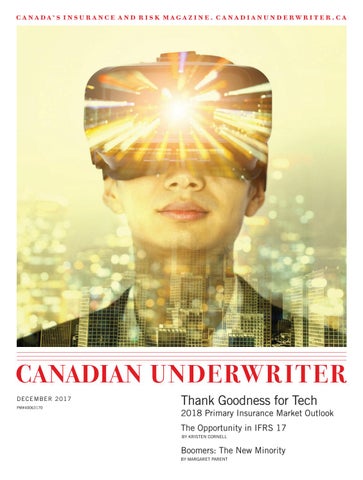
D ECEM B ER 201 7 PM#40063170
Thank Goodness for Tech 2018 Primary Insurance Market Outlook The Opportunity in IFRS 17 BY KRISTEN CORNELL
Boomers: The New Minority BY MARGARET PARENT
You see a growing export business. Davina sees cross border exposures. We provide multinationals with sophisticated coverage solutions. aig.com/multinational
AIG Insurance Company of Canada is the licensed underwriter of AIG property casualty insurance products in Canada. Coverage may not be available in all provinces and territories and is subject to actual policy language. Non-insurance products and services may be provided by independent third parties. Š American International Group, Inc. All rights reserved.
VOL. 84, NO.12, DECEMBER 2017
CANADIAN UNDERWRITER
CANADA’S INSURANCE AND RISK MAGAZINE. PUBLISHED BY NEWCOM BUSINESS MEDIA INC.
www.canadianunderwriter.ca
COVER STORY
Primary Insurance Market Outlook
20
Large catastrophe losses in 2017 put weather-related storm risks in the spotlight. Despite the tough year, industry CEOs see reason for optimism: the promise of new technologies points the way to a bright future.
FEATURES
13
29
35
Real-time data exchange
Auto Reforms
Lyft in Canada
The industry received a shot in the arm with the Broker Connectivity Accelerator project. Is real-time data exchange for commercial lines far behind?
Ontario’s proposed auto insurance reforms were top of mind at the Insurance Brokers Association of Ontario (IBAO) Convention in Ottawa.
Has Uber prepared the P&C industry for Lyft, the newest entrant into Canada ride-sharing market?
BY DAVID GAMBRILL
BY GREG MECKBACH
BY JASON CONTANT
15
31
37
Frog or Prince?
Tax Changes
Youth Movement
Companies should view the coming implementation of IFRS as an opportunity to transform their companies digitally.
Brokers could pay more tax if the feds make good on their promise to crack down on income sprinkling and passive investments.
The P&C industry appears to have made great strides in recruiting Millennials, according to preliminary demographic research.
BY KRISTEN CORNELL
BY GREG MECKBACH
BY MARGARET PARENT
December 2017 Canadian Underwriter
3
VOL. 84, NO.12, DECEMBER 2017
PROFILE Editor-in-Chief
Managing Director, Insurance Media Group
David Gambrill
Ian Portsmouth
david@canadianunderwriter.ca (416) 510-6793
ian@canadianunderwriter.ca (416) 510-6800
Associate Editor
Greg Meckbach
Director, Business Development
gmeckbach@canadianunderwriter.ca (416) 510-6796
Sandra Parente sandra@canadianunderwriter.ca (416) 510-5114
Online Editor
Jason Contant
Account Manager
jcontant@canadianunderwriter.ca (416) 510-6893
Michael Wells mike@canadianunderwriter.ca (416) 510-5122
Art Director
Production Manager
Gerald Heydens
Karen Samuels
Circulation Manager
(416) 510-5190
Mary Garufi
Photo: Leanne Scherp
Print Production Manager
mary@newcom.ca (416) 614-5831
Phyllis Wright
10 Visionary Educator .ca Published by
NEWCOM BUSINESS MEDIA INC.
Award-winning Greg Mansfield, manager of the Insurance Brokers Association of B.C.’s education department, sees mobile and Virtual Reality classrooms as the way of the future. BY DAVID GAMBRILL
451 Attwell Dr., Toronto, ON M9W 5C4 (416) 614-2200 • (416) 614-8861 (fax)
Chairman and Founder
President
Jim Glionna
Joe Glionna
Vice President, Operations
Controller
Melissa Summerfield
Peter Fryters
Director of Circulation
Pat Glionna Canadian Underwriter is published thirteen times yearly (monthly + the Annual Statistical Issue) by NEWCOM BUSINESS MEDIA INC. All rights reserved. Printed in Canada. The contents of this publication may not be reproduced or transmitted in any form, either in part or in full, including photocopying and recording, without the written consent of the copyright owner. Nor may any part of this publication be stored in a retrieval system of any nature without prior written consent. © Since 1934, Canadian Underwriter has been the voice of Canada’s insurance industry - a monthly magazine providing the highest quality and most relevant news and insight to insurance professionals from all segments of Canada’s property and casualty insurance market. The magazine is delivered on a direct-request circulation basis to 15,000 senior decision makers nationally, including insurance brokers, risk managers, insurance and reinsurance company personnel, claims managers and adjusters. Since its beginnings, Canadian Underwriter has been a link between all segments of the insurance industry, providing insurance professionals with award-winning coverage of industry issues, trends, news, personalities and events - written by Canada’s leading insurance journalists.
7 Editorial 8 Marketplace
Subscription Rates: 2017 Canada 1 Year $51.95 plus applicable taxes 2 Years $75.95 plus applicable taxes
Subscription Inquiries/Customer Service Mary Garufi (416) 614-5831 mary@newcom.ca
Single Copies $10 plus applicable taxes
GST Registration number 890939689RT0001 Second Class Mail Registration Number: 08840 Publications Mail Agreement #40063170
40 Moves & Views
Return undeliverable Canadian addresses to: Circulation Dept. Canadian Underwriter 80 Valleybrook Drive, Toronto, Ontario M3B 2S9
42 Gallery
Elsewhere 1Year $71.95 Annual Statistical Guide (included with above subscription) or separately $44 plus shipping and applicable taxes
Member
ISSN Print: 0008-525 ISSN Digital: 1923-34
4
FOCUS
Canadian Underwriter December 2017
Markel. Expect more from your insurance carrier
Commercial general liability Cyber risks insurance Directors and officers liability Environmental impairment liability Life sciences Professional liability Property and inland marine Security and protection industry Umbrella and excess liability
Helping brokers with effective insurance solutions since 1966 Calgary Montreal Toronto Vancouver www.markelinternational.ca
Canada’s First Online Buyer’s Guide NATIONAL
Insurance brokers! Find the specialized insurance coverage your clients need in the National Insurance Marketer: Canada’s original online directory of specialty, niche and non-standard insurance products, redesigned for 2017.
• Find markets for 100s of risks, from air conditioning to zebra mussels • Fully searchable by product and provider • Continually updated by carriers, MGAs and wholesalers themselves • Query providers directly from the site
Save time. Satisfy more customers. www.InsuranceMarketer.com Prefer print? You can still order your 2017 edition of the National Insurance Marketer for just $10. www.CanadianUnderwriter.ca/buynim
EDITORIAL
Déjà vu all over again
Hearing insurance professionals warn about severe weather risk is starting to sound like a scene out of Groundhog Day. David Gambrill Editor-in-Chief Canadian Underwriter david@canadianunderwriter.ca
No, you are not looking at a past issue from six years ago. I am now once again delighted to become the editor of Canadian Underwriter. Back in the perch of the editor’s chair, I am struck by the truth of the adage, ‘The more things change, the more they stay the same.’ I’m thinking in particular about the impact of climate change. In some ways, the current circumstances are very much the same now as when I first arrived as editor of Canadian Underwriter in 2005. Back then, Hurricanes Katrina, Rita and Wilma blew through the southern United States, wreaking destruction with peak wind speeds of between 280 and 295 km/h. Katrina led to storm surges and a levee breach that put large sections of New Orleans underwater. Back then, cat modelers’ early estimates projected insured damage claims of approximately US$40 billion — well short of the US$108 billion that insurers have paid out for Katrina since then. Now it is 2017, and another trio of hurricanes — Harvey, Irma and Maria — has left a trail of devastation. Hurricane Irma hit Florida as a Category 3 storm (windspeeds of between 178 and 208 km/h), causing widespread damage due to wind, storm surge, and inland flood. Cat modelling estimates of insured damage range between US$35 billion and US$55 billion for Irma; US$25 to $35 billion
for Harvey; and US$15-30 billion for Maria. These are early estimates. Time will tell whether cat models again come up short, as they did with Katrina. All told, it looks like another year of more than US$100 billion in hurricane damage. Katrina resulted in a hard market, and Canadian reinsurers at the time were calling for rate increases in the neighbourhood of between 20% and 25%. Insurance executives in this edition of the magazine predict rate firming to hit Canada in 2018, although by how much is an open question. A.M. Best says the global reinsurance sector is currently capitalized at about US$400 billion, and therefore a similar hard market — featuring major reinsurance rate increases — may not be likely, even after all the damage done. In the meantime, no one knows what to do about the weather. Hearing insurance professionals warn about severe weather risk is starting to sound like a scene out of the movie Groundhog Day, in which Bill Murray’s character wakes up to relive the exact same circumstances each day. Insurers have been cautioning anyone who cares to listen about this risk since at least 2011— right around the time when the industry started bandying about the catch-phrase ‘Water is the new fire.’ Back then, it was still news that water damage claims had surpassed fire damage insurance claims.
And so, what has the world done to heed the calls of the insurance community to prepare for escalating damage arising from more severe storms? The insurance industry has its work cut out for it, because old (and bad) habits die hard. While the industry has made some inroads, most recently appearing on a National Roundtable on Flood Risk hosted by the federal government, the capacity for human beings to ignore the obvious is astounding. Here is an anecdotal example: During my first tenure at Canadian Underwriter, a reinsurance company executive sent me an article about the New Orleans levee system, which was published at least two years before Hurricane Katrina. The article stated that the New Orleans levee was not built to withstand anything higher than a Category 3 hurricane. A similar article in the June 2003 edition of Civil Engineering Magazine said a Category 3 storm could put New Orleans under 20 feet of water. Nothing was done about it, because no one seemed to believe a Category 3 storm would ever make landfall in Louisiana. There is a lesson in this. At what point do Canadians act on the obvious and heed the cries of insurance professionals to protect themselves? Until they do, the industry should be prepared for a long period of public education ahead.
December 2017 Canadian Underwriter
7
MARKETPLACE
Canadian Market STATE FARM BRAND TO DISAPPEAR BY 2019 State Farm’s brand name in Canada will transform to Desjardins Insurance over an 18-month phased transition period starting in May 2018 and concluding by late 2019. The re-brand will put the Desjardins Insurance name on close to 500 former State Farm offices across Canada. The brand name change will be wholesale, affecting the website, digital properties, papers, signage, right down to replacing the State Farm logos appearing in the glass of office windows. “Many things need to be changed, and that’s why we’re talking about 18 months to go through that exercise,” says Denis Dubois, executive vice president of Desjardins’ property and casualty (P&C) insurance executive division. For the first two of four phases, beginning on May 1, 2018, brokers will learn more about the transition and will be able to educate their clients about the re-brand. During Phase three, planned for the fall of 2018, the State Farm and Desjardins brands will coexist, appearing side by side. “One reason is to maximize the association between the two brands, to transfer the equity,” says Dubois. During Phase four, the Desjardins brand will start to appear on its own by the end of 2019. 8
Canadian Underwriter December 2017
The impending legalization of marijuana will “impact virtually every line of business” of the insurance industry and introduce a whole new hazy world of risks, a managing general agent said recently. “If you buy a cookie at Mrs. Smith’s cookie shop with cannabis, is she going to be required to define the THC levels within there?” asked Mark Woodall, president and CEO of Special Risk Insurance Managers in Langley, B.C., referring to the main ingredient in marijuana. “It’s coming so fast and [it’s] such a broad range topic, it’s going to impact your liability, your accident benefits, your employee benefits, and your property [insurance].” Take for example a person who modifies the electrical system to allow for growing plans. If they “do it themselves and ultimately burn the premises down, is it covered or not covered?” Woodall asked.
duce,” he told the Insurance Institute of Canada’s recent At the Forefront breakfast in Toronto. “My view would be somewhere in between 30% and 40% over the next five to 10 years.” The rapidly decreasing cost of computing power has given insurance organizations an “unparalleled” ability to process and compute data, Thompson said. This allows insurance organizations to automate certain tasks and roles within the industry, reducing costs and increasing efficiency. The composition of the industry in the future will change as a result, he said. “If I look at claims, I think you will see less claims administration, and more [positions available in] what I call hard-core technical claims.” Companies using advanced analytics can leave complex, high-level underwriting to insurance professionals, Thompson added. “I think you are going to see a lot of routine underwriting completely automated.”
Technology
AUTONOMOUS VEHICLE TEST BED IN STRATFORD
MARIJUANA LEGALIZATION COULD AFFECT MANY INSURANCE LINES
AUTOMATION COULD ELIMINATE 30% TO 40% OF INDUSTRY JOBS: CEO Automation is going to significantly change the composition of Canada’s property and casualty insurance industry, predicts RSA Canada president and CEO Martin Thompson. “I think what we are going to see is the number of people in the industry will re-
The Ontario government recently launched the Autonomous Vehicle Innovation Network (AVIN) in Stratford, a “demonstration zone” intended to let researchers test such vehicles in real-life traffic scenarios. Partnering with Ontario Centres of Excellence, the provincial government says it is investing $80 million over five years in AVIN. On July 31, Ontario and
Michigan announced that they were completing North America’s first cross-border automated vehicle test drive.
Risk BROKERS STRUGGLE OVER WHO NEEDS CYBER Given the “fairly fluid coverage situation” in the cyber insurance market, it’s imperative for brokers to educate themselves about the array of available cyber products to establish the right limits of cover for their clients. “I think brokers struggle with the concept of who needs it, who will even think about buying it, and their own responsibility to make clients at least aware of the issues and options,” says Hugh Fardy, senior vice president of professional liability in Ontario with Arthur J. Gallagher Canada Limited. “There is also a fairly fluid coverage situation today, with markets amending their wordings and changing what and how cover is provided.” Establishing the right limits of cover is often an issue for both brokers and clients— especially cyber insurance, Fardy says, “as many do not have a strong understanding of exactly what the exposure is and what limit is needed to address that.” Generally speaking, a dedicated standalone policy tends to have a broader cover and better limits. Bundled coverage, on the other hand — or in the case of E&O, an extension endorsement
MARKETPLACE — often restricts the cover offer and usually comes with smaller limits. Fardy observed “a constant increase in the number of smaller businesses who have experienced a cyber issue.”
Regulation WHAT IS THE HOURLY RATE OF AN INSURANCE PROFESSIONAL? Ontario’s recent minimum wage hike up to $15 per hour ruffled a few feathers within the business community, but the new legislation didn’t raise much of a fuss within the property and casualty (P&C) insurance sector. “On this particular issue, we reached out to member companies when the legislation was first proposed, and we were not informed of any concerns,” said the Insurance Bureau of Canada (IBC). Ontario’s broker association has been engaged with the government about Bill 148 since the province released its Changing Workplaces review in May 2017. The Ontario government passed Bill 148, the Fair Workplaces, Better Jobs Act, last month. Among the changes are a gradual minimum wage hike. “Based on results from a member survey we conducted this summer, we don’t believe it will have any significant impact on brokers,” IBAO CEO Colin Simpson told Canadian Underwriter.
Assuming a 40-hour work week for 52 weeks a year, someone making a minimum hourly wage of $15 would make about $31,200 annually. In contrast, insurance brokers earn an average annual salary of $43,187 (about $21 per hour), Payscale.com reports, while insurance agents make about $40,545 (approximately $19.50 per hour).
to determine what kind of hockey fight would attract a lawsuit. For example, what were the expectations of the players entering the game? Was there a previous incident between the two players before the fight? Would the actions of the aggressor at the time lead a person to conclude there was an intention to cause injury? What degree of force was necessary to cause the injury?
Claims
REGULATORS SHOULD ENFORCE FRAUD REPORTING: AVIVA
HOW HOCKEY FIGHTS CAN TRIGGER CLAIMS
Canadian insurers should be required by regulators to report to fraud to law enforcement and to industry peers—be it claims for healthcare services that were not provided, or for bills for repairs that were never done, an Aviva Canada official suggests. “The provincial regulators of insurers need to compel the insurers in their province to act on fraud and that includes the reporting of data on fraudulent activity for the industry’s benefit,” said Gordon Rasbach, vice president of fraud management at Aviva Canada, in an interview. Aviva’s recent report, Crash, Cash and Backlash: Aviva Fraud Report 2017, includes results of a survey in which two out of three respondents said they “feel that cracking down on fraud would reduce their current auto insurance premiums.” That survey is based on interviews of 1,502 Canadians conducted in October by Pollara Strategic Insights.
Hockey fights are so frequent in the NHL that fans routinely describe them as “part of the game.” But when does the garden variety fighting cross the line and become the subject of an insurance claim for compensation? Lawyers Patrick Brennan and Shannon Mulholland of Shillingtons LLP remind insurance professionals about the rules of the game when it comes to underwriting policies and adjusting insurance claims related to hockey fights in Canada. “The courts have made clear that bodily contact is an inherent risk that is assumed by participants in the game of hockey,” Brennan and Mulholland told Canadian Underwriter, but “conduct that could be described as malicious, intentionally injurious or a deliberate unilateral attack will likely attract liability.” Traditionally, the courts have looked at several factors
The report estimates auto insurance fraud up to $2 billion every year.
NO FLOOD IS THE NEW ‘FIRED’ In the absence of standard residential flood wording, Canadian brokers are threatening to drop carriers who don’t offer overland flood, and are worried about errors and omission (E&O) claims related to overland flood insurance. Canada-wide, there is a “host of wordings out there” for flood coverage, Glenn McGillivray, managing director of the Institute for Catastrophic Loss Reduction (ICLR), told Canadian Underwriter. “This causes and will continue to cause confusion, as premiums, deductibles, caps/ limits, exclusions and policy wordings are all over the place,” McGillivray said. “I have heard of brokers threatening to ‘fire’ companies who don’t offer an overland product, because they don’t want to have to explain that to insureds.” Though sewer backup coverage has been available for years, coverage for overland flood was generally not available to Canadian homeowners until 2015. Now the Insurance Brokers Association of Nova Scotia is hearing “great concern over the potential for E&O where [overland flood] is an optional coverage,” IBANS president Gina McFetridge said in an interview. Depending on the policy, there could be coverage for sewer backup, overland water or ground water. December 2017 Canadian Underwriter
9
PROFILE
The Future of Broker Education David Gambrill Editor-in-Chief
Greg Mansfield has received an award for his visionary approach to broker CE. Here’s what he sees for broker learners in the future. It’s easy to see why Greg Mansfield, manager of the Insurance Brokers Association of B.C. (IBABC)’s education department, received the 2017 Dale Rempel Award of Excellence in broker education. For one thing, Mansfield is very experienced at what he does. He has been IBABC’s education manager for 18 years, more than half the time since IBABC hired its first education coordinator in 1986. During Mansfield’s tenure, he has offered 50% new course content each year, and pioneered the coversion of CAIB courses and exams to online delivery. Mansfield is also respected by IBABC’s partners in the insurance industry. He has worked in partnership with the Insurance Corporation of B.C. (ICBC), the province’s public auto insurer, to develop and deliver 10 Canadian Underwriter December 2017
seminars to train brokers for major upgrades in ICBC’s systems and policy design. He has also worked with the provincial broker regulator, the Insurance Council of B.C., to develop, among other offerings, the Council Rules course, a mandatory online course that outlines brokers’ privacy and code of conduct requirements. But perhaps most importantly, Mansfield is a visionary educator and a bit of a techno geek. He has seen the future of broker education and it is on mobile devices, in the near term, and in virtual reality (VR) classrooms sometime over the next decade. Mansfield had his first personal experience with VR while having dinner with a neighbour, who works in the IT field. Donning his neighbour’s VR headset with goggles, Mansfield used controllers to float over the planet, courtesy of Google Earth. The headset covers your eyes and gives you the sense that you are looking into three-dimensional space; your field of vision changes as you move your head. “I was blown away,” Mansfield said. “It’s still in its infancy, but I can just see what’s coming in the next decade or so. It’s going to be amazing. When I went home, I started thinking about the implications for education.”
Virtual reality will take time to develop, Mansfield cautions. But with advanced computer power, better broadband, and better graphics, VR seminars might be able to miminc what’s best about the the classroom experience — a chance to learn from interaction with their peers and an instructor or facilitator. “You still can’t beat the classroom, because in the classroom, when somebody is facilitating a seminar properly, there’s lots of interaction,” Mansfield says. “You have discussion, questions, and back-and-forth between the participants and the facilitator, as well as between the participants. They’re teaching each other and they are sharing stories and they are learning. It’s in the relating where the magic happens. Mansfield says he foresees a time when brokers can stay in their office or home, put their VR goggles on (if that’s still the form of VR 10 years from now), and interact virtually with their facilitator and peers. “That for me is really exciting,” he says. “This is going to seem very real, it may be scary real, but I can imagine us having a VR seminar in which brokers are logging in around the province in a virtual classroom setting, and they are looking over at each other and saying, ‘Hey, how are you? Good morning,’
and literally interact that way, which you can’t do now with a webinar.” However, before brokers get excited about a threedimensional VR classroom experience with peers across the province, the more immediate step is how to bring broker continuing education (CE) to mobile devices. “Today, it’s all about learning on the smartphone,” says Mansfield. The conundrum for educators is that the mobile
This is going to seem very real, it may be scary real, but I can imagine us having a virtual reality seminar. device requires a different way of delivering education. Mansfield says you can’t expect or ask somebody to watch a two-hour webinar on their mobile device. Nor will they likely want to read a whole chapter of a textbook on their mobile phone. Mobile learning has to be “chunked down more,” Mansfield says. “What the average [mobile] user wants is short little hits, a two-minute video, or something short to read that they can learn on the go,” he adds. “This is tough under current regulations and time
Photo: Leanne Scherp
PROFILE
constraints, because the [regulator] wants people to do their CE in credit chunks — one credit equals one hour. How do you break that hour-credit down into these short learning chunks for mobile? That’s the challenge.” Mansfield says brokers need to discuss with regulators how mobile learning can be broken down into briefer chunks and presented as part of an overall CE package. Returning from these excursions into CE’s future, what about Mansfield’s past? How did he get to be an award-winning educator in the first place? Mansfield came to broker education almost by accident, inspired by an exchange on a beach in Greece about two decades
ago with his then-wife. He had taken a year off work and was contemplating what to do upon his return. His wife said, “You’re so good at teaching people, what about some kind of teaching or training?” “Thank you, that’s amazing,” Mansfield replied. “It’s always been staring me in the face.” Mansfield says to this day. “I’ll always remember that moment at the beach.” Leading up to that moment, Mansfield started in the insurance industry 30 years ago as a junior commercial underwriter for Commercial Union (what is now Aviva Canada). He was later headhunted by a brokerage in southern Vancouver, Mellor-Liggett Insurance
Brokers, where he learned auto and personal insurance lines. He became an office manager at Mellor-Liggett. “In doing that, I ended up training some of our junior brokers on commercial lines, and tutored them on their CAIB exams. It was kind of a natural for me. I was always helping employees learn the business. They recognized my ability for training and explaining things to others early on, really.” Based on his then-wife’s inspiration, Mansfield returned from Greece roughly 20 years ago and set himself up as an educator, training basic web surfing to lawyers, people in Tourism Vancouver, and insurance brokers. That’s when he caught the eye of IBABC,
which asked him to brokers on how to use what was then the cutting-edge technology of the internet. “That was really fun,” Mansfield says of the early days teaching the internet. “The brokers were a great group. These were in the days when I literally had some brokers holding up the mouse to the computer screen, thinking that’s how it controls the computer.” After a training assignment commissioned by London Life, Mansfield joined IBABC full-time, where he has accomplished many things over the years—including managing a new entry-level textbook for brokers in B.C., which is scheduled to be launched next year. He is praised for establishing quality education on an equitable basis across all regions of B.C. In 2002, the province’s brokers were fully online, and Mansfield was again ahead of his time. In his nomination papers for the Dale Rempel Award, which recognizes excellence in broker education and development, the Insurance Brokers Association of Canada (IBAC) credited Mansfield for launching IBABC’s broker education online. “These courses set high standards for e-learning and quickly became the template for subsequent professional development programs,” IBAC says.
December 2017 Canadian Underwriter
11
2018 Symposium
Insurance Disrupted… Threat or Opportunity?
CIP SOCIETY
BREAKFAST KEYNOTE SPEAKER Fab Dolan
Tuesday, April 10, 2018 Toronto Board of Trade Featuring inspiring keynote speakers, insightful seminars and our Up Close and Personal session, Symposium is the premier industry event for GTA’s insurance professionals.
Head of Marketing Google Canada
UP CLOSE AND PERSONAL
This annual event brings together bright minds who provoke engaging discussion about the future of our industry.
Silvy Wright
Insurance Disrupted…Threat or Opportunity?
President & Chief Executive Officer Northbridge Financial Corporation
Sessions include: •
InsurTech: The Top New Products Changing the Industry
•
Succeeding in a Dynamic Environment
•
Cyber 2.0. What’s Next?
•
A Decade of Change: Implications for the Industry’s Workforce
John Taylor President Ontario Mutual Ins. Association
“Thought-provoking day with engaging sessions and speakers. Not to be missed.”
Other speakers to be confirmed
Learn more at www.insuranceinstitute.ca/gta Thanks to our generous sponsors:
Book now! Visit www.insuranceinstitute.ca/gta
Commercial Exchange David Gambrill Editor-in-Chief
Commercial brokers and carriers are close to launching real-time data exchange. Canadian commercial brokers are about to take a huge step forward on the path towards real-time data exchange between broker management systems and carrier back-end systems. At the time of writing, the Toronto Insurance Conference (TIC), a non-profit organization representing 25 full or associate member commercial brokerages across Canada, is poised to announce a proof of concept testing a real-time data exchange between a commercial lines brokerage and insurers. This would be the second major announcement this year regarding a real-time data data exchange between brokers and carriers. The first, in August, announced the Broker Connectivity Accelerator project.
The Broker Connectivity Accelerator project has a more general scope than the commercial lines focus of the TIC project. The accelerator project standardizes the way insurance brokers send transactions to insurance companies and receive complete responses in real time. In addition to beginning and ending transactions in the broker management system (BMS), the accelerator enables data to flow between systems electronically, without manual intervention or portal connections, in real time. “With accurate, straight-through processing, brokers will be able to focus on much more value-added, premium-generating activities such as proactive selling and servicing, and customer retention,� the Canadian Guidewire Users Group announced in August. The group includes Aviva Canada, Economical Insurance, Red River Mutual and Wawanesa Mutual Insurance Company. Technology solutions provider Guidewire developed the process in collaboration with soft-
December 2017 Canadian Underwriter 13
ware vendors Keal Technology and Custom Software Solutions, as well as the Centre for Study of Insurance Operations (CSIO) and the Insurance Brokers Association of Canada (IBAC). Although commercial lines brokers are late to the party when it comes to real-time data exchange, they are soon to become the life of the party. The integration challenges for commercial lines brokers and personal lines brokers are similar, says TIC president Michael Loeters. “But personal lines is much further ahead in some areas such as Electronic Data Interchange (EDI), Compuquote and other things that have been developed over the years to streamline the volume of transactions. “However, the true Holy Grail of real-time integration does not exist in either camp. For commercial insurance, we are really at ground zero from ev-
14
Canadian Underwriter December 2017
ery perspective other than commercial programs where brokers send insurers a bordereaux [a report providing premium or loss data] each month.” A TIC white paper released in June 2017 outlines in a chart format how many touchpoints and manual processes it takes to produce a single new commercial insurance policy. On the broker side, it takes 24 steps to get from lead generation to the point where the brokerage delivers the policy submission to the insurance company. The insurance company goes through another 24 steps to send final loss control recommendations back to the insured. Of the 48 different touchpoints in the whole process, 28 could be automated through real-time integration, TIC says in its White Paper. These include processes such as:
• generating a quote for the client; • creating and emailing binders of insurance and client invoices; • emailing loss control reports and recommendations between the insured and the underwriter; and • creating and sending policy documents. The cumbersome process is one reason why, in the words of the TIC White Paper, “the cost of doing commercial insurance through the distribution channel in Canada is too high.” The lack of technology integration between insurers and brokers has resulted in the insurers’ average expense ratio being estimated at 32% (i.e. for every $1 coming into the company, 32 cents is paid out in costs). The TIC proof of concept, like the accelerator project, uses CSIO data standards. This allows for the seamless flow of data between the commercial broker and the insurer without the need for data re-entry. “This would eliminate much of the scanning, emailing, data entry and other manual tasks that our industry hires an army of people to do today,” the TIC says. “The design advocated by IBAC and TIC is system-agnostic and inter-operable,” adds Brenda Rose, vice president and partner at Firstbrook Cassie & Anderson Ltd. Brokers and carriers can both use the solution no matter what software or system platforms they are using. “The industry-wide component is the use of the CSIO standards,” Rose elaborated in an email. “Any system that can digest or export/expose information using CSIO standards can use the [TIC project] design.” The difference between the TIC and accelerator projects is one of scope. Unlike the accelerator project, the TIC initiative focuses on claims notifications, both commercial and personal. Commercial lines-specific information would also be included in the scope of potential information exchanged in the TIC project.
IFRS 17 Accounting Standard
Frog or Prince? IFRS 17 doesn’t have to be an ugly accounting rule. It could actually lead to a handsome digital transformation. Kristen Cornell Principal, Industry Value Engineering, SAP Canada
To forward-thinking Canadian property and casualty insurers, IFRS 17, a new standard to ensure consistent insurance contract accounting, represents a long-awaited catalyst for digital transformation. Addressing IFRS 17 in a strategic manner can lay a long-term foundation for more efficient finance and actuarial processes, higher quality data, and the ability to conduct profitability analysis at more granular levels, ultimately supporting insight-driven business decisions. In addition to meeting regulatory compliance, an opportunity-oriented approach could help insurers reduce manual labour, increase efficiency across finance, and improve the employee experience by reducing mundane work. All this makes the new standard a big moment for the Canadian P&C insurance industry, and the way insurers respond will indicate how they intend to operate in the digital future.
BACKGROUND: What is IFRS 17? Twenty years in the making, the International Accounting Standards Board’s (IASB) IFRS 17 standard replaces IFRS 4 and aims to overhaul accounting for insurance contracts. The new standard, which takes effect Jan. 1, 2021, is designed to ensure consistent insurance contract accounting and comparability with non-insurance products globally. “IFRS 17 replaces the current myriad accounting approaches with a single approach that will provide investors and others with comparable and updated information,” said IASB Chairman Hans Hoogervorst. IFRS 17 applies to any business that issues insurance contracts, reinsurance contracts and investment contracts with discretionary participation features, provided insurance contracts are also issued. The scope of the standard not only affects primary insurers, but also banks, reinsurers, and any business offering insurance products. The standard applies to insurance policies of all sorts, including life, property and casualty, and group health insurance. Its implications to businesses are far-reaching: while many other regulatory requirements have been strictly finance
December 2017 Canadian Underwriter 15
standard, there is no time to waste in getting started. Canadian insurers will need time to unpack the requirements and align their data and systems.
TREATING IFRS AS AN OBLIGATION
and IT-focused, IFRS 17 brings actuaries to the centre of the discussion. The intersection of the finance, actuarial and IT departments brings new complexity and perhaps competing priorities in addressing the standard. IFRS 17 brings new data requirements, new calculations, new financial statements, and new disclosures. For finance, this will mean more work to calculate required figures, produce new financial statements and disclosures, and interpret changed business performance. For actuarial, the standard will mandate new calculations and potential modifications to models. And for IT, IFRS 17 will result in additional systems and more data that needs to be managed and consumed by the business. New working relationships will be required across functions, including finance, actuarial and IT, because data transcends these departments. Key business performance metrics must be realigned to new results under IFRS 17, 16
Canadian Underwriter December 2017
and management educated on how to achieve new targets. IFRS 17 will also increase scrutiny on individual product performance internally and across insurers, since comparability increases with the new standard. The analyst and investor communities must also familiarize themselves with IFRS 17 and determine how they will evaluate insurer performance going forward. IFRS 17 is an inflection point for how insurers want to operate in the modernday era and in the future. It will likely highlight issues with older IT solutions or a lack of system innovation; it may also expose a lack of cohesion or disharmonious strategies related to an organization’s technology platforms, data and/or projects. Regardless of an insurer’s appetite for digital transformation, a degree of finance system improvement will be required to support IFRS 17. And with just two and a half years until comparative statements are required under the new
Insurers are expressing mixed feelings about yet another regulation that brings change to the business at a potentially significant cost. To some, complying with the standard will be nothing more than an obligation that must be addressed in the least disruptive and least expensive manner. Insurers that take this minimal compliance approach, which probably involves a point solution to fill gaps in existing technologies, will limit their spend initially; this might allow for a faster implementation timeline. However, an obligation-oriented approach may have unintended consequences, contributing to an increasing number of systems and technological complexities. Businesses often underestimate the cost of maintaining siloed systems, which can include hardware, specialized IT skills, integration builds, integration maintenance, master data governance, data duplication, and data reconciliation. Treating IFRS 17 as an opportunity to undertake a more profound digital transformation may help to prevent the pitfalls associated with treating IFRS 17 compliance merely as an obligation to be fulfilled.
GETTING STARTED Given how many stakeholders and systems are involved, IFRS 17 can be difficult to unpack, and insurers are wondering where to start. Here are some recommendations: Lay the foundation Assemble a project team representing stakeholders from affected areas, including finance, actuarial and IT. Assign project sponsors, put overall governance in place, and identify those within the organization who need to go deep on the details of the standard. In addition to understanding the final
standard thoroughly, insurers need to document current processes and system data flows. This will serve as a starting point for identifying required gaps and changes. Finally, an impact assessment study can generate estimates on the standard’s impact and provide direction on budgetary requirements. Find your desired end state Armed with information about their current state, and taking strategic priorities into consideration, insurers must determine their approach and desired end state. This will be somewhere on the spectrum between minimum compliance and complete transformation. Once the direction is established, the project scope and budgets can be prepared, approved and finalized. Highlevel scenarios for both options can help leadership understand the implications of choosing one path over another.
IFRS 17 brings new data requirements, new calculations, new financial statements and new disclosures. Before the approach is finalized, it is imperative to evaluate the portfolio of in-flight and funded projects to consider overlaps and downstream impacts. For example, if an actuarial system is due for replacement, the IFRS 17 approach and requirements should be taken into consideration to minimize sunk costs on unsuitable technology or nonstrategic approaches. Conversely, work being done as part of ongoing projects could complement the work required for IFRS 17.
Focus on technology At this point, technology decisions must be made and a vendor selected. Starting with one area of the business and completing a proof of concept is a good way to build confidence in a solution and an approach. Many IT projects now use the agile methodology and aim to ‘fail fast and fail often,’ learn mistakes early, and achieve outcomes over the course of a project rather than mainly at the end. On the finance and actuarial side, deeper investigation into data information requirements will be ongoing. At the same time, work must be done to understand changes to financial statements, profits, and KPIs — aspects of IFRS 17 in which leadership and senior management will be keenly interested. Finally, a robust change management stream, often overlooked and underappreciated, will be critical to the success of IFRS 17 projects.
What opens a closed door? An appeal takes a refined skill set. Deeper research. Identifying the right issues. Persuasive factums. And a team of consummate advocates devoted to knowing the law and convincing the court. In the right hands, closed doors can be opened with fresh thinking. Lerners Appeals Group. The end is the point.
London Peter Kryworuk, Andrew Murray, Carolyn Brandow, Yola Ventresca Toronto Earl A. Cherniak Q.C., William Pepall, Kirk Boggs, Mark Freiman, Angus McKinnon, Bryan Smith, Brian Radnoff, Cynthia Kuehl, Jason Squire, Stuart Zacharias Sign up for our Netletter at lerners.ca/appeals/netletters/
Lerners LLP | Lerners.ca
December 2017 Canadian Underwriter 17
THE GOLD WATERMARK SOLUTION
15 Tips to save your customers' home from the perils of unwanted water Every water-bearing appliance, fixture or plumbing line is a potential source of water damage in a home.
7. Plumbing in ceilings & walls
Install an automatic water shut-off valve
8. Toilet fittings
Check for leaks & cracked hoses
6. Bathtub overflow Install an automatic water shut-off valve
9. Bathroom fixtures Promptly fix leaking fixtures
5. Refrigerator/ ice maker
Check for leaks & loose connections
10. Radiant floor heating
4. Dishwasher hoses
In secondary homes, maintain lower setting to avoid freezing in winter
Inspect & replace older hoses with steel braided hoses
3. Internal plumbing Rely on an automatic water shut-off valve
11. Water heater
Maintain regularly; check & tighten valves
2. Water softener Check for leaks & loose connections
12. Humidifier
Check in winter; disconnect water when not in use
13. Boiler
Maintain annually; replace after 25 years
1. The Solution
AquaTripÂŽ automatic water shut-off valve 14. Washing machine failure
Check for water and drain pump leaks
15. Washing machine hose Install steel braided hoses for improved durability
Attached to the main water supply line
FOR THOSE WHO KNOW THAT WATER DAMAGE PREVENTION IS A TEAM EFFORT Early mitigation is key for internal plumbing failure.
Water is the new fire
Did you know that water damage is the most common kind of loss affecting homeowners?
A bubble worth bursting All homeowners are at risk for an internal plumbing event but not all are well protected.
Sump Pump
48%
Water
Water is more frequent than fire but has more mitigation options
Fire
Less frequent but greater in severity, sprinklers provide only mitigation option
9%
Theft 31% 14%
7%
Damage and mysterious disappearance
12%
Sewer back-up
No backwater valve installed
Other
High frequency but generally low severity type claim
Due to failure of aging sump pump or over capacity
26% 53%
Roof
Heavy precipitation or ice damming
Internal Plumbing
Sudden appliance failure or broken or burst internal plumbing
Annually, Canadians incur losses in the hundreds of millions due to water damage. We know that some items are irreplaceable and preventing the loss before it occurs is always the best approach. A good insurance policy is part of the solution however damage protection starts at home. GOLD Watermark provides a complimentary or preferred rate for the installation of an automatic water shut-off valve, called AquaTripÂŽ, in addition to policy discounts. Ensure your customers are protected under the GOLD Watermark program.
SILVER STEVIE AWARD Best new product of the year 2016 Business to business category Our international recognition for the GOLD Watermark Program was awarded for taking ownership and investing in the mitigation efforts of our customers. We know that with proper awareness and by making water mitigation solutions accessible and affordable we can reduce the impact of unwanted water for our GOLD customers.
LEARN MORE AT GUARANTEEGOLD.COM
Bright Future The promise of digital technologies is top of mind for senior Canadian insurance executives in our 2018 Primary Insurance Market Outlook.
20 Canadian Underwriter December 2017
COVER STORY
Bright Future
D
igital technologies and weather-related catastrophes have taken the Canadian property and casualty (P&C) insurance industry by storm in 2017. Discussion about these topics featured prominently in our annual year-end survey of Canadian insurance company executives. Putting the customer first has been a sales mantra for quite some time, but digital technologies have had a profound effect on how the industry can now serve Canadian policyholders. Technology now allows Canadians to purchase their insurance far more quickly and conveniently than ever before, and the time for the P&C industry to adapt is now, Canadian insurance executives say. The optimism around tech’s potential to improve the delivery of insurance to policyholders comes at a rather gloomy time for Canada’s insurers overall. Regarding natural catastrophes, Hurricanes Harvey, Irma and Maria in 2017 resulted in early insured damage estimates of more than US$100 billion to cover damage claims in Puerto Rico, Florida and Texas. Several Canadian CEOs predict the impact these natural catastrophes may have on (re)insurance rates in Canada. Here, in alphabetical order by last name, is what Canadian insurance senior executives forecast for the industry in 2018.
December 2017 Canadian Underwriter 21
COVER STORY
Bright Future
1
Jean-François Blais President Intact Insurance
The insurance industry is facing potential disruption. Insurers are tackling several longer-term trends including the sharing economy, more connected consumers and products, the development of autonomous vehicles, the growing threat of cyber attacks, and the reality of changing weather patterns. This presents insurers with unique opportunities to do things differently, from transforming their operations and becoming advocates for change, to redefining the customer experience. Insurers are leveraging technology, big data, and artificial intelligence to revolutionize underwriting, pricing, claims, and new product development. Looking ahead, it will be important to explore how these tools can be applied across their operations, including sales and service as well as social media. Taking this holistic approach will help the industry and its employees work smarter, improve agility and foster innovation. The technological tools mentioned above should also be used to strengthen the customer experience. The experience we provide customers should be fast, simple, effortless and empathetic, whether it’s through mobile, in person or on social media. Crucially, insurers and brokers must demonstrate the value they can provide at every point of the customer journey, from helping customers break down the complexity of insurance to providing them with support where and when they need it. Current challenges in auto insurance provide a fantastic opportunity to showcase broker expertise through consultation. Insurers have an opportunity to introduce new solutions such as usage-based insurance to personalize the experience. By helping customers understand the value of insurance, we can strengthen our role as trusted advisors and help customers manage these changes. Looking at 2018, our operating environment will continue to become more disruptive and present new opportunities. Insurers and brokers must design 22 Canadian Underwriter December 2017
2
1
3
new ideas and solutions to leverage these changes, and remain committed to enriching the customer experience.
2
Nick Creatura President, CEO CNA Canada
The rapidly evolving environment of recent years has laid bare the need for insurers to focus attention on three core issues — talent, technology and brand experience — to ensure relevance and success in the face of strong and emerging competition. Talent: The industry faces the prospect of a significant percentage of its skilled workers retiring over the coming years. The generational shift in the composition of the workforce presents several critical challenges. Organizations must become much more effective at attracting and retaining talent, by offering compelling career propositions and developing engaging work environments. An inspiring and purpose-driven culture is essential to drive top performance. Organizations must also harness and transfer knowledge and skills from experienced personnel to new hires through effective mentoring and learning and development programs. Technology: Market-leading organizations will move away from passively collecting and storing customer data. Instead, they will move towards harnessing technology and analytics to develop better, more customized solutions for customers. By prioritizing creative and innovative thinking, applying lessons learned from consumer trends and developments, and
further developing their relationships with trading partners, progressive organizations will become their own disrupters and ensure their own success. Brand experience: Customers are more educated, demanding, and impatient. Getting what you want, how and when you want it, is no longer a concept but a social norm. Insurers that embrace, focus on, and invest in building out wider insurance solutions, with enhanced service and consultancy at the core, will thrive. The balance is shifting away from simply delivering a product to the experience of doing business with customers.
3
Denis Dubois President, COO Desjardins General Insurance Group
Canada’s property and casualty insurance industry will continue to evolve rapidly in 2018 in response to accelerating technology, changing customer expectations and climate change. Technology is a double-edged sword for insurers. Vehicles are safer than ever thanks to multiple sensors and cameras, but repair costs have skyrocketed because today’s cars are so complex. This would not be a problem if accident rates were dropping. But frequency and severity are both rising due in part to sophisticated infotainment systems that distract drivers, along with the use of cell phones and other risky behaviours. Legalizing marijuana will only make the situation worse. Fortunately, there is growing awareness of the problem and the need to educate drivers and to work with automakers and governments to reduce distractions. On the positive side, technology is helping to meet the changing expectations of customers. With the digitalization of everything from marketing through to distribution, underwriting and claims, insurers can deliver faster and more convenient service while providing customers with more choice and flexibility. Despite huge investments required, digital transformation is happening rapidly. Leading insurers are pushing the boundaries. They are using sensors and other technologies to evolve beyond their traditional
COMMERCIAL INSURANCE PRODUCTS
DATA AND CYBER PROTECTION
Real cyber protection for small businesses that are moving at the speed of technology. Headlines have shown how recent cyberattacks have impacted businesses across the globe. It’s not just massive corporations being hit anymore. Small businesses are increasingly being targeted too, and most don’t realize they need cyber protection until it’s too late. Padlock is our new, industry-leading cyber and data breach coverage for small businesses. While some companies simply offer cyber services, Padlock provides real protection. It includes coverage for business interruption,
PCI fines, extortion payments, data restoration, legal defense and more. From stolen laptops and phishing scams to ransomware and cyberattacks, Padlock keeps your small business customers protected. Get your customers the same great cyber and data breach coverage that keeps big companies secure at a price small businesses can afford. TO FIND OUT MORE, CONTACT YOUR BUSINESS DEVELOPMENT MANAGER.
Please see the policy wordings for full coverage details. The actual wording of a policy governs all situations. Coverage offering subject to individual risk eligibility and criteria.
goremutual.ca
COVER STORY
Bright Future role of providing help after a loss to helping customers to avoid or mitigate losses. This proactive approach will become increasingly important as the consequences of climate change become more severe. Fortunately, Canada had relatively few weather-related catastrophes in 2017. But the hurricanes in the southern U.S., as well as the wildfires in California and British Columbia, serve as reminders that the future will undoubtedly bring us increasing water, wind, and wildfire losses. The recent introduction of flood coverage in Canada was a positive step forward. The challenge now is to develop a better understanding of climate-related risks, effective ways to mitigate those risks and practical, affordable solutions that answer Canadians’ needs.
4
Ulrich Kadow Chief Agent of Canada Allianz Global Corporate & Specialty Americas
Across all markets, including Canada, pricing levels are generally at historic lows, which in many cases are well below technical pricing recommendations. Globally, recent natural catastrophes have highlighted the increasing frequency and potential severity of major events, potentially leading to more than US$100 billion in insured losses market-wide arising from natural catastrophes in 2017 Q3. Although there is rate strengthening in some areas, particularly for catastrophe risk, the general and longer-term impact of the above-mentioned natural catastrophes on the Canadian market is still uncertain and will depend heavily on local market dynamics, reinsurance market developments, as well as the entry or exit of traditional and alternative capital. Insurers need to maintain technical discipline and ensure proper underwriting and pricing of exposure. Many companies are making increased use of technology to support their operations and risk management programs. Examples include investments into digitalization, robotics, artificial intelligence, cloud computing, and 3D printing. Generally, this is a positive development and is expected to 24 Canadian Underwriter December 2017
4
5
6
have a beneficial impact on pricing and risk quality. However, as maturity of technology solutions develops, there may be glitches and underwriting against these risks increases in complexity. For carriers, technology innovation and improved portfolio insights, supported by high quality claims information, are essential to manage trends and take appropriate action. Insurers must continually improve their data quality and availability to keep up with an increasingly changing and connected world. Technology also drives the need to adapt existing products continually and to develop new insurance solutions such as cyber or coverage for unmanned aerial vehicles (UAVs, also known as ‘drones’). Technologically driven underwriting platforms, including the use of big data, will be the key to success in these areas. Large corporate, specialty and mid- market clients are becoming more sophisticated, connected and technologically driven. Fueled in part by a protectionist U.S. trade policy, Canadian companies are expected to diversify and expand their client base internationally. As a result, exposures are becoming increasingly complicated and more global. Advancements in technology will improve not only the clients’ capabilities with respect to their own businesses, but also how they interact with suppliers and customers around the world. As a result, cyber exposures and contingent business interruption will require more attention, a good understanding of exposure and adequate coverage solutions.
5
David Levinson
6
Sean Murphy
President, Chief Agent Zurich Canada
As 2018 begins, capital remains at the forefront in Canada. An active hurricane season in the United States will cause insurance carriers to look at their own exposures here in Canada, including earthquakes, fires, and floods. This may cause property rates to increase. Pricing pressure could come from reinsurers raising rates. Look for mergers and acquisitions among insurers and brokers to become more attractive as margins shrink. Auto insurance will continue to be a hot topic, especially in Ontario and British Colombia. A push for increased government rate control in Ontario and Alberta will cause smaller players to exit and put further strain on the profitability of the larger, personal lines players. Cyber is no longer an “emerging” risk in 2018. A continuing string of major breaches has demonstrated that we as an industry must address this risk now. More business leaders and corporate boards are talking about how deal with cyber risk. They are evaluating insurance solutions, but are more focused on mitigation tactics and educating their employees, who are the first line of defense against cyber criminals. Insurance providers will continue to focus on the fundamentals of the business to ensure they can deliver an underwriting profit. But they also need to be creative and responsive to remain relevant to their customers and brokers distribution channels. Customers’ exposures are rapidly changing, and they are expecting quicker solutions. This is an opportune time for talented and motivated Millennials and Generation Xers to step up and help redefine the customer experience for the insurance industry.
President Lloyd’s Canada
Most people in the industry anticipate a hardening of the market in 2008, the aftermath of an historic year of natural catastrophes. Some of the first signs of rising rates in the Canadian P&C industry are already starting to emerge. While the market cycle
CatIQ’s Canadian Catastrophe Conference
2018
Jan 31-Feb 2 Hilton Lac-Leamy Gatineau-Ottawa, QC
Bringing Together Industry, Academia and Government to Discuss Canadian Natural and Man-Made Catastrophes
REGISTER ONLINE TODAY! catiq.com/c4 Bring your expertise. Come for the workshop, stay for the conference! Sessions include: • Canadian Disaster Mitigation Workshop • Flood Risk Management All Over the Map: Bringing Some Cohesion • Public Communication in Times of Crisis • Lessons from Emergency Management Plans
Addressing the Climate Change Challenge with keynote speaker
• Coping With Canada’s Hottest Peril - Wildfire
Join the conversation #C42018 Platinum Sponsors
Gold Sponsor
Silver Sponsors
Maryam Golnaraghi Director of Extreme Events and Climate Risks Program, Geneva Association Media Sponsors
Community Partners
COVER STORY
Bright Future gives the industry much to talk about, it should not distract from the important role insurers play in helping cities to mitigate destruction such as that seen in Fort McMurray, Alta. in 2016, and across the United States, Puerto Rico and the Virgin Islands in 2017. It is important to place greater emphasis on infrastructure resilience in Canada. Together with rapid growth, cities are facing an uncertain and increasingly complex collection of risks including cyber threats, terrorism and natural catastrophes. The rising costs of disasters is a growing concern for the public sector and the insurance industry alike; over the past decade, direct losses from disasters totalled approximately US$1.4 trillion, according to the UN Office for Disaster Risk Reduction in 2014. The insurance industry can make a significant contribution to resilience in cities by creating incentives for robust risk management and paying claims quickly following major disasters. Local insurance markets are key facilitators of dialogue with governments, businesses, and asset owners. They can encourage stakeholders to take the appropriate risk mitigation measures, thereby potentially reducing damage from natural catastrophes, as well as the cost of insurance. The Institute for Catastrophic Loss Reduction (ICLR) has made tremendous progress in mitigating the risk of damage from basement floods and continues its focus on five hazards — water, earthquake, severe wind, wildfires, and hail — with the aim of sharing their findings to support investments by local officials, as well as action taken by property owners. Truly building resilience in Canadian cities and around the world means finding new ways to bridge silos within and between government; private sector and communities measuring and accounting for the (direct and indirect) benefits of resilience; and creating incentives for resilience-building activities.
7
Lynn Oldfield President, CEO AIG Canada
As chair of the board of the Insurance Institute of Canada (IIC), I see graduating insurance professionals who are educated, 26 Canadian Underwriter December 2017
7
8
committed, and inspiring. Their sacrifice and determination in completing their Chartered Insurance Professional (CIP) and Fellow Chartered Insurance Professional (FCIP) designations inspires us and we can have confidence that the future of our industry is in good hands. The war for talent will continue to be a key issue in 2018 and we need to work together as an industry to reach high schools, colleges and universities to attract the best and brightest. Innovation and disruptive technologies will enrich and enhance the tools of our trade for customer service, underwriting and claims adjudication. Groundbreaking innovation such as big data, virtual reality, artificial intelligence and blockchain could help to address some of the most pressing domestic and global risks. A positive impact for corporate Canada is the ability to collect real time data, based on the adoption of connected devices or the Internet of Things (IoT). IoT connected devices can be 1) applied to industrial machinery sensors to prevent downtime; 2) attached to points along the supply chain to track inventory and shipping; and 3) connected in commercial property to track metrics and reduce losses if a process breakdown was to occur. With the emergence of autonomous vehicles and other IoT developments, new questions of liability will come into focus. The insurance industry will play a vital role to help our clients mitigate the risks associated with data, innovation and IoT. Insurers can lead by anticipating the risks associated with this latest technological revolution and fostering the dialogue necessary for all participants to understand the opportunities and the consequences. If the current trend of increasing catastrophic severity continues, we can continue to expect significant losses in Canada and abroad in 2018. This past year is shaping up to be the costliest year ever
for insurance losses due to Hurricanes Harvey, Irma, Maria, an earthquake in Mexico and the California wildfires. In a globally connected economy, these losses matter to Canadians. Many industry leaders have already gone on the record to state that there will be broader implications on 2018 pricing.
8
Rowan Saunders President, CEO Economical Insurance
The continued deterioration and loss trends in automobile insurance and the impact of climate change will be the two biggest trends affecting Canada’s property and casualty insurance market in 2018. Auto is a challenge in many parts of the country, including the Atlantic provinces, Ontario, Alberta, and British Columbia. Provinces will have to make the necessary reforms within the product itself or insurance providers will need to continue taking rate. B.C. is a very good example of where we will soon see some of the highest rates in the country. The government-run monopoly is not properly limiting bodily injury losses and payments to customers and the indemnity payments are outrageously high each time. We’re seeing the costs of primary auto insurance in the province go up as a result. In Ontario, we are encouraged by the Marshall Report and the potential for improvements when the report’s recommendations are implemented. However, we still think there’s much to do to build a sustainable auto product in Ontario that’s affordable to most. With climate change, we firmly believe scientific evidence proves that the occurrence of weather events is going to increase. Year 2016 provided lessons for the entire Canadian P&C industry. Given a trend of higher-than-normal catastrophe losses right across the country, individual insurers must be able to provide the best protection and service we can to our customers, while also protecting our businesses. The increasing frequency and severity of hail storms, tornadoes, and water losses in some parts of the country is making it more challenging to provide coverage for those exposures. As
COVER STORY
Bright Future an industry, we must underwrite and rate those exposures accordingly, which is not going to make us very popular.
9
Heidi Sevcik President, CEO Gore Mutual Insurance Company
The pace of change in the property and casualty market remains faster than ever before, increasing the need for cooperation and innovation in 2018. The increasing frequency of severe weather events emphasizes the importance of the industry and governments working together to develop mitigation strategies and a framework for building community resiliency. Also, opportunities exist for insurers to partner with IoT companies to build solutions that help reduce risk. This year has seen an unprecedented number of cyber breaches, and even more cyber threats can be expected in 2018. The pervasive nature of this exposure presents a growing need to build services and products to allay the risk. Insurers, technology companies and reinsurers need to work together actively to address the growing vulnerabilities arising from an increasing dependence on technology. The advancement of technology is creating a change in consumer dynamics and expectations. The broker’s role as a personal trusted advisor is still valuable, but technology has influenced the consumer desire for transparency, convenience, simplicity, and customization in how they receive their products and services. Interpersonal service must integrate seamlessly with technology. Here lies an opportunity for insurers and brokers to work together to develop a new model and approach to service. An emerging omni-channel approach is forcing the industry to better understand modern customers. Data, information and analytics are instrumental in understanding customer preferences and satisfaction. Traditional notions of customer ownership have become blurred and fluid. Within this dynamic environment, collaboration between insurers and brokers is vital to provide innovative coverage and service to customers.
9
10
Insurers and brokers have a moral obligation to help customers understand their coverage, highlight coverage exclusions and make valuable recommendations based on risk assessments. They also have an obligation to make it as easy as possible for customers to get the service they need in the most convenient way possible, often during difficult or confusing times. Continuing to put the customer at the heart of everything should continue to be the priority for 2018 and every year after that.
11
10
Greg Somerville President, CEO Aviva Canada
There is no denying that natural hazards such as B.C wildfires, multiple flooding events and the hurricanes thrashing our neighbours have been top of mind for the property and casualty insurance industry of late. Too often, these major incidents are followed by horror stories in which insureds discover they have no coverage in place to pay out a costly claim. The increasing frequency of natural disasters highlights an important opportunity for the insurance industry to get better at minimizing uncertainty for customers. To do this, we can support the customer in their purchasing journey, help them understand the coverages they are purchasing, be there for them when they make a claim, and provide service in the format they prefer, whether digitally or in person. A customer buying insurance does not make any distinction between the claims and sales sides of the business. Delivering the best service and claims experience is what matters most to customers.The industry needs to adapt to customers’ changing needs. A few key examples of how to meet Canadians’ evolving expectations include 1) strengthening internal technology foundations, making it easier to process claims; 2) opening up Application Program Interfaces (APIs) to allow for better communication between insurer and brokerage systems; and 3) remaining committed to supporting emerging technology through investments and meaningful customer propositions.
11
John Taylor President, CEO Ontario Mutual Insurance Association (OMIA)
A lot of time and effort in 2018 will be spent reviewing this past year, which could be characterized as “the year of the water claim.” Almost all Ontario mutuals were exposed to one or more heavy rainfall events in 2017. The year provided the first significant test of the impact of the new overland water coverage introduced over the past couple of years. Compounding our “local” events, the global reinsurance market is digesting the impact of wildfire events and a severe hurricane season. The full domino effect of losses will be felt in 2018. It will likely affect not only rates, but also cause many insurers to reexamine risk selection, as well as how to match risk profiles with coverage limits and features. Water models are developing at an accelerated pace and much of this becomes an analytical exercise, with each insurer taking a unique approach to implementing analytic outputs. In non-weather-related news, many auto underwriters in Ontario are reporting a deterioration in results and awaiting government signals on the potential for significant reforms. While the prospect of reforms is positive, it won’t do anything in the short-term to bring rates down. Interestingly, while a trend toward autonomous and/or safer driving technology should have a positive effect on loss experience, it also presents a potential challenge if the need for traditional forms of automobile insurance is reduced. December 2017 Canadian Underwriter 27
COVER STORY
Bright Future Adding to the fun in 2018, the legalization of cannabis across the country will certainly create social change and debate. The insurance industry should be able to adapt to the required changes in a straightforward manner. However, if the experience in Colorado is any indication, it takes some time for the full social effect to be quantified and addressed.
12
Rob Wesseling President, CEO The Co-operators Group Limited
Taking on an increased leadership role with respect to climate change, and working to engage clients more effectively are two key challenges for the industry in the year ahead. In the short term, climate change may be a premium-level issue for the industry. But over the long term, it is a societal issue that will bring into question our ability to continue to live and work where and how we do today. To put it bluntly, insurance is not a viable solution when families, businesses and governments cannot afford the cost of the risk to which they are exposed. With respect to climate change, the Canadian insurance industry should be the canary in the coal mine. We are on the front lines and well-positioned to step forward and play a more significant role. Now is our time to make an important positive impact through proactive efforts to help strengthen resiliency in Canadian communities. Our industry has shown leadership in this area, both internationally and in Canada, such as at the National Roundtable
12
13
on Flood Risk, which brought together key stakeholders for a national discussion on a vital societal issue, as well as the Insurance Development Forum, which brings together the insurance industry, the UN and the World Bank to use insurance as a mechanism to achieve the Sustainable Development Goals. In today’s connected world, our ability to engage clients is paramount. Yet, our industry’s digital and mobile capabilities are not at the same level of maturity as other industries, and this presents a threat for us collectively. Providing options for clients to interact with us digitally while at the same time ensuring that they have access to professional advice tailored to their needs is of critical importance.
13
Silvy Wright President, CEO Northbridge Financial Corporation
With digital innovation, customers are extracting more value from their insurance partners — and this will only continue to ramp up in 2018. Insurtech startups raised $985 million in 2017 Q2 alone; investments in startups have increased by 36% over the prior year. Insurtechs may be viewed as industry dis-
claims
Invest in your client experience From accident to claim to appointment in no time! progi.com/insurer
28 Canadian Underwriter December 2017
watch Tom’s story at
progi.com/tom
ruptors, but they are necessary allies for insurers and brokers in gaining competitive advantage. New digital solutions are transforming the approach to helping customers mitigate their risks, providing them with meaningful service and connecting with them on matters of importance to them. The end result? Both the insurance advisor and provider are able to provide greater customer value in a very engaging way. How insurance companies are re-imagining the claims process is a great example. They have started to see the benefits that mobile technology can bring, such as real-time communication and greater transparency for the customer. Helping to prevent claims from happening in the first place is another opportunity to add value through digital tools. Whether through connected monitoring devices or thermal imaging of equipment to prevent and reduce risk, insurance partners can not only offer a safer environment for their customers, but also take the opportunity to embed these tools within their insurance processes to help lower overall costs. Customer education is also being taken to the next level through the use of artificial intelligence. Chatbots are a prime example, allowing customers to have their questions answered in real time, 24-7, while gathering insight on what matters most to them in the process. New digital innovations will continue to create exciting opportunities for the insurance industry, but leveraging these solutions to complement the expertise and trust customers rely on will be the winning formula.
Auto Polish
Auto insurance reform was top of mind at this year’s Insurance Brokers Association of Ontario convention. Greg Meckbach Associate Editor
Ontario’s 2016 auto reforms were a hot topic at the recent Insurance Brokers Association of Ontario (IBAO) annual convention, held Oct. 25-26 in Ottawa. Brokers discussed whether they made the most of the opportunity to explain the changes to their clients, creating a closer connection with consumers. Insurers, meanwhile, talked to a key figure in the reforms, David Marshall, about what lies in store. Ontario implemented reforms for the province’s 9.7 million drivers on June 1, 2016, which insurers say reduced premiums by an average of 8.5%. As the Insurance Bureau of Canada (IBC) notes in its 2017 Fact Book, more than half of the savings come from changes to accident benefits, and the remainder come from changes to bodily injury coverage. Insurers have argued that the reforms offer insured drivers more choice. For example, the catastrophic impairment benefit now offers $1 million for medical/rehabilitation and attendant care combined, regardless of fault. Ontario drivers now have an option to buy up to $2 million for this benefit; when combined with the optional medical/rehabilitation eligible benefit, the amount can be increased to $3 million.
Before 2010, Ontario vehicle owners had to buy first-party auto accident benefits insurance, with $100,000 in medical and rehabilitation benefits and $72,000 for attendant care. Mandatory coverage was cut by 50% in 2010. Now, for accidents occurring on or after June 1, 2016, there is one limit of $65,000 for both medical/ rehab and attendant care benefits. Brokers can advise clients of optional additional coverage available. Explaining these reforms and providing advice is a “perfect example” of how brokers can connect with clients, said Brian Purcell, who takes over in 2018 from Traci Boland as president of IBAO. “How many brokers looked at [communicating the reforms to clients] as an unwelcome increase in workload and took the easy way out just to fire off an extra piece of paper in a renewal envelope?” Purcell said during his incoming president’s address. “How many others took that as an opportunity to make personal contact with their client, review personal situations and uncover greater needs?” The industry is urging more reforms. David Marshall, a special advisor on auto insurance to Ontario Finance Minister Charles Sousa, re-
December 2017 Canadian Underwriter 29
leased 35 recommendations in a report released Apr. 11. Brokers heard Marshall at the Convention on Oct. 25 during BIP Talks with IBC president and CEO Don Forgeron. “It’s possible that there will be change here in Ontario again,” Forgeron said during his talk with Marshall about the province’s auto insurance system. “It’s possible that more options will exist in the future.” In his report, Marshall called on the Ontario auto insurance regulator to create “programs of care” for the most common auto accident injuries. In an auto accident benefits claim, “you’ve got to get that medical care to the person quickly,” Marshall said, “which means you can’t start wringing your hands and doing your research and arguing about what care is appropriate each and every time.” Like the other recommendations in his report, the call for programs of care is not “revolutionary,” Marshall told IBAO
30
Canadian Underwriter December 2017
members. “There’s lots of medical evidence to show that straightforward injuries, which are 85% or so of auto injuries, are not complex.” Jim Harris moderated the CEO panel at the IBAO Convention. He asked insurers on the panel about telematics (payas-you-drive insurance) as well as the use of technology to improve customer service to insured drivers. More than 300,000 Intact Insurance customers have opted for telematics on their policies, the carrier’s president, Jean-Francois Blais, noted during the panel. He said the telematics program is a way for the insurer “to connect the customer.” Picking up on this theme, Harris asked Blais about Intact Client Centre, a computer service that lets customers view, download and print documents such pink slips, billing summaries and insurance agreements. The launch of Client Centre “caused a bit of a stir throughout the broker
channel,” Harris noted. He asked Blais whether Intact plans in the future to using a different approach when launching new products and services. “Over the past two years I have said to brokers, ‘Technology is coming, we have the capacity to develop some new tools,’” Blais said. Brokers have to spend a lot of time answering calls, looking for paper copies of policies, and managing customers’ payments, and they want more time to sell, Blais said. Intact was trying to address this issue by introducing Client Centre. Intact has 30 people testing artificial intelligence applications in “every aspect” of the insurance business — including claims, underwriting, pricing, customer experiences and human resources. The purpose of that testing, Blais said, “is to ask ourselves, ‘Where do we re-position our jobs, when we use artificial intelligence?’”
Out of Pocket
Greg Meckbach Associate Editor
Brokers could pay more in tax after feds propose to crack down on income sprinkling and passive investments. Some brokers running family-owned firms could be paying additional money to the tax man starting next year, depending on how their firms are structured and how the federal government implements changes proposed this past summer. Among those potentially affected are familyrun brokerages that pay dividends to the owner’s spouse or children, as well as brokerages earning more than $50,000 a year from holdings that are not core to the business.
“As it stands, the broadest tax reform in decades as tabled could favour business owners selling the family business to arms-length parties instead of passing the business on to family members,” said Brooke Hunter, president and CEO of Hunters International Insurance, who is part of the fifth generation of a Toronto insurance family and former president of the Toronto Insurance Conference. Insurance Brokers Association of Canada (IBAC) chairman Robert Harrison says it’s not clear how the federal government’s proposed changes will affect the availability of capital for small businesses such as brokerages.
INCOME SPRINKLING In a discussion paper published July 18, federal finance minister Bill Morneau suggested some Canadians are “taking advantage of the fact that corporate income tax rates are much lower than personal tax rates for higher-income individuals.” The total amount of income tax owed by a brokerage, and personally by the owners, depends on a whole host of factors, including the total business income, personal income and the breakdown of personal income by salary and dividends.
December 2017 Canadian Underwriter 31
The federal government is proposing several changes, including an expansion of the tax on split income (TOSI). Taxing split income is designed “to address sprinkling of certain income to minor children,” as Morneau explains in the discussion paper. For example, a business owner can arrange to distribute income to individual family members through corporate dividend payments. The government is concerned that this is being done to minimize the overall amount of personal income tax paid on that income. Beginning in 2018, the Liberals are proposing to start charging TOSI to adults earning income from the business of a related individual when Canada Revenue Agency deems that income to be “unreasonable under the circumstances.” Brokers remain unsure how CRA plans to define the term “unreasonable.” During public consultations, which ended October 2, the Chartered Professional Accountants of Canada argued that the reasonableness test would be “highly subjective” and should not be implemented.
dends from his or her parent and pay “probably little or no tax at all.” But if TOSI gets expanded, that income could be taxed at the highest marginal rate — either 40% tax or 45%,
IMPACT ON BROKERS
The tax may discourage brokerage owners from using dividends to finance their children’s adult education.
Tddy Burello a partner and business advisor with MNP LLP, a business consulting firm, gives an example of how the tax may discourage brokerage owners from using dividends to finance their adult children’s education. Under the federal government’s proposal, according to Burello, when brokerage owners pay their adult children dividends, those adult children will have to make some sort of contribution to the brokerage either in labour or in capital to avoid paying TOSI on dividends. “Obviously many of us know that that may be a tough task for a lot of the brokerage industry,” Burello says. This is because some brokerage owners financially support their children attending college and university by paying them dividends. Burello says an adult child of a brokerage owner attending college or university could get $40,000 a year in divi32
Canadian Underwriter December 2017
depending on the nature of the dividend. “So now that child will be paying $16,000 in tax versus what they would have paid — zero,” Burello said. If brokerage owners have to start paying TOSI, they will have to plan differently going forward, Burello said. “They have to think of other compensation mechanisms to get the same amount of cash in their young adult (children’s) hands.”
AVAILABILITY OF CAPITAL In its discussion paper, the government gives an example of a self-employed person who does not incorporate and
personally earns $220,000 in a year. That person would pay $79,000 in Ontario and federal taxes. But if the same self-employed person incorporates as a business, he or she could conceivably pay only $54,000 in tax — for example, by paying dividends to the owner of the corporation and also to the owner’s spouse and child, who are in lower tax brackets. “If you are some sort of a professional and you are paying for your kids’ education — your kids are 18 to 24 — and you can receive very favourable tax treatment paying for that person’s education, that to me just isn’t fair,” said Francesco Sorbara, Liberal MP for Vaughan-Woodbridge, during the Insurance Brokers of Toronto Region’s breakfast on Nov. 14. But in an interview, Harrison pointed out that every business owner organizes their affairs differently. “The variety of ownership structures and employee structures is mind boggling.” It can be difficult for small firms and self-employed people to borrow money for their business, Harrison argued. And so it makes sense for brokers to consider the tax advantages to small businesses of income splitting or paying dividends to family members from the perspective of whether it “promotes availability of capital for small businesses.”
PASSIVE INVESTMENTS The federal government is also proposing to “generally remove the refundability of passive investment taxes.” This applies to a situation in which the earnings used to fund passive investments are taxed at low corporate tax rates. Passive income “consists of earnings derived from activities in which a corporation is not materially involved,” the federal Office of the Parliamentary Budget Officer said in a report released on Nov. 23. It could include property income, interest or dividends. The government’s intention is “to increase the tax rate payable by private corporations in these circumstances so that there may no longer be any tax
benefit in retaining the funds within the private corporation,” law firm Aird Berlis noted. Morneau’s proposals “are quite complicated,” the law firm adds, but the end game is to increase significantly corporate income tax on passive investment income generated from active business income. From Deloitte LLP’s perspective, the federal government’s concern is that “individuals who earn passive income through a corporation have access to a greater amount of capital due to lower corporate rates compared to personal rates.” But an increase in passive investments can allow the brokerage or business owner to take bigger risks, the CPA says. Or it might create an opportunity for the business owner to exit the business and join a start-up company for reduced compensation. The start-up can then benefit from the experience and expertise of the entrepreneur during years when it has little or no income.
From the broker’s point of view, “our concern is one of fairness and permitting small business the opportunity to create capital and to employ it, and to employ the people that they do, and to stay
Our concern is one of fairness and permitting small business the opportunity to create and employ capital. in business when things aren’t as good as otherwise,” Harrison told Canadian Underwriter. “At some point there needs to be planning for retirement.” Changing the rules on passive investments “penalizes those who have already been re-investing in their busi-
ness with an eye to the long haul,” Hunter said in an e-mail to Canadian Underwriter. Additional details on how the government plans to treat passive investments were released October 18. As a result, “corporations with investments in passive assets that generate no more than $50,000 per year of investment income will continue to be taxed under the existing tax regime and will not be subject to the proposed new regime,” BDO Canada LLP says. In 2014, most Canadian controlled private corporations (CCPCs) did not generate passive income of $50,000 or more, the Office of the Parliamentary Budget Officer reported last month, adding that only 9% of the 61,171 CCPCs in insurance or finance generated passive income above this threshold. “We will need to wait until the 2018 federal budget for further details on how income over that threshold will be taxed,” BDO noted.
December 2017 Canadian Underwriter 33
Putting the pieces together.
Events and Seminars Calendar CIP Society Events and Seminars give you the opportunity to learn, to network, to catch up on industry developments and to advance your professional and career development. CIP Society Events & Seminars
Convocations
Toronto—Industry Trends & Predictions 2017 ........................................January 16 Ottawa—Don’t Let a Natural Disaster Turn into an Insurance Disaster ..January 18 Ottawa—Twenty Questions to Ask to Mitigate Risk ...............................January 18 Toronto—Managing Risk in a Connected Society ..................................January 24 Cambridge—Industry Trends & Predictions 2018 ..................................January 31 Ajax, ON—Sharing Economy ...................................................................February 2 Ottawa—The SWOT Team .....................................................................February 13 Pickering, ON—Axe Throwing .....................................................................March 7
IIBC—Kelowna..........................................................................................January 11 IADQ—Quebec .........................................................................................January 13 IIO—GTA ................................................................................................. January 25 IIO—Kawartha/Durham ..........................................................................February 3 IIO—Hamilton ........................................................................................February 28 IIO—Conestoga............................................................................................March 1 IADQ—Montreal ........................................................................................March 28
Looking for insight and research on the latest trends in the p&c industry? Visit our free online library of Trends Papers at www.insuranceinstitute.ca/cipsociety/information-services. Looking for information to advance your career? Visit: www.insuranceinstitute.ca/mycareer.
Rideshare Redux
California-based Lyft is coming to Canada. Has Canada’s P&C industry learned from Uber? Jason Contant Online Editor
California-based Lyft is preparing to enter the Canadian ridesharing market, announcing its first stop will be in Toronto by the end of the year. Preparing for Lyft’s arrival, Canadian insurance professionals are once again looking back at the insurance issues associated with Uber’s marketplace entrance a few years ago. Only this time, questions surrounding coverages, endorsements, legal concerns, underwriting and adjusting have all been explored and, in some cases, addressed. But have all the ridesharing questions been answered? Lyft is in a similar situation now as Uber was a few years ago. Private auto policies still generally preclude a vehicle from being operated for hire, although some endorsements exist. And so, Lyft’s pending arrival once again begs the question: is Canada’s property and casualty insurance industry any further ahead in figuring out how to insure the risks of ridesharing drivers?
NAGGING LIABILITY ISSUES “Transporting paying passengers opens drivers up to all kinds of liability issues, costs and claims,” said Marie Gallagher, branch manager at Kernaghan Adjusters in St. Catharines, Ont. “The financial risk to a driver in not taking out additional insurance, or concealing that the vehicle is being used for ridesharing, far outweighs any potential ridesharing revenue. As such, I think there is going to be an onus on a broker or direct writer to clearly note on the application of insurance that
such things (use of vehicle) have been explained in detail to the insured to protect the broker in future.” An underwriter will accept a risk or price a policy based on many factors, Gallagher said. Although not an exhaustive list, these include 1) the the territory in which the vehicle is being driven; 2) the number of kilometres driven annually; and 3) whether the vehicle is for personal or business use. An adjuster will ask all these questions and more, but once those questions are answered, that doesn’t necessarily mean it’s smooth sailing. “In the course of their investigation, an adjuster can ask, ‘How many hours a week have you used your vehicle for ridesharing?’” Gallagher said. “But in reality, how can this number actually be verified? And what if they typically use it 10 hours a week, but, every once in a while, 25? Or 30? An underwriter would never know.” The longer a vehicle is out on the road, the higher the risk it may be involved in a collision. But Gallagher questions whether insurers can monitor the territory in which a vehicle is being used. “An insured may primarily use their vehicle in a suburb and be rated accordingly, but what if they are driving the people in those suburbs to the airport on Series 400 highways each week?” she asked. Eric Grossman, a lawyer with Zarek Taylor Grossman Hanhrahan LLP in Toronto, gives the following example as a “live issue.” December 2017 Canadian Underwriter 35
Imagine an Uber driver picks up a fare in downtown Toronto and drops the fare off at Pickering, Ont. At the end of the ride, the driver shuts off the ridesharing app and drives home, getting into an accident along the way. Technically, they are not covered under the Uber policy because they do not have a paying fare and they are not trolling for one, Grossman observes. But part of the Intact endorsement reads, “this policy shall respond prior to any other policy of which the Rideshare Driver is an insured or named insured.” So, in the example above, with the long drive from Pickering to Toronto, would the underlying policy of insurance have to respond instead of the Uber policy? “Arguably yes,” Grossman said. But it might get complicated because of the distance and territory driven. “Would the underwriter of [the underlying] private vehicle policy say, ‘You know what? That’s not part of the risk that we ever undertook.’”
Another live issue from a legal perspective revolves around accident benefits and which policy responds. If the driver of an Uber vehicle is involved in a collision, priority is supposed to go to the Uber policy when the vehicle is being used to drive an Uber fare. “But what if you’re a passenger in that Uber policy?” Grossman asked. “If you’re a passenger and you happen to have your own policy of insurance in Ontario, the priority rules have always said that you always go to your own vehicle.” Grossman lists hypothetical situations in which an Uber passenger doesn’t have their own car, has never been insured in Ontario or is a visitor to the province? Under these scenarios, “To whom should I be going for my accident benefit claim as a passenger in an Uber vehicle?” Grossman asked. “I thought the answer is supposed to be that you go to the Uber policy, and not the policy on the private vehicle when it is not being used as an Uber vehicle.
That is, as I understand it, one of the conflict issues that is arising.” These two ridesharing issues likely won’t be any different when Lyft arrives in Canada, Grossman said. “If Lyft intends to come in without those same things addressed, it’s going to revive all of those problems.” Malon Edwards, a spokesperson for the Financial Services Commission of Ontario (FSCO), reported that “a number of insurers have issued fleet policies to ridesharing entities that provide some coverage for ridesharing participants. FSCO has approved a number of forms to ensure adequate disclosure of coverage for these participants.” Ontario’s insurance regulator advises consumers to inform their personal auto representative if they are driving for a ridesharing service, since ridesharing can affect their personal policy, and also to talk to municipal officials for more details about the municipality’s ridesharing requirements.
Make your name stand out. The Chartered Insurance Professional (CIP) designation is recognized as the hallmark of professionalism in the property and casualty insurance industry. Employers across Canada know that a CIP has completed several years of rigorous study, adheres to a strict code of conduct and has the experience to offer clients fully qualified professional service. If you want to be assured employers will take note of your resumé—earn your CIP.
Learn more at www.insuranceinstitute.ca/CIP 1-866-362-8585 Follow the Insurance Institute
36
Canadian Underwriter December 2017
Be assured.
Millennials Rising
Preliminary research suggests that P&C insurers have successfully recruited Millennials into the industry Margaret Parent Director Professionals’ Division Insurance Institute of Canada
Some would say the property and casualty (P&C) insurance industry in Canada is likely to change more over the next five years than it has in the past 50 years. That may well be true if the industry can fully embrace technological advances like artificial intelligence and machine learning, big data analytics, Internet of Things (IoT), insurtech, blockchain, and more. It is even more likely if the industry has a workforce that can keep pace with these innovations. The composition of the P&C industry’s workforce has already changed significantly over the past 10 years, according to data from The Insurance Institute of Canada’s demographic research. For years, the industry has talked about the need
to attract youth to the industry. Preliminary findings from the 2017 demographic research census suggests a shift has taken place since 2007. Put simply: • In 2007, the biggest cohort of employees in the industry was ‘Baby Boomers.’ • Now in 2017, the biggest cohort of employees in the industry is ‘Millennials.’
MILLENNIAL SHIFT Understandably, the age profile of the industry has been a primary concern from the start. Here is how the industry’s demographic trend has evolved since the Institute’s first comprehensive research study in 2007.
2007 The industry was out of step with the general labour market in Canada, with too many Boomers (then aged 41 to 60, representing 49% of the workforce) and not enough Millennials (then aged 27 and under, representing 12%).
December 2017 Canadian Underwriter 37
2012 Five years later, the industry had done a good job of recruiting Millennials, who now make up a more representative proportion of the industry and the general labour market (27% Millennials then aged 17 to 32 in the industry, compared to 37% Boomers then aged 46 to 65 -- with an average retirement age in the industry of 60).
2017 A decade after the first study, Millennials (now aged 22 to 37) are the largest cohort in Canada’s general labour market and in Canada’s P&C insurance industry, too (at 38%). With the average retirement age for the industry holding at 60, Boomers (now aged 51 to 70) are steadily retiring and their share of the industry’s workforce is rapidly shrinking -- it fell to 28% in 2017. Broadly speaking, it appears the industry has done a good job recruiting youth into the industry. “Keep in mind that the workforce in general is aging, so if the P&C workforce is not aging, that is a sign the industry is able to recruit young people,” says Michael Burt, director of industrial economic trends with The Conference Board of Canada. (The Insurance Institute contracted the Conference Board as a consultant to conduct the demographic research study and report on the findings.) Burt notes the ability to recruit young people into the industry is particularly noteworthy, given the pace of hiring in the P&C industry. “Industry employment has seen little change over the past decade, relatively speaking, so most of the hiring is replacement rather than new positions,” he says. “It is much easier to change the workforce demographics in a growth environment where lots of hiring is going on. In industries where employment has been shrinking, the workforce tends to be very old, because there is very limited hiring going on.”
2003, has certainly seen big changes in the last decade on both sides of the potential candidate and employer equation. “In response to the recommendations for greater recruitment of youth stemming from the 2007 demographic research, Career Connections has dramatically increased its engagement on post-secondary campuses,” says Trevor Buttrum, manager of the Institute’s Career Connections program. “We’ve also created insurance-specific events that facilitate opportunities for industry employers to build their brand and recruit at colleges and universities across the country.” The strategy is working, Buttrum said. “We’ve seen students go from ‘not at all interested in exploring careers in insurance,’ to asking how their analytical
38
Canadian Underwriter December 2017
LOOMING GAPS Here are some themes the latest demographic research is exploring. The Institute will be reporting on the findings when the analysis is complete:
Composition of the industry by age group
2007
2012
2017
0
Attracting Millennials The Insurance Institute’s Career Connections Program, which has been promoting careers in insurance since
skills could be used for cat modelling rather than capital markets in banking.” Buttrum has seen employers follow suit by building their recruitment teams, joining Career Connections at insurance specific events, and developing their campus recruitment strategies. “All of these things are required for insurance employer brands to be alongside others vying for the same top talent,” he says. Another significant pipeline into the industry is full-time insurance programs. There are now 14 such programs, up from just four in 2007. Whereas most people in the industry once said they “fell into insurance by happenstance,” now we have more than 400 candidates each year either choosing to study insurance, or choosing to work towards a career in insurance. Employers seek out these graduates, who have some or most credits towards their Chartered Insurance Professional (CIP) designation. The placement rate at program’s end, between 95% and 100%, is attractive to Millennials, university graduates and career changers.
10 20 30 Boomers
GenX
Credit: The Conference Board of Canada.
40 Millennials
50 GenZ
60
1
Management and leadership development, and succession planning These are the top two human resources concerns ranked by the industry’s HR representatives. This is not surprising, given that high retirement rates are still expected; there are concerns around knowledge transfer; and there is existing capacity to ramp up individuals with management potential to succeed.
2 The impact of advancing technology on job
types, functions and skill requirements Many anticipate that several support roles may be eliminated by automation; that many more roles will have much more technical functions incorporated; and that skill sets will need to advance. The demographic research will have more to report on this as the data is further analyzed by The Conference Board of Canada.
SURPASSING INDUSTRY STANDARDS
3 Increased competition for key talent with
other industries This is particularly true of roles like data scientist and business analyst. Many sectors are looking for talent in these areas of specialization to help enhance their capacity to deal with big data and meet consumer demands for individualized products and services.
4 Significant advancements in risk, and to
insurance products, services and delivery As the lines blur between personal and commercial, and as risks like cyber and sharing economy grow, creative and innovative solutions will be needed. Insurance professionals with critical thinking, problem solving and creativity are needed.
5 To aid with succession planning at all levels, mapping of workplace critical skills, accelerated education, and training.
Helping industry professionals map their career and education pathways to advance their careers will support recruitment and retention strategies within organizations and across the industry.
6 Employee engagement issues like
work-life balance, remote working, and diversity and inclusion It would appear that work-life balance issues are not the cause of recruitment or retention difficulties, according to preliminary findings from the survey of industry HR representatives. Questions regarding remote working, as well as diversity and inclusion factors, were built into the research and will be analyzed further. The 2017-18 demographic research is in progress, and the full report will be published in September 2018.
30+ Years Superior Disaster Restoration Services With the strength of our team, leading technology, P]SÔ˜P]Ô˜ThT c^ cWT UdcdaT :XabcC]GXcT bda_PbbTb aTbc^aPcX^]Ô˜X]Sdbcah bcP]SPaSb U^a ^da X]bdaP]RT _Pac]Tab P]S R^\\TaRXP[ P]S aTbXST]cXP[ _a^_Tach ^f]Tab H^ [TPa] \^aT PQ^dc W^f fT RP] WT[_ aTSdRT RhR[T cX\Tb P]S T]WP]RT Rdbc^\Ta Tg_TaXT]RT 7P[[Ô˜cWTÔ˜aTbc^aPcX^]Ô˜X]Sdbcah [TPSTa :XabcC]GXcT
Visit us at firstonsite.ca or call 1.877.778.6731 Follow us:
December 2017 Canadian Underwriter 39
MOVES & VIEWS
UPCOMING EVENTS: FOR A COMPLETE LIST VISIT
www.canadianunderwriter.ca
1
Alister Campbell is now a senior fellow at C.D. Howe Institute, an independent non-profit research institute with a mandate to raise living standards by fostering economically sound public policies. “Alister’s experience and insights from his career in life and property and casualty insurance will be hugely valuable to the C.D. Howe Institute’s work in these areas,” said William Robson, president and CEO of the C.D. Howe Institute. “His keen interest in public policy and governance makes him a terrific addition to the Institute’s team.” Campbell currently serves as a member of the board of directors of the Global Risk Institute in Financial Services. He previously chaired the board of directors of the Property and Casualty Insurance Compensation Corporation (PACICC) and held a deputy chair of the board position of the Insurance Bureau of Canada, a national association whose member companies represent 90% of the Canadian property and casualty insurance market.
2
Paul MacDonald has joined Economical Insurance in the new role of executive vice president (EVP) of per-
40 Canadian Underwriter December 2017
sonal insurance, effective early January 2018. “We are pleased to welcome Paul to the executive team as we deepen our capabilities to deliver the most relevant products and experience to our customers and brokers,” said Rowan Saunders, president and CEO of Economical Insurance. “Paul brings extensive industry expertise in leading underwriting and claims functions, product and distribution strategy, and business transformation and integration — all critical elements as we drive toward our vision to become one of Canada’s top property and casualty insurers.” MacDonald will have profit and loss (P&L) accountability for broker-distributed personal insurance and support a renewed focus in personal lines across Economical’s distribution channels. Prior to joining Economical, he was senior vice president and chief claims officer at RSA Canada.
3
Ron Koerth has joined Envista Forensics, a forensic engineering recovery firm, as senior vice president. Based out of Envista’s Toronto office, Koerth will be responsible for the operational management of Envista’s Canadian and UK/European forensic con-
1
2
5
6
sulting operations. In addition, he will leverage existing relationships to assist with global corporate recruiting and talent development efforts. Before joining Envista, he spent the majority of his career working as a forensic engineer, most notably as co-founder of Giffin Koerth Forensic Engineering (now -30- Forensic). “We are extremely excited to have Ron joining our team,” says Bob Wedoff, president of Envista Forensics. “Not only is he an accomplished civil forensics expert, but he is especially adept at building and leading highly effective, multi-disciplinary forensic teams.”
4
Kernaghan Adjusters has opened a new branch in Alberta -Grande Prairie, and senior adjuster Terri-Lynn Neniska will re-locate from Ontario to Alberta to run the new operation. Grande Prairie services the northwestern region of Alberta, including Peace River, and into northern B.C., Dawson Creek and Fort St. John. The new branch will support the Edmonton and Prince George operations as needed. Neniska’s career with Kernaghan Adjusters started in Kenora, Ont. in 1995. She is accustomed to servicing loss locations in extraordinarily remote areas. Her expertise
MOVES & VIEWS
3
4
She has previously worked at the Guarantee Company of North America as senior underwriter and held various leadership and management roles at Chubb North America. She is a graduate of Carleton University and Seneca College of Applied Arts and Technology. She also holds the Canadian Risk Management Designation (CRM) from the University of Toronto.
7 7 includes transportation/cargo, equipment, sewer backups and large fire losses.
5
Sedgwick and its subsidiary Vericlaim, a global provider of loss adjusting and claims management solutions, have opened a new Vericlaim office in Halifax, N.S. René Fenez joins the company as assistant vice president of the Atlantic region and executive general adjuster. Fenez has more than 20 years of experience in loss adjusting and management. His specialties include commercial and industrial property and
9 casualty, environmental liability, marine hull and machinery, protection and indemnity, inland marine, renewable energy, course of construction, business interruption, professional indemnity, crime and fidelity, and cyber.
6
XL Catlin has appointed Farzina Coladon as Underwriter, Fine Art and Specie (FAS) in Canada. She is responsible for underwriting fine art, jewelers block and general specie insurance across Canada. Based in Toronto, Coladon joins XL Catlin with more than 20 years’ experience in the insurance industry.
DSB Claims has appointed Kevin Flynn, a former claims manager and senior adjuster, as vice president of claims. Flynn’s role is to focus on establishing client relationships, developing strategies to improve performance and service, and mentoring adjusters. “DSB Claims has developed a reputation for providing quality claim service,” DSB President Dara Banga said of the appointment. “Kevin will uphold this reputation while delivering superior problem-solving and dispute-resolution capabilities.”
8
The Boyd Group Inc. has acquired the Birchmount Collision repair center in Toronto, Ontario. The center is located on a busy corridor in northeast Toronto and is close to Highway 401, considered to be North America’s busiest
highway. “Adding this location demonstrates how our acquisition capabilities have expanded since Assured Automotive has become part of Boyd,” said Tim O’Day, president and chief executive officer of the Boyd Group. “Like Boyd, Assured has an active acquisition program. With Boyd’s resources they will be better positioned to act on opportunities.”
9
The Autorité des marchés financiers (AMF), the regulatory and oversight body for Québec’s financial sector, has appointed Moad Fahmi to the new position of director of fintech and innovation. Fahmi will co-ordinate the work of the Fintech Working Group, which includes six major projects: blockchain technology; mobile payment solutions and virtual currencies; fundraising platforms; automated insurance and investment tools; regtech; and big data and connected devices. He will also be responsible for chairing the Technological Innovation Advisory Committee, ensuring effective guidance for emerging businesses, and supporting innovation at the AMF.
December 2017 Canadian Underwriter
41
GALLERY
November saw the annual Convocation ceremonies of chapters of the Insurance Institute. In cities across the country, insurance professionals gathered to celebrate the hard work, dedication and achievements of the industry’s newest graduates from such programs as the Chartered Insurance Professional (CIP), Canadian Risk Management (CRM) and General Insurance Essentials (GIE). Congratulations to the Class of 2017 – Canadian Underwriter wishes you all the best in your future endeavours!
42
Canadian Underwriter December 2017
GALLERY See all photos from this event at www.canadianunderwriter.ca/gallery
December 2017 Canadian Underwriter
43
GALLERY See all photos from this event at www.canadianunderwriter.ca/gallery
The annual Black Tie Dinner of the Toronto Insurance Conference is well known for hosting great conversation and eye-catching formalwear. Its 62nd edition did not disappoint on either of those fronts. But the highlight of the evening’s affair – held November 2 at the Four Seasons Hotel Toronto – was the after-dinner speech by Darrell Bricker, CEO of Ipsos Public Affairs. The pollster’s prognostications of the dramatic effects demographic change will have on Canadian insurance surely renewed the audience’s sense of urgency over the need to adapt quickly if they want to thrive in the years ahead.
44
Canadian Underwriter December 2017
THANKS TO THE INSURANCE COMPANIES WHO ARE MAKING A DIFFERENCE IN CHILDREN’S HEALTH. SickKids wants to thank the following insurance companies for their steadfast support of SickKids through the Insurance Industry Challenge at the Canaccord Genuity Great Camp Adventure Walk. Their continued support is making a difference in the lives of the kids who need SickKids today and those who may need it in the future.
CONGRATULATIONS TO MASTERS INSURANCE FOR WINNING THE 2017 INSURANCE COMPANY CHALLENGE.
SPECIAL MENTION TOP FUNDRAISING INSURANCE COMPANIES: Aon Risk Solutions | Chubb Insurance | Manulife Financial | Northbridge Insurance JOIN THE WALK IN 2018 Find out how you can get involved next year by emailing info@walkforsickkids.ca
GALLERY See all photos from this event at www.canadianunderwriter.ca/gallery
The 20th annual WICC Ontario Learning Breakfast for Cancer took place November 7 at Toronto’s historic Fairmont Royal York. Attended by more than 400 insurance professionals, the event featured a moving keynote by Dr. Michael Taylor, pediatric neuro-oncologist at the Hospital for Sick Children, on the encouraging progress being made in the treatment of childhood brain tumours. The fundraiser also celebrated WICC Ontario’s Volunteer of the Year: Hoa La, the tireless president of Mississauga, Ont.-based EcoPure Cleaners.
See all photos from this event at www.canadianunderwriter.ca/gallery
SCOR Canada Reinsurance Company hosted its annual Beaujolais Nouveau Reception on November 16 at Toronto’s elegant Stratus restaurant. The reinsurer treated its customers and business partners to selections from the 2017 vintage of the French varietal, which is traditionally released worldwide on the third Thursday of November.
46
Canadian Underwriter December 2017
Recent Insurance Press Releases featured on insPRESS.ca Petley-Hare Limited Acquires Emmerson Insurance Brokers
Crawford & Company (Canada) Inc. Grows Cyber Practice in Canada
December 4 — by Petley-Hare Limited
November 27 — by Crawford & Company (Canada) Inc.
Trisura Group Announces Agreement to Acquire 40% Management Interest in Canadian Subsidiary
IndemniPro Announces Quebec Leadership Changes
November 30 — by Trisura Guarantee Insurance Company
November 24 — by SCM Insurance Services
IBANS Endorses CSIO’s eDelivery Solution
Pierre Arpin of Calgary wins 2018 Toyota RAV4 LE AWD in Select Sweepstakes
November 23 — by CSIO (Centre for Study of Insurance Operations)
November 29 — by Economical Insurance
Artificial Intelligence & Machine Learning: A Canadian Insurance Brokerage Fires Warning Shots to Competition
CAMIC Endorses CSIO’s eDelivery Solution November 29 — by CSIO (Centre for Study of Insurance Operations)
November 22 — by Surex Direct
DAS Canada Releases Quebec Research on Common Legal Problems
2017 Forensic Investigation Forum: Current Perspective on Property & Casualty Claims and Risk Mitigation
November 29 — by DAS Canada
November 22 — by -30- Forensic Engineering
Insurance-Canada.ca announces highlights of its 2018 Insurance Technology Conference
Sharp Mobile Signs Duliban Insurance Brokers Ltd.
November 29 — by Insurance-Canada.ca
Peace Hills Insurance Partners with BI&I to Provide Cyber Insurance Coverage November 28 — by Peace Hills Insurance
November 21 — by Sharp Mobile Technology Ltd.
MGB Claims Consultants Inc. Adds Depth to their Toronto Team November 21 — by MGB Claims Consultants Inc.
APRIL Canada takes pride in its achievements
Pario Engineering and Environmental Sciences Welcomes Michelle Livingstone as Forensic Engineer
November 28 — by APRIL Canada
November 20 — by SCM Insurance Services
DAS Canada Launches Second Video in “What’s Your Story?”
FIRST Canada and Lloyd’s bring holiday spirit to the final two Broker Bashes of 2017
November 28 — by DAS Canada
November 20 — by FIRST Insurance Funding of Canada
FIRST Canada and Lloyd’s bring holiday spirit to the final Vancouver Broker Bash of 2017
CSIO Welcomes Symcor as Latest Software Vendor Member
November 28 — by FIRST Insurance Funding of Canada
November 20 — by CSIO (Centre for Study of Insurance Operations)
APRIL Canada is delighted to launch a new Professional Liability product
JLT Canada Public Sector Summit 2017 – A Shift in Focus for Canadian Municipalities
November 27 — by APRIL Canada
November 17 — by -30- Forensic Engineering
IBABC Endorses CSIO’s eDelivery Solution
Insurance Spot Launches Online Quote and Bind Platform for Tenant and Condo Insurance
November 27 — by CSIO (Centre for Study of Insurance Operations)
November 17 — by Sharp Mobile Technology Ltd.
MGB Claims Consultants Inc. Expands to British Columbia with Jessica Brown
The Lawyer’s Guide to the Forensic Sciences Awarded Walter Owen Book Prize
November 27 — by MGB Claims Consultants Inc.
November 15 — by Origin and Cause
To Read the Full Story for Each Press Release visit insPRESS.ca
Recent Insurance Press Releases featured on insPRESS.ca IBAA Endorses CSIO’s eDelivery Solution November 15 — by CSIO (Centre for Study of Insurance Operations)
Vericlaim expands with new Halifax office November 15 — by Sedgwick Insurance
Automate your payments with FIRST Canada at the 2017 RCCAQ Convention November 14 — by FIRST Insurance Funding of Canada
DAS Canada Launches New Video Series, “What’s Your Story?” November 6 — by DAS Canada
CEP-Sintra shares its knowledge with the insurance industry in France November 2 — by CEP
2017 Forensic Investigation Forum: Property & Casualty Claims and Risk Mitigation
Sharp Mobile paves new path with APIs
November 2 — by -30- Forensic Engineering
November 14 — by Sharp Mobile Technology Ltd.
The Guarantee Provides 5 Tips to Help Spot SpearPhishing Attempts in Your Inbox!
On Side Restoration Announces New Halifax Branch Opening 2018 November 14 — by On Side Restoration Services Ltd.
Ontario Brokers Raise $21,000 for the True Patriot Love Foundation November 10 — by Insurance Brokers Association of Ontario
CFIB and Northbridge Insurance partner to protect small businesses November 9 — by Northbridge Insurance
November 1— by The Guarantee Company of North America
Social media a top priority for P&C brokers Economical survey reveals November 1 — by Economical Insurance
Kernaghan Adjusters Continues to Grow Alberta Operations with New Grande Prairie Branch! November 1 — by Kernaghan Adjusters
Trisura Wins 3rd Consecutive Aon Best Employer Award
Peace Hills Insurance partners with DAS Canada to offer Legal Expense Insurance (LEI)
November 9 — by Trisura Guarantee Insurance Company
November 1 — by Peace Hills Insurance
FirstOnSite Restoration Recognized as an Insurance Business Award Finalist
MGB Claims Consultants Inc. Celebrates Oktoberfest with Their Clients
November 8 — by FirstOnSite Restoration Ltd.
November 1 — by Malik, Giffen & Burnett Claims Consultants Inc
The Guarantee Highlights Most Common Sources of a D&O Claim to Help Ensure You Are Protected November 8 — by The Guarantee Company of North America
30 Forensic Engineering Announces Senior Level Appointments
Insurance Brokers Association of Manitoba Appoints New CEO October 31 — by Insurance Brokers Association of Manitoba
Kirk Labelle joins Relectronic-Remech Inc.
November 8 — by -30- Forensic Engineering
October 31 — by Relectronic-Remech
Blue Goose Ontario Holiday Galabration
Cunningham Lindsey appoints Kevin Burgher as Vice President of EFI Global Canada
November 7 — by Blue Goose Ontario Pond
From Chocolates to Charity November 7 — by AssessMed
For Pete’s Sake, Economical Insurance and May-McConvilleOmni Insurance Brokers together donate $10,000 to St. Joseph’s Hospice in memory of Peter McConville November 6 — by Economical Insurance
CSIO Welcomes Carrier Member Howard Mutual Insurance Company November 6 — by CSIO (Centre for Study of Insurance Operations)
October 30 — by Cunningham Lindsey
RSA Canada agrees to transition its Canadian Surety Business to Trisura October 30 — by Trisura Guarantee Insurance Company
To Read the Full Story for Each Press Release visit insPRESS.ca
GALLERY See all photos from this event at www.canadianunderwriter.ca/gallery
The Canada chapter of the Professional Liability Underwriting Society (PLUS) hosted #PLUSConnex on November 16. The special networking event assembled 25 senior leaders from the brokering, underwriting and claims segments of Canadian insurance, and made them available to current and future PLUS members for conversation over drinks and hors d’oeuvres. The sold-out event took place at Toronto’s Joey Eaton Centre restaurant.
See all photos from this event at www.canadianunderwriter.ca/gallery
The 44th annual Engineering Insurance Conference covered hot topics including the application of blockchain technology, analytics for claims handling, tornado and natural hazard resilience and renewable energy storage. Produced by the Canadian Boiler and Machinery Underwriters’ Association, this year’s event transpired on October 5 in Toronto.
December 2017 Canadian Underwriter
49
GALLERY See all photos from this event at www.canadianunderwriter.ca/gallery
Try to distill all of the lessons and insights imparted by speakers at the inaugural InsurTechTO conference into a single prescription, and you might get this: Technological change is everywhere in the insurance industry, and you’d better do way, way more than just get used to it. Organized by Insurance-Canada.ca, the Nov. 6 event included a pitch competition (won by “smart form” developer FormHero) and presentations on a wide range of technology topics, including how to create an innovation ecosystem, leveraging data to make brokers more competitive, and, our favourite, “Broker 2.0: The Transformation of the Modern Broker,” moderated by Canadian Underwriter’s own Ian Portsmouth.
50
Canadian Underwriter December 2017
Broaden your product suite with Commercial Accident coverage Now you can protect your commercial customers’ associations, groups, organizations and businesses from accidents at their events, in their workplace, or on their property, with the launch of Aviva’s Commercial Accident insurance. Even when your customer has taken safety measures to prevent accidents, there’s always a chance of someone getting hurt. Fill the gap in your customers’ coverage 6 ,ƛ"/&+$ + !!"! ) 6"/ ,# -/,1" 1&,+Ǿ 4&1% ,*-)"1")6 1 &),/"! "+"Ɯ10 #,/ &!"+1 ) &+'2/6 ,/ !" 1%ǽ ,2 % 3" 1%" Ɲ"5& &)&16 1, 4/&1" 1%" -,)& 6 0 01 +! ),+" or as an add-on to an Aviva p&c policy. Contact your Aviva Commercial Account Underwriter to learn more.
aviva.ca Insurance – Home | Auto | Lifestyle | Accident & Health | Business | Surety *Aviva and the Aviva logo are trademarks used under licence by the licensor. All insurance products are underwritten by Aviva Insurance Company of Canada.
We’re taking brokers on the journey with us. Rowan Saunders, President and CEO
In a swiftly changing industry like ours, standing still just isn’t an option. That’s why we’re investing in game-changing digital solutions that will help us continue to meet the needs of customers and brokers alike. By constantly staying on top of market trends and the increasingly complex needs of our business partners, Economical will be a company you can count on for another 145 years.
Get ready for the future, with us. economical.com PROPERTY | AUTO | BUSINESS
Economical Insurance includes the following companies: Economical Mutual Insurance Company, The Missisquoi Insurance Company, Perth Insurance Company, Waterloo Insurance Company, Family Insurance Solutions Inc., Sonnet Insurance Company, Petline Insurance Company. ©2017 Economical Insurance. All rights reserved. All Economical intellectual property, including but not limited to Economical® and related trademarks, names and logos are the property of Economical Mutual Insurance Company and/or its subsidiaries and/or affiliates and are registered and/or used in Canada. All other intellectual property is the property of their respective owners.