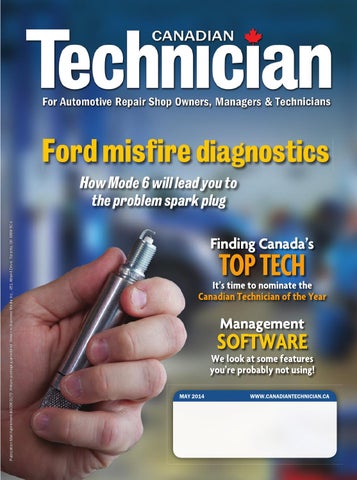
Ford misfire diagnostics Publication Mail Agreement #40063170. Return postage guaranteed. Newcom Business Media Inc., 451 Attwell Drive, Toronto, ON M9W 5C4
How Mode 6 will lead you to the problem spark plug
Finding Canada’s
TOP TECH
It’s time to nominate the Canadian Technician of the Year
Management
SOFTWARE We look at some features you’re probably not using! MAY 2014
WWW.CANADIANTECHNICIAN.CA
Electronic TechAngle® Flex Head Torque Wrenches • Dual 80® Technology for effortless torque transfer
• Designed to withstand impacts without failure
• Bright, dual progressive LEDs for better visibility
• Splash-proof protection against water and most SHOP lUIDS
• Larger backlit LCD panel for easier viewing in tight quarters
• 2-year warranty
Snap-on is a trademark, registered in the United States and other countries, of Snap-on Incorporated. All rights reserved. ©Snap-on Incorporated 2014.
contents
Canadian Technician – May 2014 – Vol. 19 No. 4
FEATURES Capitalizing on your computer .........................................20 Chances are you’re not using all the features that your business management system offers. We look at how to get the most out of your software. Ford no-code misfires .......................................................22 Ford has a unique approach to no-code misfire diagnostics. Jeff Taylor explains how Mode 6 will lead you to the problem plug.
COLUMNISTS Collective Wisdom by Alan Beech ...................................... 16 The Car Side by Rick Cogbill ................................................ 30
22
30
DEPARTMENTS Service Notes .................................................. 5 Letters .............................................................. 6 Out & About ..................................................... 9 EyeSpy ...........................................................11 By the Numbers ............................................12 Products.........................................................25 Ad Index .........................................................29
Our new international calling card. by
www.bluestreak.ca
MAY 2014 CANADIAN TECHNICIAN
3
SERVICE NOTES CANADIAN
Grow your own superstar The next Canadian Technician of the Year might be hard at work in one of your bays! By Allan Janssen We get so many great nominations every time we run our Canadian Technician of the Year award that it seems wrong to celebrate only one winner. We’ve run the competition four times now, and each time judges faced an extremely difficult choice as they read through the scores of nomination essays – some of them complete with customer testimonials, civic citations, and professional honours. I’ve always maintained that giving the award to just one person shouldn’t discount the achievements of the dozens of other nominees. Last year, in fact, the field of finalists was so strong that we took to publishing eight mini-profiles in the magazine. It gave the whole country a sense of the superstars in our midst. As an industry, we should look for role models like these to inspire our apprentices. I was particularly pleased to see a reader’s comment about one of our finalists that said, “Wow! I could sure use a guy like this in my shop.” I’m sure a lot of shop owners read the profiles with a sense of envy. The search for good technicians seems to be an ever-present concern for an awful lot of shops these days. I know they’re out there. I meet them all the time at training courses and industry conferences. All I can say is that if you can’t find any superstars, you may have to grow your own! All of the finalists in our Canadian Technician of the Year competition started out as apprentices. All of them had to develop their skills under the tutelage of others. All of them were held accountable by their employers and their teachers until they demonstrated the
excellence to which we all strive. Step one would be to sign up with a local college and take a chance on an eager young apprentice. It may not work out every time, but if you stick with the program, you’ll eventually strike gold. Secondly, work closely with your existing technicians to foster good working habits, and a healthy perspective of your business. Invest in continuous training. This is how you develop superstars. Finally, identify those who show the most promise and give them special opportunities to get to the next level – business management. Take them under your wing – not just as employees, but as future leaders in your business. Introduce them to the people that matter in your world – from parts suppliers to business coaches – so they understand the scope of your business. And if you want to encourage them, consider nominating them as the Canadian Technician of the Year. Even if they don’t win the distinction, they’ll be buoyed by your vote of confidence. If they’re truly outstanding, they’ll inspire countless others to learn from their dedication to excellence. The Canadian Technician of the Year award is all about recognizing the superstars in our bays, and giving them all a well-deserved pat on the back. And it all starts with the nomination form you’ll find on our web site. Take the time to nominate your top tech. The industry needs to hear about their successes. I want to hear what you think. You can reach me at allan@newcom.ca
VOLUME 19
NUMBER 4
451 Attwell Drive, Toronto, Ont. M9W 5C4
EDITOR Allan Janssen allan@newcom.ca (416) 614-5814 CONTRIBUTING EDITOR Sarah Voigt sarah@canadiantechnician.ca PUBLISHER Martyn Johns martyn@newcom.ca (416) 614-5826 CIRCULATION MANAGER Lilianna Kantor lily@newcom.ca (416) 614-5815 DESIGN & PRODUCTION Tim Norton production@canadiantechnician.ca (416) 614-5810 GENERAL MANAGER Joe Glionna PRESIDENT Jim Glionna PUBLISHED BY Newcom Business Media 451 Attwell Drive Toronto, Ont. M9W 5C4 Cover photography by Brad Featherstone Canadian Technician is published monthly except for January and July by Newcom Business Media, Inc., 451 Attwell Drive, Toronto, Ont. M9W 5C4. The magazine serves the Canadian automotive repair and service industry. Subscriptions are free to those who meet the criteria. For others: single copy price: $5.30; one-year subscription in Canada: $42.00 ($40.00 plus applicable taxes); one-year subscription in U.S.: US$60; one-year subscription in all other countries: US$90. Copyright 2014. All rights reserved. The contents of this publication september not be reproduced by any means, in whole or in part, without prior written consent of the publisher. The advertiser agrees to protect the publisher against legal action based upon libelous or inaccurate statements, unauthorized use of photographs, or other material in connection with advertisements placed in Canadian Technician. The publisher reserves the right to refuse any advertising which in his opinion is misleading, scatological, or in poor taste. Postmaster: Send address changes to Canadian Technician, 451 Attwell Drive, Toronto, Ont., M9W 5C4. Printed in Canada. Second class mail: Postage paid at Toronto. Canadian Publications Mail Sales Agreement #40063170. ISSN 1710-7644.
:H DFNQRZOHGJH WKH ÀQDQFLDO VXSSRUW RI WKH *RYHUQPHQW of Canada through the Canada Periodical Fund of the Department of Canadian Heritage.
Kenneth R. Wilson Award Winner Member
Canadian Business Press
MAY 2014 CANADIAN TECHNICIAN
5
LETTERS
BACKYARDERS THREATEN SAFETY AND CREDIBILITY I enjoyed Matt Martel’s article about “an industry divided” (It’s Your Turn, February 2014). It tackles the common misconception that people are only looking for the cheapest service for their vehicles. It also highlights the problem our industry is facing when it comes to licensing technicians – or potential technicians such as apprentices. I hope our industry leaders will look more deeply into this matter, since safety and credibility is at stake. Edmond Pery Fernandez Fountain Tire Winnipeg, Man.
SHOPS AND BACKYARDERS HAVE DIFFERENT PRODUCTS With regard to Matt Martel’s article in the February 2014 issue, the problem isn’t the backyarder, it’s price differentiation. As a shop you can’t simply charge each client the maximum that they’d be willing to pay. But the backyarder can. He can negotiate the price. Shops offer a very different “product.” If you want to play the quality card, you have to prove that you install better parts, faster, with a warranty, and are easier to deal with than your competition. Michael Smith Externalise Montreal, QC Member, CTAP Advisory Panel
WE NEVER SHOULD HAVE DILUTED OUR TITLE I think the problem starts with the name we call ourselves. We used to be called “licensed auto mechanics” until we switched to “technicians.” The problem 6
CANADIAN TECHNICIAN MAY 2014
Larry Dickison
is that “technician” is just a generic term. Name badges at the lube shop describe their employees as “lube technicians.” To the average customer they look just like us. They even have the same designation of “technician.” Not sure about the rest of you, but I am a Class A Licensed Automotive Mechanic. That’s something you can’t just print on a name badge and pretend to be. Dave Brough Master Mechanic Cambridge, Ont.
staff at the parts store, you may not get your proper pricing. But I don’t believe price shopping has hurt our business. We own our shop outright, and I’ve been doing it for 20 years. One thing is for sure, though. Domenic needs help running the front end, especially if he has to be pulled off a job in the shop to help out front! Donna Dimitrov Matt’s Automotive Port Colborne, Ont.
REJECTED REPAIRS PRICE SHOPPING IS SOMETIMES NECESSARY I’d like to offer a response to the letter from Domenic in the most recent Collective Wisdom article (Parts Predicament, March 2014). My husband and I have run a four-bay auto repair shop in a small community for 20 years. And, like Domenic, I also call three or four part suppliers for each job estimate and usually give the customer the option of premium or economic parts. This is a community with an over-abundance of auto repair shops. The competition is fierce, and if the price is too high, even our repeat customers will run for the door… and the next garage! I agree that you have to periodically keep tabs on your pricing from suppliers. With the constant turnover of
In February we ran an EyeSpy picture on our website. It showed just some of what technician Cory Heatley found during an inspection of a poorly maintained 1999 Ford Explorer. The vehicle eventually left the Blaskin & Lane Tire Centre in Calgary on a hook because the owner refused to authorize any safety work. Check it out at tinyurl.com/ct-eyespy-326. It prompted the following insightful comment from reader Ron Pasay: “It’s unfortunate that the customer got upset but kudos to the shop. They probably saved a life that day!”
PERFORMANCE THAT EXCITES
A great drive needs a great fuel. That’s why our scientists have developed Shell V-Power® Premium Gasoline. Inspired by our technical partnership with the Scuderia Ferrari team, it’s our best, most advanced gasoline, designed to deliver optimum performance through advanced technology. Fill up with Shell V-Power today and turn our innovations on the track into your excitement on the road.
Experience Ferrari’s choice for yourself. www.shell.ca/vpower
®Trade-mark of Shell Brands International. Used under license.
SOUND-REDUCING TECHNOLOGY
NAPA has a full line of OE matched brake parts with high-tech features that can stop almost anything, including noise. Whether you need Quiet Friction Formulations to dampen sound, or Cool Track™ Vents to prevent overheating, we have the KNOW HOW to help you finish The Perfect Brake Job.® Call your local NAPA AUTO PARTS Store today.
866-GET-NAPA / napacanada.com
Mister Transmission to focus on multi-unit ownership Chain says it has adopted a new strategy to help franchisees find efficiencies and achieve greater profitability. By Allan Janssen Mister Transmission will try out a new business model when it enters the repair market in London, Ont. later this year. Randy Moore, president and CEO of the 50-year-old chain of transmission shops across the country, told Canadian Technician the company is looking for a single owner to develop three locations in London over the next two years. “Whoever buys that market will buy the whole market,” he said. “We’re going to test our new model Randy Moore of having a multiple-location owner there. We’re absolutely certain it will work, for the simple reason that you get a different caliber of individual who’s looking at building three stores, rather than a single location.” Responsive Brands, the company that owns the 68-store Mister Transmission franchise, has been considering the new model for some time and Moore said it is ready now to get its feet wet. “It’s a very smart strategy for some marketplaces,” he said. “That multiple-location owner has a network of resources. If an employee doesn’t come in to work at Shop #1, you take a guy out of Shop #2. If Shop #3 doesn’t have a particular part, you take it out of Shop #4. The synergies are greater and you actually lower overall costs.” In addition, it reduces the incidence of one shop’s marketing dollars benefiting other shops in the same market. Franchisees in close proximity sometimes draft off each other, he explained, gaining the benefits of someone else’s hard work. “It’s almost like they’re competing against each other – even though they’re
both Mister Transmission shops,” he said. “If you have one person controlling all the shops in a particular marketplace, that owner’s marketing dollars go 100 per cent back to their own pocket. They’re not spending them to the benefit of their competitors.” It’s a strategy that has not escaped the notice of FranchiseGrade a research firm that specializes in assessing North American franchises. FranchiseGrade recently posted an article on its website entitled, “Is Multi-unit Franchising The New Norm?” It reported that the demand for multi-unit franchising has been increasing lately and “by all accounts it is here to stay,” with 52% of all franchises now owned by multi-unit operators. “If you look at the future of the automotive repair and service business, we can’t continue to have single standalone locations and continue to pay today’s costs and overhead. And the answer is not necessarily larger facilities. A 10- to 12-bay shop is a very expensive operation to run,” he said. “Besides, the law of distribution states that you can only draw customers from a certain geographic market. It’s much better to have three shops five kilometers apart.” Mister Transmission would like to slowly convert all of its key markets to multiple-location owners. “That means we would need some franchisees to step up, and convince the others in that market to step out,” he explained. “Obviously, we would prefer to work from a position of encouragement rather than enforcement.” For more, go to tinyurl.com/ ct-feature-04141
When Performance Counts. ™
OUT & ABOUT
Champion Powers All. Engineered to deliver the ideal maintenance solution for every type of vehicle.
Champion Iridium ®
Double Platinum Power r ™
Platinum Power
™
Champion and Champion Bowtie Logo are trademarks of Federal-Mogul Corporation or one of its subsidiaries. © 2014 Federal-Mogul Corporation, Southfield, MI 48033
MAY 2014 CANADIAN TECHNICIAN
9
ALL PULLEYS ARE NOT CREATED EQUAL TAKE A CLOSER LOOK AT GATORBACK® OADS. OADs transfer torque from the engine to the alternator via the belt, provide overrunning function during engine deceleration and absorb engine vibrations. OADs are OEM “fit and function,” with a one-way clutch plus a patented, tuned torsion spring. OADs wear out as they absorb vibrations from the engine and accessories. Always replace an overrunning alternator decoupler pulley with the correct part – never with a one-way clutch pulley or low-cost replacement alternator with incorrect pulley technology. An incorrect pulley will increase belt and tension wear, noise and vibration – so using the wrong part may negatively impact the vehicle’s operation. Using the correct OAD will lower belt tension fluctuation, extend bearing life, add to tensioner durability and control belt noise and vibrations. Learn the difference – and never replace an OAD with a one-way clutch.
Replace with Gatorback® brand Overrunning Alternator Decouplers and you’ll always be sure the job is done right.
For more info call 1-888-275-4397 or visit www.goodyearep.com
The GOODYEAR (and Winged Foot Design) trademark is used by Veyance Technologies, Inc. under license from The Goodyear Tire & Rubber Company. Goodyear Engineered Products are manufactured and sourced exclusively by Veyance Technologies, Inc. or its affi liates. The Gatorback trademark is licensed to Veyance Technologies, Inc. by The Goodyear Tire & Rubber Company. ©2013 Veyance Technologies, Inc. All Rights Reserved.
OUT & ABOUT
Auto trade a solid bet for skilled workers, says CTC exec
Jim McCown
Canadian Tire Corporation’s vice president of automotive parts and assortment says the North American shortage of skilled trade workers may be a bigger problem in Canada than in the U.S. and Mexico. Speaking to an audience of up-andcoming industry players at AIA Canada’s recent Young Executive Society conference, Jim McCown said Mexico’s economy and the U.S. car culture mitigate the problem in those countries. In North America, he said, Canada
may be the hardest hit by the problem. He said more young people think of automotive repair as a career in the U.S. “It’s a function of more kids having worked on cars in the garage with their dads,” he said. “That also goes some way to explaining the DIY differences between the two countries.” There is a greater level of education in Canada, he said, and that suggests more young people are going the traditional academic route. The skilled trade shortage may consequently be worse in Canada. “I don’t know if we do a real good job of selling automotive repair as a viable career option. There has been a shift away from the grease monkey image, but there is still a perception that it is not perhaps as prestigious a career. And maybe it’s not, but you will never go hungry.” McCown offered his views on a number of industry issues at the annual YES conference – intended as an inspirational springboard for the industry’s next generation of leaders. Read the full story at tinyurl.com/ct-mccown
EYE SPY The $4 Fix We may not be able to figure out how much they saved in labour… but we know what the parts cost! Alex Macleod, the manager of Oil Changers in Barrie, Ont., sent in this picture of a homemade fix to the universal joint on a customer’s truck. “There was a toonie on each side with a couple of screws securing them,” he writes. “I imagine that whoever did the fix lost the clips that hold the universal in and cleverly came up with this… and it seemed to work OK!”
Exhaustive R&D. Strength & Innovation. Superior Sealing. Only Fel-Pro delivers. ®
Fel-Pro PermaTorque® MLS innovative multi-layer head gaskets for Powerstroke® 6.0L diesel engines. 1 2
3
4 5
1 Enhanced bore bead design for robust combustion seal loading.
2 Patent-pending pushrod guide hole design reduces potential for premature wear of pushrods that can lead to engine oil contamination.
3 Highly advanced embossment technology creates increased spring force to provide a more robust sealing contact – under extreme loads and everyday use.
4 Precisely controlled thickness of proprietary FKM rubber coating in all critical sealing areas.
5 Engineered to accommodate engine overbore.
Designed to seal an engine that generates higher horsepower, increased combustion pressures and extreme temperatures.
Have an interesting picture to share? Email a high-resolution image to: allan@canadiantechnician.ca MAY 2014 CANADIAN TECHNICIAN
11
OUT & ABOUT
By the numbers Stats that put the Canadian automotive aftermarket into perspective.
78
The percentage of U.S. consumers that plan to hold on to their vehicles for 10 years or more. (Only 3% said they trade in their vehicle every 3-5 years.)
2%
The current number of light-duty diesel vehicles in the North American fleet. A study published in the Globe and Mail suggests this number could rise to as high as 18% by 2023.
1.4 hours Percentage of Canadian independent auto repair shops using tablet technology in the bay.
$22.05 per hour
$118.50
Average diagnostic labour rate at independent auto repair shops in Canada, as of Dec. 31, 2013. The average maintenance labour rate was $96.03.
1 in 4
The average wage of a Canadian automotive service technician in August 2013. The highest paid techs in the country were in Alberta, with an average of $26.25/hour and the lowest paid techs were found in Prince Edward Island, with an average hourly wage of $15.50.
11,800 The number of unfilled positions in Canada’s automotive aftermarket – including about 3,500 vacancies at repair and service shops. 12
CANADIAN TECHNICIAN MAY 2014
Average hours billed per invoice at independent auto repair shops in Canada in 2013.
The projected number of turbochargers on new North American cars by 2017. (The typical turbocharger can improve engine power by 30 to 40% and can result in a 15-20% improvement in fuel efficiency.)
17%
The expected increase in demand for professional technicians across Canada between 2010 and 2020.
Sources: NHTSA, Automotive Aftermarket E-Learning Centre, AutoMD.com, The Globe and Mail, The Society of Motor Manufacturers and Traders, Statistics Canada, Honeywell Transportation Systems Study, auto.howstuffworks.com, Canadian Automotive Repair and Service Council, Automotive Industries Association of Canada.
43
The percentage of vehicles on the road that have properly inflated tires. That number jumps to only 57% among vehicles fitted with TPMS sensors.
A FULL RANGE OF HIGH PERFORMANCE LUBRICANTS
total-lub.ca
ITS YOUR TURN
Frequency is king If you’re clinging to the old “breakdown” model, you may not be seeing your customers often enough to make your business viable. By Bob Ward Do you have a repair shop that does the occasional maintenance work? Or is it primarily a maintenance shop that also happens to do repairs? There’s a huge difference between those two models. If you’re content to sit back and wait for something to go wrong on a vehicle and then offer your repair services to the owner of that vehicle, you’re probably seeing a dramatic decrease in your car count. In fact, you may want to reconsider your business plan. The passive kind of breakdown model that was common in the 1970s just doesn’t work anymore because of the quality of modern vehicles. Cars are no longer the finicky machines that they used to be. They’re engineered better, run longer, and experience far fewer “roadside incidents.” Success in the automotive service industry is all about frequency. And the declining number of mechanical breakdowns means you won’t see your customers often enough to make for a viable business. Brake jobs probably make up the biggest piece of the “breakdown” pie. How often do you see that kind of work? Maybe every two or three years for a typical vehicle? What about engine repairs? Probably every three or four years? Those are pretty long gaps between visits! Let’s compare that to the biggest “maintenance” service we offer: oil changes. Typically motorists follow an interval of 5,000 to 7,000 km. That equates to three or four times a year. Even if they extend the oil change a bit,
we’d still see them two or three times a year. Granted, an oil change is a much smaller job, without the kind of margin that’s typical of brake jobs and engine work. But while we have the car on the rack, we have the chance to look for other maintenance items. We can monitor all the “wear parts” like tires, brakes, and suspension, and we can check the level and quality of the vehicle’s vital fluids. All of this allows us the opportunity to give our clients a comprehensive report on the state of their vehicle. This is critical in today’s business environment. Consistency of service is the single most important aspect of the service we offer. It builds our credibility as professionals who know how to make a vehicle last longer. That has enormous value to our customers! It has been proven that over the life of a vehicle, regular maintenance costs far less than periodic repairs. Not only that, but it is much easier for our customers to budget for vehicle
maintenance. The work can be projected out in a way that unexpected breakdowns simply can’t. That’s good for them… and good for us. Wouldn’t it be great to eliminate the peaks and valleys in your business – the ones that make scheduling such a challenge, and can often lead to frustration for customers? When we meet our clients’ needs on a regular basis, we tie them to our shops in a way that infrequent repairs never could. Frequent visits means better relationships. Without regular contact and positive rapport, who’s to say they’ll even come back when the next component breaks? The point I’m stressing here is the value of seeing your customers three or four times a year, rather than just once. You can’t build your business on broken cars any more. Bob Ward is the owner of The Auto Guys in St. Thomas, Ont.
MAY 2014 CANADIAN TECHNICIAN
15
COLLECTIVE WISDOM A management feature that explores the lessons learned in performance groups.
More than just bells and whistles A good business management system uses advanced processes to streamline your business and make it more profitable. By Alan Beech DEAR RANDY I commend you for taking steps to improve your business. Owners often take their time making necessary changes and then find out it’s too late to save the business. I understand your frustration of not truly understanding your business management software. If you’re over a certain age, computers don’t come naturally to you. I get that. But please understand that LAN uite a DEAR Aered writing to you for qa great the biggest advantage of using your management system to its fullest id is. I have I’ve cons it is not the convenience it brings but the more complete picture you re . e a h re w… so politan a o tr get of your financial position. e while no m y us ars s in a b ut 10 ye o It’s true that a lot of shop owners look for “bells and whistles” b a t u busines b n, e pointoung ma y th a but choosing a business management system based solely on its e t z o ri n te I’m pu ange d to com h e c features is like buying a car without first considering your own id r c e jo d a ago I sam im ti driving habits, preferences, transportation needs, and budget. m. It wa in te s le y s a litt of-sale re than t o When choosing a system, pick one that will integrate into lo m a d o n a ld d for me – ow it cou n k all aspects of your business. That includes customer service, I r , e w v o ne ven n , but I’ve g dating! E inventory management, electronic parts ordering, employee in ic o v r the an just in heard o e payroll, technician productivity, customer relationship v I’ more th . it d s lemente the bell p ll management, and complete accounting with tax/asset im a y t ll u o fu ab easier. ers talk n management. Advanced business management systems look at fe w li o ir e p e th sho that mak start s these tasks from a “process” point of view, and many steps are r e e tl h is it h e and w for me to a e integrated together. in m t ti s e v ’s erly, or in I think it Let me give you an example of what a process point tem prop s y s hat is the y m using to use. W r of view entails. When a customer shows up at the front ie s n a o e ups that’s your gro counter, most systems prompt the first questions to be new one m o fr e wisdom ms? te • What is your name? s y s t collectiv n me manage s • What make and model do you drive? s e in s bu • What is the plate number and VIN? y d n —Ra While these are valid questions, they’re not what the customer wants to talk about. Instead, he wants to tell you what he’s experiencing with his vehicle. He has a problem and he needs to know that you can sort it out. Your operating system should not get in the way of your customers trying to explain the situation. Nor should it delay you from beginning to discussing the issue at hand. Only when you have assured the customer that you have the solution to their specific problem should you start collecting contact info and email. This may sound like a trivial matter but, trust me, it will put customers at ease. And when customers are comfortable that they’re in the right 16
CANADIAN TECHNICIAN MAY 2014
Larry Dickison
place, they’ll spend money with you. Facilitating transactions like this is why you should be looking to invest in new software. Another example of a process-driven system is the selling of labour. From what I see in my performance groups, this is a major challenge in our industry. Many shops are selling only 50 to 60% of their productive capacity. Owners are concentrating on their parts gross margin while failing to realize that selling labour – especially diagnostic labour – will have the biggest impact on their bottom line. Let’s go back to the customer standing at the front counter. She does not want to talk about diagnostic charges. Rather, as we said before, she wants to talk about the symptoms she’s experiencing with her vehicle. Your point-of-sale software should be prepared to quickly record these symptoms and then give the appropriate diagnostic charge for a technician to investigate them. The second step should be to discuss any scheduled maintenance that needs to be performed. And, if the customer has been at your shop before, it should bring up any deferred items from the last visit. When the diagnostic charges are based on the symptoms that the customer is describing, it minimizes the tendency for the advisor not to assess a diagnostic charge. Assessing a diagnostic charge is essential for a number of reasons. Firstly, it pays for your technician’s time. And, secondly, it helps you gauge the customer’s commitment to completing the repair. If the customer is not willing to pay the diagnostic charge, then there’s a very good chance they are they are not willing to pay the repair charge. By focusing on the important aspects of the repair – the selling of labour time and the completion of all available work, your management system will help your shop to become more profitable. A third example of a process that will help build your business is the next-appointment process. When a customer is at the front counter, paying for the service that was just performed, there’s no better time to discuss their next
appointment. It should be just like at the dentist’s office. This sounds so simple in theory, but in practice it tends to fall through the cracks at most shops. Here’s how it should work. Firstly, the customer contact card in the software needs to be fully completed. This means you have their name, address, e-mail, full vehicle information, and the customer’s preferred maintenance interval. This last item may be based on the manufacturer’s suggested interval or an interval that you have discussed with the customer. The important thing is that the customer is involved in that decision, is on board with it, and knows that you’ll be keeping track. Your management system should take over from that point, recording service visits, noting all work that is done, and monitoring all of the vehicle’s critical fluids with an eye to bringing them to your attention when they’re due for changing. Once the next appointment is booked, this built-in CRM should automatically send out an e-mail reminder. I strongly suggest in addition to this e-mail reminder you make a follow-up phone call to ensure that the customer shows up for their appointment. This is called a 360-degree customer follow-up program.
So, Randy, you can see from the discussion so far that fancy bells and whistles aren’t what really matter in your business management system. The best shop management systems don’t just make you faster or more efficient at what you’re already doing. They guide you into new and better business practices. In the three processes I talked about, there’s a definite process in play designed to help you be more profitable. Having the right system in place, and using it with this goal in mind is enormously valuable for any business. In our performance groups, we’ve added another dimension to that. We have learned how valuable it is for us all to be running the same shop management system. That way we enjoy some incredible synergies that allow us to make changes together and to learn from each other. This enhances our collective wisdom and leads to new opportunities to streamline our businesses and be more profitable. Thanks for your letter. Alan Beech is a management consultant, and the owner of Beech Motorworks in Hamilton, Ont. You can reach Alan at alan@beechconsulting.ca.
MAY 2014 CANADIAN TECHNICIAN
17
10,000
$
in cash and prizes to be awarded
We’re looking for someone who is an ambassador for our trade: Q Is an elite technician Q Is a leader in the shop Q Gives back to our industry
Q Is an active member of their community Q Is helping to improve the public’s impression of technicians
You may nominate yourself or someone you think deserves to be the Canadian Technician of the Year 2014.
If your nominee is chosen as this year’s Technician of the Year, you will receive $250 If you nominated yourself, you will also receive the $250 if you win. DEADLINE FOR ENTRIES JUNE 30, 2014 NOMINATION FORMS ARE AVAILABLE ONLINE AT...
www.canadiantechnician.com/award @cdntechnician #CTOTY
/CanadianTechnician
Premium Sponsor
Award Sponsor
Association Sponsor
www.snapon.com
www.total-lub.ca
www.aiacanada.com
GETTING THE MOST OUT OF YOUR SOFTWARE Business management programs can streamline your business and offer a wealth of information… if you let them. By Allan Janssen A lot of shop management programs are frequently used without ever being well used. It’s a curious phenomenon of modern business, where computing software can be so sophisticated that even if you use it for years, there may still be some hidden functions that could make you more efficient if you only knew what button to push! Laine Colman, vice president of sales and marketing for Costar Automotive & Tire Software in Edmonton, says some automotive repair shop owners are progressive in their use of management software… but most only use the basic functions. “They know what they know, and they don’t push beyond that,” he says. “Hand-written invoices have pretty much gone away, thankfully. Everyone’s got some kind of tool, even if it’s just a bookkeeping program like QuickBooks. But a proper shop management system – designed specifically for the automotive repair and service industry – allows you to do so much more than just produce a professional looking invoice.” “This is a highly transaction-oriented business,” says Harry Cousins, 20
CANADIAN TECHNICIAN MAY 2014
the business lead for ShopPros, a new automotive management training and coaching organization in Canada. “If you look at what it takes to produce a repair invoice, with multiple parts at various margins, and labour times that are priced out in different ways, it’s a much more complicated transaction than many retail operations.” He says automotive repair is one of the few verticals where the computer system you use can play a huge role in the success of the business. Nick DiVerde, senior director of marketing for Mitchell 1, says shop owners who are not using a shop management system tailored specifically to their business are missing the ability to mine their own data for sales opportunities, streamline work processes, and understand the key metrics that make them money. “We have a pretty good feel of what features people are using,” he says. “And while some shops are better than others, very few are taking full advantage of everything that’s in the software.” Peter Steele of Protractor says people have to adapt their way of doing business to reap the full benefits of their management system.
“Once they understand what features are in the software, and why the features are there, they can use them to have better conversations with their customers and get better results,” he says. “There’s a big difference between a simple work-order generator and a complete process-driven system.” So what are shop owners missing out on if they’re only scratching the surface of their shop management software? Finding more work
“Recommended work shouldn’t disappear if a customer declines it,” says DiVerde. “Shops can capture those recommendations, prepare estimates complete with labour time and parts costs – which we call revisions – and keep them on the books for future sale.” He describes that as an example of how the software can add to a shop’s bottom line. Colman says shop software can also automatically add the peripherals to every job, so things don’t get left off the invoice. “Sold a new set of tires? When you add that to the invoice, the tire installation kit will come on automatically, like the mount and balance and the environmental levy so those things never
get missed or discounted,” he explains. “Everything gets charged out at the rates you’ve established to be profitable. Tracking key metrics
According to Steele, probably the least-utilized function on management software program is the ability to track the numbers that owners should be focused on. “You have to know what you want to do in your business and then work to make that happen,” he says. “The tools make that very easy.” There are many ways to assess the health of a business. Progressive shop owners are willing to pay more for a system that can easily tell them where they need to improve, whether it has to do with their labour dollars per ticket, technician productivity, shop productivity, or inventory levels. “Unfortunately, too many shops don’t know what an ‘active’ customer versus a ‘loyal’ customer or what their customer attrition rate is,” says Cousins. “They don’t know how to measure productive capacity, let alone know how they stack up against other shops. All of these directly affect the bottom line… and all can be monitored on good management software.” Managing customer flow
If you want to maximize your labour dollar, you have to have cars lined up and organized so there’s minimal deadtime in the bay. One way to do that is with a scheduler, which knows the capacity of the shop and the difference in time required to do a brake job as opposed to an oil change. Booking the next appointment is another key point-of-sale or follow-up feature that eliminates the “peaks” and “valleys” in the life of a shop. Good management software will also integrate with third-party CRM systems, so you stay in contact with customers between visits with permission-based marketing “If the objective is to make more money, this is the function that would be the easiest and most important to start using,” says Colman. “Booking the next appointment is the key difference
between a maintenance-oriented shop and a break-down shop.” “The whole customer metrics thing is underappreciated,” says Cousins. “Are most of your customers really your customers? Are they really coming back to you? Or are you just the repair-shopdu-jour? You need to know that.”
COMPLETE COVERAGE
Integrating the back end
Experts point out the tremendous value in establishing clear inspection and reporting strategies. These bring technicians and managers in alignment with each other. Your management system can also be tied directly into the bay, enabling advanced features like tracking technician time on every job.
MOOG’s comprehensive coverage provides the latest in foreign and domestic applications through its broad range of Asia-Spec™, Euro-Spec and Problem Solver ® steering and suspension parts. Install MOOG® and restore like-new steering to the Asian, European and domestic vehicles you service.
Integrating part suppliers
Selling parts is nearly half of what every shop does. Yet there are frequent breakdowns in the parts ordering process. Management systems can help eliminate costly uncertainties surrounding parts – like when incoming deliveries take too long finding their way to the right vehicle, or when parts sit around your shop waiting to go back to the supplier. One way shop owners and managers can maintain control of the parts purchasing process is to use a purchase order function that allows them to see what parts they’re waiting for, what’s come in, and what car they’re supposed to go on. They never lose track of the flow of parts.
ASIA-SPEC™ ASIA-SPEC SIA-SP C™ ™
EURO EURO-SPEC URO SP SPEC S
Getting answers
Advanced programs have a wealth of tools to help shop owners and service advisors, including forums, helplines, and online resources with frequently-asked questions, and management tips. There are also training sessions and workshops that give users an opportunity to learn how to get the most out of their software. Above all, however, DiVerde encourages shop owners to stay in learning mode. “Sometimes you learn by watching over someone’s shoulder,” he says. “And sometimes it’s just being brave enough to click on something that you were hesitant to try.”
THE TH HE PROBL PROBLEM PROBLE SOLVER ®
Visit
moogproblemsolver.com to learn more
©2014 Federal - Mogul Mog g l Corporation Corporation. MOOG MOOG, The T Problem Solver and Asia - Spec are trademarks owned by Federal - Mogul Corporation, or one of its subsidiaries, in one or more countries. All rights reserved.
MAY 2014 CANADIAN TECHNICIAN
21
Understanding Ford’s unique approach… and how Mode 6 will lead you to the source of the problem.
No-code misfires By Jeff Taylor
I
recently had to help a tech find a misfire in a V8 Ford pickup truck. He was a little confused because he knew the truck was missing under slight load but there were no trouble codes pointing to a particular cylinder. This is not uncommon with Fords, which use a different strategy than most car companies when it comes to misfires. Perhaps a quick review is in order to explain Ford’s approach to misfires, and how techs can get a better handle on a no-code miss in a Ford. As always, first things first: start with a proper road test and verify the customer’s complaint. Is it really doing what they’re complaining about? Most of us know what an ignition misfire feels like. And mechanical misfires usually are not intermittent. After returning to the shop, almost all of us would reach for the scan tool, 22
CANADIAN TECHNICIAN MAY 2014
hook it up, and check for codes. This is what we’ve always done… and it’s what I do, but on many occasions there are no codes associated with an intermittent misfiring Ford. This is when the confusion seems to set in. Some of us don’t have a factory Ford scan tool to use the power balance feature that it provides. Some scan tools do (and aftermarket scan tools are constantly getting better) but it’s not like a GM that will tell you the specific number of the misfiring cylinder while driving. This is when you have to look at Mode 6 – the raw data that the ECM is using for the OBD II system. It’s this data that will turn on or off the checkengine light. And it is this data that will show us what’s actually happening, and define the limits and values that are set by the engineers that built the vehicle. This is where I go to find out which cylinder is giving me grief – even though I have the factory Ford scan tool software. This is an easier and quicker approach. Now, I don’t want this article to be all about Mode 6. It is simply helpful in explaining how Ford detects a misfire, and why they don’t always show up as codes or a flashing SES light but only as a customer complaint. Ford has used three different methods to monitor misfire: Low Data Rate (LDR), High Data Rate (HDR) and
Neural Network Misfire (NNM). It’s the information from these systems that is stored and displayed in the Mode 6 data. The LDR misfire monitor works by monitoring the speed of the crankshaft in relation to the firing events of the cylinders. It looks for a slight increase in speed that should happen when the spark plug ignites the fuel and pushes the piston down. It uses some complex math and from this it can tell whether a given cylinder is providing equal input to the crankshaft. If not, it sees this as a misfire. The LDR is used on three- and four-cylinder engines and some rear crankshaft sensor mounted V6s. The HDR misfire monitor is capable of handling more information and is used on V6, V8, and V10 engines. As the name implies, much more data is processed in this monitor. With HDR, we’re watching more cylinders and it gets harder to tell what is noise, or road vibration, or other irrelevant data, and what is an actual misfire (or multiple misfires). This gets even harder when the engine is near its highest RPM. The HDR monitor uses so much computing power that it has its own dedicated processor inside the PCM housing. The final method that Ford used for misfire detection is a system called, The Neural Network (NNM). If this sounds vaguely biological, it is meant to. It uses a dedicated chipset that functions
Precision Brand similarly to our brains. It processes information, but it can also adapt and learn certain engine characteristics, and then filter this information to make a better judgment on misfire recognition. The escalating computer requirements to make this system work led Ford to stop using it in 2007, but there are lots of these vehicles still in service. The LDR, HDR and the NNM all use “profile correction.” What is this? Well it’s Ford’s way of taking engine wear and manufacturing deviations into the misfire calculation. This may not sound important but it’s a very critical piece of software that can affect the way that we diagnose this system. If you’re using the swap-the-coiland-clear-the-code method of misfire diagnosis (I’ve done this myself), then you need to understand how this works. The PCM is looking for a signal from the crank sensor at an exact moment in time but that’s not always possible, due to the variations in machining, timing chain or belt wear, and other things that can affect crankshaft speed. The profile correction software detects these small variations and
stores this information, and then uses it to fine-tune the high-speed misfire detection on their engines. The profile correction learns these values by watching the crankshaft speed during a de-fueled deceleration condition, from 100 to 60 km-h, with the throttle closed and no brakes applied. It typically needs to see this three times and this info is stored in Keep Alive Memory (KAM). Why do you need to know this? Well, if you swap a coil and clear the codes, what did you clear? The KAM! Will the misfire monitor run? No. It won’t run because it’s disabled until the profile correction information has been recorded. There’s some good news, though, if the vehicle you’re working on is a 2009 model or newer. It’s able to “learn” the profile correction using properly enabled scan tools in the service bay, similar to GM’s crankshaft variation relearn procedure. If there’s a mechanical reason that the profile can’t be relearned, such as a broken tooth on the crankshaft’s tone wheel, it can set a P0315. Ford looks at the speed of the crank-
Precision Engineering Precision Performance
• Hardware Included Positive Mold Ceramic Disc Brake Pads
Positive Mold Metallic Brake Pads
®
In this graphic, the Mode 6 information reveals a few things, most notably, a misfire in cylinder #8. It was well within the allowable percentage, though (just check the max and min limits that are also shown).
For more information on Ceramic Plus and other ProMax products visit,.. www.autopartsdepot.ca MAY 2014 CANADIAN TECHNICIAN
23
A read-out from the Autel scan tool, showing misfires in cylinder #5. You can see the carbon track on the spark plug that caused the problem – though the misfire was not serious enough to trip a code or the SES light. A read-out from Ford’s laptop-based New Generation Star scan tool, showing misfire incidents.
shaft to calculate misfires; the PCM wants to see a slight acceleration in the rotational speed of the crankshaft when a corresponding cylinder fires. But the PCM also has to deal with the fact that other things can affect the speed of the crankshaft, such as a very rough road (the PCM looks at the data from the ABS sensors to decide just how rough the road is), lugging, very high RPM, or very low RPM. All of these scenarios can create engine noise that the PCM could misinterpret as a speed deviation but are not misfires. The software in the PCM has the ability to filter out this noise by disabling the misfire monitor temporarily when these conditions exist. When the PCM is counting misfires, it stores them under two different categories: a 200 Revolution (Type A) code, and a 1000 Revolution (Type B) code. The 200 Revolution counter is watching for misfires that are going to cause damage to the catalytic convertor. It can store a code and make the check engine light flash when a misfire is detected – but only if Ford’s unique parameters are met. Ford’s misfire monitor counts the misfires in 200 revolutions of crankshaft rotation, and then compares this number to a threshold number. The threshold number takes RPM, load, and other factors such as the melting point of the wash coat (the important stuff on the ceramic honey comb) inside the catalytic itself before it decides to set a code and turn on the check engine light or make it flash. If it doesn’t see enough misfires in a 200 RPM count, it resets and counts again. This is why you may feel a misfire but not see a code. It wasn’t bad enough to set a code or flash the light. The 1000 revolution counter, on the other hand, watches for misfires on initial start up and during engine operation. It has a different threshold value for SES light illumination and it’s this counter that will set P0300 usually during high RPMs (3500+) but can also set a P0316, indicating that a misfire occurred during initial start-up or during the first 1000 revolutions of the engine. Starting in 2005, if the PCM decides that it has a cylinder/ cylinders misfiring risking damage to the catalytic, the PCM will enter Failure Mode Effects Management (FMEM). It can disable the effected cylinders fuel injector for as long as 30 seconds. It will then turn it back on to see if the misfire is still 24
CANADIAN TECHNICIAN MAY 2014
there. If it is, this cycle will continue until the misfire is gone. The PCM can only shut off one injector on three- or four-cylinder engines but can shut off two on V6 and V8 engines. This causes the misfiring cylinder to basically become an air pump. In the later models (2011 and later), it can also limit the amount of boost by limiting the amount of airflow into the engine through the electronic throttle. It is worth noting that if the PCM sees an ignition coil primary failure that would generate a P035x (Ignition Coil Primary/ Secondary Circuit), it will do the same thing. There are a few other things to note about the Ford misfire monitoring system. For one thing, misfires aren’t counted if • the coolant is below 20°F or above 250°F; • the EGR is stuck wide open; or • the engine is above the red line or past the fuel cut off. These all seem straightforward enough, but there’s one more we have to note. The fuel level has to be above 15%. There has to be enough fuel in the tank, or the monitor might be disabled. Ford engineers don’t want to turn on the SES light simply because the vehicle is running low on fuel. Newer models will still watch the 200-Revolution counter if there is low fuel and can enter FMEM… but they can also set a P0313 (Misfire Detected With Low Fuel) to help point technicians in the right diagnostic direction. Misfire detection is not an easy thing to do. And, as with all things in the automotive industry, technology is always evolving. The ignition system on the next generation of Fords reflects this evolution. The crankshaft tone wheels are changing from the traditional 36-1 ratio to 60-2, and the coil drivers that used to be in the PCM are moving to the actual coils. And, of course, the increase in modern computing capability is a constant contributing factor in these changes. Newer engines are providing the PCM with more information so they can make better decisions. Ford, like every vehicle manufacturer, is being driven by two main concerns: improving fuel mileage, and offering better emission controls.
Jeff Taylor is lead technician at Eccles Auto Service in Dundas, Ont.
PRODUCT CENTRAL Brake pads Federal-Mogul says it has introduced the automotive aftermarket’s first rear brake pads for 2014 Jeep Cherokee models. The Wagner ThermoQuiet CeramicNXT low-copper pads (No. QC1734) feature highly advanced Wagner OE21 low-copper friction formulations that are 35 percent qui-
eter and offer 15 percent more stopping power and up to 40 percent greater fade resistance than previous Wagner ceramic formulations. Wagner has also introduced sets for the 2014 Acura RLX, 2013 Honda Accord, and 2013-2014 Ford Taurus SHO models. tinyurl.com/ct-prod-805
Heavy duty tensioner Gates has released a new DriveAlign heavy duty tensioner specifically for Detroit Diesel Series engines. This “advanced drop-in ready solution” is described as being more responsive to system load variations, better balanced to provide consistent wear, and easier to install – all with no core charge. It features a larger pivot bushing surface, labyrinth sealing technology, belt tension damping system, and a unique design for drop-in replacement. It is “real world, fleet-tested” for 350,000-mile plus service life. tinyurl.com/ct-prod-811
Fuel Modules and Pumps Delphi Product & Service Solutions has added 28 new fuel modules and pumps to its fuel management portfolio covering more than 4.4 million popular vehicles built from 1990 to 2013. The new pumps and modules fit Jeep, Audi, Chevrolet, Volkswagen, Chrysler, Volvo, Nissan, Ford and Honda applications, among others. Delphi says its fuel modules and pumps are designed to withstand harsh alcohol fuel blends, and provide dependable, long-lasting performance, quick pressure rise and quiet, efficient operation. tinyurl.com/ct-prod-809
NOW WITH
´&876 7+( 7,0( ´&8 :( 63(1' 6($5&+,1* ,1 +$/) µ ELDON DUNN POWAY TRANSMISSIONS
ProDemand™ optimized with SureTrack delivers the most complete OEM repair information combined with a powerful, expert-based diagnostic resource — from a single-point lookup. So you can complete repairs faster and with more confidence, knowing your diagnosis has been verified by thousands of techs who have solved the same issue. For more information: Call us: 800-659-1655 | Visit us: www.mitchell1.com Or find your local Mitchell 1 sales representative: www.mitchellrep.com
© 2014 Mitchell Repair Information Company, LLC. All Rights Reserved. Mitchell 1® is a registered trademark used herein under license.
MAY 2014 CANADIAN TECHNICIAN
25
PRODUCT CENTRAL Steering and suspension parts Federal-Mogul’s Moog Steering and Suspension brand has introduced dozens of additional part numbers, including five ball joints and one sway bar bushing for several popular late-model foreign nameplate applications. It also has released 14 new Moog R-Series con-
trol arm assemblies, six ball joints, four link kits and a variety of other components for automotive applications. The company also continues to expand the its line of complete strut assemblies, with four new units covering 2003-2005 Honda Civic and 2000-2006 Toyota Tundra models. tinyurl.com/ct-prod-681
Service Carts Matco Tools has introduced two new service carts. The JSC450 and JSC480 (pictured) feature ergonomic push handles and four 6-inch by 2-inch casters, giving users double the load bearing capacity of other carts. Slides can each carry 50 lb. more weight and the design of the JSC480 offers an impressive 1,000 lbs. of overall storage capacity. The toolboxes offer over 16,500 cubic inches of total capacity and are available in five colours. tinyurl.com/ct-prod-801
LED lights
Looking to sell
your transmission shop? Mister Transmission’s looking for single-unit and multi-unit business owners. Whether you’re looking to buy a franchise or sell your business, Mister Transmission wants to hear from you!
(YL `V\ YLHK` [V ZOPM[& Contact Randall A. Moore randy@mistertransmission.com or call 1.800.373.8432
;V SLHYU TVYL HIV\[ V\Y MYHUJOPZL VWWVY[\UP[PLZ ]PZP[! www.mistertransmission.com/franchise
26
CANADIAN TECHNICIAN MAY 2014
Cliplight Manufacturing has released a trio of new LED lights that are designed for challenging environments like the automotive repair bay. The 33-LED Pivoting Worklight (No. 24-458) has 28 LED lights in front and another five on top to produce 160 lumens. It features a magnetic pivoting base with a 360° swivel hook. The ClipStrip is a powerful pocket light (No. 111112) that produces 140 lumens. It features a 180° swivel magnetic clip and comes with three AAA batteries. The ClipStrip Aqua (No. 111113) is fully waterproof, rechargeable… and it floats. Producing 180 lumens, it is powered by a 2200 mAh Lithium-Ion battery. tinyurl.com/ct-prod-679
Graphing multimeter The new Vantage Ultra from Snap-on is a new graphing multimeter and highspeed, two channel lab scope with a wide range of features to provide fast and reliable tests on vehicle components. Designed as a companion to any scan tool, it offers exclusive Fast-Track Guided Component Tests, which show technicians where to connect, how to connect and what results to look for. The Vantage Ultra boots up in five seconds and the large, eight-inch display shows test results with high-resolution clarity. tinyurl.com/ct-prod-668
Reman parts Cardone has released 45 new A1 Cardone reman part numbers and 66 new Cardone Select part numbers. A product flyer is available for quick download at tinyurl.com/ct-CardoneFlyer. It offers details of the release, which features a combination of new SKUs for popular vehicles like the Ford Explorer along with some newer, niche applications like the Nissan Leaf and Fiat 500. tinyurl.com/ct-prod-810
Brake catalogue The Bosch Braking Components print catalogue for 2014 (#2213922) provides a comprehensive listing of all of the company’s friction lines for domestic, Asian and European vehicles in the United States and Canada. Also included are parts available in the Bosch Brake Products line for vehicles in Mexico. It covers vehicles from 1946 to the current model year, listing more than 2,700 brake pads and shoes, and 1,438 brake rotors. Bosch supplies braking components to the independent aftermarket in North America for passenger cars, SUVs and minivans as well as for medium duty truck applications. tinyurl.com/ct-prod-661
Performance suspension Rancho says its 2014 GMC Sierra 1500 suspension systems were engineered to accommodate the varying steering knuckle materials being used by GMC. The new systems include an entire host of components that help preserve performance while lifting the vehicle for extending off-road capabilities. The new systems feature a onepiece sub-frame for a precision-matched fit and added strength; high-clearance aft braces to maximize ground clearance; front differential drop brackets that correct pinion angle to help minimize driveline vibration; and extended-length, DOT-certified front brake lines. tinyurl.com/ct-prod-626
Gas treatment Rislone has developed a new super-concentrated Gas Treatment designed to prevent gum and varnish buildup. It helps gasoline burn cleanly, which improves performance and extends engine life. One super-concentrated 177 mL bottle should be used with every fill-up to maintain optimum efficiency. Gas Treatment (P/N 34777) comes packaged in Rislone’s new EZ Nozzle bottle, which features a built-in flow valve to prevent spills. It is also designed to work with capless or obstructed fuel systems. tinyurl.com/ct-prod-623
Belt service Kits CRP Automotive has developed a kit program to give professional repair technicians a convenient “one part number” solution for timing belt and accessory drive system belt service. The kits include all of the wear components that a technician would need to service a particular vehicle. The program includes ContiTech Timing Kits, ContiTech Pro Series Timing Kits, ContiTech Pro Series Plus Kits, and ContiTech Accessory Drive Belt Kits. CRP thoroughly researches and accurately packs every kit to ensure that all of the components are make, model, and year-specific. tinyurl.com/ct-prod-614
Engine management Standard Motor Products has added 709 new part numbers to its BWD engine management line, covering domestic and import vehicles. The expansion includes more than 300 new switches, including combination, multi-function, power seat memory, cruise control, fog lamp, and more, covering greater than 170 million additional VIO. Other expanded categories include TPMS sensors, brake pad wear, camshaft and crankshaft, ABS speed, turbocharger boost, vehicle speed, YAW rate and more. Additional category expansion features canister vent solenoids, EGR valves and solenoids, ignition coils, fuel injectors, and power door lock actuators. tinyurl.com/ct-prod-627
Floor coating Valspar has released new Epoxy Coatings for Concrete to protect and beautify shop floors. Valspar offers two types of epoxy coating kits for concrete floors. Valspar Garage Floor Coating Kit features an extreme epoxy formula, anti-peel protection, and long-lasting protection against damage from hot tires, gasoline, oil, scuffs, wear and tear. Valspar Premium Clear Coating Kit creates a high-gloss, high-performance finish and is designed for use over Valspar Garage Floor Coating, Valspar Etching Stain, or bare concrete. tinyurl.com/ct-prod-693
Oil analysis kit Oil Analyzers has expanded its oil analysis kit offerings by adding a new Value Kit as low-cost option when a full fluid analysis is not required. Oil analysis assesses the current condition of a vehicle’s motor oil, and whether it’s suitable for continued use. The new Value Kit focuses on four key areas of testing: oil thickness, corrosion potential, wear metals and beneficial oil additives. tinyurl.com/ct-prod-814 MAY 2014 CANADIAN TECHNICIAN
27
PRODUCT CENTRAL
Headlamp lighting GE Lighting has introduced two new headlamp lighting solutions, including GE Nighthawk LED Sealed Beams and GE Nighthawk Xenon, within its Nighthawk automotive and trucking product family. The Nighthawk Xenon is said to offer crisp, white light while putting up to 120 percent more light output (measured in an area illuminated with more than 15,000 candelas in light intensity) versus standard halogen headlight technology for increased visibility. The headlamps are available in a variety of sizes and shapes. tinyurl.com/ct-prod-609
Lighting catalogue Philips Automotive North America has released its latest Automotive Lighting Application Catalogue for replacement and upgrade bulbs as well as automo-
tive accessories. The Philips Automotive Lighting catalogue covers applications for all types of domestic and import cars, SUVs, light trucks, and vans from model years 1999 to 2013. The Philips Classic Catalogue offers coverage from 1969-1998. All of the replacement and upgrade bulbs listings are presented in a tri-lingual format. tinyurl.com/ct-prod-611
Automotive belts Veyance Technologies, manufacturer of Goodyear Engineered Products and Gatorback belts, released 184 new part numbers for its automotive aftermarket and heavy-duty product lines during the third quarter of 2013. Among the new parts is the OAD & OAP Toolkit for the removal and installation of overrunning alternator decouplers (OADs) and overrunning alternator pulleys (OAPs) on some of the most
popular vehicles on the road today. The kit – which includes two pulley sockets and three shaft bits – helps technicians save time when servicing the belt system, which reduces costs for the vehicle owner. tinyurl.com/ct-prod-608
Combination wrenches Snap-on Tools says its Flank Drive Plus Combination Wrenches (SOEXM707) exceed the limits of any other openend design, featuring a patented series of flutes or notches that allow the open end to grip the fastener away from its corners much like Snap-on box end wrenches do. The wrenches feature the Flank Drive Plus design that provides up to 62 percent more turning power than conventional wrenches. The force is directed away from the weaker corners of the nut and is directed to the stronger flats of the fastener. tinyurl.com/ct-prod-606
Protractor.net Shop Manager The NEXT GENERATION OF SOFTWARE to manage your automotive service business
Fast... Easy... Accurate... Protractor.net Shop Manager Available Now!
1.866.939.8743 sales@protractor.com
28
CANADIAN TECHNICIAN MAY 2014
“
I have been using Protractor since 2004. Protractor was a huge leap forward over my old system in helping my business take care of my customers and profit. The .Net is the next evolution of shop management. The .Net makes life easier, from setting up customers, to assigning maintenance plans, to parts and labor lookup; it’s all much more efficient. The support staff at Protractor does a very good job responding to any and all concerns very fast. If you are an existing Protractor client change over, the learning curve will be the smallest one yet, especially with the customer history coming forward. If you’re looking for a new shop management system, I would recommend this product to any shop owner in the industry.
Bill Gray Gray’s Autopro and OK TIRE
”
ADVERTISER INDEX continued from page 30
smoothly, but now they had a drivability problem. “We don’t have a scan tool,” explained Aaron. “And my code reader from the UK won’t talk to it.” He also had no shop manual. Such basic tools are unavailable in Mozambique. Aaron gave me the symptoms – poor running when hot, cooling fans not coming on, stalling and a lack of power. “She runs magnificently on a cold start, but after a few minutes, it’s disastrous.” “Let me do a little web surfing,” I said. “I’ll get back to you shortly.” I sat there listening to the rain pounding on the tin roof, thinking back to when computerized engine controls were first introduced. We all felt lost in those days, much like Aaron did now. With no scan tools or graphing multi-meters, what’s a guy supposed to do? A Google search revealed instructions on how to get codes manually. I hit the redial button. “Give this a try,” I said. “Turn on the key, wait 3 seconds, then pump the gas pedal 5 times in 5 seconds, and then wait 7 seconds. Then hold the gas pedal down for at least 10 seconds until...” “Hold it!” Aaron laughed. “Are you pulling my leg?” “Nope,” I replied. “But keep in mind you’re dealing with JOBD – Japanese Onboard Diagnostics. Who knows if this will work.” As it turned out, the procedure didn’t work. All he could turn on was the oil change light. We suspected a faulty coolant sensor – not shorted or open, or the cooling fans would have come on – but one reading an unrealistic temperature for the running time of the engine. I walked Aaron through the manual testing procedure for the sensor, using a pot of boiling water, a thermometer, and an ohmmeter. Based on his findings, he ordered a new part – and prepared to wait a month for its delivery. A week later, I drove out to his school for a visit. Aaron met me with a big grin. “Hey, thanks for helping us out with that Serena. Now we’re working on a Nissan X Trail with its ABS light on and no four-wheel drive. Found the problem, though – got a bad ABS sensor on the right front wheel.” I was impressed. “How’d you figure that out?” Aaron held up his well-used DVOM. “We did an ohm reading on each wheel sensor. We found one with both wires broken off internally.” Across the highway, a herd of Impalas grazed in a field. This was Africa, where sometimes all you can do is go back to the basics and figure it out. It’s called doing it by the book. Or in this case, doing it by the jungle book. Rick Cogbill is a freelance writer and former shop owner in Summerland, B.C. You can read more of Slim Shambles’ misadventures in Rick’s book, “A Fine Day for a Drive” available at www.thecarside.com.
Auto Value ....................................................4 Contact Local Representative
Blue Streak-Hygrade....................................3 www.bluestreak.ca
BMW...........................................................31 Contact Local Retailer
Federal Mogul..............................................9 www.federalmogul.com
Federal Mogul – Fel Pro ............................11 www.federalmogul.com
Federal Mogul - Moog ...............................21 www.moogproblemsolver.com
Goodyear ....................................................10 www.goodyearep.com 888-275-4397 Mister Transmission .................................26 www.mistertransmission.com 905-884-1511 Mitchell 1 ...................................................25 www.mitchell1.com
NAPA ............................................................8 www.napaonlinecanada.com 866-GET-NAPA
®
ProMax Auto Parts Depot..........................23 www.autopartsdepot.ca 1-866-573-9889 Protractor Software ...................................28 sales@protractor.com 1-866-939-8743 Shell .............................................................7 www.shell.ca
Snap-On Tools of Canada ............................2 www.snapon.com 1-800-734-2676 Total Lubricants .........................................13 www.total-lubricants.ca 800-463-3955 Uni-Select...................................................14 www.uni-select.com 1-450-641-2440 WorldPac....................................................32 www.worldpac.ca 800-463-8749
MAY 2014 CANADIAN TECHNICIAN
29
The Car Side By Rick Cogbill
Doin’ it by the (jungle) book Slim Shambles gets a taste of automotive realities on the dark continent. The dark clouds looked threatening. I gave the Toyota bakkie more throttle. With any luck, I’d be back in camp before the torrential downpour hit. This was Africa… and when it rains, it really rains! Tinny music filled the cab, and I fumbled for my cheap African cell phone in the console to my left – getting used to right-hand drive was a real pain. “Slim here!” “Howzit, Slim? Aaron here. Look, I’ve got an issue with a Nissan. Could you help us out?” Aaron Tweaker and his wife Sarah were Brits who ran a small trade school a couple of hours to the south. Whereas I was only in Mozambique for six weeks, doing some volunteer mechanics training, the Tweakers had been slogging it out for almost two decades. 30
CANADIAN TECHNICIAN MAY 2014
“Sure, Aaron. What have you got?” A herd of goats bolted out of the tall grass beside the highway. I hammered on the brakes, dropping the cell phone in the process. By the time I’d worked my way up through the gears again, Aaron was halfway through his problem. “…so when we got back from the test drive, the check engine light was on, and it wouldn’t idle properly. Any ideas?” “Uh, hang on.” A large transport truck in front of me was belching black smoke and moving at a snail’s pace. I flipped my signal lever up – only to have the windshield wipers come on. “Drat! I hate right-hand drive!” Powering past the lumbering behemoth, I remembered the phone in my hand. “Hey, Aaron, can I call you back? Kinda busy here.” “No problem. Give me a ring when you’re free.”
Just then the clouds broke loose. When I finally pulled into my digs, the dirt driveway was pure mud. Dashing to the cottage door, I fumbled for my keys, drenched to the skin. Changing into dry clothes, I opened up my laptop and plugged the 3G modem into the USB slot. It was the middle of the bush, but we had Internet. I called Aaron back for the rest of his story. He was working on a 2000 Nissan Serena with an SR20 DE, 2.0 liter engine. The Serena was a small minivan popular in Asia, but rarely seen in Canada. The vehicle had been at his shop for over four months, waiting for new CV joints to arrive from Zimbabwe. The axle work went continued on page 29
Original BMW Parts
CNX DB QBSUT
5IF 6MUJNBUF %SJWJOH &YQFSJFODF.ÂŽ
QUALITY BUILDS CONFIDENCE, CONFIDENCE BUILDS BUSINESS. REPAIR WITH ORIGINAL BMW PARTS. Only Original BMW Parts are quality engineered for the high performance demands of BMW vehicles. Demand the right QBSU GPS UIF KPC CVJME ZPVS DVTUPNFSTŃł DPOčś‘EFODF BOE ZPVS CVTJOFTT 0SEFS 0SJHJOBM #.8 1BSUT XJUI 1B44 #.8ŃłT online parts ordering system. #Z VTJOH 0SJHJOBM #.8 1BSUT ZPV CFOFę—…U GSPN Ńź 1BSUT UIBU BSF #.8 FOHJOFFSFE UFTUFE BOE BQQSPWFE Ńź 1BSUT UIBU čś‘U SJHIU UIF čś‘STU UJNF Ńź ZFBS NBOVGBDUVSFSŃłT MJNJUFE XBSSBOUZ Ńź $PNQFUJUJWF QSJDJOH Ńź 4BNF EBZ EFMJWFSZ For more information, please consult your BMW Retailer and visit XXX QBTT CNX DPN. *Access limited to registered participants only. Certain conditions may apply. **BMW Group Canada delivery to most authorized Retailers. Certain restrictions and limitations may apply. Š2014 BMW Canada Inc. “BMWâ€?, the BMW logo, BMW model designations and all other BMW related marks, images and symbols are the exclusive properties and/or trademarks of BMW AG, used under licence.