All eyes open for airport security
Salary Survey 2014: new blood needed
an education that engages body and mind
Page 6
Page 14
Page 18
Canadian
November/December 2014
www.canadiansecuritymag.com
PM# 40065710
The publication for professional security management
DECEMBER CS 2014.indd 1
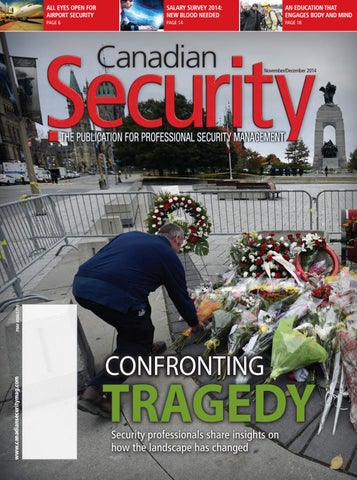
Confronting
tragedy Security professionals share insights on how the landscape has changed
2014-11-18 10:58 AM
TOP MARKS FOR SAFETY Keep your campus, staff, students and faculty safe with the Commissionaires team of dedicated professionals. We’re the choice of more than 60 campuses across Canada for crime prevention, access control, intrusion detection, video surveillance and more. You can count on Commissionaires. Many are former military and RCMP, superbly trained and experienced to respond to your security needs. www.commissionaires.ca/campus 1 888 688 0715
DECEMBER CS 2014.indd 2 Commissionaires_CS_Dec.indd 1
2014-11-18 2014-11-13 10:58 3:19 AM PM
13 3:19 PM
CONTENTS 3
Canadian The publication for professional security management
Columns
Reacting to Terror
11 RISK PERSPECTIVE Breaking down the headlines
Departments
4 editor’s notebook The greater good 6 trending 9 ASIS update Making the most of it in Montreal
Security professionals reflect on recent attacks on Canadian shores and the implications they could hold for the future Paul McKinnon / Shutterstock.com
Volume 36 Number 6
12
20 product focus Storage and appliances 21 Book review Losing oneself in a good book 22 world watch Auckland to mine big data for citizen safety; Illinois police fine tune surveillance for concert venue
14
18
2014 Salary Survey Results
Hearts and Minds
What is the industry doing to make security appealing to young people who are weighing their career options?
Conestoga College revamps its security education program with greater emphasis on mental preparation
By Neil Sutton
By Linda Johnson
visit www.CanadianSecuritymag.com Cover image: A makeshift memorial near the National War Memorial in Ottawa where Corporal Nathan Cirillo was shot. (Fred Lum/ The Globe and Mail)
Security leaders will be dropping by our studio in 2014, so be sure to check out the video section of our website for new content.
13 OFFICES NATIONWIDE AND COUNTING. WE’RE SHAKING THINGS UP
BIG TIME! INFO@SOURCESECURITY.CA 1-888-888-5451
@SecurityEd • November/December 2014 SourceSec_CS_Dec.indd 1
DECEMBER CS 2014.indd 3
2014-11-10 11:50 AM
2014-11-18 10:58 AM
Canadian
4 editor’s notebook By Neil Sutton
The greater good Security prospers when it draws from a large pool of people
S
ecurity is everybody’s business. I was reminded of that recently when it was said by one of the speakers at the International Airport Investigators Training Symposium, held in Toronto. At the symposium, David Harel spoke about the value of engaging all available eyes and ears on the ground (see full story on p. 6). Trained security personnel will always be the primary source of protection when it comes to securing a facility, but if you can encourage employees outside the professional security sphere to dedicate a small percentage of their time to simply paying attention to their surroundings, and “I would invite take note of the unusual, then you have effectively readers to tell me increased your manpower. Video analytics software can perform amazing feats these days, but I don’t that the results don’t think anyone can argue quite yet that it could replace an attentive person who is familiar with their tell the whole story.” surroundings. The same was said in the July/August issue of Canadian Security magazine when we spotlighted Toronto’s top hotels: security doesn’t end with the corporate security department; some of the best information comes from hotel staff who can identify a potential problem before it is allowed to escalate. Train your staff well, remind them that they are part of a larger team and you will reap the rewards, was the message. It’s tough to reconcile the idea that security can belong to everyone when confronted with the results of this year’s salary survey, and indeed those of years past: drawing new people into the profession can be difficult. Indeed, the vast majority of people who took the survey this year are 40 and over, and only 17 per cent are women. I tend to think of the survey results as a bellwether for the industry, but more importantly, as a means to discover some discussion points that prove useful to the readership. I would invite readers to tell me that the results don’t tell the whole story, and that are plenty of examples out there of younger people who are actively engaged in security. I can tell you that I’ve seen some of them myself. To its credit, ASIS International is helping to turn the tide. In recent years it has created groups for young professionals (targeting the under 40 crowd) and women in security, helping to dispel the myth that security is necessarily an old boys’ club. I was present at an ASIS Toronto chapter function very recently, the inaugural Women in Leadership symposium, which, as if to prove both points, was well attended by young women. The profession is certainly changing and it’s interesting to watch the transformation take place. Conestoga College, in Kitchener, Ont., for example, is revising its security program to better prepare graduates for employment, arming them with a complement of physical, mental and psychological skills (full story on p. 18). An acknowledgement that all three are necessary in order to succeed is a step in the right direction. If security is everybody’s business, it would be great to see that reflected in the results of next year’s survey.
The publication for professional security management
Group Publisher Paul Grossinger pgrossinger@annexweb.com
Account Coordinator Trish Ramsay tramsay@annexweb.com
Publisher Peter Young pyoung@annexweb.com
Circulation Lisa Thomson lthomson@annexweb.com
Editor Neil Sutton nsutton@annexweb.com
President Mike Fredericks mfredericks@annexweb.com
Art Director Graham Jeffrey gjeffrey@annexweb.com
Editorial and Sales Office 222 Edward Street, Aurora, Ontario L4G 1W6 (905) 727-0077 • Fax (905) 727-0017 Web Site: www.canadiansecuritymag.com Canadian Security is the key publication for professional security management in Canada, providing balanced editorial on issues relevant to end users across all industry sectors. Editorial content may, at times, be viewed as controversial but at all times serves to inform and educate readers on topics relevant to their individual and collective growth and interests. Canadian Security is published six times per year by Annex Publishing & Printing Inc. Subscriber Services: Lisa Thomson lthomson@annexweb.com P.O. Box 530, Simcoe ON N3Y 4N5 Tel: 866-790-6070 ext (201) Fax: 877-624-1940 I.S.S.N. 0709-3403 Printed in Canada Canada Post: Customer #6597297, Agreement #40065710. RETURN UNDELIVERABLE CANADIAN ADDRESS TO CIRCULATION DEPARTMENT P.O. Box 530, Simcoe ON N3Y 4N5 Subscription Rates: Canada: 1 year $40.00 + HST; U.S.A. (payable in US dollars): 1 year $60.00; International (payable in US dollars): 1 year $75.00 The contents of Canadian Security are copyright by ©2014 Annex Publishing & Printing Inc. and may not be reproduced in whole or part without written consent. For information on reprints of any article that appear in this publication, contact The Reprint Outsource at 1-877-394-7350. Annex Publishing & Printing Inc. disclaims any warranty as to the accuracy, completeness or currency of the contents of this publication and disclaims all liability in respect of the results of any action taken or not taken in reliance upon information in this publication.
Editorial Advisory Board Jason Caissie Profile Group
Tracy Ann Kosa Microsoft
Carol Osler TD Bank
Ken Close Trillium Health Partners
Bill McQuade Final Image
Theresa Rowsell Target
Ashley Cooper Paladin Security
Clark Northcott Pelco by Schneider Electric
Tim Saunders G4S
David Hyde Hyde & Assoc.
Malcolm Smeaton Whitehorse Group
@SecurityEd November/December 2014 • www.canadiansecuritymag.com
DECEMBER CS 2014.indd 4
2014-11-18 10:58 AM
axis_ad_ Axis_CS
m
om
.com
Did someone forget to open the back door? With a network video solution from Axis, you’ll be the first to know when a truck pulls into your delivery zone – or someone walks off with merchandise. Our network video solutions can inform security staff when deliveries come in. And set off an alarm if an unauthorized vehicle or party crosses a predefined line. You can also choose to monitor high-quality live video from a central location. Either way, you’ll save resources and money – and prevent theft – without the need for constant staff presence. Want to learn more?
Visit www.axis.com/retail
axis_ad_unattended_cansec_fpc_en_1411.indd 1 Axis_CS_Dec.indd 1 DECEMBER CS 2014.indd 5
30/10/2014 9:35:00 AM 2014-11-06 10:58 1:51 AM PM 2014-11-18
6 trending Calendar Canadian Security Focus On Series: Health Care Dec. 10, 2014 Toronto, Ont. www.focusonseries.ca TechSec Solutions February 3-4, 2015 Delray Beach, Fla. www.techsecol.com ISC West April 15-17, 2015 Las Vegas, Nev. www.iscwest.com Counter Terror Expo April 21-22, 2015 London, U.K. www.counterterrorexpo.com Border Security Expo April 21-22, 2015 Phoenix, Ariz. www.bordersecurityexpo.com Canadian Technical Security Conference April 21-23, 2015 North Gower, Ont. www.ctsc-canada.com Security Canada East April 22, 2015 Laval, Que. www.securitycanadaexpo.com IAHSS AGM May 3-6, 2015 St. Louis, Mo. www.iahss.org Security Canada Alberta May 13, 2015 Edmonton, Alta. www.securitycanadaexpo.com Security Canada Ottawa June 3, 2015 Ottawa, Ont. www.securitycanadaexpo.com Security Canada West June 17, 2015 Richmond, B.C. www.securitycanadaexpo.com
Eyes and ears before the flight
A
n issue facing airport security, says industry expert David Harel, is that it is based on a certain compliance standard, which may limit its ability to surpass that standard. Harel was one of the speakers at the International Airport Investigators Training Symposium (IAITS), held in Toronto in October. “With most places you go for compliance . . . the problem is, the threat is a lot higher,” said Harel, who is managing director, Israel, and vice-president of training at ASERO Worldwide. “We have to think, how are we going to get our act together and close that gap?” Security procedures can become ingrained over the years, said Harel, and may experience a degree of inertia, unable to adapt quickly enough to shifting circumstances. Because they are so highly driven by routine, they can also become predictable. Frequent travellers become accustomed to this routine, said Harel — they know when to remove their shoes and belts; they know which items they’re carrying might trigger an alarm and which ones are likely to pass through security checks with ease. If passengers can achieve this level of understanding through frequent exposure, then it stands to reason that people who may pose a threat will have done a great deal more homework, he argued. One way to step up security is to take advantage of the extra eyes and ears that are readily available in an airport environment. Airports will have their complement of dedicated security personnel, but there are hundreds of other people who work in airports on a daily basis — vendors, food staff, custodial staff, airline staff, police officers — who could help support their efforts. “If we do that, the system’s rigidity
is less,” said Harel. By simply providing two per cent of their daily efforts to being attentive to security concerns, they reinforce the security that is already present and multiply its effectiveness. To a large degree, this shift in mindset has already occurred in the safety world, argued Harel. Safety concerns are shared by an entire workforce, not just those who are ultimately responsible for it. Likewise, “security is everyone’s business. . . . In the workplace, safety has become so ingrained in the way work is done. It should be the same with security.” Staff can be trained to follow up on their instincts and report anything they deem suspicious or out of the ordinary. It can sometimes be difficult to ensure participation from airport personnel whose primary job is something other than security, but most people are willing to contribute, said Harel. By doing their part, they are helping to reinforce the security of the entire airport. The security philosophy espoused by Harel is “starting to take off,” according to Stephen Rowland, Detective, YYZ airport intelligence unit at Peel Region Police, and chair of the IAITS. He adds that conferences like this are helping to disseminate positive and useful ideas that may be ultimately beneficial to a wider group of airport security professionals. Harel is from Israel, and there were also speakers at the conference from the Netherlands and Columbia as well as the U.S. and Canada. “It gives you tips and ideas to move forward with,” said Rowland in an interview after the conference. “They’re seeing the same things that we’re seeing, but we [weren’t] really talking to one another. That’s why we brought all these people together under one roof: now we are.” — Neil Sutton
November/December 2014 • www.canadiansecuritymag.com
L_PRW42A_D_ DECEMBER CS 2014.indd 6
2014-11-18 10:58 AM
Honeywe
unlock potential...
...and throw away the keys! With Pro-Watch 4.2, state-of-the-art access control is available at the most affordable price yet! With an enhanced lockset and biometric portfolio, it offers numerous reader options to meet specific security needs. With fewer wires and reduced costs, customers can now employ access control in areas that were once considered difficult, or even impossible! Plus, Pro-Watch 4.2 delivers enhanced biometric integration options that are easy to use, and provide fast, reliable and secure access points. You can finally throw away the keys and start enjoying the benefits of a robust access control management system. Unlock potential, and lock in the savings!
For more information, www.honeywellintegrated.com or call 1.800.323.4576 Š 2014 Honeywell International Inc. All Rights Reserved.
L_PRW42A_D_CS.indd 1 Honeywell_CS_Oct.indd DECEMBER CS 2014.indd1 7
9/11/14 3:36 PM 2014-09-12 10:58 8:48 AM 2014-11-18 AM
8 trending
Cool under pressure
T
he Toronto chapter of ASIS International has recognized a security guard for demonstrating compassion and quickness of deed and thought, presenting him the Front Line Security Officer of the Year award at a ceremony in Toronto on Oct. 23. ASIS Toronto’s annual law enforcement and security practitioner awards are designed to reward professionals in the industry who have displayed exceptional traits. Arthur Andrzejewski, 22, a Paladin Security Group guard working at a Torontoarea hospital was singled out for the front-line award based on his actions during two events that took place earlier this year. During the first event, Andrzejewski responded to a call where an individual was attempting to harm herself. Andrzejewski, along with his team leader, was able to talk to the individual, thereby providing a measure of stability to the situation until police arrived on scene. “I told her, ‘I’ll listen to you. Sit down for a second, calm down, catch
Paladin security guard Arthur Andrzejewski
your breath, don’t do anything drastic.’ She was surprised that someone would listen her and to what she had to say. I figured that was what she needed and what she was missing,” explains Andrzejewski. Less than a week later, Andrzejewski faced another scenario where a male individual was putting himself in harm’s way. Again, Andrzejewski intervened and the individual eventually co-operated. In both cases, Andrzejewski credits
the training he received during his education at Loyalist College based in Belleville, Ont., and through his employer Paladin. Communication skills are a huge part of his job, he says. “Verbal de-escalation is probably one of the biggest things that we try to work on within the hospital.” Andrzejewski was nominated for the award by Paladin operations manager Blair Davenport. In his nomination, he wrote, “Arthur has not only saved the lives of two individuals but also the lives of someone’s children. His quick and effective response represented Paladin Security and the security industry to the highest degree of professionalism.” Andrzejewski says he was surprised when he was notified that he had won the award. Attending the award ceremony helped to put his actions into perspective. “Everyone was thanking me . . . police officers were there thanking me for the work that I’ve done. It kind of hit me how big the situation was.”
ASIS Toronto recognizes excellence in security
T
he ASIS Toronto chapter held its annual security practitioner and law enforcement awards night on Oct. 23. The awards are designed to recognize professionals in the security industry who have gone above and beyond.
Women In Security Award: Shannon Toomey, PRI Engineering (with OWLE Exec. Rep. Jenny Newton, Ontario Women in Law Enforcement)
Investigative Award: Gurpreet Sandhu, security guard, G4S (Ingram Micro account)
Scholarships for Security Studies Bursary & Writing Competition: Chesley Squire, 911 Emergency Call Centre, Durham College
Educator of the Year: Gary Galbraith, program coordinator, Sheridan College
November/December 2014 • www.canadiansecuritymag.com
DECEMBER CS 2014.indd 8
2014-11-18 10:58 AM
By Jean-Charles Gris
ASIS UPDATE 9
Making the most of it in Montreal
F
ounded in 1990, the Montreal Chapter of ASIS International currently sits at a count of 187 members which makes it Quebec’s largest individual security industry association. Twenty-seven of its members are board certified and have attained either a CPP, PSP or PCI certification. Over the last few years, the chapter has facilitated certification by providing one-on-one support and mentoring for our members. In September, the chapter experimented with an intensive five-day CPP review, led by Paul Aubé, CPP. ASIS Montreal is also working with the University of Montreal to validate
and improve security programs and (UNHCR) and an equally stimulating industry knowledge. This approach presentation on Physical Security at allows students to be better prepared for Brussels NATO Headquarters. On Oct. their future employers. 15, the Montreal Police Service provided a In additional to many seminar on active shooters at their chapter members hosting threeheadquarters. The last conference month internships, members and of the year will be a presentation graduating students meet annually from the Montreal Civil Security to mingle and present various Centre regarding operations, projects. We are also working development and challenges. on translating ASIS standards The Montreal chapter relies on into French to better respond to active members to represent us Jean-Charles Gris francophone needs in Quebec, on various committees, such as Europe and Africa. Marie-Andrée Duchesne on the Annual To encourage networking and learning Canada Night committee, and Margaux by way of sharing experiences, the chapter Blain-King on the Young Professionals event committee, led by Patrick Wilmotte, committee, led nationally by chapter organizes four to five conferences every veteran Guillaume Banville, PSP. year. Earlier this year, we held a riveting presentation on the subject of the United Jean-Charles Gris is the chair of ASIS International Nations high Commissioner for Refugees Montreal Chapter 196.
@SecurityEd • November/December 2014 GaiTronics_CS_Dec.indd 1
DECEMBER CS 2014.indd 9
2014-11-14 3:21 PM
2014-11-18 10:58 AM
10 trending
Security Director of the Year 2014
Award gala
T
Mission 500 representatives Neil Parekh and George Fletcher
Tom Rousseau
Bill McQuade, Final Image; Minaz Jivraj, Dufferin Peel Catholic School Board; JD Killeen, Tim Saunders, G4S Canada
Topical in 2014
I
n addition to news, videos and photos, canadiansecuritymag.com regularly features columns from valued contributors who are experts in their field. These are among the most popular we featured this year.
Mental health and today’s professional security provider (March 4) By Ashley Cooper “A growing number of mental healthrelated cases are being seen in emergency departments nationwide, just as they are increasingly occurring in schools and universities across North America.” Slips, trips and falls (March 25) By Richard Gerow “The difference between a slip and fall
Jeff Hofstetter, Anixter; Tom Rousseau; Peter Young, Canadian Security magazine; Gary Mistak, Anixter
Photos: Paul Wright
his year’s winner, Tom Rousseau, associate vicepresident, Canadian Tire, took some time during his acceptance speech to thank colleagues for their continued and diligent efforts. He emphasized the team effort it takes to keep a company, its employees and its customers safe. Rousseau was selected as Security Director of the Year, sponsored by Anixter Canada, earlier this year. Judges recognized his work designing a security plan for a Canadian Tire delegation to visit the Sochi Winter Olympics Games and also his devotion to security over an almost 20-year career.
that causes embarrassment and one that causes a concussion is literally inches, and the impact on the individual can be dramatic, both to themselves and to their families.” Have we forfeited our privacy? (Aug. 11) By Roger Miller “From students to seniors, we need people to understand the footprint they are leaving and the electronic data that exists with or without their knowledge and consent.” Security: Are we professionals? (Nov. 3) By Mark LaLonde “Our industry is far more professional than it was 20 years ago, and there is more we can do.”
Bill Bradshaw, ASIS International; Lina Tsakiris, CIBC; Mike Soberal, ASIS Toronto Chapter
New director for Commissionaires
T
he Canadian Corps of Commissionaires – Northern Alberta Division, headquartered in Edmonton, Alta., has appointed Major (Retired) Chris Duncan as Director of Operations. This Chris Duncan is a new position, reporting directly to the chief operations officer. Duncan is a 12-year veteran of the Canadian Forces with tours in Bosnia and Afghanistan. One of his primary functions will be to oversee the Division’s monitoring centre.
November/December 2014 • www.canadiansecuritymag.com
DECEMBER CS 2014.indd 10
2014-11-18 10:58 AM
By Tim McCreight
RISK Perspective 11
Breaking down the headlines
R How to approach popular news articles from a risk-based perspective
ecent headlines have security records in their system and didn’t encrypt professionals, including me, thinking the information. There was also mention of about risks — whether it’s the latest a vendor accessing their networks. If we take reported breach of an organization’s credit this information as fact, we could construct a card database, or a virus outbreak that’s now risk cause to read: Organization X does not hitting our shores from overseas. have adequate controls in place to protect credit card data. Credit card details are kept Reactions vary from dismissing the event, to overreacting and panic. Well, not from within the organization’s IT systems, and are me…but other folks! not protected by encryption. We react differently to As well, there are limited different types of events, network controls in place “This all began by and then turn inward to see and third party networks if ourselves, our families, are allowed access to deconstructing an the neighborhoods we live Organization X’s network. in, and organizations we The cause statement event and turning it work at could be impacted. is straightforward: if a I’m going to bet a number malicious user were to into a risk statement.” of you have read about a follow the third party network into Organization few of the recent breaches X, they could access credit to retail stores, or the reports that Ebola has card data. To finish the arrived in North America, and went through risk statement, our consequence would be: The credit card data could be compromised; the same exercise. hackers could steal credit card data, etc. There are risk lessons to be learned Once we’ve built a risk statement like our from current events — the trick is working fictional example, we can look at our own through the risk statement and identifying the organization to see if we’re “at risk” for the cause, the event, and the potential impact or same scenario. We could start by looking at consequence your organization could face. To learn from something that’s already how we manage credit card data, and if we happened and apply this newfound retain records from credit card transactions in knowledge to your organization takes some our IT systems. practice, but the exercise is worth the effort. If you don’t store records, that’s good As an example, let’s consider a theoretical news — but now you want to ensure your breach of a company’s credit card database. merchant services provider is secure. That You’ve read the headlines and were just as is a whole other assessment! If you retain upset as everyone else to learn that over three the records, you can look at the types of million credit card numbers were exposed controls you have in place to see if you’re to hackers who got into the corporation’s at risk: do you encrypt the credit card data? credit card database through a third-party Do you have controls in place to segment system used by a vendor to manage the your network so sensitive data is restricted? organization’s building systems. The Can a vendor’s network directly link to your records weren’t encrypted, so you’ve core network and “see” network activity or read, which means everyone’s services? The types of questions will vary records were at risk. based on the information you find and your Let’s build the risk circumstances. statement. If we look at the This all began by deconstructing an event and turning it into a risk statement. Not a “facts” as reported by the bad way to learn from current events. press, we realize that there weren’t many controls in place with credit cards. The Tim McCreight is a managing consultant at Seccuris company actually kept the (www.seccuris.com). @SecurityEd • November/December 2014
DECEMBER CS 2014.indd 11
2014-11-18 10:58 AM
12 DOMESTIC Terrorism
Terror
Reacting to
O
n Oct. 22, Canadians collectively held their breath as terrible events unfolded in Ottawa. Cpl. Nathan Cirillo was shot and killed while guarding the National War Memorial by an assailant later identified as Michael ZehafBibeau. The gunman then stormed Parliament Hill’s Centre Block and was ultimately killed by law enforcement officials. To most, such attacks are unthinkable in this country, but they were preceded only days earlier when Canadian Forces Warrant Officer Patrice Vincent was struck and killed by a car
driven by Martin Couture-Rouleau in a parking lot in St-Jeansur-Richelieu, Que. Both killings have been linked to extremist sympathies. It is the job of the security professional to help prevent such attacks and mitigate the damage, should they actually occur. Unfortunately, perhaps inevitably, they sometimes will. Canadian Security magazine asked security leaders and innovators to offer their impressions on how the security landscape in Canada has changed in light of recent tragic events and the lessons we can take away from them.
I think the most significant change to the security industry will be in how we perform threat assessments. The lone-wolf attack is not a new concept, but this certainly brings it to the forefront for the security professional in Canada. Since 9/11, we tend to think of terrorism risk as it relates to groups, cells and other organizations. The idea of someone that has self-radicalized, is ideologically motivated and is willing to sacrifice themselves for their beliefs is a very difficult threat to evaluate and mitigate. To complicate matters, the target is potentially not a building, but a person in a public place. That person could be a member of the military, as we have seen, but could also include first responders, politicians, religious figures and
celebrities. Secondly, as more information is released about the actions of these individuals before their attacks, there will be more pressure on law enforcement and intelligence agencies to act proactively. I would expect to see significant debate between those advocating for more information being made available to the public versus the rights and privacy of individual suspects. There’s a significant role for private security here, as long as the law enforcement and intelligence agencies can finally acquiesce to some real, bi-directional, information sharing. — Jason Caissie, vice-president, operations, Profile Group of Companies
Paul McKinnon / Shutterstock.com
When building or improving security plans, Canadians have always had to look at every possible scenario and assess the likelihood of an occurrence as well as the potential consequences. Since the incidents in Ottawa, “every” scenario may now look different. Workplace violence, active shooter incidents or terrorist attacks within Canadian borders are often dismissed because they are perceived to have low occurrence potential, and are considered something that only happens south of the border. This is despite many past and current Canadian examples that show otherwise. Security is often reactive, and although security professionals often lobby for tighter contingencies, budgets are just not approved. With Ottawa in mind, executives may now have a more open mind with suggested security requirements and allow security to be proactive. — Michael Husnik, Director of Operations, AFIMAC Global
Sentries stand guard at the Ottawa Cenotaph three days after the death of Cpl. Nathan Cirillo
I was not surprised by the shooting in Ottawa but I was angered. Security professionals know terrible events can happen, but could more have been be done to prevent or lessen their impact, and if not, why not? Canadians’ access to the iconic institutions and monuments of our democracy is a complicated balance between uninhibited access and a complete security lockdown of high risk sites. Organizations responsible for securing these sites perform and maintain updated threat risk assessments (TRAs). Knowing the professionalism of the organizations, I believe the TRAs and recommended security mitigations would minimize the risk of harm from an attacker. Were all the recommended mitigations implemented? Probably not. Why? Politicians who base security decisions on public opinion are using a flawed approach to security. Obviously, we will never know if all
November/December 2014 • www.canadiansecuritymag.com
DECEMBER CS 2014.indd 12
2014-11-18 10:58 AM
13 the mitigations recommended by security officials were implemented and whether they would have prevented these tragic events. But shouldn’t we have an accountability mechanism in place if someone decides to ignore valid security recommendations because of their concern for the short-term political impact? — Malcolm Smeaton, Principal Consultant, Whitehorse Group
forward, we remain dedicated to adapting to our clients’ needs. The ongoing reality we face is that budget constraints continue to challenge our public and private sector clients. — Paul Guindon, CEO, Commissionaires Ottawa
A homegrown, radicalized attacker struck in a city that is normally quiet and reserved. The federal government is the largest employer in Ottawa My first response on hearing the news? Shocked, but in not a new concept, but and occupies a significant amount of space in the some ways not. As Canadians, we like to think we are this certainly brings it to downtown core; so the effects of the lockdowns on an exception to the threat of terrorism. We’re not. Go Oct. 22 were experienced by many including those to Wikipedia and search “terrorist incidents in Canada” the forefront.” who were at work in the affected areas and by their for a long list going back to the late 1800’s. Remember — Jason Caissie, Profile Group family and friends who were outside the perimeter the FLQ, Air India, bombings in the B.C. and Alberta of Companies anxiously awaiting updates. Several circumstances energy fields, two attacks on the Turkish embassy in throughout the course of the events on Oct. 22 Ottawa, and the Toronto 18? The list goes on. served as important reminders for hospitals including It’s good that we are shocked and horrified by the the need to be able to restrict access to all or part of tragic deaths of Warrant Officer Patrice Vincent and the hospital quickly and to have staffing contingency plans in the event Cpl. Nathan Cirillo. That means we don’t accept such attacks as the norm. that incoming staff cannot access their hospital due to traffic gridlock. This My fear is that in our rush to respond we lose sight of much of what makes event, although horrific, will strengthen our resolve and it is crucial for us “Canadian” – open, welcoming, respectful of free speech, embracing hospitals and other institutions to take and apply the lessons learned from diversity and multiculturalism, tolerant of other faiths and views. Can we do this terrible tragedy. more to mitigate future attacks? Yes, and we will. Can all future attacks be — Jay Renaud, Manager of Security, Parking & Safety (Carillion prevented? Sadly, no. Services ROH), Royal Ottawa Health Care Group — Mark LaLonde, Director, International Operations and Company Security Officer, CKR Global Risk Solutions
“The lone-wolf attack is
As a private sector partner on the periphery of this event, our efforts that day were focused on ensuring the safety of our people. TD’s Global Security & Investigations (GSI) team, the security pillar of TD’s Financial Crimes and Fraud Management Group (FC&FMG), moved quickly to ensure the safety of local employees and customers in lock-down, as well as visitors to the Ottawa region. The experience of that day will allow us to further enhance security controls (i.e., deployment of guards, access controls, counter-surveillance and open source intelligence monitoring), training and awareness programs. We also worked closely with key internal stakeholders, kept our business leaders informed and collaborated with external security professionals and law enforcement officials as the day unfolded. We’re already seeing strengthened relationships, coordination and enhanced information-sharing with government and industry affiliations, as a result. — Carol Osler, SVP & Head of Financial Crimes and Fraud Management Group and Enterprise Project Management Office, TD Bank Group In the days following the Oct. 20 and 22 attacks on uniformed Canadians, we began to experience a surge in demand to exercise renewed vigilance while helping our clients fortify and reassess their security requirements — particularly in the National Capital Region but also across Canada at high-profile and security-sensitive sites. Given that many clients are still conducting reviews, we don’t yet know to what extent Commissionaires may take on more training and responsibilities in the months and years to come. Over the past decade in particular, 15 Commissionaires Divisions across the country have proactively expanded, diversified and evolved their security services and training, anticipating that changes to Canada’s future security landscape were inevitable. In the wake of recent attacks and moving
Campus Security & Communication "Send the Right Message To the Right People At the Right Time"
in an emergency people will react without confusion or pannic if they receive a clear, intelligible message...ARM-911
Mass Notification Voice Evacuation Structured lock Down Code Blue Notification Pre-recorded message playback School Bells Telephone Paging RM-911W
Timer triggering Alarm and contact closure triggering
"We make it easy" Inter-M Corp.
1 888-980-8009 info@inter-m.net - www.inter-m.net
ARM-911_RM-911W_D_Tab square.indd 1
InterM_CS_Dec.indd 1
DECEMBER CS 2014.indd 13
Remote Mic and message triggering
RM-911D
Available at: A
M
E
R
I
C
A
S
@SecurityEd • November/December 2014
14. 11. 11. 오후 5:23
2014-11-11 10:37 AM
2014-11-18 10:58 AM
14 Salary survey
2014 Salary Survey:
THE age
debate Is the security industry an appealing profession for young people and newcomers? Low starting salaries and negative stereotypes may be taking a toll By Neil Sutton
By Neil Sutton
J
udging by the results of this year’s Canadian Security Salary Survey, the security industry is not effectively drawing young people into its ranks. The 2014 survey, which was conducted in September and October by Canadian Security magazine, and sponsored by Commissionaires, was taken by 338 people. Of those respondents, the most commonly reported job titles were “security manager” at 25.1 per cent and “security guard” at 18 per cent. 83.4 per cent of respondents were male and 62 per cent work in Ontario (Alberta was second
with 10.9 per cent, closely followed by British Columbia and Quebec). One out of five said they work in the public sector. The second most highly reported job sector was manufacturing (10.7 per cent). Almost 36 per cent of people reported that they had worked for their current employer for five years or less. More than 40 per cent had worked for the same employer for more than 10 years. That last number may not be totally surprising taking into account the age of the respondents. More than three-quarters of the respondents said they are 40 or older. There were zero respondents under 20 and only six
per cent in the 20-30 age bracket. The ages reported are similar to those from previous salary surveys, indicating there may be a bias towards an older age bracket either through Canadian Security magazine’s readership, or indeed in the profession as a whole. For Ken Hoggart, that distinction may be an artificial one. “A lot of the youth don’t recognize the value of networking and probably are reluctant to be involved in reading things like Canadian Security magazine,” says Hoggart, president of security training company Universal Training Solutions, based in Lucan, Ont. “I’m not sure if some of the younger people coming into the industry see the value of networking
November/December 2014 • www.canadiansecuritymag.com
DECEMBER CS 2014.indd 14
2014-11-18 10:58 AM
15 and connecting. A lot of them think about the skillsets required to get into the industry as opposed to networking and connecting with people to let them see what you’re about in person, to show off your soft skills.” The age results don’t change significantly when broken down by profession: approximately 72 per cent of guards said they were 40 or older compared to 80 per cent of those who said they occupied a management role (security director, security manager, loss prevention manager, senior vicepresident, president). It’s a well known issue in the security industry, says Robert Davidson: it’s difficult to convince young people that security can be a career that provides options, upward mobility, and ultimately a satisfying pay cheque. Davidson is nuclear security response team, team leader, for Ontario Power Generation and the representative for ASIS Toronto chapter’s scholarship and awards program. As part of his ASIS duties, he runs an annual essay competition, inviting security and policing students to submit thought leadership essays; the winner receives a scholarship award towards an education program. Many of the young people he encounters want to be police officers — a career in security is a distant second.
e
What is your income? Less than $20K
$150+
5.7%
5%
$100-150K
$20-40K
16%
18%
$80-100K
17.2%
$40-60K
$60-80K
17%
21.1%
Source: Canadian Security Salary Survey 2014
“Young people, they just don’t know about our industry,” says Davidson. “That’s the Coles Notes version. They don’t know how much people get paid. They don’t know that people can make the same or more as a police officer.” Many young people with aspirations of joining a police force are likely to fall back on a security role, says Davidson. But that shouldn’t be seen as a negative, or as settling for a lesser career. “I see that as an opportunity to educate people — turn it from a second into their first passion,” he says.
What is your highest level of education? Master’s Degree
4.5% Source: Canadian Security Salary Survey 2014
High School
9.3%
4.5% College Diploma
28%
Law and Security Administration Diploma
11.8%
Other
University Undergrad Degree 19.1%
Some Post Secondary
23.2%
To some degree, the security industry is caught in a vicious cycle, argues Hoggart. You want newcomers to the profession to take the job seriously and treat it like a profession, but it can sometimes be a lot to ask when the public image of security remains one of the “mall cop” stereotype. This, coupled with a lower entry pay, presents a challenge for the industry that is hard to overcome. This is borne out by answers to the survey question: What is the most pressing workplace issue for the security industry? Approximately 20 per cent said remuneration, followed by public image of security at 19.3 per cent. The third most popular answer was career opportunities (advancement) at 11.4 per cent. But that doesn’t mean it is impossible, as evidenced by the number of respondents who reported earning six-figure salaries (more than 20 per cent). The cream will rise to the top, says Hoggart. Even after only six months, a diligent newcomer could find themselves earning a promotion and a few more dollars an hour, he says. The majority of the training conducted by Hoggart’s firm is for security firms and their employees. But some individuals seek out Hoggart of their own volition in order to augment @SecurityEd • November/December 2014
DECEMBER CS 2014.indd 15
2014-11-18 10:58 AM
16 Salary survey
How do you rate your current security employer as a place to work? Very Good
Excellent
37.8%
21%
Needs improvement
Average
15.7%
25.5%
Source: Canadian Security Salary Survey 2014
their skillsets. “Those are the people that have chosen to develop their skills and advance themselves in the security industry,” he says. Encouragingly, 77.6 per cent of survey respondents said they would be willing to further their security education on their own time. When asked, “Would you recommend security as a career to a friend?” three-quarters said yes, which is consistent with answers from years past (76.3 per cent in 2013 and 76.5 per cent in 2012). When asked to elaborate, there were a range of responses invoking pay, hours, job mobility (both good and bad) and what it takes to succeed in the profession. Perhaps the comment that best summarized all of these is: “It has its good and bad points, like any job. I have fallen in love with the work that I do, and have decided to make this a career . . . [I] just need education to go further. I would certainly recommend this field to anyone.” Not just youth For all the talk of bringing more young people into the job, the fact remains that security can offer gainful employment to people entering the profession at later stages in their lives. That is essentially the raison d’etre for Commissionaires — a not-for-profit
organization that provides employment in security for veterans of the Canadian armed forces and ex-RCMP. “It’s a job where we see people come in and out during their careers, but most of the time, it’s for their second or third career opportunity,” says John Dewar, CEO of Commissionaires, Victoria, B.C. Regardless of the age of its employees, the industry can still find itself tethered to the “guns, guards and gates” image, but there is clearly a lot
Do you currently have a professional security designation?
Yes No
38.8%
61.2%
Source: Canadian Security Salary Survey 2014
more to the profession than that, argues Dewar. When most people think of security, they think of guards, but “those jobs are often entry-level positions,” he says. “There’s other jobs related to security technology, video surveillance, monitoring, installation of security equipment, investigations . . . There’s progressive layers of sophistication required for careers.” Minds, young and old, could be persuaded and stereotypes overturned if the profession is redefined, or more accurately, recognized for what it has become, says Davidson. “The responsibility now, from what I can see, is business continuity,” he says. “We’re taking the security profession from locking a gate, because that’s how people perceive it. It’s really more about the management of people, assets and the environment — managing incidents that involve those. “We don’t respond to emergencies every single day, but when we do, when an emergency happens, people immediately look to security. We have a fire? Call security. Security then goes into response mode to help support operations to get back to normal. That’s how we fit into the puzzle from my perspective,” he says. It’s about providing young people with the right tools to make an informed choice: whether they want to go into policing, security or another profession. It’s also up to ASIS and other organizations to help facilitate that, adds Davidson. Being social For the first time this year, the Canadian Security Salary Survey inquired into the social media habits of its respondents. Results were split down the middle. In response to the question Do you use social media for work purposes?, a little more than half (55.7) replied “No, it is not part of my work routine.” When asked for specifics, a number of respondents said that the use of social media is not permitted in the workplace. However, others
November/December 2014 • www.canadiansecuritymag.com
DECEMBER CS 2014.indd 16
2014-11-18 10:58 AM
17 the most help as a means to reach out said they did find it useful, either to people not currently employed in as a promotional vehicle for their security or those who are on the fence company, as a recruitment tool, for about it. “Social media is a way to try networking with colleagues, or for to hook into these research. The most kids,” says Davidson, popular platform with a caveat: it’s was LinkedIn (33.3 “They don’t know that only useful if the per cent) followed people can make the people you are by Facebook (20.5 trying to reach are per cent) then same or more as a paying attention Twitter (16.3 per to the appropriate cent). police officer.” channels. There was — Robert Davidson, OPG “I think for no discernable security companies, difference in you have to look at social media what the application use for security is,” adds Dewar. “There’s a lot of professionals when broken down by potential there, but I think a lot age. 55.4 per cent of under 40s said of people are wrestling with what that social media is not part of their exactly to do with it. It’s certainly a work routine compared to 55.6 per fact that social media is here and it’s cent of over 40s. growing.” Right now, social media may be of
If you don’t yet have a professional security designation, do you intend to pursue one?
Yes No
40%
60%
Source: Canadian Security Salary Survey 2014
FOCUSED. EDUCATIONAL. INTERACTIVE Where the Security Industry Talks Solutions
FOCUS ON S•E•R•I•E•S
Four opportunities in 2015 to learn from experts, network with colleagues and share with peers
K-12 - March 25
Retail - June 24
Hospitality - Sept. 24
Healthcare - December 9
For more information and sponsorship opportunities, visit www.focusonseries.ca or contact Peter Young at 905-713-4344 or pyoung@annexweb.com @SecurityEd • November/December 2014
DECEMBER CS 2014.indd 17
2014-11-18 10:58 AM
18 Security education
Cowan Health Sciences Centre, home to the School of Health & Life Sciences and Community Services including Protection/Security at Conestoga College
Hearts and Minds Conestoga College revamps its security program with a renewed focus on mental and psychological preparedness By Linda Johnson
S
tanding at the front of his classroom of security students, Don Willis has no problem explaining to them the challenges they will face in their careers as professionals. As a former security director of the college, he knows the kind of pressures the job can bring. “There’s always that ‘What if? My role was to keep everyone here safe — staff, visitors and students. No matter how much you do, you always worry you could have done more,” says Willis, professor and co-ordinator of the Protection, Security and Investigation (PSI) program at Conestoga College Institute of Technology and Advanced Learning, based in Kitchener, Ont. “It’s like a chief of police: he goes
home and worries about his community. I would go home at night and worry about my community here.” Willis will soon be teaching a new kind of program, one that aims to prepare students for the psychological stresses of being a security professional. While mental wellness is a component in many courses now, it will assume a much larger role following the conclusion of a major program review now underway. “The focus has always been on physical fitness, especially at the policing foundations end,” says Willis who is also a retired police officer. “But I think now we want a student who leaves here who knows it’s not just a matter of getting physically fit but also mentally fit.” Janos Botschner, chair of the college’s Community Safety Department, says
occupational stress injuries are a major concern today and the college’s new emphasis on mental health responds to that concern. “There’s a lot of press on post traumatic stress right now, so we’re very interested in not just thinking about helping our students to be aware of mental health as something they may encounter in their work out there, but also as something they need to nurture for themselves,” he says. Willis says the conditions under which many security professionals work can create extreme stress. In one of his classes, he tries to impress on students how demanding it can be. “I go on about the shift work, the things you’re are going to see. You’ll be dealing with people who are emotionally upset, and it does affect you,” he says. Security guards work all hours of the day and night, he points out to them. They’re helping the client or helping people, doing first-aid calls and property patrols late at night.
November/December 2014 • www.canadiansecuritymag.com
DECEMBER CS 2014.indd 18
2014-11-18 10:58 AM
19 “Now people are realizing that it’s not just police officers that have to deal with the depression and the stressrelated illnesses but also people in the security field.” Botschner says they saw the program review — which covers four programs under the umbrella of policing, security and corrections and is done every five to seven years — as an opportunity to examine current ideas and issues and to look ahead to what is likely to happen over the next decade or so. “We feel a strong commitment to serving the evolving needs of the policing and security industries, and I think we’ve learned over the last little while about some of the important changes that are underway in those industries. And some of those changes are happening as we speak,” he says. The concept of public safety is changing, he adds, as people recognize the need for much greater collaboration among policing, security and community agencies. Future graduates in these fields will have to be able to collaborate, show good judgement and have both strong communication and applied skills. To do this, Botschner says, they are looking to more contemporary, active techniques of teaching. By introducing simulation-based training, for example, they will help expose students to realistic situations that require them to use skills they need in the field. “We are crafting a much stronger learning journey for our students as they go from A to B to C to D within their program design,” he says. “So we’re introducing a new framework within our program portfolio that will be just as much about a journey of wellness as it will be about helping students to develop the fitness level required for their careers of choice.” Botschner says students who understand the importance of wellness and have the skills to be able to cultivate, nurture and promote their own well-being as individuals are more resilient members of high-demand
workforces. They also represent a lowerMany security staff members have risk profile and a lower liability for the taken a mental health first-aid course employer. on campus. Developed by the Mental “It’s better for them as a person and Health Commission of Canada, the in terms of their personal relationships course has helped her staff react to as well. It’s better for the teams they troubled students more sympathetically are a part of, and it’s better for the and effectively. “It’s about recognizing organizations they are the signs of suffering working for,” he says. and knowing how to The college’s approach the person. If “It’s not just a matter of security director, someone is threatening Kirsty Bradleyharm to themselves, getting physically fit but McMurtrie, believes how do you deal also mentally fit.” the need for students with that situation? A to know how to deal student caught with — Don Willis, Conestoga College with stress is much drugs may be stressed greater today than with exams; it could in the past. This is partly a result of the be an isolated incident. You have to greater demands they face. Since she talk to the person, get information and started working as a guard 16 years ago, decide what to do,” she says. “So they’re she has seen security personnel take on making more of a judgement call — much more responsibility. which was not in the past being asked of “As a guard my main responsibility the security professional.” was making sure a door was locked. I This mental health first-aid course is would complete an incident report. I currently open to students, she says, and had a basic role. But now, as a client — the school is considering introducing it if we have a high level of incidents, if into the PSI program. an area has been hit several times with To learn how to cope with stress, theft, for example — I expect tracking Willis says, students need to know and trending, that there’s proper first how to acknowledge stress and documentation, and further investigation then how to deal with it. He tells them as well,” she says. to remember always to take time for Her staff are also called upon to deal themselves and find activities that act with a wider range of difficult incidents, as an outlet and keep them in touch Bradley-McMurtrie says. College with other people. “It’s important that guards act as first responders and must you don’t lose focus on your family, handle fires, medical emergencies and your wellness and your fitness. You personal distress calls. They are need to concentrate on keeping yourself expected to practise emergency healthy,” he says. simulations, adhere to more Willis says they expect to introduce KPIs for performance the newly designed programs in the and pursue continuing 2016–17 term. The greater emphasis on education training. “We’re mental health in the security program is also putting a lot more just the first stage in the college’s move trust in staff, especially on to expand the teaching of health and the night shift, and on the wellness across a range of programs. weekends.” “So that’s really exciting. Ours is In addition to being one of the first programs because of the able to look after their own nature of the work,” he says. “They’re mental health, she says, going to start working with our students security professionals today initially, and then roll it out across other must also have a greater programs.” understanding of mental issues other people face. Linda Johnson is a freelance writer based in Toronto. @SecurityEd • November/December 2014
DECEMBER CS 2014.indd 19
2014-11-18 10:58 AM
20 product focus STORAGE AND APPLIANCES IP video storage
Storage system
BCDVideo The Rigid Series product line is designed for outdoor recording in any environment. This new fan-less technology holds up to 4TB of video storage and is powered by an Intel Core processor. The Rigid Series includes models that offer POE, 3G, Wi-Fi, and GPS connectivity. The units are suitable for a wide range of mobile applications and installations in harsh environments. BCDVideo’s Rigid Series are built to order and include a two-year warranty. The units meet MIL-STD-810G vibration and shock compliance, as well as FCC Class A, and RoHS standards. www.bcdvideo.com/Rigid-Series
EMC Designed for large, highly distributed video surveillance environments EMC VNX-VSS100 is a new, purpose-built storage system for the edge. This is based on the VNX platform that delivers availability, simplicity and affordability. The storage array complements EMC Isilon, a scale-out data lake solution for highly scalable, large camera environments at the core. The VNX-VSS100 is validated with video management software providers including Aimetis, DVTEL, Genetec, Milestone, Next Level Security Systems (NLSS), OnSSI and Verint. www.emc.com
Recording servers Toshiba Surveillance & IP Video Products With Intel processors, dual gigabit Ethernet connections, increased memory and new video outputs, Toshiba G6 recorders can support demanding hybrid and IP camera environments. Updated configurations, optional SSD drives, and the 64-bit Windows 7 OS provide a foundation for a variety of video surveillance applications. Key to the recorders’ design are their dual gigabit Ethernet connections, which help reduce bandwidth consumption by separating the data network from the IP camera network. www.toshibasecurity.com
HD video appliance Avigilon The HD Video Appliance series combines a Power-over-Ethernet (PoE) network switch along with full video management server and client software capabilities, including full viewing and system administration, into a single compact form factor. The appliances provide a scalable solution to meet the needs of organizations of all sizes from small to medium businesses to enterprises. www.avigilon.com
Introducing Integrated Guarding Solutions Another industry first from Securitas! Integrated Guarding Solutions is a customizable new security solution from Securitas that allows you to combine any of our core service offerings: On-Site Guarding, Remote Guarding, and/or Mobile Guarding, to meet your unique security needs and budget. Our Integrated Guarding Solutions give you: • Cost Efficiencies • Flexible Security Coverage • Service Unification Call us today for your no obligation security assessment: 1-800-268-0545 Securitas Canada is a knowledge leader in security. From a broad range of services of specialized guarding, technology solutions, and consulting and investigations, we customize offerings that are suited to the client’s needs, big or small. 1-800-268-0545
www.securitas.ca
info@securitas.ca
November/December 2014 • www.canadiansecuritymag.com Securitas_CS_Dec.indd 1
DECEMBER CS 2014.indd 20
2014-11-06 1:37 PM
2014-11-18 10:58 AM
By Derek Knights
Book review 21
Losing oneself in a GOOD book Identity Thief By JP Bloch Bacon Press Books baconpressbooks.com ISBN 978-0-9913443-5-2
H
ere’s one for the books: this month’s novel review is of a work of fiction. In this case, “for the books” sort of means “first time ever” and ”novel” means “unique.” Get used to that if you choose to read Identity Thief by JP Bloch. The publicity documents that accompanied the review copy of his book say JP Bloch, PhD, is a Professor of Sociology at Connecticut State University, specializing in Criminology, and social and behavioural dynamics. Apparently he had a hardscrabble childhood but pulled himself up to his position today. And, coincidentally, suffered the theft of his identity while writing this book. His other books include non-fiction in the sociology sphere rather than criminology, but he has previously written two murder mysteries. They are described as “comedic mysteries” and Dr. Bloch considers “Identity Thief his first serious novel.” It’s not. Serious, I mean. Or his previous novels must be extraordinary laugh-fests, because this book is anything but serious. But it is pretty good. It tries to be in the Carl Hiassen-camp; it doesn’t succeed, but comes close. I read this book on the plane over two flights and perhaps about five hours. And I like to read Hiassen on a plane, so there! The publicity documents call it a “fascinating and riveting psychological thriller” but Bloch is also quoted as saying he wanted to “[spin] a good yarn.” He hit the mark with that last one. His writing style takes some getting used to — resist the temptation to give up in the first 50 or 60 pages. It’s written in limited omniscient style, but from two viewpoints: in alternating chapters we follow the crimes and misdemeanours of the hero and villain. Well, they’re both villains. Dr. Jesse Falcon is the stolen identity, and we follow the two of them up to the book’s satisfying conclusion. From the ease of getting a line of credit based on misdirected mail and Google (described very superficially) to some of the most far-fetched situations and murders and mayhem ever, including the most unlikely bank robbery in history, nonsensical hijinks abound. If you’re looking for a deeply philosophical statement on
the subject matter, or an in-depth procedural about stealing identities, you won’t find it here. This book will teach you nothing nor foster outrage at today’s identity theft problems, but it will entertain you and there’s value in that. There is one moment, though, where Bloch’s background and education peeks through: “Surely you can’t keep going further and further…” the thief says about his lies, continuing, “the fact I keep getting away with it made me increasingly cynical and despondent about other people. I retaliated with even more mischief, since apparently people deserved no better. It had become the only way to live, and with every deception, I became more convinced that the people I lied to were dumb [fools].” (The real last word in that sentence is something we can’t print here, even in a direct quote.) Different readers might get different insights, but I’m pretty sure all of them will get a laugh or a smile. Derek Knights, CPP, CISSP, CFE CIPP/C, PCI, is the senior manager, strategic initiatives, global security and investigations, at the TD Bank Group (www.tdbank.com).
Lawyer,
Mediator
Author of Visual
Evidence
Elliott Goldstein, Cell: 416.315.0066
& B.A., J.D.
elgold@rogers.com
Mediation of Disputes - Commercial, Shareholder, Employment. Litigation to Collect Debts or Defend Customer Lawsuits. Alarm Installation & Monitoring Contracts, Employment Agreements. Minute Book Reviews and Updates, Incorporations. Wills, Powers of Attorney for Property and Personal Care. Video Surveillance Law Seminars, Forensic Video Analysis Law.
www.videoevidence.ca 45 Redondo Drive, Thornhill (Vaughan), ON, Canada L4J 7S7
Fax: 905.597.6226 @SecurityEd • November/December 2014
Goldstein_CS_Sept.indd 1
DECEMBER CS 2014.indd 21
2014-09-04 1:44 PM
2014-11-18 10:58 AM
22 world watch Brazilian fire department upgrades camera network
Bombeiros do Estado de São Paulo, a local fire department in São Paulo, Brazil, recently devised a security plan to upgrade its extant security system. This not only improves the monitoring of external areas and the main entrance, but also supports stationed guards in making their virtual rounds, decreases the risk of unknown attacks, and enhances the recording of daily activity outside the department. Regional distributor Bellfone and local security system integrator Invert Systems were commissioned for the task. Vivotek cameras were selected for the project and 44 were installed.
Auckland to mine big data for citizen safety
The City of Auckland, New Zealand has selected HP Software to deliver a “Big Data” project designed to provide more efficient roadways for its citizens. Auckland Transport will deploy video analytics powered by HP IDOL on servers and storage from HP Enterprise Group, and with support from HP Software Professional Services. Auckland Transport will use HP’s integrated big data platform, HAVEn, to analyze, understand and act on vast quantities of data of virtually any type including text, images, audio and real-time video.
U.S. bank updates security across branches Cornhusker Bank, a privately owned bank based in Lincoln, Neb., has installed Genetec Security Center at six locations, including the bank’s technology centre. By moving away from locks and keys to an IP access control system Cornhusker is able to realize tighter control over branch access. With support for dual-authentication in Synergis, the bank was able to implement both a proximity card and PIN authentication for employees to gain access. In the event of a lost or stolen card, the facility is still protected by a PIN code entry.
Illinois police fine-tune surveillance for concert venue The Illinois State Police Department have chosen Raytec’s VARIO Infra-Red LED Illuminators to provide high performance surveillance lighting for an urban concert park. With large public events regularly taking place in the park, good lighting was required to improve CCTV image quality for ensuring public safety and reducing crime. VARIO holographic lens technology provided the light distribution needed for the camera system to provide detailed images of the scene at night. Choosing an Infra-Red LED solution also meant that there would be zero light pollution and no disturbance to the park events. “Our systems are based on mobility and rapid deployment so we also needed a robust illuminator that could be adjusted on the fly,” says Joe Anaya, project manager, Mobile Pro.
Atlanta schools improve awareness The Atlanta Public School System (APS) has implemented OnSSI’s Ocularis video-centric PSIM (physical security information management), enabling the Atlanta Police Department (APD) to access surveillance cameras at the schools for improved situational awareness in the event of an incident or emergency. The IP video surveillance solution is part of the school system’s initiative to upgrade its older analogue cameras on an ongoing basis. Officers in the Video Integration Center monitor the police department’s radio system, located in the same site as the emergency 911 system, so that Atlanta police are immediately aware if an emergency situation arises at one of the APS facilities. Operators are able to access cameras in that school to assess the situation and determine what, if any, response is needed.
Ad Index Axis Communications Commissionaires Elliott Goldstein Focus On Health Care Gai-Tronics HID
5 www.axis.com 2 www.commissionaires.ca 21 www.videoevidence.ca 17 www.focusonseries.ca 9 www.gai-tronics.com 24 www.hidglobal.com
Honeywell Inter-M Corp. Securitas Source Security Tyco Integrated Security
7 www.honeywell.com 13 www.inter-m.net 20 www.securitas.ca 3 www.sourcesecurity.ca 23 www.tycois.ca
November/December 2014 • www.canadiansecuritymag.com
DECEMBER CS 2014.indd 22
2014-11-18 10:58 AM
SIMP018 Tyco_CS
Safety
2
Tyco Integrated Fire & Security. Exponentially better. Partner with a single company in Canada for all your fire protection and security needs. You’ll benefit from a comprehensive portfolio of advanced products and services. A team of experienced safety professionals. And superior long-term operational value. Tyco Integrated Fire & Security: the right solutions to secure your people and property, developed by experts and supported by the resources of a committed leader.
See how you can harness the power of two at www.TycoIFS.ca.
Access | Video | Intrusion | Monitoring | Fire Alarm | Sprinkler | Suppression | Emergency Communications RBQ 5649-2317-01/RBQ 3050-7412-83. Tyco Š 2014. ALL RIGHTS RESERVED. Tyco is a trade/service mark of Tyco International Services GmbH and is used under licence. All other marks are the property of their respective owners.
SIMP0180_CanadianSecMag-OCT.indd 1 Tyco_CS_Nov.indd 1 DECEMBER CS 2014.indd 23
11/13/14 10:38 AM 2014-11-13 10:58 11:06 AM 2014-11-18
www.hidglobal.com/genuine
In a world driven by performance, “Like HID” doesn’t make it “Genuine HID.” And although they say that imitation is the sincerest form of flattery, there’s a huge difference between “like HID” and “Genuine HID.” Genuine HID is an investment you can make confidently because it means future-proofing with farsighted solutions that are rigorously tested and certified, it means high-touch warranty services that cover you globally. Most of all, it means the peace of mind that comes from the most trusted, advanced and dependable solutions in the world.
There are no shortcuts to winning, and there are no substitutes for genuine hid.
ghid-formula1-cansec-november.indd 1 DECEMBER CS 2014.indd 24 HID_CS_Dec.indd 1
11/11/14 9:44 AM 2014-11-18 2014-11-12 10:58 8:54 AM AM