NOVEMBER 2019
PUBLISHED SINCE 1898 | WRITT WRITTEN TEN FOR BUYERS S OF OF TRANSPORTATION SERVICES
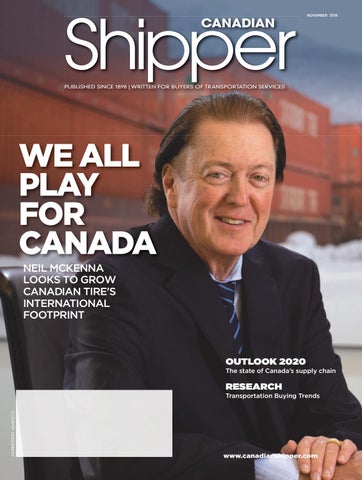
WE ALL PLAY FOR CANADA NEIL MCKENNA LOOKS TO GROW CANAD N TIRE'S INTERNATIONAL FOOTPRINT
OUTLOOK 2020 The state of Canada’s supply chain
RESEARCH AGREEMENT 40063170
Transportation Buying Trends
www.canadianshipper.com
FROM ALL ACROSS THE WORLD, WE DELIVER TO QUITO. With Air Canada Cargo, the entire world is within reach. Our extensive network of over 450 destinations across six continents offers endless possibilities for your shipping needs — and it keeps growing! Introducing service to Quito, starting December. Visit aircanadacargo.com today.
CONTENTS
NOVEMBER 2019
DEPARTMENTS
10
5 | Editor’s Foreword Carbon costs
6 | In the news Industry Q&A: Wendy Zatylny; FedEx cuts ties with Amazon in the U.S., but not in Canada; SUPPLY STATS; New supply chain lab opens in Alberta
35 | Coaching Corner Office hero
COVER STORY
38 | The Bigger Picture
EXECUTIVE OF THE YEAR
Making a choice
Neil McKenna
Photo: Peter Power
30
During his nearly 25 years with Canadian Tire Corporation, Neil McKenna, FMA’s Supply Chain Executive of the Year, has helped to create one of the best-in-class transportation supply chain operations in North America.
FEATURES
2020 OUTLOOK | 15 The future of the transportation supply chain
15
IMO 2020 | 24 Canada’s marine transportation industry readies for new fuel regulations
TRANSPORTATION RTATION BUYING TRENDS RENDS
RAIL INFRASTRUCTURE | 27 Class 1 railroads continue to grow their capital spending programs
Find out what transportation sportation will cost you in 2020 20 www.canadianshipper.com November 2019 3
EDITOR'S FOREWORD John Tenpenny November 2019 Volume 122 Issue No. 6
EDITOR John Tenpenny (416) 510-6880 john@newcom.ca EDITORIAL DIRECTOR John G. Smith (416) 614-5812 johng@newcom.ca MANAGING DIRECTOR, TRUCKING AND SUPPLY CHAIN GROUP Lou Smyrlis lou@newcom.ca ART DIRECTOR Anita Balgobin CONTRIBUTORS Carolina M. Billings, Mark Cardwell, Dan Goodwill, Carroll McCormick, James Menzies, Peter Power, Ian Putzger, Leo Ryan PRODUCTION MANAGER Jwad Khan (416) 510-6779 jwad@newcom.ca SALES MANAGER Anthony Buttino (514) 292-2297 anthonyb@newcom.ca CIRCULATION MANAGER Mary Garufi (416) 614-5831 mary@newcom.ca PRESIDENT Joe Glionna CHAIRMAN & FOUNDER Jim Glionna
5353 Dundas Street West, Suite 400, Toronto, ON M9B 6H9 Canadian Shipper is written for Canadian transportation and logistics professionals who manage product flow from manufacturer to point-of-sale. Editorial is focused on reporting, analysis and interpretation of Canadian logistics trends and issues. It is published by NEWCOM MEDIA INC.
SUBSCRIPTIONS: Contact us at: mary@newcom.ca Tel: (416) 614-5831 Fax: (416) 614-8861 Website: canadianshipper.com (click on subscription button)
Making plans
U
nder new International Maritime Organization (IMO) regulations set to take effect January 1, 2020, the container shipping industry will have to reduce greenhouse gas (GHG) emissions by at least half compared with 2008 levels by 2050. Shippers have and will be impacted and should—if they haven’t already— make plans accordingly. The industry is under the same pressures as other sectors of the transportation industry to decarbonize. Under the IMO strategy released last year, the United Nations agency aims to finalize short-term measures by 2023 and medium-term measures to reduce carbon dioxide emissions by potentially 40 per cent by 2030. Encouragingly, and thanks mainly to slower sailing speeds, the global merchant fleet is 60 per cent larger than it was in 2008 but emits 18 per cent less carbon. While IMO 2020 will help significantly reduce air pollution, these new standards may have an initial negative impact across the industry: most notably the additional cost to the entire container freight industry, which is estimated to be $10 to $12 billion each year. Carriers won’t simply eat these extra costs; they will be passed down to shippers and, ultimately, to consumers. Some of these costs have already started to filter through as shipping lines start using low-sulfur fuels and installing scrubbers. The impact is also not limited to cost, as capacity will temporarily be reduced as vessels are out of commission while scrubbers are installed. Some capacity will even be permanently eliminated due to the additional space scrubbers and LNG tanks will occupy on ships, as well as older vessels being phased out rather than converted to new types of fuel. Although the regulation doesn’t come into effect until the first of the year, shippers must prepare now to mitigate the effects on their businesses. Shippers should have conversations with their carriers to understand what fuel pricing and capacity will look like, and plan ahead: booking capacity earlier than usual will be critical to mitigating the potential disruptions. CS
SUBSCRIPTION RATES: Canada: $65.95 + applicable taxes, per year; $107.95 + applicable taxes, for two years. U.S.A.: US$107.95 per year. All other foreign: US$107.95 per year. Single copies $8 except for the annual Logistics Buyers’ Guide (Aug) $60.95 + applicable taxes, (not including HST) plus $2.00 for postage. USA: US$68..95, Foreign: US$68.95 ISSN 2292-2490 (print), ISSN 2292-2504 (Digital), (Canadian Shipper.) Indexed by Canadian Business Periodicals Index. Printed in Canada. All rights reserved. The contents of this publication may not be reproduced either in part or in full without the consent of the copyright owner.
WANT MORE? www.canadianshipper.com
POSTMASTER: Please forward forms 29B and 67B to: 5353 Dundas Street West, Suite 400, Toronto, ON M9B 6H9 Second Class Mail Registration Number 0721.
@CanadianShipper @
PUBLICATIONS MAIL AGREEMENT 40063170
John Tenpenny, Editor john@newcom.ca © iStock
Canadian-Shipper
www.canadianshipper.com
November 2019
5
INDUSTRY Q&A
The evolving nature of Canadian parts Wendy Zatylny, president, Association of Canadian Port Authorities
What is the ACPA’s reaction to recent infrastructure funding announced for some of its member ports?
We were really happy with the monies that were allocated to the NTCF [National Trade Corridors Fund] and were even happier that the Minister of Finance advanced the second and third rounds of proposals. In fact, they advanced the second round of funding that wasn’t supposed to take place for another couple of years; to this January and turned it into a rolling call for proposals. That spoke to the recognition of government of the pent up demand for funding for infrastructure projects across all of the port authorities and in fact all the players within the transportation supply chain. What will be important now is to ensure the funding agreements continue to get signed expeditiously and that the funds begin to flow because it’s one thing to have the announcement, but you need to have to have the actual agreement signed, which is the next step and that the ports can put this money to use. The rules governing matching contributions say that only the expenses that began after the agreement was signed are eligible. So we’re hoping that Transport Canada will have another look at that because we’ve had to work to keep these projects on the boil. That’s the important next step. What would the ACPA like see come out of the Ports Modernization Review?
What we tried to do in our submission was to capture the evolving nature of port authorities. Where once we were simply a place where ships arrived and cargo was loaded and unloaded, we have become so much more than that now. We are facilitators of trade, we help develop businesses and markets, 6
November 2019
www.canadianshipper.com
would be to see the modernization of the ports, but specifically the modernization of the Canada Marine Act and supporting regulatory and policy underpinnings, including processes to amend our letters patent, the ability to increase borrowing limits, as well as allow the port authorities to become at least become equity investors in their own projects within their own port. Right now, we are constrained in how we can invest in projects within the port. But, now as port authorities develop into managing logistics parks and intermodal facilities, we want to be able to branch out into those functions. Currently we are restrained from doing that with the Canada Marine Act.
“Where once we were simply a place where ships arrived and cargo was loaded and unloaded, we have become so much more than that now.” Wendy Zatylny, president, Association of Canadian Port Authorities
and most importantly, we have become data managers and logistics experts. That really is the heart of what a port authority is right now. It’s expressed in terms of cargo and people, but we are logistics experts. The problem is the Canadian Marine Act dates back to 1998 and the legislation is inconsistent with what port authorities have now become and what they need to do to continue to be able to grow and compete in a very competitive and dynamic global sector. Out of the results of the ports modernization review, a top line desire
What else is on the ACPA’s radar?
The next frontier of port efficiency is data management. There are a number of initiatives globally that are exploring things like blockchain-supported applications, such as the Maersk-IBM TradeLens platform. What we’d like to see is two things. One, recognizing the importance of data and the sharing of data, that Transport Canada’s Data Initiative be fully supported for a good 10 years and that supply chain partners be encouraged to ensure as much transparency and data sharing as possible so that we can work together to eliminate the speed bumps in the supply chain. The second element is that we called on the government to develop a working group with the port authorities and related partners to start exploring and developing a Canadian standard for the utilization of data and data exchange with a view to improving efficiency. We have a lot of individual initiatives, but we need to standardize those because that would allow Canada, its ports and transportation sector to help guide and shape global standards. CS Photo: ACPA/Michelle Valberg
IN THE NEWS
Breaking up is hard to do FedEx cuts Amazon ties in U.S., but not in Canada
By terminating its U.S. business relationship with Amazon, FedEx admitted what many in the industry have known for awhile now: that Amazon is competing with established shipping companies. The announcement about ending the contract for deliveries through the FedEx ground network came two months after an earlier decision to drop Amazon from a domestic air shipping service. FedEx says that Amazon represented less than 1.3 per cent of its total revenue in 2018, or less than US$850 million, of which 80 per cent was moved by air. While the moves caught some by surprise, there were warning signs. A month earlier, FedEx warned in a government filing that Amazon’s fledgling delivery business could lower prices, hurt its revenue and “negatively impact our financial condition and results of operations.” Previously, in a regulatory filing of its own in February, Amazon altered the description of its business to say that competitors included transportation companies. Dean Maciuba, a former FedEx executive who now works as a consultant at Logistics Trends and Insights, said FedEx had good reasons to cut ties with Amazon. “They could not afford any longer to directly support a competitor,” he said. Amazon has been growing its own fleet of air and ground transportation in the U.S., giving it more control of how its packages are delivered, while reducing its reliance on FedEx, UPS and the U.S. Postal Service (USPS). The Seattle-based company has leased jets, built package-sorting hubs at airports, and launched a program to let its contractor drivers start their own businesses delivering packages in vans stamped with the Amazon logo. Despite these actions, the AmazonFedEx business relationship north of the border remains unchanged. “E-commerce is an exciting growth opportunity in the Canadian market, and Amazon continues to be a valued FedEx customer in Canada,” says FedEx Express Canada spokesman James Anderson. Photo: Amazon/FedEx Express Canada
By John Tenpenny
While FedEx opted not to renew its ground and domestic air shipping contracts with Amazon in the U.S., nothing has changed north of the border.
Rather than dropping shipping partners, Amazon is adding them in Canada. The company recently announced a new strategic partnership with Canadian air freight line Cargojet. The deal offers Amazon up to a 14.9 per cent minority stake in Cargojet, contingent on Amazon providing a specific amount of business. “We view the agreement positively as it de-risks that growth profile and removes what little chance there was that Amazon might get creative on how it moves overnight volume in Canada,” wrote Canaccord Genuity analyst Doug Taylor in a note to investors. Access to air shipping modes is vital to provide the fast delivery times required by Amazon Prime. Amazon launched that service in Canada in 2013, and memberships doubled between 2017 and 2018. Canada’s large geographic footprint also ensures that Amazon will continue to
partner with shippers such as UPS, Purolator and Canada Post. Over the years, UPS has made more money shipping Amazon packages than FedEx has, says Maciuba. “Their scale is bigger,” he said. “Historically, they’ve always been able to offer lower rates on the express and ground side than FedEx for very large customers and profit more from them.” Estimates suggest that Amazon accounts for 5-8 per cent of UPS’ annual revenue in the U.S., and while Maciuba hasn’t seen an agreement between the two, “I don’t think UPS would put themselves at risk without some guaranteed revenue.” UPS also adds value on both sides of the border by way of its retail outlets, which support Amazon’s return activities. “[UPS Stores] do returns very well. Customers walk in, they scan the original package, they get a receipt and walk out.” CS www.canadianshipper.com
November 2019
7
IN THE NEWS
750,000 trucks
SUPPLY STATS
Daimler Trucks North America has produced its 750,000th truck—a Freightliner Cascadia for UPS—at its production facility in Cleveland, N.C. Freightliner acquired the plant in 1989, to assemble mediumduty models. Today the facility also produces the Western Star 4700, 4900 and 5700XE, and right-hand-drive Freightliner Coronados and Columbias for Australia and New Zealand.
23,000-TEU containership
100,000 vans Amazon, which ships more than 10 billion items a year on fuel-guzzling planes and trucks, said it has ordered 100,000 electric vans from Rivian, the largest order ever of electric delivery vehicles, that will start delivering packages to shoppers’ doorsteps in 2021. It also plans to have 100% of its energy use come from solar panels and other renewable energy by 2030. That’s up from 40% today.
TThe CMA CGM Group announced the launching of the world’s largest containership (23,000 TEU) —CMA CGM Jacques Saade—powered by liquefied natural gas (LNG). In 2017, company chair and CEO Rodolphe Saadé, announced the decision to order a series of nine 23,000-TEU containerships. According to the company, LNG helps to reduce: emissions of sulphur oxides and fine particles by 99%; nitrogen oxides emissions by up to 85% and carbon dioxide emissions by around 20%.
$1 billion investment 50th anniversary
In celebration of its 50th anniversary, DHL opened its Americas Innovation Center in Chicago, a state-of-the-art 28,000 square foot facility that provides a collaborative space for DHL to work with its customers, its technology partners, and academics as well as tap the innovative power of its employees.
C.H. Robinson C.H. Robinson president and CEO Bob Biesterfeld (right) announced the that the 3PL has committed to investing $1 billion in technology over the next five years, doubling its previous $1 billion investment in technology over the last 10 years. With more than 1,000 data scientists, engineers and developers, the company is continuing to invest in global talent in this critical area.
62% of Canadians
Key insights from the 2019 UPS Pulse of the Online Shopper survey indicate Canadian online consumers show a low appetite for paying for shipping. Sixty-two per cent of Canadians will consider cheaper, yet slower shipping and 96 per cent consider it important to have visibility of various shipping option prices. Abandoned carts are often due to a lack of transparency and almost half of Canadians abandoned an online purchase because the cost of delivery was higher than expected. 8
November 2019
www.canadianshipper.com
IN THE NEWS
In the lab CN supports supply chain analytics at Mount Royal University A new $500,000 analytics lab at Calgary’s Mount Royal University lets students seek out and analyze live and historical business data crucial to navigating Canada’s new economy. The industry-leading technology in the CN Supply Chain Analytics Lab provides students with dedicated space to work on the Refinitiv Eikon Data Platform that accesses the inner-workings of companies around the world in real time. Data from this platform shows students how ethics, the environment and other factors combine with price to influence decisionmaking and the supply chain. “The analytics lab will provide a vital learning environment,” says Elizabeth Evans, dean of the Faculty of Business and Communication Studies. “The Eikon plat-
form opens the potential for further analytics programming. We’re thankful to CN for its support of this lab.” The lab includes 15 Refinitiv Eikon licences to support 12 student terminals, one for an instructor in the lab and two available for professors to use for curriculum and research requirements. It can accommodate up to 36 students, with groups of three using one terminal each. CN says the lab reflects the importance of supply chain management to the transportation industry that helps drive the Canadian economy, and provided the $500,000 donation for its development. “Supply chain innovation is part of our DNA at CN and we are very proud to engage the next generation of leaders through our support of the CN Supply Chain Ana-
In the CN Supply Chain Analytics Lab, Bissett School of Business students work alongside Brian Fleming, PhD, left, associate professor in supply chain management.
lytics Lab at Mount Royal University,” says Lonny Kubas, assistant vice-president of supply chain at CN. “Knowing firsthand the important role that analytics plays in supply chain management, it is really an honour to be a part of this project.” CS W i ar nte rC t O ou R, Ta rse ke s T St
What’s the most rewarding career decision you’ll ever make?
he
N
ew
Earning the CCLP® designation is easily the single best thing you can do to boost your career prospects. It can set you up for better pay, more advancement opportunities, and a range of management pathways and options across the sector. Plus, you’ll develop and demonstrate cross-functional capabilities that can deliver better business resultsɆ and more personal job protection. Depending on your background, your CCLP designation might be within closer reach than you WKLQN &OLFN RU FDOO WR ¿QG RXW LI \RX TXDOLI\ IRU D IDVW WUDFN
citt.ca/cclp2020 • 416.363.5696 Your best choice for complete career-long OHDUQLQJ FHUWLÀFDWLRQ in supply chain logistics
Photo: Mount Royal University
®CCLP &,77 &HUWLÀHG /RJLVWLFV 3URIHVVLRQDO LV D UHJLVWHUHG WUDGH HPDUN RI &,77
www.canadianshipper.com
November 2019
9
SUPPLY CHAIN AWARD
WE ALL PLAY FOR Neil McKenna's leadership helped establish Canadian Tire’s supply chain in Canada and now his sights are set on an international footprint
BY JOHN TENPENNY
During his nearly 25 years with Canadian Tire Corporation, Neil McKenna has helped create one of the best-in-class transportation supply chain operations in North America.
10
November 2019
www.canadianshipper.com
Photo: Peter Power
SUPPLY CHAIN AWARD
I
n the eyes of Neil McKenna, failure is a rite of passage for every leader. People make mistakes. But only by being accountable for them and learning from them can leadership be formed, says the vice president of transportation projects at Canadian Tire Corporation (CTC) and the 2019 recipient of the Freight Management Association of Canada’s Supply Chain Executive of the Year award. His leadership style is revealed in the latitude he gives those who report to him, to empower them in making hiring decisions. “When one of my AVPs (associate vice presidents) would need to hire a manger, they would seek my opinion and then ask me to approve their choice,” he tells Canadian Shipper in an exclusive interview. “If I have to approve of a hire then that’s like me doing the hiring,” explains McKenna. “I want them to be accountable for their decision.” McKenna joined Canadian Tire in 1994 as finance manager in the transportation division. During his time at Canadian Tire, McKenna has been involved in just about every aspect of the company’s transportation supply chain, from director of international transportation, where he was responsible for bringing in product from around the globe, to ensuring those products made it on to the shelves of CTC’s nearly 500 Canadian Tire Retail (CTR) stores as director of domestic operations. In 2008 McKenna was promoted to vice president, transportation, a position he held for 11 years before moving into his current role, where he oversees the development of CTC’s e-commerce delivery capabilities across the enterprise, as well as working closely with the consumer brands division, providing supply chain sup-
“A role or title doesn't entitle you to be a leader. Only your actions will define if you are an effective leader or not.” —Neil McKenna, Vice-President, Transportation Projects at Canadian Tire Corporation
port as CTC looks for new global markets for its products. To grasp the scope of Canadian Tire’s transportation supply chain, you must understand that the company is more than your local Canadian Tire outlet. In addition to its 500 general merchandise retailers, CTC also owns the SportChek, National Sports, Pro Hockey Life, and Atmosphere banners, combing to create Canada’s largest national sporting goods retailer; Mark’s (380 stores), a clothing and footwear retailer; Canadian Tire Automotive, with 5,600 service bays; Canadian Tire Petroleum, one of the largest independent gasoline retailers, which pumps more than one billion litres of gasoline each year at over 260 outlets; Partsource (91 stores), an automotive parts specialty chain; and as of this year, Party City Canada (65 stores), a premier retailer of costumes, accessories and decorations. In 2018, CTC acquired Helly Hansen, a global brand in sportswear and workwear, with wholesale and retail distribution capabilities across more than 40 countries. The addition of Helly Hansen has accelerated CTC’s ability to distribute its consumer brands internationally, which is where McKenna plays an important role in expanding the company’s supply chain capabilities. McKenna’s latest role is evidence of the evolving retail landscape. Over the past few years, the company has transformed to become a leading e-commerce organization, offering customers
flexibility in how and when they want to shop. This has altered the function of supply chains, that now, in addition to shipping large volumes of products to stores, must also deliver individual items ordered directly by customers to their home or closest store for pick-up. Transportation is the artery that provides an uninterrupted flow of goods from manufacturers all over the world to CTC’s store shelves. The company’s transportation operations are Canada’s biggest importer of freight (22nd in North America), shipping more than 160 million cubic feet of product to its retail network, utilizing Canada’s largest fleet at over 14,000 pieces of equipment. Handling all that merchandise is done at four transload facilities—three in Vancouver and one in Halifax—and six distribution centres, three in the Greater Toronto Area, two in Calgary, and one in Montreal. Managing transportation operations in such a complex supply chain requires constant innovation, something McKenna excels at, according to his successor as vice president of transportation, Gary Fast. “Under Neil’s tenure CTC’s transportation capabilities have become a model of innovation and represent supply chain best practices. He has been a trailblazer in our industry.” Fast highlights several important projects headed by McKenna during his term, including Canadian Tire becoming the first carrier in Ontario to run longer combination vehicles (LCVs)
www.canadianshipper.com
November 2019
11
SUPPLY CHAIN AWARD
with containers, developing the world’s first 60-foot container and 40-60-foot sliding chassis, as well as spearheading the integration of all CTC’s transportation functions and banners. From McKenna’s perspective, getting the province of Ontario to approve the use of containers as part of its LCV program is one of his most satisfying accomplishments. “When Ontario was on the verge of allowing LCVs on its highways, which were already allowed in Quebec and Alberta, they were only going to allow LCV trailers. We had 5,000 intermodal containers that would have been excluded, which would have put us at a considerable competitive disadvantage.” Instead of the usual lobbying of government officials, McKenna came up with an ingenious plan that involved the use of an empty 200-acre parking lot.
“At that time construction of our Montreal DC had been completed but had yet to begin operations. We engaged a retired Ontario Ministry of Transportation engineer to construct an exact replica of two Ontario intersections in the DC’s parking lot.” Working with their partners at Robert Transport, McKenna’s team assembled every possible longer combination configuration of containers— two 53-foot, two 40-foot, and a 53-/40-foot. “We invited all the Transportation Ministers from Ontario, Quebec, Nova Scotia and New Brunswick for a demonstration and spent a day educating them on why containers should be included in any LCV program. They took turns riding the LCVs, executing on- and off-ramp turns, which demonstrated that the turning radius of a
53-foot container was identical to that of a trailer.” According to McKenna, within 72 hours of the parking lot demonstration, Ontario allowed containers to be part of the approved LCV program, soon followed by Nova Scotia and New Brunswick. Managing expectations
Key to McKenna’s success during his nearly 25 years at Canadian Tire has been his mastery of what he calls the “theory of competing margins.” “Transportation is essential to the success of any retailer and it is a necessary cost. So, it is incredibly important that it be managed efficiently and optimally, but it’s not as simple as just moving the product,” he says. “When you are responsible for every step in the supply chain, from the man-
π SHIPPING SUPPLY SPECIALISTS
OVER 875 GLOVES ALWAYS IN STOCK
ORDER BY 6 PM FOR SAME DAY SHIPPING
12
November 2019
www.canadianshipper.com
1-800-295-5510
uline.ca
SUPPLY CHAIN AWARD
ufacturer’s loading dock to a Canadian Tire retail store’s shelf, there can be as many as 20 different touch points along the way. “Once a purchase order is sent to a factory, we then engage our offshore logistics provider, who trucks the product from the factory to either a consolidation location and then to the port or to the port directly in the case of full loads.” From there, it is a dizzying array of moves, as first an ocean carrier delivers a container to a Canadian port, where it is trucked to a transload facility to be transferred into a domestic container, before being driven and loaded onto a train. Next up is another truck trip to a distribution centre, where the goods are unloaded again and stored before the final-mile delivery—by truck—to a retail store.
It is during this complex journey that McKenna’s theory comes alive. “Normally you’d think that our margin would be the difference between what we paid the manufacturer for the unit and what we sold it to our customers for,” he says. “But in reality, every trucking company, third-party consolidator, ocean carrier, terminal operator and railway did their part at a cost, for which they would also like a margin, which eats into the only real margin. So the real difference between what we pay and what the customer pays is less all the costs in getting the product from there to here. “The more effectively you can manage margin expectations across the supply chain, the more competitive you will be, and CTC is known throughout North America for this kind of best-inclass management.”
For McKenna, managing people is different than leading them. “Managers manage people and/or processes. Leading inspires people to be better. If you have never been asked by someone who reports to you about leadership characteristics, you don’t have them, and you are not leading,” he emphasizes. “Leadership is operating and performing in such a way that gives people confidence. A role or title doesn’t entitle you to be a leader. Only your actions will define if you are an effective leader or not.” Fast is among those who count McKenna in the former category. “Above all, Neil’s mentoring has produced many senior leaders within Canadian Tire’s supply chain and his collaborative approach and passion for developing talent is infectious and drives those around him to be their best.” CS
www.canadianshipper.com
November 2019
13
BUILDING CONNECTIONS WHEREVER WE GO. CP prides itself on building partnerships. We work with our customers, wherever they are, to identify their needs and help meet their objectives, while providing the best service along the way. CP is your full supply-chain solution provider that gets your goods to where they need to be.
Learn more at cpr.ca
OUTLOOK 2020
TRANSPORT Transport Canada announces ELDs to be required by 2021 BY JAMES MENZIES
C
anada’s long-awaited electronic logging device (ELD) rule has been published, which the Canadian Trucking Alliance (CTA) says will catapult Canada ahead of the U.S. in terms of safety and compliance. The made-in-Canada regulation requires third-party device certification, something the U.S. did not pursue, and a detail the Canadian trucking industry lobbied to have included. In the U.S., devices are selfcertified, which has led to the arrival in the market of ELDs that can be modified or tampered with. By June 2021, third-party-certified ELDs will have to be used by all truck drivers currently required to maintain a logbook. The announcement was greeted with enthusiasm by industry associations. “The vast majority of our companies and drivers in our industry fully comply with hours-of-service rules, but, undoubtedly, the implementation of tamper-proof, third-party ELD devices will further enhance safety and help ensure all drivers and companies hold themselves to the highest levels of compliance,” said CTA chairman Scott Smith. The hours-of-service rules themselves will not be changed; they’ll simply have to be recorded using an ELD. “Third-party certification of ELDs is critical for hours-of-service compliance and fatigue management as the technology behind ELD devices is key to ensuring drivers and companies
Photo: iStock
follow their work-rest cycles,” said Stephen Laskowski, CTA president. “As we learned from the previous era of paper logbooks, the non-compliant segment of our industry, while a minority, have a history of finding workarounds of the rules. We must ensure that there are no gaps or opportunities to manipulate the technology and that compliance is the only option.” The final rule also accelerates the implementation timeframe, from the initially proposed four years, to two. But unlike in the U.S., existing automatic on-board recording devices will not be grandfathered. That worries Mike Millian, head of the Private Motor Truck Council of Canada (PMTC). “The PMTC is in agreement with the two-year compliance date attached to the posting, however we do have concerns with the removal of the grandfather clause that was posted in Canada Gazette 1,” said Millian. “The removal of the grandfather clause may actually place fleets who implemented devices years prior to a mandate, in a worse position that those who did nothing. These fleets will have to work with their supplier and hope that the device they purchased can be updated to be thirdparty-certified, or replaced with new devices. As a certifying body has yet to be determined, they may have to wait to find out the status of their device,
which reduces their lead time to plan a transition if their current device is not certified. That can be problematic and time-consuming if the device is integrated into back office systems.” On the two-year implementation period, Transport Minister Marc Garneau said: “The two-year implementation period may seem quick for some truck owners, but I want to reassure you that this period will allow them time to set up and install the devices. In doing this we are looking to reduce truck and bus crashes due to fatigue.” But despite concerns about the removal of a grandfather clause, Millian welcomed the rule. “The PMTC is very pleased that Transport Canada has posted this regulation in Gazette 2 and has moved this file into the regulations. This file has been in the works for many years, and it is good to see it finally see the light of day,” he said. “We are also thrilled to see that Transport Canada listened to industry and is making third-party certification of devices mandatory, and not going down the same self-certification mandate that is causing many problems south of the border. This is a huge step in ensuring devices are actually compliant and will have the desired effect of improving compliance with hours-of-service regulations.” The CTA’s Laskowski noted the requirement for third-party certification meant the grandfather clause had to go. “It became very clear that there were challenges in the self-certification world,” he said. “How can we have grandfathering of non-third-partycertified devices? We were originally asking for 24 months plus grandfathering.” The CTA has hosted several meetings with more than a half dozen device suppliers since January 2018. It says it will be embarking on an education campaign to ensure the industry is ready for the mandate. It is also working with ELD manufacturers and suppliers to ensure they are aware of their requirements to become thirdparty-certified. CS www.canadianshipper.com
November 2019
15
BRINGING
TO YOUR
YOU’LL NOTICE THE DIFFERENCE
INTERMODAL SHIPMENTS
CONTACT YOUR FASTFRATE REPRESENTATIVE TODAY TO LEARN MORE ABOUT OUR REVOLUTIONARY INTERMODAL SERVICE OFFERING
OUTLOOK 2020
RAIL The good and the bad of rail improvements BY CARROLL MCCORMICK
C
N is spending record amounts on capital projects and maintenance. Two short lines in Western Canada got their very first taste of federal grants for upgrades. But Huron Central Railway is again pounding the streets in search of long-term stable funding. CN is outdoing itself this year with its $3.9 billion capital expenditure (CAPEX) plan. Its ambitions range from increasing capacity in Nova Scotia, maintenance work on bridges, culverts, signal systems and track in New Brunswick, to rebuilding a rail bridge over the Steen River in Alberta. In Manitoba and Saskatchewan, for example, CN is adding train sidings and double tracks. CN is adding a new train passing siding in Port Edward and increasing capacity at the Port of Vancouver. Rail replacements and hundreds of thousands of new railroad ties are part of the maintenance plan. In what borders on the remarkable, considering the historic, overall indifference that federal governments have shown short lines, this year Great Sandhills Railway in Saskatchewan and Forty Mile Rail in Alberta received a total of $16.6 million in matching funds from the federal government for track work. “Before this we’ve never received a dime of federal funding for our member short lines. Transport Canada now has a staff that has the funding of short line railways as one of their responsibilities. They have come to Saskatchewan, toured our short lines, come to our meetings. None of that has happened before,” says Allison Field, director of communications and government relations, Western Canadian Short Line Railway Association. Unfortunately, such largess was not extended to Genesee & Wyoming Photo: iStock
for its Huron Central Railway line between Sudbury and Sault Ste. Marie. Last year it managed to wring some money out of the Ontario government to keep the line running till roughly the end of 2019, but now it’s déjà vu all over again, as baseball great Yogi Berra is said to have exclaimed. “Unfortunately, despite continuous efforts on HCRY’s part to work with both levels of government to secure funding to support the railway’s longterm business plan, the only help provided so far was the $980,000 emergency fund given by the government of Ontario last fall. This funding allowed HCRY to make some emergency repairs to keep operations going throughout 2019, while we worked with governments to find a longer-term solution. We are hopeful that we will be able to lock in serious funding commitments as the Federal campaign unfolds,” says Claudine Bois, executive assistant and communication advisor, Genesee & Wyoming Canada Inc. And while it has not yet reached the construction stage, the Alaska to Alberta Railway Development Corporation (A2A) continues to make progress toward its goal to build a 2,400 kilometre railroad connecting the Alaska Railroad, and its four-port ocean access in southcentral Alaska, with Alberta, via the Yukon and Northwest Territories. “We are in the process of narrowing down a 10-kilometre planning corridor to a couple hundred feet, with aerial surveys and ground [work], later in 2019 and 2020,” says Mead Treadwell, A2A’s COO. “We are heading to a more detailed project description, based on those surveys, to share with First Nations, other landowners and regulators.”
Breach of service
This year, using the new “own motion” provision in the Transportation Modernization Act (Bill C-49), the Canadian Transportation Agency (CTA) determined that CN breached its level of service obligations in the Vancouver area last winter to wood pulp shippers by “unilaterally restricting the transportation of the shippers’ traffic.” The ruling is significant. “The new provision in C-49 gave the CTA new power to make investigations under its own initiative, and the very first time it was used was in the service problem in the Vancouver area last winter: the embargo and rationing of access, especially for forest products,” says Robert Ballantyne, president of the Freight Management Association of Canada. “If the agency sees a broad problem, the own motion investigation does not require that a shipper file a complaint. The shipper community feels that it may distance them from potential retaliation, because a formal complaint by a shipper is not necessary under this new process,” Ballantyne adds. CN is appealing the ruling. What the Federal Court of Appeal decides, possibly only next year, will have implications for this new provision, Ballantyne explains. “One thing that is a bit worrisome is that if the Federal Court of Appeal decides in favour of CN, it may be difficult for the Agency to use this provision again. FMA wants to get across that the jurisprudence that comes out of this appeal [should] not put roadblocks in front of this provision, to make it more difficult to use it in the future.” CS www.canadianshipper.com
November 2019
17
WE MAKE TRANSBORDER SHIPMENTS EASIER.
ONE SOURCE FOR ON-TIME, WORRY-FREE DELIVERIES Your business doesn’t stop at the border, neither does Old Dominion. Our people provide 100% real-time freight visibility for your shipments between Canada and the U.S., with direct loading to major U.S. markets. Your transborder crossings are pain-free with OD’s in-house 24/7 customs clearance and brokerage services and a single point of contact. Plus, OD’s industry-leading on-time record and low claims ratio provide confidence with every shipment.
For more information, visit odfl.ca or call 1-800-432-6335 1-800-432-6335.
Old Dominion Freight Line, the Old Dominion logo, OD Household Services and Helping The World Keep Promises are registered service marks of Old Dominion Freight Line, Inc. ©2019 Old Dominion Freight Line, Inc.
OUTLOOK 2020
COURIER The Amazon effect continues to disrupt BY IAN PUTZGER
N
otwithstanding the continuing growth it produced, 2019 has been a disruptive year in the courier and express segment, as the wobbles of FedEx illustrate. Not surprisingly, Amazon has been a major instigator of disruption again with several steps this year. The most recent move was the order for 100,000 electric delivery vans announcement in September. Imtiaz Kermali, vice-president sales and marketing at eShipper views this as massive push into the final mile arena. “That’s a key concern for anybody in the industry,” he comments. Earlier this year Amazon raised the bar with the announcement that it would slash the transit window for free delivery of goods ordered by Prime customers to next day. Most pundits expect this to become the new norm for e-commerce deliveries, which is bound to result in casualties in the market. “The biggest challenge for the courier and express industry in Canada will be keeping up with anticipated demand and meeting faster delivery times,” comments Paul Steiner, vice-president of strategic analysis at logistics spend consulting firm Spend Management Experts. Chris Spanjaard, senior vice-president and COO of Purolator, points out that parts of the B2B segment are moving in the same direction. “In these industries, B2B needs are closely mirroring B2C needs, which
Photo: iStock
means businesses are wanting more visibility, speed and direct-to-home or direct-to-site delivery. Supporting healthcare customers, for example, with more direct-to-home delivery options and tailored support during peak periods will be increasingly important,” he remarks. eShipper is looking to boost its warehouse footprint beyond its current facilities in Toronto and Vancouver to Montreal and Calgary in order to allow next-day service at a reasonable cost level, says Mo Datoo, director of strategy and partnerships. The balancing act between service levels and cost containment is going to be one of the key battles for the industry. Dominic Porporino, president of UPS Canada, describes efficiency and leveraging scale to reduce procurement and operating costs as one of the major challenges for operators in 2020. Automation is a vital element in this. UPS is in the process of automating facilities in Montreal and Caledon. Employee safety is another issue, particularly for delivery drivers, notes Spanjaard. “We’re rolling out an industry leading health and safety management system for our people, with advanced training, to make sure our people stay safe at every delivery point,” he says. Purolator, which announced a $1 billion growth and investment plan in June, is blazing a trail in Canada with the implementation of seven-days-a-week service in four major markets. South of the
border FedEx and UPS have announced similar plans to kick off at the end of the 2019 peak shipping season. While this shift should boost utilization and bring greater flexibility for operators, it also brings further cost pressure. “Extending an operation to seven days a week adds costs, particularly staffing. We must ensure that the added costs allow us to remain cost-competitive,” remarks Porporino. Regardless of the rate of acceleration of deliveries, e-commerce is set to keep growing. Steiner says that the outlook for B2B as well as B2C growth in Canada for 2020 is positive, although the momentum should be weaker than in 2019. One impulse for additional growth should come from the USMCA agreement replacing NAFTA (once it has been ratified), as this should raise the de minimis threshold for goods imported into Canada from $20 to $40 a d day, and express shipments valued under $150 can be imported duty-free, although they will still be subject to sales tax, Steiner points out. “Ratifying the USMCA and other trade agreements will provide customers and businesses with more certainty and confidence to invest in Canada and North America. This certainty is important and helps solidify long-term business planning,” comments Spanjaard. Increasingly firms are looking further afield, both for inbound and outbound traffic, remarks Kermali. “The international market is becoming very popular with young entrepreneurs. They don’t look just at Canada and/or the U.S.,” he says. Faced with a slowdown in regular airfreight, airlines will be happy to take on more e-commerce (despite less than stellar margins). There are no signs of capacity bottlenecks at this point, but in the domestic arena concerns have come up after Amazon and Cargojet signed a strategic agreement under which the former can acquire up to 14.9 per cent of variable voting shares in Canada’s largest cargo airline. Observers and customers are worried that Amazon could hog most of the lift on Cargojet, leaving others scrambling to move their traffic. The airline has dismissed such fears, but worries are lingering. CS www.canadianshipper.com
November 2019
19
© 2019 Penske. All Rights Reserved.
Delays not only hurt your reputation, they also damage your bottom line. It’s why we’re dedicated to getting perishable products to market quickly and efficiently. All so you can keep your promises and your profits. It’s how we deliver confidence. Learn more at gopenske.ca.
OUTLOOK 2020
AIR Slowdown means shifting sourcing patterns BY IAN PUTZGER
A
fter two years of rampant growth the air cargo sector shifted down a gear or two in 2019. Buoyed by e-commerce, Cargojet has still enjoyed rising volume and revenue, but the other sectors have softened. Interline traffic from Asia over Vancouver was down 20 per cent yearon-year in September. Gary Vince, head of air freight Canada at DHL Global Forwarding, notes that anticipated challenges finding capacity have not materialized. Shippers have changed their approach in order to keep costs down, observes Chris Matthews, COO and president of Rodair International. “We’ve seen an increase in ocean traffic and a decrease in air cargo. And we see a lot more consolidations,” he adds. Uncertainty over global economic development and barriers to trade has affected demand, as companies have adopted a wait-and-see stance. At the same time, some are moving to shift sourcing patterns. Imports from China have slowed, while traffic from Southeast Asian countries like Vietnam has increased, says Matthews. Some forwarders are leveraging networks to respond to shifting trade flows and emerging lanes. “Our networks have been a big help to us. We get a lot of business back and forth and also sales leads,” says Sandra Faraj, vice-president of AGO Transportation. At Rodair Matthew is looking forward to the company’s marriage with Rhenus Logistics, which will open up new network opportunities and client introduction. An improvement in the market is not expected for some time. “I don’t think it’s going to get better before the second quarter of next year,” comments Tim Strauss, vice-president cargo at Air Canada.
Photo: iStock
For DHL the slowdown in general cargo has reinforced the focus of stalwarts like the healthcare and aerospace sectors. “We continued to do what we do best,” says Vince. “Our market share has grown.” Edmonton International Airport is also jockeying for a role in pharmaceutical flows. The emergence of a rapidly expanding cluster of pharmaceutical firms in the area has prompted a push for CEIV certification. According to Alex Lowe, the airport’s cargo development manager, this should be completed before the end of the year. Edmonton has also benefited from the legalization of recreational use of cannabis, which has created a new shooting star for air cargo, according to Matthews. However, the bulk of cannabis production at the 800,000 squarefoot facility of Aurora Sky at the airport is medical grade shipped to international destinations. There is strong demand in markets like Europe, Australia and the U.S., Lowe says. For many players e-commerce has been the main engine for growth. “Ecommerce has changed our business model,” remarks Jamie Porteous, executive vice-president of Cargojet. E-commerce also offers promising openings for Canadian airports, says Stan Wraight, president and CEO of Strategic Aviation Solutions International, the only major Canadian-based and owned airport consultancy. Besides the Canadian market, an airport can target e-commerce flows to the U.S., he argues. “There are only five U.S. airports designated to clear U.S. mail inbound. They are all congested. This is a tremendous opportunity for a Canadian airport,” he comments
Airports are ramping up for future growth. In response to a surge in seafood traffic to China Halifax International Airport has started work on a new cargo complex that includes an extended cargo ramp and three buildings of about 50,000 square feet each. The first of these, which is slated for completion in early 2021, should have more than 10,000 square feet of cooler space, says Glen Boone, director of cargo and real estate development. Edmonton opened a cargo facility with a large cooler last year to support perishables traffic, particularly fresh meat. At the moment Aurora Sky is building a second facility with a footprint of 400,000 square feet at the airport. This will be the cannabis producer’s international distribution center, says Lowe. Air Canada Cargo is due to open a new cargo facility at Edmonton. Elsewhere the carrier is looking to boost capacity without increasing its footprint. “We’re putting $50 million into our Toronto hub now. This includes putting in a new material handling system and adding about 30 per cent more ETV capacity,” says Strauss. “We’re also spending significantly at Vancouver and Chicago,” he adds. Air Canada Cargo is one year into a three-year review of how it operates. “We win in operations, not in the air. Everybody flies at the same speed,” says Strauss. His outfit has been among the first batch of companies involved in ‘SCALE AI’, a supercluster supported by the federal government. Initial trials have been successful “We’ll start to roll out AI. This gives us six to eight per cent more capacity in high demand lanes,” says Strauss. CS www.canadianshipper.com
November 2019
21
IF TIME DOESN’T MATTER, WHY DO THEY CALL IT A RUNWAY? At most gateway airports, cargo spends a lot of time sitting around. Not at Rickenbacker International Airport. We believe runways are meant to be fast. So from the minute your cargo comes in, we’re off and running—unloading, reloading and sending it on to its next destination right from the tarmac. And because we’re strategically situated within a one-day truck drive to nearly half the U.S. and one third of Canada’s population, your goods get to market faster.
Learn more at RickenbackerAdvantage.com Bryan Schreiber Air Cargo Business Development 011-614-409-3621 BSchreiber@ColumbusAirports.com
IT’S ABOUT TIME.
OUTLOOK 2020
MARINE Global seafarer shortage felt in Canada BY LEO RYAN
I
f any proof were needed that Canada is impacted by the serious manpower shortage confronting the global shipping industry, it was supplied in striking fashion shortly after Quebec City’s Groupe Desgagnés last June held an inauguration ceremony for two leading-edge polar class duel fuel petroleum-chemical tankers built in Turkey. They represented the completion of an investment plan of $200 million launched in 2015. But one of the two state-of-the-art vessels, the Rossi A. Desgagnés could not rapidly begin trading, as hoped, simply because the shipping line was unable to find an available captain with the required certificate approved by Transport Canada. Such certificates are a pre-requisite for officers seeking to work for Canadian-flag operators. Foreign nationals must also prove permanent residence in Canada. And the process can drag on for long periods to obtain recognition of certificates accorded by training colleges in foreign countries, including France and England. So for several weeks, a ship that cost $50 million to build sat idle on the Quebec harbourfront. No cash coming in from customers for the owner shouldering not only the financing costs, maintenance costs and port charges, but also potential costs for maintaining crew on stand-by. An industry source estimated the operational losses up to $20,000 a day. Commenting on this specific occurrence at the time, Martin Fournier, general manager of the St. Lawrence Shipoperators, said the manpower shortage is affecting the whole maritime industry. “In recent years,” he told Montreal’s La Presse newspaper, “shipowners have been Photo: iStock
engaging in gymnastic maneuvers to keep their vessels in operation. Not because they lack contracts but because of the shortage. The lack of superior officers (captains, first mates, chief engineers, etc.) is really preoccupying.” Moreover, senior executives of Great Lakes carriers in Canada have become increasingly vocal in complaining that some of their captains are being “poached” by pilot corporations offering higher salaries. Globally speaking, the latest manpower report by BIMCO and the International Chamber of Shipping (ICS) put the current shortfall at about 16,500 officers and warned there will be a need for an additional 147,500 officers by 2025 to service the world merchant fleet. Another study by the Ocean Policy Research Foundation anticipates a shortage of 364,000 seafarers by 2050. There are over 50,000 merchant ships trading internationally that are served by an estimated 1,647.000 seafarers of which 774,000 are officers. Whereas the global supply of officers is forecast to increase steadily, this is predicted to be outpaced by rising demand. Some categories are in especially short supply, including engineer officers at management level and officers for such specialized ships as chemical and LNG carriers. The report suggests that in the past five years the industry has made progress in increasing recruitment and training levels. But it warns that unless training levels are boosted significantly, the growth in demand for seafarers could generate a major shortage in the supply of seafarers. ICS secretary general Peter Hinchliffe is not alone among marine industry officials and stakeholders in calling for greater efforts to promote careers at sea.
Indeed, the industry offers pretty attractive good-paying jobs. Typical deckhands in Canada start off at $60,000 to $80,000, depending on the vessel. For second mates, it can reach $120,000. And much higher still for first mates and masters. In an interview, Phillip Nelson, president of the Vancouver-based Council of Marine Carriers (CMC), said “CMC member companies are acutely aware of the shortage of qualified mariners to fill vacancies of Master and Mate positions as senior personnel moves on to retirement or choose other career routes.” He explained that tug companies are not yet experiencing too much difficulty in obtaining people to fill entry level positions, but the situation will change in the future as it becomes more and more difficult to attract mariners prepared to be away from home several weeks at a time. Alluding apparently to such sectors as trucking, Nelson remarked that other industries are also realizing that recruitment is becoming an issue. To encourage new entrants, the CMC is looking at establishing a marine apprenticeship which would provide free funding for the required schooling and seagoing assignments. In a related development, the Seafarers’ International Union (SIU) of Canada initiated a “Be A Seafarer” recruitment campaign in 2018 aimed at promoting seafaring careers for younger generations of Canadians amidst a manpower shortage and aging membership. “The SIU offered free education to select applicants of our programs and a guaranteed job upon completion of the proper marine course,” indicated Patrice Caron, SIU executive vice president. CS www.canadianshipper.com
November 2019
23
MARINE TRANSPORTATION
AHEAD OF THE CURVE With new fuel regulation standards set to take effect Canada’s marine industry is ready BY MARK CARDWELL
Canada’s Algoma Central was the first carrier in North America to adapt its fleet to scrubber technology in advance of international caps on sulphur fuels.
W
hen Gregg Ruhl joined Algoma Central Corporation as a senior vice president in 2015, management had already made a bold decision to be early adapters of scrubber technology by buying and installing closed-loop systems on the newest of the 19 dry bulk carriers in the company’s domestic fleet of Canadian-flagged vessels that travel the St. Lawrence Seaway, servicing customers on the Great Lakes and the Canadian East Coast. So with the world now on the cusp of the new global sulphur cap of 0.5 per cent for marine fuels that comes into effect on January 1—a dramatic decrease from the current emissions cap of 3.5 per cent— Ruhl says he’s grateful for the prescient decision taken by his predecessors to make Algoma the first carrier in North America to adapt to scrubber technology. “I really appreciate it,” said Ruhl, who took over as Algoma’s president and CEO in February 2019, in a recent phone interview with Canadian Shipper from the company’s headquarters in St. Catharines, Ontario. “Until this year we had more closed-loop scrubbers than any-
24
November 2019
www.canadianshipper.com
one in the world, so we’ve enjoyed lower-sulphur emissions for years. We’ve also had the advantage of practice,” added Ruhl. “We’ve now had years of experience operating these scrubbers, dealing with what breaks, how to contain it—those sorts of things. For those in the world who are installing scrubbers right now and need them to be working as of January 1 of 2020, it’s going to be a challenge to get 100-per cent reliability.” To be sure, shipping companies everywhere have been and continue to plan and prepare to meet the new fuel regulation standards implemented by the International Maritime Organization (IMO) that are set to come into effect worldwide on New Year’s Day. Dubbed IMO 2020, the new regulations are the latest in a series of actions by the United Nations-backed agency aimed at halving greenhouse gas emissions from the nearly 60,000 vessels that carry over 90 per cent of world trade by 2050 and eliminating them completely by the end of the century. “The year 2020 will mark the begin-
ning of a decade of action and delivery,” IMO Secretary-General Kitack Lim said in July at the UN agency’s 122nd session at IMO headquarters in London, where ‘Sustainable shipping for a sustainable planet’ was adopted as the World Maritime Theme for 2020. “It will be a decisive decade not only for the shipping industry, but for life on the planet.” Reducing sulphur content from conventional bunker fuel however will come at a cost for the international marine industry, according to shipping industry stakeholders and analysts. Depending on the kinds of cargo companies carry, the markets they serve and the types and ages of the vessels in their fleets, ship owners must ultimately decide on whether to retrofit older ships so they can burn lower-sulphur or other fuels or to add new technology like scrubbers, which can cost $3 million to buy and install on a large dry bulk vessel. IMO 2020 regulations are also expected to the supply and demand of marine fuel, notably a spike in the need for low-sulfur diesel—a demand
Photo: Brittany Schooley
MARINE TRANSPORTATION
that could drive diesel prices up by as much as 30 per cent more than conventional bunker, resulting in bigger profits for refiners and higher operating costs for shippers—and concerns over the availability of low-sulfur fuel. IMO 2020 is also expected to result in a drop in both the use and price of conventional marine fuel oil, which will continue to be used on ships that are equipped with expensive scrubbers. The new regulations are also expected to influence freight rates, which are affected by everything from time and distance between ports to the weight and density of cargo. A recent analysis by Goldman Sachs on the potential financial impacts of IMO 2020 on the world’s economy predicts the new regulations will result in substantially higher shipping costs that will be passed on through the international transportation and logistics ecosystem to be ultimately absorbed by consumers. Shipping companies of all size and stripe are taking different paths to compliance, from converting existing ships to burn the higher-priced, lowersulphur fuel, outfitting them with fuelcleaning scrubber technology (a path that about six per cent of the world’s shipping fleet have reportedly taken) or buying new ships with propulsion systems that use fuels like LNG that meet the new sulphur content regulations. Canadian solutions
For Michael Broad, president of the Montreal-based Shipping Federation of Canada, which represents the foreign flag fleet and whose members trade internationally, it will take time for the shipping industry as a whole to deal with and digest the challenges posed by the new emissions regime. “Things will get worked out over the next year, but right now it’s anyone’s guess as to the availability of fuel and the price increase for lower-sulphur fuel,” said Broad. “Obviously it’s going to result in added expenses and ultimately cargo has to pay for everything.” Broad figures that all international shipping companies already have
strategies in place to both ensure their vessels meet the new fuel regulations and to brunt and/or recoup the associated capital and operational costs. Those strategies range from putting on fuel surcharges (which is being done by some container companies) to adding extra fuel costs to freight charges. In some international jurisdictions like Canada, the United States and Europe, where legislative efforts to decarbonize shipping have been going on as part of a coordinated international effort that began decades ago, the impacts of IMO 2020 are not expected to have as big an impact on shipping as in other parts of the world. One of the most notable IMO actions was the creation of four Emission Control Areas (ECAs) in Canada, the U.S., the Caribbean territories of the U.S., and the Baltic/North Sea area. In Canada, the ECA that was enacted in 2015 requires sulfur levels in marine fuel used in waters south of 60 degrees not to exceed 0.1 per cent ( five times more stringent than IMO 2020 requirements) and a limit of 0.5 per cent in fuels used north of 60 degrees (the same as the new IMO requirements). Because older ships tend to burn fuel less cleanly, the Canadian government has allowed fleet averaging in its ECA to help companies reach the 0.1 per cent sulfur emission target. That loophole will end however on Dec. 31, 2020, which gives Canadian companies an extra year to reach compliance. “I see IMO 2020 as more of a continuing evolution,” said Darryl Anderson, managing director of Wave Point, a Victoria, BC-based transportation and logistics consultancy firm. “People have long been talking about decarbonizing shipping but we’ve had an international system that allows for higher sulphur content. Now there’ll be a level playing field.” For Anderson, the experience of ECAs has provided shipowners and regulators with insights on how to deal with the need for low sulphur, which is essentially an alternative fuel that requires more refining than heavy fuel.
“Yes, it’s more expensive,” said Anderson. “But for most operators—unless you’re planning to build a new ship—the cost of that capital doesn’t really make the alternative fuel stream a choice that you’re going to implement for your existing fleet. “The heart of the debate is what is the price of very low sulphur fuel or the marine gas oil versus conventional bunkers and is it cost effective or more cost effective for a ship owner to buy these enhanced blends that meet the emissions requirement or is it cheaper to continue to use the lower quality fuel and try and adapt with scrubbers,” added Anderson. For his part, Robert Lewis-Manning, president of the Chamber of Shipping, which represents commercial carriers and their agents in Canada that trade internationally and domestically, thinks the implementation of IMO 2020 rules on Jan. 1 will prove anticlimactic for two reasons. “One is that Canada isn’t seen as a major bunker port for most ocean carriers and second there’s been a good dialogue with fuel providers in Canada, so what bunker will be required I think the demand will be met,” said Lewis-Manning. “Because there’s been so much dialogue, I think there’s a good understanding of what the demand is, what it will be in the future, probably already a discussion about what the price point is, and for the quantities that ocean carriers are taking on in Canada.” In terms of the added costs that IMO 2020 could have on the supply chain, Lewis-Manning doesn’t think they will have much impact in Canada. All shipping companies are likely looking well past Jan. 1 on future GHG emission targets the IMO has set. “I lot of people are looking to LNG as maybe a transitionary fuel, but there’s probably going to be a shift in technology and fuel types in the next 20 to 30 years—we’re likely talking new ships and new systems,” said Lewis-Manning. “To me that’s the real place where owners and operators have their minds set at the moment. They’re already prepared for IMO 2020.”
www.canadianshipper.com November 2019 25
MARINE TRANSPORTATION
Looking ahead
Peter Ellis agrees. A retired rear admiral and deputy-commander of the Canadian Forces’ joint operations command who is now executive director of the Clear Seas Centre for Responsible Ma-
rine Shipping, he says the shipping industry has been a leader in environmental regulation, including the introduction of voluntary measures to reduce acoustic impacts and ship strikes on whales.
But, he said, the time, money and challenges involved with changing fuel types and making technical modifications, together with evolving IMO-led efficiency design standards for newbuilds and stated future emission targets—notably IMO 2050, which calls for a reduction in GHG emissions of the global shipping fleet to 50 per cent 2008 emissions—adds to the cost of going green. “The reality is that there is a lot of uncertainty as to how to reduce the environmental impact moving forward,” said Ellis, whose group is currently doing a research project to compare the different fuel options for marine fuels in regards to GHG emissions and other particles like sulphur and nitrous oxides and black carbon, and another study on the environmental impacts of closedand open-loop scrubbers. For Ruhl, the extension of the fleet averaging protocol on sulfur emission until the end of next year, together with the decision made years ago by his predecessors at Algoma to install scrubbers on the newest of its domestic fleet of 19 dry bulk carriers (11 self-unloaders and eight gearless bulkers) and to convert the nearly 50 smaller ocean vessels (mostly pneumatic cement carriers and mini-bulkers) in Algoma’s international fleet to low-sulphur fuel, have helped to relieve the pressure of IMO 2020. “Because we don’t have that absolute stop on Jan. 1, we’ll be able to slowly convert our ships without scrubbers to diesel over the next year,” said Ruhl, adding that by 2021, IMO 2020 will have created a level playing field in terms of emissions—but Algoma’s scrubbers will give it a leg-up on the competition. “In terms of the type and cost of the fuel we’re consuming for propulsion, we will have a competitive advantage, especially on the Lakes where we’ve invested well in advance.” CS
Mark Cardwell is an independent journalist and writer based in Quebec City. He is a correspondent for publications in various fields, including transportation, business, agriculture, medicine and law.
26
November 2019
www.canadianshipper.com
RAIL INFRASTRUCTURE
THE BIG SPEND 2019 saw Canada’s Class 1 railroads continue to make large capital project investments
R
ail is one of Canada’s most capital-intensive industries. According to the Railway Association of Canada, railways invest an average of 20 per cent of their own revenues back into their networks each year—more than $25 billion in Canada alone since 1999.
Canadian Pacific Railway
CP says it is making significant investments that will drive sustainable, profitable growth, continuing the record investments made in 2018 with anoth-
er $1.6 billion planned in 2019 and again in 2020. Approximately 50-55 per cent of its $1.6 billion capital expenditure budget is spent on replacement and upgrade of existing infrastructure, which includes replacing rail, ties and other track materials, according to a company spokesperson. At the annual NRC (National Railroad Construction and Maintenance) Conference in in January, John Leonardo, CP’s general manager for wayside train control and communication, said the railroad will build some 240 miles of new rail in the U.S. in 2019, up from the 210 miles built in 2018.
In June 2018, CP announced plans to invest more than $500 million in new high-capacity grain hopper cars over four years as part of its commitment to the agricultural sector. CP plans to spend approximately $150 million on 1,400 new high-efficiency hopper cars in 2019 and 2020. With more than 1,900 expected to be in service by the end of 2019 and an additional 1,400 in 2020, this investment in the grain supply chain will continue CP’s leading role in grain transport. According to the spokesperson, the new cars are shorter, lighter and can carry more grain than the cars they’re replacing. They feature
Infrastructure investment announcements made by railways in 2019 included upgrades near the Port of Vancouver that will help remove bottlenecks for trains, improving the flow of goods and helping accommodate growing trade.
Photo: iStock
www.canadianshipper.com
November 2019
27
RAIL INFRASTRUCTURE
According to the Railway Association of Canada, railways invest an average of 20 per cent of their own revenues back into their networks each year—more than $25 billion in Canada alone since 1999.
a three-pocket design that can be loaded and unloaded more efficiently than the old four-pocket Government of Canada cars. The new hopper cars can handle more than 15 per cent greater volume and 10 per cent greater load weight than the cars being retired while featuring a shorter frame that enables more cars in a train of the same length. The cars feature newly manufactured components that are more reliable, significantly reducing maintenance-related delays. According to the spokesperson, CP is also undertaking a robust locomotive modernization program. CP has modernized more than 130 locomotives in the fleet. Equipped with the latest technology, these locomotives will significantly improve reliability and performance. CP is planning to have 170 modernized locomotives by the end of 2019 and plans to continue the modernization program in 2020. 28
November 2019
www.canadianshipper.com
Canadian Pacific also opened its new Vancouver Automotive Compound (VAC). The VAC is in a location to handle vehicles made in North America for distribution in British Columbia, northern Washington State and parts of Alberta, as well as vehicles imported through the Port of Vancouver. “Vancouver is Canada’s primary automotive gateway for Asian imports and one of the largest destination markets,” said Jonathan Wahba, vice-president sales and marketing, intermodal and automotive. “With capacity to accommodate 168,000 vehicles annually, the VAC will provide an important service to our customers while delivering sustainable, long-term growth for our shareholders.” With surging volumes in the area, CP built the VAC on 19 acres of CP-owned land adjacent to CP’s Vancouver Intermodal Terminal. The compound has capacity for 36 multi-level auto racks and
has nearly 1,200 bays for vehicles. The compound’s location creates efficiencies in CP’s automotive supply chain, allowing for Eastern Canadian car shipments to be quickly offloaded and for empty auto carriers to be reloaded and shipped back east. CP’s automotive supply chain provides automakers the opportunity to have their product to market up to two days faster by consolidating the shipper’s product to one facility. Canadian National Railway
In 2019, CN planned to invest approximately $3.9 billion in its capital program, of which $1.6 billion was targeted toward track and railway infrastructure maintenance to support safe and efficient operations. A further $1.2 billion was expected to be spent on initiatives to increase capacity and enable growth, such as track infraPhoto: iStock
RAIL INFRASTRUCTURE
structure expansion; investments in yards and intermodal terminals; and on information technology to improve safety performance, operational efficiency and customer service. CN’s equipment capital expenditures are targeted to reach $800 million in 2019, allowing the railway to tap growth opportunities and improve the quality of the fleet. In order to handle expected traffic increase and improve operational efficiency, CN expects to take delivery of 140 new highhorsepower locomotives and 500 new grain hopper cars. “In 2019, our record capital program of $3.9 billion will be focused on investing in the renewal of a more efficient and reliable locomotive fleet, adding network capacity to accommodate our solid pipeline of growth in diverse markets and bringing technology to our Precision Scheduled Railroading,” JJ Ruest, CN’s president and chief executive officer, said in a written statement. In 2019, the railway planned to invest $300 million to advance the implementation of positive train control (PTC) along parts of its network in the U.S. CN also deployed safety enhancing technologies across its network, such as the autonomous track inspection program, distributed air cars, and automated inspection portals. “These innovations, combined with CN’s investments in locomotives, capacity, infrastructure, and train crews, will support the safe and efficient movement of our customers’ goods to their end markets,” said the company. “Following a record capital program in 2018, CN has been able to take on more traffic from different commodity sectors based on contracts with our customers,” said CN. “This year, we are continuing to invest to boost capacity and network resiliency and to meet growing traffic on our corridors across Canada. [They] are part of CN’s 2019 record capital investment focused on enabling growth from all commodity segments, including consumer goods, grain, agricultural, forest, and energy products from all of our customers.” Over two years, CN will have made a $7.4-billion capital investment.
As part of its growth strategy, CN also increased its operations in Western Canada with two additional major export supply chain projects which came online. Both of the new projects focused on maximizing the use of rail into the Port of Prince Rupert
in British Columbia. The first train of thermal coal from Coalspur’s Vista Mine in Hinton, Alberta was shipped to Ridley Terminals. CN also delivered the first unit train of propane from Alberta for export via the new AltaGas Ridley Island Propane Export Terminal. CS
P R O U D LY R E C O G N I Z E D A S
SERVING YOUR LTL, TRUCKLOAD AND DEDICATED REQUIREMENTS TO/FROM CANADA, ALABAMA, GEORGIA, TENNESSEE & KENTUCKY
www.canadianshipper.com
November 2019
29
INSIDE THE NUMBERS
2020 TRANSPORTATION BUYING TRENDS What transportation will cost you in 2020, according to our annual survey BY LOU SMYRLIS
Are you properly prepared for your next contract negotiations with transportation providers? Canadian Shipper’s annual Transportation Buying Trends research, is designed to help place you in the driver’s seat. Included are highlights from our latest survey, completed in late 2019, for the TL, LTL, rail, intermodal, marine and air modes. Read on to see what
shippers across Canada project for increases to their freight rates, the penetration of surcharges and their concerns regarding capacity constraints. Sixty-six per cent of respondents were based in Central Canada, with 26% residing in Western Canada. In terms of industry, 42% of respondents were from manufacturing, while 20% were in distribution and 3PLs, with 7% in freight forwarding.
Draw Prize Winner! Canadian Shipper is pleased to announced that the winner of the draw to receive an iPad Mini for participating in 2020 Transportation Buying Trends survey is Nancy Jacob of Toronto. Nancy is the Country Ocean Freight Intermodal Coordinator for Panalpina. Nancy has over 15 years of experience in the freight forwarding and logistics industry (in Canada, the Middle East and south east Asia) handling pharmaceutical, oil and gas, fashion, heavy equipment, aerospace, and automobile shipments.
TRUCK LOAD
35%
TL Freight Shippers ANTICIPATED CHANGES IN USE OF MODE
% expect this mode to have highest pricing power in 2020
PROJECTED CORE TRANSPORTATION PRICING
SURCHARGE PENETRATION
(excluding fuel surcharge) Increase
33%
Stay the same
Down 0-5% +
18%
Border Security
12%
Flat
20%
Border Delay
13%
Up 0-2%
14%
Detention
36%
Up 2-5%
23%
Currency
7%
Up 5% +
7%
Fuel
86%
Not sure
19%
Other
16%
Decrease
50%
7% Not sure
10%
30
November 2019
4.39
TRUCKLOAD
CAPACITY CONCERN 0
5
10
Loose capacity
Balanced
Very tight capacity
www.canadianshipper.com
INSIDE THE NUMBERS
LTL
% expect this mode to have highest pricing power in 2020
22%
LTL Freight Shippers ANTICIPATED CHANGES IN USE OF MODE
PROJECTED CORE TRANSPORTATION PRICING
SURCHARGE PENETRATION
(excluding fuel surcharge) Not sure
5% Increase
38%
Stay the same
Down 0-5%
11%
Border Security
16%
Flat
19%
Border Delay
9%
Up 0-2%
20%
Detention
30%
Up 2-5%
31%
Currency
9%
Up 5% +
6%
Fuel
88%
Not sure
12%
Other
15%
Decrease
49%
8%
4.33
LTL
CAPACITY CONCERN 0
5
10
Loose capacity
Balanced
Very tight capacity
RAIL
% expect this mode to have highest pricing power in 2020
5%
Rail Freight Shippers ANTICIPATED CHANGES IN USE OF MODE
PROJECTED CORE TRANSPORTATION PRICING
SURCHARGE PENETRATION
(excluding fuel surcharge) Not sure
16%
Increase
21%
Decrease Stay the same
Down 0-5%
9%
Border Security
8%
Flat
21%
Border Delay
6%
Up 0-2%
10%
Detention
32%
Up 2-5%
17%
Currency
11%
Up 5% +
7%
Fuel
74%
Not sure
35%
Other
23%
7%
56%
4.57
RAIL
CAPACITY CONCERN 0
5
10
Loose capacity
Balanced
Very tight capacity
www.canadianshipper.com
November 2019
31
INSIDE THE NUMBERS
INTERMODAL L
9%
Intermodal Freight Shippers ANTICIPATED CHANGES IN USE OF MODE
PROJECTED CORE TRANSPORTATION PRICING
% expect this mode to have highest pricing power in 2020
SURCHARGE PENETRATION
(excluding fuel surcharge) Not sure
17%
Increase
Down 0-5% +
3%
Border Security
6%
Flat
20%
Border Delay
7%
Up 0-2%
17%
Detention
31%
Up 2-5%
16%
Currency
9%
Up 5% +
7%
Fuel
78%
Not sure
37%
Other
28%
24%
Stay the same
Decrease
5%
54%
4.70
INTERMODAL
CAPACITY CONCERN 0
5
10
Loose capacity
Balanced
Very tight capacity
MARINE
% expect this mode to have highest pricing power in 2020
12%
ANTICIPATED CHANGES IN USE OF MODE
Ocean Freight Shippers
PROJECTED CORE TRANSPORTATION PRICING
SURCHARGE PENETRATION
(excluding fuel surcharge) Not sure
13%
Increase
31%
Stay the same
Decrease
54%
3%
November 2019
7%
Border Security
20%
Flat
22%
Border Delay
5%
Up 0-2%
18%
Detention
31%
Up 2-5%
10%
Currency
22%
Up 5% +
2%
Fuel
58%
Not sure
40%
Other
27%
4.40
MARINE
CAPACITY CONCERN
32
Down 0-5% +
0
5
10
Loose capacity
Balanced
Very tight capacity
www.canadianshipper.com
INSIDE THE NUMBERS
% expect this mode to have highest pricing power in 2020
AIR
5%
Air Freight Shippers
PROJECTED CORE TRANSPORTATION PRICING
ANTICIPATED CHANGES IN USE OF MODE
SURCHARGE PENETRATION
(excluding fuel surcharge) Not sure
19%
Down 0-5% +
3%
Border Security
26%
Flat
23%
Border Delay
7%
Up 0-2%
20%
Detention
11%
Up 2-5%
11%
Currency
26%
Up 5% +
1%
Fuel
74%
Not sure
42%
Other
26%
Increase
15% Stay the same
59% Decrease
7%
4.36
AIR
CAPACITY CONCERN 0
5
10
Loose capacity
Balanced
Very tight capacity
COURIER
12%
Courier Freight Shippers ANTICIPATED CHANGES IN USE OF MODE
PROJECTED CORE TRANSPORTATION PRICING
% expect this mode to have highest pricing power in 2020
SURCHARGE PENETRATION
(excluding fuel surcharge) Not sure
8% Increase
Down 0-5% +
3%
Border Security
10%
Flat
22%
Border Delay
3%
Up 0-2%
29%
Detention
2%
Up 2-5%
25%
Currency
15%
Up 5% +
3%
Fuel
81%
Not sure
17%
Other
19%
36% Stay the same
52% Decrease
5%
3.38
COURIER
CAPACITY CONCERN 0
5
10
Loose capacity
Balanced
Very tight capacity
www.canadianshipper.com
November 2019
33
REACH CANADIAN SHIPPERS
ADVERTISE IN
MAGAZINE
Get your message in front of those who have freight to move. Advertise in Canadian Shipper magazine — the most-trusted and widest-reaching Canadian publication for shippers.
NATIONAL ADVERTISING Anthony Buttino Sales Manager 514-292-2297 416-614-5830
canadianshipper.com
COACHING CORNER
A Hero’s Journey ey y Q: I am the only female on our management team. Every time we get together to discuss the challenges the
By Carolina Billings, CPCC, CHRL, MA-IS
to a purpose greater than self. According to Campbell, there are eight distinct steps in a hero’s journey:
organization is facing, we seem to just go round and round. Deep inside I know I can solve the problem. The challenge is that it is not my responsibility or what is deemed my vertical. I feel like volunteering to do it on my own without pay just to prove I can do more than what I am doing, plus it would elevate the status of the organization by becoming a social justice enterprise. Is that career suicide?
A: Stepping into your greatness is a risk yes. But living a life of mediocrity for the sake of safety is also very risky. You are risking never knowing all the things you can accomplish and what you are capable of especially if it will lead to a greater benefit than just for the organization by becoming a social justice enterprise. Not knowing the exact nature of the proposed change or the social impact and perceived ROI for the organization, let’s first clarify what a social justice enterprise is: “A social enterprise is an organization that applies commercial strategies to maximize improvements in financial, social and environmental well-being— this may include maximizing social impact alongside profits for external shareholders.” (Wikipedia) Being an agent of change, thought leader of innovator can be a tough and perilous journey, a sort of hero’s journey. One of my favorite books written by Joseph Campbell, The Hero With A Thousand Faces, speaks of a call of adventure ©iStock
1. The separation. Taking the hero from the ordinary world. 2. The call. A problem is presented, and the hero could not remain in the ordinary world. 3. Threshold. The actually crossing over, the journey begins. ... 4. Challenges. ... 5. Abyss. ... 6. Transformation. ... 7. Atonement. ... 8. Return with a gift, knowledge or triumph.
my own and having to prove myself without formal recognition or encouragement has been par for the course. I have always done it, and in the end it has always been worthwhile. Joseph Campbell has been a constant companion in my professional battlefield. A reminder that the likes of Homer, Jason, Joan of Arc, and our ancestors who left their home to seek a better tomorrow. I must also answer the call if I dare to live a life where I get to find out my greatness. It has always been pleasantly surprising to answer the question: How far can I go? without expectations or for someone else’s accolades.
“Thought leaders are the informed opinion leaders and the go-to people in their field of expertise. They are trusted sources who move and inspire people with innovative ideas; turn ideas into reality, and know and show how to replicate their success.” — Denise Brosseau Throughout my career, I have been a pioneer, and an adventurer. As such, I have—more often than not—found myself alone in the pursuit of new visions either by design or fate. It has been lonely at times, even though mentors and our culture erroneously tell us that it is indeed meant to be lonely at the top, that is not necessarily always true. Your wanting to volunteer for the greater good is a noble gesture. You may be surprised by the reaction you receive if you propose a collaboration or voluntary exploratory committee. It may awaken others to reach new heights. Being a visionary and quite often the only female in the C-suite, operating on
By your question, I can infer that you know that it is holding back that is the real threat. May you rise to your greatness, one courageous act at a time. CS
Carolina M. Billings is Partner & CEO of a management consulting group and has 15+ years of experience in the fields of Business Development, Branding, Human Resources and Finance. She champions leadership initiatives as well as empowering and mentoring others to lead. For more information please visit: www.powerfulwomentoday.com or email info@powerfulwomentoday.com www.canadianshipper.com
November 2019
35
NEED MARKETING? ADV E RTI S I NG S TR ATE G Y ❘ PR OMOTION S ❘ DESIG N ❘ VIDEO
USE THE INDUSTRY’S CREATIVE EXPERTS! Whether you need impactful branding, well thought-out advertising, lead generating promotions, videos with “wow” or SEO, we’ve got the talent, know-how, and expertise to meet your marketing objectives. Not only do we publish Canadian Shipper magazine, our experts can apply their knowledge to connect you with your target audience.
SEE WHAT WE CAN DO FOR YOU N E W C O M . C A / C R E AT I V E C R E AT I V E @ N E W C O M . CA
AD INDEX Air Canada
2
www.aircanadacargo.com Canadian Pacific
14
www.cpr.ca CITT
9
www.citt.ca CN
back cover
www.cn.ca Fastfrate
16
www.fastfrate.com GX Transport
29
www.gxts.com Hercules Freight
4
www.herculesfreight.com Highway H2O
26
www.HWYH2O.com Oceanex
13
www.oceanex.com Old Dominion Freight Line
18
www.odfl.ca Penske
20
www.gopenske.ca Rickenbacker International Airport
22
www.rickenbackeradvantage.com Transplace
39
www.transplace.com U-LINE
12
www.uline.ca
Follow Us On www.canadianshipper.com
+2!) !. 2019
37
THE BIGGER PICTURE
Lessons Learned? From a freight transportation perspective, the past two years have been among the most tumultuous in decades. Throughout 2018, an economic surge, a shortage of qualified drivers, and the implementation of the ELD mandate in the United States, created a shortage of freight capacity, particularly in the truckload sector. Shippers struggled to find trucks to move their loads. To address these shortfalls, many shippers were forced to pay significantly higher rates, establish dedicated fleets and/or change their freight operations to become a “Shipper of Choice.” Rather than simply tender their loads, shippers were advised to become more “carrier friendly.” This encompassed a range of activities. Different approaches
Shippers have taken two approaches to the changing market conditions. One group of shippers has abandoned the lessons learned from 2018 and gone back to a tactical or transaction-oriented approach that focuses on the old standbys—price and service. They have reverted to securing capacity on the spot market. Since capacity is more plentiful this year, they are forgetting two facts of life. First, business is cyclical. The economy ebbs and flows. Capacity is already contracting. Carriers cannot afford 38
November 2019
By Dan Goodwill
to purchase, maintain and insure excess equipment. The driver shortage is not likely to go away any time soon, even with the advent of autonomous vehicles that is still some years away. As capacity exits the market, shippers will be facing shortages again, possibly sooner than they think. Second, carriers can play the same game as shippers. They can take a tactical approach and award their capacity to shippers in a manner that best serves their companies. They can give priority to their Shippers of Choice, those companies that make long term commitments and pay contracted rates; they can make their limited excess capacity available, at higher spot rates, to those shippers that did not learn the lessons of 2018. Another group of “enlightened” shippers learned and internalized some powerful lessons during the latter half of 2018. They realized that they needed to expand their processes and key metrics beyond price (freight costs) and service so that they included a range of Shipper of Choice capacity related attributes.
www.canadianshipper.com
One indicator of the quality of those relationships is first-tender acceptance rates, a measure of how often carriers accept (or reject) potential loads from shippers. If a shipper has been difficult to work with, carriers may be inclined to reject their tenders. By changing procedures, by giving carriers more lead time, they can raise tender-acceptance rates. Another key process (and metric) is dwell time at origin and destination. Dwell time and detention fees can be measured and monitored. Shippers of choice build strategic partnerships with their carriers. The strength of these partnerships can be measured in two ways. Shippers can track monthly, quarterly, semi-annual and annual meetings. They can measure the number and results of the Action Items that come out of the partnership meetings. Driver satisfaction is also measurable and shippers have a vested interest in ensuring the drivers of their core carriers are happy and well treated. Reality check
During 2018, many shippers that did not have a core car-
rier program, and were not shippers of choice, experienced capacity shortages and rising freight rates. Those manufacturers and distributors that booked loads on the spot market, frequently paid freight rates that were higher than contracted rates. In 2019, carrier capacity conditions improved, and spot rates came down. The question for shippers is whether they should abandon the principles of becoming a Shipper of Choice in view of current realities. The driver shortage will not be solved anytime soon. As carriers adjust the size of their fleets to meet market conditions, capacity shortages will return. To avoid the pain of 2018, shippers should establish a core carrier program, with a set of high-quality suppliers, and negotiate contract rates, service requirements and capacity allocations with each of them. By implementing the set of best practices and metrics outlined above, this is a sound long-term approach to establishing a robust and competitive freight transportation services procurement program. CS
Dan Goodwill, president of Dan Goodwill and Associates, has more than 30 years of experience in the logistics and transportation industries in both Canada and the US. Goodwill is currently a consultant to manufacturers and distributors, helping them improve their transportation processes and save millions of dollars in freight spend. He has held several executive level positions in the industry. He can be reached at dan@dantranscon.com.
©iStock
LOGIS TICS INTELLIGENCE FOR TRANSPOR TATION EXCELLENCE The Transplace TMSTM Control Tower
Business Intelligence
Cost to Serve Metrics
Comprehensive Routing
Predictive Analytics
Shipping Optimization
Automated Appointment Scheduling
Proactive Shipment Visibility
Cross-Customer Optimization
*The Transplace TMSTM Control Tower
Learn more about our logistics and technology solutions at Transplace.com. Transportation Management | Strategic Capacity | Global & Cross-Border Trade
REACH FARTHER.
New equipment, new capacity and the best team in the business. CN is paving the way for a future ready to handle growth. So let us help you stay competitive in the global marketplace - reach out to us and reach farther than you thought possible. cn.ca
Celebrating 100 years