SEPTEMBER 2019
PUBLISHED SINCE 1898 | WRITT WRITTEN TEN FOR BUYERS S OF OF TRANSPORTATION SERVICES
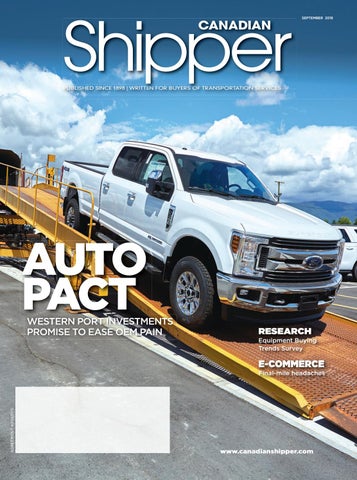
AUTO PACT WESTERN PORT INVESTMENTS PROMISE TO EASE OEM PAIN
RESEARCH Equipment Buying Trends Survey
E-COMMERCE
AGREEMENT 40063170
Final-mile headaches
www.canadianshipper.com
FROM PARIS TO TORONTO IN TIME FOR ALLERGY SEASON. At the core of our vast global network is a dedicated team making sure your pharma shipments are delivered quickly and safely. Be it allergy medication, vaccines or medical isotopes, our commitment is at the heart of every shipment. Visit aircanadacargo.com today.
AC Cool Chain
CONTENTS
SEPTEMBER 2019
DEPARTMENTS
26
5 | Editor’s Foreword Speed to market
COVER STORY
6 | In the news
AUTO PACT
ELDs and shippers; Intermodal revolution; SUPPLY STATS; Q&A with CIFFA’s Bruce Rodgers
Western port investments promise to ease OEM pain
41 | Inside the Numbers Renewal realities
43 | Coaching Corner Disclosure debate
46 | The Bigger Picture Breaking up
Photo: Canadian Pacific
31 TOP P 100 1 A rankingg of Canada’s top for-hire re ffleets re
New capacity has been added in Vancouver and Nanaimo, easing congestion for automotive manufacturers.
FEATURES TECHNOLOGY | 10 Smart sensors help track livestock during transport
FINAL-MILE DELIVERY
| 12
12
Expectations are driving last-mile delivery changes
ELECTRIC TRUCKS
| 18
Canadian fleets are leading the charge to reap the benefits of electric trucks
2019 EQUIPMENT BUYING TRENDS SURVEY | 37 Canadian carriers continue to invest in their fleets
www.canadianshipper.com September 2019 3
EDITOR'S FOREWORD John Tenpenny September 2019 Volume 122 Issue No. 5
EDITOR John Tenpenny (416) 510-6880 john@newcom.ca EDITORIAL DIRECTOR John G. Smith (416) 614-5812 johng@newcom.ca MANAGING DIRECTOR, TRUCKING AND SUPPLY CHAIN GROUP Lou Smyrlis lou@newcom.ca
Yesterday’s gone
ART DIRECTOR Anita Balgobin CONTRIBUTORS Carolina M. Billings, Carroll McCormick, Ian Putzger, Laurie Turnbull PRODUCTION MANAGER Jwad Khan (416) 510-6779 jwad@newcom.ca DIRECTOR, BUSINESS DEVELOPMENT Delon Rashid (416) 459-0063 delon@newcom.ca REGIONAL ACCOUNT MANAGER Anthony Buttino (514) 292-2297 anthonyb@newcom.ca CIRCULATION MANAGER Mary Garufi (416) 614-5831 mary@newcom.ca PRESIDENT Joe Glionna CHAIRMAN & FOUNDER Jim Glionna
5353 Dundas Street West, Suite 400, Toronto, ON M9B 6H9 Canadian Shipper is written for Canadian transportation and logistics professionals who manage product flow from manufacturer to point-of-sale. Editorial is focused on reporting, analysis and interpretation of Canadian logistics trends and issues. It is published by NEWCOM MEDIA INC.
SUBSCRIPTIONS: Contact us at: mary@newcom.ca Tel: (416) 614-5831 Fax: (416) 614-8861 Website: canadianshipper.com (click on subscription button)
SUBSCRIPTION RATES: Canada: $65.95 + applicable taxes, per year; $107.95 + applicable taxes, for two years. U.S.A.: US$107.95 per year. All other foreign: US$107.95 per year. Single copies $8 except for the annual Logistics Buyers’ Guide (Aug) $60.95 + applicable taxes, (not including HST) plus $2.00 for postage. USA: US$68..95, Foreign: US$68.95 ISSN 2292-2490 (print), ISSN 2292-2504 (Digital), (Canadian Shipper.) Indexed by Canadian Business Periodicals Index. Printed in Canada. All rights reserved. The contents of this publication may not be reproduced either in part or in full without the consent of the copyright owner.
“I
want it yesterday.” Every shipper has heard that refrain from customers, whether they’re on the business-to-consumer (B2C) or the business-to-business (B2B) side of the equation. The days of saying, “It’ll be there when it gets there,” are long gone. E-commerce has radically altered the landscape for shippers and if they don’t keep up, they will fall by the wayside as the slack is picked up by their competitors. Consumers and businesses are now demanding their products be delivered the next day and, increasingly, same day service is becoming the norm. The extraordinarily high service expectations born of e-commerce are impacting shippers. Among the demands shippers are finding challenging to meet are: • variable last-mile delivery options; • high in-transit visibility; and • flexible or free return policies and always-in-stock inventories. One recent study concluded that, while e-commerce and shipping have a symbiotic relationship, shipping often becomes an afterthought. However, for customers, the shipping experience can carry just as much weight as the product itself. An alarming 77 per cent of global survey respondents said they abandoned an online purchase due to unsatisfactory shipping options, while 58 per cent have actually stopped shopping with particular retailers altogether as a result of a negative shipping experience. Amazon reportedly is spending US$800 million to keep its “next day” promise and competitors such as FedEx and UPS have followed suit. Included in that group is Canadian integrator Purolator, which recently announced the launch of ‘QuickShip.’ The service gives businesses the opportunity to deliver products to consumers seven-daysa-week with same-day or next-day delivery. “In the next five years, we anticipate that 50 per cent of the delivery market in Canada will be direct-to-home, with consumers expecting quick and reliable deliveries at times that are convenient for them, like evenings and weekends,” said Purolator’s president and CEO John Ferguson. Giving companies choice, convenience and flexibility in shipping goods to their customers is just one step in the race to meet evolving demands brought on by e-commerce. Delivery demands aren’t going to slow down any time soon. “I want it last week” is not far off. CS
WANT MORE?
www.canadianshipper.com
POSTMASTER: Please forward forms 29B and 67B to: 5353 Dundas Street West, Suite 400, Toronto, ON M9B 6H9 Second Class Mail Registration Number 0721.
@CanadianShipper @
PUBLICATIONS MAIL AGREEMENT 40063170
John Tenpenny, Editor john@newcom.ca © iStock
Canadian-Shipper
www.canadianshipper.com
September 2019
5
IN THE NEWS
Driving down demurrage Could ELD data help solve shipper delays?
On the eve of the electronic logging device (ELD) mandate, one of the largest U.S. trucking operators, J.B. Hunt Transport, told customers to budget for transportation cost increases as high as “10 percent or more,” as the peak fall distribution season and electronic logging mandate (ELD) would intensify a driver shortage. “This is one the highest periods of turbulence and volatility in supply we have ever experienced, and we don’t think it will abate any time soon,” John Robert, president and CEO, and Shelly Simpson, chief commercial officer, said in the letter sent to J.B. Hunt customers in the fall of 2017. With Canada’s long-awaited ELD rules finally in place and a June 2021 implementation deadline on the horizon, many believe that the data carriers will collect can improve the carrier-shipper relationship, especially when it comes to the loading and unloading times known as demurrage. While it may oversimplify things when it comes to ELDs you just don’t know what you don’t know, says Ray Haight, a consultant with Dan Goodwill and Associates. “The awareness that can be brought to the shipper community [from ELDs] could show them what they don’t know about their own facilities,” he says. Being able to collect and access historical data from numerous carriers will be critical and paints a different picture, giving carriers more leverage in discussions with problem shippers—who could previously duck complaints coming from only one customer, he says. “It will be different now,” adds Haight. “Carriers can say, ‘Here’s how long every truck was in your yard, not just how long my trucks have been there.’” While it’s not as simple as turning on a light switch, ELDs will help with the momentum of objectively identifying where time is being wasted in the 6
September 2019
www.canadianshipper.com
By John Tenpenny
Federal Transport Minister Marc Garneau has announced plans to mandate electronic logging devices (ELDs) for federally regulated carriers. The data may offer more benefits than replacing paper logbooks.
network and prevent everyone from being painted with the same brush, says Trevor Fridfinnson, COO of Bison Transport, which has used the technology since 2009. “It has helped with, ‘Everyone has to pay more because the network is not efficient enough and drivers are getting held up at too many places,’” he says, referring to general discussions. “Ideally, in more situations it should help create those fixes. We want to take waste out of the system and we can help [shippers] identify where.” The implementation of ELDs in the United States, which began in
2017, has been generally positive, according to Jennifer Hedrick, executive director of The National Industrial Transportation League, America’s oldest and largest freight transportation association. She says the most apparent benefit has been the improved visibility into the relationship between shipper and carrier. “Like any transition, there have been some bumps in this early period. Some of our shipper members have reported no effect on their operations, while others saw rate increases early on due to reduction in capacity. Right Photo: Canadian Trucking Alliance
IN THE NEWS
now the shippers seem to hold a bit of advantage as capacity is plentiful. “We’ve also seen that shippers have been held more accountable for delays in loading or unloading, often resulting in detention charges or fewer choices of carriers.” Hedrick pointed out though that many companies are still using pre-existing Automatic On-Board Recording Devices (AOBRD), a technology that has been grandfathered until December.
“We’ll be looking to the data in the first quarter of next year to give more detail on the impact of full conversion.” For Fridfinnson, it has taken too long for the industry and regulators to get to this point. “We saw [ELDs] as the future and it fit with our safety culture and our values around having good tools to promote that culture,” he says, explaining Bison’s early adoption of ELDs.
Intermodal revolution Fastfrate and CP have teamed up to offer shippers faster transit times to the West Coast
Shippers treat freight services like commodities because they don’t perceive any difference—they’re all the same—so the only determining factor in choosing a service is price. Fastfrate Group is looking to turn that thinking upside down with its new intermodal offering for service from Ontario and Quebec to Western Canada, that company president and CEO Manny Calandrino calls revolutionary. In partnership with Canadian Pacific and its Demand Management offering, Fastfrate recently began offering two services. The first is FRATE Service, which replaces its LTL and TL intermodal standard service and improves transit times by two to three days. The second is FRATE Express LTL and TL intermodal service from Toronto and Montreal, which provides delivery times to Vancouver of four (TL) and five (LTL) days. “The whole service aspect of Demand Management, in my view, is going to revolutionize the marketplace,” says Calandrino. “What we’ve done Photo: Fastfrate Group
Manny Calandrino
“The whole service aspect of Demand Management, in my view, is going to revolutionize the marketplace.” Manny Calandrino, president and CEO, Fastfrate Group
The biggest benefit of ELD use, though, has involved better managing time in a safety-sensitive position, such as truck driving, compared to what could be done with a paper record. Any fears from drivers were quickly overcome, according to Fridfinnson. “Our belief and what we should hold as an industry is that no one should feel compelled to bend or break rules in order to make a living.” CS
has improved the transit time of our FRATE Service and now we’re offering our new FRATE Express service, which allows us to compete with the trucking firms.” Calandrino says the company began working on the new service two years ago with CP before starting trial runs in March of this year and marketing it to customers in July. “We started walking and by June, we were running,” he says. According to Calandrino, the new service has increased the f luidity of both their and CP’s operations. This f luidity also freed up chassis availability because of quicker turnaround time. Consolidated Fastfrate, one of Fastfrate Group’s companies is co-located with CP intermodal terminals in most major cities across the country and Fastfrate currently ships over 50,000 twenty-foot equivalent units (TEUs). “CFF is one of the oldest customer relationships CP has with the two companies first entering into agreement in 1966,” said Jonathan Wahba, CP vice president Sales and Marketing, Intermodal and just last year, the companies agreed to a new three-year contract. It’s early days, but Calandrino thinks Fastfrate customers will be reevaluating their belief that intermodal services are just a commodity. “We’re telling people, you’ll notice the difference and our current account base is already seeing the difference.” —John Tenpenny CS www.canadianshipper.com
September 2019
7
IN THE NEWS
SUPPLY STATS
1,000 jobs An economic impact study for the Prince Rupert Port Authority revealed a 40 per cent increase in volume over two years resulting in another 1,000 jobs associated with moving cargo thorough northern British Columbia. The study analyzed numerous factors based on the 26.7 million tonnes shipped through the port and determined the number of jobs grew from 5,200 in 2016 to 6,200 two years later. It says international trade cargo handled in 2018 at the port was valued at $50 billion and the business of transporting goods through that gateway created $1.5 billion worth of economic activity in the region.
27 million metric tonnes of grain CN announced that it moved more Canadian grain during the 2018-2019 crop year than ever before. The railway said it moved over 27 million metric tonnes (MMT) of grain, as compared to the previous record of 26 MMT set in 2016-2017, and compared to 25 MMT in 2017-2018.
1 million pounds of cargo By leveraging its existing aircraft fleet with additional daytime and overnight flights, Cargojet handled in excess of 1,000,000 pounds more than an average week and operated 23 additional flights in handling record volumes to meet demand during Amazon Prime Week.
$102 million in funding The Federal government announced a major investment of $102 million for five projects in the Port of Vancouver, including $42.7 million to consolidate the operations of the Annacis Auto Terminal and the Richmond Terminal; and $12.2 million to improve road and rail traffic operations and develop new rail-serviced bulk export marine terminals within the Fraser Surrey Port Lands.
$2 billion in revenue Canadian Pacific Railway Ltd. announced record second-quarter revenues of nearly $2 billion driven by grain, international container traffic and energy, chemicals and plastics. Traffic increased in all categories, with grain hitting its third-highest level in CP Rail’s 138-year history at $422 million, a 13 per cent boost.
77% of online shoppers A new global survey of digital consumers and merchants by BigCommerce found that shipping often becomes an afterthought for online retailers. For customers, however, it is a different story. Seventy-seven per cent of respondents said they abandoned an online purchase due to unsatisfactory shipping options, while 58 per cent have actually stopped shopping with particular retailers altogether as a result of a negative shipping experience. 8
September 2019
www.canadianshipper.com
INDUSTRY Q&A
try right now, they’re paying attention to what the industry requires, they’re making the changes accordingly. There has been a lot of involvement and engagement between the parties and it is very much becoming collaborative in approach. I’m not convinced that was the way it was previously.
Bruce Rodgers, Executive Director, CIFFA How have you found the transition since being named executive director in November of 2018?
As a member of CIFFA’s board of directors for 10 years previous to being named CIFFA executive director, I gained a very good understanding of the association and the transition was made much easier by my predecessor Ruth Snowden. Ruth’s tenure was really spent on building the brand of CIFFA and moving it towards being the trusted voice in the freight forwarding community. I think she did a phenomenal job in that respect, and we are well-positioned and well-respected. When Ruth walked into a room, everyone knew that CIFFA was present. Right now my focus is totally on membership value and making sure that we are properly communicating the needs of the industry and giving advice to our members in order to assist them in the operation of their business. To that end, we have strategic planning meetings with our board coming up and the focus of that will be defining our 2030 plan. What’s the latest on CIFFA’s ongoing work with CBSA?
The Customs and Assessment Revenue Management (CARM) initiative aims to improve the method of collecting duties and taxes and automating the entire process, which ties into other initiatives, such as Single Window and CBSA’s accounts receivable ledger (ARL). We are very pleased with the progress that’s being made overall. We’ve found that the government is listening to indusPhoto: CIFFA
drives speed to market. We’re on a CBSA committee looking at e-commerce and what we’re hearing is that Customs really wants to be able to better track, from a risk perspective, what’s coming into the country and secondarily, from a revenue capture point of view, what’s happening with the duties. For them, it’s a matter of obtaining that information on who the ultimate consumer is and we’re working with our members on how to better position that.
What are some other pressing issues facing Canadian forwarders?
The area where our industry is really being impacted and where we have to keep our eyes open going forward is ecommerce. Far more of the transactions now are going B2C versus B2B and that’s having a significant impact overall from an ocean and an air perspective. Also, the weight per shipment is declining and it remains to be seen what impact that will have on forwarders. The other aspect of e-commerce is customer expectations and how that
What else do you have your eye on?
Right now there are numerous disruptors, such as trade agreements and tariffs that are affecting business overall. There is also the “Amazon factor,” where Amazon is taking complete control of its supply chain from warehousing to aircraft to ocean lines and then reselling additional space at a significantly discounted price. How disruptive is that going to be to the markets? CS
OUR PROMISES GET DELIVERED Recipient of the “Shipper’s Choice” Award 2012 to 2019 & “Carrier of Choice” Award
Operating from seven terminals in Canada and the USA, we offer swift and reliable truckload service to most of North America. That, combined with our no nonsense commitment to customer service has helped Penner become the transportation provider of choice for customers who need to keep their promises, wherever they need to ship in North America. As a shipper’s “Carrier of Choice”, our promises do get delivered... consistently.
Over 350 Power Units and 800 Trailers Fully EDI capable Up to date Technology
Single point of contact 95 years of experience Cross border TL carrier
TERMINAL LOCATIONS Mississauga, ON • Winnipeg, MB • Saskatoon, SK • Regina, SK • Calgary, AB • Edmonton, AB • Vancouver, BC • Fargo, ND
www.Penner.ca Toll Free 866.729.7134 www.canadianshipper.com
September 2019
9
TECHNOLOGY
Protecting the Herd New partnership seeks to protect the health and welfare of livestock during transport
Angie Hurst, vice president of Luckhart Transport Ltd.
A
n Ontario trucking company has begun testing a smart sensor-based monitoring system to protect the health and welfare of livestock and poultry during transport. Luckhart Transport Limited, based in Sebringville, Ont., is one of the industry partners involved in a two-year research collaboration led by the Canadian Animal Health Coalition to validate the technology from Trans10
September 2019
www.canadianshipper.com
port Genie. The project is supported by the Canadian Agricultural Partnership (CAP) AgriAssurance Program and includes researchers from the University of Guelph, University of Saskatchewan and Agriculture and AgriFood Canada (AAFC). The partnership with Luckhart Transport is a sign that the industry is supportive of the technology and excited about making positive changes, says Joel Sotomayor, Transport Genie president and CEO.
“Transport is a stressful time for farmed animals when they’re most vulnerable to injury and infectious disease. We’re pleased to be working with a respected name in the livestock transport industry to demonstrate the value and effectiveness of Transport Genie under rigorous realworld conditions.” Transport Genie features smart sensors that monitor microclimate conditions inside livestock trailers and Photo: Luckhart Transport Ltd.
TECHNOLOGY
employs blockchain technology to store and share that information with truck drivers and other users along the supply chain. Having access to realtime data allows drivers to detect any problems and take immediate action to resolve issues before they threaten the health of the animals. Transport Genie is exactly the kind of multi-purpose technology that the livestock transport industry has been waiting for, according to Angie Hurst, vice president of Luckhart Transport. The company specializes in the humane hauling of swine and cattle across North America. Hurst approached the Transport Genie team in 2018 after reading an article about the new technology. “I called them right away about doing a trial because our company has always been passionate about humane
animal transport,” says Hurst, adding the industry is continually evolving and responding to society’s demands for improved animal welfare practices. “This just seemed like a logical next step.” Luckhart Transport operates over two-dozen trucks and uses three different designs in its fleet of 37 trailers, from standard pot-belly haulers to hybrid tri-deckers and imports from Italy that feature hydraulic lifts, forced-air ventilation, misters and drinkers. A key focus for the field trials will be to see how Transport Genie sensors can improve the process of disinfecting livestock trailers. Eleven years ago, Luckhart Transport became one of the first in Canada to invest in a thermally assisted drying and disinfection (TADD) system that uses heat to dry equipment after washing.
Called “baking,” the process is designed to kill pathogens that cause diseases like porcine epidemic diarrhea virus (PEDV). Ruggedly designed, the sensors are built to withstand the rough conditions and extreme temperatures that they’ll encounter during hauling and disinfection. To properly bake a trailer and destroy pathogens, it must be heated to temperatures of 75C for 15 minutes. “The main challenge with baking has always been determining that we’ve achieved the required temperature,” Hurst said. “With Transport Genie, we’ll be able to look after the health and welfare of animals during hauling, and precisely monitor temperatures during baking to take the guesswork out of disinfecting our trailers.” CS
SHIPPING SUPPLY SPECIALISTS
HUGE SELECTION OVER 36,000 ITEMS ALWAYS IN STOCK ORDER BY 6 PM FOR SAME DAY SHIPPING
COMPLETE CATALOG
1-800-295-5510
uline.ca
www.canadianshipper.com
September 2019
11
LAST-MILE DELIVERY
Purolator president and CEO John Ferguson recently announced a $1 billion investment package for the next five that includes building a national super hub in Toronto.
CHANGING LANDSCAPE Final-mile delivery is becoming more challenging as consumers’ expectations soar BY IAN PUTZGER
P
urolator courier vans, already a ubiquitous sight on Canadian streets, are now in action seven days a week in big cities. Following trials in Vancouver, the company unveiled its ‘QuickShip’ service on July 11, providing daily deliveries in Vancouver, Toronto, Montreal and Ottawa. Other locations may follow. FedEx and UPS have also announced plans to shift to a sevendays-a-week delivery pattern. “In the next five years we anticipate that 50 per cent of the delivery market in Canada will be direct-tohome, with consumers expecting quick and reliable deliveries at times that are convenient for them, like evenings and weekends,” commented Purolator president and CEO John Ferguson at the time of the announcement. Two weeks earlier Purolator had unveiled a $1 billion investment package for the next five years to “futureproof” its business. The company’s national super hub in Toronto, a 430,000 square-foot facility due to come on
stream in 2021 that will handle about 60 per cent of its business, is the biggest ticket item at $330 million, but a considerable amount is geared to finalmile activity, from new vehicles to ebikes and an expansion of the access point network. The final mile is particularly challenging. “Delivery density has consistently been a challenge with e-commerce,” acknowledged FedEx COO Raj Subramaniam when his company announced its plans for Sunday deliveries. “Delivering smaller items to residences does eat into our yields,” adds Steve Vitale, director of communications of UPS Canada. The pressure on costs is set to rise further as the industry moves to accelerate deliveries. Amazon, which had previously set the standard for ‘free delivery’ at two-day windows, announced in April that it would deliver next day to its Prime service subscribers. With Walmart and other heavy hitters announcing plans to follow suit, next day is expected to become the standard.
“Amazon are setting the bar,” remarks Imtiaz Kermali, vice-president of sales and business development at Toronto-based eShipper. “I don’t think everyone moves to next day, but everybody’s looking to next day. It has to be in everyone’s repertoire at some point,” comments Brian Bourke, vice-president of marketing at SEKO Logistics. It is going to be a costly transition. Amazon set aside $800 million for the initial outlay on going next-day. The company does not break out the cost impact of this step, but its second quarter balance sheet shows a 36 per cent increase in shipping costs to US$8.13 billion. John Haber, CEO of Spend Management, an Atlanta-based transportation consultancy, notes that Amazon was in a position to cover next-day deliveries for over 70 per cent of its shipments with its existing network when it announced nextday shipping. Morever, it has deep pockets to subsidize the development of its delivery network to support the new standard across the U.S. market. continued
12
September 2019
www.canadianshipper.com
Photo: Purolator
Nothing says Professional Logistics Expert like CCLP. CITT is proud to SUHVHQW WKH &,77 &HUWL¿HG /RJLVWLFV 3URIHVVLRQDOV ZKR HDUQHG WKHLU CCLP designation EHWZHHQ -XQH -XQH &RQJUDWXODWLRQV WR WKH PRUH WKDQ GHGLFDWHG VXSSO\ FKDLQ ORJLVWLFV SURIHVVLRQDOV ZKR QRZ MRLQ WKH UDQNV RI WKH LQGXVWU\¶V HOLWH
+DEHHE $WDQGD &&/3 'LPLWULRV $WKDQDVLRX &&/3 :LQQLSHJ 0% 7RURQWR 21
6DKLO $KXMD &&/3 6FDUERURXJK 21
7DZÀFN $O -DLODQL &&/3 0LOWRQ 21
/RUL $Q]H &&/3 )OLQ )ORQ 0%
+HQULTXH $UDQHJD &&/3 7RURQWR 21
5DYLQGHU %DLQV &&/3 %UDPSWRQ 21
6DTODLQ %DQDWZDOD &&/3 &RQFRUG 21
)DOJXQ %KDQGHUL &&/3 6FDUERURXJK 21
5LFKDUG %ODNH &&/3 /RQGRQ 21
,VDDF %RDGL &&/3 %UDPSWRQ 21
'DYLG %RXUULHU &&/3 :LQQLSHJ 0%
5LFDUGR %UDYR &&/3 (GPRQWRQ $%
(GZDUG %ULWWRQ &&/3 &DOJDU\ $%
&ROOLQ &DUZDUGLQH &&/3 *XHOSK 21
.HZHL &HQ &&/3 :LQQLSHJ 0%
=KHQ &KDL &&/3 :LQQLSHJ 0%
*LQD 'HOOH 5RVH $VK &&/3 +DPLOWRQ 21
0DUOD 'HVWHIDQR &&/3 :LQQLSHJ 0%
.DUDQ 'HZDQ &&/3 7RURQWR 21
6LPRQ (O +HORX &&/3 +DPSVWHDG 4&
*XVWDYR (VFREDU 0DUOHV &&/3 1RUWK <RUN 21
-XVWLQ )DOFRQH &&/3 0LVVLVVDXJD 21
9DQHVVD )HUJXVRQ &&/3 %DUULH 21
&KDUORWWH )HUQDQGHV &&/3 0LVVLVVDXJD 21
6DQSUHHW *LOO &&/3 %UDPSWRQ 21
(YJHQL *OLQEHUJ &&/3 :LQQLSHJ 0%
7LIIDQ\ *RGLQ &&/3 %HOOHGXQH 1%
0DUFR *URVVL &&/3 /RQGRQ 21
0DUFHOD ,QRMR]D &&/3 .LWFKHQHU 21
9DOHUL\ .XFKHUHQNR &&/3 0LVVLVVDXJD 21
$QJHO /DL &&/3 0LVVLVVDXJD 21
$QGUHZ 6FRWW /DQJLOOH &&/3 'DUWPRXWK 16
0DWKLHX /DYHUJQH &&/3 2WWDZD 21
$UL /HY\ &&/3 7RURQWR 21
6WXDUW /HZLV &&/3 0LVVLVVDXJD 21
$GROI 1DQ\HOO &&/3 0RQWUHDO 4&
$GHED\R 2NHWRRWR &&/3 :LQQLSHJ 0%
&DUORV 2VWHUURWK &&/3 0HGLFLQH +DW $%
5\DQ 0DVWHUV &&/3 :LQQLSHJ 0%
/LVD 0F6ZHHQH\ &&/3 3RUW +RSH 21
'DOMHHW 0LQKDV &&/3 0LVVLVVDXJD 21
6KHOHHQ 3DQWRQ &&/3 6FDUERURXJK 21
5HKDQD 3DUYLQ &&/3 7RURQWR 21
'ROO\ 3DWHO &&/3 6FDUERURXJK 21
$UVKLD 3HLUR 'LQQDEL &&/3 %UDPSWRQ 21
%D\DQL -U 3HQD &&/3 7RURQWR 21
0RKDPPDG 5D]D &&/3 0DUNKDP 21
0DUFR 5RPDQR &&/3 &RQFRUG 21
+RQJ]KL 5XDQ &&/3 0DUNKDP 21
0XKDPPDG 6DOHHP &&/3 &DOJDU\ $%
9DOHQWLQD 6DXYDOOH 2SD]R &&/3 6FDUERURXJK 21
7KRPDV 6FRWW &&/3 %XUQDE\ %&
/L] 6HDPRQH &&/3 7RURQWR 21
*XUVLPUDQ 6LQJK &&/3 6FDUERURXJK 21
.HYLQ 6LQJK &&/3 %UDPSWRQ 21
6LPUDQ 6LQJK &&/3 &RQFRUG 21
0DXUR 6SLHV &&/3 7RURQWR 21
7DURQ 6WHSDQ\DQ &&/3 7RURQWR 21
$P\ 6WRUH\ &&/3 %UDPSWRQ 21
5XVVHOO 6ZDUG &&/3 :LQQLSHJ 0%
0DUJDUHW 8\HGH &&/3 0LVVLVVDXJD 21
0DUN 9DQ '\N &&/3 2DNYLOOH 21
.HYLQ 9DQGDO &&/3 :LQQLSHJ 0%
1DULQGHU-HHW 6LQJK 9LUN &&/3 %UDPSWRQ 21
3HWHU 9XRQJ &&/3 7RURQWR 21
'HYDQ :DOWRQ &&/3 6DLQW -RKQ 1%
&KHU\O :HQ]HO &&/3 :LQQLSHJ 0%
'PLWUL\ <DNRYHQNR &&/3 (WRELFRNH 21
;LDRKDQ 6KDZQ 7LDQ &&/3 1RUWK <RUN 21
3DWULFLD :DOO &&/3 0LVVLVVDXJD 21
-LQ 4L &&/3 /RQJXHXLO 4&
3KRWRV RI WKHVH &,77 &HUWLÀHG /RJLVWLFV 3URIHVVLRQDOV ZHUH QRW DYDLODEOH $QJHOHV $OYDUDGR &&/3 7RURQWR 21 ,DQ $QGHUVRQ &&/3 0DUNKDP 21 $GDP $UVHQDXOW &&/3 2WWDZD 21 'LHJR %RODQRV &&/3 .LWFKHQHU 21 -HII %RZHV &&/3 6DVNDWRRQ 6. 0DWWKHZ &DUU &&/3 0LVVLVVDXJD 21 9LQFHQW &DVFKHUD &&/3 6DUQLD 21 6XVDQ &UR]LHU &&/3 6KHUZRRG 3DUN $% 0DULD &XPEDUL &&/3 (WRELFRNH 21 -XOLXV 'HOD &UX] &&/3 0LVVLVVDXJD 21 2NVDQD 'HUEDN &&/3 :LQQLSHJ 0% *XUWHM 'KLOORQ &&/3 %UDPSWRQ 21 0D[ 'L1HOOD &&/3 0LVVLVVDXJD 21 3ROO\ (GPRQGV &&/3 9DQFRXYHU %& /DLV (XIURVLQR &&/3 1RUWK <RUN 21 'DYH )RUUHVWHU &&/3 %UDPSWRQ 21 (ULND )ULHGPDQ &&/3 6KHUZRRG 3DUN $% 0LFKDHO *DOHD &&/3 +DOWRQ +LOOV 21 5REHUW *LOOLHV &&/3 3HWHUERURXJK 21 1HOVRQ *RXYHLD &&/3 0LVVLVVDXJD 21 0LFKDHO *UD\ &&/3 0LOWRQ 21 2OLYLD *UHHQEDQN &&/3 6DLQW -RKQ 1% 5DQG\ +HSSHU &&/3 6KHUZRRG 3DUN $% -DUUHQ +ROGHU &&/3 &RUXQQD 21 (ULN -DFNDPDQ &&/3 &DOJDU\ $% (OL]DEHWK -RKQVWRQ &&/3 2WWDZD 21
0DWWKHZ -XGG &&/3 %UDPSWRQ 21 9DO .ODVVHQ &&/3 6DVNDWRRQ 6. 3DYHO .ULXNRY &&/3 5LFKPRQG %& -HUHPLH /HVVDUG &&/3 0RQFWRQ 1% 'DQLHOOH /HYHVTXH &&/3 )RUW (ULH 21 'DYLG 0DF'RXJDOO &&/3 9DXJKDQ 21 -DVRQ 0DUWLQV &&/3 0LVVLVVDXJD 21 %DUWRQ 0XLU &&/3 2DNYLOOH 21 3DQDJLRWLV 1LNRODRX &&/3 $WWLND 2PDQ 9DOHULD 2VHL $NRWR &&/3 0LVVLVVDXJD 21 .HYLQ 3DUU &&/3 6XUUH\ %& -RH 3HWUXVD &&/3 %UDPSWRQ 21 0DQMRW 5DWKRUH &&/3 %UDPSWRQ 21 *HRII 5HQQ\ &&/3 'RQ 0LOOV 21 +HFWRU 5H\HV $FRVWD &&/3 7RURQWR 21 7RGG 6HZDUG &&/3 'DUWPRXWK 16 0XVWDID 6KHULII &&/3 &RQFRUG 21 $GDP 6SHQFHU %RQH &&/3 0LVVLVVDXJD 21 ,VDDF 7RQJ &&/3 %UDPSWRQ 21 -RQDWKDQ 9DQORR /HJDXOW &&/3 /DFKLQH 4& 6DQMD\ 9LVZDQDWKDQ &&/3 &DOJDU\ $% :HL :DQ &&/3 %XUQDE\ %& 9LFNL 0LQ =KX &&/3 :RRGEULGJH 21
7R VHH WKH /LVW RI all &&/3V SOXV LQGLYLGXDO &&/3 SURÀOHV YLVLW ZZZ FLWW FD WDOHQWSRRO
What’s the most rewarding career decision you’ll ever make?
Your best choice for complete career-long OHDUQLQJ FHUWLÀFDWLRQ in supply chain logistics
LAST-MILE DELIVERY
continued from p. 12
“This will be difficult for others to match,” he says. “For brick and mortar stores it’s much more difficult to offer the same service levels at a competitive price. Consumers expect free shipment.” The unforgiving
Online shoppers have high expectations, according to a study published by DHL in June. They expect same-day or nextday delivery, variable last mile options, high visibility, flexible or free returns policies and always available stock. “It’s all about the customer experience and enhancing the customer experience,” comments Brett Williams, vicepresident of sales at Trimble Visibility. Consumers are also an unforgiving lot. A survey of 1,508 shoppers published in 2018 by Convey, a delivery experience management software firm, found that 83.5 per cent were unlikely to shop with a brand again after a poor experience. In addition to free shipping, they demand more self-service delivery features, and a growing number expect to be able to make some routing changes, Convey found. Add to this the rapid proliferation of new delivery service elements, from improved visibility to the tectonic shifts caused by the moves to next-day and seven-days-a-week delivery, and it’s easy to see how merchants feel under siege. “The e-commerce and parcel landscape is changing so fast it feels to retailers that the ground is shifting under their feet. They have to constantly reevaluate their providers and their setups,” explains Bourke. Instead of reviewing logistics on an annual basis, they have to look constantly at new options and partners, he adds. The shift to next-day delivery has a severe financial impact on merchants and carriers. “Most people charge premium for next-day delivery at the moment,” observes Haber. He adds that the large integrators have been able to move a lot of second-day traffic through their ground networks, even if customers pay charges associated with transportation by air. Shifting to next-day significantly reduces the amount of traffic they can move on the ground. 16
September 2019
www.canadianshipper.com
Online shoppers have high expectations. They expect same-day or next-day delivery, variable last mile options, high visibility, flexible or free returns policies and always available stock.
Purolator hired 150 new staff and rolled out a new mobility platform for its QuickShip service. Achieving the necessary volumes to make the Sunday operation viable has not been an issue, according to Ferguson. “We have enough existing clients to allow the minimum density that we need,” he says. Interest in the new service has been lively, and Purolator expects more shippers to embrace it once they have primed their own operations for seven-days-a-week schedule. Not surprisingly technology is expected to play a huge role in efforts to achieve lower costs. Research published by DHL Supply Chain shows that 67 per cent of the retailers surveyed expect artificial intelligence and big data analytics to be essential for their 3PLs to muster. Vitale points out that measures to reduce final mile costs kick in long before a delivery van pulls out of the yard. “It starts when we receive a package, how it flows through the system,” he says. UPS is going to invest $500 million in Canada over the next few years and deploy new technology, which will optimize operations and improve yield per package, he adds Not every firm has a few hundred million dollars to spare. “How do smaller companies compete? Through partnerships. It’s about creating a network that lets you scale,” says Bourke. He sees a new era emerging where collaboration is the norm. “Nobody can do it alone any more.” SEKO itself has teamed up
with a number of players over the past year, such as ShipStation, a provider of webbased e-commerce shipping software. “We look at collaboration,” says Kermali. His company is renting warehouse in Vancouver from a competitor, which has its Toronto warehouse about five minutes from eShipper’s facility in Brampton. “They’re full here, so now they refer customers to us,” Kermali reports. “We all have to work together and be smarter.” This is one factor that makes better information flow essential. The shift to a standard next-day delivery should begin with improved communication, both with suppliers and customers, argues Williams. For one thing, the various parties have to be notified in a more proactive manner, he says. Integrating couriers with merchants who adopt Trimble’s platform to streamline operations and provide visibility has become much easier over the past four or five years, he reports. The Wild West
However, the quest for better and faster information flow faces challenges. One recent study found that 46 per cent of the retailers surveyed were reluctant or unable to share e-commerce sales forecasts with manufacturers. DHL Supply Chain’s research revealed that 70 per cent of the B2C companies surveyed had not implemented an e-commerce strategy, despite recognizing its importance. The rapid evolution of the market may be one factor behind this. Most logistics providers would argue, though, Photo: DHL Supply Chain
LAST-MILE DELIVERY
that a shifting landscape is no excuse for failing to formulate a strategy, and that such a strategy should allow for a good deal of flexibility. “The final mile landscape in North America is the wild, wild west. Anything goes. Nobody’s built out the optimized routes yet,” comments Bourke. He relishes this scenario. “It’s a great opportunity to create solutions, and it’s an opportunity for retailers to leverage supply chain networks for final mile delivery.” A vital element in this is the establishment of multiple delivery channels—both for the sake of consumer convenience and to reduce final mile costs through elements like access points and parcel lockers. “Mobile outlets on wheels, locker networks—all these help with cost,” remarks Ferguson. He adds that Purolator is planning to boost its access point network through partnerships with various companies. UPS has about 40,000 access points around the globe, Vitale notes. Delivering in bulk to these instead of individual residential deliveries helps with cost containment. Also, a growing number of consumers don’t want to wait at home for a delivery, he says. Still, home delivery is far and away the preferred option, Ferguson points out. “The future is: people want convenience,” he says. Purolator has seen 25 per cent growth in its delivery volume over the past three years. It now moves a million parcels a day at peak times. According to Vitale, UPS today delivers more residential than B2B packages. Bourke anticipates accelerated growth in e-commerce shipments crossing the border into Canada once the new NAFTA agreement finally comes into effect, as this calls for an increase in the de minimis threshold for duty free personal imports into Canada. U.S. Customs and Border Protection (CBP) have struggled with the tidal wave of parcels flooding into the country after the U.S. raised the de minimis to US$800 a day. CBP does not have the resources to handle these volumes. It is currently planning a voluntary pilot project to collect advance
data for e-commerce shipments with import values below the US$800 de minimis. If their e-commerce shipments get stuck in customs, shippers are unlikely to react with empathy, research shows. They expect online merchants to take ownership of the delivery. CS
Ian Putzger is an awardwinning journalist with more than 20 years experience covering transportation and logistics issues. He is a former writer and editor with the Hong Kongbased Asian Sources Media Group, and Airtrade, a British magazine covering the global air cargo industry.
P R O U D LY R E C O G N I Z E D A S
SERVING YOUR LTL, TRUCKLOAD AND DEDICATED REQUIREMENTS TO/FROM CANADA, ALABAMA, GEORGIA, TENNESSEE & KENTUCKY
www.canadianshipper.com
September 2019
17
ELECTRIC TRUCKS
Canadian fleets are leading the charge to reap the benefits of electric trucks
BY CARROLL MCCORMICK
growing number of fleets are clearly eager to plug into the growing promise of battery-electric or hydrogenelectric trucks, as manufacturers race to introduce the first such vehicles to North America. Just weeks ago, Penske Truck Leasing and NFI National Freight accepted keys for the first two Freightliner eCascadias. Those trucks, along with medium-duty eM2 models, will become part of a 30-vehicle Freightliner Electric Innovation Fleet to test the underlying technologies in real-world settings.
18
September 2019
www.canadianshipper.com
They’re not alone. Volvo Trucks North America has promised to begin tests with an electric VNR tractor this year. Mack Trucks will test a batterypowered LR refuse vehicle in New York in 2020. Kenworth and Toyota have joined forces to develop equipment that runs on hydrogen fuel cells, with 10 of those vehicles to be tested by Toyota’s logistics operation, selected drayage haulers, and UPS. Established manufacturers are not the only ones in the race, either. Ryder recently ordered 1,000 battery-electric Chanje panel vans to be put in service in the next two years. Nikola has
reportedly secured more than US$13 billion in pre-orders for its hydrogenelectric trucks, with production of the Nikola 2 model to begin in 2021. Loblaw has tested a Build Your Dreams (BYD) drayage truck in Vancouver. UPS is running field trials of a Class 6 vehicle made by Xos, formerly known as Thor, around Los Angeles. The promise of trucks powered by hydrogen-electric fuel cells is being tested in Western Canada, too. The Alberta Zero-Emissions Truck Electrification Collaboration (AZETEC) project, which launched earlier this year and will run until 2020, involves the
ELECTRIC TRUCKS
Numerous Canadian carriers have ordered Telsa’s Semi truck with a projected delivery date of early 2020.
design and manufacture of two heavyduty, extended range, hydrogen fuel cell electric hybrid trucks that will move freight year-round between Edmonton and Calgary. The latter tests are particularly significant in Canada, pushing the weights well beyond those experienced by urban delivery vans or port drayage trucks, and extending ranges along the way. The 64-tonne (gross vehicle weight) B-trains, developed for Alberta’s unique operating environment, will be capable of traveling up to 700 km between refueling and be operated by
Trimac Transportation and Bison Transport. By the end of the project the trucks will have travelled more than 500,000 km and carried about 20 million tonne-km of freight. Ballard Power Systems will provide a total of six FCmove-HD fuel cell modules—each generating 70 kilowatts of power—with three modules to be installed in each truck. Then there’s Elon Musk. The Tesla CEO promised one of North America’s first Class 8 electric trucks, unveiling the prototype of his Tesla Semi as early as December 2017 and beating many established equipment manufacturers to the related headlines. Production of that truck was to begin this year as well, although the date has been pushed at least to 2020.
Within hours of a video from that Tesla unveiling, fleets quickly responded by either reserving the basic model for US$26,000 down or paying the full US$257,000 up front for the more expensive Founders Series Tesla Semi. Even some Canadian carriers were revealing a strong pent-up desire to reap the benefits of electric trucks, or at least to test them. “I ordered them the day [Tesla founder Elon] Musk came out with the YouTube video,” says Rob Piccioni, founder and CEO of Montreal-based Fuel Transport, who reserved five Semis. “It was amazing that Musk was able to touch on some of the nuances of our industry, some that the trucking industry has not been able to touch on in the past 100 years.” Tesla’s claims include reduced aerodynamic drag, acceleration from 0-100 km/h in 25 seconds with a 36,000-kilogram load, the power to steam up a five-degree slope at 100plus km/h, a battery charge range of 475 or 800 km, depending on the charging/battery option, and an energy consumption of less than 125 kilowatt-hours per 100 km. Tesla also claims, somewhat unclearly that, “With fewer systems to maintain, the Tesla Semi provides US$200,000+ in fuel savings and a two-year payback period.”
continued Photo: Tesla
www.canadianshipper.com
September 2019
19
WE MAKE TRANSBORDER SHIPMENTS EASIER.
ONE SOURCE FOR ON-TIME, WORRY-FREE DELIVERIES Your business doesn’t stop at the border, neither does Old Dominion. Our people provide 100% real-time freight visibility for your shipments between Canada and the U.S., with direct loading to major U.S. markets. Your transborder crossings are pain-free with OD’s in-house 24/7 customs clearance and brokerage services and a single point of contact. Plus, OD’s industry-leading on-time record and low claims ratio provide confidence with every shipment.
For more information, visit odfl.ca or call 1-800-432-6335 1-800-432-6335.
Old Dominion Freight Line, the Old Dominion logo, OD Household Services and Helping The World Keep Promises are registered service marks of Old Dominion Freight Line, Inc. ©2019 Old Dominion Freight Line, Inc.
continued from p. 19
ELECTRIC TRUCKS
Savings dreams
The promises of lower operating and maintenance costs were not the biggest draws for Piccioni. “For me it is a technology play. I am banking on the technology, not the savings. I believe these trucks have more technology in them, more accessibility of hardware and software,” he said. “I trust the innovations of Tesla—for example, the unbreakable windshield. Windshields are a problem for us.” Hercules Forwarding Inc. also ordered Semis without ever kicking a tire. The company, with its Canadian headquarters in New Westminster B.C., and its U.S. headquarters in Vernon, Calif., reserved two Semis in January 2018, and paid in full for two Founders Series Semis in March. Hercules made the decision to, as company president Martin Burnham Jr. puts it, “To get our feet a little bit wet. There was not much information available at the time we made the purchases.” This lack of information is evident in the confusion about just what some fleets think they are getting. One person thinks the Semi comes with a trailer. Another thinks he will be able to run the Semi with his own trailers. One figures that the tractor has computer-controlled side fairings, thus explaining how, with Tesla’s seemingly miniscule gap between tractor and trailer, the rig could possibly turn left or right. Yet carriers want electric trucks badly enough to stick their necks out for the chance, should all go as Musk says it will, to rewrite the book on operating and maintaining power units. While fleets vary in their expectations of energy savings, the dream is the same: big savings. “If you are driving one of these vehicles 1,000 km a day, that’s [the equivalent of] $100,000 in fuel,” says Jamie Temple, the vice president, HR with Brampton, Ont.based Speedy Transport Group. “On the [Tesla] car side you are looking at onetenth of the cost. So you could be looking at around $90,000 a year in savings in fuel. If we run that truck like an airplane [keeping it on the road as much as possible] you’d see these savings.” Temple sees the trucks making daily round trips between the Greater Toronto Area and Montreal, but notes, “We
Daimler Trucks North America has built the first two Class 8 battery electric Freightliner eCascadias for customers at its research and development center in Portland, Oregon.
could also go into the northern U.S., but the first step will be to focus on our domestic market where we have a concentration of terminals along the OntarioQuebec corridor.” It seems reasonable for Speedy to have one charging station in Montreal and another in the GTA, Temple adds. “The Semis can get back up to an 80-per cent charge in 30 minutes. A 30-minute charge to get 400 miles—we’re good. “You are looking at an 11- to 12-hour day. We’ll be looking at utilizing that truck with two drivers—slip seat. We’ll use it more than we would a regular truck. If we could, we’d run it 22 hours a day, if what Tesla is saying [about the charge time] can be done. We think we can make it more profitable than a conventional truck and trailer. This is why we are doing it.” Burnham, in contrast, does not expect to be able to run the Semi quite that steadily. “Off the bat, we will lose half of our productivity. But to lessen our carbon footprint, we are willing to accept that.” And in California, he notes, the more electricity people use, the more it costs per kWh. Does he envision a two-year payback period? “It is possible but it all depends on what the electricity bill will do.” In referencing California, Burnham is acknowledging the fact that most manufacturers are focusing their efforts in and
around California, leveraging grants available through the California Air Resources Board (CARB). Those funds are available as the Port of Los Angeles targets a goal of banning anything but emission-free trucks by 2035. About 16,000 diesel models currently serve the ports of Los Angeles and Long Beach. Millions of related dollars are being invested by the South Coast Air Quality Management District (SCAQMD), an air pollution control agency that covers Orange County and urban areas of Los Angeles, Riverside, and San Bernardino counties. The area historically has the worst air quality in the U.S. because of natural geographic and atmospheric conditions, coupled with a dense population. The “clean” nature of electric vehicles is ultimately decided by the source of the electricity. For example, net pollutants will be lower if the energy comes from a renewable source like a wind farm rather than an aging coal facility. But California is moving forward to establish the electric vehicles with confidence that cleaner electricity sources are coming. Eventually. Charge it
Piccioni suspects that if demand for electricity to run electric trucks becomes really strong, costs may rise simcontinued
Photo: Daimler Trucks North America
www.canadianshipper.com
September 2019
21
© 2019 Penske. All Rights Reserved.
ELECTRIC TRUCKS
continued from p. 21
ply as a reaction to increased demand and to pay for new infrastructure. “Everyone assumes that the price of electricity will stay where it is. But if you start to power half the trucks with electricity, there will be serious demand on the electricity infrastructure. There will need to be a big adjustment in the power infrastructure. This will cost money,” predicts Piccioni. Temple’s comment on charging? “We have to get that right the first time. Do we go on grid, or do a hybrid with solar charging? Charge up a battery charging station from solar energy [and charge the trucks from it]? That would probably be our preference, but we have to wait until we confirm a delivery date. At that time we will invest in a couple of charging stations.” Asked whether he can envision chargers at truck stops, Temple says, “I
can see that coming, but what would happen if there are four trucks ahead of a driver at the trucks stop? We will invest in a charging station at our yard.” Piccioni has ideas about how he will run his Semis, but a final decision depends on where to put the chargers. “We need to understand the infrastructure that will help us understand how we use these trucks. I’ll probably try and run them from Montreal to Sarnia or London, but we would like to use them into the U.S. too. It depends on their performance ... [and] where we can access power. Will shippers participate in the chargers? I can’t ask the shippers this yet because Tesla hasn’t launched the truck yet.” And when will the Semis start rolling out the door? Piccioni says he doesn’t know, while Burnham says there is reason for concern.
Unleashing the Lion 8 This past spring, the Lion Electric Company officially unveiled its 100 per cent electric Class 8 truck, manufactured in Saint-Jérôme, Quebec. They are ready to be incorporated fully into carriers’ dayto-day operations. “These are not for testing. They are ready to roll, like any truck. This is not a pilot program,” says Patrick Gervais, vice-president, Marketing and Communications with Lion. Lion sells the truck as a cab and chassis, which customers can configure however they wish. “It can be configured several different ways: Bucket truck, refuse truck, tow truck. You can convert them in many different ways. We can personalize so you have the right number of batteries; you only pay for the batteries you need. We can place them in the right place,” Gervais says. Recharge times depend on the charger (e.g., the Level II charge time is eight hours). A customer might have a third party build a dry box, such as Laval, Quebecbased Transit did for the Lion 8 that SAQ, the province’s government-run alcohol provider, purchased. C&S Wholesale Gro-
“As things are going, we are very concerned that our money is at risk. There is reason to be concerned,” he says. Meanwhile, Burnham has made an effort to cover his base, having ordered Class 8 tractors from Xos Trucks in April. He expects to begin late this year. Asked why Hercules is patronizing two manufacturers, Burnham says, “Xos was further along in its development. They also have smallerduty trucks that will do one shift. We bought the tractor and the 22-foot straight truck.” No one seems to be putting all their eggs in one basket when it comes to incorporating battery-electric vehicles into their fleets. “Tesla took the market by storm,” says Temple. As far as what other competitors are doing, “There is talk that Volvo is going to push really hard in the market. At some point we will evaluate the competition.” CS
The Société des alcools du Québec’s (SAQ) first Lion 8 electric truck.
cers, in California, is having solar panels installed on its box, to provide backup power in case Lion 8’s batteries fall short in powering the reefer (something Gervais does not expect will happen). Other Lion 8 customers include the city of SaintSaveur and CP Trucking. CN has ordered 11 tractor versions that Lion will commercialize in 2020, Gervais says. “CN will be operating them in several ways, like deliveries, urban use, pulling tractors.” Kruger has ordered two tractors as well.
Lion predicts operational costs will drop by 60 per cent compared to a diesel truck. “There is a lot less maintenance to do on an electric truck. We have regenerative brakes. When you take your foot off the accelerator it [slows and] stops, just like a golf truck. If you control your driving you almost never use your brakes. With stop and go driving the brakes regenerate [charge] your batteries. The other thing is that we are using 80 per cent less energy. $50,000 worth of diesel is about $10,000 of electricity,” Gervais says. —McCormick CS Photo: Lion Electric Company
www.canadianshipper.com
September 2019
23
SPEED BRINGING
& CONSISTENCY TO
YOUR
-;, ;,' -2;83&<$ধ32 3( !-£Z9 '1!2& !2!+'1'2; 93£<ধ32T
!9Ĥ8!;' 83<6 -9 !#£' ;3 3ø'8 3<8 $<9;31'89 +!1'f$,!2+-2+ -2;'813&!£ 9'8=-$' (831 2;!8-3 !2& <'#'$ ;3 '9;'82 !2!&!W ø'8-2+ 1<£ধ6£' £'='£9 3( 9'8=-$' 23> 'ø'$ধ='£@ '£-1-2!;'9 $32+'9ধ32 !2& !££3>9 <9 ;3 683=-&' (!9;'8 !2& 138' $329-9;'2; ;8!29-; ধ1'9W !9Ĥ8!;' ,!9 6!8;2'8'& >-;, 8!-£ (38 3='8 Œ‡ @'!89 !2& >-;, ;,' £!<2$, 3( ;,-9 8'=3£<ধ32!8@ 93£<ধ32T !8' 639-ধ32'& !9 !2
INTERMODAL
-2;'813&!£ -2&<9;8@f£'!&'8 (38 @'!89 ;3 $31'W
SHIPMENTS YOU’RE IN CONTROL
LTL INTERMODAL SERVICE FROM TOR / MTL (TERMINAL TO TERMINAL)
FRATE EXPRESS FRATE
WINNIPEG
CALGARY
EDMONTON
VANCOUVER
4 DAYS
4 DAYS
5 DAYS
5 DAYS
6 DAYS
6 DAYS
7 DAYS
7 DAYS
*A D D 1 E X T R A D AY F R O M M O N T R E A L
TL INTERMODAL SERVICE FROM TOR / MTL (TERMINAL TO TERMINAL)
FRATE EXPRESS FRATE
WINNIPEG
CALGARY
EDMONTON
VANCOUVER
3 DAYS
3 DAYS
4 DAYS
4 DAYS
5 DAYS
5 DAYS
6 DAYS
6 DAYS
*A D D 1 E X T R A D AY F R O M M O N T R E A L
R
YOU’LL NOTICE THE DIFFERENCE
CONTACT YOUR FASTFRATE REPRESENTATIVE TODAY TO LEARN MORE ABOUT OUR REVOLUTIONARY INTERMODAL SERVICE OFFERING
WEST COAST GATEWAYS
Feeling No Pain With the opening of its new Vancouver Automotive Compound, CP is increasing capacity and alleviating congestion BY JOHN TENPENNY
B
uild it and they will come. Scratch that, if there is a need, build it and then they will come. That was the genesis behind the recently opened Canadian Pacific (CP) Vancouver Automotive Compound (VAC), which opened this past spring in Canada’s third-largest city. “We had conversations with some of our automotive customers and shippers who weren’t our customers about where their pain points were in their North American distribution networks, and in every single case, the answer was Vancouver,” says CP’s vice president sales and marketing, intermodal and automotive, Jonathan Wahba, who was in attendance at many of those meetings. Vancouver is Canada’s import gateway for cars coming from Japan and South Korea as well as being a large destination market for cars made in North America, which is the area CP, on basis of those conversations decided to concentrate their efforts. “Our OEM customers told us there was a need in the market, which got the wheels turning for us,” says Wahba. “So we went to our real estate and industrial group and said, ‘Here’s the market situation, is there something we can do?’” That’s when the idea of using 19 of the 100 acres of land adjacent to CP’s main line and its Vancouver Intermodal Terminal took shape. However, there was one caveat—issued directly from CEO Keith Creel— before the project was given the green
26
September 2019
www.canadianshipper.com
Jonathan Wahba, CP vice president, sales and marketing Intermodal and Automotive and Tim Quesnel, Ford Canada regional sales manager–Vehicle Sales Western Market Area, cut the ribbon at the new Vancouver Auto Compound (VAC).
light, an anchor tenant needed to sign on first. Sure enough, when CP went back to some of those same customers who had asked for a solution to their Vancouver issues, Ford stepped up, and bought 50 per cent of the compound on a long-term, exclusive contract. According to Wahba, the compound will be the destination for all Ford models shipped to the Vancouver market. Eleven active Ford assembly plants are shipping to the VAC: two plants in Mexico, one plant in Canada and eight plants from the U.S. In terms of the models at the facility, thre will be Ford and Lincoln trucks, cars and chassis arrving from Kansas City, Michigan, Kentucky, Chicago, Mexico as well as Ford Edge and Flex and Lincoln MKX models from the Oakville, Ont. manufacturing plant. The VAC can handle 36 multi-level auto racks and has nearly 1,200 stalls for vehicles. CP has also deployed a new yard logistics system that automates yard processes and supports real-time inventory reporting, to give customers better visibility of their shipments. The system strengthens the company’s damage prevention processes by enabling immediate uploading of inspection images.
That, along with guaranteed access to capacity and direct access to the CP main line, is what convinced Ford to come aboard says Wahba, who also points out the area was in desperate need of an alternative to Vancouver’s only other auto facility—Annacis Island, located on the Fraser River. For decades, it had served at British Columbia’s main automotive compound, serving a dual purpose: as a destination terminal for cars made in North America and inbound vehicles from Japan and South Korea. “[Annacis] had a monopoly on the marketplace in Vancouver and with that came longer lead times and higher levels of delay and higher damage levels because of how crowded the facility was,” says Wahba. “You also need to use a short line railway to access facility, which is an additional cost.” While there is still plenty of land left surrounding the VAC, Wahba says expansion is not in the cards. “We’re not focused on expanding the 19 acres. What we are focused on is securing additional anchor customers. We’re actively engaged with several OEMs, working with them to move their business to our compound and I would suspect by the end of the year CP will likely have another announcement regarding the Vancouver Automotive Compound.” CS Photo: Canadian Pacific
WEST COAST GATEWAYS
Master of its Own Destiny The future of Prince Rupert’s port may involve stepping up capacity to reach 7 million TEUs
P
rince Rupert Port Authority (PRPA) announced the completion of a container terminal master plan that outlines the potential of future container terminal capacity and sequencing of development at the Port of Prince Rupert. The planning work identifies the long-term potential to develop six to seven million TEUs of capacity through the development of multiple terminals at the Port of Prince Rupert. The plan’s research, completed with the assistance of AECOM, considered capital costs, operating efficiencies, optimization of construction sequencing to minimize disruptions to ongoing operations, and mitigation of human receptor impacts (air quality, noise and lighting) as criteria to determine the feasibility and sequencing of container terminal potential at the Port of Prince Rupert. “Conducting this work ensures we have a clear understanding of the future potential for terminal development and contributes to a vision for the future of our container business to respond to the growing market demand for capacity at the Port of Prince Rupert,” said Shaun Stevenson, president and CEO of the Prince Rupert Port Authority. “The terminal development potential identified in the study ensures that we can accommodate the short, medium and long term supply chain needs of Canadian exporters while continuing to provide the unparalleled reach, reliability and speed shippers have come to expect at the Port of Prince Rupert.”
Photo: Prince Rupert Port Authority
The Port of Prince Rupert handled a record 1 million TEUs and 27 million tonnes of cargo in 2018.
The master planning concluded the potential for further expansion of Fairview Terminal and the development of a second container terminal at the Port of Prince Rupert’s South Kaien Island site. This second terminal features a capacity of 2.5 million TEUs and was identified as the next phase of terminal expansion for the container business at the Port of Prince Rupert following the expansion of Fairview Container Terminal announced with DP World in 2018, increasing its current capacity from 1.35 million TEUs to 1.8 million TEUs by 2022. Both the current Fairview Terminal and South Kaien sites are in close proximity to expanding export logistics operations on Ridley Island, and will fully integrate with these operations following PRPA’s construction of the FairviewRidley Connector Corridor scheduled for the end of 2020. “DP World continues to invest in terminal capacity, including advancing our current expansion project at Fairview Terminal,” said Maksim Mihic, GM of DP World (Canada) Inc. “We fully support the Prince Rupert Port Authority’s development vision
which enables Canadian trade and improves the balance between imports and exports through the northern corridor.” “The Port of Prince Rupert continues to be an important part of CN’s supply chains to and from international markets,” added JJ Ruest, president and CEO at CN. “This strategic port provides a rail connection to key markets and its continued expansion will further solidify the port’s place as a world class gateway. Our recent record capital investments further underpin our commitment to getting Canadian natural resources and consumer products to markets safely and efficiently and the Prince Rupert gateway is key to that strategy.” The Port of Prince Rupert handled a record 1 million TEUs and 27 million tonnes of cargo in 2018. “Our planned container terminal capacity expansion ensures Canadian shippers will be able to meet their supply chain needs well into the future and Canada will be well-served in meeting its objectives of growing trade in the Asia Pacific region,” added Stevenson. CS
www.canadianshipper.com
September 2019
27
WEST COAST GATEWAYS
The vehicle carrier Tranquil Ace docked at the Port of Nanaimo on March 8 to deliver the first Mercedes-Benz cars for the port’s new Vehicle Processing Centre (VPC).
Open for Business Port of Nanaimo offers Mercedes-Benz Canada new access to Western Canada
28
September 2019
www.canadianshipper.com
M
ercedes-Benz Canada welcomed its first official delivery of vehicles through the newly opened British Columbia Vehicle Processing Centre (BCVPC) in Nanaimo. The Port of Nanaimo and the BCVPC is the first and only Western Canadian entry point for European automobiles. This new all water approach for European—and potentially additional— importers, establishes new cost-effective and environmentally responsible supply chain options for the West Coast of Canada.
“This outstanding new facility represents a new era for our operations, allowing our B.C.-bound vehicles to travel an efficient all-water highway to this important market,” said Brian D. Fulton, president & CEO of MercedesBenz Canada. “This second point of access to the Canadian market is an example of our constant focus on innovation, which extends beyond our vehicles to all aspects of our business. I’m proud to be representing the first European automotive manufacturer to partner with Western Stevedoring
Photo: Port of Nanaimo
WEST COAST GATEWAYS
and BCVPC to use the Port of Nanaimo facilities to deliver our vehicles to the B.C. market.” Mercedes-Benz Canada’s dealer network comprises 59 dealerships, of which eleven are located in British Columbia. The newly established facility allows for a new shipping route to supply Mercedes-Benz Canada’s B.C. dealerships. Mercedes-Benz passenger cars, SUVs, and vans will travel from the EU to the Port of Brunswick in Georgia, where Sprinter vans will be collected from the company’s U.S. factory, in North Charleston, South Carolina (opened in 2018) before continuing on through the Panama Canal and up North America’s western coast to Nanaimo. Following the first shipment, new vehicles are expected to arrive every two weeks for the first year of operations, totalling 10,000 within the first year. The BCVPC will have access to nearly 27 acres of port land, and is projected to boost B.C.’s gross domestic product by $12.2 million in the short term and about $52.7 million over the next five years. “The BC Vehicle Processing Centre provides an opportunity to showcase how the Port of Nanaimo delivers local benefits with its global reach, with direct shipment of vehicles to our facilities,” commented Ian Marr, president and CEO for the Port of Nanaimo. “This investment, made with key partners, utilized approximately 40 companies and over 50,000 person hours to prepare the processing centre for operation and has diversified our local economy, providing new jobs and important employment benefits. We look forward to attracting more business to Nanaimo and Vancouver Island as a result of this collaborative venture.” The first shipment from MercedesBenz on March 8 was received in Nanaimo and allowed safety protocols to be tested with great success, said acting chair of the Port of Nanaimo, Donna Hais. “We are now anticipating on-going shipments and full pro-
duction for the Processing Centre—a goal that we have been working towards as a team for over a year and for the benefit of greater Nanaimo and the Vancouver Island Region. Once fully operational, the Vehicle Process-
ing Centre will be able to handle between up to 25,000 vehicles per year in phase one creating 40 to 60 direct full-time equivalent jobs, then expanding as early as 2024 creating 80 to 100 direct full-time jobs.” CS
WE WOULD LIKE TO THANK OUR CUSTOMERS FOR THEIR MANY YEARS OF SUPPORT! ONTARIO & EAST LTL & TL SERVICE INTERMODAL LTL & TL SERVICE FULL SERVICE WAREHOUSING ON, AB, BC TRANS-BORDER FREIGHT SOLUTIONS LTL & TL
For more information about using our award winning service please contact James Mitton at jmitton@appsexpress.com or 905-861-2790
www.canadianshipper.com
September 2019
29
Vera Penney Shunter, VersaCold
VersaCold is a food-first company. With over 70 years of supply chain experience, we’re a diverse team dedicated to ensuring the safety, quality and freshness of the food families eat—every step of the chain.
versacold.com
INDUSTRY RESEARCH
THE
TOP 100 Sizing up Canada’s largest for-hire carriers, from equipment counts to services Each year, Today’s Trucking Top 100 is the definitive ranking of for-hire fleet sizes in Canada, offering insights into those who are adding or retracting available capacity. Rankings are based on a sum of supplied truck, tractor, and trailer counts.
THE TOP P5 TFI International
Mullen Group
Saint-Laurent, Que. www.tfiintl.com 514-331-4000
Okotoks, Alta. www.mullen-group.com 866-995-7711 Trucks: 1,515 Tractors: 3,372 Trailers: 8,537 OO: 1,099 Employees: 4,709 Ranking Total: 13,424 Services: TL, LTL, D, E, I, TC, B, Tank, W
Trucks: 2,209 Tractors: 6,578 Trailers: 26,581 OO: 8,568 Employees: 17,026 Ranking Total: 35,368 Services: TL, LTL, D, E, I, TC, B, Tank, W
Day & Ross Hartland, N.B. www.dayrossgroup.com 866-329-7677 Trucks: 625 Tractors: 2,027 Trailers: 6,070 OO: 1,961 Employees: 2,465 Ranking Total: 8,722ß Services: TL, LTL, D, E, I, TC, B, W
Canadian Canada National Cartage Transportation Mississauga, Ont. Montreal, Que. www.cn.ca 888-888-5909 Trucks: 0 Tractors: 1,150 Trailers: 7,500 OO: 1,150 Employees: 100 Ranking Total: 8,650 Services: TL, I
www.canadacartage.com 800-268-2228 Trucks: 444 Tractors: 2,313 Trailers: 4,386 OO: 857 Employees: 3,160 Ranking Total: 7,143 TL, LTL, D, E, I, TC, B, Tank, W
▲
TL = Truckload LTL = Less than Truckload D = Dedicated E = Expedited I = Intermodal TC = Temp. Control B = Bulk Tank = Tanker W = Warehousing
(NR) = not ranked in 2018. (#) = 2018 ranking Companies have been ranked based on a total of vehicle counts, including straight trucks, tractors, and trailers, as reported to Today’s Trucking editorial teams. Vehicles and employees based in the United States can be included if they are administered from a Canadian head office. Top 100 data is compiled from fleet representatives by telephone
or email. The statistics are not independently verified. Selected fleets have been excluded from the list if they ask to be omitted, or do not respond to repeated requests for data. Do you think your company should be on future Top 100 lists – or were they missed on this one? Email editor John G. Smith at johng@newcom.ca, or call 416-614-5812.
www.canadianshipper.com
September 2019
31
AYR Motor Express Groupe Transport St-Michel Thomson Group (formerly Thomson Terminals)
September 2019
www.canadianshipper.com
W eb sit e
Cu st om er Li ne
6 7 8 9 10 11 12 13 14 15 16 17 18 19 20 21 22 23 24 25 26 27 28 29 30 31 32 33 34 35 36 37 38 39 40 41 42 43 44 45
5 6 8 9 11 nr 7 13 12 18 29 15 19 20 16 28 22 27 24 35 23 26 30 51 37 38 44 25 nr nr 39 32 33 59 40 65 47 45 52 49
Winnipeg Winnipeg Calgary Cambridge Moncton Brampton Boucherville Mississauga Gore Bay Brampton Coteau-du-Lac Edmonton Prescott Mississauga Wroxeter Bolton Mississauga Woodbridge New Hamburg Kamloops Saskatoon Belleville St-Germain-de-Grantham Brampton Etobicoke Quebec City Montreal Edmonton Mississauga Alliston Saint-Arsène Bonnyville Ingersoll Sherwood Park Vaughan Concord Richmond Oakville Montreal Steinbach
MB MB AB ON NB ON QC ON ON ON QC AB ON ON ON ON ON ON ON BC SK ON QC ON ON QC QC AB ON ON QC AB ON AB ON ON BC ON QC MB
800-363-0003 800-665-7598 403-298-5100 800-265-6358 800-561-7967 905-793-3525 800-361-8281 800-742-5877 800-265-1485 905-792-6100 800-363-5313 800-661-2855 800-461-8000 800-588-0057 800-265-3071 905-851-1688 905-712-1084 800-268-1564 800-665-2653 250-374-3831 800-667-8556 800-267-1888 819-395-4213 800-265 5351 800-665 9318 888-880-3801 514-636-9411 800-371-6895 905-362-9198 800-461-4374 844 884-2727 800-661-3290 519-425-7881 780-449-6688 800-563-2653 905-761-1400 604-515-1499 905-338-5885 514-667-8500 866-729-7134
www.bisontransport.com www.transx.com www.trimac.com www.challenger.com www.armour.ca www.chargerlogistics.com www.robert.ca www.ups.com/ca www.manitoulintransport.com www.m-o.com www.cat.ca www.westcanbulk.ca www.kriskagroup.com www.rosedalegroup.com www.hyndman.ca www.ttgi.com www.purolator.com www.fastfrate.com www.erbgroup.com www.arrow.ca www.siemenstransport.com www.itstruck.ca www.sgt.ca www.speedy.ca www.xtl.com www.groupeguilbault.com www.simard.ca www.rosenau.ca www.cctcanada.com www.warrengibson.com www.groupemorneau.com www.breckels.com www.verspeeten.com www.carontransport.ca www.versacold.com www.highlightmotor.com www.euroasiainc.com www.caravangroup.com www.andytransport.com www.penner.ca
46
43
Guelph
ON
519-826-7028
www.schneider.com
47 48 49
53
Vernon
BC
800-575-2355
www.chambersgroup.co
57 46
Woodstock Saint-Michel
NB QC
800-668-0099 877-454-9973
www.ayrmotor.com www.transportstmichel.com
50
68
Toronto
ON
416-240-0897
www.thomsongroup.com
(NR) = not ranked in 2018 32
Pr ov in ce
He ad
(formerly DCT Chambers Trucking)
20 18
Bison Transport TransX Group of Companies Trimac Challenger Motor Freight Armour Transport Charger Logistics Groupe Robert UPS Canada Manitoulin Transport M-O Freightworks CAT/ Canadian American Trans. Westcan Bulk Transport Kriska Transportation Group Rosedale Group Hyndman Transport Titanium Transportation Group Purolator Consolidated FastFrate Erb Group of Companies Arrow Transportation Systems Siemens Transportation Group International Truckload Services SGT 2000 Speedy Transport Group XTL Transport Groupe Guilbault Simard Transport Rosenau Transport CCT Canada Warren Gibson Groupe Morneau B&R Eckel’s Transport Verspeeten Cartage Caron Transportation Systems VersaCold Logistics Services Highlight Motor Group KTL Transport Caravan Logistics Andy Transport Penner International Schneider National Carriers – Canadian Division Chambers Transportation Group
Ra nk
Fleet
Off ice
INDUSTRY RESEARCH
870 776 781 144 15 125 386 0 338 345 215 205 220 105 60 175 13 575 109 176 111 150 35 425 85 48 255 40 8 28 42 11 198 22 480 10 140 161 60 250
2250 2195 2892 1850 2050 450 3645 12000+ NA NA 841 1058 935 905 470 550 12000 1434 1500 875 787 625 300 435 686 1100 660 700 70 524 1050 400 290 463 1626 500 350 500 450 95
6500 6256 5255 4625 4575 4150 4134 3394 3254 2951 2750 2612 2360 2135 2130 1977 1935 1929 1915 1877 1846 1840 1621 1585 1585 1552 1545 1505 1489 1480 1466 1426 1417 1333 1305 1276 1245 1237 1167 1125
0
225
900
65
275
1125
0
373
675
58
259
1048
0 0
208 237
780 742
72 21
475 300
988 979
3
157
810
1
400
970
• • • • • • • • • • • • • • • • • • • • • • • • • • • •
• •
• • • • • • • • • • • • • • • •
• • • • • • • • • • • • •
• • • • • • • • • • • • • • • •
• •
• • • • • • • • • • • • • • • • • • • • • •
•
•
• • • • • • • • • • • • • • •
•
• •
• • • • • • • •
• • • • • • • •
• • • • • • • • • • •
Ta nk er W ar eh ou sin g
4800 4795 4138 3300 3450 3600 3258 362 2305 2372 2300 1853 1705 1550 1700 1500 1296 1618 1259 1358 1320 1575 1345 1050 1250 1200 1100 1100 980 1200 1080 1014 1128 916 1200 875 1100 834 800 800
De di ca te d Ex pe di te d In te rm od al Te m p. Co nt Bu ro lk l
Ow ne r-o pe ra Em to rs pl oy ee s Ra nk in g To ta l
1700 1390 1117 1325 975 550 855 170 745 407 450 759 655 525 430 475 462 292 507 425 456 260 275 430 335 348 355 325 357 280 360 236 289 382 60 395 145 401 367 325
LT L
Tr ai le rs
0 71 0 0 150 0 21 2862 204 172 0 0 0 60 0 2 177 19 149 94 70 5 1 105 0 4 90 80 152 0 26 176 0 35 45 6 0 2 0 0
TL
St ra ig ht Tr uc Tr ks ac to rs
INDUSTRY RESEARCH
• • • • • • • • • •
•
•
•
•
•
• •
• • • • • • • • • •
• • • • •
•
•
•
• •
•
• • •
• •
• • • •
•
• • •
• •
•
• • • • •
•
•
• • • • • • • • • • • •
•
•
• • • • •
•
•
• • • • • • •
• • •
• • • • •
•
•
•
•
•
•
•
•
•
• •
• • •
•
• •
• • • • • • •
•
• •
• • • • • • • • • • •
• • • •
• = Yes Blank = No www.canadianshipper.com
September 2019
33
Belleville Saint-Jean-sur-Richelieu Winnipeg Edmonton Steinbach Trois-Rivieres Sainte-Melanie Caledon Mississauga Brampton Plessisville Lachine, QC Delta Edmonton Winnipeg Edmonton Drummondville Windsor Kentville Hamilton Drummondville Caledon Boucherville Brampton Saint-Laurent Cottam Montmagny Winnipeg Milton Oakville Vaudreuil Lévis Toronto Mississauga Bolton Oshawa Concord Stoney Creek Lachine Kitchener Québec Thetford Mines Saint-Chrysostome Pickering Brantford Val-Joli, QC Lanoraie Donnacona Saint-Stanislas-de-Kostka Saskatoon (NR) = not ranked in 2018
34
September 2019
www.canadianshipper.com
ON QC MB AB MB QC QC ON ON ON QC QC BC AB MB AB QC ON NS ON QC ON QC ON QC ON QC MB ON ON QC QC ON ON ON ON ON ON QC ON QC QC QC ON ON QC QC QC QC SK
613-962-6666 800-363-9254 204-633-4330 800-661-9923 800-665-0415 800-263-9295 800-363-2757 905-951-4500 800-465-2513 800-895-2739 800-567-5841 514-345-1090 604-940-9511 780-465-0341 800-665-8085 780-468-6970 800-567-1470 519-966-8970 902-679-1153 905-578-0677 819-474-4884 905-840-4300 450-641 0082 800-265-8789 514-337-2203 519-839-4889 800-895-7053 800-748-3267 888-543-5555 905-827-4200 888-827-8521 418-835-3222 800-268-6148 905-823-7800 416-213-1334 905-728-2400 800-387-3702 888-723-3625 866-446-5252 519-748-9880 800-463-6722 800-463-3138 888-826-1129 800-219-6225 800-265-1128 450-796-2919 877-586-6662 418-285-0777 450-377-2535 306-934-3383
W eb sit e
54 71 67 60 96 63 76 70 98 nr 55 75 77 80 83 62 nr 86 66 nr 92 84 69 79 87 74 97 99 94 nr nr 100 nr 88 nr nr 42 nr nr nr nr nr nr nr nr nr nr nr nr 56
Cu st om er Li ne
He ad
51 52 53 54 55 56 57 58 59 60 61 62 63 64 65 66 67 68 69 70 71 72 73 74 75 76 77 78 79 80 81 82 83 84 85 86 87 88 89 90 91 92 93 94 95 96 97 98 99 100
Pr ov in ce
20 18
Cooney Group of Companies Transport Bourassa Paul’s Hauling Sokil Transportation Group Big Freight Systems Transport JC Germain Groupe Nadeau Falcon Motor Express APPS Transport Group Apex Motor Express Groupe Boutin Trans West Aheer Transportation Northern Industrial Carriers Arnold Bros. Transport Landtran Systems Groupe Bourret Wolverine Freight System Eassons Transport Fluke Transport Transport TYT Harman Group of Companies VA Inc. Travelers Transportation Services Transport Hervé Lemieux TVM Logistics Transport Gilmyr TEAMS Transport TransPro Freight Systems Tandet Dedicated Logistics Group Total Logistics Trucking VTL Express Canada Building Materials Musket Transport Ltd World Wide Carriers Mackie Moving Systems Western Canada Express Earl Paddock Transportation Vitesse Trucking Services BLM Group Groupe Transport Bernieres Gosselin Express Transport Jocelyn Bourdeau Shandex Truck Fleetway Transport Transport Bessette et Boudreau Express Mondor Transport Matte Transport Sylvester & Forget T & T Group (formerly Q-Line)
Ra nk
Fleet
Off ice
INDUSTRY RESEARCH
www.cooney.ca www.bourassa.ca www.paulshauling.com www.sokil.com www.bigfreight.com www.transportjcgermain.com www.groupenadeau.com www.falconxpress.ca www.appsexpress.com www.apexltl.com www.boutinexpress.com www.groupetranswest.com www.aheer.com www.nictrucking.com www.arnoldbros.com www.landtran.com www.bourret.ca www.wolverinefreight.ca www.eassons.com www.fluke.ca www.groupetyt.com www.harmangroup.ca www.vatransport.com www.travelers.ca www.transportlemieux.com www.tvmltd.ca www.gilmyr.com www.teamstransport.com www.transprofreight.com www.tandet.com www.totallogistics.com www.vtlexpress.com www.canadabuildingmaterials.com www.musket.ca www.worldwide-carriers.com www.mackiegroup.com www.westerncanadaexpress.com www.paddocktransport.com www.vitessetransport.com www.blm.com www.bernieres.ca www.gosselinexpress.com www.tjbi.ca www.shandex.com www.fleetwaytransport.com www.b-b.ca www.expressmondor.net www.transportmatte.com www.tsyf.com www.t-tgroup.com
250 450 320 255 380 250 147 450 400 300 388 610 30 85 215 335 500 180 510 150 275 150 350 180 406 68 328 60 117 170 200 160 450 300 300 550 180 115 160 200 235 91 162 92 116 220 154 155 100 145
910 904 832 830 800 800 765 750 748 745 718 700 685 675 655 640 630 615 614 607 600 600 600 591 586 582 546 537 533 496 484 471 466 463 446 415 414 395 385 380 375 370 370 367 366 352 347 334 300 295
• • • • • • • • •
• • • • • • •
•
• • • • • • • •
•
• •
•
•
• •
•
•
•
•
• • • • •
• •
• • • • • • • • • • • • • • • • • • • • • • • • • • • • • • • • • • • • •
• • • • • • • • • • • • • • • • • • • • • • • • • •
• • • •
• • •
Ta nk er W ar eh ou sin g
20 0 0 0 25 45 0 30 98 289 7 550 65 7 130 100 15 40 24 40 25 100 0 10 18 135 23 120 79 115 110 15 0 65 50 50 289 2 23 1 15 1 0 5 8 6 1 0 3 1
De di ca te d Ex pe di te d In te rm od al Te m p. Co nt Bu ro lk l
Ow ne r-o pe ra Em to rs pl oy ee s Ra nk in g To ta l
700 700 592 595 570 650 712 500 640 500 495 450 600 600 545 400 436 505 366 475 450 350 475 430 306 435 409 360 315 345 420 350 8 185 336 250 400 300 286 255 260 300 260 301 269 240 264 204 220 185
210 200 227 160 230 150 51 250 90 145 217 250 85 70 110 200 183 110 248 120 150 250 125 160 244 147 135 174 109 142 60 120 8 275 110 110 10 95 95 125 115 65 110 66 94 110 83 130 80 110
LT L
Tr ai le rs
0 4 13 75 0 0 2 0 18 100 6 0 0 5 0 40 11 0 0 12 0 0 0 1 36 0 2 3 109 9 4 1 450 3 0 55 4 0 4 0 0 5 0 0 3 2 0 0 0 0
TL
St ra ig ht Tr uc Tr ks ac to rs
INDUSTRY RESEARCH
•
•
• • •
• • •
• • •
• •
• • • • •
•
• • • • • •
•
• •
• •
• •
•
• •
• • • • • •
• • • • •
• •
• • • •
• • • • • •
•
• • • •
•
•
• •
• •
• • •
• • • • • • • • • • • • • • •
• •
• • • • • • •
• • • • • • • •
• • • • • • • • •
• •
• • • • • •
• • • • •
•
•
•
• • • •
• •
• • • •
•
• •
•
• •
•
•
• = Yes Blank = No www.canadianshipper.com
September 2019
35
The Canadian Trucking Alliance in conjunction with provincial trucking associations launched National Trucking Week to bring awareness to the critical role truck drivers play in our economy and to stress the importance of fair and equal treatment throughout the entire trucking industry. This year, we will be celebrating the Canadian driving force of over 400,000 men and women for the week of Sunday, September 1st – Saturday, September 7th. And, although this celebration lasts only one week, we need to ensure we are treating each and every truck driver with the utmost respect, year-round.
2019 EQUIPMENT BUYING TRENDS SURVEY
Canadian carriers continue to invest in their fleets despite freight slowdown
C
anada’s for-hire carriers, enjoying strong freight volume growth, went on an equipment buying spree last year. Their new equipment purchases helped contribute to one of the strongest Class 8 truck sales years in the past two decades. But with freight volumes slowing from their 2018 peak are for-hire carriers still in a buying mood? Our annual Equipment Buying Trends Survey examines the purchasing intentions of for-hire carriers across the country. This year’s survey found
there is still keen interest among these carriers to continue updating their fleets. Sixty eight per cent of carrier respondents said they plan new Class 8 truck purchases this year. Why the continuing interest to invest in new equipment? Our survey shows that close to 40 per cent of for-hire carriers are hanging on to their vehicles for over eight years. So a considerable portion of the Canadian fleet is up for replacement. And it doesn’t hurt that trucks coming off the assembly line are so much better in terms of fuel performance. continued
www.canadianshipper.com
September 2019
37
W E A R E YO U R
DELIVERING TO AND FROM ALL POINTS USA AND CANADA
2&<9;8@f£'!&-2+ ;8!29-; ধ1'9 !2& 32fধ1' &'£-='8@ '8@ LTL, TL and global 3PL !8',3<9-2+ !2& &-9;8-#<ধ32 <£ধ6£' 9'8=-$' £'='£9 -2$£<&-2+ Priority Plus
1.800.409.2269
<ষ2+f'&+' ;'$,23£3+@ -2$£<&-2+ <ষ2+f'&+' ;'$,23£3+@ -2$£<&-2+ T 83#3ধ$9T &-9;8-#<;'& £'&+ T 8 3#3ধ$9T &-9;8-#<;'& £'&+'8 !2& '8 !2& 91!8; $32;8!$; 683$'99 2£-2' 38&'8-2+T 8!ধ2+ !2& ;8!$0-2+ ;33£9 !$0-2+ ;33£9 <9;319 ;'!1 ;3 ,'£6 $£!8-(@ ;,' ;,' $8399 #38&'8 683$'99
info@polaristransport.com info@polaristr ansport.com
continued from p. 37
2019 EQUIPMENT BUYING TRENDS SURVEY
RESPONDENT PROFILE
PLANNING TO PURCHASE NEW CLASS 8 TRUCK IN 2019
61% YES
32% 7% Central Can Canada
Western Canada Ca
Eastern Canada Can
41%
15% 16%
10% of fleet
of respondents
21%
32%
20% of fleet
of respondents
15%
10%
7%
More than 30% of fleet
of respondents
1-4
5-9
10-24
25-99
100-499
500 or more
PERCENTAGE OF HD VEHICLE FLEETS LOOKING TO REPLACE NEXT YEAR
RESPONDENT PROFILE – FLEET ACTIVITIES
52%
10% of fleet
of respondents
35%
34%
14%
14%
24%
3% Long haul
Regional
Urban/ local
3 32%
NO
PERCENTAGE OF HD VEHICLE FLEETS LOOKING TO REPLACE THIS YEAR
RESPONDENT PROFILE – SIZE OF HD FLEET
12%
6 68%
20% of fleet
of respondents
Construction uct
5%
Other her
More than 30% of fleet
of respondents
CURRENT TRADE-IN CYCLE FOR HEAVY DUTY VEHICLES
30% of respondents
9%
22%
33%
of respondents
of respondents
7%
of respondents
10 years or more
8-9 years
of respondents
6-7 years
4-5 years
www.canadianshipper.com
2-3 years September 2019
39
LOGIS T ICS INTELLIGENCE FOR TRANSPOR TATION EXCELLENCE The Transplace TMSTM Control Tower
Business Intelligence
Cost to Serve Metrics
Comprehensive Routing
Predictive Analytics
Shipping Optimization
Automated Appointment Scheduling
Proactive Shipment Visibility
Cross-Customer Optimization
*The Transplace TMSTM Control Tower
Learn more about our logistics and technology solutions at Transplace.com. Transportation Management | Strategic Capacity | Global & Cross-Border Trade
INSIDE THE NUMBERS WITH LOU SMYRLIS, MCILT
RENEWAL REALITIES
PLANNING TO PURCHASE NEW CLASS 8 TRUCK IN 2019
Canadian private carriers continue plans to upgrade aging fleets
Private carriers are known for running some of the best equipment in the industry. And that doesn’t seem to be changing despite growing concerns about the long term health of the North American economy. Our annual Equipment Buying Trends Survey examines the purchasing intentions of private motor carriers across the country. This year’s survey found private carriers remain committed to continuing to update their fleets with new purchases this year.
RESPONDENT PROFILE – REGION
63%
YES
66% 6
NO
34% 3
21% 16% Central Canada Can
Western n Canada Ca
Eastern n Canada Ca
RESPONDENT PROFILE – SIZE OF HD FLEET VEHICLES
28% 21%
14% 1-4
16%
13%
5-9
10-24
25-99
100-499
8% 500 or more
PERCENTAGE OF HD VEHICLE FLEET LOOKING TO REPLACE
RESPONDENT PROFILE – FLEET ACTIVITIES Forestry
4of%
Long haul
respondents
Construction
16%
30% of respondents
10% of fleet
13% of respondents
of respondents
Urban/local
22%
8%
of respondents
of respondents
20% of fleet
42% of respondents
Regional
©iStock
14% of respondents
www.canadianshipper.com
More than 30% of fleet
September 2019
41
SURFACE TRANSPORTATION SUMMIT
Don’t miss the summit that DELIVERS OCTOBER 16, 2019 nal Centre 6900 Airport Road, Mississauga, ON
GET Expert insig ghts into your industry. Networking Opportunities with fellow supply chain leaders. Practical Kn nowledge you can put to work today. Card Exchange & Networking Driver Recruitmen nt Best Practices Freight Manageme ent Best Practices Shipper-Carrier Ro oundtable | Workplace Safety Economic Outlook k | CEO Track | Shipper of Choice
Association Partners
Produced by
Media Sponsors
MEDIA INC.
www.surfacetransportationsummit.com
COACHING CORNER
Disclosure debate Q: I am an executive in a large organization whose job requires extensive travel. I was just diagnosed with a heart murmur, and it was recommended that I slow down. I have asked friends and family whether I should disclose my condition at work. Some say “yes you have to.” Others say “no way.” What do most people do?
A: According to Annette Burrows, president of the Canadian Association for Support Employment (CASE), it is not required to disclose one’s disability unless it has to do specifically with the work. “If, for example, part of the job is to lift 30 pounds regularly and it’s mentioned in the job description, then it would be normal for an employer to ask everyone if they are able to lift the weight when conducting interviews, regardless if they have a disability or not,” she told Dani-Elle Dubé of Global News. “And if a disability is preventing you from carrying out the duty, then disclosing it may be required. But if your disability has nothing to do with the job you’re carrying out, should you still let your employer know?” It is easy to see from this example that if in your job there are specific physical requirements or machinery involved it is not only a duty of care to the safety of yourself and others to disclose and have the organization under your employee rights make reasonable accommodations. But when you are in a leadership position, a knowledge worker or thought leader, such changes in personal health may not be as obvious and it may be tempting to choose not to disclose your condition, be it mental or physical, for fear of stigma or job loss. ©iStock/DeanDrobot
By Carolina Billings, CPCC, CHRL, MA-IS
And it doesn’t stop there. Many organizations require their top executives to have key man insurance, or a life insurance policy on the key person in a business, in order to mitigate the damage the company could suffer due to the person’s absence. However, in order to be covered by the insurance company, executives often have to fill out questionnaires or submit to medical examinations. What Should I Say?
You don’t have to explain your diagnosis during disclosure, but you need to communicate what your functional abilities and limitations are in regards to the job. Consider the following (from Carleton University) do’s and don’ts when disclosing: DO: Provide positive examples of when you have overcome challenges.
By stressing the positive aspects of your disability you can confront any negative perceptions at the earliest stage possible. Admitting the difficulties, you have had and stressing the ways you have found to overcome them shows integrity and determination to an employer. Demonstrate, with examples, the skills gained from managing a disability.
Think about what your disability has taught you. What skills have you used that could be transferred to the workplace? For example, if you were partially sighted you may have exceptional verbal communication skills.
advisor if need be to give you feedback. Then rehearse it until you can say it comfortably and naturally. DON’T: Use complicated medical terminology to describe your disability/condition.
Speak about your abilities and limitations in plain language that a lay person can clearly understand. Unintentionally answer illegal questions about your disability/ condition.
After you disclose, the employer may unknowingly ask a question that is prohibited by law. To learn more about what questions are illegal and how to handle this situation you may want to consult with an independent Human Resources Expert or seek legal advice. Leave room for doubt.
Be clear as what you are expecting the employer to do. Do you require accommodations? if so have you given any thought to what those may be? How long do you require accommodations? At the end of the day your heath comes first. Disclosing may have negative consequences but no job is not worth dying for. CS
Carolina M. Billings is Partner & CEO of a management consulting group and has 15+ years of experience in the fields of Business Development, Branding, Human Resources and Finance. She champions leadership initiatives as
Prepare a disclosure script and rehearse it.
well as empowering and mentoring others
Write down what you’d like to disclose and run it by a friend, doctor or legal
visit: www.powerfulwomentoday.com or
to lead. For more information please email info@powerfulwomentoday.com www.canadianshipper.com
September 2019
43
NEED MARKETING? AD V E RTI S I NG S TR ATE G Y ❘ PR OMOTION S ❘ DESIG N ❘ VIDEO
USE THE INDUSTRY’S CREATIVE EXPERTS! Whether you need impactful branding, well thought-out advertising, lead generating promotions, videos with “wow” or SEO, we’ve got the talent, know-how, and expertise to meet your marketing objectives. Not only do we publish Canadian Shipper magazine, our experts can apply their knowledge to connect you with your target audience.
SEE WHAT WE CAN DO FOR YOU N E W C O M . C A / C R E AT I V E C R E AT I V E @ N E W C O M . CA
AD INDEX Air Canada www.aircanadacargo.com Apps Transport Group www.appsexpress.com Canadian Trucking Alliance www.cantruck.ca Cedric Millar Integrated Solutions www.cedricmillar.com CITT www.citt.ca CN www.cn.ca Fastfrate www.fastfrate.com GX Transport www.gxts.com Hercules Freight www.herculesfreight.com Old Dominion Freight Line www.odfl.ca Penner International www.penner.ca Penske www.gopenske.ca Polaris Transportation Group www.polaristransport.com Surface Transportation Summit www.surfacetransportationsummit.com Transplace www.transplace.com U-LINE www.uline.ca Versacold www.versacold.com
2 29 36 47 13, 14 & 15 back cover 24 & 25 17 4 20 9 22 38 42 40 11 30
Follow Us On www.canadianshipper.com
September 2019
45
THE BIGGER PICTURE
Shipbreaking standards It It was a big deal in ship recycling circles on July 16, 2019 when representatives from the Federal Ministry of Transport and Digital Infrastructure of Germany announced the country would be acceding to the International Maritime Organization’s (IMO) Hong Kong Convention for Safe Ship Recycling. Well, sort of. Named for the location of the diplomatic conference held in Hong Kong, the IMO adopted the Convention to address the need for better practices when it comes to recycling ships, specifically scrapping environmentally hazardous materials and improving working conditions for labourers. Under the terms of the Convention, members would need to develop a process for scrapping vessels (also referred to as “shipbreaking.”) For example, shipowners would have to identify hazardous materials involved with ships sent for recycling, and ship recycling yards would have to provide recycling plans for each ship being recycled. Initiating a Convention to mobilize member-states into action seemed timely in response to an ever-increasing number of vessels being scrapped with few processes for handling hazardous materials, and increasing worker-injuries due to a lack of safe working conditions. 46
September 2019
Shipbreaking occurs mostly throughout Asia, with more than 90 per cent of all activity occurring in India, China, Bangladesh, Turkey and Pakistan. Improper handling of hazardous materials related to shipbreaking often results in environmental risks to the coastal regions of these countries. Despite the global significance of an agreement such as the Hong Kong Convention, membership is not automatic; memberstates of the IMO must join, or “accede” to the Convention, often requiring lengthy political debate in each country. Although the Convention was implemented in 2009, Germany became only the thirteenth country to adopt the Hong Kong Convention. According to the IMO, the thirteen countries that have now acceded to the Convention represent almost 30 per cent of global merchant shipping tonnage. Another two member-states, accounting for at least 10 per cent of global shipping tonnage, must also join the Convention before the twenty-fourmonth countdown period can begin to bring the Convention into force. In the meantime, risks to the environment and shipbreaking labourers continue. Human rights organization NGO Shipbreaking Platform
www.canadianshipper.com
By Laurie Turnbull
estimates that, since the Hong Kong Convention was first proposed in 2009, over 6,000 ships destined for recycling have been beached on the shores of shipbreaking nations, and more than 300 workers have lost their lives performing this service. One of the worst incidents occurred in 2016 when a fuel tank exploded inside a ship being dismantled on the beach at Gadani, near Karachi, Pakistan, reportedly killing sixteen workers and wounding another fifty. The environmental commitments of companies responsible for sending ships to recycling yards are seemingly as varied as the countries that engage in the practice. The top five nations responsible for shipbreaking activity for example are all IMO members, yet only one, Turkey, has ratified the Hong Kong Convention to date. In 2016, Danish firm Maersk, the world’s largest container ship operator, ad-
mitted duplicity by sending vessels to India and Bangladesh for recycling in 2014 in order to take advantage of high steel prices. In 2018, Dutch shipping company Seatrade was found guilty of violating European Union rules related to vessel recycling when it sailed ships to non-approved facilities in India. Also in 2018, NGO Shipbreaking Platform gave American ship-operating firm Tidewater the title of “worst corporate dumper” for its vessel recycling practices. International marine shipping is a very tactical industry, responding largely to consumer demand, and recycling ships is likely not a primary focus in an industry that carries approximately 90 per cent of world trade. Nonetheless, the industry is now one step closer to codifying environmental and safety regulations with respect to shipbreaking. CS
Laurie Turnbull, CCLP, MSc is a Professor, Supply Chain Management-Global, at Conestoga College Institute of Technology and Advanced Learning. He can be contacted at lturnbull@ conestogac.on.ca.
©iStock
We turn your costs into profits. ƑĚîƥĚ ǷūDž îŠē ĚŕĿŞĿŠîƥĚ DžîƙƥĚ IJƑūŞ NjūƭƑ ƥƑîŠƙƎūƑƥîƥĿūŠ îŠē DžîƑĚĺūƭƙĚ ŞîŠîijĚŞĚŠƥ DžĿƥĺ î IJƑĚĚ ƙƭƎƎŕNj ČĺîĿŠ îŠîŕNjƙĿƙ IJƑūŞ îŠîēîɫƙ ŠĚDžĚƙƥ ȅ¡g ƎƑūDŽĿēĚƑɍ
Learn more at cedricmillar.com/costs-to-profits
qūDŽĚē ċNj ĿŠƥĚŕŕĿijĚŠČĚ
1-888-998-1009 ĿŠIJūʧČĚēƑĿČŞĿŕŕîƑɍČūŞ
REACH FARTHER.
New equipment, new capacity and the best team in the business. CN is paving the way for a future ready to handle growth. So let us help you stay competitive in the global marketplace - reach out to us and reach farther than you thought possible. cn.ca
Celebrating 100 years