MARCH 2018
PUBLISHED SINCE 1898 | WRITTEN FOR BUYERS OF TRANSPORTATION SERVICES
THIRD PARTY LOGISTICS 2018 3PL Survey results
INFRASTRUCTURE East Coast Gateways
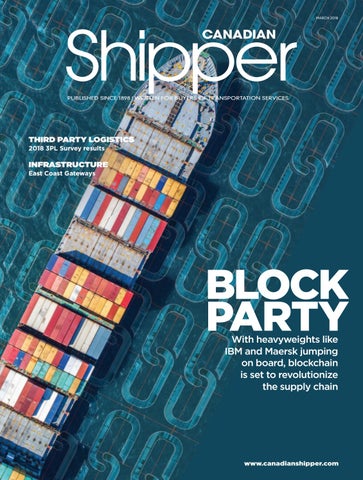
BLOCK PARTY With heavyweights like IBM and Maersk jumping on board, blockchain is set to revolutionize the supply chain
www.canadianshipper.com
WHEN YOUR FURRY CARGO REQUIRES SPECIAL HANDLING. Alpacas travel the world from farm to farm, where they are raised for their warm, soft wool. They are just one of the thousands of species entrusted to Air Canada Cargo every year. With specially-trained staff and a custom solution that ensures their safety and well-being, we help make their journey a little easier. Learn more about animal transport with Air Canada Cargo. aircanadacargo.com
CONTENTS
MARCH 2018
DEPARTMENTS
10
5 | Editor’s Foreword Flipping a coin
BLOCK PARTY 6 | In the news Highway H2O Conference;
BLOCK PARTY
Transportation marketing pioneers; Versacold opens new DC
35 | Inside the Numbers
With heavyweights like IBM and Maersk jumping on board, blockchain is set to revolutionize the supply chain
Pricing pressures
37 | Coaching Corner #MeToo introduces change
38 | The Bigger Picture Freight bids in 2018
©iStock
14 Blockchain technology—a shared, distributed ledger—can trace a container’s path through the supply chain with transparency and security.
FEATURES INTEGRATORS | 22 Strategy of drop-off locations gaining ground
RESULTS FROM THE 2018 THIRD PARTY LOGISTICS SURVEY
EAST COAST GATEWAYS | 26
22
Container growth is spurring investment in Canada’s East Coast ports
TRANSPORT CASE STUDY | 32 Rosenau Transport improves freight movement with mobile system www.canadianshipper.com March 2018 3
EDITOR'S FOREWORD John Tenpenny March 2018 Volume 121 Issue No. 2
EDITOR John Tenpenny (416) 510-6880 john@newcom.ca RESEARCH DIRECTOR Lou Smyrlis lou@newcom.ca ART DIRECTOR Ellie Robinson ellie@newcom.ca CONTRIBUTORS Carolina M. Billings, Mark Cardwell, Dan Goodwill, Carolyn Gruske, Tom Peters, Ian Putzger, Leo Ryan PRODUCTION MANAGER Kimberly Collins (416) 510-6779 kim@newcom.ca VIDEO PRODUCTION MANAGER Brad Ling CIRCULATION MANAGER Mary Garufi (416) 614-5831 mary@newcom.ca PUBLISHER Nick Krukowski (416) 510-5108 nick@newcom.ca PRESIDENT Joe Glionna CHAIRMAN & FOUNDER Jim Glionna VICE-PRESIDENT, OPERATIONS Melissa Summerfield
HEAD OFFICE: 80 Valleybrook Drive, Toronto, ON M3B 2S9 Canadian Shipper is written for Canadian transportation and logistics professionals who manage product flow from manufacturer to point-of-sale. Editorial is focused on reporting, analysis and interpretation of Canadian logistics trends and issues. It is published by NEWCOM MEDIA INC.
SUBSCRIPTIONS: Contact us at: mary@newcom.ca Tel: (416) 614-5831 Fax: (416) 614-8861 Website: canadianshipper.com (click on subscription button)
SUBSCRIPTION RATES: Canada: $65.95 + applicable taxes, per year; $107.95 + applicable taxes, for two years. U.S.A.: US$107.95 per year. All other foreign: US$107.95 per year. Single copies $8 except for the annual Logistics Buyers’ Guide (Aug) $60.95 + applicable taxes, (not including HST) plus $2.00 for postage. USA: US$68..95, Foreign: US$68.95 ISSN 2292-2490 (print), ISSN 2292-2504 (Digital), (Canadian Shipper.) Indexed by Canadian Business Periodicals Index. Printed in Canada. All rights reserved. The contents of this publication may not be reproduced either in part or in full without the consent of the copyright owner.
Heads or Tails?
W
ith the rise in interest from the transportation industry about the use of blockchain technology to provide more transparency and security to the supply chain, there has also been a push to introduce crypto- or digital currencies, with the shipping container industry again leading the way. A Hong Kong-based blockchain developer launched 300cubits in January, releasing 20 million TEU tokens, custom-designed as digital shipping booking deposits, using smart contract blockchain technology. The project aims to solve the no-show and rolling problems that have plagued the container shipping industry for years. No-show refers to the case where customers book a shipping slot but do not show up with cargo while rolling occurs when liners accept a booking but fail to load the cargo accordingly because they’ve overbooked, in order to avoid losses due to noshows. Together, these pain points cost the container shipping industry US$23 billion of losses annually, according to research by the New Jersey Institute of Technology. Using blockchain isn’t the first attempt to address these costs. Last year, the New York Shipping Exchange (NYSHEX) was formed and introduced a version of enforceable contracts, using a model copied from financial markets and called “forward contracts” that requires deposits to secure contracts and levies penalties for default. The concept with TEU tokens is that both a carrier and a shipper would each submit a token to neutral party, in this case, the Ethereum network—similar to the best known cryptocurrency, bitcoin. If a carrier does not load a container with the token as a booking deposit, then the carrier’s token goes to the shipper. If a shipper noshows, then its token goes to the carrier. Some believe that using a financial incentive which both sides are equally motivated to use and which neither side can ignore due to blockchain’s immutability, is a better option than the traditional dollar-value penalties assessed for no-shows or rolled cargo. Theoretically, this should motivate both parties because the total number and value of the coins doesn’t come close to corresponding with the number of bookings that occur each week globally. In other words, once both parties see the value in using the coins as booking deposits, the value of the coins rises. That means the cryptocurrency not only incentivizes behavioural change, it becomes a valuable asset for parties in the shipping industry in and of itself. However, with so many technologies competing to change the way traditional processes have been structured in the shipping industry— including blockchain—it is difficult to imagine digital tokens becoming the norm. CS
POSTMASTER: Please forward forms 29B and 67B to: 80 Valleybrook Drive, Toronto, Ontario, M3B 2S9 Second Class Mail Registration Number 0721.
PUBLICATIONS MAIL AGREEMENT 40063170
MEMBER CANADIAN BUSINESS PRESS
iStock
John Tenpenny, Editor john@newcom.ca www.canadianshipper.com March 2018 5
IN THE NEWS
Driving Growth on Highway H2O Annual conference highlights the importance of the Seaway/Great Lakes marine corridor
The idea that a port is just a stop along the way for the movement of goods is antiquated, and frankly shortsighted. “We need ports for economic development and stimulus, not just marine activities,” Clayton Harris III, executive director for the Illinois International Port District-The Port of Chicago, told attendees of the 13thn annual HWY H2O Conference in Toronto. “Only looking at marine activities is nearsighted.” Harris remarks were made during a panel discussion entitled, “Ports Perspective—Opportunities and Challenges.” Consisting of executives from a variety of Great Lakes port authorities, the assembled group examined the growth potential for HWY H2O—the 3,700 kilometre marine corridor that includes the St. Lawrence Seaway and the Great Lakes—from the perspective of the ports, including the challenges they face, as well as what opportunities exist. They also tackled the issues that will affect the future success of the entire Seaway system. Where you are matters. “You can’t build geography,” said Jonathan Daniels, executive director & CEO if the Mississippi State Port Authority/Port of Gulfport. Tim Heney, CEO of the Thunder Bay Port Authority, echoed those thoughts, saying that creating business and jobs for your region has to be tailored to your geographic region. In Thunder Bay they do that by working with projects in Western Canada to help unlock capacity and promote the value in shipping through the port. “Anything that add costs to the supply chain costs you business.” According to Daniels, cooperation between ports, both marine and inland can help drive costs down, especially during seasonality shifts in traffic from south/ north to north/south. He pointed to the Port of Gulport’s partnership with CN that moves bananas to Chicago. “Ninety-three per cent of our contain6 March 2018 www.canadianshipper.com
By John Tenpenny
A panel of executives from port authorities gathered in Toronto for the annual HWY H20 Conference to discuss the opportunities and challenges the Seaway marine corridor faces.
er traffic is destined for outside markets,” he said Gulfport’s business took a huge leap forward in 2016 after the addition of three new cranes—at a cost of $30 million—enabled the port to bring back Chiquita after the fruit company severed its 40-year tenancy to move to New Orleans. The company committed to another 40-year lease. In Toledo, on the shores of Lake Erie, another recently announced project pointed to the viability of locating manufacturing near ports. In June of 2017, the Toledo Lucas County Port Authority announced that Cleveland Cliffs will be locating its first hot briquetted iron (HBI) production plant at Ironville Terminal in East Toledo. According to Joseph Cappel, VP of business development, the $700 project will see two million tonnes of iron ore from Minnesota delivered by vessel for production. More business is good for everyone,
according to Harris. “The goal is not to increase your slice of the pie, but to increase the size of the pie itself.” Breaking Barriers The two-day event also saw presentations from the St. Lawrence Seaway Management Corporation, economic and trade policy outlook sessions and a panel of HWY H2O users discussing how the Seaway and Great Lakes system can be more competitive and how the system can succeed collectively. Collaboration was the a theme brought up time and again. “Collaboration, is a first good step, but more is needed between different modes of transportation in the Seaway system,” stated Rodney Corrigan, EVP operations, Logistec Stevedoring. “Overall, supply chain cost must be looked at or we’re just going to keep lumbering along.” Gurpeet Khaira, assistant vice presiPhoto: The St. Lawrence Seaway Management Corporation
IN THE NEWS
dent, merchandise, automotive and bulk with Canadian Pacific, said the competition and collaboration between railways and shipping lines, who are common handlers of things like grain and project cargo, have a vested interest in the supply chain. Foresight when it comes to growing
business is also important. “Year-round business should be explored,” said Peter Herkemji, deputy director North America for shipper Spliethoff, referring to keeping the St. Lawrence Seaway open all year. Gregg Ruhl, COO of Algoma Central, concurred, adding a specific reference to
the possibility of opening the Welland Canal in the winter. “It would open many opportunities for cargo in the system.” Seasonality is a big issue and getting the business back from the alternate shipping plans made when the Seaway is closed is tough, said Corrigan. “Cargo always finds a way.” CS
Getting it Right Transportation specialists Palmer Marketing celebrates 30 years in the industry
When Lee Palmer decided 30 years ago to get into business for himself, the idea that it might not have anything to do with transportation industry probably never occurred to him. “I’ve been in the industry pretty much my whole life,” said the founder of Palmer Marketing (PM), which has been providing advertising services to the transportation industry since 1988 and currently operates a 10-person team, including General Manager and son Tom. Lee is originally from Hartland, New Brunswick, the home of Day & Ross, where his father was President during the 1960s and ’70s. “My brothers and I all grew up in that environment and worked there in many capacities as teenagers, from dock workers, to dispatchers, to terminal managers,” he recalls. After university and time spent as a professional musician, Lee spent three years at Sameday Worldwide. He was their national pricing manager and built an in-house marketing department, before leaving to found PM. During the business’ first five years, promotion was its bread-and-butter. It was a much quicker sales cycle than the development of sales literature and the digital media the company is now known for. “We started at the same time that the industry was shifting from traditional print media to digital,” says Lee, “and that worked to our advantage. The industry was relearning how to do things, so we were not at a disadvantage compared to longstanding firms. They had to learn the new ways of doing things too.”
By John Tenpenny
For Palmer, marketing is about getting the message right. “Transportation doesn’t do a lot of research and planning, so the marketing is more on an as-needed basis and for us, it’s about how we can differentiate each client from the rest of the industry. Crafting the differentiating story to be told and utilizing the best media to reach the audience is always the focus at PM.” “These days it’s about using every resource available to us,” says Tom, who took over the day-to-day operations of the firm two years ago after his father had heart surgery.
“It’s always going to be about using an integrated mix of different media and search engine marketing to optimize results for our clients. That mix is always changing.” Tom Palmer, General Manager, Palmer Marketing
“Social media has circled back recently in importance to our clients, as well as other trends such as video, Google AdWords and implementing ongoing SEO techniques,” Tom states. “It’s our job to stay in the know with best practices. Now, we have more people capable of doing
Palmer Marketing, founded by Lee Palmer (left), has been in the transportation industry for 30 years.
these things in addition to the creative artists and writers we’ve always had. It’s always going to be about using an integrated mix of different media and search engine marketing to optimize results for our clients. That mix is always changing.” Tom comments further: “We see many opportunities for growth. We will maintain our specialization in transportation but our process does work for any industry. Along with the hundreds of transportation companies we have worked with over our history, we serve accounts in areas as diverse as finance, vet hospitals, engineering firms and roofing companies.” “Tom has a good sense of logic, knows how to get the best from our creative team and truly cares about doing the best for our customers,” states Lee, adding, “I’ll keep my hand in, but grooming my own successor has worked out just fine, especially with the team we have built around him.” CS continued www.canadianshipper.com March 2018 7
IN THE NEWS
continued from p. 7
Cold Comfort VersaCold Logistics Services opens new Ontario distribution centre It’s freezing in VersaCold’s new distribution centre in Milton, Ontario. Below freezing, actually, and that’s a good thing. Officially opened in January, the structure shares little in common with the Sobey’s warehouse that once called it home. It has been transformed into a fully temperature-controlled environment, with individual zones chilled to temperatures between four and -30 Celsius. Investments have been made in generators, boilers, and refrigeration panels alike. Concrete floors have been raised and re-poured in 11 seamless sections. The underlying technology used to move pallets of frozen foodstuff has all been upgraded, even to the point of including voice-activated equipment. “The infrastructure is original, but in-
side of that it’s virtually a brand new building,” said Doug Harrison, president and CEO of VersaCold Logistics Services, which now boasts 43 distribution centres and terminals. The first two phases of this location already cover 255,000 square feet and enclose 9.2 million cubic feet. Once a third and final phase of the Milton site is completed later this year— doubling the current pallet capacity—the space developed in a partnership with Nestle Canada will be one of the nation’s largest temperature-sensitive distribution centres. Each day the facility will handle an average of 30 inbound and 60 outbound loads, representing 17 million cases of products per year. “It’s a commitment to much-needed
capacity that’s required in the GTA to service retailers, manufacturers, producers, and consumers of food products,” Harrison said, before joining dignitaries to cut a ceremonial ribbon, just a few months after freight first began to come and go. “To launch a building is a major accomplishment [ for] our corporate engineering teams, our real estate groups, our engineering groups, our contractors.” Nestle played an instrumental role of its own. “Our partnership has expanded to include all of our frozen business and to have this facility come to life,” said Nestle Canada president and CEO Shelley Martin, who remembers when VersaCold secured the company’s ice cream business in 2010.
Experience, Connections, Opportunities
8 March 2018 www.canadianshipper.com
By John G. Smith
IN THE NEWS
VersaCold’s new warehouse in Milton, Ontario, once completed will be one of the country’s largest temperaturesensitive distribution centres.
The coldest areas inside the Milton facility will store the ice cream, and about 2.7 million cubic feet of that will be shipped out every year—enough to fill 30 Olympic-sized swimming pools. A slightly warmer space will house the frozen pizzas, about 33 million of which will be shipped out in a year. Stretching end to end, those would stretch 1.5 times across Canada. As for the frozen meals? The facility can annually handle 51 million pounds of them, or the equivalent of about 70 fully-loaded 747s. The first two phases of the Milton site features about 26,000 pallet positions, with goods moving through one of the 43 loading doors. Another 40 loading doors are coming in Phase 3. The various shapes and sizes of frozen foodstuffs are being accommodated with rack heights ranging between 56 and 98 inches, including single-selective and double-deep spaces. CS
Sp r St ing ar C t M ou ay rse 7 s
What’s the most rewarding career decision you’ll ever make?
Your best choice for complete career-long OHDUQLQJ FHUWLÀFDWLRQ in supply chain logistics
Earning the CCLP® designation is easily the single best thing you can do to boost your career prospects. It can set you up for better pay, more advancement opportunities, and a range of management pathways and options across the sector. Plus, you’ll develop and demonstrate cross-functional capabilities that can deliver better business results—and more personal job protection. Depending on your background, your CCLP designation might be within closer reach than you think. Call or click WR ¿QG RXW LI \RX TXDOLI\ IRU DGYDQFHG VWDQGLQJ
www.citt.ca/cclp • 416.363.5696 ®CCLP & &,77 &HUWLÀHG /RJLVWLFV 3URIHVVLRQDO LV D UHJLVWHUHG WUDGHPDUN RI I & &,77
www.canadianshipper.com March 2018 9
TECHNOLOGY
BLOCK PARTY With heavyweights like IBM and Maersk jumping on board, blockchain technology is set to revolutionize the supply chain
BY CAROLYN GRUSKE
B
lockchain. It’s the latest high-tech buzzword to find its way into the realm of the supply chain, but it’s a technology and a concept that can be so broadly and variably applied that the industry is still coming to terms with what benefits it truly brings and how they will be adopted. At its simplest, PwC describes blockchain as “a digital, de-
10 March 2018 www.canadianshipper.com
centralized ledger that keeps a record of all transactions that take place across a peer-to-peer network. The major innovation is that the technology allows market participants to transfer assets across the Internet without the need for a centralized third party.” This description makes it sound like the technology is perfectly suited for use in the supply chain, and while that may be true in theory, getting the entire industry to agree upon the
©iStock
TECHNOLOGY
Ninety per cent of goods in global trade are carried by the ocean shipping industry each year. A new blockchain solution from IBM and Maersk will help manage and track the paper trail of tens of millions of shipping containers across the world by digitizing the supply chain process.
details and implementing common or at least compatible solutions, is a trick nobody has worked out yet in this early stage of blockchain experimentation and adoption. Originally, blockchains evolved as permissionless, completely open public networks. Anybody (any node) could access them, send transactions over them and participate in the consensus process which regulates and monitors which transactions (or blocks) get added to the chain and what the current state of the chain happens to be. This type of blockchain is most closely associated with cryptocurrencies such as Bitcoin. As the technology has evolved beyond cryptocurrencies and been accepted as a business tool, a different type of blockchain has emerged. Permission-based blockchains are now being operated by industry consortiums which set the rules about how disputes are resolved and decide who can join. Typically, potential members need to prove their identity to the consortium to demonstrate they could add value to the chain and should be part of it. Sometimes these are referred to as private blockchains, although that is a bit of a misnomer, as a fully private blockchain is one that is operated by a single company or entity and doesn’t allow in any outside party. Earlier, the term node was mentioned. Depending on the type of blockchain, nodes can have slightly different definitions. In a permissionless blockchain there are usually differences between full nodes and lite nodes. A lite node only verifies a limited number of transactions. Full nodes enforce all the rules of the blockchain. In a consortium system, nodes may be limited to major
players such as banks or international carriers or major retailers, some of whom may even download full copies of the blockchain and host it locally. They act more like stewards of the blockchain, whereas less influential organizations such as a local farmer or a small machine shop may just access the blockchain more in the capacity of a simple user, sending information about the products they contribute to the supply chain. No matter whether public or consortium, blockchains need to develop what is known as a minimally viable ecosystem in order to truly function. This means having participants in all stages of a process. In the supply chain that could be customers, tier one and tier two suppliers, or shippers, customs brokers, carriers and warehousing companies. So far, the supply chain has seen both the implementation—at least at the pilot stage—of both public blockchains and consortium-based blockchains. Toronto-based Sparx Logistics Canada, which moves between 70,000 and 100,000 containers per year, took part in a blockchain pilot project with Wave Bill of Lading, an U.S. and Israel-based start-up technology company. Wave has built an application that allows companies to digitize official trade documents and share them over the blockchain, eliminating the need for the original documentation to be couriered from one company to another. Its solution is currently based on a fork (a technological off-shoot) of the underlying Bitcoin blockchain technology. In the trial, Sparx moved three containers from China to Canada, and from the mocontinued
Photo: Maersk
www.canadianshipper.com March 2018 11
TECHNOLOGY
continued from p. 11
Traditional cross-border The new Champlain Bridge will be 3.4 km long, with a shipping processes usually 0.5 km cable-stayed portion and have six lanes for traffic, involve manually transporting as well as a segregated cycle and pedestrian lane. and verifying paper documents for each shipment. IBM and Maersk are forming a joint venture to use blockchain technology to make global trade more efficient, transparent and secure.
ment they were booked until they arrived at the company, all of the paperwork was digitized and transmitted through the blockchain. According to Sparx president David Pupco, the company’s office saved about an hour’s worth of time using the blockchain technology. “An hour of a working person, if you are shipping thousands of containers—just imagine how much money you can save. And I don’t know how much time they saved on the China side. We definitely saved the courier’s time.” In contrast, IBM Corp. and A.P. Moller-Maersk have joined together to create a yet-to-be-named company that will take the lead on an industry consortium blockchain designed for global trade. The underpinning blockchain technology solution offered by this company is IBM’s Blockchain Platform, which itself is built upon The Linux Foundation’s Hyperledger Fabric version 1.0. Hyperledger currently has the backing of major technology companies, banks, and international accounting firms, many of which have members on Hyperledger’s governing board. New York-based Ramesh Gopinath, vice-president of blockchain solutions for IBM, said even though the new entity was founded by IBM and Maersk, they will be two among equals. “We will have an industrial advisory body that will evolve the direction these products evolve. The industry at large will influence the direction the joint venture will take. It’s at an arm’s length even from Maersk so others can feel comfortable. Maersk will be on an even playing field with respect to this product in this joint venture,” he said. At this point, it’s too early to tell if public or consortium blockchains will gain dominance in the supply chain, but Dawood Khan, co-founder of TransformationWorx Inc., a Toronto-based company that teaches executives about blockchain technology and business applications, explained there is room for both. “You can have hybrid solutions. You can have implementations where you are doing something on the private blockchain or a consortium blockchain and then you take certain elements of that and connect it with a public blockchain,” he said. Khan gave an example of a company or a government agency that needs to have an open procurement process, but still has a 12 March 2018 www.canadianshipper.com
list of pre-approved suppliers that have the right to bid on contracts to resupply inventory. That company’s or government’s inventory list could be stored in a private distributed database or ledger. Once inventory levels drop below a predetermined threshold, that event could trigger the issuing of an RFP to a vendor record list that is kept on a public blockchain. “Maybe you stamp something on a public blockchain then, and say ‘here’s a situation where something has changed’ and all that vendor community is doing is sensing and looking for that change. As soon as it sees it on a public blockchain, it says ‘something has changed with the government of Canada in the area of widgets. There has been a delta, so let me go figure out what that is, because I might be interested in supplying these widgets.’ I could be a vendor anywhere in the world monitoring that on a Bitcoin public-solution blockchain. As soon as that happens, I go back, I say, ‘here are my credentials, I’m a vendor of record, please tell me what you need.’ Then through a consortium or private blockchain, they could exchange that information.” Concerns about competitors, such as suppliers to a large retailer, having access to each other’s proprietary information on the blockchain is a real concern, said Iliana Oris Valiente, the Toronto-based managing director and global blockchain innovation lead for Accenture’s emerging technology practice group. This issue, however, is being addressed by the blockchain technology industry. “We are starting to see more and more privacy-preserving techniques being introduced, and I think they are going to be important down the line. Organizations will all be running separate nodes, but there are ways of configuring the blockchain implementation where the network knows a transaction has occurred but the organizations are not able to see the details of it unless they were one of the parties that was part of the transaction.” One group of parties that has a definite interest in what is happening with blockchains in the supply chain space are government regulators, said Oris Valiente, adding that many regulators are likely to operate nodes on what prove to be the most widely used trade blockchains. She also expects that self-regula-
Photo: Maersk
TECHNOLOGY
tion will become more popular among blockchain participants. “For the regulators, they recognize blockchain is the new paradigm shift and whereas the Internet was great for the transfer of information across borders, blockchain enables the transfer of value across borders and it really does question how the regulators will carry out their duties. Many of the regulators we have engaged with have recognized this is an opportunity for them to go back to first principles and understand what is their function, what are they there to ensure happens and could they achieve their mandate while also embracing new technologies.” As to how blockchain users will interact with the technology, that will depend on their internal needs and usage requirements. For some, they will likely treat the blockchain along the softwareas-a-service [SaaS] model where they just log in and interact with the blockchain application directly. Others will have a need to bind it more tightly to their business processes. “Shippers, customs, ports, they all have their own internal systems,” said Gopinath. “If I’m a customs officer used to using an internal IT system to sign off on a customs document, then this solution needs to be integrated in that context. You don’t want to change that user experience or log into a different system and sign off. That doesn’t work. There are examples where
you need to actually do that integration.” As to whether the supply chain, an industry that has been known to drag its heels a little bit when it comes to the adoption of new ways of doing business or new technologies, is ready to adopt blockchain, not to mention smart contracts that are built on blockchains or other technologies like Internet of Things (IoT) that can work in conjunction with blockchains, Wave Bill of Lading co-founder and CEO Gadi Ruschin says it absolutely is. “Blockchain has started a lot of discussion regarding payment and the transfer of value and the transfer of items—things that I would say were traditionally considered as things that you cannot change, but now may have to change. There is just a lot of innovation and a lot of disruption in the world and the supply chain, or trade, is the biggest industry in the world, so the players in international trade want to benefit from those efficiencies as well.” CS Carolyn Gruske, a former Editor of MM&D, is an award-winning journalist with expertise reporting about supply chain and logistics, automotive and transportation, information technology and legal matters.
www.canadianshipper.com March 2018 13
3PL SURVEY
RESULTS FROM OUR ANNUAL CANADIAN SHIPPER AND MM&D THIRD PARTY LOGISTICS SURVEY BY JOHN TENPENNY
14 March 2018 www.canadianshipper.com
3PL SURVEY
C
ABOUT THE SPONSOR
VERSACOLD is Canada’s largest end-to-end supply chain solutions company focused exclusively on the handling of temperature sensitive products. VersaCold delivers a suite of fully integrated logistics services through its national network of industry leading facilities, transportation fleet and advanced technologies that set the benchmark for accessibility, information visualization, real-time tracking and inventory management. Empowered by its commitment to exceptional service, performance driven culture and dedicated focus on continuous innovation, VersaCold is a trusted and valued partner to its clients—enabling business strategies and revenue growth within highly sensitive and regulated environments. VersaCold is proud to play a key role in ensuring the safety, quality and freshness of some of North America’s most beloved food brands— protecting the health and wellness of families from east to west coast—through exceptional food safety and cold-chain quality assurance. For more information about VersaCold Logistics Services, please visit www.versacold.com or connect with us on LinkedIn, Facebook or Twitter.
ommunication is essential to any relationship or partnership, including the one between shippers and third party logistics providers (3PLs). Never has the shipper-3PL relationship been more important, with global 3PL revenues topping $800 billion in 2016 and projected to exceed $1 trillion by 2022, according to the latest analysis by Armstrong & Associates. As outsourcing continues to increase in popularity as a solution for shippers to addresses their supply chain challenges, the desire to communicate concerns with 3PLs remains paramount, according to our annual Canadian Shipper and MM&D Third Party Logistics Survey. While the challenges remain the same—more than a third of respondents said cost and price increases was their No. 1 concern—this year we asked our respondents to indicate the type of action they’ve taken to address their concerns with 3PLs. Meeting with their third party logistic supplier ranked first amongst respondents, with an average of 58 per cent of them choosing this option. Renegotiating the contract was the second most popular choice (22 per cent), followed by cancelling the contract (14 per cent), doing nothing (16 per cent) and imposing a penalty on the supplier (six per cent). Within the shipper-3PL relationship, other concerns cited by respondents included a lack of continuous ongoing improvements in service offerings ( 16 per cent), as well as service level commitments not being realized as a result of outsourcing (10 per cent) Five per cent of respondents indicated that cost reductions not being realized was a concern. It was no surprise that nearly half (44 per cent) of survey respondents named reducing costs as the most important supply chain challenge facing shippers. Enhancing customer service was important for 13 per cent of respondents, improving supply chain continued
MAJOR SUPPLY CHAIN CHALLENGES
44%
13%
7%
5%
5%
7%
Reduce costs
Enhance customer service
Improve supply chain execution
Need to keep up with logistics software technology
Expand or improve service to new international markets
Need to improve supply chain management
of respondents
www.canadianshipper.com March 2018 15
3PL SURVEY
continued from p. 15
OUTSOURCING PHILOSOPHY
management execution for seven per cent, keeping up with logistics software technology, five per cent, while other considerations included expansion to new domestic and new international markets and improving supply chain management.
Prefer to own/ control functions
Review costs
Outsourcing strategies While nearly two-thirds (64 per cent) of respondents describing their company’s outsourcing strategy as “currently outsource some or all logistics functions and will continue to do so,” the percentage of respondents indicating they “have never outsourced and have no immediate plans to do so” dropped from 19 to 17 per cent. Those respondents who “have outsourced in the past and would consider doing so again” stood at nine per cent, while six per cent indicated they “have outsourced in the past but have no plans to outsource in the future. How much of total logistics expenditures are currently directed to outsourcing? A third (35 per cent) of respondents said that less than 20 per cent of their total logistics expenditures were currently directed to outsourcing, while nearly a fifth (19 per cent) said their companies direct more than 80 per cent of their total logistics expenditures towards outsourcing. When it came to philosophies around to the decision to outsource, respondents varied in their answers, with 41 per cent preferring to own or control functions in house and sometimes outsource, while 38 per cent of respondents indicated that they review costs between ownership and outsourcing before deciding. Transportation remained the most popular service to outsource with 73 per cent of respondents naming outbound transportation and 60 per cent naming inbound transportation. Other popular choices for outsourcing included customs brokerage (61 per cent), customs clearance (56 per cent), freight forwarding (35 per cent) and warehousing (32 per cent). Forward looking Looking ahead five years, what services do companies envision they’ll be outsourcing? More than a third named outbound (39 per cent) and inbound (32 per cent) transportation, indicating that they excontinued 16 March 2018 www.canadianshipper.com
38%
between
in house, sometimes outsource
ownership and outsourcing
41%
before
Prefer to outsource
decision
non-core business
22%
activities where possible
OUTSOURCING STRATEGIES
64%
5%
6%
9%
17%
Outsource some or all logistics functions and will continue to do so
Not currently outsourcing but considering doing so
Have outsourced in past but no plans to outsource in future
Have outsourced in past and considering doing so again
Have never outsourced and no immediate plans to do so
of respondents
PERCENTAGE OF LOGISTICS EXPENDITURES DIRECTED TO OUTSOURCING Less than 20% 81-100%
35%
19%
61-80%
14% 18% 14% 21-40%
41-60%
3PL SURVEY
MAIN SERVICES CURRENTLY OUTSOURCED
SINGLE VS. MULTIPLE 3PL PROVIDERS
Outbound transportation
73%
15%
85%
Single Provider
Multiple Provider
Inbound transportation
60% Customs brokerage
61% Customs clearance
56% RATING OF TOP PROVIDERS (SCALE OF 1 TO 5)
Warehousing
32% Freight forwarding
35% Shipment consolidation/distribution
3.89 Managing and servicing account
18% Cross docking
21%
3.78
Freight bill auditing
10%
Reacting quickly to changes or problems
Selected manufacturing activities
12% 3.83 Meeting promises on execution
MAIN REASON FOR USING MULTIPLE 3PL PROVIDERS
3.74 Serve different geographic areas
Less reliance on any one provider
46%
Being price competitive
12% 8%
Compare service levels
3.74 14% Greater leverage on pricing
19%
Greater range of expertise
Understanding intricacies of client business
www.canadianshipper.com March 2018 17
3PL SURVEY
continued from p. 16
pect to outsource these services within the next five years. Other services respondents expect to outsource within the next five years include customs brokerage (32 per cent), and customs clearance (30 per cent). Not everyone expects more outsourcing to occur, with 35 per cent of respondents indicating that they have no plans to outsource additional services within the next five years. In terms of strategies, a key outsourcing strategy amongst respondents is to use multiple 3PL providers, with 85 per cent using more than one service provider. According to the survey, using multiple outsourcing providers allows respondents to “serve different geographic areas” (46 per cent), to utilize a “greater range of expertise” (14 per cent) and to gain “greater leverage on pricing” (19 per cent). Operational improvements While the performance of 3PLs—according to survey respondents—has remained fairly consistent year-over-year in such categories as managing and servicing accounts, reaction to changes or problems and being price competitive, the question still remains: Has outsourcing improved logistics operations for shippers? Those who said that outsourcing led to improved logistics operations pointed to improved service, and declining costs. This year, service improved for 31 per cent of our respondents while logistics costs declined for 36 per cent. Other improvements included shortened average order cycle lengths ( five per cent), the decline of overall inventories (two per cent), and the decline of logistics assets (nine per cent). Why don’t companies outsource? Loss of control as the result of outsourcing logistics was cited by 33 per cent of respondents, while 24 per cent believed that costs would ultimately not be reduced, the same percentage who say logistics is too important to outsource. Nearly a quarter (22 per cent) of respondents believed that service levels would be jeopardized if their company outsourced logistics, while 10 per cent felt there was an insufficient level of expertise available from potential outsourcing providers. CS continued
18 March 2018 www.canadianshipper.com
MAIN WAY OUTSOURCING HAS IMPROVED LOGISTICS OPERATIONS
36%
Logistics costs declined
31%
Service has improved
9%
Logistics assets have declined
5%
Average order cycle length shortened
2%
Overall inventories declined
TOP CONCERN WITH 3PL RELATIONSHIPS
37%
16%
10%
5%
Cost creep and price increases
Lack of continuous ongoing improvements in service
Service level commitments not realized
Cost reductions not realized
7%
3%
4%
Time and effort spent on logistics not reduced
Lack of strategic management skills
Over promising on services due to competitive pressures
ACTION TAKEN TO ADDRESS CONCERN WITH 3PL RELATIONSHIPS Average rank
Average %
Meet with supplier to discuss
1.00
58%
Renegotiate contract
2.43
22%
Cancel contract
2.57
14%
Nothing
3.86
16%
Impose penalties
4.43
6%
3PL SURVEY
Survey Demographics
GEOGRAPHIC SCOPE OF LOGISTICS RESPONSIBILITY
A deeper dive into our 3PL Survey respondents
Canada/U.S.
39%
APPROXIMATE ANNUAL LOGISTICS BUDGET
Canada Domestic
37%
Less than $500,000 $500,000 to $5 million
Global
28%
33.5% 17%
$5 million to $20 million Over $20 million
33%
12.5% COMPANY SECTOR
30%
Manufacturing
70%
of respondents had an annual logisticsbudget of under $5 million
36%
Service provider
18%
Distributor
7%
Retail
ANNUAL SPENDING ON TRANSPORTATION
Wholesale
Less than $500,000
40%
$500,000 to $5 million
35%
$5 million to $20 million
15%
Over $20 million
10%
5%
TYPE OF INDUSTRY Transportation ta
35%
20% Consumer products
42% of respondents had annual sales between $30 million and $2 billion
Food and kindred products d
12%
12%
Industrial Products
GROSS ANNUAL SALES Less than $5 million $5 million to $30 million
22%
7%
27.5%
$30 million to $100 million
20%
$100 million to $2 billion
22%
Over $2 billion
Automotive m
8%
8%
Pharmaceuticals/ Medicine/Health
Services vi
13%
www.canadianshipper.com March 2018 19
3PL SURVEY
continued from p. 18
Adaptation paramount for 3PLs Annual survey highlights technology, relationships Blockchain, automation and new talent requirements are the focus of the 2018 Annual Third-Party Logistics Study: The State of Logistics Outsourcing. The 22nd edition of the study showed the continuation of two trends: the importance of the shipper-3PL relationship, and the importance of adapting to emerging technologies, including blockchain and automation. The result of these closely forged relationships is improved services to the end customer. Blockchain For the first time the study investigated blockchain. Results showed that while 30 per cent of 3PLs and 16 per cent of shippers see blockchain as a potential application, they have yet to engage with the technology. The study described anticipated benefits including improved supply chain visibility and potential challenges that participants will face in implementing blockchain. “Blockchain has the potential to make significant improvements in security, transparency and governance, but only in supply chains where there is value in controlling consumer risk, valuable goods or complying with regulations,” said Ken Toombs, global head of Infosys Consulting. “Shippers and 3PLs will need to work together to drive value from blockchain, using lessons collectively learned from missteps with other emerging technologies like Radio Frequency Identification (RFID).” Automation in transportation The study looked at some of the exciting potential with on-road automation, such as driverless vehicles. It also examined many ways in which automation is already providing returns across the supply chain through digitalized load matching and warehouse robotics. Competitiveness is a key driver for a majority of 3PLs (62 per cent) and shippers (57 per cent) to invest in automation/ digitization. However, the report also revealed a number of reasons for lack of investment in digitization and automation, including a lack of in-house talent to develop, implement and monitor (12 per cent of 3PLs and 10 per cent of shippers). “Technology improvements in supply 20 March 2018 www.canadianshipper.com
chain, especially in the area of fleet operations, have had positive impacts on the industry,” said Tom Scollard, Penske Logistics vice-president of dedicated contract carriage. “It has allowed 3PLs to operate fleets that are safer and more efficient for the customer.” Logistics talent revolution Technology is reframing the demands on the workforce, particularly within the supply chain where automation, digitization and data collection capabilities are growing rapidly. Supply chain leaders and logistics executives play even more critical roles as companies work to build more efficient and technologically advanced supply chains. “It’s no surprise that technology continues to unlock unforeseen value across the global supply chain in a variety of ways,” said Neil Collins, regional managing partner for Korn Ferry’s North American industrial markets. “To leverage the potential upside, organizations must now rethink their talent strategy from top to bottom. The supply chain/logistics leader must now be agile, a strategist, a visionary and a collaborator. The entire supply chain organization must now compete with technology, and the winners will be those that elevate their people using technology, rather than replacing them with it.”
Risk and resilience in shipper-3PL relationships Through all the technological advances, the opportunity to improve upon the risk versus resilience in relationships between 3PLs and shippers continues: 79 per cent of 3PLs and 64 per cent of shippers reported they have been involved in projects in which the ability to execute quickly was directly impacted by lack of complete, accurate and consistent information provided by the shipper. The study showed a large increase in the percentage of shippers seeking information technology (IT) services from 3PLs, with 27 per cent indicating outsourcing of IT services in the 2018 study compared to 17 per cent in the previous year. However, the percentage of shippers indicating satisfaction dropped slightly this year from 65 per cent to 56 per cent, potentially due to higher expectations among shippers as technology has improved or because shippers are seeking enhanced analytical capabilities to help drive more effective supply chain decisions. The 2018 study was produced by Penske Logistics, the global logistics and supply chain management provider, Infosys Consulting, the strategy and transformation consulting arm of Infosys, Penn State University, and global talent advisory firm Korn/Ferry. CS
3PL SURVEY — FROM THE SPONSOR
A Cold Chain Reaction VersaCold on the evolution of cold chain logistics and 3PL/4PL
Food safety and increased regulations—not a bad thing Food safety regulations have increased drastically in the last few years. As one of the world’s safest food suppliers, Canada, through its Canadian Food Inspection Agency (CFIA), has also made significant changes. Other major countries are doing the same. “You want your food safe for consumption,” says Tremblay. “From the time it’s picked or processed, to the time it’s on your plate, monitoring temperature in the cold chain is a critical aspect. VersaCold’s sole focus is food. Our investment in food safety has been an important underpinning of the company’s value proposition. Hazard Analysis and Critical Control Points (HACCP) is a given in today’s world, but having access to a Cold Chain Assurance team whose number one commitment is food safety and quality has given VersaCold’s customer base a leg up. Our investment in our Cold Chain Assurance team allows us to work closely with our customers, providing resources unmatched in the industry and creating a conversation well above the basics.” The bottom line is this: consumers are concerned about food safety. Because of this concern, regulations around the globe are being strengthened to ensure effective tracking of food products throughout the cold supply chain. These improved controls, along with the upcoming development of blockchain, will ensure complete control in leveraging technology and promote greater safety across the cold chain. Outsourcing to a specialist drives success and competitive advantage Tremblay believes the advancements in technology over
the years have contributed to customers outsourcing portions of their supply chain. “VersaCold equips all of its road transportation with multiple types of sensors. Through our operations center, we monitor temperature, door openings and mechanical operations of our fleet as it travels throughout North America. This allows our operations team to proactively respond to alerts. Given that our business is solely food, we can make large investments to improve efficiencies and integrity in this area,” says Tremblay. VersaCold’s in-house team of supply chain engineers and consultants works closely with their customers to understand their strategic and supply chain goals and determine their optimum inventory levels and best warehouse locations. From there, VersaCold is able to find a specific solution to meet a customer’s needs, whether they’re looking for speed to market, onshelf availability, cost savings, reduced capital or other key organization goals. “Outsourcing to an industry-specific 3PL or 4PL gives our customers a tailored solution,” says Tremblay. “Our 3PL group provides asset-based solutions, including Dedicated Contract Carriage, dedicated warehousing or production and other customized 3PL solutions. Partnering with an industry expert allows our customers to use their capital for their prime area of focus, which isn’t typically trucks and warehouses.” VersaCold’s qualified 4PL service team provides services including customs brokerage, freight forwarding, intermodal transport, shared warehousing and management services anywhere in the world. These non-assetbased services offer VersaCold customers flexibility to shift their supply chains quickly to meet dynamic market needs or to accommodate volumes that don’t warrant a dedicated 3PL service. The changing customer The changing demands of consumers are creating further complexity in the food supply chain. Customers are now focused on high-quality, easy-to-prepare and readyto-eat food products. This in turn demands greater availability, shorter shelf life and the need for SKU proliferation. And because the food supply chain is becoming more global and using more unique inputs, the complexity is even greater in many cases, working against the changing needs. “Companies are looking to VersaCold as industry experts to provide their core expertise in Supply Chain Services specifically focused on food products,” says Tremblay. Today, having an effective cold chain partner offers a competitive edge. VersaCold’s innovative 3PL and 4PL services are designed to do just that. CS www.canadianshipper.com March 2018 21
CS
Whether it’s through distributors, producers, manufacturers or retailers, the food industry is constantly evolving. From new buying trends to shifting regulations, many recent factors have been impacting the industry around the globe. And as consumer demands continue to change, supply chains must continue to evolve with them. This evolution also creates a greater demand for technology-supported solutions and controls. VersaCold is constantly innovating and improving to ensure they remain on the cutting edge of temperature-controlled logistics. In addition, as companies focus on core competencies, outsourcing all of (or portions of) their supply chain to experts like VersaCold continues to be an option used by an increasing number of companies. Rick Tremblay, Senior Vice-President & General Manager, VersaCold Transportation Management & 4PL Solutions, is among those who have witnessed the cold chain industry evolving. He shares its most recent changes and how 3PL and 4PL providers can stay ahead of the curve during these changing times.
INTEGRATORS
ALL ACCESS PASS Integrators see opportunity in e-commerce logistics while consumers are driving increased use of drop-off locations BY IAN PUTZGER
SME merchants selling internationally is set to grow traffic to Europe with the recently implemented CETA free trade agreement.
I
n early December, Canada Post sounded the alarm when some of its depots were overwhelmed by parcel traffic, which caused delays. As flows built up to a record parcel season, concerns mounted that an avalanche of shipments might bring the system to a breaking point. Consumers’ penchant for online shopping is keeping parcel carriers on their toes, with no sign of easing off. “We continue to see more B2C traffic. It doesn’t seem to be levelling off,” says Steve Vitale, director of communications, UPS Canada. In the event, the postal service as well as private parcel carriers managed to deliver the Christmas surge. “For us it’s been challenging but manageable,” reports Ramsey Mansour, vice president of corporate strategy and marketing at Purolator Courier. The company registered a 40 per cent rise in delivery stops in December. Mansour stresses the importance of early preparation—hand in hand with clients. “Working with our customers was key to manage the volume of flow and capacity,” he says. A lesser challenge has been the rise in online purchases of larger items like mattresses and snow blowers. “This is about three per cent of our total volume,” remarks Vitale. Thanks to special handling fees and oversize charges, this traffic does not affect the bottom line—unlike the cost of additional labour and equipment to cope with the Christmas spike in traffic. Mansour says that the peak season drives up cost, which has to be compensated through the year, chiefly through optimizing the volume mix and improving productivity. 22 March 2018 www.canadianshipper.com
A more crowded field is putting pressure on rates and squeezing margins, observes Phil Cahley, vice president customs brokerage and regulatory at BILSI. “Margins are razor-thin,” he remarks, adding that more people see opportunities in e-commerce logistics. Dropping off “Our margins are dropping, but we look more at strategies, at things like drop-off locations,” says Imtiaz Kermali, vice president of corporate strategy and marketing at eShipper. He adds that it is crucial to build a portfolio that gives customers choice and generates savings, and to think ahead of the market. Vitale agrees that is it both a challenge and an opportunity to stay ahead of the growth in volume as well as evolving customer expectations. In the battle to contain costs, access points have emerged as a key strategic plank. “Business is warming up to the idea of drop-off locations,” remarks Mo Datoo, director of strategy and planning at eShipper. Kermali adds that their company is importing drop-off locations into its online platform, which will allow its customers to create drop-off networks as they see fit. Vitale points out that consumer preferences are a major driver of the growing focus on drop-off points. Harnessing local variety stores as well as its UPS Stores, his company currently has over 1,100 access points across Canada, and it intends to add more. “We do it to increase density but also because that’s what people want,” he says, pointing to a survey that UPS conducted in
Photo: UPS
INTEGRATORS
A recent UPS Canada survey indicated that 42 per cent of respondents preferred dropping off packages to waiting for a pick-up.
Canada, which indicated that 42 per cent of respondents preferred dropping off packages to waiting for a UPS van to show up. If this trend continues, the company estimates that it will be doing 2 million fewer pick-ups in a year. Purolator, which has over 700 shipping centres and agents, is currently evaluating what its retail network should look like. “There is no one size fits all solution,” remarks Mansour. He is wary of putting too much emphasis on access points. “Retail presence is a very important piece of the puzzle, but it’s not the entire picture,” he comments, adding that 50 per cent of online shoppers prefer that shipments are left outside their home. “Our first focus remains delivery at first attempt,” he says. “Consumers are looking for more solutions, not less,” he continues. This requires an array of multiple solutions to fit their schedule, he concludes. E-commerce connections By the same token, online merchants need a choice of options how to move their goods to the consumer, notes Kermali. “We must also factor in the consumer. They look for instant gratification in a seamless and frictionless way,” agrees Mansour. “Your model has to be more nimble and more agile. It’s not like in the past, when the peak season was mainly a matter of making sure you had your inventory in place. Now it’s more sporadic, more fluid.” Technology is a key element in this, both to manage assets and to support clients. “We need to have the tools in place to help our
customers—not just to deliver their goods,” says Vitale. Cahley stresses alignment with the merchant’s system. “We look to connect with the e-commerce provider at the shopping cart level. For example, if the vendor uses Shopify, there are opportunities for us to connect with that,” he says. UPS is looking to leverage its Marketplace Shipping package, which combines shipping with order management functionality and can be integrated with popular platforms. “It’s not in high demand right now, but I think that will change,” comments Vitale. eShipper, whose cloud-based shipping platform hosts all toptier courier firms in Canada, has set up programs for merchants to manage their imports and their vendors, and it also offers comprehensive shipping solutions as well as consulting. Over the past three years the focus of conversations with clients has shifted from how to cut costs to education, notes Kermali. “Education is a big part in the growth of this industry,” he says. Arguably this applies particularly to the company’s clientele, which consists of small and mid-sized firms. Their need for advice is even more pronounced when they venture into the international arena, which is beckoning ever more. Over the past couple of years, the momentum in cross-border online shopping commerce has eclipsed the rate of e-commerce growth in most domestic markets. Canadian consumers venture confidently across borders, points out Vitale, with 83 per cent of the people who participated in the UPS survey having ordered goods from outside Canada. Working with merchants from overseas who want to sell to Cacontinued
Photo: UPS
www.canadianshipper.com March 2018 23
INTEGRATORS
continued from p. 23
“We need to have the tools in place to help our customers—not just to deliver their goods,” Steve Vitale, director of communications, UPS Canada
nadian online shoppers often involves more than simply delivering their goods. In the initial stage many require a lot of hand holding to navigate through taxes and customs regulations, notes Cahley. Overseas headaches While Canadian shoppers increasingly look outside the country, the outbound momentum is less strident, although there is definite interest, according to Mansour. BILSI handles the odd international shipment, remarks Cahley, but this traffic does not amount to much yet, especially when it comes to overseas markets. “Canadian companies have not been big on offshore exports.” For UPS most of the deliveries are domestic shipments and imports from the U.S. At this point approximately five per cent of
π SHIPPING SUPPLY SPECIALISTS
ORDER BY 6 PM FOR SAME DAY SHIPPING
COMPLETE CATALOG
1-800-295-5510 24 March 2018 www.canadianshipper.com
Over the past couple of years, the momentum in cross-border online shopping has eclipsed the rate of e-commerce growth in most domestic markets.
OVER 34,000 ITEMS ALWAYS IN STOCK
INTEGRATORS
SME merchants sell internationally, notes Vitale. He reckons that the free trade agreement with the European Union will spawn some B2C traffic in this trade lane. “We are not seeing the growth yet,” says Cahley. For eShipper the U.S. is the biggest trade lane, while Britain and Australia have come on strong, notes Kermali. The latter market has a high duty free threshold, which should eliminate concerns about such charges, he adds. For small businesses with limited capital shipping to international markets is challenging, observes Datoo. If the customer overseas rejects the shipment, the costs—including duties and taxes—are their loss, he points out. To begin with, novices in international trade are not familiar with duties and tax rates in overseas markets. eShipper is looking to include a duties and tax calculator on its website. Returns pose another headache. Given the value of the goods shipped, in most cases a return to origin would be prohibitive. eShipper has a returns polity for the U.S. market and is building up a returns portfolio, but when it comes to overseas shipments being rejected, nine out of 10 companies do not want them back, says Kermali. In some cases re-imports face hurdles, points out Cahley. If a U.S.-based merchant wants to bring back a rejected garment that was originally manufactured in a third country, they will need the original manufacturer’s name and address, he notes.
He adds that the clearance process and tax regime for e-commerce flows into Canada are too cumbersome. “The CBSA needs a streamlined option for B2C e-commerce coming into Canada,” he argues. At this point the agency has two streams—for low value and commercial shipments. Adding a dedicated e-commerce stream to this would facilitate flows and help avoid congestion. Such a step is bound to boost the flow of data. “Customs want to address risk. There is exposure to importing drugs, especially fentanyl,” reflects Cahley. An advance flow of data would be the logical step to address this. Courier companies will not run out of reasons to update their technology, both to manage their assets better and boost productivity and to keep the interfaces with clients, consumers and government agencies humming. Any disconnect threatens to derail the online shopping process and kill a transaction, plus subsequent visits to the merchant’s site. CS
Ian Putzger is an award-winning journalist with more than 20 years experience covering transportation and logistics issues. He is a former writer and editor with the Hong Kong-based Asian Sources Media Group, and Airtrade, a British magazine covering the global air cargo industry.
www.canadianshipper.com March 2018 25
EAST COAST GATEWAYS
With a new container terminal planned for Contrecoeur, the Port of Montreal is upping its competitive advantage Slated to open within a decade, the container terminal in Contrecoeur will handle 1.14 million TEUs.
BY MARK CARDWELL
B
y definition, a port can be one of two things. It can be a town or city with a harbor where ships can load or unload, especially one where customs officers are stationed. Or it can be an inland town or city whose connection to the coast by a river or other body of water enables it to act as a port. So what do you call a port that is both those things? Busy, judging by the amount of cargo being handled by the Port of Montreal—a flow, experts say, that will continue to grow into the foreseeable future. “We are doing very well,” says Sophie Roux, the Montreal Port Authority’s (MPA) vice president public affairs. “But we have to keep looking ahead and working hard to ensure that that success continues.” According to preliminary statistics, Roux’s facility handled close to 38 million tonnes of freight in 2017. That unaudited number represents a seven per cent increase in cargo traffic, a record performance in the 188-year history of Canada’s second-largest port. About a quarter of that total cargo came from Middle Eastern and Asian countries and transited through the Suez rather than the Panama Canal. 26 March 2018 www.canadianshipper.com
That is a sea change from the port’s traditional markets in Europe and the Mediterranean, where it has long been a preferred port of entry into the heartland of North America. According to Roux, last year’s record cargo results are a reward for the years of effort that have been made to diversify the port’s overseas markets and maintain its positioning as the leading port in Eastern Canada for containers. “Containers are a key driver for us,” Roux says about the business, which was introduced in 1967 and led to the construction the following year of Canada’s first container terminal. “We offer an efficient intermodal chain with CN and CP right in our yard, and we are only two train days from the American Midwest.” The port, she adds, has recently completed—and is undertaking—several major infrastructure projects that aim to aid and abet that container growth. One is the $197-million makeover of the 50-year-old Viau container terminal. Inaugurated in 2016 and in operation for the past year, the face-lifted facility will— once it reaches maximum capacity, which is expected to occur within the next few years—add more than 600,000 twentyfoot equivalent units (TEUs) to the port’s
total capacity, which will increase to 1.5 million TEUs overall. Once fully operational, the new Viau terminal is also expected to generate some $340 million in annual economic benefits for the surrounding area, as well as 2,500 direct and indirect jobs. Location, location, location Those numbers will climb much higher however, if and when the new container terminal that the port is planning to build 40 kilometres downriver from Montreal comes on line. Now in advanced stages of public consultation, the $650-million project features several major components, including the construction of two berths and a container handling area, an intermodal rail yard connected to the main network and a truck entry portal connected to the regional road network. Expected to be operational by the mid-2020s on a mostly uninhabited tract of riverside on the south shore of the St. Lawrence River in the town of Contrecoeur, the terminal is expected to be able to handle 1.14 million TEUs per year. “This additional port space will make it possible to support the growth of this business segment and make the most of
Photo: Port of Montreal
EAST COAST GATEWAYS
Photo: LeContrecourant.com
the economic and commercial opportunities arising from emerging markets, the Canada-European Union Comprehensive Economic and Trade Agreement and the Quebec Maritime Strategy,” the MPA’s vice president, operations, Daniel Dagenais, stated at a news briefing about the project last month. The MPA also released the findings of a federal environment impact assessment of the project, which will be the subject of upcoming public hearings. According to Roux, the project has been on the books since the late 1980s, when the MPA acquired the land in Contrecoeur. “It’s the perfect place for container handling because of its great location near rail and road networks and the markets we serve, and because it’s outside of and away from dense urban areas,” she says. The terminal, she adds, will also feature the same rail-to-dock service and intermodal chain—the so-called “Montreal Model”—that has made the MPA world famous in logistic and transportation circles. “We want to avoid having to say one day, ‘Sorry, no vacancy,’ which would be the worst possible thing,” says Roux. “With the Contrecoeur project we are confident that we can sustain and secure the future of container traffic not just in Montreal but in Eastern Canada for the next 50 years. Thinking ahead like this is the only way we can compete with giants like the Port of New York City.” Saturation point Claude Comtois agrees. A geography professor at the Université de Montréal and a leading academic expert on the international maritime industry—from the organization of markets and the structure of trade networks to the flow of merchandise and the capacity and competitiveness of
ports—he says the Port of Montreal is at the heart of vibrant and in some ways new network dynamics on both the high seas and in northeastern North America. “The port is very healthy,” Comtois says. “But it can’t afford to sit on its laurels.” According to Comtois, the Port of Montreal is the envy of major ports around the world because of its unique rail-at-dockside infrastructure. “Forty-five per cent of containers that come into Montreal go right from ships to railway cars that are bound for the American Midwest,” says Comtois, who spent a decade as director of transportation projects for the Canadian International Development Agency. “That’s unheard of in ports like Antwerp and Shanghai and Hong Kong and Singapore, which don’t have that ability. Delegations from around the world come to see the Montreal Model in action, and dream about it.” Comtois credits both the prescience of Canada’s early railroad barons and the organizational prowess of the port’s modern administrators for keeping things humming dockside in what is by world standards a physically small port that is hemmed in tightly on all sides. “In other ports, you will see a lot of containers stacked up at terminals,” says Comtois. “You don’t see them at Montreal because they don’t have the space. They are condemned to be efficient, and they have succeeded because they lead North America in terms of time that containers sit on the dock.” Though he is a fan of the Viau terminal, Comtois says the site is quickly reaching the point of container saturation. He calls the proposed Contrecoeur project “a fabulous idea on a superb site.” Comtois also lauds the port’s efforts to
become smart, including the monitoring of truck traffic through meta data analysis and a plan to integrate imbedded intelligence in port activities and services. The advent of new traffic is also giving the port’s bottom line an unexpected bump, says Comtois. A major one is containerized grain—notably pulses such as lentils, chickpeas and other high-protein dried seeds—which can be itemized for volume, not bulk. “There is high global demand for it,” says Comtois. “It’s nice for the port of Montreal because, in terms of traffic, it containerized grains have taken up much of the capacity slack that has been created by the decline of grain traffic on the St. Lawrence.” He said the $8 million the port spent recently to transform an old terminal to handle those specialized grains and fill containers is both seed money to help shore up that new business and fodder for its efforts to diversify traffic into Egypt, the Middle East and Asia, where pulses are most in demand. The Montreal Model According to Comtois, the port’s development plans and efforts, together with the Quebec government’s maritime strategy—a major component of which is the creation a massive logistics hub that revolves around the Port of Montreal—will help to ensure the facility’s pre-eminence in the economic, social and even environmental lives of the more than four million people who live in the greater Montreal region, including the nearly 20,000 who are employed directly or indirectly by the port’s activities, which generate $1.5 billion in annual economic activity. “We did a calculation as to what point the citizens here rely on the port and we found between four and five tonnes per capita per year of traffic—everything from cement and clothes to food and forest products for homeowners, hospitals and businesses,” says Comtois. “If the port wasn’t there, all of that stuff would have to come in by road or rail or air.” Comtois also believes that the port’s development plans will help to counter what he calls “the manageable challenges” facing the facility as well as potential Canadian or American rivals. The biggest challenge—the scrapecontinued www.canadianshipper.com March 2018 27
EAST COAST GATEWAYS
continued from p. 27
bottom, 11.3-metre depth of the water column in the St. Lawrence, which could and can lead to declines in the size of international ships and payloads going to and from Montreal, which is 1,600 kilometres inland from the Atlantic Ocean— is being met with frequent dredging at strategic chokepoints (something that major ports from New York and Norfolk to Antwerp and Shanghai must do, says Comtois) and plans to digitize the depths of the river through the use of on-board monitoring under vessel keels. “You never get 10,000 TEU ships into Montreal, they never go past Quebec City or Trois-Rivières because of the water column,” says Comtois. “But that’s actually a good thing because the turnaround at Montreal with 5,000 or 8,000 TEU ships is
very fast, which only helps to enhance the port’s reputation for speedy service.” For Mathieu Charbonneau, that speed and fluidity, plus the Port of Montreal’s prime location as the most westerly, year-round international port in eastern North America (only lakers can go further west beyond the Lachine Rapids), help to make and maintain the facility’s role as the beating heart of a massive regional logistical cluster. “One ship brings in 4,000 containers, which are then loaded onto hundreds of trucks and dozens of trains,” says Charbonneau, executive director of Cargo Montréal (CargoM), a government-backed agency that brings together and works with logistics and transportation stakeholders in the Montreal metropolitan cluster in an effort
to identify and resolve cluster-clogging problems. “There is a whole ecosystem of 6,000 companies with 120,000 employees that rely on the movement of goods into and out of the port of Montreal.” According to Charbonneau, the efficiencies of the Montreal Model—and the absence of need for the use of shunters— means the “dwell time” of merchandise on docks is only 1.8 days. “That is half the dwell time at East Coast ports (and) gains back the extra sailing time to come up river,” adds Charbonneau. “But we’re that much closer to the 110 million consumers in the North American heartland, which gives us a considerable competitive advantage that is understood and accepted by the industry.” CS
Setting the Stage The West Side Modernization project is all about ensuring the Port of Saint John’s future BY TOM PETERS
T
he Port of Saint John, New Brunswick is undertaking a major terminal project not only to build on a “niche” container market, but to ensure the port will progress under future generations, according to Saint John Port Authority president and CEO Jim Quinn. Saint John announced in 2015, the $205-million West Side Modernization project to accommodate larger vessels and to enhance the port’s container terminal capabilities. In addition to the expansion and redevelopment of the piers, the 60-acre project, to be completed in three phases, will see 25 acres transformed into container storage, 10 acres set aside for multipurpose use with the rest of the land destined for supporting infrastructure such as warehousing, stevedoring and transloading operations. There are proposals to build large container terminals in Montreal, Quebec City, Melford, Sydney and possibly Halifax, but Quinn is not overly concerned. He 28 March 2018 www.canadianshipper.com
The Port of Saint John, the third-largest port in Canada by volume, handling 30.4 million metric tonnes of cargo in 2017.
said ports like Halifax, and some of the others as well, are focused on being able to handle the very largest container ships, but “Our market is a niche market. When selling our advantage we underscore our geographic position, our close proximity to the (U.S.) Northeast and our close connectivity by road and rail to the central part of Canada. To be ready for growing business, we need to design the terminals for a hundred years and design them in a way that the largest ships that we can handle come into the inner harbor,” he said. The very large ships he talks about “are in that 14,000 TEU range. The plan is to have the capacity to be able to service ships this size so that we don’t sacrifice the growth ability of future generations. We want to take advantage of maximizing what we have and what future genera-
tions will have to work with,” he said. Saint John has had container ships ranging in size from 1,200 TEUs to 5,000 TEUs and Quinn expects the container fleet servicing Saint John “will likely grow from 5,000 to 7,000 TEUs.” Quinn said there is a lot preliminary work being done which will take the project to the point where it is ready to go out to tender. “After this, we can get on with the actual construction.” There is also a demolition phase in the preliminary work which Quinn says will likely start early in the third quarter pending environmental approval. It involves taking down about 50 metres of the old pier wall face and eventually reconstructing and extending out about 350 metres. There is also infrastructure that has to be moved inland such as piping and electrical services so Photo: Port of Saint John
EAST COAST GATEWAYS
the area can be cleared for demolition. “This early work will allow (terminal operator) DP World to continue on with the operation and, in fact, DP, with their global knowledge and operation of over 70 terminals around the world, is an invaluable partner to provide information on how it will all unfold,” Quinn said. Terminal Flexibility “Port Saint John’s expansion plans align well with DP World’s vision to offer an expanded and creative supply chain solution to importers and exporters in the Midwestern U.S., central and eastern Canada, and New England,” said Curtis Doiron, DP World’s general manager in Saint John. He added: “A deeper berth and channel, expanded container and rail yard, coupled with an investment in terminal infrastructure and technology will position Saint John as a modern, flexible terminal, ready to meet the dynamic and changing needs of the marketplace.” Saint John is presently served by three container lines: MSC, CMA CGM and Bahri, which provide global connections for both importers and exporters. Saint John wants to build the container sector which presently is only a small portion of its business. The port is the third-largest port in Canada by volume, handling 30.4 million metric tonnes of cargo in 2017, the vast majority of that was liquid bulk. “But we are active in every sector, including container and we aim to increase that niche,” said Quinn. “Right now we have a capacity of about 125,000 TEUs and the best year we had was close to 100,000 TEUs. We had to expand to grow the business and in the container sector, where there are ups and downs. Lines will come and lines will go, it’s a volatile business so you have to work hard so people will see the advantage of using this port.” Saint John was party to that volatility in 2016 when it lost its major container line, Tropical, which moved its business to Halifax. “Tropical represented about 50 per cent of our business,” said Quinn. “It was a big blow. But if you look at just raw numbers, one would think our container traffic would be down by about 50 per cent for 2017. But CMA CGM came in here at the end of August and they started to grow their numbers. In actuality we were down by about 32 per cent so there has been a small recovery. Their [CMA) CGM] loads were low at first
but now they are significant,” he said, adding 2018 is looking very promising. As the port strengthens its terminal capabilities and increases water depth in the main channel “it will make Saint John much more attractive. And we do have an advantage in terms of natural position.
We are closer to the marketplace of the northeast U.S. and have short transit times on road and rail into the large markets of central Canada. We are really focusing on the north/south trade because that’s always been the natural advantage of Saint John. Certainly, we don’t ignore continued
ALABAMA
TENNESSEE D A I L Y
OHIO
D I R E C T
KENTUCKY
INDIANA
S E R V I C E
YOUR CROSS-BORDER SPECIALIST
1 . 87 7.74 0 . 3 9 4 0
GXTS.COM
LTL | DEDICATED | TL | DIRECT | EXPEDITED | DRY VAN | CONSOLIDATIONS
www.canadianshipper.com March 2018 29
EAST COAST GATEWAYS
continued from p. 29
the trans-Atlantic trade but we understand the north/south niche and we aim to attract it,” Quinn said. Saint John has had a strong export side and is now starting to see the import side take hold, said Quinn. That started several years ago when the port began doing things with companies on the north/ south trade lanes who wanted to use a Canadian port but had to use an American port because connecting services to the U.S. didn’t exist. “But now with CMA CGM we now have a service that opens doors for people which is encouraging. The Cagema service added Saint John as the first port of call in North
America,” said Quinn. The port rotation for the Cagema service is Kingston, San Juan, Saint John, New York, Savannah, Miami and back to Kingston which is a transshipment hub to South America. “This routing opens new opportunities for New Brunswick producers who want to ship from a New Brunswick port, saving on inland transportation costs,” Quinn added. The port is also connected to the U.S. by rail. An initiative by DP World and Pan Am Railways has led to a direct intermodal service connecting Saint John and the Boston market via the inland container terminal in Ayer, Massachusetts. In addition, the port is served by CN and
New Brunswick Southern Railway, with the latter providing connections to CP and the Central Maine and Quebec Railway. At the end of the day Quinn said the ultimate goal is to complete the project by 2023 and, in 10 years or so, grow the business and so that any debt incurred from the project would have been paid off. “Then phase two of the West Side Modernization will be possible for the next generation to carry out. That is what this is all about, to set the stage for those who follow so they can make decisions in an environment where there is no debt and they are able to continue to grow business.” CS
Port of Quebec throws down the gauntlet Dual container port strategy for St. Lawrence questioned With container expansion projects already underway by the Port of Montreal (pictured) the idea of a container terminal in Quebec City has some scratching their heads.
BY LEO RYAN
S
ome four decades ago, CP Ships (now part of Hapag-Lloyd) dropped its North Atlantic container service with the Port of Quebec in favour of Montreal. In rapid fashion, Montreal emerged as Canada’s leading container hub on the East Coast while Quebec has focused virtually exclusively on bulk shipping— seemingly for the long term. So a recent announcement by the Port of Quebec to establish a container terminal stunned St. Lawrence River maritime circles (including the Port of Montreal). It also confounded analysts well versed in the special features and challenges of the continental waterway that allows ocean carriers to penetrate deeply into the industrial heartland of North America. Critics qualify as “unrealistic” a hypothetical dual container port strategy. Last December, Mario Girard, president and CEO of the Quebec Port Authority, unveiled a plan to build a container terminal at the deep water port aimed at boosting the competitiveness of the St. Lawrence gateway with U.S. ports accommodating much bigger ships (with capac30 March 2018 www.canadianshipper.com
ities above 10,000 TEUs) since the 2016 enlargement of the Panama Canal. He affirmed that the Port of Quebec, with its water depth of 15 metres at high tide (compared to Montreal at 11.3 metres), was strongly positioned to capitalize on the changing landscape of commercial shipping. “Quebec City,” Girard said, “must get on board and leverage its strategic location on the shortest route between Europe and the St. Lawrence-Great Lakes region, which is home to over 40 per cent of the U.S. manufacturing industry.” Worth recalling is the fact that there was no mention specifically of the Port of Quebec as a container player when the provincial government unveiled its ambitious Quebec Maritime Strategy in 2015. The over-arching goal was to develop the province as “the mega-hub of transatlantic trade.” On that occasion, Premier Couillard stated: “Our job is to tell people what an opportunity Montreal is in terms of access to the heart of North America and that it
can accommodate even large ships.” Much emphasis and government financing support subsequently flowed to the Montreal region as Quebec’s leading port, intermodal and industrial cluster arguably best placed to reap the benefits of such developments as the Canada-European Union free trade agreement taking affect in the fall of 2017. Costing an estimated $400 million, the proposed terminal at the Port of Quebec, with nominal annual capacity of 500,000 containers, would be the revised principal feature of the Beaufort expansion project that was originally designed as a multipurpose facility. The terminal would extend the port’s wharf line by 610 metres, connect with existing road and rail networks, and house a 17-hectare container yard. Commenting during an interview with Canadian Shipper on the Quebec container project and the prospects for economies of scale, Professor Claude Comtois, a transportation/logistics expert at the UniPhoto: Port of Montreal
EAST COAST GATEWAYS
versité de Montréal, questions the viability of a 10,000-TEU container ship calling at the Port of Quebec. He points out that the Port of Quebec represents too much of a detour (more than a thousand nautical miles) to warrant megaship calls as well as at various ports on the eastern seaboard (as many transatlantic services via Halifax are structured). Thus, the Port of Quebec must constitute, in such cases, a destination port where all containers are loaded and unloaded (as happens in Montreal). “But,” continued Comtois, “the small local market could generate barely 10 per cent of this traffic—meaning thousands of containers will have to be transported by train or truck to markets well beyond Quebec City.
hurdles as securing government and industry financial support as well as regulatory environmental approval. In this regard, the Port of Montreal in early February moved an important step forward to establishing a sixth container terminal releasing an environmental impact report on the project at Contrecoeur.
Apart from finding sufficient financing, Slack sees “no commercial justification” for both the Contrecoeur and Beauport projects. “You have a successful activity at the Port of Montreal. If local industry in Montreal had to ship goods to Quebec City, it would also add time and costs for shippers.” CS
Competitive advantages As a result, apart from the increase in greenhouse gas emissions and road congestion around Quebec City, this implies, in his view, additional costs by truck and rail towards markets in Ontario and the U.S. Midwest compared with the services offered via the Port of Montreal. “For a shipping line, there is no commercial justification for the creation of a container service in which the capacity of ship is dependent on distant markets already served in a competitive way by the Port of Montreal with well-established intermodal links.” For his part, Brian Slack, a maritime transport specialist and professor emeritus at Montreal’s University of Concordia, declares: “The Port of Quebec has many merits, but not for containers. Logisticswise, the container project does not make sense. A lot is going on globally revolving around the myth of mega ships of up to 20,000 TEUs. It is far from reality, at least as far as North America is concerned. “What is striking about Montreal is the full discharge and load: you are typically bringing 4,000 containers in and you are taking 4,000 containers out. Now that is as good as you are going to get in any U.S. East Coast port where vessels make multiple stops. “Try and find a port that can give you a turnaround of up to 8,000 TEUs. That’s pretty good going. Montreal is, in fact, a unique business model, with direct container services of small or what you could call medium-sized vessels.” Prior to carrying out the ambitious Beauport 2020 container project, the Port of Quebec must overcome such major www.canadianshipper.com March 2018 31
TRANSPORT CASE STUDY
Upward Mobility Deploying a new mobile computer system helped Rosenau Transport improve efficiency and move more freight
I
n operation since 1957, Rosenau Transport Ltd. is a Canadian transport company headquartered in Edmonton, Alberta. As a leading provider of same-day and one-day LTL freight services to leading clients across Western Canada, Rosenau employs over 500 people and has been named one of Canada’s Top Fleet Employers two years in a row by Trucking HR Canada. The company has also earned an Alberta provincial government award for its “excellent” safety fitness rating. Long range scanning required Rosenau provides freight service between 27 terminals across Alberta, Saskatchewan, British Columbia and Manitoba, in addition to a highly developed network of commodity services with connections to and from Eastern Canada and the United States. As the company continued to grow, it needed to invest in additional mobile computers to support its expanded operations. However, its existing devices were not always effective and took too long to scan barcodes. Scanning would only work if the 32 March 2018 www.canadianshipper.com
scanner was aligned perfectly and within a specific distance of a barcode—not too close and not too far. As a result, Rosenau often had to pair together a forklift operator with another dock worker, so the forklift operator could move freight while a second person scanned the associated barcode. Five years earlier, Rosenau had been using a paper-based freight management system, but switching to a computerbased scanning system did not improve efficiency due to limited scanning ranges and capabilities. An added concern for Rosenau was the fact that Microsoft stopped supporting the Windows Mobile 5.1 operating system in October 2015. Rosenau was looking for a future-proof solution with faster, longer range scanning capabilities and a supported operating system. Fully supported operating system DMS iTech, a full-service Alberta-based IT company, worked with Rosenau to understand its requirements and presented several options, including Zebra’s MC9200 handheld mobile computers, which offer fast near-field and long-range barcode
DEVICE UPGRADE Since deploying a new mobile computer system across its operations, Rosenau Transport has achieved unprecedented improvements in efficiency and significant cost savings. Customer Rosenau Transport Ltd. Partner DMS iTech Industry Transportation & Logistics Solution Zebra’s MC9200 Mobile Computer with extended range imager and Android operating system Results • Significant efficiency improvements • Dramatically reduced costs • Near-instantaneous scanning • Reliable scanning from any angle, even off-axis • Long-range scanning capability • Instant transitions between long and short range scanning • Overwhelming worker endorsement
scanning, along with a fully supported Android operating system. To evaluate its options, Rosenau used a two-stage approach. Its IT department, which includes two formerly-experienced dock workers, configured and tested a number of solutions to determine the most viable options. The IT staff then shortlisted four solutions and gave them to dock workers to evaluate. In on-the-job testing, Zebra’s MC9200 mobile computers quickly emerged as the hands-down favorite. Scanning was virtuPhoto: Rosenau Transport
TRANSPORT CASE STUDY
ally instantaneous and could be performed at any angle, and even off-axis. Long-range scanning was a massive breakthrough, allowing forklift operators to scan barcodes without needing additional manpower and without needing to leave the forklift. Operators could switch between short-range and long-range scanning instantly, making it easy to use the MC9200 as a multi-purpose scanning device. 10,000 hours saved Since upgrading to Zebra’s MC9200 mobile computers, Rosenau’s IT Manager, Jason Sichkaryk, estimates that the company is already saving one hour of employee time per shift. At its main branch in Edmonton, there are 20 forklift operations, so this amounts to a total savings of 20 hours per shift at this location. With five-day shifts and five-night shifts per
week, that’s a total of 200 hours saved per week and 10,000 hours per year. The resulting efficiency will help Rosenau move more freight and provide faster service to its customers, all while saving tremendously on its total costs. Based on typical industry standards of $31.25 per worker for wages and overhead, Rosenau can potentially save $6,250 per week and a staggering $312,500 per year at its Edmonton branch alone. Zebra’s MC9200 was so overwhelmingly popular with Rosenau’s dock workers that the only question remaining was how quickly the devices could be made available at all of the company’s locations. Rosenau has since deployed 45 units of Zebra’s MC9200 computers across its operations, with 64 more planned in the near future. The results have been unprecedented improvements in efficiency and significant cost savings for the company.
• • • • •
•
Workers now scan and track freight almost instantly, thanks to the Zebra MC9200’s advanced scanning engines and ultra-fast performance. Barcodes can be scanned from any angle and even off-axis, ensuring accurate data capture the first time, every time. Barcodes are scannable from short or long range as Zebra’s MC9200 automatically accommodates for altered depth of field requirements. Forklift workers can now scan barcodes from long range, without leaving the forklift. Zebra’s MC9200 communicates seamlessly with Rosenau’s transportation management system (TMS), allowing freight to be scanned, tracked, and located before and after loading. Zebra’s mobile computers and Rosenau’s TMS alert workers immediately if freight is being loaded on the wrong truck. CS
WHY GO WEST TO SHIP EAST? Did you know that in 2016, one in four international containers handled at the Port either originated in or was destined for Asia? Thanks to our direct connections with transshipment ports in the Mediterranean and Northern Europe, we offer competitive and alternative routings to Southeast Asia and the Far East. Find out what we can do for you at port-montreal.com/why-montreal
www.canadianshipper.com March 2018 33
WE MAKE TRANSBORDER SHIPMENTS EASIER.
ONE SOURCE FOR ON-TIME, WORRY-FREE DELIVERIES Your business doesn’t stop at the border, neither does Old Dominion. Our people provide 100% real-time freight visibility for your shipments between Canada and the U.S., with direct loading to major U.S. markets. Your transborder crossings are pain-free with OD’s in-house 24/7 customs clearance and brokerage services and a single point of contact. Plus, OD’s industry-leading on-time record and low claims ratio provide confidence with every shipment.
For more information, visit odfl.ca or call 1-800-432-6335.
Old Dominion Freight Line, the Old Dominion logo, OD Household Services and Helping The World Keep Promises are service marks or registered service marks of Old Dominion Freight Line, Inc. All other trademarks and service marks identified herein are the intellectual property of their respective owners. ©2018 Old Dominion Freight Line, Inc., Thomasville, N.C. All rights reserved.
INSIDE THE NUMBERS WITH LOU SMYRLIS, MCILT
PRICING PRESSURES
Shippers expecting base rate increases by mode
As capacity tightens your transportation budgets will need to expand
With freight volume projections upward bound for most of the country there is increasing pressure anticipated on transportation pricing, according to our annual Transportation Buying Trends survey. The pressure on pricing is greatest in trucking where the conuence of consolidation and the new ELD mandate in effect in the US (and in Canada within two years) is tightening capacity.
Freight volume projections 2018 (SHIPPERS)
59%
LTL
64%
Courier
61%
Marine
40%
Air cargo
57%
Intermodal
45%
Modes expected to wield greatest pricing power in 2018 13%
Rail
34%
LTL
24%
Courier
10%
Airfreight
6%
Marine
6%
Intermodal
6%
About the same
Central Canada
of respondents
Truckload
41%
54%
of respondents
Truckload
Western Canada
UP
39%
Rail
41%
UP 54%
Expected magnitude of price increases per mode About the same
Eastern Canada
UP 33%
66% About the same
Â
Up 0-2%
Up 2-5%
Up 5%+
Rail
21%
20%
0%
Truckload
29%
26%
4%
LTL
32%
23%
5%
Courier
28%
22%
5%
Marine
22%
9%
8%
Air cargo
16%
14%
5%
Intermodal
22%
15%
4%
www.canadianshipper.com March 2018 35
REPRESENTING CANADIAN SHIPPERS FOR 100 YEARS What do you know about? • The new Electronic Logging Device regulations for trucks? • The container decontamination requirements? • Improvements to the rail shipper protection laws? FMA members are kept informed on changes to current laws and regulations that will impact their operations. Government relations and information dissemination is an essential part of FMA’s mandate to promote a cost-effective, safe and efficient transportation system.
GOVERNMENT HAS A BIG IMPACT ON FREIGHT TRANSPORTATION you can help shape the future of the freight transportation industry. FOR MORE INFORMATION CONTACT FMA: (613) 599-3283 | kelsey@fma-agf.ca | www.fma-agf.ca
COACHING CORNER
#MeToo at work: the changing landscape As a human resources professional I get asked a lot about how to handle awkward and sometimes inappropriate conduct in the workplace. #MeToo has brought to light years of abuse of power. But, it is not only men that have created the environment for this to occur, women have at times not supported the victims or witnesses have turned a blind eye in selfpreservation. Q: As a manager how can I handle people dating in the workplace, sexual harassment or anything that can later be classified as a #MeToo occurrence that can destroy reputations and businesses?
A: I was once fired by a business owner early in my career. I was fired because I wouldn’t execute a direct request to dismiss an employee. The person was taking too much time off due to a recent diagnosed and disclosed heart condition. I was new at the job and when I said “We cannot do that” I was told “I can do whatever I want. My company, my rules.” I continued to explain how this was illegal. The owner of the business became more irritated by my comments and finally said “Then, you’re fired. Either he goes or you go.” I went. You may think I am making this up. I am not. This is one example among many others clearly outside best practices and employment standards that I have witnessed including, sexual harassment. In my experience, sexual contact and inappropriate behavior in the workplace seldom occurs in a vacuum. In most cases it is known by someone other than the people involved. If there is a human resources representative, it is likely they know. Immediate supervisors often know. Peers usually know. The questions then become: What do they do with this knowledge? What if they are not in agreement of how it is handled? What can they do? In my case, I took a stand and was fired. I ©iStock
would do it all over again, without a doubt. Not everyone may do the same. According to the Government of Canada, 90.3 per cent of the Canadian workforce is employed by SMEs. Most small businesses seldom have strict policies in place protecting employees against harassment or abuse. Medium-sized companies are more likely to, then it comes down to enforcement. Large firms almost always have a very clear code
By Carolina Billings, CPCC, CHRL, MA-IS
process and investigation guidelines? How is this policy communicated to the workforce? How often? Is this part of the onboarding training? Do employment contracts of people in position of authority include non-fraternization clauses and their consequences? As a manager, the best thing you can do is make sure you know what the policies and procedures are regarding fraternization, harassment and assault in your
“#MeToo, Time’s Up, the Women’s March, these movements tell us that we need to have a critical discussion on women’s rights, equality and the power dynamics of gender. Sexual harassment, for example—in business and in government—is a systemic problem and it is unacceptable. As leaders, we need to act to show that truly, time is up”. – Prime Minister Justin Trudeau
of conduct in the workplace as they have more resources and more to lose should their brand’s reputation be tarnished. Before we get to assault and sexual harassment, which are harder to ignore and part of the Ontario Health & Safety Act that mandates companies to have clear policies as part of the legislation, let’s talk about fraternization in the workplace. Prevention is the best way to create a safe workplace culture. It is very important for a company to have a very clear policy regarding its stance about Fraternization in the workplace. It should have a very clear description of what is acceptable and what is not. What are the consequences of having a relationship with an imbalance of power in the workplace? How do you report it? What happens then? What are the due
workplace. If the organization you work for does not have human resources, it is something health and safety can address. Women and men need to feel safe in their workplace physically and mentally. It is our right and it is good business. CS
Carolina M. Billings is Partner & CEO of a business consulting group and has 15+ years of experience in the fields of Business Development & Branding, Human Resources and Finance. She champions leadership initiatives as well as empowering and coaching/mentoring others to lead. For more information please visit www.thewellnessgroup.ca or email Carolina@thewellnessgroup.ca www.canadianshipper.com March 2018 37
THE THEBIGGER BIGGERPICTURE PICTURE
Freight Bids in 2018 — It’s a New Ballgame The New Year has started off with a bang. With the stock market at record levels, unemployment at historic lows in Canada and the United States and a new U.S. tax bill that promises to put extra dollars in the hands of American purchasers, it is not surprising that consumer confidence is at a high. The strong GDP numbers reflect that people are spending money again. It is no wonder that the Dow Transportation index is also at record levels This is great news for trucking companies. The end of 2017 also saw the electronic logging device (ELD) mandate take effect. This measure which is designed to increase driver safety, is projected to restrict the availability of truck capacity in the U.S. Of course, a driver shortage has already made capacity tight. Companies that comply with the mandate must work within specific time windows. Those that don’t conform to the mandate risk being pulled off the road, over time, as compliance becomes stricter. The result is that freight rates are projected to increase in 2018. It is against this backdrop that shippers and carriers begin preparations for the annual freight bid ritual. The following are some suggestions on how each side should prepare for this process.
SHIPPER FREIGHT RFP PREPARATIONS 1. Get your house in order This means take any inefficiencies out of your freight operations. Truckers will be looking for carrier friendly shippers. This means that freight companies will be giving priority treatment to shippers that offer well packaged palletized freight, clean paperwork, freight ready at time of pick up, clean docks, and scheduled appointment times. In this era of ELDs, shippers that allow carriers to drop trailers and pick up full loads will receive preferred status. 2. Recruit a broad selection of carriers and freight management companies Even if your carriers are providing great service at what you consider fair rates, add a group of new companies to the mix. In fact, begin testing some of them now before you start your RFP exercise. Have a pre-RFP chat with each carrier. Find out how your freight fits within their system, how much volume they can handle, the lanes they want and don’t want and where your company’s freight ranks in their customer list.
38 March 2018 www.canadianshipper.com
By Dan Goodwill
3. Benchmark your freight rates There are several ways to do this. If you have sister companies, share freight costs. If your company is part of an industry association, speak with other members of your association and see if you can share data, at least on some specific high-volume lanes. This will give you an idea of where your freight rates rank with respect to overall market levels. There are also companies that, for a fee, supply benchmarking data. Since this will be a tough year for rate negotiations, preparation is critical to success. CARRIER FREIGHT RFP PREPARATIONS 1. Focus on your business and financial requirements There will be lots of RFPs circulating through the industry this year. Carriers need to focus on their network, skills, requirements, and financial requirements. Some RFPs will be fishing expeditions. There are shippers that conduct RFPs every year but use them as leverage with their core carriers. At the end of the process they go running back to their same group of
carriers. Check the type of freight, volumes, and lanes in the bid. Focus on what best meets your needs. 2. Contact shippers to find out where they are facing challenges and if you have a legitimate chance of securing some business To increase your odds, contact the shipper to find out where they need help. For new shippers, this is a great way to get in the door and prove yourself. Doing what you do best can serve as a stepping stone down the road, over even in the short term if one or more carriers do not perform up to expectations. 3. To ease the burden on your traffic department, prioritize your bids and lanes and set aside those where there is a minimal chance of success There is no need to burden your traffic department by asking them to prepare a quote for every bid that arrives. Be selective. Quality is more important than quantity. Pick the pieces of business that best meet the needs of your company and prepare thoughtful quotes that will deliver value and profits to your company. CS
Dan Goodwill, president of Dan Goodwill and Associates, has more than 30 years of experience in the logistics and transportation industries in both Canada and the US. Goodwill is currently a consultant to manufacturers and distributors, helping them improve their transportation processes and save millions of dollars in freight spend. He has held several executive level positions in the industry. He can be reached at dan@dantranscon.com.
©zygotehasnobrain/iStock
The supply chain never sleeps. And neither do we. At Transplace, we are relentless in executing our customers’ transportation and supply chain needs to achieve profitable and predictable results. Continuous improvement and innovation is core to our culture, and we aren’t satisfied until you are. Learn more about our North American logistics and technology solutions at Transplace.com. 1.866.413.9266 | info@transplace.com
J=KL =9KQ& O= OGF L&
Radar
entttss pmen hiip Sh
REACH FARTHER.
3 coasts, 15 ocean terminals, 23 inland terminals and growing.
At CN we’re investing in all aspects of our business - from infrastructure to innovation - to give you the supply chain advantage you need to stay competitive in the global marketplace. Reach out to us and reach farther than you thought possible. 40 March 2018 www.canadianshipper.com
cn.ca