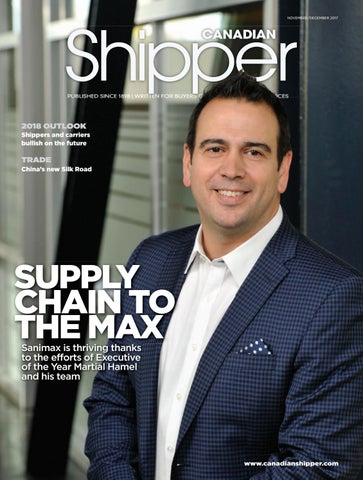
NOVEMBER/DECEMBER 2017
PUBLISHED SINCE 1898 | WRITTEN WRITT TT TEN FOR BUYER BUYERS RS OF OF TRANSPORTATION TRA RANS NSP PO ORT RTA AT TIO ION SERVICES SE S ERV RVIIC CES
2018 OUTLOOK Shippers and carriers bullish on the future
TRADE China’s new Silk Road
SUPPLY CHAIN TO THE MAX Sanimax is thriving thanks to the efforts of Executive of the Year Martial Hamel and his team
www.canadianshipper.com
PROUDLY CELEBRATING
80 YEARS OF EXCELLENCE
A YEAR TO CELEBRATE This year marks the 150th anniversary of Canada and Air Canada’s 80th birthday. On this landmark occasion, we would like to thank you, our customers and partners, for your continued support. As we look forward to the future, we at Air Canada Cargo, continue to aim higher, striving to deliver the services you need with utmost expertise and care, with a truly Canadian spirit.
We invite you to experience today’s Air Canada Cargo.
CONTENTS
NOVEMBER/DECEMBER 2017
DEPARTMENTS
14
5 | Editor’s Foreword Supply chain dangers 6 | In the news Kuehne + Nagel’s pharmaceutical/ healthcare logistics facility up and running; ACPA conference focuses on sustainability
43 | Inside the Numbers Shippers having second thoughts 45 | Coaching Corner Is short term the new normal? 46 | The Bigger Picture
COVER STORY
The capacity crunch
38
Sanimax is thriving thanks to the efforts of Martial Hamel and his team Martial Hamel, senior vice president, supply chain for Montreal-based Sanimax, is the 2017 recipient of the Freight Management Association of Canada’s annual Supply Chain Executive of the Year.
FEATURES 2018 OUTLOOK | 18 Shippers and carriers discuss the future of the transportation supply chain
REGIONAL FOCUS | 28
32
China’s ambitious Belt and Road Initiative building momentum
Project Cargo Case Study Museum ships a blue whale heart to Europe— and back
CARRIER PROFILE | 32 Cargojet continues to soar at 15
WEST COAST GATEWAYS | 34 Prince Rupert expands its terminal and its future
2017 SURFACE TRANSPORTATION SUMMIT | 37 Shipper and carriers agree, more freight visibility needed www.canadianshipper.com November/December 2017 3
Denis Bernier
SUPPLY CHAIN EXECUTIVE OF THE YEAR
BUILDING CONNECTIONS WHEREVER WE GO. CP prides itself on building partnerships. We work with our customers, wherever they are, to identify their needs and help meet their objectives, while providing the best service along the way. CP is your full supply-chain solution provider that gets your goods to where they need to be.
Learn more at cpr.ca
EDITOR'S FOREWORD John Tenpenny November/December 2017 Volume 120 Issue No. 6
EDITOR John Tenpenny (416) 510-6880 john@newcom.ca RESEARCH DIRECTOR Lou Smyrlis lou@newcom.ca ART DIRECTOR Ellie Robinson ellie@newcom.ca CONTRIBUTORS Denis Bernier, Carolina M. Billings, Dan Goodwill, Ken Mark, James Menzies, Carroll McCormick, Ian Putzger, Leo Ryan PRODUCTION MANAGER Kimberly Collins (416) 510-6779 kim@newcom.ca VIDEO PRODUCTION MANAGER Brad Ling CIRCULATION MANAGER Mary Garufi (416) 614-5831 mary@newcom.ca PUBLISHER Nick Krukowski (416) 510-5108 nick@newcom.ca PRESIDENT Joe Glionna CHAIRMAN & FOUNDER Jim Glionna VICE-PRESIDENT, OPERATIONS Melissa Summerfield
HEAD OFFICE: 80 Valleybrook Drive, Toronto, ON M3B 2S9 Canadian Shipper is written for Canadian transportation and logistics professionals who manage product flow from manufacturer to point-of-sale. Editorial is focused on reporting, analysis and interpretation of Canadian logistics trends and issues. It is published by NEWCOM BUSINESS MEDIA INC.
SUBSCRIPTIONS: Contact us at: mary@newcom.ca Tel: (416) 614-5831 Fax: (416) 614-8861 Website: canadianshipper.com (click on subscription button)
SUBSCRIPTION RATES: Canada: $65.95 + applicable taxes, per year; $107.95 + applicable taxes, for two years. U.S.A.: US$107.95 per year. All other foreign: US$107.95 per year. Single copies $8 except for the annual Logistics Buyers’ Guide (Aug) $60.95 + applicable taxes, (not including HST) plus $2.00 for postage. USA: US$68..95, Foreign: US$68.95 ISSN 2292-2490 (print), ISSN 2292-2504 (Digital), (Canadian Shipper.) Indexed by Canadian Business Periodicals Index. Printed in Canada. All rights reserved. The contents of this publication may not be reproduced either in part or in full without the consent of the copyright owner.
Always be prepared
A
s the incidences of terrorism continue to rise worldwide, global supply chains are not immune to this unlawful use of force intended to intimidate or coerce governments or corporations in furtherance of a political goal or for economic gain. Supply chain terrorism is the use of such tactics against any part of the supply chain, including air, rail or sea transport and by any metric, this activity has seen a dramatic increase in recent years. According to a report from supply chain consultancy BSI, terrorist attacks on the supply chain have increased 16 per cent year on year, with a total of 346 attacks taking place in 2016. The report, entitled Terrorist Threats to International Trade and the Supply Chain, noted varied attacks, including cargo theft cause considerable direct and indirect economic costs, disrupt the international movement of freight and creates reputational risks to organizations. Terrorist attacks threaten to disrupt a significant amount of international trade. Over the past five years, the top 10 countries for supply chain terrorism incidents accounted for $776 billion worth of global exports annually, including $108 billion of exports to the United States specifically. Even the increased security measures implemented in the wake of terrorist attacks—intended to reduce the risk of further attacks—have the effect of disrupting the flow of cargo, especially for cross-border shipments, as was seen in France following the November 2015 coordinated attacks in Paris. Immediately following, France imposed stricter controls along the borders with Belgium and Luxembourg, costing companies an additional $59 per delayed vehicle. The total cost to shippers in Belgium was estimated at $3.5 million within the first month following the attack. The report also found that in 2016 terrorists targeted a wider range of industries and modes of transport than in any other year. In particular, terrorists increasingly targeted industries generally associated with private or corporate supply chains rather than state-owned supply chain infrastructure. Over three years of data, terrorist attacks against the agriculture and food and beverage sectors more than tripled, attacks on the industrial and manufacturing materials and pharmaceuticals sectors more than doubled, and attacks against the metals industry nearly doubled. Worryingly, despite the upward trend of attacks, BSI’s report found that there is still inadequate spending on supply chain security. “Our analysis clearly shows that commercial interests and private organizations are increasingly threatened, extorted, and directly targeted by terrorist organizations all over the world,” stated Jim Yarbrough, global intelligence program manager at BSI. “Corporations must take notice and prepare their organizations accordingly.” Regardless of how the NAFTA renegotiations turn out, Canadian shippers and carriers need to ensure their security measures are continuously updated and improved in order to guard against any kind of threat. Just as international trade isn’t going anywhere, neither is the threat of terrorism. CS
POSTMASTER: Please forward forms 29B and 67B to: 80 Valleybrook Drive, Toronto, Ontario, M3B 2S9 Second Class Mail Registration Number 0721.
PUBLICATIONS MAIL AGREEMENT 40063170
MEMBER CANADIAN BUSINESS PRESS
John Tenpenny, Editor john@newcom.ca www.canadianshipper.com November/December 2017 5
IN THE NEWS
K+N unveils new pharma facility
By John Tenpenny
The KN PharmaChain GxP distribution centre, located in Mississauga’s Pill Hill district, is a 208,000 square-foot, multi-client facility.
While it may have taken less than a year to go from ground-breaking ceremony to hitting the ground running, for the full story behind Kuehne + Nagel Canada’s recently opened pharmaceutical/healthcare logistics facility in Mississauga’s Pill Hill, you have to go back a little further. As one of the world’s leading logistics providers, Kuehne + Nagel focuses on industry specific solutions. “Several years ago, in close cooperation with customers, we developed KN PharmaChain to set new standards in logistics,” says Murray Gascoyne, vice president, contract logistics for Kuehne + Nagel Canada. “We already had a mature and established pharma/healthcare offering in airfreight in Canada, so it was a matter of expanding our contract logistics network up to meeting our customers’ warehousing and distribution needs,” he told Canadian Shipper, during an exclusive inter-
view and tour of the facility. “In 2012, Kuehne + Nagel Canada undertook its first investment in the vertical and converted 80,000 square feet of an existing site, on what we call the Millcreek Campus, into our first pharmaceutical-grade building,” says Gascoyne. After promptly outgrowing that facility, “we couldn’t take on more volume from customers,” says Gascoyne, “so we needed to leverage the next phase.” The newly built KN PharmaChain GxP distribution centre is a 208,000 square-foot, multi-client facility equipped with stateof-the-art technology for storing temperature-sensitive healthcare products. “Our investment underlines the importance of our strategy to further grow our healthcare activities in Canada and we are grateful to our loyal customers for their confidence in our services,” says Gascoyne.
6 November/December 2017 www.canadianshipper.com
It offers advanced warehousing, copacking services, full end-to-end capabilities from inbound to final mile, and crossdocking for time-critical products. In addition, says Gascoyne, Kuehne + Nagel’s standardized warehouse and transportation management system provides total supply chain inventory visibility. According to Gary Boettger, Kuehne + Nagel’s manager, national procurement, the warehouse was designed to capture innovations within the industry while keeping an eye on environmental impacts. The facility is temperature and humidity controlled, as well as licensed and qualified to Health Canada standards, including: • Ambient storage – between 15° C to 25° C • Less than 60 per cent relative humidity • 10,000 square-foot 2° C to 8° C cooler fully racked with 30-foot clear height
Photo:Kuehne + Nagel
IN THE NEWS
• Live temperature and humidity monitoring systems • CCTV and other security features • Motion sensor LED lighting • Digitally controlled HVAC system • Grey-water landscaping irrigation system “One of our goals with this building is to raise the bar when it comes to GMPcompliant facilities,” says Boettger. “So, that when customers come in and see our facility and compare it to other facilities, it stands out in the market.” Nothing was too small to escape design scrutiny in setting up the warehouse to store goods securely and in optimum condition. “It’s not your typical warehouse design,” says Boettger. “We worked with the engineers to eliminate as many horizontal and cross beams to avoid places where dust could collect.” The surrounding fields even include bio-swales for water retention, rather than rainwater going directly into the sewer system. Inside, from an operations point of view, flow was a key consideration, says distribution manager Jason Farrell. “What is good about this facility is you have natural pressure and choke points within an operation that if you haven’t designed enough space flow around it, become an artificial bottleneck. “When you design you have to look at areas such as packing, shipping, receiving, and picking and identify how goods and people are going to move safely and
“Inside, from an operations point of view, flow was a key consideration. What is good about this facility is you have natural pressure and choke points within an operation that if you haven’t designed enough space flow around it, become an artificial bottleneck.” Jason Farrell, distribution manager, Kuehne + Nagel Canada
efficiently in that area.” “The new facility allows Kuehne + Nagel to meet two important strategic goals—good design to make us more efficient and effective—and set the stage for continued growth,” says Gascoyne. “We’ve been managing the process pretty tightly and have some target customers lined up and we believe that optimistically the opportunities will come towards the back
end of next year and at that point that’s when the future expansion will kick in. “In the 3PL industry, you’re talking about a 12 to 18-month lead time, so the reality is we’re opening up conversations with customers to pre-build the extension.” Foresight was also taken in regards to being able to add features to the facility as needed. “In the future, we will add a narcotics vault and an Order-to-Cash, system feature for automated sales order creation,” says Gascoyne. Being in the centre of Canada’s second-largest life sciences cluster, with nearly 400 companies employing 25,000 people, is key to ensuring the company’s long term future. “The area is a logistics hub,” adds Matt Harris, director of operations, contract logistics for Kuehne + Nagel Canada. “From a logistics standpoint we’re within thirty minutes of two intermodal hubs and within twenty minutes of Pearson airport and most truckyards are within that same radius.” In a market filled with complexity due to strict regulations and compliances to meet, Kuehne + Nagel’s pharma/healthcare logistics facility puts the company right where it wants to be. “We like complexity,” says Gascoyne. “With our proven KN PharmaChain solutions and our team of local experts, we manage our customers’ logistics challenges and offer a wealth of value to their businesses.” CS
%*3&$5 8&&,-: *.1035 &91035 $0/40-*%"5*0/4 4*/("103& )0/( ,0/( #64"/ */%*" 4)"/()"* 4)&/;)&/
www.canadianshipper.com November/December 2017 7
IN THE NEWS
continued from page 7
Canadian port officials focus on sustainability and infrastructure Annual ACPA conference also highlighted Canadian ports’ position on the front lines of trading opportunities The 59th annual Association of Canadian Port Authorities (ACPA) conference, staged in Vancouver, focused on sustainability issues, infrastructure demands and the key role of maritime transport in world trade. The central theme of the September event, “Navigating a Sustainable Future,” dominated panel discussions against a backdrop of the recently enacted free trade agreement with the European Union (CETA) and the ongoing renegotiations of the North American Free Trade Agreement (NAFTA). “As a trading nation, Canadian ports are on the front lines of all our trading op-
portunities and we must seize the moment to be part of the future,” declared Robin Silvester, president and CEO of the Vancouver Fraser Port Authority. Peter Ellis, executive director of the Vancouver-based Centre for Responsible Marine Shipping in Canada, referred to an analysis forecasting that Canada’s maritime trade could double by 2045. A persistent challenge, he said, is “to strike a balance between the advantages of maritime transport and protecting the environment. “By virtue of its nature, shipping affects people and wildlife in many ways,” Ellis
By Leo Ryan
said before underlining the constant need for risk mitigation efforts such as the recent initiatives on Canada’s east and west coasts to slow vessel speeds to protect threatened right whales and orcas. Emergence of ‘new oceanic age’ A highlight of the event was the opening keynote address with a broad geopolitical content by a high-ranking commander of the Canadian Navy. Rear Admiral Art McDonald, commander of Maritime Forces Pacific, proclaimed the arrival of “a new oceanic age”—characterized by surging maritime commerce, global power poli-
We make a big deal over the tiniest items.
Your business doesn’t stop at the border. Neither does Old Dominion. Our focus on premium service means every shipment arrives on time and worry free, backed by an on-time record and claims ratio that rank among the best in the industry. When shipping to or from the U.S., choose Old Dominion.
Old Dominion Freight Line, the Old Dominion logo, OD Household Services and Helping The World Keep Promises are service marks or registered service marks of Old Dominion Freight Line, Inc. All other trademarks and service marks identified herein are the intellectual property of their respective owners. © 2017 Old Dominion Freight Line, Inc., Thomasville, N.C. All rights reserved.
IN THE NEWS
tics, the impact of climate change in the Arctic region, and the challenges for the United States especially with China’s expanding involvement. “Not since the great era of exploration
in the 16th century have oceans played as important a role in global affairs as they do today,” said McDonald. “Unprecedented levels of commerce move across the world’s oceans, great power politics are
being played out at sea, and oceans are central to the health of the planet in an age of profound climate change.” McDonald stressed that the oceans have become a global highway, accounting for 90 per cent of world trade, with “the meteoric growth of the Chinese economy” constituting “a driving factor this expansion. “As evidenced by China’s economic rise, Beijing has come to fully appreciate the flexibility, mobility and authority of seapower…manifested in the appearance of a powerful new Blue Water navy.” Among other things, McDonald said this “has meant that the existing hegemony, the United States, and the aspiring hegemony, China, find themselves competing for power and influence in the same oceanic realm—creating a context in great power geopolitics that has not previously coexisted with globalization.” What is more, he continued, “we will increasingly be called on to operate in continued
For transborder shipments, OD offers:
• A single point of contact with a local OD shipping expert • In-house customs clearance and brokerage services available 24/7 • 100% visibility with door-to-door track and trace • Complete coverage of the U.S. with direct loading to major markets • PARS and PAPS pre-clearance that reduces paperwork issues and delays at the border
For more information, visit odfl.ca or call 1-800-432-6335.
IN THE NEWS
continued from page.9
new maritime environments that will challenge our assumptions, test our resolve and require our collective commitment to governance.” Changing Arctic horizons He singled out the Arctic as presenting such a case, adding: “Indeed, for the first time in human history, we are on the cusp of acquiring a new ocean.” The steady recent diminution of polar sea ice, McDonald said, promises to Canada and the whole world “a new and navigable ocean. The vast and remote nature of the North represents a unique challenge and the opening of this marine passage will have a large impact on marine transit. Already, there is notable international interest and activity from those wishing to exploit the commercial and economic potential of the region.”
“Supply chains are only as strong as their weakest links. Among other initiatives, keeping the gates open at night are part of the solution for increasing efficiency without expanding infrastructure.” Marko Dekovic, VP public affairs, Global Container Terminals
In that context, he alluded to this past summer’s circumnavigation of the Arctic via Canada’s North West Passage by a Chinese research vessel. But then came a word of caution: “And yet, despite historic pretension and modern curiosity and opportunism, one needs ask if marine trade exploitation (across the entire Canadian Arctic) will ever be viable and desirable.”
Collaborating with local communities Speaking on a panel looking at solutions to ease port impacts on local communities, Peter Xotta, vice president, planning and operations, Vancouver Fraser Port Authority said issues like truck congestion on city streets and maintaining a healthy environment could be managed through greater supply chain visibility
La aunching this Octob ber…
2018 Survey of the Supply Chain Professional Salary • Education • Experience e • Sc Scop ope of Operation ns
2WTUWKPI C ECTGGT KP VJG JG G UWR WRRN[ EJCKP!| Help us track the future of th he pr profession, and w ` ÕÌ Ü Þ Õ ÃÌ>V Õ« Õ LÞ «> Þ «>ÀÌ À V ÀÌ «>Ì } this short survey. All partici cip pant ntss ar a e entered Ì ÕÀ «À âi `À>Ü v À > > V V > > Vi Ì Ü > $500 Best Buy gift carrd.
Visit Canadian nSh Ship ippe per. r.ccom com to t enter!
Sponsored by: Produced by:
10 November/December 2017
www.canadianshipper.com
IN THE NEWS
and collaboration amongst port stakeholders “by leveraging data.” He said the Port of Vancouver had a unique opportunity to lead by driving that collaboration to focus on the environment and the community. “The key idea is that data capability is as much new infrastructure for ports as a new quay crane or a rail siding or a berth—it is critical to driving success.” Christian Dea, director general, Transport Canada, said the Government of Canada is preparing to deal with “fragmentation and the lack of governance” in the country’s supply chains with the creation of the Canadian Centre for Transportation Data, to be launched this fiscal year. In a panel devoted to options for financing port infrastructure, moderator Carlo Dade from the Canada West Foundation, suggested that building trade infrastruc-
ture requires more people with expertise. “Canada needs a different way to be successful in the next thirty to forty years,” added Bruce McCuaig, executive advisor to the newly-created Canada Infrastructure Bank. Mark Hodgson, partner at Deloitte LLP Vancouver, said that the three-berth Roberts Bank Terminal 2 project at Deltaport to boost combined container capacity to 3.7 million TEUs was still bogged down in the environmental approval process. He recalled an estimate that to meet Asian trade demands, total capacity at the Port of Vancouver would have to reach 6.2 million TEUs by 2030. Commenting on efforts to reduce truck congestion and pollution problems at Deltaport was Marko Dekovic, VP public affairs of Global Container Terminals, which operates Canada’s largest box facility.
“Supply chains are only as strong as their weakest links,” Dekovic said. Among other initiatives, he said that “keeping the gates open at night are part of the solution for increasing efficiency without expanding infrastructure.” As ports forge ahead with expansion plans in order to remain competitive, however, delegates were reminded that building community trust represents a vital factor in the process. CS Leo Ryan is a veteran journalist who has reported on key transportation and trade developments in Canada for more than two decades. A former Montreal bureau chief for The Journal of Commerce, he specializes in port and shipping issues and was awarded the Medal of Merit in 1992 by the then Canadian Port and Harbour Association.
What’s the most rewarding career decision you’ll ever make?
Your best choice for complete career-long OHDUQLQJ FHUWLÀFDWLRQ in supply chain logistics
Earning the CCLP® designation is easily the single best thing you can do to boost your career prospects. It can set you up for better pay, more advancement opportunities, and a range of management pathways and options across the sector. Plus, you’ll develop and demonstrate cross-functional capabilities that can deliver better business results—and more personal job protection. Depending on your background, your CCLP designation might be within closer reach than you think. Call or click WR ¿QG RXW LI \RX TXDOLI\ IRU DGYDQFHG VWDQGLQJ
www.citt.ca/cclp t 416.363.5696 ®CCLP & &,77 &HUWLÀHG /RJLVWLFV 3URIHVVLRQDO LV D UHJLVWHUHG WUDGHPDUN RII &,77
www.canadianshipper.com November/December 2017 11
30/.3/2%$Â&#x;#/.4%.4
%DMONTONÂ&#x;)NTERNATIONALÂ&#x;!IRPORT Â&#x;4HEÂ&#x;!EROTROPOLISÂ&#x;%XPERIENCE LIKELYÂ&#x;THINKÂ&#x;ABOUTÂ&#x;YOURÂ&#x;LASTÂ&#x;TRIP Â&#x; WELCOMINGÂ&#x;LOVEDÂ&#x;ONESÂ&#x;ORÂ&#x;YOURÂ&#x;NEXT big adventure. But if you’re in the BUSINESSÂ&#x;OFÂ&#x;SHIPPING Â&#x;YOUÂ&#x;MAYÂ&#x;THINK ABOUTÂ&#x;HOWÂ&#x;IMPORTANTÂ&#x;AIRÂ&#x;SERVICEÂ&#x;ISÂ&#x;TOÂ&#x; the transportation of goods. Since 2013, Edmonton International Airport (EIA) has gone through AÂ&#x;MAJORÂ&#x;GROWTHÂ&#x;PERIOD Â&#x;$ESPITE AÂ&#x;SERIOUSÂ&#x;ECONOMICÂ&#x;SLOW DOWNÂ&#x; OVERÂ&#x;THEÂ&#x;PASTÂ&#x;TWOÂ&#x;YEARS Â&#x;OVERALL development has continued at a healthy pace. While EIA’s vision ISÂ&#x;gMOREÂ&#x;ÛIGHTSÂ&#x;TOÂ&#x;MOREÂ&#x;PLACES s its mission is “driving economic prosperity through aviation and commercial development for the REGION sÂ&#x;!SÂ&#x;%)!Â&#x;HASÂ&#x;THEÂ&#x;LARGEST land mass of any major airport in Canada (spanning 7,080 acres), their abundance of space provides OPPORTUNITIESÂ&#x;FORÂ&#x;GROWTH Â&#x;/VERÂ&#x; Â&#x; million square feet of development has either occurred or is under CONSTRUCTIONÂ&#x;ATÂ&#x;%)! Â&#x;WITHÂ&#x;OVERÂ&#x; Â&#x;BILLIONÂ&#x;INVESTEDÂ&#x;ON SITEÂ&#x; Â&#x; million private, $293 million EIA). EIA’s development includes a CAREFULLY PLANNEDÂ&#x;MIXÂ&#x;OFÂ&#x;CARGOÂ&#x;AND other airport services: industrial, technological, retail, hotels, restaurants and entertainment. The STRATEGYÂ&#x;BEHINDÂ&#x;THISÂ&#x;gAEROTROPOLISs concept is to build an entire metropolitan community centered on an airport that serves as a commercial core. Of EIA’s developments, the Premium Outlet Collection by Ivanhoe Cambridge and Simon Properties is one of the largest. Set to open in May 2018, the unique covered OUTLETÂ&#x;SHOPPINGÂ&#x;EXPERIENCEÂ&#x;WILLÂ&#x; OFFERÂ&#x;OVERÂ&#x; Â&#x;STORES Â&#x;WITHÂ&#x;THEÂ&#x; entirety of the project culminating WITHÂ&#x;AÂ&#x;HOTEL Â&#x;AÂ&#x;RESTAURANTÂ&#x;CAMPUSÂ&#x; and various retail opportunities. !NDÂ&#x;WHILEÂ&#x;%)! SÂ&#x;RETAILÂ&#x;DEVELOPMENTS are booming, entertainment is not limited to shopping. In addition to RedTail Landing Golf Club and #ASTROLÂ&#x;2ACEWAY Â&#x;#ENTURYÂ&#x;-ILEÂ&#x;kÂ&#x;A MILE LONGÂ&#x;HORSEÂ&#x;RACINGÂ&#x;FACILITYÂ&#x;kÂ&#x;ISÂ&#x;
scheduled to open in September 2018. Additionally, Aurora Cannabis WILLÂ&#x;OPENÂ&#x;ANÂ&#x; Â&#x;SQUARE FOOT medical production facility in early 2018, and the Alberta Motor !SSOCIATIONÂ&#x;ISÂ&#x;OPENINGÂ&#x;AÂ&#x;CUTTING EDGEÂ&#x;DRIVER TRAININGÂ&#x;FACILITY Â&#x;%)!Â&#x; is becoming a true business and entertainment community. Cargo has also seen major developments at EIA. In September Â&#x;2OSENAUÂ&#x;4RANSPORTÂ&#x;,TD Â&#x;TOOK POSSESSIONÂ&#x;OFÂ&#x;ITSÂ&#x;NEWÂ&#x; SQUARE FOOTÂ&#x;FACILITY Â&#x;WHILEÂ&#x;%)!Â&#x;ALSO WELCOMEDÂ&#x;&LYINGÂ&#x;&RESHÂ&#x;!IRÂ&#x;&REIGHT Â&#x; a perishables and specialty freight FORWARDER Â&#x;TOÂ&#x;THEÂ&#x;AIRPORT SÂ&#x;#ARGO Village. Most recently, a modern STATE OF THE ARTÂ&#x; Â&#x;MILLIONÂ&#x;#ANADIANÂ&#x; CARGOÂ&#x;ANDÂ&#x;LOGISTICSÂ&#x;WAREHOUSEÂ&#x; opened at EIA on October 20, Â&#x;4HEÂ&#x; Â&#x;SQUARE FOOTÂ&#x;CARGO facility is Aeroterm’s third building on EIA grounds, and is already fully LEASEDÂ&#x;kÂ&#x;WITHÂ&#x;TENANTSÂ&#x;INCLUDINGÂ&#x; 'ATEÂ&#x;'OURMET Â&#x;3KYÂ&#x;#AFÂ Â&#x;3WISSPORTÂ&#x; International Ltd. and Airport Terminal Services (ATS). 4ECHNOLOGYÂ&#x;ISÂ&#x;ANOTHERÂ&#x;KEY component in creating a prosperous business and maintaining a strategic GROWTHÂ&#x;PATTERN Â&#x;%)!Â&#x;WASÂ&#x;INSPIRED to become one of the founding members of the Alberta Aerospace and Technology Centre (AATC) WITHÂ&#x;#ANADIANÂ&#x;.ORTH Â&#x;#ANADIAN Helicopters, Edmonton Economic $EVELOPMENTÂ&#x;#ORPORATIONÂ&#x;AND the Government of Alberta. Other members include Promethean Labs, Absolute Combustion, Aerium !NALYTICS Â&#x;!IRÂ&#x;-ARKET Â&#x;4HEÂ&#x;,ORRNELÂ&#x; Group, Super T Innovation, Remedy Energy Services Inc. and the Alberta Centre for Advanced MNT (microsystems and nanotechnology) 0RODUCTS Â&#x;!!4#Â&#x;ISÂ&#x;WORKINGÂ&#x;TOÂ&#x;SECURE EIA as a focal point for innovative activity in aerospace and technology. One major innovation, the Robird, ISÂ&#x;DESIGNEDÂ&#x;TOÂ&#x;KEEPÂ&#x;BIRDSÂ&#x;AWAYÂ&#x;FROM OURÂ&#x;AIRCRAFTSÂ&#x;BYÂ&#x;USINGÂ&#x;AÂ&#x;REMOTE controlled drone that mimics the appearance and behavior of
a falcon. The technology from Aerium Analytics and Clear Flight Solutions can also provide mapping and unmanned aerial vehicle services. Furthermore, another innovation is Absolute Combustion and its revolutionary technology, PROVINGÂ&#x;TOÂ&#x;BEÂ&#x; Â&#x;MOREÂ&#x;EFÚCIENT WHENÂ&#x;COMPAREDÂ&#x;TOÂ&#x;OTHERÂ&#x;HEATERS INÂ&#x;ITSÂ&#x;CLASS Â&#x;4HISÂ&#x;RE PURPOSINGÂ&#x;OFÂ&#x; technology from the Oil and Gas sector to address aviation needs is credited to the creation of AATC. 7HAT SÂ&#x;MORE Â&#x;TWOÂ&#x;OFÂ&#x;OURÂ&#x;FOUNDING MEMBERSÂ&#x;AREÂ&#x;OFFERINGÂ&#x;WORLD CLASSÂ&#x;ÛIGHTÂ&#x;SIMULATORÂ&#x;TECHNOLOGY kÂ&#x;#ANADIANÂ&#x;.ORTHÂ&#x;ANDÂ&#x;#ANADIAN (ELICOPTERSÂ&#x;kÂ&#x;THATÂ&#x;WILLÂ&#x;CREATEÂ&#x;THEÂ&#x; ability for training to happen in Edmonton and, in some cases, can REPLACEÂ&#x;IN AIRCRAFTÂ&#x;TRAINING Â&#x; 7HYÂ&#x;#ARGOÂ&#x;-ATTERS Cargo is a staple of our regional MARKETÂ&#x;kÂ&#x;ITÂ&#x;CONNECTSÂ&#x;%DMONTON and Northern Alberta to the WORLDÂ&#x;ECONOMYÂ&#x;ANDÂ&#x;THEÂ&#x;GLOBAL MARKETPLACE Â&#x;#ARGOÂ&#x;DRIVESÂ&#x;TRADEÂ&#x;AND stimulates our region in the process, ensuring prosperity and movement. /FTEN Â&#x;HOWÂ&#x;FULLÂ&#x;THEÂ&#x;PLANE SÂ&#x;BELLYÂ&#x;ISÂ&#x; INÛUENCESÂ&#x;THEÂ&#x;OVERARCHINGÂ&#x;DECISION OFÂ&#x;ÛIGHTÂ&#x;FREQUENCYÂ&#x;TOÂ&#x;%)! Â&#x;AND HAVINGÂ&#x;CARGOÂ&#x;TOÂ&#x;ÚLLÂ&#x;THATÂ&#x;BELLYÂ&#x;HELPSÂ&#x;TOÂ&#x; MAKEÂ&#x;AIRÂ&#x;SERVICEÂ&#x;MOREÂ&#x;PROÚTABLEÂ&#x;ANDÂ&#x; successful. EIA strongly believes in supporting THEIRÂ&#x;CARGOÂ&#x;COMMUNITY Â&#x;WHICHÂ&#x;ISÂ&#x; WHYÂ&#x;THEYÂ&#x;HAVEÂ&#x;PARTNEREDÂ&#x;TOÂ&#x;CREATEÂ&#x; AÂ&#x;FREIGHT FORWARDERÂ&#x;BUILDING This building provides leasing OPPORTUNITIESÂ&#x;THATÂ&#x;CREATEÂ&#x;ANÂ&#x;AMAZINGÂ&#x; environment for our shipper and FREIGHT FORWARDERÂ&#x;TENANTSÂ&#x;TOÂ&#x;BECOMEÂ&#x; part of our cargo village community. The future is bright: in 2014, EIA’s economic impact on the City of Edmonton and Leduc County WASÂ&#x;VALUEDÂ&#x;ATÂ&#x; Â&#x;BILLION Â&#x;!SÂ&#x;THEÂ&#x; economic impact study is being updated in the coming year, EIA LOOKSÂ&#x;FORWARDÂ&#x;TOÂ&#x;ITSÂ&#x;CONTINUALÂ&#x;GROWTHÂ&#x; and innovation to support business for the region.
NOW AVAILABLE FOR LEASE: BE PART OF THE EXCITEMENT • Neighbours to Premium Outlet Collection Edmonton International Airport, hotels, big box retail, restaurants ANDÂ&#x;PLANNEDÂ&#x;OFÚCEÂ&#x;PARKÂ&#x; • -IXEDÂ&#x;USEÂ&#x;OFÚCEÂ&#x;ANDÂ&#x;WAREHOUSEÂ&#x;SPACEÂ&#x;WITHÂ&#x;ÛEXIBLEÂ&#x;SIZESÂ&#x; • Close proximity to logistics hubs and airside access available
For more details, email cargo ÛYEIA COM. #HECKÂ&#x;OUTÂ&#x;ALLÂ&#x;OFÂ&#x;OURÂ&#x;CARGOÂ&#x;BUSINESSÂ&#x;DEVELOPMENTÂ&#x;ATÂ&#x;ÛYEIA COM cargo
Be in the centre of technology. of aerospace or technology, consider becoming a part of something bigger.
aatccanada.com
SUPPLY CHAIN AWARD
Supply Chain Executive of the Year Martial Hamel leads a team at the forefront of Sanimax’s environmental mission BY JOHN TENPENNY
t some companies supply chain is an afterthought, left off the agenda at executive meetings and shuffled off to side, left to flounder under the direction of someone who doesn’t have the foggiest idea of its importance to company’s bottom line. Nothing could be further from the truth at Montreal-based Sanimax, home to Martial Hamel, senior vice president, supply chain and the 2017 recipient of the Freight Management Association of Canada’s Supply Chain Executive of the Year award. Hamel was hand-picked for his role several years ago as a result of a shift in management’s thinking around the role the supply chain played at the company. What triggered the move in 2014, according to Hamel, was a reset of the vision of the company initiated by CEO Martin Couture. “At the heart of the vision was the customer,” recalls Hamel, “And in order to do that we needed to realign the supply chain.” The fourth-largest rendering company in North America, Sanimax serves the agri-food industry and its role revolves around what the company refer to as the three R’s—reclaim, re-
new and return. Each day the company’s fleet of trucks and equipment travels more than 40,000 kilometres collecting materials such as meat byproducts, used cooking oil and grease, hides and organic material from supermarkets—two billion kilograms of byproducts that would otherwise be sent to landfills. At some of its 17 operating sites in Canada, the U.S. and Brazil, Sanimax renews these materials into high quality products, which are returned to the market to its customers who use them to manufacture numerous household products, including animal feed, pet food, soaps, leather, esters, lubricants, cutting oils, paint, rubber, tires, shampoos, cosmetics, perfumes, cleansing creams, medicines, inks, adhesives, solvents, antifreeze, fertilizers, and more Sanimax was founded in 1939 by brothers Alex and Déziel Couture. Alex learned the basics of rendering, where fat and bones are processed into useful goods, working at slaughterhouses in the St Malo neighbourhood of Quebec City. Following the untimely death of his brother, Alex carried on and began a vertical integration of the business by establishing a continued
14 November/December 2017 www.canadianshipper.com
Photo: Denis Bernier
SUPPLY CHAIN AWARD
Martial Hamel , Sanimax's senior vice president, supply chain, is lauded by colleagues for his forward-thinking and his habit of challenging those who work for him to do better.
continued www.canadianshipper.com November/December 2017 15
SUPPLY CHAIN AWARD
continued from page 15
feed mill and an experimental farm that, at its height, would include some 30,000 poultry and a pig house. “Our business is reclaiming, renewing and returning organic byproducts that society has chosen not to use for food consumption,” says Hamel. “And our vision of Sanimax is to be recognized by its customers as the very best environmental solution provider to the agri-food service industry and a key part of that is making sure our supply chain works.” According to Hamel, Sanimax’s supply chain is everything that comes into the company in the form of a byproduct as well as everything that goes out as a finished good. “What’s unique to our company is that what we transport is organic, which deteriorates very quickly with time and temperature, so the quality of our finished products are very dependent on how effective our supply chain is.” Hamel joined Sanimax, a third-generation, family-owned company, in 2010 as vice president of sales and marketing, after nine years at chemical distributor Univar Canada, where he was involved in sales and logistics functions. In addition to working for a family company, Hamel was drawn to Sanimax’s environmental values. “Everything the company does is part of its green mission and that, along with the fact that it was a family business, was what appealed to me when I joined,” Hamel says. Hamel’s recognition came about as the result of the determination of his colleague, Todd Strickler, manager of logistics for Sanimax, based in Guelph, Ont., who nominated his boss two years ago and despite not having his efforts rewarded, didn’t hesitate to re-nominate Hamel again this year. “In the five years I’ve worked with Martial I’ve found that he’s one of the more forward-thinking bosses that I’ve had in my 20-plus years of working in the supply chain,” enthuses Strickler. “Sanimax values are doing what’s best and finding better ways and Martial is always looking for those better ways.” Strickler adds that another reason for his nomination of Hamel is his boss’ habit of challenging those who work for him. From his perspective, Hamel sees his job as one of leadership, not micro-managing. “I’m a true believer in empowering people,” he says. “There is so much talent around us and sometimes as leaders we’re not giving it a chance to grow and shine. Photo: Denis Bernier
Hamel, pictured with members of his team at Sanimax's Montreal head office, is quick to credit those he works with for any success achieved in improving the supply chain at North America's fourth-largest rendering company. "When I look at what we've achieved...I truly believe it has been a team effort," he says.
“It’s also about making sure they have the right tools and processes to do their jobs,” Hamel continues. “Once you shape their expectations and share the vision, sometimes they deliver results that you didn’t expect. When people are listened to and given the tools to do their job, guess what, they do great things and they deliver great results.” As an example of putting his beliefs into action, Hamel points to a recent project Sanimax is undertaking over the next 18 months to develop new routing systems with the installation of telematics systems in its trucks and the elimination of handheld devices, where the input of drivers, gathered through engagement surveys and interviews, was invaluable. “When it comes to my philosophy of working with people it’s about listening to employees and that starts with our drivers, because they’re the ones servicing our clients day in and day out.” The goal, says Hamel, is to bring Sanimax’s supply chain together as a driver of profitability for the company by making smarter decisions and optimizing the network. “We’re investing massively in technology and training and we’ve found that there is quite a bit of efficiency and customer service gains that we will see as a result of our investments,” he says. “It’s really about leading ourselves into the next generation of tools.” With Hamel’s appointment in 2014,
there was also a bringing together of what, says Strickler, had historically been separate departments—transportation and logistics. “Transportation used to equal raw materials and logistics used to equal finished goods,” he says. “And Martial has been very instrumental in bridging that gap and bringing the two teams closer together so that now transportation is doing more finished goods on our own fleet and logistics is reaching out and assisting transportation in outsourcing to thirdparty carriers to move our materials when we can’t do it ourselves. “Martial really recognizes the importance of the supply chain, not just the raw material collection, which is one piece of it, but we work very closely together on the return piece as well,” continues Strickler. “We have a full logistics team that I lead, with team members in Guelph and Green Bay, Wisc., and Martial is always helping to drive that part of the supply chain forward and making sure we’re using the right solutions.” Despite the recognition that comes with being named Supply Chain Executive of Year, Hamel is very forceful in deflecting any accolades directed his way. “When I look at what we’ve accomplished at Sanimax over the past few years, I truly believe it has been a team effort with no one person single-handily being responsible for the performance improvements or the customer experience improvements we’ve achieved.” CS
www.canadianshipper.com November/December 2017 17
OUTLOOK 2018
Adapt to survive Canadian carriers are faced with unique challenges, such as ELDs, pot and NAFTA BY JAMES MENZIES
T
he legalization of marijuana, the electronic logging device (ELD) mandate, and the possible reworking of NAFTA are three of the biggest issues facing the Canadian transport industry, according to panelists at the recent Surface Transportation Summit. Stephen Laskowski, president of the Canadian Trucking Alliance (CTA) and Ontario Trucking Association (OTA), said Canada has dropped the ball when it comes to protecting employers when marijuana becomes legalized next July. “The decision was made to legalize marijuana. That’s fine, we’re moving on. But the issue here is, the government must have the fortitude to stand up beside employers and say that in safety-sensitive positions we’re going to allow drug and alcohol testing,” contended Laskowski. Employers will have difficulty determining whether or not their employees are high on the job, as there is currently no test available that determines impairment. “This was rushed from the beginning,” Laskowski said. “It’s a complicated issue.” The Canadian version of the U.S. ELD mandate should soon be posted in the government publication Canada Gazette, according to Laskowski. “It’s not going to change the hours-of-
service rules, but it’s going to change how it’s reported, and that’s a big change,” he explained. He said shippers will need to work with carriers to better manage the supply chain. Bob Ballantyne, president of the Freight Management Association of Canada, said his members are eager to do so. “There’s going to have to be a lot of cooperation,” he acknowledged. Laskowski said it’s estimated only 30-40 per cent of carriers are currently using ELDs. Implementing them, he said, can require a 12- to 18-month transition period. Asked if drivers and owner-operators will exit the business rather than adopt ELDs, Laskowski said most fleets report drivers come to embrace them. “Time is money,” he said. “Drivers no longer have to fill out paperwork. It’s easier to audit. There are a lot of other time savings that equal money at the end of the day.” The renegotiation of NAFTA was another concern listed by the panel. Ballantyne said three quarters of Canadian exports go to the U.S., and half our imports originate from there. “So, in terms of trade, it’s the most important relationship we have,” he said. “We had big trade with the U.S. before
18 November/December 2017 www.canadianshipper.com
NAFTA existed and we will continue to have trade, regardless of what happens. But there could be disruptions and that would be bad.” But Laskowski said the ongoing NAFTA talks at least provide an opportunity to get trucking issues back on the table with government. He noted the CTA made submissions to government on more than 13 areas that could be improved with regards to border operations. “Getting the attention of government on some of our micro issues in transportation is difficult,” he said. “Here is an opportunity…we have a wonderful opportunity to modernize NAFTA. There are a number of issues we’d like to work on as the trucking industry, and hopefully we’ll get an opportunity to discuss them.” The latest technology is also pushing the industry towards an uncertain future. First and foremost, Paul Kudla, regional VP of Volvo Trucks North America addressed the reason why technology was so important to trucking. In his opinion, he believes technology gives value to the industry, as it makes drivers safer and attracts the younger generations into the driving profession. “I believe we’ve made it easier for drivers to drive safely…we’re trying to put every technology into the trucks now that helps the driver do a better job and stay safe on the road,” he said. “Because without an automated transmission, by the end of the day (driving with a clutch) you’re worn out…. Plus, young folks love technology, so the more we can add in to the trucks…it’ll make it more attractive for them to drive.” According to Justin Bailie, president and co-founder of Rose Rocket, if you think of your trucking company as just a trucking company, you’re not only wrong, but you’re doing a disservice to your customers and your business. “Every company is a tech company,” he said. “Because you can’t sell, you can’t market, you can’t transport products or services without technology. We all use technology as consumers and suppliers, so the risk of not thinking that way and not embracing that, is being irrelevant to your customers.” Marco Beghetto, VP of communications and new media for the OTA and the CTA, said though all this new technology ©Artem_Egorov/iStock
OUTLOOK 2018
in trucking has people excited, the industry is generally slower at adopting technology than others. “For example, ELDs, which have been around forever…we’re three months from compliance in the U.S. And if you believe certain polls 50 to 60 per cent are not compliant yet, despite four years of warning. A lot of this automation is slow to come by.” For Rick Geller of Marsh Risk Consulting, however, timing is everything when you talk about adopting new technology. “Timing is critical and it’s important to understand how to leverage technology so it compliments your business model,” he said. “Act too soon, you end up exhausting resources…wait too long and you miss the revolution. There’s a number of video rental companies that missed streaming. So it really is about timing.” By far, the most exciting and “sexy” technology topic in the world of trucking today is self-driving vehicles. Though just because the industry has proven it’s possible for a truck to roll down the highway without human intervention, doesn’t mean it’s going to happen in the near future, panelists agreed. “The technology is there today to run autonomous vehicles,” Kudla said likening the technology to modern-day airlines. “I’ve used this analogy before…but 99 per cent of an airplane flight is done by a computer. But the day the pilot isn’' there, I’m not getting on that plane. Every one of the major OEMs has trucks running autonomously, but to have trucks on the road without drivers in them concerns me. And I don’t know if our governments or infrastructure will ever let that happen.” Geller said that in the midst of all this technology talk, it’s easy to get carried away, but that many things need to be put in place before this advanced technology can truly take over. “It’s hard not to get excited,” he said. “You think about in 100 years, we’ve gone from horse and carriage to driverless trucks…however having said that, there’s a whole host of things that have to be put into place first. The least of which would be improved communication. When that autonomous truck has to make a decision, I don’t want to see that hourglass spinning.” CS
Trust Issues The fate of proposed amendments to the CTA will define the next eight years for rail shippers BY CARROLL MCCORMICK
T
his September the Freight Management Association (FMA) proposed 10 changes to the Bill C-49 amendments to the rail-shipper sections of the Canada Transportation Act (CTA). Continuing a struggle that has existed in the Canadian rail mode for over a century, the FMA says its proposed changes will provide some surrogates for real competition in a mode frequently described as a duopoly. Word is that the Commons Transport Committee, which reviewed the Bill in early October, did not accept all the changes the FMA proposed. After more travel through the House of Commons and the Senate which may open it up for comment, and more amendments, Bill C-49 will become law in late 2017 or early 2018, and the CTA will be thus revised. Canada is nearing the end of another statutory review of the CTA, mandated every eight years. Bill C-49 was introduced May 16, 2017, following recommended changes made public in January 2016. This September a Standing Committee on
Transport, Infrastructure and Communities reviewed Bill C-49. The following is a summary of the FMA’s proposed changes: 1. Bill C-49 introduced nine specific considerations the Canadian Transportation Agency (the Agency) must consider when evaluating companies’ service obligations; that is, “the company’s and the shipper’s operational requirements and restrictions.” The FMA argued that including mandatory considerations sets the stage for protracted legal disputes, and that shippers would find themselves having to provide certain information they have no access to. The FMA wants these nine considerations removed, allowing the Agency to use its own judgement, based on existing jurisprudence developed by the courts and the Agency over time. 2. The FMA wants the proposal to reduce the time limit for dealing with level of service complaints from the current 120 days—which is already too little time, the FMA notes—to 90 days. But if the time limit is reduced from 120 to 90 days, the Agency should be compensated with adcontinued
©yoh4nn/iStock
www.canadianshipper.com November/December 2017 19
OUTLOOK IN THE NEWS 2018
continued from page 19
ditional funds and resources to help it cope with such a shortended time limit. 3. Interswitching is when a shipper can use one railway for a portion of a freight movement, then switch to another railway. To encourage competition, the Agency has, since 1988, applied regulated rates for the first 30 kilometres so shippers can get their cargo to a competing railway at a competitive rate. This was later temporarily extended to 160 kilometres for the three Prairie provinces, which expired on August 1, 2017. Bill C-49 proposed replacing this with something called Long-Haul Interswitching (LHI). Two flaws, the FMA argued, are that Bill C-49 says the Agency cannot set a rate lower than “what are essentially status quo captive rates,” effectively invalidating the remedy; and that LHI does not define whether a rate is between origin and destination or between origin and the interswitching point (the rate for short hauls are usually higher). The FMA wants “not … less” changed to “not … more.” And if the intention of C-49 is “… for comparable distances to be measured against the distance of the long haul …” it should say so. 4. Bill C-49 has exclusions to LHI; e.g., it is not available to shippers if the origin or destination of the interchange is within the Quebec-Windsor corridor or Vancouver-Kamloops corridor. As well, certain products; e.g., motor vehicles and containers or trailers on flatcars, are excluded According to Bob Ballantyne, president of FMA, the Long Haul Interchange (LHI) exclusions have been modified so that Kamloops will be an available point of interchange, with the objective of “opening this provision to shippers in parts of B.C. and Alberta that would have otherwise been excluded as Kamloops was listed as part of the Kamloops-Vancouver exclusion zone. A similar amendment will be made to give shippers in parts of Quebec outside the Quebec-Windsor Corridor access to LHI (apparently at Montreal).” 5. The FMA recommended that “ … Bill C-49 be amended to retain the Agency’s authority to set regulated interswitching rates for interswitching beyond 30 kilometres from an interchange.” In addition, the 160 kilometres distance should be reviewed to see if it has had a positive effect on competitive access. 6. Bill C-49 requires that railways publish a
list of all interchanges on their websites. But Bill C-49 also allows a railway to remove an interchange from their list, with 60 days’ notice “Regarding the List of Interchanges by each of CN and CP, there will be a clarification to confirm the policy that protects interchanges in line with level of service obligations that railways may have (I assume either by contract or by Agency decision),” stated Ballantyne. “Railways will be required to give 120 days’ advance notice (up from 60) before removing any interchange from its list of authorized interchanges.” 7. The FMA points out that rail customers lack information, such as operational and service data, that they should have when negotiating with railways, such as the volume and revenue by commodity, and annual random samples of freight bills, data, that the U.S. Surface Transportation Board makes available. In this recommendation, the FMA wrote, “…Bill C-49 be amended to permit railway-provided costs and rate information to be shared with shippers in a form deemed to be fair and reasonable by the Agency.” 8. Bill C-49 makes a change to subsection 169.37(d) that, in the existing CTA, allows a Service Level Agreement Arbitration arbitrator access to the following: “… the railway company’s service obligations under section 113 to other shippers and the railway company’s obligations to persons and other companies under section 114.” In Bill C-49, the arbitrator will have access to “…the railway company’s obligations under this Act in respect of the operation of the railway.” The FMA’s legal counsel advised that this change renders 169.37(d) vague and overly broad, and will lead to arguments
by railways to which a shipper “may be unable to respond.” The FMA wants the language left as is. 9. “The “short” or summary process for rate disputes settled by Final Offer Arbitration is proposed to be available for disputes up to $2 million in value, an increase from the current maximum of $750,000. Under the summary process, there is no provision to cross-examine the other party’s information put before the arbitrator. The FMA legal advisor recommended that “the parties should have the right to crossexamine under the summary process.” 10. Currently, the Agency can only respond to complaints. It does not have “own-motion authority;” i.e., it cannot act proactively, despite, noted the FMA, constantly bringing this up in its annual reports. And this most recent CTA Review recommends, “…that the Agency be provided the authority to act on its own motion and on an ex parte basis, and to address systemic issues and issue general orders.” Ballantyne recently attended a meeting of the Edmonton Chamber of Commerce that included the Minister of Transportation. “I asked him specifically about this,” reports Ballantyne. “He said the government should be able to act on its own motion. “This is something that we would really like to see,” added Ballantyne. “The other thing that is really interesting is that most shipper witnesses appearing before the Commons Standing Committee made the same recommendation. So far, the government is not budging on this. The FMA recommends that the Agency have ownmotion authority,” he says. CS continued
©olaser/iStock
www.canadianshipper.com November/December 2017 21
Whether it’s across town or halfway around the world, with every shipment and every project, our customers place their trust in our hands. My hands. Because at some point, every piece of business I touch becomes a personal responsibility. It’s up to me to keep costs down, performance on schedule, and quality at a premium. Someone’s business is riding on it. And I won’t let them down. I am
pilotdelivers.com / 1-800-HI-PILOT ©2017
OUTLOOK IN THE NEWS 2018
continued from page 21
e-static Parcel shipments are expected to grow over the next three years, driven by international e-commerce BY IAN PUTZGER
F
or Purolator Courier, the 2017 peak season started in April, when the firm began its preparations for the spike in traffic, sitting down with clients for forecast planning and putting training schedules in place. Management was bracing itself for an increase over the torrent of parcels that strained the system in 2016, mindful of projections for growth in e-commerce, says Purolator president and CEO John Ferguson. B2C parcel traffic is going through the roof. The latest update of a parcel shipping index published annually by Pitney Bowes, a provider of e-commerce solutions, shipping and mailing products, shows that global parcel volume surged 48 per cent from 2014 to 2016 to reach 65 billion parcels. The index, which was published in September, predicts that growth will continue to rise at a rate of 17 to 28 per cent a year between 2017 and 2021. According to Ferguson, domestic momentum has remained strong, but international flows are rising even faster, as consumers increasingly make purchases outside national borders. This tallies with a study released by UPS in the summer that found a greater willingness among U.S. consumers to order goods from international vendors. Market research firm eMarketer projects 22 per cent average annual growth for global cross-border ecommerce between 2015 and 2020. While the B2C sector has drawn much attention, the B2B segment has been solid, although valid numbers are scarce, given that much of this traffic is managed within networks of large manufacturers,
such as car makers and their vendors, notes Horst Manner-Romberg, principal of mail and parcel logistics research and consulting firm M-R-U. As a rule of thumb, the sector’s development is roughly in line with domestic GDP levels, he says. Ferguson notes a convergence between the segments, as more companies are shifting to online platforms and omnichannel logistics. This is changing the landscape from a B2B and B2C distinction to an ‘X2X’ scenario, he says. “Our goal in these verticals is to add value,” he adds. At the same time the scope of merchandise moved in courier networks is expanding, primarily with the rise of the online grocery segment. The takeover of Whole Foods by Amazon south of the border and the e-tailer’s aggressive pricing move as soon as the acquisition was completed highlighted the importance of this sector in the fight for B2C online business. Express parcel carriers welcome this development. “Food and groceries is an area that we’ve gotten in pretty heavily,” remarks Ferguson. For Purolator meals that are assembled at home are a major area, as this business requires fast transit from distribution centres for next day delivery. “That market is definitely growing,” he says. The question for logistics providers is where to draw the line. “Food and perishables is attractive where it makes sense. For example, sameday food delivery is not in our scope at this time. However, we do work with customers in the food and perishable segments that include items like meal kits, baked goods and frozen food items,” comments
Christoph Atz, president of UPS Canada. “We don’t expect to be running a cold chain,” agrees Ferguson. Manner-Romberg points to a large German retailer’s comment—“we don’t know where this is going, but we have to be in there.” At this point there is no clear winning formula, but retailers feel they have to offer this service. The financials can be sobering, he notes. British online food delivery company Deliveroo, which operates across 84 cities in 12 countries in Europe and Asia, had costs of GBP127.47 million ($211.47 million) on revenues of GBP128.56 million in 2016, resulting in a loss of GBP129 million. According to Pitney Bowes, overall parcel volume growth has outstripped revenues, forcing logistics providers to focus on yield improvement. The pressure is particularly intense on the last mile, which has been costly because of the need to offer multiple options to meet consumer requirements. “We continue to grow the UPS Access Point Network in Canada to provide a convenient delivery option for today’s busy consumers,” remarks Atz. “This network provides customers with an alternate address to pick up and drop off packages at their convenience. For businesses, the UPS Access Point Network also provides an option for their customers to return goods.” Locker boxes for consumers to pick up their parcels are one strategy that has gained traction, Manner-Romberg observes. In addition to saving cost and effort on re-scheduling deliveries, these can become consolidation points for returns, he adds. The second major strand in the lastmile arena is technology to give consumers better tools to schedule deliveries and keep track of shipments. “We pride ourselves on hitting delivery on the first attempt,” says Ferguson. Automation and improved visibility for the consumer are key elements in this, and Purolator will continue to invest in technology, automation and data, he stresses. There has been talk of drones coming into play for delivery of parcels. Purolator has an in-house R&D group that has this theme on its radar, but Ferguson does not expect an early breakthrough, citing regulatory issues. “It’s still early days,” he says, adding that this technology is moving ahead within walls for now. “Drones are more used within warehouses,” he says. CS continued
©iStock
www.canadianshipper.com November/December 2017 23
OUTLOOK 2018
continued from page 23
Going international After years of slow growth, the air cargo industry is bullish on future prospects BY IAN PUTZGER
H
oping for a repeat of 2017 may be a bit greedy. “This year has been spectacular,” says Tim Strauss, vice-president of cargo at Air Canada. The carrier’s revenues climbed 14 per cent in the first quarter, 37 per cent in the second and 41 per cent in the third. Two weeks showed yearon-year gains north of 50 per cent. “Since the financial crisis the average growth has been two per cent per year,” observes Strauss. His targets for 2018 are slightly more moderate. “Next year, the 15 per cent range is a reasonable goal,” he comments. The surge in traffic this year has been across the board, but a number of segments have been particularly strong. The rise in international e-commerce has unleashed a deluge of parcels, and forecasts predict further strong growth in this segment. However, margins are not particularly appealing—both in terms of the rates this traffic commands and the associated work. Ken Singh, president of Atlas International Freight Forwarding, notes that this business requires a considerable amount of investment, and activities like doing customs clearance for the likes of Amazon offer little return for much work. Gary Vince, head of airfreight, Canada at DHL Global Forwarding, observes that healthcare and the aerospace industry have been two sectors that have produced solid growth in the past year. They have been eclipsed by perishables, though, he
adds, pointing to double-digit growth in volume, which has been particularly pronounced in the Asia-Pacific market. “This is certainly an opportunity,” he comments. Even the project sector—oil and gas but also mining—has shown some signs of coming back to life, remarks Jeff Cullen, CEO of Rodair International. “Our project business went dormant in the past years, but we’re seeing more activity now. We’re getting a lot more enquiries,” he reports. Andre Goguen, president of Ago Transportation, is bullish on traffic to and from Europe in the wake of the CETA agreement, which will eliminate tariffs on most goods. Cargojet is also upbeat on Europe. The carrier is thinking of mounting a third transatlantic freighter in addition to its existing Hamilton-Halifax-Cologne run and the Frankfurt flight in partnership with Air Canada, according to president and CEO Ajay Virmani. However, the bright prospect of rising international traffic is overshadowed by uncertainty, from geopolitical tensions to the rise of protectionism. For many Canadian operators, the latter means first and foremost the question how NAFTA negotiations will pan out. Cullen is interested in setting up pan-North American distribution for online merchants from overseas, possibly offering them a platform to market their products as well as managing the distribution, but with the uncertainty over NAFTA, this scheme is on the
24 November/December 2017 www.canadianshipper.com
backburner for the time being. The surge in demand for lift has outpaced the growth in capacity, resulting in tighter supply and rising rates. Both tendencies are expected to continue in the coming year. Vince warns that the mounting discrepancy between demand and available lift will make it challenging to secure enough capacity. He urges closer cooperation between shippers and forwarders and suggests that it would be helpful if shippers could step up their forecasting. Freighter availability could be a particular challenge. William Flynn, president and CEO of freighter leasing firm Atlas Air, recently warned that all-cargo aircraft will be in short supply. Virtually all widebody freighters that were taken out of service during the downturn that are still viable have been brought back into action, agrees Robert van de Weg, managing director of consulting firm AirWay Cargo and a former freighter airline executive. Air Canada’s capacity will grow next year with more B787-9s entering service, but space is getting tight for the carrier on the ground, notably in Montreal. Meanwhile, management is still working on its plans to revamp its main hub in Toronto. Given the high amount of transit cargo in the airline’s network, Strauss is looking to set up a smart hub that will incorporate more warehouse management tools and use data to a much higher extent to analyze and prioritize cargo. Forwarders are also mulling over the push to incorporate more technology. Vince is looking to deploy better tools for real-time tracking. “Customers are really ready for this. They have embraced it on the courier side,” he says Some large forwarders have moved to put their pricing online and automate the quote process, but most see little benefit in this. Cullen is looking to technology to integrate better with clients, noting that it will be harder to pry a shipper away from a logistics provider if there is stronger technological link-up. At the same time the spectre of further consolidation looms over the forwarder scene. The takeover of Montreal-based Milgram & Company by C.H. Robinson in September is viewed by many as a reminder that this trend has been around and will remain. “More family-owned forwarders will sell,” predicts Singh. CS
OUTLOOK 2018
Cautiously Optimistic Improved supply/demand balance and freight rates have buoyed the hopes of the shipping industry BY LEO RYAN
I
t’s not quite nirvana. But compared with a year ago, there are more positive vibrations being felt by the global shipping industry, notably those carriers engaged in the main container trades across the Atlantic, Pacific and on the very high volume Asia-Europe routes. Freight rates have been firming up or showing less volatility. Capacity supply and demand are more closely aligned. And, somewhat unexpectedly, operating profits are back after six consecutive years of heavy losses. Briefly summarized, there’s a new world—precipitated in no small part by the recent wave of consolidation that has seen the elimination of eight major carriers through mergers, acquisitions or bankruptcies. The most dramatic development was the sudden descent into bankruptcy of Hanjin Shipping in the late summer of 2016, which plunged the international shipping industry into chaos, stranding
hundreds of thousands of containers on the high seas and in ports around the world, including on Canada’s west coast. It brought the massive debts of liner shipping companies into stark relief, and the outlook was bleak amidst weak demand and capacity oversupply. To what degree is the current recovery sustainable? According to the U.K.’s Drewry consultancy, the brighter market outlook and consolidation point to a relatively sustainable recovery. More cautious is Denmark’s SeaIntel Maritime Analysis, which notes that the supply-demand remains significant, with overcapacity forcing the cascading of large ships to smaller trade lanes as carriers deploy mega vessels that can only sail on the Asia-Europe trade route. In a recent edition of Container Insight Weekly, Drewry suggested that “carriers are now finally getting their strength back
and looking forward to a potentially golden era of profitability.” Drewry reported that during the second quarter of 2017, the industry enjoyed its most profitable quarter in two years, with average margins hitting around four per cent. This kept the global industry on track to meet Drewry’s prediction of a collective operating profit of US$5 billion in 2017—virtually the same amount as the total loss suffered in 2016. Three factors are listed by Drewry for such a reversal of fortunes: a shrinking pool of competitors, better supply and demand fundamentals (aided by cascading and vessel scrappings), and greater pricing discipline stemming from placing more emphasis on profits before market share. A good example was the strategy of Maersk Line, the leading global container carrier which last year used a price war to gain market share. Now, it is giving priority continued
©iStock
www.canadianshipper.com November/December 2017 25
OUTLOOK 2018
continued from page 25
to maintaining business profits over market share. Such an approach saw Maersk’s second quarter container throughput increase just 1.6 per cent whereas average revenue per FEU (40-foot equivalent unit) container surged by 21 per cent. Similar strong upticks in unit revenues than volumes were recorded by such other carriers as OOCL, ‘K’ Line and Zim Integrated Services. Meanwhile, the orders for mega container vessels have continued, although with significantly less frequency and magnitude than a few years ago. In September, Mediterranean Shipping Company placed an order for 11 ships with capacities of 22,000 TEUs (20foot equivalent units), shortly after France’s CMA CGM confirmed an order for nine such giant vessels. The French carrier indicated that its order was motivated by the desire to reduce unit costs. Headquartered in Geneva, privately-
owned MSC said the mega ships will replace going off-hire in its chartered fleet. Sign of an incoming flood? Not so, asserted Rolf Habben Jansen, CEO of Hapag-Lloyd, at a recent container industry conference in Hamburg. “We may see the orderbook drop to 10 per cent of global fleet capacity by the end of year.” In the past decade, there has, in fact, been a drastic decrease in the orderbookto-fleet ratio: from 61 per cent (6.5 million TEUs) in 2007 to 14 per cent (2.9 million TEUs) at the end of 2016. As Habben Jansen expressed it, “Several large carriers say they have no plans to order, and there are fewer companies to put in orders.” Louis Martel, president and CEO of CSL Group, the Montreal-based carrier with substantial domestic and international shipping operations, was prudent in his assessment of the current outlook. “Although improvements in the U.S.
and North American economy provided early signs of recovery in the shipping industry, we are still very far from the results we were used to seeing in the not-so-distant past,” he told Canadian Shipper. “We hope the positive trend will continue into 2018, but as we continue to witness economic and political instability in many parts of the world, we remain extremely cautious in our forecast and approach. “Amid the continued volatility,” Martel said, “we are focused on improving efficiencies and the overall performance and flexibility of our operations, and on taking full advantage of our modern fleet and new technologies.” Entering the busy fall period, cargo trends on the St. Lawrence Seaway were pointing upwards, with total 2017 volume expected to exceed last year’s lacklustre 35 million metric tons. Total traffic at the end of August showed an increase of 13 per cent, thanks notably to good numbers in
WHY GO WEST TO SHIP EAST? Did you know that in 2016, one in four international containers handled at the Port either originated in or was destined for Asia? Thanks to our direct connections with transshipment ports in the Mediterranean and Northern Europe, we offer competitive and alternative routings to Southeast Asia and the Far East. Find out what we can do for you at port-montreal.com/why-montreal
26 November/December 2017 www.canadianshipper.com
OUTLOOK 2018
grain, iron ore and steel imports. Fednav Atlantic Lakes Line’s (FALLine) season started off the 2017 season on a positive note. “The number of sailings may have been slightly lower than the previous year, but cargo bookings were strong at the opening of the Great Lakes season as receivers were looking to replenish their depleted winter stocks,” said Denis Pfeffer, liner manager of Fednav International Ltd. The latter is the largest ocean-going user of the Seaway, and FALLine offers a regular service between Northern Europe and the Great Lakes/Seaway waterway. According to Pfeffer, brisk volumes of steel imports continued as the year progressed, particularly in long products such as beams with the construction industry doing well through the first three quarters and receivers rushing to get tonnage in before President Trump’s Section 232 antidumping penalties came into force. With the approach of the end of year,
Fednav expects that the steel import rhythm will continue through the fall season and peak in late November as importers will stockpile to cover winter months before the Seaway closure in late December. During the winter months, FALLine offers monthly sailings to the St. Lawrence River with calls to the port of Sorel while Fednav Direct continues to offer customers full logistics services year round in and out of the Great Lakes. Overall, FALLine expects 2017 volumes will slightly surpass 2016 levels. Algoma Central Corporation owns and operates the largest Canadian-flag fleet of dry bulk carriers and product tankers on the North American waterway. Algoma reported a significant improvement in yearover-year earnings for the period ending June 30, 2017 due to a stronger Great Lakes dry bulk market, coupled with aggressive fleet renewal and expansion, and strengthening markets for its rapidly growing international shipping interests.
Earnings were 21 per cent higher for the three months ended June 30, 2017 compared to the same period in 2016. Commenting on present trends, Gregg Ruhl, chief operating officer, declared: “The domestic dry bulk market has strengthened considerably from 2016, primarily on increased cargo volumes for iron ore and salt, with volumes expected to remain strong through 2018. The planned introduction of three new Equinox Class vessels in 2017 and 2018, joining four already operating, will further serve to drive performance from Algoma’s Canadian fleet.” Through its joint ventures—NovaAlgoma Cement Carriers (NACC) and NovaAlgoma Short Sea Carriers (NASC)— Algoma reports it has nearly doubled the number of vessels in which it has an ownership interest within the past year. Aggressive fleet expansion is expected to continue in 2018 with a focus on strategic international short-sea markets. CS
π SHIPPING SUPPLY SPECIALISTS
WE ARE THE BOX LEADER OVER 1,450 BOX SIZES IN STOCK
ORDER BY 6 PM FOR SAME DAY SHIPPING COMPLETE CATALOG
1-800-295-5510
www.canadianshipper.com November/December 2017 27
REGIONAL FOCUS
CHINA’S NEW SILK ROAD China’s ambitious plan to integrate the region from Asia to Africa into a massive market spanning 60 countries and a third of the world’s GDP is not something that can be ignored.
BY KEN MARK
C
hina’s One Belt One Road (OBOR), also referred to as the Belt and Road Initiative (BRI) has a head-turning list of projects involving more than 60 countries and an eyepopping, estimated budget exceeding U.S.$1 trillion. Its goal is to redraw global transportation routes and reshape logistical practices across the entire Eurasian land mass. Says Nicholas Kwan, director of research for the Hong Kong Trade Development Council: “the number of participating countries is not the issue. BRI forms the basis of China’s globalization trade strategy.” The ‘Belt’ portion will modernize the historic overland Silk Road trading routes connecting China and Europe via Central Asia and the Middle East. The ‘Road’ section will update numerous harbours, port facilities and canals along sea lanes linking China, Southeast Asia, South Asia and Africa. Resulting ship traffic will then feed into European ports via the Suez Canal. One OBOR element—its rail link to Europe—is currently up and working. The first-ever, direct freight train service between China and the U.K. arrived in London in early January of this year after a 17-day journey. It carried 34 containers filled with clothes and other consumer goods valued at C$57 million. During its 12,000-kilometre trip, it passed through 10 countries including 28 November/December 2017 www.canadianshipper.com
Kazakhstan, Russia, Belarus, Poland, Germany, Belgium and France. A customs agreement involving the European Union, Kazakhstan and China has eliminated inspections at each border crossing along the way. Once the goods clear customs at the China-Kazakhstan border, except for three stops to accommodate different track gauges, the train speeds on to Europe. Demand for the Eurasian rail link continues to grow. London is the 15th European city on the list of delivery points for China's rail cargo. In 2016, 1,702 freight trains made the voyage to Europe, more than doubling the 2015 figure. OBOR’s ribbon of steel can serve as a “back-door” shipping link for E.U.-based Canadian manufacturing facilities and partners to customers in emerging Middle Eastern and Central Asian markets. “Geographically we are on the wrong continent to be directly involved,” says Bob Armstrong, a Lindsay, ON-based logistics consultant, who planned on attending the 7th Asian Logistics and Maritime Conference in Hong Kong in November. “The recently signed Canada-E.U. CETA treaty, further simplifies such deliveries.” Serious talk about establishing such a link has recently surfaced. Canadian auto parts giant, Magna International Inc. founded by entrepreneur Frank Stronach, an Austrian émigré, has recently joined a consortium led by BMW AG and others to develop
©RNMitra/iStock
REGIONAL FOCUS
One OBOR project is the Khorgos Gateway, a dry port, that connects Kazakhstan to China by rail. Sitting right at the heart of an emerging network of trans-Eurasian rail lines, which directly connect 27 cities in China with 11 cities in Europe, goods flow in from China to be consolidated and transshipped to destinations all over the Eurasian landmass.
“If you want to get rich, first build roads.” Attributed to a Sichuan “National Model Worker” at a 1982 Chinese Ministry of Transportation conference
a self-driving vehicle platform to serve multiple auto makers. Magna has been assembling BMW vehicles in Austria for the past decade. Many industry observers foresee first-generation, Magnadeveloped and assembled electric vehicles (EVs) serving as backhaul cargo for the Yiwu-London train service. More important, beyond simply boosting global supply chain efficiency, such experts also believe that OBOR can add muscle to China’s innovation strategy to market electronic vehicles (EVs) by 2025. According to the Bloomberg News Energy Finance (BNEF), the world’s largest economies—China, the U.S. and Europe—will be driving demand for battery powered cars over the next 25 years That complements China’s latest industrial goal of leapfrogging foreign car makers at home and then expanding production to meet export demands. Its “Made in China 2025” blueprint for dominating cutting-edge industries includes controlling at least 70 per cent market share for homegrown plug-in vehicles by 2020. At a recent future-of-energy conference in Austria, executives predict that besides simply boosting global supply chain efficiency that OBOR will add muscle to China’s innovation strategy enabling it to meet its 2025 target. In addition, they also fear that China’s longer term manufacturing strategy sees developing EVs as the first step to competing directly with traditional European competitors. OBOR’s role in this grand plan is create a faster, cheaper and more efficient supply chain for delivering future Chinese innovative products to ea-
ger buyers and consumers from Asia to Africa. After attending the recent Hong Kong Belt and Road Summit as a member part of the Canadian Mission, Joe Lam believes that it is still early days for OBOR. Lam, a retired Delcan International Corporation senior executive is an experienced “Asia hand.” He earned his stripes by developing and implementing major traffic control and surveillance systems for Hong Kong’s impressive network of tunnels and bridges. He says, “The Chinese vision is great. But so far, execution details are still missing. Organizers need to explain what both the Chinese and international partners need to do. “Also, Canadian engineering and consulting firms must stop being shy about participating in major international projects.” Toronto-based Hatch Ltd., a global management, engineering and development consulting firm has stepped forward to accept Lam’s challenge. According to David Small, a company director currently on assignment in Brisbane, Australia, some of the OBOR-related projects it is pursuing include a commuter rail and mining projects in Kazakhstan, a Beijing-to-Singapore high-speed rail link with focus on a Kuala Lumpur transport hub as well as alumina and steel projects in Indonesia. Small points out some of the current bumps in the road to signing contracts. “There is a general lack of experience in completing the task at hand given the newness of the OBOR initiative and the incredible breadth of project type and geography. As a result, these corporations [Chinese state-owned enterprises—SOEs] face a steep learning curve on many fronts—culture, organization structure, systems, tools, standards, et cetera.” Looking on the bright side, Small concludes, “This is both a problem and a huge opportunity, if you can position your firm as a trusted advisor to help Chinese clients navigate their way past both the external (international standards and regulations.) specific to their OBOR projects and the internal (relentless evolution of Chinese priorities, rules and procedures) pressures they are facing.” Fulfilling its OBOR vision will also spur encourage China’s leaders and economic planners to think in grander terms. They continued www.canadianshipper.com November/December 2017 29
TRANSPORTATION MANAGEMENT & 4PL
We help our customers expand their global reach with our proven ability to manage international shipments and our access to the world’s largest commercial markets, including our 10 facilities approved to export beef to China.
TRANSPORTATION
Efficiently transporting our WAREHOUSING
client’s products cross country and cross border – offering both standard and expedited service – we enable
Beyond our specialized,
our customers to extend their markets
temperature-controlled
while ensuring the safety, quality and
warehouses that ensure your
freshness of their products.
product is always stored safely at exactly the right temperature, we also offer manufacturer-specialized services like case picking and beef aging.
Our business is knowing yours. We know a lot happens between the beginning and end of your supply chain. As Canada’s leader in temperature sensitive, end-to-end supply chain solutions, we make sure we are experts in all of it. With our constantly evolving products and services, and knowledge of your business, we don’t just know your story, we help you write it.
WAREHOUSING
LTL & TL TRANSPORTATION
3RD-PARTY LOGISTICS (3PL)
info.versacold.com/beefstory 1-800-563-COLD
TRANSPORTATION MANAGEMENT & 4PL
DISTRIBUTOR SERVICES
NORTH AMERICA TRANSPORTATION
Performance Driven versacold.com
continued from page 29
realize that OBOR will play a major role in achieving China’s dream to overtake the U.S. and become the world largest economy by 2050. In turn, that will help usher in the Asian Century. Under that banner, economists forecast that countries in the region will leverage the work ethic of their young population, untapped natural resources and strategic location to create a vast market of middle-class consumers. Their success will drive global prosperity in the 21st century. Up-to-date, modern infrastructure is crucial for realizing that vision. China can make it happen since it has developed the capacity to design, finance, build and, if necessary, operate the proposed OBOR projects. Beyond simply boosting its own political and economic power within Asia, Chinese leaders are also likely aware of the greater fame and glory arising from completing such grandiose projects. In the past, besides significantly reducing the shipping times and distances between continents, the Suez Canal which France designed and built in the 1870s and which Great Britain later managed as well as the U.S.-built Panama Canal in the early 20th century affirmed their status as world powers. In more practical terms, with its OBOR initiative, China, alone among the global major economies, understands the long-term, economic value of investing in modern infrastructure. Currently, most advanced economies have adopted a policy of “If it ain’t broke, don’t fix it.” They have reduced, if not eliminated such strategic infrastructural spending in favour of austerity and balanced budgets. For example, Canada and the U.S. continue to drag their feet on the Gordie Howe International Bridge between Detroit and Windsor. Germany, despite its booming trade surpluses, has slashed government maintenance budgets which led to the brief closure in 2013 of the critical Kiel Canal, the world's most heavily trafficked man-made shipping lane, linking the Baltic and North Seas. As well, many carriers complain that the government continues to ignore repairing the nation’s high-speed autobahn network. Financing for OBOR projects are starting to emerge. One of the newest players is the China-led Asian Infrastructure Investment Bank (AIIB) a 57-member lending authority that includes most of the major European economies but not the United States or Japan. Canada recently joined as a second-round member contributing about one per cent of the AIIB’s shares. The AIIB has recently appointed Hatch as a consultant to complete due diligence and feasibility assessments for their OBOR portfolio. Says Linda Seymour, Toronto-based executive vice president and country head of commercial banking, HSBC Bank Canada: “Recent reforms in China are making it easier for foreign companies to invest in China. Today, foreign companies will find it easier to access funding in China, and they are now subject to the same licensing rules that apply to local companies. For Canadian companies, these reforms have made it easier than ever to establish and grow their business in China. “With the public sector so far providing more than 90 per cent of Asian infrastructure investment there is limited room for increased public involvement. Private investors will commit largescale, long-term financing only if contracts are based on incentive-driven risks and returns with a solid legal framework that helps mitigate political threats. We believe a market-oriented, multi-tier system of financing is the way to provide sustainable
REGIONAL FOCUS
The first-ever, direct freight train service between China and the U.K. arrived in London earlier this year after a 17-day journey. During its 12,000-kilometre trip, the freight train passed through 10 countries
funding for cross-border Belt and Road infrastructure projects.” OBOR involves enormous risks. Potential investors and others are now starting to look behind the good-news headlines. Since most of the recipient countries are single-party authoritarian states, many of them have had an inconsistent record of repaying meeting loans from international development banks or defaulting on or missing payments on private sector loans and bonds. As well, even though China is now the world’s second largest economy after the United States, many experts contend that it lacks the economic muscle to finance the hundreds of billions of dollarsworth of overseas projects on its own. As well, since many of the economies, political systems and civil societies of the recipient countries are not yet stable, fears of corruption, revolutions and political upheaval raise further doubts. At the same time, concerns over the high level of China's current high national debt and deficit levels make potential foreign investors feel uneasy. There is now growing awareness that the biggest roadblock may be basic demographics. China, like most other of the world’s prosperous economies including Canada, are running out of millennials to replace retirees. Finally, the ultimate concern about OBOR is its economic viability as a global supply chain. Although the Yiwu-London link is up and working, critics point out that many of the containers are returning empty to China. While rail is faster—18 days versus 30 days or more by sea, ocean freight is cheaper and offers higher capacity. The logistics challenge is finding suitable consumer products other than Scotch whisky that benefit from the train’s speedier but more expensive delivery. The ultimate success of the One Belt, One Road network may rest upon transporting yet-to-be-built innovations such as electronic or driverless vehicles to middle-class consumers across the Eurasian land mass and beyond. CS
Ken Mark is a veteran technology expert, who has covered supply chain management since it was called distribution and has documented its legitimization as a critical business function. He holds an MBA from York University. www.canadianshipper.com November/December 2017 31
CARRIER PROFILE
BY IAN PUTZGER
PHOENIX RISING
N
ext year will see Cargojet complete a rapid fleet expansion that started after the carrier won the contract to run the domestic air cargo network for Canada Post in 2014. Canada’s largest all-cargo airline is looking to add another Boeing 767-300 freighter to its fleet in the first quarter of 2018. This will bring its line-up to 10, alongside six B757 and three B727 cargo aircraft. Cargojet has two more 757s waiting in the wings, but management is looking to retire the 727s, which used to form the core of its fleet, as well as its last 767-200 freighter. It has been a steep growth curve from the carrier’s launch in 2002. (Cargojet celebrated its 15th anniversary in February.) The airline entered the scene after the demise of Canada 3000, which had ceased operations in November 2001. Delhi-born businessman Ajay Virmani spotted an opportunity and decided to acquire the cargo operation of the defunct carrier as the launch pad for a domestic freighter airline. The prospect seemed far from promising. The dot-com boom had just imploded and Canada’s aviation scene was littered with failed all-cargo ventures. Altogether, between the mid-1970s and the early 2000s, 15 freighter airlines had a stab at the market, but none survived, says Virmani. He saw an opening for a dedicated cargo business—not a byproduct of a passenger airline—with an on-time record above the 95 per cent mark and set a target for 98 per cent. This was necessary to persuade the large network operators—Canada Post, Purolator, UPS 32 November/December 2017 www.canadianshipper.com
Launched 15 years ago by Ajay Virmani from the wreckage of a defunct carrier, Cargojet has grown rapidly to become Canada’s largest domestic freighter airline
and FedEx—who were all running their own planes across Canada, to put their nightly traffic on his flights. Doing so would bring considerable cost savings to them. They would compete during the day on the ground, “but at night who cares if it travels on a brown plane or another freighter?” says Cargojet’s president and CEO. At the same time, Cargojet would carry overnight cargo for freight forwarders on the trunk routes across Canada. The company’s performance—not only in terms of schedule integrity—has won it plaudits from customers. “Their professional approach to all aspects of air cargo including fleet, scheduling, communications and ancillary services is first class,” comments Bob Brogan, president of ATS. “Cargojet continues to be a value-added partner and an important part of our continued growth and success.” And it’s not just one customer who sings the praises of the company, as Cargojet was recently named by Canadian Shipper as a Carrier of Choice, for having exceeded the Shipper’s Choice Awards’ industry benchmark for five consecutive years. UPS was the first of the integrators to buy into Virmani’s logic and put its overnight Canadian traffic on the carrier, and the others followed over time, although it took a bit longer with Canada Post. The seven-year deal, which is worth an estimated $1 billion, precipitated a sharp acceleration for Cargojet, which had to ramp up its fleet to accommodate the additional traffic. It needed more and larger aircraft than its existing fleet of B727 freighters at the time, which led to the addition of 767 and 757 cargo aircraft, swelling its fleet to 30 planes, a far cry from the four 727Fs with which
CARRIER PROFILE
With delivery in early 2018, Cargojet will see its fleet of Boeing 767-300 freighters grow to 10.
Cargojet had started its operations. The workforce, meanwhile, has increased from a few dozen people in the beginning to more 800 current employees. The operating hours of an overnight network leave ample time for the fleet to sit idly on the ground-during the day as well as on weekends. All along management has striven to boost aircraft utilization with contract flying—such as a dedicated weekly freighter operation for LOT Polish Airlines between Warsaw and Toronto that ran for several years—and some charter flights, but the massive increase in the fleet elevated the focus on this side of the business. Moreover, the addition of larger, more fuel-efficient planes allowed Cargojet to venture further into the international arena. Last year brought a significant boost on this front through a partnership with Air Canada that saw the launch of B767 flights from Hamilton to Bogota and Mexico City via U.S. transit points and later the addition of a Hamilton-Frankfurt run, also with 767300F equipment. For the passenger airline, this brought a boost in revenues and the ability to leverage its global network more, while Cargojet improved the utilization of its largest assets. The pair, which used to be fierce rivals, have established a task force to explore synergies, such as joint bids for maintenance work. Cargojet also leases hangar space from Air Canada in Vancouver and Winnipeg. The new spirit of collaboration has not eliminated competition between the two carriers, which Virmani describes as “healthy.” “We compete, but they have different product lines, and they have an international network,” he says. The launch of the joint Frankfurt run has not stopped Cargojet’s weekly freighter from Hamilton via Halifax to Cologne, which stands out from the carrier’s usual approach, which is defined by charters and contract flying. According to Jamie Porteous, Cargojet’s executive vice-president, the two transatlantic flights serve different markets, with different types of cargo. “The Cologne flight is very special for us. It carries a lot of seafood to Europe and brings back a lot of auto parts and cars,” adds Virmani.
“We’re thinking of adding a third European flight in the first quarter of 2018,” he reveals, but is keeping the routing under wraps for now. The new service may be a 50:50 venture with Air Canada, if the larger carrier comes on board, but Cargojet could also go it alone, he adds. Flying its own freighters outside its home market is not the only way for Cargojet to boost its international business. “We have about 60 international interline deals,” Virmani says. One such connection is with China Airlines over Edmonton, with the Canadian carrier picking up cargo brought by the Taiwanese airline to Alberta and moving it to the rest of Canada. “Now our focus is growth from international business, from charters, and from international airlines,” says Virmani. In the domestic arena he intends to target e-commerce to generate further growth. In light of the rapid expansion of this traffic and its voracious appetite for lift, this promises juicy opportunities, if the carrier can align it with its core overnight network schedule. During the build-up and the early implementation phase, the postal contract took a toll on Cargojet’s balance sheet, but since last year the carrier has produced steadily improving black figures. The second quarter of this year saw an 11.2 per cent increase in revenue to $88.2 million, while the gross margin climbed 11.5 per cent to $23.2 million. For the last calendar year the company tabled revenues of $331 million, up 14.5 per cent from 2015, with gross margin improving 124 per cent. This is a long way from the cargo revenue of Canada 3000, which, according to Virmani was about $40 million per year. CS
Ian Putzger is an award-winning journalist with more than 20 years experience covering transportation and logistics issues. He is a former writer and editor with the Hong Kong-based Asian Sources Media Group, and Airtrade, a British magazine covering the global air cargo industry. www.canadianshipper.com November/December 2017 33
WEST COAST GATEWAYS
Location, location, location With the completion of an expansion project, the Port of Prince Rupert has cemented its reputation as one of the fastest and most reliable trans-Pacific trade gateways BY JOHN TENPENNY
N
obody’s laughing anymore. When the Port of Prince Rupert’s future was in jeopardy in 2003 after lumber shipments dried up, the idea that it could reinvent itself as a container terminal was laughable, recalls Don Krusel, former president and CEO of the port. “Back then, the industry experts didn’t believe it could be done,” he recently told the Prince Rupert Northern View. Less than four years later, the dream had become a reality, as the Cosco ship Antwerp arrived and unloaded 1,000 containers. Fast-forward a decade and the Port of Prince Rupert had seen the number of container lines offering services to the port grow from one to 10 and annual throughput capacity increase to 850,000 TEUs (twentyfoot equivalent units) annually. Beginning this fall, the port took another giant step forward with the completion of
the expansion of DP Worlds’ Fairview Container Terminal that increases the port’s container-handling capacity to 1.35 million TEUs annually, while accommodating the largest container vessels in the world. The terminal now includes a second vessel berth serviced by three new “big ship ready” Malacca-max cranes, in addition to its existing fleet of four Super-post Panamax cranes, and direct on-dock access to the CN Rail network, allowing 20,000+ TEU vessels to access the terminal through the deepest natural harbour in North America. In addition, 6,000 more feet of on-dock rail and six rubber tired gantry cranes (RTGs) and an 11-hectare increase to the terminal footprint will add even more speed and reliability to terminal services. The conclusion of the two-year “Phase 2 North” expansion project was celebrated by shippers, supply chain partners, local labour and First Nations and commu-
34 November/December 2017 www.canadianshipper.com
nity leaders with a ribbon cutting and community open house attended by thousands, including Canadian Shipper. As cargo volumes grow to fill the new capacity, over 200 new jobs are expected to be created on the terminal, adding to the port’s already impressive economic impact. According to the Prince Rupert Port Authority, the facility provides $150 million in local wages, 2,700 full time jobs, $500 million in economic output and $280 million in annual GDP. Since its conversion from a break-bulk facility in 2007, Fairview Container Terminal has been recognized as one of the fastest growing container terminals in North America, and established a reputation as one of the fastest and most reliable trans-Pacific trade gateways. Its location in Prince Rupert provides the closest proximity to Asia and direct access to the most reliable rail network Photos: Prince Rupert Port Authority
WEST COAST GATEWAYS
With the completion of the twoyear Phase 2 North expansion of DP World's Fairview Container Terminal, the Port of Prince Rupert increased the ports containerhandling capacity to 1.35 million TEUs annually.
reach of any terminal on the west coast. Prince Rupert has the flattest rail route profile between the west coast and Chicago. The Port is also 450 nautical miles closer to Shanghai than Vancouver and nearly 1,200 nautical miles closer than Los Angeles. Maksim Mihic, General Manager of DP World Canada, said the expansion represents a forward-thinking commitment to providing shipping lines and cargo owners with fast, reliable container service that’s always ahead of customer demand. “Prince Rupert’s success has been driven by its unparalleled geographical position on the trans-Pacific trade route, its high terminal productivity, and its consistently low dwell times that have sustained despite our significant growth in throughput over the past two years,” said Mihic. “However, as global trade has grown, so have container vessels. In order to meet the needs of our customers and capitalize on other opportunities, we needed an upgrade. Thankfully, our strong relationships with our expansion project partners, ILWU, the Port of Prince Rupert and CN Rail have resulted in an impressive transformation that will provide reliable and competitive service for our customers.” Don Krusel, who announced his retirement shortly after the open house, said the expansion is an important part of its future growth strategy. “We continue to build on our strengths, and ensure that as we grow as a Port we will maintain the velocity and fluidity that got us here. “This project is a significant addition to Canada’s trade infrastructure, and pro-
vides tremendous value to our shippers and many partners,” said Krusel. “It has become a major contributor to the regional economy, and could not have been realized without collaboration and support of industry, labour, government, First Nations and our local communities.” Luc Jobin, president and chief executive officer of CN, said the last decade of supply chain collaboration between the port, terminal operators, CN and other partners has become the model for how to establish and grow a trade corridor. “As one of the fastest growing ports in North America, the Port of Prince Rupert holds a premier place on the global trade map.” The container terminal opened with weekly service from Cosco and a single train a week. Today, according to Jobin, the world’s major steamship companies call on the port and with more than 15 trains a week from Rupert, it accounts for about 20 per cent of CN’s intermodal business. Prince Rupert is a truly ‘dedicated’ gateway port, because unlike other west coast ports such as Vancouver, Seattle and Los Angeles, 100 per cent of Prince Rupert’s arriving cargo is earmarked for other destinations, creating greater efficiency and throughput speed. “The Port of Prince Rupert plays a major role in strengthening British Columbia’s economy and in providing opportunities for Canadian entrepreneurs, businesses and workers across the country by facilitating the quick and efficient movement of madein-Canada goods to the world,” said Canada’s Minister of International Trade, François-Philippe Champagne, at the event. CS
Port of Prince Rupert Fairview Terminal Timeline October 31, 2007 First container vessel, the Cosco Prince Rupert, calls on Fairview Terminal.
2009 Cosco adds second weekly service into Prince Rupert
2011 Hanjin adds weekly service.
2013 Fourth crane added.
2014 CN rail siding added near the terminal
2015 Construction begins on Fairview Terminal Phase 2 North expansion. DP World acquires Fairview Terminal from Maher Terminals. Maersk and MSC begin weekly service.
2016 CMA CGM begins slot share with Cosco.
2017 Completion of Fairview Terminal Phase 2 North expansion
www.canadianshipper.com November/December 2017 35
WEST COAST GATEWAYS
CN believes Prince Rupert’s value proposition is strong “How important is the Port of Prince Rupert? It’s all about geography,” says Dan Bresolin, assistant vice president, international intermodal at CN, as an introduction to the relationship between the port and the railway. The whole vision of Prince Rupert back in 2006 was fast ocean transit, fast port throughput and fast, reliable rail transit to major inland markets primarily the U.S. Midwest and Mid-South, says Bresolin. He adds: “CN is a growing intermodal carrier—it’s the fastest-growing segment of our business and when you can provide shippers with a product that can get to Chicago or Toronto two or three days faster, consistently on the water, faster through the port, and one or two days faster on land, you’ve got a product that going to provide importers and exporters with a great service. “And that’s been the cornerstone of our growth at Prince Rupert: the ability to import quickly to key markets in the Midwest and Central Canada very consistently, reliably and fast.” The partnership between CN and the terminal operator DP World has always been strong, says Bresolin. “When we see growth opportunities we look at it collaboratively. We’ve always worked in lockstep with each other. And it’s shown in the amount of growth that we’ve had.” A perfect example of this occurred a few years ago when there were labour difficulties at U.S. west coast ports, and
With annual export capacity in excess of seven million tonnes, the Prince Rupert grain terminal offers the fastest route for Canadian grain bound for Asian and Middle Eastern markets.
shippers and steamship lines pushed the Prince Rupert gateway to handle more cargo. “It is situations like these where the team learned how to do more in the space that was available,” explains Bresolin. “What we also learned was that the value proposition of Prince Rupert, especially to the U.S. Midwest, was stronger than ever. CN invested in infrastructure outside of the terminal—$30 million into a rail corridor and $15 million into additional sidings—which provided the capacity for rail to grow at Prince Rupert.” While Prince Rupert was an “importstrong play,” Bresolin says CN knew it would need to develop a better export proposition to be able to grow the needed export loads to match the growing number of imports. “Simply put, if you’re not concentrating on the round-trip cost for your customer then all you have is an import port location,” he says. “With no exports going back and it won’t be long until customers figure out that if the value proposition is not compensatory. It’s all about the round trip for the ocean carrier.” To that end, CN, in 2012, built and expanded an export location in Prince George, B.C. for lumber and pulp and that sufficed, at the time, to provide exportability, other than other exports that are also facilitated within the hinterland of the Midwest or Central Canada. “We also built a grain transload facility in our Chi-
36 November/December 2017 www.canadianshipper.com
Photo: Lloyd Sutton/Alpha Presse
cago-area terminal in Harvey, Illinois. And both of those facilities worked in conjunction to provide more exports so that we could fill a large portion of the boxes going back to Prince Rupert,” adds Bresolin. “But now that we’re getting into being a much bigger port than what we originally were, we have to provide more exportability, so that’s where the new Ray-Mont Logistics container loading facility on Ridley Island comes in. With it, we can develop local exportability within Prince Rupert. This adds the ability to load more exports locally with our partners at Quickload, who have been loading lumber and pulp since 2011.” The Ray-Mont facility, which will containerize agricultural products, is important to CN, says Bresolin, because it offers more flexibility on the Prince Rupert gateway for its ocean carriers. “The first goal is to source load exports in inland locations or locations along the way back towards the port of entry.” Carriers also want to move empty containers back to the port and have the option of either putting an empty on the ship or “topping up” the ship with a locally-sourced export, he adds. “The partnerships between the steamship lines as customers, the Prince Rupert Port Authority, DP World and CN works so well that I believe the value proposition of the gateway is very strong.” —John Tenpenny
2017 SURFACE TRANSPORTATION SUMMIT
Shippers to carriers: More freight visibility needed Technology and its influence highlights shipper-carrier roundtable discussion Shippers are demanding greater visibility of their freight movements, and more advanced technologies from their trucking providers. That was a message from carrier executives who participated in a shipper-carrier roundtable at the Surface Transportation Summit October 11. Eric Warren, vice-president of business development with Hercules, said eight of the company’s 500 staff members are in information technology (IT) and he feels the trucking company he runs is as much a technology company as it is a trucking provider. Mike Ludwick, chief administrative officer for Bison Transport agreed. “We are seeing a much more educated buyer of freight services than we ever have,” he said. “They have lots of information and they want a whole bunch more. The key factors they’re looking for are reliable capacity and freight visibility.” Many shippers are now demanding deliveries be made within 10- to 15-minute windows, noted Warren, which is especially challenging in a LTL environment. Hercules has been adapting by equipping its drivers with handheld devices, so they can handle more of the transaction than in the past. “We’ve been trying to get more functions done by one person,” Warren said. “The driver at the point of delivery is getting the receiver’s name entered into the handheld. It’s one less job that has to be done when the delivery receipt comes back to the terminal.” “The pull of technology in our business is really powerful,” added Ludwick. “Our IT group is growing faster than any other part of our business…We are concentrating on self-service tools for our drivers to give them access to the information they want, when they want it, where they want it.” Bison noticed some time ago that every new hire already owned a smartphone, and wanted to use it. So, the company is providing tools to allow drivers to access information on their own devices.
“Our hope is that it also has the side effect of maybe widening the (pool) of people interested in our business,” he said. “We have technology in the truck, and in the handheld, and in the cab, that can make the job more interesting and better and maybe that gets us a new candidate into the truck.” Buying and implementing technology is easy, Warren noted, properly utilizing it is the challenge. He cited trailer tracking as an example. There was no adversarial tone to this year’s shipper-carrier roundtable, with carrier representatives suggesting downward pressure on pricing seems to be easing. Carriers also reported strong demand for their services. “It’s been refreshing for us, the last little while, that shippers are much more interested in having a conversation on how we can work together to take waste out of the system,” Ludwick said. “We are happy to have those conversations and hope they can make both our businesses more efficient.” He noted the cost of trucking has gone up substantially in recent years, and rates have not kept pace. “The spot rate in the trucking market is less this year than it was in 2014,” Ludwick said. “That is just not sustainable for fleets. It has started to change in the last quarter or two.” Anna Petrova, senior supply chain leader with Ferrero, said most discussions she has with carriers center around efficiency, not price. “How can we create more efficiencies together?” she pondered. She welcomes the upcoming electronic logging device (ELD) mandate, as the devices could help to identify where in the supply chain waste exists. “Hopefully carriers will understand waiting times, and it can become a factbased conversation, which in the end can also save shippers some money,” she said. Hugh MacDonald, director, logistics and distribution with Wajax, agreed. “When a carrier does come in and talk
BY JAMES MENZIES
about a rate increase, we know wages are going up, we know there are costs associated with maintaining good people, we know there are equipment costs, technology costs. It goes back to efficiencies and how we can understand how to help each other out,” he said. MacDonald and Petrova both said they’re not concerned about the impending ELD mandate affecting their ability to find trucks to move their loads. “I do not anticipate that to disrupt us in a negative way,” Petrova said. “We deal with large companies like Bison, and it’s something they know how to deal with.” But carriers on the panel said not everyone is ready for the mandate, and it will put pressure on capacity. “There’s going to be a capacity crunch based on strong demand and the ELD, and we think it’s time for it,” said Ludwick. In an LTL environment, Warren said ELDs will help identify shippers that are slow to load or unload. “We are able to track everything and bring this information to the customer. Previously, drivers may have written it down or passed it along to dispatch. Now, it’s very exportable, in a format you can give customers and have a meaningful conversation about,” he said. “The ELD mandate raises the spotlight on driver time,” Ludwick added. “If we are doing something in our network that wastes drivers’ time, we’re going to have to change that. I think that’s a really good thing and it makes the profession less sensitive to all the things that are outside the driver’s control.” CS
www.canadianshipper.com November/December 2017 37
PROJECT CARGO CASE STUDY
THE HEART OF THE MATTER With the support of Kuehne + Nagel, the Royal Ontario Museum shipped a blue whale’s heart across the Atlantic. Now on display, the preserved organ could last as long as a 1,000 years BY JOHN TENPENNY
S
ometimes a shipment requires more than some bubble wrap and a ‘fragile’ sticker. In the case of a blue whale heart shipped by the Royal Ontario Museum (ROM) to Germany—and back— for preservation so it could be displayed to the public, the logistics involved were mind-boggling. From the time that a pair of blue whales, from a group of nine entrapped in ice, washed ashore in Newfoundland in the spring of 2014, it was nearly three years until the heart and skeleton from the 90 metric ton creatures went on display in March of this year at the ROM’s exhibition entitled, “Out of the Depths: The Blue Whale Story.” The 23-metre long skeleton was harvested from a blue whale which beached in Trout River, Newfoundland and Labrador, while the heart came from a second whale that washed up in Rocky Harbour
in Gros Morne National Park. After a team from the ROM removed the heart, it was chilled and transported to Research Casting International (RCI) in Trenton, ON where is was frozen for nearly a year before being thawed—which took five days—prepped and packed for shipment to Gubener Plastinate GmbH, where it spent over a year undergoing a preservation technique known as plastination, before returning to Toronto. According to Jacqueline Miller, a mammalogy technician with the ROM, who was involved in the process beginning on the beach in Newfoundland, the recommendation to use Kuehne + Nagel as the logistics expert came from Gubener, the company that invented the plastination technique and is best known for its Body Worlds exhibitions. “They said [Kuehne + Nagel] was the
38 November/December 2017 www.canadianshipper.com
best shipper that they had dealt with in shipping similar materials across Europe,” says Miller. “One of the reasons why we chose them was because of all of these specific details involved. “It’s not every day a customs official will have a 400-pound whale heart to be inspected.” As the dedicated project events manager, Trudy Nguyen, with Kuehne + Nagel Expo & Events Logistics in New Jersey, coordinated the time-sensitive cargo with airfreight and customs team members in Toronto and Germany. “The shipment was closely monitored from initial collection through a tight delivery schedule with total commitment to the safe, temperature controlled environment required for handling the fragile organ,” she says. “What made the entire shipping process so successful and move smoothly was the open communication between the ROM and Kuehne + Nagel,” adds Miller. “I could call Trudy directly and get a hold her at any time to discuss the little things that came up. This became even more important when dealing with customs, which can make or break the whole process.” For the first leg of the heart’s trip, all modes of transport had to be booked and scheduled in advance, says Nguyen, due to the time-sensitive nature of the shipment. “We picked up the heart in the customer’s refrigerated crate at their warehouse Trenton, approximately two hours east of Toronto’s Pearson International Airport and had it trucked straight to an awaiting cargo aircraft.” Upon arrival to airline, the heart moved under temperature control flight from Toronto to Frankfurt airport. Upon arrival in Frankfurt, after an seven-hour temperature-controlled flight, the shipment cleared customs and was delivered directly to its final destination in Guben, near the Polish border. Temperature was an important consideration because formaldehyde will precipitate or crystalize if it gets to cold, no longer acting as a preservative. Over a year later, after receiving notification from the ROM that the heart was ready for its return journey, Kuehne + Nagel’s team was mobilized. “Our customs colleague went to the airport around eight o’clock on a Sunday evening to ensure the heart cleared customs Photo: Brian Boyle ©Royal Ontario Museum
PROJECT CARGO CASE STUDY
and was picked up early Monday morning and delivered to the ROM, so it could be unpacked and set up as part of the exhibition.” It all sounds so simple, but preparing for the shipment of an organ from an endanger species that weighed over 400 pounds and was the size of a small freezer—about four feet by four feet—was a massive undertaking. “The whole process was quite an adventure in many respects,” says Miller. “The shipment involved dangerous chemicals and organic tissue—organic tissue that is an endangered species—and all of these facets had their own leg of logistics that had to be addressed.” The first step involved some luck. “We were extraordinarily lucky with this blue whale to have a specimen that was not decomposed, that was still intact and still had, relative to the amount of time the animal had been dead, good structural integrity,” says Miller. Researchers aren’t always so lucky, she points out, citing the recent right whale deaths near the mouth of the St. Lawrence River. “I attended the scene of a right whale near PEI where we were able to prepare a skeleton, but were unable to recover the heart. It was too far gone.” After being transported to Trenton, where it remained frozen for several months in RCI’s warehouse, the heart was thawed and the team began working as quickly as possible, racing against putrefaction by fixing it with formaldehyde A lot of formaldehyde. “We used 700 gallons of formalin (37 per cent formaldehyde) to preserve the heart,” says Miller, adding that the chemical was diluted (4:1 and 7:1) several times during the procedure. One of the biggest tasks, according to Miller was the amount of paperwork she had to do. Because of the chemicals used to preserve the heart and the fact that blue whales are an endangered species, very specific export and import permits were required. “We were familiar with IATA guidelines for shipping volatile chemicals, which call for a heat-sealed, double-bag, with absorbent material in between the first and second bag in the event there is a leak,” explains Miller. That absorbent material was yards of cellulose void fill and 12 bags of Styrofoam peanuts. “So, you translate that to something that is over 400 pounds and larger than
How to preserve a blue whale heart
1
EXTRACT
Starting at the tail, 10 workers pull back strips of flesh with a hook and fillet the blubber and tissue into sections. Once they reach the heart, technicians sever the blood vessels; then they cut open the pericardial sac around the heart and push it out of the rib cage. The team is now knee-deep in decomposing guts.
2 DILATE
Without blood, the heart flattens. So researchers insert hoses into two blood vessels and cork the rest with plungers and plastic bottles. They pump in more than 700 gallons of formaldehyde, which stiffens the muscles, stops decomposition, and makes the heart return to normal size.
3
SHIP
Technicians triple-wrap the wet organ in absorbent mats, forklift it into a padded steel tank, and dump in
thousands of packing peanuts. Then the heart gets flown to Gubener Plastinate in Germany—the place that does the human displays for Body Worlds exhibitions.
4 PLASTINATE
German anatomists soak the heart in acetone, constantly changing out the fluid. Over six months, the acetone replaces all the water molecules in the tissue. Then the magic of plastination happens. Techs soak the heart in a silicone polymer solution and put it in a vacuum chamber. Atmospheric pressure drops to nearouter-space conditions, causing the acetone to bubble away and the polymer to take its place.
5 CURE
A gaseous curing agent hardens the silicone. After three months the heart comes out as a giant plastic glob, something that could last a 1,000 years.
continued Photo: Stacey Lee Kerr ©Royal Ontario Museum
www.canadianshipper.com November/December 2017 39
PROJECT CARGO CASE STUDY
continued from page 39
several human beings, it becomes a much more difficult issue in terms of packing.” It took eight people an entire work day to pack the heart into a purpose-built heavy-gauge stainless steel tank measuring five feet deep, five feet wide and six feet long. Prior to packing, the team spent several days plugging up all the major valves leading to and from the heart, using, “buckets, bottles, whatever fit. There is a toilet plunger in one them,” says Miller. Smaller openings were sutured and many of the larger ‘corks’ needed to be removed and stuffed with material for shipping, to the protect the heart. To deal with the paper work challenges, Miller had to engage in some research, “because when you’re dealing with animal material, many countries will require evidence that you had a permit to collect this animal, particularly if it’s endangered. “The most sensitive documentation was probably the CITES (Convention on International Trade in Endangered Species).
Michael Specht of Gubener Plastinate GmbH prepares the plastinated whale heart to be shipped from Germany to the Royal Ontario Museum.
Most countries are on board, but every country has the liberty to dictate its own protocol. ” Miller explains, that generally, the ROM uses a standardized scientific exchange permit for specimen loans between approved institutions that involve shipping endangered species. However, “because this was a new scientific acquisition, and not a loan, per say, both the ROM and Gubener had to apply for de novo exportation and importation permits.” Another piece of paperwork was required to guarantee that no dangerous micro-organisms would be transferred along with the heart. “It’s what they refer to as a zoo sanitation letter,” says Miller. “We had to do some research to ensure our formaldehyde treatment was sufficient and to provide evidence that treated like this the animal material wouldn’t pose any threat by importing it into the country.” It sounds like overkill, but having this
Clean, competitively priced LNG FortisBC’s high-capacity LNG facilities are strategically located near ports, water channels and the Pacific Ocean. We can help you get on board with our competitive LNG pricing, incentive programs and our truck-to-ship onboard LNG bunkering system—the first of its kind in the world. That’s energy at work. Image courtesy of Seaspan Ferries Corporation
fortisbc.com/canadianLNG
FortisBC uses the FortisBC name and logo under license from Fortis Inc. (17-062.2 08/2017)
40 November/December 2017 www.canadianshipper.com
Photo: dpa picture alliance/Almay Stock Photo
PROJECT CARGO CASE STUDY
“It took eight people an entire work day to pack the heart into a purpose-built heavygauge stainless steel tank measuring five feet deep, five feet wide and six feet long. Prior to packing, the team spent several days plugging up all the major valves leading to and from the heart, using, “buckets, bottles, whatever fit. There is a toilet plunger in one them,”
of the heart did they want to expose.? “The anatomist at Gubener, Dr. Vladimir Chereminskiy was great,” says Miller. “He would do a little bit of dissection and say to us, ‘See how good this is going to look?’ And he was right. He did a wonderful of job of giving us our entire heart, yet being able to expose enough of the inner vascula-
ture to give it more of that wow factor. “But for me the thing was to make people curious, which was what the exhibition was all about, making people more aware of the blue whale and its biology and being curious and asking questions and hopefully help us become better custodians of the ones we have left.” CS
Jacqueline Miller, mammalogy technician, Royal Ontario Museum stuff done ahead of time helps smooth things over at the border, “because you’ve already addressed any potential questions that might come up.” Once the whale arrived in Germany, its return date was up in air. “When we started nobody knew how long the process would take,” says Miller. She says Gubener had done large items, but nothing like a blue whale heart, meaning they could only give an estimate on how long it might take. One factor that made a timeline unpredictable was the amount of fat in the heart. “The heart had a lot more fat than anyone thought and fat that doesn’t plastinate as well,” explains Miller. “Because one of the steps in plastination requires dehydration using acetone [22,000 litres was used] and fat takes a long time to dehydrate, so it took a lot longer than we had anticipated.” Before fat became an issue, the ROM had hoped to have the heart in time for the opening of the exhibition in March of 2107, but that turned out not to the case. “We revised our schedule to having arrive July ,but we were incredibly lucky that [Gubener] were able to accelerate processes and we had on display in early May.” In anticipation of its arrival, Miller and her boss—ROM CEO—Mark Engstrom, travelled to Germany in January to consult on the final stages of the heart’s preparation, which included deciding how much of the heart to dissect. In other words, how much of the inner workings www.canadianshipper.com November/December 2017 41
70
ANNIVERSARY CONFERENCE
GLOBAL SUPPLY CHAINS IN A DIGITAL FUTURE: INNOVATION AND INSPIRATION Toronto, October 16 & 17, 2018 Metro Toronto Convention Centre (North Building)
Sponsor and showcase your brand Early bird registration for individuals opens January 2018
INSIDE THE NUMBERS WITH LOU SMYRLIS, MCILT
Higher rates and/or surcharges affected use of transportation modes
SECOND THOUGHTS
Yes 51%
Shipper loyalty wanes as freight rates rise With the Canadian economy showing signs of continued improvement and transportation equipment capacity expected to get tighter, shippers are bracing for upward pressure on transportation pricing. Our annual Transportation Buying Trends Survey, however, has shown that in the past shipper loyalty starts to wane as freight rates rise. Shippers who had a choice were willing to change modes over pricing.
Current shipments shippers consider trucking to be viable alternative to rail Percentage
Percentage
of shipments
of respondents
0%
48%
1 to 10%
20%
11 to 20%
9%
21 to 30%
9%
31 to 40%
1%
41 to 50% More than 50%
Main reasons diverted freight from railroad to trucking
11%
Trying to service new markets
of respondents
37%
Responding to customer requests Increasing truck prices
6%
Decreasing rail prices
6%
To achieve faster inventory times
13%
2%
Poor truck service or coverage
32%
12%
Other
26%
Main reasons diverted freight from trucking to railroad Trying to service new markets
49% No
Current shipments shippers consider rail to be viable alternative to trucking Percentage
Percentage
of shipments
of respondents
0%
51%
1 to 10%
24%
11 to 20%
14%
21 to 30%
5%
31 to 40%
0%
12%
41 to 50%
1%
4%
More than 50%
4%
13% of respondents
Responding to customer requests
24%
Increasing truck prices
20%
Decreasing rail prices
16%
To achieve faster inventory times Poor rail service or coverage Other
2%
www.canadianshipper.com November/December 2017 43
THE PLATFORM FOR YOU TO
Featuring Speakers:
CONNECT. GENERATE. ADVANCE.
Lucia Pi P nh nheiroo P esidden Pr ent, t, DAMC DA MCOO Ca Canada daa
Jack Mah Jac ahoney ey Preesiddent, Maeerssk Ca Pr C na nadda
REGISTRATION NOW OPEN! ACT NOW AND SECURE EARLY BIRD RATES
Jim Ji im Ho Hour urig igan ig an Chie Ch ieff Su Suppply Chain Offfic i er, BuuilildD d ir i ect Teech chno nolo logi gies ies
Presenting Media Sponsors PROUDLY SUPPORTED BY
44 November/December 2017 www.canadianshipper.com
www.cargologisticscanada.com
COACHING CORNER
Is short term employment the new career reality?
By Carolina Billings, CPCC, CHRL, MA-IS
Reality check. The job market and professional world has already changed and if you are just coming to terms with this then you are already behind the times. Your ability to not only survive, but to thrive, is based on the range and depth of the problems you can solve. Because that is the true purpose of demand, to solve a problem or meet a perceived need.
Q: I keep reading that you should change your job every three years now. What does that mean to your resume both from an employer and an employee perspective? And when do you stop changing jobs, if that is the case?
A: Current thought is that you no longer base your marketability on the job you currently have or want, or even what you want to be when you grow up. Rather, you base it on your ability to solve a problem or identify a need and, if you are amazing, you bring awareness and fill that need. This can happen within an organization as well as through changing jobs. Most people in leadership are interdisciplinarians, meaning they have to address and understand many facets within the business. It has been their hard work and countless hours of continued education and experience following a path of organic growth which has led them to successful careers. In the age of constant innovation and change, is mastery of a single subject a luxury? Or is it a strength or a weakness? In the information age—where the sheer amount of knowledge doubles every six to nine months and up to a third of it becomes obsolete every year—the reality is that after five years without continued investment in personal skills improvement and development, you are left
©iStock
with a small fraction of marketable current knowledge. This is an area that is dangerous for organizations. Interdisciplinarians are golden within leadership and at any level within an organization. Advanced organizations understand that fomenting an environment of continued learning will ensure that their level of innovation as a whole allows them to build an infrastructure of leadership throughout. Sometimes it is possible to expand your area of expertise within a company and have many jobs within the same organization. If this is not possible, it often means having several jobs as it is likely you will outgrow your current position before a new one is available. That is not to say you can’t make a pitch to create a new position, based on an identified need. Organizations that get it will provide a learning stipend or tuition reimbursement upon successful completion of training that is directly linked to an employee’s position. Simply put, people’s ability to learn new things comes in handy when introducing new technology, new processes, new strategies or for that matter, any change. Learning is learning is learning. The same neuron brain activity at a chemical level ignites whether you are learning calculus or a new routine in your step class. After all, how can cooking lessons pos-
sibly help Tom become a better programmer? Truth is, they do. Not only does learning anything whatsoever new produce additional neuron connections within the brain that help all learning, it provides an intellectual stress release and a fulfillment of expression of different dimensions within an individual. Organizations that think they cannot afford to help their employees continue to progress in learning mode simply to save money would be akin to cutting back on electricity or Internet access. You will begin to tread water and lose competitive advantage before you know it. As for leadership, when you spot that perpetual student always wanting to learn make sure you cultivate that learning spirit and encourage creative, visionary ways to apply cross discipline models and solutions to everyday and emerging challenges. When reviewing a resume that shows a lot of movement I always take the time to ask why? Is the career progression clear? Has the candidate done a good job representing this? Also, do they have good references? If so, then having a lot of jobs in a resume is not necessarily a bad thing. One caveat though. It may beg the question, “How long do you intend to stay at this job?” CS Carolina M. Billings is Partner & CEO of a business consulting group and has 15+ years of experience in the fields of Business Development & Branding, Human Resources and Finance. She champions leadership initiatives as well as empowering and coaching/mentoring others to lead. For more information please visit www.thewellnessgroup.ca or email Carolina@thewellnessgroup.ca
www.canadianshipper.com November/December 2017 45
THE BIGGER PICTURE
Shipper-carrier collaboration in era of tight capacity Of the many subjects raised at this year’s Surface Transportation Summit in Toronto, one in particular sparked much discussion: limited capacity. Shipper-carrier collaboration was the focus of one of the afternoon breakout sessions and everyone agreed, capacity is limited, even with contracted core carriers. During this session, attended by many from both sides, shippers expressed the view that even carriers with contracted rates, that have committed to supply capacity to their core customers, are not able to provide the required number of drivers, tractors and trailers this fall. In Canada, this has become a problem on cross-border truckload traffic out of Quebec and Ontario. The Basic Options for Securing Capacity This led into a discussion of the available options to obtain capacity. The option of adding more backup carriers was seen as of limited value. Backup carriers may be able to supply capacity on specific days, on specific lanes, when their volumes are soft. However, at the end of the month, they need to make their capacity available to their primary customers; shippers may not be able to rely on extra equipment from backup carriers during their peak periods. Backup carriers will become more dependable if they receive consistent volumes, not a couple of extra loads at the end of the month or quarter. Using load brokers is an
option, but not necessarily an entirely reliable one. Load brokers work with their group of core carriers. These carriers have their own base of customers, of which brokers rank somewhere on the pecking order. They can be an option at times, but they may not always be able to meet the specific needs of the shipper (i.e. performing trailer drops rather than live loading). Using the so-called “spot market” may work in times of excess capacity, but when capacity tightens, rates can spike as they are now in some areas. Another option is to establish a private fleet to move freight for certain customers and/or specific geographic areas. Running a private fleet is a significant undertaking, even if a company only runs a small trucking operation. Driver recruitment is an industry-wide problem. Setting up a private fleet will require the shipper to address issues such as finding back haul traffic to ensure the economic viability of the fleet, buying or leasing equipment, fleet maintenance, insurance, fleet management and other concerns. Creating a private fleet is not for everyone. Some shippers can try to “throw money at the problem.” Certainly, carriers like shippers that pay premium rates and that pay their invoices
quickly (i.e. within 15 days). But shippers must watch their bottom lines. Paying top dollar for freight and/or going on the “spot market” are costly solutions. With freight rates already on the rise, there is a limit to how much shippers can afford to pay for the assurance of capacity. Other Options to Consider During the Summit discussion some viable alternatives were offered up. They included the following: Dedicated Transportation— Shippers that are having trouble finding capacity can explore the possibility of outsourcing their freight operations to a dedicated contract carrier. While this may address the capacity issue, in some markets, the shipper must carefully compare the financial implications of this option against the status quo. Freight Management Companies—Another choice is an extension of the freight broker option. Using a large freight management company provides the shipper access to a much broader range of carriers. This option can be particularly attractive on some of the harder to cover lanes. The top freight management companies may be
By Dan Goodwill
aware of the small, less wellknown carriers that may be just what a shipper needs in some markets. Since freight management companies add a markup to the costs of their carriers, this can be an expensive option for some shippers. The Best Option As the discussion concluded, some attendees determined that one of the most desirable paths forward in this era of tight capacity, is for shippers and carriers to be frank on how they can best work together. As one of the attendees stated, it is better for a carrier to be forthright and tell the shipper on certain days that they simply don’t have the capacity rather than over-committing or lying to customers, and then failing to meet their needs. As “partners,” it is essential to be open and honest with each other so each side can plan accordingly. Shippers can help themselves by giving their carriers as much lead time as possible on upcoming promotions and special offers that may create equipment challenges down the road. Clearly, there is no easy solution to the truck capacity issue and rising freight rates, but the best place to start is probably to have good communication with key partners. CS
Dan Goodwill, president of Dan Goodwill and Associates, has more than 30 years of experience in the logistics and transportation industries in both Canada and the US. Goodwill is currently a consultant to manufacturers and distributors, helping them improve their transportation processes and save millions of dollars in freight spend. He has held several executive level positions in the industry. He can be reached at dan@dantranscon.com.
46 November/December 2017 www.canadianshipper.com
©iStock
It feels good knowing more. The Port of Vancouver checks all the boxes. With real-time monitoring tools, innovative supply chain strategies and collaborative infrastructure improvements, Vancouver is the right choice now and the right choice for the future. Go to portvancouver.com to check all the details.
CONNECTING THE DOTS Prince Rupert and Vancouver, our West Coast port gateways, offer the fastest transit times to/from Asia, and connect with our expansive North American rail network - giving a true competitive supply chain advantage to our customers.
Call today. Gain the CN advantage. 1-888-668-4626 www.cn.ca/cds
@CNRailway