www.canplastics.com
NOVEMBER 2018
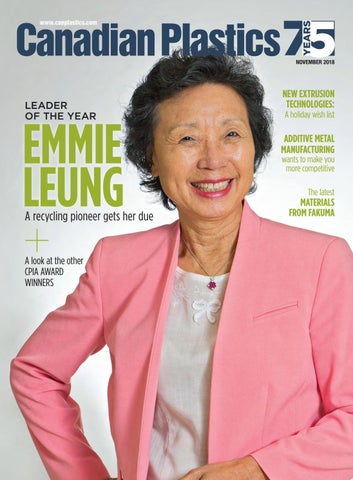
LEADER OF THE YEAR
EMMIE LEUNG
A recycling pioneer gets her due
NEW EXTRUSION TECHNOLOGIES: A holiday wish list
ADDITIVE METAL MANUFACTURING wants to make you more competitive
The latest
MATERIALS FROM FAKUMA
A look at the other CPIA AWARD WINNERS
CPL_Nov2018 issue_AMS.indd 1
2018-11-05 1:05 PM
Challenges accepted.
Solutions delivered.
ALL NEW
Novatec’s continuing innovations provide the drying solutions for today and tomorrow.
OVER DRYING NYLONS AND OTHER MATERIALS? MATERIAL DEGRADING, OXIDIZING AND TURNING YELLOW?
The industry’s first Non-Oxidizing Nitrogen Generating Dryer.
Includes Novatec’s Patented Moisture Manager and OverDry Protection. Self-adjusts to save energy and avoid over drying of expensive resins.
Many specialty resins are subject to yellowing, oxidation, or degradation caused by drying in an oxygenated hopper. That’s all cleared up with NitroDry.
W
E S T T O TA
L
T
Sold & Serviced in Canada by Maguire Products Canada, Inc. 905-879-1100 l info@maguirecanada.com l www.maguirecanada.com
F
warr R anty O
OS
O
© Copyright 2018 Novatec, Inc.
–5– YEA
O
C
L
Mobile, beside-the-press package self-adjusts to avoid over drying.
W
NERSHIP
CPL_Oct_Novatec.indd CPL_Nov2018 issue_AMS.indd 1 2
www.novatec.com
2018-09-18 2018-11-05 11:14 1:05 PM AM
8 11:14 AM
contents
FROM THE ARCHIVES The May 2000 issue of Canadian Plastics reported on a massive mold building project undertaken by Toronto’s FGL Precision Works Ltd. for Louisiana-based structural road mat molder Loma Co. Each mold half of aircraft aluminum measured 14 by 8 feet, and the complete set of both halves tipped the scales at 10,000 lbs. FGL built 24 sets of these monster molds for Loma, which molded the parts in a stack mold configuration on a custom-built vertical compression press, with each stack containing eight sets of tools. FGL would eventually win two design awards from the Society of the Plastics Industry for the project.
Cover photo and pg. 3 photo of Emmie Leung: Sandra Strangemore
NOVEMBER 2018 VOLUME 77 • NUMBER 6
10
Number of the month:
ONE*
* The number of employees at International Paper Industries when Emmie Leung founded it in 1976. (See pg. 11)
24
22 cover story
in every issue 4 Editor’s View: Rethinking cobots after Rethink Robotics 5 Ideas & Innovations: Using sunlight to make polymers 6 News: • As sales go up, Maguire Canada doubles down on service • Blown film innovator Robert Krycki passes away • Record sales, expansion for Sepro • People
10 LEADER OF THE YEAR: Emmie Leung goes from bag lady to leading lady Emmie Leung has risen from driving a rented van for her one-woman curbside recycling company to being the CEO of Emterra Group, which sells reprocessed plastics all over the world. And this recycling trailblazer can now add another feather to her cap: she’s the CPIA’s new Leader of the Year. PLUS: Profiles of the other CPIA award winners.
features
18 EXTRUSION: An Xmas wish list The holidays are coming, which means the biggest shopping month of the year is right around the corner. So if you’re an extrusion shop owner and want to treat yourself, consider these new technologies.
21 MOLDMAKING: Additive Metal Manufacturing wants to make you more competitive
27 Technology Showcase
This Concord, Ont.-based engineering and design consulting firm is rewriting the book on mold heat removal by 3D printing inserts with complex cooling channels that can dramatically cut cycle times. And it might just be the kick in the pants that Canada’s plastics processors need to start kicking butt globally.
29 Classifieds
24 MATERIALS: Developments from Fakuma
29 Advertising Index 30 Technical Tips: Hot runner maintenance made simple
If you think Germany’s annual Fakuma trade show is mainly about injection molding, you’re not wrong. But even the best new I/M machines can’t make parts from nothing, which is why material suppliers exhibit at the shows in droves. Here’s a look at some of the innovative resins unveiled at Fakuma 2018 for injection molding (and extrusion too).
Visit us at www.canplastics.com November 2018 Canadian Plastics
CPL_Nov2018 issue_AMS.indd 3
3
2018-11-06 1:02 PM
editor’s view
Canadian Plastics magazine reports on and interprets developments in plastics markets and technologies worldwide for plastics processors, moldmakers and end-users based in Canada.
Rethinking cobots after Rethink Robotics
L
ast month Boston, Mass.-based Rethink Robotics closed its doors abruptly after 10 years in business. As reported by The Boston Globe, the company’s sales were down, it was running low on cash, and at the very last minute a potential buyer backed out. For those who didn’t know the firm, Rethink was a major player in the world of collaborative robots, or cobots: small robots with cameraequipped arms that can work side-byside with human workers without safety guarding, handling light payloads and stopping when they sense someone in their way. The company’s Baxter and smaller, faster Sawyer cobots were easily recognizable thanks to the big eyes on their screen faces and distinct red exteriors. They were endearing, too: Baxter and Sawyer could turn towards a nearby person and change their expressions, raising their eyebrows or giving a quizzical look. (Full disclosure: We put Sawyer on the cover of our September 2016 issue, and it’s probably my favourite Canadian Plastics cover photo.) These two cute robots became the almost literal faces of cobots worldwide, and were ubiquitous at industry trade shows, where the Rethink sales team members eagerly showed attendees how easy it was to teach the machines various tasks. And the prices were low, at around US$20,000, encouraging molders to try them out. So when the company failed, many asked what it meant for the future of cobots. Considering that Rethink was one of the first and most vocal companies in the cobot space, did the company’s demise mean the bubble was starting to burst? Some engineers already considered cobots to be a passing fad, opining that traditional robots will always dominate the market. But if at first glance the story
4
Canadian Plastics November 2018
CPL_Nov2018 issue_AMS.indd 4
www.canplastics.com EDITOR Mark Stephen 416-510-5110 Fax: 416-442-2230 mstephen@canplastics.com
seemed to mean one thing — the beginning of the end for cobots — a closer look shows that it signifies something else entirely. Rethink may have led the charge to develop collaborative robots, but the field is getting more crowded. The company faced a growing competition from Danish cobot maker Universal Robots, German supplier pi4 robotics GmbH, and automation powerhouses Kuka AG, ABB Ltd., and Fanuc Corp. So the failure of Rethink doesn’t signal a weak market for cobots, but the opposite. Faced with growing competition, Rethink simply couldn’t keep up with its deeper-pocketed counterparts — although it may live on in some form, as breaking news is that German automation supplier Hahn Group GmbH has purchased Rethink’s technology. While there will always be many manufacturing applications that favour traditional robots, cobots are nevertheless an entry point for human workers to grow accustomed to automated systems. Which is necessary, since one thing we know for certain is that automation is coming. IoT and robotic systems are being widely adopted across several industries, plastics manufacturing among them, and cobots have and will continue to help us transition to this more automated world. For years now, breathless headlines have predicted the end of manufacturing jobs, as robotics — traditional and collaborative — and artificial intelligence combine to make human workers obsolete. And while many manufacturing jobs have been eliminated due to automation — and many more will be — these are, overwhelmingly, the strenuous, repetitive, and dangerous jobs that no human being wants to do anyway. So good riddance to those. And a much fonder farewell to Baxter and Sawyer.
NATIONAL ACCOUNT MANAGER Catherine Connolly 289-921-6520 cconnolly@annexweb.com ART DIRECTOR Andrea M. Smith ACCOUNT COORDINATOR Tracey Hanson 416-510-6762 thanson@annexbusinessmedia.com CIRCULATION MANAGER Aashish Sharma 416-442-5600 ext. 5206 asharma@annexbusinessmedia.com VP PRODUCTION / GROUP PUBLISHER Diane Kleer dkleer@annexbusinessmedia.com PRESIDENT & CEO Mike Fredericks PRINTED IN CANADA ISSN 008-4778 (Print) ISSN 1923-3671 (Online) Publication Mail Agreement #40065710 2018 SUBSCRIPTION RATES 6 issues Canadian Plastics, plus Dec. 2019 Buyers’ Guide: CANADA: 1 Year $75.50 plus applicable taxes; 2 Years $121.00+ taxes USA: US$132.50/year FOREIGN: US$151.00/year
CIRCULATION mchana@annexbusinessmedia.com Tel: 416-442-5600 ext. 3539 Fax: 416-510-6875 or 416-442-2191 Mail: 111 Gordon Baker Road, Suite 400, Toronto, ON M2H 3R1 Occasionally, Canadian Plastics will mail information on behalf of industry related groups whose products and services we believe June be of interest to you. If you prefer not to receive this information, please contact our circulation department in any of the four ways listed above. Annex Privacy Officer privacy@annexbusinessmedia.com • Tel: 800-668-2374 No part of the editorial content of this publication June be reprinted without the publisher’s written permission ©2018 Annex Business Media. All rights reserved. Opinions expressed in this magazine are not necessarily those of the editor or the publisher. No liability is assumed for errors or omissions. All advertising is subject to the publisher’s approval. Such approval does not imply any endorsement of the products or services advertised. Publisher reserves the right to refuse advertising that does not meet the standards of the publication. MEMBER: Magazines Canada, Canadian Plastics Industry Association.
Mark Stephen, editor
mstephen@canplastics.com
www.canplastics.com
2018-11-05 1:05 PM
ideas & innovations
Photo Credit: Jeff Fitlow/Rice University
Using sunlight to make polymers
Rice University assistant professor Eilaf Egap holds a vial of quantum dots her lab is using to catalyze the creation of functional polymers.
F
ans of DC Comics know that Superman, a Kryptonian, gets his superhuman strength from exposure to the Earth’s yellow sun. (The scribes at DC even invented a pseudo-scientific name for it — the photonucleic effect — but we won’t get into that now.) Back in the real world, meanwhile, the sun’s powers are just as impressive, and can be put to good use by real science. Case in point? Researchers at Rice University in Houston, Tex., are developing a way to use sunlight to grow functional synthetic polymers using photosensitive quantum dots — semiconducting particles only a few nanometers wide that have optical and electronic properties — as a catalyst. The goal of the technology is to reduce the cost of producing polymers by replacing the molecular catalysts and expensive transition metals currently used to make things like methacrylates — which are common in plas-
tics — as well as styrene and block copolymers. As detailed in a recent issue of the American Chemical Society journal ACS Macro Letters, the research team — made up of Rice assistant professor of materials science and biomolecular engineering Eilaf Egap, Rice postdoctoral researcher Yiming Huang, and graduate student Yifan Zhu — applied light from various sources, including the sun and a lamp, to a solution containing the quantum dots, which led to the creation of free radical atoms and caused the solution’s acrylate monomers to link. Because the monomers tested in the lab had no ability to terminate propagation of the chain, the process is called living polymerization. “It will keep going until it consumes all the monomers or you decide to terminate,” Egap said. “The benefit is, if you have monomer A and you want to add monomers B and C in a specific sequence,
you can do that. In a random polymerization, they would be randomly dispersed along the polymer backbone, but quantum dot polymerization shows promise for highly controlled growth of sophisticated polymers.” The advantage of having controlled polymer growth, Egap said, is that it can lead to the discovery of new polymers with possible applications in solar energy, bioimaging, and magnetoelectronics. One new polymer might be a quantum dot photocatalyst with an attached semiconducting polymer that would simplify the manufacture of solar cells and other devices. “These could also be relevant to light-emitting diodes, magnetoelectronics, and bioimaging,” Egap said. “We could grow them all at once. That’s the dream, and I think we’re within reach.” Sounds a lot more useful than leaping over tall buildings in a single bound. CPL November 2018 Canadian Plastics
CPL_Nov2018 issue_AMS.indd 5
5
2018-11-05 1:05 PM
news
As sales go up, Maguire Canada doubles down on service
Photo Credits: M.T. Innovations
As the determining factor in the sale Innovations 30 years ago, when he was taking just about any service call for price of a house, location, location, working with a different auxiliary Maguire Canada unassisted. “Maguire location is the mantra of realtors world- equipment company; and the relation- introduces new products regularly, but wide. Auxiliary equipment supplier ship became solid enough that when most of the processes are familiar to us Maguire Products Canada Inc. has Davis and other industry veterans Rob- so we can do the service work,” Steeb gone a slightly different route — they ert Hodge and Wayne Travell founded said. “The control technology is what call it service, service, service — and Maguire Canada in 2007, they took really changes, and this is our biggest it’s paying off. M.T. Innovations with them as their challenge. I’ve had to call Maguire “Any machinery and equipment Canada’s service manager Wayne sales firm ultimately owes its success Travell for help in the middle of to good service — the sales staff the night because we don’t know make the first sale, but good service the sequencing code for a new sells everything after that,” said Brian control system. And he always Davis, general manager of the takes the call immediately.” Vaughan, Ont.-based company. “We Maguire Canada’s recent suchad a record sales year in 2016 — up cess points to the value of good 18 per cent over 2015 — and our sales service in the highly competitive in 2017 were up by 23 per cent over auxiliary equipment sector, 2016, and I attribute a lot of this Davis said — and to how rare growth to good service. Some of our good service is becoming. sales and service staff were proces- Replacing an old Novatec NPD dryer (left) with a “Sales companies are so shortsors in their past lives, so they under- new NPD model for one of Maguire Canada’s Southstaffed these days that plastics stand how important service is. And ern Ontario customers. processors almost expect not to if our own team isn’t available, we get efficient service; so when use a service provider called M.T. Inno- independent service provider. “Mark they actually get good service, they vations to back us up.” knows Maguire equipment inside and remember it,” Davis said. “In addition A Waterloo, Ont.-based millwright out, and also understands Novatec Inc. to Robert and Wayne, our staff company founded in 1988 by Mark — which we also represent — as well includes Dan Lorenz, Raj Shekar, and Steeb, M.T. Innovations specializes in as competing equipment and off- our newest hire Amir Baradaran, and assembly and installation of injection brands from China,” Davis said. “We they’re all crack service providers, molding equipment and vacuum and can trust Mark and his team to handle including on competitors’ equipment. conveying systems, as well as welding, any service situation.” And if we can’t get to a customer in a machine repair, and machine mainteAfter all this time, Steeb and his timely manner, we can rely on M.T. CPL nance. Davis first began using M.T. staff of five do indeed feel comfortable Innovations.”
6
Canadian Plastics November 2018
CPL_Nov2018 issue_AMS.indd 6
important blown film equipment manufacturers. Future Design placed an emphasis on the repair and replacement of blown film line components, and made a big impact with its Saturn family of air rings. Krycki also invented and patented the Saturn Evacuation System, which reduced the amount of airborne contamination that fills a plant during the blown film extrusion process. Krycki retired from Future Design
Ad
Ma dry
Blown film innovator Robert Krycki passes away Robert Krycki, a wellknown member of Canada’s blown film industry, passed away at age 74 in Welland, Ont. on Oct. 23, after a battle against three types of cancer. Krycki began his extensive career working in the plastics industry for blown film and bag manufacturer W. Ralston & Co. He started building equipment in his spare time, and in 1978 he founded Brampton, Ont.-based Future Design Inc, one of Canada’s most
N
in 2008, and was awarded a Lifetime Achievement Award from the Canadian Plastics Industry Association in that same year; but he didn’t retire from the industry. Krycki remained active as a consultant, and in 2014 he founded Resin 2 Revenue Consulting Inc. in Brampton, which helped companies in the plastics industry plan for equipment purchases; and he also served as a consultant for blown film die maker and service provider Cyber Plastic Machinery Inc., which was founded in Brampton in 2015 by his daughter Dawn Krycki and Liviu Sas. CPL
Ra
Au Pla
Ful sys
www.canplastics.com
2018-11-06 1:03 PM
CPL_Nov
Control and Management of your production
New
Plant wide Supervisory Systems
Advanced Design
Powerful Control
Utmost Versatility
Management of storage, conveying, drying, blending and cooling systems
Predictive and scheduled mantenance operations
Easy to use, windows based program
Raw material traceability
Plantwide connectivity and integration with Piovan Winfactory 4.0
Automation and data exchange Plantwide Fully developed factory management system
CPL_Nov_Piovan.indd CPL_Nov2018 issue_AMS.indd 1 7
All alarms are visible and emailed instantly Self diagnostics of Machines
Immediate notiďŹ cation of exceptions to process parameters Accessible via mobile devices Provides access to all key features of the machines
2018-10-25 1:05 2018-11-05 2:36 PM PM
news
Record sales, expansion for Sepro
Photo Credit: Sepro Group
ations from the robot integration As it nears the end of an ambitious workflow, while increasing pro11 million euro expansion plan, duction capacity for Sepro three-, France-based robotic automation five-, and six-axis robots from maker Sepro Group is on track to 3,000 to 5,000 units annually.” In record its sixth consecutive record addition, the French facility’s sales year, with 2018 sales forecast robot integration unit has been to reach 130 million euros expanded by 50 per cent, enabling (US$149 million) — approxiwork teams to develop more cusmately double the total from five tom robotic automation cells for years ago. And by the end of this the European market. The comyear, the finishing touches will pany has also developed new have been applied to the last eleoffice space and opened a dediments of the program — which cated “innovation space” in its was launched in May 2017 — Expansion of Sepro Group’s corporate headquarters headquarters building. when expansions at Sepro’s manu- and production facility in La Roche-sur-Yon, France Third, a new corporate trainfacturing facilities in France and from its current 13,000 square meters to nearly 20,000 square meters is almost complete. ing centre has recently opened on the U.S. are complete. an all-new site near the company Early in 2018, the first element of the plan was completed, doubling to further expand production in 2019 headquarters. The 800-square-meter facility is staffed by eight full-time the size of its Sepro facility in Warren- and beyond. dale, Pa., and making it the hub for new “The second and largest element of trainers. The centre can provide trainrobot assembly, engineering, and auto- the global plan — expansion of our cor- ing for up to 1,500 people, a 50 per cent mation capabilities in the North Ameri- porate headquarters and production increase over the former location. “This can market. According to Jean-Michel facility in La Roche-sur-Yon, France newest training centre joins other cenRenaudeau, managing director of from its current 13,000 square meters to tres located in Dietzenbach, Germany, Sepro Group, the new hub is fully oper- nearly 20,000 square meters — is nearly and in the U.S. in Warrendale and near ational and on pace to assemble and complete,” Renaudeau said. “The added Chicago,” Renaudeau said. Sepro’s Canadian subsidiary, Sepro deliver 40 large robots to U.S. and manufacturing space will enable the Canadian injection molders in 2018 and separation of robot manufacturing oper- Canada, is located in Montreal. CPL
Big management change at Hasco Canada
Louis Hébert
René Eisenring
Manfred Breuner
8
Louis Hébert, a well-known figure in Canada’s mold technology industry and the managing director of Toronto-based Hasco Canada Inc., is retiring at the end of 2018. Hasco Canada is naming René Eisenring to replace Hébert as its new general manager, effective January 1, 2019. Hébert has been with Hasco Canada, which is the Canadian subsidiary of Germany-based mold technology supplier Hasco Hasenclever GmbH + Co KG, for more than 25 years. Hasco Canada is also appointing Manfred Breuner as its new technical sales representative for Eastern Canada and B.C. CPL
Canadian Plastics November 2018
CPL_Nov2018 issue_AMS.indd 8
Ontario injection molding veteran John Tamasovics Sr. passes away Canadian plastics pioneer John Tamasovics Sr. passed away on Aug. 30 at age 85 in Windsor, Ont. Born in Hungary in 1933, Tamasovics immigrated to Canada in 1957 and settled in Windsor, where he began his career in the industry working for International Tool. Along with two partners, he founded JFJ Mold in Oldcastle, Ont. in 1964. For the first few years, these three were the only employees, and took turns operating the company’s one injection molding machine, as well as performing other services such as polishing and benchwork. JFJ’s business evolved into consumer and automotive molding, plus mold tryouts; the company eventually focused exclusively on the automotive sector as a Tier 2 molder. When the other two partners left the company, Tamasovics became the sole owner, and he grew the business to include 25 injection molding machines and 150 workers. He retired in 2000. CPL www.canplastics.com
2018-11-05 1:05 PM
news
Extrusion machinery maker DavisStandard LLC has invested US$2 million to boost production efficiency at its headquarters in Pawcatuck, Conn. The investment involved DavisStandard installing its fourth CNC machining centre to support what it calls its ongoing growth in feedscrew manufacturing, which will enable the company to increase feedscrew production by over 25 per cent. The machining centre became operational in mid-October. “This investment reflects our continued commitment to best practices in manufacturing and in supporting customers with best-in-class feedscrew technology,” said Mike Newhall, Davis-Standard’s vice president of operations. “The CNC machining centre that was installed is the same brand as our existing machines, Weingartner, which makes software programs and tooling interchangeable. We also have highly skilled machin-
ists already trained to run this type of equipment. This will further add to our ability to meet customer demand and improve our overall responsiveness to our customer’s requirements.” The additional centre is a Weingartner Pickup 700 Whirler, which is capable of The additional machining centre is expected to boost Davismachining feedscrew Standard’s feedscrew production by over 25 per cent. sizes that comprise 80 per cent of Davis-Standard’s screw vol- reduction, enabling us to improve ume, including feedscrews from 1.5 to delivery times and maintain a steady 6 inches (38 to 152 mm) in diameter stock of feedscrews in various sizes and in lengths up to 207 inches (5,200 and finishes.” Davis-Standard designs, develops, mm). “The machine will augment existing capabilities in Davis-Stan- and distributes extrusion and convertdard’s feedscrew operation, which cur- ing technology for the agriculture, autorently manufactures over 1,000 feed- motive, construction, healthcare, screws annually,” Newhall said. “It energy, electronics, food and beverage will also support feedscrew cycle time packaging, and retail industries. CPL
Photo Credit: Davis-Standard LLC
Davis-Standard invests $2 million to expand feedscrew manufacturing capacity
PEOPLE
Clint Beutelschies
Robert Flack
David Harrilla
Manuel Heusinger
– Lebanon, Ore.-based extrusion machinery maker Entek International has appointed Clint Beutelschies as global vice president of sales. – T he Cambridge, Ont.-based Canadian Tooling & Machining Association has named Robert Flack as its new president. – David Harrilla has been named as operations director for auxiliary equipment maker Universal Dynamics/Piovan North America, headquartered in Fredericksburg, Va. – Extrusion blow molding machinery maker Kautex Maschinenbau has named Manuel Heusinger as head of sales at its North American subsidiary in Branchburg, N.J.
Ilham Kadri
Ned Monroe
Myron Petruch
John Van Hulle
– Belgium-based chemicals group Solvay SA has named Ilham Kadri as its new CEO effective March 1, 2019. She succeeds departing CEO JeanPierre Clamadieu. – T he Washington, D.C.-based Vinyl Institute has named Ned Monroe as its new president and CEO. – Parsippany, N.J.-based polymer and compounds maker Sun Chemical Corp. has appointed Myron Petruch as its president and CEO, effective January 1, 2019. – Indianapolis, Ind.-based specialty chemical maker Vertellus Holdings LLC has named John Van Hulle as its new CEO.
November 2018 Canadian Plastics
CPL_Nov2018 issue_AMS.indd 9
9
2018-11-05 1:05 PM
leader of the year
FROM BAG LADY TO
LEADING LADY
Photo Credit: Sandra Strangemore
By Mark Stephen, editor
10
Canadian Plastics November 2018
CPL_Nov2018 issue_AMS.indd 10
www.canplastics.com
2018-11-05 1:05 PM
leader of the year
Emmie Leung has risen from driving a rented van for her one-woman curbside recycling company to being the CEO of Emterra Group, which sells reprocessed plastics — as well as aluminum, newsprint, cardboard, steel, and rubber — all over the world. And this trailblazer in the Canadian recycling industry can now add another feather to her cap: she’s the Canadian Plastics Industry Association’s new Leader of the Year.
B
ig outcomes sometimes hinge on small incidents — maybe as small as taking a walk. Pierre Trudeau famously decided to run for the Liberal leadership in 1968 after going for a walk in the snow, and the ultimate result was his 16-year tenure as Canada’s prime minister. Emmie Leung, the founder and CEO of Burlington, Ont.-based recycler Emterra Group, had her epiphany in a similar way. In 1976, Leung was a recent commerce graduate of the University of Manitoba looking for a job. Walking around her Winnipeg neighbourhood one day, she noticed great piles of newspapers and cardboard set out for garbage collection, and had the sudden realization that she could sell them in China. She moved to Vancouver to be closer to core transportation hubs, and has been a pioneer in the recycling and waste diversion industry in Canada ever since. Along the way, Leung has garnered more awards and accolades than some film studios have Oscars — the most recent of which is being named as the Canadian Plastics Industry Association’s Leader of the Year for 2018.
A PIONEER IN RECYCLING Born and raised in China, Leung immigrated to Winnipeg to study in 1972. The original company she founded in Vancouver in 1976 was called International Paper Industries (IPI) and started as a one-person curbside recycling business. Leung rented a van and loaded it herself until it was full and stored the papers in her backyard until she had enough to fill an overseas con-
tainer; she was the driver, loader, warehouse shipper, shipping coordinator, and bookkeeper. Recycling was in its infancy in those days, and Leung quickly became a recycling pioneer and guru, making an example of how to turn waste into dollars. “I came from a country where resources were scarce, so I could see the value in recycling; when I see waste, my first thought is, how can we turn it into something of value?” she said. “In Canada at that time, however, people didn’t know there was value in paper and boxes, and they came to me as an expert.” Indeed, recycling was such a new concept in Canada that Leung’s background and gender — which were unique for an entrepreneur
expanded, opening the first material recovery facility (MRF) in Surrey, B.C. in 1982. In the 1990s and 2000s, IPI grew beyond B.C., establishing an offshoot called Halton Recycling Ltd. in Ontario in 1995; starting its first single stream MRF in Manitoba in 2003; acquiring Canadian Liquids Processors Ltd. in Ontario in 2004, which specializes in confidential product destruction and recycling sugar- and alcohol-based liquids into ethanol; and opening a tire recycling company called Canadian Eco Rubber Ltd. in Brampton, Ont. in 2005, which collected and processed used and scrap tires from across the province. In 2008, the group of companies were brought together under the new name and brand of Emterra Group.
“I came from a country where resources were scarce, so I could see the value in recycling; when I see waste, my first thought is, how can we turn it into something of value?” back then — didn’t even matter. “Everyone started calling me the ‘bag lady,’ but my customers didn’t look at me as a woman or Chinese,” she said. “In business, it’s all about what you can do to provide value to a customer, and I could do that. I’m the type of person that if I want to do something, nobody can stop me.” When IPI started to expand into municipal curbside recycling, Leung instigated the first ever “blue bag” program to collect recyclables, a system that continues to be used in some municipalities throughout Canada. As waste diversion and recycling gained momentum during the 1980s, IPI
Today, Emterra Group consists of the Emterra Environmental and the Michigan-based Emterra Environmental USA divisions, which are recycling and waste resource management companies; Emterra Tire Recycling; Canadian Liquids Processors; and Ryse Solutions, Canada’s first fully integrated producer responsibility organization that offers compliance and advisory services and material recovery solutions under one umbrella. Together these divisions and companies operate 31 material recovery facilities and offices in B.C., Saskatchewan, Manitoba, Ontario, and the state of Michigan — handling everything from paper November 2018 Canadian Plastics
CPL_Nov2018 issue_AMS.indd 11
11
2018-11-05 1:05 PM
Photo Credit: ReVital Polymers
leader of the year
Emmie Leung on the shop floor at ReVital Polymers.
products and packaging to used tires to yard and kitchen waste to trash — and employ more than 1,100 people. Emterra Group sells processed aluminum, various types of plastics, newsprint, cardboard, steel, and rubber all over the world
DEEPER DIVE INTO PLASTICS Leung’s involvement with plastics recycling became more pronounced in 2016, when she and Tony Moucachen, the president of Delta, B.C.-based Merlin Plastics Group, founded ReVital Polymers. The two formed a partnership to acquire the assets of a former plastics recycling facility in Sarnia, Ont. that had gone into receivership, which included an 180,000-square-foot recycling facility. Said to operate the first recycling plant in Canada that combines a Container Recovery Facility and a Plastics Recovery Facility under one roof, ReVital accepts post-consumer plastics recovered from municipal recycling programs across Canada and the U.S., and uses a closed-loop process to recycle materials into raw materials for use in manufacturing again. “ReVi-
12
Canadian Plastics November 2018
CPL_Nov2018 issue_AMS.indd 12
tal uses state-of-the-art technology that sorts and converts waste plastics into resin types that are tailored to specific customer end-use applications, so that processors can make new products and packaging with recycled content for any sector,” Leung said. “I’m not in favour of plastic bans — I’m in favour of keeping all types of post-consumer plastic, especially single-use plastic, out of landfills and in continuous use, and ReVital helps us get closer to that goal.” Leung and Moucachen have also recently combined the market presence of their three extended plastics collection, processing, and recycling companies — ReVital along with Merlin Plastics Group and Emterra Group — to launch the Circular Polymers Group (CPG), said to be North America’s largest plastics recycling consortium. These companies currently operate 38 multi-materials handling and recycling facilities in B.C, Alberta, Saskatchewan, Manitoba, and Ontario, as well as in the U.S. states of Oregon, California, and Michigan. In 2017, CPG collected and recycled well over 140 million kgs of plastics from resi-
dential curbside recycling systems; beverage container deposit-return systems; and the industrial, commercial, and institutional sectors across Canada and the U.S. “While each of our companies will continue to do business individually, we work synergistically to offer our customers our combined recycling expertise; in that sense, CPG is a consortium company,” Leung said. “As one of the 38 plants in CPG, ReVital has a niche within that group to deliver programs and services that help improve post-consumer plastics recovery. Our technologies to collect, sort, and recycle plastics could be implemented in developing countries, for example, which might help dramatically reduce the millions of tons of plastics discharged into the world’s oceans every year from developing nations.”
ANOTHER ACCOLADE During the course of her four-decade rise from one woman with a rented truck to the head of Emterra Group and the co-owner of ReVital, Leung has garnered her fair share of awards, including the Ernst and Young Entrepreneur of the Year for Energy and Cleantech in 2014, being ranked 15th in Canada’s Top 100 Female Entrepreneurs by Canadian Business and Profit magazine in 2015, and receiving the University of Manitoba’s Distinguished Alumni Award for Professional Achievement in 2016. But being selected as CPIA’s newest Leader of the Year has its own meaning, Leung said. “I owe this award and recognition to my team, and I want to thank them for supporting the organization and everything we stand for,” she said. “We all want to build a sustainable environment for today and for the future, and as long as we keep working with a single focus to develop closed-loop processes that recycle plastic into raw materials for use in manufacturing again, plastics can be part of the solution, not the problem.” Not a bad destination for a journey that started with a walk around the block in Winnipeg more than 40 years ago. CPL www.canplastics.com
2018-11-05 1:05 PM
CPL_We
Free
WEBINAR
December 11, 2018 2 p.m. est
POLYETHYLENE & POLYPROPYLENE A Pricing Forecast for 2019 and Beyond PRESENTED BY ZACHARY MOORE – ICIS Zachary joined ICIS in 2016 and currently works as deputy managing editor for the Americas region. He covers North American markets for major commodity polymers such as polyethylene and polypropylene as well as intermediate chemicals used in the production of polyurethane foams.
JOIN US AS CANADIAN PLASTICS SHARES THIS IMPORTANT ECONOMIC FORECAST Register at: www.canplastics.com
CPL_Webinar_PriceForecast_Oct2018_AMS.indd CPL_Nov2018 issue_AMS.indd 13 1
2018-10-29 2018-11-05 1:37 1:05 PM
CPIA awards
SIMPLY THE BEST In early October, the Canadian Plastics Industry Association recognized outstanding individuals and businesses for their commitment and dedication to the growth and sustainability of our plastics industry at its annual Plastics Industry Leadership Awards Dinner. The awards and award winners are...
LIFETIME ACHIEVEMENT AWARD Recognizing those who have made outstanding achievements and contributed enduring legacies to the Canadian plastics industry and to the community at large.
14
Boudrias has been involved in rigid plastic food packaging since 1977. Throughout his career, he led Laval, Que.-based food packaging supplier Dyne-a-Pak from a small producer to a leader in foam food trays in Canada, with a strong position in the U.S. market.
JIM ELLIES
SERGE GELINAS
Ellies, who retired as head of Mississauga, Ont.-based extruder Gracious Living Innovations earlier this year, has played a leading role in Canada’s plastics industry for over 40 years, and twice led the construction of plastics manufacturing facilities in Canada and the U.S. Ellies was CPIA’s Leader of the Year for 2016.
Gelinas has worked for Dyne-aPak for over 43 years. “During his career he was a major contributor to Dyne-a-Pak and the plastic industry in general,” CPIA said. “Beyond his technical and problem-solving expertise, Serge demonstrated determination, drive for improvement, and great team spirit.”
LOUIS GOURON
RICK RADVANY
“Gouron has been a leader within the plastic film industry for over 40 years, and led Mississauga-based film extruder Balcan Plastics to tremendous growth and success over his career,” CPIA said. “He has also served in leadership positions in many plastic industry associations.”
Radvany is the CEO of Mississaugabased Poly-Cel Packaging Products, which he founded in 1971. “Rick built long-term relationships with all of his customers by providing quality service,” CPIA said. “He was one of the early innovators of breathable packaging.”
Canadian Plastics November 2018
CPL_Nov2018 issue_AMS.indd 14
PAUL BOUDRIAS
www.canplastics.com
2018-11-05 1:05 PM
CPIA awards
PLASTICS SUSTAINABILITY AWARD Recognizing individuals or organizations who have contributed to the sustainability of the Canadian plastics industry in an environmental, social or economic manner, including post-use plastics recovery. GENERAL MOTORS, LAVERGNE GROUP, AND WINDSOR MOLD AUTOMOTIVE COMPONENTS DIVISION Detroit-based GM, Montreal-based sustainable resin maker Lavergne Group, and Windsor Mold Group’s automotive parts making division are being recognized for their joint involvement in the “Do Your Part” program, which turns used water bottles and other plastic packaging into car parts and other materials such as insulation and fleece.
KEURIG CANADA INC. The Montreal-based beverage supplier is being awarded for its efforts to transition all of the K-cup pods produced and sold in Canada to the recyclable format. “Keurig Canada demonstrated their commitment to sustainability and strong willingness to use their corporate leadership to foster innovation and environmental stewardship,” CPIA said.
PLASTICS INNOVATOR AWARD Recognizing those who have contributed to the advancement of the plastics industry in the areas of materials, products, process/technology or marketing/ communications.
EMMERSON PACKAGING
MIKE ZHANG “Zhang, of Toronto-based
The Belleville, Ont.-based flexible packaging supplier is being recognized for its commercialization of a recyclable, mono-material multilayer film structure that will allow consumers to recycle packages that are suitable for a value-added recycle stream.
melt pressure measurement equipment maker ONEhalf20 Inc., has invented a dozen measurement and control devices directly aimed at improving industry efficiencies and effectiveness,” CPIA said.
In Canada
CPL_Nov_Chillers.indd 1
CPL_Nov2018 issue_AMS.indd 15
905-895-9667 www.ChillersInc.com
November 2018 Canadian Plastics
15
2018-10-24 2:43 PM
2018-11-05 1:05 PM
CPIA awards
CANPLAST AWARD Recognizing those who contribute their time, energy, and expertise to improving the competitive and environmental performance of the Canadian plastics industry.
TOM ETHANS is the executive director of the non-profit environmental organization TakePride Winnipeg. He has contributed significantly to the advancement of the industry and advocated on important issues including core messages about science, responsible use, and product stewardship, and has been an effective opponent of plastic bans.
Fast Plastic Solutions With IMPROVING YOUR PROFITABILITY WITH INNOVATIVE POLYMERIC
YOUNG LEADER AWARD Recognizing up-and-coming individuals, under 40, who demonstrate leadership in plastics businesses (running a company or division), innovation or technical leadership, and/or sustainability efforts (corporate or community).
BENJAMIN SCOTT is the lead research scientist with Brantford, Ont.-based clean technology developer GreenMantra Technologies, and is being awarded for his role in the company’s production of value-added synthetic waxes, polymer additives, and other chemicals.
PHILIPPE ST-CYR is the general manager and one of the founders of Burlington, Ont.-based Rootree (formerly Swiss Pack Canada), a supplier of environmentally-friendly plastic packaging. ATA ZAD is the founder of Montrealbased product development company AxiPolymer Inc. He is being awarded for his company’s work in helping small and medium-sized plastics processors design, develop, and market new products and applications; and for developing a new artificial intelligence technology that can help larger processors better manage their businesses. CPL 16
Canadian Plastics November 2018
CPL_Nov2018 issue_AMS.indd 16
MATERIALS AND
ON-TIME DELIVERY orders@poundsofplastic.com
SUPPLIER OF MATERIALS FOR • INJECTION MOULDING • EXTRUSION • BLOW MOULDING • ROTO MOULDING • FILM • Antimicrobial thermoplastics (Kills bugs) • Biodegradable thermoplastics (Degrades in Landfill) • Black colour concentrates • Reprocessed post consumer thermoplastics
POUNDS OF PLASTIC INC. www.poundsofplastic.com
W m c t r c m
N t a r m v t m p “ t
I a s t t t c C p p p d o c m h c c c li n t n m 6 a A fi o s
T h e w
P n
5650 Tomken Rd., buildings 1 &2, Mississauga, Ontario L4W 4P1 PH: 905-286-9894 • FA: 905-625-8233 rpounds@poundsofplastic.com
CPL_Nov2018_PoundsOfPlastics_AMS.indd 1
N in m s
F
P
2018-11-05 1:05 PM
G
C.
Nylon 6 and nylon 6,6 are the predominant nylon materials in the nylon market place. Since many additions/ modifications can be made to nylons the following will be somewhat brief. We can begin at the manufacturing stage. Nylon 6 is manufactured from a six carbon containing ring molecule called Caprolactam. Caprolactam is a solid at room temperature and is heated slightly and charged to a reaction vessel. A chemical reaction occurs that joins the caprolactam molecules together producing macromolecules of nylon 6 (polyamide 6). Nylon 6,6 is manufactured from two organic molecules that contain 6 carbon atoms each. An organic acid (adipic acid) and an amine (hexamethylenediamine) are prereacted together producing a 6,6 “salt” (a 12 carbon atom molecule). The salt is then charged to a second reaction vessel. A chemical reaction between the “salt” molecules takes place that bonds them together producing macromolecules of nylon 6,6 (polyamide 6,6). We call the polymerization for both nylon 6 and for nylon 6,6 “condensation polymerization” since water is produced in the chemical reaction(s). If the molecules of nylon 6 were viewed under a microscope and compared to viewed molecules of nylon 6,6 only subtle differences in their chemical structure between the two types would be noticeable. You could think of it as all the same pieces are included in each type of molecule but that they are not in exactly the same place on the carbon chain. Chemistry is very much a physical phenomenon. Chemical reactions take place when molecules can physically get together. The subtle difference between the physical configuration of nylon 6 molecules and the physical configuration of nylon 6,6 molecules yields a different crystalline structure in cooled injection molded or extruded parts. Nylon 6 and nylon 6,6 are in the category of “Semi-Crystalline” polymers. Portions of the molecules within a given matrix of nylon 6 or nylon 6,6 have an affinity for one another. The affinity results upon cooling from the plasticated stage (hot) to the forming of crystalline sites. The formation of crystalline sites is not a chemical reaction but could be viewed as an attraction; like magnets. In the “melt phase” we can say that both nylon 6 and nylon 6,6 are amorphous. It is the different type of crystalline sites after cooling that give nylon 6 and nylon 6,6 their differences. These “magnet” like sites are more difficult to break with heat in nylon 6,6 than in nylon 6. These differences become less important or less apparent as additives are included in nylon compounds. Additives include impact modifiers, fibre glass, carbon fibre, minerals (reinforcements), carbon black, pigment, other polymers, heat stabilizers, anti-oxidants and, UV stabilizers and so on. The difference between nylon 6 and nylon 6,6 homopolymers in a given molded part after reaching equilibrium moisture content is as follows: Nylon 6,6 parts would have a slightly higher stiffness and slightly higher
tensile strength. Nylon 6 parts would be tougher. Nylon 6,6 parts can handle spike temperatures above 420°F that is the melting temperature of nylon 6 and not higher than 498°F (the melting temperature of nylon 6,6) for short periods of time (minutes). Nylon 6 and nylon 6,6 have the same continuous use temperature and relative thermal index of 250°F. Unreinforced Nylon 6,6 when injection molded generally cycles faster than nylon 6, You need a higher temperature to process nylon 6,6 than nylon 6 to break the greater molecule attraction in the solid phase that nylon 6,6 molecules have versus nylon 6 molecules. Nylon 6,6 has slightly higher shrinkage than nylon 6 again due to the greater molecule attraction taking place upon cooling of nylon 6,6 moldings. Wet nylon 6,6 is more difficult to process than wet nylon 6. Molding wet nylon 6,6 can be a great challenge. Wet nylon 6,6 in the barrel of a Molding machine will spit and “freeze off” the nozzle. Running wet nylon 6 generally results in far less freeze offs but will result in poor surface aesthetics; Caprolactam bloom. Neither nylon should be molded wet. Moisture content of the nylon portion of the compound should be between 0.08 to 0.2% by weight.
TECHNICAL SOLUTIONS SERIES
R
IS THERE A DIFFERENCE BETWEEN NYLON 6,6 AND NYLON 6?
One of the most common additives used in nylon is fiber glass. Fiber glass changes the stiffness, strength, impact, chemical resistance and heat performance of the nylons. The physical properties of a 33% glass reinforced nylon 6 would be very difficult to distinguish relative to a 33% glass reinforced nylon 6,6. The advantage to processing again goes to nylon 6 as the fiber glass can be buried easily. A “more resin rich” surface finish can be obtained at lower mold temperatures and injection pressures using nylon 6, 33% glass reinforced versus nylon 6,6, 33% glass reinforced. A 33% glass reinforced nylon 6,6 will handle spike temperatures above 420°F for short periods of time (minutes). Nylon 6 is much more forgiving under heat history versus nylon 6,6. Regrind studies performed when comparing the two polymers in the same mold demonstrate a better retention of original physical properties of nylon 6 parts versus nylon 6,6 parts. Nylon 6 parts retain > 80% of their original physical properties after (5) five passes of 100% regrind. Whereas nylon 6,6 parts after two passes (100% regrind) retains minimal physical properties relative to the starting point. Nylon 6 with 33% glass reinforcement also faired much better than nylon 6,6 with 33% glass. The study I was privy to also indicated that even average glass fiber length retention is better with nylon 6 glass reinforced than nylon 6,6 reinforced after grinding and then subsequent molding. The theory is that the higher process temperature when processing nylon 6,6 breaks down the polymer chains (chain scission) but also affects the “sizing” (glue) on the fibre glass. The higher heat of processing nylon 6,6 degrades the “sizing”. The bond between the polymer and the glass becomes weak. Degradation of sizing also produces an acid condition. Nylon is dissolved in the acid produced and this resultant solution is detrimental to the physical properties.
Pounds of Plastic Inc.’s trade name for Nylon 6, nylon 6,6, nylon 6,66, nylon 6,12 and others is NYLENIUM® For additional information regarding nylons, contact us @
Ph: 905-286-9894 • Fx: 905-625-8233
CPL_Nov2018 issue_AMS.indd 17
2018-11-06 1:52 2:01 PM
extrusion
An Xmas
WISH
LIST
The holidays are coming, which means the biggest shopping month of the year is right around the corner. So if you’re an extrusion shop owner and want to treat yourself, consider these new technologies. By Mark Stephen, editor
E
xtrusion is a “black-box” process, in that we can’t see what goes on inside an extruder. Which can make it hard to spot improvements and innovations. Add to that the fact that an extruder will last for more than 20 years if maintained properly, and you can get the impression that nothing in extrusion ever really changes — that it’s a mature technology where radically new developments are no longer possible. Wrong. Extrusion equipment makers are always working to boost output, reduce energy usage, expand the range of dies, and improve control and measurement capabilities; and if they can make extrusion shops more competitive, then that’s radical enough. So as the biggest shopping month of the year approaches, you might want to peruse these innovative new products — regardless of whether you’ve been naughty or nice.
18
Canadian Plastics November 2018
CPL_Nov2018 issue_AMS.indd 18
REDESIGNED MACHINE OFFERS HIGH OUTPUTS, FAST START-UPS Battenfeld-cincinnati’s single-screw solEX NG extruder has a completely redesigned screw feed section with a significantly lower pressure profile, designed to ensure high specific outputs; fast process start-ups at low screw torques; and no conveying instabilities, even at high back pressures up to 500 bar (7,200 psi). Thanks to the new processing unit, a reduction of melt temperature of up to 20°F (-6°C) is possible — which means the cooling length can be shortened as cooling baths need to remove less heat. Alternatively, for nearly all products, it’s possible to increase line speed with the same cooling length, resulting in up to 20 per cent higher outputs. Lower melt temperatures at a consistently high level of melt homogeneity also result in better product quality; sagging is reduced, for example, which is a particularly important development for thick-walled or large-diameter pipes. And because it operates with less drive power and lower energy losses, the solEX NG series requires up to 15 per cent less energy than competing machines; and the grooved barrel and corresponding lower pressure profile offers additional energy savings by reducing barrel cooling. Finally, the machine’s processing characteristics, combined with special wear protection solutions for the processing unit, result in material and maintenance cost savings. battenfeld-cincinnati USA (McPherson, Kan.); www.battenfeld-cincinnati.com/usa; 620-241-6843
IN-LINE COMPOUNDING OF POLYMERS, WITH ADDITIVES AND ACTIVE FILLERS
Leistritz Extrusion’s new ZSE-3D twin-screw extrusion system is designed for the production of 3D filaments from a co-rotating or counter-rotating twin-screw extruder. www.canplastics.com
2018-11-05 1:06 PM
extrusion
Direct extrusion of raw materials facilitates rapid product sampling, and also results in one-less heat and shear history as compared to two-step processes, which is particularly beneficial for heat and shear sensitive formulations. The Leistritz ZSE-3D system consists of a ZSE twinscrew extruder configured for compounding, devolatilization, and/or REX; loss-in-weight feeders for pellets, powders or fibres; a liquid injection system; a gear pump front-end attachment; a 3D filament die for one to five mm diameter parts; an air-rack or water tank with sizing bushing; and a downstream system that includes a belt puller, laser gauge, and winder. The Leistritz ZSE-3D twin-screw system is ideal for inline compounding of polymers, with additives and active fillers, to quickly develop new filaments and formulations. Formulations can be modified “on-the-fly” for rapid sampling of filaments with different formulation percentages. A sample can be produced every 10 minutes. Additionally, the system can be configured for water-soluble and high-temperature engineering polymers. Leistritz Advanced Technologies Corp. (Somerville, N.J.); www.extruders.leistritz.com; 908-685-2333
VERSATILE SINGLE-SCREW UNIT New from Milacron Extrusion Technologies, the SV350 is designed to be a robust, f lexible extruder for processors of profile, tubing, sheet, fibre, and wire and cable. A stock machine, and therefore available for quick delivery, machines are available with screw sizes ranging from two to 4.5 inches with a L:D ratio of 24:1. A big benefit of the SV350 is the versatility to handle a multitude of applications and materials, Milacron said. Milacron both designs and builds full extrusion systems in-house. Its range of supplies includes new and rebuilt extruders, barrels and screws, pipe heads, dies, and downstream equipment. Milacron LLC (Batavia, Ohio); www.milacron.com; 513-536-2000
CO-EXTRUSION CROSSHEAD FOR IRRIGATION TUBING The new Series 824 from Guill Tool & Engineering Co. Inc is a co-extrusion crosshead designed for irrigation tubing
with an emitter tool. Manufactured from stainless steel, this crosshead features balanced flow design with spiral technology that improves flow characteristics at all extruder speeds. Dualfeed ports provide concentric compound flow, while the splits flow from one extruder to feed the inside and outside layers via a manifold assembly. The crosshead is adaptable to virtually all popular extruders on the market, the company said. Capacities include a maximum die ID of 1.875 inches, a maximum core OD of 1.250 inches, a maximum tip OD of 1.500 inches, and a maximum emitter tool OD of 1.18 inches. The Series 824 design allows the emitter insertion tool to pass completely through the crosshead ID. Gum space adjustment is performed with die nut rotation, while a twostage clamping mechanism allows easier concentricity adjustment. Quick-change tooling and a tool kit for disassembly and re-assembly are provided with the unit. Guill Tool & Engineering Co. Inc. (West Warwick, R.I.); www.guill.com; 401-828-7600
CO-EXTRUSION DIES NEED LESS SPACE, PROVIDE MORE PRECISION On the heels of the launch of its extrusion dies for film, Dual Spiral Systems Inc. (DSS) has designed new co-extrusion dies for manufacturing pipe and tubing. The new DSS Compact Coex pipe and tubing dies have been reduced in height and weight by 50 per cent compared to the company’s traditional multilayer DSS modular die system, DSS president Rafael Castillo said, and have serious advantages over traditional dies. “They offer faster heat-up time due to their lower mass, lower residence time due to shorter flow passages, faster purge and material changeover times, 60 per cent less energy consumption, and more streamlined melt port entries,” he said. Additionally, Castillo said, they’re easier to handle and move, and take up less floor space. “Our research has shown that layer division substantially reduces film thickness deviation, increases output rates, and makes film twice as strong compared to dies with singlefilm layers,” Castillo continued. “When we applied the DSS concept to pipe extrusion, pipe wall thickness was equally uniform, to the point where any nonuniformity can no longer be measured by traditional methods.” DSS Compact dies can produce tubing and pipes ranging from 0.25 to 60 inches in diameter, Castillo said. Dual Spiral Systems Inc. (Burlington, Ont.); www.dualspiralsystems.com; 905-524-2438 November 2018 Canadian Plastics
CPL_Nov2018 issue_AMS.indd 19
19
2018-11-05 1:06 PM
01-8365-Sepro Canada Half Page Ad.qxp_Layout 1 5/21/18 1:40 PM Page 1
extrusion For Plastics Injection Moulding
A Full Range of Robots One Unique Control
PLUG-AND-PLAY NON-CONTACT MOISTURE METER MoistTech Corp. recently rolled out the IR-3000C, its latest non-contact moisture meter. Designed for both film and sheet, the plug-and-play near-infrared system continuously analyzes multiple wavelengths of light to measure moisture content, thickness, and temperature. Compared to its predecessor, the IR-3000, the IR-3000C can be more finely tuned. IR-3000C sensors typically are installed between four to 16 inches from the extrusion head, and even at high speeds they can provide real-time feedback that isn’t hindered by material variations such as differences in particle size, height, and colour. Equipped with a suite of hightech, Windows-based programs, the system is compatible with any PC platform and provides user-friendly interfaces for configuration, data logging, and diagnostics monitoring. The sensors are calibrated at the factory according to customer specifications, and require no maintenance or recalibration once in operation. The system works with a wide variety of materials, including PVC, PP, PE, and polyvinyl butyral. MoistTech Corp. (Sarasota, Fla.); www.moisttech.com; 941-229-8100
SCALABLE, MODULAR CONTROL PACKAGE
Sepro offers the industry’s widest choice of 3, 5 and 6 axis robots for machines from 20 to 5000 tons, plus advanced connectivity and new control developments to improve your moulding efficiency. With Sepro, the Future is Open 4.0
www.sepro-group.ca • 514 515-9349 seprocanada@sepro-group.com • @SeproGroup
20
New from Eurotherm USA, the E+PLC400 Modular Platform Solution with E+HMI150 is designed to deliver precision control and complete open PLC functionality in a scalable modular form. Billed as ideal for all extrusion applications, the E+PLC controller takes advantage of CODESYS, a leading platform which provides a proven, efficient engineering tool. Control and visualization are built in the single integrated development environment, reducing the time and cost of implementing a system. An exclusive feature is built-in Modbus/TCP communications drivers to Eurotherm’s EPack, which allows these two controllers to work together to provide what Eurotherm calls best-in-class control and diagnostics. The E+HMI150 touchscreen operator interface panel offered in a 13-inch model is well-suited for local or remote monitoring and operation of the process. Eurotherm USA (Ashburn, Va.); www.eurotherm.com; 703-724-7300 CTH Controls Inc. (Oakville, Ont.); www.cthcontrols.com; 888-550-6829 CPL
Canadian Plastics November 2018
CPL_June_Sepro.indd 1
CPL_June2018_Sepro.indd 1
CPL_Nov2018 issue_AMS.indd 20
www.canplastics.com 2018-08-22 9:44 AM 2018-05-22 3:11 PM 2018-11-05 1:06 PM
moldmaking
ADDITIVE METAL MANUFACTURING This Concord, Ont.-based engineering and design consulting firm is rewriting the book on mold heat removal by 3D printing inserts with complex cooling channels that can dramatically cut cycle times and consolidate manufacturing processes. And it might just be the kick in the pants that Canada’s plastics processors need to start kicking butt globally. By Mark Stephen, editor
A
n old adage says that generals always fight the last war. Meaning that when a new war starts, they repeat what was effective last time, usually with disastrous results. And it applies in manufacturing wars, too — if the owners and decision-makers don’t adapt and change, their companies will keep losing the battles, all the way to bankruptcy. It’s a grim fate that Additive Metal Manufacturing (AMM) wants to help Canada’s moldmakers avoid, by offering them a new technology that can make them — and their plastics manufacturing customers — more competitive globally. The Concord, Ont.-based engineering and design consulting firm uses metal additive manufacturing to 3D-print mold inserts to a customer’s individual specification, allowing for the insertion of conformal cooling channels in geometric designs that
Photo Credits: Additive Metal Manufacturing
wants to make you MORE COMPETITIVE
Above: AMM’s founding partners Norman Holesh (left) and David Slimowitz. Right: Programming one of AMM’s EOS laser sintering machines.
were previously not attainable, to better manage thermal issues and dramatically reduce time to market.
EUREKA MOMENT AMM was founded in 2014 by a group of manufacturing veterans with more than 100 years of industry experience between them, and who had all suffered from long lead times and manufacturing processes invented decades earlier. The inspiration for the company came when Norman Holesh, one of AMM’s principals, attended an information night on 3D printing. “The focus of the session was on plastics, but I was struck by the potential for 3D printing with metals,” said Holesh, who serves as the company’s CEO. “Canada’s moldmakers really need something new to help them compete and bring tooling work back from low-cost countries, especially those shops that
are scraping by on old-school methods. The last innovation that disrupted and benefitted the moldmaking sector was CAD technology, and that was a long time ago. Metal additive manufacturing will have the same impact.” The founders — together with a staff of younger, tech-savvy engineering school graduates — currently operate two EOS laser sintering machines for 3D printing mold inserts. “The machines are very expensive compared to high-quality 3D plastics printers that retail for as little as a few thousand dollars,” Holesh said. These machines melt and sinter powdered metals, including stainless tool steel and aluminum, onto a grow plate in 40 micron layers — thinner than a human hair — building each part layer by layer to produce cost-efficient, high-quality metal tool inserts, prototypes, and final products. As built, the parts are November 2018 Canadian Plastics
CPL_Nov2018 issue_AMS.indd 21
21
2018-11-05 1:06 PM
moldmaking
BIG PROBLEM SOLVED The additive metal manufacturing process uses conformal cooling to manage the mother of all mold tooling challenges: heat removal. “Traditional cooling channels for molds are drilled in secondary machining operations, and they follow straight lines,” Holesh said. “Conformal cooling channels follow the geometry of the part that’s being produced, reaching the hot spots that couldn’t be reached previously. This manages the thermal differential within the mold, dissipating the heat faster and resulting in an increase in capacity and longer tool life. Another benefit is reduction of scrap.” But there’s always been a downside to conformal cooling: Many in the industry think the technology is too difficult and too expensive, which — depending on your circumstances — might be true. And they often don’t recognize the impact of conformal cooling across the entire cost spectrum. Which is where the benefit of 3D printing conformal cooling channels comes in. “Making tooling inserts the traditional way is subtractive manufacturing: you start with a block of steel and the more you chip away at it, the more it costs you,” Holesh said. “But with additive manufacturing, you only pay for what you get. Designers have the freedom to place the channels where they’re needed, and they can be as complex or as simple as the shape of the tool dictates.” This is good news for moldmakers and end-users alike. “Additive manufacturing keeps the costs down by saving weight and tooling time; it has the design freedom to print only what’s needed, which are the cooling channels,” Holesh said. “And they can be as highly complex as the designer wants to make them because we can print water channels in any pattern.” In other words, the moldmaker gets inserts that
22
Canadian Plastics November 2018
CPL_Nov2018 issue_AMS.indd 22
offer all of the benefits of conformal cooling at a fraction of the time and cost. “Conformal cooling rapidly removes the heat from the tool, which translates into a reduction of cycle time of between 25 and 50 per cent, and consolidation of manufacturing processes,” Holesh continued. Another benefit of the technology, Holesh said, is speed to market. “Inserts can be 3D printed in a few days, which shortens the lead times by weeks or even months over traditional insert making,” he said. “And because we can often print a final part for both fit and function, the production of a soft tool is eliminated.”
CULTURE SHOCK The biggest hurdle that AMM and its technology faces isn’t technical, Holesh said, but cultural. “Some toolmakers and injection molding experts resist adopting a new technology because they know the old ones so well and think they’re doing fine with them,” he said. “What they may not realize is, they don’t have a choice. Canada’s manufacturing supply chain is shifting towards more advanced technologies and global markets, and metal additive manufacturing is going to happen whether people like it or not.” To help normalize metal additive manufacturing, AMM recently joined forces with Mohawk College to give students in the college’s Mechanical Engineering Technology and NonDestructive Testing programs the opportunity to work directly with AMM engineers on research and development projects aimed at helping manufacturers adopt the technology. The students will have the opportunity to work at both the Additive Manufacturing Centre at Mohawk and AMM’s production facility, where they’ll work directly with full-time engineers and customers to gain first-hand experience solving real-world commercial
Cooling channels 3D printed by AMM.
Photo Credit: Additive Metal Manufacturing
between 30 and 35 hardness on the Rockwell scale, and the hardness can be increased to a range of 50 to 55 Rockwell. If needed, the parts can be welded, polished to a mirror finish, drilled, and tapped.
and engineering issues. “We’ve found that most graduates from university and college don’t have the hands-on experience with the technology or the commercial experience of working with customers,” Holesh said. “This experience will teach them how to work with customers.” AMM has also enlisted well-known sales representative Larry Bonehill, the owner of Uxbridge, Ont.-based Shadow Automation Inc., to represent it in the province. “Larry is a trusted name in the plastics industry, and he’ll help convince some of the skeptics,” Holesh said. So if the only thing moldmakers have to fear about 3D printing with metal is fear itself, they can relax. AMM isn’t a tool shop, Holesh said, and won’t compete with existing machine shops. Instead, they see the business as a service bureau for additive manufacturing. “Moldmakers should understand that we’re not building the tool, we’re just supplying the inserts,” Holesh said. “We’re trying to help them build molds faster, not take business away from them. It’s a collaboration that benefits them as well as the processors that use the finished molds.” And it might just give these processors fighting chances to win today’s manufacturing war. CPL
W pio Cr ra
ww
www.canplastics.com
2018-11-05 1:06 PM
CPL_Apr
Molded to Perfection
Schmolz Bickenbach page 23
With over 160 years of steel production experience backing their brands, SCHMOLZ + BICKENBACH is not only a pioneer, but also a market leader in specialty steels. Their comprehensive range of Formadur®, Thermodur®, and Cryodur® grades allows you to choose the ideally suited mold material for your application. In addition, an extensive range of value added services provides you with more alternatives from one source, SCHMOLZ + BICKENBACH. www.schmolz-bickenbach.us www.schmolz-bickenbach.ca Phone: +1 800 323 1233
CPL_Apr_SchmolzBickenbach.indd CPL_Nov2018 issue_AMS.indd 23 1
2018-03-22 1:06 2018-11-05 9:40 PM AM
materials
MATERIAL
developments from
Photo Credit: Fakuma
FAKUMA If you think Germany’s annual Fakuma trade show is mainly about injection molding, you’re not wrong. But even the best new I/M machines can’t make parts from nothing, which is why material suppliers exhibit at the shows in droves. Here’s a look at some of the innovative resins unveiled at Fakuma 2018 for injection molding (and extrusion too). By Mark Stephen, editor
AUTOMOTIVE ASCENDANCY Ascend Performance Materials introduced a new grade of its Vydyne polyamide 6,6 material for automotive lightweighting at the show. Called Vydyne R433H, the new grade is designed to reinforce down-gauged steel and aluminum used in vehicle body in white (BIW) structures, helping reduce weight without sacrificing safety or comfort. Vydyne R433H has improved energy absorption over traditional glass-filled PA66, reducing noise, vibration, and harshness (NVH) and absorbing impact energy from crashes. Using the new grade in the BIW structure reinforces sheet metal, helping manufacturers shave substantial weight and improve efficiency. In electric vehicles, where lightweighting and NVH reduction are especially
24
Canadian Plastics November 2018
CPL_Nov2018 issue_AMS.indd 24
important, R433H also works well in battery frame and housing applications. Responding to the growing market for miniaturization of electronic car components, BASF expanded its portfolio of engineering plastics with the new Ultradur grade B4340ZG3. Said to offer improved mechanical properties, increased impact strength, increased stiffness and resistance to external loads, the material is described as a good fit for applications such as cable harnesses that require robust and unbreakable plug-in connectors to avoid the labour- and cost-intensive replacement of defective parts. Ultradur B4340ZG3 also has special electrical properties, BASF said: The CTI (Comparative Tracking Index according to IEC 60112) is 600 volts, which permits minimum gaps between the
conductor tracks in plug-in connectors. Ultradur B4340ZG3 is available in black and uncoloured, and samples can be ordered. Lanxess AG highlighted some new product innovations in polyesters. Pocan C1202LT and C3230LT are both intended for automotive markets, and both are blends of PBT and PC that are designed to offer superior laser transparency even with thicker walls. “The strength of the unreinforced Pocan C1202LT is its high toughness and low warpage; it’s already being used in the production of a tailgate handle system with waterproof sealed electronics,” said Frank Krause, welding technology expert with Lanxess’s high-performance materials business unit. “Pocan
Photo Credit: Lanxess AG
I
njection molding usually sucks up all the oxygen at the Fakuma trade shows, and last month’s Fakuma 2018 event in Germany was no exception. Which is why, once the dust settles, it’s important to take a good, hard look at the other technologies that were introduced – because if we don’t, they might just pass unnoticed. So here are some of the latest materials that were on display.
The cover of the tailgate handle system with integrated rear view camera is made from the new Pocan C1202LT from Lanxess. It’s joined by laser transmission welding to the handle system housing made of Pocan B7425, making the locking electronics watertight. www.canplastics.com
2018-11-05 1:06 PM
materials
Photo Credit: Fakuma
C3230LT contains 30 per cent by weight of glass fibres and is designed for applications that require good stiffness and strength, such as electronic housings.” Despite the glass fibre reinforcement, it has low distortion and produces good surface qualities, he added. In addition, new laser-transparent PBT grades with good hydrolysis stabilization are in the development pipeline at Lanxess. “These materials are a challenge because additives for hydrolysis stabilization usually reduce laser light transparency,” Krause said. “Potential applications for the new products are geometrically complex housings of sensors and control units in the engine compartment that are exposed to moist heat.” Solvay SA brought three new grades of its Ryton-brand PPS resin to the show, aimed at extrusion applications for the automotive market. Called Ryton XE3500BL, Ryton XE4500BL, and Ryton XE5500BL, the stiffness of these grades varies between 1,500 and 2,500 MPa (218 and 363 ksi), which allows them to be used in pipes and tubing with different wall thicknesses and diameters or for post-extrusion thermoforming. According to Andreas Lutz, Solvay’s Europe automotive area development manager, coolant lines made with the new materials exhibit high melt strength, chemical resistance, and thermal stability with enhanced tensile elongation and impact strength. “Coolant lines are among the last components to be designed to fit the engine bay, so the materials have to offer the design freedom to enable more complex routing, and also have the enhanced thermal and chemical resistance to guarantee operational safety without adding weight, such as the need for additional heat shields,” Lutz said. “Ryton PPS extrusion technology can help OEMs replace cumbersome and expensive powertrain fluid handling lines with sleek, light, integrated solutions that include connectors, overmolded brackets, and welded brackets made from Ryton PPS injection molding grades.” The grades can compete with nylon 11, nylon 12, and metal in
those uses, Lutz added. Teknor Apex Co. unveiled its new Creamid 240 H7.5 series of high-heat glass-reinforced polyamide 66 compounds, designed to bridge the costperformance gap between standard heat-resistant polyamides and costly specialty polymers and provide injection molders with a more economical alternative for automotive and other metal replacement parts. “Creamid 240 H7.5 compounds provide the strength and stiffness of highly glass-filled engineering polymers while maintaining high levels of mechanical properties even after continuous service at temperatures of 240°C or 460°F,” said Hartmut Elsässer, the company’s global director of technology for engineering thermoplastics. Currently available
Solvay’s Ryton PPS materials for extrusion can be used in demanding automotive cooling line assembly applications. Photo Credit: Solvay AG
grades, with glass fibre content of 35, 50, or 60 per cent, exhibit improved property retention in comparison with similarly glass-filled standard PA66 compounds, Elsässer added, but they cost around 30 per cent less per kg than high-performance polymers such as PPA or PA46. “Additional cost savings with Creamid 240 H7.5 compounds are achievable in processing,” he said. “These new materials exhibit lower melt and mold temperatures than competing PA66 compounds and high-performance products like PPA, providing economies in terms of energy consumption, cycle times, and tooling requirements.” Creamid 240 H7.5 compounds are recommended for automotive under-the-hood components such as charge air cooler end caps, air intake manifolds, quick-fit connectors, radiator end tanks, turbo air ducts and reso-
nators, oil pump wheels, EGR valves, and thermostatic casings, Elsässer said.
PROMOTING PACKAGING Covestro AG has developed Desmopan 37385A, a new polyether carbonate polyols produced with the aid of carbon dioxide (CO 2 ), intended to be the first grade in a series of TPUs based on CO 2 technology that Covestro will market under the brand name Cardyon. With a hardness of 85 Shore A, Desmopan 37385A’s mechanical properties are at the level of conventional TPU grades of similar hardness, and exceed some of them, but leave a lower carbon footprint. It has a tensile strength of 36 megapascals and the elongation at break reaches 660 per cent. The plastic is designed for extrusion but is also suitable for injection molding. “The application spectrum covers typical applications of conventional TPU grades with comparable hardness and ranges from soles and upper shoe components to sportswear, handles and knobs to packaging for sensitive electronics,” explained Georg Fuchte, TPU expert at Covestro. “We plan to expand the new TPU series with variants of different hardnesses.” Fuchte said a product with a hardness of 95 Shore A, whose melt cures rapidly during processing, will be available soon. Dow Performance Silicones introduced a new silicone-based technology designed to significantly reduce the coefficient of friction (COF) of LDPE film. The new Dow Corning MB25-235 masterbatch is said to provide lasting slip performance and prevent migration in food-contact applications. In terms of performance, reducing stress on LDPE film used in high-volume, high-speed form-fill-seal packaging operations requires stable, long-lasting slip additives to lower the COF on film surfaces. Dow Corning MB25-235 masterbatch is described by the company as an advanced silicone slip technology that helps to increase production speed, maintain uninterrupted throughput, and ensure uniform film quality. “The consistently low, stable COF is unaffected by time duration or temperature,” said November 2018 Canadian Plastics
CPL_Nov2018 issue_AMS.indd 25
25
2018-11-05 1:06 PM
materials
Christophe Paulo, industrial and consumer strategic marketer, EMEA, Dow Performance Silicones. “It maintains the film’s critical mechanical properties, such as tensile and tear strength.” And unlike organics, it won’t migrate to the film surface and affect downstream operations, such as printing and metallization, or potentially contaminate food or other contents. Another benefit of the new product is its cost-effectiveness, Paulo said, because it only needs to be incorporated into the outer layer of multilayer films. Kraiburg TPE introduced the FC/ AD/PA Thermolast K series of TPEs, a product range intended to meet sophisticated TPE/polyamide applications in the consumer products industry and which complies with Regulation (EU) No. 10/2011 for food contact. The compounds of the new FC/AD/PA Thermolast K series are characterized by good processability and superior surfaces
that require no finishing after exiting the mold, and can be directly injection molded onto PA6 and PA66 without any additional adhesive primer, either translucent grades or coloured. “The new grades have hardness degrees ranging between 40 and 80 Shore A, and combine tactile properties such as soft touch and non-slip grip even at low wall thicknesses,” said Dirk Butschkay, Kraiburg’s product marketing manager, EMEA. “They also provide superior tensile strength, elongation at break, and abrasion resistance.” Typical applications for these materials are tool components that comply with food regulations, Butschkay said, as well as handles and surfaces of household appliances such as coffee machines and juicers. “Further possible applications include health care aids from interdental brushes to eyeglass frames to hearing aids, along with a wide array of cosmetics and sports articles,” he said.
“They meet the increasing demand for thermoplastic elastomers that provide both promotional and functional properties in two-component applications with polyamides.” Take them all in all, these were some serious material developments at Fakuma. CPL RESOURCE LIST Ascend Performance Materials (Houston, Tex.); www.ascendmaterials.com; 713-315-5700 BASF Canada (Mississauga, Ont.); www.basf.ca; 866-485-2273 Covestro LLC (Pittsburgh, Pa.); www.covestro.com; 844-646-0545 Dow Performance Silicones (Midland, Mich.); www.dow.com; 989-636-1000 Kraiburg TPE (Buford, Ga.); www.kraiburg-tpe.com; 678-584-5020 Lanxess AG/Chemtura Canada Co. (Toronto); www.lanxess.com; 416-284-1662 Solvay Canada Inc. (Toronto); www.solvay.ca; 800-606-0498 Teknor Apex Co. (Pawtucket, R.I.); www.teknorapex.com; 800-556-3864
Looking to optimize mold clamping? Looking for a technology that’s easy to use, without a specific interface? Your QMC solution: MECHANICAL clamping Looking for a robust technology that works with your automated mold changes? Your QMC solution: HYDRAULIC clamping Do you need flexibility with fast and secure clamping? Your QMC solution: MAGNETIC clamping
When color or material changes are critical, entrust your most difficult purging needs to Dyna-Purge, the industry leader for over 30 years. We offer the most effective products, outstanding customer service and technical expertise, ensuring you have the best results every time. Request a free sample of Dyna-Purge today and see for yourself.
Learn more about Stäubli QMC solutions at quick-mold-change.com
Experience the difference. 1-866-607-8743 www.dynapurge.com DYNA-PURGE and PRODUCTIVITY BEGINS WITH PURGING are registered trademarks of SHUmAN PlASTICS, INC.
26
Canadian Plastics November 2018
CPL_Nov_Staubli.indd 1
CPL_Nov2018 issue_AMS.indd 26
www.canplastics.com 2018-10-29 CPL_Nov_ShumanPlastics.indd 9:44 AM 1
2018-11-01 10:40 AM
2018-11-05 1:06 PM
technology showcase
AUXILIARY EQUIPMENT
Portable conveying system for up to eight destinations Conair Group’s new PowerFill 8 vacuum conveying system, which can deliver material to up to eight destinations, is mounted on two wheels, allowing the unit to be quickly moved into proximity of material sources and production machines. Designed and engineered for long life with minimal maintenance, and featuring an AllenBradley PLC and seven-inch touchscreen, PowerFill conveying units can link to Conair receivers via flexible vacuum conveying hoses, line valves, manifolds, or other conveying hardware. Electrical and communications connections can be made through plug-and-play cables that run from receivers and valves to the PowerFill 8 unit’s I/O panel. All PowerFill units operate on three-phase AC power. In operation, PowerFill 8 units utilize PLC logic and user touchscreen inputs to manage loading functions, including single-material, ratio, volume,and time-fill loading for up to eight receivers. Receivers can then be equipped with gravity valves, positive-discharge valves, demand ratio valves, and purge valves, as well as remote demand and fill sensors. Users may also opt for an idle-mode valve, which allows the vacuum pump to continue running between loading cycles to reduce the number of pump stop/start cycles, which prolongs pump life. Conair Group (Cranberry Township, Pa.); www.conairgroup.com; 724-584-5500 Dier International Plastics Inc. (Unionville, Ont.); www.dierinternational.com; 416-219-0509 Industries Laferriere (Mascouche, Que.); www.industrieslaferriere.ca; 450-477-8880 Turner Group Inc. (Seattle, Wash.); www.turnergroup.net; 206-769-3707
Combined portable dryer and TCU Novatec Inc. and Advantage Engineering Inc. have joined forces to introduce the DryTemp+, a patent-pending machine that combines a portable desiccant wheel dryer and a fluid temperature control unit (TCU) in a single footprint. Aimed at processors that don’t rely on central drying, the unit features a seven-inch touchscreen Siemens pendant PLC, which accesses both drying and mold temperature control parameters. The PLC can pro-
vide trending and data-logging, and will be Ethernetequipped so it can be used for QC logging of jobs with resin, mold temperature, and drying parameters recorded. The DryTemp+ dryer is a NovaWheel desiccant dryer sized for 25 to 150 lbs per hour, featuring Novatec’s over-dry protection technology. The TCU comes with one or two circuits, a display screen, custom designed impeller housing, and heating and cooling cylinders, with capacity of 30 gallons per minute at 30 psi and 30 to 250°F (-1.1 to 121°C) capability. Maguire Products Canada Inc./Novatec Inc. (Vaughan, Ont.); www.maguireproducts.com; 905-879-1100
INJECTION MOLDING Performance upgrades available in Canada
Available now for the Canadian market, Absolute Haitian has made several upgrades and added new features to its best-selling Mars series injection molding machines. Improvements include a reduced overall footprint, faster clamp movement for better dry cycle times, lower energy consumption, lower platen stress, and increased mold force stability to reduce mold wear. Ball-type linear guide rails on the clamp are designed to reduce friction, resulting in smoother clamp movement. Other features include a reduction in oil capacity requirements, the use of high-load-bearing copper-graphite bushings on the rear and stationary platens and toggle, a pivot design in the injection unit to facilitate screw and nozzle changes, and more open space at the clamp end for conveyors. All sizes, which range from 67 to 3,709 tons, of the updated MA II S and certain sizes of the MA II S are available for immediate delivery. Absolute Haitian Corp. (Worcester, Mass.); www.absolutehaitian.com; 508-459-5372 Shadow Automation Inc. (Uxbridge, Ont.); 416-464-2070 Barway Plastics Equipment (Vaudreuil-Dorion, Que.); www.barway.ca; 450-455-1396
New higher tonnage machine from Boy In response to customer demand for a machine to handle bigger molds, small tonnage expert Dr. Boy GmbH & Co. KG is releasing its largest press to date, the Boy 125 E, with a clamping November 2018 Canadian Plastics
CPL_Nov2018 issue_AMS.indd 27
27
2018-11-05 1:06 PM
technology showcase
force of 125 tonnes — which is 25 per cent higher than any other machine available from the company. The 125 E has a clear width of 470 mm (18 inches) between the tie bars instead of the previous distance of 430 mm. The maximum platen distance has been extended to 825 mm (32.5 inches) as standard to accept rotary platens. The Boy 125 E will be fully integrated into series production in the spring of 2019. Boy Machines Inc. (Exton, Pa.); www.boymachines.com; 610-363-9121
HOT RUNNERS Expanded range of zero maintenance valve gate actuators Mold Hotrunner Solutions Inc. continues to grow its flagship line of coolingfree, zero maintenance valve gate actuators to cover a full range of injection molding applications. The technology is quickly replacing conventional valve gates as moldmakers and molders adopt the simpler, more durable solutions. Both product lines for the new internally actuated Rheo-Pro iVG nozzles and the manifold mounted Black Box cylinders have been expanded to bring their superior performance to plastic part applications of every size and for every industry. The products are built entirely without O-rings, so that practically no amount of heat or force can wear them out, even at temperatures of 450°C (850°F). And since the pistons have no soft seals or lubrication, they require virtually no maintenance over the life of a mold. This delivers a definite advantage over other pneumatic, hydraulic or electric shut-off actuators, not just for high-temperature materials but for all valve gate projects. Mold Hotrunner Solutions Inc. (Georgetown, Ont.); www.mhs-hotrunners.com; 905-873-1954
CONVEYING Accurate, customized box filling systems Dynamic Conveyor Corp. now offers both in-line and side-byside box filling systems by part count, cycle count or weight. All box filling systems are engineered to meet customized box filling needs. Automatic fill-
28
Canadian Plastics November 2018
CPL_Nov2018 issue_AMS.indd 28
ing systems are designed for unattended box filling of parts by weight and/or count. Systems are designed to accommodate boxes from 6 to 27 inches, and include Mettler Toledo scales. Automatic filling systems allow user-defined fill rates to ensure accuracy up to 0.3 ounces, providing the most precise box or container filling. Offering a smooth transfer of boxes from zero to 200 lbs, the systems are automated and allow for unattended operation of filling with simple control set-up, quick disconnects between conveyors, and an easy to read visual indicator on a large graphical LED display. Utilizing minimal energy resources, the systems operate on 110V and use no compressed air. In-line box filling by count are the most economical type of systems. Cycle count systems are cost-effective and easy to implement. Side-by-side box filling systems are used when space constraints are an issue. Dynamic Conveyor Corp. (Norton Shores, Mich.); www.dynamicconveyor.com; 231-798-1483
ROBOTS & AUTOMATION ARI harnesses power and versatility of ABB Robot Absolute Robot Inc. (ARI) has become an integrator with six-axis robot maker ABB Robotics, and the partnership allows ARI’s new user interface on ABB robots to make them easier to program and interface with the molding machines. ARI’s control user interface software — EZ Mold Application — lays on top of the ABB software to simplify operation, ensuring that the molder doesn’t lose any of the versatility or power of the ABB robot. These robots can operate on all brands and sizes of injection molding machines, as well as work with additional downstream automation equipment. Features include ARI EZ Mold Application control for easy programming, large payload capabilities from 6.6 to 1,102 lbs, compliance with all North American safety standards, multiple mounting configurations, and high-speed movement. In addition to standard robot functions, EZ Mold Application software provides molders with a bypass robot function to allow the press to run independently of the robot. This enables the operator to run cycles sans robot without having to unplug the robot and insert a dummy plug, for example during the initial machine start-up. The software also comes with an auto-backout function for safe reset of the robot after an alarm is activated, enabling the robot to retrace its movements out of the mold www.canplastics.com
2018-11-05 1:06 PM
technology showcase
area, returning to its home position without needing to be in manual mold, avoiding damaging the mold or the parts. Absolute Robot Inc. (Worcester, Mass.); www.absoluterobot.com; 508-792-4305
MATERIALS Non-yellowing colour for PVC applications Baerlocher’s new Baeropan stabilizer and Baerolub lubricant additives for PVC applications are designed to deliver crystal clarity and non-yellowing colour without potentially hazardous chemicals such as barium. Baerolub and Baeropan additives deliver important benefits to rigid and semi-rigid PVC applications, such as profiles, siding, pipe and flooring, and outdoor decking. Baerolub internal lubricants lower PVC’s melt viscosity by reducing friction between molecular chains, resulting in easier processing. Baerolub external lubricants are also available to control fusion properties and enhance metal release. Baeropan technologies deliver long-term stability and durability to withstand weathering and heat aging. One important application area for Baeropan additives is rigid LVT. Baerlocher recently developed a new stabilization chemistry for the wear layer that addresses the flooring industry’s safety and sustainability goals. This innovative technology is based on calcium and zinc instead of barium, which is potentially hazardous. It ensures crystal clarity and lasting water-white colour without yellowing for high-end vinyl tile. Baerlocher USA (Cincinnati, Ohio); www.baerlocherusa.com; 513-482-6300 Victor Satov (Canada); 513-638-0965
CLEANROOM EQUIPMENT High-speed, upward-acting cleanroom door Rite-Hite’s new LiteSpeed cleanroom door is designed as a high-speed solution for operations that demand cleanroom environments. Meeting the good manufacturing practices and guidelines set forth by the FDA, the LiteSpeed door is made from a tough PVC vinyl curtain that operates on a stainless steel frame. All stainless steel surfaces have a tapered design that makes it more resistant to collecting dust than flat surfaces. It can maintain room-to-room pressure differentials of up to 0.2 InWC with its tight seal. The roll-up design translates into a smaller physical footprint and peak operating speeds of 65 inches per second with its one hp motor. A seven-inch LCD touchscreen graphic user interface allows for troubleshooting at the door opening. Additional safety features include a standard full-width vision panel to allow workers to see what’s on the other side of the door; and optional Virtual Vision, which uses presence-sensing technology to alert workers if someone is approaching from the other side of the door. Rite-Hite/Arbon Equipment Corp. (Brampton, Ont.); www.ritehite.com; 905-495-1428
classifieds
Now offering custom slitting services in the GTA. INTEGRATED PACKAGING FILMS
Serious protection for sensitive products.
www.ipfinc.net
advertising index Advertiser
Page
Website
Advertiser
Page IBC
Website
CanPlastics TV
30
www.canplastics.com
Plastic Process Equipment Inc
Canadian Plastics Webinar
13
www.canplastics.com
Pounds of Plastic
Chillers Inc.
15
www.chillersinc.com
Schmolz + Bickenbach Canada
23
www.schmolz-bickenbach.ca
Integrated Packaging Films
29
www.ipfinc.net
Sepro Canada
20
www.seproamerica.com
16-17
www.ppe.com www.poundsofplastic.com
Maguire Products
OBC
www.maguirecanada.com
Shuman Plastics Dyna-Purge
26
www.dynapurge.com
Novatec Inc
IFC
www.novatec.com
Staubli Corp.
26
www.staubli.com
7
www.piovan.com
Piovan Canada
November 2018 Canadian Plastics
CPL_Nov2018 issue_AMS.indd 29
29
2018-11-05 1:06 PM
technical tips
Hot runner maintenance made simple By Steve Johnson, ToolingDocs LLC
I
n mold repair shops around the world, hot runner systems have the reputation for being “something we don’t mess with” when it’s time for inhouse repair technicians to remove, clean, inspect, and reassemble them. One little mistake — such as a loose bolt, pinched wire, brass shrapnel (from a hammer and other “soft” tool), using the wrong tool at the wrong time, or applying the wrong amount of force — can lead to catastrophe. And that’s just on the maintenance and repair side; failure to follow the proper startup procedures can also have disastrous consequences.
CLICK ON...
for interviews with industry experts, coverage of plastics industry events, and more!
New episode every month. These 5-minute information packed videos are produced by the editors of Canadian Plastics. To view them, go to our web site,
www.canplastics.com and scroll down to canplasticsTV SPONSORED BY:
30
Canadian Plastics November 2018
CPL_Nov2018 issue_AMS.indd 30
Which is why in-house manifold maintenance and repair, along with keeping hot runner systems healthy, are two causes worthy of proper training. With that in mind, here’s a breakdown of some of the work involved in cleaning and repairing a manifold within a typical hot runner system. First, map out systems for position verification of thermocouples and heaters; second, perform heater resistance and connectivity checks and replacement; third, verify correct thermocouple operation/location and replacement; fourth, route (to connectors) and splice wires correctly; fifth, disassemble and clean valve gates (valve pins, seals, and cylinder components); sixth, inspect and verify tooling conditions, and check manifold stack dimensions for proper preload; seventh, perform comparative (cavity-to-cavity) dimensional analysis on nozzle and gate tip heights; and finally, remove, clean, and reinstall fixed (thermal) gate tips (sometimes done in the press). The only practice for hot runner maintenance and repair that could be classified as non-standard is the cleaning of internal manifold and nozzle channels by hot sand bath using fluid bed thermal process equipment. However, even these types of systems are readily available for those companies that frequently require this type of service. Many repair technicians today still lack the exposure and confidence to take a mold, strip the hot runner system down to the bare bones, inspect and replace the components, and re-wire. But it shouldn’t be this way, since this work is entirely within their skill set. Manifolds and related components really aren’t difficult to maintain and repair compared to the level of maintenance many repair technicians already perform every day
on close-tolerance ejector systems, cores, cavities, spring-loaded slides, cams, and other dynamic tooling configurations. When it comes to hot runners, these technicians just lack a basic understanding of the system and a documentation method that allows the critical elements of the process to be recorded.
TRAINING DAYS This is where proper training comes in. It’s up to the company to provide that training and then continue to feed the employees manifold work that gradually increases in its degree of difficulty, growing their skills and confidence. Luckily, the steps to learning about hot runner systems are simple. First, technicians need to be educated in basic manifold information such as plastic flow, seal types, and expansion issues; second, they should learn about fixed-gate and valve-pin operation, and the critical elements that should be monitored; third, they need to know how to use an ohmmeter to map out a system and check for heater connectivity and resistance; and finally, get a grasp on basic controller usage and cable and connector issues, including bench safety concerns. In the end, working on hot runner manifolds and components requires a systematic approach in which everyone in the shop is trained on proper techniques and tools to keep hot runner systems functioning reliably and efficiently. CPL Steve Johnson is the operations manager for ToolingDocs LLC, part of the PCIC Group of Companies. He also has his own business, MoldTrax, in Ashland, Ohio. He can be reached at steve.johnson@toolingdocs.com, or 419-289-0281. www.canplastics.com
2018-11-05 1:06 PM
CPL_Apr
CPL_Nov2018 issue_AMS.indd 31 CPL_Apr18_PPEFP.indd 1
2018-11-05 10:39 1:06 PM 2018-04-02 AM
C
M
Y
CM
MY
CY
CMY
K
CPL_Nov_Maguire.indd CPL_Nov2018 issue_AMS.indd 1 32
2018-10-23 1:06 2018-11-05 3:14 PM PM