www.canplastics.com
JUNE 2018
Beat the humidity with the latest DRYING TECHNOLOGIES • p 14 BLOW MOLDING: Machinery maker PET Technologies is coming to North America • p 18 Meet some awardwinning RECYCLING EQUIPMENT • p 22
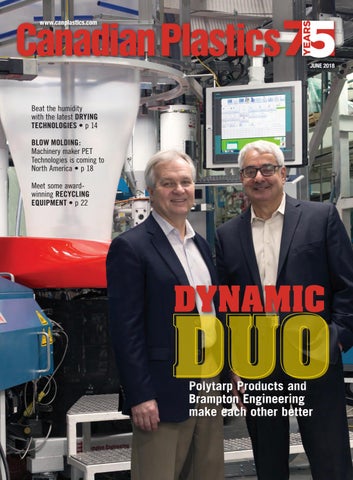
DYNAMIC
DUO Polytarp Products and Brampton Engineering make each other better
The POWER of Performance
NWB-DC+ Portable Dryer NOVATEC continues to lead the charge in reliable
• Web-enabled access
LO
• Most sold • Easiest-to-use smart controls
W
drying technology and industry-first innovations.
www.novatec.com
© Copyright 2018 NOVATEC, Inc.
T T O TA L C O
–5– YEAR
O
NOVATEC products are made in the USA. Supported worldwide.
ES
ST
Sold & Serviced in Canada by Maguire Products Canada, Inc. 905-879-1100 info@maguirecanada.com www.maguirecanada.com
warranty
F
OW
NERS
HI
P
contents JUNE 2018 VOLUME 77 • NUMBER 3
The March 1987 issue of Canadian Plastics broke the news about a brand new industry trade show in Canada: Expoplast. Owned and operated by the Society of the Plastics Industry of Canada – the forerunner of the Canadian Plastics Industry Association – the first staging of this first major Quebec plastics show was set for December 1-2, 1987, at Montreal’s Place Bonaventure. Expoplast 87 would receive partial funding from the Quebec government, and as of press time for our March 1987 issue, almost 50 per cent of the available 25,000 square feet of show space had already been booked by exhibiting companies.
Cover photo and pg. 3 photo taken by Janis Rees, Kaleidoscope Photography
FROM THE ARCHIVES
10
Number of the month:
56,034*
* The number of confirmed registered attendees at the NPE2018 trade show in May. (See pg. 6)
22
5 cover story
in every issue 4 Editor’s View:
Emission standards are becoming a Gordian knot
5 Ideas & Innovations: “ Infinitely” recyclable plastic
invented
6 News: • N PE2018: Supernova in the
Sunshine State
• Absolute Haitian building new
facility, partnering with Sepro in Canada and the U.S. • Dominion Colour merges with Lansco Colors • Supplier News and People 26 Technology Showcase 29 Classifieds 29 Advertising Index 30 Technical Tips:
There are no truly universal dies in extrusion. Here’s why.
10 DYNAMIC DUO: Polytarp Products and Brampton Engineering
P olytarp Products got its start – and its name – by making tarpaulins, and then became famous supplying plastic film for the construction industry. But the company has reinvented itself as a go-to supplier for high-barrier food packaging, and blown film machinery maker Brampton Engineering has been there every step of the way.
features
14 DRYERS: Canada dry
T he infamous Canadian humidex signals danger to resins, which will all absorb at least some moisture if left unprotected. Which is why keeping them dry is the best defense. These latest technologies are up to the challenge.
18 BLOW MOLDING: PET Technologies is crossing the pond
A fter almost 20 years of selling its blow molding machines and blow molds into Europe, the Middle East, and Asia, Austria-based PET Technologies has now set its sights on North America.
22 RECYCLING: Say hello to some award-winning innovations
W hat do equipment supplier Bulk Handling Systems, the Coca-Cola Co., and filter maker Fimic SRL have in common? They were all recognized as innovators at the 2018 Plastics Recycling Conference.
24 MOLDMAKING: Hands-on training program is taking off in Ontario
C alled the Mold Maker Level 1 program, the course represents a partnership between the Toronto chapter of the Canadian Association of Mold Makers and the Ontario Manufacturing Learning Consortium.
Visit us at www.canplastics.com June 2018 Canadian Plastics
3
editor’s view
Canadian Plastics magazine reports on and interprets developments in plastics markets and technologies worldwide for plastics processors, moldmakers and end-users based in Canada.
www.canplastics.com
Emission standards are becoming a Gordian knot
I
n Greek mythology, the knot of Gordian was impossible to untie. Anyone clever enough to do so would supposedly become the king of Asia. Many princes tried and they all failed. When Alexander the Great arrived, he was challenged to untie the impossible knot. Instead, the story goes, he pulled out his sword and cut through it. Problem solved. It’s too bad the same can’t be done to the increasingly complex issue of fuel emission standards. Corporate Average Fuel Economy (CAFE) standards approved by the U.S. Environmental Protection Agency in 2017 in the final days of the Obama administration forced automakers to nearly double the average fuel economy of new cars and trucks to about 50 miles (80 km) per gallon by 2025, or face fines of US$5.50 for each one-tenth of a mile-per-gallon their average fuel economy falls short of the standard for a model year, multiplied by the total volume of vehicles sold. And you can bet those costs would have been passed onto the U.S. consumers and that – since Canada currently follows American nationwide standards – our vehicle buyers would have been dinged as well. Which is why, with the current fleet average at just 25.2 miles per gallon in 2017, automakers – including Detroit’s Big Three – have argued the technology isn’t ready to keep up with such stringent mandates and have lobbied for them to be revisited. So when the Trump administration – in the person of EPA administrator Scott Pruitt – announced in April that the Obama CAFE standards were not appropriate and should be revised, there was much rejoicing. Gloria Bergquist, a spokeswoman for the Alliance of Automobile Manufacturers, said Pruitt made the right decision and that the administration was working on
4
Canadian Plastics June 2018
EDITOR Mark Stephen 416-510-5110 Fax: 416-442-2230 mstephen@canplastics.com
a way to both increase fuel economy and “keep new vehicles affordable to more Americans.” Not so fast, however. The Trump administration’s move was immediately challenged in federal court by a coalition of 17 states and the District of Columbia, which sued to block the revised standards. One of these 17 states is California, which holds a waiver from the EPA allowing it to set stricter standards than the federal limit through model year 2025. Making matters even worse, twelve other states – including New York and Pennsylvania – typically follow California’s lead on standards, and these combine to represent about one-third of the U.S auto market. The worry is that if California sticks to its tighter regulations, automakers might find themselves in the bad position of having to produce one set of vehicles for the Golden State – and the states that follow its strictures – and a second set for the remaining states. And that’s not even the biggest problem. In the end, a federal lawsuit will probably be needed to resolve the federal/state dispute, which could take years and leave automakers in regulatory limbo. Which is bad, since what automakers most want out of any new fuel economy standard is the consistency and predictability to allow them to make long-term plans. And that’s next to impossible at present. And for Canada, meanwhile, if the EPA does indeed succeed in rolling back its requirements, will the Trudeau government – no fan of fossil fuels – follow the now weaker U.S.-wide standards or adopt the stricter California rules? It’s a decision with huge implications and repercussions. Unfortunately for our industry, no one is going to cut this Gordian knot anytime soon.
NATIONAL ACCOUNT MANAGER Catherine Connolly 289-921-6520 cconnolly@annexweb.com ART DIRECTOR Mark Ryan ACCOUNT COORDINATOR Tracey Hanson 416-510-6762 thanson@annexbusinessmedia.com CIRCULATION MANAGER Aashish Sharma 416-442-5600 ext. 5206 asharma@annexbusinessmedia.com VP PRODUCTION / GROUP PUBLISHER Diane Kleer dkleer@annexbusinessmedia.com PRESIDENT & CEO Mike Fredericks PRINTED IN CANADA ISSN 008-4778 (Print) ISSN 1923-3671 (Online) Publication Mail Agreement #40065710 2018 SUBSCRIPTION RATES 6 issues Canadian Plastics, plus Dec. 2019 Buyers’ Guide: CANADA: 1 Year $75.50 plus applicable taxes; 2 Years $121.00+ taxes USA: US$132.50/year FOREIGN: US$151.00/year
CIRCULATION mchana@annexbusinessmedia.com Tel: 426-442-5600 ext. 3539 Fax: 416-510-6875 or 416-442-2191 Mail: 111 Gordon Baker Road, Suite 400, Toronto, ON M2H 3R1 Occasionally, Canadian Plastics will mail information on behalf of industry related groups whose products and services we believe June be of interest to you. If you prefer not to receive this information, please contact our circulation department in any of the four ways listed above. Annex Privacy Officer privacy@annexbusinessmedia.com • Tel: 800-668-2374 No part of the editorial content of this publication June be reprinted without the publisher’s written permission ©2018 Annex Business Media. All rights reserved. Opinions expressed in this magazine are not necessarily those of the editor or the publisher. No liability is assumed for errors or omissions. All advertising is subject to the publisher’s approval. Such approval does not imply any endorsement of the products or services advertised. Publisher reserves the right to refuse advertising that does not meet the standards of the publication. MEMBER: Magazines Canada, Canadian Plastics Industry Association.
Mark Stephen, editor
mstephen@canplastics.com
www.canplastics.com
ideas & innovations
“Infinitely” recyclable plastic invented Photo Credit: Bill Cotton/Colorado State University
A
ctress Shirley MacLean and other less celebrated believers in reincarnation think that human souls are perpetually recycled to return to life in other bodies. True or not – and we’re not eager to find out – it appears that plastic, at least, can be reused indefinitely. As reported in the April issue of Science magazine, a team of scientists at Colorado State University (CSU) have invented a new type of plastic which, when exposed to the right chemicals, breaks down into the same basic building blocks that it came from, meaning that it can – in theory – be recycled over and over again. The new plastic is designed to solve a major impediment to plastic recycling: Most plastics degrade into molecules that aren’t immediately useful. Transforming those molecules back into plastic or into some other product requires many chemical reactions, which makes the recycling process less efficient. And while biodegradable plastics have become popular in recent years, they break down only if the right microbes are present; more often than not, these plastics end up lingering in landfills or floating in the ocean. But designing an endlessly recyclable plastic polymer is a tall order. Polymers are long chains of small molecules – called monomers – that link together like beads on a string. Monomers that need extreme temperatures or too much chemical coaxing to join up into polymers might not be practical building blocks. And resulting polymers need to be stable up to a high enough temperature so that, for example, pouring hot coffee into a cup made of them won’t destabilize the chains and melt the plastic. Led by Eugene Chen, a professor in the Department of Chemistry at CSU, the scientists set out to solve this challenge. The team has had some luck in the past creating a polymer that could be broken down into its starting molecules. But the resulting plastics created by their lab, and others on the same track, were too soft and temperaturesensitive to have much practical use. In their most recent breakthrough, Chen and his colleagues modified one of their previous creations – a small ringed molecule – by adding another ring in a way that braced the molecule into a particular conformation. That rigidity helped the monomers quickly link together at room temperature into polymer chains that are heat-stable. Then, when exposed to certain mild chemicals or high enough heat, the polymers degraded back into monomers. The researchers were able to repeat this cycle several times, showing that – in theory, at least – the polymer could be infinitely recyclable. But the team isn’t home-free just yet. The new polymer technology has only been demonstrated at the academic lab scale, Chen said, but with the help of a seed grant from CSU Ventures the chemists are optimizing their monomer synthesis process and developing new, even more cost-effective
Eugene Chen’s lab at Colorado State University has developed a completely recyclable polymer, shown here.
routes to such polymers. They’re also working on scalability issues on their monomer/polymer/monomer recycling setup, while further researching new chemical structures for even better recyclable materials. The jury is still out on actual human reincarnation, CPL however.
June 2018 Canadian Plastics CPL_June_PCS.indd 1
5
2018-04-27 2:41 PM
news
NPE2018: Supernova in the Sunshine State
N
PE, the largest plastics show in North America, lit up Orlando, Fla. from May 7-11. And the third time at the city’s Orange County Convention Center (OCCC) was definitely the charm: The 2018 edition was the largest ever, with 2,174 exhibiting companies occupying more than 1.2 million net square feet of sold-out exhibit floor space. Attendance rose by 1.7 per cent over that of NPE2015 to 56,034 confirmed registered attendees. Dozens of Canadian companies exhibited at the show, from global heavy hitters such as Husky Injection Molding Systems and Brampton Engineering to small family-owned companies. And at the booths of many of the international exhibitors, Canadian sales reps were hard at it showing off new equipment and technologies and closing deals. “It was a great experience,” Steve Hamilton, CEO of Mississauga, Ont.-based equipment supplier Hamilton Plastic Systems, told Canadian Plastics during the show. “The booth set-up was very smooth and the show was very busy, with lots of our Canadian customers coming to our booth.” According to the Plastics Industry Association, which produces NPE, exhibiting companies came from 35 nations. In descending order, the ten countries with the largest number of exhibiting companies were the U.S., China, Canada, Taiwan, Italy, Germany, India, France, Turkey, and Switzerland. After a streak of 14 shows held in Chicago, the shift to Orlando for the 2012 show marked a cultural 180-degree turn – trading the House of Blues for Walt Disney World – but it seems to be working: Just before NPE2018 kicked off, the Plastics Industry Association announced that the next three editions of the triennial event – in 2021, 2024, and 2027 – will also be at the OCCC. Which probably sounds okay to most exhibitors. “We enjoy being in Orlando, and I’m really happy the show is returning here,” Hamilton said. CPL
Clockwise from top left: Canadian salespeople making a difference at the Absolute Haitian, Rotogran International, Maguire Products, Husky Injection Molding Systems, Piovan Group, and Wittmann Battenfeld booths.
After-hours socializing at the Lorenz Conveying Products booth (left) and the Canada Night event.
6
Canadian Plastics June 2018
www.canplastics.com
news
Absolute Haitian building new facility, partnering with Sepro in Canada and the U.S.
I
njection molding machine supplier Absolute Haitian Corp. is making some moves to improve its capabilities in Canada and the U.S. The Worcester, Mass.-based company, which is the exclusive sales and service partner of Chinese injection molding machine maker Haitian International, is expanding its operations to provide additional capacity and capabilities to support Haitian product lines. The expansion includes construction of a new 116,000-square-foot operations facility in Moncks Corner, S.C., which will provide for expanded sales, applicaCanadian Plastics tions, service, and training functions. Half Page - 4C “The new plant will provide enough space for stock machines and will allow us to pursue a range of domestic machine assembly options in collaboration with Haitian, based on the needs of the mar-
ket,” said Glenn Frohring, president and co-owner of Absolute Haitian. The facility is expected to be operational in 2019, Frohring added. The expansion comes on the heels of a major infrastructure project at Absolute Haitian’s Worcester headquarters facility that is now completed. Haitian International recently completed expansions in Mexico with a grand opening of a technical support centre in Tijuana, and additional service centres in Mexico are being planned. Absolute Haitian has also now partnered with robotic automation supplier Sepro America to make three-, five- and six-axis robots built by Sepro available with Haitian and Zhafir injection molding machines sold in Canada and the U.S. All robots will have a user interface based on Sepro’s Visual robot control
A Sepro robot integrated with a Haitian injection molding machine at NPE2018. Photo Credit: Absolute Haitian
that’s fully integrated and accessible from the IMM operator interface. “This integrated offering gets to the heart of the benefits customers will experience with Industry 4.0,” Frohring said. “It allows customers to select products that make sense for them, rather than being boxed into single-supplier solutions.” Absolute Haitian is represented in Ontario by Shadow Automation Inc. CPL
INDUSTRIAL SHREDDERS FOR PLASTICS bUilt to rUN 24 / 7
(336) 447-3573 • 5708 Uwharrie road, archdale, Nc 27263 • www.vecoplaNllc.com
news
Dominion Colour merges with Lansco Colors
T
oronto-based Dominion Colour Corp. (DCC), a global manufacturer of pigments, dispersions, and preparations for the coatings, plastics, and specialty ink industries, is merging with pigment supplier Lansco Colors. Both companies are owned by Miami, Fla.based private equity firm HIG Capital. Lansco is headquartered in Pearl River, N.Y. “Each of us brings our own complementary strengths,” Lansco president and CEO Donald Greenwald said in a news release. “By combining to create a broader global pigment provider, we will offer a range of organic and inorganic pigments, dispersions, and preparations that will be unmatched in the industry.” Greenwald and the Lansco management team will remain in place after the merger. Lansco has approximately 600 customers, mainly in the U.S. Founded in 1946, DCC has customers in 70 countries. In addition to its plant in Toronto, the company operates plants in the Netherlands and the U.K., as well as technical sales offices throughout the Americas, Europe, and Asia. CPL
Engel’s Wintec making moves in China and the Americas
I
n the first expansion since it was founded four years ago as a more standardized machine than its namesake Engel machines, Engel Austria GmbH’s Wintec subsidiary is beefing up its sales and service in China and North and South America. Wintec, headquartered in Changzhou, China, is now under new management. In April, Michael Peter Auinger Feltes transitioned from Engel’s headquarters in Austria to Wintec as president of sales and service. Feltes was most recently with the business unit packaging division at Engel’s headquarters in Schwertberg, Austria. Engel is also investing more than US$12 million Don Ivey into expanding capacity for Wintec’s Changzhou facility. The expansion, slated to start in the fourth quarter of 2018 and be completed a year later, will double the production area. Wintec was founded in 2014 by Peter Auinger. Initially only available in Asia, Wintec formally entered the Americas market at the NPE2018 trade show in May, and is also targeting the Middle East, Turkey, Africa, and India. Auinger is now taking charge of sales in the Americas, and injection molding machine sales veteran Don Ivey is the new director of sales for North America. Wintec’s offerings, including e-win electrics and two-platen t-win servo hydraulics, are targeted at standardized applications. CPL
PEOPLE Richard Altice
Andrew Hartline
Judson Lew
Alfred Stern
Kirk Winstead
–M innetonka, Minn.-based bioplastics supplier NatureWorks LLC has named Richard Altice as its president and CEO.
has named Alfred Stern as CEO effective July 2. He replaces outgoing CEO Mark Garrett, who is leaving the company.
– Norton Shores, Mich.-based equipment manufacturer Dynamic Conveyor Corp. has named Andrew Hartline as its new sales manager.
– Cranberry Township, Pa.-based auxiliary equipment maker Conair Group has appointed Kirk Winstead as its new president. He replaces Larry Doyle, who has left the company.
– Woodbridge, Ont.-based extrusion machinery maker Alpha Marathon Film Extrusion Technologies Inc. has appointed Judson Lew as its vice president of sales. – Robotic automation maker Sepro Group, of La Roche Sur Yon, France, has appointed Raul Scheller as managing director of its operations in North America. He will be based out of the Pittsburgh, Pa. area. – Vienna, Austria-based material supplier Borealis AG
8
Raul Scheller
Canadian Plastics June 2018
SUPPLIER NEWS
Calgary-based polyethylene supplier Nova Chemicals Corp. is partnering with M. Holland Co. and Osterman & Co. to expand its reach in North America. The two firms will distribute Nova’s butene linear low density polyethylene (LLDPE) in Mexico. www.canplastics.com
The New Choice in Gravimetric Blending
Made in USA
Gravimetric Batch Blenders Robust, Precise, Modular. Produced by Una-Dyn, a Piovan company
Model:Q12 with six stations
Advanced Design
Powerful Control
Utmost Versatility
Modularity, up to 6 Stations, with Precision Flow Gates/Augers
8.5� Touch HMI, 999 Recipe Storage
Easily Removable Supply Hoppers with Loaders in Place
On-board or Remote Positioning
Stainless Steel Fabrication, Applicable to all Processes
Integration with NEW FACS 4.0 and Winfactory 4.0 for Production Management and Materials Traceability
Cleaning of Weigh Hopper and Mixer in ONE Minute
Remote Mixer Version for Immunity to Strong Vibrations
New Patented Mixer Design for Best Homogeneity of the Blend
unadyn.piovan.com
cover story
DYNAMIC
DUO Polytarp Products got its start — and its name — by making tarpaulins, and then became famous supplying plastic film for the construction industry. But the company has reinvented itself as a go-to supplier for highbarrier food packaging, and blown film machinery maker Brampton Engineering has been there every step of the way.
F
rom Caesar and Cleopatra to the Coen brothers, history is filled with successful partnerships. And the key is that, while each is formidable on its own, the collaboration brings out the best in both parties. By this standard, the ongoing partnership between Polytarp Products and Brampton Engineering (BE) is one for the ages. With more than 90 years of combined business experience between them, this dynamic duo have prospered in a mutually productive relationship that dates back to the mid-1980s — and that has grown especially productive in the last decade. Headquartered in Toronto, Polytarp is an international supplier of PE film products — including single and multilayer sheeting, tubing, and bags — for businesses across a wide range of industries, from construction and food packaging to automotive, furniture, and agriculture. But it wasn’t always this way. Founded in 1957, the privately operated company transitioned into manufacturing plastic film for the construction industry, in which it became preeminent in Canada, particularly through its trademarked Super Six brand vapour barrier, which is sold from coast-to-coast. “The brand name Super Six became a generic name that everybody knows, like Tylenol,” said Polytarp president Steven Ghantous. Polytarp remains the largest supplier of vapour barrier in Canada, but 20 years ago the company decided to diversify into the food packaging industry. It was a transition that started slowly, and that didn’t require new machinery at first. “Food packaging was a simpler industry back then, and our early products were simple monolayer
10
Canadian Plastics June 2018
films that we could manufacture with the monolayer lines we already had,” Ghantous said. “These machines really weren’t designed for making food liners.” But the food packaging industry evolved, and multilayer film structures combining barrier, bulk, and sealant to provide high-barrier levels to oxygen, water vapour, aromas and flavours, and UV light quickly became the norm. Polytarp wanted to evolve as well, but in some ways it remained a victim of its own success: Even after 10 years in the food packaging sector, it was still perceived as a company that made construction film. So it doubled down. “We made a firm commitment 15 years ago to become a reliable supplier of high-barrier food grade packaging,” Ghantous said. To that end, the company hired a chemical engineer experienced in film structures to head up an R&D department. “A goal of this research was to create specific structures to manufacture higher barrier films, which keep food fresh during transport and enhance shelf life in the supermarket,” Ghantous said. “We also hired additional engineers and outfitted a state-of-the-art testing lab.”
A GOOD RELATIONSHIP GETS BETTER
And Polytarp also turned to BE. Headquartered in Brampton, Ont., BE had already been a go-to supplier for Canadian and international packaging companies for decades, providing multilayer air-blown and water-quenched film systems, film winding, and other film production technologies; and had been among the first to deliver complete 8-, 9-, 10-, and www.canplastics.com
All photos taken by Janis Rees, Kaleidoscope Photography
By Mark Stephen, editor
Brampton Engineering president and CEO Gary Hughes (left) and Polytarp’s Steven Ghantous seal the deal in front of the new fivelayer extrusion line.
cover story
The Polytarp staff.
11-layer blown film systems to the market. “We’d purchased machinery from BE in the past, but they now became virtually our exclusive equipment supplier during our upgrade,” Ghantous said. “First we purchased a seven-layer BE extrusion machine, and then four years later we added a nine-layer system. We also invested in new winders, because the way plastic film is rolled up is very important to our customers’ automated packing equipment.” Most recently, Polytarp just purchased a new five-layer extrusion line from BE, which became operational in March. Five-layer film has largely replaced three-layer film, according to Mike McAlear, BE’s director of sales for North America. “More and more blown film is going five-layer,” he said. “It allows you to better control costs by using more cost-effective materials and reducing the percentage of more expensive skin layers.” The new machine was necessary to keep up with increasing demand from Polytarp’s customers, Steven Ghantous said, and also positions the company for more growth going forward. “We cater to what our customers’ needs are, and they needed us to increase our capacity with the five-layer extruder,” he said. “But it will also allow us to go after new customers because it allows us to use harder, stronger polymers that provide better barrier properties and create clearer films.” Polytarp now operates 11 extrusion lines in its 115,000-square-foot facility, and has invested over $10 million in new equipment over the past decade, and its nine- and seven-layer machines each took an entire year to build and install. But the move to high-barrier film has involved more than just spending money. “It takes a lot of technical expertise, and there was a big learning curve involved in going from three layers to seven layers, especially because of the different raw materials you have to use, and then another learning curve in going from seven layers to nine layers,” Ghantous said. “But we have a very dedicated work force, and they rose to the challenge.” More than a few of Polytarp’s 135 employees have, in fact, worked one-on-one with the same Polytarp customers for decades, Ghantous said. “I started at Polytarp in 1984
and there are 15 employees with more seniority than me,” he added.
PAYING DIVIDENDS
The payoff on this huge, ongoing investment has been well worth it. “Some plastic companies are still making the same commodity products today that they were 30 years ago,” Ghantous said. “That‘s not Polytarp: We’ve diversified to the point where we’re almost unrecognizable compared to just 10 years ago. We still have some of the old, traditional products, but we have a lot of new products with the new investments we’ve made.” The team has even developed its own proprietary process for creating a thin, high-barrier plastic film that’s easily compatible with automated packaging equipment; and the resulting product is a good fit for the current needs of the meat packaging industry, Ghantous said. Polytarp has also cemented its relationship with BE. “Since we started dealing exclusively with BE 10 years ago, our sales have doubled,” Ghantous said. “We couldn’t have made this transition into making high-barrier food packaging without them. With every upgrade we’ve wanted to make,
Programming the new five-layer extrusion line. June 2018 Canadian Plastics
11
cover story
Fast Plastic Solutions With IMPROVING YOUR
Polytarp’s sales and service team. Standing, left to right: Roy Quast, Peter Nomm, Irving Kohl, and Nina Maidment. Marty Benkiel is in front.
they worked with us to determine what machine would be the best for the job, and then delivered it on schedule. And their service is outstanding.” And BE isn’t just after the biggest sale it can get. “If a BE machine can be upgraded by adding more extruders and blenders instead of having to add a completely new die, then that’s what they’ll recommend,” Ghantous said. “They don’t automatically push for the most expensive option, which is refreshing.” The relationship has actually become something of a two-way street over the years. “Polytarp has helped us on several occasions by acting as a beta site when we develop new technologies,” Mike McAlear said. “We tested our newest Vector air ring on one of Polytarp’s BE machines before we market launched it, for example. We didn’t want to have it tested overseas or at a plant that couldn’t protect our confidentiality. Polytarp could, and it was a win-win situation: We were able to work out the bugs in a real-world environment and Polytarp got the benefits of the Vector air ring when we finished developing it.” Polytarp has also allowed BE to bring prospective customers into the Polytarp facility for tours. “These tours let BE demonstrate what its machinery can do in a genuine production environment,” Steven Ghantous said. “As long as they’re not competitors of ours, it’s something we’re happy to do.” Even though Polytarp’s new five-layer extrusion line has only been running since this spring, the team is already considering the next move forward. “We’re not finished with our expansion and our investment in the food industry,” Ghantous said. “The food packaging sector is always changing, and we’ll keep changing with it. When someone is looking for a high-barrier food product, we want them to think of us, and it’s working: Thanks in part to BE’s expertise and help, our sales have increased significantly. BE has been a valuable resource for us, helping us to reach our goals. This is a great example of two successful Canadian companies relying on each other.” CPL
12
Canadian Plastics June 2018
PROFITABILITY WITH INNOVATIVE POLYMERIC MATERIALS AND ON-TIME DELIVERY
SUPPLIER OF MATERIALS FOR • INJECTION MOULDING • EXTRUSION • BLOW MOULDING • ROTO MOULDING • FILM Distributors quality products: Omni Plastics LLC, • Antimicrobial thermoplastics (Kills bugs) Biodegradable thermoplastics (Degrades in Landfill) • Black colour concentrates • Reprocessed post consumer thermoplastics
OmnilonTM OmniproTM OmnitechTM OmnicarbTM Many unique and specialized nylon 6 and nylon 6,6, polypropylene, ABS, PBT, PET/polycarbonate and polycarbonate/ABS compounds.
POUNDS OF PLASTIC INC. www.poundsofplastic.com 5650 Tomken Rd., buildings 1 & 2, Mississauga, Ontario L4W 4P1 PH: 905-286-9894 • FA: 905-625-8233 rpounds@poundsofplastic.com
Plastic manufacturers including the Polymerizers and the Converters are being blamed, unjustly in my opinion, for the floating plastic debris in the world’s oceans. There seems to be a movement to ban plastic. I believe this is related to ignorance on the part of Governments. The reason there is plastic floating in the oceans is due to people who are careless: They either have littered consciously or they have littered unconsciously. The good news is that the plastic rubble floats, which means that the collection is made up of plastic that has a specific gravity of less than sea water. The plastic floating debris seems to all come together. Could this facilitate easier collection? Let’s examine a plastic shopping bag and compare it to a paper bag. Cost of paper vs plastic bags: 1,000 Grocery Size Shopping Bags Paper Bags versus Plastic Bags – Real Numbers Shipping Total cost Diesel used
Paper bag $28.00 $258.00 0.58 gallons
Plastic bag $3.00 $38.00 0.06 gallons
To produce a paper bag, we (rhetorical) have to cut down a tree. On average, a tree intakes 21 kilograms of carbon dioxide annually. Once the tree is killed then it no longer breathes in carbon dioxide and breathes out oxygen. Paper bags are more costly to make (see above). Paper bag manufacturing consumes more energy than the energy to make a plastic bag. Fossil fuels are consumed. Paper bags, when they end up in the garbage, generally don’t get recycled. For cellulose fibre (bag make-up) to decompose, the fibres need to be in a dark, moist environment where they are exposed to microbes that can act upon the cellulose. In a landfill site where is there is lack of oxygen, if the other conditions are correct for decomposition the byproduct of decomposition is methane gas, which is colourless and odorless. Another name for methane is natural gas. This process is named anaerobic respiration. Landfills by their design are low-oxygen environments. According to Environment Canada, landfills are responsible for 20% of natural gas emissions in Canada. Methane is a greenhouse gas that and flexible is much more Rigid harmful than carbon dioxide as a cause PVC compounds. of “global warming.” Methane gas traps 21 times more heat in the atmosphere than CO2. Other gasses that are released from a landfill are other hydrocarbons and oxides of nitrogen. These also contribute to warming. Archaeologist Dr. W. Rathje “dug” landfills. In 1992, he excavated newspapers that were as easy to read as when they were put into the landfill 30 years prior. He
stated that paper tends not to biodegrade in landfills. He also found a disposed dish of guacamole that he stated was in almost edible condition. It was thought to have been 20 or 30 years old. Dr. Rathje concluded that the real issue in landfills is paper. He further stated that if all the plastic (plastic wrap and containers) and diapers were to disappear, the landfill operators would not notice. Paper accounts for 40% of the landfill volume. Paper has 16 times more volume than other waste. Please ‘google” www.nytimes.com1992/08/13nyregion/ seeking-the-truth-in-refuse.html PLA (polylactic acid) is marketed as “compostable”; PLA is not marketed as biodegradable. I understand this to mean items made from PLA in a landfill will, under the correct conditions, decompose. PLA will behave in a landfill as paper does. PLA items are not biodegradable plastics. PLA has a better chance of decomposing in a landfill versus PET, however. The good news about PET in a landfill is that it won’t degrade and will not produce greenhouse gasses. There is the difference between biodegradable and compostable. PLA is a great concept, but in reality it is not a solution. Landfills are not the answer to our garbage problem. In my opinion, incineration is. By burning our garbage, including plastic, we can create energy. Incineration reduces waste volume by 95%. Incineration reduces solid mass of the original waste by 80-85%. Incineration doesn’t reduce the need for dumping completely; however the land required to dispose of our garbage is much less. Ash is inert. Ash doesn’t react with others. Landfills take up a lot of space. Power can be derived from incineration of garbage. Plastics are hydrocarbons. Incinerators produce less pollution than landfills. A comparison study between two facilities (one landfill and one incinerator) consuming 1,500 tonnes per day yielded results that incineration was much more environmentally friendly. To get back to our floating plastic island, this situation is not good. I reiterate that much of the rubble could be lessened if people didn’t litter. People who litter are irresponsible; they are the problem, not the producers. That Barney Rubble; what an actor. However, being in the middle of the ocean, there is little impairment of UV light. UV light will degrade the island. The UV light will cause chain scission of the plastic molecules. The articles will become brittle, break up, and eventually disappear. For additional information on plastics in general and specifically nylon (NYLENIUM®) features and processing, please don’t hesitate to contact Richard Pounds at rpounds@ poundsofplastic.com or 905-2869894 ext. 22.
For Additional information on the degradation of thermoplastics please don’t hesitate to contact Richard Pounds. rpounds@poundsofplastic.com or 905-286-9894
TECHNICAL SOLUTIONS SERIES
WHERE DO MY BLUE BOX GOODS GO? FLOATING ON THE OCEAN
dryers
DRY
CANADA
The infamous Canadian humidex signals danger to resins, which will all absorb at least some moisture if left unprotected. Which is why keeping them dry is the best defense. These latest technologies are up to the challenge. By Mark Stephen, editor
T
here are boatloads of Canadian inventions we can be proud of: hockey, the telephone, and poutine are three celebrated examples. More dubious is the humidex. The term – short for humidity index – is a Canadian innovation first used in 1965, and coined for a very good reason: On the stickiness scale, some areas of Canada can feel more like the Amazon rainforest than the Great White North, especially during summer. For years, Southern Ontario earned the reputation as the humidex capital of Canada, with Quebec not far behind. And because these two epicentres of sweatiness are also the main plastics processing regions in Canada, it’s no mystery why effective resin drying is at a premium here, since all resins will absorb at least some moisture, leading to long-term loss in mechanical properties…and maybe a loss in business. The good news? In the long-running war against moisture absorption, victory isn’t coming – it’s here. These latest drying technologies can help you to turn the tide right now. Forewarned is forearmed.
PORTABLE AND INTUITIVE
A new generation of Conair Group’s Carousel Plus desiccant dryers – D series portable dryers and dX series mobile drying/conveying systems – are designed to offer superior resin drying performance together with advanced yet easy-to-use controls, high reliability and energy efficiency, and an innova-
14
Canadian Plastics June 2018
Novatec’s new NitroDry press-side resin dryer is targeted at sensitive resins. Photo Credit: Novatec Inc.
tive new air-to-air aftercooling option. The new dryers are based on a top-tobottom redesign of the Carousel Plus desiccant dryer architecture affecting portable dryers and mobile drying/conveying systems sized from 15 to 400 lbs per hour of throughput. “The new D and dX series dryers combine a new control interface with extremely reliable components that maximize performance, uptime, and energy efficiency,” said Alan Landers, Conair’s dryers product manager. “These are housed in a new, space-efficient chassis that saves floor space and offers easier, more direct access to key components and to user-serviceable items like filters.” Additionally, customers can specify
dryers equipped with either an optional air-to-water aftercooler or the new airto-air aftercooler; the air-to-air unit can sustain drying efficiency while handling return-air temperatures of up to 375°F (190°C), and dewpoints of -40°F (-40°C). “The air-to-air option also saves water, maximizes dryer portability, and makes installation and set-up faster and easier,” Landers said. Finally, the dryers use a new DC-C programmable electronic controller, which was developed specifically for drying applications. “The control uses software developed by Conair to maximize flexibility in adapting to current and future customer application needs,” Landers said. Tapping into Industry 4.0 buzz, DriAir Industries Inc. recently launched its Dri-Air Dryer 4.0, which uses internet capabilities to adjust to conditions and changes in the operation autonomously, gathering information and adapting on its own. For customers with multiple systems, a central dryer control can be installed that displays each dryer’s operating parameters and other important data. When a dryer needs servicing, an icon flashes to show what needs to be done, with directions for service and the parts required. The dryer’s control monitors motor performance, reporting this data to the main control. By using 4.0 wireless technology, the molder can compare cycle times among dryers, molding machines, and robots to determine the optimum cycle for the equipment. Dri-Air Dryer 4.0 also incorporates cyclonic removal of fines coupled with a visible collector of waste that notifies the customer’s maintenance team when it’s full, virtually eliminating filtration cartridges. As a new Dri-Air 4.0 dryer is installed, it’s automatically added to the group display, and the list of spare parts required
www.canplastics.com
dryers is updated. An inventory package that tracks and stores the spare parts is currently under development. A new intermediate-range model in Maguire Products’ VBD line of vacuum resin dryers expands the throughput capacity of these systems and also introduces an energy monitoring capability that the company will make available on all VBD models. “The VBD 600 dryer handles throughputs up to 600 lbs per hour, building out the VBD lineup and joining the VBD 150, VBD 300, and VBD 1000,” said Brian Davis, president of Maguire Products Canada Inc. “Maguire’s vacuum drying systems now have throughput capabilities ranging from 30 to 1,000 lbs per hour.” A new controller display on the VBD 600 dryer monitors energy consumption and enables processors to track usage over time. In the VBD series, gravity moves material through three vertically arranged drying stages – heating hopper, vacuum vessel, and material retention hopper – with material discharge to each stage controlled by high-speed slide gate valves boasting accuracy of ± four grams. The vacuum vessel and retention hopper are mounted on load cells that monitor the weight of material at these stages, controlling material consumption and documenting process conditions for certification to customers. For hygroscopic materials, a membrane purge option is available.
CONTROLLING TENDENCIES
Combined functions – drying and conveying – are the emphasis for Motan Inc. with its new Luxor E A and Luxor EM A mobile dehumidifying dryers for small throughputs or standalone applications, which can provide 60 to 150 litres of drying hopper volume. Luxor E A models can be integrated into existing conveying systems or equipped with a standalone material loader. Luxor EM A dryers with integrated conveying are self-contained mobile units. As standard, they have integrated drying and a side channel blower, as well as a small, monitored cyclone dust collection filter and bin. The Luxor EM A can control up to three Metro G material loaders – one to supply the drying hopper and up to two more to
using standard factory compressed air as a feedstock, and it vents air to the drying room. It also removes the danger of releasing a large quantity of pure nitrogen into the air, because the gas is produced only at the rate at which it’s needed. According to Mark Haynie, Novatec’s product manager for dryers, the technology is exclusive to Novatec and falls under the umbrella of the NovaDrier compressed air/membrane system patent. The NitroDry system comes with a five-year warranty, and is initially being made available in models with throughputs of 7, 25, and 50 lbs per hour.
MOVING AND LINKING
Maguire’s VBD 600 dryer handles throughputs up to 600 lbs per hour. Photo Credit: Maguire Products
supply processing machines. Optionally, Metro G loaders can be equipped with a Metromix proportioning valve, so that any regrind produced at the machine can be immediately returned to the production process. The dryers operate in a closed process in combination with temperature controlled regeneration, and also have an option for dewpoint controlled regeneration. Both dryer ranges come standard with the new LuxornetEM colour touchscreen control. Novatec Inc.’s new NitroDry pressside resin dryer is targeted at sensitive resins, especially nylons, polyurethanes, and PLA, which are highly susceptible to oxygen degradation from prolonged exposure to heat in the presence of oxygen. The degradation can impact strength, ductility, colour, viscosity, chemical resistance, stiffness, and stability. Traditionally, the problem was solved by using nitrogen to displace oxygen in the drying hopper, but nitrogen dryers usually require an external source for the nitrogen – often bulky tanks of the gas. By contrast, NitroDry generates its own nitrogen
Universal Dynamics, a Piovan SpA brand and the maker of the Genesys PET resin drying system, plans to more than double its production over the next three years by moving to a new North American headquarters in Fredericksburg, Va. by the end of this year, and begin to roll out new product lines by next year. The company budgeted US$10 million for the purchase, renovation, and expansion of the 88,000-square-foot building. UnaDyn’s previous headquarters was in Woodbridge, Va. The new highly automated “fresh slate” factory will allow the company to streamline component manufacturing, fabrication, welding, preassembly, and final assembly of auxiliary equipment, including dryers. The Genesys dryer, said to be the only auto-adaptive system available today, uses a variety of technologies – including loss-in-weight control, airflow management and stabilization, an intelligent regeneration process, and advanced industrial PC-based control – to ensure that highly hygroscopic PET resin doesn’t experience a rapid drop-off in intrinsic viscosity, which can be detrimental to the blow molding process of PET containers. And by integrating an automatic airflow control and adjustment to reduce energy consumption – coupled with the capability to stabilise the airflow in the drying hopper – Genesys is able to provide savings of up to 80 per cent when compared to traditional or current regeneration technology, Una-Dyn said. June 2018 Canadian Plastics
15
dryers For Plastics Injection Moulding
A Full Range of Robots One Unique Control
Sepro offers the industry’s widest choice of 3, 5 and 6 axis robots for machines from 20 to 5000 tons, plus advanced connectivity and new control developments to improve your moulding efficiency. With Sepro, the Future is Open 4.0
www.sepro-group.ca • 514 515-9349 seprocanada@sepro-group.com • @SeproGroup
16
Canadian Plastics June 2018
In another Industry 4.0-friendly development, the updated Aton plus H segmented wheel dryer from Wittmann Battenfeld now has the capability to link with the Wittmann 4.0 communication protocol, and can be connected with a Wittmann Battenfeld injection molding machine via a router and subsequently operated from the machine’s control system without any restrictions. With a 5.7inch colour touchscreen, the unit also features a chain-driven segment The updated Aton plus H segmented wheel dryer, a three-save wheel dryer from Wittmann Battenfeld. process, and an Eco- Photo Credit: Wittmann Battenfeld mode feature to optimize the drying process by eliminating unneeded regeneration cycles. “The three-save process involves an improved material heat-up phase so the ‘hot’ segment is fed directly, running dried air over the heater to utilize the entire element; and counterflow regeneration, heating the desiccant in reverse direction to the process airflow,” said Nick Paradiso, Wittmann Battenfeld’s division manager for materials handling and auxiliaries. “The goal is to select the optimal temperature range for regenerating the desiccant, thereby improving the machine’s efficiency.” The bottom line? Consider arming yourself with some of these latest technologies and you can keep your resins dry no matter how nasty the humidex gets. CPL RESOURCE LIST Conair Group (Cranberry Township, Pa.); www.conairgroup.com; 724-584-5500 D ier International Plastics Inc. (Unionville, Ont.); www.dierinternational.com; 416-219-0509 I ndustries Laferriere (Mascouche, Que.); www.industrieslaferriere.ca; 450-477-8880 T urner Group Inc. (Seattle, Wash.); www.turnergroup.net; 206-769-3707 Dri-Air Industries Inc. (East Windsor, Conn.); www.dri-air.com; 860-627-5110 M aguire Products Canada Inc. (Vaughan, Ont.); www.maguirecanada. com; 905-879-1100 Maguire Products Canada Inc./Novatec Inc. (Vaughan, Ont.) Barway Plastic Equipment Inc. (Vaudreuil-Dorian, Que.); www.barway.ca; 450-455-1396 Motan Inc. (Plainwell, Mich.); www.motan-colortronic.com; 269-685-1050 Piovan Canada (Mississauga, Ont.); www.piovan.com; 905-629-8822 Wittmann Battenfeld Canada Inc. (Richmond Hill, Ont.); www.wittmann-group.com; 905-887-5355
www.canplastics.com
blow molding
All photos courtesy of PET Technologies GmbH
The new all-electric APF-Max.
PET Technologies
is crossing the pond
After almost 20 years of selling its blow molding machines and blow molds into Europe, the Middle East, and Asia, Austria-based PET Technologies has now set its sights on North America. By Mark Stephen, editor
S
tarting with Christopher Columbus in 1492, there’s been a trend: Europeans cross the Atlantic and make a splash in North America. Neunkirchen, Austria-based PET Technologies GmbH, a manufacturer of blow molding machines and blow molds, wants to keep that trend going. Founded in 1999, the company’s equipment has been installed in more than 40 countries in Europe, the Middle East, and Asia; and now, with the development of its new APF-Max stretch blow molding machine with four-, six-, and eight-cavity configurations and output up to 14,000 bottles per hour, PET Technologies is determined to make its mark in Canada and the U.S. The all-electric APF-Max can blow containers from 200 ml to three litres for the beverage, health care, cosmetic, dairy, beer, and other markets, and offers a wide range of
PET Technologies’ plant in Chernihiv, Ukraine, bedecked with balloons on opening day.
18
Canadian Plastics June 2018
neck sizes from 18 to 48 mm. According to Vladimir Tsallagov, PET Technologies’ export director, the APF-Max was designed with the North American market specifically in mind. “North American custom blow molders have unique demands, primarily the need for flexible changeover of neck and preform sizes, and sometimes bigger capacities and higher speeds than the European market requires,” he said. “The APF-Max gives them this flexibility by offering something unique: it can have four, six, or eight cavities on the same platform, which means that customers can start with four cavities and upgrade to six and then eight as their production needs grow. Fifteen minutes are enough to change the blow mold and start to produce another bottle format, which makes it ideal for medium-size custom blow molders.” And to reduce energy use, Tsallagov continued, the APFMax has a short-wave near infrared heating system. Although not a common heating method for PET blow molding machines, it makes preform heating more efficient and consumes less power, Tsallagov said. “In the eight-cavity version, which can make up to 14,000 bottles per hour, the total installed power on the machine is 140 kW, which is very low,” he said. “And the oven itself is significantly shorter than on other machines, making for a more compact footprint.” The APF-Max is also priced to be more than competitive with the rest of the market. “It can cost up to 40 per cent less than similar blow molding machines,” Tsallagov said. Another prong in PET Technologies’ expansion strategy involved finding a North American sales representative. The company signed on the dotted line with Chicago-based Sopro Machinery LLC 18 months ago, which is its exclusive distributor in Canada and the U.S. “We did the market research and found the right sales partner in Sopro,” Tsallagov said. “Our machines arrive in North America in two modular pieces that fit together. Sopro will stock all critical parts.” www.canplastics.com
blow molding MAKING PROGRESS
And the push into the Americas is already beginning to pay off. “We’ve sold several machines to some South American blow molders, and several into North America as well,” Tsallagov said. Among the latter were two of the company’s fourcavity APF-6004 blow molding machines purchased last year by plastic drink bottle molder Triumbari Corp., of Bolton, Ont. “We were looking to add capacity and bought an APF-6004 machine that PET Technologies custom built for us,” said company president Joe Triumbari. “We were very happy with it, and so we purchased a second APF-6004 shortly after. Each machine can make 6,000 bottles per hour. They’re just what we needed, and the service is excellent.” PET Technologies’ foray into North America is just the latest development during a busy time for the company. “We opened a new 4,000-square-meter manufacturing plant in Chernihiv, Ukraine a few years ago,” Tsallagov said. “The facility has two R&D departments: one for machines and one for molds. And then in January 2018 we opened an adjoining 1,500-square-meter, two-storey office complex.” While PET Technologies’ machines are designed at the company’s headquarters in Austria, all the parts are produced and assembled in Chernihiv. “We don’t outsource anything,” Tsallagov said. “We do all the manufacturing and assembling of machines ourselves.” To further emphasize its arrival on the North America
In Canada ...
The APF-6004.
scene, PET Technologies also exhibited at the NPE trade show, in May, for the first time. The only disappointment? “We didn’t have an APF-Max at our booth at NPE because the demand was too great: The first machine was sold to a customer in the Ukraine and the next one in production is going to a customer in Russia,” Tsallagov said. “But it was already displayed earlier this year at the Drinktec trade show.” Instead, PET Technologies exhibited its APF-3002 automatic stretch blow molding machine. “It has an output of 3,000 PET bottles per hour from two cavities, and is capable of producing original shapes and designs,” Tsallagov said. “Our company is interested in the future – we’ve done the prep work and are ready to expand into North America, and we hope that exhibiting at NPE2018 sent that message to the industry.” CPL
905-895-9667
1228 Gorham St, Newmarket, ON L3Y 8Z1, Canada
June 2018 Canadian Plastics CPL_June_Chillers.indd 1
19
2018-05-29 2:39 PM
blow molding
I
f you made a pit stop in the Beer Garden section of the Bottle Zone during the recent NPE2018 trade show in Orlando, Fla., you might want to thank W. Amsler Equipment Inc. for that cold one you enjoyed. In what was a deeply collaborative project, the Vaughan, Ont.-based blow molding machine manufacturer oversaw all design, technical, and manufacturing work for production of 12-ounce long-neck craft beer bottles, which were filled off-site in Orlando. First, Amsler reached out to its mold partner Mold Spec, headquartered in Stoney Creek, Ont., which utilized its own patented base for the bottle. The bottle design was then approved by Florida-based
Orlando Brewing, which had a preexisting arrangement to supply beer in glass containers to the Orange County Convention Center, and was also reviewed by other brewers in Canada and the U.S. The 12-ounce, 36-gram preform was designed by Amsler with assistance from injection molding machine maker Athena Automation Ltd., which is also headquartered in Vaughan. The preform was designed to accept a standard metal crown closure, and was optimized for the required axial and diametrical stretch ratios as well as core and cavity draft for preform molding. Preforms were designed by Amsler to run on Athena equipment at its Ontario location.
Photo Credit: W. Amsler Equipment Inc.
W. Amsler helped brew something special at NPE
For the barrier material, Amsler selected a monolayer structure with a barrier additive which would allow the molding of PET preforms on virtually any injection molding machine equipped for PET. Amsler used its single-cavity PET stretch blow molder to produce bottles for the NPE show; the 12-ounce barrier bottles were amber, with colour from Italy-based liquid colourant producer Repi SpA. CPL
4 SIMPSON 4 SIMPSON ROAD ROAD 4 SIMPSON ROAD ON,BOLTON, L7E 1G9,ON, CANADA BOLTON,BOLTON, ON, L7E 1G9, CANADA L7E 1G9, CANADA For your rep.your or quotation, please call: please call: area rep.area or quotation, please For area rep.call: or quotation, Visit us: For your Visit us: Visit us: (905) 738-0101 Fax: (905) 738-5750 Tel:booth (905)Tel: 738-0101 Fax: (905) 738-5750 Tel: 738-0101 Fax: (905) 738-5750 booth #W6492 booth #W6492 #W6492 www.rotogran.com www.rotogran.com www.rotogran.com
20 
Canadian Plastics  June 2018
CPL_June18_Rotogran.indd 1
www.canplastics.com 2018-06-04 2:31 PM
COLD START TO DRY POLYMERS IN JUST 35 MINUTES!
STAGE 1 - HEAT
Faster & Less Energy
Dries resin six times faster than desiccant dryers and uses 60% less energy.
Zero Maintenance
Unique, patented 3-stage drying technology.
Smart Drying
Load cell control matches the drying rate to the process rate.
STAGE 2 - VACUUM
VBD-150
Delivered anywhere in the US within
2 WEEKS
STAGE 3 - BLANKETED RETENTION HOPPER
No Material Degradation High speed, no stress drying.
GET YOURS IN TIME FOR DRYER SEASON!
MODELS AVAILABLE:
VBD-150 / 300 / 600 / 1000
recycling
SAY HELLO TO SOME
AWARD-WINNING
INNOVATIONS By Mark Stephen, editor
A
sure sign the plastics recycling industry has finally entered the big leagues is the fact that it now has its own awards. Think the Academy Awards minus the red carpet dresses and long-winded speeches. During the 2018 Plastics Recycling Conference, held last February in Nashville, Tenn., the Association of Plastic Recyclers (APR) recognized three innovators selected for the 2018 APR Plastics Recycling Showcase during the APR Technical Forum. “For the third year running, the program commended innovators that address technical challenges facing plastic recyclers,” John Standish, APR’s technical director, told the crowd. “Innovation drives the growth of recycling and is essential to the success of the plastics recycling industry.” You bet. So here’s a look at who won for what.
1
22
Canadian Plastics June 2018
Photo Credit: Bulk Handling Systems
Recycling equipment maker Bulk Handling Systems, of Eugene, Ore., won for its Max-AI artificial intelligence t e c h n o l o g y, which identifies materials, makes intelligent decisions, and directs equipment such as robotic sorters. “Through deep learning technology, Max-AI employs both multilayered neural net-
works and a vision system to see and identify objects the way a person does,” APR said. According to Bulk Handling Systems, the technology is driving improvements in MRF and PRF design, operational efficiency, recovery and purity, system optimization, and maintenance. The Max-AI Autonomous Quality Control (AQC) system combines this intelligent technology with a robotic sorter to pick-and-place up to six different material types in one location. “The AQC outperforms manual sorting in this role, consistently making smart decisions and 65 picks per minute over multiple shifts,” the company said.
2
The Coca Cola Co. won for its collaboration with Indorama Ventures PLC – a global PET resin supplier based in Bangkok, Thailand – and CKS Packaging of Atlanta, Ga., a developer and manufacturer of rigid plastic containers. The end result is Coca Cola’s 89-ounce bottle of Simply Orange brand, which has been converted to Indorama Ventures’ 5507 material, an APR-recognized grade of extrudable PET. This now allows the package to carry the recycle code #1 symbol, which communicates its compatibility with the PET recycle stream. “This conversion represents the first commercial application of this new grade of extrudable PET designed and developed for use on shuttle extrusion blow molding equipment,” APR said. “The label also features an adhesive that can be removed during the recycling process.”
Photo Credit: Coca Cola Co.
What do equipment supplier Bulk Handling Systems, the Coca-Cola Co., and filter maker Fimic SRL have in common? They were all recognized as innovators at the 2018 Plastics Recycling Conference.
www.canplastics.com
Photo Credit: Fimic SRL
recycling
3
Italy-based Fimic SRL, a supplier of automatic selfcleaning melt filters particularly suitable for heavily contaminated molten plastics, won for its RAS continuous melt filter, which is said to guarantee the filtration of any contamination type, even the most aggressive. According to APR, the filter features a unique scraping system acting on either a punched or laser-drilled filtering disc screen. “Two blades made of flexible steel scrape the perforated screen and collect the contamination from the screen into the scraper’s chambers,� APR said. Traditionally, in order to protect a costly part like the laser screen, a “safety filter� is often needed. Instead of installing two separate filters with a melt pump between them – or even two separate extruders – Fimic created a double filtration chamber in only one filter body. “The first chamber can be equipped with a less expensive punched screen to remove the coarser and often the most dangerous contamination, while the second chamber – placed just after the first one in the same filter structure – can be equipped with a laser screen for very fine filtration (80 micron/160 mesh to 250 micron/60 mesh),� APR said. CPL
bacteria found in Japan; when they bombarded it with X-rays, they caused it to mutate into something even more powerful. Called Ideonella sakaiensis 201-F6, this new enzyme is able to effectively break down PET, one of the most popular forms of plastic employed by the food and drink industry. Bottles made from PET are used to package almost 75 per cent of the soft drinks, fruit juices, and mineral waters sold in shops and supermarkets; and while often described by industry as highly recyclable, discarded PET actually persists for decades in the environment before degrading, clogging up landfill sites and the world’s oceans. “Although the improvement is modest, this unanticipated discovery suggests that there is room to further improve these enzymes, moving us closer to a recycling solution for the ever-growing mountain of discarded plastics,� said Dr. John McGeehan, a lead scientist on the project. Significantly, the enzyme can also degrade polyethylene furandicarboxylate, or PEF, a bio-based substitute for PET that’s often used as a replacement for glass beer bottles. “The engineering process is much the same as for enzymes currently being used in bio-washing detergents and in the manufacture of biofuels,� McGeehan said. “It’s very possible that in the coming years we’ll see an industrially viable process to turn PET – and potentially other substrates like PEF, PLA, and PBS – back into their original building blocks so they can be Hot Runner - SITC15 0418cp2.FH10 Mon May 07 14:24:46 2018 sustainably recycled.� CPL C M Y CM MY CY CMY K
SITC15 ACE SERIES
HOT RUNNER CONTROL
THIS PLASTIC-EATING PROTEIN MIGHT JUST CHANGE EVERYTHING
It sounds like the rejected plotline for a Godzilla movie: Two years ago, researchers stumbled across a mutant plastic-eating bacteria that had evolved in a Japanese trash dump. But instead of terrorizing an entire populace, this bacteria might just have a positive impact: British scientists are now hoping that an enzyme derived from it will revolutionize recycling and help solve the growing problem of PET bottle litter. The first known protein capable of digesting PET, the enzyme was created by researchers from the U.K.’s Portsmouth University who were conducting tests on the naturally occurring
Page 1
• • • • • • • • • • •
Â
 � � � � �   € ‚ƒ„ … †
Œ€ �
$160.00 each
PLASTIC PROCESS EQUIPMENT, INC.  Â? Â? Â?Â?Â? Â?    Â? Â? Â?Â?Â?   Â? €  ‚ Â?  Â?Â? Â
‹
ƒƒ „ … ƒ † ‡ ƒ ˆ ‰�� �  � � �  Š‚ �  � � €  ‚ � � ��
�� � ‡ „ ƒƒ  � �� � �  Š � �� � � €  �  � �
June 2018  Canadian Plastics  CPL_June2018_PPE.indd 1
23
2018-05-08 1:43 PM
moldmaking
HANDS-ON
IS TAKING OFF
IN
Called the Mold Maker Level 1 program, the course represents a partnership between the Toronto chapter of the Canadian Association of Mold Makers and the Ontario Manufacturing Learning Consortium. By Mark Stephen, editor
D
oes Canada’s moldmaking industry have a problem attracting skilled young workers? That’s like asking if Elvis had a problem with too many cheeseburgers. As the industrial work force turns increasingly grey, the shortage of skilled young workers has become a top concern for Canada’s moldmaking sector, with many shop owners saying the lack of talent is hindering the growth of their companies. How bad is it getting? A recent survey by the Ontario Skilled Trades Alliance reported that 41 per cent of moldmakers would hire more people if they could find those with the skills they needed. Which is why the Toronto chapter of the Canadian Association of Mold Makers (CAMM) is partnering with the Ontario Manufacturing Learning Consortium (OMLC) to implement a new on-the-job training program designed to fill entry-level positions at CAMM Toronto member companies throughout the GTA. Called the Mold Maker Level 1 training program, the program is the brainchild of Rod Jones, the OMLC’s manag-
24
Canadian Plastics June 2018
ing director. Previously the executive director of the Ontario Aerospace Council, Jones founded the OMLC four years ago with the mission of pioneering a new way of filling critical entry and mid-level skills gaps in Ontario’s manufacturing workforce. The OMLC works with a training institute and comprises four industry associations in the aerospace, tooling and machining, nuclear, and manufacturing sectors; the Ontario provincial government also kicks in some funding. “Historically, industry has not taken the role that it must do if we’re going to bring about good training programs, and we’re trying to change that,” Jones said. “Our system involves work-based learning – mostly through hands-on experiential learning on the shop floor – and is a fast, reliable, and efficient way for companies to get the skilled employees they need; for the trainees, meanwhile – who usually have little or no relevant work experience and often limited educational achievement – it’s a good way to start them towards rewarding, long-term careers in
advanced manufacturing.” With support through Ontario’s Youth Skills Connections program and the Canada-Ontario Jobs Grant program, the OMLC has created programs to select, hire, and train over 380 young people as CNC machinists, CNC operators, and CMM operators in over 45 companies so far. “The certification and continuing employment rate for our completing trainees is between 85 and 90 per cent, which is remarkably high considering these are young people in their late teens and early twenties, most of whom have never worked in manufacturing and many of whom have only a high school diploma or less,” Jones said.
CAMM SIGNS ON
Jones first reached out to CAMM in early 2018. “I asked them if they were having challenges attracting skilled labour, and they said yes,” he said. “We decided to lobby the government together, and were able to get funding.” Next, Jones and CAMM Toronto leadwww.canplastics.com
moldmaking ership met with some CAMM Toronto members in March at the headquarters of Athena Automation Ltd., in Vaughan, Ont. “We presented the Mold Maker Level 1 program to the members and explained to them what participating companies have to do,” Jones said. First, the moldmaker has to agree to an interview with a candidate who has passed the OMLC’s validated candidate selection process. “Once a trainee is in place at the participating mold shop, the shop then has to follow our training guidelines and system; provide dedicated time for a trainer or coach to assist the trainee; use our learning contract system to manage the trainee’s hands-on learning; and provide access for periodic visits by an OMLC assessor,” Jones said. The shop also has to pay the full training fees at the start of the program, which represents an investment of $15,000. “Canada-Ontario Jobs Grant payouts to the company, via CAMM, will be $8,500 after three weeks and $1,500 after completion, and a training
provider will pay another $3,000 in cash to the mold shop after the trainee has been certified as a Mold Maker Level 1,” Jones said. The program – which involves between four and six weeks of classroom training followed by approximately 22 weeks of on-the-job training – requires a minimum of 15 CAMM member companies to commit to taking on one or more trainees before it can begin. “We already have several shops that have signed on, and I’m confident we’ll have the others we need in time to begin the program by this summer,” Jones said. “To me it’s obvious: The best place for people to learn skilled trades is on the shop floor. When it comes to learning tooling and machining, it never made sense to me to have schools buying expensive pieces of CNC equipment that are underutilized. Why not send the trainees directly to the mold shops, where the equipment and the trained workers already are?” CPL
CLICK ON...
for interviews with industry experts, coverage of plastics industry events, and more!
New episode every month. These 5-minute information packed videos are produced by the editors of Canadian Plastics. To view them, go to our web site,
www.canplastics.com and scroll down to canplasticsTV SPONSORED BY:
PLASTICS CONVEYING ONE STOP SHOP Our industry leading quality can’t be beat, and same goes for our delivery times! Couplings, Elbows, Fittings, Cyclones, Diverter Valves and Gates. We manufacture it all!
#LorenzQuality #LorenzConveying
USA 1.800.263.7782 CANADA 1.800.263.1942 June 2018 Canadian Plastics
CPL_June2018_Lorenz.indd 1
25
2018-06-01 9:27 AM
technology showcase
AUXILIARY EQUIPMENT Industry 4.0 platform turns plastics process data into action New from Conair Group, SmartServices is an Industry 4.0 platform for plastics processors that combines powerful equipment monitoring and visualization functions with advanced cloud-based data storage and analytics to achieve new levels of process performance and quality optimization, predictive diagnostics and maintenance, and maximum equipment uptime. The SmartServices offering is straightforward, starting with compact wireless machine adapters (WMAs) that are installed in the controls of each piece of auxiliary equipment, and a connection to the web-based SmartServices platform. Upon login, users identify and configure their auxiliaries into the system, organizing them by equipment type, plant names, production lines, physical locations –
THE NEED FOR SPEED Are changeovers slowing you down? Win back precious time with Dyna-Purge! Our commercial purging compounds clean on the first pass, minimizing machine downtime to maximize your productivity. Plus, only Dyna-Purge provides product and technical support built on over 30 years of innovation. Our customers enjoy the industry’s most effective purging product, outstanding customer service and reliable results. Request a free sample of Dyna-Purge and see for yourself. Discover the Difference. 866-607-8743 www.dynapurge.com DYNA-PURGE is a registered trademark of SHUMAN PLASTICS, INC.
26
whatever customized format fits their operation. Once enabled, WMAs automatically collect data from each piece of auxiliary equipment and transmit it into the secure, cloud-based SmartServices database, where it’s processed and stored for presentation to the user. The Conair SmartServices web portal streams user data into a dashboard format, providing a clickable list of the userspecified equipment groups on one side and a large working screen on the other. Within the dashboard, users can rapidly navigate to a selected equipment group and then drill down to key performance indicators for each piece of equipment. The platform also gives processors the option of integrating Conair parts and service staff into the alarm routing protocol, enabling them to respond proactively by offering troubleshooting assistance, recommending spare parts, or even initiating a service call. Conair Group (Cranberry Township, Pa.); www.conairgroup.com; 724-584-5500 Dier International Plastics Inc. (Unionville, Ont.); www.dierinternational.com; 416-219-0509 Industries Laferriere (Mascouche, Que.); www.industrieslaferriere.ca; 450-477-8880 Turner Group Inc. (Seattle, Wash.); www.turnergroup.net; 206-769-3707
INJECTION MOLDING
Machines for mid-to-large part molding The new Zhafir Jenius series from Absolute Haitian is designed for molders seeking an energy-efficient solution for mid-to-large part precision molding. The Jenius series combines the advantages of proven electric screw drive technology from the Zhafir brand with the compact two-platen clamp design and servo-hydraulic clamp movement from the Haitian Jupiter series. The result contributes to the molder’s bottom line with a short footprint for higher productivity per square foot of floor space (twoplaten design), a high-precision all-electric injection unit, greater repeatability for uniform part weight with less than 0.1 per cent variation between cycles, and standard capability allowing for independent screw recovery during clamp open and close to reduce cycle time (parallel functioning). The Jenius series is available in tonnages ranging from JE 4,500 to JE 33,000 kN clamp force (506 to 3,709 tons). Absolute Haitian (Worcester, Mass.); www.absolutehaitian.com; 508-459-5372 Shadow Automation Inc. (Uxbridge, Ont.); 416-464-2070
Canadian Plastics June 2018
CP_NeedForSpeed_Resized.indd 1
www.canplastics.com 2017-02-23 9:10 AM
technology showcase
Expanded series for thin-wall packaging
Netstal is expanding the lower end of its Elios series with versions featuring clamping forces of 4,500 kN and 5,500 kN. The Elios 4500 has a stroke of 574 mm and a dry cycle time of 1.5 seconds according to the Euromap norm, and the Elios 5500 has a dry cycle of 1.7 seconds at a stroke of 644 mm. A dual-toothed rack drive with a highly dynamic, watercooled servo motor is used for the purely electrical movements. Two synchronous cylinders, which feature a parallel alignment, assist with building up clamping force and the five-point dual toggle lever, which is moved via a central crosshead with drive elements that act simultaneously. Due to the optimized toggle lever geometry, the clamping unit of the series is particularly energy-efficient, and offers ideal conditions for the recovery of the movement energy. The kinetic energy generated during braking processes flows into the electric motor of the main drive, where it’s converted into hydraulic energy and stored, requiring 50 per cent less energy compared to conventional designs. The Elios series now comprises four main versions with clamping forces of 4,500, 5,500, 6,500, and 7,500 kN.
Netstal (Florence, Ky.); www.kraussmaffei.com; 859-283-0200
BLOWN FILM Expandable die from five to 17 layers
New from Kuhne Anlagenbau GmbH, the Mo-Con modular concept blown film die is a stackable die that’s expandable from five to 17 layers, and features unique design concepts that set it apart from all other modular concepts in the market. The Mo-Con die can be used on any type of blown film line: triple bubble, water-quenched, and conventional aircooled blown film lines. Instead of using totally flat pancake style modules like other stackable dies, the spirals are machined in a cone at the centre of the Mo-Con modules. This feature allows the die body to be more compact, and orients the melt flow in a very shallow angle to merge with the other layers. The binary distribution is still done on the flat portion of the modules, as
CREATIVE
Recy
cle
RECYCLING
S ! EA D he re I t rn ea gr e bo ar
Add Value to Your Scrap.
Struktol Company of America creates cutting edge additive solutions for recycled polymers. • Odor / Volatile Reduction & Control • Viscosity Modification & Lubrication • Mixing / Blending / Homogenization We help our customers develop value-added, high-performance upcycled compounds opening a wide window of feed stream options.
Struktol Canada, Ltd. | Uxbridge, Ontario | Canada Call us at 416.286.4040 email us at strukcansales@bellnet.ca or visit us at 4struktol.com
CPL_June18_Struktol.indd 1
June 2018 Canadian Plastics
27
2018-04-25 3:37 PM
technology showcase
in the conventional flat pancake dies. In the Mo-Con die, both sides of the modules are machined in order to keep the die compact in height. Additionally, the melt is fed into the centre of each module instead of between two modules or plates, allowing for a straightforward assembly of the melt adaptor to the die. Kuhne Group USA (Charlotte, N.C.); www.kuhne-group.com; 980-417-2722
Next-generation machine for wide range of PET bottle making A next-generation, four-cavity all-electric reheat stretch blow molder from W. Amsler Equipment Inc. offers several new features, including preferential heating, neck orientation, and hot-fill capabilities to enable PET bottle production in a range of configurations and sizes. The L42X reheat machine has four parallel heating ovens – one for each cavity – and comes equipped with 12 Bosch Rexroth servo motors, compared to three servos for the previous model. The extra servos provide more repeatability; lower energy consumption; and require less wiring, which results in easier troubleshooting. Other key features include agitated preform infeed to prevent bridging, preform temperature sensing prior to blow, pre-blow flow control for each cavity, water-cooled neck shields, and a large touchscreen operator interface. Servodriven stretch rods are 14 mm, with 10 mm and 12 mm options. The L42X comes equipped with a large touchscreen operator panel from Wonderware. It has a Windows-based HMI with full access to assembly drawings, bills of materials, set-up guides, troubleshooting, and training videos. The new machine can manufacture up to two-litre containers at a rate of 6,500 per hour in four cavities. It can also be used to run two-cavity molds for production of larger containers up to five litres.
28
Canadian Plastics June 2018
CPL_June_Balzanelli.indd 1
W. Amsler Equipment Inc. (Richmond Hill, Ont.); www.amslerequipment.com; 905-707-6704
SIZE REDUCTION Large diameter cutting rotor handles bulky scrap
One of Vecoplan LLC’s new generation of plastics shredders, the VAZ 1600 M XL incorporates a wide range of innovations that improve performance, increase durability, and decrease maintenance time, and is specifically designed to process oversized, bulky scrap in heavy duty applications. With a large diameter cutting rotor, the VAZ 1600 M XL has features and options that include direct shaft drives, double sidewalls, reversible counter knives, hydraulic swing-up screen carriages, rotatable screens, and externally adjustable counter knives. Direct shaft drives eliminate drive belts, lower maintenance costs, and decease overall machine base widths. Double sidewalls reduce wear, eliminate contamination of and heat transfer to the bearings, increase durability, and lower maintenance costs. Reversible counter knives deliver twice the life while cutting replacement costs in half. Hydraulic swing-up screen carriages provide quick and easy access to the rotor for cutter replacements, tramp metal removal, and other routine maintenance. Rotatable screens can be turned 180 degrees, increasing wear life by a factor of 1.5. Externally adjustable counter knives allow users to obtain optimal cutting tolerances quickly and easily, which is especially beneficial when shredding films and other thin materials. Vecoplan LLC (Archdale, N.C.); www.vecoplanllc.com; 336-861-6070 Greg Parent; 416-678-0154
www.canplastics.com 2018-05-09 12:45 PM
technology showcase
PROCESS COOLING
MATERIALS
Pump system now available with advanced controls
Stabilization technology for polyolefins
A new pump system control from Thermal Care Inc. is designed to offer users multitask capabilities that can expand as their business grows. The controller can accommodate up to 15 pumps and eight cooling towers, including variable frequency drives for each, all without outside programming from the factory or new software required. With three process zones, each with up to four fluid circuits, Thermal Care’s pump system is easy to navigate with its standard colour touchscreen; all of the information needed to run your process is available at your fingertips for quick access. Additionally, the new pump system control is Connex 4.0ready. It can provide secure detailed system status information via a remote mobile device or computer with an internet connection. Thermal Care Inc. (Niles, Ill.); www.thermalcare.com; 847-966-2260 T antus Corp. (Pickering, Ont.); www.tantuscorp.com; 866-308-7418 L utek Plastic Equipment (Dorval, Que.); www.lutek.ca; 888-505-8835
Baerlocher USA, part of Baerlocher Group, has just introduced its new Baeropol DRS 6812 antioxidant, the next generation of its Baeropol RST resin stabilization technology, designed to deliver improvements in melt stability, polymer colour, and antioxidant solubility – all critical elements for stabilizing and recycling resins. The additive offers superior compounding flexibility, and can directly replace phosphites as a 1:1 drop-in substitute, or act as a synergist to reduce the loading of phosphites to improve properties. The new material can even allow the use of lower cost phosphites while maintaining desired performance. Baeropol RST chemistry can be suitable for generally recognized as safe (GRAS) applications, making it applicable for indirect food contact. Target applications include food packaging and regrind stabilization. Baerlocher USA (Cincinnati, Ohio); www.baerlocherusa.com; 513-482-6300 Victor Satov (Canada); 513-638-0965
classifieds
Now offering custom slitting services in the GTA.
WE OFFER MUCH MORE THAN EQUIPMENT, FOR YOUR BENEFIT, WE GIVE YOU
UR EXPERTISE!
COMPLETE SOLUTIONS FOR PLASTIC PROCESSORS
INTEGRATED PACKAGING FILMS
Serious protection for sensitive products.
1 866 922-AUXI auxiplast.com
www.ipfinc.net
CPL_Apr2018_Auxiplast.indd 1
Advertiser
advertising index
2018-03-22 3:30 PM
Page
Website
Advertiser
Page
Website
Pounds of Plastic
12, 13 www.poundsofplastic.com
CanPlastics TV
25
Chillers Inc.
19
www.chillersinc.com
Rotogran International Inc.
20
www.rotogran.com
F.B. Balzanelli USA Inc.
28
www.fb-balzanelli.it
Sepro Canada
16
www.seproamerica.com
Lorenz Conveying Products
25
www.lorenzproducts.com
Shuman Plastics Dyna-Purge
26
www.shuman-plastics.com
Maguire Products
21
www.maguirecanada.com
Struktol Canada Ltd.
27
www.struktol.com
Novatec Inc.
2
www.novatec.com
Thermal Care Inc.
PCS Co.
5
www.pcscompany.com
Piovan Canada
9
www.piovan.com
Plastics Process Equipment Inc. 23, 31 www.ppe.com
Back cover
www.thermalcare.com
Vecoplan LLC
7
www.vecoplanllc.com
Weima America Inc.
17
www.weima.com
June 2018 Canadian Plastics
29
technical tips
There are no truly universal dies in extrusion. Here’s why. By Jim Frankland, Frankland Plastics Consulting LLC
F
low characteristics of different polymers vary considerably. So while adjustment features are available, for the most part dies must be designed for an individual polymer. Because polymers are non-Newtonian in behaviour – they have different viscosity thinning characteristics at increasing shear rates – any given extrusion die can produce a specific shape with only a relatively narrow range of polymers. Shear sensitivity is largely related to molecular weight and molecular weight distribution, which vary widely between different polymers as well as between grades within the same polymer family. To compensate, many dies have built-in adjustable features to compensate for the flow variations caused by shear thinning in different materials. To illustrate this point, a sample set of flow calculations for a simple corner molding was made for three different polymers, showing the variation in the profile with each polymer and illustrating the lack of universality. If an LDPE profile with an MI of 2 was extruded at 100 lbs per hour, it
Because polymers are non-Newtonian in behaviour, with different viscosity thinning characteristics at increasing shear rates, any given extrusion die can produce a specific shape with only a relatively narrow range of polymers. would have a linear velocity of about 22 feet per minute. Assuming the original internal geometry of the profile die was properly designed to produce the desired shape with 2 MI LDPE, what would it look like with a 5 MFI PP homopolymer or a 0.76 IV PET? The PP and PET flow rates were adjusted to the same volumetric output to compensate for the differences in density and thus clarify the analysis. If the two “legs” of the profile are treated as separate rectangles for flow analysis, the difference in velocity of the legs between a 2 MI LDPE, a 5 MFI PP, and a 0.76 IV PET could produce very different results. According to the power-law coefficients, the LDPE and PP have similar shear thinning tendencies, so even though the viscosity of the 5 MFI PP is about two-thirds that of the 2 MFI LDPE, the flow remains relatively balanced. The vertical leg of the corner profile will have about 18 per cent greater flow rate than the horizontal leg and would distort the part shape. It’s the opposite for the 0.76 IV PET, which has a viscosity about two-thirds higher than the LDPE. PET’s reduced shear
30
Canadian Plastics June 2018
sensitivity creates about 80 per cent greater flow in the horizontal leg, completely unbalancing the profile shape. The differences in flow are caused by the differences in shear rate in the legs, with the vertical leg being half the thickness of the horizontal leg. At the same linear velocity in both legs, the shear rate is unbalanced because of the difference in thickness between the horizontal and vertical leg. With the shear rate changing exponentially based on the width of the legs, and the viscosity changing logarithmically with the shear rate, it’s very difficult to anticipate the flow changes without benefit of rheological data and flow calculations. The polymers’ power-law coefficients are a reference to the degree polymers change viscosity with shear rate, but are too general to be used for computational purposes and vary even within the same polymer type. Working from actual rheological data, this PP shear-thinned more than the LDPE but even more than was indicated by the power-law coefficients. This is likely due to the reduced molecular weight, as represented by the higher MI. The PET had a very large change in flow between the two legs and was more reflective of the difference in the powerlaw coefficients, although still well outside what could be used for computational purposes. This analysis shows powerlaw coefficient values did not reflect the actual differences seen in the die flow for each polymer, but are still a general indicator of likely flow variations. Consequently, rheological data is necessary to determine the degree to which polymer shear sensitivity will affect the flow performance of the die. The sample analysis shows that the flow characteristics of different polymers varies considerably, making die design specialized to an individual polymer. This applies to every kind of die except a round solid profile that is centre fed. The larger the die and/or the greater the variation in part thickness, the more the effects of shear thinning affect the flow. Many dies have adjustable features to give them more range, such as a restrictor bar on a sheet die or an adjustable pressure ring on a tubular die; and even profile dies can have inserts to give them more range. Something has to be done in every die to compensate for the varying shear thinning characteristics of polymer types and grades, however, which is why there are no truly universal dies in extrusion. CPL Jim Frankland is a mechanical engineer who has been involved in all types of extrusion processing for more than 40 years. He is now president of Frankland Plastics Consulting LLC. Contact him at jim.frankland@comcast.net or 724-651-9196. www.canplastics.com
Superior equipment, Exceptional service
CUSTOMER SERVICE
DIAGNOSTICS
REMOTE ACCESS
TEXT OR EMAIL
-NEWCONNEX4.0
Where water means business. THERMAL CARE MEANS heat transfer experts, professional equipment manufacturers, and cutting edge technology, all ready to help you work smarter. THERMAL CARE’s latest development, CONNEX4.0, provides secure remote access to all connected equipment so you can have confidence your process is running smoothly no matter where you are. Plus, alarms or warnings are in real time to help you be proactive in scheduling maintenance for added peace of mind. 1-866-308-7418 sales@tantuscorp.com Ontario and West
1-888-505-8835 www.lutek.ca Quebec and East
5680 W. Jarvis Ave. • Niles, IL 60714 • 847-966-2260 • www.thermalcare.com