JANUARY/FEBRUARY 2016
+ the magazine for ict professionals
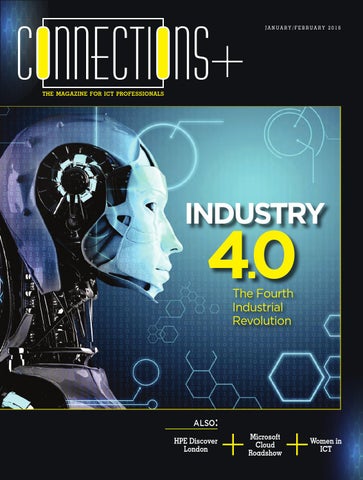
INDUSTRY
4.0 The Fourth Industrial Revolution
also: HPE Discover London
Microsoft Cloud Roadshow
Women in ICT
Coast to Coast
With Belden Erika Violet OM4 fibre, you can now easily distinguish between OM3 and OM4 in your data centre or LAN configuration. Nedco has your full OM4 solution in stock and ready to order so you can stay connected from sea to shining sea.
Visit your local Nedco branch or buy online at www.nedco.ca
Š 2016 Belden Inc.
Our End-to-End Expertise • Your End-to-End Solution
F E ATURE
CONTENTS Fe a t u r e s
18 The Rise of Industry 4.0 It is changing the entire manufacturing landscape.
18
23 Women In ICT For many, a career in this sector remains elusive.
23
Departments Editor’s Note
4
Infrastructure Systems
6
Networks & The Cloud
8
Mobile Movements
17
New & Noteworthy
27
The Back Page
30
member of:
I n the Ne xt Issue
>> The Ethernet Roadmap
audited by:
27 www.connectionsplus.ca
Jan/Feb 2016
Connections+
3
EDIT O R ’S N O TE
Industry 4.0 & Women In ICT ndustry 4.0, otherwise known as the Fourth Industrial Revolution and the subject of this issue’s cover story, has become more than a high-tech buzzword and for good reason. Politicians, economists and the smart ones associated with the manufacturing of goods realize just how important it is going to be for the foreseeable future. Certainly important enough that it dominated discussion at the recently completed World Economic Forum held in Davos, Switzerland, which attracts business and political leaders from around the world. Magnus Penker, CEO of Innovation Group 360 AB, an innovation consulting group based in Stockholm, wrote in a post-Davos blog that “we stand on the brink of a technological evolution that will fundamentally alter the way we live, work and relate to one another. In its scale, scope and complexity, the transformation will be unlike anything humankind has experienced before. “The Fourth Industrial Revolution was on all lips in Davos, a good thing, but let’s recap. The first three industrial revolutions were, in chronological order, the steam engine, electricity and electronics. The concept is connected to the Internet of Things, and provides that any product in the production chain can carry information and where and how, with the result that the factory is able to organize itself.” Penker goes on to write that the Fourth Industrial Revolution is about the re-industrialization of the Western world.
I
Surprisingly, our cover story notes that even though the many technologies that make up this revolution have been around for some time in various states of maturity, a McKinsey & Company survey conducted last year revealed that only 48% of manufacturers consider themselves ready for Industry 4.0, while 78% of suppliers say they are prepared. Our trending feature, meanwhile, entitled The Curious Case of Women In ICT, should be required reading for it begs the question: What can be done to improve gender parity in this sector? In her piece, author Mary Allen writes that despite ongoing efforts by industry, educational institutions and government to improve gender parity in ICT, women’s employment in computing businesses has languished at rates that do not compare well with men’s and, in fact, represent a considerable decline from their high point in the mid-1980s. Canada, she writes, “will struggle to fill over 182,000 ICT positions needed to keep the country competitive over the next five years and could use all hands on deck. “At the same time, women would benefit from employment in the well-paying jobs of the future that ICT can offer.” It is an issue that must be addressed. C+
w w w. c o n n e c t i o n s p l u s . c a
+
Volume 3, Issue 1 January/February 2016
SPOTLIGHT ON A CHANGING MOBILE WORLD
Editor Paul Barker 416-510-6752 pbarker@connectionsplus.ca Senior Publisher Maureen Levy 416-510-5111 mlevy@connectionsplus.ca Art Director Mary Peligra Production Manager Gary White
President Alex Papanou Editorial Advisory Board Keith Fortune, CET, Western Regional Manager, Electron Metal AIG Inc. Henry Franc, RCDD/OSP Senior Account Manager, Professional Support at Belden
Creative Advertising Services Glenn McEvoy
Brantz Myers, B.Sc Math and Computing Science Director of Healthcare Business Development, Cisco Systems Canada Co.
Circulation Manager Diane Rakoff 416-510-5216 drakoff@annexnewcom.ca
Peter Sharp, RCDD, AMIEE Senior Telecommunications Consultant, Giffels Associates Limited/IBI Group
Print Production Manager Phyllis Wright
Alexander Smith, RCDD President, Connectivitywerx
Advertising Sales Maureen Levy 416-510-5111 mlevy@connectionsplus.ca
Rob Stevenson, RCDD/NTS Specialist Communications Division Manager, Guild Electric Ltd.
Head Office Annex-Newcom LP 80 Valleybrook Drive, Toronto, ON Canada M3B 2S9 Tel: 416-442-5600 Fax:416-510-5134 Toll Free: 1-800-268-7742 ext. 3546 (CAN.) 1-800-387-0273 ext. 3546 (U.S.) Editorial purpose Connections+ targets 30,000+ individuals who purchase, design, specify, install, maintain and test structured cabling, networking and telecom products as well as facilities management specialists and senior executives who are responsible for overseeing the implementation and installation of these initiatives.
We acknowledge the financial support of the Government of Canada through the Canada Periodical Fund of the Department of Canadian Heritage.
Canada
Subscriptions Canada, 1 year $44.95 + taxes (HST #815380985-RT0001). United States U.S. $46.95. Foreign U.S. $73.95. Single copy in Canada $8, in USA $10 US, elsewhere $10 US. Printed in Canada All rights reserved. The contents of this publication may not be reproduced either in part or in full without the consent of the copyright owner(s). ISSN: 2292-2202 (Print) ISSN: 2292-2210 (Online)
Connections+ is published by AnnexNewcom LP, a leading Canadian information company with interests in business-tobusiness information services.
Postal information Return undeliverable mail to Circulation Dept., Connections Plus, 80 Valleybrook Drive, Toronto, ON Canada M3B 2S9. Canada Post Canadian Publication Mail Agreement No.43005526.
Emails published should only be used to contact the company regarding their products. These emails are NOT CASL compliant.
From time to time we make our subscription list available to select companies and organizations whose product or service may interest you. If you do not wish your contact information to be made available, please contact us via one of the following methods. Phone: 1-800-6682374 Fax: 416-442-2200 E-Mail: vmoore@annexnewcom.ca Mail to: Privacy Officer, 80 Valleybrook Drive, Toronto, ON Canada M3B 2S9.
HOW WILL YOU SPEND YOUR LAST 10 YEARS? The average Canadian will spend their last ten years in sickness. Change your future now.
In f ras t r uct ure S y s t e m s
The next frontier for
Indoor Wireless By Matt Melester
Stadiums and airports came first and now it is time to move on to office complexes
Over the last several years, wireless operators have been focused on covering the largest public access venues – stadiums, arenas and airports – with cellular services. In these types of venues, it’s all about providing high network capacity to a high concentration of subscribers. In football stadiums, for example, some operators have deployed distributed antenna systems (DAS) with over 60 sectors for each frequency band. This design delivers plenty of capacity to fans for watching video replays and using other data-intensive applications. Future upgrades for adding more capacity and frequency bands will likely be necessary, but solid foundations for wireless are in place there. The next frontier for indoor wireless is the mid- and large-size enterprise buildings – office complexes, high-rise apartments and commercial buildings – which are typically privately owned. The challenges of deploying wireless in private access venues are significantly different in terms of the customers and channels involved, as well as the technical requirements. The most signifi-
cant difference is the operators’ willingness, or lack thereof, to fund these systems. The operators recognized they needed to invest in wireless for large public venues because their subscribers demanded service there. But the return on investment for private enterprises is less certain. As such, operator willingness to fund in-building wireless in private enterprises is not as strong, particularly as they pursue other investments such as new spectrum, acquisitions and network virtualization. The enterprises will likely need to invest in the equipment themselves. This is a much different model, and overall there is no consistent process to help the enterprises know how to acquire and deploy a system successfully. Even if an enterprise is willing to fund a system, an operator has to provide the radio and backhaul to their network. The process for getting approval from one operator to another is different, making the situation daunting and confusing for many. Remember, we are generally dealing with IT organizations in private enterprises, not RF managers from the major network operators who are intimately familiar with cellular communications. A significant learning curve stands between these worlds. Enterprises typically have little to no understanding of cellular. They want it be no more complicated than Wi-Fi -- and unfortunately, it generally is. The IT installation companies they know are probably only slightly more knowledgeable about cellular. To remedy this barrier to in-building wireless in the enterprise space, vendors need to provide wireless systems that look and act more like the infrastructure that IT managers know. Many like CommScope are doing exactly that. DAS continues to be enhanced to better meet the needs of commercial buildings. Small cells offer a great alternative for cost-effective coverage for enterprises, particularly for single operator applications with a limited number of frequency bands. Managing interference inside buildings can be challenging, but newer solutions address this issue. The key stakeholders in the enterprise need to undergo a bit of a mindset change, too. Recent research commissioned by CommScope found that only about half (56%) of building managers, facilities managers, real estate managers and architects always consider mobile connectivity for a building’s tenants as a factor when working on projects. However, three quarters (73%) of respondents cited it as an ‘important’ or ‘very important’ factor. There is a disconnect here. Building owners and managers have to ensure that tenants are always connected in today’s increasingly mobile, data-intensive era, and that buildings are future-proofed for Continued on bottom of page 7.
6
Connections+
Jan/Feb 2016
www.connectionsplus.ca
Infra s t ruct ureFSy E ATURE stems
Cisco launches Toronto Innovation Centre Cisco recently opened its Innovation Centre at its headquarters in downtown Toronto. The centre, one of nine located around the world, is designed to catalyze and showcase digital innovation and development, the company said in a release. “(It) will bring together customers, industry collaborators, startups, application developers, accelerators, government organizations and universities to work on real world problems, with a focus on urban innovation (including smart cities, urban mobility, and environmental transformation), healthcare and financial services transformation.” Cisco’s commitment to bring this unique facility to our city shows we are on the path to establishing Toronto and Canada as innovation leaders, said Toronto mayor John Tory at the official opening of the facility. He added that it “offers our brightest and most talented an opportunity to take their game changing ideas from a concept to reality. By providing access to test labs for experimentation, investment for commercialization and networks to access the global market, Cisco’s Innovation Centre will help build Toronto’s economy of the future.” “The mantra of the Toronto Innovation Centre is Inspire, Innovate and Invest,” said Bernadette Wightman, president, Cisco Canada. “Inspire the next great minds of tomorrow. Foster innovation and big ideas today. And invest in the potential game-changing companies of tomorrow.” Components include: • A dynamic classroom space where Cisco Networking Academy students and instructors can have hands-on access to the latest Cisco technology and mentorship from Cisco engineers. • A Solutions Lab where Cisco experts, together with partners and ecosystem startups, will develop proof of concepts and do rapid pro-
tomorrow. Better planning for indoor wireless networks, even from the time buildings are being constructed, would help ensure adequate wireless coverage and capacity. Deployment in the building construction phase can avoid significant disruption to tenants when systems are added after-the-fact. This can also save on the considerable cost involved in building retro-fits. The sooner architects, building owners and managers start planning for wireless, the easier it is to deliver high quality, high bandwidth networks. In 2016, we expect to see more enterprises start to invest in their wireless systems. These early adopters will lead the evolution to a new model where building owners and IT managers take the lead in buying and deploying in-building wireless solutions. DAS and small cells will continue to evolve to support this important market segment. The needs of mobile users in commercial spaces are too great to ignore. The paradigm shift to new funding models and ways of thinking about wireless systems is already underway in North America. The evolution of in-building wireless will continue in 2016 and eventually carry over to all regions. Matt Melester is senior vice president and general manager, distributed coverage and capacity solutions, at CommScope. www.connectionsplus.ca
Rick Huijbregts, digitization and industry solutions director for the Americas at Cisco, speaks to the press during a tour of the new innovation centre.
totyping. The Toronto team is already working with an ecosystem of more than 25 local and international companies and organizations. • A TelePresence room for collaboration with Cisco’s global Innovation Centres, as well as customers, partners, academia across the country. See also p. 30
Snake Tray Mega Snake ®
®
Cutt your costs t nott the th cable bl tray! t
Cable tray installations are seldom a straight run. Obstacles in buildings are everywhere. Fabricating wire mesh cable trays onsite is extremely time consuming and costly. Snake Tray simply bends by hand and Mega Snake is pre-congured. Both are designed to save on time, labor and materials!
Snake Tray products are patent protected, see our website for specic patent information.
631.674.0004 ♦ www.snaketray.com ♦ info@snaketray.com
Jan/Feb 2016
Connections+
7
Netwo r ks & The Clo u d
HPE Arrives at a
Critical Juncture
London – You need more than a new name and new branding to succeed in the enterprise computing space, a point that Meg Whitman and the rest of her senior team were well aware of in the days and weeks leading up to a user conference called HPE Discover 2015 held late last year in this bustling U.K. capital. The event represented far more than a coming-out-party for a new entity called Hewlett-Packard Enterprise or HPE, which came into being on Nov. 1 and is headed by Whitman. Touting everything from the Internet of Things, big data analytics, hybrid cloud and something called “Composable Computing,” it needed to do well out of the gate in this, the first user conference since the split of HP Inc. into two separate entities – HP Inc., which is now all about personal systems and printers and HPE, which as the name suggests, is all about the enterprise. According to Dave Pearson, research manager for storage and networking at IDC Canada, multiple leadership changes, a few notable unsuccessful acquisitions and the reduction of R&D and staff spending in pursuit of leaner profits, have certainly led to much speculation about HPE’s long-term success. “The challenge here is as much one of perception as it is of per8
Connections+
Jan/Feb 2016
By Paul Barker
formance,” said Pearson, who attended HPE Discover. “A focused HPE, able to develop and communicate a clear path toward their next generations of technology is a must to overcome these biases. To that end, on Day Two of the event, Robert Youngjohns, the firm’s executive vice president of software, told his audience that whatever industry they are in, the disruptors of the future will be those who can use “information at their fingertips to drive new business models, different ways of accessing their customers and different ways of competing. This is really, really important.” Youngjohns also referenced a conversation that occurred at a recent customer event. “Somebody said IoT was an invention by the IT industry simply to sell more storage. I don’t think that is the case. It is real and it is happening now. The key is in the infrastructure you build to support the Internet of Things.” HPE announced new Internet of Things (IoT) systems and networking offerings that it said enable customers to more efficiently collect, process and analyze IoT data. The rapid proliferation of IoT devices, data and connectivity has the power to enable the creation of new offerings, improved effiwww.connectionsplus.ca
Ne t wo rks & TFhe E ATURE Cloud
In a keynote speech CEO Meg Whitman said the splitting up of the two companies, required massive scale and incredible speed.
ciency, better decision making, and more effective risk management across organizations, the company said. Products include: • HPE IoT System EL10 – A gateway designed for entry level deployments. • HPE IoT System EL20 – A gateway with additional features for higher compute capabilities. ‘Today, delivering business outcomes quickly and securely requires intelligence to enable real-time decisions at the edge,” the company said in a release. “Moving computing power, data acquisition and data management to the edge of an organization’s network, outside of the traditional data centre, allows faster access to relevant data, requires less bandwidth to transport useless data, and ultimately accelerates the time to insight for organizations.” Meanwhile, Aruba, an HPE company, launched a cloud-based beacon management offering. The sensors combine a small Wi-Fi client and BLE radio, which enable organizations to remotely monitor and manage Aruba Beacons across existing multivendor Wi-Fi networks from a central location using the Meridian cloud service. The Meridian cloud service interfaces with business and analytics applications. “What is going to make IoT successful in your enterprise is not the devices you put out on the edge of the network,” said Youngjohns. “They are pretty much trivial – $5 will buy you a sensor with the ability to create log data. What is going to matter here is the infrastructure you build around it to support the Internet of Things.” In an interview with Connections+, Dr. Tom Bradicich, head of hyperscale servers and IoT systems at HPE, theorized that if you
Robert Youngjohns, HPE’s executive vice president of software: The disruptors of the future will be companies that use digital information to drive different business models.
”
have enough data you negate the need to make a decision. “A decision is made because you don’t have enough data. The more data we can collect through these thousands of sensors,” the greater the insight that can be learned, he added, about anything and everything. “Think about it. You walk up to a washing machine and you need this shirt washed tonight … and the machine breaks then that is a surprise. Contrary to that, if you can be told your washing machine is going to break on Wednesday of next week, you can plan around it. “Wouldn’t you love to be able to plan around an automobile breakdown, instead of it happening while you are on the highway. This notion of being able to prognosticate and convert surprise outages into planned outages has tremendous personal value and business value.” Meanwhile, also launched at Discover were: • HPE Synergy, a platform designed to run both traditional and cloud native applications. Jed Scaramella, research director at IDC, said in order to “respond to the demands of the business, CIOs and IT executives need to deliver services that are increasingly application-centric. To remain relevant, IT needs to not only provide a reliable and cost-effective infrastructure that can support their legacy investments, but one that gives them the flexibility and speed to deliver services like a cloud provider.” • HPE Helion Managed Cloud Broker, a managed services offering that allows businesses to provision, access and consolidate control services across multiple cloud workloads and providers. • The appointment of Microsoft Cloud Azure as the “preferred public cloud partner for HPE customers. Neil MacDonald, vice president and general manager of HPE BladeSystem and converged datacentre infrastructure, said soft
Cloud computing is becoming a proxy for IT transformation in the industry. Customers now want to use the cloud for all of their workloads.
www.connectionsplus.ca
”
Jan/Feb 2016
Connections+
9
Netwo r ks & The Clo u d
ware-defined intelligence contained in Synergy now means the “infrastructure can play a much, much greater role in managing its own life cycle. “For customers it helps them in four ways: It helps them reduce the over-provisioning of IT infrastructure, it helps them develop applications much faster, it helps them deploy those services much more rapidly and it greatly simplifies the whole life-cycle management that they have had to invest in managing that infrastructure and keeping it current over time.” Composable computing, said Pearson, was definitely a “mind share leader at the conference and their announcements around the Synergy products showed great movement forward in terms of actually deploying true composable infrastructure. “Composable computing is going to be big – we’ve already had some early entrants from Cisco and Dell, but HPE’s announcement was a forward look at the technology, with more powerful embedded software tools for deployment and management, and multichassis support with storage nodes in the chassis or external storage support. “These capabilities, extended forward, can provide the agility so many business leaders are looking for from their IT department. Quick responsiveness from IT to meet business demands has come to
be of utmost importance among line of business and IT leaders alike, according to our surveys and executive interviews. “Expect to see more products in this vein from other vendors, which leads to the question – how can HPE execute on this vision, especially in a Canadian context? Synergy does have the potential to be a game changer, but it will rely on HPE demonstrating real value to customers, not just thought leadership. “They were also early mind share leaders in the realm of converged infrastructure, being literally the first name on the list in terms of customer awareness when the buzz started. In Canada now; however, they don’t enjoy the same leadership position in terms of market share that they once had in recognition.” Meanwhile, Bill Hilf, the company’s senior vice president and general manager of HPE Cloud, said that in this particular sector, hybrid will rule. He released details of a joint HPE-451 Research study that examined cloud investing plans in eight major verticals – manufacturing, telecom, retail, insurance, healthcare, government, finance/banking and education. In each case, two-thirds of total spend is going into the private cloud. The vast majority of enterprises need the mix of both, he said, in order to make the “digital transformation happen to them in a real way. “The first wave of cloud computing was heavily adopted by start-ups and younger companies taking advantage of going into primarily a public cloud context. They were no longer buying servers, they were no longer buying infrastructure. “What we see now is that enterprises want those same benefits, but they have to deal with the environment they have today and they have to deal with a variety of other constraints that often start-ups or consumers do not have to deal with such as regulations and security and geo-political issues that are related to certain industries. “Cloud computing is becoming a proxy for IT transformation in the industry. Customers now want to use the cloud for all of their workloads.”
”
HPE announced new Internet of Things (IoT) systems and networking offerings that it said enable customers to more efficiently collect, process and analyze IoT data.
10
Connections+
Jan/Feb 2016
”
www.connectionsplus.ca
POWER & COMMUNICATE AT 30X THE DISTANCE
Distributed by:
1.800.GRAYBAR www.graybarcanada.com
Small cell, Wi-Fi and HD camera installations need both power and communications. Often times these network devices can’t be installed precisely where needed due to PoE distance limitations or landlord/utility negotiation concerns. TE’s Powered Fiber Cable System is a complete “rack to device” solution to simultaneously power and communicate with network devices at 30x the distance of traditional PoE. System Benefits: • Extend 30x the Distance of PoE • Reduce Landlord/Utility Negotiations • Eliminate Local Power Sources • Centrally Located UPS • SELV and NEC Class II Compliant • Carrier Grade Electrical Protection
POWER & COMMUNICATE AT 30X THE DISTANCE
More info at www.te.com/poweredfiber
EVERY CONNECTION COUNTS
Small cell, Wi-Fi and HD camera installations need both power and communications. Often times these network devices can’t be installed precisely where needed due to PoE distance limitations or landlord/utility negotiation concerns. TE’s Powered Fiber Cable System is a complete “rack to device” solution to simultaneously power and communicate with network devices at 30x the distance of traditional PoE. System Benefits: • Extend 30x the Distance of PoE • Reduce Landlord/Utility Negotiations • Eliminate Local Power Sources • Centrally Located UPS • SELV and NEC Class II Compliant • Carrier Grade Electrical Protection EVERY CONNECTION COUNTS
More info at www.te.com/poweredfiber
Netwo r ks & The Clo u d
The new way of handling information Big data and analytics focus of Dell customer event in Toronto By Paul Barker
Speakers Shawn Rogers (left), David Senf and Jeremy Melville, a Dell Statistica sales engineer (right) are shown during an audience Q&A.
Late last year, Dell released a study that found companies investing in cloud, mobility, security and big data are growing upwards of 50% faster than those who had decided to give it a miss. It is a telling statistic, according to Shawn Rogers, the company’s chief research officer of big data and analytics, who spoke at a recent event in Toronto organized by Dell Canada. “The new way of handling information and coupling it with advanced analytics to do work that we couldn’t or didn’t do before, allows us to transform our businesses and allows us to do things that we didn’t find very practical in the past. “You don’t have to be a monstrous enterprise company to get added value and added competitive advantage and optimization for your business out of big data. It doesn’t have to be zettabytes or pettabytes or exabytes to qualify as big data. We have this opportunity to transform and change the way we run our businesses.” The transformation also extends to medical institutions. Accord12
Connections+
Jan/Feb 2016
ing to Rogers, the surgical team at the University of Iowa has reduced surgical site infections by 58%, while decreasing the cost of care, using big data analytics. Data required for analysis included information from electronic medical records and data from the operating room, in order to determine whether a patient is susceptible to such an infection. “We have this opportunity to transform and change the way we run our businesses,” he said. “It’s all about the ability to use your data assets in a way that you were not using it before in order to get the edge.” Analytics are important, but so too is integration, added Rogers: “If you do follow my advice or give into the pressures, you are going to have more platforms than you have in the past and you are going to have to have a more sophisticated approach to how you integrate data and manage your data. “Data management and data integration are two really big piecwww.connectionsplus.ca
Ne t wo rks & TFhe E ATURE Cloud
”
The first genome took 15 year and $3 billion to map. Today, it costs about $1,000 and takes four days. Within five years, it will cost $100.
”
es of the pie. And last, but not least, you need to have an infrastructure that is flexible enough to handle all of these new pressures. A lot of our traditional environments are very rigid and they tend to break when we want to innovate.” “Data is the new currency. Invest wisely.” Kevin Peesker, president of Dell Canada, told the Toronto audience that currently, the “three big data barriers” are lack of alignment between business and IT, resource constraints and a siloed data environment. He referenced another recent study that found that 32% of respondents have budget limitations around data analysis, 75% lack analytics tools, 73% cannot get business units to break down the silos and share information and 75% do not understand where to focus the big data investment. Once those obstacles are overcome, Peesker said, the use of data analytics can put an organization on a path to greater progress and economic growth by uncovering and acting on insights and opportunities hidden in data, connecting teams with the right analytics tools and optimizing the storage and management of information. He described data analytics as a “business organizational mechanism by which business advances itself in the way it addresses new markets. “The first genome took 15 year and $3 billion
to map,” said Peesker. “Today, it costs about $1,000 and takes four days. Within five years, it will cost $100.” Other speakers included David Senf, program vice president of the infrastructure solutions group at IDC Canada. The research firm has found that currently one in six of organizations are involved in big data in some way shape or form. “In one year, one third will be experimenting with it,” Senf said. “Those are your peers, they are your competitors. “There is a huge amount of growth in big data because it is getting easier and easier to do. When you talk about the volume of data, the more data you have the better. Why? Because you are getting better resolution into whatever problem you are trying to solve. “It is great to experiment, but we need to think about what we are doing on premise vs. off premise and bring those things together. The more you think about the broader architecture that helps big data, it will help other parts of the organization and the better off you will be overall.” Big data, he said, can tackle many issues: “Why did this customer leave my organization, why did they stop using my brand, why did this product break, why did this machinery not work or whatever the problem is you are trying to solve?”
Fujitsu signs on with CENGN CENGN, Canada’s Centre of Excellence in Next Generation Networks (NGN), and Fujitsu Network Communications Inc., have announced that Fujitsu has joined as the consortium’s newest member. The organization is a consortium of industry, academic and research leaders whose goal is to accelerate the commercialization of next generation communications solutions. CENGN’s multi-vendor data centre houses an OpenStack production environment connected to a WAN enabling connectivity speeds of more than 100 Gbps. The environment is used to validate and test the performance and interoperability of proof-of-concept (PoC) end to end offerings based on emerging network technologies such as SDN and NFV. “Fujitsu will be a great addition to our membership,” said Ritch Dusome CENGN president and CEO. “Fujitsu will provide significant value considering their NGN expertise, technical competencies, and robust product and development environwww.connectionsplus.ca
ment. This global collaboration is required to accelerate the development and introduction of new SDN and NFV products and services.” CENGN’s members include Alcatel-Lucent, Allstream, BTI Systems, Cisco, EWA Canada, EXFO, Invest Ottawa, Juniper, Mistral Ventures, Rogers, Telus and Viavi. “Fujitsu is thrilled to be partnering with CENGN to accelerate SDN and NFV commercialization,” said Igor Bergman, vice president and head of the software business unit at Fujitsu Network Communications. “The communications network industry is changing in ways that will have far-reaching effects on service providers, as networks become more dynamic, virtualized and automated.” Fujitsu is already collaborating with CENGN members on a Proof of Concept (PoC) for Multi-layer Data Connectivity Orchestration. This project will demonstrate an end-to-end multilayer SDN orchestration of an MPLS-based WAN over Optical infrastructure, allowing real-time operations across multi-vendor platforms. Jan/Feb 2016
Connections+
13
FEATUrRks Netwo E & The Clo u d
Cloud, Security and Business Makeovers CompTIA Advisory Council predicts those three sectors will dominate IT this year
The year 2016 will see cloud computing rise to new heights, security readiness remain front and center and daunting choices for technology solution providers to alter their business or risk becoming irrelevant, according to members of industry advisory councils at CompTIA, the information technology (IT) industry trade association. CompTIA asked members of its distributor, partner and vendor advisory councils to share their insights about what is in store for the IT industry and IT channel in 2016. Cloud computing, security and business transformation among channel partners and solution providers dominate their 2016 expectations.
Cloud Ascending: New and expanded use of cloud computing will once again drive much of the business for channel companies this year. “The year 2016 will be another big year in the ‘main adoption phase’ of cloud services, particularly cloud telecom and managed firewalls,” says Cassandra Anderson, director, channel sales, Crexendo. That’s good news for IT companies with strong cloud credentials, according to Sergio Farache, vice president, solutions and strategy, Avnet Technology Solutions, Americas. “Companies of all sizes will require expert resources that can help them develop and implement effective cloud solutions with flexible transaction models to overcome rising data center costs,” Farache says. “The most successful players in the channel will adapt to this shift.” Dina Moskowitz, CEO, SaaSMAX also sees more channel engagement ahead. “Based on the momentum we’re experiencing, I predict that a growing percentage of the VAR, MSP and agent channels will 14
Connections+
Jan/Feb 2016
”
New and expanded use of cloud computing will once again drive much of the business for channel companies this year.
be adding more software-as-a-service (SaaS) applications to their line card, including at least one security-related SaaS application,” she says. “I also predict that more and more SaaS development companies, both IT and line of business focused, will be launching and embracing channel partner programs.”
Security above All: Heightened emphasis on security considerations will also be prevalent. “The year 2016 will be the year of a lot more firing of CIOs and CSOs. This will be fueled by more cybersecurity attacks on business and negative headlines calling out companies for their inability to protect their data, employees and customers,” predicts Paul Cronin, senior vice president, Atrion. The security challenges companies face should generate business opportunities for qualified channel companies, he adds. “Consultants, integrators and vendors who can help the CIO design an all-encompassing security business strategy that addresses the concerns of corporate executives and engages the business units will find themselves in the right place at the right time.” The small and medium size business market will also offer opportunities to help customers with their security readiness. “Data security has become an overwhelming concern for business,” Crexendo’s Anderson says. “Even small businesses are feeling the pressure to become more security conscious, realizing they are actually a prime target.” “Small business need to leverage the security expertise of their providers,” says Jon Whitlock, vice president, B2B and channel marketing, North America, Kaspersky Lab and member, CompTIA Vendor Advisory Council. “We’ll see more of the SMB market moving the management of security to a managed security service provider (MSSP),” Whitlock adds. “These MSSPs will be able to maintain sophisticated workflows and leverage many SMB customers to retain the talent necessary.”
”
www.connectionsplus.ca
YOUR COMPANY DEPENDS ON YOUR PEOPLE. AND YOUR PEOPLE DEPEND ON YOUR NETWORK.
Our Blade Gives You the Ultimate Protection. Innovatively designed and extensively tested, Procyon Blade System™ enclosures represent the new standard in fiber connectivity for multibuilding complexes such as hospitals, corporate centers, government facilities and universities. Created to provide superior organization, accessibility and density, the Blade System enclosures and in-line splice modules maintain the highest optical performance over the longest runs. If you’re looking for a solution that is innately suited to support increasing growth for future applications, put our Blade to the test.
STRONG. INNOVATIVE. COMMUNICATIONS SOLUTIONS™ .
800-622-7711 | Canada: 800-443-5262
occfiber.com
FEATUrRks Netwo E & The Clo u d
Microsoft Exec:
IoT Perfect Fit For Cloud By Paul Barker
Given Canada’s presence in Microsoft Corp.’s overall cloud strategy, it is not surprising that the recent Cloud Roadshow held at the Toronto Congress Centre attracted a full house of corporate and government customers. Last June, Microsoft announced plans to deliver Azure, Office 365 and Dynamics CRM Online from Toronto and Quebec Citybased data centres beginning this year. At the time, Kevin Turner, the firm’s worldwide chief operating officer, said the “substantial investment in a Canadian cloud demonstrates how committed we are to bringing event more opportunity to Canadian businesses and government organizations, helping them fully realize the cost savings and flexibility of the cloud.” According to Julia White, general manager of cloud platforms and product marketing (pictured right), a key piece of the strategy moving forward will revolve around the burgeoning Internet of Things or IOT movement. “With devices going on everything, the amount of data that is streaming from these devices is staggering and perfect for a cloud use case,” she said in an interview following a keynote speech at the Cloud Roadshow. “The reality is that all of these devices are inherently far less valuable if they are not connected to a cloud service.” She added that Microsoft is one of three hyperscale cloud providers on the planet with Google and Amazon, being the other two. “The advantage you get is a global footprint and more data centre capacity. “If you look at most organizations today, IT has a massive backlog of apps that the employees have been requesting or the business needs. There is no way they are going to get to that entire list with the current business model.” In the case of an IoT cloud, said White, data flowing in from any number of devices can land and be stored in the cloud for immedi-
16
Connections+
Jan/Feb 2016
ate or future analysis. “Rockwell Automation is doing work around fuel and crude production. They have sensors now in every aspect of that supply chain effectively. When they see any part of the system having issues, they can send maintenance people right to that part of the fuel line. In addition they are conducting more predictive analysis around the equipment.” The company uses Microsoft Azure to deliver a degree of collaboration and visibility unheard of it in the oil and gas industry, says Doug Weber, the organization’s business manager of remote application: “With sensors, software and the cloud, these disparate assets can become part of a Connected Enterprise, powered at its core by a rich flow of data.” White also referenced Krupp Elevator: “They have IoT sensors on all of their elevators and now they are actually doing competitive maintenance based on statistical models that includes traffic and usage. They take the data and are able to make repairs before the elevator breaks down, which is a good customer satisfaction point.”
www.connectionsplus.ca
M o b i le M oFvemen E ATURE ts
Ericsson releases its
‘10 hot consumer trends’ for 2016
”
eryday activities such as watching sports and Ericsson ConsumerLab recently released making video calls. 44% even want to print their what it called the 10 hottest consumer trends own food. for 2016 and beyond. This year’s report reCommuters want to 5. Sensing Homes. 55% of smartphone ownveals that consumers believe Artificial Inteluse their time ers believe bricks used to build homes could inligence (AI) will soon enable interaction with clude sensors that monitor mold, leakage and objects without the need for a smartphone meaningfully and electricity issues within the next five years. As a screen. In fact, half of all smartphone users result, the concept of smart homes may need to expect smartphones to become things of the not feel like passive be rethought from the ground up. past within the next five years, Ericsson said. 6. Smart Commuters. Commuters want to use The report also reveals that as the adopobjects in transit. their time meaningfully and not feel like passive tion of networked technologies moves faster 86% would use objects in transit. 86% would use personalized than ever, mass-market use becomes the commuting services if they were available. norm quicker. As a result, the time period personalized 7. Emergency Chat. Social networks may bewhen early adopters influence others is now come the preferred way to contact emergency shorter than before. commuting services services. Six out of 10 consumers are also interDr. Michael Björn, head of research, Ericsested in a disaster information app. son ConsumerLab, said that while “some of if they were available. 8. Internables. Internal sensors that measure these trends may seem futuristic, consumer well-being in our bodies may become the new interest in new interaction paradigms such as wearables. Eight out of 10 consumers would AI and virtual reality (VR), as well as in emlike to use technology to enhance sensory perbedding the Internet in the walls of homes or ceptions and cognitive abilities such as vision, even in our bodies, is quite strong. memory and hearing. “This means we could soon see new con9. Everything Gets Hacked. Most smartphone sumer product categories appearing – and whole industries transforming – to accommodate this development.” users believe hacking and viruses will continue to be an issue. As According to an Ericsson ConsumerLab press release, the a positive side-effect, one in five say they have greater trust in an broadest trend is representative of 1.1 billion people across 24 organization that was hacked, but then solved the problem. 10. Netizen Journalists. Consumers share more information than countries, whereas the narrowest represents 46 million urban ever and believe it increases their influence on society. More than smartphone users in 10 major cities. a third believe blowing the whistle on a corrupt company online has These are the 10 trends for 2016 and beyond: 1. The Lifestyle Network Effect. Four out of five people now ex- greater impact than going to the police. In an interview with Connections+, Björn said ”what you are perience an effect where the benefits gained from online services increases as more people use them. Globally, one in three consum- seeing is that the social effect of cloud intelligence and the sharing economy is accumulating on a lifestyle level. Most of the serers already participates in various forms of the sharing economy. 2. Streaming Natives. Teenagers watch more YouTube video con- vices we are talking about now are Internet-related in some form tent daily than other age groups. 46% of 16-19 year-olds spend an or another. This is accumulating and having a big impact across the world. hour or more on YouTube every day. As for the early adopter theory, he said the faster new technolo3. AI Ends The Screen Age. Artificial intelligence will enable interaction with objects without the need for a smartphone screen. One gies are adopted, the less impact they will have. ”There are other mechanisms in place, which is what we are in two smartphone users think smartphones will be a thing of the looking at here with the Lifestyle Network Effect. This is a broad past within the next five years. 4. Virtual Gets Real. Consumers want virtual technology for ev- trend and extremely important.”
”
www.connectionsplus.ca
Jan/Feb 2016
Connections+
17
COVE R S TO RY
Industry 4.0 is based on the use of connected cyber-physical systems which has
The Fourth Industrial Revolution ndustry 4.0 has become quite the buzzword in certain circles. The phrase coined by the German government, is one that isn’t an all or nothing disruption to the industry, but rather an evolutionary journey powered around the more commonly used term, Industrial Internet of Things (IIoT). According to Michael Stolze, managing director, Prüftechnik Alignment Systems GmbH in Germany, the first revision of manufacturing or Industrial Revolution began around 1784 with the introduction of mechanical production equipment driven by water and steam power. The second Industrial Revolution was based on mass production achieved by the division of labour concept and the use of electrical energy and conveyor belts in the late 1800s. The third was based on the use of electronics and IT to further automate production (it began with the first programmable logic controller being introduced in 1969).
I
18
Connections+
Jan/Feb 2016
led to the emergence of smart factories. It is, the next big wave in manufacturing. By Denise Deveau
Industry 4.0 or the Fourth Industrial Revolution is based on the use of connected cyber-physical systems which has led to the emergence of smart factories. In a highly sophisticated environment, intelligent machines could communicate with each other, as well as with the goods they produce or handle, analyze their own condition parameters, engage in self-learning, order their own spare parts, and plan their own maintenance and repair measures, according to Stolze. As futuristic as an all-digital, perpetually communicating system of equipment, people and objects may sound, some would argue that most of the foundational elements are already in place. A McKinsey report co-authored by Cornelius Baur and Dominik Wee entitled “Manufacturing’s next act” defines Industry 4.0 as the “next phase in the digitization of the manufacturing sector, driven by four technology disruptions: • The astonishing rise in data volumes, computation power, and www.connectionsplus.ca
COVER STORY
connectivity, especially new low-power wide-area networks; • The emergence of analytics and business-intelligence capabilities; • New forms of human-machine interaction such as touch interfaces and augmented-reality systems; and • Improvements in transferring digital instruction to the physical world, such as advanced robotics and 3-D printing.” Others define Industry 4.0 simply as a world in which everything is connected to everything to drive better outcomes, ranging from predictive maintenance to forecasting and supply chain efficiency. Whatever definition one chooses to use, Baur and Wee say executives should carefully monitor the coming changes and develop strategies to take advantage of the new opportunities, given that many of the technologies have been around for some time in various stages of maturity. As of January 2015, a McKinsey survey showed that only 48% of manufacturers consider themselves ready for Industry 4.0, while 78% of suppliers say they are prepared.
With Industry 4.0 and IIoT, you’re not talking about the Internet, but rather private networks and intranets. That’s where the action is right now. No one is interested in hooking up their manufacturing site or power grid to the public Internet.
Industry 4.0 in action Dr. Tom Bradicich, VP and general manager for HPE Servers and IoT Systems in Houston, Tex., says Industry 4.0 is rapidly becoming a central point of discussion at industry consortiums as a sub-category of IoT. “IoT has already achieved celebrity status like cloud and big data. Industrial IoT is simply one of the many subcategories within that.” The one distinction for IIoT (or Industry 4.0) is that IoT in and of itself implies public connectivity. “With Industry 4.0 and IIoT, you’re not talking about the Internet, but rather private networks and intranets. That’s where the action is right now. No one is interested in hooking up their manufacturing site or power grid to the public Internet. In fact, a better term would be the Intranet of Things: in other words, connecting all things to each other. If you can do that, there is potential for some very exciting business, engineering and scientific value.” He cites the example of a large airplane manufacturing project in which the actual tools used to bolt and build airplanes (the T of IoT) are connected to the intranet. Wrenches with built-in sensors can automatically program for the right torque and size of bolt. “A human doesn’t have to make a judgment call or determine the parameters manually, which eliminates the risk of error,” Bradicich explains. “It’s all intuitive so there’s less human error and higher quality results. Extend that further, and you could have smart eyeglasses that look at a hole and alert a worker as to what screw or bolt to use. That’s where the business value is.” Added benefits can be driven by connecting to your supply chain, www.connectionsplus.ca
”
he adds. “What if a bolt didn’t fit or broke and all the information was immediately sent to all engineers and parts suppliers anywhere in the world? That is actually happening today.” There are also predictive maintenance benefits to be found in an Industry 4.0 approach. HPE has been working with a U.S.-based energy company in which multiple sensors on pumps and instruments connected to switches are delivering a wealth of data to computers, intranets and other servers. “That provides great value in the way of machine condition monitoring,” Bradicich explains. “Predictive analysis can advise when maintenance needs to take place before a piece of equipment fails; much like taking care that you change your oil in your car to avoid a catastrophic failure.” In the industrial world there are two types of errors, he notes. “A type 1 error is when you don’t do something in time and end up with a catastrophic failure. But there’s also a type 2 error which is doing it too often, thereby wasting time and money. It may not be catastrophic but it’s hardly a good use of resources. Doing the right amount of maintenance at the right time saves a tremendous amount of money.” The challenge for manufacturing entities is that Industry 4.0 solutions are a complex web of vendors and architectures, he adds. “There can be 15 or 20 vendors participating in a solution at any given time.” To help manage the complexity for those who have yet to participate in the Industry 4.0 journey, Bradicich advises starting small in order to develop expertise and determining the business value as you go. “Maybe procure a few sensors, such as vibration sensors, that can tell you about the maintenance of a system or whether it will fail. Then you can grow that to include measuring temperature, moisture, particulates and more. Manufacturers have already invested in substantial assets and the technology is available to connect them to gain insight.”
”
The mechanics of it all Tim Rourke, president of Rittal Systems Ltd. in Mississauga, says despite the fact that the company’s stock in trade is producing enclosures for other companies and therefore viewed as a mechanical provider, it has a remarkably sophisticated communications ecosystem. Its integrated manufacturing philosophy and approach encompasses two of Rittal’s companies: EPLAN, an electrical engineering software for the planning and documentation of electrical design projects; and Kiesling, which specializes in automated equipment for the manufacture of control panels. Jan/Feb 2016
Connections+
19
COVE R S TO RY
Building Blocks of IIoT Gurvie Waraich, process automation offer manager for Schneider Electric Canada, says the Industrial Internet of Things (IIoT) has been evolving since the 1980s. In fact some of the protocols developed in the early infrastructure stages remain today. Following are Waraich’s thoughts on standards building blocks that are playing a key role in IIoT:
1. Communication standards: “Ethernet is the most widely use communications protocol,” he says. “As such, it is the first building block of the industrial internet of things, because it allows different products, systems and solutions to exchange data.” He adds that Ethernet adoption is widespread in numerous product lines today from circuit breakers to compressors and monitoring systems. “Ethernet is everywhere and has proven to be the most reliable media you can have on a plant floor.” 2. Data standards: Groups such as FDT (Field Device Technologies) are working to standardize communication and configuration interfaces between field devices and host systems through embedded device type managers (DTMs). “FDT is doing a very good job of bringing manufacturers to one common platform,” Waraich says. “It is as easy as installing a desktop printer, if you have a driver, you can install it on any computer. A DTM is simply a driver for that device.” 3. Web standards: The OPC UA (Object Linking and Embedding for Process Control – Unified Architecture) is a widely used industrial communications protocol for Web services. According to Waraich, “any smart device, whether it’s a sensor, circuit breaker or switch can communicate through Web services.” 4. Programming standards: IEC 61131-3 is a common standard for writing application code for programmable logic controllers. “These building blocks are widely used in the marketplace today,” Waraich notes. “That means we have a pretty good infrastructure in place already. The next step is adding other services and programs on top to allow for more meaningful communications between all Wi-Fi-enabled devices.”
20
Connections+
Jan/Feb 2016
Not surprisingly, Europe is among the leaders on the Industry 4.0 front, while Canada lags behind the U.S. by about a year.
“That integration between our three companies offers an unprecedented level of intelligence,” Rourke explains. “Parts from any electrical manufacturer for example can be imported into EPLAN to execute the enclosure design and ensure that everything will fit. It also allows us to make modifications of components to accommodate interface devices and subsequently enable automated equipment manufacturing. It takes production to the next level.” One of the key benefits of Industry 4.0 for Rittal, he says, is savings through predictive (or intelligent) maintenance. By way of example, a typical maintenance schedule for a piece of equipment might be 500 running hours. “With sensors, components can provide feedback on operating temperatures and ease of movement within a machine. It could tell us that it’s still operating well at 700 hours, thereby avoiding early shutdown. Conversely, it could tell us it’s running hot at 300 hours so we can proactively plan maintenance. That allows for extremely high levels of automation and productivity in our facilities.”
The visual dimension Even more progressive organizations that have implemented sensors; however, often need the added benefit of visual insight, argues Chris Johnston, regional marketing manager for Bosch in Lancaster, Pa. “Security is becoming an integral part of the Industry 4.0 equation, as video transforms to an IP-based infrastructure,” Johnston says. “Analog didn’t touch the network. You might have a connection point to a customer network to provide camera access, but you couldn’t access reporting for example.” In an industrial setting specifically, what has changed is that surveillance solutions that were once relegated mainly to perimeter fencing, entryways and parking lots are now being deployed in process areas as visualization tools that can send alerts if something is “not quite right,” Johnston says. Having visual capabilities on the network is a boon for many industries that have historically had to send workers into potentially www.connectionsplus.ca
Thousands of Solutions. One Class, Rittal Class . TM
Be it large or small, whatever your application, Rittal’s unique ‘Custom from Standard’ design philosophy will provide you with the optimal solution. We have the economy of scale and total product scope to bring you the industry-leading innovation you need with the time frames and pricing you can afford. Thousands of options - but only one standard, the highest - Rittal Class. Visit www.rittal.ca
COVE R S TO RY
There are predictive maintenance benefits to be found in an Industry 4.0 approach.
”
Cameras are more than just observers. They can also be programmed as sensors in their own right. For example, in a refinery with a stack that is burning waste gases, video can be used to augment electronic sensors to monitor if the flame is present.
22
Connections+
Jan/Feb 2016
”
hostile environments to monitor systems and download data. “Now you can put a handful of cameras in an area or look at multiple areas at the same time. It’s far less expensive, safer for workers, and helps to optimize limited resources.” Cameras are more than just observers. They can also be programmed as sensors in their own right. For example, in a refinery with a stack that is burning waste gases, video can be used to augment electronic sensors to monitor if the flame is present. Cameras are also becoming increasingly intelligent in capturing and translating visual data, Johnston adds. “Embedded video analytics can tell when someone or something enters a restricted area, is moving in the wrong direction or is lingering too long and trigger an alert. The next iteration is cameras talking to other cameras to follow something when it has detected an event.” As Johnston puts it, industry is moving away from “relay magic” where things were wired A to B. “Now information can be sent anywhere a network can reach. It’s not beyond the realm of imagination to have those systems talk to the surveillance side.”
Who’s on first? While some are progressing at a healthy place when it comes to Industry 4.0 adoption; others are not as quick off the mark. Not surprisingly Europe is among the leaders on the Industry 4.0 front, while Canada lags behind the U.S. by about a year, Rourke estimates. “In my talks with counterparts in the U.S., there seemed to be a higher level of awareness and much greater demand for information.” Networking to the plant floor; however, will be a matter of competitive survival he believes. “If you don’t have devices talking to each other, you are not realizing the full value. There is a better way to do things. You just need to make sure you have the digital resources in place or you will lose opportunities.”C+ Denise Deveau is a Toronto-based freelance writer. She can be reached at denisedeveau@bell.net. www.connectionsplus.ca
T R E NDI NG
The Curious Case Of
Women in ICT The number of female CEOs and country managers may be escalating, but for most Canadian women a career in this sector remains elusive. That needs to change. By Mary Allen s the glass half full or half empty? In the context of women’s role in ICT, this question evokes the same ambiguity that marks virtually all discussions of complex social evolution. On one hand, the contribution that women could make to the ICT industry is clear; according to the ICTC’s Labour Market Outlook 2015-2019, Canada will struggle to fill over 182,000 ICT positions needed to keep the country competitive over the next five years and could use all hands on deck. At the same time, women would benefit from employment in the well-paying jobs of the future that ICT can offer; in 2013, the Canadian government’s ICT Sector Profile found that ICT workers earned on average $69,876 in 2013 or 48% more than the economy-wide average of $47,354. But despite ongoing efforts by industry, educational institutions and government to improve gender parity in ICT, women’s employment in computing businesses has languished at rates that do not compare well with men’s and in fact represent a considerable decline from their high point in the mid-1980s. Curiouser and curiouser, is that the industry has also lately experienced a management bonanza featuring the elevation of multiple high profile female executives to top leadership positions in Canada and elsewhere. On the domestic front, these include Mary Ann Yule, who has just been named managing director of HP Canada, Karen Sheriff, president and CEO of Canadian data centre outsource service provider Q9 Networks, Janet Kennedy, CEO of Microsoft Canada, and Bernadette Wightman, former GM of Cisco’s Russian subsidiary, and now president of the Canadian operation. Globally, the star cast features IBM CEO Ginni Rometty, HPE CEO Meg Whitman, Xerox CEO Ursula
I
www.connectionsplus.ca
Jan/Feb 2016
Connections+
23
T REND I N G
Burns and Marissa Mayer, CEO at Yahoo!, Facebook COO Sheryl Sandberg, Safra Catz, co-CEO of Oracle, and Cher Wang, cofounder and chairperson of HTC Corporation. Out of this dubious legacy, two key questions emerge: what accounts for the gap between the experience of female leaders and others, and what can be done to address the uneven advance of women in ICT, a goal that is of critical importance to women and to industry development more generally. For most women, a career in ICT remains elusive. While the share of women in the US ICT workforce peaked at 38% in the mid-1980s, it has been falling in the U.S. and on a global basis ever since. Today, Canadian women make up 47.3% of the labour force; however, the ICTC Labour Outlook estimates that women made up only 24% of the Canadian ICT workforce total in 2015, while at the top 10 Canadian technology companies, they represent only 16.5% of workers. When focus is trained on management positions, female representation is more thin, and the view from the board room is similarly bleak, with women constituting only 16.5% of board members in public ICT businesses (as of 2013). One perceived challenge to greater participation in the computing sector that has been advanced is women’s lack of STEM (Science, Technology, Engineering and Math) education. Statistics Canada has found that women’s enrollment in computing disciplines at the post-secondary level is significantly lower than it is for men and falling: women accounted for 37% of enrollment in 20052006, but by 2009, that figure had dropped to 27%. Another Statscan summary has shown that male enrolment increased dramatically over this period, with the result that there were roughly twice as many male graduates as female in 1992, and three times as many in 2007. Today, estimates of female enrollment in STEM disciplines vary, but hover around the 19%, while an online survey of 1,007 Canadians carried out by Angus Reid on behalf of MasterCard in 2014 found that only 18% of Canadians who considered a career in technology were women. Recent research from Randstad’s Women Shaping Business study 2015 suggests that little change on this score can be expected, even if gender parity in enrollment in other disciplines such as finance, business and law is on the rise. According to report authors, only 3% of the 1,005 Canadian working women surveyed for the study are currently studying to work in a STEM profession, and the most frequently cited barrier to women’s choosing a STEM or skilled trade career is the stereotype that STEM 24
Connections+
Jan/Feb 2016
is a “male-centric field” – though 27% of women (35% in the 18-34 year old cohort; 29% of 35-54 year olds; 20% of 55 year olds), more women from higher income families, and more women with children stated they would have considered STEM with the right support or guidance. Even more alarming in the study; however, are perceptions around barriers to work in STEM fields reported by women in general, compared to the views of women who are actually working in STEM occupations. As the figure from Randstad research (see p.26) shows, experience of work in STEM reinforces many of women’s fears. Faith Tull, senior vice president of HR at Randstad Canada, says this research is conducted on an annual basis because “even though a lot of the information on gender inequality is commonplace, the question is ‘what are we doing about it?’ “Our survey shows that while there may have been small improvements – in attitudes held by the younger cohorts, for example – we still have a problem. But the research shows that with the proper encouragement, many women would choose a STEM career. So, how do we encourage them to do so? This is where we need to place more focus, make more investment, and devote more energy.”
Bernadette Wightman, president of Cisco’s Canadian operation: She launched JUMP, a program designed to groom high potential women for more senior management positions.
If the numbers sketch out the magnitude of the problem facing the industry, they do little to help draw the solution that Tull urges. On this score, it’s more instructive to consider the micro example: the tactics employed by individual women who have met and coped with the range of factors advanced by sociologists to explain obstacles – socialization and early education, systemic barriers in
www.connectionsplus.ca
T R E NDI NG
schools and within organizations (recruitment and promotion), exclusion from formals networks, communication styles, self-efficacy and choice, as well as competing life priorities – and have managed to negotiate successful ICT careers. These tactics may provide guidance that can help shape strategies designed to drive more female inclusion in the industry and at management levels. Bernadette Wightman’s experience building a career at Cisco Systems, for example, Joanne Stanley, may support some rethinking executive director of assumptions made about of the WCT: Gender barriers to women’s success parity is a topical issue in ICT, while suggesting action and many companies items that may help move the are now searching for numbers needle for women answers on where to at large. find additional female Her career path came via resources. sales and channel development – rather than product engineering – a pattern for successful advancement that is a typical route for males in IT as well. Wightman’s career has taken her to lead Cisco teams in the U.K., the Middle East, across Russia, Ukraine and other CIS countries, and now Canada; a supportive family has accommodated her extensive travel with the help of better communications technology. But when asked to identify the key success factors in her own experience, Wightman took special pains to focus on the importance of strong mentorship which had “huge impact on my personal development, confidence, authenticity and therefore, impact” and on the role of a particular male mentor who promoted her to her first director position, urged her to continue to speak out as a “disruptor” and promised, if awkward moments occurred, to “cover, I’ve got your back.” To ‘pay it forward’, Wightman determined to build a diversity program within Cisco based on “three keys” she learned from another mentor, then CEO of McKinsey: the person at the top has to support the initiative, you need female role models, and you need female – only training that will allow women to retain authenticity and support group networking. To address the third requirement, Wightman launched JUMP, a program designed to groom high potential women for more senior management positions, tackling diversity issues within Cisco top down by establishing role models, while developing a stronger female talent pipeline. “We found we could bring women into the organization at the director and above level, but we weren’t able to bring women from being individual contributors to the first level of management,” she says. www.connectionsplus.ca
“We weren’t growing our own female population. We were recruiting at the top, but we had this gap in the middle.” Since launch six years ago, the program has wrestled with the notion that ICT career development is out of reach for women and has the numbers to demonstrate the contrary: to date, more than 1,100 women globally have benefited from JUMP, and in Canada, 45 women have been involved in the program (in year two here) and have received promotions as a result. Programs like JUMP, corporate leadership on diversity (Cisco’s global executive composition is now 50 % female), and strong leadership within individual country organizations can make the difference: when Wightman arrived as Canadian president, there was one female exec; today the organization has been transformed with the leadership team just over 40 % female, women in sales management and more females represented on hiring panels. Under Wightman’s leadership, Cisco is also engaged in outreach to the broader community. To coincide with the opening of its new Toronto Innovation Centre, Cisco Canada is launching the Women Entrepreneurs’ Circle, a program that will provide female entrepreneurs with support in the form of free business/technology training, zero cost financing for network/communications investments, and innovation resources. Each female business leader will be assigned a University of Waterloo intern who will work with Cisco engineers and the Cisco dev/ net community, using the Innovation Centre facility as they work to help entrepreneurs execute on digital strategy. Cisco’s program activities are by no means isolated — the Dell Women’s Entrepreneurship Network has operated on a global basis and in Canada for several years, and similar education, networking and mentorship goals have been institutionalized by a number of organizations, including women’s associations. The WCT, for example, which celebrates its 25th anniversary this year, provides digital leadership skills training, an extensive network (11 chapters across Canada, including a recently launched public sector chapter in Ottawa), as well as two discrete cross-industry, cross-country mentorship programs – an 18-year-old advice and counseling program, and the more recently launched career sponsorship initiative, the Protégé Project aimed at advancing young women with promise, which each seek to address gender barriers to women’s success in ICT.
Jan/Feb 2016
Connections+
25
T REND I N G
Source: Randstad
According to Joanne Stanley, executive director of WCT, the association is set to launch a campaign this year to ask Canadian companies to disclose and improve their numbers on female employment in tech occupations. Gender parity is a topical issue, she says, and many companies are now searching for answers on where to find additional female resources. The issue is also benefitting from the “right political climate” and WCT is now devoting recent Status of Women Canada funding to attracting business leaders to discuss best practices in developing female tech talent – “what works, what doesn’t, and what should businesses and outside organizations be doing,” she says. Considering the numbers – and indeed Randstad findings – engaging business leaders in the search for solutions is critical. Stanley argues that the conditions identified in the “definitive” research on women in technology, the Athena Project, continue to hold sway: the “women chilly climate” or culture in tech firms, isolation in the workplace, an unclear advancement path and lack of network support, lack of role models and mentors, and need for greater work/life balance. 26
Connections+
Jan/Feb 2016
The notion that there are systemic, culturally unfriendly attitudes towards women “is a tough message to deliver to company leaders, which tend to be male,” Stanley says. And though the association offers no quick fixes, it can advise on or provide mentorship programs to build the cohort of middle and senior managers, who in turn — as in Wightman’s case – can accelerate the process of inclusion. But “it’s a bit of catch 22: the fewer women you have at the top, the more difficult it is to change the culture,” she adds, a final argument for more star leaders who can address gaps in the broad transformational process that inclusion of women in ICT entails. C+ Managing editor at InsightaaS, Mary Allen is a long standing observer of women’s issues. In 1991, while on an academic exchange in Moscow to research the role of women in the Red Army, she travelled to the first “Gender Conference” in nearby Dubna on the same day the failed anti-Gorbachev coup was mounted in Red Square. “It was kind of crazy to leave the revolution for a women’s event, especially since I was not officially allowed to travel, and because the subways were all blocked off for security reasons,” she recalls. “But it was the first women’s conference there!” Mary can be reached at mary.allen@insightaas.com
www.connectionsplus.ca
New & Noteworthy
1 2
3 4 1. PLATINUM TOOLS
2. GREENLEE TEXTRON INC
3. BERK-TEK
4. HARTING CANADA
Platinum Tools has announced the launch of the new Big Mouth Tool Bag (P/N 4006). With a manufacturers’ suggested retail price of US$35.25, the new tool bag is designed for carrying an assortment of tools while on the job site thanks in part to its heavy duty construction. Now shipping, Big Mouth includes six spacious interior and exterior pockets for storage, is made with waterresistant canvas construction with nylon stitching for durability, and collapses flat for storage when not in use. “The durable Big Mouth Tool Bag is perfect for carrying your tools to the job site,” said John Phillips, Platinum Tools’ product manager. “The heavy duty construction means this bag will last for years to come.” Further information can be obtained at info@platinumtools.com. www.platinumtools.com
Greenlee Textron Inc., a Textron Inc. company, recently launched the DataScout 10Gx multi-service network analyzer under the Greenlee Communications brand. This new Greenlee Communications branded analyzer can be remotely controlled up to 100 feet away using any Android tablet or mobile device equipped with Bluetooth. The DataScout 10Gx enables technicians to work independently of their test equipment, yet still retain full command and control when working in tight locations or in high density equipment racks, the company said. By controlling the device via Bluetooth, the DataScout 10Gx eliminates the need for a built-in touch screen display which extends average battery run time and reduces the theft profile when left onsite to monitor remote circuits. It also comes housed in a ruggedized all aluminum enclosure for added protection. www.greenlee.com
Berk-Tek, a Nexans Company, launched a new transceiver product line at the recent 2016 BICSI Winter Conference that includes optical transceivers for both Ethernet and Fiber Channel protocols. The company says they are compatible with all major switch and server manufacturers through a partnership with ProLabs, an independent provider of OEM compatible networking offerings. Additionally, when Berk-Tek’s 40GBASE-SR4 enhanced transceivers are paired with Berk-Tek’s GIGAlite10XB glass, the company guarantees enough power budget to support a 40G link distance up to 500 metres. This is more than three times the reach guaranteed with standard-compliant fiber and transceivers, it says The enhanced transceivers are also available for Short Wavelength 8G and 16G Fiber Channel. Berk-Tek is promoting its new transceiver product line with the tagline “Own the Link.” www.berktek.com
From hex keys to crimp tools, panel punches and torque sets, Harting Canada says it now offers its largest portfolio of assembly tools yet that align with its connector products for both large form factor industrial and board level connectivity. The company’s tooling lineup recently expanded with the addition of a slimline screwdriver set and tightening torque tools for guiding pins. The tightening torque tool offers the simplest operation and reproducible quality with a fixed torque (0.5 Nm), which makes it almost impossible to over or under tighten, the company said. The slim line screwdrivers are ideal for assembly with the integration of the insulation at blade diameter. Harting manually operated panel cut out punch tools make it simple to create the corresponding panel cut out right on the spot, quickly and accurately, eliminating laborious sawing. www.harting.ca
www.connectionsplus.ca www.connectionsplus.ca
Januar y/Februar Jan/Feby 2016
Connections+
27
Lite r at ure Re views
Cut Costs and increase Profits without Cutting corners Datacenters are captial-intensive businesses that rely heavily on real estate. It’s crucial to reduce expenses and increase profits in ways that don’t negatively impact performance. We’ve gathered suggestions that will help offervaluable services – without adding space or expanding a location. Visit: http://bit.ly/CutCostWP or call 1.800.BELDEN.1 (800.235.3361)
Free Siemon INNOVATE digital magazine In this quarterly electronic magazine, Siemon provides educational information on high performance infrastructure solutions for Data Centers, LANs and Intelligent Buildings. Featuring the latest new product innovations, industry standard updates, trends, technical articles, case studies and more. To access your free copy visit:
www.siemon.com/innovate
www.belden.com
Graybar Canada New YouTube Channel Graybar Canada has launched their new YouTube Channel! With a featured monthly vendor, the channel will be the place to check out educational product videos from their best-in-class vendors. You can also check out a short video about the company’s core capabilities, as told by the employees. See more and subscribe to the channel at youtube.com/graybarcanada
Snake Tray® Cable Management & Power Distribution Order the new Snake Tray catalog to get details on our full line of labor-saving cable trays and power distribution systems. All of our products are designed to lower constructions costs with innovative features that save on labor, install time and material handling. To learn more visit www.snaketray.com or call 631-674-0004.
www.graybarcanada.com
GET YOUR FREE RITTAL EBOOK SERIES EMAILED TO YOU! 1. Standard-Compliant Switchgear and Controlgear Production 2. Enclosure and Process Cooling 3. Technical Aspects of Enclosures 4. The World of IT Infrastructures Decision-Making Criteria Email Your Request To: marketing@rittal.ca
www.rittal.ca
Connections+ 2016 MEDIA KIT The magazine for ICT professionals, Connections+ readership targets individuals who purchase, design, specify, install, maintain and test structured cabling, networking and telecom products as well as facilities management specialists and senior IT executives who are responsible for overseeing the implementation and installation of these initiatives. For more information contact Maureen Levy – 416-510-5111 or mlevy@connectionsplus.ca
www.connectionsplus.ca
28
Connections+
Jan/Feb 2016
www.connectionsplus.ca
Complimentary subscription request form Your job function (check one only)
Your company’s primary business activity (check one only)
• • • • • • • •
Network (LAN/WAN) Installation/troubleshooting Utilities Cable/Wire/Electrical Contractor Transportation Government Broadcasting/Communications Health Services Education Wire/Cable Wholesaler Legal Services Engineering System Integrator/Network Design Financial/Insurance Manufacturer _ _ _ _ _ _ _ _ _ _ _ _ _ _ _ _ _ _ _ _ _ _ _ _ _ _ _ _ _ _ _ _ _ Data Processing/Information Services Other _ _ _ _ _ _ _ _ _ _ _ _ _ _ _ _ _ _ _ _ _ _ _ _ _ _ _ _ _ _ _ _ _ _ _ _
• • • •
• • • •
• • • • • • • • • •
MIS Mgmt., Network/Comm. Mgmt. Structured Cabling Designer Cabling Systems Installer Information Syst./Technology Spec. Facilities/Property/Project Mgr. Corporate & Plant Mgmt. Technical/Electrical Installer Electrical/Consulting Engineer Electrical Contractor Other Engineering & Consulting
Number of employees at this location 1 1-19 2 20-49 3 50-99
• •
Purchasing, Sales/Mktg. Comm. Specialist
Do you purchase or influence the purchase of ICT products and/or services for your company?
Name: _ _ _ _ _ _ _ _ _ _ _ _ _ _ _ _ _ _ _ _ _ _ _ _ _ _ _ _ _ _ _ _ _ _ _ _ _ _ _ _ _ _ _ _ _ _
•
yes
Do you?
• • •
Buy Install Test
•
4 100-199 5 200-499 6 500+
• • •
Specify Maintain Design
no
Title: _ _ _ _ _ _ _ _ _ _ _ _ _ _ _ _ _ _ _ _ _ _ _ _ _ _ _ _ _ _ _ _ _ _ _ _ _ _ _ _
Company: _ _ _ _ _ _ _ _ _ _ _ _ _ _ _ _ _ _ _ _ _ _ _ _ _ _ _ _ _ _ _ _ _ _ _ _ _ _ _ _ _ _ _ _ _ _ _ _ _ _ _ _ _ _ _ _ _ _ _ _ _ _ _ _ _ _ _ _ _ _ _ _ _ _ _ _ _ _ _ _ _ _ _ _ _ _ _ _ _ Address: _ _ _ _ _ _ _ _ _ _ _ _ _ _ _ _ _ _ _ _ _ _ _ _ _ _ _ _ _ _ _ _ _ _ _ _ _ _ _ _ _ _ _ _ _ _ _ _ _ _ _ _ _ _ _ _ _ _ _ _ _ _ _ _ _ _ _ _ _ _ _ _ _ _ _ _ _ _ _ _ _ _ _ _ _ _ _ _ _ City: _ _ _ _ _ _ _ _ _ _ _ _ _ _ _ _ _ _ _ _ _ _ _ _ _ _ _ _ _ _ _ _ _ _ _ _ _ _ _ _ _ _ _ _ _ _ Province: _ _ _ _ _ _ _ _ _ _ _ _ _ _ _ _ _ _ _ _ _ Telephone: (
Do you wish to:
)
_ _ _ _ _ _ _ _ _ _ _ _ _ _ _ _ _ _ _ _ _ _ _ _ Fax: (
• • • • • • • receive
) _ _ _ _ _ _ _ _ _ _ _ _ _ _ _ _ _ _ _ _ _ _ _ _ E-Mail: _ _ _ _ _ _ _ _ _ _ _ _ _ _ _ _ _ _ _ _ _ _ _ A Please use my e-mail for subscription renewals or publisher’s updates. yes no
continue to receive
CONNECTIONS+ Magazine FREE?
yes
Digital Print Select your format: Signature: R E Q U I R E D
• •
no
Both
Date:
M / D / Y
Publisher reserves the right to determine qualification for free subscription. Offer valid in Canada only
• • • •
o f
Companies
Pg.
Belden
2
ppollack@adtrack.com
Ericsson Canada
31
Graybar
11
info@graybarcanada.com
Hyperline Canada
32
Optical Cable
15
Rittal Systems Ltd Snake Tray
www.connectionsplus.ca
B I permit the publisher to pass along my e-mail address to carefully screened companies for relevant trade shows, training courses, and product or service offers. yes no C I permit the publisher to pass along my mailing address to carefully screened companies for relevant trade shows, training courses, and product or service offers. yes no
To register... Fax: 416-510-6875 Or mail to: CONNECTIONS+ Magazine, 80 Valleybrook Drive, Toronto, ON Canada M3B 2S9
I n d e x
Postal Code: _ _ _ _ _ _ _ _ _ _ _
A d v e r t i s e r s Phone
Website
1-800-235-3361
www.belden.com/enterprise
905-629--6700
www.ericsson.com/ca
1-800-GRAYBAR
www.graybarcanada.com
info@hyperline.com
1-866-634-9737
www.Hyperline.com
info@occfiber.com
1-540-265-0690
www.occfiber.com
21
marketing@rittal.ca
1-800-399-0748
www.rittal.ca
7
info@snaketray.com
1-631-674-0004
www.snaketray.com
Jan/Feb 2016
Connections+
29
THE B ACK PAG E
Trudeau needs a sound
rural bandwidth plan By Dave Webb
ayne Cuervo, director of Cisco Canada’s Innovation Centre on Queen’s Quay in Toronto, and I had the singular experience of being stuck on Frobisher Bay a couple of years ago. (The Innovation Centre, I should mention, provides a working space for businesses and entrepreneurs develop next-generation technology. But I digress.) We were in something called a kumativ – I hope I got the spelling right – which is essentially four pieces of plywood slapped together to be drawn behind a snowmobile. It’s not much for creature comforts like seats or padding. Maybe they’ll give you a blanket. On snow, it’s fairly smooth. But Frobisher Bay doesn’t get Zambonied. It’s a rough ride, and you cling to the sides of the sled until your ribs bruise. We were returning from an excursion out to a campsite where youth from Iqaluit go to learn outdoor skills. We had bannock and hot chocolate and explored the sleeping caves cut into the snow. It was -18C; I was wearing so many layers, I couldn’t turn my head, just crane my upper body. This became significant early in the return trip. You’re facing backward in a kumativ, so you can’t see what’s coming. We were just getting under way, still on the snow, a smooth ride that got smoother and smoother and slower and slower and … stopped. We figured our sled driver had stopped to make a repair or adjustment. Being unable to look behind me, I didn’t really have a particular concern. But after a couple of minutes, I got an eerie feeling. I rolled my body to the side just in time to see the snowmobile disappearing out of site. Our kumativ had become disconnected. We were 18 miles from Iqaluit at four in the afternoon wearing boots that gave the probability of a very long trudge. The sun was going down. We had options; the snow caves, the campsite, waiting or walking. Just to get an idea of what we were in for, we climbed a nearby knoll. What I saw was like nothing I’ve ever even imagined: A body of ice as far as the eye could see. Nothing. No distinguishing landmarks. No indication that the rest of the world was any different. Long story short (I know, too late), we were recovered. But that vista gave me a sense of how huge this country
W
30
Connections+
Jan/Feb 2016
is – and how remote it can be. Iqaluit is a three-hour flight from Ottawa. There’s nothing in between but lakes and snow. And that’s the capital of Nunavut, its major centre. Nunavut’s 32,000 people are spread over two million square kilometers – 20% of Canada’s geography. That’s roughly like taking the population of Fort Erie, Ont., and settling it across Western Europe. That demands a comprehensive and continually updated wireless strategy. And not just for Nunavut, but for all of Canada’s north. All of Canada, in fact. That strategy should start with a few questions. I should stress that I have no idea what the answers are. • Should we bother servicing some areas at all? If no one’s there, why bother? One could argue a public safety issue – hunters will go into the most remote areas, with the possibility of a snowmobile failure or injury. There is also mining infrastructure in remote areas. • Then there’s also the burgeoning Internet of Things (IoT). Will we be installing IP-enabled sensors to monitor snow conditions, ice floe movement, permafrost depth? • Is there a play for newly freed-up 700 MHz spectrum? The old analogue TV spectrum, only half of which is necessary for mandated digital over-the-air broadcasting, can send signals much further, and with much less power, than higher frequency spectra. Power would be an issue. Since solar would be the most likely candidate for remote transmitters and repeaters, winter would be an issue.
Isn’t existing satellite coverage enough? Fortunately, there’s been a change in federal government, not that I say that out of any political affiliation or question the competence of those who created our existing strategy. A new regime is always eager to put its own stamp on what the old regime left behind, and Justin Trudeau’s Liberal majority is no exception. A flurry of activity has accompanied its October victory Perhaps there are higher priorities. But somewhere down the line, the Trudeau government needs to review the existing strategy, and see if it can put its own stamp on that, in consultation with carriers and independent ISPs. C+ Dave Webb is a Toronto-based freelance writer. He can be reached at dave@weebmedia.ca. www.connectionsplus.ca
GAME ON EVERYWHERE NOW. Anyone can be a champion in the Networked Society. With mobility, games have become sports fields between continents and time zones, and during fiveminute breaks on the bus. New heroes, interactions and relationships are shifting the hierarchy of entertainment. Our technology and services enable change and change-makers around the world. The opportunities are everywhere now - take them!
Ericsson is a trade-mark of Telefonaktiebolaget LM Ericsson, Ericsson Canada Inc. is a licensed user.