Evaluating Coloured Asphalt BRT Lanes A pplying Big Data to Road Safety Analysis Cell Phone Data Used to Measure Traffic Variability Using Time to Measure Sustainable Development
2015 | WINTER/HIVER
DATA-DRIVEN DECISION MAKING IN TRANSPORTATION
LES DONNÉES ET LES PRISES DE DÉCISION DANS L’INDUSTRIE DU TRANSPORT
www.csce.ca CIVIL Winter 2015.indd 1
15-12-04 2:29 PM
Smart. Choice.
For 38 years, Nilex’s engineered, technically advanced geosynthetic materials have provided customers with smart choices and alternatives to conventional construction methods for less money. Smart, environmentally conscious solutions used in road building, Mechanically Stabilized Earth walls for grade changes, erosion and sediment control, water management and containment. Nilex. Smart. Choice.
nilex.com
CIVIL Winter 2015.indd 2
2015-12-02 10:39 AM
contents WINTER 2015/HIVER 2015 | VOLUME 32.5
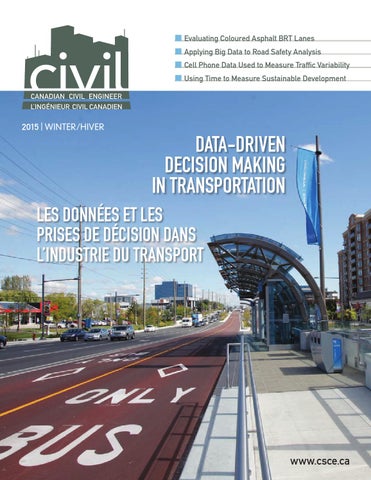
IN VIEW: PROJECTS 10 S pragues Road Unbonded Concrete Overlay 12 Evaluating Coloured Asphalt BRT Lanes Cover: Bus rapid transit (BRT) lane on Highway 7, York Region (see p. 12).
FORUM ON SUSTAINABILE INFRASTRUCTURE/ FORUM SUR L’INFRASTRUCTURE DURABLE 14 It’s About Time – a measure for sustainable technological development
TECHNICAL: DATA-DRIVEN DECISION MAKING IN TRANSPORTATION TECHNIQUE: LES DONNÉES ET LES PRISES DE DÉCISION DANS L’INDUSTRIE DU TRANSPORT 16 Introduction: the rise of data in transportation. By Tony Z. Qiu, Ph.D., P.Eng. 17 Using anonymous cell phone data to measure intercity freeway traffic
variability caused by holidays 21 Applying big data to road safety analysis
12
NEWS, VIEWS & DEPARTMENTS
NOUVELLES,
POINTS DE VUE ET
DÉPARTEMENTS 4 President’s perspective/
Perspective présidentielle 6 From the regions: Quebec/ De nos régions ; Québec 8 Young professionals corner/Le coin des jeunes professionnels 9 Student voice/La voix des étudiants 28 CSCE welcome to new members/Bienvenue aux nouveaux members SCGC 30 CSCE partners and sponsors/ Associés et commanditaires de la SCGC
17
10 Canadian Civil Engineer | Winter 2015
CIVIL Winter 2015.indd 3
3
2015-12-02 10:39 AM
PRESIDENT’S PERSPECTIVE | PERSPECTIVE PRÉSIDENTIELLE
Tony Bégin, P.Eng., CDP, M.A.Sc., MCSCE PRESIDENT, CSCE/PRÉSIDENT SCGC PRESIDENT@CSCE.CA
CSCE/SCGC
521-300, rue St-Sacrement Montreal, Québec H2Y 1X4 Tel.: 514-933-2634, Fax: 514-933-3504 E-mail: info@csce.ca www.csce.ca
PRESIDENT/PRÉSIDENT Tony Bégin, P.Eng., CDP, M.A.Sc., MCSCE
CANADIAN CIVIL ENGINEER/L’INGÉNIEUR CIVIL CANADIEN EDITOR/RÉDACTEUR Doug Salloum, CSCE Executive Director 514-933-2634 ext. 1, doug.salloum@csce.ca MANAGING EDITOR/ DIRECTEUR DE LA RÉDACTION Cindy Macdonald Tel.: 416-510-6755 cmacdonald@annexnewcom.ca
ASSOCIATE EDITOR/ RÉDACTEUR EN CHEF ADJOINT Bronwen Parsons Tel.: 416-510-5119 bparsons@ccemag.com
ADVERTISING SALES/ PUBLICITÉ Maureen Levy Tel: 416-510-5111 mlevy@ccemag.com
ART DIRECTOR/ COMPOSITION ARTISTIQUE Lisa Zambri Tel: 416-510-5600 x3595 lzambri@annexnewcom.ca
Annual Subscription Rates/Abonnement annuel Canada & U.S./E.U. $35.00, Other countries/Autres pays $45.00; Single copy/Un numéro $7.50; Agency discount/Rabais au distributeurs 10% PUBLICATION ISSN 9825-7515 RETURN ADDRESS/ADRESSE DE RETOUR : The Canadian Society for Civil Engineering La Société Canadienne de Génie Civil 521-300, rue St-Sacrement Montreal, Québec H2Y 1X4 Canadian Civil Engineer (CCE) is published five times per year by the Canadian Society for Civil Engineering (CSCE). L’ingénieur Civil Canadien (ICC) est publié cinq fois par année par la Société Canadienne de Génie Civil (SCGC). The opinions expressed in the papers are solely those of the authors and the Canadian Society for Civil Engineering is not responsible for the statements made in this publication. Les opinions exprimées dans les articles sont la seule responsabilité de leurs auteurs et la Société canadienne de génie civil n’engage pas sa responsabilité dans les propos exprimés. CIVIL Magazine is produced by the publishers of Canadian Consulting Engineer Magazine, published by Annex Publishing & Printing Inc. Le magazine Civil est produit par l’editeur de la publication Canadian Consulting Engineer qui est publie par Annex Publishing & Printing Inc. Annex Publishing & Printing Inc., 80 Valleybrook Drive, Toronto, Ontario M3B 2S9 Tel.: 416-442-5600; Fax: 416-510-5140 PUBLICATIONS MAIL AGREEMENT/POSTES CANADA ENREGISTREMENT #40065710
4
CIVIL Winter 2015.indd 4
What’s up?
A
s it is now almost six months into my term as president, let me give you an executive update on what we are doing to enhance your CSCE membership experience and to speed up our growth. Since last year the total number of members has reached almost 4,500, an increase of approximately 1,000 and a record high in the last three years. The number of students joining CSCE accounts for this growth. There is definitely a momentum which bodes well for the future of our Society. More than 400 volunteers give time and energy to CSCE through civil engineering departments of universities, our student chapters, sections, regions, technical divisions, committees, programs, conference organizing committees and the board of directors. I thank them for their dedication and valuable contribution. The best way to reward them is to participate in the activities, conferences and meetings that they organize for you. I had the honor and privilege of representing our learned Society in the past few months. I really enjoyed meeting with some other association partners such as the Engineering Institute of Canada (EIC), the Canadian Geotechnical Society (CGS), Canadian Construction Innovations (CCI), the Canadian Institute of Steel Construction, the Canadian Construction Association (CCA) and the American Society of Civil Engineers (ASCE). Many cooperation initiatives are under way. Together we will be stronger and our collaboration will help us to grow more quickly and to better serve the interests of our respective members Key initiatives have been pursued and some tangible products/services have been delivered in line with our Vision 2020 Strategic Directions. Here are the highlights:
Enhancing services to members • More than 50 letters of commendation were sent by the president to the work supervisors of CSCE’s volunteer executive members. We thanked them for the support of their employees and we informed them of their involvement in, and their contribution to, CSCE’s programs and activities; • Local section conference programs and networking activities; • Two issues (summer and fall) of Canadian Civil Engineer magazine (CIVIL) containing articles on civil engineering practice and the dissemination of know-how and best practices; • Twenty issues of the e-bulletin carrying the latest news on the Society as well as a compilation of very interesting articles published in the media on civil engineering topics; • New initiative to communicate the president’s video messages on YouTube; • Publication of videos of the projects that won the 2015 Innovation in Civil Engineering Award and the Governmental Leadership in Sustainable Infrastructure Award on YouTube; • Easier access to ASCE’s library of webinars (e-Learning, Live and On-Demand) with discounted fees for CSCE members.
Hiver 2015 | L’Ingénieur civil canadien
2015-12-02 10:39 AM
PRESIDENT’S PERSPECTIVE | PERSPECTIVE PRÉSIDENTIELLE
Growing with youth • Free CSCE membership for students with an automatic yearly renewal for the duration of their studies; • Involvement of practitioners from local sections as advisers to the student chapters; • Launch of a new CSCE student competition for Steel Bridge Design and Construction. The first edition will be held in May 2016 in conjunction with the Concrete Canoe Competition at McGill University in Montreal; • Start of a new mentor and protégé program with a mentor recruitment campaign that generated more than 50 registrations over the last few months. Watch for the upcoming protégé sign-up information.
Leadership in sustainable infrastructure • Upcoming publication of the second edition of the Canadian Infra-
structure Report Card. A press conference will be organized to launch the document; • Preparation of a national lecture tour in the spring of 2016 on this topic; • Development of an Infrastructure Sustainability Rating System with a CSCE position paper and policy statement. The economic, environmental and social impact factors will be taken into consideration. The entire civil engineering community is motivated by the mission of building better sustainable infrastructure in the future. We want to provide guidance and assistance to government and municipal leaders, as well as developers of new construction projects, in the prioritization of expenditures and investments. Tony Bégin is senior director of integrated project delivery at Canam-Buildings, a division of Canam Group.
Quoi de neuf ?
P
Des initiatives clés ont été mises en place et des résultats tangibles ont été réalisés en lien avec les orientations stratégiques de notre Vision 2020. En voici les faits saillants:
Le nombre total de nos membres, 4 500 personnes, est le plus élevé des trois dernières années : depuis un an, il a accru de 1000 personnes. La source principale de cette augmentation est l’adhésion des étudiants qui ont rejoint les rangs de la SCGC ce qui est très positif pour l’avenir de notre Société. Plus de 400 bénévoles donnent de leur temps et de leur énergie à la SCGC dans les départements de génie civil des universités, les chapitres étudiants, les sections, les régions, les divisions techniques, les comités, les différents programmes, les comités organisateurs des conférences et le conseil d’administration. Je les remercie pour leur de dévouement et précieuse contribution. La meilleure façon de les récompenser est de participer aux activités, aux conférences et aux rencontres qu’ils organisent pour vous. J’ai eu l’honneur et le privilège de représenter notre Société au cours des derniers mois. J’ai grandement apprécié rencontrer les dirigeants d’autres organismes tels que l’Institut des ingénieurs canadiens (IIC), la Société canadienne de géotechnique (SCG), Innovations de la construction canadienne (ICC), l’Institut canadien de la construction en acier (ICCA), l’Association canadienne de la construction (ACC) et l’American Society of Civil Engineers (ASCE). Plusieurs initiatives de coopération sont en cours. Ensemble, nous serons plus forts et notre collaboration permettra non seulement une croissance plus rapide, mais une plus grande efficacité pour servir les intérêts de nos membres respectifs.
Bonification des services aux membres:
rès de six mois dans mes fonctions de président et je prends le temps de vous communiquer un sommaire exécutif de ce que nous entreprenons pour améliorer votre expérience de membre et pour accélérer notre croissance.
Canadian Civil Engineer | Winter 2015
CIVIL Winter 2015.indd 5
Plus de cinquante (50) lettres de référence ont été adressées par le président aux superviseurs chez l’employeur des membres bénévoles exécutifs impliqués activement dans la SCGC. Nous les avons remerciés pour leur support tout en les informant de l’implication et de la contribution de leurs employés au sein de notre organisation; Présentation de conférences et d’activités de réseautage au niveau des Sections locales; Publication de deux (2) éditions (été et automne) de la revue L’Ingénieur civil canadien contenant des articles axés sur la pratique du génie civil et la dissémination du savoir-faire et des meilleures pratiques de la profession; Vingt (20) parutions du Bulletin électronique portant sur les dernières nouvelles de la Société et une compilation des articles les plus intéressants publiés par les medias sur des sujets pertinents du génie civil; Nouvelle initiative de publication de messages vidéo du président sur YouTube; Publication sur YouTube des vidéos des projets qui ont remporté les prix 2015 de l’Innovation en génie civil et du Leadership gouvernemental en infrastructures durables; Accès simplifié et à prix réduit à la librairie de webinaires (e-Learning, Live et On-Demand) de l’American Society of Civil Engineers (ASCE) pour les membres de la SCGC. Suite à la page 6
5
2015-12-02 10:39 AM
PRESIDENT’S PERSPECTIVE | PERSPECTIVE PRÉSIDENTIELLE Suite de la page 5
Croître avec les jeunes: Adhésion gratuite à la SCGC pour les étudiants avec un renouvellement annuel automatique pendant la durée de leurs études en génie civil; Implication d’un représentant de la pratique de la section locale à titre de conseillers au sein de chacun des chapitres étudiants; Lancement d’un nouveau concours étudiant canadien pour la conception et la construction d’un pont d’acier. La première édition se tiendra en mai 2016 conjointement avec le Concours canadien de canoë de béton à l’Université McGill de Montréal; Création d’un nouveau programme Mentor et Protégé avec une campagne de recrutement de mentors qui a généré plus de cinquante (50) inscriptions au cours des derniers mois. Un appel aux protégés sera bientôt lancé.
Leadership en infrastructures durables: Prochaine publication de la 2e édition du Bulletin de rendement des infrastructures canadiennes. Une conférence de presse sera organisée pour
le lancement du document; Organisation au printemps 2016 d’une tournée nationale de conférences portant sur l’interprétation des résultats du Bulletin de rendement des infrastructures canadiennes; Élaboration d’un système canadien d’évaluation de la durabilité des infrastructures avec la publication d’un énoncé de principes. Les facteurs d’impact économique, environnemental et social seront pris en considération.
Toute la communauté du génie civil est motivée par cette mission visant la construction de meilleures infrastructures durables pour l’avenir. Nous voulons guider adéquatement les instances gouvernementales, les autorités municipales et les développeurs de nouveaux projets de construction dans la priorisation des dépenses et des investissements. Tony Bégin est directeur senior, réalisation de projets intégrés à Canam-bâtiments, une division de Groupe Canam.
FROM THE REGIONS: SECTION NEWS | DE NOS RÉGIONS : NOUVELLES DES SECTIONS
First ever CSCE Canadian National Steel Bridge Competition to be in Montreal Jean-Luc Martel, ing. jr, AMCSCE VICE-PRESIDENT, QUEBEC REGION, CSCE
T
Concrete canoe race at the CNCCC held in Toronto in 2015./ Course de canoës de béton lors de la CNCCB à Toronto en 2015.
6
CIVIL Winter 2015.indd 6
he main objective of engineering competitions is to provide engineering students with opportunities to apply theories and concepts learned in class through a challenging project. For many future engineers, this first experience will contribute substantially to their training. It will push them to develop technical skills as well as communication and leadership skills, which are increasingly sought by the industry. The Canadian Society for Civil Engineering (CSCE) is pleased to promote this type of event by introducing the first Canadian National Steel Bridge Competition (CNSBC). For its first edition, the CNSBC will be organized jointly with the Canadian National Concrete Canoe Competition (CNCCC). McGill Uni-
Hiver 2015 | L’Ingénieur civil canadien
2015-12-02 10:39 AM
FROM THE REGIONS: SECTION NEWS | DE NOS RÉGIONS : NOUVELLES DES SECTIONS versity will host both events in Montreal from May 13 to 15, 2016. All Canadian universities are invited to participate. Several industry partners are contributing to the success of these competitions, by providing either financial support or material resources needed for the teams to develop their project. You may also contribute to the success of these events by becoming a partner of the
CNSBC or CNCCC. Of course, these events are open to the public. You are cordially invited to attend these competitions and enjoy the achievements of our future engineers. For more information, please feel free to contact me at president@scgcmontreal.ca.
Première édition du Concours national canadien de pont d’acier de la SCGC à Montréal! Jean-Luc Martel, ing. jr, MASCGC VICE-PRÉSIDENT – RÉGION DU QUÉBEC, SCGC
L
es concours d’ingénierie ont pour objectif principal d’offrir aux étudiants en génie l’opportunité de mettre en pratique les théories et les concepts appris en classe par le biais d’un projet stimulant. Pour beaucoup de futurs ingénieurs et ingénieures, il s’agit d’une première expérience pratique qui contribue grandement à leur formation. En effet, ils sont amenés à développer non seulement des compétences techniques, mais aussi leurs aptitudes sociales telles que la communication et le leadership, compétences de plus en plus recherchées par l’industrie. La Société canadienne de génie civil (SCGC) est heureuse de promouvoir à nouveau ce genre de concours en lançant le premier Concours national canadien de pont d’acier (CNCPA). Pour sa première édition, le CNCPA sera organisé conjointement avec le Concours national canadien de canoë de béton (CNCCB). L’uni-
versité McGill de Montréal accueillera les deux évènements du 13 au 15 mai 2016. Toutes les universités canadiennes sont invitées à y participer. Les différents partenaires industriels jouent un rôle primordial dans le succès de ces concours en fournissant soit un support financier soit les ressources matérielles nécessaires aux différentes équipes pour construire leur projet. Ainsi, vous pouvez à votre tour contribuer au succès de ces évènements en devenant partenaire du CNCPA ou du CNCCB dès maintenant. Bien entendu, l’évènement est ouvert au public. Vous êtes cordialement invités à y assister en grand nombre pour apprécier les réalisations des futurs ingénieurs et ingénieures de notre société! Pour plus d’informations, n’hésitez pas à me contacter : president@ scgcmontreal.ca.
Denso Products - Unmatched Quality and Performance
If it doesn’t say
on the outside, then its not
Denso North America Inc. • www.densona.com
Canadian Civil Engineer | Winter 2015
CIVIL Winter 2015.indd 7
on the inside.
7
2015-12-02 10:39 AM
YOUNG PROFESSIONALS’ CORNER | LE COIN DES JEUNES PROFESSIONNELS
Winter and the Young Professionals Committee Bernard Moulins CHAIR, YOUNG PROFESSIONALS COMMITTEE, CSCE
W
inter is fast approaching and the CSCE is beginning to organize its work plans and budgets for 2016. The Young Professional’s Committee is preparing a plan to help achieve the CSCE Vision 2020. Vision 2020 is composed of three strategic directions: (i) enhanced member services, (ii) growing with youth, and (iii) leadership in sustainable infrastructure. The YP Committee’s key role with tomorrow’s lead engineers makes it essential to helping fulfill Vision 2020. Last year, the YP Committee’s 2014 work plan included several goals tailored to reach these strategic directions. High importance was placed on growing with youth. Specifically, the YP Committee focused on bridging the gap between CSCE student and young professional members, where CSCE was experiencing low retention rates. The work plan resulted in a unique budget allocated to increasing awareness of CSCE YP offerings and of a free Associate Membership (AM0CSCE). The AM0CSCE category gives recent graduates all the benefits of young
professional membership during the period from graduation to December 31 of their graduating year. This is an opportunity to get to know your local CSCE before you decide to pay the annual dues required to become a first year associate member (AM1CSCE). The YP Committee is confident our efforts over the past year will have helped the CSCE grow with youth, but works remains to be done! Our new work plan will include a continued focus on awareness, events, and facilitating attendance at the annual conference for YP leaders. We want to continue extending CSCE’s role in the professional and personal endeavors of all civil engineering young professionals by offering unique networking opportunities, workshops and support. However, our key to success remains your feedback. We’d like to hear your thoughts on the CSCE YP Committee. Any goals, events or ideas – big or small – are welcome. Please don’t hesitate to contact me at bernard.moulins@enercon.de.
L’hiver au Comité des jeunes professionnels Bernard Moulins PRÉSIDENT, COMITÉ DES JEUNES PROFESSIONNELS, SCGC
L
’hiver approche à grands pas et la SCGC commence déjà à préparer ses plans de travail et ses budgets pour l’année 2016. Le Comité des jeunes professionnels prépare un plan concordant avec la Vision 2020 de la SCGC. La Vision 2020 est constituée de trois orientations stratégiques : (i) la bonification des services aux membres, (ii) la croissance avec les jeunes, et (iii) le leadership en infrastructures durables. Le principal rôle du Comité JP auprès des ingénieurs qui seront les leaders de demain rend essentiel de contribuer à l’accomplissement de la Vision 2020. L’année dernière, le plan de travail du Comité des jeunes professionnels incluait plusieurs objectifs personnalisés et destinés à mettre en œuvre les trois orientations stratégiques. Une grande importance fut accordée à la croissance avec les jeunes. Plus particulièrement, le Comité JP s’est attelé à combler l’écart entre les étudiants de la SCGC et les jeunes professionnels membres de la SCGC, pour lesquels nous avons remarqué un faible taux de rétention. Le plan de travail a mené à l’allocation d’un budget unique visant à augmenter la conscientisation des privilèges offerts aux JP ainsi qu’une adhésion gratuite comme membre associé (MA0SCGC). La catégorie MA0SCGC fournit aux récents diplômés tous les avantages
8
CIVIL Winter 2015.indd 8
de l’adhésion jeune professionnel de la date d’obtention de leur diplôme au 31 décembre de la même année. Cela vous donne l’opportunité de connaitre votre section SCGC locale avant de décider de régler les frais d’adhésion requis pour devenir membre associé 1ère année (MA1SCGC). Le Comité JP est convaincu que nos efforts des dernières années auront porté des fruits et auront permis à la SCGC de croître avec les jeunes. Cependant, il reste beaucoup à faire! Notre nouveau plan de travail comprendra un effort soutenu pour la sensibilisation, les événements et la promotion de la présence des leaders des jeunes professionnels au Congrès annuel de la SCGC. Nous souhaitons continuer à accroître le rôle de la SCGC dans les efforts professionnels et personnels de tous les jeunes professionnels en génie civil en offrant des occasions uniques de réseautage, des ateliers et un soutien. Néanmoins, vos commentaires demeurent la clé de notre succès. Nous aimerions savoir ce que vous pensez du Comité JP de la SCGC. Tout objectif, événement ou idée, qu’ils soient modestes ou ambitieux, sont les bienvenus. N’hésitez pas à me contacter à bernard.moulins@enercon.de.
Hiver 2015 | L’Ingénieur civil canadien
2015-12-02 10:39 AM
THE STUDENT VOICE | LA VOIX DES ÉTUDIANTS
Keys to Creating a Dynamic CSCE Student Chapter Charles-Darwin Annan, Ph.D., P.Eng. CHAIR, STUDENT AFFAIRS COMMITTEE, CSCE
A
s chair of student affairs, I keep receiving the same questions from CSCE student chapter leaders about how they can create a high performance student chapter. Like any dynamic organization, a vibrant student chapter requires the right team of leaders and the establishment of the right structures and processes. Here are some key characteristics to help add value to your chapter: Define chapter goals with significant professional content. Without a clearly defined goal, and action and follow-up plans, a student chapter lacks direction and will be unable to assess its performance. Some examples of chapter goals are: increasing chapter membership, improving member participation and adding
value to student membership. Develop professionally stimulating programs. Chapter leaders have a responsibility to give students a reason to be chapter members. They can request special talks, tours and events from their local CSCE sections; explore multi-chapter activities with other student chapters in their region; and undertake special projects with engineering content to build relationships with their communities. Remain visible. One way of creating a dynamic chapter is by building visibility, including online visibility through social media and a chapter website. Chapters can also publish their activities in CIVIL magazine. Participate in CSCE events. Attend local, regional and national, including the Student
Leaders Workshop at the annual conference. Maintain a sound financial status. Chapters can explore different sources to raise funds, i.e. fundraising projects, seeking sponsorships from local industry, exploring department/ faculty support systems for student projects, and connecting with CSCE local sections and regions. Document for future executives. To run an efficient chapter, it is important to document chapter goals and action plans, financial cash flow, activities and events. It is imperative to involve students from all year groups in the leadership team, and to plan ahead to ensure a smooth transition from one year to another. Dr. Charles-Darwin Annan is an associate professor of civil engineering at Université Laval and can be reached at Charles-darwin.annan@ gci.ulaval.ca
Facteurs clés pour un chapitre étudiant dynamique Charles-Darwin Annan, Ph.D., P.Eng. PRÉSIDENT, AFFAIRES ÉTUDIANTES DE LA SCGC
E
n tant que président des Affaires étudiantes, des leaders des chapitres étudiants de la SCGC me posent souvent des questions sur la façon dont ils peuvent mettre en place un chapitre étudiant performant. Tout comme n’importe quelle organisation productive et vigoureuse, un chapitre étudiant dynamique se doit de mettre en place la bonne équipe de leaders et d’établir des structures et des processus adéquats. Voici quelques caractéristiques clés pouvant vous aider à ajouter de la valeur à votre chapitre : Définir les objectifs du chapitre en incluant un contenu professionnel important : sans des objectifs et des plans d'action et de
Corporate Announcement:
Infrastructure Management Specialist Dr. Guy Félio, P.Eng., FCSCE R.V. Anderson Associates Limited is pleased to welcome Guy Félio as our Infrastructure Management Specialist. Guy joined RVA on August 24, 2015 and works out of the Ottawa office. Guy is leading RVA’s infrastructure management practice, bringing 30 years of experience in municipal, civil and geotechnical engineering. He focuses on finding practical, innovative and cost-effective solutions for sustainable and resilient infrastructure. He draws on his engineering, policy development, research and teaching experience in his approach to problem solving. In his role, Guy provides expertise and support to all of RVA’s Canadian and International operations.
toronto niagara ottawa sudbury london moncton fredericton st. john’s mumbai www.rvanderson.com
Suite à la page 15 Canadian Civil Fall Engineer Engineer||Winter Winter2015 2015
CIVIL Winter 2015.indd 9
Canadian Civil Engineer 4.875” x 3.625” 9 November 2015
2015-12-02 10:39 AM
IN VIEW: PROJECTS | PROJETS EN VEDETTE
Spragues Road Unbonded Concrete Overlay A pilot project to rehabilitate a well travelled road in the Region of Waterloo, Ontario, is taking the innovative approach of preserving the road’s existing concrete base. By Daniel Pickel, Ma.Sc., Ph.D. CANDIDATE, UNIVERSITY OF WATERLOO
Susan L. Tighe, Ph.D., P.Eng., MCSCE, PROFESSOR, UNIVERSITY OF WATERLOO
Eric Saunderson, PMP, CET, EIT, REGION OF WATERLOO
S
pragues Road in the Region of Waterloo, Ontario, was in poor condition in 2014. Several areas on the asphalt surface showed severe cracking and spalling. Localized asphalt patches that had been placed relatively recently were also in poor condition. The pavement was a composite which included about 150 mm of asphalt placed over about 180 mm of concrete. The concrete, which was installed by the Province of Ontario in 1929 according to some estimates, provides a stiff base, which is why very
10
CIVIL Winter 2015.indd 10
little deep rutting was observed. For a regional highway in Southern Ontario, Spragues Road experiences significant traffic levels. The traffic is partially due to local industries, such as the quarry located at the intersection of Spragues Road and Brant-Waterloo Road, and also because Spragues Road serves as a direct link between Paris and Cambridge, Ontario, and Highway 401, which is the most heavily travelled highway in Canada. With an average annual daily traffic level of approximately 8,500 vehicles, 8% of which are heavy trucks, Spragues Road experiences higher traffic levels than it was originally designed for.
Pavement design The project's section of roadway had been resurfaced several times over the life of the pavement and it was determined that traditional resurfacing strategies were not cost-effective due to reflective cracking from the underlying concrete base. This situation led the Region of Waterloo to consider replacing the concrete base with granular materials. The Region contracted Applied Research Associates (ARA) of Toronto to analyze several design options and consider alternate pavement rehabilitation strategies.
Based on a number of considerations, it was deemed that preserving the existing concrete base was the most feasible and cost-effective solution for Spragues Road. The design includes an unbonded concrete overlay with re-profiling of the existing asphalt surface — in some locations down to the underlying concrete. A 25-mm thick layer of asphalt was then placed to provide a separation layer between the existing and new concrete. The new concrete surface was widened to accommodate new cycling facilities and consists of a 160-mm thick layer of jointed plain concrete pavement. Because the pavement repair strategy was the first for the Region of Waterloo, a substantial amount of pre-engineering work was conducted to determine the extent of the existing concrete base prior to developing the design of the 1.2-km pilot project and releasing the tender for bidding. The performance of the pilot project will be monitored following construction and the success of this rehabilitation strategy will be taken into consideration as part of potential concrete overlay projects in the future.
Traffic management Capital Paving and the Miller Group were the successful bidders on the project. During
Hiver 2015 | L’Ingénieur civil canadien
2015-12-02 10:39 AM
IN VIEW: PROJECTS | PROJETS EN VEDETTE Left inset: Surface of Spragues Road in poor condition, May 2015. Facing page left: Spragues Road following unbonded concrete overlay, October 2015. Below: southbound traffic detour around project extents. Route shown in red denotes original route and length, while yellow denotes the route and length of the detour.
the tender stage it was decided that the twolane highway would be rehabilitated one lane at a time, while maintaining traffic on the other lane. This decision increased the importance of traffic management during each stage of the project and provided access to residences and businesses that were within the work limits. The first challenge was how to manage traffic with only one lane available for use at a time. In some projects, the shoulders can be extended enough to allow two directions of slow travel across a width smaller than two typical traffic lanes. In the case of Spragues Road, there are several steep shoulders and natural barriers that make the required shoulder widening unfeasible. Because of this, it was decided that only northbound traffic would be maintained, while southbound traffic would be detoured 13 kilometres around the construction site for the entire two-month duration of the project. This approach was found to be very disruptive to motorists and local residents. For future projects the Region has determined that maintaining two-way traffic until such time that the contractor has to close the road for concrete operations is a better strategy. This
Canadian Civil Engineer | Winter 2015
CIVIL Winter 2015.indd 11
strategy would include controlled flagging operations or pilot vehicles during normal working hours, and providing full access during the evenings and weekends. The duration of the work would be extended and an additional cost would be expected to conduct the work in this fashion, but the Region would be able to reduce traffic disruption and reduce motorist frustration. The other traffic management consideration was allowing residents along the construction zone to have full access to their properties throughout the course of construction. This access included the 24-hour periods when the concrete pavement was curing and could not support the weight of a vehicle. Access was maintained using several strategies, such as: quick-removal
ramps, temporary stringline drops, parking spaces adjacent to properties, and, most importantly, constant communication between residents and the on-site contractors. The Centre for Pavement and Transportation Technology (CPATT) at the University of Waterloo studied the traffic management practices of the project in order to transfer knowledge and provide guidance on similar future overlay projects in the Region of Waterloo and elsewhere. In addition, instrumentation to measure the strains of the concrete overlay layer was installed during the placement of concrete in order to monitor the performance of the pavement throughout its life. The gauges provide insight into the magnitude of strains occurring at the bottom (tension face) of the concrete layer.
Owner: Region of Waterloo (Eric Saunderson, PMP, CET, EIT) Prime consultant, design and analysis: Applied Research Associates (ARA), Toronto (Anne Holt, P.Eng.) Contractors: Capital Paving and Miller Group Researchers: Centre for Pavement and Transportation Technology (CPATT), University of Waterloo; Cement Association of Canada (Rico Fung)
11
2015-12-02 10:39 AM
IN VIEW: PROJECTS | PROJETS EN VEDETTE
York Region
Section of the Highway 7 BRT Lane, York Region, Ontario.
Evaluating Coloured Asphalt BRT Lanes The Regional Municipality of York in Ontario and CPATT at the University of Waterloo are working to find innovative and sustainable surface treatments for bus rapid transit lanes.
L
ocated north of Toronto, the Regional Municipality of York, the sixth largest municipality in Canada, is a thriving community and home to a well-established service sector. York Region’s population is expected to grow from 1.1 million in 2013 to 1.8 million in 2041. With more people coming to the Region every year, rapid transit projects provide significant benefits. Bus Rapid Transit (BRT) lanes are built or being built along the region's three By Sina Varamini, MASc., most heavily travelled roads: Yonge Street, PH.D. CANDIDATE, EIT, UNIVERSITY OF WATERLOO Highway 7 and Davis Drive. To improve the level of safety through enhanced visibility and Mehran Kafi Farashah, MASc., P.Eng., to help residents and motorists easily underASSET MANAGEMENT ANALYST, YORK REGION stand this new transit system and follow the right-of-way, York Region uses coloured asphalt Susan L Tighe, Ph.D., P.Eng., MCSCE, pavement design for its dedicated BRT lanes. PROFESSOR, UNIVERSITY OF WATERLOO York Region and Metrolinx (an agency of
12
CIVIL Winter 2015.indd 12
the Government of Ontario, created to improve the coordination and integration of all modes of transportation in the Greater Toronto and Hamilton Area) retained the Centre for Pavement and Transportation Technology (CPATT) at the University of Waterloo to identify innovative and sustainable coloured asphalt pavement designs. The intent is to find materials for future preservation and maintenance in an effort to ensure durability and high performance throughout the material’s life cycle.
Nature of asphalt pavement Asphalt pavement is a structure composed of asphalt-bound layers over unbound drainage layers and a subgrade. This pavement structure distributes stress caused by traffic loads down-
Hiver 2015 | L’Ingénieur civil canadien
2015-12-02 10:39 AM
Laboratory tests and field observations To help decision makers, an array of materials is being systematically evaluated for performance at the state-of-the-art pavement laboratory at CPATT. These results will be used to develop performance prediction models describing the expected path of deterioration over time. Materials under evaluation include those collected during paving operations and materials produced under controlled laboratory conditions. The study results are expected to provide insight into the level of resistance the pavement structure will exhibit when subject to distresses, including: (1) permanent deformation (also known as “rutting”) caused by repetitive traffic loading coupled with relatively hot summer temperatures; (2) fatigue cracking due to repeated long-term traffic load; (3) low-temperature cracking caused by shrinkage during winter temperatures; (4) exposure to multiple freeze-thaw cycles; and (5) loss of surficial colour and friction due to inevitable wear and tear. Laboratory performance results are integrated with field observations and semi-au-
Canadian Civil Engineer | Winter 2015
CIVIL Winter 2015.indd 13
CPATT
Above: Fatigue testing a prism prepared using field-sampled coloured asphalt mixture. The fatigue test is an accelerated test simulating stresses that are expected from traffic loading and climatic conditions in long-term life of more than 20 years. Above right: Low-temperature cracking testing a prism prepared using field-sampled coloured asphalt mixture. This test simulates stresses caused by shrinkage during extreme winter temperatures. Right: Dynamic modulus testing a cylindrical specimen prepared using field-sampled coloured asphalt mixture. This test is used to evaluate the impact of colouring pigment on the mixture’s strength at testing conditions simulating varying seasonal temperature and vehicle speed.
tomated distress surveys of existing road sections. The distress survey is conducted using a semi-automated road analyzer equipped with an extensive set of sensors and video cameras continuously recording type, extent and intensity of different types of surface cracks. By using the semi-automated road analyzer
CPATT
ward to the underlying soil foundation at different seasonal environmental conditions. Another key performance is that the pavement’s surface must be smooth and provide adequate skid resistance for drivers. However, after years of being in service, as well as being exposed to climatic conditions, cracks begin to appear on the pavement surface as different forms of distress, allowing water to infiltrate and further weaken the pavement surface. Without proper pavement management practices, the ability to preserve and maintain the structure becomes lost, and ultimately the pavement is no longer able to support heavy loads, which leads to pavement failure. One key to proper management of asphalt surfaces is identifying timely and cost effective preservation and maintenance strategies. Doing so may be difficult if there is not a good understanding of the in-situ materials’ performance and their long-term behaviour.
CPATT
IN VIEW: PROJECTS | PROJETS EN VEDETTE
equipment, accurate and cost-effective data are collected, which will effectively complement management decisions. This study will determine the performance characteristics of coloured asphalt pavements and coloured surface treatments used on York Region and Metrolinx projects.
Owners: Regional Municipality of York (Jim Lee, P.Eng.) and Metrolinx (Javier Mena Diep, P.Eng, PMP) Researchers: Centre for Pavement and Transportation Technology (CPATT), University of Waterloo
13
2015-12-02 10:39 AM
SUSTAINABLE INFRASTRUCTURE | LES INFRASTRUCTURES DURABLES
It’s About Time By Doug Nuttall, P.Eng PARISH AQUATIC SERVICES
S
ustainability engineering is in its infancy, but it’s growing up quickly. This ongoing forum in CIVIL magazine has contained the wisdom of many who have explored this topic: we started on this journey looking at sustainability indicators, and moved onto balancing with triple bottom line approaches. But we need something more to say with confidence that a particular initiative will allow a community to be more sustainable, and to know how much more sustainable it will be. To do that, we will need to use the units of measure for sustainable technological development. With those units, we can provide designs that are optimized for community sustainability. The example that follows uses a method that can be used by any discipline of engineering to assess how the potential quality of life within a community would be affected by any given engineering project.
The example: Dr. John Smith, P.Eng., who is a long-time resident of the Temiskaming area, has been told by his insurance company that because his principal source of space heat is a wood burning appliance (7 full cord/year), and his house is made of logs, he is going to have to pay $5000 per year in additional insurance. All of his neighbours in the same situation have installed baseboard electric heat, and have continued heating mostly with wood. He’d like to check to see if the conventional wisdom is actually the best idea. Dr. Smith, in developing his analysis, starts with this definition of sustainability engineering: Sustainability engineering is creating or enhancing systems of infrastructure so that there is an expectation of a return on that investment into the future, when considering only the resources available in perpetuity to the community and the time required to meet needs within the community.
He decides he has five alternatives available: 1. Do nothing, and pay $5000 more per year, in addition to his electrical bill. 2. Install baseboard electric heat, and provide 8% of his heat using electricity. This would be cheap to install, and he doesn’t have to use them much. 3. Build an average Canadian new home, and heat with fuel oil or propane. 4. Build a ‘green’ home, using a small pellet cooking stove for cooking, domestic hot water, and space heat. 5. Build an ‘earthship’, using PassiveHouse approaches, and large south-facing glass, using a propane stove for cooking.
14
CIVIL Winter 2015.indd 14
For Canada as a whole, in 2005, the curve on page 16 relates time use to meet needs (T measured as the time spent to meet needs in minutes per day per capita (min/d/ca) to the resource consumption (R measured as ecological footprint in global hectares per capita (gHa/ca). This provides the conversion of units of resource consumption to units of time. For each alternative, his analysis determines: 1. Cradle-to-cradle life cycle analysis (LCA) of Time cost to create, operate, maintain, and decommission project. 2. Improvement in time used to meet needs within community, as time benefit relative to “Do Nothing.” 3. Resources used from sources being managed per Daly by community as ecological footprint. 4. Resources used from sources not being managed per Daly by community. a) Not from resources managed by community; imported ecological footprint b) Will exhaust over lifecycle of project 5. Find costs and penalties. a) Convert (4a) to a Future Time Cost using the slope of the R/T curve at capacity. b) Convert (4b) to a Time Penalty using the mass ratio of (4b) to total mass used x longevity ratio of time to peak over lifespan of project. 6. Subtract (2)+(5a) from (1) =Net Time Benefit 7. Compare to “Do Nothing.” 8. If positive, divide (7) by cost per day =Sustainable Value He chose his community as all the people and resources within 60 km of his residence. The Locally Used Biocapacity (LUBC) is 7.7 gHa/ ca, slightly more than the Canadian average. The slope of the 2005 T/R curve at that point is -9.06 min/d/gHa, and he assumes it has not changed significantly since then. He is calculating for a household of 4 people. He expected that the time required for his household tasks will be essentially unchanged with any of these alternatives. The differences would be the time he takes maintaining his home (well-built homes will require less), cutting and burning wood (well-built homes will require significantly less heat), and the time of construction divided by the lifespan of the infrastructure. He expected the Ecological Footprint for home maintenance will be the national average, adjusted linearly with the time required. Half of the electricity, and generally half of the construction materials, come from outside of the community. A small amount of the resources used would come from unsustainable harvest from within the community. For the various alternatives, he found that in this community, the earth/soil composite construction would produce the best Net Time Benefit, and the highest Sustainable Value, while the conventional wisdom of his neighbours causes the overall quality of life to be decreased. Therefore, Dr. Smith decided to investigate the ‘earthship’ in more de-
Hiver 2015 | L’Ingénieur civil canadien
2015-12-02 10:39 AM
SUSTAINABLE INFRASTRUCTURE | LES INFRASTRUCTURES DURABLES Alternative
Units 1 2 3 4 5
Install cost
$
4000
228000
342000
193800
Operating cost
$/year
2073
1401
934
420
Lifespan
Yrs 80 50 60 80 80
Present value
$
193333
57353
266790
370219
206498
Time cost
min/d/ca
11.55
11.56
9.47
6.68
6.29
Time benefit
min/d/ca
0.00
0.13
0.41
0.98
1.63
EF per Daly
gHa/ca
4.13
4.00
3.50
2.08
0.27
EF imported
gHa/ca
0.51
0.67
0.81
0.63
0.30
Mass % not per Daly
0.0%
0.0%
12.8%
17.2%
1.8%
Future time cost
min/d/ca
4.630
6.068
7.331
5.749
Time penalty
min/d/ca
0.000
0.000
0.052
0.168
Net time benefit
min/d/ca -16.18
6401
Compare to Do Nothing min/d/ca Sustainable value
2.732 0.029
-17.50
-16.44
-11.62
-7.42
-1.38
-0.27
4.56
8.76
0.36
1.24
0
min/ca/$
-
-
deprivation (red area): not enough time in a day to meet needs
1440 1440
Time Use to Meet Needs (min/d/ca)
(1 day)
1080 1080
tail, to see which components could be changed to improve the Net Time Benefit farther without impacting his perceived quality of life.
The bigger picture Our obligation as a profession is to hold our duty to public welfare as paramount. In the world we are in today, this means stepping up, and seeking out better ways of making design decisions that can be shown to benefit not just the client today, but the whole community for as far as we can foresee. This method allows engineers to test to see which solution would make a community the most sustainable, and to determine which alternative would be the best investment of money for a return of sustainability. It can compare solutions from different disciplines, communities, and cultures. And it can be used as part of a larger conversation involving other professions, to actualize the potential quality of life that we develop for the community. Engineers have traditionally built the quality of life for individuals, families, and communities. We can now design specifically for it, and with experience and outside help, we’ll be able to provide maximal solutions. Sustainability engineering is well on its way to growing up.
References 1. http://earthship.com/ 2. http://www.passivehouse.ca/ 3. Daly, H. ( 1990). “Toward some operational principals of Sustainable Development” Ecological Economics, 2(1), pp. 1-6
720 720
below subsistence (blue area): insufficient resources to meet needs
360 360
00
00
22
below capacity (white area): not using all available resources
44
beyond capacity (grey area): must ‘import’ resources from either away or the future
66
88
10 10
12 12
Ecological Footprint (gHa/ca) Deciles of household Income, Canada 2005
at capacity (7.6gHa/ca)
Doug Nuttall is a senior water resources engineer with Parish Aquatic Services, a division of Matrix Solutions Inc. Further information about this topic can be found at www.sustainabilityengineering.net.
THE STUDENT VOICE | LA VOIX DES ÉTUDIANTS Suite de la page 9 suivi clairement définis, un chapitre étudiant manquera d'orientation et ne sera pas en mesure d'évaluer adéquatement son rendement. Voici quelques exemples d'objectifs de chapitre : augmenter le nombre d'adhésions au chapitre, accroître la participation des membres et ajouter de la valeur au statut de membres étudiants. Développer des programmes stimulant au niveau professionnel : les leaders des chapitres ont la responsabilité de donner aux étudiants une raison de devenir membres du chapitre. Ils peuvent demander des conférences, des tournées et des événements spéciaux à leurs sections locales de la SCGC; explorer l'idée d’organiser des activités conjointes avec d'autres chapitres étudiants de leur région; entreprendre des projets spéciaux ayant un contenu en ingénierie afin de développer des liens avec leurs communautés. Demeurer visible : une bonne façon de créer un chapitre dynamique est d’assurer sa visibilité, incluant une présence en ligne par le biais des médias sociaux et d'un site Web dédié au chapitre étudiant. Les chapitres
Canadian Civil Engineer | Winter 2015
CIVIL Winter 2015.indd 15
peuvent également publier leurs activités dans la revue CIVIL. Participer aux événements de la SCGC : au niveau local, régional et national, incluant l’atelier pour les leaders des chapitres étudiants organisé lors du congrès annuel. Maintenir une situation financière saine : les chapitres peuvent explorer différentes avenues pour amasser des fonds telles que des collectes de fonds, des recherches de commanditaires industriels, des systèmes de soutien des facultés/départements pour des projets étudiants, et des rencontres avec les sections locales et régionales de la SCGC. Conserver les dossiers pour les futurs dirigeants : pour gérer un chapitre efficace, il est important de bien documenter les objectifs et les plans d’action du chapitre, ainsi que la situation de la trésorerie, les activités et les événements. Il est primordial d’impliquer les étudiants de tous les niveaux d’études dans l’équipe de direction, afin de bien planifier pour l’avenir et d’assurer la transition d’une année à l’autre.
15
2015-12-02 10:39 AM
TECHNICAL: DATA-DRIVEN DECISION MAKING IN TRANSPORTATION | TECHNIQUE: LES DONNÉES ET LES PRISES DE DÉCISION DANS L’INDUSTRIE DU TRANSPORT
The Rise of Data in Transportation Tony Z. Qiu, Ph.D., P.Eng. CHAIR, TRANSPORTATION DIVISION, CSCE
M
odern data collection and analysis methods have significantly expanded the horizon of potential data applications. As a result, transportation professionals and agencies are under increasing pressure to apply data-driven decision making and performance metrics to not only the planning and development of future transportation and infrastructure, but also to maintenance and preservation as well. In addition, at the driver level, data can be used to help users more effectively plan their trips to save travel time and avoid congestion. This issue of CIVIL magazine highlights a few data-driven applications, providing insight into how data can be used to address relevant and timely issues in the field of transportation. The following article describes research at the University of Alberta on how data from mobile phone networks can be used to understand traffic patterns and help improve freeway operational performance. A second article
describes work at the University of Waterloo on the potential of a data-driven nonparametric approach for road safety analysis, considering the arrival of the big data era. Two case studies elsewhere in this issue describe research at the University of Waterloo on assessing and developing strategies for timely and cost-effective maintenance and preservation of roadway pavement. For the transportation industry, data is increasingly becoming a valuable resource with a myriad of applications that will influence the future of transportation. Data-driven decision making is particularly key for Canada in building durable infrastructure, as our country’s climate presents unique challenges when designing and maintaining transportation infrastructure. Tony Z. Qiu is associate professor, transportation engineering, and director, Centre for Smart Transportation, at the University of Alberta.
L’augmentation des données dans le domaine des transports
Tony Z. Qiu, Ph.D., P.Eng.
PRÉSIDENT, DIVISION DES TRANSPORTS, SCGC
L
es méthodes modernes de collecte et d’analyse des données ont permis d’élargir considérablement les possibilités des applications de données. Il en résulte que les agences de transport et les professionnels de l’industrie subissent une pression toujours grandissante pour appliquer la prise de décision basée sur des données et des mesures du rendement non seulement à la planification et au développement des infrastructures et des moyens de transport futurs mais également à leur entretien et leur préservation. De plus, au niveau du chauffeur, les données peuvent être utilisées pour aider les utilisateurs à planifier plus efficacement leurs déplacements afin de gagner du temps et d’éviter les congestions. Cette édition de la revue CIVIL présente quelques applications basées sur les données, procurant un aperçu de la façon dont les données peuvent être utilisées afin de faire face à des problèmes importants et précis dans le domaine du transport. L’article suivant décrit les recherches menées à l’Université de l’Alberta sur la manière dont les données provenant de réseaux téléphoniques mobiles peuvent être utilisées pour comprendre les modèles de circulation et contribuer
16
CIVIL Winter 2015.indd 16
aider à l’amélioration du rendement opérationnel des autoroutes. Le second article décrit le travail effectué à l’Université de Waterloo sur le potentiel d’une approche non paramétrique basée sur des données pour l’analyse de la sécurité routière compte tenu de l’arrivée de l’ère des méga données. Deux études de cas présentent les recherches menées à l’Université de Waterloo sur l’évaluation et l’élaboration de stratégies visant l’entretien et la préservation opportuns et rentable du revêtement des chaussées. Pour l’industrie du transport, les données deviennent de plus en plus une ressource précieuse comportant une myriade d’applications qui influenceront l’avenir des transports. La prise de décision basée sur des données est particulièrement importante pour le Canada pour la construction d’infrastructures durables, alors que le climat de notre pays présente des défis uniques pour la conception et l’entretien des infrastructures de transport. Tony Z. Qiu est professeur agrégé en ingénierie du transport, et directeur du Centre for Smart Transportation, à l’Université de l’Alberta.
Hiver 2015 | L’Ingénieur civil canadien
2015-12-02 10:39 AM
TECHNICAL: DATA-DRIVEN DECISION MAKING IN TRANSPORTATION | TECHNIQUE: LES DONNÉES ET LES PRISES DE DÉCISION DANS L’INDUSTRIE DU TRANSPORT
Using Anonymous Cell Phone Data to Measure Intercity Freeway Traffic Variability Caused by Holidays Gang Liu, Ph.D. POSTDOCTORAL FELLOW
Chenhao Wang M.SC. CANDIDATE
Tony Z. Qiu, Ph.D., P.Eng. DIRECTOR CENTRE FOR SMART TRANSPORTATION AND ASSOCIATE PROFESSOR, DEPARTMENT OF CIVIL AND ENVIRONMENTAL ENGINEERING, UNIVERSITY OF ALBERTA
A
s wireless location technology continues to progress very quickly, cellular probe technology is becoming a hot topic in the field of traffic engineering. Since cell phones move with people in vehicles, a huge amount of data can be collected at the individual level for estimating traffic-related parameters. Many studies have explored the use of cell phone data to estimate traffic states (Frutos and Castro 2014; Järv et al. 2014). Intuitively, monitoring and tracking the movement of cell phones within one wireless network can generate real-time estimated traffic states of the corresponding roadway network covered by the wireless network. For example, measuring the “speed” of cell phones provides the scope to determine the speed of the vehicles. In past years, a number of simulation studies and field tests have investigated the feasibility of designing and developing a cellular probebased traffic speed estimation system (Bar-Gera 2007). Unlike other traffic sensing systems, these techniques rely on the location of the cellular phone over the time period, calibrated using triangulation of the GSM (Global System for Mobile communication) signal strength over time; fingerprint matching of the phone’s successive signal strength readings; or the location of the cellular phone handoff between towers (Chen et al. 2006; Gundlegard and Karlsson 2009). Steenbruggen et al. (2013) systematically reviewed the main studies and projects addressing the use of data derived from mobile phone networks to obtain location and traffic estimations of individuals. They gave several general conclusions: (1) the most studied estimation issues for traffic management purposes were travel speed and travel time; (2) most of the studies focused on stretches of roads, or loops, and not on a road network level; (3) recent studies show more promising results. Holiday periods contribute to a large portion of traffic variabili-
Canadian Civil Engineer | Winter 2015
CIVIL Winter 2015.indd 17
ty (i.e., different traffic congestion patterns in comparison with non-holiday periods). Liu and Sharma (2008) analyzed twenty years of data collected by permanent traffic counters on highways in Alberta, Canada. The results of the nonparametric Wilcoxon matched pair test and Friedman method revealed that holidays substantially contributed to the variability of traffic. Jun (2010) investigated the vari-
Figure 1. Architecture of the cellular network.
17
2015-12-02 10:39 AM
TECHNICAL: DATA-DRIVEN DECISION MAKING IN TRANSPORTATION | TECHNIQUE: LES DONNÉES ET LES PRISES DE DÉCISION DANS L’INDUSTRIE DU TRANSPORT ability of speed patterns and congestion characteristics of interstate freeway systems during holidays. The estimated Gaussian mixture speed distribution showed the potential of improving freeway operational performance evaluation schemes for holiday periods. However, the traffic patterns of the intercity freeway during special holidays have been rarely investigated using anonymous cell phone data. Heavy traffic congestion and longer delay times are easily created on intercity freeway systems during holiday periods. An understanding of this substantial variation in traffic volume and speed due to holiday events is important for transportation agencies to establish appropriate holiday traffic management plans. This study uses anonymous cell phone data to evaluate the change in traffic patterns caused by holiday traffic, and discusses how traffic patterns vary each day during holiday periods (before the holiday, during the holiday, and after the holiday). It is anticipated that the findings of this study will help transportation engineers and program managers implement appropriate congestion-related countermeasures for mitigating heavy congestion on a subject roadway during the busiest holiday periods. Drivers can also choose to avoid the congestion and change their holiday travel schedules based on the information about holiday traffic.
Speed estimation Figure 1 shows the system structure of a standard cellular network. A cellular network is a radio network made up of a number of radio cells, each served by a fixed transmitter, known as a base transceiver station (BTS), which is also termed a cell. These cells are used to cover different areas in order to provide radio coverage over an area broader than one cell. Cellular networks are inherently asymmetric with a set of fixed main transceivers each serving a cell and a set of distributed transceivers that provide services to the network’s users. BTSs (cells) are all interconnected, which is the reason why someone can move from one cell to another without losing connection. BTS is the basic geographic unit of a cellular network system, and a city or county is divided into smaller cells, each of which is equipped with a low-powered BTS. The cells can vary in size depending upon the location, terrain and capacity demands, and the size can be several hundred meters or several kilometers. When a cell phone during
Figure 2. Calibrated handoff points and two-way roadway links.
18
CIVIL Winter 2015.indd 18
a call moves from one cell toward another, a base station controller (BSC) monitors the movement, and at the appropriate time, transfers or hands off the phone call to the new cell. Handoff is the process by which the controller passes a cell phone conversation from one cell to another. The handoff is performed so quickly that users usually never notice, and the controller records each handoff once it occurs. Location update (LU) strategy is another mechanism for locating cell phones in the GSM cellular network, and it can handle all cell phones that have been turned on and are in idle status (not on-call). All the cells within the GSM network are grouped into a number of disjointed location areas (LA). As shown in Figure 2, a long road segment can be modelled as a straight line, divided into several smaller sections that are connected one by one and separated by the virtual sensor node, and the small segment determined by two consecutive handoff points is defined as a handoff link if and only if there exists one actual roadway link that can connect these two handoff nodes directly. Considering the projection relation between the roadway link and handoff link, three cases exist: • The two handoff points of handoff links are within the corresponding roadway link, and the roadway link is longer than the handoff link. For example, refer to handoff link 11 of roadway link 1 in Figure 2. • The two handoff points are placed on two sides of one node of the roadway link. For example, see handoff link 21 and 23 of roadway link 2 in Figure 2. • The two handoff points are on two sides of the corresponding roadway link, and the roadway link is shorter than the handoff link. The two consecutive handoffs caused by one particular cell phone are called a handoff pair, which can determine the unique handoff link, except in cases of a multi-deck bridge or closely parallel roads.
Figure 3. Schematic diagram of studied freeway section.
Hiver 2015 | L’Ingénieur civil canadien
2015-12-02 10:39 AM
TECHNICAL: DATA-DRIVEN DECISION MAKING IN TRANSPORTATION | TECHNIQUE: LES DONNÉES ET LES PRISES DE DÉCISION DANS L’INDUSTRIE DU TRANSPORT If we get the measurement of a handoff link from one handset, we can easily calculate the moving speed of the handset when traversing the handoff link or location update route identified by the handoff pair. Then we can translate the average handoff link speed into the average roadway link speed using the link length adjustment factor.
Data characteristics The studied section in China starts from Hangzhou and ends at Quzhou, as shown in Figure 3. There are three other big cities along this freeway section: Zhuji, Yiwu, and Jinhua. The analysis is based on cell phone call data from December of 2013 to May of 2014. Figure 4 shows the sample number of the corridor on April 26, 28, 29, 30, and May 1 and 4. As May 1 to May 3 is a national holiday, we can see an obvious increase in the sample size on April 30 and May 1. More samples exist for southbound than northbound.
Figure 4. Sample numbers for different dates.
Results analysis Figure 5 shows the temporal variation of the sample number during holidays. Firstly, traffic patterns on April 26, 28, and 29 have a very similar trend, which increases during morning and decreases during evening. Secondly, the sample number starts to increase significantly for April 30, and we can see a much higher sample number on May 1. The reason is that people drive to visit family and friends during the holiday. Thirdly, the increase of the southbound (SB) sample number is much larger than for northbound (NB) traffic, which means more people are travelling outside of Hangzhou to the other four southbound cities. The data clearly show substantial holiday effects on traffic volumes, and the effects are different for outbound and inbound directions. Figure 6 shows the speed dynamic at one location from April 21 to May 7. The speeds detected by the cell phone and microwave vehicle detector have the same trend during holidays, weekends, and weekdays. We can see a clear speed drop on May 1 due to higher traffic volume, especially during the morning. For further analysis, Figure 7 shows the speed contour along the studied corridor for May 1. There are obvious congested links and time intervals along the corridor. The NB and SB directions show different traffic dynamics. We can see one significant instance of SB congestion in the early morning, at about 3:30 AM.
Figure 5a. Temporal variation of the sample number during holidays.
Conclusions Recent studies have showed promising results for using mobile phone data for sophisticated applications in traffic management and monitoring. This study uses the cell phone call data to in-
Canadian Civil Engineer | Winter 2015
CIVIL Winter 2015.indd 19
Figure 5b. Temporal variation of the sample number during holidays.
19
2015-12-02 10:39 AM
TECHNICAL: DATA-DRIVEN DECISION MAKING IN TRANSPORTATION | TECHNIQUE: LES DONNÉES ET LES PRISES DE DÉCISION DANS L’INDUSTRIE DU TRANSPORT
Figure 6. Speeds (km/h) at one location from April 21 to May 7, 2014.
vestigate the effects of holidays (observed in Zhejiang, China) on traffic patterns. Results show that a holiday affects daily and hourly traffic volume and speed, and the effects are different for southbound and northbound directions. A good understanding of temporal and spatial traffic patterns due to holiday effects can assist in developing appropriate countermeasures for congestion mitigation.
References Bar-Gera, H. (2007). “Evaluation of a Cellular Phone-based System for Measurements of Traffic Speeds and Travel Times: A Case Study from Israel,” Transportation Research Part C: Emerging Technologies, 15(6):380-391. Chen et al. (2006). “Practical Metropolitan-Scale Positioning for GSM Phones,” UbiComp: Ubiquitous Computing, 4206:225-242. Frutos, S. H., Castro, M. (2014). “Using Smartphones as a Very Low-cost Tool for Road Inventories,” Transportation Research Part C: Emerging Technologies, 38:136-145. Gundlegard, D. and Karlsson, J. M. (2009). “Handover Location Accuracy for Travel Time Estimation in GSM and UMTS,” IET Intelligent Transport Systems, 3(1):87-94. Järv, O., Ahas, R., Witlox, F. (2014). “Understanding Monthly Variability in Human Activity Spaces: A Twelve-Month Study Using Mobile Phone Call Detail Records,” Transportation Research Part C: Emerging Technologies, 38: 122-135. Jun, J. (2010). “Understanding the Variability of Speed Distributions under Mixed Traffic Conditions Caused by Holiday Traffic,” Trans-
20
CIVIL Winter 2015.indd 20
Figure 7. Speed (km/h) contour along the southbound corridor on May 1, 2014.
portation Research Part C: Emerging Technologies, 18:599-610. Liu, Z., Sharma, S. (2008). “Nonparametric Method to Examine Changes in Traffic Volume Pattern during Holiday Periods,” Transportation Research Record: Journal of the Transportation Research Board, 2049:45-53. Steenbruggen, J., Borzacchiello, M., Nijkamp, P., Scholten, H. (2013). “Mobile Phone Data from GSM Networks for Traffic Parameter and Urban Spatial Pattern Assessment: A Review of Applications and Opportunities,” GeoJournal, 78:223-243.
Hiver 2015 | L’Ingénieur civil canadien
2015-12-02 10:39 AM
TECHNICAL: DATA-DRIVEN DECISION MAKING IN TRANSPORTATION | TECHNIQUE: LES DONNÉES ET LES PRISES DE DÉCISION DANS L’INDUSTRIE DU TRANSPORT
Applying Big Data to Road Safety Analysis Liping Fu, Ph.D. PROFESSOR, DEPARTMENT OF CIVIL & ENVIRONMENTAL ENGINEERING, UNIVERSITY OF WATERLOO
Luis F. Miranda-Moreno, Ph.D. ASSOCIATE PROFESSOR, DEPARTMENT OF CIVIL ENGINEERING AND APPLIED MECHANICS, MCGILL UNIVERSITY
Chris Lee, Ph.D., P.Eng. ASSOCIATE PROFESSOR, DEPARTMENT OF CIVIL AND ENVIRONMENTAL ENGINEERING, UNIVERSITY OF WINDSOR
Lalita Thakali, PhD Candidate DEPARTMENT OF CIVIL & ENVIRONMENTAL ENGINEERING, UNIVERSITY OF WATERLOO
Figure 1. Exposure measure (AADT) using automated counts and GPS data (Strauss, et al., 2015).
T
he single most significant story of our modern world is the pace at which data are being generated. Every day, 2.5 quintillion bytes of data are created globally, which means 90% of the data in today’s world has been created over the last two years (Zikopoulos et al., 2015). Social networks, ecommerce and transportation systems represent the three largest contributors with data from all possible sources such as social media sites, smartphones, photos and videos, GPS readings, and weather sensors. This is “big data” –
Canadian Civil Engineer | Winter 2015
CIVIL Winter 2015.indd 21
it comes in vast volume from diverse sources in real time. Many industries and organizations are already capitalizing on the immense potential of big data. The field of science is also transforming. Big data is believed to have great potential for the field of transportation engineering in general and transportation safety in specific. Transportation-related crashes are still a major cause of death and injury in our society. Transportation planners and engineers are constantly seeking effective meth-
ods to identify critical network locations, diagnose specific safety patterns, and implement and evaluate various safety countermeasures. With automated data collection, real-time monitoring and big data analytics, these safety analysis components are expected to be transformed from the traditional reactive approach to a more proactive approach with automated procedures and abundant quantities of microscopic data. Furthermore, big data can significantly improve the predictive power of traffic and collision models, reduce accident response times and effectiveness, extend the network-wide monitoring coverage, and generate significant cost savings. This article introduce this paradigm shift in field of road safety analysis as driven by big data through three recent research contributions: surrogate measure-based safety assessment, data-driven collision modelling, and real-time prediction of road accidents.
Automated road conflict analysis with smartphone data and traffic videos Road safety analyses (RSA) such as network screening and countermeasure evaluation have traditionally been based on historical accident data (Hauer, 1997). While this approach has the strength of being evidence-based, it suffers from several important limitations:
21
2015-12-02 10:39 AM
TECHNICAL: DATA-DRIVEN DECISION MAKING IN TRANSPORTATION | TECHNIQUE: LES DONNÉES ET LES PRISES DE DÉCISION DANS L’INDUSTRIE DU TRANSPORT it is reactive, requiring crashes to occur before related factors can be identified and engineering treatments can be implemented; it often faces the small sample and low mean problem, in particular, for facilities with low crash occurrence such as highway-railway crossings and suburban non-signalized intersections, having to wait for years for accident data to accumulate; accident data usually do not provide information about the mechanisms and behaviors associated to the events; exposure measures, such as average annual daily traffic (AADT), for the entire network are not available, which is especially true for non-motorized modes — pedestrians and bicycles (e.g., St-Aubin et al., 2015; Strauss et al. 2015). An alternative approach to RSA is based on surrogate safety measures, such as conflicts (e.g., time-to-collision), traffic violations, hard braking incidences, speeds, and gap time, which are indicative of the conditions leading to accidents. While this approach is not new, it is only recently that it has received significant attention in the road safety field, owing to increasing availability of technologies for collecting data on these surrogate measures. Ubiquitous smartphones, WiFi and Bluetooth detectors, and traffic cameras can be used to obtain the trajectories of individual road users. This type of new data sources is characterized by large temporal and/or spatial coverage and high granularity and can often be obtained in real-time, leading to new ways to investigate traffic safety issues. New surrogate-based RSA methods have been proposed with the following unique advantages: 1) they are pro-active since there is no need to wait for accidents to occur, 2) events (e.g., conflicts) that can be related to safety occur much more frequently than accidents, and 3) large quantities of data can be automatically collected and treated in relatively short periods of time (St-Aubin et al., 2015). As a result, network screening can be continuously carried out almost in real time and treatments can be evaluated immediately after their implementation.
22
CIVIL Winter 2015.indd 22
Figure 1 shows a traffic bicycle exposure map of the City of Montreal. The exposure measure was generated using a large GPS dataset from thousands of smartphone users traveling in real conditions and automated counting stations (Strauss, et al., 2015). Figure 2 shows a heatmap of another surrogate safety measure — hard braking events identified on the basis of speed differentials (Stipancic et al. 2015). This map can be used to identify the critical network locations in real time.
Model-less collision prediction — a data-driven machine learning approach The ability to predict the long-term expected collision frequency of a site (e.g., intersection and road segment) is essential to the road safety analysis (RSA) methodology recommended in the latest highway safety manual (HSM 2010). It enables ranking of sites by level of risk for identification of high-risk locations, selection of effective countermeasures for specific sites, and formulation of cost-effective safety improvement programs. Significant efforts have been made in the past to develop reliable collision prediction methods; the state-of-the-art approach is model-based (also called distribution-based
or parametric), in which the collision occurrence is assumed to follow a specific counting distribution such as negative binomial (NB) with its mean being assumed to be a function of a set of predicting factors (Hauer 1997). While this approach of assuming a specific distribution and relation is easy to apply and interpret, the assumed distribution and functional form inevitably imposes restrictions on flexibility in capturing a true relation in crash data, which could lead to biased estimates of crash risk. A few past studies have attempted to address this limitation. Some alternative approaches have been proposed, including artificial neural network, hierarchical tree-based regression, and support vector machine. These alternatives, collectively called nonparametric approaches, are data-driven with few assumptions on the relationship between crash and various influencing factors. Therefore, the estimated result from a data-driven approach has a lower chance to be biased because it avoids any potential mis-specification issues as in parametric models. A data-driven nonparametric approach is even more advantageous in the era of big data with availability of large amount of historical data, as shown in the following example.
Figure 2. Hot spot analysis of hard braking events based on GPS data (Stipancic et al. 2015).
Hiver 2015 | L’Ingénieur civil canadien
2015-12-02 10:39 AM
TECHNICAL: DATA-DRIVEN DECISION MAKING IN TRANSPORTATION | TECHNIQUE: LES DONNÉES ET LES PRISES DE DÉCISION DANS L’INDUSTRIE DU TRANSPORT where
Eq. 1
•
m(x) is the kernal nonparametric estimator of m(x) (i.e., expected crash frequency)
∑ in= 1 ∏ jd=1 K
x
j
–
x
ij
b j j
–
x
ij
b j
y
i
•
d is the number of input variables. 0 , K(.)
^
• n is the sample size. • K(u) is a kernel function, satisfying: K(u) 2
•
∞
^
∫K(u)du =1 and ∫u K(u)du
∞ , K(u) = K(-u),
bj is the bandwith (a postive number) of jth variable, such that b (n) j (n) to 0 monotonically) and nbj ‹ ∞ for all i = 1,...,d
0
‹
x
^
m(x) =
∑ in= 1 ∏ jd=1 K
• yi is observed crashes per unit time interval. • xj is the jth variable (j=1...d.)
(goes down
The following is an example showing the potential of one of the data-driven methods -- kernel regression (KR), a multivariate regression technique introduced by Nadaraya and Watson (Pagan and Ullah, 1999). Mathematically, it is expressed as: As shown in Eq. 1, estimating crash frequency for a given condition is a weighted average of observed crashes, i.e., y ’s, where the weights are determined jointly by a kernel function and bandi widths. Intuitively, for fixed bandwidths, the weights are bigger for the observed points that are closer to evaluating point ( x ) and smaller or possibly 0 when they are remote. By down-weighting the observations that are further apart, KR uses more relevant information for estimation. This clearly suggests that the interpretation of the KR method is straightforward, unlike in other data-driven approach such as ANN where interpretation of how a dependent variable is linked to a set of independent variables is complex. Meanwhile, the weighing approach of each observed crash to
Figure 3. Validation errors as a
Figure 4. Differences in network screening results by the two approaches: Top 10 high risk
function of data size.
sections on Highway 401.
Canadian Civil Engineer | Winter 2015
CIVIL Winter 2015.indd 23
23
2015-12-02 10:39 AM
TECHNICAL: DATA-DRIVEN DECISION MAKING IN TRANSPORTATION | TECHNIQUE: LES DONNÉES ET LES PRISES DE DÉCISION DANS L’INDUSTRIE DU TRANSPORT estimate crash for a given point of interest indicates that the KR is a local fitting technique as opposed to a parametric method that selects a single curve of a certain shape to fit the given entire data points. In this method, prior to the estimation, we need to decide two things: kernel function and bandwidth. For kernel function, the most common choice is the Gaussian. Note that for a large sample size, any kernel will be close to the optimum kernel. The other important component of KR estimator is the bandwidth that determines the “distances” between xj ’s and x. A smaller bandwidth reduces the bias but inflates the variance, while a bigger bandwidth reduces variance at the cost of bigger bias. This natural trade-off between the bias and variance helps to pin down the bandwidth by minimizing the mean squared error of the estimator. The potential of the KR method as a tool for safety analysis with big data is shown using Highway 401 in the province of Ontario as a case study. Highway 401 is one of the busiest highways in North America, playing a crucial role for the region’s socio-economic development. It extends across the southern, central and eastern regions of Ontario, connecting the province of Quebec in the east and the Windsor-Detroit international border in the west. The total length of the highway is 817.9 km and the annual average daily traffic (AADT) ranges from 14,500 to 442,900. The databases used in this case study include: 1) historical crash records from 2000 to 2008 extracted from MTO’s Accident Information System (AIS); 2) historical AADT data for the same years from MTO’s Traffic Volume Inventory System (TVIS); and 3) road geometric features from MTO’s Highway Inventory Management System (HIMS) database. Crashes are aggregated on an annual basis over individual homogenous sections (HSs), each of which represents a segment with similar characteristics such as number of lanes, shoulder width, presence of median, curvatures, and other roadway features. As mentioned previously, all the data sources such as crash, road
24
CIVIL Winter 2015.indd 24
geometry and traffic data are spatially referenced with MTO’s LHRS system. There are a total of 418 unique HS sections. Traffic count data consist of AADT and average annual commercial vehicle counts for the period 2000-2008. As each observation recorded LHRS and offset information, the traffic counts were spatially located using the linear referencing GIS tool. Each HS was then assigned the nearest traffic observation. Note that a total of 170 traffic counting stations were available. Figure 3 (a) and (b) are boxplots of MAE for KR and NB models, respectively. From the figures, we can draw two main findings. First, on average, regardless of the sample size, KR method has higher estimation accuracy compared to the NB model. Secondly, the performance increases by sample size. In contrast, the average accuracy of NB model varied little by sample size (although its reliability did improve as did the KR method). The overall findings from these boxplots are significant as they suggest that the nonparametric approach is highly sensitive to the sample data size as compared to the model-based approach. For the size of dataset in hand, kernel regression method outperformed the model-based approach. Kernel regression showed curse-of-dimensionality effect whereas it was less visible in NB model. The relative performance of KR outperforming NB increased with the sample size, suggesting that data size matters in their relative performance. Figure 4 shows the differences in the hotspots identified by the two approaches, confirming the significant implications in terms of network screening.
When and where will the next collisions occur? In conventional road safety analysis, the relationship between historical crash frequencies and traffic geometric factors are identified using statistical models. However, this approach is not effective in predicting crashes (or more precisely the likelihood of crash occurrence) in real time as traffic conditions could change in a short time period. Availability of large
amounts of real-time collision related data, especially those prior to the occurrence of crashes, provides a new opportunity to develop data-driven models that link the likelihood of crash occurrence or crash potential in real time to short-term traffic and road environmental data. In this regard, the hazardous traffic flow conditions that are present prior to the occurrence of the crash are defined as “crash precursors.” Many researchers have found that some crash precursors, such as 5-min. average speed and standard deviation of speed, are closely associated with crash potential (see e.g., Hassan and Abdel-Aty, 2013). In general, crash precursors are computed from various time-varying data sources, including traffic data collected from loop detectors and radar sensors, and/or environmental conditions (e.g., precipitation, visibility) reported from road weather information systems. The following is an example of developing a data-driven real-time crash prediction model using the traffic data collected from a 10-km section of the Gardiner Expressway in Toronto (Lee et al., 2003). Twenty-second average speed, volume, and occupancy data were collected from 38 loop detectors with a spacing of approximately 500 meters. These data are available in each lane for 24 hours a day and 365 days a year. For the same location and time period, crash records were also retrieved from the incident logs maintained by the City of Toronto traffic operation centre. Several crash precursors were developed and related to crash potential using log-linear models which account for exposure to various traffic conditions. It was found from the model results that the following three crash precursors were significant: 1) the variation of speed upstream of a specific location; 2) the average difference in speed between the upstream and downstream of a specific location; and 3) average cross-sectional (between adjacent lanes) covariance of flow rate difference between the upstream and downstream of a specific location. Some external factors including geometric feature (presence of ramps within the road section) and time of day (peak hour or off-peak hour) were also significant. The
Hiver 2015 | L’Ingénieur civil canadien
2015-12-02 10:39 AM
UNIVERSITY OF VICTORIA ASSISTANT OR ASSOCIATE PROFESSOR FACULTY POSITION CIVIL ENGINEERING The Faculty of Engineering, at the University of Victoria, invites applications for a tenure-track or tenured faculty position to support the development of a green Civil Engineering program. To address sustainability challenges of rapid global urbanization the Faculty is seeking an Assistant or Associate Professor in Sustainable Cities and Infrastructure Systems. Candidates with a diversity of research backgrounds will be considered including: urban water systems and sanitation (including treatment processes and hydraulics), urban transportation (e.g., land-use transportation planning, public transit), resilient cities, smart cities, low carbon cities, cities as complex systems, climate change adaptation, and urban infrastructure planning in a development context. Candidates for the position must have a Ph.D in Civil and/or Environmental Engineering, or a related field, together with demonstrated excellence in teaching, research, graduate student supervision, verbal and written communication, and collaboration with colleagues with engineering and non-engineering backgrounds. Candidates must be registered as a professional engineer or be eligible for and committed to registration. The successful applicant will be expected to teach at the undergraduate and graduate levels, supervise graduate students, establish an active research program, and participate in the academic affairs of the university. The Civil Engineering Program was established in 2013 and currently has 140 undergraduate students in the first three years. The establishment of the Civil Engineering department and the development of a graduate program are under way. The program presently has five faculty members with three additional members to arrive in January 2016, including the Chair of the Department. The successful applicant will have the opportunity to contribute further to the new Civil Engineering Program at UVic. The University of Victoria (http://www.uvic.ca/) is situated in the City of Victoria, the capital of British Columbia, at the southeast tip of Vancouver Island. Founded in 1963, the University is ranked as one of the leading universities in Canada with a reputation for excellence in research and teaching. Applications should include curriculum vitae, a statement of teaching and research objectives and interests, and the names, addresses, telephone numbers, and email addresses of at least four referees. Applications can be sent electronically by 19 February 2016 in PDF format to CIVErole2@uvic.ca addressed to:
Dr. Sadik Dost, Professor and Acting Director of Civil Program Faculty of Engineering, University of Victoria PO Box 1700, Victoria, BC, Canada, V8W 2Y2 Faculty and Librarians at the University of Victoria are governed by the provisions of the Collective Agreement. Members are represented by the University of Victoria Faculty Association (http://www.uvicfa.ca). The University of Victoria is an equity employer and encourages applications from women, persons with disabilities, visible minorities, Aboriginal Peoples, people of all sexual orientations and genders, and others who may contribute to the further diversification of the university. All qualified candidates are encouraged to apply; however, in accordance with Canadian Immigration requirements, Canadians and permanent residents will be given priority.
CIVIL Winter 2015.indd 25
2015-12-02 10:39 AM
TECHNICAL: DATA-DRIVEN DECISION MAKING IN TRANSPORTATION | TECHNIQUE: LES DONNÉES ET LES PRISES DE DÉCISION DANS L’INDUSTRIE DU TRANSPORT
Figure 5. Prediction of crash potential using crash precursors.
real-time crash prediction model predicts crash potential based on these crash precursors and external factors. Figure 5 demonstrates how crash potential is predicted in real time as the crash precursors change at three different loop detector stations on a freeway. As shown in the figure, as the speed abruptly drops, the model predicts that crash potential significantly increases at all locations. This is intuitive since it is difficult for drivers to decelerate quickly to avoid collisions. Also, crash potential is relatively higher at the locations near the ramps (Stations 1 and 3) than the location far from the ramps (Station 2) due to more frequent lane changes in merge and diverge sections. Furthermore, the predicted crash potential can be implemented for real-time traffic flow control to improve safety. For instance, whenever crash potential exceeds a pre-specified threshold, speed limits are temporarily adjusted to smooth traffic flow and thereby reduce crash potential (Lee, 2006).
Concluding remarks The landscape of scientific fields is changing due to the arrival of the big data era along with availability of unparalleled computing power and machine intelligence. The same is expected for the field of road safety. Never have be-
26
CIVIL Winter 2015.indd 26
fore we seen safety-related data made available in such sheer volume from all kinds of sensors and devices: mobile phones, traffic detectors and cameras, and environmental sensors. The availability of these data makes it possible to relax some of the major restrictions of our conventional road safety analysis paradigm such as collision-history based risk analysis, distribution-based modeling, and reactive responses. In this article we have attempted to preview this paradigm shift using three emerging data-driven RSA methods: conflict-based safety assessment, data-driven collision modelling, and real-time prediction of road accidents. Automated traffic conflict analysis makes uses of videos from ubiquitous traffic cameras to identify traffic conflicts and thus potential safety issues and effects of risk reduction measures. The data-driven approach has been proposed as an alternative to the traditional model-based approach for crash risk prediction. With automated machine learning algorithms, new collision data could be immediately incorporated into the estimation of collision risk once they become available. It has the potential to obviate the need for safety performance functions and collision modification factors.
References Hassan, H., Abdel-Aty, M. (2013). Predicting
reduced visibility related crashes on freeways using real-time traffic flow data. Journal of Safety Research 45, pp. 29-36. Hauer, E. (2015). The Art of Regression Modeling in Road Safety. Springer. Hauer, E. (1997). Observational Before-After Studies in Road Safety. Estimating the Effect of Highway and Traffic Engineering Measures on Road Safety, Oxford, Pergamon Press. Lee, C., Hellinga, B., Saccomanno, F. (2003). Real-time crash prediction model for application to crash prevention in freeway traffic. Transportation Research Record 1840, TRB, National Research Council, Washington, D.C., pp. 67-77. Lee, C., Hellinga, B., Saccomanno, F., 2006. Evaluation of variable speed limits to improve traffic safety. Transportation Research Part C 14, pp. 213-228. Pagan, A. and Ullah, A. (1999). Nonparametric econometrics, Cambridge University Press. St-Aubin, P., Saunier, N., Miranda-Moreno, L. (2015). “Large-Scale Automated Proactive Road Safety Analysis Using Video Data”. Transportation Research, Part C Vol. 58, pp. 363–379. Stipancic, J., Miranda-Moreno, L., Saunier, N. (2015). The Who and Where of Road Safety: Extracting Surrogate Indicators from Smartphone-Collected GPS Data in Urban Environments. To be presented at the TRB 95th Annual Meeting, Washington D.C., USA, 2016. Strauss J., Miranda-Moreno, L., Morency, P. (2015). “Mapping Cyclist Activity and Injury Risk in a Network Combining Smartphone GPS Data and Bicycle Counts”. Accident Analysis & Prevention Vol. 83, pp. 132–142. Thakali, L., Fu, L. and Chan, T. (2015). Model Based versus Data-driven Approach for Road Safety Analysis: Does More Data Help? To be presented at the 2016 Annual Meeting of Transportation Research Board, Washington DC. Zikopoulos, P., deRoos, D., Bienko, C., Buglio, R., and Andrews, M. (2015). Big Data beyond the Hype: A Guide to Conversations for Today’s Data Center, McGraw-Hill.
Hiver 2015 | L’Ingénieur civil canadien
2015-12-02 10:39 AM
UNIVERSITY OF VICTORIA ASSOCIATE OR FULL PROFESSOR POSITION IN CIVIL ENGINEERING The Faculty of Engineering, at the University of Victoria, invites applications for a tenure-track or tenured faculty position to support the development of a green Civil Engineering program. To address sustainability challenges of rapid global urbanization, the Faculty is seeking an appointment at the Full or Associate Professor level in Sustainable Cities and Infrastructure Systems. Candidates with a diversity of research backgrounds will be considered including: urban water systems and sanitation (including treatment processes and hydraulics), urban transportation (e.g., land-use transportation planning, public transit), resilient cities, smart cities, low carbon cities, cities as complex systems, climate change adaptation, and urban infrastructure planning in a development context. Candidates for the position must have a Ph.D in Civil Engineering, or a related field, together with demonstrated excellence and proven record in teaching, research, graduate student supervision, verbal and written communication, and collaboration with colleagues with engineering and non-engineering backgrounds. Candidates must be registered as a professional engineer or be eligible for and committed to registration. The successful applicant will be expected to teach at the undergraduate and graduate levels, supervise graduate students, establish an active research program, obtain significant research funding, and participate in the academic affairs of the university. The Civil Engineering Program was established in 2013 and currently has about 140 undergraduate students in the first three years. The Program presently has 5 faculty members with additional 3 members to arrive as of Jan 1, 2016, including the Chair of the Department. The establishment of the Civil Engineering department and the development of its graduate programs are under way. The successful applicants will have the opportunity to contribute further to the growing Civil Engineering Program at UVic. The University of Victoria (http://www.uvic.ca/) is situated in the City of Victoria, the capital of British Columbia, at the southeast tip of Vancouver Island. Founded in 1963, the University is ranked as one of the leading universities in Canada with a reputation for excellence in research and teaching. Applications should include curriculum vitae, a statement of teaching and research objectives and interests, and the names, addresses, telephone numbers, and email addresses of at least four referees. Applications can be sent electronically by 19 February 2016 in PDF format to MENGrole2@uvic.ca addressed to:
Dr. Sadik Dost, Professor and Acting Director of Civil Program Faculty of Engineering, University of Victoria PO Box 1700, Victoria, BC, Canada, V8W 2Y2 The University of Victoria is an equity employer and encourages applications from women, persons with disabilities, visible minorities, Aboriginal Peoples, people of all sexual orientations and genders, and others who may contribute to the further diversification of the university. In accordance with Canadian Immigration requirements, Canadians and permanent residents will be given priority.
CIVIL Winter 2015.indd 27
2015-12-02 10:39 AM
NEW MEMBERS | NOUVEAUX MEMBRES
Welcome to new members
CSCE welcomes the following individuals who joined as new members in the last year:
Bienvenue aux nouveaux membres La SCGC accueille les personnes suivantes qui sont devenues membres au cours de l’année :
Name/Nom
Grade/Catégorie City/Ville
Name/Nom
Grade/Catégorie City/Ville
Tarek Abdel-Hamid
Member
Dubai, UAE
Dan Kornblum
Corporate Member
Baher Abdulhai
Member
Toronto
Normand Landry
Corporate Member
Halifax
Chandra Acharya
Member
Medicine Hat, AB
Ryan Lavich
Associate Member
Winnipeg
Steven Agranove
Associate Member
Toronto
Seng Cheok Lee
Member
Calgary
Kevin Michael Alemany
Member
Ottawa
Daniel Jackson LeMay
Associate Member
Saskatoon
Mir Mazher Ali
Member
Ottawa
Marina Li
Member
Port Moody, BC
Javid Amidi-Rad
Member
Richmond Hill, ON
Zhen Fred Liu
Member
Fort McMurray, AB
Whitby, ON
Kaveh Arjomandi
Member
Fredericton, NB
Kevin Maggisano
Affiliate Member
Toronto
Muhammad Yasir Arslan
Technologist Member
Abu Dhabi, UAE
Ronald Maine
Member
Edmonton
Solomon Asantey
Member
London, ON
Sandra Martel
Corporate Member
Longueuil, QC
Amir Hossein Azimi
Member
Thunder Bay, ON
Colin McCreath
Member
Nathalie Baudais
Member
Dundurn
Benjamin James McNab
Member
Jean-Philippe Blouin
Associate Member
Regina
Babak Mehran
Affiliate Member
Regina
Ian Bonsma
Member
Mississauga, ON
Zanyar Mirzaei
Member
Sanandaj, Iran
Edmonton
Peter Byrne
Member
Toronto
Vedran Misljenovic
Member
Kingston, ON
Young-Jin Cha
Member
Winnipeg
Liban Mohamed
Technologist Member
Toronto
Sherman Chan
Member
Edmonton
Raymond John Morgan
Retired Member
London, ON
Chun Wah Cheng
Member
Kowloon Tong, Hong Kong
Gilles Morin
Member
Montreal
Avishek Choudhury
Member
Calgary
Gabriel Nadeau
Associate Member
Winnipeg Boisbriand, QC
Donald Cleghorn
Corporate Member
Toronto
Fadi Nader
Member
Elsie Mae Clements
Member
London, ON
Zahra Najarzadeh
Affiliate Member
Kitchener, ON
Ronan Collins
Member
Hong Kong
Fuzhan Nasiri
Affiliate Member
Montreal
David Conciatori
Member
Quebec
Moncef L. Nehdi
Member
London, ON
Ayman Dabbas
Member
Toronto
Kelvin Ng
Member
Regina
Prabir Kumar Das
Associate Member
Waterloo, ON
Martin Noel
Member
Ottawa
Mikael De Riggs
Associate Member
Oakville, ON
Miguel A. Pando
Member
Charlotte, NC
Giuseppe Delle Donne
Member
Montreal
Chirag Patel
Associate Member
Brampton, ON
Joseph Doxey
Technologist Member
Saskatoon
Vojislav Pijanovic
Corporate Member
Markham, ON
Amir Poshnejad
Member
Mississauga, ON
Ashley Veronica Quashigah
Associate Member
Calgary
Latifa El Ayachi
Technologist Member
Issam El-Khatib
Member
Kitchener, ON
David Elwood
Corporate Member
Saskatoon
Danny Radulescu
Associate Member
Calgary
Jeffrey Erochko
Associate Member
Ottawa
Mohsen Rahmani
Affiliate Member
Scarborough, ON
Jarrod Evans
Corporate Member
St. John's
Mohsen Rassem
Member
Regina
Evan J. Fer
Member
Calgary
Alan Martin Redmond
Affiliate Member
Sophia Antipolis, France
Reno Fortin
Member
Dieppe, NB
Abraham Rollins
Member
Crysler, ON
Luciano Fronteddu
Member
Montreal
E. Anthony Ross
Member
Toronto
Elisa Gaetano
Member
Westmount, ON
Hamid Sarabadani
Associate Member
Calgary
Joseph Gallaccio
Member
Beaconsfield, QC
Nidal Serhan
Member
Kuwait
Philippe Gatien
Associate Member
Saint-Hubert, QC
Wamid Shamon
Corporate Member
Mohamed Ahmed Ghareeb
Member
Edmonton
Sherif Sidky
Corporate Member
Sajjad Ghorbani Komsari
Associate Member
Ottawa
Brittany Sutherland
Associate Member
Edmonton
Patrick Giroux
Member
St-Augustin-de-Desmaures, QC
Michael Swanson
Member
Edmonton
Robert Graf
Member
Mississauga, ON
Humaira Tajeen
Associate Member
Winnipeg
Dean Hamilton
Member
Stittsville, ON
Hamidreza Tamannaee
Affiliate Member
Toronto
Tyler Harris
Associate Member
Toronto
Sonia Tevi-Benissan
Member
Montreal
Catherine Tremblay
Corporate Member
Longueuil, QC
Martin (David Royston) Williams
Member
London
Downsview, ON
Edward Harrison
Corporate Member
Joseph Jeffrey Harrott
Corporate Member
Whitby, ON
Eric Hildebrand
Member
Fredericton, NB
Siu Tsuen Wong
Member
Hong Kong
Elizabeth Jamieson
Member
Ottawa
Edgar Wong
Member
Calgary
Sami Kamal Ahmad Abdulkhaleq
Associate Member
Ottawa
Tanya Zlateva
Associate Member
Etobicoke, ON
Bruce-Joseph Keeling
Associate Member
Edmonton
28
CIVIL Winter 2015.indd 28
Hiver 2015 | L’Ingénieur civil canadien
2015-12-02 10:39 AM
UNIVERSITY OF VICTORIA ASSISTANT OR ASSOCIATE PROFESSOR FACULTY POSITION CIVIL ENGINEERING The Faculty of Engineering, at the University of Victoria, invites applications for a tenure-track or tenured faculty position to support the development of a green Civil Engineering program. The Faculty seeks one appointment at the Assistant or Associate Professor level in Green Buildings and Structures. Candidates should be motivated to conduct research towards reducing environmental impacts in areas such as structural design (e.g., lightweight structures, wood frame structures), net-zero building design, building science, building systems, or sustainable materials. An advanced degree in Civil Engineering with focus on structural engineering or significant professional structural design office experience is required. Experience teaching structural design would be an asset. Candidates for the position must have a Ph.D in Civil Engineering, or a related field, together with demonstrated excellence in teaching, research, graduate student supervision, verbal and written communication, and collaboration with colleagues with engineering and non-engineering backgrounds. Candidates must be registered as a professional engineer or be eligible for and committed to registration. The successful applicant will be expected to teach at the undergraduate and graduate levels, supervise graduate students, establish an active research program, and participate in the academic affairs of the university. The Civil Engineering Program was established in 2013 and currently has 140 undergraduate students in the first three years. The establishment of the Civil Engineering department and the development of a graduate program are under way. The program presently has five faculty members with three additional members to arrive in January 2016, including the Chair of the Department. The successful applicant will have the opportunity to contribute further to the new Civil Engineering Program at UVic. The University of Victoria (http://www.uvic.ca/) is situated in the City of Victoria, the capital of British Columbia, at the southeast tip of Vancouver Island. Founded in 1963, the University is ranked as one of the leading universities in Canada with a reputation for excellence in research and teaching. Applications should include curriculum vitae, a statement of teaching and research objectives and interests, and the names, addresses, telephone numbers, and email addresses of at least four referees. Applications can be sent electronically by 19 February 2016 in PDF format to CIVErole1@uvic.ca addressed to: Dr. Sadik Dost, Professor and Acting Director of Civil Program Faculty of Engineering, University of Victoria PO Box 1700, Victoria, BC, Canada, V8W 2Y2 Faculty and Librarians at the University of Victoria are governed by the provisions of the Collective Agreement. Members are represented by the University of Victoria Faculty Association (http://www.uvicfa.ca). The University of Victoria is an equity employer and encourages applications from women, persons with disabilities, visible minorities, Aboriginal Peoples, people of all sexual orientations and genders, and others who may contribute to the further diversification of the university. All qualified candidates are encouraged to apply; however, in accordance with Canadian Immigration requirements, Canadians and permanent residents will be given priority.
CIVIL Winter 2015.indd 29
2015-12-02 10:39 AM
CSCE PARTNERS & SPONSORS | ASSOCIÉS ET COMMANDITAIRES DE LA SCGC MAJOR PARTNERS / ASSOCIÉS PRINCIPAUX
PARTNERS / ASSOCIÉS
AFFILIATES / AFFILIÉS
CSCE SECTIONS SCGC Newfoundland
Québec
Durham/Northumberland
Calgary
Contact: Bing Chen, MCSCE T. 709-864-8958, E-mail: bchen@mun.ca
Contact: Kim Lajoie T. 418-650-7193 Courriel: klajoie@cecobois.com
Contact: Robbie Larocque T. 905-576-8500 E-mail: robbie.larocque@dgbiddle.com
Contact: Kris Karvinen T. 403-716-1489 E-mail: cscecalgarychapter@gmail.com
Contact: to be determined
Capital Section (Ottawa-Gatineau)
London & District Contact: Patricia Wilbur T. 226-268-7778 E-mail: trisha.wilbur@csce-cgs-london.org
Edmonton
East New Brunswick and P.E.I. (Moncton)
Contact: Kevin Alemany T. 613-724-4091 E-mail: kevin.alemany@stantec.com
Toronto
Manitoba
Contact: Nigel Parker, AMCSCE T. 647-463-5002 E-mail: nparker@rjc.ca
Contact: Vaibhav Banthia T. 204-226-4875/204-988-0546 E-mail: vaibhav.banthia@tetratech.com
Hamilton/Niagara
South Saskatchewan
Contact: Jean-Luc Martel, AMCSCE T. 514-918-3249 E-mail: president@scgcmontreal.com
Contact: Ben Hunter, MCSCE T. 905-335-2353 x 269 E-mail: ben.hunter@amec.com
Contact: Harold Retzlaff, MCSCE T. 306-787-4758 E-mail: harold.retzlaff@gov.sk.ca
Contact: Kevin Baskin, FCSCE T. 250-387-7737 E-mail: kevin.baskin@gov.bc.ca
Sherbrooke
Northwestern Ontario
Saskatoon
CSCE Hong Kong Branch
Contact: Gerry Buckrell, MCSCE T. 807-625-8705/807-623-3449 E-mail: gerald.buckrell@hatchmott.com
Contact: Karleigh Pihowich T. 306-203-6463 E-mail: karleighp@graham.ca
Nova Scotia
Contact: Gerard J. Poitras T. 506-858-4759 E-mail: gerard.poitras@umoncton.ca
West New Brunswick Contact: to be determined
Montréal
Contact: Michael Jean, AM1CSCE T. 819-565-3385, Courriel: michael.jean@cima.ca
30
CIVIL Winter 2015.indd 30
Contact: Mark A. Scanlon, AMCSCE T. 780-451-7666 x3448 E-mail: scanlonm@ae.ca
Vancouver Contact: Stanley Chan, AMCSCE E-mail: csce.vancouver@gmail.com
Vancouver Island
Contact: Kelvin Cheung, MCSCE T. 011-852-9225-0304 E-mail: kelvin_cheung@wanchung.com
Hiver 2015 | L’Ingénieur civil canadien
2015-12-02 10:39 AM
T i
D *N a a ® T
Get more out of your Canadian Society for Civil Engineering membership. Get preferred insurance rates today!
Because you’ve earned it. Take advantage of your group privileges: You could save $415* or more when you combine your home and auto insurance with us.
At TD Insurance we believe your efforts should be recognized. That’s why, as a Canadian Society for Civil Engineering member, you have access to the TD Insurance Meloche Monnex program, which offers you preferred insurance rates and highly personalized service, along with additional discounts. Request a quote and find out how much you could save! Our extended business hours make it easy. Monday to Friday: 8 a.m. to 8 p.m. (ET) Saturday: 9 a.m. to 4 p.m. (ET)
Home and auto insurance program recommended by
HOME | AUTO
Ask for your quote today at 1-866-269-1371 or visit melochemonnex.com/csce The TD Insurance Meloche Monnex program is underwritten by SECURITY NATIONAL INSURANCE COMPANY. It is distributed by Meloche Monnex Insurance and Financial Services Inc. in Quebec, by Meloche Monnex Financial Services Inc. in Ontario, and by TD Insurance Direct Agency Inc. in the rest of Canada. Our address: 50 Place Crémazie, Montreal (Quebec) H2P 1B6. Due to provincial legislation, our auto and recreational vehicle insurance program is not offered in British Columbia, Manitoba or Saskatchewan. *Nationally, 90% of all of our clients who belong to a professional or an alumni group (underwritten by SECURITY NATIONAL INSURANCE COMPANY) or an employer group (underwritten by PRIMMUM INSURANCE COMPANY) that have an agreement with us and who insure a home (excluding rentals and condos) and a car on July 31, 2015 saved $415 when compared to the premiums they would have paid with the same insurer without the preferred insurance rate for groups and the multi-product discount. Savings are not guaranteed and may vary based on the client’s profile. ® The TD logo and other TD trade-marks are the property of The Toronto-Dominion Bank.
CIVIL Winter 2015.indd 31
2015-12-02 10:39 AM
CIVIL Winter 2015.indd 32
2015-12-02 10:39 AM