National Conference Review 2017 Honours and Awards Analyzing LEED home performance Evaluating the Envision Rating System
2017 | SUMMER/ÉTÉ
FUNCTIONAL AMBIANCE & SUSTAINABILITY RATING SYSTEMS
Publications Mail Agreement #40065710
AMBIANCE FONCTIONNELLE ET SYSTÈMES D’ÉVALUATION DE LA DURABILITÉ
www.csce.ca CIVIL_SUMMER17_LAZ.indd 1
2017-07-27 2:57 PM
HOBAS in Canada HOBAS’ geographic acceptance is growing, with expansion into Canada. With projects from Vancouver to Newfoundland and many places in between, the HOBAS standard brings corrosion and abrasion resistance, leak-free systems and a long-maintenance free life.
HOBAS PIPE USA
281-821-2200
www.hobaspipe.com
HOBAS_Canada_CCE_art.indd CivilEng_HobasPipe_Conf2017.indd 1 2 1 CIVIL_SUMMER17_LAZ.indd
2017-03-02 2/23/17 11:11 2:55 AM PM 2017-07-27 2:57 PM
3/17 11:11 2:55 AMPM
contents SUMMER 2017/ÉTÉ 2017 | VOLUME 34.3
FORUM ON SUSTAINABLE INFRASTRUCTURE/ FORUM SUR LES INFRASTRUCTURES DURABLES 10 An Invitation to Action / Une Invitation à l’action
CSCE CONFERENCE/CONGRÈS SCGC — VANCOUVER 2017 12 Celebrating Careers and Technical Excellence
Célébration de l’excellence technique
TECHNICAL: SUSTAINABLE INFRASTRUCTURE TECHNIQUE: INFRASTRUCTURES DURABLES 16 From the Technical Editor 18 Do LEED Certified Homes Perform As Expected? 22 Exploring the Envision Rating System: the City of Vancouver’s
Experience
16
NEWS, VIEWS & DEPARTMENTS NOUVELLES, POINTS DE VUE ET RUBRIQUES 4 President’s perspective/
Perspective présidentielle 6 From the regions: Prairie Region/Région des Prairies 7 Student voice/La voix des étudiants 8 Young professionals corner/Le coin des jeunes professionnels 34 CSCE partners and sponsors/ Associés et commanditaires SCGC
22
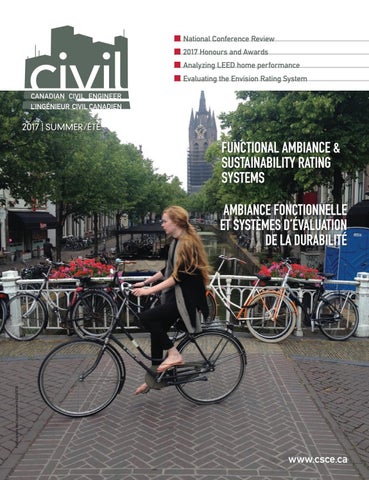
12 On the cover: Streetscape in Delft, Netherlands (photo: Gordon Lovegrove)
Canadian Civil Engineer | Summer 2017
CIVIL_SUMMER17_LAZ.indd 3
3
2017-07-27 2:57 PM
PRESIDENT’S PERSPECTIVE | PERSPECTIVE DE LA PRÉSIDENTE
Susan Tighe, Ph.D., P.Eng. PRESIDENT, CSCE/PRÉSIDENTE DE LA SCGC PRESIDENT@CSCE.CA
CSCE/SCGC 521-300, rue St-Sacrement Montreal, Québec H2Y 1X4 Tel.: 514-933-2634, Fax: 514-933-3504 E-mail: mahmoud.lardjane@csce.ca www.csce.ca PRESIDENT/PRÉSIDENTE Susan Tighe, Ph.D., P.Eng.
MANAGING EDITOR/ DIRECTEUR DE LA RÉDACTION Doug Picklyk Tel.: 416-510-5119 dpicklyk@ccemag.com ADVERTISING SALES/ PUBLICITÉ Maureen Levy Tel: 416-510-5111 mlevy@ccemag.com ART DIRECTOR/ COMPOSITION ARTISTIQUE Lisa Zambri Tel: 416-510-5600 x3595 Annual Subscription Rates/Abonnement annuel Canada & U.S./E.U. $35.00, Other countries/Autres pays $45.00; Single copy/Un numéro $7.50; Agency discount/Rabais au distributeurs 10% PUBLICATION ISSN 9825-7515 RETURN ADDRESS/ADRESSE DE RETOUR : The Canadian Society for Civil Engineering La Société Canadienne de Génie Civil 521-300, rue St-Sacrement Montreal, Québec H2Y 1X4 Canadian Civil Engineer (CCE) is published five times per year by the Canadian Society for Civil Engineering (CSCE). L’ingénieur Civil Canadien (ICC) est publié cinq fois par année par la Société Canadienne de Génie Civil (SCGC). The opinions expressed in the papers are solely those of the authors and the Canadian Society for Civil Engineering is not responsible for the statements made in this publication. Les opinions exprimées dans les articles sont la seule responsabilité de leurs auteurs et la Société canadienne de génie civil n’engage pas sa responsabilité dans les propos exprimés. CIVIL Magazine is produced by the publishers of Canadian Consulting Engineer Magazine, published by Annex Publishing & Printing Inc. Le magazine Civil est produit par l’editeur de la publication Canadian Consulting Engineer qui est publie par Annex Publishing & Printing Inc.
Annex Publishing & Printing Inc., 80 Valleybrook Drive, Toronto, Ontario M3B 2S9 Tel.: 416-442-5600; Fax: 416-510-5140 PUBLICATIONS MAIL AGREEMENT/POSTES CANADA ENREGISTREMENT #40065710
4
CIVIL_SUMMER17_LAZ.indd 4
The Road Ahead: Task Force, Celebrating Membership and CSCE HUB
H
appy 150th Birthday Canada! I am honoured and excited to write my first president’s message for CIVIL magazine during this very special year in Canada! I have served on the executive now for two years and I am delighted to be assuming the role of President. I will work for you and do my best to serve the Canadian Society for Civil Engineering. I am very grateful to serve with a very engaged executive and board as well as countless volunteers from across the country. Thank you for your effort in making this society great. We are also fortunate to have a very dedicated staff in the CSCE national office. With the elimination of the Executive Director role earlier this year, a Task Force will be struck shortly to re-examine roles and responsibilities with the ultimate goal of making the national office stronger and relevant for the changing needs of the organization. Past-President Jim Gilliland is leading this initiative, and I am sure we will have updates and news from this group over the next several months. I am grateful for Jim’s leadership on this initiative. In this issue, we have our regions column highlighting the activities of the Saskatoon section. At the recent Annual conference in Vancouver, there was a very vibrant Young Professional Program and Student Program. As you will see in this issue, the YP and Student members really did take centre stage in Vancouver. We were pleased to celebrate the several and various award recipients representing all sectors and generations within the society. Our organization should be proud of the many professionals in our profession who make our world a better place. It is also an opportunity to consider 2018 nominations! Please take a moment to brainstorm names and organizations that have an impact in our profession and communities. Let us recognize the successes and leaders in our field! In addition, there is a call to examine how civil engineering can be more sustainable through the usage of rating systems and or other tools. CSCE has an important role to influence the road ahead on how we can promote and nurture sustainable infrastructure. We are also inviting you to participate in the Infrastructure Renewal Committee (IRC). We are keen to have interested volunteers who are willing to share, learn and network to improve infrastructure renewal. This year we will continue to work at advancing our three strategic directives. As part of this, Strategic Direction 1: enhanced services to members and Strategic Direction 2: growing with youth, CSCE will develop programs and benefits that will support students and Young Professionals, targeted to their specific career development needs—we have been working on an innovative communication tool, THE HUB. The CSCE Hub will be an expansion of the CSCE website, which will provide a Professional Network for members, unlike any other in use today. It will enable an online community in
Été 2017 | L’Ingénieur civil canadien
2017-07-27 2:57 PM
PRESIDENT’S PERSPECTIVE | PERSPECTIVE DE LA PRÉSIDENTE which members can interact with mentors, employers, each other, and the CSCE itself, provide relevant news and social feeds, as well as an expanded job posting section, enable an expanded membership profile (i.e.. professional development courses, education, work experience) and complement a new loyalty initiative program geared towards all members. The intent is to create a framework for the CSCE to later expand upon and enable a wider range of services to members.
If you have not completed the survey, please do so by July 28. The link is http://bit.ly/2suxHMl If you would like to learn more check it out at https://hubcsce.ca/ We look forward to hearing from you! Get involved, we want your feedback! CSCE is the place to be for civil engineering in Canada! Susan Tighe, Ph.D., P.Eng. is Deputy Provost and Associate Vice-President Integrated Planning and Budgeting and the Norman McLeod Professor in Sustainable Pavement Engineering at the University of Waterloo.
Tracer la voie : Groupe de travail, célébration de nos membres et Hub SCGC
B
on 150e Anniversaire, Canada! Je suis honorée et stimulée de rédiger mon premier message de la présidente pour la revue CIVIL en cette année très spéciale au Canada! Je suis membre de l’exécutif depuis maintenant deux ans et je suis ravie d’assumer le rôle de présidente. Je vais travailler pour vous et faire de mon mieux pour servir la Société canadienne de génie civil! Je suis très reconnaissante de servir avec un exécutif et un conseil d’administration très engagés ainsi qu’avec d’innombrables bénévoles de partout au pays. Je vous remercie de vos efforts pour faire de la SCGC une société géniale! Nous sommes également chanceux d’avoir un personnel très dévoué au bureau national de la SCGC. Avec l’élimination du rôle de directeur exécutif au début de l’année, un groupe de travail sera prochainement mis sur pied. Il réexaminera les rôles et les responsabilités dans le but de rendre le Bureau national plus fort, plus pertinent et plus adapté aux besoins changeants de l’organisation. Le président sortant, Jim Gilliland, dirige cette initiative et nous aurons des mises à jour et des nouvelles dea ce groupe au cours des prochains mois. Je suis reconnaissante à Jim pour son leadership dans cette initiative. Dans ce numéro, vous trouverez notre rubrique des régions soulignant les activités de la section de Saskatoon. Notre récent congrès annuel de Vancouver a présenté un Programme des jeunes professionnels et des étudiants très dynamique. Comme vous le lirez plus loin, les membres JP et étudiants ont vraiment pris le devant de la scène à Vancouver. Nous avons eu le plaisir de célébrer les nombreux et divers récipiendaires représentant tous les secteurs et toutes les générations au sein de la société. Notre organisation devrait être fière des nombreux professionnels qui rendent notre monde meilleur. C’est aussi l’occasion de prendre en compte les mises en candidature pour 2018! Prenez un moment pour réfléchir aux personnes et aux organisations qui ont un impact sur notre profession et nos communautés. Reconnaissons les succès et les leaders dans notre domaine! Par ailleurs, il est nécessaire d’examiner les manières de rendre le génie civil plus durable par l’utilisation de systèmes de notation et /
Canadian Civil Engineer | Summer 2017
CIVIL_SUMMER17_LAZ.indd 5
ou d’autres outils. La SCGC joue un rôle important pour imprimer sa marque sur la voie à suivre pour promouvoir et favoriser les infrastructures durables. Nous vous invitons à participer aux travaux du Comité du renouvellement des infrastructures (CRI). Nous souhaitons intéresser les bénévoles qui veulent partager, apprendre et réseauter dans le but d’améliorer le renouvellement des infrastructures. Cette année, nous continuerons à travailler sur l’avancement de nos trois orientations stratégiques. Dans le cadre de l’orientation stratégique no. 1: bonification des services aux membres et de l’orientation stratégique no. 2: croissance avec les jeunes, la SCGC élaborera des programmes et des avantages répondant aux besoins spécifiques des étudiants et des jeunes professionnels en matière de développement de carrière. Ainsi, nous travaillons sur la mise sur pied d’un outil de communication innovant, le HUB. Le Hub SCGC sera une extension du site Web de la Société et fournira aux membres un réseau professionnel unique en son genre. Il créera une communauté Web au sein de laquelle les membres pourront interagir avec des mentors, des employeurs, d’autres membres et avec la SCGC elle-même. Il fournira des fils de nouvelles et des fils sociaux pertinents, ainsi qu’une section emploi élargie. Il permettra également de générer un profil de membre plus étendu (formation continue, enseignement, expérience professionnelle) et complètera un nouveau programme de fidélisation destiné à tous les membres. Notre intention est de créer un cadre que la SCGC pourra développer et qui permettra d’offrir une gamme plus étendue de services aux membres. Si vous n’avez pas répondu au questionnaire, veuillez le faire d’ici le 28 juillet. Le lien est http://bit.ly/2suxHMl. Pour plus d’informations, consultez le site https://hubcsce.ca/. Nous avons hâte d’avoir de vos nouvelles! Impliquez-vous, nous avons besoin de vos commentaires! La SCGC est là où il faut être pour le génie civil au Canada! Susan Tighe, Ph.D., P.Eng., est vice-rectrice et vice-présidente associée, Planification intégrée et budgétisation et professeure Norman McLeod en ingénierie des chaussées durables à l’Université de Waterloo
5
2017-07-27 2:57 PM
FROM THE REGIONS: SECTION NEWS | DE NOS RÉGIONS : NOUVELLES DES SECTIONS
‘Nooners’ Resurgence in Saskatoon Roanne Kelln, AMCSCE CHAIR OF THE SASKATOON SECTION,
F
PRAIRIE REGION
or the Saskatoon Section, hosting events that offer our members and guests a chance to nosh on delicious food, network with others involved in the many facets of civil engineering, and nurture continuing professional development through informal learning activities is a tradition that predates the establishment of the Section itself. Professors at the University of Saskatchewan held regular dinner meetings on campus for the local civil engineering community for over 10 years before the formal founding of the Section in 1984. After that, Prof. Rezansoff, with the support of the other members of the first Section executive committee, started the Noon-hour luncheon meetings. Such meetings have continued ever since, branded as “Nooners” (a name borrowed from the student chapter at the university for similar events they previously held).
Over the years, the venue has changed, from the now-demolished Elks Club until the mid 1990s, to the University Club (formerly called and still generally known as the Faculty Club) until 2016, and now to the Park Town Hotel (overlooking the scenic South Saskatchewan river). However, the event itself has stayed the same—a great lunch and an opportunity to hear about recent civil engineering projects. This past year, the Executive renewed its efforts in publicizing the events, selling tickets electronically, and delivering interesting and topical presenters to discuss projects in and around Saskatoon that have transformed, or will continue to transform, the city. Some of this past year’s Nooner topics included the redevelopment of Kinsmen Park in downtown Saskatoon, the functional plan for the Highway 11/Highway 16 interchange, and the use of drone technology for surveying. With these changes, in addition to the new venue (which offers better parking, always a concern in Saskatoon), there has been a renewed interest from the local civil engineering community in attending these events. The Section Executive has been overjoyed at the response, and we look forward to offering more great Nooners this upcoming year.
Retour des <<Midi-rencontres>> à Saskatoon Roanne Kelln, MASCGC PRÉSIDENTE, SECTION SCGC DE SASKATOON, RÉGION DES PRAIRIES
P
our la Section de Saskatoon, organiser des événements offrant à nos membres et invités la possibilité de déguster une nourriture délicieuse, d’échanger avec des personnes impliquées dans les multiples facettes du génie civil et de favoriser le développement professionnel continu par des activités d’apprentissage informel est une tradition antérieure à la création de la section. Des professeurs de l’Université de Saskatchewan ont tenu des rencontres régulières sur le campus pour la communauté locale du génie civil plus de 10 ans avant la fondation formelle de la Section en 1984. Par la suite, le Prof. Rezansoff a commencé à organiser des réunions du midi avec l’appui des autres membres du premier comité exécutif
Active noon-hour luncheon meetings at the Park Town Hotel in Saskatoon
6
CIVIL_SUMMER17_LAZ.indd 6
de la section. Ces rencontres se sont poursuivies sous le nom «Midi-rencontres» («Nooners»), emprunté au chapitre étudiant de l’université qui organisait des événements similaires. Au fil des années, le lieu de ces rencontres a changé à plusieurs reprises. Du Club Elks, maintenant démoli, jusqu’au milieu des années 1990, au Club universitaire (anciennement Club de la faculté et toujours connu sous ce nom) jusqu’en 2016, et enfin l’Hôtel Park Town qui surplombe la pittoresque rivière Saskatchewan South. Cependant, l’événement luimême est resté le même: un excellent dîner et une occasion d’écouter la présentation d’un récent projet de génie civil. Au cours de la dernière année, l’exécutif de la section a redoublé ses efforts pour promouvoir ces événements, pour vendre des billets par voie électronique et pour engager des conférenciers intéressants qui présentent des projets réalisés à Saskatoon et ses environs qui transforment la ville. Certains des sujets abordés ont inclus le réaménagement du parc Kinsmen au centre-ville de Saskatoon, le plan fonctionnel de l’échangeur des autoroutes 11 et 16 et l’utilisation de la technologie des drones dans l’arpentage. Ces changements et le choix du nouveau lieu des présentations, qui offre un meilleur stationnement, un sujet de préoccupation permanent à Saskatoon, ont entrainé un intérêt renouvelé de la communauté locale du génie civil pour ces événements. L’exécutif de la section était ravi de la réponse cette année, et nous avons hâte d’offrir davantage de Midi-rencontres importantes au cours de l’année à venir.
Été 2017 | L’Ingénieur civil canadien
2017-07-27 2:57 PM
THE STUDENT VOICE | LA VOIX DES ÉTUDIANTS
Student Members Les membres étudiants de la Take Center Stage in SCGC occupent le devant de la Vancouver scène à Vancouver Charles-Darwin Annan, Ph.D., P.Eng. CHAIR, STUDENT AFFAIRS COMMITTEE, CSCE
T
Par Charles-Darwin Annan, Ph.D., P.Eng.
PRÉSIDENT, COMITÉ DES AFFAIRES ÉTUDIANTES DE LA SCGC
L
he 2017 CSCE annual conference early June in Vancouver une congrès annuel 2017 de la SCGC de Vancouver a souligné le derscored the crucial role of students in the Society’s future. The rôle crucial des étudiants dans l’avenir de la société. Le comité des Student Affairs committee worked diligently in collaboration with the affaires étudiantes a travaillé intensément avec l’équipe des Jeunes proYoung Professionals (YP) team to provide an effective platform for stu- fessionnels (JP) pour offrir aux étudiants une plate-forme efficace leur dents to make valuable professional contacts. permettant d’établir de précieux contacts professionnels. En ma qualité As Chair, I would like to thank everyone who played any role in re- de président du comité, je remercie tous ceux qui ont joué un rôle dans cording such great success. Notably, we saw a significant increase in la réalisation d’un tel succès. Nous avons notamment enregistré une students’ participation in the National Student Leaders Workshop, augmentation significative de la participation des étudiants à l’Atelier the National Civil Enginational des dirigeants neering Capstone Design étudiants, au Concours competition and the Stunational Capstone de dent Research Paper comconception en génie civpetition. il et au Concours de la Congratulations to communication en reUniversity of Waterloo cherche. and British Columbia Je félicite l’Université Institute of Technology de Waterloo et l’Insti(BCIT) for coming out tut de technologie de la on top as joint winners Colombie-Britannique of the President’s Award (BCIT) pour l’obtenfor Outstanding Student Leaders from different CSCE Student Chapters who participated in the Student Chapter tion du Prix du présiChapter; Western Universi- Leaders Workshop; Dirigeants de divers chapitres étudiants qui ont participé à l’Atelier dent du chapitre étudiContinued on page 8
des dirigeants des chapitres étudiants
Suite à la page 8
Denso Products - Unmatched Quality and Performance
If it doesn’t say
on the outside, then its not
Denso North America Inc. • www.densona.com
Canadian Civil Engineer | Summer 2017
CIVIL_SUMMER17_LAZ.indd 7
on the inside.
7
2017-07-27 2:57 PM
THE STUDENT VOICE | LA VOIX DES ÉTUDIANTS
Continued from page 7
Suite de la page 7
ty for scooping third place, and Dalhousie University and University of New Brunswick for receiving honourable mention. Dr. Usman Khan received commendation for his outstanding contribution as Faculty Advisor for the student chapter at York University. Congratulations also go to University of Waterloo for winning the National Capstone Design Competition; University of Toronto and UBC Okanagan for taking second and third places, respectively; Queen’s University for winning the Great Northern Concrete Toboggan Race; McMaster University for winning the Troitsky Bridge Building Competition; École Polytechnique de Montréal for winning the Canadian National Concrete Canoe Competition; École Technologie Supérieure for winning the Canadian National Steel Bridge Competition. Outstanding individual students were also recognized. Congratulations to Udai Hassein from Ryerson University for winning the Best Paper in the General CSCE Conference category; Alok Dua from Carleton for Best Paper in the Engineering Mechanics and Materials category; Estacio Pereira from University of Alberta for Best Paper in the Construction Specialty category; Sho Harada from Concordia University for the Hydrotechnical category; and Chunjiag An from University of Regina for the Environmental Engineering category. Now, with a new school year comes a new opportunity to build on our previous successes. This is the time to get involved in your student chapter and begin those lifelong and valuable professional contacts. This is the time to make your student membership count. Dr. Charles-Darwin Annan is an associate professor of civil engineering at Université Laval. charles-darwin.annan@gci.ulaval.ca
ants exceptionnel, Western University pour sa troisième place et l’Université Dalhousie et l’Université du Nouveau-Brunswick pour leur mention honorable. Le Dr Usman Khan a reçu une mention élogieuse pour sa contribution exceptionnelle en tant que conseiller de la Faculté au chapitre étudiant de l’Université York. Je transmets également mes félicitations aux universités suivantes pour les prix qu’elles ont remportés. Université de Waterloo : Concours national Capstone de conception en génie civil; Université de Toronto et UBC Okanagan: deuxième et troisième places; Queen’s University: la Grande course de toboggans de béton du Nord; Université McMaster: Concours Troitsky de construction de pont; École Polytechnique de Montréal: Concours canadien de canot de béton; École de Technologie Supérieure: Concours national canadien de pont d’acier. Des prix individuels des meilleures communications techniques ont été attribués à de brillants étudiants et je les en félicite. Ils sont : Udai Hassein (Université Ryerson) dans la catégorie Congrès de la SCGC, Alok Dua (Université Carleton) en Mécanique technique et matériaux, Estacio Pereira (Université de l’Alberta) en Construction, Sho Harada (Université Concordia) en Hydrotechnique et Chunjiag An (Université de Regina) en génie de l’environnement. La nouvelle année universitaire va nous offrir une autre occasion de bâtir sur nos succès passés. C’est le moment de vous impliquer dans votre chapitre étudiant et d’établir des contacts professionnels qui vous seront importants et durables. C’est le moment de tirer avantage de votre statut de membre étudiant. Le Dr Charles-Darwin Annan est professeur agrégé de génie civil à l’Université Laval. charles-darwin.annan@gci.ulaval.ca.
YOUNG PROFESSIONALS’ CORNER | LE COIN DES JEUNES PROFESSIONNELS
Conference Shines Bright Vincent Tourangeau, eng.
Le congrès a brillé! Vincent Tourangeau, ing. VICE-PRÉSIDENT, COMITÉ DES JEUNES PROFESSIONNELS, SCGC
VICE CHAIR YOUNG PROFESSIONALS COMMITTEE CSCE
E
arlier this Spring I had the chance to participate in the CSCE annual conference. This year, the conference was held in Vancouver, and the organizers did a wonderful job of organizing an engaging program, planning interesting conferences, and inviting inspiring speakers. The response from the engineering community was favorable—the conference broke attendance records!
8
CIVIL_SUMMER17_LAZ.indd 8
P
lus tôt ce printemps, j’ai eu l’occasion de participer au congrès annuel de la SCGC qui s’est déroulé à Vancouver. Les organisateurs ont fait un travail remarquable en présentant un programme attrayant, des conférences intéressantes et des conférenciers inspirants. La réponse de la communauté de l’ingénierie fut sans appel: le congrès a battu les records de présence! Le Comité des jeunes professionnels (JP) a jugé qu’il était important d’être visible durant le congrès. Le président du Comité des
Été 2017 | L’Ingénieur civil canadien
2017-07-27 2:57 PM
YOUNG PROFESSIONALS’ CORNER | LE COIN DES JEUNES PROFESSIONELS
The Young Professionals Committee believed it was important to be visible at the conference. Stanley Chan, this year’s Conference Chair for the Young Professionals, made sure that the YPs had a complete and fun program to look forward to, and he did a great job at delivering it. The YP board felt it should have a presence at the conference, so I happily volunteered and I had an amazing experience. I met with plenty of motivated and resourceful people, both newcomers and veterans of the CSCE. These students and professionals, who for the most part volunteer huge amounts of their time for the well-being of the Society and its members, gave me great hope of a bright future for the community of civil engineers in Canada. I hope the success of the Conference will entice students to get involved in the Society. I met quite a few who seemed keen on pursuing their involvement past the university walls. One of our objectives as a Society is Growing With Youth, and this was hugely fulfilled by the opportunities provided to students to participate in both Conference activities and social gatherings. These opportunities definitely showcase to students the Society’s continued improvement of member services. I am grateful to have had the opportunity to be a part of this year’s Conference. For any additional information about the Young Professionals and how to get involved, do not hesitate to contact one of the board members! (vincent.tourangeau@sslc.ca)
activités des JP et des étudiants du congrès s’est assuré qu’un programme complet et amusant soit mis sur pied pour les JP, et il a fait un excellent travail pour le livrer. Le conseil des JP ayant estimé qu’il devait avoir une présence au congrès, je me suis porté volontaire pour l’y représenter. Ce fut une expérience incroyable. J’ai rencontré beaucoup de personnes motivées et ingénieuses, aussi bien les nouveaux arrivants que les vétérans de la SCGC. Ces étudiants et professionnels, qui, pour la plupart d’entre eux, offrent une grande partie de leur temps pour le bien-être de la Société et de ses membres, me laissent entrevoir un avenir brillant pour la communauté des ingénieurs civils au Canada. J’espère que le succès du congrès incitera les étudiants à s’impliquer dans la Société. Un certain nombre de personnes avec lesquelles j’ai échangé me semblaient désireuses de poursuivre leur participation lorsqu’elles auront quitté l’université. L’un des objectifs de notre Société est de croître avec les jeunes. Cela fut pleinement accompli de par les possibilités offertes aux étudiants de participer aux différents programmes du congrès ainsi qu’aux activités sociales. Ces opportunités montrent clairement aux étudiants que les services aux membres de la SCGC s’améliorent constamment. Je suis reconnaissant d’avoir eu l’occasion de prendre part au congrès de cette année. Pour toute information complémentaire sur les jeunes professionnels et sur la façon de s’impliquer, n’hésitez pas à contacter l’un des membres du conseil d’administration! (vincent.tourangeau@sslc.ca)
Halton Region’s Zone 1 Interconnecting Watermain:
Construction is Successfully Underway
CALL FOR CASE STUDIES - 2017 The editors of CIVIL magazine invite CSCE-CSGC members to submit case studies for possible publication in future issues. Projects submitted should should demonstrate technical innovation in structural/civil engineering, project management or other engineering expertise.
The new Zone 1 Interconnecting Watermain comprises 6.8 km of 2600-mm diameter bored tunnel that houses 1500-mm and 1800-mm diameter watermains, which are being constructed to facilitate growth within Halton Region. To-date, the tunnel has been successfully mined along its entire length, and all the watermain pipe has been installed. Approximately 60% of the pipe has been grouted and backfilled. Construction is within budget and on schedule, with an expected completion date in early 2018.
Submit a brief summary of 700 words (in English or French), plus two or three images, to: Doug Picklyk, Managing Editor, CIVIL. dpicklyk@ccemag.com, Tel. 416-510-5119.
Canadian Civil Engineer | Summer 2017
CIVIL_SUMMER17_LAZ.indd 9
toronto niagara ottawa sudbury london moncton fredericton st. john’s mumbai www.rvanderson.com
CIVIL_RVAnderson_Summer.indd 1
Canadian2017-07-14 Civil Engineer 1:31 PM 4.875” x 3.625”9 July 2017
2017-07-27 2:57 PM
SUSTAINABLE INFRASTRUCTURE | LES INFRASTRUCTURES DURABLES
Une invitation à l’action
Recrutement de bénévoles au Comité du renouvellement des infrastructures (CRI) Par Guy Félio, Ph.D, P.Eng., FCSCE, PRI[Climat] PRÉSIDENT, COMITÉ DU RENOUVELLEMENT DES INFRASTRUCTURES (CRI)
L
a SCGC et notre profession ont parcouru un long chemin depuis la Feuille de route des technologies (FRT) des systèmes d’infrastructures civiles (SIC) de 2003. Le 6 juin 2003, la SCGC accompagnée de l’Association canadienne des travaux publics (CPWA), du Conseil canadien des ingénieurs (devenu Ingénieurs Canada) et du Conseil national de recherches Canada (CNRC) ont publié la première feuille de route des technologies des systèmes d’infrastructures civiles (FRT-SIC). Le rapport fut remis à des représentants du gouvernement fédéral, dont le ministre du Travail de l’époque, l’honorable Claudette Bradshaw, et l’Administrateur général d’Infrastructure Canada, André Juneau, lors du congrès annuel de la SCGC à Moncton (N.-B.). La FRT était un plan d’action détaillé qui contenait dix objectifs et dix recommandations visant à trouver des manières nouvelles et novatrices d’améliorer la maintenance et la réhabilitation de nos systèmes routiers et hydrauliques. Ils comprenaient: • Un catalogage et une évaluation des inventaires d’infrastructures pour déterminer leur état de détérioration; • Un accroissement des investissements publics dans la recherche et l’innovation; • La diffusion d’informations sur les meilleures pratiques par le biais de programmes universitaires et de la formation continue; • Une évaluation des progrès de la FRT dans cinq ans; et • La création d’un organisme consultatif spécialisé et impartial sur les infrastructures. Cet organisme regrouperait tous les intervenants en matière d’infrastructures dans le but de conseiller le gouvernement fédéral sur le renouvellement, l’investissement et la gestion des écarts de politique. Les résultats de la FRT étaient basés sur un large processus de consultation nationale impliquant des comités directeurs et des groupes d’experts, sur des études concernant les infrastructures du Canada ainsi que cinq séances de discussions ouvertes. Contrairement aux études antérieures sur les besoins en infrastructures, le rapport final contenait une vision nationale résultant d’un processus qui a permis de regrouper de nombreuses parties prenantes dans l’industrie fragmentée des infrastructures. En 2010, nous avons examiné les réalisations de la SCGC et d’autres organisations intervenant dans les infrastructures pour atteindre les objectifs fixés par la FRT. Sans entrer dans les détails, la révélation la plus surprenante, et positive, était que beaucoup de ces réalisations provenaient de parties prenantes qui ne faisaient pas partie des partenaires de la FRT.
10
CIVIL_SUMMER17_LAZ.indd 10
Avance rapide vers 2017 – où en sommes-nous? Les Bulletins de rendement des infrastructures canadiennes (BRIC) de 2012 et 2016 peuvent être considérés comme une analyse « SWOT » des infrastructures publiques (municipales) au Canada. Par exemple, si pendant plus d’une décennie, la SCGC et des organisations partageant les mêmes idées faisaient la promotion de la gestion d’actifs (GA) aux niveaux supérieurs du gouvernement, la nécessité et les avantages de la planification de la GA sont maintenant pratiquement institutionnalisés dans les programmes d’infrastructures, tels que l’exigence d’éligibilité pour le financement de la taxe sur l’essence. Si on ne peut pas dire que la vision de la FRT a été réalisée dans sa totalité, je vous soumets que «l’esprit de la FRT» perdure dans plusieurs initiatives en cours. Notons, à titre d’exemple, les millions de dollars que le gouvernement fédéral a investis dans la planification de la GA par le biais de la Fédération canadienne des municipalités (FCM). Je citerai aussi les communautés régionales des pratiques de gestion des actifs créées à partir d’une autre initiative à laquelle la SCGC a participé en 2005: le Groupe de travail national sur la gestion des actifs. Alors, Bravo à la SCGC pour sa vision! De par tous ces efforts, menés sous la direction du Comité du renouvellement des infrastructures (CRI) de la SCGC, qui fut créé peu de temps après la publication de la FRT, la SCGC s’est donné une place enviable en tant que société savante qui établit un pont entre le leadership et l’innovation technologique, et les besoins des praticiens. Mais il s’agit d’un voyage et non pas d’une destination, et beaucoup reste à faire. La SCGC et son comité CRI doivent maintenir cet élan pour continuer à améliorer la façon dont nous gérons les milliards de dollars investis dans la planification, la construction, la gestion, l’exploitation et la maintenance d’actifs qui font du Canada le 2e meilleur pays au monde. Il y a de nombreux nouveaux défis ainsi que des opportunités dans l’assiette du comité, dont le développement, l’adaptation ou l’adoption d’un système d’évaluation de la durabilité des infrastructures. Reconnue comme une organisation qui a réussi à rassembler autour d’une table divers intervenants pour débattre des problèmes liés aux infrastructures, la SCGC est de nouveau bien positionnée pour être le chef de file en la matière et a, en fait, déjà commencé à jouer ce rôle. Le message du président du Groupe de travail de la FRT de 2003 (Reg Andres, ancien président de la SCGC) était intitulé: «Un appel à l’action». Dans cet esprit, en tant que président actuel du CRI, je renouvelle cette invitation à l’action, près de 15 ans plus tard, dans le cadre de l’adhésion au CRI de la SCGC. Nous avons besoin de vous! La SCGC s’est engagée à poursuivre ce voyage passionnant pour rendre les infrastructures du Canada résilientes et durables afin que les générations futures de membres de la SCGC puissent dire: notre profession a été la clé de la qualité de vie que nous apprécions aujourd’hui !
Été 2017 | L’Ingénieur civil canadien
2017-07-27 2:57 PM
SUSTAINABLE INFRASTRUCTURE | LES INFRASTRUCTURES DURABLES
An Invitation to Action
Call for membership on the Infrastructure Renewal Committee (IRC) By Guy Félio, Ph.D, P.Eng., FCSCE, IRP[Climate] CHAIR, INFRASTRUCTURE RENEWAL COMMITTEE
C
SCE and the profession have come a long way since the 2003 Civil Infrastructure Systems (CIS) Technology Roadmap (TRM). On June 6 2003, CSCE with the Canadian Public Works Association (CPWA), the Canadian Council of Professional Engineers (now Engineers Canada) , and the National Research Council released the first Civil Infrastructure Systems Technology Road Map (CIS-TRM). Representatives from the federal government including then Labour Minister, the Honourable Claudette Bradshaw, and the Deputy Head of Infrastructure Canada, André Juneau, were on hand at the CSCE Conference in Moncton (NB) to receive the report. The TRM was a comprehensive action plan that contained 10 objectives and 10 recommendations aimed at charting new and innovative ways to improve the maintenance and rehabilitation of our road and water systems; they included: • Cataloguing and assessing infrastructure inventories for weakness and deterioration; • Greater public investment in research and innovation; • Disseminating information about best practices through academic curriculum and lifelong learning; • Measuring progress of the TRM in five years; and • The creation of an impartial expert, advisory body on infrastructure that brings all infrastructure stakeholders together to counsel the federal government on renewal, investment, and addressing policy gaps. The results of the TRM were based on a broad national consultation process involving steering committees, expert panels, studies on Canada's infrastructure, and five town hall meetings. Unlike previous infrastructure needs studies, the final report was a national vision resulting from a process that succeeded in bringing together numerous stakeholders in the fragmented infrastructure industry. In 2010, we reviewed accomplishments by CSCE and other infrastructure stakeholder organizations in achieving the goals laid-out by the TRM. Without going into the details, probably the most surprising—and positive—revelation was that many of these accomplishments came from stakeholders outside the original TRM partners.
infrastructure like-minded organizations where promoting asset management (AM) at the senior levels of government, the needs for and benefits of AM planning is now quasi-institutionalized in infrastructure programs—for example an eligibility requirement for Gas Tax funding. If line by line we cannot say the vision of the TRM has been realised, I submit to you that the “spirit of the TRM” has, and continues to live through many of the initiatives we are currently witnessing, for example the millions of federal dollars invested in AM planning through the Federation of Canadian Municipalities (FCM), or the regional asset management communities of practices created out of another initiative to which CSCE participated in the mid 2005’s: the National Asset Management Working Group. So Bravo to CSCE for its vision! In all these efforts, under the leadership of CSCE’s Infrastructure Renewal Committee (IRC), which was born shortly after the release of the TRM, CSCE has achieved the enviable position as a learned society that bridges thought leadership with practitioners’ needs. But this is a journey not a destination, and much remains to be done. CSCE, and the IRC, need to maintain this momentum and build on it to continue improving how we plan, build, manage, operate and maintain the trillions of dollars invested in the assets that make Canada the 2nd best country in the world. There are many new challenges and existing opportunities on the Committee’s plate, not the least is developing, adapting or adopting a sustainability rating for infrastructure. CSCE, with it’s recognition as an organization that has been successful in bringing diverse stakeholders to the table on infrastructure related issues, is again well positioned to be the leader in this, and has started. The message of the Chair of the 2003 TRM Working Group (CSCE Past-President, Reg Andres) was entitled: “An Invitation to Action”. In this spirit, as current Chair of the IRC, I renew this Invitation to Action, close to 15 years later, in the context of CSCE membership in the IRC – we need YOU! CSCE is committed to pursue this exciting journey to make Canada’s infrastructure resilient and sustainable so that future generations of CSCE members will say: our profession was key to the quality of life we are enjoying today!
Fast-forward to 2017 – are we there yet?
Please contact Guy Félio, to express your interest: Guy.Felio@stantec.com,
The 2012 and 2016 Canadian Infrastructure Report Cards (CIRC) can be viewed as a SWOT analysis of public (municipal) infrastructure in Canada. For example, when for more than a decade CSCE and
Veuillez contacter: Guy Félio, Guy.Felio@stantec.com
Canadian Civil Engineer | Summer 2017
CIVIL_SUMMER17_LAZ.indd 11
11
2017-07-27 2:57 PM
CSCE 2017 HONOURS AND AWARDS | | DISTINCTIONS ET PRIX 2017 DE LA SCGC
CELEBRATING CAREERS AND TECHNICAL EXCELLENCE E
ach year, the Canadian Society for Civil Engineering recognizes members for their career achievements and for the excellence of their technical papers. The following were recognized for their achievements at the Awards for Civil Engineering Excellence Gala in Vancouver, on June 2nd, 2017. The CSCE extends its congratulations to all award recipients. Full details are available on www.csce.ca (Honours and Fellowships page).
LA SCGC CÉLÈBRE L’EXCELLENCE EN GÉNIE CIVIL C
haque année, la Société canadienne de génie civil rend hommage à ses membres qui se sont distingués pour l’ensemble de leur carrière ou pour la qualité de leurs communications techniques. Les personnes suivantes furent célébrées pour leurs réalisations au Gala des prix de l’excellence en génie civil du 2 juin 2017 à Vancouver. La SCGC présente ses chaleureuses félicitations à tous les récipiendaires. Les détails sont disponibles sur www.csce.ca (page Distinctions honorifiques et fellowships).
Fellows of the Canadian Society of Civil Engineering / Fellows de la Société canadienne de génie civil : Tony Bégin, FCSCE, St.Georges, QC; Peter Bischoff, FCSCE, Fredericton, NB; Girma Bitsuamlak, FCSCE, London ON; Jacques Boissonnault, FCSCE, Campbellton, NB; Peter Calcetas, FCSCE, Woodbridge, ON; Mark F. Green, FCSCE, Kingston, ON; Susann Hickey, FCSCE, St. John’s NL; Constantine John Katsanis, FCSCE,
Montreal, QC; Sid Lodewyk, FCSCE, Edmonton, AB; John P. Newhook, FCSCE, Halifax, NS; Van-Thanh-Van Nguyen, FCSCE, Montreal, QC; Kent Novakowski, FCSCE, Kingston, ON; Huntley O’Connor, FCSCE, Regina, SK; Brent Sleep, FCSCE, Toronto, ON; John F. Unsworth, FCSCE, Calgary, AB.
From Vancouver to Fredericton Kenedee Ludwar, Chair, CSCE 2017 Orga-
Donald Jamieson Fellowship / Bourse Donald Jamieson : Jean-François Belleau Albert E. Berry / Médaille Albert E. Berry: Heather L. MacLean Camille Dagenais Award / Prix Camille Dagenais: David Zhu Sandford Fleming Award / Prix Sandford Fleming: Eric Hildebrand Horst Leipholz Medal / Médaille Horst Leipholz: Moncef Nehdi Donald R. Stanley Award / Prix Donald R. Stanley: Mamert Mbonimpa, Médard Bouda, Isabelle Demers, Mostafa Benzaazoua, Denis Bois, Mario Gagnon
12
CIVIL_SUMMER17_LAZ.indd 12
nizing Committee (right), and Lloyd Waugh,
A.B. Sanderson Award / Prix A.B. Sanderson: Patrick Paultre Walter Shanly Award / Prix Walter Shanly: Tony Bégin
Chair CSCE 2018 Local Organizing Committee De Vancouver à, Fredericton Kenedee Ludwar, présidente du Comité organisateur SCGC 2017, Lloyd Waugh, président du Comité organisateur local SCGC 2018
W. Gordon Plewes Award / Prix W. Gordon Plewes: Siobhan Roberts Young Professional Engineer Award / Prix du jeune ingénieur professionnel: Leslie Young Thomas C. Keefer Medal / Médaille Thomas C. Keefer: Shooka Karimpour, Vincent H. Chu Casimir Gzowski Medal / Médaille Casimir Gzowski: Suze Youance, Marie-José Nollet, Ghyslaine McClure
Canadian National Steel Bridge Competition winner: École de technologie supérieure Lauréate du Concours national canadien de pont d’acier : École de technologie supérieure
Stacie Carr Photography
Career Awards / Prix carrière
Été 2017 | L’Ingénieur civil canadien
2017-07-27 2:57 PM
Institutional Award / Prix institutionnel
Stacie Carr Photography
CSCE Award for Governmental Leadership in Sustainable Infrastructure The 2017 Award for Governmental Leadership is awarded to the City of Vancouver. In 2010, the City of Vancouver adopted an ambitious plan to become the greenest city in the world by 2020. Since adopting it, Vancouver has become recognized internationally for its leadership in sustainable actions. Behind the scenes, these ambitious green goals are aligned with social and economic goals as laid out in a Healthy City Strategy and Economic Strategy. The Greenest City Action Plan was developed through an extensive engagement process, and sets out strategic actions in 10 goal areas, several of which are “owned” by Vancouver’s Engineering department - including Green Transportation, Zero Waste, and Water Conservation. This means that Engineering Services is not only key to meeting targets, but they are responsible for helping to reach them. Importantly, they proactively report back on progress toward meeting all goals each spring. The City has made big progress, from reimagining the future of waste, capturing landfill gas for reuse, reaching its 2020 transportation goals five years in advance, creating vibrant public spaces, and building them all in a sustainable way – from having the largest elective vehicle fleet in Canada to using recycled materials in their warm mix asphalt. Prix SCGC du leadership gouvernemental en infrastructures durables Le prix 2017 pour le leadership gouvernemental est attribué à la Ville de Vancouver. En 2010, la Ville de Vancouver a adopté un plan ambitieux pour devenir la ville la plus verte du monde d’ici 2020. Depuis son adoption, Vancouver est reconnue à l’échelle internationale pour son leadership dans des programmes de durabilité. Dans les coulisses, ces objectifs écologiques ambitieux sont alignés sur les objectifs sociaux et économiques tels qu’ils sont énoncés dans une Stratégie d’une ville saine et une Stratégie économique. Le Plan d’action de la ville la plus verte a été élaboré grâce à un vaste processus d’engagement. Il présente des actions stratégiques dans 10 domaines d’action, dont plusieurs sont sous la coupe du département d’ingénierie de Vancouver, y compris les Transports verts, Zéro déchets, Conservation de l’eau. Cela signifie que les services d’ingénierie ne sont pas seulement essentiels pour atteindre les objectifs, mais qu’ils sont chargés d’aider à les atteindre. Fait important, à chaque printemps ils rapportent de manière proactive les progrès réalisés pour atteindre tous les objectifs. La Ville a fait de grands progrès. Elle a ré-imaginé l’avenir des déchets, capturé les gaz d’enfouissement pour les réutiliser, at-
Canadian Civil Engineer | Summer 2017
CIVIL_SUMMER17_LAZ.indd 13
CIVIL_Summer_2017_Aegion.indd 1
13
2017-07-18 1:57 PM
2017-07-27 2:57 PM
CSCE 2017 HONOURS AND AWARDS | | DISTINCTIONS ET PRIX 2017 DE LA SCGC teint ses objectifs 2020 en matière de transports 5 ans à l’avance. Elle a créé des espaces publics dynamiques, tous construits de manière durable, elle possède la plus grande flotte de véhicules communautaires au Canada et utilise des matériaux recyclés en mélange d’enrobé tiède.
CSCE Award for Governmental Leadership in Sustainable Infrastructure (plaque and painting) City of Vancouver: (l-r) Jim Gilliland, CSCE President 2016-2017, Jerry Dobrovolny, General Manager of Engineering Services and staff, City of Vancouver. Prix SCGC du leadership gouvernemental en infrastructures durables (plaque et tableau): Ville de Vancouver; Jim Gilliland, président de la SCGC 2016-2017, Jerry Dobrovolny, Directeur général du service ingénierie et personnel, Ville de Vancouver.
CSCE 2018 National Honours and Awards – Call for Nominations
N
ominations are invited at any time for the awards listed below. Complete nominations must be received by November 15, 2017 (except where noted) to be considered for the 2018 awards to be presented at the CSCE Annual Conference in Fredericton in 2018. Please submit nominations, clearly stating the award for which the nomination is made, by e-mail or mail to: Mahmoud Lardjane, Programs Manager at mahmoud.lardjane@csce.ca, Canadian Society for Civil Engineering, 521-300 rue St-Sacrement, Montréal, QC H2Y 1X4
A.B. Sanderson Award
Recognizes outstanding contributions by a civil engineer to the development and practice of structural engineering in Canada.
Albert E. Berry Medal
Recognizes significant contributions by a civil engineer to the field of environmental engineering in Canada.
Camille A. Dagenais Award
Recognizes outstanding contributions by a civil engineer to the development and practice of hydrotechnical engineering in Canada.
E. Whitman Wright Award
Recognizes significant contributions by a civil engineer to the development of computer applications in civil engineering in Canada.
Excellence in Innovation in Civil Engineering Award
Recognizes excellence in innovation in civil engineering by an individual or a group of individuals practicing civil engineering in Canada, or a Canadian engineering firm, or a Canadian research organization. (Deadline for nominations is Jan. 15, 2018).
Award for Governmental Leadership in Sustainable Infrastructure
Recognizes those in the public sector who, through a project or program, are building for the future. Any municipal government or provincial or federal department that is planning, designing, building
14
CIVIL_SUMMER17_LAZ.indd 14
or delivering an infrastructure program or a project that significantly extends the life of these critical assets, makes better use of resources and reduces the environmental impact may apply. (Deadline for nominations is Feb. 15, 2018)
Young Professional Award
Awarded annually to a CSCE Member or Associate Member who has demonstrated outstanding accomplishments as a young professional engineer. Normally, nominees must be no older than 35 as of December 31 of the year that the award is presented, although this limit may be extended for nominees who have taken extended leaves from professional practice.
Horst Leipholz Medal
Recognizes outstanding contributions by a civil engineer to engineering mechanics research and/or practice in Canada.
James A. Vance Award
Recognizes a CSCE member whose dedicated service, other than as president, has furthered the advancement of the CSCE and who has completed or recently completed service in one or more sequential positions at the national level.
Sandford Fleming Award
Recognizes outstanding contributions by a civil engineer to transportation engineering research and/or practice in Canada.
Walter Shanly Award
Recognizes outstanding contributions by a civil engineer to the development and practice of construction engineering in Canada.
W. Gordon Plewes Award
Recognizes particularly noteworthy contributions by an individual to the study and understanding of the history of civil engineering in Canada, or civil engineering achievements by Canadian engineers elsewhere. Normally, the recipient will be an individual, not necessarily an engineer, but in special circumstances the award can be given to an organization.
Été 2017 | L’Ingénieur civil canadien
2017-07-27 2:57 PM
CALL FOR NOMINATIONS | APPEL A CANDIDATURES
Awards for Civil Engineering Excellence : 2017 winners Prix de l’excellence en génie civil: lauréats 2017
Distinctions Honorifiques et prix 2018 de la SCGC
L
es membres sont invités à soumettre, en tout temps, des candidatures pour les prix ci- dessous; les candidatures soumises d’ici le 15 novembre 2017 seront considérées pour les prix 2018 qui seront décernés au congrès annuel de la SCGC à Fredericton en juin 2018. Veuillez soumettre les candidatures, en précisant le titre du prix, par courriel ou par envoi postal à: Mahmoud Lardjane, Directeur des programmes à mahmoud.lardjane@csce.ca, La Société canadienne de génie civil, 521-300 rue St-Sacrement, Montréal, QC H2Y 1X4.
Le prix A.B. Sanderson
Est décerné aux ingénieurs civils qui se sont distingués par leur contribution exceptionnelle au développement et à la pratique du génie des structures au Canada.
La médaille Albert Berry
pal, provincial ou département fédéral qui planifie, conçoit, construit ou livre un programme ou un projet d’infrastructures qui prolonge d’une manière significative la vie de ces actifs, fait un bon usage des ressources et réduit l’impact sur l’environnement peut postuler. (Délai de soumission de candidats: 15 février 2018).
Le prix du jeune professionnel
Attribué annuellement à un membre ou à un membre associé de la SCGC ayant accompli des réalisations exceptionnelles en tant que jeune ingénieur professionnel. Les candidats doivent être âgés de 35 ans ou moins au 1er décembre de l’année de l’attribution du prix. Toutefois, cette limite peut être prorogée pour les candidats qui ont pris des congés prolongés.
La médaille Horst Leipholz
Souligne l’importante contribution d’un ingénieur civil au génie de l’environnement au Canada.
Est décernée à un ingénieur civil qui s’est distingué par son importante contribution à la recherche et/ou à la pratique de la mécanique appliquée au Canada.
Le prix Camiille A. Dagenais
Le prix James A. Vance
Est décerné aux ingénieurs civils qui se sont signalés par leur contribution exceptionnelle au développement et à la pratique de l’hydrotechnique au Canada.
Le prix E. Whitman Wright
Est décerné à un ingénieur civil qui s’est distingué par son importante contribution au développement des applications de l’informatique au génie civil au Canada.
Le prix d’excellence en innovation dans le domaine du génie civil
Souligne l’excellence dans le domaine du génie civil dont a fait preuve une personne ou un groupe de personnes pratiquant le génie civil au Canada, ou une société canadienne d’ingénierie ou un organisme canadien de recherche. (Délai de soumission de candidats: le 15 janvier 2018.)
Le prix pour le leadership gouvernemental en infrastructures durables
Reconnait des entités du secteur public qui, de par un projet ou un programme, construisent pour le future. Tout gouvernement munici-
Canadian Civil Engineer | Summer 2017
CIVIL_SUMMER17_LAZ.indd 15
Est décerné à un membre de la SCGC dont le dévouement a favorisé l’avancement de la Société et qui termine, ou a récemment achever un mandat au sein de la Société, autre que celui de président.
Le prix Sandford Fleming
Est décerné à un ingénieur civil qui s’est distingué par son importante contribution à la recherche et/ou à la pratique du génie du transport au Canada.
Le prix Walter Shanly
Est décerné à un ingénieur civil qui s’est distingué par son importante contribution au développement et/ou à la pratique du génie de la construction au Canada.
Le prix W. Gordon Plewes
Est décerné à une personne, qi n’est pas nécessairement un ingénieur, qui s’est distinguée par sa contribution à l’étude de l’histoire du génie civil au Canada ou de l’histoire des réalisations canadiennes en matière de génie civil à travers le monde. Dans les circonstances exceptionnelles, le prix peut être décerné à une organisation.
15
2017-07-27 2:57 PM
FROM THE TECHNICAL EDITOR | MOT DU RÉDACTEUR TECHNIQUE
Civil Engineering for a more sustainable quality of life: which rating system should I use? Gord Lovegrove, P.Eng., PhD, MCSCE ASSOCIATE PROFESSOR, SCHOOL OF ENGINEERING,
I
am penning this as I sit here in Delft, Netherlands, taking a pause from teaching 15 UBC students about how the Dutch plan and design their communities toward an enviably high quality of life that can be sustained without compromising the ability of our future generations to do the same (see the UN report by Gro Brundtland, entitled “Our Common Future,” 1987). I have observed that my students learn so much more when they spend three weeks over here with people that have fought together for over 800 years to claim, protect and efficiently use each piece of precious land from the North Sea to sustain themselves—land that averages three meters below sea level! The Dutch ‘sense of community’ brought about by this long common conflict for survival is enviable. It has imprinted on them a ‘community first’ value system, whereby the needs of community are heavily weighted in all engineering decisions. They take pains to carefully consider each decision’s impact on energy use, air quality, noise, waste, active transport, safety, security, health, business, social equity, justice, and peace. Of relevance to the topic of this article, Dr. Marc Verheijen, City Architect for Rotterdam (and a trained traffic engineer!), has been a guest lecturer in my Dutch course, wherein he introduced a novel sustainability assessment tool for all proposed civic infrastructure projects interfacing with roads, detailed in his new book titled “Infratecture”. In it, he focuses on ‘functional ambiance’, a rating system that the City of Rotterdam uses to assess and help reconcile the usual tension between form (the traditional design focus of architects and planners) and function (the traditional design focus of engineers). He stresses the significant benefits on local economies and quality of life that investing in public realm can bring, and offers an eight-point rating system with many sub-categories, culminating in a visually convenient, summary spider diagram. Rotterdam’s leadership in investment in social equity, architecture, ambiance and the environment, while continuing to nurture and promote local economic prosperity and well engineered infrastructure, has won the city numerous international sustainability awards and a world class reputation much like Vancouver’s. Rotterdam’s functional ambiance rating system is one of the best Eu-
16
CIVIL_SUMMER17_LAZ.indd 16
Ryan Hirakida
UNIVERSITY OF BRITISH COLUMBIA, OKANAGAN
Students touring The Netherlands with the author (back row centre), and Dr. Marc Verheijen (right). Étudiants visitant les Pays-Bas avec l’auteur (au centre, rangée arrière) et le Dr Marc Verheijen (à droite)
ropean examples I have seen. Prior to any approvals, the City requires community planners and engineers to use it to assess projects in pursuit of more sustainable community quality of life and infrastructure. The two case studies presented in this edition of our CSCE CIVIL Magazine focus on two North American infrastructure sustainability assessment tools, LEED and Envision, each of which was presented as a case study presentation at CSCE 2017 in Vancouver this past June. Presenters have granted us permission to publish their case studies. You will find them informative and useful as practical tools for your profession. Neither is presented as ‘the panacea’ for all civil engineering sustainability assessment tools, but we already knew that, since we as professionals are charged with making the final decision on our projects. Taken together, they, like Infratecture’s functional ambiance rating system, can help us do our jobs better in the pursuit of our civil and sustainable society, a quality of life to which we all aspire. Which is best? The jury is still out. CSCE is currently conducting a review of Envision, and I sit on the review committee. I will be sure to provide input regarding international tools such as Infratecture used in Rotterdam, and the famous Dutch Sustainable Road Safety system that has resulted in one of the lowest traffic fatality rates in the world in Holland in pursuit of Vision Zero. Other needs for Envision include 1) First Nations, and 2) Northern Climates considerations. If you have any inputs on our Envision review, or are interested in coming with us on our next trip to the Netherlands, please feel welcome to e-mail me at gord.lovegrove@ubc.ca. Tot ziens (see you soon)!
Été 2017 | L’Ingénieur civil canadien
2017-07-27 2:57 PM
FROM THE TECHNICAL EDITOR | MOT DU RÉDACTEUR TECHNIQUE
Le génie civil pour une qualité de vie plus durable: quel système de cotation devrais-je utiliser? Gord Lovegrove, P.Eng., Ph.D., MCSCE PROFESSEUR AGRÉGÉ, FACULTÉ DES SCIENCES APPLIQUÉES, UNIVERSITÉ DE COLOMBIE-BRITANNIQUE, OKANAGAN
J
e rédige ce texte assis à Delft, aux Pays-Bas, pendant une pause dans un cours. J’enseigne à 15 étudiants de l’Université de la Colombie-Britannique la façon dont les Hollandais planifient et conçoivent leurs collectivités pour une qualité de vie très élevée. Celle-ci peut être durable sans compromettre la capacité de nos futures générations de faire de même (voir le rapport de l›ONU de Gro Brundtland intitulé «Notre avenir commun», 1987). J’ai observé que mes étudiants apprennent tellement plus lorsqu’ils passent trois semaines ici avec des personnes qui se sont battues depuis plus de 800 ans pour revendiquer, protéger et utiliser efficacement chaque arpent d’une terre précieuse de la mer du Nord pour assurer leur subsistance. Une terre qui se trouve à trois mètres sous le niveau de la mer! Le «sentiment de collectivité» néerlandais causé par ce long conflit commun pour la survie est enviable. Il a inculqué aux Hollandais un système de valeurs de «première communauté», dans lequel ses besoins sont pris en compte dans toutes les décisions prises en ingénierie. Ils s’efforcent de mesurer attentivement l’impact de chacune de leurs décisions sur la consommation d’énergie, la qualité de l’air, le bruit, les déchets, le transport actif, la sécurité, la santé, les affaires, l’équité sociale, la justice et la paix. En lien avec le sujet de cet article, j’ai invité le Dr Marc Verheijen, architecte municipal de Rotterdam, à faire une conférence sur la Hollande dans le cadre de mon cours. Le Dr Verheijen a présenté un nouvel outil d’évaluation de la durabilité pour tous les projets d’infrastructures civiles, qui est décrit dans son nouveau livre intitulé «Infratecture». Cet ouvrage met l’accent sur «l’ambiance fonctionnelle», un système de notation que la ville de Rotterdam utilise pour évaluer et aider à concilier la tension habituelle entre la forme (élément clé de la conception traditionnelle des architectes et des planificateurs) et la fonction (élément clé de la conception traditionnelle des ingénieurs). Il souligne les avantages importants du système pour les économies locales et la qualité de vie que l’investissement dans le domaine public peut apporter et offre un système de notation de 15 points comportant de nombreuses sous-catégories. Rotterdam a pris le leadership dans l’investissement dans l’équité sociale, l’architecture, l’ambiance et l’envi-
Canadian Civil Engineer | Summer 2017
CIVIL_SUMMER17_LAZ.indd 17
ronnement, tout en continuant à soutenir et à promouvoir la prospérité économique locale ainsi que des infrastructures bien conçues. Cela a permis à la ville de remporter plusieurs prix internationaux pour la durabilité et d’avoir une réputation de classe mondiale comme celle de Vancouver. Le système d’évaluation de l’ambiance fonctionnelle de Rotterdam est l’un des meilleurs exemples européens que j’ai vus. Avant toute approbation, la ville exige que les planificateurs et les ingénieurs l’utilisent afin d’évaluer les projets visant à améliorer la qualité de vie et les infrastructures de la collectivité. Les deux études de cas présentées dans ce numéro se concentrent sur les systèmes nord-américains de notation de la durabilité des infrastructures, LEED et Envision, qui furent présentés au congrès 2017 de la SCGC de juin dernier à Vancouver. Les conférenciers nous ont permis de publier leurs études de cas. Vous les trouverez utiles et instructifs comme outils pratiques pour votre profession. Aucun de ces systèmes n’est présenté comme «la panacée» pour tous les outils d’évaluation de la durabilité en génie civil. Cela, nous le savions déjà, car, en tant que professionnels, nous sommes chargés de prendre la décision finale pour nos projets. Pris ensemble, ils peuvent, comme le système d’évaluation de l’ambiance fonctionnelle d’Infratecture, nous aider à mieux faire notre travail pour bâtir une société civile durable et atteindre une qualité de vie à laquelle nous aspirons tous. Quel est le meilleur système? La réponse reste à trouver. La SCGC procède actuellement à un examen d’Envision et je siège au comité de révision. Je ne manquerai pas de fournir des commentaires sur les outils internationaux tels que Infratecture, utilisé à Rotterdam, ainsi que le célèbre Système de sécurité routière durable néerlandais qui a entraîné l’un des taux de mortalité de la circulation routière les plus bas au monde dans le cadre de la Vision Zéro de la Hollande. Les autres besoins d’Envision comprennent 1) les Premières nations et 2) les considérations relatives au climat nordique. Si vous avez des commentaires sur notre examen d’Envision ou si vous souhaitez vous joindre à nous lors de notre prochain voyage aux Pays-Bas, veuillez nous envoyer un courriel à gord.lovegrove@ubc.ca. Tot ziens (à bientôt)!
17
2017-07-27 2:57 PM
TECHNICAL: SUSTAINABLE INFRASTRUCTURE | TECHNIQUE: INFRASTRUCTURES DURABLES
Do LEED Certified Homes Perform As Expected? A case study on energy performance evaluation of LEED homes in Manitoba. M. Shokry Rashwan, Ph.D., P.Eng. Paul Charette – Manitoba Applied Research Chair in Sustainable Construction SCHOOL OF CONSTRUCTION AND ENGINEERING TECHNOLOGIES, RED RIVER COLLEGE
L
EED (Leadership in Energy & Environmental Design) standards are expected, at least from public perception, to help in developing buildings that are energy and water efficient, and that offer healthy and environmentally friendly indoor living spaces for people. That is basically why Manitoba Housing, the largest landlord in Manitoba, made the deci-
sion to develop 72 homes to those standards between 2011 and 2013 in three Northern and Western Manitoba cities: Thompson, The Pas and Brandon. The homes (24 units/site) shared similar plans and were all designed according to LEED for Homes standards by one architectural firm while the construction was done by
three different building contractors. Once construction was completed, only few units at each location were selected for, and later achieved, LEED certifications. Brandon units were the first to be used in 2011 as affordable housing for low income families, followed by the units in Thompson and The Pas that were used as students’ family housing in 2013. In 2014, there was a call from a number of stakeholders to conduct a Post Occupancy Evaluation (POE) for these units to find out how they perform. This case study primarily includes the results of the energy performance assessment of these homes followed by a critical analysis of the effectiveness of current LEED rating & certification process in achieving set expectations. The article ends with recommendations for improvements.
First: Results of assessing the energy performance
Figure 1. Total annual consumptions for the units at the three sites with respect to projections and reference values
18
CIVIL_SUMMER17_LAZ.indd 18
Energy performance was defined by levels of: 1) deviations of actual consumption from reference values and design projections, 2) trends and 3) variability/irregularity in energy consumption values at post occupancy for all the units. Therefore, and for the past three years, monthly hydro billing data, provided by Manitoba Hydro, along with the projects’ related documents as well as telephone interviews with facilities’ managers were compiled, reviewed and methodically analyzed to address
Été 2017 | L’Ingénieur civil canadien
2017-07-27 2:57 PM
TECHNICAL: SUSTAINABLE INFRASTRUCTURE | TECHNIQUE: INFRASTRUCTURES DURABLES
those attributes listed above that describe the energy performance for all units at the three locations. Generally, and for all three sites and as shown in Figure 1, the energy performance analysis showed that annual average actual consumption values were lower than projected (Hot2000 projections) and reference values (Stats Canada baseline value: 250 kWh/m2). However, it is believed that even lower consumption values should be targeted for through “pushing the envelope” and demonstrating more use of innovations in design, construction, materials and energy management. Slight trends pointing to declining efficiencies in energy consumption were also noted (Figure 2) and may be attributed to poor quality materials, construction practice and/or inadequate maintenance. Significant variations in consumption patterns existed in all units and sites, as shown in Figure 3 (next page), and may directly point to occupancy related factors. Finally, the analysis showed there were no significant differences in performance between LEED Certified (LC) and Non-LEED Certified (NLC) units. Figure 4 (next page) shows the close similarity in overall average monthly consumptions, both values and variability, between the LC and NLC units during Heating Seasons (HSs) and No-Heating seasons (NHSs) for Thompson units for example. The summary shows that the energy performance of those homes and particularly the LC
Canadian Civil Engineer | Summer 2017
CIVIL_SUMMER17_LAZ.indd 19
Figure 2. Monthly average consumptions before and after normalization for Thompson units throughout the analysis periods
units is “average at best”. This has prompted a review and assessment of current LEED rating and certifying process which is summarized in the following sections.
Second: A critical analysis of the effectiveness of home LEED rating & certification process Generally, the LEED design, rating and certification work for the three sites followed a standard process. This process began with the LEED Rater’s site visits that focused on conducting air leakage tests and ended with filling the checklist according to eight categories defined by the CaGBC (Canada Green Building Council). Table 1 (top page 21) shows a
summary of the ratings for the three sites. As shown in the table, the designated units at the three sites achieved Gold LEED certificates as the threshold for Gold is 65 points. As mentioned before, reviewing the post occupancy energy performance and the project documents raised the question of whether the LEED process has actually helped in producing sustainable homes. The following analysis attempts to address this question: • Are levels of consumption sufficient to designate these homes as energy efficient? Reference and actual consumption values for these units are still not at the levels needed
19
2017-07-27 2:57 PM
TECHNICAL: SUSTAINABLE INFRASTRUCTURE | TECHNIQUE: INFRASTRUCTURES DURABLES
Figure 3. Difference in the variability between projected and actual hydro consumption values for The Pas units
Figure 4. Difference between actual ave monthly consumptions for LC and NLC units during HSs and NHSs for Thompson units
to truly call them energy efficient homes. To elaborate: the average annual consumption for all units is 150 kWh/m2, approximately. This average is suspected to be the “norm” for most new conventional homes nowadays (it is approximately 200 kWh/m2 in Manitoba). It is also suspected that this average needs to be at or lower than 50% of its current levels (e.g. 75 to 100 kWh/m2) if we are serious in achieving sustainability targets envisioned by global environment accords. While the average actual consumption is 150 kWh/m2, average value projected using HOT2000 model was 158 kWh/m2. This calls for review and perhaps changes of the many assumptions used for the energy model’s inputs. It is unrealistic to award almost 50% of the points allocated for “Energy & atmosphere” for LEED rating (refer to Table
20
CIVIL_SUMMER17_LAZ.indd 20
1 above) to the use of a model that only predicts the “norm” and a baseline that is almost outdated. • No difference in energy performance between LEED and Non-LEED certified units: Consideration of this issue was meant to respond to some who may ask: “so, did additional expenses and work done on the selected LC units to certify them really lead to better performing homes?” To address this issue, let us examine the impacts of air leakage tests, for example. In reference to Figure 1 shown earlier, we can see a general and yet interesting observation, and that is the lack of correlation between the air tightness test results and energy performance of the units. It is also interesting to note that achieving
“pass” scores for testing Thompson’s units occurred after multiple failures and after switching the method of air leakage calculation from Air Changes per Hour (ACH) to Normalized Air Leakage Area (NLA) and then to Normalized Air Leakage Rate (NLR). Aside from the uncertain reasons for switching, this required multiple site trips, repeated tests and corrective work, all of which is presumed to have added to the cost of LEED certification, without any significant achievement in performance to show for it. • Occupants and operators training: No records of occupants’ training existed. It is suspected that either this part was totally overlooked or dealt with in a superficial and marginal manner. It is interesting to note
Été 2017 | L’Ingénieur civil canadien
2017-07-27 2:57 PM
TECHNICAL: SUSTAINABLE INFRASTRUCTURE | TECHNIQUE: INFRASTRUCTURES DURABLES
Table 1. Final scores for the eight categories assessed for LEED certifications at the three sites
that this eighth category for certifying the units, “Awareness and Education”, has the lowest credit according to the LEED score card, as shown in Table 1, giving an indication of “least importance.” • Should post-occupancy energy performance monitoring & measuring become part of LEED certification & rating process? There were no references in the rating process to post occupancy monitoring of parameters such as energy and water consumption performance or indoor air quality. Although this is “how it is done” currently, it is believed that monitoring and measuring post occupancy performance parameters is essential in achieving the true sustainability intended for the buildings. • Where is the innovation? With reference to Table 1, we note that innovations—whether in design, construction, or material selections—are assigned lower credits compared with energy. In addition, points allocated during the rating process showed that these other categories did not achieve
Canadian Civil Engineer | Summer 2017
CIVIL_SUMMER17_LAZ.indd 21
high marks compared with those scored by the energy. Within the energy category itself, over 50% of the points were given to the energy modeling and consumption projections. Considering the inconsequential results of the energy model projections one may ask: Would higher credits to “innovations” encourage developers to consider new designs, construction methods and building materials in pursuing LEED certification?
Conclusions & Recommendations Although there have been mixed results and opinions about the effectiveness of the standard, it is believed, based on the assessment conducted, that LEED still can offer a viable process in the pursuit of energy efficient homes. However, it is also believed, like all other processes, that the LEED rating and certification process needs continuous improvements in order to enhance the intended impacts and most importantly meet public expectation. Therefore, the following recommendations are meant to inform stakeholders and decision makers of the need to continue calling for and supporting the evolution of LEED:
• Training for the occupants must follow standardized and transparent procedures, and the credit for “Awareness and Education” category in LEED score card must be reviewed and increased relative to other categories. • The rating process must include reference to post occupancy monitoring of parameters such as energy and water efficiencies. • Consider changing assumptions needed for energy projection models to reflect changes in climates as well as to support the challenge to reduce energy consumption by at least 50% of its current levels. • The rating process must reflect support for innovations by assigning higher credits to those categories and subcategories including innovative methods in design, construction and material selection and lower points to easily attainable tasks such as energy projection modeling. • Finally, the cost of certifying needs to be assessed and hopefully reduced.
Acknowledgement The author would like to acknowledge the supports of Paul Charette-Manitoba Applied Research endowment, CaGBC and ft3 Architecture Landscape Interior Design.
21
2017-07-27 2:57 PM
TECHNICAL: SUSTAINABLE INFRASTRUCTURE | TECHNIQUE: INFRASTRUCTURES DURABLES
Exploring the Envision Rating System A Case Study of the City of Vancouver’s Experience Megan Pate, P. Eng. and Raghav Grover, EIT
T
he City of Vancouver has ambitious sustainability objectives across the organization as outlined in the its Greenest City Action Plan (GCAP) 2020. In addition to traditional sustainability objectives such as reducing carbon emissions, reducing waste and conserving water, which can be progressed by policies and community outreach, the GCAP challenges the City to be a leader in sustainably delivering internal operations and capital programs and projects. With a combined average capital budget of over $100 million annually to deliver transportation, utility and other infrastructure works, implementing sustainable design and construction practices for civil infrastructure projects is imperative to the City’s ability to be a leader and improve infrastructure resiliency and life cycle performance. City of Vancouver has extensive experience working with the LEED rating system, which has guided much of the recent sustainable devel-
opment. LEED provides a comprehensive set of objectives that the City has used as a basis of its Green Building Policy that specifically requires all new public and private developments in Vancouver that go through rezoning to achieve a minimum rating of LEED Gold. The positive experiences and third-party validation of success from working with LEED has encouraged the City to explore a sustainable rating system that could be applied to civil infrastructure projects and highlight opportunities to improve project delivery, focus resources, and create high quality products. In recent years, there has been an increased interest internationally in sustainable rating systems for civil infrastructure projects. This interest has resulted in the development of systems such as Envision, BREEAM Infrastructure, CEEQUAL, and GreenRoads, among others. As these systems are still relatively new, there is limited literature available on the
Table 1 documents the review of available civil infrastructure systems.
22
CIVIL_SUMMER17_LAZ.indd 22
Été 2017 | L’Ingénieur civil canadien
2017-07-27 2:57 PM
TECHNICAL: SUSTAINABLE INFRASTRUCTURE | TECHNIQUE: INFRASTRUCTURES DURABLES
pedestrian facilities, municipal and third-party systems themselves and on experiences and reRequired Envision project utility network relocations and expansions, a sults of field use. Consequently, City of Vancoudocumentation is extensive ramp structure to bridge the elevation difference ver completed a review of the different systems between the proposed neighbourhood and exas available in October 2016. A comparison of and will be best achieved isting adjacent downtown neighbourhoods, and these systems is provided in Table 1 (data was with dedicated resources public realm and landscape improvements. The collected from publically available websites of project is currently in the detailed design phase each rating system). per credit, an added and, pending Council approval in late 2017, The number of projects completed, internainvestment of time construction could commence in mid-2018. tionally and in Canada, was of particular interest The fact that the project was entering into deto City of Vancouver to indicate which systems and funding to the project tailed design at the time of the Envision training may be easier to adopt and are more highly recprogram further enhanced its applicability as the ognized and supported by industry. The higher example project as it presented an opportunity number of projects completed in Canada sugto critically evaluate the project at a time when gested that a system was well suited and easier to implement on Canadian projects. Identifying which systems apply improvements could be implemented well and in a cost effective manto municipal works was also imperative for the City to get high value ner. The case study workshop allowed staff and project team members to from training and to be able to apply lessons learned to future civil infrastructure projects. The Envision rating system met this objective as review each credit within the Envision framework and identify what it can be applied to a variety of infrastructure projects including water, the NEFC already included, what could be added or removed from the wastewater, transportation, and landscaping and habitat improvement. project scope to improve project performance, and what elements of the As the Envision Rating System was well aligned with City of Vancou- project could be enhanced to improve the Envision Level of Achievever’s work and objectives, and there was some recent local experience ment. The 30 participants were broken up into groups with each assigned with the system, the City chose to further explore Envision. Training on the framework was available through local consultants, on behalf of the one of the Envision credit areas (Quality of Life, Leadership, Resource Institute of Sustainable Infrastructure (ISI), and presented an opportu- Allocation, Natural World, and Climate and Risk) based on the expernity for the City to gain experience with, and an understanding of, the tise in each group. Each group was asked to identify the minimum and maximum Level of Achievement that could be realistically achieved, intricacies of Envision. The City invested in training for 30 staff members from a variety of without considering budget or schedule constraints. At the end of the session, a summary chart was created to show the departments including Engineering, Sustainability, Social Policy, Procurement and Project Management. The training program included the overall potential on the project. The results suggested that a minimum one full day formal ISI accreditation training, which outlined the sys- Gold Envision rating could be achieved for the existing project scope, tem attributes and how projects are evaluated, and a half day case study pending more detailed investigation of how credit requirements may be workshop which applied the Envision framework to the City’s in-prog- met. A larger group discussion followed and a number of lessons learned were identified, including: ress Northeast False Creek Viaducts Replacement Project (NEFC). The NEFC Viaducts Replacement Project is a multi-disciplinary project with a significant scope that includes many items that are covered 1. Several existing sustainability and infrastructure policies of the in the Envision framework. This significant city-building endeavour in- City of Vancouver, the province of British Columbia and the regional cludes the deconstruction of the existing Georgia and Dunsmuir viaduct body of Metro Vancouver are well aligned with Envision. For examstructures, construction of a replacement street network with cyclist and ple, the City’s Transportation 2040 policy calls for the creation of All
Canadian Civil Engineer | Summer 2017
CIVIL_SUMMER17_LAZ.indd 23
23
2017-07-27 2:57 PM
TECHNICAL: SUSTAINABLE INFRASTRUCTURE | TECHNIQUE: INFRASTRUCTURES DURABLES
4. The majority of Envision credits apply to the Canadian context; however there are some credits that are based on U.S. standards which are difficult to translate. Specifically, the air pollutant emissions credit (Envision Credit CR 1.2) measures reduction by the California Ambient Air Quality Standards, which does not align well with air quality identifiers in Canada. The NEFC team will evaluate if the documentation and conversions of air quality targets will provide good value to the project and final Envision score.
Thirty City of Vancouver staff members went through Envision training including a half-day case study workshop.
Ages and Abilities active transportation facilities to create a fully connected cyclist and highly accessible walking network. In comparison, Envision calls for the expansion and connection of active transportation facilities (Envision Credit QL 2.5). Furthermore, Envision and City policy calls for local workers to be hired and trained on projects (Envision Credit QL 1.3), which builds capacity in the community and supports the economy. 2. As the Envision Framework provides varying Levels of Achievement, there is good motivation and a clear methodology provided to improve project performance. Initially, the NEFC Project included exploring options for sustainable deconstruction, recycling and reuse of the viaducts which is rewarded by Envision (Envision Credit RA 1.5); however, by identifying opportunities to recycle and reuse the viaducts material, preferably onsite, there is potential for the project to achieve a higher Level of Achievement in one or more credits. The City is currently exploring opportunities to partner with groups that could use larger pieces of the viaducts and is working to determine if the concrete could be crushed and used for construction of the new street network. 3. Sustainability applies to all aspects of a project, not just the infrastructure design and delivery methods. Engagement of the public, incorporating historical context, removing invasive species, and improving habitats, etc. are all central to the Envision framework. The NEFC Project has an extensive engagement program that includes working with residents and communities to ensure that the area reflects its past.
24
CIVIL_SUMMER17_LAZ.indd 24
5. Required Envision project documentation is extensive and will be best achieved with dedicated resources per credit; an added investment of time and funding to the project. The final Envision rating is based on the number of points achieved and each Envision Credit and Level of Achievement is assigned a specific point value depending on ISI’s opinion of the impact of the activity. Recognizing this, a project team must evaluate which Credits to work towards and document to improve overall project performance and rating. Following the workshop, there was enthusiasm and support of staff time to continue with the Envision process on the NEFC project. In order to further advance an Envision rating for this project, the project team has hired an independent Envision Sustainability Professional (ENVSP). The ENVSP has experience using the system and providing the required documentation; knowledge that is transferred to City staff which creates in-house capabilities on future projects. To date, the ENVSP has assisted by further refining the minimum and maximum possible scores and creating a strategy which outlines the credits achieved through existing project designs and which Credits require additional effort to create an improved, more sustainable design. The project team is working to optimize the street, utility and structures design with the guidance of the Envision framework and are starting to collect and file documentation by Credit in a central depository. As the work is still in progress, final conclusions on the Envision rating system cannot yet be made. It is the intent of the City to review the efforts and costs associated with pursuing an Envision evaluation at the end of the process, which will inform how the City can most effectively use and benefit from Envision in the future. The City is also interested in exploring the use of other rating systems reviewed and compared. Many of the transportation-focused systems could be valuable in promoting sustainability on cycling and pedestrian specific projects, for example, that do not include utility construction. Regardless of the rating system used, the value of sustainable design and construction civil infrastructure is apparent. The City of Vancouver has found that the rating system frameworks reviewed provided an appreciation for the opportunities available and motivation to continually improve project delivery.
Été 2017 | L’Ingénieur civil canadien
2017-07-27 2:57 PM
CSCE 2017 HONOURS AND AWARDS | | DISTINCTIONS ET PRIX 2017 DE LA SCGC
Corporate Announcement The Department of Civil and Environmental Engineering and the Centre for Pavement and Transportation (CPATT) at the University of Waterloo are delighted to join CSCE as corporate members. “When we reviewed the many benefits associated with being a corporate member, we felt it was an opportunity we could not pass up. For instance, the ability for us to have our logos showcased prominently on the CSCE website Jim Gilliland, CSCE President 2016-2017, unveils the plaque of the Mosquito Creek Bridge civil engineering historical site. Jim Gilliland, président de la SCGC 2016-2017, dévoile la plaque du site historique de génie civil, le pont Mosquito Creek.
and publications serves as a great marketing tool for our program and research centre. We will have the opportunity to participate in Face-to-Face and Web Collaboration meetings and to provide documentation and content on various projects and innovative technologies in the CSCE's magazine, website and e-bulletin. We will also, through this enhanced membership, participate in knowledge sharing activities by providing training ideas, project case studies, webinars, and video for postings. This will benefit past, current and future students, it will showcase our programs, research collaborations and innovations in education. “We are proud of our Civil and Environmental Engineering Department and work through CPATT and feel this is a fantastic opportunity to collaborate with CSCE. We encourage other organizations and in particular other Canadian Civil Engineering Departments and Research Centres to consider this fantastic opportunity.” For more information contact Dr. Jeff West, Chair of Civil and Environmental Engineering or Dr. Susan Tighe, Director of CPATT.
Young Professional Engineer Award : Leslie Symon
https://uwaterloo.ca/civil-environmental-engineering/ and
Prix Jeune ingénieure professionnelle : Leslie Symon
https://uwaterloo.ca/centre-pavement-transportation-technology/
CSCE SECTIONS SCGC Newfoundland
Sherbrooke
Durham/Northumberland
Calgary
Nova Scotia
Québec
London & District
Edmonton
East New Brunswick and P.E.I. (Moncton)
Capital Section (Ottawa-Gatineau)
Manitoba
Vancouver
South Saskatchewan
Vancouver Island
Saskatoon
CSCE Hong Kong Branch
Contact: Bing Chen, MCSCE T. 709-864-8958 Email: bchen@mun.ca Contact: Haibo Niu, MCSCE Email: haibo.niu@dal.ca
Contact: Samuel Richard, MCSCE T. 506-857-3164 Email: samuel.richard@canamgroupinc.com
West New Brunswick
Contact: Brandon Searle, SMCSCE T. 506-260-3947 Email: Brandon.searle@opusinternational.ca
Montréal
Contact: Sara Rankohi, MSCGC T. 450-641-4000 x 3282 Email: sara.rankohi@groupecanam.com
Contact: Jean-Gabriel Lebel, MESCGC T. 514-502-7368 Courriel: jg.lebel@usherbrooke.ca Contact: Kim Lajoie, MSCGC T. 418-650-7193 Courriel: scgc-sectionquebec@outlook.com To be announced
Toronto
Contact: Nigel Parker, AMCSCE T. 647-463-5002 Email: nparker@rjc.ca
Hamilton/Niagara
Contact: Ben Hunter, MCSCE T. 905-335-2353 x 269 Email: ben.hunter@amec.com
Northwestern Ontario
Contact: Gerry Buckrell, MCSCE T. 807-625-8705/807-623-3449 Email: gerald.buckrell@hatchmott.com
Canadian Civil Engineer | Summer 2017
CIVIL_SUMMER17_LAZ.indd 25
Contact: Robbie Larocque T. 905-576-8500 Email: robbie.larocque@dgbiddle.com Contact: Stephanie Dalo, MCSCE T. 519-673-0510 Email: stephanie.dalo@aecom.com Contact: Tricia Stadnyk, MCSCE T. 204-474-8704 Email: Tricia.Stadnyk@umanitoba.ca Contact: Harold Retzlaff, MCSCE T. 306-787-4758 Email: harold.retzlaff@gov.sk.ca Contact: Roanne Kelln, AMCSCE T. 306-665-0252 Email: rkelln@bbk-eng.ca
Contact: Kris Karvinen, MCSCE T. 403-716-1489 Email: cscecalgarychapter@gmail.com Contact: Courtney Beamish, MCSCE T. 780-264-1832 Email: chair@csceedmonton.ca Contact: Graham Walker, MCSCE T. 780-496-5695 Email: graham.walker2@aecom.com Contact: Jonathan Reiter, MCSCE T. 250-590-4133 Email: jreiter@seng.ca Contact: Kelvin Cheung, MCSCE T. 011-852-9225-0304 Email: kelvin_cheung@wanchung.com
25
2017-07-27 2:57 PM
CSCE PARTNERS & SPONSORS | ASSOCIÉS ET COMMANDITAIRES DE LA SCGC We invite you to consult our web page (https://csce.ca/membership/corporate) to discover all the benefits associated with our Corporate Engagement Program. PREMIUM PARTNERS | PARTENAIRES PRÉMIUM
logo
Become a distinctive CSCE Corporate Partner and add your logo here.
MAJOR PARTNERS | PARTENAIRES MAJEURS
SENIOR PARTNERS | PARTENAIRES SÉNIORS
logo
Become a distinctive CSCE Corporate Partner and add your logo here. PARTNERS | PARTENAIRES
AFFILIATES | AFFILIÉS
26
CIVIL_SUMMER17_LAZ.indd 26
Été 2017 | L’Ingénieur civil canadien
2017-07-27 2:57 PM
CIVIL_C
C ANADI AN I NS T I T UT E O F S T E E L C O NS T R UC T I O N I N ST IT UT C ANADI E N DE L A C O NS T R UC T I O N E N AC I E R
CISC AD
The Canadian Steel Conference September 27-29, 2017 | Calgary, Alberta canadiansteelconference.ca Attend expert led education sessions, earn valuable continuing education units (CEUs), network with steel industry leaders, and explore the latest innovations in the steel industry! The Canadian Steel Conference offers a comprehensive program that is packed with multiple business development, educational, networking and social events including multi-day, multi-track education sessions, and an expanded trade show exhibit showcasing the latest products & services in the steel industry.
Don't miss this must-attend event! Register Today at canadiansteelconference.ca
CIVIL_CISC_Summer.indd 1 27 CIVIL_SUMMER17_LAZ.indd
2017-07-14 2:57 1:25 PM PM 2017-07-27
CIVIL_SUMMER17_LAZ.indd 28
2017-07-27 2:57 PM