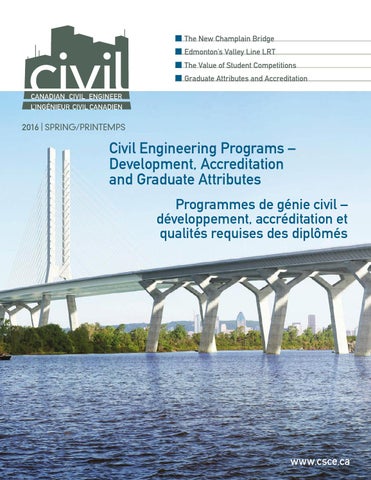
The New Champlain Bridge Edmonton’s Valley Line LRT The Value of Student Competitions Graduate Attributes and Accreditation
2016 | S PRING/PRINTEMPS
Civil Engineering Programs – Development, Accreditation and Graduate Attributes Programmes de génie civil – développement, accréditation et qualités requises des diplômés
www.csce.ca CIVIL_Spring2016_LAZ.indd 1
16-02-26 8:43 AM
Civil_MarchSpring_SFrame.indd CIVIL_Spring2016_LAZ.indd 2 1
2016-02-11 11:34 AM 16-02-25 10:26
1 11:34 AM
contents SPRING 2016/PRINTEMPS 2016 | VOLUME 33.1
IN VIEW: PROJECTS 12 N ew Champlain Bridge Corridor Project FORUM ON SUSTAINABLE INFRASTRUCTURE/ FORUM SUR LES INFRASTRUCTURES DURABLES
16 Incorporating Sustainable Urban Integration into Edmonton’s Upcoming
Valley Line LRT
NEWS, VIEWS & DEPARTMENTS
NOUVELLES,
POINTS DE VUE ET
RUBRIQUES
4 President’s perspective/
Perspective présidentielle
TECHNICAL: CIVIL ENGINEERING PROGRAMS – DEVELOPMENT, ACCREDITATION AND GRADUATE ATTRIBUTES TECHNIQUE: PROGRAMMES DE GÉNIE CIVIL – DÉVELOPPEMENT, ACCRÉDITATION ET QUALITÉS REQUISES DES DIPLÔMÉS 18 Introduction: From studentship to professional engineers,
Elena Dragomirescu, Ph.D. 19 Graduate attributes and accreditation 21 Is there value to student competitions? 24 International student exchanges enhance learning
16
6 From the regions: Western/ De nos régions: l’Ouest
9 Student voice/La voix des étudiants
10 Young professionals
corner/Le coin des jeunes professionnels 11 Lifelong Learning/ Formation continue 26 CSCE partners and sponsors/ Associés et commanditaires SCGC
19
12 Cover: New Champlain Bridge design concept/Infrastructure Canada, see p. 12.
Canadian Civil Engineer | Spring 2016
CIVIL_Spring2016_LAZ.indd 3
3
16-02-25 10:27 AM
PRESIDENT’S PERSPECTIVE | PERSPECTIVE PRÉSIDENTIELLE
Tony Bégin, P.Eng., CDP, M.A.Sc., MCSCE PRESIDENT, CSCE/PRÉSIDENT SCGC PRESIDENT@CSCE.CA
CSCE/SCGC 521-300, rue St-Sacrement Montreal, Québec H2Y 1X4 Tel.: 514-933-2634, Fax: 514-933-3504 E-mail: mahmoud.lardjane@csce.ca www.csce.ca
PRESIDENT/PRÉSIDENT Tony Bégin, P.Eng., CDP, M.A.Sc., MCSCE
CANADIAN CIVIL ENGINEER/L’INGÉNIEUR CIVIL CANADIEN EDITOR/RÉDACTEUR Doug Salloum, CSCE Executive Director 514-933-2634 ext. 1, doug.salloum@csce.ca MANAGING EDITOR/ DIRECTEUR DE LA RÉDACTION Cindy Macdonald Tel.: 416-510-6755 cmacdonald@annexweb.com
ASSOCIATE EDITOR/ RÉDACTEUR EN CHEF ADJOINT Bronwen Parsons Tel.: 416-510-5119 bparsons@ccemag.com
ADVERTISING SALES/ PUBLICITÉ Maureen Levy Tel: 416-510-5111 mlevy@ccemag.com
ART DIRECTOR/ COMPOSITION ARTISTIQUE Lisa Zambri Tel: 416-510-5600 x3595
Annual Subscription Rates/Abonnement annuel Canada & U.S./E.U. $35.00, Other countries/Autres pays $45.00; Single copy/Un numéro $7.50; Agency discount/Rabais au distributeurs 10% PUBLICATION ISSN 9825-7515 RETURN ADDRESS/ADRESSE DE RETOUR : The Canadian Society for Civil Engineering La Société Canadienne de Génie Civil 521-300, rue St-Sacrement Montreal, Québec H2Y 1X4 Canadian Civil Engineer (CCE) is published five times per year by the Canadian Society for Civil Engineering (CSCE). L’ingénieur Civil Canadien (ICC) est publié cinq fois par année par la Société Canadienne de Génie Civil (SCGC). The opinions expressed in the papers are solely those of the authors and the Canadian Society for Civil Engineering is not responsible for the statements made in this publication. Les opinions exprimées dans les articles sont la seule responsabilité de leurs auteurs et la Société canadienne de génie civil n’engage pas sa responsabilité dans les propos exprimés. CIVIL Magazine is produced by the publishers of Canadian Consulting Engineer Magazine, published by Annex Publishing & Printing Inc. Le magazine Civil est produit par l’editeur de la publication Canadian Consulting Engineer qui est publie par Annex Publishing & Printing Inc. Annex Publishing & Printing Inc., 80 Valleybrook Drive, Toronto, Ontario M3B 2S9 Tel.: 416-442-5600; Fax: 416-510-5140 PUBLICATIONS MAIL AGREEMENT/POSTES CANADA ENREGISTREMENT #40065710
Moving forward in 2016
T
he momentum for translating ideas into actions and making things happen is now part of our annual strategic planning process. Last fall, more than 40 CSCE volunteers and staff members took part in a workshop session in Montreal. A top 10 list of strategic initiatives was prioritized for 2016 and was approved the following day at the board meeting. The description of the initiatives and the targeted deliverables were summarized in a onepage report published in the e-bulletin and on the CSCE web site for all members to know what we are working on (https://csce.ca/strategic-directions/). These priorities are in line with our Vision 2020 strategic directions (1. enhanced services to members; 2. growing with youth; and 3. leadership in sustainable infrastructure) and our membership growth objective of 25 per cent per year. A very important milestone was reached on January 18 with the publication of a press release on the 2016 Edition of the Canadian Infrastructure Report Card (www.canadianinfrastructure.ca/) in collaboration with the Canadian Construction Association (CCA), the Canadian Public Works Association (CPWA) and the Federation of Canadian Municipalities (FCM). The key finding of the report is that one-third of Canada’s municipal infrastructure is at risk of rapid deterioration. This represents a current replacement value of $388 billion. I would like to acknowledge the great contribution and leadership of our CSCE Infrastructure Renewal Committee chaired by Nick Larson. We will be organizing a CSCE Infrastructure Report Card National Tour to present the report findings in the spring and fall of this year. These presentations will be hosted by CSCE Sections in many cities across the country. All members are invited to participate to better understand the facts and the key messages of the report card. We also want to invite the municipal infrastructure construction buyers, the asset management practitioners and funding stakeholders, as well as the general public, to attend the events. The dates and locations of these presentations will be confirmed shortly. For information on this tour please contact Mahmoud Lardjane, mahmoud.lardjane@csce.ca Finally, don’t forget to register soon for the 2016 CSCE Annual Conference in London, Ont., from June 1 to 4 (www.csce2016.ca/). The theme is Resilient Infrastructure. The specialty conferences are: environmental, materials, structural, transportation engineering and natural disaster mitigation. More than 637 abstracts and 119 project profiles have been received for review and approval. Come and join us to learn, network and discover this beautiful region. It’s a rendez-vous!
Tony Bégin is senior director of integrated project delivery at Canam Group Inc.
4
CIVIL_Spring2016_LAZ.indd 4
Printemps 2016 | L’Ingénieur civil canadien
16-02-25 10:27 AM
PRESIDENT’S PERSPECTIVE | PERSPECTIVE PRÉSIDENTIELLE
Allons de l’avant en 2016
L
e momentum pour traduire des idées en actions et pour concrétiser nos projets fait maintenant partie de notre processus de planification stratégique annuel. L’automne dernier, plus de 40 bénévoles et membres du personnel de la SCGC se sont mis réunis lors d’un atelier à Montréal. Les dix initiatives stratégiques les plus importantes furent priorisées pour 2016 et furent approuvées le lendemain par le conseil d’administration. La description des initiatives et des livrables ciblés est résumée dans un rapport d’une page publié dans la lettre électronique et sur le site web de la SCGC (https://csce.ca/fr/strategic-directions/) afin d’informer tous les membres de ce que nous entreprenons. Ces priorités sont en ligne avec les orientations stratégiques de notre Vision 2020 (1. Bonification des services aux membres; 2. Croître avec les jeunes et 3. Leadership en infrastructures durables) ainsi que notre objectif de croissance annuelle des adhésions de 25%. Nous avons franchi une étape très importante le 18 janvier dernier avec la publication d’un communiqué de presse sur l’édition 2016 du Bulletin de rendement des infrastructures durables (www.canadianinfrastructure.ca/) en collaboration avec l’Association canadienne de la construction (ACC), l’Association canadienne des travaux publics (ACTP) et la Fédération canadienne des municipalités (FMC). La principale conclusion du bulletin est que le tiers des infrastructures municipales canadiennes risquent une détérioration rapide, ce qui représente une valeur de remplacement actuelle de 388 milliards de dollars. Je tiens à souligner la contribution majeure ainsi que le leadership de notre Comité du renouvellement des infrastructures présidé par Nick Larson. Nous organiserons une tournée nationale de présentations sur le bulletin au printemps et en automne. Ces présentations se dérouleront au niveau des sections de la SCGC dans plusieurs villes du pays. Tous les membres sont invités à y assister afin de mieux comprendre les faits et les messages contenus dans le bulletin. Nous voulons aussi inviter les acheteurs d’infrastructures municipales, les praticiens de la gestion des actifs, les intervenants dans le financement des infra-
Canadian Civil Engineer | Spring 2016
CIVIL_Spring2016_LAZ.indd 5
The Canadian Infrastructure Report Card was published in January this year. A key finding is that one-third of Canada’s municipal infrastructure is at risk of rapid deterioration.
structures ainsi que le grand public à y participer. Les dates et lieux de ces présentations seront confirmés sous peu. Pour toute information sur cette tournée, veuillez contacter Mahmoud Lardjane, mahmoud. lardjane@csce.ca. Je terminerai en vous rappelant de vous inscrire bientôt au Congrès annuel 2016 de la SCGC (www.csce2016.ca/) qui se déroulera à London, ON du 1er au 4 juin. Le thème du congrès est ‘’Les infrastructures résilientes’’. Les conférences spécialisées porteront sur l’environnement, les matériaux, les structures et l’atténuation des catastrophes naturelles. Plus de 637 résumés de communications et 119 profils de projets ont été reçus pour révision et approbation. Joignez-vous à nous pour apprendre, pour faire du réseautage et pour découvrir la belle région de London. C’est un rendez-vous ! Tony Bégin est directeur principal, réalisation de projets intégrés chez Groupe Canam Inc.
5
16-02-25 10:27 AM
FROM THE REGIONS: SECTION NEWS | DE NOS RÉGIONS : NOUVELLES DES SECTIONS
Western Region Update D. Philip Alex (Alex), M.Sc., B.Arch. PMP REGIONAL VICE-PRESIDENT, WESTERN REGION, CSCE
I
n 2015, I had the opportunity to visit the Vancouver and Vancouver Island sections and was really excited to see how they have been following the CSCE’s strategic directions, while developing programs, engaging professionals and continuing to build the student sections. The following are some of the key highlights for each of the sections.
Edmonton In addition to the monthly dinner meetings which highlight exciting local engineering projects, the section hosted a day-long short course addressing the changes that have been made to the most recent version of CSA S-06, the Canadian Highway Bridge Design Code. The section also established a scholarship for undergraduate students with the University of Alberta Department of Civil and Environmental Engineering; the endowment is a legacy of the 2012 National Conference held in Edmonton. The Young Professionals group held its second speed mentoring session in January, hosted a technical tour of the ongoing North East Anthony Henday roadway and bridge construction in October, and continued to host a variety of social and networking opportunities for our members. (http://csceedmonton.ca/)
Calgary The Calgary section has been hosting dinner meetings on engineering projects, including the Elbow River Pedestrian Bridge, the excavation of the new Telus Sky high rise building and a historical talk on the Glenmore Dam. The section also hosted a panel discussion on the importance of mentoring. Panelists included CSCE Fellows Dr. John Morrall, Colin Campbell, and Denis Broadhurst. The student section conducted a workshop on networking basics and hosted a student-professor mixer. In addition, the young professionals group organized a forum on the challenges of growing your own business in civil engineering, and they toured the new National Music Centre. (http://www.cscecalgary.com)
Vancouver This section organized two tours in 2015, the first being the Evergreen Line and the second being the Lafarge Richmond cement plant. In addition, the section hosted a seminar on the latest research studies in structural and wind engineering at University of Western Ontario. The young professionals group organized the 35th annual Physics Balsa Bridge Building Contest at Notre Dame Regional Secondary School. The two student sections with the University of British Columbia and the British Columbia Institute of Technology are actively involved in putting on events like the UBC industry night, the 9th BCIT annual professional night, various technical talks and seminars, StructureCraft
6
CIVIL_Spring2016_LAZ.indd 6
CSCE has established a scholarship at the University of Alberta./La SCGC a créé une bourse à l’Université de l’Alberta.
Builders Tours and site tours of the Ruskin Dam and YVR expansion project. (http://www.cscebc.ca)
Vancouver Island The student chapter has kicked off a storm that has inspired the Vancouver Island section to redevelop and further integrate the student chapter into the section. The student chapter has been hosting BBQ mixers and has been organizing skills development workshops by exposing students to software such as AutoCAD Civil 3D and S-Frame and S-Concrete. The section is also making transitions within their executive and is in the process of recruiting new members to take on more leadership roles. (http://csce.engr.uvic.ca/) Although there are significant challenges related to the current economy and concerns with succession planning within the sections, this is an exciting time within the Western Region. The region has come together to provide a strong frontier as the Vancouver section works towards hosting the CSCE Annual Conference in 2017. I know that I am looking forward to the year ahead and working with the sections, the CSCE National Office and the local organizing committee of the 2017 CSCE conference. D. Philip Alex is director, drainage strategic services for the City of Edmonton.
The Western Region core committee consists of the regional vice-president (Dinu Philip Alex), treasurer (Dr. Rishi Gupta), regional coordinator (vacant) and the chairs of the four sections in the region (Mark Scanlon – Edmonton, Kristoffer Karvinen – Calgary, Stanley Chan – Vancouver, Kevin Baskin – Vancouver Islands).
Printemps 2016 | L’Ingénieur civil canadien
16-02-25 10:27 AM
Civil_Spr
EXCLUSIVE FINANCIAL SECURITY PROGRAM
for engineers, geoscientists, students and their families
RRSP, non-registered savings plan, TFSA, RRIF, LIF or annuities Sponsored by Engineers Canada
Lower fees
Get group pricing
How much more?
$35,526
More future savings and more income in retirement
more*
with an Engineers Canada-sponsored RRSP
Program participants get free investment guidance Start today – contact Angela Harvey at 1-866-788-1293 ext. 5786 or angela.harvey@gwl.ca, or visit www.infosite.grs.grsaccess.com/engineers-canada Sponsored by:
*Assumes no further contributions for ease of calculation, interest on the initial $25,000 investment compounded annually. Based on a 25-year investment at a group plan rate of return (which includes fees) of eight per cent and a bank rate of return (which includes fees) of seven per cent. / Great-West Life and key design are trademarks of The Great-West Life Assurance Company (Great-West Life), used under licence by its subsidiaries, London Life Insurance Company (London Life) and The Canada Life Assurance Company (Canada Life). As described in this advertisement, group retirement, savings and income products are issued by London Life and payout annuity products are issued by Canada Life.
Civil_Spring_Engineers.indd CIVIL_Spring2016_LAZ.indd 17
2016-01-22 8:39 AM AM 16-02-25 10:27
FROM THE REGIONS: SECTION NEWS | DE NOS RÉGIONS : NOUVELLES DES SECTIONS
Le point sur la région de l’Ouest D. Philip Alex (Alex), M.Sc., B.Arch. PMP VICE-PRÉSIDENT RÉGIONAL, RÉGION DE L’OUEST, SCGC
E
n 2015, j’ai eu l’occasion de visiter les sections de Vancouver et de l’île de Vancouver et j’ai été vraiment ravi de la façon dont cellesci suivent les orientations stratégiques de la SCGC, tout en développant des programmes, en organisant des rencontres entre professionnels et étudiants et en continuant de bâtir leurs sections étudiantes. Voici quelques-uns des points saillants pour chacune des sections.
Edmonton En plus d’être l’hôte de dîners-rencontres mensuels, au cours desquels sont soulignés des projets d’ingénierie marquants à l’échelle locale, la section a organisé un cours d’une journée pour aborder les plus récents changements apportés au Code canadien sur le calcul des ponts routiers (CSA S-06). La section a également créé une bourse à l’intention des étudiants du premier cycle du département de génie civil et de l’environnement de l’université de l’Alberta — une initiative qui tire son origine du congrés annuel de 2012 tenue à Edmonton. Le groupe des Jeunes professionnels a tenu sa deuxième séance de mentorat à la chaîne en janvier, organisé une visite technique des travaux de construction du pont et de la partie nord-est de la promenade Anthony Henday en octobre ainsi que divers évènements offrant à nos membres des opportunités de rencontres sociales et de réseautage (http://csceedmonton.ca/)
Calgary La section de Calgary a tenu des soupers-rencontres portant sur divers projets d’ingénierie, dont le pont piétonnier de la rivière Elbow, l’excavation de la fondation de la nouvelle tour Telus Sky ainsi qu’une conférence sur l’histoire du barrage Glenmore. La section a également organisé une table ronde sur l’importance du mentorat, à laquelle ont participé des membres Fellows de la SCGC : Dr John Morrall, Colin Campbell et Denis Broadhurst. La section étudiante a offert un atelier sur les bases du réseautage et une rencontre entre étudiants et professeurs. Le groupe des Jeunes professionnels a mis sur pied un forum sur les défis de la création de sa propre entreprise de génie civil et une visite du nouveau Centre national de musique. (http://www.cscecalgary.com)
Vancouver La section a organisé deux visites en 2015, la première à la ligne Evergreen et la seconde à la cimenterie Lafarge de Richmond. Elle a également offert un séminaire sur les dernières recherches en ingénierie des structures et étude des vents à l’Université Western en Ontario. Le groupe des Jeunes professionnels a organisé la 35e édition du Concours annuel de construction de pont Physics Balsa à l’école secondaire
8
CIVIL_Spring2016_LAZ.indd 8
The Vancouver section toured the Evergreen Line construction./ La section de Vancouver a organisé une visite du projet de la ligne Evergreen.
Notre Dame. Les deux sections étudiantes de l’Université de la Colombie-Britannique et de l’Institut de technologie de la Colombie-Britannique participent activement à l’organisation d’évènements comme la « nuit de l’industrie » de l’UBC, la 9e édition de la « nuit professionnelle » de la BCIT, divers entretiens et séminaires techniques, des visites de projets StructureCraft Builders et visites des sites du barrage de Ruskin et du projet d’agrandissement de l’aéroport de Vancouver. (http://www.cscebc.ca)
île de Vancouver Grâce aux efforts inspirants du chapitre étudiant, la section de l’île de Vancouver s’est déployée et a intégré davantage le chapitre étudiant au sein de la section. Le chapitre étudiant a organisé des rencontres-barbecues et ateliers de développement des compétences, incluant une initiation des étudiants à divers logiciels, dont AutoCAD Civil 3D, S-Frame et S-Concrete. La section est aussi en phase transitoire au sein de sa direction et s’affaire à recruter de nouveaux membres pour améliorer son leadership (http://csce.engr.uvic.ca/). Malgré de nombreux défis liés à la situation économique actuelle et à la planification de la relève au sein des sections, la région de l’Ouest traverse une période stimulante alors qu’elle se solidifie et que la section de Vancouver se prépare à accueillir le Congrès annuel de la SCGC en 2017. J’entrevois la prochaine année avec beaucoup d’optimisme dans le cadre de mon travail avec les sections, le Bureau national de la SCGC et le comité organisateur local du congrès 2017 de la SCGC. D. Philip Alex est directeur des services stratégiques aux services de drainage de la ville d’Edmonton. Le comité de la région de l’Ouest comprend le vice-président régional (Dinu Philip Alex), le trésorier (Dr Rishi Gupta), le coordonnateur régional (vacant) et les présidents des quatre sections de la région — Mark Scanlon, Edmonton, Kristoffer Karvinen, Calgary, Stanley Chan, Vancouver, Jonathan Reiter, île de Vancouver.
Printemps 2016 | L’Ingénieur civil canadien
16-02-26 9:52 AM
THE STUDENT VOICE | LA VOIX DES ÉTUDIANTS
Think Big!
Pensez grand!
Jean-Gabriel Lebel
Jean-Gabriel Lebel
PRESIDENT, UNIVERSITÉ DE SHERBROOKE
PRÉSIDENT DU CHAPITRE ÉTUDIANT DE
STUDENT CHAPTER, CSCE
L’UNIVERSITÉ DE SHERBROOKE
T
L
he Sherbrooke chapter expanded significantly during the last year, with substantial progress in participation, number of activities and scope. This improvement was notably influenced by a “think big” mentality. While this may sound clichéd, it’s a great incentive for our executive members to undertake initiatives. In the last year, we organized more than 15 major activities, covering essentially all subfields of civil engineering, and we won’t stop there. This year, we raised the bar and the stage is set for us to surpass ourselves in the coming year. Our mission is to promote learning and discovery of various practices and procedures inherent in civil engineering. This is why our strategy focuses increasingly on activities that enable students to distinguish themselves professionally, by gaining extracurricular skills and developing their network of contacts. To that end, our chapter provided a 16-hour training session last November on software used extensively in engineering but not included in our university’s curriculum. This provided students with opportunities to acquire useful knowledge on various design, planning and infrastructure applications. The students were also able to use these programs within the context of actual case studies. This purely technical activity also offered great networking opportunities. One of our guidelines for the year ahead is to promote meetings between students and professionals, based on their respective passions.
e chapitre de Sherbrooke a connu un essor marqué durant sa dernière année d’activité. Le progrès est indéniable de par le nombre d’activités et du taux de participation autant que de leur envergure. La mentalité qui a guidé ce progrès : Pensez grand. Cela peut sembler profondément cliché, j’en conviens. N’empêche qu’il s’agit d’un cliché extrêmement stimulant pour nos membres exécutifs pour la mise en œuvre d’initiatives. Durant la dernière année, nous avons organisé plus de 15 activités d’envergure, couvrant essentiellement tous les sous-domaines du génie civil. Nous ne nous arrêterons pas là. Nous avons fixé la barre haute pour cette année, la table est mise pour nous surpasser. Fondamentalement, notre mission est de favoriser l’apprentissage et la découverte des diverses pratiques et procédures inhérentes au génie civil. C’est pourquoi notre orientation stratégique tend à se diriger de plus en plus vers des activités qui permettront à nos étudiants de se démarquer sur la scène professionnelle par l’acquisition de compétences extracurriculaires ainsi que le développement de leur réseau de contacts. Ainsi, en novembre dernier, notre chapitre a offert une formation professionnelle d’une durée de 16h sur des logiciels qui sont très utilisés en ingénierie mais ne sont pas inclus dans le cursus de notre Université. Cette activité a permis aux étudiants d’acquérir une connaissance approfondie de divers applications et logiciels de design, de planification et de conception des infrastructures. Cette activité a aussi permis aux étudiants d’expérimenter ces programmes dans le contexte de réelles études de cas. Cette activité purement technique a aussi offert de grandes opportunités de réseautage. L’une de nos lignes directrices pour l’année à venir est de favoriser des rencontres entre les étudiants et les professionnels sur la base de leurs passions respectives.
Denso Products - Unmatched Quality and Performance
If it doesn’t say
on the outside, then its not
Denso North America Inc. • www.densona.com
Canadian Civil Engineer | Spring 2016
CIVIL_Spring2016_LAZ.indd 9
on the inside.
9
16-02-25 10:27 AM
YOUNG PROFESSIONALS’ CORNER | LE COIN DES JEUNES PROFESSIONELS
Growing as a Young Professional Through CSCE Connell Miller, B.E.Sc.
H
ello! My name is Connell Miller. I am a recent graduate from Western University in civil engineering, and am currently working on my Ph.D. in wind engineering. I am also a member of the local organizing committee for the CSCE 2016 conference in London as the young professionals coordinator. I first became involved with the CSCE late in my undergraduate career by joining the student chapter at Western University. After some time, I became co-president of this student chapter, and attended more events with the local chapter. After graduating in 2015, I volunteered to be a part of the committee for the conference to continue the passion I’ve developed for the CSCE YP program. In my personal experience, I have found that the YP program offered
by the CSCE is an invaluable resource — not only for the networking and social opportunities that it provides, but also for the educational benefit of talking with and listening to industry professionals. Everyone applying for an engineering job has a degree in engineering, but it is the opportunities, contacts, and resources that the YP program provides that can really set you apart from other engineers. Participating in the upcoming conference has all of these opportunities on an even larger scale. Networking and hearing research from civil engineers across North America are fantastic ways to spend your time. I’d really encourage you to check out www.csce2016.ca to see all of the seminars, social events and networking opportunities that are being held specifically for the YP program!
Grandir en tant que jeune professionnel au sein de la SCGC Connell Miller, B.E.Sc.
B
onjour ! Je m’appelle Connell Miller. J’ai récemment obtenu mon diplôme en génie civil à l’Université Western et je prépare actuellement mon doctorat en génie éolien. Je suis membre du comité organisateur local du congrès 2016 de la SCGC, qui aura lieu à London, en tant que coordinateur des jeunes professionnels. Je me suis impliqué pour la première fois au sein de la SCGC à la fin de
CALL FOR CASE STUDIES - 2016-17 The editors of CIVIL magazine invite CSCE members to submit case studies for possible publication in future issues. Bronwen Parsons, Associate Editor, CIVIL. e-mail bparsons@ccemag.com, Tel. 416-510-5119.
10
CIVIL_Spring2016_LAZ.indd 10
mes études de premier cycle en rejoignant le chapitre étudiant de l’Université Western. J’en suis éventuellement devenu le coprésident et j’ai assisté à plusieurs événements de la section locale. Après avoir obtenu mon diplôme en 2015, je me suis porté volontaire pour faire partie du comité organisateur du congrès afin de cultiver la passion que j’ai développée au sein du programme des jeunes professionnels de la SCGC. Selon mon expérience personnelle, je considère que ce programme est une ressource inestimable. Outre les occasions de rencontres sociales et de réseautage qu’il fournit, il permet aux jeunes participants d’enrichir leurs connaissances en étant en contact avec des professionnels de l’industrie. Tous ceux qui postulent pour un emploi d’ingénieur détiennent un diplôme en génie, mais ce sont les possibilités et ressources qu’offre le programme des jeunes professionnels qui permettent à ses participants de se démarquer. Le prochain congrès offre toutes ces possibilités et d’autres avantages inestimables. Établir des contacts et discuter avec des ingénieurs civils des quatre coins de l’Amérique du Nord est une expérience enrichissante. Je vous invite à visiter www.csce2016.ca pour consulter la liste des séminaires, événements sociaux et autres activités qui auront lieu dans le cadre du congrès, particulièrement celles concernant le programme des jeunes professionnels !
Printemps 2016 | L’Ingénieur civil canadien
16-02-25 10:27 AM
LIFELONG LEARNING | FORMATION CONTINUE
CSCE Canadian Infrastructure Report Card National Tour Mahmoud Lardjane, PROGRAMS MANAGER, CSCE
C
anada’s latest Infrastructure Report Card (CIRC), which was released in January 2016, identifies one-third of Canada’s municipal infrastructure as being in fair, poor or very poor condition. In a series of presentations this spring, Guy Félio and Nick Larson will present a detailed overview of the CIRC process and results, and will provide some ideas for how we can engineer our infrastructure to make sure it can be sustained over the long term. Guy Félio, Ph.D., P.Eng., (R. V. Anderson Associates Ltd.) authored the first Canadian Infrastructure Report Card published in 2012. Nick Larson, MEPP, P.Eng. (GM BluePlan Engineering) represented the CSCE on the Project Steering Committee (PSC) that developed the 2016 Canadian Infrastructure Report Card. The presentation will be offered in Regina, Ottawa, London, Hamilton and Oshawa in May. Visit www.csce.ca for details. Cette présentation sera offerte en français à Montréal, Sherbrooke et Québec en septembre. Veuillez visiter www.csce.ca.
THE PIPE THAT FITS IN SO MANY WAYS.
National Tour Dates and Locations April 20: Fredericton and Moncton April 21: Halifax April 22: St. John’s April 25: Victoria and Vancouver April 26: Calgary and Edmonton April 27: Saskatoon April 28: Winnipeg and Toronto April 29: Thunder Bay
NovaForm PVC Liner TM
The sewer & culvert rehabilitation solution in the sizes you need.
• • • •
A Size for Every Job Durability of PVC Consistent Production Peace of Mind
To learn more, call us toll free at 1-866-473-9462 or visit www.ipexinc.com NovaFormTM is manufactured by IPEX Inc. NovaFormTM is a trademark of IPEX Branding Inc.
CivilEngineering_Spring_IPEX.indd 1
Canadian Civil Engineer | Spring 2016
CIVIL_Spring2016_LAZ.indd 11
2016-01-28 8:57 AM
11
16-02-25 10:27 AM
IN VIEW: PROJECTS | PROJETS EN VEDETTE
BUILDING A LANDMARK NEW CHAMPLAIN BRIDGE CORRIDOR PROJECT
The project to replace the 1960s Champlain Bridge over the St. Lawrence River in Montreal involves many components — and must be completed by 2019.
Bridge Corridor Project. SSL is responsible for the design, build, financing, operation, maintenance and rehabilitation of the new corridor. This project is being delivered under a public-private partnership agreement with the Government of Canada. With a 125-year design life, the new 3.4 km bridge with a cable stay section and two approach structures will replace the current aging bridge, which has been crossing the By Dan Genest, Saint Lawrence River and connecting comSIGNATURE ON THE SAINT-LAWRENCE GROUP muters from the South Shore to the Island of Montreal since the early 1960s. With n June 2015, the equity partners in the 50 million vehicles crossing the ChamSignature on the Saint Lawrence (SSL) plain Bridge each year, it is one of the busGroup consortium announced the financial iest crossings in the country and a critical close and official signing of one of the larg- passageway for the regional and Canadian est transportation infrastructure projects economies. The project will include a new 470-m in North America: the New Champlain
I 12
CIVIL_Spring2016_LAZ.indd 12
bridge connecting Montreal to L’Île-desSoeurs. In addition, the 4.5-km federal portion of Highways 15 and 10 will be reconstructed and widened. Signature on the Saint Lawrence Construction — the design-build arm of SSL Group, composed of SNC-Lavalin, Dragados and Flatiron — began detailed design work, geotechnical investigations, permitting and construction activities prior to the financial close. They did so in order to fully exploit the 2015 construction window — and to establish the momentum needed to deliver on the very aggressive bridge opening date. Indeed, the new Champlain Bridge will be opening to the public no later than December 1, 2018, while the remainder of the corridor needs to be fully completed by October 31, 2019.
Printemps 2016 | L’Ingénieur civil canadien
16-02-25 10:27 AM
IN VIEW: PROJECTS | PROJETS EN VEDETTE
Design concept for the new 3.4 km bridge, which has a cable stay
Infrastructure Canada
section and two approach structures.
Modular construction SSL’s solution for this project revolves around a modular construction approach, making best use of a hybrid concrete/steel solution. To ensure the proper focus was brought to each aspect of the project, two design teams were created with expertise in each of two major scopes of the project: the A15 and A10 Highway connectors and the New Champlain Bridge. The Highway scope is designed using standard design criteria for the Montreal area and consists of asphaltic pavement on a granular base, incorporating current drainage requirements. Essentially, the highway design is common for the Canadian environment and was not exposed to significant technical challenges. It is an efficient, cost-effective design that will meet all requirements.
Canadian Civil Fall Engineer Engineer||Spring Spring2016 2016
CIVIL_Spring2016_LAZ.indd 13
The Bridge scope was established for a 125-year life span and has incorporated appropriate design elements to address operational security requirements. The new bridge deck comprises a composite solution of steel girders overlaid with precast concrete deck slabs, which is highly efficient and has overall less material consumption and costs. The design examined all areas where optimization could yield a more efficient and effective solution. For example, the selected design option reduced by close to 10% the number of in-water foundations/piers, a cost-saving measure which, at the same time, allowed for a more efficient structural design. The SSL design maximizes the use of precast concrete elements throughout the Bridge scope to ease construction and en-
sure schedule efficiency, allowing yearround work, complemented with steel components for the pier caps and superstructure. We like to call this a “kit of parts.” The standardized precast elements include the foundations, pier legs, cable stay lower pylon, and bridge deck. Other standardized elements for ease of fabrication and construction include the structural steel girder lengths. Cast-in-place concrete design is only used in areas where its use is most efficient, such as the cable stay upper pylon (use of climbing forms), the East Approach foundations, and the West Approach foundations in the jetty area. The combination of composite deck, precast concrete, cast-in-place concrete, and steel design approaches allows for precast sourcing options off site and minimizes the
13
16-02-25 10:27 AM
Infrastructure Canada
Infrastructure Canada
IN VIEW: PROJECTS | PROJETS EN VEDETTE
Above left: aerial view of the existing Champlain Bridge and Port of Montreal. Centre: demolition under way at L’Île-des-Soeurs. Right: construction under way on jetty at the West Approach.
size of in-water jetties required for the precast and preassembly installations on site.
One project, two scopes SSL will self-perform the bulk of the work to retain positive control on achieving the schedule milestones. It has adopted a “One Project, Two Scopes” approach to the construction and will act as a fully integrated team for both the Bridge and Highway scopes, with extensive coordination built into all aspects of the organization. The construction activities have been simplified and de-risked to the maximum extent possible by a thoughtful construction-driven design approach and the application of a suitably tailored set of means and methods to build the project. A15 and A10 Highway scope. The highway construction scope includes removing existing structures with engineered demolition methods, adding retaining walls as required, constructing new structures and completing the southbound lanes initially on the Montreal side of the project. Subsequently, the transfer of traffic from the existing highway onto the new southbound lanes will allow the construction of the northbound lanes where the current highway exists. As part of this work, the Île-des-Soeurs Bridge will be demolished
14
CIVIL_Spring2016_LAZ.indd 14
in segments. The new bridge will be built in two halves; the west end side first on an in-water jetty; followed by a similar approach for the east end side. This construction method is commonly used and effectively poses very little cost and schedule risks. It is important to note that SSL thoroughly analyzed the highway construction means, methods and schedule, and developed a plan where over 90% of the highway work will be completed in time for the New Champlain Bridge opening. New Champlain Bridge scope. The construction of the New Champlain Bridge has been optimized through the use of composite materials and precast and cast-in-place concrete methods. The bridge consists of three main segments: the West Approach; the Cable Stay section; and the East Approach. The West and East Approaches consist of the same overall bridge design concept: precast concrete foundations; precast pier legs; steel pier caps; structural steel girders; and concrete bridge deck. The East Approach is shorter, at approximately 850 metres in length, and poses the least schedule and construction risks. Essentially, the construction team in this area will be working with jetties built for the work, installing cast-in-place concrete foundations, erecting precast pier legs (standardized for the
entire project and fabricated off-site), and then installing the “W” shaped steel pier caps by cranes sitting on the jetty. The steel girders will then also be put in place by cranes, followed by the precast bridge deck slabs. The majority of this work will be completed in early 2018. Meanwhile, the West Approach (approximately 2,050 metres in length) has both jetty and in-water work. It has been technically separated into four frames. The 500-m west jetty has been built in the Frame 4 segment immediately adjacent to the Montreal shoreline. This jetty will host the precast yard for the foundations for the West Approach, as well as the pre-assembly yard for the steel pier caps and superstructure of the West Approach. The in-water work in Frames 1 through 3 will be constructed using precast concrete foundations collected from the west jetty, using heavy lift equipment and barges, and lowered to river bottom. The installation of the precast pier legs (fabricated off-site) will follow, using regular lift cranes and barges. Once the pier legs have been set in place, the steel pier caps will be collected from the jetty and installed using heavy lift equipment. Frame 3 will commence first, followed by Frames 2 and then 1 for the in-water works, working towards the Cable Stay section of the bridge. Once the pier caps
Printemps 2016 | L’Ingénieur civil canadien
16-02-25 10:27 AM
Infrastructure Canada
IN VIEW: PROJECTS | PROJETS EN VEDETTE
have been delivered for Frames 3 to 1, the construction of the cast-in-place foundations in Frame 4 (west jetty area) will occur, followed by precast pier legs, steel pier caps, steel girders and precast deck slabs. At this time, work will start on removing the jetty and restoring the river bed. The Cable Stay section of the bridge is the portion of the New Champlain Bridge that has the least float in the schedule, and therefore is the most important to tightly manage and construct, using the simplest methods possible. We have chosen to use drilled shafts for the main span tower, supporting cast-in-place foundations, precast lower pylons and a steel tie beam that holds the symmetrical towers together. The design of the Cable Stay section is asymmetrical, which requires thoughtful detailing as to the sequence of constructing the back and main spans, while at the same time erecting the pylons through concrete climbing forms and installing the cable stays. Once the New Champlain Bridge is completed in the fall of 2018, the A15 and A10 Highway will be connected through an appropriate traffic management switchover and the bridge will be operational on or before December 1, 2018. Following the completion of the project, Signature on the Saint Lawrence Group will operate, maintain and rehabilitate the new bridge
corridor for a period of 30 years. For more details, see the project’s official website: www.newchamplain.ca, and http://www.infrastructure.gc.ca/nbsl-npsl/nbsl-npsl-eng.html OWNER: Government of Canada PRIVATE PARTNERS / DESIGN-BUILD, FINANCE, OPERATE, MAINTAIN AND REHABILITATE: Signature on the Saint Lawrence (SSL) Group (SNC-Lavalin, ACS, Hochtief, Dragados Canada and Flatiron Constructors Canada) NEW CHAMPLAIN BRIDGE DESIGN: TY Lin International, International Bridge Technologies, and SNC-Lavalin HIGHWAY DESIGN: SNC-Lavalin and MMM Group
Corporate Appointment: Vice President Peter Langan, P.Eng., FCSCE Peter Langan, P.Eng., FCSCE was appointed as a Vice President of R.V. Anderson Associates Limited by the firm’s Board of Directors in December 2015. Over the past 26 years with RVA, Peter has developed an extensive portfolio in urban development, municipal and transportation engineering. He became a Principal of the firm in 2009. His experience includes many of the firm’s marquee urban development projects, including award-winning work for Waterfront Toronto. In his new role, he will continue providing leadership to our urban development, municipal and transportation groups, and will take on new challenges as part of the firm’s senior management team.
toronto niagara ottawa sudbury london moncton fredericton st. john’s mumbai www.rvanderson.com
CivilEngineering_Spring_RVAnderson.indd 1
Canadian Civil Fall Engineer Engineer||Spring Spring2016 2016
CIVIL_Spring2016_LAZ.indd 15
Canadian2016-01-13 Civil Engineer 8:57 AM 4.875” x 3.625” 15 January 2016
16-02-25 10:27 AM
SUSTAINABLE INFRASTRUCTURE | LES INFRASTRUCTURES DURABLES
Red Light, Yellow Light, Green Light:
Incorporating sustainable urban integration into Edmonton’s upcoming Valley Line LRT by Quinn Nicholson
I
n 2014, global infrastructure industry players representing design, construction, finance and operations firms packed the ballroom of the Fairmont Hotel Macdonald in Edmonton to learn about the largest infrastructure project in the history of Alberta’s capital city: the Valley Line LRT. Based on this day-long session, many firms would be making a decision whether to invest time, money, and staff resources to pursue a chance to work on Edmonton’s new 13.2-km low floor, urban-style LRT line. As one of the key speakers for the project team, the City of Edmonton’s design lead opened his presentation with a caution: “If your firm plans to subcontract out the role of chief architect for this project, you may want to reconsider bidding.” There was an uncomfortable silence before the questions started.
Conveying a vision of sustainability It’s a common industry problem. How do you ensure sustainability on a project? How do you ensure that the bidder’s understanding matches the owner’s vision of sustainability? Do we even mean the same thing when we talk about sustainability? When the City of Edmonton established new LRT corridor selection criteria in 2008, sustainability and urban integration concerns played a large part in determining the city’s new priorities. All three of the main screening categories – feasibility, environment and community – demonstrated the importance of sustainability to the city’s vision. Whether allowing for future extension (feasibility), connecting priority revitalization areas (environment) or avoiding the creation of neighborhood barriers (community), the new priorities highlighted the importance of selecting an LRT system and route that exemplified these values. When the Valley Line LRT owner’s engineer team – a mixture of AECOM, Dialog, Hatch Mott MacDonald, and other partners – formed to begin preliminary engineering on the Valley Line, they united sustainability, urban integration, and “green” goals into one coherent movement that would define the project’s vision: sustainable urban integration (SUI). The first challenge for this new Valley Line team was to develop a shared vision between the SUI values the city wanted to implement for
16
CIVIL_Spring2016_LAZ.indd 16
the new LRT, and how to ensure those values would integrate in a tangible way into the communities the LRT would touch. The two years of public consultation during preliminary engineering focused heavily on discussions with stakeholders about: • How the new line could best fit with existing landscapes and communities • What LRT stops and stations would look and feel like • How public art could integrate with the new line • How public transportation and multimodal transportation should connect with the new line • Understanding the impacts to stakeholders and working to resolve concerns. With information collated from more than 50 public meetings, the Valley Line project team then created an extensive design guidebook that would inform the look and feel of the project’s final design. The next hurdle: the project was to be delivered as a P3. How could the project team ensure that the winning consortium – who would be doing the detailed design, construction, financing, operation and maintenance of the line – would implement and manage the system in a manner consistent with the SUI principles, the city’s vision and the public’s values? Many projects have gone off the rails in the implementation stage due to sacrificing budget for quality, or vice versa.
Sustainable vision before the technical gates Shortlisting down to three competing consortia, there was a lot of discussion about how the Valley Line project team could actually ensure a competitive bidding process that would: (a) reinforce the importance the city was placing on sustainability and convey that this was an integrated “must-have” approach and not a “value-add” item; and (b) do so in way that didn’t scare off potential bidders or force the city into a position where it was negotiating for these elements after a best and final offer. Following the Alberta P3 delivery model, the city had already determined it would have proponents pass through a series of technical “gates” – submission periods where the city would review and provide feedback on the proponents’ technical designs. With this in mind, there was an early understanding that, given the qualitative nature of sus-
Printemps 2016 | L’Ingénieur civil canadien
16-02-25 10:27 AM
SUSTAINABLE INFRASTRUCTURE | LES INFRASTRUCTURES DURABLES
The Holyrood Stop is a suburban location, one of the typical stops on the route.
tainable urban integration, the final process would need to be iterative, giving proponents the chance to mesh the strengths of their individual visions and experience with the overall design expectations and public engagement commitments established by the City of Edmonton. Ultimately, this was accomplished by placing sustainable urban integration gates before the technical gates, meaning the proponents would have to prove they could meet the city’s sustainable urban integration priorities before they would even be allowed to submit technical designs. The end SUI gate would be a final pass/fail evaluation on the proponents’ submissions. Failure at this final step would mean the proponent would be disqualified from bidding on the Valley Line project, period. If they couldn’t show the City of Edmonton they could meet the shared vision of the citizens… well, then the city wasn’t really interested in their services.
Discussions established common ground In the first round of SUI discussions, the Valley Line project leads, along with the City of Edmonton’s chief architect and other relevant city services, met with each bidding team separately to discuss the city’s vision for sustainable urban integration and to listen to what each proponent saw as their approach to sustainability. These discussions began the work of establishing a common ground for expectations, definitions, and visions regarding SUI, ensuring the bidding consortia had a clear idea what the City of Edmonton was ultimately looking for. A few months later, the SUI 2 gate opened, with the project team receiving submissions on 22 detailed items from each of the proponent teams. These items ranged from the character of stop/station design and architecture, to how well the LRT infrastructure meshed with each “character zone” along the alignment, to how the proponents would manage safety and signals along the alignment. Each of the 22 items was then graded by the Valley Line project team on a red light, yellow light, green light system. Red meant they were not aligned; yellow, that they were on the right track but with some concerns; green, that they understood the city’s vision and were good to proceed.
Canadian Civil Engineer | Spring 2016
CIVIL_Spring2016_LAZ.indd 17
The different proponent teams were given the opportunity to meet directly with the Valley Line project team, explain the rationale for their vision, and then receive face-to-face feedback on how the city viewed the issue. This allowed both parties to establish a clear path towards meeting each other’s expectations.
Process created a unified vision The overall process benefited both parties. It pushed the Valley Line project team to be crystal clear on what it was asking proponents to achieve, highlighting subtle differences in team members’ own understanding of SUI and forcing a more coherent, unified vision. And it pushed the proponent teams to re-examine their own philosophies of design, construction, operations and maintenance – challenging them to re-examine and innovate on their core strengths in these areas and leverage or realign these to fit the Valley Line, rather than the other way around. Approximately six weeks later, SUI 2B, the final pass/fail gate, opened. Companies were required to resubmit any design elements that had not already achieved green-light status. A red light at this stage on any element would knock the entire proponent team out of the running. Thankfully, backed by a careful iterative process, an extensive dedication of resources and a genuine commitment from the bidders towards the principles of design and sustainability, all three proponent teams were able to synthesize their vision with the city’s, and the Valley Line project was able to move into technical submissions with three valid bidders, ensuring that competitive tension for quality and price would continue. Sustainable urban integration had been established as a guiding principle required to be preserved throughout the proponents’ technical submissions, and the City of Edmonton has an LRT that we hope will leave other municipalities green with envy… without going into the red. Quinn Nicholson is a public communications specialist for the City of Edmonton, with a focus on the Valley Line LRT design and construction.
17
16-02-25 10:27 AM
FROM THE TECHNICAL EDITOR | MOT DU RÉDACTEUR TECHNIQUE
From studentship to professional engineers Elena Dragomirescu, Ph.D. CHAIR, EDUCATION AND RESEARCH COMMITTEE, CSCE
T
here are more than 90 universities and post-secondary institutions across Canada, among which about 30 offer accredited programs in civil engineering. The number of students graduating from a civil engineering program has increased steadily in recent years; in just Ontario and Quebec more than 2,000 civil engineering students are graduating every year, setting them on a mission of constructing, rehabilitating and maintaining the Canadian infrastructure. But are they ready for this responsibility? Do we prepare them well enough for this highly demanding job? What do they need to become an engineer in the short period of a four-year undergraduate program? In consultancy with the Canadian Engineering Accreditation Board (CEAB), Engineers Canada and the Ministry of Education, to name a few, changes have been implemented to update the package of knowledge, skills and communication abilities the students should possess upon completing an undergraduate and/or a graduate program in civil
D’étudiants à ingénieurs professionnels Dr. Elena Dragomirescu PRÉSIDENTE, COMITÉ DE L’ÉDUCATION ET DE LA RECHERCHE, SCGC
L
e Canada compte plus de 90 universités et établissements d’enseignement postsecondaire, dont environ 30 offrent des programmes accrédités en génie civil. Le nombre d’étudiants diplômés d’un programme de génie civil a augmenté de façon constante au cours des dernières années. Rien qu’en Ontario et au Québec, un peu plus de 2 000 étudiants obtiennent leur diplôme de génie civil chaque année. Ces nouveaux diplômés se voient confier la mission de construire, de réhabiliter, de moderniser et d’entretenir nos infrastructures. Mais sont-ils prêts à assumer une telle responsabilité ? Les préparons-nous adéquatement pour ce travail très exigeant ? Peuvent-ils vraiment devenir des ingénieurs compétents dans cette courte période de quatre ans du programme de premier cycle ? En consultation avec le Bureau canadien d’agrément des programmes de génie, Ingénieurs Canada et le ministère de l’éducation, pour ne citer que ceux-là, des changements ont été mis en œuvre pour mettre à jour l’ensemble des connaissances, compétences et capacités de communication que les étudiants doivent posséder après avoir terminé un baccalauréat ou/et un programme d’études supérieures en génie civil. Une liste des qualités requises des diplômés a été élaborée et adoptée par le Bureau canadien d’agré-
18
CIVIL_Spring2016_LAZ.indd 18
TEC
engineering. A series of attributes have been adopted by the CEAB for assessing the quality of the graduate and undergraduate programs. In addition, traditional educational methods have evolved into an interactive training process, customized for enhancing the students’ experience and comprehension inside and outside the classroom. Nowadays students proudly take part in competitions, entrepreneurship programs, internships and international exchanges; they create spin-off companies with the assistance of their academic institutions; they evolve into highly motivated individuals, with an enlarged vision about the future development of civil engineering. However, it takes more than four years of studentship to become a professional in the field of civil engineering. Years of practical experience and exposure to engineering projects will complete the process of forming a professional civil engineer. Academia will always try to address the demands of the civil engineering industry by appending new techniques and practical concepts to its graduate and undergraduate programs, in an effort to better prepare the students we graduate. The change, however, starts in the traditional classroom: long ago I stopped calling them “students.” I always address them as “future engineers” because I consider that this is the first step in preparing them for their future careers in civil engineering. Elena Dragomirescu is an assistant professor, Faculty of Engineering, University of Ottawa. ment des programmes de génie pour évaluer la qualité des programmes de premier cycle et d’études supérieures. De plus, les méthodes d’enseignement traditionnelles ont laissé place à un processus de formation interactif, personnalisé pour améliorer l’expérience et la compréhension des étudiants à l’intérieur et à l’extérieur de la salle de classe. De nos jours, les étudiants participent fièrement à des concours, programmes d’entrepreneuriat, stages et échanges internationaux. Ils créent des entreprises dérivées avec l’aide de leurs institutions universitaires. Ils deviennent très motivés et ont une vision élargie de l’évolution et de l’avenir du génie civil. Il faut cependant plus de quatre ans d’études pour devenir un professionnel dans le domaine du génie civil. Des années d’expérience pratique et une participation à de multiples projets d’ingénierie sont nécessaires pour achever le processus de formation d’un ingénieur civil professionnel. Le milieu universitaire sera toujours tenté de répondre aux exigences de l’industrie du génie civil, en ajoutant de nouvelles techniques et concepts pratiques à ses programmes de premier cycle et d’études supérieures, tou- jours dans le but de mieux préparer les nouveaux diplômés. Le changement, par contre, s’entreprend d’abord dans la salle de classe traditionnelle : il y a longtemps que je ne les appelle plus « étudiants ». Je m’adresse toujours à eux en tant que « futurs ingénieurs », car je considère que c’est la première étape pour les préparer à leur future carrière en génie civil. Elena Dragomirescu est professeure adjointe à la faculté de génie de l’Université d’Ottawa.
Printemps 2016 | L’Ingénieur civil canadien
16-02-25 10:27 AM
TECHNICAL: CIVIL ENGINEERING PROGRAMS – DEVELOPMENT, ACCREDITATION AND GRADUATE ATTRIBUTES | TECHNIQUE : PROGRAMMES DE GÉNIE CIVIL : DÉVELOPPEMENT, ACCRÉDITATION ET QUALITÉS REQUISES DES DIPLÔMÉS
Graduate attributes and accreditation Michael Isaacson , Ph.D., P.Eng
DEPARTMENT OF CIVIL ENGINEERING, UNIVERSITY OF BRITISH COLUMBIA
or some years, the development of civil engineering programs in Canada has increasingly relied on an assessment of desirable attributes of graduates of those programs, so as to affirm that graduates possess the attributes expected of them and so as to continually improve the programs. Consistent with this, some years ago the Canadian Engineering Accreditation Board (CEAB) – now known as the Engineers Canada Accreditation Board – introduced two new criteria relating to graduate attributes and to continual improvement (GA/CI), in addition to other criteria already in place. Initially, conformance with these two new criteria was not used as a basis for making accreditation decisions. However, since June 2015 accreditation decisions have relied in part on these GA/CI criteria. This paper outlines these two criteria; summarizes the purpose and process of accreditation; and describes broadly accepted approaches for developing and assessing graduate attributes and making consequential program improvements. It also summarizes CEAB’s approach to assessing conformance to these criteria and clarifies the relationship of these criteria to input-based criteria. The reliance of programs on graduate attributes assessment is evolving appropriately and effectively. Further progress is anticipated so as to assure that institutional efforts in this regard are manageable and are sustainable.
CEAB criteria As mentioned, there are two new CEAB criteria that relate to graduate attributes and continual improvement. The first of these reads: “The institution must demonstrate that the graduates of a program possess the attributes under the following headings. The attributes will be interpreted in the context of candidates at the time of graduation. It is recognized that graduates will continue to build on the foundations that their engineering education has provided.” It then goes on to identify and describe twelve attributes (CEAB, 2014). They have the following headings: • A knowledge base for engineering • Problem analysis • Investigation • Design • Use of engineering tools • Individual and team work • Communication skills • Professionalism 1
Thinkstock
F
• Impact of engineering on society and the environment • Ethics and equity • Economics and project management • Lifelong learning. Specific descriptions are provided for each of these. For example, two of them are described as follows: “A Knowledge Base for Engineering: Demonstrated competence in university level mathematics, natural sciences, engineering fundamentals, and specialized engineering knowledge appropriate to the program.” “Professionalism: An understanding of the roles and responsibilities of the professional engineer in society, especially the primary role of protection of the public and the public interest.” The companion criterion relating to continual improvement reads: “Engineering programs are expected to continually improve. There must be processes in place that demonstrate that program outcomes are being assessed in the context of the graduate attributes, and that the results are applied to the further development of the program.”
Accreditation purpose and process For context, it is appropriate to summarize the purpose and process of engineering accreditation in Canada. Purpose. Regulatory authorities in each Canadian province and territory regulate the practice of engineering in Canada and license members of the engineering profession. The underlying basis for accreditation is that these authorities recognize graduates of accredited programs as meeting the academic requirements for licensure. They
Although Dr. Isaacson is a member of the CEAB, the views expressed in this paper are his and do not reflect the position of the CEAB.
Canadian Civil Engineer | Spring 2016
CIVIL_Spring2016_LAZ.indd 19
19
16-02-25 10:27 AM
TECHNICAL: CIVIL ENGINEERING PROGRAMS – DEVELOPMENT, ACCREDITATION AND GRADUATE ATTRIBUTES | TECHNIQUE : PROGRAMMES DE GÉNIE CIVIL : DÉVELOPPEMENT, ACCRÉDITATION ET QUALITÉS REQUISES DES DIPLÔMÉS are all constituent members of Engineers Canada. In turn, Engineers Canada has established the CEAB as one of its standing committees, and has vested in the CEAB the authority to make accreditation decisions. Washington Accord. There is an important international aspect to Canada’s accreditation system. The Washington Accord (IEA, 2014) is an international agreement between relevant organizations of signatory countries, including Canada, such that they all recognize the substantial equivalence of programs accredited in each of these countries. That is, all signatory countries recognize graduates of accredited programs in any of them as having met the academic requirements for licensure. While these countries conform to common education standards in different ways, they all now include graduate attribute considerations amongst their criteria. Accreditation process. The CEAB has established a well-developed process to assess engineering programs and make accreditation decisions. This entails the following components: an initial request is made by an institution; the institution submits documentation relating to its conformance to the CEAB criteria; a site visit to the institution is undertaken on behalf of the CEAB; a Visiting Team Report that includes ratings (acceptable, marginal, unacceptable) with respect to all criteria as well as other commentary is prepared; and a written response and update by the dean is provided. The CEAB then considers the Visiting Team Report along with the dean’s response to make accreditation decisions. Accreditation may be granted for up to six years, although a range of accreditation decisions are possible.
GA/CI elements Approaches to developing and assessing graduate attributes rely on a sampling of assessment results, or a “spot-check” approach. This is distinct from a “minimum path” or “individual student” approach that is applied to input-based assessments relevant to other CEAB criteria. It is also recognized that the extent of student learning and the extent of assessments made may differ widely across the 12 attributes, and also that the assessment of the individual attributes and associated program improvements may occur over a multi-year cycle. A common approach for institutions to develop and assess graduate attributes and make consequential improvements, consistent with CEAB’s approach to assessing conformance to the criteria, is to recognize that these occur through a series of elements. Eight elements as relating to the two criteria have been formulated as follows: • Organization and engagement • Curriculum maps • Indicators • Assessment tools • Assessment results • Improvement process • Stakeholder engagement • Improvement actions.
20
CIVIL_Spring2016_LAZ.indd 20
The first five relate to the Graduate Attributes criterion and the last three relate to the Continual Improvement criterion. Comments on each of these elements follow. Organization and engagement. This relates to the need for all faculty members to be aware of, and engaged in, outcomes-based assessment and the resulting continual improvement that occurs; and to the need for suitable committee and reporting structures to assure the sustainable measurement of graduate attributes. Curriculum maps. A curriculum map shows the relationship between learning activities (usually courses) for each of the attributes and the semesters in which these take place. The map may provide additional information such as an identification of those courses in which course-specific assessments are made, and it may make suitable distinctions (or distinct maps may be used) for options in a program and/or for more than one primary cohort. Indicators. Indicators are descriptors of what students must achieve in order to be considered competent in the corresponding attribute. Typically, each of the 12 attributes has a few indicators. Assessment tools. Assessment tools are measurements made to develop data on student learning. These may be course-specific measurements addressing one or more indicators within an attribute, or surveys or other tools that may span multiple indicators or attributes. As well, there may be other forms of assessment, such as those arising from third-party reviews. Ideally, assessment tools need to be suitably distributed over the program duration in order to track progress towards the achievement of a particular attribute. In the selection of assessment tools, consideration may be given to the validity and reliability of the results to be obtained, the applicability of the results to continual improvement, and the sustainability of the data collection effort over the long term. Assessment results. It is recognized that assessment results for all 12 attributes may be gathered over a multi-year cycle. Most often, course-specific assessment results are provided in the form of achievement levels (typically: fails to meet expectations, minimally meets expectations, adequately meets expectations, and exceeds expectations). Improvement process. There is a need to establish a clear continual improvement process with a suitable committee structure, an articulation of the roles and responsibilities of the participants, and a well-defined annual or multi-year timetable. Stakeholder engagement. It is anticipated that the continual improvement process will involve the close engagement of a broad range of stakeholders in specified ways, including those within the program, those within the institution but outside the program, and those outside the institution. Improvement actions. Generally, the continual improvement process is expected to result in specific curriculum or other program improvements, improvements in the achievement of graduate attributes, and/or improvements in the assessment process itself. For a program that incorporates the eight elements in the manner
Printemps 2016 | L’Ingénieur civil canadien
16-02-25 10:27 AM
TEC
TECHNICAL: CIVIL ENGINEERING PROGRAMS – DEVELOPMENT, ACCREDITATION AND GRADUATE ATTRIBUTES | TECHNIQUE : PROGRAMMES DE GÉNIE CIVIL : DÉVELOPPEMENT, ACCRÉDITATION ET QUALITÉS REQUISES DES DIPLÔMÉS outlined above, its graduate attributes development and assessment should be effective in assuring that its graduates achieve the attributes and in assuring continual program improvements. In turn, CEAB’s approach to assessing conformance to the relevant GA/CI criteria is expected to rely on a reporting of these eight elements reflecting the considerations that are indicated.
Relationship to input-based criteria There is sometimes confusion regarding the relationship between graduate attributes and input-based criteria, especially those that quantify the curriculum. Curriculum input criteria and outcomes-based criteria are complementary, addressing different aspects of a program so that the reliance on one does not preclude the need for the other. Indeed, Washington Accord countries have all retained curriculum-input measures, albeit with different measurement systems. Thus, graduate attributes assessment activities in themselves cannot replace measures of curriculum quantity, and cannot universally assure minimum levels of curriculum – this is one reason why curriculum input assessments need to continue. The CEAB has adopted the Accreditation Unit (AU) as the basis for quantifying the curriculum. (An AU is taken to correspond approximately to the extent of learning associated with one lecture hour.) Although the formal definition of the AU could be simplified in order to reduce institutional effort, the AU or equivalent cannot be dispensed with as such, since the need for a clear measure of curriculum quantity will continue – whether this entails a modified AU definition or some
other unit of measurement such as hours or academic credit or semesters suitably defined.
Summary and conclusions Civil engineering programs in Canada are relying increasingly on graduate attributes with respect to assessing their graduates and assuring continual improvement of their programs. Approaches to developing and assessing graduate attributes and making consequential program improvements, along with CEAB’s approach to assessing conformance to the related criteria, are summarized. The relationship of such assessments to curriculum input measures is also clarified. The reliance of programs on graduate attribute assessment is evolving appropriately and effectively. Further progress is anticipated so as to assure that institutional efforts in this regard are manageable and are sustainable.
References Canadian Engineering Accreditation Board, (2014), Accreditation Criteria and Procedures, published by Engineers Canada, <www.engineerscanada.ca/sites/default/files/2014_accreditation_criteria_and_ procedures_v06.pdf> [Last accessed: January 20, 2016] International Engineering Alliance, (2014), 25 Years Washington Accord, 1989-2014 Celebrating international engineering education standards and recognition < http://www.ieagreements.org/25_years/ 25YearsWashingtonAccord-A5booklet-FINAL.pdf> [Last accessed: January 20, 2016]
Is there value to student competitions? Rania Al-Hammoud, Chris Bachmann, Scott Walbridge, Neil R. Thomson DEPARTMENT OF CIVIL AND ENVIRONMENTAL ENGINEERING, UNIVERSITY OF WATERLOO, ONT.
O
ver the last decade there has been a conscious effort by most engineering schools across Canada to change the ways our engineering students learn. This effort has been primarily in response to an improved understanding of how our students learn, as well as changing student demographics. A shift is underway from traditional passive learning to active learning. Examples include blending learning, flipping classrooms, problem-based learning, various types of experiential learning, and entrepreneurship encouragement. Integrated within these activities has been an increase in student competitions. Student competitions span an enormous spectrum, from those that are intra-curricular (e.g. grades assigned for participation and performance in a popsicle stick bridge building competition) to extra-curricular (e.g. National Student Steel Bridge Competition). The goals of student competitions create a need for students to engage in self-learning of concepts and skills within and beyond the
Canadian Civil Engineer | Spring 2016
CIVIL_Spring2016_LAZ.indd 21
scope of their courses, allowing them to solidify or expand their knowledge of these subjects (Carroll, 2013 and Sirinterlikci, 2011). Research suggests knowledge gained from problem-based learning activities, including student competitions, is retained longer (Gallagher, 1997). This said, some guidance structure may be necessary to allow students to achieve a full understanding of the topics (Carroll, 2013 and Yost, 2008). On the instructional side, major barriers to implementing active learning are intimidation and skeptical perceptions of non-traditional teaching methods (Carroll, 2013). While the results of the projects and actual competition may be mixed, learning outcomes tend to be strongly met and consistent among students (Carroll, 2013 and Sirinterlikci, 2011). In our experience, the competition event provides a sense of anticipation and excitement, and acknowledges the efforts put in by each team, allowing them to feel valued for their work.
21
16-02-25 10:27 AM
TECHNICAL: CIVIL ENGINEERING PROGRAMS – DEVELOPMENT, ACCREDITATION AND GRADUATE ATTRIBUTES | TECHNIQUE : PROGRAMMES DE GÉNIE CIVIL : DÉVELOPPEMENT, ACCRÉDITATION ET QUALITÉS REQUISES DES DIPLÔMÉS fessors and industry representatives. The winning team receives a non-trivial monetary award. While this is a relatively new student competition initiative, the overall student work-product has been elevated and a sense of excitement generated as each team competes to be one of the top six and then to be the overall winner. The pitch environment mimics how engineers must often present a concept to a client to win the proposal. Student support for this initiative has been high. For example, one student commented that this competition provided the “opportunity to apply the information and skills that I learned from class and throughout my studies, into a real world situation where as an engineering consultant I would be working with a client/owner to deliver a proposal that meets Figure 1: University of Waterloo’s ASCE/AISC Steel Bridge Team competing in their requirements.” regional event at West Point, N.Y., in 2015. Since 2000, we have been providing the opportunity for final-year students to participate in the Annual International Environmental Design Contest hosted by the WERC Consortium and Framework for evaluation Kirkpatrick’s Model of evaluation (Kirkpatrick, 2006) can be used to the Institute for Energy and the Environment at New Mexico State look at the effectiveness of competitions in student learning through University in Las Cruces, New Mexico. This student competition draws hundreds of college and university students from across the four stages: • Reaction: The competitions produce a positive learning environ- United States and around the world. Student teams design solutions for real-world problems while developing fully operational benchment, enticing the students to seek further learning. • Learning: The hands-on experience and the thrill of non-exam like scale solutions that are then presented to panels of judges comprised competitions enhance students’ learning towards achieving the objec- of environmental professionals. The teams prepare written, oral, poster and bench-scale model presentations. Evaluation points are tives of the project without having to worry about grades. • Behaviour: Competitions change students’ attitude towards learn- also earned for the ability of their bench-scale system to produce the ing. Students start to think outside the box. They have better under- required results under controlled testing conditions. The University of Waterloo team has taken first place in six of the nine competitions standing and skills related to how to address open-ended questions. • Results: The enhanced learning experience through competitions they have entered. For many of the students who participate in this leads to better collaboration, bonding, teamwork, communication competition, it represents their culminating university experience. The capacity to compete at such a high level demonstrates that teamskills, and professionalism. All of the results assessed by this model correspond with student work, ability to self-learn outside the classroom, and higher-order outcomes currently required by the Canadian Engineering Accredi- skills are required for success. tation Board (CEAB), which align with the outcomes identified by the Department of Civil and Environmental Engineering (CEE) at Unique challenges of the steel bridge competition the University of Waterloo (UW) to enhance the overall academic In 2015, University of Waterloo competed for the first time at the Upperformance and experience of our engineering graduates. state New York regional round of the ASCE/AISC National Student For the last several years we have added an extra-curricular stu- Steel Bridge Competition. For this annual competition, the rules are dent competition to our Capstone design project. This is a two-term normally released in August/September, and the competitions take course that requires teams of students to identify a significant techni- place in April/May the following year. The UW team therefore faces a cal problem, and then work thought the engineering design process unique challenge, because its mandatory co-operative (co-op) educato produce a final design. At the mid-stage of this project course, the tion program results in students coming and going from campus evsix best student teams are selected by their peers and course instruc- ery four months. Despite this fact and the uncertainty associated with tors based on an oral presentation of the work completed to date competing for the first time, the UW team completed their bridge and plans for the remainder of the project course. These six teams and performed very well (placed 8 out of 12 teams). then compete in the Capstone Design Pitch Contest, which involves Through meeting the objectives of the competition, the team mema 10-minute long presentation to a judging panel of engineering pro- bers: built an organizational structure, raised funds, developed web
22
CIVIL_Spring2016_LAZ.indd 22
Printemps 2016 | L’Ingénieur civil canadien
16-02-25 10:27 AM
TEC
TECHNICAL: CIVIL ENGINEERING PROGRAMS – DEVELOPMENT, ACCREDITATION AND GRADUATE ATTRIBUTES | TECHNIQUE : PROGRAMMES DE GÉNIE CIVIL : DÉVELOPPEMENT, ACCRÉDITATION ET QUALITÉS REQUISES DES DIPLÔMÉS resources to communicate with classmates away on co-op, learned “the hard way” about concepts such as construction tolerances, learned how to cut, drill, and weld steel, and gained practical experience with structural analysis software. Critical to the success of the team was a small number of students taking a leadership role and motivating the others – especially as the academic terms got more intense with course deliverables. Support from faculty is important. However, in general it seems that the students want to “own” the result of the team’s effort, so the role of the faculty need be one of support more than leadership. The team also benefited from access to tools and a student machine shop so that they could do the component fabrication in-house. Comparing the outcomes of this team activity with Kirkpatrick’s Model, it would appear that this activity was highly successful in its first year. To quote one of the team members: “I understand the concepts from class a lot better after seeing and touching an object that has been affected. Otherwise the concepts are simply definitions on a slideshow.” To quote another: “The experience of being involved as a team captain with the steel bridge team taught me valuable practical skills about constructability, and which aspects of a project are most critical for planning, scheduling, execution and overall structural performance. Furthermore, the competition was extremely useful for demonstrating that any engineering problem can be solved in numerous ways, which emphasizes the importance of being creative and developing novel structural systems in order to achieve an optimal design solution.”
Integrating multiple courses In the Fall 2015 term, students in the second year civil engineering class at UW participated in a popsicle stick bridge design competition. While the competition previously stemmed solely from a group design project in their Solid Mechanics course, three other courses were integrated in 2015: Probability and Statistics, Structure and Properties of Materials, and Engineering Economics. From their learning in all four courses, students were asked to design a popsicle stick bridge with the highest strength-to-weight ratio while minimizing the life-cycle costs. Their knowledge of materials informed material selection and their statistical skills were applied to assess the significance of their predictions before the competition event. In addition to applying concepts from multiple courses simultaneously, students immediately recognized the tension between interacting design objectives (maximizing strength-to-weight ratio versus minimizing life-cycle costs). The effectiveness of the cross-course student design competition was examined through the four stages of Kirkpatrick’s Model. Students reacted positively and energetically when the project was introduced by multiple instructors. This learning experience was especially unique for students that sometimes view their courses as “silos” of knowledge; instead, their economics professor discussed the impact
Canadian Civil Engineer | Spring 2016
CIVIL_Spring2016_LAZ.indd 23
of bridge deterioration rates on lifecycle costs, and their structures’ professor discussed how lifecycle costs affect structural design choices. Student behaviour during the project revealed a positive and motivated attitude toward learning. Students began examining course concepts more deeply than simply “plugging and chugging” equations. For example, students developing cash flow diagrams for their lifecycle cost analysis began questioning assumptions about static inflation rates and asked how operations and maintenance costs could be predicted so far into the future – and what to do about these issues. These types of questions are less common when students are working with “cooked” textbook problems that do not require thinking tangibly, and they change the students’ way of thinking. To quote one of the students: “I felt that the bridge project (and competition) gave us a real sense of the complexities and depth behind designing a project…. This trains us to be more open-minded when considering possible options and constraints before making decisions, not just for an engineering career, but in everyday life too.” As a result, the learning experience through student competition was enhanced and made students overachieve and think outside the box, as expressed by a student in the course.
Conclusion Through their involvement in competitions students learn important skills, which are not easily taught in the classroom, in particular in an engineering program, where much of the curriculum is dictated by fairly strict technical requirements. Such skills include teamwork, communication, leadership, fundraising, and working on an open-ended problem with minimal or ambiguous constraints. In many cases, after students graduate, their involvement with team competitions ends up being one of the fondest and most lasting memories of their undergraduate degree, which they carry with them and share with former classmates throughout life.
References Carroll, C. (2013) “Competition Based Learning in the Classroom” in Proc. ASEE Annual Conf. & Expo., Atlanta, GA, June 23-26, 2013. 20 pages. Sirinterlikci, A., Kerzmann, T. (2011) “Active Learning through SAE BAJA Competition” in Proc. ASEE Annual Conf. & Expo., Vancouver, 2011 Gallagher, S. (1997) “Problem-Based Learning: Where did it come from, what does it do and where is it going?” Journal for Education of the Gifted, Vol. 20, No. 4, Summer, pp. 332-362. Yost, J., Weinstein, R. (2008) “Introduction to Engineering: A Freshman Year Multidisciplinary Engineering Course and Competition” in Proc. MidAtlantic Regional Meeting of ASEE, Spring, Kirkpatrick, D.L., Kirkpatrick, J.D. (2006) Evaluating Training Programs: The Four Levels (3rd Edition), San Francisco, Berret-Koehler Publishers, Inc.
23
16-02-25 10:27 AM
TECHNICAL: CIVIL ENGINEERING PROGRAMS – DEVELOPMENT, ACCREDITATION AND GRADUATE ATTRIBUTES | TECHNIQUE : PROGRAMMES DE GÉNIE CIVIL : DÉVELOPPEMENT, ACCRÉDITATION ET QUALITÉS REQUISES DES DIPLÔMÉS
International Student Exchanges Enhance Learning
Exchange students in Hong Kong.
Kelvin K. C. Cheung, Ph.D., MCSCE CHAIRMAN, CSCE HONG KONG BRANCH
I
believe students should be given opportunities to gain international learning experience in order to broaden their horizons, to develop a global mindset in addition to a local one, and to be globally competitive. Globalization has been an international force, allowing economic integration across countries. Now we have one global market for the economies of various countries. Globalization is transforming not only the location and organization of production and services, but also economic and social patterns (Bugliarello 2005). Civil engineering development is undoubtedly one of the driving forces acting on the process of globalization. Civil engineers are generally a group of multi-disciplined, well-trained and highly disciplined individuals. In the words of CSCE’s first president, Thomas Keefer, in 1888, the CSCE is “a great army of civil engineers with different branches of service, but all working together for the same end – the directing of the great powers in nature for the use and convenience of man.” (http:// people.fsv.cvut.cz/www/muk/aecef/news/98_1/ircha.html). Information technology is another driving force in the process. It is no longer enough to have the same knowledge and skill one had a few years ago. I used AutoCAD 10.0 to prepare drawing assignments in 1990 and now people are talking about using AutoCAD 2016. As a result of the Internet and electronic communications, engineering and education work can be performed remotely, anywhere in the world, without proximity to persons and places. A computer, tablet or smart phone can show you almost everything and exchange important information almost instantly. Some competitive students are even looking internationally for fast-track programs in order to save time and money and yet get qualified. To understand is hard, once one understands, action is easy. ~ Dr. Sun Yat-sen, Chinese revolutionary (1866-1925) Once one understands, learning is easy. My intention in this article is first to remind you of this imminent trend of global competition, and second is to point out that the goal of international student exchange programs is not just to enhance learning. By going deeper and wider, they can help students to develop the positive attitude they will need in order to achieve their full potential in all aspects of learning. With my personal understanding of being an international student, I will share valuable experience/insight gained in six years of academic studies, covering both high school and university in one of the most
24
CIVIL_Spring2016_LAZ.indd 24
multicultural cities in the world outside my homeland in Hong Kong. I graduated from Georges Vanier Secondary School in Toronto with the class of ’91. In 1995, I received a Bachelor of Engineering from Ryerson University in Civil Engineering, also in Toronto. I also hope that sharing my thoughts could shed light on the topic and encourage more cooperative partnerships among higher education institutions across countries. Needless to say, Canada is one of the countries that has superior quality teaching and learning for the 21st century. As mentioned, it is a cast-iron fact that the advancement of information technology such as e-learning has made campus life easier. The advantage of a retake option allows students to pass difficult courses with confidence. One of the hardest questions to answer is, “How far can a student go after leaving university?” Another one is, “What is the most important thing teachers can do to ensure students receive a quality education?” Lifelong learning is indeed fundamental to a quality education for students, that is, helping students become self-motivated learners in a lifetime. Let’s compare education with running. There is a huge difference between running a marathon (local mindset) and an ultra-marathon (global mindset). Generally, three challenging factors are obvious: physical distance, strategic mindset and systematic approach to training. Given the time required for all the mental and physical training, if you are ready to complete the 42-km marathon, it doesn’t mean you can complete the ultra race with just double the training efforts. It requires multiple efforts which are much harder and it’s more competitive. You need to determine your own running pace as per physical fitness. You will need to adjust the running pace during a race, which it is a complex process of self-regulation. The most challenging factor is to avoid staying in your comfort zone. During the past two decades, the international activities within higher education have dramatically expanded in volume and complexity (Alt-
Printemps 2016 | L’Ingénieur civil canadien
16-02-25 10:27 AM
TEC
TECHNICAL: CIVIL ENGINEERING PROGRAMS – DEVELOPMENT, ACCREDITATION AND GRADUATE ATTRIBUTES | TECHNIQUE : PROGRAMMES DE GÉNIE CIVIL : DÉVELOPPEMENT, ACCRÉDITATION ET QUALITÉS REQUISES DES DIPLÔMÉS bach and Knight 2007). The international student exchange program should be widely promoted in higher education given today’s global competitiveness. Nowadays, we don’t just compete locally but globally. We don’t just compete at the starting point or the finishing point (graduation) but beyond graduation, and most importantly, during the campus life between those two points. The exchange program allows students to gain real-life experience and a true understanding of what it is like to live in another culture. It also helps students to develop self-confidence and build meaningful connections to the world. The main goal is to inspire students to learn through learning and help them to become self-motivated learners.
My experience as an international student I value the unique quality of teaching and learning in the city of Toronto, Ontario. When I was a student some 20 years ago, I was offered a multicultural environment in which I could learn and understand something beyond academic knowledge: cross-cultural learning or a sense of shared learning. It is an important learning engine which consists of a wide range of abilities that enables students to learn like a “sponge,” to absorb, to learn through learning, and to appreciate it. That is to say, understanding the benefit of teamwork among multicultural students and within that teamwork, how they value individual differences, such as intelligence, background, personality and a combination of psychological factors that enrich learning. Back in the early `90s, my introduction to staying in another English-speaking country was a totally uncomfortable experience. The language/dialect barrier was one thing that made me feel alone and misunderstood on the inside. On the outside, the city of Toronto was too cold for me. The price tags I saw in shops were not the price you paid due to additional taxes (GST/PST). Many things were unlike Hong Kong and they were strange to me, including the way students dressed, looked and talked (they talked in hip hop or rap beats). They didn’t shake hands for greetings, they bumped fists. They often expected a big hug and kiss too. Professors were friendly and they didn’t mind students drinking and eating during lectures, and is seemed that some students never combed their hair. Apart from its historical development and the immense size of the country, Canada is genuinely a welcoming place that respects cultural diversity and difference. It was a good place for myself and other students to develop a global network and a sense of belonging to the world.
Graduates must embrace other cultures One notable fact about globalization is that different cultures and economic systems around the world are becoming connected and similar to each other because of the influence of large multi-national companies and improved communication. The bottom line is that university graduates will need to embrace this lesson for life and at least know how to build a functioning relationship with people. It is likely they will compete with people from other con-
Canadian Civil Engineer | Spring 2016
CIVIL_Spring2016_LAZ.indd 25
tinents, work for international companies, and collaborate with people in other countries and with differing backgrounds. Lacking such understanding and ability can have negative consequences within any organizational structure, and thus hinder collaborative learning. There is a well-established learning culture that may not easily allow people to have a new mindset and see the good that arises from differences and challenges. Without a positive attitude for learning, people may get easily frustrated, nervous and worried for no reason. The negative consequence is like thinking inside the box, meaning that you can’t think outside the box. In other words, staying in a comfort zone, enjoying a little change or no change, is like being a concrete block that will absorb only a little, instead of staying in a learning zone where people can acquire new knowledge and skills. Each person needs to find a perfect combination of learning for their own growth. I believe if you are willing to step outside of the comfort zone, you will find your most rewarding experience. I recall the first successful student exchange program organized by CSCE and the Hong Kong section of CSCE. It took place in 2011 among students from Canada (University of Toronto and Ryerson University), China (Tsinghua University) and Hong Kong (Chu Hai College and Institute of Vocational Education). Great feedback was received from students, noting that they could learn from each other both technically and culturally. The exchange was further motivated by the shared belief that students who become engaged in CSCE at an early stage would eventually develop to become more successful professionals upon graduation (Canadian Civil Engineer, winter 2011/12). It is possible that CSCE’s Hong Kong section will arrange another international student exchange program in 2016/17 and that the program could be widely promoted in higher education and may be integrated into extra course credits as a means of educating responsible global citizens. Such development of early understanding would allow students to learn and go beyond traditional academic studies. World knowledge and cultural values will help students understand and respect others from different countries. I would like to close with a quote from one of the world’s famous films, from 1999, Galaxy Quest: “Never give up, never surrender!” Keep moving forward on your own learning, step by step until you get to your finish line.
References Philip G. Altbach, and Jane Knight (2007). “The Internationalization of Higher Education: Motivations and Realities,” Journal of Studies in International Education, Vol. 11, No. 3/4, Fall/Winter 2007 p290-305. George Bugliarello (2005). “Globalization and Engineering,” The Bridge, linking engineering and society, Vol. 35, No. 3, Fall 2005 p3. Canadian Civil Engineer, CSCE University of Toronto’s Student Delegation to Hong Kong – Summer 2011, winter 2011/12, page 26,
25
16-02-25 10:27 AM
CSCE PARTNERS & SPONSORS | ASSOCIÉS ET COMMANDITAIRES DE LA SCGC MAJOR PARTNERS / ASSOCIÉS PRINCIPAUX
PARTNERS / ASSOCIÉS
AFFILIATES / AFFILIÉS
CSCE SECTIONS SCGC Newfoundland
Québec
Durham/Northumberland
Calgary
Contact: Bing Chen, MCSCE T. 709-864-8958, E-mail: bchen@mun.ca
Contact: Kim Lajoie T. 418-650-7193 Courriel: klajoie@cecobois.com
Contact: Robbie Larocque T. 905-576-8500 E-mail: robbie.larocque@dgbiddle.com
Contact: Kris Karvinen T. 403-716-1489 E-mail: cscecalgarychapter@gmail.com
Capital Section (Ottawa-Gatineau)
London & District
Contact: Kevin Alemany T. 613-724-4091 E-mail: kevin.alemany@stantec.com
Contact: Patricia Wilbur T. 226-268-7778 E-mail: trisha.wilbur@csce-cgs-london.org
Edmonton
Toronto
Manitoba
Contact: Nigel Parker, AMCSCE T. 647-463-5002 E-mail: nparker@rjc.ca
Contact: Vaibhav Banthia T. 204-226-4875/204-988-0546 E-mail: vaibhav.banthia@tetratech.com
Hamilton/Niagara
South Saskatchewan
Contact: Ben Hunter, MCSCE T. 905-335-2353 x 269 E-mail: ben.hunter@amec.com
Contact: Harold Retzlaff, MCSCE T. 306-787-4758 E-mail: harold.retzlaff@gov.sk.ca
Contact: Jonathan Reiter T. 250-590-4133 E-mail: jreiter@seng.ca
Northwestern Ontario
Saskatoon
CSCE Hong Kong Branch
Contact: Gerry Buckrell, MCSCE T. 807-625-8705/807-623-3449 E-mail: gerald.buckrell@hatchmott.com
Contact: Karleigh Pihowich T. 306-203-6463 E-mail: karleighp@graham.ca
Nova Scotia Contact: Haibo Niu E-mail: haibo.niu@dal.ca
East New Brunswick and P.E.I. (Moncton) Contact: Samuel Richard T. 506-857-3164 E-mail: samuel.richard@canamgroupinc.com
West New Brunswick Contact: to be determined
Montréal Contact: Jean-Luc Martel, AMCSCE T. 514-918-3249 E-mail: president@scgcmontreal.com
Sherbrooke Contact: Jean-Gabriel Lebel T. 514-502-7368, Courriel: jg.lebel@usherbrooke.ca
26
CIVIL_Spring2016_LAZ.indd 26
Contact: Mark A. Scanlon, MCSCE T. 780-451-7666 x3448 E-mail: scanlonm@ae.ca
Vancouver Contact: Stanley Chan, AMCSCE E-mail: csce.vancouver@gmail.com
Vancouver Island
Contact: Kelvin Cheung, MCSCE T. 011-852-9225-0304 E-mail: kelvin_cheung@wanchung.com
Printemps 2016 | L’Ingénieur civil canadien
16-02-25 10:27 AM
Get more out of your Canadian Society for Civil Engineering membership. Get preferred insurance rates today!
Because you’ve earned it. Take advantage of your group privileges: You could save $415* or more when you combine your home and auto insurance with us.
At TD Insurance we believe your efforts should be recognized. That’s why, as a Canadian Society for Civil Engineering member, you have access to the TD Insurance Meloche Monnex program, which offers you preferred insurance rates and highly personalized service, along with additional discounts. Request a quote and find out how much you could save! Our extended business hours make it easy. Monday to Friday: 8 a.m. to 8 p.m. (ET) Saturday: 9 a.m. to 4 p.m. (ET)
Home and auto insurance program recommended by
HOME | AUTO
Ask for your quote today at 1-866-269-1371 or visit melochemonnex.com/csce The TD Insurance Meloche Monnex program is underwritten by SECURITY NATIONAL INSURANCE COMPANY. It is distributed by Meloche Monnex Insurance and Financial Services Inc. in Quebec, by Meloche Monnex Financial Services Inc. in Ontario, and by TD Insurance Direct Agency Inc. in the rest of Canada. Our address: 50 Place Crémazie, Montreal (Quebec) H2P 1B6. Due to provincial legislation, our auto and recreational vehicle insurance program is not offered in British Columbia, Manitoba or Saskatchewan. *Nationally, 90% of all of our clients who belong to a professional or an alumni group (underwritten by SECURITY NATIONAL INSURANCE COMPANY) or an employer group (underwritten by PRIMMUM INSURANCE COMPANY) that have an agreement with us and who insure a home (excluding rentals and condos) and a car on July 31, 2015 saved $415 when compared to the premiums they would have paid with the same insurer without the preferred insurance rate for groups and the multi-product discount. Savings are not guaranteed and may vary based on the client’s profile. ® The TD logo and other TD trade-marks are the property of The Toronto-Dominion Bank.
CIVIL_Spring2016_LAZ.indd 27
Projet : Annonce MMI 2015
Province : Ontario Publication : Canadian Civil Engineer
Épreuve # : 1
16-02-25 10:27 AM
CIVIL_Spring2016_LAZ.indd 28
16-02-25 10:27 AM